Article

The Response of Earthworm Communities and Weed Dynamics to East–West Tree Row Orientation in a Willow-Based Temperate Agroforestry System

1
Doctoral School of Natural Sciences, Hungarian University of Agriculture and Life Sciences, Páter K. Str. 1., H-2100 Gödöllő, Hungary
2
Institute of Agronomy, Department of Agronomy, Hungarian University of Agriculture and Life Sciences, Páter K. Str. 1., H-2100 Gödöllő, Hungary
3
Institute of Plant Protection, Department of Integrated Plant Protection, Hungarian University of Agriculture and Life Sciences, Páter K. Str. 1., H-2100 Gödöllő, Hungary
4
Institute of Agronomy, Hungarian University of Agriculture and Life Sciences, Anna-Liget Str. 35., H-5540 Szarvas, Hungary
5
Doctoral School of Agricultural and Food Sciences, Hungarian University of Agriculture and Life Sciences, Páter K. Str. 1., H-2100 Gödöllő, Hungary
6
OPUS Cactus SA Africa Office, N8, T146, Bloemfontein 9300, South Africa
7
Doctoral School of Environmental Sciences, Hungarian University of Agriculture and Life Sciences, Páter K. Str. 1., H-2100 Gödöllő, Hungary
8
Rice Research Group (ÖVKI), Division of Irrigation Development, Institute of Environmental Sciences, Hungarian University of Agriculture and Life Sciences, Anna-Liget Str. 35., H-5540 Szarvas, Hungary
*
Author to whom correspondence should be addressed.
Agriculture 2026, 16(12), 1287; https://doi.org/10.3390/agriculture16121287
Submission received: 24 April 2026 / Revised: 3 June 2026 / Accepted: 8 June 2026 / Published: 10 June 2026
(This article belongs to the Special Issue Soil Carbon Enhancement for Sustainable Climate-Smart Agriculture)

Abstract

This study examined the effect of east–west orientation of willow tree (Salix alba L.) rows on soil biological activity and weed dynamics in a temperate maize (Zea mays L.) intercropped agroforestry (AF) system in Eastern Hungary. The experiment evaluated how the year (2022, 2023), location (distance from the rows), and irrigation (IR) influenced spatial patterns of earthworm (EW) parameters and weed cover. The study aimed to assess how willow-based AF systems influence soil biological and weed community dynamics under varying IR and row spacing, in comparison with monoculture cropland (MC) systems, and to evaluate their potential role in climate change adaptation in arable farming. Both soil sampling for the EW survey and vegetation studies were conducted along perpendicular transects extending from the tree rows to measure EW abundance and biomass, as well as total weed cover. Experimental results revealed clear spatial gradients in EW distribution and weed abundance near the tree rows, driven by litter input, shading, moisture, and reduced disturbance. These effects were intensified under IR at narrower row spacings. No significant differences were observed between AF-South (shaded), AF-Center, and MC plots; however, significantly higher EW abundance and biomass were found on the AF-North (sunny) side. As for the location, significantly greater total EW abundance was found at AF-North (105.0 individual m−2) compared with the MC plots. AF systems enhance soil biological activity and shape weed dynamics through spatial ecological gradients influenced by tree row spacing and irrigation, supporting their role as sustainable land-use systems while emphasizing the need for site-specific management and further long-term optimization.

1. Introduction

Cropland agroforestry (AF) systems integrate trees with crops and may provide multiple environmental benefits compared to monoculture croplands (MC), including positive effects on soil biota and local environmental conditions.
In alley-cropping systems, the alternation of tree and crop rows can modify the local environment through shading, reduced wind speed, and altered evapotranspiration, potentially creating spatially heterogeneous conditions within fields [1]. The magnitude and distribution of these effects depend on system design characteristics, including tree species, canopy structure, row spacing, and tree row orientation.
Previous studies and model simulations have shown that tree row orientation can influence the spatial distribution of light within agroforestry systems [2,3]. In particular, east–west (E–W)-oriented tree rows may create contrasting shaded and more exposed zones on opposite sides of the tree line, potentially affecting understory vegetation dynamics and crop performance. However, the extent of these effects varies with local environmental conditions, tree architecture, and seasonal changes in canopy development [4,5,6]. Canopy architecture is also an important factor influencing light transmission to the understory. Previous studies have reported that dense tree canopies may reduce light availability and alter weed persistence compared with more open canopy structures [7]. Likewise, Dlamini et al. [8] observed differences in crude protein content between opposite sides of willow tree rows in an E–W-oriented agroforestry system, suggesting that spatial variation within alley-cropping systems may be associated with differences in light availability and other environmental conditions. Nevertheless, the specific mechanisms underlying these patterns remain context-dependent and may vary among agroforestry designs [9]. However, this situation changes following coppicing, a standard management practice in willow (Salix ssp) plantations [10]. According to Albertsson [11], canopy closure in high-density (approx. 13,000 stems/ha) willow stands can occur within a month following coppicing. This results in a dense vegetative cover that suppresses weed growth by limiting their access to sunlight, making it difficult for them to compete effectively. This was further confirmed by the studies of Reuse and Langhof [12] in N–S-oriented poplar systems, where the biomass production of arable crops significantly decreased within a 1 m strip from the tree row. Row orientation is altered to shade the weeds, thus reducing their growth by depriving them of sunlight [13,14,15]. A study by Borger et al. [14] found that an E–W crop orientation suppressed weed proliferation through shading of weeds in the interrow spaces. Kun et al. [16] reported increased weed density beneath the woody rows in a north–south (N–S)-oriented AF system in Hungary.
Woody plants, especially their root systems, play a crucial role in shaping hydraulic soil properties, particularly by enabling mechanisms like hydraulic lift [17,18,19]. Incorporating woody plants with more extensive root systems can offer advantages, such as facilitating the hydraulic lift of water resources that are out of reach for annual crops [18,20,21]. Moreover, an increase in hydraulic conductivity, which is one of the benefits of tree incorporation, leads to elevated infiltration rates [22], and there is an overall enhancement in soil water storage capacity [23,24]. Higher fine-root biomass of woody trees in deeper soil layers significantly contributes to organic matter input and pedoturbation, enhancing subsoil carbon sequestration [25]. Furthermore, nutrient availability as soil organic carbon (SOC) increases beneath the tree crown (within an 80 cm radius), primarily due to litterfall and pruning residues from trees [26]. These inputs serve as a significant nutrient source and contribute to the nutrient cycle within the tree strip.
Earthworms (EW) are sensitive indicators of soil quality and respond rapidly to changes in microclimate, organic matter availability, and soil disturbance regimes. EWs are key components of soil ecosystems, as their activity fundamentally influences soil structure, nutrient cycling, and microbial processes. In the classical literature, EWs are described as “ecosystem engineers” because their burrowing activity improves soil aeration, water infiltration, and aggregate stability [27]. Lavelle and colleagues highlighted that EWs play a major role in organic matter decomposition and nutrient mineralization, thereby directly contributing to soil fertility and plant productivity [28]. Jouquet and co-authors [29] emphasized that interactions between EWs and microorganisms are crucial in regulating soil carbon and nitrogen dynamics. Overall, these findings support that a detailed understanding of the functional roles of EWs is essential when assessing the impacts of land-use change on soil ecological processes. Tree row orientation indirectly influences EW populations by modifying soil temperature, moisture, and litter distribution [16,30]. Recent field experiments have demonstrated higher EW density and biomass in shaded and semi-shaded zones of AF systems, particularly under N–S-oriented tree rows that promote stable moisture regimes [30,31]. Enhanced litter accumulation near tree rows provides additional food resources and improves habitat quality [32]. Moreover, reduced mechanical disturbance and increased organic inputs in AF systems support diverse functional groups of EWs, including epigeic, endogeic, and anecic species [16]. These organisms contribute to soil aggregation, nutrient turnover, and carbon stabilization [33].
Weed cover influences soil microhabitats by regulating temperature, moisture, and organic inputs. Moderate weed presence can promote EW activity by protecting the soil surface and supplying organic residues [33,34]. In AF systems, spatial variation in weed communities driven by row orientation affects EW distribution patterns. Areas with diversified plant cover often exhibit higher EW abundance and improved soil structure compared with bare soil zones [35]. However, excessive weed proliferation may compete with crops for nutrients and water, emphasizing the need for integrated weed management strategies that consider system architecture and biological interactions [36]. By promoting favorable conditions for beneficial soil fauna and suppressing competitive weeds, well-designed systems contribute to resilient and low-input production models [37]. Recent modeling and long-term experiments suggest that orientation-driven improvements in resource-use efficiency can significantly reduce yield variability under climate extremes [38,39]. Agroforestry systems are increasingly recognized as a climate-smart land-use practice due to their potential to enhance resilience against climate extremes, including droughts, heatwaves, windstorms, heavy precipitation events, and late spring frosts.
This study aimed to assess the effects of a willow-based agroforestry system on soil biological activity (especially earthworm abundance and biomass) and weed community composition across distance gradients from tree rows. These parameters were also examined under irrigated and non-irrigated conditions and were compared to monoculture cropland. This study tested the following hypotheses:
H1. 
Agroforestry (AF) systems increase earthworm (EW) abundance and biomass compared to monoculture cropland (MC).
H2. 
Distance from tree rows affects soil conditions, resulting in changes in weed cover and EW community composition.
H3. 
Irrigation enhances EW abundance and biomass in both AF and MC systems.
H4. 
EW abundance and biomass differ between the northern (sunny) and southern (shaded) sides of tree rows.

2. Materials and Methods

2.1. Site Description

The research experiment investigated an agroforestry system (AF) and monoculture cropland (MC) from 2023 to 2024. Both sites were located at the Research Center for Irrigation and Water Management (ÖVKI), Szarvas, Hungary. The ÖVKI Research Center is a part of the Institute of Environmental Sciences at the Hungarian University of Agriculture and Life Sciences, Gödöllő, Hungary.
The location of the AF experimental site (46°51′06.8″ N, 20°31′16.3″ E) is on the Great Hungarian Plain, in South-East Hungary. The oxbow lake of the River Körös surrounds the research area. According to the river regulations, the area has not been subjected to flooding since the second part of the 19th century.

2.2. Climatic Conditions and Soil Parameters

The climate in South-East Hungary is temperate continental, and the research area is characterized by warm and dry weather conditions. Meteorological data for the 2023 and 2024 experiments were collected by the automatic weather station (Agromet Solar, Boreas Ltd., Érd, Hungary), located approximately 1300 m from the experimental site (Table 1).
Precipitation totals in 2023 and 2024 were approximately 13% and 17% below the long-term average, respectively, while irrigation in 2024 increased to more than three times the level of 2023. Mean annual temperatures exceeded the average by 1.8 °C in 2023 and 2.4 °C in 2024. A pronounced water deficit occurred during the summer period, as illustrated by August 2024, when precipitation was about 66% below average, and IR became dominant. To compensate for this deficit, supplementary irrigation was applied using water from the oxbow lake of the River Körös, amounting to 45 mm in 2023 and 145 mm in 2024, representing more than a threefold increase. In contrast, precipitation in September 2024 exceeded the average by approximately 77%, although this period did not coincide with the most critical growth stages. Mean annual air temperatures exceeded the long-term average in both years, with values of 13.2 °C in 2023 and 13.8 °C in 2024 (Table 1).
The area received clayey and silty sediments deposited by the River Körös. The soil at the experimental site is classified as Vertisol [40]. The detailed soil parameters are shown in Table 2. The soil reaction was neutral (pH: 7.0) at all sites and years (2023, 2024). The soil texture, measured by the saturation percentage method according to Arany [41], ranged between 51 and 60 (clay textural class) for all samples. The water-soluble salt content was 0.1% in all cases. As for the CaCO3 content, it was also very low, between 0.3 and 0.7%, with the highest value in the case of the irrigated (IR) MC in 2023. The humus content was between 1.6 and 2.0%. At the AF site in 2024, the highest humus value was observed at 2.0% under the IR, and 1.9% at the non-irrigated (NI) site. The available nitrogen content of the soil was characterized by the sum of the nitrite and nitrate contents of the soil (KCl; NO2 + NO3 + N). Nitrite and nitrate were extracted using potassium chloride, and the concentrations were measured with a FIA spectrophotometer (according to Hungarian Standard MSZ 20135:1999) [42]. As for the macronutrients, plant available nitrogen (NO2 + NO3) was between 9.0 (MC-irrigated, MC-IR; AF-irrigated, AF-IR-2024) and 17.0 mg kg−1 (AF-non-irrigated, AF-NI-2023; MC-non-irrigated, MC-NI). Sodium, phosphorus, and potassium were extracted with nitric acid + hydrogen peroxide, and their concentrations were measured using inductively coupled plasma-optical emission spectrometry (ICP-OES) (according to Hungarian Standard MSZ 08 1783 28-30:1985) [43]. The ISO 5983-2:2009 Standard method [44] was used to determine nitrogen. All analytical studies were conducted in triplicate. Regarding the AL-soluble P2O5 content, the values were between 99 (AF-IR-2023) and 310 mg kg−1 (MC-IR), while the AL-soluble K2O content was between 247 (AF-NI-2023) and 306 mg kg−1 (MC-NI).

2.3. Design of the Experiment and Locations of Sampling

Before the present study, the experimental site (2.9 hectares) was occupied by an energy plantation of Salix alba L. (clones 77 and 82, marketed as “Naperti”) between 2014 and 2019. In 2020, the plantation was converted into an AF system comprising seven tree rows arranged in an alley cropping design. This agroforestry system includes six areas (field strips), each 275 m long and 6.5, 9, or 24 m wide, located between adjacent tree lines in two replications. The orientation of the tree rows is east–west (E–W), which results in variable shading of field plots depending on their position relative to the tree lines. The trees were cut every two to three years. The last cutting before the experiment occurred on 10 November 2022. No further cutting was carried out after that date until the end of the experiment. The trees form a dense, bushy barrier that interlocks to create walls of foliage that are 3.05 and 6.10 m tall, with 16.5 and 45.3 mm diameters of the tree trunks as measured on 30 August 2023 and 30 August 2024, respectively, in the surveyed area of the agroforestry system.
On the sampling sites, red clover (Trifolium pratense L.) was cultivated in the spaces between tree lines, from 2020 to 2022 [45]. The maize (Zea mays L.) was sown on 20 April 2023 to maintain a distance of approximately 1 m between the tree line and the immediate row of the maize, on land that was 6.5, 9, or 24 m wide. The Harmonium cultivar (FAO 380) was planted with a seeding rate of 66,000 seeds per hectare and at a depth of 5 cm. The agroforestry system was divided into zones with different nitrogen levels. However, each sampling site for the present research was treated with ammonium nitrate fertilizer (27%), providing 100 kg of nitrogen a.i. per hectare at the seedbed preparation. In 2024, maize was grown in the same way; however, the fertilizer used was calcium–ammonium–nitrate (nitrate N 13.5%, ammonium N 13.5%, CaO 7%, and MgO 5%) with the same dosage of the nitrogen-active ingredient (100 kg ha−1), and the sown cultivar was the Pioneer P 9960 (FAO 410).
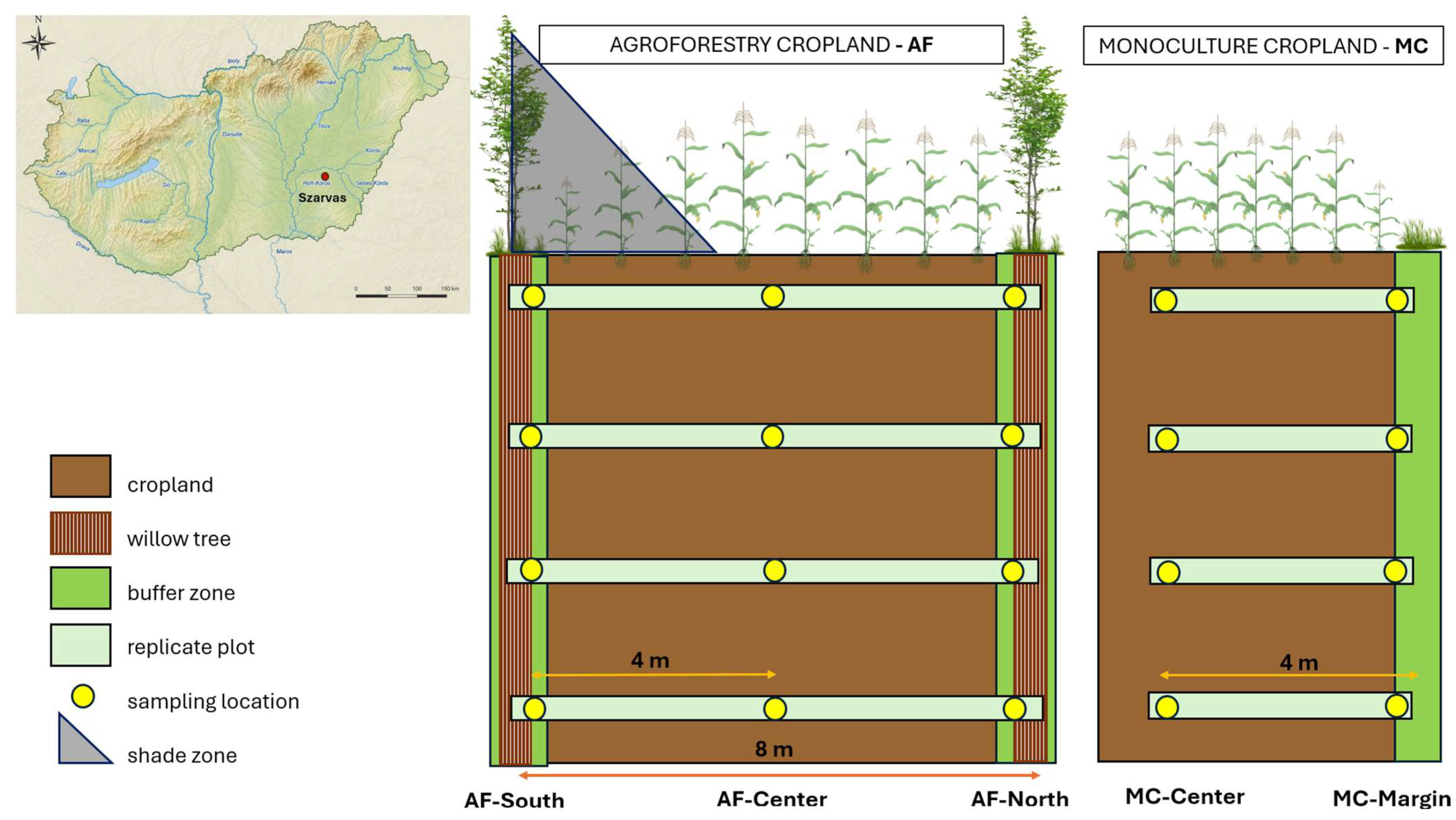
The plantation included both IR and NI areas, where the tree lines were 24, 9, and 6.5 m apart, and the cultivated areas between the tree rows are 23, 8, and 5.5 m wide (without a 0.5 m buffer zone on either side of the rows). Half of the experimental site was IR. Irrigation water was supplied from the oxbow lake of the River Körös once in 2023 (20 June, with 45 mm) and three times in 2024 (9 May, 24 June, and 13 August, with 45, 50, and 50 mm, respectively). The other half of the area was NI. For assessing soil biological activity, earthworm (EW) parameters (abundance, biomass, morphotypes, and species) and weed dynamics were examined perpendicular to the tree lines in the following locations of the 9 m wide tree lines: on both sides of the cultivated-areas, next to the tree lines (AF-South and AF-North) and in the intercrop (maize), 4 m away from both tree lines (AF-Center), as well as at the marginal site of a neighboring MC (MC-Margin) and at 4 m from the margin (MC-Center). The MC was sampled only in the first year (2023) because the study area is part of an actively managed large-scale agricultural system, where a different crop was established in 2024 due to crop rotation and farm management considerations. This altered the vegetation structure and management conditions, making the monoculture treatment no longer directly comparable with the agroforestry system; therefore, further sampling would not have provided an ecologically relevant comparison. The north and south sides of the tree lines were sampled to detect differences related to tree-induced shading (Figure 1). EW and weed samples were taken from the same locations in four replicates on four occasions during the two-year study (25 May 2023; 22 November 2023; 13 May 2024; 30 September 2024).
Soil samples were taken at the same time and location as the EW sampling. The sampling locations were the following: right in the AF tree lines (AF-South and AF-North), 4 m away from the tree line in the intercrop (maize) (AF-Center), and also in the margin of the MC (MC-Margin) and 4 m away from the margin (MC-Center). The composite soil samples consisted of five subsamples. The subsamples were taken from the 0–25 cm soil depth and thoroughly mixed in a bucket; then, a homogeneous composite soil sample (about 500 g) was transported to the laboratory for further physical and chemical analyses.

2.4. Earthworm Sampling

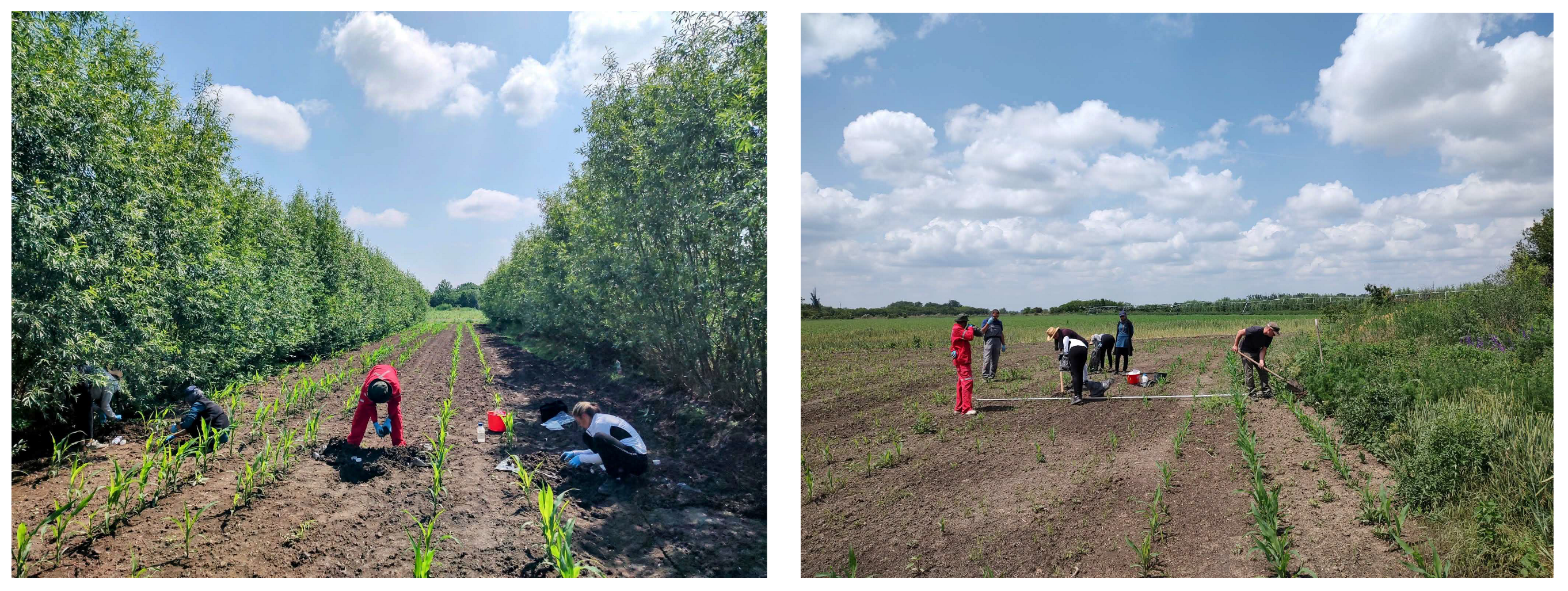
The EWs were sampled using the hand-sorting method according to the ISO Standard (2006) [46]. The size of the excavated soil blocks was 25 cm × 25 cm × 25 cm (one-sixteenth of a square meter at a depth of 25 cm). The soil block was placed on a plastic sheet, and the soil was carefully searched by hand for EWs for a minimum of 15 min (Figure 2). These values were multiplied by 16 to obtain the abundance and biomass of EWs per square meter. Four replications were applied in all cases. The AF site was sampled perpendicular to the planted willow tree (Salix spp.) rows (Figure 1): in the tree lines (AF-South, AF-North), and 4 m away from it (AF-Center), placed in the maize (Zea mays L.) culture, which was cultivated as an intercrop between tree lines. Sampling points were also positioned on both the northern and southern sides of the tree rows. A nearby MC site was also sampled for EWs to provide background information on EW parameters.
The following EW parameters were detected: abundance (expressed as individuals m−2), biomass (gram m−2), morphotypes (epigeic, endogeic, or anecic), species composition based on the external and internal characteristics using the taxonomic keys from Csuzdi and Zicsi [47] and Csuzdi [48].
As for the EW species ratio, the average proportion of the collected EW adults from the four sampling times (Figure 2) (spring and autumn of 2023 and 2024) was calculated both for AF and MC sites.

2.5. Weed Sampling

Weed surveys were conducted in parallel with EW surveys, both in terms of timing (25 May 2023; 22 November 2023; 13 May 2024; 30 September 2024) and location (AF-South, AF-Center, AF-North, MC-Center, and MC-Margin; MC sites only in 2023), in IR and NI areas of 9 m wide interrow lines in four replications. The size of each sampling site was 1 m2 [49], where the total weed cover [50] (excluding woody and crop vegetation) was recorded.

2.6. Statistical Analyses

As the available data did not form a complete data matrix—the MC was only surveyed in spring and autumn 2023—we divided the database into two parts and analyzed them separately.
The first step was to analyze only AF data from 2023 and 2024 to assess the combined effects of the spring and autumn seasons, as well as the effects of the specific years.
In the second step, we analyzed the data for AF and MC together, but only for the year 2023.
For both steps, a Generalized Linear Model (GLM) was used with factor predictors of season, location, and irrigation, as fixed factors on—x + 1—transformed values of dependent variables (adult, juvenile, and total EW abundance; adult, juvenile, and total EW biomass; total weed cover) separately [51], assumed gamma distribution, a used logarithmical link function, and standardized deviance residuals, with the examination of goodness of fit between deviance/df value between 0.8 and 1.2, and with the use of Wald Chi-squared statistics [52] to evaluate the significance of predictors on 95% confidence level. In significant cases of GLM, the Tukey HSD post hoc test was used to analyze the levels of the predictor factors with three or more categories (season in the first step, and location in both steps) [53].
In the third step, the database was divided into eight groups based on sampling dates (four levels) and irrigation (two levels). The effect of location on total EW abundance and total biomass was then compared within these sub-databases using a Generalized Linear Model (GLM) with the parameters described above, followed by a Tukey’s post hoc test at a 95% confidence level.
In the fourth step of the analysis, we examined the relationship between total weed cover and variables describing the EW population (adult, juvenile, and total EW abundance; adult, juvenile, and total EW biomass) separately, using Pearson’s correlation [54]. For this analysis, we used the ln(x + 1)-transformed values of the raw data [55]. We applied this step to both the entire database and its sub-databases, which were broken down by levels of season (2023 spring, 2023 autumn, 2024 spring, and 2024 autumn), location (AF-South, AF-Center, AF-North, MC-Margin, and MC-Center), and irrigation (irrigated and non-irrigated) variables. For this step, results with a confidence level of at least 90% were reported, along with the corresponding correlation coefficients.

3. Results

3.1. Effect on Earthworm Abundance

The EW abundances in the AF sites in 2023–2024 are shown in Table 3. Concerning the seasons, in spring of 2023, significantly greater total EW abundance (number of individuals on one square meter) (104.0 individuals m−2) was obtained as compared to autumn of 2023 (69.3 ind m−2) and spring of 2024 (30.7 ind m−2). Overall, juvenile earthworms were more abundant than adults in all seasons. Regarding the location of the EW sampling, significantly greater total EW abundance was found in the case of the AF-North (100.0 ind m−2) as compared to AF-South (69.5 ind m−2) and AF-Center (58.5 ind m−2) locations. Approximately twice as many juvenile EWs were found in each location as compared to adult ones. As for IR, significantly greater total EW abundance was found under the IR sites (97.3 ind m−2) as compared to the NI ones (54.7 ind m−2). In addition to single effects, the season × location and season × irrigation interactions were also significant in all cases.
The EW abundances in the AF and MC sites combined in 2023 are shown in Table 4. Regarding the season, significantly greater total EW abundance was found in spring of 2023 (85.2 ind m−2), as compared to autumn of 2023 (52.8 ind m−2). A greater number of juveniles was found in both seasons compared to adults. As for the location, significantly greater total EW abundance was found at AF-North (105.0 ind m−2), compared to the MC sites, i.e., MC-Center (58.0 ind m−2) and MC-Margin (27.0 ind m−2). Regarding the effect of IR, significantly greater total EW abundance was found under the IR sites (92.4 ind m−2), as compared to the NI ones (45.6 ind m−2). The season × location and season × irrigation interactions had a significant effect on juvenile and total earthworm abundance.
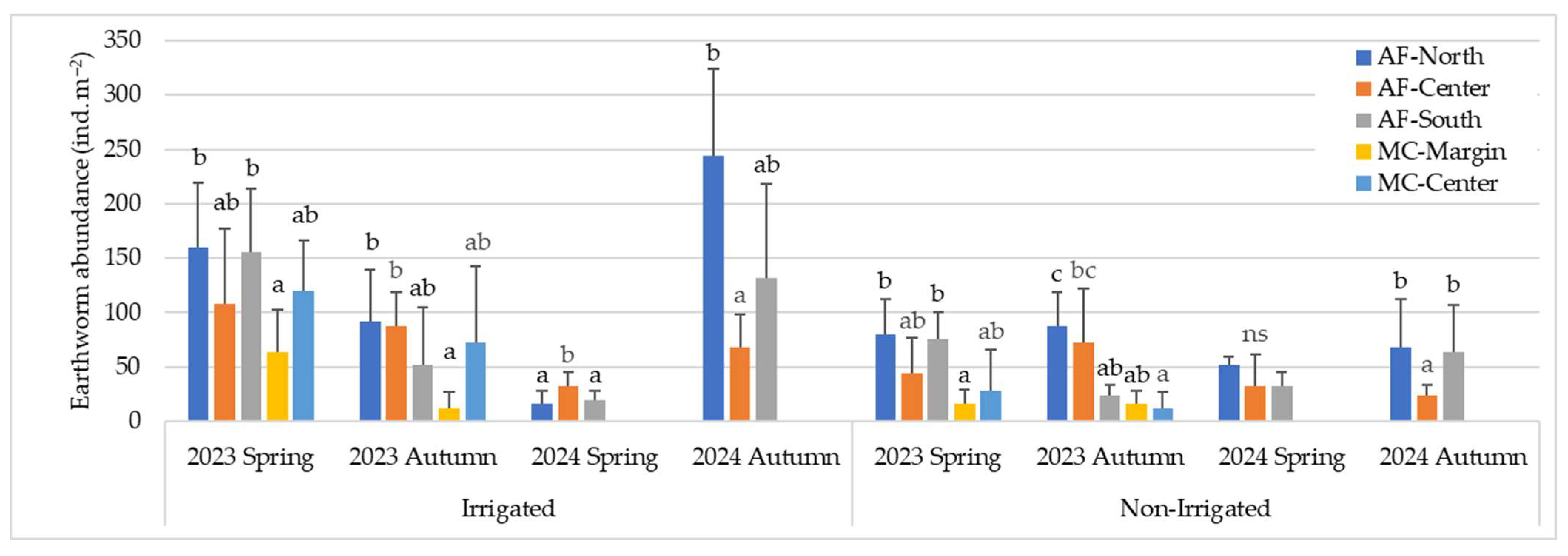
Figure 3 presents earthworm (EW) abundances at the AF and MC sites combined for 2023 and 2024. The first block represents the IR locations, while the second one represents the NI sites. In general, EW abundance was higher under the IR locations compared to the NI ones, except for the spring of 2024.
In spring 2023, samples from the tree lines (AF-North and AF-South) resulted in significantly greater EW abundances as compared to the MC-Margin locations under both IR and NI treatments. However, in autumn 2023 (IR), AF-North and AF-Center were significantly greater than MC-Margin, while in NI treatments, AF-North was significantly greater than AF-South, MC-Margin, and MC-Center.
In 2024, only AF sites were measured. In spring 2024 (IR), significantly greater EW abundance was detected under AF-Center as compared to AF-North and AF-South locations. Whereas, in the NI location, no significant difference was found at the same season.
As for autumn 2024 (IR), AF-North was significantly greater than AF-Center, while under the NI sites, AF-Center also showed the lowest EW abundance compared to the other two locations.

3.2. Effect on Earthworm Biomass

The EW biomass in the AF sites in 2023–2024 is shown in Table 5. Regarding the season, significantly greater EW biomass was obtained in spring 2023 (35.7 g m−2) than in all the other examined seasons (autumn 2024: 23.8 g m−2, autumn 2023: 18.6 g m−2, and spring 2024: 4.1 g m−2). As for the location, AF-North (26.8 g m−2) resulted in significantly greater EW biomass as compared to the AF-Center (15.0 g m−2) site. As for IR, significantly greater biomass was gained under the IR sites (26.4 g m−2) as opposed to the NI ones (14.7 g m−2). The season × location and season × irrigation interactions were significant in the case of biomass of all EW categories, while the three-level interaction was significant for both adult and total biomass.
The EW biomass in the AF and MC sites combined in 2023 is shown in Table 6. Regarding the season, it can be seen that spring, 2023 (27.04 g m−2), gave significantly higher EW total biomass than autumn, 2023 (14.44 g m−2). As for the location, AF-North resulted in significantly greater biomass (31.07 g m−2) than the MC sites (MC-Margin: 12.61; MC-Center: 9.60 g m−2). Regarding IR treatment, IR plots had higher EW biomass (27.50 g m−2) than NI (13.98 g m−2) ones. As for the EW biomass of adults and juveniles, lower EW biomass was gained for juveniles in all factors, as compared to the adults, except for one case (location: MC-Center). Both season × location and season × irrigation interactions were significant for all EW biomass categories.
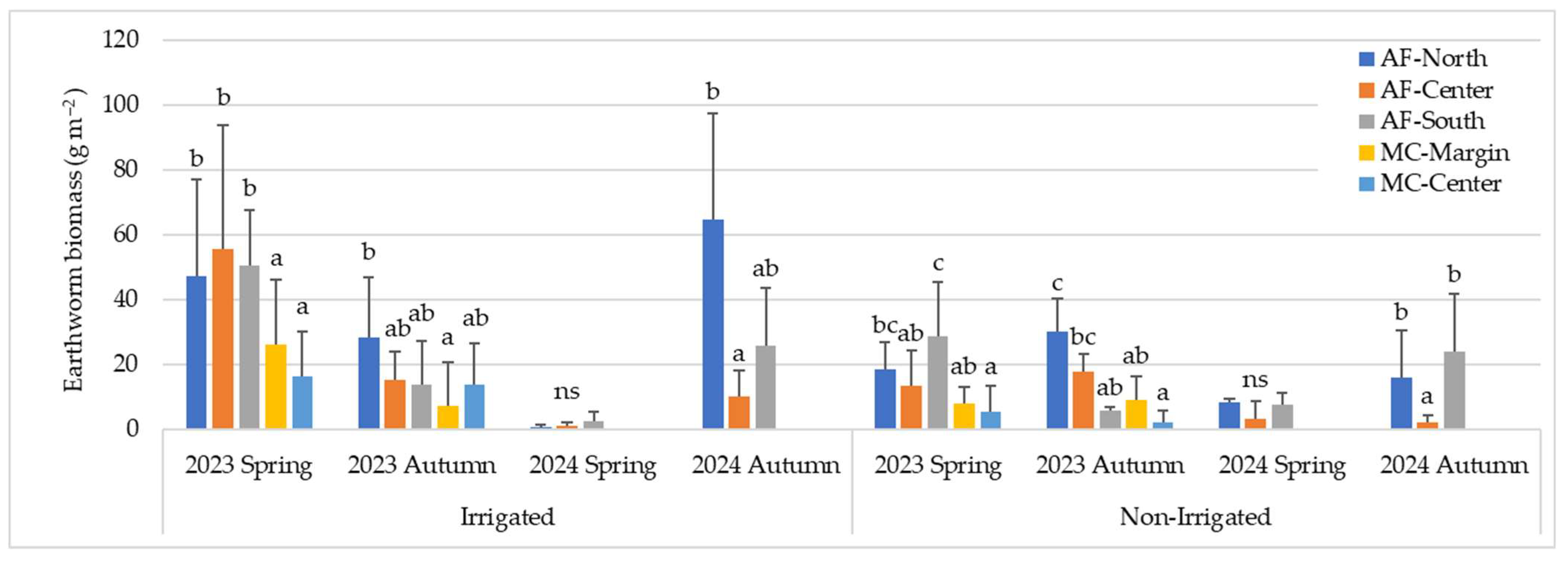
The EW biomass in the AF and MC sites combined in 2023 and 2024 can be seen in Figure 4. The first block represents the IR locations, while the second one represents the NI sites. In general, we can state that the IR sites resulted in greater EW biomass, except for one case (spring, 2024). In spring 2023, under IR, the AF sites had greater EW biomass compared to the MC sites. In autumn 2023 (IR), however, only the AF-North site was significantly greater than the MC-Margin site. In spring, 2024 (IR), no significant differences were detected, while in autumn, 2024 (IR), AF-North was significantly higher than the AF-Center site. As for the NI sites, spring 2023, the AF-South site resulted in significantly higher EW biomass than AF-Center and the MC sites. In autumn 2023, AF-North was significantly greater than AF-South and the MC sites. In spring 2024, no significant differences were detected. In autumn 2024, AF-North and AF-South had significantly greater EW biomass than the AF-Center location.

3.3. Earthworms Species Composition

The detected EW species from the AF site are given in Table 7. It can be seen that Aporrectodea rosea dominated both sites with or without IR, with a minimum of 68.3% presence (68.3–100%). Aporrectodea caliginosa was the next most common species, with an average presence ranging from 12.5% to 29.2%. The third detected species (Octolasion lacteum) was found only at two locations (AF-Center NI and IR sites) and in low proportions (4.3 and 2.6%, respectively).
Concerning the MC that is located about 200 m away from the AF site, we also sampled the EW in spring and autumn of 2023 to obtain some basic information about the EW species composition (Table 8). In this case, we also detected A. rosea as the most dominant EW species (50–100%), followed by A. caliginosa (16.7–50.0%). Another species, Proctodrilus antipai, was detected at only one sampling location (IR—MC-Center), where it accounted for 20.8% of the total.

3.4. Weed Cover: Seasonal and Spatial Effects in AF and MC Systems

The effects of the factors were consistent in the two-year AF and the MC in 2023. The effects of season and location were significant, with higher values in spring 2023. Sampling revealed that the center plots of both the AF (AF-Center) and MC systems (MC-Center) were less weedy, and this difference was significant in the two-year AF and in the MC in 2023. Additionally, two-level interactions were significant in both cases, as was the three-way interaction in AF (Table 9 and Table 10).

3.5. Earthworm–Weed Relationships: Context-Dependent Correlations in Abundance and Biomass

The correlation between total weed cover and EW abundance and biomass was not significant based on the overall dataset. In contrast, when we broke down the data by sampling date, we observed correlations in the autumn of both years. The direction of these correlations was opposite: in 2023, places with fewer weeds resulted in higher EW abundance and biomass, whereas in 2024, locations with more weeds exhibited higher EW abundance and biomass. When analyzing the data by location, significant effects of weed coverage were found only for juvenile EW abundance in AF-Center, and for juvenile and total EW abundance in MC-Margin. At IR sites, higher weed cover resulted in lower juvenile and total EW abundance, whereas at NI sites, the higher weed cover led to increased juvenile and total EW abundance and biomass (Table 11).

4. Discussion

The present study demonstrated that willow-based AF systems generate distinct spatial gradients that significantly influence soil biological activity and weed dynamics in temperate arable conditions. The observed significant increase in EW abundance and biomass in the proximity to tree rows (AF-North) supports our first hypothesis that AF enhances soil biological functioning through improved habitat conditions as compared to MC systems. These findings are consistent with previous studies highlighting the role of perennial vegetation in promoting soil fauna via increased organic matter inputs, i.e., the accumulation of leaf litter and root residues, which provide a food source for soil fauna [16,30,32,56], and have no or reduced soil disturbance [57,58]. The higher abundance and biomass observed in the present study may also be related to local environmental conditions associated with the presence of tree rows. However, the specific mechanisms underlying these patterns were not directly measured and, therefore, cannot be confirmed. In heavy-textured clay soils, moderate warming may stimulate earthworm activity and reproduction by improving aeration and microbial decomposition, whereas excessive shading can maintain cooler, wetter soil conditions that limit biological activity. Additionally, the proximity of the tree rows likely promoted litter accumulation and root-derived organic inputs, providing continuous food resources for soil fauna. Therefore, the higher EW abundance observed in AF-North was likely not the result of a single environmental factor, but presumably rather the combined effects of favorable microclimatic conditions, litter accumulation, moderated soil moisture, and reduced soil disturbance. Furthermore, the combination of the absence or reduced mechanical disturbance and increased organic inputs in AF systems supports diverse functional groups of EWs, including epigeic, endogeic, and anecic species [16]. These organisms further contribute to soil aggregation, nutrient turnover, and carbon stabilization [33]. Regarding the morphotypes of the detected EW species in AF and MC sites, endogeic ones were found, living and feeding in the organic matter-rich topsoil layers (0 to about 20–30 cm). The most dominant EW species (A. rosea, A. caliginosa) are very common in many kinds of habitats (grassy, arable, forest, etc.), and they do not have any preferences for soil types [47]. O. lacteum is also an endogeic species without any preferences to soil type; however, higher abundance is typical in calcareous soils [59], while Proctodrilus antipai was found only in the MC site (IR—MC-Center), prefers soils with high moisture and high clay content, and mostly calcareous soil pH [60]. Regarding the EW juveniles, mostly endogeic morphotypes were found; however, in some cases (IR—AF-North and AF-Center—2023 spring; NI—AF-North and AF-South—2024 spring), a few well-pigmented epigeic (whole body) and anecic juvenile EWs (head part) were also found, but in very low proportions. This suggests that leaf litter from the tree line provides raw plant matter as a food source for EWs, enabling other morphotypes to appear and survive in these habitats as well. These findings indicate that litter accumulation, shading, and soil moisture interact closely in AF systems and together shape habitat suitability for EWs. Leaf litter from willow rows may enhance soil surface protection, reduce evaporation, and increase organic carbon availability, thereby supporting microbial activity and nutrient cycling. Simultaneously, partial shading can buffer extreme soil temperature fluctuations and help maintain more stable moisture conditions during dry periods. However, excessive shading may reduce soil warming and alter vegetation composition, which could explain the lower EW activity observed in some shaded AF-South locations. Consequently, the ecological responses observed in this study are likely associated with the combined influence of organic matter inputs and local environmental conditions created by the presence of tree rows.
Concerning the background soil parameters, they were relatively homogeneous across the experimental areas (both AF and MC). The neutral pH (KCl) values (7.0) are suitable for EWs; most species, especially endogeic ones, prefer pH values between 6.0 and 7.0 [61,62]. The high clay content supports high nutrient and moisture-holding capacity, providing a fertile soil environment. However, this texture is not always suitable for earthworm burrowing, as extreme weather can cause the soil to become hard when dry or sticky and plastic-like when wet [63]. As for the plant-available nitrogen content (NO2 and NO3), somewhat higher values were observed at the NI sites, suggesting some leaching due to irrigation. However, other soil parameters did not differ by location.
Weed dynamics showed clear spatial patterns, indicating that AF systems not only influence soil processes but also plant community assembly [64]. We found significantly greater weed cover in the proximity of tree rows as compared to all other examined habitats (AF-Center; MC-Margin; MC-Center). This finding supported our second hypothesis, i.e., that AF systems create spatial gradients in soil conditions (e.g., soil moisture, organic matter input), which significantly influence weed cover and community composition. Increased weed cover near tree rows may be linked to reduced disturbance intensity and niche diversification, which can support a broader range of species. While higher weed abundance is often viewed negatively in conventional agriculture, in AF systems it may contribute to biodiversity and ecosystem functioning, provided that competitive effects on crops remain manageable [65,66]. Importantly, greater weed cover may also indirectly support EW communities by contributing additional organic residues, root exudates, and soil surface protection. Weed vegetation can reduce soil desiccation and provide supplementary food resources for decomposer organisms, potentially creating more favorable habitats for EWs. Nevertheless, excessive weed competition may negatively affect crop productivity; therefore, the ecological benefits of increased weed diversity in AF systems should be balanced against agronomic considerations.
Irrigation (IR) played a key role in modulating the effects of exposure (N or S), particularly under narrower tree row spacing. The amplification of spatial gradients under IR conditions suggests that water availability interacts with tree-induced microhabitat heterogeneity, enhancing biological activity and vegetation responses. This interaction highlights the importance of considering both structural (tree arrangement) and management (IR) factors when evaluating AF systems [67,68,69].
Regarding the application of irrigation, significantly greater EW abundance and biomass were found on IR sites in AF systems in both years compared to non-irrigated (NI) sites (Table 3 and Table 5). Furthermore, when the AF and the MC systems were analyzed together, we also obtained significantly greater EW abundance and biomass under the IR sites measured in 2023, as compared to the NI ones (Table 4 and Table 6). This partially supported our third hypothesis, i.e., irrigation amplifies the positive effects of AF systems on soil biological activity and weed dynamics, particularly under narrower tree row spacing, since we did not find significant differences in weed cover under IR and NI sites (Table 9). At the same time, the somewhat higher NO2 and NO3 values observed under NI sites may indicate nutrient leaching processes linked to water movement within the soil profile. Altogether, these findings highlight that irrigation not only modifies water availability but also influences nutrient dynamics, organic matter decomposition, and biological interactions belowground.
The pronounced differences between the northern (sun-exposed) and southern (shaded) sides of the tree rows further emphasize the importance of microclimate in structuring below- and above-ground communities. When only the AF sites were analyzed, significantly greater EW abundance was gained in the AF-North location as compared to the other AF sites (Table 3). In the case of EW biomass, we found significantly greater EW biomass in the AF-North site, as compared to the AF-Center site (Table 5). This might suggest that the northern (sunny) side of the tree line was associated with higher EW abundance and biomass than the southern (shaded) side. These differences may be related to spatial variation in environmental conditions and resource availability around the tree rows. However, soil temperature, humidity, and other microclimatic variables were not directly measured in this study; therefore, the mechanisms underlying these patterns cannot be confirmed. Consequently, our fourth hypothesis was only partially supported, as higher EW abundance and biomass were observed on the northern side of the tree rows. The observed pattern is consistent with relationships reported in previous studies; however, the underlying microclimatic mechanisms were not directly assessed in the present study.
Our last hypothesis, i.e., “Earthworm abundance and biomass differ between the northern and southern sides of tree rows”, was only partially supported by our data, as significant differences were only found between AF-North and MC sites (Margin and Center). AF-South and AF-Center did not differ from MC-Center in terms of EW abundance, nor from MC-Margin in terms of EW biomass. This indicates that AF-South (in the tree line) and AF-Center exhibited characteristics similar to the MC sites, so land-use generalizations cannot be made based on these results. The location within the land use (Margin or Center) is also crucial in determining the local soil and environmental conditions for EWs and weed cover.
Overall, the results confirm that AF systems can enhance ecological heterogeneity, which Jose [70] confirms, and promote soil biological activity, although these effects are spatially variable and strongly dependent on local conditions [31,71]. The lack of significant differences between certain treatments also suggests that the benefits of AF are not uniform across the entire system, highlighting the need for spatially explicit management strategies [72,73]. The observed patterns demonstrate that interactions among litter accumulation, shading intensity, soil moisture, and management practices such as irrigation collectively determine the functioning of belowground communities in AF systems.

5. Conclusions

Agroforestry systems may generate pronounced spatial heterogeneity in soil conditions, which may be reflected in localized differences in soil biological activity rather than a uniform response across the entire system. Tree rows may create spatial gradients in environmental conditions that are associated with variations in EW abundance and biomass, particularly between different sides of the tree rows. In the present study, higher values were observed on the northern (sun-exposed) side; however, the underlying microclimatic variables (e.g., temperature, humidity, and radiation) were not directly measured, and, therefore, the mechanisms behind these patterns cannot be confirmed. Tree row spacing and irrigation may also influence the magnitude of these spatial patterns, with narrower spacing and more intensive irrigation potentially being associated with stronger spatial variability in soil biological responses. While not all sampling positions within the agroforestry (AF) systems differed significantly from adjacent monoculture conditions, the results suggest that ecological functioning in AF systems is spatially heterogeneous and dependent on sampling position. From a management perspective, these findings suggest that AF should be considered a spatially explicit system, in which soil biological benefits are concentrated in specific microhabitats rather than being distributed evenly. This highlights the importance of adapting management practices to site-specific conditions within fields to more effectively harness the ecological potential of agroforestry (AF) systems.
The weed cover was highest near the tree rows, compared to other AF-Center and MC sites. This confirms the presence of a clear spatial pattern in the structure of the aboveground plant community. However, this increase was limited to specific positions and was not representative of the entire (AF) system. Overall, the results suggest that AF systems can influence soil biology and weed growth, but these effects vary greatly depending on the location within the field, the position of the tree rows, the spacing, and the irrigation. The findings highlight that the impact of AF should be assessed on a fine spatial scale rather than as a uniform, field-level improvement.
Future research should focus on long-term monitoring, yield–soil biota interactions, the effect of weed composition on EW community, and the optimization of tree–crop spatial configurations to better understand how AF design influences both ecological processes and agricultural performance.

Author Contributions

Conceptualization, B.B., B.S. and M.M.M.; methodology, B.B., B.S., M.Z., I.K. and M.J.; software, M.Z.; validation, B.S. and Á.K.; formal analysis, B.B., B.S., M.Z. and Á.K.; investigation, B.B., D.S., M.M.M. and Z.D.; resources, B.B., B.S., I.K., Z.D. and M.J.; data curation, B.B., B.S. and M.Z.; writing—original draft preparation, B.B., B.S., M.Z. and D.S.; writing—review and editing, B.B., B.S., M.Z., I.K., C.G., G.P.K. and Á.K.; visualization, B.B. and M.Z.; supervision, B.S., C.G. and Á.K.; project administration, B.B. and Á.K.; funding acquisition, B.B., C.G. and G.P.K. All authors have read and agreed to the published version of the manuscript.

Funding

This research was funded by the National Research Excellence Program (ADVANCED 151105—The development of agro-technologies that improve the management of organic matter in soils and ensure the utilization of saline soils, with short-rotation energy willow breeding materials) and ClimaPannonia (HORIZON-MISS-2023-CLIMA-01-01: Building regional resilience via large-scale uptake of systemic solutions in agricultural ecosystem) projects.

Institutional Review Board Statement

Not applicable.

Data Availability Statement

The data presented in this study are available on request from the corresponding author due to privacy concerns.

Conflicts of Interest

Author Maimela Maxwell Modiba was employed by the company OPUS Cactus SA Africa Office. The remaining authors declare that the research was conducted in the absence of any commercial or financial relationships that could be construed as a potential conflict of interest.

Abbreviations

AF—agroforestry site, MC—monocultural cropland; EW—earthworm; IR—irrigated; NI—non-irrigated; N—northern side, S—southern side.

References

  1. Donat, M.; Geistert, J.; Grahmann, K.; Bellingrath-Kimura, S.D. Orientation of Tree Rows in Alley Cropping Systems Matters—The “ShadOT” Modelling Tool for Tree Growth and Shading Effects. MethodsX 2023, 11, 102282. [Google Scholar] [CrossRef] [PubMed]
  2. Jackson, J.E.; Palmer, J.W. Interception of Light by Model Hedgerow Orchards in Relation to Latitude, Time of Year and Hedgerow Configuration and Orientation. J. Appl. Ecol. 1972, 9, 341. [Google Scholar] [CrossRef]
  3. Dupraz, C.; Blitz-Frayret, C.; Lecomte, I.; Molto, Q.; Reyes, F.; Gosme, M. Influence of Latitude on the Light Availability for Intercrops in an Agroforestry Alley-Cropping System. Agrofor. Syst. 2018, 92, 1019–1033. [Google Scholar] [CrossRef]
  4. Dupraz, C.; Lawson, G.J.; Lamersdorf, N.; Papanastasis, V.P.; Rosati, A.; Ruiz-Mirazo, J. Temperate Agroforestry: The European Way. In Temperate Agroforestry System; CABI: Wallingford, UK, 2018; pp. 98–152. [Google Scholar] [CrossRef]
  5. Brunner, A. A Light Model for Spatially Explicit Forest Stand Models. For. Ecol. Manag. 1998, 107, 19–46. [Google Scholar] [CrossRef]
  6. Talbot, G.; Dupraz, C. Simple Models for Light Competition within Agroforestry Discontinuous Tree Stands: Are Leaf Clumpiness and Light Interception by Woody Parts Relevant Factors? Agrofor. Syst. 2011, 84, 101–116. [Google Scholar] [CrossRef]
  7. Leroy, C.; Sabatier, S.; Wahyuni, N.S.; Barczi, J.-F.; Dauzat, J.; Laurans, M.; Auclair, D. Virtual Trees and Light Capture: A Method for Optimizing Agroforestry Stand Design. Agrofor. Syst. 2009, 77, 37–47. [Google Scholar] [CrossRef]
  8. Dlamini, Z.; Kun, Á.; Gombos, B.; Zalai, M.; Kolozsvári, I.; Jancsó, M.; Bakti, B.; Menyhárt, L. The Optimization of Maize Intercropped Agroforestry Systems by Changing the Fertilizing Level and Spacing Between Tree Lines. Land 2026, 15, 126. [Google Scholar] [CrossRef]
  9. Jacobs, S.R.; Webber, H.; Niether, W.; Grahmann, K.; Lüttschwager, D.; Schwartz, C.; Breuer, L.; Bellingrath-Kimura, S.D. Modification of the Microclimate and Water Balance through the Integration of Trees into Temperate Cropping Systems. Agric. For. Meteorol. 2022, 323, 109065. [Google Scholar] [CrossRef]
  10. Gyuricza, C.; Bakti, B.; Benke, A.; Kovács, G.P.; Balla, I.; Borovics, A. Energetikai ültetvények szerepe az agrárerdészeti rendszerekben. In Agrárerdészet; Gyuricza, C., Borovics, A., Radó, G., Somogyi, N., Eds.; Nemzeti Agrárkutatási és Innovációs Központ: Gödöllő, Hungary, 2018; pp. 171–218. [Google Scholar]
  11. Albertsson, J. Weed problems and possibilities for their control in Salix for biomass. In Introductory Paper at the Faculty of Landscape Planning, Horticulture and Agricultural Science; Swedish University of Agricultural Sciences: Alnarp, Sweden, 2012; Volume 5, Available online: https://res.slu.se/id/publ/40989 (accessed on 29 May 2026).
  12. Reuse, C.; Langhof, M. The Impact of Tree Height and Distance on Crop Yields in a Temperate Short Rotation Alley Cropping Agroforestry System: A Multi-Year Study. Agrofor. Syst. 2025, 99, 140. [Google Scholar] [CrossRef]
  13. Borger, C.P.D.; Hashem, A.; Powles, S.B. Manipulating Crop Row Orientation and Crop Density to Suppress Lolium Rigidum. Weed Res. 2015, 56, 22–30. [Google Scholar] [CrossRef]
  14. Borger, C.P.D.; Hashem, A.; Pathan, S. Manipulating Crop Row Orientation to Suppress Weeds and Increase Crop Yield. Weed Sci. 2010, 58, 174–178. [Google Scholar] [CrossRef]
  15. Johnson, W.C., III; Davis, J.W. Perpendicular Cultivation for Improved In-Row Weed Control in Organic Peanut Production. Weed Technol. 2015, 29, 128–134. [Google Scholar] [CrossRef]
  16. Kun, Á.; Simon, B.; Zalai, M.; Kolozsvári, I.; Bozán, C.; Jancsó, M.; Körösparti, J.T.; Kovács, G.P.; Gyuricza, C.; Bakti, B. Effect of Mulching on Soil Quality in an Agroforestry System Irrigated with Reused Water. Agronomy 2023, 13, 1622. [Google Scholar] [CrossRef]
  17. Fernández, M.E.; Gyenge, J.; Licata, J.; Schlichter, T.; Bond, B.J. Belowground Interactions for Water between Trees and Grasses in a Temperate Semiarid Agroforestry System. Agrofor. Syst. 2008, 74, 185–197. [Google Scholar] [CrossRef]
  18. Thompson, S.E.; Harman, C.J.; Heine, P.; Katul, G.G. Vegetation-infiltration Relationships across Climatic and Soil Type Gradients. J. Geophys. Res. 2010, 115, G02023. [Google Scholar] [CrossRef]
  19. Inurreta-Aguirre, H.D.; Lauri, P.-É.; Dupraz, C.; Gosme, M. Impact of Shade and Tree Root Pruning on Soil Water Content and Crop Yield of Winter Cereals in a Mediterranean Alley Cropping System. Agrofor. Syst. 2022, 96, 747–757. [Google Scholar] [CrossRef]
  20. Ludwig, F.; Dawson, T.E.; de Kroon, H.; Berendse, F.; Prins, H.H.T. Hydraulic Lift in Acacia Tortilis Trees on an East African Savanna. Oecologia 2002, 134, 293–300. [Google Scholar] [CrossRef] [PubMed]
  21. Hirota, I.; Sakuratani, T.; Sato, T.; Higuchi, H.; Nawata, E. A Split-Root Apparatus for Examining the Effects of Hydraulic Lift by Trees on the Water Status of Neighbouring Crops. Agrofor. Syst. 2004, 60, 181–187. [Google Scholar] [CrossRef]
  22. Carroll, Z.L.; Bird, S.B.; Emmett, B.A.; Reynolds, B.; Sinclair, F.L. Can Tree Shelterbelts on Agricultural Land Reduce Flood Risk? Soil Use Manag. 2004, 20, 357–359. [Google Scholar] [CrossRef]
  23. Cubera, E.; Moreno, G. Effect of Land-Use on Soil Water Dynamic in Dehesas of Central–Western Spain. CATENA 2007, 71, 298–308. [Google Scholar] [CrossRef]
  24. Quinkenstein, A.; Wöllecke, J.; Böhm, C.; Grünewald, H.; Freese, D.; Schneider, B.U.; Hüttl, R.F. Ecological Benefits of the Alley Cropping Agroforestry System in Sensitive Regions of Europe. Environ. Sci. Policy 2009, 12, 1112–1121. [Google Scholar] [CrossRef]
  25. Sierra, C.A.; Ahrens, B.; Bolinder, M.A.; Braakhekke, M.C.; von Fromm, S.; Kätterer, T.; Luo, Z.; Parvin, N.; Wang, G. Carbon Sequestration in the Subsoil and the Time Required to Stabilize Carbon for Climate Change Mitigation. Glob. Change Biol. 2024, 30, e17153. [Google Scholar] [CrossRef]
  26. Rodríguez, W.; Suárez, J.C.; Casanoves, F. Total Litterfall and Leaf-Litter Decomposition of Theobroma Grandiflorum under Different Agroforestry Systems in the Western Colombian Amazon. Agrofor. Syst. 2023, 97, 1541–1556. [Google Scholar] [CrossRef]
  27. Edwards, C.A.; Arancon, N.Q. Biology and Ecology of Earthworms; Springer: Greer, SC, USA, 2022. [Google Scholar]
  28. Lavelle, P.; Bignell, D.; Lepage, M.; Wolters, V.; Roger, P.-A.; Ineson, P.; Heal, O.W.; Dhillion, S. Soil function in a changing world: The role of invertebrate ecosystem engineers. Eur. J. Soil Biol. 1997, 33, 159–193. [Google Scholar]
  29. Jouquet, P.; Dauber, J.; Lagerlöf, J.; Lavelle, P.; Lepage, M. Soil Invertebrates as Ecosystem Engineers: Intended and Accidental Effects on Soil and Feedback Loops. Appl. Soil Ecol. 2006, 32, 153–164. [Google Scholar] [CrossRef]
  30. D’Hervilly, C.; Bertrand, I.; Berlioz, L.; Hedde, M.; Capowiez, Y.; Dufour, L.; Marsden, C. Tracking Earthworm Fluxes at the Interface between Tree Rows and Crop Habitats in a Mediterranean Alley Cropping Field. Eur. J. Soil Biol. 2024, 120, 103572. [Google Scholar] [CrossRef]
  31. Udawatta, R.P.; Rankoth, L.; Jose, S. Agroforestry and Biodiversity. Sustainability 2019, 11, 2879. [Google Scholar] [CrossRef]
  32. Cardinael, R.; Mao, Z.; Chenu, C.; Hinsinger, P. Belowground Functioning of Agroforestry Systems: Recent Advances and Perspectives. Plant Soil 2020, 453, 1–13. [Google Scholar] [CrossRef]
  33. Blouin, M.; Hodson, M.E.; Delgado, E.A.; Baker, G.; Brussaard, L.; Butt, K.R.; Dai, J.; Dendooven, L.; Peres, G.; Tondoh, J.E.; et al. A Review of Earthworm Impact on Soil Function and Ecosystem Services. Eur. J. Soil Sci. 2013, 64, 161–182. [Google Scholar] [CrossRef]
  34. Li, T.; Fan, J.-Q.; Qian, H.-W.; Wei, J.-H.; Qian, Z.-G.; Guo, S.-L.; Lv, W.-G. Earthworm Activities Enhance Taro Production by Reducing Weed Infestation through Taro–Earthworm Coculture. Agric. Ecosyst. Environ. 2023, 352, 108533. [Google Scholar] [CrossRef]
  35. Pumariño, L.; Sileshi, G.W.; Gripenberg, S.; Kaartinen, R.; Barrios, E.; Muchane, M.N.; Midega, C.; Jonsson, M. Effects of Agroforestry on Pest, Disease and Weed Control: A Meta-Analysis. Basic Appl. Ecol. 2015, 16, 573–582. [Google Scholar] [CrossRef]
  36. Radicetti, E.; Mancinelli, R. Sustainable Weed Control in the Agro-Ecosystems. Sustainability 2021, 13, 8639. [Google Scholar] [CrossRef]
  37. Wolz, K.J.; DeLucia, E.H. Alley Cropping: Global Patterns of Species Composition and Function. Agric. Ecosyst. Environ. 2018, 252, 61–68. [Google Scholar] [CrossRef]
  38. Stigter, K. Agroforestry and (Micro)Climate Change. In Tree-Crop Interactions: Agroforestry in a Changing Climate; CABI: Wallingford, UK, 2015; pp. 119–145. [Google Scholar]
  39. Wang, W.; Wang, J.; Cao, X. Water Use Efficiency and Sensitivity Assessment for Agricultural Production System from the Water Footprint Perspective. Sustainability 2020, 12, 9665. [Google Scholar] [CrossRef]
  40. IUSS Working Group WRB. World Reference Base for Soil Resources. In International Soil Classification System for Naming Soils and Creating Legends for Soil Maps, 4th ed.; International Union of Soil Sciences (IUSS): Vienna, Austria, 2022. [Google Scholar]
  41. Buzás, I. (Ed.) Talaj-Talaj-És Agrokémiai Vizsgálati Módszerkönyv; Physico-Chemical and Chemical Test Methods of Soils; INDA 4231 Kiadó: Budapest, Hungary, 1993. (In Hungarian) [Google Scholar]
  42. MSZ 20135:1999; Determination of the Soluble Nutrient Element Content of the Soil. Hungarian Standards Institution (MSZT): Budapest, Hungary, 1999.
  43. MSZ 08 1783 28-30:1985; Plant Analysis. Determination of Phosphorus Content After Hydrochloric Acid Digestion. Hungarian Standards Institution (MSZT): Budapest, Hungary, 1985.
  44. ISO 5983-2:2009; Animal Feeding Stuffs—Determination of Nitrogen Content and Calculation of Crude Protein Content—Part 2: Block Digestion and Steam Distillation Method. ISO: Geneva, Switzerland, 2009.
  45. Dlamini, Z.; Jancsó, M.; Székely, Á.; Kolozsvári, I.; Túri, N.; Bakti, B.; Zalai, M.; Kun, Á. Assessing Yield, Biomass Production, and Forage Quality of Red Clover (Trifolium pratense L.) in Agroforestry System: One-Year Study in Szarvas, Hungary. Agronomy 2024, 14, 1921. [Google Scholar] [CrossRef]
  46. ISO 23611-1:2006; Soil Quality–Sampling of Soil Invertebrates–Part 1: Hand-Sorting and Formalin Extraction of Earthworms. 1st ed. ISO: Geneva, Switzerland, 2006.
  47. Csuzdi, C.; Zicsi, A. Earthworms of Hungary (Annelida: Oligochaeta, Lumbricidae); Hungarian Natural History Museum: Budapest, Hungary, 2003. [Google Scholar] [CrossRef]
  48. Csuzdi, C. Magyarország földigiliszta-faunájának áttekintése (Oligochaete, Lumbricidae) [A review of the Hungarian earthworm fauna]. ÁLlattani Közlemények 2007, 92, 3–38. (In Hungarian) [Google Scholar]
  49. Zalai, M.; Dorner, Z.; Kolozsvári, L.; Keresztes, Z.; Szalai, M. What does the precision of weed sampling of maize fields depend on? Növényvédelem 2012, 48, 451–456, (In Hungarian with English abstract). [Google Scholar]
  50. Németh, I.; és Sárfalvi, B. Comparative studies on methodology of weed surveys. Növényvédelem 1998, 34, 15–22, (In Hungarian with English abstract). [Google Scholar]
  51. Ziegel, E.R. Generalized Linear Models. Technometrics 2002, 44, 287–288. [Google Scholar] [CrossRef]
  52. Moore, D.S. Generalized Inverses, Wald’s Method, and the Construction of Chi-Squared Tests of Fit. J. Am. Stat. Assoc. 1977, 72, 131–137. [Google Scholar] [CrossRef]
  53. Tukey, J.W. Comparing Individual Means in the Analysis of Variance. Biometrics 1949, 5, 99. [Google Scholar] [CrossRef]
  54. Schober, P.; Boer, C.; Schwarte, L.A. Correlation Coefficients: Appropriate Use and Interpretation. Anesth. Analg. 2018, 126, 1763–1768. [Google Scholar] [CrossRef]
  55. West, R.M. Best Practice in Statistics: The Use of Log Transformation. Ann. Clin. Biochem. 2021, 59, 162–165. [Google Scholar] [CrossRef] [PubMed]
  56. Bakti, B.; Simon, B.; Zalai, M.; Tharwat Mohamed Ibrahim, H.; Modiba, M.M.; Dlamini, Z.; Kun, Á. Examination of Earthworm Abundance; Biomass Andcorrelations of Soil Organic Matter in an Irrigated (with River and Catfish Effluent Water) and Mulched Agroforestry System. Columella 2024, 11, 5–17. [Google Scholar] [CrossRef]
  57. Decaëns, T.; Jiménez, J.J. Earthworm Communities under an Agricultural Intensification Gradient in Colombia. Plant Soil 2002, 240, 133–143. [Google Scholar] [CrossRef]
  58. Duhour, A.; Costa, C.; Momo, F.; Falco, L.; Malacalza, L. Response of Earthworm Communities to Soil Disturbance: Fractal Dimension of Soil and Species’ Rank-Abundance Curves. Appl. Soil Ecol. 2009, 43, 83–88. [Google Scholar] [CrossRef]
  59. Zicsi, A. Ein zusammenfassendes Verbreitungsbild der Regenwürmer auf Grund der Boden- und Vegetationsverhältnisse Ungarns. Opusc. Zool. Budapest 1968, 8, 99–164. [Google Scholar]
  60. Zicsi, A. Beitrag zur geographischen Verbreitung und ökologie von Allolobophora antipai (Michaelsen) 1891. Ann. Univ. Sci. Budapestiensis Rolando Eötvös Nomin. Sect. Biol. 1959, 2, 283–292. [Google Scholar]
  61. Bouché, M.B. Lombricines de France. Ecologie et Systèmatique; INRA Publ. 72-2; Institut National des Recherches Agriculturelles: Paris, France, 1972. [Google Scholar]
  62. Lee, K.E. Earthworms: Their Ecology and Relationships with Soil and Land Use; Academic Press: New York, NY, USA, 1985; 432p. [Google Scholar]
  63. Dudek, M.; Waroszewski, J.; Kabała, C.; Łabaz, B. Vertisols Properties and Classification in Relation to Parent Material Differentiation near Strzelin (SW Poland). Soil Sci. Annu. 2019, 70, 158–169. [Google Scholar] [CrossRef]
  64. Boinot, S.; Alignier, A.; Storkey, J. Landscape Perspectives for Agroecological Weed Management. A Review. Agron. Sustain. Dev. 2024, 44, 7. [Google Scholar] [CrossRef]
  65. Casanova-Lugo, F.; Lara-Pérez, L.A.; Dzib-Castillo, B.; Caamal-Maldonado, J.A.; Ramírez-Barajas, P.J.; Cetzal-Ix, W.R.; Estrada-Medina, H. Alley Cropping Agroforestry Systems Change Weed Community Composition and Reduce Dominant Weed Species Associated with Corn in Southern Mexico. Agric. Ecosyst. Environ. 2023, 350, 108471. [Google Scholar] [CrossRef]
  66. Trinchera, A.; Warren Raffa, D. Weeds: An Insidious Enemy or a Tool to Boost Mycorrhization in Cropping Systems? Microorganisms 2023, 11, 334. [Google Scholar] [CrossRef]
  67. Cardinael, R.; Chevallier, T.; Barthès, B.G.; Saby, N.P.A.; Parent, T.; Dupraz, C.; Bernoux, M.; Chenu, C. Impact of Alley Cropping Agroforestry on Stocks, Forms and Spatial Distribution of Soil Organic Carbon—A Case Study in a Mediterranean Context. Geoderma 2015, 259–260, 288–299. [Google Scholar] [CrossRef]
  68. Beule, L.; Vaupel, A.; Moran-Rodas, V.E. Abundance, Diversity, and Function of Soil Microorganisms in Temperate Alley-Cropping Agroforestry Systems: A Review. Microorganisms 2022, 10, 616. [Google Scholar] [CrossRef]
  69. Wang, Z.; Xiong, K.; Wu, C.; Luo, D.; Xiao, J.; Shen, C. Characteristics of Soil Moisture Variation in Agroforestry in Karst Region. Land 2023, 12, 347. [Google Scholar] [CrossRef]
  70. Jose, S. Agroforestry for Ecosystem Services and Environmental Benefits: An Overview. Agrofor. Syst. 2009, 76, 1–10. [Google Scholar] [CrossRef]
  71. Topa, D.-C.; Căpșună, S.; Calistru, A.-E.; Ailincăi, C. Sustainable Practices for Enhancing Soil Health and Crop Quality in Modern Agriculture: A Review. Agriculture 2025, 15, 998. [Google Scholar] [CrossRef]
  72. Beillouin, D.; Ben-Ari, T.; Makowski, D. Evidence Map of Crop Diversification Strategies at the Global Scale. Environ. Res. Lett. 2019, 14, 123001. [Google Scholar] [CrossRef]
  73. Telo da Gama, J. The Role of Soils in Sustainability, Climate Change, and Ecosystem Services: Challenges and Opportunities. Ecologies 2023, 4, 552–567. [Google Scholar] [CrossRef]
Figure 1. The location (Szarvas) and the layout of the experimental sites on the agroforestry (AF) and monoculture cropland (MC).
Agriculture 16 01287 g001
Figure 2. Earthworm and soil sampling in the middle of the agroforestry (AF-Center) (left) and the monoculture cropland (MC-Center) (right) on 25 May 2023.
Agriculture 16 01287 g002
Figure 3. Earthworm abundances on the agroforestry and monoculture cropland sites between 2023 and 2024. (AF-North: agroforestry site, next to the tree lines at the north site of the interrow line; AF-Center: agroforestry site, 4 m from tree lines; AF-South: agroforestry site, next to the tree lines at the south site of the interrow line; MC-Margin: monoculture cropland site, at the field margin; MC-Centre: monoculture cropland site, 4 m from the field margin; There were no significant differences between survey sites that were designated the same letter in relation to the same irrigation regime and sampling period).
Agriculture 16 01287 g003
Figure 4. Earthworm biomass values on the agroforestry sites between 2023 and 2024. (AF-North: agroforestry site, next to the tree lines at the north side of the interrow line; AF-Center: agroforestry site, 4 m from tree lines; AF-South: agroforestry site, next to the tree lines at the south side of the interrow line; MC-Margin: monoculture cropland site, at the field margin; MC-Center: monoculture cropland site, 4 m from the field margin; There were no significant differences between survey sites that were designated the same letter in relation to the same irrigation regime and sampling period).
Agriculture 16 01287 g004
Table 1. Precipitation, irrigation, and monthly average temperature between 1991 and 2020, and in 2023 and 2024 in the experimental area, Szarvas.
Weather FactorPrecipitation + Irrigation ATemperature
Year/Period1991–2020202320241991–202020232024
Monthmm°C
January28.249.919.6−0.44.71.8
February34.115.110.91.33.28.9
March27.125.311.26.28.110.1
April38.219.337.112.110.014.3
May51.856.024.7 + 45.0 A17.017.018.4
June65.520.1 + 45.0 A70.420.820.723.1
July65.933.358.8 + 50.0 A22.524.325.8
August48.133.716.2 + 50.0 A22.324.026.0
September50.531.089.317.020.918.8
October43.121.339.011.315.311.9
November40.385.236.95.97.03.7
December44.978.031.30.73.22.2
Total/Avg.537.6468.2 + 45.0 A445.4 + 145.0 A11.413.213.8
A Irrigation: June 2023: 45 mm; May 2024: 45 mm, July 2024: 50 mm; August 2024: 50 mm.
Table 2. The measured soil parameters (n = 12) on the agroforestry and monoculture cropland experimental sites.
Year A20232024
Cropping System BAFMCAF
Irrigation CIRNIIRNIIRNI
Soil ParametersMean ± SD
pH (KCl)7.0 ± 0.17.0 ± 0.17.0 ± 0.17.0 ± 0.17.0 ± 0.17.0 ± 0.1
Soil texture by Arany (KA)56.0 ± 2.557.5 ± 1.852.4 ± 1.154.6 ± 4.255.5 ± 2.254.6 ± 1.2
Water soluble total salt (m/m%)0.1 ± 0.00.1 ± 0.00.1 ± 0.00.1 ± 0.00.1 ± 0.00.1 ± 0.0
CaCO3 (m/m%)0.3 ± 0.10.5 ± 0.30.7 ± 0.10.3 ± 0.00.3 ± 0.00.4 ± 0.2
Humus (m/m%)1.8 ± 0.11.8 ± 0.11.6 ± 0.11.9 ± 0.12.0 ± 0.11.9 ± 0.1
NO2 + NO3-N (KCl, mg kg−1)13.0 ± 917.0 ± 89.0 ± 117.0 ± 89.0 ± 412.0 ± 7
P2O5 (AL, mg kg−1)99.0 ± 20106.0 ± 21310.0 ± 15245.0 ± 33115.0 ± 31122.0 ± 14
K2O (AL, mg kg−1)249.0 ± 15247.0 ± 15291.0 ± 8306.0 ± 31261.0 ± 16248.0 ± 11
A Sampling dates: 23 November 2023, 4 November 2024; B AF: agroforestry, MC: monoculture cropland; C IR: irrigated, NI: non-irrigated.
Table 3. Earthworm abundance in the agroforestry sites between 2023 and 2024.
Factor(s)/LevelsAdult (Individual m−2)Juvenile (Individual m−2)Total (Individual m−2)
Wald χ2Sig AMean BWald χ2Sig AMean BWald χ2Sig AMean B
Season (S)29.4<0.001 37.1<0.001 60.6<0.001
 Spring 2023 38.0 b 66.0 bc 104.0 c
 Autumn 2023 28.0 b 41.3 ab 69.3 b
 Spring 2024 6.7 a 24.0 a 30.7 a
 Autumn 2024 28.0 b 72.0 c 100.0 bc
Location (L)9.10.010 12.60.002 21.6<0.001
 AF-South 24.0 ab 45.5 ab 69.5 a
 AF-Center 18.0 a 40.5 a 58.5 a
 AF-North 33.5 b 66.5 b 100.0 b
Irrigation (I)5.20.022 27.1<0.001 31.9<0.001
 Irrigated 30.0 67.3 97.3
 Non-irrigated 20.37 34.3 54.7
S × L15.60.016 22.30.001 29.8<0.001
S × I12.10.007 33.5<0.001 35.1<0.001
L × I2.8ns 1.3ns 1.8ns
S × L × I10.4ns 9.3ns 14.20.027
A ns: not significant on 95% confidence level; B individual m−2; according to the Tukey post hoc test at a 95% confidence level, there are no significant differences between levels of the season or location factor with the same letter.
Table 4. Earthworm abundance in the agroforestry and monoculture cropland sites in spring and autumn of 2023.
Factor(s)/LevelsAdult (Individual m−2)Juvenile (Individual m−2)Total (Individual m−2)
Wald χ2Sig AMean BWald χ2Sig AMean BWald χ2Sig AMean B
Season (S)5.40.020 12.00.001 16.1<0.001
 Spring 2023 30.0 55.2 85.2
 Autumn 2023 20.0 32.8 52.8
Location (L)22.46<0.001 26.5<0.001 40.9<0.001
 AF-South 30.0 ab 47.0 b 77.0 bc
 AF-Center 31.0 ab 47.0 b 78.0 bc
 AF-North 38.0 b 67.0 b 105.0 c
 MC-Margin 12.0 a 15.0 a 27.0 a
 MC-Center 14.0 a 44.0 ab 58.0 ab
Irrigation (I)15.8<0.001 20.9<0.001 33.7<0.001
 Irrigated 33.6 58.8 92.4
 Non-irrigated 16.4 29.2 45.6
S × L5.9ns 13.90.008 10.60.031
S × I3.1ns 8.10.004 10.40.001
L × I1.2ns 8.5ns 4.9ns
S × L × I4.0ns 0.5ns 0.8ns
A ns: not significant on 95% confidence level; B individual m−2; according to the Tukey post hoc test at a 95% confidence level, there are no significant differences between levels of the location factor with the same letter.
Table 5. Earthworm biomass in the agroforestry sites between 2023 and 2024.
Factor(s)/LevelsAdult Biomass (g m−2)Juvenile Biomass (g m−2)Total Biomass (g m−2)
Wald χ2Sig AMean BWald χ2Sig AMean BWald χ2Sig AMean B
Season (S)36.4<0.001 49.7<0.001 67.4<0.001
 Spring 2023 23.1 c 12.6 c 35.7 c
 Autumn 2023 12.0 ab 6.6 ab 18.6 b
 Spring 2024 2.4 a 1.7 a 4.1 a
 Autumn 2024 14.2 bc 9.6 bc 23.8 b
Location (L)6.30.042 10.30.006 12.30.002
 AF-South 12.0 a 7.9 ab 19.9 ab
 AF-Center 9.7 a 5.3 a 15.0 a
 AF-North 17.1 a 9.7 b 26.8 b
Irrigation (I)7.60.006 18.3<0.001 17.6<0.001
 Irrigated 16.3 10.1 26.4
 Non-irrigated 9.5 5.2 14.7
S × L19.00.004 14.40.026 23.00.001
S × I14.00.003 30.3<0.001 26.4<0.001
L × I3.8ns 2.8ns 2.3ns
S × L × I14.10.029 6.3ns 15.00.020
A ns: not significant on 95% confidence level; B g m−2; according to the Tukey post hoc test at a 95% confidence level, there are no significant differences between levels of the season or location factor with the same letter.
Table 6. Earthworm biomass in the agroforestry and monoculture cropland sites in spring and autumn of 2023.
Factor(s)/LevelsAdult Biomass (g m−2)Juvenile Biomass (g m−2)Total Biomass (g m−2)
Wald χ2Sig AMean BWald χ2Sig AMean BWald χ2Sig AMean B
Season (S)10.00.002 11.90.001 17.2<0.001
 Spring 2023 17.30 9.74 27.04
 Autumn 2023 9.23 5.21 14.44
Location (L)18.70.001 18.80.001 29.3<0.001
 AF-South 15.78 ab 8.99 ab 24.77 bc
 AF-Center 17.37 ab 8.30 ab 25.67 bc
 AF-North 19.52 b 11.55 b 31.07 c
 MC-Margin 8.88 ab 3.73 a 12.61 ab
 MC-Center 4.79 a 4.81 a 9.60 a
Irrigation (I)14.4<0.001 8.40.004 19.8<0.001
 Irrigated 18.12 9.38 27.50
 Non-irrigated 8.41 5.57 13.98
S × L10.90.027 10.60.031 11.10.025
S × I7.70.006 7.90.005 12.5<0.001
L × I2.9ns 3.7ns 1.6ns
S × L × I6.5ns 3.2ns 6.3ns
A ns: not significant on 95% confidence level; B g m−2; according to the Tukey post hoc test at a 95% confidence level, there are no significant differences between levels of the location factor with the same letter.
Table 7. The earthworm species collected under the agroforestry sites averaged during the examined seasons (2022–2023).
Sample Location AIrrigation BSpeciesSpecies Ratio (%)
AF-SouthNIAporrectodea rosea77.7
Aporrectodea caliginosa22.3
IRAporrectodea rosea100.0
AF-CenterNIAporrectodea rosea83.2
Aporrectodea caliginosa12.5
Octolasion lacteum4.3
IRAporrectodea rosea68.3
Aporrectodea caliginosa29.1
Octolasion lacteum2.6
AF-NorthNIAporrectodea rosea70.8
Aporrectodea caliginosa29.2
IRAporrectodea rosea76.0
Aporrectodea caliginosa24.0
A AF-North: agroforestry site, next to the tree lines at the north side of the interrow line; AF-Center: agroforestry site, 4 m from tree lines; AF-South: agroforestry site, next to the tree lines at the south side of the interrow line; B NI: non-irrigated, IR: irrigated.
Table 8. The earthworm species collected under the monoculture cropland site averaged between the spring and autumn of 2023.
Sample Location AIrrigation BSpeciesSpecies Ratio (%)
MC-MarginNIAporrectodea rosea50.0
Aporrectodea caliginosa50.0
IRAporrectodea rosea67.9
Aporrectodea caliginosa32.1
MC-CenterNIAporrectodea rosea100.0
IRAporrectodea rosea62.5
Proctodrilus antipai20.8
Aporrectodea caliginosa16.7
A MC-Margin: monoculture cropland site, at the field margin; MC-Center: monoculture cropland site, 4 m from the field margin; B NI: non-irrigated, IR: irrigated.
Table 9. The effect of season, location, and irrigation on weed cover in the agroforestry system between 2023 and 2024.
Factor(s)GLMLevels A
Wald χ2Sig B(Mean, %) C
Season (S)24.0<0.001Spring 2023 (16.86 b), autumn 2023 (8.55 a),
spring 2024 (7.06 a), autumn 2024 (8.92 a)
Location (L)6.30.043AF-South (11.76 b), AF-Center (7.58 a),
AF-North (11.71 b)
Irrigation (I)2.6nsIrrigated (9.08), non-irrigated (11.62)
S × L56.8<0.001
S × I17.60.001
L × I17.6<0.001
S × L × I18.30.005
A AF-North: agroforestry site, next to the tree lines at the north side of the interrow line; AF-Center: agroforestry site, 4 m from tree lines; AF-South: agroforestry site, next to the tree lines at the south side of the interrow line; MC-Margin: monoculture cropland site, at the field margin; MC-Center: monoculture cropland site, 4 m from the field margin; B ns: not significant on 95% confidence level. C According to the Tukey post hoc test at a 95% confidence level, there are no significant differences between levels of the season or location factor with the same letter.
Table 10. The effect of season, location, and irrigation on weed cover in agroforestry and monoculture cropland in 2023.
Factor(s)GLMLevels A
Wald χ2Sig B(Mean, %) C
Season (S)8.60.003Spring 2023 (19.09), autumn 2023 (12.41)
Location (L)103.0<0.001AF-South (16.53 b), AF-Center (5.49 ab),
AF-North (16.10 b), MC-Margin (36.41 c),
MC-Center (4.20 a)
Irrigation (I)1.9nsIrrigated (17.32), non-irrigated (14.17)
S × L26.8<0.001
S × I7.40.006
L × I59.8<0.001
S × L × I9.3ns
A AF-North: agroforestry site, next to the tree lines at the north side of the interrow line; AF-Center: agroforestry site, 4 m from tree lines; AF-South: agroforestry site, next to the tree lines at the south side of the interrow line; MC-Margin: monoculture cropland site, at the field margin; MC-Center: monoculture cropland site, 4 m from the field margin; B ns: not significant on 95% confidence level. C According to the Tukey post hoc test at a 95% confidence level, there are no significant differences between levels of the location factor with the same letter.
Table 11. Correlation between total weed cover and earthworm community (abundance and biomass).
Grouping
Criterion/
Dataset
AbundanceBiomass
AdultJuvenileTotalAdultJuvenileTotal
p-Value A,B (Pearson Correlation Coefficient)
All datansnsnsnsnsns
Seasonality
 Spring 2023nsnsnsnsnsns
 Autumn 20230.095 (−0.27)ns0.072 (−0.29)0.062 (−0.30)ns0.028 (−0.35)
 Spring 2024nsnsnsnsnsns
 Autumn 2024ns0.001 (0.56)<0.001 (0.59)ns0.069 (0.33)0.089 (0.31)
Location C
 AF-Southnsnsnsnsnsns
 AF-Centerns0.059 (0.34)nsnsnsns
 AF-Northnsnsnsnsnsns
 MC-Marginns0.099 (0.38)0.052 (0.44)nsnsns
 MC-Centernsnsnsnsnsns
Irrigation
 Irrigatedns0.044 (–0.25)0.087 (–0.22)nsnsns
 Non-irrigatedns0.001 (0.39)0.002 (0.37)ns<0.001 (0.41)0.020 (0.27)
A Calculated based on transformed data (ln(x + 1)); B ns: not significant on 90% confidence level; C AF-North: agroforestry site, next to the tree lines at the north side of the interrow line; AF-Center: agroforestry site, 4 m from tree lines; AF-South: agroforestry site, next to the tree lines at the south side of the interrow line; MC-Margin: monoculture cropland site, at the field margin; MC-Center: monoculture cropland site, 4 m from the field margin.
Disclaimer/Publisher’s Note: The statements, opinions and data contained in all publications are solely those of the individual author(s) and contributor(s) and not of MDPI and/or the editor(s). MDPI and/or the editor(s) disclaim responsibility for any injury to people or property resulting from any ideas, methods, instructions or products referred to in the content.