1. Introduction
In recent years, digital technologies have started to reshape agriculture in ways that are both gradual and far-reaching. Across the sector, decision-making is increasingly informed by data, supported by interconnected tools, and guided by models that attempt to anticipate change and enhance management. This transition is complex, and in many contexts it is still unfolding, but its influence is already noticeable in a wide range of agricultural practices, irrespective of agrifood value chain levels [
1,
2].
Within this evolving landscape, digital twins have emerged as one of the more ambitious developments. Their principal objective is to create evolving virtual counterparts of real agricultural systems, continuously updated through incoming data, and capable of supporting both predictive analysis and day-to-day decision-making. According to [
3], the concept of digital twins originates from industrial engineering, where they were initially developed to replicate and optimize complex mechanical systems. Its adaptation to agriculture, inter alia, reflects growing expectations that similar approaches could help enhance productivity and resource-use efficiency, as well as strengthen the resilience of agrifood systems, particularly under increasing climate variability.
However, the transfer of this concept to agriculture is far from straightforward. Unlike engineered systems, agroecosystems are shaped by complex interactions of biotic and abiotic factors living, and strong environmental variability. These interactions are often non-linear, context-dependent, and influenced by processes that remain only partially understood or difficult to represent within modelling frameworks [
4,
5,
6,
7,
8,
9,
10,
11]. As a result, applying digital twins to agriculture introduces a fundamental tension between the capacity to predict and control system dynamics and the reality of biological systems that are only partly observable and inherently uncertain.
Despite the rapid expansion of the interest in agricultural digital twins in recent years [
2,
12,
13,
14,
15,
16,
17,
18], much of the discussion continues to be driven by technological enthusiasm. The dominant narrative tends to emphasise innovation, data integration, and computational advances, while giving comparatively less attention to the conceptual and operational limits that shape real-world agricultural systems. A commonly held assumption is that increasing the volume of data and the sophistication of models will necessarily lead to better understanding and improved predictions. Yet, this assumption is not as straightforward as it may seem. Research on complex systems has repeatedly shown that more data do not automatically translate into greater insight, more reliable forecasts, or better-informed decisions [
2,
12,
13,
14,
15,
16,
17,
18].
Against this backdrop, the present review adopts a deliberately critical and integrative perspective. Rather than simply listing existing applications, it seeks to examine the assumptions that underpin agricultural digital twins, to assess how they perform across different contexts in agrifood system, and to highlight the structural, epistemological, and practical constraints that continue to shape their development. By taking this step back, the aim is to reposition digital twins within a broader understanding of agriculture as a complex adaptive system, and to proffer directions for future research that are both more realistic and more firmly grounded in scientific reasoning.
2. Bibliometric Overview of the Field
2.1. Scope and Procedure of the Bibliometric Screening
The bibliometric overview presented in this section was designed as a targeted screening of the international peer-reviewed literature in order to identify the main temporal and thematic trends associated with digital twins in agriculture. It was not intended as an exhaustive bibliometric census of all global publications on the topic, but rather as a structured overview supporting the critical analysis developed in this review. The search was conducted in Web of Science Core Collection and Scopus, using combinations of the term “digital twin” with agriculture-related descriptors such as “agriculture”, “farming”, “crop”, “livestock”, “greenhouse”, and “agroecosystem”, applied to titles, abstracts, and keywords. The screening focused on the period 2016–2025, chosen to capture both the emergence of agricultural digital twins as a distinct topic and its subsequent consolidation.
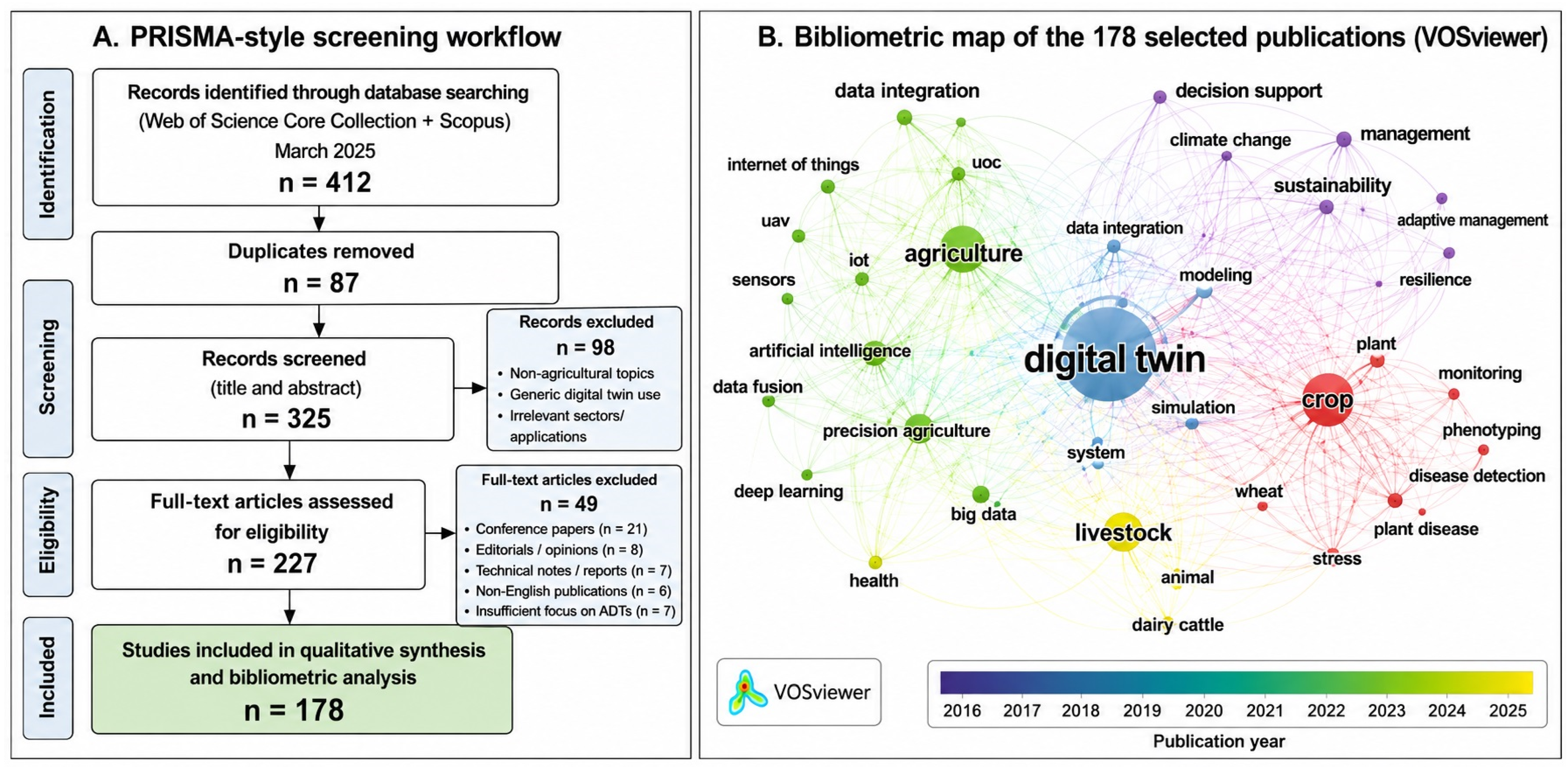
The bibliometric search was conducted in March 2025. The initial screening identified 412 records across Web of Science and Scopus. After duplicate removal (n = 87), 325 records remained for title and abstract screening. Following eligibility assessment and exclusion of non-relevant or non-agricultural studies, a final corpus of 178 publications was retained for qualitative synthesis and bibliometric interpretation.
The retained corpus was used to support the bibliometric screening and thematic analysis presented in this review. Not all publications included in the screening corpus were necessarily cited individually in the manuscript, as references were selected according to their relevance to the specific conceptual, methodological, and critical discussions developed throughout the review. A PRISMA-inspired screening workflow summarizing this procedure has been added as
Figure 1.
Only English-language peer-reviewed journal articles and review papers were considered. Conference papers, editorials, notes, book chapters, and documents not directly addressing agricultural applications, architectures, conceptualisations, or limitations of digital twins were excluded.
However, we acknowledge that this selection strategy introduces limitations. Because agricultural digital twins remain an emerging and highly application-oriented field, relevant advances may also appear in conference proceedings, technical reports, industrial project documents, and non-English literature. The present review should therefore be interpreted as a critically curated and structured synthesis rather than a fully exhaustive inventory of all existing ADT-related publications.
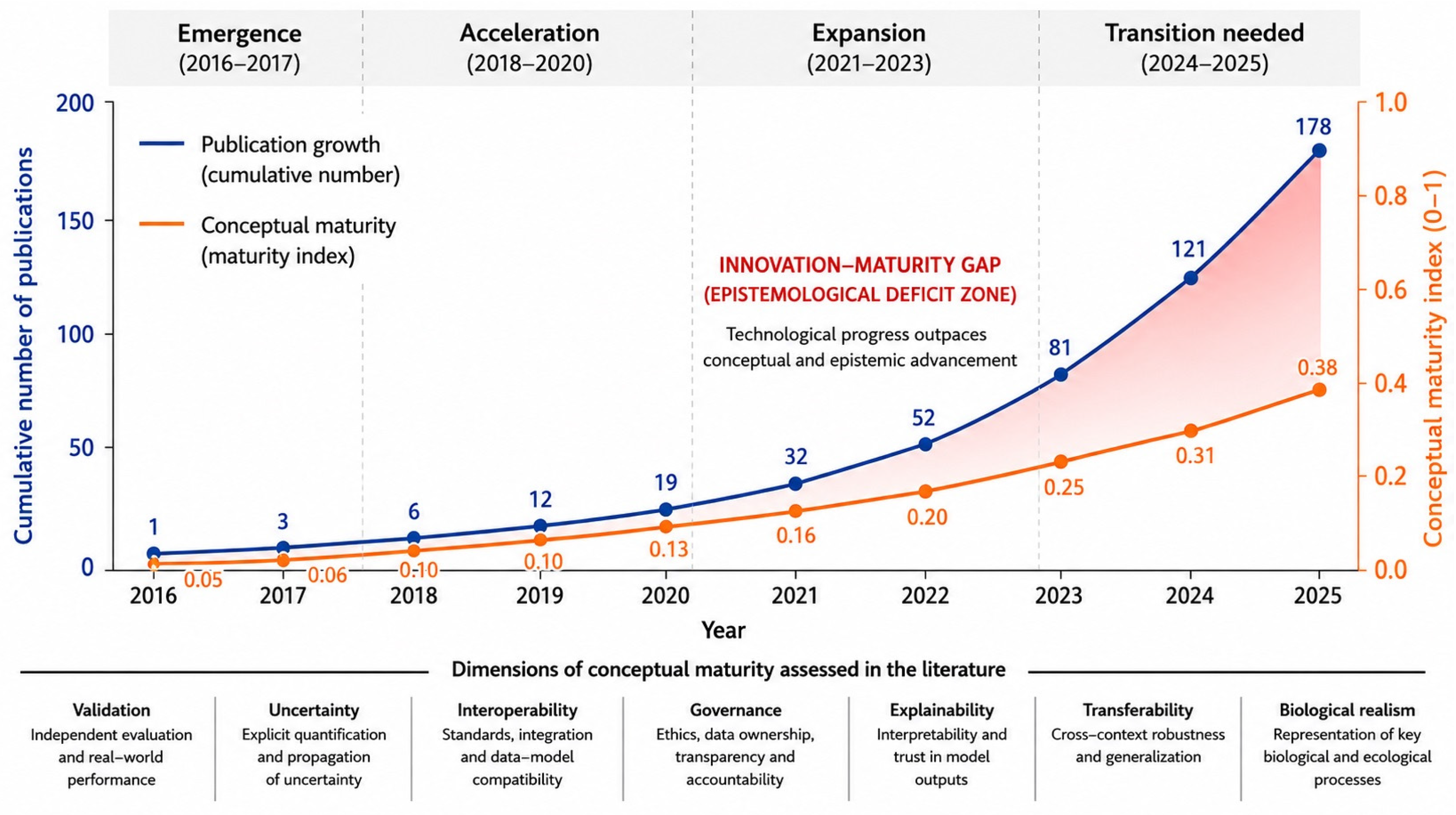
The resulting corpus was used to identify the publication trajectory shown in
Figure 2 and to support the thematic structuring presented in
Figure 3. In this sense, the bibliometric analysis should be interpreted as a structured overview of the reviewed corpus rather than as a claim to full exhaustiveness.
2.2. Bibliometric Evolution of Research on Digital Twins in Agriculture
A bibliometric analysis of the literature reveals that research on Agricultural Digital Twins (ADTs) has undergone a profound transformation over the past decade. What initially emerged as a relatively niche and largely conceptual topic has progressively evolved into a rapidly expanding interdisciplinary research domain situated at the intersection of precision agriculture, artificial intelligence, cyber–physical systems, remote sensing, systems modelling, and decision-support sciences. As illustrated in
Figure 2, the cumulative number of publications increased exponentially between 2016 and 2025, reflecting the growing scientific, technological, and societal interest in the application of digital twin concepts to agricultural systems.
However,
Figure 2 suggests that publication growth alone provides only a partial representation of the field’s evolution. While scientific production has accelerated markedly, the development of conceptual maturity appears to have progressed at a substantially slower pace. The figure conceptualizes this divergence through an Innovation–Maturity Gap, highlighting the possibility that technological innovation is advancing faster than the conceptual, epistemological, and methodological foundations required to support its long-term development. In other words, the rapid expansion of the field has not necessarily been accompanied by an equivalent consolidation of theoretical frameworks, validation procedures, uncertainty quantification approaches, governance structures, or explanatory models.
This observation is particularly significant because it suggests that the evolution of ADTs is not simply a story of technological progress. Rather, it reflects the convergence of multiple scientific traditions that have historically evolved in relative isolation, including precision agriculture, smart farming, crop and soil modelling, environmental monitoring, artificial intelligence, cyber–physical systems, and digital infrastructure research. As these domains increasingly converge, new challenges emerge regarding interoperability, transferability, explainability, governance, biological realism, and the representation of complex agroecosystem processes.
Figure 2 further indicates that the field may be entering a new developmental phase. Whereas the period between 2016 and 2020 was primarily characterized by technological emergence and acceleration, recent years have witnessed growing attention to issues extending beyond implementation and operational performance. Increasing numbers of studies now address uncertainty quantification, model validation, explainability, governance, interoperability, and the limitations of digital representations when applied to living, adaptive, and context-dependent agroecosystems. These dimensions collectively contribute to what is represented in the figure as conceptual maturity.
Importantly, the figure should not be interpreted as a formal measurement of scientific maturity, nor as a statistically calibrated indicator. The conceptual maturity index represents a heuristic synthesis derived from recurring themes identified throughout the reviewed literature, including validation, uncertainty management, interoperability, governance, explainability, transferability, and biological realism. Its purpose is therefore not to quantify maturity precisely, but to illustrate a broader pattern: although ADTs are experiencing rapid technological expansion, significant challenges remain in establishing the conceptual and epistemological foundations required for their reliable deployment in complex agroecosystems.
From this perspective, the future development of ADTs may depend less on further increases in data volume, computational power, or sensing capacity than on narrowing the Innovation–Maturity Gap. Achieving this objective will require stronger integration between technological innovation and conceptual advancement, ensuring that future ADTs are not only more powerful computationally, but also more interpretable, transferable, biologically realistic, uncertainty-aware, and scientifically robust.
General note on conceptual figures. All conceptual figures presented in this review should be interpreted as heuristic syntheses intended to clarify the main conceptual relationships, trade-offs, paradoxes and systemic tensions emerging from the reviewed literature. Curves, thresholds, normalized scales, relative proportions, directional arrows and graphical relationships are illustrative devices rather than empirical measurements, statistically calibrated outputs or universally validated relationships. They are used to formalize recurring patterns, support comparative interpretation and stimulate critical discussion. Accordingly, these figures should not be read as quantitative models, but as conceptual frameworks designed to make explicit the assumptions, limitations and future research directions associated with Agricultural Digital Twins in complex agroecosystems.
2.3. Thematic Structuring and Conceptual Reorientation of the Field
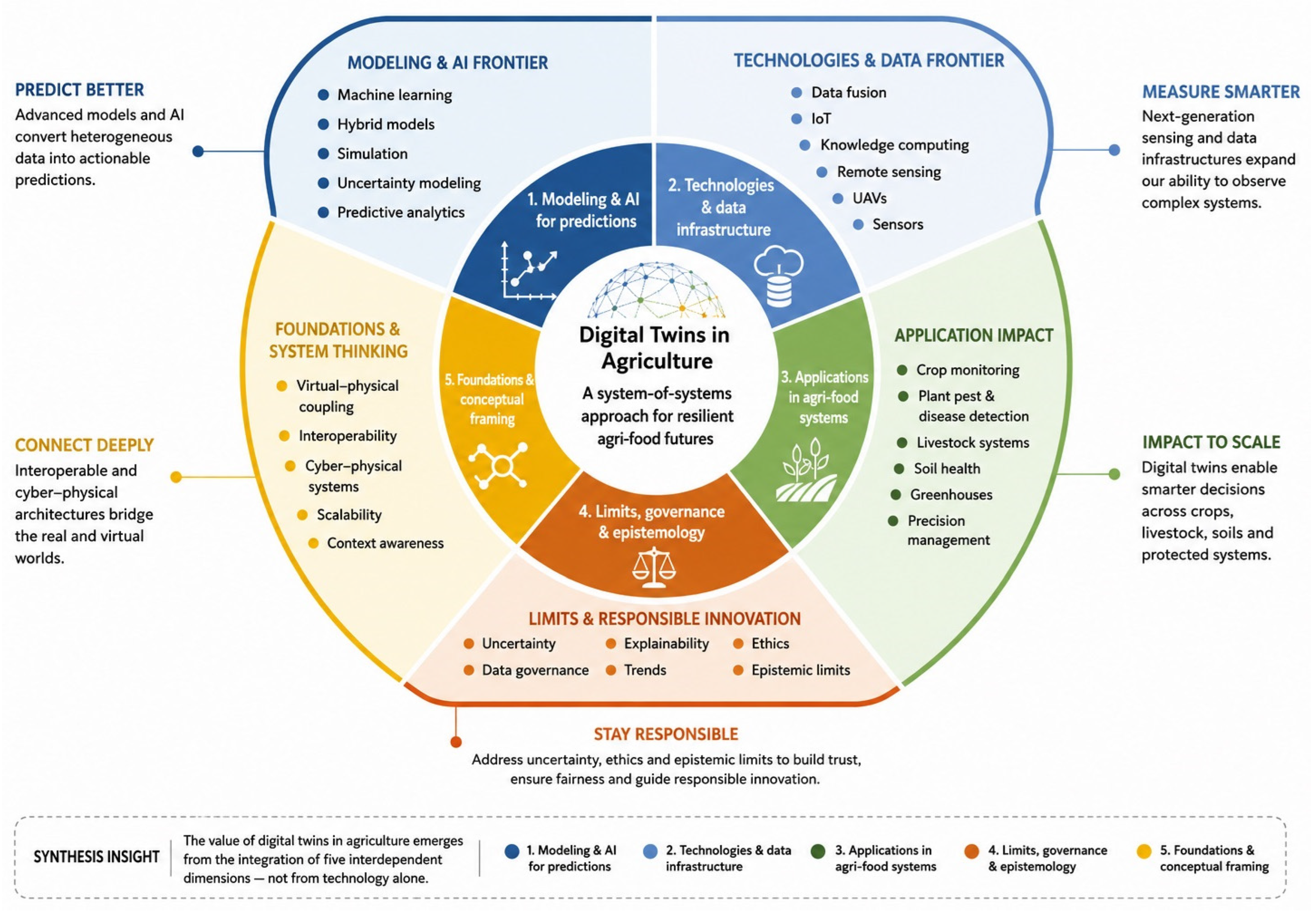
Alongside this quantitative expansion, the Agricultural Digital Twin (ADT) literature has also undergone a process of conceptual maturation and thematic diversification. As illustrated in
Figure 3, the field can be organized into five interconnected domains: (i) modelling and artificial intelligence for prediction and decision support, (ii) technologies and data infrastructures enabling observation and data integration, (iii) applications across agri-food systems, (iv) limits, governance, and epistemological considerations, and (v) foundational and conceptual frameworks that define how digital twins are understood and implemented in agricultural contexts. Rather than representing isolated research streams, these domains form an increasingly interconnected system-of-systems in which technological innovation, modelling capacity, practical applications, and critical reflection co-evolve.
This thematic structure reveals an important shift in the trajectory of the field. Early research was largely driven by technological opportunities associated with sensors, remote sensing, IoT networks, simulation platforms, and artificial intelligence [
1,
2]. More recent studies, however, increasingly recognize that the effectiveness of ADTs cannot be explained solely by advances in data acquisition or computational sophistication. As a result, growing attention has been directed toward conceptual foundations, interoperability, uncertainty modelling, explainability, governance, and the broader epistemological assumptions underlying digital representations of agroecosystems.
Figure 3 further suggests that the future development of ADTs depends on the integration of these dimensions rather than on progress within any single domain. Advances in sensing technologies may expand observability, while modelling and artificial intelligence improve predictive capabilities; however, their practical value ultimately depends on how these technologies are embedded within coherent conceptual frameworks, interpreted through transparent governance mechanisms, and translated into meaningful agricultural applications. In this sense, the figure highlights that the scientific value of ADTs emerges from the interaction among technological, methodological, institutional, and conceptual dimensions rather than from technological innovation alone.
A growing body of literature is therefore moving beyond questions of implementation and operational performance toward more fundamental questions concerning representation, realism, interpretability, transferability, and uncertainty [
1,
2]. Researchers are increasingly asking what constitutes a meaningful digital representation of a living agroecosystem, how model assumptions influence decision-making, and whether digital twins can adequately capture the biological heterogeneity, context dependency, and adaptive dynamics that characterize agricultural systems. This evolution signals a transition from a predominantly technology-driven phase toward a more reflexive and theoretically informed stage of development.
Viewed collectively, the five domains represented in
Figure 3 illustrate the emergence of a new research agenda in which ADTs are no longer framed merely as predictive technologies, but as integrative socio-technical systems situated at the intersection of data, models, ecological processes, governance structures, and human decision-making. The long-term success of ADTs may therefore depend less on technological sophistication alone and more on the capacity to connect these dimensions within coherent, transparent, and scientifically robust frameworks capable of supporting resilient agri-food systems.
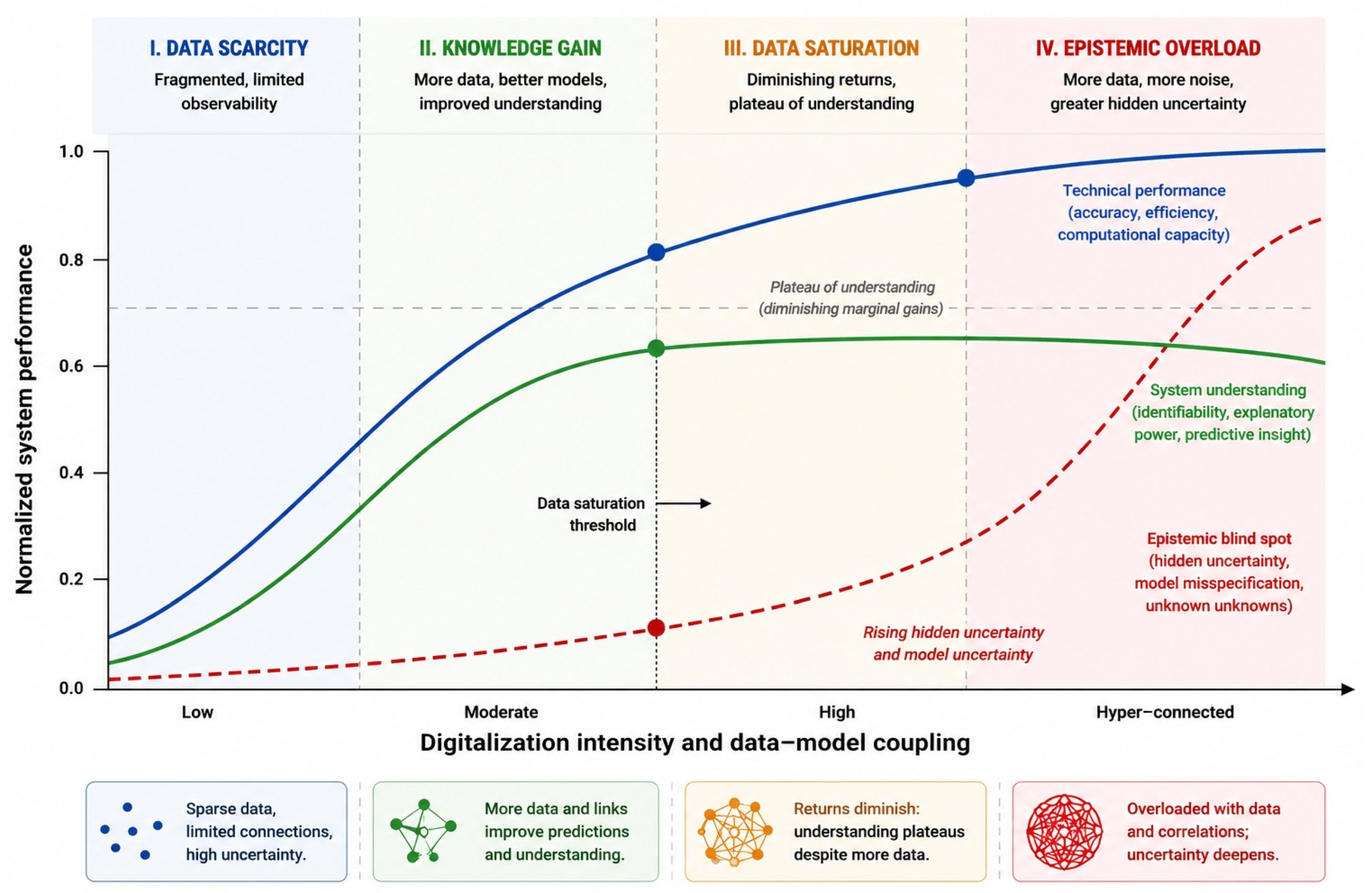
Figure 4 synthesizes one of the central arguments emerging from this review: the evolution of Agricultural Digital Twins (ADTs) is characterized not only by increasing technological capability, but also by a growing divergence between technical performance and system understanding. The figure conceptualizes this trajectory through four successive phases—data scarcity, knowledge gain, data saturation, and epistemic overload—highlighting how the relationship between data accumulation and knowledge generation may become increasingly non-linear in complex agroecosystems.
During the early stages of digitalization, additional data, improved sensing infrastructures, and stronger data–model coupling generally contribute to substantial gains in both predictive performance and system understanding. This phase corresponds to a period of rapid knowledge acquisition in which previously unobserved processes become measurable and model representations improve accordingly. Such expectations have strongly influenced the development of ADTs, which were initially promoted as tools for optimization, automation, predictive control, and real-time synchronization, largely inspired by engineering and cyber–physical systems paradigms [
2,
3,
19,
20]. However,
Figure 4 suggests that this positive relationship may not persist indefinitely. Beyond a critical data saturation threshold, the marginal contribution of additional data to system understanding progressively decreases. While technical performance may continue to improve through enhanced computational capacity, more sophisticated algorithms, and larger data streams, explanatory power and mechanistic understanding may increase at a much slower rate. This divergence reflects the fact that many agroecosystem processes are governed by biological variability, context dependency, nonlinear interactions, emergent properties, and partially observable mechanisms that cannot be fully resolved through data accumulation alone [
7,
21,
22,
23]. The figure further introduces the concept of epistemic overload, a stage in which increasing digitalization may generate expanding layers of hidden uncertainty despite continued improvements in technical performance. In highly connected systems, larger volumes of data may reveal new correlations, interactions, and sources of variability faster than they reduce uncertainty. Consequently, the growth of information can be accompanied by the emergence of new blind spots associated with model misspecification, latent variables, structural uncertainty, and unknown unknowns. Under such conditions, additional data do not necessarily translate into proportional gains in understanding and may even increase the complexity of interpretation.
Importantly,
Figure 4 should not be interpreted as an empirical quantification or universally calibrated relationship. The saturation threshold, curve trajectories, and performance levels shown are conceptual representations intended to synthesize recurring patterns identified across the reviewed literature. Rather than describing statistically validated universal responses, the figure illustrates a broader epistemological argument: technological progress and data accumulation may continue to improve operational performance, while the deeper challenge of understanding complex agroecosystem behaviour remains only partially resolved.
In this perspective, the future development of ADTs should not be evaluated solely according to predictive accuracy, computational efficiency, or data volume. Equally important is their capacity to improve system understanding, make uncertainty explicit, identify epistemic blind spots, and support robust decision-making under conditions of incomplete knowledge.
Figure 4 therefore highlights a fundamental shift in perspective: the challenge is no longer simply to collect more data, but to determine how much meaningful understanding can be generated from increasingly complex information environments.
More recent contributions increasingly acknowledge that these limitations are not marginal. They arise from the intrinsic properties of agroecosystems themselves. Many key processes remain only partially observable, biological responses vary across contexts, and models are often difficult to transfer across environments and scales. In addition, relationships identified in data may become unstable under changing conditions, while structural uncertainty persists even in situations where large volumes of data are available.
From this perspective, the bibliometric trajectory of the field offers more than a simple indication of publication growth, as it also reflects a deeper conceptual shift. The literature is gradually moving away from an exclusive emphasis on technological capability toward a more critical understanding of digital twins as partial, context-dependent, and model-based representations of agricultural reality. Taken together,
Figure 1,
Figure 2,
Figure 3 and
Figure 4 suggest that the future development of agricultural digital twins will depend not only on increasing data availability or computational power, but also on the capacity to design frameworks that explicitly account for uncertainty, remain sensitive to context, and are grounded in a more realistic understanding of biological systems. In this perspective, the value of agricultural digital twins may lie less in producing fixed and fully reliable predictions than in supporting informed and adaptive decision-making under conditions of uncertainty, variability, and partial observability.
3. Conceptual Foundations: Engineering Paradigms vs. Agroecological Reality
The concept of the digital twin has its roots in an engineering perspective, where systems are generally treated as observable, decomposable, and, to a certain extent, controllable [
19,
24,
25,
26,
27,
28]. Within such contexts, digital replicas can be highly effective for simulating system behaviour and supporting optimisation. However, once this perspective is brought into agriculture, its underlying assumptions become less straightforward. Agroecosystems do not generally behave like engineered machines [
2,
29]. They are better described as complex adaptive systems, shaped by feedback loops, emergent properties, and interactions that unfold across multiple spatial and temporal scales [
1,
2]. These characteristics make agricultural systems inherently difficult to represent through simplified or reductionist modelling frameworks.
The rapid expansion of digital agriculture has also generated increasing conceptual overlap between Agricultural Digital Twins (ADTs), precision agriculture, smart farming systems, cyber–physical platforms, and data-driven decision-support systems. Although these concepts share several technological foundations, they are not fully equivalent and should not be used interchangeably.
In this review, an Agricultural Digital Twin (ADT) is defined as a dynamically evolving virtual representation of an agricultural system that is continuously updated through bidirectional interactions between physical and digital components, integrates heterogeneous data streams with process-based or hybrid modelling frameworks, and supports adaptive decision-making under changing environmental conditions. This definition differs from conventional precision agriculture approaches, which primarily focus on spatially targeted management, and from smart farming systems that often emphasize automation, connectivity, and sensor integration without maintaining continuously synchronized virtual representations of agroecosystem states.
Similarly, ADTs differ from traditional decision-support systems because they aim to establish continuous synchronization between observed system states, predictive simulations, and adaptive updating mechanisms. However, as discussed throughout this review, such synchronization remains inherently constrained by partial observability, structural uncertainty, and context dependency in agroecosystems. This distinction is particularly important because not all data-intensive agricultural systems can legitimately be considered digital twins. Systems lacking continuous updating, bidirectional interaction, or adaptive assimilation mechanisms may function as advanced monitoring or predictive platforms without fully meeting the operational criteria of ADTs.
This tension becomes particularly apparent in what can be referred to as the data–model paradox. Digital twins are often developed with the implicit expectation that increasing the amount of available data will improve system understanding and enhance predictive performance [
19,
24,
25,
26,
27,
28]. In practice, however, the relationship is not that simple, as more data do not necessarily make a model more robust.
Importantly, this limitation should not be interpreted as implying that increasing data availability is inherently detrimental. High-quality, process-relevant, and biologically meaningful datasets can substantially improve predictive robustness when integrated into appropriate model structures. The paradox emerges primarily when additional data compensate for incomplete or weakly specified models rather than improving mechanistic understanding. In such cases, noisy, redundant, poorly harmonized, or weakly related datasets may amplify uncertainty, increase overfitting, and reduce interpretability.
When the underlying model is structurally deficient, that is, poorly specified, weakly calibrated, or insufficiently aligned with the actual functioning of the system, adding more data does not necessarily improve understanding or prediction; instead, it may amplify noise, complicate interpretation, and in some cases increase uncertainty rather than reduce it [
5,
21,
27,
28,
30,
31,
32,
33,
34,
35]. In this sense, the link between data volume and predictive reliability should be understood as conditional rather than cumulative.
Examples of this phenomenon have been reported in crop yield forecasting systems integrating heterogeneous satellite datasets, disease detection frameworks relying on unstable spectral signatures, and soil moisture assimilation systems where increasing sensor density introduced inconsistencies between observational scales and model structure. These examples suggest that predictive instability may emerge not only from data scarcity, but also from mismatches between data complexity and the capacity of models to represent underlying biological processes.
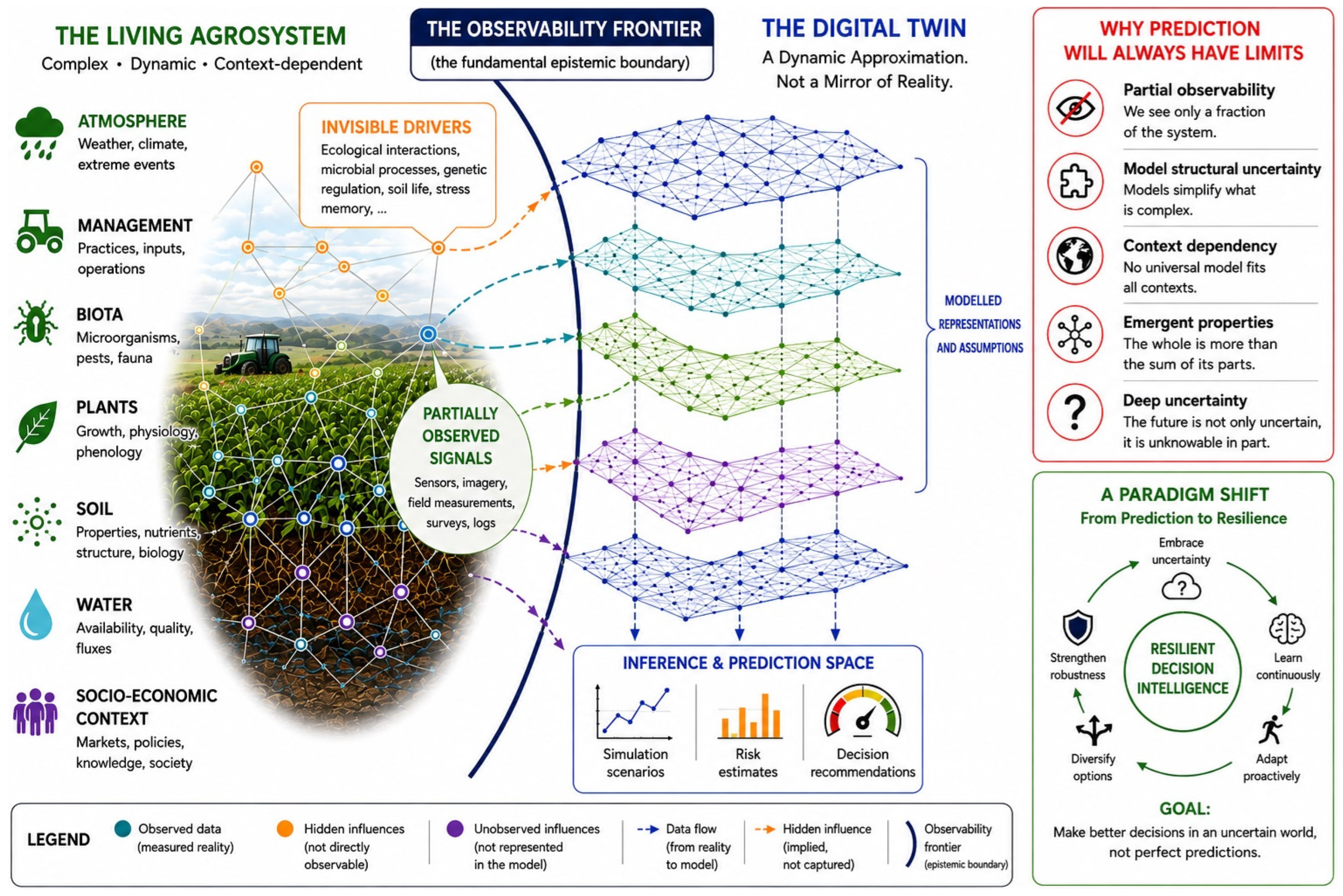
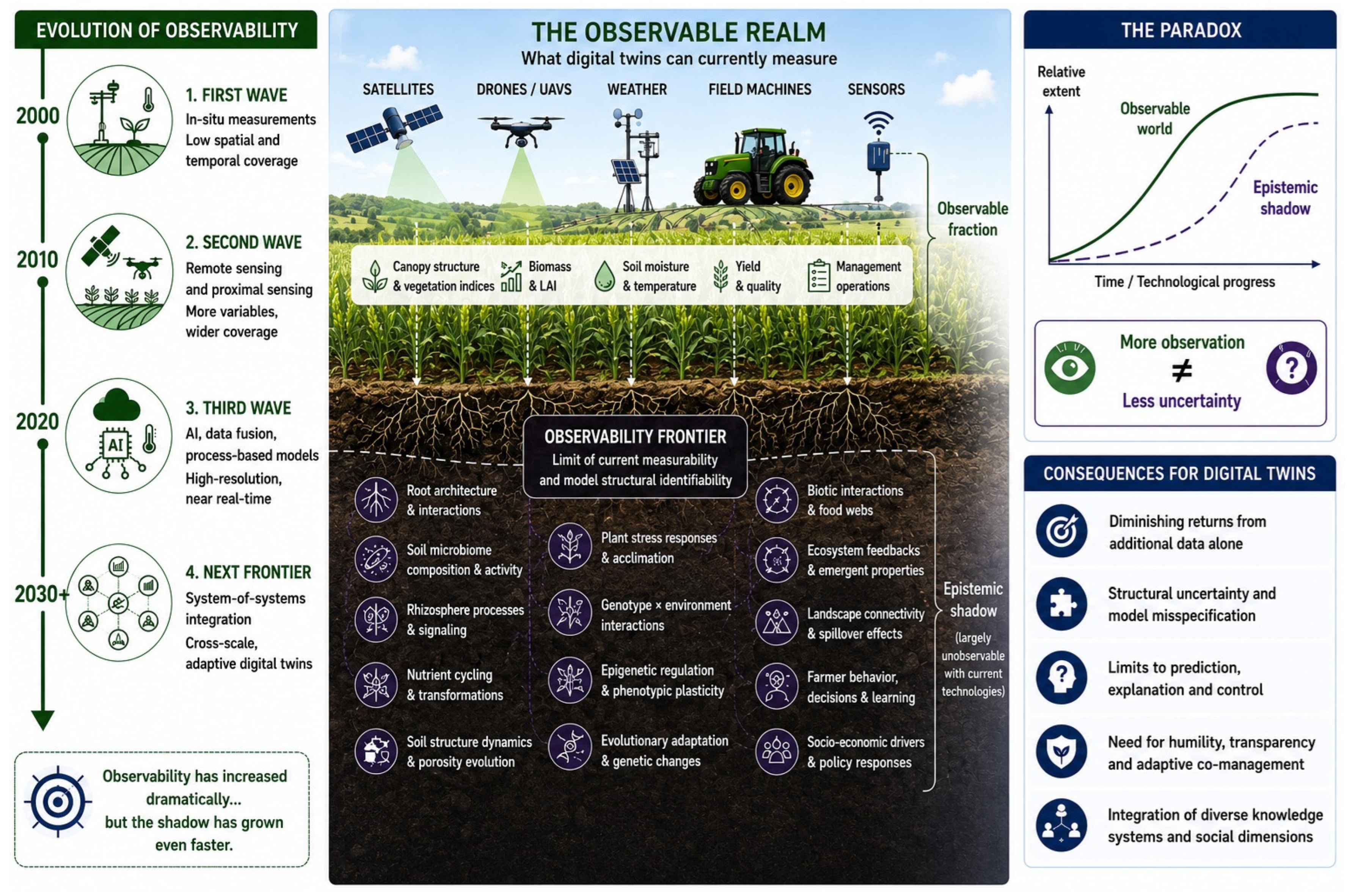
As illustrated in
Figure 5, the fundamental limitation of Agricultural Digital Twins (ADTs) may not arise from insufficient data availability alone, but from the existence of an inherent observability frontier that constrains how much of an agroecosystem can be directly measured, represented, and understood. Agroecosystems are complex socio-ecological systems shaped by interacting atmospheric, biological, hydrological, agronomic, and socio-economic processes operating across multiple spatial and temporal scales. While advances in remote sensing, sensor networks, UAVs, artificial intelligence, and data integration continue to expand the observable domain, a substantial fraction of system behaviour remains only partially observable or entirely hidden. Ecological interactions, microbiome dynamics, stress memory, adaptive human behaviour, emergent ecosystem properties, and cross-scale feedback mechanisms often remain beyond direct observation and are therefore only indirectly represented within digital twin architectures.
Figure 5 conceptualizes this challenge through the notion of an observability frontier, representing the epistemic boundary separating observable signals from latent system drivers. In this perspective, a digital twin should not be interpreted as a complete digital replica of reality, but rather as a dynamic approximation constructed from partial observations, model assumptions, and inferred relationships. Consequently, increasing data acquisition does not necessarily eliminate uncertainty, because many sources of uncertainty originate not from data scarcity alone but from structural limitations in system representation, incomplete process understanding, context dependency, and emergent dynamics.
Importantly,
Figure 5 should not be interpreted as an empirical quantification or a universally calibrated representation of digital twin performance. Instead, it provides a heuristic conceptual synthesis of recurring patterns identified throughout the reviewed literature. The observability frontier, hidden drivers, and modelled representations shown in the figure are not intended to represent measurable thresholds or statistically validated relationships. Rather, they illustrate a fundamental epistemological constraint: regardless of technological progress, a portion of agroecosystem complexity is likely to remain only partially observable and therefore only partially representable within any modelling framework.
This interpretation carries important implications for the future development of ADTs. Rather than pursuing the unattainable objective of perfect prediction through ever-increasing data accumulation, future systems may benefit more from explicitly acknowledging uncertainty, identifying blind spots, and exploring alternative futures. In this sense, the figure supports a broader conceptual transition from prediction-centred modelling toward resilient decision intelligence, where the primary objective is not to forecast reality perfectly but to support robust, transparent, and adaptive decisions under conditions of incomplete knowledge. The value of ADTs may therefore depend less on their ability to eliminate uncertainty than on their capacity to make uncertainty visible, understandable, and actionable for decision-makers.
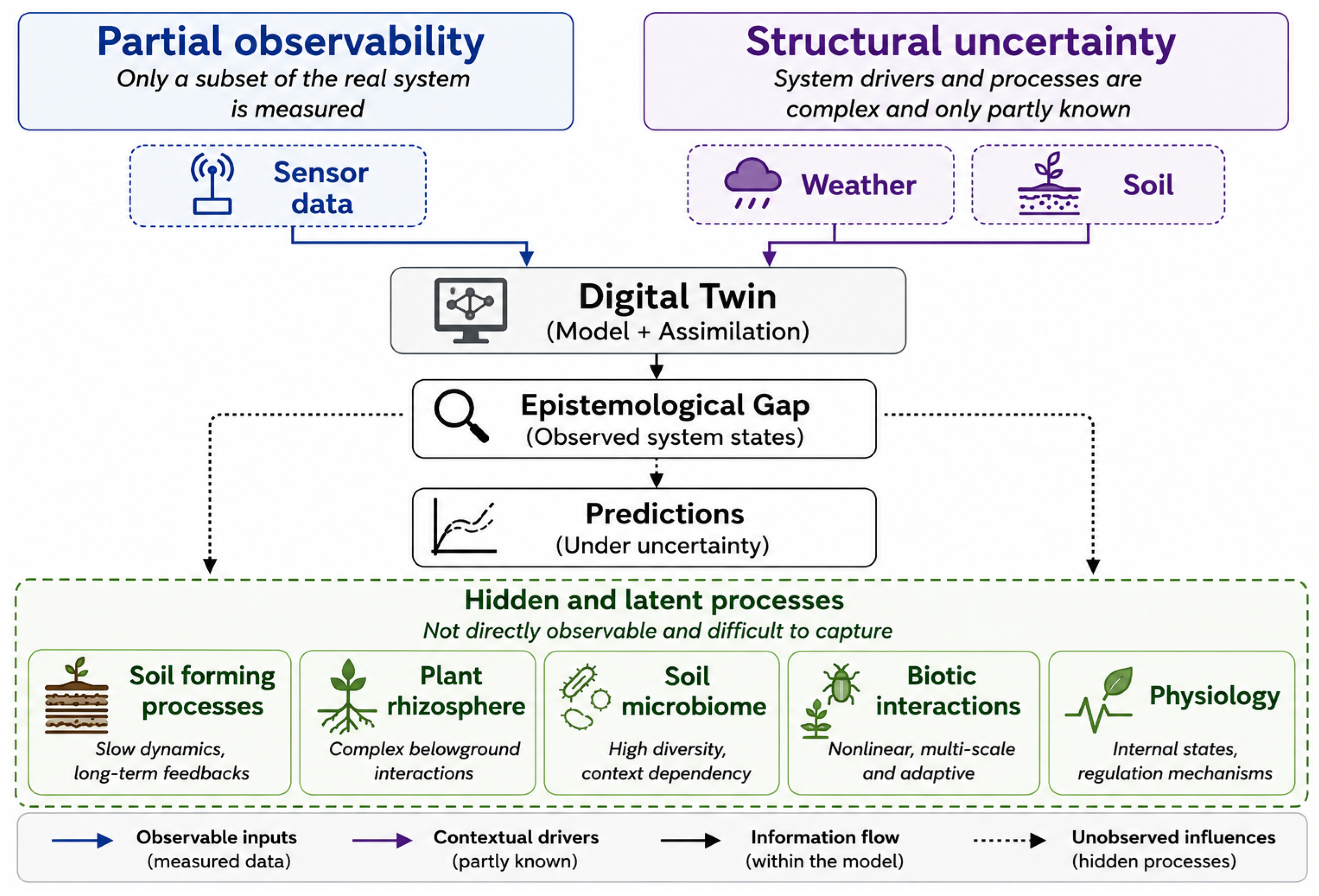
At the same time, agricultural digital twins operate within a fundamentally constrained observational space. What can be measured captures only a fraction of the processes that actually drive agroecosystem dynamics. Unlike engineered systems, where internal states can often be monitored directly or inferred with reasonable confidence, agroecosystems are influenced by many latent processes that remain difficult, and sometimes impossible, to observe directly. These include root–soil interactions, microbial dynamics, plant physiological responses to abiotic and abiotic stresses, and a range of ecological interactions that occur across different trophic levels.
Figure 5 highlights the consequences of this limitation by illustrating the existence of an epistemological gap between the system as it is observed and the system as it actually functions. Observable variables—such as canopy reflectance, soil moisture, or temperature—provide useful information, but they remain indirect proxies for deeper biological and ecological processes. From this perspective, digital twins cannot be considered complete representations of agroecosystem reality. Rather, they should be understood as partial approximations, built from a necessarily reduced and filtered view of the system.
This partial observability introduces a form of structural uncertainty that cannot simply be eliminated through increasing data availability because the missing information relates to processes that are inherently difficult to observe at operational scales [
23,
36,
37,
39,
41,
42]. Consequently, predictive outputs may appear quantitatively precise while remaining biologically incomplete. This creates what can be described as an epistemological asymmetry between observable system states and the hidden causal processes driving agroecosystem behaviour [
23,
36,
37,
39,
41,
42].
This limitation has several important implications. First, it weakens confidence in predictive outputs, particularly when models rely heavily on correlations derived from observable variables without adequately capturing the causal mechanisms governing system behaviour. Second, it challenges the assumption that digital twins can provide fully reliable representations of biological systems. More broadly, it reveals a fundamental epistemological tension at the core of agricultural digital twins: these systems are designed to simulate realities that can only ever be partially observed.
As illustrated in
Figure 6, the gap between measurable variables and hidden agroecosystem processes should therefore not be considered a temporary technological limitation that will disappear automatically with increasing sensor density or computational power. Instead, it reflects deeper scientific constraints linked to the intrinsic complexity, heterogeneity, and multi-scale organization of living systems.
While digital twins can undoubtedly provide valuable insights and improve operational management under certain conditions, their outputs must be interpreted cautiously, particularly in situations where important processes remain hidden or only indirectly inferred. In this sense, the challenge is not purely technical but fundamentally conceptual. It concerns the limits of what can realistically be known, measured, represented, and predicted in complex agroecosystems.
Taken together,
Figure 5 and
Figure 6 show that the central challenge facing Agricultural Digital Twins (ADTs) is not merely the acquisition of larger datasets or the deployment of more computationally sophisticated models. The deeper challenge is epistemological: how to construct useful digital representations of systems whose functioning is only partially observable, context-dependent, and shaped by hidden biological, ecological and socio-economic processes. These figures therefore challenge the engineering assumption that digital replication can progressively converge toward a complete representation of reality. In agroecosystems, uncertainty is not only a temporary technical limitation caused by insufficient data; it is also an intrinsic property of living systems characterized by emergent behaviour, cross-scale interactions, biological variability and adaptive responses. Consequently, future ADTs should not be designed as attempts to mirror agroecosystems exhaustively, but as adaptive approximation systems capable of identifying what is observable, clarifying what remains uncertain, and supporting robust decisions under incomplete knowledge.
4. Digital Twin Architectures: Integration Challenges and Fragmentation
Agricultural digital twins are often described as layered systems that integrate data acquisition, modelling components, data harmonisation, and decision-support modules. On paper, this type of architecture appears both coherent and compelling. It suggests a seamless integration of scales, data sources, and analytical processes, with the potential to support real-time monitoring and predictive management of agroecosystems [
17,
19]. However, this apparent coherence becomes more difficult to sustain when confronted with the realities of agricultural systems. In practice, most digital twin implementations fall short of functioning as fully integrated systems. Instead, they tend to remain fragmented, both technically and institutionally, reflecting the complexity of agricultural environments and the difficulty of coordinating heterogeneous data, models, actors, and infrastructures.
A central source of this fragmentation lies in the inherently heterogeneous nature of agricultural data. Observations of agroecosystems are generated from a wide range of sources, such as remote sensing platforms, in situ sensors, farm machinery, and farmer-reported information. These data streams differ not only in format and resolution, but also in spatial and temporal scale, as well as in their associated uncertainties and error structures [
18,
21]. This diversity is not merely a technical issue that can be resolved through improved data management. It reflects the underlying nature of agricultural systems themselves, where processes operating at the microbial or root level can interact with, and influence, dynamics at the field or landscape scale in highly non-linear ways [
7]. Under such conditions, integrating these heterogeneous data streams into a single digital twin architecture often requires substantial simplifications, which may obscure important dimensions of system behaviour.
These integration challenges are further compounded by the lack of widely adopted data standards, shared ontologies, and effective interoperability frameworks. Initiatives such as the FAIR data principles [
43] and the development of agricultural data platforms have contributed to progress in this field. However, their implementation remains uneven and, in many cases, insufficient to support fully operational and scalable digital twins. In practice, data pipelines are often assembled in a project-specific manner, which limits their reproducibility and makes it difficult to transfer solutions across regions or production systems [
2,
44]. As a result, many digital twin architectures remain context-dependent, fragile, and difficult to generalise. This lack of interoperability is not only a technical limitation; it also raises broader concerns about reproducibility and scientific robustness.
Beyond technical considerations, digital twin architectures are increasingly embedded within proprietary digital ecosystems, often controlled by a relatively small number of private actors. These platforms frequently operate as closed systems, where access to data, algorithms, and even model structures is restricted [
18,
45]. In such contexts, asymmetries in data ownership and control can emerge. Farmers and local stakeholders contribute large volumes of data, yet they do not always retain control over how these data are used, shared, or translated into valuable outputs. Nor do they necessarily benefit proportionally from the insights generated. This concentration of data and computational capacity raises important questions related to data sovereignty, transparency, and power dynamics within digital agriculture [
46,
47].
These issues cannot be reduced to a simple lack of technological maturity. They point instead to deeper structural tensions at the intersection of biological complexity, data science, and socio-economic organisation. Digital twins are often built on the assumption that systems can be standardised, observed, and, to some extent, controlled. Yet agroecosystems do not easily conform to this logic. They are variable, context-specific, and only partially observable, which creates a fundamental mismatch between the architectural ambitions of digital twins and the realities they aim to represent. The result is not only technical fragmentation, but also a more profound epistemological constraint, as these systems attempt to impose coherence on inherently heterogeneous and dynamic realities.
This fragmentation has direct implications for decision-making. When models are constructed on the basis of incomplete, weakly integrated, or biased data streams, their outputs may fail to reduce uncertainty and, in some cases, may even reinforce it. The apparent precision of digital twin outputs can therefore be misleading, creating a sense of reliability that is not always supported by the underlying data or model structures [
48]. In agricultural contexts, this is particularly critical, as decisions based on such outputs can have lasting consequences for ecosystems, resource use, and farm livelihoods.
Taken together, these observations suggest that the current development of digital twins in agriculture is characterised less by full integration than by multiple layers of fragmentation, technical, institutional, and epistemological. Addressing these challenges will certainly require advances in interoperability, data infrastructures, and modelling approaches. However, technical improvements alone are unlikely to be sufficient. There is also a need for a more critical reassessment of the assumptions underlying digital twin architectures, particularly with regard to data governance, system representation, and the limits of predictive control in complex living systems.
5. Applications of Digital Twins: Performance, Context-Dependency, and Structural Limitations
Digital twins have rapidly gained attention as one of the most ambitious and potentially integrative concepts in agricultural research, with applications ranging from yield prediction and disease surveillance to resource optimization and farm management. Their growing popularity stems from the expectation that continuous integration of observations, modelling frameworks, and decision-support systems can improve agricultural management under increasingly variable environmental conditions.
Concrete examples of Agricultural Digital Twin (ADT) implementation now include greenhouse tomato production systems integrating climate-control digital twins, maize yield forecasting frameworks combining Sentinel-2 assimilation with crop growth models, wheat disease early-warning systems integrating UAV imagery with epidemiological simulations, livestock behavioural monitoring systems based on wearable sensors, and irrigation scheduling platforms combining soil-moisture sensing with weather-driven decision-support systems. These examples illustrate the diversity of ADT applications currently emerging across crop and livestock production systems.
In the area of yield prediction, several studies report improvements in predictive accuracy under controlled conditions [
44,
49]. At the same time, some recent studies demonstrate that hybrid modelling approaches combining mechanistic crop models with adaptive machine-learning frameworks can improve robustness, particularly when dynamic updating and multi-season calibration are incorporated. Several studies have also reported encouraging results regarding regional transferability when models are deployed within relatively homogeneous agroecological regions and supported by continuous calibration procedures. However, these systems typically remain strongly dependent on site-specific calibration, cultivar-dependent parameters, and local climatic conditions [
22].
Moreover, the apparent success of data assimilation approaches can sometimes mask deeper structural limitations. Repeatedly correcting model outputs with observational data may reduce errors in the short term, but this does not necessarily indicate that the underlying representation of system processes has improved. In this sense, a form of “performance illusion” may emerge, where models appear accurate while remaining structurally incomplete [
21]. Under such conditions, digital twins may function less as mechanistic representations of agroecosystem dynamics and more as adaptive interpolation tools.
A similar tension can be observed in plant disease monitoring. In this domain, digital twins are increasingly combined with proximal and remote sensing technologies designed to detect early signals of plant stress. Indicators such as spectral signatures, thermal anomalies, and fluorescence measurements are used to infer plant health and anticipate disease development [
23,
50]. While these approaches are promising, their interpretation remains complex. Spectral signals are rarely specific to a single cause and can be influenced by a range of abiotic and biotic factors, including water stress, nutrient deficiencies, canopy structure, and variations in illumination [
51]. As a result, distinguishing disease-related signals from background variability is not always straightforward, increasing the risk of false positives or misclassification, particularly in operational settings where decisions depend on reliable and interpretable outputs.
The temporal dynamics of plant diseases add another layer of complexity. Many pathogens follow non-linear infection pathways, involve latency periods, and respond to threshold effects that cannot easily be captured through observable proxies alone [
52]. Consequently, the early-warning potential often attributed to digital twins may be constrained by the very nature of the signals on which they rely. This reinforces the gap between observable indicators and the biological processes that actually drive disease dynamics.
Digital twins have also been widely promoted as tools for optimising resource use, particularly in irrigation and nutrient management. By combining soil moisture data, weather information, and crop models, these systems are expected to support more precise and adaptive management decisions [
2,
44]. Reported benefits include reduced water use, improved nutrient efficiency, and, in some cases, higher economic returns. Several pilot studies have reported water savings exceeding 15–30% while maintaining comparable yield levels, suggesting substantial potential for resource-efficient management when digital twins are properly integrated into farm decision processes.
However, many of these results are derived from experimental or pilot-scale studies and may not fully reflect the variability and constraints of real farming conditions.
Importantly, the long-term stability of these reported benefits remains insufficiently documented. Most published studies evaluate ADT performance over relatively short periods, often covering only one or a few growing seasons. Consequently, evidence regarding their robustness under prolonged climatic variability, extreme weather events, and changing management conditions remains limited. Longitudinal validation studies are therefore urgently needed to assess whether reported gains persist through time.
Future evaluation frameworks for agricultural digital twins should therefore move beyond predictive accuracy alone and incorporate rigorous multi-dimensional validation strategies. These should include independent validation across years, sites, cultivars, management systems, and climatic conditions; explicit separation between calibration and validation datasets; systematic reporting of uncertainty intervals; comparison with non-digital-twin baseline models; and assessment of real operational outcomes such as water-use efficiency, pesticide reduction, nutrient-use efficiency, yield stability, labour requirements, economic benefit, and farmer decision quality. Without such validation procedures, the apparent precision of ADT outputs may overstate their actual robustness, transferability, and practical value under real farming conditions.
More broadly, the effectiveness of these systems cannot be assessed solely in terms of technical performance. Their practical value also depends on user behaviour, institutional contexts, and economic conditions. Farmers may face barriers related to cost, access to data, technological literacy, and trust, all of which influence the adoption and impact of digital twin technologies [
46]. In addition, successful implementation increasingly depends on co-design approaches involving farmers, advisers, agronomists, and technology developers. Emerging evidence suggests that user participation during system development improves transparency, trust, interpretability, and operational relevance, thereby increasing the likelihood of long-term adoption. This highlights that the effectiveness of ADTs is not purely a function of algorithmic performance but also of their integration within broader socio-technical systems.
The growing incorporation of explainable artificial intelligence (XAI) techniques may further contribute to addressing this challenge by improving model transparency and helping users understand the rationale behind digital twin recommendations. Such developments could help bridge the gap between predictive capability and user trust, which remains a critical limitation in many current implementations.
Taken together, these observations suggest that while digital twins hold considerable promise across a range of agricultural applications, their current performance remains shaped by a persistent tension between local success and limited generalisability. Rather than representing a universal solution, they are better understood as context-dependent tools whose effectiveness is constrained by data quality, model structure, system complexity, and socio-economic conditions.
The evidence reviewed here therefore suggests that future progress will depend not only on improving sensing technologies, computational capacity, or model sophistication, but also on strengthening long-term validation, improving interoperability, enhancing explainability, and developing participatory implementation frameworks capable of integrating technical innovation with the realities of agricultural decision-making.
Table 1 provides a synthesis of these applications, highlighting both reported benefits and their underlying limitations.
As agricultural digital twins increasingly incorporate machine-learning and AI-driven predictive frameworks, an important tension emerges between predictive performance and interpretability. While black-box models may improve short-term forecasting capacity, they can simultaneously obscure the causal mechanisms underlying agroecosystem dynamics. This prediction–interpretability trade-off becomes particularly critical in biological systems characterized by non-linearity, context dependency, and partial observability, where understanding causal relationships may be as important as improving predictive accuracy itself.
6. Critical Analysis: Structural, Epistemological, and Operational Limits of Agricultural Digital Twins
One of the main limitations of digital twins in agriculture stems from the need to simplify inherently complex agroecosystems into a set of variables that can be measured and modelled. This simplification is, in many ways, unavoidable. Yet it also comes at a cost. In making these systems computationally manageable, certain dimensions that are central to their functioning tend to be reduced, or sometimes left aside altogether. This is particularly evident for belowground processes, microbial dynamics, trophic interactions, and biodiversity-driven regulation, which operate across multiple scales and are often only partially observable [
7,
55,
56,
57,
58]. As a result, digital twins tend to emphasise what can be measured relatively easily, rather than what necessarily matters most, introducing a form of structural bias in how agroecosystems are represented.
This limitation becomes particularly important when considering the increasing interest in nature-based and biodiversity-driven agricultural systems, where ecosystem services often emerge from interactions that remain difficult to monitor directly. Consequently, the capacity of digital twins to represent ecological resilience mechanisms remains intrinsically constrained by the observability of the processes on which these mechanisms depend.
This tendency reflects a broader epistemological challenge that extends beyond agriculture itself. Digital twins implicitly assume that system behaviour can be adequately captured through measurable variables and computational representations. However, agroecosystems are not merely collections of measurable components. They are living systems characterized by emergence, self-organization, adaptation, evolutionary dynamics, and context-dependent interactions. Many of these properties arise from interactions among system components rather than from the components themselves, making them inherently difficult to quantify and model explicitly.
Particularly problematic is the representation of biological interactions occurring below the sensor horizon. Root–microbiome associations, rhizosphere signalling processes, microbial functional redundancy, ecological resilience mechanisms, and biodiversity-mediated buffering effects remain largely invisible to current monitoring infrastructures. Yet these processes often play a central role in determining crop productivity, nutrient cycling, disease suppression, and system resilience. Consequently, even highly sophisticated digital twins may omit processes that fundamentally shape agroecosystem functioning.
This bias has important implications when it comes to capturing emergent behaviour. Agroecosystems rarely respond in simple or predictable ways. Their dynamics are shaped by feedback loops, threshold effects, and, at times, abrupt shifts, where relatively small changes can trigger disproportionately large consequences [
59,
60,
61,
62]. When key processes are missing or overly simplified, digital twins may struggle to anticipate such transitions, particularly when system behaviour depends on interactions that are not explicitly represented. In that sense, the simplifications required for modelling are not just technical compromises, they also act as structural constraints that limit the ability of digital twins to reflect the deeper dynamics of living systems.
Recent advances in hybrid modelling approaches that combine mechanistic knowledge with machine-learning algorithms have attempted to address some of these limitations. While these approaches offer promising opportunities to better integrate biological understanding into digital twin architectures, their ability to adequately capture emergent system properties and cross-scale ecological interactions remains largely untested under diverse agroecological conditions.
From an epistemological standpoint, digital twins also raise a more fundamental question: what kind of knowledge is actually being produced in data-intensive agriculture? The rapid growth of data availability and computational capacity has encouraged the idea that more data will naturally lead to better understanding and improved prediction. However, this assumption is not always borne out in practice. As emphasised by Saltelli et al. (2020), models should not be evaluated solely on their predictive performance [
63]. Their value also depends on transparency, robustness, and their capacity to capture the causal mechanisms underlying system behaviour. This issue becomes particularly relevant when digital twins incorporate machine learning approaches. While such models can enhance predictive performance, they often do so at the expense of interpretability, making it more difficult to understand what is actually being captured [
21,
48].
This challenge has stimulated growing interest in explainable artificial intelligence (XAI) approaches, which seek to improve transparency and provide greater insight into the relationships identified by data-driven models. Although these approaches represent an important step toward improving model interpretability, they do not fully resolve the broader challenge of linking predictive outputs to causal biological mechanisms.
In this context, there is a risk of what might be described as an “illusion of precision.” Highly detailed simulations can give the impression of accuracy and control, even when the underlying model structure remains uncertain or incomplete. In many cases, digital twins rely on correlations derived from observable variables without fully accounting for the causal processes that drive system dynamics. In agriculture, this distinction is particularly important. Decisions based on unstable or poorly understood relationships can lead to unintended consequences, especially when models are applied outside the contexts in which they were originally developed [
2,
21,
47,
64,
65]. These limitations become even more critical under conditions of global change, where systems are evolving and historical data may no longer provide a reliable guide.
Importantly, this potential “illusion of precision” should not be interpreted as an inherent property of all Agricultural Digital Twins. Rather, it may emerge under specific circumstances, particularly when predictive performance is emphasized without equivalent attention to model assumptions, uncertainty characterization, biological realism, or independent validation. Several studies have demonstrated substantial operational benefits of data-driven approaches within clearly defined experimental contexts. Nevertheless, the extent to which such performance can be generalized across contrasting agroecological conditions remains insufficiently documented.
Moreover, the transferability of digital twin models across regions, production systems, and climatic conditions remains insufficiently documented. Models calibrated under specific environmental conditions may exhibit substantially reduced performance when confronted with novel combinations of climatic, biological, or management factors. This raises important questions regarding the long-term robustness and generalizability of current digital twin implementations.
This qualification is particularly important because many of the performance gains reported in the literature—including improvements in prediction accuracy, disease detection, irrigation scheduling, and resource-use efficiency, have frequently been obtained under relatively controlled conditions, pilot-scale deployments, experimental farms, greenhouse environments, or limited temporal observation windows. While these studies provide valuable proof-of-concept evidence, they do not necessarily demonstrate equivalent levels of performance under the full diversity of real-world farming conditions.
From a more practical perspective, digital twins are also demanding in terms of implementation. Their deployment requires not only access to data, but also the infrastructure, computational resources, and expertise needed to manage and update these systems over time. In many regions, such conditions are not easily met [
17,
18]. This creates a clear barrier to adoption, particularly for smallholder farmers or for agricultural systems operating with limited digital resources. In such contexts, digital twins may inadvertently reinforce existing inequalities in access to innovation, rather than helping to reduce them [
46,
66].
This issue is particularly relevant given that smallholder farming systems contribute substantially to global food production. If digital twin technologies remain dependent on costly infrastructures and specialized expertise, their benefits may remain concentrated within highly capitalized agricultural systems, thereby exacerbating existing technological and economic disparities.
Beyond these technical constraints, the effective use of digital twins also depends on human and institutional factors that are sometimes overlooked. Their usefulness is closely tied to user capacity, trust, and the availability of appropriate support systems. Farmers need to be able to interpret model outputs and translate them into practical decisions, even when those outputs are uncertain or difficult to interpret. This raises important questions about usability, transparency, and the extent to which these systems are designed with end-users in mind [
47].
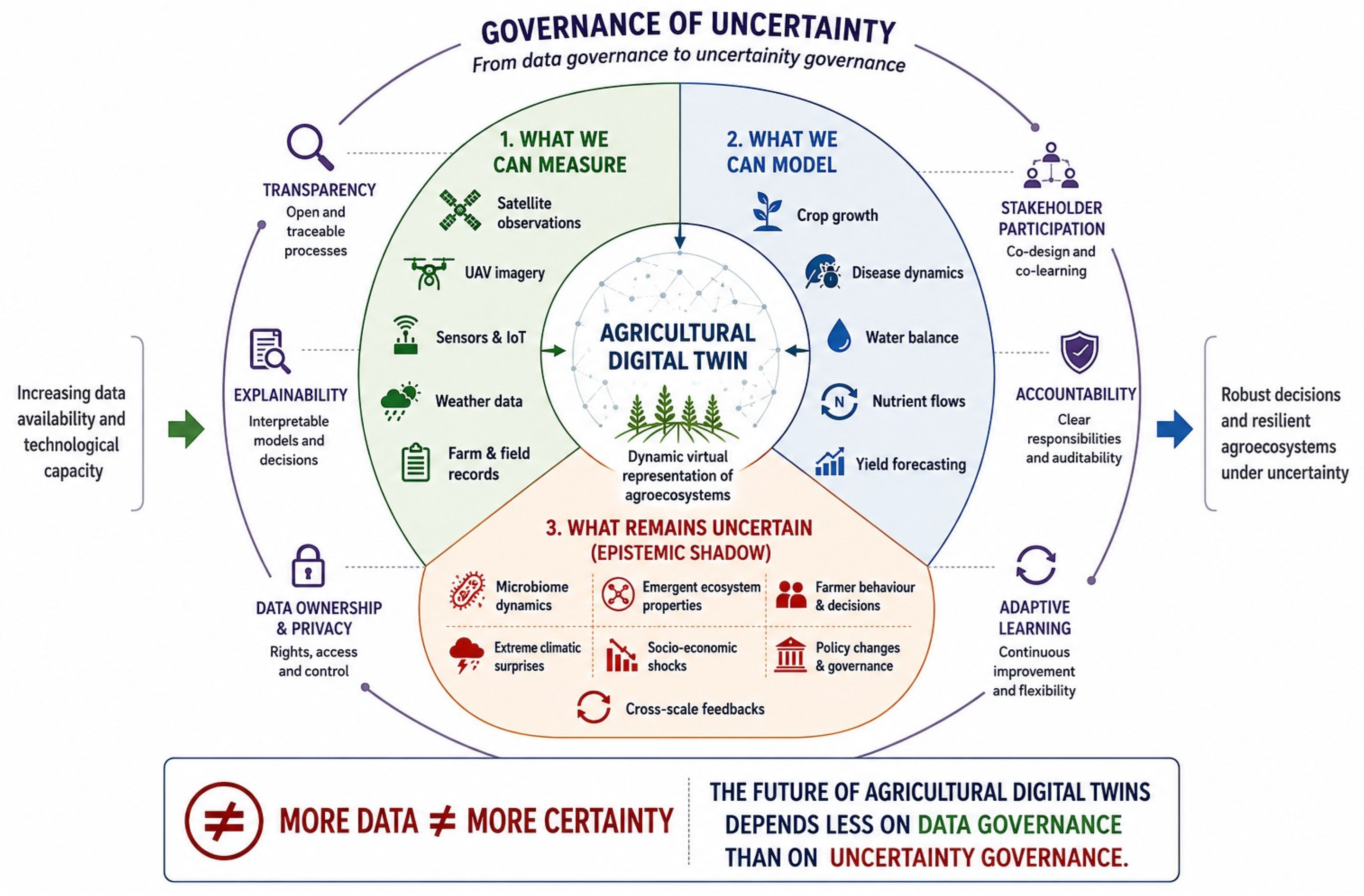
In addition, questions related to data governance, ownership, privacy, and algorithmic transparency are becoming increasingly important as agricultural digital twins rely on expanding networks of sensors, cloud infrastructures, and proprietary analytical platforms. The future success of ADTs may therefore depend as much on the development of transparent governance frameworks as on further technological innovation.
Without a stronger integration of social and institutional dimensions, digital twins risk remaining technologically sophisticated tools that are only partially aligned with the realities of agricultural practice.
Furthermore, the literature continues to suffer from a lack of harmonized validation procedures. Many studies rely on short-term experiments, single-site evaluations, or narrowly defined performance metrics.
Although several studies report encouraging improvements in predictive accuracy, water-use efficiency, disease detection performance, and operational decision support, these outcomes should be interpreted within the scope of the experimental conditions under which they were obtained. The current evidence base remains dominated by relatively short-term and context-specific evaluations, making it difficult to determine whether similar levels of performance can be consistently maintained across different crops, climatic regions, management systems, and socio-economic contexts.
Future research should therefore prioritize multi-year, multi-site, and multi-crop validation frameworks, together with explicit uncertainty quantification and comparisons against alternative modelling approaches.
Such validation efforts should move beyond conventional technical metrics alone and also assess robustness, transferability, economic viability, user adoption, environmental trade-offs, and performance under unexpected or extreme conditions. This broader evaluation perspective would provide a more realistic assessment of the capacity of Agricultural Digital Twins to support resilient decision-making in complex agroecosystems.
Such efforts are essential for establishing the robustness, credibility, and operational relevance of digital twins under real-world agricultural conditions.
Taken together, these structural, epistemological, and operational limitations suggest that the current promise of agricultural digital twins remains constrained by more than just technical challenges. They point to deeper issues related to how agroecosystems are represented, how knowledge is produced, and how these tools are implemented in practice.
Table 2 summarises these constraints, highlighting how they interact across different dimensions and contribute to shaping both the potential and the limits of digital twins in agriculture.
Collectively, these limitations suggest that future progress will depend not only on improvements in sensing technologies, computational power, and modelling sophistication, but also on the ability to develop transparent, biologically realistic, uncertainty-aware, and socially legitimate digital twin frameworks capable of supporting decision-making under the inherent complexity of agroecosystems.
7. Research Gaps, Scientific Controversies, and Future Directions
The literature on digital twins in agriculture is evolving rapidly, but it also reveals a number of unresolved tensions, both conceptual and methodological. Digital twins are often presented as integrative and predictive tools with the potential to transform agricultural systems. However, a closer examination suggests that there is still a noticeable gap between these ambitions and what is currently achieved in practice. The main scientific controversies underlying this gap are summarised in
Table 3, while the key research gaps and future priorities are outlined in
Table 4.
One of the most persistent assumptions in this field is that increasing data availability will automatically improve predictive performance. While this idea is intuitively appealing, the evidence suggests a more complex reality. When models are poorly constrained, structurally limited, or only loosely connected to the actual dynamics of agroecosystems, adding more data can introduce noise, increase redundancy, and even destabilise predictions rather than improve them [
21,
44]. In complex systems, where many processes remain only partially observable, the relationship between data volume and model performance is therefore not linear. As reflected in
Table 3, this issue highlights a broader tension between data abundance and model adequacy, suggesting that beyond a certain point, additional data may reduce rather than enhance predictive reliability. Importantly, this observation should not be interpreted as evidence that increasing data availability is inherently detrimental. Rather, it suggests that predictive improvements depend critically on the capacity of model structures to transform data into biologically meaningful representations of agroecosystem processes. High-quality and process-relevant observations can substantially improve predictive robustness when integrated within appropriate modelling frameworks. The controversy therefore lies less in the quantity of available data than in the relationship between data complexity and model adequacy [
21,
44].
A second major limitation concerns the way models are validated. Many studies reporting strong performance still rely on relatively narrow datasets, short observation periods, or controlled experimental conditions that do not fully capture the variability of real agricultural systems [
22]. In some cases, models are even evaluated using the same data that were used for calibration, raising concerns about overfitting and inflated performance estimates. More importantly, validation across different environments, cropping systems, and time periods remains limited. This makes it difficult to assess how robust and transferable these models actually are. As highlighted in
Table 3 and
Table 4, improving validation practices remains a key priority for strengthening the scientific credibility of digital twins in agriculture.
Beyond conventional calibration procedures, future validation strategies should incorporate independent evaluations across years, sites, climatic conditions, management systems, and crop types. Particular attention should also be given to uncertainty quantification, robustness under extreme events, and comparisons with non-digital-twin baseline approaches. Such validation frameworks are essential for determining whether reported improvements genuinely reflect model generalization or merely local optimisation effects [
22].
The growing integration of artificial intelligence further complicates this picture. Machine learning and deep learning approaches can enhance predictive performance by identifying complex and non-linear patterns that are difficult to capture with traditional models [
21,
48]. However, these gains often come with a trade-off. As models become more powerful, they may also become less transparent. In many cases, they function as black-box systems, where predictive accuracy increases while interpretability declines.
This prediction–interpretability trade-off has emerged as one of the most important scientific controversies associated with agricultural digital twins. While highly flexible machine-learning algorithms can identify complex non-linear relationships, they often provide limited insight into the causal mechanisms underlying system behaviour. Recent developments in explainable artificial intelligence (XAI), hybrid mechanistic–AI approaches, and causal modelling frameworks represent promising avenues for addressing this limitation. However, their implementation within operational agricultural digital twins remains relatively limited and requires further evaluation under diverse agroecological conditions [
21,
48]. The challenge is particularly important in biological systems, where understanding why a prediction is generated may be as important as the prediction itself. In agroecosystems characterized by partial observability, emergent behaviour, and strong context dependency, predictive performance alone may be insufficient to ensure scientific credibility or operational reliability. Consequently, future ADTs will likely need to balance predictive power with explainability and biological realism [
21,
48].
These controversies are summarized in
Table 3, while key research gaps and priorities are outlined in
Table 4. Together,
Table 3 and
Table 4 illustrate that many of the current limitations of ADTs originate not only from technological constraints but also from unresolved conceptual questions concerning uncertainty, causality, system representation, and model validity.
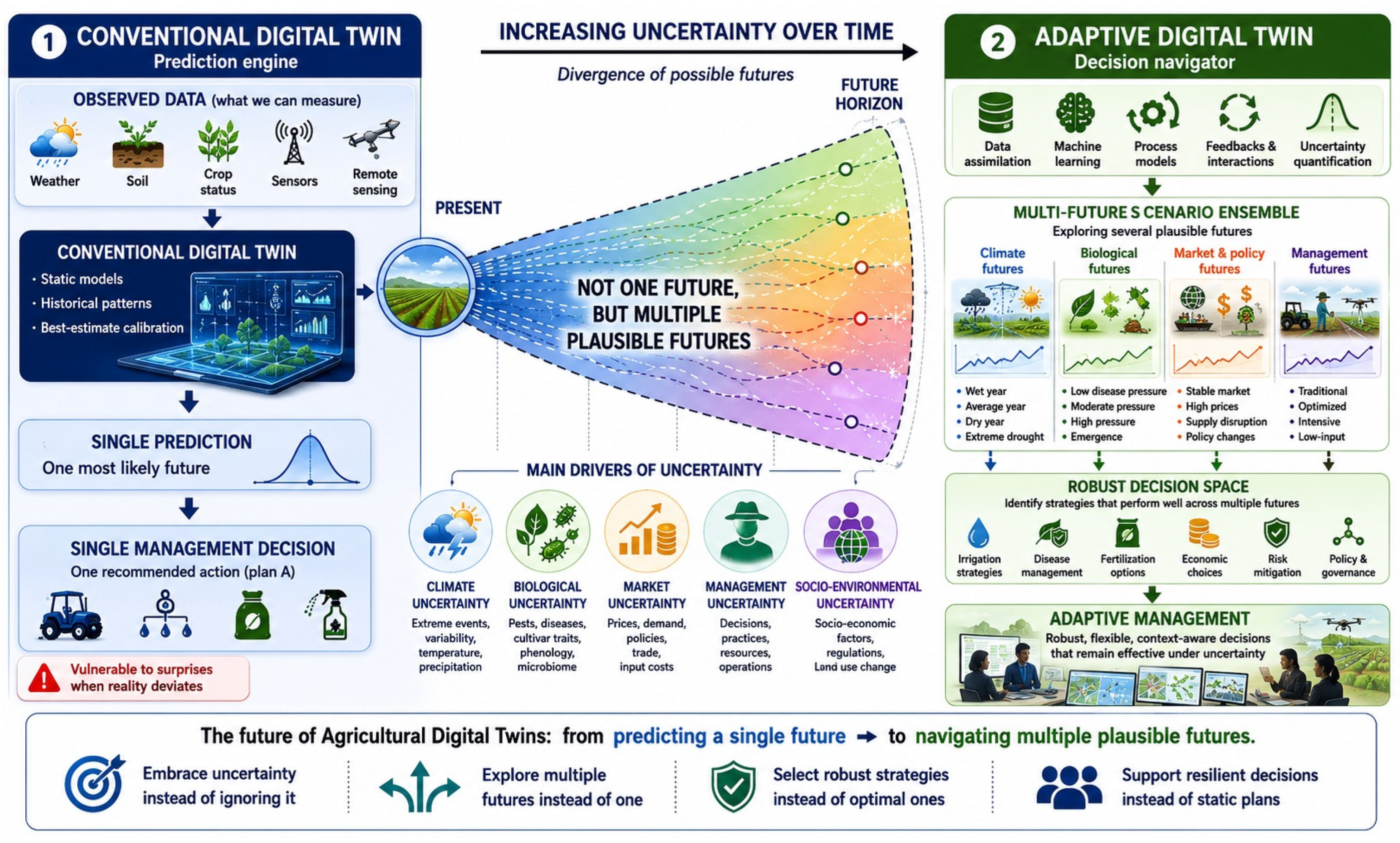
A major future direction for Agricultural Digital Twins (ADTs) lies in the transition from deterministic prediction engines to adaptive decision navigators, as conceptualized in
Figure 7. This transition reflects a profound shift in the underlying philosophy of digital twin development. Conventional ADTs typically aim to identify a single most likely future based on historical observations, model calibration, and best-estimate predictions. While such approaches can provide valuable insights under relatively stable conditions, their effectiveness may decline when agroecosystems are exposed to multiple interacting sources of uncertainty, including climatic variability, biological dynamics, socio-economic disruptions, policy changes, and adaptive human responses.
Figure 7 illustrates an alternative paradigm in which uncertainty is no longer treated as a residual error to be minimized, but as an intrinsic and unavoidable feature of agroecosystem functioning. In this framework, adaptive ADTs explicitly integrate uncertainty quantification, data assimilation, machine learning, feedback mechanisms, and process-based modelling to generate ensembles of plausible futures rather than a single deterministic forecast. The objective therefore shifts from predicting one future accurately to exploring multiple possible trajectories and identifying management strategies that remain effective across a range of uncertain conditions.
This evolution aligns ADTs with key principles of resilience theory, adaptive management, robust decision-making, and scenario-based planning. Rather than optimizing decisions for a single anticipated future, adaptive digital twins support the identification of robust strategies capable of maintaining system performance under diverse climatic, biological, economic, and institutional scenarios. In this sense, the future value of ADTs may depend less on their ability to forecast perfectly and more on their capacity to help decision-makers navigate uncertainty, anticipate alternative futures, and enhance the adaptive capacity of agroecosystems.
More fundamentally,
Figure 7 suggests that the next generation of ADTs should be evaluated not solely according to predictive accuracy, but also according to their ability to support resilient, flexible, and context-aware decision-making. This represents a transition from a paradigm of prediction and control toward a paradigm of learning, adaptation, and uncertainty-informed governance. The ultimate ambition is therefore not the production of a single optimal recommendation, but the construction of decision-support systems capable of remaining informative, transparent, and operational across multiple plausible futures.
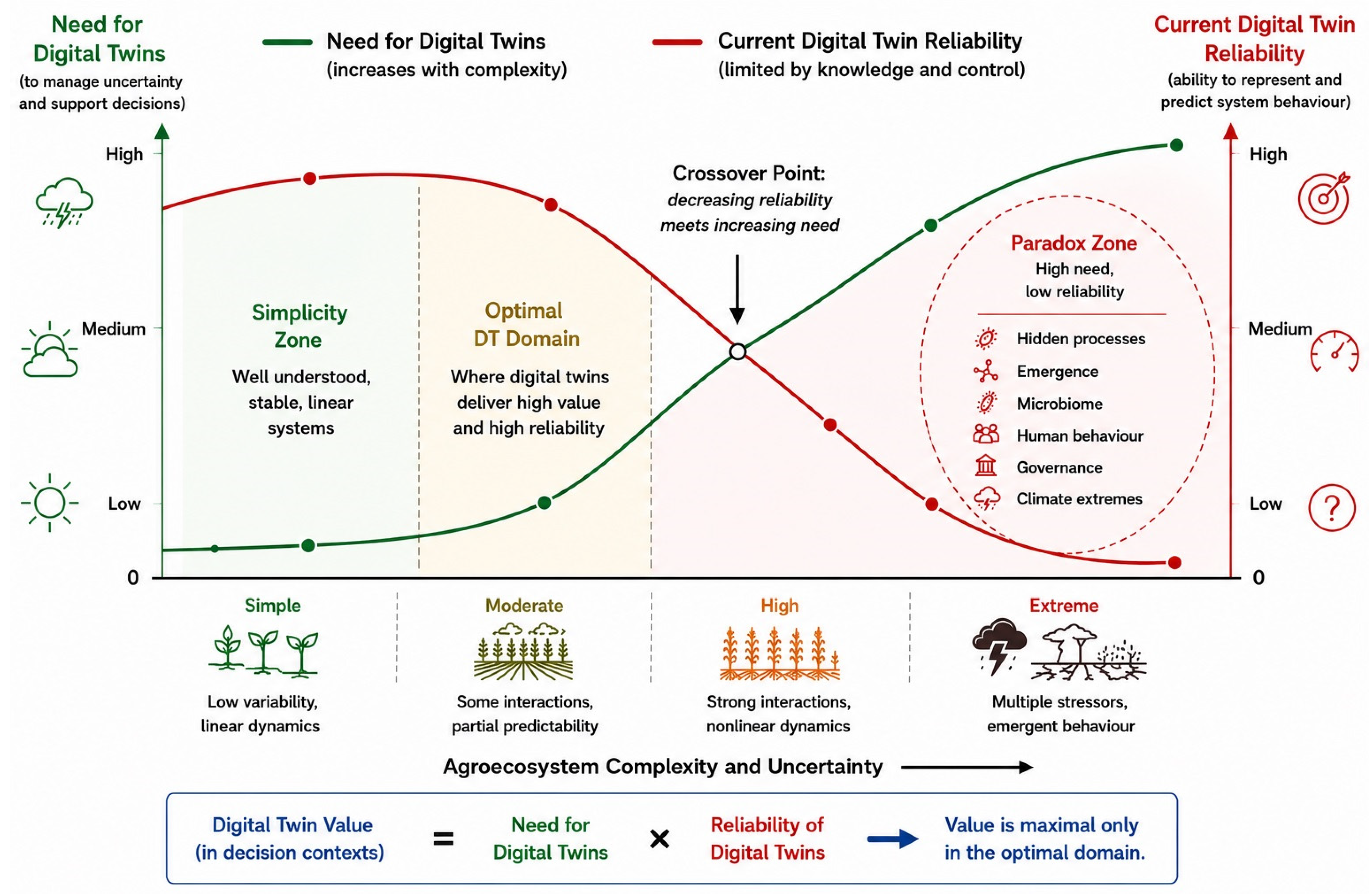
At the same time, the increasing complexity of agroecosystems introduces a fundamental challenge for Agricultural Digital Twins (ADTs), conceptualized in
Figure 8 as the Digital Twin Relevance Paradox. As agroecosystem complexity increases, the need for digital twins becomes progressively greater because decision-making must account for nonlinear interactions, environmental variability, biological heterogeneity, and multiple sources of uncertainty operating across scales. However, the reliability of current ADTs may decline beyond a critical complexity threshold because many of the processes governing system behaviour remain only partially observable, weakly represented, or structurally inaccessible to existing modelling frameworks. These include emergent ecological properties, microbiome dynamics, cross-scale feedback mechanisms, socio-economic responses, governance influences, and adaptive human decision-making. Consequently, ADTs tend to perform most reliably in relatively simple and controlled systems, whereas their greatest potential value lies in highly complex systems characterized by strong uncertainty and limited predictability. This paradox highlights a central limitation of current digital twin architectures and suggests that future progress will depend not only on increasing data availability or computational power, but also on improving the representation of hidden processes, uncertainty propagation, adaptive learning mechanisms, and cross-scale interactions that shape agroecosystem dynamics [
60].
Finally,
Figure 8 further exposes a critical mismatch between where Agricultural Digital Twins (ADTs) currently perform most reliably and where they are most urgently needed. In relatively simple or controlled systems, model structures are easier to parameterize, uncertainty is more constrained, and observed variables are more closely linked to system behaviour. Under these conditions, ADTs can reach comparatively high reliability, but their added value for decision support may remain limited because system dynamics are already more predictable. Conversely, as agroecosystem complexity increases, the need for ADTs becomes greater because farmers and decision-makers must operate under stronger uncertainty, nonlinear dynamics, interacting stressors, and socio-ecological feedback. Yet these are precisely the conditions under which current ADTs become less reliable, because hidden processes, emergent behaviour, microbiome dynamics, climate extremes, governance constraints, and human decision-making are difficult to observe, formalize, and validate. This creates a relevance paradox: ADTs may be most reliable where they are least needed, and most needed where they are least reliable. The implication is not that ADTs are unsuitable for complex agroecosystems, but that their future development must move beyond technological maturity alone. Progress will require uncertainty-aware modelling, cross-scale validation, adaptive learning, transparent governance, and stronger representation of latent biological and socio-economic processes.
Figure 8 therefore calls for more realistic expectations: the scientific value of ADTs should not be judged only by predictive performance under controlled conditions, but by their ability to remain informative, robust, and decision-relevant when agroecosystem complexity increases. Beyond purely scientific and technical challenges, future developments will also need to address broader governance and implementation issues. Questions related to data ownership, algorithmic transparency, digital sovereignty, accessibility, farmer participation, and equitable access to technological innovation are likely to become increasingly important as digital twin deployment expands. Without appropriate governance frameworks and participatory implementation strategies, the benefits of ADTs may remain concentrated within highly capitalized agricultural systems, potentially reinforcing existing technological and socio-economic inequalities.
Taken together, these research gaps and ongoing controversies point to a broader conclusion: the future of digital twins in agriculture will depend on more than technological progress alone. It will require improvements in validation practices, greater attention to model interpretability, and a more explicit integration of uncertainty into both modelling and decision-making processes. It will also require stronger integration of biological realism, multi-scale system representation, transparent governance frameworks, participatory design approaches, and uncertainty-aware decision-support architectures capable of operating under the intrinsic complexity of agroecosystems. The issues summarized in
Table 3, the priorities outlined in
Table 4, and the conceptual shifts illustrated in
Figure 7,
Figure 8 and
Figure 9 all converge toward the same direction. For digital twins to mature as a scientific and operational approach, their development will need to become more critical, more transparent, more biologically grounded, and more firmly anchored in the realities of complex agricultural systems.
8. Conceptual Framework Development and Figure Construction
The conceptual figures presented in this review were not designed simply as visual illustrations of the text. They form an integral part of the analytical framework underlying the manuscript. Their development is based on a careful synthesis of the literature, combined with a systems-oriented perspective and an explicit effort to reflect on the epistemological dimensions of digital twin research. Rather than reproducing empirical outputs, these figures are intended as conceptual tools that help make visible the recurring patterns, inconsistencies, and tensions identified across studies on digital twins, agroecosystem complexity, and data-driven modelling [
17,
21,
44].
The construction of these figures followed a structured, yet iterative process. It began with a close reading of the literature in order to identify the main conceptual tensions shaping the field. Among the most prominent were the non-linear relationship between data availability and model performance (
Figure 5), the gap between observable variables and underlying biological processes (
Figure 6), and the mismatch between technological maturity and system complexity (
Figure 9). Rather than treating these issues in isolation, they were considered as interconnected expressions of deeper structural constraints that emerge when digital twins are applied to complex living systems [
7,
63].
Particular attention was given to identifying concepts that appeared consistently across multiple studies despite differences in agricultural systems, modelling approaches, and technological infrastructures. Only recurring themes supported by convergent evidence from the reviewed literature were incorporated into the conceptual framework. This approach was adopted to minimise arbitrary interpretation and to ensure that the figures reflected broad scientific patterns rather than isolated observations.
The figures were then developed through a process of abstraction aimed at translating these recurring patterns into simplified visual representations. The objective was not to quantify relationships precisely, but rather to provide a coherent framework for understanding how different limitations and opportunities interact within agricultural digital twin systems.
Importantly, the figures were constructed using a systems-thinking perspective in which agroecosystems are viewed as complex adaptive systems characterised by feedback loops, non-linearity, partial observability, emergent behaviour, and context dependency [
63,
67]. Consequently, the graphical structures were intentionally designed to emphasize interactions, constraints, trade-offs, and sources of uncertainty rather than purely technological functionalities.
In this respect,
Figure 5,
Figure 6,
Figure 7,
Figure 8 and
Figure 9 should be interpreted as analytical syntheses rather than predictive models. Their purpose is to facilitate discussion about relationships that are frequently acknowledged in the literature but rarely formalised explicitly [
21,
68]. Similarly,
Figure 5 was developed to illustrate the gap between observable variables and latent processes, a challenge that is widely recognised in fields such as plant phenotyping and ecological modelling [
23].
This distinction is particularly important because several of the mechanisms illustrated in the figures remain difficult to evaluate through conventional experimental approaches. By translating fragmented evidence into structured conceptual representations, the figures provide a means of integrating knowledge originating from different disciplines, including agronomy, systems ecology, artificial intelligence, remote sensing, modelling science, and digital agriculture [
7,
22].
This approach is, of course, open to discussion. Conceptual figures inevitably involve a degree of interpretation, which means they may be perceived as subjective or insufficiently grounded in empirical validation. However, in a field where empirical evidence remains fragmented and highly context-dependent, developing such conceptual frameworks is not necessarily a weakness. On the contrary, it can help structure scientific debate, clarify what remains uncertain, and identify priorities for future research [
22,
65].
Furthermore, conceptual synthesis has historically played a pivotal role in the advancement of scientific paradigms, particularly in disciplines characterized by high system complexity, strong context dependency, and limited experimental controllability. In such domains, conceptual frameworks frequently act as intellectual bridges linking empirical observations, theoretical developments, methodological innovation, and the formulation of new research hypotheses. Rather than merely summarizing existing knowledge, they often contribute to shaping emerging scientific agendas by identifying hidden assumptions, unresolved tensions, and overlooked research frontiers.
Within this perspective, the conceptual figures proposed throughout this review should be interpreted as hypothesis-generating and theory-building frameworks rather than definitive representations of agroecosystem reality. Their primary objective is not to provide empirical quantification, but to formalize recurring patterns, conceptual contradictions, and systemic challenges repeatedly identified across the reviewed literature. As such, they are intended to stimulate future empirical validation, comparative analyses, and methodological refinement.
Importantly, these figures should not be regarded as simple visual complements to the text. Instead, they constitute an integral component of the critical argument developed throughout this review. Collectively, they challenge several techno-optimistic assumptions that continue to dominate discussions surrounding Agricultural Digital Twins (ADTs), particularly the implicit belief that increasing data volumes, sensing density, computational power, and model complexity will inevitably lead to improved understanding, predictability, and control of agroecosystems.
By making structural constraints more explicit, the figures reveal a series of interconnected scientific challenges that remain only partially acknowledged in the current literature. These include the non-linear relationship between data accumulation and knowledge generation, illustrated through the data saturation and epistemic overload dynamics represented in
Figure 4; the fundamental observability constraints imposed by partially observable biological systems and hidden ecological processes highlighted in
Figure 5; the transition from deterministic prediction toward adaptive, uncertainty-aware decision support conceptualized in
Figure 7; the cross-scale interactions linking molecular, physiological, agronomic, landscape, and socio-economic processes illustrated in
Figure 8; the maturity–complexity paradox showing that digital twins tend to be least mature precisely where system complexity is highest (
Figure 9); and the governance challenges associated with transparency, accountability, explainability, interoperability, and stakeholder legitimacy synthesized in
Figure 10.
Taken together, these conceptual representations suggest that the future development of ADTs may be constrained less by technological limitations than by deeper epistemological boundaries associated with understanding, representing, and governing complex living systems. In this sense, the figures collectively support a broader scientific argument: the central challenge facing agricultural digital twins is not merely technological implementation, but the reconciliation of digital representation with the intrinsic uncertainty, heterogeneity, emergence, adaptability, and context dependency that characterize agroecosystems.
Consequently, the figures serve not only as explanatory devices but also as critical analytical instruments designed to stimulate scientific reflection and encourage a more balanced assessment of both the opportunities and limitations of digital twin technologies. Their purpose is to confront technological expectations with biological, ecological, epistemological, and socio-technical realities that cannot be fully eliminated through data acquisition or computational advances alone.
For this reason, the figures should not be interpreted as neutral summaries of the literature. Rather, they function as conceptual lenses through which prevailing assumptions can be critically examined and alternative research trajectories explored. They are not predictive models in themselves, but heuristic frameworks intended to organize thinking around the limits, trade-offs, paradoxes, and future directions of ADT development. By explicitly linking data, models, observability, uncertainty, governance, and system complexity, they contribute to a more transparent, reflexive, and scientifically grounded understanding of digital twin implementation in agriculture.
Ultimately, the conceptual framework developed in this review seeks to move beyond a purely technological interpretation of Agricultural Digital Twins. By explicitly incorporating uncertainty, partial observability, epistemic limits, governance mechanisms, adaptive decision-making, and multi-scale system complexity, it proposes a broader scientific perspective through which future ADT research can be evaluated, refined, and critically assessed. From this viewpoint, the long-term success of agricultural digital twins will likely depend not only on advances in sensing technologies, artificial intelligence, or computational performance, but also on their capacity to integrate ecological realism, scientific transparency, institutional legitimacy, and responsible governance within coherent socio-ecological decision-support systems capable of operating under conditions of irreducible uncertainty.
9. Limitations of the Conceptual Framework
Although the conceptual framework and associated figures developed in this review provide a structured synthesis of recurring patterns emerging from a rapidly evolving and highly interdisciplinary body of literature, their interpretive power remains subject to several important limitations that warrant explicit consideration.
First, the proposed framework is grounded in a qualitative, comparative, and integrative interpretation of the literature rather than in a formal quantitative meta-analysis. Consequently, the relationships represented in
Figure 4,
Figure 5,
Figure 6,
Figure 7,
Figure 8,
Figure 9 and
Figure 10 should not be interpreted as empirically calibrated laws, predictive equations, or universally transferable system properties. Rather, they represent conceptual abstractions derived from convergent observations, theoretical reasoning, and recurring themes identified across diverse studies. This distinction is particularly important because many of the dynamics illustrated in the framework, including the data–knowledge decoupling process, the emergence of epistemic blind spots, and the maturity–complexity paradox—are likely to vary substantially across agroecological conditions, climatic contexts, production systems, institutional environments, and levels of technological development.
More fundamentally, the framework reflects an attempt to identify general tendencies within a heterogeneous scientific landscape rather than to establish universal principles governing Agricultural Digital Twins (ADTs). As a result, some conceptual relationships may reflect dominant narratives and recurrent patterns within the current literature rather than intrinsic properties of agroecosystems themselves. The framework should therefore be interpreted as an analytical synthesis of contemporary scientific thinking rather than as a definitive representation of agricultural reality.
Second, the level of abstraction required to construct an integrative conceptual framework inevitably simplifies the complexity of living agroecosystems. Biological systems are characterized by emergence, adaptation, path dependency, non-linearity, and cross-scale interactions that cannot be fully represented through static conceptual structures. Processes such as plant–microbiome co-evolution, genotype-by-environment interactions, ecological memory, adaptive farmer behaviour, landscape connectivity, and ecosystem feedback mechanisms remain only partially represented within the present framework.
This limitation is particularly evident in
Figure 6 and
Figure 8, which respectively conceptualize partial observability and multi-scale organization. While these representations help clarify major structural tensions, they cannot fully capture the diversity, contingency, and dynamic nature of interactions occurring across biological, ecological, and socio-economic scales. Consequently, the framework should not be interpreted as an exhaustive description of agroecosystem functioning, but rather as a heuristic lens designed to reveal underlying tensions that frequently remain hidden in predominantly technology-oriented discussions.
Third, several influential drivers of digital twin performance remain only indirectly incorporated into the framework. These include behavioural adaptation by farmers, institutional learning processes, governance structures, market dynamics, policy interventions, economic incentives, geopolitical instability, data ownership regimes, and emerging technological disruptions. Increasing evidence suggests that these factors can influence the success or failure of digital twin implementation as strongly as technological performance itself. However, incorporating all of these dimensions explicitly would have transformed the framework into a substantially more complex socio-technical model, extending beyond the analytical objectives of the present review.
A related limitation concerns the representation of uncertainty. Several relationships illustrated throughout the framework, particularly those involving thresholds, transitions, saturation effects, and declining predictive reliability, are primarily derived from theoretical reasoning, systems thinking, and comparative interpretation rather than from harmonized empirical datasets. The curves and transitions represented in
Figure 4,
Figure 7 and
Figure 9 should therefore be interpreted as heuristic and context-dependent trajectories. They identify plausible system behaviours and potential structural tendencies, but they do not constitute empirically validated universal responses.
Future research should therefore focus on testing these conceptual propositions through coordinated empirical investigations conducted across contrasting agroecological regions, climatic gradients, production systems, and technological environments. Such efforts would help determine whether the relationships proposed here reflect general characteristics of ADTs or remain contingent upon specific contexts and implementation conditions.
Fourth, the framework only partially captures the profound socio-technical heterogeneity that characterizes global agriculture. The pathways leading toward uncertainty-aware and adaptive digital twins are unlikely to be uniform across regions. Differences in infrastructure quality, digital connectivity, institutional capacity, governance systems, access to expertise, economic resources, and data availability may fundamentally shape both the trajectory and the maturity of ADT development.
This limitation is particularly relevant for low- and middle-income countries, where agricultural systems often operate under conditions of limited connectivity, fragmented datasets, institutional constraints, and resource scarcity. Under such circumstances, the assumptions underlying highly integrated digital twin architectures may not hold, and alternative development pathways may emerge. Consequently, the maturity–complexity relationships proposed in this review should not be assumed to follow identical trajectories across all geographical and socio-economic contexts.
Fifth, the framework remains constrained by the current state of the scientific literature itself. Publication bias may systematically favour studies reporting technological successes, predictive improvements, and positive implementation outcomes, while failures, negative results, uncertainty analyses, and unsuccessful deployments remain comparatively underreported. This asymmetry may contribute to an overly optimistic representation of ADT capabilities and may partially obscure the frequency and significance of implementation challenges. As a result, some of the limitations discussed throughout this review may in fact be more pervasive than currently documented in the published literature.
Finally, an inherent limitation of all conceptual frameworks lies in their interpretive nature. Conceptual synthesis is not a neutral process of aggregation but an analytical exercise involving theoretical choices, disciplinary perspectives, and epistemological assumptions. Alternative conceptualisations of the same literature are therefore entirely possible. Researchers approaching ADTs from engineering, ecological, agronomic, social-science, or governance perspectives may legitimately emphasize different mechanisms, relationships, and priorities.
Rather than representing a weakness, this plurality of interpretations reflects the interdisciplinary nature of the field itself. Indeed, one of the central conclusions emerging from this review is that Agricultural Digital Twins cannot be fully understood through a single disciplinary lens. Their development sits at the intersection of engineering, ecology, data science, systems theory, governance, and decision sciences. Consequently, future progress will likely depend not only on technological innovation but also on the capacity to integrate these diverse perspectives into coherent scientific frameworks capable of addressing the fundamental challenge underlying ADTs: how to represent, understand, and support decision-making within complex living systems that remain only partially observable, inherently adaptive, and irreducibly uncertain.
For this reason, the framework should not be viewed as a definitive representation of agricultural digital twin development, but rather as a working scientific hypothesis designed to stimulate debate, guide future empirical investigations, and support the progressive refinement of theoretical understanding. Its principal value lies not in providing final answers, but in making explicit the key assumptions, uncertainties, and structural tensions that continue to shape the evolution of agricultural digital twins [
22,
65].
Ultimately, the framework should be regarded as an evolving conceptual architecture that will require continuous revision as new empirical evidence, modelling approaches, validation studies, and real-world implementations become available. In this sense, its scientific contribution is less to establish fixed conclusions than to provide a transparent foundation upon which future research can build, challenge, refine, and empirically test the proposed relationships.
10. Beyond Technological Optimism: A Critical Reappraisal of Digital Twins in Agriculture
Although the literature on digital twins in agriculture is expanding rapidly and often presents them as transformative tools, the discussion remains, to a large extent, shaped by a strong techno-optimistic narrative that deserves closer examination. Digital twins are frequently portrayed as integrative, data-driven solutions capable of improving productivity, enhancing sustainability, and strengthening resilience. While these expectations are not without foundation, they can sometimes overlook important scientific uncertainties, as well as the epistemological and socio-technical constraints that become apparent when these systems are applied to real-world agricultural contexts.
A first point of concern relates to the widespread assumption that agricultural systems can be made fully observable, measurable, and ultimately controllable through digital infrastructures. This assumption, which is partly inherited from engineering paradigms [
19,
69], does not align easily with the nature of agroecosystems. These systems are not fully ordered or predictable environments; they are complex adaptive systems, shaped by non-linearity, emergent dynamics, and multiple sources of uncertainty [
7,
70,
71,
72,
73].
Furthermore, the assumption that increasing digitalisation will necessarily reduce uncertainty deserves careful reconsideration. In biological systems, uncertainty is not merely a consequence of insufficient information but often reflects intrinsic properties of ecological processes themselves. Consequently, even highly sophisticated digital twins may remain unable to fully anticipate emergent system behaviours, regime shifts, or unexpected responses arising from interactions across scales.
A second issue concerns the growing tendency to equate technological sophistication with scientific understanding. The increasing integration of sensors, remote sensing platforms, machine learning algorithms, and high-performance computing infrastructures undoubtedly expands the capacity to collect and process information. However, the accumulation of data should not be confused with an equivalent increase in explanatory power. As discussed throughout this review, the relationship between information availability and system understanding remains conditional upon the ability of models to represent underlying causal mechanisms [
21,
48,
74,
75].
This distinction becomes particularly important in the context of artificial intelligence and deep learning approaches. While highly flexible predictive models may achieve impressive forecasting performance, they may simultaneously obscure causal relationships and reduce interpretability. As a result, predictive success does not necessarily imply improved understanding of agroecosystem functioning. In some cases, increasingly complex algorithms may generate highly accurate outputs while providing limited insight into the ecological processes responsible for observed patterns.
Another important consideration concerns the socio-technical dimension of agricultural digital twins. Digital technologies are often presented as neutral innovations whose benefits emerge automatically from their deployment [
18,
66]. In reality, their performance and impact are strongly influenced by institutional arrangements, governance structures, economic conditions, and user capacities [
46,
47].
These socio-technical constraints indicate that governance should not be treated as an external regulatory add-on or a secondary implementation concern, but as a constitutive layer of Agricultural Digital Twins. As illustrated in
Figure 10, the transformation of heterogeneous agricultural data into actionable, trustworthy and socially legitimate decisions depends on governance mechanisms that make data flows traceable, model assumptions interpretable, responsibilities explicit, and uncertainties communicable. Transparency, explainability, interoperability, data ownership, accountability, fairness, trust, adaptive learning and stakeholder participation are therefore not peripheral conditions for adoption; they are core requirements for ensuring that ADTs remain credible, usable and decision-relevant under the uncertainty and complexity of real agroecosystems. This issue is especially relevant in smallholder farming systems, rainfed tropical agriculture, biodiversity-rich agroecological systems, and resource-constrained regions, where digital infrastructures, connectivity, technical support, and access to high-quality datasets may remain limited. Ironically, many of the agricultural systems that could potentially benefit most from improved decision-support tools are also those in which the implementation of sophisticated digital twins remains most challenging.
At the same time, a growing body of evidence suggests the existence of a fundamental mismatch between the technological aspirations associated with Agricultural Digital Twins (ADTs) and the ecological complexity of the systems they seek to represent. As conceptualized in
Figure 8, the performance of digital twin architectures tends to be highest in environments characterized by relatively stable conditions, high observability, standardized management practices, and well-defined system boundaries. Under such circumstances, data streams can be efficiently integrated, model parameters can be calibrated with greater confidence, and system dynamics remain sufficiently constrained to enable reliable prediction and optimization.
The situation is markedly different in complex agroecosystems. Systems characterized by high biodiversity, strong environmental variability, heterogeneous management practices, and multiple interacting biological processes remain substantially more difficult to represent through digital replicas. This observation raises a critical scientific question: are digital twins currently being developed primarily for the agricultural systems where they are most needed to enhance resilience and sustainability, or for those where implementation is technically easier and economically more attractive?
This question becomes particularly relevant when considering diversified agroforestry systems, mixed crop–livestock systems, tropical smallholder mosaics, regenerative farming systems, and low-input agroecological landscapes. Such systems are governed by dense ecological networks involving soil microbiomes, plant–plant interactions, trophic relationships, landscape connectivity, ecosystem services, and adaptive management strategies that evolve through time. Their behaviour frequently emerges from interactions occurring across multiple organizational scales rather than from a limited set of measurable variables. Consequently, many of the assumptions underlying conventional digital twin architectures—including standardization, repeatability, parameter stability, and transferability—become increasingly difficult to sustain.
From this perspective, the challenge facing future generations of ADTs is not merely one of computational power or data acquisition. Rather, it concerns the capacity to develop representations capable of embracing ecological complexity without reducing it excessively. A digital twin that simplifies agroecosystem functioning to the point where essential ecological processes disappear may achieve technical efficiency while simultaneously losing ecological realism. This creates a fundamental trade-off between model tractability and biological fidelity that remains largely unresolved within the current literature.
More broadly, the complexity mismatch highlighted in
Figure 8 reflects a deeper epistemological issue. Agricultural systems are not simply physical systems waiting to be digitized; they are living adaptive systems characterized by emergence, contingency, path dependency, and irreducible uncertainty. Unlike industrial assets, whose behaviour can often be described through relatively stable physical laws, agroecosystems continuously reorganize in response to environmental change, biological adaptation, and human intervention. As a consequence, complete representation may remain an unattainable objective regardless of future advances in sensing technologies or artificial intelligence.
It is equally important to recognize that digital twins are not neutral technological artefacts. Every digital twin embodies a particular way of observing, measuring, interpreting, and ultimately governing agricultural systems. The selection of variables, the design of indicators, the structure of models, and the definition of optimization objectives all reflect underlying epistemological assumptions regarding what is considered relevant, measurable, and actionable knowledge.
By privileging variables that can be quantified, monitored, and computationally processed, ADTs may unintentionally favour certain forms of knowledge while marginalizing others. Experiential knowledge accumulated by farmers, tacit management practices, local ecological understanding, indigenous knowledge systems, and context-specific observations often remain difficult to formalize within conventional modelling frameworks. Yet these forms of knowledge frequently play a critical role in managing uncertainty, responding to unexpected disturbances, and maintaining long-term agroecosystem resilience.
This observation has important implications for the future governance of digital agriculture. If digital twins become increasingly influential in guiding agricultural decisions, questions of knowledge representation, transparency, inclusiveness, and epistemic equity will become as important as questions of predictive accuracy. The challenge is therefore not simply to build more sophisticated digital twins, but to ensure that their development remains compatible with plural forms of knowledge and diverse agricultural realities.
Ultimately, the long-term scientific value of ADTs may depend less on their ability to create perfect virtual replicas of agricultural systems than on their capacity to function as transparent, uncertainty-aware, and participatory decision-support environments. In this perspective, the next generation of agricultural digital twins should not aim to replace ecological understanding with computation, but rather to create new forms of interaction between data, models, ecological processes, and human expertise. Such a transition would move the field beyond a purely technological paradigm toward a more mature vision of ADTs as socio-ecological learning systems capable of supporting resilient agriculture under conditions of complexity, uncertainty, and global change.
Figure 10 ultimately reframes Agricultural Digital Twins (ADTs) not as purely computational infrastructures, but as governed socio-ecological knowledge systems operating at the interface between observation, modelling, and irreducible uncertainty. Rather than depicting governance as an external regulatory layer applied after model development, the figure positions governance as an integral component of the digital twin itself, shaping how data are collected, interpreted, validated, communicated, and translated into decisions. In this perspective, the long-term value of ADTs depends not only on sensing technologies, artificial intelligence, and predictive capabilities, but also on the institutional and societal mechanisms through which uncertainty is acknowledged, managed, and incorporated into decision-making processes.
The figure further highlights a critical distinction between what can be measured, what can be modelled, and what remains fundamentally uncertain. Although advances in remote sensing, UAVs, IoT networks, and artificial intelligence continue to expand the observable and modelled domains of agroecosystems, important drivers of system behaviour remain only partially observable or structurally inaccessible. These include microbiome dynamics, emergent ecosystem properties, adaptive human behaviour, socio-economic disruptions, policy shifts, and cross-scale ecological feedbacks. As a result, uncertainty should not be viewed as a temporary deficiency that will disappear with additional data, but as an intrinsic characteristic of complex agroecosystems that must be explicitly incorporated into digital twin architectures.
Consequently, future ADT development should move beyond data-centric paradigms toward uncertainty-aware and governance-sensitive frameworks. Participatory modelling approaches become particularly important in this context, as farmers, advisors, agronomists, ecologists, data scientists, and policy actors possess complementary forms of knowledge that can help identify blind spots, contextualize model outputs, and improve system legitimacy. Such collaborative approaches may strengthen transparency, operational relevance, stakeholder trust, and social acceptance while reducing the risk of developing technically sophisticated systems that remain disconnected from real-world agricultural decision-making.
Beyond methodological innovation, the figure suggests that a broader governance architecture is required to ensure the responsible deployment of ADTs. This architecture should include transparent data-governance policies, explainable artificial intelligence, interoperable infrastructures, open validation protocols, uncertainty quantification procedures, adaptive learning mechanisms, and cross-scale verification frameworks capable of evaluating model performance across diverse agroecological and socio-economic contexts. These governance dimensions are not secondary complements to technological development; they are likely to become primary determinants of the credibility, legitimacy, and long-term societal value of digital twins.
Taken together, these considerations suggest a fundamental conceptual shift. The objective of future ADTs should not be the pursuit of complete digital replication or perfect prediction of agroecosystems, an ambition that may remain unattainable in highly complex systems. Instead, ADTs should evolve toward adaptive, uncertainty-aware, and governance-enabled systems capable of supporting robust decisions under imperfect knowledge. In this perspective, success will depend less on maximizing predictive accuracy alone and more on building systems that remain transparent, trustworthy, resilient, and decision-relevant when confronted with uncertainty, complexity, and change. The future of Agricultural Digital Twins may therefore depend not on eliminating uncertainty, but on governing it effectively.
11. Conclusions
Digital twins are increasingly presented as emblematic of the broader transition toward data-driven agriculture. They carry a compelling promise: to integrate data, models, and decision-support tools into dynamic representations of agroecosystems capable of informing action in a context of accelerating environmental and climatic change. This promise is not without substance. It reflects both genuine technological progress and a growing need for tools that can help navigate the complexity of modern agricultural systems. Yet, as this review has shown, a clear gap remains between what digital twins are expected to achieve and what they can currently deliver.
At the core of this gap lies a fundamental characteristic of agroecosystems: they are living, context-dependent systems shaped by interactions that are multi-scale, dynamic, and only partially observable. In such systems, uncertainty is not simply a temporary limitation that can be resolved with more data. It is a structural feature. This has important implications. Although increasing data availability and model sophistication can improve the apparent representation of agricultural systems, they do not automatically generate deeper understanding or more reliable prediction. In many cases, model sophistication depends on measurements, state variables, or process-level information that are only partially available, inconsistently observed, or too costly to acquire under real farming conditions. As a result, a methodological deadlock may emerge: the more refined the model becomes, the more it relies on data that agricultural systems cannot reliably provide. In such situations, the resulting outputs may create an illusion of precision that exceeds both the observational basis of the model and the actual predictability of the system.
Importantly, this observation should not be interpreted as a universal limitation of Agricultural Digital Twins. Under appropriate conditions, numerous studies have demonstrated meaningful improvements in prediction, monitoring, resource-use efficiency, and decision support. However, the magnitude, persistence, and transferability of these benefits remain highly dependent on system characteristics, data quality, model assumptions, environmental conditions, and validation procedures. Consequently, caution is warranted when extrapolating reported performance gains beyond the contexts in which they were originally demonstrated.
In this light, the role of digital twins in agriculture may need to be reconsidered. Rather than being viewed primarily as tools for predictive control, they may be better understood as evolving interfaces that bring together data, models, and decision-making under conditions of uncertainty. Their value lies not only in their capacity to simulate system behaviour, but also in their potential to support more informed, adaptive, and context-aware decisions. This is particularly important in agricultural systems, where management choices must often be made under conditions of uncertainty, incomplete observability, and strong environmental variability. In such contexts, the role of digital twins is not simply to provide a single optimal prediction, but to help decision-makers explore possible system responses, compare alternative scenarios, and better understand the limits and implications of different management options.
At the same time, the future relevance of agricultural digital twins will depend on their ability to move beyond highly controlled production environments and demonstrate their value across a broader diversity of agroecosystems. This challenge is particularly important for smallholder farming systems, rainfed tropical agriculture, mixed crop–livestock systems, and biodiversity-rich agroecological landscapes, where system complexity, environmental variability, and limited digital infrastructure continue to constrain implementation. The true test of ADTs will therefore not be their performance in simplified environments alone, but their capacity to remain robust, interpretable, and operational under real-world complexity.
The evidence reviewed throughout this study further suggests that future progress will depend not only on advances in sensing technologies, artificial intelligence, computational power, or model integration. Equally important will be the development of rigorous long-term validation strategies, cross-site transferability assessments, uncertainty-aware modelling frameworks, and explainable AI approaches capable of improving transparency and scientific credibility. In this perspective, predictive performance should no longer be considered the sole criterion of success. Robustness, interpretability, adaptability, and ecological realism are likely to become equally important benchmarks for evaluating next-generation agricultural digital twins.
Future evaluation efforts should therefore place greater emphasis on long-term, multi-site, and cross-context validation studies capable of assessing whether reported performance improvements remain consistent across contrasting agroecological regions, production systems, climatic conditions, and socio-economic settings. Such efforts are essential for distinguishing context-specific successes from more generalizable properties of Agricultural Digital Twins.
Beyond scientific and technical considerations, the development of responsible agricultural digital twins will require new governance frameworks capable of addressing questions of data ownership, transparency, interoperability, accountability, and equitable access to digital innovation. Open data governance principles, explainable artificial intelligence frameworks, participatory modelling approaches involving farmers and local stakeholders, and cross-scale validation mechanisms should become central components of future ADT development. These dimensions are not peripheral to technological innovation; they are fundamental conditions for ensuring legitimacy, trust, and long-term societal value.
Particular attention should also be given to avoiding the emergence of new forms of digital inequality. Without appropriate governance mechanisms, the benefits of digital twins may remain concentrated in highly digitised agricultural systems, while resource-constrained regions continue to face barriers related to infrastructure, expertise, and data accessibility. Future ADTs should therefore be designed not only to optimise agricultural performance, but also to enhance inclusiveness, accessibility, and resilience across diverse socio-economic contexts.
Rather than questioning the value of ADTs, these considerations highlight the importance of adopting realistic expectations regarding their current capabilities and future development trajectories. The central challenge is not whether digital twins can generate useful insights, but under which conditions, at which scales, and with what degree of confidence those insights remain reliable, transferable, and operationally relevant.
Ultimately, this review argues that the future of agricultural digital twins does not lie in the pursuit of perfect prediction or complete digital replication of agroecosystems. Rather, it lies in the development of adaptive, uncertainty-aware, and scientifically transparent systems capable of supporting decision-making in environments characterised by complexity, variability, and change. The most successful agricultural digital twins will likely be those that combine technological innovation with ecological understanding, scientific humility, participatory governance, and operational realism. In this emerging paradigm, digital twins should be viewed not as instruments of control, but as tools for navigating uncertainty and supporting resilient agricultural transitions in an increasingly unpredictable world.