Article

Design and Experimental Analysis of a Volvariella volvacea Picking Machine

College of Engineering and Technology, Jilin Agricultural University, 2888 Xincheng Street, Changchun 130118, China
*
Author to whom correspondence should be addressed.
Agriculture 2026, 16(12), 1285; https://doi.org/10.3390/agriculture16121285
Submission received: 9 May 2026 / Revised: 4 June 2026 / Accepted: 6 June 2026 / Published: 10 June 2026
(This article belongs to the Section Agricultural Technology)

Abstract

To address the issues of low efficiency, high labor intensity, and susceptibility to damage during the manual harvesting of Volvariella volvacea, a mechanized harvesting device was developed to accommodate the growth characteristics of Volvariella volvacea. Thin-film sensors were used to measure the harvesting force values under both the bending method and the rotating method, incorporating two-finger and three-finger operation modes. The results indicated that the maximum force for the bending method was 4.60 N, while that for the twisting method was 2.91 N (peak values, n = 20 per method). The twisting method required less effort and posed a lower risk of damage. A four-suction-cup flexible end-effector was designed using silicone rubber material and equipped with a rotary cylinder. ANSYS 2022 R1 finite element simulation verified that under an applied force of 8 N, the surface stress on the Volvariella volvacea was less than 1.1489 MPa, meeting low-damage requirements. A Volvariella volvacea harvesting test rig was constructed, and performance tests were conducted. The results showed that the overall harvesting success rate was 96.65%, the damage rate was 2.03%, and the average time per harvest by the end-effector was 5.9 s. This study provides a theoretical foundation and technical support for the mechanized and intelligent harvesting of Volvariella volvacea, and is significant for promoting the high-quality development of the Volvariella volvacea industry.

1. Introduction

Volvariella volvacea is a typical high-temperature edible mushroom widely distributed in tropical and subtropical regions, possessing significant economic value [1,2,3]. Currently, factory production of Volvariella volvacea mainly adopts bed-type cultivation, requiring approximately 7 to 9 days from sowing to fruiting [4,5]. However, the harvesting of Volvariella volvacea is heavily dependent on manual labor, which suffers from three major problems: low efficiency, high labor intensity, and poor consistency [6,7]. With the aging of the rural labor force and the rising labor costs, the harvesting bottleneck has formed a significant constraint on the sustainable development of the Volvariella volvacea industry [8].
Substantial progress has been achieved in the field of fruit and vegetable harvesting robots [9,10,11]. For example, high-precision recognition, localization, and maturity determination of fruits and vegetables such as tomatoes, strawberries, and apples have been realized under complex field and facility environments by deep learning-based object detection and semantic segmentation models [12,13,14,15]. Closed-loop control of grasping force has been achieved by end-effectors integrated with flexible strain sensors and tactile sensors. Significant reduction in the damage rate of berry-type fruits during harvesting has been accomplished through force-position hybrid control strategies [16,17]. However, most of these studies focused on fruits with relatively regular shapes and high firmness [18,19]. In contrast, Volvariella volvacea exhibits large individual size variation, irregular cap morphology, and a clustered growth habit. Furthermore, Volvariella volvacea grows in high-temperature and high-humidity mushroom beds and the fruiting body tissue is extremely fragile [20]. Traditional rigid clamping or rotary pulling can easily cause mechanical damage, including cap breakage, stipe fracture, and mycelium tearing, thereby severely reducing commercial value.
Volvariella volvacea exhibits four characteristics that make automated harvesting particularly challenging. First, the cap tissue is extremely fragile. The mechanical properties of Volvariella volvacea fruiting bodies have not been quantitatively characterized in the literature. In contrast, published data show that the minimum picking force for Agaricus bisporus under bending is 3.1 N ± 2.1 N [21], and the compression force for shiitake cultivation blocks exceeds 8.97 N [22]. These values indicate that even relatively robust mushrooms require careful force control, suggesting that the even more fragile Volvariella volvacea will have a significantly lower damage threshold. Second, Volvariella volvacea typically grows in dense clusters with narrow spacing between individual fruiting bodies (observed spacing often <10 mm), which limits the access space for harvesting tools. Third, Volvariella volvacea requires a high-temperature (32–34 °C) and high-humidity (75–83%) cultivation environment [23]. These conditions, which are necessary for normal fruiting, introduce surface moisture that reduces friction and can cause rigid grippers to slip, leading to additional mechanical damage. Fourth, Volvariella volvacea individuals within a cluster exhibit considerable size variation and asynchronous maturation. These combined features—low mechanical strength, dense and irregular growth, demanding environmental conditions, and high variability—render existing harvesting methods designed for button mushrooms or shiitake largely unsuitable for Volvariella volvacea.
Research on automated harvesting equipment for Agaricus bisporus and shiitake mushrooms has been relatively extensive [24,25,26]. Harvesting robots developed by companies have achieved a harvesting success rate of over 90%. Technologies including machine vision and flexible gripping are well-adapted to the regular morphology and controllable growing environment of Agaricus bisporus. Shiitake mushroom harvesting robots have also made significant progress in tasks such as cluster recognition and mechanical analysis of stipe gripping, demonstrating good adaptability to stick-based and shelf-based cultivation modes. However, Volvariella volvacea differs fundamentally from button mushrooms and shiitake mushrooms: button mushrooms have round caps and typically grow singly, making them suitable for vacuum suction cups and rigid shearing; shiitake mushrooms have thick stems and high mechanical strength, allowing them to withstand a certain amount of gripping force. In contrast, Volvariella volvacea has thin, fragile caps and grows in dense, size-variable clusters, imposing stringent requirements on end-effector flexibility and harvesting strategies. Furthermore, Volvariella volvacea has a short growth cycle and highly asynchronous maturation, requiring high-frequency cyclic harvesting. However, the efficiency and continuous operational stability of existing harvesting systems cannot meet the demands of large-scale production [27]. To date, no dedicated harvesting device for Volvariella volvacea has been reported in the peer-reviewed literature, and only a small number of patents exist [28,29,30]. Unlike single-suction-cup systems designed for Agaricus bisporus (which grows singly) or rigid grippers for shiitake mushrooms (which tolerate higher force), the proposed four-suction-cup configuration enables parallel harvesting of clustered mushrooms and reduces contact stress through flexible silicone rubber cups.
Herein, an efficient and low-damage harvesting machine for bed-type cultivation of Volvariella volvacea was designed and validated. Thin-film sensors were used to measure forces during bending and twisting harvesting methods. The force characteristics of two-finger and three-finger grasps were compared. A flexible end-effector with four suction cups was designed, and contact stress was analyzed using the finite element method. A complete machine test platform was built to evaluate harvesting success rate, damage rate, and single-harvest time. The results provide key design parameters and theoretical support for mechanized and intelligent harvesting of Volvariella volvacea.

2. Materials and Methods

2.1. Test Samples

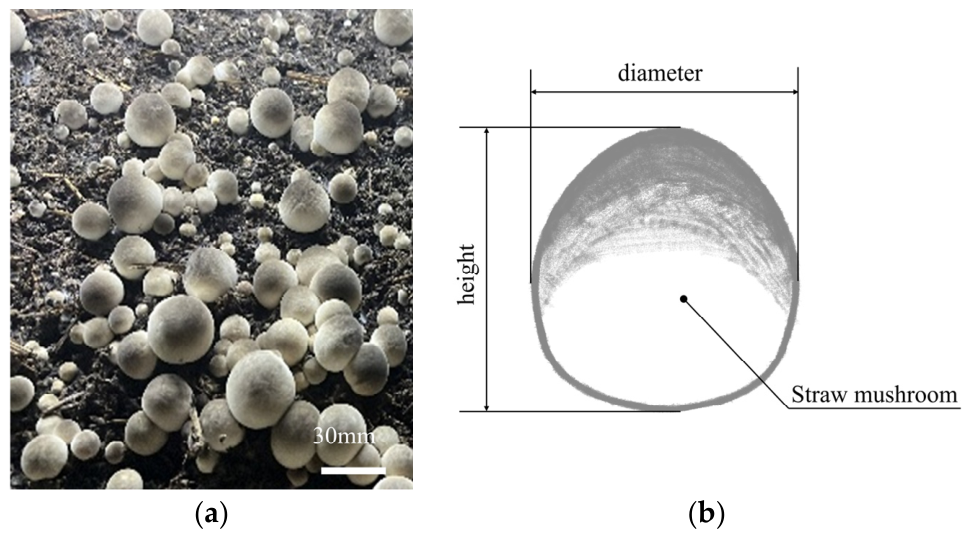
The Volvariella volvacea were cultivated on mushroom beds in the edible fungus cultivation chamber of the Engineering Training Center at Jilin Agricultural University. As shown in Figure 1, the height, weight, and diameter of Volvariella volvacea were measured. These measurements provided a basis for selecting the end-effector. The main dimensional parameters of Volvariella volvacea are listed in Table 1. The experiments were carried out in July 2025.

2.2. Measurement and Analysis of Harvesting Force Based on Thin-Film Sensors

2.2.1. Analysis of Harvesting Methods

Volvariella volvacea grow densely. Harvesting operations must adapt to the biological characteristics of the mushroom species. Two harvesting methods (bending and twisting) and two operating finger modes (two-finger and three-finger) were adopted. The specific operations are described as follows.
Two-finger twisting method: The thumb and index finger pinch the lower-middle part of the fruiting body. The wrist drives a twisting motion of the fingers, while a slight upward lift is applied. The mushroom then separates naturally from the bed.
Three-finger twisting method: The thumb, index finger, and middle finger encircle and pinch the fruiting body with symmetrical force. A synchronized twisting motion is the main action, assisted by a small upward lift, and the mushroom is removed.
Two-finger bending method: The thumb and index finger pinch the base of the fruiting body. The bending motion of the finger joints causes a slight rotation, while a slow upward pull is applied. Separation is achieved using the mushroom’s inherent toughness.
Three-finger bending method: Three-finger bending method: The thumb, index finger, and middle finger pinch the upper-middle part of the fruiting body. The three fingers bend together in a coordinated manner while applying a uniform upward pull. This avoids damage caused by uneven force distribution.
In order to reduce human operational differences and ensure the accuracy and reliability of data, all harvesting operations were performed by a single skilled operator with experience in Volvariella volvacea harvesting. The operator received standardized training before the experiment, which ensured consistent technique across all harvesting methods. Each combination of harvesting method (twisting or bending) and finger mode (two-finger or three-finger) was repeated 20 times (n = 20).

2.2.2. Sensor Module Integration

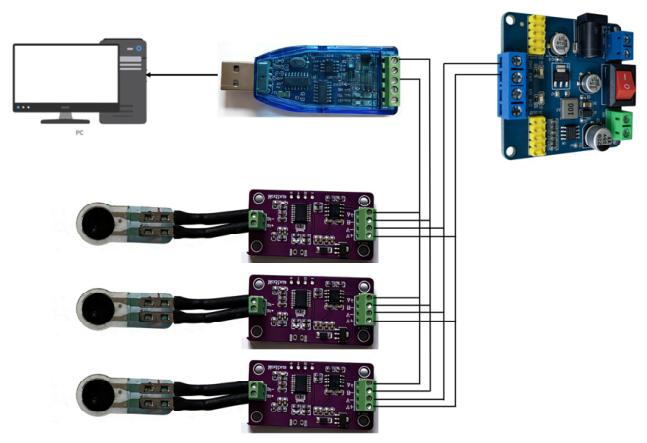
A sensor of model RPC7.6LTLF2 (Luojia Technology Co., Ltd., Shenzhen, China) was selected for the harvesting experiment, as shown in Figure 2. This sensor model has a “micro-trigger force” specification, which matches the force range of gentle pinching and lifting during harvesting. An excessively large measurement range would cause insufficient sensitivity, while an excessively small range would lead to premature saturation. The RPC7.6LTLF2 sensor avoids both issues. The sensor was connected to a signal conversion module. DuPont wires were used to connect the sensor electrodes to the “sensor interface” of the module. Correct connection of the positive and negative poles was ensured. The module was then connected to a 3.3 V or 5 V power supply, and the power indicator light was checked.
The sensor was attached to the finger pulp (two or three fingers) that contacts the mushroom. The effective sensing area was aligned with the mushroom contact point. Lateral offset, which would cause uneven force distribution, was avoided.

2.2.3. Data Acquisition

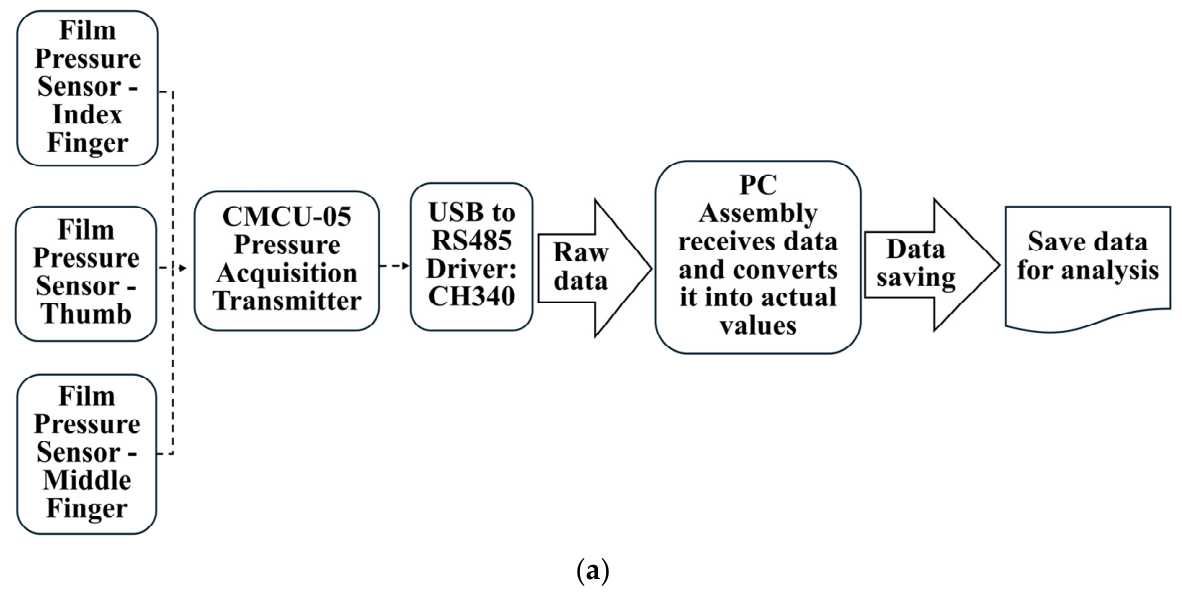
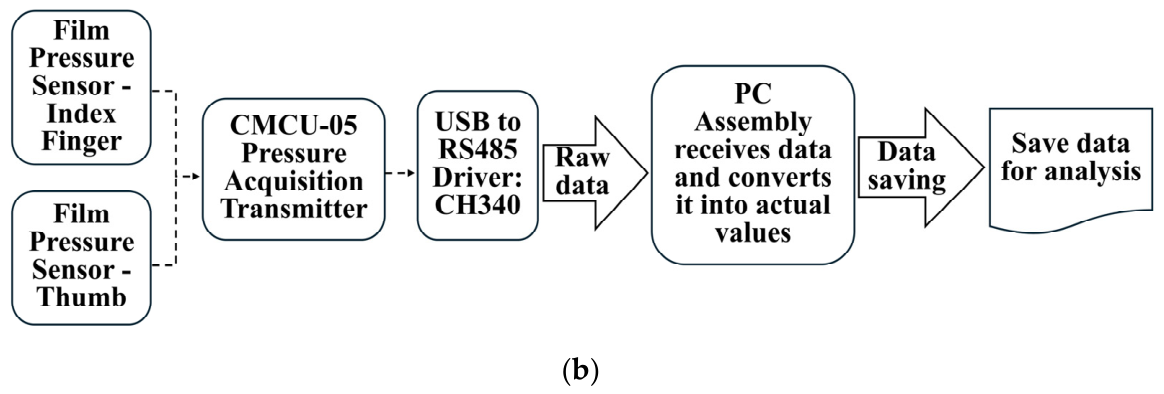
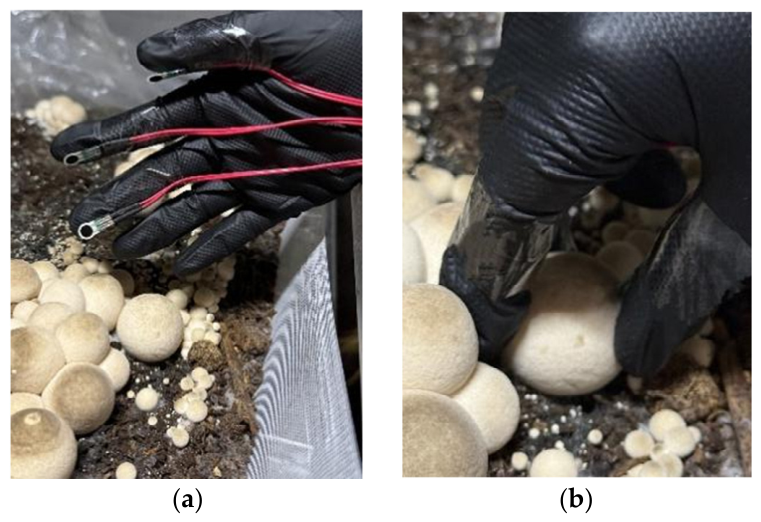
As shown in Figure 3 and Figure 4, a harvester wore gloves with thin-film sensors attached to the surface. Two-finger and three-finger grasping methods were used to harvest Volvariella volvacea. The applied forces were recorded in real time. Before harvesting, a basic sensor continuity test was performed. The sensor leads at the wrist were connected to the AO port of the signal conversion module using DuPont wires. A light finger press was applied to the sensor, and the voltage change was observed. This continuity test excluded problems such as sensor offset or poor lead contact. During harvesting, voltage changes in the three stages of pinching, twisting, and gently lifting or pinching, bending, and gently lifting were collected through the AO port. The collected voltage changes were converted into corresponding force values. Voltages from two or three sensors were simultaneously collected to analyze force distribution during twisting and bending actions. The RPC7.6LTLF2 thin-film pressure sensor was used in combination with the CMCU-05 transmitter (Luojia Technology Co., Ltd., Shenzhen, China). A calibration procedure was carried out, including zero-point calibration, multi-point linear calibration, and stability verification. The relationship between the AD output value of the sensor and the actual harvesting force was established. Within the measurement range of 0–10 N, the measurement error of the calibrated sensor was ≤±5%. This meets the requirements of light-weight, high-precision force measurement for the mechanical testing of Volvariella volvacea harvesting and provides reliable data support for the subsequent comparative analysis of bending and twisting harvesting forces.

2.3. Design of the Key Components

2.3.1. Overview of the Four-Suction-Cup Harvesting Mechanism

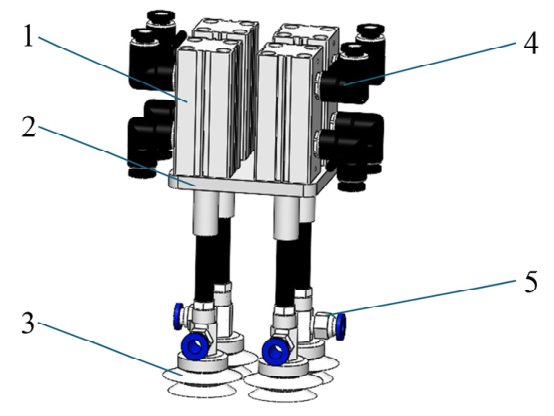
Volvariella volvacea often grow in dense clusters. Narrow spatial gaps exist between individual fruiting bodies. Traditional mechanical grippers can easily cause surface damage due to rigid contact, squeezing, or scraping. This damage degrades the mushroom’s appearance and makes it difficult to meet quality requirements. Therefore, flexible suction cups were selected as the harvesting components. Gentle grasping of the fruiting body is achieved through negative pressure adsorption, which effectively reduces damage. Furthermore, a four-suction-cup rotary structure (Figure 5) was adopted to improve harvesting efficiency. Multi-suction-cup operation shortens the single-harvest cycle and adapts to dense growth conditions.

2.3.2. Design of the Harvesting Mechanism

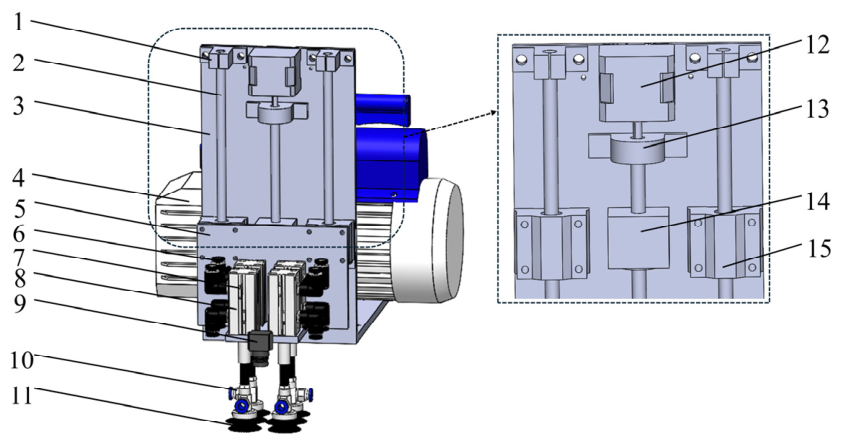
Figure 6 shows the overall structure of the end-effector. The main components include a slide rail fixing frame, a slide rail, an air pump tube connector, an air cylinder, a vacuum pump, a camera, a vacuum tube connector, suction cups, a lead screw stepper motor, a lead screw bearing, a lead screw nut moving block, and a slider. The air pump supplies negative pressure. The motor drives the movement of relevant components. The cylinder realizes position adjustment and rotation during harvesting. The suction cups are the key components that directly contact and harvest the mushroom.
The motor drives the end-effector to a position near the target Volvariella volvacea. The cylinder adjusts the position so that the four suction cups are accurately aligned. The air pump then generates negative pressure, and the suction cups adsorb the mushroom. Through the coordinated action of the motor and cylinder, the end-effector rotates the adsorbed mushroom and detaches it from the growth bed. Harvesting of Volvariella volvacea is thus achieved.

2.3.3. Control Principle of the End-Effector

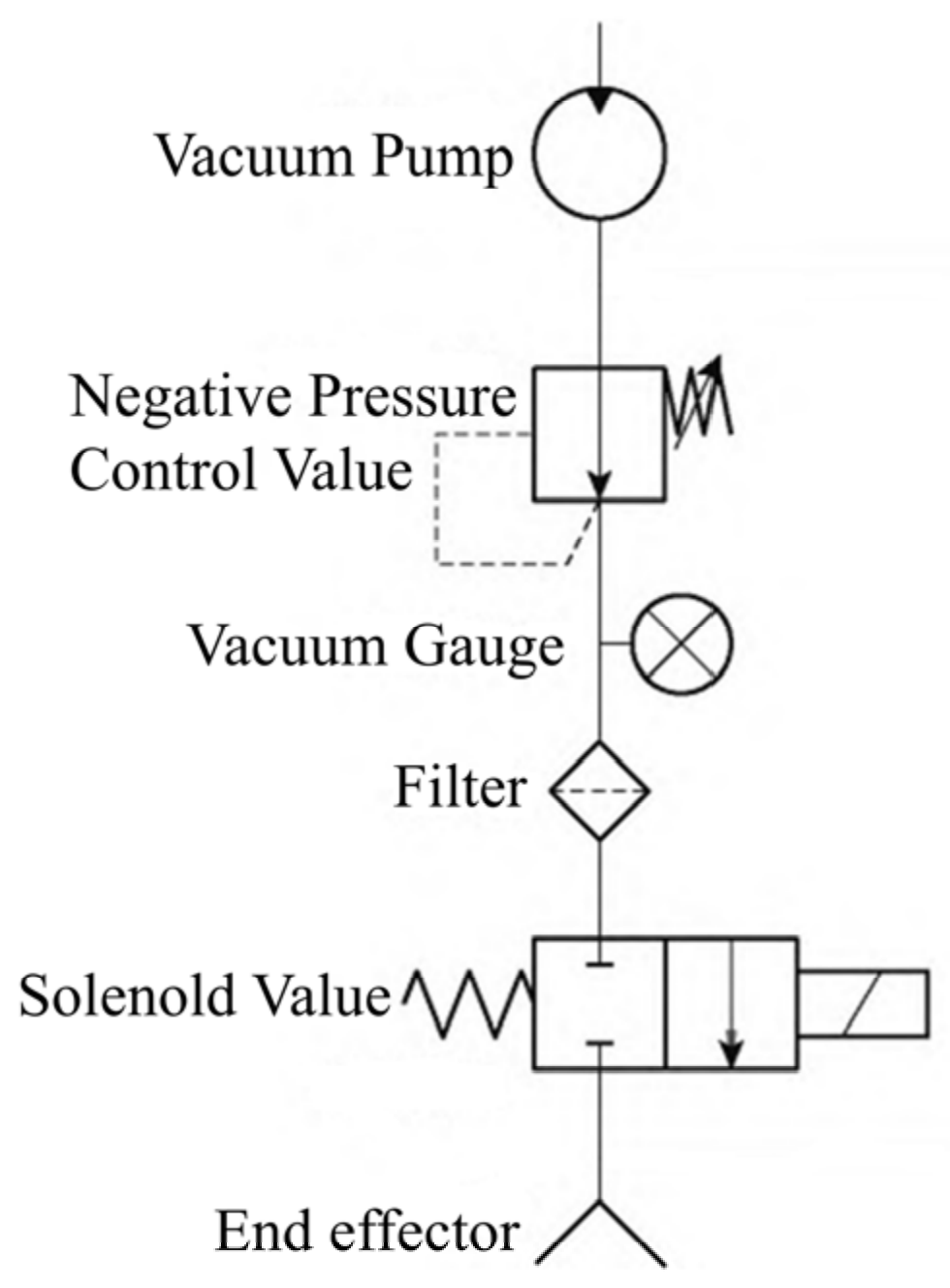
Figure 7 shows the workflow of the end-effector. After the suction cups move to the target position, the solenoid valve is energized and the suction circuit is connected. The vacuum pump generates suction force, which is regulated by a negative pressure regulating valve and transmitted to the suction nozzles. Reliable adsorption of the mushroom is achieved.
When the suction cups transport the mushroom to a position above the harvesting basket, the solenoid valve is de-energized. The suction circuit is switched to atmospheric connection, and the negative pressure is released. The mushroom then falls smoothly into the harvesting basket.

2.4. Design of the Traveling Mechanism

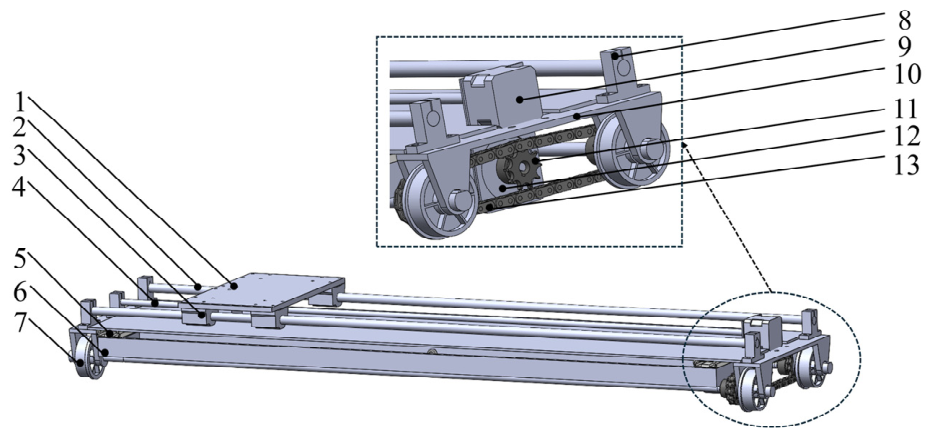
The structure of the traveling mechanism is shown in Figure 8. The main components include a connecting plate, a slide rail, a motion slider, a lead screw, a harvesting basket slide rail, a harvesting basket, wheels, a slide rail fixing frame, a first stepper motor, a drive wheel bracket, a motor drive sprocket, a second motor, and a transmission chain. The working principle is described as follows: The first stepper motor drives the lead screw through a coupling. The rotational motion of the lead screw is converted into the linear motion of the end-effector moving platform. As a result, the platform moves laterally along the slide rail with precise displacement. The second stepper motor drives the wheels to rotate. Friction generated between the wheels and the mushroom bed causes the traveling mechanism to move longitudinally. The wheels are connected to a support platform via wheel connecting rods. The support platform provides support and guidance, ensuring smooth movement.

2.5. Analysis of the Whole Volvariella volvacea Picking Machine

2.5.1. Overall Equipment Operation Process

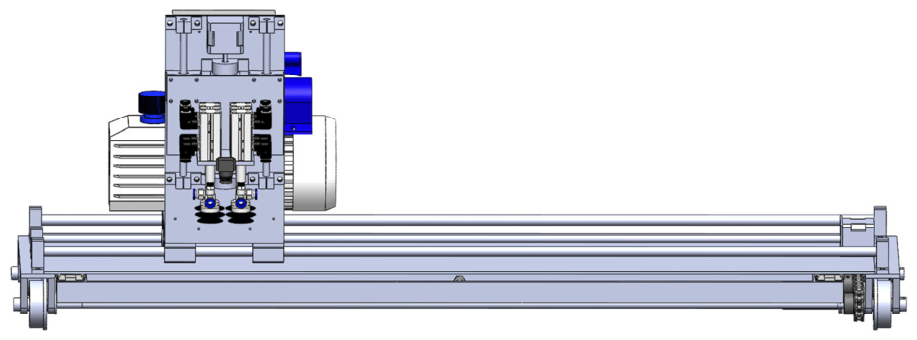
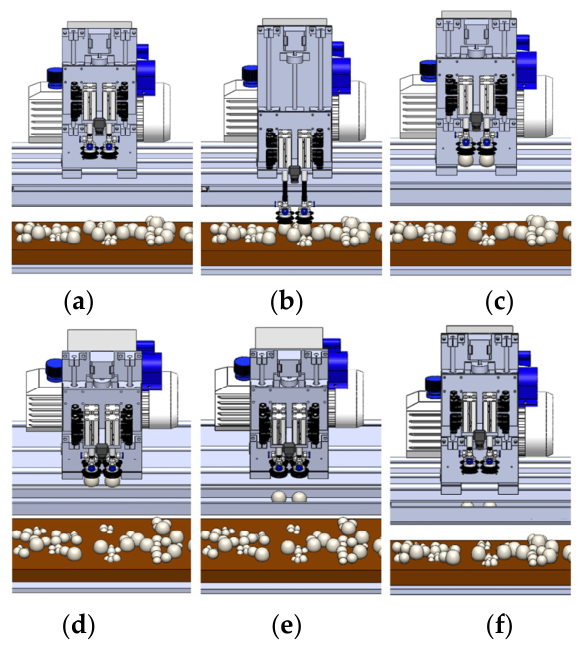
The complete Volvariella volvacea harvesting machine is shown in Figure 9. The working process is shown in Figure 10. First, the visual recognition system identifies and locates mature mushrooms. The traveling mechanism moves laterally and longitudinally to position the harvesting mechanism directly above the target mushroom. The corresponding suction cups are lowered and adsorb the mushroom. After adsorption is completed, the rotary cylinder is activated and rotated by 90°. The mushroom is then detached from the mushroom bed. Subsequently, the suction cups are raised and returned to the original position. The harvesting basket is automatically opened, and the mushroom falls into the harvesting basket. The harvesting basket then closes immediately. After one harvesting cycle is completed, the harvesting mechanism turns toward other mature mushrooms and starts the next cycle.

2.5.2. Overall Performance Analysis

Mature Volvariella volvacea mushrooms were selected from the cultivation beds to evaluate the machine’s harvesting performance. The same batch of mature mushrooms was used for all harvesting method comparisons. Three indicators were used: harvesting success rate, damage rate, and average harvesting time. Their definitions and calculation methods are as follows:
The harvesting success rate (C1) is defined for a selected group of mature Volvariella volvacea within a specified range. The harvesting success rate C1 is calculated as the ratio of the number of successfully harvested mushrooms to the total number of mushrooms within a specified range.
The harvesting damage rate (C2) is defined as the ratio of the number of mushrooms damaged during harvesting to the total number of successfully harvested mushrooms.
The average harvesting time (t): refers to the average time taken for one picking of mushrooms. It is the sum of four average durations:
ta: time for the traveling mechanism to move directly above the target mushroom.
tb: time for the end-effector to complete the harvesting action.
tc: time for the harvested mushroom to fall into the basket.
td: time for the machine to reset to the ready state.
Damage assessment criteria: A mushroom was recorded as damaged if any of the following conditions were observed immediately after harvesting: cap rupture (visible crack or hole in the cap tissue, or rupture of the veil), stipe fracture (complete break or a clearly visible fracture extending through most of the stipe), surface indentation (visible depression caused by mechanical contact), cap detachment, or visible deformation caused by compression or impact. Minor superficial scratches without indentation or rupture, as well as natural veil opening due to over-ripening, were not counted as mechanical harvesting damage.
The average harvesting time t is calculated as the sum of the average durations of the following four stages: the average time ta required for the traveling mechanism to move to a position directly above the target mature mushroom, the average time tb required for the end-effector to complete the mushroom harvesting action, the average time tc required for the harvested mushroom to fall into the harvesting basket, and the average time td required for the complete machine to reset to the ready-to-harvest state.
The formulas are as follows:
C 1 = n 1 n × 100 %
C 2 = n 2 n 1 × 100 %
t = a = 1 n s   t a n s + b = 1 n s   t b n s + c = 1 n s   t c n s + d = 1 n s   t d n s
where C 1 is the harvesting success rate; n is the total number of Volvariella volvacea; n 1 is the number of successfully harvested mushrooms; C 2 is the harvesting damage rate; n 2 is the number of damaged mushrooms; t is the average time required to harvest the number of straw mushrooms within the selected area; n s is the number of straw mushrooms within the selected area.

3. Results and Discussion

3.1. Analysis of Two Harvesting Methods

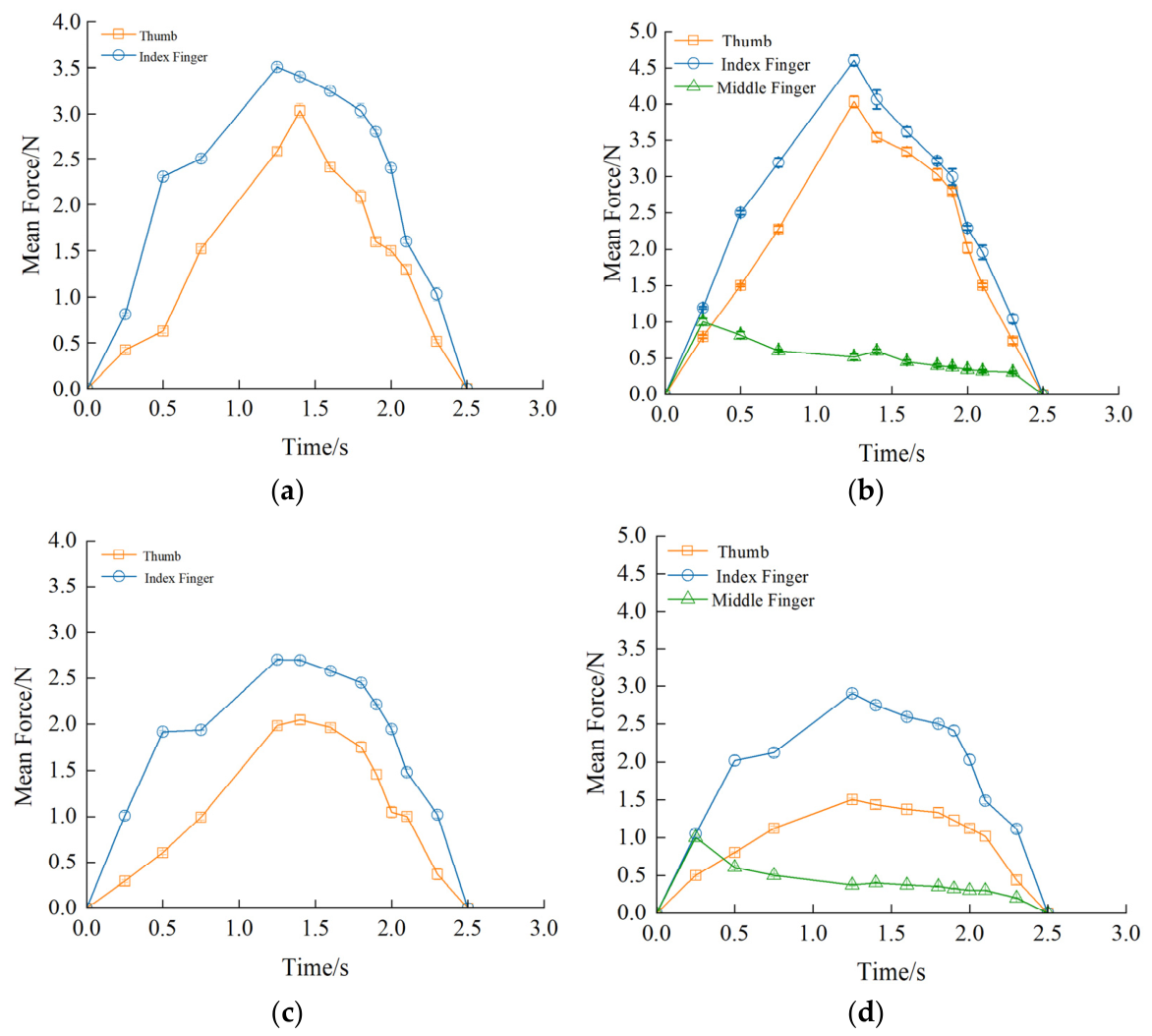
The force-time curves for the twisting and bending methods under two-finger and three-finger operations are shown in Figure 11. Table 2 and Table 3 summarize the peak and average forces for each finger. Each harvesting method was repeated 20 times (n = 20). A paired t-test was performed to evaluate the statistical significance of the differences between twisting and bending methods. The differences in peak force were statistically significant for both thumb and index fingers (p < 0.05).
As shown in Table 2 (three-finger operation), the peak force of the thumb increased from 1.44 N (twisting) to 4.00 N (bending), and the average force of the thumb increased from 0.91 N to 1.97 N. The peak force of the index finger increased from 2.91 N to 4.60 N, and the average force of the index finger increased from 1.77 N to 2.36 N.
As shown in Table 3 (two-finger operation), the peak force of the thumb increased from 2.04 N (twisting) to 3.00 N (bending), and the average force of the thumb increased from 1.04 N to 1.35 N. The peak force of the index finger increased from 2.70 N to 3.40 N, and the average force of the index finger increased from 1.69 N to 2.05 N. Under two-finger operation, the average forces on each finger were generally higher than those under three-finger operation. The twisting method required less force than the bending method. Therefore, the twisting method is more suitable for reducing mechanical damage to Volvariella volvacea.
Compared with two-finger operation, three-finger operation disperses the harvesting force more evenly over the contact area of the mushroom, reducing local stress concentration. This finding supports the use of a multi-suction-cup end-effector. The suction cups provide further buffering and force dispersion through flexible contact and negative pressure adsorption, avoiding damage caused by rigid gripping.

3.2. Finite Element Simulation of End-Effector Harvesting

3.2.1. Finite Element Model Setup

A contact model between the suction cup and the Volvariella volvacea was established in SolidWorks 2023. The suction cup model was simplified to ensure computational efficiency. The simulation assumed that a uniform force was applied to the top surface of the suction cup during downward pressing. The contact surfaces were assumed to be smooth, and the materials were assumed to be continuous, uniform, and isotropic.
The contact interface between the suction cup and the mushroom was the core research area. Therefore, the lower surface of the suction cup and the upper surface of the mushroom were meshed with refinement. A tetrahedral mesh type was used for the whole model. The base mesh size was set to 2 mm, with local refinement at the contact interface.
In the finite element model, silicone rubber was used as the suction cup material with a density of 1100 kg/m3, an elastic modulus of 3 MPa, and a Poisson’s ratio of 0.45. For the Volvariella volvacea fruiting body, the density was set to 920 kg/m3, the elastic modulus to 0.8 MPa, and the Poisson’s ratio to 0.45. Frictional contact was defined between the suction cup and the mushroom surface with a friction coefficient of 0.3, and the augmented Lagrangian contact algorithm was adopted to improve the stability and convergence of the contact calculation. A fixed constraint was applied to the bottom surface of the mushroom to simulate its actual placement on the mushroom bed, while the horizontal displacement of the suction cup was constrained to allow only vertical movement, reproducing the actual motion of downward pressing and adsorption. The negative pressure was applied as a uniform load according to the vacuum pump specification, and the simulated deformation pattern was qualitatively consistent with experimental observations from pilot tests.

3.2.2. Simulation of Suction Cup Adsorption Process

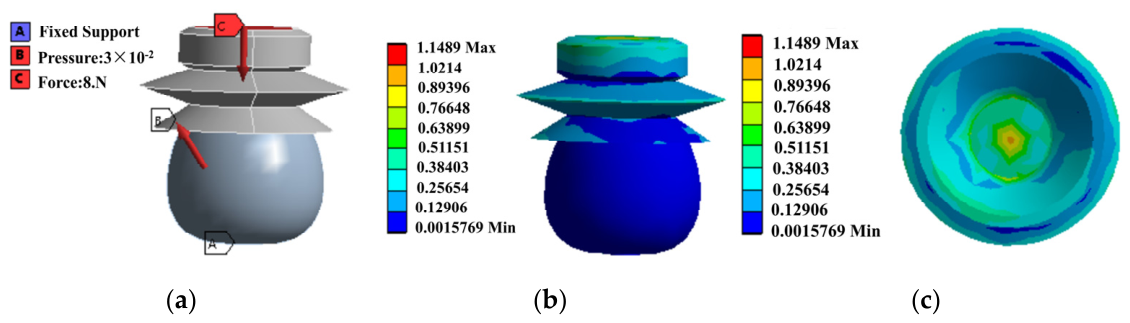
The finite element load of the adsorption process was set in two stages (Figure 12a). Stage 1: downward pressing. Pressure was applied to the top of the suction cup, and the cup moved down until it contacted the mushroom surface. The applied force of 8 N was selected for the simulation because it represents approximately twice the measured peak harvesting force of 4.60 N (bending method), providing a safety margin to cover worst-case loading conditions. Stage 2: adsorption. The adsorption force was maintained.
The simulation results (Figure 12b) showed a significant regional difference instress distribution. The contact interface became the main stress concentration area due to the combined effect of the adsorption force and contact pressure. Stress values in this area were significantly higher than in other parts of the suction cup. The central area of the suction cup, which did not contact the mushroom, showed relatively low stress. The overall pattern was “high stress at the edge, low stress in the center.” The stress concentration area formed a regular ring shape. The force state of this ring directly affected the stability and reliability of adsorption.
The effective diameter of the suction cup was defined as the outer diameter of the stress concentration ring. This effective diameter is related to the mushroom diameter. The simulation results suggest that adjusting the effective diameter according to the mushroom size may improve adsorption stability. However, a quantitative relationship was not established in this study, and the optimal adjustment strategy requires further investigation.
Both simulations and experiments (Figure 12c) showed that when the effective diameter of the suction cup reached its maximum, the contact area with the mushroom surface was maximized. The transmission efficiency of the adsorption force was then optimal. A stable sealed adsorption environment was formed. Problems such as air leakage or detachment during the adsorption process were effectively avoided. This principle provides a theoretical basis for precise adsorption control of mushrooms with different diameters and offers a reference for suction cup design and parameter adjustment.

3.2.3. Validation of Simulation Results

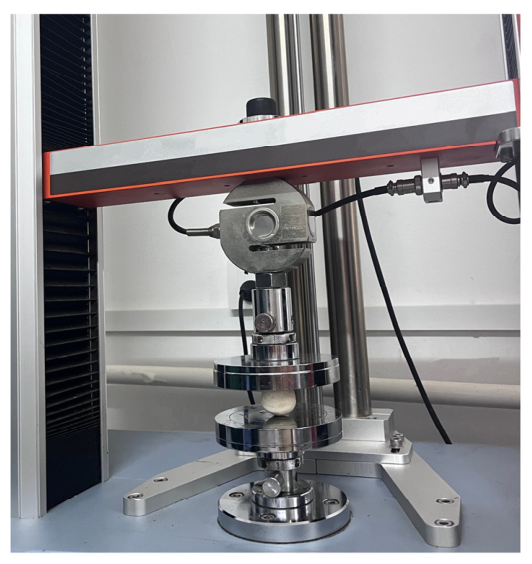
To obtain the critical failure stress of Volvariella volvacea tissue for comparison with the simulation results, axial quasi-static compression tests were conducted using a TH-8201S universal testing machine (TopHung Machine Equipment Co., Ltd., Suzhou, China) (Figure 13). Mature mushrooms without mechanical damage were selected, with dimensions consistent with those used in the simulation model. The loading rate was set to 1 mm/min, and full-surface axial compression was applied using parallel plates.
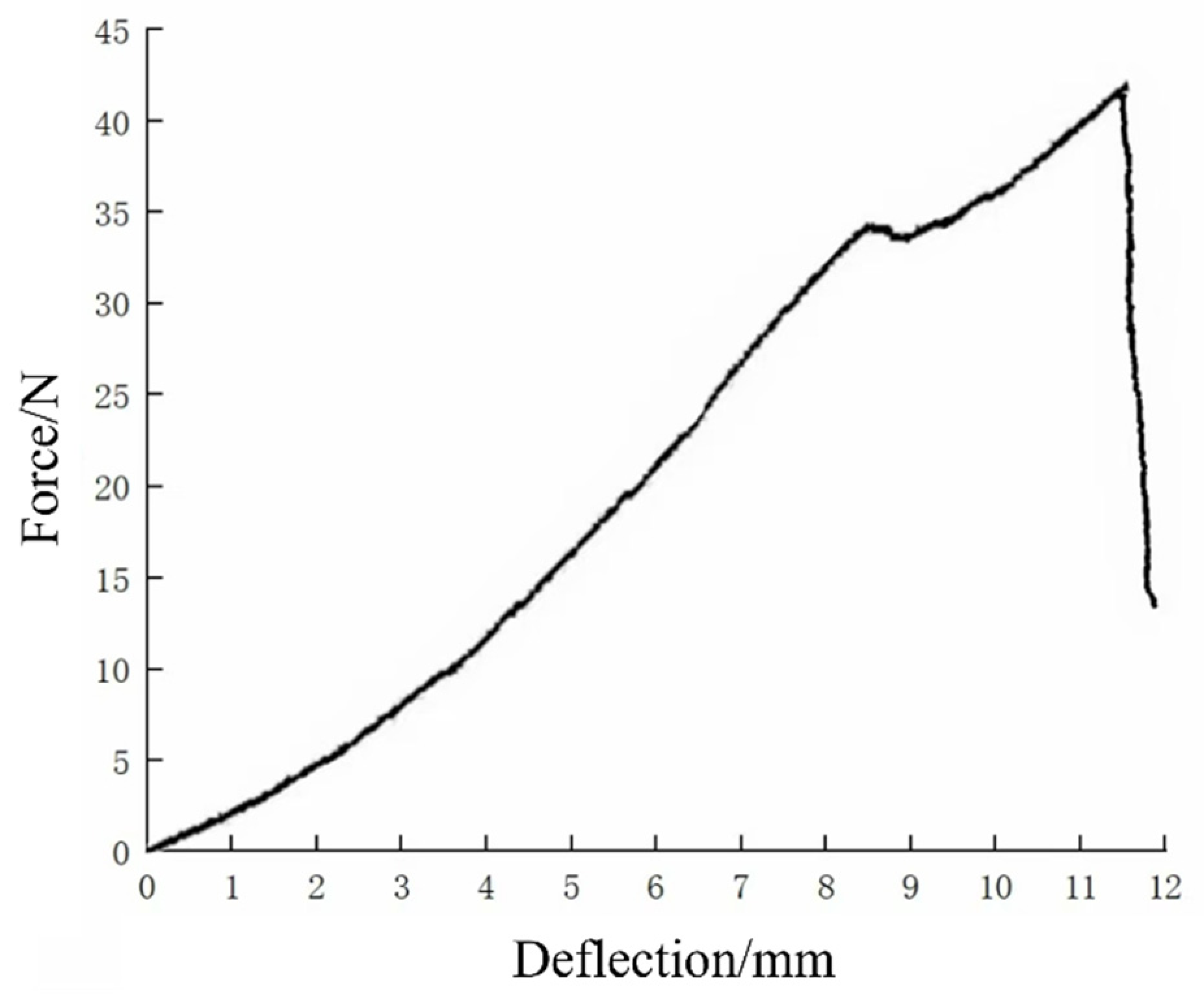
The force-deformation curve obtained from the test is shown in Figure 14. As the compression displacement increased, the load increased continuously until it reached a peak of 41.8 N at a deformation of 10.9 mm. Beyond this point, the load dropped abruptly, and the cap tissue ruptured with visible cracking and pulp damage. This peak load was therefore identified as the critical failure load (Ffail) of the Volvariella volvacea fruiting body.
The failure stress was calculated using the contact area of the mushroom cap:
A = π D 2 4
σ f a i l = F f a i l A
where D is the measured diameter of the cap contact surface (mm), F f a i l is the critical failure load (N), and σ f a i l is the failure stress (MPa). Based on the measured diameter of the tested mushrooms, the calculated failure stress of Volvariella volvacea tissue was 3.72 MPa.
Under the simulated harvesting load of 8 N, the maximum equivalent stress on the mushroom surface was 1.1489 MPa (see Section 3.2.2). This value is significantly lower than the experimentally determined failure stress of 3.72 MPa. Therefore, from a material failure criterion perspective, the contact stress generated by the proposed end-effector is well below the critical threshold that would cause tissue rupture. This validates that the 8 N operating load is safe for low-damage harvesting of Volvariella volvacea.

3.3. Analysis of the Complete Machine Test Results

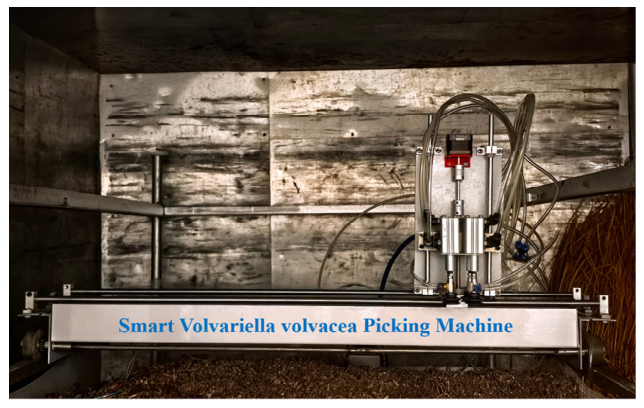
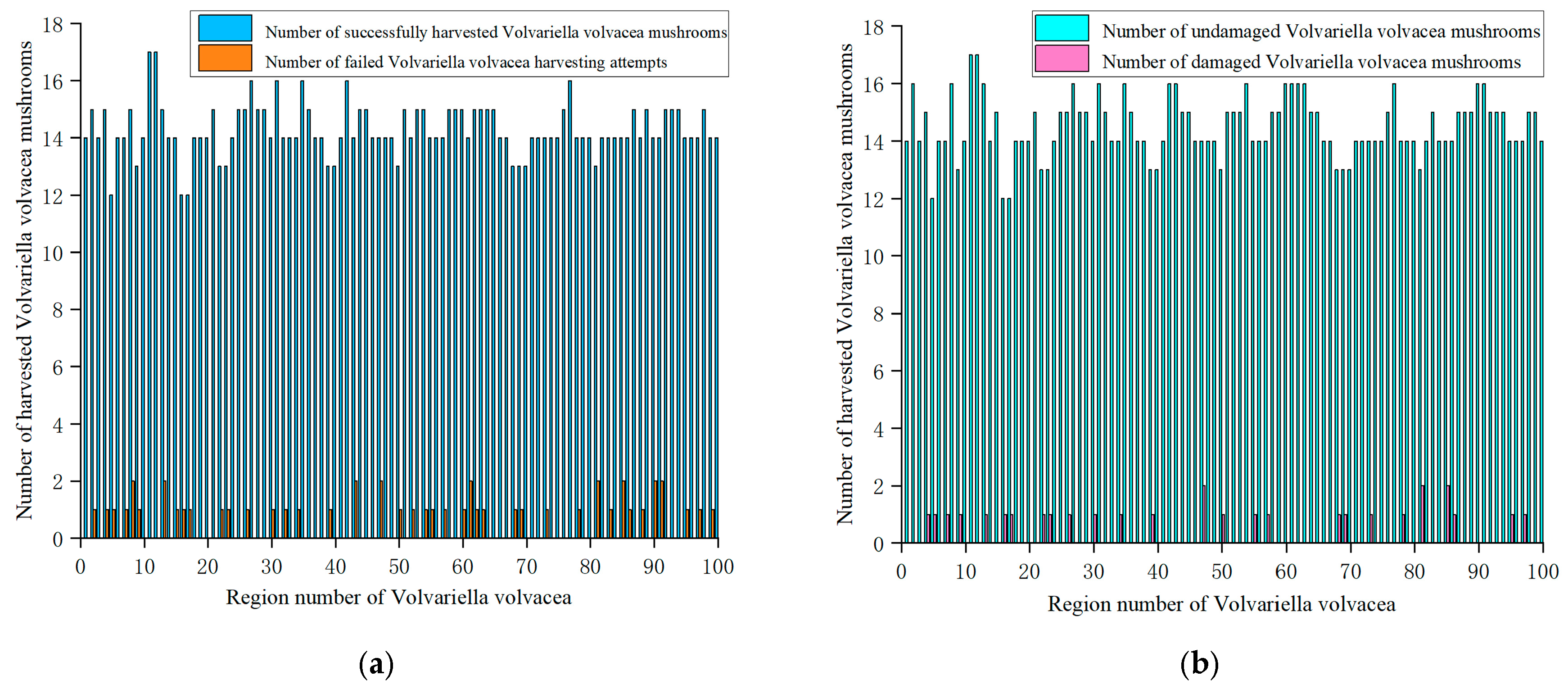
The prototype was tested in a Volvariella volvacea cultivation room (Figure 15). A total of 100 harvesting groups were performed, and 1480 mushrooms were harvested. The results are shown in Figure 16. The number of successfully harvested mushrooms was 1429, giving a success rate of 96.65%. Thirty mushrooms were damaged during harvesting, resulting in a damage rate of 2.03%. The average time for the traveling mechanism to move above the target mushroom was 2.0 s. The average harvesting time was 3.2 s. The average time for the mushroom to fall into the basket was 0.5 s. The average reset time was 0.2 s. Thus, the average total time per mushroom was 5.9 s.
Practical efficiency and stability evaluation
Based on the average single-harvest cycle time of 5.9 s, the theoretical harvesting capacity of the prototype was calculated as approximately 610 mushrooms per hour. After accounting for non-harvesting auxiliary operations in the factory cultivation environment (e.g., fine positioning of mushroom clusters and suction cup alignment), the actual effective harvesting efficiency was estimated to be 537 mushrooms per hour.
A manual harvesting control experiment was conducted under the same working conditions. An experienced worker achieved an instantaneous peak efficiency of 800–1000 mushrooms per hour. However, under the high-temperature (32–34 °C) and high-humidity (75–83%) conditions of the cultivation room, the worker’s physical performance deteriorated significantly after two consecutive hours of work, and the effective working time per day did not exceed six hours. In contrast, the prototype was capable of continuous 24 h operation without performance degradation. Its estimated that the daily harvesting output reached 12,888 mushrooms, which is approximately 2.1–2.7 times the daily comprehensive output of a skilled manual worker. This advantage addresses the common challenges of high labor costs, harsh working environment, and labor shortages in industrial straw mushroom harvesting.
To verify the long-term operational reliability of the prototype, a 24 h uninterrupted full-load continuous operation test was carried out. During the test, a total of 12,560 mushrooms were harvested, and no abnormal stoppages caused by mechanical jamming, suction cup air leakage, or control system faults were observed. The harvesting success rate remained stable between 96.2% and 96.9%, and the damage rate fluctuated only between 1.95% and 2.12%, demonstrating excellent consistency and stability.
Causes of failure and damage
The main reason for unsuccessful harvesting was the large variation in mushroom size and excessively dense growth. The wide range of cap diameters made it difficult for the suction cups with fixed structural parameters to form a uniform and effective sealing surface for very large or very small mushrooms, leading to air leakage, insufficient adsorption force, and eventual detachment. Meanwhile, dense and disordered clustering caused mutual occlusion among multiple mushrooms, preventing some target mushrooms from being accurately aligned and effectively adsorbed by the suction cups. The core cause of mushroom damage was spatial interference under dense cultivation conditions. Due to the narrow spacing between adjacent mushrooms, the working space for harvesting was limited. During the downward movement, contact, and rotary extraction of the suction cups, the end-effector frequently experienced rigid interference and scraping with neighboring non-target mushrooms. This resulted in uneven force distribution and local stress concentration on the target mushroom, leading to cap fragmentation and tissue damage. Overall, three core factors limited the harvesting performance of the prototype: uneven mushroom size, high cluster density, and insufficient inter-mushroom spacing. These issues can be alleviated by optimizing the cultivation density, rationally controlling the growth spacing, and improving the multi-suction-cup layout. These insights provide directions for future performance optimization and field adaptability enhancement.
Comparison with alternative end-effector configurations
To evaluate the advantages of the proposed four-suction-cup flexible rotary end-effector, a conceptual comparison was made with alternative harvesting mechanisms. A single-suction-cup design, commonly used for button mushrooms, would require multiple positioning steps to harvest a dense mushroom cluster, significantly increasing cycle time. A double-suction-cup configuration improves throughput but still cannot cover more than two mushrooms in one operation and may cause interference with neighboring fruiting bodies. Rigid grippers, even with soft covers, apply concentrated contact forces that easily exceed the low damage threshold of Volvariella volvacea (peak detachment force ≤ 4.60 N), leading to cap rupture or stipe fracture. In contrast, the four-suction-cup flexible rotary structure allows parallel harvesting of multiple mushrooms in a cluster, reduces contact stress through compliant silicone rubber cups, and the rotary action mimics the manual twisting method which requires less force (2.91 N vs. 4.60 N for bending). Therefore, the proposed design offers a better balance of harvesting efficiency, low damage, and adaptability to dense clustered growth.


4. Conclusions

In this study, the harvesting forces of the bending and twisting methods were measured under two-finger and three-finger operations using thin-film sensors. A flexible end-effector with four suction cups (silicone rubber suction cups and a rotary cylinder) was designed, and the contact stress was analyzed by ANSYS finite element simulation. A complete machine test platform was built to evaluate harvesting performance. The results indicated that the twisting method required less force (2.91 N) than the bending method (4.60 N), making it more suitable for Volvariella volvacea harvesting. Under an applied force of 8 N, the finite element simulation predicted a mushroom surface stress below 1.1489 MPa, satisfying the low-damage requirement. The prototype achieved a harvesting success rate of 96.65%, a damage rate of 2.03%, and an average harvesting time of 5.9 s per mushroom. The performance of the prototype decreased in dense clusters because of physical interference among the suction cups and neighboring mushrooms. Practical issues including energy consumption, component durability, economic feasibility, and vision-based grading integration require further investigation. The flexible suction cup rotary harvesting method is therefore feasible for Volvariella volvacea. The design parameters and test data provide technical references for the development of mechanized and intelligent harvesting equipment, offering engineering value for reducing manual labor intensity and improving automation in the edible fungus industry.

Author Contributions

Conceptualization, K.Z. and Z.H.; methodology, D.H.; software, K.Z.; validation, X.M., W.D. and C.Z.; formal analysis, Z.H.; investigation, X.M.; resources, D.H.; data curation, K.Z.; writing—original draft preparation, K.Z.; writing—review and editing, X.M. and Z.H.; visualization, K.Z.; supervision, X.M. and D.H.; funding acquisition, X.M. All authors have read and agreed to the published version of the manuscript.

Funding

This research was funded by the Science and Technology Department of Jilin Province, grant number 20220202029NC.

Institutional Review Board Statement

Not applicable.

Data Availability Statement

The data presented in this study are available in the article. Further inquiries can be directed to the corresponding author.

Conflicts of Interest

The authors declare no conflicts of interest.

References

  1. Li, H.L.; Tian, Y.; Menolli, N., Jr. Reviewing the world’s edible mushroom species: A new evidence-based classification system. Compr. Rev. Food Sci. Food Saf. 2021, 20, 1982–2014. [Google Scholar] [CrossRef]
  2. Liu, M.; Yu, T.; Singh, P.K.; Liu, Q.; Liu, H.; Zhu, Q.; Xiao, Z.; Xu, J.; Peng, Y.; Fu, S.; et al. A Comparative Transcriptome Analysis of Volvariella volvacea Identified the Candidate Genes Involved in Fast Growth at the Mycelial Growth Stage. Genes 2020, 11, 161. [Google Scholar] [CrossRef]
  3. Zhao, X.; Chen, M.; Li, Z.; Zhao, Y.; Yang, H.; Zha, L.; Yu, C.; Wu, Y.; Song, X. The Response of Volvariella volvacea to Low-Temperature Stress Based on Metabonomics. Front. Microbiol. 2020, 11, 592107. [Google Scholar] [CrossRef] [PubMed]
  4. Bao, D.; Gong, M.; Zheng, H. Sequencing and Comparative Analysis of the straw mushroom (Volvariella volvacea) Genome. PLoS ONE 2013, 8, e58294. [Google Scholar] [CrossRef]
  5. Sakinah, N.M.J.; Misran, A.; Mahmud, T.M.M. A review: Production and postharvest management of Volvariella volvacea. Int. Food Res. J. 2019, 26, 367–376. [Google Scholar]
  6. Kominek, J.; Marszalek, J.; Neuveglise, C.; Craig, E.A.; Williams, B.L. The complex evolutionary dynamics of Hsp70s: A genomic and functional perspective. Genome Biol. Evol. 2013, 5, 2460–2477. [Google Scholar] [CrossRef] [PubMed]
  7. Ahlawat, P.; Sinha, P.; Singh, M. Culture Viability, Commercial Scale Cultivation and Shelf Life Studies on the Silver-silk Straw Mushroom, Volvariella bombycina. J. Sci. Ind. Res. 2016, 75, 562–569. [Google Scholar]
  8. Ahlawat, O.P.; Kaur, H. Evaluation of hybrids and single spore isolates of paddy straw mushroom Volvariella volvacea (Bull.) Singer for fruiting body yield and nutritional quality. J. Environ. Biol. 2020, 41, 727–734. [Google Scholar] [CrossRef]
  9. Zhou, H.Y.; Wang, X.; Au, W. Intelligent robots for fruit harvesting: Recent developments and future challenges. Precis. Agric. 2022, 23, 1856–1907. [Google Scholar] [CrossRef]
  10. Zhang, Y.; Li, N.; Zhang, L. A review on the recent developments in vision-based apple-harvesting robots for recognizing fruit and picking pose. Comput. Electron. Agric. 2025, 231, 110087. [Google Scholar] [CrossRef]
  11. Ao, J.X.; Ji, W.; Yu, X.W. End-Effectors for Fruit and Vegetable Harvesting Robots: A Review of Key Technologies, Challenges, and Future Prospects. Agronomy 2025, 15, 2650. [Google Scholar] [CrossRef]
  12. Chen, Z.; Lei, X.; Yuan, Q.; Chen, L.; Chen, Y. Key Technologies for Autonomous Fruit- and Vegetable-Picking Robots: A Review. Agronomy 2024, 14, 2233. [Google Scholar] [CrossRef]
  13. Li, A.; Wang, C.; Ji, T.; Li, J.; Li, Y. D3-YOLOv10: Improved YOLOv10-Based Lightweight Tomato Detection Algorithm Under Facility Scenario. Agriculture 2024, 14, 2268. [Google Scholar] [CrossRef]
  14. Yu, Y.; Zhang, K.; Yang, L. Fruit detection for strawberry harvesting robot in non-structural environment based on Mask-RCNN. Comput. Electron. Agric. 2019, 163, 104846. [Google Scholar] [CrossRef]
  15. Guo, Z.; Fu, H.; Wu, J.; Zhang, X. Dynamic Task Planning for Multi-Arm Apple-Harvesting Robots Using LSTM-PPO Reinforcement Learning Algorithm. Agriculture 2025, 15, 588. [Google Scholar] [CrossRef]
  16. Zhang, J.; Li, X.; Wang, Y. Force Sensing and Force Control of Flexible Gripper with Integrated Flexible Strain and Tactile Sensors for Strawberry Non-Destructive Gripping and Freshness Grading. Food Bioprocess Technol. 2025, 18, 1223–1244. [Google Scholar] [CrossRef]
  17. Xiong, Y.; Ge, Y.; Grimstad, L.; From, P.J. An autonomous strawberry-harvesting robot: Design, development, integration, and field evaluation. J. Field Robot. 2020, 37, 202–224. [Google Scholar] [CrossRef]
  18. Koirala, B.; Zakeri, A.; Kang, J.; Kafle, A.; Balan, V.; Merchant, F.A.; Benhaddou, D.; Zhu, W. Robotic Button Mushroom Harvesting Systems: A Review of Design, Mechanism, and Future Directions. Appl. Sci. 2024, 14, 9229. [Google Scholar] [CrossRef]
  19. Tan, Y.; Liu, X.; Zhang, J. A Review of Research on Fruit and Vegetable Picking Robots Based on Deep Learning. Sensors 2025, 25, 3677. [Google Scholar] [CrossRef]
  20. Zhao, L.; Chen, M.; Guo, Q. Comparative Proteomics Study on the Postharvest Senescence of Volvariella volvacea. J. Fungi 2022, 8, 819. [Google Scholar] [CrossRef]
  21. Huang, M.; Yang, X.; Zhang, C.; Li, H.; Wu, H.; Wang, F. Study on harvesting dynamics of button mushroom and design of picking end-effector. J. Chin. Agric. Mech. 2023, 44, 66–70+98. [Google Scholar]
  22. Wang, Z.; Tao, K.; Yuan, J.; Liu, X. Design and Experiment on Mechanized Batch Harvesting of Shiitake Mushrooms. Comput. Electron. Agric. 2024, 217, 108296. [Google Scholar] [CrossRef]
  23. Patungan, D.G.A. Micro-Climate Characterization of Different Bedding Materials for Straw Mushroom (Volvariella volvacea Bull. Ex-Fr. Singer) Production. Master’s Thesis, Central Luzon State University, Muñoz, Philippines, 2019. [Google Scholar]
  24. Gu, Y.; Li, B.; Lu, W. Mushroom (Agaricus bisporus) picking robot based on mimicry of manual harvesting. Comput. Electron. Agric. 2026, 243, 108762. [Google Scholar] [CrossRef]
  25. Yin, X.; Yang, L.; Yao, D. Improved DeepLabV3+ and GR-ConvNet for shiitake mushroom harvest robots flexible grasping of mimicry. Comput. Electron. Agric. 2025, 236, 109471. [Google Scholar] [CrossRef]
  26. Zhong, M.; Han, R.Q.; Liu, Y.; Huang, B.; Chai, X.J.; Liu, Y.X. Development, integration, and field evaluation of an autonomous Agaricus bisporus picking robot. Comput. Electron. Agric. 2024, 220, 108871. [Google Scholar] [CrossRef]
  27. Sujatanagarjuna, A.; Kia, S.; Briechle, D.F. MushR: A Smart, Automated, and Scalable Indoor Harvesting System for Gourmet Mushrooms. Agriculture 2023, 13, 1533. [Google Scholar] [CrossRef]
  28. Guan, X.; Chen, Q.; Zhao, G.; Ma, L. A Kind of Volvariella volvacea Harvester. CN Patent 205912503U, 1 February 2017. [Google Scholar]
  29. Yang, L. A Kind of Volvariella volvacea Harvester. CN Patent 219205429U, 20 June 2023. [Google Scholar]
  30. Li, K. A Kind of Volvariella volvacea Harvester. CN Patent 210008334U, 4 February 2020. [Google Scholar]
Figure 1. (a) Volvariella volvacea planted on the mushroom bed; (b) Diameter and total height of Volvariella volvacea.
Agriculture 16 01285 g001
Figure 2. Sensor Module.
Agriculture 16 01285 g002
Figure 3. Data Acquisition Flowchart. (a) Three-finger data collection process; (b) Two-finger data acquisition process.
Agriculture 16 01285 g003aAgriculture 16 01285 g003b
Figure 4. Diagram of the Manual Harvesting Process (a) Equipped with Sensors; (b) Picking Process.
Agriculture 16 01285 g004
Figure 5. Four-Suction-Cup Model Diagram. 1. Rotary Cylinder; 2. Connecting Platform; 3. Flexible Suction Cup; 4. Cylinder Pipe Adapter; 5. Suction Cup Pipe Adapter.
Agriculture 16 01285 g005
Figure 6. Harvesting Mechanism Diagram. 1. Slide Rail Fixing Bracket; 2. Linear Slide Rail; 3. Connecting Plate; 4. Vacuum Pump; 5. Slide Rail Fixing Bracket; 6. Air Pump Pipe Connector; 7. Magnetic Switch; 8. Pneumatic Cylinder; 9. Camera; 10. Vacuum Tube Connector; 11. Suction Cup; 12. Lead Screw Stepper Motor; 13. Lead Screw Bearing; 14. Lead Screw Nut Moving Block; 15. Slider Block.
Agriculture 16 01285 g006
Figure 7. End-effector Control Schematic Diagram.
Agriculture 16 01285 g007
Figure 8. Travel Mechanism. 1. Connecting Plate; 2. Slide Rail; 3. Moving Slider 4. Lead Screw; 5. Harvesting Basket Slide Rail; 6. Harvesting Basket; 7. Wheel; 8. Slide Rail Fixing Bracket; 9. Stepper Motor I; 10. Drive Wheel Bracket; 11. Motor Drive Sprocket; 12. Motor II; 13. Drive Chain.
Agriculture 16 01285 g008
Figure 9. Volvariella volvacea Harvester.
Agriculture 16 01285 g009
Figure 10. Operating Process of the Volvariella volvacea Harvester (a) The travel mechanism positions the harvesting mechanism over mature Volvariella volvacea; (b) Suction cup descends to adhere to Volvariella volvacea; (c) The suction cup carries the picked Volvariella volvacea back to their place; (d) The picking basket automatically opens; (e) Volvariella volvacea fall into the picking basket; (f) Return the picking baskets to their designated locations.
Agriculture 16 01285 g010
Figure 11. Force-time curves of two-finger and three-finger harvesting using bending and rotation method. (a) Three-finger twisting. (b) Three-finger bending. (c) Two-finger twisting. (d) Two-finger bending.
Agriculture 16 01285 g011
Figure 12. Finite element simulation results. (a) Load application setup. (b) Overall equivalent stress distribution. (c) Equivalent stress on the suction cup.
Agriculture 16 01285 g012
Figure 13. TH-8201S universal testing machine.
Agriculture 16 01285 g013
Figure 14. Force-deformation curve of Volvariella volvacea under axial compression.
Agriculture 16 01285 g014
Figure 15. Prototype in operation.
Agriculture 16 01285 g015
Figure 16. Harvesting test results. (a) Harvesting success rate. (b) Harvesting damage rate.
Agriculture 16 01285 g016
Table 1. Measurement of Volvariella volvacea Parameters.
Test Serial NumberVolvariella volvacea Height (mm)Weight of Volvariella volvacea (g)Volvariella volvacea Diameter (mm)
129.210.929.5
230.511.831.2
331.111.931.6
431.812.231.9
532.312.632.9
632.712.933.5
729.811.530.8
831.612.032.4
Mean3111.931.5
Note: The sample size (n = 8) was intended for preliminary design guidance due to time constraints and the limited availability of mature mushrooms during the experimental period. This small sample may not fully capture the natural size variability in commercial production; therefore, the dimensional parameters reported here should be considered as a reference rather than a full population characterization. Future studies should include a larger sample to improve generalizability.
Table 2. Three-finger harvesting force data.
ThumbIndex FingerMiddle Finger
Peak (N)Mean (N)Peak (N)Mean (N)Peak (N)Mean (N)
Twisting Method1.50 ± 0.020.91 ± 0.112.91 ± 0.011.77 ± 0.191.00 ± 0.030.37 ± 0.07
Bending Method4.03 ± 0.081.97 ± 0.374.60 ± 0.072.36 ± 0.411.00 ± 0.050.44 ± 0.08
Table 3. Two-finger harvesting force data.
ThumbIndex Finger
Peak (N)Mean (N)Peak (N)Mean (N)
Twisting Method2.05 ± 0.051.04 ± 0.212.71 ± 0.011.69 ± 0.26
Bending Method3.03 ± 0.081.35 ± 0.153.51 ± 0.022.05 ± 0.19
Disclaimer/Publisher’s Note: The statements, opinions and data contained in all publications are solely those of the individual author(s) and contributor(s) and not of MDPI and/or the editor(s). MDPI and/or the editor(s) disclaim responsibility for any injury to people or property resulting from any ideas, methods, instructions or products referred to in the content.