1. Introduction
Contemporary agriculture faces pressures related to climate change, market volatility, resource constraints, and the need for sustainable productivity growth [
1]. In this context, agricultural innovation is essential for adaptation and competitiveness [
2]. Digital technologies, precision agriculture, data-driven solutions, new inputs, and agroecological practices can reduce vulnerabilities, but their impact depends on how they are understood, accepted, and integrated into practice [
3,
4]. Therefore, the central challenge is not only the availability of innovation, but also the capacity of agricultural systems to adopt it as normal market behavior [
5,
6]. This process is influenced by economic, cognitive, social, and communicative factors [
7,
8], giving agricultural innovation marketing a mediating role between technological complexity and the practical logic of agricultural stakeholders [
9,
10].
Agricultural innovation marketing can be understood in terms of innovation communication and knowledge translation. It translates technical complexity into perceived value, reduces uncertainty, and adapts messages to users’ operational needs. In diffusion-oriented marketing, communication should clarify relative advantages, compatibility, complexity, trialability, and observability; meanwhile, digital agricultural communication and extension services increasingly rely on user-centered content, interactive formats, trusted intermediaries, and channels adapted to agricultural audiences. Thus, innovation marketing should support knowledge translation, segmentation, trust-building, and adoption, not merely promotion.
The literature shows that the availability of innovation does not guarantee adoption [
11]. Agricultural decisions are shaped by perceived utility, costs, risks, compatibility, and ease of understanding and use [
12], as well as information quality, source credibility, prior experience, and social validation [
13]. These factors are consistent with the Technology Acceptance Model and Rogers’ Diffusion of Innovations theory, but in agriculture, they are conditioned by farm structure, resources, and socioeconomic context. Large-scale digitalized systems may emphasize efficiency and data integration, while fragmented or small-scale contexts often prioritize affordability, risk reduction, practical verification, accessibility, and compatibility with routines.
Trust is central to adoption. From source credibility and relational marketing perspectives, communication effectiveness depends not only on message quality, but also on the perceived expertise, reliability, and proximity of those who transmit it. In digital agriculture, where technologies are complex and outcomes uncertain, advisors, researchers, teachers, experienced farmers, professional associations, and demonstration networks can reduce perceived risk and support adoption-oriented decisions.
Communication is especially important because direct experience, practical demonstration, and economic consequences strongly influence agricultural decision making [
14,
15]. This aligns with studies showing that perceived advantages, compatibility, complexity, and source credibility affect agricultural technology adoption [
8,
16]. Therefore, this paper analyzes how agricultural innovation can be effectively communicated by clarifying the current profile of agricultural practitioners and the emerging profile of future practitioners.
Agricultural practitioners usually show a pragmatic orientation, valuing observable and tested solutions over abstract or overly technical formulations [
17]. Although they possess strong empirical skills, they may encounter difficulties when innovation is presented in specialized language or insufficiently connected to practical effects, costs, risks, and benefits [
18]. Adoption is rarely purely technical, and it is influenced by time constraints, economic pressure, hidden costs, and information overload [
19]. Practitioners also need credible sources, practical validation, and evidence that innovation can be integrated without compromising business stability [
20]. Thus, the current practitioner profile is result-oriented, risk-aware, dependent on relevant information, and sensitive to the translation of innovation into concrete utility. Practical demonstration, experiential validation, and immediate economic relevance remain essential for reducing the uncertainty associated with change [
21].
New innovative technologies in agriculture require clarification, explanation, practical validation, and careful information selection, especially as a digitally familiar generation is now undergoing professional training [
22,
23]. In the context of digitalization, smart farming, AI-supported agriculture, and digital extension systems, agricultural students can offer relevant insights into the emerging traits of future practitioners, although they cannot be directly equated with them [
24]. Investigating their perceptions of innovation, information sources, and adoption conditions can clarify generational changes in digital literacy, risk perception, communication preferences, and technology engagement, thereby supporting the adaptation of agricultural innovation marketing strategies to a changing audience [
25].
This issue is particularly relevant in Romania, where agriculture retains significant social and economic importance and operates within a fragmented and unevenly modernized structural framework [
26,
27]. The share of employment in agriculture remains above the European Union average, and the sector combines many small-scale farms with a smaller segment of consolidated commercial farms [
28,
29]. This structure affects access to technology, willingness to invest, and the pace of innovation adoption. Romania’s modernization challenges should also be understood in a broader European and transitional context; similar patterns, though less pronounced, can be observed in countries such as Bulgaria and Poland. Central and Eastern European agricultural systems often face common barriers to digital transformation, including unequal rural connectivity, uneven advisory services, limited digital skills, and contrasts between small farms and technologically advanced holdings. This comparative positioning shows why innovation marketing in Romania must address not only technological performance but also affordability, practical verification, institutional support, and trust-building.
In Romania, the coexistence of high-performing farms with many subsistence-oriented households creates an environment where innovation is perceived unevenly and adoption depends on access to resources and relevant information [
30]. Aging in the agricultural population, youth migration, and unequal digital skills further increase the need for professional renewal and technological adaptation [
31]. Agricultural students are therefore an analytically relevant group, situated at the intersection of professional training, exposure to new technologies, and possible future integration into agricultural production or consulting [
32]. Although they cannot be directly assimilated to active practitioners, they can indicate how agricultural professional profiles may be reconfigured [
33].
In this study, “future practitioners” is used in a delimited analytical sense. Agricultural students are treated as an analytical proxy, not as direct equivalents of future farmers, managers, consultants, or entrepreneurs. Their transition to professional practice is neither automatic nor uniform, since they may later enter farming, advisory services, agribusiness, education, research, public administration, or related fields. Therefore, the findings should be interpreted as possible tendencies in an emerging professional profile, not as direct predictions of all future agricultural actors. For Romania, this distinction is important because innovation marketing strategies must consider both current practitioners and the characteristics of the new generation which is gradually entering the sector.
Although agricultural innovation adoption, communication channels, and farmers’ socioeconomic characteristics have been widely examined, research that integrates these areas with the transformation of the agricultural practitioner’s profile remains limited [
16,
34]. Existing studies often address current stakeholders’ interest in technologies and adoption levels, but less frequently connect practitioner profiles, generational change, and agricultural innovation marketing. This gap is also evident in the domestic literature, where links between current practitioners and the emerging in-service training generation remain insufficiently explored [
35]. Addressing this gap is relevant because innovation marketing strategies may remain inadequate if they rely only on current actors and ignore the characteristics of the generation entering the agricultural sector [
36].
The originality of this study lies in connecting three dimensions which are usually examined separately: current agricultural practitioner profiles, emerging traits of professionally trained younger generations, and the adaptation of agricultural innovation marketing. The study advances the literature by linking adoption factors such as usefulness, risk, cost, compatibility, and information access with generational change and digital transformation. It also connects agricultural innovation adoption, trust-building, practitioner transformation, and marketing communication within a single interpretive framework, offering managerial insights for audiences that combine digital openness with the need for practical verification, credible information, risk reduction, and operational relevance.
Starting from these considerations, this research analyzes the current profile of agricultural practitioners and the emerging characteristics of future practitioners, as reflected in agricultural students, in order to identify implications for adapting agricultural innovation marketing. A sequential mixed-methods design was used because the research problem required both conceptual exploration and empirical structuring. Qualitative analysis helped us in identifying how students interpret innovation, trust, risk, and practical usefulness, while the quantitative phase examined the distribution of these perceptions across a broader group. The literature review and interviews informed the questionnaire, and the focus group refined the interpretation, making the design suitable for simultaneously studying innovation marketing, technology adoption, and generational transformation.
The empirical investigation was guided by four research questions:
RQ1. What characteristics define current agricultural practitioners in relation to innovation adoption?
RQ2. What emerging traits can be identified among agricultural students as an analytical proxy for possible future practitioners?
RQ3. How do perceived utility, trust, information credibility, risk perception, and practical validation influence students’ willingness to consider innovation?
RQ4. What implications do these findings have for adapting agricultural innovation marketing communication?
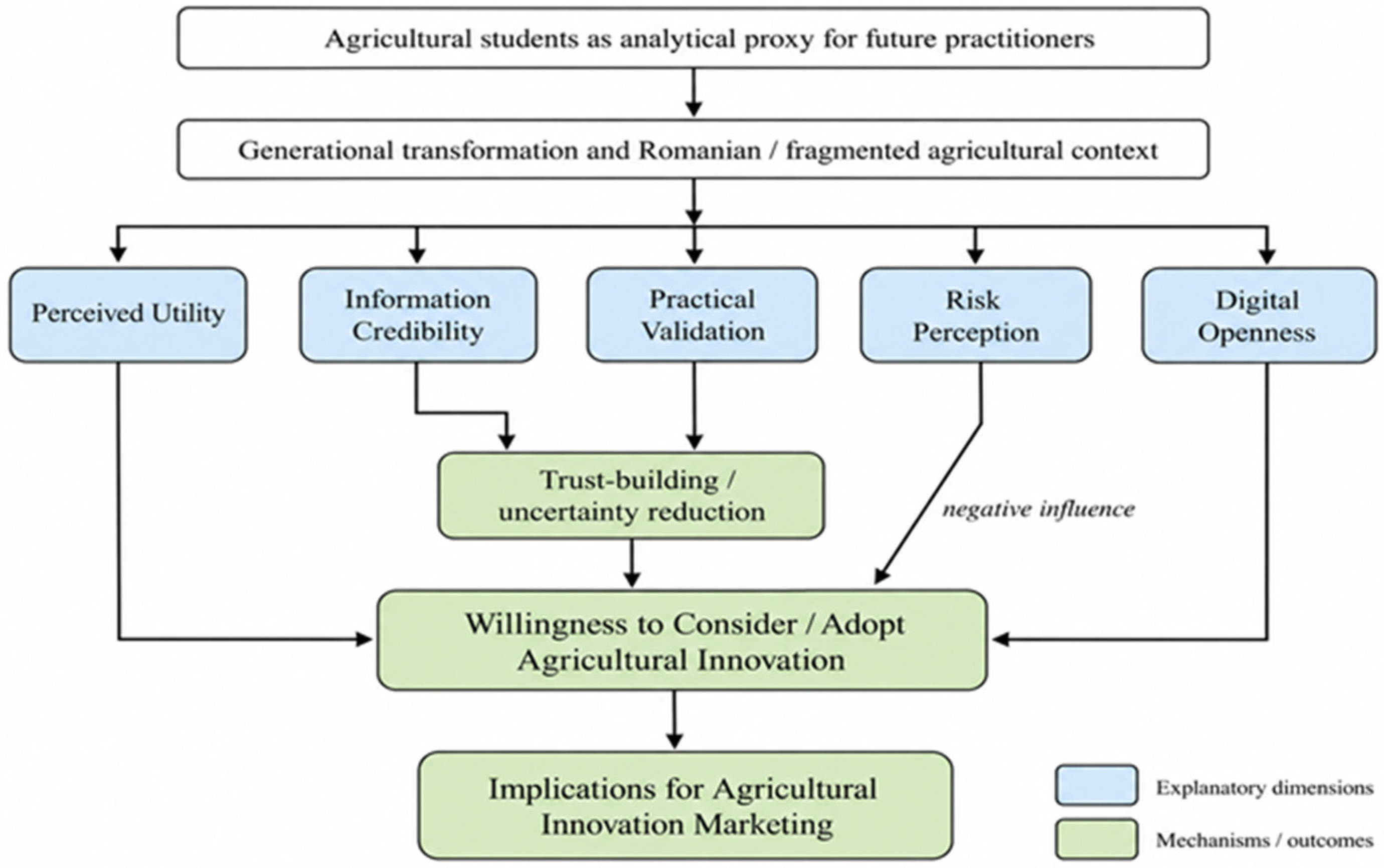
The conceptual framework summarized in
Figure 1 assumes that willingness to consider or adopt agricultural innovation is shaped by perceived utility, information credibility, trust-building, risk perception, and practical validation. These relationships are examined in the context of agricultural students as an analytical proxy for future practitioners, while also considering digital openness and the broader transformation of agricultural practice.
The study contributes by linking the current characteristics of agricultural practice with generational change and the need to rethink how innovation is communicated and promoted in the agri-food sector. It emphasizes the importance of effective communication for presenting agricultural innovation to future users, in line with the specialized literature [
37]. Methodologically, the research uses a sequential mixed-methods design combining a literature review, semi-structured interviews, a student questionnaire, and a focus group. This approach supports both the description of perceptions and trends and the construction of an applied interpretation of how agricultural innovation marketing can be adapted to a changing professional profile.
2. Materials and Methods
The study used a sequential mixed-methods design combining a literature review with an empirical investigation of the perceptions and decision-making mechanisms related to agricultural innovation. The methodological framework included three main stages: conceptual foundation, questionnaire-based opinion survey, and contextual validation.
2.1. Research Purpose, Objectives, and Methodological Design
The purpose of the research was to analyze the current profile of agricultural practitioners and the emerging characteristics of future practitioners, as reflected in agricultural students’ opinions, in order to identify implications for adapting agricultural innovation marketing strategies. The study pursued four objectives: identifying the defining characteristics of current practitioners; examining the dominant traits of future practitioners based on undergraduate and master’s students; validating these traits through the perspectives of experienced agri-food actors; and formulating implications for innovation marketing.
The research was designed as a sequential mixed-methods study based on triangulation, an approach supported by the literature [
38,
39]. This design combined an exploratory perspective, focused on the logic and nuances of innovation-related decision making, with an empirical perspective aimed at structuring relevant variables. The investigation included four complementary stages: literature analysis to define the conceptual framework and current practitioner profile [
40]; semi-structured interviews with agricultural students to explore perceptions and decision-making mechanisms; a questionnaire developed from qualitative findings and administered to a broader student sample; and a focus group with experienced agri-food participants for contextual validation.
The questionnaire was developed through the operationalization of qualitative themes into measurable dimensions. References to usefulness, applicability, and expected results were translated into perceived utility; references to experts, teachers, practitioners, and professional recommendations into information credibility and trust; references to demonstrations, testing, and visible results into practical validation; and references to cost, uncertainty, implementation difficulty, and lack of support into perceived barriers and risk perception. These dimensions guided the formulation of Likert-type and categorical questionnaire items.
Triangulation was operationalized by comparing findings across the literature review, interviews, questionnaire, and focus group. The literature identified key theoretical dimensions of adoption, the interviews examined their presence in respondents’ own explanations, the questionnaire measured their distribution in a broader sample, and the focus group refined and contextualized the interpretation. Convergent findings were retained as central patterns, complementary findings added explanatory detail, and divergent findings were used to refine interpretation rather than force a single conclusion. This procedure strengthened the robustness of the analysis.
Agricultural students were used as an analytical proxy for future practitioners, without assuming direct equivalence between student status and future professional roles. This choice is justified by their professional training and exposure to educational, technological, and value-related influences relevant to the evolution of agricultural practice. The research followed ethical principles specific to social science investigations: participation was voluntary, respondents were informed about the purpose and confidentiality of the study, and all responses were analyzed anonymously.
2.2. The Qualitative Phase: Semi-Structured Interviews
The qualitative phase had an exploratory role, aiming to identify the emerging characteristics of future agricultural practitioners and determine how they understand, evaluate, and relate to agricultural innovation. It also helped us to identify those dimensions that were not fully deduced from the literature and grounded the subsequent quantitative instrument [
41].
Data were collected through semi-structured interviews with undergraduate and master’s students in agricultural or agri-food-related fields. Respondents were selected to ensure diversity in study level, background, and proximity to agricultural activities; the procedure was supported by the literature [
42].
The inclusion criteria were as follows: enrollment in a relevant program, voluntary participation, and the ability to discuss perceptions or expectations regarding agricultural innovation. Students with different educational profiles and degrees of contact with agriculture, such as family farming background, practical training, internships, or direct agricultural experience, were included. Students outside the relevant fields or without informed consent were excluded.
The students were treated as an analytical group relevant for exploring possible future practitioner profiles, without assuming direct equivalence between student status and future professional roles.
Interviews were conducted between September and November 2025, either in person or online, and lasted about 20–30 min. A total of 62 interviews were conducted. The number was considered adequate because thematic saturation was reached: after approximately 50 interviews, the main themes related to perceived utility, trust, information sources, testing, risk, barriers, and adoption conditions had already appeared repeatedly. The final interviews mainly confirmed the stability of the coding structure and did not substantially change the thematic framework.
The semi-structured interview guide focused on previous experience with new technologies, criteria for evaluating utility and relevance, information sources, trust-building factors, perceived adoption barriers, conditions for understanding technology, and the perceived practical value of innovation. This structure allowed comparable discussions while leaving space for individual explanations [
43]. Key questions addressed decisions about new technologies, criteria for judging whether a technology is worth using, credible information sources, barriers to adoption, and how technology should be presented to be understood.
These dimensions were chosen because innovation adoption in agriculture is influenced by direct experience, perceived risk, economic criteria, and source credibility [
44]. Particular attention was given to utility, clarity of presentation, practical validation, and the role of other users’ experience in building trust.
The interviews were recorded, transcribed, and analyzed thematically, as recommended in the literature [
45]. Coding was predominantly inductive, guided by the empirical content of responses and by the thematic dimensions of the interview guide [
46]. Transcripts were read repeatedly to identify meaningful units related to innovation, usefulness, trust, information sources, testing, barriers, risk, and adoption conditions. These units were assigned initial open codes, which were then grouped into broader categories such as perceived utility, information credibility, practical validation, risk perception, adoption barriers, digital openness, and willingness to adopt.
The coding structure was refined through iterative comparison across interviews, with codes merged, renamed, or separated when necessary to avoid overlap and improve conceptual clarity. Final themes were selected based on recurrence across respondents and relevance to the research objectives. The resulting thematic structure was used to interpret the qualitative findings and inform the construction of the quantitative instrument [
47].
To enhance analytical consistency, a subset of transcripts was independently reviewed by a second researcher. Differences in code interpretation and category grouping were discussed within the research team, and the coding scheme was refined by consensus. Although no formal intercoder reliability coefficient was calculated, this procedure helped reduce individual interpretive bias and strengthened the transparency and credibility of the qualitative analysis.
The qualitative phase served two functions: it clarified how future practitioners relate to innovation, risk, information sources, and the practical utility of new technologies, and it provided the basis for constructing the questionnaire items. To make this transition transparent, recurring themes such as practical utility, trust in information sources, testing and demonstration, perceived barriers, information-seeking behavior, and willingness to adopt were operationalized into questionnaire dimensions and items.
Table 1 presents the qualitative-to-quantitative mapping used for questionnaire development.
This mapping clarifies the exploratory sequential logic of the study: the qualitative stage did not function only as a preliminary descriptive component but rather directly informed the construction of the quantitative instrument. In this way, the questionnaire was grounded in the meanings, criteria, and decision-making mechanisms expressed by the interview participants, while the quantitative phase allowed these dimensions to be examined in a broader student sample.
2.3. The Quantitative Phase and Contextual Validation via Focus Groups
The quantitative phase further examined the qualitative findings through a structured questionnaire administered to a broader sample of undergraduate and master’s students in agricultural fields. It aimed to quantify perceptions of agricultural innovation, information-seeking behavior, trust factors, perceived barriers, and willingness to adopt innovative technologies and products [
48].
The questionnaire was developed from the dimensions identified in the semi-structured interviews and included items on the importance of agricultural innovation, intention to use new technologies, preferred information sources, promotion channels, trust factors, perceived barriers, and willingness to invest. Examples of items included the following: “How important do you consider agricultural innovations in future decision-making?”; “From which sources do you prefer to receive information before adopting an agricultural innovation?”; “How likely are you to invest in a new innovative technology if you were to start an agricultural business?”
The sample was non-probability-based and included 172 undergraduate and master’s students from the “Ion Ionescu de la Brad” Iași University of Life Sciences, enrolled in agriculture, agricultural business management, agribusiness administration, consumer protection, environmental protection, and related agri-food fields. Respondents came from both rural and urban areas and varied in agricultural experience, including family farming backgrounds, university practical training, internships, or indirect exposure through education. Inclusion criteria were enrollment in a relevant program, availability to complete the questionnaire, and anonymous consent; incomplete responses, lack of consent, or non-enrollment in a relevant field led to exclusion. The sample was considered adequate for the exploratory quantitative phase because it allowed perception patterns to be examined across a broader student group.
Data were collected online between December 2025 and February 2026 through digital platforms. Participation was voluntary, anonymous, and limited to academic use. The questionnaire combined closed-ended, multiple-choice, and Likert-type items; the structure was supported by the specialized literature [
49]. Before full administration, the questionnaire was pre-tested with 30 students from the target population to assess clarity, wording, logical sequence, and completion time. Based on feedback, some items were reworded, overlapping formulations were reduced, and question order was adjusted.
The questionnaire was organized around three dimensions: perceived importance of agricultural innovation and openness to future use; information-seeking behavior and promotion channels; and adoption decision factors, including perceived utility, risk, motivations, barriers, and willingness to invest. Perceived utility referred to usefulness, applicability, expected benefits, efficiency, and relevance for future professional decisions. Trust was measured through the perceived credibility of teachers, experts, practitioners, companies, online platforms, peer networks, and professional or institutional sources. Innovation intention referred to willingness to consider, use, test, recommend, or invest in innovative technologies. Perceived barriers included cost, uncertainty, lack of information, implementation difficulty, lack of support, risk, incompatibility with existing practices, and insufficient practical validation.
The quantitative analysis described response distributions and examined relationships between respondents’ characteristics and attitudes toward innovation. Variables such as background and educational milestones were considered to identify differences in perceptions, information-seeking behavior, and adoption intentions. Given the exploratory nature of the study and the ordinal or categorical structure of several items, Spearman’s rank correlation was used for selected ordinal variables, such as perceived risk, digital openness, trust in information sources, and willingness to adopt or invest in innovation. Chi-square tests were used for selected categorical variables, including preferred information sources, promotion channels, and levels of openness toward innovation. These analyses were not intended to build causal models, but to support the interpretation of descriptive results and identify relevant associations.
To refine and contextualize the previous findings, the research included a focus group as a validation stage [
50]. The eight participants were selected through purposive sampling to include complementary perspectives from agricultural activities, consulting, agricultural management, input distribution, agricultural education, and related agri-food fields. Selection considered professional experience, contact with innovation adoption, and the ability to reflect critically on changes in agricultural practitioner profiles. The discussion was moderated in person or online, lasted about 90 min, and followed a thematic guide based on preliminary findings [
51]. Participants were presented with these findings in a neutral manner and invited to confirm, expand, or challenge them based on professional experience.
The guide addressed acceptance or rejection of new technologies, the role of practical testing, trusted sources of information, the importance of cost, results, risk and ease of use, differences between current and future practitioners, and the characteristics needed for marketing strategies targeting future agricultural practitioners.
2.4. Data Processing, Analysis, and Integration
The data were processed and analyzed according to a sequential mixed-methods design in order to integrate qualitative and quantitative evidence on the current profile of agricultural practitioners, the emerging traits of future practitioners, and their implications for agricultural innovation marketing [
52].
For the quantitative component, questionnaire data were processed in SPSS Statistics 29.0. Descriptive statistics were used to characterize the sample and response distributions, while association analyses were used to examine the relationships between respondents’ characteristics, perceptions of innovation, information-seeking behavior, and willingness to adopt new technologies. Given the exploratory nature of the study and the ordinal or categorical structure of several variables, Spearman’s rank correlation was used for selected ordinal variables, such as digital openness, perceived risk, trust in information sources, perceived utility, and willingness to adopt or invest in innovative technologies. Chi-square tests were considered for categorical variables, such as preferred information sources, promotion channels, and levels of openness toward innovation. More complex models, such as regression, mediation, or structural modeling, were not applied because the quantitative phase was designed with the aim of conducting exploratory validation and pattern identification rather than causal modeling.
Measurement rigor was supported through conceptual validation and internal consistency-oriented checks. Construct validity was based on the correspondence between theoretical dimensions, qualitative themes, and questionnaire items, while the qualitative-to-quantitative mapping table helped us to verify whether the items reflected the meanings identified in the exploratory phase. For multi-item constructs, attention was given to item coherence within dimensions such as perceived utility, trust in information sources, perceived barriers, digital openness, and willingness to adopt or invest.
For the qualitative component, interview and focus group data were processed in NVivo 14 through thematic analysis, including coding, category development, and identification of recurring themes related to perception, evaluation, and decision making in agricultural innovation [
53]. This supported the identification of interpretive dimensions that were not reducible to frequencies, such as pragmatic evaluation, direct experience, trust-building, and perceived technological complexity.
The integration of the results was achieved through triangulation [
54]. The literature review provided the conceptual framework, the interviews generated interpretive categories, the questionnaire examined their distribution across a broader group, and the focus group refined and contextualized the interpretation. Convergent findings were retained as central patterns, complementary findings added explanatory depth, and partial divergences were used to refine the final interpretation. This strategy supported a coherent and contextualized understanding of how the emerging profile of future practitioners relates to the current profile of agricultural actors and how agricultural innovation marketing can be adapted accordingly.
3. Results
The results are presented according to the methodological framework of the study: literature review, qualitative research, quantitative research, and contextual validation through focus group. This structure highlights three aspects: the current profile of agricultural practitioners, the emerging traits of future practitioners, and implications for agricultural innovation marketing.
3.1. Results of the Literature Review: The Current Profile of Practitioners and Directions of Transformation Relevant to Agricultural Innovation Marketing
The literature review shows that the current profile of agricultural practitioners is structured by a pragmatic logic in which technology is evaluated according to concrete utility, economic consequences, and compatibility with existing activities [
55,
56,
57,
58]. Innovation adoption appears as an evaluation process shaped by direct experience, perceived risk, and the credibility of available information, since the mere existence of a given technology does not ensure its effective use [
59,
60,
61,
62].
The first finding was that practitioners prioritize solutions that can be observed, tested, and validated through concrete results. Practical demonstrations, testing opportunities, and functional or economic evidence reduce uncertainty associated with change [
63,
64,
65]. Thus, the current practitioner profile is marked by results orientation, risk aversion, and sensitivity to the immediate applicability of technology.
The second finding concerns trust. In agriculture, information is filtered through credible sources, past experiences, and social validation provided by other practitioners, consultants, or professionally relevant actors [
66]. Therefore, the practitioner profile must be understood not only through economic and technical variables, but also through mechanisms of credibility and legitimacy [
67,
68]. Agricultural practitioners operate as producers, managers, risk assessors, negotiators, and technology users; consequently, adoption is rarely purely technical, being influenced by economic pressure, time constraints, transition costs, and integration into existing routines [
69]. This is relevant for innovation marketing, as messages focused only on novelty or abstract performance may be ineffective if they do not clearly communicate utility and control.
A third finding concerns digital transformation. The literature on digitalization, precision agriculture, smart farming, and Agriculture 4.0 shows that modern agriculture is undergoing professional reconfiguration. Empirical experience remains important, but it is increasingly complemented by competencies related to data interpretation, algorithm-assisted decision making, information selection, and the evaluation of complex technologies, including AI-supported tools [
70,
71]. Digital platforms, decision-support systems, mobile applications, and digital extension services reshape how information is accessed, evaluated, and applied. However, adoption remains uneven, as digitalization depends on resources, infrastructure, skills, and support services. As technologies become more complex, the need for explainability, practical verification, and information selection increases [
72,
73]. This supports the idea that agricultural practice is being reconfigured within a more digitalized and information-dense context, requiring adapted marketing communication strategies.
In Romania, this issue has additional relevance. The literature and statistical reports show that Romanian agriculture remains structurally fragmented, combining consolidated commercial farms with many smallholdings and a high share of agricultural employment compared with the European average [
74].
The aging of the agricultural population, youth migration, and unequal digital skills increase the need for professional renewal and technological adaptation. Therefore, agricultural innovation marketing should be analyzed not only as product promotion but also as communication adapted to different practitioner categories and stages of professional transformation [
75].
The literature review also indicates that agricultural students are relevant for exploring possible characteristics of future practitioners in digitalized agriculture. Studies on generational change and agricultural digitalization suggest that younger cohorts are exposed to more diverse information sources, faster technological change, and different trust-building mechanisms than many traditional practitioners [
76,
77]. Although students cannot be treated as direct equivalents of future farmers or agricultural decision-makers, their perceptions may reveal emerging professional tendencies. Younger potential entrants may show greater digital familiarity, more intensive use of mobile applications and online platforms, openness to data-driven tools, and stronger expectations for interactive communication and rapid access to information. However, their adoption decisions remain shaped by usefulness, cost, risk, credibility, and the possibility of testing technologies before full adoption.
Generational transformation should therefore be understood as a hybridization of professional logic, not as a simple replacement of traditional experience by digital openness. Younger actors may be more digitally connected, while still requiring practical validation, reliable information, and visible operational benefits. This supports the need to adapt innovation marketing strategies to both current practitioners and the generation gradually entering agriculture.
In conclusion, the literature review shows that current practitioners are characterized by pragmatism, caution, and reliance on contextually relevant information; recent transformations point to a hybrid profile combining practical experience with digital skills; and, in Romania, these changes have direct implications for agricultural innovation marketing. The literature review thus provided an interpretive framework for the empirical stages and supported the working hypothesis that future practitioners exhibit a combination of greater openness to digital tools with practice-oriented criteria related to usefulness, evidence, and trust.
3.2. Results of the Qualitative Analysis
The qualitative results were obtained through thematic analysis of the semi-structured interviews coded in NVivo 14. To increase interpretive transparency, representative anonymized quotations are included and showed in
Table 2, to illustrate the main categories identified during coding: perceived utility, trust in information sources, practical testing, risk perception, ease of understanding, and willingness to adopt agricultural innovation. These quotations show how the analytical categories were grounded in respondents’ own explanations.
This phase aimed to identify the cognitive, evaluative, and decision-making criteria through which agricultural students, used as an analytical proxy for future practitioners, relate to innovative agricultural technologies. The analysis focused on perceived utility, credible information sources, trust-building and trust loss, barriers to adoption, clarity of technology presentation, and the practical value attributed to innovation.
By grouping recurring codes into thematic categories, the analysis revealed a predominantly pragmatic decision-making logic. Respondents’ attitudes toward innovation were mainly shaped by concrete utility, direct verification, source credibility, and the need for clear and intelligible technology presentation. The following subsections present these results by thematic dimension.
3.2.1. Practical Utility, Testing, and Observable Results as Benchmarks in Technology Evaluation
Responses to the question “How do you determine whether a technology is worth using?” concentrated around three criteria: practical utility, testing, and observable results. For respondents, a given technology is valuable when it addresses concrete needs, can be verified, and produces clear practical effects (
Table 3).
Most responses indicated that a given technology is worth using when it solves a problem, is useful in practice, or meets a concrete need. These statements formed the dominant subcategory of direct practical utility, showing that respondents evaluate technology through functional relevance and immediate applicability.
A second important subcategory was validation through testing based on references to free trials and practical testing. This indicates that acceptance is closely linked to the possibility of verifying the technology before adoption. Respondents also valued observable results, especially when the technology was perceived as producing visible or immediate benefits. Interactivity appeared only marginally, suggesting that it is a secondary evaluation criterion.
Overall, this theme indicates a conditional openness toward technology, filtered through utility, verification, and clear results. Formulations such as “I verify it in practice,” “it is useful in practice,” and “it has the ability to solve a problem” illustrate this pragmatic orientation.
3.2.2. Credible Sources of Information: The Predominance of Expert Validation and Academic Proximity
Responses to the question “Where do you get your information from and which sources do you consider credible?” showed that respondents assess credibility selectively. They distinguish between sources according to specialization, verifiability, and proximity to professional or academic environments perceived as legitimate (
Table 4).
The first important subcategory referred to manufacturer-related sources and direct testing, including the manufacturer’s website, manufacturer tests, and use during a free trial period. Respondents were willing to consult official sources, but preferred them to be supported by practical verification, indicating a form of conditional trust.
The second subcategory included independent and specialized sources, such as official independent studies and specialized websites. These responses suggest that credibility is associated not only with specialization but also with the perceived independence of the assessment.
The third category was academic proximity, reflected in references to professors and academic networks. These sources were perceived as legitimate because of their cognitive and professional authority. In contrast, social media appeared only sporadically and functioned more as a rapid information channel than as a core source of credibility.
Overall, respondents selected information sources carefully, associating credibility mainly with expertise, verifiability, and proximity to specialized or academic environments.
3.2.3. Trust in Technology: Clarity of Results, Ease of Use, and Perceived Safety
Responses to the question “What increases or decreases your trust in a new product?” showed that trust depends mainly on clear results, ease of use, and perceived safety (
Table 5).
The strongest subcategory was unclear or unverified results, which respondents frequently associated with declining trust. Lack of clear, verifiable, or coherent outcomes directly affected the perceived credibility of a product. The second major subcategory was difficulty of use, indicating that trust depends on the ability to use the technology without major obstacles. Even functionally promising technologies may generate reluctance if they appear difficult to operate.
Respondents also mentioned security risk, showing that perceived safety and control are important filters of trust. Less frequent expressions, such as “disappointing,” “pseudo-qualitative results,” or “negative perception of utility,” further indicate that trust depends on the alignment between technological promises and concrete user experience. Overall, trust appears selective and conditional on clear results, usability, and perceived safety. Expressions such as “unclear/unverified results,” “difficulties in use,” and “security risk” summarize the main conditions under which trust may be undermined.
3.2.4. Barriers to Adoption: Dependency, Support, and Compatibility with Practice
Responses to the question “What would prevent you from adopting a technology?” showed that refusal or postponement of adoption is associated with social validation, autonomy, post-adoption support, and compatibility with existing practice (
Table 6).
The most frequent barrier was negative reports from other users or consumers. Experiences shared on social media or informal networks appeared repeatedly in respondents’ explanations of non-adoption. Another relevant barrier was technology dependence, associated with concerns about loss of autonomy and limited control in future activities.
Perceived risk therefore moderates agricultural innovation adoption: even when users recognize an innovation’s usefulness, high risk may weaken the transition from favorable attitude to adoption intention. This is relevant in agriculture, where adoption often involves investment, operational dependency, production uncertainty, and possible incompatibility with existing routines. The findings show that respondents did not reject innovation in principle, but assessed it through cost, dependency, support infrastructure, controllability, and practical fit.
Lack of repair, maintenance, and tutorial services also indicated the importance of support infrastructure. Other barriers concerned contextual compatibility, such as regional unavailability or conflict with traditional work methods, as well as brand distrust. Overall, non-adoption was associated with dependency risk, vulnerability, insufficient support, and incompatibility with actual practice.
3.2.5. Clarity of Presentation and Direct Exploration as Premises for Understanding Technology
Responses to “How should a technology be presented so that you understand it well?” showed that understanding depends on how innovation is organized, explained, and connected to users’ concrete experience (
Table 7). The main subcategory was simplicity and clarity, expressed through common language, easy-to-understand explanations, and intuitive interfaces. A second important subcategory was direct exploration and testing, including trials, testing, and simulations, showing that understanding is facilitated by direct interaction with technology, not only by verbal explanation. Many respondents also mentioned the need for initial training and tutorial guides, indicating that new technologies are easier to understand when supported by a structured learning environment. Other responses, such as “detailed presentation,” “fits in with the other innovative products I use,” or “aligns with my existing knowledge,” suggest that understanding is facilitated when the technology is connected to familiar practices and prior knowledge.
Overall, respondents preferred technologies to be presented with accessible language, supported by direct interaction, and accompanied by initial guidance. Expressions such as “common language,” “testing,” “intuitive interface,” and “tutorial guide” summarize the conditions under which technology becomes intelligible and practically familiar.
3.2.6. Usefulness of Technology Efficiency, Problem-Solving, and Economic Benefits
Response to “What does it mean to you that a technology is useful?” showed that utility is defined through the concrete effects that technology can produce in agricultural activity (
Table 8).
The most consistent subcategory was problem-solving and direct functional benefit, reflected in statements such as “helps to solve problems.” Respondents assessed utility mainly through the technology’s ability to address concrete agricultural difficulties. A second subcategory was operational efficiency, including references to work speed, time saving, and easier work processes. Utility was also associated with economic benefit, especially income generation and yield increase. Overall, respondents defined usefulness through problem-solving, resource saving, and measurable economic value.
3.2.7. Synthesis of Qualitative Results: Emerging Profile of Future Agricultural Practitioners
Overall, the qualitative results outline an emerging profile characterized by conditional openness to innovation and pragmatic evaluation. Respondents considered a given technology to be relevant when it solved a concrete problem, could be tested, produced clear results, and could be integrated easily into practical activity.
This profile is defined by several traits: strong orientation toward utility, need for practical validation, selective trust in information sources, caution regarding adoption risks, and preference for clear, accessible technology presentation. Testing, simulations, trial periods, specialized sources, academic proximity, support infrastructure, and intuitive communication repeatedly appeared as conditions for trust, understanding, and possible adoption.
Thus, future agricultural practitioners, as reflected in this student-based analysis, appear open to innovation but continue to evaluate technologies through usefulness, evidence, credibility, risk control, and intelligibility. These traits provide the basis for the quantitative phase and for adapting agricultural innovation marketing strategies.
3.3. Results of the Quantitative Questionnaire Survey
3.3.1. Sample Characteristics
The quantitative sample included 172 respondents, 132 from rural areas (76.74%) and 40 from urban areas (23.25%). The predominance of rural respondents is relevant given the study’s focus on agricultural innovation, modernization, and rural professional contexts.
Regarding the relationship between knowledge and academic performance, responses were relatively balanced, with a slight concentration in the neutral zone. The highest share was recorded for value 4 on the scale (23.25%), indicating a moderate position between the importance of actual knowledge and grades.
Table 9 summarizes the sample characteristics used in the quantitative analysis.
The distribution also shows no clear dominant orientation regarding academic performance: 38.15% of respondents tended to prioritize actual knowledge over grades, while 38.94% tended to consider grades as indicators of determination and competence.
3.3.2. Perception of Agricultural Innovation and Adoption Intentions
Results for item Q2 indicate a favorable attitude toward agricultural innovation in future decision making.
Higher scale values accounted for most responses: 24.41% selected option 5, 29.06% option 6, and 23.83% option 7. Together, these categories show that 77.30% of respondents support the use of innovative products in agriculture, while 11.62% selected the neutral category and 11.03% chose reserved options.
For item Q6, the most preferred innovations were modern machinery (32.95%) and digitalization, including sensors, drones, and management software (29.29%). These were followed by sustainable solutions, such as smart irrigation and precision fertilization (23.11%), and biotechnologies or advanced seeds (14.65%). This distribution indicates stronger interest in innovations perceived as directly applicable, visible, and relevant to agricultural efficiency.
Table 10 summarizes these results.
Overall, this subsection shows a favorable perception of agricultural innovation and a preference for modern technologies, digitalization, and sustainable solutions. Respondents’ openness is mainly linked to innovations with immediate practical applicability and visible effects on agricultural activity.
3.3.3. Motivation for Adopting Agricultural Innovation and the Role of Perceived Risk
Motivation for adopting innovative agricultural products was analyzed through Q4, together with perceived risk (Q5) and reasons for avoiding online-promoted innovative products (Q16). Results show that motivation is mainly functional and economic, but that it is moderated by uncertainty and the need for clear information.
For Q4, the main motivations were increased productivity (34.98%) and cost reduction (31.28%), followed by environmental protection (17.49%) and access to subsidies or support programs (16.26%). Thus, adoption is primarily associated with expected gains in efficiency and performance, while sustainability and institutional support play secondary roles.
Risk perception (Q5) was dominated by cautious or undecided responses: 51.16% selected “don’t know/so-so,” 23.25% indicated high or very high risk, and 25.57% indicated low or no risk. This suggests that, despite a favorable attitude toward innovation, risk assessment remains cautious and context-dependent.
Table 11 summarizes these motivational and risk-related results.
Responses to Q16 confirm this cautious pattern. The main reasons for avoiding an innovative product promoted online were lack of clear information (21.66%), negative reviews (18.76%), and high price (14.31%), followed by a lack of farm-specific demonstrations (11.03%), lack of brand trust (10.83%), and previous bad experiences (9.67%). Overall, demotivation was mainly associated with insufficient clarity, limited practical evidence, and uncertainty regarding product reliability and promotional messages.
3.3.4. Impactful Promotional Content and Elements That Build Trust
The role of promotion was analyzed through Q11, regarding promotional content influencing purchase decisions, and Q12, regarding trust-building elements. Results indicate a clear preference for practical experience and verifiable evidence.
For Q11, the most influential formats were reviews from other farmers (25.38%) and comparative tests or case studies with concrete economic results (21.02%). Demonstration videos and sponsored posts or advertisements accounted for 15.34%, followed by technical articles or specialized studies (14.77%). Lower shares were recorded for interactive demonstrations (8.90%), online trade shows or webinars (7.77%), and recommendations from influencers or specialists (6.82%). Thus, purchasing decisions were mainly influenced by practical confirmation and economic arguments.
For Q12, trust was most strongly associated with product demonstrations and pre-purchase testing (26.57%), testimonials and reviews from other users (20.73%), certifications (19.44%), technical data (17.49%), and economic results (15.77%). Overall, trust appears to rely on objective, testable, and comparable validation rather than persuasive messages alone.
Table 12 summarizes these results.
Overall, promotional influence and product trust were mainly associated with practical reviews, demonstrations, testing, and concrete economic results, confirming respondents’ pragmatic approach to innovative technologies.
3.3.5. The Decision to Adopt Innovative Agricultural Products
The adoption decision was analyzed through three dimensions: purchase and investment factors, information sources and frequency before adoption, and openness to digital applications in decision making. Results indicate a pragmatic orientation based on product quality, evidence of effectiveness, credible information, and the usefulness of digital tools.
For Q19, the main factors influencing purchase decisions were product quality (26.58%) and results validated by studies or tests (25.09%), followed by price (18.77%), recommendations from other farmers (11.71%), and warranties or after-sales services (9.48%). Brand reputation (6.32%) and promotions or discounts (2.04%) had limited influence, while product availability or delivery time was not selected. Thus, purchase decisions were mainly based on performance, verifiability, and efficiency, with promotional factors playing a secondary role (
Table 13).
Results for Q17 confirm a favorable adoption attitude: 48.25% of respondents would very likely invest in an innovative technology, and 43.02% would likely do so. Overall, 91.27% expressed a favorable investment intention, while only 7.55% were undecided and 1.16% indicated low probability.
Before adopting an innovation, respondents preferred direct and official information sources. For Q7, the main sources were sales representatives or field agents (22.35%) and company websites (21.40%), followed by online farmer groups (16.86%), friends or farmers in the community (12.31%), and local suppliers (11.36%). Video reviews (8.52%) and social media (7.20%) had lower shares, suggesting preference for specialized, official, or practice-related sources.
Information search was recurrent but not daily: 37.20% searched monthly, 31.39% weekly, 18.02% every 2–3 months, 5.81% daily, and 7.55% not at all. The most used digital channels were YouTube (18.10%), specialized websites (17.41%), and Google Search (15.86%), followed by TikTok, farmer forums or groups, Facebook, and Instagram. Newsletters, AI, and WhatsApp farmer groups had marginal shares. Online promotion influenced adoption decisions often or very often for 69.18% of respondents, while only 2.32% reported rare or no influence.
Regarding digital applications (Q18), most respondents perceived them as facilitating future purchasing decisions: values 5–7 were selected by 72.65%, the neutral value by 16.87%, and values 1–3 by 11.03%.
Table 14 summarizes these results.
Overall, the decision-making results show that respondents base purchasing decisions mainly on product quality, proven results, and price. They prefer direct, official, and specialized information sources, while online promotion has a clear influence and digital applications are mostly perceived as facilitating the purchasing process. These results confirm the pragmatic, evidence-based orientation identified in previous sections.
3.4. Contextual Validation of the Emerging Profile of Future Practitioners via Focus Group
To deepen and validate the previous findings, a focus group was conducted with eight participants from fields connected to the agri-food sector, including practitioners, consultants, and experts in marketing, education, and socioeconomic research. The discussion was analyzed thematically and summarized in a convergence matrix based on recurring statements and areas of agreement.
The focus group confirmed the main conditions for technology acceptance, trust formation, adoption decisions, and marketing strategies targeting future agricultural practitioners. The dominant themes are presented in
Table 15.
Additional association tests supported the descriptive results. Spearman correlation indicated a moderate positive association between digital openness and willingness to adopt innovative technologies (ρ = 0.46, p < 0.001), a negative association between perceived risk and adoption intention (ρ = −0.31, p = 0.002), and a positive association between trust in credible information sources and willingness to consider innovation (ρ = 0.39, p < 0.001).
Chi-square tests showed that information source preferences were significantly associated with openness toward innovation (χ2 = 14.82, df = 4, p = 0.005). Respondents preferring expert-based, university-related, professional, or demonstration-based sources reported higher openness than those relying mainly on general online information. The association between preferred promotional channel and adoption intention was weaker and marginally significant (χ2 = 8.91, df = 4, p = 0.063). These results indicate that adoption intention is shaped by digital openness, perceived risk, and information credibility.
Overall, the focus group reinforced the interpretation developed from the interviews and questionnaire and connected it more clearly to professional realities in the agri-food sector.
The focus group participants were coded P1–P8 and selected to reflect complementary perspectives in the agri-food sector: farmer, marketing specialist, doctoral student in agricultural marketing, consultant, input distribution specialist, procurement specialist, agricultural education expert, and rural sociology researcher.
Six main themes emerged. The first pertains to technology acceptance based on clear utility, measurable results, and easy integration into farm routines. Participants emphasized that technologies are more likely to be accepted when they offer concrete benefits, reduce losses, simplify decisions, or improve activity; they stated that technologies are more likely to be rejected when they are expensive, complex, poorly explained, or dependent on insufficient infrastructure.
The second theme was the importance of practical testing before adoption. Participants agreed that farmers prefer limited trials to large-scale risk and that on-farm demonstrations, pilot plots, local examples, and visible comparisons accelerate adoption decisions.
The third theme concerned trustworthy sources and relational validation. Trust was linked mainly to practitioners who had already tested the technology, followed by consultants, agronomists, professors, or technical representatives who remained available after a recommendation or sale. Academic and technical sources supported the decision but rarely determined it in isolation.
The fourth theme showed that adoption depends on the balance between output, risk, cost, and ease of use. Output and risk carried the most weight, cost acted as an entry filter, and ease of use became critical when time and labor resources were limited.
The fifth theme referred to differences between current practitioners and the new generation in training. Participants noted that future practitioners are more open to digitalization, quick comparisons, data use, and online learning, although this openness remains constrained by access to capital, infrastructure, skills, and institutional support.
The final theme concerned marketing strategies for future agricultural practitioners. Participants emphasized the importance of local evidence, simple figures, clear comparisons, concise content, practical demonstrations, post-purchase support, peer learning, social validation, and segmentation by farm type, digital skills, and economic pressure. As one participant stated, “the practitioner accepts it when they see a clear benefit, a measurable result, and a natural place in their daily work.” Another summarized the logic of social validation: “Trust is gained primarily through proven professional relationships.”
Overall, the focus group refined the previously identified profile by emphasizing usefulness, verification, trusted professional input, and ease of integration. It also showed that agricultural innovation marketing should be built around local evidence, message clarity, post-purchase support, and social validation.
4. Discussion
The present section presents our interpretation of the empirical results in relation to innovation adoption, trust-building, perceived risk, practical validation, and agricultural innovation marketing. This distinction preserves the separation between empirical reporting and theoretical explanation.
The results indicate that the emerging profile of future agricultural practitioners can be understood as a reconfiguration of current practitioners’ decision-making logic in a more digitalized and information-diversified context. Although respondents showed openness to innovative technologies and digital tools, this openness remained conditional on operational relevance, testing opportunities, transparent outcomes, and reliable information channels. This is consistent with studies showing that agricultural technology adoption remains influenced by pragmatic criteria, perceived advantage, and trust in information sources [
78,
79,
80,
81].
Theoretically, this conditional openness can be interpreted through technology adoption behavior, perceived risk theory, and innovation resistance theory. Openness does not automatically lead to adoption because agricultural technologies are evaluated under uncertainty, investment pressure, operational dependency, and possible mismatch with existing routines. Perceived risk acts as a filter: even when innovation is valued, respondents remain cautious until the technology appears useful, understandable, controllable, and verifiable. Innovation resistance may therefore represent not only rejection, but also rational delay, selectivity, or demand for evidence before adoption.
Thus, the transformation of the agricultural professional profile preserves pragmatism as a decision-making core, adapted to new technological, communicational, and generational conditions. This interpretation is consistent with research describing agricultural digitalization as a gradual process in which new skills and tools interact with decision-making criteria already consolidated in practice [
82,
83].
4.1. Continuities and Transformations Between the Current Profile and the Emerging Profile
The results show both continuity and transformation between the current profile of agricultural practitioners and the emerging profile identified empirically. Literature and empirical findings converge in showing that technology evaluation remains organized around usefulness, testability, visible outcomes, and economic relevance, consistent with studies on perceived utility, testability, observability, and compatibility in agricultural technology adoption [
84,
85].
At the same time, the new generation in training differs through greater openness to digitalization, more diversified information sources, and greater willingness to integrate digital tools into decision making, in line with research on agricultural actors closer to educational and digital environments [
86]. Compared with many current practitioners, whose decisions are often shaped by empirical experience, direct observation, local networks, and risk avoidance, the emerging profile appears more digitally connected and exposed to diversified information flows.
This difference concerns digital literacy, innovation readiness, communication preferences, trust-building behavior, and technology engagement. Younger respondents are more familiar with online platforms, social media, digital tools, and rapid information searches. They also show greater attitudinal openness to innovation, although this remains conditioned by usefulness, affordability, credibility, and practical verification. Their communication preferences are more interactive, visual, and accessible, while trust is built through academic, professional, peer-based, and digital validation. Technological engagement involves comparison, testing, questioning, and expectations of smooth integration into professional routines.
The emerging practitioner profile should therefore be understood as hybrid: more digitally open than the traditional profile, but still anchored in pragmatic evaluation, risk control, and evidence-based adoption. This supports the idea of transition rather than discontinuity. The pragmatic logic of agricultural practice is preserved, but reconfigured through new technologies, information access, and generational change, as also shown in studies on the gradual and differentiated nature of agricultural digital transformation [
87,
88].
These results should still be interpreted in relation to literature emphasizing structural factors such as farm size, capital access, infrastructure, and institutional support. The present study does not diminish these constraints, but highlights the cognitive, relational, and communicative dimensions of adoption [
4,
89].
4.2. Decision-Making Pragmatism, Trust and Practical Validation
Respondents relate to agricultural innovation through an applied decision-making logic, in which trust develops as technologies are tested against usefulness, controllability, and compatibility with real working conditions. This is consistent with studies showing that adoption depends on relative advantage, compatibility, perceived risk, and the possibility of testing before use [
90,
91]. Interviews and questionnaire results also show that respondents valued demonstrations, prior trials, user reviews, economic outcomes, and specialized or practice-oriented information channels, in line with research emphasizing social validation, professional networks, and practical evidence in agricultural technology adoption [
92,
93,
94].
For younger agricultural practitioners, trust is increasingly shaped by digital information environments. Unlike traditional extension contexts based mainly on direct contact with advisors or experienced farmers, digital environments expose users to multiple and sometimes competing sources, including online platforms, social media, professional groups, company content, peer reviews, and academic or institutional materials. From source credibility and relational marketing perspectives, credibility depends on expertise, transparency, consistency, proximity to users’ needs, interactive communication, and visible evidence.
These findings can also be interpreted through trust-based technology adoption and institutional trust frameworks. Trust reduces uncertainty when technologies cannot be fully evaluated before adoption and is built at the intersection of technological reliability, source credibility, and professional or institutional validation. Peer validation, academic proximity, and professional networks function as forms of social capital by providing credible information, shared experience, and reputational guarantees. Thus, adoption is not only an individual decision, but also a socially embedded process shaped by networks, institutions, and trusted intermediaries.
The barriers identified, such as lack of clear information, negative reviews, difficulty of use, uncertain results, and insufficient post-adoption support, show that perceived risk is a central filter of technology assessment.
This is consistent with research on perceived complexity, ease of use, and technical support in agricultural innovation adoption, especially for digital technologies [
95]. Adoption therefore depends on evidence that the technology is intelligible, verifiable, and compatible with agricultural practice. The focus group reinforced this interpretation, showing that practical validation and trust built in professional networks remain essential.
Overall, the decision to adopt innovative agricultural technologies is shaped by economic criteria, practical assessment, and trust-building mechanisms [
96,
97].
4.3. Implications for Agricultural Innovation Marketing
The results suggest that agricultural innovation marketing should align with respondents’ evaluative logic, which combines operational usefulness, uncertainty reduction, and opportunities for verification. This is consistent with studies showing that effective innovation communication in agriculture must translate technical characteristics into functional, economic, and operational benefits relevant to users [
98,
99]. Therefore, communication strategies should demonstrate functional value, reduce uncertainty, and provide opportunities for field-based verification.
This emphasis on practical utility confirms that farmers and agricultural decision-makers usually assess innovation through functional value rather than technological novelty alone. Technologies are evaluated according to their ability to solve concrete problems, improve productivity, reduce costs, save time, increase predictability, and fit existing routines.
Thus, producers of agricultural technologies, research institutions, universities, and knowledge-transfer actors should communicate innovations through applied evidence, clear economic results, accessible explanations, and testing or simulation opportunities.
Similar studies highlight the role of practical demonstrations, assessment under real-use conditions, and accessible technology presentation in increasing adoption readiness [
100,
101]. From the perspective of experiential learning and demonstrative marketing, demonstration plots, pilot applications, field days, user testimonials, simulations, and case-based presentations can transform innovation from an abstract promise into an observable and assessable solution. Such formats reduce psychological distance and allow users to evaluate performance, usability, compatibility, risk, and expected economic value before adoption.
Marketing strategies should also combine digital channels with social and professional validation, including authentic testimonials, local demonstrations, peer learning, and post-purchase support. From a communication effectiveness perspective, accessible language, intuitive interfaces, visual explanations, and guided demonstrations reduce cognitive effort, increase message relevance, and translate technical information into actionable knowledge.
Digital extension services and technology communication platforms can support this process through interactive content, decision-support tools, tutorials, demonstration videos, feedback mechanisms, and expert or peer support.
Thus, agricultural innovation marketing should be understood not only as commercial promotion, but as a process of transmitting, confirming, and contextualizing innovation for users with specific needs and decision-making reference points [
102].
Practically, agricultural technology firms, agri-food marketers, extension services, educators, and policymakers should support adoption through demonstrations, pilot testing, cost–benefit explanations, segmented digital communication, advisory infrastructure, innovation literacy, digital skills, demonstration networks, and institutional trust-building. Overall, innovation communication should combine digital visibility, experiential evidence, relational trust, and practical support.
4.4. Specificity of the Romanian Context, Limitations of the Research and Future Research Directions
The interpretation of the results is linked to the specificity of Romanian agriculture, characterized by fragmentation, heterogeneous farm structures, and uneven modernization. In this context, openness to innovation depends on access to resources, infrastructure, digital skills, and support services, as also shown in studies describing differentiated modernization and technology adoption in Romania [
103]. The findings suggest a profile of future practitioners open to digitalization and multiple information sources, but still dependent on verification, clear communication, and perceived controllability.
Although the study was conducted in Romania, its relevance extends to other fragmented and unevenly modernized agricultural systems. Similar structural conditions can be found in Central and Eastern European contexts such as Bulgaria, Poland, Serbia, and other transitional or semi-fragmented systems. In such contexts, innovation adoption depends not only on technical performance, but also on utility, affordability, practical verifiability, compatibility with routines, and validation through trusted professional or institutional networks.
Thus, the Romanian case may offer useful insights into innovation communication and adoption in contexts marked by structural heterogeneity, generational renewal, and uneven digital transformation, although transferability should be approached cautiously. This is consistent with research showing that openness to innovation does not eliminate pragmatic adoption criteria, even among actors closer to educational and digital environments [
104,
105].
Several limitations should be acknowledged. Agricultural students were used as an analytical proxy for future practitioners, without assuming full equivalence between student status and future professional roles. Their future trajectories may differ, since not all will become farmers or direct decision-makers, and later behavior may depend on farm ownership, capital access, institutional support, regional opportunities, family background, or labor market conditions. Therefore, the results reflect orientations of a relevant educational and generational group rather than a statistically generalizable profile of all future agricultural practitioners.
The non-probability sample and the specific institutional and national context further limit generalization, but do not diminish the analytical relevance of the patterns identified. The mixed-methods design, combining literature analysis, interviews, questionnaire, and focus group, supported an integrated understanding of this emerging profile, in line with methodological literature on sequential mixed designs for complex cognitive, social, and communicative phenomena [
106,
107].
Future research should compare students and active practitioners, extend the investigation to other universities and agricultural regions, and test how different decision profiles relate to the effectiveness of concrete agricultural innovation marketing strategies. Comparative studies could also examine how different agricultural actors respond to innovation communication depending on experience, farm type, and familiarity with digital tools.
Overall, the results suggest that the emerging profile of future agricultural practitioners is built at the intersection of continuity and transformation. Although the new generation is more open to digitalization, multiple information sources, and new technologies, adoption remains anchored in utility, practical validation, source credibility, and risk control.
From this perspective, agricultural innovation marketing should be understood as mediation between technological complexity and the pragmatic criteria through which agricultural actors evaluate adoption, consistent with research viewing innovation adoption as a relational, contextual, and gradual process shaped by technological performance and by how innovation is communicated, validated, and integrated into user experience [
108,
109].
In Romania, this is particularly relevant because professional transformation occurs within an unbalanced structural framework, requiring communication and promotion strategies that consider both generational differences and sectoral constraints [
110,
111].
5. Conclusions
This research analyzed the relationship between the current profile of agricultural practitioners, the emerging features of future practitioners, operationalized through agricultural students, and the implications for adapting agricultural innovation marketing strategies. The results show that the emerging profile reflects a reconfiguration of the decision-making logic associated with current agricultural practice, in a more digitalized and information-diversified context.
The literature review indicated that current practitioners are characterized by pragmatism, risk prudence, and dependence on contextually relevant information. The qualitative and quantitative results confirmed that these features also shape how future practitioners relate to innovation, although students show greater availability for digital tools, multiple information sources, and the integration of technologies into decision making.
Generational change therefore does not replace pragmatic adoption criteria but adapts them to new professional and communicational conditions. Concrete utility, practical validation, information clarity, source credibility, and risk control remain stable benchmarks for adoption. At the same time, interest in digitalization, demonstration-based promotional content, economic results, and investment in innovative technologies all suggest higher responsiveness toward innovation. However, this receptivity remains conditional on sufficient evidence that the technology is intelligible, verifiable, and compatible with agricultural practice.
From an applied perspective, agricultural innovation marketing should be built around utility demonstration, uncertainty reduction, and social and professional validation. Effective innovation communication should combine trust-building mechanisms, demonstration-based campaigns, clear cost–benefit messages, short explanatory videos, case studies from comparable farms, testimonials from trusted practitioners, and opportunities for pilot testing. Digital strategies targeting future agricultural practitioners should use interactive and visually accessible content, social media, professional online communities, webinars, and mobile-friendly materials, while maintaining links with academic experts, extension advisors, and experienced farmers. Youth-oriented agricultural marketing should also include innovation education components, such as practical technology assessment, critical evaluation of information sources, and guided exposure to digital tools.
In the Romanian context, these conclusions are particularly relevant because professional transformation in agriculture takes place within a framework marked by structural fragmentation, uneven modernization, and unequal access to digital resources, infrastructure, and skills. The findings also have relevance for agricultural policy and development programs. Policymakers can support innovation adoption by combining investment incentives with advisory services, digital training, demonstration networks, and institutional trust-building. Extension services can translate technical information into practical guidance and connect farmers or future practitioners with reliable experts and peer examples, while agricultural education institutions can strengthen digital literacy, innovation literacy, critical evaluation of information sources, and practical exposure to new technologies.
The theoretical contribution of the study lies in linking agricultural innovation marketing, technology adoption, and practitioner transformation within a single interpretive framework. It shows that innovation communication must be adapted to a hybrid emerging profile in which digital openness coexists with pragmatic evaluation, perceived risk, trust-building, and the need for practical evidence before adoption.
The limitations of the research should also be acknowledged. The use of agricultural students as an analytical proxy limits direct transferability to active farmers, managers, consultants, or agricultural entrepreneurs. The non-probability, student-centered sample restricts statistical generalizability, and the concentration of the study in one university and one national context may limit applicability to other regions or agricultural systems. Since the data are based on self-reported perceptions, possible response bias should also be considered. In addition, the cross-sectional design captures perceptions at one moment in time and does not show how attitudes may evolve during the transition from student status to professional practice.
The mixed-methods design, combining literature analysis, interviews, questionnaire, and focus group, allowed an integrated perspective on the emerging profile. The interviews clarified why usefulness, trust, testing, and risk are important; the questionnaire showed how these orientations were distributed across a broader group; the focus group contextualized the patterns in relation to agricultural practice. This integration generated a more nuanced understanding than a single-method design would have allowed.
Future research could expand this investigation through longitudinal studies following the transition from agricultural education to professional practice and through comparative international research involving different agricultural systems and levels of digital readiness.
Further studies should include active farmers, agribusiness managers, consultants, and other decision-makers to compare student-based orientations with actual adoption behavior. Future research may also examine AI-supported agriculture, smart farming, digital extension platforms, and advanced quantitative approaches, such as regression analysis, mediation models, or structural equation modeling, on larger and more diverse samples.