4.1. Analysis of Lateral Leaf Motion Patterns
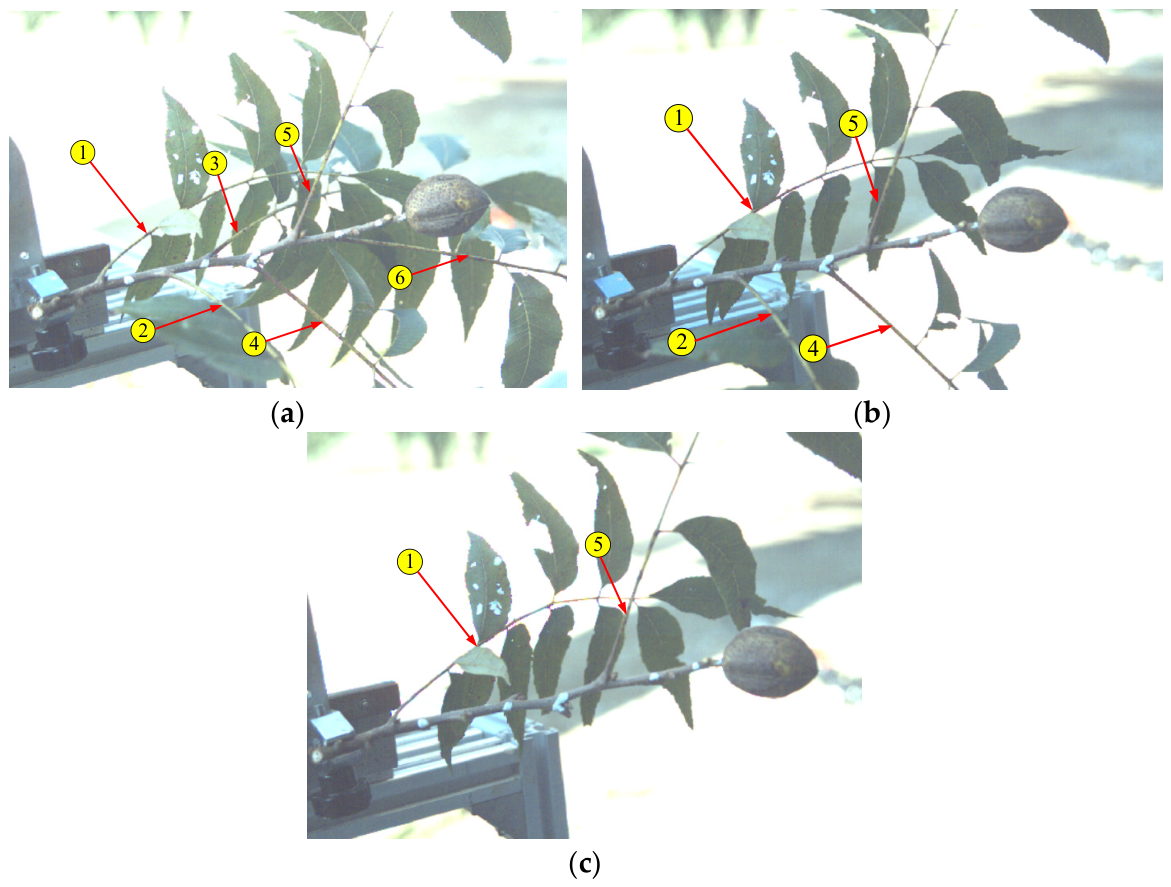
To analyze the dynamic response characteristics of lateral leaves during free vibration, high-speed imaging was used to record the walnut branch–leaf–fruit local subsystem in real time, and the motion process of the lateral leaves was identified frame by frame with the aid of TEMA high-speed video analysis software. In this study, the term subsystem refers to a local dynamic unit composed of the terminal fruiting branch segment, its attached lateral leaves, and a single fruit. For the convenience of comparing how increasing lateral leaf number affects motion patterns, the results are discussed in the order of zero, two, four, and six lateral leaves.
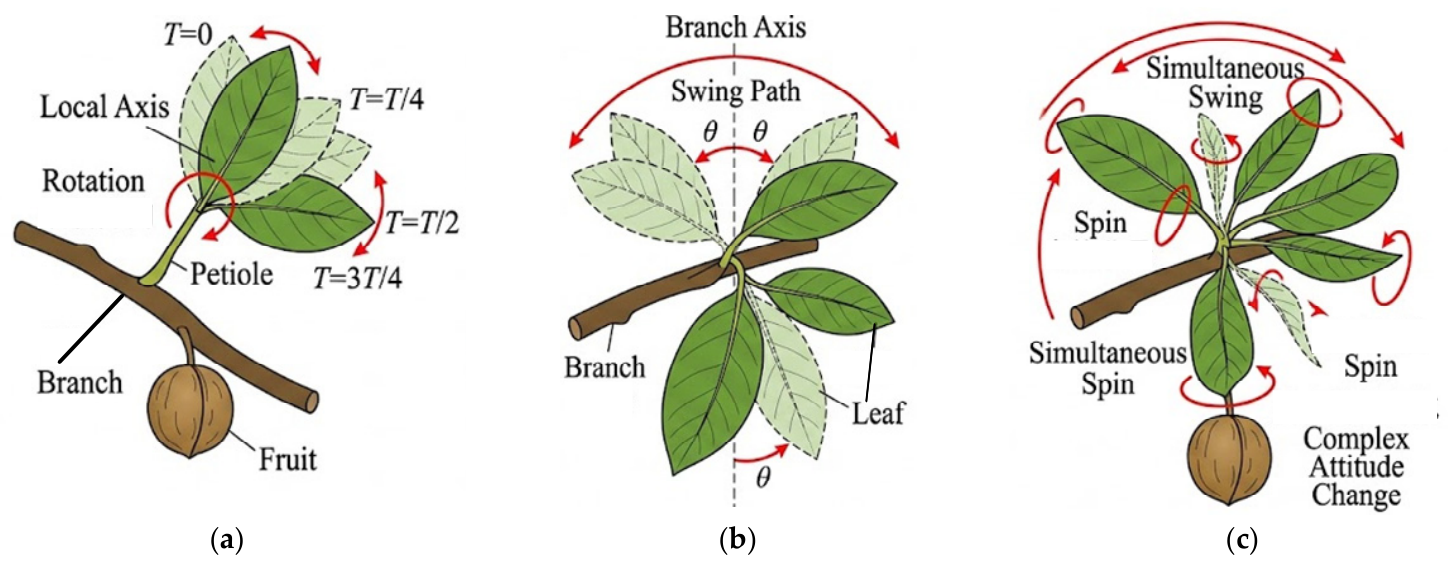
Experimental observations showed that lateral leaves mainly exhibited three typical motion patterns during free vibration, namely, spin motion, swing motion, and spin–swing compound motion, as shown in
Figure 4. Here, spin motion refers to the rotation of a leaf around a local axis near the connection region between the petiole and the branch; swing motion refers to the periodic reciprocating deflection of the leaf relative to the main branch axis; and spin–swing compound motion refers to the case in which an obvious rotational component accompanies the swing motion. Unlike the previous description based only on trajectory lines, the classification of these three motion patterns should be based on changes in the actual leaf posture and its angular displacement relative to the branch.
Under the leafless condition, no leaf-related motion existed in the system, and vibration energy was mainly dissipated through branch structural damping and air resistance. When the number of lateral leaves increased to two, leaf motion was dominated by large-amplitude swinging, with a weak rotational component observed locally, indicating that the constraining effect of the leaves on the system was still relatively weak. Under this condition, energy dissipation was mainly associated with the additional aerodynamic resistance generated during swinging. When the number of lateral leaves further increased to four, leaf motion gradually changed from pure swinging to a compound pattern involving both swinging and rotation, and differences in posture response among individual leaves began to appear. This suggests that, with an increase in lateral leaf number, the coupling between leaves and the branch became stronger, and the system energy dissipation pathways became more complex than those under the two-leaf condition.
When the number of lateral leaves increased to six, lateral leaf motion was dominated by spin, while the swing amplitude was relatively reduced, indicating that leaves were more likely to form a relatively stable rotational response when a more complete leaf retention condition was maintained. This phenomenon suggests that, under this condition, lateral leaves not only acted as added mass but also participated in system energy dissipation through local constraints at the petiole connection, aerodynamic resistance during leaf rotation, and coupling interaction with the main branch vibration. Combined with the subsequent free-vibration and forced-vibration results, it can be seen that the non-excitation direction responses were more strongly suppressed under the six-leaf condition, suggesting that a spin-dominated leaf motion pattern was more favorable for reducing vibration dispersion in non-dominant directions, whereas the 2–4-leaf conditions represented an intermediate stage in the transition from swing-dominated motion to compound motion.
Therefore, lateral leaf number changes not only whether leaves participate in the vibration response but also the specific way in which they participate in system energy dissipation: under the leafless condition, structural damping dominates; under the two-leaf condition, swing-related dissipation dominates; under the four-leaf condition, swinging and spinning act together; and under the six-leaf condition, relatively stable spin response dominates. These results indicate that lateral leaf number is an important structural factor determining the distribution of leaf motion patterns and their associated energy-dissipation modes. This also provides a morphological basis for the subsequent analysis of natural frequency changes and forced response differences.
4.2. Analysis of Free-Vibration Characteristics and Parameter Variations in the Branch–Leaf–Fruit Subsystem
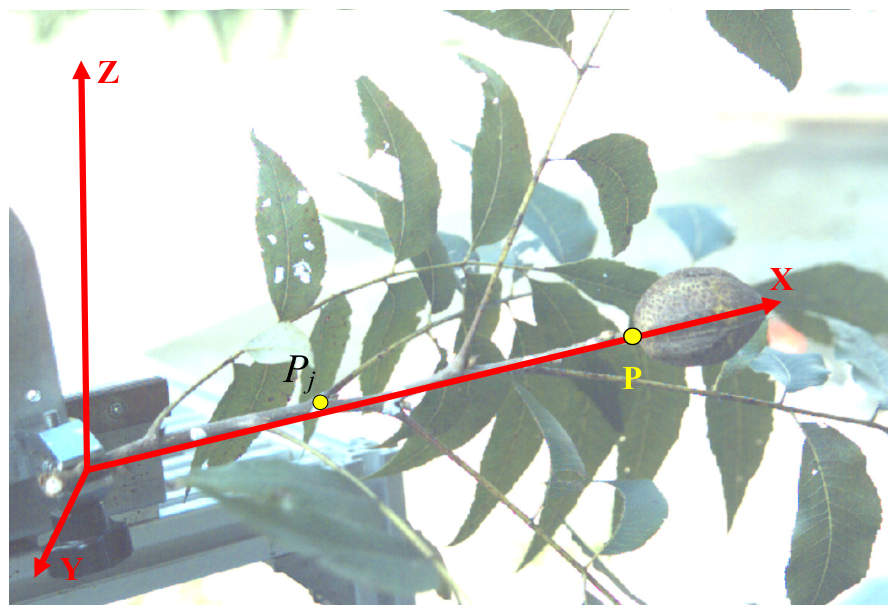
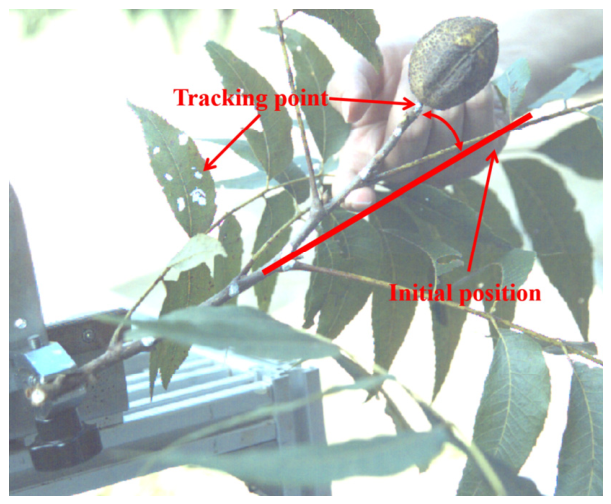
To analyze the influence of lateral leaf number variation on the free-vibration response of the walnut branch–leaf–fruit local subsystem, the tracking point
near the fruit–pedicel junction shown in
Figure 1 was selected as the response analysis point. For the same subsystem, the free end was displaced to the same initial position and then released, allowing the system to undergo free-decay vibration without continuous external excitation. High-speed imaging and trajectory extraction methods were used to record the spatial motion of tracking point
.
The experimental results showed that after free release, the motion trajectory of tracking point generally exhibited a nearly closed path that gradually converged toward the equilibrium position over time. It should be noted that, due to the coupled responses in two transverse directions, the projected trajectory of tracking point in the observation plane showed a nearly closed pattern that gradually contracted inward as the vibration decayed, rather than a strict geometric ellipse. In the initial stage of free vibration, the system possessed obvious response components in both transverse directions, together with the effects of gravity and geometric nonlinearity. Therefore, the trajectory exhibited skewness, contraction, and partial non-closure. As vibration energy was continuously dissipated by structural damping, air resistance, and leaf-related energy dissipation, the trajectory envelope gradually collapsed inward and finally converged to the static equilibrium position.
The convergence process of tracking point differed under different lateral leaf number conditions. Under the leafless condition, the free vibration of the system was mainly governed by the structural damping of the branch itself and air resistance; the trajectory converged more rapidly, but the initial rebound amplitude was relatively large, indicating that the system was more sensitive to the initial disturbance in this case. When the number of lateral leaves increased to two, the trajectory was still dominated by a relatively large-amplitude swinging response, but compared with the leafless condition, the contraction speed of the trajectory became slower, indicating that the leaves had begun to participate in energy dissipation and local coupling. When the number of lateral leaves further increased to four, the trajectory pattern was generally similar to that under the two-leaf condition, still exhibiting a relatively evident ellipse-like converging feature; however, the local trajectory became smoother and the rebound process more stable, indicating that the system had gradually evolved from a low-leaf, weak-coupling state to an intermediate state in which part of the leaves participated in energy dissipation. When the number of lateral leaves increased to six, the overall trajectory became more concentrated and the convergence process more uniform, suggesting that under a more complete leaf retention condition, the local constraints at the petiole connection, the energy dissipation associated with leaf spin–swing, and the branch–leaf coupling jointly affected the free-vibration decay process.
Overall, variation in lateral leaf number not only altered the added mass of the system but also changed the energy dissipation path and the trajectory evolution mode during free vibration. Under the leafless condition, the system mainly relied on the structural damping of the branch for energy dissipation. As the number of lateral leaves increased, the additional aerodynamic resistance caused by leaf swinging and rotation, the local constraints at the petiole connection, and the dynamic coupling between the branch and leaves jointly participated in vibration attenuation. As a result, the trajectory envelope, rebound height, and convergence rate of tracking point all changed. Quantitatively, these differences can be further characterized by the logarithmic decrement , the equivalent damping ratio , and the number of cycles required for the response to decay to a given amplitude. Therefore, lateral leaf number is an important structural parameter that affects the free-vibration response pattern and energy dissipation characteristics of the system.
To further quantify the effects of lateral leaf number on the natural characteristics and damping-related energy dissipation of the system, modal frequencies under different conditions were obtained from Equation (13) based on the aforementioned discrete dynamic model, while the experimental equivalent damping ratio was identified from the free-vibration decay curves according to Equations (16) and (17). In addition, differences in damping energy dissipation can be further characterized by Equations (18)–(20) combined with variations in successive peak amplitudes during free decay. Since the main focus of this section is to compare the variation in natural frequencies under different lateral leaf number conditions,
Table 3 first summarizes the first ten natural frequencies of the system under four typical conditions, namely, zero, two, four, and six lateral leaves.
As shown in
Table 3, when the number of lateral leaves increased from zero to two, four, and six, the mean natural frequencies of all modes showed an overall decreasing trend. Taking the first-order natural frequency as an example, the value decreased from 13.92 ± 6.37 Hz under the leafless condition to 8.79 ± 4.03 Hz under the six-leaf condition, corresponding to a reduction of 36.76%. The one-way repeated measures ANOVA indicated that lateral leaf number had a significant effect on the first-order natural frequency; F
3,12 = 29.50 and
p < 0.001. Although the standard deviations were relatively large because of differences in branch length, radius, and fruit mass among samples, the decreasing trend with increasing lateral leaf number was consistent among the five samples.
As indicated by Equations (10)–(12), variation in lateral leaf number updates not only the mass matrix but also the stiffness and damping matrices. Therefore, the change in frequency cannot be simply interpreted by the intuition of a single-degree-of-freedom system; instead, variation in lateral leaf number systematically changes the frequency distribution of the low-order dominant modes.
It should be noted that if the system were simply approximated as a lumped single-degree-of-freedom system, reducing the mass would generally increase the frequency when the stiffness remains essentially unchanged. However, the object investigated in this study is not a purely lumped single-degree-of-freedom system, but rather a discrete coupled system composed of discretized main-branch beam elements, lumped fruit mass, and equivalent mass–stiffness–damping units representing lateral leaves. According to the matrix update relations of the model, variation in lateral leaf number changes not only the mass matrix but also the stiffness and damping matrices. Consequently, although removing lateral leaves reduces the added mass, it also weakens the local constraints at the petiole connection, the additional restoring effect of lateral leaves on the main branch, and the coupling effects related to leaf motion patterns. Thus, the decrease in equivalent stiffness exceeds the frequency-increasing effect caused by reduced mass, and the final result is a decrease in natural frequency. In other words, the frequency change observed here cannot be simply explained by the single-degree-of-freedom intuition of “lower mass leads to higher frequency”; it should instead be understood as the result of equivalent parameter reconstruction in a discrete coupled system.
In addition, the natural frequencies under the four-leaf and two-leaf conditions were very close to each other, and this phenomenon was consistent across different samples. Taking the first-order frequency as an example, the mean values under the two-leaf and four-leaf conditions were 10.71 ± 4.91 Hz and 10.61 ± 4.86 Hz, respectively, with a relative difference of only about 1.01%; the differences in the remaining modal frequencies were also generally small. This indicates that when the number of lateral leaves increased from the leafless condition to a small number of leaves, the natural characteristics of the system changed more noticeably; however, when the number of leaves increased further from two to four, the frequency reduction caused by additional leaves entered a stage of diminishing marginal effect. In other words, the 2–4-leaf conditions correspond to an intermediate transition stage from a “few-leaf, swing-dominated” state to a state in which partial leaves participate in coupled energy dissipation. At this stage, the system reaches a new temporary balance among added mass, local constraints, and energy dissipation mode, so that the frequency responses under the two conditions are close but not identical. The natural frequencies of parallel samples are summarized in
Table 4.
As shown in
Table 4, after the same procedure was applied to the other four parallel samples, the absolute values of natural frequencies differed among samples due to differences in branch length, radius, and fruit mass. Among them, short and thick branches exhibited higher overall frequencies because of their greater structural stiffness, whereas slender and long branches showed relatively lower frequencies due to increased flexibility. However, under different structural parameter conditions, the overall trend remained consistent: increasing the number of lateral leaves corresponded to a decrease in frequency, while reducing the number of lateral leaves corresponded to an increase in frequency. This indicates that the influence of lateral leaf number on the natural characteristics of the system has good stability and consistency.
At the same time, as the modal order increased, the frequency difference among different leaf number conditions gradually enlarged. Taking the representative sample as an example, the difference in the tenth-order frequency between the six-leaf and leafless conditions reached 61.65 Hz, whereas the difference in the first-order frequency was only 5.13 Hz; the former was approximately 12.0 times the latter. This indicates that variation in lateral leaf number has a greater influence on higher-order modes, suggesting that the role of leaves in system dynamic regulation is not limited to low-order dominant modes but is also significant in higher-order local responses.
In summary, the free-vibration tests showed that variation in lateral leaf number simultaneously affected the trajectory pattern of tracking point P, the distribution of natural frequencies, and the damping-related energy dissipation parameters. The mean first-order natural frequency decreased with increasing lateral leaf number, whereas the logarithmic decrement, equivalent damping ratio, and relative energy dissipation rate showed an increasing trend. These results indicate that lateral leaves not only changed the equivalent dynamic parameters of the system but also enhanced vibration attenuation during free decay. Among these conditions, the zero-leaf condition corresponded to higher natural frequencies and weaker leaf-related damping, the six-leaf condition corresponded to lower natural frequencies and stronger branch–leaf coupled dissipation, and the 2–4-leaf conditions exhibited obvious intermediate transition characteristics.
This decreasing trend of natural frequency with increasing lateral leaf number is generally consistent with the findings of Castro-García et al. [
15], who reported that the presence of leaves on secondary orange branches reduced the first natural frequency and markedly suppressed vibration transmission. Although the present study focused on a walnut branch–leaf–fruit subsystem rather than citrus secondary branches, both studies indicate that leaves should not be regarded as negligible appendages in vibration harvesting analysis. The difference is that the present study further quantified the influence of lateral leaf number by comparing the zero-, two-, four-, and six-leaf conditions, showing that the frequency reduction was gradually strengthened as more lateral leaves were retained. This suggests that, for walnut vibration harvesting, the leaf retention state during the harvest period may directly affect the selection of excitation parameters.
4.3. Analysis of Forced-Motion Characteristics and Parameter Variations in the Branch–Leaf–Fruit Subsystem
As described in
Section 3.2, a sinusoidal displacement excitation with a frequency of 20 Hz and an amplitude of 10 mm was applied along the
X-direction to obtain the forced vibration response of the branch–leaf–fruit subsystem. Unlike the free-vibration test, which mainly reflected the inherent characteristics and decay behavior of the system, the forced-vibration test was used to analyze the directional response, non-excitation direction deviation, and trajectory morphology of the fruit tracking point under continuous external excitation. Therefore, this section focuses on the displacement response of tracking point
P in the
X-,
Y-, and
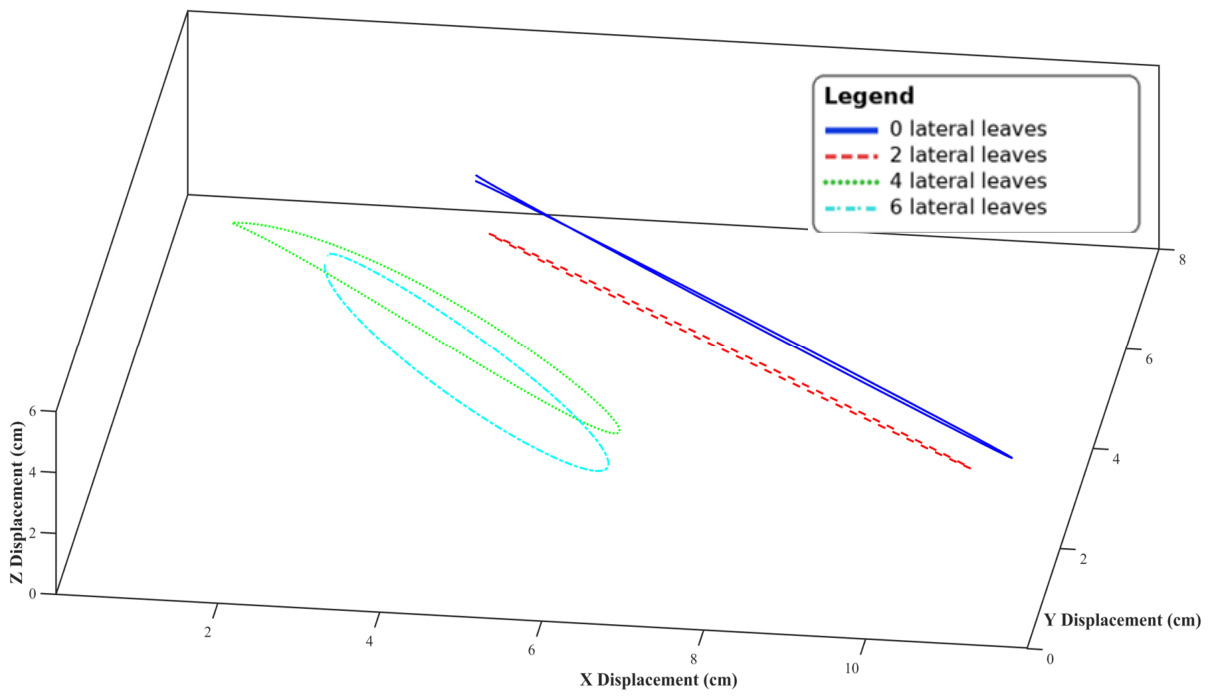
Z-directions under different lateral leaf number conditions. For the four typical lateral leaf number conditions of zero, two, four, and six leaves, the obtained steady-state trajectories are shown in
Figure 5.
To avoid interference from the initial transient stage in the analysis, the fifth cycle was selected as the characteristic cycle for steady-state analysis. In this cycle, the amplitude variation between adjacent cycles had become relatively small, and the system response had entered a relatively stable state, thus reflecting the true forced response under continuous excitation more objectively. Based on the displacement data within the fifth cycle, the maximum displacements of tracking point
in the
-,
-, and
-directions under different conditions were extracted, and the results are listed in
Table 5.
As shown in
Table 5, as the number of lateral leaves increased from zero to six, the maximum displacement of the tracking point in all three directions decreased, but the reductions differed markedly among directions. Along the excitation direction X, the mean maximum displacement decreased from 9.1 ± 0.36 cm under the leafless condition to 7.00 ± 0.07 cm under the six-leaf condition, corresponding to a reduction of 28.13%. Given that the input excitation amplitude was 10 mm, the response of the fruit end in the
-direction under all conditions did not completely coincide with the imposed displacement, and the following amplitude of the fruit end along the excitation direction further decreased as the number of lateral leaves increased. This indicates that the more complete the leaf retention, the less likely the system is to exhibit large synchronous following motion under continuous excitation.
In contrast, the reductions in the non-excitation directions were more pronounced. As the number of lateral leaves increased from zero to six, the maximum displacement in the Y-direction decreased from 2.82 ± 0.62 cm to 1.24 ± 0.15 cm, corresponding to a reduction of 65.43%. The maximum displacement in the Z-direction decreased from 4.3 ± 1.00 cm to 1.90 ± 0.23 cm, corresponding to a reduction of 67.45%. These results indicate that, with an increase in lateral leaf number, the suppression of vibration deviation in the non-excitation directions was much stronger than the weakening of the primary response in the excitation direction. In other words, the presence of lateral leaves did not simply reduce vibration in all directions; rather, it more effectively suppressed the additional deflections in the - and -directions, causing the forced response to become more concentrated in the main excitation direction in space.
The stronger suppression of the
Y- and
Z-direction responses observed in this study is also consistent with previous reports on vibration transmission in fruit-bearing branches. Castro-García et al. [
15] found that leaves greatly suppressed acceleration transmission in orange branches, indicating that leaves can act as important energy-dissipating components during forced vibration. Similar to their conclusion, the present results show that the presence of lateral leaves reduced the spatial dispersion of the fruit-end response. However, unlike previous studies that mainly evaluated acceleration transmission along branches, the present study analyzed the three-dimensional displacement response of a local walnut branch–leaf–fruit subsystem and found that the suppression effect was more obvious in the non-excitation directions than in the main excitation direction. This provides a more direct explanation for why retained lateral leaves may improve the directionality of forced response during walnut vibration harvesting.
Further insight can be obtained from the motion trajectories shown in
Figure 6. Under different lateral leaf number conditions, the trajectory pattern of tracking point
differed significantly. Under the leafless condition, the trajectory exhibited a larger spread in the
- and
-directions, indicating a stronger spatially coupled deviation under continuous excitation. When the number of lateral leaves increased to two, the response in the non-excitation directions began to weaken, but the trajectory still showed obvious lateral expansion. Under the four-leaf condition, the trajectory further contracted toward the
-direction, indicating that the system had entered an intermediate stage from multidimensional dispersed response toward response concentration in the main direction. When the number of lateral leaves increased to six, the trajectory became the most concentrated, with the smallest spread in the non-excitation directions, indicating that under this condition, the lateral leaves exerted stronger constraint and energy-dissipation effects on non-dominant directional vibrations.
This trend is consistent with the evolution of lateral leaf motion patterns observed in
Section 4.1. Under low-leaf-number conditions, leaf motion was dominated by swinging, and the system was more prone to deviations in the non-excitation directions. When a more complete leaf retention condition was maintained, the rotation and swinging of leaves and their coupling interaction with the branch became more sufficient, which was more favorable for suppressing additional vibration in non-dominant directions. It should be noted that this phenomenon should not be simply attributed to “larger aerodynamic damping leading to higher energy utilization efficiency” because the forced response was simultaneously affected by local constraints at the petiole connection, added mass distribution, and changes in leaf motion mode.
The same forced-vibration procedure was then applied to the other four parallel samples, with each condition repeated three times, in order to examine the consistency of the above laws among samples with different structural parameters. The results are shown in
Table 6.
As shown in
Table 6, although the parallel samples differed in branch length, radius, and fruit mass, the raw repeated test data showed the same trend as the statistical results in
Table 4. For each parallel sample, the maximum displacement responses in the
X-,
Y-, and
Z-directions generally decreased as the number of lateral leaves increased from zero to six. This consistency among samples supports the reliability of the statistical results and indicates that the effect of lateral leaf number on forced-vibration response was not limited to a single representative sample.
Overall, the forced-vibration tests showed that lateral leaf number had a significant effect on the displacement response of the branch–leaf–fruit subsystem. As the number of lateral leaves increased, the displacement response in the excitation direction weakened to some extent, whereas the suppression of deviation in the non-excitation directions was more pronounced. This was manifested as progressively more concentrated trajectories in the main excitation direction and weaker spatially dispersed responses. The zero-leaf condition corresponded to stronger multidimensional coupled deviation, the six-leaf condition corresponded to stronger directional constraint, and the 2–4-leaf conditions represented an intermediate transition stage between the two.
4.4. MATLAB-Based Analysis of Motion Trajectories of the Subsystem
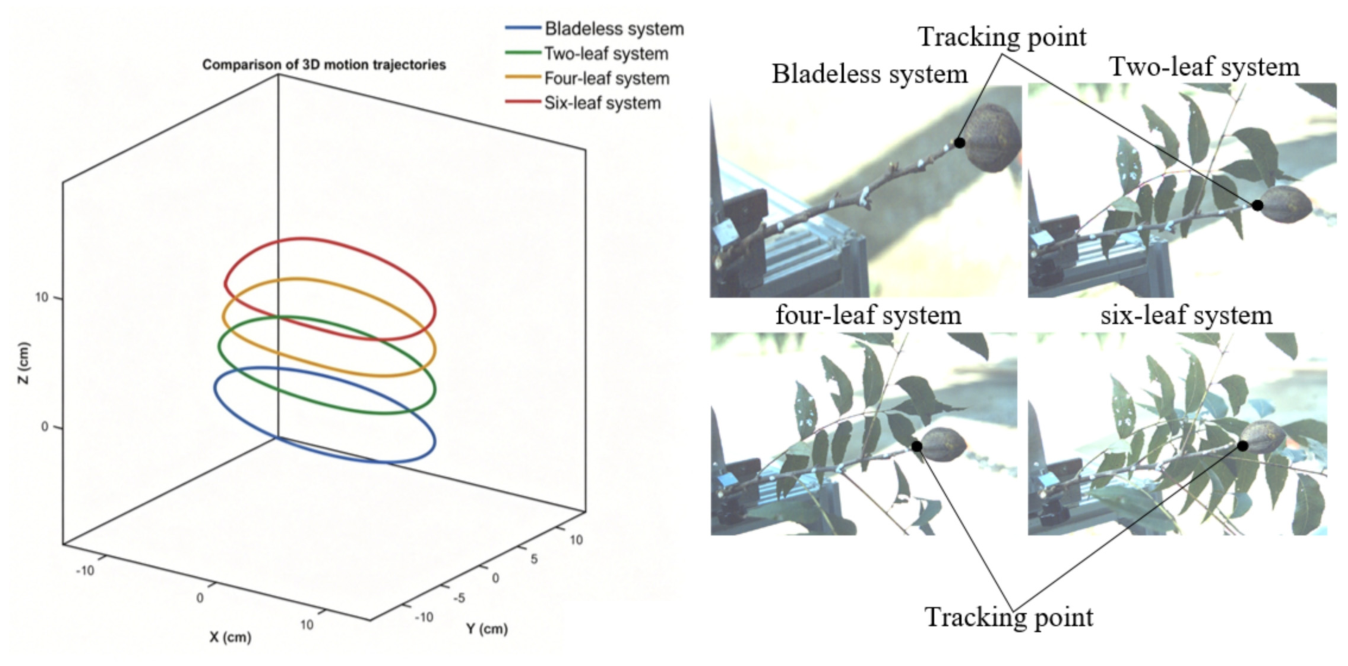
In the original simulation model, lateral leaves were simplified as fixed equivalent mass–damping units connected to the main branch nodes, without explicitly considering the spin, swing, and time-varying coupling effects of leaves during vibration. The trajectory results obtained from this model are shown in
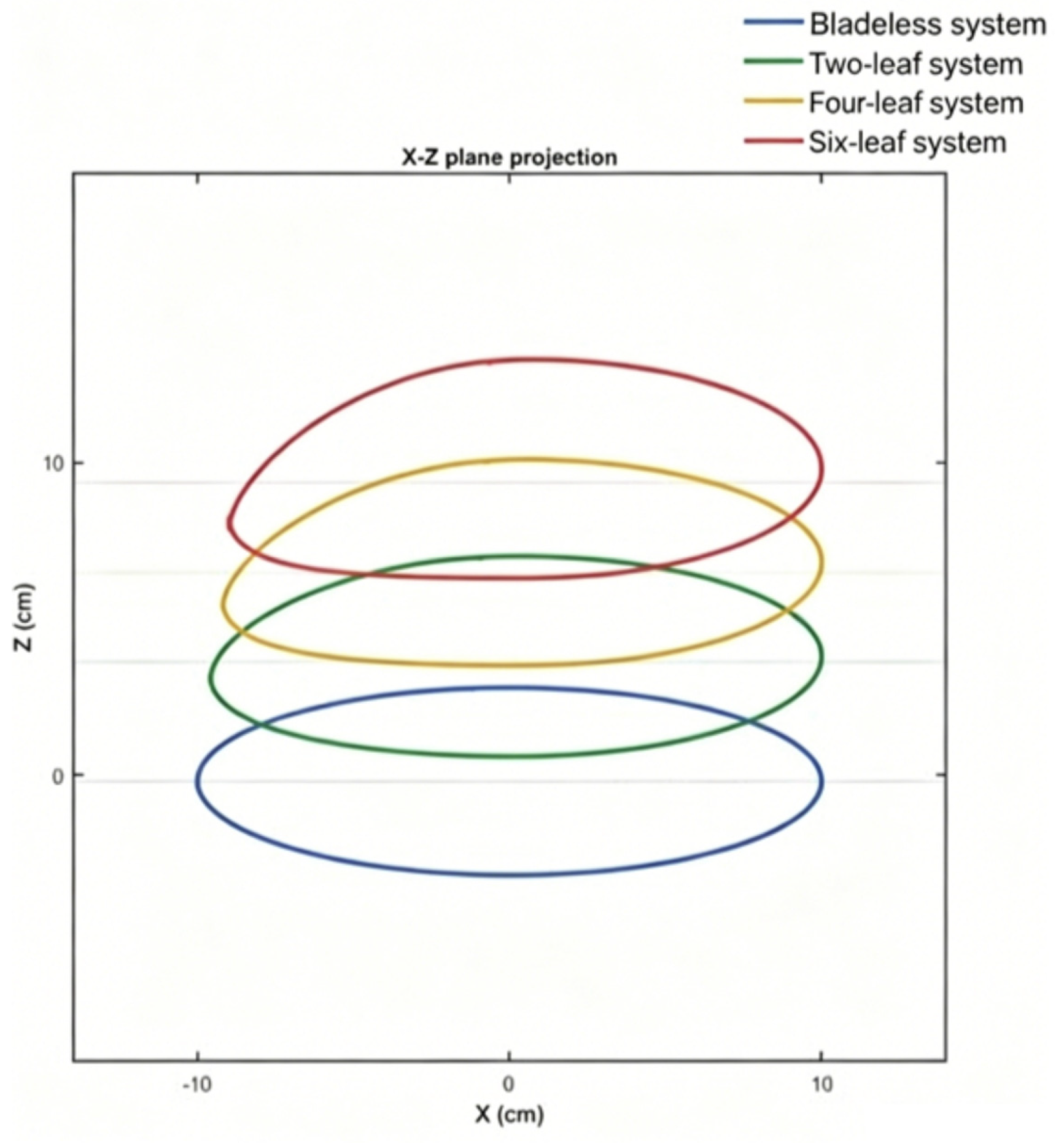
Figure 6, and their projections in the
–
plane are shown in
Figure 7. Overall, the original model could reflect the influence of the added mass of lateral leaves on the overall displacement distribution of the system, but the predicted motion trajectory patterns were obviously different from the experimental results.
Specifically, in the original simulation results, the leafless system exhibited a relatively regular ellipse-like trajectory. When the number of lateral leaves increased to six, the trajectory shifted downward by about 10.4 cm as a whole, showing an obvious vertical settlement feature. Corresponding displacement amplitude analysis showed that, after introducing lateral leaves, the amplitude in the -direction decreased from 10.0 cm to 9.5 cm, a reduction of 5.0%, whereas the maximum response in the -direction increased from 0.050 cm to 0.287 cm, and the amplitude in the -direction increased from 3.0 cm to 6.5 cm, an increase of 116.7%. This indicates that, in the original model, the introduction of lateral leaves was mainly reflected in the effects of added mass and fixed damping on the system equilibrium position and the responses in non-excitation directions, but it failed to correctly reproduce the experimentally observed trend that “the more lateral leaves, the more strongly the - and -direction displacements are suppressed”.
From the perspective of response distribution, the original simulation results showed that under the leafless condition, most of the vibration response was concentrated in the
-direction excitation. After introducing lateral leaves, the response proportion in the
-direction decreased significantly, whereas the response in the
-direction increased markedly, showing a tendency of response transfer from the excitation direction to the vertical direction. This result is inconsistent with the laws obtained from the forced-vibration experiments in
Section 4.3. The experiments showed that as the number of lateral leaves increased from zero to six, the displacement responses of the fruit tracking point in the
- and
-direction non-excitation directions decreased significantly, whereas the original simulation predicted a strong vertical deviation. This indicates that although simplifying the lateral leaves as fixed lumped mass–damping elements can describe their influence on the additional load of the system, it is insufficient to characterize the regulatory role of real leaf motion patterns on the directional forced response.
The main reason for the discrepancy between the simulations and experiments lies in the simplification of the model assumptions. First, in the experiments, leaf motion under the six-leaf condition was dominated by spin, whereas under the 2–4-leaf conditions it showed a compound pattern of swing and spin, indicating that the leaf energy dissipation mode changed with the number of leaves. However, the original simulation model used the same type of fixed damping parameter for all leaf-bearing conditions and did not reflect the time-varying damping and coupling effects corresponding to differences in leaf motion patterns. Second, the original model emphasized the static settlement and vertical deviation caused by added mass while insufficiently considering the local constraints at the petiole connection, the aerodynamic energy dissipation induced by leaf rotation, and the reconstruction of system parameters corresponding to different leaf numbers. As a result, the -direction response was overestimated and the ability of the model to explain the experimental trends was weakened.
To reduce the discrepancy between the original MATLAB simulation and the forced-vibration experimental results, an equivalent damping correction was introduced into the lateral leaf model. In the original model, lateral leaves were simplified as fixed lumped mass–damping units, which could not fully represent the additional energy dissipation caused by leaf swing, spin, and branch–leaf coupling. Therefore, the corrected equivalent damping coefficient was expressed as , where is the original equivalent damping coefficient under the -leaf condition and is a leaf-number-dependent damping correction coefficient related to the observed leaf motion pattern. The correction coefficient was calibrated by reducing the relative error between the simulated and experimentally measured maximum displacements of tracking point , especially in the Y- and Z-direction non-excitation responses. The relative error was calculated as , where and are the simulated and experimental maximum displacements, respectively.
For the six-leaf condition, the original model predicted maximum displacements of 0.287 cm and 6.50 cm in the Y- and Z-directions, whereas the corresponding experimental values were 1.31 ± 0.15 cm and 1.94 ± 0.23 cm, respectively. The relative errors were therefore 78.1% and 235.1%, indicating that the original model could not accurately reproduce the non-excitation direction responses. After introducing the equivalent damping correction, the predicted maximum displacements in the Y- and Z-directions were 1.20 cm and 1.80 cm, and the corresponding errors decreased to 8.4% and 7.2%, respectively. These results indicate that the corrected model improved the prediction accuracy of the non-excitation direction responses. However, this correction should be regarded as an equivalent empirical treatment rather than a complete description of the fluid–structure coupling and nonlinear petiole motion of lateral leaves.
Taken together, the overall comparison among the zero-, two-, four-, and six-lateral-leaf conditions shows that the trajectory differences corresponding to different leaf numbers were relatively small in the original simulation. The fundamental reason is that the model did not distinguish the changes in leaf motion patterns and energy dissipation modes under different leaf number conditions, nor did it adequately represent the synchronous reconstruction of system mass, stiffness, and damping caused by changes in lateral leaf number. In contrast, after introducing the equivalent damping correction coefficient, the corrected model more reasonably reflected the experimentally observed trend that the displacement responses in the non-excitation directions decreased with increasing lateral leaf number. This indicates that in the forced-vibration analysis of the branch–leaf–fruit subsystem, if the evolution of lateral leaf posture and its corresponding time-varying energy dissipation effects are ignored, the model will be unable to accurately explain experimentally observed phenomena such as trajectory convergence, enhanced directionality, and suppression in the non-excitation directions.
In summary, the MATLAB simulation analysis indicates that the influence of lateral leaves on the system motion trajectory cannot be simply attributed to static settlement caused by added mass but should instead be understood as the combined result of added mass, local constraints, and motion-pattern-related energy dissipation. The original model can reflect the basic influence of the presence of lateral leaves on the system response, but its explanatory ability for trajectory morphology and directional differences under different leaf number conditions is limited. By introducing the leaf-number-dependent equivalent damping correction coefficient and using the relative error of maximum displacement as the validation criterion, the corrected model showed improved consistency with the experimental trends, especially in the Y- and Z-direction non-excitation responses under the six-leaf condition. This suggests that to further enhance model accuracy, future work still needs to improve the representation of leaf aerodynamic energy dissipation, petiole-connection nonlinearity, and leaf-group coupling effects.