Analytical Technologies for the Detection and Identification of Genome-Edited Crops: Current Capabilities, Product-Specific Feasibility, and Enforcement Readiness


Abstract
1. Introduction: Detection, Identification, and the Layers Between
1.1. Detection–Identification Framework
1.2. Scope and Methodology
2. The Molecular Landscape: What Enforcement Must Detect
2.1. Editing Outcomes Ranked by Analytical Accessibility
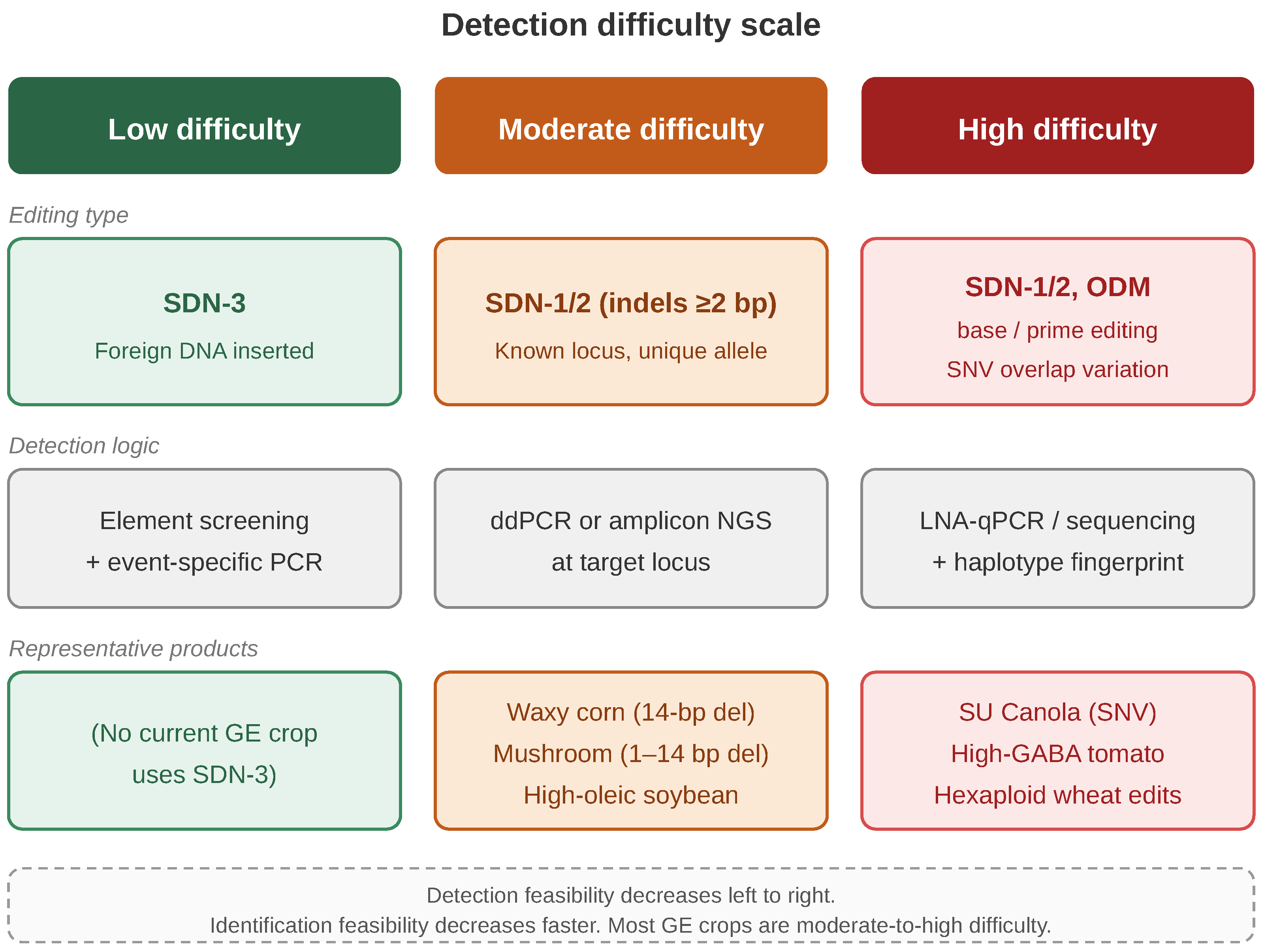
2.2. A Difficulty Scale for Enforcement
3. Technology Assessment: A Comparative Evaluation
3.1. What Has Succeeded: ddPCR, LNA-qPCR, and Amplicon Sequencing
3.2. What Has Not Succeeded: WGS for Attribution and CRISPR Diagnostics for Enforcement
3.3. Base and Prime Editing: The Sharpest Expression of the Detection–Identification Gap
3.4. What HRM Teaches About Triage
- Section 3 Key Takeaways
- Detection sensitivity at or below the 0.1% MRPL is technically achievable for known targets across ddPCR, LNA-qPCR, and amplicon deep sequencing.
- All three platforms require prior knowledge of the target locus and allele; this dependency, not chemistry, is the operational bottleneck.
- WGS adds analytical depth but does not, by itself, deliver attribution; CRISPR diagnostics remain exploratory for food-matrix enforcement.
- For base- and prime-edited products, identification feasibility is conditional on edit class and on species mating system rather than on assay performance.
- HRM is a triage tool, not a compliance tool; CRISPR diagnostics may eventually occupy a similar triage niche.
4. Bioinformatics and Database Infrastructure
4.1. Computational Requirements for Low-Frequency Variant Detection
- Minimum Bioinformatic Requirements for Enforcement Laboratories
- Empirical error-floor characterization per amplicon and per sequencing platform; the platform-specific noise model is locus-dependent and cannot be ported across instruments.
4.2. Three Strategies for Moving from Detection to Attribution

| Method/Resource | Section | Primary Tier(s) | Function in Workflow | D–I Axis |
|---|---|---|---|---|
| Low-AF variant callers, cancer-genomics origin (Mutect2, VarScan2, LoFreq, Strelka2) | Section 4.1 | T2–T3 | Variant calling on amplicon/WGS data at <1% AF in plant material | Detection |
| Neural callers (DeepVariant, DeepSomatic) | Section 4.1 | T3 | Variant calling in repetitive and polyploid regions for first-detection events | Detection |
| UMI consensus calling (≥3–5 reads/family) | Section 4.1 | T2 | Suppressing PCR/sequencer error below 0.1% AF in amplicon panels | Detection |
| Subgenome-aware alignment (PolyCat, HomeoRoq) | Section 4.1 | T2–T3 | Homeolog-specific read assignment in B. napus (AACC) and hexaploid wheat (AABBDD) | Detection |
| ddPCR (event-specific) | Section 3.1 | T2 | Quantitative confirmation at ≤0.1% MRPL for known SDN-3/SDN-1 targets | Detection |
| LNA-enhanced qPCR | Section 3.1 | T2 | Allele-specific quantification of known SNV/indel edits | Detection |
| Amplicon deep sequencing (multiplex panels) | Section 3.1 | T2 | Locus-level capture of any variant in known editing target genes | Detection |
| HRM | Section 3.4 | T1 (triage flagging) | Cheap pre-screen to prioritize Tier 2; insufficient specificity for compliance | Detection |
| CRISPR diagnostics (DETECTR/SHERLOCK) | Section 3.2 | T1 (future) | Field-deployable known-target screening once validated for food matrices | Detection |
| WGS/PacBio HiFi long-read | Section 3.2 | T3 | Confirms allele structure, rules out off-targets, supplies flanking haplotype | Detection + I1/I2 |
| Population-level filtering (SoyBase, 3000RG, MaizeGDB, Wheat 10+) | Section 4.2 (strategy 1) | T3/T4 boundary | Tests allele uniqueness against surveyed natural diversity (criterion I1); gates escalation from Tier 3 to Tier 4 | Identification |
| Functional-annotation filtering (EU-SAGE catalog of editing targets) | Section 4.2 (strategy 2) | T2 + T4 | Panel design and prior-probability calculation, restricting variant search to documented editing target genes | Both |
| Haplotype fingerprinting (proof of concept [66]; DETECT-rapeseed reference) | Section 4.2 (strategy 3) | T4 | Probabilistic attribution against curated reference panels (criteria I2 and I3) | Identification |
| EUginius molecular characterization registry | Section 4.3 | T1–T4 | Method retrieval (T1–T2), sequence query (T3), event registry (T4) | Both |
| GMOMETHODS, GMO-Matrix, GMO-Amplicons | Section 4.3 | T2 | Validated reference methods and screening strategy optimization | Detection |
| Biosafety Clearing-House and regulatory records | Section 4.3 | T1 | Origin and regulatory-status gating; intelligence-guided triage | Detection |
4.3. Database Resources and Their Limitations
- Section 4 Key Takeaways
- Low-frequency variant calling for GE enforcement requires UMI-based consensus calling, subgenome-aware alignment for polyploids, and benchmarking of low-AF callers against spike-in mixtures at the target frequency.
- Variant calling at sub-1% AF requires both UMI consensus calling AND empirical error-floor characterization per amplicon and per sequencing platform; the platform-specific noise model is locus-dependent and cannot be ported across instruments.
- Three complementary attribution strategies, population-level filtering, functional-annotation filtering, and haplotype fingerprinting, progressively narrow candidate variants but cannot, in combination, substitute for disclosed parental genotypes and curated haplotype panels.
- Existing databases (EUginius, GMOMETHODS, JRC GMO-Matrix, EU-SAGE, BCH) provide useful infrastructure but do not yet integrate an edited sequence, parental genotype, and validated detection method for any commercialized GE crop.
5. Product-Specific Feasibility: Applying the Detection–Identification Framework
5.1. A Two-Axis Assessment
5.2. Two Case Studies That Bracket the Field
5.2.1. Failure-Mode Typology
5.2.2. Section 5 Key Takeaways
- Across commercialized GE crops, event-specific validated detection requires the disclosed edited variant; for proprietary products with known target loci (PPO, myrosinase) gene-panel surveillance over the locus or gene family remains developable on locus knowledge alone and can capture an undisclosed variant in screening mode, but event-specific attribution is blocked by the disclosure gap.
- Among disclosed products, only SU Canola has a partially independently validated method, and its event specificity is contested at the forensic layer rather than at the analytical layer.
- No certified reference material currently exists for any commercialized GE crop; the gap is structural (developer cooperation, single-nucleotide CRM metrology) rather than purely technical.
- The two DETECT case studies (barley, rapeseed) bracket the field: identification feasibility tracks elite-pool haplotype diversity (typically narrower in selfing/narrow-base crops, but with exceptions, as discussed in Section 5.2) and the availability of informative flanking polymorphisms.
- Three failure modes (Type I allele non-uniqueness, Type II haplotype opacity, Type III disclosure-blocked) can be anticipated at the notification stage; their remedies overlap rather than being strictly distinct (Type I and II are both I1 failures and can co-occur, as in SU Canola; Type III is an I4 disclosure failure on the cross-axis precondition).
5.3. No Certified Reference Materials
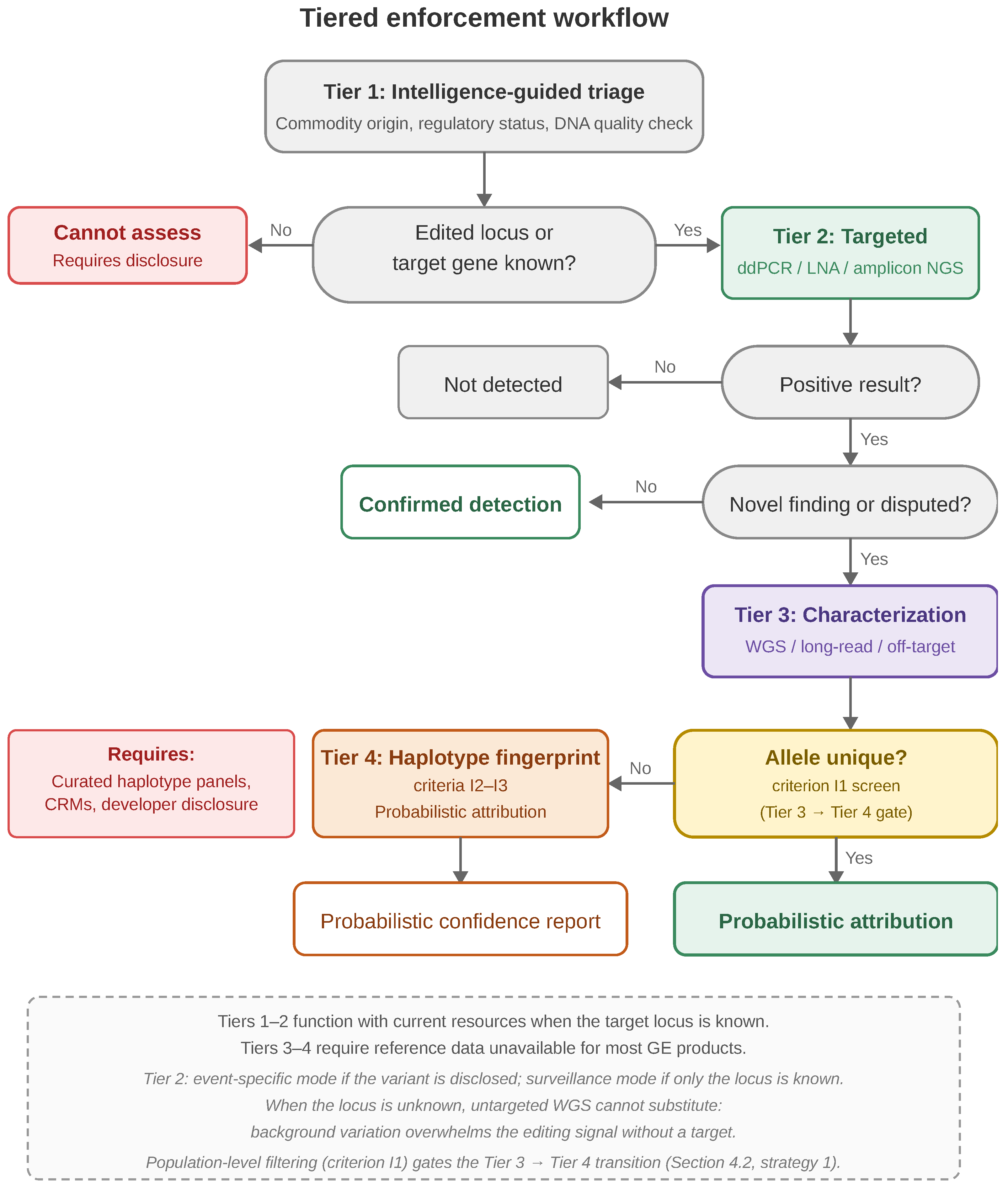
6. A Tiered Enforcement Workflow
- Tier 1: Intelligence-guided triage. Commodity origin, exporting-country regulatory status, traceability documentation, and DNA-quality assessment against ENGL MPR benchmarks. Decides whether a sample warrants analytical work; reagent cost essentially zero; and turnaround in hours.
- Tier 2: Targeted detection. ddPCR, LNA-qPCR, or amplicon deep sequencing against the suspected edited locus, validated to the 0.1% MRPL. Event-specific ddPCR and LNA-qPCR require the disclosed variant; amplicon deep sequencing over the implicated locus or gene family runs on locus knowledge alone and can capture an undisclosed variant in surveillance mode. Low-frequency positives at or near the MRPL are confirmed by ddPCR replication or UMI-based amplicon resequencing; Sanger sequencing is used only on pure-positive control material or strongly enriched amplicons, since its effective detection limit (10–20% variant allele frequency) is well above the 0.1% MRPL.
- Tier 3: Comprehensive molecular characterization. WGS or long-read sequencing for first-detection events, contested results, or suspected unintended integrations. Confirms the allele and rules out off-targets but does not by itself establish product-level attribution.
- Tier 4: Haplotype-based attribution. Comparison of flanking-SNP haplotypes against curated reference panels for known GE lines. Addresses criteria I2 and I3 of the D–I framework; functional only where reference panels exist.
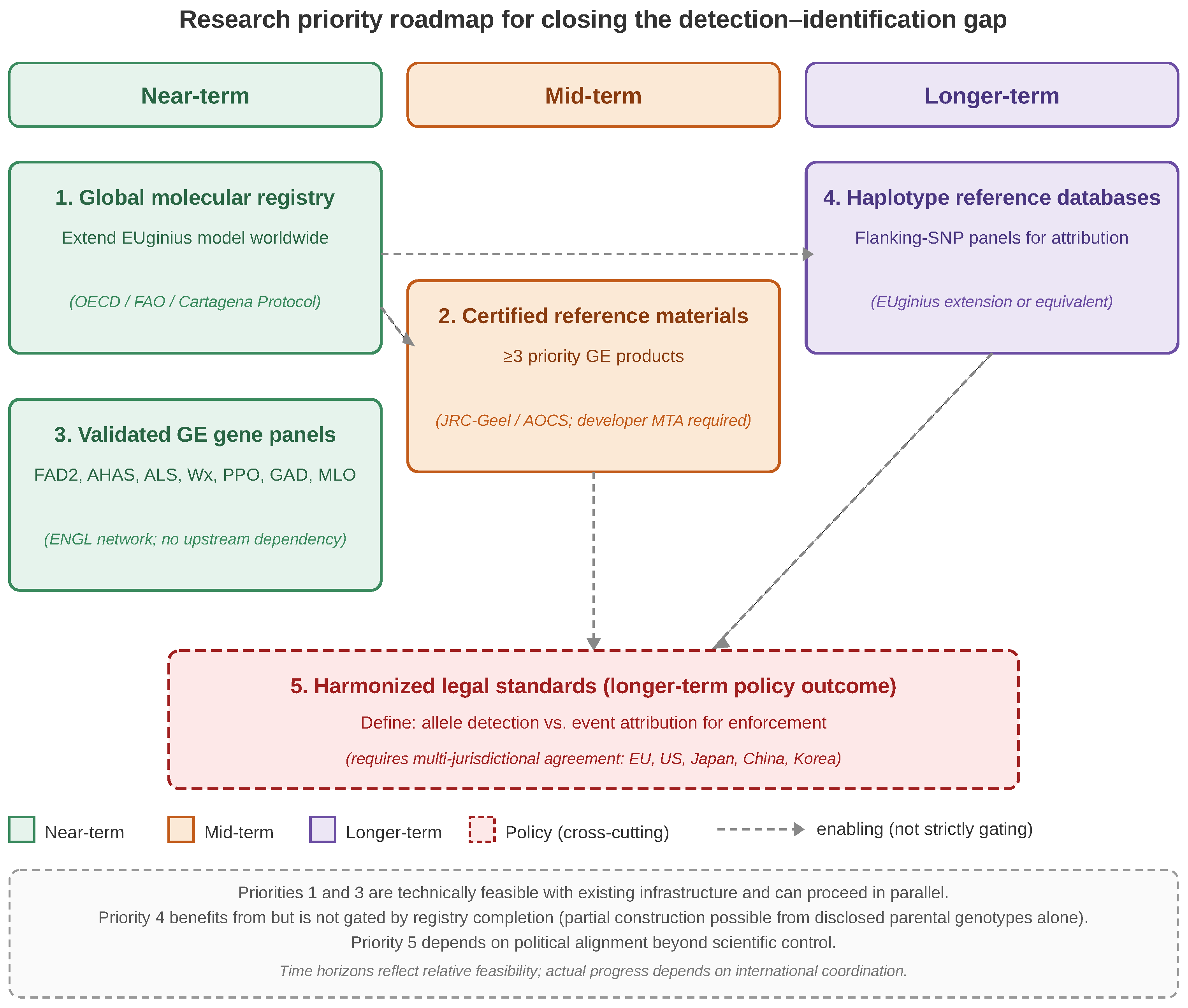
7. Outlook: Research Priorities and the Feasibility–Achievability Boundary
8. Conclusions
Supplementary Materials
Author Contributions
Funding
Institutional Review Board Statement
Informed Consent Statement
Data Availability Statement
Conflicts of Interest
Abbreviations
| ABE | adenine base editor |
| AHAS | acetohydroxyacid synthase |
| ALS | acetolactate synthase |
| AOCS | American Oil Chemists’ Society |
| APHIS | Animal and Plant Health Inspection Service |
| BCH | Biosafety Clearing-House |
| CBE | cytosine base editor |
| CBD | Convention on Biological Diversity |
| CJEU | Court of Justice of the European Union |
| CRISPR | clustered regularly interspaced short palindromic repeats |
| CRM | certified reference material |
| ddPCR | droplet digital PCR |
| DETECT | Detection of Genome-Edited Organisms in Food and Feed |
| DETECTR | DNA Endonuclease-Targeted CRISPR Trans Reporter |
| D–I | Detectability–Identifiability framework |
| DSB | double-strand break |
| ENGL | European Network of GMO Laboratories |
| EU | European Union |
| FAD2 | fatty acid desaturase 2 |
| FAO | Food and Agriculture Organization |
| FAPAS | Food Analysis Performance Assessment Scheme |
| FDA | US Food and Drug Administration |
| GABA | gamma-aminobutyric acid |
| GE | genome-edited (or genome editing) |
| GM | genetically modified |
| GMO | genetically modified organism |
| HiFi | high-fidelity (PacBio circular-consensus long-read) |
| HRM | high-resolution melting |
| JRC | Joint Research Centre (European Commission) |
| LD | linkage disequilibrium |
| LMO | living modified organism |
| LNA | locked nucleic acid |
| LOD | limit of detection |
| LOQ | limit of quantification |
| MAFF | Ministry of Agriculture, Forestry and Fisheries (Japan) |
| MOTIE | Ministry of Trade, Industry and Energy (Korea) |
| MPR | Minimum Performance Requirements (ENGL) |
| MRPL | minimum required performance limit |
| MTA | material transfer agreement |
| NGS | next-generation sequencing |
| NGTs | new genomic techniques |
| NHEJ | non-homologous end joining |
| ODM | oligonucleotide-directed mutagenesis |
| OECD | Organisation for Economic Co-operation and Development |
| ONT | Oxford Nanopore Technologies |
| PAM | protospacer adjacent motif |
| PCR | polymerase chain reaction |
| PE | prime editor |
| PPO | polyphenol oxidase |
| PRISMA | Preferred Reporting Items for Systematic Reviews and Meta-Analyses |
| qPCR | quantitative (real-time) PCR |
| SDN | site-directed nuclease |
| SHERLOCK | Specific High-sensitivity Enzymatic Reporter unLOCKing |
| SNP | single-nucleotide polymorphism |
| SNV | single-nucleotide variant |
| SOP | standard operating procedure |
| SPS | Sanitary and Phytosanitary (WTO Agreement) |
| SSR | simple sequence repeat |
| SU | sulfonylurea |
| TALEN | transcription activator-like effector nuclease |
| TBT | Technical Barriers to Trade (WTO Agreement) |
| TGS | third-generation sequencing |
| UMI | unique molecular identifier |
| USDA | United States Department of Agriculture |
| WGS | whole-genome sequencing |
| WHO | World Health Organization |
| WTO | World Trade Organization |
| UPOV | International Union for the Protection of New Varieties of Plants |
References
- Court of Justice of the European Union (CJEU). Judgment in Case C-528/16, Confédération Paysanne and Others v. Premier Ministre and Ministre de l’Agriculture, 25 July 2018. Available online: https://curia.europa.eu/juris/document/document.jsf?docid=204387 (accessed on 21 April 2026).
- European Commission. Proposal for a Regulation of the European Parliament and of the Council on Plants Obtained by Certain New Genomic Techniques and Their Food and Feed. COM(2023) 411 Final, 5 July 2023. Available online: https://eur-lex.europa.eu/legal-content/EN/TXT/?uri=CELEX:52023PC0411 (accessed on 21 April 2026).
- United States Department of Agriculture, Animal and Plant Health Inspection Service (USDA APHIS). SECURE Rule: Movement of Certain Genetically Engineered Organisms (7 CFR Part 340), 2025 Update. Available online: https://www.aphis.usda.gov/biotechnology/regulations (accessed on 21 April 2026).
- Convention on Biological Diversity (CBD). Cartagena Protocol on Biosafety to the Convention on Biological Diversity; Secretariat of the Convention on Biological Diversity: Montreal, QC, Canada, 2000. Available online: https://www.cbd.int/doc/legal/cartagena-protocol-en.pdf (accessed on 21 April 2026).
- European Commission. Commission Regulation (EU) No 619/2011 of 24 June 2011 Laying Down the Methods of Sampling and Analysis for the Official Control of Feed as Regards Presence of Genetically Modified Material for Which an Authorisation Procedure Is Pending or the Authorisation of Which Has Expired. Off. J. Eur. Union 2011, L166, 9–15. Available online: https://eur-lex.europa.eu/legal-content/EN/TXT/?uri=CELEX:32011R0619 (accessed on 21 April 2026).
- European Network of GMO Laboratories (ENGL). Definition of Minimum Performance Requirements for Analytical Methods of GMO Testing; JRC Technical Report No. JRC95544; European Commission Joint Research Centre: Ispra, Italy, 2015; Available online: https://gmo-crl.jrc.ec.europa.eu/doc/MPR Report Application 20_10_2015.pdf (accessed on 21 April 2026).
- European Network of GMO Laboratories (ENGL). Definition of Minimum Performance Requirements for Analytical Methods of GMO Testing, Part 2; JRC Technical Report No. JRC125975; European Commission Joint Research Centre: Ispra, Italy, 2023; Available online: https://gmo-crl.jrc.ec.europa.eu/doc/JRC125975_01.pdf (accessed on 21 April 2026).
- European Network of GMO Laboratories (ENGL). Detection of Food and Feed Plant Products Obtained by New Mutagenesis Techniques; JRC Technical Report No. JRC116289; European Commission Joint Research Centre: Ispra, Italy, 2019; Available online: https://gmo-crl.jrc.ec.europa.eu/doc/JRC116289-GE-report-ENGL.pdf (accessed on 21 April 2026).
- Grohmann, L.; Keilwagen, J.; Duensing, N.; Dagand, E.; Hartung, F.; Wilhelm, R.; Bendiek, J.; Sprink, T. Detection and Identification of Genome Editing in Plants: Challenges and Opportunities. Front. Plant Sci. 2019, 10, 236. [Google Scholar] [CrossRef]
- Sprink, T.; Wilhelm, R.; Hartung, F. Detection of Genome Edits in Plants, From Editing to Seed. Vitr. Cell. Dev. Biol. Plant 2022, 58, 430–442. [Google Scholar] [CrossRef]
- BLE (Bundesanstalt für Landwirtschaft und Ernährung). DETECT Project Report: Detection of Genome-Edited Organisms in Food and Feed; BLE: Bonn, Germany, 2024; Available online: https://www.ble.de/SharedDocs/Meldungen/DE/2024/240702_genomeditierte_Pflanzen.html (accessed on 11 May 2026).
- Chhalliyil, P.; Ilber, H.; Bai, C.; Woodhouse, M.; Petri, C.; Averill, O.H.; Kappa-Maguire, S.; Bhaumik, S. A Real-Time Quantitative PCR Method Specific for Detection and Quantification of the First Commercialized Genome-Edited Plant. Foods 2020, 9, 1245. [Google Scholar] [CrossRef] [PubMed]
- Health Canada. Novel Food Information, Cibus Canola Event 5715 (SU Canola); Health Canada: Ottawa, ON, Canada, 2013. Available online: https://www.canada.ca/en/health-canada/services/food-nutrition/genetically-modified-foods-other-novel-foods/approved-products.html (accessed on 21 April 2026).
- Haun, W.; Coffman, A.; Clasen, B.M.; Demorest, Z.L.; Lowy, A.; Ray, E.; Retterath, A.; Stoddard, T.; Juillerat, A.; Cedrone, F.; et al. Improved Soybean Oil Quality by Targeted Mutagenesis of the Fatty Acid Desaturase 2 Gene Family. Plant Biotechnol. J. 2014, 12, 934–940. [Google Scholar] [CrossRef] [PubMed]
- U.S. Food and Drug Administration (FDA). Biotechnology Consultation Agency Response Letter BNF No. 000164 (Calyxt High-Oleic Soybean), 2019. Available online: https://hfpappexternal.fda.gov/scripts/fdcc/index.cfm?set=NewPlantVarietyConsultations&id=FAD2KO (accessed on 11 May 2026).
- Gao, H.; Gadlage, M.J.; Lafitte, H.R.; Lenderts, B.; Yang, M.; Schroder, M.; Farrell, J.; Snopek, K.; Peterson, D.; Feigenbutz, L.; et al. Superior Field Performance of Waxy Corn Engineered Using CRISPR-Cas9. Nat. Biotechnol. 2020, 38, 579–581. [Google Scholar] [CrossRef]
- Nonaka, S.; Arai, C.; Takayama, M.; Matsukura, C.; Ezura, H. Efficient Increase of Gamma-Aminobutyric Acid (GABA) Content in Tomato Fruits by Targeted Mutagenesis. Sci. Rep. 2017, 7, 7057. [Google Scholar] [CrossRef]
- Waltz, E. GABA-Enriched Tomato Is First CRISPR-Edited Food to Enter Market. Nat. Biotechnol. 2022, 40, 9–11. [Google Scholar] [CrossRef]
- Waltz, E. Gene-Edited CRISPR Mushroom Escapes US Regulation. Nature 2016, 532, 293. [Google Scholar] [CrossRef]
- United States Department of Agriculture, Animal and Plant Health Inspection Service (USDA APHIS). Response to “Am I Regulated?” Inquiry 15-321-01, CRISPR-Edited White Button Mushroom (Agaricus bisporus), April 2016. Available online: https://www.aphis.usda.gov/biotechnology/downloads/reg_loi/15-321-01_air_response_signed.pdf (accessed on 21 April 2026).
- Menz, J.; Modrzejewski, D.; Hartung, F.; Wilhelm, R.; Sprink, T. Genome Edited Crops Touch the Market: A View on the Global Development and Regulatory Environment. Front. Plant Sci. 2020, 11, 586027. [Google Scholar] [CrossRef] [PubMed]
- Entine, J.; Felipe, M.S.S.; Groenewald, J.-H.; Kershen, D.L.; Lema, M.; McHughen, A.; Nepomuceno, A.L.; Ohsawa, R.; Ordonio, R.L.; Parrott, W.A.; et al. Regulatory Approaches for Genome Edited Agricultural Plants in Select Countries and Jurisdictions around the World. Transgenic Res. 2021, 30, 551–584. [Google Scholar] [CrossRef]
- United States Department of Agriculture, Animal and Plant Health Inspection Service (USDA APHIS). Response to “Am I Regulated?” Inquiry 18-243-01 from Intrexon Corporation, GreenVenus Non-Browning Romaine Lettuce (Lactuca sativa), 2019. Available online: https://www.aphis.usda.gov/biotechnology/downloads/reg_loi/18-243-01_air_response_signed.pdf (accessed on 21 April 2026).
- Karlson, D.; Mojica, J.P.; Poorten, T.J.; Lawit, S.J.; Jali, S.; Chauhan, R.D.; Pham, G.M.; Marri, P.; Guffy, S.L.; Fear, J.M.; et al. Targeted Mutagenesis of the Multicopy Myrosinase Gene Family in Allotetraploid Brassica juncea Reduces Pungency Fresh Leaves Across Environments. Plants 2022, 11, 2494. [Google Scholar] [CrossRef]
- GreenVenus. Ag-Biotech Innovator GreenVenus Achieves Breakthrough in Non-Browning Avocado Through Gene Editing. Press Release, June 2023. Available online: https://www.prnewswire.com/news-releases/ag-biotech-innovator-greenvenus-achieves-breakthrough-in-non-browning-avocado-through-gene-editing-301842939.html (accessed on 21 April 2026).
- Whelan, A.I.; Lema, M.A. Regulatory Framework for Gene Technology and New Breeding Techniques (NBTs) in Argentina. GM. Crop. Food 2015, 6, 253–265. [Google Scholar] [CrossRef]
- Ministry of Trade, Industry and Energy (MOTIE), Republic of Korea. Act on Transboundary Movement of Living Modified Organisms (Law No. 17529); MOTIE: Sejong, Republic of Korea, 2020. Available online: https://elaw.klri.re.kr/kor_service/lawView.do?hseq=24570&lang=EN (accessed on 11 May 2026).
- Podevin, N.; Davies, H.V.; Hartung, F.; Nogué, F.; Casacuberta, J.M. Site-Directed Nucleases: A Paradigm Shift in Predictable, Knowledge-Based Plant Breeding. Trends Biotechnol. 2013, 31, 375–383. [Google Scholar] [CrossRef]
- Debode, F.; Janssen, E.; Berben, G. Development of 10 New Screening PCR Assays for GMO Detection Targeting Promoters (pFMV, pNOS, pSSuAra, pTA29, pUbi, pRice Actin) and Terminators (t35S, tE9, tOCS, tg7). Eur. Food Res. Technol. 2013, 236, 659–669. [Google Scholar] [CrossRef]
- Holst-Jensen, A.; Bertheau, Y.; de Loose, M.; Grohmann, L.; Hamels, S.; Hougs, L.; Morisset, D.; Pecoraro, S.; Pla, M.; Van den Bulcke, M.; et al. Detecting Un-Authorized Genetically Modified Organisms (GMOs) and Derived Materials. Biotechnol. Adv. 2012, 30, 1318–1335. [Google Scholar] [CrossRef] [PubMed]
- Komor, A.C.; Kim, Y.B.; Packer, M.S.; Zuris, J.A.; Liu, D.R. Programmable Editing of a Target Base in Genomic DNA without Double-Stranded DNA Cleavage. Nature 2016, 533, 420–424. [Google Scholar] [CrossRef] [PubMed]
- Gaudelli, N.M.; Komor, A.C.; Rees, H.A.; Packer, M.S.; Badran, A.H.; Bryson, D.I.; Liu, D.R. Programmable Base Editing of A·T to G·C in Genomic DNA without DNA Cleavage. Nature 2017, 551, 464–471. [Google Scholar] [CrossRef]
- Anzalone, A.V.; Randolph, P.B.; Davis, J.R.; Sousa, A.A.; Koblan, L.W.; Levy, J.M.; Chen, P.J.; Wilson, C.; Newby, G.A.; Raguram, A.; et al. Search-and-Replace Genome Editing without Double-Strand Breaks or Donor DNA. Nature 2019, 576, 149–157. [Google Scholar] [CrossRef] [PubMed]
- Lin, Q.; Zong, Y.; Xue, C.; Wang, S.; Jin, S.; Zhu, Z.; Wang, Y.; Anzalone, A.V.; Raguram, A.; Doman, J.L.; et al. Prime Genome Editing in Rice and Wheat. Nat. Biotechnol. 2020, 38, 582–585. [Google Scholar] [CrossRef]
- Zong, Y.; Liu, Y.; Xue, C.; Li, B.; Li, X.; Wang, Y.; Li, J.; Liu, G.; Huang, X.; Cao, X.; et al. An Engineered Prime Editor with Enhanced Editing Efficiency in Plants. Nat. Biotechnol. 2022, 40, 1394–1402. [Google Scholar] [CrossRef]
- Jiang, Y.Y.; Chai, Y.P.; Lu, M.H.; Han, X.L.; Lin, Q.; Zhang, Y.; Zhang, Q.; Zhou, Y.; Wang, X.-C.; Gao, C.; et al. Prime Editing Efficiently Generates W542L and S621I Double Mutations in Two ALS Genes in Maize. Genome Biol. 2020, 21, 257. [Google Scholar] [CrossRef] [PubMed]
- Zhang, H.; Li, J.; Zhao, S.; Yan, X.; Si, N.; Gao, H.; Li, Y.; Zhai, S.; Xiao, F.; Wu, G.; et al. Accurate Detection and Evaluation of the Gene-Editing Frequency in Plants Using Droplet Digital PCR. Front. Plant Sci. 2021, 11, 610790. [Google Scholar] [CrossRef]
- Weidner, C.; Edelmann, S.; Großmann, L.; Mankertz, J. Assessment of the Real-Time PCR Method Claiming to Be Specific for Detection and Quantification of the First Commercialised Genome-Edited Plant. Food Anal. Methods 2022, 15, 2575–2587. [Google Scholar] [CrossRef]
- Hindson, B.J.; Ness, K.D.; Masquelier, D.A.; Belgrader, P.; Heredia, N.J.; Makarewicz, A.J.; Bright, I.J.; Lucero, M.Y.; Hiddessen, A.L.; Legler, T.C.; et al. High-Throughput Droplet Digital PCR System for Absolute Quantitation of DNA Copy Number. Anal. Chem. 2011, 83, 8604–8610. [Google Scholar] [CrossRef]
- Dobnik, D.; Stebih, D.; Blejec, A.; Morisset, D.; Žel, J. Multiplex Quantification of Four DNA Targets in One Reaction with Bio-Rad Droplet Digital PCR System for GMO Detection. Sci. Rep. 2016, 6, 35451. [Google Scholar] [CrossRef] [PubMed]
- Bernacka, K.U.; Michalski, K.; Wojciechowski, M.; Sowa, S. Application of SNV Detection Methods for Market Control of Food Products from New Genomic Techniques. Int. J. Mol. Sci. 2026, 27, 626. [Google Scholar] [CrossRef]
- Salk, J.J.; Schmitt, M.W.; Loeb, L.A. Enhancing the Accuracy of Next-Generation Sequencing for Detecting Rare and Subclonal Mutations. Nat. Rev. Genet. 2018, 19, 269–285. [Google Scholar] [CrossRef]
- Kennedy, S.R.; Schmitt, M.W.; Fox, E.J.; Kober, B.F.; Salk, J.J.; Ahn, E.H.; Prindle, M.J.; Palber, K.J.; O’Brien, N.; Loeb, L.A.; et al. Detecting Ultralow-Frequency Mutations by Duplex Sequencing. Nat. Protoc. 2014, 9, 2586–2606. [Google Scholar] [CrossRef]
- van Dijk, E.L.; Jaszczyszyn, Y.; Naquin, D.; Thermes, C. The Third Revolution in Sequencing Technology. Trends Genet. 2018, 34, 666–681. [Google Scholar] [CrossRef]
- Gootenberg, J.S.; Abudayyeh, O.O.; Kellner, M.J.; Joung, J.; Collins, J.J.; Zhang, F. Multiplexed and Portable Nucleic Acid Detection Platform with Cas13, Cas12a, and Csm6. Science 2018, 360, 439–444. [Google Scholar] [CrossRef]
- Chen, J.S.; Ma, E.; Harrington, L.B.; Da Costa, M.; Tian, X.; Palefsky, J.M.; Doudna, J.A. CRISPR-Cas12a Target Binding Unleashes Indiscriminate Single-Stranded DNase Activity. Science 2018, 360, 436–439. [Google Scholar] [CrossRef]
- Gootenberg, J.S.; Abudayyeh, O.O.; Lee, J.W.; Essletzbichler, P.; Dy, A.J.; Joung, J.; Verdine, V.; Donghia, N.; Daringer, N.M.; Freije, C.A.; et al. Nucleic Acid Detection with CRISPR-Cas13a/C2c2. Science 2017, 356, 438–442. [Google Scholar] [CrossRef] [PubMed]
- Ghouneimy, A.; Mahas, A.; Marsic, T.; Aman, R.; Mahfouz, M. CRISPR-Based Diagnostics: Challenges and Potential Solutions toward Point-of-Care Applications. ACS Synth. Biol. 2023, 12, 1–16. [Google Scholar] [CrossRef]
- Kellner, M.J.; Koob, J.G.; Gootenberg, J.S.; Abudayyeh, O.O.; Zhang, F. SHERLOCK: Nucleic Acid Detection with CRISPR Nucleases. Nat. Protoc. 2019, 14, 2986–3012. [Google Scholar] [CrossRef] [PubMed]
- Wittwer, C.T. High-Resolution DNA Melting Analysis: Advancements and Limitations. Hum. Mutat. 2009, 30, 857–859. [Google Scholar] [CrossRef]
- Weidner, C.; Neusius, D.; Eckermann, K.N.; Pietsch, K.; Guertler, P. Development and In-House Validation of Two Real-Time PCR Methods for the Detection of Genome-Editing Events in Soybean FAD2 Gene Variants. J. Consum. Prot. Food Saf. 2025, 20, 53–62. [Google Scholar] [CrossRef]
- Cibulskis, K.; Lawrence, M.S.; Carter, S.L.; Sivachenko, A.; Jaffe, D.; Sougnez, C.; Gabriel, S.; Meyerson, M.; Lander, E.S.; Getz, G. Sensitive Detection of Somatic Point Mutations in Impure and Heterogeneous Cancer Samples. Nat. Biotechnol. 2013, 31, 213–219. [Google Scholar] [CrossRef]
- Koboldt, D.C.; Zhang, Q.; Larson, D.E.; Shen, D.; McLellan, M.D.; Lin, L.; Miller, C.A.; Mardis, E.R.; Ding, L.; Wilson, R.K. VarScan 2: Somatic Mutation and Copy Number Alteration Discovery in Cancer by Exome Sequencing. Genome Res. 2012, 22, 568–576. [Google Scholar] [CrossRef]
- Wilm, A.; Aw, P.P.K.; Bertrand, D.; Yeo, G.H.T.; Ong, S.H.; Wong, C.H.; Khor, C.C.; Petric, R.; Hibberd, M.L.; Nagarajan, N. LoFreq: A Sequence-Quality Aware, Ultra-Sensitive Variant Caller for Uncovering Cell-Population Heterogeneity from High-Throughput Sequencing Datasets. Nucleic Acids Res. 2012, 40, 11189–11201. [Google Scholar] [CrossRef]
- Kim, S.; Scheffler, K.; Halpern, A.L.; Bekritsky, M.A.; Noh, E.; Källberg, M.; Chen, X.; Kim, Y.; Beez, D.; Krusche, P.; et al. Strelka2: Fast and Accurate Calling of Germline and Somatic Variants. Nat. Methods 2018, 15, 591–594. [Google Scholar] [CrossRef]
- Poplin, R.; Chang, P.C.; Alexander, D.; Schwartz, S.; Colthurst, T.; Ku, A.; Newburger, D.; Dijamco, J.; Nguyen, N.; Afshar, P.T.; et al. A Universal SNP and Small-Indel Variant Caller Using Deep Neural Networks. Nat. Biotechnol. 2018, 36, 983–987. [Google Scholar] [CrossRef]
- Park, J.; Cook, D.E.; Chang, P.C.; Hsu, A.; Goel, S.; Kim, K.; Kolesnikov, A.; Brambrink, L.; Mier, J.C.; Gardner, J.; et al. Accurate Somatic Small Variant Discovery for Multiple Sequencing Technologies with DeepSomatic. Nat. Biotechnol. 2025; in press. [CrossRef]
- Stoler, N.; Nekrutenko, A. Sequencing Error Profiles of Illumina Sequencing Instruments. NAR Genom. Bioinform. 2021, 3, lqab019. [Google Scholar] [CrossRef]
- Page, J.T.; Gingle, A.R.; Udall, J.A. PolyCat: A Resource for Genome Categorization of Sequencing Reads from Allopolyploid Organisms. G3 Genes Genomes Genet. 2013, 3, 517–525. [Google Scholar] [CrossRef]
- Akama, S.; Shimizu-Inatsugi, R.; Shimizu, K.K.; Sese, J. Genome-Wide Quantification of Homeolog Expression Ratio Revealed Nonstochastic Gene Regulation in Synthetic Allopolyploid Arabidopsis. Nucleic Acids Res. 2014, 42, e46. [Google Scholar] [CrossRef]
- Grant, D.; Nelson, R.T.; Cannon, S.B.; Shoemaker, R.C. SoyBase, the USDA-ARS Soybean Genetics and Genomics Database. Nucleic Acids Res. 2010, 38, D843–D848. [Google Scholar] [CrossRef]
- Bukowski, R.; Guo, X.; Lu, Y.; Zou, C.; He, B.; Rong, Z.; Wang, B.; Xu, D.; Yang, B.; Xie, C.; et al. Construction of the Third-Generation Zea Mays Haplotype Map. GigaScience 2018, 7, gix134. [Google Scholar] [CrossRef] [PubMed]
- Wang, W.; Mauleon, R.; Hu, Z.; Chebotarov, D.; Tai, S.; Wu, Z.; Li, M.; Zheng, T.; Fuentes, R.R.; Zhang, F.; et al. Genomic Variation in 3010 Diverse Accessions of Asian Cultivated Rice. Nature 2018, 557, 43–49. [Google Scholar] [CrossRef] [PubMed]
- Walkowiak, S.; Gao, L.; Monat, C.; Haberer, G.; Kassa, M.T.; Brinton, J.; Ramirez-Gonzalez, R.H.; Kolodziej, M.C.; Delorean, E.; Thambugala, D.; et al. Multiple Wheat Genomes Reveal Global Variation in Modern Breeding. Nature 2020, 588, 277–283. [Google Scholar] [CrossRef] [PubMed]
- Modrzejewski, D.; Hartung, F.; Sprink, T.; Krause, D.; Kohl, C.; Wilhelm, R. What Is the Available Evidence for the Range of Applications of Genome-Editing as a New Tool for Plant Trait Modification and the Potential Occurrence of Associated Off-Target Effects: A Systematic Map. Environ. Evid. 2019, 8, 27. [Google Scholar] [CrossRef]
- Fraiture, M.-A.; D’aes, J.; Gobbo, A.; Delvoye, M.; Meunier, A.-C.; Frouin, J.; Guiderdoni, E.; Deforce, D.; De Vogelaere, C.; De Keersmaecker, S.C.J.; et al. Genetic Fingerprints Derived from Genome Database Mining Allow Accurate Identification of Genome-Edited Rice in the Food Chain via Targeted High-Throughput Sequencing. Food Res. Int. 2025, 221, 117218. [Google Scholar] [CrossRef]
- Broll, H.; Bendiek, J.; Braeuning, A.; Eckermann, K.N.; Gebhardt, A.; Grohmann, L.; Keiss, N.; Lämke, J.; Mankertz, J.; Schenkel, W.; et al. Current Status and Trends in the Analysis of GMO and New Genomic Techniques. J. Consum. Prot. Food Saf. 2025, 20, 89–92. [Google Scholar] [CrossRef]
- Adamse, P.; Dagand, E.; Bohmert-Tatarev, K.; Wahler, D.; Miranda, M.; Kok, E.J.; Bendiek, J. GMO Genetic Elements Thesaurus (GMO-GET): A Controlled Vocabulary for the Consensus Designation of Introduced or Modified Genetic Elements in Genetically Modified Organisms. BMC Bioinform. 2021, 22, 67. [Google Scholar] [CrossRef]
- Bonfini, L.; Van den Bulcke, M.H.; Mazzara, M.; Ben, E.; Patak, A. GMOMETHODS: The European Union Database of Reference Methods for GMO Analysis. J. AOAC Int. 2012, 95, 1713–1719. [Google Scholar] [CrossRef]
- Angers-Loustau, A.; Petrillo, M.; Bonfini, L.; Gatto, F.; Rosa, S.; Paracchini, V.; Kreysa, J. JRC GMO-Matrix: A Web Application to Support Genetically Modified Organisms Detection Strategies. BMC Bioinform. 2014, 15, 417. [Google Scholar] [CrossRef]
- Petrillo, M.; Angers-Loustau, A.; Henriksson, P.; Bonfini, L.; Paracchini, V.; Morisset, D.; Querci, M.; Rosa, S.; Kreysa, J. JRC GMO-Amplicons: A Collection of Nucleic Acid Sequences Related to Genetically Modified Organisms. Database 2015, 2015, bav101. [Google Scholar] [CrossRef]
- European Parliament; Council of the European Union. Regulation (EC) No 1829/2003 of 22 September 2003 on Genetically Modified Food and Feed. Off. J. Eur. Union 2003, L268, 1–23. Available online: https://eur-lex.europa.eu/legal-content/EN/TXT/?uri=CELEX:32003R1829 (accessed on 21 April 2026).
- World Trade Organization (WTO). Agreement on Technical Barriers to Trade; Annex 1A to the Marrakesh Agreement Establishing the World Trade Organization; WTO: Geneva, Switzerland, 1995; Available online: https://www.wto.org/english/docs_e/legal_e/17-tbt.pdf (accessed on 21 April 2026).
- Organisation for Economic Co-Operation and Development (OECD). Safety Assessment of Foods and Feeds Derived from Transgenic Crops, Volume 3; OECD Publishing: Paris, France, 2019. [Google Scholar] [CrossRef]
- FAO/WHO. Guideline for the Conduct of Food Safety Assessment of Foods Derived from Recombinant-DNA Plants (CAC/GL 45-2003, Amendments 2008 and 2011); Codex Alimentarius Commission: Rome, Italy, 2008; Available online: https://www.fao.org/fileadmin/user_upload/gmfp/docs/CAC.GL_45_2003.pdf (accessed on 21 April 2026).


| Technology | Sensitivity (LOD/LOQ) | Allele Discrimination | Prior Target Knowledge | Validation Maturity | Key Ref. |
|---|---|---|---|---|---|
| Droplet digital PCR (ddPCR) | 0.1% in 1 bp rapeseed insertion; 0.9% lowest mixture tested for 1 bp barley deletion | High (known variants) | Required | Research-validated (DETECT; single project, no published ring trial) | [11,39,40] |
| LNA-enhanced qPCR | 0.05% LOQ (SU Canola); 0.003% optimized | High (allele-specific) | Required | Partially validated (SU Canola only) | [12,38,41] |
| Amplicon deep sequencing | 0.1% in seed mixtures; down to 0.01% in DNA mixtures (DETECT) | Very high (any variant in amplicon) | Required (locus) | Research-validated (DETECT); no enforcement protocol | [11,42,43] |
| WGS (short-read) | Variable (depth-dependent) | Highest in sequence content; attribution requires flanking polymorphism or parental haplotype | Not strict; parental control needed for attribution | Research-grade; not routine | [11] |
| Long-read sequencing (PacBio HiFi, ONT R10) | Variable; sub-1% with deep coverage | Very high; reads phase flanking haplotypes (I2–I3) | Not strict; parental control improves attribution | Research-grade (HiFi in DETECT); no enforcement validation | [11,44] |
| CRISPR diagnostics (DETECTR/SHERLOCK) | Attomolar in non-food research assays; not validated for plant food matrices | Position-dependent; PAM-constrained | Required | Exploratory only | [45,46,47,48,49] |
| High-resolution melting (HRM) | Moderate (Tm-dependent) | Low (cannot confirm identity) | Required | Triage-grade; not for compliance | [50] |
| Product | Developer (2026) | Editing Approach | Target Gene | Mutation Disclosed? | Detectability | Identifiability | Overall Assessment | Key Ref. |
|---|---|---|---|---|---|---|---|---|
| SU Canola (sulfonylurea-tolerant canola) | Cibus | ODM | AHAS1C (G1676T) | Yes | Demonstrated (0.05% LOQ, LNA-qPCR) | Contested at the forensic layer (Type I; allele non-unique; somaclonal-origin and edited-origin alleles indistinguishable; analytical performance of the assay is not in dispute) | Detection solved; identification unresolved | [12,13,38] |
| Waxy corn | Corteva (formerly DuPont Pioneer) | CRISPR-Cas9 | Wx1 (14 bp deletion) | Yes | Technically developable (amplicon sequencing, ddPCR) | Likely achievable (novel deletion size) | Developable; not yet validated | [16] |
| High-oleic soybean | Cibus (formerly Calyxt; merger 2023) | TALEN | FAD2-1A, FAD2-1B | Partial | Developed and in-house-validated (real-time PCR for FAD2 variants) | Uncertain (multigene family) | Method developed; independent confirmation pending | [14,15,51] |
| High-GABA tomato | Sanatech Seed | CRISPR-Cas9 | SlGAD3 | Yes | Technically developable | Uncertain (depends on allele uniqueness) | Developable; not yet validated | [17,18] |
| Anti-browning mushroom | Penn State | CRISPR-Cas9 | PPO (1–14 bp deletions) | Yes (unusually detailed) | Technically developable | Uncertain | Developable; no commercial detection method | [19,20] |
| Non-browning romaine lettuce | GreenVenus (Third Security, LLC; formerly Intrexon/Precigen) | CRISPR-Cas9 | PPO | No (proprietary) | PPO gene-panel surveillance developable (locus known); event-specific validated method blocked by undisclosed variant | Not applicable until detection supplies a candidate variant | Locus-targeted screening possible; event-specific detection and identification blocked by disclosure gap | [23] |
| Reduced-pungency mustard greens | Pairwise/Bayer | Multiplex CRISPR-Cas12a | Myrosinase gene family (B. juncea) | No (proprietary) | Myrosinase-family gene-panel surveillance developable (loci known); event-specific validated method blocked by undisclosed variants | Not applicable until detection supplies candidate variants | Locus-targeted screening possible; event-specific detection and identification blocked by disclosure gap | [24] |
| Non-browning avocado | GreenVenus (Third Security, LLC) | CRISPR-Cas9 | PPO | No (proprietary) | PPO gene-panel surveillance developable (locus known); event-specific validated method blocked by undisclosed variant | Not applicable until detection supplies a candidate variant | Locus-targeted screening possible; event-specific detection and identification blocked by disclosure gap | [25] |
| DETECT barley (research reference) | JKI Germany | CRISPR-Cas9 | ENGase (1 bp deletion) | Yes (project disclosure) | Demonstrated (ddPCR tested down to 0.9% lowest mixture, LOD not published; amplicon seq; WGS) | Not achievable (Type II compound; I1 conjunct 2 fails on 1 bp signature, I2 unavailable) | Case study: detection yes, identification no | [11] |
| DETECT rapeseed (research reference) | JKI Germany | CRISPR-Cas9 | RPS5a (1 bp insertion) | Yes (project disclosure) | Demonstrated (ddPCR) | Achievable (informative flanking polymorphisms) | Case study: detection and identification both tractable | [11] |
Disclaimer/Publisher’s Note: The statements, opinions and data contained in all publications are solely those of the individual author(s) and contributor(s) and not of MDPI and/or the editor(s). MDPI and/or the editor(s) disclaim responsibility for any injury to people or property resulting from any ideas, methods, instructions or products referred to in the content. |
© 2026 by the authors. Licensee MDPI, Basel, Switzerland. This article is an open access article distributed under the terms and conditions of the Creative Commons Attribution (CC BY) license.
Share and Cite
Kim, K.-H.; Yim, W.C.; Hu, Y.K.; Lim, S.D. Analytical Technologies for the Detection and Identification of Genome-Edited Crops: Current Capabilities, Product-Specific Feasibility, and Enforcement Readiness. Agriculture 2026, 16, 1184. https://doi.org/10.3390/agriculture16111184
Kim K-H, Yim WC, Hu YK, Lim SD. Analytical Technologies for the Detection and Identification of Genome-Edited Crops: Current Capabilities, Product-Specific Feasibility, and Enforcement Readiness. Agriculture. 2026; 16(11):1184. https://doi.org/10.3390/agriculture16111184
Chicago/Turabian StyleKim, Kyung-Hee, Won C. Yim, Yu Kyong Hu, and Sung Don Lim. 2026. "Analytical Technologies for the Detection and Identification of Genome-Edited Crops: Current Capabilities, Product-Specific Feasibility, and Enforcement Readiness" Agriculture 16, no. 11: 1184. https://doi.org/10.3390/agriculture16111184
APA StyleKim, K.-H., Yim, W. C., Hu, Y. K., & Lim, S. D. (2026). Analytical Technologies for the Detection and Identification of Genome-Edited Crops: Current Capabilities, Product-Specific Feasibility, and Enforcement Readiness. Agriculture, 16(11), 1184. https://doi.org/10.3390/agriculture16111184