Article

Scale-Up Green Synthesis of Maghemite–Citrus reticulata Hybrid Nanoparticles with High Magnetization and Their Effects on Cd/Ni Uptake in Cacao Seedlings

by
Juan A. Ramos-Guivar
1,*,
Mercedes del Pilar Marcos-Carrillo
1,
Melissa-Alisson Mejía-Barraza
1,
Renzo Rueda-Vellasmin
1,
Noemi-Raquel Checca-Huaman
2,
Edson Caetano Passamani
3,
Cesar Oswaldo Arévalo-Hernández
4,5 and
Enrique Arévalo-Gardini
4,5
1
Grupo de Investigación de Nanotecnología Aplicada para Biorremediación Ambiental, Energía, Biomedicina y Agricultura (NANOTECH), Facultad de Ciencias Físicas, Universidad Nacional Mayor de San Marcos, Av. Venezuela Cdra 34 S/N, Ciudad Universitaria, Lima 15081, Peru
2
Centro Brasileiro de Pesquisas Físicas (CBPF), R. Xavier Sigaud, 150, Urca, Rio de Janeiro 22290-180, Brazil
3
Programa de Pós-Graduação em Física (PPGFis), Universidade Federal do Espírito Santo (UFES), Vitória 29075-910, Brazil
4
Instituto de Cultivos Tropicales (ICT), Av. Ahuashiyacu S/N CDRA, 16 Sector Laguna Venecia, Tarapoto 22000, Peru
5
Facultad de Ingeniería y Ciencias, Universidad Nacional Autónoma de Alto Amazonas (UNAAA), Prolongación Libertad 1220, Yurimaguas 16501, Peru
*
Author to whom correspondence should be addressed.
Agriculture 2026, 16(11), 1151; https://doi.org/10.3390/agriculture16111151
Submission received: 7 April 2026 / Revised: 7 May 2026 / Accepted: 21 May 2026 / Published: 24 May 2026

Abstract

Metal accumulation in cacao (Theobroma cacao L.) cultivation represents an important agronomic and food-safety concern, particularly in acidic tropical soils where cadmium (Cd) and other trace metals can become bioavailable and translocate to plant tissues. Green magnetic nanomaterials offer a potential strategy for reducing metal mobility in agricultural substrates, but their performance depends on surface chemistry, dose, and plant genotype. In this study, we synthesized and evaluated MCRES, defined here as a maghemite–Citrus reticulata extract system, a biofunctionalized γ-Fe2O3-based nanosystem prepared by coupling iron oxide nanoparticles (NPs) with a 3% (w/v) Citrus reticulata peel extract. The objective was to determine whether citrus-mediated biofunctionalization could produce a scalable magnetic nanoamendment capable of modifying Cd and naturally occurring Ni partitioning in cacao seedlings. MCRES was recovered magnetically and dried, yielding 8.44 g of product from 10 g of precursor. Rietveld analysis performed in X ray diffractograms confirmed phase-pure cubic γ-Fe2O3 with a lattice parameter of 0.8332 nm, a crystallite size of 11.3(1) nm, and satisfactory refinement quality (χ2 ≈ 1.34). Transmission electron microscope images showed quasi-spherical NPs with a log-normal size distribution centered at 7.5 nm. Magnetic measurements showed superparamagnetic-like behavior at 300 K, high saturation magnetization values of 62 emu g−1 at 300 K and 71 emu g−1 at 5 K, and elevated effective anisotropy values obtained from the Law of Approach to Saturation fitting. MCRES was applied at 0, 1, 2, 4, and 6 g pot−1 to cacao seedlings containing Cd-amended Ultisol with naturally occurring Ni. Plant responses were genotype and dose dependent: TSH-1188 genotype showed limited dose sensitivity for most biometric variables, whereas ICS-95 genotype showed significant dose effects, with maximum growth at the 2 g pot−1 treatment. Metal-partitioning results indicated that Cd remained comparatively mobile toward shoots, whereas Ni was preferentially retained in roots. In TSH-1188 genotype, the Ni translocation factor decreased from 3.07 in the control to 0.85–1.00 at higher MCRES doses. Compared with previous work on non-biofunctionalized nanomaghemite, these results suggest that citrus-mediated biofunctionalization produces a distinct Cd/Ni partitioning response. Overall, MCRES is recommended as a promising nursery-scale green nanoamendment for reducing metal mobility in cacao cultivation, but its agronomic use should be optimized according to genotype and dose. Future work should include side-by-side comparisons with unfunctionalized γ-Fe2O3, Citrus reticulata extract alone, and non-contaminated controls under field conditions to validate its long-term effectiveness and environmental safety.

1. Introduction

Metal contamination of agricultural soils is a global environmental and public health problem [1]. Among the most relevant toxic elements are cadmium (Cd) and nickel (Ni) because of their persistence, mobility in soil, and capacity to bioaccumulate in crops intended for human consumption [2,3]. These metals can occur in soils through mining activities, industrial emissions, the use of phosphate fertilizers, irrigation with wastewater, and atmospheric deposition. Once present in soil, Cd and Ni can be absorbed by plant roots and translocated to edible tissues, thereby compromising food safety and public health [4].
Cacao (Theobroma cacao L.) is a strategic crop for several tropical economies; however, it is particularly susceptible to the accumulation of potentially toxic metals, especially Cd. This issue is highly relevant because Cd can be transferred from contaminated or naturally enriched soils to cacao roots, vegetative tissues, and ultimately cocoa beans, thereby affecting the safety and commercial value of cocoa-derived products. Elevated Cd concentrations in cocoa beans have been reported as a recurrent problem in several cacao-producing regions, particularly in acidic tropical soils where Cd mobility and bioavailability are favored by low pH, low organic matter, and competition with other cations. As a result, cocoa-producing countries may face trade limitations when bean or chocolate Cd concentrations exceed international regulatory thresholds, making Cd mitigation a priority for sustainable cacao production [5].
Although Ni has received less attention than Cd in cocoa bean regulation, it is also relevant in cacao-growing soils because it can occur naturally in parent materials or be introduced through agricultural and industrial inputs. At trace concentrations, Ni acts as an essential micronutrient involved in plant metabolism; however, at elevated levels it becomes phytotoxic, inducing oxidative stress, chlorosis, inhibition of root elongation, interference with nutrient uptake, and impaired biomass production [6,7]. In cacao seedlings, excessive Ni availability may therefore compromise early plant development and modify metal partitioning between roots and shoots. The simultaneous presence of Cd and Ni in cacao-cultivated soils represents a complex remediation challenge because both metals can compete for sorption sites, interact with Fe oxides and organic functional groups, and exhibit different root-retention and shoot-translocation behaviors. Therefore, strategies capable of reducing metal bioavailability and controlling Cd/Ni partitioning are needed to improve the sustainability and safety of cacao production.
Conventional soil-remediation technologies, such as chemical washing, stabilization with inorganic or organic amendments, and phytoremediation, have shown some effectiveness; however, they are limited by high operational costs, long treatment times, the generation of secondary residues, and variable performance depending on soil physicochemical properties [8,9]. These limitations have motivated the search for alternative remediation approaches that can reduce metal bioavailability while remaining compatible with agricultural production.
Among these approaches, green nanotechnology-based strategies have gained increasing attention for metal mitigation in agricultural systems. Green-synthesized nanomaterials can interact with metal ions in the rhizosphere through adsorption, ion exchange, surface complexation, redox-mediated reactions, and precipitation, thereby decreasing metal bioavailability and limiting root-to-shoot translocation. Compared with bulk amendments, nanoscale materials provide high specific surface area, abundant reactive sites, and tunable surface chemistry, which can enhance their interaction with potentially toxic ions such as Cd2+ and Ni2+. In addition, plant-extract-assisted synthesis or functionalization can reduce the use of harsh chemical reagents while introducing phytochemical functional groups, including –OH and –COOH, that may improve nanoparticle stabilization and metal-binding capacity. Therefore, green nanoamendments represent a sustainable platform for controlling metal mobility in soil–plant systems [10].
Within this framework, nanoscale iron oxides are particularly attractive because Fe oxides are naturally abundant in soils and can participate in metal retention through hydroxylated surface sites. Nanomaghemite refers to nanoscale maghemite, γ-Fe2O3, a ferrimagnetic iron oxide with an inverse spinel-related structure, high chemical stability, relatively low toxicity, and strong surface reactivity. These properties are important for agricultural crop production because γ-Fe2O3 NPs can act as soil nanoamendments capable of interacting with potentially toxic metal ions in the rhizosphere while contributing Fe-based mineral surfaces that are already compatible with many soil environments. The hydroxylated surface of nanomaghemite can promote adsorption and surface-complexation processes with divalent metal cations such as Cd2+ and Ni2+, potentially reducing metal bioavailability and limiting root-to-shoot transfer. In addition, its magnetic response facilitates material handling and may enable magnetic recovery in aqueous or slurry systems, while its nanoscale size provides a high density of reactive surface sites [11,12,13,14,15]. Therefore, nanomaghemite represents a promising platform for developing green functionalized nanoamendments aimed at improving crop safety and reducing metal risks in contaminated agricultural substrates.
Citrus peel-derived materials have also been reported as sustainable biosorbents for the removal of potentially toxic metal ions, including Cd2+ and Ni2+. The adsorption capacity of citrus residues is commonly associated with their pectin, cellulose, hemicellulose, lignin, and low-molecular-weight phytochemical components, which provide carboxyl, hydroxyl, carbonyl, and other oxygenated functional groups capable of binding metal ions. For example, Liang et al. [16] reported that orange peel xanthate can remove Cu2+, Cd2+, Pb2+, Zn2+, and Ni2+ from aqueous solutions, with adsorption behavior influenced by pH, initial metal concentration, and contact time. It indicates that citrus residues are not only low-cost and biodegradable agro-industrial wastes, but also chemically active biosorbent precursors for metal mitigation. Therefore, coupling citrus-derived functional groups with magnetic γ-Fe2O3 NPs may provide a hybrid platform in which the iron oxide core contributes magnetic and reactive Fe–OH sites, while the citrus-derived organic layer introduces additional metal-binding functionalities relevant for Cd and Ni immobilization [16,17,18].
Citrus reticulata peel extract was selected in this study because citrus peel is an abundant agro-industrial residue and a low-cost renewable source of phytochemicals. In particular, mandarin/tangerine peels contain phenolic compounds, flavonoids, organic acids, and terpenoid molecules bearing oxygenated functional groups such as hydroxyl and carboxyl moieties. These groups can interact with hydroxylated iron oxide surfaces, favoring nanoparticle stabilization and surface biofunctionalization. Therefore, the use of Citrus reticulata extract was chosen not only as a green synthesis route, but also as a strategy for valorizing agricultural waste while introducing surface functionalities potentially relevant for Cd2+ and Ni2+ interactions [17].
Despite these advances, the application of green functionalized magnetic nanomaterials in cacao-cultivated soils remains at an early stage. Most citrus peel-based adsorbent studies have focused on metal removal from aqueous solutions, which does not reproduce the complexity of agricultural soils, where pH, organic matter, competing ions, mineral surfaces, moisture, and root activity jointly control metal mobility. In addition, previous work [5] on nanomaghemite in cacao seedlings demonstrated Cd mitigation using non-biofunctionalized γ-Fe2O3, but it did not address whether citrus-derived surface functionalization modifies the interaction between γ-Fe2O3, metals, and plant roots. There is also limited knowledge of whether such biofunctionalized systems affect native metals such as Ni in addition to externally added Cd. Finally, cacao genotypes differ in metal uptake and stress responses, but genotype-specific dose responses to green magnetic nanoamendments are not well established. These gaps justify the present study, which evaluates MCRES under Cd-amended Ultisol nursery conditions containing naturally occurring Ni and links material properties with biometric responses and Cd/Ni partitioning in two cacao genotypes.
In this context, the present study evaluates a biofunctionalized nanomaterial (MCRES), composed of nanomaghemite combined with Citrus reticulata extract (3% w/v), as a sustainable adsorbent for the immobilization of cadmium and nickel in cacao-cultivated soils [18]. The novelty of this study lies not merely in producing nanomaghemite at a larger scale, but in evaluating a biofunctionalized γ-Fe2O3Citrus reticulata hybrid nanosystem under a Cd/Ni co-contamination scenario in cacao seedlings. Unlike our previous work [5], which focused on non-biofunctionalized nano-γ-Fe2O3 as an inhibitor of Cd uptake, the present study examines whether phytochemical surface modification using Citrus reticulata peel extract alters metal immobilization, plant uptake, and root-to-shoot translocation. In addition, this work expands the biological interpretation by comparing two cacao genotypes and by distinguishing the behavior of Cd and Ni in soil–root–shoot partitioning.
We hypothesize that phytochemical compounds derived from Citrus reticulata extract enhance the interaction between MCRES and metallic species through surface-complexation mechanisms and electrostatic interactions while maintaining environmental compatibility. Therefore, the objective of this study was to evaluate the performance of MCRES toward Cd and Ni in soil matrices and to analyze its influence on metal bioavailability, plant accumulation, and genotype-dependent responses in cacao seedlings.
The relevance of this study lies in its contribution to the early-stage development of sustainable nanoamendments for safer cacao production in metal-affected tropical soils. By linking the physicochemical properties of a green biofunctionalized γ-Fe2O3Citrus reticulata hybrid nanosystem with plant growth, Cd/native Ni accumulation, and root-to-shoot translocation in cacao seedlings, this work provides preliminary information that may help guide nanomaterial dose optimization, genotype-specific response evaluation, and nursery-stage management strategies. The outcomes may serve as a basis for future studies comparing MCRES with unfunctionalized γ-Fe2O3, citrus extract alone, and non-contaminated controls under field conditions, ultimately supporting the development of low-cost, biomass-derived, magnetically responsive soil amendments for reducing metal mobility in cacao cultivation.

2. Materials and Methods

2.1. Materials

Analytical-grade reagents were used throughout the study without further purification. Type I ultrapure water (18.2 MΩ·cm) was used in all extraction, washing, and solution-preparation steps. Fresh Citrus reticulata peels were used as the botanical precursor for the preparation of the aqueous extract employed in nanoparticle biofunctionalization. The iron oxide NPs (IONPs) used as the starting magnetic material for MCRES synthesis were obtained according to a previously reported method [5]. Cadmium chloride hemi(pentahydrate) (≥99 %, Sigma-Aldrich, St. Louis, MO, USA) was used to artificially contaminate the experimental substrate. For the chemical analyses of soil and plant tissues, nitric acid (65 wt %, Merck, Darmstadt, Germany), ammonium acetate (≥98 %, Merck, Darmstadt, Germany), and DTPA (≥99 %, Sigma-Aldrich, St. Louis, MO, USA) were used for digestion and extraction procedures. Additional reagents required for phosphorus quantification by the Olsen and vanadate-molybdate methods were used according to the corresponding standard analytical protocols.

2.2. Synthesis of Scaled-Up MCRES

2.2.1. Preparation of Citrus reticulata Peel Extract

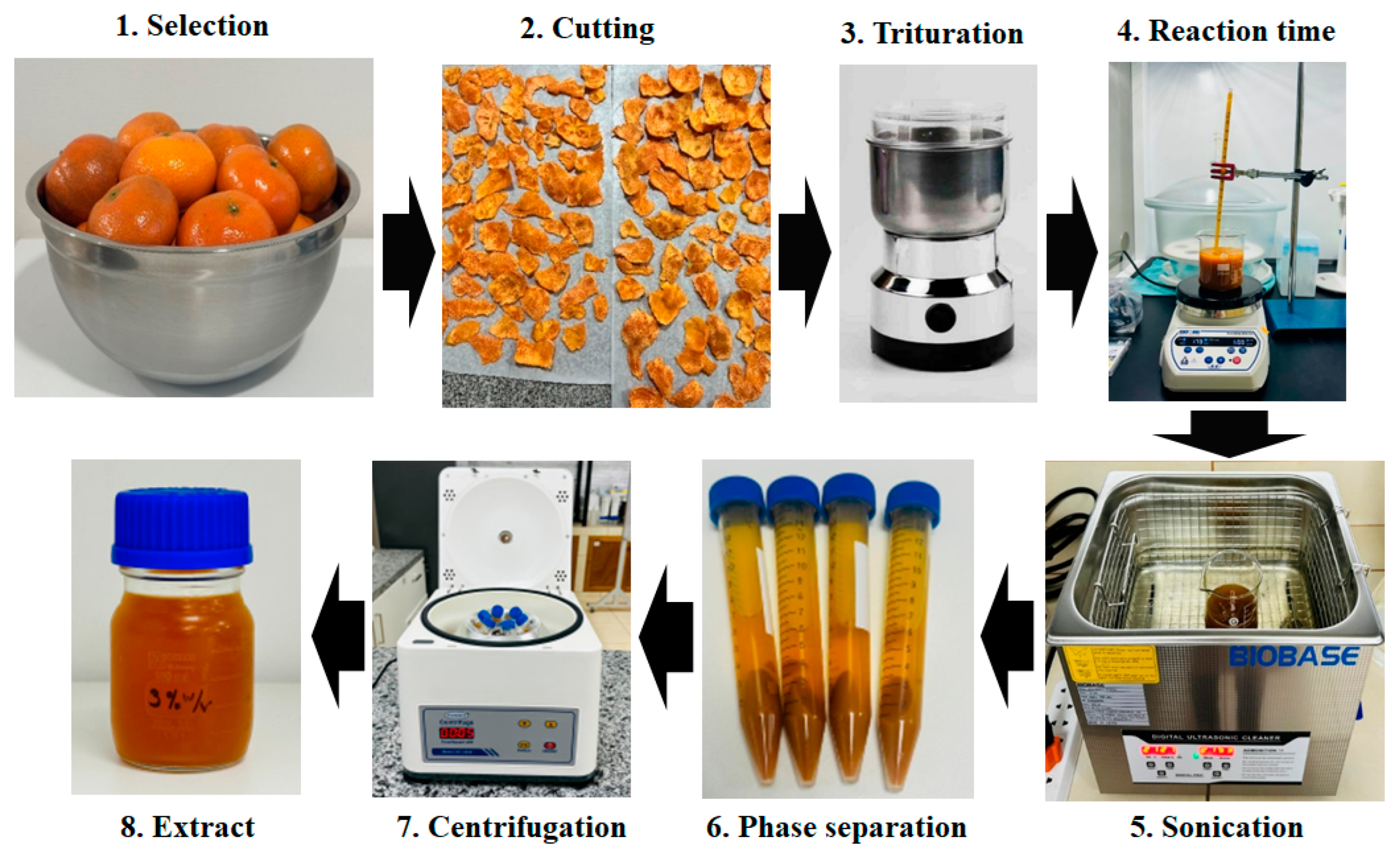
This biomass was selected because mandarin peel is an abundant agro-industrial residue and contains phenolic compounds, flavonoids, organic acids, and terpenoids that may act as natural stabilizing and surface-functionalizing agents for iron oxide NPs. Fresh peels of Citrus reticulata were manually separated from the fruit, thoroughly rinsed with distilled water to remove impurities, and cut into small pieces to increase the extraction surface area. The material was dried in a laboratory oven (Faithful) at 80 °C for 20 min to remove residual moisture. The dried peels were then ground in a stainless-steel electric mill to obtain a homogeneous fine powder.
An amount of 6 g of peel powder was accurately weighed and dispersed in 200 mL of ultrapure water (Type I), corresponding to a final concentration of 3% (w/v). The 3% (w/v) extract concentration was selected as a working concentration for MCRES biofunctionalization because it provides sufficient phytochemical content for interaction with hydroxylated γ-Fe2O3 surfaces while maintaining low viscosity and good processability during dispersion, magnetic separation, washing, and drying. Higher extract concentrations may increase organic loading and aggregation, whereas lower concentrations may provide insufficient surface-functionalizing molecules. The extract concentration was kept constant in this study because the main experimental variable was the MCRES dose applied to cacao seedlings; future work should optimize this parameter systematically.
The mixture was subjected to magnetic stirring at 363 K (90 °C) for 5 min to facilitate the aqueous extraction of bioactive phytochemicals, including flavonoids, phenolic compounds, and organic acids.
After thermal treatment, the suspension was allowed to cool gradually to 300 K using water to prevent abrupt thermal changes that could affect the stability of thermosensitive compounds. The cooled dispersion was subsequently sonicated (BIOBASE) for 30 min to enhance cell wall disruption and improve the release of phytoconstituents into the aqueous phase.
The resulting mixture was centrifuged at 4000 rpm for 5 min to separate insoluble residues from the liquid fraction. The supernatant was carefully collected and subjected to vacuum filtration to remove any remaining particulate matter, yielding a clear aqueous extract. The final extract was transferred into clean, dry borosilicate glass bottles, properly sealed, and stored at 278 K until its use in MCRES synthesis, this last step to preserve its chemical stability and bioactivity. Scheme 1 summarizes all these steps.

2.2.2. Biosynthesis of IONPs Assisted by Citrus reticulata Peel Extract (MCRES)

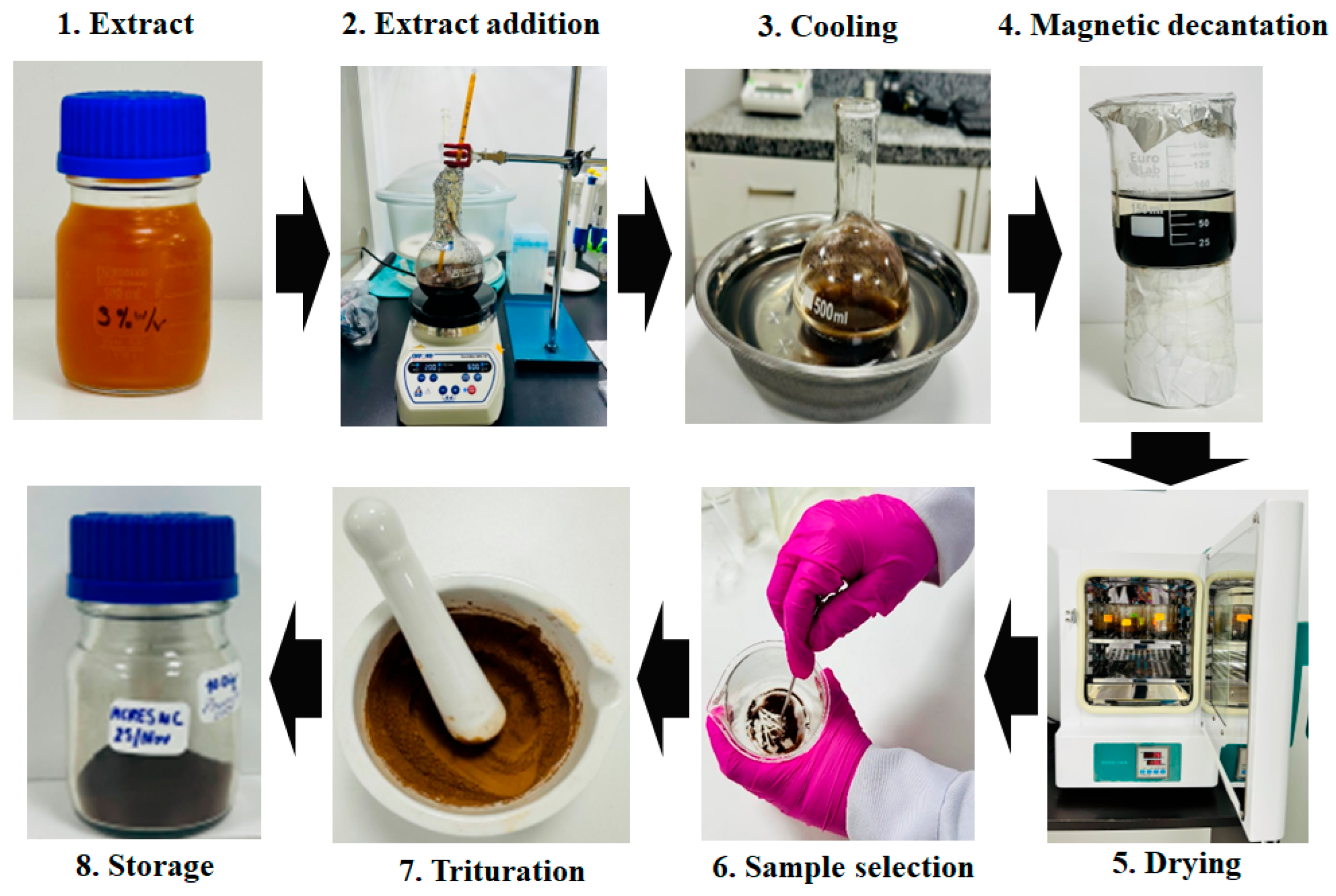
The surface functionalization of the IONPs was carried out using the previously prepared Citrus reticulata peel extract (3% w/v). Briefly, 10 g of pre-synthesized IONPs [5] were dispersed in 140 mL of the aqueous peel extract under continuous magnetic stirring to ensure homogeneous mixing.
The suspension was heated at 353 K under constant magnetic stirring for 2 h. Once the temperature stabilized at 353 K, the reaction time was monitored to allow effective interaction between the nanoparticle surface, and the phytochemical constituents present in the extract. This thermal treatment promoted the adsorption and binding of bioactive molecules, such as phenolic compounds and flavonoids, onto the surface of the IONPs, yielding biofunctionalized NPs.
After completion of the reaction, the dispersion was subjected to controlled cooling using a water bath to prevent abrupt thermal changes and to stabilize the formed hybrid material. The resulting material was magnetically separated using a neodymium magnet and washed five times with ultrapure water until neutral pH (≈7) was reached, ensuring the removal of unbound organic residues and excess extract components.
The purified material was dried in a laboratory oven for 12 h to eliminate residual moisture. Finally, the dried product was gently ground using an agate mortar to obtain a homogeneous powder. The final recovered mass was 8.44 g, and the biofunctionalized IONPs were labeled as MCRES for subsequent characterization and application studies, as depicted in Scheme 2.

2.3. Characterization

Structural characterization of the MCRES sample was carried out by X-ray diffraction (XRD) using a RIGAKU Ultima IV diffractometer (Rigaku, Tokyo, Japan) with CuKα radiation (λ = 1.5418 Å) in Bragg–Brentano configuration. The X-ray diffractogram was recorded over a 2θ range of 25–80°, using a step size of 0.02° and a dwell time of 2 s per step. The crystalline phase was identified by comparison with crystallographic reference data for cubic γ-Fe2O3. Rietveld refinement was performed to obtain the lattice parameter, crystallite size, atomic site occupancy, and refinement quality parameters [19].
Morphological characterization was performed by transmission electron microscopy (TEM) using a JEOL 2100F microscope (JEOL, Tokyo, Japan) operated at 200 kV. For TEM preparation, approximately 20 mg of dried MCRES powder was dispersed in 1 mL of acetone in a 1.5 mL Eppendorf tube and sonicated for 5 min in an ultrasonic bath to reduce agglomeration and obtain a stable dispersion. After sonication, 5 µL of the supernatant was collected and drop-cast onto a lacey carbon-coated copper TEM grid. The grids were dried at room temperature before observation. Particle size distribution histograms were obtained by measuring approximately 800–1000 particles from 30–35 micrographs using ImageJ 1.54 g software. The size distribution was fitted using a log-normal function, and the mean particle diameter and goodness of fit were obtained from the fitted distribution.
Magnetic characterization was performed using a Physical Property Measurement System, PPMS EverCool II, equipped with a vibrating sample magnetometer attachment. A known mass of dried MCRES powder was placed in a nonmagnetic sample holder and fixed to avoid movement during measurement. Isotherm magnetization curves, M(H), were recorded at 300 K and 5 K under applied magnetic fields from −50 to +50 kOe. Before each measurement, the sample was thermally stabilized at the target temperature. The saturation magnetization (MS), remanent magnetization (MR), and coercive field (HC) were obtained from the hysteresis loops. The near-zero coercivity observed at 300 K was used to evaluate the superparamagnetic-like response of the MCRES sample.
The high-field region of the magnetization curves was further analyzed using the Law of Approach to Saturation (LAS) given by Equation (1):
M ( H ) = M s 1 b / H 2 + χ H
where MS is the saturation magnetization, b is the coefficient associated with anisotropy-related contributions, χ is the high-field susceptibility, and H is the applied magnetic field. The fitting was performed in the high-field region, approximately between +20 and +32 kOe, where the magnetization approaches saturation and irreversible low-field processes are minimized. The effective magnetic anisotropy, Keff, was estimated from the anisotropy-related term obtained from the LAS fit. Magnetic parameters were reported using negative-exponent notation, namely emu g−1 for MS, kOe for HC, and J m−3 for Keff.

2.4. Location and Seed Collection

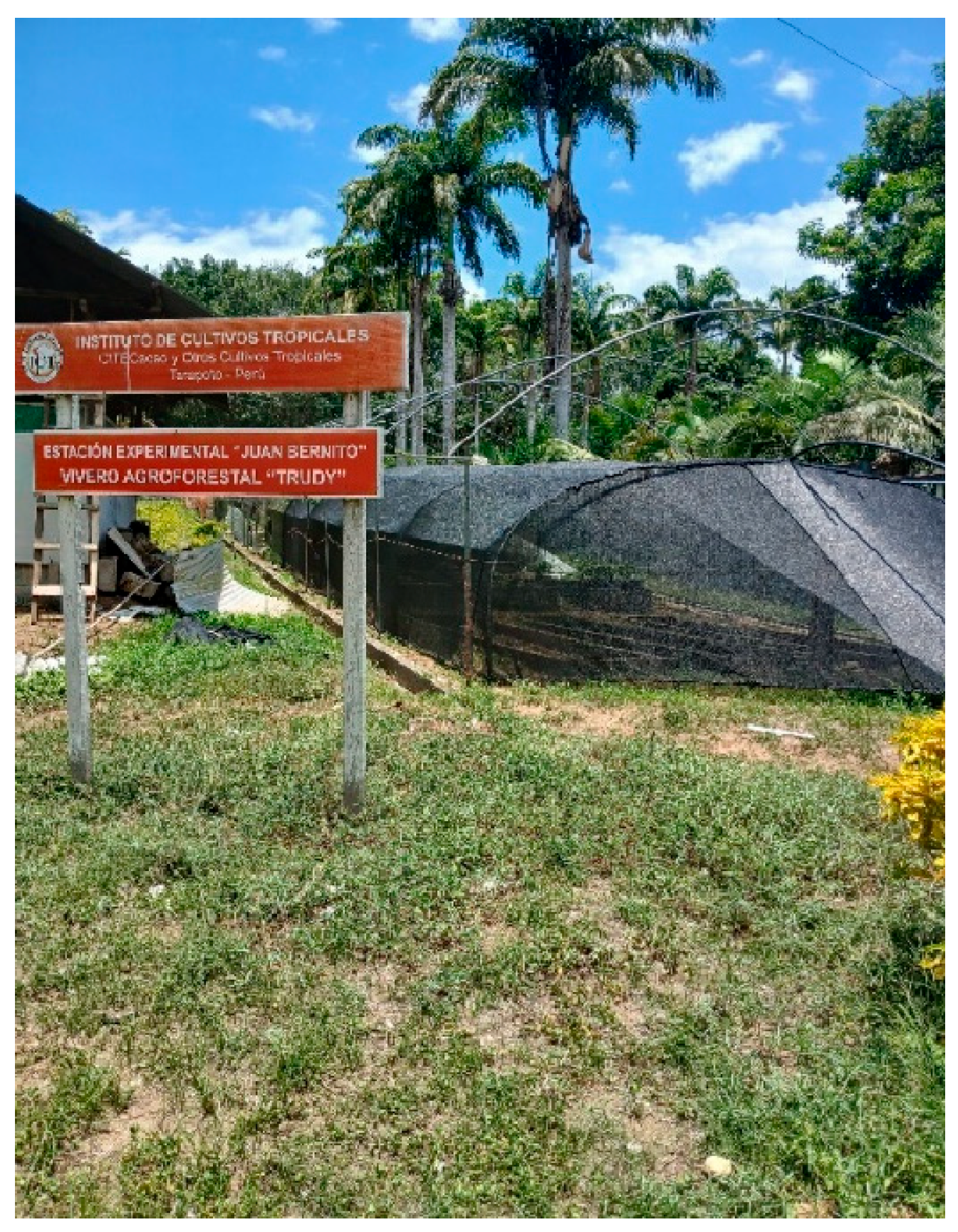
The experiments and data collection were carried out during 2025 at the nursery of the Juan Benito Experimental Station shown in Figure 1, located in the district of Banda del Shilcayo, San Martín, Peru (06°30′28″ S; 76°00′18″ W; 333 m a.s.l.).

2.5. Seed Collection

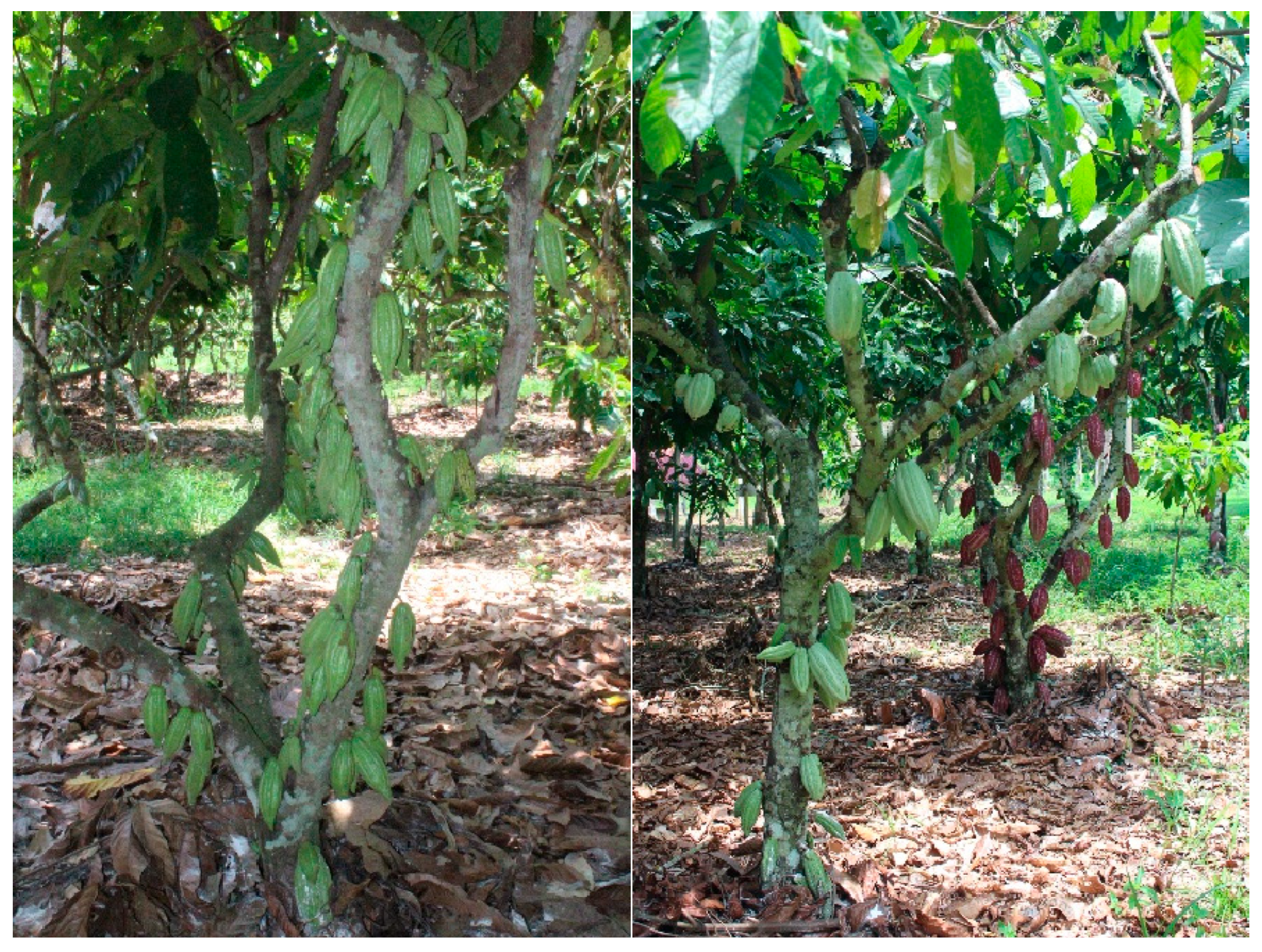
The ICS-95 and TSH-1188 genotypes were obtained from the demonstration plots of Instituto de Cultivos Tropicales, as shown in Figure 2. The ICS-95 and TSH-1188 genotypes were selected because they are agronomically relevant cacao genotypes available at the Instituto de Cultivos Tropicales and allow evaluation of genotype-dependent responses to MCRES. These clones may differ in growth performance, nutrient uptake, and metal accumulation under contaminated substrate conditions. In particular, ICS-95 genotype has been reported as susceptible to Cd uptake [20]. TSH-1188 genotype was included as a contrasting genotype to assess whether MCRES effects on plant growth and Cd/native Ni partitioning were genotype-specific.

2.6. Substrate Preparation and Artificial Contamination

For substrate preparation, soil from the B horizon of an Ultisol was collected according to Soil Taxonomy classification [21]. This substrate was selected because of its acidic and low-fertility characteristics, which favor metal mobility and allow the evaluation of metal uptake by cacao seedlings under nursery conditions. The collected soil was air-dried, manually homogenized, and sieved (4 mm) to remove stones, coarse plant residues, and large aggregates before pot filling. Each experimental unit consisted of 5 kg of homogenized substrate placed in a plastic nursery pot. The soil used had the following physicochemical properties: pH 4.51, electrical conductivity 0.1 dS m−1, organic matter content 2.21%, and texture clay loam.
The substrate was artificially contaminated only with Cd. A concentrated cadmium chloride solution of 1000 mg L−1 was prepared and added to the substrate to achieve a target Cd concentration of 3 mg kg−1 soil. The Cd solution was added gradually and mixed thoroughly with the soil to promote a homogeneous distribution of the contaminant within each pot. After contamination, the substrate was allowed to equilibrate under controlled wetting conditions before MCRES application and seedling establishment.
Nickel was not externally added to the substrate. Its behavior was evaluated based on the native Ni naturally present in the Ultisol used in this study (2.04 mg kg−1). Therefore, the artificial contamination step refers only to Cd addition, whereas Ni was monitored as a naturally occurring metal in the soil–plant system. Accordingly, the experimental system should be interpreted as Cd-amended Ultisol containing naturally occurring Ni, rather than as an artificially Cd/Ni-spiked substrate.

2.7. Experimental Design and MCRES Application

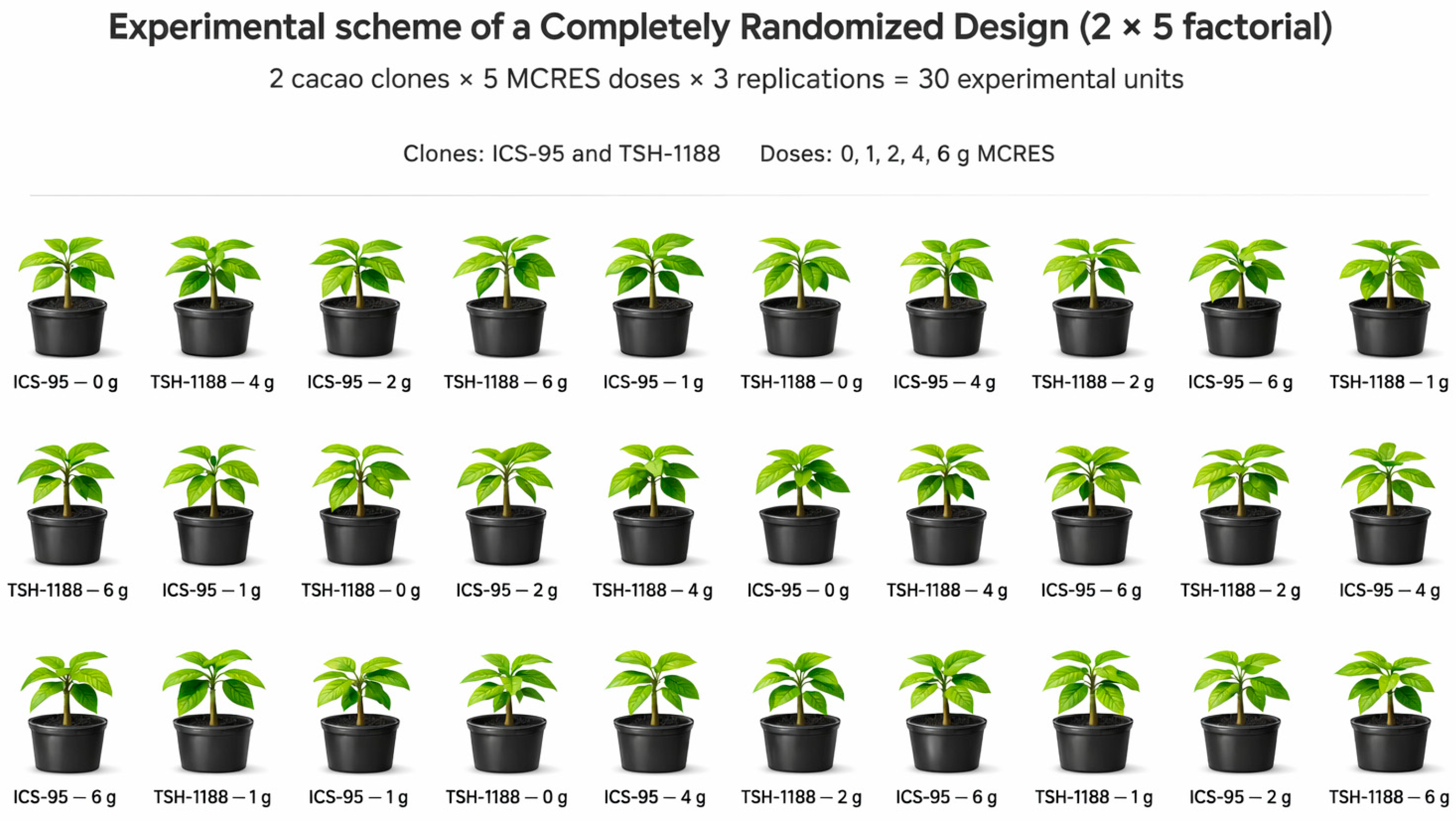
The study was conducted under nursery conditions for 4 months using a completely randomized design (CRD) in a 2 × 5 factorial arrangement, as seen in Scheme 3. The factors were cacao genotype, with two levels, ICS-95 and TSH-1188 genotypes, and MCRES dose, with five levels: 0, 1, 2, 4, and 6 g pot−1. Considering the total substrate mass of 5 kg per pot, these doses are nominally equivalent to 0, 200, 400, 800, and 1200 mg kg−1 soil, respectively. However, these values should be interpreted only as nominal pot-based equivalents, because MCRES was not homogeneously dispersed throughout the entire substrate mass. Instead, the material was applied locally in the upper root-growth zone near the cacao seedling to promote contact among MCRES, the Cd-amended Ultisol, naturally occurring Ni, and the developing root system. Three replications were used per treatment, resulting in a total of 30 experimental units.
The 0 g pot−1 MCRES treatment corresponded to the Cd-amended control, because it contained the same Cd-amended Ultisol substrate but did not receive MCRES. This control was used to evaluate the dose-dependent effect of MCRES under the same metal-stress condition. A non-contaminated blank control was not included because the main objective of this experiment was to compare MCRES treatments under Cd-amended conditions rather than to compare contaminated and non-contaminated seedling development. Nevertheless, the absence of a non-contaminated blank control is recognized as a limitation, and future studies should include this treatment to establish baseline cacao seedling development under non-stressed conditions.
For MCRES application, the corresponding mass of dried MCRES powder was weighed for each treatment and incorporated locally into the upper substrate layer around the root-growth zone of each pot. The material was gently mixed with the surrounding substrate near the plant rather than uniformly dispersed throughout the entire 5 kg substrate mass. Control pots received no MCRES but were otherwise handled under the same experimental conditions.
Pregerminated cacao seeds or uniform cacao seedlings of ICS-95 and TSH-1188 genotypes were established in the treated pots under the same depth and nursery conditions. The plants were maintained for 04 months at the Juan Benito Experimental Station nursery, Banda del Shilcayo, San Martín, Peru. During the experimental period, the pots were irrigated with distilled water as required to maintain adequate substrate moisture (80% of Field Capacity), avoiding both waterlogging and excessive leaching. Plant development was monitored throughout the nursery exposure period, after which biometric parameter analysis, soil chemical analysis, and plant tissue chemical analysis were performed. The environmental conditions of the nursery were measured with a termohigrometer with mean temperatures between 300 K and 303 K and relative humidity between 60–90 %.
The selected MCRES doses were used as nursery-scale screening treatments to evaluate dose-dependent biometric responses and Cd/native Ni partitioning under pot conditions. Similar pot-based amendment studies have expressed amendment rates on a mass basis and used controlled substrate quantities to screen plant response before field validation [22]. Therefore, the present treatments should not be interpreted as direct field-application recommendations, but rather as exploratory amendment rates intended to identify effective dose ranges and possible response thresholds for future field validation.

2.8. Measurement of Biometric Parameters and Plant Harvesting

Biometric measurements were performed at the end of the nursery exposure period following procedures adapted from [20]. Plant height was measured from the root collar to the apical meristem using a measuring tape. Stem diameter was measured at the root collar using a caliper, and the number of fully expanded leaves was counted manually. Root length was measured after careful removal of the root system from the substrate.
After biometric evaluation, plants were harvested by cutting at the root collar to separate the shoot fraction from the root system. The shoot fraction included stems and leaves, whereas the root fraction included the complete recovered root system. Roots were carefully separated from the substrate to minimize tissue loss and to avoid cross-contamination with soil particles.
Shoots and roots were washed sequentially with tap water to remove adhered substrate particles, rinsed with 1 % HCl to remove surface-bound metals and external residues, and finally rinsed with distilled water. The fresh weight and length of roots and shoots were recorded. The samples were placed in labeled paper envelopes and dried in an oven at 333 K for 72 h until constant weight. Dry weight was then recorded and expressed in grams. The dried tissues were stored in labeled containers for subsequent digestion and elemental analysis.

2.9. Chemical Analysis

Soil and plant analyses were conducted following the procedures specified by [23]. For soil samples, pH (1:2) and Electrical conductivity (EC) were determined using 10 g of soil with 20 mL of distilled water in a potentiometer and conductivity meter, respectively. P was determined using the Olsen method, whereas Ca and K were extracted with ammonium acetate at pH 7.0. Organic matter was determined with Walkey and Black method. The micronutrients Cu, Fe, Mn, and Zn were extracted using DTPA. Cd and Ni concentrations in soil were determined following EPA Method 3050B [24]; therefore, these values are reported as pseudo-total recoverable concentrations rather than directly bioavailable metal fractions. All elements were quantified by atomic absorption spectrophotometry (AAS).
For plant tissue analysis, dried shoot and root samples were separately processed. The samples were digested with HNO3 prior to elemental determination. Phosphorus was determined using the vanadate-molybdate method at 880 nm with a UV-Vis spectrophotometer. The concentrations of K, Ca, Cu, Fe, Mn, Zn, Cd, and Ni were determined by AAS. Cadmium was analyzed as the externally added contaminant, whereas Ni was analyzed as a naturally occurring metal originally present in the Ultisol substrate. Metal concentrations were used to evaluate nutrient uptake, Cd/Ni accumulation, and root-to-shoot partitioning in cacao seedlings.

2.10. Bioconcentration and Translocation Factors

The bioconcentration factor (BCF) was calculated as the ratio of metal concentration in the plant shoot to that in the rhizosphere soil, according to the following Equation (2):
B C F = C o n c e n t r a t i o n   o f   m e t a l   i n   p l a n t   t i s s u e   ( m g   k g 1 ) S o i l   m e t a l   c o n c e n t r a t i o n   ( m g   k g 1 )
where soil metal concentration is the pseudo-total metal concentration in the soil (mg kg−1 dry weight). A BCF > 1 indicates a plant with hyperaccumulation potential for the respective metal.
The translocation factor (TF) was calculated as the ratio of metal concentration in the shoot to that in the root, see Equation (3):
T F = C o n c e n t r a t i o n   o f   m e t a l   i n   s h o o t   ( m g   k g 1 ) C o n c e n t r a t i o n   o f   m e t a l   i n   r o o t   ( m g   k g 1 )
A TF > 1 indicates efficient translocation of metals from root to aerial tissues.

2.11. Statistical Analysis

Descriptive statistics (means and standard deviations) were calculated for all variables. An analysis of variance (ANOVA) was then performed at the 95 % confidence level. When significant differences were detected, means were compared using the Scott-Knott test at p < 0.05. To explore the relations between the studied variables, a Principal Component Analysis (PCA) was performed with the prcomp function (R software ver. 4.1). Prior to analysis, all variables were centered and scaled to unit variance. The PCA was computed from the correlation matrix, and the number of principal components retained for interpretation was determined using the Kaiser criterion (eigenvalues > 1). All statistical analyses and figures were generated using R software [25].

3. Results and Discussion

3.1. Characterization of MCRES Sample

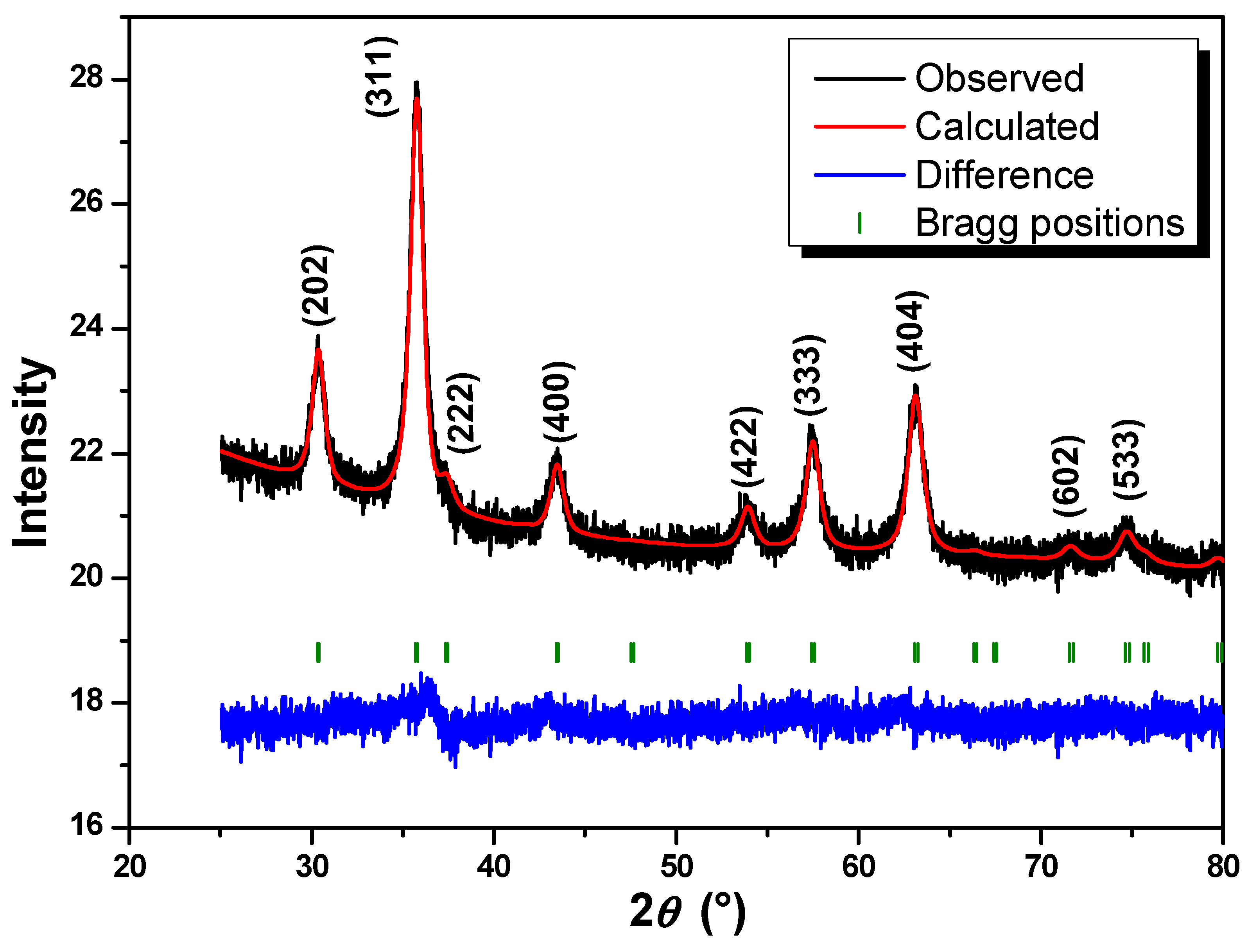
The X-ray diffractogram in Figure 3 showed characteristic Bragg peaks at approximately 2θ = 30.3°, 35.7°, 37.4°, 43.3°, 53.7°, 57.3°, 63.1°, 71.5°, and 74.7°, which were assigned to the (202), (311), (222), (400), (422), (333), (404), (602), and (533) planes, respectively. This diffraction profile is consistent with the cubic γ-Fe2O3 phase. In this spinel structure, the (311) reflection is typically the most intense peak. No additional peaks or signals from secondary iron oxide phases, such as hematite, were observed, confirming the high phase purity of the sample. The results of Rietveld refinement of the XRD data are given in Table 1 and further confirmed the cubic crystal symmetry, space group F d 3 ¯ m , characteristic of γ-Fe2O3.
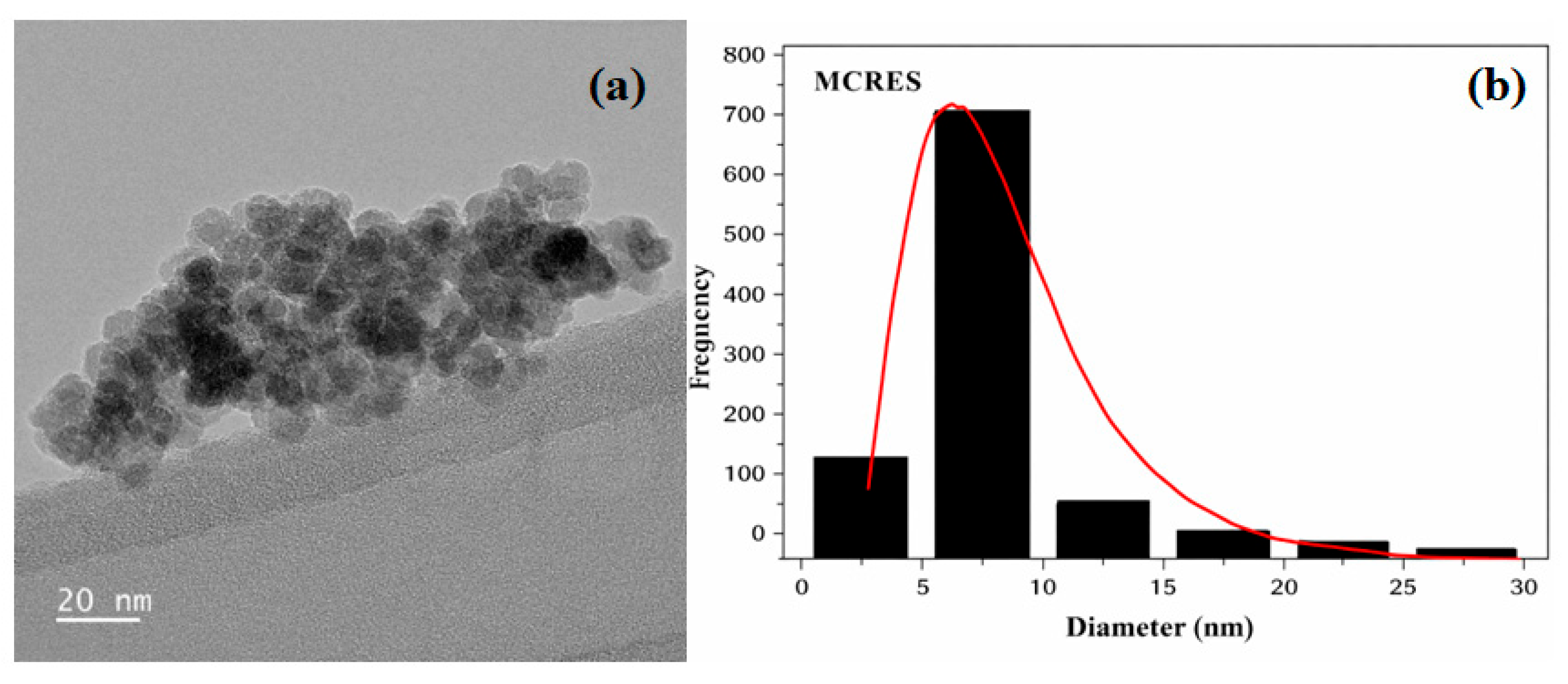
The morphology and size distribution of the MCRES NPs were characterized by TEM. The micrographs (Figure 4) revealed that the NPs exhibit a predominantly quasi-circular shape with a relatively uniform morphology. The particles appear as clusters or aggregates; this phenomenon is typically attributed to the high surface energy of the nanomaterials and the strong magnetic dipole–dipole interactions inherent to γ - F e 2 O 3 [26].
The particle size distribution was determined by analyzing the TEM images, as shown in the corresponding histogram. The data followed a log-normal distribution fit (R2 = 0.95), yielding a mean particle diameter (xc) of 7.5 nm. This ultrafine size is particularly relevant for agricultural applications. According to [27], NPs smaller than 10 nm possess an exceptionally high surface area-to-volume ratio, which enhances their reactivity and adsorption capacity for metals such as C d 2 + and N i 2 + in soil systems. Furthermore, this small diameter facilitates the efficient translocation and distribution of the NPs through plant vascular tissues, potentially reducing the accumulation of toxic elements in the shoots [28].
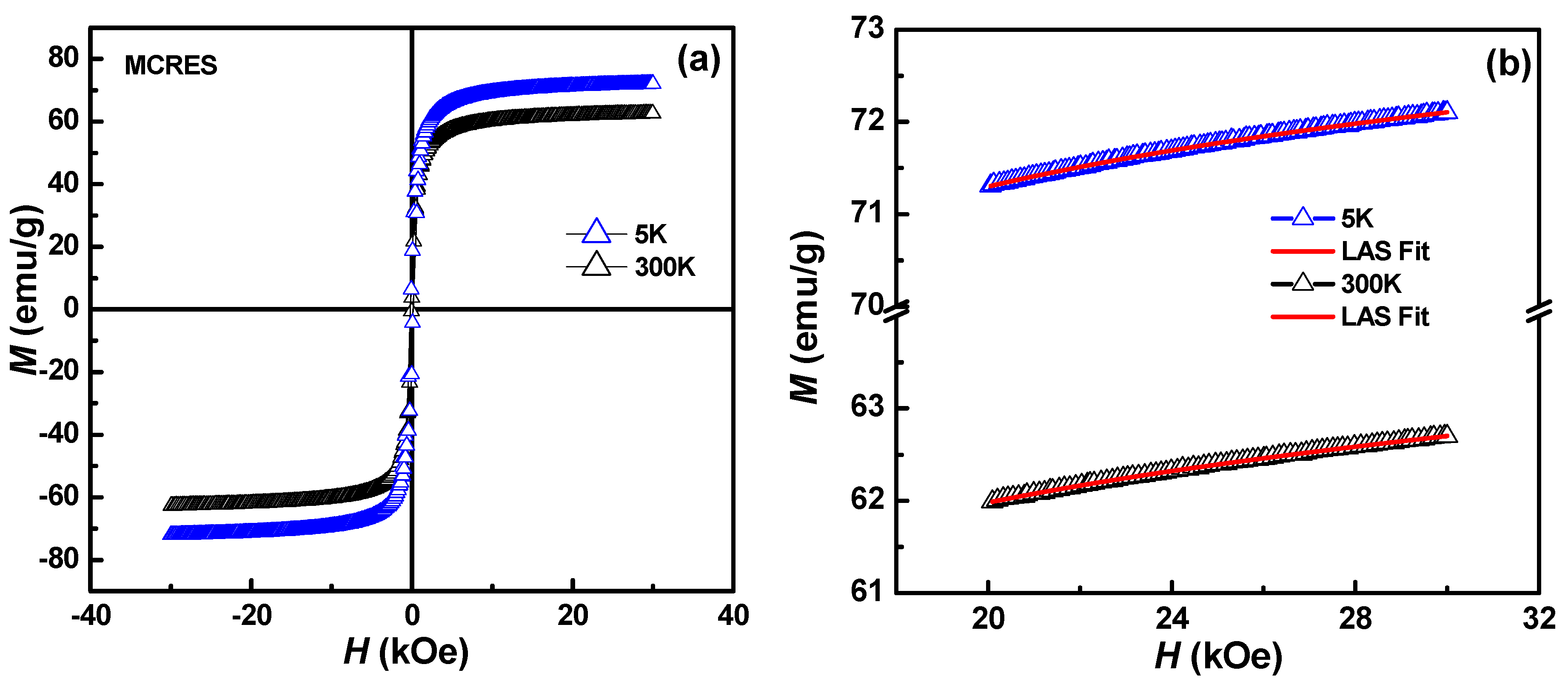
Figure 5a showed the magnetization curves at 5 K and 300 K of the MCRES NPs. At 300 K, the sample exhibited superparamagnetic behavior ( H c = 0   k O e ). As expected, the M S value decreased with increasing temperature, from 71 emu g−1 at 5 K to 62 emu g−1 at 300 K, consistent with values reported for bulk γ-Fe2O3 (60–90 emu g−1) [29]. The high MS value for the MCRES NPs supports the high phase purity and crystalline order achieved through the tangerine-mediated green synthesis.
Figure 5b isolates the high-field approach-to-saturation regime (≈20–32 kOe), where the magnetization can be modeled using Equation (1) to separate the intrinsic saturation term from anisotropy-driven canting and the small high-field susceptibility. The LAS fits yielded tightly constrained MS values of ( 61.89 ± 0.04 ) emu g−1 (300 K) and ( 71.44 ± 0.03 ) emu g−1 (5 K), with excellent fit quality (Adj. R 2 0.9996 0.9998 , reduced χ 2 10 5 ). The fit χ remained on the order of (3.4–3.7) × 10−5 (in the units consistent with the plotted M H data), confirming that the curve shape in this region was dominated by the anisotropy-related 1 / H 2 term rather than by paramagnetic contributions. Using the same LAS framework, the effective anisotropy extracted from the high-field behavior was Keff = 2.67 × 10⁵ J m−3 at 300 K and 2.98 × 10⁵ J m−3 at 5 K, consistent with a strong surface/shell contribution typical of ultrasmall γ-Fe2O3 NPs [30].
Overall, the scaled-up MCRES material showed phase-pure cubic γ-Fe2O3, ultrasmall quasi-spherical NPs, and strong magnetic performance. The following section evaluates whether these physicochemical features translate into dose-dependent biological responses in cacao seedlings under nursery conditions.
These physicochemical features are relevant for the intended agricultural application of MCRES. The preservation of the cubic γ-Fe2O3 phase indicates that citrus-mediated biofunctionalization did not produce detectable secondary iron oxide phases, which is important because phase purity affects both magnetic response and surface reactivity. The ultrasmall particle size observed by TEM implies a high surface-area-to-volume ratio and a high density of exposed surface Fe–OH sites, which can participate in adsorption and surface complexation with divalent metal cations. Similar behavior has been reported for magnetic IONPs, where nanoscale size and hydroxylated surfaces favor the interaction with potentially toxic metal ions [13,15,26,27]. In addition, the presence of Citrus reticulata-derived phytochemicals may introduce oxygenated groups such as –OH and –COOH, which are commonly associated with metal binding in plant-derived biosorbents [16,17]. Therefore, the combination of a reactive γ-Fe2O3 core, citrus-derived surface functionalities, and strong magnetic response supports the use of MCRES as a green magnetic nanoamendment for soil–plant systems.

3.2. Biometric Parameters

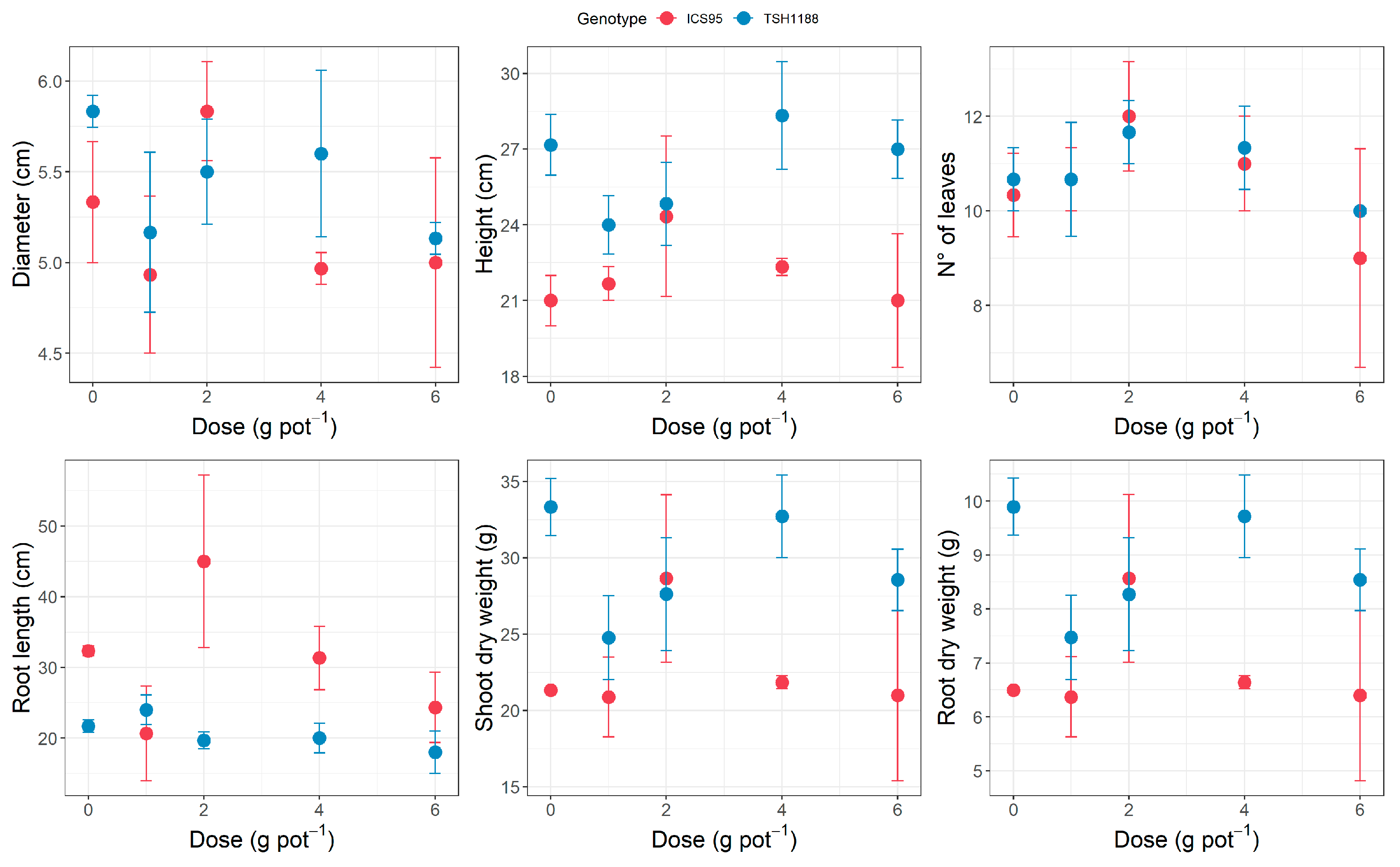
The 7.5 nm MCRES sample was applied to the seedlings at various doses. The results for the biometric parameters (Diameter, Height, Number of leaves, Root length, and Shoot and Root Dry Weight) are presented in Figure 6. Regarding the clones, significant differences were generally observed (p < 0.05), with TSH-1188 genotype exhibiting greater diameter, height, and shoot and root dry weights. For the TSH-1188 genotype, no significant differences (p > 0.05) were observed between the different nanoparticle doses, except for shoot and root dry weights, where the control treatment and the 4 g pot−1 dose promoted greater biomass accumulation. In contrast, for the ICS-95 genotype, significant differences (p < 0.05) were observed in stem diameter, root length, and shoot and root dry weights, with the 2 g pot−1 dose promoting the greatest growth.
These results suggest that the observed differences were primarily associated with genetic factors, as some crop species and clones are more susceptible to MCRES exposure, which may reduce growth and induce toxicity. This effect has been previously reported in crops such as onion, lettuce, rice, wheat, and soybean, among others [31]. In the case of cacao, a potential toxic effect was also observed in the ICS-95 genotype, which was the most susceptible among those studied [5].
The genotype-dependent biometric response is consistent with the fact that cacao genotypes can differ in root architecture, nutrient acquisition, metal uptake, and tolerance to abiotic stress [20]. The contrasting behavior of ICS-95 and TSH-1188 genotypes indicates that MCRES did not act as a universally beneficial or toxic amendment, but rather produced responses modulated by genetic background and dose. The stronger response of ICS-95 genotype at the 2 g pot−1 treatment suggests that an intermediate MCRES dose may improve root-zone conditions or reduce metal stress sufficiently to support growth, whereas higher doses may not provide additional benefit and could alter nutrient availability or root–particle interactions. This non-linear response agrees with previous studies reporting that NPs can stimulate plant growth at suitable doses but may produce neutral or inhibitory effects at higher concentrations depending on plant species, genotype, particle properties, and exposure conditions [31,32]. Therefore, MCRES application should be optimized according to genotype rather than recommended as a single fixed dose for all cacao materials.

3.3. Soil Concentrations

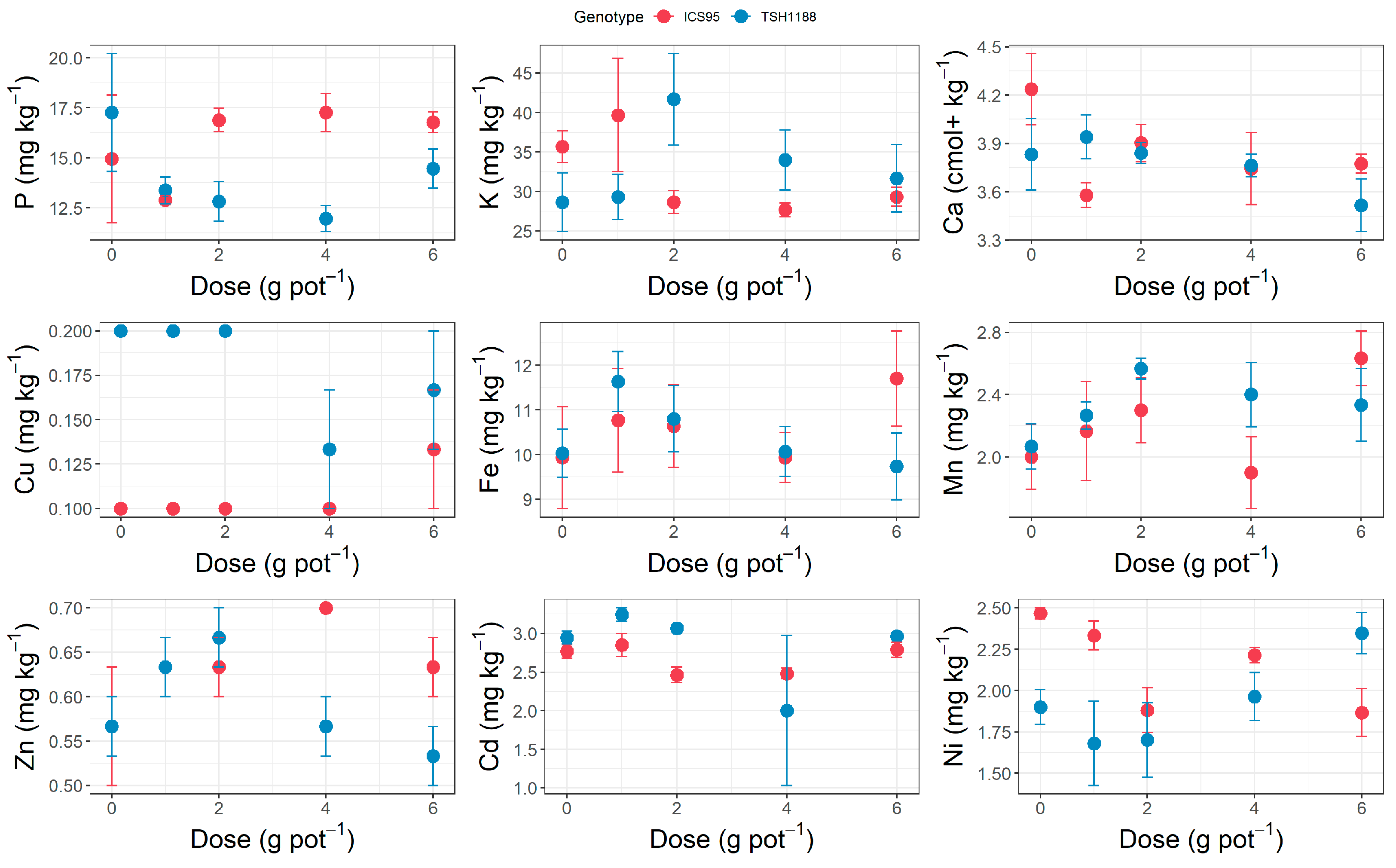
The concentrations of nutrients (P, Ca, and K) and metals (Cu, Fe, Mn, Zn, Cd, and Ni) in the soil are presented in Figure 7. In general, no significant differences (p > 0.05) were found between the clones. However, the MCRES NPs reduced the soil concentrations of Zn, Cd, and Ni.
It should be noted that Cd and Ni in soil were determined using EPA Method 3050B [24], which provides pseudo-total recoverable concentrations rather than directly bioavailable metal fractions. Therefore, changes in soil Cd and Ni concentrations should not be interpreted alone as direct evidence of adsorption or immobilization. Under the present pot conditions, the observed soil-metal patterns may reflect combined effects of plant uptake, root-zone partitioning, redistribution among soil and plant compartments, and possible changes in operationally recoverable metal pools. Because leachates were not collected and quantified, and because sequential extraction or DTPA-extractable Cd/Ni fractions were not determined, a complete metal mass balance could not be established. Consequently, the interpretation of MCRES performance in this study is based primarily on plant metal accumulation, bioconcentration, and root-to-shoot translocation factors, while future studies should include extractable metal fractions, leachate monitoring, and mass-balance analysis.
The interpretation of soil Cd and Ni concentrations should also consider the nursery-pot watering conditions. Irrigation can influence metal availability by modifying substrate moisture, solubilization, diffusion toward the root zone, and potential downward movement of soluble species [2,3]. In the present experiment, irrigation was applied uniformly across treatments and waterlogging or intentional leaching was avoided; therefore, differential watering was not expected to be the main driver of the observed differences among MCRES doses. Nevertheless, because Cd was externally added and Ni was naturally present in the Ultisol substrate, their mobility may have responded differently to moisture conditions, root activity, and interaction with MCRES.
Previous studies have reported that nanoparticle-based amendments can modify nutrient availability and nutrient accumulation in plants, depending on nanoparticle type, dose, crop species, and soil conditions [31,32]. Such an effect was not clearly observed in the present study. Nevertheless, a reduction in EPA 3050B-recoverable soil Cd was detected, consistent with previous observations in cacao seedlings treated with non-biofunctionalized γ-Fe2O3 NPs [5]. Therefore, the present results suggest that MCRES may influence Cd partitioning in the soil–plant system, although soil pseudo-total data alone cannot confirm direct immobilization.
The observed changes in soil Cd and native Ni after MCRES application may be associated with combined soil–plant partitioning processes rather than being attributed solely to adsorption. The γ-Fe2O3 surface and citrus-derived functional groups may contribute to these processes through Fe–OH surface interactions and oxygenated functional groups, as reported for iron oxide NPs and citrus-derived biosorbents [13,15,16,17]. Such metal interactions may involve electrostatic attraction, ion exchange, surface complexation, and chelation. Thus, although EPA 3050B data alone cannot confirm immobilization, the observed soil and plant responses are consistent with the hypothesis that MCRES can modify Cd/native Ni partitioning in acidic agricultural substrates.

3.4. Nutrient Concentrations

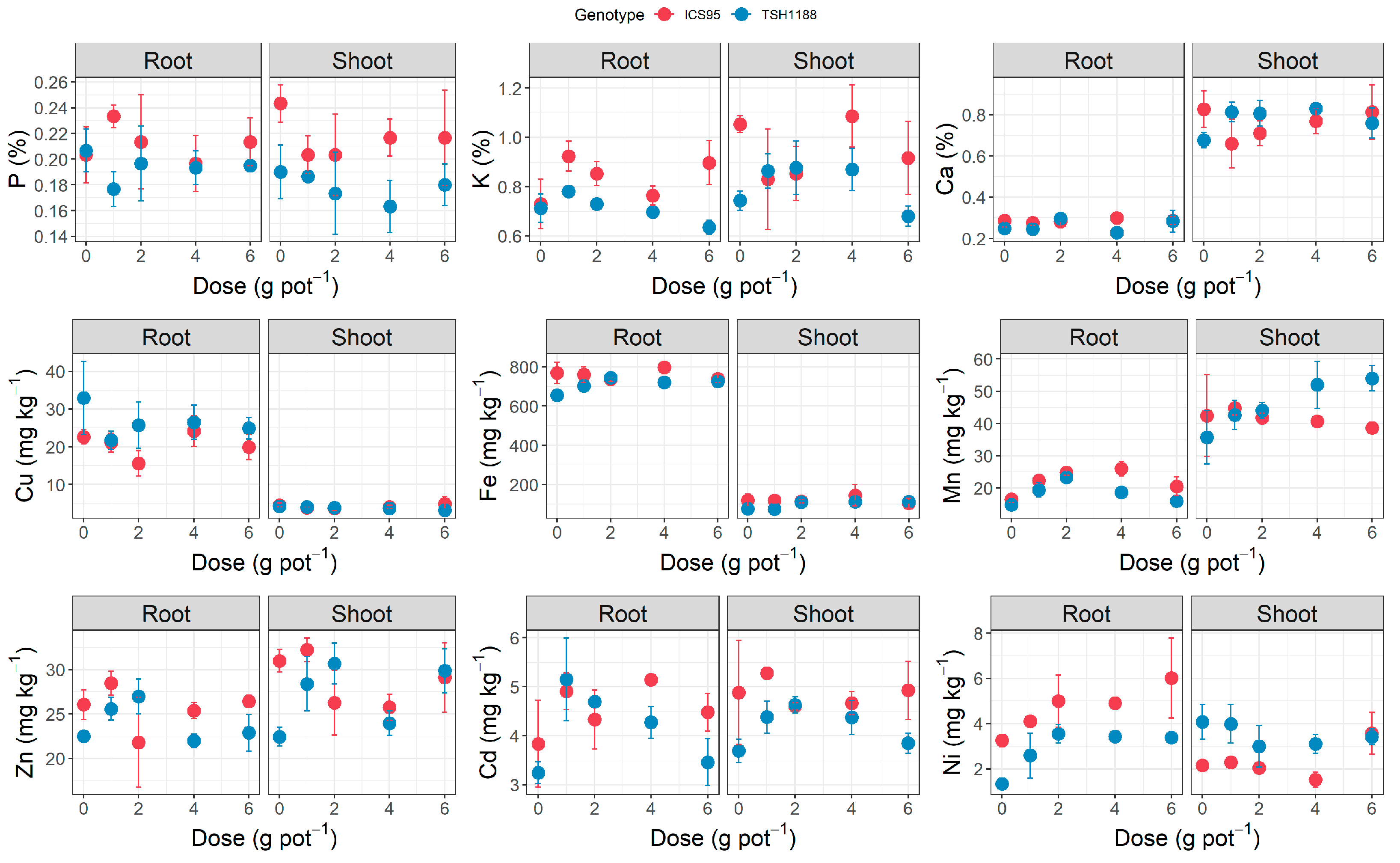
The concentrations of nutrients and metals in shoots and roots are presented in Figure 8. For P and K, the ICS-95 genotype showed higher concentrations of these elements, with higher values in the shoot, whereas the opposite trend was observed in the other clone. In both clones, the uptake of these elements decreased at higher nanoparticle doses. For K, the 4 g pot−1 dose promoted the greatest uptake. For Ca, Cu, Fe, and Mn, no marked differences in uptake were observed between clones or doses, and no significant differences were found (p > 0.05). For Zn, concentrations were higher in the shoot than in the root, increased up to the 2 g pot−1 dose, and decreased at higher doses. For Cd, uptake decreased at higher doses, with a maximum at 2 g pot−1. For Ni, shoot concentrations were lower than root concentrations, and the NPs promoted uptake up to a maximum level, after which no significant differences among doses were observed.
The different behavior of Cd and Ni in roots and shoots can be associated with their contrasting mobility and biological roles in plants. Cd is a non-essential and highly mobile element that can enter plants through transport pathways used by essential divalent cations and may be translocated to aerial tissues through the xylem [2,20]. This behavior explains why Cd remained comparatively mobile toward the shoot even after MCRES application. In contrast, Ni is an essential micronutrient at trace concentrations but becomes phytotoxic when present at elevated levels [6,7]. Its stronger accumulation in roots suggests that root retention mechanisms, including binding to cell walls, complexation with organic ligands, sequestration in root tissues, and interaction with MCRES in the rhizosphere, may have limited its movement to shoots. The observed changes in nutrient concentrations also indicate that MCRES may influence not only metal behavior but also nutrient availability and uptake, probably through competition for sorption sites, changes in rhizosphere chemistry, and genotype-specific root activity [31,32]. Therefore, the agronomic use of MCRES should consider both metal mitigation and nutrient-balance effects.

3.5. Bioconcentration and Translocation Factors for Cd and Ni

Bioconcentration and translocation factors for Cd and Ni are presented in Table 2. It is important to note that Cd and Ni had different origins in the experimental system. Cd was artificially added to the Ultisol substrate to reach 3 mg kg−1 soil, whereas Ni was not externally added and corresponded to the native Ni naturally present in the substrate. Therefore, the observed Ni behavior reflects the influence of MCRES on the mobility and plant partitioning of naturally occurring Ni under Cd-amended nursery conditions. This distinction is relevant because the system should not be interpreted as a dual Cd/Ni-spiked experiment, but rather as a Cd-amended Ultisol system in which native Ni was also monitored.
For Cd, significant differences in the bioconcentration factor were observed among doses, except in the shoots of the ICS-95 genotype (p > 0.05). The 4 g pot−1 dose produced the highest mean values in the roots of both clones and in the shoots of TSH-1188 genotype. For Ni, the bioconcentration factor in the shoot was lower at the 4 g pot−1 dose, whereas in roots the control showed the lowest values in all cases. Cd translocation factors were generally close to or greater than 1, indicating substantial accumulation in the shoot. In contrast, most Ni translocation factors were below 1, indicating preferential retention in the roots of cacao seedlings, except in TSH-1188 genotype, where higher MCRES doses reduced translocation.
The bioconcentration and translocation factors provide important evidence that MCRES produced a metal-specific response. For Cd, translocation factors close to or greater than unity indicate that Cd remained capable of moving from roots to shoots, which is consistent with the known mobility of Cd in acidic soil–plant systems [2,5,20]. This result shows that MCRES influenced Cd behavior but did not fully suppress Cd translocation under the tested conditions. In contrast, the reduction in Ni translocation, particularly in TSH-1188 genotype, indicates preferential belowground retention of native Ni [6,7]. The decrease in Ni translocation factor from 3.07 in the control to 0.85–1.00 at higher MCRES doses suggests that MCRES increased the retention of Ni in the root zone or root tissues. This may be related to the combined presence of Fe–OH sites from γ-Fe2O3 and oxygenated groups from Citrus reticulata-derived compounds, which can provide additional binding sites for Ni [13,15,16,17]. Therefore, the TF results support the conclusion that MCRES was more effective in limiting Ni root-to-shoot movement than Cd translocation under the present experimental conditions.
A relevant point is that the present experimental design did not include a side-by-side treatment with unfunctionalized γ-Fe2O3 NPs. However, the unfunctionalized γ-Fe2O3 NPs system was previously evaluated by Arias-Contreras et al. [5], who applied γ-Fe2O3 NPs without plant-extract functionalization to Cd-contaminated cacao seedlings at 1, 2, and 4 g pot−1 doses and reported significant inhibition of Cd uptake, particularly in the ICS-95 genotype. Therefore, that previous study provides a published reference baseline for the behavior of non-biofunctionalized γ-Fe2O3 in cacao seedlings. In contrast, the present study evaluates a γ-Fe2O3Citrus reticulata hybrid nanosystem under Cd/Ni exposure and reveals a different response pattern, especially the preferential retention of Ni in roots and the marked reduction in Ni translocation in TSH-1188 genotype. Even so, because the previous study using non-biofunctionalized γ-Fe2O3 NPs [5] and the present study using MCRES were not performed as a single side-by-side experiment under identical conditions, the specific contribution of citrus-mediated functionalization should be interpreted cautiously. Future experiments should include unfunctionalized γ-Fe2O3, Citrus reticulata extract alone, and MCRES under identical soil, genotype, dose, and metal-exposure conditions to directly separate the effect of the iron oxide core from that of the phytochemical surface functionalization.

3.6. PCA of the Studied Variables

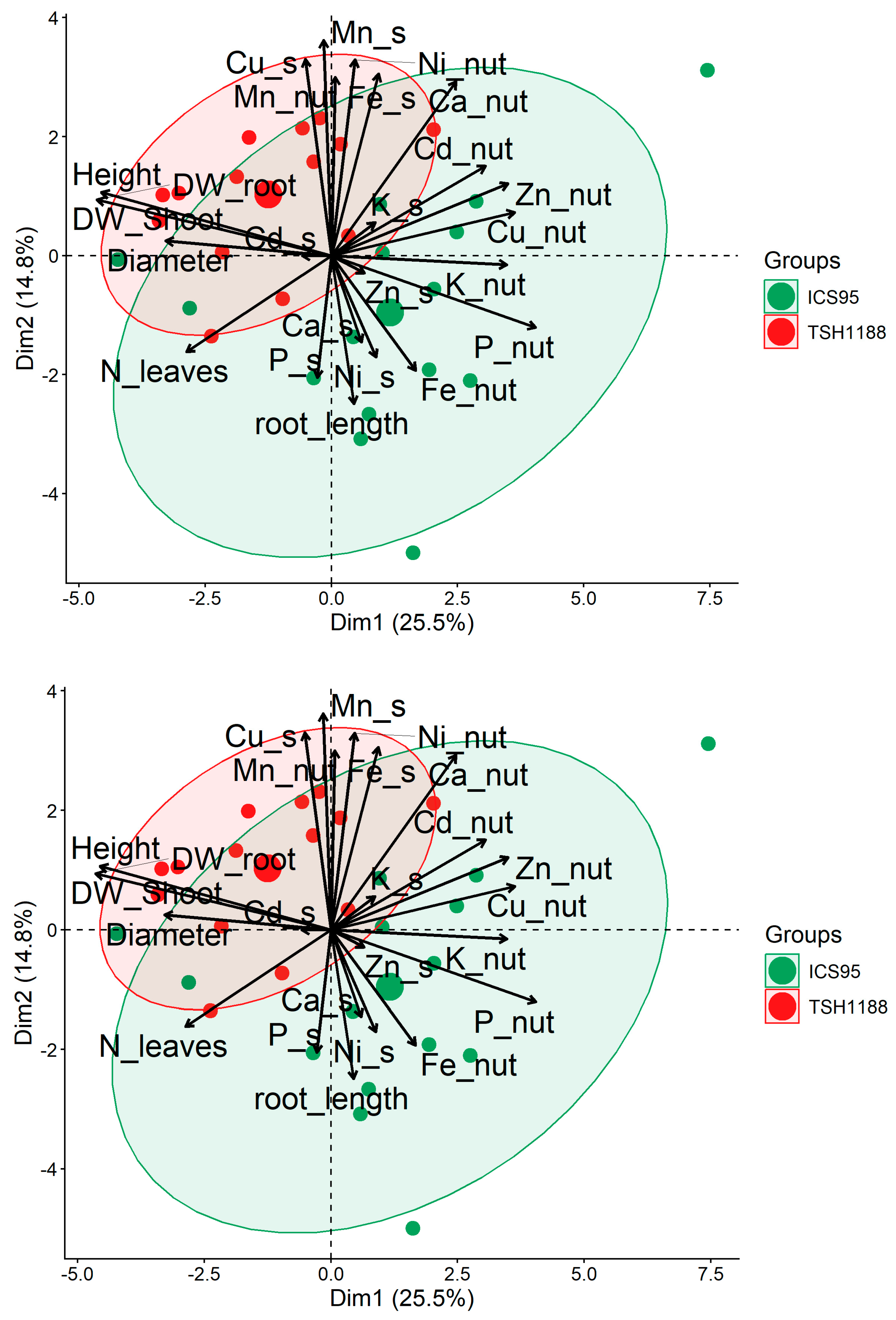
The PCA of the studied variables (biometric, nutrient, and soil) is presented in Figure 9. In the case of the shoot, soil Cd (Cd_s) had a higher correlation with soil Zn, while foliar Cd correlated with soil K (K_s). Soil Ni had no relationship with any evaluated variable. However, foliar Ni (Ni_nut) had a greater relationship with root length. In the case of the roots, soil Cd had a low relationship with soil Ni. Meanwhile, foliar Cd had a high correlation with the number of leaves (N_leaves). On the other hand, foliar Ni had a correlation with soil Zn (Zn_s).
The PCA results reinforce the interpretation that MCRES effects were controlled by multiple interacting factors rather than by a single variable. The association between soil Cd and soil Zn suggests that Cd behavior may be linked to broader cation availability and competition in the acidic Ultisol substrate [2,20]. The relationship between foliar Cd and soil K may reflect the influence of nutrient status on metal uptake and translocation, since Cd can interact indirectly with pathways associated with essential cation transport. For Ni, the relationship with root length suggests that root development played an important role in controlling Ni uptake and partitioning [6,7]. This is consistent with the stronger root retention observed for Ni in the bioconcentration and translocation analysis. Overall, the PCA supports an integrated interpretation in which genotype, root development, soil nutrient status, and MCRES dose jointly influenced Cd/native Ni partitioning in cacao seedlings.

4. Conclusions

This study demonstrated that the maghemite–Citrus reticulata extract system (MCRES) can be prepared as a green biofunctionalized γ-Fe2O3-based nanoamendment and applied under nursery conditions to cacao seedlings grown in Cd-amended Ultisol containing naturally occurring Ni. The results showed that MCRES affected cacao seedlings in a genotype- and dose-dependent manner. In particular, ICS-95 genotype showed a clearer biometric response to MCRES application, with the 2 g pot−1 treatment producing the most favorable growth response, whereas TSH-1188 genotype showed lower sensitivity to dose variation for most biometric parameters. From an agronomic perspective, the results indicate that MCRES should not be recommended as a universal amendment at a fixed dose for all cacao genotypes. Instead, its use should be optimized according to genotype, soil condition, and target metal. Under the present nursery conditions, the intermediate dose of 2 g pot−1 appeared more favorable for ICS-95 genotype growth, while higher doses were more effective in reducing Ni translocation in TSH-1188 genotype. Therefore, MCRES may be considered a promising nursery-stage green nanoamendment for modifying metal partitioning in cacao systems, especially by promoting root retention of naturally occurring Ni and reducing its movement toward aerial tissues. The study also showed that Cd and Ni responded differently to MCRES. Cd, which was externally added to the substrate, remained comparatively mobile toward the shoots, whereas naturally occurring Ni was preferentially retained in the roots, particularly in TSH-1188 genotype. This metal-specific behavior suggests that MCRES was more effective in limiting Ni translocation than Cd translocation under the tested conditions. Consequently, future optimization should focus on improving Cd immobilization while preserving the favorable Ni root-retention effect. Several limitations should be considered. First, the present design did not include side-by-side treatments with unfunctionalized γ-Fe2O3 NPs or Citrus reticulata extract alone; therefore, the specific contribution of citrus-mediated functionalization cannot be fully isolated. Second, although the 0 g pot−1 MCRES treatment served as the Cd-amended control for evaluating MCRES dose effects, a non-contaminated blank control was not included, limiting direct comparison with baseline cacao seedling development in uncontaminated soil. Third, Ni was not externally added, so the Ni-related results should be interpreted as the response of naturally occurring Ni in the Ultisol substrate under Cd-amended conditions. Fourth, soil Cd and Ni were determined using EPA Method 3050B, which provides pseudo-total recoverable concentrations rather than directly bioavailable fractions; therefore, the soil-metal data alone cannot confirm adsorption or immobilization mechanisms without complementary extractable-fraction, leachate, or mass-balance analyses. Finally, the study was conducted under nursery-pot conditions, and field-scale performance may differ because of rainfall, drainage, soil heterogeneity, microbial activity, and seasonal variation. Future studies should therefore include unfunctionalized γ-Fe2O3, Citrus reticulata extract-alone treatments, non-contaminated controls, and field trials under realistic cacao-growing conditions. Further work should also optimize the Citrus reticulata extract concentration used during synthesis, evaluate additional cacao genotypes, monitor soil moisture and leachates, determine extractable Cd/Ni fractions, perform mass-balance analysis, and evaluate the long-term stability, environmental safety, and effectiveness of MCRES in reducing Cd and Ni mobility. These steps are necessary before recommending MCRES for broader agricultural application in cacao production systems.


Author Contributions

J.A.R.-G.: Writing—review & editing, Writing—original draft, Visualization, Validation, Supervision, Software, Resources, Project administration, Methodology, Investigation, Funding acquisition, Formal analysis, Data curation, Conceptualization. M.d.P.M.-C.: Conceptualization, Writing—review & editing, Visualization, Validation, Software, Methodology, Data curation, Investigation, Formal analysis. M.-A.M.-B.: Investigation, Formal analysis, Validation, Visualization, Software. R.R.-V.: Visualization, Software, Methodology, Investigation, Data curation. N.-R.C.-H.: Validation, Software, Methodology, Investigation, Visualization, Data curation. E.C.P.: Writing—review & editing, Validation, Methodology, Investigation, Formal analysis, Conceptualization. C.O.A.-H.: Writing—original draft, Writing—review & editing, Visualization, Validation, Supervision, Software, Resources, Methodology, Investigation, Formal analysis, Data curation, Conceptualization. E.A.-G.: Writing—review & editing, Validation, Methodology, Investigation. All authors have read and agreed to the published version of the manuscript.

Funding

This research was supported by Vicerrectorado de Investigación y Posgrado (VRIP) de la Universidad Nacional Mayor de San Marcos (UNMSM)—R.R. N° 010238-2024-R/UNMSM and Project number B24130141i-PCONFIGI-INV 2024. The APC was funded by VRIP-UNMSM.

Institutional Review Board Statement

Not applicable.

Data Availability Statement

The original contributions presented in this study are included in the article. Further inquiries can be directed at the corresponding author.

Acknowledgments

The authors are thankful to Project code N° PE501086798-2024-PROCIENCIA. E. C. Passamani also thanks Fundação de Amparo à Pesquisa e Inovação do Espírito Santo (FAPES-TO-975/2022) and Conselho Nacional de Desenvolvimento Científico e Tecnológico (CNPq 310167/2021-3).

Conflicts of Interest

The authors declare no conflicts of interest.

References

  1. Hou, D.; O’Connor, D.; Nathanail, P.; Tian, L.; Ma, Y. Integrated GIS and multivariate statistical analysis for regional-scale assessment of heavy metal soil contamination: A critical review. Environ. Pollut. 2017, 231, 1188–1200. [Google Scholar] [CrossRef]
  2. Shahid, M.; Dumat, C.; Khalid, S.; Niazi, N.K.; Antunes, P.M.C. Cadmium bioavailability, uptake, toxicity and detoxification in soil-plant system. Rev. Environ. Contam. Toxicol. 2016, 241, 73–137. [Google Scholar] [CrossRef]
  3. El-Naggar, A.; Ahmed, N.; Mosa, A.; Niazi, N.K.; Yousaf, B.; Sharma, A.; Sarkar, B.; Cai, Y.; Chang, S.X. Nickel in soil and water: Sources, biogeochemistry, and remediation using biochar. J. Hazard. Mater. 2021, 419, 126421. [Google Scholar] [CrossRef]
  4. De Silva, M.; Cao, G.; Tam, K.C. Nanomaterials for the removal and detection of heavy metals: A review. Environ. Sci. Nano 2025, 12, 2154–2176. [Google Scholar] [CrossRef]
  5. Arias-Contreras, M.A.; Checca-Huaman, N.R.; Arévalo-Gardini, E.; Arévalo-Hernández, C.O.; Passamani, E.C.; Ramos-Guivar, J.A. Medium scale-up synthesis of nanomaghemite as an inhibitor of cadmium uptake in seedlings of Theobroma cacao L. J. Agric. Food. Res. 2024, 18, 101295. [Google Scholar] [CrossRef]
  6. Shahzad, B.; Tanveer, M.; Rehman, A.; Cheema, S.A.; Fahad, S.; Rehman, S.; Sharma, A. Nickel: Whether toxic or essential for plants and environment-a review. Plant Physiol. Biochem. 2018, 132, 641–651. [Google Scholar] [CrossRef]
  7. Mustafa, A.; Zulfiqar, U.; Mumtaz, M.Z.; Radziemska, M.; Haider, F.U.; Holatko, J.; Hammershmiedt, T.; Naveed, M.; Ali, H.; Saeed, Q.; et al. Nickel (Ni) phytotoxicity and detoxification mechanisms: A review. Chemosphere 2023, 328, 138574. [Google Scholar] [CrossRef] [PubMed]
  8. Aparicio, J.D.; Raimondo, E.E.; Saez, J.M.; Costa-Gutierrez, S.B.; Álvarez, A.; Benimeli, C.S.; Polti, M.A. The current approach to soil remediation: A review of physicochemical and biological technologies, and the potential of their strategic combination. J. Environ. Chem. Eng. 2022, 10, 107141. [Google Scholar] [CrossRef]
  9. Gusiatin, Z.M.Y.; Kulikowska, D.; Klik, B. New-generation washing agents in remediation of metal-polluted soils and methods for washing effluent treatment: A review. Int. J. Environ. Res. Public Health 2020, 17, 6220. [Google Scholar] [CrossRef]
  10. Youssif, M.M. Recent developments in the adsorption of heavy metal ions from aqueous solutions using various nanomaterials. Materials 2024, 17, 5141. [Google Scholar] [CrossRef]
  11. Serna, C.J.; Morales, M.P. Maghemite (γ-Fe2O3): A Versatile Magnetic Colloidal Material. In Surface and Colloid Science; Matijević, E., Borkovec, M., Eds.; Springer: Boston, MA, USA, 2004; Volume 17, pp. 27–81. [Google Scholar] [CrossRef]
  12. Kuchma, E.A.; Zolotukhin, P.V.; Belanova, A.A.; Soldatov, M.A.; Lastovina, T.A.; Kubrin, S.P.; Nikolsky, A.V.; Mirmikova, L.I.; Soldatov, A.V. Low toxic maghemite nanoparticles for theranostic applications. Int. J. Nanomed. 2017, 12, 6365–6371. [Google Scholar] [CrossRef] [PubMed]
  13. Roy, A.; Bhattacharya, J. A binary and ternary adsorption study of wastewater Cd(II), Ni(II) and Co(II) by γ-Fe2O3 nanotubes. Sep. Purif. Technol. 2013, 115, 172–179. [Google Scholar] [CrossRef]
  14. Watanabe, H.; Seto, J. Specific acidities of the surface hydroxyl groups on maghemite. Bull. Chem. Soc. Jpn. 1993, 66, 395–399. [Google Scholar] [CrossRef]
  15. Chowdhury, S.R.; Yanful, E.K.; Pratt, A.R. Kinetics of cadmium(II) uptake by mixed maghemite-magnetite nanoparticles. J. Environ. Manag. 2013, 129, 642–651. [Google Scholar] [CrossRef]
  16. Liang, S.; Guo, X.; Feng, N.; Tian, Q. Effective removal of heavy metals from aqueous solutions by orange peel xanthate. Trans. Nonferrous Met. Soc. China 2010, 20, s187–s191. [Google Scholar] [CrossRef]
  17. Radulescu, D.-M.; Surdu, V.-A.; Ficai, A.; Ficai, D.; Grumezescu, A.-M.; Andronescu, E. Green synthesis of metal and metal oxide nanoparticles: A review of the principles and biomedical applications. Int. J. Mol. Sci. 2023, 24, 15397. [Google Scholar] [CrossRef]
  18. Abdul-Gafaru, I.; Cobbina, S.J.; Michael, K. Green-synthesized magnetic iron oxide nanoparticles for the adsorptive removal of Cd2+ and Pb2+ from aqueous solution. Discov. Water 2025, 5, 92. [Google Scholar] [CrossRef]
  19. Rueda-Vellasmin, R.; Checca-Huaman, N.-R.; Passamani, E.C.; Litterst, F.J.; Ramos-Guivar, J.A. Mössbauer studies of core-single-shell and core-double-shell polymer functionalized magnetic nanoparticles. Hyperfine Interact. 2022, 243, 27. [Google Scholar] [CrossRef]
  20. Arévalo-Hernández, C.O.; Arévalo-Gardini, E.; Barraza, F.; Farfán, A.; He, Z.; Baligar, V.C. Growth and nutritional responses of wild and domesticated cacao genotypes to soil Cd stress. Sci. Total Environ. 2021, 763, 144021. [Google Scholar] [CrossRef]
  21. Staff, S.S. Soil Taxonomy: A Basic System of Soil Classification for Making and Interpreting Soil Surveys, 2nd ed.; Agricultural Handbook 436; Natural Resources Conservation Service, U.S. Department of Agriculture: Washington, DC, USA, 1999.
  22. Koprivica, M.; Petrović, J.; Simić, M.; Dimitrijević, J.; Ercegović, M.; Trifunović, S. Characterization and Evaluation of Biomass Waste Biochar for Turfgrass Growing Medium Enhancement in a Pot Experiment. Agriculture 2025, 15, 2206. [Google Scholar] [CrossRef]
  23. Silva, F.C. (Ed.) Manual de Análises Químicas de Solos, Plantas e Fertilizantes, 2nd ed.; Embrapa Informação Tecnológica: Brasília, DF, Brazil; Embrapa Solos: Rio de Janeiro, RJ, Brazil, 2009. [Google Scholar]
  24. Arévalo-Gardini, E.; Farfán, A.; Barraza, F.; Arévalo-Hernández, C.O.; Zúñiga-Cernades, L.B.; Alegre, J.; Baligar, V.C. Growth, physiological, nutrient-uptake-efficiency and shade-tolerance responses of cacao genotypes under different shades. Agronomy 2021, 11, 1536. [Google Scholar] [CrossRef]
  25. R Core Team. R: A Language and Environment for Statistical Computing; R Foundation for Statistical Computing: Vienna, Austria, 2021; Available online: https://www.R-project.org/ (accessed on 20 April 2026).
  26. Zhang, K.; Song, X.; Liu, M.; Chen, M.; Li, J.; Han, J. Review on the use of magnetic nanoparticles in the detection of environmental pollutants. Water 2023, 15, 3077. [Google Scholar] [CrossRef]
  27. Liosis, C.; Papadopoulou, A.; Karvelas, E.; Karakasidis, T.E.; Sarris, I.E. Heavy metal adsorption using magnetic nanoparticles for water purification: A critical review. Materials 2021, 14, 7500. [Google Scholar] [CrossRef]
  28. Wang, X.; Xie, H.; Wang, P.; Yin, H. Nanoparticles in plants: Uptake, transport and physiological activity in leaf and root. Materials 2023, 16, 3097. [Google Scholar] [CrossRef]
  29. Shokrollahi, H. A review of the magnetic properties, synthesis methods and applications of maghemite. J. Magn. Magn. Mater. 2017, 426, 74–81. [Google Scholar] [CrossRef]
  30. Pisane, K.L.; Singh, S.; Seehra, M.S. Unusual enhancement of effective magnetic anisotropy with decreasing particle size in maghemite nanoparticles. Appl. Phys. Lett. 2017, 110, 222409. [Google Scholar] [CrossRef]
  31. Rajput, V.D.; Minkina, T.; Sushkova, S.; Tsitsuashvili, V.; Mandzhieva, S.; Gorovtsov, A.; Nevidomskaya, D.; Gromakova, N. Effect of nanoparticles on crops and soil microbial communities. J. Soils Sediments 2017, 18, 2179–2187. [Google Scholar] [CrossRef]
  32. De Souza, A.; Govea-Alcaide, E.; Masunaga, S.H.; Fajardo-Rosabal, L.; Effenberger, F.; Rossi, L.M.; Jardim, R.F. Impact of Fe3O4 nanoparticle on nutrient accumulation in common bean plants grown in soil. SN Appl. Sci. 2019, 1, 308. [Google Scholar] [CrossRef]
Scheme 1. Step-by-step preparation of Citrus reticulata peel extract. The process includes (1) selection of intact peels, (2) cutting into small pieces, (3) crushing using a mechanical mill, (4) reaction time under controlled conditions, (5) sonication to redisperse the IONPs, (6) separation of the solid and liquid phases, (7) centrifugation for solid phase recovery and washing, and (8) collection of the final peel extract for subsequent use.
Agriculture 16 01151 sch001
Scheme 2. Schematic representation of the biosynthesis process using Citrus reticulata peel extract. The procedure involves (1) Citrus reticulata peel extract, (2) addition of the Citrus reticulata peel extract, (3) cooling to RT (= 300 K), (4) magnetic decantation using neodymium magnet, (5) oven drying at 353 K, (6) Selection of the sample to be crushed, (7) grinding until a fine powder is obtained, (8) storage of the MCRES powder sample for subsequent characterization.
Agriculture 16 01151 sch002
Figure 1. Nursery used for experiment at the Juan Bernito Experimental station, San Martín, Peru.
Agriculture 16 01151 g001
Figure 2. Field plants of the ICS-95 genotype used for seed collection at the Juan Bernito Experimental station.
Agriculture 16 01151 g002
Scheme 3. Experimental scheme of the completely randomized design (CRD) in a 5 × 2 factorial arrangement using Cd-amended Ultisol containing naturally occurring Ni.
Agriculture 16 01151 sch003
Figure 3. Refined X-ray diffractogram of the MCRES sample. The plot illustrates the experimental data (black lines), the calculated profile (red line), Bragg positions (green bars), and the residual difference (blue line).
Agriculture 16 01151 g003
Figure 4. (a) Representative TEM image of the MCRES sample and (b) its corresponding PSD histogram.
Agriculture 16 01151 g004
Figure 5. Magnetic characterization of MCRES NPs: (a) M(H) curves at 5 K and 300 K, and (b) high-field region analysis with LAS fit for M s and K e f f determination.
Agriculture 16 01151 g005
Figure 6. Effect of MCRES dose (g pot−1) on biometric parameters (stem diameter, plant height, leaf number, root length, and shoot and root dry weight) of two cacao genotypes (ICS-95 and TSH-1188 genotypes) under nursery conditions.
Agriculture 16 01151 g006
Figure 7. Effect of MCRES dose (g pot−1) on soil nutrients (P, K, and Ca) and metals (Cd, Cu, Fe, Mn, Ni, and Zn) concentrations in two cacao genotypes (ICS-95 and TSH-1188 genotypes) under nursery conditions.
Agriculture 16 01151 g007
Figure 8. Effect of MCRES dose (g pot−1) on nutrients (P, K, and Ca) and metals (Cd, Cu, Fe, Mn, Ni, and Zn) concentrations in the roots and shoots of two cacao genotypes (ICS-95 and TSH-1188 genotypes) under nursery conditions.
Agriculture 16 01151 g008
Figure 9. PCA of biometric variables, soil variables (_s), and plant nutrient variables (_nut) by genotype in the shoots (top) and roots (bottom) of cacao seedlings under nursery conditions.
Agriculture 16 01151 g009
Table 1. Rietveld refinement results of the MCRES sample.
Atom/SiteWyckoff SiteXyzOccupancy
Fe8a0.1250.1250.1250.3249
Fe16d0.5000.5000.5000.5277
O32e0.2560.2560.2561.0000
Note: Lattice parameter: a = 0.8332 nm. Mean crystallite size = 11.3(1) nm. Space group ( F d 3 ¯ m ). Caglioti coefficients: U = 0.030284, V = −0.008841, W = 0.176022. Refinement quality parameters: Rp = 37.6%, Rwp = 20.1%, Rexp = 17.4%, χ2 = 1.34.
Table 2. Effect of MCRES dose (g pot−1) on the bioconcentration and translocation factor of Cd and Ni of two genotypes (ICS-95 and TSH-1188 genotypes) in shoots and roots of cacao seedlings under nursery conditions.
CloneDose (g pot−1)Bf_CdTF_CdBf_NiTF_Ni
Shoot
ICS-9501.771.270.87 b0.66 a
11.851.070.98 b0.56 a
21.871.061.09 b0.41 b
41.880.910.68 c0.31 b
61.771.101.91 a0.59 a
pnsns**
TSH-118801.25 b1.142.14 a3.07 a
11.35 b0.862.37 a1.53 b
21.51 b0.981.76 b0.85 c
42.18 a1.021.58 b0.90 c
61.28 b1.111.50 b1.00 c
p*ns****
Root
ICS-9501.39 c1.32 c
11.72 b1.76 c
21.76 b2.65 b
42.07 a2.21 b
61.61 b3.23 a
p* **
TSH-118801.10 c0.70 c
11.59 b1.54 b
21.53 b2.08 a
42.13 a1.75 b
61.16 c1.49 b
p* *
ns: not significant by ANOVA test, *: significant at 0.05 by ANOVA test, **: significant at 0.01 by ANOVA test. Different letters mean significant differences by Scott-Knott test at 0.05. Bf_Cd: Bioconcentration factor of Cd, TF_Cd: Translocation factor of Cd, Bf_Ni: Bioconcentration factor of Ni, TF_Ni: Translocation factor of Ni.
Disclaimer/Publisher’s Note: The statements, opinions and data contained in all publications are solely those of the individual author(s) and contributor(s) and not of MDPI and/or the editor(s). MDPI and/or the editor(s) disclaim responsibility for any injury to people or property resulting from any ideas, methods, instructions or products referred to in the content.