Article

Evaluation of Wheat’s (Triticum aestivum L.) Agronomic and Grain Traits and Protein and Starch Characteristics Under Cultivation Environments in Korea

1
Department of Crop Science, College of Agriculture, Life Science and Environmental Chemistry, Chungbuk National University, Cheongju 28644, Republic of Korea
2
Winter Crop Research Division, National Institute of Crop and Food Science, Rural Development Administration, Wanju 55365, Republic of Korea
3
Department of Plant Resources, Gyeongsang National University, Jinju 52725, Republic of Korea
4
Department of GreenBio Science, Gyeongsang National University, Jinju 52725, Republic of Korea
5
Department of Smart Agro-Industry, Gyeongsang National University, Jinju 52725, Republic of Korea
*
Authors to whom correspondence should be addressed.
These authors contributed equally to this work.
Agriculture 2026, 16(11), 1131; https://doi.org/10.3390/agriculture16111131
Submission received: 10 April 2026 / Revised: 16 May 2026 / Accepted: 19 May 2026 / Published: 22 May 2026
(This article belongs to the Section Crop Production)

Abstract

This study was conducted to evaluate regional variation in wheat traits within the same genetic background using the Korean-bred cultivar ‘Saekumkang’, thereby minimising genetic effects. Field trials were conducted across six major wheat-growing regions in Korea: Gyeongsangnam-do (GN), Gyeongsangbuk-do (GB), Jeollanam-do (JN), Jeollabuk-do (JB), Chungcheongnam-do (CN), and Chungcheongbuk-do (CB). Regional grain-filling environments were characterised using temperature, vegetation indices, and photosynthesis-related traits measured at approximately 20 days after anthesis. Differences in grain-filling environments and leaf physiological status were accompanied by variation in grain morphology, starch composition, and protein-related traits. Grain area was highest in GN (17.92 ± 0.33 mm2) and lowest in CB (13.41 ± 0.49 mm2). Total grain protein concentration was highest in GB (12.39 ± 3.70 mg/g) and lowest in JN (5.40 ± 1.93 mg/g), whereas total grain starch content was highest in GN (45.09 ± 0.33%) and lowest in CB (36.48 ± 0.22%). Principal component analysis and partial least squares discriminant analysis showed that grain size- and starch-related traits were mainly associated with GN, whereas photosystem II energy flux and protein-related traits were associated with CB or GB. These results indicate that regional grain-filling environments are closely associated with coordinated changes in leaf physiology, grain development, and starch- and protein-related quality traits within a single cultivar, providing baseline information for region-specific wheat quality management.

1. Introduction

Protein and starch, which accumulate in the endosperm of wheat (Triticum aestivum L.) during the grain-filling period, are primary determinants of processing performance and grain quality, and their relative proportions and functional characteristics vary with the cultivation environment [1,2,3]. Among storage proteins, gluten proteins are key determinants of dough properties and processing suitability, and variations in glutenin composition and functionality are closely associated with differences in quality [4]. Glutenins are classified into high-molecular-weight glutenin subunits (HMW-GS) and low-molecular-weight glutenin subunits (LMW-GS). HMW-GSs are encoded by Glu-A1, Glu-B1, and Glu-D1 loci on chromosomes 1A, 1B, and 1D, respectively, whereas LMW-GSs are encoded by loci located in the terminal regions of the same homoeologous chromosome group [5,6]. Therefore, HMW-GS can be quantitatively compared based on locus-specific composition and relative abundance to interpret variation patterns in quality traits among regions with contrasting cultivation environments. In addition, starch accounts for approximately 60–75% of the grain and strongly influences agronomic traits such as grain diameter and weight [7,8]. The two major starch components, amylose and amylopectin, are also closely associated with final processing quality through their interactions with gluten proteins [9,10].
Environmental factors are closely associated not only with the agronomic performance and yield of wheat but also with grain quality. In particular, environmental conditions during the grain-filling period, when storage proteins and starch accumulate, strongly influence quality traits [11,12]. Among these factors, temperature during the grain-filling period has been consistently identified as a major environmental determinant of wheat grain development and quality traits [12,13]. High temperatures during the grain-filling period have been reported to cause grain shrinkage and yield reduction by inhibiting aleurone layer and endosperm cell development. Low temperatures negatively affect grain development by suppressing embryo development [14,15,16]. In addition, high-temperature conditions during the grain-filling period have been reported to inhibit starch accumulation, alter protein composition, and induce unfavourable changes in glutenin polymers, which may be associated with processing quality traits [3,16,17,18]. This suggests that wheat quality traits exhibit diverse patterns depending on environmental conditions during the grain-filling period.
Vegetation indices—calculated from reflectance at different wavelengths based on plant chlorophyll characteristics—are widely used to quantify crop growth, assess spatial distribution, and indirectly evaluate vegetation responses to regional variations in environmental conditions [19,20,21,22]. Indicators of photosynthesis-related traits, such as chlorophyll fluorescence, are used to diagnose functional changes in photosystem II (PS II), which limit photochemical reactions under environmental stress. They have been used to compare plant physiological responses to cultivation-related environmental stresses across various crops and serve as auxiliary indicators for quantitatively interpreting environmental stress conditions [23,24,25]. Previous studies have also reported that vegetation indices and chlorophyll fluorescence parameters measured during the grain-filling period can reflect leaf physiological status and are associated with wheat growth, yield, and quality-related traits [26,27].
Changes in wheat agronomic traits and protein and starch characteristics in response to regional environmental factors have been reported in many studies. Specifically, several domestic studies have also evaluated changes in wheat-related traits across multiple cultivation environments using a single cultivar [28]. However, these studies have mainly focused on changes in individual wheat traits, such as flour protein content, processing-related quality characteristics, or selected agronomic traits. Therefore, field-based studies that comprehensively evaluate changes in agronomic traits, grain characteristics, starch composition, and protein fraction characteristics in relation to regional grain-filling environmental and physiological factors using a Korean-bred cultivar remain limited.
Accordingly, this study aimed to quantify environmental conditions during grain-filling period across major wheat-growing regions in Korea using the Korean-bred cultivar ‘Saekumkang’ and to compare regional changes in wheat agronomic traits, grain characteristics, starch composition, and protein fraction characteristics. Based on this approach, this study specifically evaluated whether variation in regional grain-filling environmental and physiological factors was associated with coordinated changes in agronomic traits, grain characteristics, starch composition, and protein fraction characteristics within the same cultivar.

2. Materials and Methods

2.1. Experimental Materials and Site Locations

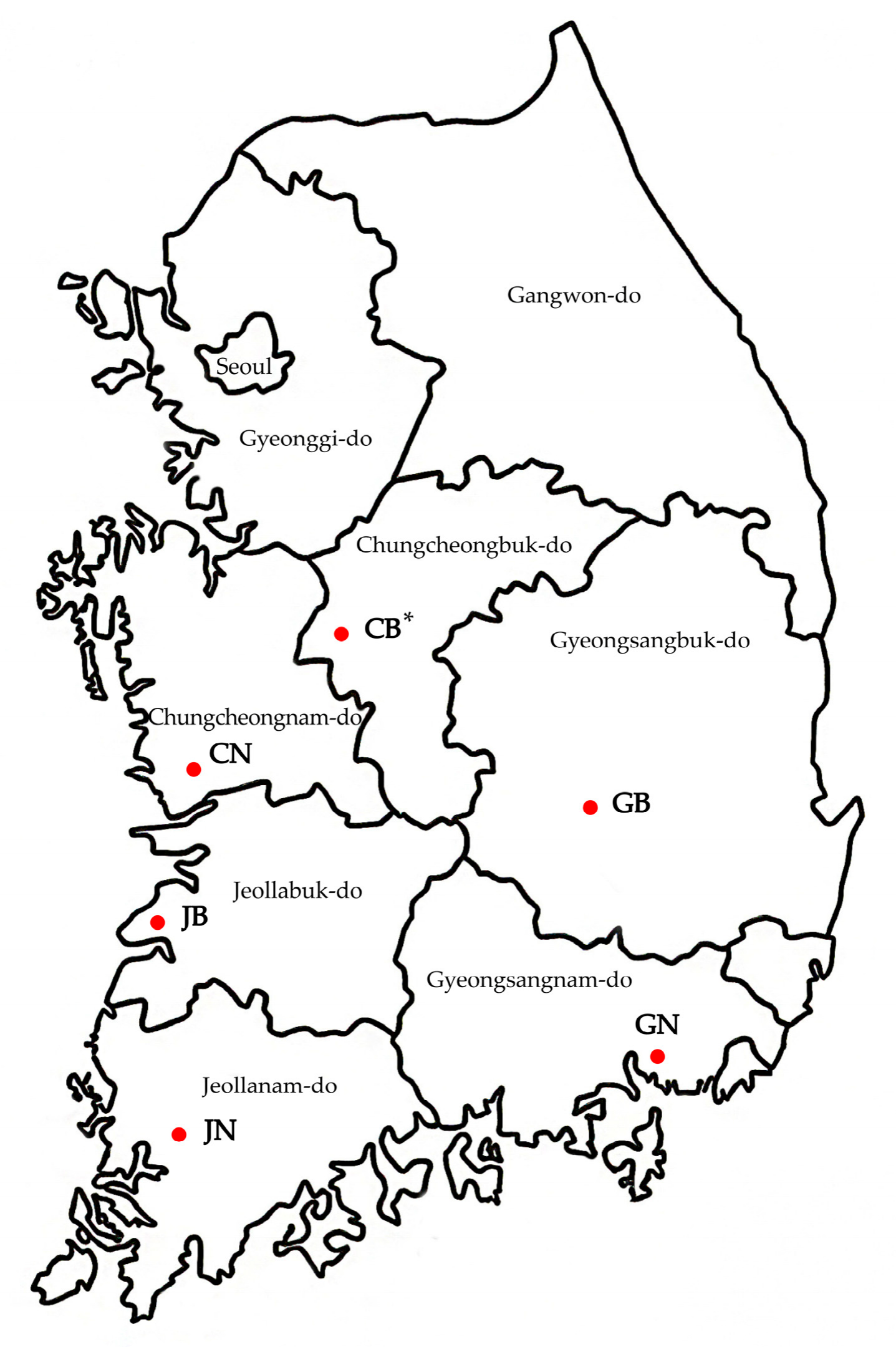
The experiment was conducted in 2025 using the domestically bred wheat cultivar ‘Saekumkang’, noted for its bright noodle-sheet colour and excellent noodle-making quality. This experiment was conducted in six provinces representing the major wheat-producing regions of Korea. In each region, one representative field cultivated with ‘Saekumkang’ was selected as the regional experimental site, and plants were randomly sampled within that field. Therefore, the replication in this study represents plant-level and analytical replication within each regional experimental field, rather than independent field-level replication within each region. The experimental fields were located in Gimhae-si, Gyeongsangnam-do (35°18′09″ N, 128°42′02″ E; GN), Gumi-si, Gyeongsangbuk-do (36°18′09″ N, 128°18′06″ E; GB), Naju-si, Jeollanam-do (35°01′44″ N, 126°37′02″ E; JN), Buan-gun, Jeollabuk-do (35°43′58″ N, 126°47′33″ E; JB), Buyeo-gun, Chungcheongnam-do (36°16′07″ N, 126°51′55″ E; CN) and Cheongju-si, Chungcheongbuk-do (36°40′32″ N, 127°38′50″ E; CB). Their spatial distribution is shown in Figure 1.

2.2. Comparison of Maximum, Minimum, and Mean Air Temperatures at Approximately 20 Days After Anthesis Based on Region

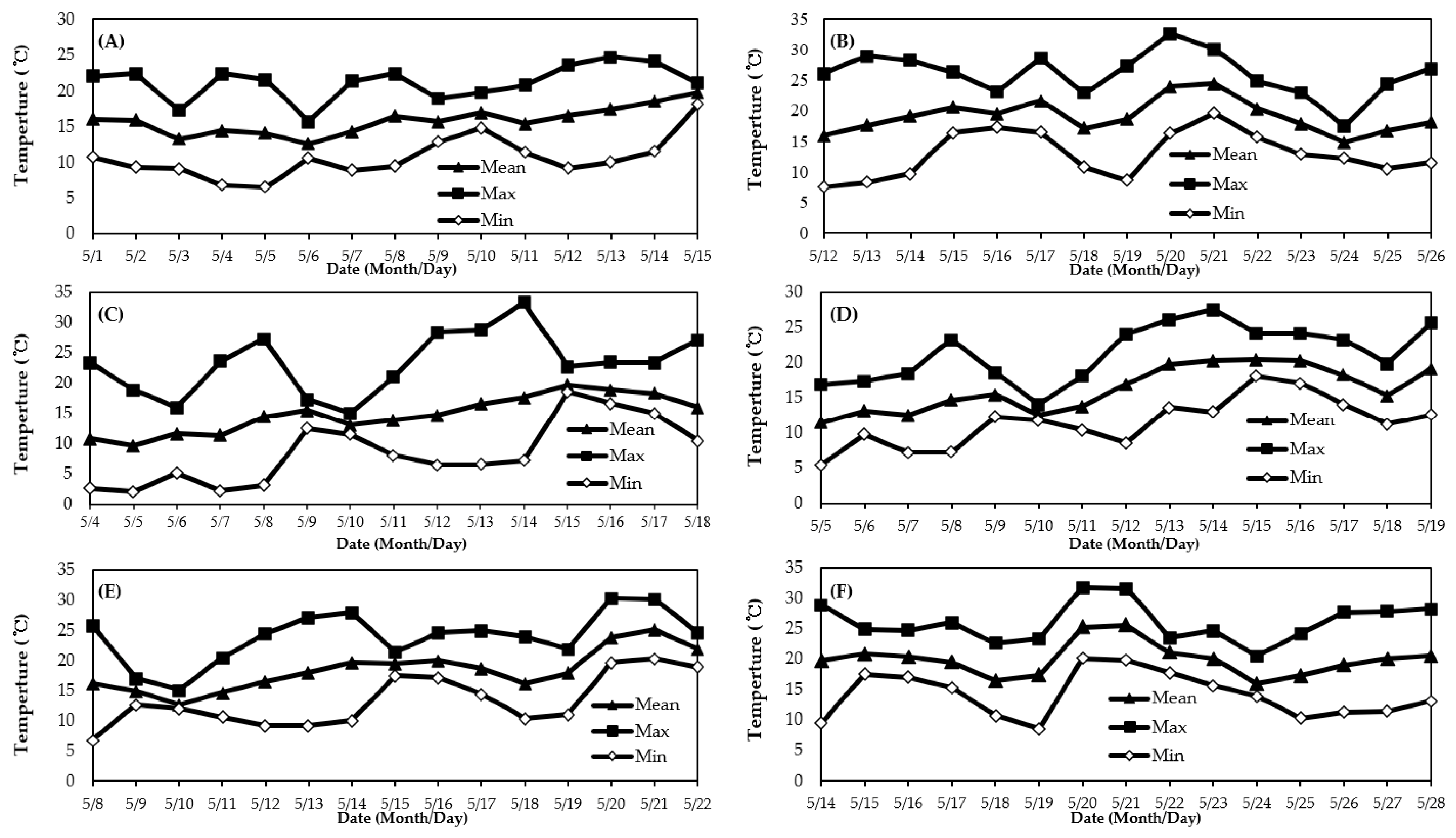
To evaluate regional variation in starch- and protein-related traits in wheat grains in relation to environmental and physiological conditions, approximately 20 days after anthesis was selected as the reference time point. This stage corresponds to the mid-grain-filling period, when starch accumulation and the activities of major enzymes involved in starch synthesis are reported to be high during wheat grain development [29]. Therefore, this time point was considered appropriate for assessing regional environmental conditions and physiological indicators during the grain-filling period. The temperature data for each experimental site were obtained from the Rural Development Administration’s Agricultural Weather Information Service [30] and used for analysis. The analysis was centred on approximately 20 days after wheat anthesis in each experimental field as the reference date (GN: 8 May; GB: 19 May; JN: 11 May; JB: 12 May; CN: 15 May; and CB: 21 May). A 15-day window, spanning 7 days before and after the reference date, was used to calculate the maximum, minimum, and mean temperatures for each region.

2.3. Measurement of Vegetation Indices and Photosynthesis-Related Traits Based on Region

To quantify plant responses to regional cultivation environments, vegetation indices and photosynthesis-related traits were measured at each experimental field. Vegetation indices were measured using a Polypen RP410 (PSI Korea Co., Seoul, Republic of Korea) on 15 randomly selected plants per experimental field. For each plant, measurements were taken from the uppermost leaf using the leaf clip attached to the instrument. The measured vegetation indices included the Normalised Difference Vegetation Index (NDVI), Modified Chlorophyll Absorption in Reflectance Index (MCARI), Gitelson–Merzlyak Index (GM1), Anthocyanin Reflectance Index (ARI1), and Carotenoid Reflectance Index (CRI1). Photosynthesis-related traits were measured on the same 15 plants using a FluorPen FP110 (PSI Korea Co., Seoul, Republic of Korea), with measurements taken from the uppermost leaf of each plant. Before measurement, leaves were dark-adapted for 15 min using the leaf clip of the instrument. Photosynthesis-related traits measured included the maximum quantum efficiency of PS II photochemistry (Fv/Fm), absorption per reaction centre (ABS/RC), trapping per reaction centre (TR0/RC), electron transport per reaction centre (ET0/RC), and dissipation per reaction centre (DI0/RC). Vegetation indices and photosynthesis-related traits were measured at each regional experimental field ~20 days after wheat anthesis, corresponding to the reference date used for weather data analysis. All measurements were conducted between 10:00 a.m. and 12:00 p.m., and the weather conditions during measurement were maintained under clear or slightly cloudy conditions. In addition, to ensure consistency in comparisons among regions, measurements were not performed under rainfall, strong winds, or when dew remained on the leaf surface. Before measurement, the instrument was inspected and calibrated according to the manufacturer’s instructions.

2.4. Evaluation of Agronomic Traits and Image Analysis for Grain Characterisation Based on Region

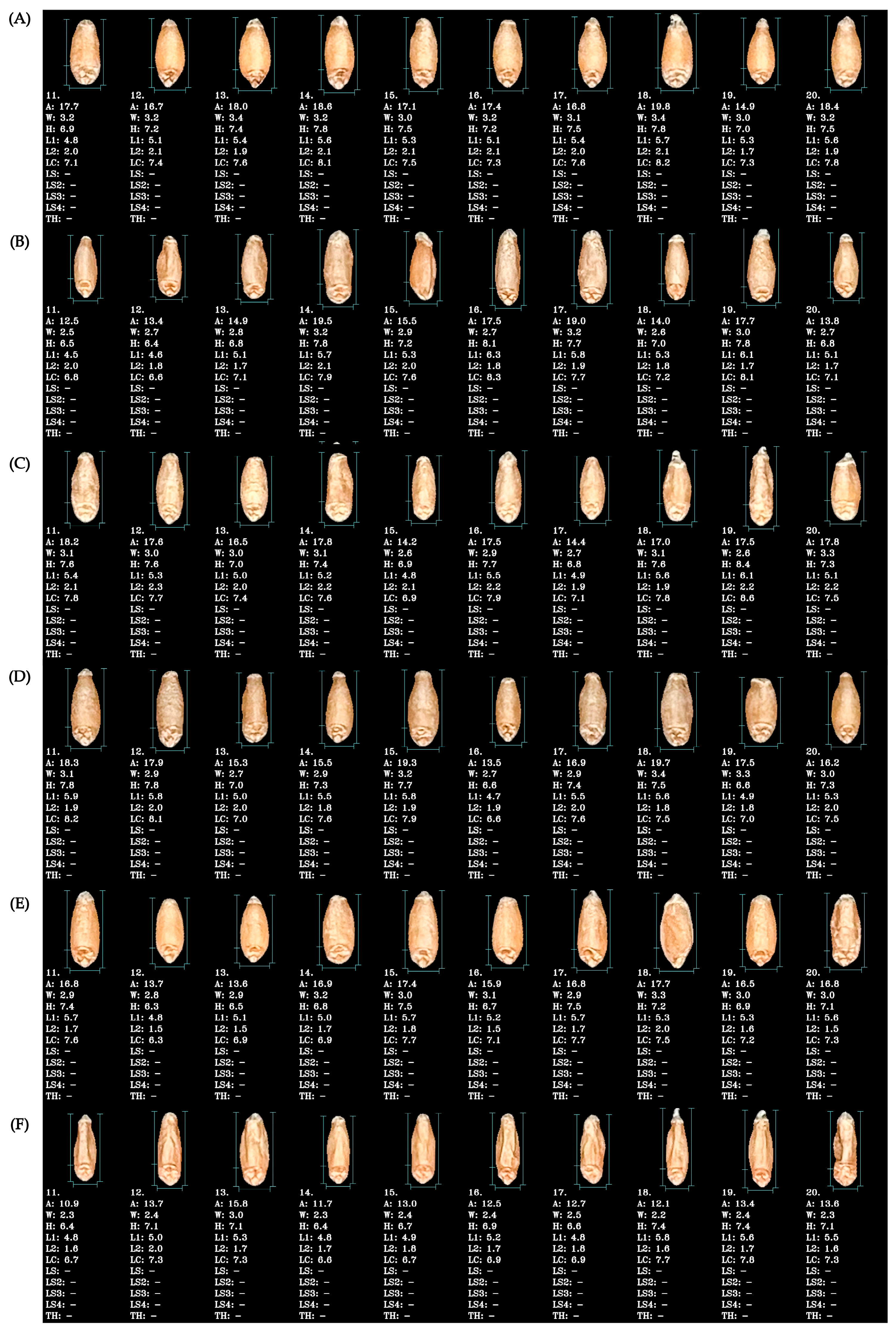
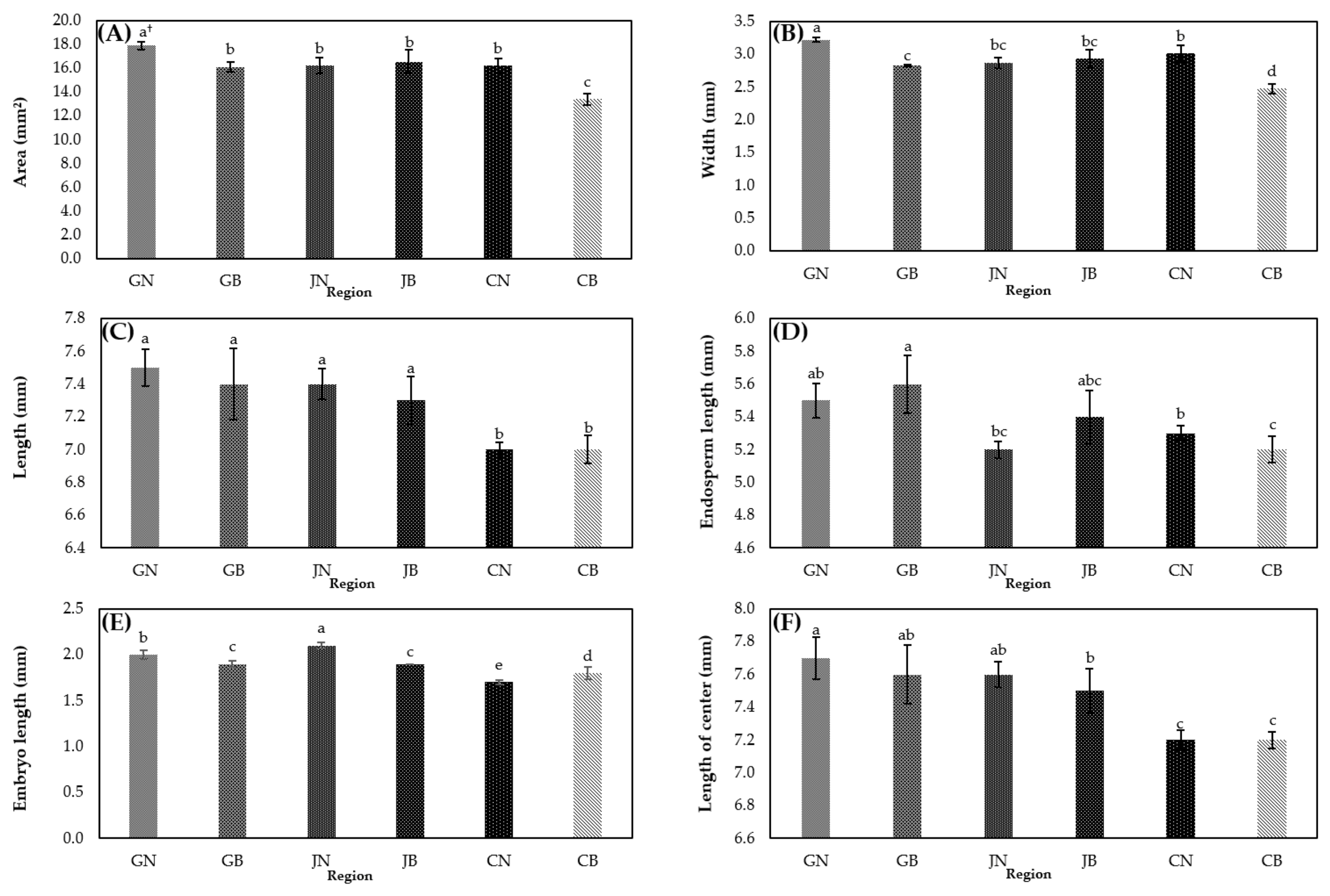
After harvesting the same 15 plants used for the vegetation index and photosynthesis measurements from each regional experimental field, agronomic traits and grain characteristics were evaluated. The evaluated agronomic traits included spike length, spike node number, grains per spike, seed-setting rate, floret number, and hundred-grain weight, following the Standard of Research and Analysis for Agricultural Technology [31]. Wheat grain characteristics in each region were evaluated following the method of [32] using image analysis-based crop-phenotyping software developed by the Korea Institute of Planning and Evaluation for Technology in Food, Agriculture and Forestry (IPET). At each regional experimental field, binary images of individual grains were captured for grain-characteristic assessments. For each field, 30 grains were randomly selected to measure grain area, width, length, embryo length, endosperm length, and centre length (Figure 2).

2.5. Measurement of Total Protein Concentration Based on Region

Whole wheat flour samples were homogenised via sieving through a 0.25 mm mesh before analysis. Total protein was extracted using a Pierce Plant Extraction Kit (Thermo Fisher Scientific, Waltham, MA, USA). Briefly, 100 mg of flour was placed in a filter cartridge, followed by 100 µL of the Native Lysis Buffer supplied with the kit. The mixture was incubated on ice and centrifuged at 16,000× g rpm for 5 min, after which the supernatant was collected as the total protein extract. For protein quantification, 30 µL of the extract was mixed with 1.5 mL of the Pierce™ Bradford Protein Assay reagent (Thermo Fisher Scientific, Waltham, MA, USA); incubated at a temperature of 25 °C for 10 min; and absorbance was measured at 595 nm using a UV–Vis spectrophotometer (UV-1900i, Shimadzu Co., Kyoto, Japan). The total protein concentration was calculated from a standard curve generated using bovine serum albumin as the standard in the Bradford assay with Coomassie Brilliant Blue G-250. All measurements were performed in triplicate (n = 3), and mean values were used for analysis.

2.6. Measurement of Total Starch, Amylose, and Amylopectin Contents Based on Region

Whole wheat flour samples were homogenised using a 0.2 mm sieve. The total starch and amylose contents were determined using an Amylose/Amylopectin kit (K-AMYL, Megazyme, Bray, Ireland) following the instructions of the manufacturer. Dimethyl sulfoxide (DMSO) was added to 25 mg of the sample to ensure complete dispersion, followed by ethanol treatment to remove lipids. The precipitate obtained after centrifugation was used for analysis. The precipitate was subsequently redissolved in DMSO and concanavalin A (Con A) solvent and filtered through filter paper to prepare the analytical solution (Solution A). Total starch was hydrolysed to glucose through the reaction of Solution A with amyloglucosidase + α-amylase, followed by a glucose oxidase/peroxidase (GOPOD) reaction. In addition, for amylose determination, concanavalin A was added to Solution A to precipitate amylopectin, which was removed via centrifugation. Thereafter, the amylose molecules in the resulting supernatant were hydrolysed to glucose through the reaction with amyloglucosidase + α-amylase, followed by the GOPOD reaction. Absorbance was measured at 510 nm using a spectrophotometer (Nabi UV/Vis NANO SPECTROPHOTOMETER, MicroDigital Co., Ltd., Seongnam, Republic of Korea), and contents were calculated from a standard curve prepared using diluted D-Glucose standard solution (1.0 mg/mL). All measurements were performed in quintuplicate (n = 5), and mean values were used for analysis.

2.7. Glutenin Extraction of Wheat Grains

Wheat glutenin extraction was conducted following the protocols of [33,34]. Wheat grains with the embryo removed were milled and homogenised using a 0.2 mm sieve. To remove gliadins, 100 mg of flour was mixed with 400 µL of 70% (v/v) ethanol at 25 °C for 1 h under vortexing and centrifuged at 13,000× g rpm for 15 min; the supernatant was discarded. For glutenin washing, the remaining pellet was mixed with 500 µL of 55% (v/v) isopropanol and incubated in a 65 °C water bath for 30 min, followed by centrifugation at 13,000× g rpm for 10 min and removal of the supernatant. This washing step was repeated three times. After the final wash, to reduce glutenin, the remaining pellet was mixed with 100 µL of an extraction buffer containing 50% (v/v) isopropanol, 80 mM Tris–HCl (pH 8.0), and 1% dithiothreitol, incubated in a 65 °C water bath for 30 min, and centrifuged at 13,000× g rpm for 10 min; the supernatant was discarded.
For alkylation, the pellet was mixed with 100 µL of an extraction buffer containing 50% (v/v) isopropanol, 80 mM Tris–HCl (pH 8.0), and 1.4% (v/v) 4-vinylpyridine, and incubated at 65 °C in a water bath for 30 min. The mixture was then centrifuged at 13,000× g rpm for 10 min, and the supernatant was transferred to a new tube. To concentrate and purify glutenins, cold acetone (−20 °C) was added to the supernatant to a final acetone concentration of 80%, and the mixture was stored at −20 °C overnight. After storage, the sample was centrifuged at 13,000× g rpm for 10 min, and the acetone was completely removed in a fume hood. The pellet was eluted with 200 µL of 20% (v/v) acetonitrile (ACN) containing 0.1% (v/v) trifluoroacetic acid (TFA) to extract glutenins. The extracts were filtered through a 0.2 µm polyvinylidene difluoride syringe filter, and the resulting solution was used for reversed-phase high-performance liquid chromatography (RP-HPLC) analysis.

2.8. Reversed-Phase High-Performance Liquid Chromatography Analysis

RP-HPLC analysis was performed using an HPLC system (Vanquish Core HPLC system, Thermo Fisher Scientific, Waltham, MA, USA) equipped with a BIOBASIC C18 column (5 µm, 250 × 4.6 mm; Thermo Fisher Scientific, Waltham, MA, USA). The column temperature was maintained at 65 °C, and the flow rate was 0.8 mL min−1. The mobile phases consisted of 0.1% (v/v) TFA in water and 0.1% (v/v) TFA in ACN. The gradient elution began with 18% 0.1% (v/v) TFA in ACN, increasing to 22% from 10 to 25 min, 26% from 25 to 40 min, 40% from 40 to 50 min, and 50% from 50 to 60 min. After 60 min, the system was returned to the initial conditions. Before each run, the column was equilibrated at the starting mobile-phase composition for 5 min. Eluted proteins were detected at 210 nm UV absorbance, and the injection volume was 20 µL. To characterise and confirm the HMW-GS composition of the cultivar ‘Saekumkang’ used in this study, its HMW-GS profile was evaluated across cultivars. Wheat grain samples were obtained through distribution from the National Institute of Crop Science, Rural Development Administration, Korea, and the cultivars used were ‘Keumkang’, ‘Saekumkang’, ‘Hwanggeumal’, and ‘Baekgang’. In addition, a quantitative evaluation of HMW-GS in ‘Saekumkang’ grains was conducted using samples from the regional experimental fields. The measured parameters included the peak area of each regional HMW-GS composition, the total HMW-GS peak area, the total LMW-GS peak area, and the ratio of the total HMW-GS to LMW-GS peak areas.

2.9. Principal Component Analysis, Partial Least Squares Discriminant Analysis, and Variable Importance in Projection Score Calculation Between Environmental Factors and Wheat Traits

To elucidate the relationships between regional environmental factors and wheat agronomic, grain-, protein-, and starch-related traits, principal component analysis (PCA) and partial least squares discriminant analysis (PLS-DA) were conducted. Variable importance in projection (VIP) was calculated to identify the major traits contributing to group separation. The analysis included the following variables: Environmental factors comprising the maximum, minimum, and mean temperatures were measured over a 15-day period spanning 7 days before and after the reference date—corresponding to ~20 days after anthesis at each regional experimental field. Vegetation indices (NDVI, MCARI, GM1, ARI1, and CRI1) and photosynthesis-related traits (Fv/Fm, ABS/RC, TR0/RC, ET0/RC, and DI0/RC) were also measured on the reference date. Wheat trait variables included agronomic traits (spike length, spike node number, grain number per spike, seed-setting rate, floret number, and hundred-grain weight), grain traits (grain area, width, length, embryo length, endosperm length, and centre length), protein-related traits (total protein concentration, peak area of each HMW-GS composition, total HMW-GS peak area, total LMW-GS peak area, and the ratio of HMW-GS to LMW-GS peak areas), and starch-related traits (total starch, amylose, and amylopectin contents).

2.10. Statistical Analysis

Regional differences in vegetation indices and photosynthesis-related traits, agronomic traits, grain characteristics, and protein- and starch-related traits were evaluated using analysis of variance (ANOVA) in R (version 4.2.3). Prior to ANOVA, homogeneity of variance was assessed using Levene’s test, and normality was examined based on the residuals of the ANOVA model. When ANOVA indicated significant differences, mean comparisons were conducted using Duncan’s multiple range test at p < 0.05 with the ‘agricolae’ package. Each trait was analysed independently, and the observations obtained for each trait within each region were used as replicates for statistical analysis. Because one representative field was selected in each region, independent field-level replication within regions was not available. Therefore, a mixed model including field or site effects as random effects could not be appropriately applied in this study. Accordingly, regional differences were evaluated using ANOVA based on the plant-level observations or analytical replications obtained for each trait within each regional experimental field. The resulting statistical comparisons were interpreted as differences among the sampled regional experimental fields under the 2025 field conditions, rather than as effects generalised across independently replicated fields within each region. PCA was conducted using Analyse-it® for Microsoft® Excel, version 6.15.4 (build 8349.32216) and the results were visualised using the correlation monoplot function of the biplot/monoplot module.
PLS-DA was conducted in Python (version 3.12) using the pandas, NumPy, SciPy, and matplotlib libraries, and missing values were handled by listwise deletion. Prior to analysis, a log1p transformation was applied to the predictor variables to reduce skewness and stabilise variance, followed by z-score standardisation through mean-centring techniques and unit-variance scaling. No additional normalisation was performed, and no outliers were removed. In PLS-based analyses, a VIP value of 1.0 or higher is typically used as a criterion for identifying variables with above-average explanatory importance; in the present study, variables with VIP scores ≥ 1.0 were major contributors to group separation [35,36].

3. Results

3.1. Comparison of Maximum, Minimum, and Mean Air Temperatures at Approximately 20 Days After Anthesis Based on Region

The maximum, minimum, and mean temperatures ~20 days after anthesis in wheat varied significantly among regions (Figure 3). In the GB and CB regions, mean temperatures ranged from 16.0–25.6 °C to 16.5–25.6 °C, respectively. Days with maximum temperatures > 30 °C indicated relatively high-temperature conditions. In contrast, the GN and JN regions had mean temperatures of 12.6–19.8 °C and 9.7–19.8 °C, respectively, while minimum temperatures dropped to 2.1–6.6 °C, suggesting relatively mild- or low-temperature conditions. The JB and CN regions had intermediate temperature conditions between the high- and low-temperature regions, with mean values of 11.5–20.4 °C and 12.6–25.2 °C, respectively. Thus, grain-filling temperatures varied regionally, providing a key environmental background for interpreting differences in wheat agronomic traits, grain characteristics, and starch- and protein-related traits.

3.2. Comparison of Vegetation Indices and Photosynthesis-Related Traits Approximately 20 Days After Anthesis, Based on Region

Vegetation indices assessed ~20 days after anthesis in wheat exhibited distinct regional patterns that varied with the index type (Table 1). MCARI was highest in the CN region, whereas GM1 was relatively high in the GB region. ARI1 and CRI1 were relatively high in the JB and CN regions, respectively, whereas NDVI showed no significant regional differences. Apart from NDVI, all vegetation indices varied significantly among regions.
Photosynthesis-related traits also exhibited distinct regional patterns (Table 2). Fv/Fm—representing the maximum quantum efficiency of PS II—was highest in the JN region but relatively low in the CB region. ABS/RC, TR0/RC, ET0/RC, and DI0/RC were generally higher in the CB region and lower in the CN region. These regional differences in vegetation indices and photosynthesis-related traits indicate that plant physiological responses to grain-filling environmental conditions differ between regions (Table 1 and Table 2).

3.3. Evaluation of Agronomic Traits and Grain Characteristics of Wheat Based on Region

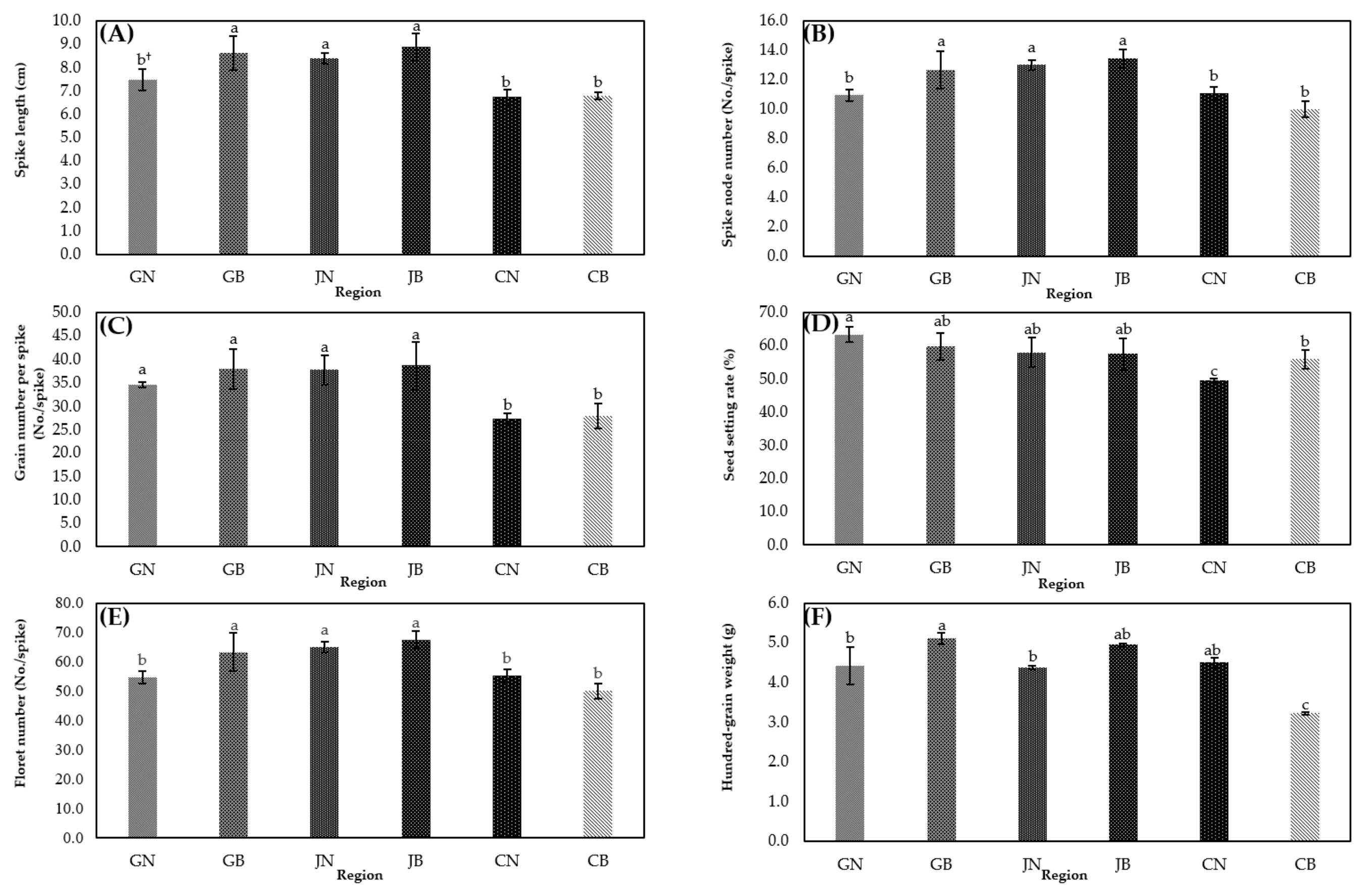
Regional assessment of wheat agronomic traits revealed significant differences between regions for key agronomic traits and yield components (Figure 4). Spike length was highest in the JB region (8.90 ± 0.58 cm) and lowest in the CN region (6.74 ± 0.32 cm). The spike node number was also highest in the JB region (13.47 ± 0.61) and lowest in the CB region (10.00 ± 0.53), indicating regional variations in the agronomic scale. The grain number per spike was highest in the JB region (38.73 ± 5.02) and lowest in the CN region (27.40 ± 1.04), indicating that yield components also varied regionally (Figure 4).
Regional assessment of grain traits revealed clear differences in indices of grain shape and size (Figure 5). Grain area was highest in the GN region (17.92 ± 0.33 mm2) and lowest in the CB region (13.41 ± 0.49 mm2), while grain width also differed significantly between the GN (3.22 ± 0.04 mm) and CB regions (2.48 ± 0.07 mm). Grain length was greatest in the GN region (7.49 ± 0.11 mm) and relatively shorter in the CN region (6.95 ± 0.05 mm). Endosperm and embryo lengths also varied among regions, indicating that internal grain morphology differed between regions (Figure 5).

3.4. Evaluation of Total Protein and Components of Total Starch, Amylose, and Amylopectin in Wheat Grain Based on Region

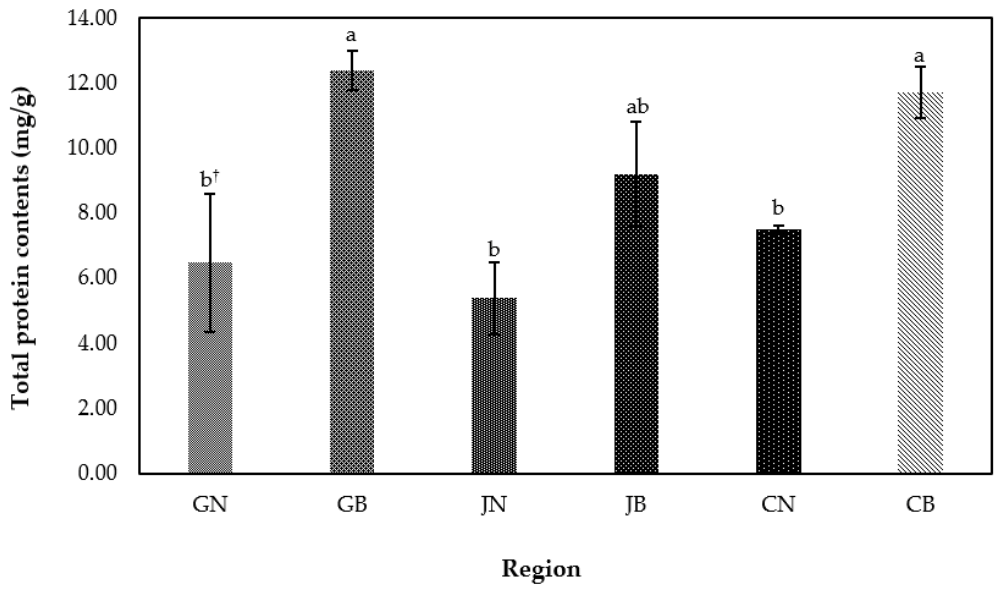
The total protein concentration in wheat varied significantly among regions (Figure 6). It reached its maximum value in the GB region (12.39 ± 3.70 mg/g) and minimum value in the JN region (5.40 ± 1.93 mg/g). Relatively high protein concentrations were also observed in the CB and GB regions, whereas the CN, GN, and JN regions exhibited lower concentrations.
Total starch content and its components in wheat also varied significantly among regions (Table 3). Total starch was highest in the GN region (45.09 ± 0.33%) and lowest in the CB region (36.48 ± 0.22%). Amylose content was also highest in the GN region (21.51 ± 0.38%) and lowest in the CB region (11.60 ± 0.76%). In contrast, amylopectin content was highest in the CB region (88.40 ± 0.76%) and relatively lower in the GN region (78 ± 0.38%).

3.5. Cultivar-Specific Analysis of Peak Characteristics of High-Molecular-Weight Glutenin Subunits in Wheat Using Reversed-Phase High-Performance Liquid Chromatography

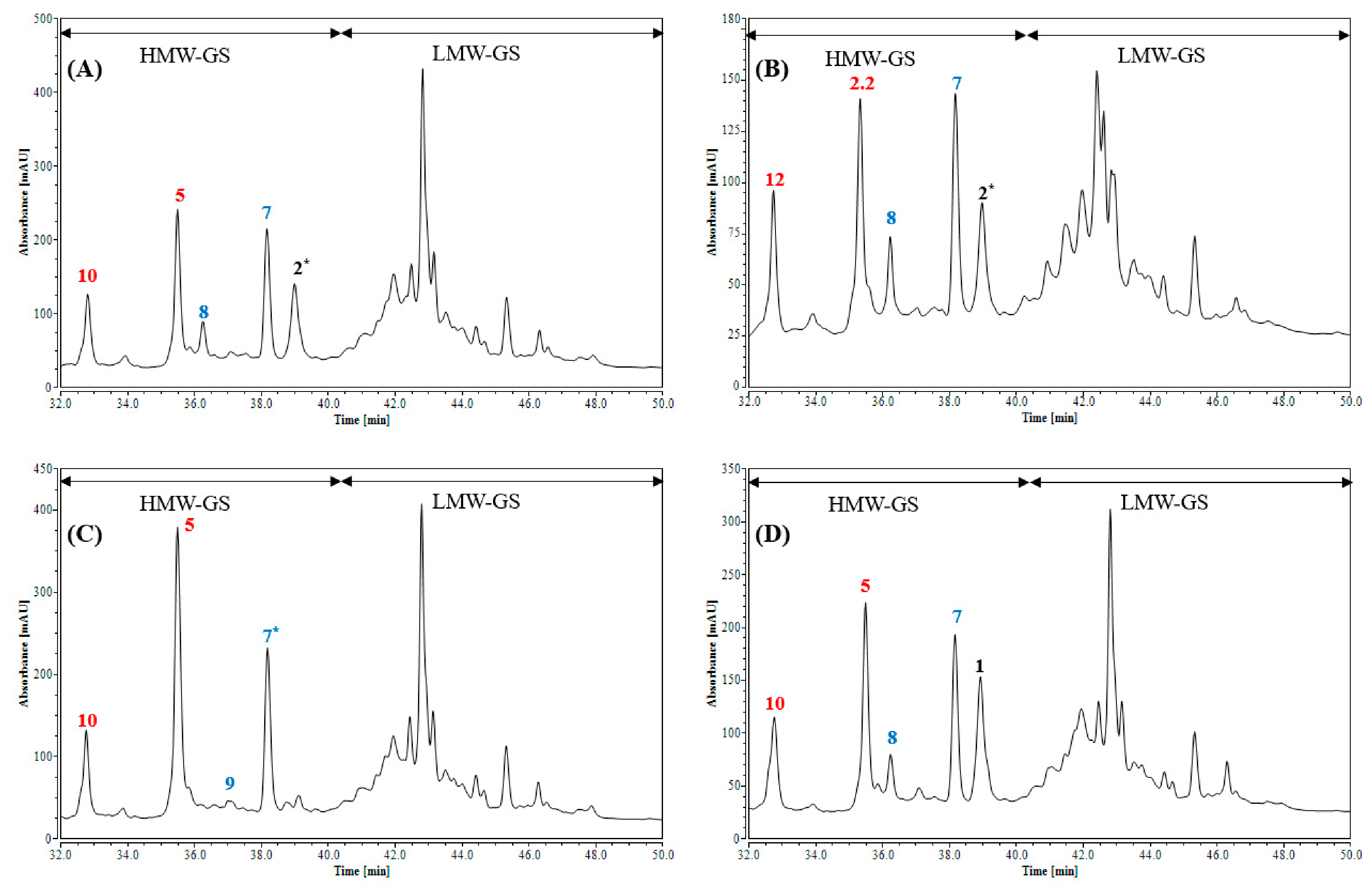
RP-HPLC analysis of HMW-GS in each wheat cultivar is shown in Figure 7. The detected HMW-GS subunits were identified based on retention times under the specified mobile phase conditions, following the method in [37]. Consequently, HMW-GS compositions at the Glu-A1, Glu-B1, and Glu-D1 loci varied among cultivars.
In the cultivars ‘Keumkang’ and ‘Hwanggeumal’, the Glu-D1 locus carried the 5 + 10 subunit combination, whereas ‘Saekumkang’ exhibited the 2.2 + 12 combination. At the Glu-B1 locus, the 7 + 8 combination was commonly detected in ‘Keumkang’, ‘Saekumkang’, and ‘Baekkang’, whereas ‘Hwanggeumal’ contained 7* + 9. At the Glu-A1 locus, 2* was present in ‘Keumkang’ and ‘Saekumkang’, whereas ‘Baekkang’ carried 1. These findings indicate that RP-HPLC clearly distinguishes the HMW-GS compositions of the cultivars and confirms the HMW-GS profile of ‘Saekumkang’ (Figure 7).

3.6. Quantitative Evaluation of Glutenin in Wheat Grains Based on Region

The peak areas of the regional wheat HMW-GS compositions at the Glu-A1, Glu-B1, and Glu-D1 loci varied among regions, exhibiting distinct distribution patterns and significant regional differences (Table 4). For example, at the Glu-D1 locus, the peak areas of the 12 and 2.2 subunits were highest in the JB region (29.07 ± 0.86 and 60.66 ± 0.76 mAU·min, respectively) and lowest in the GN region (15.19 ± 0.16 and 34.99 ± 0.33 mAU·min, respectively).
The total HMW-GS peak area also varied regionally, reaching its maximum in the JB region (216.09 ± 0.23 mAU·min) and minimum in the GN region (107.37 ± 0.51 mAU·min). Similarly, the total LMW-GS peak area was highest in the JB region (460.14 ± 2.53 mAU·min) and lowest in the GN region (239.22 ± 0.89 mAU·min). Accordingly, the ratio of total HMW-GS to LMW-GS peak area was highest in the GB region (0.620 ± 0.003) and lowest in the GN region (0.449 ± 0.003), indicating that the relative quantitative distribution of glutenin varied among regions even within the same cultivar (Table 4).

3.7. Principal Component Analysis Between Environmental Factors and Wheat Traits Based on Region

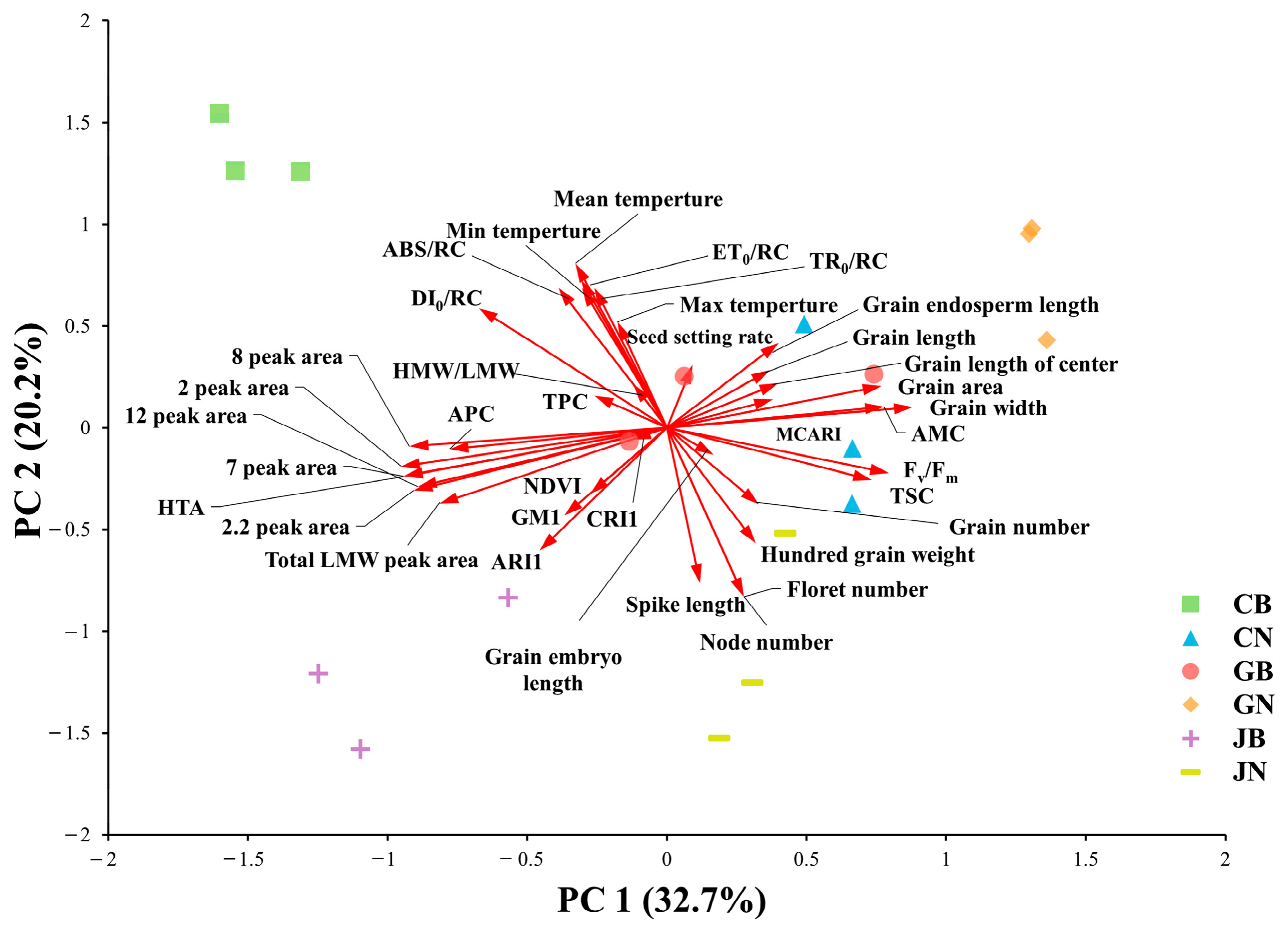
The results of the PCA of regional environmental factors and wheat traits are shown in Figure 8. PC1 and PC2 accounted for 32.7% and 20.2% of the total variation, respectively, and together explained 52.9% of the total variation. PC1 was primarily associated with grain size, grain starch composition, protein composition, and selected physiological indicators. Total starch and amylose contents, selected grain size traits (grain area, width, and centre length), MCARI, and Fv/Fm were loaded in the same direction; by contrast, the total protein concentration and the peak areas of individual and total HMW-GS, as well as amylopectin content, were aligned in the opposite direction. These findings suggest that the contrast between grain size, starch components, selected physiological indicators, and protein composition constituted the primary axis of variation.
PC2 was associated with temperature, energy flux parameters per reaction centre, and agronomic- and yield-related traits. Maximum, minimum, and mean temperatures, along with ABS/RC, TR0/RC, and ET0/RC, contributed positively to PC2; by contrast, spike length, spike node number, floret number, and hundred-grain weight were loaded in the opposite direction.
In PCA space, regional patterns showed that the CB region was positioned in the negative direction of PC1 and the positive direction of PC2, aligning with temperature conditions during the grain-filling period, energy flux parameters per reaction centre among photosynthetic traits, total protein concentration, and the ratio of HMW-GS to LMW-GS. The CN region was positioned in the positive direction of PC1, aligning with grain shape traits, Fv/Fm, MCARI, starch composition traits (total starch and amylose content), and yield components (grain number per spike and hundred-grain weight). The GN region was positioned in the positive directions of PC1 and PC2, aligning with grain shape traits excluding embryo length, amylose content, and MCARI. The JB region was positioned in the negative directions of PC1 and PC2, consistent with selected vegetation indices (NDVI, GM1, ARI1, and CRI1), amylopectin content, and glutenin-related traits. The JN region was positioned in the positive direction of PC1 and the negative direction of PC2, aligning with agronomic traits (spike length, spike node number, and floret number) and yield components (hundred-grain weight and grain number per spike). In contrast, the GB region was broadly distributed across the PCA space, without a clear bias towards any specific variable direction (Figure 8).

3.8. Major Environmental Factors and Wheat Trait Characteristics Contributing to Regional Discrimination (Partial Least Squares Discriminant Analysis)

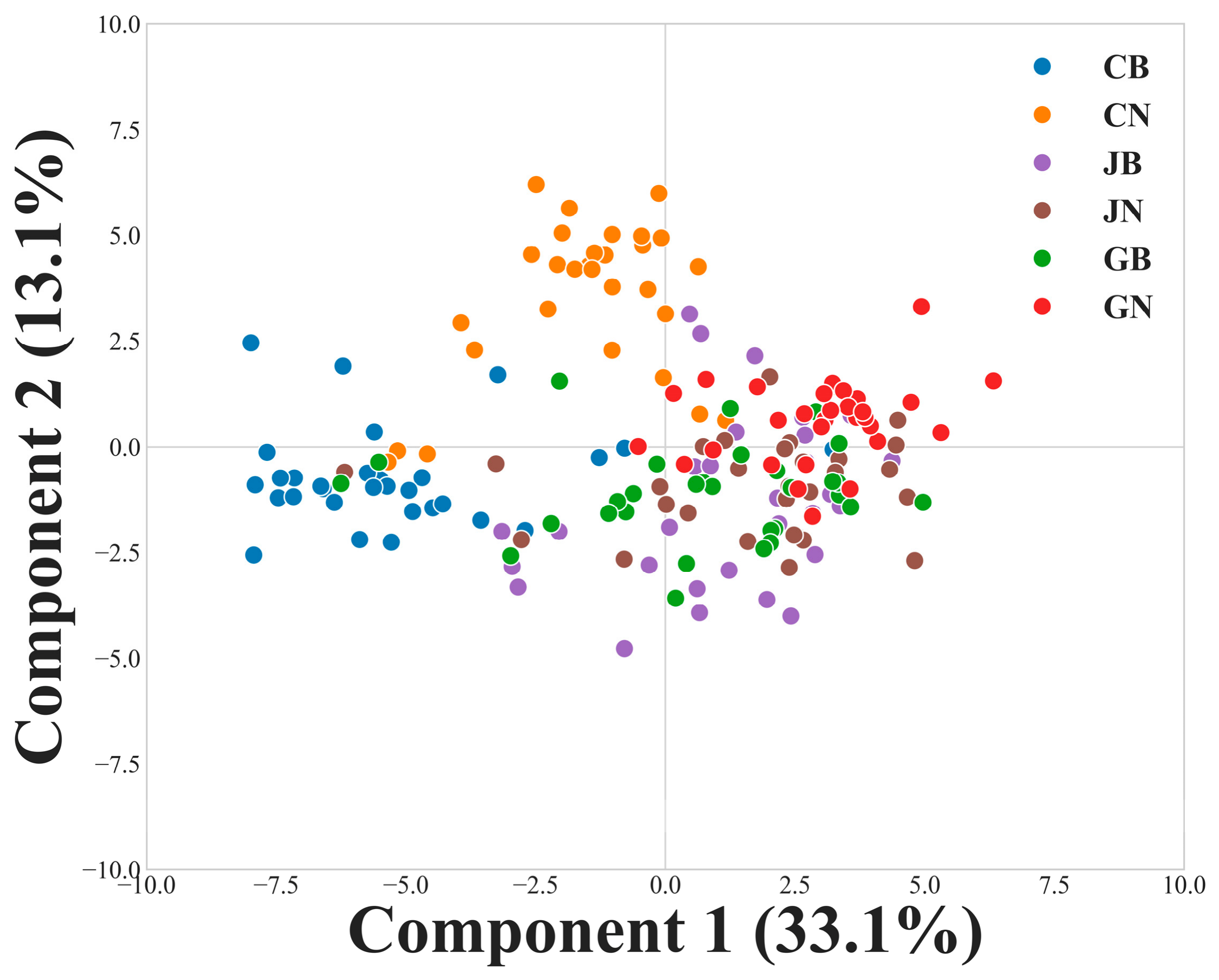
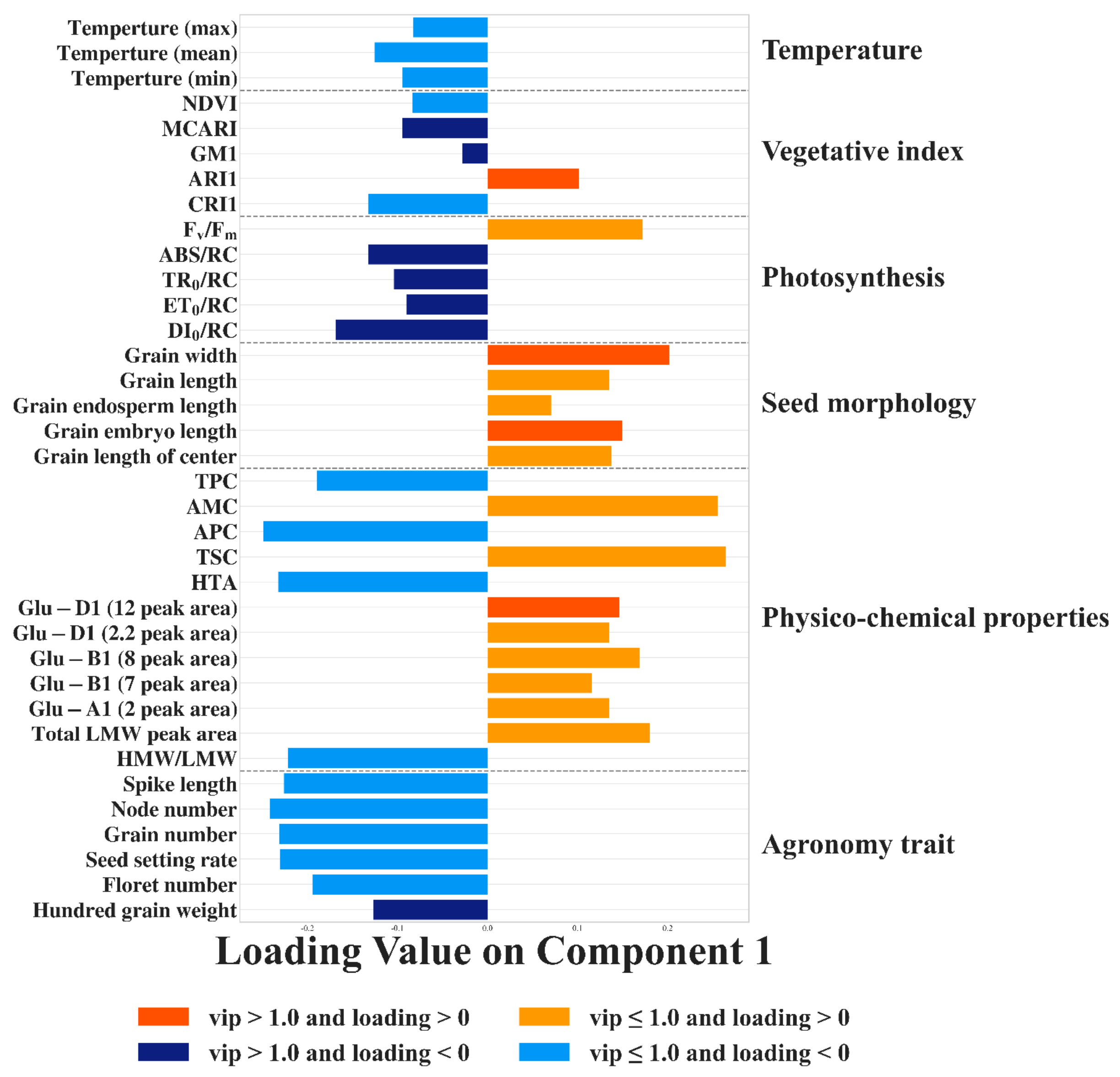
Figure 9, Figure 10 and Figure 11 present the results of the regional PLS-DA and VIP analyses. Regional separation was most pronounced along Component 1 (33.1%), with the CB region most distinctly separated in the negative direction. The GN region showed the strongest bias towards the positive direction compared with the other regions (Figure 9). Loading values for Component 1 showed that temperature variables (mean, maximum, and minimum); MCARI; energy flux parameters per reaction centre (ABS/RC, TR0/RC, ET0/RC and DI0/RC); total protein concentration; amylopectin content; the total peak area of HMW-GS; the ratio of HMW-GS to LMW-GS total peak area; agronomic traits (spike length and spike node number); and yield traits (grain number per spike, seed-setting rate, floret number and hundred-grain weight) contributed to the negative direction. Conversely, ARI1; Fv/Fm; selected grain morphological traits (grain width, length, embryo length, endosperm length, and centre length); selected starch-related traits (total starch and amylose content); the peak areas of individual HMW-GS compositions; and the total peak area of LMW-GS contributed to the positive direction (Figure 10).
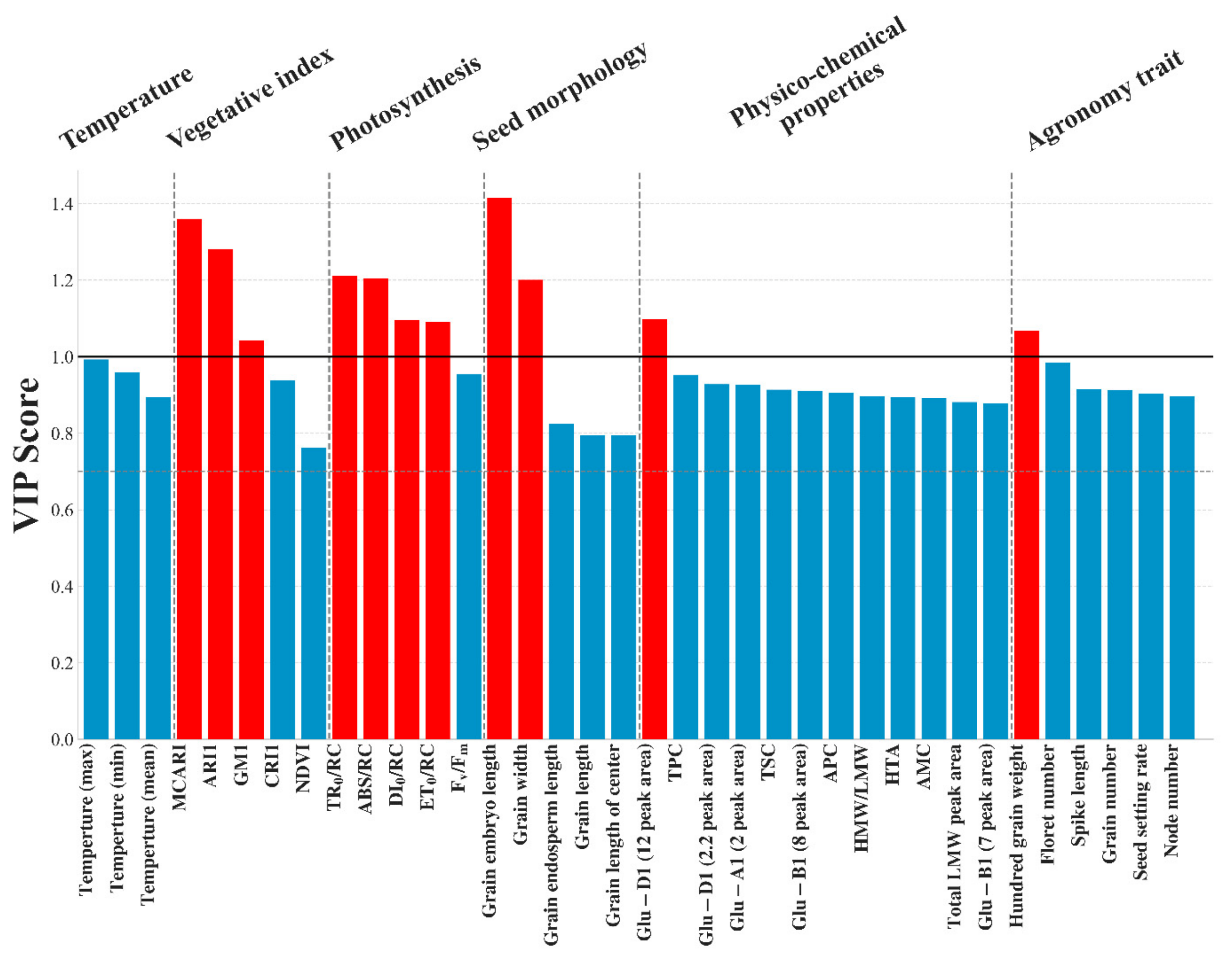
The VIP analysis revealed that MCARI, ARI1, GM1, ABS/RC, TR0/RC, ET0/RC, DI0/RC, grain embryo length, grain width, the peak area of the 12 subunit at the Glu-D1 locus, and hundred-grain weight had VIP values > 1.0, highlighting their significant contributions to regional discrimination (Figure 11).

4. Discussion

This study examines how temperature conditions at ~20 days after anthesis, vegetation- and photosynthesis-related traits, grain traits, and protein and starch characteristics covary at the regional scale in relation to differences in environmental characteristics during the grain-filling period. An integrated analysis was performed across major wheat-growing regions in Korea using a single cultivar, ‘Saekumkang’. However, as this study was based on data from a single growing season, it could not be clearly distinguished whether the observed regional differences were associated with temporary weather conditions in that year or with environmental characteristics inherent to each region. Therefore, in the present discussion, rather than drawing definitive conclusions about the causal- or stress-related effects of specific factors, the observed regional differences are interpreted with a focus on whether they showed directional consistency with physiological and biochemical responses reported in previous studies. Concurrently, for factors and stress conditions underlying the observed regional differences that showed strong agreement with physiological and biochemical responses and stress indicators reported in previous studies, and for which supporting evidence was robust, interpretations are provided based on the relevant literature. In addition, this study was conducted using one representative experimental field per region. Therefore, although the same cultivar, ‘Saekumkang’, was evaluated across major wheat-growing regions in Korea, independent field-level replications within each region were not included. Accordingly, differences in physiological indicators and wheat-related traits among regions were interpreted by focusing on the associations between regional physiological indicators and variation in wheat-related traits, rather than as the independent effects of specific environmental factors.

4.1. Interpretation of Regional Temperature Patterns During the Grain-Filling Period

One study reported that the optimum temperature range during the anthesis and grain-filling periods is 12–22 °C [38]. Wheat is a temperature-sensitive crop, and exposure to temperatures exceeding this optimum range affects its physiological and biochemical responses, as well as agronomic- and quality-related traits [39]. In addition, a daily maximum temperature > 30 °C during the grain-filling period is an indicator of heat stress [40]. In the present study, comparison of regional temperature distributions ~20 days after anthesis revealed that mean temperatures in the GB and CB regions exceeded 22 °C on some days during this period, and that days with maximum temperatures > 30 °C also occurred (Figure 3). The temperature patterns in these regions are considered to exceed the optimum temperature range reported in previous studies and be consistent with heat stress indicators. Therefore, in this study, variations in vegetation- and photosynthesis-related characteristics, as well as wheat traits, were compared based on regional temperature characteristics during the grain-filling period. The associated physiological and biochemical responses to heat stress, together with patterns of variation in wheat traits, were also examined.

4.2. Interpretation of Regional Variation in Vegetation Traits

Vegetation indices measured ~20 days after anthesis exhibited different patterns of variation among regions (Table 1). NDVI is an indicator of leaf area and aboveground biomass in plants [41,42], and the lack of significant regional differences in NDVI at the time point measured indicates that canopy cover and biomass are within a similar range among regions. By contrast, MCARI, GM1, ARI1, and CRI1 showed significant regional differences. MCARI and GM1 are indicators of leaf chlorophyll content and nitrogen status [43,44], whereas ARI1 and CRI1 are pigment-related indices that indirectly reflect the progression of leaf senescence, photoprotective responses, and physiological status under varying environmental conditions [45,46,47]. In this study, plant responses associated with pigment composition varied among regions, suggesting that physiological status of leaves during the grain-filling stage may be shaped differently depending on environmental conditions among cultivation regions. However, some regions exhibited inconsistent response patterns among vegetation indices. For example, GM1 values were relatively higher in the GB region than in other regions, whereas MCARI values were lower. This pattern reflects the fact that, although both indices are associated with leaf chlorophyll content and nitrogen status, GM1 more directly represents leaf chlorophyll content; by contrast, MCARI captures chlorophyll absorption characteristics and the influence of non-photosynthetic components [48,49]. Furthermore, because vegetation indices differ in the physiological characteristics they reflect and their sensitivity, regional response patterns are likely to differ accordingly. Therefore, given that this experiment was conducted in a single year, regional chlorophyll content and physiological status could not be interpreted definitively based solely on comparisons of vegetation index values among regions; however, other environmental factors and variations in wheat traits were examined together. As such, the associations between regional vegetation indices and related traits were interpreted comprehensively.

4.3. Interpretation of Regional Variation in Photosynthetic Traits

Photosynthetic traits also showed distinct patterns of variation among regions (Table 2). Heat stress is a major factor causing reductions in Fv/Fm as it impairs the photoprotective mechanisms of PS II and thereby decreases photochemical efficiency [50,51,52]. In addition, heat stress inactivates some PS II reaction centres, thereby decreasing the number of active centres, and the resulting increase in ABS/RC reflects a relative increase in absorbed energy per reaction centre due to the reduction in active reaction centres, rather than an increase in antenna size [53]. Concurrently, heat stress damages thylakoid membrane components, thereby impairing PS II activity and electron transport efficiency. As a result, excess energy is dissipated as heat and, consequently, this causes an increase in DI0/RC [54]. In the present study, the CB region exhibited relatively low Fv/Fm, whereas ABS/RC and DI0/RC were relatively high (Table 2). This suggests that under high temperatures during the grain-filling period in the CB region, PS II efficiency is reduced and heat dissipation is enhanced. The regional differences in photosynthetic traits suggest that the energy distribution within PS II may vary with changes in environmental conditions.
Heat stress increases the generation of reactive oxygen species and induces heat dissipation-based photoprotective mechanisms and carotenoid-related responses to alleviate this stress [55]. CRI1 is an index reflecting carotenoid-related responses in plants [46]. Therefore, the relatively high CRI1 value observed in the CB region in this study reflects increased photoprotective and carotenoid-related responses resulting from heat stress during the grain-filling period. Considering the temperature during the grain-filling period together with variations in photosynthetic traits in the CB region, these results suggest that leaf physiological responses to heat stress during this period were relatively pronounced in this region (Table 1 and Table 2).

4.4. Variation in Agronomic Traits and Grain Characteristics According to Differences in Environmental and Physiological Indicators Among Regions

Regional differences in environmental and physiological indicators observed in this study were also reflected in wheat agronomic traits and grain characteristics (Figure 4 and Figure 5). Previous studies consistently report that major agronomic traits, such as spike length, grain number per spike, and hundred-grain weight, vary with environmental conditions across cultivation regions [56,57]. Similar regional patterns were observed for some of these traits in the present study (Figure 4). Heat stress during the grain-filling period reduces grain weight and grain number per spike by decreasing the fertility of florets through reduced pollen viability and abnormalities in pollen, stigma, and style [58,59]. Therefore, the lower grain number per spike and hundred-grain weight observed in the CB region, compared with values in other regions, reflect reductions in yield components caused by high temperatures during the grain-filling period (Figure 4C,F). The relatively low floret number observed in the CB region also results from reduced floret fertility caused by heat stress (Figure 4E). These findings suggest that heat stress during the grain-filling period in the CB region is a significant cause of variation in wheat agronomic traits.
Grain characteristics, such as grain area, length, and width, also vary with the cultivation environment [60,61]. Therefore, the regional differences in grain characteristics observed in this study may reflect differences in grain development patterns associated with environmental variation during the grain-filling period (Figure 5). High temperatures during the grain-filling period in particular restrict endosperm development by inhibiting cell proliferation and expansion, thereby limiting endosperm size [16,62,63,64]. Therefore, the relatively low endosperm length observed in the CB region in this study reflects reduced endosperm size resulting from suppressed endosperm development under high temperatures during the grain-filling period (Figure 5D). These findings suggest that heat stress during the grain-filling period in this region also caused variations in grain-related traits. Conversely, the GN region generally exhibited higher grain-related traits than those of the other regions (Figure 5D). However, as this pattern could not be adequately explained based solely on temperature conditions during the grain-filling period, as well as vegetation- and photosynthesis-related traits, it was interpreted in conjunction with data on starch- and protein-related traits.

4.5. Interpretation of Variations in Total Protein Concentration and Starch Composition According to Regional Differences in Environmental Conditions During the Grain-Filling Period

The total grain protein concentration, as well as contents of starch, amylose, and amylopectin, differed significantly among cultivation regions (Table 3; Figure 6). Given that protein accumulates in the grain via leaf nitrogen assimilation and remobilisation during the grain-filling period, grain protein concentration is closely associated with leaf chlorophyll content and nitrogen status [65,66,67,68]. In this study, the GB region, which showed a relatively high GM1 value, reflecting the chlorophyll content and nitrogen status of plants, exhibited the highest grain protein concentration among the regions (Table 1; Figure 6). This suggests that chlorophyll-related vegetation indices and grain protein concentration may show similar variation patterns.
Additionally, grain starch content is closely associated with environmental factors across cultivation regions, and starch, amylose, and amylopectin contents vary significantly due to these factors [17,57,69]. As a result, total starch, amylose, and amylopectin contents differed significantly across regions in this study (Table 3).
Under high temperature during the grain-filling period, starch accumulation is restricted as the expression and activity of soluble starch synthase is inhibited, which is a key enzyme in starch biosynthesis [15]. Studies report that assimilation and allocation of energy to general metabolism decrease, whereas the allocation of energy to stress-defence-related metabolism, including thermoprotection and storage reserve accumulation, increases. This results in an increase in storage protein accumulation as well as a corresponding increase in the proportion of grain protein [16,70]. In this study, total grain protein concentration and starch component contents observed in the CB region showed trends consistent with previous findings (Table 3; Figure 6).
In particular, starch accumulation during the grain-filling period is crucial to grain development [71,72], and starch content is positively associated with grain size traits [73]. Temperature during the grain-filling period influences starch accumulation [16]. Therefore, in this study, when considering the starch content, grain traits, and temperature during the grain-filling period in the GN region, it was found that the temperature remained within the optimum range for wheat, allowing continuous starch accumulation. This resulted in a relatively larger grain size compared to other regions (Table 3; Figure 2 and Figure 5).
In this experiment, regional variation in starch content was observed by measuring starch content among regions using the GOPOD reaction; however, processing suitability related to starch properties or final product quality was not directly evaluated. Therefore, the starch content and starch composition results should not be interpreted as direct evidence of processing quality, but rather as regional variation in grain quality-related components that may be associated with processing quality. These starch-related results can provide baseline information indicating that starch accumulation and compositional characteristics within the same cultivar may vary depending on regional environmental conditions during the grain-filling period.

4.6. Interpretation of Regional Variation in Glutenin Content in Relation to Environmental Conditions During the Grain-Filling Period

While HMW-GS composition is a cultivar-specific genetic characteristic, the contents and ratio of HMW-GS to LMW-GS vary with environmental conditions [74,75,76]. In this study, the HMW-GS composition of the cultivar ‘Saekumkang’ was consistent with previous findings [77,78]; however, regional differences were observed in the contents of HMW-GS and LMW-GS as well as their ratio (Table 4).
In some regions, the glutenin content and compositional ratio varied in relation to environmental conditions during the grain-filling period (Table 4). Previous studies report that, as temperature rises during the grain-filling period, the relative proportion of HMW-GS remains stable or increases; however, the proportion of certain LMW-GSs tends to decrease [79,80]. Similarly, in the present study, the GB region, which exhibited a relatively high temperature during the grain-filling period, exhibited the highest HMW-GS/LMW-GS ratio (Table 4; Figure 3). PCA results also showed that the temperature during the grain-filling period and the HMW-GS/LMW-GS ratio aligned in the same direction, indicating a positive correlation between the two traits (Figure 8). These findings indicate that the relatively high HMW-GS to LMW-GS ratio in the GB region reflects the influence of high temperature during the grain-filling period. These findings also suggest that, even within the same cultivar, relative accumulation patterns among glutenin protein fractions may vary with environmental differences during the grain-filling period.
In contrast, the quantified HMW-GS peak values did not show a consistent increase or decrease among regions (Table 4). This finding is consistent with that of [80], suggesting that, while the HMW-GS content may vary with environmental conditions, its response direction is not always consistent.
Although RP-HPLC enabled the quantification of regional variation in glutenin fractions, dough rheological properties and final processing quality were not directly evaluated in this study. Therefore, the glutenin fraction results should not be interpreted as direct evidence of processing quality, but rather as regional variation in grain quality-related components that may be associated with processing quality. Nevertheless, these results provide baseline information suggesting that the relative accumulation patterns of glutenin fractions within the same cultivar may vary depending on regional environmental conditions during the grain-filling period.
Taken together, the regional variation in glutenin fractions and starch content observed in this study can provide baseline information that may be linked to future evaluations of dough rheological properties, starch properties, and final processing quality across cultivation regions.

4.7. Interpretation of Principal Component Analysis of Regional Environmental and Physiological Factors, Wheat Agronomic Traits, Grain Characteristics, and Protein and Starch Characteristics

In this study, PCA summarises the relationships among individual traits across regions (Figure 8). With PC1 as the principal axis, grain size and starch-related traits aligned in the same direction, whereas protein- and glutenin-related traits aligned in the opposite direction, indicating a contrasting relationship between these trait groups. This pattern is consistent with previous findings indicating that starch accumulation and grain size traits may be negatively correlated with protein-related traits [81,82,83,84].
With PC2 as the principal axis, temperature and energy-flux-related parameters per reaction centre were positioned opposite to agronomic and yield component traits. This pattern is similar to previous reports suggesting negative correlations among these traits [85,86,87,88].
In addition, energy flux parameters per reaction centre (ABS/RC, ET0/RC, TR0/RC, and DI0/RC) were aligned in the same direction as the HMW-GS to LMW-GS ratio (Figure 8). While studies directly demonstrating clear correlations among these traits are limited, physiological characteristics such as photosynthetic function and PS II energy flux status may influence the HMW-GS to LMW-GS ratio [89,90]. The findings of the present study were interpreted within a similar context, suggesting that the accumulation patterns of HMW-GS and LMW-GS may vary with the energy flux status per reaction centre during the grain-filling period.
Examination of regional distribution patterns suggested that the GN region was positioned in the same direction as starch-related traits. By contrast, peak values of individual glutenin compositions were aligned in the opposite direction, indicating a tendency for these two trait groups to contrast (Figure 8). This pattern was also consistent with results showing that total starch content was relatively high in the GN region, whereas values of individual HMW-GS compositions were relatively low (Table 3 and Table 4). This finding aligns with that of [91], indicating that a negative correlation exists between HMW-GS and starch contents.
Additionally, the CB region was positioned in the same direction as DI0/RC and total protein concentration, but remained in the opposite direction to Fv/Fm and total starch content (Figure 8). As discussed above, this pattern is associated with high-temperature stress during the grain-filling period, which weakens the photoprotective function of PS II and induces heat dissipation mechanisms.
Therefore, PCA revealed that wheat agronomic traits, grain shape, starch characteristics, and protein characteristics vary in interrelated patterns at the regional level rather than independently in response to variations in environmental conditions during the grain-filling period.

4.8. Interpretation of Partial Least Squares Discriminant Analysis of Regional Environmental and Physiological Factors, Wheat Agronomic Traits, Grain Characteristics, and Protein and Starch Characteristics

According to the regional PLS-DA results, wheat samples were not completely distinct based on cultivation region alone but tended to be distributed in different directions. This indicates that regional differences in environmental conditions and physiological responses were reflected in trait variation (Figure 9, Figure 10 and Figure 11). These findings align with previous studies suggesting that agronomic, yield, and quality traits may respond differently to variations in regional environmental conditions [92]. Component 1 loadings indicated that grain and starch composition traits were positioned in the positive direction and varied in the same direction as the GN region (Figure 10), consistent with earlier findings that grain-filling temperatures in the GN region influence starch accumulation and grain size. By contrast, PLS-DA reflects the relative variation in traits that explain group separation, rather than directly presenting absolute trait levels within a specific group [93]. In this study, the PLS-DA findings reflected relative variations among traits at the regional level, rather than simply indicating absolute levels in a specific region or direct positive relationships among traits. Accordingly, the positioning of quantified peak values of individual glutenin fractions in the positive direction in the PLS-DA reflected a distribution pattern in which their contents were relatively lower in the GN region than in the other regions (Table 4; Figure 10).
Among the photosynthetic traits studied, the energy flux parameters per reaction centre (ABS/RC, TR0/RC, ET0/RC, and DI0/RC) and hundred-grain weight were positioned in the negative direction. They were identified as major variables explaining regional separation, as they had VIP values > 1.0 and varied in the same direction as the CB region (Figure 10 and Figure 11). These findings are consistent with those of [86], showing that PS II energy flux parameters and yield traits may be related. The close association between the CB region and environmental and physiological traits was interpreted in the context of the grain-filling high-temperature stress response discussed above. In addition, the agronomic traits were positioned in the negative direction and tended to vary in the same direction as the CB region (Figure 10), which reflected the distribution pattern in which these traits were relatively lower in the CB region than in other regions due to high-temperature stress during the grain-filling period.
In this study, PCA and PLS-DA were performed as auxiliary analyses to visualise the relative variation structure among regional environmental and physiological indicators, agronomic traits, grain traits, and starch- and protein-related traits, and to exploratorily identify major variables contributing to regional discrimination. Therefore, because additional validation procedures, such as cross-validation or permutation tests, were not performed, there are limitations in interpreting the PCA and PLS-DA results of this study as validated prediction models or definitive regional classification results. However, these analytical results are useful for explaining how wheat-related traits are distributed and vary together according to regional environmental and physiological conditions during the grain-filling period, and for identifying major variables that may contribute to regional discrimination. Therefore, these results can be used as baseline information for more quantitatively evaluating the relationships between environmental and physiological factors and wheat traits in future multi-year and multi-region validation studies.

5. Conclusions

This study comprehensively evaluated regional variation in grain-filling environments, leaf physiological status, agronomic traits, grain morphology, starch composition, protein concentration, and glutenin fraction characteristics in the Korean-bred wheat cultivar ‘Saekumkang’ across six major wheat-growing regions in Korea. By using a single cultivar, this study minimised genetic effects and enabled a more focused assessment of regional trait variation within the same genetic background. Nevertheless, significant regional differences were observed in grain morphology, starch composition, protein concentration, and the contents and ratios of HMW-GS and LMW-GS, and these differences showed distinct patterns in relation to grain-filling temperature conditions and indicators of leaf physiological status.
In particular, in CB, which showed relatively high temperature conditions at approximately 20 days after anthesis, Fv/Fm was relatively low, together with lower grain size and total starch content. In contrast, total grain protein concentration was relatively high in CB. These results suggest that, even within the same cultivar, environmental and physiological conditions during the grain-filling period may be involved in wheat grain development and quality formation.
In the PCA, PC1 summarised the contrast between grain size- and starch-related traits and protein- and glutenin-related traits, whereas PC2 summarised the contrast between temperature conditions and energy flux parameters per reaction centre during the grain-filling period, and agronomic traits and yield components. In addition, region-specific distribution patterns centred on different trait combinations were identified, suggesting that wheat agronomic traits and quality characteristics varied together as interrelated structures at the regional level rather than responding independently to environmental variation during the grain-filling period. In the regional PLS-DA, wheat samples showed a separation tendency among regions mainly along Component 1, with CB showing the clearest distribution in the negative direction and GN in the positive direction. The loading values indicated that temperature conditions during grain filling, PS II energy flux parameters, total grain protein concentration, amylopectin content, and selected agronomic traits contributed to the separation of CB, whereas Fv/Fm, grain morphological traits, and total starch and amylose contents contributed to the distribution of GN. These results suggest that environmental and physiological differences among regions may contribute to variation in agronomic traits, grain characteristics, and quality traits within the same cultivar.
Because this study was conducted during a single growing season, the observed regional patterns should be interpreted as associations under the 2025 field conditions rather than as definitive responses validated across multiple years. Nevertheless, this study demonstrates that regional differences in environmental conditions, vegetation indices, and physiological status during the grain-filling period may be associated with variation in wheat grain characteristics and quality traits. These findings also provide baseline information for future studies aimed at validating these relationships across multiple growing seasons and broader environmental gradients and evaluating genotype × environment interactions using multiple cultivars. Such efforts would enable a more robust understanding of wheat agronomic trait variation, grain development, and quality formation under regional environments and support the future development of region-specific wheat cultivation and quality management strategies through multi-year and multi-location validation.

Author Contributions

Conceptualisation, T.-Y.H. and S.-W.C.; Methodology, T.-Y.H. and S.-W.C.; Formal Analysis, H.-S.Y., H.-J.J., N.-Y.L., E.-C.B., E.-B.H., E.-S.B., S.-J.O., Y.-M.L., S.-C.G., S.-W.C. and T.-Y.H.; Investigation, H.-S.Y., N.-Y.L. and E.-C.B.; Resources, T.-Y.H.; Data Curation, H.-S.Y. and S.-J.O.; Writing—Original Draft Preparation, H.-S.Y. and H.-J.J.; Writing—Review and Editing, H.-J.J., S.-W.C., M.-S.L. and T.-Y.H.; Visualisation, H.-S.Y.; Supervision, H.-S.Y. and H.-J.J.; Project Administration, T.-Y.H.; Funding Acquisition, T.-Y.H. All authors have read and agreed to the published version of the manuscript.

Funding

This study was financially supported by the Rural Development Administration Grant (RS-2025-02223577), Republic of Korea.

Institutional Review Board Statement

Not applicable.

Data Availability Statement

The original contributions presented in this study are included in the article. Further inquiries can be directed to the corresponding authors.

Conflicts of Interest

The authors declare no conflicts of interest.

Abbreviations

PS IIPhotosystem II
HMW-GSHigh-molecular-weight glutenin subunits
LMW-GSLow-molecular-weight glutenin subunits
NDVINormalised Difference Vegetation Index
MCARIModified Chlorophyll Absorption in Reflectance Index
GM1Gitelson–Merzlyak Index
ARI1Anthocyanin Reflectance Index
CRI1Carotenoid Reflectance Index
Fv/FmMaximum quantum efficiency of PS II photochemistry
ABS/RCAbsorption per reaction centre
TR0/RCTrapping per reaction centre
ET0/RCElectron transport per reaction centre
DI0/RCDissipation per reaction centre
IPETKorea Institute of Planning and Evaluation for Technology in Food, Agriculture and Forestry
DMSODimethyl sulfoxide
Con AConcanavalin A
GOPODGlucose oxidase/peroxidase
ACNAcetonitrile
TFATrifluoroacetic acid
RP-HPLCReversed-phase high-performance liquid chromatography
PCAPrincipal component analysis
PLS-DAPartial least squares discriminant analysis
VIPVariable importance in projection
GNGyeongsangnam-do
GBGyeongsangbuk-do
JNJeollanam-do
JBJeollabuk-do
CNChungcheongnam-do
CBChungcheongbuk-do
ANOVAAnalysis of variance
TPCTotal protein concentration
TSCTotal starch content
AMCAmylose content
APCAmylopectin content
HTATotal RP-HPLC peak area of high-molecular-weight glutenin subunits

References

  1. Nuttall, J.G.; O’Leary, G.J.; Panozzo, J.F.; Walker, C.K.; Barlow, K.M.; Fitzgerald, G.J. Models of grain quality in wheat—A review. Field Crops Res. 2017, 202, 136–145. [Google Scholar] [CrossRef]
  2. Shi, J.; Ding, Z.; Ge, X.; Qiu, X.; Xu, J.; Xiao, L.; Liu, L.; Tang, L.; Cao, W.; Zhu, Y.; et al. Compound extreme heat and drought stress alter the spatial gradients of protein and starch in wheat grains. Agric. Water Manag. 2024, 303, 109049. [Google Scholar] [CrossRef]
  3. Ullah, A.; Nadeem, F.; Nawaz, A.; Siddique, K.H.M.; Farooq, M. Heat stress effects on the reproductive physiology and yield of wheat. J. Agron. Crop Sci. 2022, 208, 1–17. [Google Scholar] [CrossRef]
  4. Wieser, H.; Koehler, P.; Scherf, K.A. Chemistry of wheat gluten proteins: Qualitative composition. Cereal Chem. 2023, 100, 23–35. [Google Scholar] [CrossRef]
  5. Barneix, A.J. Physiology and biochemistry of source-regulated protein accumulation in the wheat grain. J. Plant Physiol. 2007, 164, 581–590. [Google Scholar] [CrossRef]
  6. Visioli, G.; Comastri, A.; Imperiale, D.; Paredi, G.; Faccini, A.; Marmiroli, N. Gel-based and gel-free analytical methods for the detection of HMW-GS and LMW-GS in wheat flour. Food Anal. Methods 2016, 9, 469–476. [Google Scholar] [CrossRef]
  7. Labuschagne, M.T.; Geleta, N.; Osthoff, G. The influence of environment on starch content and amylose to amylopectin ratio in wheat. Starch Stärke 2007, 59, 234–238. [Google Scholar] [CrossRef]
  8. Shevkani, K.; Singh, N.; Bajaj, R.; Kaur, A. Wheat starch production, structure, functionality and applications—A review. Int. J. Food Sci. Technol. 2017, 52, 38–58. [Google Scholar] [CrossRef]
  9. Wang, J.; Qiao, W.; Bian, N.; Wu, Z.; Zhao, S. The interaction between starch and gluten and related wheat-based noodles quality, a review. Int. J. Biol. Macromol. 2025, 307, 142001. [Google Scholar] [CrossRef]
  10. Yu, X.; Li, B.; Wang, L.; Chen, X.; Wang, W.; Gu, Y.; Wang, Z.; Xiong, F. Effect of drought stress on the development of endosperm starch granules and the composition and physicochemical properties of starches from soft and hard wheat. J. Sci. Food Agric. 2016, 96, 2746–2754. [Google Scholar] [CrossRef]
  11. Brandizzi, F. Adding to the understanding of grain-filling processes through multiomics: High-throughput proteome and metabolome come into play. Plant J. 2021, 107, 667–668. [Google Scholar] [CrossRef]
  12. Dupont, F.M.; Altenbach, S.B. Molecular and biochemical impacts of environmental factors on wheat grain development and protein synthesis. J. Cereal Sci. 2003, 38, 133–146. [Google Scholar] [CrossRef]
  13. Peterson, C.J.; Graybosch, R.A.; Baenziger, P.S.; Grombacher, A.W. Genotype and environment effects on quality characteristics of hard red winter wheat. Crop Sci. 1992, 32, 98–103. [Google Scholar] [CrossRef]
  14. Hafeez, M.B.; Zahra, N.; Kausar, A.; Li, J.; Rehman, A.; Farooq, M. Influence of heat stress during grain development on the wheat grain yield, quality, and composition. J. Soil Sci. Plant Nutr. 2023, 23, 2955–2969. [Google Scholar] [CrossRef]
  15. Kim, Y.; Choi, M.-G.; Jeong, H.-Y.; Park, J.; Kim, Y.; Lee, G.E.; Kim, S.; Lee, J.-H.; Cho, C. Heat stress impacts and strategies for improving heat tolerance in wheat. Korean J. Breed. Sci. 2025, 57, 103–130. [Google Scholar] [CrossRef]
  16. Zhao, K.; Tao, Y.; Liu, M.; Yang, D.; Zhu, M.; Ding, J.; Zhu, X.; Guo, W.; Zhou, G.; Li, C. Does temporary heat stress or low temperature stress similarly affect yield, starch, and protein of winter wheat grain during grain-filling? J. Cereal Sci. 2022, 103, 103408. [Google Scholar] [CrossRef]
  17. Rhazi, L.; Méléard, B.; Daaloul, O.; Grignon, G.; Branlard, G.; Aussenac, T. Genetic and environmental variation in starch content, starch granule distribution and starch polymer molecular characteristics of French bread wheat. Foods 2021, 10, 205. [Google Scholar] [CrossRef]
  18. Son, J.-H.; Kang, C.-S.; Yoon, Y.-M.; Choi, C.-H.; Kim, K.-H.; Kim, K.-M.; Park, T.-I.; Kang, T.-G.; Kang, S.-W.; Park, C.S.; et al. Effect of high temperature during grain maturation on flour properties and end-use quality in Korean wheat cultivars. Korean J. Breed. Sci. 2019, 51, 20–33. [Google Scholar] [CrossRef]
  19. Hussien, K.; Kebede, A.; Mekuriaw, A.; Beza, S.A.; Erena, S.H. Spatiotemporal trends of NDVI and its response to climate variability in the Abbay River Basin, Ethiopia. Heliyon 2023, 9, e14113. [Google Scholar] [CrossRef]
  20. Jung, H.-J.; Jeon, D.; Lee, K.-D.; Ryu, J.-H.; Ahn, H.-Y.; Jeon, Y.-A.; Kim, S.-G.; Jeong, H.-Y. Estimation of wheat protein content and yield under different nitrogen fertilization through UAV-based vegetation index. Korean J. Crop Sci. 2024, 69, 264–272. [Google Scholar]
  21. Wei, Y.; Sun, S.; Liang, D.; Jia, Z. Spatial–temporal variations of NDVI and its response to climate in China from 2001 to 2020. Int. J. Digit. Earth 2022, 15, 1463–1484. [Google Scholar] [CrossRef]
  22. Wu, D.; Zhao, X.; Liang, S.; Zhou, T.; Huang, K.; Tang, B.; Zhao, W. Time-lag effects of global vegetation responses to climate change. Glob. Change Biol. 2015, 21, 3520–3531. [Google Scholar] [CrossRef]
  23. Keller, B.; Matsubara, S.; Rascher, U.; Pieruschka, R.; Steier, A.; Kraska, T.; Muller, O. Genotype specific photosynthesis × environment interactions captured by automated fluorescence canopy scans over two fluctuating growing seasons. Front. Plant Sci. 2019, 10, 1482. [Google Scholar] [CrossRef]
  24. Moya, I.; Loayza, H.; López, M.L.; Quiroz, R.; Ounis, A.; Goulas, Y. Canopy chlorophyll fluorescence applied to stress detection using an easy-to-build micro-lidar. Photosynth. Res. 2019, 142, 1–15. [Google Scholar] [CrossRef]
  25. Sharma, D.K.; Andersen, S.B.; Ottosen, C.O.; Rosenqvist, E. Wheat cultivars selected for high Fv/Fm under heat stress maintain high photosynthesis, total chlorophyll, stomatal conductance, transpiration and dry matter. Physiol. Plant. 2015, 153, 284–298. [Google Scholar] [CrossRef]
  26. Noor, H.; Sun, M.; Algwaiz, H.I.M.; Sher, A.; Fiaz, S.; Attia, K.A.; Wani, S.H.; AlKahtani, M.D.F.; Husnain, L.A.; Lin, W.; et al. Chlorophyll fluorescence and grain filling characteristic of wheat (Triticum aestivum L.) in response to nitrogen application level. Mol. Biol. Rep. 2022, 49, 7157–7172. [Google Scholar] [CrossRef]
  27. Kizilgeci, F.; Yildirim, M.; Islam, M.S.; Ratnasekera, D.; Iqbal, M.A.; Sabagh, A.E. Normalized Difference Vegetation Index and chlorophyll content for precision nitrogen management in durum wheat cultivars under semi-arid conditions. Sustainability 2021, 13, 3725. [Google Scholar] [CrossRef]
  28. Young, M.D.; Kim, K.H.; Oh, M.K.; Choi, I.; Park, C.S.; Baik, B.K.; Kim, H.S.; Park, H.H. Source of variation in flour protein quantity and quality of a top-yielding Korean wheat cultivar, Baegjoong grown from different regions. J. Crop Sci. Biotechnol. 2018, 21, 103–111. [Google Scholar] [CrossRef]
  29. Zhang, W.; Zhao, Y.; Li, L.; Xu, X.; Yang, L.; Luo, Z.; Wang, B.; Ma, S.; Fan, Y.; Huang, Z. The effects of short-term exposure to low temperatures during the booting stage on starch synthesis and yields in wheat grain. Front. Plant Sci. 2021, 12, 684784. [Google Scholar] [CrossRef]
  30. Rural Development Administration. RDA Weather: Agricultural Meteorological Information. Available online: https://weather.rda.go.kr/ (accessed on 1 December 2025).
  31. Rural Development Administration. Research and Analysis Standards for Agricultural Science and Technology, 5th ed.; Rural Development Administration: Suwon, Republic of Korea, 2012.
  32. Lee, Y.; Oh, S.; Kang, S.-W.; Choi, C.; Lee, J.; Cho, S.W. Phylogenetic classification and evaluation of agronomic traits of Korean wheat landrace (Triticum aestivum L.). Korean J. Crop Sci. 2024, 69, 111–122. [Google Scholar]
  33. Cho, S.W.; Kang, C.S.; Kang, T.G.; Cho, K.M.; Park, C.S. Influence of different nitrogen application on flour properties, gluten properties by HPLC and end-use quality of Korean wheat. J. Integr. Agric. 2018, 17, 982–993. [Google Scholar] [CrossRef]
  34. Yan, X.; Liu, W.; Yu, Z.; Han, C.; Zeller, F.J.; Hsam, S.L.K.; Yan, Y. Rapid separation and identification of wheat HMW glutenin subunits by UPLC and comparative analysis with HPLC. Aust. J. Crop Sci. 2014, 8, 140–147. [Google Scholar]
  35. Singh, A.; Prakash, V.; Gupta, N.; Kumar, A.; Kant, R.; Kumar, D. Serum metabolic disturbances in lung cancer investigated through an elaborative NMR-based serum metabolomics approach. ACS Omega 2022, 7, 5510–5520. [Google Scholar] [CrossRef]
  36. Zhang, Q.; Yin, X.; Wang, H.; Wu, X.; Li, X.; Li, Y.; Zhang, X.; Fu, C.; Li, H.; Qiu, Y. Fecal metabolomics and potential biomarkers for systemic lupus erythematosus. Front. Immunol. 2019, 10, 976. [Google Scholar] [CrossRef]
  37. Lee, M.H.; Choi, C.; Kim, M.-J.; Kang, C.-S.; Lee, J.-H.; Kim, K.-M. High-molecular-weight-glutenin subunit allelic composition at the GLU-A1 and GLU-D1 loci in domestic wheat cultivars: Insights from PCR-based markers. Korean J. Breed. Sci. 2025, 57, 433–444. [Google Scholar] [CrossRef]
  38. Farooq, M.; Bramley, H.; Palta, J.A.; Siddique, K.H.M. Heat stress in wheat during reproductive and grain-filling phases. Crit. Rev. Plant Sci. 2011, 30, 491–507. [Google Scholar] [CrossRef]
  39. Wang, X.; Liu, F. Effects of elevated CO2 and heat on wheat grain quality. Plants 2021, 10, 1027. [Google Scholar] [CrossRef]
  40. Liu, B.; Liu, L.; Asseng, S.; Zou, X.; Li, J.; Cao, W.; Zhu, Y. Modelling the effects of heat stress on post-heading durations in wheat: A comparison of temperature response routines. Agric. For. Meteorol. 2016, 222, 45–58. [Google Scholar] [CrossRef]
  41. Cabrera-Bosquet, L.; Molero, G.; Stellacci, A.; Bort, J.; Nogués, S.; Araus, J. NDVI as a potential tool for predicting biomass, plant nitrogen content and growth in wheat genotypes subjected to different water and nitrogen conditions. Cereal Res. Commun. 2011, 39, 147–159. [Google Scholar] [CrossRef]
  42. Tan, C.W.; Zhang, P.P.; Zhou, X.X.; Wang, Z.X.; Xu, X.C.; Mao, W.; Li, W.X.; Huo, Z.Y.; Guo, W.S.; Yun, F. Quantitative monitoring of leaf area index in wheat of different plant types by integrating NDVI and Beer-Lambert law. Sci. Rep. 2020, 10, 929. [Google Scholar] [CrossRef]
  43. Daughtry, C.S.T. Estimating corn leaf chlorophyll concentration from leaf and canopy reflectance. Remote Sens. Environ. 2000, 74, 229–239. [Google Scholar] [CrossRef]
  44. Al-Saddik, H.; Simon, J.C.; Cointault, F. Development of spectral disease indices for ‘flavescence dorée’ grapevine disease identification. Sensors 2017, 17, 2772. [Google Scholar] [CrossRef]
  45. Gitelson, A.A.; Merzlyak, M.N.; Chivkunova, O.B. Optical properties and nondestructive estimation of anthocyanin content in plant leaves. Photochem. Photobiol. 2001, 74, 38–45. [Google Scholar] [CrossRef]
  46. Gitelson, A.A.; Zur, Y.; Chivkunova, O.B.; Merzlyak, M.N. Assessing carotenoid content in plant leaves with reflectance spectroscopy. Photochem. Photobiol. 2002, 75, 272–281. [Google Scholar] [CrossRef]
  47. Li, L.; Huang, G.; Wu, J.; Yu, Y.; Zhang, G.; Su, Y.; Wang, X.; Chen, H.; Wang, Y.; Wu, D. Combine photosynthetic characteristics and leaf hyperspectral reflectance for early detection of water stress. Front. Plant Sci. 2025, 16, 1520304. [Google Scholar] [CrossRef]
  48. Gao, S.; Yan, K.; Liu, J.; Pu, J.; Zou, D.; Qi, J.; Mu, X.; Yan, G. Assessment of remote-sensed vegetation indices for estimating forest chlorophyll concentration. Ecol. Indic. 2024, 162, 112001. [Google Scholar] [CrossRef]
  49. Vukadinović, L.; Galić, V.; Brkić, A.; Jambrović, A.; Šimić, D. Comparing chlorophyll fluorescence and hyperspectral indices in drought-stressed young plants in a maize diversity panel. Agronomy 2025, 15, 1604. [Google Scholar] [CrossRef]
  50. Bhandari, S.R.; Kim, Y.H.; Lee, J.G. Detection of temperature stress using chlorophyll fluorescence parameters and stress-related chlorophyll and proline content in paprika (Capsicum annuum L.) seedlings. Hortic. Sci. Technol. 2018, 36, 619–629. [Google Scholar] [CrossRef]
  51. Schreiber, U.; Klughammer, C. Non-photochemical fluorescence quenching and quantum yields in PS II and PS I: Analysis of heat-induced limitations using maxi-imaging-PAM and Dual-PAM-100. PAM Appl. Notes 2008, 1, 15–18. [Google Scholar]
  52. Sharma, D.K.; Andersen, S.B.; Ottosen, C.; Rosenqvist, E. Phenotyping of wheat cultivars for heat tolerance using chlorophyll a fluorescence. Funct. Plant Biol. 2012, 39, 936–947. [Google Scholar] [CrossRef]
  53. Strasser, R.J.; Tsimilli-Michael, M.; Srivastava, A. Analysis of the chlorophyll a fluorescence transient. In Chlorophyll a Fluorescence; Papageorgiou, G.C., Govindjee, Eds.; Springer: Dordrecht, The Netherlands, 2004; Volume 19, pp. 321–362. [Google Scholar]
  54. Kalaji, H.M.; Bosa, K.; Kościelniak, J.; Hossain, Z. Chlorophyll a fluorescence—A useful tool for the early detection of temperature stress in spring barley (Hordeum vulgare L.). OMICS 2011, 15, 925–934. [Google Scholar] [CrossRef]
  55. Jahns, P.; Holzwarth, A.R. The role of the xanthophyll cycle and of lutein in photoprotection of photosystem II. Biochim. Biophys. Acta Bioenerg. 2012, 1817, 182–193. [Google Scholar] [CrossRef]
  56. Lee, Y.J.; Yoon, J.S.; Kang, C.-S.; Choi, Y.-M.; Joung, K.H.; Seo, Y.W. Selection of wheat germplasm in Korean production environments employing agronomic characteristics and adaptation analysis. Korean J. Breed. Sci. 2021, 53, 42–52. [Google Scholar] [CrossRef]
  57. Studnicki, M.; Wijata, M.; Sobczyński, G.; Samborski, S.; Gozdowski, D.; Rozbicki, J. Effect of genotype, environment and crop management on yield and quality traits in spring wheat. J. Cereal Sci. 2016, 72, 30–37. [Google Scholar] [CrossRef]
  58. Djanaguiraman, M.; Narayanan, S.; Erdayani, E.; Prasad, P.V.V. Effects of high temperature stress during anthesis and grain filling periods on photosynthesis, lipids and grain yield in wheat. BMC Plant Biol. 2020, 20, 268. [Google Scholar] [CrossRef]
  59. Prasad, P.V.V.; Djanaguiraman, M. Response of floret fertility and individual grain weight of wheat to high temperature stress: Sensitive stages and thresholds for temperature and duration. Funct. Plant Biol. 2014, 41, 1261–1269. [Google Scholar] [CrossRef]
  60. El Baouchi, A.; Ibriz, M.; Dreisigacker, S.; Lopes, M.S.; Sanchez-Garcia, M. Dissection of the genetic basis of genotype by environment interactions for morphological traits and protein content in winter wheat panel grown in Morocco and Spain. Plants 2024, 13, 1477. [Google Scholar] [CrossRef]
  61. Rabieyan, E.; Bihamta, M.R.; Moghaddam, M.E.; Mohammadi, V.; Alipour, H. Genome-wide association mapping for wheat morphometric seed traits in Iranian landraces and cultivars under rain-fed and well-watered conditions. Sci. Rep. 2022, 12, 17839. [Google Scholar] [CrossRef]
  62. Fábián, A.; Jäger, K.; Rakszegi, M.; Barnabás, B. Embryo and endosperm development in wheat (Triticum aestivum L.) kernels subjected to drought stress. Plant Cell Rep. 2011, 30, 551–563. [Google Scholar] [CrossRef]
  63. Feng, B.; Li, S.; Li, H.; Wang, Z.; Zhang, B.; Wang, F.; Kong, L. Effect of high temperature stress at early grain-filling stage on plant morphology and grain yield of different heat-resistant varieties of wheat. Chin. J. Eco-Agric. 2019, 27, 451–461. [Google Scholar]
  64. Girousse, C. Heat shock exposure during early wheat grain development can reduce maximum endosperm cell number but not necessarily final grain dry mass. PLoS ONE 2023, 18, e0285218. [Google Scholar] [CrossRef]
  65. Cooper, M.; Woodruff, D.R.; Eisemann, R.L.; Brennan, P.S.; DeLacy, I.H. Genotype-by-management interactions for grain yield and grain protein concentration of wheat. Field Crops Res. 2001, 69, 47–67. [Google Scholar] [CrossRef]
  66. Evans, J.R. Photosynthesis and nitrogen relationships in leaves of C3 plants. Oecologia 1989, 78, 9–19. [Google Scholar] [CrossRef]
  67. Martre, P.; Porter, J.R.; Jamieson, P.D.; Triboï, E. Modeling grain nitrogen accumulation and protein composition to understand the sink/source regulations of nitrogen remobilization for wheat. Plant Physiol. 2003, 133, 1959–1967. [Google Scholar] [CrossRef]
  68. Melash, A.A.; Bytyqi, B.; Nyandi, M.S.; Vad, A.M.; Ábrahám, É.B. Chlorophyll meter: A precision agricultural decision-making tool for nutrient supply in durum wheat (Triticum turgidum L.) cultivation under drought conditions. Life 2023, 13, 824. [Google Scholar] [CrossRef]
  69. Beckles, D.M.; Thitisaksakul, M. How environmental stress affects starch composition and functionality in cereal endosperm. Starch Stärke 2014, 66, 58–71. [Google Scholar] [CrossRef]
  70. Wang, X.; Hou, L.; Lu, Y.; Wu, B.; Gong, X.; Liu, M.; Wang, J.; Sun, Q.; Vierling, E.; Xu, S. Metabolic adaptation of wheat grain contributes to a stable filling rate under heat stress. J. Exp. Bot. 2018, 69, 5531–5545. [Google Scholar] [CrossRef]
  71. Gao, Y.; Li, Y.; Xia, W.; Dai, M.; Dai, Y.; Wang, Y.; Ma, H.; Ma, H. The regulation of grain weight in wheat. Seed Biol. 2023, 2, 17. [Google Scholar] [CrossRef]
  72. Pellny, T.K.; Lovegrove, A.; Freeman, J.; Tosi, P.; Love, C.G.; Knox, J.P.; Shewry, P.R.; Mitchell, R.A.C. Cell walls of developing wheat starchy endosperm: Comparison of composition and RNA-seq transcriptome. Plant Physiol. 2012, 158, 612–627. [Google Scholar] [CrossRef]
  73. Schoen, A.; Joshi, A.; Tiwari, V.; Gill, B.S.; Rawat, N. Triple null mutations in starch synthase SSIIa gene homoeologs lead to high amylose and resistant starch in hexaploid wheat. BMC Plant Biol. 2021, 21, 100. [Google Scholar] [CrossRef]
  74. Dai, Z.M.; Xu, T.S.; Li, X.G.; Zhang, H.; Li, Y.; Zhang, X.L. Effect of different water supply on accumulation of high molecular weight glutenin subunits and glutenin macropolymers in near-isogenic wheat lines. Plant Soil Environ. 2016, 62, 53–59. [Google Scholar] [CrossRef]
  75. Irmak, S.; Naeem, H.A.; Lookhart, G.L.; MacRitchie, F. Effect of heat stress on wheat proteins during kernel development in wheat near-isogenic lines differing at Glu-D1. J. Cereal Sci. 2008, 48, 513–516. [Google Scholar] [CrossRef]
  76. Kolster, P.; Krechting, K.F.; Van Gelder, W.M.J. Quantitative variation of total and individual high molecular weight glutenin subunits of wheat in relation to variation in environmental conditions. J. Sci. Food Agric. 1991, 57, 405–415. [Google Scholar] [CrossRef]
  77. Shin, D.; Cha, J.K.; Lee, S.M.; Kabange, N.R.; Lee, J.H. Rapid and easy high-molecular-weight glutenin subunit identification system by lab-on-a-chip in wheat (Triticum aestivum L.). Plants 2020, 9, 1517. [Google Scholar] [CrossRef]
  78. Jang, Y.R.; Beom, H.R.; Altenbach, S.B.; Lee, M.K.; Lim, S.H.; Lee, J.Y. Improved method for reliable HMW-GS identification by RP-HPLC and SDS-PAGE in common wheat cultivars. Molecules 2017, 22, 1055. [Google Scholar] [CrossRef]
  79. Hurkman, W.J.; Tanaka, C.K.; Vensel, W.H.; Thilmony, R.; Altenbach, S.B. Comparative proteomic analysis of the effect of temperature and fertilizer on gliadin and glutenin accumulation in the developing endosperm and flour from Triticum aestivum L. cv. Butte 86. Proteome Sci. 2013, 11, 8. [Google Scholar] [CrossRef]
  80. Koga, S.; Böcker, U.; Moldestad, A.; Tosi, P.; Shewry, P.R.; Mosleth, E.F.; Uhlen, A.K. Influence of temperature on the composition and polymerization of gluten proteins during grain filling in spring wheat (Triticum aestivum L.). J. Cereal Sci. 2015, 65, 1–8. [Google Scholar] [CrossRef]
  81. Ahmad, S.; Pasha, I.; Saeed, M.; Shahid, M. Principal component analysis and correlation studies of spring wheats in relation to cookie making quality. Int. J. Food Prop. 2017, 20, 2299–2313. [Google Scholar] [CrossRef][Green Version]
  82. Du, M.; Deng, G.; Liu, R.; Lu, J.; Wang, M.; Cheng, J.; Luo, X.; Zhang, L.; Zhang, C.; Li, Y.; et al. *Impact of kernel hardness, protein, and total starch content on wheat starch digestibility. Int. J. Food Sci. Technol. 2025, 60, vvae103. [Google Scholar] [CrossRef]
  83. Fan, X.; Xu, Z.; Wang, F.; Feng, B.; Zhou, Q.; Cao, J.; Ji, G.; Yu, Q.; Liu, X.; Liao, S.; et al. Identification of colored wheat genotypes with suitable quality and yield traits in response to low nitrogen input. PLoS ONE 2020, 15, e0229535. [Google Scholar] [CrossRef]
  84. Geisslitz, S.; Schierenbeck, M.; Börner, A.; Scherf, K.A. Semi-dwarfing reduced height genes hardly influenced gluten protein composition while extreme dwarfing genes decreased glutenins in wheat. Food Sci. Nutr. 2025, 13, e70649. [Google Scholar] [CrossRef]
  85. Chai, Y.; Zhao, Z.; Lu, S.; Chen, L.; Hu, Y. Field evaluation of wheat varieties using canopy temperature depression in three different climatic growing seasons. Plants 2022, 11, 3471. [Google Scholar] [CrossRef]
  86. Duvnjak, J.; Katanic, Z.; Sarcevic, H.; Spanic, V. Analysis of the photosynthetic parameters, grain yield, and quality of different winter wheat varieties over a two-year period. Agronomy 2024, 14, 478. [Google Scholar] [CrossRef]
  87. Kovačević, J.; Mazur, M.; Drezner, G.; Lalić, A.; Sudarić, A.; Dvojković, K.; Viljevac-Vuletić, M.; Josipović, M.; Josipović, A.; Markulj-Kulundžić, A.; et al. Photosynthetic efficiency parameters as indicators of agronomic traits of winter wheat cultivars in different soil water conditions. Genetika 2017, 49, 891–910. [Google Scholar] [CrossRef]
  88. Yu, Y.; Li, C.; Shen, W.; Yan, L.; Zheng, X.; Yao, Z.; Cui, S.; Cui, C.; Hu, Y.; Yang, M. Correlation study between canopy temperature (CT) and wheat yield and quality based on infrared imaging camera. Plants 2025, 14, 411. [Google Scholar] [CrossRef]
  89. Valente, F.; Panozzo, A.; Bozzolin, F.; Barion, G.; Bolla, P.K.; Bertin, V.; Potestio, S.; Visioli, G.; Wang, Y.; Vamerali, T. Growth, photosynthesis and yield responses of common wheat to foliar application of Methylobacterium symbioticum under decreasing chemical nitrogen fertilization. Agriculture 2024, 14, 1670. [Google Scholar] [CrossRef]
  90. Yang, H.; Li, Y.; Zhao, J.; Chen, Z.; Huang, X.; Fan, G. Regulating the composition and secondary structure of wheat protein through canopy shading to improve dough performance and nutritional index. Food Res. Int. 2023, 173, 113399. [Google Scholar] [CrossRef]
  91. Han, P.; Wang, Y.; Sun, H. Impact of temperature stresses on wheat quality: A focus on starch and protein composition. Foods 2025, 14, 2178. [Google Scholar] [CrossRef]
  92. Khare, V.; Shukla, R.S.; Pandey, S.; Singh, S.K.; Singh, C. Exploring the genotype-environment interaction of bread wheat in ambient and high-temperature planting conditions: A rigorous investigation. Sci. Rep. 2024, 14, 2402. [Google Scholar] [CrossRef]
  93. Xu, S.; Bai, C.; Chen, Y.; Yu, L.; Wu, W.; Hu, K. Comparing univariate filtration preceding and succeeding PLS-DA analysis on the differential variables/metabolites identified from untargeted LC-MS metabolomics data. Anal. Chim. Acta 2024, 1287, 342103. [Google Scholar] [CrossRef]
Figure 1. Experimental sites for each region. * The abbreviations are defined as follows: CB, Cheongju-si, Chungcheongbuk-do; CN, Buyeo-gun, Chungcheongnam-do; GB, Gumi-si, Gyeongsangbuk-do; JB, Buan-gun, Jeollabuk-do; GN, Gimhae-si, Gyeongsangnam-do; and JN, Naju-si, Jeollanam-do.
Agriculture 16 01131 g001
Figure 2. Grain characteristics of wheat samples from each region, assessed by image analysis: (A) Gimhae-si, Gyeongsangnam-do; (B) Gumi-si, Gyeongsangbuk-do; (C) Naju-si, Jeollanam-do; (D) Buan-gun, Jeollabuk-do; (E) Buyeo-gun, Chungcheongnam-do; and (F) Cheongju-si, Chungcheongbuk-do.
Agriculture 16 01131 g002
Figure 3. Mean, maximum, and minimum temperatures at approximately 20 days after anthesis in wheat from each region: (A) Gimhae-si, Gyeongsangnam-do; (B) Gumi-si, Gyeongsangbuk-do; (C) Naju-si, Jeollanam-do; (D) Buan-gun, Jeollabuk-do; (E) Buyeo-gun, Chungcheongnam-do; and (F) Cheongju-si, Chungcheongbuk-do.
Agriculture 16 01131 g003
Figure 4. Agronomic trait values ((A) spike length; (B) spike node number; (C) grain number per spike; (D) seed-setting rate; (E) floret number; and (F) hundred-grain weight) of wheat from six regions. Error bars represent standard errors of the mean (n = 3). The abbreviations are defined as follows: GN, Gimhae-si, Gyeongsangnam-do; GB, Gumi-si, Gyeongsangbuk-do; JN, Naju-si, Jeollanam-do; JB, Buan-gun, Jeollabuk-do; CN, Buyeo-gun, Chungcheongnam-do; and CB, Cheongju-si, Chungcheongbuk-do. Means with the same letter are not significantly different (p < 0.05) according to Duncan’s multiple range test.
Agriculture 16 01131 g004
Figure 5. Grain trait values ((A) grain area; (B) width; (C) length; (D) endosperm length; (E) embryo length; and (F) length of centre) of wheat from each region. Error bars represent standard errors of the mean (n = 3). The abbreviations are defined as follows: GN, Gimhae-si, Gyeongsangnam-do; GB, Gumi-si, Gyeongsangbuk-do; JN, Naju-si, Jeollanam-do; JB, Buan-gun, Jeollabuk-do; CN, Buyeo-gun, Chungcheongnam-do; and CB, Cheongju-si, Chungcheongbuk-do. Means with the same letter are not significantly different (p < 0.05) according to Duncan’s multiple range test.
Agriculture 16 01131 g005
Figure 6. Total protein concentration (mg/g) of wheat from each region. Error bars represent standard errors of the mean (n = 3). The abbreviations are defined as follows: GN, Gimhae-si, Gyeongsangnam-do; GB, Gumi-si, Gyeongsangbuk-do; JN, Naju-si, Jeollanam-do; JB, Buan-gun, Jeollabuk-do; CN, Buyeo-gun, Chungcheongnam-do; and CB, Cheongju-si, Chungcheongbuk-do. Means with the same letter are not significantly different (p < 0.05) according to Duncan’s multiple range test.
Agriculture 16 01131 g006
Figure 7. Results of reversed-phase high-performance liquid chromatography analysis of high-molecular-weight glutenin subunits in (A) Keumkang; (B) Saekumkang; (C) Hwanggeumal; and (D) Baekkang. The coloured text indicates the following glutenin loci: red, Glu-D1; blue, Glu-B1; and black, Glu-A1.
Agriculture 16 01131 g007
Figure 8. Principal component analysis (PCA) of temperature conditions, vegetation indices, chlorophyll fluorescence parameters, grain traits, and quality traits at approximately 20 days after anthesis in wheat. This figure presents the PCA results based on temperature conditions (maximum, minimum, and mean temperatures at approximately 20 days after anthesis), vegetation indices (NDVI, MCARI, GM1, ARI1, and CRI1), photosynthesis-related traits (Fv/Fm, ABS/RC, TR0/RC, ET0/RC, and DI0/RC), grain traits (grain area, grain width, grain length, grain endosperm length, grain embryo length, and grain length of centre), and quality traits (TPC, total protein concentration; AMC, amylose content; APC, amylopectin content; TSC, total starch content; RP-HPLC peak areas of individual high-molecular-weight glutenin subunit (HMW-GS) fractions; HTA, total HMW-GS peak area; total low-molecular-weight glutenin subunit (LMW-GS) peak area; and the HMW-GS/LMW-GS ratio based on total peak areas). CB, Cheongju-si, Chungcheongbuk-do; CN, Buyeo-gun, Chungcheongnam-do; GB, Gumi-si, Gyeongsangbuk-do; JB, Buan-gun, Jeollabuk-do; GN, Gimhae-si, Gyeongsangnam-do; and JN, Naju-si, Jeollanam-do.
Agriculture 16 01131 g008
Figure 9. Partial least squares discriminant analysis (PLS-DA) score plot according to cultivation region.
Agriculture 16 01131 g009
Figure 10. Partial least squares discriminant analysis (PLS-DA) loading plot according to cultivation region. TPC, total protein concentration; TSC, total starch content; AMC, amylose content; APC, amylopectin content; HTA, high-molecular-weight glutenin RP-HPLC total peak area.
Agriculture 16 01131 g010
Figure 11. Partial least squares discriminant analysis (PLS-DA) VIP score plot according to cultivation region. TPC, total protein concentration; TSC, total starch content; AMC, amylose content; APC, amylopectin content; HTA, high-molecular-weight glutenin; RP-HPLC, total peak area.
Agriculture 16 01131 g011
Table 1. Vegetation indices (NDVI, MCARI, GM1, ARI1, and CRI1) measured approximately 20 days after anthesis in wheat from each region.
RegionNDVIMCARIGM1ARI1CRI1
GN *0.621 a** ± 0.006 ***0.092 b ± 0.0112.941 c ± 0.008−0.019 cd ± 0.0612.325 b ± 0.083
GB0.656 a ± 0.0050.055 c ± 0.0093.564 a ± 0.0560.121 bc ± 0.0481.813 c ± 0.170
JN0.607 a ± 0.0330.066 c ± 0.0103.247 b ± 0.2010.303 b ± 0.0842.075 bc ± 0.479
JB0.634 a ± 0.0660.062 c ± 0.0153.479 a ± 0.1940.591 a ± 0.1802.467 b ± 0.190
CN0.619 a ± 0.0140.133 a ± 0.0032.708 d ± 0.088−0.125 d ± 0.1393.321 a ± 0.195
CB0.653 a ± 0.0090.096 b ± 0.0023.142 bc ± 0.073−0.033 cd ± 0.0412.979 a ± 0.046
* GN: Gimhae-si, Gyeongsangnam-do; GB: Gumi-si, Gyeongsangbuk-do; JN: Naju-si, Jeollanam-do; JB: Buan-gun, Jeollabuk-do; CN: Buyeo-gun, Chungcheongnam-do; CB: Cheongju-si, Chungcheongbuk-do. ** Means within a column followed by the same letter are not significantly different at the 5% level, as determined by Duncan’s multiple range test. *** Mean values of triplicate determinations ± standard deviation.
Table 2. Photosynthesis-related traits (Fv/Fm, ABS/RC, TR0/RC, ET0/RC, and DI0/RC) measured approximately 20 days after anthesis in wheat from each region.
RegionFv/FmABS/RCTR0/RCET0/RCDI0/RC
GN *0.802 a** ± 0.015 ***1.614 b ± 0.0171.294 b ± 0.0320.891 a ± 0.0420.321 b ± 0.022
GB0.793 a ± 0.0081.438 c ± 0.0801.140 c ± 0.0570.788 bc ± 0.0510.298 bc ± 0.025
JN0.814 a ± 0.0091.372 cd ± 0.1061.114 c ± 0.0750.773 bc ± 0.0510.259 bc ± 0.031
JB0.803 a ± 0.0021.422 c ± 0.0301.140 c ± 0.0230.797 b ± 0.0150.283 bc ± 0.008
CN0.814 a ± 0.0061.250 d ± 0.0321.017 d ± 0.0190.714 c ± 0.0370.232 c ± 0.014
CB0.747 b ± 0.0291.897 a ± 0.0971.412 a ± 0.0310.965 a ± 0.0510.485 a ± 0.082
* GN: Gimhae-si, Gyeongsangnam-do; GB: Gumi-si, Gyeongsangbuk-do; JN: Naju-si, Jeollanam-do; JB: Buan-gun, Jeollabuk-do; CN: Buyeo-gun, Chungcheongnam-do; CB: Cheongju-si, Chungcheongbuk-do. ** Means within a column followed by the same letter are not significantly different at the 5% level, as determined by Duncan’s multiple range test. *** Mean values of triplicate determinations ± standard deviation.
Table 3. Total starch, amylose, and amylopectin contents of wheat from each region.
RegionTotal Starch (%)Amylose (%)Amylopectin (%)
GN *45.09 a** ± 0.33 ***21.51 a ± 0.3878.49 e ± 0.38
GB42.56 b ± 0.2220.06 b ± 0.9979.94 d ± 0.99
JN40.71 d ± 0.1815.96 c ± 0.7684.04 c ± 0.76
JB42.19 c ± 0.3414.17 d ± 0.4485.83 b ± 0.44
CN40.98 d ± 0.2514.27 d ± 0.2785.73 b ± 0.27
CB36.48 e ± 0.2211.60 e ± 0.7688.40 a ± 0.76
* GN: Gimhae-si, Gyeongsangnam-do; GB: Gumi-si, Gyeongsangbuk-do; JN: Naju-si, Jeollanam-do; JB: Buan-gun, Jeollabuk-do; CN: Buyeo-gun; Chungcheongnam-do; CB: Cheongju-si, Chungcheongbuk-do. ** Means within a column followed by the same letter are not significantly different at the 5% level, as determined by Duncan’s multiple range test. *** Mean values of quintuplicate determinations ± standard deviation.
Table 4. Peak areas of high-molecular-weight glutenin subunits (HMW-GSs) for each locus determined by reversed-phase high-performance liquid chromatography (RP-HPLC), total HMW-GS peak area, total low-molecular-weight glutenin subunit (LMW-GS) peak area, and the HMW-GS/LMW-GS peak area ratio in wheat from each region.
RegionPeak Area (mAU·min)Ratio
Glu-D1Glu-B1Glu-A1HMW-GSLMW-GSHMW-GS/
LMW-GS
122.2872 *
GN *15.186 e** ± 0.159 ***34.985 f ± 0.32610.181 e ± 0.22828.220 f ± 0.08718.794 f ± 0.206107.365 f ± 0.506239.216 f ± 0.8940.449 f ± 0.003
GB24.129 c ± 0.59242.339 d ± 0.19215.479 c ± 0.45246.677 d ± 0.67029.504 d ± 0.712158.128 d ± 1.552255.197 d ± 1.6330.620 a ± 0.003
JN23.401 c ± 0.28846.353 c ± 0.46315.831 c ± 0.64648.410 c ± 0.30531.251 c ± 0.148165.246 c ± 1.004325.354 c ± 1.1750.508 d ± 0.003
JB29.074 a ± 0.85960.661 a ± 0.76317.800 b ± 0.37365.943 a ± 0.77342.840 a ± 0.204216.093 a ± 0.225460.138 a ± 2.5250.470 e ± 0.002
CN21.651 d ± 0.42441.253 e ± 0.69413.985 d ± 0.85540.371 e ± 0.15924.617 e ± 0.202141.877 e ± 0.743245.979 e ± 2.0850.577 b ± 0.005
CB27.584 b ± 0.17054.864 b ± 0.83919.804 a ± 0.61862.961 b ± 0.84242.025 b ± 0.411207.238 b ± 2.341374.617 b ± 3.4450.553 c ± 0.006
* GN: Gimhae-si, Gyeongsangnam-do; GB: Gumi-si, Gyeongsangbuk-do; JN: Naju-si, Jeollanam-do; JB: Buan-gun, Jeollabuk-do; CN: Buyeo-gun, Chungcheongnam-do; CB: Cheongju-si, Chungcheongbuk-do. ** Means within a column followed by the same letter are not significantly different at the 5% level, as determined by Duncan’s multiple range test. *** Mean values of triplicate determinations ± standard deviation.
Disclaimer/Publisher’s Note: The statements, opinions and data contained in all publications are solely those of the individual author(s) and contributor(s) and not of MDPI and/or the editor(s). MDPI and/or the editor(s) disclaim responsibility for any injury to people or property resulting from any ideas, methods, instructions or products referred to in the content.