Article

Assessment of Portable X-Ray Fluorescence for Six Elements in Albic Luvisol Soils: Comparison with Aqua-Regia-Extractable ICP-MS

1
Division of Agricultural and Environmental Chemistry, Institute of Agriculture, Warsaw University of Life Sciences-SGGW, Nowoursynowska 159, 02-776 Warsaw, Poland
2
Department of Soil Science and Environmental Analysis, Institute of Soil Science and Plant Cultivation—State Research Institute, Czartoryskich 8, 24-100 Puławy, Poland
3
Institute of Animal Science, Přátelství 815, 10-Uhříněves, 104-00 Praha, Czech Republic
*
Author to whom correspondence should be addressed.
Agriculture 2026, 16(10), 1119; https://doi.org/10.3390/agriculture16101119
Submission received: 15 April 2026 / Revised: 12 May 2026 / Accepted: 18 May 2026 / Published: 21 May 2026

Abstract

Portable X-ray fluorescence (pXRF) is increasingly used as a rapid and cost-effective technique for soil analysis; however, its comparability with laboratory-based methods remains uncertain. This study aimed to evaluate the applicability of pXRF for determining the concentrations of six elements (K, Ca, Fe, Pb, Mn, and Zn) in agricultural soils classified as Albic Luvisols with a loamy sand texture. A total of 96 dried, ground soil samples from a long-term fertilization experiment were analyzed using pXRF and compared with inductively coupled plasma mass spectrometry (ICP-MS) following aqua regia digestion. Association and agreement between methods were assessed using correlation analysis, Deming regression, Lin’s concordance correlation coefficient (CCC), and Bland–Altman analysis. Substantial differences were observed between the two methods. The mean pXRF/ICP-MS ratios were approximately 25 for K, 4.0 for Ca, 1.43 for Fe, 1.41 for Mn, 1.21 for Pb, and 1.06 for Zn. The observed discrepancies are attributed to methodological factors. In particular, ICP-MS after aqua regia digestion represents pseudo-total concentrations, whereas pXRF measures total solid-phase content. Bland–Altman analysis revealed substantial systematic differences between methods. The largest biases were observed for K (−13,110 mg kg−1) and Ca (−2904 mg kg−1), indicating differences spanning several orders of magnitude. Smaller biases were found for Fe (−1179 mg kg−1), Mn (−50.0 mg kg−1), Pb (−2.37 mg kg−1), and Zn (−1.30 mg kg−1). The limits of agreement were particularly wide for K and Ca, whereas Zn exhibited the narrowest range. CCC values confirmed poor agreement for most elements (0.00049–0.36), with Zn showing the highest concordance (0.89). Overall, in the study condition, Zn demonstrated the best agreement between methods. Moreover, the results highlight that correlation-based metrics alone are insufficient for comparing methods and should be complemented by agreement-based approaches.

1. Introduction

Major and trace elements present in soils play an important role in the functioning of terrestrial ecosystems. Their content indicates soils’ ability to provide ecosystem services and is one of the basic indicators of environmental ecological quality [1]. Soils are the primary source of mineral nutrients for crops, largely determining plant growth, yield quantity and quality, and thereby the capacity of agroecosystems to sustain human and animal nutrition [2,3]. Generally, soil serves as both a natural reservoir of elements and a medium in which contaminants originating from anthropogenic activities, including industry, agriculture, and mining, may accumulate [4,5]. Excessive accumulation of metals in soils can lead to environmental degradation and pose a potential threat to human health through their incorporation into the food chain [6,7]. Routine monitoring of soil chemical composition and nutrient status is a cornerstone of agronomic advisory systems, enabling the supply of deficient elements through fertilizers, maintaining soil fertility, and achieving high, stable yields while avoiding nutrient surpluses and associated environmental risks [8]. Research is increasingly focused on the application of XRF technology for assessing plant-available nutrient forms in soils [9]. Despite this progress, significant knowledge gaps remain, and its successful implementation still requires robust ground-truth datasets to improve and validate predictive models. Key research challenges include: evaluating the temporal stability of local models under variable fertilization regimes, expanding XRF spectral libraries to encompass a wider range of soil types, and developing advanced modelling approaches that account for matrix effects and the relationship between total and plant-available nutrient fractions [9].
Recent regional studies have additionally highlighted the importance of spatial analyses and ecological risk assessment of potentially toxic elements (PTEs) in agricultural soils. Miletić et al. [10] investigated the spatial distribution and ecological risk of PTEs in agricultural surface soils using multivariate statistical and geospatial approaches, demonstrating the usefulness of integrated monitoring strategies for identifying contamination sources and assessing environmental risk. For this reason, accurate determination of element contents in soils is a key component of agricultural and environmental studies, as well as pollution monitoring [11].
Traditionally, the determination of metals in environmental samples is carried out using high-sensitivity, high-accuracy laboratory analytical techniques, including atomic absorption spectroscopy (AAS) and inductively coupled plasma (ICP) coupled with mass spectrometry (ICP-MS), optical emission spectroscopy (ICP-OES), and atomic emission spectrometry (ICP-AES) [12,13,14]. However, these methods require prior sample preparation, most commonly acid digestion, which enables elements to be transferred into solution [15]. One of the most frequently used procedures in soil analysis is digestion with a mixture of hydrochloric and nitric acids (aqua regia), which dissolves most mineral phases containing metals, although it does not completely break down silicates. As a result, the obtained values are often referred to as so-called pseudo-total element concentrations [16,17]. Despite their high accuracy, these time-consuming methods require advanced laboratory instrumentation and involve complex sample preparation. In recent years, portable X-ray fluorescence spectrometers (pXRF) have been gaining increasing popularity in environmental research [18]. This technique enables rapid determination of the elemental composition without the need for sample preparation [19,20]. Owing to the mobility of pXRF instruments, analyses can be carried out directly in the field, thereby significantly accelerating data acquisition and reducing analytical costs [21]. This seems to be promising in the context of rapid determination of the functional properties of the soil, its ecological status, and potential threats of environmental pollution. In many environmental applications, pXRF is used as a screening method for the rapid assessment of soil contamination with trace elements [22], plant science applications [23,24], organic materials analysis [25], or for preliminary characterization of the geochemical composition of the studied area [20]. Despite its numerous advantages, the accuracy and reliability of pXRF measurements may be limited by several factors. One of the most important is matrix effects, which arise from interactions of X-rays with various mineral components present in the sample. The mineralogical composition of the soil, organic matter content, moisture, and particle-size distribution can also substantially affect the intensity of fluorescent radiation and, consequently, the accuracy of determinations [26]. Moreover, pXRF analyzes only a small volume of material from the sample’s surface layer, which, in the case of heterogeneous materials, may lead to additional variability in the results. For this reason, many studies focus on comparing pXRF results with those obtained using reference laboratory techniques, such as ICP-MS or ICP-OES. In numerous cases, a good correlation between the methods has been demonstrated for selected elements [12,27,28]. At the same time, low pXRF/Aqua Regia ICP-OES correlations were reported for Cr, K, Mg, Na, S, Si, Ti, and Al or for samples with a complex mineral matrix [29,30,31]. Although numerous studies have explored the applicability of portable X-ray fluorescence for environmental analysis, significant uncertainties remain regarding the reliability of pXRF measurements across different elements and soil matrices. Therefore, further studies are required to evaluate the agreement between these analytical methods under different environmental conditions and for a broader range of elements.
In this context, the aim of the study was to compare the applicability of portable X-ray fluorescence (pXRF) for determining selected environmentally relevant elements (K, Ca, Fe, Pb, Mn, and Zn) in soil samples, with ICP-MS after aqua regia digestion. Unlike most comparative studies conducted across heterogeneous soil types, this research is based exclusively on Albic Luvisols with a loamy sand texture, in which variability in soil chemical properties is driven by long-term, well-defined fertilization and crop rotation rather than by differences in soil genesis. This experimental design enables the isolation of analytical uncertainty by minimizing pedogenic, textural, and mineralogical variability that typically affects pXRF performance. In addition, rigorous sample pre-treatment (air-drying, sieving, and fine grinding) reduces moisture- and particle-size-related matrix effects, allowing for a more direct evaluation of methodological differences between both techniques. Moreover, in contrast to previous studies [22] that rely primarily on simple correlation analysis, this work combines multiple statistical approaches—including Deming regression, Lin’s concordance correlation coefficient (CCC) [32], and Bland–Altman analysis—to provide a more rigorous assessment of method agreement [33,34]. Such an approach allows not only the evaluation of the relationship between the two methods but also the identification of systematic biases and the estimation of the limits of agreement between measurements. Simple correlation analysis alone is insufficient for method comparison because it quantifies only the strength of association between variables and does not account for systematic bias or measurement agreement between analytical methods.
Furthermore, the results of this study contribute to a better understanding of the reliability and limitations of pXRF in soil analysis and provide important information regarding its potential use as a rapid screening tool in environmental monitoring and geochemical studies.

2. Materials and Methods

2.1. Sample Collection and Preparation

A total of 96 soil samples were collected from 96 plots of the 40-years-old experimental field station in Łyczyn (52°05′ N, 21°09′ E), belonging to the Warsaw University of Life Sciences—SGGW (Poland). The experimental field was established under a structured fertilization design involving combinations of mineral (N, P, K, Ca) fertilization and organic amendment with manure. The experiment was conducted in a four-field crop rotation system including potato, spring barley, rapeseed, and rye. Mineral fertilization was applied at constant rates of 140 kg N ha−1, 50 kg P ha−1, and 140 kg K ha−1, while liming was performed every four years at a rate of 1.6 t CaO ha−1. In selected treatments, manure was applied at 40 t ha−1 before potato and 20 t ha−1 before rapeseed cultivation. This fertilization scheme generated variability in soil pH, organic carbon, and nutrient contents across plots within the same soil type (Supplementary Table S1). The resulting range of soil chemical conditions provided a suitable dataset for evaluating the agreement between pXRF and ICP-MS measurements following aqua regia digestion. The study focused exclusively on analytical method comparison rather than assessment of fertilization effects.
The investigated soils were classified according to WRB 2022 [35] as Albic Luvisols with a loamy sand texture developed from glacial till. The 0–25 cm soil layer was characterized by a high proportion of sand fractions (83.5%), with relatively low silt (11.5%) and clay (<0.002 mm; 5.0%) contents.
Soil samples were collected using an Egner soil sampling stick and stored in polyethylene bags. At each sampling location, a composite sample was prepared by combining three subsamples collected at the vertices of a triangle with approximately 1 m spacing between points. This sampling scheme was repeated at five nearby locations, resulting in a total of 15 subsamples per composite sample. Each subsample was taken from the surface mineral horizon (Ap horizon) at a depth of 0–25 cm. After transport to the laboratory, the soil samples were air-dried at room temperature, gently disaggregated, and sieved through a 2-mm stainless-steel sieve to remove coarse fragments and plant residues. The prepared soil material was subsequently ground to a fine powder using a SPEX SamplePrep 8000 M vibratory ball mill. Particle size after milling was <75 µm. The sieving and milling equipment were cleaned between samples to minimize cross-contamination.
Finally, the homogenized samples were divided into two subsamples intended for elemental analysis using portable X-ray fluorescence spectrometry (pXRF) and inductively coupled plasma with mass spectrometry (ICP-MS). All analyses were performed in 2025.

2.2. Portable X-Ray Fluorescence Analysis

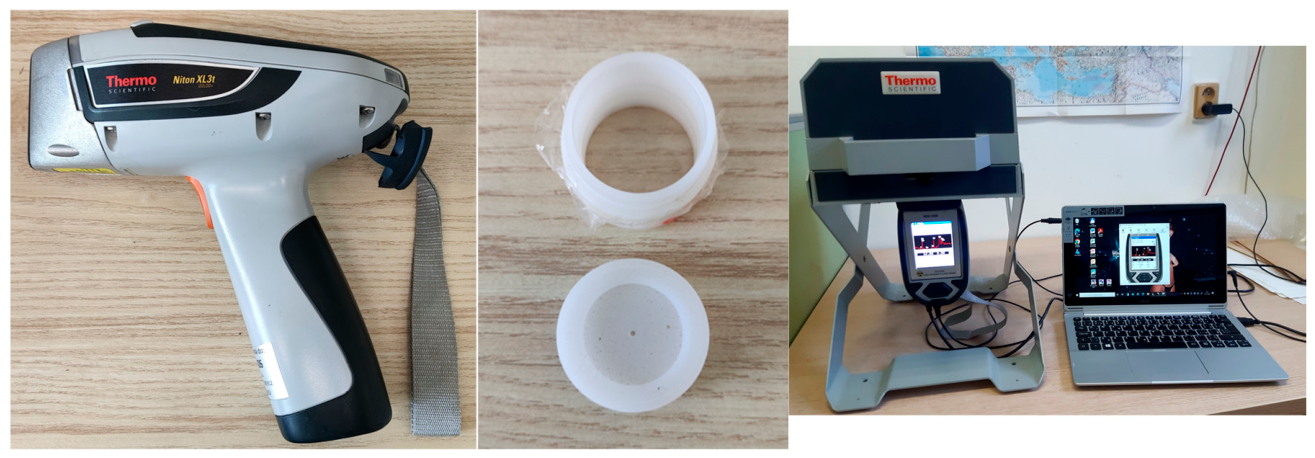
The pXRF analyses were conducted with a Thermo ScientificTM NitonTM XL3t GOLDD XRF analyzer (ThermoScientific, Waltham, MA, USA). The instrument operates on the principle of X-ray fluorescence spectroscopy, in which primary X-rays generated by an X-ray tube excite atoms in the analyzed material, resulting in the emission of characteristic secondary (fluorescent) X-rays that are detected to determine elemental composition. The radiation source is an Ag anode (50 kV voltage max., 2 W max.). The beam opening area is 50 mm2. The device was set to the “Soil” mode. Detection of the emitted fluorescence radiation was performed using a Geometrically Optimized Large Drift Detector (GOLDD). The GOLDD detector provides enhanced sensitivity and faster signal acquisition than conventional detectors, enabling rapid analysis and improved detection limits across a wide range of elements.
Measurements were made hands-free using an X-ray security capsule controlled by a computer. The air-dried, sieved, and ground soil samples were placed into XRF sample cups (25 mm in diameter), compacted with a pestle to ensure consistent packing density, and covered with a 4 μm-thick polyester film (Figure 1). The analyzer was set up for soil analysis, measuring medium, low, and high specters; for 30 s. Thus, the total scan time was 90 s per sample. Three measurements were performed for each soil sample (n = 3). The XRF device was calibrated using the standards of the Soil QC Certificate (140-00139, 2017) and the Mining QC Sheet (140-00072, 2017, ThermoScientific, Tewksbury, MA, USA). The elements considered were K, Ca, Fe, Pb, Mn, and Zn.

2.3. ICP-MS Analysis

The contents of the same elements were determined using an ICP-MS apparatus (ICP-MS 7500 Series Octopole Reactio System equipped with an ASX-500 Series ICP-MS Autosampler, Agilent Technologies, Santa Clara, CA, USA), operated with argon as the carrier gas and helium and hydrogen as reaction gases. The internal standards applied to normalize the signal in soil solutions, blank samples, and standard solutions were: scandium (Sc), yttrium (Y), and terbium (Tb) at a concentration of 2000 µg/L each. The calibration ranges for individual elements were as follows: 180–40,000 µg K/L, 100–50,000 µg Ca/L, 160–80,000 µg Fe/L, 0.4–200 µg Pb/L, 4–2000 µg Zn/L, and 80–40,000 µg Mn/L. Elements were separated by ionizing samples in a high-temperature argon plasma by their mass-to-charge ratio; masses 39 m/z, 44 m/z, 57 m/z, 208 m/z, 66 m/z, and 55 m/z were used for K, Ca, Fe, Pb, Zn, and Mn, respectively. ICP-MS apparatus operated at the plasma parameters: RF power—1600 W, RF matching: 1.68 V, Carrier gas flow: 0.9 L/min, makeup gas flow: 0.2 L/min, nebulizer pump: 0.05 rsc. Detector parameters were as follows: discriminator—8.0 mV, analog HV—1750 V, pulse HV—1310 V. The relative standard deviation (RSD) for three measurements in the collision cell was operated at >5%. Prior to analysis, soil samples (0.5 g) were digested in a mixture of hydrochloric and nitric acids (aqua regia) using a microwave digestion system (Mars Xpress, CEM Corp., Matthews, NC, USA). In each analytical series, a procedural blank and certified reference materials (CRM020—Trace Metals—Sandy Loam, CRM020—Trace Metals—Sandy Loam 11) for Fe, Pb, Mn, and Zn, and Laboratory Check Standard (LCS) for K and Ca were included for quality assurance and quality control (QA/QC) procedure. Method reputability and accuracy for individual elements were 97–109% and <5%, respectively. The detailed information on method validation parameters is in Table 1.

2.4. Statistical Analysis

To assess the agreement between pXRF and ICP-MS measurements, several statistical approaches were applied. The strength of the linear relationship between pXRF and ICP-MS measurements was evaluated using the Pearson correlation coefficient (r) and the coefficient of determination (R2). The relationship between the results obtained by the two analytical methods was evaluated using Deming regression, which is recommended for comparing analytical techniques affected by measurement errors in both variables. Unlike ordinary least squares (OLS) regression, Deming regression accounts for analytical uncertainty in both the independent and dependent variables, providing a more appropriate estimation of the relationship between two measurement methods.
The root mean square error (RMSE) was used as an absolute measure of the dispersion of residuals around the Deming regression line. RMSE was calculated as:
R M S E   =   1 n i = 1 n ( y i y ^ i ) 2  
where yi are the ICP-MS values and ŷi are the corresponding values predicted from the Deming regression based on pXRF. RMSE is expressed in mg kg−1 and represents the typical magnitude of the prediction error.
The agreement between the two analytical techniques was further evaluated using Lin’s concordance correlation coefficient (CCC) [32], which simultaneously accounts for precision and accuracy relative to the line of identity.
Furthermore, Bland–Altman analysis was applied to assess systematic bias and determine the limits of agreement (LoA) between the two methods. The differences between measurements were calculated as [33,34]:
D i f f e r e n c e   =   I C P M S p X R F
The mean difference was interpreted as measurement bias, and the 95% limits of agreement were calculated as:
Bias ± 1.96 × SD
where SD represents the standard deviation of the differences between methods.
Additionally, 95% confidence intervals (CI) for CCC, Bland–Altman bias, and LoA were estimated using bootstrap resampling (5000 iterations). The presence of proportional bias was assessed using linear regression between the measurement differences and the corresponding mean values. Heteroscedasticity was evaluated using the Spearman correlation between absolute differences and mean concentrations. Normality of differences was verified using the Shapiro–Wilk test. Statistical significance was assessed at α = 0.05.
In addition to the absolute Bland–Altman analysis, a relative Bland–Altman analysis was also performed, where the differences were expressed as percentages relative to the mean value of the two measurements.
R e l a t i v e   d i f f e r e n c e =   I C P M S p X R F I C P M S + p X R F 2 × 100 %
All statistical analyses and data visualizations were performed using Statistica PL 13.3 software (Tulsa, OK, USA) and the Python programming language, Python 3.12, using the NumPy, pandas, SciPy, matplotlib, and scikit-learn libraries within a Google Colab environment (https://colab.research.google.com, accessed on 10 May 2026).

3. Results

3.1. Descriptive Statistics of Element Concentrations

Table 2 summarizes the basic statistics for the concentrations of K, Ca, Fe, Zn, Pb, and Mn obtained by pXRF and ICP-MS after aqua regia digestion. For all elements, pXRF reported higher mean values than ICP-MS. The largest differences were observed for K and Ca: the mean K concentration measured by pXRF was 13,655.58, whereas ICP-MS yielded 545.32 mg kg−1; similarly, the mean Ca concentration was 3871.67 for pXRF and 967.97 mg kg−1 for ICP-MS. In contrast, for trace elements, the differences between methods were much smaller: mean Zn concentrations were 21.4 (pXRF) and 20.1 mg kg−1 (ICP-MS), mean Pb concentrations 13.85 and 11.48, and mean Mn concentrations 170.84 and 120.81 mg kg−1, respectively.
The variability of the measurements, expressed as the coefficient of variation (CV), showed some systematic differences between methods. For most elements, concentrations measured by pXRF exhibited a relatively lower CV than ICP-MS. For Zn and Pb, the CVs of the two methods were similar (19.0% vs. 19.6% for Zn; 9.7% vs. 8.9% for Pb).

3.2. Association and Agreement Between pXRF and ICP-MS

The results of the carried out analyses showed that for Fe and Ca, linear correlations between methods were moderate to strong: r = 0.58 for Fe (R2 = 0.32) and r = 0.90 for Ca (R2 = 0.82) (Table 2). K and Pb showed only weak-to-moderate linear relationships, with r values of 0.43 (R2 = 0.19) and 0.41 (R2 = 0.17), respectively. The highest correlation values were obtained for Zn (r = 0.93, R2 = 0.87) and Mn (r = 0.88, R2 = 0.78), indicating that for these elements most of the variance in ICP-MS results can be explained by the corresponding pXRF measurements.
However, correlation alone did not imply good agreement, which is reflected in the CCC values. For K, Ca, and Fe, the CCCs were very low (0.00049, 0.07, and 0.10, respectively), despite the relatively high r for Ca. This indicates substantial systematic disagreement between pXRF and ICP-MS for these elements, consistent with the large differences in mean concentrations. In other words, although Ca (and to a lesser extent Fe and K) showed some linear association between methods, pXRF results were heavily biased relative to ICP-MS and cannot be considered interchangeable without calibration.
In contrast, Zn exhibited both a very strong linear correlation and a high CCC (0.89, 95% CI: 0.81–0.94). These metrics indicated a high level of concordance between pXRF and ICP-MS for Zn, with only small random and systematic differences. For Mn, the correlation was also strong (r = 0.88), but the CCC was considerably lower (0.36, 95% CI: 0.29–0.43), indicating systematic differences between pXRF and ICP-MS.
Overall, the agreement analysis shows that pXRF performs best for Zn, with both the central tendency and variability closely matching those of ICP-MS. For Mn and Ca, pXRF measurements are strongly correlated with ICP-MS but affected by substantial systematic bias. For K, Fe, and Pb, both the strength of association and concordance are limited, implying that uncorrected pXRF readings for these elements should be interpreted with caution or adjusted using appropriate calibration models.

3.3. Deming Regression Analysis

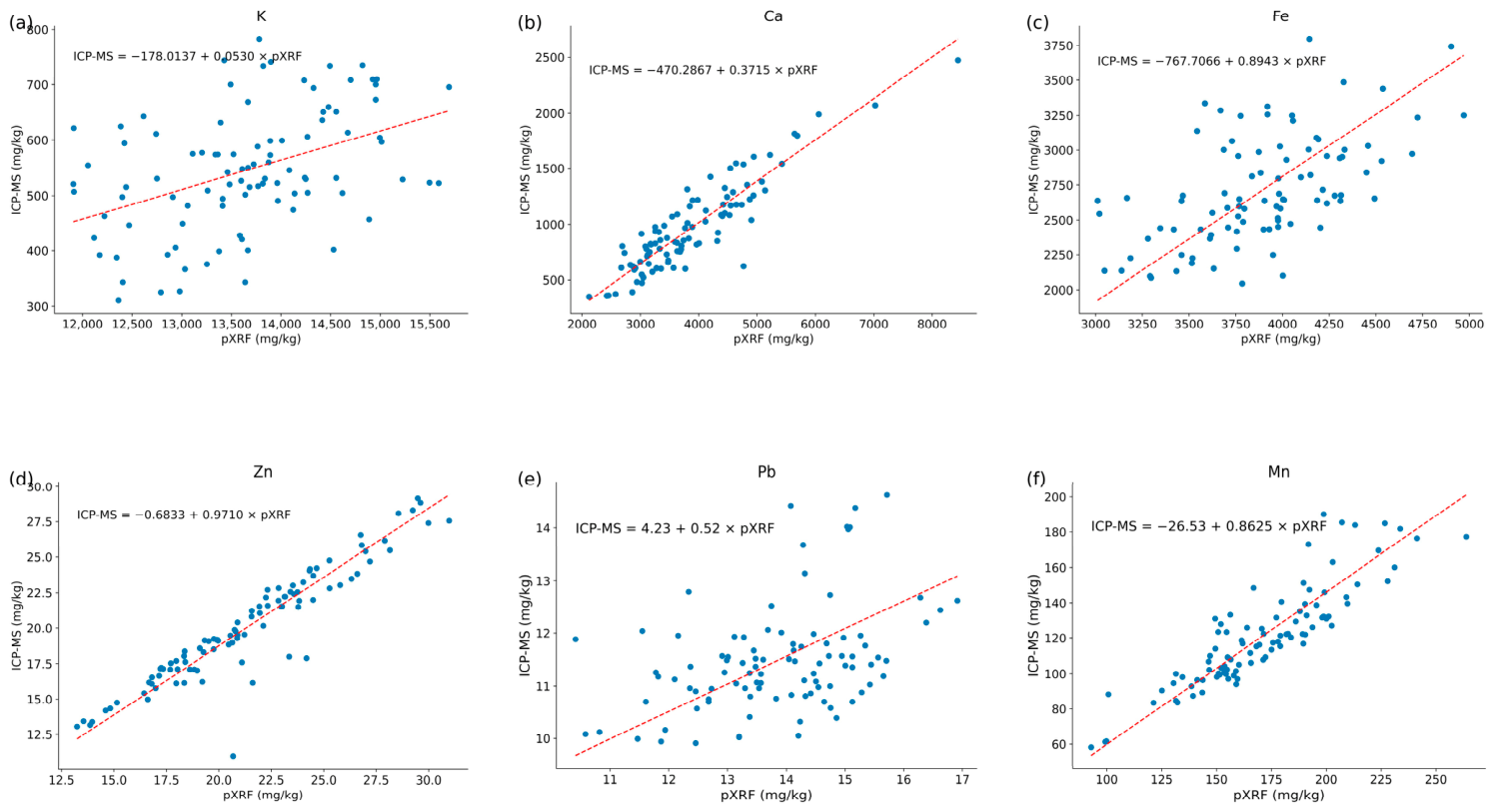
The relationship between pXRF and ICP-MS measurements was further examined using Deming regression for all investigated elements (K, Ca, Fe, Pb, Mn, and Zn) (Figure 2). Among the studied elements, Zn showed the most favorable behavior in the Deming regression. The slope was very close to unity (0.97), and the intercept was negligible (−0.68), indicating almost proportional measurements; this pattern is consistent with the very strong linear association and high concordance previously observed for this element. In contrast, Ca and Mn exhibited substantial deviations from the line of identity despite relatively moderate-to-strong linear associations between the two analytical techniques. For Ca, the slope of 0.37 indicates a pronounced proportional difference, with pXRF systematically producing higher values than ICP-MS across the concentration range. For Mn, the slope of 0.86 indicates a weaker but still evident proportional difference between pXRF and ICP-MS. The remaining elements exhibited even less favorable regression characteristics. Despite a Deming slope for Fe numerically close to 1 (0.89), the scatter of points around the regression line remained considerable. Potassium was characterized by an almost flat regression slope (0.05), confirming the absence of any meaningful quantitative relationship between pXRF and ICP-MS within the examined concentration range and within the studied soil matrix and analytical framework. Lead, with a slope of 0.52 over a relatively narrow concentration range, likewise showed a weak and non-proportional relationship between methods.
The performance of the Deming regression model, expressed as the root mean square error (RMSE), describes the dispersion of observations around the fitted regression line and therefore reflects the precision of the model fit. RMSE values were lowest for Zn and Pb (1.42 and 0.97 mg kg−1, respectively), indicating a tight clustering of data points around the regression line, whereas substantially higher RMSE values for Fe, Ca, and K indicate greater scatter and lower precision of the model for these elements (Table 2).

3.4. Bland–Altman Analysis—Absolute and Relative Differences

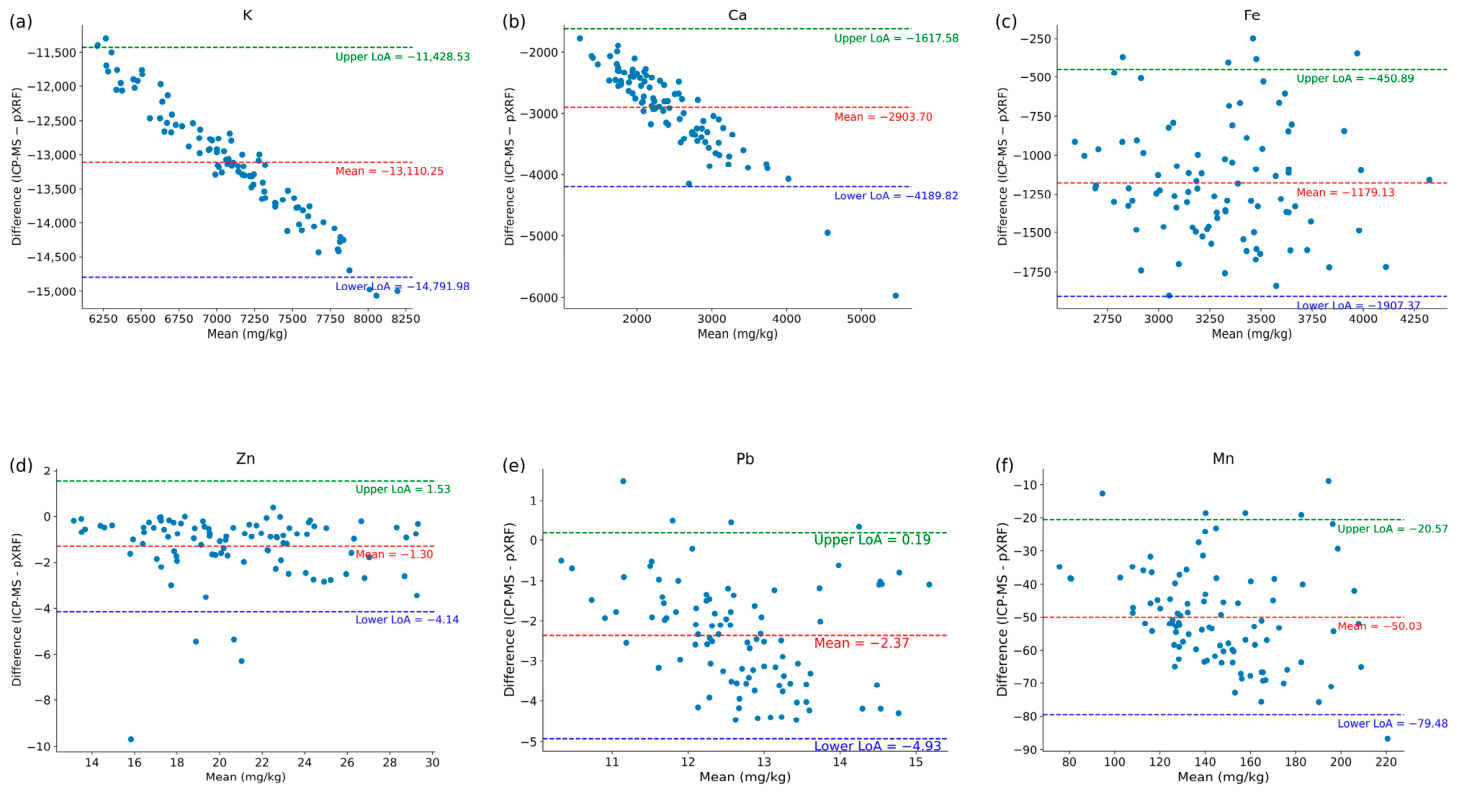
Bland–Altman analysis was used to further characterize the magnitude and dispersion of differences between methods. For each element, mean difference (bias) and 95% limits of agreement (LoA) were computed on both absolute and relative scales (Figure 3 and Figure 4).
On the absolute scale, Zn showed the smallest discrepancies (Figure 3). The mean difference between ICP-MS and pXRF was −1.30 (95% CI: −1.61 to −1.04), with narrow limits of agreement ranging from −4.14 (95% CI: −5.39 to −2.89) to 1.53 (95% CI: 0.7 to 2.31), indicating only minor absolute disagreements between the methods. For Pb, the mean bias was also small (−2.37, 95% CI: −2.63 to −2.11) with a relatively narrow absolute LoA (−4.93 to 0.19), but this should be interpreted in light of the low concentration range (Table 2).
In contrast, Ca, Mn, Fe, and especially K exhibited large absolute differences. For Ca, the mean bias was −2903.7 (95% CI: −3035.3 to −2776.1), with wide limits (−4189.8 to −1617.6), and for Mn, the bias was −50.0 (95% CI: −52.9 to −46.9), with limits from −79.5 to −20.6. For Fe, the mean difference reached −1179.1 (95% CI: −1253.6 to −1103.0) (LoA −1907.4 to −450.9). The most pronounced discrepancy was observed for K, with an extreme negative bias of −13,110.3 (95% CI: −13,284.3 to −12,937.9) and very wide limits of agreement (−14,792.0 to −11,428.5), indicating substantial systematic differences between pXRF and ICP-MS. The analysis of proportional bias indicated statistically significant relationships between measurement differences and mean concentrations for K, Ca, Pb, and Mn (p < 0.05), suggesting concentration-dependent discrepancies between pXRF and ICP-MS for these elements (Table 3). In contrast, no significant proportional bias was observed for Fe and Zn. Heteroscedasticity analysis revealed non-constant variability of differences for K, Ca, Zn, Pb, and Mn (p < 0.05), indicating that the dispersion of inter-method differences changed with concentration level. No significant heteroscedasticity was detected for Fe (Table 3).
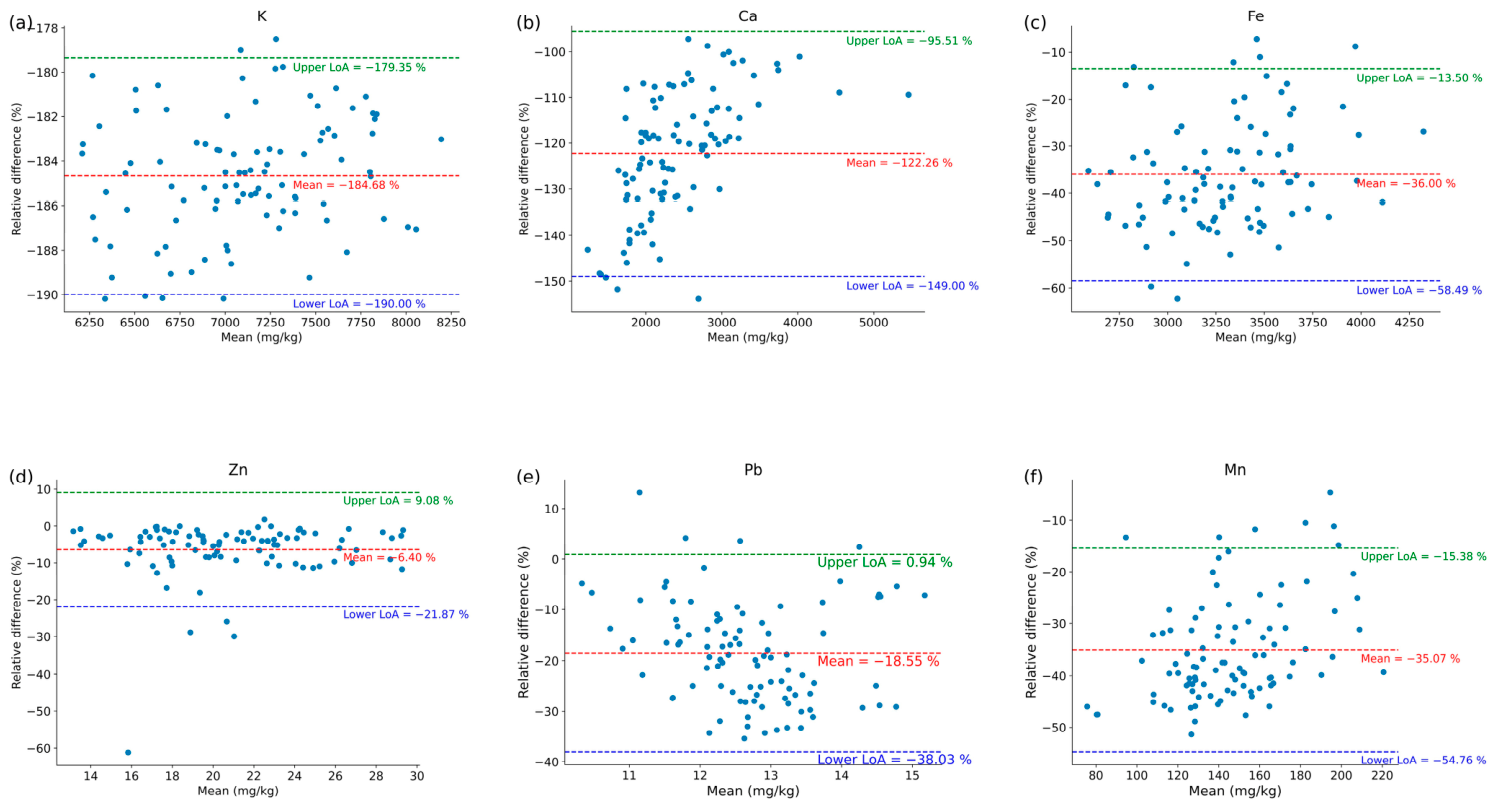
On the relative scale, the pattern of systematic differences between the two methods became even more evident (Figure 4). Zn showed only a small mean relative bias of −6.4% with relatively narrow relative LoA (from −21.9% to 9.1%), consistent with the good concordance indicated by CCC. For Pb, the mean relative bias was −18.5% (limits: −38.0% to 0.9%), indicating substantial proportional differences despite the small absolute errors.
For Ca, Mn, and Fe, the relative Bland–Altman analysis confirmed substantial biases. Ca exhibited a mean relative bias of −122.3%, with wide relative limits of agreement from −149.0% to −95.5%. Mn showed a mean relative bias of −35.1% (relative LoA −54.8% to −15.4%), and Fe a mean relative bias of −36.0% (relative LoA −58.5% to −13.5%). The most extreme case was K, with a mean relative bias of −184.7% and narrow but highly shifted relative limits (−190.0% to −179.4%), indicating a strong systematic discrepancy between methods. On the absolute scale, pXRF values were approximately 25 times higher than ICP-MS results, reflecting substantial differences in the measured fraction rather than random analytical error.
Taken together, the Bland–Altman analyses show that, pXRF exhibits substantially systematic differences compared with ICP-MS, both in absolute and relative terms. The smallest differences were observed for Zn, whereas Ca, Mn, Fe, and particularly K exhibited substantial systematic bias and dispersion, indicating limited agreement between the methods. These findings are consistent with mean pXRF/ICP-MS ratios for most elements, i.e., approximately 4.0; 1.43; 1.06; 1.21; and 1.41 for Ca, Fe, Zn, Pb and Mn, respectively (Table 2).

4. Discussion

The results indicate that pXRF measurements are systematically higher than ICP-MS values for the analyzed elements. (Table 2). Similar discrepancies between portable X-ray fluorescence and laboratory-based analytical techniques have been widely reported in studies evaluating the applicability of pXRF in environmental and soil analyses [21,36,37,38,39]. In the study conducted on Andosols (volcanic soils rich in primary minerals) [37], contamination by heavy metals, including Pb, Zn, Cu, Cd, As, and Cr, was assessed using both pXRF and aqua regia extraction followed by ICP-MS/AAS analysis. The results showed very strong correlations between the two methods (r > 0.90); however, in most cases, pXRF yielded higher concentration values than aqua regia. These differences are primarily due to fundamental differences in the analytical principles and sample preparation procedures used by the two methods. The pXRF technique provides a direct measurement of the total elemental composition of a solid sample without chemical digestion [40,41], whereas ICP-MS analysis in the present study was performed following aqua regia extraction, which targets the so-called pseudo-total fraction of elements. Since aqua regia does not completely dissolve silicate minerals, a portion of the elements bound within resistant mineral phases remains undetected in ICP-MS analysis [16,42]. According to Chen and Ma [42], aqua regia digestion failed to accurately quantify more than 20 elements in some sediments, especially K and Al, which are part of some clay mineral structures. Consequently, the potassium concentrations measured by ICP-MS may be systematically lower than those obtained using pXRF, as our results confirm (Table 2). Previous studies conducted in mining-affected soils have also reported strong correlations between pXRF and ICP–AES following HCl digestion despite differences in absolute concentrations [36]. In soils influenced by mine waste and tailings, pXRF yielded higher Cu and Pb values than ICP–AES, highlighting the need for calibration and cautious interpretation of agreement between methods. In addition to incomplete digestion, several factors intrinsic to pXRF measurements, such as matrix effects, particle size distribution, moisture content, and surface heterogeneity, are commonly reported as sources of variability [26,39,43,44]. These factors can modify both the absorption and enhancement of X-ray fluorescence signals. Marsay et al. [45], who tested iron slag heap materials in Teesside, UK, and soil samples, reported that soil organic matter content in samples had little effect on pXRF measurements. In the case of ignition, no substantial difference was seen in R2 for Pb, Sr, Cr, Mn, Ca, and Fe. According to these authors, soil moisture was identified as a much more important factor affecting pXRF signal response and measurement comparability. However, it was a nutrient-specific effect. Drying the samples did not significantly change the R2 values for As, Sr, Cr, Ni, Ti, Zn, P, K, and Mn. Nevertheless, drying did lead to a notable increase in the R2 values for Fe and Pb, rising from 0.72 to 0.80 and from 0.67 to 0.80, respectively. Unexpectedly, drying decreased the R2 value for Ca from 0.76 to 0.68. Ge et al. [46] demonstrated that soil moisture significantly affects pXRF measurements when the sample’s water content exceeds approximately 20%. Detailed investigations on the influence of soil organic matter on pXRF measurements were conducted by Ravansari and Lemke [44] using a Niton XL3t + 950 pXRF analyzer (ThermoScientific). The authors artificially increased the organic matter content of soil samples by adding cellulose, carbon, and sugar at levels ranging from 0% to 35%. Their results demonstrated progressive attenuation of the pXRF signal with increasing organic matter content, resulting in lower measured concentrations of elements such as As, Cr, Cu, Fe, Mn, Pb, Rb, Sr, Th, Ti, V, Zn, and Zr. However, in the present study, these factors were minimized through sample preparation and experimental design. All soil samples were air-dried, sieved, and finely ground prior to analysis, reducing the influence of particle size and moisture-related effects. Furthermore, all samples were classified as Albic Luvisols with a loamy sand texture, characterized by a very low content of soil organic carbon (mean 0.8%, minimum, 0.4%, maximum 1.1% (Supplementary Table S1). Therefore, the influence of matrix-related effects was likely limited, and the observed discrepancies between pXRF and ICP-MS can be attributed predominantly to metal characteristics and methodological differences rather than to sample heterogeneity, moisture, and organic carbon content.
In most studies, the comparison of methods (pXRF vs. wet chemistry) was assessed by calculating the correlation (r) or regression (r, R2, and slope) between the two procedures [25,47,48,49,50]. Radu and Diamond [27] compared the concentrations of Pb, As, Cu, and Zn, in soil samples measured using pXRF with those obtained by aqua regia digestion followed by atomic absorption spectroscopy (AAS). According to the authors, the strong correlation between the two methods confirms the usefulness of pXRF for the rapid assessment of heavy metal contamination in soils. In a study of urban garden soils in the United States, pXRF measurements of sieved soil samples were compared with ICP-OES analyses (after aqua regia digestion) [38]. Based on Pearson correlation coefficients of approximately 0.6 for Mn and Cu and 0.5 for Zn and Pb, the authors concluded that pXRF can serve as an accurate and effective tool for screening Mn, Cu, Zn, and Pb concentrations in soils. McLaren et al. [30], who, using a handheld Bruker Tracer III-V pXRF spectrometer, demonstrated that measurements for elements such as As, Ca, Cr, Cu, Fe, K, Mg, Mn, Ni, P, Pb, Si, Ti, and Zn were strongly correlated with laboratory ICP results, with correlation coefficients ranging from 0.82 to 0.98. The authors also highlighted the high applicability of pXRF in environmental studies. More examples of such studies are presented in Table 4.
However, Ravansari et al. [22] state that high coefficients of determination alone do not guarantee equality between comparative measurements. Therefore, complementary statistical approaches are necessary. In our study, high values of correlation coefficients (r) and R2 were obtained, particularly for Zn, Ca, and Mn (Table 2). Our results confirmed that analytical methods comparisons should not rely solely on the correlation coefficient. High r values may mask the presence of systematic bias and scale differences between methods. Therefore, more appropriate approaches include the Concordance Correlation Coefficient and agreement analyses such as Bland–Altman, which allow the evaluation of both the direction and magnitude of differences between pXRF and ICP-MS measurements [47]. In the present study (Table 2), this is clearly illustrated by the results for Ca and Mn, which showed a high correlation (r = 0.90; R2 = 0.82 and r = 0.88; R2 = 0.78, respectively), while the Concordance Correlation Coefficient (CCC = 0.07 and CCC = 0.36) indicated very poor agreement between the methods, highlighting substantial systematic bias and scale differences despite the strong linear relationship. Our findings are consistent with those of Schmidt et al. [29] who also demonstrated that strong correlation coefficients alone are insufficient for assessing agreement between analytical methods. In their study of 91 residential yard soil samples analyzed by portable XRF (Niton, Thermo Scientific, Waltham, MA, USA) and ICP-MS, strong positive correlations were observed for arsenic and lead (Spearman’s coefficients of 0.850 and 0.981, respectively), with high R2 values from regression analysis. However, Bland–Altman analysis revealed wide and element-dependent limits of agreement, particularly for lead, indicating that method comparability cannot be reliably assessed based on correlation metrics alone. In contrast, Poljak et al. [52] compared Cu concentrations in 35 soil samples measured by portable XRF (Vanta™ Handheld XRF Analyzer, Olympus, Waltham, MA, USA) with AAS and ICP-MS following aqua regia digestion and reported both a very strong linear relationship (R2 = 0.99) and good agreement based on Bland–Altman analysis. Together, these studies highlight that correlation alone may be misleading and that agreement-based approaches are essential for reliable method comparison. In the present study, the highest agreement between methods was observed for Zn, whereas substantially poorer agreement was observed for the other elements, particularly K (Figure 2, Figure 3 and Figure 4). This element-dependent variability reflects a combination of physicochemical and instrumental factors inherent to X-ray fluorescence analysis [53]. The relatively good agreement observed for Zn is consistent with previous findings [21,42], which indicating that pXRF provides more reliable results for elements with medium to high atomic numbers (Z > 20) [54]. Zinc (Z = 30) emits higher-energy fluorescence radiation, which is less affected by absorption processes within the sample matrix and air, thereby allowing for deeper penetration and a larger effective analytical volume. According to Ravansari, et al. [22], the maximum escape path length of Zn fluorescence in a SiO2 matrix is 632 µm. In contrast, lighter elements such as K (Z = 19) and Ca (Z = 20) emit low-energy fluorescence radiation (K (43 µm) and Ca (58 µm)) [22] that is strongly attenuated by the sample matrix and air, leading to reduced signal intensity and increased measurement uncertainty [22,31,39]. This may partially explain the lower agreement observed for these elements in our study.

5. Conclusions

This study demonstrates that high correlation between pXRF and ICP-MS does not imply good agreement, particularly in the presence of systematic and proportional biases. The application of Deming regression provided a more appropriate evaluation of the relationship between methods than ordinary least squares, as it accounts for measurement errors in both variables. This approach revealed proportional biases that would not be fully captured using standard linear regression.
In turn, Bland–Altman analysis enabled a direct assessment of agreement, quantifying systematic bias and limits of agreement. The results showed that even strongly correlated elements (e.g., Mn and Ca) may exhibit substantial bias, while for K, Fe, and Pb, both agreement and concordance were limited.
Overall, pXRF performance was strongly element-dependent. Zn showed the highest agreement with ICP-MS, whereas other elements require caution and, in most cases, calibration. However, the conclusions of this study are limited to a single soil type (Albic Luvisols), one long-term experimental field site, air-dried and finely ground soil samples, and comparison against aqua-regia-extractable ICP-MS fractions. Therefore, the results should not be generalized beyond similar methodological and environmental conditions without further validation.

Supplementary Materials

The following supporting information can be downloaded at: https://www.mdpi.com/article/10.3390/agriculture16101119/s1, Table S1. Soil properties.

Author Contributions

Conceptualization, M.S. and T.S.; methodology, M.S., B.S. and P.Č.; software, M.S.; validation, M.S. and T.S.; formal analysis, M.S.; investigation, M.S., T.S., B.S. and P.Č.; resources, M.S., T.S., B.S. and P.Č.; data curation, T.S.; writing—original draft preparation, M.S.; writing—review and editing, T.S., B.S. and P.Č.; visualization, M.S.; supervision, T.S.; project administration, T.S.; funding acquisition, T.S. All authors have read and agreed to the published version of the manuscript.

Funding

This research was funded by Warsaw University of Life Sciences within the System of Financial Support for Scientists and Research Teams No. 853-2-80-45-700400-S24011.

Data Availability Statement

The original contributions presented in this study are included in the article. Further inquiries can be directed to the corresponding author.

Acknowledgments

The authors are grateful to Bartłomiej Kowalczuk for his professional assistance in soil sample preparation.

Conflicts of Interest

The authors declare no conflicts of interest.

Abbreviations

The following abbreviations are used in this manuscript:
pXRFPortable X-ray fluorescence
ICP-MSInductively Coupled Plasma Mass Spectrometry
RMSERoot mean square error
CCCLin’s concordance correlation coefficient
CI95% confidence interval

References

  1. Adhikari, K.; Hertemink, A.E. Linking soils to ecosystem services—A global review. Geoderma 2016, 262, 101–111. [Google Scholar] [CrossRef]
  2. Szymańska, M.; Sulewski, P.; Wąs, A.; Sosulski, T. Measuring the Sustainability of Nitrogen Fertilization in EU Agriculture: A New Index-Based Assessment in the Context of Sustainable Intensification. Agronomy 2025, 15, 1643. [Google Scholar] [CrossRef]
  3. Szymańska, M.; Sulewski, P.; Wąs, A.; Sosulski, T. In the Way to More Sustainable Phosphorus Management in European Agriculture: Changes in Fertilization Efficiency in the Context of the Sustainable Intensification Concept. Environ. Sci. Eur. 2025, 37, 235. [Google Scholar] [CrossRef]
  4. Sosulski, T.; Szara, E.; Korc, M.; Stępień, W. Leaching of macronutrients, micronutrients and aluminium from the soil under long-term fertilizer experiments In Skierniewice (Central Poland). Soil Sci. Annu. 2013, 64, 106–113. [Google Scholar] [CrossRef]
  5. Mishra, S.; Bharagava, R.N.; More, N.; Yadav, A.; Zainith, S.; Mani, S.; Chowdhary, P. Heavy metal contamination: An alarming threat to environment and human health. In Environmental Biotechnology: For Sustainable Future; Sobti, R., Arora, N., Kothari, R., Eds.; Springer: Singapore, 2019; pp. 103–125. [Google Scholar]
  6. Hou, D.; Jia, X.; Wang, L.; McGrath, S.P.; Zhu, Y.-G.; Hu, Q.; Zhao, F.-J.; Bank, M.S.; O’Connor, D.; Nriagu, J. Global soil pollution by toxic metals threatens agriculture and human health. Science 2025, 388, 316–321. [Google Scholar] [CrossRef]
  7. Wysocka, K.; Cacak-Pietrzak, G.; Sosulski, T. Mineral Concentration in Spring Wheat Grain Under Organic, Integrated, and Conventional Farming Systems and Their Alterations During Processing. Plants 2025, 14, 1003. [Google Scholar] [CrossRef]
  8. Higgins, S.; Keesstra, S.D.; Kadziuliene, Z.; Jordan-Meille, L.; Wall, D.; Ťrinchera, A.; Spiegel, H.; Sandén, T.; Baumgarten, A.; Jensen, J.L.; et al. Stocktake study of current fertilisation recommendations across Europe and discussion towards a more harmonised approach. Eur. J. Soil Sci. 2023, 74, e13422. [Google Scholar] [CrossRef]
  9. Tavares, T.R.; Minasny, B.; McBratney, A.; Cherubin, M.R.; Marques, G.T.; Ragagnin, M.M.; Alves, E.E.N.; Padarian, J.; Lavres, J.; Carvalho, H.W.P. Estimating plant-available nutrients with XRF sensors: Towards a versatile analysis tool for soil condition assessment. Geoderma 2023, 439, 116701. [Google Scholar] [CrossRef]
  10. Miletić, A.; Radomirović, M.; Dordević, A.; Bogosavljević, J.; Lučić, M.; Onjia, A. Geospatial mapping of ecological risk from potentially toxic elements in soil in the pannonian-carpathian border area south of the Danube. Carpath. J. Earth Environ. Sci. 2022, 17, 351–363. [Google Scholar] [CrossRef]
  11. Alloway, B.J. Heavy Metals in Soils: Trace Metals and Metalloids in Soils and Their Bioavailability, 3rd ed.; Springer: Dordrecht, The Netherlands, 2013. [Google Scholar]
  12. Jenkins, E.M.; Galbraith, J.; Paltseva, A.A. Portable X-ray Fluorescence as a Tool for Urban Soil Contamination Analysis: Accuracy, Precision, and Practicality. Soil 2025, 11, 565–582. [Google Scholar] [CrossRef]
  13. Beauchemin, D. Inductively coupled plasma mass spectrometry. Anal. Chem. 2008, 80, 4455–4486. [Google Scholar] [CrossRef]
  14. Di Fusco, G.; Calia, A. Advances in (LA)-ICP-MS Techniques and Applications for the Elemental Analysis in the Field of Cultural Heritage: A Review. Talanta 2026, 303, 129492. [Google Scholar] [CrossRef]
  15. Aldrabee, A.; Wriekat, A.H. Archaeometric Characterization of Ancient Glazed Pottery Sherds from Khirbet Faris, Jordan by Inductively Coupled Plasma Mass Spectrometry (ICP-MS). Microchem. J. 2011, 99, 289–295. [Google Scholar] [CrossRef]
  16. ISO 11466; Soil Quality—Extraction of Trace Elements Soluble in Aqua Regia. International Organization for Standardization: Geneva, Switzerland, 1995.
  17. Santoro, A.; Held, A.; Linsinger, T.P.J.; Perez, A.; Ricci, M. Comparison of total and aqua regia extractability of heavy metals in sewage sludge: The case study of a certified reference material. TrAC Trends Anal. Chem. 2017, 89, 34–40. [Google Scholar] [CrossRef]
  18. Kalnicky, D.J.; Singhvi, R. Field portable XRF analysis of environmental samples. J. Hazard. Mater. 2001, 83, 93–122. [Google Scholar] [CrossRef]
  19. Luchian, C.E.; Motrescu, I.; Dumitrașcu, A.I.; Scutarașu, E.C.; Cara, I.G.; Colibaba, L.C.; Cotea, V.V.; Jităreanu, G. Comprehensive Assessment of Soil Heavy Metal Contamination in Agricultural and Protected Areas: A Case Study from Iași County, Romania. Agriculture 2025, 15, 1070. [Google Scholar] [CrossRef]
  20. Martínez-del-Pozo, I.; Gómez-Pachón, M.C.; Ferri-Moreno, I.; García-Lorenzo, M.L.; Lorenzo, S.; Barquero-Peralbo, J.I.; Arroyo, X.; Higueras, P.; Esbrí, J.M. Portable X-ray fluorescence (pXRF) application to the determination of major and trace elements in large soil datasets for geochemical background assessment. J. Geochem. Explor. 2026, 282, 107961. [Google Scholar] [CrossRef]
  21. Weindorf, D.C.; Bakr, N.; Zhu, Y. Advances in portable X-ray fluorescence (pXRF) for environmental, pedological, and agronomic applications. Adv. Agron. 2014, 128, 1–45. [Google Scholar] [CrossRef]
  22. Ravansari, R.; Wilson, S.C.; Tighe, M. Portable X-ray fluorescence for environmental assessment of soils: Not just a point and shoot method. Environ. Int. 2020, 134, 105250. [Google Scholar] [CrossRef] [PubMed]
  23. Zhang, C.; Charrois, L.; Jacquet, J.; Sirguey, C.; Chen, Z.; van der Ent, A. Monochromatic X-ray Fluorescence Spectroscopy for Major and Trace Element Analysis in Plant Science Applications. Plant Soil 2026, 518, 105–120. [Google Scholar] [CrossRef]
  24. Margui, E.; Queralt, I.; Carvalho, M.L.; Hidalgo, M. Comparison of EDXRF and ICP-OES after microwave digestion for element determination in plant specimens from an abandoned mining area. Anal. Chim. Acta 2005, 549, 197–204. [Google Scholar] [CrossRef]
  25. Sapkota, Y.; Drake, B.L.; McDonald, L.M.; Griggs, T.C.; Basden, T.J. Elemental Composition and Moisture Prediction in Manure by Portable X-ray Fluorescence Spectroscopy Using Random Forest Regression. J. Environ. Qual. 2020, 49, 472–482. [Google Scholar] [CrossRef]
  26. Li, S.; Shen, J.; Bishop, T.F.A.; Viscarra Rossel, R.A. Assessment of the Effect of Soil Sample Preparation, Water Content and Excitation Time on Proximal X-ray Fluorescence Sensing. Sensors 2022, 22, 4572. [Google Scholar] [CrossRef]
  27. Radu, T.; Diamond, D. Comparison of soil pollution concentrations determined using AAS and portable XRF techniques. J. Hazard. Mater. 2009, 171, 1168–1171. [Google Scholar] [CrossRef]
  28. Gonzales, C.R.; Paltseva, A.A.; Bell, T.; Powell, E.T.; Mielke, H.W. Agreement of Four Analytical Methods Applied to Pb in Soils from the Small City of St. John’s, Newfoundland, Canada. Int. J. Environ. Res. Public Health 2021, 18, 9863. [Google Scholar] [CrossRef]
  29. Schmidt, K.; Autenrieth, D.; Nagisetty, R. A comparison of field portable X-ray fluorescence (FP XRF) and inductively coupled plasma mass spectrometry (ICP-MS) for analysis of metals in the soil and ambient air. Res. Sq. 2024. [Google Scholar] [CrossRef] [PubMed] [PubMed Central]
  30. McLaren, T.I.; Guppy, C.N.; Tighe, M.K.; Forster, N.; Grave, P.; Lisle, L.M.; Bennett, J.W. Rapid, Nondestructive Total Elemental Analysis of Vertisol Soils using Portable X-ray Fluorescence. Soil Sci. Soc. Am. J. 2012, 76, 1436–1445. [Google Scholar] [CrossRef]
  31. Parsons, C.; Marguí, E.; Pili, E.; Floor, G.; Roman-Ross, G.; Charlet, L. Quantification of trace elements in soils using portable XRF. J. Hazard. Mater. 2013, 262, 1213–1222. [Google Scholar] [CrossRef] [PubMed]
  32. Lin, L.I. A concordance correlation coefficient to evaluate reproducibility. Biometrics 1989, 45, 255–268. [Google Scholar] [CrossRef]
  33. Altman, D.G.; Bland, J.M. Measurement in Medicine: The Analysis of Method Comparison Studies. J. R. Stat. Soc. Ser. D (Stat.) 1983, 32, 307–317. [Google Scholar] [CrossRef]
  34. Bland, J.M.; Altman, D.G. Statistical methods for assessing agreement between two methods of clinical measurement. Lancet 1986, 1, 307–310. [Google Scholar] [CrossRef]
  35. IUSS Working Group WRB. World Reference Base for Soil Resources: International Soil Classification System for Naming Soils and Creating Legends for Soil Maps; Update 2022; World Soil Resources Reports No. 202; FAO: Rome, Italy, 2022. [Google Scholar]
  36. Lee, H.; Choi, Y.; Suh, J.; Lee, S.H. Mapping copper and lead concentrations at abandoned mine areas using element analysis data from ICP-AES and portable XRF instruments: A comparative study. Int. J. Environ. Res. Public Health 2016, 13, 384. [Google Scholar] [CrossRef]
  37. Caporale, A.G.; Adamo, P.; Capozzi, F.; Langella, G.; Terribile, F.; Vingiani, S. Monitoring metal pollution in soils using portableXRF and conventional laboratory-based techniques: Evaluation of the performance and limitations according to metal properties and sources. Sci. Total Environ. 2018, 643, 516–526. [Google Scholar] [CrossRef]
  38. McStay, A.C.; Walser, S.L.; Sirkovich, E.C.; Perdrial, N.; Richardson, J.B. Nutrient and toxic elements in soils and plants across 10 urban community gardens: Comparing pXRF and ICP-based soil measurements. J. Environ. Qual. 2022, 51, 439–450. [Google Scholar] [CrossRef]
  39. Rouillon, M.; Taylor, M.P. Can Field Portable X-Ray Fluorescence (pXRF) Produce High-Quality Data for Application in Environmental Contamination Research? Environ. Pollut. 2016, 214, 255–264. [Google Scholar] [CrossRef]
  40. Lemière, B. A review of pXRF (field portable X-ray fluorescence) applications for applied geochemistry. J. Geochem. Explor. 2018, 188, 350–363. [Google Scholar] [CrossRef]
  41. Tighe, M.; Rogan, G.; Wilson, S.C.; Grave, P.; Kealhofer, L.; Yukongdi, P. The potential for portable X-ray fluorescence determination of soil copper at ancient metallurgy sites, and considerations beyond measurements of total concentrations. J. Environ. Manag. 2018, 206, 373–382. [Google Scholar] [CrossRef]
  42. Chen, M.; Ma, L.Q. Comparison of three aqua regia digestion methods for twenty Florida soils. Soil Sci. Soc. Am. J. 2001, 65, 491–499. [Google Scholar] [CrossRef]
  43. Towett, E.K.; Shepherd, K.D.; Tandoh, J.E.; Winowiecki, L.A.; Lulseged, T.; Nyambura, M.; Sila, A.; Vågen, T.-G.; Cadish, G. Total elemental composition of soils in Sub-Saharan Africa and relationship with soil forming factors. Geoderma Reg. 2015, 5, 157–168. [Google Scholar] [CrossRef]
  44. Ravansari, R.; Lemke, L.D. Portable X-ray fluorescence trace metal measurement in organic rich soils: pXRF response as a function of organic matter fraction. Geoderma 2018, 319, 175–184. [Google Scholar] [CrossRef]
  45. Marsay, N.H.; Wagland, S.T.; Campo, P.; Alamar, M.C. Development and optimisation of ex situ portable X-ray fluorescence spectroscopy for heterogenous post-metallurgical sites. Environ. Geochem. Health 2025, 47, 298. [Google Scholar] [CrossRef]
  46. Ge, L.; Lai, W.; Lin, Y. Influence of and correction for moisture in rocks, soils and sediments on in-situ XRF analysis. X-Ray Spectrom. 2005, 34, 28–34. [Google Scholar] [CrossRef]
  47. López-Núñez, R. Portable X-ray Fluorescence Analysis of Organic Amendments: A Review. Appl. Sci. 2022, 12, 6944. [Google Scholar] [CrossRef]
  48. López-Núñez, R.; Ajmal-Poley, F.; González-Pérez, J.A.; Bello-López, M.A.; Burgos-Doménech, P. Quick Analysis of Organic Amendments via Portable X-ray Fluorescence Spectrometry. Int. J. Environ. Res. Public Health 2019, 16, 4317. [Google Scholar] [CrossRef]
  49. Horf, M.; Gebbers, R.; Vogel, S.; Ostermann, M.; Piepel, M.-F.; Olfs, H.-W. Determination of Nutrients in Liquid Manures and Biogas Digestates by Portable Energy-Dispersive X-ray Fluorescence Spectrometry. Sensors 2021, 21, 3892. [Google Scholar] [CrossRef]
  50. Mensik, L.; Hlisnikovsky, L.; Nerusil, P.; Kunzova, E. Comparison of the Concentration of Risk Elements in Alluvial Soils Determined by pXRF In Situ, in the Laboratory, and by ICP-OES. Agronomy 2021, 11, 938. [Google Scholar] [CrossRef]
  51. Tepanosyan, G.; Harutyunyan, N.; Sahakyan, L. Revealing XRF data quality level, comparability with ICP-ES/ICP-MS soil PTE contents and similarities in PTE induced health risk. Environ. Geochem. Health 2022, 44, 1739–1750. [Google Scholar] [CrossRef]
  52. Poljak, M.; Zgorelec, Ž.; Kisić, I.; Kuharić, Ž.; Perčin, A. Comparison of AAS, ICP-MS, and pXRF Performance for Copper Analysis in Agricultural Soils. J. Cent. Eur. Agric. 2024, 25, 580–587. [Google Scholar] [CrossRef]
  53. Potts, P.J.; West, M. Portable X-Ray Fluorescence Spectrometry: Capabilities for In Situ Analysis; Royal Society of Chemistry: Cambridge, UK, 2008. [Google Scholar]
  54. Shand, C.A.; Wendler, R. Portable X-ray fluorescence analysis of mineral and organic soils and the influence of organic matter. J. Geochem. Explor. 2014, 143, 31–42. [Google Scholar] [CrossRef]
Figure 1. A portable X-ray fluorescence (pXRF) spectrometer (Niton XL3t GOLDD+, Thermo Fisher Scientific, Waltham, MA, USA) used for elemental analysis of soils (Source: Pavel Čermák).
Agriculture 16 01119 g001
Figure 2. Deming regression for all investigated elements: (a) Potassium (K); (b) Calcium (Ca); (c) Iron (Fe); (d) Zinc (Zn); (e) Lead (Pb); (f) Manganese (Mn).
Agriculture 16 01119 g002
Figure 3. Bland–Altman plot showing the absolute difference (mg kg−1) between the two analytical methods for (a) Potassium (K); (b) Calcium (Ca); (c) Iron (Fe); (d) Zinc (Zn); (e) Lead (Pb); (f) Manganese (Mn) as a function of their mean concentration (mg kg−1). The red dashed line indicates the mean difference (bias), and the green and blue dashed lines indicate the upper and lower limits of agreement (LoA), respectively.
Agriculture 16 01119 g003
Figure 4. Bland–Altman plot showing the relative difference (%) between the two analytical methods for (a) Potassium (K); (b) Calcium (Ca); (c) Iron (Fe); (d) Zinc (Zn); (e) Lead (Pb); (f) Manganese (Mn) as a function of their mean concentration (mg kg−1). The red dashed line indicates the mean relative difference (bias), and the green and blue dashed lines indicate the upper and lower limits of agreement (LoA), respectively.
Agriculture 16 01119 g004
Table 1. Parameters describing the applied analytical procedure.
ParameterElement
KCaFeZnPbMn
Range in the standard (mg kg−1)20,400 ± 60025,600 ± 846192,000 ± 48703010 ± 22.35110 ± 50.8945 ± 7.43
Average accuracy (%)100102102.797109103.2
Average repeatability (%)4.053.624.974.132.883.38
LOD (mg kg−1)3.74.491.120.230.0290.050
LOQ (mg kg−1)8.8102.70.60.080.14
Average content in blanks (µg L−1)3550650.28
Table 2. Summary statistics and method-agreement parameters for pXRF and ICP-MS determinations of selected elements in soil.
StatisticsKCaFeZnPbMn
pXRFICP-MSpXRFICP-MSpXRFICP-MSpXRFICP-MSpXRFICP-MSpXRFICP-MS
Mean (mg kg−1)13,655.58545.323871.67967.973870.582699.8321.4020.1013.8511.48170.84120.81
SD904.13109.83997.90399.79413.70385.834.063.951.351.0231.9528.04
Median13,666.31530.533689.24864.753891.262643.9921.0019.4814.0711.37167.68117.59
Min.11,906.57310.632120.53351.363010.651984.6513.2410.9910.419.9193.0358.25
Max.15,693.11782.778442.512472.594970.473796.9630.9829.1616.9214.63263.93190.06
CV (%)6.6220.1425.7741.3010.6914.2918.9719.659.738.8618.7023.21
pXRF and ICP_MS Association and Agreement Metrics
r0.43 *0.90 *0.58 *0.93 *0.41 *0.88 *
R20.190.820.320.870.170.78
RMSE98.60171.12351.051.420.9713.49
CCC0.000490.070.100.890.130.36
CCC_CI_lower0.000280.050.060.810.070.29
CCC_CI_upper0.000700.100.140.940.200.43
SD—standard deviation, Min—minimum, Max.—maximum, CV (%)—Coefficient of variation, r—the Pearson correlation coefficient (r), R2—the coefficient of determination, RMSE—the root mean square error, CCC—Lin’s concordance correlation coefficient, CCC_CI_lower and CCC_CI_upper—lower and upper bounds of the 95% confidence interval for CCC, * significant at p < 0.05.
Table 3. Bland–Altman parameters with confidence intervals and statistical tests.
Agreement Uncertainty and Diagnostic TestsKCaFeZnPbMn
Mean CI_lower−13,284.34−3035.33−125,365−1.61−2.63−52.92
Mean CI_upper−12,937.87−2776.07−1101.98−1.04−2.11−46.91
Upper LoA CI lower−11,716.01−1872.12−603.210.70−0.28−26.86
Upper LoA CI upper−11,166.53−1374.71−309.972.310.64−15.05
Lower LoA CI lower−15,046.18−4590.30−1998.95−5.39−5.26−83.50
Lower LoA CI upper−14,507.94−3810.89−1801.80−2.89−4.54−74.84
Proportional_bias0.000.000.470.460.000.01
Heteroscedasticity0.000.000.380.030.000.00
Mean CI lower/upper—95% confidence interval for mean bias; Upper LoA CI lower/upper and Lower LoA CI lower/upper—95% confidence intervals for the upper and lower limits of agreement, respectively; Proportional_bias—p-value for proportional bias test; Heteroscedasticity—p-value for heteroscedasticity test. Statistical significance was assessed at α = 0.05.
Table 4. Overview of selected studies on pXRF performance in soils, including comparison conditions (CRM, ICP).
PXRF InstrumentMatrix/Soil InformationElementsR2 RangePXRF ApplicationComparison AgainstDigestion TypeReference
Olympus Delta PremiumNIST 2586, 2587, 2709a, 2710a, 2711a, 1944, NRC BCSS-1, PACS-2, MESS-2, RM 8704 CRTi, Cr, Mn, Fe, Ni, Cu, Zn,
As, Sr, Cd, Pb
0.87
to ≥0.99
Ex-SituCRM-[22]
Niton XLt 792WYUnspecified—48 CRMsAs, Ca, Cd, Cr, Cu, Fe, K,
Mn, Ni, Pb, Rb, Sr, Ti, V, Zn
0.74
to ≥0.99
Ex-SituCRM-[22]
Olympus Delta PremiumVarious soils from Queensland and New South Wales, AustraliaTi, Cr, Mn, Fe, Ni, Cu, Zn,
As, Sr, Cd, Pb
0.52
to ≥0.99
Ex-SituICP-OESHNO3 + HClO4 + HF (Complete)[22]
Niton XLt 960Cambisol, ChinaAs, Pb, Cu, Zn0.68 to 0.93Ex-SituICP-MS HNO3 + HClO4 + HF (Complete)[22]
Omega XpressTexture varied from clay to loam Baton Rouge, Louisiana USAs, Co, Cu, Fe, Mn, Pb, Zn0.35 to 0.96In-SituICP-OESaqua regia (Incomplete)[22]
Niton XL-722Erren River Basin, TaiwanPb, Zn, Ni, Cu, Cr, Cd0.08 to 0.73In-SituICP-OESaqua regia (Incomplete)[22]
Innov-X DELTA handheld XRF analyzer, Olympus Cu, Pb0.9In-Site (after sieving to <2 mm)ICP–AES0.1 N of
HCl solution
[36]
NitonTM XL3t GoldFluvisolIn-Situ
Pb, Zn, As, Mn, Cu
Ex-Situ
Pb, Zn, As, Mn, Cu
0.96, 0.92, 0.72, 0.63, 0.31
0.99, 0.88, 0.98, 0.89, 0.89
In-Situ
and Ex-Situ
ICP-OESaqua regia (Incomplete)[50]
Olympus Innov-X
X-5000
Soil samples under the impact of copper smelterTi, Fe, Mn, Co, V, Pb, Zn, Cu, Cr, Mo, Sr, As0.39, 0.76, 0.87, 0.45, 0.13, 0.96, 0.95, 0.98, 0.7, 0.38, 0.09, 0.97Ex-SituICP-ES/ICP-MSaqua regia (Incomplete)[51]
Disclaimer/Publisher’s Note: The statements, opinions and data contained in all publications are solely those of the individual author(s) and contributor(s) and not of MDPI and/or the editor(s). MDPI and/or the editor(s) disclaim responsibility for any injury to people or property resulting from any ideas, methods, instructions or products referred to in the content.