Article

Behavior of Honey Bees (Apis mellifera L.) Exposed to Tebuconazole Under Laboratory Conditions

by
Natalia Białecka
1,*,
Paweł Migdał
1,
Krzysztof Latarowski
1,
Beata Madras-Majewska
2 and
Beniamin Stępień
1,*
1
Department of Bees Breeding, Institute of Animal Husbandry and Breeding, Wroclaw University of Environmental and Life Sciences, 51-630 Wroclaw, Poland
2
Department of Animal Environment Biology, Institute of Animal Sciences, Warsaw University of Life Sciences (SGGW), 02-787 Warsaw, Poland
*
Authors to whom correspondence should be addressed.
Agriculture 2026, 16(10), 1083; https://doi.org/10.3390/agriculture16101083
Submission received: 20 February 2026 / Revised: 12 May 2026 / Accepted: 12 May 2026 / Published: 15 May 2026
(This article belongs to the Special Issue The Impact of Environmental Factors and Pesticides on Bee Behavior)

Abstract

Honey bees are constantly exposed to various environmental threats, among which pesticide pollution, including fungicides, is one of the most serious. The bees were 3 days old when they received the experimental solution. This study aimed to evaluate the behavior and mortality of honey bee workers exposed to a commercial formulation of the fungicide tebuconazole (Tebu® EW, a.i. 25.8%; HELM, Hamburg, Germany). The experiment was conducted under laboratory conditions and lasted 7 days for all experimental groups. The fungicide solution was prepared by adding 6.25 mL of Tebu® EW per 1 L of water, corresponding to 156.25 mg of tebuconazole (active ingredient) in the prepared solution of sugar syrup. The solution was served in 5 mL dispensers (=group feeding) placed in the cages. This concentration was used for the acute-exposure group (24 h). After 24 h bees were supplied with untreated sugar syrup for the remainder of the experiment. For the chronic-exposure group (168 h), the solution was a 1000-fold dilution of the acute solution, containing 0.15625 mg tebuconazole, dissolved in sugar syrup, provided continuously for 7 days with daily replacement. After 7 days, bee behavior was recorded using a camera and analyzed with Noldus Observer XT software (12.5: Windows 7 64-bit (SP1) version) Five basic honey bee behaviors were examined: walking, flight, self-grooming, contact between individuals and stillness. The results showed statistically significant differences between the experimental groups and the control group (α = 0.05) in the duration of walking, contact between individuals and self-grooming, and the frequency of walking and flight. This was particularly evident for self-grooming; the longer the group was exposed to tebuconazole, the less time the bees spent on this behavior (the acute group spent 47% less time self-grooming and the chronic group spent 88.8% less time self-grooming compared to the control group). Meanwhile, the frequency of walking and flying increased significantly with increasing exposure. No significant differences were observed in the survival between the groups. Based on these findings, it can be concluded that the fungicide containing tebuconazole significantly affects the behavior of honey bee workers.

1. Introduction

Plant protection products (PPPs) pose a serious threat to pollinators, including honey bees, due to the constant exposure of bees bodies to chemicals. Driven by the need to maximize yields and associated economic returns within shorter production cycles, the use of PPPs has increased in recent decades. However, the intensification of agrochemical use leads to negative environmental consequences [1].
PPP residues can be found in pollen and nectar, posing a direct threat to honey bees. While foraging, bees visit various plant species, including crops such as winter rapeseed, buckwheat, and sunflowers, and are therefore exposed to residues of many PPPs [2,3]. Along with the pollen and nectar collected by foragers, these residues are carried back to the hive, where they are then incorporated into bee bread and honey. Consequently, they become food for larvae and the queen [4]. In addition to food, honey bees also require water. PPP residues found in soil enter the water and thus appear in streams, reservoirs, agricultural areas, surrounding areas, and in ponds. Water is primarily used for thermoregulation within the hive. Contaminated water is deposited on the combs in the form of droplets and aerosols, which affects bees that come into contact with it. At the same time, water is used to maintain osmotic homeostasis in adults and dilute the honey to make it suitable for bees to consume [5,6,7].
Fungicides account for over 35% of the global pesticide market, which makes them one of the most commonly used pesticides [8]. They encompass a wide range of compounds with different mechanisms of action and belong to different chemical classes, which differ in their biological properties and agricultural applications [9,10]. Fungicides can also exhibit synergistic effects with other plant protection products, such as insecticides and acaricides, thereby enhancing their impact [8]. Fungicides are applied directly to plants or to seeds. They are used as sprays on trees, vines, crops, and garden plants. Unlike other plant protection products, fungicides are applied prophylactically and often multiple times per season [11]. Their residues may therefore be present in nectar and pollen throughout the season, thus posing a chronic threat [12]. As a result, bees foraging in sprayed areas encounter fungicides much more frequently than other types of plant protection products [8]. Insecticides are the most widely studied group of pesticides for their impact on honey bees. Fungal diseases, on the other hand, pose the greatest threat to crops worldwide, so the use of fungicides is constantly increasing [13]. As a result, more and more studies are being conducted on their impact on pollinators [14]. One of the most frequently detected fungicides in bee products is tebuconazole, which is widely used in agriculture worldwide [15]. Tebuconazole belongs to the triazoles and acts by interfering with ergosterol biosynthesis, thereby inhibiting fungal growth or causing cell death. It exhibits systemic activity, which means that it penetrates plant tissues and is transported along with the sap (xylem and phloem) throughout the entire plant organism, including new growths [16,17]. Currently, there are no studies available assessing the effects of tebuconazole on honey bee behavior, but there is information about doses potentially harmful to this pollinator. According to the U.S. Environmental Protection Agency [18], the estimated LD50 for honey bees is >83,050 ng per bee. In the study by Albacete et al. [19], bees consumed doses 7-to-33-times lower than this (2500 to 11,500 ng per bee). Based on the results, an LD50 was not determined [19]. Tebuconazole is therefore typically classified as a fungicide with low acute toxicity to bees.
Environmental pesticide pollution disrupts key physiological processes in honey bees and impairs their immune system [20,21]. Additionally, fungicides can have a direct negative impact on honey bee cellular processes, including the antioxidant system. This, in turn, can affect bee behavior, foraging efficiency, learning, pollination, colony maintenance and development [12].
In honey bees, two types of immunity are distinguished: individual and social. Social immunity encompasses behavioral immunity [22].
The behavior of individual honey bees within a bee colony determines its survival and development. Observing worker bee behavior provides information on individual responses that may be important for the functioning of the colony. This is an important research element, as these behaviors significantly impact colony productivity and, consequently, pollination [23,24].
Hygienic behaviors play a crucial role in maintaining the health of a bee colony. In honey bees, they reflect social resistance to parasites and diseases by limiting the development of pathogens. These behaviors include allogrooming, or mutual grooming, and autogrooming, or self-grooming [25,26,27]. Flight and foraging behaviors play an equally important role. Forager bees are responsible for providing pollen, nectar, and water to the hive, ensuring access to food for the hive bees, the queen, and the brood [28].
Previous studies have shown that bee behavior, including general motor activity, orientation in the field, learning ability, and feeding, is significantly influenced by pollinator exposure to sublethal doses of plant protection products, including fungicides [29,30]. At the same time, reduced cognitive functions may be closely related to oxidative stress in response to exposure to triazole fungicides [31,32].
In this study, the effect of tebuconazole on selected honey bee behaviors was assessed under laboratory conditions, using concentrations of 156.25 mg/L for acute exposure (24 h) and 0.15625 mg/L for chronic exposure (168 h). The higher concentration was intended to simulate a single contact of the bees with the agent immediately after spraying, while the lower concentration represented long-term exposure resulting from the presence of pesticide residues in the environment.

2. Materials and Methods

2.1. Research Material

The research material consisted of 1-day-old worker honey bees of the Carniolan Honey bee subspecies (Apis mellifera carnica). The brood was obtained from the Educational and Research Apiary of the Wrocław University of Environmental and Life Sciences, located at the Research and Educational Station in Swojczyce (51°06′49.5″ N 17°08′45.1″ E). On the 20th day of brood development, frames with brood were collected (from one colony) and transported to an incubator at 34.5 °C (±0.5 °C), 70% (±5%) humidity with a continuous dark–light cycle until adult emergence. Then, 1-day-old worker honey bees were randomly placed in cages equipped with a dispenser (a 5 mL syringe) containing sucrose (≥99.5%, ACS reagent; Merck/Sigma-Aldrich, Darmstadt, Germany) sugar syrup at a concentration of 1M. Each cage contained 40 workers with ad libitum access to food. There were 5 randomly assigned cages in each group (Table 1). All prepared cages were placed in an incubator (30.9 °C) until the workers were three days old, at which point the experiment commenced.

2.2. Treatments

The tested fungicide was a formulation of tebuconazole (Tebu® EW, a.i. 25.8%; HELM, Hamburg, Germany) applied to crops such as winter wheat, spring barley, winter rapeseed, sugar beet, and fruit crops such as cherry. The concentration recommended by the manufacturer was selected for the experiment, corresponding to the maximum permissible application rate for winter rapeseed in spring at the end of flowering (1.25 L ha−1) and was used to simulate the contact of worker bees with freshly sprayed plants.
The exposure solutions were prepared as follows:
For the acute-exposure group (24 h), the solution was prepared by adding 6.25 mL of Tebu® EW per 1 L of water, corresponding to 156.25 mg of tebuconazole (active ingredient) per liter of solution (10 mL from prepared Tebu solution was added to 90 mL of 1M of sugar syrup, which give 156.24 mg/L = 19.53 µg per bee). Bees in this group were offered the solution for 24 h, after which they received pesticide-free sucrose syrup (1M) for the remaining 6 days of the experiment. The syrup was replaced daily and provided ad libitum. The bees only had access to this food and took it voluntarily.
For the chronic-exposure group (168 h), the solution was prepared by diluting the acute-exposure solution 1000-fold, resulting in 0.15625 mg of tebuconazole per liter (which gives 0.01953 µg per bee). This concentration simulated environmental residues and long-term exposure to low concentrations of the fungicide [33,34]. Bees in this group received the solution continuously for 168 h, with fresh solution provided daily and available ad libitum. The bees only had access to this food and took it voluntarily.
The control group was given sucrose syrup at a concentration of 1M for 7 days, available ad libitum and replaced daily. The bees only had access to this food and took it voluntarily.

2.3. Behavioral Analysis

After 7 days of the experiment, twelve bees from each group (12 bees from 200 tested per group) were randomly selected, from which three bees were placed in a behavioral study area. Each group had 4 recordings with 3 bees in a glass box. A total of 36 were tested (12 bees for each group). The behavioral study area was a cubic, perforated, glass box measuring 20 cm × 20 cm × 20 cm. Recordings lasted 330 s in total, including the initial 30 s acclimation period (30 s of adaptation were not included in the analysis). Three individuals per cage were recorded simultaneously to observe contact between them. With a larger number of individuals, it would not be possible to observe each behavior separately and assign them to a specific bee.
Bee behavior was recorded using a Sony HDR-CX450 camera (Sony, Wrocław, Poland). The recordings were analyzed off-line using Noldus Observer XT software (12.5: Windows 7 64-bit (SP1) version) to minimize observer disturbance. Five basic honey bee behaviors were selected for observation and are presented in Table 2 [35,36]:
The frequency of each behavior and the duration of time spent performing each behavior were analyzed for every individual.
All observations were conducted under constant laboratory conditions (temperature: 24 °C ± 0.5 °C, relative humidity: 70% ± 5%), which were identical for all experimental groups. Illumination was uniform and did not produce glare or shadows within the arena. To avoid potential circadian effects, all behavioral assays were carried out at the same time on one day (12 p.m.–14 p.m.). All the data were collected in 2025.

2.4. Survival Monitoring

The number of dead bees in each group was recorded and they were then removed and disposed of daily during the whole experiment.

2.5. Statistic Analysis

The statistical significance of the data within groups and between groups was determined by the Kruskal–Wallis test. When the Kruskal–Wallis test indicated a significant group effect, pairwise post hoc comparisons were performed using Dunn’s test with Holm’s correction for multiple comparisons (agricolae package) For all tests, RStudio (R Core Team, 2021, R-3.4.4 for Windows, CRAN, Vienna, Austria) was used with a significance level of α = 0.05. During the analysis, a library (readxl) package was used, which helped in downloading data from Excel. The library (tidyverse) package allowed access to the tidyr package (made it easier to organize data) and dplyr (helped in data management). One-way ANOVAs were not appropriate, owing to the small sample sizes and data that does not conform to tests of normality. Survival analysis was carried out using the “survival” and “survminer” packages and on the basis of the original code, transforming laboratory data into the form required by these packages. The charts were made using the “ggplot2” package and the “Inkscape” vector graphics program to improve the readability of the charts.

3. Results

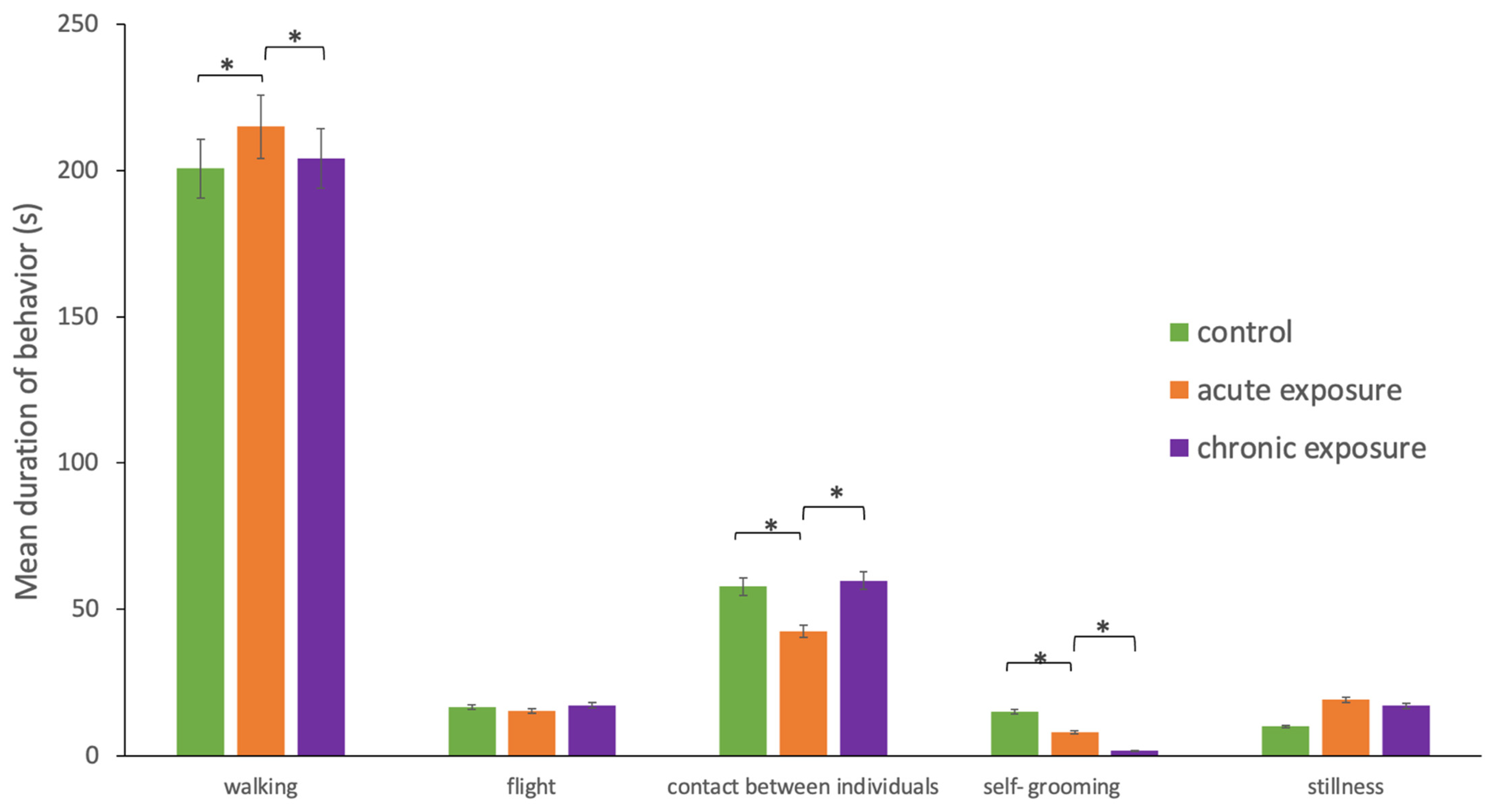
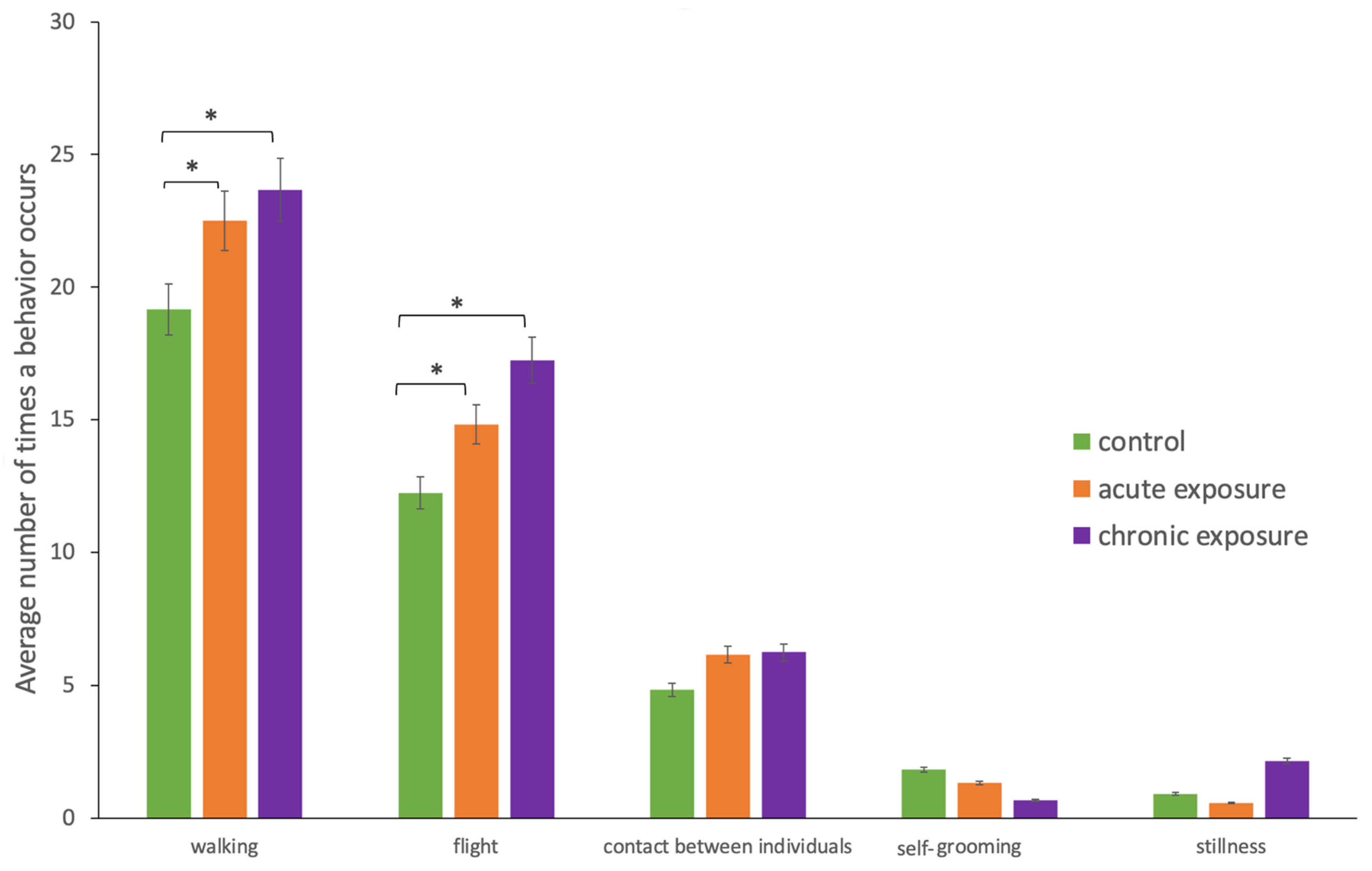
The data were analyzed to compare the mean duration in time (seconds, Figure 1) and the mean frequency (Figure 2) of each focal trait in the behavioral catalog (Table 2) for the control and experimental groups. The mean duration of three behaviors (walking, contact between individual, and self-grooming) significantly differed between the groups (Figure 1). Walking duration differed significantly among groups (Kruskal–Wallis: H(2) = 15.2, p = 0.0016). Post hoc Dunn’s tests with Holm correction revealed significant differences between the control and acute-exposure groups (p = 0.0021), and between the acute- and chronic-exposure groups (p = 0.0152), while no difference was found between the control and chronic-exposure groups (p = 0.421). Control bees spent on average 200.67 s walking, chronic-exposure bees 204.24 s, and acute-exposure bees 215.00 s. The chronic-exposure group spent 1.68 s on self-grooming, while the control group spent 15.01 s (Kruskal–Wallis: H(2) = 10.8, p = 0.0045), which was 88.8% less time compared to the control group. Post hoc Dunn’s tests with Holm correction revealed significant differences between the control and acute-exposure groups (p = 0.0012), and between the acute- and chronic-exposure groups (p = 0.0094), while no difference was found between the control and chronic-exposure groups (p = 0.337). Contact between individuals differed significantly among groups (Kruskal–Wallis: H(2) = 18.3, p = 0.0011). The control and the chronic-exposure groups spent 58 s and 60 s on the behavior, respectively, while the acute-exposure group spent 42 s (Figure 1). Post hoc Dunn’s tests with Holm correction revealed significant differences between the control and acute-exposure groups (p = 0.0047), and between the acute- and chronic-exposure groups (p = 0.0211), while no difference was found between the control and chronic-exposure groups (p = 0.337). For the mean number of behavioral occurrences, statistically significant differences were found for: walking (Kruskal–Wallis: H(2) = 18.5, p = 0.0016; post hoc Dunn’s tests with Holm correction between the control and acute-exposure groups (p = 0.0065), and between the control and chronic-exposure groups (p = 0.0181), while no difference was found between the acute- and chronic-exposure groups (p = 0.274) and flight (Kruskal–Wallis: H(2) = 14.88, p = 0.002; post hoc Dunn’s tests with Holm correction between the control and acute-exposure groups (p = 0.0019), and between control and chronic-exposure groups (p = 0.0114), while no difference was found between acute- and chronic groups (p = 0.193). Other behaviors did not differ significantly between groups [contact between individuals, self-grooming and stillness (Figure 2)]. However, self-grooming behavior showed trends. Bees from the acute-exposure group exhibited fewer grooming behaviors compared to the control group, while the lowest frequency of self-grooming was observed in the chronic-exposure group. Regarding stillness, both the acute-exposure and chronic-exposure groups displayed longer periods of immobility than the control group but without statistical differences (Figure 1 and Figure 2).
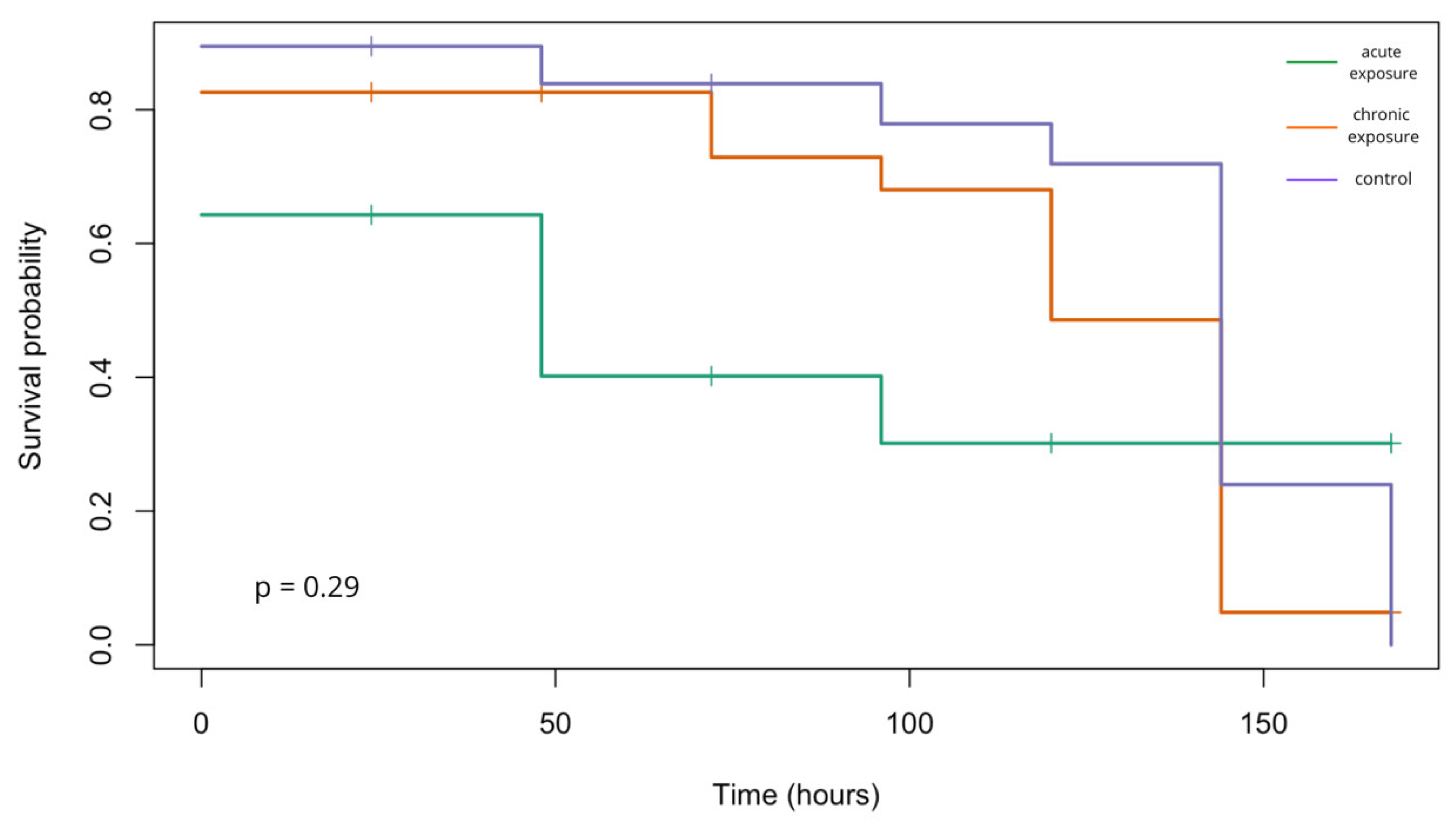
Kaplan–Meier survival analysis revealed no statistically significant differences between groups (Figure 3).

4. Discussion

Current knowledge regarding the effects of tebuconazole-containing fungicides on honey bee behavior remains limited, making direct comparison of our results with those of other researchers difficult. Nevertheless, our results indicate that tebuconazole significantly alters the behavior of worker honey bees. Both the acute- and chronic-exposure groups demonstrated statistically significant behavioral changes compared to the control group in walking, flight, self-grooming and contact between individuals. This study provides novel insights and contributes to a better understanding of honey bee responses to tebuconazole-containing fungicides.
Behavioral disorders accompanied by cognitive impairment may result from oxidative stress. Reactive oxygen species (ROS) promote protein oxidation and lipid peroxidation, ultimately leading to aging and systemic physiological dysfunction [12,39,40,41,42]. Oxidative stress is also widely recognized as one of the key molecular consequences of exposure to plant protection products [43,44]. Mackei et al. [12] assessed the acute and sublethal effects of tebuconazole on fatty acid composition and redox homeostasis in the honey bee brain. Honey bees were administered a tebuconazole-containing syrup solution for 48 h at concentrations of 202.5 μg/mL, 101.25 μg/mL, and 50.625 μg/mL. The treatment reduced total antioxidant capacity, increased malondialdehyde (MDA) levels, indicating lipid peroxidation and a decreased reduced-to-oxidized glutathione (GSH-GSSG) ratio [12]. Fatty acids are essential for signaling molecules such as neurotransmitters and cell membranes [45,46]. Lipid peroxidation is a very dangerous mechanism due to the high content of fatty acids in membranes and the simultaneous rapid metabolic rate of the bee brain [47]. Damage to neuronal membranes disrupts ionic balance and impairs neurotransmission. Neurotransmitters are crucial for learning memory, sensory processing, social interactions, secretory regulation, and motor control [48,49]. Consequently, fungicide-induced disruption of neurotransmission may lead to behavioral impairments that affect both individual performance and colony functioning [50]. Our findings could be associated with this mechanism. Bees exposed to tebuconazole exhibited increased activity together with prolonged periods of stillness (although without significant differences, so we should treat it as just a guess), which may suggest neurological dysfunction. Due to ionic disturbances and thus impaired neurotransmission, also responsible for motor behavior, it contributes to unstable neuromuscular transmission, resulting in changes in the functioning of the bees’ flight muscles. This, in turn, can lead to hyperactivity, motor insensitivity, or general irregularity in locomotion. This is evident in the marked motor arousal in bees exposed to the agent. In both groups, with increasing exposure time to tebuconazole, both walking and flying between cage walls became more frequent, confirming the bees’ irregular movements. Pesticide exposure may increase ROS levels, which initiate lipid peroxidation, and this effect can be visible in bee behavior, resembling toxic arousal. The same team (Mackei et al.) confirmed these results in 2024, assessing the effect of tebuconazole on oxidative stress, this time in honey bee flight muscles. The results showed a decreased GSH-GSSG ratio in all groups treated with tebuconazole at concentrations of 202.5 μg/mL, 101.25 μg/mL, and 50.625 μg/mL, thus even the lowest concentration of the agent affected the glutathione system [51]. These results were confirmed by Saeed et al. [52], who examined the effect of a mixture of tebuconazole and fluopyram on honey bees and their antioxidant system. A significant decrease in bee survival and increased oxidative stress was demonstrated, as evidenced by reduced catalase and superoxide dismutase levels. Simultaneously, there was an increase in glutathione and malondialdehyde levels, indicating lipid peroxidation. Glutathione in its active (reduced) form neutralizes ROS and interrupts the peroxidation chain reaction, thus protecting the body from lipid peroxidation [53]. The decreased survival rate may be a consequence of the early stage of oxidative stress [52].
Our own research revealed statistically significant differences in self-grooming behavior between the study groups and the control group. The longer the bees were exposed to tebuconazole, the less time they spent self-grooming. This behavior is linked to the bees’ hygiene instincts, which are crucial for bees, as they play a key role in defending against parasites and diseases. Therefore, failure to perform this activity can impact the functioning of the entire colony. When bees are exposed to various chemicals, protection against them relies primarily on detoxification genes, demonstrating altered expression of individual genes. Studies indicate that cytochrome P450 gene expression can influence hygienic behavior [54,55]. Haas and Nauen [56] assessed the effect of propiconazole (a triazole, similar to tebuconazole [57]) on the activity of CYP9Q2 and CYP9Q3 enzymes, which are cytochrome P450 isoenzymes. The results showed strong inhibition of both enzymes in response to propiconazole exposure [56]. Although the authors focused on the analysis of CYP9Q3 as a molecular factor determining insecticide selectivity, the obtained results can be considered in a somewhat broader context. Disturbances in cytochrome P450 activity, in addition to their important role in the bee’s detoxification system, may affect the nervous system of the honey bee. Thus, they influence the expression of complex behaviors, including hygienic behaviors. Based on the research results, it can be assumed that the inhibition of CYP9Q2 and CYP9Q3 isoenzymes by triazole fungicides may be one of the processes contributing to the reduction in the effectiveness of bees’ hygienic behavior. However, CYP450 enzymes are critical for detoxification and therefore this is a speculative issue and can be treated as a hypothesis for future investigation.
Another important topic is acetylcholinesterase (AChE). Inhibition of AChE enzymatic activity leads to the termination of neurotransmission, which in turn disrupts the functioning of the nervous system overall [58,59,60]. A study by Cang et al. [15] demonstrated significantly reduced AChE activity following exposure to tebuconazole, which may contribute to impaired cognitive behavior, learning, and memory [15]. Comparing the results obtained by Cang et al. with the results of our own research, a relationship can be observed between the neurotoxicity of tebuconazole and changes in bee motor activity, and perhaps also a decrease in the intensity of hygienic behavior. Therefore, we suspect that these mechanisms are related to our results.
Additionally, Keodara et al. [61] assessed the effect of the fungicide pyraclostrobin on honey bee flight behavior. Pyraclostrobin is not a triazole but a strobilurin [62], but similarly to tebuconazole-based agents, it exhibits toxic effects on honey bees [63]. The study assessed parameters related to return flight to the hive and the expression of genes related to energy metabolism. The study showed that pyraclostrobin significantly reduced the time spent by foragers away from the hive, while the agents did not affect the foragers’ ability to return to the hive. Although there was no loss of the ability to return to the hive, the reduced time spent, most likely on foraging, is also an unfavorable effect, due to the crucial function of foraging and collecting food and water for the entire colony. Inefficient foraging by foragers will lead to insufficient food collection, which then triggers a cascade of difficulties, such as inadequate larval nutrition. Increased expression of cox5a, cox5b, and cox17 was also demonstrated, along with prolonged return times to the hive, regardless of whether the bees were exposed to the agent or not, suggesting increased energy activity. Reduced expression of cox5a and cox6c was demonstrated in laboratory conditions, which may negatively impact energy metabolism and thus hinder the production of energy needed for bee return to the hive. Therefore, it can be concluded that not only flying but also xenobiotic detoxification requires energy resources, so the expression of genes involved in ATP synthesis must have been increased when studying bees return to the hive [61]. In our own study, we can see a similarity between the results obtained by Keodara et al. [61] and their increased activity, as well as increased stillness in some cases. Exposure to the drug may have increased the expression of genes responsible for energy metabolism to help the body metabolize tebuconazole. At the same time, some bees may have experienced decreased expression of these genes, resulting in increased stillness, but this has not yet been investigated.
The research included behavioral assays in an artificial cage environment, with a short observation duration (300 s), small sample size (12 tested bees per group) and no molecular or biochemical confirmation of mechanisms, so it should be remembered that the obtained results and the interpretation that follows them are only an introduction to the topic under investigation.

5. Conclusions

Based on the conducted research, it can be concluded that a tebuconazole-containing fungicide, with both acute and chronic exposure to this substance, creates statistically significant changes in some behaviors, including walking and flight frequency, and walking, contact between individuals and self-grooming duration, compared to the control group. The results indicate that tebuconazole adversely affects honey bees, and that prolonged exposure could impair individual bee performance. Consequently, it may reduce pollination efficiency and colony functioning in agricultural ecosystems.
Therefore, further studies are needed to evaluate the effects of fungicides on honey bees, under both laboratory and field conditions, and to develop strategies to reduce their exposure.

Author Contributions

P.M. and N.B.; methodology: P.M., B.M.-M. and N.B.; validation: P.M. and B.S.; formal analysis: N.B. and B.M.-M.; investigation: P.M., N.B., B.S. and K.L.; resources: P.M. and K.L.; data curation, P.M. and N.B.; writing—original draft preparation: N.B.; writing—review and editing: P.M., B.M.-M. and B.S.; visualization: K.L.; supervision, P.M.; project administration, P.M.; funding acquisition, P.M. and B.M.-M. All authors have read and agreed to the published version of the manuscript.

Funding

This work was supported by the Department of Bees Breeding, Institute of Animal Husbandry and Breeding, Wroclaw University of Environmental and Life Sciences, Wroclaw, Poland.

Institutional Review Board Statement

Not applicable.

Data Availability Statement

The original contributions presented in this study are included in the article. Further inquiries can be directed to the corresponding author.

Conflicts of Interest

The authors declare no conflicts of interest.

References

  1. Farina, W.M.; Balbuena, M.S.; Herbert, L.T.; Goñalons, C.M.; Vázquez, D.E. Effects of the Herbicide Glyphosate on Honey Bee Sensory and Cognitive Abilities: Individual Impairments with Implications for the Hive. Insects 2019, 10, 354. [Google Scholar] [CrossRef] [PubMed]
  2. Zioga, E.; Kelly, R.; White, B.; Stout, J.C. Plant Protection Product Residues in Plant Pollen and Nectar: A Review of Current Knowledge. Environ. Res. 2020, 189, 109873. [Google Scholar] [CrossRef] [PubMed]
  3. Migdał, P.; Murawska, A.; Berbeć, E.; Zarębski, K.; Ratajczak, N.; Roman, A.; Latarowski, K. Biochemical Indicators and Mortality in Honey Bee (Apis mellifera) Workers after Oral Exposure to Plant Protection Products and Their Mixtures. Agriculture 2024, 14, 5. [Google Scholar] [CrossRef]
  4. Rumkee, J.C.O.; Becher, M.A.; Thorbek, P.; Osborne, J.L. Modeling Effects of Honeybee Behaviors on the Distribution of Pesticide in Nectar within a Hive and Resultant In-Hive Exposure. Environ. Sci. Technol. 2017, 51, 6908–6917. [Google Scholar] [CrossRef]
  5. Sanchez-Bayo, F.; Goka, K. Impacts of Pesticides on Honey Bees. In Beekeeping and Bee Conservation—Advances in Research; IntechOpen: London, UK, 2016. [Google Scholar] [CrossRef]
  6. Kovac, H.; Käfer, H.; Stabentheiner, A. The Energetics and Thermoregulation of Water Collecting Honeybees. J. Comp. Physiol. A Neuroethol. Sens. Neural Behav. Physiol. 2018, 204, 783–790. [Google Scholar] [CrossRef]
  7. McCune, F.; Samson-Robert, O.; Rondeau, S.; Chagnon, M.; Fournier, V. Supplying Honey Bees with Waterers: A Precautionary Measure to Reduce Exposure to Pesticides. Environ. Sci. Pollut. Res. Int. 2021, 28, 17573–17586. [Google Scholar] [CrossRef]
  8. Rondeau, S.; Raine, N.E. Fungicides and Bees: A Review of Exposure and Risk. Environ. Int. 2022, 165, 107311. [Google Scholar] [CrossRef] [PubMed]
  9. Hassaan, M.A.; El Nemr, A. Pesticides Pollution: Classifications, Human Health Impact, Extraction and Treatment Techniques. Egypt. J. Aquat. Res. 2020, 46, 207–220. [Google Scholar] [CrossRef]
  10. Gikas, G.D.; Parlakidis, P.; Mavropoulos, T.; Vryzas, Z. Particularities of Fungicides and Factors Affecting Their Fate and Removal Efficacy: A Review. Sustainability 2022, 14, 56. [Google Scholar] [CrossRef]
  11. Zubrod, J.P.; Bundschuh, M.; Arts, G.; Brühl, C.A.; Imfeld, G.; Knäbel, A.; Payraudeau, S.; Rasmussen, J.J.; Rohr, J.; Scharmüller, A.; et al. Fungicides: An Overlooked Pesticide Class? Environ. Sci. Technol. 2019, 53, 3347–3365. [Google Scholar] [CrossRef]
  12. Mackei, M.; Sebők, C.; Vöröházi, J.; Tráj, P.; Mackei, F.; Oláh, B.; Fébel, H.; Neogrády, Z.; Mátis, G. Detrimental Consequences of Tebuconazole on Redox Homeostasis and Fatty Acid Profile of Honeybee Brain. Insect Biochem. Mol. Biol. 2023, 159, 103990. [Google Scholar] [CrossRef]
  13. Degani, O. Plant Fungal Diseases and Crop Protection. J. Fungi 2025, 11, 274. [Google Scholar] [CrossRef]
  14. Schuhmann, A.; Schmid, A.P.; Manzer, S.; Schulte, J.; Scheiner, R. Interaction of Insecticides and Fungicides in Bees. Front. Insect Sci. 2022, 1, 808335. [Google Scholar] [CrossRef]
  15. Cang, T.; Lou, Y.; Zhu, Y.-C.; Li, W.; Weng, H.; Lv, L.; Wang, Y. Mixture Toxicities of Tetrachlorantraniliprole and Tebuconazole to Honey Bees (Apis mellifera L.) and the Potential. Mech. Environ. Int. 2023, 172, 107764. [Google Scholar] [CrossRef]
  16. Sanchez-Bayo, F.; Goka, K. Pesticide Residues and Bees—A Risk Assessment. PLoS ONE 2014, 9, e94482. [Google Scholar] [CrossRef] [PubMed]
  17. Lee, W.-Y.; Lee, R.; Park, H.-J. Tebuconazole Induces ER-Stress-Mediated Cell Death in Bovine Mammary Epithelial Cell Lines. Toxics 2023, 11, 397. [Google Scholar] [CrossRef]
  18. U.S. Environmental Protection Agency. Tebuconazole: Draft Ecological Risk Assessment for Registration Review. Available online: https://web.archive.org/web/20241002215658/https://downloads.regulations.gov/EPA-HQ-OPP-2015-0378-0025/content.pdf (accessed on 2 February 2026).
  19. Albacete, S.; Sancho, G.; Azpiazu, C.; Sgolastra, F.; Rodrigo, A.; Bosch, J. Exposure to Sublethal Levels of Insecticide-Fungicide Mixtures Affect Reproductive Success and Population Growth Rates in the Solitary Bee Osmia cornuta. Environ. Int. 2024, 190, 108919. [Google Scholar] [CrossRef] [PubMed]
  20. Sukkar, D.; Kanso, A.; Laval-Gilly, P.; Falla-Angel, J. A Clash on the Toll Pathway: Competitive Action between Pesticides and Zymosan A on Components of Innate Immunity in Apis mellifera. Front. Immunol. 2023, 14, 1247582. [Google Scholar] [CrossRef]
  21. Sadia, H.; Karki, P.R.; Afroz, M.; Khan, H.I.; Hossain, M.M.; Rahman, M.M. The Exposure of Pesticides to Honeybees: A Global Threat to Food Security. OJBS 2024, 24, 232–243. [Google Scholar] [CrossRef]
  22. Evans, J.D.; Spivak, M. Socialized Medicine: Individual and Communal Disease Barriers in Honey Bees. J. Invertebr. Pathol. 2010, 103, S62–S72. [Google Scholar] [CrossRef]
  23. Ngo, T.N.; Rustia, D.J.A.; Yang, E.-C.; Lin, T.-T. Automated Monitoring and Analyses of Honey Bee Pollen Foraging Behavior Using a Deep Learning-Based Imaging System. Comput. Electron. Agric. 2021, 187, 106239. [Google Scholar] [CrossRef]
  24. Siefert, P.; Buling, N.; Grünewald, B. Honey Bee Behaviours within the Hive: Insights from Long-Term Video Analysis. PLoS ONE 2021, 16, e0247323. [Google Scholar] [CrossRef]
  25. Pereira, R.A.; Morais, M.M.; Francoy, T.M.; Gonçalves, L.S. Hygienic Behavior of Africanized Honey Bees Apis mellifera Directed towards Brood in Old and New Combs during Diurnal and Nocturnal Periods. Insects 2013, 4, 521–532. [Google Scholar] [CrossRef]
  26. Facchini, E.; Bijma, P.; Pagnacco, G.; Rizzi, R.; Brascamp, E.W. Hygienic Behaviour in Honeybees: A Comparison of Two Recording Methods and Estimation of Genetic Parameters. Apidologie 2019, 50, 163–172. [Google Scholar] [CrossRef]
  27. Wilson-Rich, N.; Spivak, M.; Fefferman, N.H.; Starks, P.T. Genetic, Individual, and Group Facilitation of Disease Resistance in Insect Societies. Annu. Rev. Entomol. 2009, 54, 405–423. [Google Scholar] [CrossRef]
  28. Tokach, R.; Smart, A.; Fassbinder-Orth, C.; Fong, C.; Wald, K.; Wu-Smart, J. Honey Bee Colony Behavior and Ontogeny Are Adversely Affected When Exposed to a Pesticide-Contaminated Environment. J. Insect Sci. 2024, 24, 13. [Google Scholar] [CrossRef]
  29. Pettis, J.S.; Lichtenberg, E.M.; Andree, M.; Stitzinger, J.; Rose, R.; vanEngelsdorp, D. Crop Pollination Exposes Honey Bees to Pesticides Which Alters Their Susceptibility to the Gut Pathogen Nosema Ceranae. PLoS ONE 2013, 8, e70182. [Google Scholar] [CrossRef] [PubMed]
  30. Murawska, A.; Migdał, P.; Roman, A. Effects of Plant Protection Products on Biochemical Markers in Honey Bees. Agriculture 2021, 11, 648. [Google Scholar] [CrossRef]
  31. Vieira, R.S.F.; Venâncio, C.A.S.; Félix, L.M. Behavioural Impairment and Oxidative Stress by Acute Exposure of Zebrafish to a Commercial Formulation of Tebuconazole. Environ. Toxicol. Pharmacol. 2022, 91, 103823. [Google Scholar] [CrossRef]
  32. Ku, T.; Liu, Y.; Xie, Y.; Hu, J.; Hou, Y.; Tan, X.; Ning, X.; Li, G.; Sang, N. Tebuconazole Mediates Cognitive Impairment via the Microbe-Gut-Brain Axis (MGBA) in Mice. Environ. Int. 2023, 173, 107821. [Google Scholar] [CrossRef] [PubMed]
  33. Friedle, C.; Wallner, K.; Rosenkranz, P.; Martens, D.; Vetter, W. Pesticide Residues in Daily Bee Pollen Samples (April–July) from an Intensive Agricultural Region in Southern Germany. Environ. Sci. Pollut. Res. 2021, 28, 22789–22803. [Google Scholar] [CrossRef]
  34. Kędzierska-Matysek, M.; Teter, A.; Skałecki, P.; Topyła, B.; Domaradzki, P.; Poleszak, E.; Florek, M. Residues of Pesticides and Heavy Metals in Polish Varietal Honey. Foods 2022, 11, 2362. [Google Scholar] [CrossRef]
  35. Medrzycki, P.; Montanari, R.; Bortolotti, L.; Sabatini, A.G.; Maini, S.; Porrini, C. Effects of Imidacloprid Administered in Sub-Lethal Doses on Honey Bee Behaviour. Laboratory Tests. Bull. Insectology 2003, 56, 59–62. [Google Scholar]
  36. Aliouane, Y.; El Hassani, A.K.; Gary, V.; Armengaud, C.; Lambin, M.; Gauthier, M. Subchronic Exposure of Honeybees to Sublethal Doses of Pesticides: Effects on Behavior. Environ. Toxicol. Chem. 2009, 28, 113–122. [Google Scholar] [CrossRef]
  37. Traniello, I.M.; Avalos, A.; Gachomba, M.J.M.; Gernat, T.; Chen, Z.; Cash-Ahmed, A.C.; Hamilton, A.R.; Cook, J.L.; Robinson, G.E. Genetic Variation Influences Food-Sharing Sociability in Honey Bees. PLoS Biol. 2025, 23, e3003367. [Google Scholar] [CrossRef]
  38. Morfin, N.; Goodwin, P.H.; Hunt, G.J.; Guzman-Novoa, E. Effects of Sublethal Doses of Clothianidin and/or V. Destructor on Honey Bee (Apis mellifera) Self-Grooming Behavior and Associated Gene Expression. Sci. Rep. 2019, 9, 5196. [Google Scholar] [CrossRef] [PubMed]
  39. Simone-Finstrom, M.; Li-Byarlay, H.; Huang, M.H.; Strand, M.K.; Rueppell, O.; Tarpy, D.R. Migratory Management and Environmental Conditions Affect Lifespan and Oxidative Stress in Honey Bees. Sci. Rep. 2016, 6, 32023. [Google Scholar] [CrossRef] [PubMed]
  40. Yazlovytska, L.S.; Karavan, V.V.; Domaciuk, M.; Panchuk, I.I.; Borsuk, G.; Volkov, R.A. Increased Survival of Honey Bees Consuming Pollen and Beebread Is Associated with Elevated Biomarkers of Oxidative Stress. Front. Ecol. Evol. 2023, 11, 1098350. [Google Scholar] [CrossRef]
  41. Huber, F.; Kámán-Tóth, E.; Neogrády, Z.; Mátis, G.; Fébel, H.; Mackei, M. Impact of Acetamiprid on Fatty Acid Composition of the Central Nervous System in Honey Bees. Sci. Rep. 2025, 15, 33120. [Google Scholar] [CrossRef]
  42. Kunat-Budzyńska, M.; Łabuć, E.; Ptaszyńska, A.A. Changes in Enzymatic Activity and Oxidative Stress in Honeybees Kept in the Apiary and Laboratory Conditions during the Course of Nosemosis. PLoS ONE 2025, 20, e0317384. [Google Scholar] [CrossRef] [PubMed]
  43. Dussaubat, C.; Maisonnasse, A.; Crauser, D.; Tchamitchian, S.; Bonnet, M.; Cousin, M.; Kretzschmar, A.; Brunet, J.-L.; Le Conte, Y. Combined Neonicotinoid Pesticide and Parasite Stress Alter Honeybee Queens’ Physiology and Survival. Sci. Rep. 2016, 6, 31430. [Google Scholar] [CrossRef]
  44. Souders, C.L.; Xavier, P.; Perez-Rodriguez, V.; Ector, N.; Zhang, J.-L.; Martyniuk, C.J. Sub-Lethal Effects of the Triazole Fungicide Propiconazole on Zebrafish (Danio Rerio) Development, Oxidative Respiration, and Larval Locomotor Activity. Neurotoxicol. Teratol. 2019, 74, 106809. [Google Scholar] [CrossRef]
  45. Furse, S.; Koch, H.; Wright, G.A.; Stevenson, P.C. Sterol and Lipid Metabolism in Bees. Metabolomics 2023, 19, 78. [Google Scholar] [CrossRef] [PubMed]
  46. Mutlu, C.; Vilas-Boas, M. Fatty Acids Profile in the Honeybee: Metabolic Pathways, Stressor Interactions, and Analytical Approaches. Apidologie 2025, 56, 93. [Google Scholar] [CrossRef]
  47. Mackei, M.; Huber, F.; Oláh, B.; Neogrády, Z.; Mátis, G. Redox Metabolic Disruptions in the Honey Bee Brain Following Acute Exposure to the Pyrethroid Deltamethrin. Sci. Rep. 2025, 15, 28322. [Google Scholar] [CrossRef]
  48. Shapira, M.; Thompson, C.K.; Soreq, H.; Robinson, G.E. Changes in Neuronal Acetylcholinesterase Gene Expression and Division of Labor in Honey Bee Colonies. J. Mol. Neurosci. 2001, 17, 1–12. [Google Scholar] [CrossRef]
  49. Fahad Raza, M.; Anwar, M.; Husain, A.; Rizwan, M.; Li, Z.; Nie, H.; Hlaváč, P.; Ali, M.A.; Rady, A.; Su, S. Differential Gene Expression Analysis Following Olfactory Learning in Honeybee (Apis mellifera L.). PLoS ONE 2022, 17, e0262441. [Google Scholar] [CrossRef]
  50. Cabirol, A.; Haase, A. The Neurophysiological Bases of the Impact of Neonicotinoid Pesticides on the Behaviour of Honeybees. Insects 2019, 10, 344. [Google Scholar] [CrossRef]
  51. Mackei, M.; Huber, F.; Sebők, C.; Vörösházi, J.; Tráj, P.; Márton, R.A.; Neogrády, Z.; Mátis, G. Effective Adaptation of Flight Muscles to Tebuconazole-Induced Oxidative Stress in Honey Bees. Heliyon 2025, 11, e41291. [Google Scholar] [CrossRef] [PubMed]
  52. Saeed, N.S.; Ahmed, S.A.; Ahmed, Z.H.; Amro, A.M.; Mohamed, I.A. Mixture Toxicity of Tebuconazole and Fluopyram to Honeybee (Apis mellifera L.): Effects on Survival, Feeding and Antioxidant Defenses. J. Plant Prot. Res. 2025, 65, 211–222. [Google Scholar] [CrossRef]
  53. Moural, T.W.; Koirala, B.K.S.; Bhattarai, G.; He, Z.; Guo, H.; Phan, N.T.; Rajotte, E.G.; Biddinger, D.J.; Hoover, K.; Zhu, F. Architecture and Potential Roles of a Delta-Class Glutathione S-Transferase in Protecting Honey Bee from Agrochemicals. Chemosphere 2024, 350, 141089. [Google Scholar] [CrossRef]
  54. Johnson, R.M.; Mao, W.; Pollock, H.S.; Niu, G.; Schuler, M.A.; Berenbaum, M.R. Ecologically Appropriate Xenobiotics Induce Cytochrome P450s in Apis mellifera. PLoS ONE 2012, 7, e31051. [Google Scholar] [CrossRef]
  55. Boutin, S.; Alburaki, M.; Mercier, P.-L.; Giovenazzo, P.; Derome, N. Differential Gene Expression Between Hygienic and Non-Hygienic Honeybee (Apis mellifera L.) Hives. BMC Genom. 2015, 16, 500. [Google Scholar] [CrossRef]
  56. Haas, J.; Nauen, R. Pesticide Risk Assessment at the Molecular Level Using Honey Bee Cytochrome P450 Enzymes: A Complementary Approach. Environ. Int. 2021, 147, 106372. [Google Scholar] [CrossRef]
  57. Agüera, A.; Martinez Piernas, A.B.; Campos-Mañas, M. Analytical Strategies Used in HRMS. In Applications in High Resolution Mass Spectrometry: Food Safety and Pesticide Residue Analysis; Elsevier: Amsterdam, The Netherlands, 2017; pp. 59–82. [Google Scholar]
  58. Dvir, H.; Silman, I.; Harel, M.; Rosenberry, T.L.; Sussman, J.L. Acetylcholinesterase: From 3D Structure to Function. Chem. Biol. Interact. 2010, 187, 10–22. [Google Scholar] [CrossRef]
  59. Al Naggar, Y.; Dabour, K.; Masry, S.; Sadek, A.; Naiem, E.; Giesy, J.P. Sublethal Effects of Chronic Exposure to CdO or PbO Nanoparticles or Their Binary Mixture on the Honey Bee (Apis millefera L.). Environ. Sci. Pollut. Res. Int. 2020, 27, 19004–19015. [Google Scholar] [CrossRef] [PubMed]
  60. Lindgren, C.; Rajeshwari, R.; Engdahl, C.S.; Kumari, R.; Ekström, F.; Linusson, A. The Molecular Properties of Honey Bee Acetylcholinesterase Reveal Opportunities to Avoid Off-Target Effects in Insecticide Discovery. Chemistry 2025, 31, e202500664. [Google Scholar] [CrossRef] [PubMed]
  61. Keodara, A.; Jeker, L.; Straub, L.; Grossar, D.; Müller, J.; Christen, V. Novel Fungicide and Neonicotinoid Insecticide Impair Flight Behavior in Pollen Foraging Honey Bees, Apis mellifera. Sci. Rep. 2024, 14, 22865. [Google Scholar] [CrossRef] [PubMed]
  62. Han, L.; Wang, Y.; Wang, Y.; Xu, H.; Liu, M.; Nie, J.; Huang, B.; Wang, Q. Pyraclostrobin Repeated Treatment Altered the Degradation Behavior in Soil and Negatively Affected Soil Bacterial Communities and Functions. J. Hazard. Mater. 2025, 485, 136876. [Google Scholar] [CrossRef]
  63. Nicodemo, D.; Mingatto, F.E.; De Jong, D.; Bizerra, P.F.V.; Tavares, M.A.; Bellini, W.C.; Vicente, E.F.; de Carvalho, A. Mitochondrial Respiratory Inhibition Promoted by Pyraclostrobin in Fungi Is Also Observed in Honey Bees. Environ. Toxicol. Chem. 2020, 39, 1267–1272. [Google Scholar] [CrossRef]
Figure 1. The average duration of behavior for individual experimental groups; bars represent mean values (n = 12), with * marking the groups between which there was a statistically significant difference at the α = 0.05 level; the whiskers on the bars denote the 95% confidence intervals.
Agriculture 16 01083 g001
Figure 2. The average number of times a behavior occurs for individual experimental groups; bars represent mean values (n = 12), with * marking those groups between which there was a statistically significant difference at the α = 0.05 level; the whiskers on the bars denote the 95% confidence intervals.
Agriculture 16 01083 g002
Figure 3. Kaplan–Meier survival curve for individual experimental groups.
Agriculture 16 01083 g003
Table 1. Experimental design.
Group NameNumber of BeesNumber of Bees for
Behavioral Observation
Type of Exposure
Control200 (5 cages)12Sucrose sugar syrup
Acute exposure200 (5 cages)12Acute (24 h); sucrose sugar syrup with 156.25 mg/L of tebuconazole
Chronic exposure200 (5 cages)12Chronic (168 h); sucrose sugar syrup with 0.15625 mg/L of tebuconazole
Table 2. Behavioral catalog.
BehaviorDefinition
FlightMovement through the air between the cage walls, lid and the floor
WalkingOn the walls, lid, and floor of the cage
Contact between individualsMutual grooming and trophallaxis [37]
Self-groomingGrooming the body surface, antennae, and tongue [38]
StillnessThe bee remaining motionless for an extended period (several seconds)
Disclaimer/Publisher’s Note: The statements, opinions and data contained in all publications are solely those of the individual author(s) and contributor(s) and not of MDPI and/or the editor(s). MDPI and/or the editor(s) disclaim responsibility for any injury to people or property resulting from any ideas, methods, instructions or products referred to in the content.