Article

Litter-Mediated Carbon and Nitrogen Inputs Are Associated with Shifts in Soil Microbial Community Structure Under Ozone and Nitrogen Addition in Poplar Systems


1
State Key Laboratory of Efficient Production of Forest Resources, Beijing Forestry University, Beijing 100083, China
2
The Key Laboratory for Silviculture and Conservation of Ministry of Education, Beijing Forestry University, Beijing 100083, China
3
Key Laboratory for Silviculture and Forest Ecosystem of State Forestry and Grassland Administration, Beijing Forestry University, Beijing 100083, China
4
School of National Safety and Emergency Management, Beijing Normal University, Beijing 100875, China
*
Author to whom correspondence should be addressed.
These authors contributed equally to this work.
Agriculture 2026, 16(10), 1059; https://doi.org/10.3390/agriculture16101059
Submission received: 20 April 2026 / Revised: 6 May 2026 / Accepted: 11 May 2026 / Published: 13 May 2026
(This article belongs to the Special Issue The Impact of Carbon and Nitrogen Cycles on Agricultural Soil Ecology)

Abstract

Litter decomposition regulates the quantity and quality of plant-derived carbon (C) and nitrogen (N) inputs to soil and is closely associated with microbial community structure. However, how elevated ozone (O3) and nitrogen (N) addition interactively affect residual litter inputs and their associations with soil microbial communities remains poorly understood, especially in agroforestry systems. Here, we conducted a 12-month in situ litter decomposition experiment using two poplar clones (107 and 546) under ambient or elevated O3 with or without N addition (60 kg N ha−1 yr−1) at an O3-FACE platform in northern China. Litter mass and chemical traits were measured during decomposition, and endpoint soil microbial community structure was characterized using phospholipid fatty acid (PLFA) profiling. Treatment effects and litter–microbe associations were evaluated using linear mixed-effects models, correlation analysis, and redundancy analysis (RDA). Endpoint litter mass remaining was significantly affected by O3, clone identity, and their interactions with N addition, while endpoint litter chemical traits showed trait-specific responses. PLFA-derived microbial community indices also showed treatment- and clone-dependent responses, particularly in bacterial groups, AM fungi, and the fungal-to-bacterial ratio. Endpoint litter mass remaining showed the strongest statistical association with PLFA-derived microbial community structure, whereas individual nutrient concentrations showed weaker independent effects. These findings suggest that O3- and N-induced changes in residual litter quantity and quality are associated with shifts in PLFA-derived microbial community structure. Because PLFA characterizes microbial community structure rather than process rates, these findings should be interpreted as evidence of structural microbial reorganization associated with altered residual litter inputs, rather than direct evidence of changes in C or N cycling rates.

1. Introduction

Soil carbon (C) and nitrogen (N) cycling are fundamental processes that sustain productivity, nutrient retention, and ecological stability in agricultural ecosystems, and soil microbial communities are key biological regulators of these processes [1,2,3]. By mediating litter decomposition, soil organic matter turnover, C mineralization, N transformation, and microbial necromass accumulation, microorganisms strongly influence the formation and turnover of soil C and N pools [4,5]. Therefore, examining how microbial community structure responds to changes in plant-derived organic matter inputs is essential for understanding belowground community responses to global environmental change.
Litter links aboveground plant production with belowground nutrient cycling [6]. During decomposition, changes in litter mass and chemistry determine the amount and composition of organic substrates entering soil, thereby shaping microbial resource-use strategies [7,8]. Litter N content, C:N ratio, Lignin, and Lignin:N are key determinants of decomposition and microbial community composition [7,9]. In general, litter with higher N content and lower C:N ratios tends to decompose faster and may favor bacterial activity, whereas litter with higher Lignin content and Lignin:N ratios is more recalcitrant and may favor fungi and other groups capable of utilizing complex organic substrates [10,11]. Thus, decomposition-induced changes in litter quantity and quality provide an important resource context for soil microbial community development.
Elevated near-surface ozone (O3) and increasing N deposition are global change factors that can modify plant–soil interactions [12]. Elevated O3 can alter initial litter quality and subsequent decomposition by modifying plant photosynthate allocation, nutrient distribution, and stoichiometric traits [13,14], whereas N addition may modify tissue nutrient concentrations, substrate stoichiometry, and microbial nutrient availability [15,16]. However, most previous studies have focused on the individual effects of O3 or N addition on plant growth, litter decay, or nutrient release. Much less is known about how O3 and N addition interactively modify decomposition outcomes and whether these changes are associated with shifts in soil microbial community structure [15,17].
This question is further complicated by clone-dependent variation in litter quality and decomposition pathways [18,19]. Poplars are widely used in farmland shelterbelts and agroforestry systems [20,21], where their litter inputs can influence soil C accumulation, N availability, and microbial community structure in adjacent agricultural soils [22,23,24]. However, the microbial implications of altered poplar litter inputs under combined O3 and N addition remain insufficiently tested. Nevertheless, the pathway linking clone-dependent litter decomposition, residual substrate characteristics, and PLFA-derived microbial community structure remains poorly resolved in poplar-based agroforestry systems.
In this study, we conducted a 12-month in situ leaf litter decomposition experiment using two poplar clones under combined O3 and N addition treatments at an O3-FACE platform. We aimed to determine: (1) how O3 and N addition affect endpoint litter mass remaining and key litter quality traits; (2) how PLFA-derived microbial community indices respond to endpoint residual substrate conditions; and (3) whether endpoint litter traits are associated with PLFA-derived microbial community structure. We hypothesized that: (i) O3 and N addition would interactively alter endpoint litter mass remaining and residual substrate quality; (ii) PLFA-derived microbial community structure would show clone-dependent responses to these changes; and (iii) endpoint litter mass remaining and lignin-related recalcitrance indices would show stronger associations with microbial community structure than individual nutrient concentrations.

2. Materials and Methods

2.1. Study Site and Experimental Design

This study was conducted at an O3 free-air concentration enrichment (O3-FACE) platform located at the Yanqing Experimental Base in northwestern Beijing, China (40°47′ N, 116°34′ E; 485 m a.s.l.). The site has a temperate semi-humid continental monsoon climate, with a mean annual temperature of approximately 9 °C and annual precipitation of 400–500 mm.
The O3-FACE system was established in a 4-hm2 experimental field and consisted of eight 30 m × 30 m plots separated by 67 m. Among them, four plots were maintained under ambient air O3 concentration (A; 43.49 ± 12.20 nmol mol−1), and the other four plots were maintained at 1.5 times the ambient O3 concentration (E; 57.02 ± 16.45 nmol mol−1), with a maximum real-time concentration of 180 nmol mol−1.
Two poplar clones were planted in each plot at a spacing of 1.6 m × 1.6 m: clone ‘546’ (Populus deltoides × P. cathayana) was planted on the eastern side, and clone ‘107’ (P. euramericana cv. ‘74/76’) on the western side. Each clone area contained 180 trees arranged in a 10 × 18 planting layout within each FACE plot. To prevent exchanges of topsoil nutrients and microbial communities between the two clone-growing areas, a vertical polyvinyl chloride (PVC) barrier (1.3 m deep) was installed between them. Each clone-growing area was further divided into four subplots, and a 7 m-wide buffer zone was established to minimize edge effects. Naturally senesced leaf litter was collected from each clone area within each FACE plot and pooled at the plot × clone level for the subsequent litterbag decomposition experiment.
N was applied as urea solution. The northern subplots received monthly urea application at a total annual rate of 60 kg N ha−1 yr−1 (N60), whereas the southern subplots received no N addition (N0). This design resulted in four treatment combinations: A-N0, E-N0, A-N60, and E-N60. The experiment followed a split-plot design within the O3-FACE platform, with O3 treatment applied at the FACE plot level and N addition applied at the subplot level. Overall, the experiment included eight independent FACE plots, with four plots assigned to ambient O3 and four plots assigned to elevated O3. Within each FACE plot, both N-addition levels and both poplar clones were represented. Litterbags were placed in the corresponding O3 × N × clone areas, with three litterbags collected for each plot × N subplot × clone combination at each sampling time. These litterbags were treated as subsamples rather than independent experimental replicates. O3 fumigation was conducted daily from 08:00 to 18:00, except on foggy, dewy, and rainy days. Detailed information on the platform is provided by Xu [25].

2.2. Litter Decomposition Experiment

Collected leaf litter was air-dried and stored prior to the decomposition experiment, which was initiated in situ on 28 June 2021. Each litterbag (10 cm × 10 cm) was filled with 5.0 g of air-dried leaf litter. The upper mesh size was 150 μm and the lower mesh size was 15 μm.
Samples were collected after 0, 2, 4, and 12 months of decomposition. The 0-month samples were used to characterize the initial litter quality, whereas the 2-, 4-, and 12-month samples were used to assess mass loss and changes in chemical traits during decomposition. After retrieval, adhering soil particles and impurities were carefully removed. The samples were then oven-dried at 60 °C to constant weight to determine litter mass remaining, and subsequently ground for chemical analyses.

2.3. Determination of Litter Chemical Traits

Litter samples were ground into fine powder using a vibrating ball mill (MM400, Retsch Technology, Haan, Germany) prior to chemical analyses. Total carbon (C) and nitrogen (N) concentrations were determined using an elemental analyzer (Vario EL III, Elementar, Langenselbold, Germany). Total phosphorus (P) concentration was measured using inductively coupled plasma optical emission spectrometry (ICP-OES; Prodigy, Leeman Labs, Hudson, NH, USA) after H2O2–HNO3 digestion following standard plant tissue digestion procedures after digestion with hydrogen peroxide and nitric acid. Lignin concentrations were measured using the acetyl bromide (AcBr) method with a commercial assay kit provided by Beijing Boxbio Science & Technology Co., Ltd. (Beijing, China), following the manufacturer’s instructions.
Based on these measurements, substrate quality indices including C:N and Lignin:N were further calculated. Because endpoint litter traits more directly reflect decomposition outcomes and the characteristics of residual inputs entering the soil system, litter mass remaining, N, P, and Lignin:N at 12 months were selected as explanatory variables in the subsequent litter–microbe coupling analyses.

2.4. Soil Sampling and PLFA Analysis

At the end of the decomposition experiment (12 months), soil samples were collected simultaneously with litterbag retrieval from the 0–10 cm soil layer directly beneath and immediately adjacent to each retrieved litterbag. Soil samples were collected using a cleaned soil auger, which was cleaned between samples to minimize cross-contamination. The collected soils were immediately transferred into clean centrifuge tubes, transported to the laboratory on ice, and processed within 48 h. This sampling strategy was used to characterize the local soil microbial community associated with the residual litter environment. After removing visible roots and stones, soils were sieved through a 2 mm mesh and stored at −20 °C before PLFA analysis.
Soil microbial community structure was characterized by phospholipid fatty acid (PLFA) analysis following an optimized Bligh–Dyer extraction procedure based on [26]. PLFAs were extracted from freeze-dried soil, separated by solid-phase extraction, converted by mild alkaline methanolysis, and quantified by gas chromatography using methyl nonadecanoate (19:0) as the internal standard. Detailed extraction procedures and biomarker assignments are provided in the Supplementary Materials.
PLFA biomarkers were used to quantify major microbial groups, including Gram-positive bacteria (G+), Gram-negative bacteria (G), other bacteria, fungi, arbuscular mycorrhizal (AM) fungi, and actinomycetes. Total bacterial PLFA was calculated as the sum of G+, G, actinomycetes, and other bacterial PLFAs. Subsequent analyses focused on total PLFA, total bacteria, total fungi, the fungal-to-bacterial ratio (F:B), G+, G, AM fungi, and actinomycetes. Because PLFA profiling characterizes broad microbial community structure rather than direct microbial activity, metabolic function, or process rates, PLFA-derived indices were interpreted as indicators of microbial community structural variation.

2.5. Statistical Analysis

All statistical analyses were performed using R 4.3.0 (R Foundation for Statistical Computing, Vienna, Austria) and SPSS 26.0 (IBM Corp., Armonk, NY, USA), and figures were generated using R and OriginPro 2024 (OriginLab Corp., Northampton, MA, USA). Statistical significance was determined at p < 0.05. Single-exponential decomposition constants (k) were estimated from the full decomposition time series, including 0, 2, 4, and 12 months, using the model M t / M 0 = e k t , where M t / M 0 is the proportion of litter mass remaining at decomposition time t , and k is the decomposition constant. The estimated k values were reported as descriptive Supplementary Information (Table S1).
For endpoint litter traits and PLFA indices, linear mixed-effects models were fitted with O3 treatment, N addition, clone identity, and their interactions as fixed effects. FACE plot was included as a random effect to account for the whole-plot application of O3, and litterbag subsamples within each plot × N addition × clone combination were averaged before analysis. When significant fixed effects were detected, pairwise comparisons were performed using Tukey-adjusted post hoc tests. Model assumptions were evaluated by inspecting residual normality and homogeneity of variance.
Relationships between endpoint litter traits and PLFA-derived microbial community structure were assessed using Spearman correlation analysis and univariate linear regression for selected variable pairs. Redundancy analysis (RDA) was used to evaluate multivariate relationships between litter traits and PLFA community structure, with PLFA variables as response variables and endpoint litter mass remaining, N, P, and Lignin:N as explanatory variables. Correlation, regression, and RDA analyses were based on 32 endpoint observations after averaging litterbag subsamples within each plot × N addition × clone combination. Prior to RDA, explanatory variables were standardized to zero mean and unit variance. Collinearity among explanatory variables was assessed using variance inflation factors (VIF), and permutation tests with 999 permutations were used to test the significance of the overall model and individual explanatory variables.

3. Results

3.1. Temporal Dynamics of Litter Mass Remaining

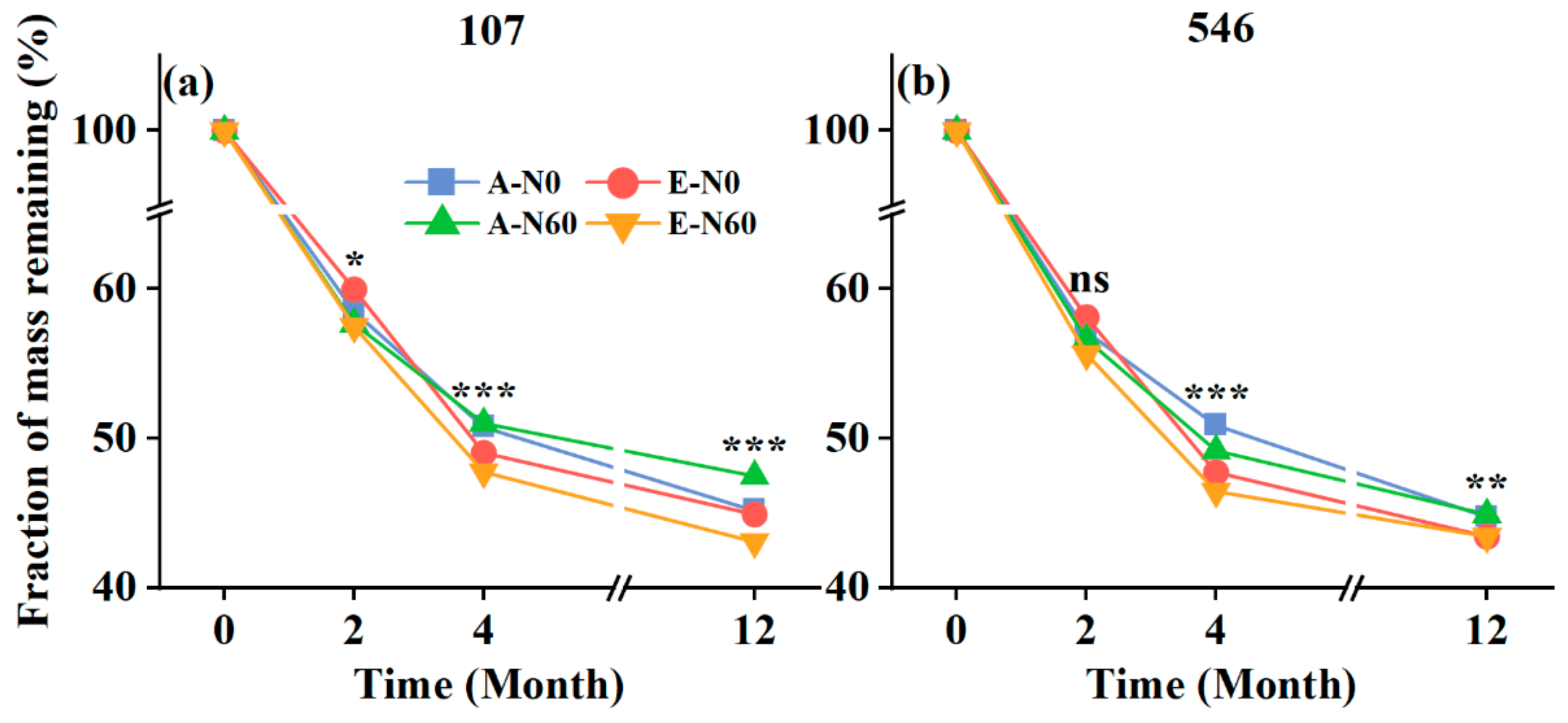
Litter mass remaining decreased continuously over the 12-month decomposition period under all O3 and N addition treatments, with a faster decline during the early stage and a slower decline after 4 months (Figure 1). Treatment differences became apparent after 2 months and persisted until the end of the experiment. Overall, clone 107 retained more litter mass than clone 546.
At the 12-month endpoint, litter mass remaining was significantly affected by O3, clone identity, O3 × N, O3 × clone, and O3 × N × clone interactions, whereas the main effect of N addition was not significant (Table S1). Relative to the corresponding N0 treatment, N addition was associated with higher mass remaining under ambient O3, with increases of 5.1% and 3.9% in clones 107 and 546, respectively, but lower mass remaining under elevated O3, with decreases of 4.6% and 2.9%, respectively.
The single-exponential decomposition constants (k) generally supported these endpoint patterns (Table S1). In clone 107, N addition reduced k under ambient O3 from 0.619 to 0.560 yr−1, but increased k under elevated O3 from 0.632 to 0.659 yr−1, consistent with the opposite effects of N addition on endpoint mass remaining. In clone 546, k changed only slightly with N addition, decreasing from 0.621 to 0.611 yr−1 under ambient O3 and from 0.654 to 0.637 yr−1 under elevated O3.

3.2. Changes in Litter Nutrient Traits and Substrate Quality Indices

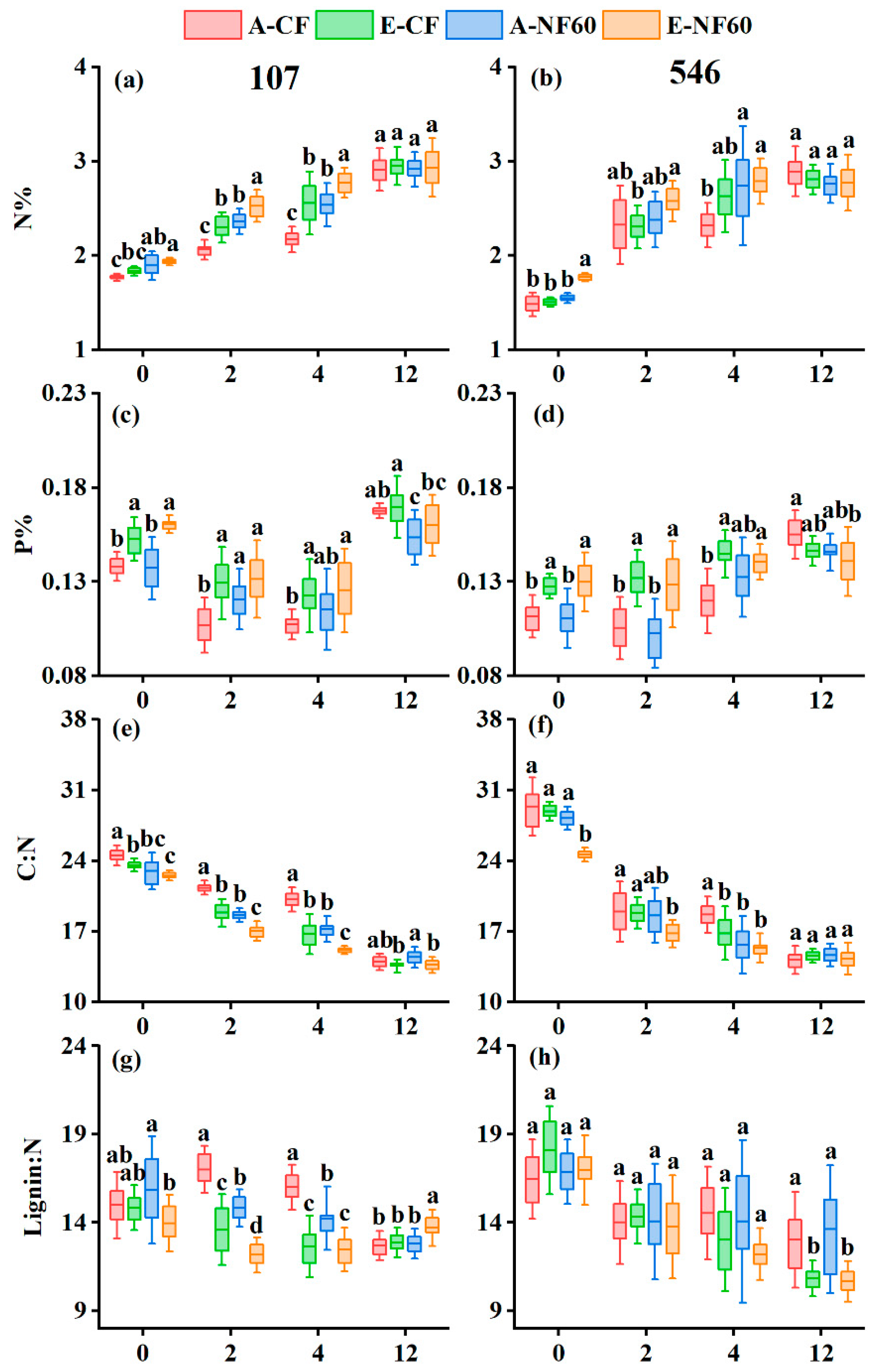
In addition to mass loss, litter chemical traits also exhibited pronounced temporal changes during decomposition (Figure 2). Overall, N and lignin concentrations increased with decomposition time, P concentration showed an initial decline followed by an increase, and C concentration decreased continuously. Meanwhile, both the C:N and Lignin:N ratios showed an overall declining trend (Figure 2 and Figure S1).
The trajectories of these traits differed among treatments. In clone 107, the A-N60 treatment significantly reduced P concentration and was associated with a relatively higher C:N ratio after 12 months of decomposition. By contrast, the E-N60 treatment caused the greatest decline in C:N and significantly increased Lignin:N (Figure 2c,e,f). In clone 546, the E-N60 treatment significantly reduced both P concentration and Lignin:N (Figure 2d,h).
Mixed-effects models showed that endpoint litter chemical traits responded in a trait-specific manner to O3, N addition, clone identity, and their interactions (Table S2). O3 significantly affected endpoint C, Lignin, and Lignin:N, whereas N addition significantly affected only P. Clone identity significantly affected N, P, Lignin, C:N, and Lignin:N. Significant interactions were detected for C under O3 × N and N × clone, and for P, Lignin, and Lignin:N under O3 × clone.

3.3. Responses of PLFA-Derived Microbial Community Indices

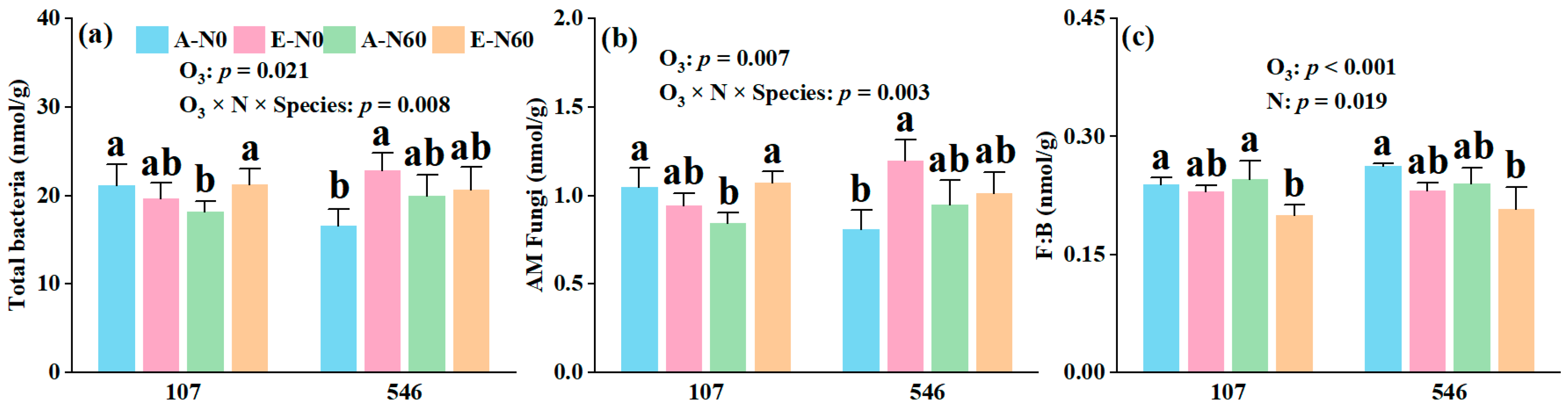
PLFA-derived microbial community indices responded differently to O3, N addition, and clone identity at the 12-month endpoint (Table S3). Total bacteria, AM fungi, and F:B were selected for detailed visualization in Figure 3 because they represent bacterial PLFA abundance, AM fungal abundance estimated from PLFA biomarkers, and the fungal–bacterial PLFA balance, respectively.
Among these indices, F:B showed the broadest response, being significantly affected by O3, N addition, O3 × N, and O3 × N × clone. Total bacteria and AM fungi were significantly affected by O3 and O3 × N × clone. Across all PLFA indices, the O3 × N × clone interaction significantly affected Total PLFA, Total bacteria, Total fungi, F:B, G+, G, and AM fungi, but not actinomycetes.
The response patterns of the three selected indices varied between clones (Figure 3). In clone 107, A-N60 tended to reduce Total bacteria and AM fungi compared with A-N0, whereas this suppressive pattern was partly alleviated under E-N60. In clone 546, O3, N addition, and their combination generally increased Total bacteria and AM fungi. In both clones, E-N60 reduced F:B, indicating a relative shift in the balance between fungal and bacterial PLFA groups under combined O3 and N addition.

3.4. Coupling Relationships Between Endpoint Litter Traits and Microbial Community Structure

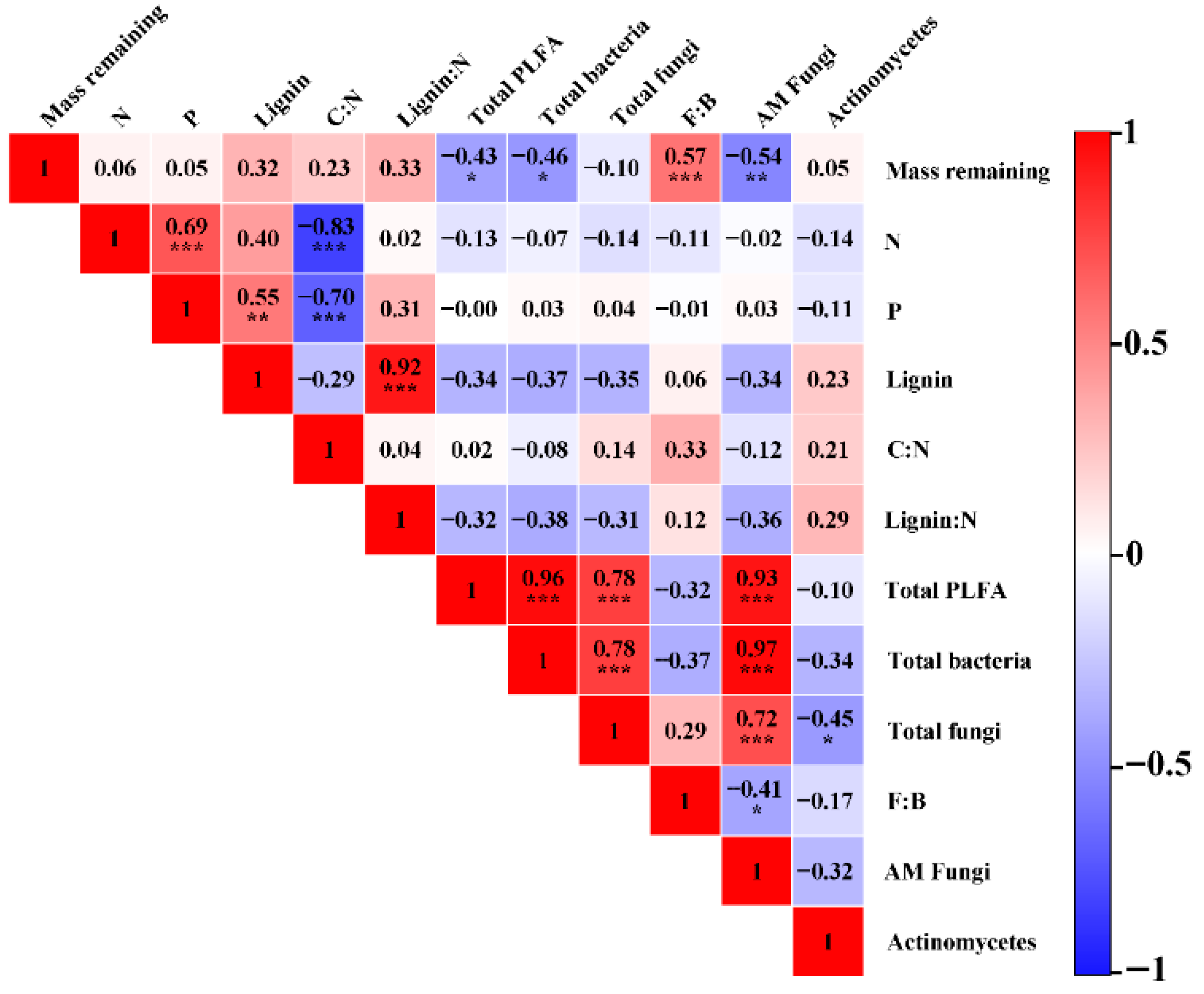
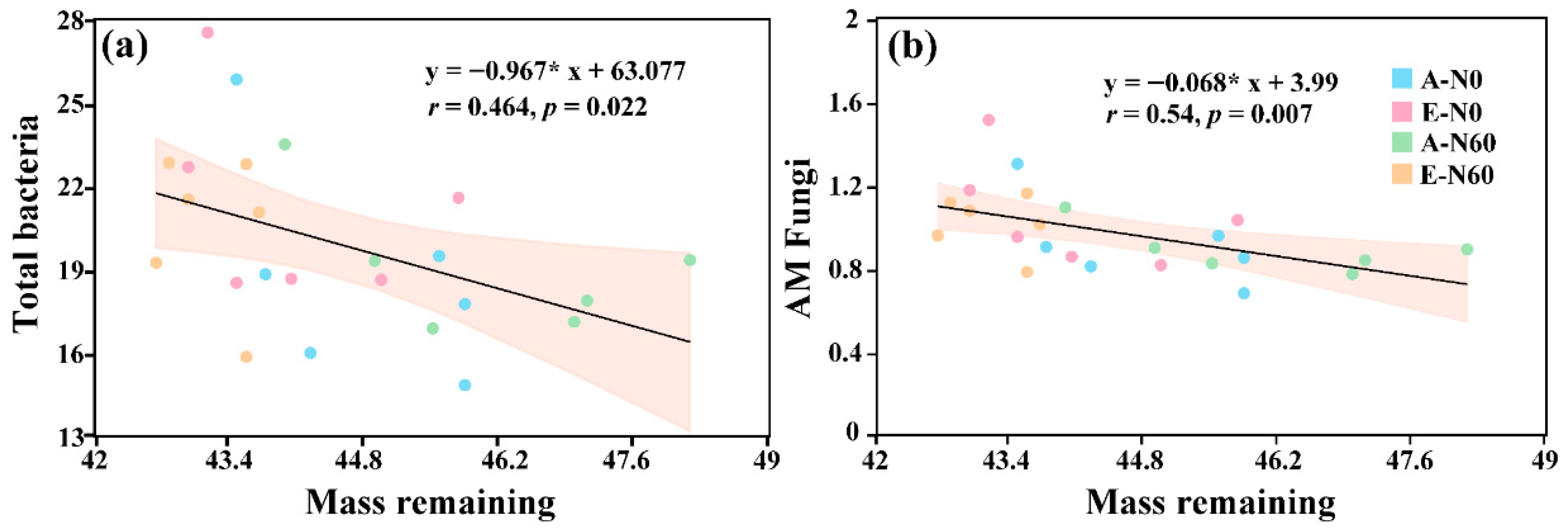
To clarify the relationships between decomposition outcomes and microbial status, we analyzed the correlations between litter traits and key PLFA indices at the end of decomposition, together with their multivariate coupling patterns (Figure 4, Figure 5 and Figure 6). The correlation heatmap showed that endpoint litter mass remaining was associated with multiple microbial variables, among which the relationship between mass remaining and F:B was the most pronounced (Figure 4). Scatterplot analysis further showed that Total bacteria and AM fungi were significantly negatively correlated with mass remaining (p < 0.05, p < 0.01; Figure 5).
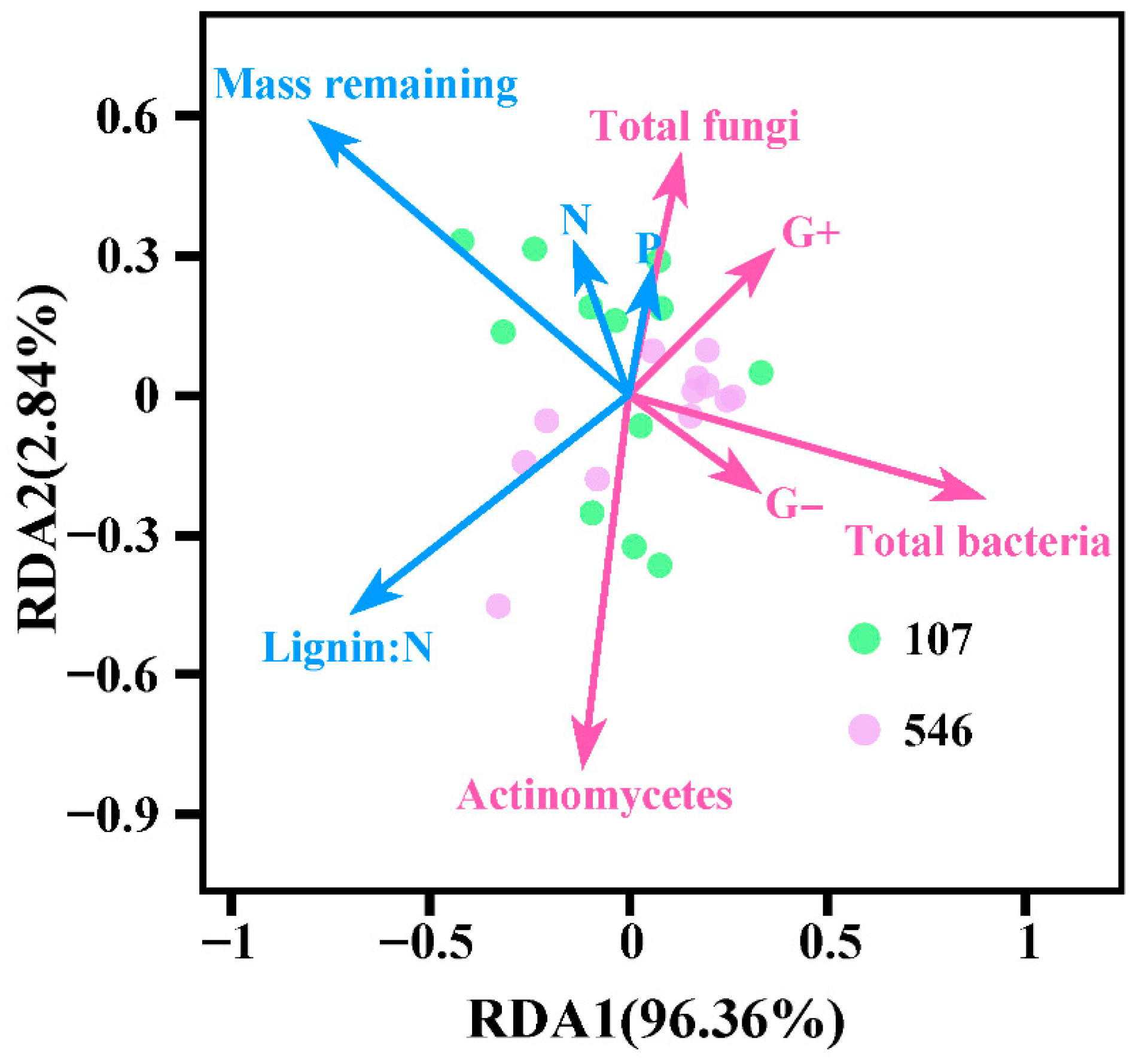
RDA indicated that endpoint litter traits were associated with variation in PLFA-derived microbial community structure (Figure 6). The RDA was based on 32 plot-level endpoint observations. All explanatory variables had VIF values below 3, including mass remaining (VIF = 1.141), N (VIF = 2.072), P (VIF = 2.287), and Lignin:N (VIF = 1.353), indicating no severe collinearity among the selected litter traits. Within the constrained ordination space, RDA1 and RDA2 accounted for 96.36% and 2.84% of the constrained variance, respectively. Sequential permutation tests showed that mass remaining was the only significant explanatory variable (p = 0.030), whereas Lignin:N, N, and P were not significant (p = 0.107, 0.887, and 0.659, respectively). The envfit association of mass remaining with the ordination space was marginally significant (R2 = 0.259, p = 0.053). Because sequential permutation tests and envfit evaluate different aspects of the litter–microbe relationship, mass remaining was interpreted as the most consistent, but not definitive, explanatory signal among the measured litter traits.
In the ordination diagram, bacterial PLFA groups, including Total bacteria, G+, and G, were mainly distributed along the positive direction of RDA1, whereas the vectors for mass remaining and Lignin:N pointed toward the negative direction of RDA1. These results suggest that endpoint PLFA-derived microbial community structure was statistically associated with variation in residual litter quantity and quality, with mass remaining providing the most consistent statistical signal.

4. Discussion

4.1. O3 and N Addition Altered Decomposition Outcomes and the Quantity and Quality of Litter Inputs to Soil

Our results showed that O3 and N addition significantly altered the decomposition trajectories and endpoint residual status of poplar leaf litter, and that these effects were strongly clone-dependent. Under all treatments, litter mass remaining declined over time, but the rate of mass loss slowed after 4 months, indicating a transition from an early phase dominated by the rapid loss of labile components to a later phase dominated by the slower decomposition of relatively recalcitrant fractions. This pattern is consistent with the general course of litter decomposition, in which soluble compounds are rapidly depleted during the early stage and structural components become relatively enriched later in the process [7,27]. Treatment differences became progressively larger as decomposition proceeded, and a significant O3 × N × clone interaction was detected after 12 months, suggesting that global change factors not only influence decomposition dynamics but also modify the quantity of residual plant-derived substrate remaining at the litter–soil interface.
The two poplar clones differed in their responses to O3 and N addition. The E-N60 treatment reduced litter mass remaining in both clones, whereas the A-N60 treatment increased it, with clone 107 showing a stronger response. This suggests that the effect of N addition on decomposition outcome is not fixed, but depends on the O3 background and plant material characteristics. Similarly, previous studies have shown that plant traits and substrate quality are important determinants of litter decomposition, and that the direction of N-addition effects often varies with substrate properties and environmental context [7,16,28]. In poplar systems, elevated O3 has also been shown to alter litter decomposition rates and nutrient release patterns [29]. Although the observed differences in endpoint mass remaining were modest, ranging from approximately 2.8% to 5.1%, repeated annual shifts of this magnitude could potentially accumulate over multiple years in poplar shelterbelt and agroforestry systems and influence organic matter return. Nevertheless, because this study did not directly quantify soil C accumulation or N transformation rates, the ecosystem-level implications of these differences should be interpreted cautiously.
In addition to litter mass remaining, the temporal changes in litter chemistry further indicate that O3 and N addition altered the quality of organic matter entering the soil. During decomposition, N and lignin concentrations increased, C concentration declined, P showed a stage-dependent pattern, and both C:N and Lignin:N ratios decreased overall. These trends are broadly consistent with the general patterns of continuous C loss, relative N enrichment, and dynamic P changes during litter decomposition [30,31,32]. The fact that these trajectories differed among treatments and clones indicates that O3 and N addition altered not only the quantity of litter inputs to soil, but also their nutrient availability and structural complexity. This interpretation is consistent with previous studies showing that N addition and elevated O3 can modify substrate chemistry and decomposition processes [16,29,33].

4.2. Differential Responses of PLFA-Derived Microbial Groups Were Associated with Endpoint Litter Traits

PLFA-derived microbial community indices responded differently to O3, N addition, and clone identity. The fungal-to-bacterial ratio (F:B) was significantly affected by the main effects of both O3 and N addition, whereas Total bacteria and AM fungi exhibited significant O3 × N × clone interactions. These results suggest that microbial community structure was associated with the combined effects of external treatments and clone-mediated litter environments. PLFA analysis has been widely used to characterize major soil microbial community groups and their structural variation, and F:B is commonly regarded as an informative indicator of shifts in the relative dominance of fungi and bacteria [26,34].
The clone-specific microbial responses may reflect differences in the residual substrate environments generated by clones 107 and 546. Clone 107 generally retained more litter mass than clone 546 and showed a stronger N-addition response under different O3 backgrounds, suggesting that clone-dependent litter persistence may have altered microbial resource availability. Differences in nutrient status, lignin-related recalcitrance, leaf structural traits, and clone-specific O3 sensitivity could have contributed to these divergent decomposition trajectories. This interpretation is consistent with previous studies showing that tree identity and associated litter and soil chemical characteristics can significantly shape microbial community composition [19,35]. Meanwhile, E-N60 reduced F:B in both clones, indicating a relative shift in the balance between fungal and bacterial PLFA markers, rather than necessarily an increase in absolute bacterial dominance. However, because PLFA primarily reflects broad microbial community structure rather than microbial activity or process rates, these results should be interpreted as evidence of microbial community structural reorganization, rather than direct proof of altered microbial metabolism, decomposition activity, or C and N transformation rates [36].
Endpoint substrate traits were associated with PLFA community structure. Mass remaining was the only variable that reached significance in the sequential RDA test, indicating that, at the endpoint of decomposition, the quantity of residual substrate showed a stronger statistical association with microbial community differentiation than individual N or P concentrations. However, the envfit result for mass remaining was only marginally significant, suggesting that this pattern should be interpreted as a suggestive association rather than definitive evidence of a single dominant driver. At the same time, Lignin:N also showed relatively strong explanatory trends in the correlation and ordination analyses, indicating that substrate recalcitrance may remain an important component of the residual litter environment associated with microbial community differentiation. Previous studies have shown that substrate chemistry, especially lignin content, C:N, and Lignin:N, can influence microbial community variation during decomposition [37,38]. Our results extend this view by suggesting that the amount of residual litter remaining after decomposition may also be an important component of the litter-derived resource environment. Nevertheless, because the present study used PLFA-based community profiling and endpoint observations, these relationships should be interpreted as statistical associations between residual substrate traits and microbial community structure, rather than direct evidence for causal effects on microbial metabolism or C and N cycling rates. Future studies combining PLFA with enzyme activities, soil respiration, C and N mineralization rates, or functional gene analyses would be needed to determine whether these structural changes translate into altered microbial processes [11,39].

4.3. Potential Implications for Litter-Mediated C and N Inputs in Agroforestry Systems

Our findings suggest that O3 and N addition may be associated with shifts in PLFA-derived microbial groups through changes in the quantity and quality of plant residue inputs. These results point to a potential link between residual plant inputs and microbial community structure, but they do not directly demonstrate changes in soil C or N cycling rates. Previous work has shown that plant residue chemical quality is closely related to soil microbial activity, community structure, and the stabilization of soil organic C and N [40]. In agricultural ecosystems, crop residues, shelterbelt litter, and other organic materials are all important sources of soil organic C and N inputs [41], and differences in the quality of these inputs can further influence microbially mediated decomposition and nutrient transformation processes. If environmental change alters the amount, chemical composition, and recalcitrance of these inputs, the composition of PLFA-derived microbial groups may also change accordingly [40,42].
Although the present study focused on poplar leaf litter, its implications for plant residue inputs and microbial community structure may also be relevant to shelterbelt and agroforestry systems. In farmland shelterbelts and agroforestry systems, trees can alter adjacent soil microbial communities and soil processes [22,43,44]. Our results are consistent with a litter-mediated association among global change factors, residual plant inputs, and PLFA-derived microbial community structure. However, because we did not directly measure process indicators such as C mineralization, N mineralization, soil respiration, extracellular enzyme activities, or functional genes, the extent to which these microbial structural shifts translate into changes in C and N cycling processes remains to be tested.

4.4. Limitations and Future Perspectives

Several limitations should be acknowledged. First, PLFA analysis primarily characterizes microbial community structure and the composition of broad functional groups. Although it provides valuable information on microbial biomass and coarse taxonomic distribution, it does not directly resolve specific metabolic functions or process rates. Consequently, the microbial structural changes observed here should not be directly equated with alterations in the intensity of C and N transformation processes [36,45,46]. Second, microbial measurements were conducted only at the endpoint of decomposition (12 months). Therefore, our analysis is best interpreted as an endpoint association between residual litter traits and microbial community structure, rather than a temporal reconstruction of microbial succession during decomposition [10,47]. Repeated microbial measurements across decomposition stages would be needed to determine how microbial community structure changes dynamically in response to litter mass loss and substrate quality shifts.
Furthermore, the correlation and ordination analyses used in this study reflect statistical associations among variables rather than causal relationships. Although these approaches are useful for identifying patterns of community differentiation and their correspondence with environmental factors, they cannot independently establish mechanistic links between litter inputs and microbial responses. Future studies should combine time-series microbial monitoring with measurements of extracellular enzyme activities, soil respiration, C and N mineralization rates, microbial biomass C and N, DOC/DON, and functional genes to determine whether PLFA-derived structural changes translate into altered biogeochemical processes. In addition, experimental manipulation of litter input quantity and substrate quality would help disentangle their relative contributions to microbial community structure and associated C and N cycling processes [47,48].

5. Conclusions

This study showed that O3 and N addition interactively altered endpoint poplar leaf litter mass remaining and residual litter chemical quality, with responses depending strongly on clone identity. These changes were accompanied by shifts in PLFA-derived soil microbial community structure, particularly in Total bacteria, AM fungi, and the fungal-to-bacterial ratio.
Among the measured endpoint litter traits, litter mass remaining showed the strongest statistical association with PLFA-derived microbial community structure, whereas individual N and P concentrations had weaker independent effects. This suggests that residual litter quantity, together with substrate quality, may be an important component of litter-mediated microbial community reorganization under combined O3 and N addition. However, because microbial process rates, enzyme activities, and C and N mineralization were not measured, these findings should be interpreted as evidence of microbial structural responses with potential, rather than demonstrated, implications for soil C and N cycling.

Supplementary Materials

The following supporting information can be downloaded at: https://www.mdpi.com/article/10.3390/agriculture16101059/s1, Figure S1: Changes in litter nutrient traits and substrate quality indices of 107 and 546 during decomposition under different ozone and nitrogen addition treatments; Table S1: Single-exponential decomposition rate constants (k) of poplar leaf litter under different O3 and N addition treatments.; Table S2: Linear mixed-effects model results for endpoint litter mass remaining and chemical traits.; Table S3: Linear mixed-effects model results for PLFA-derived microbial community indices at the 12-month endpoint.

Author Contributions

Conceptualization, X.H., M.Z. and P.L.; methodology, H.W. and Q.L.; validation, X.H., M.Z. and X.L. (Xin Li).; formal analysis, X.H. and X.L. (Xin Li); investigation, H.W. and Q.L.; resources, X.H. and M.Z.; writing—original draft preparation, X.H. and M.Z.; writing—review and editing, X.H., M.Z. and P.L.; supervision, H.W. and P.L.; project administration, H.W. and P.L.; funding acquisition, X.L. (Xianwen Li) and P.L. All authors have read and agreed to the published version of the manuscript.

Funding

This research was funded by the National Natural Science Foundation of China (Grant No. 32271673) and the Special Funds for the Cultivation of Guangdong College Students’ Scientific and Technological Innovation (“Climbing Program” Special Funds, Grant No. pdjh2025bg245).

Institutional Review Board Statement

Not applicable.

Data Availability Statement

The data presented in this study are available in the article and Supplementary Materials.

Conflicts of Interest

The authors declare no conflicts of interest. The funders had no role in study design, data collection and analysis, decision to publish, or preparation of the manuscript.

References

  1. Delgado-Baquerizo, M.; Maestre, F.T.; Reich, P.B.; Jeffries, T.C.; Gaitan, J.J.; Encinar, D.; Berdugo, M.; Campbell, C.D.; Singh, B.K. Microbial diversity drives multifunctionality in terrestrial ecosystems. Nat. Commun. 2016, 7, 10541. [Google Scholar] [CrossRef]
  2. Zheng, Q.; Hu, Y.; Zhang, S.; Noll, L.; Bckle, T.; Dietrich, M.; Herbold, C.W.; Eichorst, S.A.; Woebken, D.; Richter, A. Soil multifunctionality is affected by the soil environment and by microbial community composition and diversity. Soil Biol. Biochem. 2019, 136, 107521. [Google Scholar] [CrossRef]
  3. Naylor, D.; Sadler, N.; Bhattacharjee, A.; Graham, E.B.; Jansson, J.K. Soil Microbiomes Under Climate Change and Implications for Carbon Cycling. Annu. Rev. Environ. Resour. 2020, 45, 29–59. [Google Scholar] [CrossRef]
  4. Wang, B.; An, S.; Liang, C.; Liu, Y.; Kuzyakov, Y. Microbial necromass as the source of soil organic carbon in global ecosystems. Soil Biol. Biochem. 2021, 162, 108422. [Google Scholar] [CrossRef]
  5. Tao, F.; Huang, Y.; Hungate, B.A.; Manzoni, S.; Frey, S.D.; Schmidt, M.W.I.; Reichstein, M.; Carvalhais, N.; Ciais, P.; Jiang, L.; et al. Microbial carbon use efficiency promotes global soil carbon storage. Nature 2023, 618, 981–985. [Google Scholar] [CrossRef]
  6. Freschet, G.T.; Cornwell, W.K.; Wardle, D.A.; Elumeeva, T.G.; Liu, W.D.; Jackson, B.G.; Onipchenko, V.G.; Soudzilovskaia, N.A.; Tao, J.P.; Cornelissen, J.H.C. Linking litter decomposition of above- and below-ground organs to plant-soil feedbacks worldwide. J. Ecol. 2013, 101, 943–952. [Google Scholar] [CrossRef]
  7. Cornwell, W.K.; Cornelissen, J.H.C.; Amatangelo, K.; Dorrepaal, E.; Eviner, V.T.; Godoy, O.; Hobbie, S.E.; Hoorens, B.; Kurokawa, H.; Pérez-Harguindeguy, N.; et al. Plant species traits are the predominant control on litter decomposition rates within biomes worldwide. Ecol. Lett. 2010, 11, 1065–1071. [Google Scholar] [CrossRef] [PubMed]
  8. Prescott, C.E.; Vesterdal, L. Decomposition and transformations along the continuum from litter to soil organic matter in forest soils. For. Ecol. Manag. 2021, 498, 119522. [Google Scholar] [CrossRef]
  9. Melillo, J.M.; Aber, J.D.; Muratore, J.F. Nitrogen and Lignin Control of Hardwood Leaf Litter Decomposition Dynamics. Ecology 1982, 63, 621–626. [Google Scholar] [CrossRef]
  10. Strickland, M.S.; Rousk, J. Considering fungal: Bacterial dominance in soils–Methods, controls, and ecosystem implications. Soil Biol. Biochem. 2010, 42, 1385–1395. [Google Scholar] [CrossRef]
  11. Benito-Carnero, G.; Gartzia-Bengoetxea, N.; Arias-González, A.; Rousk, J. Low-quality carbon and lack of nutrients result in a stronger fungal than bacterial home-field advantage during the decomposition of leaf litter. Funct. Ecol. 2021, 35, 1783–1796. [Google Scholar] [CrossRef]
  12. Borer, E.T.; Stevens, C.J. Nitrogen deposition and climate: An integrated synthesis. Trends Ecol. Evol. 2022, 37, 541–552. [Google Scholar] [CrossRef]
  13. Shang, B.; Feng, Z.; Li, P.; Calatayud, V. Elevated ozone affects C, N and P ecological stoichiometry and nutrient resorption of two poplar clones. Environ. Pollut. 2018, 234, 136–144. [Google Scholar] [CrossRef]
  14. Hou, X.; Wu, X.; Ma, C.; Tian, D.; Yan, Z.; Li, P. Effect of the elevated ozone on greening tree species of urban: Alterations in C-N-P stoichiometry and nutrient stock allocation to leaves and fine roots. Urban For. Urban Green. 2022, 76, 127735. [Google Scholar] [CrossRef]
  15. Li, Y.; Bezemer, T.M.; Yang, J.; Lü, X.; Li, X.; Liang, W.; Han, X.; Li, Q. Changes in litter quality induced by N deposition alter soil microbial communities. Soil Biol. Biochem. 2019, 130, 33–42. [Google Scholar] [CrossRef]
  16. Ping, Q.; Xu, S.; He, X.; Sun, S. Nitrogen addition alters litter chemical traits to regulate decomposition: A meta-analysis. Sci. Total Environ. 2025, 983, 179705. [Google Scholar] [CrossRef]
  17. Zheng, H.; Vesterdal, L.; Agathokleous, E.; Yuan, X.; Yuan, M.; Xu, Y.; Heděnec, P.; Shang, B.; Feng, Z.; Rousk, J. Ozone strengthens the ex vivo but weakens the in vivo pathway of the microbial carbon pump in poplar plantations. Soil Biol. Biochem. 2024, 198, 109559. [Google Scholar] [CrossRef]
  18. Schweitzer, J.A.; Bailey, J.K.; Fischer, D.G.; LeRoy, C.J.; Lonsdorf, E.V.; Whitham, T.G.; Hart, S.C. Plant-soil microorganism interactions: Heritable relationship between plant genotype and associated soil microorganisms. Ecology 2008, 89, 773–781. [Google Scholar] [CrossRef] [PubMed]
  19. Prescott, C.E.; Grayston, S.J. Tree species influence on microbial communities in litter and soil: Current knowledge and research needs. For. Ecol. Manag. 2013, 309, 19–27. [Google Scholar] [CrossRef]
  20. Isebrands, J.G.; Richardson, J. Poplars and Willows: Trees for Society and the Environment; CABI: Boston, MA, USA; FAO: Rome, Italy, 2014; pp. 571–579. [Google Scholar] [CrossRef]
  21. Rolo, V.; Rivest, D.; Maillard, M.; Moreno, G. Agroforestry potential for adaptation to climate change: A soil-based perspective. Soil Use Manag. 2023, 39, 1006–1032. [Google Scholar] [CrossRef]
  22. Beule, L.; Lehtsaar, E.; Corre, M.D.; Schmidt, M.; Veldkamp, E.; Karlovsky, P. Poplar Rows in Temperate Agroforestry Croplands Promote Bacteria, Fungi, and Denitrification Genes in Soils. Front. Microbiol. 2019, 10, 3108. [Google Scholar] [CrossRef]
  23. Wu, Y.; Wang, Q.; Wang, H.; Wang, W.; Han, S. Shelterbelt Poplar Forests Induced Soil Changes in Deep Soil Profiles and Climates Contributed Their Inter-site Variations in Dryland Regions, Northeastern China. Front. Plant Sci. 2019, 10, 220. [Google Scholar] [CrossRef]
  24. Zhu, M.; Cheng, G.; Zhang, X.; Guo, Y.; Wu, Y.; Wang, Q.; Wang, H.; Wang, W. Shelterbelts increased soil inorganic carbon but decreased nitrate nitrogen, total phosphorus, and bulk density relative to neighbor farmlands depending on tree growth, geoclimate, and soil microbes in the Northeast China Plain. Catena 2023, 231, 107344. [Google Scholar] [CrossRef]
  25. Xu, Y.; Feng, Z.; Kobayashi, K. Performances of a system for free-air ozone concentration elevation with poplar plantation under increased nitrogen deposition. Environ. Sci. Pollut. Res. 2021, 28, 58298–58309. [Google Scholar] [CrossRef]
  26. Frostegård, A.; Bååth, E. The use of phospholipid fatty acid analysis to estimate bacterial and fungal biomass in soil. Biol. Fertil. Soils 1996, 22, 59–65. [Google Scholar] [CrossRef]
  27. Zhang, J.; Zhang, D.; Jian, Z.; Zhou, H.; Zhao, Y.; Wei, D. Litter decomposition and the degradation of recalcitrant components in Pinus massoniana plantations with various canopy densities. J. For. Res. 2019, 30, 1395–1405. [Google Scholar] [CrossRef]
  28. Wu, J.; Zhang, H.; Cheng, X.; Liu, G. Nitrogen addition stimulates litter decomposition rate: From the perspective of the combined effect of soil environment and litter quality. Soil Biol. Biochem. 2023, 179, 108992. [Google Scholar] [CrossRef]
  29. Hou, X.; Li, P.; Wu, X.; Xu, S.; Sun, Q. Differences in nutrient release and decay rate of poplar leaf litter and fine roots and their relationship with substrate quality and decomposition environment under ozone pollution. Environ. Exp. Bot. 2024, 226, 105898. [Google Scholar] [CrossRef]
  30. Manzoni, S.; Trofymow, J.A.; Jackson, R.B.; Porporato, A. Stoichiometric controls on carbon, nitrogen, and phosphorus dynamics in decomposing litter. Ecol. Monogr. 2010, 80, 89–106. [Google Scholar] [CrossRef]
  31. Ding, Z.; Liu, X.; Gong, L.; Chen, X.; Zhao, J.; Chen, W. Response of litter decomposition and the soil environment to one-year nitrogen addition in a Schrenk spruce forest in the Tianshan Mountains, China. Sci. Rep. 2022, 12, 648. [Google Scholar] [CrossRef]
  32. Chi, G.; Zeng, F.; Wang, Y.; Chen, X. Phosphorus dynamics in litter–soil systems during litter decomposition in larch plantations across the chronosequence. Front. Plant Sci. 2022, 13, 1010458. [Google Scholar] [CrossRef]
  33. Li, P.; Yin, R.; Zhou, H.; Xu, S.; Feng, Z. Functional traits of poplar leaves and fine roots responses to ozone pollution under soil nitrogen addition. J. Environ. Sci. 2022, 113, 118–131. [Google Scholar] [CrossRef]
  34. Bååth, E.; Anderson, T.H. Comparison of soil fungal/bacterial ratios in a pH gradient using physiological and PLFA-based techniques. Soil Biol. Biochem. 2003, 35, 955–963. [Google Scholar] [CrossRef]
  35. Urbanová, M.; Šnajdr, J.; Baldrian, P. Composition of fungal and bacterial communities in forest litter and soil is largely determined by dominant trees. Soil Biol. Biochem. 2015, 84, 53–64. [Google Scholar] [CrossRef]
  36. Agnihotri, R.; Gujre, N.; Mitra, S.; Sharma, M.P. Decoding the PLFA profiling of microbial community structure in soils contaminated with municipal solid wastes. Environ. Res. 2023, 219, 114993. [Google Scholar] [CrossRef]
  37. Bray, S.R.; Kitajima, K.; Mack, M.C. Temporal dynamics of microbial communities on decomposing leaf litter of 10 plant species in relation to decomposition rate. Soil Biol. Biochem. 2012, 44, 30–37. [Google Scholar] [CrossRef]
  38. Habtewold, J.Z.; Helgason, B.L.; Yanni, S.F.; Janzen, H.H.; Ellert, B.H.; Gregorich, E.G. Litter composition has stronger influence on the structure of soil fungal than bacterial communities. Eur. J. Soil Biol. 2020, 98, 103190. [Google Scholar] [CrossRef]
  39. Elias, D.M.O.; Robinson, S.; Both, S.; Goodall, T.; Majalap-Lee, N.; Ostle, N.J.; McNamara, N.P. Soil Microbial Community and Litter Quality Controls on Decomposition Across a Tropical Forest Disturbance Gradient. Front. For. Glob. Change 2020, 3, 81. [Google Scholar] [CrossRef]
  40. Almagro, M.; Ruiz-Navarro, A.; Díaz-Pereira, E.; Albaladejo, J.; Martínez-Mena, M. Plant residue chemical quality modulates the soil microbial response related to decomposition and soil organic carbon and nitrogen stabilization in a rainfed Mediterranean agroecosystem. Soil Biol. Biochem. 2021, 156, 108198. [Google Scholar] [CrossRef]
  41. Kong, A.Y.Y.; Scow, K.M.; Córdova-Kreylos, A.L.; Holmes, W.E.; Six, J. Microbial community composition and carbon cycling within soil microenvironments of conventional, low-input, and organic cropping systems. Soil Biol. Biochem. 2011, 43, 20–30. [Google Scholar] [CrossRef]
  42. Baumann, K.; Marschner, P.; Smernik, R.J.; Baldock, J.A. Residue chemistry and microbial community structure during decomposition of eucalypt, wheat and vetch residues. Soil Biol. Biochem. 2009, 41, 1966–1975. [Google Scholar] [CrossRef]
  43. Bach, L.H.; Grytnes, J.A.; Halvorsen, R.; Ohlson, M. Tree influence on soil microbial community structure. Soil Biol. Biochem. 2010, 42, 1934–1943. [Google Scholar] [CrossRef]
  44. Ji, Q.; Jiang, H.; Xu, Z.; Zhu, M.; Zhang, S.; Wang, H.; Tang, Z.; Wang, Q.; Wang, W. Farmland Afforestation by Poplar Shelterbelts Increased Soil Inorganic Carbon but Showed Ambiguous Effects on Soil Organic Carbon as Revealed by Carbon Isotopic Composition: Inter-Fraction and Inter-Site Differences in Northern China. Forests 2025, 16, 328. [Google Scholar] [CrossRef]
  45. Quideau, S.A.; McIntosh, A.C.S.; Norris, C.E.; Lloret, E.; Swallow, M.J.B.; Hannam, K. Extraction and Analysis of Microbial Phospholipid Fatty Acids in Soils. J. Vis. Exp. 2016, 54360. [Google Scholar] [CrossRef]
  46. Van Galen, L.G.; Smith, G.R.; Margenot, A.J.; Waldrop, M.P.; Crowther, T.W.; Peay, K.G.; Jackson, R.B.; Yu, K.; Abrahão, A.; Ahmed, T.A.; et al. A global database of soil microbial phospholipid fatty acids and enzyme activities. Sci. Data 2025, 12, 1568. [Google Scholar] [CrossRef]
  47. Liao, J.; Dou, Y.; Yang, X.; An, S. Soil microbial community and their functional genes during grassland restoration. J. Environ. Manag. 2023, 325, 116488. [Google Scholar] [CrossRef]
  48. Geng, Y.; Ding, Y.; Zhou, P.; Wang, Z.; Peng, C.; Li, D. Soil microbe-mediated carbon and nitrogen cycling during primary succession of biological soil crusts in tailings ponds. Sci. Total Environ. 2023, 894, 164969. [Google Scholar] [CrossRef]
Figure 1. Temporal dynamics of poplar leaf litter mass remaining under different O3 and N addition treatments during the 12-month decomposition experiment. (a) 107; (b) 546. A and E represent ambient and elevated O3 treatments, respectively; N0 and N60 represent no N addition and N addition at 60 kg N ha−1 yr−1, respectively. Data are presented as mean ± SE. * p < 0.05; ** p < 0.01; *** p < 0.001; ns, not significant.
Agriculture 16 01059 g001
Figure 2. Changes in litter nutrient traits and substrate quality indices of 107 and 546 during decomposition under different O3 and N addition treatments. (a) N of 107; (b) N of 546; (c) P of 107; (d) P of 546; (e) C:N of 107; (f) C:N of 546; (g) Lignin:N of 107; (h) Lignin:N of 546. Data are presented as mean ± SE. Different lowercase letters indicate significant differences among treatments within the same clone at each sampling time (p < 0.05).
Agriculture 16 01059 g002
Figure 3. Responses of selected PLFA-derived microbial community indices under different O3 and N addition treatments. Panels show Total bacteria (a), AM fungi (b), and the fungal-to-bacterial PLFA ratio (F:B) (c) in soils associated with poplar clones 107 and 546 at the end of decomposition. A and E represent ambient and elevated O3 treatments, respectively; N0 and N60 represent no N addition and N addition at 60 kg N ha−1 yr−1, respectively. Data are presented as mean ± SE. Different lowercase letters indicate significant differences among treatments within the same clone (p < 0.05). The symbol “×” denotes an interaction effect between factors.
Agriculture 16 01059 g003
Figure 4. Correlation heatmap showing the relationships between litter traits and key PLFA microbial indices at the end of decomposition. Color indicates the direction and strength of the correlation, with warm colors representing positive correlations and cool colors representing negative correlations. Asterisks indicate significance levels: * p < 0.05, ** p < 0.01, *** p < 0.001.
Agriculture 16 01059 g004
Figure 5. Linear relationships between litter mass remaining and key microbial indices at the end of decomposition. (a) Total bacteria; (b) AM fungi. Solid lines indicate fitted linear regressions, and shaded areas represent 95% confidence intervals.
Agriculture 16 01059 g005
Figure 6. Redundancy analysis (RDA) ordination showing associations between endpoint litter traits and PLFA-derived microbial community structure. Arrows represent litter trait variables, and arrow length indicates the relative strength of association with the ordination space. RDA1 and RDA2 explained 96.36% and 2.84% of the constrained variation, respectively. PLFA variables represent broad microbial community groups rather than direct microbial process rates.
Agriculture 16 01059 g006
Disclaimer/Publisher’s Note: The statements, opinions and data contained in all publications are solely those of the individual author(s) and contributor(s) and not of MDPI and/or the editor(s). MDPI and/or the editor(s) disclaim responsibility for any injury to people or property resulting from any ideas, methods, instructions or products referred to in the content.