Review

A Review of Mechanized Harvesting, Threshing, and Cleaning Devices for Pulses

1
School of Mechanical Engineering, Jiangsu University, Zhenjiang 212013, China
2
School of Food and Biological Engineering, Jiangsu University, Zhenjiang 212013, China
3
Nanjing Institute of Agricultural Mechanization, Ministry of Agriculture and Rural Affairs, Nanjing 210014, China
*
Author to whom correspondence should be addressed.
Agriculture 2026, 16(10), 1051; https://doi.org/10.3390/agriculture16101051
Submission received: 11 April 2026 / Revised: 6 May 2026 / Accepted: 8 May 2026 / Published: 12 May 2026
(This article belongs to the Section Agricultural Technology)

Abstract

Against the backdrop of intelligent and precision agriculture, mechanized harvesting of pulses is crucial for improving productivity and addressing the challenges posed by the changing agricultural workforce structure. However, the biological characteristics of pulses—such as susceptibility to grain breakage, pod shattering, and asynchronous maturity—impose far more stringent demands on threshing and cleaning performance than those for cereal crops. Existing grain combines, when directly applied to pulses, commonly cause high grain breakage during threshing, high cleaning losses, and poor adaptability. This paper systematically reviews the current status and development trends of threshing and cleaning technologies in mechanized pulse harvesting. The core challenges are analyzed from three perspectives: crop biology, technical bottlenecks, and external operational factors. Research progress and breakthrough pathways in low-damage threshing are reviewed in terms of physical and biomechanical properties, flexible threshing elements, multi-stage cylinder structures, multi-field coupled simulation, intelligent control, and energy consumption analysis. Key achievements and breakthrough pathways in high-efficiency cleaning are summarized from aspects of airflow–screen coupling optimization, screening system innovation, numerical simulation, and intelligent detection and control. Based on typical machine models, the structural characteristics and operational applicability of general-purpose and specialized combine harvesters are compared and analyzed. Finally, future development directions are discussed from four perspectives: multifunctionality and generalization, simplification and adaptability, intelligence and precision, and greening and energy efficiency. This paper aims to provide a systematic theoretical reference and technical support for the development, improvement, and industrial application of low-damage, high-efficiency pulse harvesting equipment.

1. Introduction

With the changing structure of the agricultural labor force and the promotion of large-scale planting patterns, mechanized harvesting has become an important support for ensuring the stable development of the pulse industry. Pulse crops mainly include soybean, mung bean, faba bean, pea, cowpea, etc., which are important food and cash crops in China [1]. Compared with cereal crops, pulse crops exhibit significant differences in plant morphology, podding position, maturity uniformity, and grain dimensional uniformity and moisture content, making them more prone to issues such as header losses, grain breakage during threshing, and cleaning difficulties during mechanized harvesting. Therefore, conducting research on the key technologies in the pulse harvesting process is of great significance for improving the level of mechanized harvesting.
In recent years, domestic and international scholars have conducted extensive research on mechanized pulse harvesting, achieving notable progress in threshing and cleaning processes [2]. In terms of threshing, research has mainly focused on the analysis of crop physical and mechanical properties, the elucidation of damage mechanisms, and the optimization of low-damage structures. Design concepts such as flexible threshing elements, multi-stage threshing cylinders, and adjustable clearance mechanisms have gradually emerged. In terms of cleaning, research has focused on the optimization of air-and-screen systems, airflow regulation, improvement of screen surface structures, and simulation analysis of the cleaning process to enhance grain separation efficiency and operational adaptability. Meanwhile, the development of sensing and control technologies has also promoted research on condition monitoring and parameter adjustment during the threshing and cleaning processes [3,4,5,6,7,8]. Recent rapid advances in smart agricultural machinery, particularly in multi-sensor fusion, edge computing, and digital twins for harvesters [9,10], have opened new possibilities for intelligent pulse harvesting.
Existing reviews have summarized related technologies from various perspectives. Zhan et al. [1] reviewed the types of threshing and cleaning devices and proposed suggestions for the selection of pulse harvesting equipment. Xia et al. [7,8] reviewed the current status of mechanized pulse harvesting technology in China and strategies for loss reduction. Zhang et al. [2] analyzed the current state and intelligent development direction of mechanized threshing technology for pulses. Tang et al. [3] reviewed the research status of threshing and separation devices in combine harvesters. Yang et al. [11] reviewed the research status and machine characteristics of threshing equipment for faba bean and cereals at home and abroad. Tang et al. [12] discussed the current status of equipment for segmented and combined mechanized harvesting of mung bean. Liu et al. [13] reviewed the key technologies of cleaning devices in soybean combines. Lei et al. [14] reviewed the types and technical research status of threshing devices in grain combine harvesters. Gu et al. [9] reviewed sensor-centric intelligent systems for soybean harvest mechanization in challenging agro-environments. Chen et al. [15] reviewed control algorithms for grain combine harvesters. Reviews on digital twin applications across the agri-food sector [16] further illustrate the accelerating integration of intelligent technologies into harvesting systems. Dong et al. [17] reviewed the current status and trends of grain loss monitoring sensor technology.
To answer these questions, this paper adopts a comprehensive methodological framework designed to systematically review the key threshing and cleaning technologies in mechanized pulse harvesting. The literature was retrieved from multiple academic databases, including Web of Science, Scopus, and CNKI (China National Knowledge Infrastructure), to ensure broad coverage of both international and Chinese research outputs. The following inclusion criteria were applied: (1) peer-reviewed journal articles, doctoral/master’s theses, and patents with experimental validation were prioritized to ensure methodological rigor; (2) studies were required to report quantitative or qualitative data on threshing or cleaning performance for pulse crops or, where relevant, cereal crops with transferable insights; and (3) the search was temporally restricted to publications between 1990 and 2025 to encompass both foundational studies and recent advances. Where multiple studies reported similar findings for the same crop and device type, representative studies with the most reproducible experimental protocols were selected for detailed discussion. The synthesis approach adopted in this review is critical and comparative, aiming to identify consistent trends, conflicting findings, and research gaps across the literature.
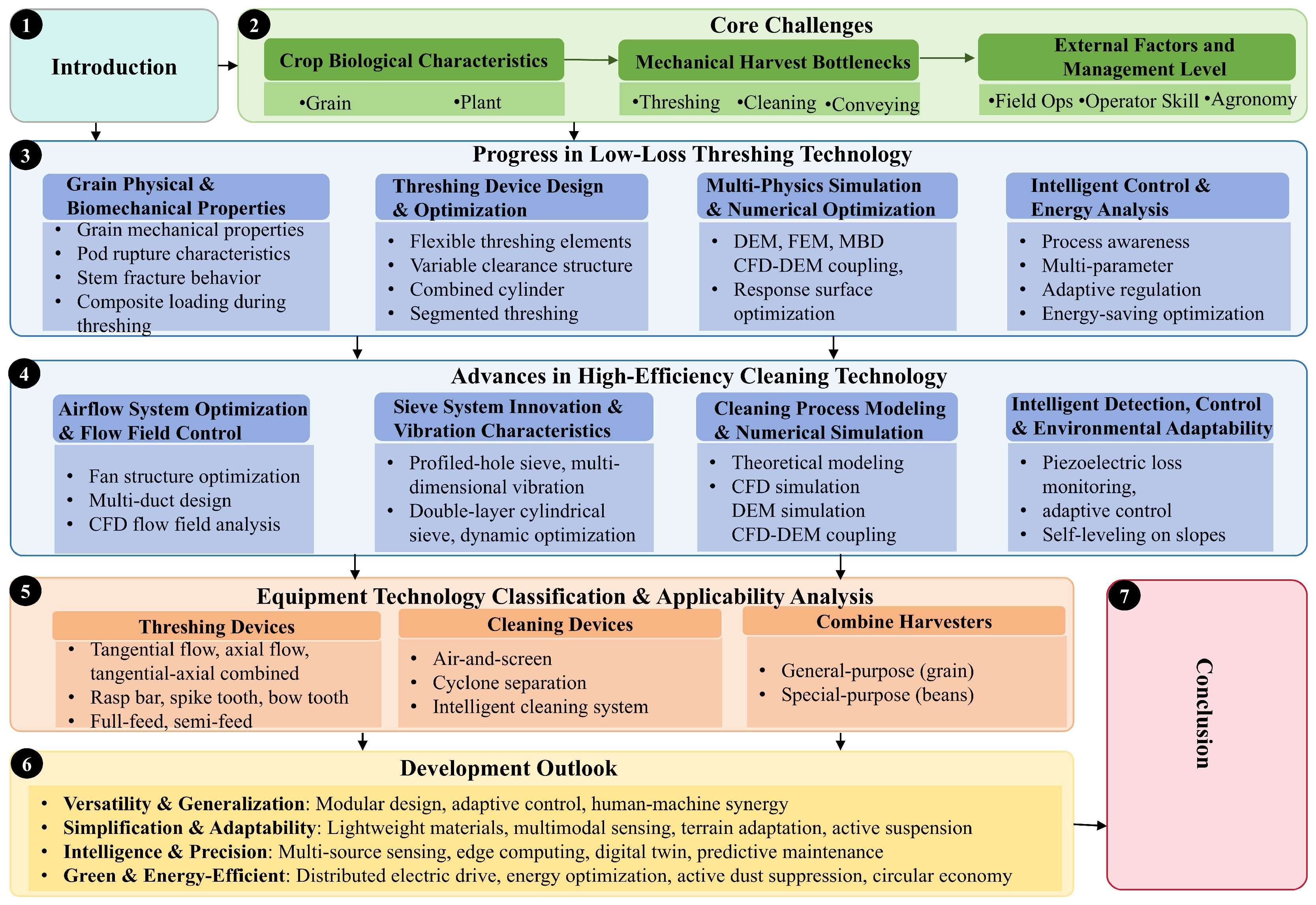
As shown in Figure 1, Section 2 analyzes the main challenges faced by mechanized pulse harvesting. Section 3 reviews the research progress of low-damage threshing technology. Section 4 summarizes the development status of high-efficiency cleaning technology. Section 5 provides a comparative analysis of typical combine harvesting equipment. Section 6 discusses future development directions. Section 7 concludes the paper. Through the above content, it is expected to provide a reference for the research and application of low-damage and high-efficiency pulse harvesting equipment.

2. Core Challenges in Mechanized Pulse Harvesting

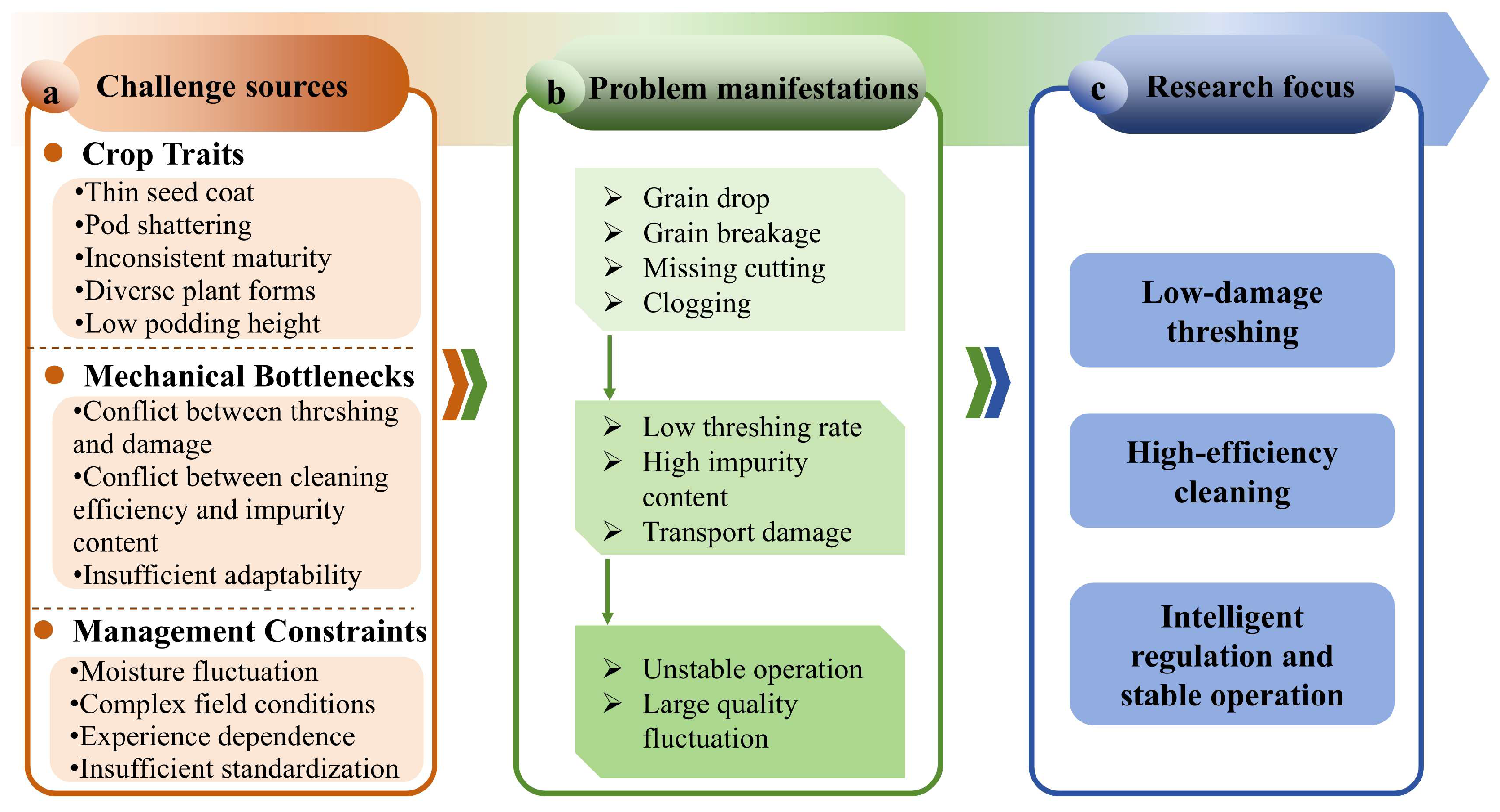
Mechanized pulse harvesting is a key link for improving production efficiency and alleviating labor shortages. However, due to significant differences among crop biological characteristics, harvesting equipment adaptability, and field operating conditions, the harvesting quality still faces considerable challenges. As shown in Figure 2, these challenges can be categorized into three types.
The first is the limitation of crop biological characteristics. Compared with cereal crops, pulses generally exhibit characteristics such as thin seed coats, fragile embryos, pods prone to shattering, asynchronous maturity, diverse plant morphologies, and low podding positions [1,7,8,18,19]. These characteristics make them susceptible to issues such as grain shedding, breakage, missed cutting, and entanglement and blockage during mechanical harvesting.
The second is the technical bottleneck of machinery. Existing combine harvesters are mostly designed for cereals, making it difficult to fully meet the requirements of pulse crops in terms of threshing intensity, cleaning capacity, control of conveying damage, and adaptability to complex working conditions [8,9,20]. This is mainly manifested in the trade-offs between threshing rate and breakage rate, and between cleaning efficiency and impurity content rate, as well as the insufficient adaptability of threshing, cleaning, and conveying processes to pulse crops.
The third is external factors and management constraints. Factors such as large fluctuations in field maturity and moisture content, fragmented plots, insufficient operator experience, and inadequate integration of agricultural machinery with agronomic practices further amplify the instability of the harvesting process [1,21,22,23]. These are mainly reflected in rapid changes in maturity and moisture content, complex field conditions, parameter adjustment relying on experience, and insufficient socialized services and standardized operations.
Therefore, conducting research on low-damage threshing and high-efficiency cleaning technologies based on the characteristics of pulse crops, while simultaneously improving the adaptability of equipment to complex field conditions and the level of intelligent control, is the key approach to enhancing the quality of mechanized pulse harvesting.

3. Low-Damage Threshing Technology

3.1. Research on Physical and Biomechanical Properties

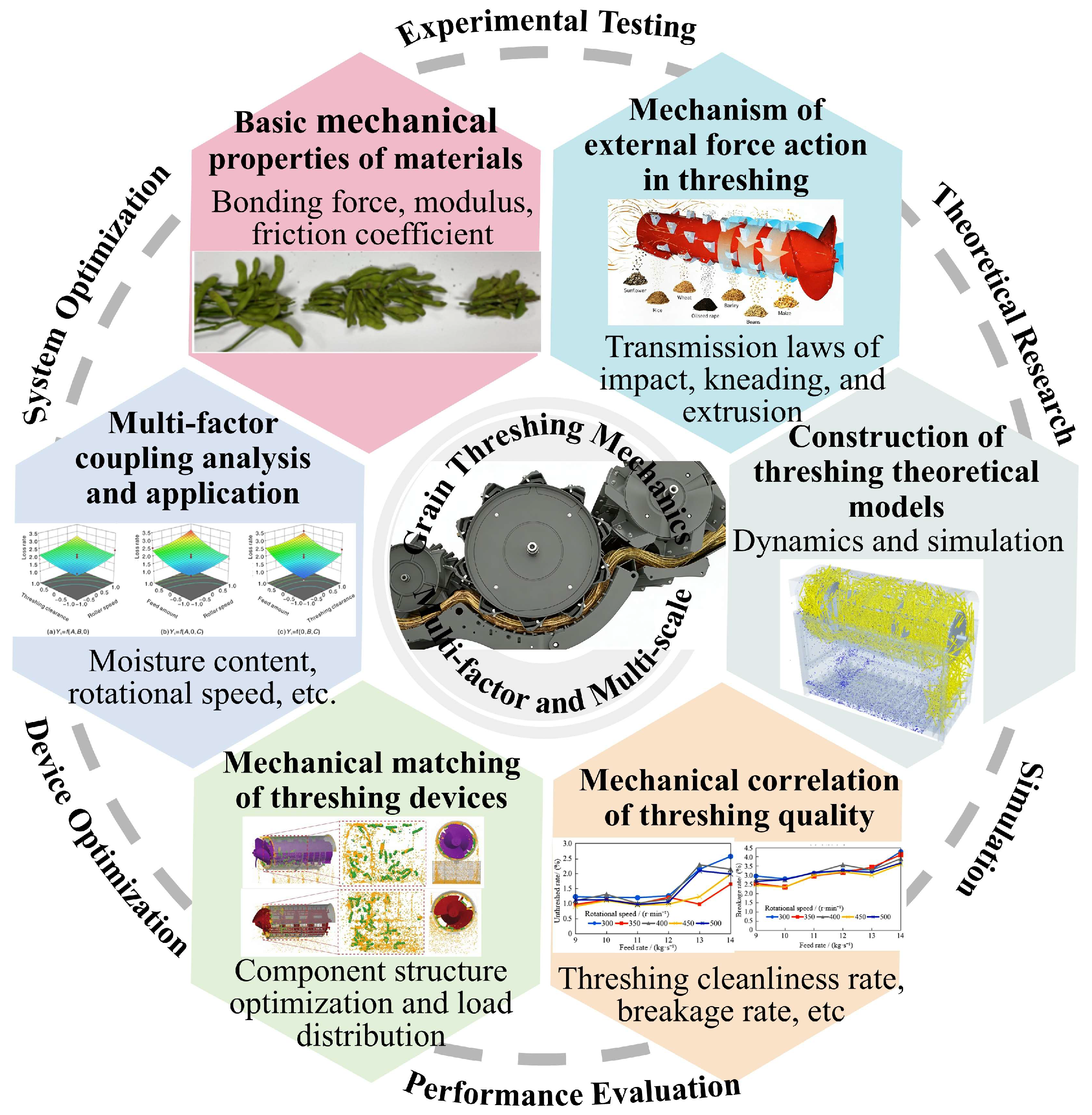
The core of the threshing process is to overcome the bonding force between grains and pods or peduncles through mechanical action, thereby achieving grain separation. Therefore, the physical and biomechanical properties of crops not only determine the load thresholds required for threshing, but also directly affect the balance among grain breakage during threshing, breakage rate, and threshing rate. For pulse crops, there are significant differences in the structural composition, moisture content response, and failure modes under load among grains, pods, and stalks. These differences collectively form the foundation for low-damage threshing research [24,25,26,27,28,29,30]. As shown in Figure 3, existing research mainly focuses on aspects such as the mechanical properties of grains, the shattering characteristics of pods, the fracture behavior of stalks, and the combined loading effects during threshing, gradually evolving from single-parameter measurements to multi-factor coupled analyses.
First, the mechanical properties of grains are key factors determining the level of grain breakage during threshing. Studies have shown that significant differences exist in grain hardness, elastic modulus, fracture toughness, and compressive strength among different pulse varieties, and these indicators are highly sensitive to changes in moisture content [25,27]. For mung bean, the elastic modulus ranges from 153.4 to 247.7 MPa, the yield strength from 0.23 to 0.98 MPa, and the failure load from 42.62 to 81.72 N within a moisture content range of 9.3% to 12.8% (wet basis) [31]. As moisture content increases, the elastic modulus, failure load, and yield strength decrease substantially, while the maximum strain increases from 0.25% to 0.61% [32]. For soybean, the compression force and proportional deformity modulus similarly decrease with increasing moisture content, with maximum compression resistance observed when grains are compressed in the repose position [33]. Generally speaking, when the moisture content is too low, the grain tissue becomes brittle, making the seed coat and embryo more prone to crack propagation and internal damage under impact or compression. Conversely, when the moisture content is too high, the viscoelasticity of the grain increases, requiring greater force during the threshing process, which in turn increases the difficulty of achieving complete threshing and raises energy consumption [25,26,27]. Dinesh et al. [34] pointed out that different mung bean varieties exhibit significant differences in their response to rotor speed and working clearance during threshing, with the fundamental reasons lying in differences in grain hardness and peduncle connection strength. Waree et al. [35] and Wuttiphol et al. [36] further found that loading rate and impact energy significantly alter the damage response of grains, with moisture content playing a central role in regulating the mechanical behavior of grains. Studies by Ezzatollah et al. [37] and Asli-Ardeh et al. [38] also indicated that moisture content is one of the main factors affecting threshing loss rate and breakage rate, and an appropriate moisture state helps to reduce the risk of breakage while ensuring threshing efficiency. Meanwhile, some studies have established analytical models relating grain stress and crack propagation from the perspective of internal damage mechanisms, revealing that local structures such as the hilum exhibit significant stress concentration, representing a critical weak area for grain breakage [28,29]. Overall, quantitative research on the physical and mechanical properties of grains has evolved from traditional single-indicator testing to comprehensive evaluations incorporating moisture content, loading rate, and varietal differences, providing a fundamental basis for optimizing low-damage threshing parameters.
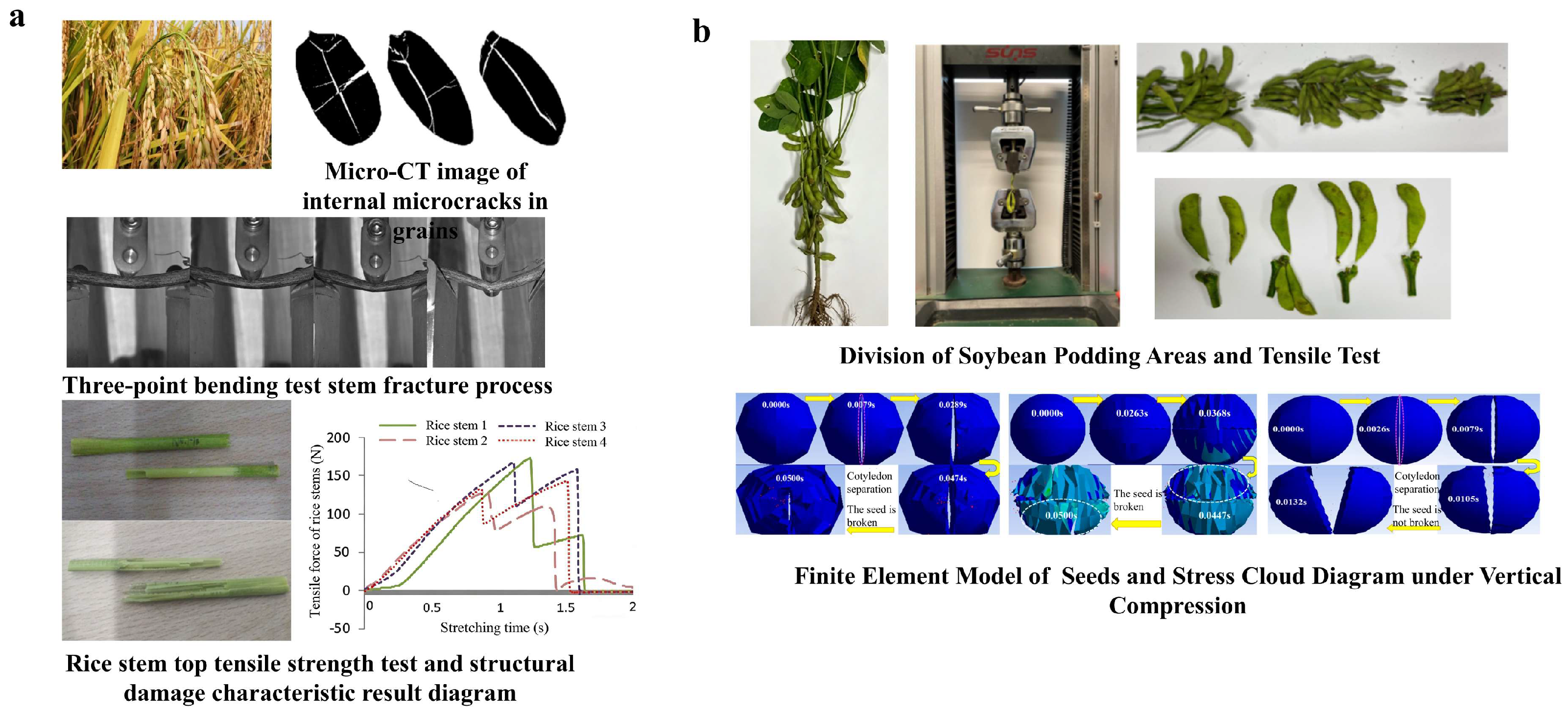
Secondly, the structure of pods and their shattering characteristics are important factors affecting pod shattering losses. During the ripening process of pulse pods, tissue dehydration, fiber embrittlement, and accumulation of internal stresses occur. When external mechanical disturbance exceeds their shattering threshold, pod shattering and grain scattering are prone to happen. For instance, texture analyzer tests on soybean pods revealed that the average shattering force under vertical compression—the direction with the highest shattering risk—is approximately 14.33 N. Furthermore, the pod opening force decreases rapidly with declining pod moisture content, with the relative shattering strength dropping sharply as moisture increases from 8% to 20%, and the critical pod moisture content associated with pod dehiscence in soybean ranges from approximately 10.1% to 10.4%. As shown in Figure 4b, studies on crops such as vegetable soybean have shown that pod shattering characteristics were identified through pod zone division and tensile tests, while finite element stress nephograms of the grain further revealed stress concentration at the hilum and seed coat edge under vertical compression [30]. The compressive strength, tensile properties, and shattering threshold of pods are closely related to variety, maturity, and moisture content [24,30]. Different agronomic traits further affect the tissue structure and mechanical response of pods, thereby altering their failure modes during harvesting [24]. From the perspective of threshing mechanism, pods do not merely act as enclosing structures but serve as key carriers for mechanical energy transmission and crack propagation. Their shattering pattern directly determines field losses during harvesting and subsequent threshing loads. Therefore, research on pod shattering mechanisms and critical shattering conditions not only helps optimize harvest timing but also provides a theoretical basis for defining the boundaries of low-damage threshing intensity [30].
The mechanical properties of stalks and their connection points also have a significant impact on material conveying and subsequent separation processes. Studies on soybean stalks in the Huang-Huai-Hai region have shown that the maximum bending force decreases from 480–820 N at the lower section (20 cm above ground) to 80–140 N at the upper section (60 cm above ground), while flexural rigidity drops from 800–1200 N·mm2 at the basal internodes to 100–300 N·mm2 at the upper internodes [40,41]. These properties are further influenced by loading speed, moisture content, and tissue structure. In terms of fracture mode, breakage tends to occur in structurally weak areas such as nodes, where the required fracture energy is approximately 40–60% lower than at internodes. Increasing impact velocity from 1.5 m/s to 3.5 m/s reduces the average fragment length from 12–18 cm to 4–8 cm, significantly increasing the extent of fragmentation [42,43,44]. As shown in Figure 4a, Micro-CT images of rice grains clearly show the morphology of internal microcracks. Combined with three-point bending tests and tensile strength tests at the stalk apex, the damage threshold of the stalk-grain interface can be quantitatively evaluated. These results indicate that under combine harvesting conditions, stalks not only affect the morphology of the cut material but also indirectly influence threshing load and cleaning efficiency by altering material length distribution, entanglement risk, and conveying resistance. Meanwhile, related pretreatment studies have shown that material drying or heat treatment may alter the fracture mode, shifting from ductile tearing to brittle fracture, thereby further affecting the material response during mechanical harvesting [39]. In addition, the development of online moisture detection technology provides a new technical basis for real-time monitoring of crop status and dynamic adjustment of threshing parameters [45]. It should be noted, however, that the mechanical properties discussed above—such as bending stiffness, shear strength, and fracture energy—are currently measured through offline laboratory tests and cannot yet be directly detected in real time by existing combine harvesters. Bridging this gap between laboratory characterization and in-field sensing remains an important direction for future research. Nevertheless, research on stalk mechanical properties has gradually expanded from simply describing physical parameters to serving operational control and condition identification.
Beyond static mechanical properties, the loading form and energy transfer pattern of the threshing process itself are also important aspects of understanding crop biomechanical behavior. Actual threshing is not a single impact or compression action, but rather the result of multiple coupled loads including impact, rubbing, shearing, and compression [46,47]. From an energy perspective, not all input energy is used for grain separation; part of it is converted into structural deformation, crack propagation, and heat dissipation. This is the fundamental reason why it is difficult to balance damage and energy consumption [46]. Some studies have attempted to reveal the interaction mechanism between threshing elements and crops using high-speed photography and mechanical modeling, pointing out that combined loads are more conducive to achieving efficient separation compared with single loads [47]. At the level of mechanical mechanisms, visualization techniques such as high-speed photography provide intuitive evidence for revealing the damage mechanisms caused by threshing elements. Ma et al. [48] found through high-speed photography that the peak local impact force of high-speed spike teeth was about 40% higher than that of rasp bars, directly leading to a higher grain crack rate. Looh et al. [46] found that only part of the input energy was used for threshing, with the remainder dissipated as plastic deformation, crack propagation, and thermal energy. This analytical framework indicates that the essence of threshing device optimization lies in increasing the proportion of effective threshing energy while reducing the energy share dissipated as damage.
In terms of mathematical modeling, Miu et al. [49] established the material motion equation within an axial flow cylinder, describing the axial distribution patterns of unthreshed grains, free grains, and separated grains. Vlăduț et al. [50] further proposed a density distribution function for separated grains and correlated the threshing coefficient and separation coefficient with parameters such as material flow rate, cylinder speed, and threshing clearance. Fisunova et al. [51,52] established a pressure model for the threshing process based on factorial experiments and compression laws, providing a computable theoretical framework for the parametric design of threshing devices. Although these models provide important methods for studying the threshing process, existing achievements are mostly based on cereal crops, and their depiction of pod shattering, grain-peduncle connection fracture, and damage evolution under multiple sequential loads specific to pulses remains insufficient. The universality and accuracy of the models still need further improvement.

3.2. Research on Structural Design and Optimization of Threshing Devices

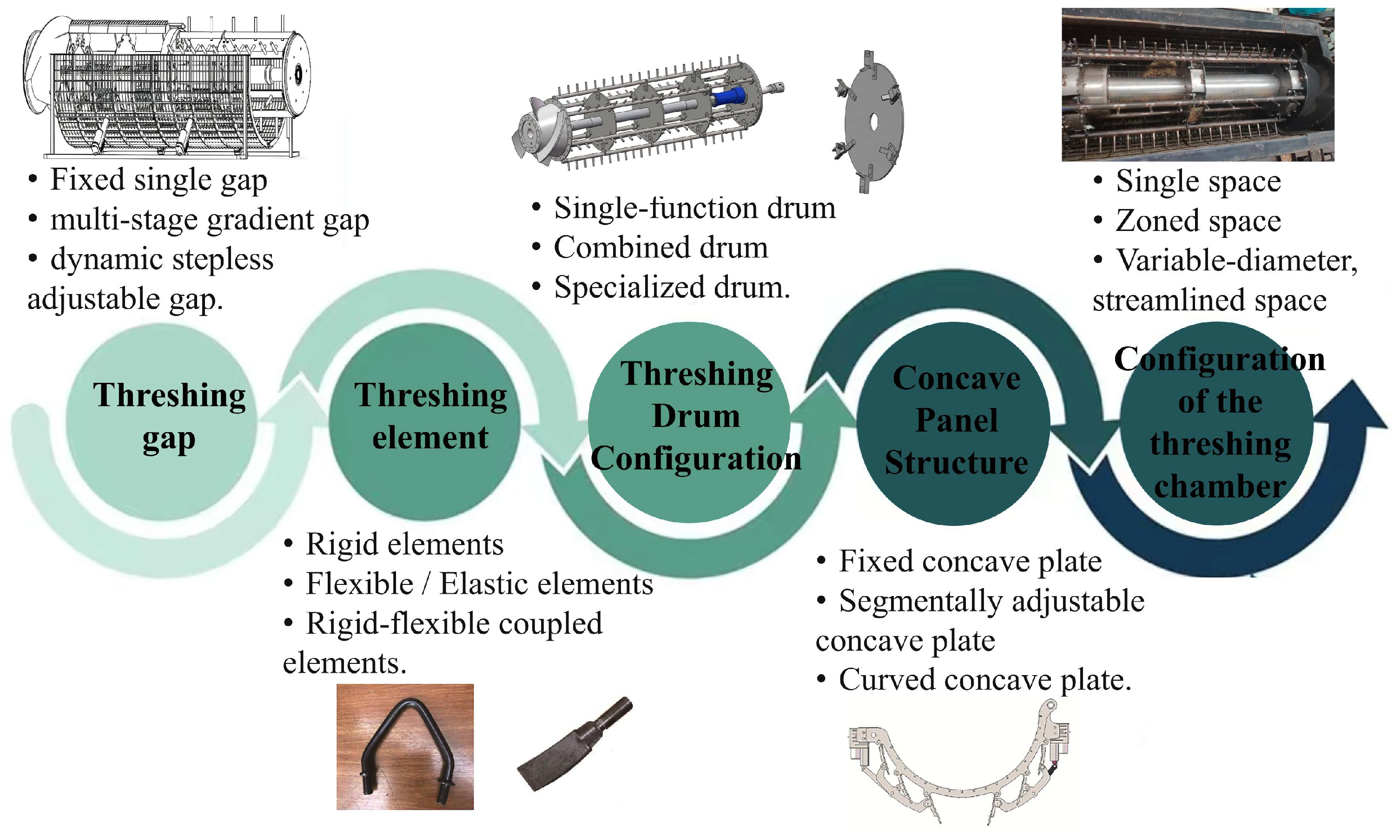
The structural form of the threshing device directly determines the load application mode, material motion trajectory, and grain damage level during the threshing process. For pulse crops, due to their thin seed coats, high pod brittleness, and significant variations in maturity, traditional strong-impact threshing devices designed for cereals often struggle to balance threshing rate with low-damage requirements [53,54,55]. Therefore, as shown in Figure 5, in recent years, research on threshing devices for pulse crops has gradually shifted from general-purpose structural modifications to specialized, flexible, and low-damage designs, achieving considerable progress in aspects such as threshing element type, cylinder configuration, clearance adjustment methods, and overall machine integration.
From the perspective of technological evolution, early mechanical threshing was represented by manual corn shellers, followed by the gradual development of threshing devices such as extrusion-rubbing and kneading-rubbing types. These devices have certain advantages in improving threshing rate, but their mode of action remains dominated by strong mechanical impact and friction. When directly applied to pulse crops, they are prone to causing premature pod shattering, grain breakage, and entrainment losses. To address this issue, research focus has gradually shifted from modifying general-purpose threshers to designing specialized threshers tailored to the characteristics of pulse materials, forming a technical route characterized by low impact, gentle contact, and staged threshing. However, despite this general trend, quantitative comparisons among different threshing element types under controlled conditions remain scarce, making it difficult to guide design selection for specific pulse varieties.

3.2.1. Threshing Clearance Control and Structural Adaptability Optimization

Threshing clearance control is an important foundation for achieving low-damage threshing. Traditional fixed-clearance structures have poor adaptability and struggle to cope with fluctuations in operating conditions caused by changes in pulse crop maturity, moisture content, and feed rate. To address this, researchers have proposed structural solutions such as multi-stage tapered clearance, variable-diameter cylinders, and adaptive clearance adjustment mechanisms. Compared with fixed-clearance designs, variable-diameter threshing cylinders enable coaxial stepless adjustment of threshing clearance and rotational speed in real time according to operating conditions [59], providing a foundation for dynamic control. Further studies have shown that the concentricity of the threshing clearance is particularly critical for low-damage operation; non-concentric clearance leads to a significant increase in the average fracture length of stalks, whereas multi-stage tapered concentric clearance can achieve both a high threshing rate and a low breakage rate over a wide range of feed rates, demonstrating clear advantages over fixed and non-concentric configurations [53,60]. To meet the demands of multi-crop harvesting, independently adjustable concave screen structures [61], floating threshing devices [62], and adaptive threshing clearance mechanisms have further expanded the flexibility of clearance control. Among these, adaptive mechanisms offer the greatest potential for real-time condition response, yet their complexity and cost remain higher than simpler adjustable designs, presenting a trade-off between performance and practicality.
The evolution of threshing clearance from fixed to tapered, adjustable, and even adaptive types reflects that the design of pulse threshing equipment has gradually shifted from static matching to condition-responsive operation. This change is of great significance for improving operational stability under complex field conditions.

3.2.2. Flexible Threshing Elements and Low-Damage Mechanism

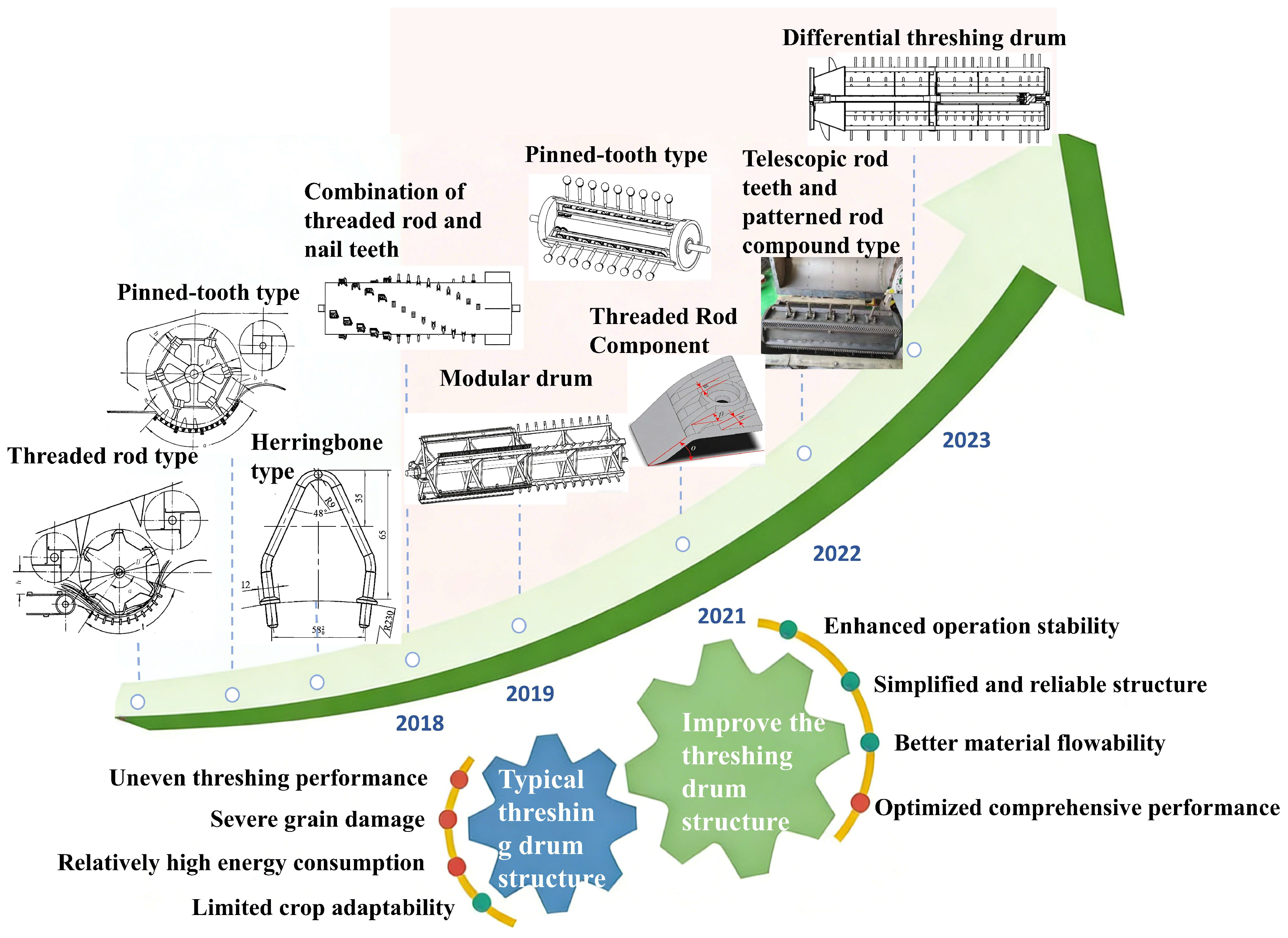
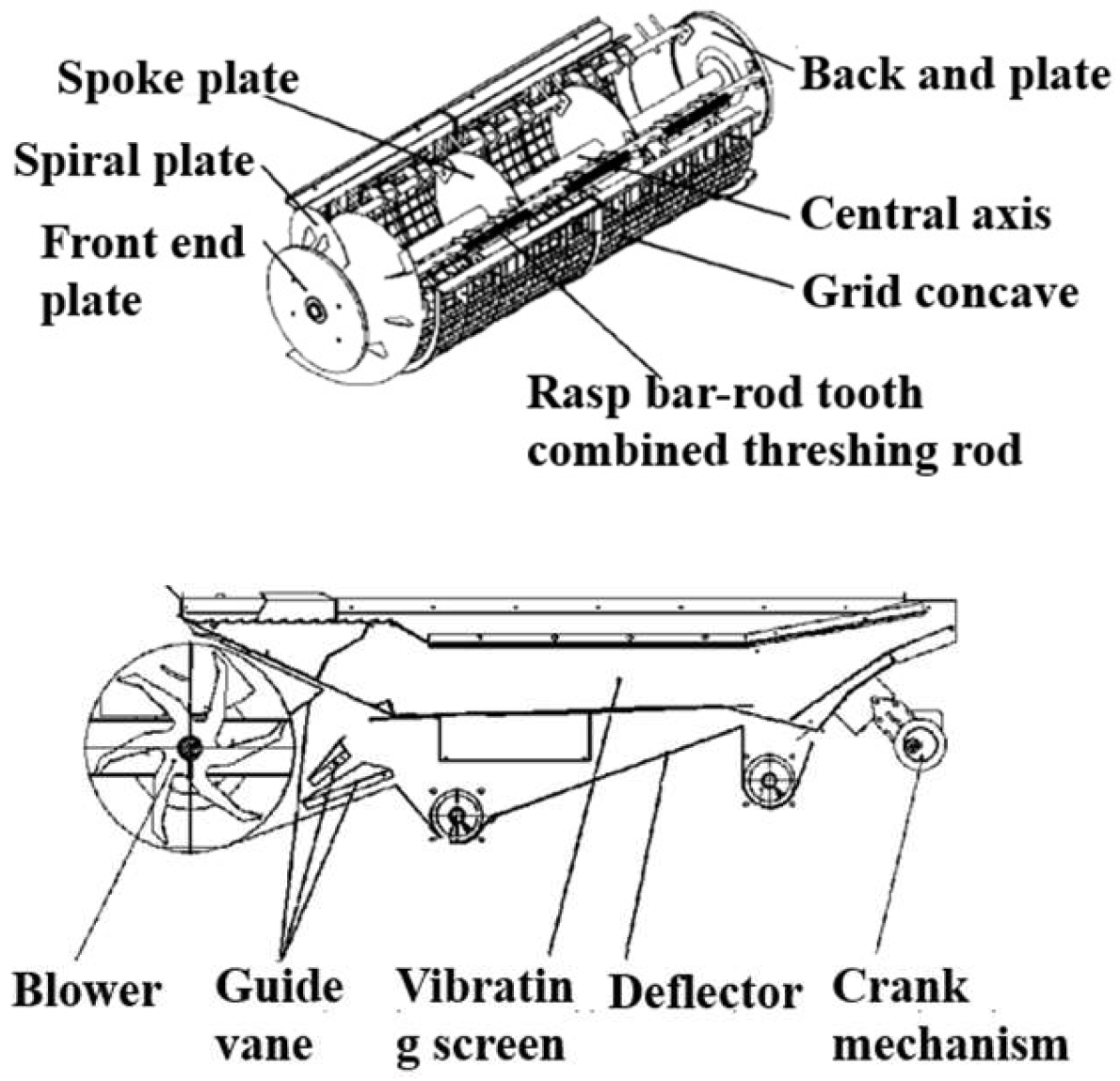
Flexible threshing elements are the core carriers of low-damage design, and their material and structure directly affect the impact peak, contact time, and buffering capacity. In specialized threshing devices for pulses, the staged threshing concept has been widely applied 61,62], with typical implementations mainly including rasp bar, spike tooth, and bow tooth cylinder structures, as shown in Figure 6 [3,61,63,64,65,66,67]. The rasp bar type relies on rubbing action for threshing, providing gentle action and low grain breakage rates (typically below 2% for dry soybeans), making it suitable for dry, easily breakable pulse varieties, but its threshing efficiency drops markedly for pods with high moisture content. In contrast, the spike tooth type achieves threshing through impact and combing, offering strong threshing capability and higher efficiency for moist, easily tangled pulses, but at the cost of elevated breakage rates (2–5% under comparable conditions). The bow tooth type focuses on continuous combing, achieving the lowest breakage rates (below 1.5% for seed soybeans) and is specifically designed for pulses such as seed beans that require high grain integrity, but it has a more complex structure, higher manufacturing cost, and poor adaptability to lodged crops [3,68,69]. This comparison reveals a fundamental trade-off among the three types: rasp bars prioritize low damage at the expense of efficiency in tough conditions, spike teeth maximize efficiency with acceptable damage risk, and bow teeth pursue extreme grain protection with reduced operational flexibility.
Following the flexible threshing design concept, researchers have proposed optimization solutions from multiple dimensions including material, structure, and arrangement. In terms of material optimization, flexible materials such as rubber coatings and nitrile rubber wrapping are used to reduce impact peaks, achieving breakage rates comparable to or lower than conventional rasp bars while maintaining moderate threshing efficiency [70,71,72,73]. In terms of structural optimization, rigid-flexible coupled bow teeth and flexible rasp bars reduce grain damage by extending contact time, offering a better balance between damage control and threshing efficiency than single-material designs [74,75,76]. In terms of arrangement and combination optimization, composite elements such as flexible spike teeth combined with double torsion spring pressure short rasp bars, plate teeth replacing traditional cylindrical spike teeth, and differential motion rubber belts have been developed, generally showing comprehensive performance superior to single-element configurations [77,78,79]. Some studies have also combined bionic design to simulate manual threshing methods, further improving threshing performance at low moisture contents [70,80]. Across these approaches, a consistent finding is that flexibilization is not simply about reducing material hardness, but rather achieving a gentler threshing process by changing the contact mode, extending the action time, and reducing peak loads. Compared with rigid elements, flexible designs consistently show 30–50% reduction in impact-induced grain damage, though quantitative comparisons among different flexible configurations remain limited. This type of design is particularly important for pulse crops that are brittle and prone to pod shattering.

3.2.3. Cylinder Configuration and Optimization of Combined Threshing Structures

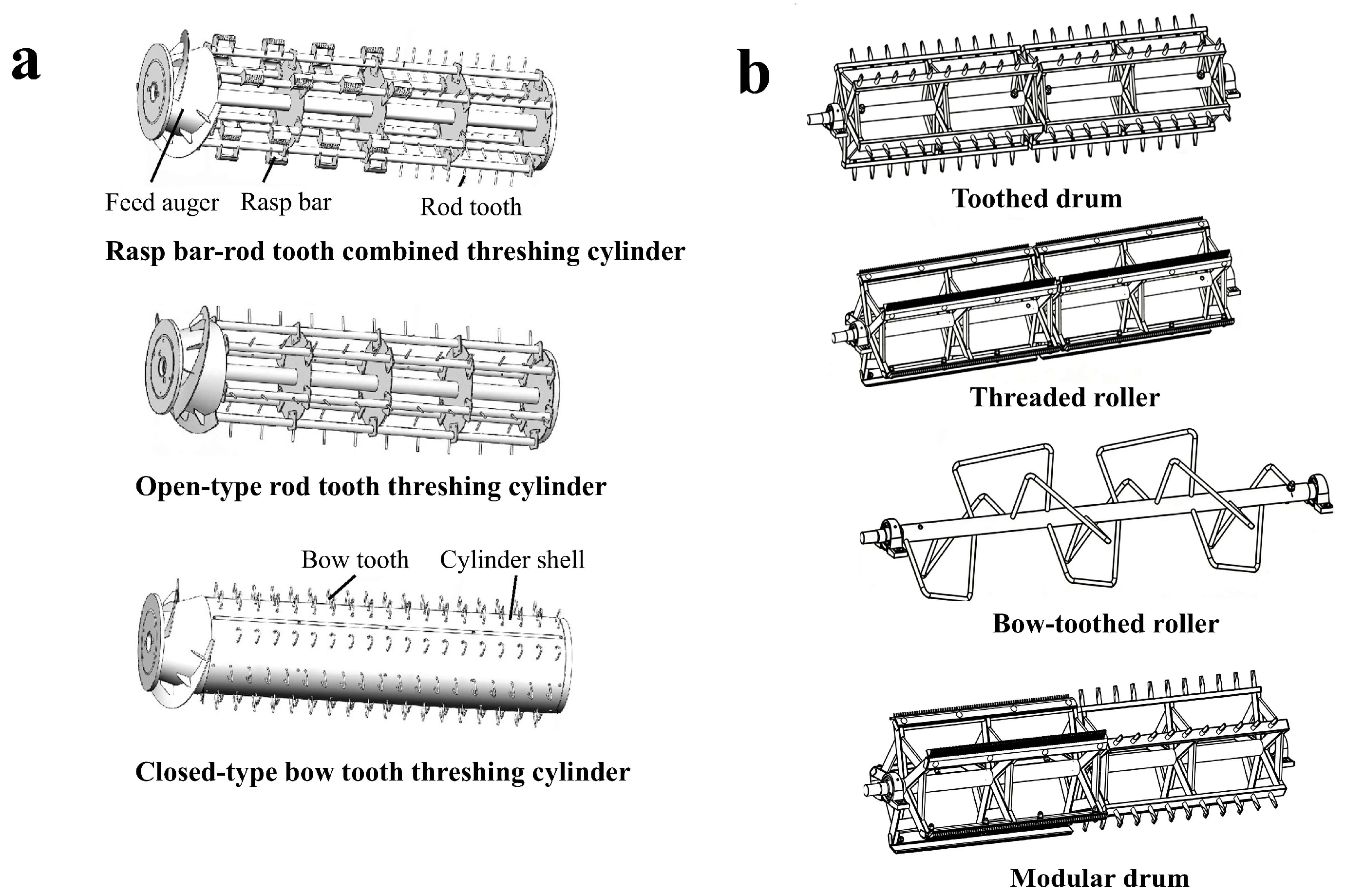
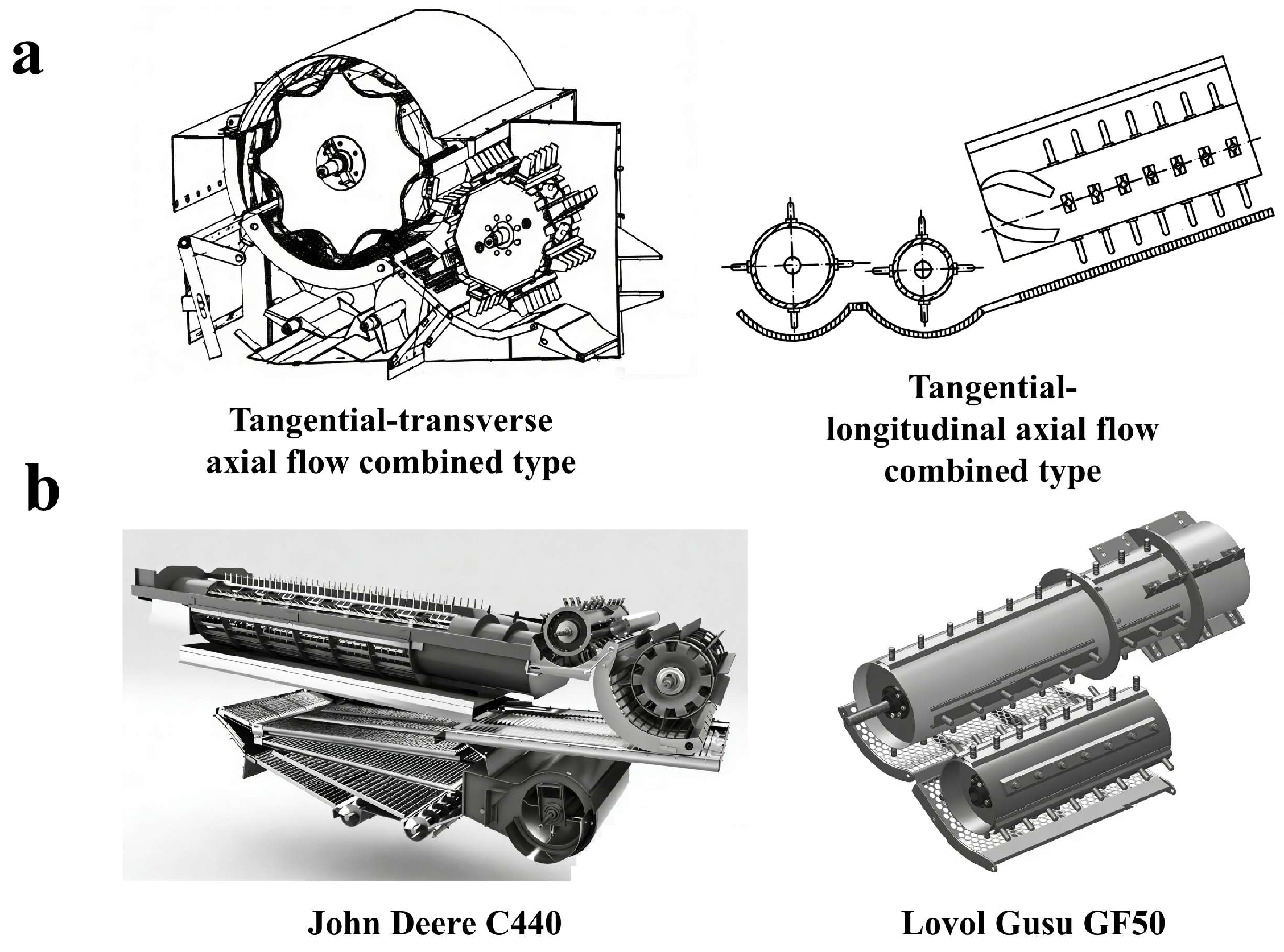
Cylinder configuration and its combination mode are also key factors affecting threshing quality. A single cylinder structure often struggles to simultaneously meet the threshing requirements of different crops under varying maturity conditions. Therefore, combined and specialized cylinders have gradually become research focuses [81]. In terms of combined design, as shown in Figure 7, Jin et al. [69] compared the effects of cylinder structures such as rasp bar-spike tooth combination, open spike tooth, and closed bow tooth on the harvesting quality of soybean, finding that the combined designs generally outperformed single-element cylinders in comprehensive indicators including breakage rate and threshing efficiency (Figure 7a). Li et al. [63] further identified the composite rasp bar-bow tooth cylinder as a solution with superior comprehensive performance over single-type cylinders (Figure 7b). The optimized parameter combinations for segmented axial flow threshing devices provided a basis for related structural designs, demonstrating that multi-stage configurations achieve better separation of threshing stages than single-stage designs [82]. The semi-feed coaxial differential threshing cylinder achieves staged threshing through differential motion, reducing overall impact load compared with conventional single-speed cylinders [83]. The single axial flow threshing cylinder enhances axial conveying capacity and reduces blockage through a combined structure of spiral deflector plates and spike teeth [84].
In terms of specialized design, the horizontal axial flow combined cylinder for oil sunflower achieved an average threshing rate of 99.01% with a breakage rate of 2.28% [85]; the vertical axial flow threshing cylinder for tiger nut improved separation efficiency in high-soil-content harvesting conditions [86]; and the double-helix structure axial flow threshing cylinder reduced loss rate to 0.15%, breakage rate to 4.75%, and impurity rate to 3.86%, outperforming the conventional bar-tooth cylinder which recorded a minimum loss rate of 0.50%, breakage rate of 6.85%, and impurity rate of 0.29% [87]. Comparative tests have also shown that the full spike tooth cylinder outperforms the rasp bar-spike tooth cylinder in comprehensive performance metrics such as power consumption, material distribution, total loss rate, and impurity rate, indicating that element type selection can outweigh cylinder configuration in determining overall performance. For small-seed crops, optimization tests on five different shapes of threshing spike teeth demonstrated that disk-shaped pegs achieved a threshing efficiency of 99.57% with 0.45% unthreshed grain and 0% broken grain, indicating that reasonable selection of element geometry can significantly improve threshing efficiency and reduce damage [88].
Collectively, these studies indicate that the development of threshing cylinders has shifted from single-structure optimization to a dual optimization model of “structural combination + crop adaptation.” Comparative evidence suggests that combined cylinder structures consistently offer 10–20% improvement in comprehensive performance over single-element designs, though the optimal combination varies by crop type. For pulses, future cylinder design should place greater emphasis on low-impact contact, continuous conveying capacity, and compatibility with multiple crop varieties.

3.2.4. Dynamic Characteristics, Parameter Matching, and System Optimization

The dynamic characteristics and operating parameters of threshing devices have a direct impact on operational quality. Studies have shown that insufficient feeding uniformity can induce periodic excitation forces, leading to increased bearing housing vibration, fluctuations in threshing clearance, and increased grain losses, indicating that stable feeding is an important prerequisite for ensuring threshing quality [89]. Meanwhile, parameters such as cylinder speed and feed rate affect the distribution state of threshed materials within the device, and this distribution uniformity further influences the load and efficiency of the subsequent cleaning process, revealing the inherent coupling relationship between threshing and cleaning that is often overlooked in component-level optimization [90].
In terms of structural parameter optimization, different threshing elements exhibit significant differences in their effects on threshing and entrainment losses in tangential flow and axial flow devices, with spike teeth generally causing higher entrainment losses but better threshing rates than rasp bars under identical conditions [91]. The influence of the back inclination angle of blade teeth on breakage rate, unthreshed rate, and power consumption has been systematically studied, revealing that optimal angles can reduce breakage by 15–25% without compromising threshing efficiency [92]. In addition, field dynamic balancing correction of threshing cylinders using the dual-plane influence coefficient method can effectively reduce vibration and noise during high-speed rotation [93]. Optimization of the damping characteristics of prestressed composite beams helps reduce vibration transmissibility in critical frequency bands [94]. Modal vibration response analysis of the frame under multi-source excitation provides theoretical support for structural optimization and vibration reduction design [95].
From the perspective of optimization objectives, threshing technology research has shifted from simply pursuing threshing rate to achieving a comprehensive balance among threshing rate, breakage rate, impurity content rate, and power consumption. Relevant studies have shown that different structural and operational parameters have significant and often conflicting effects on grain damage—for instance, increasing cylinder speed improves threshing rate but simultaneously elevates breakage rate [96]. Through system optimization, a favorable combination of operating parameters for soybean threshing and separation performance can be obtained, demonstrating that multi-objective optimization yields measurably better outcomes than single-parameter tuning [97]. The comprehensive matching of structural parameters such as cylinder speed and concave clearance with operational parameters directly determines the operational quality of axial flow threshing devices [98]. Meanwhile, grain damage often originates from mismatches among device parameters, operation modes, and crop characteristics, highlighting the importance of synergistic optimization of structure, parameters, and crops rather than treating each factor in isolation [99]. In terms of bionic low-damage threshing, a variable-speed inertial wheel structure that simulates manual threshing characteristics has been shown to reduce the unthreshed rate of rice compared with conventional constant-speed designs, providing a new approach for the bionic design of low-damage threshing devices [100,101]. Overall, the trend in this area is toward integrated multi-parameter optimization, yet systematic comparative studies that quantify the relative contribution of each parameter to overall performance across different pulse varieties are still lacking.

3.2.5. Specialized, Low-Cost, and Equipment Adaptable to Complex Scenarios

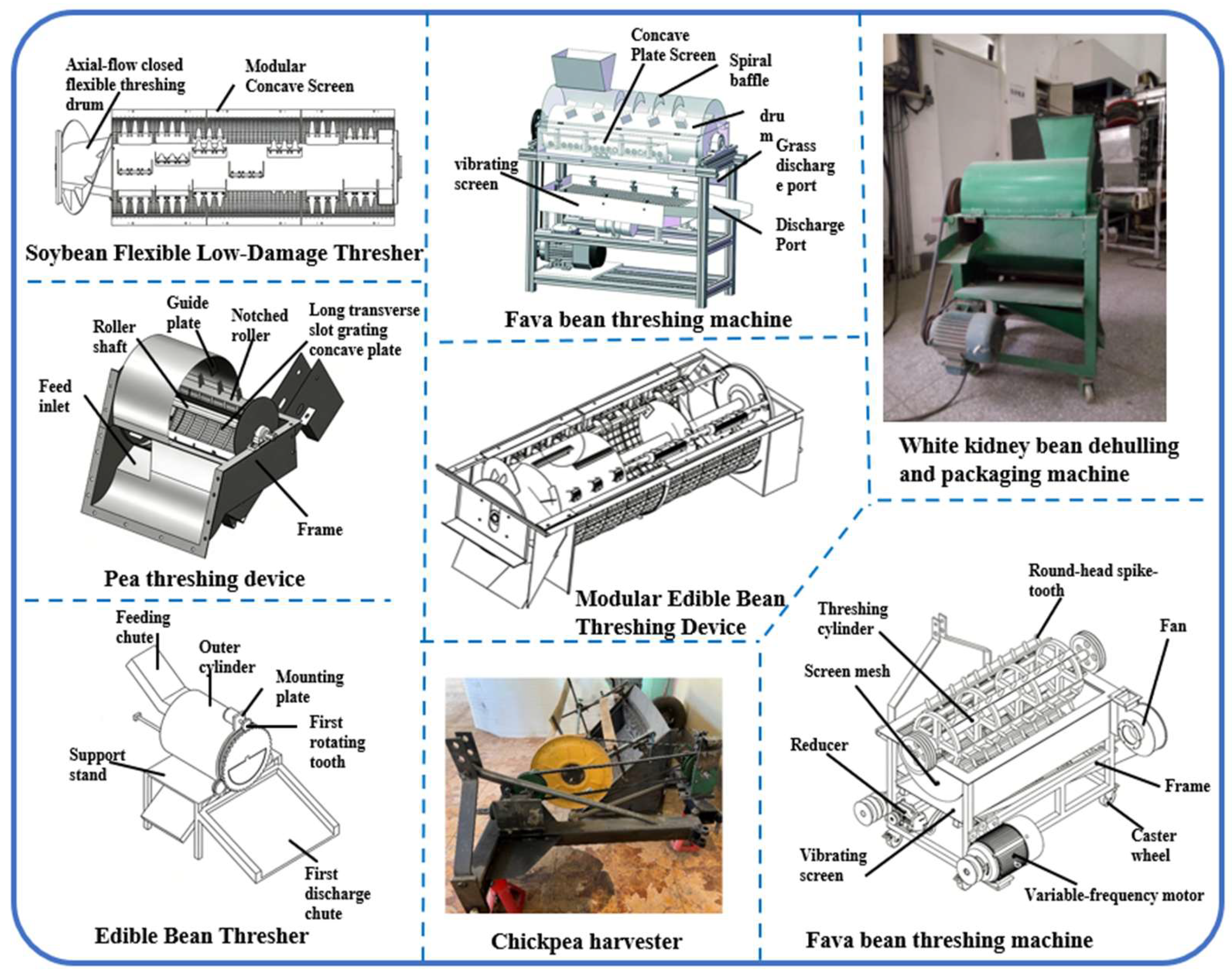
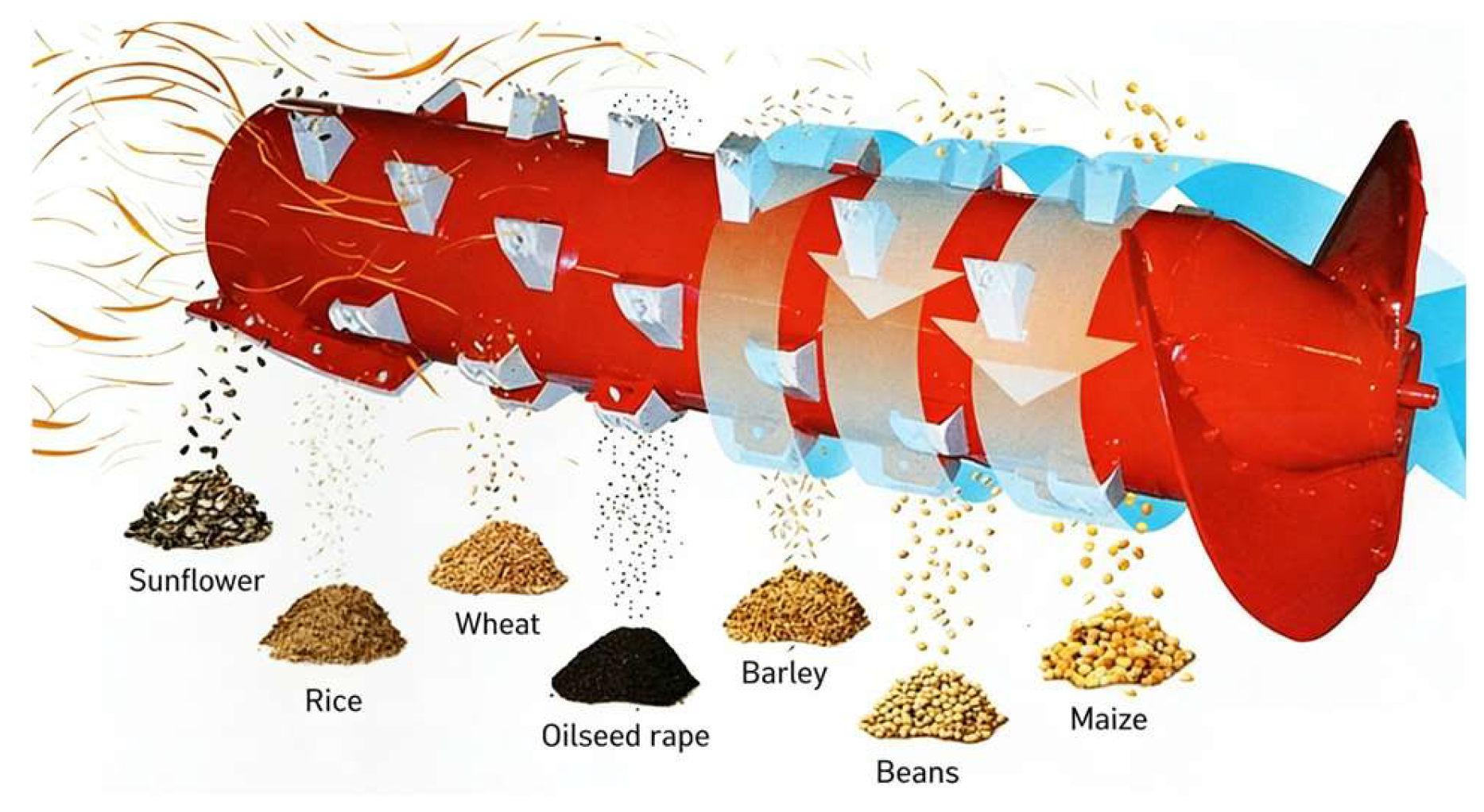
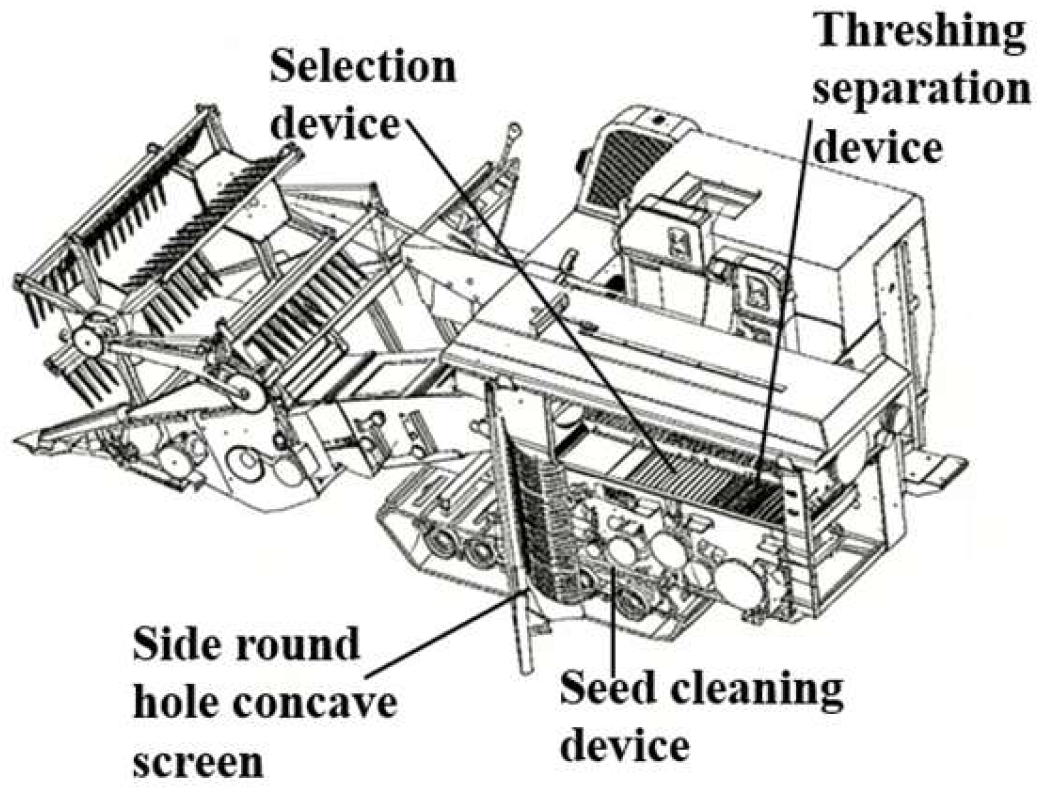
Significant progress has also been made in specialized designs for specific agronomic scenarios. As shown in Figure 8, in terms of segmented harvesting, self-propelled pickup threshers integrate pickup, threshing, and cleaning operations through front-mounted finger-type pickups and double-cylinder bow tooth devices, making them suitable for segmented harvesting of various pulses such as soybean, mung bean, and adzuki bean [88]. For breeding applications, plot breeding threshers adopt a triangular support plate cylinder structure, enabling single-plant threshing and separate collection [102]. For regionally characteristic crops, specialized threshing devices for tiger nut [103] and small specialized threshing and separation devices for white kidney bean [104] have achieved excellent threshing performance through targeted design.
In terms of special planting patterns, a pea threshing device designed for maize-pea intercropping systems effectively reduces entanglement and blockage through a spike tooth axial flow cylinder and a top cover with guide vanes [105]. In terms of system integration, multi-speed adjustable fans and dual-air-deflector airflow systems can accommodate efficient low-damage processing of various pulses such as soybean and chickpea [108]. Double-layer structure threshers achieve adjustable aperture sizes through multi-row tapered filter holes in the inner cylinder, integrating threshing and cleaning functions [106]. A telescopic spike tooth-rasp bar composite threshing device with adaptive anti-blocking function, in which spike teeth can retract when encountering resistance, is particularly suitable for complex working conditions in hilly and mountainous areas [64].
Positive progress has also been made in low-cost equipment tailored to the needs of smallholder farmers. Low-cost equipment such as solar-powered multi-crop threshers [109], pedal-operated soybean threshers [110], and spike tooth cylinder cowpea threshers [111] have been developed successively. By optimizing matching with crop biomechanical properties and threshing parameters, these devices improve harvesting quality while reducing labor intensity. For crops such as green soybean, mung bean, and soybean, threshers [112,113,114,115,116,117,118,119,120] have been designed that balance efficient threshing with grain protection by improving threshing element structures [121], applying rubber strips on cylinder surfaces [115], or combining star beaters with friction rubbing principles. Among these, electric cowpea threshers [122] and canvas belt cowpea threshers [123] further expand the range of low-cost equipment types. For mechanized harvesting challenges of crops such as chickpea [124] and pea, positive progress has also been made in tractor-mounted cutting and conveying mechanisms and root-tearing harvesting methods.

3.3. Research on Multi-Field Coupled Simulation and Numerical Optimization

The development of threshing devices has long relied on bench testing and empirical parameter adjustment, which suffer from long cycles, high costs, and limited parameter coverage. In recent years, numerical simulation has gradually become an important tool for threshing device research, evolving from single-method analysis to multi-field coupled modeling and optimization design, providing a new technical pathway for low-damage and high-efficiency development.
As shown in Table 1, the Discrete Element Method (DEM), Finite Element Method (FEM), and Multi-Body Dynamics (MBD) simulation are the core numerical methods in threshing device research, each with distinct emphases in threshing optimization. DEM is mainly used to analyze the flow, collision, and separation patterns of discrete materials such as grains and stalks within the threshing device, providing a basis for optimizing threshing clearance, cylinder structure, and threshing element types [125,126,127,128]. Compared with DEM, FEM is more suitable for analyzing the local damage mechanisms of grains and the structural response of threshing components. Chen et al. [29] found that the hilum of soybean grains (Figure 9) is a typical stress concentration area, exhibiting a high probability of crack initiation under relatively low impact forces. Meanwhile, FEM can also be used to analyze the modal vibration response of the threshing frame under multi-source excitation, providing a basis for structural vibration reduction and reliability design [95]. MBD is used to optimize the dynamic coordination among components such as cylinders, concaves, and deflectors, improving the continuity of material conveying [129].
As single methods often only cover one aspect of the threshing process, current research is gradually shifting toward multi-field coupled analysis. MBD-DEM and CFD-DEM coupled simulations of the threshing process can integrate mechanical component dynamics, granular material motion, and gas–solid two-phase interactions, more realistically reflecting the multi-factor coupling relationships within threshing devices. However, current coupled models for pulses still have limitations, such as insufficiently accurate characterization of pod shattering and the non-spherical properties of grains [130]. Additionally, these models are complex to construct, computationally expensive, and heavily reliant on parameter calibration and experimental validation. Particularly in scenarios involving pulses, where pod shattering mechanisms are complex and material nonlinearity is significant, existing models still struggle to fully represent the actual threshing process and have not yet achieved large-scale engineering applications.
While the simulation methods listed in Table 1—DEM, FEM, and MBD—provide powerful tools for analyzing material flow, stress distribution, and mechanism dynamics within threshing devices, they primarily serve as descriptive and predictive tools. Determining the optimal combination of operating parameters and structural configurations; however, requires systematic exploration across multi-dimensional design spaces under multiple conflicting objectives (e.g., high threshing rate, low breakage rate, and low power consumption), which cannot be achieved through simulation alone. To bridge this gap, numerical optimization algorithms have been introduced as an essential complement to simulation-based analysis. Methods such as response surface methodology and genetic algorithms have been widely used for optimizing the process parameters of axial flow threshing cylinders to achieve a comprehensive balance among threshing performance, breakage rate, and power consumption [131]. Performance prediction models for pulse threshers have also been established, enabling evaluation of the impact of different design variables on system performance through simulation, thereby providing a theoretical basis for parameter design [107]. However, constrained by simulation model accuracy and computational efficiency—especially under conditions requiring coordinated optimization across multiple parameters, wide ranges, and multiple operating scenarios—the validity of current optimization results still needs improvement.
To address the above limitations, a systematic calibration and validation strategy is essential before these simulation models can guide practical threshing device design. Based on the reviewed studies, the key steps involve: (i) measuring the physical and mechanical properties of specific pulse varieties through standardized laboratory tests to build a reliable input parameter dataset; (ii) calibrating DEM contact parameters such as the coefficient of restitution and rolling friction by matching simulated particle behavior with bench-scale experiments; (iii) validating the coupled model by comparing simulation outputs with field test data, using performance metrics including threshing rate, grain breakage rate, and power consumption; and (iv) evaluating the model’s prediction accuracy across a range of operating conditions to assess its generalizability. For instance, Fu et al. [131] demonstrated that response surface methodology combined with DEM simulation could identify the optimal parameter combination for axial flow threshing cylinders, with the predicted optimal settings validated through field trials. Wamalwa et al. [107] established performance prediction models that linked design variables to threshing performance, enabling the evaluation of different configurations without exhaustive physical testing. These examples illustrate how simulation models, once properly calibrated and validated against field data, can serve as practical tools for threshing device optimization rather than remaining purely analytical exercises.

3.4. Research on Intelligent Control and Energy Consumption Analysis of Threshing Systems

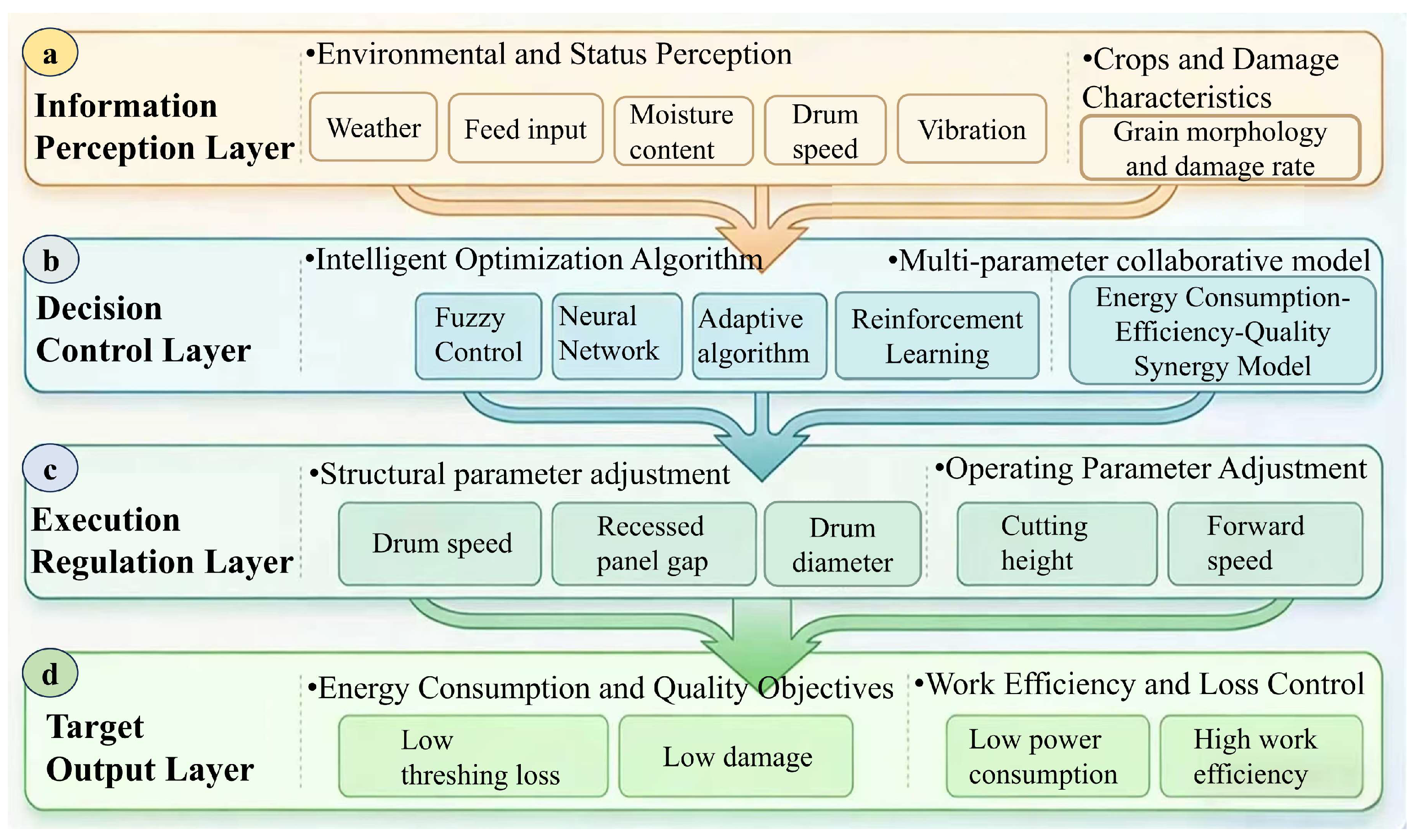
As shown in Figure 10, with the development of sensing technology, intelligent algorithms, and electric drive control, research on threshing systems has gradually shifted from static structural optimization to dynamic perception, coordinated control, and energy optimization oriented toward the operational process, gradually forming a closed-loop control model of “perception–decision–execution–evaluation”.
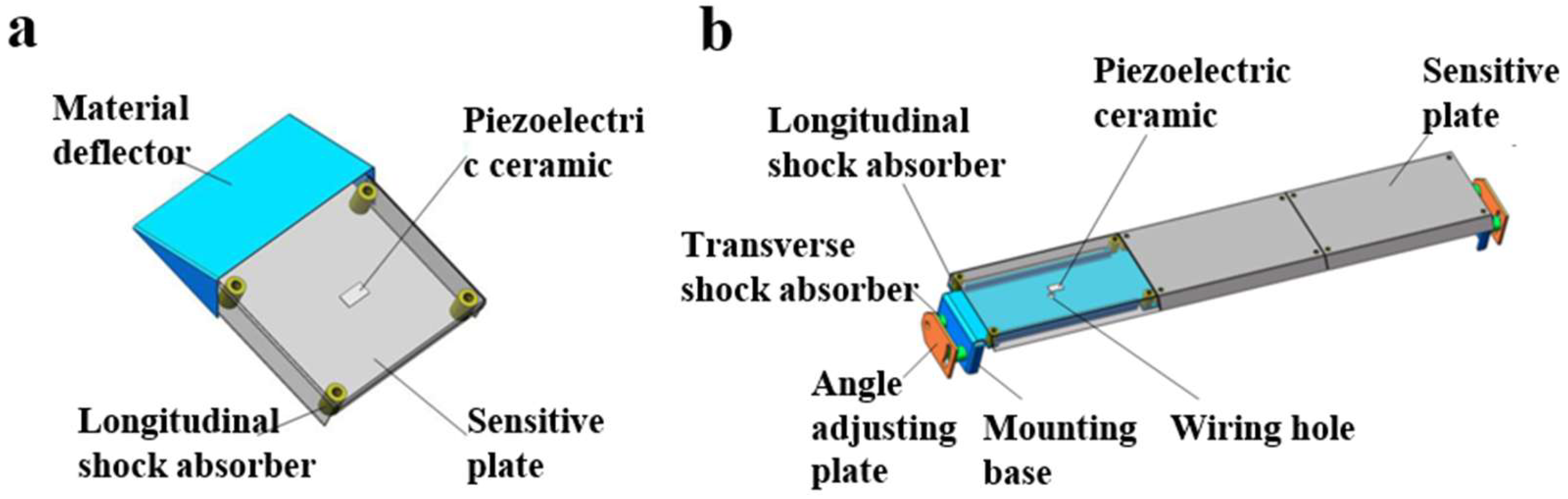
In terms of condition perception and fault diagnosis, existing research mainly utilizes multi-source information such as vibration, torque, rotational speed, and images to identify conditions such as cylinder imbalance, slipping, blockage, and grain damage. Methods based on vibration signals can extract abnormal features by constructing cylinder vibration models, thereby identifying abnormal states during the threshing process [132,133]. Monitoring methods based on torque and rotational speed enable real-time warning of load fluctuations in the transmission system [134,135]. In terms of operational quality monitoring, methods combining image processing and neural networks have been used for quantitative detection of grain breakage, and online monitoring systems for impurity content rate and breakage rate adaptable to multiple crops have also achieved good results [136,137] (Figure 11). Overall, existing perception technologies have laid the foundation for evolving from single fault identification to multi-source fusion diagnosis, but still face challenges such as insufficient capability for coupled multi-fault identification and limited sensor stability under complex field conditions.
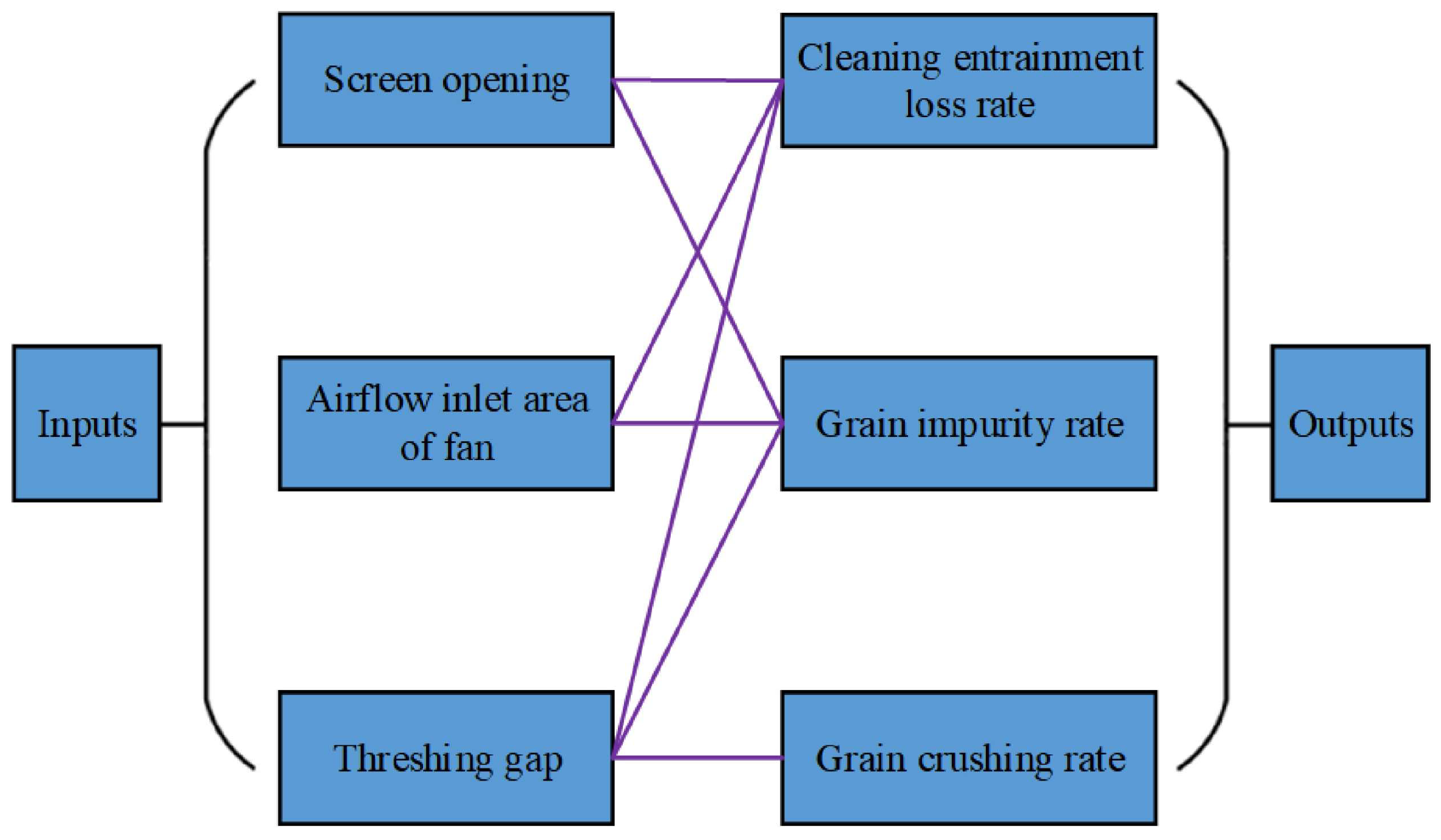
In terms of multi-parameter coordinated control, research focus has shifted from single-parameter adjustment to multi-variable joint optimization. Intelligent control models based on operating condition feedback can dynamically adjust control parameters to improve threshing continuity and stability [136] (Figure 12). In Figure 13, nearly all grains and impurities can be detected and box-selected, with the color overlays representing different material categories: red for healthy grains, blue for crushed grains, and green for impurities, as described by Li et al. [136]. Fuzzy control strategies integrating multi-source information and neural network control methods have further enhanced the system’s adaptability to load fluctuations and crop variations [138,139]. Meanwhile, research on three-dimensional point cloud-based crop canopy height estimation, variable-diameter cylinders, stepless clearance adjustment devices, and automatic balancing systems has also provided support for front-end perception and actuator adjustability of threshing systems [140,141,142,143]. Nevertheless, the real-time performance and sensitivity of existing control strategies under rapidly changing field conditions still need improvement, and the contradiction between multi-parameter collaborative optimization and efficient edge-side deployment has not yet been fully resolved.
In terms of energy consumption analysis and energy-saving optimization, research has gradually shifted from component-level power consumption testing to overall machine energy management and system-level optimization. Existing studies have shown that extended-range hybrid power technology, high-efficiency brushless DC motors, and different combinations of operating parameters all have significant effects on the energy consumption of threshing systems [144,145,146,147]. Control methods based on power consumption models and fuzzy logic can automatically adjust operating parameters based on real-time threshing losses, achieving a certain degree of balance between operational quality and energy consumption [148,149]. However, existing work remains primarily focused on individual components or local links, and the understanding of the overall machine energy flow patterns and the coupling relationship between control strategies and load variations remains insufficient. In particular, the influence mechanisms of the material characteristics of pulse crops on threshing energy consumption response have not yet been systematically studied [17].
In addition to the control strategies reviewed above, recent studies have further advanced the application of intelligent technologies in threshing systems. Digital twin–based approaches have been proposed for real-time monitoring of threshing performance, enabling virtual representation and dynamic optimization of the threshing process. Deep learning–based methods have also been developed for real-time grain damage detection, including YOLOv4-based damage quantification [150] and dynamic detection of corn kernel breakage rate using sliding window technology [151]. Multi-sensor fusion frameworks combining LiDAR, camera, and IMU data have been applied to real-time crop perception [152], offering potential for adaptive threshing control.
Looking forward, recent advances in instance segmentation and real-time visual perception offer new opportunities for intelligent threshing control in pulse harvesting. As demonstrated by Wang et al. [153], YOLOv8-based instance segmentation can achieve high-precision real-time identification of tender tea shoots under field conditions. A conceptually similar approach could be adapted for pulse harvesting: instance segmentation networks could be trained to detect, in real time, pod splitting, the presence of unthreshed pods, or excessive grain breakage during the threshing process. Combined with the multi-sensor fusion frameworks and digital twin models discussed above, such visual feedback would enable closed-loop adaptive regulation of cylinder speed, concave clearance, and feed rate. Recent work on real-time soybean pod detection in the field using deep learning [154] further validates the feasibility of this direction. Although current studies in this area focus primarily on phenotyping and quality assessment, extending these methods to online threshing process monitoring represents a promising research frontier for low-damage pulse harvesting.

4. High-Efficiency Cleaning Technology

4.1. Research on Airflow System Optimization and Flow Field Control

Cleaning efficiency mainly depends on the matching degree between the airflow field and the aerodynamic characteristics of the material. In terms of research on the aerodynamic characteristics of materials, related work primarily focuses on the suspension, disturbance, and energy loss patterns of particles in the airflow field. Deng et al. [155] established the dynamic equations of grains in the airflow field, while Chen et al. [156] pointed out that the close proximity of suspension velocities between grains and light impurities is an important reason for difficulties in cleaning separation. Zhang et al. [157] studied the fluidization behavior of wet threshed materials under the influence of humid and hot airflow, while Ueka et al. [158] revealed the blocking and disturbing effects of particles on airflow distribution from the perspective of flow field visualization. These studies indicate that there is a significant coupling relationship between material characteristics and airflow response, which is a fundamental issue that must be prioritized in cleaning airflow design.
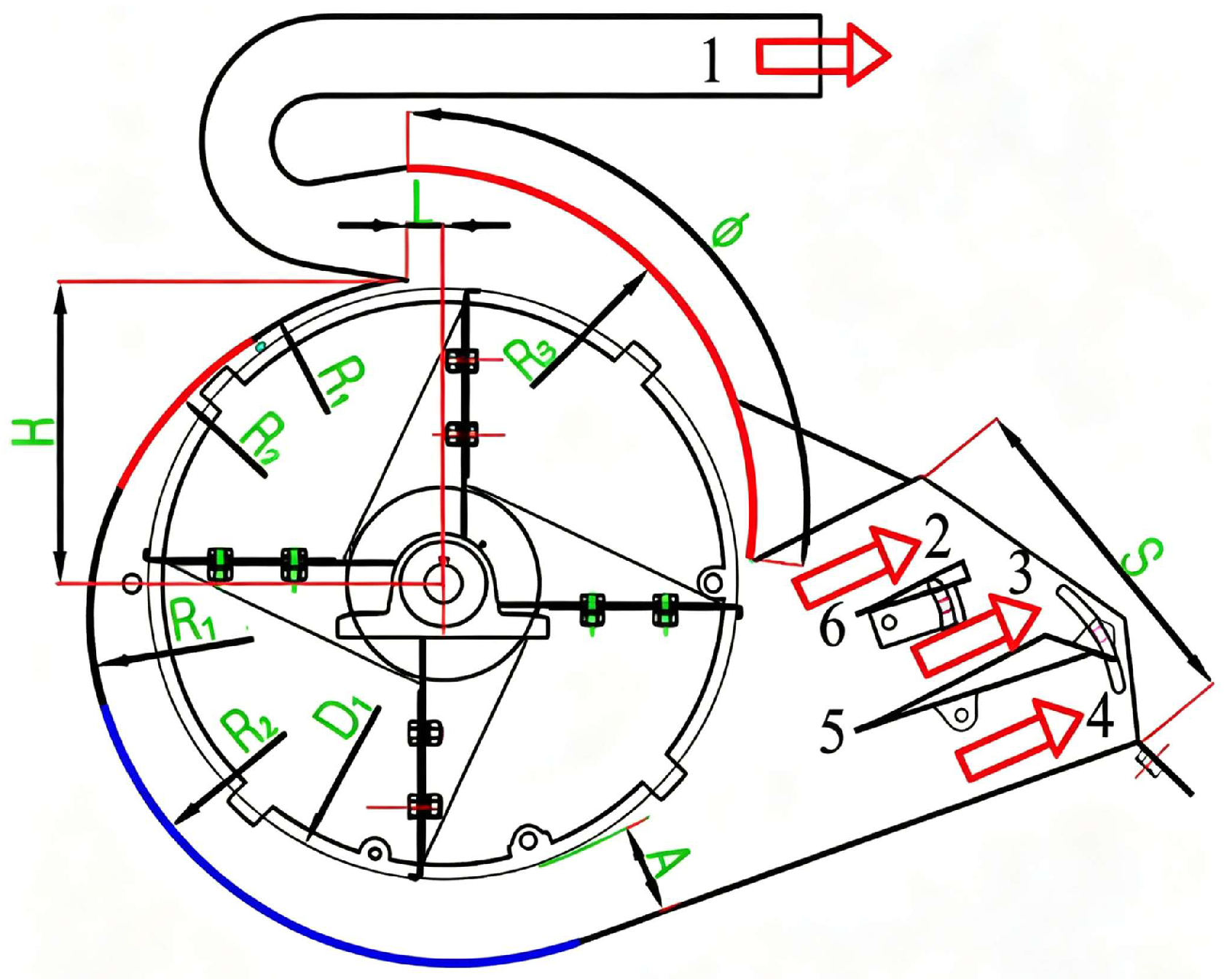
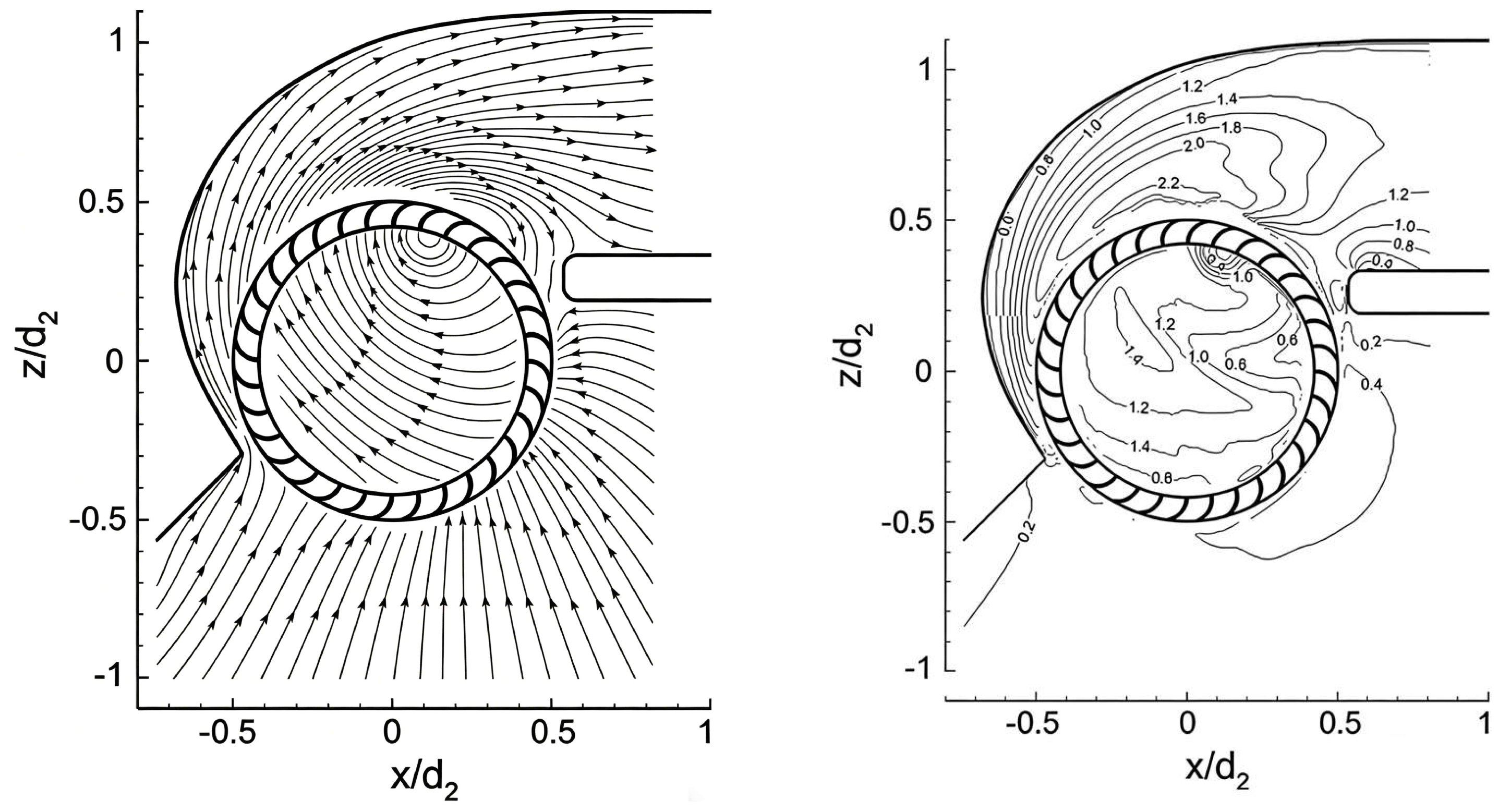
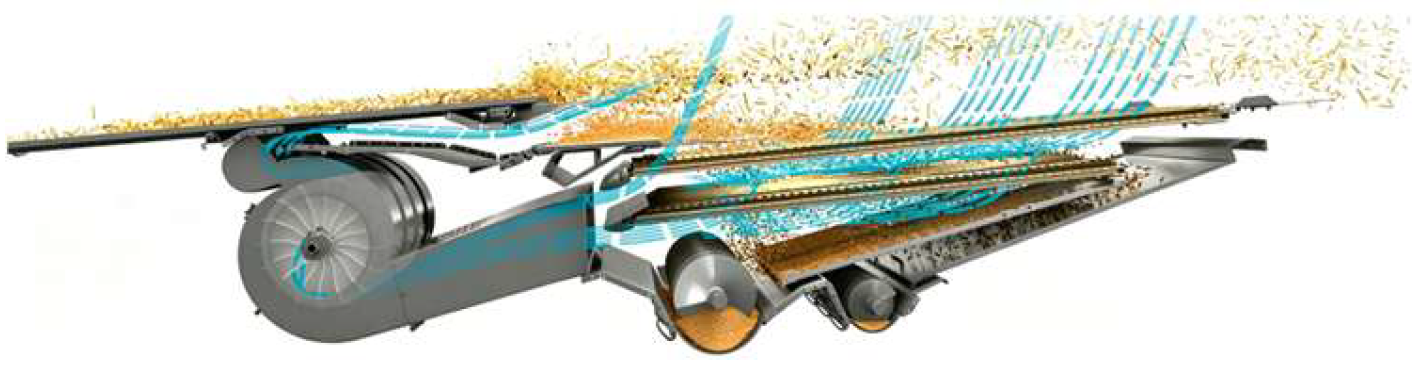
As the power source of cleaning airflow, the structural optimization of fans revolves around three core components: the inlet, the volute, and the impeller, exhibiting an overall technical trend toward high efficiency, uniformity, and low loss. Inlet optimization can improve the total pressure efficiency of the fan [159], volute structure improvements can enhance the uniformity of outlet static pressure [160] (Figure 14), and impeller parameter adjustments directly optimize the outlet wind speed distribution [161]. Special structural designs such as curled-blade fans and new-type cleaning fans further enhance airflow uniformity while simultaneously addressing noise reduction and reducing inlet losses [162,163]. Conical fans generate transverse wind speeds through the pressure difference between the two ends of the impeller [164,165,166], while cross-flow fans have gained attention due to their high airflow uniformity [167]. In addition, experimental research based on geometric parameter standardization and high-precision CFD simulation has further improved the predictability of fan design [168,169]. Studies combining PIV experiments and high-precision numerical simulation have further revealed the unsteady flow, noise sources, and internal vortex structures of cross-flow fans [170,171] (Figure 15), providing a basis for their performance improvement. Gebrehiwot et al. [172] combined CFD with experiments to study cross-flow fans, revealing the key influence of vortex wall position on fan performance. Yu et al. [173] and Li et al. [174] obtained optimal combinations of fan parameters through simulation. These results indicate that the optimization of cleaning fans is shifting from empirical design to structure-coordinated and mechanism-driven design.
To address the issue of uneven airflow distribution in the cleaning chamber, air duct technology has gradually evolved from single-duct to dual-duct and multi-duct configurations. Cross-flow fans with dual air ducts improve airflow stability by regulating rotational speed and inlet opening [175], while adding a cross-flow fan to a centrifugal fan significantly enhances the lateral uniformity of outlet air velocity [176]. Designs such as dual-fan three-duct and multi-duct centrifugal fans have significantly improved cleaning adaptability under large feed rates through rational pressure matching and airflow organization [177,178,179]. In-depth research on the airflow field characteristics within the cleaning chamber is key to improving cleaning quality and reducing energy consumption. Researchers have employed a combination of CFD and EFD to conduct precise measurements and simulation analyses of the flow field inside fans and cleaning chambers. For small-seed crops, Mao et al. [180] clarified the influence mechanisms of fan frequency and screen inclination angle on the impurity content rate and loss rate in millet cleaning. Ueka et al. [158] pointed out that airflow loss mainly originates from wall friction and particle shape.
Therefore, the research focus for future cleaning airflow systems should not be limited to improving fan efficiency alone, but should comprehensively consider the coupling relationships among fan structure, air duct layout, flow field uniformity, and system adaptability, based on the aerodynamic characteristics of pulse threshed materials, to construct a high-efficiency and low-loss cleaning airflow field suitable for pulse crops.

4.2. Innovation in Screening Systems and Research on Vibration Characteristics

Screening is a key process for achieving separation of materials based on differences in particle size, morphology, and motion state. Its performance directly affects grain purity, impurity residue rate, and operational losses during the cleaning process. For pulse crops, grains often exhibit characteristics such as irregular shapes, significant variations in surface roughness, and discrete size distributions. Moreover, harvested materials frequently contain various light impurities such as broken pods, stalks, and leaves, making the screening process more prone to issues such as screen hole blockage, insufficient stratification, and fluctuations in sieving efficiency.

4.2.1. Screen Surface Structure Optimization

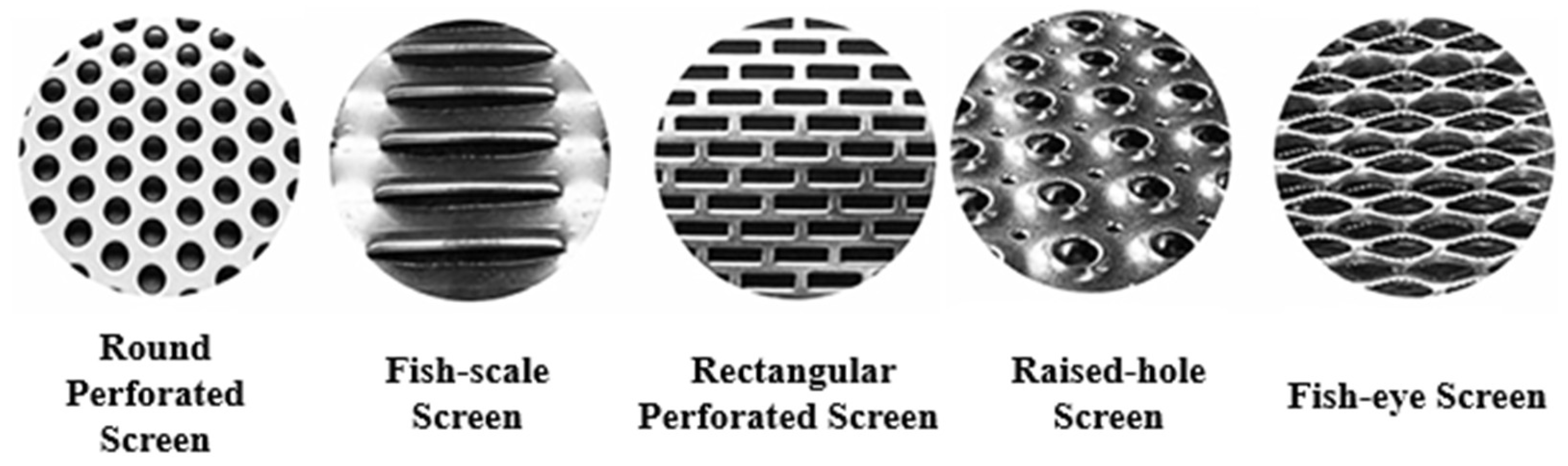
As the direct actuating component for material separation, the screen’s aperture shape, arrangement, and surface morphology have decisive effects on screening efficiency and anti-blocking performance. As shown in Figure 16, the differences in aperture shape and surface characteristics among different screen structures determine their applicable scenarios in grain cleaning. Traditional round-hole screens and slotted screens are widely used in grain cleaning. However, when processing pulse materials, due to random grain orientation and large size variations, issues such as screen hole bridging, particle jamming, and localized material accumulation are prone to occur, thereby reducing screening efficiency [181]. To address the problems of easy hole blockage and low sieving efficiency when traditional round-hole and slotted screens are used for pulses, researchers have carried out optimizations from two aspects: aperture shape and surface morphology, with significant differences in adaptability and performance among different structures. In terms of aperture shape optimization, specially shaped hole screens such as shell-round-hole combination screens and sinusoidal woven screens enhance particle disturbance by altering the shape of the hole edges, providing good anti-blocking effects and making them suitable for small-seed pulses with irregular shapes, such as mung bean and pea [182,183,184,185]. In terms of surface morphology optimization, corrugated screen plates, countersunk screens, and stepped screen surfaces improve stratification effects by extending material residence time [182], while the introduction of guide strips and turbulence ribs reduces local accumulation, making them suitable for large-seed pulses such as soybean and faba bean [186,187]. All optimized structures focus on improving the probability of sieving and reducing the risk of hole blockage, adapting to the cleaning requirements of different grain types of pulses. Meanwhile, adjusting the screen surface inclination angle to achieve a more rational sliding and bouncing state of the material has also been proven to be an effective measure for improving sieving and impurity discharge performance.
Overall, screen surface structure optimization has gradually evolved from simple aperture shape adjustment to a comprehensive optimization model involving coordinated improvements in aperture design, surface morphology, and flow-guiding structures. Such research has laid the foundation for improving the initial stratification and sieving capability of pulse materials. However, under high feed rates or high-humidity conditions, relying solely on static screen surface optimization remains insufficient to fully meet high-efficiency screening requirements, leading research to further shift toward innovations in screen body motion patterns.

4.2.2. Innovation in Vibration Forms and Motion Trajectories

Screening efficiency depends not only on screen surface structure but also on the motion form of the screen body. Traditional reciprocating vibrating screens are widely used due to their simple structure and ease of manufacture. However, their motion trajectory is relatively simple, especially under high feed rates or conditions with wet and sticky materials, where issues such as insufficient material spread, low screen surface utilization, and unclear stratification effects are prone to occur. To address this limitation, researchers have begun exploring screening methods that are better suited to the characteristics of complex materials, starting from vibration forms and motion trajectories.
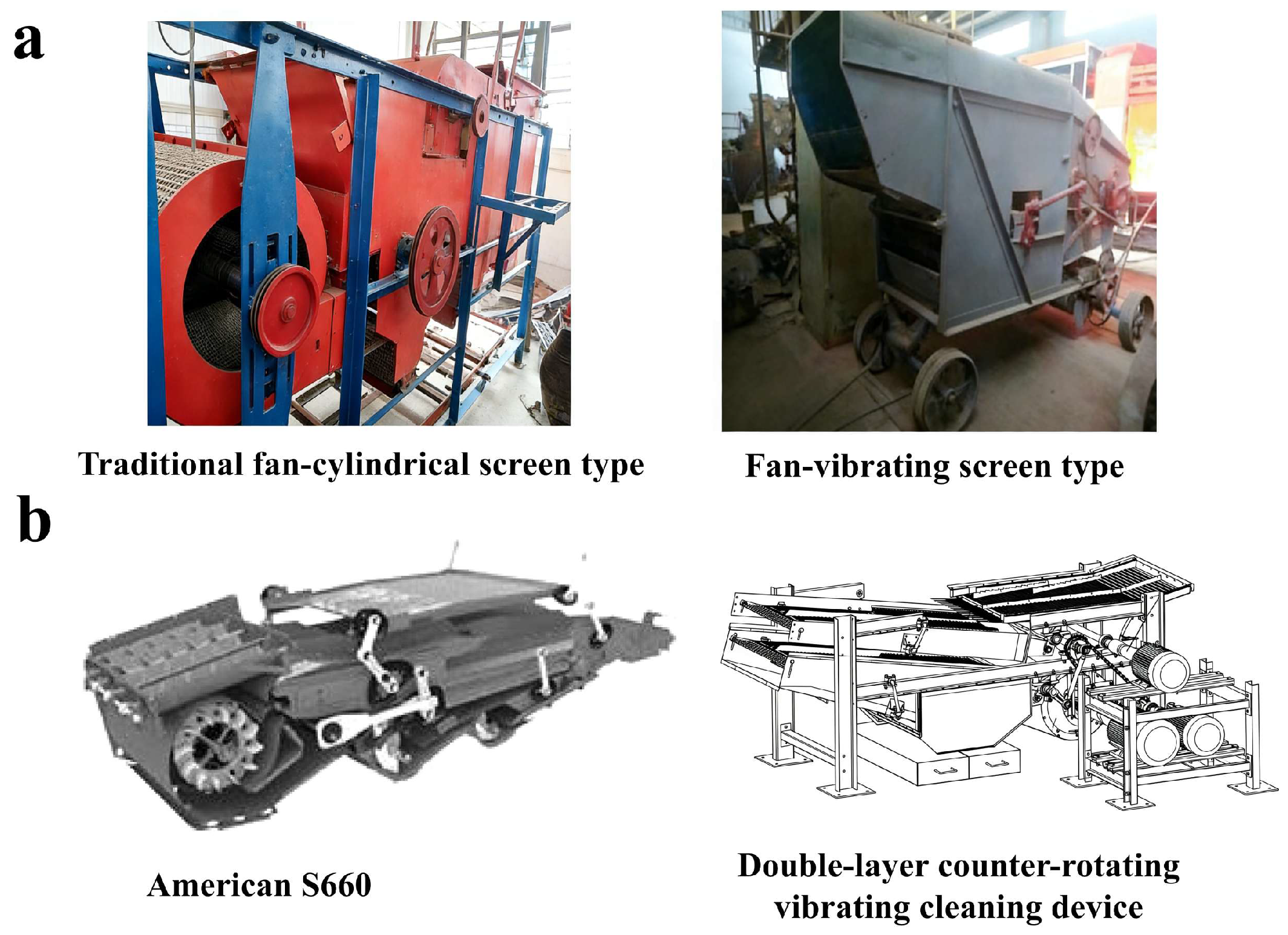
Multi-dimensional vibration and composite motion screening devices are important development directions in recent years. Devices such as three-dimensional vibrating screens constructed using parallel mechanisms and vibration screens with three translational and two rotational motions can generate composite motions in the transverse, longitudinal, and vertical directions, enabling materials on the screen surface to experience enhanced tumbling, tossing, and rearrangement effects. This enhances relative displacement among particles, promoting the sinking of fine particles and the migration of coarse particles [188,189,190,191,192]. Such motion forms help improve material stratification efficiency and reduce the probability of fine particles being shielded by coarse particles, thereby enhancing overall screening performance. Compared with unidirectional reciprocating vibration, multi-degree-of-freedom composite motion is better suited for the cleaning requirements of pulses, which involve complex grain shapes and high levels of impurity admixture.
In addition to multi-dimensional vibration, rotary and differential-speed screening mechanisms have also gradually gained attention. For example, differential-speed rotating double-layer cylindrical screens achieve continuous turning and graded separation of materials through the rotational speed difference between the inner and outer cylinders, improving stratification uniformity while reducing overall machine vibration [193]. Rotary cleaning screens replace intermittent reciprocating motion with continuous rotation, allowing materials to be gradually graded over a longer screening path, offering advantages such as smooth operation and compact structure. Compared with traditional vibrating screens, such devices are better suited for operational scenarios requiring high stability and continuity. Overall, the optimization of screening systems is no longer limited to increasing amplitude or frequency, but rather places greater emphasis on matching the motion trajectory with material characteristics—that is, by rationally designing motion patterns to enhance the synergy among material dispersion, stratification, and sieving processes.

4.2.3. Vibration Characteristics and Dynamic Analysis of Screening Systems

As the motion forms of screening systems become more complex, the dynamic loads borne by the screen body during high-speed continuous operation have also increased significantly. To address this issue, researchers commonly employ rigid-flexible coupled dynamic analysis and finite element simulation methods to study the force and deformation patterns of the screen body under actual operating conditions. Relevant studies have shown that the screen box exhibits significant peak inertia force regions during vibration, and the force distribution is non-uniform. The front end of the screen body, connection boundaries, and excitation loading areas are typically high-risk locations for fatigue damage [194,195]. Accordingly, researchers have proposed improving load distribution and reducing structural vibration response through measures such as asymmetric counterweights, support optimization, and local reinforcement. Meanwhile, topology optimization and lightweight design have also been applied to the structural design of cleaning screen boxes and screen bodies to reduce overall machine weight while ensuring stiffness and strength, thereby improving dynamic performance [196].
In addition to structural-level optimization, vibration parameters themselves also have important effects on screening performance. Parameters such as screen cylinder inclination angle, eccentricity, excitation frequency, and amplitude all affect the motion state of materials on the screen surface and sieving efficiency [197]. Improper parameter settings can easily lead to issues such as insufficient material transport, localized accumulation, or excessive tossing, thereby affecting separation accuracy. Therefore, systematic analysis of vibration characteristics not only helps reveal the dynamic response patterns of the screen body but also provides a theoretical basis for parameter matching and reliability design of screening devices.

4.2.4. Development of Specialized and Composite Screening Devices

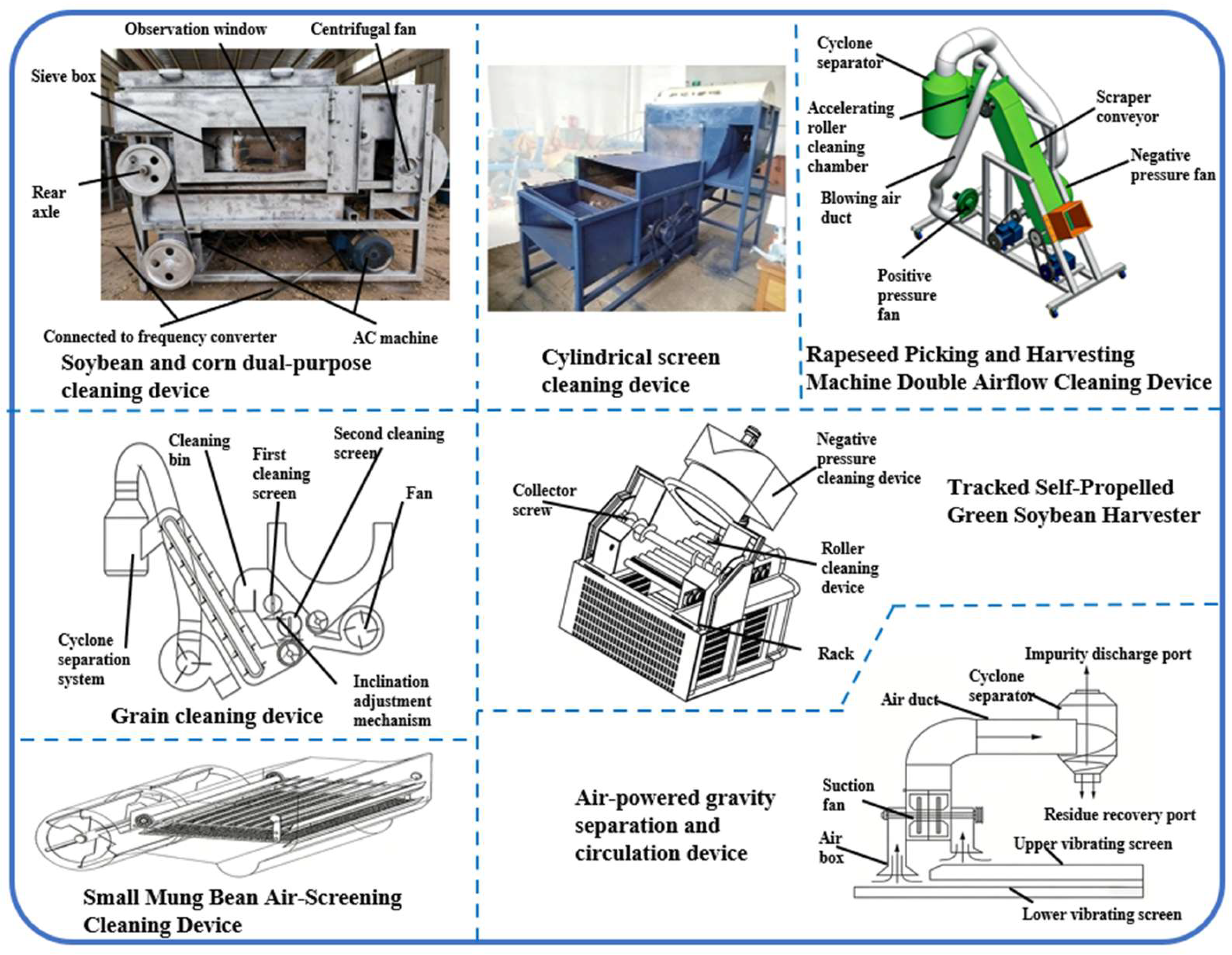
Based on the continuous deepening of screen surface optimization, motion innovation, and dynamic analysis, specialized screening devices tailored to different pulse crops and complex operating environments have also developed rapidly. Due to significant differences among various pulses in terms of grain size, density, surface characteristics, and impurity composition, general-purpose screening devices often struggle to meet the cleaning requirements of different crops. Therefore, researchers have begun developing specialized equipment oriented toward crop characteristics and scenario requirements, as shown in Figure 17.
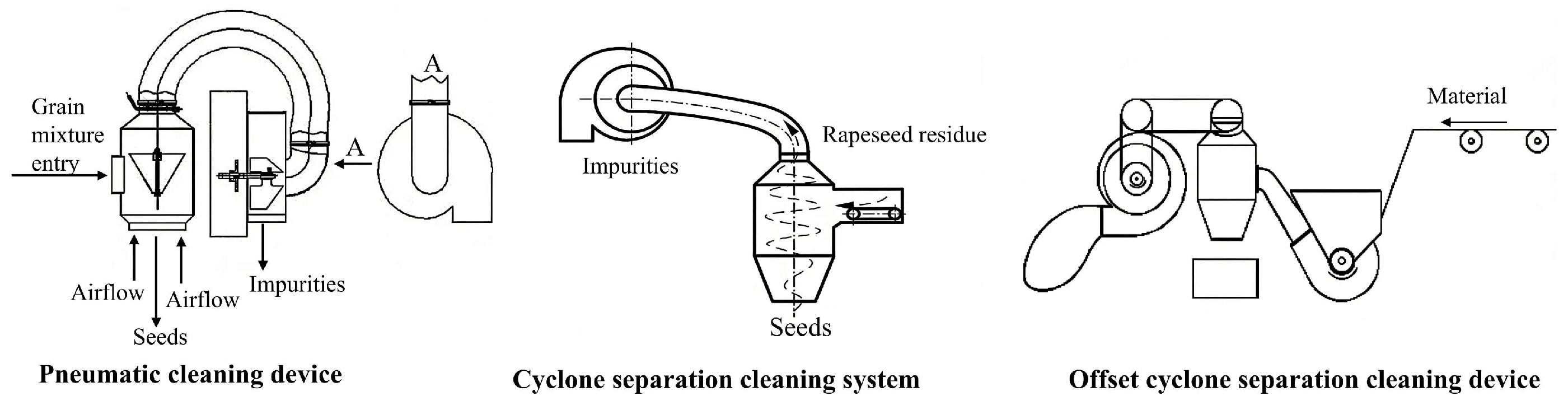
For fresh or economic pulse crops such as vegetable soybean and tiger nut, roller spring-tooth picking mechanisms combined with cleaning systems can achieve efficient separation by utilizing differences in density and stiffness between pods and light impurities [198]. For crops with different grain types, such as soybean, mung bean, pea, and lentil, adjustable screen surfaces, multi-stage cylindrical screens, composite screen bodies, and airflow-vibration coupled cleaning devices have been successively proposed to enhance device adaptability to different material conditions [199,200,201,202,203,204,205,206,207]. In addition, specialized cleaning devices for crops such as pea, chickpea, and lentil have also been developed, including pea mill cleaning units combining inclined frames with mesh screen plates [208], and pneumatic systems for separation based on density differences [209]. To meet the needs of smallholder farmers, researchers have also developed low-cost, compactly designed cleaning devices [210], as well as novel structures such as spiral step cleaning devices [211] and vertical centrifugal separation re-screening devices [212], which have demonstrated good performance in specific application scenarios. Among these, double-inclined-plane air-and-screen devices, roller-kneading pretreatment devices, and rotary grading devices have improved screening efficiency under high-humidity and accumulation conditions by extending material processing paths or enhancing pre-separation effects [213,214].
With the development of intelligent technologies, methods such as machine vision, remote monitoring, and adaptive parameter adjustment are gradually being introduced into screening equipment design, enabling equipment to adjust operating parameters in real time based on material conditions and the operating environment [181,215,216]. This indicates that screening systems have gradually evolved from traditional general-purpose mechanical design toward crop specialization, condition adaptation, and intelligent control.
Figure 17. Schematic diagrams of cleaning devices [198,200,205,207,213,217,218].
Agriculture 16 01051 g017
Although orthogonal experiments and response surface methodology have been widely adopted across the reviewed studies on screen design and vibration optimization, the statistical rigor of reported results varies considerably. The majority of studies present results as mean values, range analysis outcomes, or response surface plots, without reporting confidence intervals, standard errors, or explicit p-values from formal significance tests. Only a limited number of studies provided complete ANOVA tables with significance levels. Given that cleaning performance indicators such as cleaning loss rate and impurity rate are subject to substantial field variability, this gap in statistical reporting makes it difficult for readers to assess the reliability and reproducibility of the reported improvements. Future experimental studies on cleaning device optimization should, as a minimum, include at least three independent replicates per treatment, report standard deviations or confidence intervals alongside mean values, and apply analysis of variance or equivalent non-parametric tests with a reported significance threshold.

4.3. Research on Modeling and Numerical Simulation of the Cleaning Process

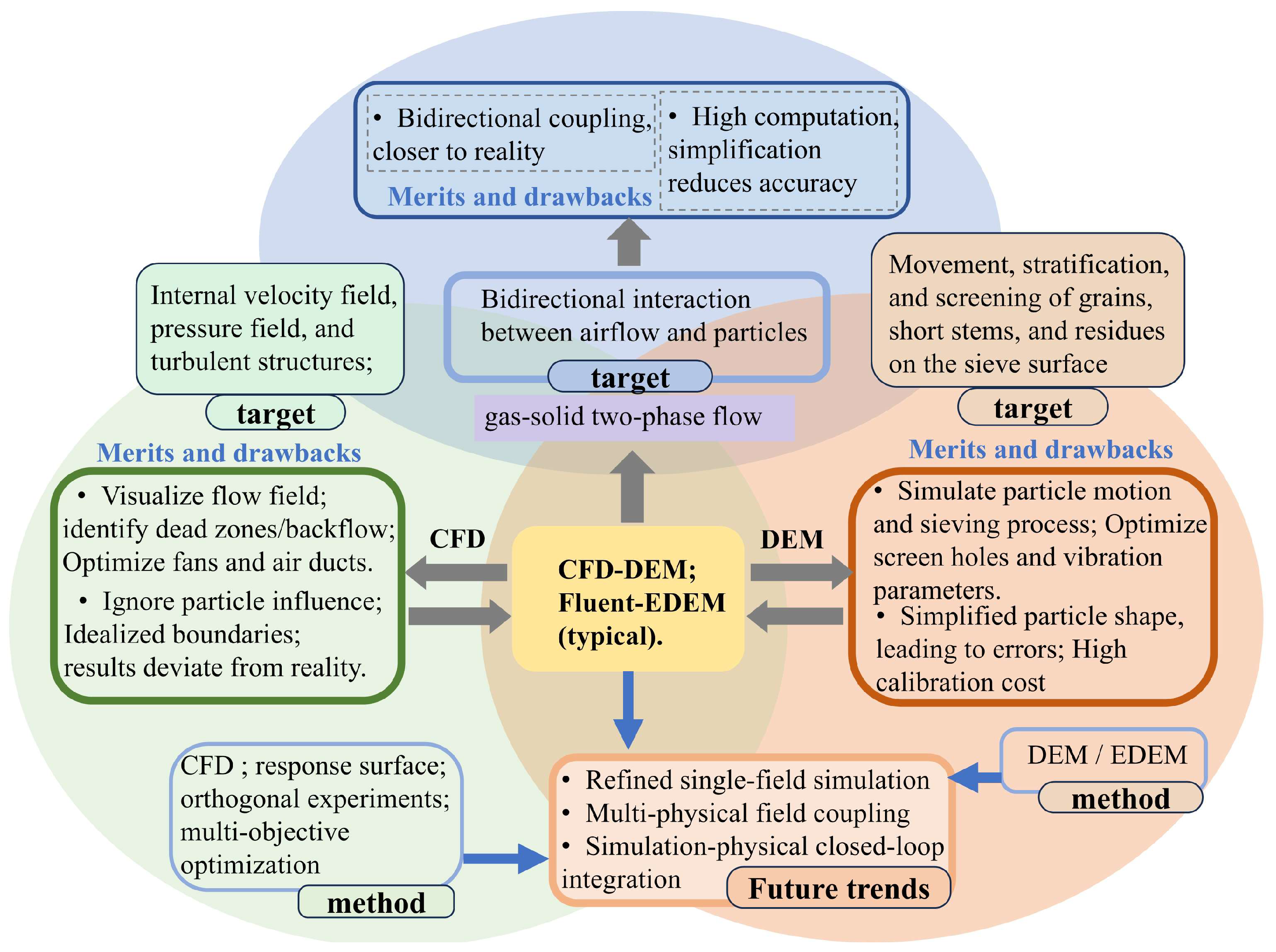
The cleaning process involves complex coupling interactions among the airflow field, screen body motion, and multi-component materials such as grains, broken pods, and stalks. It exhibits characteristics of strong nonlinearity, multiphase interaction, and sensitivity to operating conditions. Relying solely on physical experiments makes it difficult to fully reveal the underlying mechanisms. As shown in Figure 18, numerical simulation of the cleaning process has currently formed a technical system centered on CFD, DEM, and CFD-DEM coupling, providing precise support for structural optimization and parameter control of cleaning devices from three dimensions: airflow field characteristics, particle motion patterns, and gas–solid two-phase interaction. However, issues such as insufficient model adaptability still exist due to the irregular grain shapes and complex material composition of pulses.

4.3.1. Theoretical Modeling and Single-Field Simulation Research

Theoretical modeling is the foundation of numerical simulation, with the core being the quantification of material motion patterns and separation mechanisms. Early research focused on the material separation behavior of straw walkers, establishing rheological property models for straw layers [219]. With technological development, researchers further constructed kinematic models for the synergistic action of vibrating screens and airflow, and improved the theoretical system through physical simulation. To address the multi-parameter coupling characteristics, multi-parameter identification modeling methods based on intelligent algorithms have been used to construct high-precision state-space models [136]. Numerical simulation methods for gas–solid two-phase flow have also achieved quantitative prediction of cleaning performance. For instance, Badretdinov et al. [220] and related CFD-based studies [221] reported prediction errors within 5% when comparing simulated cleaning loss rates with experimental measurements. However, it should be noted that these validation results were obtained under specific laboratory or controlled field conditions with a limited range of crop varieties, moisture contents, and feed rates. Existing theoretical models are mostly constructed based on cereal crops, oversimplifying the interactions among non-spherical pulse grains, broken pods, and stalks. They lack systematic physical property databases for pulses, and their universality still needs improvement [222].
Single-field simulation focuses on refined analysis of a single physical field. CFD technology is mainly used for visualization and optimization of the internal airflow field in cleaning devices. Through numerical simulation, the wind speed distribution of core components such as fan volutes, blades, and inlets can be intuitively presented, and dead zones and recirculation zones in the flow field can be identified. Researchers have achieved optimized design of fan structural parameters using methods such as response surface methodology and orthogonal experiments, significantly improving outlet wind speed uniformity [223,224], and have provided theoretical foundations for the development of multi-channel cleaning devices and self-cleaning airflow systems [180,225,226]. However, CFD simulations typically ignore the blocking and disturbing effects of particles on the airflow, and when applied to pulse harvesting scenarios with high impurity content rates, they are prone to deviations between simulation results and actual operating conditions.
DEM technology focuses on simulating particle motion processes. By constructing particle contact models, it can intuitively display the motion trajectories, stratification patterns, and sieving efficiency of grains and impurities on the screen surface [125]. Existing studies have revealed the influence mechanisms of screen hole orientation and vibration parameters on sieving efficiency [227,228]. However, limited by computational efficiency, DEM simulations often adopt the assumption of spherical particles. Pulse grains are mostly elliptical or irregular in shape, and spherical models tend to overestimate the separation rate of large particles, leading to reduced simulation accuracy [130]. This issue is particularly prominent in cleaning simulations for small-seed pulses such as mung bean and pea. Quantitatively, spherical particle models can overestimate sieving rates by 20–40% for flat or lens-shaped grains such as lentil and certain mung bean varieties, because spheres exhibit unrealistic rolling and percolation behavior through screen apertures compared with their real non-spherical counterparts. To address this, a minimum level of shape approximation should be adopted depending on the crop. For moderately elongated grains such as soybean and faba bean, multi-sphere models composed of three to five overlapping spheres can adequately represent the ellipsoidal form with volume errors typically below 5%. For markedly flat or lens-shaped grains such as lentil and some mung bean varieties, super-quadratic or polyhedral models are recommended. Without such shape-specific modeling strategies, simulation-based design optimization risks systematically underestimating cleaning losses and screen blockage.
The majority of the reviewed CFD and CFD-DEM studies rely predominantly on global goodness-of-fit metrics such as R2 or RMSE, without comprehensive residual analysis or independent cross-validation on datasets distinct from those used for model calibration. This reliance raises legitimate concerns about overfitting and generalizability, particularly when models are trained or calibrated against synthetic data generated under idealized assumptions. Future modeling studies should report prediction errors on independent validation datasets covering a meaningful range of moisture contents and feed rates, present residual diagnostics to verify model assumptions, and employ cross-validation or bootstrap procedures to quantify prediction uncertainty and strengthen confidence in simulation-based design recommendations.

4.3.2. Application and Optimization of Multi-Field Coupling Simulation Technology

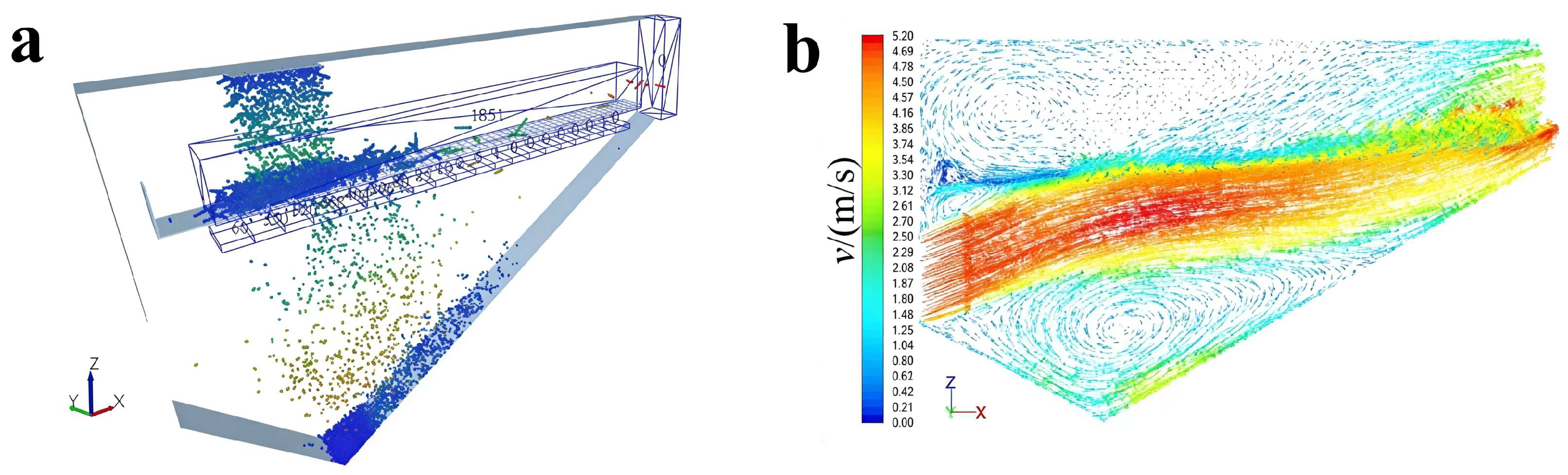
As shown in Figure 17, the CFD-DEM offers the advantages of bidirectional coupling and closer approximation to actual operating conditions, enabling simultaneous description of the airflow field, particle motion, and their interactions. It has become the mainstream technology for numerical simulation of the cleaning process [220]. However, its high computational cost, complex parameter calibration, and insufficient accuracy in describing microscopic behaviors such as particle shape, adhesion, and pod shattering limit its application in real-time control and online optimization. In terms of model construction, researchers have quantified the relationship between material motion patterns and fan wind speed by establishing physical models of short stalks and grains [229,230] (Figure 19). The establishment of gas–solid two-phase flow models for cross-flow cleaning devices has also revealed the phenomenon of horizontal stratification in the airflow field [231]. In application scenarios, CFD-DEM technology has been widely used in cleaning optimization studies for crops such as rice, corn, wheat, tiger nut, and mung bean [232,233,234,235,236,237,238,239], achieving significant results in air duct structure design, airflow distribution control, and screen surface parameter matching, effectively reducing cleaning losses and impurity content rates [240].
Regarding the validation of these simulation studies with real-world data, the majority of the reviewed CFD-DEM studies validated their predictions indirectly by comparing simulation outputs such as cleaning loss rate and grain purity with bench-test or field-average measurements. Direct validation against real-time, time-series field data on pulse materials with complex shapes and variable moisture conditions has not been reported in the reviewed literature. This gap is significant because bench-test validation under controlled laboratory conditions may not fully capture the transient fluctuations in material feed rate, moisture content, and terrain-induced vibrations encountered during actual field harvesting.
The contact parameters adopted in current CFD-DEM models further contribute to the gap between simulation and reality. Standard parameters such as the coefficient of restitution and rolling friction are typically calibrated using clean, dry grains under laboratory conditions. These parameters do not adequately represent moisture-dependent adhesion between pulse grains and screen surfaces, nor the sudden energy release and fragmentation patterns associated with pod shattering events. For pulse materials with high or variable moisture content, the assumption of constant contact parameters can lead to significant prediction errors in material stratification, sieving efficiency, and screen blockage behavior. Future calibration protocols should incorporate moisture-dependent cohesion models and pod rupture criteria to improve the fidelity of CFD-DEM simulations under field-relevant conditions. Direct field-scale time-series validation with instrumented combine harvesters would further enhance confidence in simulation-based design recommendations for pulse cleaning systems.
However, CFD-DEM coupling simulation for pulse cleaning still faces three major challenges. First, particle morphology modeling is difficult. The irregular shapes of pulse grains and broken pods require multi-sphere or non-spherical particle representations, which significantly increase computational complexity. Second, the description of material adhesion effects is insufficient. Under high-moisture conditions, adhesion between grains and the screen surface, as well as among grains, easily causes screen blockage, yet existing models lack precision in capturing such microscopic behaviors. Third, the computational cost is high. Coupled simulations of multi-component, large-scale materials demand powerful hardware, restricting their use in real-time control and online optimization. These challenges collectively limit the reliability and practicality of CFD-DEM simulations for pulse cleaning. To overcome these barriers, future research should focus on developing high-fidelity non-spherical particle models with the shape approximation strategies described in Section 4.3.1, integrating pod shattering and grain breakage criteria into DEM frameworks, and exploring reduced-order or surrogate modeling methods to balance simulation accuracy with computational efficiency.
Beyond the three challenges discussed above, a broader methodological concern pertains to the validation framework adopted by current numerical studies. The majority of CFD-DEM models for grain cleaning are validated by comparing globally averaged metrics—such as overall cleaning loss rate or grain purity—between simulation outputs and experimental measurements at a limited number of operating points. This bulk-validation approach, while practical, does not verify whether the model correctly captures the underlying physical mechanisms at the particle scale, such as the trajectory of individual non-spherical grains or the transient dynamics of screen blockage. Furthermore, model validation is rarely conducted on datasets that are fully independent of those used for parameter calibration, and the ranges of moisture content, feed rate, and material composition over which the model remains valid are seldom explicitly specified. To strengthen the credibility and applicability of CFD-DEM simulations for pulse cleaning, future research should adopt more rigorous validation protocols, including independent validation datasets, explicit specification of the validated operating envelope, and particle-scale verification where feasible.
To bridge the gap between simulation and practical application identified above, a structured calibration and validation protocol is essential for pulse-specific DEM and CFD-DEM simulations. Based on the literature reviewed and the limitations discussed, such a protocol should encompass the following steps. First, laboratory characterization of pulse grain and pod properties should be conducted, including 3D shape scanning for particle morphology reconstruction, moisture-dependent friction and cohesion measurements, and pod rupture force testing under quasi-static and dynamic loading. Second, non-spherical particle models should be constructed using the shape approximation strategies described in Section 4.3.1, with multi-sphere or super-quadratic representations selected according to grain type. Third, contact parameters should be calibrated through systematic bench-scale tests rather than assumed values: incline plate or direct shear tests can determine grain–grain and grain–screen friction coefficients, drop tests can measure the coefficient of restitution, and controlled humidity chamber tests can quantify moisture-dependent cohesion. Fourth, simulations should be executed under the same operating conditions as the planned validation experiments, with feed rate, airflow velocity, and screen motion parameters matched to field or bench measurements. Fifth, validation should be performed not only against globally averaged metrics such as cleaning loss rate and grain breakage rate, but also against particle-scale observations where feasible, such as the spatial distribution of grain deposition on the cleaning shoe or screen blockage patterns. The validated operating envelope should be explicitly specified, including the ranges of moisture content, feed rate, and material composition over which the model has been tested. This structured approach would provide a practical pathway from the current limitations toward more reliable simulation-guided design of pulse cleaning systems.

4.4. Research on Intelligent Detection, Control, and Environmental Adaptability

With increasing requirements for precision, stability, and intelligence in cleaning operations, research focus has gradually shifted from traditional separation efficiency optimization to comprehensive performance improvement encompassing loss monitoring, process control, and adaptability to complex environments.

4.4.1. Sensing Technology for Cleaning Loss Monitoring

In terms of cleaning loss monitoring, piezoelectric sensing technology has become the mainstream approach due to its fast response, high sensitivity, and strong anti-interference capability. Piezoelectric ceramics and piezoelectric films are two commonly used sensitive materials. Sensors based on piezoelectric ceramics offer good stability, and when combined with double-layer vibration isolation structures, can effectively suppress vibration interference, keeping measurement errors below 5% [17]. Further optimization of the sensitive element installation angle and signal processing circuits enhances the ability to capture grain impact signals, enabling effective differentiation between grains and impurities, with measurement errors reduced to within 4.1% [241,242].
In contrast, piezoelectric films offer advantages such as light weight, good flexibility, and structural versatility, making them more suitable for array-based and embedded sensing applications. Grain impact sensors employing floating raft damping structures and vertically distributed flexible thin-film sensing arrays can significantly improve signal acquisition quality, reducing signal aliasing by 0.48% [17,243,244]. As shown in Figure 20a, the development trend of piezoelectric sensing technology is toward flexibility and array integration. Piezoelectric ceramics are better suited for fixed-point monitoring requiring high stability and anti-interference, while PVDF piezoelectric films are more suitable for lightweight, distributed full-width monitoring. The complementarity between the two constitutes the core technical approach for cleaning loss monitoring in pulses. Recent developments have further validated piezoelectric and PVDF-based sensor networks for pulse crops. Dong et al. [17] reviewed the current status and trends of grain loss monitoring sensor technology, covering advances in both piezoelectric ceramics and films. Automated soybean quality detection systems integrating deep learning with mechanical sampling have been proposed [245], and high-precision online detection methods for foreign matter and kernel breakage based on hyperspectral imaging and lightweight deep learning models have also been reported [246]. These advances indicate that sensor-based monitoring for pulse cleaning is progressing from single-signal detection toward multi-source information fusion.
However, piezoelectric films are prone to short circuits under high humidity conditions, which seriously limits their stable application in harvesting high-moisture pulses [17]. Therefore, developing specialized moisture-proof packaging and protective structures has become a key issue for improving environmental adaptability. Existing studies have conducted preliminary explorations in areas such as composite water-blocking layers, high-level sealing packages, and double-layer vibration isolation structures; however, problems such as insufficient sealing reliability under high-frequency vibration and attenuation of weak impact signals by multi-layer packaging still exist, leaving a significant gap compared to the actual demands of pulse harvesting. Future optimization can focus on bionic superhydrophobic packaging, vibration compensation structures, and machine learning-based adaptive signal compensation to further enhance sensor applicability in high-humidity and variable environments.

4.4.2. Sensor Structure Optimization and Spatial Perception

Regarding sensor structure optimization, researchers have focused on aspects such as array layout, spatial localization, and signal fusion to advance loss monitoring from single-point sensing to spatial resolution. Designs such as array-type piezoelectric sensors and double-layer cross-structure sensors have significantly improved detection resolution and spatial localization capabilities [242,250,251].
Piezoelectric film-based sensors have been successfully applied to cleaning loss detection in corn and wheat. Through bidirectional array design and Kalman filter optimization, recognition errors have been reduced to 3–6% [153,252,253,254]. In addition, acoustic signal recognition technology offers a new approach for non-destructive monitoring, achieving recognition accuracy of up to 94% under complex field noise backgrounds, compensating for the insufficient anti-interference capability of traditional monitoring methods [255]. As shown in Figure 17, loss monitoring technology is evolving toward the integration of materials, structures, and signal processing. However, for the issue of similar impact signal characteristics between pulse grains and light impurities, existing sensors still require further improvement in signal discrimination accuracy.

4.4.3. Intelligent Control, Closed-Loop Regulation, and Environmental Adaptability

Intelligent closed-loop control technology for cleaning based on sensing monitoring has achieved a transition from fixed parameters to dynamic adaptive regulation. As shown in Figure 20b, researchers have established mapping relationships among loss amounts, pulse signals, and operating parameters, constructing adaptive regulation models for airflow rate and screen surface vibration parameters [256,257]. Intelligent cleaning control systems developed to address fluctuations in feed rate can achieve automatic compensation and parameter optimization for cleaning performance, effectively reducing cleaning losses and energy waste caused by fixed-parameter control [247,258,259,260]. Current control strategies have integrated algorithms such as fuzzy PID and neural networks, but their real-time responsiveness to fluctuations in pulse moisture content and maturity still needs improvement. Meanwhile, environmental adaptability under complex terrain conditions is also an important aspect of intelligent development. To address the issue of cleaning screen inclination during sloping field operations in hilly and mountainous areas, Wu et al. developed a self-leveling system for cleaning screens using a fuzzy PID control algorithm, achieving real-time horizontal adjustment of the cleaning screen on slopes of up to 10° [248]. The introduction of inclination self-adjusting mechanisms, automatic leveling devices, and adaptive support structures has further enhanced equipment adaptability to complex terrains [217,218]. Future environmental adaptability design should integrate real-time sensing of field conditions to achieve comprehensive compensation for multiple factors including terrain, materials, and feed rate.
Overall, cleaning control is evolving toward data-driven, real-time feedback, and automatic compensation. In the future, how to combine the unique physical characteristics of pulse crops to develop loss monitoring sensors with higher sensitivity and discrimination accuracy, construct more adaptable intelligent control models, and achieve coordinated optimization control through multi-source information fusion will be important directions for the intelligent development of cleaning systems [10].

5. Threshing and Cleaning Combine Harvesters

5.1. Technical Classification and Applicability Evaluation of Threshing Devices

5.1.1. Classification by Material Flow Direction

(1) Tangential Flow Threshing Devices. In tangential flow threshing devices, the crop is fed tangentially along the direction of the threshing cylinder. Within the wedge-shaped gap between the cylinder and the concave, it is subjected to high-speed impact and rubbing, causing rapid grain shedding. The crop typically rotates less than one full revolution inside the cylinder before being discharged tangentially. This structure has a short threshing time, intense action, and causes a high degree of stalk breakage, making it suitable for dry and uniform grain harvesting. Some models in the John Deere JD 1000 series, Case IH 1600 series, and Massey Ferguson MF 300 or 500 series use rasp bar or spike tooth tangential flow cylinders combined with straw walkers. Domestic models such as the Dongfeng-5 and early Changchai 4LZ series also primarily adopt this configuration (Figure 21). However, as pulse grains have weak impact resistance, direct use of tangential flow can easily cause breakage. Therefore, in pulse harvesting, tangential flow is typically used as the front stage of a multi-stage threshing system, primarily for rapid pre-threshing to separate most grains first, with the remaining material then entering a downstream axial flow device for gentler threshing. However, when used alone, tangential flow still struggles to balance threshing rate and breakage rate.
(2) Axial Flow Threshing Devices. In axial flow threshing devices, the crop is fed from one end of the cylinder. Under the action of helical guiding elements, it moves forward along the axial direction. The material undergoes long-distance, multiple gentle impacts and rubbing actions within the annular space before being discharged from the other end. Grains continuously pass through the separation grates under centrifugal force, achieving integrated threshing and separation. This structure offers high threshing rate and low damage, making it particularly suitable for high-yield, moist, and difficult-to-thresh crops [3]. As shown in Figure 22, mainstream international models such as the Case IH Axial-Flow series, Claas LEXION series, and Yanmar YH1180 adopt this axial flow design. In addition, the 4LZ-1.0Q harvester features a simplified axial flow structure specifically designed for pulse harvesting in small plots [261,262]. Due to its long threshing path and gentle action, axial flow has become the mainstream technical solution for pulse harvesting.
(3) Tangential-Axial Flow Combined Threshing Devices. Tangential-axial flow combined devices connect a tangential flow cylinder and an axial flow cylinder in series. The front-stage tangential flow cylinder performs pre-threshing at higher speeds and smaller clearances, allowing most grains to be separated first. The remaining material then enters the axial flow cylinder, where it undergoes complete threshing through a long path and multiple gentle actions. This structure combines the high efficiency of tangential flow with the high threshing rate of axial flow, offering strong adaptability to variations in crop moisture content and feed rate. It is suitable for high-yield, moist rice, as well as soybean, wheat, and other crops [3]. As shown in Figure 23, high-end models such as the John Deere C440, US CSX7000, Wode, Lovol Gepard, and Zoomlion Guwang adopt this configuration. For pulse materials, the tangential section can quickly thresh easily separable parts, while the axial section gently processes difficult-to-thresh pods, avoiding high-intensity action throughout the entire process. The tangential-axial flow combined device developed by Jiangsu University uses a rasp bar cylinder design, featuring a simple structure and low cost, demonstrating good adaptability for pulse harvesting in deep-mud, small plots [1,263].

5.1.2. Classification by Feeding Method

According to feeding method, threshing devices can be classified into full-feed and semi-feed types. Full-feed devices feed both ears and stalks into the threshing unit together. They have a relatively simple structure and high processing efficiency, representing the mainstream form of large and medium-sized combine harvesters. The John Deere S series and Case IH Axial-Flow series adopt this design. When used for pulse harvesting, although stalk breakage increases the cleaning load, the requirements for large-scale commercial pulse harvesting can still be met through optimization of threshing elements and cleaning systems. Semi-feed devices feed only the ear part into the threshing chamber, while the main part of the stalk is clamped, conveyed, and discharged intact. The Kubota PRO series and Yanmar AW series are representative of this design. This structure maintains the relative integrity of the stalks and has lower threshing power consumption. However, due to the dispersed podding positions of pulses and difficulties in feeding when lodged, its application in pulse harvesting is not as widespread as in rice. It is mainly suitable for varieties with uniform podding and low lodging rates, or for segmented harvesting operations [3].

5.2. Technical Classification and Applicability Evaluation of Cleaning Devices

5.2.1. Air-and-Screen Type Cleaning Devices

Air-and-screen type cleaning is the mainstream technology in combine harvesters. It achieves separation by utilizing the synergistic action of mechanical screening by vibrating screens and airflow blowing from fans, exploiting differences in particle size, density, and suspension velocity between grains and impurities [213]. As shown in Figure 24, common configurations include the traditional fan-cylinder screen type and the fan-vibrating screen type. The latter, by enhancing material stratification and sieving efficiency, is more suitable for high-yield, high-impurity operating conditions. The Dyna Flo Plus multi-stage cleaning system on the John Deere S series and the Cross Flow fan on the Case IH Axial-Flow series belong to this category [1]. However, the suspension velocities of pulse grains, broken pods, and stalk segments are relatively close, and traditional air-and-screen systems are prone to localized losses or residual impurities due to uneven airflow distribution. Among these, the double-layer counter-directional vibrating cleaning device designed by Fan et al. [264] has shown good performance in soybean cleaning, reducing impurity content rates to low levels.

5.2.2. Cyclone Separation Type Cleaning Devices

Cyclone separation type devices utilize centrifugal force generated by high-speed rotating airflow to achieve separation. Denser grains are thrown toward the outer wall and fall, while light impurities are discharged with the central airflow. This structure is compact and is commonly used in small combine harvesters or as auxiliary cleaning devices. As shown in Figure 25, Liu et al. [265] developed an airflow-type cleaning device that achieves staged separation through series-connected airflow channels and wind speed gradient control. Liao et al. [266] designed a cyclone separation cleaning system that improves fine impurity separation using variable-diameter volutes and deflector vane technology. Zhou et al. [267] developed a cyclone separation cleaning device with an offset suction port. By positioning the suction port away from the feed inlet and optimizing offset parameters, it effectively reduces losses caused by impurities carrying over grains. Due to the lower density of pulse grains and smaller differences in suspension velocity, the risk of using cyclone separation alone is high [249,263]. Therefore, such devices are typically used in conjunction with vibrating screens as auxiliary cleaning or secondary re-cleaning units.

5.2.3. Intelligent Cleaning Systems

Intelligent cleaning systems integrate sensor networks into traditional air-and-screen devices to monitor cleaning loss rate and grain impurity content rate in real time, automatically and coordinately adjusting fan speed and screen opening. This represents a leap from relying on manual judgment to system-autonomous optimization. The John Deere ICA2 system (Deere & Company, Moline, IL, USA) can dynamically adapt threshing cylinder speed, clearance, cleaning fan speed, screen opening, and deflector angle, and incorporates slope compensation functionality. The Fendt IDEALbalance™ system(AGCO GmbH, Marktoberdorf, Germany) achieves uniform material distribution through a dual-grain-pan structure, capable of handling side slopes of up to 15%. The New Holland IntelliSense™ system (CNH Industrial N.V., Turin, Italy) integrates agricultural big data and cloud platforms to optimize parameters in advance before the harvester enters different yield zones. Intelligent cleaning systems can adjust parameters in real time based on the characteristics of pulse materials, effectively addressing the pain points of fixed parameters and poor adaptability in traditional cleaning systems. For example, when pulse moisture content is high, the system automatically reduces wind speed and increases screen openings to prevent grains from being blown away. When feed rate fluctuates due to lodging, the system dynamically adjusts fan speed to maintain cleaning stability. In the future, with advancements in sensor accuracy and algorithm optimization, intelligent cleaning will become a key enabler for low-damage pulse harvesting.

5.3. Combine Harvesting Devices

The structural design of existing combine harvesters for pulses is fundamentally supported by the low-damage threshing and high-efficiency cleaning technologies discussed in Section 3 and Section 4. As shown in Figure 26, with continuous optimization of threshing and cleaning systems, modern combine harvesters have made significant progress in crop adaptability and are now capable of harvesting various crops, including wheat, rice, corn, soybean, and rapeseed. Based on their design objectives and target crops, combine harvesters applied to pulse harvesting can be mainly classified into two categories: general-purpose grain combines and specialized pulse combines [268,269]. Compared with earlier reviews that primarily described available equipment types [1,7,8], this section provides a critical comparative analysis of the two categories, identifying specific structural and parametric factors that determine harvesting performance and extracting quantitative design guidelines for pulse-specific combine harvesters.

5.3.1. Applicability Analysis of General-Purpose Grain Combine Harvesters

General-purpose models are represented by the John Deere S series, Case IH Axial Flow series, New Holland CR series, and Claas LEXION series. Although each model has its own emphasis in threshing and cleaning structures, as shown in Table 2, their common technical features revolve around high efficiency, high feed rates, and multi-crop adaptability. For example, the John Deere S series employs a triple-duct axial flow cylinder and multi-stage cleaning structure, equipped with an ICA intelligent control system that can adjust operating parameters in real time based on crop load [263,270,271,272]. The Case IH Axial Flow series achieves gentle threshing through a single axial flow cylinder and Grain on Grain design, complemented by a self-leveling cleaning shoe for slope operation [270]. The New Holland CR series features a dual-rotor parallel system and Opti Fan hydraulically driven fan to meet high feed rate harvesting requirements [273]. The Claas LEXION series reduces the load on the main cylinder through an APS pre-separator, combined with the VARIO intelligent cleaning system for adaptive control [274].
A critical comparison of these models reveals that their threshing and cleaning systems, while highly optimized for cereals, share a common limitation when applied to pulses: their design parameters are calibrated for the mechanical properties of rice, wheat, and corn, which differ fundamentally from those of pulse crops in terms of grain fragility, pod structure, and impurity composition. By implementing modifications such as replacing specialized headers, adjusting cylinder speed and concave clearance, and using flexible threshing elements, the above models can harvest ordinary commercial pulses to a certain extent. Their advantage lies in retaining the mature power and travel systems of the original models, with relatively low modification costs, making them suitable for production conditions characterized by scattered plots and diversified planting varieties [18].
However, the limitations of general-purpose models in pulse harvesting are equally evident and can be quantified based on the literature reviewed in Section 3 and Section 4. First, threshing elements are primarily designed for rice, wheat, and corn, lacking sufficient mechanical compatibility with pulse materials. Field studies have shown that even after modification, general-purpose models typically exhibit grain breakage rates of 3–8% for soybean, whereas specialized models consistently achieve grain breakage rates below 2%, as summarized in the quantitative performance comparison table [275,276]. For instance, CLAAS Lexion harvesters have been reported with losses below 2% in soybean under well-adjusted conditions [18]; John Deere harvesters evaluated in soybean can show total losses exceeding 2.5% when threshing is still satisfactory [8]; New Holland CR series combines equipped with Twin-Clean system can reduce losses at the back of the harvester to nearly zero under closed-loop automation [14]. Second, the airflow field and screen surface parameters of the cleaning system are mostly calibrated for staple cereals, lacking targeted optimization for the density differences between pulses, broken pods, and stalks. This mismatch results in cleaning loss rates of 5–12% under typical field conditions, significantly higher than the below 3% target for high-quality pulse production [1,8]. For mung bean, combine harvesting with optimized cylinder peripheral speed of 18.91 m/s and forward speed of 1.5 km/h can hold grain damage to 1.54–3.22% [1]. Third, although modern general-purpose models are generally equipped with intelligent control systems, their control models are primarily established based on staple cereals, offering limited adaptive capability to pulse characteristics. Specifically, the preset control maps for fan speed and screen opening do not account for the narrow suspension velocity range of pulse grains relative to their pod and stalk impurities, a key factor identified in Section 4.1. Case IH Axial-Flow combines equipped with Harvest Command automation can automatically regulate rotor speed, cage vane adjustment, cleaning-fan speed, and sieve opening to control grain loss and grain damage, and a grain quality camera evaluates the amount of broken grains and non-grain material enroute to the grain tank [11]; John Deere S series combines similarly feature ICA2 and Harvest-Smart systems that automatically adjust the combine’s speed and settings based on real-time loss and grain quality feedback [3]. Despite these capabilities, their underlying control maps remain optimized for cereals and have not been recalibrated for the specific mechanical characteristics of pulse crops.
Therefore, general-purpose modified models are more suitable for harvesting ordinary commercial pulses where cleanliness and damage requirements are not stringent. From a selection perspective, if multi-crop rotation is the primary practice and pulses are only a secondary crop without stringent harvesting quality requirements, the general-purpose model modification approach is an economically reasonable choice [18]. The quantitative comparison of general-purpose and dedicated models regarding the key performance indicators above is shown in Table 3.

5.3.2. Applicability Analysis of Specialized Pulse Combine Harvesters

Specialized pulse combine harvesters have undergone systematic optimization in headers, threshing, cleaning, and conveying, achieving operational goals of low damage, low loss, and high cleanliness. Their common technical characteristics mainly include: employing contour-following flexible headers to adapt to low podding positions and lodged crops; configuring low-speed, multi-stage adjustable threshing cylinders with rubber spike teeth or flexible rasp bars to achieve gentle threshing through rubbing and combing actions; utilizing coordinated air-and-screen and multi-stage cleaning systems in the cleaning stage to fully leverage the suspension velocity differences between grains and impurities for precise separation; and employing bucket elevators or pneumatic conveying in the conveying stage to significantly reduce the risk of secondary impact and damage.
The technical characteristics of typical specialized models are shown in Table 2. The Luyue 4DL-5A model, designed for easily breakable crops such as faba bean, uses an extended axial flow cylinder and grate-type concave, equipped with a fan-screen combined cleaning system, achieving a grain breakage rate below 2% and a total loss rate below 3% [276]. This represents a 60–75% reduction in breakage rate compared with modified general-purpose models operating under comparable conditions. The Hubei Shuangxing 4LZD-3.0B model, targeting varieties such as chickpea, features a single axial flow cylinder with combined rasp bar and spike tooth elements, coordinated cleaning by a vibrating screen and centrifugal volute fan, and a crawler chassis suitable for small plot operations and complex terrain conditions [277]. The Nanjing Research Institute for Agricultural Mechanization 4LZ 1.5 model focuses on low-damage soybean harvesting and breeding requirements, employing a variable-pitch closed single axial flow cylinder with bow teeth, integrating a rapid cleaning device, achieving a grain breakage rate below 1.5% and a variety mixing rate close to zero [275]. The low variety mixing rate is particularly critical for breeding applications, a requirement that general-purpose modified models cannot satisfy without extensive manual cleaning between plots.
The superior performance of specialized models can be attributed to three key design factors identified through this review. First, the adoption of low-speed, flexible threshing elements (peripheral speeds of 8–15 m/s depending on crop type) reduces impact-induced grain breakage by 30–50% compared with the rigid elements operating at 20–30 m/s in general-purpose models [70,71,72,73]. Second, multi-stage concentric clearance configurations maintain stable threshing gaps under fluctuating feed rates, a feature that Section 3.2.1 identified as critical for balancing threshing efficiency and grain damage [53,60]. Third, air-and-screen cleaning systems in specialized models are calibrated specifically for the aerodynamic properties of pulse threshed materials, with fan speeds and screen parameters optimized to exploit the narrow density and suspension velocity differences between pulse grains and their associated impurities [126,264].
Compared with general-purpose modified models, specialized pulse combine harvesters demonstrate superior performance in grain breakage during threshing control, cleaning cleanliness, and adaptability to terrain and operating conditions. Although their overall level of intelligence and information technology configuration is slightly lower than that of some high-end international general-purpose models, their control parameter calibration tailored to pulse material characteristics is more precise, and some models have integrated functions such as feed rate monitoring and automatic adjustment of key component speeds. From an application scenario perspective, specialized models are more suitable for specialized, highly standardized production systems such as large-scale contiguous cultivation, seed breeding bases, and high-quality export pulse production. Their disadvantages of higher acquisition costs and more specialized maintenance requirements can be effectively offset and compensated through improved operational quality and reduced harvesting losses under large-scale operation conditions. From an economic perspective, the higher acquisition cost of specialized pulse combine harvesters raises a practical question regarding the operational scale at which the investment becomes justified. Although a full economic analysis is beyond the scope of this review, the performance data summarized in the quantitative comparison table provide a basis for a simplified break-even assessment. The primary benefit of a specialized harvester lies in the value of grain saved through lower breakage and harvest losses. For large-scale continuous pulse cultivation, seed production, or high-value export-oriented production, the value of grain saved per hectare is likely to recover the additional investment within a reasonable operational area. For smallholders or farms with diversified cropping patterns, the modification approach for general-purpose harvesters may remain economically preferable. Future studies incorporating detailed cost data and regional market prices would further refine these comparisons.
Table 2. Structure of typical combine harvester devices (some of the pictures are from product technical manual).
Combine Harvester ModelThreshing and Cleaning Device StructureMain Structural DiagramMain Features
John Deere S Series [263,270,271,272]Triple-duct axial flow cylinder, dual-speed drive, cast mold separator, ICA intelligent control system, Dyna-Flo Plus multi-stage cleaning structureFigure 27ICA intelligent real-time control, triple-duct gentle rubbing threshing, multi-stage cleaning with tailings recovery, suitable for high-efficiency low-damage operation across multiple crops
Case IH Axial-Flow Series [270]Single axial flow threshing cylinder, Grain on Grain design, Cross Flow fan, self-leveling cleaning shoeFigure 28Grain on Grain gentle threshing, cross-flow fan for uniform cleaning, self-leveling for slope adaptability, balancing low damage with multi-terrain operation
New Holland CR Series [273]Twin Rotor dual-rotor axial flow system, Opti Fan hydraulically driven fan, self-leveling cleaning shoeFigure 29Dual-rotor parallel high-efficiency threshing, hydraulically controlled constant-speed fan for stable cleaning, self-leveling for slope adaptability, meeting high feed rate large-scale harvesting demands
Claas LEXION Series [274]APS pre-separation accelerator, JET STREAM airflow technology, VARIO intelligent cleaning systemFigure 30 and Figure 31APS pre-separation reduces main cylinder load, jet stream airflow for precise cleaning, intelligent adaptive regulation, achieving high efficiency, energy savings, and high-precision separation
Luyue 4DL-5A [276]Extended axial flow cylinder, grate-type concave, fan-screen combined cleaningFigure 32Extended cylinder for gentle threshing, grate concave to prevent backflow, fan-screen combined cleaning, optimized for pulses to achieve low-damage harvesting
Nanjing Research Institute for Agricultural Mechanization 4LZ-1.5 Soybean Combine Harvester [275]Variable-pitch closed single axial flow cylinder with bow teeth, fan-screen combination system, rapid cleaning deviceFigure 33Variable-pitch bow teeth for breakage prevention, fan-screen combination for high-efficiency cleaning, integrated rapid cleaning device, suitable for both field harvesting and breeding applications
Table 3. Quantitative performance comparison of general-purpose and specialized combine harvesters for pulse crops [1,3,8,11,14,18,275,276].
Representative ModelTarget Pulse CropFeed Rate (kg/s)Grain Breakage Rate (%)Total Harvest Loss (%)
John Deere S SeriesSoybean8–123–65–10
Case IH Axial-Flow SeriesSoybean6–103–55–8
New Holland CR SeriesSoybean8–143–75–12
Claas LEXION SeriesSoybean8–133–65–10
Luyue 4DL-5AFaba bean1.5–2.5<2<3
Hubei Shuangxing 4LZD-3.0BChickpea2.0–3.0<2<3
Nanjing Research Institute 4LZ-1.5Soybean1.0–1.5<1.5<2
Based on the comparative analysis presented in this section, we propose the following quantitative design guidelines for pulse-specific combine harvesters, which extend beyond the descriptive summaries provided in earlier reviews [1,2,7,8]: (1) adopt flexible or rigid-flexible coupled threshing elements with peripheral speeds of 10–15 m/s for large-seed pulses (soybean, faba bean) and 8–12 m/s for small-seed pulses (mung bean, pea) to maintain grain breakage rates below 2%; (2) configure multi-stage tapered concentric clearance with a minimum clearance of 8–12 mm at the inlet and 3–5 mm at the outlet to accommodate variations in pod size and moisture content; (3) employ dual-duct or multi-duct centrifugal fans with adjustable air volume specifically calibrated for pulse threshed material to achieve cleaning loss rates below 3%. These parameter ranges represent a synthesis of the optimal values reported across the studies reviewed in Section 3 and Section 4, and provide directly applicable references for equipment design, modification, and field operation.

6. Development Prospects

6.1. Multifunctionality and Generalization

Multifunctionality and generalization are core directions for improving the utilization rate of pulse harvesting equipment and reducing operational costs, focusing primarily on multi-variety adaptability and rapid switching. Future efforts should focus on systematically constructing a database of physical and mechanical property parameters for major pulses such as soybean, mung bean, faba bean, and pea, clarifying the threshing and cleaning parameter thresholds for different varieties. Modular design of threshing and cleaning units should be promoted, developing replaceable flexible threshing elements, adjustable-aperture concave screens, and switchable cleaning structures to achieve rapid adaptation to different pulse varieties and some cereal crops. A multi-crop universal intelligent control model should be established to enable equipment to automatically identify operating conditions for different crops and achieve precise parameter matching, meeting the production demands of diverse pulse varieties and complex planting patterns in China.

6.2. Simplification and Adaptability

Simplification and adaptability focus on the characteristics of wide pulse cultivation areas and the high proportion of hilly and mountainous regions, balancing field mobility of equipment with adaptability to complex operating conditions. In terms of simplification, the overall machine structural layout should be optimized, and lightweight high-strength materials should be used to reduce redundant component mass and overall machine weight, improving equipment maneuverability in small and muddy plots. In terms of adaptability, to address issues such as low podding positions, susceptibility to lodging, and large fluctuations in moisture content in pulses, flexible headers with stronger contour-following capabilities and adaptive anti-blocking threshing devices should be developed to achieve stable harvesting of pulses with different maturities and growth states. Combined with inclination self-adjustment and automatic leveling technologies, the operational stability of equipment in complex terrains such as hilly slopes should be further enhanced, addressing the issue of high cleaning losses caused by terrain variations.

6.3. Intelligence and Precision

Intelligence and precision are key directions for overcoming bottlenecks in low-damage and high-efficiency pulse harvesting, centering on the framework of “condition perception–precise control–quality closed-loop”. Future efforts should focus on constructing online monitoring systems integrating multi-source information, combining piezoelectric sensing, machine vision, near-infrared spectroscopy, and other technologies to achieve real-time and accurate detection of pulse grain breakage rate, cleaning loss rate, and moisture content, addressing the challenge of distinguishing signals between grains and light impurities. Combined with machine learning, model predictive control, digital twin, and other technologies, a multi-parameter collaborative optimization model for threshing cylinder speed, clearance, fan speed, and screen surface vibration parameters should be established to achieve dynamic and precise control based on material characteristics and operating condition variations. Edge computing terminals should be developed to enhance the real-time responsiveness of control algorithms, establishing a full-process closed-loop control system of “perception–decision–execution–evaluation” to achieve precise quality control in pulse harvesting.

6.4. Greening and Energy Efficiency

Greening and energy efficiency align with the requirements of low-carbon agricultural development, focusing on energy consumption optimization in threshing and cleaning processes and the resource utilization of by-products. In terms of energy efficiency, threshing element structures, cleaning airflow organization, and screening motion patterns should be optimized to reduce ineffective collisions, redundant actions, and airflow losses, thereby improving energy utilization efficiency. Distributed electric drive and hybrid power technologies should be promoted, and power transmission systems should be optimized to reduce energy losses in mechanical transmission. A collaborative model for threshing and cleaning energy consumption and operational quality should be established to achieve refined energy management. In terms of greening, straw crushing and returning devices should be optimized to achieve efficient resource utilization of harvesting by-products such as pulse stalks and pods. Active dust suppression devices should be developed to reduce dust pollution during harvesting. In equipment design and manufacturing, emphasis should be placed on material conservation and maintainability to extend the overall machine service life and reduce environmental impact throughout the lifecycle.
Agriculture 16 01051 i001

7. Conclusions

The rapid development of agricultural mechanization and intelligence has made mechanized pulse harvesting a key link in ensuring the high-quality development of the industry. However, the inherent biological characteristics of pulses—such as susceptibility to grain breakage, sensitivity to pod shattering, and asynchronous maturity—present more complex challenges in threshing, cleaning, and overall machine adaptability compared with cereal crops.
This paper provides a systematic review of key threshing and cleaning technologies in mechanized pulse harvesting. First, the core challenges are analyzed from three dimensions: crop biological characteristics, technical bottlenecks of machinery, and external management constraints, identifying three major breakthrough directions: low-damage threshing, high-efficiency cleaning, and stable operation under complex conditions. Second, research progress in low-damage threshing technology is systematically reviewed, covering the physical and biomechanical properties of pulses, structural optimization of threshing devices, multi-field coupled simulation and numerical optimization, intelligent control, and energy consumption analysis. Third, the development status of high-efficiency cleaning technology is comprehensively summarized, establishing a technical framework of “airflow control–screening optimization–simulation modeling–intelligent compensation” based on airflow system optimization, screening system innovation, numerical simulation, intelligent detection, and environmental adaptability. Fourth, the structural characteristics and applicability of general-purpose and specialized combine harvesters are compared and analyzed, clarifying the core design features of specialized equipment tailored to pulse characteristics. Finally, future development directions are discussed from four perspectives: multifunctionality and generalization, simplification and adaptability, intelligence and precision, and greening and energy efficiency.
Overall, mechanized pulse harvesting technology is evolving from traditional empirical design toward low-damage, high-efficiency, intelligent, precise, and multifunctional adaptation. Existing research has achieved significant progress in device structure optimization, numerical simulation, and intelligent sensing. However, several shortcomings remain: insufficient in-depth research on the microscopic damage mechanisms of pulse grains, inadequate multi-parameter collaborative optimization capability for threshing and cleaning, limited real-time field responsiveness of intelligent technologies, and low industrialization level of specialized equipment.
Future research should further strengthen the synergy among crop characteristics, equipment structure, operating parameters, and control strategies, promote deep integration and integrated innovation of threshing and cleaning technologies, enhance collaborative design across the four development directions, and overcome core scientific issues and technical bottlenecks to develop specialized combine harvesters that are low-damage, high-efficiency, intelligent, and green, tailored to the production characteristics of pulses in China. The findings of this paper can provide theoretical references and technical support for the development, improvement, and industrial application of low-damage and high-efficiency pulse harvesting equipment.

Author Contributions

Conceptualization, X.Z. and S.J.; methodology, M.Z.; software, M.Z. and L.C.; validation, X.Z. and S.J.; formal analysis, X.Z. and S.J.; investigation, S.J.; resources, X.X.; data curation, S.J.; writing—original draft preparation, X.Z. and S.J.; writing—review and editing, L.C. and X.X.; visualization, L.C. and S.J.; supervision, X.X.; project administration, L.C. and X.X.; funding acquisition, X.X. All authors have read and agreed to the published version of the manuscript.

Funding

This research was funded by the National Natural Science Foundation of China (32472018), and the National Key Research and Development Program of China (No. 2021YFD1600602-04).

Data Availability Statement

Data can be requested from the corresponding author upon reasonable request.

Conflicts of Interest

The authors declare no conflicts of interest.

References

  1. Zhan, C.X.; Chen, Q.M.; Xiao, H.R.; Xia, X.F.; Song, Z.Y.; Zhang, J.F. Applicability Analysis of Threshing and Cleaning Devices for Edible Bean Combine Harvesting. Chin. J. Agric. Mech. 2020, 41, 13–19. [Google Scholar] [CrossRef]
  2. Zhang, R.L.; Xia, X.F.; Song, Z.Y.; Yang, G. Current Status and Development Trend of Mechanized Threshing Technology for Legume Crops. Chin. J. Agric. Mech. 2025, 46, 39–48. [Google Scholar] [CrossRef]
  3. Tang, X.H.; Jin, C.Q.; Zhang, G.H.; Guo, Z.; Zhao, N.; Xu, B. Research Status of Threshing and Separating Device of Combine Harvester in China. J. Agric. Mech. Res. 2022, 44, 1–9+15. [Google Scholar] [CrossRef]
  4. Wang, W.; Li, C.; Xi, Y.; Gu, J.; Zhang, X.; Zhou, M.; Peng, Y. Research Progress and Development Trend of Visual Detection Methods for Selective Fruit Harvesting Robots. Agronomy 2025, 15, 1926. [Google Scholar] [CrossRef]
  5. Hu, T.; Wang, W.; Gu, J.; Xia, Z.; Zhang, J.; Wang, B. Research on Apple Object Detection and Localization Method Based on Improved YOLOX and RGB-D Images. Agronomy 2023, 13, 1816. [Google Scholar] [CrossRef]
  6. Wang, W.; Shan, Y.; Xi, Y.; Xia, Z.; Xu, G.; Zhang, X. A Predictive Production-Logistics Cooperation Method for Service-Oriented Smart Discrete Manufacturing System. J. Eng. Des. 2025, 36, 1–27. [Google Scholar] [CrossRef]
  7. Xia, X.F.; Chen, Q.M.; Xiao, H.R.; Yang, G.; Song, Z.Y.; Mei, S. Development Status and Countermeasures of Mechanized Harvesting Technology for Edible Beans in China. Chin. J. Agric. Mech. 2019, 40, 22–28. [Google Scholar] [CrossRef]
  8. Xia, X.F.; Yang, G.; Chen, Q.M.; Song, Z.Y.; Mei, S.; Jin, Y. Loss Reduction Technology and Strategy Analysis of Edible Bean Combined Harvest. Chin. J. Agric. Mech. 2022, 43, 13–19+25. [Google Scholar] [CrossRef]
  9. Gu, X.; Tang, Z.; Wang, B. Sensor-Centric Intelligent Systems for Soybean Harvest Mechanization in Challenging Agro-Environments of China: A Review. Sensors 2025, 25, 6695. [Google Scholar] [CrossRef]
  10. Wang, W.; Yang, S.; Zhang, X.; Xia, X. Research on the Smart Broad Bean Harvesting System and the Self-Adaptive Control Method Based on CPS Technologies. Agronomy 2024, 14, 1405. [Google Scholar] [CrossRef]
  11. Yang, G.; Chen, Q.M.; Xiao, H.R.; Xia, X.F.; Song, Z.Y. Research Status and Development Trend of Faba Bean Threshing Equipment. Chin. J. Agric. Mech. 2019, 40, 78–83. [Google Scholar] [CrossRef]
  12. Tang, H.; Jiang, Z.Q.; Lin, X.G.; Hu, C.J.; Mei, L.S. Development Status and Suggestions for Mechanized Harvesting of Mung Bean. Sichuan Agric. Agric. Mach. 2025, 63–65. [Google Scholar]
  13. Liu, P.; Jin, C.Q.; Yin, X.; Ning, X.J.; Li, Q.L. Research Progress on Cleaning Device and Key Technology of Soybean Combine Harvester. Zhejiang J. Agric. Sci. 2019, 31, 1758. [Google Scholar] [CrossRef]
  14. Lei, C.X.; Jin, C.Q.; Li, P.P.; Yang, X.Y.; Zhao, Z.H.; Lyu, L.L. Development Status of Threshing Technology and Device for Grain Combine Harvester. J. Agric. Sci. Technol. 2025, 27, 90–102. [Google Scholar] [CrossRef]
  15. Chen, Z.; Qian, Z.; Jin, C.; Yang, T. Research Progress on Control Algorithms for Grain Combine Harvesters. Appl. Sci. 2025, 15, 9176. [Google Scholar] [CrossRef]
  16. Guo, D.; Du, Y.; Wang, L.; Zhang, W.; Sun, T.; Wu, Z. Digital Twin for Monitoring Threshing Performance of Combine Harvesters. Measurement 2025, 239, 115411. [Google Scholar] [CrossRef]
  17. Dong, J.; Zhao, S.; Zhang, A.; Meng, Z.; Wang, F.; Qin, W.; Li, M. Research Status and Trend of Grain Loss Monitoring Sensor Technology. INMATEH Agric. Eng. 2025, 77, 238–250. [Google Scholar] [CrossRef]
  18. Glancey, J.L.; Kee, W.E.; Wootten, T.L. Machine Harvesting of Lima Beans for Processing. J. Veg. Crop Prod. 1997, 3, 59–68. [Google Scholar] [CrossRef]
  19. Skowronski, L. Qualidade Fisiológica e Tecnológica de Sementes de Feijão Colhidas em Diferentes Estádios de Maturação. Master’s Thesis, Universidade Federal de Pelotas, Pelotas, Brazil, 2019. [Google Scholar]
  20. Kang, J.X.; Wang, X.S.; Xie, F.P.; Luo, Y.; Li, Q.; Chen, Z.G. Design and Test of Symmetrical Adjustable Concave Sieve for Soybean Combine Harvester. Trans. Chin. Soc. Agric. Eng. 2022, 38, 11–22. [Google Scholar]
  21. Liu, S.; Tang, Z.; Zhang, B.; Liang, Y.; Gu, X. Ergonomic Design of Cab Structure for Wheeled Combine Harvester. Eng. Agríc. 2022, 42, e20220023. [Google Scholar] [CrossRef]
  22. Zhang, X.; Zheng, Z.; Fu, S.; Xia, X. Analysis and Optimization of the Threshing and Clearing System of Edible Bean Harvesting Equipment. Agric. Eng. 2024, 11, 209–215. [Google Scholar]
  23. Zhu, Y.T.; Gou, S.X.; Mu, J.X.; Wei, S.H.; Zhang, P.; An, R. Thoughts on the Development of Mechanized Harvesting Under the Background of Soybean Industry Revitalization. Agric. Eng. 2023, 13, 10–14. [Google Scholar] [CrossRef]
  24. He, L.Y.; Yin, C.J.; Huang, S.C.; He, Q.Y.; Shu, Y.J. Correlation, Cluster and Principal Component Analysis of Main Agronomic Traits of Vegetable Soybean. Zhejiang J. Agric. Sci. 2018, 30, 50–57. [Google Scholar]
  25. Li, Y.; Ali Chandio, F.; Ma, Z.; Ali Lakhiar, I.; Razaque Sahito, A.; Ahmad, F.; Ali Mari, I.; Farooq, U.; Suleman, M. Mechanical Strength of Wheat Grain Varieties Influenced by Moisture Content and Loading Rate. Int. J. Agric. Biol. Eng. 2018, 11, 35–41. [Google Scholar] [CrossRef]
  26. Zhao, L.; Chen, Y.; Zhang, M.H.; Zhang, F.; Zhang, L.H. Experiment and Analysis of Corn Threshing by Spike-Tooth Cylinder with Different Moisture Content. J. Anhui Agric. Univ. 2018, 45, 1160–1164. [Google Scholar] [CrossRef]
  27. Qu, H.J.; Zhang, D.L.; Yang, T.W.; Xu, Z.D. Experimental Study on Influence of Moisture Content on Corn Threshing Performance. J. Agric. Mech. Res. 2014, 36, 153–156. [Google Scholar] [CrossRef]
  28. Ren, H.; Tang, Z.; Li, X.; Li, Y.; Liu, X.; Zhang, B.; Li, Y. Method for Measuring Rice Grain Internal Damage Degree Undergoing Threshing Force. Int. J. Agric. Biol. Eng. 2021, 14, 63–73. [Google Scholar] [CrossRef]
  29. Chen, Y.; Tang, Z.; Li, B.; Wang, S.; Liu, Y.; Zhou, W.; Jing, J.; He, X. Analysis of Damage Characteristics and Fragmentation Simulation of Soybean Seeds Based on the Finite-Element Method. Agriculture 2025, 15, 780. [Google Scholar] [CrossRef]
  30. Liu, Z.Y. Optimal Design and Experiment of Picking Device for Vegetable Soybean Combine Harvesting. Master’s Thesis, Chinese Academy of Agricultural Sciences, Beijing, China, 2025. [Google Scholar]
  31. Dai, F.; Zhao, W.; Zhang, F.; Han, Z.; Zhang, K. Experimental Research of Extrusion Mechanical Properties of Mung Beans. Sci. Technol. Food Ind. 2013, 15, 58–60. [Google Scholar] [CrossRef]
  32. Ikegwu, O.J. Effect of Moisture Content on the Physical Properties of Mung Bean Varieties Grown in Abakaliki, Ebonyi State, Nigeria. Agric. Eng. Int. CIGR J. 2023, 25, 165–178. [Google Scholar]
  33. Ribeiro, D.; Correa, P.; Furtado, B.; Goneli, A.; Resende, O. Soybean Mechanical Properties in Function of Moisture Content. Eng. Agríc. 2007, 27, 493–500. [Google Scholar] [CrossRef]
  34. Dogra, B.; Kumar, D.; Dogra, R.; Bains, T.S.; Manes, G.S. Optimization of Operational Parameters for Mechanized Harvesting of Mung-Bean (Vigna radiata (L.) Wilczek) with Combine Harvester. Legume Res. 2019, 42, 216–221. [Google Scholar] [CrossRef]
  35. Srison, W.; Chuan-Udom, S.; Saengprachatanarak, K. Effects of Operating Factors for an Axial-Flow Corn Shelling Unit on Losses and Power Consumption. Agric. Nat. Resour. 2016, 50, 421–425. [Google Scholar] [CrossRef]
  36. Chansrakoo, W.; Chuan-Udom, S. Factors of Operation Affecting Performance of a Short Axial-Flow Soybean Threshing Unit. Eng. J. 2018, 22, 109–120. [Google Scholar] [CrossRef]
  37. Askari Asli Ardeh, E.; Abbaspour-Gilandeh, Y. Investigation of the Effective Factors on Threshing Loss, Damaged Grains Percent and Material Other than Grain to Grain Ratio on an Auto Head Feed Threshing Unit. Am. J. Agric. Biol. Sci. 2008, 3, 699–705. [Google Scholar] [CrossRef]
  38. Asli-Ardeh, E.A.; Abbaspour-Gilandeh, Y.; Abbasi, S. Study of Performance Parameters of Threshing Unit in a Single Plant Thresher. Am. J. Agric. Biol. Sci. 2009, 4, 92–96. [Google Scholar] [CrossRef]
  39. Wang, M.; Tang, Z.; Zhang, B.; Li, Y. Differences in Breaking Behavior of Rice Leaves under Microwave and Naturally Drying Processes. Int. J. Agric. Biol. Eng. 2022, 15, 89–100. [Google Scholar] [CrossRef]
  40. Zhang, K.F.; Li, H.; He, Y.J.; Wang, W.Z.; Yu, Y.C. Experimental Study on Mechanical Properties of Soybean Straw. Soybean Sci. 2016, 35, 306–309. [Google Scholar]
  41. Liu, J.; Jin, C.Q.; Liang, S.N.; Ni, Y.L.; Wang, X.; Li, Z.F. Multi-Variety Comparative Test of Soybean Stem Mechanical Properties in Huang-Huai-Hai Region. J. Agric. Mech. Res. 2018, 40, 124–131. [Google Scholar] [CrossRef]
  42. Tang, Z.; Li, Y.; Zhang, B.; Wang, M.; Li, Y. Controlling Rice Leaf Breaking Force by Temperature and Moisture Content to Reduce Breakage. Agronomy 2020, 10, 628. [Google Scholar] [CrossRef]
  43. Tang, Z.; Li, Y.; Li, X.; Xu, T. Structural Damage Modes for Rice Stalks Undergoing Threshing. Biosyst. Eng. 2019, 186, 323–336. [Google Scholar] [CrossRef]
  44. Tang, Z.; Zhang, B.; Wang, B.; Wang, M.; Chen, H.; Li, Y. Breaking Paths of Rice Stalks during Threshing. Biosyst. Eng. 2021, 204, 346–357. [Google Scholar] [CrossRef]
  45. Liu, Z.; Yang, T.; Li, P.; Wang, J.; Xu, J.; Jin, C. The Design and Experimentation of a Differential Grain Moisture Detection Device for a Combined Harvester. Sensors 2024, 24, 4551. [Google Scholar] [CrossRef]
  46. Looh, G.A.; Xie, F.; Wang, X.; Looh, A.N.; Hind, H. Grain Kernel Damage during Threshing: A Comprehensive Review of Theories and Models. J. Agric. Eng. 2025, 56, 1674. [Google Scholar] [CrossRef]
  47. Tang, Z.; Liang, Y.; Zhang, B.; Wang, M.; Zhang, H.; Li, Y. Effects of Multi-Sequence Combination Forces on Creep Characteristics of Bales during Wheat Harvesting. Int. J. Agric. Biol. Eng. 2021, 14, 88–99. [Google Scholar] [CrossRef]
  48. Ma, Z.; Han, M.; Li, Y.; Yu, S.; Ali Chandio, F. Comparing Kernel Damage of Different Threshing Components Using High-Speed Cameras. Int. J. Agric. Biol. Eng. 2020, 13, 215–219. [Google Scholar] [CrossRef]
  49. Miu, P.I.; Kutzbach, H.-D. Modeling and Simulation of Grain Threshing and Separation in Axial Threshing Units: Part II. Application to Tangential Feeding. Comput. Electron. Agric. 2008, 60, 105–109. [Google Scholar] [CrossRef]
  50. Vlăduț, N.-V.; Biriș, S.-Ş.; Cârdei, P.; Găgeanu, I.; Cujbescu, D.; Ungureanu, N.; Popa, L.-D.; Perișoară, L.; Matei, G.; Teliban, G.-C. Contributions to the Mathematical Modeling of the Threshing and Separation Process in An Axial Flow Combine. Agriculture 2022, 12, 1520. [Google Scholar] [CrossRef]
  51. Fisunova, E.; Groshev, L.; Baryshnikova, O. Analysis of the Threshing Process in the Interriffle Space of the Threshing Device. MATEC Web Conf. 2018, 224, 05017. [Google Scholar] [CrossRef][Green Version]
  52. Fisunova, E.; Lavrenova, T.; Zharov, V. Using the Imitation Model of Elementary Technological Operation at the Evaluation of the Threshing Action of the Threshing Device. MATEC Web Conf. 2018, 224, 05018. [Google Scholar] [CrossRef][Green Version]
  53. Liu, Y.; Li, Y.; Zhang, T.; Huang, M. Effect of Concentric and Non-Concentric Threshing Gaps on Damage of Rice Straw during Threshing for Combine Harvester. Biosyst. Eng. 2022, 219, 1–10. [Google Scholar] [CrossRef]
  54. Yi, S.J. Design of Self-Propelled Pickup Thresher for Beans. Mach. Des. Manuf. 2005, 9–10. [Google Scholar]
  55. Xia, X.F.; Song, Z.Y.; Yang, G.; Chen, Q.M.; Jin, Y.; Mei, S. A Combined Low-Damage Threshing Device for Edible Beans. Chinese Patent CN115176602B, 27 June 2023. [Google Scholar]
  56. Zeng, X.M.; Zhang, Y.; Ma, Y. Design of Spiral Extrusion and Rubbing Type Automatic Corn Thresher. Food Mach. 2015, 31, 100–102,129. [Google Scholar] [CrossRef]
  57. Li, X.P.; Ma, Y.D.; Jin, X.; Gao, L.X. Design and Experiment of Corn Seed Bionic Thresher. Trans. Chin. Soc. Agric. Mach. 2015, 46, 97–101. [Google Scholar]
  58. He, X.P.; Liu, C.H.; Shi, J.F.; Wang, G.W. Development of Rubbing Type Corn Thresher. Trans. Chin. Soc. Agric. Eng. 2003, 19, 105–108. [Google Scholar]
  59. Wang, F.; Liu, Y.; Li, Y.; Ji, K. Research and Experiment on Variable-Diameter Threshing Drum with Movable Radial Plates for Combine Harvester. Agriculture 2023, 13, 1487. [Google Scholar] [CrossRef]
  60. Liu, Y.; Li, Y.; Chen, L.; Zhang, T.; Liang, Z.; Huang, M.; Su, Z. Study on Performance of Concentric Threshing Device with Multi-Threshing Gaps for Rice Combines. Agriculture 2021, 11, 1000. [Google Scholar] [CrossRef]
  61. Kang, J.X.; Wang, X.S.; Xie, F.P.; Luo, Y.; Li, Q.; Huang, X.J. Performance Test and Analysis of Differential Speed Threshing Cylinder for Soybeans with Different Maturity. Trans. Chin. Soc. Agric. Eng. 2023, 39, 38–49. [Google Scholar]
  62. Li, X.P.; Xiong, S.; Du, Z.; Geng, L.X.; Ji, J.T. Design and Experiment of Floating Corn Ear Threshing Device. Trans. Chin. Soc. Agric. Mach. 2017, 48, 104–111. [Google Scholar]
  63. Li, Q.; Zhang, X.J.; Zhu, X.L. Design and Experimental Study of Threshing Device for Oil Sunflower Combine Harvester. Chin. J. Agric. Mech. 2019, 40, 6–12,25. [Google Scholar] [CrossRef]
  64. Wang, X.; Cheng, F.; Pei, E.P.; Yang, X.H.; Wang, J.W.; Zheng, D.C. Design and Experiment of Mixed Threshing Device with Telescopic Spike Teeth and Rasp Bars. J. Shanxi Agric. Univ. Nat. Sci. Ed. 2022, 42, 107–119. [Google Scholar] [CrossRef]
  65. Di, Z.F.; Cui, Z.K.; Zhang, H.; Zhou, J.; Zhang, M.Y.; Bu, L.X. Design and Experiment of Rasp Bar and Spike Tooth Combined Axial Flow Corn Threshing Cylinder. Trans. Chin. Soc. Agric. Eng. 2018, 34, 28–34. [Google Scholar]
  66. Wang, Z.D.; Cui, T.; Zhang, D.X.; Yang, L.; He, X.T.; Zhang, Z.P. Design and Experiment of Rasp Bar Threshing Element for Corn Combine Harvester. Trans. Chin. Soc. Agric. Mach. 2021, 52, 115–123. [Google Scholar]
  67. Zhan, C.X.; Xia, X.F.; Yang, G.; Chen, Q.M.; Song, Z.Y.; Mei, S.; Jiang, Q.H.; Ding, W.Q.; Jin, Y.; Zhao, Y.; et al. A Threshing Cylinder for Edible Bean Threshing Equipment. Chinese Patent CN113016361B, 12 April 2022. [Google Scholar]
  68. Grain Combine Harvester. Smart Agric. Available online: https://www.pwsannong.com/c/2016-04-13/555294.shtml (accessed on 19 January 2026).
  69. Jin, C.Q.; Kang, Y.; Guo, H.X.; Wang, T.E.; Yin, X. Effect of Threshing Cylinder Structure on Mechanized Harvesting Quality of Soybean. Trans. Chin. Soc. Agric. Eng. 2021, 37, 49–58. [Google Scholar]
  70. Su, Y.; Liu, H.; Xu, Y.; Cui, T.; Qu, Z.; Zhang, D.X. Optimization and Experiment of Spike Tooth of Axial Flow Corn Threshing Device. Trans. Chin. Soc. Agric. Mach. 2018, 49, 258–265. [Google Scholar]
  71. Yang, L.R.; Zhao, D.Y.; Chen, Y.X.; Zhang, L.J.; Kong, D.T.; Wang, Y. Design and Analysis of a Flexible Faba Bean Thresher. For. Mach. Woodwork. Equip. 2025, 53, 78–83. [Google Scholar] [CrossRef]
  72. Zhang, Y.P.; Xu, L.Z.; Zhang, H.; Chen, T.T. A Flexible Low-Damage Threshing Device for Soybean and Combine Harvester. Chinese Patent CN115529941B, 7 November 2025. [Google Scholar]
  73. Xia, X.; Chen, Q.; Xiao, H.; Yang, G. Design and Trial-Produce of a Special Nail-Tooth Thresher for Pulses Crops. MATEC Web Conf. 2018, 242, 01019. [Google Scholar] [CrossRef][Green Version]
  74. Luo, H.B.; Kou, Y.Z.; Lian, X. Design of Flexible Extrusion-Rubbing Corn Thresher Cylinder. Agric. Mach. 2016, 94–95+98. [Google Scholar] [CrossRef]
  75. Chen, Q.M.; Xiao, H.R.; Xia, X.F.; Yang, G.; Song, Z.Y.; Mei, S.; Zhao, Y.; Jin, Y.; Ding, W.Q.; Han, Y. An Edible Bean Thresher. Chinese Patent CN209002400U, 21 June 2019. [Google Scholar]
  76. Fu, J.; Zhang, Y.C.; Cheng, C.; Chen, Z.; Tang, X.L.; Ren, L.Q. Design and Experiment of Rigid-Flexible Coupled Bow Teeth for Wheat Threshing. J. Jilin Univ. Eng. Technol. Ed. 2020, 50, 730–738. [Google Scholar] [CrossRef]
  77. Li, Q.L. Experimental Research and Simulation Analysis of Threshing Process of Impact-Type Corn Thresher. Master’s Thesis, Jilin University, Changchun, China, 2014. [Google Scholar]
  78. Chen, H.T.; Teng, Y.J.; Wang, Y.C.; Shi, N.Y.; Wang, X. Design and Experiment of Flexible Differential Speed Belt-Type Single-Plant Soybean Threshing Device. Trans. Chin. Soc. Agric. Mach. 2018, 49, 96–104. [Google Scholar]
  79. Chen, M.Z.; Xu, G.F.; Wang, C.X.; Diao, P.S.; Zhang, Y.P.; Niu, G.D. Design and Experiment of Axial Flow Roller Combined Corn Flexible Threshing and Separation Device. Trans. Chin. Soc. Agric. Mach. 2020, 51, 123–131. [Google Scholar]
  80. Han, D.; Wang, C.; Zhang, H.; Pang, H.; Wang, X.; Chen, X.; Wen, X. Advances in Mechanized Harvesting Technologies and Equipment for Chili Peppers. Agriculture 2025, 15, 1129. [Google Scholar] [CrossRef]
  81. Lee, G.-H.; Moon, B.-E.; Basak, J.K.; Kim, N.-E.; Paudel, B.; Jeon, S.-W.; Kook, J.; Kang, M.-Y.; Ko, H.J.; Kim, H.T. Assessment of Load on Threshing Bar During Soybean Pod Threshing. J. Biosyst. Eng. 2023, 48, 478–486. [Google Scholar] [CrossRef]
  82. Teng, Y.J.; Jin, C.Q.; Chen, Y.P.; Liu, P.; Yin, X.; Wang, T.E.; Yu, K. Design and Optimization of Segmented Threshing Device for Rice-Wheat Combine Harvester. Trans. Chin. Soc. Agric. Eng. 2020, 36, 1–12. [Google Scholar]
  83. Chen, N.; Yu, H.J.; Chen, D.J.; Gong, Y.J.; Zhang, Z.Z. Design and Experiment of Coaxial Differential Threshing Cylinder for Semi-Feed Combine Harvester. Trans. Chin. Soc. Agric. Mach. 2011, 42, 39–42. [Google Scholar]
  84. Peng, Y.X.; Li, X.; Liu, D.W.; Xie, F.P.; Ren, S.G. Design and Performance Test of Single Axial Flow Threshing Cylinder. J. Hunan Agric. Univ. Nat. Sci. Ed. 2016, 42, 554–560. [Google Scholar] [CrossRef]
  85. Han, C.J.; Diao, H.W.; Zhu, X.L.; Huang, X.N.; Wang, S.; Song, D.L. Design and Experiment of Edible Sunflower Threshing Device Based on Manual Threshing Principle. Trans. Chin. Soc. Agric. Eng. 2022, 38, 57–64. [Google Scholar]
  86. Liu, W.L.; Hu, H.; Jiang, C.Y.; Dong, R.J.; Wen, Z.B. Research on Vertical Axial Flow Threshing and Separation Device for Tiger Nut Harvester. Agric. Dev. Equip. 2019, 103–104. [Google Scholar]
  87. Chen, Y.P.; Teng, Y.J.; Wang, T.E.; Jin, C.Q.; Yin, X. Design and Experimental Analysis of Axial Flow Double Helix Cylinder. J. Agric. Mech. Res. 2020, 42, 62–69. [Google Scholar] [CrossRef]
  88. Chaturvedi, S.; Rathore, F. Development of Threshing Cylinder for Small Millets. Agric. Sci. Dig. 2018, 38, 178–182. [Google Scholar]
  89. Que, K.; Tang, Z.; Wang, T.; Su, Z.; Ding, Z. Effects of Unbalanced Incentives on Threshing Drum Stability during Rice Threshing. Agriculture 2024, 14, 777. [Google Scholar] [CrossRef]
  90. Hu, Y.; Tang, Z.; Wang, S.; Li, B.; Guo, X.; Chen, S. The Influence of the Distribution Law and Uniformity of a Threshed Mixture with the Working Parameters of a Soybean Threshing Device. Agronomy 2024, 14, 1581. [Google Scholar] [CrossRef]
  91. Tang, Z.; Li, Y.M.; Xu, L.Z.; Zhao, Z.; Li, H.C. Effects of Different Threshing Elements on Threshing and Separating Performance of Tangential Flow and Axial Flow Rice Combine. Trans. Chin. Soc. Agric. Eng. 2011, 27, 93–97. [Google Scholar]
  92. Ban, C.H. Design of Spike-Tooth Cylinder Threshing Device. Agric. Sci. Technol. Equip. 2013, 17–18. [Google Scholar] [CrossRef]
  93. Yu, Z.; Li, Y.; Xu, L.; Du, X.; Ji, K. Unbalanced Variation after Assembly and Double-Speed Influence Coefficient Method in the Threshing Drum. Int. J. Agric. Biol. Eng. 2023, 16, 1–10. [Google Scholar] [CrossRef]
  94. Tang, Z.; Zhang, B.; Wang, M.; Zhang, H. Damping Behaviour of a Prestressed Composite Beam Designed for the Thresher of a Combine Harvester. Biosyst. Eng. 2021, 204, 130–146. [Google Scholar] [CrossRef]
  95. Chen, S.; Zhou, Y.; Tang, Z.; Lu, S. Modal Vibration Response of Rice Combine Harvester Frame under Multi-Source Excitation. Biosyst. Eng. 2020, 194, 177–195. [Google Scholar] [CrossRef]
  96. Wang, G.; Guan, Z.H.; Mu, S.L.; Tang, Q.; Wu, C.Y. Optimization of Structure and Operating Parameters of Seed Grain Threshing Device for Rapeseed Combine Harvester. Trans. Chin. Soc. Agric. Eng. 2017, 33, 52–57. [Google Scholar]
  97. Yang, H.; Du, Y.L.; Chen, P.; Du, Q.; Yong, T.W.; Zhang, L.H.; Yang, W.Y. Parameter Optimization of Axial Flow Threshing Device for Small Feed Rate Soybean Harvester. J. Gansu Agric. Univ. 2018, 53, 184–189,196. [Google Scholar] [CrossRef]
  98. Han, G.J.; Fu, S.L.; Wang, D.J. Discussion on Factors Affecting Operation Quality of Axial Flow Threshing Device. Rural Pastor. Mech. 2007, 28–30. [Google Scholar]
  99. Lachuga, Y.F.; Bur’yanov, A.I.; Pakhomov, V.I.; Chervyakov, I.V. Adaptation of Threshing Devices to Physical and Mechanical Characteristics of Harvested Crops. Russ. Agric. Sci. 2020, 46, 198–201. [Google Scholar] [CrossRef]
  100. Jing, T.; Tang, Z.; Hao, S.; Shen, C.; Wang, T.; Wang, M. Structure Design and Rice Threshing Performance of the Variable-Speed Inertial Pulley for Simulating Artificial Threshing. Int. J. Agric. Biol. Eng. 2024, 17, 33–40. [Google Scholar] [CrossRef]
  101. Pan, Z.; Gu, J.; Wang, W.; Fang, X.; Xia, Z.; Wang, Q.; Wang, M. Picking Point Identification and Localization Method Based on Swin-Transformer for High-Quality Tea. J. King Saud Univ. Comput. Inf. Sci. 2024, 36, 102262. [Google Scholar] [CrossRef]
  102. Fan, C.H.; Lian, R.R.; Yu, Y.C.; Ren, Y.; Duan, Y.K.; Zhao, B.B.; Li, H. Design of New Type Plot Soybean Thresher. Soybean Sci. 2017, 36, 138–142. [Google Scholar]
  103. Yuan, M.; Liu, X.F.; Zhang, Y.B.; Bai, Q.H.; Qi, J.T. Design and Experiment of Tiger Nut Threshing and Separation Device. Xinjiang Agric. Mech. 2025, 28–32. [Google Scholar] [CrossRef]
  104. Niu, Y.Z. Design and Experimental Study of Small White Kidney Bean Threshing and Separation Device. Master’s Thesis, Heilongjiang Bayi Agricultural University, Daqing, China, 2020. [Google Scholar]
  105. Chen, B.B.; Su, Z.K.; Zhang, K.P.; Hou, C.K.; Sun, B.G.; Zhang, P. Design and Simulation Analysis of Threshing Device for Intercropping Pea Harvester. Agric. Equip. Veh. Eng. 2022, 60, 20–25. [Google Scholar]
  106. Zhu, X.; Hu, W.L.; Xu, Y.; Yang, H.Y.; Yang, P.C.; Zhang, G.S.; Qu, Y.C.; Yang, L.; Yang, H.C. An Edible Bean Thresher and Method of Use Thereof. Chinese Patent CN113079830A, 9 July 2021. [Google Scholar]
  107. Wamalwa, P.; Kanali, C.; Ronoh, E.; Kituu, G. Simulation of Design Variables Effect on Performance of a Common Beans (Phaseolus vulgaris L) Portable Thresher. INMATEH Agric. Eng. 2021, 65, 452–464. [Google Scholar] [CrossRef]
  108. Wang, Y.Y.; Li, Z.J.; Zhang, Y.; Chen, K.; Yang, D.H.; Zheng, R.H.; Du, W.; Pan, C.G.; Jiang, B.; Yang, Q.M.; et al. A Multifunctional Threshing Device for Edible Bean Combine Harvester. Chinese Patent CN117751774A, 26 March 2024. [Google Scholar]
  109. Leonce, H. Studies on Design and Development of Solar Powered Multicrop Thresher for Small Holdings. Master’s Thesis, Gulu University, Gulu, Uganda, 2021. [Google Scholar]
  110. Yamba, P. Design, Manufacture and Performance Evaluation of a Soybean Paddle Thresher with a Blower. Int. J. Mech. Eng. Appl. 2017, 5, 253. [Google Scholar] [CrossRef][Green Version]
  111. Muhammed-Bashir, O.W.; Oriola, K.O.; Ogundeji, B.A.; Adesokan, M.A. Fabrication and Performance Evaluation of Cowpea Thresher for Small Scale Cowpea Farm Holders in Nigeria. Curr. J. Appl. Sci. Technol. 2018, 31, 1–11. [Google Scholar] [CrossRef]
  112. Hasantabar, S.; Seyedi, S.R.M.; Kalantari, D. Design, Construction and Evaluation of a Seed Pod Husker and Testing with Soybean and Mung Bean. Agric. Eng. Int. CIGR J. 2019, 21, 90–99. [Google Scholar]
  113. Akendola, F.; Komolafe, C.; Ankrah, A.; Ofori, Y. Design, Fabrication, and Performance Evaluation of a Soybean Threshing Machine. Int. J. Adv. Technol. Eng. Explor. 2025, 12, 53–73. [Google Scholar] [CrossRef]
  114. Glancey, J.L.; Kee, W.E.; Icenogle, B.A.; Postles, B.C. A Stationary Threshing Machine for Green Peas and Lima Beans. Appl. Eng. Agric. 1996, 12, 435–440. [Google Scholar] [CrossRef]
  115. Salo, J.; Salera, S.J.; Salo, G.; Ludevese, E.; Torrefranca, I. Performance of Small-Scale Mung Bean (Vigna radiata Wilc.) Shelling cum Cleaning Machine. Philipp. J. Agric. Biosyst. Eng. 2025, 25, 757-764–12. [Google Scholar]
  116. Yulianto, K.; Santosa; Andasuryani; Noviska, E. Techno-Economic Studies of Threshing Green Beans (Vigna radiata) Using Power Thresher. IOP Conf. Ser. Earth Environ. Sci. 2023, 1182, 012079. [Google Scholar] [CrossRef]
  117. Adekanye, T.A.; Osakpamwan, A.B.; Osaivbie, I.E. Evaluation of a Soybean Threshing Machine for Small Scale Farmers. J. Eng. Appl. Sci. 2016, 18, 426–434. [Google Scholar]
  118. Delelegn, T. Design, Development and Performance Evaluation of a Common Bean (Phaseolus vulgaris) Thresher. Master’s Thesis, Jimma University, Jimma, Ethiopia, 2022. [Google Scholar]
  119. Duran, J.A.; Fernando, A.S.; Malo-Oy, E.A. Experimental Performance Evaluation of the Effect of Rotary Sifter Speed on the Product Quality, Purity and Recovery of Continuous Mung Bean Thresher Using a Variable Frequency Drive. In Proceedings of the 2025 16th International Conference on Mechanical and Intelligent Manufacturing Technologies (ICMIMT), Cape Town, South Africa, 16–19 May 2025; pp. 15–19. [Google Scholar]
  120. Akinyele, O.; Oladimeji, S.T.; Azeez, A.A.; Fadele, N.T.; Ate, J. Construction and Performance Evaluation of a Soybean Threshing Machine. J. Eng. Res. Rep. 2023, 43, 358–367. [Google Scholar]
  121. Ukatu, A.C. A Modified Threshing Unit for Soya Beans. Biosyst. Eng. 2006, 95, 371–377. [Google Scholar] [CrossRef]
  122. Irtwange, S.V. Design, Fabrication and Performance of a Motorized Cowpea Thresher for Nigerian Small-Scale Farmers. J. Agric. Eng. Technol. 2009, 4, 1383–1391. [Google Scholar]
  123. Adanu, E.O.; Iya, S.A.; Yakubu, I.T.; Kabri, H.U. Performance Evaluation and Optimization of a Canvas Belt Cowpea Thresher for Small-Scale Farming Applications. J. Agric. Sci. Eng. 2024, 12, 45–58. [Google Scholar]
  124. Mostafavand, H.; Kamgar, S. Design and development of a cutter and feeder mechanism for a chick pea harvester. In Proceedings of the CIGR and AGM Québec City 2010, CIGR Section III-Equipment Engineering for Plant Production, Québec City, QC, Canada, 13–17 June 2010. [Google Scholar]
  125. Lenaerts, B.; Aertsen, T.; Tijskens, E.; De Ketelaere, B.; Ramon, H.; De Baerdemaeker, J.; Saeys, W. Simulation of Grain–Straw Separation by Discrete Element Modeling with Bendable Straw Particles. Comput. Electron. Agric. 2014, 101, 24–33. [Google Scholar] [CrossRef]
  126. Shi, R.; Chang, L.; Zhao, W.; Dai, F.; Liang, Z. Simulation of Flax Threshing Process by Different Forms of Threshing Drums in Combined Harvesting. Agronomy 2024, 15, 36. [Google Scholar] [CrossRef]
  127. Su, Z.; Li, Y.; Dong, Y.; Tang, Z.; Liang, Z. Simulation of Rice Threshing Performance with Concentric and Non-Concentric Threshing Gaps. Biosyst. Eng. 2020, 197, 270–284. [Google Scholar] [CrossRef]
  128. Li, Y.M.; Xu, T.B.; Xu, L.Z.; Zhao, Z. Test Bench for Multi-Cylinder Threshing and Separation Device. Trans. Chin. Soc. Agric. Mach. 2013, 44, 95–98. [Google Scholar]
  129. Liang, Z.; Li, J.; Liang, J.; Shao, Y.; Zhou, T.; Si, Z.; Li, Y. Investigation into Experimental and DEM Simulation of Guide Blade Optimum Arrangement in Multi-Rotor Combine Harvesters. Agriculture 2022, 12, 435. [Google Scholar] [CrossRef]
  130. Delaney, G.W.; Cleary, P.W.; Hilden, M.; Morrison, R.D. Testing the Validity of the Spherical DEM Model in Simulating Real Granular Screening Processes. Chem. Eng. Sci. 2012, 68, 215–226. [Google Scholar] [CrossRef]
  131. Fu, J.; Yuan, H.; Zhang, D.; Chen, Z.; Ren, L. Multi-Objective Optimization of Process Parameters of Longitudinal Axial Threshing Cylinder for Frozen Corn Using RSM and NSGA-II. Appl. Sci. 2020, 10, 1646. [Google Scholar] [CrossRef]
  132. Yu, Z.; Li, Y.; Du, X.; Liu, Y. Threshing Cylinder Unbalance Detection Using a Signal Extraction Method Based on Parameter-Adaptive Variational Mode Decomposition. Biosyst. Eng. 2024, 244, 26–41. [Google Scholar] [CrossRef]
  133. Hao, S.; Tang, Z.; Guo, S.; Ding, Z.; Su, Z. Model and Method of Fault Signal Diagnosis for Blockage and Slippage of Rice Threshing Drum. Agriculture 2022, 12, 1968. [Google Scholar] [CrossRef]
  134. Que, K.; Zhuang, X.; Shi, Y.; Ding, Z.; Tang, Z.; Jing, T.; Cao, Y.; Wang, B.; Yu, Y. Winding Characteristics and Signal Characterization of Roller During Threshing of Mature Rice. Agriculture 2024, 14, 2332. [Google Scholar] [CrossRef]
  135. Zhu, Y.; Ma, Z.; Wu, Z.; Zhang, Z.; Li, Y.; Wang, L.; Pan, Y. Monitoring and Blockage Diagnosis in Axial Flow Threshing and Separation Device under Variable Feed Conditions. Biosyst. Eng. 2025, 258, 104262. [Google Scholar] [CrossRef]
  136. Li, Y.; Xu, L.; Lv, L.; Shi, Y.; Yu, X. Study on Modeling Method of a Multi-Parameter Control System for Threshing and Cleaning Devices in the Grain Combine Harvester. Agriculture 2022, 12, 1483. [Google Scholar] [CrossRef]
  137. Zhu, Y.; Ma, Z.; Han, M.; Li, Y.; Xing, L.; Lu, E.; Gao, H. Quantitative Damage Detection of Direct Maize Kernel Harvest Based on Image Processing and BP Neural Network. Food Sci. Technol. 2022, 42, e54322. [Google Scholar] [CrossRef]
  138. Li, X.; Sun, X.Y.; Li, L.Y. Optimization Design of Threshing Cylinder Angular Velocity Control of Combine Harvester Based on Wavelet Neural Network. J. Agric. Mech. Res. 2016, 38, 64–68. [Google Scholar] [CrossRef]
  139. Chen, J.; Lian, Y.; Zou, R.; Zhang, S.; Ning, X.; Han, M. Real-Time Grain Breakage Sensing for Rice Combine Harvesters Using Machine Vision Technology. Int. J. Agric. Biol. Eng. 2020, 13, 194–199. [Google Scholar] [CrossRef]
  140. Gu, X.; Wang, B.; Tang, Z.; Zhang, H.; Zhang, H. Automatic Vibration Balancing System for Combine Harvester Threshing Drums Using Signal Conditioning and Optimization Algorithms. Agriculture 2025, 15, 1564. [Google Scholar] [CrossRef]
  141. Sun, Y.; Luo, Y.; Zhang, Q.; Xu, L.; Wang, L.; Zhang, P. Estimation of Crop Height Distribution for Mature Rice Based on a Moving Surface and 3D Point Cloud Elevation. Agronomy 2022, 12, 836. [Google Scholar] [CrossRef]
  142. Wang, X.W.; Xie, F.P.; Li, X.; Liu, D.W.; Wang, X.S. Design and Test of Adjustable Clearance Threshing and Separation Device. J. Hunan Agric. Univ. Nat. Sci. Ed. 2019, 45, 205–211. [Google Scholar] [CrossRef]
  143. Liu, Y.; Li, Y.; Ji, K.; Yu, Z.; Ma, Z.; Xu, L.; Niu, C. Development of a Hydraulic Variable-Diameter Threshing Drum Control System for Combine Harvester Part I: Adaptive Monitoring Method. Biosyst. Eng. 2025, 250, 174–182. [Google Scholar] [CrossRef]
  144. Tavakoli, H.; Mohtasebi, S.; Jafari, A.; Mahdavinejad, D. Power Requirement for Particle Size Reduction of Wheat Straw as a Function of Straw Threshing Unit Parameters. Aust. J. Crop Sci. 2009, 3, 231–236. [Google Scholar]
  145. Weng, S.; Yuan, C.; He, Y.; Shen, J.; Xu, L.; Zhu, Z.; Yu, Q.; Yang, X. Energy Optimization Control of Extended-Range Hybrid Combine Harvesters Based on Quasi-Cycle Power Demand Estimation. J. Agric. Eng. 2025, 56, 1819. [Google Scholar] [CrossRef]
  146. Sujanarko, B.; Kuswardhani, N.; Andrini, V.S. Performance Improvement of Paddy Threshing Unit Using Brushless Direct Current Motor. J. Agric. Eng. 2016, 47, 59–61. [Google Scholar]
  147. Li, B.H.; Zhang, Y.F.; Zhang, G.H. Experimental Study on Power Consumption of Axial Threshing and Separation Device Test Bench with Spiral Blade Plate Teeth. J. Agric. Mech. Res. 2006, 165–166+170. [Google Scholar] [CrossRef]
  148. Yusuf, K.A.; Amisi, E.O.; Ding, Q.; Chen, X.; Xu, G.; Jibril, A.N.; Gedeon, M.G.; Abdulhamid, Z.M. Novel Technical Parameters-Based Classification of Harvesters Using Principal Component Analysis and Q-Type Cluster Model. Agriculture 2024, 14, 941. [Google Scholar] [CrossRef]
  149. Omid, M.; Lashgari, M.; Mobli, H.; Alimardani, R.; Mohtasebi, S.; Hesamifard, R. Design of Fuzzy Logic Control System Incorporating Human Expert Knowledge for Combine Harvester. Expert Syst. Appl. 2010, 37, 7080–7085. [Google Scholar] [CrossRef]
  150. Looh, G.A.; Wang, X.; Kang, J.; Looh, A.N.; Xie, F.; Zheng, P.; Hamdaoui, H. Mechanics of Rice Grain Breakage and YOLOV4-Based Damage Quantification. Mater. Des. 2025, 259, 1–24. [Google Scholar] [CrossRef]
  151. Hu, X.; Zhang, X.; Chen, X.; Zheng, L. Research on Corn Leaf and Stalk Recognition and Ranging Technology Based on LiDAR and Camera Fusion. Sensors 2024, 24, 5422. [Google Scholar] [CrossRef]
  152. Liu, M.; Liu, Y.; Wang, Q.; He, Q.; Geng, D. Real-Time Detection Technology of Corn Kernel Breakage and Mildew Based on Improved YOLOv5s. Agriculture 2024, 14, 725. [Google Scholar] [CrossRef]
  153. Wang, W.; Xi, Y.; Gu, J.; Yang, Q.; Pan, Z.; Zhang, X.; Xu, G.; Zhou, M. YOLOv8-TEA: Recognition Method of Tender Shoots of Tea Based on Instance Segmentation Algorithm. Agronomy 2025, 15, 1318. [Google Scholar] [CrossRef]
  154. Zhou, S.; Sun, Q.; Zhang, N.; Chai, X.; Sun, T. PodNet: Pod Real-Time Instance Segmentation in Pre-Harvest Soybean Fields. Plant Phenomics 2025, 7, 100052. [Google Scholar] [CrossRef]
  155. Deng, C.X.; Tao, D.C.; Gao, J.P. Study on Dynamic Characteristics and Influence Factors of Grain in Airflow Cleaning Fan. Trans. Chin. Soc. Agric. Eng. 2006, 22, 121–125. [Google Scholar]
  156. Chen, L.; Liao, Q.X.; Zong, W.Y.; Liao, Y.T.; Li, H.T.; Huang, P. Measurement of Aerodynamic Characteristics of Threshed Mixture for Rapeseed Combine Harvester. Trans. Chin. Soc. Agric. Mach. 2012, 43, 125–130. [Google Scholar]
  157. Zhang, T.; Li, Y.; You, G. Experimental Study on the Cleaning Performance of Hot Air Flow Cleaning Device. Agriculture 2023, 13, 1828. [Google Scholar] [CrossRef]
  158. Ueka, Y.; Matsui, M.; Inoue, E.; Mori, K.; Okayasu, T.; Mitsuoka, M. Turbulent Flow Characteristics of the Cleaning Wind in Combine Harvester. Eng. Agric. Environ. Food 2012, 5, 102–106. [Google Scholar] [CrossRef]
  159. Ma, Z.; Zhu, Y.; Li, J.; Song, Z.; Yu, J.; Li, Y.; Xu, L. Study on the Performance of Detection Air Duct and Evaluation Index of Agricultural Cleaning Centrifugal Fans. Biosyst. Eng. 2024, 239, 81–97. [Google Scholar] [CrossRef]
  160. Liang, Z.; Li, D.; Li, J.; Tian, K. Effects of Fan Volute Structure on Airflow Characteristics in Rice Combine Harvesters. Span. J. Agric. Res. 2020, 18, e0209. [Google Scholar] [CrossRef]
  161. Liu, L.; Yu, C.F.; Zhang, J.; Sun, H.Y. Optimal Design and Experiment of Cleaning Fan for Grain Combine Harvester. J. Agric. Mech. Res. 2026, 48, 211–219. [Google Scholar] [CrossRef]
  162. Geng, D.Y.; He, K.; Meng, F.H.; Jiang, M.; Li, Y.H.; Xie, C.J.; Li, K.T. A Cleaning Fan for Grain Harvesters. Chinese Patent CN106376300B, 26 June 2020. [Google Scholar]
  163. Han, B.; Xu, W.C.; Liu, D. Curved-Blade Fan for Combine Harvester Cleaning System. Mod. Agric. 2003, 35. [Google Scholar]
  164. Chen, N.; Huang, D.M.; Chen, D.J.; Tian, X.J.; Zhang, J.R. Principle and Experiment of Non-Uniform Airflow Cleaning in Air-and-Screen Cleaning Device. Trans. Chin. Soc. Agric. Mach. 2009, 40, 73–77. [Google Scholar]
  165. Zhou, X.; Wang, Z.M.; Chen, N.; Chen, D.J. Numerical Simulation and Experiment of Airflow Field in Cleaning Chamber of Conical Fan. Trans. Chin. Soc. Agric. Mach. 2019, 50, 91–100. [Google Scholar]
  166. Wang, Z.M.; Lü, P.M.; Zhou, X.; Chen, N.; Chen, D.J. Orthogonal Test on Performance of Threshing, Separation and Cleaning System for 4LZS-1.8 Combine Harvester. J. Jilin Agric. Univ. 2017, 39, 360–365. [Google Scholar] [CrossRef]
  167. Liang, Y.; Tang, Z.; Zhang, H.; Li, Y.; Ding, Z.; Su, Z. Cross-Flow Fan on Multi-Dimensional Airflow Field of Air Screen Cleaning System for Rice Grain. Int. J. Agric. Biol. Eng. 2022, 15, 223–235. [Google Scholar] [CrossRef]
  168. Alaimo, A.; Esposito, A.; Messineo, A.; Orlando, C.; Tumino, D. 3D CFD Analysis of a Vertical Axis Wind Turbine. Energies 2015, 8, 3013–3033. [Google Scholar] [CrossRef]
  169. Lazzaretto, A.; Toffolo, A.; Martegani, A.D. A Systematic Experimental Approach to Cross-Flow Fan Design. J. Fluids Eng. 2003, 125, 684–693. [Google Scholar] [CrossRef]
  170. Casarsa, L.; Giannattasio, P. Experimental Study of the Three-Dimensional Flow Field in Cross-Flow Fans. Exp. Therm. Fluid Sci. 2011, 35, 948–959. [Google Scholar] [CrossRef]
  171. Cho, Y.; Moon, Y.J. Discrete Noise Prediction of Variable Pitch Cross-Flow Fans by Unsteady Navier-Stokes Computations. J. Fluids Eng. 2003, 125, 543–550. [Google Scholar] [CrossRef]
  172. Gebrehiwot, M.G.; De Baerdemaeker, J.; Baelmans, M. Numerical and Experimental Study of a Cross-Flow Fan for Combine Cleaning Shoes. Biosyst. Eng. 2010, 106, 448–457. [Google Scholar] [CrossRef]
  173. Yu, B.; Wang, Q.; Wang, S. Simulation of Airflow Field in Air-and-Screen Cleaning Chamber Based on Fluent. Jiangsu Agric. Sci. 2016, 44, 358–361. [Google Scholar] [CrossRef]
  174. Li, H.; Zhang, M.N.; Yin, W.Q.; Li, Y. Optimization of Airflow Field in Air-and-Screen Cleaning Device Based on CFD. Trans. Chin. Soc. Agric. Mach. 2013, 44, 12–16. [Google Scholar]
  175. Liu, X.Y.; Wang, S.S.; Ji, J.T.; Chen, P.; Zhao, S.X.; Zhao, M.L. Design and Suction Characteristics Test of Dual-Air-Duct Cross-Flow Fan. J. Agric. Mech. Res. 2025, 47, 155–161. [Google Scholar] [CrossRef]
  176. Gebrehiwot, M.G.; De Baerdemaeker, J.; Baelmans, M. Effect of a Cross-Flow Opening on the Performance of a Centrifugal Fan in a Combine Harvester: Computational and Experimental Study. Biosyst. Eng. 2010, 105, 247–256. [Google Scholar] [CrossRef]
  177. Li, Y.; Xu, L.Z.; Liang, Z.W. Simulation and Experiment of Airflow Field in Four-Duct Cleaning Device with Double Outlets. J. Agric. Mech. Res. 2018, 40, 7–12. [Google Scholar] [CrossRef]
  178. Cui, J.W.; Han, Z.D.; Zhang, Z.R.; Hao, F.P.; Gan, B.X.; Su, T.S.; Qiao, X.D. Experiment and Analysis of Airflow Distribution on Cleaning Screen of Grain Combine Harvester. Agric. Eng. 2015, 5, 1–4+14. [Google Scholar]
  179. Wu, H.; Li, L.Y. Design and Airflow Characteristics Study of Multi-Duct Cleaning Device for Harvester. Mach. Des. Manuf. 2025, 82–87. [Google Scholar] [CrossRef]
  180. Mao, X.; Li, S.F.; Zhang, W.G.; Zhang, D.M.; Zhang, Z.H.; Wang, Z.M. Flow Field Simulation and Performance Test of Air-and-Screen Cleaning Device for Millet. J. Northwest A&F Univ. Nat. Sci. Ed. 2025, 54, 171–180. [Google Scholar] [CrossRef]
  181. Tao, X. Design and Experiment of Grain Cleaning Device. J. Agric. Mech. Res. 2025, 47, 152–157. [Google Scholar] [CrossRef]
  182. Zhang, W.H.; Wang, Z.F.; Shen, S.J.; Wang, M. A Round-Hole Corrugated Cleaning Screen Device for Combine Harvester. Chinese Patent CN205993141U, 8 March 2017. [Google Scholar]
  183. Wang, L.; Chai, J.; Wang, H.; Wang, Y. Design and Performance of a Countersunk Screen in a Maize Cleaning Device. Biosyst. Eng. 2021, 209, 300–314. [Google Scholar] [CrossRef]
  184. Wang, L.J.; Zhang, C.G.; Ding, Z.J. Structure Optimization of Cleaning Screen for Corn Harvester. Trans. Chin. Soc. Agric. Mach. 2016, 47, 108–114. [Google Scholar]
  185. Wang, L.J.; Feng, X.; Zheng, Z.H.; Yu, Y.T.; Liu, T.H.; Ma, Y. Design and Experiment of Combined Sieve for Corn Cleaning. Trans. Chin. Soc. Agric. Mach. 2019, 50, 104–113. [Google Scholar]
  186. Guo, X.; Wang, S.; Chen, S.; Li, B.; Tang, Z.; Hu, Y. Impact of Structural Parameters on the Collision Characteristics and Coefficient of Restitution of Soybean Particles on Harvester’s Cleaning Screens. Agriculture 2024, 14, 1201. [Google Scholar] [CrossRef]
  187. Chai, X.; Zhou, Y.; Xu, L.; Li, Y.; Li, Y.; Lv, L. Effect of Guide Strips on the Distribution of Threshed Outputs and Cleaning Losses for a Tangential-Longitudinal Flow Rice Combine Harvester. Biosyst. Eng. 2020, 198, 223–234. [Google Scholar] [CrossRef]
  188. Wang, L.J.; Duan, L.K.; Zheng, Z.H.; Cui, Y.Q.; Li, Y.B.; Zhao, H.J. Optimization and Experiment of Driving Mechanism for Three-Translational and Two-Rotational Vibrating Screen. Trans. Chin. Soc. Agric. Mach. 2018, 49, 138–145. [Google Scholar]
  189. Li, Y.M.; Liu, X.F.; Ma, Z.; Tang, Z.; Xu, L.Z.; Si, Z.Y. Screening Performance of 3D Parallel Sieve with Different Initial Phases of Branches. Trans. Chin. Soc. Agric. Mach. 2017, 48, 88–95. [Google Scholar]
  190. Li, J.; Zhao, D.A.; Shen, H.P.; Deng, J.M. Research on Screening Effect of 3D Parallel Vibrating Screen Based on DEM. China Mech. Eng. 2013, 24, 1018–1022. [Google Scholar]
  191. Wang, C.J.; Li, Y.M.; Ma, L.Z. Design of Multi-Dimensional Vibrating Screen Test Bench Based on Parallel Mechanism. Trans. Chin. Soc. Agric. Mach. 2012, 43, 70–74+112. [Google Scholar]
  192. Ma, L.Z.; Lin, Y.Z.; Yang, W.L.; Liu, A.R.; Xue, C.; Wang, J.J. Analysis of Screening Efficiency of Multi-Dimensional Vibrating Screen Based on Grain Motion. Trans. Chin. Soc. Agric. Mach. 2009, 40, 62–66. [Google Scholar]
  193. Zhang, C.W.; Lu, F.Y.; Geng, L.X. Design and Experiment of Differential Speed Double-Layer Cylindrical Screen Cleaning Device for Oats. Chin. J. Agric. Mech. 2024, 45, 106–113. [Google Scholar] [CrossRef]
  194. Ma, Z.; Zhang, Z.; Zhang, Z.; Song, Z.; Liu, Y.; Li, Y.; Xu, L. Durable Testing and Analysis of a Cleaning Sieve Based on Vibration and Strain Signals. Agriculture 2023, 13, 2232. [Google Scholar] [CrossRef]
  195. Wei, C.; Xu, L.; Wang, J.; Li, Y. Inertial Force Balance and ADAMS Simulation of the Oscillating Sieve and Return Pan of a Rice Combine Harvester. Int. J. Agric. Biol. Eng. 2018, 11, 129–137. [Google Scholar] [CrossRef]
  196. Ma, Z.; Li, B.H.; Song, Z.Q.; Liu, Y.B.; Pan, Y. Lightweight Design and Experiment of Cleaning Screen Box for Combine Harvester. Trans. Chin. Soc. Agric. Mach. 2024, 55, 201–211. [Google Scholar]
  197. Krzysiak, Z.; Samociuk, W.; Zarajczyk, J.; Kaliniewicz, Z.; Pieniak, D.; Bogucki, M. Analysis of the Sieve Unit Inclination Angle in the Cleaning Process of Oat Grain in a Rotary Cleaning Device. Processes 2020, 8, 346. [Google Scholar] [CrossRef]
  198. Fei, Y.; Wang, T.; Lou, T.T.; Xu, J.D. Development and Experiment of Crawler Self-Propelled Vegetable Soybean Harvester. Chin. J. Agric. Mech. 2024, 45, 28–33. [Google Scholar]
  199. Rasulov, A.; Abduraxmanov, A.; Igamberdiev, D.; Idrisov, K. Primary Cleaning Machine for Small and Medium-Sized Mung Bean Grains for Farms and Peasant Farms. BIO Web Conf. 2023, 78, 06006. [Google Scholar] [CrossRef]
  200. Zhang, L.H.; Qiu, Q.Y.; Qin, D.L.; Luo, H.Z.; Yuan, S.L.; Nie, J.S. Design and Experiment of Cleaning Device for Soybean and Corn Combined Harvester. Trans. Chin. Soc. Agric. Eng. 2022, 38, 21–30. [Google Scholar]
  201. Tang, Z.; Gu, X.Y.; Fang, M.; Hu, Y.F.; Wang, B.Z. A Double-Section Cylindrical Screen Cleaning Device and Control Method and Harvester. Chinese Patent CN118556515B, 7 November 2025. [Google Scholar]
  202. Li, Q. Optimization Design and Experiment of Cleaning Device for Southern Soybean Combine Harvester. Master’s Thesis, Hunan Agricultural University, Changsha, China, 2024. [Google Scholar]
  203. Chen, S.; An, S.; Kan, Z.; Huang, L.; Meng, H.; Qi, J.; Peng, H. Design and Optimization of an Airflow-Vibration Sieving Device for the Effective Cleaning of Cyperus esculentus L. Harvesting Mixture. Int. J. Agric. Biol. Eng. 2024, 17, 77–88. [Google Scholar] [CrossRef]
  204. Jia, H.L.; Ma, Z.Y.; Wang, G.; Huang, D.Y.; Gu, B.L.; Tan, H.W. Design and Experiment of Air-and-Screen Cleaning Mechanism for Tiger Nut Harvester. J. Agric. Mech. Res. 2023, 45, 149–156. [Google Scholar] [CrossRef]
  205. Gao, L.X.; Zhao, X.G.; Yang, D.X.; Jiao, W.P.; Zhang, X.W.; Liu, D.J. Development and Performance Test of Pneumatic Cleaning Circulation Device for Soybean Thresher. Trans. Chin. Soc. Agric. Eng. 2012, 28, 22–27. [Google Scholar]
  206. Fernando, S.D.; Hanna, M.A. Design and Development of a Threshing Chamber and Pneumatic Conveying and Cleaning Units for Soybean Harvesting. Trans. ASAE 2005, 48, 1681–1688. [Google Scholar] [CrossRef]
  207. Deng, X.X.; Zhao, P. An Air-and-Screen Cleaning Device for Small Mung Bean Combine Harvester. Chinese Patent CN216087726U, 22 March 2022. [Google Scholar]
  208. Gudeta, T.D. Design, Fabrication and Performance Evaluation of Pea Milling Machine. Master’s Thesis, Jimma University, Jimma, Ethiopia, 2021. [Google Scholar]
  209. Ayomide, O.J.; Uchegbu, I.D.; Daniyan, I.; Phuluwa, H.S.; Adekanye, T.A.; Lawal, S.O.; Ajewole, J.B.; Adediran, A.A. Development of a Portable Screening Machine for Cowpeas and Lentils. J. Eng. Res. 2025, 7, 236–246. [Google Scholar] [CrossRef]
  210. El-Fakhrany, W.; Aboegela, M.A. Manufacture and Development of a Small Threshing Machine. J. Soil Sci. Agric. Eng. 2021, 12, 117–122. [Google Scholar] [CrossRef]
  211. Liu, W.; Zeng, S.; Chen, X. Vortex Cleaning Device for Rice Harvester: Design and Bench Test. Agriculture 2024, 14, 866. [Google Scholar] [CrossRef]
  212. Sun, W.; Na, M.J.; Feng, J.; Jiang, Y.Y. Optimization of Vertical Centrifugal Separation and Re-Cleaning Device for Stripping Header Harvester. Trans. Chin. Soc. Agric. Mach. 2018, 49, 73–81. [Google Scholar]
  213. Li, X.P.; Meng, Y.J.; Zhang, J.L.; Geng, L.X.; Ji, J.T. Design and Experiment of Roller-Cylinder Screen Cleaning Device for Millet. Trans. Chin. Soc. Agric. Mach. 2018, 49, 92–102+136. [Google Scholar]
  214. He, J.L.; Lu, J.X.; Guo, Y.X.; Yang, H.H. A Double-Inclined-Plane Air-and-Screen Mung Bean Cleaning Device. Chinese Patent CN221288660U, 9 July 2024. [Google Scholar]
  215. Tsydypov, T.T.; Yampilov, S.S.; Tsybenov, Z.B.; Eremina, T.V. To the Question of Creating a Device for Cleaning and Sorting of Grain. IOP Conf. Ser. Earth Environ. Sci. 2020, 548, 062020. [Google Scholar] [CrossRef]
  216. Zhang, Z.H.; Tao, G.X.; Yi, S.J.; Wang, W.; Yue, Q.; Li, R. Design and Experiment of Air-and-Screen Cleaning Device for Millet. Chin. J. Agric. Mech. 2024, 45, 119–127. [Google Scholar] [CrossRef]
  217. Sun, X.X.; Zong, W.Y.; Ma, L.N.; Wan, X.Y. Design and Experiment of Dual-Air-Duct Cleaning Device for Rapeseed Pickup Harvester in Hilly and Mountainous Areas. Trans. Chin. Soc. Agric. Eng. 2025, 41, 72–82. [Google Scholar]
  218. Li, Y.G.; Chai, X.Y.; Xu, L.Z.; Qin, D.G. A Cleaning Device and Combine Harvester. Chinese Patent CN116965242B, 12 December 2025. [Google Scholar]
  219. Myhan, R.; Jachimczyk, E. Grain Separation in a Straw Walker Unit of a Combine Harvester: Process Model. Biosyst. Eng. 2016, 145, 93–107. [Google Scholar] [CrossRef]
  220. Badretdinov, I.; Mudarisov, S.; Lukmanov, R.; Permyakov, V.; Ibragimov, R.; Nasyrov, R. Mathematical Modeling and Research of the Work of the Grain Combine Harvester Cleaning System. Comput. Electron. Agric. 2019, 165, 104966. [Google Scholar] [CrossRef]
  221. Xu, L.; Hansen, A.C.; Li, Y.; Liang, Z.; Yu, L. Numerical and Experimental Analysis of Airflow in a Multi-Duct Cleaning System for a Rice Combine Harvester. Trans. ASABE 2016, 59, 1101–1110. [Google Scholar] [CrossRef]
  222. Elskamp, F.; Kruggel-Emden, H. Review and Benchmarking of Process Models for Batch Screening Based on Discrete Element Simulations. Adv. Powder Technol. 2015, 26, 679–697. [Google Scholar] [CrossRef]
  223. Liang, Z.; Wada, M.E. Parameter Optimisation of a Centrifugal Fan for Rice Combine Harvesters Based on Airflow Resistance Coefficients and CFD Simulations. Biosyst. Eng. 2025, 259, 104287. [Google Scholar] [CrossRef]
  224. Chai, X.; Xu, L.; Sun, Y.; Liang, Z.; Lu, E.; Li, Y. Development of a Cleaning Fan for a Rice Combine Harvester Using Computational Fluid Dynamics and Response Surface Methodology to Optimise Outlet Airflow Distribution. Biosyst. Eng. 2020, 192, 232–244. [Google Scholar] [CrossRef]
  225. Liang, Z.; Li, Y.; De Baerdemaeker, J.; Xu, L.; Saeys, W. Development and Testing of a Multi-Duct Cleaning Device for Tangential-Longitudinal Flow Rice Combine Harvesters. Biosyst. Eng. 2019, 182, 95–106. [Google Scholar] [CrossRef]
  226. Hussain, S.; Jianjun, H.; Yong, C.; Ali, A.; Song, H.; Zheng, D.; Farid, M.U.; Ghafoor, A.; Ahmed, M. CFD Study of Self-Cleaning System of Multi-Stage Tangential Roller Threshing Unit for Precise Buckwheat Breeding. Heliyon 2024, 10, e27180. [Google Scholar] [CrossRef]
  227. Elskamp, F.; Kruggel-Emden, H.; Hennig, M.; Teipel, U. Discrete Element Investigation of Process Models for Batch Screening under Altered Operational Conditions. Powder Technol. 2016, 301, 78–95. [Google Scholar] [CrossRef]
  228. Dong, K.; Esfandiary, A.H.; Yu, A.B. Discrete Particle Simulation of Particle Flow and Separation on a Vibrating Screen: Effect of Aperture Shape. Powder Technol. 2017, 314, 195–202. [Google Scholar] [CrossRef]
  229. Li, H.C.; Li, Y.M.; Tang, Z.; Xu, L.Z. Numerical Simulation of Material Motion on Vibrating Screen of Air-and-Screen Cleaning Device Based on CFD-DEM. Trans. Chin. Soc. Agric. Mach. 2012, 43, 79–84. [Google Scholar]
  230. Li, H.; Li, Y.; Gao, F.; Zhao, Z.; Xu, L. CFD–DEM Simulation of Material Motion in Air-and-Screen Cleaning Device. Comput. Electron. Agric. 2012, 88, 111–119. [Google Scholar] [CrossRef]
  231. Du, X.Q.; Xiao, M.H.; Hu, X.Q.; Chen, J.N.; Zhao, Y. Numerical Simulation and Experiment of Gas-Solid Two-Phase Flow in Cross-Flow Grain Cleaning Device. Trans. Chin. Soc. Agric. Eng. 2014, 30, 27–34. [Google Scholar]
  232. Wang, L.; Chai, X.; Huang, J.; Hu, J.; Cui, Z. Efficient and Low-Loss Cleaning Method for Non-Uniform Distribution of Threshed Materials Based on Multi-Wing Curved Combination Air Screen in Computational Fluid Dynamics/Discrete Element Method Simulations. Agriculture 2024, 14, 895. [Google Scholar] [CrossRef]
  233. Ding, B.; Liang, Z.; Qi, Y.; Ye, Z.; Zhou, J. Improving Cleaning Performance of Rice Combine Harvesters by DEM–CFD Coupling Technology. Agriculture 2022, 12, 1457. [Google Scholar] [CrossRef]
  234. Wang, L.J.; Feng, X.; Wu, Z.C.; Li, R.; Cui, Y.Q.; Li, Y.B. Design and Experiment of Stepped Vibrating Screen with Cross-Flow for Corn Combine Harvester. Trans. Chin. Soc. Agric. Mach. 2018, 49, 115–123. [Google Scholar]
  235. Jiang, T.; Wu, C.Y.; Tang, Q.; Wang, G.; Wu, J. Simulation Analysis of Air-and-Screen Cleaning for Combine Harvester Based on CFD-DEM. J. Agric. Mech. Res. 2016, 38, 34–40+45. [Google Scholar] [CrossRef]
  236. Zhang, K.P.; Fan, H.P.; Sun, B.G.; Chai, Q. CFD-DEM Gas-Solid Coupling Simulation and Experimental Verification of Cleaning Device for Wheat Combine Harvester under Intercropping Mode. Agric. Res. Arid Areas 2019, 37, 268–274. [Google Scholar]
  237. Liu, W.; Zeng, S.; Chen, X. Design and Experiment of Spiral Step Cleaning Device for Ratooning Rice Based on CFD-DEM Coupling. Comput. Electron. Agric. 2024, 224, 109207. [Google Scholar] [CrossRef]
  238. Zhang, F.Y.; Pang, J.C.; He, X.N.; Shang, S.Q.; Wang, D.W.; Dong, T.T. Design and Experiment of Tiger Nut Cleaning Device Based on Fluent Coupling Simulation. Chin. J. Agric. Mech. 2026, 47, 299–305. [Google Scholar] [CrossRef]
  239. Lu, J.X.; He, J.L.; Yang, H.H.; Guo, Y.X. Numerical Simulation Analysis of Mung Bean Cleaning Device Based on Fluid-Structure Interaction. Agric. Eng. 2024, 14, 100–105. [Google Scholar] [CrossRef]
  240. Ueka, Y.; Matsui, M.; Inoue, E.; Mitsuoka, M.; Okayasu, T. Shape Model of Grain and Straw Using Coupling Elements and Flight Simulation of Threshing Unit of Combine by Discrete Element Method. Eng. Agric. Environ. Food 2014, 7, 34–39. [Google Scholar] [CrossRef]
  241. Zhang, G.Y.; Jin, C.Q.; Yang, T.X.; Liu, Z.; Chen, M.; Zhou, D.D. Design and Implementation of Cleaning Loss Rate Monitoring System for Combine Harvester. Chin. J. Agric. Mech. 2019, 40, 146–150. [Google Scholar] [CrossRef]
  242. Ni, J.; Mao, H.P.; Li, P.P.; Zuo, Z.Y.; Zhang, X.D. Intelligent Online Detection Device for Grain Cleaning Loss of Combine Harvester. Chinese Patent CN201657632U, 1 December 2010. [Google Scholar]
  243. Chen, G.; Wu, X.; Zhang, J.; Wang, W.; Zhu, Y.; Wang, J.; Jiang, K. A Flexible Cleaning Loss Sensing Module for Wheat Combine Harvesters with Reduced Error Using Vertically Distributed PVDF Sensing Array. Appl. Eng. Agric. 2025, 41, 227–236. [Google Scholar] [CrossRef]
  244. Zhao, Z.; Li, Y.; Liang, Z.; Chen, Y. Optimum Design of Grain Impact Sensor Utilising Polyvinylidene Fluoride Films and a Floating Raft Damping Structure. Biosyst. Eng. 2012, 112, 227–235. [Google Scholar] [CrossRef]
  245. Ji, B.; Zhou, H.; Pan, L.; Xie, F.; Xie, Y.; Li, Y.; Bai, J.; Li, P.; Wang, X. Automated Soybean Quality Detection System Using Deep Learning. Smart Agric. Technol. 2025, 12, 101473. [Google Scholar] [CrossRef]
  246. Chen, M.; Chang, Z.; Jin, C.; Cheng, G.; Wang, S.; Ni, Y. Classification and Recognition of Soybean Quality Based on Hyperspectral Imaging and Random Forest Methods. Sensors 2025, 25, 1539. [Google Scholar] [CrossRef] [PubMed]
  247. Guo, H.; Han, J.X.; Lü, Z.S.; Qiu, S.L.; Dong, Y.D.; Guo, L.H. Design and Experiment of Cleaning Loss Monitoring Device for Oil Sunflower Combine Harvester. J. Jilin Univ. Eng. Technol. Ed. 2024, 54, 1–11. [Google Scholar] [CrossRef]
  248. Wu, J.; Tang, Q.; Mu, S.; Yang, X.; Jiang, L.; Hu, Z. Design and Test of Self-Leveling System for Cleaning Screen of Grain Combine Harvester. Agriculture 2023, 13, 377. [Google Scholar] [CrossRef]
  249. Xu, L.Z.; Li, Y.; Li, Y.M.; Chai, X.Y.; Qiu, J. Research Progress on Cleaning Technology and Device of Grain Combine Harvester. Trans. Chin. Soc. Agric. Mach. 2019, 50, 1–16. [Google Scholar]
  250. Liang, Z.; Li, Y.; Xu, L.; Zhao, Z.; Tang, Z. Optimum Design of an Array Structure for the Grain Loss Sensor to Upgrade Its Resolution for Harvesting Rice in a Combine Harvester. Biosyst. Eng. 2017, 157, 24–34. [Google Scholar] [CrossRef]
  251. Liang, Z.; Li, Y.; Xu, L.; Zhao, Z. Sensor for Monitoring Rice Grain Sieve Losses in Combine Harvesters. Biosyst. Eng. 2016, 147, 51–66. [Google Scholar] [CrossRef]
  252. Wang, Z.; Che, D.; Bai, X.P.; Hu, H.C. Design and Experiment of Cleaning Loss Monitoring Device for Corn Combine Harvester. Trans. Chin. Soc. Agric. Mach. 2018, 49, 100–108. [Google Scholar]
  253. Qu, Z.; Lu, Q.; Shao, H.; Le, J.; Wang, X.; Zhao, H.; Wang, W. Design and Test of a Grain Cleaning Loss Monitoring Device for Wheat Combine Harvester. Agriculture 2024, 14, 671. [Google Scholar] [CrossRef]
  254. Wu, Y.; Li, X.; Mao, E.; Du, Y.; Yang, F. Design and Development of Monitoring Device for Corn Grain Cleaning Loss Based on Piezoelectric Effect. Comput. Electron. Agric. 2020, 179, 105793. [Google Scholar] [CrossRef]
  255. Shen, Y.; Gao, J.; Jin, Z. Research on Acoustic Signal Identification Mechanism and Denoising Methods of Combine Harvesting Loss. Agronomy 2024, 14, 1816. [Google Scholar] [CrossRef]
  256. Li, D.; Wang, Z.; Liang, Z.; Zhu, F.; Xu, T.; Cui, X.; Zhao, P. Analyzing Rice Grain Collision Behavior and Monitoring Mathematical Model Development for Grain Loss Sensors. Agriculture 2022, 12, 839. [Google Scholar] [CrossRef]
  257. Tang, X.H.; Song, L.; Yu, H.J.; Wang, J.; Zhao, L.; Tao, K.R. Study on Distribution Law of Cleaning Loss Grains in Soybean Harvester. Rural Sci. Technol. 2024, 15, 152–154. [Google Scholar] [CrossRef]
  258. Lou, X.H.; Li, M.F.; Du, Y.F.; Mao, E.R.; Fu, L. Design and Experiment of Cleaning Control System for Corn Combine Harvester. Chin. J. Agric. Mech. 2024, 45, 1–8. [Google Scholar] [CrossRef]
  259. Chen, X.Q.; Geng, L.X.; Pang, J.; Huang, S.C.; Wang, S.S.; Lin, Y. Parameter Monitoring and Optimization Experiment of Cleaning Device for Grain Combine Harvester. Chin. J. Agric. Mech. 2025, 46, 208–215. [Google Scholar] [CrossRef]
  260. Xie, H.Z.; Du, Z.J.; Zhou, C.X. Airflow Field Simulation and Parameter Adaptive Regulation Mechanism of Cleaning Device for Combine Harvester. Shandong Agric. Mech. 2025, 55–56. [Google Scholar] [CrossRef]
  261. Xiong, Y.S.; Wang, J.S.; Chen, D.J.; Xu, Z.W.; Hu, H.D. Design and Experiment on Small-Scale Full-Feed Dual-Cylinder Axial Flow Combine Harvester. Trans. Chin. Soc. Agric. Mach. 2011, 42, 35–38. [Google Scholar]
  262. Zhong, T.; Hu, Z.C.; Gu, F.W.; Cao, M.Z.; Chen, N.Y.; Wang, H.O. Experiment and Optimization of Threshing and Cleaning Components on 4LZ-1.0Q Rice-Wheat Combine Harvester. Trans. Chin. Soc. Agric. Mach. 2012, 43, 76–81. [Google Scholar]
  263. Zhang, Z.Z.; Xie, F.P.; Tian, L.Q.; Liu, D.W.; Wang, X.S.; Li, X. Development Status and Prospect of Threshing and Separation System for Foreign Grain Combine Harvester. Chin. J. Agric. Mech. 2021, 42, 20–29. [Google Scholar] [CrossRef]
  264. Fan, C.L.; Cui, T.; Zhang, D.X.; Yang, L.; Tian, C.C.; Zhong, X.J. Design and Experiment of Double-Layer Counter-Directional Cleaning Device for Longitudinal Axial Flow Combine Harvester. Trans. Chin. Soc. Agric. Mach. 2018, 49, 239–248. [Google Scholar]
  265. Liu, Z.H.; Zheng, Y.P.; Wang, Z.M.; Chen, D.J.; Wang, J. Research on Pneumatic Cleaning Device of Micro Rice-Wheat Combine Harvester. Trans. Chin. Soc. Agric. Mach. 2015, 46, 102–108. [Google Scholar]
  266. Liao, Q.X.; Wan, X.Y.; Li, H.T.; Ji, M.Y.; Wang, H. Design and Experiment on Cyclone Separation Cleaning System for Rapeseed Combine Harvester. Trans. Chin. Soc. Agric. Eng. 2015, 31, 24–31. [Google Scholar]
  267. Zhou, X.J.; Yuan, H.J.; Yan, W.H.; Shi, Q.X.; Ma, M.; Li, Y.H. Experiment on Cyclone Separation Cleaning Device with Offset Suction Port for Combine Harvester. Trans. Chin. Soc. Agric. Mach. 2014, 45, 80–85,159. [Google Scholar]
  268. Tang, P.; Ma, K.D.; Xi, Z.P.; Liu, Z.; Lü, X.R. Analysis and Suggestions on Key Technologies of Soybean Combine Harvester. Hans J. Agric. Sci. 2021, 11, 644. [Google Scholar] [CrossRef]
  269. Yadav, D.K.; Singh, J.; Kumar, P. Combine Harvesters: A Review of Developments in Grain Harvesting and Processing. Int. J. Agric. Ext. Soc. Dev. 2020, 8, 1–15. [Google Scholar] [CrossRef]
  270. Yang, M.; Hu, Z.C.; Zhang, Y.H.; Xu, H.B.; Gu, F.W.; Wu, F. Research Status and Prospect of Pneumatic Cleaning Device for Agricultural Granular Materials. Chin. J. Agric. Mech. 2020, 41, 121–127. [Google Scholar] [CrossRef]
  271. Duma Copcea, A.C.; Mihuț, C.D.; Niță, L.D.; Scedei, D.N.; Adalbert, O.; Bungescu, S.; Rotariu, L.S.; Sîrbu, C.C. Studies on the Dynamics of Threshing Appliances of Cereal Harvesting Combines. Machines 2019, 7, 1–15. [Google Scholar]
  272. Arsenoaia, V.N.; Rațu, R.; Veleșcu, I.; Țenu, I. Field Tests of a John Deere Harvester for the Purpose of Production Maps Achievement. Eng. Rural Dev. 2023, 66, 37–40. [Google Scholar]
  273. Stefanoni, W.; Latterini, F.; Malkogiannidis, V.; Salpiggidis, V.; Alexopoulou, E.; Pari, L. Mechanical Harvesting of Castor Bean (Ricinus communis L.) with a Combine Harvester Equipped with Two Different Headers: A Comparison of Working Performance. Energies 2022, 15, 2999. [Google Scholar] [CrossRef]
  274. Wang, P.; Jin, C.Q.; Wang, C.; Li, P.P.; Zhao, Z.H. Research Status of Threshing System for Grain Combine Harvester. Chin. J. Agric. Mech. 2023, 44, 48–57. [Google Scholar] [CrossRef]
  275. Youliang, N.; Chengqian, J.; Ting’en, W.; Lei, Z.; Zheng, L. Design and Experiments of the 4LZ-1.5 Soybean Combine Harvester. Trans. Chin. Soc. Agric. Eng. 2022, 38, 1–11. [Google Scholar] [CrossRef]
  276. Yang, G.; Chen, Q.M.; Xia, X.F.; Chen, J.N.; Song, Z.Y. Design and Optimization of Key Components for 4DL-5A Faba Bean Combine Harvester. Trans. Chin. Soc. Agric. Eng. 2021, 37, 10–18. [Google Scholar]
  277. Technology Empowers: Edible Beans Become “Golden Beans”—Visiting the “Shuangxingda” Exhibition Booth. Available online: https://m.sohu.com/a/948127954_121123767/ (accessed on 19 January 2026).
Figure 1. Framework diagram of the review.
Agriculture 16 01051 g001
Figure 2. Classification and evolution path of challenges in mechanized pulse harvesting.
Agriculture 16 01051 g002
Figure 3. Framework of mechanics and theoretical research on the threshing process.
Agriculture 16 01051 g003
Figure 4. Rice grain microcracks and stalk mechanical properties [39] (a), and soybean podding zone and grain compressive stress distribution [30] (b).
Agriculture 16 01051 g004
Figure 5. Evolution of key structures and configuration technologies for threshing devices [14,56,57,58].
Agriculture 16 01051 g005
Figure 6. Classification and comparison of cylinder surface threshing elements [3,61,63,64,65,66,67].
Agriculture 16 01051 g006
Figure 7. Combined threshing cylinders. (a) Rasp bar-rod tooth combined, open-type rod tooth, and closed-type bow tooth threshing cylinders [63]; (b) Toothed drum, threaded roller, bow-toothed roller, and modular drum structures [69].
Agriculture 16 01051 g007
Figure 8. Pulse threshing devices [55,71,72,75,104,105,106,107].
Agriculture 16 01051 g008
Figure 9. Finite element model of soybean grain and stress nephogram under vertical compression [29].
Agriculture 16 01051 g009
Figure 10. Technical roadmap of the closed-loop control model.
Agriculture 16 01051 g010
Figure 11. Structural diagram of the piezoelectric loss monitoring sensor [136]: (a) Cleaning loss sensor and (b) Entrainment loss sensor.
Agriculture 16 01051 g011
Figure 12. Multi-parameter threshing and cleaning system [136].
Agriculture 16 01051 g012
Figure 13. Image processing results for various crops (rice, wheat, rapeseed, corn, soybean) [136].
Agriculture 16 01051 g013
Figure 14. Schematic diagram of a multi-channel fan [160].
Agriculture 16 01051 g014
Figure 15. Comparison of cross-flow fan structures with two different volutes [170].
Agriculture 16 01051 g015
Figure 16. Schematic diagrams of various screen hole types [181].
Agriculture 16 01051 g016
Figure 18. Research framework of CFD-DEM coupled numerical simulation.
Agriculture 16 01051 g018
Figure 19. Simulation results of gas–solid two-phase flow in an air-and-screen cleaning device [230]. (a) Motion of the two-phase flow field of threshed material (b) Schematic diagram of the airflow field.
Agriculture 16 01051 g019
Figure 20. Schematic diagrams of sensitive elements and adjustment systems [243,244,247,248,249].
Agriculture 16 01051 g020
Figure 21. Kubota 4LZ-4J (PRO988Q-Q) PLUS (the picture is from product technical manual).
Agriculture 16 01051 g021
Figure 22. Classification of axial flow threshing devices [3] (a) and representative models [262] (b) (some of the pictures are from product technical manual).
Agriculture 16 01051 g022
Figure 23. Classification of tangential-axial flow combined threshing devices [3] (a) and representative models [249] (b).
Agriculture 16 01051 g023
Figure 24. Classification of air-and-screen cleaning devices [213] (a) and representative models [1,264] (b).
Agriculture 16 01051 g024
Figure 25. Schematic diagram of the cyclone separation cleaning device [265,266,267].
Agriculture 16 01051 g025
Figure 26. Threshing of multiple crops (the picture is from product technical manual).
Agriculture 16 01051 g026
Figure 27. Threshing and cleaning system of John Deere S series harvester.
Agriculture 16 01051 g027
Figure 28. Case IH axial flow single cylinder structure.
Agriculture 16 01051 g028
Figure 29. CR series axial flow dual-cylinder structure.
Agriculture 16 01051 g029
Figure 30. Schematic diagram of threshing device.
Agriculture 16 01051 g030
Figure 31. LEXION series JET STREAM cleaning system.
Agriculture 16 01051 g031
Figure 32. Threshing and cleaning system of Luyue 4DL-5A harvester.
Agriculture 16 01051 g032
Figure 33. 4LZ-1.5 soybean combine harvester.
Agriculture 16 01051 g033
Table 1. Comparison of applications of different numerical simulation methods in threshing device research.
Simulation MethodResearch ObjectTypical ApplicationAdvantages
DEMDiscrete materials such as grains and stalksAnalysis of material flow, collision, separation, and the effects of threshing clearance, cylinder structure, and threshing elements on operational performanceIntuitively describes the motion patterns of particle swarms, facilitating analysis of material flow behavior within the threshing device
FEMLocal grain structures, threshing components, frame, etc. (continuous bodies)Analysis of stress and strain distribution, crack initiation, structural strength, and modal responseEffectively reveals local damage mechanisms and structural stress characteristics
MBDMechanical components such as cylinders, concaves, and deflectorsAnalysis of mechanism kinematics, dynamic response, and interaction among componentsEfficiently reflects the overall motion patterns of mechanical systems
Disclaimer/Publisher’s Note: The statements, opinions and data contained in all publications are solely those of the individual author(s) and contributor(s) and not of MDPI and/or the editor(s). MDPI and/or the editor(s) disclaim responsibility for any injury to people or property resulting from any ideas, methods, instructions or products referred to in the content.