


Article

Effects of Dietary Starch Level and Calcium Salts of Palm Fatty Acids on Carcass Traits and Meat Quality of Lambs

by
Joyanne Mirelle Sousa Ferreira
1,
Hérick Pachêco Rodrigues
2,
Maria Izabel Batista Pereira
2,
Lais Santos Trajano
3,
Ligia Lins Souza
4,
Henry Daniel Ruiz Alba
5,
José Esler de Freitas Junior
6,
Gleidson Giordano Pinto de Carvalho
6,
Douglas dos Santos Pina
6,
Stefanie Alvarenga Santos
6 and
José Augusto Gomes Azevêdo
3,*
1
Postgraduate Program in Animal Science, Universidade Estadual do Sudoeste da Bahia, Itapetinga 45700000, Bahia, Brazil
2
Postgraduate Program in Animal Science, Universidade Estadual de Santa Cruz, Ilhéus 45662900, Bahia, Brazil
3
Department of Agricultural and Environmental Sciences, Universidade Estadual de Santa Cruz, Ilhéus 45662900, Bahia, Brazil
4
Department of Exact and Technological Sciences, Universidade Estadual do Sudoeste da Bahia, Vitória da Conquista 45083900, Bahia, Brazil
5
Department of Agronomy, Universidade Federal do Oeste do Pará, Santarém 68040255, Pará, Brazil
6
Department of Animal Science, Universidade Federal da Bahia, Salvador 40170110, Bahia, Brazil
*
Author to whom correspondence should be addressed.
Agriculture 2026, 16(1), 98; https://doi.org/10.3390/agriculture16010098 (registering DOI)
Submission received: 30 September 2025 / Revised: 28 October 2025 / Accepted: 3 November 2025 / Published: 31 December 2025

Abstract

This study aimed to investigate the interactive effects of dietary starch concentration (220 or 420 g/kg DM) and supplementation with calcium salts of palm fatty acids (CSPFAs; 0 or 30 g/kg DM) on carcass characteristics and meat quality in lambs. Thirty-two castrated Dorper × Santa Inês male lambs (initial body weight 25.0 ± 2.85 kg) were randomly assigned to four experimental diets in a 2 × 2 factorial arrangement for 44 days. Although carcass yield remained unaffected (average 49.4%; p > 0.05), CSPFA supplementation significantly increased fat deposition, including perirenal fat mass (590 vs. 400 g; p = 0.005), renal fat score (2.90 vs. 2.66; p = 0.035), and subcutaneous fat thickness (3.8 vs. 1.9 mm; p = 0.017). A starch × CSPFA interaction (p = 0.014) was observed for carcass cooling, where high-starch diets reduced the 24 h temperature only in lambs not receiving CSPFA (7.45 vs. 8.48 °C; p = 0.028). CSPFA also altered the muscle fatty acid profile by increasing C16:0 and total saturated fatty acids (SFA) while reducing polyunsaturated fatty acids (PUFA). In conclusion, palm-oil–derived CSPFA enhances carcass fatness but compromises the nutritional value of lamb meat by promoting an unfavorable fatty acid profile.

1. Introduction

Intensive lamb production is expanding to meet market demands for a consistent supply and improved carcass yield. However, the lipid quality of lamb meat remains a significant concern due to its relatively high saturated fatty acid (SFA) content and low concentrations of long-chain polyunsaturated fatty acids (PUFAs), particularly n-3 PUFAs, which are associated with cardioprotective effects [1,2]. Consequently, enhancing the fatty acid profile of lamb meat, without compromising growth performance, represents a key objective for innovation in ruminant nutrition [3,4].
Two major nutritional factors directly influence lipid metabolism in ruminants: dietary starch and rumen-protected fats. Starch serves as a key modulator of ruminal fermentation and biohydrogenation; elevated starch levels lower ruminal pH, shift microbial populations, and modify hydrogenation pathways that determine the formation of conjugated linoleic acid (CLA) and its intermediates [5,6]. In contrast, calcium salts of palm fatty acids (CSPFAs) enhance dietary energy density and escape ruminal biohydrogenation, delivering preformed long-chain fatty acids to the small intestine for post-absorptive metabolism [7,8,9]. However, CSPFAs derived from palm oil are particularly rich in palmitic acid (C16:0), raising concerns regarding increased SFA deposition and adverse impacts on health-related lipid indices [2,10].
Despite extensive research on these dietary components, the available evidence remains fragmented. Studies investigating CSPFA and other rumen-protected fats have reported alterations in tissue lipid composition and fat depot distribution, but effects on carcass yield have been inconsistent [10,11]. Similarly, dietary manipulation of starch has been shown to affect ruminal biohydrogenation, yet it has not consistently enhanced beneficial PUFA levels [12,13]. Notably, most studies have evaluated starch and CSPFA in isolation. To date, no research has examined the interactive effects of dietary starch × CSPFA on carcass traits, fat deposition patterns, post-mortem temperature dynamics, or intramuscular fatty acid composition. This lack of integrative analysis limits our understanding of whether high dietary starch facilitates or impairs the utilization of long-chain fatty acids supplied by CSPFA.
We hypothesized that dietary starch concentration and CSPFA supplementation interact to modulate energy partitioning and lipid metabolism, thereby influencing fat distribution, post-mortem carcass temperature, and the fatty acid profile of the Longissimus dorsi muscle. Accordingly, this study employed a 2 × 2 factorial design to evaluate the main and interactive effects of dietary starch level and CSPFA supplementation on lamb carcass traits, physicochemical parameters, and intramuscular fatty acid composition in lambs.

2. Materials and Methods

2.1. Animal Ethics

All experimental procedures complied with Brazilian guidelines for the ethical use of animals in research (Law No. 11.794, 8 October 2008) [14] and were approved by the Ethics Committee on Animal Use (CEUA) of the Universidade Estadual de Santa Cruz (UESC), Ilhéus, Bahia, Brazil (approval protocol number 008/2025, dated 6 May 2025).

2.2. Animals, Experimental Design, and Diets

The study was conducted at the Laboratório de Pesquisa em Nutrição e Alimentação de Ruminantes (LaPNAR/UESC, Ilhéus, Bahia, Brazil). The experimental facility consisted of a covered barn (ceiling height: 3.5 m), naturally ventilated, equipped with 40 individual pens (1.20 × 0.80 m) each, featuring slatted wooden flooring, individual feed bunks, and water buckets. During the experimental period, the average ambient temperature ranged from 23 to 29 °C, with a relative humidity between 70% and 86%, which is typical of a humid tropical climate (Köppen classification: Af).
Thirty-two castrated male lambs (Dorper × Santa Inês), approximately 120 days old and with an initial average body weight of 25.0 ± 2.85 kg, were used. Animals were identified, dewormed, vaccinated against clostridial diseases, and adapted to the experimental conditions for 15 days before the start of the feeding trial. The initial body weight reported corresponds to the beginning of the 44-day feeding period. Animals were assigned to treatments via stratified randomization based on initial body weight to ensure homogeneity across groups.
The experiment design was a completely randomized design with a 2 × 2 factorial arrangement, testing two starch levels (220 or 420 g/kg DM) and the inclusion (30 g/kg DM) or absence of calcium salts of palm fatty acids (CSPFAs; Nutri Gordura Lac®, Nutricorp Inc., Araras, SP, Brazil). Diets were formulated according to Exigências Nutricionais de Caprinos e Ovinos—BR-Caprinos & Ovinos [15] recommendations for finishing lambs, using a target average daily gain of 200 g/animal/day as a reference for nutrient adequacy. All diets were based on corn silage and a concentrate mixture comprising ground corn, soybean meal, soybean hulls, urea, limestone, and mineral salt (Table 1). Metabolizable energy (ME) values were estimated according to Cruz et al. [16] based on the proportion of ingredients and chemical composition of the experimental diets.
The composition of the CSPFA and chemical composition supplement were provided by Nutri Gordura Lac® (Nutricorp Inc., Araras, SP, Brazil) and verified by laboratory analysis prior to the feeding trial. The supplement contained 84.9% total fatty acids (48.6% C16:0, 34.3% C18:1 cis-9, 5.5% C18:2 cis-9,12, 4.4% C18:0, others <2%). Fatty acid concentrations were expressed as percentages of the total fatty acids in the supplement. Additionally, the proximate composition included a minimum ether extract of 820 g/kg, calcium content of 67 g/kg, maximum moisture of 50 g/kg, and maximum ash content of 200 g/kg, with an acidity index of <10 mg NaOH/g and peroxide index of <5 meq/kg.
To determine the chemical composition of the experimental diets, feed samples were pre-dried at 60 °C for 72 h and ground to pass through a 1 mm screen. Analyses for dry matter, crude protein, ether extract, and ash were performed in duplicate, following the established methodologies of Association of Official Analytical Chemists (AOAC) [17]. Neutral and acid detergent fibers were determined according to Van Soest et al. [18], using heat-stable α-amylase and omitting sodium sulfite. Starch concentration was analyzed colorimetrically at the 3rLab Agricultural Analysis Laboratory (Lavras, MG, Brazil) following the method of Dische [19]. Residual organic matter was calculated as described by Tebbe et al. [20] and metabolizable energy was estimated according to Cruz et al. [16]. The fatty acid profiles of the feeds and diets were determined as described in Section 2.4.
Diets were offered twice daily (07:30 and 14:00 h), with daily adjustments made to allow for 10–20% refusals. Clean, fresh water was provided ad libitum in individual 5 L buckets, which were cleaned and refilled daily.

2.3. Slaughter and Carcass Evaluation

At the end of the 44-day feeding period, lambs underwent a 16 h solid-feed withdrawal while retaining free access to water. Pre-slaughter body weight was recorded to determine slaughter live weight (SLW). Animals were humanely slaughtered via captive-bolt stunning followed by exsanguination, in accordance with Brazilian Regulation of Industrial and Sanitary Inspection of Products of Animal Origin (RIISPOA, 2017) [21].
Evisceration was performed, and the contents of the gastrointestinal tract, gallbladder, and urinary bladder were removed to determine empty body weight (EBW). Hot carcass weight (HCW) was recorded after removal of the head, feet, genital organs, and respiratory tract. Hot carcass yield (HCY = HCW/SLW × 100) and true yield (TY = HCW/EBW × 100) were calculated as described by Cezar and Sousa [22].
Carcasses were then chilled at −4 °C for 24 h in a chamber with an airflow of approximately 1.5 m/s and a minimum spacing of 15 cm between carcasses. Then, cold carcass weight (CCW) was measured and cold carcass yield (CCY = CCW/SLW × 100) and chilling loss (CL = (HCW − CCW)/HCW × 100) were calculated.
Carcass pH and internal temperature were measured using a digital thermometer with a penetration probe inserted 2.5 cm into the Longissimus dorsi at the 12th rib interface approximately 30 min postmortem and after 24 h of chilling. A calibrated pH meter with a penetration electrode was used for the measurements.
Each carcass was split longitudinally and sectioned into six commercial cuts: shoulder, neck, rib, rib-flank, loin, and leg, according to the method described by Cezar and Sousa [22]. All cuts were weighed and stored at −20 °C for subsequent analyses. Subcutaneous fat thickness (SFT) was measured using a digital caliper over the Longissimus dorsi at the 12th rib. Fat depth was measured 11 cm from the midline at the same anatomical location. The loin eye area was traced on transparent plastic film, digitized, and analyzed using AutoCAD® software, version 2023 (Autodesk Inc., San Rafael, CA, USA).

2.4. Lipid Extraction and Fatty Acid Profile

Lipid composition was analyzed in the Longissinus dorsi, the reference muscle for intramuscular fat metabolism and meat quality studies in ruminants [23,24]. Samples were collected from the left half of each carcass, lyophilized, and finely ground prior to analysis. Total lipids were extracted from homogenized tissue using the chloroform–methanol method described by Bligh and Dyer [25], with minor modifications. Lipid content was determined gravimetrically following solvent evaporation in a rotary evaporator at 33–34 °C. Extracts were stored in n-heptane at −20 °C until further analysis.
Fatty acid methyl esters (FAME) were prepared by transesterifying approximately 150 mg of extracted lipids with 0.25 mol/L sodium methoxide in methanol–diethyl ether. FAME were then extracted with iso-octane and washed with saturated NaCl solution [26]. To validate the recovery of long-chain PUFAs, a subset of samples was also transesterified according to the method of O’Fallon et al. [27].
The fatty acid methyl esters were analyzed using both a Shimadzu GC-2010 Plus (Shimadzu Corp., Kyoto, Japan) and an Agilent 6890 gas chromatograph (Agilent Technologies, Santa Clara, CA, USA), each equipped with a flame ionization detector (FID) and a high-polarity capillary column (Rt-2560, Restek Corp., Bellefonte, PA, USA, or CP-Sil 88, Agilent Technologies, Santa Clara, CA, USA; 100 m × 0.25 mm i.d., 0.20 μm film thickness). The carrier gas was hydrogen (40 mL/min), with nitrogen as make-up gas (30 mL/min), and synthetic air (400 mL/min). Injector and detector temperatures were set at 225 and 260 °C, respectively. The oven program initiated at 140 °C (held for 5 min), ramped at 3 °C/min to 245 °C, and was held for 20 min, totaling a 60 min run time. Duplicate 1 µL injections were performed, and peak areas were integrated using GCSolution® software, version 2.42 (Shimadzu Corp., Kyoto, Japan).
The fatty acid methyl esters peaks were identified by comparison with retention times of external standards (Sigma-Aldrich, Supelco 37 FAME Mix, CLA isomers, and trans-18:1 isomers; Sigma-Aldrich, St. Louis, MO, USA). Quantification was conducted using methyl tricosanoate (C23:0) as an internal standard [28]. Fatty acid concentrations were expressed as mg fatty acids/g total lipids. Analytical validation included determination of detection (LOD = 0.001 g/100 g FA) and quantification limits (LOQ = 0.005 g/100 g FA), calibration coefficients (R2 > 0.995), and analytical coefficients of variation (CV < 5%).
Only major fatty acids and those of nutritional or technological importance are reported in the main results table. Quantification was based on authentic standards, including CLA isomers, EPA, and DHA. Fatty acid percentages were normalized to the sum of identified and quantified peaks. Trace fatty acids (<0.05% of total FA) and unresolved peaks near baseline noise were reported as not detected (ND), which may cause totals not to add exactly to 100%. Following the identification of fatty acids, the Δ9-desaturase indices were calculated according to the equations proposed by Bichi et al. [29] and Malau-Aduli et al. [30].

2.5. Nutritional Quality Indices

The nutritional quality of intramuscular fat was assessed using: atherogenicity Index (AI), thrombogenicity Index (TI) [31], hypocholesterolemic/hypercholesterolemic ratio (h:H) [29], and desirable fatty acids, expressed as the sum of C18:0 + MUFA + PUFA [32].

2.6. Cholesterol Determination

Cholesterol content was determined following the method of Saldanha et al. [33]. Briefly, 2 g of homogenized muscle were saponified with ethanolic KOH, and the unsaponifiable fraction was extracted with hexane. Quantification was carried out using HPLC (Shimadzu, C18 column, 250 × 4.6 mm, 3.5 µm). The mobile phase consisted of acetonitrile:isopropanol (85:15, v/v), at a flow rate of 2.0 mL/min. The injection volume was 20 µL, and detection was performed via UV absorbance at 202 nm. Cholesterol was identified based on retention time and quantified using external calibration curves.

2.7. Statistical Analysis

Data were analyzed using a 2 × 2 factorial arrangement in a completely randomized design, testing the main effects of dietary starch level and CSPFA inclusion, as well as their interaction. The statistical model was:
Yijk = μ + Si + Cj + (S × C)ij + εijk
where μ = overall mean, Si = fixed effect of starch level, Cj = fixed effect of CSPFA inclusion, (S × C)ij = interaction effect, and εijk = random error.
Analyses were conducted with the MIXED procedure in SAS software, version 9.4 (SAS Institute Inc., Cary, NC, USA) [34]. Fixed effects included starch level, CSPFA supplementation, and their interaction. The individual animal was treated as a random effect. The experimental unit for carcass traits and meat quality was the half carcass.
Model assumptions were assessed by residual diagnostics, including the Shapiro–Wilk test for normality and Levene’s test for homogeneity of variances. As each factor had only two levels, significant differences between means were assessed directly using the F-test, without the need for post hoc adjustments. Where significant interactions were observed (p < 0.05), simple effects were evaluated via pairwise contrasts between the two levels of each factor.

3. Results

3.1. Carcass Traits

Slaughter weight, empty body weight, hot and cold carcass weights, carcass yield (hot and cold), biological yield, and gastrointestinal tract components were not affected by the dietary starch level, CSPFA supplementation, or their interaction (p > 0.05; Table 2). These results indicate that neither a higher starch concentration nor CSPFA inclusion (30 g/kg DM) altered nutrient utilization efficiency or overall tissue deposition during finishing.

3.2. Half Carcass Cuts

Diets containing 420 g/kg starch increased flank rib yield compared to the 220 g/kg starch diet (p = 0.048). CSPFA supplementation increased the proportion of loin (p = 0.041), whereas neck, shoulder, rib, and leg cuts were unaffected (p > 0.05; Table 3). Higher starch concentration slightly favored muscle deposition in flank regions, whereas CSPFA promoted greater loin development without altering the overall carcass distribution.

3.3. Internal Fat Depots and Fatness Indicators

Calcium salt of palm fatty acids supplementation significantly increased perirenal fat weight (p = 0.005), renal fat score (p = 0.035), and subcutaneous fat thickness (p = 0.017) without affecting cavity fat, renal fat weight, or loin eye area (p > 0.05; Table 4). This pattern indicates a preferential lipid deposition in perirenal and subcutaneous depots, reflecting enhanced energy storage rather than muscle hypertrophy.

3.4. Physicochemical Parameters of Meat

Carcass pH at 30 min and 24 h, as well as the initial carcass temperature, were not influenced by starch level, CSPFA inclusion, or their interaction (p > 0.05). However, a significant starch × CSPFA interaction was detected for the carcass temperature at 24 h (p = 0.014; Table 4, Figure 1A). In unsupplemented diets, lambs fed 420 g/kg starch showed a lower 24 h carcass temperature than those fed 220 g/kg (7.45 vs. 8.48 °C; p = 0.028). No differences were observed between starch levels in the CSPFA-supplemented diets or between CSPFA levels within each starch level (p > 0.05). The reduction in carcass temperature under high-starch, fat-free diets suggests faster postmortem cooling, likely due to reduced subcutaneous insulation, whereas CSPFA supplementation mitigated this effect by increasing external fat deposition.

3.5. Fatty Acid Profile of Longissimus dorsi and Desaturase Activity

A significant interaction between starch and CSPFA affected the composition of several major fatty acids (p < 0.05; Table 5, Table 6 and Table 7). In low-starch diets (220 g/kg DM), CSPFA supplementation reduced long-chain n-3 PUFA, particularly eicosatrienoic acid (C20:3n3) and eicosapentaenoic acid (EPA, C20:5n3). In contrast, under high-starch diets (420 g/kg DM), CSPFA increased EPA concentrations (p < 0.05), indicating that starch availability modulated post-ruminal absorption and tissue incorporation of PUFA (Figure 1B).
Across the main effects, CSPFA supplementation increased palmitic (C16:0) and palmitoleic (C16:1) acids, and decreased stearic (C18:0), oleic (C18:1n9c), CLA isomers (c9t11 and t10c12), and docosahexaenoic acid (DHA, C22:6n3) (all p < 0.05). These shifts reflect the high palmitic acid content of palm oil and preferential incorporation of saturated fatty acids into intramuscular lipids. Conversely, high-starch diets increased the total PUFA and CLA concentrations while reducing C18:0 (p < 0.05), consistent with enhanced microbial desaturation and a shift in ruminal biohydrogenation toward more unsaturated intermediates.
Minor long-chain fatty acids (C20:0, C20:1, C22:1n9, and C24:1) represented less than 0.5% of the total intramuscular lipids and exhibited small, non-systematic variations across treatments (p > 0.05). Due to their minimal contribution to the overall lipid composition and negligible biological impact, they were grouped for concise reporting.
CSPFA supplementation also altered overall lipid profiles (Table 7). Diets containing CSPFA showed higher total SFA, AI, TI, and n-6/n-3 ratio, accompanied by a lower MUFA and h:H ratio (p < 0.05). In contrast, increasing dietary starch reduced the n-6/n-3 ratio (p = 0.004), indicating a favorable enrichment of n-3 PUFA under high-fermentable energy conditions.
Collectively, these results demonstrate that dietary starch levels and CSPFA supplementation jointly shape the deposition of bioactive fatty acids and determine the nutritional quality of lamb meat.
Dietary starch concentration significantly influenced the Δ9-desaturase 14 index (p = 0.040; Table 8), which increased with a high-starch diet (57.6 vs. 19.6). No effects were observed for Δ9-desaturase 16 or Δ9-desaturase 18 (p > 0.05). CSPFA supplementation did not significantly influence desaturase index. These results indicate that higher starch availability modestly enhanced desaturase activity for shorter-chain fatty acids, which is consistent with the greater deposition of unsaturated lipids observed in the high-starch treatments.

4. Discussion

4.1. Carcass Traits

The absence of effects of dietary starch level or CSPFA supplementation on slaughter weight and carcass yield is physiologically coherent. Rumén-protected fats, such as CSPFA, bypass microbial lipolysis and biohydrogenation, increasing the post-ruminal flow of long-chain fatty acids for absorption. As calcium salts of fatty acids (CSFA) resist ruminal hydrolysis, they allow unsaturated fatty acids to reach the jejunum for absorption, thus modifying the circulating lipid pools [35]. This energy is primarily incorporated into adipose tissue without necessarily stimulating lean tissue accretion, which explains why the carcass yield remained unchanged in the present study despite the increased dietary energy density from CSPFA supplementation at 30 g/kg DM.
This neutral response aligns with the findings for similar fat sources. Colombo [36] reported that neither palm oil-based calcium salts nor a blend containing palm, cottonseed, and soybean oils improved carcass yield in cattle. However, this effect appears to depend on the fatty acid source. In contrast to the present results [32], observed that calcium salts of soybean fatty acids (35 g/kg DM) increased slaughter body weight (45.5 vs. 39.1–42.8 kg) and hot carcass yield (46.5% vs. 41.5–42.1%) compared with whole soybean or corn germ. This discrepancy suggests that unsaturated-rich salts (soybean-based) may enhance carcass deposition, whereas palm oil-based salts, dominated by palmitic acid (C16:0), preferentially direct energy toward non-carcass adipose depots.
Therefore, the lack of effect on carcass yield in the present study reinforces the interpretation that protected fats, particularly those from palm sources, are more likely to redistribute lipid partitioning to specific body depots than to enhance overall carcass accretion. However, changes in lipid deposition may occur in specific depots rather than uniformly across all carcass tissues.
Intramuscular fat deposition is primarily regulated by key lipogenic enzymes (LPL, DGAT, GPAT, and ACC) and local lipolytic control (HSL), which respond more directly to the availability of circulating fatty acids than to total energy intake [37]. In contrast, subcutaneous and visceral depots, due to their greater volumetric capacity, may respond more strongly to energy balance and finishing duration [38]. This differential metabolic response likely explains why lipid supplementation can alter fat distribution and meat composition without significantly affecting carcass yield [38]. Indeed, a recent meta-analysis supports this, showing increased intramuscular fat with no consistent effect on carcass yield [39].

4.2. Fat Depots and Meat Quality

Calcium salts of palm fatty acids supplementation increased perirenal fat, subcutaneous fat thickness, and renal fat scores, consistent with the known ability of long-chain fatty acid salts to partially escape ruminal biohydrogenation and enhance post-ruminal absorption [32,36]. Once absorbed, these fatty acids are incorporated into lipoproteins, thereby increasing the lipid supply for adipose deposition [40]. The preferential response of the perirenal and subcutaneous depots is consistent with their higher capacity for lipid sequestration when circulating substrates are elevated.
The depot-specific response is likely due to differences in lipid-handling capacity and enzyme regulation. Increased flux of preformed fatty acids may enhance uptake via lipoprotein lipase and esterification pathways (via GPAT and DGAT), while high-energy diets reduce oxidation and further promote fat deposition [37]. Subcutaneous fat depots are particularly responsive to endocrine and nutritional cues; high-concentrate diets may suppress sirtuin pathways, favoring lipogenesis [38].
Chilling loss was not affected by starch concentration or CSPFA supplementation, indicating that cooling dynamics were largely independent of the dietary treatments. However, CSPFA increased subcutaneous fat thickness, which may have slightly reduced heat transfer during cooling. Similar effects have been reported in carcasses with thicker fat layers, where slower heat dissipation can prolong the period above the evaporative threshold and potentially increase moisture loss under specific chilling conditions [35]. However, in the present study, this mechanism did not lead to measurable differences in chilling loss, suggesting that the insulation effect was restricted to carcass temperature at 24 h rather than influencing total evaporative loss. Therefore, the effect of dietary fat sources on carcass cooling appears to be limited to thermal dissipation rather than actual moisture evaporation.
This is reinforced by the interaction between starch and CSPFA: in the absence of CSPFA, high-starch diets led to lower 24 h carcass temperatures; however, this cooling advantage was neutralized by CSPFA, likely due to increased fat cover. Notably, loin eye area remained unaffected, suggesting CSPFA-derived energy was preferentially partitioned to adipose tissue rather than muscle hypertrophy [37,41]. Despite these changes, meat pH values at 30 min and 24 h remained within physiological ranges (30 min: 6.54–6.56; 24 h: 5.62–5.67), indicating glycolytic metabolism and meat quality were not compromised.

4.3. Fatty Acid Profile and Desaturase Activity

A significant starch × CSPFA interaction was detected for eight fatty acids: C6:0, C17:0, C20:0, C20:1, C22:1n9, C24:1, C20:3n3, and EPA (C20:5n3). In low-starch diets, CSPFA reduced the content of odd- and long-chain fatty acids, whereas in high-starch diets, it increased the same fatty acids, demonstrating that carbohydrate availability modulates lipid metabolism and tissue fatty acid composition [6,13].
Long-chain PUFA responses also depended on the starch level. CSPFA reduced C20:3n3 and EPA under low-starch diets, but increased it under high-starch conditions. This response was accompanied by higher Δ9-desaturase 14 activity in lambs fed the high-starch diet, indicating enhanced enzymatic conversion of saturated to monounsaturated fatty acids. This effect is consistent with previous findings that carbohydrate-rich diets stimulate stearoyl-CoA desaturase (SCD1) expression and Δ9-desaturase activity in lipogenic tissues [23,42,43]. In addition, greater fermentable starch availability can modify the ruminal hydrogen balance and biohydrogenation, favoring unsaturated intermediates and improving PUFA transfer to tissues [44,45]. Together, these mechanisms explain the greater proportion of unsaturated lipids observed in high-starch diets and the starch-dependent response of n-3 PUFA (e.g., EPA) to CSPFA.
In contrast, low-starch diets may intensify ruminal biohydrogenation and reduce PUFA transfer to muscles [12,46]. High-starch diets also increased CLA isomers and DHA while reducing C18:0, indicating shifts in ruminal biohydrogenation pathways driven by higher fermentable energy [47]. CSPFA supplementation increased palmitic (C16:0) and palmitoleic (C16:1) acids, but decreased C17:0, C20:0, oleic (C18:1n9c), and CLA isomers. The increase in C16:0 reflects the high palmitic acid content of palm oil [36]. Reductions in CLA and DHA levels have also been observed. Although DHA has been consistently linked to cardioprotective effects through anti-inflammatory and lipid-lowering mechanisms [48,49], the effects of CLA remain controversial, with human studies reporting neutral or adverse outcomes depending on the isomer and dose [50]. These outcomes may result from competitive incorporation or partial downregulation of desaturase gene expression [12,37,51].
Collectively, these results indicate that starch concentration and CSPFA supplementation act synergistically to modulate desaturase activity, ruminal biohydrogenation, and intramuscular fatty acid deposition, ultimately affecting the nutritional quality of lamb meat lipids.

4.4. Health-Related Lipid Indices

From a human health standpoint, CSPFA supplementation deteriorated meat lipid quality, increasing SFA and reducing both MUFA and PUFA. These shifts translated into higher AI and TI values and a lower h:H ratio, which is consistent with an increased cardiovascular risk [31,52]. The main contributor to this decline was the increase in palmitic acid, a hypercholesterolemic fatty acid that may elevate LDL-C levels and trigger pro-inflammatory pathways [53,54,55].
It is important to stress that these negative health-related effects are not universal to all rumen-protected fats but are strongly dependent on the supplement composition. Palm-oil–based CSPFA typically contains ~44–45% palmitic acid (C16:0), a hypercholesterolemic SFA, which explains the deterioration in health-related indices observed here. In contrast, calcium salts derived from sunflower oil provide ~60–70% oleic acid (C18:1n9), while flax-based salts supply ~50% α-linolenic acid (C18:3n3). These unsaturated-rich profiles have been associated with improved AI, TI, h:H ratios, and lower n-6/n-3 values in lamb meat [38,56]. Thus, the type of rumen-protected fat is likely to be decisive in determining whether the nutritional quality of meat is improved or compromised.

4.5. Study Limitations, Practical Implications, and Final Synthesis

This study had several limitations that should be acknowledged. First, no direct measurements of ruminal fermentation, plasma lipids, or gene expression were conducted, limiting mechanistic interpretation. Second, only one CSPFA dose was tested, preventing assessment of dose–response relationships. Third, the experimental duration was relatively short, and long-term effects on carcass traits and lipid metabolism remain unclear. Finally, all animals belonged to a single breed, which may limit the applicability of the findings across breeds. Future studies should incorporate longitudinal designs, molecular analyses, and alternative fat sources to refine feeding strategies aimed at improving both animal performance and meat nutritional quality.
From an agro-industrial standpoint, palm oil–derived calcium salts of fatty acids (CSPFAs) are widely used in ruminant nutrition because of their low cost, wide availability, and oxidative stability, making them a practical source of rumen-protected energy [57,58]. However, the predominance of palmitic acid (C16:0) in these supplements poses a challenge to the nutritional quality of meat, as demonstrated in the present study. While palm oil utilization supports the sustainability and economic efficiency of the feed industry, its extensive use in animal diets requires careful evaluation, considering the potential negative implications for consumer health associated with higher saturated fatty acid content.

5. Conclusions

This study demonstrated that supplementation with calcium salts of palm fatty acids (CSPFAs) predominantly altered the fatty acid composition of lamb meat, increasing the proportion of saturated fatty acids and worsening lipid health indices, particularly under low-starch conditions. These effects were mainly driven by the fatty acid profile of the palm oil source itself rather than by the fermentable energy level.
Dietary starch concentration modulated specific responses, such as the content of long-chain n-3 PUFA (EPA) and total PUFA, indicating that fermentable energy can partially influence post-ruminal lipid metabolism. However, these effects were secondary to the consistent impact of CSPFA supplementation on the overall lipid quality.
Collectively, these results indicate that palm-oil-based rumen-protected fats increase carcass adiposity without improving meat nutritional quality. These findings suggest that further research should evaluate rumen-protected lipid sources with higher PUFA contents as potential alternatives to enhance both the production efficiency and nutritional value of lamb meat.

Author Contributions

J.M.S.F.: Investigation, Data Curation, Writing—Original Draft; H.P.R.: Investigation, Data Curation; M.I.B.P.: Investigation, Formal analysis; L.S.T.: Investigation; L.L.S.: Conceptualization, Supervision, Project administration; H.D.R.A.: Conceptualization, Methodology; J.E.d.F.J.: Validation, Writing—Original Draft; G.G.P.d.C.: Validation, Writing—Original Draft; D.d.S.P.: Validation, Writing—Original Draft; S.A.S.: Conceptualization, Methodology; J.A.G.A.: Conceptualization, Investigation, Formal analysis, Validation, Supervision, Writing, Resources, Project administration, Funding acquisition. All authors have read and agreed to the published version of the manuscript.

Funding

This research received no external funding.

Institutional Review Board Statement

All experimental procedures complied with Brazilian guidelines for the ethical use of animals in research. They were approved by the Ethics Committee on Animal Use (CEUA) at the State University of Santa Cruz (UESC) in Ilhéus, Bahia, Brazil (approval protocol number 008/2025, dated 6 May 2025).

Data Availability Statement

The datasets generated and analyzed during the current study are part of an ongoing doctoral thesis, which is scheduled to be completed and defended in March 2026. Upon completion, the datasets will be made publicly available in the institutional repository of the Postgraduate Program in Animal Science at the State University of Southwest Bahia (UESB) (https://www2.uesb.br/ppg/ppz/?post_type=producao (accessed on 15 September 2025)). Until that time, the data are available from the corresponding author upon reasonable request.

Acknowledgments

The authors would like to thank the Conselho Nacional de Desenvolvimento Científico e Tecnológico—CNPq and the Universidade Estadual de Santa Cruz for the financial support provided for this study. We would also like to thank the Universidade Estadual de Santa Cruz for its institutional support and infrastructure. Additionally, the first author would like to thank the Fundação Coordenação de Aperfeiçoamento de Pessoal de Nível Superior—CAPES for the doctoral scholarship.

Conflicts of Interest

The authors declare no conflicts of interest.

Abbreviations

The following abbreviations are used in this manuscript:
ACC Acetyl-CoA carboxylase
AI Atherogenicity index
BW Body Weight
CCW Cold Carcass Weight
CCY Cold Carcass Yield
CEUA Ethics Committee on Animal Use
CLA Conjugated linoleic acid
CL Chilling Loss
CSFA Calcium salts of fatty acids
CSPFA Calcium salts of palm fatty acids
CV Coefficient of variation
DGAT Acyl-CoA:diacylglycerol acyltransferase
DHA Docosahexaenoic Acid
DM Dry Matter
EBW Empty Body Weight
EGIT Empty gastrointestinal tract
EGS Subcutaneous fat thickness (
EPA Eicosapentaenoic Acid
FAME Fatty acid methyl esters
FGIT Full gastrointestinal tract
FID Flame ionization detector
GPAT Glycerol-3-phosphate acyltransferase
GRGrade Rule
HCW Hot Carcass Weight
HCY Hot Carcass Yield
h:H Hypocholesterolemic/Hypercholesterolemic ratio
HPLC High-performance liquid chromatography
HSL Hormone-sensitive lipase
LaPNAR/UESC Laboratory for Research in Nutrition and Feeding of Ruminants
LDL-C ow-Density Lipoprotein Cholesterol
LOD Limit of detection
LOQ Limit of quantification
LPL Lipoprotein lipase
MUFA Monounsaturated fatty acids
PUFA Polyunsaturated fatty acids
RFS Renal fat score
SFA Saturated fatty acid
SLW Slaughter Live Weight
SFT Subcutaneous fat thickness
TI Thrombogenicity Index
TY True Yield
UESC State University of Santa Cruz

References

  1. Van Le, H.; Nguyen, D.V.; Nguyen, Q.V.; Malau-Aduli, B.S.; Nichols, P.D.; Malau-Aduli, A.E.O. Fatty Acid Profiles of Muscle, Liver, Heart and Kidney of Australian Prime Lambs Fed Different Polyunsaturated Fatty Acids Enriched Pellets in a Feedlot System. Sci. Rep. 2019, 9, 1238. [Google Scholar] [CrossRef]
  2. Prates, J.A.M. The Role of Meat Lipids in Nutrition and Health: Balancing Benefits and Risks. Nutrients 2025, 17, 350. [Google Scholar] [CrossRef]
  3. Ponnampalam, E.; Priyashantha, H.; Vidanarachchi, J.; Kiani, A.; Holman, B. Effects of Nutritional Factors on Fat Content, Fatty Acid Composition, and Sensorial Properties of Meat and Milk from Domesticated Ruminants: An Overview. Animals 2024, 14, 840. [Google Scholar] [CrossRef]
  4. Orzuna-Orzuna, J.F.; Hernández-García, P.A.; Chay-Canul, A.J.; Díaz Galván, C.; Razo Ortíz, P.B. Microalgae as a Dietary Additive for Lambs: A Meta-Analysis on Growth Performance, Meat Quality, and Meat Fatty Acid Profile. Small Rumin. Res. 2023, 227, 107072. [Google Scholar] [CrossRef]
  5. Zhang, M.; Zhang, Z.; Zhang, X.; Lu, C.; Yang, W.; Xie, X.; Xin, H.; Lu, X.; Ni, M.; Yang, X.; et al. Effects of Dietary Clostridium Butyricum and Rumen Protected Fat on Meat Quality, Oxidative Stability, and Chemical Composition of Finishing Goats. J. Anim. Sci. Biotechnol. 2024, 15, 3. [Google Scholar] [CrossRef]
  6. Toral, P.G.; Monahan, F.J.; Hervás, G.; Frutos, P.; Moloney, A.P. Review: Modulating Ruminal Lipid Metabolism to Improve the Fatty Acid Composition of Meat and Milk. Challenges and Opportunities. Animal 2018, 12, s272–s281. [Google Scholar] [CrossRef]
  7. Wang, X.; Martin, G.B.; Wen, Q.; Liu, S.; Li, Y.; Shi, B.; Guo, X.; Zhao, Y.; Guo, Y.; Yan, S. Palm Oil Protects α-Linolenic Acid from Rumen Biohydrogenation and Muscle Oxidation in Cashmere Goat Kids. J. Anim. Sci. Biotechnol. 2020, 11, 100. [Google Scholar] [CrossRef]
  8. Lashkari, S.; Bonefeld Petersen, M.; Krogh Jensen, S. Rumen Biohydrogenation of Linoleic and Linolenic Acids Is Reduced When Esterified to Phospholipids or Steroids. Food Sci. Nutr. 2020, 8, 79–87. [Google Scholar] [CrossRef]
  9. Frank, E.; Livshitz, L.; Portnick, Y.; Kamer, H.; Alon, T.; Moallem, U. The Effects of High-Fat Diets from Calcium Salts of Palm Oil on Milk Yields, Rumen Environment, and Digestibility of High-Yielding Dairy Cows Fed Low-Forage Diet. Animals 2022, 12, 2081. [Google Scholar] [CrossRef] [PubMed]
  10. Shpirer, J.; Livshits, L.; Kamer, H.; Alon, T.; Portnik, Y.; Moallem, U. Effects of the Palmitic-to-Oleic Ratio in the Form of Calcium Salts of Fatty Acids on the Production and Digestibility in High-Yielding Dairy Cows. J. Dairy. Sci. 2024, 107, 6785–6796. [Google Scholar] [CrossRef] [PubMed]
  11. Oyebade, A.; Lifshitz, L.; Lehrer, H.; Jacoby, S.; Portnick, Y.; Moallem, U. Saturated Fat Supplemented in the Form of Triglycerides Decreased Digestibility and Reduced Performance of Dairy Cows as Compared to Calcium Salt of Fatty Acids. Animal 2020, 14, 973–982. [Google Scholar] [CrossRef]
  12. Costa, M.; Alves, S.P.; Francisco, A.; Almeida, J.; Alfaia, C.M.; Martins, S.V.; Prates, J.A.M.; Santos-Silva, J.; Doran, O.; Bessa, R.J.B. The Reduction of Starch in Finishing Diets Supplemented with Oil Does Not Prevent the Accumulation of Trans-10 18:1 in Lamb Meat1. J. Anim. Sci. 2017, 95, 3745–3761. [Google Scholar] [CrossRef]
  13. Francisco, A.; Alves, S.P.; Portugal, P.V.; Dentinho, M.T.; Jerónimo, E.; Sengo, S.; Almeida, J.; Bressan, M.C.; Pires, V.M.R.; Alfaia, C.M.; et al. Effects of Dietary Inclusion of Citrus Pulp and Rockrose Soft Stems and Leaves on Lamb Meat Quality and Fatty Acid Composition. Animal 2018, 12, 872–881. [Google Scholar] [CrossRef]
  14. Establishes Procedures for the Scientific Use of Animals; Brazil. Law No. 11.794, 8 October 2008; Diário Oficial da União: Brasília, Brazil, 2008.
  15. Pereira, E.S.; Teixeira, I.A.M.A.; Azevêdo, J.A.G.; Santos, S.A. Exigências Nutricionais de Caprinos e Ovinos—BR-Caprinos & Ovinos; Editora Scienza: São Carlos, Brazil, 2024. [Google Scholar]
  16. da Cruz, C.H.; Santos, S.A.; de Carvalho, G.G.P.; Azevedo, J.A.G.; Detmann, E.; Valadares Filho, S.d.C.; Mariz, L.D.S.; Pereira, E.S.; Nicory, I.M.C.; Tosto, M.S.L.; et al. Estimating Digestible Nutrients in Diets for Small Ruminants Fed with Tropical Forages. Livest. Sci. 2021, 249, 104532. [Google Scholar] [CrossRef]
  17. AOAC Association of Official Analytical Chemists. Official Methods of Analysis, 20th ed.; Association of Official Analytical Chemists: Arlington, VA, USA, 2016. [Google Scholar]
  18. Van Soest, P.J.; Robertson, J.B.; Lewis, B.A. Methods for Dietary Fiber, Neutral Detergent Fiber, and Nonstarch Polysaccharides in Relation to Animal Nutrition. J. Dairy Sci. 1991, 74, 3583–3597. [Google Scholar] [CrossRef]
  19. Dische, Z. General Color Reactions. Methods Carbohydr. Chem. 1962, 1, 478–512. [Google Scholar]
  20. Tebbe, A.W.; Faulkner, M.J.; Weiss, W.P. Effect of Partitioning the Nonfiber Carbohydrate Fraction and Neutral Detergent Fiber Method on Digestibility of Carbohydrates by Dairy Cows. J. Dairy. Sci. 2017, 100, 6218–6228. [Google Scholar] [CrossRef] [PubMed]
  21. Brasil Regulamento Da Inspeção Industrial e Sanitária de Produtos de Origem Animal—RIISPOA 2017. Available online: https://www.sertaobras.org.br/wp-content/uploads/2010/11/RIISPOA.pdf (accessed on 15 September 2025).
  22. Cezar, M.F.; Sousa, W.H. Carcaças Ovinas e Caprinas: Obtenção, Avaliação e Classificação [Sheep and Goat Carcases: Procurement, Evaluation and Classification]; Editora Agropecuária Tropical: Uberaba, Brazil, 2007. [Google Scholar]
  23. Vasta, V.; Priolo, A.; Scerra, M.; Hallett, K.G.; Wood, J.D.; Doran, O. Δ9 Desaturase Protein Expression and Fatty Acid Composition of Longissimus Dorsi Muscle in Lambs Fed Green Herbage or Concentrate with or Without Added Tannins. Meat Sci. 2009, 82, 357–364. [Google Scholar] [CrossRef] [PubMed]
  24. Wood, J.D.; Enser, M.; Fisher, A.V.; Nute, G.R.; Sheard, P.R.; Richardson, R.I.; Hughes, S.I.; Whittington, F.M. Fat Deposition, Fatty Acid Composition and Meat Quality: A Review. Meat Sci. 2008, 78, 343–358. [Google Scholar] [CrossRef]
  25. Bligh, E.G.; Dyer, W.J. A Rapid Method of Total Lipid Extraction and Purification. Can. J. Biochem. Physiol. 1959, 37, 911–917. [Google Scholar] [CrossRef]
  26. Bannon, C.D.; Craske, J.D.; Hai, N.T.; Harper, N.L.; O’Rourke, K.L. Analysis of Fatty Acid Methyl Esters with High Accuracy and Reliability. J. Chromatogr. A 1982, 247, 63–69. [Google Scholar] [CrossRef]
  27. O’Fallon, J.V.; Busboom, J.R.; Nelson, M.L.; Gaskins, C.T. A Direct Method for Fatty Acid Methyl Ester Synthesis: Application to Wet Meat Tissues, Oils, and Feedstuffs. J. Anim. Sci. 2007, 85, 1511–1521. [Google Scholar] [CrossRef]
  28. Visentainer, J.V.; Franco, M.R.B. Ácidos Graxos Em Óleos e Gorduras: Identificação e Quantificação; Barela: São Paulo, Brazil, 2006; pp. 99–119. [Google Scholar]
  29. Bichi, E.; Toral, P.G.; Hervás, G.; Frutos, P.; Gómez-Cortés, P.; Juárez, M.; de la Fuente, M.A. Inhibition of ∆9-Desaturase Activity with Sterculic Acid: Effect on the Endogenous Synthesis of Cis-9 18:1 and Cis-9, Trans-11 18:2 in Dairy Sheep. J. Dairy Sci. 2012, 95, 5242–5252. [Google Scholar] [CrossRef]
  30. Malau-Aduli, A.E.O.; Siebert, B.D.; Bottema, C.D.K.; Pitchford, W.S. A Comparison of the Fatty Acid Composition of Triacylglycerols in Adipose Tissue from Limousin and Jersey Cattle. Aust. J. Agric. Res. 1997, 48, 715–722. [Google Scholar] [CrossRef]
  31. Ulbricht, T.L.V.; Southgate, D.A.T. Coronary Heart Disease: Seven Dietary Factors. Lancet 1991, 338, 985–992. [Google Scholar] [CrossRef] [PubMed]
  32. Alba, H.D.R.; Freitas Júnior, J.E.d.; Leite, L.C.; Azevêdo, J.A.G.; Santos, S.A.; Pina, D.S.; Cirne, L.G.A.; Rodrigues, C.S.; Silva, W.P.; Lima, V.G.O.; et al. Protected or Unprotected Fat Addition for Feedlot Lambs: Feeding Behavior, Carcass Traits, and Meat Quality. Animals 2021, 11, 328. [Google Scholar] [CrossRef]
  33. Saldanha, T.; Mazalli, M.R.; Bragagnolo, N. Avaliação Comparativa Entre Dois Métodos Para Determinação Do Colesterol Em Carnes e Leite. Ciência Tecnol. Aliment. 2004, 24, 109–113. [Google Scholar] [CrossRef]
  34. SAS. Statistical Analysis System, Version 9.4; SAS Institute Inc.: Cary, NC, USA, 2013.
  35. Pewan, S.B.; Otto, J.R.; Kinobe, R.T.; Adegboye, O.A.; Malau-Aduli, A.E.O. Nutritional Enhancement of Health Beneficial Omega-3 Long-Chain Polyunsaturated Fatty Acids in the Muscle, Liver, Kidney, and Heart of Tattykeel Australian White MARGRA Lambs Fed Pellets Fortified with Omega-3 Oil in a Feedlot System. Biology 2021, 10, 912. [Google Scholar] [CrossRef]
  36. Colombo, E.; Cooke, R.F.; Mackey, S.; Pickett, A.; Batista, L.F.; Pohler, K.; Sousa, O.; Cappellozza, B.; Brandão, A.P. 36 Productive and Physiological Responses of Feedlot Cattle Receiving Different Sources of Ca Salts of Fatty Acids in the Finishing Diet. J. Anim. Sci. 2023, 101, 36–37. [Google Scholar] [CrossRef]
  37. Guerrero-Bárcena, M.; Domínguez-Vara, I.A.; Morales-Almaraz, E.; Sánchez-Torres, J.E.; Bórquez-Gastelum, J.L.; Hernández-Ramírez, D.; Trujillo-Gutiérrez, D.; Rodríguez-Gaxiola, M.A.; Pinos-Rodríguez, J.M.; Velázquez-Garduño, G.; et al. Effect of Zilpaterol Hydrochloride and Zinc Methionine on Growth, Carcass Traits, Meat Quality, Fatty Acid Profile and Gene Expression in Longissimus Dorsi Muscle of Sheep in Intensive Fattening. Agriculture 2023, 13, 684. [Google Scholar] [CrossRef]
  38. Gao, C.; Gao, D.; Zhang, Q.; Wang, Y.; Gao, A. Performance, Meat Quality, Intramuscular Fatty Acid Profile, Rumen Characteristics and Serum Parameters of Lambs Fed Microencapsulated or Conventional Linseed Oil. Czech J. Anim. Sci. 2022, 67, 365–373. [Google Scholar] [CrossRef]
  39. Santos Torres, R.d.N.; Ghedini, C.P.; Chardulo, L.A.L.; Baldassini, W.A.; Curi, R.A.; Pereira, G.L.; Schoonmaker, J.P.; Almeida, M.T.C.; Costa, C.; Neto, O.R.M. Potential of Different Strategies to Increase Intramuscular Fat Deposition in Sheep: A Meta-Analysis Study. Small Rumin. Res. 2024, 234, 107258. [Google Scholar] [CrossRef]
  40. Ramos-Méndez, J.L.; Estrada-Angulo, A.; Rodríguez-Gaxiola, M.A.; Gaxiola-Camacho, S.M.; Chaidez-Álvarez, C.; Manriquez-Núñez, O.M.; Barreras, A.; Zinn, R.A.; Soto-Alcalá, J.; Plascencia, A. Grease Trap Waste (Griddle Grease) as a Feed Ingredient for Finishing Lambs: Growth Performance, Dietary Energetics, and Carcass Characteristics. Can. J. Anim. Sci. 2021, 101, 257–262. [Google Scholar] [CrossRef]
  41. Quadros, D.G.; Kerth, C.R. Replacing Cottonseed Meal and Sorghum with Dried Distillers’ Grains with Solubles Enhances the Growth Performance, Carcass Traits, and Meat Quality of Feedlot Lambs. Transl. Anim. Sci. 2022, 6, txac040. [Google Scholar] [CrossRef]
  42. Miyazaki, M.; Dobrzyn, A.; Man, W.C.; Chu, K.; Sampath, H.; Kim, H.-J.; Ntambi, J.M. Stearoyl-CoA Desaturase 1 Gene Expression Is Necessary for Fructose-Mediated Induction of Lipogenic Gene Expression by Sterol Regulatory Element-Binding Protein-1c-Dependent and -Independent Mechanisms. J. Biol. Chem. 2004, 279, 25164–25171. [Google Scholar] [CrossRef]
  43. Oliveira, M.A.; Alves, S.P.; Santos-Silva, J.; Bessa, R.J.B. Effect of Dietary Starch Level and Its Rumen Degradability on Lamb Meat Fatty Acid Composition. Meat Sci. 2017, 123, 166–172. [Google Scholar] [CrossRef]
  44. Bougouin, A.; Martin, C.; Doreau, M.; Ferlay, A. Effects of Starch-Rich or Lipid-Supplemented Diets That Induce Milk Fat Depression on Rumen Biohydrogenation of Fatty Acids and Methanogenesis in Lactating Dairy Cows. Animal 2019, 13, 1421–1431. [Google Scholar] [CrossRef] [PubMed]
  45. Ungerfeld, E.M. Metabolic Hydrogen Flows in Rumen Fermentation: Principles and Possibilities of Interventions. Front. Microbiol. 2020, 11, 589. [Google Scholar] [CrossRef] [PubMed]
  46. Carreño, D.; Toral, P.G.; Pinloche, E.; Belenguer, A.; Yáñez-Ruiz, D.R.; Hervás, G.; McEwan, N.R.; Newbold, C.J.; Frutos, P. Rumen Bacterial Community Responses to DPA, EPA and DHA in Cattle and Sheep: A Comparative In Vitro Study. Sci. Rep. 2019, 9, 11857. [Google Scholar] [CrossRef]
  47. Castro, D.P.V.; Pimentel, P.R.S.; dos Santos, N.J.A.; da Silva Júnior, J.M.; Virginio Júnior, G.F.; de Andrade, E.A.; Barbosa, A.M.; Pereira, E.S.; Ribeiro, C.V.D.M.; Bezerra, L.R.; et al. Dietary Effect of Palm Kernel Oil Inclusion in Feeding Finishing Lambs on Meat Quality. Animals 2022, 12, 3242. [Google Scholar] [CrossRef]
  48. Manso, T.; Gallardo, B.; Lavín, P.; Ruiz Mantecón, Á.; Cejudo, C.; Gómez-Cortés, P.; de la Fuente, M.Á. Enrichment of Ewe’s Milk with Dietary n-3 Fatty Acids from Palm, Linseed and Algae Oils in Isoenergetic Rations. Animals 2022, 12, 1716. [Google Scholar] [CrossRef]
  49. Dannenberger, D.; Eggert, A.; Kalbe, C.; Woitalla, A.; Schwudke, D. Are n- 3 PUFAs from Microalgae Incorporated into Membrane and Storage Lipids in Pig Muscle Tissues?—A Lipidomic Approach. ACS Omega 2022, 7, 24785–24794. [Google Scholar] [CrossRef]
  50. Omachi, D.O.; Aryee, A.N.A.; Onuh, J.O. Functional Lipids and Cardiovascular Disease Reduction: A Concise Review. Nutrients 2024, 16, 2453. [Google Scholar] [CrossRef]
  51. Urrutia, O.; Mendizabal, J.A.; Alfonso, L.; Soret, B.; Insausti, K.; Arana, A. Adipose Tissue Modification Through Feeding Strategies and Their Implication on Adipogenesis and Adipose Tissue Metabolism in Ruminants. Int. J. Mol. Sci. 2020, 21, 3183. [Google Scholar] [CrossRef]
  52. Dal Bosco, A.; Cavallo, M.; Menchetti, L.; Angelucci, E.; Cartoni Mancinelli, A.; Vaudo, G.; Marconi, S.; Camilli, E.; Galli, F.; Castellini, C.; et al. The Healthy Fatty Index Allows for Deeper Insights into the Lipid Composition of Foods of Animal Origin When Compared with the Atherogenic and Thrombogenicity Indexes. Foods 2024, 13, 1568. [Google Scholar] [CrossRef]
  53. Jackson, K.H.; Harris, W.S.; Belury, M.A.; Kris-Etherton, P.M.; Calder, P.C. Beneficial Effects of Linoleic Acid on Cardiometabolic Health: An Update. Lipids Health Dis. 2024, 23, 296. [Google Scholar] [CrossRef] [PubMed]
  54. Davinelli, S.; Intrieri, M.; Corbi, G.; Scapagnini, G. Metabolic Indices of Polyunsaturated Fatty Acids: Current Evidence, Research Controversies, and Clinical Utility. Crit. Rev. Food Sci. Nutr. 2021, 61, 259–274. [Google Scholar] [CrossRef] [PubMed]
  55. Vela-Vásquez, D.A.; Sifuentes-Rincón, A.M.; Delgado-Enciso, I.; Ordaz-Pichardo, C.; Arellano-Vera, W.; Treviño-Alvarado, V. Effect of Consuming Beef with Varying Fatty Acid Compositions as a Major Source of Protein in Volunteers Under a Personalized Nutritional Program. Nutrients 2022, 14, 3711. [Google Scholar] [CrossRef]
  56. Marino, R.; Caroprese, M.; della Malva, A.; Santillo, A.; Sevi, A.; Albenzio, M. Role of Whole Linseed and Sunflower Seed on the Nutritional and Organoleptic Properties of Podolian × Limousine Meat. Ital. J. Anim. Sci. 2024, 23, 868–879. [Google Scholar] [CrossRef]
  57. Pramana, A.; Kurnia, D.; Firmanda, A.; Rossi, E.; AR, N.H.; Putri, V.J. Using Palm Oil Residue for Food Nutrition and Quality: From Palm Fatty Acid Distillate to Vitamin E toward Sustainability. J. Sci. Food Agric. 2025, 105, 4728–4740. [Google Scholar] [CrossRef]
  58. Barkah, N.N.; Despal; Retnani, Y.; Putri, N.O.H.; Rahmayuni, S.; Metania, R.D.N. Comparative Analysis of The Physical Properties and Energy Content of Rumen-Protected Fats from Crude Palm Oil for Dairy Nutrition. IOP Conf. Ser. Earth Environ. Sci. 2025, 1484, 012014. [Google Scholar] [CrossRef]
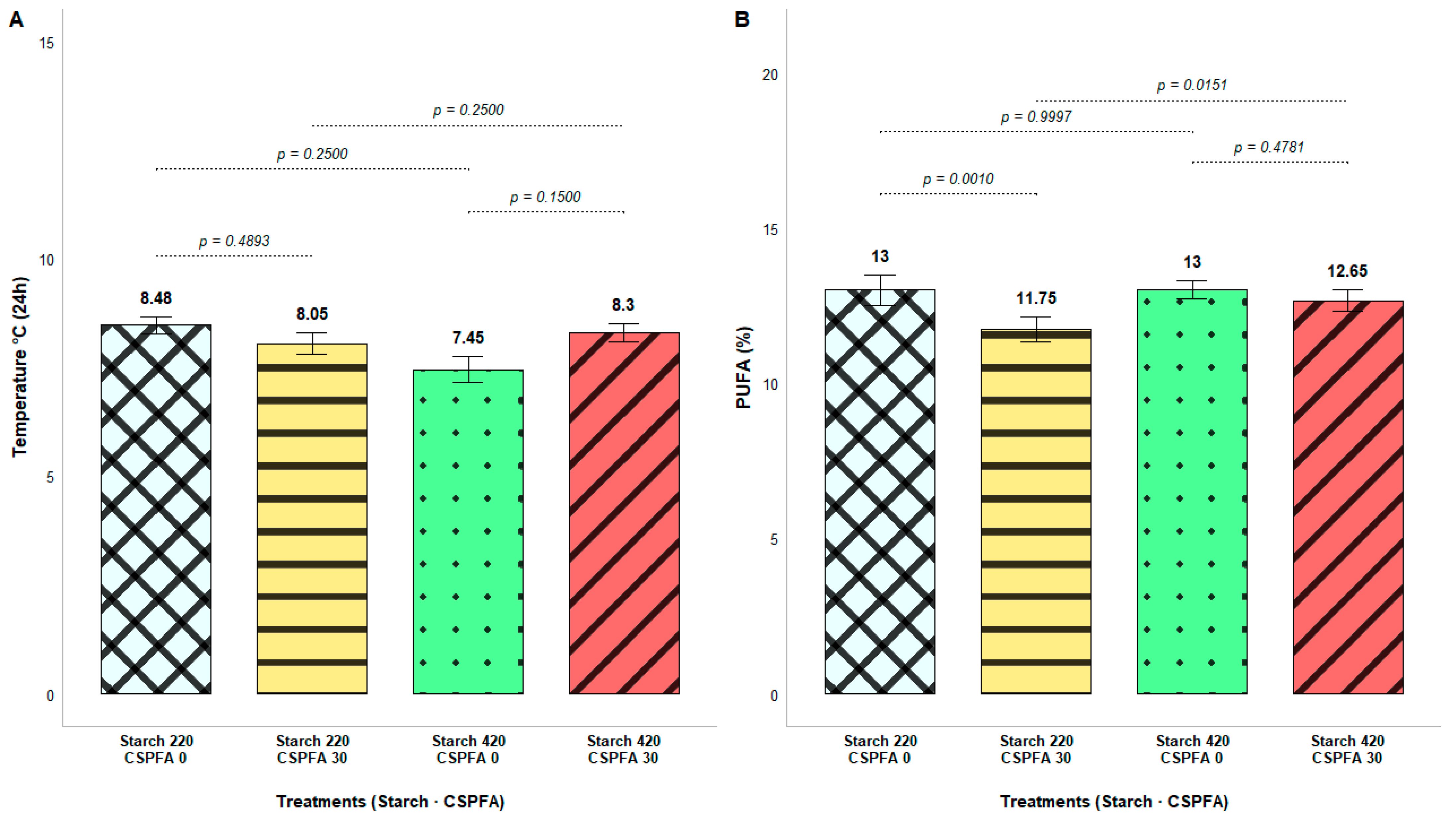
Figure 1. Interactive Effects of Dietary Starch and Calcium Salts of Palm Fatty Acids on 24 h Carcass Temperature (A) and Polyunsaturated Fatty Acids in Muscle (B) of Lambs.
Agriculture 16 00098 g001
Table 1. Proportion of ingredients and chemical composition of experimental diets.
TreatmentsExperimental Diets
Starch level, g/kg DM 220 220 420 420
CSPFA level, g/kg DM 30 0 30 0
Ingredients proportion, g/kg DM
Corn silage400.0400.0400.0400.0
Ground corn190.4187.3485.0483.2
Soy hull322.6314.10.012.7
Soybean meal32.174.660.274.6
Urea9.93.010.07.0
Limestone6.512.09.714.0
Mineral mixture 18.59.05.18.5
CSPFA 230.00.030.00.0
Chemical composition, g/kg DM
Dry matter, as-fed basis663.3662.2664.8653.8
Organic matter961.1955.5961.9953.5
Ether extract54.4522.2360.436.5
Crude protein135.0135.0135.0136.1
Neutral detergent fiber466.0474.0323.4330.5
Starch220.0220.0420.0420.0
Residual organic matter85.7104.323.230.4
Metabolizable energy (Mcal/kg DM) 32.852.692.962.81
Fatty acid profile, mg/100 g DM
Caprylic (C8:0)0.030.030.030.03
Capric (C10:0)0.150.150.150.15
Lauric (C12:0)0.300.310.300.31
Myristic (C14:0)1.991.811.781.62
Palmitic (C16:0)15.0814.5015.3415.14
Stearic (C18:0)4.394.714.384.69
Palmitoleic (C16:1)0.380.360.380.36
Oleic (C18:1 n-9)28.1028.0928.0927.94
Linoleic (C18:2 n-6)46.6147.1346.5846.87
α-linolenic (C18:3 n-3)2.962.902.962.88
1 Guaranteed levels (per kg of product): Calcium (min.) 110.0 g/kg; Calcium (max.) 135.0 g/kg; Phosphorus 87.0 g/kg; Sulfur 18.0 g/kg; Sodium 147.0 g/kg; Cobalt 15.0 mg/kg; Copper 590.0 mg/kg; Chromium 20.0 mg/kg; Iodine 50.0 mg/kg; Manganese 2000.0 mg/kg; Molybdenum 300.0 mg/kg; Selenium 20.0 mg/kg; Zinc 3800.0 mg/kg; Fluorine (max.) 870.0 mg/kg. 2 Calcium salts of palm fatty acids (Nutri Gordura Lac, Nutricorp Inc., Araras, São Paulo, Brazil). Guaranteed composition: 84.9% total fatty acids (48.6% C16:0, 4.40% C18:0, 34.3% C18:1 cis-9, 5.5% C18:2 cis-9 cis-12, and others <2% each); minimum ether extract: 820 g/kg; minimum calcium: 67 g/kg; maximum moisture: 50 g/kg; maximum ash: 200 g/kg; maximum acid value: 10.0 mg NaOH/g; maximum peroxide value: 5.0 meq/kg. 3 estimated according to Cruz et al. [16].
Table 2. Slaughter and carcass traits of lambs fed diets with starch and calcium salts of palm fatty acids.
ItemStarch (S), g/kgCSPFA (FA), g/kgSEMp Value
220420030SFASxFA
Weight, kg
Slaughter weight34.5534.9134.8334.630.610.7800.8760.458
Empty body weight31.8532.1632.0431.970.580.8070.9590.403
Hot carcass weight17.1617.1917.0717.290.360.9680.7750.303
Cold carcass weight16.4716.3716.4716.370.350.8940.8910.353
Chilling loss, %4.014.414.583.830.250.4390.1650.593
Carcass yield, kg/100 kg BW
Hot carcass yield49.6349.2049.0149.820.460.6450.3950.339
Cold carcass yield47.6846.8547.2847.190.400.3630.9140.440
Biological yield53.8553.4153.3053.960.470.6550.5070.422
Non-carcass components, kg
FGIT 16.657.086.856.880.180.2910.9390.917
EGIT 22.662.722.762.620.120.8260.6000.783
1 Full gastrointestinal tract; 2 Empty gastrointestinal tract.
Table 3. Half carcass composition of feedlot lambs fed starch and calcium salts of palm fatty acids.
ItemStarch (S), g/kgCSPFA (FA), g/kgSEMp Value
220420030SFASxFA
Half carcass, kg
Neck0.330.310.310.330.010.1210.2370.512
Shoulder1.451.381.361.460.040.4770.3140.995
Rib1.561.411.411.560.060.2590.2770.559
Flank rib1.621.771.701.690.060.2670.9430.205
Loin0.630.590.670.540.030.6590.1110.408
Leg2.672.672.642.690.060.9640.7140.863
Half carcass yield, %
Neck4.043.843.864.020.100.3910.4900.329
Shoulder17.5817.0216.8717.730.440.5540.3720.603
Rib18.8417.3217.3818.770.580.2090.2470.594
Flank rib19.5921.7120.8820.420.560.0480.6510.098
Loin7.537.278.266.520.420.7450.0410.273
Leg32.3932.8132.732.510.360.5940.8060.347
Table 4. Carcass fat depots and meat quality traits of feedlot lambs fed starch and calcium salts of palm fatty acids.
ItemStarch (S), g/kgCSPFA (FA), g/kgSEMp Value
220420030SFASxFA
Internal fat depots
Cavity fat, g9015090140200.2810.4460.143
Perirenal fat, g530460400590300.2230.0050.196
Renal fat, g90909090100.9920.7620.689
Fatness indicators
RFS 1 (1–3)2.772.802.662.900.050.7880.0350.673
SFT 2, mm2.872.781.863.800.400.8990.0170.988
Grade Rule meas, mm13.0412.3013.1112.240.680.6220.5640.609
Loin eye area, cm27.356.807.606.550.280.3310.0780.392
Physicochemical parameters
pH at 30 min6.546.566.566.540.050.8540.8890.587
pH at 24 h5.625.675.645.650.050.5920.9720.426
Temp at 0 h, °C32.0831.8332.2131.700.230.5840.2660.072
Temp at 24 h, °C8.267.877.968.170.130.1180.4060.014
1 Renal fat score, 2 Subcutaneous fat thickness.
Table 5. Fatty acid profile of the Longissimus dorsi muscle of lambs fed diets with different starch levels and calcium salts of palm fatty acids.
ItemStarch (S), g/kgCSPFA (FA), g/kgSEMp Value
220420030SFASxFA
Saturated fatty acids (SFA, %)
Caproic (C6:0)0.170.240.190.220.020.0930.5520.026
Capric (C10:0)0.120.110.120.110.010.1610.9700.745
Lauric (C12:0)0.250.230.230.260.010.2880.2210.630
Myristic (C14:0)0.140.150.150.140.010.4670.3750.069
Pentadecanoic (C15:0)0.270.310.280.300.010.2030.5810.748
Palmitic (C16:0)22.9523.6621.0125.610.820.441<0.0010.487
Heptadecanoic (C17:0)1.171.201.520.840.090.467<0.0010.088
Stearic (C18:0)23.4819.9320.7821.620.110.0030.4960.153
Arachidic (C20:0)0.180.190.190.180.01<0.0010.0130.002
Monounsaturated fatty acids (MUFA, %)
Palmitoleic (C16:1)2.202.181.492.890.180.681<0.0010.050
Heptadecenoic (C17:1)1.511.391.381.530.110.5280.4220.011
Elaidic (C18:1n9t)3.273.143.163.250.060.3620.4980.440
Oleic (C18:1n9c)31.7232.9434.7929.881.160.4630.0100.152
Eicosenoic (C20:1)0.340.460.330.470.02<0.001<0.0010.015
Erucic (C22:1n9)0.160.100.140.120.01<0.001<0.001<0.001
Nervonic (C24:1)0.120.170.140.150.01<0.0010.034<0.001
Polyunsaturated fatty acids (PUFA, %)
Linolelaidic (C18:2n6t)9.008.778.818.960.070.1100.2980.390
α-Linolenic (C18:3n3)1.441.451.531.360.050.9290.2030.482
Rumenic (C18:2c9t11)0.901.111.320.700.080.004<0.0010.379
CLA (C18:2t10c12) 10.200.250.230.210.01<0.0010.0390.896
Eicosatrienoic (C20:3n3)0.160.330.280.210.02<0.001<0.0010.007
DHA (C22:6n3) 20.070.100.090.070.01<0.001<0.0010.495
EPA (C20:5n3) 30.180.330.260.250.02<0.0010.023<0.001
1 Conjugated Linoleic Acid, 2 Docosahexaenoic Acid, 3 Eicosapentaenoic Acid.
Table 6. Interaction effects of dietary starch level and calcium salts of palm fatty acids on individual fatty acids of lamb Longissimus dorsi muscle.
Item SCAGP
Starch030p Value
Caproic (C6:0), %2200.210.140.959
4200.180.300.042
p Value0.5500.041
Heptadecenoic (C17:1), %2200.170.180.400
4200.210.18<0.001
p Value<0.0010.978
Arachidic (C20:0), %2200.700.720.400
4200.820.73<0.001
p Value<0.0010.978
Eicosenoic (C20:1), %2200.250.43<0.001
4200.410.520.006
p Value<0.001<0.001
Nervonic (C24:1), %2200.130.110.596
4200.150.21<0.001
p Value0.145<0.001
Erucic (C22:1n9), %2200.200.14<0.001
4200.090.110.809
p Value<0.0010.809
Eicosatrienoic (C20:3n3), %2200.230.11<0.001
4200.350.330.848
p Value<0.001<0.001
EPA (C20:5n3) 1, %2200.210.17<0.001
4200.320.350.017
p Value<0.001<0.001
1 Eicosapentaenoic Acid.
Table 7. Lipid profile and health indices of lamb Longissimus dorsi muscle as affected by dietary starch and calcium salts of palm fatty acids.
ItemStarch (S), g/kgCSPFA (FA), g/kgSEMp Value
220420030SFASxFA
SFA 148.7445.0244.4749.281.000.2210.0050.228
MUFA 239.3240.3841.4338.290.970.4920.0480.219
PUFA 312.3612.8212.9912.190.150.021<0.0010.027
Atherogenicity index0.490.490.430.550.020.868<0.0010.258
Thrombogenicity index0.930.900.791.040.040.659<0.0010.210
h:H 42.212.162.501.860.110.7560.0030.281
n-6/n-3 ratio5.104.174.294.980.190.0040.0210.252
Cholesterol (mg/100 g)58.8758.4459.1558.162.460.9370.8590.837
1 Saturated fatty acids, 2 Monounsaturated fatty acids, 3 Polyunsaturated fatty acids, 4 Hypocholesterolemic:hypercholesterolemic ratio.
Table 8. Desaturase activity indices in the Longissimus dorsi muscle of lambs fed diets with different starch levels and calcium salts of palm fatty acids.
ItemStarch (S), g/kgCSPFA (FA), g/kgSEMp Value
220420030SFASxFA
Δ9-desaturase 1419.5957.5740.5836.588.890.0400.8160.945
Δ9-desaturase 1627.7115.2336.206.757.510.3890.0540.644
Δ9-desaturase 1860.4342.1852.5450.075.940.1540.8420.959
Disclaimer/Publisher’s Note: The statements, opinions and data contained in all publications are solely those of the individual author(s) and contributor(s) and not of MDPI and/or the editor(s). MDPI and/or the editor(s) disclaim responsibility for any injury to people or property resulting from any ideas, methods, instructions or products referred to in the content.


