Article

Milk Performance and Blood Biochemical Indicators of Dairy Goats Fed with Black Oat Supplements
Faculty of Agrobiotechnical Sciences Osijek, J.J. Strossmayer University in Osijek, V. Preloga 1, 31000 Osijek, Croatia
*
Author to whom correspondence should be addressed.
Agriculture 2026, 16(1), 68; https://doi.org/10.3390/agriculture16010068 (registering DOI)

Submission received: 4 December 2025 / Revised: 23 December 2025 / Accepted: 27 December 2025 / Published: 28 December 2025

Abstract

This research determined the milk performance and milk and blood biochemical indicators of dairy goats fed with black oat supplements. The experiment was conducted on 20 French Alpine goats on the 48th day of lactation, divided into two groups of 10 goats each (initial body weights (BW) of 53.90 and 52.15 kg). The research lasted for 30 days, and the monitoring of production properties and blood sampling were carried out on the 1st, 15th, and 30th days of the research. Goats in the BOG group were fed a diet in which yellow oats were gradually replaced with black oats, whereas goats in the COG group received a diet containing yellow oats (CP: 143.64 vs. 150.40 g/kg DM; EE: 48.60 vs. 48.80 g/kg DM; NEL: 7.18 vs. 7.19 MJ/kg DM). These values were subjected to repeated-measures analysis using the PROC MIXED procedure and were further analyzed using Tukey’s post hoc test. Compared with the COG group, no significant differences were observed in the BOG group for the production performance of the goats, except for a slightly increased milk yield (1264.94 vs. 1542.10 g/day, p = 0.098) and reduced concentrations of urea and globulin in the milk of the BOG group (7.90 vs. 7.05 mmol/L, p = 0.081; 5.16 vs. 3.96 g/L, p = 0.091). In the blood of BOG goats, a significantly lower urea concentration was detected (8.75 vs. 7.05 mmol/L, p = 0.020). However, compared with the COG group, goats in the BOG group showed a slight increase (p > 0.05) in protein fractions and a decrease in lipid-related indicators in the blood. These findings confirm the moderate benefit of black oats as a dietary supplement in feed for lactating goats.

1. Introduction

With the restriction on antibiotic use in animal feed, the role of biostimulants as growth promoters has become more prominent in ruminant production [1]. While in other parts of the world, the reduction in the use of antibiotics in agriculture, including decreased antibiotic use in food-producing animals, has been associated with a reduction in antimicrobial resistance in animals, it also raises considerable concerns [2,3]. In the study by Tang et al. [4], a meta-analysis of published research on restricting the use of antibiotics in food-producing animals was performed, and the authors concluded that numerous studies have found that restricting the use of antibiotics in food for animals reduces the presence of antibiotic-resistant bacteria. Also, the authors suggest that the broad implementation of strategies to reduce the use of antibiotics requires a balanced consideration of the benefits of reducing antibiotic resistance in animals as well as in humans [4].
Feedstuffs rich in natural biostimulants are used for the balancing of meals, and consumption of such feedstuffs has a positive influence on animals, including antimicrobial, antioxidant, anti-inflammatory, and antitumor effects [5]. Many forages, especially pigmented feed and agro-industrial by-products, contain various biostimulants recognized as beneficial in animal nutrition [6]. Among these compounds, dietary polyphenols are abundant in cereals, especially in whole grains [7]. Polyphenols do not directly contribute to the nutritional value of feed but are widely distributed throughout plant tissues and primarily include phenolic acids, flavonoids, and lignans. Their biological activity and risk–benefit profile depend on their chemical diversity, source, bioavailability, and potential dual effects in animal metabolism [8].
Yellow oats are recognized for their unique protein composition and high nutritional value. Unlike most cereals, whose proteins are predominantly prolamins, oat proteins consist mainly of globulins, resulting in a more balanced amino acid profile [9]. Oats are classified as whole grains and are particularly rich in soluble fiber (β-glucan), lipids, protein, and specific micronutrients [10]. Oats are a unique source of polyphenols (avenanthramides). In the diet of ruminants, oats usually comprise up to 20% [11].
Advances in plant breeding and food processing technologies that preserve the health-promoting properties of oats while expanding their application have stimulated research into different oat genotypes and their functional potential [12,13]. Oats comprise numerous varieties (genotypes), among which black oats warrant particular attention [14,15]. According to Fontaneli et al. [16], black oats can be cultivated either exclusively for forage or for both forage and grain production. Black oats are rich in polyphenols and phenolic acids [17], which exhibit anti-inflammatory, antiproliferative, and antipruritic activities [18].
In addition, Waqas et al. [19] emphasized that efforts in breeding ruminants for meat or milk production should focus on reducing greenhouse gas emissions by optimizing ruminal fermentation processes and improving rumen microflora composition. Diets rich in polyphenols may contribute to this objective. Although several studies have examined the use of black oats for livestock grazing or as a component of silage, relatively few have investigated the use of black oat grain in ruminant nutrition [20,21,22]. Available studies have primarily focused on grazing ruminants in Central and North America (e.g., Mexico and Brazil) [23,24,25,26] or on black oats included in silage [24,27,28]. These studies reported positive effects of black oats on production performance and the economic efficiency of ruminant production.
However, to the best of our knowledge, no studies available in scientific databases have evaluated the use of black oat grain in goat feeding. Therefore, the hypothesis of this study was that replacing yellow oats with black oats in the diet of dairy goats during early lactation would positively affect milk production and selected blood biochemical indicators. Accordingly, the objective of this study was to evaluate milk performance, milk biochemical parameters, and blood metabolic indicators in dairy goats fed diets supplemented with black oats.

2. Materials and Methods

2.1. Experimental Design and BW Analysis

The study was carried out on 20 French Alpine goats at the Djurković dairy goat farm, located in Osijek-Baranya County, Croatia. The experiment was conducted in 2022. The selected goats were in the 48th day of lactation. The preparatory period lasted for 7 days so that the goats could adjust to the new composition of the diet. The research lasted for 30 days. Weighing of the goats (initial BW 53.90 ± 6.09 and 52.15 ± 6.42 kg) and acquiring milk (initial milk production during morning milking: 1338 ± 682.02 and 1436 ± 513.70 g/L) and blood samples were carried out on the 1st, 15th, and 30th day of the experiment (48th, 63th, and 78th days of lactation). The goats were divided into two groups, with 10 goats in each group. The groups were kept in separate pens (5 m × 4 m). The goats were weighed with a livestock scale (Kern EOS 150K50XL animal platform scale (Kern & Sohn, Balingen, Germany)). The selected goats were, on average, 5 years old and in the fourth lactation. All animals were treated with an anthelmintic, cleared of parasites, were in good health, and exhibited an appropriate body condition. They were chosen from a herd consisting of 50 goats. The goats were housed in a barn, and milking was performed mechanically in a separate milking parlor. Body condition score (BCS) was observed on a 1- to 5-point scale, as described by Santucci and Maestrini [29], where the scale from 1 (thin) to 5 (obese) was divided in 0.25 intervals. All staff members handling live goats received appropriate education and training.

2.2. Diet Composition and Feed Analysis

Goats were fed a feed mixture (1.2 kg/day), the composition of which is overviewed in Table 1, according to NRC [30]. The goats’ daily meal consisted of the feed mixture and hay. The feed mixture was given to the goats twice a day during milking, individually, in separate feeding troughs. The goats also had ad libitum access to meadow hay, livestock salt, and water. The dietary ratio of roughage to concentrate was maintained at 60:40. In the control group of goats (COG), conventional yellow oats were used in the feed mixture at a level of 15% of the feed dry matter, whereas in the experimental group (BOG), it was completely replaced with black oats.
Samples of the feed mixtures were taken immediately after mixing and analyzed at the Central Analytical Agrobiotechnical Unit of the Faculty of Agrobiotechnical Sciences in Osijek. Both the feed mixture and hay were dehydrated and finely ground using an ultra-centrifugal mill free of heavy metals (Microtron MB 550; Kinematica, Luzern, Switzerland). Feed composition was determined using standard methods of AOAC [31]. Total polyphenols were extracted and quantified following the procedures outlined by Jakobek et al. [32], using the specified equipment (Shimadzu UV-1280 spectrophotometer (Shimadzu Europe GmbH, Duisburg, Germany)). Three separate extracts of each feed sample were prepared, and the total polyphenol content was expressed as mg of gallic acid equivalents (GAE) per kg of sample. Analyses were performed using a Shimadzu UV-1280 spectrophotometer (Shimadzu Europe GmbH), as detailed by Jakobek et al. [32].

2.3. Milk Sampling and Analysis

In this study, milk sampling was carried out on the 1st, 15th, and 30th day during the morning machine milking of the goats (7.00 a.m.). Three samples of milk were acquired in 30 mL bottles and cooled to 4 °C. Goat milking was performed manually, and milk samples were collected immediately after milking from each goat individually on the same day, in the morning. Milk samples were transported to the laboratory, where they were analyzed the following morning for chemical analysis, while samples intended for biochemical analysis were analyzed immediately after sampling and transported to the laboratory. The reagent (Azidiol) was present only in bottles intended for basic chemical analysis of milk. No cases of mastitis were observed in any of the goats throughout the experiment, as assessed by forestripping prior to each milk sampling. The chemical composition of the milk was obtained on the milkoScan FT 6000 analyzer (Foss Electric, Hillerød, Denmark) by following the HRN ISO 9622:2017 [33]. The following equation was used to calculate fat-corrected milk at 3.5% (FCM, kg/day; Pulina et al. [34]):
FCM = milk yield × (0.634 + 0.1046 × fat)
Somatic cell counts (SCC) were determined using a Fossomatic 5000 Analyzer (Foss Electric) based on the fluoro-opto-electronic method (HRN ISO 13366-2/Ispr.1:2007). Following the methods of Wiggans and Shook [35], the results were converted to logarithmic values using the following equation:
SCC = 3 + log2(SCC/100 000)
To determine biochemical indicators, fresh goat milk was centrifuged at 5000× g for 30 min to separate the fat (ROTOFIX 32A, Hettich GmbH & Co. KG, Tuttlingen, Germany), and the resulting milk plasma was analyzed.
Biochemical parameters, including Ca, inorganic P, Mg, AST (aspartate aminotransferase), ALT (alanine aminotransferase), GGT (γ-glutamyl transferase), ALP (alkaline phosphatase), urea, ALB (albumins), GLOB (globulins), and TP (total proteins), were measured using an Olympus AU 400 biochemical analyzer (Olympus, Tokyo Japan). Glutathione peroxidase (GPx) activity in milk was determined using the Ransel® kit (Randox, Crumlin, UK).

2.4. Blood Sampling and Analysis

Goat blood samples were collected from vein jugulars in sterile vacuum tubes (Venoject®, Leuven, Belgium) without EDTA and were centrifuged at 1609.92× g for 10 min using a ROTOFIX 32A centrifuge (Hettich GmbH & Co. KG, Tuttlingen, Germany) immediately after the completion of milking. The collected goat serum samples were analyzed using the Olympus AU400 biochemical analyzer (Olympus, Japan). In serum, the determined biochemical parameters were minerals, i.e., calcium, inorganic phosphorus, and magnesium; metabolites, i.e., urea; GUK (glucose); PROT (total proteins); ALB (albumin); CHOL (cholesterol); LDL-CHOL (low density lipoprotein); HDL-CHOL (high density lipoprotein); TGC (triglycerides); BHB (β-hydroxybutyrate); NEFA (non-esterified fatty acids); and enzyme activities, i.e., ALT (alanine aminotransferase), AST (aspartate aminotransferase), GGT (γ-glutamyl transferase), and CK (creatine kinase), all determined by using Olympus System reagents (Olympus Diagnostic GmbH, Dublin, Ireland). Globulin concentration (GLOB) was calculated as the difference between TP and ALB concentrations. The activity of glutathione peroxidase (GPx) in goat serum was assessed using the Ransel® kit (Randox, UK) on the Olympus AU 400 analyzer (Olympus, Tokyo, Japan).

2.5. Statistical Analysis

Descriptive statistics for productive performance, milk quality, and milk and blood biochemical parameters were computed for each goat at every sampling point. These values were then subjected to a repeated-measure analysis using PROC MIXED (SAS 9.4 [36]), by applying the following model: Yijk = μ + di + hij + wk + dwik + eijk, where μ means overall mean, di means fixed effect of diet (i = COG, BOG), hij means goats fed specific diets (j = COG, BOG), wk means fixed effect of sampling time during lactation (k = 1–3), dwik means interaction between diet and sampling time (diet × sampling time), and eijk means residual error. Mean values were analyzed using Tukey’s significant difference test, with p-values below 0.05 indicating statistically significant differences.

3. Results

The data presented in Table 2 refer to the BW and body condition scores (BCS) of the goats, from which it is evident that there were no significant differences between feeding treatments (p = 0.314 and p = 0.205). Data regarding milk yield showed a slight increase; however, no significant differences were observed between the BOG and COG groups (p = 0.098). Milk quality indicators and concentrations of biochemical indicators in milk did not differ significantly, except for slightly decreased urea and globulin concentrations in BOG milk compared to those for COG milk (p = 0.081 and p = 0.091). The conducted experiment did not result in significant changes in the production and quality of milk, except for the slightly increased amount of milk (1264.94:1542.10 g/day; p = 0.098) and slightly decreased concentrations of urea (7.90:7.05 mmol/L, p = 0.081) and globulin (5.16:3.96 g/L, p = 0.091) in milk (Table 2). A significant effect of sampling time on GPx activity (p = 0.001) in the milk of the studied goats was also determined.
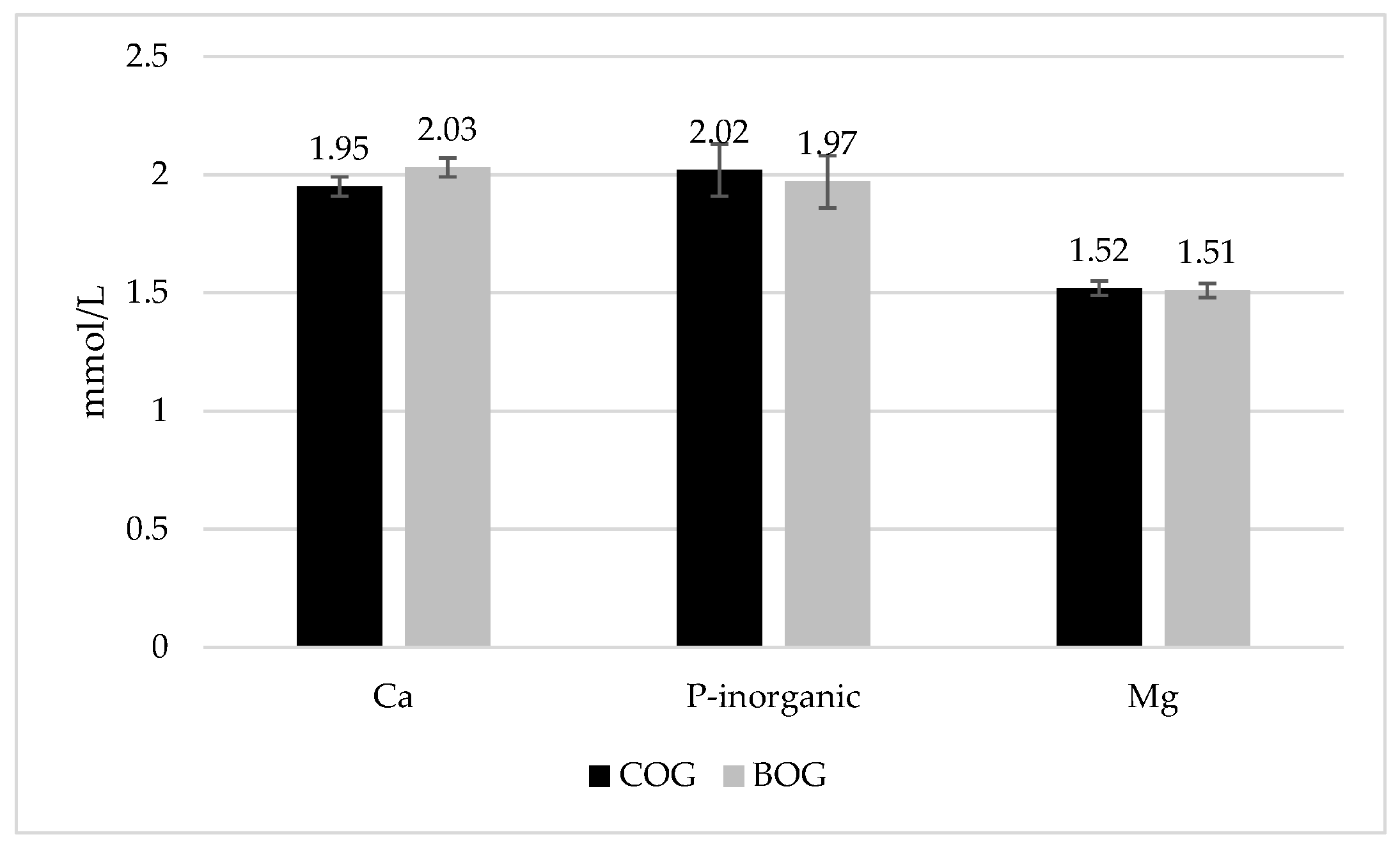
The metabolic profile, assessed through blood biochemical indicators (metabolites, minerals, and enzyme activities), is presented in Table 3 and Table 4 and Figure 1.
A significantly lower concentration of urea in the blood was found in the blood of goats from the BOG (8.75:7.03 mmol/L, p = 0.020) group, while the determined concentrations of minerals and other metabolites in the blood did not differ significantly (p > 0.05; Table 3; Figure 1). However, there was a smaller increase in protein fractions, but also a slight decrease in lipid indicators in the blood of goats in the BOG group compared to the levels in the COB group (p > 0.05). Concentrations of minerals, GUK, NEFA, and BHB in the blood of goats did not vary with respect to the feeding treatment (p > 0.05). A significant effect of sampling time on urea, TGC, and NEFA concentrations (p = 0.020, p = 0.001, and p = 0.011) was also observed, as well as a significant effect of the interaction (diet × sampling time) on TGC concentration (p = 0.013) in the blood of the studied goats.
Analysis of the enzyme activity in the blood of goats in both groups (Table 4) did not show any major differences that would be connected to the feeding treatment. A significant effect of sampling time on GPx activity (p = 0.023) in the blood of the studied goats was also determined.

4. Discussion

Plants rich in polyphenols or plant pure extracts supplemented in the feed of dairy ruminants can have an anti-inflammatory effect and increase milk production [37]. The conducted experiment did not result in significant changes in the production and quality of milk, except for the slightly increased amount of milk (1264.94:1542.10 g/day; p = 0.098) and slightly decreased concentration of urea (7.90:7.05 mmol/L, p = 0.081) and globulin (5.16:3.96 g/L, p = 0.091) in milk (Table 2). The above results can be connected with the effect of polyphenols in the BOG group compared to the COG group. Animal species, age, sex, physiological and health status, timing and duration of exposure, as well as polyphenol metabolism and bioavailability, are additional physiological factors that modulate their effects. Consistent with the slightly increased milk yield observed in the present study, supplementation of a phytogenic feed additive mixture rich in polyphenols in the diets of lactating Friesian cows at a dose of 3 g/day per cow was reported to increase milk production by 6% and energy-corrected milk by 13% [38]. As published by Kholif et al. [39], this improvement in milk yield could be due to improved rumen fermentation and efficient feed utilization. Namely, Salem et al. [40] concluded that milk yield in dairy cows can be increased by reducing protein and energy losses during fermentation and improving feed utilization by the rumen microflora. A review of the literature [1] found that the results of the effect of polyphenols from animal feed on milk production in dairy ruminants are contradictory. Furthermore, those authors point out that the positive effect on milk production in dairy ruminants was associated with the modulation of stressors when adding polyphenols to the diet, which was obvious in stressful periods, such as the transitional period of early lactation. The above results may also be the reason for the non-significant increased milk production in the BOG groups in our study.
Biochemical indicators showing the blood metabolic profile can be used for diagnosis and prognosis of diseases and for assessment of animal welfare and condition [41]. The average serum concentrations of minerals in our study, showed in Figure 1, were similar among treatments, but the goats exhibited lower concentrations of Ca (1.95 and 2.03 mmol/L) and higher conentrations of Mg (1.52 and 1.51 mmol/L) compared to the reference values for goats [42]. For Ca, the values ranged from 2.30 to 2.90 mmol/L, and for Mg, the values varied from 0.8 to 1.30 mmol/L. Such changes can be associated with the 1/3 lactation period of goats when milk production is the highest. Indeed, it is known that significant amounts of Ca are excreted in milk, especially in the 1/3 lactation period in small ruminants [43,44]. It is also known that lactation is a very demanding period for animals, and significant fluctuations in blood parameters can occur because of milk secretion [45,46]. The slightly higher concentration of TP in the blood of the BOG goats determined in this experiment (69.62:66.15 g/L, p = 0.307) can be connected with increased amino acids and microbial protein duodenal flux in ruminants supplemented with flavonoids [47]. A slightly higher concentration of serum globulins (GLOB) was observed in this research (45.03:42.85 g/L, p = 0.378), indicating an enhanced immune response [38]. The liver plays a central role in protein metabolism, and any hepatic damage is reflected in total serum protein levels [48]. In this study, the observed significance changes in blood urea concentrations may be linked to the polyphenol content in black oats provided to goats in the BOG group in comparison with that received by goats in the COG group (7.03:8.75 mmol/L, p = 0.007). Supporting this, Giannenas et al. [49] reported that supplementation of a plant-based feed additive rich in polyphenols in cows reduced blood urea, increased serum globulin and total protein concentrations, improved nutritional status, enhanced microbial protein synthesis, and minimized protein catabolism. The blood NEFA concentrations in both groups of goats in this research were similar (p > 0.05) and within reference values (<0.4 mmol/L), which indicated similar energy status [41,50].
In the present study, certain favorable improvements in lipid status were determined, as there was a certain slight decrease in the concentration of total CHOL (2.19:2.35 mmol/L, p = 0.341) and its fractions (HDL-CHOL 1.34:1.43 mmol/L, p = 0.032 and LDL-CHOL 0.72:0.80 mmol/L, p = 0.390) and TGC (0.25:0.27 mmol/L, p = 0.747) in the blood of the BOG group in comparison with those in the COG group. Research conducted on animals using colored grains rich in anthocyanins in ratio indicate, among other benefits, improvements in the oxidation of LDL-cholesterol, VLDL-cholesterol, and total triglycerides in the blood [51,52,53,54]. Furthermore, in a study by Sharma et al. [55], when feeding mice high-fat meals with the addition of black and purple wheat for 12 weeks led to a decrease in total cholesterol and triglyceride concentrations in the serum blood and an increase in blood glucose concentrations to normal levels. The determined non-significant reduction of lipid profile indicators (CHOL and its fractions and TGC) in the blood of goats in the BOG group in the present research indicates the need for a longer duration of the research, when a significant improvement in the blood lipid status of the researched goats could be expected when feeding with feed mixtures supplemented with black oats.
In the present study, no significant changes (p > 0.05) were observed in the blood enzyme activities of goats in the COB and BOG groups (Table 4), suggesting that liver metabolism remained normal and lipid metabolism was appropriate. As noted by Silanikove and Tiomkin [56], serum activities of AST and GGT, along with cholesterol (CHOL) concentrations, are commonly used to assess hepatic function in both humans and animals. The similarity in enzyme activities (AST, ALT, and GGT) between the COB and BOG groups indicates that dietary supplementation with black oats had no adverse effects on hepatic metabolism.
The limitations of this study are reflected in its relatively short duration, as well as in the shorter adaptation period of the goats to the new diet. Consequently, it is possible that not all long-term effects of the dietary change on production and metabolic parameters were fully expressed, and a longer study might result in clearer and more stable differences among the studied groups.

5. Conclusions

The use of black oats in the diet of goats during early lactation resulted in a slight increase in milk yield, a significant decrease in blood urea concentrations, and no significant changes in protein and lipid metabolism. These findings indicate that black oats can be used as an alternative feed ingredient in diets for lactating goats; however, further research is needed to expand the evaluation to include indicators of immune response and antioxidant status in goats.

Author Contributions

Investigation, methodology, writing—original draft preparation, conceptualization, and visualization, Z.A.; investigation, field experiment, formal analysis, and editing, J.N.; investigation, visualization, and statistical analyses, Ž.K.Š.; formal analysis and methodology, Z.S., M.D., and M.R. All authors have read and agreed to the published version of the manuscript.

Funding

This research received no external funding.

Institutional Review Board Statement

The trial followed the recommendations of the Animal Protection Act (NN 133/06, NN 37/13 and NN 125/13), the Legal Act on the Protection of Animals Used for Scientific Purposes (NN 55/13), the European Union Directive 2010/63/EU, and the remaining valid legal acts related to the welfare of farm animals. Therefore, the animal study protocol was approved by the Bioethical Committee for Research on Animals of Faculty of Agrobiotechnical Science Osijek (22-02, 17 March 2022).

Data Availability Statement

The data presented in this study are available on request from the corresponding author due to institutional data management policies.

Acknowledgments

The research was carried out with the Anim Tech (no. 1152) research team at the Faculty of Agrobiotechnical Sciences Osijek.

Conflicts of Interest

The authors declare no conflicts of interest.

References

  1. Formato, M.; Cimmino, G.; Brahmi-Chendouh, N.; Piccolella, S.; Pacifico, S. Polyphenols for Livestock Feed: Sustainable Perspectives for Animal Husbandry? Molecules 2022, 27, 7752. [Google Scholar] [CrossRef]
  2. Wang, J.; Deng, L.; Chen, M.; Che, Y.; Li, L.; Zhu, L.; Chen, G.; Feng, T. Phytogenic feed additives as natural antibiotic alternatives in animal health and production: A review of the literature of the last decade. Anim. Nutr. 2024, 17, 244–264. [Google Scholar] [CrossRef] [PubMed]
  3. Mediouni, M.; Diallo, A.B.; Makarenkov, V. Quantifying antimicrobial resistance in food-producing animals in North America. Front. Microbiol. 2025, 16, 1542472. [Google Scholar] [CrossRef]
  4. Tang, K.T.; Caffrey, N.P.; Nóbrega, D.B.; Cork, S.C.; Ronksley, P.E.; Barkema, H.W.; Polachek, A.J.; Sharma, H.G.N.; Kellner, J.D.; Ghali, W.A. Restricting the use of antibiotics in food-producing animals and its associations with antibiotic resistance in food-producing animals and human beings: A systematic review and meta-analysis. Lancet Planet Health 2017, 1, 316–327. [Google Scholar] [CrossRef]
  5. Frankic, T.; Voljc, M.; Salobir, J.; Rezar, V. Use of herbs and spices and their extracts in animal nutrition. Acta Agric. Slov. 2009, 94, 95–102. [Google Scholar] [CrossRef]
  6. Mora, B.; Calabrò, S.; Cutrignelli, M.I.; Barbier, E.; Haroutounian, S.; Yanza, J.R.; Jayanegara, A.; Torrent, A.; Vastolo, A.; Hoste, H.; et al. Screening of mediterranean agro-industrial by-products rich in phenolic compounds for their ability to modulate in vitro ruminal fermentation. Ital. J. Anim. Sci. 2025, 24, 1478–1488. [Google Scholar] [CrossRef]
  7. Tian, S.; Sun, Y.; Chen, Z.; Yang, Y.; Wang, Y. Functional Properties of Polyphenols in Grains and Effects of Physicochemical Processing on Polyphenols. Hindawi J. Food Qual. 2019, 2019, 2793973. [Google Scholar] [CrossRef]
  8. Hashem, N.M.; Gonzalez-Bulnes, A.; Simal-Gandara, J. Polyphenols in Farm Animals: Source of Reproductive Gain or Waste? Antioxidants 2020, 9, 1023. [Google Scholar] [CrossRef]
  9. Klose, C.; Schehl, B.D.; Arendt, E.K. Fundamental study on protein changes taking place during malting of oats. J. Cereal Sci. 2009, 49, 83–91. [Google Scholar] [CrossRef]
  10. Singh, R.; De, S.; Belkheir, A. Avena sativa (oat) a potential nutraceutical and therapeutic agent: An overview. Crit. Rev. Food. Sci. Nutr. 2013, 53, 126–144. [Google Scholar] [CrossRef]
  11. Mowrey, A.; Spain, J.N. Results of a nationwide survey to determine feedstuffs fed to lactating dairy cows. J. Dairy Sci. 1999, 82, 445–451. [Google Scholar] [CrossRef] [PubMed]
  12. Decker, E.A.; Rose, D.J.; Stewart, D. Processing of oats and the impact of processing operations on nutrition and health benefits. Br. J. Nutr. 2014, 112, 58–64. [Google Scholar] [CrossRef] [PubMed]
  13. Clemens, R.; van Klinken, B.J.W. Oats, more than just a whole grain: An introduction. Br. J. Nutr. 2014, 112, 1–3. [Google Scholar] [CrossRef]
  14. Abdel-Aal, E.S.M.; Young, J.C.; Rabalski, I. Anthocyanin Composition in Black, Blue, Pink, Purple, and Red Cereal Grains. J. Agric. Food Chem. 2006, 54, 4696–4704. [Google Scholar] [CrossRef]
  15. Varga, M.; Jójárt, R.; Fónad, P.; Mihály, R.; Palágyi, A. Phenolic composition and antioxidant activity of colored oats. Food Chem. 2018, 268, 153–161. [Google Scholar] [CrossRef]
  16. Fontaneli, R.S.; dos Santos, H.P.; Fontaneli, R.S.; Oliveira, J.T.; Lehmen, R.I.; Dreon, G. Winter forage grasses. In Forrageiras para Integração Lavoura-Pecuária-Floresta na Região Sul-Brasileira; Fontaneli, R.S., dos Santos, H.P., Fontaneli, R.S., Eds.; EMBRAPA: Brasilia, Brazil, 2012. [Google Scholar]
  17. Xie, F.; Lei, Y.; Han, X.; Zhao, Y.; Zhang, S. Antioxidant ability of polyphenols from black rice, buckwheat and oats: In vitro and in vivo. Czech J. Food Sci. 2020, 38, 242–247. [Google Scholar] [CrossRef]
  18. Ivanišová, E.; Czech, M.; Hozlár, P.; Zaguła, G.; Gumul, D.; Grygorieva, O.; Makowska, A.; Kowalczewski, P.Ł. Nutritional, Antioxidant and Sensory Characteristics of Bread Enriched with Whole meal Flour from Slovakian Black Oat Varieties. Appl. Sci. 2023, 13, 4485. [Google Scholar] [CrossRef]
  19. Waqas, M.; Salman, M.; Sahrif, M.S. Application of polyphenolic compounds in animal nutrition and their promising effects. J. Anim. Feed Sci. 2023, 32, 233–256. [Google Scholar] [CrossRef]
  20. Bernardes, G.M.C.; Carvalho, S.; Pires, C.C.; Motta, J.H.; Teixeira, W.S.; Borges, L.I.; Fleig, M.; Pilecco, V.M.; Farinha, E.T.; Venturini, R.S. Consumption, performance and economic analysis of the feeding of lambs finished in feedlot as the use of high-grain diets. Arq. Bras. Med. Vet. Zootec. 2015, 67, 6. [Google Scholar]
  21. Bernardes, G.M.C.; Carvalho, S.; Venturini, R.S.; Teixeira, W.S.; Motta, J.H.; Borges, L.I.; Rosa, J.S.; Pesamosca, A.C.; Cocco, A.; Mello, V.L.; et al. Carcass characteristics and tissue composition of the meat of feedlot lambs fed high-grain diets. Semin. Ciênc. Agrár. Lond 2018, 39, 2637–2646. [Google Scholar]
  22. Antunović, Z.; Klir Šalavardić, Ž.; Mioč, B.; Steiner, Z.; Ðidara, M.; Sičaja, V.; Pavić, V.; Mihajlović, L.; Jakobek, L.; Novoselec, J. Dietary Effects of Black-Oat-Rich Polyphenols on Production Traits, Metabolic Profile, Antioxidative Status, and Carcass Quality of Fattening Lambs. Agriculture 2024, 14, 1550. [Google Scholar] [CrossRef]
  23. Derenevicz Faisca, L.; Peres, M.T.P.; Fernandes, S.R.; Bonnet, O.J.F.; Batista, R.; Deiss, L.; Monteiro, A.G. A new insight about the selection and intake of forage by ewes and lambs in different production systems on pasture. Small Rum. Res. 2023, 221, 106949. [Google Scholar] [CrossRef]
  24. Vega-García, J.I.; López-González, F.; Estrada-Flores, J.G.; Flores-Calvete, G.; Prospero-Bernal, F.; Arriaga-Jordán, C.M. Black oat (Avena strigosa Schreb.) grazing or silage for small-scale dairy systems in the highlands of central Mexico. Part I. Crop and dairy cow performance. Chil. J. Agric. Res. 2020, 80, 515–525. [Google Scholar] [CrossRef]
  25. Pitta, S.R.; Silveira, A.L.F.; Adami, P.F.; Pelissari, A.; Cassol, L.C.; Assmann, A.L. Effect of goat grazing of black oat with different plots and corn yield with different nitrogen levels in succession. Rev. Ciênc. Agrovet. 2019, 18, 178–186. [Google Scholar]
  26. Adami, P.F.; Pitta, C.S.R.; da Silveira, A.L.F.; Pelissari, A.; Hill, J.A.G.; Assmann, A.L.; Ferrazza, J.M. Ingestive behavior, forage intake and performance of goats fed with different levels of supplementation. Pesq. Agropec. Bras. 2013, 48, 220–227. [Google Scholar] [CrossRef]
  27. Silva, T.B.P.; Del Valle, T.A.; Ghizzi, L.G.; Silva, G.G.; Gheller, L.S.; Marques, J.A.; Dias, M.S.S.; Nunes, A.T.; Grigoletto, N.T.S.; Takiya, C.S.; et al. Partial replacement of corn silage with whole-plant soybean and black oat silages for dairy cows. J. Dairy Sci. 2021, 104, 9842–9852. [Google Scholar] [CrossRef]
  28. Gómez-Miranda, A.; Estrada-Flores, J.G.; Morales-Almaraz, E.; López-González, F.; Flores-Calvete, G.; Arriaga-Jordán, C.M. Barley or black oat silages in feeding strategies for small-scale dairy systems in the highlands of Mexico. Can. J. Anim. Sci. 2019, 100, 221–227. [Google Scholar] [CrossRef]
  29. Santucci, P.M.; Maestrini, O. Body condition of dairy goats in extensive systems of production: Method of estimation. Ann. Zotech 1985, 34, 471–490. [Google Scholar] [CrossRef]
  30. National Research Council (NRC). Nutrient Requirements of Small Ruminants: Sheep, Goats, Cervids and New World Camelids; The National Academy Press: Washington, DC, USA, 2007; p. 256.
  31. AOAC. Official Methods of Analysis of AOAC International. In Association of Analytical Communities; AOAC: Arlington, VA, USA, 2006. [Google Scholar]
  32. Jakobek, L.; Matic, P.; Ištuk, J.; Barron, A.R. Study of interactions between individual phenolics of aronia with barley β-glucan. Pol. J. Food Nutr. Sci. 2021, 71, 187–196. [Google Scholar] [CrossRef]
  33. HRN ISO 9622:2017; Milk and Liquid Milk Products—Guidelines for the Application of Mid-Infrared Spectrometry (ISO 9622:2013). Croatian Standards Institute: Zagreb, Croatia, 2017.
  34. Pulina, G.; Cannas, A.; Serra, A.; Vallebella, R. Determination and estimation of the energy value in Sardinian goat milk. In Proceedings of the Congress of Società Italiana Scienze Veterinarie (SISVet), Altavilla Milicia, Italy, 25–28 September 1991; pp. 1779–1781. [Google Scholar]
  35. Wiggans, G.R.; Shook, G.E. A lactation measure of somatic cell count. J. Dairy Sci. 1987, 70, 2666–2672. [Google Scholar] [CrossRef]
  36. SAS 9.4 Copyright © 2002–2012; SAS Institute Inc.: Cary, NC, USA, 2013.
  37. Olagaray, K.E.; Brouk, M.J.; Mamedova, L.K.; Sivinski, S.E.; Liu, H.; Robert, F.; Dupuis, E.; Zachut, M.; Bradford, B.J.; Loor, J.J. Dietary supplementation of Scutellaria baicalensis extract during early lactation decreases milk somatic cells and increases whole lactation milk yield in dairy cattle. PLoS ONE 2019, 14, e0210744. [Google Scholar] [CrossRef]
  38. Kholif, A.E.; Hassan, A.A.; El Ashry, G.M.; Bakr, M.H.; El-Zaiat, H.M.; Olafadehan, O.A.; Matloup, O.H. Phytogenic feed additives mixture enhances the lactational performance, feed utilization and ruminal fermentation of Friesian cows. Anim. Biotechn. 2020, 32, 708–718. [Google Scholar] [CrossRef]
  39. Kholif, A.E.; Matloup, O.H.; Morsy, T.A.; Abdo, M.M.; Elella, A.A.A.; Anele, U.Y.; Swanson, K.C. Rosemary and lemongrass herbs as phytogenic feed additives to improve efficient feed utilization, manipulate rumen fermentation and elevate milk production of Damascus goats. Livest. Sci. 2017, 204, 39–46. [Google Scholar] [CrossRef]
  40. Salem, A.Z.M.; Kholif, A.E.; Elghandour, M.M.Y.; Buendía, G.; Mariezcurrena, M.D.; Hernandez, S.R.; Camacho, L.M. Influence of oral administration of Salix babylonica extract on milk production and composition in dairy cows. Ital. J. Anim. Sci. 2014, 13, 2978. [Google Scholar] [CrossRef]
  41. Antunović, Z.; Šperanda, M.; Novoselec, J.; Ðidara, M.; Mioč, B.; Klir, Ž.; Samac, D. Blood Metabolic Profile and Acid-Base Balance of Dairy Goats and Their Kids during Lactation. Vet. Arh. 2017, 87, 43–55. [Google Scholar]
  42. Kaneko, J.; Harvey, J.; Bruss, M. Clinical Biochemistry of Domestic Animals; Elsevier Academic Press: Amsterdam, The Netherlands, 2008; p. 963. [Google Scholar]
  43. Antunović, Z.; Mioč, B.; Lončarić, Z.; Klir Šalavardić, Ž.; Širić, I.; Držaić, V.; Novoselec, J. Changes of macromineral and trace element concentration in the blood of ewes during lactation period. Czech J. Anim. Sci. 2021, 66, 129–136. [Google Scholar] [CrossRef]
  44. Abdelrahman, M.M.; Aljumaah, R.S. Metabolic blood profiles and milk compositions of peri-parturient and early lactation periods in sheep. Asian J. Anim. Vet. Adv. 2012, 7, 1130–1138. [Google Scholar] [CrossRef]
  45. Antunović, Z.; Novoselec, J.; Klir Šalavardić, Ž.; Steiner, Z.; Drenjančević, M.; Pavić, V.; Ðidara, M.; Ronta, M.; Jakobek Barron, L.; Mioč, B. The Effect of Grape Seed Cake as a Dietary Supplement Rich in Polyphenols on the Quantity and Quality of Milk, Metabolic Profile of Blood, and Antioxidative Status of Lactating Dairy Goats. Agriculture 2024, 14, 479. [Google Scholar] [CrossRef]
  46. Antunović, Z.; Novoselec, J.; Mioč, B.; Širić, I.; Držaić, V.; Klir Šalavardić, Ž. Macroelements in the Milk of the Lacaune Dairy Sheep Depending on the Stage of Lactation. Poljoprivreda 2024, 30, 54–59. [Google Scholar] [CrossRef]
  47. Balcells, J.; Aris, A.; Serrano, A.; Seradj, A.R.; Crespo, J.; Devant, M. Effects of an extract of plant flavonoids (Bioflavex) on rumen fermentation and performance in heifers fed high-concentrate diets. J. Anim. Sci. 2012, 90, 4975–4984. [Google Scholar] [CrossRef]
  48. Mbuh, J.V.; Mbwaye, J. Serological changes in goats experimentally infected with Fasciola gigantica in Buea sub-division of S.W.P. Cameroon. Vet. Parasitol. 2005, 131, 255–259. [Google Scholar] [CrossRef] [PubMed]
  49. Giannenas, I.; Skoufos, J.; Giannakopoulos, C.; Wiemann, M.; Gortzi, O.; Lalas, S.; Kyriazakis, I. Effects of essential oils on milk production, milk composition, and rumen microbiota in Chios dairy ewes. J. Dairy Sci. 2011, 94, 5569–5577. [Google Scholar] [CrossRef]
  50. Fernandez, J.R.; Ramos, E.; De la Tore, H.R.; Extremera, F.G.; Sanz Sampelayo, M.R. Blood metabolites as indicators of energy status in goats. Option Mediterr. Ser. A 2006, 74, 451–455. [Google Scholar]
  51. Xia, X.; Ling, W.; Ma, J.; Xia, M.; Hou, M.; Wang, Q.; Zhu, H.; Tang, Z. An anthocyanin-rich extract from black rice enhances atherosclerotic plaque stabilization in apolipoprotein E-deficient mice. J. Nutr. 2006, 136, 2220–2225. [Google Scholar] [CrossRef] [PubMed]
  52. Reis, J.F.; Monteiro, V.V.S.; Souza Gomes, R.; Carmo, M.M.; Costa, G.V.; Ribera, P.C.; Monteiro, M.C. Action mechanism and cardiovascular e_ect of anthocyanins: A systematic review of animal and human studies. J. Transl. Med. 2016, 14, 315. [Google Scholar] [CrossRef] [PubMed]
  53. Francavilla, A.; Joye, I.J. Anthocyanins in Whole Grain Cereals and Their Potential effect on Health. Nutrients 2020, 12, 2922. [Google Scholar] [CrossRef]
  54. Wang, H.; Liu, D.; Ji, Y.; Liu, Y.; Xu, L.; Guo, Y. Dietary Supplementation of Black Rice Anthocyanin Extract Regulates Cholesterol Metabolism and Improves Gut Microbiota Dysbiosis in C57BL/6J Mice Fed a High-Fat and Cholesterol Diet. Mol. Nutr. Food Res. 2020, 64, 1900876. [Google Scholar] [CrossRef]
  55. Sharma, S.; Khare, P.; Kumar, A.; Chunduri, V.; Kumar, A.; Kapoor, P.; Mangal, P.; Kondepudi, K.K.; Bishnoi, M.; Garg, M. Anthocyanin-Biofortified Colored Wheat Prevents High Fat Diet–Induced Alterations in Mice: Nutrigenomics Studies. Mol. Nutr. Food Res. 2020, 64, 1900999. [Google Scholar] [CrossRef]
  56. Silanikove, N.; Tiomokin, D. Toxicity induced by poultry litter consumption: Effect on parameters reflecting liver function in beef cows. Anim. Prod. 1992, 54, 203–209. [Google Scholar] [CrossRef]
Figure 1. Concentration of minerals in blood of goats during investigation (COG: control oat group; BOG: black oat group).
Agriculture 16 00068 g001
Table 1. Composition and nutritional characteristics of the feed mixture and meadow hay fed to goats.
Ingredient (% DM)GroupBlack OatsHay
COGBOG
Ingredients composition
Corn42.3042.30
Oats15.00-
Black oats-15.00
Barley19.0019.00
Soybean meal9.009.00
Soybean, toasted11.0011.00
Limestone0.300.30
Cattle salt0.400.40
Mineral premix *3.003.00
Chemical composition (g/kg DM)
Dry matter948.80951.00952.00951.15
Crude proteins143.64150.4084.5075.90
Ether extract48.6048.8047.5011.20
Crude fiber50.1850.50101.10328.60
Ash65.0465.1028.6047.40
NEL, MJ/kg7.187.19-4.45
Polyphenols (total), mg gallic acid equivalents (GAE)/kg1582.612054.631416.525650.61
COG: control oats, BOG: black oats; DM: dry matter; NEL: net energy for milk production. * Mineral–vitamin premix for goats: 21% calcium, 6% sodium, 5% phosphorus, 5% magnesium, 1,200,000 IU/kg vitamin A, 140,000 IU/kg vitamin D3, 6500 mg/kg zinc oxide, 3500 mg/kg vitamin E, 1500 mg/kg zinc (in the form of chelates), 600 mg/kg iron sulphate monohydrate, 500 mg/kg copper (in the form of chelates), 490 mg/kg copper sulphate pentahydrate, 60 mg/kg iodine in the form of anhydrous calcium iodate, 50 mg/kg selenium selenite, 40 mg/kg cobalt carbonate monohydrate, and 5 mg/kg manganese sulphate pentahydrate.
Table 2. Production performances, milk quality, and biochemical indicators in goat milk during investigation.
DietsSEMp Value
COGBOG DietPD × P
Live BW, kg52.7951.090.970.3140.3530.929
BCS, point2.172.430.100.2050.4930.694
Milk yield, g/day1264.941542.1093.180.0980.8370.649
Fat, %3.323.400.180.7180.9060.574
Protein, %2.912.840.060.5720.9760.875
Lactose, %4.454.380.030.2450.1690.661
Log SCC, log6.136.140.090.9290.8340.533
Log CFU, log3.973.960.120.9800.7250.365
Urea, mmol/L7.907.050.270.0810.0110.149
Ca, mmol/L34.8237.902.180.4970.4180.381
P, mmol/L24.1624.030.820.9390.7570.525
TP, g/L24.1823.580.780.7150.7840.512
ALB, g/L19.0219.820.610.5300.5040.337
GLOB, g/L5.163.960.320.0910.9360.869
AST, U/L51.9079.2310.560.2020.3550.116
ALT, U/L58.8764.129.540.7690.8230.524
ALP, U/L66.2049.2410.260.3700.3150.859
GGT, U/L421.90414.5519.900.9330.1050.576
GPx, U/L45.9643.673.030.6700.0010.765
COG: control oat group; BOG: black oat group; D: diet; P: sampling time; D × P: interaction (diet × sampling time); SEM: standard error of mean; BW: body weight; BCS: body condition score; SCC: somatic cells count; CFU: colony-forming unit; TP: total proteins; ALB: albumins; GLOB: globulins; AST: aspartate aminotransferase; ALT: alanine aminotransferase; ALP: alkaline phosphatase; GGT: γ-glutamyl transferase; GPx: glutathione peroxidase.
Table 3. Concentrations of metabolites in the blood of goats during investigation.
DietsSEMp Value
COGBOG DPD × P
Urea, mmol/L8.757.030.320.0070.0200.184
GUK, mmol/L4.404.770.150.2230.1210.458
TP, g/L66.1569.621.680.3070.1290.750
ALB, g/L23.3024.600.630.3120.3110.643
GLOB, g/L42.8545.031.210.3780.1330.853
CHOL, mmol/L2.352.190.090.3410.3740.680
HDL-CHOL, mmol/L1.431.340.040.3270.5990.718
LDL-CHOL, mmol/L0.800.720.050.3900.2550.582
TGC, mmol/L0.270.250.010.7470.0010.013
NEFA, mmol/L0.130.140.020.9010.0110.212
BHB, mmol/L0.780.770.070.9760.2070.726
COG: control oat group; BOG: black oat group; D: diet; P: sampling time; D × P: interaction (diet × sampling time); SEM: standard error of mean; GUK: glucose; TP: total proteins; ALB: albumins; GLOB: globulins; CHOL: cholesterol; HDL-CHOL: HDL-cholesterol; LDL-CHOL: LDL-cholesterol; TGC: triglycerides; NEFA: non-esterified fatty acids; BHB: β-hydroxybutyrate.
Table 4. Enzyme activities in the blood of goats during investigation.
DietsSEMp Value
COBBOG DPD × P
AST, U/L131.30122.175.010.3950.9020.486
ALT, U/L20.2220.611.130.8650.0920.989
GGT, U/L43.7645.411.630.6100.0410.967
CK, U/L184.95197.7612.500.5770.1860.496
GPx, U/L1029.831023.7655.250.9550.0230.669
COG: control oat group; BOG: black oat group; D: diet; P: sampling time; D × P: interaction (diet × sampling time); SEM: standard error of mean; AST: aspartate aminotransferase; ALT: alanine aminotransferase; GGT: γ-glutamyl transferase; CK- creatine kinase; GPx: glutathione peroxidase.
Disclaimer/Publisher’s Note: The statements, opinions and data contained in all publications are solely those of the individual author(s) and contributor(s) and not of MDPI and/or the editor(s). MDPI and/or the editor(s) disclaim responsibility for any injury to people or property resulting from any ideas, methods, instructions or products referred to in the content.