Article

Can Agricultural Credit Promote Farmers’ Green Production Behaviors? Evidence from China
College of Economics, Sichuan Agricultural University, Chengdu 611130, China
*
Author to whom correspondence should be addressed.
Agriculture 2026, 16(1), 50; https://doi.org/10.3390/agriculture16010050
Submission received: 11 November 2025 / Revised: 14 December 2025 / Accepted: 24 December 2025 / Published: 25 December 2025
(This article belongs to the Section Agricultural Economics, Policies and Rural Management)

Abstract

Agricultural green production is vital for sustainable agricultural development and rural revitalization. As a market-oriented financial tool, this study examines the role of agricultural credit in promoting green production behaviors among farmers (FGPB). Using survey data from 537 farmers in Sichuan, Shanxi, and Guizhou provinces, the OLS model is applied to assess the impact of agricultural credit on FGPB. The study employs a 2SLS model to address endogeneity and conducts robustness checks with Tobit and Probit models, alternative dependent variables, and regional fixed effects. The findings reveal that (1) agricultural credit significantly boosts FGPB, increasing it by 5.39%, while reducing the use of fertilizers, pesticides, and plastic films by 0.2338, 0.1751, and 0.2387 levels, respectively. (2) The effect is more pronounced among small-scale farmers, those with higher happiness levels, and those with more farming experience. (3) Agricultural credit also promotes FGPB by encouraging the adoption of green inputs, waste recycling, and the expansion of agricultural socialized service (ASS). (4) Financial accessibility, farmers’ financial literacy, and their abilities of information acquisition can influence their participation in credit transactions. This study provides empirical evidence on the role of agricultural credit in driving FGPB, enriching the literature on financial instruments for green agricultural development, and offers policy recommendations for promoting green transformation through agricultural credit.

1. Introduction

Agricultural green production refers to farming practices that focus on sustainability, environmental protection, and resource efficiency [1]. It involves using environmentally friendly techniques to enhance agricultural productivity while minimizing the negative impact on ecosystems, biodiversity, and the surrounding environment [2]. As the foundational industry of the national economy, the green transformation of agriculture holds irreplaceable significance for safeguarding national food security, promoting sustainable agricultural development, and achieving the strategic goals of rural revitalization. According to China’ s National Bureau of Statistics, the nation’ s fertilizer application rates per hectare were 298.79 kg in 2022, 292.60 kg in 2023 and 288.33 kg in 2024 (Data source: https://data.stats.gov.cn/easyquery.htm?cn=C01&zb=A0D0W&sj=2015 (accessed on 4 December 2025)). Although this represents a continued decline, the current intensity is still markedly higher than the internationally recognized safe threshold of 225 kg/hm2. Excessive use of fertilizers and other agro-chemicals generates significant resource waste and non-point-source pollution, constraining high-quality agricultural development and hampering improvements to the rural ecological environment.
However, the level of agricultural green production is jointly influenced by a variety of internal and external factors, including policy intervention and innovation [3], market mechanisms, and farmers’ behaviors [4]. For many years, China’s agricultural sector has been heavily reliant on chemical fertilizers and pesticides, which has contributed to environmental degradation, such as soil erosion and biodiversity loss. As a result, transitioning to agricultural green production has become essential to overcome resource and environmental challenges while enhancing agricultural quality, efficiency, and competitiveness. Moreover, promoting agricultural green production is not only vital for the sustainable development of agriculture but also serves as a crucial component in achieving China’s carbon peaking and carbon neutrality goals.
Currently, policy intervention is widely regarded as one of the main drivers of agricultural green production [5,6]. Policy measures such as government subsidies [7], quality inspections, and restrictions on banned pesticides directly incentivize and constrain farmers’ behaviors through administrative means, significantly increasing farmers’ enthusiasm for adopting green production technologies [8]. Technological innovation is another important driving force for agricultural green production [9], but the effectiveness of technology promotion is often affected by farmers’ characteristics such as education level, gender and age [10], especially their ecological literacy [11]. Farmers’ perception of green production technologies significantly influences their adoption of such technologies, and this impact is more pronounced in regions with higher quality of rural human capital [12]. Despite some policy support, it is unfortunate that, in our survey, the FGPB of most of the interviewed farmers has not been effectively improved. The use of green production technology by farmers has also not been effectively promoted.
As of the end of December 2024, the balance of inclusive agricultural loans nationwide in China reached 14.4 trillion yuan, a year-on-year increase of 14.4% (Data source: https://content-static.cctvnews.cctv.com/snow-book/index.html?item_id=15813966530459534287&track_id=d914d703-eff0-4c49-8376-fc0b537dbfa2 (accessed on 4 December 2025)). As a core component of the rural financial system, agricultural credit, with advantages such as wide coverage, large capital scale (Data source: https://baijiahao.baidu.com/s?id=1846554120010508660&wfr=spider&for=pc (accessed on 4 December 2025)), and strong policy orientation [13], has become a vital tool for promoting the development of the agricultural industry, improving farmers’ income [14] and guiding agricultural production. The design of agricultural credit usually includes various forms such as interest subsidies, loan guarantees, and risk-sharing mechanisms, aiming to alleviate the financing difficulties faced by farmers due to the lack of collateral or credit records [15,16]. In recent years, the scale of agricultural credit provision has continued to expand, and credit products have been continuously innovated, forming a multi-level and widely covered rural financial service system. Agricultural credit has not only effectively alleviated the capital constraints in agricultural production and operation but also made significant contributions to rural revitalization.
Then, can agricultural credit promote FGPB? There is currently limited research on this topic. Existing literature shows that agricultural credit exerts a profound impact on agricultural green production through multiple dimensions, including direct capital support [16,17,18,19,20], indirect social capital accumulation, and long-term institutional optimization [17,18]. Scholars generally believe that the core of agricultural credit lies in reducing farmers’ financing thresholds through financial leverage while guiding capital flow into the field of green production, so as to achieve a win-win situation between environmental protection and economic benefits [19]. In the case of capital shortage, the involvement of credit can quickly fill the resource gap. As a factor directly affecting credit costs, interest rates are considered one of the most direct and effective incentive means of credit [17]. Likewise, easing credit constraints can shift agriculture away from its high-pollution production model, leading to a marked drop in carbon intensity [20]. The government can significantly reduce farmers’ loan costs by providing interest subsidies, thereby increasing their enthusiasm for adopting green production technologies.
Although the importance of agricultural credit in agricultural green development has been recognized, there is still a lack of systematic and in-depth research on its specific impact mechanism, action path, and actual effect on agricultural green production behavior. Most existing studies around agricultural green development focus on the macro level [21,22]. Most micro-level studies on FGPB have focused on agricultural insurance [23,24]. Can agricultural credit truly incentivize FGPB? Does its impact have regional differences or group heterogeneity? What is the mechanism through which agricultural credit promotes FGPB? These issues are not only related to the optimization and adjustment of agricultural credit policies but also directly affect the process and quality of agricultural green transformation.
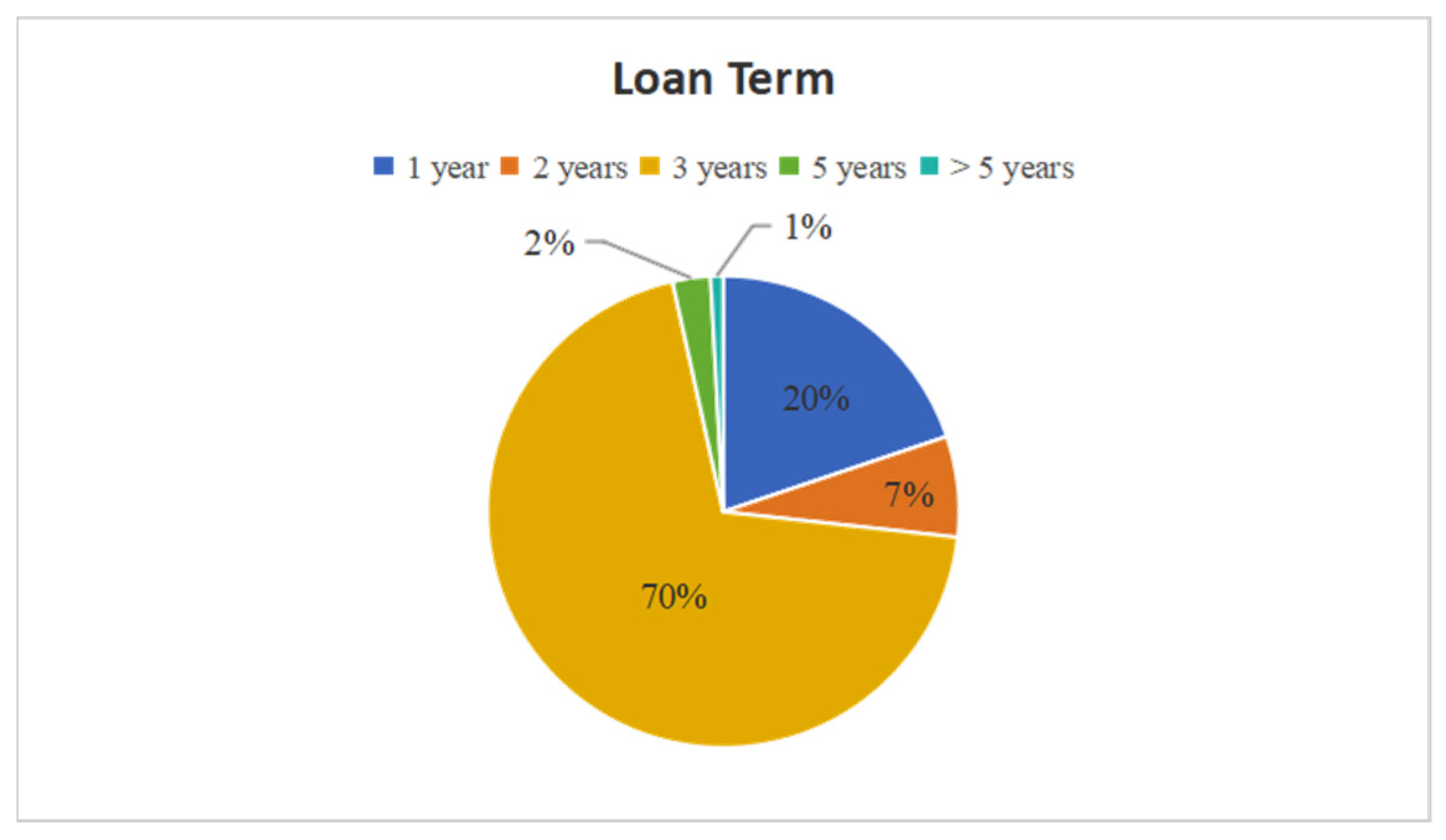
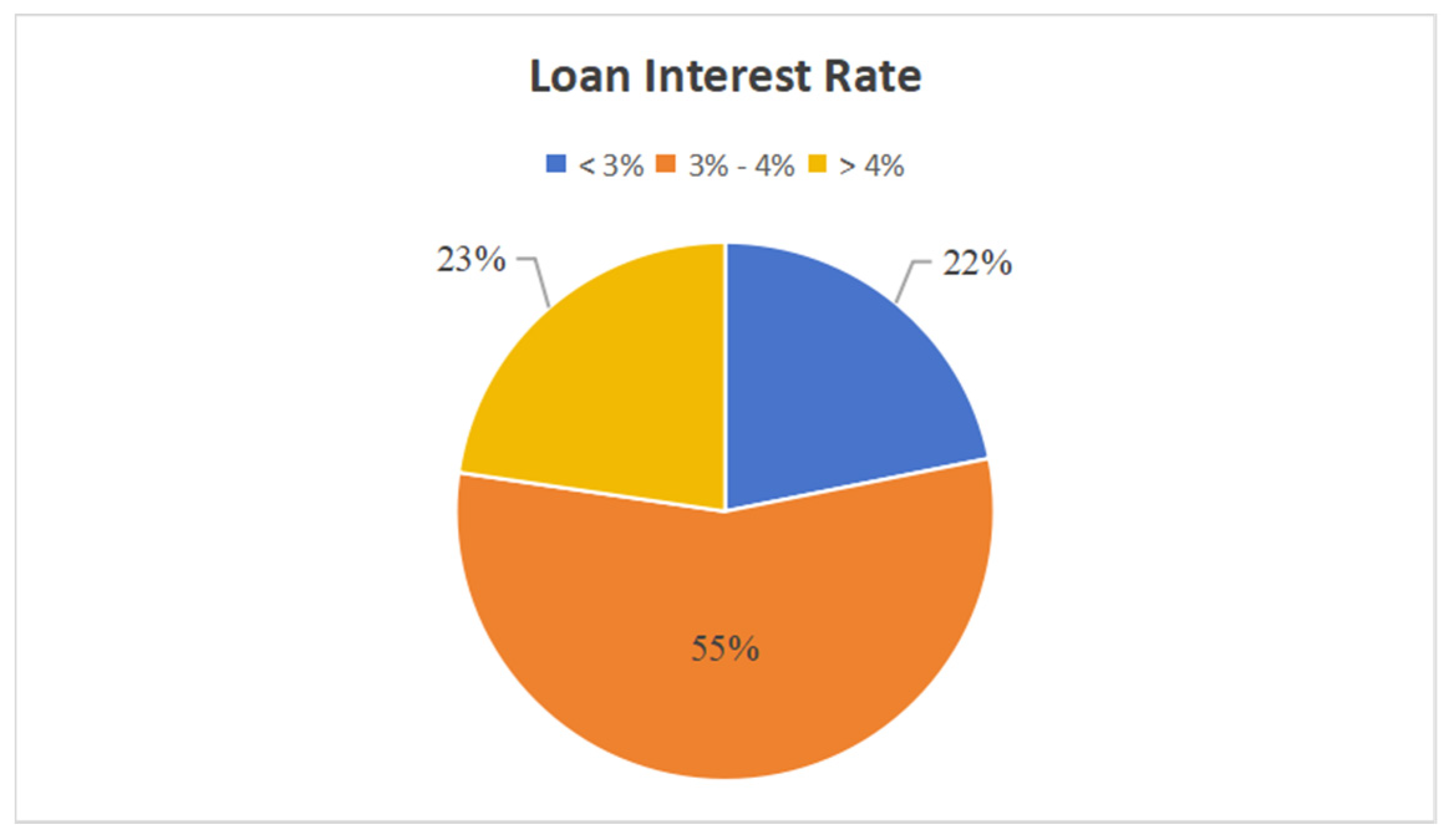
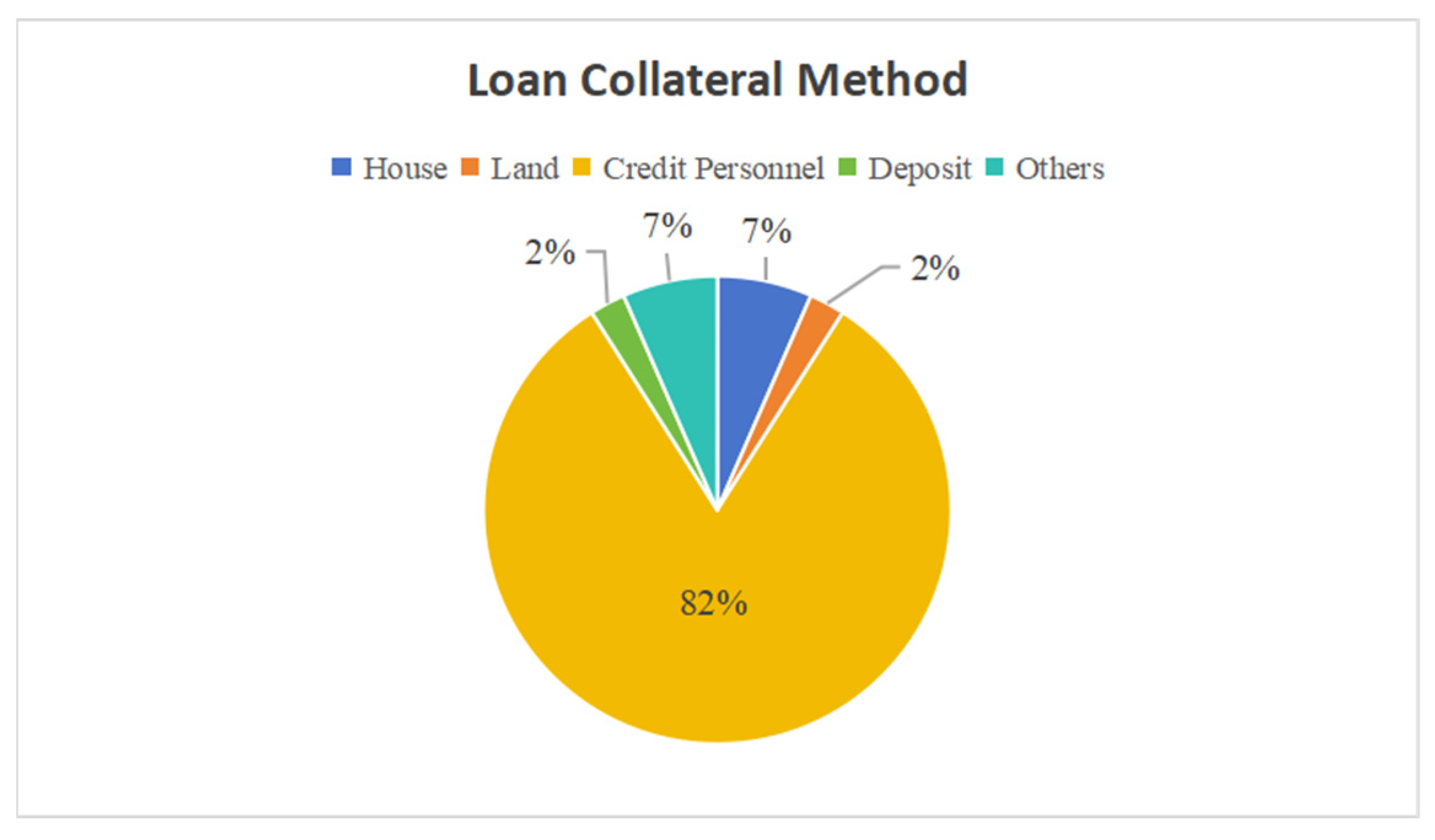
Based on this, this study, using 537 farmer-questionnaires collected from surveys in 8 counties across Sichuan Province, Shanxi Province and Guizhou Province in China, conducting OLS model, systematically explores the impact and inherent mechanism of agricultural credit on FGPB from the perspective of micro-farmer behavior. Among the surveyed group of farmers, 245 individuals purchased agricultural credit products, accounting for approximately 45.5%. All loans were agricultural production loans, reflecting a certain scale of agricultural credit among the respondents. In terms of loan term, the vast majority of farmers have loan periods of 3 years or less. Specifically, 70% of the respondents have a loan term of 3 years, while 20% have a loan term of 1 year, the longest duration is 8 years (only 2). The detailed loan term distribution is shown in Figure 1. Regarding loan interest rates, 22% of respondents have an annual interest rate of less than 3%, and 55% have an interest rate between 3% and 4%. The highest interest rate among respondents is 5.5%. The specific interest rate distribution is shown in Figure 2. According to China’s poverty alleviation policies, poverty-relieved households can benefit from the 530 model of agricultural credit, which offers a loan amount of 50,000 yuan, a loan term of 3 years, and zero interest. This model improves the coverage of agricultural credit. Among the surveyed group, 33 farmers used this type of agricultural credit. In terms of loan collateral, 82% of the surveyed farmers used personal credit, meaning no collateral was required. The remaining respondents used methods such as house or land mortgages. The specific collateral types are shown in Figure 3.
This study seeks to address the gap in the literature by offering new empirical evidence on the specific role agricultural credit plays in promoting FGPB, and by identifying the mechanisms through which it operates. The study also explores the heterogeneity of agricultural credit’s impact on different farmer groups, offering insights for policy adjustments that can cater to diverse farmer needs. It is expected to provide empirical evidence and decision-making references for improving the agricultural green financial policy system and promoting sustainable agricultural development. The potential marginal contributions of this study are as follows: First, this study verifies that agricultural credit promotes FGPB, enriching the existing literature on agricultural credit and providing valuable micro-level evidence. Second, in contrast to previous studies that focus solely on the adoption of new agricultural technologies [25], specific types of sustainable production practices [26,27,28,29], even farmers’ subjective feelings regarding the application of new agricultural technologies [30], which do not fully capture the overall level of farmers’ green production, this research approaches the issue from the perspective of capital support provided by agricultural credit. It first establishes the impact of agricultural credit on the reduction in traditional agricultural chemicals and then further explores its underlying mechanisms, offering a more comprehensive and coherent explanation. Third, the indicator design used in this study to measure the level of green production is more robust. While existing literature typically gauges the intensity of agricultural chemical use by quantity [26] or how much they purchased for them [28], this method does not account for variations in usage over time and fails to adequately reflect the changes in FGPB. By asking farmers directly about changes in their use of agricultural chemicals, this study provides a more dynamic and intuitive measure of their evolving FGPB. Finally, this research examines the heterogeneity of agricultural credit’s impact across different groups, considering factors such as farmer entities, farmers’ well-being, and agricultural production experience. This offers empirical evidence to support the development of targeted policies by relevant authorities.

2. Theoretical Analysis

2.1. The Impact of Agricultural Credit on FGPB

Against the backdrop of agricultural green transformation and environmental regulation, reducing the use of chemical inputs has become a key path to achieving sustainable agricultural development [31]. However, farmers face multiple constraints in green production practices, especially capital constraints [24]. As a specialized financial tool for the agricultural production chain, agricultural credit can alleviate farmers’ capital pressure to a certain extent and provide capital support for their green production behavior [32].
This argument is supported by the Theory of Planned Behavior (TPB, by Ajzen in 1991), which suggests that behavior is guided by intentions, which in turn are influenced by three factors: attitudes toward the behavior, subjective norms, and perceived behavioral control [33]. Agricultural credit can directly influence farmers’ attitudes and perceived control over their green production practices, by alleviating financial constraints and providing access to necessary resources. In this context, agricultural credit serves as a financial tool that not only facilitates farmers’ green intentions but also enhances their perceived ability to adopt green practices [34].
First, by providing stable and low-cost credit funds, agricultural credit enhances the flexibility of farmers in production decision-making [35]. In traditional agricultural production, chemical inputs have become the main means for farmers to ensure output due to their significant short-term effects and convenient use [36]. In contrast, adopting green agricultural production methods often means higher upfront investment and a longer return cycle, such as using environmentally friendly inputs or adjusting the crop planting structure. The involvement of agricultural credit can, to a certain extent, smooth farmers’ cash flow, reduce their dependence on short-term high output, and thus create conditions for them to reduce the use of chemical inputs [37], thereby reducing agricultural pollution emissions [38]. According to the theory of rational behavior (RBT), individuals are assumed to make decisions that maximize their expected utility, given the available information. The higher upfront investment required for green agricultural practices can be seen as a deterrent for farmers when there is uncertainty or limited financial resources. Agricultural credit helps reduce this uncertainty by providing access to capital [39], thus facilitating rational decisions toward adopting green practices. The improved financial liquidity and reduced financial risk make it more rational for farmers to adopt environmentally friendly methods over the long term [40].
Second, agricultural credit is usually linked to specific industrial chains or agricultural product varieties, featuring targeting and earmarking of funds [41]. The institutional design ties the use of credit funds closely to factors such as market demand and product quality standards. Against the background of green agriculture gradually obtaining market premiums and policy support, the targeted investment of agricultural credit helps guide farmers to align their production behaviors with green standards, thereby reducing their dependence on traditional chemical inputs. In other words, agricultural credit not only provides capital support but also conveys signals of green production through its institutional arrangements, forming soft constraints on farmers’ production behaviors. This is consistent with TPB’s concept of subjective norms, where social and institutional pressures can influence behavior. The earmarked nature of agricultural credit helps to align farmers’ behaviors with market demand and green production standards, essentially creating a social norm that incentivizes green practices [42]. Furthermore, these targeted funds help farmers recognize the importance of producing in an environmentally sustainable way, not only for ecological reasons but also for economic gains [41].
Third, obtaining agricultural credit requires credit evaluation and risk control mechanisms [39]. During the lending process, financial institutions usually conduct a comprehensive evaluation of farmers’ production capacity, historical operation records, product sales channels, and other aspects. To a certain extent, this can screen out farmer groups with certain operational capabilities, market awareness, and multiple channels for obtaining information such as the Internet. These farmers are often more receptive to the concept of green production. When they have access to Internet information combined with low-cost credit, it helps them reduce the use of agricultural chemicals [43] and better convert green production into economic benefits. In line with the TPB, the credit evaluation process can also affect the perceived behavioral control of farmers. Farmers with better operational records and access to information channels are likely to perceive that they have more control over their production decisions, including the adoption of green practices. This enhanced perceived control, combined with agricultural credit as a resource, strengthens their intentions to adopt sustainable agricultural methods [44]. Additionally, RBT suggests that the availability of credit reduces the financial risks associated with the transition to green practices, making it a rational decision for farmers to invest in long-term environmental sustainability.
In summary, agricultural credit not only provides the financial support necessary for the adoption of green production practices. Based on the above theoretical analysis, this study constructs a mathematical model to describe how agricultural credit affects farmers’ decision-making regarding the use of chemical inputs. Farmers’ production goal is to maximize their net income, and their production function is set as follows:
Y = A   ×   f   ( X c , X g ) .
In this study, Y denotes agricultural output, while A represents total factor productivity (TFP) in agriculture, defined as an exogenous variable. X c and X g denote inputs of agricultural chemicals and green inputs, respectively. The function f   ( X c   ,   X g ) follows a neoclassical production model. Both chemical and green inputs enhance output [45,46], with first-order partial derivatives above 0, though their marginal returns diminish. When fertilizers or organic fertilizers are increased unilaterally, their marginal returns gradually decrease, with second-order partial derivatives below 0, though the sign of their cross-partial derivative remains undetermined. Labor is also an important component of agricultural production. However, since the total number of people engaged in labor within a household remains unchanged in the short term, we assume that labor is a given condition in the discussion of this section.
We further consider the market prices of various inputs and agricultural products. Let the price of chemical inputs be p c and the price of green inputs be p g , typically p g > p c [47], with the agricultural product price p being an exogenous variable. When agricultural loans are properly risk-controlled, their cost structure allows for lower interest rates [48], in China, the interest rate on agricultural loans is lower than that of general commercial bank loans (Data source: https://www.pbc.gov.cn/zhengcehuobisi/125207/125213/125440/125838/125885/125896/5701493/index.html (accessed on 4 December 2025), https://www.creditchina.gov.cn/csxynew/chengsfaxian/202510/t20251020_470278.html (accessed on 4 December 2025)), and the rate continues to decrease (Data source: https://content-static.cctvnews.cctv.com/snow-book/index.html?item_id=7835140966094763708 (accessed on 4 December 2025)), and farmers are willing to pay a premium for low collateral credit loans [49]. We define the agricultural credit amount received by farmers as L , with a loan interest rate r m . Due to policy incentives, the interest rate on agricultural credit is lower than the market rate rm. Consequently, farmers face the following budget constraint:
p c X c   +   p g X g     W   +   L
Here, W denotes the farmer’s own capital, it refers to the amount that farmers are willing and able to invest in agricultural production, and L represents the agricultural credit limit, it refers to the portion of agricultural credit that farmers receive, which can be used for chemical inputs and green inputs. Given that agricultural credit is typically granted at the maximum available amount under standard conditions, this study considers L an exogenous variable. When L = 0, farmers face a complete capital constraint. In this scenario, farmers must determine the optimal quantities of agricultural chemicals X c and green inputs X g to maximize their net returns as follows:
m a x X c , X g   π   =   p   ×   A   ×   f   ( X c , X g )     ( p c X c   +   p g X g )   ×   ( 1   +   r ) .
The maximized net income is constrained by Equation (2), and based on this, the paper constructs a Lagrange function:
L   = p   × A   ×   f   ( X c , X g )     ( p c X c   +   p g X g ) ( 1   +   r )   +   λ ( W   +   L     p c X c     p g X g ) .
Derive the first-order conditions for agricultural chemicals X c , green inputs X g , and λ respectively.
L X c   =   p   ×   A   ×   f X c       p c   ( 1   +   r )     λ p c   =   0
L X g   =   p   ×   A   ×   f X g     p g   ( 1   +   r )     λ p g   =   0
L λ   =   W   +   L     p c X c     p g X g     0 ,   λ     0 λ   ×   ( W   +   L     p c X c     p g X g )   =   0
If farmers are not subject to credit constraints, then λ = 0, and the first-order condition is simplified as
p   ×   A   ×   f X c   =   p c ( 1   +   r ) ,
p   ×   A   ×   f X g   =   p g ( 1   +   r ) .
In this scenario, the expansion of agricultural credit L does not affect input selection, as farmers can freely adjust their input mix. However, in most cases, farmers face credit constraints [50], where λ > 0, tightening their budget constraints. Consequently, Equation (2) becomes
p c X c   +   p g X g   =   W   +   L .
Modeling this as a utility maximization problem, farmers select input combinations to maximize output under budget constraints. The Marginal Rate of Substitution (MRTS) is constructed as follows:
M R T S g , c   =   f X g f X c   =   p g p c .
In the previous analysis, if farmers do not face credit constraints, then according to the rational agent assumption, they would allocate the purchase quantities based on the prices of the two types of inputs. Of course, the effects of chemical inputs and green inputs on soil and crops are not considered here, but this will be analyzed in the following sections. However, due to credit constraints, farmers cannot achieve the optimal combination. Increasing credit rationing L in this case relaxes the budget constraint, allowing farmers to adjust their input structure. Further, a comparative static analysis of the budget constraint is conducted:
p c d X c d L   +   p g d X g d L   =   1 .
Agricultural chemical inputs pose risks to soil and ecosystems [51], often leading to soil compaction, nutrient depletion, and adverse health effects [52], resulting in faster diminishing marginal returns compared to green inputs. In contrast, green inputs benefit soil and ecosystems [53] and demonstrate greater long-term marginal returns. With the Chinese government actively promoting green agricultural practices through subsidies, farmers are increasingly reducing chemical use while expanding green input adoption [6]. This shift reflects a strategic transition toward sustainable practices as credit constraints ease.
d X c dL   <   0 d X g dL   >   0
Green inputs have intertemporal benefits. Now, considering a two-period dynamic optimization, let soil quality (S) be the state variable. In the current period, green inputs increase S in the next period, while chemical inputs decrease S.
S t   +   1   =   S t   +   θ X g ,   t     δ X c ,   t
Here, θ and δ are the ecological conversion coefficients, both of them are positive. The farmers’ discount factor C (0,1). In this way, the two-period returns become the following form:
π   =   π t   +   π t + 1   = [ p   ×   A   ×   f   ( X c , X g ) ( p c X c   +   p g X g ) ×   ( 1   +   r ) ]   + β   [ p   ×   A   ×   f   ( X c , t + 1   ,   X g , t + 1 ,   S t + 1 )     ( p c ,   t X c , t + 1   +   p g X g , t + 1 )   ×   ( 1   +   r ) ]   .
Substituting S into Equation (14), take the first-order partial derivative with respect to (A) and set it to zero.
p   ×   A   ×   f X g ,   t     p g   ( 1   +   r )   +   p   ×   A   ×   β   ×   f S   ×   θ   =   0
Equation (16) has an additional marginal ecological benefit compared to the static condition (9), indicating that green inputs are dynamically rewarded with extra benefits. If credit constraints are effective, λ p g needs to be subtracted from the left-hand side of Equation (16), which further suppresses X g . Therefore, relaxing credit constraints not only releases the current period’s budget but also amplifies the intertemporal benefit channel, ensuring that the sign of d X g dL   >   0 still holds in the dynamic framework.
Therefore, agricultural credit alleviates capital constraints, strengthens green production signals, and optimizes farm structures, providing institutional and resource foundations for reducing chemical inputs. Based on this, the first hypothesis is proposed:
H1: 
Agricultural credit can improve the level of FGPB.

2.2. Analysis of the Mechanism of Agricultural Credit on FGPB

2.2.1. Agro-Chemical Substitution Mechanism

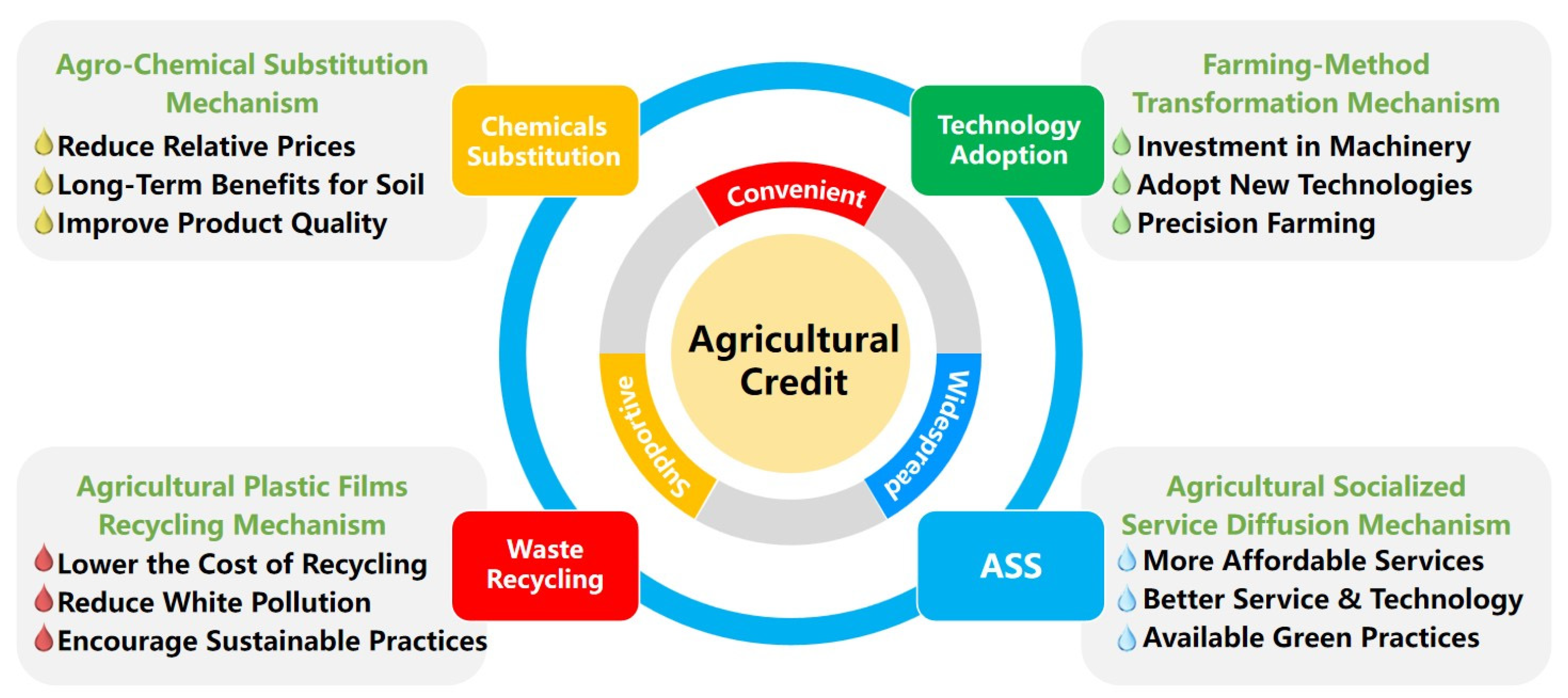
Agricultural credit is specifically allocated to the agricultural production and sales processes, thereby providing farmers with the financial means to purchase relatively higher-priced green agricultural inputs. This credit line can be directly applied to the purchase of environmentally friendly inputs, such as organic fertilizers and biological pesticides. Given that in China, the interest rate on agricultural credit is either zero or very low, coupled with interest subsidies, bulk discounts, and service bundling, the relative cost of green agricultural inputs is significantly reduced. Additionally, agricultural chemicals, including pesticides, chemical fertilizers, and plastic films, have been shown to negatively impact crop growth [54], and their associated hidden costs, such as waste disposal, further enhance the cost-effectiveness of green agricultural inputs compared to conventional chemicals. In this context, the long-term marginal returns of green agricultural inputs become particularly apparent. Farmers, who were previously constrained by liquidity issues and forced to rely on chemical fertilizers and pesticides, can now afford to purchase a complete set of green inputs in a single transaction. The reduction in financing thresholds directly opens up space for substitution. Biological pesticides, derived from microorganisms or other natural substances, are typically more environmentally friendly [55], while organic fertilizers contribute to improved soil quality, crop yield, and quality [56]. Consequently, agricultural credit plays a crucial role in encouraging farmers to adopt green agricultural inputs, such as biological pesticides and organic fertilizers, as substitutes for traditional agricultural chemicals, thereby promoting FGPB.

2.2.2. Farming-Method Transformation Mechanism

Agricultural credit not only influences the input structure but also facilitates the transformation of agricultural production methods by promoting investment in mechanization and automation. Green production factors, such as agricultural machinery and precision farming systems, require substantial initial investment and have long capital recovery periods [57], posing challenges for farmers relying on self-financing to achieve mechanized transformation [58]. Through policy-based low-interest loans, agricultural credit provides crucial financial support to farmers and agricultural enterprises, thereby reducing the costs of purchasing or leasing machinery. This incentivizes investment in agricultural equipment [59], enhancing the adoption of advanced production technologies. Furthermore, agricultural credit can improve farmers’ technical efficiency [60] and accelerate the process of agricultural modernization [61], farmers have more budget to purchase or rent machinery. The adoption of agricultural machinery enables farmers to implement no-tillage practices, organic fertilization, and straw-returning technologies [62], thus the widespread adoption of agricultural mechanization enhances the energy and environmental performance of China’s agricultural sector [58]. By replacing manual labor with machinery, farming intensification is promoted, the use of agricultural chemicals is reduced, carbon emissions are lowered, and agricultural green production efficiency is significantly improved [63], thus contributing to an increase in FGPB.

2.2.3. Agricultural Plastic Films Recycling Mechanism

The green development of agriculture depends not only on advancements in input and production processes but also on the establishment of incentives for environmental governance and resource recycling following production [64]. Although agricultural plastics are crucial for farming productivity, they also present a potential risk to sustainable development. If agricultural plastic waste is not managed effectively, the negative effects could outweigh their positive contributions [65], significantly hindering the sustainable development of the sector [66]. Recycling agricultural plastic films not only mitigates white pollution but also contributes to increased agricultural productivity and the enhancement of product quality. However, the recycling and disposal of agricultural waste, such as plastic films, often incur high costs, which discourages farmer participation [64]. Agricultural credit, through the provision of special funds and preferential interest rates, offers financial support to farmers, cooperatives, and enterprises for investments in environmentally sustainable practices. Most agricultural credit is either interest-free or carries very low interest rates, effectively spreading the costs of plastic film recycling, increasing farmers’ net incomes, and incentivizing them to engage in recycling practices. This, in turn, promotes the adoption of sustainable agricultural waste management practices, thereby facilitating FGPB.

2.2.4. Agricultural Socialized Service Diffusion Mechanism

Agricultural socialized services (ASS) play a vital role in advancing agricultural green production. Due to the fragmented operations and limited scale of individual farmers, they often encounter issues such as information asymmetry and limited service access when adopting green technologies. By improving financing conditions, agricultural credit can support both supply and demand, thereby enhancing the availability and spread of ASS. On the supply side, ASS organizations frequently face challenges like insufficient capital and outdated equipment. Agricultural credit can offer low-interest loans to these entities, easing their financial pressure and allowing them to scale up services, upgrade equipment, and enhance technical capabilities [67]. On the demand side, agricultural credit improves farmers’ payment ability, enabling them to indirectly adopt green production technologies by purchasing services such as agricultural machinery rental, soil testing, fertilization planning, and eco-friendly pest control [26]. With credit support, a positive interaction is fostered between the supply and demand of ASS, which not only boosts the adoption of green technologies by farmers but also widens the reach of green production models [68]. In this way, agricultural credit helps expand service supply through financial backing while simultaneously stimulating farmers’ demand for services, accelerating the diffusion of green production technologies, and ultimately improving FGPB.
Based on this, the mechanism hypotheses of this study are proposed:
H2a: 
Agricultural credit can promote FGPB by encouraging them to use green agricultural inputs to replace agricultural chemical inputs.
H2b: 
Agricultural credit can promote FGPB by transforming farmers’ production methods and encouraging them to increase the frequency of agricultural machinery use.
H2c: 
Agricultural credit can promote FGPB by encouraging farmers to recycle agricultural plastic films.
H2d: 
Agricultural credit can promote FGPB by encouraging farmers to participate in ASS.
Figure 4 illustrates the mechanism of action of agricultural credit on FGPB.

3. Research Design

3.1. Model Specification

3.1.1. Baseline Regression Model

In the baseline regression, this study uses the OLS model for regression. Considering the possible differences among different provinces and counties, the county-level fixed effects model is adopted. Referring to most studies, whether farmers have obtained agricultural credit is used as the core explanatory variable, and the OLS model is set as shown in Equation (17):
F G P B   =   a 0   +   a 1   ×   c r e d i t   +   a n   ×   C o n t r o l   +   μ i   +   ε ,
where FGPB represents the level of FGPB of the respondents, credit represents whether the respondents have obtained agricultural credit, Control represents the control variables, μ i is the county-level fixed effect, and ε is the residual term.

3.1.2. Mechanism Analysis Model

To further verify the mechanism by which agricultural credit promotes farmers’ agricultural green production behavior, this study conducts a mechanism analysis based on Equation (17), as shown in Equation (18):
M   =   b 0   +   b 1   ×   c r e d i t   +   b n   ×   C o n t r o l   +   μ i   +   ε ,
where M represents each mechanism variable, i.e., the times of organic fertilizer and biological pesticide use, the frequency of agricultural machinery use, the number of agricultural plastic film recycling times, and whether take part in ASS; credit represents whether the respondents have obtained agricultural credit; Control represents the control variables; μ i is the county-level fixed effect; and ε is the residual term.

3.1.3. 2SLS Model

In addressing endogeneity, this study selects instrumental variables and employs a 2SLS model to mitigate endogeneity issues. Considering the issue of endogeneity, the 2SLS model used in this study is as follows:
F i r s t   S t a g e :   c r e d i t   =   c 0   +   c 1   ×   I V   +   c 2   ×   C o n t r o l   +   μ i   +   ε ,
S e c o n d   S t a g e :   F G P B   =   d 0   +   d 1   ×   c r e d i t   +   d 2   ×   C o n t r o l   +   μ i   +   ε .
In Equation (19), I V refers to instrumental variables. This study selects instrumental variables at the village and farmer levels and uses 2SLS model for regression.

3.2. Variable Definition and Descriptive Statistics

3.2.1. Dependent Variables

In this study, the level of FGPB is assessed using the entropy weight method. The measurement is based on changes in the usage of three agricultural chemicals—chemical fertilizers (fertilizer), pesticides (pesticide), and plastic films (film)—by the surveyed farmers in 2022 compared to 2021. Referring to existing literature [69], this paper scores farmers based on the change in their usage of agricultural chemicals. The changes in the usage of each chemical are evaluated on a scale from 1 to 5, where 5 indicates a significant increase (i.e., more than a 10% increase compared to 2021), 4 indicates a slight increase (i.e., an increase of 0–10% compared to 2021), 3 indicates no significant change (i.e., usage is similar to 2021), 2 indicates a slight decrease (i.e., a decrease of 1–10% compared to 2021), and 1 indicates a significant decrease (i.e., a decrease of more than 10% compared to 2021), the details are shown in Table 1. A reduction in the usage of agricultural chemicals is considered a positive indicator of FGPB [70]. Therefore, in the subsequent empirical analysis, a higher FGPB value reflects a greater reduction in the usage of agricultural chemicals by farmers.

3.2.2. Core Explanatory Variable

The core explanatory variable in this study is the acquisition of agricultural credit (credit), which is determined based on whether the surveyed farmers received agricultural credit in 2022. A value of 1 is assigned if the farmer obtained agricultural credit, and 0 if they did not.

3.2.3. Mechanism Variables

This study uses the number of biological pesticide applications (biopesticide) in 2022 to assess the substitution effect of agricultural credit on traditional pesticides, as biological pesticides can serve as a substitute for conventional pesticides. In contrast, much of the existing literature measures the use of organic fertilizers based solely on whether they are applied, which fails to capture their substitution effect for traditional chemical fertilizers. Therefore, this study employs the number of organic fertilizer applications (organfertilizer) in 2022 to investigate its substitution effect on chemical fertilizers. Organic fertilizers not only replace chemical fertilizers but also contribute to long-term soil health.
This paper measures the shift in farmers’ agricultural production methods based on the frequency of agricultural machinery usage, including both purchases and rentals. A scoring system from 1 to 5 is applied, where a score of 1 indicates that the farmer never uses agricultural machinery. A score of 2 represents usage in 0–25% (excluding 0) of their agricultural activities, 3 corresponds to usage in 25–50% of their agricultural activities, 4 reflects usage in 50–75%, and 5 indicates usage in 75–100% of their agricultural activities.
As indicated in the previous analysis, the recycling of agricultural plastic films helps mitigate white pollution in the soil and reduces the need for subsequent plastic film usage. Existing literature primarily measures this through the binary indicator of whether agricultural plastic films are recycled. However, using the number of recycling instances provides a more accurate reflection of the impact of agricultural credit on promoting farmers’ sustainable, green production practices. Therefore, this study adopts the number of agricultural plastic film recycling events (filmrecycling) by farmers in 2022 as an indicator of their engagement in green and sustainable production methods.
Building on existing studies [71], this study uses the acquisition of Agricultural Socialized Services (ASS) to measure the level of agricultural services accessible to farmers with the support of agricultural credit. A value of 1 is assigned if the farmer has obtained ASS, and 0 if they have not.

3.2.4. Control Variables

Based on existing studies [72,73] and the characteristics of the survey areas, this study selects the following variables as controls: the number of family members (familysize), the respondent’s age at the time of the survey (lnage), gender (gender), education level (edu), health status (health), family agricultural land area (farmsize), family income (lnincome), number of agricultural technology training sessions attended (train), and marital status (marriage). The measurement methods for these variables are presented in Table 2.

3.2.5. Descriptive Statistics of Variables

The mean value of FGPB is 0.478, but the standard deviation is as high as 0.159, indicating significant variation in FGPB among different agricultural operators. Specifically, according to the results calculated using the entropy method, when the changes in the usage of the three agricultural chemicals are all 0 (i.e., when scored 3 on the 5-point scale), the value of FGPB is 0.5. This suggests that when the FGPB value is 0.5, the respondent’s green production status has not changed. When the FGPB value exceeds 0.5, the respondent’s green production status has improved, while a value below 0.5 indicates a decline in green production status. Clearly, the overall green production status of the surveyed group has declined. The descriptive statistics of the changes in the usage of chemical fertilizers, pesticides, and plastic films also support this result. The average annual frequency of biological pesticide and organic fertilizer applications is less than once per year. Specifically, the average number of biological pesticide applications is 0.778, with a standard deviation of 1.531. This suggests that the use of biological pesticides is generally infrequent among the surveyed farmers, with considerable variability across individuals. Similarly, the average number of organic fertilizer applications is 0.872, accompanied by a high standard deviation of 1.537. This indicates that organic fertilizer usage is similarly limited, with significant variation in application frequency among farmers. These findings underscore the low adoption of green agricultural practices.
In terms of agricultural mechanization, the average level is 2.244, with a standard deviation of 1.289, reflecting limited machinery usage among the respondents and substantial disparities between farmers. The variability in agricultural plastic film recycling is even greater, with an average of 0.186 and a standard deviation of 0.417, indicating minimal recycling overall and considerable inconsistency in practices among farmers. The average value for the accessibility of Agricultural Socialized Services (ASS) is 0.190, with a standard deviation of 0.393, reflecting both a low adoption rate and significant variability in the availability of these services among farmers.
Furthermore, the average proportion of farmers who have obtained agricultural credit is 0.456, meaning that only 45.6% of respondents have access to agricultural credit. This relatively low coverage suggests that the availability of agricultural credit remains limited, highlighting the need for its expansion to increase accessibility for a larger proportion of farmers. Agricultural credit has a positive correlation with FGBP. A detailed description of the measurement methods and descriptive statistics for the other variables can be found in Table 3, while Table 4 is Pairwise Correlations of Variables.

3.3. Data Source

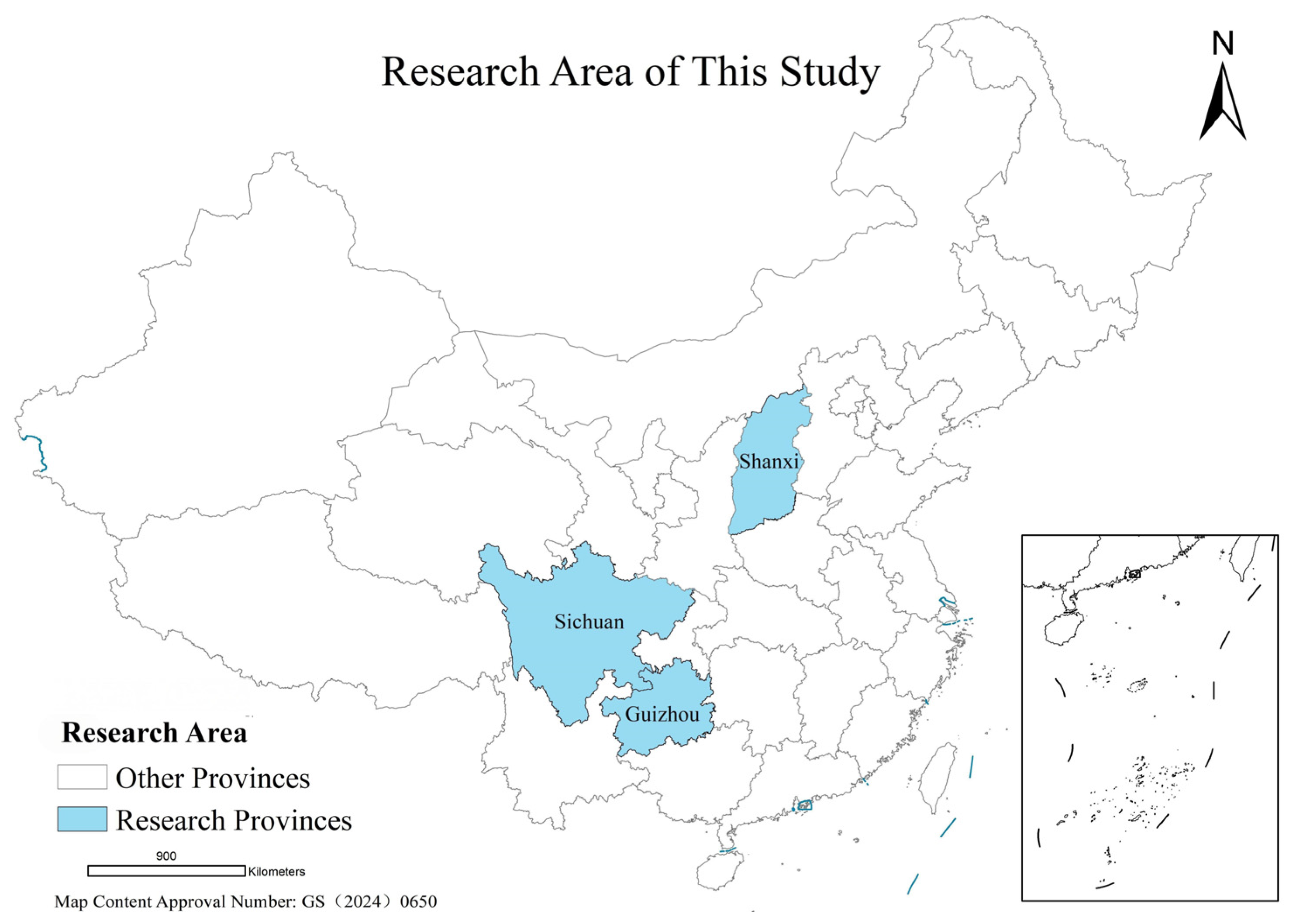
The data for this study were obtained from surveys conducted by the research team in Sichuan, Guizhou, and Shanxi provinces between 2023 and 2025, with the survey scope illustrated in Figure 5. These provinces span humid, semi-humid, and semi-arid climate zones, encompassing a variety of landforms, including basins, plateaus, hills, and plains. The primary crops cultivated in these regions include rice, corn, wheat, and potatoes, which allow for a comprehensive examination of the variations in agricultural credit demand and the orientation of FGPB under different ecological conditions. This provides a representative and comparable regional sample for the study. In total, eight counties were selected for the survey. After reviewing and eliminating anomalous questionnaires, 537 valid responses were retained for analysis.

4. Empirical Analysis

4.1. Multicollinearity Test

This study first performs a multicollinearity test, including all variables from the baseline regression within the scope of the analysis. Following the approach commonly used in existing literature, the Variance Inflation Factor (VIF) is employed for this test. The results are presented in Table 5. The VIF for each variable is less than 2, significantly lower than the standard threshold of 10, indicating that there is no multicollinearity among the variables in the baseline regression model of this study.

4.2. Baseline Regression

Building upon Equation (17), we first examine whether agricultural credit can promote FGPB. The baseline results are presented in Table 6. Column (1) reports the estimates without control variables or county fixed effects. The coefficient for agricultural credit is 0.0699, which is statistically significant at the 1% level, indicating a positive relationship between access to agricultural credit and FGPB. This finding suggests that increased access to agricultural credit could directly contribute to enhancing the green production index, likely by enabling farmers to adopt more sustainable farming practices or invest in green technologies. Such results align with the notion that financial support for agriculture can play a crucial role in the transition towards environmentally friendly agricultural practices. In Column (2), we include control variables and county fixed effects, which results in a reduction in the coefficient to 0.0542. However, it remains statistically significant at the 1% level. This indicates that, when controlling for factors such as local economic conditions and fixed characteristics of each county, access to agricultural credit increases the green production index by an average of 0.0542 units. The slight reduction in the coefficient from 0.0699 to 0.0542 suggests that part of the relationship observed in Column (1) may be driven by county-level or other unobserved heterogeneity. Nevertheless, the positive effect remains robust, confirming that agricultural credit has a significant role in promoting green production even after accounting for local economic factors. This implies that the positive impact of agricultural credit on FGPB is not simply a result of omitted variable bias or regional-specific factors. To further investigate the impact of agricultural credit on traditional agro-chemical inputs, we re-estimate the model for fertilizer, pesticide, and plastic film usage. The results, shown in Columns (3), (4), and (5), present coefficients of −0.2343, −0.1745, and −0.2380, respectively, all of which are statistically significant. These findings suggest that agricultural credit encourages farmers to reduce the use of chemical inputs, which is consistent with the broader goals of sustainable agricultural practices. The negative coefficients for chemical inputs imply that when farmers have access to agricultural credit, they may have greater financial flexibility to invest in alternative, more sustainable farming methods (e.g., organic fertilizers or biocontrols) that reduce reliance on harmful chemicals. These results provide strong empirical support for the idea that financial incentives can drive more eco-friendly production practices, thus helping to reduce the environmental impact of agriculture. Therefore, Hypothesis 1 is supported, as the empirical evidence shows a clear relationship between agricultural credit and both the promotion of green production and a reduction in agro-chemical inputs. This strengthens the argument that financial interventions in agriculture can act as a catalyst for environmental sustainability.
Additionally, we observe a significant negative relationship between farming area and FGPB. The negative coefficient suggests that, as the farming area expands, the investment required for green production, including the costs associated with adopting environmentally friendly practices or technologies, increases. This may create greater economic pressure on farmers, particularly in the context of large-scale operations where the initial capital outlay for green practices may be prohibitively high.

4.3. Endogeneity Treatment

Although this study has incorporated as many control variables as possible to address endogeneity, issues such as omitted variables, measurement errors, and reverse causality still exist. Therefore, this study selects instrumental variables at the village and farmer levels and uses 2SLS model for regression.

4.3.1. Village Elevation

Village elevation has a significant impact on the accessibility of rural financial services [74]. In high-altitude regions, the harsher climate and rugged terrain increase the cost of establishing bank branches and make it more difficult for financial officers to access these villages. As a result, farmers in such areas have fewer opportunities to obtain agricultural credit compared to those in low-altitude regions. Therefore, elevation satisfies the relevance condition for an instrumental variable. Additionally, elevation does not directly influence FGPB, thereby meeting the exogeneity assumption for instrumental variables. Columns (1) and (2) of Table 7 present the regression results. The coefficient on elevation is significantly negative in the regression for farmers’ uptake of agricultural credit products, indicating that geographic accessibility affects the utilization of agricultural credit. When elevation is used as an instrument, the estimated effect of agricultural credit on FGPB is 0.2475, which is statistically significant at the 1% level. The LM statistic is significant at the 1% level, thereby rejecting the under-identification hypothesis, while the Cragg–Donald Wald F statistic is 20.438, which rejects the weak instrument hypothesis. These results confirm the robustness of the baseline findings.

4.3.2. Farmers’ Financial Literacy

Financial literacy plays a crucial role in shaping farmers’ decisions regarding the purchase and use of financial products. Generally, farmers with higher financial literacy tend to make more informed decisions regarding financial allocation and investment. This is essential for product uptake [75] and enables them to make investment decisions more efficiently [76]. As such, financial literacy influences the likelihood of farmers applying for agricultural credit, fulfilling the relevance condition for an instrument. However, it does not directly impact the FGPB, thereby satisfying the exclusion restriction. The results are reported in columns (3) and (4) of Table 7. We measure financial literacy by asking respondents during the survey, “Do you know which institution to consult for your personal credit report?” If the answer is correct, the variable is assigned a value of 1; if the answer is incorrect or the respondent does not know, the variable is assigned a value of 0. Financial literacy exhibits a significantly positive coefficient for credit uptake at the 1% significance level. After accounting for endogeneity, the estimated effect of agricultural credit on FGPB is 0.5536, significant at the 5% level. The LM statistic is 19.773, significant at the 1% level, thereby rejecting the under-identification hypothesis. Additionally, the Cragg–Donald Wald F statistic is 19.879, well above the critical value of 16.38 at the 10% significance level, which rejects the weak instrument hypothesis. The robustness of these findings is confirmed when farmers’ financial literacy is used as an instrument.

4.3.3. Farmers’ Access to Information

The level of information acquisition among farmers significantly increases their likelihood of obtaining agricultural credit [77]. In general, when farmers have a higher level of information acquisition, they are better able to understand policies and benefits related to agricultural credit, thereby improving their chances of securing loans. However, the level of information acquisition does not directly contribute to the promotion of FGPB [78]. To measure farmers’ ability to acquire information, this study assesses the frequency with which farmers access agricultural information through smartphones, using a 5-point scale: 1 for never, 2 for 1–2 times per month, 3 for 3–4 times per month, 4 for 5–6 times per month, and 5 for 7 or more times per month. This score is employed as an instrumental variable in the two-stage least squares (2SLS) regression model. The results, presented in columns (5) and (6) of Table 7, show that the regression coefficient for farmers’ information acquisition ability in relation to agricultural credit acquisition is 0.0732, which is significantly positive at the 1% level. This finding suggests a positive correlation between farmers’ information acquisition ability and their access to agricultural credit. After accounting for farmers’ information acquisition ability, the regression coefficient for the impact of agricultural credit on green agricultural production is 0.1453, which is significantly positive at the 10% level. Furthermore, the LM statistic is significant at the 1% level, rejecting the hypothesis of under-identification, and the Cragg–Donald Wald F statistic is 20.996, which rejects the weak instrument variable hypothesis. Consequently, the preceding regression results are robust.

4.4. Robustness Checks

To further assess the robustness of the baseline findings, we conduct a series of robustness checks, the results of which are presented in Table 8. Since the dependent variable, FGPB, is constrained between 0 and 1, it satisfies the assumptions required for the application of the Tobit model. Consequently, we begin by re-estimating the regression using the Tobit estimator. Column (1) reveals that the coefficient for agricultural credit on FGPB is 0.0542, which is statistically significant at the 1% level. In the baseline regression, we apply the entropy method to synthesize changes in farmers’ chemical inputs. As previously mentioned, an FGPB value of 0.5 indicates no change in green behavior relative to the previous period; values greater than 0.5 suggest an improvement, while values below 0.5 indicate a deterioration. Accordingly, we assign a value of 1 to respondents whose index exceeds 0.5, denoting an improvement in green production, and a value of 0 to all others, signifying no change or a decline. We then regress this indicator on agricultural credit. The result, shown in Column (2) of Table 8, yields a coefficient of 0.1493, significant at the 1% level, confirming that access to agricultural credit enhances farmers’ FGPB.
Next, given that the dependent variable in Column (3) is binary, we apply the Probit model. Column (3) reports the marginal effect of agricultural credit as 0.5129, significant at the 1% level, which is consistent with the baseline finding. Finally, while county-fixed effects were included in the baseline regression, provincial authorities often implement uniform agricultural and financial policies and share similar resource endowments. To account for this, we replace county-fixed effects with province-fixed effects. The estimate presented in Column (4) is 0.0530, significant at the 1% level, and is nearly identical to the previous results. Taken together, these robustness checks confirm the reliability of the baseline regression findings.

4.5. Heterogeneity Analysis

4.5.1. Heterogeneity Across Agricultural Operation Entities

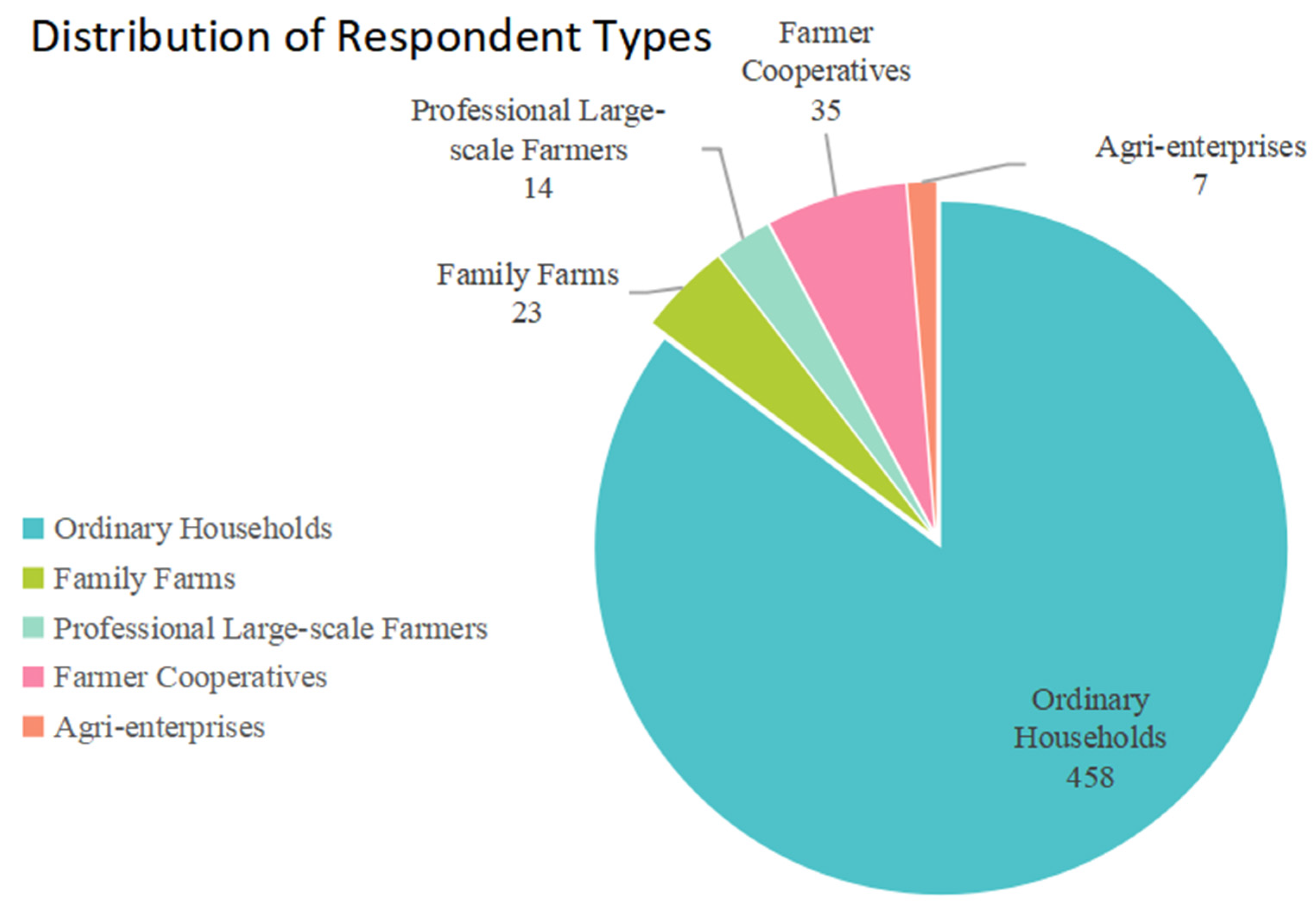
Our survey encompasses a range of agricultural entities, including ordinary households, family farms, professional large-scale farmers, farmer cooperatives, and agri-enterprises. Ordinary farmers refer to those who, aside from large-scale households (family farms) within their own villages, engage in land use and operation for farming. The specific criteria are as follows: in areas with a one-crop farming system, the land used for open-field crop cultivation is less than 100 acres; in areas with a two-crop or more farming system, the land used for open-field crop cultivation is less than 50 acres; and in the case of facility agriculture, the land occupied by facilities is less than 25 acres. A family farm refers to a new type of agricultural business entity that primarily relies on family members as labor, engages in large-scale, intensive, and commercialized agricultural production, and derives most of the family income from agriculture. Professional large-scale farmers refer to agricultural operators whose scale of operation is significantly larger than that of traditional local farmers, who primarily rely on family labor and specialize in the production of a specific agricultural product, such as large-scale grain farmers, etc. Farmer cooperatives refer to mutual aid economic organizations that are voluntarily formed and democratically managed by producers of similar agricultural products or related service providers and users, based on the foundation of rural household contracting operations. Agri-enterprises refer to enterprises that focus on the production, processing, and circulation of agricultural products, have legal entity status, and establish stable benefit connection mechanisms with farmers (Classification standard: https://www.stats.gov.cn/zt_18555/zdtjgz/zgnypc/d3cnypc/npfa/202302/P020230215381099442323.pdf (accessed on 4 December 2025)). The distribution of the types of interviewed farmers is shown in Figure 6.
Smallholders, operating on a smaller scale and with lower levels of specialization, differ from other entities that are larger and more professional. Consequently, the incentive to obtain agricultural credit may vary across these groups. To address this, we divide the sample into two categories: smallholders and larger entities. The results are presented in Table 9. Column (1) reveals that for smallholders, the coefficient of agricultural credit on FGPB is 0.0706, which is statistically significant at the 1% level, while for larger entities, the coefficient is −0.0152 and not statistically significant. A Fisher permutation test with 1500 repetitions yields a p-value of 0.022 for the difference between the two coefficients, which is significant at the 5% level. This supports the conclusion that agricultural credit promotes FGPB among smallholders but has no significant effect on larger entities.
On one hand, smallholders face fewer barriers to adopting green technologies. After receiving agricultural credit, they can replace chemical inputs with alternatives such as manually spreading organic fertilizer or using handheld sprayers instead of drones, incurring minimal marginal fixed costs. In contrast, large operators, whose chemical input levels are already higher [79], must undertake substantial green investments and bear additional organizational costs. As a result, their net cost is higher, and their willingness to invest is lower. On the other hand, large-scale entities prioritize profit maximization, and the marginal increase in chemical inputs often outpaces the increase in output value [80]. Consequently, they tend to allocate agricultural credit towards existing production activities. In contrast, smallholders, who typically produce primarily for self-consumption [81], place greater emphasis on product quality. As such, smallholders experience a greater increase in FGPB than larger entities following the receipt of agricultural credit.

4.5.2. Heterogeneity Across Farmer’s Happiness

The subjective happiness of farmers and their families may lead to differential effects on the extent to which agricultural credit promotes green production behavior. To explore this, we divided the sample into two groups: the “high-happiness” group, which includes “very happy” and “comparatively happy” households, and the “low-happiness” group, which comprises “neutral,” “unhappy,” and “very unhappy” households. Table 10 presents separate regression results for each group. Column (1) shows that for the high-happiness group, the coefficient for agricultural credit on GPB is 0.0741, which is statistically significant at the 1% level. In contrast, Column (2) shows an insignificant coefficient of 0.0119 for the low-happiness group. A Fisher permutation test with 1,500 repetitions yields a p-value of 0.033 for the difference, which is significant at the 5% level, confirming that the green-promoting effect of agricultural credit is restricted to farmers with higher happiness.
According to the broaden-and-build theory of positive emotions [82], individuals with high subjective well-being possess greater cognitive resources and psychological resilience [83], which in turn positively influence pro-environmental behavior [84]. Happiness, as a key form of psychological capital, enhances farmers’ ability to value long-term benefits. Thus, farmers with higher happiness levels exhibit stronger emotional activation and tend to apply a lower discount rate when receiving agricultural credit. This allows them to better tolerate the long payback periods and low immediate returns typical of green technologies, ultimately leading them to allocate credit funds toward green inputs and engage in environmental protection [85].
In contrast, low-happiness farmers, dominated by negative emotions, are more likely to have higher discount rates [86] and prefer short-term financial gains, which inhibits their investment in green technologies. Furthermore, green production generates positive externalities, with private benefits often smaller than the social benefits, leading to under-investment in green technologies. Due to their positive emotions and altruistic preferences, high-happiness farmers are more likely to assign a higher value to social benefits such as neighborhood environmental quality and community reputation. This helps them internalize these externalities, thereby increasing the private net-benefits of green technologies, so that the marginal return on credit exceeds the opportunity cost. In contrast, low-happiness farmers, influenced by negative emotions and weaker social preferences, assign little or no value to external benefits. Consequently, their green investment remains at an equilibrium where private net benefits are negative, and even with access to credit, they do not adopt green practices. Therefore, the positive effect of agricultural credit on FGPB is significant only among farmers with higher subjective well-being.

4.5.3. Heterogeneity Across Farming Experience

Few studies have examined the role of farmers’ farming experience, despite the fact that tenure significantly influences production decisions and capital allocation. This paper investigates whether the green-promoting effect of agricultural credit varies with farming experience. Farmers with 10 or more years of experience are classified as the “experienced” group, while those with fewer than 10 years are categorized as the “inexperienced” group. The results of separate regressions for each group are presented in Table 11. Column (1) reveals that, for the experienced group, the coefficient of agricultural credit on FGPB is 0.0752 and is statistically significant at the 1% level, whereas the coefficient for the inexperienced group is 0.0196, which is not statistically significant. A Fisher permutation test produces a p-value of 0.045 for the difference between the two groups, significant at the 10% level. This suggests that agricultural credit has a substantial effect on FGPB only for experienced farmers, while it does not significantly promote FGPB in the inexperienced group.
Experienced farmers are better able to assess soil health [87], which enables them to enhance soil management practices. Additionally, their agricultural knowledge is more closely tied to output [88]. Green production often involves the adoption of new technologies, inputs, and management practices, representing a systematic upgrade to traditional farming methods. With higher human capital and accumulated technical knowledge, experienced farmers are more adept at identifying, adopting, and applying green technologies. This enables them to convert credit funds into marginal output more efficiently, with lower trial-and-error costs and a greater willingness to embrace these innovations [89]. In contrast, inexperienced farmers face higher technical barriers and a greater likelihood of failure, which increases the risk of credit investments turning into sunk costs and reduces their motivation to engage in green production. Therefore, the positive impact of agricultural credit on FGPB is only significant in the sample of experienced farmers.

5. Mechanism Analysis

5.1. Agro-Chemical Substitution Mechanism

As previously discussed, agricultural credit can incentivize farmers to replace conventional agro-chemicals with environmentally friendly alternatives, such as bio-pesticides and organic fertilizers, thereby promoting FGPB. To empirically test this mechanism, we regress agricultural credit on the frequency of bio-pesticide and organic fertilizer usage. Columns (1) and (2) of Table 12 indicate that agricultural credit significantly increases the application of bio-pesticides by 0.3413 times and organic fertilizers by 0.3323 times, both at the 5% significance level. These findings confirm that agricultural credit fosters the adoption of these sustainable inputs. Bio-pesticides and organic fertilizers not only mitigate the pollution and toxicity associated with chemical pesticides but also promote crop growth [90]. Thus, Hypothesis H2a is supported.

5.2. Farming-Method Transformation Mechanism

We next investigate the impact of agricultural credit on farming practices. Mechanization, which replaces manual labor, is a widespread trend in agriculture. To capture this, we use the frequency of machinery usage as the mechanism variable. Column (3) of Table 12 shows that the coefficient of agricultural credit on machinery-use frequency is 0.3873, which is statistically significant at the 1% level. Following the receipt of agricultural credit, farmers increase their use of machinery, leading to more accurate sowing and spraying, reduced waste and chemical overuse, decreased soil degradation, and enhanced straw incorporation [91]. These practices contribute to higher agricultural carbon efficiency [92] and overall productivity [93], thereby improving FGPB. Therefore, Hypothesis H2b is supported.

5.3. Agricultural Plastic Films Recycling Mechanism

This study further investigates the mechanism through which agricultural credit promotes FGPB by using the number of agricultural film recycling episodes as a proxy for the adoption of green production practices. To assess the impact of agricultural credit on farmers’ green production methods, we regress agricultural credit on the frequency of agricultural film recycling. Column (4) of Table 12 shows that the regression coefficient for agricultural credit on the number of recycling episodes is 0.1004, which is statistically significant at the 5% level, indicating that agricultural credit significantly encourages the adoption of green production practices. Agricultural film contributes to white pollution in the soil and degrades soil quality [94], which in turn affects the quality of agricultural products. Recycling agricultural film can, to some extent, mitigate soil and environmental pollution [95] and further support FGPB. Therefore, Hypothesis H2c is validated.

5.4. Agricultural Socialized Service Diffusion Mechanism

To examine the diffusion mechanism of agricultural credit in promoting FGPB through agricultural socialized services (ASS), this study regresses agricultural credit against farmers’ participation in ASS. Column (5) of Table 12 presents a coefficient of 0.0817 for agricultural credit on participation in ASS, which is statistically significant at the 5% level. This finding indicates that access to agricultural credit significantly enhances farmers’ participation in ASS. ASS, as previously shown, notably improves farmers’ adaptability to new technologies [96]. Meanwhile, large-scale planting reduces per-unit green input costs and increases the willingness of both farmers and service providers to engage in green production. Additionally, fiscal subsidies further lower the perceived costs of adopting green technologies, thereby fostering FGPB. Consequently, hypothesis H2d is supported.

6. Discussion

6.1. Research Significance

This study explores the significant role of agricultural credit in promoting environmentally friendly agricultural practices, offering valuable policy implications. It finds that agricultural credit promotes FGPB, this discovery is consistent with the results presented in the existing literature [97]. Moreover, it motivates investment in sustainable agricultural methods, such as reducing reliance on chemical fertilizers, increasing mechanization, and enhancing environmental practices like recycling plastic waste. The research identifies four main channels through which agricultural credit promotes these practices: the substitution of green inputs for chemicals, mechanization improvements, promotion of environmental practices, and support for agricultural socialized services. The study highlights that small-scale farmers, who often face capital shortages and limited access to modern technologies, are particularly influenced by credit, emphasizing the need for targeted credit policies that cater to their specific needs. Additionally, the study uncovers the negative impact of village altitude on credit accessibility, showing that geographical factors and infrastructure play a crucial role in determining credit availability. Financial literacy and access to information also emerge as critical factors that influence farmers’ ability to utilize agricultural credit, suggesting that policies should focus on improving these aspects to encourage the adoption of environmentally friendly practices. The empirical findings of this study not only shed light on the diverse channels through which credit impacts agricultural sustainability but also offer important policy insights, particularly for developing regions, to optimize agricultural credit policies and better support the transition to sustainable agriculture. Overall, this research fills several gaps in the existing literature, especially by focusing on the indirect effects of agricultural credit, the specific needs of small-scale farmers, and the influence of financial literacy and geographical factors on credit accessibility.

6.2. Research Limitations

Although this paper strives to maintain rigor in both data collection and methodology, certain limitations remain. First, the study employs cross-sectional data, which, despite efforts to enhance the robustness of the results through various methods, may still fall short in fully capturing the long-term dynamic effects of agricultural credit on green production behavior. Future research could address this limitation by utilizing longitudinal surveys or experimental designs to explore the persistence and lag effects of credit. Second, the sample in this study is confined to three provinces. While this sample offers some degree of representativeness, it does not adequately account for the variations in agricultural structure, ecological conditions, and policy environments that exist across different regions, or even globally. Expanding the scope of the analysis to include a broader range of locations could strengthen the external validity of the findings. Third, this study examines changes in farmers’ use of agricultural chemicals by comparing their usage in 2022 with that in 2021. Although this approach provides insight into the trends in usage, it relies on self-reported data, which may introduce biases and deviate from actual practices. Fourth, while this study identifies the mediating mechanisms through which credit affects green production, it does not delve deeply into the interactions between these mechanisms. Future research could apply structural equation modeling or case study analysis to explore the potential synergistic or substitutive effects between different pathways.

7. Research Conclusions, Discussion and Policy Implications

7.1. Research Conclusions

This paper, based on survey data collected from 537 farm households across three provinces in China, constructs an Ordinary Least Squares (OLS) model to investigate the relationship between farmers’ use of agricultural credit services and their engagement in environmentally friendly agricultural practices. Through a series of empirical analyses, the following conclusions are drawn: (1) Participation in agricultural credit services significantly promotes FGPB, and this result remains robust after addressing potential endogeneity and performing various robustness checks. (2) Agricultural credit promotes FGPB through four main channels: (a) encouraging farmers to substitute green inputs for agrochemicals; (b) transforming farming practices by increasing the use of agricultural machinery; (c) promoting environmentally sustainable practices, such as the recycling of plastic film waste; and (d) facilitating farmers’ participation in agricultural socialized services. (3) The positive effect of agricultural credit on FGPB is significant only for smallholders, households with higher levels of subjective well-being, and farmers with extensive planting experience. This effect is not significant for other agricultural operation entities, households with lower happiness levels, or farmers lacking planting experience. (4) The altitude of the village where farmers reside negatively impacts their access to agricultural credit, whereas farmers’ financial literacy and information acquisition capabilities positively influence their ability to obtain such credit.

7.2. Policy Recommendations

In line with the research findings, this paper proposes a set of targeted policy suggestions.

7.2.1. Targeted Agricultural Credit Programs for Smallholders

Policymakers should prioritize smallholder farmers in the design and implementation of agricultural credit programs. The findings of this study highlight that smallholder farmers benefit most from agricultural credit in promoting environmentally friendly practices. Targeted financial products, such as low-interest loans or credit guarantees, could enable these farmers to invest in green inputs, machinery, and other sustainable agricultural technologies.

7.2.2. Financial Literacy and Information Accessibility

Governments and financial institutions should invest in improving farmers’ financial literacy and information acquisition skills. This study demonstrates that farmers with higher financial literacy are more likely to access agricultural credit. Educational campaigns, training programs, and digital tools can equip farmers with the knowledge they need to understand and effectively utilize agricultural credit, thereby fostering sustainable farming practices.

7.2.3. Encouraging Sustainable Input Substitution

Agricultural credit programs should incorporate incentives for farmers to adopt environmentally friendly inputs, such as organic fertilizers or biological pest control agents. As shown in this study, credit can encourage farmers to substitute green inputs for agrochemicals, which is a crucial step in promoting sustainable agriculture. Subsidies or tax breaks on green inputs could be part of credit offerings to ensure farmers are incentivized to make environmentally conscious choices.

7.2.4. Support for Socialized Agricultural Services

Policymakers should facilitate the development of agricultural socialized services, such as shared machinery and waste recycling systems. The study shows that agricultural credit promotes farmers’ engagement with such services, leading to more sustainable practices. Government initiatives to support the establishment of cooperatives or service providers that offer machinery, waste management, and other services could help farmers adopt more sustainable and efficient agricultural methods.

7.2.5. Addressing Geographical Barriers to Credit Access

The negative impact of village altitude on access to agricultural credit, as found in this study, indicates the need for policies to overcome geographical barriers to financial inclusion. Financial institutions and governments should explore innovative solutions, such as mobile banking or remote lending services, to ensure that farmers in remote or mountainous areas can access credit. Additionally, efforts to improve rural infrastructure could enhance access to credit and support green agricultural development.

7.2.6. Promote Subjective Well-Being and Rural Development

Since higher subjective well-being among farmers positively influences their engagement with environmentally friendly practices, it is essential to consider broader rural development policies. Providing social safety nets, improving healthcare, and investing in rural education could contribute to higher well-being, thereby indirectly encouraging farmers to adopt more sustainable agricultural practices.

Author Contributions

Data curation, Q.W.; empirical analysis, Q.W.; methodology, Q.W. and W.L.; writing—original draft preparation, Q.W., W.L., T.C. and Q.B.; formal analysis, Q.W. and T.C.; resources, D.Z.; supervision, D.Z. All authors have read and agreed to the published version of the manuscript.

Funding

This paper is supported by the National Social Science Foundation of China (Grant No. 22BGL071) and the Science and Technology Department of Sichuan Province (Grant No. 2023JDR0110).

Institutional Review Board Statement

The study was conducted in accordance with the Declaration of Helsinki, and the protocol was approved by The Institutional Review Board of College of Economies, Sichuan Agricultural University (22BLG071) on 7 March 2023.

Informed Consent Statement

Informed consent for participation was obtained from all subjects involved in the study.

Data Availability Statement

The datasets used or analyzed during the current study are not uploaded as attachments, but they are available from the corresponding author on reasonable request.

Conflicts of Interest

The authors declare no conflicts of interest.

Abbreviations

The following abbreviations are used in this manuscript:
FGPBFarmers’ Green Production Behaviors
ASSAgricultural Socialized Service
OLSOrdinary Least Squares
2SLSTwo-Stage Least Squares

References

  1. Xiao, S.X.; He, Z.X.; Zhang, W.K.; Qin, X.M. The Agricultural Green Production following the Technological Progress: Evidence from China. Int. J. Environ. Res. Public Health 2022, 19, 9876. [Google Scholar] [CrossRef]
  2. Cui, S.; Adamowski, J.F.; Wu, M.; Zhang, P.; Yue, Q.; Cao, X. An integrated framework for improving green agricultural production sustainability in human-natural systems. Sci. Total Environ. 2024, 945, 174153. [Google Scholar] [CrossRef]
  3. Lei, S.; Yang, X.; Qin, J. Does agricultural factor misallocation hinder agricultural green production efficiency? Evidence from China. Sci. Total Environ. 2023, 891, 164466. [Google Scholar] [CrossRef]
  4. Liu, Y.; Sun, D.; Wang, H.; Wang, X.; Yu, G.; Zhao, X. An evaluation of China’s agricultural green production: 1978–2017. J. Clean. Prod. 2020, 243, 118483. [Google Scholar] [CrossRef]
  5. He, P.; Zhang, J.; Li, W. The role of agricultural green production technologies in improving low-carbon efficiency in China: Necessary but not effective. J. Environ. Manag. 2021, 293, 112837. [Google Scholar] [CrossRef] [PubMed]
  6. Shao, J. Green industrial policy and green development of agriculture—Quasi-natural experiment based on the Yangtze River Economic Belt in China. PLoS ONE 2024, 19, e0308307. [Google Scholar] [CrossRef] [PubMed]
  7. Xin, Y.; Xu, Y.; Zheng, Y. A study on green agricultural production decision-making by agricultural cooperatives under government subsidies. Sustainability 2024, 16, 1219. [Google Scholar] [CrossRef]
  8. Fan, X.; Meng, G.; Zhang, Q. Empirical research on factors influencing chinese farmers’ adoption of green production technologies. Sustainability 2024, 16, 5657. [Google Scholar] [CrossRef]
  9. Shi, R.; Yao, L.; Zhao, M.; Yan, Z. Low-carbon production performance of agricultural green technological innovation: From multiple innovation subject perspective. Environ. Impact Assess. Rev. 2024, 105, 107424. [Google Scholar] [CrossRef]
  10. Mao, H.; Zhou, L.; Ying, R.; Pan, D. Time Preferences and green agricultural technology adoption: Field evidence from rice farmers in China. Land Use Policy 2021, 109, 105627. [Google Scholar] [CrossRef]
  11. Heong, K.-L.; Lu, Z.-X.; Chien, H.-V.; Escalada, M.; Settele, J.; Zhu, Z.-R.; Cheng, J.-A. Ecological engineering for rice insect pest management: The need to communicate widely, improve farmers’ ecological literacy and policy reforms to sustain adoption. Agronomy 2021, 11, 2208. [Google Scholar] [CrossRef]
  12. Gong, S.; Sun, Z.; Wang, B.; Yu, Z. Could digital literacy contribute to the improvement of green production efficiency in agriculture? Sage Open 2024, 14, 21582440241232789. [Google Scholar] [CrossRef]
  13. Ogundeji, A.A.; Donkor, E.; Motsoari, C.; Onakuse, S. Impact of access to credit on farm income: Policy implications for rural agricultural development in Lesotho. Agrekon 2018, 57, 152–166. [Google Scholar] [CrossRef]
  14. Wang, Y.; Xu, Y.; Chen, W. Study on the Relationship between agricultural credit, fiscal support, and farmers’ income—Empirical analysis based on the PVAR model. Sustainability 2023, 15, 3173. [Google Scholar] [CrossRef]
  15. Henning, J.I.; Bougard, D.A.; Jordaan, H.; Matthews, N. Factors affecting successful agricultural loan applications: The case of a South African credit provider. Agriculture 2019, 9, 243. [Google Scholar] [CrossRef]
  16. Li, G.; Jia, X.; Khan, A.A.; Khan, S.U.; Ali, M.A.S.; Ali, M.; Luo, J. Role of agricultural credit guarantee policies in encouraging green agricultural development: Farmers’ perspectives and responses, and the regulatory function of household capital. Environ. Sci. Pollut. Res. 2023, 30, 66314–66327. [Google Scholar] [CrossRef]
  17. Wang, H.; Du, L. Agricultural credit scale and agricultural green production efficiency: A Metafrontier-Malmquist-Luenberger and panel Tobit approach. Front. Environ. Sci. 2023, 11, 1191012. [Google Scholar] [CrossRef]
  18. Li, X.; Zhang, J. Rural digital credit and residential energy consumption: Evidence from the agricultural production perspective. Energy 2024, 290, 130111. [Google Scholar] [CrossRef]
  19. Deng, L.; Xu, W.; Luo, J. Optimal loan pricing for agricultural supply chains from a green credit perspective. Sustainability 2021, 13, 12365. [Google Scholar] [CrossRef]
  20. Zhang, Z.; Tian, Y.; Chen, Y.-H. Can agricultural credit subsidies affect county-level carbon intensity in China? Sustain. Prod. Consum. 2023, 38, 80–89. [Google Scholar] [CrossRef]
  21. Qi, Z.; You, Y. The impact of the rural digital economy on agricultural green development and its mechanism: Empirical evidence from China. Sustainability 2024, 16, 3594. [Google Scholar] [CrossRef]
  22. Han, X.; Wang, Y.; Yu, W.L.; Xia, X.L. Coupling and coordination between green finance and agricultural green development: Evidence from China. Financ. Res. Lett. 2023, 58, 104221. [Google Scholar] [CrossRef]
  23. Huang, Z.; Su, K.; Wang, S. The role of agricultural insurance in promoting farmers’ green production behavior: The moderating effect of legal trust. Financ. Res. Lett. 2025, 80, 107269. [Google Scholar] [CrossRef]
  24. Fang, L.; Hu, R.; Mao, H.; Chen, S. How crop insurance influences agricultural green total factor productivity: Evidence from Chinese farmers. J. Clean. Prod. 2021, 321, 128977. [Google Scholar] [CrossRef]
  25. Xu, D.; Liu, Y.; Li, Y.; Liu, S.; Liu, G. Effect of farmland scale on agricultural green production technology adoption: Evidence from rice farmers in Jiangsu Province, China. Land Use Policy 2024, 147, 107381. [Google Scholar] [CrossRef]
  26. Yang, C.; Zeng, H.; Zhang, Y. Are socialized services of agricultural green production conducive to the reduction in fertilizer input? Empirical evidence from rural China. Int. J. Environ. Res. Public Health 2022, 19, 14856. [Google Scholar] [CrossRef]
  27. Qiu, H.; Huang, Y.; Zhang, W.; He, B.; Yuan, R.; Wang, Z. E-commerce operation empowers green agriculture: Implication for the reduction of farmers’ fertilizer usage. Front. Sustain. Food Syst. 2025, 9, 1557224. [Google Scholar] [CrossRef]
  28. Na, H.; Yan, X.; Xing, R.; Jiang, A. The empirical effect of agricultural social services on pesticide inputs. Sci. Rep. 2024, 14, 15907. [Google Scholar] [CrossRef] [PubMed]
  29. Zhang, Y.-F.; Zhang, Y.-H. Green pesticide practices and sustainability: Empirical insights into agricultural services in China. Int. J. Agric. Sustain. 2024, 22, 2306713. [Google Scholar] [CrossRef]
  30. Yu, X.; Sheng, G.; Sun, D.; He, R. Effect of digital multimedia on the adoption of agricultural green production technology among farmers in Liaoning Province, China. Sci. Rep. 2024, 14, 13092. [Google Scholar] [CrossRef] [PubMed]
  31. Hou, J.; Li, X.; Tang, Y.; Hou, B.; Chen, F. The Impact of Environmental Regulation on Pesticide Use in China. Agriculture 2025, 15, 825. [Google Scholar] [CrossRef]
  32. Yu, L.; Zhao, D.; Xue, Z.; Gao, Y. Research on the use of digital finance and the adoption of green control techniques by family farms in China. Technol. Soc. 2020, 62, 101323. [Google Scholar] [CrossRef]
  33. Raza, A.; Hongliang, L.; Yue, Z.; Yang, T.; Wei, N. Environmental regulations and eco-innovation as catalysts for green agricultural practices: Insights from Pakistan–China agricultural cooperation. Agric. Food Econ. 2025, 13, 29. [Google Scholar] [CrossRef]
  34. Dey, S.; Singh, P.K. Estimating farmers’ intention towards institutional credit adoption by using extended theory of planned behavior. J. Appl. Soc. Psychol. 2023, 53, 684–703. [Google Scholar] [CrossRef]
  35. Tacconi, F.; Waha, K.; Ojeda, J.J.; Leith, P. Drivers and constraints of on-farm diversity. A review. Agron. Sustain. Dev. 2022, 42, 2. [Google Scholar] [CrossRef]
  36. Wu, Y.; Xi, X.; Tang, X.; Luo, D.; Gu, B.; Lam, S.K.; Vitousek, P.M.; Chen, D. Policy distortions, farm size, and the overuse of agricultural chemicals in China. Proc. Natl. Acad. Sci. USA 2018, 115, 7010–7015. [Google Scholar] [CrossRef]
  37. Guo, L.; Zhao, S.; Song, Y.; Tang, M.; Li, H. Green finance, chemical fertilizer use and carbon emissions from agricultural production. Agriculture 2022, 12, 313. [Google Scholar] [CrossRef]
  38. Song, C.; Liu, Q.; Song, J.; Ma, W. Impact path of digital economy on carbon emission efficiency: Mediating effect based on technological innovation. J. Environ. Manag. 2024, 358, 120940. [Google Scholar] [CrossRef] [PubMed]
  39. Xu, Y.; Peng, Z.; Sun, Z.; Zhan, H.; Li, S. Does digital finance lessen credit rationing?—Evidence from Chinese farmers. Res. Int. Bus. Financ. 2022, 62, 101712. [Google Scholar] [CrossRef]
  40. Olutumise, A.I. Impact of credit on the climate adaptation utilization among food crop farmers in Southwest, Nigeria: Application of endogenous treatment Poisson regression model. Agric. Food Econ. 2023, 11, 7. [Google Scholar] [CrossRef]
  41. Shen, Y.; Zhang, X. Finance-driven sustainable development: The impact of green finance on agricultural non-point source pollution and its pathways. Front. Sustain. Food Syst. 2024, 8, 1430670. [Google Scholar] [CrossRef]
  42. Han, X.; Cai, Q. Environmental regulation, green credit, and corporate environmental investment. Innov. Green Dev. 2024, 3, 100135. [Google Scholar] [CrossRef]
  43. Yuan, F.; Tang, K.; Shi, Q. Does Internet use reduce chemical fertilizer use? Evidence from rural households in China. Environ. Sci. Pollut. Res. 2021, 28, 6005–6017. [Google Scholar] [CrossRef]
  44. Lu, H.; Liu, Q. The impact of geographic indication recognition on farmers’ intentions for green production behavior: A case study of Gannan navel oranges in China. Front. Sustain. Food Syst. 2025, 9, 1598152. [Google Scholar] [CrossRef]
  45. Mossa, M.M.; Gebrekidan, D.; Mesele, E.; Kasegn, M.M. Effectiveness of different bio-fertilizers on growth, yield, and yield attributing characters of faba bean (Vicia fabae L.). Discov. Agric. 2024, 2, 129. [Google Scholar] [CrossRef]
  46. Shaaban, M.; Younas, A.; Mehmood, M.A.; Shi, Z.; Wang, X. Enhancing N use Efficiency, Increasing Wheat Yield and Reducing Chemical Fertilizer Dependence via Beneficial Bacteria. Rice 2025, 18, 85. [Google Scholar] [CrossRef] [PubMed]
  47. Li, L.; Tong, L.; Lv, Y. Influence of bio-fertilizer type and amount jointly on microbial community composition, crop production and soil health. Agronomy 2023, 13, 1775. [Google Scholar] [CrossRef]
  48. LaDue, E.L.; Moss, J.L.; Smith, R.S. The Profitability of Agricultural Loans by Commercial Banks. J. Northeast Agric. Econ. Counc. 1978, 7, 1–5. [Google Scholar] [CrossRef]
  49. Kong, R.; Peng, Y.; Meng, N.; Fu, H.; Zhou, L.; Zhang, Y.; Turvey, C.G. Heterogeneous choice in the demand for agriculture credit in China: Results from an in-the-field choice experiment. China Agric. Econ. Rev. 2021, 13, 456–474. [Google Scholar] [CrossRef]
  50. Tran, M.C.; Gan, C.E.; Hu, B. Credit constraints and their impact on farm household welfare: Evidence from Vietnam’s North Central Coast region. Int. J. Soc. Econ. 2016, 43, 782–803. [Google Scholar] [CrossRef]
  51. Kanter, D.R.; Zhang, X.; Mauzerall, D.L. Reducing nitrogen pollution while decreasing farmers’ costs and increasing fertilizer industry profits. J. Environ. Qual. 2015, 44, 325–335. [Google Scholar] [CrossRef]
  52. Rad, S.M.; Ray, A.K.; Barghi, S. Water pollution and agriculture pesticide. Clean Technol. 2022, 4, 1088–1102. [Google Scholar] [CrossRef]
  53. Fenibo, E.O.; Ijoma, G.N.; Nurmahomed, W.; Matambo, T. The potential and green chemistry attributes of biopesticides for sustainable agriculture. Sustainability 2022, 14, 14417. [Google Scholar] [CrossRef]
  54. Lin, F.; Muhammad, M.H.; Mao, Y.; Zhao, F.; Wang, Z.; Hong, Y.; Cai, P.; Guan, X.; Huang, T. Comparative Control of Phyllotreta striolata: Growth-Inhibiting Effects of Chemical Insecticides Versus the Green Advantages of a Biopesticide. Insects 2025, 16, 552. [Google Scholar] [CrossRef]
  55. Ashaolu, C.A.; Okonkwo, C.O.; Njuguna, E.; Ndolo, D. Recommendations for effective and sustainable regulation of biopesticides in Nigeria. Sustainability 2022, 14, 2846. [Google Scholar] [CrossRef]
  56. Wang, B.; Wang, S.; Li, G.; Fu, L.; Chen, H.; Yin, M.; Chen, J. Reducing nitrogen fertilizer usage coupled with organic substitution improves soil quality and boosts tea yield and quality in tea plantations. J. Sci. Food Agric. 2025, 105, 1228–1238. [Google Scholar] [CrossRef] [PubMed]
  57. Robertson, M.; Carberry, P.; Brennan, L. The economic benefits of precision agriculture: Case studies from Australian grain farms. Crop Pasture Sci. 2007, 60, 2012. [Google Scholar]
  58. Jiang, M.; Hu, X.; Chunga, J.; Lin, Z.; Fei, R. Does the popularization of agricultural mechanization improve energy-environment performance in China’s agricultural sector? J. Clean. Prod. 2020, 276, 124210. [Google Scholar] [CrossRef]
  59. Zhang, Z.; Yan, Q.; Cai, H. Grain growth through rural credit incentive policy: New evidence from China. Appl. Econ. 2025, 1–17. [Google Scholar] [CrossRef]
  60. Zhang, J.; Li, D. Research on path tracking algorithm of green agricultural machinery for sustainable development. Sustain. Energy Technol. Assess. 2023, 55, 102917. [Google Scholar] [CrossRef]
  61. Rahman, A.; Ali, R.; Kabir, S.N.; Rahman, M.; Al Mamun, R.; Hossen, A. Agricultural mechanization in Bangladesh: Statusand challenges towards achieving the sustainable development goals (SDGs). AMA Agric. Mech. Asia Afr. Lat. Am. 2020, 51, 106–120. [Google Scholar]
  62. Qing, C.; Zhou, W.; Song, J.; Deng, X.; Xu, D. Impact of outsourced machinery services on farmers’ green production behavior: Evidence from Chinese rice farmers. J. Environ. Manag. 2023, 327, 116843. [Google Scholar] [CrossRef]
  63. Guo, S.; Tang, X. Impact of agricultural machinery input on agricultural green production efficiency in the YREB from a spatial spillover perspective. Sci. Rep. 2025, 15, 20502. [Google Scholar] [CrossRef]
  64. Zhu, C.; Cheng, Z.; Li, J. Is it Possible for Government Intervention to Support Low-Carbon Transition in Agriculture through Agri-Environmental Protection? Evidence from the Waste Agricultural Film Recycling Pilot. Pol. J. Environ. Stud. 2025, 34, 1973–1993. [Google Scholar] [CrossRef]
  65. Wen, C.; Ma, J.; Shi, X.e.; Liu, X.; Yan, C.; Wang, K.; Cheng, J. Dual role of agricultural plastic in China’s food security and green transition: Policy progress and prospects. Front. Agric. Sci. Eng. 2026, 13, 25625-1. [Google Scholar]
  66. Teng, Y.; Pang, B.; Xu, H.; Liu, X. The behavioral decisions of stakeholders related to agricultural film recycling under the improvement of black land quality in Northeast China. J. Clean. Prod. 2024, 452, 141899. [Google Scholar] [CrossRef]
  67. Wang, J.; Long, F. How do agricultural socialization services drive green transition of farmers’ grain production under “dual-carbon” targets: An analysis of moderating effects based on factor allocation. Front. Environ. Sci. 2025, 13, 1511548. [Google Scholar] [CrossRef]
  68. Yao, W.; Zhu, Y.; Liu, S.; Zhang, Y. Can Agricultural Socialized Services Promote Agricultural Green Total Factor Productivity? From the Perspective of Production Factor Allocation. Sustainability 2024, 16, 8425. [Google Scholar] [CrossRef]
  69. Liao, Q.; Wang, X.; Yang, R. Complements or substitutes? The impact of social interactions and Internet use on farmers’ green production technology adoption behavior. J. Clean. Prod. 2025, 518, 145964. [Google Scholar] [CrossRef]
  70. Ma, W.; Zheng, H. Heterogeneous impacts of information technology adoption on pesticide and fertiliser expenditures: Evidence from wheat farmers in China. Aust. J. Agric. Resour. Econ. 2022, 66, 72–92. [Google Scholar] [CrossRef]
  71. Yu, X.; Ali, W.; Li, D. Agricultural Social Services and Land Transfer: A Multidimensional Analysis of Impacts on Land Allocation. Land 2025, 14, 855. [Google Scholar] [CrossRef]
  72. Guo, Z.; Chen, X.; Zhang, Y. Impact of environmental regulation perception on farmers’ agricultural green production technology adoption: A new perspective of social capital. Technol. Soc. 2022, 71, 102085. [Google Scholar] [CrossRef]
  73. King, M.; Singh, A.P. Understanding farmers’ valuation of agricultural insurance: Evidence from Vietnam. Food Policy 2020, 94, 101861. [Google Scholar] [CrossRef]
  74. Azine, P.C.; Mugumaarhahama, Y.; Mutwedu, V.B.; Mondo, J.M.; Chuma, G.B.; Buchekabiri, A.; Mutume, T.; Bagula, E.M.; Ayagirwe, R.B.-B.; Baenyi, S.P. Assessing smallholder farmers’ vulnerability to climate change and coping strategies in South Kivu Province, eastern Democratic Republic of Congo. Environ. Syst. Res. 2025, 14, 2. [Google Scholar] [CrossRef]
  75. Sarfo, Y.; Musshoff, O.; Weber, R. Farmers’ awareness of digital credit: Does financial literacy matter? J. Int. Dev. 2023, 35, 2299–2317. [Google Scholar] [CrossRef]
  76. Liu, G.; Li, Y.; Xu, D. How does financial literacy affect farmers’ agricultural investments? A study from the perspectives of risk preferences and time preferences. Appl. Econ. 2025, 57, 1527–1541. [Google Scholar] [CrossRef]
  77. Ma, W.; Qiu, H.; Rahut, D.B. Rural development in the digital age: Does information and communication technology adoption contribute to credit access and income growth in rural China? Rev. Dev. Econ. 2023, 27, 1421–1444. [Google Scholar] [CrossRef]
  78. Hong, X.; Chen, Y.J.; Gong, Y.; Wang, H. Farmers’ green technology adoption: Implications from government subsidies and information sharing. Nav. Res. Logist. (NRL) 2024, 71, 286–317. [Google Scholar] [CrossRef]
  79. Li, M.; Feng, X.; Tian, C.; Li, Y.; Zhao, W.; Guo, B.; Yao, Y. Do large-scale agricultural entities achieve higher livelihood levels and better environmental outcomes than small households? Evidence from rural China. Environ. Sci. Pollut. Res. 2024, 31, 21341–21355. [Google Scholar] [CrossRef] [PubMed]
  80. Fan, Z.; Liu, W.; Wang, X.; Xu, H. The ecological and economic effects of large-scale farmland management: A perspective from new agricultural business entities. Environ. Dev. Sustain. 2024, 1–19. Available online: https://link.springer.com/article/10.1007/s10668-024-05694-z. [CrossRef]
  81. Li, H.; Liang, Y.; Shi, L.; Zhang, J.; Chen, F. Role of self-actualization in green production behavior: Evidence from rice smallholders in China. Heliyon 2024, 10, e30950. [Google Scholar] [CrossRef] [PubMed]
  82. Fredrickson, B.L. What good are positive emotions? Rev. Gen. Psychol. 1998, 2, 300–319. [Google Scholar] [CrossRef] [PubMed]
  83. Fredrickson, B.L. The role of positive emotions in positive psychology: The broaden-and-build theory of positive emotions. Am. Psychol. 2001, 56, 218. [Google Scholar] [CrossRef]
  84. Liu, Y.; Ahmad, N.; Lho, L.H.; Han, H. From boardroom to breakroom: Corporate social responsibility, happiness, green self-efficacy, and altruistic values shape sustainable behavior. Soc. Behav. Personal. Int. J. 2024, 52, 1–14. [Google Scholar] [CrossRef]
  85. Ng, Y.-K. Consumption tradeoff vs. catastrophes avoidance: Implications of some recent results in happiness studies on the economics of climate change. Clim. Change 2011, 105, 109–127. [Google Scholar] [CrossRef]
  86. Kennedy, J. Subjective wellbeing and the discount rate. J. Happiness Stud. 2020, 21, 635–658. [Google Scholar] [CrossRef]
  87. O’Neill, B.; Sprunger, C.D.; Robertson, G.P. Do soil health tests match farmer experience? Assessing biological, physical, and chemical indicators in the Upper Midwest United States. Soil Sci. Soc. Am. J. 2021, 85, 903–918. [Google Scholar] [CrossRef]
  88. Nidumolu, U.; Hayman, P.; Hochman, Z.; Horan, H.; Reddy, D.; Sreenivas, G.; Kadiyala, D. Assessing climate risks in rainfed farming using farmer experience, crop calendars and climate analysis. J. Agric. Sci. 2015, 153, 1380–1393. [Google Scholar] [CrossRef]
  89. Han, C.; Lyu, J.; Zhong, D. The impact of financial support and innovation awareness on farmers’ adoption of green production technology. Financ. Res. Lett. 2025, 79, 107259. [Google Scholar] [CrossRef]
  90. Verma, M.L.; Kumar, A.; Chintagunta, A.D.; Samudrala, P.J.K.; Bardin, M.; Lichtfouse, E. Microbial production of biopesticides for sustainable agriculture. Sustainability 2024, 16, 7496. [Google Scholar] [CrossRef]
  91. Wang, X.; Song, Y.; Huang, W. The effects of agricultural machinery services and land fragmentation on farmers’ straw returning behavior. Agribusiness 2024, 1–23. [Google Scholar] [CrossRef]
  92. Zheng, P.; Maharjan, K.L. Does Rural Labor Transfer Impact Chinese Agricultural Carbon Emission Efficiency? A Substitution Perspective of Agricultural Machinery. Sustainability 2024, 16, 5870. [Google Scholar] [CrossRef]
  93. Meng, M.; Yu, L.; Yu, X. Machinery structure, machinery subsidies, and agricultural productivity: Evidence from China. Agric. Econ. 2024, 55, 223–246. [Google Scholar] [CrossRef]
  94. Yuanqiao, L.; Caixia, Z.; Changrong, Y.; Lili, M.; Qi, L.; Zhen, L.; Wenqing, H. Effects of agricultural plastic film residues on transportation and distribution of water and nitrate in soil. Chemosphere 2020, 242, 125131. [Google Scholar] [CrossRef]
  95. Yang, W.; Qi, J.; Arif, M.; Liu, M.; Lu, Y. Impact of information acquisition on farmers’ willingness to recycle plastic mulch film residues in China. J. Clean. Prod. 2021, 297, 126656. [Google Scholar] [CrossRef]
  96. Wang, G.; Lu, Q.; Capareda, S.C. Social network and extension service in farmers’ agricultural technology adoption efficiency. PLoS ONE 2020, 15, e0235927. [Google Scholar] [CrossRef]
  97. Wang, F.; Du, L.; Tian, M. Does agricultural credit input promote agricultural green total factor productivity? Evidence from spatial panel data of 30 provinces in China. Int. J. Environ. Res. Public Health 2022, 20, 529. [Google Scholar] [CrossRef] [PubMed]
Figure 1. Detailed Loan Term Distribution.
Agriculture 16 00050 g001
Figure 2. Detailed Interest Rate Distribution.
Agriculture 16 00050 g002
Figure 3. Detailed Collateral Types Distribution.
Agriculture 16 00050 g003
Figure 4. Mechanism of Action Diagram.
Agriculture 16 00050 g004
Figure 5. Research Scope of This Study.
Agriculture 16 00050 g005
Figure 6. Distribution of Respondent Types.
Agriculture 16 00050 g006
Table 1. Measurement of FGPB.
IndicatorCalculation MethodAttributeWeight
Change in Fertilizer UsageChanges in usage in 2022 compared to 2021
1 = significantly decreased (decreased by more than 10%)
2 = slightly decreased (decreased by 0% to 10%)
3 = no significant change (the same usage as 2021)
4 = slightly increased (increased by 0% to 10%)
5 = significantly increased (increased by more than 10%)
Negative0.4511
Change in Pesticide UsageChanges in usage in 2022 compared to 2021
1 = significantly decreased (decreased by more than 10%)
2 = slightly decreased (decreased by 0% to 10%)
3 = no significant change (the same usage as 2021)
4 = slightly increased (increased by 0% to 10%)
5 = significantly increased (increased by more than 10%)
Negative0.3100
Change in Film UsageChanges in usage in 2022 compared to 2021
1 = significantly decreased (decreased by more than 10%)
2 = slightly decreased (decreased by 0% to 10%)
3 = no significant change (the same usage as 2021)
4 = slightly increased (increased by 0% to 10%)
5 = significantly increased (increased by more than 10%)
Negative0.2389
Table 2. Name and Measurement of Variables.
Variable TypeVariableMeasurement Method
Dependent VariableFGPBComprehensive changes in the usage of chemical fertilizers, pesticides, and plastic films, measured by the entropy weight method
fertilizerChanges in usage in 2022 compared to 2021
1 = significantly decreased (decreased by more than 10%)
2 = slightly decreased (decreased by 0% to 10%)
3 = no significant change (the same usage as 2021)
4 = slightly increased (increased by 0% to 10%)
5 = significantly increased (increased by more than 10%)
pesticideChanges in usage in 2022 compared to 2021
1 = significantly decreased (decreased by more than 10%)
2 = slightly decreased (decreased by 0% to 10%)
3 = no significant change (the same usage as 2021)
4 = slightly increased (increased by 0% to 10%)
5 = significantly increased (increased by more than 10%)
filmChanges in usage in 2022 compared to 2021
1 = significantly decreased (decreased by more than 10%)
2 = slightly decreased (decreased by 0% to 10%)
3 = no significant change (the same usage as 2021)
4 = slightly increased (increased by 0% to 10%)
5 = significantly increased (increased by more than 10%)
Mechanism VariablesbiopesticideNumber of biological pesticide applications in 2022
organfertilizerNumber of organic fertilizer applications in 2022
machineFrequency of agricultural machinery use in 2022
1 = never use machinery
2 = rarely use machinery (the use of agricultural machinery accounts for 0–25% of the total labor hours)
3 = sometimes use machinery (the use of agricultural machinery accounts for 25–50% of the total labor hours)
4 = often use machinery (the use of agricultural machinery accounts for 50–75% of the total labor hours)
5 = always use machinery (the use of agricultural machinery accounts for 75–100% of the total labor hours)
filmrecyclingNumber of agricultural plastic film recycling times in 2022
ASSWhether agricultural socialized services were obtained in 2022
1 = participated
0 = not participated
Core Explanatory VariablecreditWhether agricultural credit was obtained in 2022
1 = obtained loan
0 = not obtained loan
Control VariablesfamilysizeNumber of family members
lnageLogarithm of the actual age of the respondent
gender1 = male
0 = female
edu1 = never attended school
2 = primary school
3 = junior high school
4 = senior high school
5 = technical secondary school/vocational high school
6 = junior college/vocational college
7 = undergraduate
health1 = very poor
2 = poor
3 = average
4 = good
5 = very good
farmsizeCrop sown area in 2022
lnincomeLogarithm of the actual family income in 2022
trainNumber of agricultural technology training sessions for farmers in 2022
marriage1 = married
0 = unmarried
Table 3. Descriptive Statistics of Variables.
Variable TypeVariableObsMeanStd.Dev.MinMax
Dependent VariableFGPB5370.4780.1590.0001.000
fertilizer5372.8510.9961.0005.000
pesticide5372.9010.8611.0005.000
film5372.9830.8001.0005.000
Mechanism Variablesbiopesticide5370.7781.5310.00020.000
organfertilizer5370.8721.5370.00020.000
machine5372.2441.2891.0005.000
filmrecycling5370.1860.4170.0003.000
ASS5370.1900.3930.0001.000
Core Explanatory Variablecredit5370.4560.4990.0001.000
Control Variablesfamilysize5373.7561.5141.0009.000
lnage5373.9080.2653.0454.522
gender5370.7110.4540.0001.000
edu5373.2011.4211.0007.000
health5373.8531.1271.0007.000
farmsize53715.124111.1040.1002000
lnincome53710.9551.3570.00016.706
train5370.9801.3690.00010.000
marriage5370.7210.4490.0001.000
Table 4. Pairwise Correlations of Variables.
Variables(1)(2)(3)(4)(5)(6)(7)(8)(9)(10)(11)
(1) FGPB1.000
(2) credit0.207 *1.000
(0.000)
(3) familysize0.0130.0861.000
(0.768)(0.047)
(4) lnage−0.169 *−0.277 *0.0911.000
(0.000)(0.000)(0.034)
(5) gender0.0320.047−0.016−0.0261.000
(0.453)(0.275)(0.715)(0.555)
(6) edu0.158 *0.176 *−0.053−0.452 *0.0961.000
(0.000)(0.000)(0.216)(0.000)(0.026)
(7) health0.119 *0.213 *−0.006−0.363 *0.0260.279 *1.000
(0.006)(0.000)(0.894)(0.000)(0.544)(0.000)
(8) farmsize−0.120 *0.020−0.0660.0450.056−0.002−0.0241.000
(0.005)(0.645)(0.129)(0.300)(0.191)(0.956)(0.580)
(9) lnincome0.123 *0.274 *0.030−0.193 *0.0760.168 *0.168 *0.0261.000
(0.004)(0.000)(0.488)(0.000)(0.080)(0.000)(0.000)(0.547)
(10) train0.015−0.014−0.0180.0910.1110.000−0.0010.1040.0171.000
(0.724)(0.753)(0.682)(0.034)(0.010)(0.996)(0.986)(0.016)(0.697)
(11) marrige0.016−0.0130.0450.128 *0.135 *−0.017−0.0080.0420.139 *−0.0731.000
(0.718)(0.763)(0.298)(0.003)(0.002)(0.693)(0.860)(0.333)(0.001)(0.091)
* p < 0.01.
Table 5. Multicollinearity Test Results.
VariableVIF1/VIF
lnage1.510.6616
edu1.350.7435
health1.200.8329
loan1.180.8498
lnincome1.120.8950
region1.110.9037
gender1.050.9491
lan1.030.9682
familysize1.030.9699
farmsize1.020.9841
Mean VIF1.16
Table 6. Baseline Regression Results.
(1)(2)(3)(4)(5)
FGPBFGPBFertilizerPesticidePlastic Film
credit0.0699 ***0.0542 ***−0.2343 **−0.1745 **−0.2380 ***
(0.0143)(0.0168)(0.0972)(0.0887)(0.0802)
familysize −0.0009−0.01300.0475 *−0.0220
(0.0048)(0.0290)(0.0274)(0.0247)
lnage −0.04080.3417 *−0.07840.1399
(0.0329)(0.1979)(0.1888)(0.1663)
gender 0.00280.0251−0.0530−0.0258
(0.0166)(0.0979)(0.0924)(0.0833)
edu 0.0107 *−0.0334−0.0308−0.0765 **
(0.0061)(0.0376)(0.0325)(0.0299)
health 0.0036−0.0008−0.05300.0102
(0.0072)(0.0443)(0.0384)(0.0372)
farmsize −0.0002 ***0.0006 ***0.0009 ***0.0006 **
(0.0000)(0.0002)(0.0002)(0.0003)
lnincome 0.0048−0.0480 *−0.03630.0572 **
(0.0049)(0.0282)(0.0340)(0.0269)
train 0.0057−0.0430−0.0006−0.0140
(0.0054)(0.0353)(0.0290)(0.0281)
marrige 0.0102−0.0355−0.0051−0.0968
(0.0171)(0.1026)(0.0913)(0.0815)
_cons0.4427 ***0.5037 ***2.6606 ***4.0282 ***2.2440 ***
(0.0093)(0.1568)(0.9441)(0.9115)(0.8225)
N537537537537537
R20.04300.09500.08080.05210.0766
ControlNoYesYesYesYes
County_FENoYesYesYesYes
The values in parentheses represent robust standard errors. * p < 0.1, ** p < 0.05, *** p < 0.01.
Table 7. Regression Results with Endogeneity Treatment.
(1)(2)(3)(4)(5)(6)
CreditFGPBCreditFGPBCreditFGPB
height−0.0002 ***
(0.0001)
financial-literacy 0.1941 ***
(0.0439)
inform 0.0732 ***
(0.0160)
loan 0.4906 *** 0.5807 *** 0.1453 *
(0.1244) (0.1427) (0.0799)
Underidentification test
(LM statistic)
20.383 ***19.735 ***20.841 ***
Weak identification test
(Cragg–Donald Wald F statistic)
20.47719.83920.996
N537537537537537537
ControlYesYesYesYesYesYes
County_FEYesYesYesYesYesYes
The values in parentheses represent robust standard errors. * p < 0.1, *** p < 0.01.
Table 8. Robustness Test Regression Results.
(1)(2)(3)(4)
Change ModelChange VariableChange ModelChange Fixed Effects
credit0.0542 ***0.1493 ***0.5129 ***0.0530 ***
(0.0152)(0.0426)(0.1355)(0.0160)
familysize−0.00090.01450.04230.0001
(0.0049)(0.0127)(0.0415)(0.0045)
lnage−0.0408−0.1015−0.3310−0.0471
(0.0327)(0.0854)(0.2774)(0.0329)
gender0.0028−0.0188−0.05700.0037
(0.0159)(0.0417)(0.1381)(0.0164)
edu0.0107 *0.0319 **0.1075 **0.0100
(0.0057)(0.0151)(0.0501)(0.0061)
health0.0036−0.0190−0.06610.0037
(0.0068)(0.0179)(0.0598)(0.0071)
farmsize−0.0002 ***−0.0001−0.0192−0.0002 ***
(0.0001)(0.0001)(0.0134)(0.0000)
lnincome0.0048−0.0218 *−0.06490.0043
(0.0062)(0.0131)(0.0506)(0.0044)
train0.00570.0484 ***0.1614 ***0.0044
(0.0054)(0.0157)(0.0502)(0.0051)
marrige0.0102−0.0402−0.12740.0097
(0.0164)(0.0439)(0.1416)(0.0169)
_cons0.5037 ***0.8254 **1.21230.5284 ***
(0.1586)(0.4000)(1.3294)(0.1546)
N537537537537
R2−0.13670.10120.10160.0852
ControlYesYesYesYes
County_FEYesYesYesNo
Province_FENoNoNoYes
The values in parentheses represent robust standard errors. * p < 0.1, ** p < 0.05, *** p < 0.01.
Table 9. Regression Results of Heterogeneity in Agricultural Business Entities.
(1)(2)
SmallholdersOther Entities
credit0.0706 ***−0.0152
(0.0175)(0.0600)
familysize−0.00280.0119
(0.0052)(0.0182)
lnage−0.0363−0.0685
(0.0340)(0.1490)
gender−0.00160.0149
(0.0173)(0.0725)
edu0.00750.0257
(0.0063)(0.0174)
health0.0062−0.0264
(0.0072)(0.0287)
farmsize−0.0018−0.0001
(0.0019)(0.0001)
lnincome0.01040.0148
(0.0067)(0.0119)
lan−0.00770.0410
(0.0184)(0.0636)
train0.0101 *−0.0045
(0.0060)(0.0206)
marrige0.00520.0108
(0.0178)(0.0573)
_cons0.4415 **0.4244
(0.1707)(0.6385)
p-value of coefficient difference0.022 **
N45879
R20.11160.1598
ControlYesYes
County_FEYesYes
The values in parentheses represent robust standard errors. * p < 0.1, ** p < 0.05, *** p < 0.01.
Table 10. Heterogeneous Regression Results of Farmers’ Happiness.
(1)(2)
High-Happiness GroupLow-Happiness Group
credit0.0741 ***0.0119
(0.0220)(0.0276)
familysize0.00060.0007
(0.0064)(0.0076)
lnage−0.0482−0.0114
(0.0436)(0.0501)
gender0.0059−0.0057
(0.0210)(0.0266)
edu0.0142 *0.0068
(0.0077)(0.0097)
health−0.00870.0256 **
(0.0088)(0.0114)
farmsize−0.0002 ***−0.0001
(0.0001)(0.0002)
lnincome0.00440.0023
(0.0086)(0.0067)
lan−0.02380.0248
(0.0230)(0.0290)
train0.01060.0004
(0.0073)(0.0083)
marrige0.0075−0.0094
(0.0210)(0.0281)
_cons0.6134 ***0.2364
(0.2152)(0.2467)
p-value of coefficient difference0.033 **
N322215
R20.15710.0792
ControlYesYes
County_FEYesYes
The values in parentheses represent robust standard errors. * p < 0.1, ** p < 0.05, *** p < 0.01.
Table 11. Regression Results of Farmers’ Experience Heterogeneity.
(1)(2)
Experienced GroupInexperienced Group
credit0.0752 ***0.0196
(0.0235)(0.0239)
familysize0.0037−0.0090
(0.0061)(0.0078)
lnage−0.0315−0.0593
(0.0453)(0.0509)
gender−0.01020.0220
(0.0223)(0.0254)
edu0.01240.0057
(0.0076)(0.0099)
health0.0067−0.0041
(0.0095)(0.0105)
farmsize−0.0007 ***−0.0001 **
(0.0002)(0.0001)
lnincome0.00430.0153
(0.0062)(0.0109)
lan0.0117−0.0156
(0.0259)(0.0282)
train0.00700.0004
(0.0078)(0.0082)
marrige0.0244−0.0156
(0.0231)(0.0255)
_cons0.4335 **0.5397 **
(0.2088)(0.2426)
p-value of coefficient difference0.045 **
N310227
R20.13610.1017
ControlYesYes
County_FEYesYes
The values in parentheses represent robust standard errors, ** p < 0.05, *** p < 0.01.
Table 12. Regression Results of Mechanism Analysis.
(1)(2)(3)(4)(5)
BiopesticideOrganfertilizerMachineFilmrecyclingASS
credit0.3413 **0.3323 **0.3873 ***0.1004 **0.0817 **
(0.1389)(0.1350)(0.1153)(0.0400)(0.0375)
familysize−0.05870.0023−0.0982 ***−0.0036−0.0172
(0.0415)(0.0408)(0.0359)(0.0133)(0.0113)
lnage0.4895−0.1253−0.0171−0.0653−0.0557
(0.3775)(0.2852)(0.2486)(0.0923)(0.0800)
gender0.0249−0.1603−0.0136−0.0430−0.0056
(0.1321)(0.1411)(0.1186)(0.0431)(0.0354)
edu0.0252−0.06250.0412−0.0347 **0.0033
(0.0464)(0.0492)(0.0460)(0.0153)(0.0136)
health0.0313−0.0195−0.0038−0.0068−0.0254
(0.0666)(0.0643)(0.0530)(0.0204)(0.0158)
farmsize0.0002−0.00000.0006 ***0.0004 ***0.0002
(0.0003)(0.0005)(0.0002)(0.0001)(0.0002)
lnincome0.0073−0.06180.1184 **0.01720.0373 ***
(0.0624)(0.0473)(0.0459)(0.0133)(0.0144)
train0.07040.1392 **0.1808 ***0.01640.0232
(0.0492)(0.0636)(0.0394)(0.0142)(0.0147)
marrige0.2184 *−0.04610.0531−0.0659−0.0147
(0.1302)(0.1750)(0.1200)(0.0445)(0.0381)
_cons−1.08872.3571 *0.86510.3392−0.1281
(1.5705)(1.3513)(1.1767)(0.4385)(0.3648)
N537537537537537
R20.06210.04590.15540.11440.1695
ControlYesYesYesYesYes
County_FEYesYesYesYesYes
The values in parentheses represent robust standard errors. * p < 0.1, ** p < 0.05, *** p < 0.01.
Disclaimer/Publisher’s Note: The statements, opinions and data contained in all publications are solely those of the individual author(s) and contributor(s) and not of MDPI and/or the editor(s). MDPI and/or the editor(s) disclaim responsibility for any injury to people or property resulting from any ideas, methods, instructions or products referred to in the content.