
Article

Error Threshold-Based Autonomous Navigation with Right-Angle Turning for Crawler-Type Combine Harvesters in Paddy Fields

1
School of Agricultural Engineering and Food Science, Shandong University of Technology, Zibo 255000, China
2
Shandong Provincial Key Laboratory of Smart Agricultural Technology and Intelligent Agricultural Machinery Equipment for Field Crops, Zibo 255000, China
3
Nanjing Research Institute for Agricultural Mechanization of Ministry of Agriculture and Rural Affairs, Nanjing 210014, China
*
Author to whom correspondence should be addressed.
Agriculture 2026, 16(1), 42; https://doi.org/10.3390/agriculture16010042
Submission received: 4 December 2025 / Revised: 20 December 2025 / Accepted: 22 December 2025 / Published: 24 December 2025
(This article belongs to the Section Agricultural Technology)

Abstract

Crawler-type combine harvesters feature labor-intensive operation, tough steering and complex environments in paddy fields, necessitating reliable automatic operation to ensure efficient and complete harvesting. An error threshold-based autonomous navigation system for crawler-type combine harvesters was developed by using right-angle turning according to unilateral brake steering. Based on the chassis structure and working principles, a moving control system was designed to achieve automatic control of steering, speed and throttle. A global path planning method was proposed to generate a spiral path by giving reference points and operation directions. A path tracking method based on the error threshold was developed to calculate both lateral and heading errors in real-time, and we executed the adjustment strategy to ensure rapid alignment and high-precision tracking. A right-angle turning method was implemented to prevent missed cutting and crop damage by giving an adjustment distance. Field tests showed that the maximum lateral and heading errors for straight-line path tracking were 10.25 cm and 1.94°, respectively. The maximum lateral and heading errors for right-angle turning were 17.64 cm and −14.46°, respectively. It was concluded that the newly developed autonomous navigation system showed adequate path tracking accuracy and stability, meeting working requirements in crop harvesting.

1. Introduction

With the development of precision agriculture and smart agriculture, the automation and intelligence level of agricultural machinery has been continuously improving. Autonomous navigation serves as a key technology for modern agricultural machinery automation and intelligence, significantly reducing operator workload while enhancing operational quality and efficiency [1,2,3]. In the process of agricultural production, the working environment of harvesting machinery is relatively harsh, and the operation is relatively complex, making the demand for autonomous navigation more urgent. Crawler-type combine harvesters are widely used in paddy field harvesting due to their low ground pressure and strong traction capability [4]. Therefore, the development of an autonomous navigation for crawler-type combine harvester holds significant practical importance and broad application prospects.
In recent years, numerous scholars have conducted research on autonomous navigation for crawler-type agricultural machinery. In terms of moving control, steering control methods are generally designed based on the kinematic model of crawler chassis. Hu et al. [5] established a dual-wheel differential kinematic model for crawler vehicles with unilateral brake steering and developed a smooth steering method based on Pulse-Width Modulation (PWM). Ding et al. [6] used electromagnets to actuate clutch forks, controlling their on/off state via PWM-adjusted optocoupler relays to regulate the steering angle of a crawler-type rapeseed planter. Regarding path planning, scientific and efficient harvester routes can ensure full coverage of harvesting areas while minimizing compaction and non-working path lengths, thereby improving operational efficiency [7,8,9]. Wang et al. [10] proposed a hybrid path planning method combining nested and spiral approaches for polygonal fields, which reduced planning time by over 11% compared to nested algorithms and decreased non-working path length by approximately 18% compared to mixed inner-spiral and reciprocating methods. Lu et al. [11] extracted field boundaries from satellite images using the canny algorithm, approximated these boundaries as polygons, and achieved edge offsetting for fields and obstacles based on straight skeleton principles. Their path planning method enabled combine harvesters to perform coverage path planning in irregular or obstructed fields. For path tracking, control algorithms mainly include pure pursuit control, Proportional-Integral-Derivative (PID) control, and Model Predictive Control (MPC). Takai et al. [12,13] developed a navigation control algorithm for crawler tractors using Real-Time Kinematic Global Positioning System (RTK-GPS) and Inertial Measurement Unit (IMU) as navigation sensors. Steering control and autonomous navigation tests demonstrated lateral errors of 1–3 cm at various speeds, with successful multi-path navigation. Kurita et al. [14] designed an autonomous driving system for rice harvesters using pure pursuit algorithms to achieve spiral-pattern full-field harvesting, maintaining straight-line tracking errors below 10 cm at 0.6 m/s. Wang et al. [15,16,17,18] implemented adaptive pure pursuit controllers on crawler-type sprayers, tractors, and rapeseed planters, enabling automatic look-ahead distance adjustment to improve tracking accuracy and stability. He et al. [19] enhanced PID path tracking by incorporating virtual steering angles, proposing a dual-PID control method with preview tracking that achieved precise path tracking for crawler peanut harvesters via pulse-width controllers. Zhang et al. [20] developed an adaptive path tracking and control system for crawler harvesters, combining multi-parameter optimization feedback with nonlinear PID steering control to enhance dynamic performance and steady-state accuracy. Zhou et al. [21] integrated genetic algorithms with MPC, using genetic algorithms to compute optimal time-domain parameters based on real-time speed, vehicle posture, and road conditions for adaptive MPC. Results showed rapid deviation correction and stable path tracking. Xu et al. [22] proposed an efficiency-oriented MPC algorithm, demonstrating an 8.56% improvement in operational efficiency compared to traditional Nonlinear Model Predictive Control (NMPC).
Existing studies primarily focus on general navigation algorithms or idealized crawler chassis models, while limited attention has been given to the combined effects of paddy fields conditions, frequent right-angle turning, and continuous harvesting requirements. To solve the above problems, this research uses a unilateral brake steering crawler-type combine harvester as the platform to develop an autonomous navigation system, investigate research on path planning and navigation control, and conduct full-field navigation performance tests in paddy fields to verify the path tracking accuracy and stability of the system.

2. Materials and Methods

The platform used in this research is the Lovol 4LZ-7G2A crawler-type combine harvester (Weichai Lovol Intelligent Agricultural Technology Co., Ltd. in Weifang, China), which is equipped with a unilateral brake steering crawler chassis, an automatic transmission device and an automatic throttle device. Its key parameters are shown in Table 1.
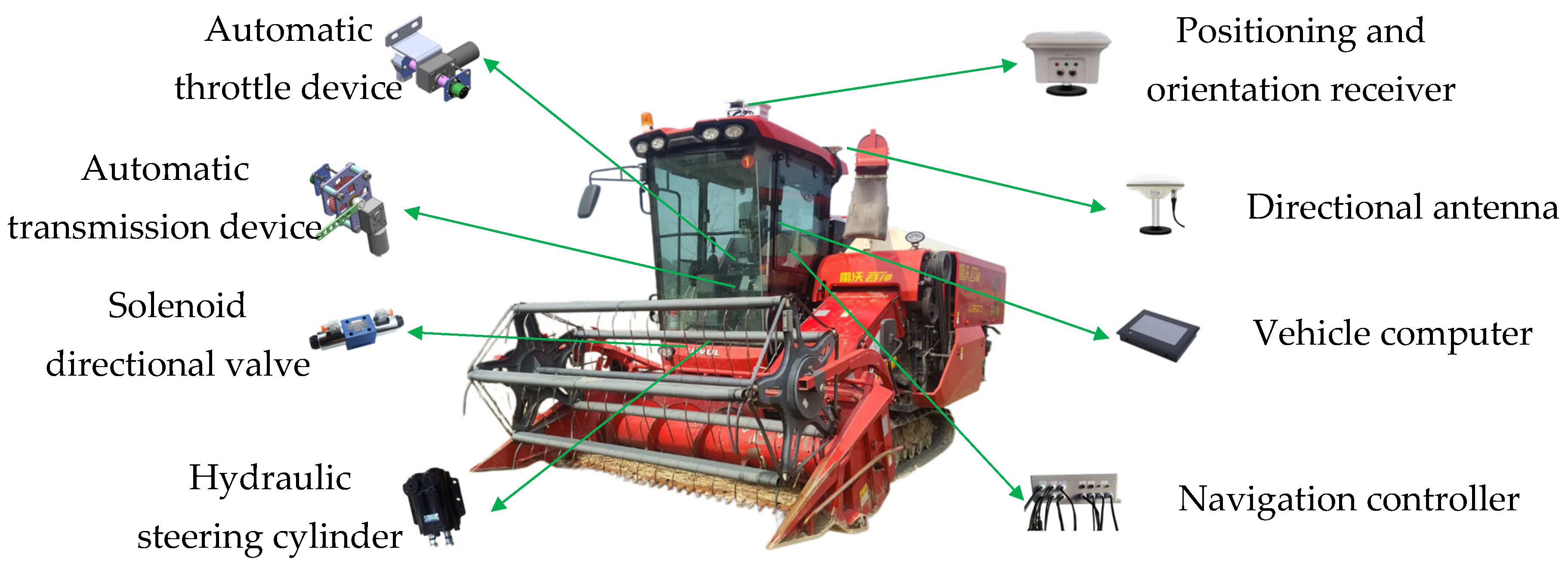
The autonomous navigation system for the crawler-type combine harvester primarily consists of a positioning and orientation receiver, a navigation control terminal, a navigation controller, and a moving control system, as shown in Figure 1. The positioning and orientation receiver integrates the UM982 dual-antenna positioning board and the JY61P IMU. The UM982 supports Real-Time Kinematic (RTK) positioning and dual-antenna orientation calculation, with horizontal positioning accuracy of 0.8 cm + 1 ppm, vertical positioning accuracy of 1.5 cm + 1 ppm, and orientation accuracy of 0.2° (1 m baseline). The JY61P compensates for positioning errors induced by machine pitch and roll, with a measurement range of ±180° on the X and Z axes, ±90° on the Y axis, and an accuracy of 0.2° for the X and Y axes and 1° for the Z axis. The navigation control terminal receives position, heading, and attitude data via the RS-232 serial port to perform navigation operations including parameter configuration, path planning, and process monitoring. The navigation controller, with the PIC18F258 microcontroller as its core processor, processes data and executes navigation algorithms while transmitting commands to the moving control system. The moving control system receives instructions from the navigation controller through the Controller Area Network (CAN) bus and controls the solenoid directional valve, automatic transmission device, and automatic throttle device to enable the crawler-type combine harvester to operate in the desired state.
Manual operation experienced drivers maintain the maximum lateral tracking error and heading error within 15 cm and 5° for straight-line path tracking, 20 cm and 10° for right-angle turning, respectively. The error threshold-based navigation system proposed in this research needed to demonstrate superior performance better than manual operation in terms of lateral and heading errors for straight driving and turns.
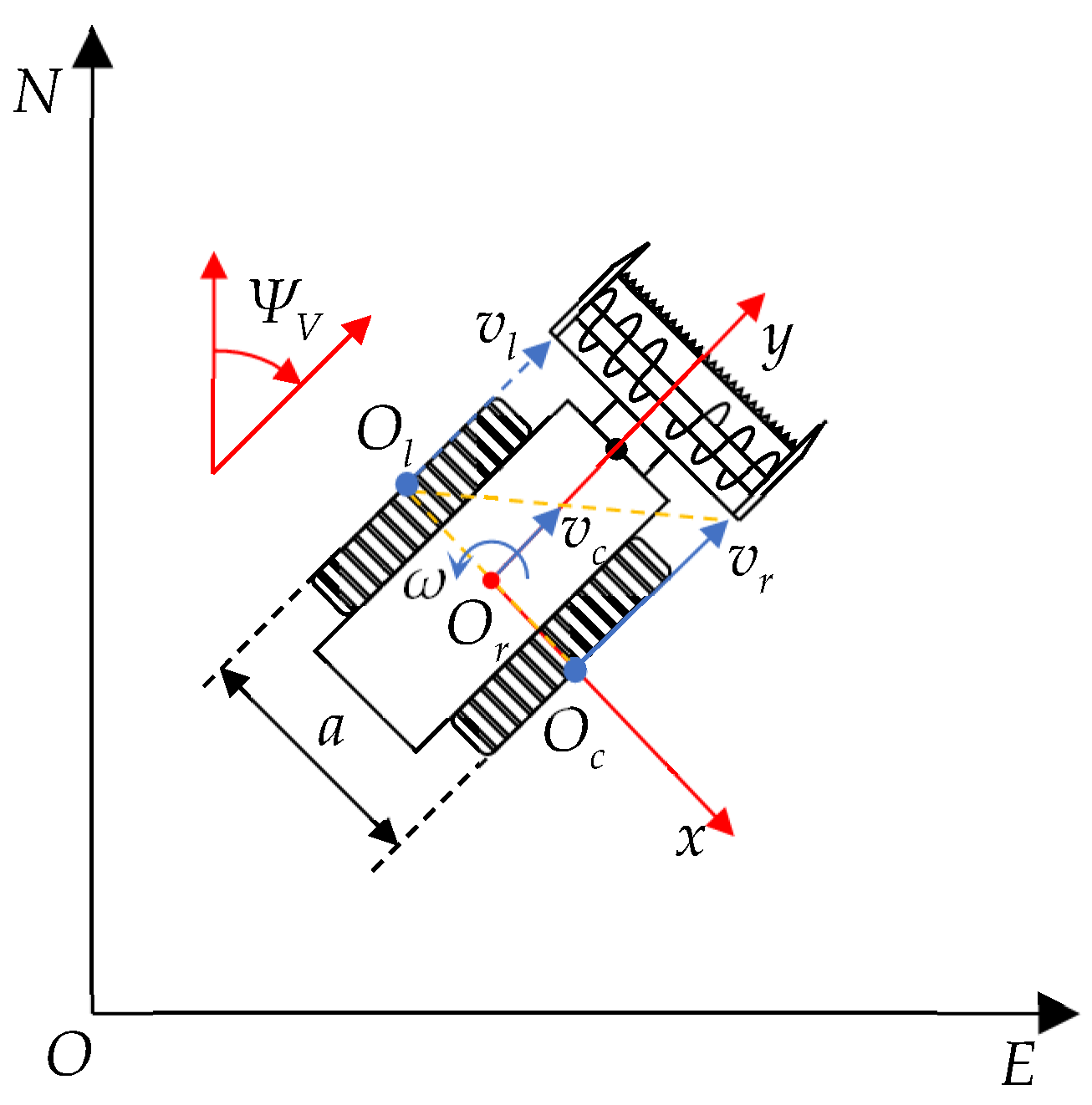
During the steering of the crawler-type combine harvester, the linear velocity of the steering-side track is 0, while the linear velocity of the opposite-side track remains constant, with the steering center located at the outer edge of the steering-side track. The following assumptions for simplifying the kinematic mode are made: (1) The center of mass coincides with the geometric center; (2) The steering angular velocity and resistance coefficient remain constant; (3) Slippage and skidding between the tracks and the ground are neglected. The kinematic model of the crawler-type combine harvester is established in the coordinate system NOE, as shown in Figure 2.
The kinematic equation for the crawler-type combine harvester is calculated:
v c ω = v l + v r 2 v r v l a
When the crawler-type combine harvester turns left, the left track is fully braked, while the right track maintains propulsion. The kinematic equation under this condition is derived as follows:
v c ω = v r 2 v r a
The steering angle θ of the crawler-type combine harvester is proportional to the energization time t of the solenoid coil in the solenoid directional valve, with the proportionality coefficient being the steering angular velocity ω. To achieve flexible steering in complex field operating environments, the steering control module should be capable of controlling the crawler-type combine harvester to turn at various amplitudes. This study employs N-channel Metal Oxide Semiconductor (NMOS) electronic switch modules to control the energization time of the solenoid coil. The module supports PWM signal triggering with a frequency range from 0 to 20 kHz.
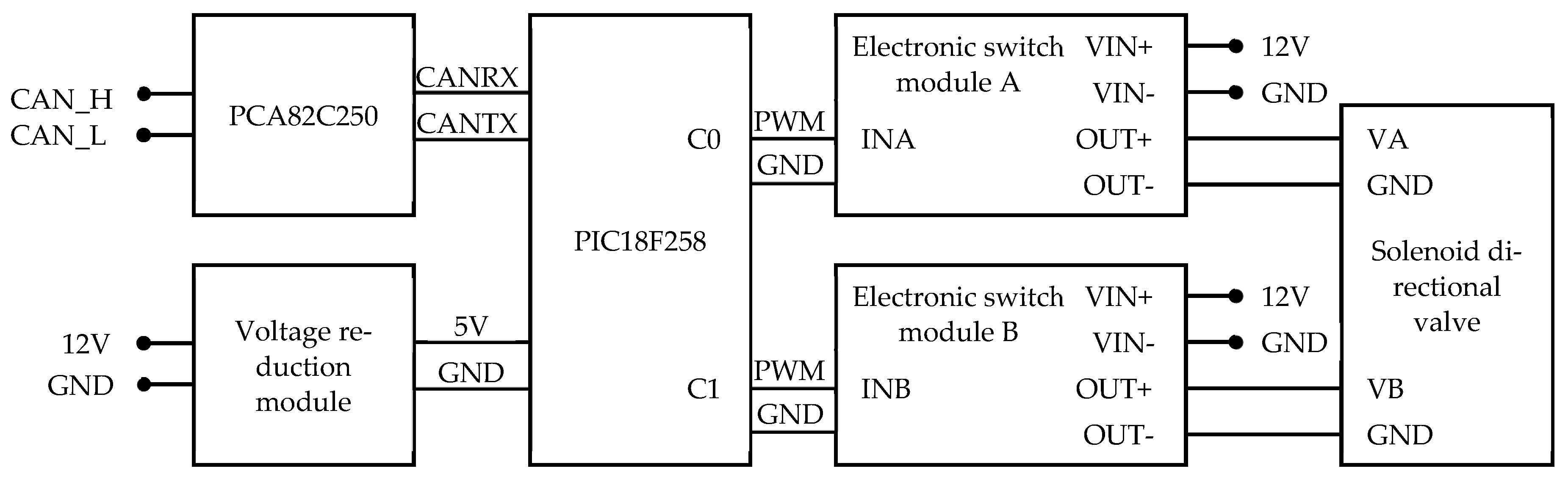
The steering control module primarily consists of a steering controller, two electronic switch modules, and a solenoid directional valve. The steering controller uses a PIC18F258 microcontroller (Microchip Technology Inc., Chandler, AZ, USA) as the core processor, with the PCA82C250 (NXP Semiconductors N.V., Eindhoven, The Netherlands) providing the CAN bus physical interface. Based on the steering commands issued on the CAN bus, it outputs PWM pulse signals with corresponding frequencies and duty cycles to control the electronic switch module, thereby adjusting the energization time of the solenoid coil and achieving flexible control of the steering action. If the steering controller outputs a PWM signal with frequency f and duty cycle D, the steering angle θ of the crawler-type combine harvester can be derived from the kinematic model as follows:
θ = ω t = 2 D v c a f = D v r a f
Since crawler slip and skid were inevitable in the paddy field, assumptions were given to create an ideal kinematic model for navigation control according to geometric dimensions of the Lovol 4LZ-7G2A combine harvester.
The diagram of the steering control module is shown in Figure 3. When output C0 is high and C1 is low, electronic switch module A activates for a left turn; the reverse activates electronic switch module B for a right turn; both low results in straight travel.

2.1. Path Planning

The spiral path is widely used in the working process of crawler-type combine harvesters due to its characteristics of continuous operation without headland turns and high field coverage efficiency [23,24,25,26]. After completing operations in the previous work area, the crawler-type combine harvester will enter the current work area via headland roads or by crossing field ridges, and different entry methods will result in different starting positions and directions for the operation. To address this issue, this study proposed a spiral path planning method to achieve complete field harvesting.
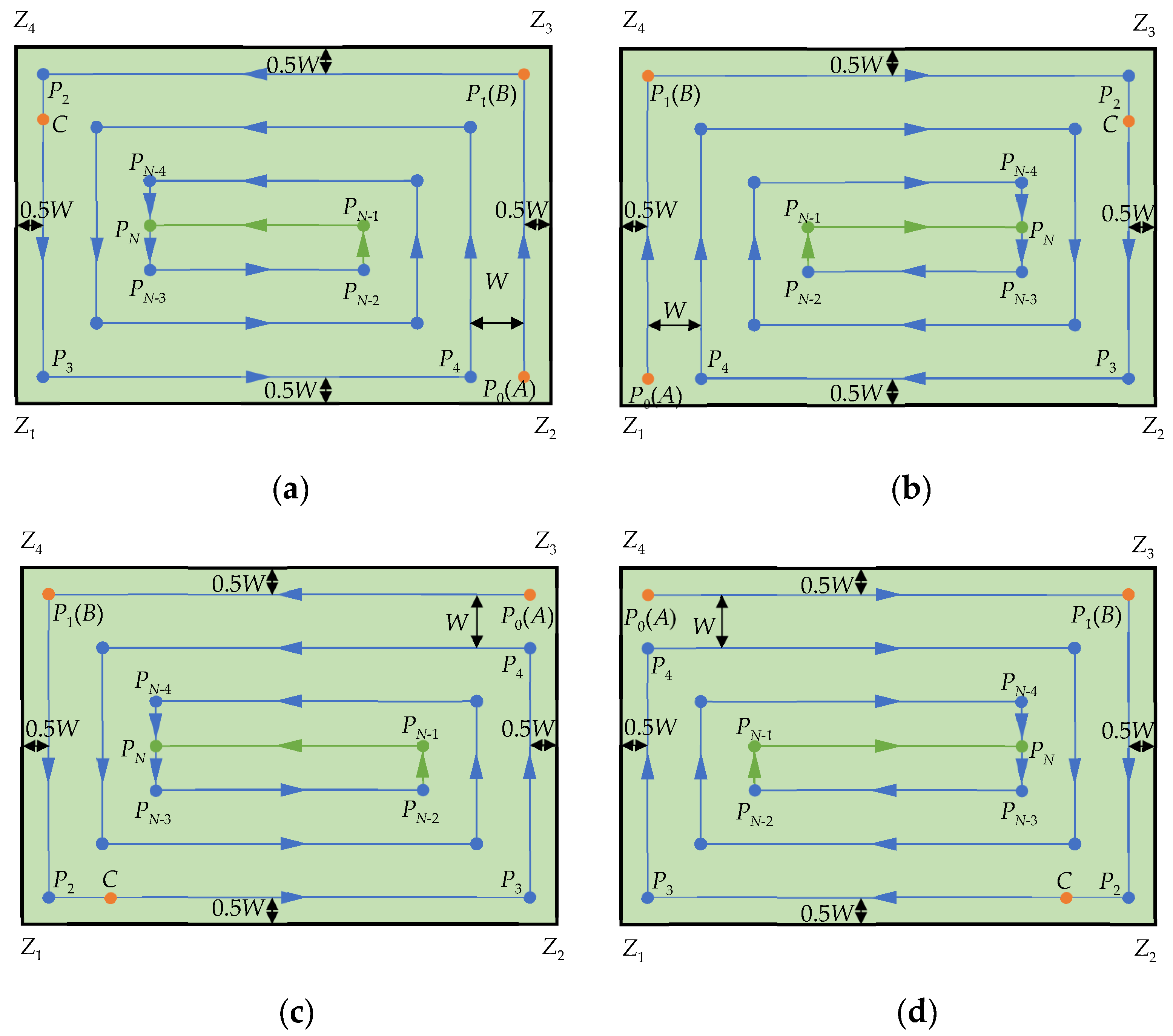
It can be seen from Figure 4 that the position coordinates of reference points A, B, and C are obtained to determine the rectangular working area Z1Z2Z3Z4. Taking Figure 4a as an example, point A is 0.5W away from both boundary lines Z1Z2 and Z2Z3, point B is 0.5W away from both boundary lines Z2Z3 and Z3Z4, and point C is 0.5W away from boundary line Z1Z4, where W is the working width of the crawler-type combine harvester. For clarity of description, the total number of paths is defined as N, with the nth path being Pn−1Pn and its length as Ln. The coordinates of the starting point Pn−1 and the endpoint Pn are (En−1, Nn−1) and (En, Nn), respectively. The path P0P1 is the baseline AB with length L1; path P1P2 is perpendicular to path P0P1, with its length L2 equal to the distance from point C to the baseline AB. In the planned spiral paths, adjacent paths are connected end-to-end and perpendicular to each other, with each completed loop contracting inward by the working width. Since the width of the working area is not exactly an integer multiple of the working width, when the crawler-type combine harvester completes the harvesting along path PN−3PN−2, the width of the unharvested area will be less than the working width. In this case, the length LN−1 of path PN−2PN−1 is planned as half of the length LN−3 of path PN−4PN−3, while the length LN of path PN−1PN is planned to be equal to the length LN−2 of path PN−3PN−2.
From these path characteristics, it can be seen that the relative positions of reference points A, B, and C determine the type of the planned spiral paths. Therefore, it is necessary to evaluate the length relationship between L1 and L2, as well as the positional relationship between point C and the baseline AB.
L1 and L2 are calculated by Equation (4) and Equation (5), respectively:
L 1 = ( E 0 E 1 ) 2 + ( N 0 N 1 ) 2
L 2 = ( E 1 E 0 ) ( N C N 0 ) ( E C E 0 ) ( N 1 N 0 ) ( E 1 E 0 ) 2 + ( N 1 N 0 ) 2
where (E0, N0) is the coordinate of point P0 (A), (E1, N1) is the coordinate of point P1 (B), and (EC, NC) is the coordinate of point C.
When L1 < L2, the total number N of paths and the length Ln of the nth path are determined by Equation (6) and Equation (7), respectively:
N = 2 L 1 W + 2
L n = L 1 n = 1 L 2 n 2 2 W n = 2 , 4 , , N 2 L 1 n 3 2 W n = 3 , 5 , , N 3 1 2 ( L 1 N 6 2 W ) n = N 1 L 2 N 4 2 W n = N
when L1L2, the total number N of paths and the length Ln of the nth path are given by Equation (8) and Equation (9), respectively:
N = 2 L 2 W + 1
L n = L 1 n = 1 L 2 n 2 2 W n = 2 , 4 , , N 3 L 1 n 3 2 W n = 3 , 5 , , N 2 1 2 ( L 2 N 5 2 W ) n = N 1 L 1 N 5 2 W n = N
The positional relationship between point C and baseline AB can be represented by the parameter CAB, which is calculated as follows:
C A B = ( N 1 N 0 ) E C + ( E 0 E 1 ) N C + E 1 N 0 E 0 N 1
When CAB < 0, the working direction is to the left, and the planned path follows a counterclockwise spiral path; when CAB > 0, the working direction is to the right, and the planned path follows a clockwise spiral path.
To calculate the endpoint coordinates of each path, it is necessary to determine the direction angle ΨAB of vector AB . The direction angle uses the true north direction of the UTM coordinate system as the 0° reference, increases clockwise, and has a range of 0–360°. ΨAB is calculated as follows:
Ψ A B = cos 1 N 1 N 0 L 1 E 0 E 1 360 cos 1 N 1 N 0 L 1 E 0 > E 1
The coordinate of the endpoint Pn for path Pn−1Pn is calculated as follows:
E n = E 0 + i = 1 n L i sin ( Ψ A B ± i 1 2 π ) N n = N 0 + i = 1 n L i cos ( Ψ A B ± i 1 2 π )
where the “±” sign is determined by the working direction: it is positive when CAB > 0 and negative when CAB < 0.
The linear equation for path Pn−1Pn is shown as follows:
A n E + B n N + C n = 0 A n = N n N n 1 B n = E n 1 E n C n = E n N n 1 E n 1 N n
where An and Bn are the coefficients of the linear equation for path Pn−1Pn, and Cn is the constant term.

2.2. Straight-Line Path Tracking

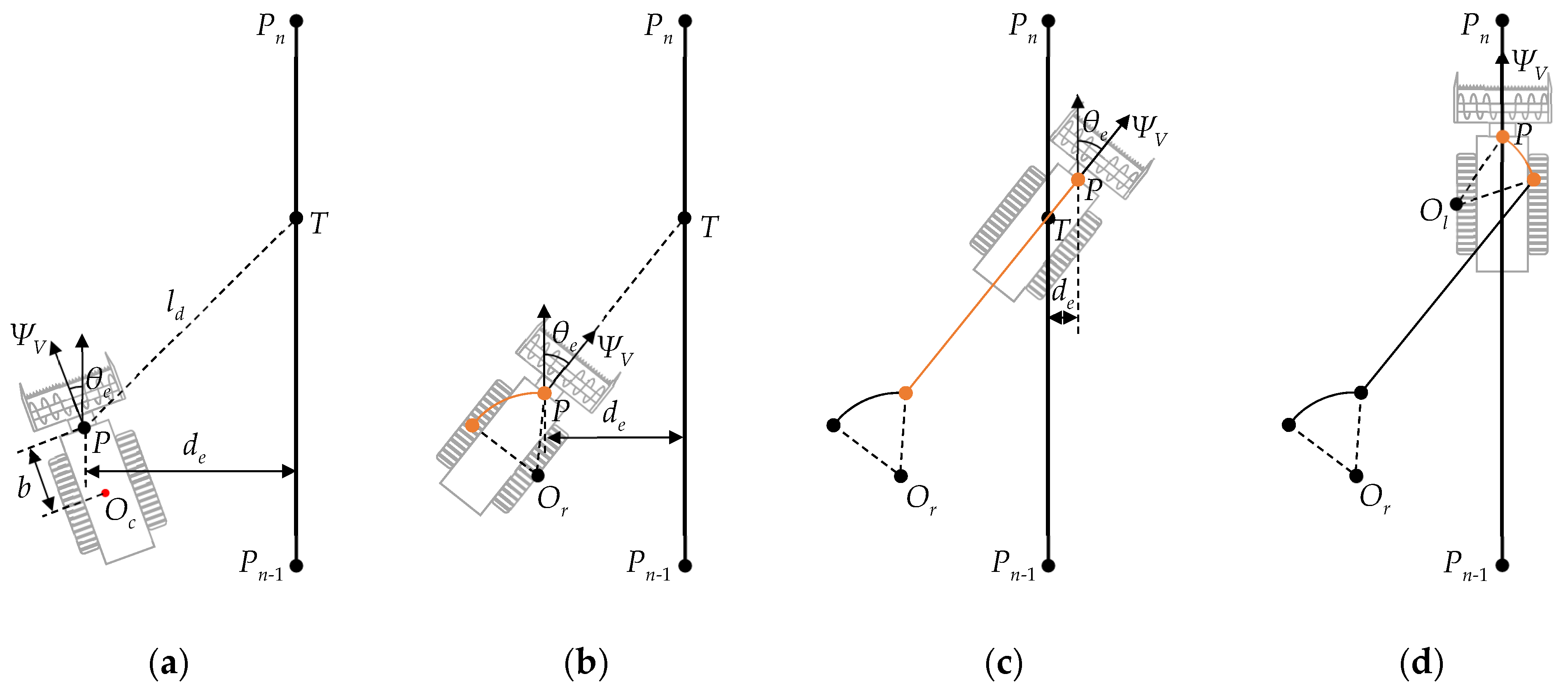
The crawler-type combine harvester’s current position and heading exhibit randomness. To achieve rapid path alignment and ensure accurate operation, this study developed a path tracking method based on error thresholds. This method calculates the lateral error de and heading error θe in real time, determines the threshold range for the errors, and executes corresponding adjustment strategies. The lateral error represents the offset between the current position and the current path, while the heading error represents the angular difference between the current heading and current path direction. By convention, both de and θe are defined as positive when the harvester is to the right of the current path with clockwise heading offset, and negative otherwise.
When lateral error is relatively small (|de| ≤ de3), intermittent adjustments are sufficient to meet straight-line path tracking accuracy requirements. Specifically: if |de| ≤ de1 and |θe| ≤ θe1, the crawler-type combine harvester achieves path alignment without requiring adjustment; if |de| ≤ de1 but θe1 < |θe| ≤ θe2, small heading-based adjustments are applied; when de1 < |de| ≤ de2 with |θe| ≤ θe2, small lateral-based adjustments are executed; for de2 < |de| ≤ de3 while |θe| ≤ θe2, large lateral-based adjustments are implemented. Special cases occur when |de| ≤ de3 and |θe| > θe2: if deθe > 0, large lateral-based adjustments are performed, whereas if deθe < 0, traveling straight can quickly corrects the lateral error until deθe > 0. de1, de2, de3 represent the first, second and third lateral error thresholds, while θe1 and θe2 denote the first and second heading error thresholds, respectively, which were determined empirically through field tests to balance between tracking accuracy and operational smoothness. de1, de2, de3, θe1, and θe2 are all positive values, and de1 < de2 < de3, θe1 < θe2. The complete intermittent adjustment strategy is detailed in Table 2.
When the lateral error is relatively large (|de| > de3), adopting the intermittent adjustment strategy would result in an excessively long alignment distance, adversely affecting work efficiency. Therefore, a “Turn-Straight-Turn” adjustment strategy is implemented for rapid path alignment.
As shown in Figure 5, the crawler-type combine harvester at the position P has a direction angle of ΨV, with lateral error de and heading error θe relative to the current path Pn−1Pn. The target point T on the current path is determined based on the look-ahead distance ld. In stage 1, the crawler-type combine harvester performs a pivot turn, while the navigation control terminal calculates ΨV and the direction angle ΨPT of PT in real time until the stage 1 termination condition is met. In stage 2, the harvester travels straight along PT to rapidly reduce the lateral error until the stage 2 termination condition is satisfied. In stage 3, the harvester performs a pivot turn to correct the heading error until the stage 3 termination condition is fulfilled. After completing the “Turn-Straight-Turn” adjustment, the system returns to the error judgment process.
The termination condition for stage 1 is given by Equation (14) as follows:
Ψ V Ψ P T d e < 0 Ψ V Ψ P T d e > 0
The termination condition for stage 2 is specified by Equation (15) as follows:
d e a 2 ( cos θ e 1 ) + b sin θ e θ e > 0 d e a 2 ( 1 cos θ e ) b sin θ e θ e < 0
where b represents the distance between the positioning and orientation receiver and the geometric center of the crawler-type combine harvester.
The termination condition for stage 3 is defined by Equation (16) as follows:
θ e θ e 1

2.3. Right-Angle Turning

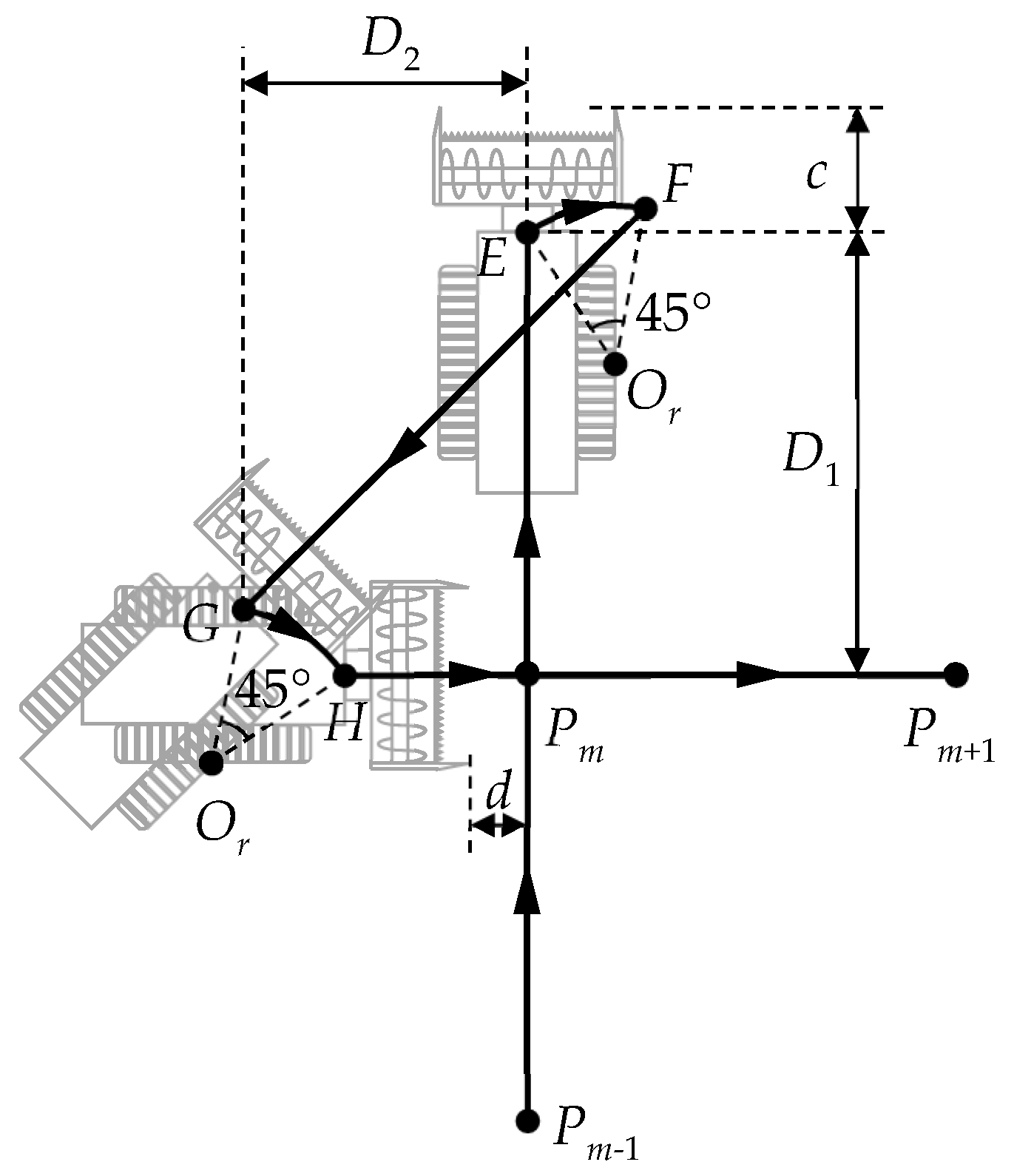
The crawler-type combine harvester must execute a right-angle turn at the endpoint of the current path to transition between rows. The right-angle turning process can be simply described as a five-step sequence: forward, turn, backward, turn, and forward. The trajectory of the crawler-type combine harvester during this process is shown in Figure 6.
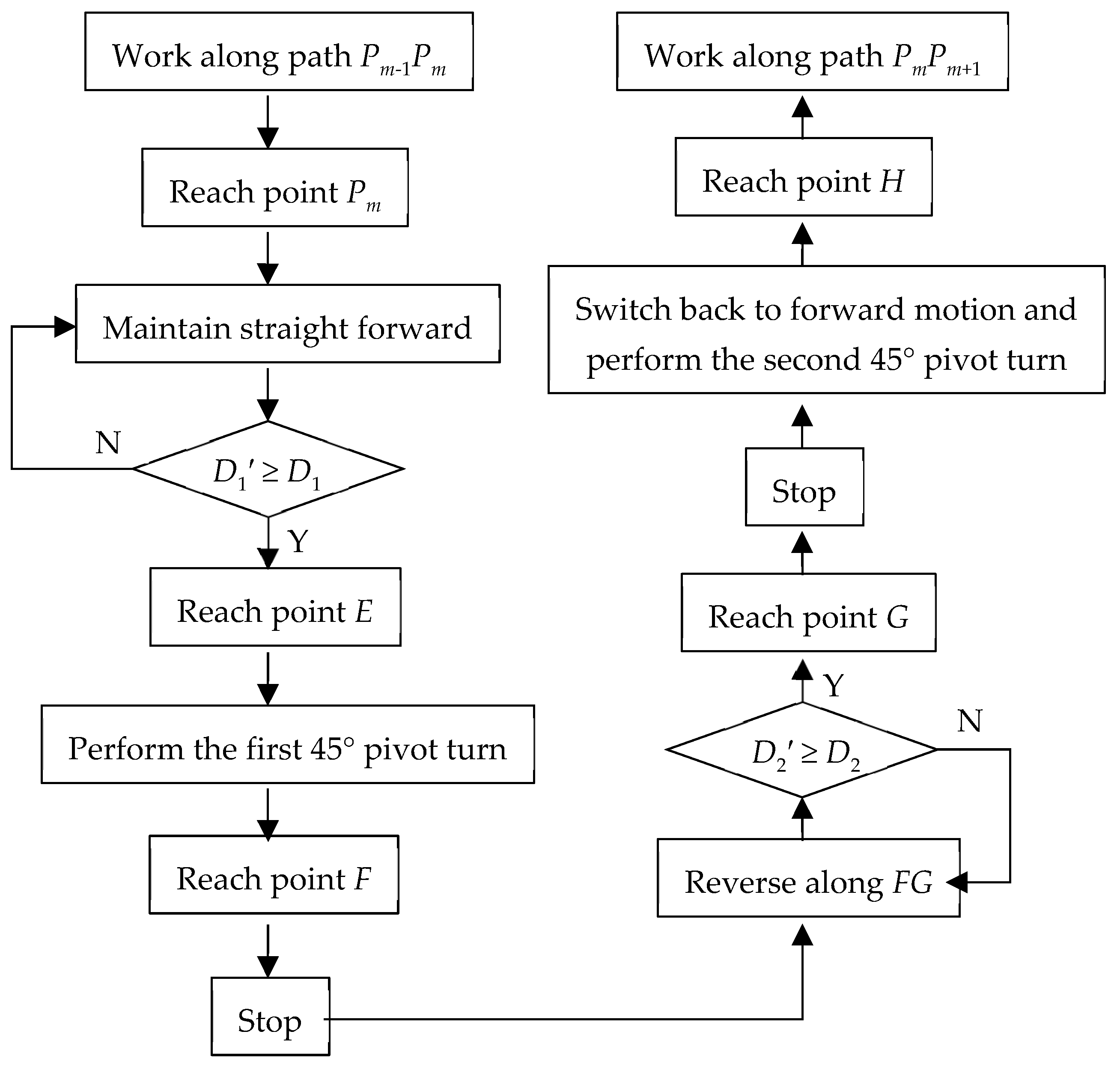
When the harvester reaches the endpoint Pm of the current path Pm−1Pm (where mN* and m < N), it maintains straight forward motion while the navigation control terminal calculates the distance D1′ between the current position and point Pm. If D1′ ≥ D1, the harvester performs the first 45° pivot turn in the working direction and stops, where D1 is the first theoretical distance set. The harvester then reverses along FG while the navigation control terminal calculates the distance D2′ between the current position and path Pm−1Pm. If D2′ ≥ D2, the harvester stops, where D2 is the second theoretical distance set. The harvester switches back to forward motion while performing the second 45° pivot turn in the working direction. The current path is updated to PmPm+1, and the system returns to the straight-line path tracking process. The crawler-type combine harvester reaches the starting point Pm of the path PmPm+1, and the right-angle turning process is completed. The flowchart of the right-angle turning is presented in Figure 7.
Considering the slip and skid effects between the tracks and soil during actual turning maneuvers, significant variations may occur in right-angle turning errors [11,19,23,24]. Excessive errors can lead to prolonged alignment distances, resulting in unharvested areas and crop damage. Therefore, when completing the right-angle turning, an adjustment distance d should be reserved between the header’s front edge and the starting point Pm of the next path. Based on the trajectory characteristics of right-angle turning, D1 and D2 are calculated by Equation (17) and Equation (18), respectively.
D 1 = 2 b + c + d
D 2 = 2 4 a + 2 2 2 b + c + d

3. Results and Discussion

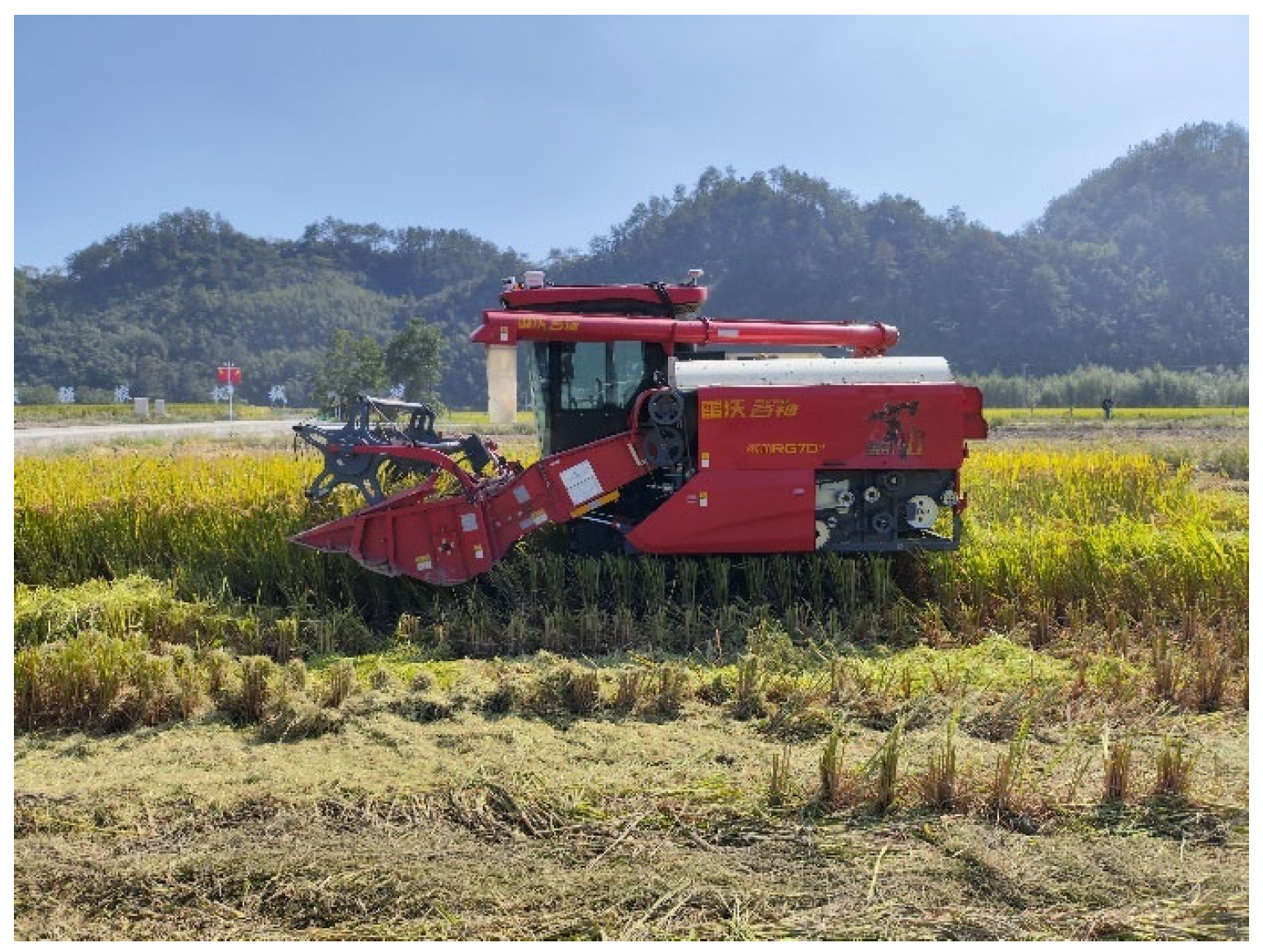
To evaluate the accuracy and stability of the developed autonomous navigation system for the crawler-type combine harvester, field tests were conducted in Hangzhou, Zhejiang Province, in October 2024. The test area featured mature rice crops in a waterlogged field with clayey and wet soil, as shown in Figure 8.
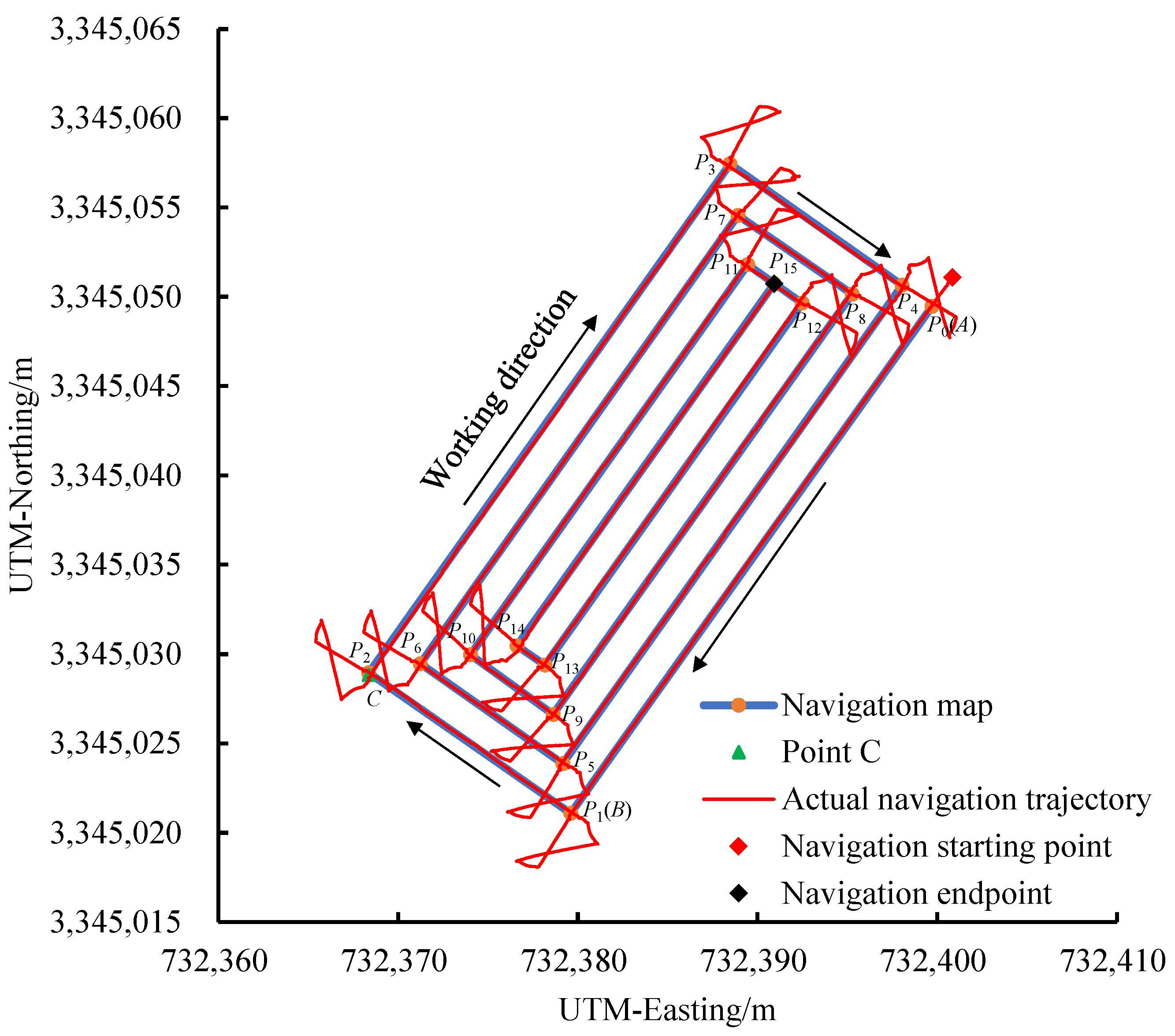
For path planning in the test area, the reference points A (732,399.72, 3,345,049.47), B (732,379.61, 3,345,021.09), and C (732,368.37, 3,345,028.84) under the UTM reference system were acquired, with distances of 34.78 m between point A and B, and 13.73 m between point C and baseline AB. The main parameters set for the test were as follows: working width W of 2 m, test speed of 0.8 m/s, sampling frequency of 10 Hz, the first lateral error threshold de1 of 10 cm, the second lateral error threshold de2 of 20 cm, the third lateral error threshold de3 of 30 cm, the first heading error threshold θe1 of 1.5°, and the second heading error threshold θe2 of 5°. The PWM signal frequency and duty cycle for small adjustments were 0.7 Hz and 20%, respectively, while those for large adjustments were 1 Hz and 50%, with a 100% duty cycle for pivot turns. The positioning and orientation receiver and directional antenna were mounted above the cabin, at the front and rear, respectively. The autonomous navigation mode was activated at the navigation starting point, enabling the crawler-type combine harvester to autonomously complete the processes of path alignment, straight-line path tracking, and right-angle turnings along the planned spiral path until it automatically stopped at the navigation endpoint. During the test, the navigation control terminal recorded the moving trajectory and calculated lateral and heading errors in real time. The navigation map and actual navigation trajectory are shown in Figure 9.

3.1. Evaluation of Straight-Line Path Tracking Performance

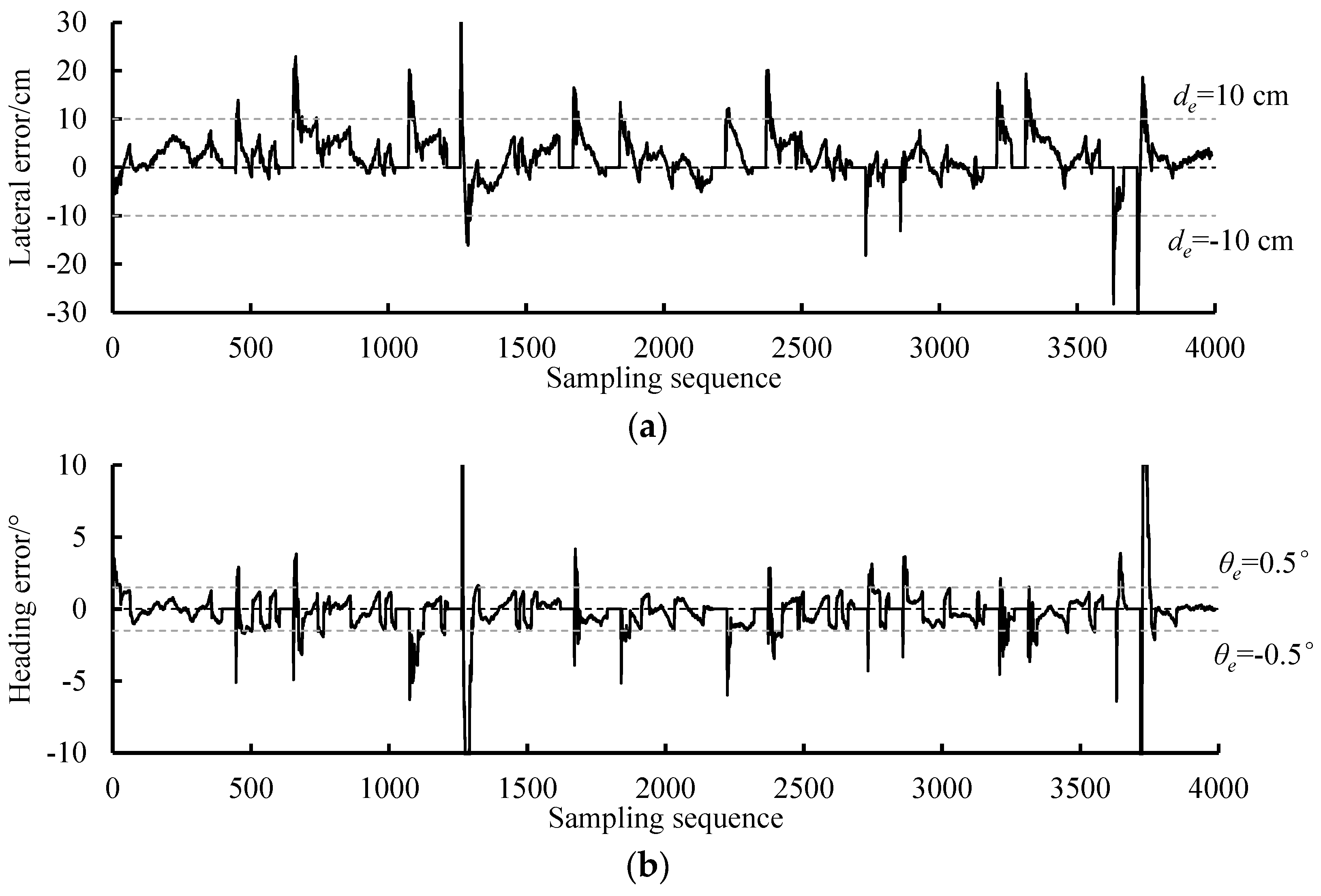
In straight-line path tracking, the errors displayed a sawtooth-like pattern due to field surface undulations and steering adjustments as shown in Figure 10. Positive lateral errors significantly outnumbered the negative values, primarily due to the rightward offset of the crawler-type combine harvester’s center of gravity, induced by the heavy grain tank, which results in more pronounced subsidence of the right-side track. Furthermore, the wet and slippery paddy soil conditions reduce the track’s lateral adhesion capability, leading to a consistent rightward sliding tendency of the harvester. A comparison between lateral and heading errors reveals that adjustments are typically triggered when the heading error reaches the predefined threshold, effectively suppressing further increases in lateral error and improving straight-line path tracking accuracy.
The mean value of absolute tracking errors in straight was statistically analyzed using the average value, maximum value, and RMS (Root Mean Square) error as metrics to evaluate the accuracy and stability of straight-line path tracking. The statistical results of the straight-line path tracking errors are presented in Table 3.
The maximum average lateral and heading errors were 6.44 cm and 1.18°, respectively. The maximum lateral and heading errors were 10.25 cm and 1.94°, respectively. And the maximum RMS lateral and heading errors were 6.48 cm and 1.19°, respectively. For the path P0P1~P10P11, the lateral error and heading error of each path were similar, with no obvious variation pattern. For the path P11P12~P14P15, the straight-line path tracking accuracy of P12P13 and P14P15 was relatively poor. This is due to the shorter path length, as the crawler-type combine harvester reaches the alignment condition when it is close to the path’s endpoint, and the error is not further reduced. These results demonstrated that the crawler-type combine harvester, equipped with the autonomous navigation system, achieves high accuracy and stability in straight-line tracking.

3.2. Evaluation of Right-Angle Turning Performance

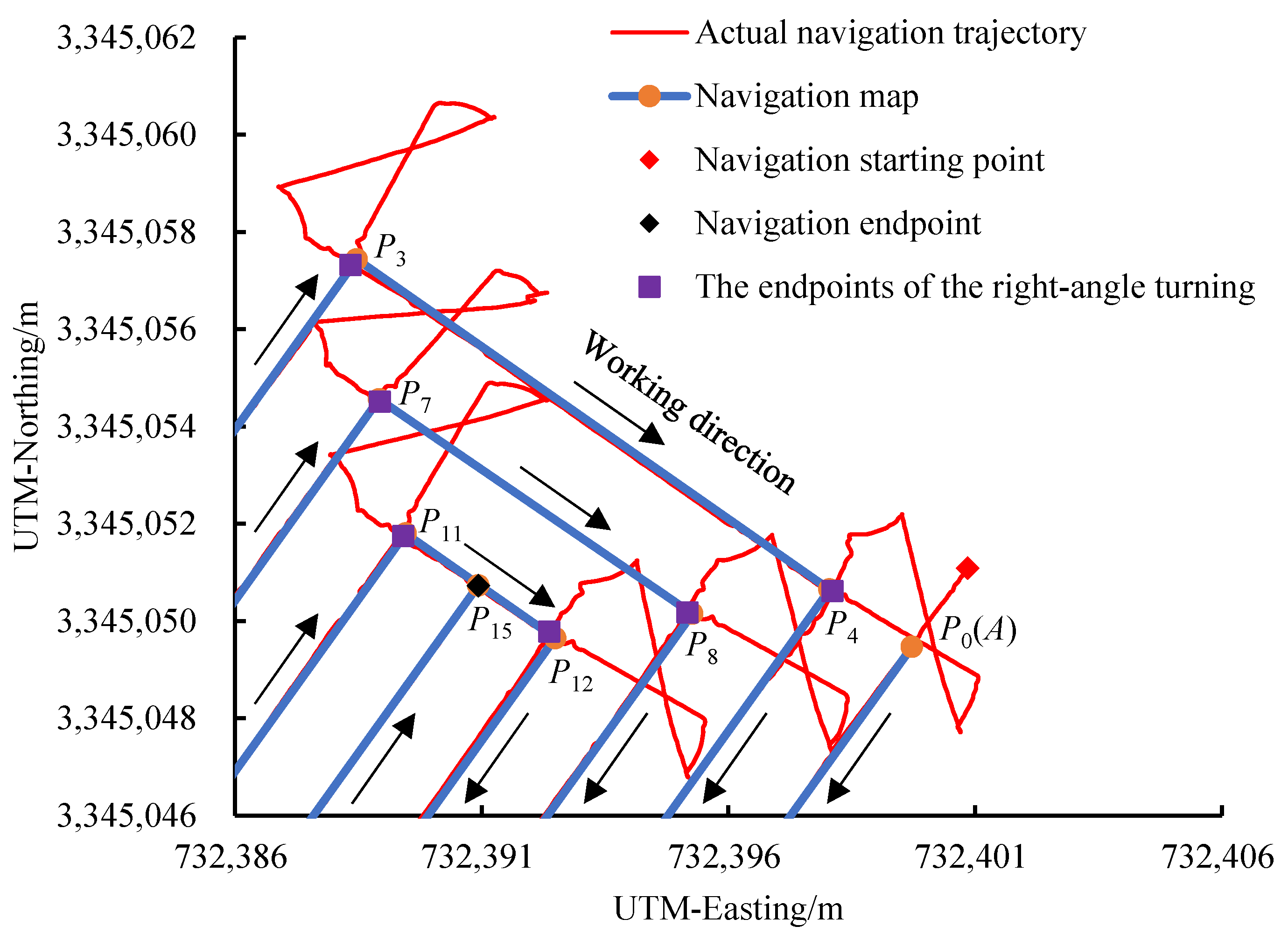
The peak error occurs at the beginning of straight-line path tracking. Due to the presence of the adjustment distance, the crawler-type combine harvester has not yet reached the endpoint of the right-angle turning at this time, so the peak error cannot be used as the evaluation metric for right-angle turning performance. When the crawler-type combine harvester completes the right-angle turning, the header begins harvesting rice, and the error at this moment can be used as the right-angle turning error to evaluate the turning accuracy. Additionally, the alignment time and alignment distance are used to evaluate the timeliness of the crawler-type combine harvester’s adjustment after the right-angle turning. Here, the alignment time and alignment distance represent the time and travel distance required from the completion of the right-angle turning until the error meets the alignment condition and remains stable. The right-angle turning performance is shown in Figure 11.
During the test, a total of 14 right-angle turnings were performed, and the recorded errors and alignment status are shown in Table 4. The maximum lateral and heading errors for the right-angle turning were 17.64 cm and −14.46°, respectively, while the minimum values were 0.41 cm and 0.32°, indicating significant variations in turn accuracy between rows. The primary reasons are Under wet soil conditions, the intensified slippage of the inner track and skidding of the outer track during pivot turns shift the steering center away from the track’s outer edge. (2) Turning resistance varies substantially across different field zones and changes dynamically during maneuvers. (3) The hydraulic-powered steering cylinder exhibits response delays relative to control signals, resulting in imprecise angle control. The heading error of the number 4 right-angle turning is significantly higher than that of the other right-angle turnings, as the harvester is in the stage 2 of the “Turn-Straight-Turn” adjustment strategy and has not yet undergone heading correction. Additionally, the positive values of the right-angle turning error in the crawler-type combine harvester were greater than the negative values, which is mainly caused by the first theoretical distance D1 being set too small or the second theoretical distance D2 being set too large. However, due to the interaction between the wet and slippery soil and the tracks, as well as the offset of the combine harvester’s center of gravity, it is difficult to determine the ideal values for the first and second theoretical distances. The maximum alignment time and alignment distance were 4 s and 3.2 m, respectively, indicating that the crawler-type combine harvester could rapidly meet the alignment condition and maintain stable operation, even when the right-angle turning accuracy was slightly compromised.
These factors indicated the limitations of the simplified kinematic model, which neglects slip and dynamic load variations. Those represent key targets for future system improvement. Nevertheless, the implemented error-threshold-based control strategy, combined with the empirical adjustment distance (d), demonstrated robustness in managing these disturbances, allowing the harvester to quickly re-align and continue stable operation after turns. Field tests results demonstrated that the developed autonomous navigation system for the crawler-type combine harvester achieves high navigation accuracy and stability, meeting the requirements of practical field operations.

4. Conclusions

In this research, the autonomous navigation system was developed to realize autonomous operation in paddy fields for a crawler-type combine harvester. Adaptive path planning, a dual-mode tracking strategy for brake-steering dynamics, and automation of right-angle turns were described to ensure harvesting performance. The error-threshold-based control logic not only ensured high tracking accuracy but also provided inherent robustness against high-frequency noise from navigation sensors. The straight-line tracking algorithm ensured high path-tracking accuracy despite soil slip and chassis asymmetry, through a combination of a multi-level error threshold adjustment strategy and a rapid alignment procedure. The adjustment distance in right-angle turns was optimized to effectively reduce cutting misses and crop damage. By enabling continuous spiral movement with reliable straight-line tracking and right-angle turning, the developed system is expected to reduce unnecessary passes and excessive maneuvering during harvesting operations. The developed navigation system does not require changes to the parameters of the working unit or field layout. The additional travel distance caused by the turning trajectory is limited and acceptable for improvement of operational stability and harvesting quality. Field test results showed that the maximum lateral and heading errors for the right-angle turning were 10.25 cm and 1.94° for straight-line tracking, 17.64 cm and −14.46° for right-angle turning, respectively, which indicated that stable and accurate performance was achieved by the developed autonomous navigation system across the entire harvesting process, demonstrating superior performance better than manual operation in terms of lateral and heading errors for straight driving and turns.
Nevertheless, this research is limited by the absence of comparisons with classical control algorithms and the use of a simplified kinematic model that omits dynamic slip. Future work will focus on adaptive determination of turning parameters under varying soil properties, reducing hydraulic steering lag, and integrating the navigation module with real-time harvesting logistics such as grain unloading to support fully autonomous field operation.

Author Contributions

Conceptualization, X.Y. and G.A.; methodology, G.A. and J.D.; software, X.Y.; validation, J.D. and W.M.; formal analysis, J.D. and W.M.; investigation, X.Y. and J.D.; resources, X.Y.; data curation, X.Y. and G.A.; writing—original draft preparation, G.A.; writing—review and editing, X.Y. and G.A.; visualization, G.A.; supervision, C.J.; project administration, C.J.; funding acquisition, C.J. and X.Y. All authors have read and agreed to the published version of the manuscript.

Funding

This research was funded by Key R&D Program of Shandong Province, China (Grant No. 2022SFGC0201); National Natural Science Foundation of China (Grant No. 32171910); National Key Research and Development Program of China (Grant No. 2021YFD2000502); Agricultural Engineering Foundation of SDUT of China (Grant No. NZY-2025-07).

Institutional Review Board Statement

Not applicable.

Data Availability Statement

The original contributions presented in the study are included in the article, further inquiries can be directed to the corresponding author.

Conflicts of Interest

The authors declare no conflicts of interest.

References

  1. Cui, B.; Cui, X.; Wei, X.; Zhu, Y.; Ma, Z.; Zhao, Y.; Liu, Y. Design and Testing of a Tractor Automatic Navigation System Based on Dynamic Path Search and a Fuzzy Stanley Model. Agriculture 2024, 14, 2136. [Google Scholar] [CrossRef]
  2. Xie, B.; Jin, Y.; Faheem, M.; Gao, W.; Liu, J.; Jiang, H.; Cai, L.; Li, Y. Research progress of autonomous navigation technology for multi-agricultural scenes. Comput. Electron. Agric. 2023, 211, 107963. [Google Scholar] [CrossRef]
  3. Yin, X.; Wang, Y.; Chen, Y.; Jin, C.; Du, J. Development of autonomous navigation controller for agricultural vehicles. Int. J. Agric. Biol. Eng. 2020, 13, 70–76. [Google Scholar] [CrossRef]
  4. Sun, J.; Zeng, L.; Ying, J.; Zheng, H.; Sun, Q.; Meng, X. Research Status and Prospect of Key Technologies of Agricultural Track Chassis. Trans. Chin. Soc. Agric. Mach. 2024, 55, 202–220. [Google Scholar] [CrossRef]
  5. Hu, C.; Ru, Y.; Li, X.; Fang, S.; Zhou, H.; Yan, X.; Liu, M.; Xie, R. Path tracking control for brake-steering tracked vehicles based on an improved pure pursuit algorithm. Biosyst. Eng. 2024, 242, 1–15. [Google Scholar] [CrossRef]
  6. Ding, Y.; He, Z.; Xia, Z.; Peng, J.; Wu, T. Design of navigation immune controller of small crawler-type rape seeder. Trans. Chin. Soc. Agric. Eng. 2019, 35, 12–20. [Google Scholar] [CrossRef]
  7. Chen, T.; Seok Ahn, H.; Sun, W.; Pan, J.; Liu, Y.; Cheng, J.; Xu, L. Optimizing path planning for a single tracked combine harvester: A comprehensive approach to harvesting and unloading processes. Comput. Electron. Agric. 2024, 224, 109217. [Google Scholar] [CrossRef]
  8. Guo, H.; Li, Y.; Wang, H.; Wang, C.; Zhang, J.; Wang, T.; Rong, L.; Wang, H.; Wang, Z.; Huo, Y.; et al. Path planning of greenhouse electric crawler tractor based on the improved A* and DWA algorithms. Comput. Electron. Agric. 2024, 227, 109596. [Google Scholar] [CrossRef]
  9. Ren, H.; Wu, J.; Lin, T.; Yao, Y.; Liu, C. Research on an Intelligent Agricultural Machinery Unmanned Driving System. Agriculture 2023, 13, 1907. [Google Scholar] [CrossRef]
  10. Wang, X.; Zhang, B.; Du, X.; Hu, X.; Wu, C.; Cai, J. An Adaptive Path Tracking Controller with Dynamic Look-Ahead Distance Optimization for Crawler Orchard Sprayers. Actuators 2025, 14, 154. [Google Scholar] [CrossRef]
  11. Lu, E.; Xu, L.; Li, Y.; Tang, Z.; Ma, Z. Modeling of working environment and coverage path planning method of combine harvesters. Int. J. Agric. Biol. Eng. 2020, 13, 132–137. [Google Scholar] [CrossRef]
  12. Takai, R.; Barawid, O.; Noguchi, N. Autonomous Navigation System of Crawler-Type Robot Tractor. IFAC Proceedings Volumes. In Proceedings of the 18th IFAC World Congress, Milano, Italy, 28 August–2 September 2011; Volume 44, pp. 14165–14169. [Google Scholar] [CrossRef]
  13. Takai, R.; Yang, L.; Noguchi, N. Development of Crawler-Type Robot Tractor Based on GNSS and IMU. IFAC Proceedings Volumes. In Proceedings of the 5th IFAC Conference on Bio-Robotics, Sakai, Japan, 27–29 March 2013; Volume 46, pp. 95–98. [Google Scholar] [CrossRef]
  14. Kurita, H.; Iida, M.; Cho, W.; Suguri, M. Rice Autonomous Harvesting: Operation Framework. J. Field Robot. 2017, 34, 1084–1099. [Google Scholar] [CrossRef]
  15. Song, Y.; Xue, J.; Zhang, T.; Sun, X.; Sun, H.; Gao, W.; Chen, Q. Path tracking control of crawler tractor based on adaptive adjustment of lookahead distance using sparrow search algorithm. Comput. Electron. Agric. 2025, 234, 110219. [Google Scholar] [CrossRef]
  16. Wang, N.; Jin, Z.; Wang, T.; Xiao, J.; Zhang, Z.; Wang, H.; Zhang, M.; Li, H. Hybrid path planning methods for complete coverage in harvesting operation scenarios. Comput. Electron. Agric. 2025, 231, 109946. [Google Scholar] [CrossRef]
  17. Zhang, C.; Dong, W.; Xiong, Z.; Hu, Z.; Wang, D.; Ding, Y. Design and Experiment of Fuzzy Adaptive Pure Pursuit Control of Crawler-Type Rape Seeder. Trans. Chin. Soc. Agric. Mach. 2021, 52, 105–114. [Google Scholar] [CrossRef]
  18. Zhou, J.; Wen, J.; Yao, L.; Yang, Z.; Xu, L.; Yao, L. Agricultural Machinery Path Tracking with Varying Curvatures Based on an Improved Pure-Pursuit Method. Agriculture 2025, 15, 266. [Google Scholar] [CrossRef]
  19. He, J.; Man, Z.; Hu, L.; Luo, X.; Wang, P.; Li, M.; Li, W. Path tracking control method and experiments for the crawler-mounted peanut combine harvester. Trans. Chin. Soc. Agric. Eng. 2023, 39, 9–17. [Google Scholar] [CrossRef]
  20. Zhang, S.; Wei, X.; Liu, C.; Ge, J.; Cui, X.; Wang, F.; Wang, A.; Chen, W. Adaptive path tracking and control system for unmanned crawler harvesters in paddy fields. Comput. Electron. Agric. 2025, 230, 109878. [Google Scholar] [CrossRef]
  21. Zhou, B.; Su, X.; Yu, H.; Guo, W.; Zhang, Q. Research on Path Tracking of Articulated Steering Tractor Based on Modified Model Predictive Control. Agriculture 2023, 13, 871. [Google Scholar] [CrossRef]
  22. Xu, J.; Lai, J.; Guo, R.; Lu, X.; Xu, L. Efficiency-Oriented MPC Algorithm for Path Tracking in Autonomous Agricultural Machinery. Agronomy 2022, 12, 1662. [Google Scholar] [CrossRef]
  23. Lee, K.; Choi, H.; Kim, J. Development of Path Generation and Algorithm for Autonomous Combine Harvester Using Dual GPS Antenna. Sensors 2023, 23, 4944. [Google Scholar] [CrossRef] [PubMed]
  24. Luo, C.; Xiong, C.; Huang, X.; Ding, Y.; Wang, S. Coverage operation path planning algorithms for the rape combine harvester in quadrilateral fields. Trans. Chin. Soc. Agric. Eng. 2021, 37, 140–148. [Google Scholar] [CrossRef]
  25. Wei, W.; Xiao, M.; Duan, W.; Wang, H.; Zhu, Y.; Zhai, C.; Geng, G. Research Progress on Autonomous Operation Technology for Agricultural Equipment in Large Fields. Agriculture 2024, 14, 1473. [Google Scholar] [CrossRef]
  26. Zhang, S.; Wei, X.; Deng, Y.; Zhang, C.; Ji, X.; Wang, A. Design and experiments of the whole field path tracking algorithm for a track based harvest. Trans. Chin. Soc. Agric. Eng. 2023, 39, 36–45. [Google Scholar] [CrossRef]
Figure 1. The autonomous navigation system for the crawler-type combine harvester.
Agriculture 16 00042 g001
Figure 2. Kinematic model of the crawler-type combine harvester. xOcy is the coordinate system of the crawler-type combine harvester; Oc is the geometric center of the crawler-type combine harvester; Ol and Or are the left and right steering centers, respectively; vc is the velocity of the harvester’s geometric center (m/s); vl and vr are the linear velocities of the left and right tracks, respectively (m/s); ω is the steering angular velocity of the crawler-type combine harvester (rad/s); a is the distance between the outer edges of the left and right tracks (m). ΨV is the direction angle of the crawler-type combine harvester (°).
Agriculture 16 00042 g002
Figure 3. Diagram of the steering control module. C0 and C1 are the digital output pins of the PIC18F258 microcontroller; PWM is the pulse-width modulation signal; CANTX is the CAN bus transmit terminal of the PIC18F258 microcontroller; CANRX is the CAN bus receive terminal of the PIC18F258 microcontroller; INA and INB are the signal trigger ports of the electronic switch module; VIN+ and OUT+ are the positive input port and positive output port of the electronic switch module, respectively; VIN- and OUT- are the negative input port and negative output port of the electronic switch module, respectively; VA and VB are the positive input ports of the solenoid coils.
Agriculture 16 00042 g003
Figure 4. Schematic diagram of planned spiral paths. (a) Planned spiral path when L1 < L2 and CAB < 0; (b) Planned spiral path when L1 < L2 and CAB > 0; (c) Planned spiral path when L1L2 and CAB < 0; (d) Planned spiral path when L1L2 and CAB > 0. CAB is a parameter that characterizes the positional relationship between point C and the baseline AB.
Agriculture 16 00042 g004
Figure 5. Schematic diagram of the “Turn-Straight-Turn” adjustment strategy. (a) Initial position of the crawler-type combine harvester; (b) Stage 1 of the “Turn-Straight-Turn” adjustment strategy; (c) Stage 2 of the “Turn-Straight-Turn” adjustment strategy; (d) Stage 3 of the “Turn-Straight-Turn” adjustment strategy.
Agriculture 16 00042 g005
Figure 6. Schematic diagram of right-angle turning. Points E and F represent the positions of harvester before and after the first 45° pivot turn, respectively; Points G and H represent the positions of harvester before and after the second 45° pivot turn, respectively; c is the distance from the positioning and orientation receiver to the header front edge; d is the adjustment distance.
Agriculture 16 00042 g006
Figure 7. Flowchart of the right-angle turning.
Agriculture 16 00042 g007
Figure 8. Field tests in the rice field of Hangzhou, China.
Agriculture 16 00042 g008
Figure 9. Navigation map and actual navigation trajectory.
Agriculture 16 00042 g009
Figure 10. Error variations during field test: (a) Lateral error variation; (b) Heading error variation.
Agriculture 16 00042 g010
Figure 11. Right-angle turning performance. The endpoints of the right-angle turning refer to the harvester’s positions upon completing the right-angle turning.
Agriculture 16 00042 g011
Table 1. Key parameters of the Lovol 4LZ-7G2A crawler-type combine harvester.
ParameterValue
Engine power (ps)140
Cutting width (m)2.3
Feeding capacity (kg/s)7
Machine weight (kg)3890
Dimensions (m × m × m)6.2 × 2.75 × 2.9
Track gauge (m)1.2
Grain tank capacity (m)1.6
Table 2. Intermittent adjustment strategy.
de[−de3, −de2)[−de2, −de1)[−de1, 0)(0, de1](de1, de2](de2, de3]
θe
(−∞, −θe2)LRLRLRNNN
[−θe2, −θe1)LRSRSRSRSLLL
[−θe1, 0)LRSRNNSLLL
(0, θe1]LRSRNNSLLL
(θe1, θe2]LRSRSLSLSLLL
(θe2, +∞)NNNLLLLLL
where SL means small left adjustment; LL means large left adjustment; SR means small right adjustment; LR means large right adjustment; N means traveling straight.
Table 3. Statistics of straight-line path tracking errors.
PathLateral Error (cm)Heading Error (°)
AverageMaximumRMSAverageMaximumRMS
P0P12.747.523.350.461.290.58
P1P22.719.773.361.071.711.14
P2P33.6910.254.80.641.940.78
P3P45.197.835.380.561.80.71
P4P53.127.723.570.671.730.78
P5P63.319.114.110.711.150.73
P6P72.287.32.610.51.490.64
P7P83.919.9551.181.471.19
P8P92.797.33.480.71.470.79
P9P101.5841.861.071.441.1
P10P111.97.652.40.721.440.78
P11P126.198.386.260.660.970.67
P12P133.39.833.980.561.650.67
P13P146.448.396.480.440.950.5
Table 4. Statistics of right-angle turning errors.
NumberLateral Error
(cm)
Heading Error
(°)
Alignment Time (s)Alignment Distance (m)
17.13−0.9400
217.640.613.83.04
313.53−3.543.62.88
4−6.87−14.4643.2
56.85−2.090.60.48
69.35−1.1500
78.95−1.2100
87.64−2.3221.6
90.413.1310.8
102.082.440.80.64
117.36−2.653.22.56
1214.180.323.22.56
13−8.792.291.41.12
148.399.12.82.24
Disclaimer/Publisher’s Note: The statements, opinions and data contained in all publications are solely those of the individual author(s) and contributor(s) and not of MDPI and/or the editor(s). MDPI and/or the editor(s) disclaim responsibility for any injury to people or property resulting from any ideas, methods, instructions or products referred to in the content.