Article

Vibration-Excited Combined Harvester for Dual Harvesting of Ears and Stalks: Design and Experiments
1
School of Agricultural Engineering and Food Science, Shandong University of Technology, Zibo 255000, China
2
Institute of Modern Agricultural Equipment, Shandong University of Technology, Zibo 255000, China
*
Author to whom correspondence should be addressed.
Agriculture 2026, 16(1), 104; https://doi.org/10.3390/agriculture16010104
Submission received: 12 December 2025 / Revised: 30 December 2025 / Accepted: 30 December 2025 / Published: 31 December 2025
(This article belongs to the Section Agricultural Technology)

Abstract

Aiming at the reliability of ear picking and the consistency of stalk chopping length in the process of corn ear and stalk harvesting, a new type of corn harvester with both ear and stalk harvesting based on exciting ear picking was developed. Based on the vertical cutting table, the machine realizes the excitation of the ear during the process of stalk transportation by rotating the eight-edged special-shaped pick-up roll, and the stable and orderly transportation of stalks before cutting is realized by the way of clamping and conveying with the rear rollers. By analyzing the configuration and parameter determination methods of the main working parts, the high-efficiency and low-loss harvest of the ear was realized, and the consistency of the cut length of the stalk was guaranteed. A discrete element model (DEM) of ear-bearing maize plants was established using EDEM (version 2024, Altair Engineering, Troy, MI, USA) simulation software, and a five-factor, three-level quadratic orthogonal rotation experiment was conducted based on Response Surface Methodology (RSM). The simulation results indicated that the optimal operational quality was achieved under the following parameters: a header angle of 10°, a snapping roller speed of 942 rpm, a clamping roller speed of 215 rpm, and a moving blade speed of 1450 rpm. Furthermore, multiple sets of field trials were conducted at various forward speeds to validate these findings. The mean values of seed loss rate, ear loss rate, and seed breakage rate are 0.51%, 0.55%, and 0.32%, respectively, for the harvester at operating speeds of 4 km/h, 6 km/h, 8 km/h, and 10 km/h. The σ values are 97%, 98%, 97%, and 98%. The field harvesting performance indexes meet the requirements of technical specifications for evaluating the operation quality of corn combine harvester, and meet the design requirements of low loss, high efficiency, and consistency of stem chopping length.

1. Introduction

“In China, corn—as a primary food crop—reached a planting area of 3.51 × 10⁶ hm2 in 2012, thereby becoming the largest major food crop [1].” However, with the impact of international corn prices in 2014, China’s corn prices suddenly fell to approximately 0.4 yuan/kg. This price lingered for several years and seriously dampened the enthusiasm of farmers to grow corn. In 2014, the State Council issued the Outline for the Development of Food and Nutrition in China (2014–2020). To ensure the basic self-sufficiency of grains and the absolute safety of rations, the State Council proposed that the planned target of 29 kg per capita meat consumption and 36 kg dairy consumption should be achieved by 2020, thus promoting the promulgation and implementation of the policy of changing food to feed. In this context, the development of corn ear-stalk harvesting technology and equipment has important practical significance for ensuring food security production and alleviating the shortage of animal husbandry feed [2,3].
In terms of mechanized harvesting of corn stalks, most of the corn harvesters in developed countries adopt the form of both ear and stem harvesting, and most of them are in the form of direct grain collection [4]. However, this kind of harvester, because of its large size, can only be used in large areas, and its price is high, so it has not been widely used in China. In China, most harvesters only harvest the ears of corn. The straw was smashed and returned to the field by adding a straw returning machine. The straw could not be recovered, and the power consumption was also large. For this reason, Chinese scholars have made relevant research on corn harvesters suitable for China. S. Ramm studied the technology of corn ear and stalk harvesting earlier [5]. A vertical picking roll header was used to realize corn ear and stalk harvesting, but the reliability of ear harvesting led to the failure of the machine to be popularized. In 2009, Tan drew lessons from the double-deck cutting platform of the KcKy-6 corn combine harvester developed by Haishan Group and Ukraine and developed a corn harvester with both ear and stalk harvesting by a double-deck header [6]. The harvester achieves the harvesting of ears through the upper header, while the lower header cuts the stalks and conveys them in gathering. Finally, the harvester cuts and spreads them. Although this method can achieve both ear and stem harvesting, problems such as ear damage and difficulty of guaranteeing the cut-up length remain due to the transverse and longitudinal transportation of stalks. Yang developed a method of cutting and throwing stalks when they were transversely transported to one side; this method was based on Diao’s research, and it simplified the structure of the entire machine [7,8]. However, problems such as the chopping length being difficult to guarantee also occur.
The reliability of corn ear picking and the consistency of stalk cutting length must be improved to popularize and apply the technology of corn ear and stalk harvesting on a large scale. Particularly, the reliability of harvesting must indicate low-loss and high-efficiency harvesting, and the problems of feeding stalks in a direction must be solved to achieve consistency of stalk shredding [9]. Only when these requirements are met can the technology of ear and stalk harvesting be productive, thereby improving the economic benefits of corn production [10].
To achieve efficient and low-damage ear picking and high-quality stalk cutting during the maize ear and stalk simultaneous harvesting process, this study conducted the following research: (1) analyzed the mechanism of vibration-assisted ear picking and high-quality stalk cutting, and the intrinsic connection with the design of the maize combine harvester for simultaneous ear and stalk harvesting, establishing a design method for efficient and low-damage maize combine harvesters; (2) constructed discrete element simulation models for vibration-assisted ear picking and stalk cutting using EDEM finite element software, and combined with response surface experimental design, obtained the optimal combination of key design parameters for the ear picking and stalk-cutting components; (3) conducted field trials to verify that the designed vibration-based maize combine harvester for ear and stalk simultaneous harvesting achieved efficient and low-damage harvesting performance. This research provides theoretical and technical support for the structural improvement and performance enhancement of maize-combined harvesters for simultaneous ear and stalk harvesting.

2. Materials and Methods

2.1. Structure and Working Principle of the Machine

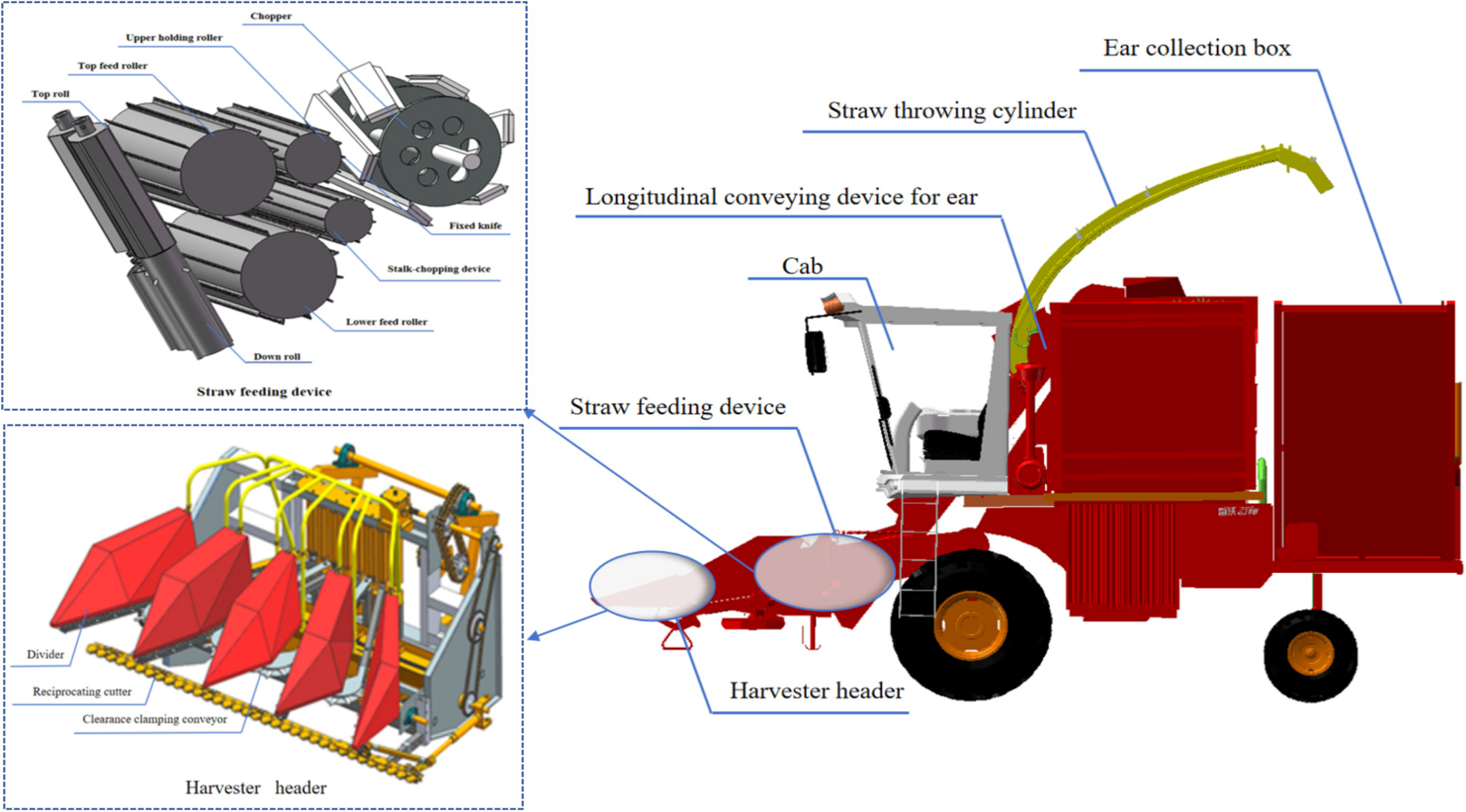
We determine the structure of the entire machine (Figure 1) to ensure the reliability of corn ear picking and the consistency of stalk chopping. The machine is mainly composed of a divider, a reciprocating cutter, a clearance clamping conveyor, an exciting and snapping device, a stalk-conveying device, a stalk-chopping device, a walking system, an ear-collecting box, a longitudinal ear-conveying device, and a cab.
When the machine is in operation, the divider completes the separation of the corn plant to be harvested from other plants [10]. Under the action of star wheel and divider, corn plants are introduced into a closed conveying channel composed of a reeling chain and a compression bar to realize an orderly feeding of corn plants. The reciprocating cutter located under the reeling chain can cut off the stalk to solve the problem of incorrect row harvest of corn plants and then ensure the efficiency of ear and stalk harvesting of corn. The cut stalk is forced into the excitation ear-picking device through the gap-clamping conveyor to complete the separation of the ear and stalk, which can effectively prevent the gnawing of the ear in the process of corn harvesting [11]. The picked ear falls into the transverse conveying device of the ear due to gravity. When the ear is conveyed to the right side of the machine, it is conveyed back to the peeling device by the vertical conveying device of the ear. The peeling of the ear is completed, then it falls into the collection box to complete the collection. The stalks of the harvested ears are transported backward and forward by the exciting picking device, and the fixed length of the stalks is cut with the help of dynamic and static knives. Finally, the stalks are thrown out by the throwing barrel. In this process, a high-speed moving picking roller is used to separate the ear from the stalk in the harvesting process, which is not only efficient but also causes minimal damage to the ear. For stalk harvesting, the stalk is kept at forward motion from picking to cutting, which ensures that the stalk is fed perpendicular to the cutting edge of the moving knife that guarantees the consistency of the length of stalk cutting.

2.2. Layout Design of the Machine

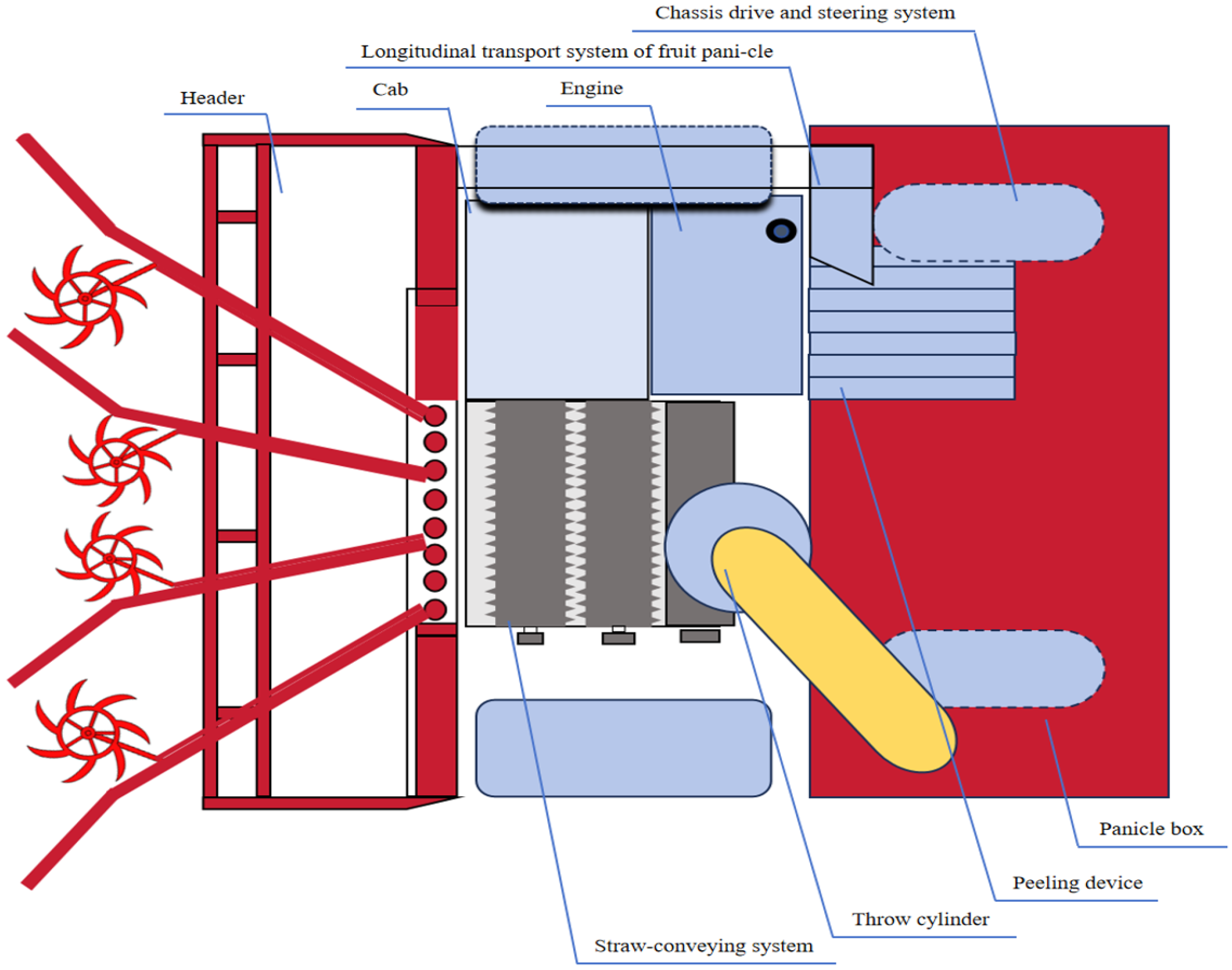
In the layout design, according to the requirements of operation technology and function, the header is arranged in front of the entire machine to ensure the natural posture of the stalk in the process of plant harvesting [12]. The vertical picking technology is adopted to solve the problem of guaranteeing the consistency of straw-cutting length due to the traditional straw cutting and transverse conveying–vertical straightening conveying–chopping technology. This method is conducive to the forward transportation of straw and improves the consistency of straw-cutting posture. The snapping device on the header adopts the ear-picking roller centralized row structure, which is conducive to shortening the hob length and reducing the influence of the weight of the entire machine and the deviation in the center of gravity [13].
We set the cab above the driving axle and the straw-conveying system and behind the header to create a broad vision for the operators in consideration of the appearance and structure of the entire machine layout and the safety, convenience, and comfort of operation. The engine is arranged in the cab of the right rear and juxtaposed with the chopped hob to reduce the driving distance between the bridge and engine for ensuring that the focus is on the middle position. We minimize the length of the stalk conveyor and arrange the throwing barrel behind and above the hob in consideration of the large weight of the engine (including gearbox) and for the compactness of the entire machine structure. A multiroll clamping conveyor with step-by-step acceleration is adopted between the picking roll and the chopping hob to prevent the disturbance of stalk posture and improve the consistency of straw chopping. The peeling device is arranged at the rear of the engine and the front and upper position of the header box. The structure layout is formed (Figure 2).

2.3. Key Technologies and Structural Design

2.3.1. Determination of the Principle of High-Efficiency and Low-Loss Ear Picking

In the development of an ear-harvesting table, we consider the current problems of corn harvesting, such as gnawing ear and grain, because both ear and stalk harvesting is a job to complete the harvesting of ear and stalk at the same time [10,14]. Thus, this machine adopts the vertical roll header structure of an eight-edge special-shaped roll [15]. The high-speed vibration of the stalk is driven by the alternating changes of the edges of the eight-edge special-shaped roll. The separation of the ear and stalk is completed under the excitation force, and the contactless picking of the ear is realized. The vertical roll header can ensure that the harvested ears leave the harvesting roll immediately under the action of gravity and can prevent the secondary gnawing of the ears by the harvesting rollers, and the speed of the vertical roll header is higher than that of the horizontal one. Therefore, the efficiency of harvesting ears can be effectively improved.

2.3.2. Determination of Structural Parameters for Ear Picking

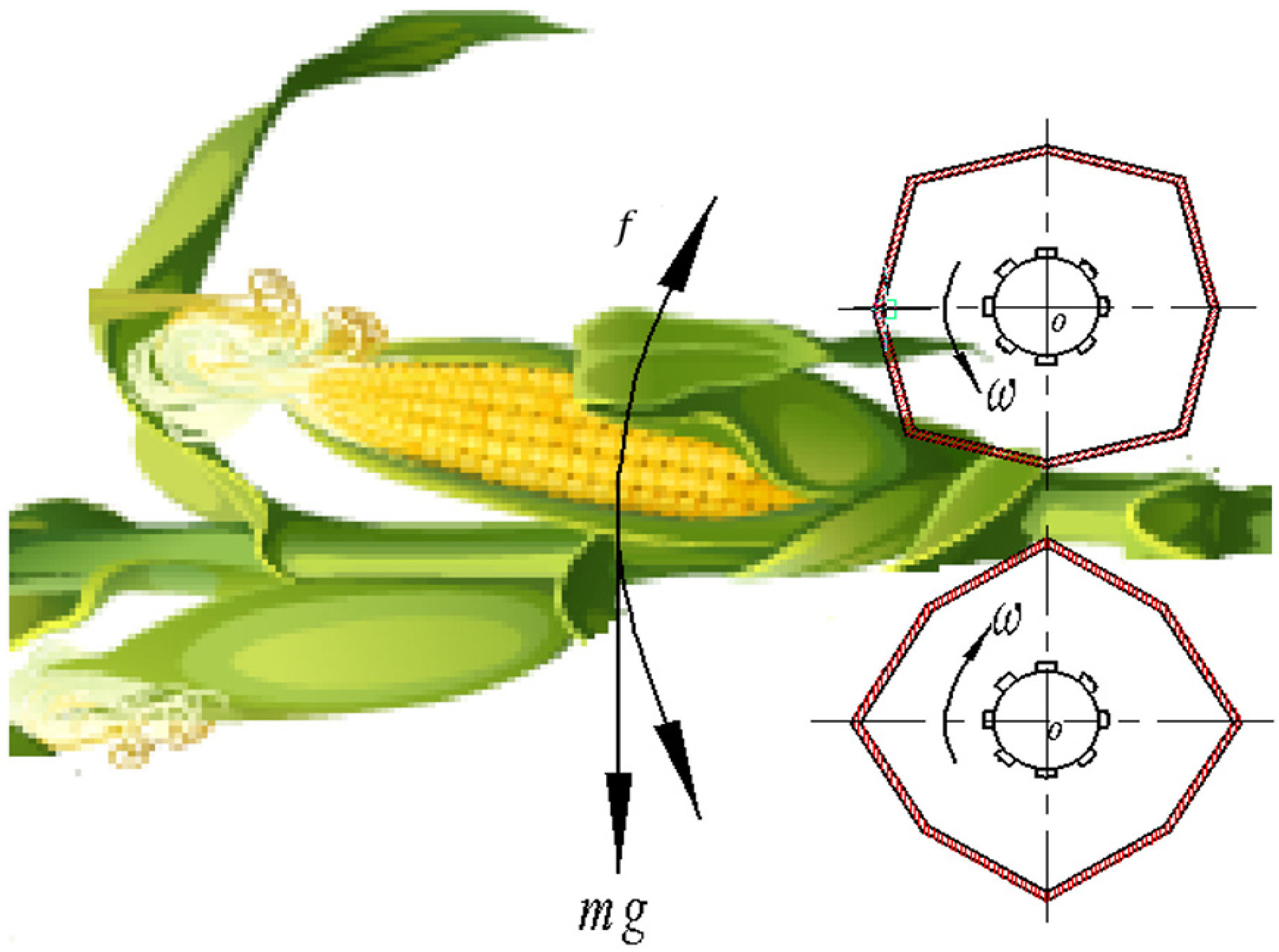
The machine adopts the structure of an eight-edge special-shaped picking roll to realize contactless picking of ears (Figure 3).
If the angular velocity of the picking roll is ω, its rotational speed n can be expressed as follows:
n = 30 ω π
Owing to the eight-edge structure of the picking roller, the frequency f and the period T of the ear vibration caused by the rotation of the pair of picking rollers are respectively as follows:
f = 8 n / 60 = 8 × 30 ω 60 π = 4 ω π
T = 1 f = π 4 ω
Two types of motion of eared corn plant occur under the action of the above-mentioned shock wave. One is the uniform motion along the plant axis, and the other is the excitation motion perpendicular to the axis of the corn plant under the action of the shock wave. The absolute motion of eared corn is the combination of the two. The uniform motion along the plant axis exerts a minimal effect on the excitation ear picking and hence can be neglected in the analysis of the excitation ear picking. The motion of the corn ear becomes the exciting motion only along the vertical axis of the plant. The equation of motion is as follows:
y = A cos ( φ 0 + ω g t )
where A represents the amplitude of panicle vibration under excitation wave, cm. φ0 is the initial phase of panicle vibration. ωg is the angular frequency of the ear when it is vibrated. Its value is determined by the rotational speed of the exciting ear-picking roller and the number of edges. t denotes time, s.
Under this exciting force, the inertia force produced by the ear is as follows:
F = m y = m A ω g 2 cos ( φ 0 + ω g t )
The connecting force between the ear and handle is allowed to be F, the allowable bending stress of the handle is τ0, the diameter of the handle is d, and the length is l. The bending stress of the fruit handle caused by the excitation force is as follows:
τ = M W z = F l / 2 π d 3 / 32 = 16 F l π d 3 = 16 m A ω g 2 l π d 3 cos ( ϕ 0 + ω g t )
For breaking the corn handle,
min ( τ ) [ τ 0 ]
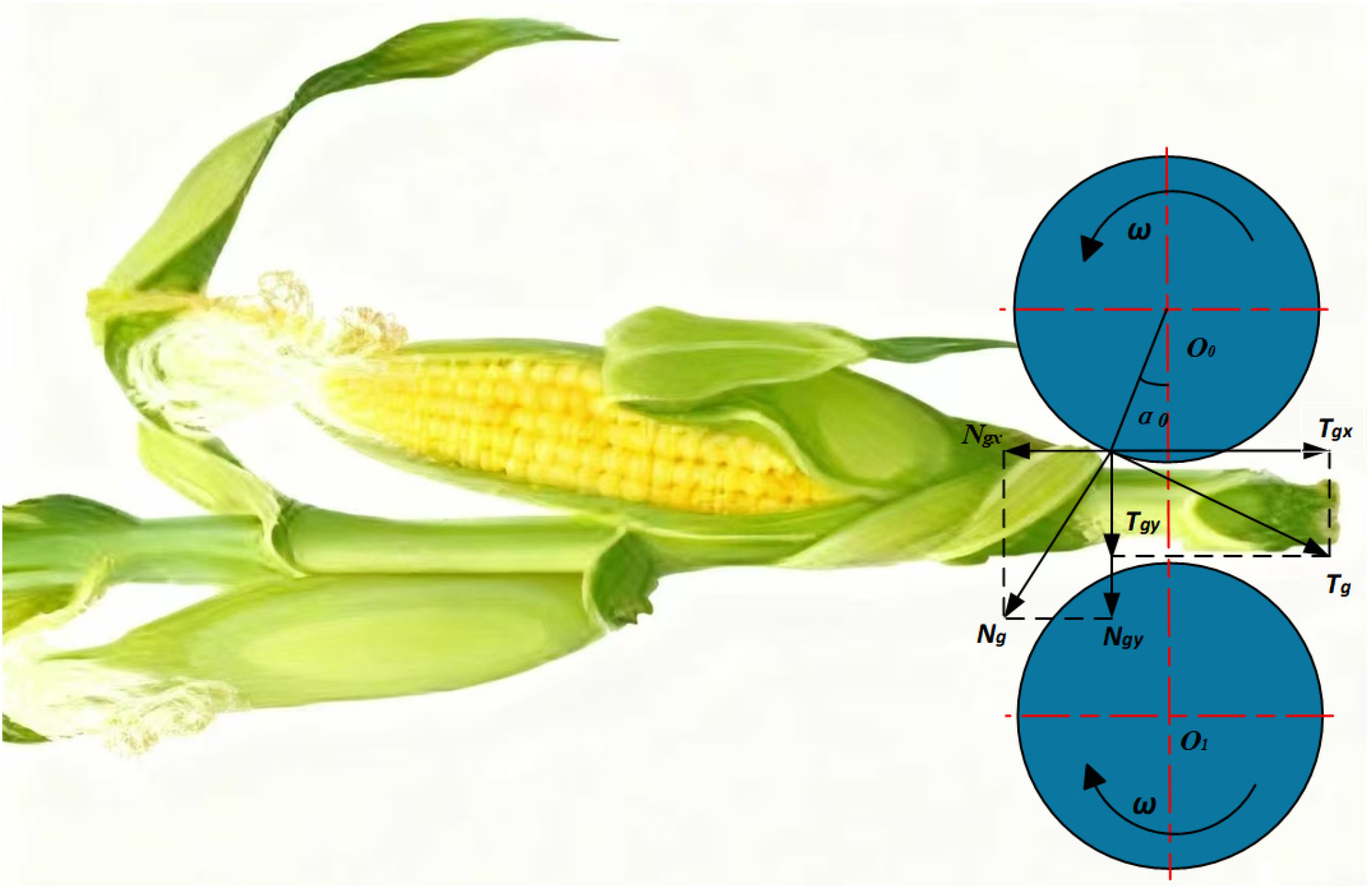
The ear-picking roller has a pulling effect on the corn stalk because of the uniform movement of stalks along the direction. The stress of the ear in this process is accordingly analyzed. If the angular velocity of the picking roll is ω, the force exerted by the picking roll on the stalk to prevent the stalk from entering the picking roll is Ng, and the pulling force of the picking roll on the stalk is Tg. Ng and Tg are decomposed into horizontal forces Ngx and Tgx, respectively. The force required to pull the handle is Rg. The conditions for pulling the handle are as follows (Figure 4).
T g x N g x R g / 2
Given
T g x = T g cos α 0
N g x = N g sin α 0
T g = μ g N g
Therefore,
( μ g cos α 0 sin α 0 ) N g R g 2
Given
N g = N g y cos α 0
Thus,
N g y ( μ g tan α 0 ) R g 2
Accordingly,
min ( N g y ( μ g tan α 0 ) ) [ R g / 2 ]
where μg is the grabbing coefficient of the picking roll to the corn handle, and α0 is the average grabbing angle of the picking roll to the corn handle.
To separate the ear from the corn handle,
min ( τ ) [ τ 0 ] min ( N g y ( μ g tan α 0 ) ) [ R g / 2 ]

2.3.3. Design of Straw-Harvesting Device

The consistency of stalk-chopping length exerts an important influence on anaerobic fermentation quality in the later stage [14,16]. For the corn harvester with both ear and stalk harvesting, ensuring that the direction of stalk feeding is perpendicular to the direction of the blade of the moving knife and that the chopping position is suitable (to ensure the quality of chopping and power consumption) is necessary to ensure the consistency of the length of stalk chopping [17,18].

2.3.4. Determination of Straw-Harvesting Device

As mentioned above, the consistency of cut stalk length needs to be improved to avoid the disorder of stalk caused by transverse transporting of stalk in traditional corn harvester with spike and stalk harvesting [10]. Therefore, the vertical picking roll header is adopted in this study. In this way, the stalk is first cut off, then clamped and transported, and finally transported backward through the picking roll, which can effectively avoid the confusion of the straw-transporting process. The twin-roll opposite structure is adopted to complete the stalk conveying after the picking roll because the bottom plate of the stalk contact conveying channel will lead to the decrease in stalk speed, which may cause the confusion on the stalk conveying posture and the instability of the conveying speed. The support cutting under the clamping state is also adopted to reduce the power consumption in the process of stalk chopping. The diameter of the subsequent upper and lower clamping rolls is smaller than that of the upper and lower feeding rolls to avoid the deformation of the stalk caused by the distance between the clamping point and the cutting position and the reduced consistency of the length of the stalk cutting.

2.3.5. Determination of the Position and Parameters of the Feed Roller

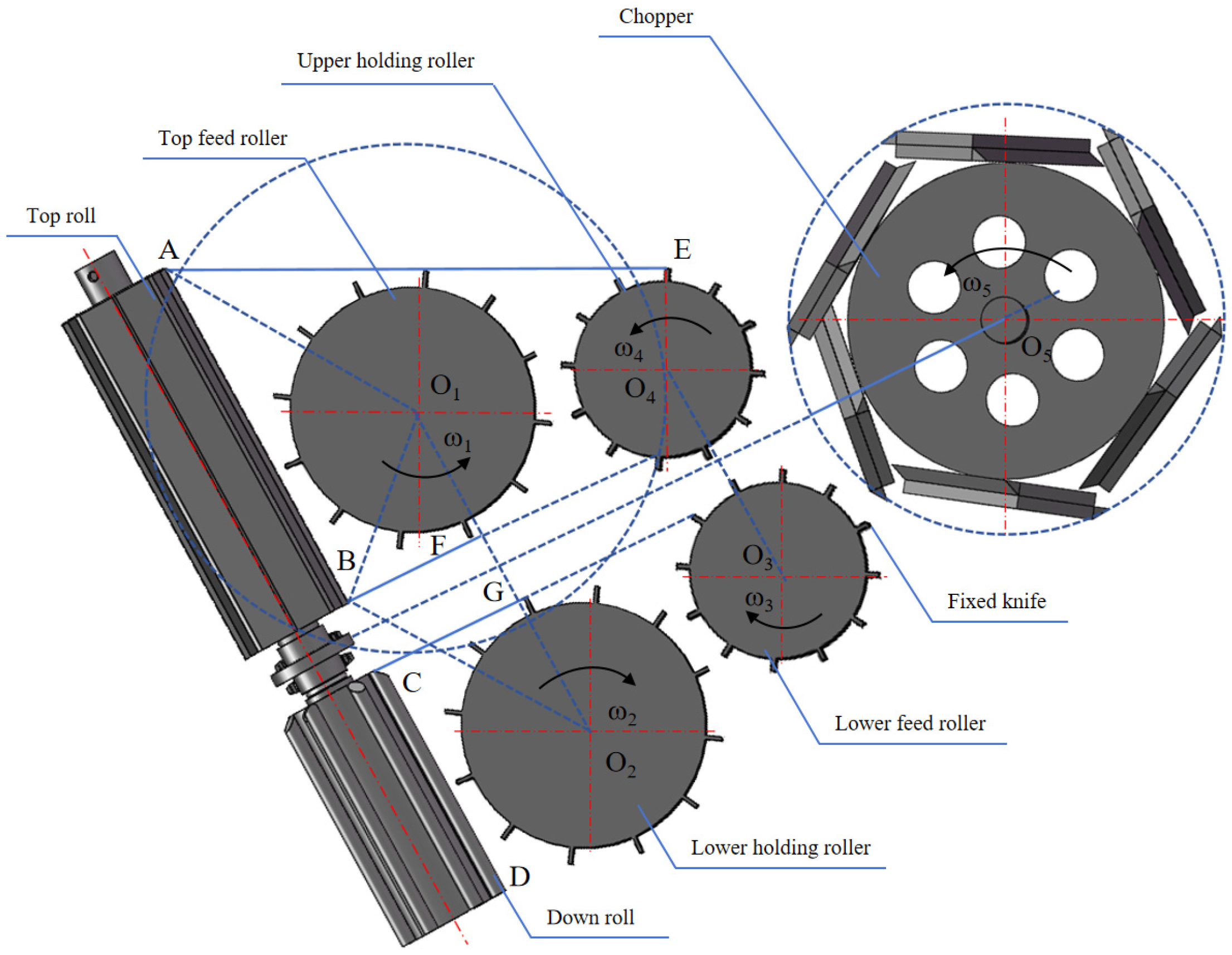
In the picking process, the lower part of the picking roll grabs the stalk, and the upper part of the picking roll completes the picking. The clearance between the two feeding rollers is selected in the position where the picking rollers are relatively small and have transmission sprockets to ensure the stable clamping and conveying of stalks, and the axis of the two feeding rollers is parallel to the axis of the picking rollers. As shown, O1O2//AD (Figure 5).
The diameter of the feeding roll is determined according to the position and size of the feeding roll to ensure the compact structure and the reliability of stalk grabbing. The horizontal line AE is made along point A of the upper feeding roll. Specific methods are as follows: the horizontal line AE is made along point A of the upper feeding roll, the straight line BF perpendicular to its axis is made at point B of the upper feeding roll, and the angular bisectors of ∠BAE and ∠ABF are taken. The intersection point O1 of the two bisectors is the axis position of the upper feeding roll. Circles are made tangent to AE, AB, and BF through O1 (which can clean up the roll removal), that is, the position and size of the upper feeding roll. Crossing point C is a straight line CG perpendicular to the axis of the picking roll, and ∠DCG is an angular line intersecting O1O2 with O2 at O2. Crossing O2 with the CD tangent circle, the circle O2 is the position and size of the feeding roll. The diameters of the upper and lower feeding rolls are equal, that is, r1 = r2.
The stalk should be clamped as far as possible and the distance between the clamping position and the chopper should be controlled to ensure the stability of stalk clamping during chopping. Therefore, the upper and lower clamping rollers of the stalk-conveying device adopt opposite rollers with different diameters.
In this case, the diameter of the clamping roll is d3 = 1/2d1. The position determination principle is as follows: the upper edge of the lower clamping roll and the upper edge of the lower feeding roll must be leveled to ensure the smoothness of the stem transportation. The lower clamping roll is tangent to the side of the lower feeding roll, that is, the lower clamping roll O3 is tangent to the lower feeding roll O2 and the straight line CG at the same time, to reduce the size of the structure and make the lower clamping roll clean up the lower feeding roll. In principle, the diameter of the upper clamping roll O4 is equal to that of the lower clamping roll. However, on the basis of the diameter of the lower clamping roll and according to the requirements of clamping degree, an additional compression amount δ of the stem is added, that is, the diameter of the upper clamping roll d4 = d3 + 2δ to make the stem clamping stable and reliable. Its position is determined by ensuring that it is tangent to the requirements of upper feeding roll and clamping clearance, as shown by O4 in Figure 5.
The cutter is the core component of the stalk-chopping device. The position of the cutter must be vertical to the feeding direction of the stalk when chopping the stalk to ensure the consistency of the length of the stalk chopping. In the entire cutting process, the minimum displacement of the moving cutter in the horizontal direction must be guaranteed. The moving cutter must be perpendicular to the direction of stem transportation. Therefore, the center position of the moving cutter is located in the position shown by O5 in Figure 5. If the speed of the cutter hob is ω5, the number of moving cutters is z, the radius of lower clamping roll is r3, the speed is ω3, and the length of stalk cutter is
L = 2 π r 3 ω 3 ω 5 z × 1000
where r3ω3 represents the linear velocity and ω5z represents the cutting frequency; if the resulting L is in mm, it must be multiplied by 1000.

2.4. Parameter Optimization

The analysis indicates that the quality of ear picking and stalk chopping of the designed corn stalk–ear combine harvester is primarily influenced by the rotational speed of the picking roller, the header angle, the rotational speed of the clamping roller, the rotational speed of the moving knife, and the number of circumferential moving knives. To obtain the optimal parameter combination and ensure operational quality, response surface methodology (RSM) experiments were conducted in this study using Design-Expert version 13 software combined with EDEM simulation tests.

2.4.1. Establishment of Simulation Model

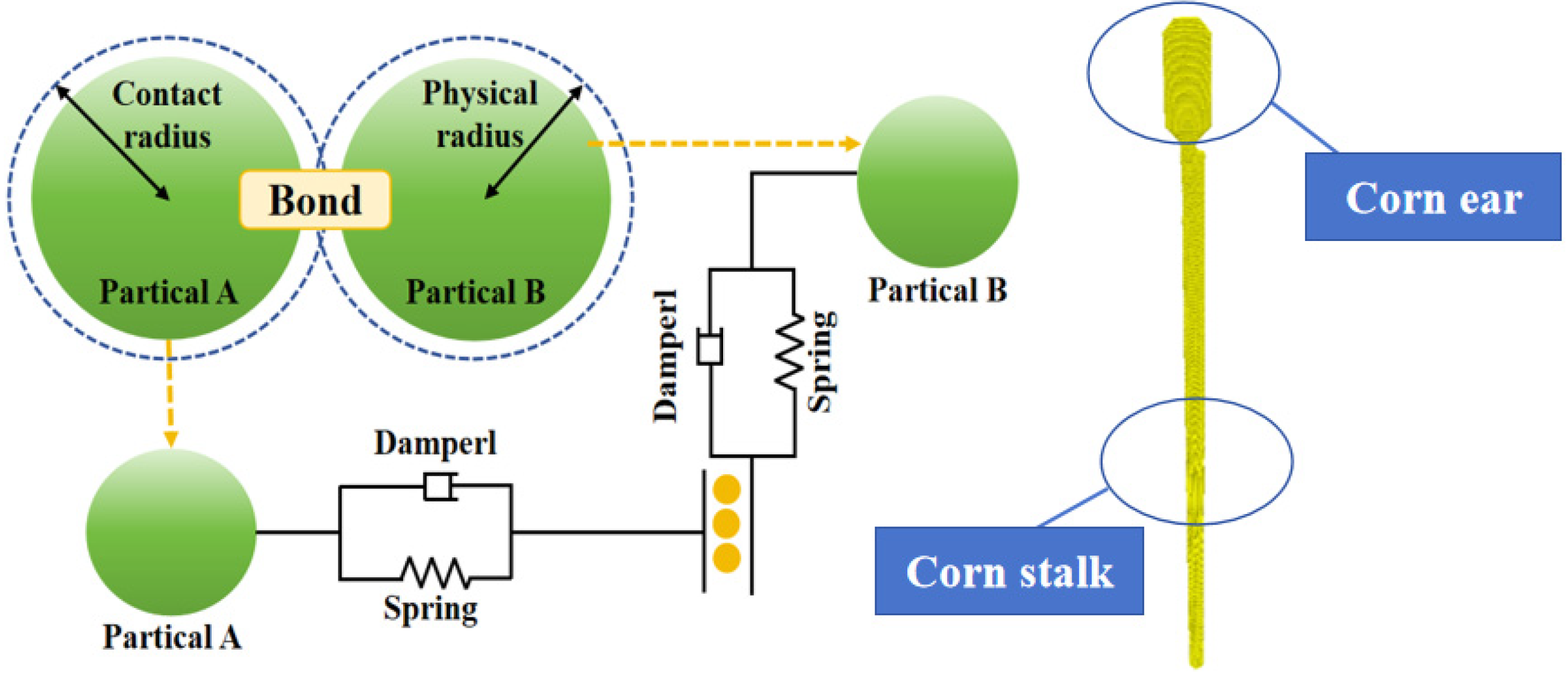
The operation process of the corn stalk–ear combine harvester developed in this paper involves stalk clamping, vibration picking, stalk conveying, and stalk chopping. Therefore, the corn stalks with ears constructed in the simulation environment are required to possess bonding and breaking capabilities. Based on the Hertz–Mindlin (no slip) model, this study incorporates the Hertz–Mindlin with the Bonding model to serve as the contact model between particles [19].
In the simulation, the corn plant model with ears established by the research group was adopted to simulate vibration picking and stalk cutting. For the ear picking and stalk cutting device, the ear picking unit, stalk feeding unit, and cutting unit—all modeled in UG—were imported into the EDEM software. Based on previous research findings and relevant literature, the simulation parameters were configured. The specific model parameters are detailed in Table 1, Table 2 and Table 3, and the simulation model is illustrated in Figure 6 [20,21,22,23]. Based on the actual working state of the stalk–ear combine harvester, rotational motions were assigned to the picking rollers, stalk pulling rollers, upper and lower feeding rollers, upper and lower clamping rollers, and the chopping knives. Additionally, translational motions were assigned to the corn stalks with ears according to the conventional operating speed of the harvester to simulate the vibration picking and stalk chopping processes. The simulation time step was set to 20% (of the Rayleigh time step), the data save interval was 0.01 s, and the grid cell size was set to three times the minimum particle radius.

2.4.2. Simulation Parameters

In response to surface optimization, the experimental design requires that the test points encompass the optimal levels of each factor. Based on the preceding analysis, the header angle, ear-picking roller speed, clamping roller speed, and the rotation speed and number of moving blades were selected as the experimental factors. A five-factor, three-level rotary orthogonal experiment was conducted. Drawing on the Agricultural Machinery Design Manual and the research team’s previous progress in vibration-based ear picking, the experimental ranges were established as follows: header angle of 5–15°, ear-picking roller speed of 800–1000 rpm, and clamping roller speed of 180–240 rpm (with a roller diameter of 240 mm). Additionally, with a moving blade radius of 0.3 m and a quantity of 8–14 blades, the rotation speed of the moving blades was determined to be 1300–1500 rpm to satisfy the requirement of a 1–2 cm chopping length [19,24]. The factor coding is presented in Table 4. For each experimental group, harvesting simulations were performed on 30 corn plants, and each test was repeated three times, with the mean values recorded as the experimental results.

2.4.3. Evaluation Indicators

The ear-picking success rate, kernel damage rate, and stalk cutting length were selected as the experimental indicators for the testing process. Given that the experiment was conducted in a simulation environment, to improve computational efficiency and reduce time costs—while leveraging the characteristic of vibration picking which achieves contact less and damage-free harvesting—any contact between the ear and the picking roller before detachment in the simulation was defined as gnawing. Additionally, Ln was used to evaluate the average stalk chopping length under different operating speeds. The specific calculations for each indicator are as follows:
P s = S n N
where Sn is the number of successfully picked ears, and N is the total number of stalks.
P d = D n N
where Dn is the number of corn plants where the ear collided with the picking roller during the picking process.
L n = i = 1 n L n i n

2.5. Field Experiment and Result Analysis

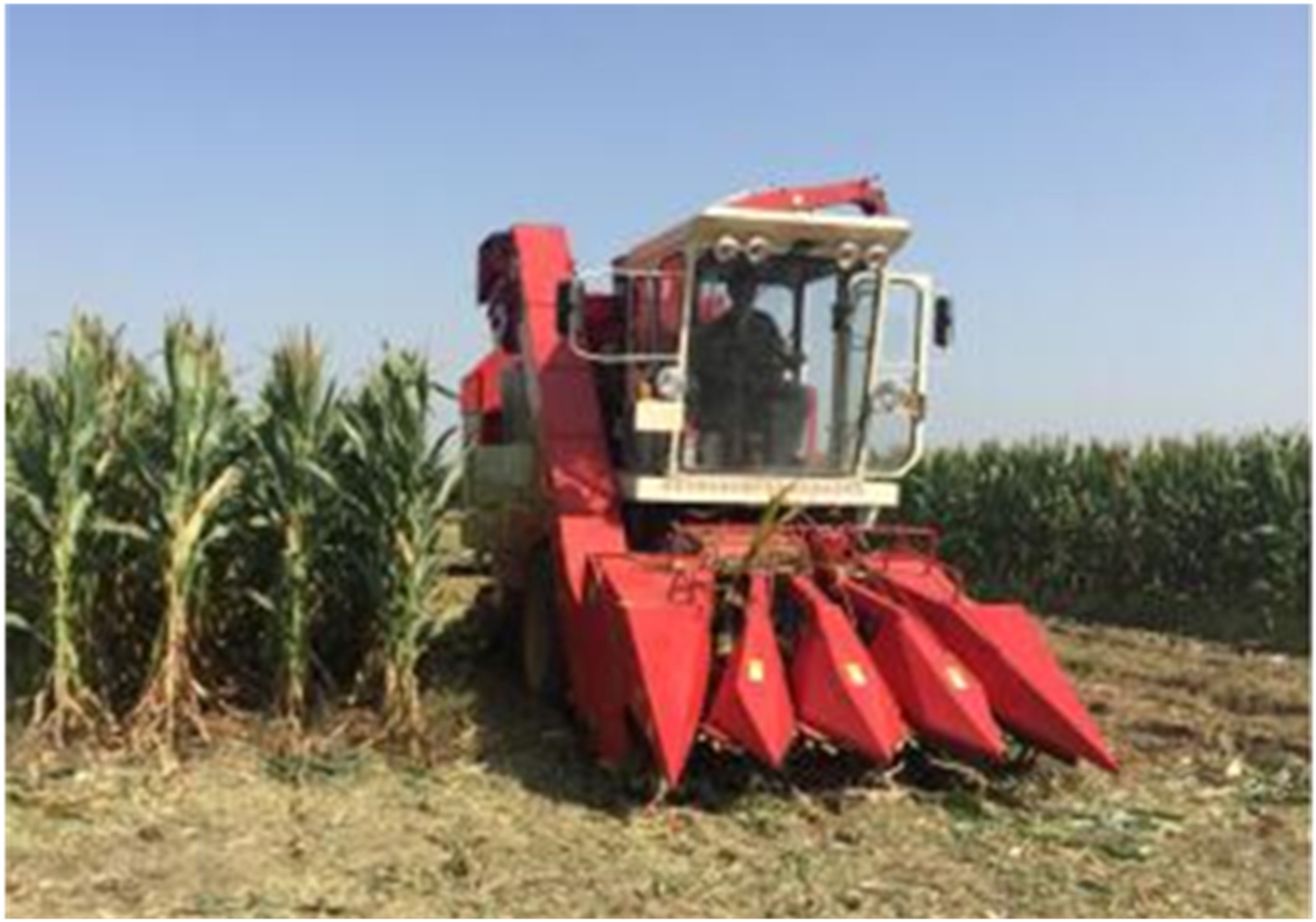
To verify the operational quality and efficiency of the developed harvester, a field experiment was conducted at Weibei Farm, Hanting District 288, Weifang City, Shandong Province, China. Prior to the experiment, the field plants and planting parameters were measured. The specific experimental scenario is illustrated in Figure 7, and the detailed parameters are shown in Table 5.
The test machine is shown in the Figure 7.
The experiment was conducted in accordance with the requirements of GB/T 21962-2020 Test Methods for Corn Harvesting Machinery [25]. Prior to the test, the experimental area was divided into a stabilization zone, a measurement zone, and a parking zone. A four-row corn planting plot with a length of 70 m was selected as the experimental area, where the 0–30 m section served as the pretest stabilization zone, the 30–50 m section as the measurement zone, and the 50–70 m section as the parking zone. Before the test, natural fallen grains, fallen ears, broken stalks, and ears with a height of less than 35 cm were cleared from the measurement zone (including the harvested area and 2–4 adjacent unharvested rows).
The grain loss rate, ear loss rate, and grain breakage rate were selected as the evaluation indicators for the ear-picking quality of the harvester.
In the measurement zone, all fallen grains (including grains entrained in the stalks) and broken ears shorter than 5 cm were collected. After threshing and cleaning, the collected materials were weighed, and the grain loss rate was calculated using the following formula:
S L 1 = W L 1 W Z 1 × 100 %
where SL1 is the grain loss rate, %; WL1 is landed grain mass, g; WZ1 is the total grain mass in the test area, g.
Missed and fallen corns (including segmented corns over 5 cm) were collected in the measurement area. The corns were weighed, and the corn loss rate was calculated using the following formula.
S L 2 = W L 2 W Z 2 × 100 %
where SL2 is the ear loss rate; WL2 is the seed mass of missed and landed corns, g.
In the measurement area, a sample of not less than 2000 g was taken from the discharge outlet of the corn elevator for threshing. Seeds with machine damage, visible cracks, and broken skins were picked out. The seed breakage rate was calculated.
S L 3 = W S W i × 100 %
where SL3 is the grain breakage rate, %; Ws is the mass of machine-damaged, visibly cracked, and skin-broken seeds, g; Wi is the seed mass of the sample, g.
To verify the accuracy and stability of the cutting length during the operation of the harvester, the average cutting length Ln, the coefficient of variation C.V. of the cutting length, and the precision σ of the cutting length of the stalk section were selected as the test indexes in this study. The cut length of stalks is qualified when it is 10–20 mm. Where Ln is used to evaluate the average stalk cut length at different operating speeds, C.V. is used to evaluate the degree of influence of different forward speeds on the stalk cut length, σ reflects the proportion of the distribution of the cut length within the error allowance, xi is the number of cuts at the qualifying length of the cut section. For the test procedure, we conducted three sets of repeated tests in three different plots. Samples were collected through catch bags, and 100 cut segments were randomly selected from the catch bags as evaluation indicators for experimental data analysis. The length of each cut segment was measured separately to demonstrate that the harvester designed by us can ensure the accuracy and stability of the cutting length when operating at different speeds in different plots. The length of the i-th measured cut segment is denoted as Lni.
The specific calculations for each index were as follows:
C . V = L n L n i 2 n 1 L n
σ = i = 1 n x i n
Based on the preceding analysis, the qualified range for the cutting length was determined to be [10 mm, 20 mm]. Therefore, L was set to 15 mm, and ΔL was set to 10 mm.
During the experiment, four groups of tests were conducted at harvester operating speeds of 4, 6, 8, and 10 km/h, respectively. Each group was repeated three times, and the average values were recorded as the final test results for subsequent data analysis and processing.
The developed QZ4112Z harvester (Weichai Lovol Intelligent Agricultural Technology Co., Ltd., Weifang, China) was utilized as the experimental platform, as shown in Figure 7. Its main technical parameters are listed in Table 6.

3. Results and Discussion

3.1. Simulation Results

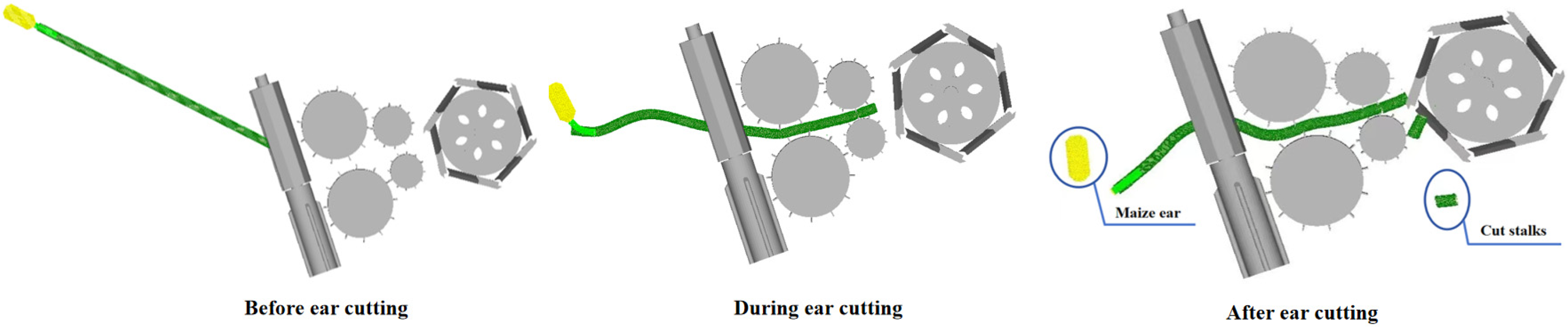
The EDEM simulation results are shown in Figure 8.
The analysis indicates that the simulation process primarily consists of the ear picking stage, the stalk clamping and conveying stage, and the stalk cutting stage, which is consistent with the overall analysis of this study. In this research, Design-Expert software was utilized to conduct experimental design and data analysis using the Box–Behnken Design (BBD) method within the Response Surface Methodology (RSM) framework. To evaluate operational performance, success rate, damage rate, and cutting length were selected as the primary experimental indices. A total of forty-six experimental groups were conducted, comprising forty edge midpoints and six center points (zero points). This distribution of points ensures that the model can effectively estimate experimental error and maintain high optimization precision while avoiding extreme conditions. The experimental scheme and results are presented in Table 7. The results of the analysis of variance (ANOVA) are shown in Table 8.
The ANOVA results indicate that the header angle (X0) and picking roller speed (X1) significantly affect the ear picking success rate, and their interaction effect is significant. The header angle (X0), picking roller speed (X1), and clamping roller speed (X2) significantly affect the gnawing rate, with a significant interaction effect between the header angle (X0) and picking roller speed (X1). Additionally, the header angle (X0), picking roller speed (X1), clamping roller speed (X2), moving knife speed (X3), and number of knives (X4) all have a significant influence on the stalk chopping length, and there is a significant interaction between the moving knife speed (X3) and the number of knives (X4). According to the requirements of combined ear and stalk harvesting, the success rate Y should be maximized, and the gnawing rate Z should be minimized. For the chopping length W, this study targets a value of 15 mm while also aiming to minimize the deviation and variance to ensure high uniformity and consistency of the chopped segments. The optimization module of the Design-Expert software was used to solve for the optimal parameters.
The objective functions and constraints are established as follows:
M a x Y X 0 , X 1 , X 2 , X 3 , X 4 M i n Z X 0 , X 1 , X 2 , X 3 , X 4 T a r g e t W X 0 , X 1 , X 2 , X 3 , X 4 5 X 0 15 800 X 1 1000 180 X 2 240 1300 X 3 1500 8 X 4 15
Based on the constraints of the objective functions, the optimal combination of operating parameters was determined as follows: a header angle of 10°, a picking roller speed of 942.5 rpm, a clamping roller speed of 215.4 rpm, a moving knife speed of 1460 rpm, and 12.2 moving knives. Under these conditions, the predicted ear picking success rate, gnawing rate, and chopping length were 98.49%, 0.279%, and 14.41 mm, respectively. Considering the convenience of equipment setting and control during actual operation, the optimized parameters were adjusted to a header angle of 10°, a picking roller speed of 942 rpm, a clamping roller speed of 215 rpm, a moving knife speed of 1450 rpm, and 12 moving knives. According to the fitted equations, the adjusted performance indicators were a success rate of 98.52%, a gnawing rate of 0.276%, and a chopping length of 14.4 mm.

3.2. Field Experiment Results

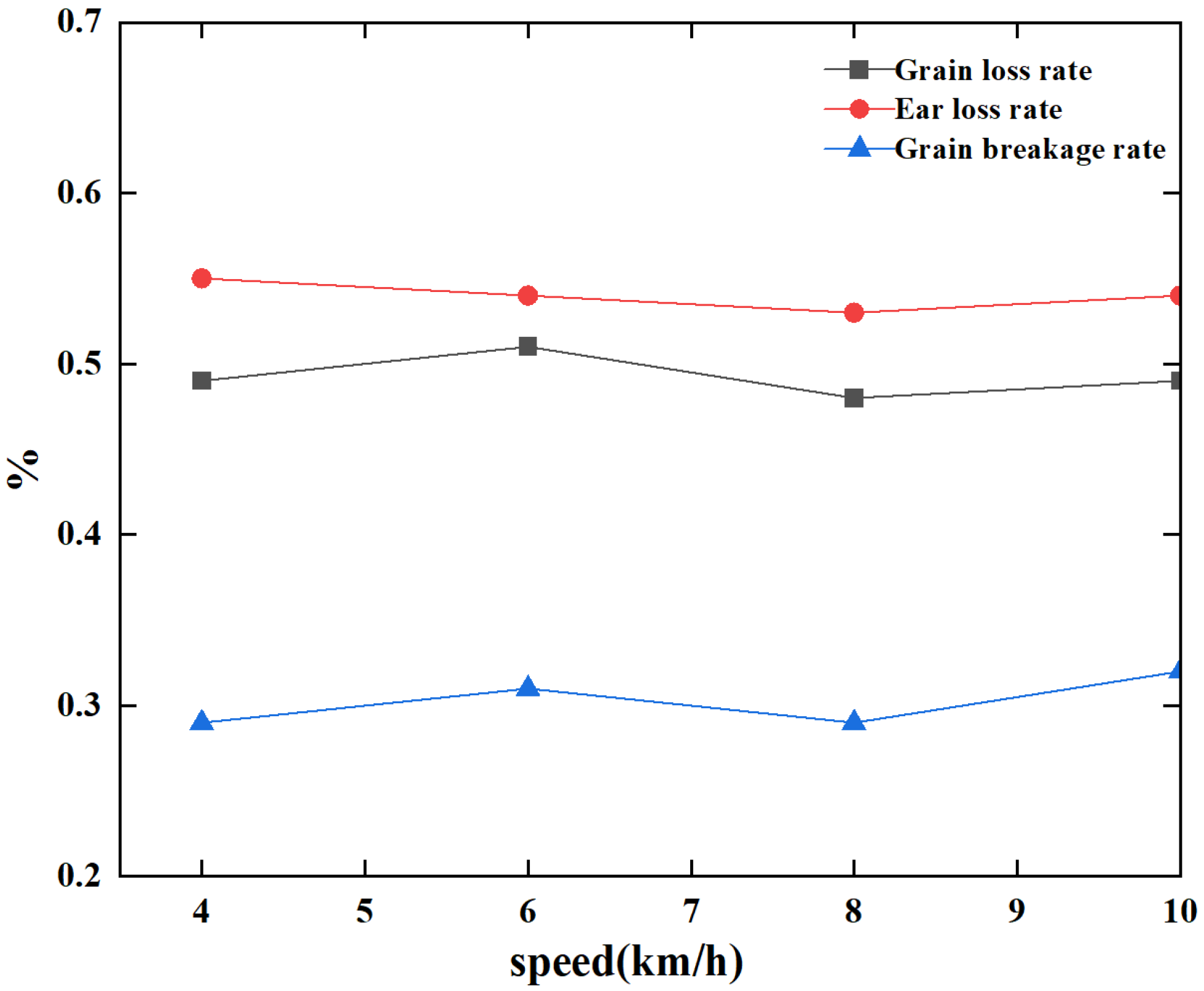
(1) Figure 9 displays the statistical results of the seed loss rate, ear loss rate, and seed crushing rate under different operating speeds (4 km/h, 6 km/h, 8 km/h, and 10 km/h, respectively).
The results of loss and breakage rates at different operating speeds are further analyzed as shown in Table 9.
The analysis showed that the harvest evaluation indicators did not vary much at different machine forward speeds. Among them, the maximum value of SL1 is 0.51%, and the average value is 0.49%. The maximum value of SL2 is 0.55%, and the average value is 0.54%. The maximum value of SL3 is 0.32%, and the average value is 0.30%. The S.D. values for all groups remained at a relatively low level, indicating that the operating speed has no significant influence on the harvesting quality of the harvester developed in this study.
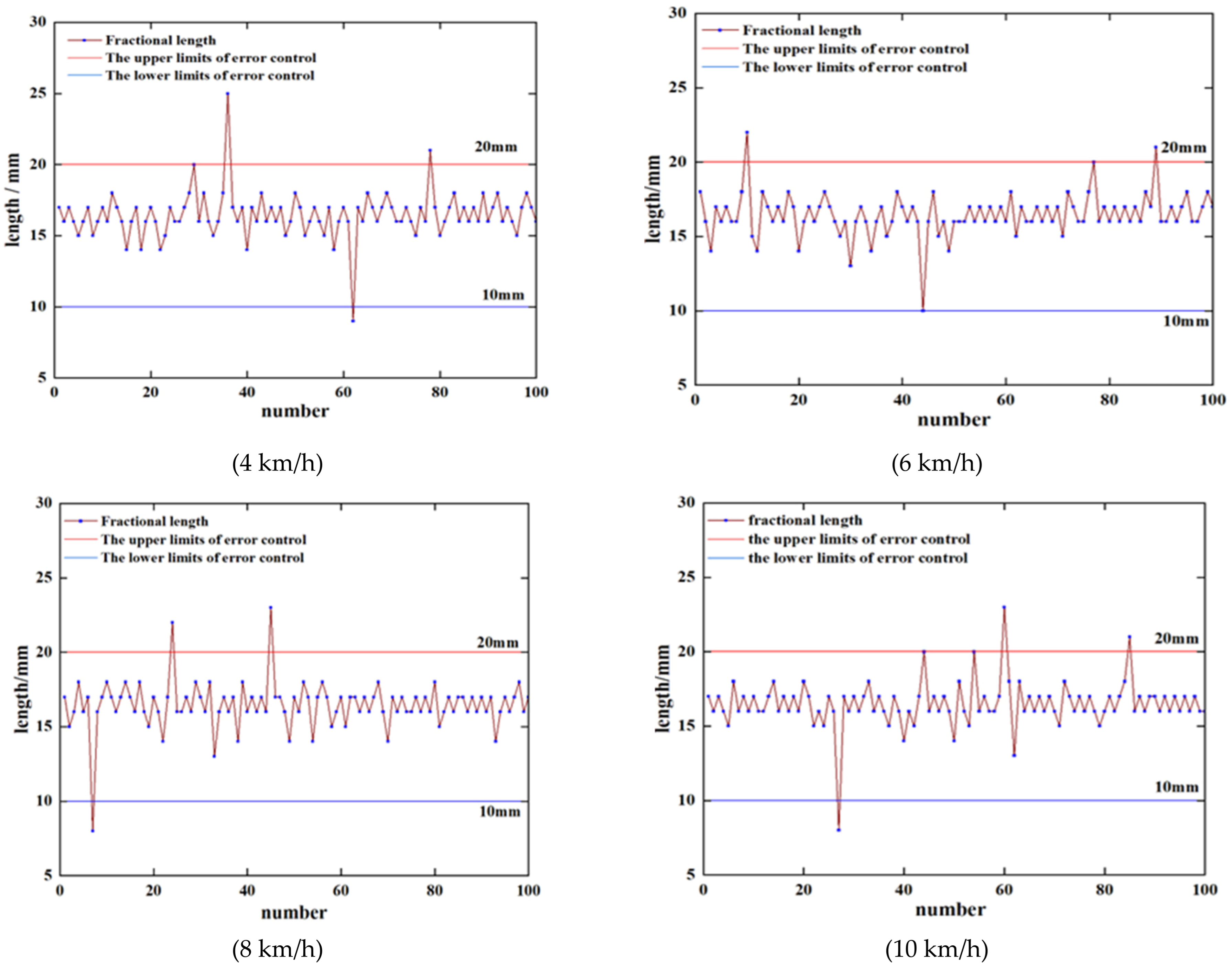
(2) Figure 10 shows the statistics of the cut lengths at different operating speeds of 4 km/h, 6 km/h, 8 km/h, and 10 km/h, respectively. Based on the previous analysis of the stalk cutting length, the qualified range is [10 mm, 20 mm]. Therefore, L is 15 mm, and ΔL is 10 mm. The experimental results are shown in Figure 10 and Table 10.
The effect of different operating speeds on cut length is further analyzed and the results are shown in Table 10.
The lengths of the stalk cuts were mainly distributed in [10 mm, 20 mm], consistent with the previous analysis. Among them, the L values under different speeds are 16.47, 16.48, 16.47, 16.52, the mean value is 16.48, and the standard deviation is 1.44. It indicates that the difference between the length of the stalk cut section and its mean value was slight. The S.D. values for all groups remained at a low level, with S.E. < 1.0, and the C.V. ranging from 9.2% to 9.8%. These results indicate that the stalk cut length maintains excellent overall stability across different operating speeds. The σ values were 97%, 98%, 97%, and 98%, respectively, with a mean of 97.5%, further demonstrating that the stalk cut length is minimally affected by the operating speed.

4. Conclusions

A vertical picking roll ear and stalk harvesting machine was developed to ensure the consistency of ear-harvesting quality and stalk-cutting length, and the structural parameters of the exciting picking was proposed through analyzing the operation process of an eight-edge special-shaped picking roll. We also explored a technology of stalk chopping with opposed clamping conveying and feeding rollers combined with hobs.
Optimal parameter combinations for the key operating parameters of the designed ear and stalk harvester were obtained through simulation tests. To verify the operating quality and stability of the designed harvester, several sets of field trials were conducted at different operating speeds. The results showed that the mean values of SL1, SL2, and SL3 are 0.51%, 0.55%, and 0.32%, respectively, for the harvester at operating speeds of 4 km/h, 6 km/h, 8 km/h, and 10 km/h. The σ values are 97%, 98%, 97%, and 98%, with a mean value of 97.5%. These data show that the machine not only fully meets the operation quality requirements of the corn harvester for both ear and stalk harvesting but also has the technical advantages of low loss, high efficiency, and good consistency of stalk cutting length.

Author Contributions

Conceptualization, X.W. and Y.W.; methodology, X.W.; software, X.W.; validation, X.W., Y.W. and Q.W.; formal analysis, X.W.; investigation, X.L.; resources, R.L.; data curation, J.L.; writing—original draft preparation, X.W.; writing—review and editing, D.G.; visualization, Y.G.; supervision, D.G.; project administration, Y.L.; funding acquisition, D.G. All authors have read and agreed to the published version of the manuscript.

Funding

This work was supported by the Modern Agricultural Industrial System of Shandong Province (SDAIT-02-12). This research was also supported by the National Natural Science Foundation of China under Grant No. 32372008 and the National Key Research and Development Plan (2021YFD20000502).

Institutional Review Board Statement

Not applicable.

Data Availability Statement

Data are contained within the article.

Conflicts of Interest

The authors declare no conflicts of interest.

References

  1. Dong, W.; Wu, Y.; Liu, F.; Hu, H.; Yan, J.; Bai, H.; Zhao, X. Design and Experiment of a Harvesting Header for Wide-Narrow-Row Corn. Appl. Sci. 2024, 14, 1309. [Google Scholar] [CrossRef]
  2. Liu, A.; Li, P.; Xie, F.; Ashwehmbom, L.G.; Wang, X.; Zhu, L.; Ji, B. Design and experiment of adaptive adjustment of threshing gaps based on the feed rate monitoring of soybean combine harvester conveyor trough. Comput. Electron. Agric. 2025, 237, 110687. [Google Scholar] [CrossRef]
  3. Pari, L.; Del Giudice, A.; Pochi, D.; Gallucci, F.; Santangelo, E. An innovative flexible head for the harvesting of cardoon (Cynara cardunculus L.) in stony lands. Ind. Crops Prod. 2016, 94, 471–479. [Google Scholar] [CrossRef]
  4. Feng, X.; Xie, C.; Tong, J.; Guo, S.; Qi, B.; Gao, Y.; Wang, L.; Wang, Q. Design and Test of Vertical Axis Rotating Cutters for Cutting Corn Roots and Crown. Agriculture 2025, 15, 717. [Google Scholar] [CrossRef]
  5. Ramm, S.; Hasler, M.; Reckleben, Y.; Hartung, E. Single-Pass Grain Corn Harvest and Stubble Shredding: Performance of Three Corn Header Configurations as Effected by Harvesting Speed and Cutting Height. Agriculture 2023, 13, 833. [Google Scholar] [CrossRef]
  6. Tan, H.; Wang, G.; Zhou, S.; Jia, H.; Qu, M.; Xiang, M.; Gao, X.; Zhou, Z.; Li, H.; Zou, Z. Design and Experiment of Header Height Adaptive Adjustment System for Maize (Zea mays L.) Harvester. Sustainability 2023, 15, 14137. [Google Scholar] [CrossRef]
  7. Yang, R.; Chen, D.; Zha, X.; Pan, Z.; Shang, S. Optimization Design and Experiment of Ear-Picking and Threshing Devices of Corn Plot Kernel Harvester. Agriculture 2021, 11, 904. [Google Scholar] [CrossRef]
  8. Wang, Z.-H.; Zhao, Y.-J.; Liu, Y.; Huang, D.-Y. The Study of the Work Parameters of the Corn Harvester Cutter. In Computer and Computing Technologies in Agriculture XI, Proceedings of the 11th IFIP WG 5.14 International Conference, CCTA 2017, Jilin, China, 12–15 August 2017; Li, D., Zhao, C., Eds.; IFIP Advances in Information and Communication Technology; Springer: Cham, Switzerland, 2019; Volume 545, pp. 293–301. [Google Scholar] [CrossRef]
  9. Igathinathane, C.; Womac, A.R.; Sokhansanj, S. Corn stalk orientation effect on mechanical cutting. Biosyst. Eng. 2010, 107, 97–106. [Google Scholar] [CrossRef]
  10. Rocha, E.M.C.; Drewry, J.L.; Willett, R.M.; Luck, B.D. Assessing kernel processing score of harvested corn silage in real-time using image analysis and machine learning. Comput. Electron. Agric. 2022, 203, 107415. [Google Scholar] [CrossRef]
  11. Wang, W.; Sun, W.; Li, H.; Li, X.; Yuan, Y. Design and Experiment of a Single-Disk Silage Corn Harvester. Agriculture 2025, 15, 751. [Google Scholar] [CrossRef]
  12. Cui, D.; Li, H.; He, J.; Wang, Q.; Lu, C.; Gao, Z.; Tong, Z.; Zhong, G. Experimental Study on the Effect of Water Jet Cutting Parameters on Maize Stalks. Agriculture 2023, 13, 880. [Google Scholar] [CrossRef]
  13. Ge, Y.; Jiang, Y.; Li, Y.; Liang, Q.; Wang, J.; Du, S.; Wen, X.; Zhang, J. Design and test for hob-type chopped roller of green fed harvester. IOP Conf. Ser. Mater. Sci. Eng. 2018, 382, 032061. [Google Scholar] [CrossRef]
  14. Li, T.; Guan, X.; Zhou, F. Mechanistic analysis and experimental study of a shear-type low-loss fresh corn ear-picking mechanism. Comput. Electron. Agric. 2023, 213, 108191. [Google Scholar] [CrossRef]
  15. Amiama, C.; Bueno, J.; Álvarez, C.J.; Pereira, J.M. Design and field test of an automatic data acquisition system in a self-propelled forage harvester. Comput. Electron. Agric. 2008, 61, 192–200. [Google Scholar] [CrossRef]
  16. Reddy, K.P.K.; Kumar, S.R.; Rao, B.N. Multi-objective optimization for minimize cutting force and power consumption in corn stalk chopping processes. Heliyon 2024, 10, e35373. [Google Scholar] [CrossRef]
  17. Xie, B.; Wang, J.; Jiang, H.; Zhao, S.; Liu, J.; Jin, Y.; Li, Y. Multi-feature detection of in-field grain lodging for adaptive low-loss control of combine harvesters. Comput. Electron. Agric. 2023, 208, 107772. [Google Scholar] [CrossRef]
  18. Xiao, M.; Niu, Y.; Wang, K.; Zhang, S.; Li, J.; Zhao, Z.; Hu, Y.; Ma, Z. Design of self-excited vibrating rotary tiller and analysis of its performance in reducing torsion and consumption. Trans. Chin. Soc. Agric. Mach. 2022, 53, 52–63. [Google Scholar] [CrossRef]
  19. Cui, Y.; Guan, P.; Yin, J.; Zha, Z.; Yu, Q.; Wang, Z.; Geng, D. Influence of maize picking roller surface structure on stalk pulling force. Biosyst. Eng. 2025, 259, 104289. [Google Scholar] [CrossRef]
  20. Liu, L.; Wang, X.; Zhang, X.; Zhong, X.; Wei, Z.; Geng, Y.; Cheng, X.; Zhao, K.; Bai, M. Determination and verification of parameters for the discrete element modelling of single disc covering of flexible straw with soil. Biosyst. Eng. 2023, 233, 151–167. [Google Scholar] [CrossRef]
  21. Liu, L.; Wang, X.; Zhang, X.; Cheng, X.; Wei, Z.; Zhou, H.; Zhao, K. The impact of ‘T’-shaped furrow opener of no-tillage seeder on straw and soil based on discrete element method. Comput. Electron. Agric. 2023, 213, 108278. [Google Scholar] [CrossRef]
  22. Chen, J.Z.; Shi, R.J.; Zhao, W.Y.; Dai, F.; Zhao, Y.M.; Liu, X.L. Simulation and experiment of kernel loss during peeling of seed maize based on DEM-MBD coupling. Biosyst. Eng. 2025, 257, 1–17. [Google Scholar] [CrossRef]
  23. Liu, W.; Su, Q.; Fang, M.; Zhang, J.; Zhang, W.; Yu, Z. Parameters Calibration of Discrete Element Model for Corn Straw Cutting Based on Hertz-Mindlin with Bonding. Appl. Sci. 2023, 13, 1156. [Google Scholar] [CrossRef]
  24. Guan, P.; Geng, D.; Cui, Y.; Zha, Z.; Yin, J.; Yu, Q. Research on Optimization of Vibration Ear Picking Parameters Based on Corn Plant Vibration Response Characteristics and Finite Element Analysis. Agriculture 2024, 14, 1481. [Google Scholar] [CrossRef]
  25. GB/T 21962-2020; Test Methods for Corn Combine Harvester. State Administration for Market Regulation: Beijing, China; Standardization Administration of the P.R.C.: Beijing, China, 2020.
Figure 1. Corn and stalk vibration harvester.
Agriculture 16 00104 g001
Figure 2. Schematic of the structural layout of the entire machine.
Agriculture 16 00104 g002
Figure 3. Schematic diagram of vibration picking principle. mg is the weight of the corn ear; ω is the angular velocity of the picking roll; f is the vibration frequency of the picking roller.
Agriculture 16 00104 g003
Figure 4. Force analysis of the fruit stalk during the fruit pulling process.
Agriculture 16 00104 g004
Figure 5. Schematic diagram of the straw feeding device.
Agriculture 16 00104 g005
Figure 6. DEM simulation model.
Agriculture 16 00104 g006
Figure 7. Field experiment.
Agriculture 16 00104 g007
Figure 8. EDEM simulation.
Agriculture 16 00104 g008
Figure 9. Loss and breakage rate at different speeds.
Agriculture 16 00104 g009
Figure 10. Test results of stalk cutting length.
Agriculture 16 00104 g010
Table 1. Intrinsic parameters.
MaterialParametersValue
StalkPoisson’s ratio0.35
Shear modulus (Pa)1.0 × 10⁷
Density (kg·m−3)240
ShankPoisson’s ratio0.38
Shear modulus (Pa)2.5 × 10⁷
Density (kg·m−3)550
EarPoisson’s ratio0.30
Shear modulus (Pa)1.2 × 10⁸
Density (kg·m−3)800
SteelPoisson’s ratio0.30
Shear modulus (Pa)7.9 × 10¹⁰
Density (kg·m−3)7850
Table 2. Contact parameters.
MaterialParametersValue
Stalk–StalkRestitution coefficient0.32
Static friction coefficient0.65
Rolling friction coefficient0.15
Shank–ShankRestitution coefficient0.35
Static friction coefficient0.65
Rolling friction coefficient0.12
Ear–EarRestitution coefficient0.30
Static friction coefficient0.60
Rolling friction coefficient0.10
Stalk–ShankRestitution coefficient0.30
Static friction coefficient0.60
Rolling friction coefficient0.12
Stalk–EarRestitution coefficient0.35
Static friction coefficient0.60
Rolling friction coefficient0.12
Shank–EarRestitution coefficient0.30
Static friction coefficient0.65
Rolling friction coefficient0.15
Stalk–SteelRestitution coefficient0.45
Static friction coefficient0.50
Rolling friction coefficient0.08
Shank–SteelRestitution coefficient0.35
Static friction coefficient0.45
Rolling friction coefficient0.10
Ear–SteelRestitution coefficient0.42
Static friction coefficient0.55
Rolling friction coefficient0.08
Table 3. Contact model parameters.
MaterialParametersValue
Stalk epidermisNormal stiffness (N·m−2)9.68 × 10⁸
Tangential stiffness (N·m−2)5.0 × 10⁸
Critical normal stress (Pa)4.20 × 10⁷
Critical tangential stress (Pa)3.50 × 10⁷
Stalk coreNormal stiffness (N·m−2)4.50 × 10⁷
Tangential stiffness (N·m−2)2.20 × 10⁷
Critical normal stress (Pa)1.20 × 10⁶
Critical tangential stress (Pa)0.85 × 10⁶
Shank–StalkNormal stiffness (N·m−2)1.85 × 10⁸
Tangential stiffness (N·m−2)9.50 × 10⁷
Critical normal stress (Pa)8.20 × 10⁶
Critical tangential stress (Pa)6.15 × 10⁶
Shank–EarNormal stiffness (N·m−2)2.10 × 10⁸
Tangential stiffness (N·m−2)1.25 × 10⁸
Critical normal stress (Pa)1.15 × 10⁷
Critical tangential stress (Pa)8.40 × 10⁶
Table 4. Coding of experimental factors.
CodeFactors
Header Angle/(°)Picking Roller Speed/(rpm)Clamping Roller Speed/(rpm)Moving Knife Speed/(rpm)Number of Moving Knives
−1580018013008
010900210140011
1151000240150014
Table 5. Corn plant parameters.
ParameterNumerical Value
Corn varietyXianyu335
Row spacing/cm67
Plant spacing/cm19.6
Plant height/cm225.3
Minimum spike height/cm89.7
Stem diameter/cm2.24
Diameter of large diameter of ears/cm4.67
Drooping rate of ears/%1.21
Grain moisture content/%28.9
Table 6. Main technical parameters.
ParameterTechnical Specifications
Walking modeSelf-propelled
Engine power rating/KW103
Straw treatment methodStraw recycling type
Overall dimensions of a car/m6050 × 2600 × 3300
Operating speed/km/h0–10
Traveling speed/km/h0–20
Line space adaptation range/mm450–750
Pull roll typeOctagonal shaped roll
Cutting width/mm2480
Cutter typeReciprocal motion
Vehicle weight/kg7100
Working lines4
Table 7. Experimental design and results.
Test NumberHeader
Angle X0
Picking Roller
Speed X1
Clamping Roller Speed X2Moving Knife Speed X3Number of Moving Knives X4Success Rate
Y/%
Gnawing Rate
Z/%
Chopping Length W/mm
1−1−100095.910.1316.22
21−100099.310.2416.81
3−1100099.730.3315.51
41100098.120.3816.13
500−1−1097.850.1715.81
6001−1097.910.2817.62
700−11097.740.1717.31
80011097.820.2813.41
90−100−197.310.1817.74
100100−199.020.3516.86
110−100197.410.1815.52
120100198.930.3514.41
13−10−10097.650.1316.53
1410−10098.820.2217.21
15−1010097.720.2414.87
161010098.740.3315.32
17000−1−197.860.2317.81
180001−197.710.2316.23
19000−1197.930.2216.14
200001197.820.2313.22
210−1−10097.210.1217.31
2201−10099.110.2916.12
230−110097.330.2415.61
240110099.050.3914.31
25−100−1097.740.1917.23
26100−1098.820.2817.74
27−1001097.630.1915.15
281001098.710.2815.52
2900−10−197.840.1717.52
300010−197.920.2715.93
3100−10197.710.1715.81
320010197.830.2714.14
33−1000−197.640.1817.1
341000−198.710.2817.4
35−1000197.750.1815.42
361000198.870.2815.71
370−10−1097.420.1717.63
38010−1099.020.3516.73
390−101097.310.1815.82
400101098.940.3614.51
410000098.220.2316
420000098.30.2515.82
430000098.110.2116.11
440000098.250.2315.94
450000098.320.2216.2
460000098.230.2415.72
Table 8. Results of analysis of variance.
SourceSuccess Rate YGnawing Rate ZChopping Length W
Sum of SquaresDegrees of FreedomFpSum of SquaresDegrees of FreedomFpSum of SquaresDegrees of FreedomFp
Model21.982066.16<0.0001 **0.210020163.24<0.0001 **56.002032.44<0.0001 **
X04.341261.10<0.00010.03241503.63<0.00010.9073110.510.0034
X110.101607.88<0.00010.115611796.89<0.00014.08147.27<0.0001
X20.009510.570.45640.04621718.52<0.00019.631111.52<0.0001
X30.047312.850.10390.000110.87440.358715.091174.86<0.0001
X40.003610.220.64566.250 × 10−610.09720.757916.441190.50<0.0001
X0X16.281377.80<0.00010.0009113.990.00100.000210.00260.9597
X0X20.005610.340.56580.000010.00001.00000.013210.15320.6988
X0X30.000010.0001.00000.000010.00001.00000.004910.05680.8136
X0X40.000610.0380.84780.000010.00001.00000.000010.00030.9866
X1X20.008110.490.49140.000111.550.22400.003010.03500.8530
X1X30.000210.0140.90830.000010.00001.00000.042010.48690.4918
X1X40.009010.540.46790.000010.00001.00000.013210.15320.6988
X2X30.000116.021 × 10−30.93880.000010.00001.00008.15194.43<0.0001
X2X40.000410.0240.87790.000010.00001.00000.001610.01850.8928
X3X40.000410.0240.87790.000010.38860.53870.448915.200.0314
X020.131417.910.00940.000212.600.11970.633317.340.0120
X120.032511.960.17400.01131176.22<0.00010.022010.25490.6181
X220.2795116.830.00040.000314.290.04880.198012.290.1424
X320.2847117.140.00033.788 × 10−710.00590.93940.093611.080.3078
X420.2769116.670.00040.000111.320.26060.006310.07300.7892
Residual0.4152253.530.08340.0016250.15210.99912.16253.140.1040
Lack of Fit0.3878200.0006202.0020
Pure Error0.027550.001050.15915
Cor Total22.39450.21164558.1645
Note: ** indicates extremely significant difference (p < 0.0001).
Table 9. Test results.
No.v (km/h)SL1 (%)S.D.SL2 (%)S.D.SL3 (%)SD
140.490.020.550.030.290.01
260.510.020.540.020.310.02
380.480.020.530.020.290.01
4100.490.010.540.030.320.02
Note: Data in the table are presented as mean values; SD denotes standard deviation; the number of experimental replicates is n = 3.
Table 10. Test results.
No.v (km/h)L (mm)S.D.S.E.C.V. (%)σ (%)
1416.471.620.939.7797
2616.481.530.889.2298
3816.471.590.919.6597
41016.521.560.909.4697
Note: Data in the table are presented as mean values. The number of independent field replicates is n = 3.
Disclaimer/Publisher’s Note: The statements, opinions and data contained in all publications are solely those of the individual author(s) and contributor(s) and not of MDPI and/or the editor(s). MDPI and/or the editor(s) disclaim responsibility for any injury to people or property resulting from any ideas, methods, instructions or products referred to in the content.