Analysis of Critical “Source-Area-Period” of Agricultural Non-Point Source Pollution in Typical Hilly and Mountainous Areas: A Case Study of Yongchuan District, Chongqing City, China
Abstract
1. Introduction
2. Materials and Methods
2.1. Study Area and Database
2.1.1. Overview of the Study Area
2.1.2. Introduction to Data Sources
2.2. Pollutant Load Estimation Model
2.2.1. The Export Coefficient Model
2.2.2. Determination of Export Coefficient
2.2.3. Supplement to Spatiotemporal Simulation Model
2.3. Identification and Analysis of CPs
3. Results
3.1. Analysis of the Spatio-Temporal Characteristics of AGNPSP
3.1.1. Interannual Variation of AGNPSP
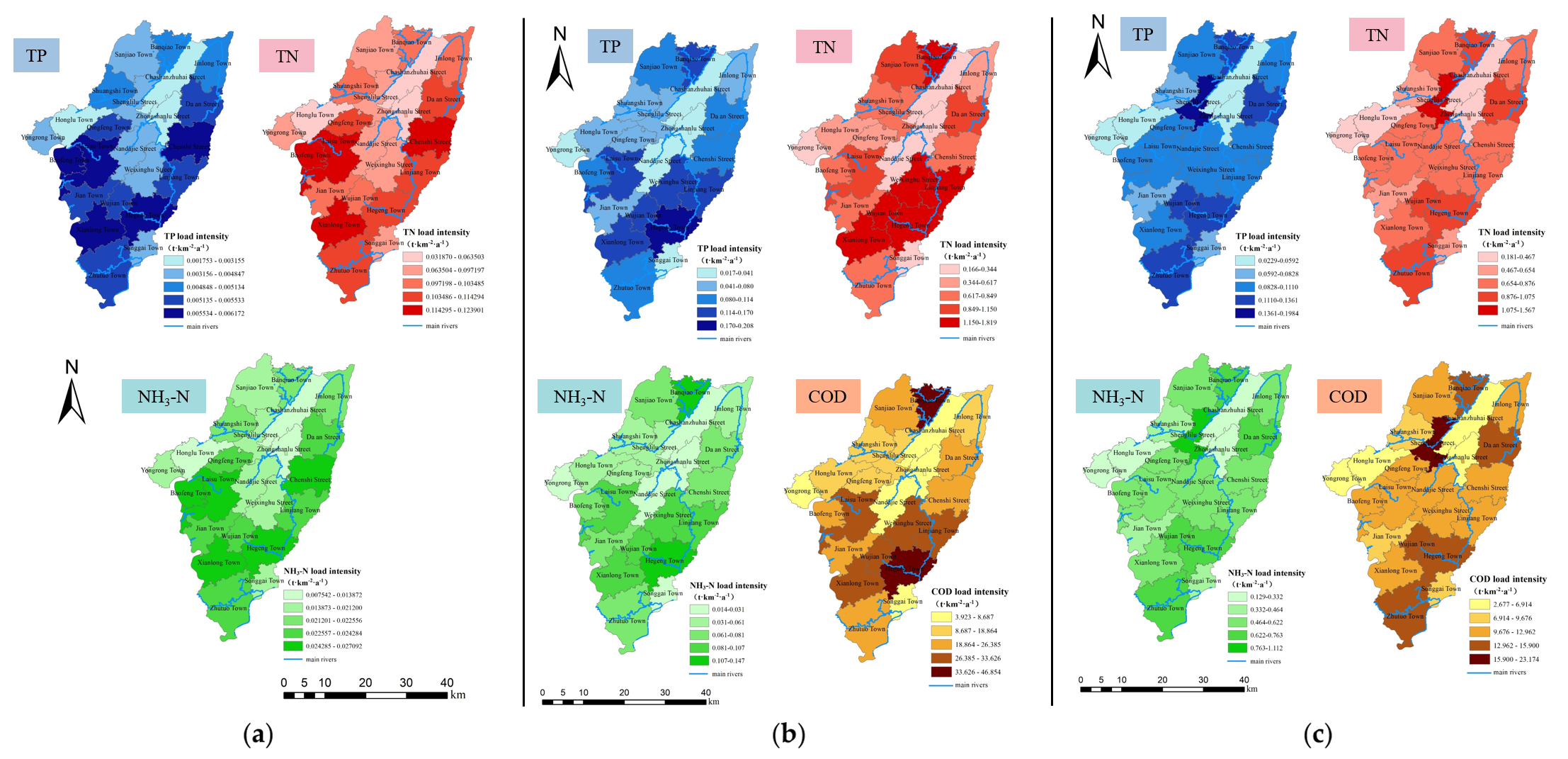
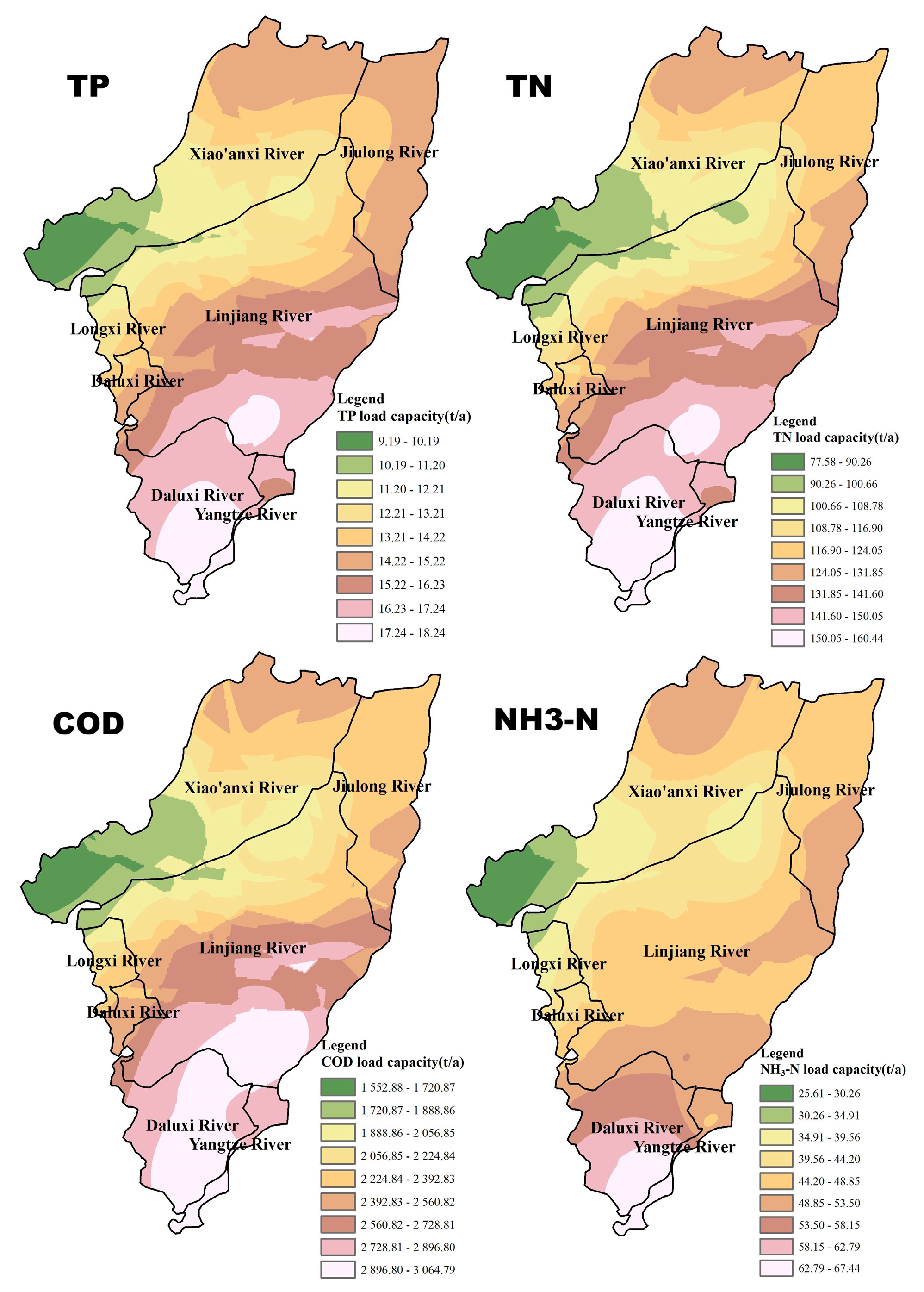
3.1.2. Spatial Changes of AGNPSP
3.2. Identification of CSs, CAs and CPs of AGNPSP
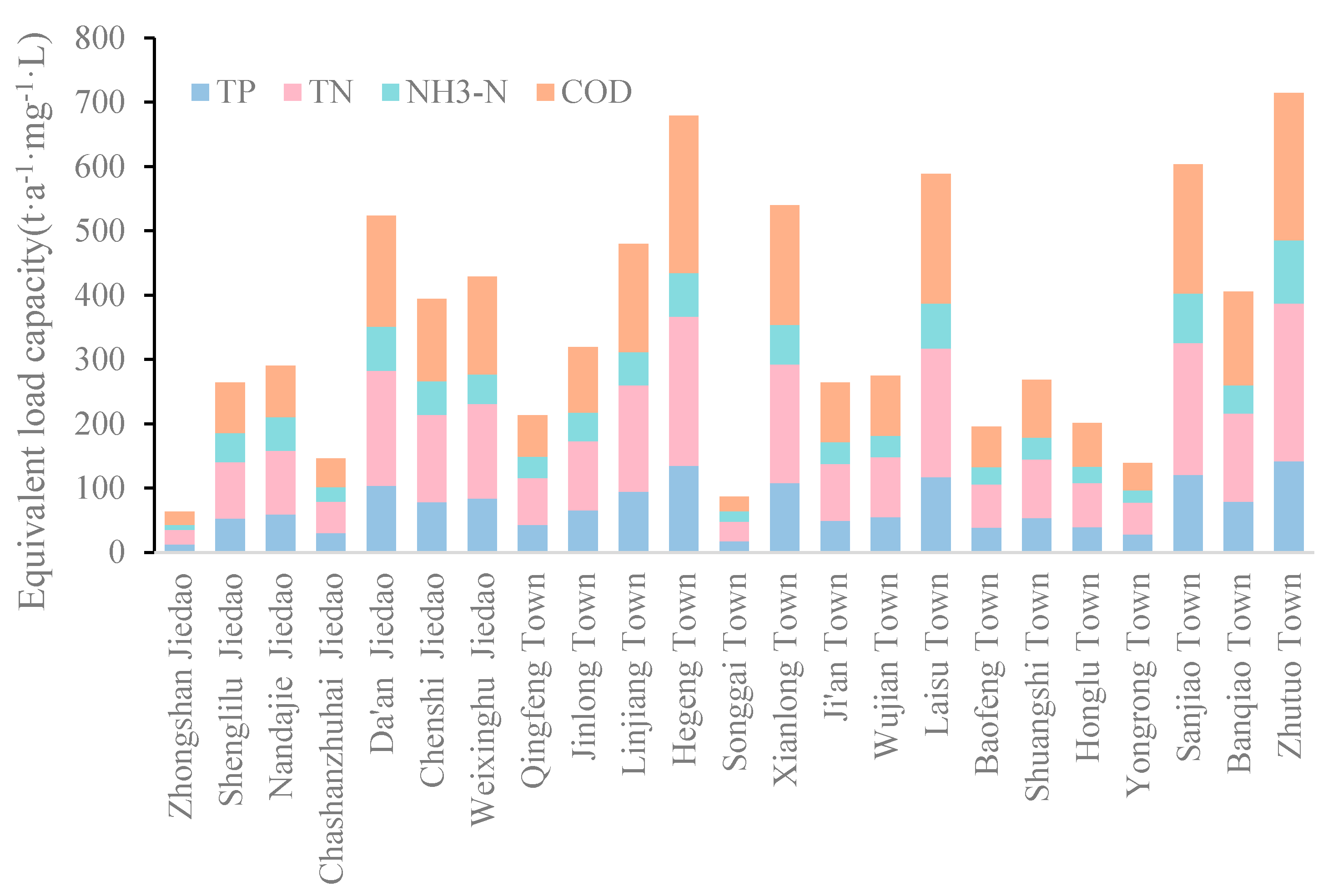
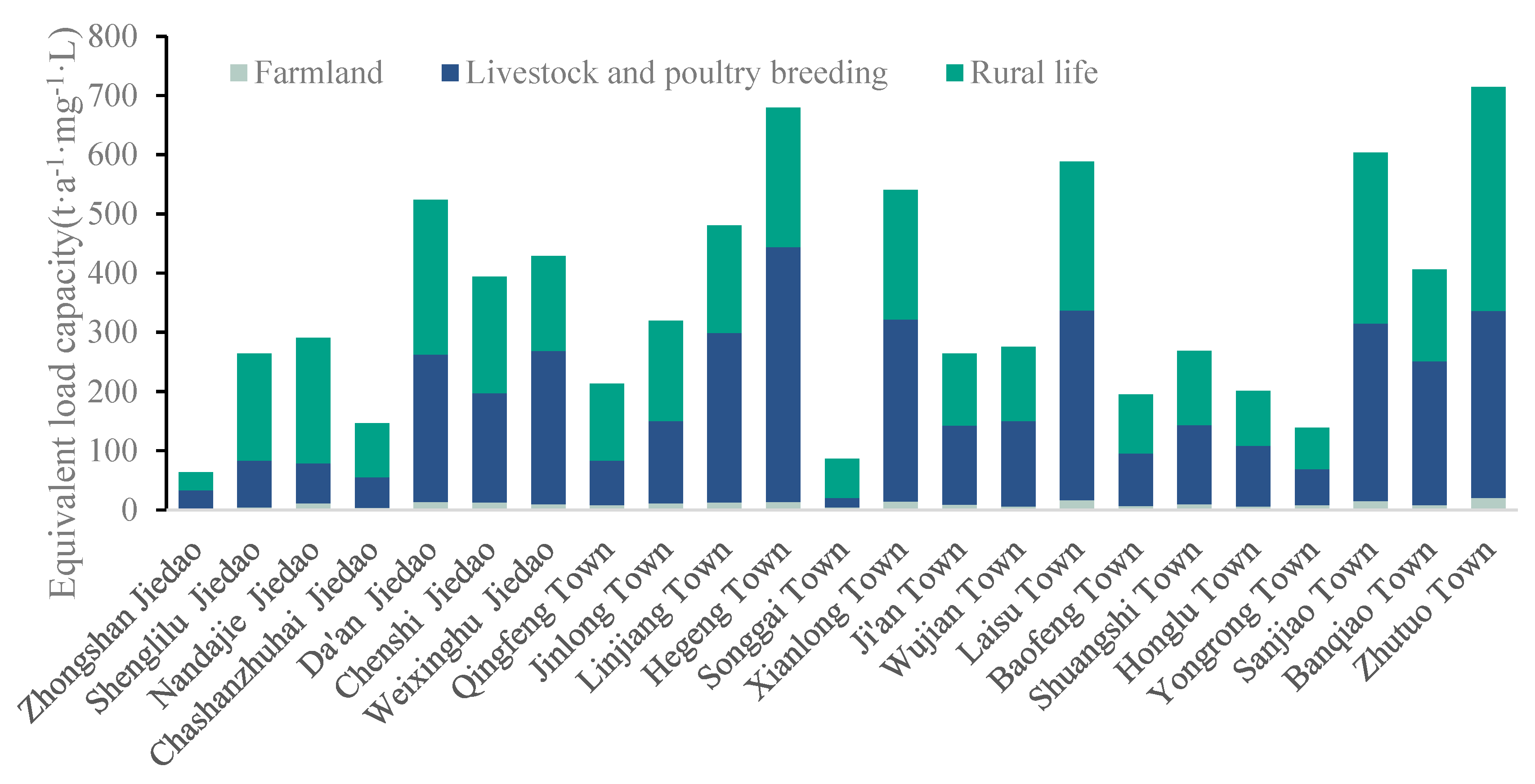
3.2.1. Identification of CSs and CAs
3.2.2. Identification of CPs
4. Discussion
4.1. Priority Control Strategy of AGNPSP in CSs and CAs
4.2. Priority Control Strategy of AGNPSP in CPs
5. Conclusions
Author Contributions
Funding
Data Availability Statement
Conflicts of Interest
Appendix A

| Research Area | Land Use Factors (1000 kg·km−2·a−1) | Non Land Use Factors (kg·ca−1·a−1 or kg·per−1·a−1) | |||||
|---|---|---|---|---|---|---|---|
| Cultivated Land | Orchard Land | Draught Animal | Swine | Sheep | Poultry | Domestic Sewage | |
| Qiongjiang River Basin (Anju Section) | 0.006 | / | 0.186 | 0.085 | 0.027 | 0.003 | 0.128 |
| Yangtze river basin | 0.009 | 0.005 | 0.310 | 0.142 | 0.045 | 0.005 | 0.214 |
| Xiaoanxi River Basin | 0.006 | 0.003 | 0.186 | 0.085 | 0.027 | 0.003 | 0.128 |
| Huaihe River Basin (Wang–Beng Section) | 0.017 | 0.001 | 0.218 | 0.041 | 0.014 | 0.005 | 0.112 |
| Upper Reach of Yangtze River Basin | 0.090 | / | 0.218 | 0.142 | 0.045 | 0.005 | 0.214 |
| Mountainous area of Sichuan | 0.090 | 0.090 | / | / | / | / | 0.200 |
| Nenjiang Watershed | 0.161 | / | 0.748 | 0.111 | 0.069 | / | / |
| Baoxianghe watershed | 0.161 | / | 0.587 | 0.443 | 0.054 | 0.005 | / |
| Poyang Lake Watershed | 0.003 | 0.008 | 0.003 | 0.003 | / | 0.010 | / |
| Yanghua River Basin | / | / | 0.218 | 0.142 | 0.045 | 0.005 | 0.214 |
| Hanjiang Watershed (Jingmen Region) | 0.079 | 0.108 | 0.624 | 0.179 | 0.085 | 0.009 | 0.214 |
| Jialing River Watershed | 0.117 | / | 0.624 | 0.179 | 0.085 | 0.009 | 0.214 |
| Three Gorges Reservoir Area (Chongqing) | 0.250 | 0.262 | 1.010 | 0.170 | 0.045 | 0.012 | 0.160 |
| Research Area | Land Use Factors (1000 kg·km−2·a−1) | Non Land Use Factors (kg·ca−1·a−1 or kg·per−1·a−1) | |||||
|---|---|---|---|---|---|---|---|
| Cultivated Land | Orchard Land | Draught Animal | Swine | Sheep | Poultry | Domestic Sewage | |
| Yangtze river basin | 0.190 | 0.080 | 7.320 | 1.390 | 1.400 | 0.060 | 1.870 |
| Xiaoanxi River Basin | 0.095 | 0.040 | 3.660 | 0.695 | 0.700 | 0.030 | 0.935 |
| Huaihe River Basin (Wang–Beng Section) | 0.167 | 0.194 | 7.893 | 1.290 | 0.730 | 0.043 | 1.087 |
| Upper Reach of Yangtze River Basin | 2.900 | / | 11.318 | 2.667 | 1.513 | 0.005 | 1.955 |
| Mountainous area of Sichuan | 2.750 | 1.500 | / | / | / | / | 2.470 |
| Nenjiang Watershed | 1.303 | / | 3.203 | 0.356 | 0.069 | / | / |
| Baoxianghe watershed | 2.320 | / | 16.226 | 0.740 | 0.400 | 0.046 | / |
| Poyang Lake Watershed | 0.025 | 0.020 | 0.025 | 0.025 | / | 0.010 | / |
| Hanjiang Watershed (Jingmen Region) | 1.121 | 1.021 | 10.210 | 0.740 | 0.400 | 0.040 | 2.140 |
| Jialing River Watershed | 2.200 | / | 10.348 | 2.038 | 0.968 | 0.055 | 1.955 |
| Three Gorges Reservoir Area (Chongqing) | 1.800 | 1.240 | 6.110 | 0.450 | 0.230 | 0.028 | 1.580 |
| Research Area | Land Use Factors (1000 kg·km−2·a−1) | Non Land Use Factors (kg·ca−1·a−1 or kg·per−1·a−1) | |||||
|---|---|---|---|---|---|---|---|
| Cultivated Land | Orchard Land | Draught Animal | Swine | Sheep | Poultry | Domestic Sewage | |
| Huaihe River Basin (Wang–Beng Section) | 2.800 | 2.450 | 300 | 30 | 4.400 | 1.170 | 10.100 |
| Yanghua River Basin | / | / | / | 30 | / | / | 25 |
| Hanjiang Watershed (Jingmen Region) | 1.800 | 2.450 | / | 30 | / | / | 25 |
| Research Area | Land Use Factors (1000 kg·km−2·a−1) | Non Land Use Factors (kg·ca−1·a−1 or kg·per−1·a−1) | |||||
|---|---|---|---|---|---|---|---|
| Cultivated Land | Orchard Land | Draught Animal | Swine | Sheep | Poultry | Domestic Sewage | |
| Huaihe River Basin (Wang–Beng Section) | 0.042 | 0.027 | 1.320 | 0.100 | 0.060 | 0.003 | 0.163 |
| Yanghua River Basin | / | / | / | 1.500 | / | / | 1.200 |
| Hanjiang Watershed (Jingmen Region) | 0.800 | 0.400 | / | 1.500 | / | / | 1.200 |

References
- Garnier, M.; Porto, A.L.; Marini, R.; Leone, A. Integrated Use of GLEAMS and GIS to Prevent Groundwater Pollution Caused by Agricultural Disposal of Animal Waste. Environ. Manag. 1998, 22, 747–756. [Google Scholar] [CrossRef]
- Ongley, E.; Zhang, X.; Yu, T. Current status of agricultural and rural non-point source Pollution assessment in China. Environ. Pollut. 2010, 158, 1159–1168. [Google Scholar] [CrossRef]
- Zhou, J.; Liu, X.; Liu, X.; Wang, W.; Wang, L. Assessing agricultural non-point source pollution loads in typical basins of upper Yellow River by incorporating critical impacting factors. Process Saf. Environ. Prot. 2023, 177, 17–28. [Google Scholar] [CrossRef]
- Wen, Y.H.; Liu, K.X. Review of domestic and international pollution control measures. Beijing Water Aff. 2020, 2, 29–31. [Google Scholar]
- Bai, Z.; Ma, W.; Ma, L.; Velthof, G.; Wei, Z.; Havlik, P.; Oenema, O.; Lee, M.; Zhang, F. China’s livestock transition: Driving forces, impacts, and consequences. Sci. Adv. 2018, 4, 11. [Google Scholar] [CrossRef]
- Bao, W.; Yang, Y.; Fu, T.; Xie, G. Estimation of livestock excrement and its biogas production potential in China. J. Clean. Prod. 2019, 229, 1158–1166. [Google Scholar] [CrossRef]
- Cheng, X.; Chen, L.; Sun, R.; Jing, Y. Identification of regional water resource stress based on water quantity and quality: A case study in a rapid urbanization region of China. J. Clean. Prod. 2019, 209, 216–223. [Google Scholar] [CrossRef]
- Zhang, T.; Yang, Y.; Ni, J.; Xie, D. Construction of an integrated technology system for control agricultural non-point source pollution in the Three Gorges Reservoir Areas. Agric. Ecosyst. Environ. 2020, 295, 106919. [Google Scholar] [CrossRef]
- Gao, L.; Wu, Y.; Yang, S.; Liu, X.; Li, L.; Li, D. Risk Assessment of Nitrogen Agricultural Non-point Source Pollution and Identification of Critical Control Areas in Henan Province. Trans. Chin. Soc. Agric. Mach. 2024, 55, 311–320. (In Chinese) [Google Scholar]
- Ministry of Ecology and Environment of the People’s Republic of China; National Bureau of Statistics; Ministry of Agriculture and Rural Affairs of the People’s Republic of China. Bulletin of the Second National Pollution Source Census. 2023. China. Available online: https://www.mee.gov.cn/home/ztbd/rdzl/wrypc/zlxz/202006/t20200616_784745.html (accessed on 10 February 2025).
- He, C.; Fu, B.; Chen, L. Non-point source pollution control and management. Environ. Sci. 1998, 19, 88–92. (In Chinese) [Google Scholar]
- Wen, W.; Zhuang, Y.; Zhang, L.; Li, S.; Ruan, S.; Zhang, Q. Preferred hierarchical control strategy of phosphorus from non-point source pollution at regional scale. Environ. Sci. Pollut. Res. 2021, 28, 60111–60121. [Google Scholar] [CrossRef]
- Strauss, P.; Leone, A.; Ripa, M.N.; Turpin, N.; Lescot, J.; Laplana, R. Using critical source areas for targeting cost-effective best management practices to mitigate phosphorus and sediment transfer at the watershed scale. Soil Use Manag. 2007, 23, 144–153. [Google Scholar] [CrossRef]
- Zou, L.; Liu, Y.; Wang, Y.; Hu, X. Assessment and analysis of agricultural non-point source pollution loads in China: 1978–2017. J. Environ. Manag. 2020, 263, 110400. [Google Scholar] [CrossRef]
- Bannerman, R.; Owens, D.; Dodds, R.; Hornewer, N. Sources of pollutants in Wisconsin stormwater. Water Sci. Technol. 1993, 28, 241–259. [Google Scholar] [CrossRef]
- Sharpley, A.; Daniel, T.; Edwards, D. Phosphorus movement in the landscape. J. Prod. Agric. 1993, 6, 492–500. [Google Scholar] [CrossRef]
- Chen, D.; Hu, M.; Guo, Y.; Dahlgren, R. Reconstructing historical changes in phosphorus inputs to rivers from point and nonpoint sources in a rapidly developing watershed in eastern China, 1980–2010. Sci. Total. Environ. 2015, 533, 196–204. [Google Scholar] [CrossRef] [PubMed]
- Kalcic, M.; Muenich, R.; Basile, S.; Steiner, A.; Kirchhoff, C.; Scavia, D. Climate change and nutrient loading in the western Lake Erie Basin: Warming can counteract a wetter future. Environ. Sci. Technol. 2019, 53, 7543–7550. [Google Scholar] [CrossRef] [PubMed]
- Hua, L.; Li, W.; Zhai, L.; Yen, H.; Lei, Q.; Liu, H.; Ren, T.; Xia, Y.; Zhang, F.; Fan, X. An innovative approach to identifying agricultural pollution sources and loads by using nutrient export coefficients in watershed modeling. J. Hydrol. 2019, 571, 322–331. [Google Scholar] [CrossRef]
- Wang, W.; Chen, L.; Lin, C.; Liu, Y.; Dong, X.; Xiong, J.; Liu, G.; Zhang, Y.; Li, J.; Shen, Z. An integrated source apportionment method by incorporating spatial location information and source-transfer-sink simulation. J. Clean. Prod. 2022, 379, 134741. [Google Scholar] [CrossRef]
- Zhu, K.; Chen, L.; Wang, Y.; Liu, G.; Yan, X.; Guo, C.; Zhang, L.; Shen, Z. Preliminary study on distributed erosion-type non-point source pollution model. J. Agro-Environ. Sci. 2022, 41, 2382–2394. (In Chinese) [Google Scholar]
- Wang, B.; Ma, Q. Research Status and Development Trends of Non-point Source Pollution Load Prediction. J. Xi’an Univ. Archit. Technol. (Nat. Sci. Ed.) 2010, 42, 717–722. (In Chinese) [Google Scholar]
- Han, L.; Liu, S.; Huang, M.; Ma, J.; Wei, J.; Hu, W. Research progress on watershed hydrological and water quality simulation based on HSPF model. J. East China Norm. Univ. 2015, 2, 9. (In Chinese) [Google Scholar]
- Qin, P.; Lei, K.; Chu, S.; Qiao, F. Exploring the Characteristics of Urban Non-point Source Pollution in China and Its Model Application. J. Environ. Eng. Technol. 2016, 4, 397–406. (In Chinese) [Google Scholar]
- Liang, L.; Zhao, Y.; Wu, J.; Wei, D.; Jin, L.; Xu, S.; Wang, L. Research progress and frontier analysis of agricultural non-point source pollution based on Citespace at home and abroad. China Agric. Resour. Zoning 2023, 4, 99–112. (In Chinese) [Google Scholar]
- Wu, Y.; Xi, X.; Tang, X.; Luo, D.; Gu, B.; Lam, S.; Vitousek, P.; Chen, D. Policy distortions, farm size, and the overuse of agricultural chemicals in China. Proc. Natl. Acad. Sci. USA 2018, 115, 7010–7015. [Google Scholar] [CrossRef]
- Srinivasan, M.; Gerard-Marchant, P.; Veith, T.; Gburek, W.; Steenhuis, T. Watershed scale modeling of critical source areas of runoff generation and phosphorus transport. J. Am. Water Resour. Assoc. 2005, 41, 361–377. [Google Scholar] [CrossRef]
- Giri, S.; Nejadhashemi, A.; Woznicki, S. Evaluation of targeting methods for implementation of best management practices in the saginaw river watershed. J. Environ. Manag. 2012, 103, 24–40. [Google Scholar] [CrossRef]
- Liu, R.; Wang, Q.; Xu, F.; Men, C.; Guo, L. Impacts of manure application on SWAT model outputs in the Xiangxi River watershed. J. Hydrol. 2017, 555, 479–488. [Google Scholar] [CrossRef]
- Ding, X.; Wu, Q.; Wen, G.; Zhang, C. Migration trajectory and spatial pattern of cultivated land non-point source pollution in Dongting Lake Plain from 2005 to 2019. Trans. CSAE 2021, 37, 258–266. (In Chinese) [Google Scholar]
- Su, J.; Zhao, H.; Jiao, R.; Fang, Z.; Yang, X.; Li, X. Identifying the critical sources areas of non-point particulate phosphorus based on an index approach in R: A case study in red soil hilly micro-watershed. China Environ. Sci. 2021, 41, 1868–1877. (In Chinese) [Google Scholar]
- Hao, G.; Song, F.; Xu, L.; Zhu, G. Estimation of agricultural non-point source pollution load in the upper reaches of Qing shui River based on output coefficient model. Sci. Technol. Eng. 2020, 20, 13919–13927. (In Chinese) [Google Scholar]
- Yang, Y.; Shen, L.; Xie, D.; Luo, Y.; Ni, J.I. Estimation of Agricultural Non-point Source Pollution Load in the Three Gorges Reservoir Area (Chongqing Section) Based on Output Coefficient Model. J. Southwest Univ. (Nat. Sci. Ed.) 2015, 3, 112–119. (In Chinese) [Google Scholar]
- Johnes, P. Evaluation and management of the impact of land use change on the nitrogen and phosphorus load delivered to surface waters: The export coefficient modelling approach. J. Hydrol. 1996, 183, 323–349. [Google Scholar] [CrossRef]
- Meng, F.; Zhao, Q.; Ma, J.; Chen, X.; Shi, Y. Evaluation of Agricultural Non-point Source Pollution Load and Current Situation: A Case Study of the Dasuhe Region. J. Agric. Environ. Sci. 2010, 29, 145–150. (In Chinese) [Google Scholar]
- Xue, L.; Yang, L. Research progress on output coefficient models of non-point source pollutants. J. Ecol. 2009, 28, 755–761. (In Chinese) [Google Scholar]
- Wang, Q.; Xu, L.; Xiang, S.; Zou, G. Estimation of non-point source pollution load in the lower reaches of the Gan River using output coefficient model. People’s Yangtze River 2011, 42, 31–33. (In Chinese) [Google Scholar]
- Ding, E. Research on Land Use Optimization Approaches for Agricultural Non-point Source Pollution Control in the Three Gorges Reservoir Area. Ph.D. Thesis, Southwest University, Chongqing, China, 2010. (In Chinese). [Google Scholar]
- Liu, L.; Ao, T.; Hu, Z.; Hu, F.; Li, M. Comprehensive evaluation of water quality and non-point source pollution in the Qiongjiang River Basin (Anju section). Soil Water Conserv. Res. 2019, 6, 372–376. (In Chinese) [Google Scholar]
- Zhang, H.; Li, J.; Li, X.; Liu, X.; Chen, X.; Liu, J.; Ao, T. Research on the Assessment Method of Rural Non-point Source Pollution in Data Deficient Areas. J. Sichuan Univ. (Eng. Sci. Ed.) 2013, 6, 58–66. (In Chinese) [Google Scholar]
- Zhu, H.; Ao, T.; You, R.; Gao, D.; Zhang, X. Assessment of Water Quality and Non-Point Source Pollution in Xiao’anxi River Basin. China Rural. Water Resour. Hydropower 2020, 9, 185–189. (In Chinese) [Google Scholar]
- Wang, S. Simulation Study on the Contribution of Agricultural Non-Point Source Pollution to the Pollution Load in the Wangbang Interval of the Huaihe River Basin. Master’s Thesis, Anhui University of Science and Technology, Huainan, China, 2021. [Google Scholar]
- Liu, R.; Shen, Z.; Ding, X.; Wu, X.; Liu, F. Estimation of non-point source pollution load in the upper reaches of the Yangtze River using output coefficient model. J. Agric. Environ. Sci. 2008, 2, 677–682. (In Chinese) [Google Scholar]
- Liu, J.; Fu, B.; Wang, Y.; Xu, P. Estimation and evaluation of non-point source pollutants loads in mountainous area of Sichuan. Trans. Chin. Soc. Agric. Eng. (Trans. CSAE) 2016, 32, 218–225. (In Chinese) [Google Scholar]
- Ma, G.; Wang, Y.; Xiang, B.; Wang, J.; Hu, Y. Impact and Differences of Land Use on Surface Source Pollution in the Upper Yangtze River Basin. J. Agric. Environ. Sci. 2012, 4, 791–797. (In Chinese) [Google Scholar]
- Duan, Y.; Jiang, H.; Wu, W.; Zhou, Y. Non-point source pollution load estimation based on improved output coefficient model—Taking the Nenjiang River Basin as an example. Environ. Prot. Sci. 2020, 4, 48–55. (In Chinese) [Google Scholar]
- Gui, P.; Wang, F.; Li, S.; Zhou, X.; Zou, L.; Fan, L. Estimation and Evaluation of Agricultural Non-point Source Pollution Load Based on Stage Output Coefficient Model: A Case Study of Sichuan Province. Zhejiang Agric. J. 2016, 28, 110–118. (In Chinese) [Google Scholar]
- Ren, W.; Dai, C.; Guo, H. Estimation of Non-Point Source Pollution Load in Baoxiang River Basin, Yunnan Province Based on Improved Output Coefficient Model. Chin. Environ. Sci. 2015, 8, 2400–2408. (In Chinese) [Google Scholar]
- Wu, L.; Long, T.; Liu, X.; Guo, J. Impacts of climate and land-use changes on the migration of non-point source nitrogen and phosphorus during rainfall-runoff in the jialing river watershed, China. J. Hydrol. 2012, 475, 26–41. [Google Scholar] [CrossRef]
- Lu, J.; Chen, X.; Xiao, J.; Yu, J.; Liu, H. Application of Improved Output Coefficient Method in Agricultural Pollution Source Estimation. J. Cent. China Norm. Univ. (Nat. Sci. Ed.) 2012, 3, 373–378. (In Chinese) [Google Scholar]
- Xia, Y.; Yuan, Y.; Zhan, L.; He, C.; Xia, J. Fine estimation and empirical study of non-point source pollution load in small watersheds—Taking the Yanghua River Basin in Chengdu as an example. J. Yangtze River Acad. Sci. 2024, 4, 55–61+69. (In Chinese) [Google Scholar]
- Xu, C.; Li, Y.; Shu, J.; Li, B.; Li, M. Spatial distribution and evaluation of non-point pollution source in Jingmen region of Hanjiang watershed. Bull. Soil Water Conserv. 2017, 37, 63–68. (In Chinese) [Google Scholar]
- Li, W. Prediction and Analysis of Non-Point Source Pollution Load in Jialing River Basin. Master’s Thesis, Chongqing University, Chongqing, China, 2009. [Google Scholar]
- Yang, W.; Yu, X.; Yang, Y. Calculation method of agricultural non-point source pollution load and analysis of output coefficient values. Environ. Prot. Circ. Econ. 2023, 10, 43–48. (In Chinese) [Google Scholar]
- Zhong, D.; Zhang, H. Evaluation of the Impact of Pollution Sources on Water Environment Using the Equivalent Pollution Load Method. China Water Supply Drain 2005, 5, 101–103. (In Chinese) [Google Scholar]
- Qiu, Q.; Yang, Y.; Niu, M.; Zhang, W.; Zhang, Z.; Wang, X.; Ma, X.; Xiong, S. GIS based analysis of agricultural non-point source pollution in the Yellow River region of Henan Province. J. Henan Agric. Univ. 2023, 57, 558–569. (In Chinese) [Google Scholar] [CrossRef]
- Lu, S.; Zhang, P.; Pan, C.; Peng, S.; Liu, X. Research on Characteristics and Control Strategies of Agricultural Non-point Source Pollution Emissions in Dongting Lake. Chin. Environ. Sci. 2017, 37, 2278–2286. (In Chinese) [Google Scholar]
- Liu, G.; Fu, B.; Yang, P. Sea water environmental quality and pollutant flux into the sea. Environ. Sci. 2001, 4, 46–50. (In Chinese) [Google Scholar]
- Ji, X.; Wen, L.; Zhang, M.; Le, F. Analysis of Pollutant Flux into Hongze Lake. Jiangsu Water Resour. 2014, 205, 45–46+48. (In Chinese) [Google Scholar]
- Cheng, Q.; Wang, S.; Lei, K. Temporal and Spatial Changes in Water Quality and Fluxes of Major Pollutants in the Aojiang River Basin. J. Shenyang Univ. (Nat. Sci. Ed.) 2023, 35, 7–15. (In Chinese) [Google Scholar]
- Wen, W.; Zhuang, Y.; Jiang, T.; Li, W.; Li, H.; Cai, W.; Xu, D.; Zhang, L. “Period-area-source” hierarchical management for agricultural non-point source pollution in typical watershed with integrated planting and breeding. J. Hydrol. 2024, 635, 131198. [Google Scholar] [CrossRef]
- Wang, Y.; Xu, Y.; Wu, L.; Ruan, B.; Guo, J.; Du, B. Identification of critical source areas and delineation of management subzones of non-point source pollution in Jing River Basin. Environ. Dev. Sustain. 2023, 27, 7569–7594. [Google Scholar] [CrossRef]
- Li, J.; Li, M.; Liu, X.; Yang, L. Research on Agricultural Non-Point Source Pollution load in Shanxi Based on Output Coefficient Method. J. Ecol. Rural Environ. 2023, 39, 523–529. (In Chinese) [Google Scholar]
- Sun, C.; Kang, M.; Meng, F.; Wang, Q.; Han, Z. Estimation and analysis of agricultural non-point source pollution load in the Laowanfu River Basin of Yutai County. Agric. Dev. Equip. 2024, 4, 124–126. (In Chinese) [Google Scholar]
- Ge, X.; Huang, B.; Yuan, Z.; Wang, D.; Wang, Q.; Chen, J.; Xie, Z. Spatial and temporal changes and source analysis of agricultural non-point source pollution load in Guangdong Province in the past 20 years. Environ. Sci. 2022, 6, 3118–3127. (In Chinese) [Google Scholar] [CrossRef]
- Xie, P.; Gong, J.; Chen, C. Analysis of pollution load characteristics and control zones division of agricultural non-point sources in Beijing City. J. Environ. Eng. Technol. 2020, 10, 613–622. (In Chinese) [Google Scholar]
- Sun, Y. Agricultural source nitrogen and phosphorus emissions and spatial distribution characteristics in Anhui Province. J. Hebei Inst. Environ. Eng. 2022, 32, 11–15. (In Chinese) [Google Scholar]
- Xu, W.; Liu, L.; Zhu, S.; Sun, A.; Wang, H.; Ding, Z. Identifying the critical areas and primary sources for agricultural non-point source pollution management of an emigrant town within the Three Gorges reservoir area. Environ. Monit. Assess. 2023, 195, 602. [Google Scholar] [CrossRef] [PubMed]
- Li, Q.; Liu, M.; Li, Y.; An, Y.; Zhang, H.; Wang, P.; Zhang, Y.; Li, Y.; Zhang, Z. PEST analysis of resource utilization of livestock and poultry manure in China. Chin. Agric. Bull. 2023, 39, 92–98. (In Chinese) [Google Scholar]
- Xu, Y.; Zhang, Y.; Gu, C.; Liu, H.; Ni, Q. History, Typical Models, and Development Trends of Fish Vegetable Symbiosis. Fish. Mod. 2020, 47, 1–7. (In Chinese) [Google Scholar]
- Shen, W.; Li, S.; Mi, M.; Zhuang, Y.; Zhang, L. What makes ditches and ponds more efficient in nitrogen control? Agr. Ecosyst. Environ. 2021, 314, 107409. [Google Scholar] [CrossRef]
- Özcan, Z.; Kentel, E.; Alp, E. Evaluation of the best management practices in a semi-arid region with high agricultural activity. Agric. Water Manag. 2017, 194, 160–171. [Google Scholar] [CrossRef]
- Yang, L.; Pang, S.; Wang, X.; Du, Y.; Huang, J.; Melching, C. Optimal allocation of best management practices based on receiving water Capa-city constraints. Agric. Water Manag. 2021, 258, 107179. [Google Scholar] [CrossRef]
- Hanief, A.; Laursen, A. Meeting updated phosphorus reduction goals by applying best management practices in the Grand River watershed, southern Ontario. Ecol. Eng. 2019, 130, 169–175. [Google Scholar] [CrossRef]
- Risal, A.; Parajuli, P. Evaluation of the impact of best management practices on streamflow, sediment and nutrient yield at field and watershed scales. Water Resour. Manag. 2022, 36, 1093–1105. [Google Scholar] [CrossRef]
- Liu, R.; Kang, Y.; Wan, S.; Pei, L. Evaluation of methods of nutrient and water management on tea performance and nutrient loss in the Danjiangkou Reservoir area, China. Arch. Agron. Soil Sci. 2016, 62, 1123–1135. [Google Scholar] [CrossRef]
- Miao, X.; Zhu, C.; Zhao, J.; Wang, Y. Problems and Countermeasures of Rural Sewage Pipeline Operation and Maintenance. Munic. Technol. 2023, 41, 35–42. (In Chinese) [Google Scholar] [CrossRef]


| Main Pollutants | Land Use Factors (1000 kg·km−2·a−1) | Non Land Use Factors (kg·ca−1·a−1 or kg·per−1·a−1) | |||||
|---|---|---|---|---|---|---|---|
| Cultivated Land | Orchard Land | Draught Animal | Swine | Sheep | Poultry | Domestic Sewage | |
| TP (Total phosphorus) | 0.090 | 0.050 | 0.218 | 0.142 | 0.045 | 0.005 | 0.214 |
| TN (Total nitrogen) | 1.352 | 0.585 | 5.690 | 1.043 | 0.700 | 0.046 | 1.690 |
| NH3-N (Ammonia nitrogen) | 0.040 | 0.020 | 1.320 | 0.100 | 0.060 | 0.003 | 1.200 |
| COD (Chemical oxygen demand) | / | / | 300.000 | 30.000 | 4.400 | 1.170 | 25.000 |
Disclaimer/Publisher’s Note: The statements, opinions and data contained in all publications are solely those of the individual author(s) and contributor(s) and not of MDPI and/or the editor(s). MDPI and/or the editor(s) disclaim responsibility for any injury to people or property resulting from any ideas, methods, instructions or products referred to in the content. |
© 2025 by the authors. Licensee MDPI, Basel, Switzerland. This article is an open access article distributed under the terms and conditions of the Creative Commons Attribution (CC BY) license.
Share and Cite
Lu, Y.; Li, X.; Sun, M.; Zhang, L.; Zhang, Y.; Yin, Y.; Yang, R. Analysis of Critical “Source-Area-Period” of Agricultural Non-Point Source Pollution in Typical Hilly and Mountainous Areas: A Case Study of Yongchuan District, Chongqing City, China. Agriculture 2026, 16, 103. https://doi.org/10.3390/agriculture16010103
Lu Y, Li X, Sun M, Zhang L, Zhang Y, Yin Y, Yang R. Analysis of Critical “Source-Area-Period” of Agricultural Non-Point Source Pollution in Typical Hilly and Mountainous Areas: A Case Study of Yongchuan District, Chongqing City, China. Agriculture. 2026; 16(1):103. https://doi.org/10.3390/agriculture16010103
Chicago/Turabian StyleLu, Yanrong, Xiuhong Li, Meiying Sun, Le Zhang, Yuying Zhang, Yitong Yin, and Rongjin Yang. 2026. "Analysis of Critical “Source-Area-Period” of Agricultural Non-Point Source Pollution in Typical Hilly and Mountainous Areas: A Case Study of Yongchuan District, Chongqing City, China" Agriculture 16, no. 1: 103. https://doi.org/10.3390/agriculture16010103
APA StyleLu, Y., Li, X., Sun, M., Zhang, L., Zhang, Y., Yin, Y., & Yang, R. (2026). Analysis of Critical “Source-Area-Period” of Agricultural Non-Point Source Pollution in Typical Hilly and Mountainous Areas: A Case Study of Yongchuan District, Chongqing City, China. Agriculture, 16(1), 103. https://doi.org/10.3390/agriculture16010103