Sandy Soil Quality and Soybean Productivity in Medium-Duration Agricultural Production Systems †

 ,
,  , ,
, ,  ,
, 
Abstract
1. Introduction
2. Materials and Methods
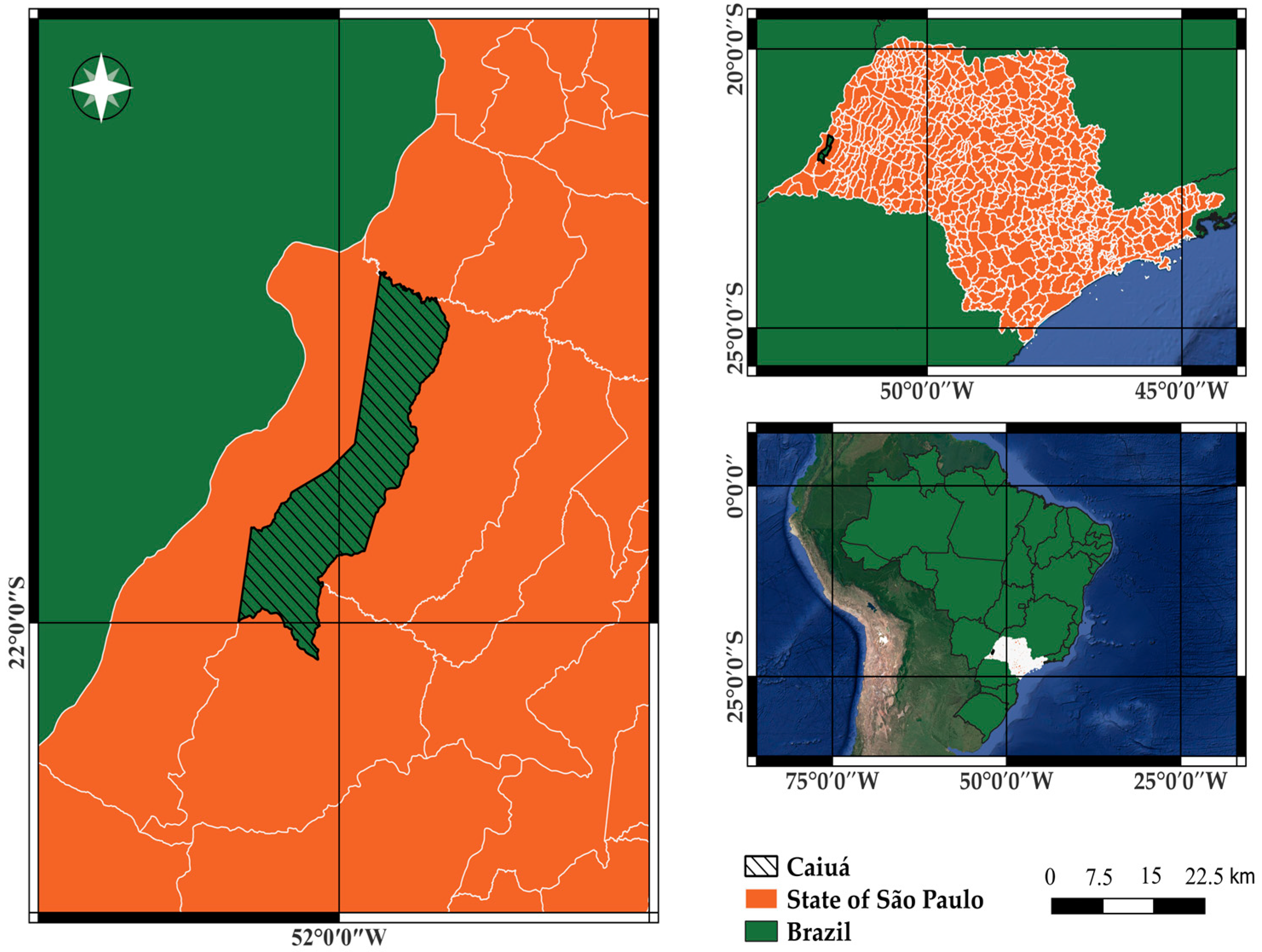
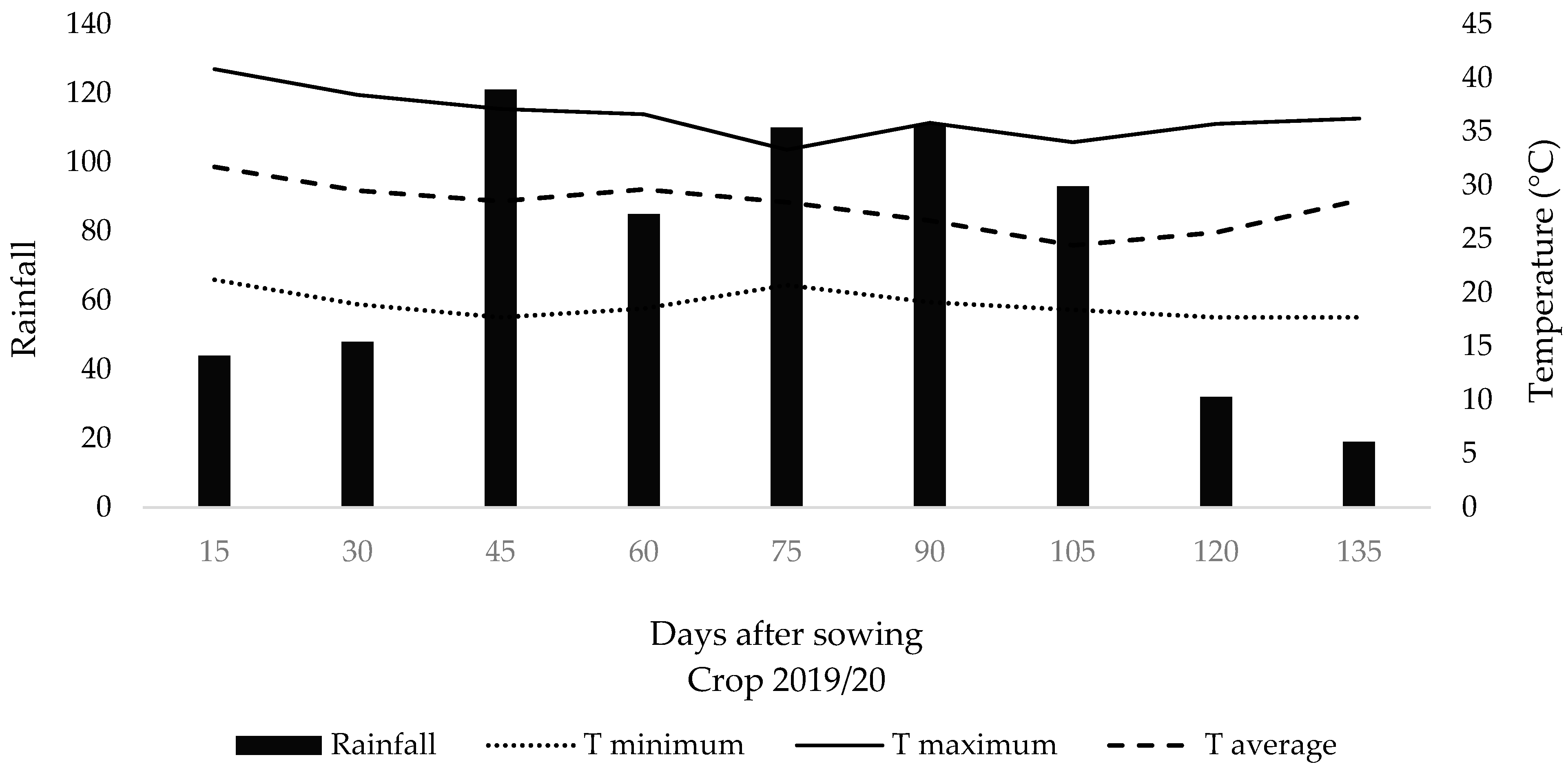
2.1. Location and Characteristics of the Experimental Area
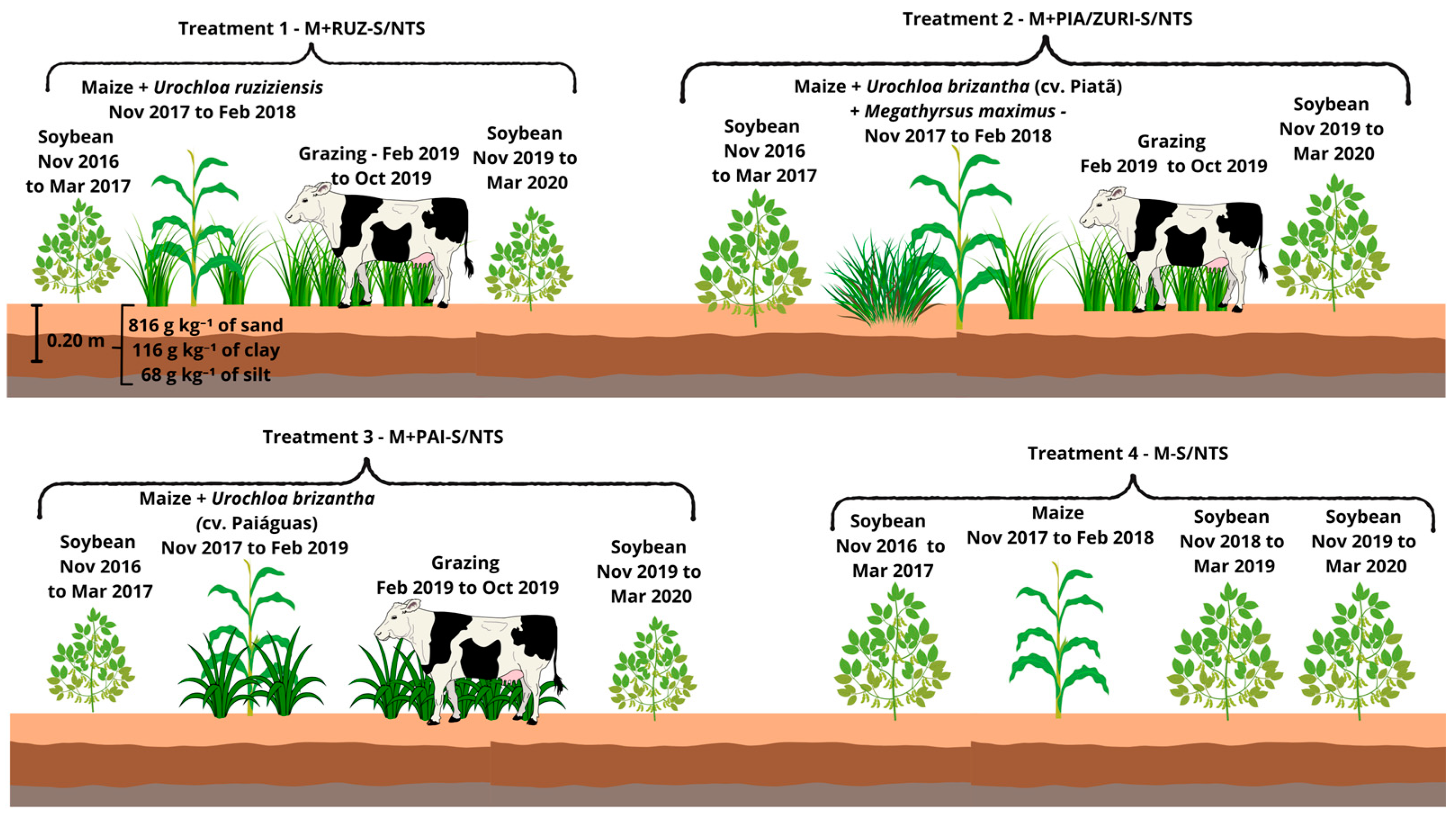
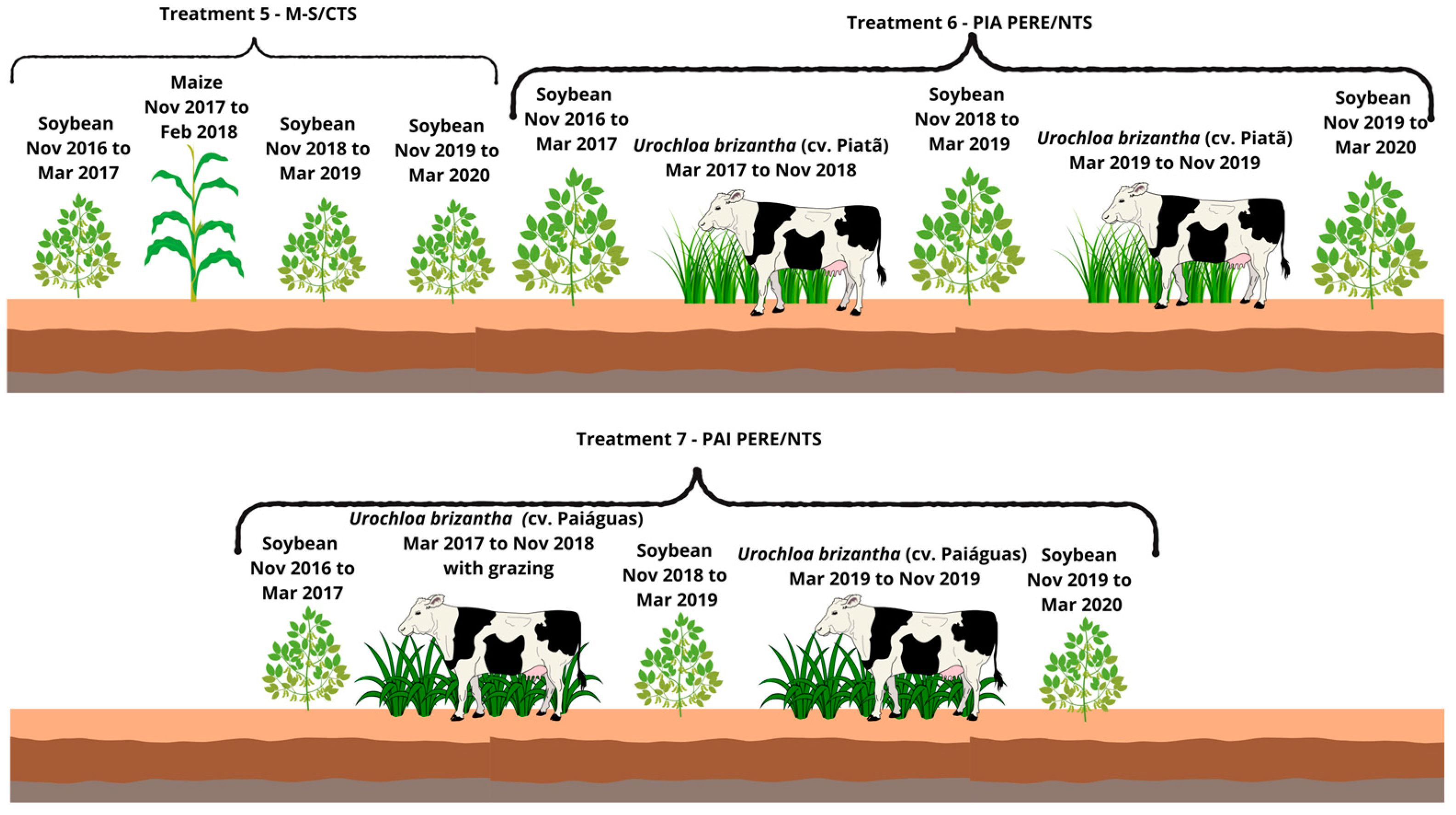
2.2. Area History, Experimental Design, and Treatments
- Soybean–Maize + Urochloa ruziziensis (grazing) + Soybean/No-tillage System (NTS) (M+RUZ-S/NTS):2016/17: Soybean cultivation in November 2016.2017/18: Sowing of maize intercropped with U. ruziziensis, without grazing.2019/20: Introduction of animal grazing in 2019 and 2020, with soybean as the summer crop.
- Soybean–Maize + Urochloa brizantha cv. Piatã (grazing)/Megathyrsus maximus cv. BRS Zuri + Soybean/No-tillage System (M+PIA/ZURI-S/NTS):2016/17: Soybean cultivation in November 2016.2017/18: Sowing of maize intercropped with Urochloa brizantha cv. Piatã, without grazing.2018/19: Replacement of Piatã grass with Megathyrsus maximus cv. BRS Zuri due to low dry matter production.2019/20: Introduction of animal grazing in 2019 and 2020, with soybean as the summer crop.
- Soybean–Maize + Urochloa brizantha cv. Paiaguás (grazing) + Soybean/No-tillage System (M+PAI-S/NTS):2016/17: Soybean cultivation in November 2016.2017/18: Sowing of maize intercropped with U. brizantha cv. Paiaguás, without grazing.2019/20: Introduction of animal grazing in 2019 and 2020, with soybean as the summer crop.
- Soybean–Maize/No-tillage system (M-S/NTS):2016/17: Soybean cultivation in November 2016.2017/18: Sowing of maize using no-tillage in the off-season, repeated in 2018.2019/20: Due to low maize productivity, soybean was cultivated followed by fallow in 2019 and 2020.
- Soybean–Maize/Conventional Tillage System—CTS (M-S/CTS):2016/17: Soybean cultivation in November 2016.2017/18: Sowing of maize in the off-season with conventional tillage (one plowing and leveling harrowing), repeated in 2018.2019/20: Due to low maize productivity, soybean was cultivated followed by fallow in 2019 and 2020.
- Soybean–Urochloa brizantha cv. Piatã (grazing for 2 years)—Soybean–Piatã (grazing)—Soybean/No-tillage System (PIA PERE/NTS):2016/17: Soybean cultivation in November 2016.2017/18 and 2018/19: Sowing of U. brizantha cv. Piatã in March 2017, remaining in the area for two years.2019/20: After soybean cultivation in succession, U. brizantha cv. Piatã was resown in March 2019, this time with grazing for one year, followed by soybean as the summer crop.
- Soybean–Urochloa brizantha cv. Paiaguás (grazing for 2 years)—Soybean–Paiaguás (grazing)—Soybean/No-tillage System (PAI PERE/NTS):2016/17: Soybean cultivation in November 2016.2017/18 and 2018/19: Sowing of U. brizantha cv. Paiaguás in March 2017, remaining in the area for two years.2019/20: After soybean cultivation in succession, U. brizantha cv. Paiaguás was resown in March 2019, this time with grazing for one year, followed by soybean as the summer crop.
2.3. Characteristics of the Area and Experimental Conduct
2.3.1. Seeding of the Intercropped Forages
2.3.2. Desiccation of the Forages in the Intercropping Systems and Soybean Seeding
2.3.3. Harvesting of Soybean Grains
2.3.4. Soil Sampling for Chemical Analysis
2.3.5. Determination of Microbial Respiratory Activity (MRA), Microbial Biomass Carbon (MBC), and Soil Enzymatic Activity
2.3.6. BioAS Analysis
2.4. Statistical Analysis
3. Results
3.1. Microbial Respiratory Activity (MRA), Microbial Biomass Carbon (MBC)
3.2. Soil Enzymatic Activity
3.3. Soil Fertility
3.4. Soil Health
3.5. Soybean Grain Productivity
4. Discussion
5. Conclusions
Author Contributions
Funding
Institutional Review Board Statement
Data Availability Statement
Acknowledgments
Conflicts of Interest
References
- Del Buono, D. Can biostimulants be used to mitigate the effect of anthropogenic climate change on agriculture? It is time to respond. Sci. Total Environ. 2021, 751, 141763. [Google Scholar] [CrossRef]
- Oliveira, L.; Carvalho, M.L.M.; Silva, T.T.A.; Borges, D.I. Temperatura e regime de luz na germinação de sementes de Tabebuia impetiginosa (Martius ex AP de Candolle) Standley e T. serratifolia Vahl Nich.-Bignoniaceae. Ciência e Agrotecnologia. Ciên. Agrotec. 2005, 29, 642–648. [Google Scholar] [CrossRef]
- Rodrigues, L.N.F.; Borges, W.L.B.; Modesto, V.C.; Ribeiro, N.A.A.; de Souza, N.C., Jr.; Girardi, V.A.M.; Matos, A.M.S.; Silva, B.P.C.; Galindo, F.S.; Andreotti, M. Use of Soil Remineralizer to Replace Conventional Fertilizers: Effects on Soil Fertility, Enzymatic Parameters, and Soybean and Sorghum Productivity. Agriculture 2024, 14, 2153. [Google Scholar] [CrossRef]
- Macedo, M.C.M. Integração Lavoura e Pecuária: O estado da arte e inovações tecnológicas. Rev. Bras. Zootec. 2009, 38, 133–146. Available online: http://www.fcav.unesp.br/Home/departamentos/zootecnia/anaclaudiaruggieri/10.-ilp-inovacoes.pdf (accessed on 6 February 2025). [CrossRef]
- Ceccon, G.; Fonseca, I.C.; Luiz Neto, A.; Sereia, R.C.; Leite, L.F. Estabelecimento de Brachiaria Ruziziensis Consorciada com Milho Resistente à Spodoptera Frugiperda; Anais FertBio—XXIX Reunião Brasileira de Fertilidade do Solo e Nutrição de Plantas: Guarapari, ES, Brazil, 13–17 September 2010. Available online: https://ainfo.cnptia.embrapa.br/digital/bitstream/item/23349/1/329281583.pdf (accessed on 6 February 2025).
- Pacheco, L.P.; Pires, F.R.; Monteiro, F.P. Profundidade de semeadura e crescimento inicial de espécies forrageiras utilizadas para cobertura do solo. Rev. Ciênc. Agrotec. 2010, 34, 1211–1218. Available online: https://www.researchgate.net/profile/Fernando_Monteiro10/publication/262432070_Depth_of_sowing_and_initial_growth_of_forage_species_used_for_soil_coverage/links/554b9c5c0cf29f836c971bf1.pdf> (accessed on 6 February 2025). [CrossRef]
- Gregory, A.S.; Joynes, A.; Dixon, E.R.; Beaumont, D.A.; Murray, P.J.; Humphreys, M.W.; Richter, G.M.; Dungait, J.A.J. High-Yielding Forage Grass Cultivars Increase Root Biomass and Soil Organic Carbon Stocks Compared with Mixed-Species Permanent Pasture in Temperate Soil. Eur. J. Soil Sci. 2021, 73, e13160. [Google Scholar] [CrossRef]
- Salomão, P.E.A.; Kriebel, W.; Santos, A.A.; Martins, A.C.E. A importância do sistema de plantio direto na palha para reestruturação do solo e restauração da matéria orgânica. Res. Soc. Dev. 2020, 9, e154911870. [Google Scholar] [CrossRef]
- Devkota, P.; Singh, R.K.; Smith, N.G.; Slaughter, L.C.; van Gestel, N. Residue Addition Can Mitigate Soil Health Challenges with Climate Change in Drylands: Insights from a Field Warming Experiment in Semi-Arid Texas. Soil Syst. 2024, 8, 102. [Google Scholar] [CrossRef]
- Köberl, M.; Wagner, P.; Müller, H.; Matzer, R.; Unterfrauner, H.; Cernava, T.; Berg, G. Unraveling the Complexity of Soil Microbiomes in a Large-Scale Study Subjected to Different Agricultural Management in Styria. Front. Microbiol. 2020, 11, 1052. [Google Scholar] [CrossRef]
- Bettiol, W.; Silva, C.A.; Cerri, C.E.P.; Martin-Neto, L.; Andrade, C.A. Entendendo a Matéria Orgânica do Solo em Ambientes Tropical e Subtropical; Embrapa Meio Ambiente: Jaguariúna, Brazil, 2023; Available online: https://www.embrapa.br/en/busca-de-publicacoes/-/publicacao/1153147/entendendo-a-materia-organica-do-solo-em-ambientes-tropical-e-subtropical (accessed on 7 February 2025).
- Borowik, A.; Wyszkowska, J.; Kucharski, J. Impact of Various Grass Species on Soil Bacteriobiome. Diversity 2020, 12, 212. [Google Scholar] [CrossRef]
- Dubey, A.; Malla, M.A.; Khan, F.; Chowdhary, K.; Yadav, S.; Kumar, A.; Sharma, S.; Khare, P.K.; Khan, M.L. Soil microbiome: A key player for conservation of soil health under changing climate. Biodivers. Cons. 2019, 28, 2405–2429. [Google Scholar] [CrossRef]
- Jansson, J.K.; Hofmockel, K.S. Soil microbiomes and climate change. Nat. Rev. Microbiol. 2019, 18, 35–46. [Google Scholar] [CrossRef] [PubMed]
- Köppen, W.; Geiger, R. Klimate der Erde; Verlag Justus Perthes: Gotha, Germany, 1928; pp. 91–102. [Google Scholar]
- Inmet. Instituto Nacional de Meteorologia. Climatologia e Histórico de Previsão do Tempo em Caiuá, São Paulo, Brasil. Brasília. Available online: https://www.climatempo.com.br/climatologia/2248/caiua-sp (accessed on 7 February 2025).
- Soil Survey Staff. Natural Resources Conservation Service. In Keys to Soil Taxonomy, 12th ed.; USDA: Washington, DC, USA, 2014. [Google Scholar]
- Teixeira, P.C.; Donagemma, G.K.; Fontana, A.; Teixeira, W.G. Manual de Métodos de Análise de Solo. In Empresa Brasileira de Pesquisa Agropecuária Embrapa Solos Ministério da Agricultura, 3rd ed.; Pecuária e Abastecimento—EMBRAPA: Brasília, Brazil, 2017; Available online: https://www.infoteca.cnptia.embrapa.br/infoteca/bitstream/doc/1087262/1/Pt1Cap10Analisegranulometrica.pdf (accessed on 18 December 2024).
- van Raij, B.; Andrade, J.C.; Cantarella, H.; Quaggio, J.A. Análise Química Para Avaliação da Fertilidade de Solos Tropicais; Instituto Agronômico: Campinas, Brazil, 2001; p. 284. [Google Scholar]
- Rezende, L.A.; Assis, L.C.; Nahas, E. Carbon, nitrogen and phosphorus mineralization in two soils amended with distillery yeast. Bioresour. Technol. 2004, 94, 159–167. [Google Scholar] [CrossRef] [PubMed]
- Jenkinson, D.S.; Ladd, J.N. Microbial biomass in soil: Measurement and turnover. In Soil Biology and Biochemistry; Paul, E.A., Ladd, J.N., Eds.; Elsevier: Amsterdam, The Netherlands, 1976; Volume 5, pp. 415–471. [Google Scholar]
- Oliveira, J.R.A.; Mendes, I.d.C.; Vivaldi, L.J. Carbono da biomassa microbiana em solos de cerrado: Comparação dos métodos fumigação-incubação e fumigação-extração. In Empresa Brasileira de Pesquisa Agropecuária Embrapa Solos Ministério da Agricultura; Embrapa Cerrados: Planaltina, Goiás, Brazil, 2001; Available online: http://www.infoteca.cnptia.embrapa.br/infoteca/handle/doc/567076 (accessed on 18 December 2024).
- Anderson, T.H.; Domsch, K.H. The metabolic quocient for CO2 (q CO2) as a specific activity parameter to assess the effects of environmental conditions, such as pH, on the microbial biomass of forest soils. Soil Bilo. Biochem. 1978, 25, 393–395. [Google Scholar] [CrossRef]
- Tabatabai, M.A. Soil enzymes. In Methods of Soil Analysis: Microbiological and Biochemical Properties; Weaver, R.W., Scott, A., Bottomeley, P.J., Eds.; Soil Science Society of America: Madison, WI, USA, 1994; pp. 778–835, (Special Publication 5). [Google Scholar]
- Chaer, G.M.; Mendes, I.C.; Dantas, O.D.; Malaquias, J.V.; Reis Junior, F.B.; Oliveira, M.I.L. Evaluating C trends in clayey Cerrado oxisols using a four-quadrant model based on specific arylsulfatase and β-glucosidase activities. Appl. Soil Ecol. 2023, 183, 104–742. [Google Scholar] [CrossRef]
- Mendes, I.C.; Chaer, G.M.; Reis, F.B., Jr.; Oliveira, M.I.L.; Dantas, O.D.; Malaquias, J.V. Fazendas de Referência para a Implementação do Modelo de Quatro Quadrantes na Avaliação de Tendências do Carbono do Solo Pela Tecnologia BioAS Tendências de Ganho ou Perda de C no Solo. Documentos 403—EMBRAPA, Planaltina—DF, 2023. Available online: https://www.infoteca.cnptia.embrapa.br/infoteca/handle/doc/1154741 (accessed on 18 December 2024).
- R Core Team. R: A Language and Environment for Statistical Computing; R Foundation for Statistical Computing: Vienna, Austria, 2024. [Google Scholar]
- dos Santos, T.E.B.; de Melo, M.A.; Ramos, T.V.; Souza, A.G.V.; Brandão, T.P. Comportamento da comunidade microbiana no sistema silviagrícola na região de cerrado. Rev. Agrotec. 2018, 9, 18–27. [Google Scholar] [CrossRef]
- Siqueira, M.G.; Santos, W.P.; Dias, C.B.M.; Vieira, A.S.; Santos, W.P.; Ferreira, A.G.; Souza, S.P. Respiração do solo em sistemas de manejo no sudoeste da Amazônia. In Elementos da Natureza e Propriedades do Solo; Steiner, F.A., Zuffo, M., Eds.; Atena: Pontagrossa, PA, Brazil, 2018; Volume 6, pp. 95–106. [Google Scholar]
- Silva, M.A.; Nascente, A.S.; de Mello Frasca, L.L.; Rezende, C.C.; Ferreira, E.A.S.; de Filippi, M.C.C.; Lanna, A.C.; de Brito Ferreira, E.P.; Lacerda, M.C. Plantas de cobertura isoladas e em mix para a melhoria da qualidade do solo e das culturas comerciais no Cerrado. Res. Soc. Dev. 2021, 10, 11101220008. [Google Scholar] [CrossRef]
- Calegari, A.; de Araujo, A.G.; Tiecher, T.; Bartz, M.L.C.; Lanillo, R.F.; dos Santos, D.R.; Capandeguy, F.; Zamora, J.H.; Jump, J.R.B.; Moriya, K. No-till farming systems for sustainable agriculture in South America. In No-Till Farming Systems for Sustainable Agriculture; Springer International Publishing: Cham, Switzerland, 2021; pp. 533–565. [Google Scholar] [CrossRef]
- da Costa, T.P.; Quinteiro, P.; Arroja, L.; Dias, A.C. Environmental performance of different end-of-life alternatives of wood fly ash by a consequential perspective. SM&T 2022, 32, 1–13. [Google Scholar] [CrossRef]
- Rosa, D.M.; Nóbrega, L.H.P.; Mauli, M.M.; Lima, G.P.; Pacheco, F.P. Humic substances in soil cultivated with cover crops rotated with maize and soybean. Rev. Cienc. Agron. 2017, 48, 221–230. [Google Scholar] [CrossRef]
- Demattê, J.L.I.; Demattê, J.A.M. Manejo de Solos Arenosos: Fundamentos e Aplicações; Portal de Livros Abertos da USP; Universidade de São Paulo (USP). Escola Superior de Agricultura Luiz de Queiroz (ESALQ): São Paulo, Brazil, 2024; pp. 1–352. [Google Scholar] [CrossRef]
- Araújo, F.C.; Nascente, A.S.; Guimarães, J.L.N.; Sousa, V.S.; Silva, M.A. Cultivo de Plantas de Cobertura na Produção de Biomassa de Plantas Daninhas. In Inovação e Desenvolvimento na Orizicultura: Anais Eletrônico. Embrapa Arroz e Feijão-Artigo em Anais de Congresso. Congresso Brasileiro de Arroz Irrigado, 11, 2019, Balneário Camboriú, SC, Brasil. Epagri: Sosbai. Available online: https://www.alice.cnptia.embrapa.br/alice/bitstream/doc/1111824/1/CNPAF2019cbaiasn2.pdf (accessed on 18 December 2024).
- Kaschuk, G.; Alberton, O.; Hungria, M. Quantifying effects of different agricultural land uses on soil microbial biomass and activity in Brazilian biomes: Inferences to improve soil quality. Plant Soil 2010, 338, 467–481. [Google Scholar] [CrossRef]
- Rangel-Vasconcelos, L.G.T.; Zarin, D.J.; de Assis Oliveira, F.; Vasconcelos, S.S.; de Carvalho, C.J.R.; de Lourdes Silva Santos, M.M. Effect of water availability on soil microbial biomass in secondary forest in Eastern Amazonia. Rev. Bras. Ciênc. Solo 2015, 39, 377–384. [Google Scholar] [CrossRef]
- Chen, H.; Yang, X.; Wang, H.; Sarkar, B.; Shaheen, S.M.; Gielen, G.; Bolan, N.; Guo, J.; Che, L.; Sun, H.; et al. Animal carcass and wood-derived biochars improved nutrient bioavailability, enzyme activity, and plant growth in metal-phthalic acid ester co-contaminated soils: A trial for reclamation and improvement of degraded soils. J. Environ. Manag. 2020, 261, 110246. [Google Scholar] [CrossRef]
- Xu, X.; Schimel, J.P.; Janssens, I.A.; Song, X.; Song, C.; Yu, G.; Sinsabaugh, R.L.; Tang, D.; Zhang, X.; Thornton, P.E. Global pattern and controls of soil microbial metabolic quotient. Ecol. Monogr. 2017, 87, 429–441. [Google Scholar] [CrossRef]
- Clayton, J.; Lemanski, K.; Bonkowski, M. Shifts in Soil Microbial Stoichiometry and Metabolic Quotient Provide Evidence for a Critical Tipping Point at 1% Soil Organic Carbon in an Agricultural Post-Mining Chronosequence. Biol. Fertil. Soils 2021, 57, 435–446. [Google Scholar] [CrossRef]
- Pereira, L.F.; Ferreira, C.F.C.; Guimarães, R.M.F. Manejo, qualidade e dinâmica da degradação de pastagens na Mata Atlântica de Minas Gerais—Brasil. Nativa 2018, 6, 370–379. [Google Scholar] [CrossRef]
- Cruz, N.T.; Dias, L.S.D.; Fries, D.D.; Jardim, R.R.; De Lana Sousa, B.M.; Pires, A.J.V.; Ramos, B.L.P. Alternativas para recuperação e renovação de pastagens degradadas. Pesqui. Agropecuária Gaúcha 2022, 28, 15–35. [Google Scholar] [CrossRef]
- Dhakal, D.; Islam, M.A. Grass-Legume Mixtures for Improved Soil Health in Cultivated Agroecosystem. Sustainability 2018, 10, 2718. [Google Scholar] [CrossRef]
- Meza, K.; Vanek, S.J.; Sueldo, Y.; Olivera, E.; Ccanto, R.; Scurrah, M.; Fonte, S.J. Grass–Legume Mixtures Show Potential to Increase Above- and Belowground Biomass Production for Andean Forage-Based Fallows. Agronomy 2022, 12, 142. [Google Scholar] [CrossRef]
- Silva, A.C.; Barbosa, M.S.; Barral, U.M.; Silva, B.P.C.; Fernandes, J.S.C.; Viana, A.J.S.; Mendonça Filho, C.V.; Bispo, D.F.A.; Christófaro, C.; Ragonezi, C.; et al. Organic matter composition and paleoclimatic changes in tropical mountain peatlands currently under grasslands and forest clusters. Catena 2019, 180, 69–82. [Google Scholar] [CrossRef]
- Favarato, L.F.; de Souza, J.L.; Galvão, J.C.C.; de Souza, C.M.; Guarçoni, R.C. Atributos químicos do solo sobre diferentes plantas de cobertura no sistema plantio direto orgânico. Rev. Bras. Agrop. Sust. 2015, 5, 19–28. [Google Scholar] [CrossRef]
- Nascente, A.S.; Crusciol, C.A.C.; Cobucci, T. The no-tillage system and cover crops—Alternatives to increase upland rice yields. Eur. J. Agron. 2013, 45, 124–131. [Google Scholar] [CrossRef]
- Cordeiro Júnior, P.S.; Finoto, E.L.; Bárbaro-Torneli, I.M.; Martins, M.H.; Soares, M.B.B.; Bolonhezi, D.; Martins, A.L.M. Agronomic performance of soybean cultivars for the central north region of São Paulo, crop year 2016/17. Nucleus 2017, 34, 59–66. [Google Scholar] [CrossRef][Green Version]
- Oligini, K.F.; Batista, V.V.; Barhy, C.A.; Conceição, P.C.; Sartor, L.R.; Adami, P.F. Cover crops biomass yield grown as a 2nd summer crop in relation to sowing periods. Aust. J. Crop. Sci. 2022, 16, 982–989. [Google Scholar] [CrossRef]
- Adeux, G.; Cordeau, S.; Antichi, D.; Carlesi, S.; Mazzoncini, M.; Munier-Jolain, N.; Bàrberi, P. over crops promote crop productivity but do not enhance weed management in tillage-based cropping systems. Eur. J. Agron. 2021, 123, 126221. [Google Scholar] [CrossRef]
- Koudahe, K.; Allen, S.C.; Djaman, K. Critical review of the impact of cover crops on soil properties. Int. Soil Water Conserv. Res. 2022, 10, 343–354. [Google Scholar] [CrossRef]
- Muhammad, I.; Wang, J.; Sainju, U.M.; Zhang, S.; Zhao, F.; Khan, A. Cover cropping enhances soil microbial biomass and affects microbial community structure: A meta-analysis. Geoderma 2021, 381, 114696. [Google Scholar] [CrossRef]
- Lima, C.L.R.; Silva, A.P.; Imhoff, S.; Lima, H.V.; Leão, T.P. Heterogeneidade da compactação de um Latossolo Vermelho-Amarelo sob pomar de laranja. Rev. Bras. Cienc. Solo 2004, 28, 409–414. [Google Scholar] [CrossRef]
- Machado, L.V.; Rangel, O.J.P.; Mendonça, E.S.; Machado, R.V.; Ferrari, J.L. Fertilidade e compartimentos da matéria orgânica do solo sob diferentes sistemas de manejo. Coffee Sci. 2014, 9, 289–299. [Google Scholar]
- Morgan, B.S.T.; Tian, G.; Oladeji, O.O.; Cox, A.E.; Granato, T.C.; Zhang, H.; Podczewinski, E.W. Analysis of effects and factors linked to soil microbial populations and nitrogen cycling under long-term biosolids application. Sci. Total Environ. 2024, 934, 173216. [Google Scholar] [CrossRef]
- Santos, M.E.R.; de Moraes, L.S.; de Oliveira Fernandes, F.H.; Carvalho, B.H.R.; de Oliveira Rocha, G.; de Andrade, C.M.S. Herbage accumulation and canopy structure during stockpiling of Marandu, Piatã, Xaraés, and Paiaguás brachiariagrass cultivars. Pesqui. Agropecuária Bras. 2021, 56, e02207. [Google Scholar] [CrossRef]
- Valle, C.B.; Euclides, V.P.B.; Valério, J.R.; Macedo, M.C.M.; Fernandes, C.D.; Dias Filho, M.B. Brachiaria brizantha cv. Piatã: Uma forrageira para diversificação de pastagens tropicais. Seed News 2007, 11, 28–30. [Google Scholar]
- Souza, L.S.; Ambrosano, E.J.; Rossi, F.; Carlos, J.A.D. Adubação verde na física do solo. In Adubação Verde e Plantas de Cobertura no Brasil: Fundamentos e Prática, 1st ed.; Filho, O.F.L., Ambrosano, E.J., Rossi, F., Carlos, J.A.D., Eds.; Embrapa: Brasília, Brazil, 2014; pp. 337–369. [Google Scholar]
- Balbinot Junior, A.A.; dos Santos, J.C.F.; Debiasi, H.; Yokoyama, A.H. Contribution of roots and shoots of Brachiaria species to soybean performance in succession. Pesqui. Agropecuária Bras. 2017, 52, 592–598. [Google Scholar] [CrossRef]
- Coser, T.R.; Ramos, M.L.G.; de Figueiredo, C.C.; deCarvalho, A.M.; Cavalcante, E.; dos Reis Moreira, M.K.; Araújo, P.S.M.; de Oliveira, S.A. Soil microbiological properties and available nitrogen for corn in monoculture and intercropped with forage. Pesqui. Agropecuária Bras. 2016, 51, 1660–1667. [Google Scholar] [CrossRef]
- Moraes, M.T.D.; Debiasi, H.; Franchini, J.; Rodrigues da Silva, V. Benefícios das plantas de cobertura sobre as propriedades físicas do solo. In Manejo e Conservação do Solo e da Água em Pequenas Propriedades Rurais no sul do Brasil: Práticas Alternativas de Manejo Visando a Conservação do Solo e da Água; Universidade Federal do Rio Grande do Sul: Porto Alegre, Brazil, 2016; Volume 1, p. 34. Available online: https://www.researchgate.net/publication/309285857_BENEFICIOS_DAS_PLANTAS_DE_COBERTURA_SOBRE_AS_PROPRIEDADES_FISICAS_DO_SOLO (accessed on 18 December 2024).
- Planisich, A.; Utsumi, S.A.; Larripa, M.; Galli, J.R. Grazing of Cover Crops in Integrated Crop-Livestock Systems. Animals 2021, 15, 100054. [Google Scholar] [CrossRef] [PubMed]
- de Faccio Carvalho, P.C.; Peterson, C.A.; de Albuquerque Nunes, P.A.; Martins, A.P.; de Souza Filho, W.; Bertolazi, V.T.; Kunrath, T.R.; de Moraes, A.; Anghinoni, I. Animal production and soil characteristics from integrated crop-livestock systems: Toward sustainable intensification. J. Anim. Sci. 2018, 96, 4923. [Google Scholar] [CrossRef]
- Tobin, C.; Singh, S.; Kumar, S.; Wang, T.; Sexton, P. Demonstrating Short-Term Impacts of Grazing and Cover Crops on Soil Health and Economic Benefits in an Integrated Crop-Livestock System in South Dakota. Open J. Soil Sci. 2020, 10, 109–136. [Google Scholar] [CrossRef]
- Rosa Filho, G.; de Passos Carvalho, M.; Andreotti, M.; Montanari, R.; da Silva Binotti, F.F.; Gioia, M.T. Variabilidade da produtividade da soja em função de atributos físicos de um latossolo vermelho distroférrico sob plantio direto. Rev. Bras. Cienc. Solo 2009, 33, 283–293. [Google Scholar] [CrossRef]
- Rossi, C.Q.; Pereira, M.G.; Giacomo, S.G.; Betta, M.; Polidoro, J.C. Frações húmicas da matéria orgânica do solo cultivado com soja sobre palhada de braquiária e sorgo. Bragantia 2011, 70, 622–630. [Google Scholar] [CrossRef]
- Brown, V.; Barbosa, F.T.; Bertol, I.; Mafra, Á.L.; Muzeka, L.M. Efeitos no solo e nas culturas após vinte anos de cultivo convencional e semeadura direta. Rev. Bras. Ciências Agrárias 2018, 13, 1–7. [Google Scholar] [CrossRef]

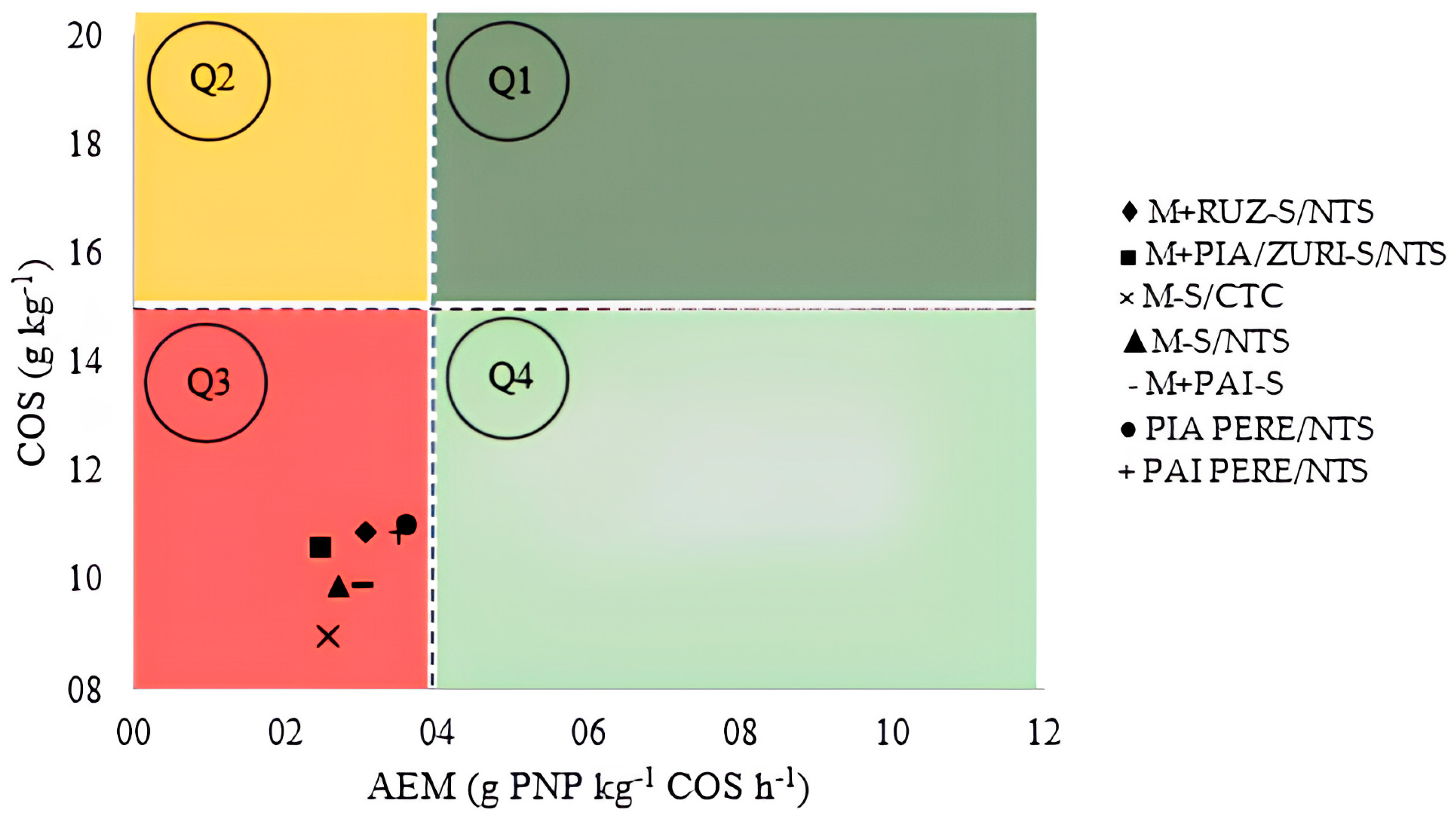
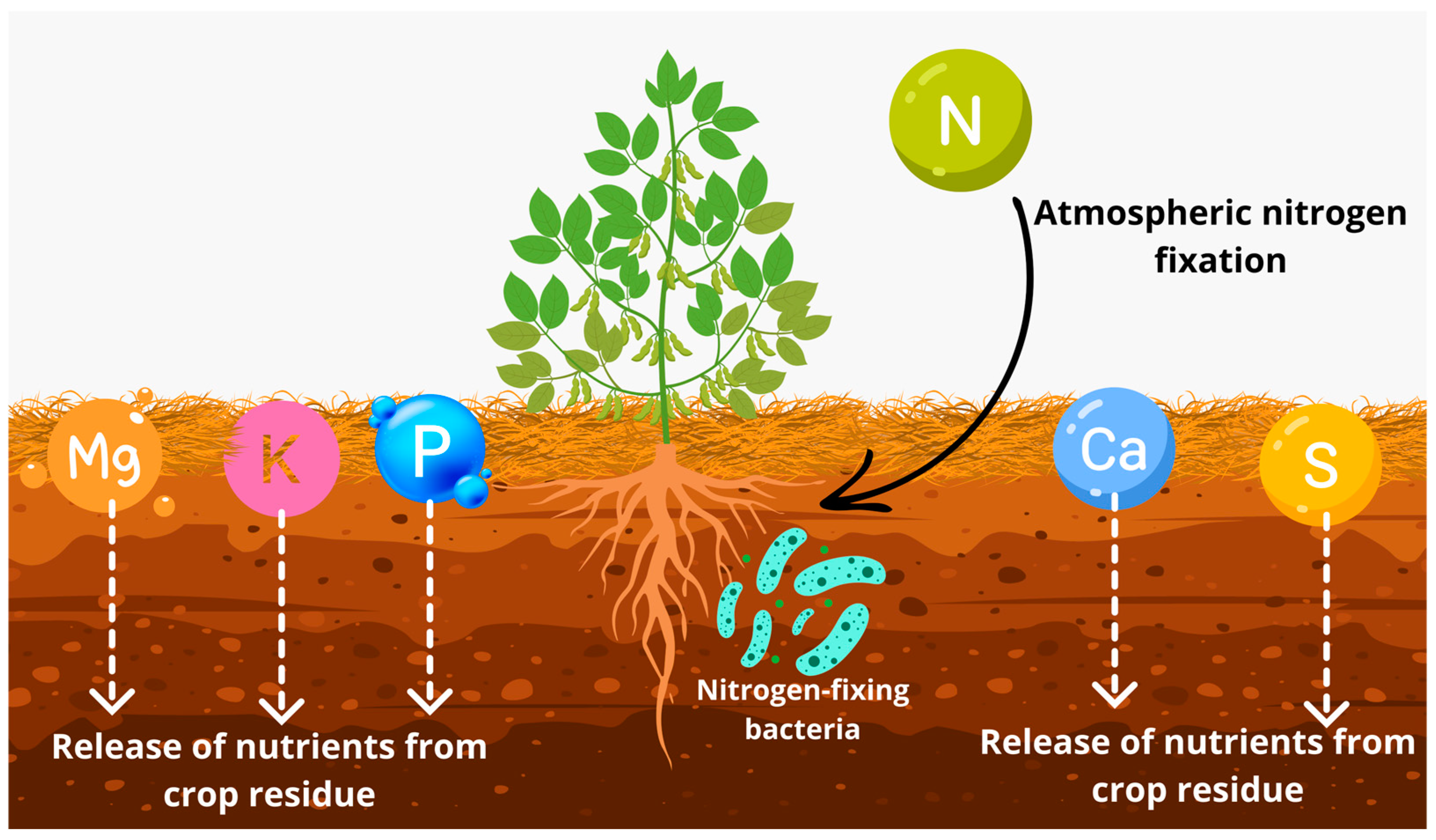

| a | |||||||||||||||||||||||||
| Treatment | Depth | MA | MI | TP | SD | Total N | C/N Ratio | ||||||||||||||||||
| cm | ---------m−3 m−3--------- | mg m−3 | g kg −1 | - | |||||||||||||||||||||
| M+RUZ-S/NTS | 00 to 10 | 0.05 | 0.28 | 0.33 | 1.62 | 0.95 | 9.16 | ||||||||||||||||||
| 10 to 20 | 0.04 | 0.26 | 0.31 | 1.65 | - | - | |||||||||||||||||||
| M+PIA/ZURI-S/NTS | 00 to 10 | 0.10 | 0.29 | 0.39 | 1.50 | 0.77 | 10.47 | ||||||||||||||||||
| 10 to 20 | 0.07 | 0.28 | 0.35 | 1.63 | - | - | |||||||||||||||||||
| M+PAI-S/NTS | 00 to 10 | 0.12 | 0.29 | 0.41 | 1.47 | 0.95 | 9.01 | ||||||||||||||||||
| 10 to 20 | 0.08 | 0.27 | 0.34 | 1.61 | - | - | |||||||||||||||||||
| M-S/NTS | 00 to 10 | 0.10 | 0.29 | 0.39 | 1.53 | 1.04 | 8.32 | ||||||||||||||||||
| 10 to 20 | 0.07 | 0.26 | 0.32 | 1.65 | - | - | |||||||||||||||||||
| M-S/CTS | 00 to 10 | 0.10 | 0.29 | 0.39 | 1.53 | 1.05 | 7.93 | ||||||||||||||||||
| 10 to 20 | 0.07 | 0.26 | 0.32 | 1.65 | - | - | |||||||||||||||||||
| PIA PERE/NTS | 00 to 10 | 0.07 | 0.29 | 0.35 | 1.57 | 0.84 | 10.27 | ||||||||||||||||||
| 10 to 20 | 0.05 | 0.26 | 0.31 | 1.67 | - | - | |||||||||||||||||||
| PAI PERE/NTS | 00 to 10 | 0.08 | 0.29 | 0.37 | 1.50 | 0.95 | 9.90 | ||||||||||||||||||
| 10 to 20 | 0.06 | 0.27 | 0.33 | 1.56 | - | - | |||||||||||||||||||
| MA: Macroporosity; MI: Microporosity; TP: Total Porosity; SD: Soil Density; Total N: Nitrogen Total; C/N Ratio: Ratio Carbon/Nitrogen. M+RUZ-S/NTS = Soybean–Maize+Ruziziensis/No-tillage System; M+PIA/ZURI-S/NTS = Soybean–Maize+BRS Zuri/No-tillage System; M+PAI-S/NTS = Maize–Soybean + Paiaguás/No-tillage System; M-S/NTS = Maize–Soybean/No-tillage System; M-S/CTS = Maize–Soybean/Conventional Tillage System; PIA PERE/NTS = Soybean + Piatã/No-tillage System; PAI PERE/NTS = Soybean–Paiáguas/No-tillage System. | |||||||||||||||||||||||||
| b | |||||||||||||||||||||||||
| Treatment | Depth | Presin | OM | pH | K | Ca | Mg | S-SO4 | |||||||||||||||||
| cm | mg dm−3 | g dm−3 | CaCl2 | --mmolcdm−3-- | mg dm−3 | ||||||||||||||||||||
| M+RUZ-S/NTS | 00 to 10 | 41 | 13 | 5.6 | 2 | 21 | 11 | 4 | |||||||||||||||||
| 10 to 20 | 43 | 12 | 5.2 | 1.5 | 17 | 7 | 6 | ||||||||||||||||||
| M+PIA/ZURI-S/NTS | 00 to 10 | 40 | 13 | 5.6 | 2.1 | 19 | 9 | 4 | |||||||||||||||||
| 10 to 20 | 30 | 13 | 5.5 | 1.6 | 18 | 7 | 3 | ||||||||||||||||||
| M+PAI-S/NTS | 00 to 10 | 32 | 12 | 5.8 | 1.9 | 21 | 9 | 3 | |||||||||||||||||
| 10 to 20 | 25 | 12 | 5.7 | 1.1 | 20 | 6 | 3 | ||||||||||||||||||
| M-S/NTS | 00 to 10 | 57 | 12 | 5.8 | 2.4 | 25 | 13 | 3 | |||||||||||||||||
| 10 to 20 | 36 | 12 | 5.8 | 1.8 | 22 | 9 | 3 | ||||||||||||||||||
| M-S/CTS | 00 to 10 | 57 | 12 | 5.8 | 2.4 | 25 | 13 | 3 | |||||||||||||||||
| 10 to 20 | 36 | 12 | 5.8 | 1.8 | 22 | 9 | 3 | ||||||||||||||||||
| PIA PERE/NTS | 00 to 10 | 38 | 13 | 6 | 1.9 | 29 | 14 | 3 | |||||||||||||||||
| 10 to 20 | 32 | 12 | 6 | 1.2 | 29 | 12 | 3 | ||||||||||||||||||
| PAI PERE/NTS | 00 to 10 | 47 | 13 | 6.1 | 2.2 | 28 | 13 | 3 | |||||||||||||||||
| 10 to 20 | 28 | 13 | 6 | 1.7 | 31 | 18 | 3 | ||||||||||||||||||
| Presin: phosphorus content; OM: organic matter; pH: hydrogen ion potential; K: potassium: Ca: calcium; Mg: magnesium; S-SO4: sulfate. MA: Macroporosity; MI: Microporosity; PT: Total Porosity; Ds: Soil Density. M+RUZ-S/NTS = Soybean–Maize+Ruziziensis/No-tillage System; M+PIA/ZURI-S/NTS = Soybean–Maize+BRS Zuri/No-tillage System; M+PAI-S/NTS = Maize–Soybean + Paiaguás/No-tillage System; M-S/NTS = Maize–Soybean/No-tillage System; M-S/CTS = Maize–Soybean/Conventional Tillage System; PIA PERE/NTS = Soybean + Piatã/No-tillage System; PAI PERE/NTS = Soybean–Paiáguas/No-tillage System. | |||||||||||||||||||||||||
| c | |||||||||||||||||||||||||
| Treatment | Depth | H + Al | Al | SB | CEC | V | K/CEC | Ca/CEC | Mg/CEC | m | |||||||||||||||
| cm | ------------mmolcdm−3------------ | ------------------------------%------------------------ | |||||||||||||||||||||||
| M+RUZ-S/NTS | 00 to 10 | 16 | 1 | 34.4 | 50.2 | 66 | 4 | 42 | 20 | 3 | |||||||||||||||
| 10 to 20 | 18 | 1 | 24.9 | 42.7 | 57 | 4 | 38 | 15 | 5 | ||||||||||||||||
| M+PIA/ZURI-S/NTS | 00 to 10 | 16 | 0 | 29.4 | 45.4 | 65 | 5 | 41 | 19 | 1 | |||||||||||||||
| 10 to 20 | 16 | 0 | 26.9 | 42.6 | 63 | 4 | 44 | 16 | 0 | ||||||||||||||||
| M+PAI-S/NTS | 00 to 10 | 14 | 0 | 40.5 | 54.7 | 72 | 4 | 45 | 23 | 0 | |||||||||||||||
| 10 to 20 | 14 | 0 | 32.3 | 46.1 | 69 | 4 | 48 | 18 | 0 | ||||||||||||||||
| M-S/NTS | 00 to 10 | 14 | 0 | 40.5 | 54.7 | 72 | 4 | 45 | 23 | 0 | |||||||||||||||
| 10 to 20 | 14 | 0 | 32.3 | 46.1 | 69 | 4 | 48 | 18 | 0 | ||||||||||||||||
| M-S/CTS | 00 to 10 | 13 | 0 | 31.9 | 45.1 | 70 | 4 | 46 | 20 | 0 | |||||||||||||||
| 10 to 20 | 14 | 0 | 26.9 | 40.9 | 65 | 3 | 48 | 14 | 0 | ||||||||||||||||
| PIA PERE/NTS | 00 to 10 | 13 | 0 | 44.3 | 57.5 | 76 | 3 | 49 | 23 | 0 | |||||||||||||||
| 10 to 20 | 14 | 0 | 42.4 | 56.4 | 75 | 2 | 52 | 21 | 0 | ||||||||||||||||
| PAI PERE/NTS | 00 to 10 | 13 | 0 | 44.0 | 56.5 | 78 | 4 | 50 | 24 | 0 | |||||||||||||||
| 10 to 20 | 14 | 0 | 49.9 | 63.5 | 76 | 3 | 49 | 25 | 0 | ||||||||||||||||
| H + Al: hydrogen + aluminum; SB: sum of bases; CEC: cation exchange capacity; V: base saturation; K/CEC: potassium in CEC; Ca/CEC: calcium in CEC; Mg/CEC: magnesium in CEC; m: aluminum saturation. M+RUZ-S/NTS = Soybean–Maize+Ruziziensis/No-tillage System; M+PIA/ZURI-S/NTS = Soybean–Maize+BRS Zuri/No-tillage System; M+PAI-S/NTS = Maize–Soybean + Paiaguás/No-tillage System; M-S/NTS = Maize–Soybean/No-tillage System; M-S/CTS = Maize–Soybean/Conventional Tillage System; PIA PERE/NTS = Soybean + Piatã/No-tillage System; PAI PERE/NTS = Soybean–Paiáguas/No-tillage System. | |||||||||||||||||||||||||
| Treatments | MRA | MBC |
|---|---|---|
| mg CO2 50 g ss day−1 | mg C kg−1 | |
| M+RUZ-S/NTS | 4.4 | 56.1 |
| M+PIA/ZURI-S/NTS | 4.4 | 52.0 |
| M+PAI-S/NTS | 3.8 | 48.9 |
| M-S/NTS | 4.8 | 45.5 |
| M-S/CTS | 3.6 | 52.2 |
| PAI PERE/NTS | 4.3 | 45.5 |
| PIA PERE/NTS | 3.6 | 49.4 |
| LSD | 2.9 | 16.8 |
| Pr>Fc | 0.75 | 0.34 |
| CV% | 29.8 | 14.4 |
| Treatments | Acid Phosphatase | β-Glucosidase | Arylsulfatase |
|---|---|---|---|
| mg of p-Nitrophenol kg of soil−1 h−1 | |||
| M+RUZ-S/NTS | 146.8 ab | 44.5 ab | 22.0 bc |
| M+PIA/ZURI-S/NTS | 140.6 abc | 36.3 ab | 16.1 c |
| M+PAI-S/NTS | 147.8 ab | 42.5 ab | 33.3 a |
| M-S/NTS | 110.1 bc | 36.0 b | 17.0 bc |
| M-S/CTS | 104.2 c | 31.6 b | 14.3 c |
| PAI PERE/NTS | 163.4 a | 36.5 ab | 23.0 bc |
| PIA PERE/NTS | 131.8 abc | 53.3 a | 26.0 ab |
| LSD | 39.7 | 17.2 | 9.0 |
| Pr>Fc | 0.001 * | 0.01 * | 0.0001 * |
| CV% | 12.6 | 18.6 | 17.8 |
| Systems (S) | Presin | OM | pH | K | Ca | Mg | H + Al | Al | SB | CEC | S-SO42− | V | m |
|---|---|---|---|---|---|---|---|---|---|---|---|---|---|
| 0–0.10 m | |||||||||||||
| mg dm3 | g dm−3 | CaCl2 | -------------------------- mmolc dm−3 ------------------------------- | mg dm3 | ------ % ------ | ||||||||
| M+RUZ-S/NTS | 18.7 bc | 18.7 | 5.2 | 2.0 c | 11.0 ab | 7.8 abc | 15.7 | 1.0 ab | 21.3 cd | 36.2 | 2.5 ab | 57 ab | 2.5 |
| M+PIA/ZURI-S/NTS | 25.5 bc | 18.3 | 4.9 | 2.9 ab | 11.0 ab | 7.0 abc | 19.3 | 1.5 a | 23.7 abc | 39.3 | 4.0 a | 51 ab | 5.5 |
| M+PAI-S/NTS | 28.3 ab | 18.7 | 5.3 | 3.0 a | 12.0 ab | 10.0 ab | 17.7 | 0.0 b | 30.12 ab | 42.5 | 2.0 ab | 61 a | 0.0 |
| M-S/NTS | 37.0 a | 17.0 | 5.0 | 2.4 abc | 9.3 ab | 5.3 bc | 20.0 | 0.0 b | 18.5 d | 36.6 | 2.5 ab | 48 ab | 0.0 |
| M-S/CTS | 27.5 abc | 15.5 | 4.8 | 2.3 bc | 8.0 b | 4.0 c | 20.3 | 0.7 ab | 26.7 abc | 34.9 | 2.0 ab | 43 b | 8.7 |
| PAI PERE/NTS | 17.5 c | 18.7 | 5.0 | 3.1 a | 12.0 ab | 7.3 abc | 17.7 | 0.7 ab | 22.2 bcd | 36.2 | 2.0 ab | 50 ab | 7.5 |
| PIA PERE/NTS | 23.0 bc | 19.0 | 5.6 | 2.1 bc | 15.5 a | 12.0 a | 17.7 | 1.0 ab | 31.8 a | 44.1 | 1.3 b | 62 a | 4.0 |
| LSD | 10.1 | 6.0 | 1.0 | 0.83 | 7.4 | 5.2 | 4.8 | 1.1 | 8.7 | 13.3 | 2.4 | 17.0 | 12.5 |
| Pr>Fc | 0.0001 * | 0.4 | 0.5 | 0.0008 * | 0.04 * | 0.003 * | 0.06 | 0.001 * | 0.0002 * | 0.2 | 0.03 * | 0.008 * | 1.19 |
| CV% | 17.1 | 14.7 | 6.5 | 14.0 | 28.2 | 29.1 | 11.2 | 30.6 | 15.1 | 14.8 | 24.2 | 13.9 | 22.9 |
| Systems (S) | Presin | OM | pH | K | Ca | Mg | H + Al | Al | SB | CEC | S-SO42− | V | m |
|---|---|---|---|---|---|---|---|---|---|---|---|---|---|
| 0.10–0.20 m | |||||||||||||
| mg dm3 | g dm−3 | CaCl2 | ---------------------------- mmolc dm−3 --------------------------------- | mg dm3 | ------- % ------- | ||||||||
| M+RUZ-S/NTS | 23.0 | 15.0 | 5.2 ab | 1.7 b | 10.0 | 6.0 | 15.7 b | 0.5 | 16.7 ab | 35.7 | 1.5 | 54 | 4.3 |
| M+PIA/ZURI –S/NTS | 24.0 | 15.3 | 4.9 b | 1.7 b | 10.0 | 5.0 | 16.0 b | 1.7 | 16.4 ab | 34.4 | 2.3 | 48 | 9.5 |
| M+PAI-S/NTS | 23.0 | 15.5 | 5.5 ab | 2.5 a | 13.0 | 7.0 | 15.5 b | 0.0 | 23.0 a | 38.3 | 2.0 | 59 | 0.0 |
| M-S/NTS | 28.0 | 14.0 | 5.1 ab | 1.5 b | 11.0 | 5.0 | 16.0 b | 1.0 | 16.3 ab | 33.0 | 2.3 | 50 | 5.7 |
| M-S/CTS | 25.0 | 14.0 | 4.9 b | 1.7 b | 9.0 | 5.0 | 24.0 a | 2.0 | 14.2 b | 36.1 | 2.0 | 44 | 10.3 |
| PAI PERE/NTS | 20.2 | 15.0 | 5.1 ab | 1.8 ab | 13.5 | 7.0 | 15.0 b | 1.0 | 18.0 ab | 31.7 | 2.0 | 52 | 7.0 |
| PIA PERE/NTS | 18.5 | 15.3 | 5.7 a | 1.9 ab | 14.0 | 7.0 | 13.5 b | 0.3 | 22.0 a | 41.6 | 1.7 | 63 | 1.3 |
| LSD | 14.1 | 2.9 | 0.8 | 0.7 | 5.9 | 2.6 | 5.4 | 2.6 | 6.7 | 16.2 | 1.1 | 19.9 | 15.7 |
| Pr>Fc | 0.30 | 0.47 | 0.03 * | 0.002 * | 0.14 | 0.70 | 0.002 * | 0.52 | 0.004 * | 0.55 | 0.35 | 0.06 | 0.62 |
| CV% | 25.8 | 9.1 | 6.5 | 16.3 | 22.6 | 20.2 | 13.9 | 27.6 | 15.9 | 19.6 | 24.8 | 16.0 | 27.1 |
| Systems (S) | Presin | OM | pH | K | Ca | Mg | H + Al | Al | SB | CEC | S-SO42− | V | m |
|---|---|---|---|---|---|---|---|---|---|---|---|---|---|
| 0.20–0.40 m | |||||||||||||
| mg dm3 | g dm−3 | CaCl2 | ---------------------------- mmolc dm−3 --------------------------------- | mg dm3 | ------- % ------- | ||||||||
| M+RUZ-S/NTS | 14.0 a | 12.2 | 4.9 | 1.4 | 10.0 | 4.0 ab | 15.7 | 1.5 | 14.7 bc | 30.4 | 2.0 ab | 48 ab | 10.7 |
| M+PIA/ZURI –S/NTS | 12.2 a | 12.7 | 4.8 | 1.4 | 9.0 | 3.0 b | 19.0 | 2.0 | 13.5 c | 32.4 | 2.0 ab | 42 b | 12.0 |
| M+PAI-S/NTS | 13.2 a | 14.0 | 5.3 | 1.7 | 10.0 | 5.8 a | 15.7 | 0.7 | 19.3 a | 33.2 | 3.0 a | 53 ab | 3.3 |
| M-S/NTS | 10.2 ab | 12.3 | 5.0 | 1.4 | 10.0 | 4.0 ab | 15.0 | 0.8 | 15.8 abc | 31.3 | 3.0 a | 48 ab | 5.8 |
| M-S/CTS | 8.0 bc | 12.5 | 4.9 | 1.4 | 9.0 | 4.0 ab | 17.0 | 1.3 | 14.5 bc | 30.7 | 2.0 ab | 45 ab | 11.3 |
| PAI PERE/NTS | 6.0 c | 12.3 | 5.2 | 1.4 | 12.0 | 4.5 ab | 15.0 | 0.7 | 16.4 abc | 29.4 | 2.2 ab | 49 ab | 6.3 |
| PIA PERE/NTS | 5.0 c | 13.8 | 5.6 | 1.5 | 12.0 | 5.2 ab | 13.7 | 0.0 | 18.6 ab | 32.2 | 1.3 b | 58 a | 0.0 |
| LSD | 4.2 | 2.5 | 0.9 | 0.4 | 2.8 | 2.0 | 5.7 | 2,6 | 4.8 | 8.7 | 1.4 | 15.00 | 16.5 |
| Pr>Fc | 0.0001 * | 0.12 | 0.19 | 0.09 | 0.3 | 0.01 * | 0.16 | 0.2 | 0.005 * | 0.8 | 0.01 * | 0.02 * | 0.52 |
| CV% | 18.3 | 8.3 | 7.7 | 11.3 | 11.8 | 20.0 | 15.5 | 21.0 | 12.6 | 11.9 | 27.4 | 13.3 | 25.2 |
| Treatments | Population (Plants ha−1 × 1000) | Productivity (kg ha−1) |
|---|---|---|
| M+RUZ-S/NTS | 212 ab | 3143 ab |
| M+PIA/ZURI-S/NTS | 210 ab | 3181 ab |
| M+PAI-S/NTS | 206 ab | 3201 ab |
| M-S/NTS | 194 b | 3083 ab |
| M-S/CTS | 164 c | 2934 b |
| PAI PERE/NTS | 222 a | 3746 a |
| PIA PERE/NTS | 204 ab | 3760 a |
| Pr>Fc | 0.0001 | 0.0022 |
| CV% | 11.96 | 13.74 |
Disclaimer/Publisher’s Note: The statements, opinions and data contained in all publications are solely those of the individual author(s) and contributor(s) and not of MDPI and/or the editor(s). MDPI and/or the editor(s) disclaim responsibility for any injury to people or property resulting from any ideas, methods, instructions or products referred to in the content. |
© 2025 by the authors. Licensee MDPI, Basel, Switzerland. This article is an open access article distributed under the terms and conditions of the Creative Commons Attribution (CC BY) license (https://creativecommons.org/licenses/by/4.0/).
Share and Cite
Froio, L.d.L.; Pechoto, E.A.P.; Garruti, M.V.G.; Soares, D.d.A.; Sekiya, B.M.S.; Modesto, V.C.; Souza Júnior, N.C.d.; Girardi, V.A.M.; Ribeiro, N.A.A.; Matos, A.M.S.; et al. Sandy Soil Quality and Soybean Productivity in Medium-Duration Agricultural Production Systems. Agriculture 2025, 15, 589. https://doi.org/10.3390/agriculture15060589
Froio LdL, Pechoto EAP, Garruti MVG, Soares DdA, Sekiya BMS, Modesto VC, Souza Júnior NCd, Girardi VAM, Ribeiro NAA, Matos AMS, et al. Sandy Soil Quality and Soybean Productivity in Medium-Duration Agricultural Production Systems. Agriculture. 2025; 15(6):589. https://doi.org/10.3390/agriculture15060589
Chicago/Turabian StyleFroio, Leonardo de Lima, Eduardo Augusto Pontes Pechoto, Moisés Vinícius Garcia Garruti, Deyvison de Asevedo Soares, Bianca Midori Souza Sekiya, Viviane Cristina Modesto, Nelson Câmara de Souza Júnior, Vitória Almeida Moreira Girardi, Naiane Antunes Alves Ribeiro, Aline Marchetti Silva Matos, and et al. 2025. "Sandy Soil Quality and Soybean Productivity in Medium-Duration Agricultural Production Systems" Agriculture 15, no. 6: 589. https://doi.org/10.3390/agriculture15060589
APA StyleFroio, L. d. L., Pechoto, E. A. P., Garruti, M. V. G., Soares, D. d. A., Sekiya, B. M. S., Modesto, V. C., Souza Júnior, N. C. d., Girardi, V. A. M., Ribeiro, N. A. A., Matos, A. M. S., Lupatini, G. C., & Andreotti, M. (2025). Sandy Soil Quality and Soybean Productivity in Medium-Duration Agricultural Production Systems. Agriculture, 15(6), 589. https://doi.org/10.3390/agriculture15060589