Article

Tracking Heavy Metals and Resistance-Related Genes in Agricultural Karst Soils Derived from Various Parent Materials

1
Jiangsu Provincial University Key Laboratory of Agricultural and Ecological Meteorology, Key Laboratory of Ecosystem Carbon Source and Sink-China Meteorological Administration (ECSS-CMA), School of Ecology and Applied Meteorology, Nanjing University of Information Science & Technology, Nanjing 210044, China
2
Hechi Agricultural Ecology and Resource Protection Station, Hechi 547001, China
*
Author to whom correspondence should be addressed.
Agriculture 2025, 15(24), 2596; https://doi.org/10.3390/agriculture15242596
Submission received: 19 October 2025 / Revised: 10 December 2025 / Accepted: 10 December 2025 / Published: 16 December 2025
(This article belongs to the Section Agricultural Soils)

Abstract

Karstic regions are globally distributed, and the soil-forming parent rocks and their weathering process primarily cause elevated geochemical heavy metal (HM) accumulation in karst soils. However, the patterns of HMs, the genes related to resistance, and their interactions in karstic soils developed from different parent materials remain unexplored. In this study, 36 field karst soil samples originating from two parent materials were collected, including 19 samples from the residues of the weathering and leaching of carbonate rocks (Car) and 17 samples from Quaternary sediments (Qua). In the Car soils, the levels of As, Cd, Cr, Zn, Cu, Ni, and Pb exceeded the risk screening values for soil contamination of agricultural land set by the Chinese standard GB15618-2018 by 100%, 100%, 94.11%, 64.71%, 64.71%, 47.06%, and 41.18%, respectively, while only 11.76% of As in Qua soils exceeded the risk screening values. The proportion of metal resistance genes (MRGs) and antibiotic resistance genes (ARGs) in Car soils was significantly higher than that in Qua soils. However, HM content had a significantly positive correlation with Nemerow integrated pollution index (NIPI), individual HM-related genes, MRGs, ARGs, and mobile genetic elements (MGEs) in Qua soils, respectively. Although the corresponding correlation was positive in the Car soils, it was not statistically significant. Results demonstrated that microbial activity was more crucial for the accumulation of HMs in Qua soils compared with Car soils. Meanwhile, our in-depth research also provides new perspectives to establish a more rational ecological assessment for the elevated HMs by identifying applicable and valid biomarkers from functional genes, which is vital in contamination monitoring, prevention, and standard establishment in agricultural soils of karst regions.

1. Introduction

Heavy metal (HM) contamination is widespread in soils globally. Key contaminants include cadmium (Cd), chromium (Cr), copper (Cu), nickel (Ni), lead (Pb), zinc (Zn), and the metalloid arsenic (As) [1,2,3] HMs are nondegradable and tend to accumulate in soils over long periods, which could threaten agriculture and human health globally [4]. Nationwide surveys in China showed that 16% of all soils and 19% of the agricultural soil samples were contaminated according to China’s soil quality standards [4]. A study also reported that one or more of the HMs in 28.3% of the surface area across 27 European countries exceeded the applied threshold concentrations [5]. In general, HMs in soils primarily originate from two sources: anthropogenic and geogenic [6,7,8]. As urbanization and industrialization advance rapidly, anthropogenic activities (i.e., electronic waste, mining and smelting, and over-fertilization) have accumulated large amounts of HMs into soils [9,10]. Furthermore, HMs are also ubiquitous and occur in variable concentrations in bedrocks, the natural parent materials for soils [2,3,8]. Previous studies showed that elevated levels of HMs existed in some types of parent rocks (e.g., shale and basalt) and primary minerals (e.g., sphalerite, pyrite) [11]. For instance, the accumulation of HMs in ferrosols (soils rich in iron) developed on karstic landscapes is typically high in China, and it is mainly distributed in the southwestern region and covers about 20.3% of China’s total land area [2,12]. HM accumulation in karstic soils typically exhibits a strong genetic link with the parent rocks, and the weathering and pedogenesis processes (soil formation processes) of parent rocks are considered as the major impacts on HM distribution in the soils from the karstic area [1,12,13].
Elevated HMs in the contaminated soils by anthropogenic activities have created a persistent selective pressure on the evolution of microorganisms as well as the resistance-related genes they carry [9,14,15,16]. These genes include metal resistance genes (MRGs) and antibiotic resistance genes (ARGs). Meanwhile, mobile genetic elements (MGEs) are also greatly related, which can move within or between genomes, facilitating horizontal gene transfer and rapid microbial adaptation [17]. For instance, resistant bacteria that contain corresponding MRGs that function in metal detoxification and resistance could gain ecological fitness over the sensitive populations in HM-contaminated site soils and agricultural soils by anthropogenic activities [18,19]. Co-selection of both ARGs and MRGs by antibiotics and HMs is common in different ecosystems with close genetic associations of ARGs and MRGs and comparable functions of certain gene members [20,21,22]. However, the impacts of geogenic factors on the distribution of resistance-related genes in the karstic soils influenced by elevated HMs derived from various parent materials have rarely been reported [16,17].
Plentiful bacterial subcommunities have been reported to possess a greater capacity for environmental adaptation compared to the rare bacterial communities and protistan subgroups in the karst river ecosystem [23]. Further, Wang et al. found that microorganisms were responsible for the transformation of arsenic in karst soils, including Bacillus spp., Clostridium spp., Desufitobacterium spp., and Pseudomonas spp. [13]. Currently, conventional methods for assessing the contamination of HMs in soils are widely applied, including the Nemerow integrated pollution index (NIPI), potential ecological risk index (RI), and single pollution index (PI) [3,17,24]. However, these indices fail to account for the significant connections between functional genes and the elevated levels of HM contamination in soil ecosystems [10,25]. With the development of metagenomics technology and bioinformatic analysis, the microbial community and genes related to resistance are gaining increasing recognition as biomarkers to evaluate the ecological risks posed by elevated HM contamination in soils [26,27,28]. In karst soils, especially, more efforts are needed to establish a more rational ecological assessment for the elevated contamination of HMs in identifying applicable and valid biomarkers from functional genes, which is vital in contamination monitoring, prevention, and standard establishment [2,13].
Despite extensive research on anthropogenic heavy metal contamination, almost no studies have evaluated microbial resistance genes under conditions of naturally elevated HMs in agricultural soils derived from different parent materials. Deciphering the potential correlations among HMs and resistance-related genes can be vital for revealing the key driver of biological assemblies during increasing HMs in karst soils. Given their ubiquitous nature and the sensitivity of microbial indices to the elevated HMs in karst soils, 36 field soil samples derived from two representative parent materials in the karst regions were collected to (1) quantify the distribution of biogeochemical properties and seven HMs in the agricultural soils from two various parent materials, (2) profile the interactions among HMs, NIPI, MRGs, and ARGs in soils, and (3) explore the mechanisms of HM accumulation and the ecological risks caused by the elevated HMs.

2. Materials and Methods

2.1. Soil Sample Collection and Biogeochemical Analysis

Soil sampling sites were selected from Hengxian County, a typical karstic basin in Guangxi, according to previous studies (Figure 1A,B) [1,2]. A total of 17 soil samples (Qua1–Qua17) were gathered from field soils, mainly derived from the Quaternary strata, which were transported and deposited alongside the Zhenlong River, originating from the Zhenlong Mountain in the northern part of the Hengxian basin. And 19 soil samples (Car1–Car19) were mainly from the weathering and leaching residues of carbonate rocks in the middle of the basin, of which the dominant lithology was Carboniferous and Devonian limestone, as well as Devonian dolomite. Sampling points were selected using a systematic grid approach (1 km × 1 km) based on geological maps. At each site, five subsamples (0–20 cm) were collected from a 10 m × 10 m plot using a stainless-steel auger and combined into one composite sample (approximately 1 kg). Soils for DNA extraction were freeze-dried within 48 h and stored at −80 °C. Soils for chemical analysis were air-dried at room temperature for two weeks, and then sieved through a 2 mm nylon mesh.
The pH of soil samples was measured in the suspension with a soil and water ratio (1:2.5 (m/v)) using a Delta320 pH-meter (Mettler-Toledo, Greifensee, Switzerland). Total organic carbon (TOC) of soils was determined by the Vario MACRO cube elemental analyzer (Elementar, Langenselbold, Germany). Soil moisture content was assessed using the oven-drying method in aluminum containers. The total concentrations of Cr, Zn, Ni, and Cu were quantified by using inductively coupled plasma optical emission spectroscopy (ICP-OES, iCAP 6300, Thermo Fisher Scientific Inc., Waltham, MA, USA). The inductively coupled plasma-mass spectrometry (ICP-MS, Agilent 8800, Santa Clara, CA, USA) was applied to detect the concentrations of Cd, As, and Pb with lower detection limits. All soil samples were analyzed following the digestion with HNO3 and HF (5:1, v/v) in duplicate. Method blanks, certified reference materials (GBW07405, GBW07406), and spiked recoveries (90–110%) were included for quality control. NIPI in this study was computed to represent the combined HM pollution levels, with specific details provided in the Supplementary information accordingly [16,28,29].

2.2. Metagenomic Sequencing Analysis and Taxonomic Annotation

DNA extraction of soils was performed using the Power Soil® DNA Isolation Kit (QIAGEN, Hilden, Germany) accordingly. Metagenomic sequencing analysis was performed by the Illumina NovaSeq6000 platform of Shanghai Biozeron Biological Technology Co., Ltd. (Shanghai, China). The depth of the minimum sequencing was 15 Gb per soil sample. For initial quality control, the data of raw metagenomic sequencing was processed with KneadData software (v0.12.0), leveraging Trimmomatic functionalities to remove sequencing adapters and apply quality-based trimming parameters [25]. Megahit software (v1.2.9) was applied to assemble the cleaned reads. Open reading frames (ORFs) were identified within the assembled sequences by utilizing Prodigal (v2.6.3). Subsequently, CD-HIT (v4.8.1) was used to eliminate redundancy, thereby constructing a database of non-redundant unigenes. The relative gene abundance of the soil samples was processed using Salmon software (v1.10.1) [25]. The reads of each soil sample were classified using Kraken2 (v2.1.2) for taxonomic assignment. This tool aligned k-mers with a reference database to determine the taxonomic labels across multiple levels [16]. To accurately estimate the abundance of taxa by reallocating ambiguously assigned reads, these results were subsequently processed with Bracken (v2.9).

2.3. Annotation of Resistance-Related Genes

The annotation of MRGs was performed using the BacMet2 database, with sequence similarity and alignment length parameters set to 80% and 25 amino acids, respectively. And the unigenes were searched for ARGs by BLASTX against the SARG database (v2.3) [30,31]. A sequence was designated as an ARG-like fragment if its similarity to the reference ARG sequence was >80% and the alignment length was longer than 25 amino acids [32]. Five kinds of MGEs were analyzed, such as insertion sequence, integrase, ist, plasmids, and transposase. All the unigene sequences were consistent with the INTEGRAL, Isfinder, and the National Center for Biotechnology Information (NCBI) RefSeq database, respectively [10,13]. Relative abundance of MRGs, ARGs, and MGEs was calculated accordingly [9,33].

2.4. Analysis of Co-Associated Networks

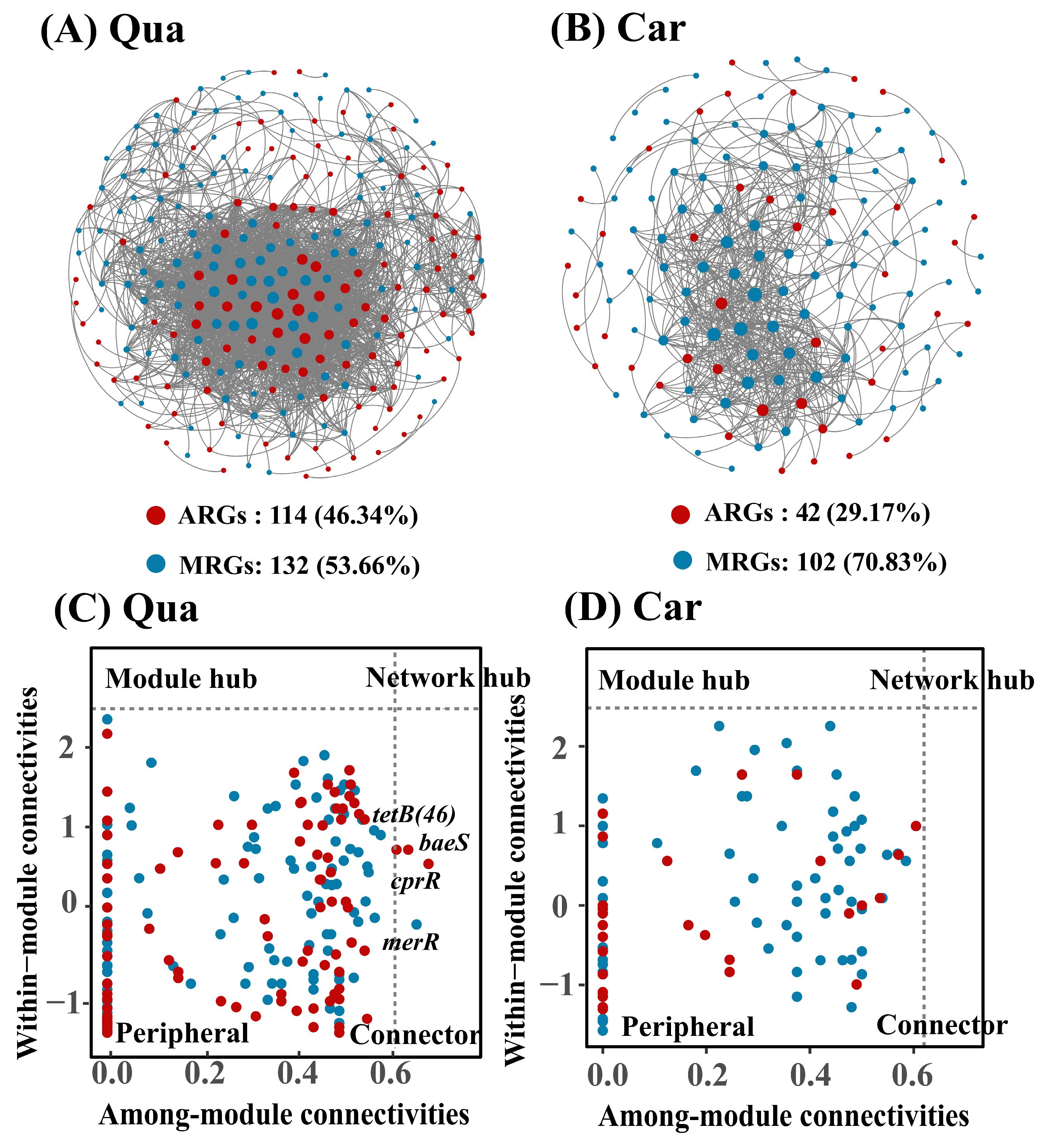
Co-associated networks were conducted to research the complicated interactions among the resistance-related genes from the Qua and Car soils [13,34,35]. Specifically, Spearman’s correlation coefficients were determined, and only strong correlations (absolute value > 0.85) with a significance level of p < 0.05 were selected for the analysis of co-associated networks. Gephi (v0.9.2) was applied to visualize the resulting networks. To profile the structural properties of the co-associated networks, topological features such as graphical diameter, average degree, and modularity were calculated accordingly [25,36]. Among-module connectivity (Pi) and within-module connectivity (Zi) were applied to assess the ecological roles of individual nodes by using the “igraph” package in R (v4.4.1). Based on the designated thresholds, nodes were classified into four groups: (1) peripherals (Zi ≤ 2.5 and Pi ≤ 0.62), (2) connectors (Zi ≤ 2.5 and Pi > 0.62), (3) module hubs (Zi > 2.5 and Pi ≤ 0.62), and (4) network hubs (Zi > 2.5 and Pi > 0.62) accordingly [16].

2.5. Statistical Methods

Linear regression analyses of HMs, NIPI, individual HM-related genes, MRGs, ARGs, and MGEs in soil samples were fitted by the lm and nls functions in R (v4.1.3), respectively [36]. Differences between the Qua soils and Car soils were assessed using the Anosim function from the vegan package in R (v4.1.3). One-way ANOVA followed by Tukey’s HSD test was employed to calculate the significant differences, with a significance level of p < 0.05. STAMP analysis was utilized to detect the significant abundant gene subtypes in Qua soils and Car soils. This method utilized Welch’s t-test, coupled with Benjamini–Hochberg false discovery rate (FDR) correction to address the issue of multiple comparisons [16].

3. Results

3.1. Biogeochemical Properties and Heavy Metals in Soil Samples

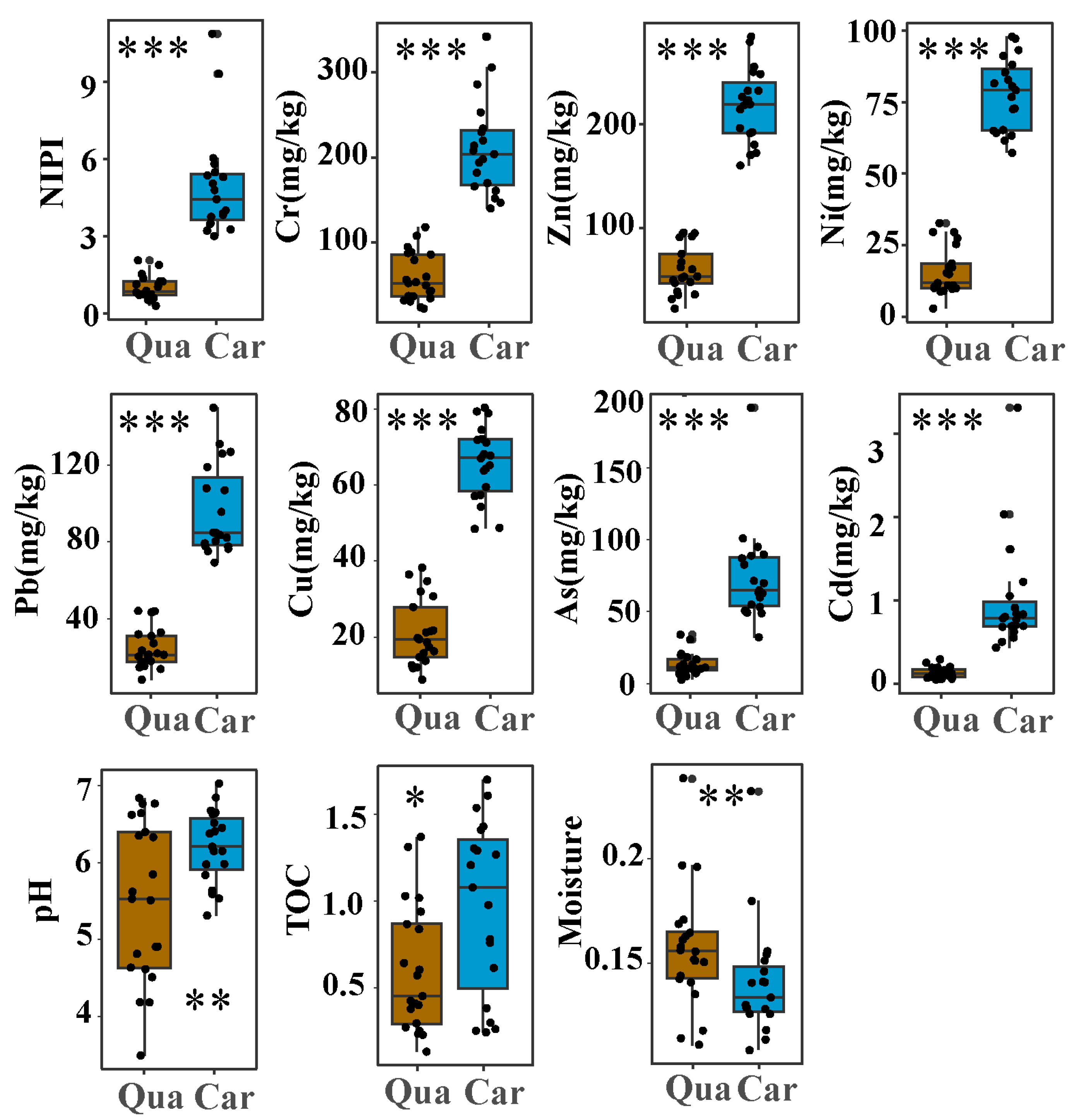
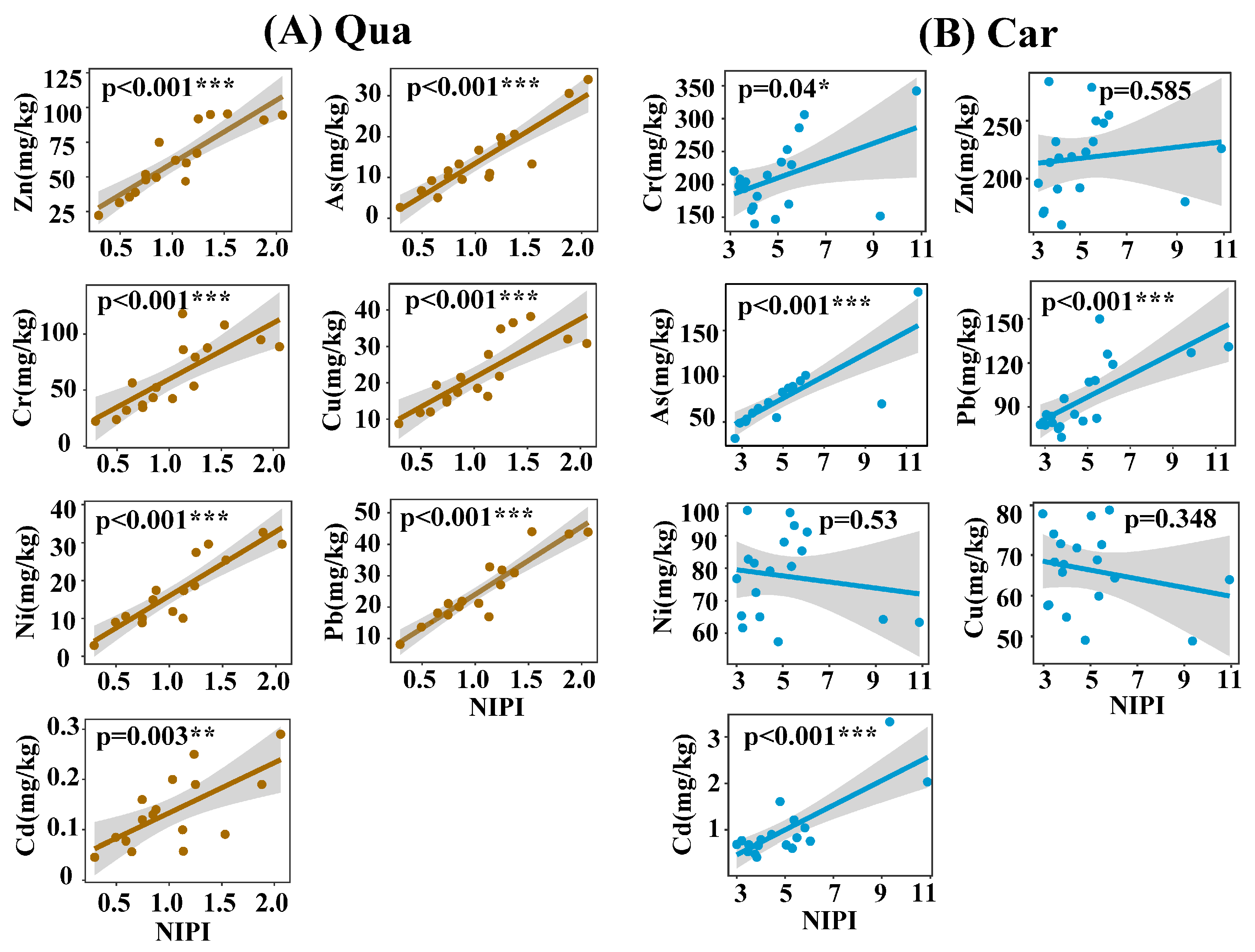
Results showed that 100% of As, 100% of Cd, 94.11% of Cr, 64.71% of Zn, 64.71% of Cu, 47.06% of Ni, and 41.18% of Pb in the Car soils exceeded the risk screening values for the soil contamination of agricultural land set by the standard GB15618-2018 in China, respectively, while no soil samples except for 11.76% of As exceeded the risk screening values in the Qua soils (Table 1 and Table S1). The concentrations of HMs in both Qua and Car soil samples did not exceed the risk intervention values of the standard (Table 1). NIPI (p < 0.001 ***), soil pH (p < 0.01 **), TOC (p < 0.05 *), and moisture (p < 0.01 **) showed significant differences between Qua and Car soil samples, respectively (Figure 2). In Qua soils, NIPI showed significant positive correlations with all HMs (p < 0.01 for Cd; p < 0.001 for others). In contrast, Car soils exhibited significant correlations only for Cd (p < 0.001), with non-significant or even negative trends for Zn, Ni, and Cu (Figure 3). The markedly higher HM concentrations in Car soils can be attributed to the parent material composition. Carboniferous and Devonian carbonate rocks in the study area contain higher Fe-Mn oxides and clay minerals that strongly adsorb trace metals during pedogenesis. In contrast, Quaternary sediments are more quartz-rich with lower sorption capacity, resulting in lower HM accumulation [2].

3.2. Profiles of Resistance-Related Genes in Soil Samples

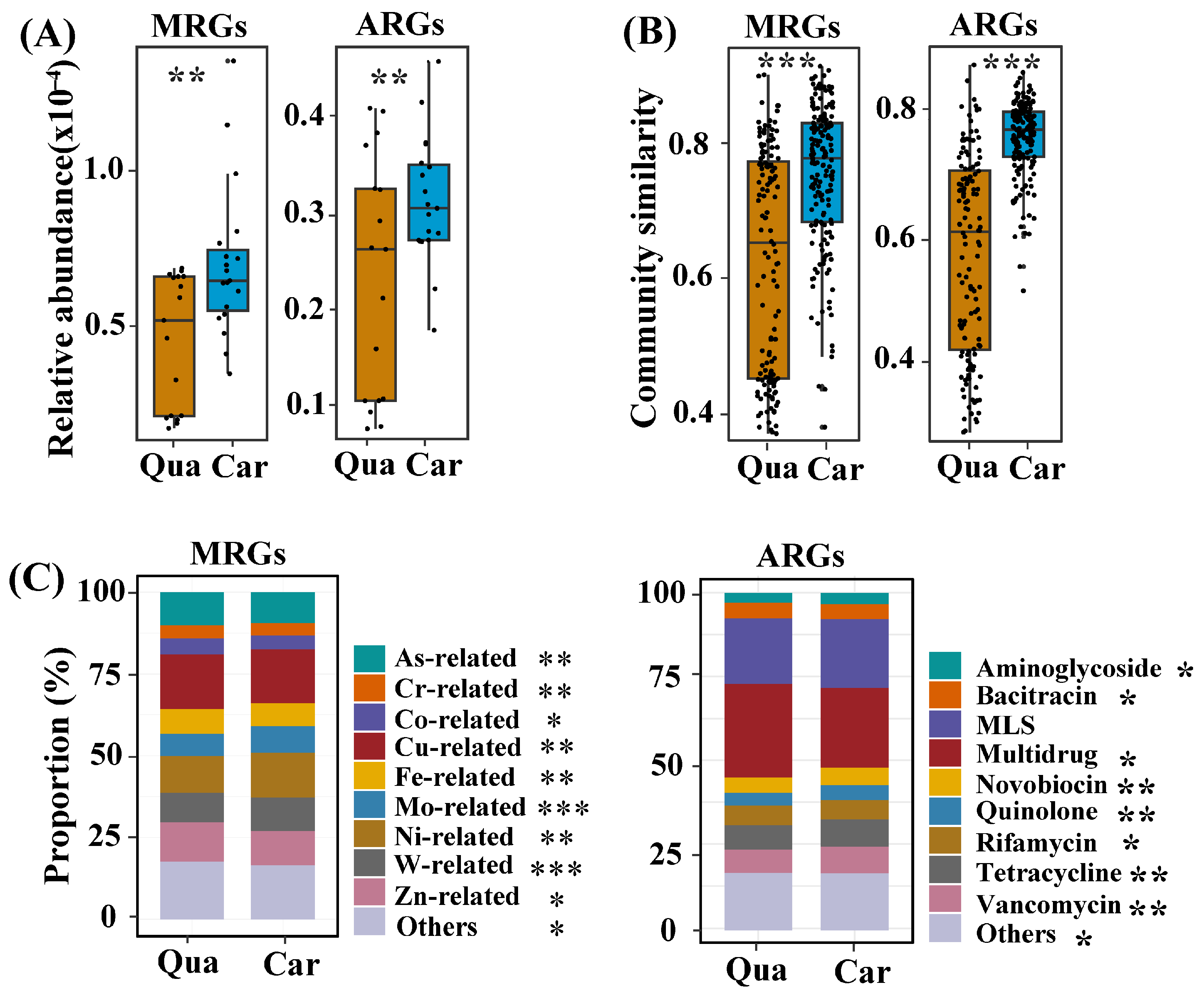
A total of 296 MRG subtype genes, 850 ARG subtype genes, and 5 MGE-type genes were identified from all soil samples in this study, respectively (Figure S1). To be specific, copR, corR, and wtpC were the top three abundant MRG subtype genes, and macB, novA, and Bado_rpoB_RIF were the top three abundant ARG subtype genes in karst soil samples, respectively (Figures S3 and S4). Genes of insertion sequence and transposase were the two main types of MGEs (Figure S2C). Car soils exhibited significantly higher abundance and community similarity of MRGs and ARGs compared to Qua soils (p < 0.01, Figure 4A,B), while MGE abundance showed no significant difference (p > 0.05, Figure S2A).
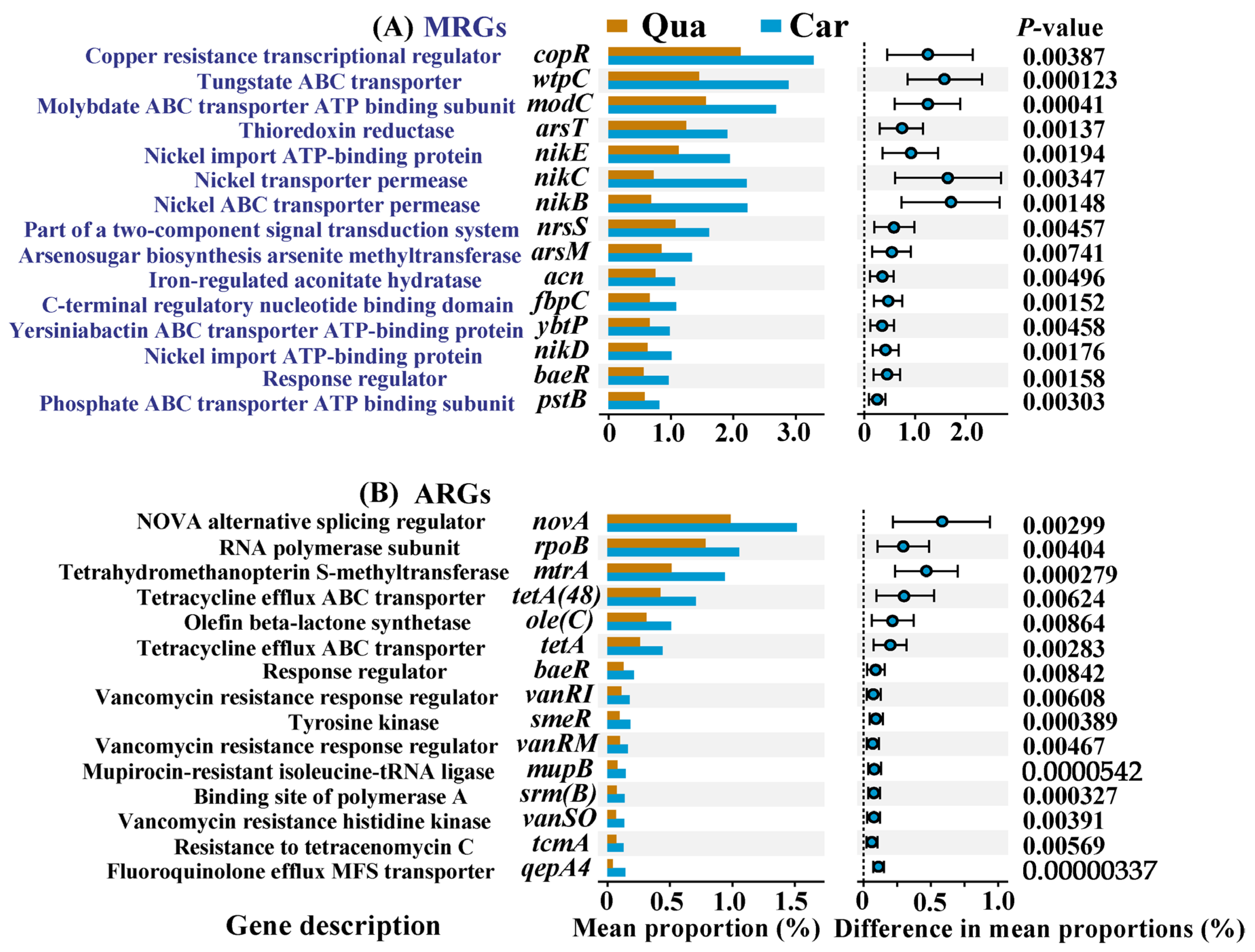
MRGs were further classified into ten subtypes, and significant differences were observed regarding the proportion of individual heavy metal-related genes between Qua soils and Car soils (Figure 4C). Multidrug, MLS, and other ARGs were the three most abundant subtypes of ARGs in both Qua soils and Car soils (Figure 4C). The subtypes of MRGs and ARGs were further compared between Qua soils and Car soils by STAMP analysis (Figure 5). A total of 15 subtype genes of MRGs and ARGs with high abundance and evident differences were finally illustrated. The copR, wtpC, modC, arsT, and nikE emerged as the five most abundant different subtype genes of MRGs, displaying a significantly higher level in Car soils than those in Qua soils, followed by the rest of the ten MRG subtype genes (Figure 5A). Regarding ARGs, the most enriched five subtype genes in Qua and Car soils contained novA, rpoB, mtrA, tetA(48), and ole(C), which also showed a significantly higher level in Car soils than those in Qua soils (Figure 5B).

3.3. Interactions Among Heavy Metals, MRGs, and ARGs in Karst Soil Samples

The co-associated network analysis of the resistance-related genes in Qua soils contained 246 nodes with 2838 edges, and the Car soils contained merely 144 nodes with 625 edges (Table S2 and Figure 6A,B). The critical topological parameters, such as graph density, average degree, and clustering coefficient, were higher in the Qua soils (23.07, 0.09, and 0.62) than those in the Car soils (8.68, 0.06, and 0.50), respectively (Table S2). Conversely, average path length, graph diameter, and modularity in the Qua soils (2.89, 7, 0.30) were lower than those in the Car soils (3.12, 8, and 0.38), respectively (Table S2). Zi-Pi analysis was performed to assess the topological roles of networks in the Qua soils and Car soils, respectively (Figure 6C,D). In both the Qua soils and Car soils networks, most nodes were categorized as peripherals. Also, significant variations were observed in both the number and the composition of connectors. The Qua soils network contained four connector subtype genes, including tetB(46), baeS, cprR, and merR, while no connectors were identified in the Car soils network. The four connector genes identified in Qua soils played crucial roles in network connectivity by linking different functional modules. Their absence in Car soils suggested limited cross-module gene flow, potentially reducing the efficiency of adaptive respon se to multiple stressors. Neither Qua soils nor Car soils exhibited any subtype genes in network hubs or module hubs, suggesting that no globally dominant genes were capable of bridging all modules and influencing the overall network structure [25,36].
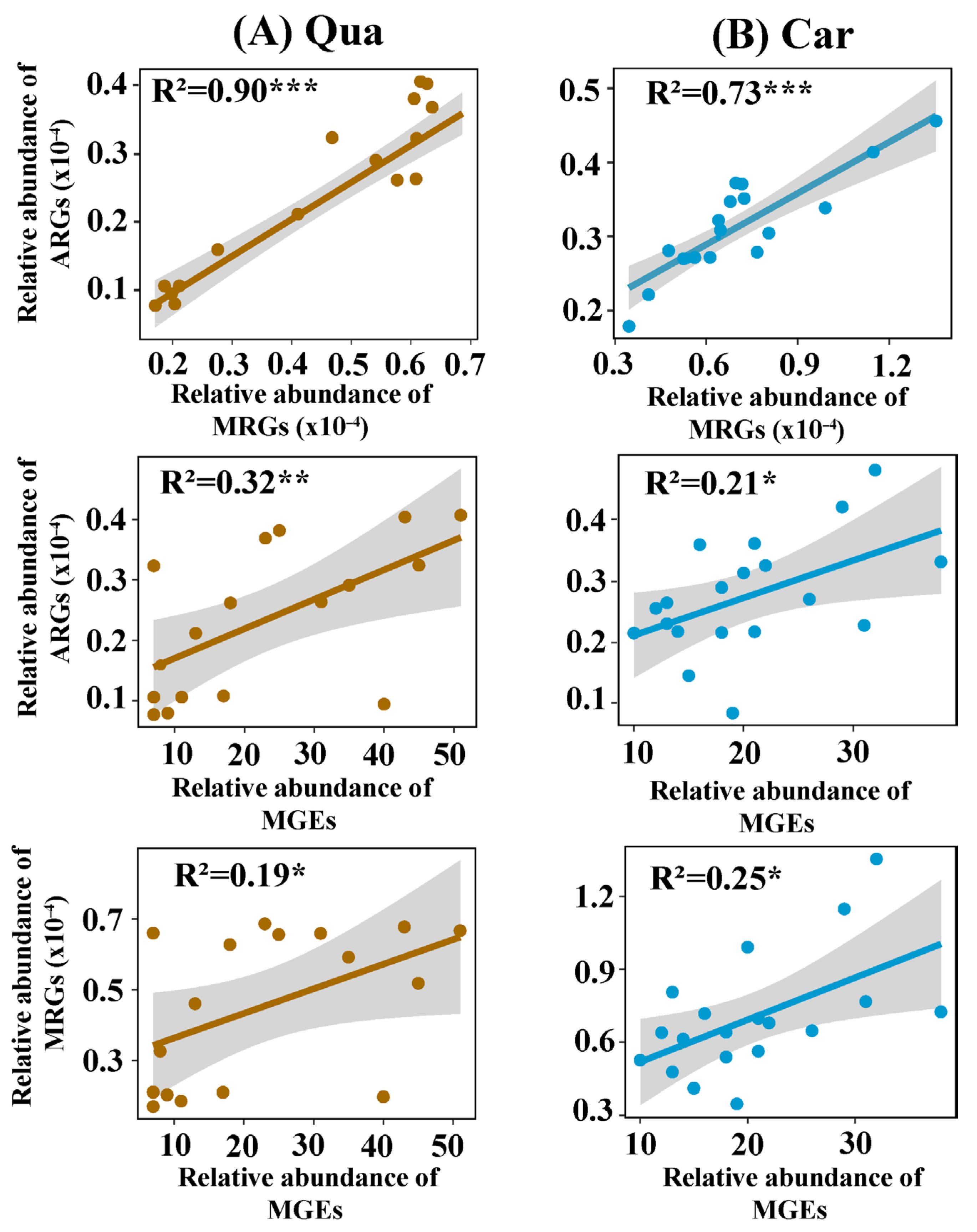
According to the linear regression analyses, the correlations between the relative abundance of MRGs and ARGs (R2 = 0.90 ***), the relative abundance of MGEs and ARGs (R2 = 0.32 **), and the relative abundance of MGEs and MRGs (R2 = 0.19 *) were significantly positive in the Qua soils, respectively (Figure 7A). Meanwhile, the correlations between the relative abundance of MRGs and ARGs (R2 = 0.73 ***), the relative abundance of MGEs and ARGs (R2 = 0.21 *), and the relative abundance of MGEs and MRGs (R2 = 0.25 *) were also significantly positive in the Car soils, respectively (Figure 7B). Correlations among HMs, biogeochemical properties, and resistance-related genes in the Qua soils and Car soils were demonstrated and compared, respectively (Figure 8). Results illustrated that Zn, Cu, Pb, Cr, and Ni had a significantly positive correlation with individual HM-related genes, MRGs, ARGs, and MGEs in the Qua soils, respectively (Figure 8A). Comparably, Zn, Cu, Pb, As, Cr, and Ni had a positive but non-significant correlation with individual HM-related genes, MRGs, ARGs, and MGEs in the Car soils, respectively (Figure 8B). However, neither As nor Cd had an obvious correlation with individual HM-related genes, MRGs, ARGs, and MGEs in both Qua and Car soils, respectively (Figure 8). The correlation of NIPI with individual HM-related genes, MRGs, ARGs, and MGEs was more significantly positive in the Qua soils than in the Car soils, respectively. Notably, pH had a significantly negative correlation with individual HM-related genes, MRGs, ARGs, and MGEs, while moisture and TOC had a positive correlation with these factors in the Qua soils, respectively (Figure 8A). In the Car soils, the correlation was the opposite, as the pH had a positive correlation with individual HM-related genes, MRGs, ARGs, and MGEs, while moisture and TOC had a negative correlation with these factors, respectively (Figure 8).

4. Discussion

4.1. Geological Factors Significantly Influenced the Patterns of Heavy Metals and Resistance-Related Genes in Karst Soils

The stark differences in HM concentrations and resistance-related genes between Qua and Car soils reflect fundamental lithological controls in the karstic region [2,37]. The Qua soils were developed from the Devonian and Quaternary strata, which were widely distributed in the northeastern part of the basin in this study. The Car soils were predominant in the central part and the western region of the basin in the study, and the geological background of the Car soils was characterized by Carboniferous and Devonian strata (Figure 1). Previous studies showed that the molecular soil chemistry (i.e., mineral components and functional assignments) was significantly different and influenced the heavy metal accumulation in the karst soils [2,37,38]. For example, the elevated accumulation of HMs in the Car soils compared to the Qua soils can be attributed to the higher concentrations of Fe-Mn oxides, a more widespread presence of chlorites, and more responsive vO-H and vSi-O assignments. Fe-Mn oxides in Car soils provide high-affinity sorption sites through surface complexation and co-precipitation, sequestering 60–80% of total Zn and Cu. Chlorite minerals contribute to permanent negative charge sites for Ni and Cr adsorption. In contrast, Qua soils’ quartz-dominated mineralogy limits sorption capacity, making microbial biomineralization and extracellular polymeric substance (EPS) production the dominant HM stabilization mechanisms.
Meanwhile, lithology and associated soil biogeochemistry could also impact the species and distribution of MRGs and ARGs in karst soils. However, lithological controls on microbial communities have been reported, and this is among the initial studies to explicitly link the parent material differences to the resistance-related gene profiles in the agricultural karstic soils [25,39]. In general terms, it has been found that the abundance of MRGs and ARGs increased along the gradient of the elevated HM concentrations in soils. The potential for co-selection of resistance by HMs has been emphasized through various mechanisms, particularly when multiple genes encoding resistance to both antibiotics and metals are situated on the same MGEs, leading to co-resistance, or when the same genes confer resistance to multiple types of antibiotics and metals, resulting in cross-resistance [40,41,42].

4.2. Microbial Activity Had a Different Influence on the Interactions of HMs and Resistance-Related Genes in Karst Soils

According to the interactions among HMs, MRGs, and ARGs in karst soils, our results showed that Zn, Cu, Pb, Cr, and Ni had a more significant correlation with individual HM-related genes, MRGs, ARGs, and MGEs in the Qua soils than in the Car soils, respectively. Although both Qua soils and Car soils were karst soils, microbial activity was more crucial for the HM accumulation in Qua soils compared with Car soils. Our previous studies reported that Car soils had the representative characteristics of karst soils, including a larger amount of macroaggregates (>250 μm) with abundant Fe-Mn concretions, more extensive existence of chlorites, and more reactive vO-H and vSi-O functional assignments [2,37]. A process-based model was developed to demonstrate that the redox kinetics of Cr (VI) in the Qua soils were microbially driven and coupled by multiple biogeochemical processes of C, N, Mn, Fe, and Cr [43]. Meanwhile, previous studies also found that microbial-mediated Fe redox reaction with lower content dominated As behaviors at low conc [39,40,41] entrations in the Qua soils, and soils with higher concentrations in the Car soils with higher levels of Fe-rich clay exhibited stronger As adsorption capabilities than the Qua soils [38]. Collectively, several factors may contribute to the weak correlations with microbial activity in Car soils: (1) binding site saturation: High HM concentrations may saturate mineral sorption sites, reducing bioavailability and microbial response; (2) historical exposure: Long-term adaptation may have stabilized resistance gene profiles, decoupling them from current HM levels; and (3) metal speciation: Fe-Mn oxides may sequester metals in non-bioavailable forms, weakening the gene–metal relationship.
The relative parameters for the structure of the co-associated network in the Qua soils were higher than those in the Car soils, except for the node of MRGs, MRGs-MRGs edge, and modularity (Table S2 and Figure 6). Accordingly, the more highly interconnected properties of the network suggested more robust microbial interactions with the integrated community structure that existed in the Qua soils compared with the Car soils, which could strengthen the efficiency of processes such as metal detoxification, nutrient cycling, and stress response [16,26]. The lower MRGs node, MRGs-MRGs edge, and modularity corresponded to the lower concentrations of HMs in the Qua soils compared with the higher concentrations of HMs in the Car soils. However, the relative ARG-related parameters for the structure of the co-associated network in the Qua soils were higher in the Car soils, which demonstrated that the ARGs were weakly responsive to the HM concentration compared to MRGs. Higher network density in Qua soils suggests more robust microbial interactions and functional redundancy, which enhances ecosystem stability against disturbances. Lower modularity indicates less compartmentalization, allowing rapid information flow and coordinated responses. Conversely, Car soils’ lower density but higher modularity reflects geochemical dominance, where microbial communities exist as isolated modules with limited cross-talk. The absence of connectors in Car soils reduces potential for horizontal gene transfer, potentially slowing adaptive evolution [18,42,44]. Further, the observed cross-metal correlations (e.g., Cd-related genes correlating with Ni) were probably a gene response to multiple HM ions by co-resistance or co-occurrence [33].
The differences in HM accumulation and microbial community structures between Qua soils and Car soils suggest that agricultural practices should be tailored to specific soil types. For Qua soils, where microbial activity plays a more crucial role in HM accumulation, sustainable agricultural practices that promote soil health and microbial diversity, such as organic farming, crop rotation, and reduced tillage, could help mitigate HM contamination and improve soil fertility. These practices can enhance the natural capacity of the soil to detoxify heavy metals and reduce the transfer of HMs to crops. Collectively, these results of the co-associated network were consistent with the correlations among heavy metals, MRGs, and ARGs, which proved that the Qua soils could modulate more stable microbial interactions and unify community structure in order to enhance the process’s efficiency, including nutrient cycling, HM accumulation and detoxification, and stress response [9,44,45]. However, these correlative patterns require experimental validation through microcosm studies or isotope tracer experiments to establish causality, while the alternative explanations, such as confounding soil properties, cannot be completely ruled out.

4.3. Significance for the Assessment of Ecological Risks of HM Contamination in Karst Soils

Karst regions with high geochemical backgrounds of HMs are distributed globally, such as in the Jura Mountains in Western Europe, central Jamaica, and southwestern China [46]. Given that karst soils cover a substantial area of agricultural land, the elevated HM contamination in karst agricultural soils poses crucial ecological risks to agricultural practices, land use, and crop productivity [39,47]. As shown in our study, 100% of As, 100% of Cd, 94.11% of Cr, 64.71% of Zn, 64.71% of Cu, 47.06% of Ni, and 41.18% of Pb in Car soils exceeded the risk screening values for soil contamination of agricultural land according to the national standard (GB15618-2018). A previous study also reported that 55.0% of one thousand soil samples surpassed the cadmium threshold in Guangxi [47]. These results indicated that crops grown in these soils may be exposed to HM contamination, which could lead to reduced yields, lower quality of agricultural products, and potential human health risks [1,3]. Since most current soil quality standards do not take into consideration the high geochemical backgrounds of HMs in karstic soils, the oversight frequently results in the incorrect categorization of farmland and triggers costly remediation efforts that may not be necessary [2,39]. However, the field data showed that crops grown in karst soils rarely exceeded the food safety standards, suggesting that the ecological risks of HM contamination were lower than those indicated by soil assessments [48]. HMs are mostly bound in Fe-Mn oxide structures and clay minerals with high pH in Car soils, which show the stable speciation and strong adsorption that causes the low bioavailability of HMs in the crop [3,49]. This apparent contradiction of “high background but low risk” underscores the need to reassess current soil evaluation standards for the farmland in karst regions [2,50].
At present, most field surveys concentrate on examining the geographical accumulation of HMs by analyzing their distribution in a large number of karstic soil samples collected across various regional scales. Our results in this study showed that conventional soil pollution assessment methods (i.e., NIPI) could not accurately assess the ecological risks of heavy metal contamination in karst areas. For instance, the correlations between NIPI and individual heavy metals in the Qua soils were all significant and positive, as shown in Figure 3A. However, in the Car soils, the highly significant positive correlation only existed between NIPI and Cd, and the correlations between NIPI and Zn, Ni, and Cu were not significant, respectively (Figure 3B). Previous research has demonstrated that long-term exposure to HMs may induce and enhance the co-selection for resistance, especially in cases where multiple genes from ARGs and MRGs are located on the same MGEs (co-resistance) or the same genes confer resistance to multiple types of antibiotics and metals (cross-resistance) [1,33,34]. Xiao et al. also found that eight effective biomarkers from resistance-related genes (i.e., merR, cmtR, and pbrA) underscored the potential for the ecological risk assessments in the agricultural soils and microcosm soils by using random forest modeling [28]. Our finding that resistance gene profiles distinctly differ between Qua and Car soils, and that these genes correlate strongly with HM levels in Qua soils, supports their potential as biomarkers. Specifically, the consistent enrichment of resistance-related genes in Car soils across all samples suggests these genes could serve as robust indicators of carbonate-derived soil contamination. The stronger gene–HM correlations in Qua soils (R2 = 0.73–0.90) indicate higher predictive power for risk assessment in these soils, whereas geochemical indices alone may suffice for Car soils. This also could impact soil fertility by altering rhizosphere microbial communities. However, direct effects on crop yield require experimental validation and long-term field trials monitoring both resistance-related gene dynamics and soil health indicators (e.g., enzyme activities, nutrient cycling rates).

5. Conclusions

This study demonstrated the distinct profiles of HM accumulation, MRGs, and ARGs in karst soils developed from two different parent materials. Car soils had higher HM concentrations and resistance-related genes than Qua soils, but weaker gene–HM correlations. Microbial activity plays a larger relative role in HM cycling in Qua soils, while geochemical processes dominate Car soils. The consistent enrichment of resistance-related genes in karst soils could serve as robust indicators of carbonate-derived HM contamination. Considering the significant influence of geological factors on HMs and microbial activity, our research offers valuable references and new insights for environmental monitoring and management for utilizing the biomarkers from the resistance-related genes to evaluate the ecological risks associated with HM contamination in agricultural karst soils in the future. However, these correlative patterns require experimental validation through microcosm studies or isotope tracer experiments to establish causality across diverse karst landscapes.

Supplementary Materials

The following supporting information can be downloaded at https://www.mdpi.com/article/10.3390/agriculture15242596/s1; Figure S1: The pattern of MRGs, ARGs, and MGEs in all Qua and Car soil samples. Figure S2: The relative abundance (A), community similarity (B), composition proportion (C) of MGEs in Qua soils and Car soils, respectively. Figure S3: Heatmap of top 50 subtype genes of MRGs in Qua soils and Car soils. Figure S4: Heatmap of top 50 subtype genes of ARGs in Qua soils and Car soils. Table S1: The background soil concentrations of heavy metals in Guangxi Province and in China, and risk screening value and risk intervention value for soil contamination in agricultural land. Table S2: Topological indices of co-associated networks in soils. References [29,51,52] are cited in the Supplementary Materials.

Author Contributions

Data curation, C.L. and C.G.; formal analysis, H.M. and C.G.; funding acquisition, J.X.; investigation, C.L.; methodology, C.L., H.M., and C.H.; resources, C.H.; software, H.M.; validation, C.G.; visualization, C.H.; writing—original draft, J.X.; writing—review and editing, J.X. All authors have read and agreed to the published version of the manuscript.

Funding

This research is funded by the National Natural Science Foundation of China (Grant No. 42107027) and the Startup Foundation for Introducing Talent of NUIST (H20240347).

Data Availability Statement

The data presented in this study are available on request from the corresponding author due to (specify the reason for the restriction).

Conflicts of Interest

The authors declare no conflicts of interest.

References

  1. Zhao, Y.; Hu, H.W.; Su, J.Q.; Hao, X.; Guo, H.; Liu, Y.R.; Zhu, Y.G. Influence of legacy mercury on antibiotic resistomes: Evidence from agricultural soils with different cropping systems. Environ. Sci. Technol. 2021, 55, 13913–13922. [Google Scholar] [CrossRef]
  2. Xiao, J.; Chen, W.; Wang, L.; Zhang, X.; Wen, Y.; Bostick, B.C.; Wen, Y.; He, X.; Zhang, L.; Zhuo, X.; et al. New strategy for exploring the accumulation of heavy metals in soils derived from different parent materials in the karst region of southwestern China. Geoderma 2022, 417, 115806. [Google Scholar] [CrossRef]
  3. Hou, D.; Jia, X.; Wang, L.; McGrath, S.P.; Zhu, Y.-G.; Hu, Q.; Zhao, F.-J.; Bank, M.S.; O’Connor, D.; Nriagu, J. Global soil pollution by toxic metals threatens agriculture and human health. Science 2025, 388, 316–321. [Google Scholar] [CrossRef]
  4. Coban, O.; De Deyn, G.B.; van der Ploeg, M. Soil microbiota as game-changers in restoration of degraded lands. Science 2022, 375, 990. [Google Scholar] [CrossRef]
  5. Tóth, G.; Hermann, T.; Szatmári, G.; Pásztor, L. Maps of heavy metals in the soils of the European Union and proposed priority areas for detailed assessment. Sci. Total Environ. 2016, 565, 1054–1062. [Google Scholar] [CrossRef]
  6. Ahmadi, M.; Akhbarizadeh, R.; Haghighifard, N.J.; Barzegar, G.; Jorfi, S. Geochemical determination and pollution assessment of heavy metals in agricultural soils of south western of Iran. J. Environ. Health Sci. Eng. 2019, 17, 657–669. [Google Scholar] [CrossRef]
  7. Gadd, G.M. Metals, minerals and microbes: Geomicrobiology and bioremediation. Microbiology 2010, 156, 609–643. [Google Scholar] [CrossRef]
  8. White, W.B. Karst hydrology: Recent developments and open questions. Eng. Geol. 2002, 65, 85–105. [Google Scholar] [CrossRef]
  9. Yi, X.; Liang, J.-L.; Su, J.-Q.; Jia, P.; Lu, J.-l.; Zheng, J.; Wang, Z.; Feng, S.-w.; Luo, Z.-h.; Ai, H.-x.; et al. Globally distributed mining-impacted environments are underexplored hotspots of multidrug resistance genes. ISME J. 2022, 16, 2099–2113. [Google Scholar] [CrossRef]
  10. Yan, Q.; Zhong, Z.; Li, X.; Cao, Z.; Zheng, X.; Feng, G. Characterization of heavy metal, antibiotic pollution, and their resistance genes in paddy with secondary municipal-treated wastewater irrigation. Water Res. 2024, 252, 121208. [Google Scholar] [CrossRef]
  11. Alloway, B.J. Heavy Metals in Soils: Trace Metals and Metalloids in Soils and their Bioavailability; Springer: Berlin/Heidelberg, Germany, 2012. [Google Scholar]
  12. Hu, P.; Zhang, W.; Nottingham, A.T.; Xiao, D.; Kuzyakov, Y.; Xu, L.; Chen, H.; Xiao, J.; Duan, P.; Tang, T.; et al. Lithological controls on soil aggregates and minerals regulate microbial carbon use efficiency and necromass stability. Environ. Sci. Technol. 2024, 58, 21186–21199. [Google Scholar] [CrossRef] [PubMed]
  13. Wang, J.; Shaheen, S.M.; Swertz, A.-C.; Liu, C.; Anderson, C.W.N.; Fendorf, S.; Wang, S.-L.; Feng, X.; Rinklebe, J. First Insight into the Mobilization and Sequestration of Arsenic in a Karstic Soil during Redox Changes. Environ. Sci. Technol. 2024, 58, 17850–17861. [Google Scholar] [CrossRef] [PubMed]
  14. Zhu, Y.G.; Zhao, Y.; Li, B.; Huang, C.L.; Zhang, S.Y.; Yu, S.; Chen, Y.S.; Zhang, T.; Gillings, M.R.; Su, J.Q. Continental-scale pollution of estuaries with antibiotic resistance genes. Nat. Microbiol. 2017, 2, 16270. [Google Scholar] [CrossRef]
  15. Zhu, J.; Huang, Q.; Peng, X.; Zhou, X.; Gao, S.; Li, Y.; Luo, X.; Zhao, Y.; Rensing, C.; Su, J.; et al. MRG chip: A high-throughput qpcr-based tool for assessment of the heavy metal(loid) resistome. Environ. Sci. Technol. 2022, 56, 10656–10667. [Google Scholar] [CrossRef] [PubMed]
  16. Du, S.; Feng, J.; Bi, L.; Hu, H.W.; Hao, X.; Huang, Q.; Liu, Y.R. Tracking soil resistance and virulence genes in rice-crayfish co-culture systems across China. Environ. Int. 2023, 172, 107789. [Google Scholar] [CrossRef]
  17. Liu, Y.R.; van der Heijden, M.G.A.; Riedo, J.; Sanz-Lazaro, C.; Eldridge, D.J.; Bastida, F.; Moreno-Jimenez, E.; Zhou, X.Q.; Hu, H.W.; He, J.Z.; et al. Soil contamination in nearby natural areas mirrors that in urban greenspaces worldwide. Nat. Commun. 2023, 14, 1706. [Google Scholar] [CrossRef]
  18. Hu, H.W.; Wang, J.T.; Li, J.; Shi, X.Z.; Ma, Y.B.; Chen, D.; He, J.Z. Long-term nickel contamination increases the occurrence of antibiotic resistance genes in agricultural soils. Environ. Sci. Technol. 2017, 51, 790–800. [Google Scholar] [CrossRef]
  19. Dai, Z.; Guo, X.; Lin, J.; Wang, X.; He, D.; Zeng, R.; Meng, J.; Luo, J.; Delgado-Baquerizo, M.; Moreno-Jiménez, E.; et al. Metallic micronutrients are associated with the structure and function of the soil microbiome. Nat. Commun. 2023, 14, 1. [Google Scholar] [CrossRef]
  20. Qi, R.; Xue, N.; Wang, S.; Zhou, X.; Zhao, L.; Song, W.; Yang, Y. Heavy metal(loid)s shape the soil bacterial community and functional genes of desert grassland in a gold mining area in the semi-arid region. Environ. Res. 2022, 214, 113749. [Google Scholar] [CrossRef] [PubMed]
  21. Jiang, X.; Liu, W.; Xu, H.; Cui, X.; Li, J.; Chen, J.; Zheng, B. Characterizations of heavy metal contamination, microbial community, and resistance genes in a tailing of the largest copper mine in China. Environ. Pollut. 2021, 280, 116947. [Google Scholar] [CrossRef]
  22. Guo, Y.; Cheng, S.; Fang, H.; Yang, Y.; Li, Y.; Shi, F.; Zhou, Y. Copper and cadmium co-contamination affects soil bacterial taxonomic and functional attributes in paddy soils. Environ. Pollut. 2023, 329, 121724. [Google Scholar] [CrossRef] [PubMed]
  23. Wu, Y.; Zhang, Y.; Fang, H.; Wang, C.; Wang, Z.; Zhang, W.; Mai, B.; He, Z.; Wu, R.; Li, K. The assembly, biogeography and co-occurrence of abundant and rare microbial communities in a karst river. Front. Mar. Sci. 2023, 10, 1228813. [Google Scholar] [CrossRef]
  24. Shi, H.; Wang, S.; Xu, X.; Huang, L.; Gu, Q.; Liu, H. Spatial distribution and risk assessment of heavy metal pollution from enterprises in China. J. Hazard. Mater. 2024, 480, 136147. [Google Scholar] [CrossRef]
  25. Wang, M.; Zhao, J.; Liu, Y.; Huang, S.; Zhao, C.; Jiang, Z.; Gu, Y.; Xiao, J.; Wu, Y.; Ying, R.; et al. Deciphering soil resistance and virulence gene risks in conventional and organic farming systems. J. Hazard. Mater. 2024, 468, 133788. [Google Scholar] [CrossRef]
  26. Zhou, S.Y.; Lie, Z.; Liu, X.; Zhu, Y.G.; Penuelas, J.; Neilson, R.; Su, X.; Liu, Z.; Chu, G.; Meng, Z.; et al. Distinct patterns of soil bacterial and fungal community assemblages in subtropical forest ecosystems under warming. Glob. Change Biol. 2023, 29, 1501–1513. [Google Scholar] [CrossRef]
  27. Fu, Y.; Hu, F.; Wang, F.; Xu, M.; Jia, Z.; Amelung, W.; Mei, Z.; Han, X.; Virta, M.; Jiang, X.; et al. Distinct assembly patterns of soil antibiotic resistome revealed by land-use changes over 30 years. Environ. Sci. Technol. 2024, 58, 10216–10226. [Google Scholar] [CrossRef] [PubMed]
  28. Xiao, J.; Xie, W.-Y.; Wang, P. Metagenomic insights into the ecological risks of multiple heavy metals on soil bacterial communities and resistance-related genes. Ecotoxicol. Environ. Saf. 2025, 303, 119048. [Google Scholar] [CrossRef] [PubMed]
  29. Du, Y.; Chen, L.; Ding, P.; Liu, L.; He, Q.; Chen, B.; Duan, Y. Different exposure profile of heavy metal and health risk between residents near a Pb-Zn mine and a Mn mine in Huayuan county, South China. Chemosphere 2019, 216, 352–364. [Google Scholar] [CrossRef]
  30. Li, B.; Yang, Y.; Ma, L.; Ju, F.; Guo, F.; Tiedje, J.M.; Zhang, T. Metagenomic and network analysis reveal wide distribution and co-occurrence of environmental antibiotic resistance genes. ISME J. 2015, 9, 2490–2502. [Google Scholar] [CrossRef]
  31. Jiang, C.; Zhao, Z.; Zhu, D.; Pan, X.; Yang, Y. Rare resistome rather than core resistome exhibited higher diversity and risk along the Yangtze River. Water Res. 2024, 249, 120911. [Google Scholar] [CrossRef]
  32. Lu, J.; Salzberg, S.L. Ultrafast and accurate 16S rRNA microbial community analysis using Kraken 2. Microbiome 2020, 8, 124. [Google Scholar] [CrossRef]
  33. Liu, W.; Xie, W.-Y.; Liu, H.-J.; Chen, C.; Chen, S.-Y.; Jiang, G.-F.; Zhao, F.-J. Assessing intracellular and extracellular distribution of antibiotic resistance genes in the commercial organic fertilizers. Sci. Total Environ. 2024, 929, 172558. [Google Scholar] [CrossRef]
  34. Gao, C.; Xu, L.; Montoya, L.; Madera, M.; Hollingsworth, J.; Chen, L.; Purdom, E.; Singan, V.; Vogel, J.; Hutmacher, R.B.; et al. Co-occurrence networks reveal more complexity than community composition in resistance and resilience of microbial communities. Nat. Commun. 2022, 13, 3867. [Google Scholar] [CrossRef] [PubMed]
  35. Wen, T.; Xie, P.; Yang, S.; Niu, G.; Liu, X.; Ding, Z.; Xue, C.; Liu, Y.X.; Shen, Q.; Yuan, J. ggClusterNet: An R package for microbiome network analysis and modularity-based multiple network layouts. iMeta 2022, 1, e32. [Google Scholar] [CrossRef]
  36. Yu, F.; Wen, Y.; Peng, Z.; Xu, D.; Xiao, J. Divergent risk gene profiles in smallholder and large-scale paddy farms. Environ. Res. 2025, 285, 122406. [Google Scholar] [CrossRef] [PubMed]
  37. Zhang, L.; Xiao, J.; Ji, J.; Liu, Y. Arsenate Adsorption on Different Fractions of Iron Oxides in the Paddy Soil from the Karst Region of China. Bull. Environ. Contam. Toxicol. 2021, 106, 126–133. [Google Scholar] [CrossRef]
  38. Liu, Y.; Zhang, L.; Wen, Y.; Zhai, H.; Yuan, Y.; Guo, C.; Wang, L.; Wu, F.; Liu, C.; Xiao, J.; et al. A kinetics-coupled multi-surface complexation model deciphering arsenic adsorption and mobility across soil types. Sci. Total Environ. 2024, 948, 174856. [Google Scholar] [CrossRef]
  39. Lin, K.; Li, B.; Guan, D.-X.; Wu, Z.; Li, X.; Ji, W.; Liu, W.; Yu, T.; Yang, Z. Enrichment Mechanisms of Cadmium in Natural Manganese-Rich Nodules from Karst Soils. Environ. Sci. Technol. 2025, 59, 7256–7267. [Google Scholar] [CrossRef]
  40. Wang, M.; Wu, Y.; Zhao, J.; Liu, Y.; Chen, Z.; Tang, Z.; Tian, W.; Xi, Y.; Zhang, J. Long-term fertilization lowers the alkaline phosphatase activity by impacting the phoD-harboring bacterial community in rice-winter wheat rotation system. Sci. Total Environ. 2022, 821, 153406. [Google Scholar] [CrossRef]
  41. Wu, J.; Wang, J.; Li, Z.; Guo, S.; Li, K.; Xu, P.; Ok, Y.S.; Jones, D.L.; Zou, J. Antibiotics and antibiotic resistance genes in agricultural soils: A systematic analysis. Crit. Rev. Environ. Sci. Technol. 2022, 53, 847–864. [Google Scholar] [CrossRef]
  42. Smith, W.P.J.; Wucher, B.R.; Nadell, C.D.; Foster, K.R. Bacterial defences: Mechanisms, evolution and antimicrobial resistance. Nat. Rev. Microbiol. 2023, 21, 519–534. [Google Scholar] [CrossRef]
  43. Ren, J.; Liu, Y.; Cao, W.; Zhang, L.; Xu, F.; Liu, J.; Wen, Y.; Xiao, J.; Wang, L.; Zhuo, X.; et al. A process-based model for describing redox kinetics of Cr(VI) in natural sediments containing variable reactive Fe(II) species. Water Res. 2022, 225, 119126. [Google Scholar] [CrossRef]
  44. Sun, J.; Zhao, M.; Cai, B.; Song, X.; Tang, R.; Huang, X.; Huang, H.; Huang, J.; Fan, Z. Risk assessment and driving factors of trace metal(loid)s in soils of China. Environ. Pollut. 2022, 309, 119772. [Google Scholar] [CrossRef]
  45. Wang, X.; Wang, X.; Wu, F.; Zhang, J.; Ai, S.; Liu, Z. Microbial community composition and degradation potential of petroleum-contaminated sites under heavy metal stress. J. Hazard. Mater. 2023, 457, 131814. [Google Scholar] [CrossRef]
  46. Wei, N.; Gu, X.; Wen, Y.; Guo, C.; Ji, J. Geochemical speciation and activation risks of Cd, Ni, and Zn in soils with naturally high background in karst regions of southwestern China. J. Hazard. Mater. 2025, 486, 137100. [Google Scholar] [CrossRef]
  47. Yang, Q.; Yang, Z.; Filippelli, G.M.; Ji, J.; Ji, W.; Liu, X.; Wang, L.; Yu, T.; Wu, T.; Zhuo, X.; et al. Distribution and secondary enrichment of heavy metal elements in karstic soils with high geochemical background in Guangxi, China. Chem. Geol. 2021, 567, 120081. [Google Scholar] [CrossRef]
  48. Wen, Y.; Li, W.; Yang, Z.; Zhuo, X.; Guan, D.-X.; Song, Y.; Guo, C.; Ji, J. Evaluation of various approaches to predict cadmium bioavailability to rice grown in soils with high geochemical background in the karst region, Southwestern China. Environ. Pollut. 2019, 258, 113645. [Google Scholar] [CrossRef] [PubMed]
  49. Bradl, H. Adsorption of heavy metal ions on soils and soil constituents. J. Colloid Interface Sci. 2004, 277, 1–18. [Google Scholar] [CrossRef] [PubMed]
  50. Wen, Y.; Li, W.; Yang, Z.; Zhang, Q.; Ji, J. Enrichment and source identification of Cd and other heavy metals in soils with high geochemical background in the karst region, Southwestern China. Chemosphere 2020, 245, 125620. [Google Scholar] [CrossRef]
  51. Zhao, X.; Shen, J.P.; Zhang, L.M.; Du, S.; Hu, H.W.; He, J.Z. Arsenic and cadmium as predominant factors shaping the distribution patterns of antibiotic resistance genes in polluted paddy soils. J. Hazard. Mater. 2020, 389, 121838. [Google Scholar] [CrossRef] [PubMed]
  52. China National Environmental Monitoring Centre (CNEMC). Elemental Background Values of Soils in China; Environmental Science Press of China: Beijing, China, 1990. [Google Scholar]
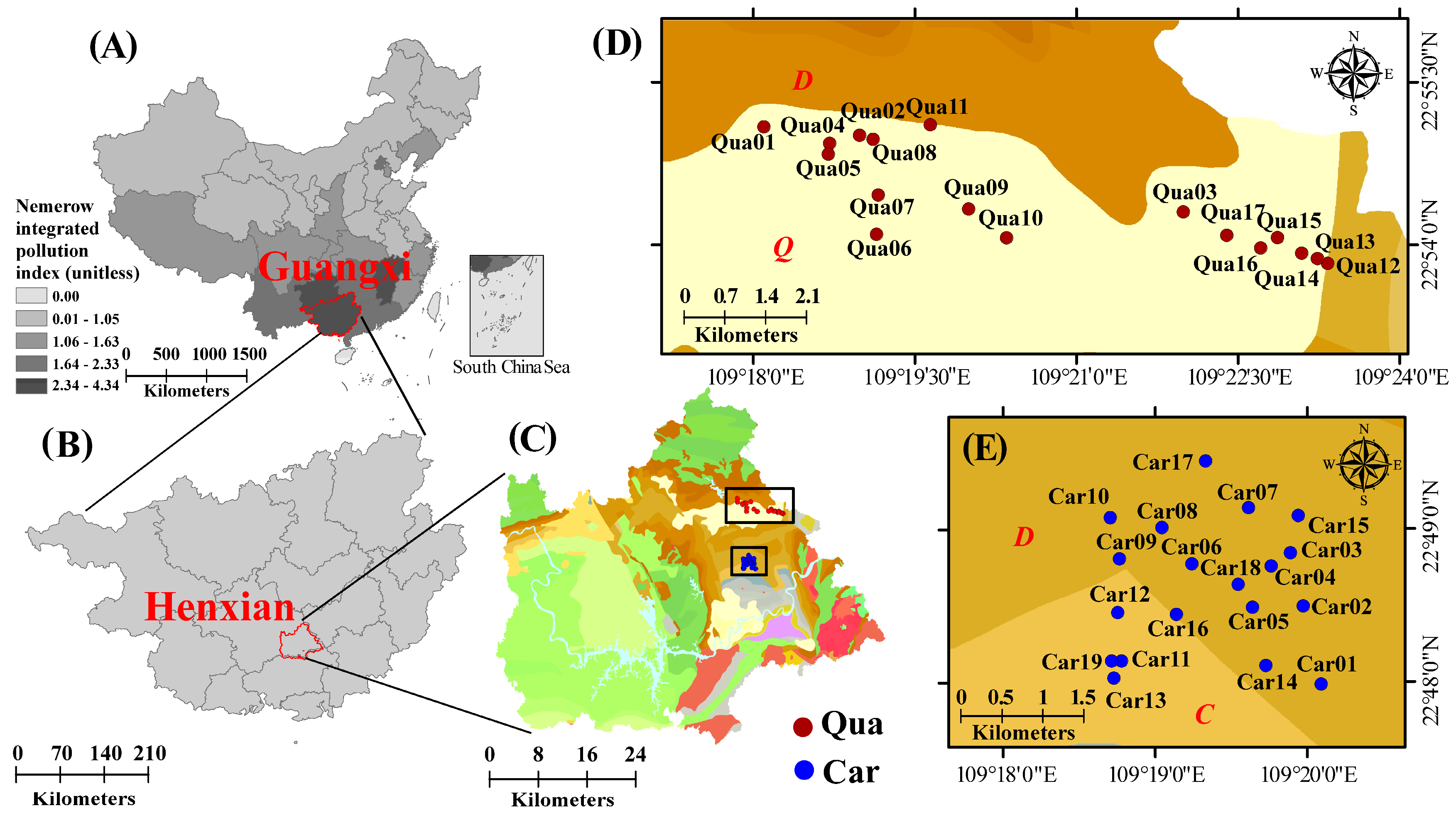
Figure 1. Soil sampling sites in Hengxian, Guangxi, China. (A) The location of Guangxi and the distribution of soil heavy metals in China by the average Nemerow integrated pollution indices accordingly [2]; (B) the location of Hengxian County in Guangxi, China; and (CE) soil sampling sites in this study. Brown circles represented that soils were mainly developed from Quaternary sediments (Qua); blue circles represented that soils were mainly developed from the weathering and leaching residues of carbonate rocks (Car). C, Q, and D in (D,E) represented Carboniferous, Quaternary, and Devonian strata, respectively.
Agriculture 15 02596 g001
Figure 2. Biogeochemical properties of soils developed from different parent materials in the karst regions of southwestern China. The brown color represents soils developed from Quaternary sediments (Qua); the blue color represents soils developed from the weathering and leaching residues of carbonate rocks (Car). Significant levels were denoted as *** p < 0.001, ** p < 0.01, and * p < 0.05.
Agriculture 15 02596 g002
Figure 3. Linear regression analysis of NIPI and heavy metals in the soils developed from different parent materials in the karst regions of southwestern China. (A) Brown color represents soils developed from Quaternary sediments (Qua); (B) Blue color represents soils developed from the weathering and leaching residues of carbonate rocks (Car). Significant levels were denoted as *** p < 0.001, ** p < 0.01, and * p < 0.05.
Agriculture 15 02596 g003
Figure 4. Relative abundance (A), community similarity (B), and composition (C) of metal resistance genes (MRGs) and antibiotic resistance genes (ARGs) in the soils developed from different parent materials in the karst regions of southwestern China. The brown color in (A,B) represents soils developed from Quaternary sediments (Qua); the blue color in (A,B) represents soils developed from the weathering and leaching residues of carbonate rocks (Car). MLS indicated macrolide–lincosamide–streptogramin resistance genes. Significant levels were denoted as *** p < 0.001, ** p < 0.01, and * p < 0.05. Asterisks behind the texts in each legend indicate significant differences between Qua and Car soils based on the Wilcoxon test in (C).
Agriculture 15 02596 g004
Figure 5. The STAMP analysis showed the significant differences in the relative abundance of the subtypes of MRGs (A) and ARGs (B) in soils developed from different parent materials in the karst regions of southwestern China. The brown color represents soils developed from Quaternary sediments (Qua); the blue color represents soils developed from the weathering and leaching residues of carbonate rocks (Car). The brown and blue dots in each plot represent the percentage of difference in mean proportions for the Qua soils and the Car soils, respectively, using two group Welch’s t-test with p < 0.05, and plotted by extended error bar with 95% confidence intervals.
Agriculture 15 02596 g005
Figure 6. Co-associated network analysis and Zi-Pi plots of the resistance-related genes in the Qua soils and Car soils. (A,B) Co-associated networks constructed based on Spearman’s correlation analysis in Qua soils (A) and Car soils (B). (C,D) Zi-Pi plots showed the topological roles of MRG and ARG subtype genes in the Qua soils (C) and Car soils (D) networks. Nodes were shaped by ARGs (red circles) and MRGs (blue circles). Nodes in Zi-Pi plots were classified based on within-module connectivity (Zi) and among-module connectivity (Pi) using thresholds of Zi = 2.5 and Pi = 0.62.
Agriculture 15 02596 g006
Figure 7. Linear regression analyses among the relative abundance of MRGs, ARGs, and MGEs in the Qua soils (A) and Car soils (B). Significant levels were denoted as *** p < 0.001, ** p < 0.01, and * p < 0.05.
Agriculture 15 02596 g007
Figure 8. Correlations among HMs, biogeochemical properties, and resistance-related genes in the Qua soils (A) and Car soils (B), respectively. Significant levels were denoted as *** p < 0.001, ** p < 0.01, and * p < 0.05.
Agriculture 15 02596 g008
Table 1. Percentage of total Cr, Zn, Ni, Pb, Cu, As, and Cd contents in soil samples according to the national standard for soil environmental quality and risk control standard for soil contamination of agricultural land (GB15618-2018).
Heavy MetalPercentage of Heavy Metal Content in Soil Samples Exceeding the Risk Screening Value (%) aPercentage of Heavy Metal Content in Soil Samples Exceeding the Risk Intervention
Value (%) b
QuaCarQuaCar
Cr094.1100
Zn064.7100
Ni047.0600
Pb041.1800
Cu064.7100
As11.7610000
Cd010000
a The data of risk screening value of agricultural contaminated soils were from the national standard for soil environmental quality and risk control standard for soil contamination of agricultural land (GB15618-2018); b The data of risk intervention value of agricultural contaminated soils were from the national standard for soil environmental quality and risk control standard for soil contamination of agricultural land (GB15618-2018).
Disclaimer/Publisher’s Note: The statements, opinions and data contained in all publications are solely those of the individual author(s) and contributor(s) and not of MDPI and/or the editor(s). MDPI and/or the editor(s) disclaim responsibility for any injury to people or property resulting from any ideas, methods, instructions or products referred to in the content.