Article

Study on the Interaction Mechanism Between Sandy Soils and Soil Loosening Device in Xinjiang Cotton Fields Based on the Discrete Element Method


1
College of Mechanical and Electrical Engineering, Xinjiang Agricultural University, Urumqi 830052, China
2
Autonomous Region Agricultural Machinery Product Quality Supervision and Management Station, Urumqi 830091, China
3
Wutubulage Town People’s Government, Bole 833400, China
*
Author to whom correspondence should be addressed.
Agriculture 2025, 15(24), 2587; https://doi.org/10.3390/agriculture15242587
Submission received: 24 November 2025 / Revised: 7 December 2025 / Accepted: 12 December 2025 / Published: 15 December 2025
(This article belongs to the Section Agricultural Technology)

Abstract

Asoil loosening device is designed to overcome the poor soil disturbance performance observed during residual film recovery, thereby effectively improving residual film recovery rates. Based on soil properties measured in cotton fields, a discrete element method was developed to simulate the interaction between the soil and the soil loosening device. A comparative analysis of the soil angle of repose and soil firmness was conducted to validate the accuracy of the soil discrete element model. Simulation experiments were conducted to analyze the effects of forward speed on soil particle velocity, soil particle forces, and forces on the soil loosening device. A theoretical analysis was performed to examine how forward speed and soil penetration depth affect the soil disturbance coefficient. Using this coefficient as the evaluation metric, a Central Composite Design experiment was carried out. Using the soil disturbance coefficient as the evaluation criterion, a central composite design experiment was carried out to identify the optimal parameter set: a forward speed of 6 km/h and a tillage implement penetration depth of 108 mm. Under these optimized conditions, the standard deviation of the soil disturbance coefficient was measured at 1.92%, which satisfies the operational requirements. The results offer useful insights for the design improvement of tillage implements.

1. Introduction

Plastic mulch technology is widely used in cotton cultivation in Xinjiang. Although it significantly enhances the economic benefits of cotton production, it has also led to issues of “white pollution.” Residual plastic film left in the soil disrupts soil structure and hinders cotton growth. Mechanized film recovery has become a key method for addressing this pollution. Researchers in China have developed various types of film recovery machinery. To improve the recovery rate, these machines are often equipped with a soil loosening device (SLD). However, most existing designs are tailored to specific soil conditions, resulting in limited versatility and poor adaptability to the soils typical of Xinjiang’s cotton fields. Therefore, there is a need to design a reliable and stable SLD and to investigate the interaction mechanism between the device and the soils in Xinjiang’s cotton fields. This study aims to provide a theoretical basis for the optimization and improvement of SLD.
To accomplish this objective, a comprehensive understanding of the interaction mechanism between the SLD and the soil must first be established. The Discrete Element Method is a fundamental tool for simulating and analyzing interactions between soil and mechanical components. It enables the modeling of soil cutting, deformation, failure, and disturbance, as well as the prediction of forces on key parts, thereby revealing soil–tool interaction mechanisms at the microscopic level. Many researchers have conducted extensive studies on soil modeling and the interface between critical mechanical components and soil. In soil modeling, Wu et al. [1] established a DEM model for cohesive subsoil using the Edinburgh Elastic–Plastic Adhesion contact model, with validation performed via cone penetration tests. Wang et al. [2] developed a two-phase mixture model comprising soil and water particles based on the Hertz–Mindlin model with JKR cohesion, calibrating DEM parameters for disturbed saturated paddy soil through simulations and validating them via soil trench experiments. Han et al. [3] applied the Hertz–Mindlin model with JKR cohesion to calibrate DEM parameters for sandy soil under varying moisture contents, with verification through comparisons between physical bearing capacity tests and simulation results. Song et al. [4] used DEM to simulate the accumulation and sliding processes in layered fertilization operations, validating their model against experimental soil accumulation and sliding tests. The focus of existing studies has been on modeling and calibrating soil behavior to determine its physical parameters. Building on this, the discrete element method has been effectively employed to elucidate the complex interaction mechanisms between soil and diverse mechanical working components.
Ma et al. [5] applied the Discrete Element Method to simulate the interaction between a scraper and vineyard ridge soil. In another study, Ma et al. [6] used an EDEM-RecurDyn coupled approach to investigate the interaction and wear mechanisms between flexible materials and soil. Liu et al. [7] simulated the dynamic interaction among a T-shaped trencher, straw, and soil using DEM. Chen et al. [8] developed a discrete element model of the blade–soil system to study the frictional resistance characteristics and their variation across different regions of three common types of rotating blades. Li et al. [9] employed DEM to explore the drag reduction mechanism of a bionic shovel. Zhang et al. [10] established a contact mechanics model based on DEM to represent soil plastic deformation and inter-particle cohesion, analyzing both the complex dynamic behavior of soil under large deformations and the mechanical performance of cutting tools. This study provides deeper insights into the mechanistic-level interactions between soil and mechanical components. These fundamental investigations offer essential theoretical underpinnings for designing and optimizing SLD.
Jiang et al. [11] designed a shovel-tooth-type lifting mechanism. Using the discrete element method, they developed an operational model to simulate the interaction between the edge film teeth and soil, and analyzed the resultant force and wear volume on the teeth. Kang et al. [12] created a sliding-blade type SLD, via theoretical analysis, identified the key parameters of the guide surface and primary structural components. Sun et al. [13] introduced a rotary soil loosening mechanism. By examining the forces and motion of the residual film-soil mixture during operation, they optimized the parameters to achieve complete separation of film from soil. Liu et al. [14] compared film-lifting shovels with different blade configurations (upper, straight, and lower blade types) to determine the optimal design. They further examined particle movement during film-lifting, stubble-pressing, and soil-crushing processes, elucidating the underlying mechanisms. Their work provides key insights for cultivator design and soil–tool interaction analysis, demonstrating the reliability of the discrete element method (DEM) in this field. Nevertheless, systematic DEM studies on sandy soils in Xinjiang cotton fields and the corresponding cultivator–soil interaction mechanisms remain lacking.
Based on previous research, this study applies the Hertz-Mindlin with JKR contact model to develop a sandy soil model for Xinjiang cotton fields. The model parameters were calibrated by comparing the errors in the angle of repose, and by validating simulated against measured soil firmness. An interaction model between sandy soil and the SLD in cotton fields was established. The forces acting on the device, along with the forces and velocity of soil particles, were examined during its operation. Key parameters for the SLD were determined via a central composite design experiment, using the soil disturbance coefficient as the response. The optimal value of this coefficient was subsequently validated through field experiments, offering a practical reference for optimizing the device.

2. Materials and Methods

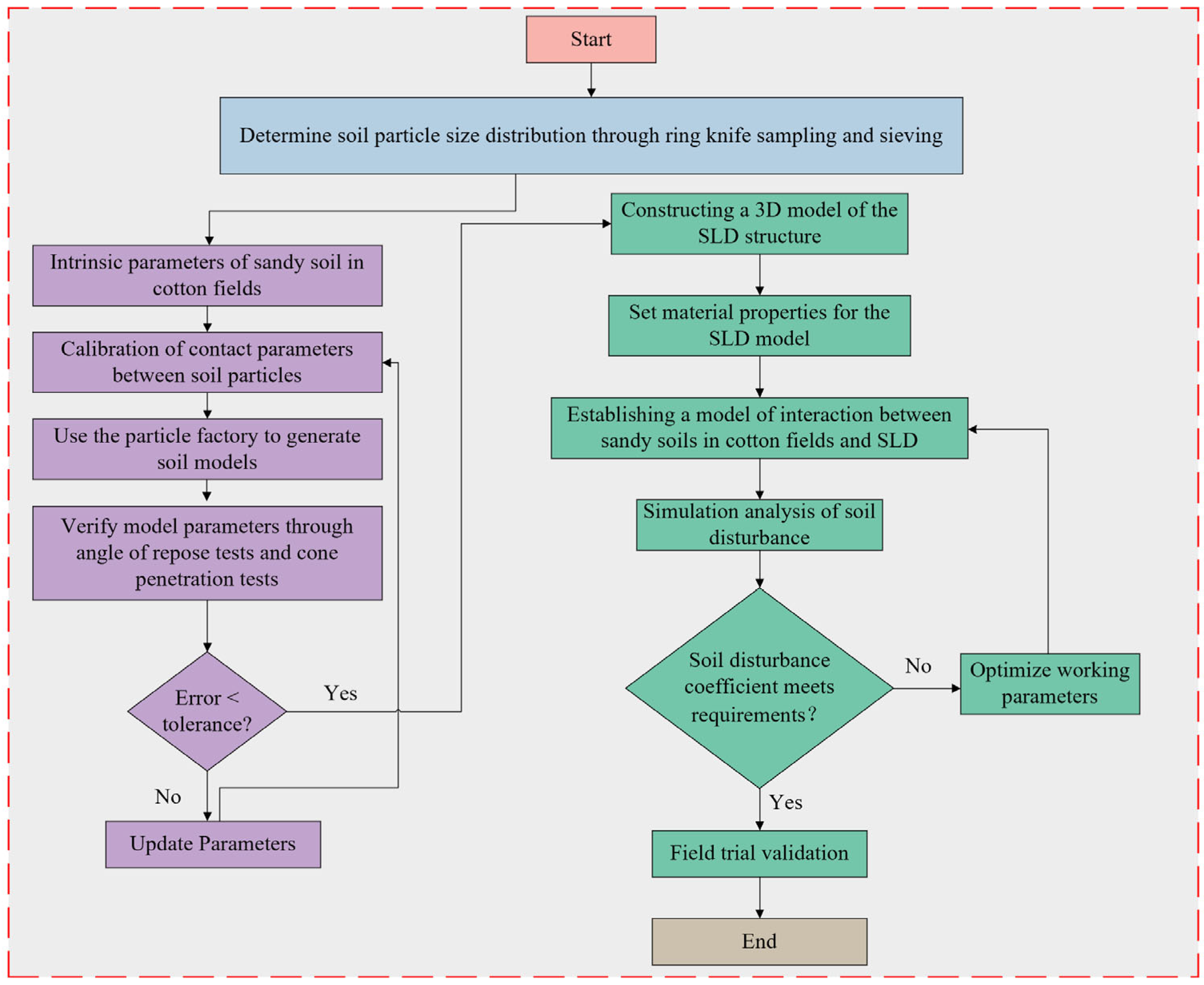
The research procedure is outlined in Figure 1. First, soil particle size and intrinsic parameters were obtained via ring-sampler extraction and sieve analysis. Following this, parameter calibration was conducted for sandy cotton field soils, and a corresponding soil model was developed. The model was validated through angle of repose tests and cone penetration tests. Subsequently, a three-dimensional model of the tillage tool was created, its material properties were assigned, and an interaction model between the tool and the sandy soil was established. Soil disturbance simulations were then carried out. Finally, field experiments were performed to validate the simulation results.

2.1. Structure and Working Principle of the SLD

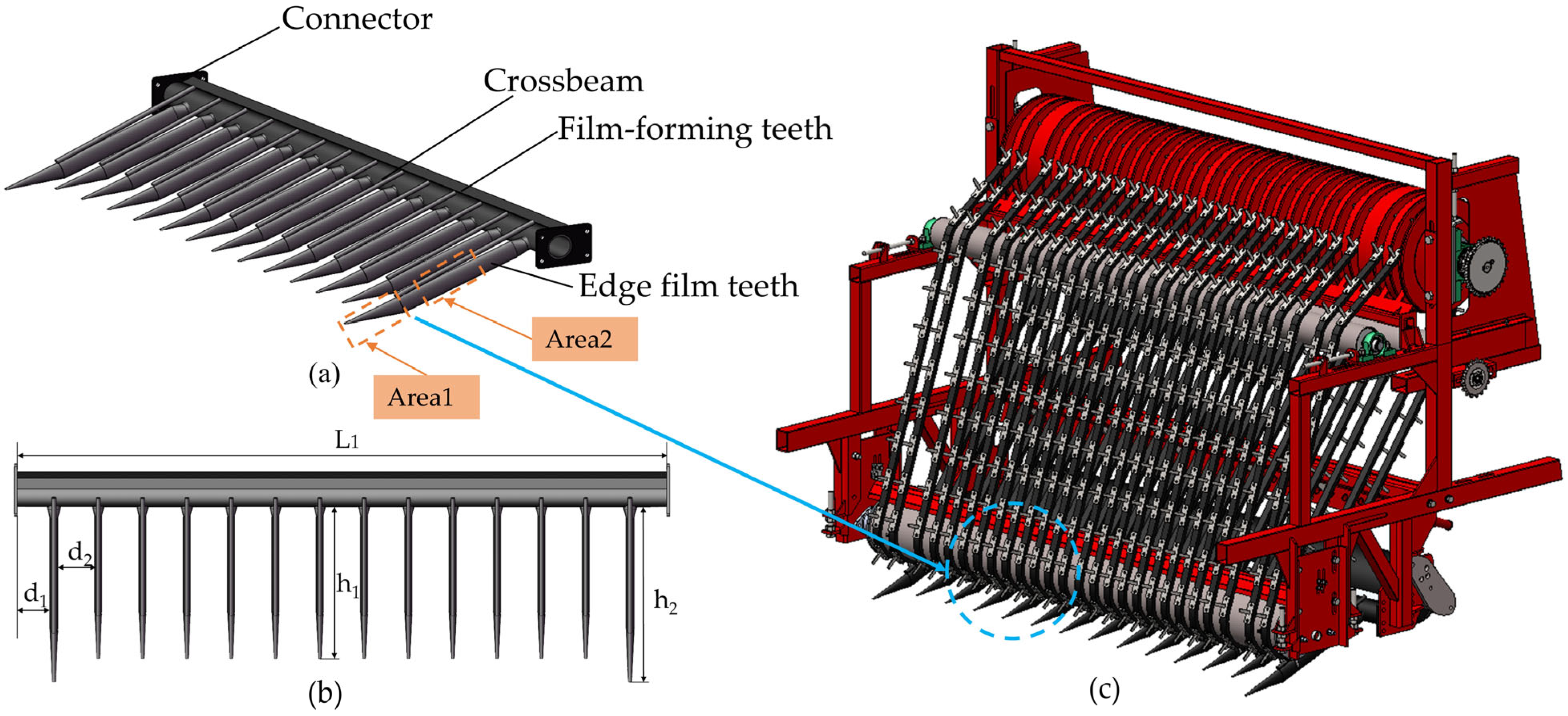
The SLD mainly comprises a mounting beam, film-lifting teeth, bolted connection plates, nuts, and other components, as illustrated in Figure 2. The film-lifting teeth engage the soil at a predefined angle, driven by the combined force of their self-weight and the machine’s forward motion. As the device advances, it disturbs and breaks up the soil, enabling the subsequent film-collecting machinery to retrieve the exposed residual film from the surface. This mechanism not only improves the recovery rate of residual film but also enhances the overall efficiency of the film recovery process. Key structural parameters of the device are as follows: L1 = 2100 mm, d1 = 110 mm, d2 = 123 mm, h1 = 520 mm, h2 = 630 mm.

2.2. Stress Analysis of SLD

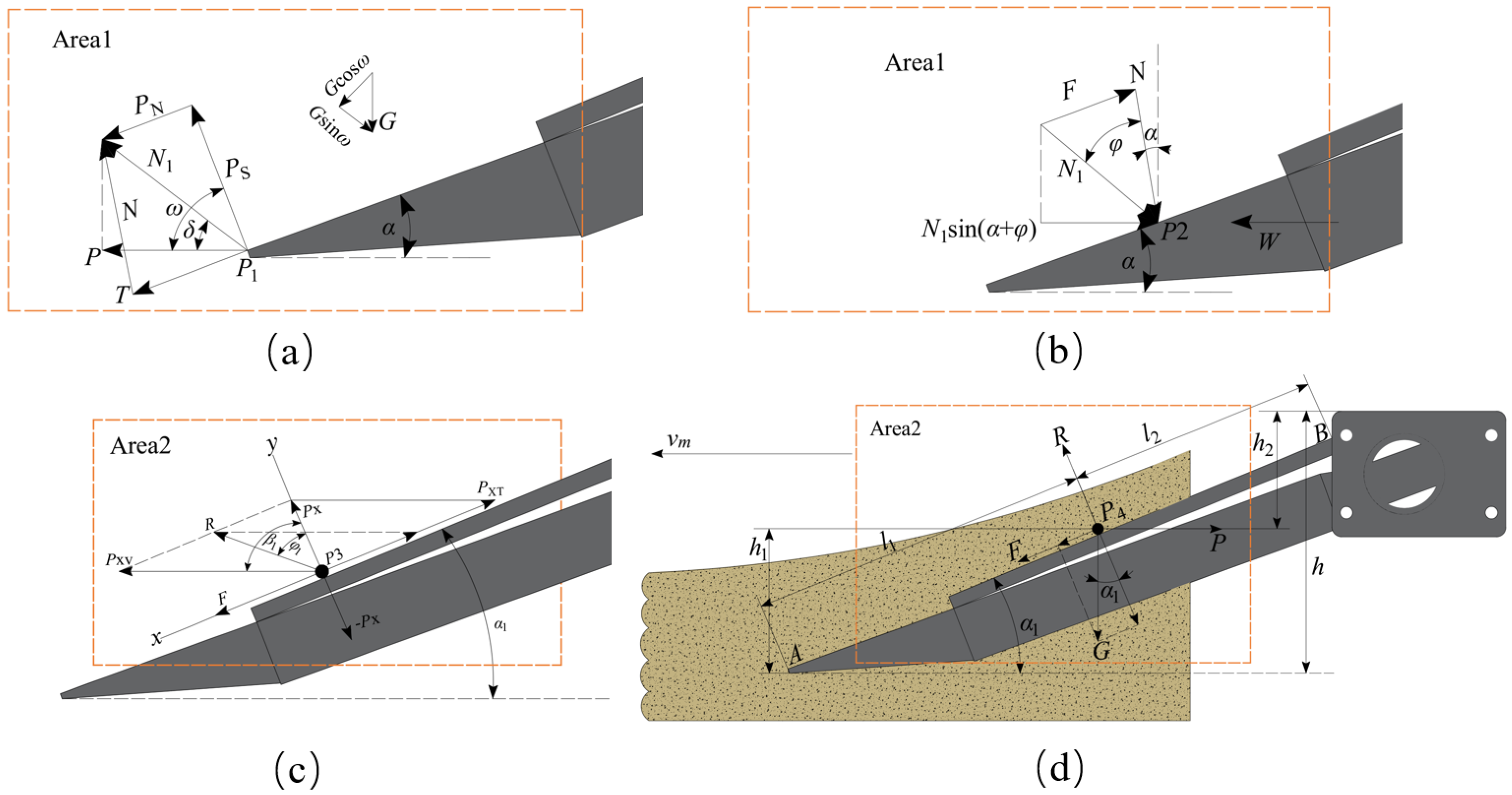
For the purpose of analytical simplification, the soil particles are assumed to be uniform. Accordingly, the SLD tooth is divided into two regions (Area 1 and Area 2) for subsequent stress analysis.
(1) Force analysis of soil cutting by the SLD in Area 1
A force analysis is performed for the soil cutting process in Area 1. As illustrated in Figure 3a, when the teeth fragment the soil, the normal and tangential forces acting on the SLD at point P1 can be expressed as:
P N = N 1 sin ( ω δ ) P S = N 1 cos ( ω δ )
where ω is the angle between force P and PS, °.
Taking into consideration the gravitational component of the soil weight, the normal stress and shear stress at point P1 can be determined as follows:
σ P 1 = N 1 sin ( ω δ ) + G cos ω sin ω l h τ P 1 = N 1 cos ( ω δ ) G sin ω sin ω l h
where l is the tooth tip width of the film-forming device, mm; h is the tooth tip penetration depth, mm.
The force P acting at point P1 is
P = G sin ω ( sin ω + cos ω tan ρ ) + c l h sin ( α + φ ) cos ( ω δ ) 1 tan ( ω δ ) tan ρ sin ω
where ρ represents internal friction angle of the soil, °; c de-notes the bulk density of the soil, g/cm3; G signifies the gravitational force of the soil, N.
When the tooth tip surface in area 1 contacts the soil, the SLD is subjected to several forces: normal pressure, motion resistance, and a frictional force F = fN generated by soil sliding along the blade. This friction acts opposite to the direction of travel. The resultant force N1, comprising N and F, is given by:
N 1 = N 2 + ( f N ) 2
where f is the coefficient of friction, f = tanφ; N is the normal force, N.
The resultant force N1 is given by
N 1 = N cos φ = N 1 + tan 2 φ
where φ is the angle between the resultant force N1 and the surface normal of SLD.
Accounting for the traction force W arising from frictional resistance to the device’s motion.
W = N 1 cos [ π 2 ( α + φ ) ] = N cos φ sin ( α + φ )
(2) Force analysis on the SLD surface in area 2
To improve soil disturbance, the primary device in area 2 was augmented with an auxiliary tooth. Soil particles contact this tooth at point P3, subjecting it to a normal force N = −PX and a frictional force F = tanφ1. The force N is resolved into components PXV and PXT along the direction of motion, for soil particles to move along the tooth surface, the condition PXV or PXT > F must be met, which requires β1 > φ1.
The tangential component can be expressed as
P X T = P X tan β 1
where β1 is the angle between the forward speed (FS) and the normal.
In the equation, PX denotes the lateral pressure exerted by soil particles.
Since β1 > φ1, it follows that PXtanβ1 > PXtanφ1, i.e., PXT > F. During the operation, soil particles in area 2 are propelled along the auxiliary tooth surface by a resultant force R, the force R is defined as the vector sum of the net tangential force (PXtanβ1PXtanφ1) and the force PXT. The governing differential equation for the soil particle motion is therefore:
m d 2 x d t 2 = m g 2 tan α tan φ 1 m g 2 tan α 1 tan β 1 m d 2 y d t 2 = 0
Among them
P X = m g 2 tan α 1
Integrating Equation (8) twice yields
v x = g t ( tan φ 1 tan β 1 ) 2 tan a 1 + C 1
Substitution of the initial conditions (t = 0, x = 0, vx = 0) into Equation (10) determines the constant C1 = 0.
v x = g t ( tan φ 1 tan β 1 ) 2 tan a 1
The x-direction displacement of soil particles is obtained by integrating Equation (11):
x = g t 2 ( tan φ 1 tan β 1 ) 4 tan a 1 + C 2
From the initial conditions, it is determined that C2 = 0. The displacement of soil particles in the x-direction equals:
x = g t 2 ( tan φ 1 tan β 1 ) 4 tan a 1
An analysis of soil movement above the SLD indicates that the soil penetration angle α1 affects both the x-direction velocity and displacement of soil particles, consequently influencing the device’s soil disturbance performance.
(3) Design of SLD Length
According to the force equilibrium of soil particles on the device surface, the conditions for particle motion along the surface are established. As presented in Figure 3d, the equilibrium equation is:
P cos α 1 F G sin α 1 = 0 R G cos α 1 P sin α 1 = 0 F = f R
where P denotes the driving force required for soil movement along the device surface, N; R is the corresponding soil reaction force on the SLD, N; G represents gravitational force of soil, N; F is the frictional force exerted by the soil on surface of the SLD, N; f is the coefficient of friction; and α1 is the soil-penetration angle, °.
The soil-penetration angle is
α 1 = arctan P f G f P + G
Based on Equation (15), increasing the α1 angle improves the soil disturbance capability of the SLD. Nevertheless, an excessively large α1 also leads to higher soil penetration resistance. Therefore, considering operational resistance during soil entry, an α1 angle of 20° was selected in this study.
When the device enters area 2 at a FS vm, the total energy at the contact point P4 is defined by:
E = m v m 2 2
The velocity of soil particles drops to zero at point B, the device’s endpoint. Here, the kinetic energy is fully dissipated via frictional work along a distance l2, as well as the work done against the gravitational force.
A t = G l 2 tan φ cos θ A g = G l 2 sin θ
Here, φ2 is the friction angle between the soil and steel, with a value ranging from 30° to 36°.
Accordingly, the energy balance equation for soil particles is established as:
m v m 2 2 = m g l 2 tan φ cos α + m g l 2 sin α
The length l2 is determined using Equation (18). Substituting the defined parameters α1 = 20° and vm = 1.39 m/s yields l2 = 111.5 mm. Since the burial depth h1 ranges from 100 to 140 mm, the total length l1 of SLD is given by following formula:
l 1 = h 1 sin θ
The SLD comprises two sections, l1 and l2, with a total length of
l = l 1 + l 2 = h 1 sin α 1 + v m 2 cos φ 2 g sin α 1 + φ
Based on Equation (20) with the given parameters, the required length of the film tooth was determined to be 404~520 mm. The maximum value of 520 mm was chosen to optimize operational efficiency. Furthermore, a side film tooth length of 630 mm was specified to maximize the recovery of the side film.
Guided by the analytical conclusions from Section 2.2, this study designated the device’s forward speed (FS) and soil penetration depth (SPD) as the experimental factors, employing the soil disturbance coefficient (SDC) for performance evaluation.

2.3. Discrete Element Modeling of Interactions Between Cotton Field Sandy Soil and SLD

2.3.1. Establishment of DEM Model for Cotton Field Sandy Soil

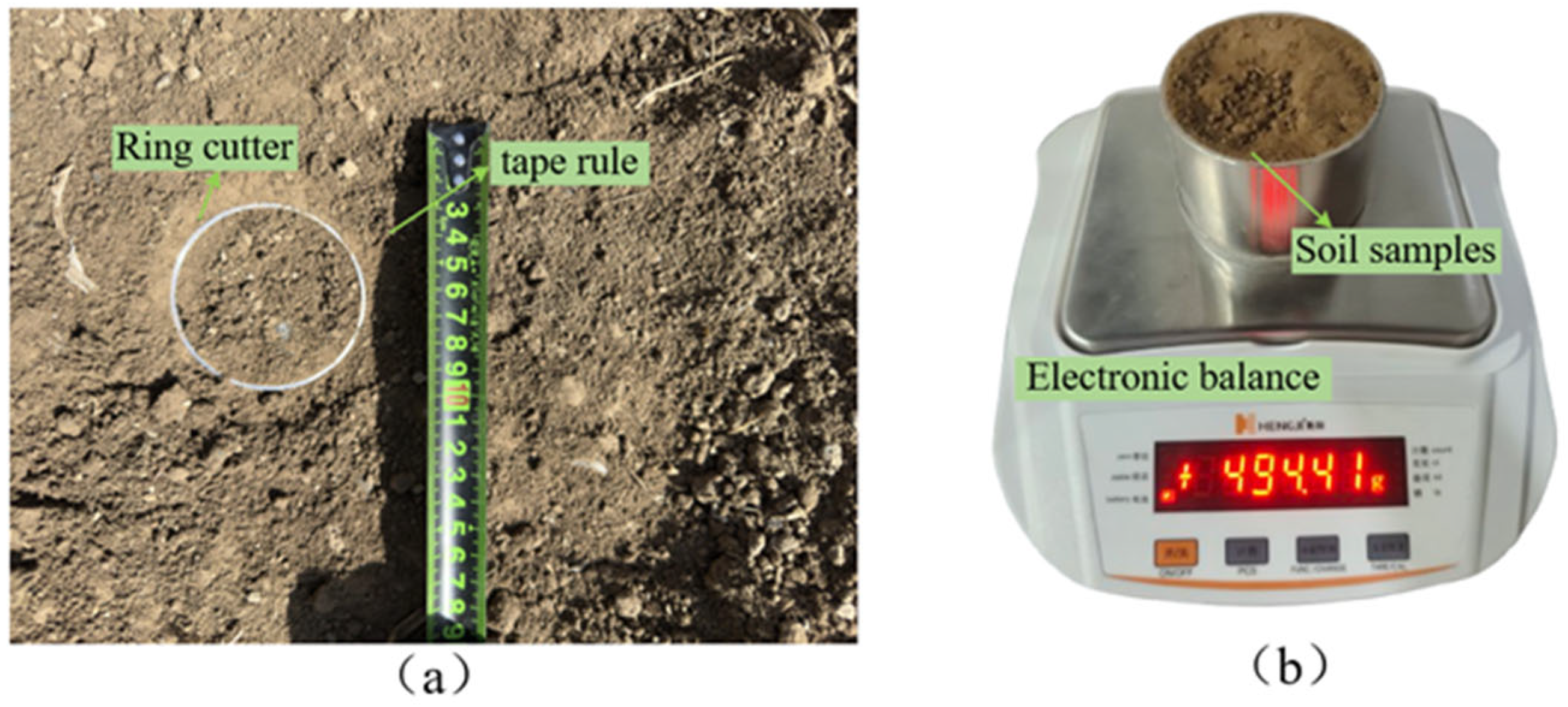
Soil sampling was conducted in the cotton-growing regions of Yuli County, Bayingolin Mongol Autonomous Prefecture, Xinjiang Uygur Autonomous Region, employing a ring knife and a five-point sampling pattern (Figure 4a). Soil density was determined to be 1630 kg/m3 using an electronic balance (accuracy 0.01 g) [15], as illustrated in Figure 4b, the ring knife sampling depth ranges from 0~150 mm, with a sampling size of 70 × 52 mm, the average soil moisture content is 6.8%.
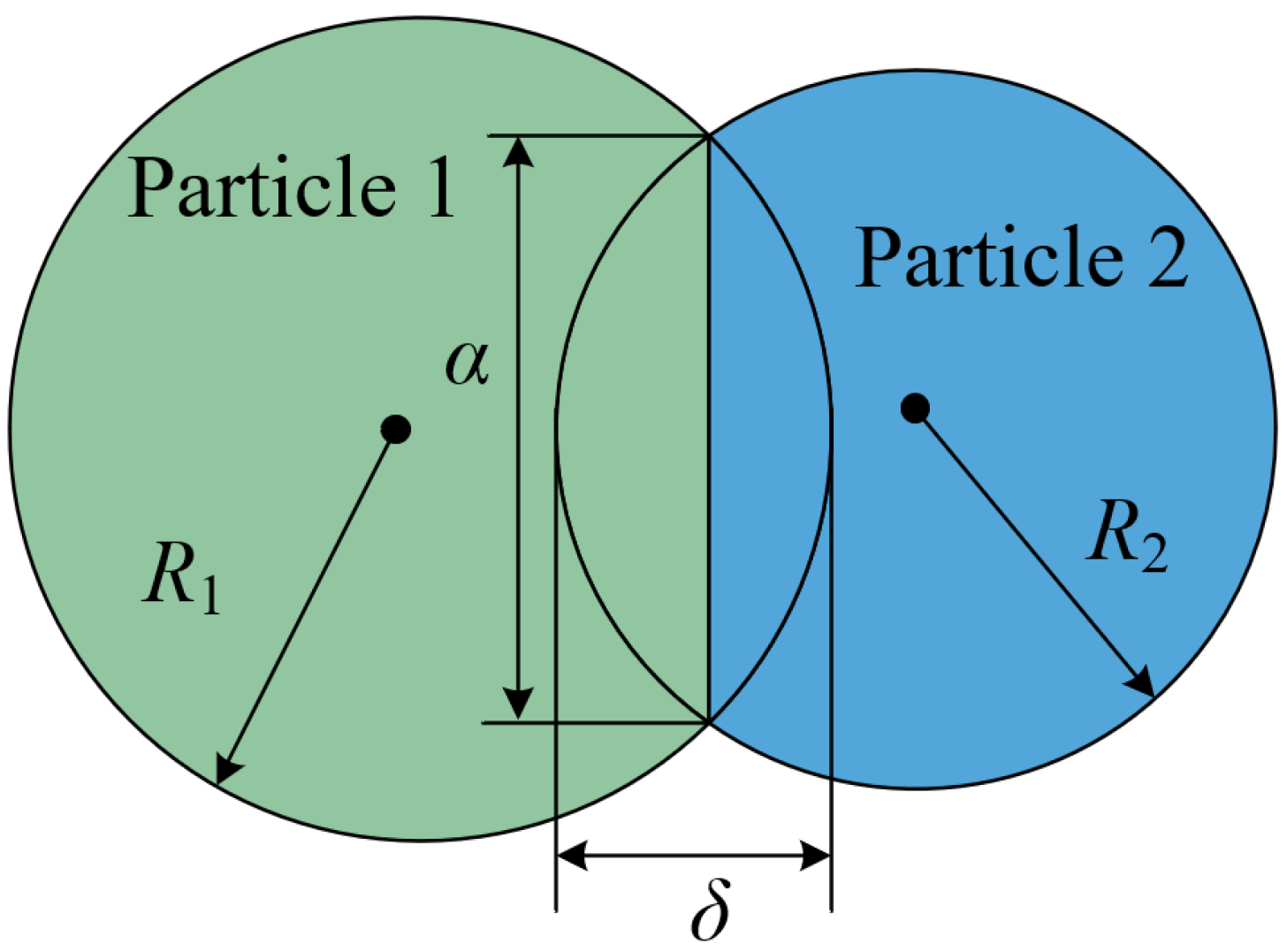
The discrete element method has been widely applied in the simulation of soils, seeds, and crop straw [15]. Different contact models are suitable for simulating different soil textures [16]. This study focuses on sandy soils in Xinjiang cotton fields. Preliminary field surveys confirm the sandy soil type. As these fields are irrigated prior to harvest, the soil retains a certain moisture content, which induces cohesion between particles. To represent this inter-particle attraction effectively, the Hertz-Mindlin with JKR contact model was adopted [17]. Consequently, this model was used to construct the cotton field soil model in this study, as shown in Figure 5.
Intrinsic parameters of soil were obtained through direct measurement or from literature [18]. Contact parameters between soil and steel, specifically the coefficient of static friction (CSF), coefficient of rolling friction (CRF), and collision recovery coefficient (CRC), were set to 0.42, 0.51, and 0.32, respectively, according to reference [19]. Parameters are listed in Table 1.

2.3.2. Soil Angle of Repose Simulation (ARS) Experiment

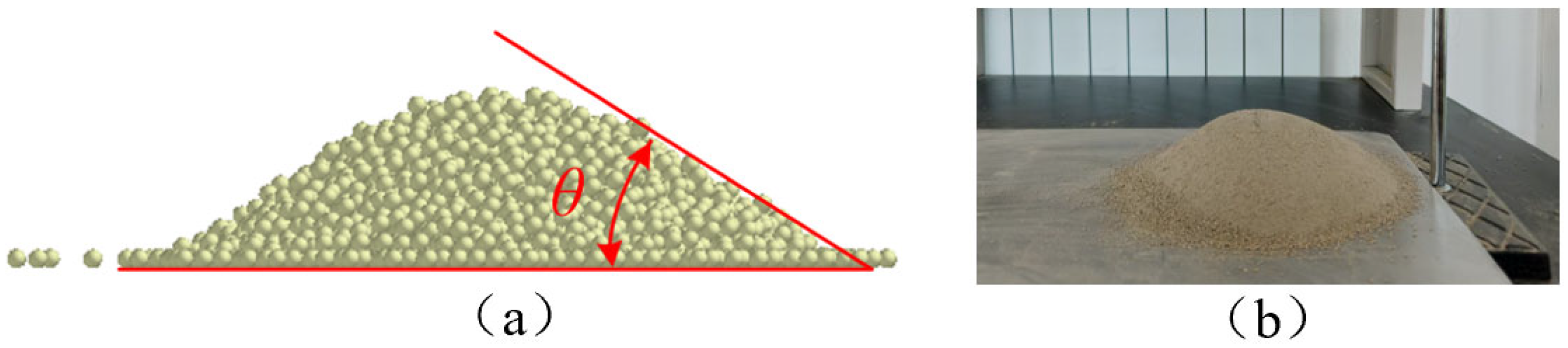
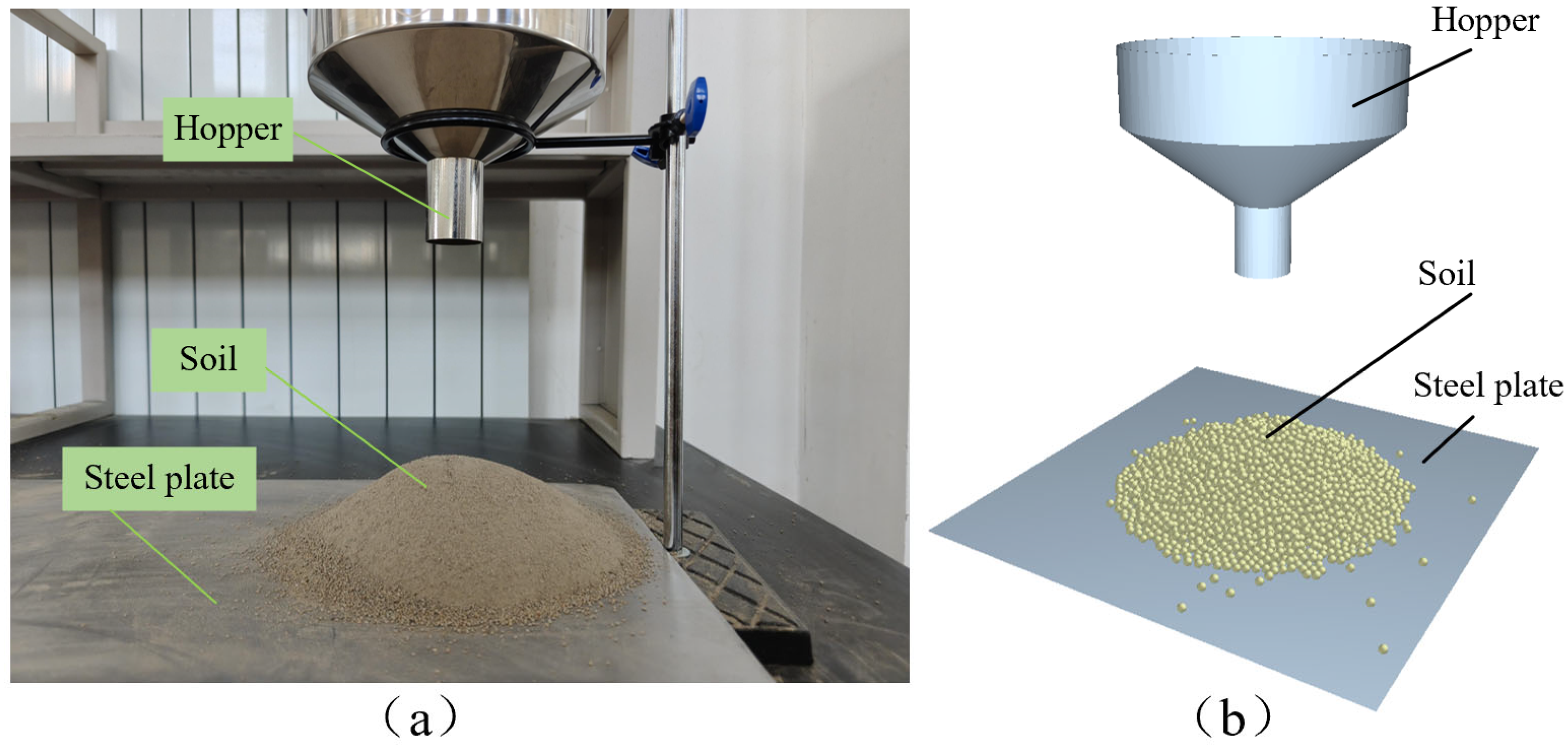
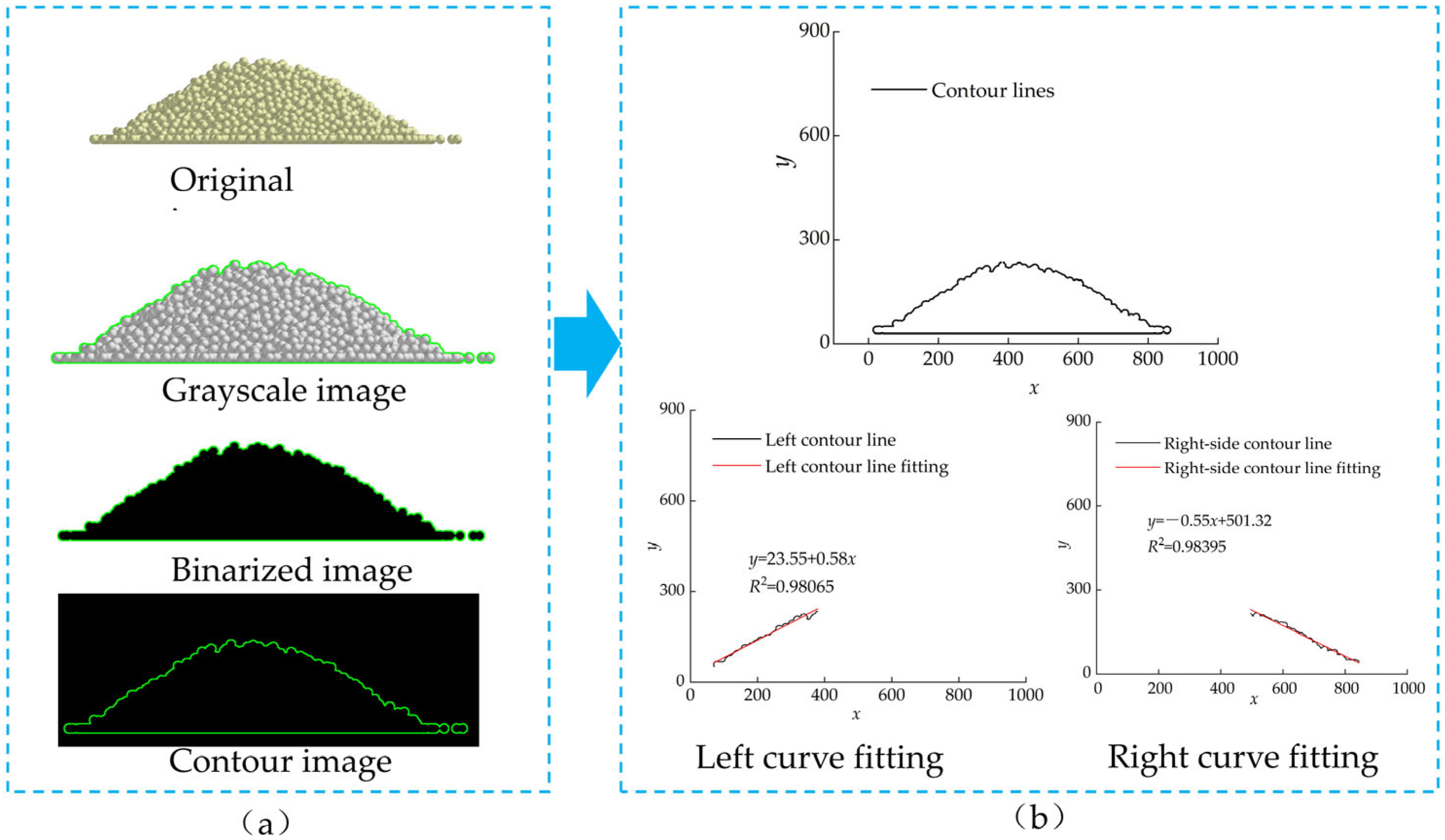
The ARS test is commonly used to calibrate discrete element parameters of granular materials with a custom test setup. In this test, soil particles are discharged from a steel funnel to form a stable pile on a bottom steel plate. The resulting pile angle is captured by a mobile phone. Through iterative simulations, contact parameters are adjusted within the test range until the simulated pile angle matches the physical measurement. As shown in Figure 6, the soil ARS is determined by extracting and fitting the soil edge contour via image processing. Specifically, the RGB image is first converted to grayscale. Contour coordinate points are then extracted, plotted in Origin, and fitted to a contour curve, as illustrated in Figure 7.

2.3.3. Calibration of Soil Parameters in Cotton Fields

The simulation parameters are provided in Table 1. Soil particles with an average radius of 2 mm were generated, the JKR surface energy coefficient (SEC)(XE), was varied between 0~9 J/m2. The experimental factors included soil–soil contact parameters: coefficient of restitution (CCR)XC, static friction coefficient (SFC)XS, rolling friction coefficient (RFC)XR, and JKR surface energy coefficient (SEC)(XE). The evaluation metrics were the ARS (θS) and its relative error (Y), calculated using Equation (21). A Box–Behnken design was employed for the four-factor, three-level simulation experiment, with each factor set at +1, 0, and −1 levels. The level coding for each factor, based on the parameter range, is given in Table 2.
Y = θ S θ θ × 100 %
In the equation, Y the relative error of ARS (%); θS the simulated ARS (°); θ the actual ARS (°).

2.3.4. Calibration and Validation of Simulation Parameters

The experimental design results for the simulated soil ARS are summarized in Table 3. Using Design-Expert software13.0, multivariate regression analysis was conducted to develop a regression model relating the four parameters to the ARS. Insignificant terms were removed based on analysis of variance (ANOVA), resulting in the following final quadratic regression equation:
θ S = 34.64326 X C 0.73 X S + 3.39 X R + 1.51 X E 1.35 X S X R + 1.75 X R X E 1.7 X R 2
The ANOVA performed on Equation (22) (Table 4) indicated that the regression model was highly significant (p < 0.0001). The experimental reliability was confirmed by a low coefficient of variation (3.29%) and a non-significant lack-of-fit (P = 0.7452). The model’s explanatory power was strong, with R2 = 0.9499, accurately capturing the relationship between XC~XE and θS. An analysis of F-values revealed the parameter significance order as XR > XC > XE > XS.

2.4. Soil Model Validation

2.4.1. Soil Angle of Repose Validation

The measured angle of repose of 34.46° was used as the target value for optimization in Design-Expert software13.0 [20]. The resulting optimal parameter combination was determined as follows: soil–soil CCR = 0.28, SFC = 0.67, RFC = 0.14, and SEC = 6.95 J/m2. To validate these parameters, five repeated angle of repose tests were conducted using the method described earlier. The average measured angle was 34.87°, which closely agrees with the target value, showing a relative error of only 1.17% and confirming the high accuracy of the calibrated soil model. A visual comparison of the soil piles from the simulation and the physical test is presented in Figure 8.

2.4.2. Validation of Soil Firmness Using the Cone Penetration Test

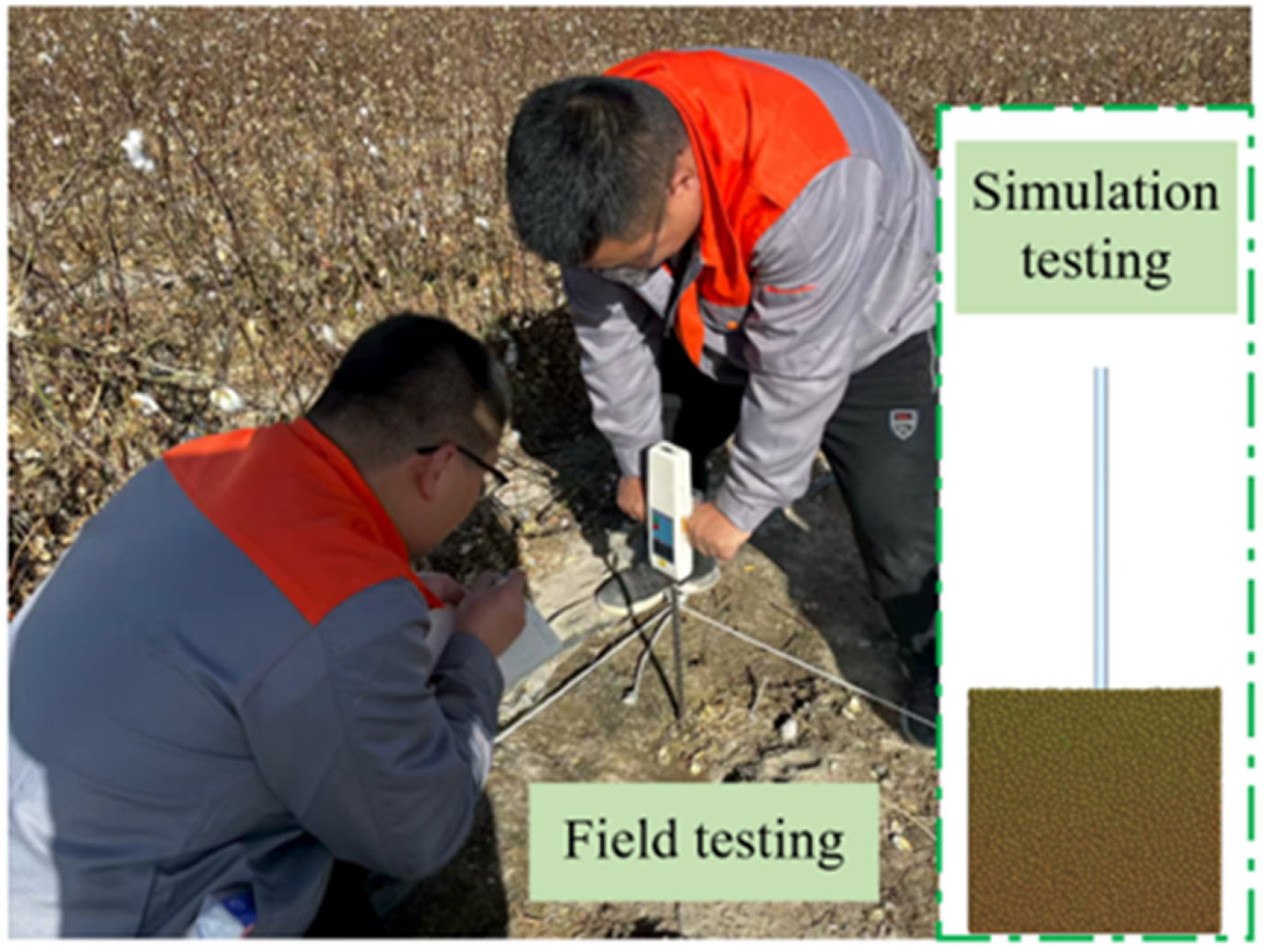
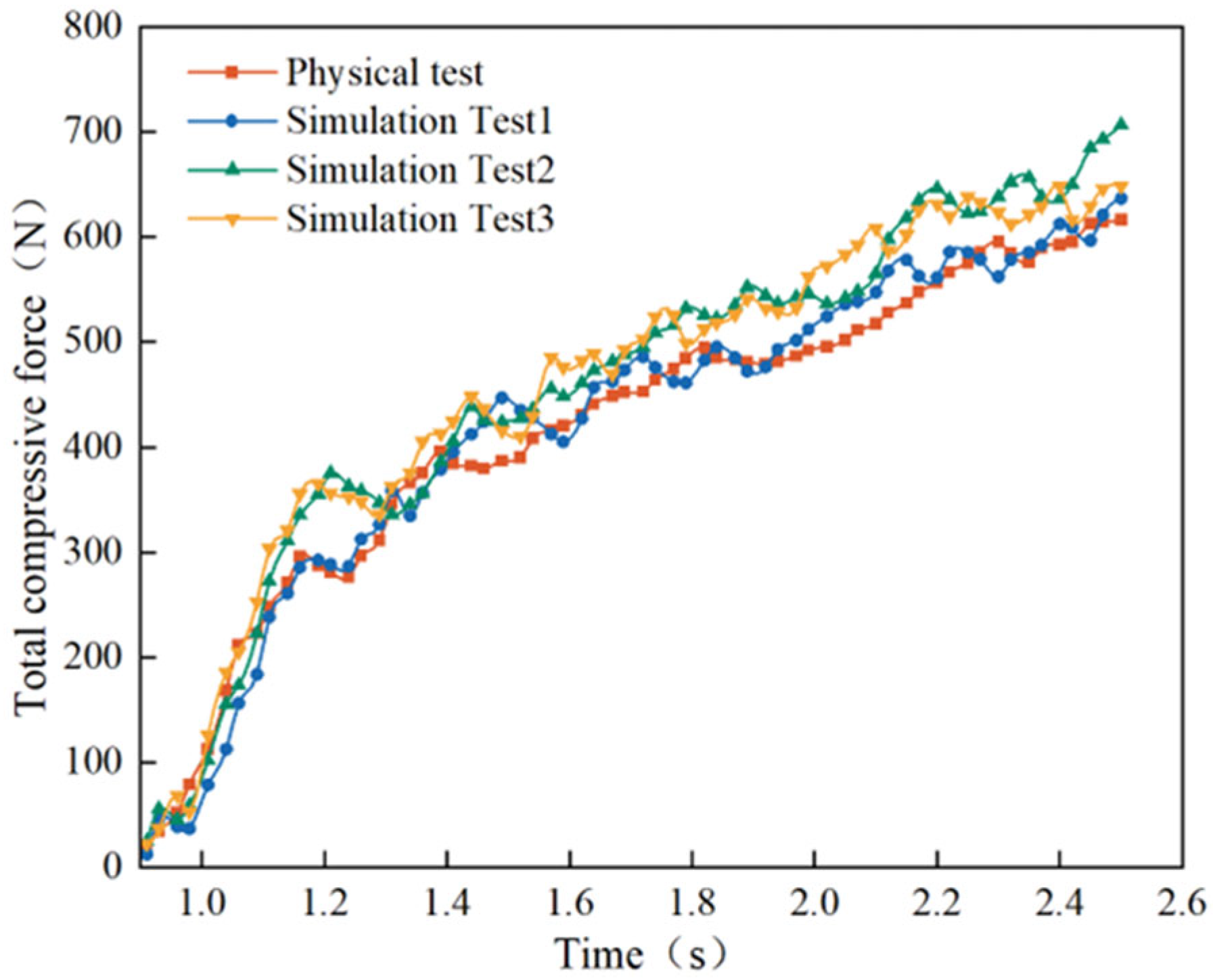
To determine the soil contact parameters for simulation, a soil bin model measuring 100 mm × 100 mm × 200 mm was created in EDEM 2022. [21] The soil–steel contact parameters were assigned as previously defined. Calibration of the soil model parameter was performed using a cone penetration test, following a comparative approach between physical and simulated experiments. In the field tests, a TYD-2 soil hardness tester (range: 0–1000 N·cm2) was used. The cone was driven into the soil at a constant speed, and the data from five repeated tests were recorded, with the average value taken (Figure 9). For the simulation, a 1:1 scale model of the hardness tester was built, and the total pressure on the probe was set as the simulation response variable.

2.5. Soil-Lift Device-Soil Interaction Model

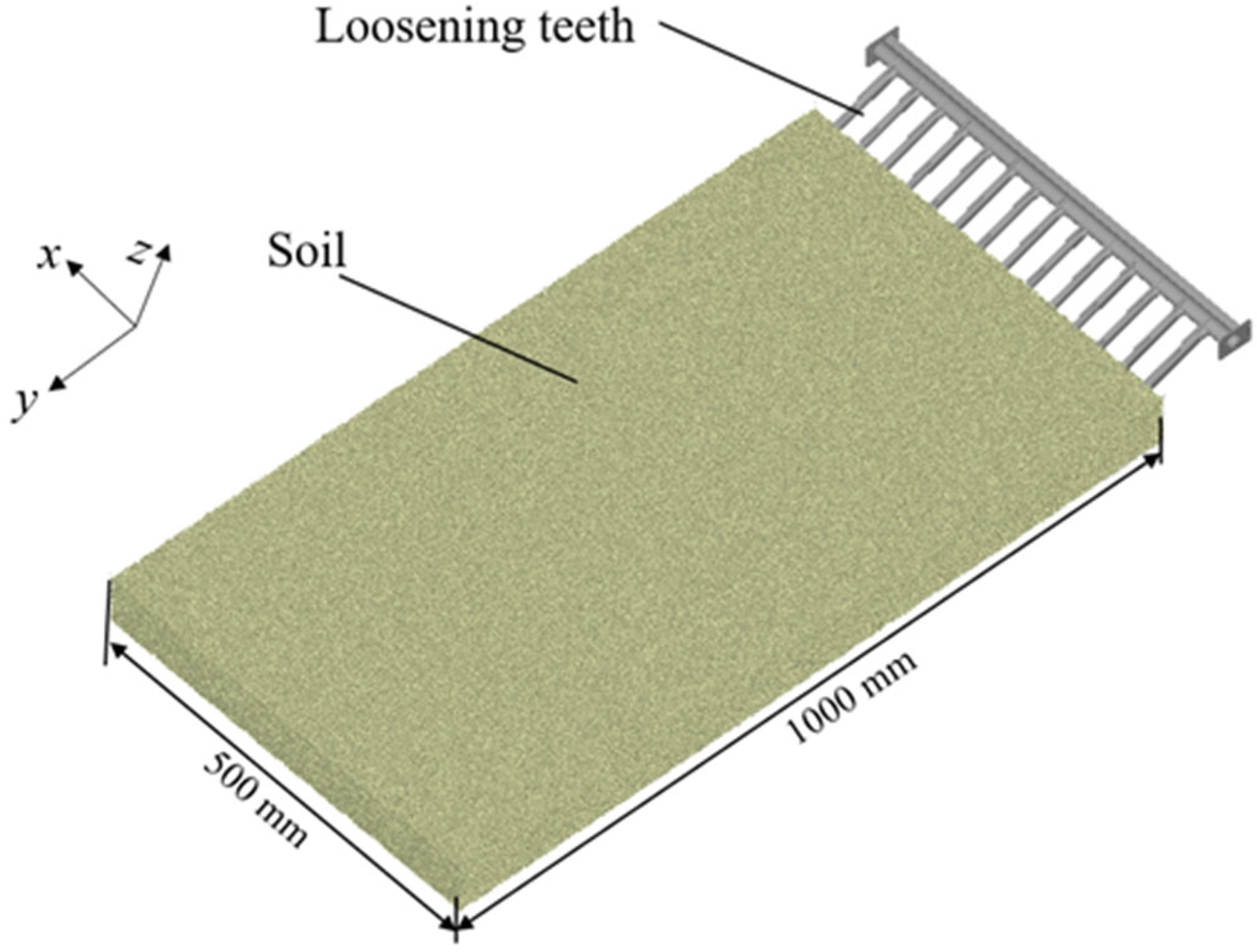
To further examine the soil disturbance performance of the SLD and its interaction mechanism with the soil [22], a discrete element soil model was developed using the calibrated parameters listed in Table 5. The model measured 1000 mm × 500 mm × 200 mm, as shown in Figure 10, and contained 1,253,360 soil particles. Particles were generated at a rate of 10% per time step, with an inter-particle time interval of 0.01 s. The SLD imported as an STL file into EDEM, was assigned a linear motion with the following key parameters: FS of 1.39 m/s, SPD of 100 mm, simulation time step of 2 × 10⁻⁷ s, and a data save interval of 0.01 s.

2.6. Field Trials

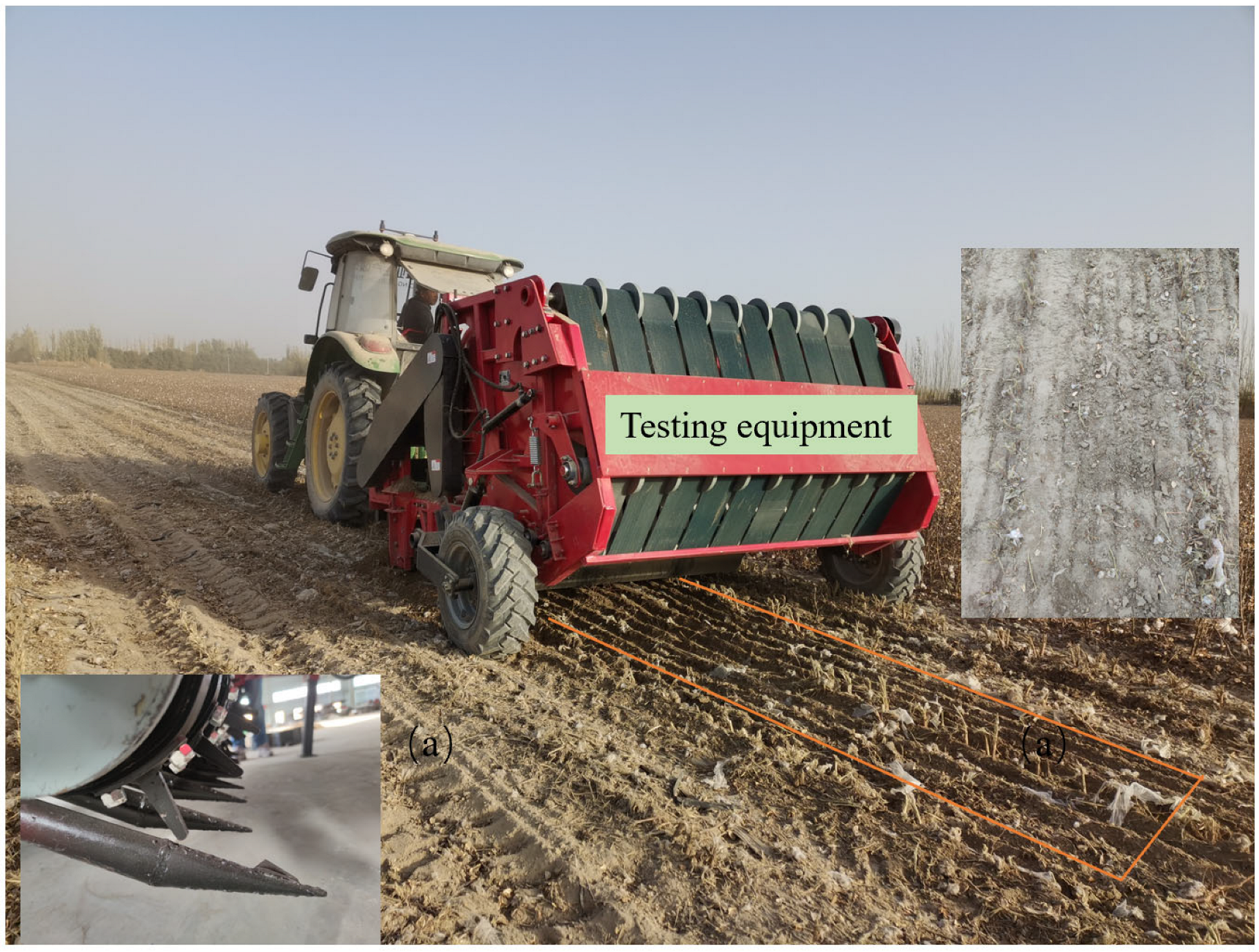
Field trials were conducted in October 2023 at a cotton field in Yuli County, Korla, Xinjiang, to validate the simulation accuracy of the SLD in replicating cotton field soil disturbance [23]. The measured soil had an average moisture content of 6.3% and a compaction strength of 6210 kPa. The test setup included a John Deere 1204 tractor pulling a tooth-belt residual film collector, with a tape measure used for field measurements, as shown in Figure 11.
The SDC (Y1) was selected as the evaluation index [24], preliminary experiments and theoretical analysis identified FS and SPD as the experimental factors. In accordance with practical operational requirements and prior theoretical studies, the FS was set in the range of 4~8 km/h, and the SPD between 100~140 mm. A Central Composite Design (CCD) was employed to conduct simulation tests and develop models under various working conditions. The simulation parameters remained consistent with field experiments, and the coded factor levels for the CCD are presented in Table 6.
Y 1 = A s A q × 100 %
where AS is cross-sectional area (original surface to actual trench bottom), mm2; Aq is cross-sectional area (original surface to theoretical trench bottom), mm2.

3. Results and Discussion

3.1. Calibration of Soil Parameters

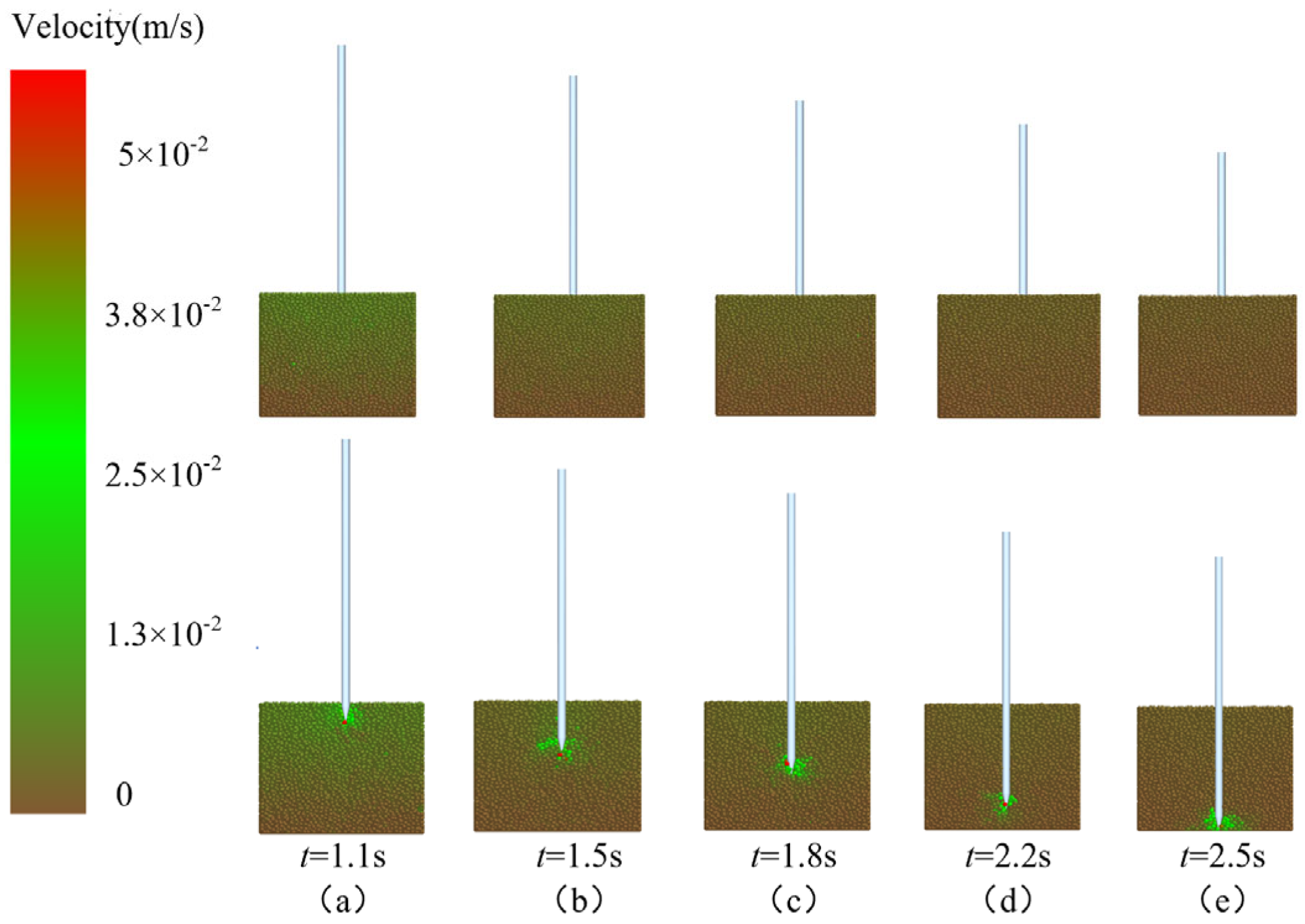
To further validate the conformity of the soil model with actual soil mechanical properties, cone penetration tests were conducted to evaluate soil stiffness (Figure 12). During the simulation, the probe initially contacted the soil (Figure 12a), altering the surface motion state and causing fracture in a limited number of soil particles. Upon full penetration (Figure 12b–d), additional particles were displaced and fractured, while those adjacent to the probe were noticeably disturbed. During the stable penetration phase, surface disturbance ceased, with the most pronounced effects concentrated near the probe tip and propagating downward. By the end of the simulation, disturbance was confined primarily to deeper soil layers, a finding consistent with Lin et al. (2024), who similarly employed cone penetration tests to calibrate soil DEM parameters [25].
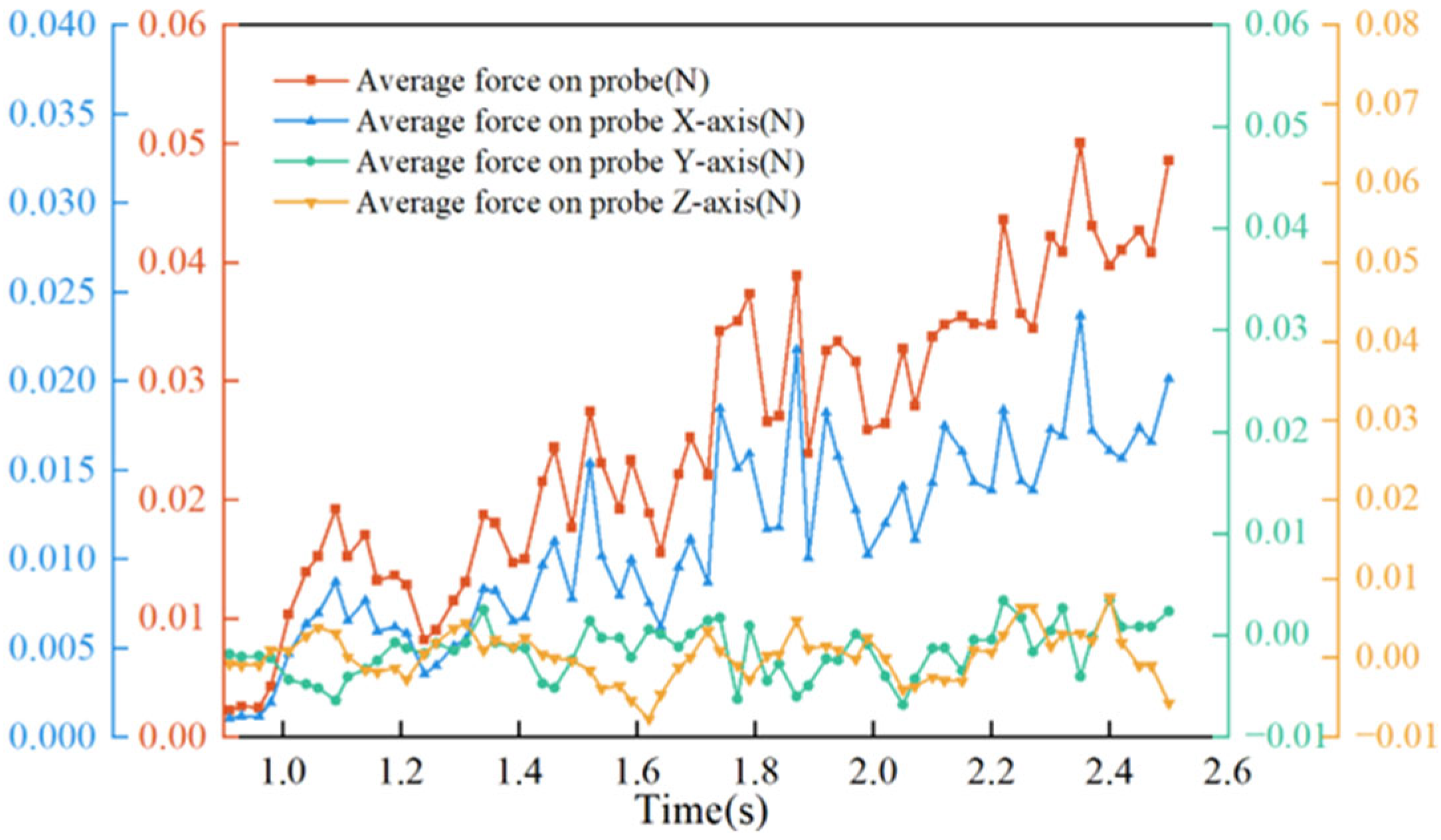
Through the EDEM post-processing module, the average stress variation curves of the probe were extracted, as presented in Figure 13. As penetration depth increases, the average stress on the probe exhibits a progressive rise. Given that the X-axis aligns with the direction of probe movement, stress variation along this axis is substantially more pronounced compared to the other axes. In contrast, stress changes along the Y-axes and Z-axes are relatively subdued, which can be attributed to lateral compression from surrounding soil particles. Owing to the larger contact area in these directions, the resulting forces acting on the probe remain comparatively lower.
Three cone penetration simulations were conducted and evaluated against physical tests. As shown in Figure 14, the time–total pressure relationship curves indicate a progressive increase in stress with penetration depth in both simulation and experiment. The average relative errors in total pressure at identical time points were 3.25%, 6.28%, and 5.2% for the three simulation sets, indicating generally good agreement. The difference primarily stems from the inherent complexity of real cotton field soil, a heterogeneous mixture containing minor cotton residues and impurities that discrete element models cannot fully capture. Furthermore, the spherical particles used in such models create inter-particle voids, resulting in incomplete filling of the soil trench. Further limitations include the method’s current inability to simulate variations in soil moisture content and the randomness of particle size distribution. Consequently, it fails to fully replicate the true physical state and environmental conditions of soil. The close correspondence in displacement–load trends between physical and simulation results collectively verifies the accuracy of the soil simulation model parameters.

3.2. Central Composite Design Experimental Parameter Optimization Results

A Central Composite Design (CCD) was generated via Response Surface Methodology using Design-Expert 13.0 software. The experimental layout is summarized in Table 7.

3.2.1. Analysis of the Effect of Interaction Factors on SDC

To characterize the relationship between the SDC (Y1) and the influencing factors, quadratic regression and multiple regression analyses were performed using Design-Expert 13.0 [25], yielding regression equations that were subsequently tested for significance.
Y 1 = 67.07 + 3.40 X F + 2.48 X D 1.7 X F X D 1.36 X F 2 1.38 X D 2
Based on the experimental data and multiple regression analysis, the ANOVA results for the SDC (Y1) are summarized in Table 5. The primary and secondary influencing factors were identified as A and B, respectively. Among these, A and B showed highly significant effects on Y1 (p < 0.01), while B2, A2, and the interaction term AB were also significant (p < 0.05). The goodness-of-fit test revealed no significant lack of fit (p = 0.2144, Table 8), indicating the absence of other major influencing factors not included in the model. A significant quadratic relationship was confirmed between the experimental factors and the SDC [26].

3.2.2. Response Surface Analysis

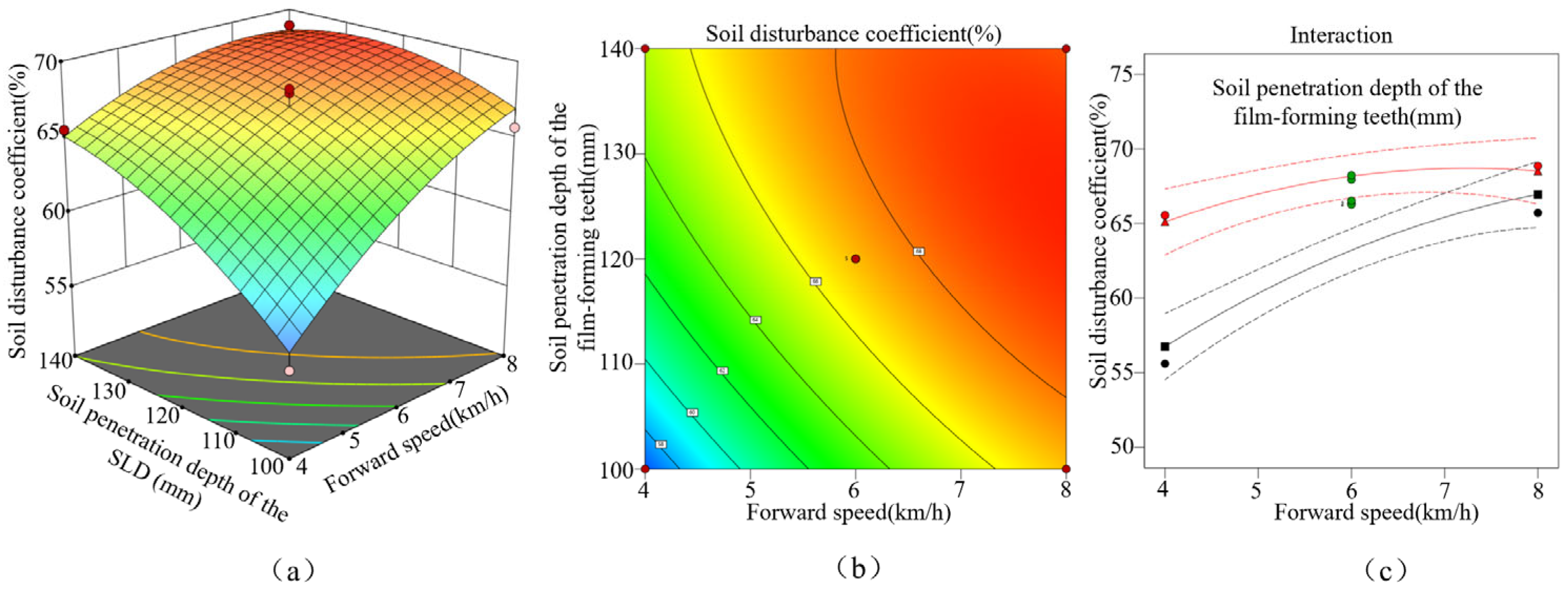
The interactive effects of FS and SPD on the SDC (Y1) were analyzed using Design-Expert 13.0, with the resulting response surface plot shown in Figure 15 [26].
Based on the analysis of the SPD (Y1), when the SPD of the SLD is held constant, Y1 increases with rising FS. At lower FS, the SDC grows as SPD increases. Similarly, under greater SPD, Y1 also rises with higher FS.

3.2.3. Parameter Optimization

The optimal parameter combination affecting the SDC was determined through a two-factor, five-level Central Composite Design experiment [27]. In accordance with agronomic requirements, which specify that the SDC must exceed 50% [28], the objective function and constraints were established as follows:
G 1 ( A , B ) = 50 Y 1 0 s . t . 4 A 8 100 B 140
The optimal solution was determined using the multi-objective parameter optimization module in Design-Expert 13.0 [29]. The resulting parameters: a FS of 5.939 km/h and a SPD of 107.666 mm, gave a predicted SDC of 64.874%. After rounding these values to 6 km/h and 108 mm, five validation tests were performed, the validation test results are shown in Table 9. The results indicate that the standard deviation of the soil disturbance coefficient is 1.92%, verifying the accuracy and reliability of the model.

3.3. DEM Simulation Results

3.3.1. Soil Disturbance Process

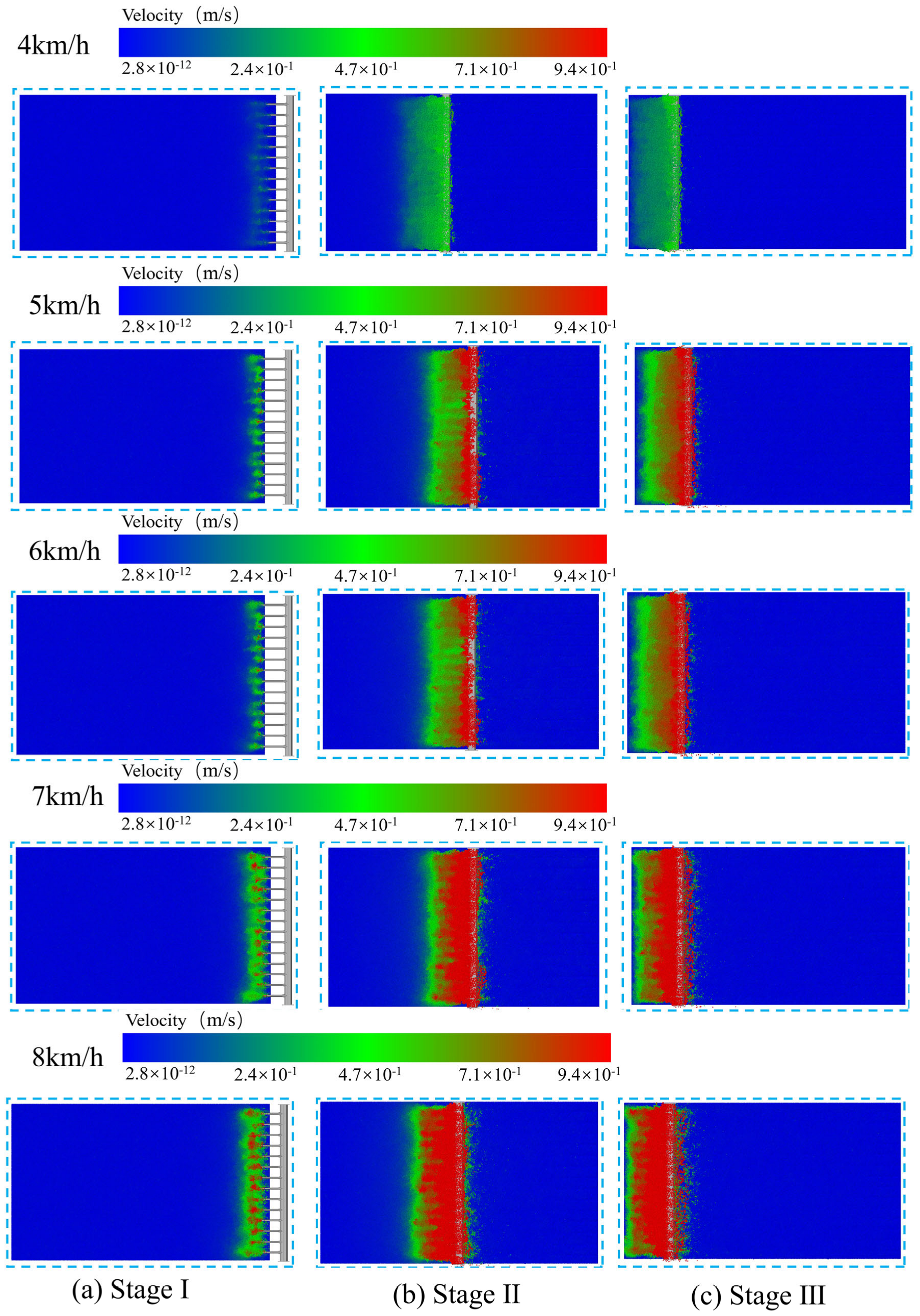
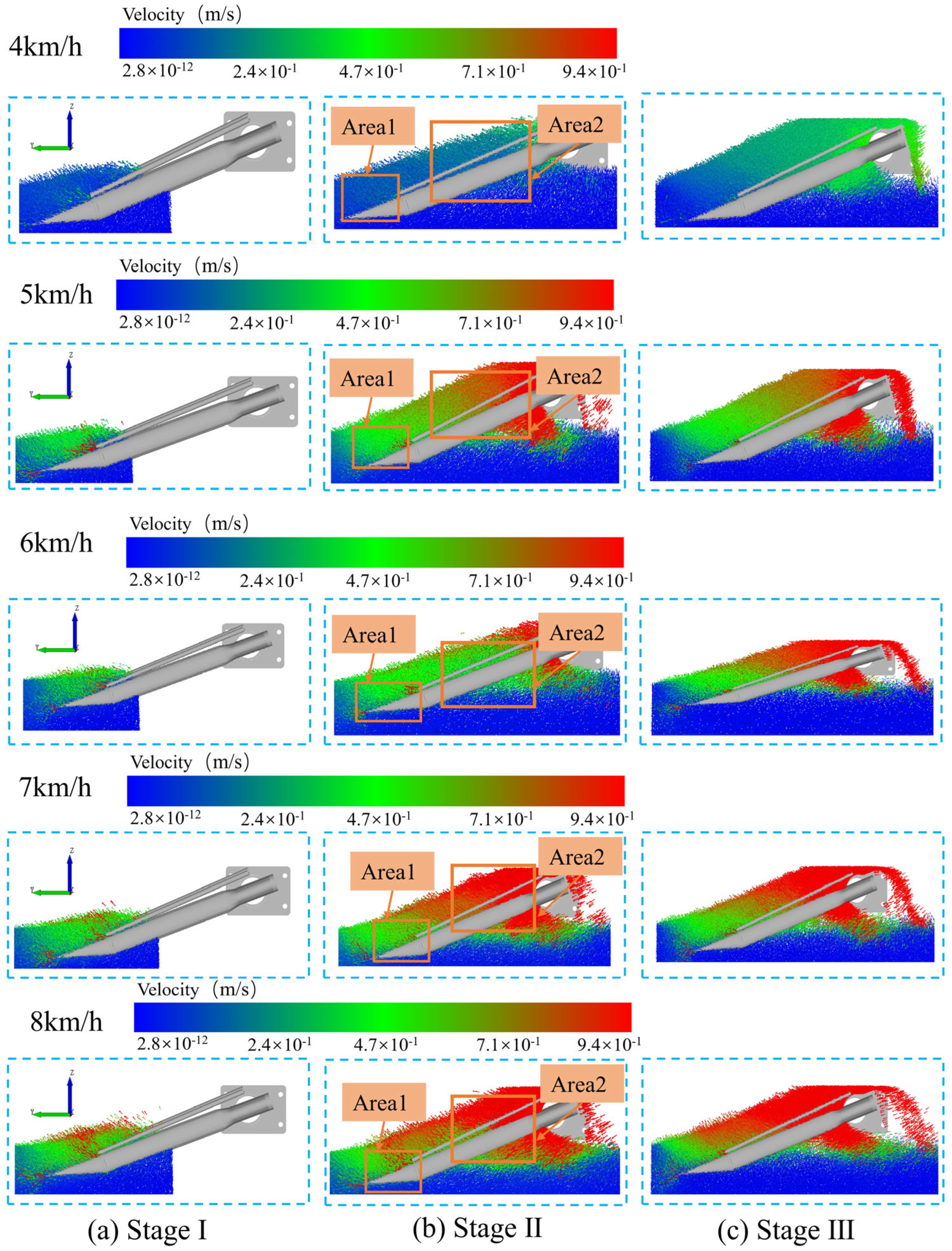
During operation of the SLD, soil particles move along its surface and are ejected backward and upward. Variations in soil disturbance and soil particle velocity across different working stages are shown in Figure 16. The disturbance process is divided into three distinct stages (Stage I, II, and III) at various forward speeds [30]. In Stage I, the device enters the soil model, causing soil particles to move primarily along the direction of travel (+Y-axis). In Stage II, the device fully penetrates the soil, resulting in soil compression and particle breakage, which leads to accumulation above the device. During this stage, the accumulation height is greater on the forward-facing side (+Y-axis) than on the rear side (−Y-axis) [9].

3.3.2. Movement of Soil Particles During Operation

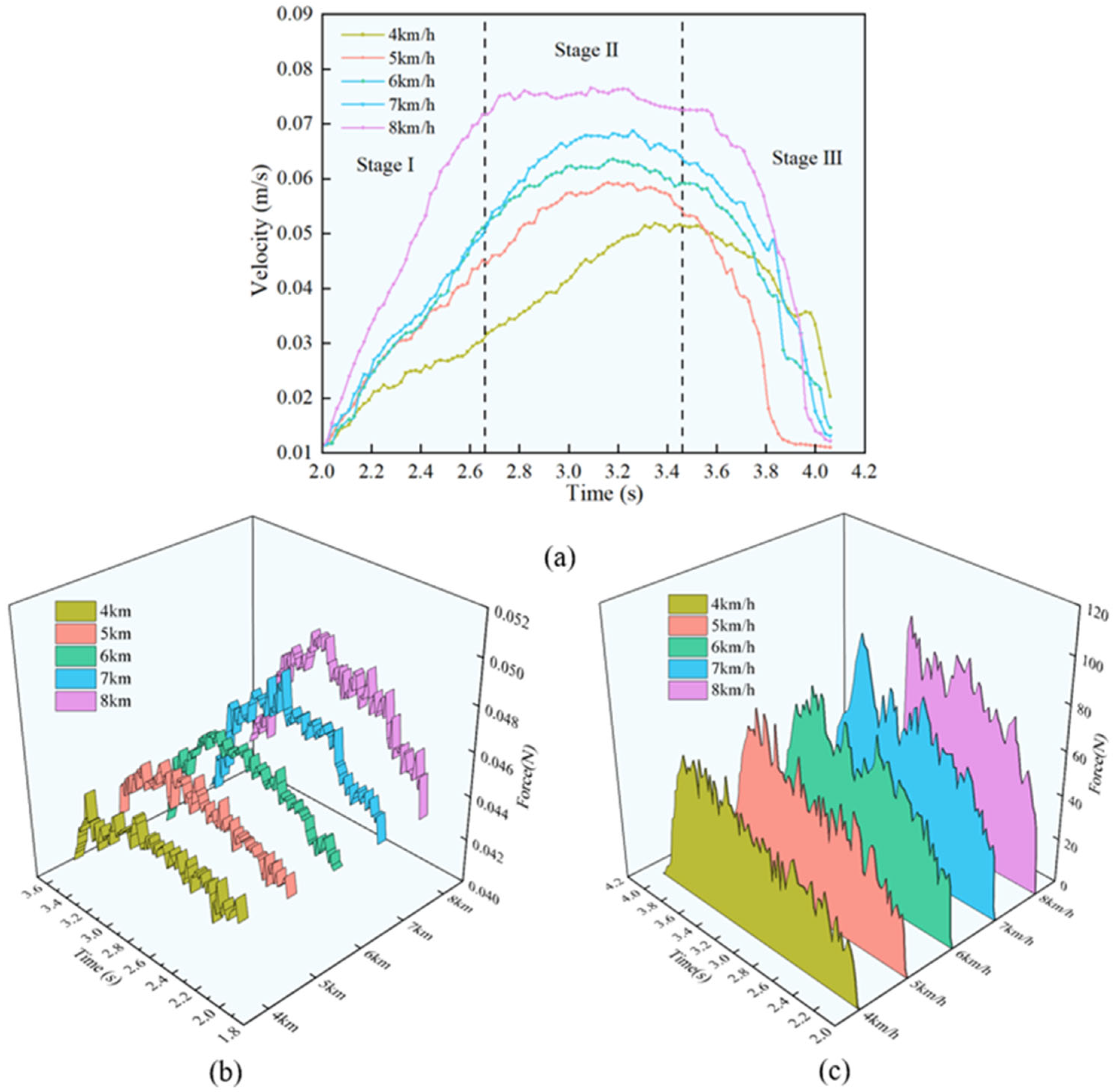
The simulation was configured with forward speeds of 4, 5, 6, 7, and 8 km/h and a soil entry angle of 20° for the SLD. As the device advanced along the +Y-axis, results showed that higher FS correlated with increased soil particle velocities, leading to more extensive soil disturbance. This behavior is consistent with soil movement trends reported in DEM simulations of corn stubble cultivation by Che et al. (2025) [31]. Figure 17 presents contour plots of soil particle velocity during stable operation. Upon engaging the soil, particles in region 1 near the tooth tips acquired rearward and upward velocity along the device surface and were subsequently ejected. Meanwhile, particles in area 2 exhibited higher velocities, with all velocities rising as FS increased (Figure 18a). During Phase I, the average soil particle velocity increased gradually from 0.02 to 0.06 m/s. It then stabilized in Phase II, fluctuating periodically within 0.05–0.07 m/s, before declining rapidly in Phase III.

3.3.3. Force Analysis of Soil Particles During Operation

The average force acting on soil particles during the operation of the SLD was extracted using the EDEM post-processing module. The force distribution displayed clear oscillatory behavior across different operational stages. During Stage I, as the device first engaged the soil, the mean force began to fluctuate periodically, reaching a peak of 0.042 N (Figure 18b). In Stage II, as soil interaction continued, the average force oscillated within a defined range, with the peak increasing to 0.049 N. By Stage III, the overall force declined. Under FS of 4, 5, 6, 7, and 8 km/h, the corresponding average forces were 0.043 N, 0.044 N, 0.045 N, 0.046 N, and 0.047 N, respectively. In summary, higher FS led to more pronounced particle velocities and forces, resulting in stronger soil disturbance.

3.3.4. Force Analysis of the SLD

Figure 18c shows the variation in force acting on the SLD across different operational stages. In Stage I, as the device begins to disturb the soil, the applied force rises sharply and shows periodic fluctuations. At FS of 4, 5, 6, 7, and 8 km/h, the peak forces on the loosening device are 34.67 N, 39.39 N, 41.74 N, 45.55 N, and 49.88 N, respectively, indicating a corresponding increase with speed. In Stage II, the SLD operates in a stable manner, with forces between 56.87 N~95.70 N, which continue to rise as the FS increases. During Stage III, as the device gradually disengages from the soil, the force decreases rapidly. This pattern is consistent with the force characteristics observed by Chen et al. (2023) during the interaction between a trenching blade and soil [32]. In summary, higher FS leads to greater forces on the SLD and more intense movement of soil particles, resulting in more pronounced soil disturbance.

3.4. Discussion

This research examines the interaction between SLD and sandy soils in cotton fields. It systematically analyzes the operational dynamics, encompassing the forces on the SLD, the forces on soil particles, and soil particle velocity. Simulation tests were conducted to investigate soil disturbance mechanisms and key performance factors, with field validation confirming the reliability of the numerical results. The proposed SLD achieves a soil disturbance coefficient exceeding 60%, substantially improving the efficiency of subsequent film recovery operations.
Elevated FS enhanced both particle velocity and applied force, intensifying soil disturbance—a trend consistent with findings reported by Che et al. (2025) [31] and Chen et al. (2023) [32].
The newly developed SLD exhibits a clear advantage in soil disturbance over existing counterparts, with a measured SDC exceeding 60%. Nevertheless, the higher operating speeds required for this performance elevate energy demands. Consequently, subsequent research should prioritize the analysis and optimization of energy usage to achieve energy-saving and high-efficiency operation without compromising functional performance.
This study is limited to a single type of sandy soil. Future work should therefore assess the universal applicability of loosening devices across different soil types. Additionally, to account for the performance degradation caused by SLD tooth wear over time, subsequent research could explore the use of wear-resistant materials to prolong operational durability.

4. Conclusions

(1) Based on the sandy soil properties of Xinjiang cotton fields, this study calibrated key soil contact parameters and developed a corresponding discrete element model. The model was validated via cone penetration tests, in which the average relative errors between simulated and measured total pressures at identical time points were 3.25%, 6.28%, and 5.2% for the three simulation tests, respectively. These results confirm that the model effectively captures soil mechanical behavior and is suitable for predicting subsequent mechanical performance with good accuracy.
(2) A novel SLD is proposed in this study. Theoretical analysis identified forward speed and penetration depth as key factors affecting its performance. Analysis of the SLD–soil interaction showed that the average soil particle velocity was 0.02–0.06 m/s in Phase I, remained at 0.05–0.07 m/s in Phase II, and decreased rapidly in Phase III. At FS of 4, 5, 6, 7, and 8 km/h, the corresponding average forces on soil particles were 0.043 N, 0.044 N, 0.045 N, 0.046 N, and 0.047 N, while the peak forces on the device were 34.67 N, 39.39 N, 41.74 N, 45.55 N, and 49.88 N, respectively—both showing a clear increasing trend with speed.
(3) Under the optimal operational parameters (forward speed of 6 km/h, penetration depth of 108 mm), five validation tests yielded a soil disturbance coefficient with a standard deviation of 1.92%. This outcome validates the accuracy and reliability of the proposed model.
(4) While this study focused on the influence of FS and SPD of the SLD on the SDC, the effect of different angles was not investigated. This aspect will be systematically examined in future work.

Author Contributions

Conceptualization, J.L. and J.Z.; methodology, J.L., J.Z. and Y.W.; software, J.L. and Y.W.; validation, J.L., J.Z., Y.W., H.Z. and S.S.; formal analysis, J.L. and J.Z.; investigation, J.L., Y.W. and S.S.; data curation, J.L., J.Z. and Y.W.; writing—original draft preparation, J.L., J.Z. and Y.W.; writing—review and editing, J.L., Y.W., W.D. and S.S.; visualization, J.L., S.S. and S.A.; supervision, J.L.; funding acquisition, J.Z. All authors have read and agreed to the published version of the manuscript.

Funding

This research was supported by the Xinjiang Uygur Autonomous Region Key Research and Development Project (Grant No. 2022B02023-3); the Xinjiang Uygur Autonomous Region Competitive Bidding and Leadership Projects (Grant No. XJJBGS-MG202403); the Science and Technology Innovation Leading Talent Project of the Xinjiang Uygur Autonomous Region (Grant No. 2024TSYCLJ0014); and the Xinjiang Agricultural University Graduate Research Innovation Project (Grant No. XJAUGRI2025011).

Institutional Review Board Statement

Not applicable.

Data Availability Statement

The original contributions presented in this study are included in the article. Further inquiries can be directed to the corresponding author.

Acknowledgments

The authors extend their sincere appreciation to the editor and anonymous reviewers for their valuable comments and suggestions, which have significantly contributed to enhancing the quality of this manuscript.

Conflicts of Interest

The authors declare no conflicts of interest.

References

  1. Wu, Z.Y.; Wang, X.S.; Liu, D.W.; Xie, F.P.; Ashwehmbom, L.G.; Zhang, Z.Z.; Tang, Q.J. Calibration of discrete element parameters and experimental verification for modelling subsurface soils. Biosyst. Eng. 2021, 212, 215–227. [Google Scholar] [CrossRef]
  2. Wang, H.C.; Ding, K.Q.; Xia, J.J.; Zhang, G.Z.; Wang, Y.; Kang, Q.X.; Tang, N.R.; Liu, W.R. Calibration of disturbed-saturated paddy soil discrete element parameters based on slump test. Trans. Chin. Soc. Agric. Mach. 2024, 55, 222–230. [Google Scholar]
  3. Han, D.L.; Hu, J.R.; Liu, H.R.; Ren, L.Z.; Zhou, M.L.; Yang, Q.Z.; Li, B.; Chen, X.G. Parameter calibration and experiment of the discrete element contact model of water-containing sandy soil particles. Trans. Chin. Soc. Agric. Eng. 2025, 41, 70–78. [Google Scholar]
  4. Song, S.L.; Tang, Z.H.; Zheng, X.; Liu, J.B.; Meng, X.J.; Liang, Y.C. Calibration of the discrete element parameters for the soil model of cotton field after plowing in Xinjiang of China. Trans. Chin. Soc. Agric. Eng. 2021, 37, 63–70. [Google Scholar]
  5. Ma, S.; Niu, C.; Yan, C.G.; Tan, H.C.; Xu, L.M. Discrete element method optimisation of a scraper to remove soil from ridges formed to cold-proof grapevines. Biosyst. Eng. 2021, 210, 156–170. [Google Scholar] [CrossRef]
  6. Ma, S.; Xu, L.M.; Xu, S.C.; Tan, H.C.; Song, J.F.; Shen, C.C. Wear study on flexible brush-type soil removal component for removing soil used to protect grapevines against cold. Biosyst. Eng. 2023, 228, 88–104. [Google Scholar] [CrossRef]
  7. Liu, L.; Wang, X.L.; Zhang, X.C.; Cheng, X.P.; Wei, Z.C.; Zhou, H.; Zhao, K.L. The impact of ‘T’-shaped furrow opener of no-tillage seeder on straw and soil based on discrete element method. Comput. Electron. Agric. 2023, 213, 108278. [Google Scholar] [CrossRef]
  8. Cheng, J.; Xia, J.F.; Zheng, K.; Liu, G.Y.; Wei, Y.S.; Liu, Z.Y.; Li, P.L.; Liu, H.P. Construction and analysis of a discrete element model for calculating friction resistance of the typical rotary blades. Comput. Electron. Agric. 2023, 214, 108303. [Google Scholar] [CrossRef]
  9. Li, J.W.; Li, X.Y.; Hu, B.; Gu, T.L.; Wang, Z.J.; Wang, H.L. Analysis of the resistance reduction mechanism of potato bionic digging shovels in clay and heavy soil conditions. Comput. Electron. Agric. 2023, 214, 108315. [Google Scholar] [CrossRef]
  10. Zhang, X.Y.; Yu, S.Y.; Hu, X.; Zhang, L.X. Study on rotary tillage cutting simulations and energy consumption predictions of sandy ground soil in a Xinjiang cotton field. Comput. Electron. Agric. 2024, 217, 108646. [Google Scholar] [CrossRef]
  11. Jiang, Y.X.; Qu, H.; Liu, X.F.; Zhang, H.C.; Zhou, X.; Zhang, L. Design and experiment of spade tooth film lifting device for residual film recycling machine. Trans. Chin. Soc. Agric. Mach. 2025, 56, 282–289. [Google Scholar]
  12. Kang, J.M.; Wang, S.G.; Yan, L.M.; Wang, N.N.; Di, M.L.; Du, J.W. Design and experiment of loosen shovel installed on plastic film collecting machine. Trans. Chin. Soc. Agric. Mach. 2016, 47, 143–148. [Google Scholar]
  13. Sun, Y.; Jian, J.M.; Tian, Y.T.; Sun, F.C.; Zhang, M.J.; Wang, S.G. Analysis and experiment of filming mechanism of rotary film-lifting device of residual film recycling machine. Trans. Chin. Soc. Agric. Mach. 2018, 49, 304–310. [Google Scholar]
  14. Liu, X.L. Research on the Mechanism and Device for Film Surface Cleaning and Stubble Crushing of Corn Stubble Land in Hexi Irrigation District; Gansu Agricultural University: Gansu, China, 2024. [Google Scholar]
  15. Liu, J.; Lu, T.; Zheng, S.; Tian, Y.; Han, M.M.; Tai, M.H.; He, X.N.; Li, H.X.; Wang, D.W.; Zhao, Z. Parameter calibration method for discrete element simulation of soil–wheat crop residues in saline–alkali coastal land. Agriculture 2025, 15, 129. [Google Scholar] [CrossRef]
  16. Qiao, Y.; Huang, S.H.; Yang, C.Y.; Liu, S.L.; Wang, K.L.; Lu, Y.P.; Wang, J.S. Calibration and testing of discrete element simulation parameters for ultrasonic vibration-cutter-soil interaction model. Agriculture 2024, 15, 20. [Google Scholar] [CrossRef]
  17. Xu, N.; Xin, Z.B.; Yuan, J.; Gao, Z.H.; Tian, Y.; Xia, C.; Liu, X.M.; Wang, D.W. Calibration of discrete element simulation parameters and model construction for the interaction between coastal saline alkali soil and soil-engaging components. Agriculture 2024, 15, 7. [Google Scholar] [CrossRef]
  18. Ma, X.T.; You, Y.; Yang, D.Q.; Wang, D.C.; Hui, Y.T.; Li, D.Y.; Wu, H.H. Calibration and verification of discrete element parameters of surface soil in camellia oleifera forest. Agronomy 2024, 14, 1011. [Google Scholar] [CrossRef]
  19. Du, K.; Wang, J.L.; Liu, M.; Wang, P.Y.; Fu, D.P.; Feng, W.Z.; Chu, L.D.; Ning, Y.C.; Wang, Y.; Guo, Y.J. Parameter calibration for discrete element simulation of the interaction between loose soil and thrown components after ginseng land tillage. Processes 2024, 12, 246. [Google Scholar] [CrossRef]
  20. Han, J.W.; Shen, K.; Guo, Y.; Xiong, H.B.; Lin, J.Z. Discrete element simulations of flexible ribbon-like particles. Powder Technol. 2023, 429, 118950. [Google Scholar] [CrossRef]
  21. Jin, X.; Zhao, G.Q.; Li, M.Y.; Li, S.F.; Zhou, L.M.; Liang, J.; Xie, X.L.; Hou, B.H. Optimization of transplanting mechanism working parameters based on a coupled machine-soil-pot seedling model. Comput. Electron. Agric. 2025, 238, 110786. [Google Scholar] [CrossRef]
  22. Wang, X.Z.; Zhang, Q.K.; Huang, Y.X.; Ji, J.T. An efficient method for determining DEM parameters of a loose cohesive soil modelled using hysteretic spring and linear cohesion contact models. Biosyst. Eng. 2022, 215, 283–294. [Google Scholar] [CrossRef]
  23. Zheng, H.; Duan, W.W.; Li, Z.Q.; Zhu, Y.J.; Li, D.F.; Liu, Z.; Xu, W.X.; Xiao, M.H.; Zhu, L. A CFD–DEM model for simulating mechanical responses of saturated paddy soil: Model development and experimental verification. Comput. Electron. Agric. 2025, 239, 110896. [Google Scholar] [CrossRef]
  24. Chen, Z.P.; Wassgren, C.; Ambrose, R.P.K. Development and validation of a DEM model for predicting impact damage of maize kernels. Biosyst. Eng. 2022, 224, 16–33. [Google Scholar] [CrossRef]
  25. Lin, J.X.; Liao, Q.X.; Wang, X.F.; Kang, Y.; Du, W.B.; Zhang, Q.S. Exploring straw movement through the simulation of shovel-type seedbed preparation machine-straw-soil interaction using the DEM-MBD coupling method. Comput. Electron. Agric. 2024, 226, 109465. [Google Scholar] [CrossRef]
  26. Li, S.C.; Diao, P.S.; Zhang, Y.P.; Li, X.H.; Zhao, Y.L.; Zhao, H.D. Design and performance evaluation of notched type discs for application in no-till seeding process using discrete element method and field trials. Biosyst. Eng. 2025, 257, 104222. [Google Scholar] [CrossRef]
  27. Tian, Y.Y.; Zeng, Z.W.; Gong, H.; Zhou, Y.H.; Qi, L.; Zhen, W.B. Simulation of tensile behavior of tobacco leaf using the discrete element method (DEM). Comput. Electron. Agric. 2023, 205, 107570. [Google Scholar] [CrossRef]
  28. Ding, X.T.; Wang, B.B.; He, Z.; Shi, Y.G.; Li, K.; Cui, Y.J.; Yang, Q.C. Fast and precise DEM parameter calibration for Cucurbita ficifolia seeds. Biosyst. Eng. 2023, 236, 258–276. [Google Scholar] [CrossRef]
  29. Li, X.; Luo, Z.T.; Hao, Z.H.; Zheng, E.L.; Yao, H.P.; Zhu, Y.; Wang, X.C. Investigation on tillage resistance and soil disturbance in wet adhesive soil using discrete element method with three-layer soil-plough coupling model. Powder Technol. 2024, 436, 119463. [Google Scholar] [CrossRef]
  30. Tan, H.C.; Shen, C.C.; Ma, J.L.; Wu, C.L.; Xu, L.M.; Ma, S. The reduction of energy consumption and soil disturbance mechanisms in trenching using biomimetic blades. Comput. Electron. Agric. 2025, 230, 109887. [Google Scholar] [CrossRef]
  31. Che, H.L.; Zhou, H.; Zhang, Y.P.; Li, Z.Z.; Wang, X.; Li, J.Y.; Chen, J.L.; Zhou, H. Parameter optimization and numerical analysis of the double disc digging shovel for corn root-soil complex. Comput. Electron. Agric. 2025, 235, 110386. [Google Scholar] [CrossRef]
  32. Chen, G.B.; Wang, Q.J.; Xu, D.J.; Li, H.W.; He, J.; Lu, C.Y. Design and experimental research on the counter roll differential speed solid organic fertilizer crusher based on DEM. Comput. Electron. Agric. 2023, 207, 107748. [Google Scholar] [CrossRef]
Figure 1. Schematic diagram of the research methodology.
Agriculture 15 02587 g001
Figure 2. Schematic of the SLD: (a) isometric view of the SLD; (b) structural diagram of the SLD; (c) installation arrangement of the SLD.
Agriculture 15 02587 g002
Figure 3. Force diagrams of the SLD: (a) forces acting on the tooth tip in area 1; (b) forces acting on the tooth face in area 1; (c) analysis of soil particle motion on the tooth face in area 2; (d) forces on the tooth face in area 2.
Agriculture 15 02587 g003
Figure 4. Soil sampling and density measurement: (a) soil sampling; (b) soil weighing.
Agriculture 15 02587 g004
Figure 5. Hertz-Mindlin with JKR contact model.
Agriculture 15 02587 g005
Figure 6. Simulated soil ARS test: (a) physics experiment; (b) simulation experiment.
Agriculture 15 02587 g006
Figure 7. Contour line extraction: (a) processing the ARS image; (b) extracting the contour line.
Agriculture 15 02587 g007
Figure 8. Comparison between simulated and physical tests of ARS: (a) simulation ARS; (b) actual ARS.
Agriculture 15 02587 g008
Figure 9. Field soil firmness and simulated soil firmness measurements.
Agriculture 15 02587 g009
Figure 10. Soil–tooth interaction model.
Agriculture 15 02587 g010
Figure 11. Field test.
Agriculture 15 02587 g011
Figure 12. Cone penetration test simulation: (a) initial contact; (b) full penetration; (c) stable penetration I; (d) stable penetration II; (e) test completion.
Agriculture 15 02587 g012
Figure 13. Average stress variation curves of the probe along the X, Y, and Z axes.
Agriculture 15 02587 g013
Figure 14. Stress–strain curves from simulation and actual testing.
Agriculture 15 02587 g014
Figure 15. Y1 Response surfaces: (a) 3D surface; (b) contour map; (c) interaction plot.
Agriculture 15 02587 g015
Figure 16. Cloud map of soil fragmentation effect and speed variation for the SLD.
Agriculture 15 02587 g016
Figure 17. Contour map of soil particle velocity variations.
Agriculture 15 02587 g017
Figure 18. Analysis of velocity and forces during operation: (a) analysis of soil particle movement velocity; (b) analysis of forces acting on soil particles; (c) analysis of forces acting on the SLD.
Agriculture 15 02587 g018
Table 1. Simulation parameters of soil.
ParametersSoilSteelSource
Density (kg/m−3)1.63 × 1037.27 × 107Measurement
Shear modulus (Pa)1× 1067.83 × 103Measurement
Poisson ratio0.360.35Measurement
Soil-steel CRC0.42[4]
Soil-steel CSF0.51[4]
Soil-steel CRF0.32[4]
Table 2. Levels of factors for the BBD test.
Factor−101
Soil CCR XC0.150.450.75
Soil SFC XS0.160.500.84
Soil RFC XR0.050.270.49
Soil SEC XE04.59
Table 3. Summary of Box–Behnken Experimental Design and Results.
Test NumberFactor
XCXSXRXEθS (°)Y%
10.450.840.27031.39.17
20.150.160.274.539.213.76
30.150.840.274.538.812.59
40.750.160.274.531.48.88
50.450.50.05030.611.20
60.150.50.27034.30.46
70.150.50.054.530.212.36
80.750.50.054.526.921.94
90.450.50.274.534.50.12
100.450.50.274.535.83.89
110.450.50.274.535.73.60
120.450.50.49033.52.79
130.450.50.274.532.55.69
140.450.160.27034.20.75
150.750.50.494.531.58.59
160.450.160.494.539.514.63
170.450.840.27936.76.50
180.150.50.27939.614.92
190.450.50.05929.713.81
200.450.50.274.534.70.70
210.150.50.494.538.712.30
220.450.840.494.534.50.12
230.450.50.49939.614.92
240.750.50.27030.810.62
250.450.160.27935.63.31
260.450.840.054.529.813.52
270.450.160.054.529.414.68
280.750.50.27931.68.30
290.750.840.274.529.514.39
Table 4. Results of the ANOVA.
SourceSSDFMSFP
Model355.081425.3618.98<0.0001 **
XC127.401127.4095.33<0.0001 **
XS6.3116.314.720.0475 *
XR138.041138.04103.29<0.0001 **
XE27.30127.3020.430.0005 **
XCXS0.562510.56250.42090.5270
XCXR3.8013.802.850.1138
XCXE5.0615.063.790.0720
XSXR7.2917.295.450.0349 *
XSXE4.0014.002.990.1056
XRXE12.25112.259.170.0090 **
XC22.5612.561.920.1879
XS20.570910.57090.42720.5240
XR218.82118.8214.080.0021
XE20.000110.00010.00010.9942
Residual18.71141.34
Lack of Fit11.64101.160.65830.7309
Pure Error7.0741.77
Cor Total373.7928
Note: ** represents highly significant, * represents significant.
Table 5. Calibrated parameters for Soil.
ParametersValues
Soil-soil CCR0.28
Soil-soil SFC0.67
Soil-soil RFC0.14
Soil-steel CRC0.42
Soil-steel CSF0.51
Soil-steel CRF0.32
Soil SEC/J/m26.95
Table 6. Experimental values and coded level.
CodeFactor
FS XF/(km/h)SPD XD (mm)
−1.4.143.1791.72
−14100
06120
18140
1.4148.83148.28
Table 7. Experiment scheme and results.
Test NumberXFXDY1
10066.53
2−1−155.61
31−165.72
41168.86
50067.95
60068.23
7−1.414059.87
801.41467.11
90066.28
100066.34
11−1165.55
120−1.41462.32
131.414069.64
Table 8. ANOVA analysis of SDC.
SourceSSDFMSFP
Model176.51535.3025.120.0002 **
A92.73192.7365.98<0.0001 **
B49.27149.2735.060.0006 **
AB11.56111.568.220.0241 *
A212.78112.789.090.0195 *
B213.16113.169.360.0183 *
Residual9.8471.41
Lack of Fit6.2732.092.340.2144
Pure Error3.5740.8921
Cor Total186.3512
Note: ** represents highly significant, * represents significant.
Table 9. Compare optimization results with experiment results.
Test NumberSoil Disturbance Coefficient Y1/%
163.59
262.39
364.46
466.35
561.36
Standard deviation1.92%
Disclaimer/Publisher’s Note: The statements, opinions and data contained in all publications are solely those of the individual author(s) and contributor(s) and not of MDPI and/or the editor(s). MDPI and/or the editor(s) disclaim responsibility for any injury to people or property resulting from any ideas, methods, instructions or products referred to in the content.