
Article

Calcium–Silicon–Magnesium Synergistic Amendment Enhances Cadmium Mitigation in Oryza sativa L. via Soil Immobilization and Nutrient Regulation Dynamics

1
The Key Laboratory of Computing and Stochastic Mathematics, Ministry of Education, School of Mathematics and Statistics, Hunan Normal University, Changsha 410081, China
2
The Key Laboratory of Agro-Environment in Midstream of Yangtze Plain, Ministry of Agriculture and Rural Affairs, Institute of Agricultural Soil and Eco-Environment, Hunan Academy of Agricultural Sciences, Changsha 410125, China
*
Author to whom correspondence should be addressed.
These authors contributed equally to this work.
Agriculture 2025, 15(24), 2580; https://doi.org/10.3390/agriculture15242580 (registering DOI)
Submission received: 15 November 2025 / Revised: 7 December 2025 / Accepted: 10 December 2025 / Published: 13 December 2025
(This article belongs to the Section Agricultural Soils)

Abstract

Soil passivation conditioners effectively reduce cadmium (Cd) bioavailability and limit its accumulation in rice, though their efficacy and stability vary considerably among different types. A three-year paddy field study in southern China evaluated a calcium–silicon–magnesium composite (CSM) applied at 1500 and 3000 kg/ha (CSM1 and CSM2), with a no-CSM control (CK), on Cd behavior, soil properties, and functional groups. Results demonstrated a clear dose–response relationship, with CSM reducing brown rice Cd by 35−74% across sites (2021−2023). High-dose treatments achieved grain safety standards (0.183 mg/kg, p < 0.05). Soil pH increased annually by 0.2−0.37 units, while DTPA-extractable Cd decreased by 2.6−27% over three years. CSM application significantly transformed Cd speciation, reducing exchangeable Cd by 3% while increasing the iron–manganese oxide-bound fraction by 5%. Soil base saturation increased from 42.6% to 73.2% (HS) and 71% to 97.3% (XY). FTIR analysis revealed enhanced silicate polymerization, increased hydroxyl group abundance, and Si-O-Mg/Fe vibrations indicating a significant increase in Cd complexation in treated soil. The CSM passivator immobilizes Cd by elevating soil pH to promote its transformation into stable Fe-Mn-bound forms, enhancing hydroxyl and siloxane complexation with Cd, and synergizing with silicon–calcium ionic antagonism, collectively reducing Cd bioavailability while improving soil fertility through base saturation regulation.

1. Introduction

Human activities including mining, smelting, and agrochemical use have caused growing heavy metal accumulation in soils. This environmental contamination now threatens both ecosystem stability and public health [1,2]. Cadmium (Cd) is considered one of the most dangerous toxic metals, ranking seventh among the top twenty [3]. The point pollution rate of Cd in farmland in China has reached 7.0%. Ranked among the most pernicious environmental contaminants, Cd exhibits acute toxicity even at trace concentrations in terrestrial ecosystems [4]. As a persistent environmental toxicant, Cd induces systemic toxicity through cardiovascular calcification, renal tubular atrophy, pulmonary apoptosis, and DNA instability-mediated carcinogenesis [5]. Cereal crops such as rice have the ability to accumulate high levels of Cd. Cd is primarily absorbed through the roots, then translocated to aerial parts, and finally accumulates in rice grains [6]. Studies have indicated a high Cd bioaccumulation potential, with soil-to-edible grain transfer coefficients exceeding 1.6 in contaminated paddy fields [7]. In Asia, over 40% of dietary Cd intake derives from rice consumption, and in Cd-contaminated regions, this proportion reaches 70% [8]. The bioaccumulation process confirms that rice consumption serves as the principal pathway for human Cd exposure, particularly in Asian nations. Hence, developing innovative strategies to mitigate soil Cd toxicity is essential for safeguarding food safety, public health, and sustainable agriculture.
Current remediation strategies for heavy metal-contaminated farmland soils principally involve three approaches: (i) bioavailability reduction through in situ passivation techniques (e.g., silicon/calcium-based amendments) [9]; (ii) total metal content depletion via removal methods such as phytoremediation and soil washing [10]; (iii) integrated agricultural management combining optimized cultivation practices with low-accumulation cultivars (e.g., water regime optimization coupled with low-Cd rice cultivars) [11,12,13,14]. Farmland remediation confronts dual challenges: sustaining crop productivity and accommodating regional variations in crop cultivars and cultivation practices. Consequently, passivation-based remediation strategies enabling simultaneous agricultural production and in situ soil rehabilitation have gained broad adoption. Soil heavy metals occur in multiple chemical species, with their bioavailability primarily governed by speciation dynamics—the transformation and migration processes between different metal forms [15]. Tessier [16] established a sequential extraction protocol categorizing metals in geological matrices into five operationally defined fractions [17]: exchangeable-bound (plant-bioavailable and environmentally labile), carbonate-bound (pH-sensitive mobilization), Fe-Mn oxide-bound (degradable under oxidizing conditions, with OM-Cd also regulated), organic matter-bound, and residual forms (geochemically stable). Therefore, selecting appropriate passivation amendments is critical for determining the efficacy of heavy metal remediation in agricultural soils.
Abundant crustal elements including silicon (Si), calcium (Ca), and magnesium (Mg) exert dual functions in enhancing crop productivity while alleviating heavy metal phytotoxicity [18,19,20]. Study shows that co-application of Ca: Mg at a 1:1 molar ratio achieves a 54% reduction in Cd accumulation in rice. This is mediated through enhanced iron deposition in root apoplasts, which strengthens Cd immobilization in roots while suppressing soil Cd speciation dynamics [18]. Silicon, the second-most abundant soil element in the Earth’s crust, primarily exists in silicate and silicon dioxide forms. Compared to other elements, silicon reduces Cd accumulation in rice grains by increasing soil pH to form insoluble Cd silicate precipitates [16,21], depositing in the root endodermis to block Cd transport, co-precipitating with Cd in cell walls, and enhancing overall plant resistance to Cd stress [22,23]. Studies have shown that applying silicon fertilizer at a rate of 180−600 kg/ha can reduce Cd accumulation in rice by up to 45–87% [7,24].
Passivation amendments mitigate Cd uptake in crops. However, the continuous field application of passivators has attracted our attention to the morphological changes and accumulation responses of Cd in the soil–rice system, as well as the levels of soil physical and chemical health factors (such as exchangeable bases, potassium, sodium, calcium, magnesium), and the changing patterns of related functional groups in the soil. The calcium–silicon–magnesium composite amendments (CSM) selected in this experiment can promote crop growth and synergistically inhibit Cd absorption. Specifically, calcium elevates soil pH to facilitate Cd precipitation; silicon enhances the formation of root barriers and promotes Cd co-precipitation; and magnesium, owing to its similar ionic properties to Cd, competes with Cd for plant absorption. These mechanisms jointly reduce the bioavailability of Cd, enhancing the resistance of crops. In this study, a three-year field experiment was established in a rice cropping system in southern China to evaluate the alleviation effects of applying calcium–silicon–magnesium composite amendments on Cd-polluted soils. Subsequently, the physicochemical properties of the treated soils were evaluated. The findings provide critical insights for developing sustainable strategies to mitigate and utilize Cd-contaminated agricultural lands.

2. Materials and Methods

2.1. Soil Characterization

A three-year field experiment was conducted at the rice paddies (28°42′50″ N, 112°51′45″ E) in Bainilake Town, Xiangyin County, Yueyang City, and (28°30′21″ N, 112°36′56″ E) in Oujiangcha Town, Heshan District, Yiyang City during 2021 to 2023 (one-season rice). The rice testing areas are situated within Hunan Province, the main region for double-cropping rice production in China. The region features a humid monsoon climate characterized by four distinct seasons, abundant sunshine, and elevated temperatures. Precipitation is concentrated during the warm spring and summer months, coinciding with peak thermal periods (rain–heat synchronization). The experimental sites in Yueyang and Yiyang have similar latitudes and longitudes, and their climate parameters are also comparable. The specific information is as follows: mean annual temperature: 16.9~17 °C; frost-free period: 223~304 days; annual sunshine duration: 1399.9~2058.9 h; annual precipitation: 1392.6~1432.8 mm.
The soil is classified as hydragric soil derived from Quaternary alluvium (river-deposited parent material). The area demonstrates favorable irrigation and drainage systems, accessible transportation infrastructure, and medium-to-high soil fertility. The surrounding environment remains free from industrial pollution sources such as factory/mine emissions, agricultural runoff, or municipal wastewater discharge. The physical and chemical properties of the experimental soil are presented in Table 1.

2.2. Field Experiment

The field experiments were arranged in a split-plot design, with different rice treatments assigned to the main plots. The experimental setup consisted of three treatments, organized in a randomized complete block design. Based on our prior research, the calcium–silicon–magnesium soil conditioner used in this experiment was co-optimized with an industrial partner. It comprises dolomite from mining areas and high-silicate materials, supplemented with 4–5% magnesium oxide and trace iron. The treatments included (1) conventional fertilization (CK); (2) conventional fertilization + Ca-Si-Mg composite soil amendment (labeled CSM1) applied to the soil at a dose of 1500 kg/ha; and (3) conventional fertilization + Ca-Si-Mg composite soil amendment (labeled CSM2) applied to the soil at a dose of 3000 kg/ha. The conditioner was deep-applied five days prior to seedling transplantation, followed by immediate water flooding to ensure uniform dispersion and prevent localized concentration hotspots. Experimental plots were set up randomly with three replicates. The area in every treatment plot was 30 m2 (6 × 5 m) with a 0.5 m distance. Each plot was independently irrigated and drained. Plastic film barriers were installed between plots to prevent cross-irrigation and drainage. The bunding depth exceeded 20 cm to further ensure isolation between treatments. Standard fertilization was applied following regional agronomic practices regarding dosage and application methods. Cultivation practices (such as insecticide, weed killing, and water management) remained consistent across treatments except for the differential application of soil conditioners. The conventional fertilization protocol comprised a basal application of 600 kg/ha NPK compound fertilizer (15-15-15, N-P2O5-K2O) on 22 June; followed by 97.5 kg/ha urea one week later (29 June); and a topdressing at the peak tillering stage (45 days after transplanting) with 49.5 kg/ha potassium chloride. During each growing season, a single basal fertilizer was applied followed by two supplementary topdressings. The basic properties of the Ca-Si-Mg composite soil amendment are presented in Table 2. It should be noted that the conditioner was synthesized through high-temperature calcination at 1200–1300 °C, a process specifically designed to transform raw material carbonates into reactive oxides (CaCO3 into active CaO), while simultaneously converting quartz (α-SiO2) into amorphous SiO2 with high-silicon bioavailability. As quantified in Table 2, these reactive fractions (CaO and amorphous SiO2) constitute the functional core of the amendment, whereas the remaining mass consists of inert phases including periclase and unreacted silicates that contribute minimally to remediation efficacy.
Seeds of indica type rice (“Jing Liang You 641” and “Xiang Zao Xian 45”) were selected for this study, purchased from the Hunan Academy of Agriculture Sciences. The former variety was used for 2021; the latter for 2022 and 2023.

2.3. Sampling and Analysis

2.3.1. Soil Sampling and Analysis

Topsoil samples (0−15 cm depth) were collected from designated sub-areas, with each sample representing a composite of multiple sampling points. The collected soils were air-dried indoors and sieved to remove plant residues and other non-soil components. Subsequently, the soils were sequentially passed through 1.0 mm and 0.149 mm mesh screens. The sifted soil was then used for further analysis.
Soil pH was determined in a soil–water suspension prepared at a soil-to-water ratio of 1:2.5 (w/v). The suspension was vigorously shaken for 2 h prior to measurement using a calibrated pH meter (FE28, Mettler Toledo, Zurich, Switzerland) [25]. Exchangeable aluminum (EXC-Al) serves as the primary constraint on crop production in strongly acidic soils and is a key indicator of soil acidification severity. EXC-Al in soils was determined using a standardized 1M KCl extraction followed by neutralization titration with 0.01M NaOH (HJ 649-2013 [26]). Approximately 5 g soil sample was extracted by 25 mL diethylene triamine pentaacetate acid (DTPA) solution (5 mM DTPA, 100 mM triethanolamine, 10 mM CaCl2, pH 7.30). The extracting solution was vibrated horizontally at 180 rpm for 2 h, then the filtrate was collected, and the extractable Cd concentration in the soil was determined. Exchangeable base cations (K+, Na+, Ca2+, Mg2+) are electrostatically adsorbed on soil colloids, replaceable by other cations, and bioavailable to plants. They were extracted via 1M ammonium chloride (NH4Cl); meanwhile, the Cd content in above-mentioned solution was monitored (labeled as EX-Cd). The available silicon in the soil was quantified using the MARA-issued industry standard method (NY/T 1121.15-2006 [27]): citric acid extraction followed by the molybdenum blue colorimetric method.
The Tessier sequential extraction was conducted in dry-sieved soil. Five fractions of Cd including the exchangeable state, carbonate-bound state, iron–manganese oxide state, organic-bound state, and residue state, were extracted according to the following procedure [17].
  • Exc-Cd: An amount of 1.00 g soil was extracted with 8 mL MgCl2 (1.0 mol/L) in a 50 mL centrifuge tube for 1 h. The suspension was centrifuged at 4000 r for 10 min and the subsequent collection of the supernatant.
  • Car-Cd: An amount of 8 mL CH3COONa (1.0 mol/L, pH = 5.0) was used to extract the residue from Step 1 for 5 h. The suspension was then centrifuged at 4000 r for 10 min, and the supernatant collected.
  • FeMnOx-Cd: An amount of 20 mL NH2OH·HCl (0.04 mol/L) was used to extract the residue from Step 2 at 96 °C for 6 h. The suspension was then centrifuged at 4000 r for 10 min, and the supernatant collected.
  • OM-Cd: An amount of 5 mL 30% H2O2 and 3 mL 0.02 mol/L HNO3 (mixed solution pH = 2.0) were added to the residue from Step 3 at 85 °C for 2 h. Then 5 mL of 30% H2O2 extract was added and extracted at 85 °C for 3 h, followed by 5 mL of a solution containing 20% (v/v) HNO3 and 3.2 mol/L CH3COONH4. The suspension was then centrifuged at 4000 r for 10 min, and the supernatant collected.
  • R-Cd: The residue from Step 4 was dried and digested in a mixed acid solution of HCl-HNO3-HF-HClO4.
The content of Cd in the above-mentioned digestion solution/extract solution was determined by inductively coupled plasma mass spectrometer (i-Cap Q ICP-MS; Thermo Fisher Scientific, Waltham, MA, USA) [25].
Soil base saturation was determined by calculating the ratio of the sum of exchangeable base cations (K+, Na+, Ca2+, Mg2+) to the total cation exchange capacity (CEC), expressed as follows:
B a s e   S a t u r a t i o n % = E x c h a n g e a b l e   K + + N a + + C a 2 + + M g 2 + C E C   ×   100
Fourier Transform Infrared (FTIR) spectroscopy was employed to characterize soil functional groups, with a specific focus on the asymmetric stretching vibrations of Si-O-Si bonds in amorphous calcium silicates within the treated soils. Sieved soil samples were thoroughly mixed with spectroscopic-grade KBr in a specific ratio, finely ground using an agate mortar, and pressed into tablets. These tablets were then analyzed using a Fourier Transform Infrared Spectrometer (Nicolet iS 50, Thermo Fisher Scientific) by averaging 32 scans at a resolution of 4 cm−1 over a wavenumber range of 4000–400 cm−1.

2.3.2. Plant Sampling and Analysis

At maturity, rice plants were harvested by uprooting the entire plant. The whole plants were first rinsed thoroughly under running tap water to remove surface-adhered soil and contaminants, followed by a final rinse with ultrapure water. Subsequently, the roots, straws, and brown rice grains were carefully separated. The samples were then oven-dried using a two-stage process: an initial dehydration at 105 °C for 30 min to deactivate enzymes, followed by continuous drying at 65 °C until constant weight was achieved. All dried tissues were pulverized using a stainless-steel grinder and homogenized for subsequent Cd quantification analyses. Critically, all crushing equipment was meticulously cleaned between samples to prevent cross-contamination.
Cd quantification was performed as previously described [28]. Precisely weighed aliquots (0.25 g) underwent microwave-assisted acid digestion (MARS 6, CEM, Matthews, NC, USA) with 5 mL HNO3 (68%) and 2 mL H2O2 (30%). The digestates were analyzed via ICP-MS (iCAP-Q, Thermo Fisher Scientific) with 103Rh internal standardization. Cd concentrations were expressed as mg/kg dry weight (DW).

2.4. Statistical Analysis

A one-way analysis of variance (ANOVA) using the Duncan and Pearson method, p < 0.05) was conducted to analyze the significance and correlation of various parameters under different treatments. The experimental data were statistically processed using Origin Pro 2017, SPSS 20, and R 4.0.4 software. All data are presented as means ± standard error (SE, n = 3).

3. Results

3.1. Inhibitory Effect of Ca-Si-Mg Composite Soil Amendment (CSM) on Cd Accumulation in Rice

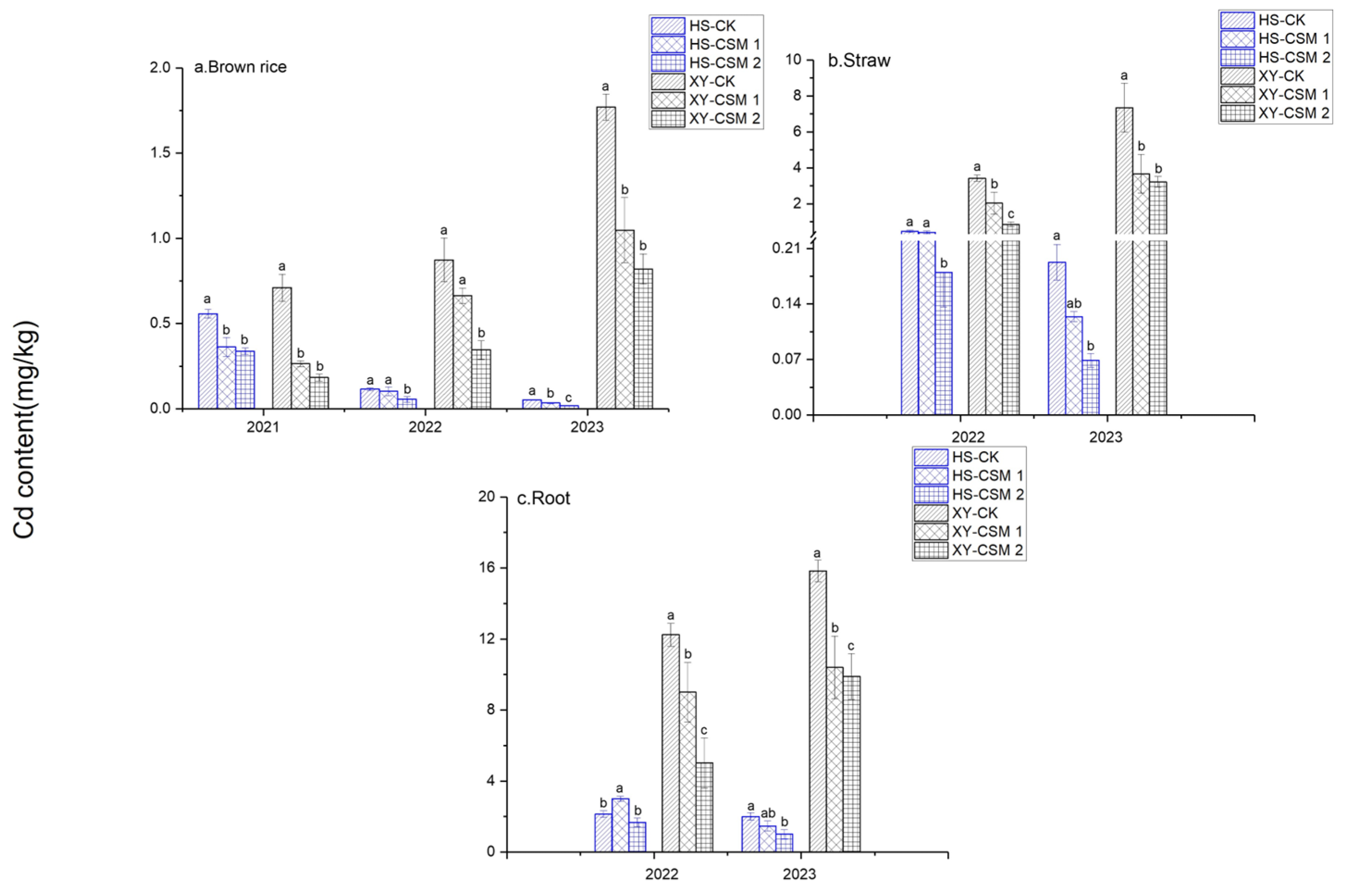
In the three years, two-site experiments, the Cd content in brown rice of both rice varieties exhibited a decreasing trend as the application rate of CSM increased (Figure 1a). Compared to HSCK (0.558 mg/kg in 2021, 0.115 mg/kg in 2022, and 0.052 mg/kg in 2023), the Cd content in brown rice under HSCSM1 treatment showed reductions of 35% in 2021 (p < 0.05), 10.8% in 2022, and 33.7% in 2023 (p < 0.05). The Cd reduction effect was significantly enhanced under HSCSM2 treatment, reaching 39.4% in 2021 (p < 0.05), 51.3% in 2022 (p < 0.05), and 67.1% in 2023 (p < 0.05). Similarly, in the XY experimental field, the Cd content variation trend in brown rice mirrored that observed in the HS experimental field. Specifically, compared to the XYCK (0.711 mg/kg in 2021, 0.874 mg/kg in 2022, and 1.770 mg/kg in 2023), the XYCSM1 and XYCSM2 treatments demonstrated progressive Cd reductions. The XYCSM1 treatment achieved reductions of 62% (2021, p < 0.05), 23% (2022), and 40% (2023, p < 0.05), while XYCSM2 showed more substantial decreases of 74% (Cd brown rice: 0.183 mg/kg, below the Cd pollution limit, p < 0.05) in 2021, 60% (p < 0.05) in 2022, and 53% (p < 0.05) in 2023.
The Cd variation trend in rice straws followed the same pattern as previously observed, showing a concentration-dependent decrease with elevated CSM application rates (Figure 1b). Compared to HSCK, HSCSM1 treatment achieved an average Cd reduction of 22.6% (p < 0.05), while HSCSM2 demonstrated significantly greater efficacy with a 62.9% average decrease (p < 0.05). In the root system, all treatments except HSCSM1 in 2022 showed varying degrees of Cd reduction (Figure 1c). More precisely, XYCSM2 exhibited the most pronounced effect, yielding an average 48.2% decrease (p < 0.05). Notably, the average Cd reductions under XYCSM1 and XYCSM2 treatments reached 45.1% and 65.4% (p < 0.05), respectively.

3.2. Impacts of Passivators on Soil Available Cd Content and Speciation Transformation

As shown in Table 3, the DTPA-extractable Cd (DTPA-Cd) content in soil demonstrated a dose-responsive decrease (2.6–27% reduction range) with increasing CSM application rates. In 2021, compared to HSCK, HSCSM1 reduced soil DTPA-Cd by 5.1%, while HSCSM2 achieved a 10% reduction (p < 0.05). Parallel comparisons at the XY site revealed more pronounced effects: XYCSM1 and XYCSM2 decreased DTPA-Cd by 19.2% and 27.5%, respectively, both reaching statistical significance (p < 0.05). The year 2023 showed sustained efficacy, with XYCSM2 maintaining a 9.1% DTPA-Cd reduction at the XY experimental site.
In addition, after the application of CSM, the exchangeable Cd fraction (EX-Cd) demonstrated a consistent reduction trend. In the 2023 XY trials, specific treatments showed marked efficacy: compared to XYCK, XYCSM1 and XYCSM2 achieved EX-Cd reductions of 10% and 17.2%, respectively (p < 0.05).
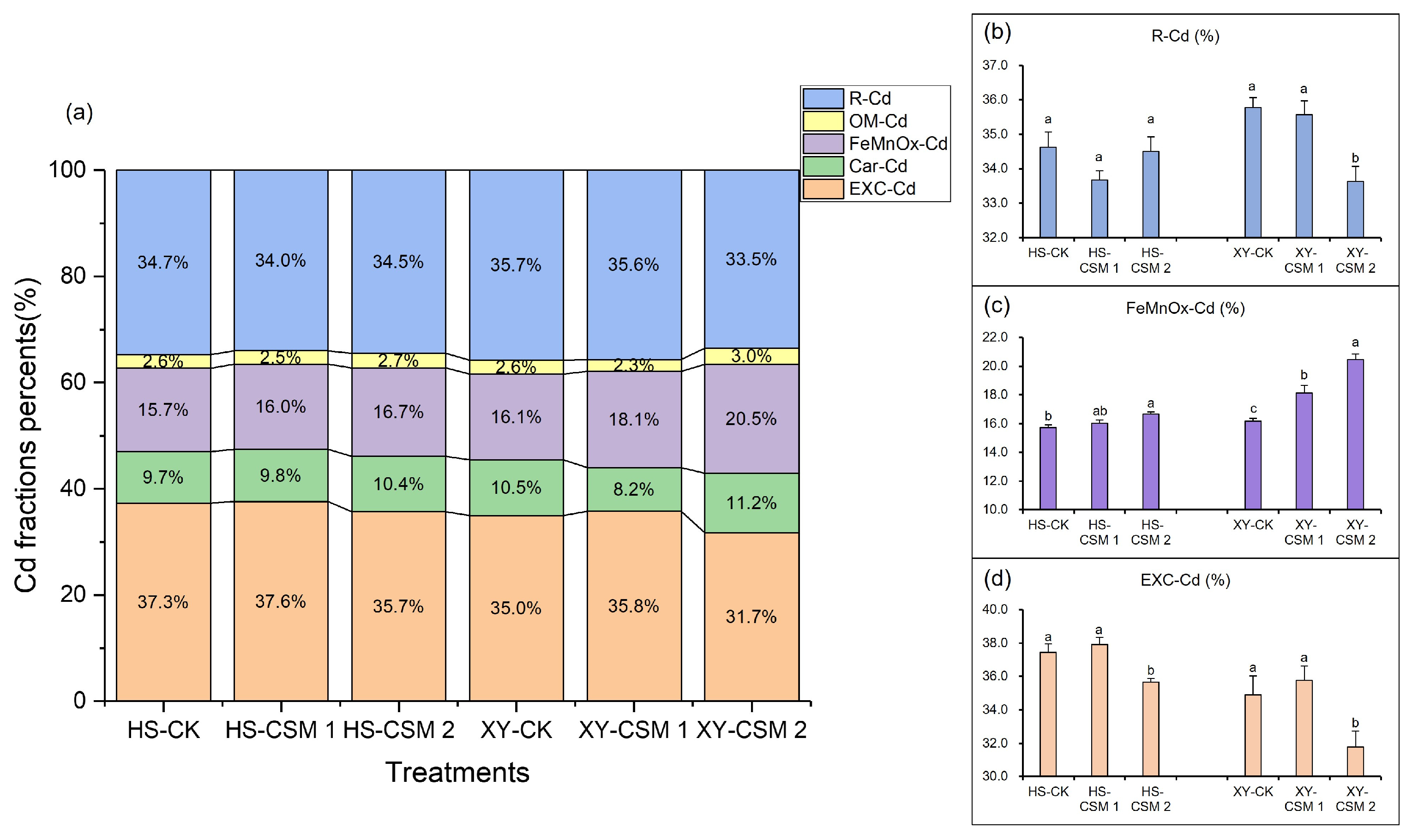
Furthermore, CSM application altered Cd forms in soil, effectively modulating the transformation processes between different chemical forms of Cd (Figure 2). As illustrated in Figure 2, Cd speciation in the soil profile was dominated by exchangeable (EXC-Cd, 35.5%) and residual fractions (R-Cd, 34.6%), followed by iron–manganese oxide-bound (FeMnOx-Cd, 17.1%) and carbonate-associated (Car-Cd, 10.0%) forms. The organic matter-bound fraction (OM-Cd) constituted the smallest proportion at 3.0%. CSM application induced alterations in Cd speciation in soil at both experimental sites, which mainly manifested as a 1–3% decline in exchangeable Cd (EXC-Cd, p < 0.05) proportion, a 1–5% increase in iron–manganese oxide-bound fraction (FeMnOx-Cd, p < 0.05), and a 1–3% reduction in residual phase (R-Cd, p < 0.05). This speciation realignment demonstrated dose-dependent characteristics, with FeMnOx-Cd augmentation suggesting enhanced soil Cd immobilization through oxide complexation mechanisms.

3.3. Influence of CSM-Mediated Passivation on Soil Physicochemical Properties

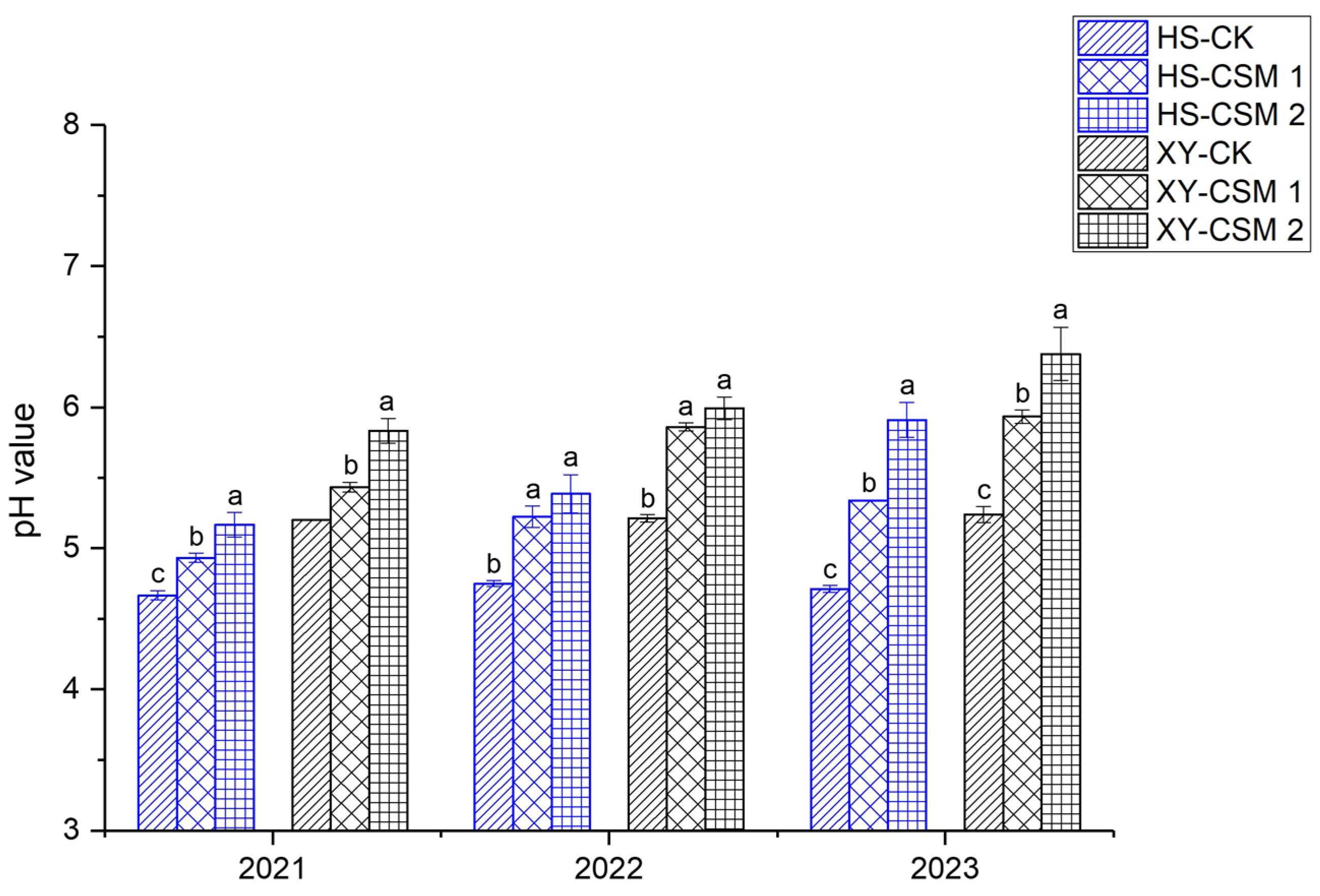
CSM application significantly elevated soil pH in a dose-dependent manner across both experimental sites, with multi-year monitoring data (Figure 3) demonstrating sustained neutralization effects. At the HS site, initial soil pH of 4.7 in HSCK increased progressively under CSM1 at 0.2 pH units/year, reaching 5.3 (13.3% increase, p < 0.05) by 2023, while CSM2 showed enhanced efficacy with a 0.37 units/year increment, culminating at pH 5.9 (25.4% increase, p < 0.05). Parallel observations at the XY site revealed similar patterns. From baseline pH 5.2 in XYCK, CSM1 and CSM2 treatments drove annual increases of 0.25−0.27 pH units, achieving final values of 5.9 (13% increase) and 6.4 (22% increase, respectively, after three years (both p < 0.05). The magnitude of pH elevation exhibited strong linear correlation with CSM dosage (r = 0.68, p < 0.001).
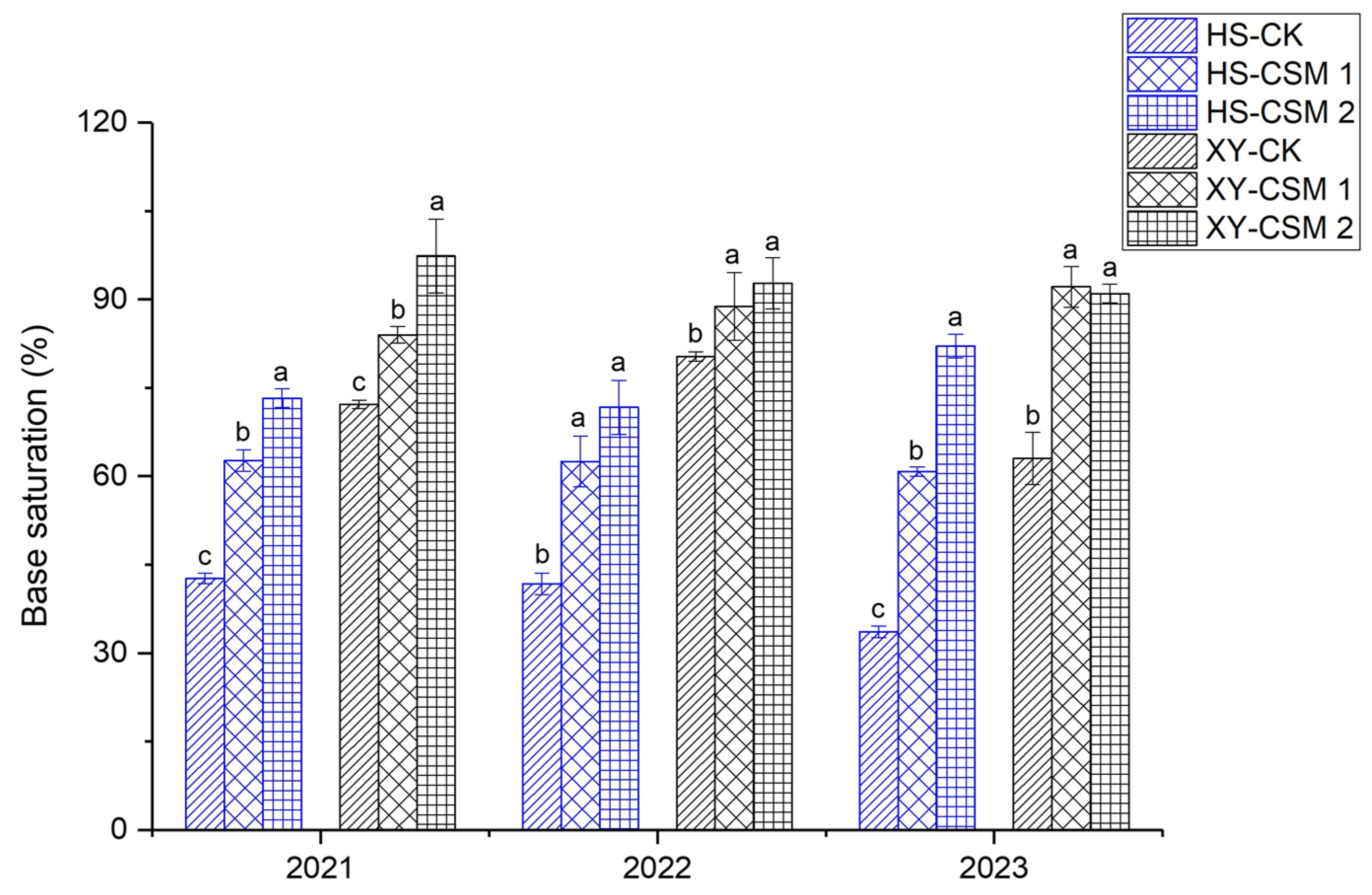
The application of CSM significantly enhanced soil base saturation (BS). As shown in Figure 4, the initial BS at the HS control site (HSCK) measured 42.6% in 2021, increasing to 62.6% (p < 0.05) under CSM1 and 73.2% (p < 0.05) under CSM2 treatment. At the XY site, BS rose from control levels (XYCK) to 83.9% (CSM1) and 97.3% (CSM2), both showing statistical significance (p < 0.05). Longitudinal analysis revealed divergent spatial responses to CSM applications, with the HS region (low initial BS at 39% average) demonstrating annual BS increments of 2−11% across treatments. In the XY experimental area (initial BS: 71%), CSM applications demonstrated no significant dose-dependent variation in BS, with final BS values stabilizing within 90−92% across all treatment levels. CSM’s efficacy counteracted inherent base depletion during continuous rice cultivation cycles through sustained pH modulation and cation exchange capacity enhancement.
Three-year monitoring revealed differential responses of exchangeable cations to CSM application rates across both experimental sites. Exchangeable aluminum (EXC-Al) exhibited significant dose-dependent reductions, while exchangeable calcium (EXC-Ca) and exchangeable magnesium (EXC-Mg) showed progressive accumulation. Exchangeable potassium (EXC-K) and exchangeable sodium (EXC-Na) concentrations remained statistically invariant across all treatment levels (Table 4). EXC-Al exhibited dose-responsive reductions, with 100 kg/mu CSM increments decreasing EXC-Al by 1.7−2 times (HS-2021) and 1.9−2.6 times (XY-2021) (p < 0.05). After continuous application for three years, the HS site showed 44−56% annual EXC-Al reduction versus 33% at the XY site. Concurrently, EXC-Ca and EXC-Mg demonstrated CSM dose-dependent accumulation. Relative to HSCK-2021, CSM1/CSM2 treatments elevated EXC-Ca by 44%/74% and EXC-Mg by 32%/64% (p < 0.05), culminating in three-year cumulative increases of 71% (Ca) and 99% (Mg). Similar trends emerged at the XY site, with 45% Ca and 68% Mg elevation (2023 vs. XYCK-2021, p < 0.05).
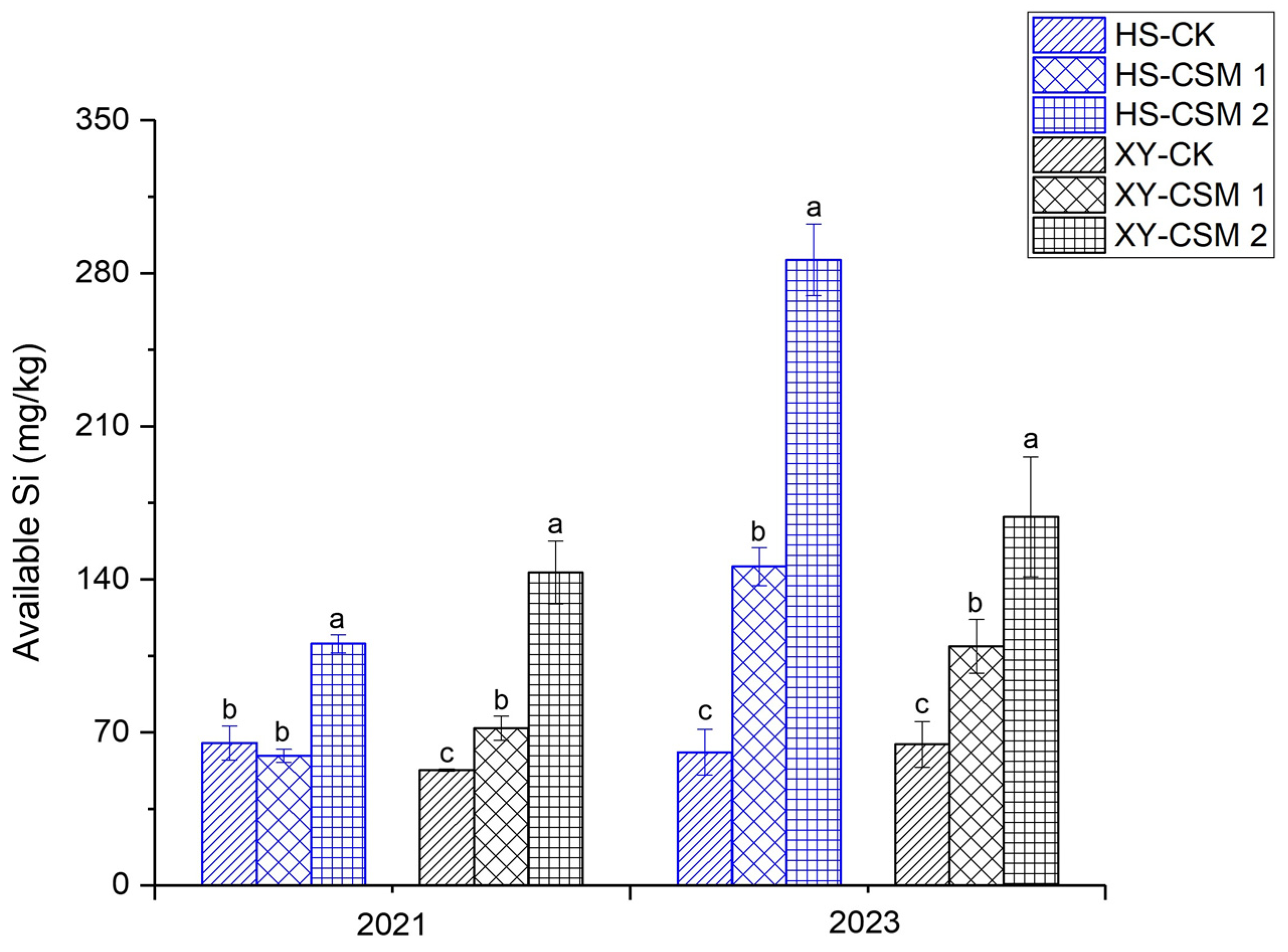
The level of available silicon (available Si) in the soil is shown in Figure 5. With the increased application amount of CSM, the content of available silicon in the soil shows an upward trend. At the HS site, initial available Si in 2021 controls (HSCK) measured 65.0 mg/kg. The CSM2 treatment elevated available Si to 110 mg/kg (+69.8%, p < 0.05) within the first application year, with triennial cumulative increase reaching 3.4 times (221 mg/kg). Parallel trends emerged at the XY site; relative to the 2021 XYCK, CSM2 boosted available Si 1.7-fold (143 mg/kg, p < 0.05) initially, escalating to 2.1-fold (168.5 mg/kg, p < 0.05) after three years of applications.

3.4. Potential Effects of Various Physical and Chemical Factors in Soil on Cd Toxicity and Plant Growth

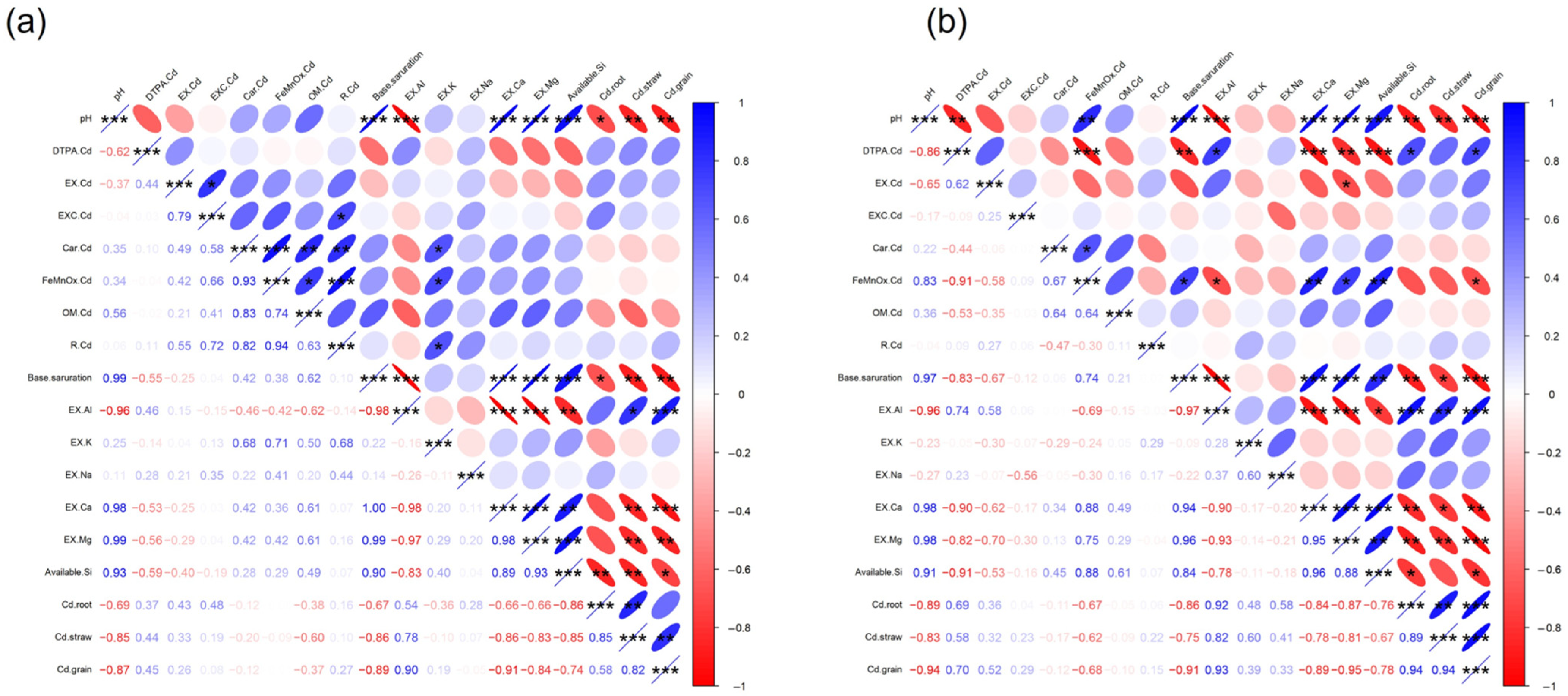
Based on the environmental conditions of different experimental areas, the data correlations of the HS and XY regions were compared separately. Figure 6a reveals significant negative correlations (r = −0.53 to −0.62, p < 0.05) between DTPA-extractable Cd and soil pH, base saturation (BS), and exchangeable Ca2+, Mg2+, and Si levels under HS experimental conditions. Root Cd content showed significant negative correlations with soil pH (r = −0.69, p < 0.05), base saturation (BS, r = −0.67, p < 0.05), and available silicon (r = −0.86, p < 0.01). For aboveground tissues, straw Cd demonstrated stronger negative associations with pH (r = −0.85, p < 0.01) and BS (r = −0.86, p < 0.01), while grain Cd displayed the most pronounced anti-correlation with pH (r = −0.87, p < 0.01) and BS (r = −0.89, p < 0.01). Both straw and grain Cd concentrations were inversely related to exchangeable Ca2+/Mg2+ and available Si but were positively correlated with exchangeable Al3+, showing a particularly strong association in grains (r = 0.90, p < 0.001) compared to straw (r = 0.78, p < 0.05). Soil OM-Cd exhibited significant negative correlations with straw (r = −0.60, p < 0.05) and grain Cd (r = −0.37). Exchangeable bases demonstrated strong positive correlations with pH, EXC-Ca, EXC-Mg, and available Si, while showing significant negative correlation with EXC-Al.
The correlations among the parameters in the XY experimental area generally aligned with those observed in HS, showing significant negative correlations between soil pH, BS, EXC-Ca, EXC-Mg, and available Si with plant Cd accumulation (Figure 6b). Additionally, FeMnOx-Cd was significantly negatively correlated with rice Cd (r = −0.68, p < 0.05). DTPA-Cd was negatively correlated with soil pH, FeMnOx-Cd, BS, EXC-Ca, EXC-Mg, and available Si, but positively correlated with grain Cd, root Cd, and EXC-Al.

3.5. FTIR Spectroscopic Characterization of Soil Functional Group Composition and Relative Abundance

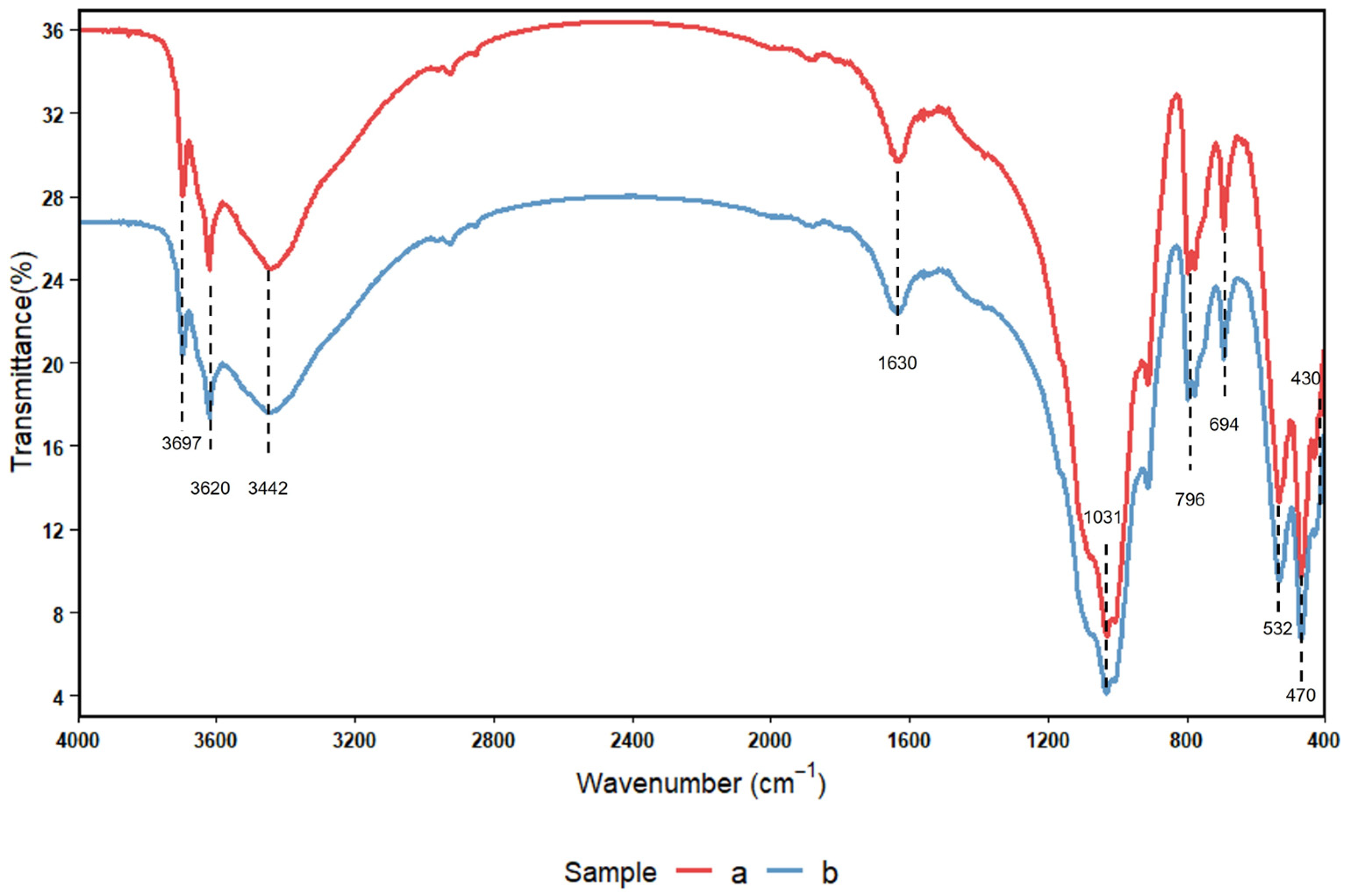
FTIR analysis (Figure 7) identified the test soil as spherical clay (a type of clay rich in kaolinite and quartz particles). Comparative spectral analysis revealed conserved functional group signatures between control (CK, spectrum a) and CSM-treated (spectrum b) soils, with no significant alteration in functional group diversity but marked increases in relative abundance under CSM treatment. CSM treatment intensified the Si-O-Si asymmetric stretching vibration at 1031 cm−1 (silicate structure, 4% transmittance vs. CK’s 6%), which promoted silicate polymerization within the soil matrix. Then, the O-H stretching vibrations (3620 cm−1 and 3442 cm−1), corresponding to hydroxyl functional groups on kaolinite surfaces, exhibited a 7-percentage-point transmittance reduction under CSM treatment (17%) compared to CK (24%), indicating enhanced hydroxyl group abundance on the soil surface following CSM application. At 430 cm−1, the Si-O-Mg/Fe bending vibrations exhibited distinct abundance variations between treatments. CSM application resulted in a 6% absolute decrease in transmittance (14% vs. CK’s 20%), indicating enhanced metal–ligand complexation. All wavenumbers correspond to the characteristic vibrations of clay minerals, and the reduction in transmittance is inversely correlated with functional group content.

4. Discussion

This study investigated the effects of CSM composite passivator remediation on Cd removal efficiency in both soil and rice systems, while simultaneously characterizing its impacts on soil nutrient transformations and functional group abundance dynamics. Based on three-year field trials, application of the calcium–silicon–magnesium composite passivating agent (CSM) resulted in a steady annual increase in soil pH (Figure 3), indicating its persistent acid-neutralizing capacity. Soil pH, as one of the fundamental physicochemical properties of soil, exerts significant influence on both nutrient availability and crop growth and development [29,30]. High-temperature calcination of limestone and high-silicate minerals in the conditioner releases activated silicon and calcium ions. Once applied to soil, these ions neutralize soil hydrogen and aluminum ions. This process significantly and sustainably increases soil pH, showing a stable 22% (0.2−0.3 units) rise over three years with no inflection point observed (Figure 3). The hydrolysis of calcium and magnesium oxides generates weak acid ions that further consume soil hydrogen ions. Meanwhile, silicate ions released from dissolved high-silicon minerals hydrolyze to consume additional H+, raising pH and enhancing the soil’s buffering capacity, thereby promoting long-term pH stability [31]. In flooded soil, H+ concentration decreases exponentially, facilitating coordination reactions between Cd2+ and Al-OH or Si-OH sites at iron oxide edges. Concurrently, this process promotes the complexation of Cd2+ with Fe-OH and Al-OH adsorption sites on iron–aluminum oxides [32,33]. Specifically, it enhances the binding of free soil Cd2+ to anions such as hydrogen phosphate, sulfate, hydroxyl, and carbonate, forming insoluble precipitates that reduce soil Cd mobility. Additionally, reduced soil H+ concentration increases the surface electronegativity of soil particles [32], which enhances their adsorption efficiency for Cd2+ and further lowers Cd bioavailability. Beyond direct chemical immobilization, the released nutrients (Ca, Mg, Si) further reduce Cd bioavailability through complementary biogeochemical mechanisms: Ca2+ and Mg2+ compete with Cd2+ for root absorption due to similar ionic properties [34,35], while adequate Ca-Mg nutrition enhances membrane stability and alleviates Cd-induced oxidative stress. Simultaneously, silicon facilitates Cd sequestration within plant tissues by promoting phytochelatin synthesis and reinforcing apoplastic barriers (e.g., silica–cellulose deposits) [36], collectively inhibiting Cd translocation and accumulation.
Regulating soil pH and exchangeable base ions effectively controls Cd content in rice. The amendment of silicon–calcium–magnesium composite significantly enhanced soil base saturation (Figure 4), concurrently increasing exchangeable Ca2+ and Mg2+ while reducing exchangeable Al3+ (Table 4). Soil EXC-Al reacts with conditioner calcium oxide, neutralizing base-ion adsorption capacity in acidic soils. As shown in previous studies, these cationic alterations demonstrated strong pH dependency, with correlation coefficients reaching 0.99 and 0.97 for base saturation pH and −0.96 for Al3+ depletion and pH (Figure 6). Base saturation quantifies the proportion of exchangeable base cations (Ca2+, Mg2+, K+) relative to total exchangeable cations, serving as a critical parameter for soil fertility assessment and nutrient availability evaluation. Conditioner alkaline groups release slowly, increasing soil soluble alkali-ion content (Figure 4, Table 4) and thereby enhancing soil surface negative charge and OH competitiveness. The calcium–silicon–magnesium conditioner provides abundant exchangeable cations (Ca2+, Mg2+, Fe2+, etc.) that compete with Cd2+ for root adsorption sites in the soil solution and undergo ion exchange with colloid-adsorbed Cd2+, thereby enhancing the soil-specific Cd adsorption capacity [37]. This process also promotes the conversion of soluble Cd2+ into less active iron–manganese oxide-bound forms (Figure 2). Meanwhile, the active silicate (SiO32−) and carbonate minerals in the conditioner react with Cd via co-precipitation to form insoluble cadmium silicate and cadmium–calcium–magnesium double salt precipitates, thereby reducing the concentration of free Cd2+ in the soil solution [38]. Furthermore, the conditioner contains abundant active silicon, which promotes the formation of iron and manganese oxides (e.g., goethite, manganite) in the soil. This increase in oxide formation enhances their surface area and adsorption sites, enabling the adsorption of more Cd onto the mineral surface. In addition, the reduction in available Al content in post-treatment soil effectively inhibits root acid secretion in the rhizosphere and prevents soluble Cd complex formation (e.g., cadmium citrate). This improved physicochemical state enhances cation exchange capacity while providing phytoprotective mechanisms against acidic stress, thereby optimizing cationic nutrient supply for crop development [39,40]. In soil solutions, free silicon occurs predominantly as monosilicic acid [41]. Silicate ions exhibit co-precipitation with Cd2+, effectively restricting Cd migration.
The plant-accessible Cd pool is determined by total soil Cd levels coupled with the proportion of chemically mobile fractions [42]. Following CSM treatment, multiple Cd fractions in soil exhibited significant reductions, with exchangeable Cd showing the most pronounced decrease (Figure 2). Concurrently, the contribution of Fe-Mn oxide-bound Cd to total soil Cd increased substantially (p < 0.05). Exchangeable Cd has higher bioavailability, is easily soluble, and is readily taken up by plants. Therefore, decreased concentrations of this reactive Cd form reduce environmental strain and associated health risks [43]. The Cd forms in the soil change from the exchangeable state with high biological availability to the more chemically stable iron–manganese oxide-bound phase. This study shows that the Fe-Mn oxide-bound Cd fraction demonstrates a significant negative correlation with Cd accumulation in rice. Increasing the proportion of this geochemically stable phase concomitantly suppresses ionic Cd mobility through soil matrices [44,45].
After CSM treatment, FTIR analysis showed that the intensities of the O-H, Si-O-Si, and Si-O-(Mg/Fe) functional groups in soil exhibited significant enhancement, augmenting hydroxyl, silicate, and silicate–magnesium/ferric oxide active groups in farmland. The O-H group is the core site for Cd passivation in kaolinite clay minerals. The stretching vibration of O-H (at 3620 cm−1) is associated with the formation of stable cadmium–hydroxyl complexes with Cd2+ via coordination bonds. Surface hydroxyl groups (O-H) and siloxane bonds (Si-O) adsorb Cd2+ through hydrogen bonding, ion exchange, and other mechanisms. Research indicates that soil pH directly determines the protonation (-COOH) or deprotonation (-COO) state of organic matter functional groups [46]. In a moderately alkaline environment (pH > 6.5), carboxyl and phenolic hydroxyl groups dissociate, leading to an increase in negative charge density and maximizing the complexation (chelation) ability with Cd2+. Macromolecular organic components reduce Cd mobility through strong complexation [47]. However, FTIR results from this study showed no significant change in deprotonated carboxyl groups in the treated soil. Instead, the main difference was observed in the abundance of hydroxyl functional groups. This discrepancy may be attributed to the experimental soil pH remaining below 6.5, which was insufficient to trigger significant dissociation of carboxyl groups in soil organic matter. Rather, the consumption of H+ increased the soil’s negative charge, likely promoting the formation of localized hydroxyl groups. The asymmetric stretching vibration of the Si-O-Si bond (e.g., the characteristic peak at 1031 cm−1) increases the negative charge density on soil colloid surfaces. This increased charge density enhances the electrostatic attraction and adsorption of Cd2+, thereby reducing its dissolution. Additionally, the bending vibration of Si-O-Mg/Fe (430 cm−1) indicates stronger metal–ligand complexation. Cd2+ competes with Mg2+/Fe2+ for coordination sites, forming stable Cd-Si-O-Mg/Fe complexes and lowering Cd mobility. These functional groups complex with free Cd2+ through coordination bonding. Concurrently, elevated soil pH facilitated oxygen-bridging interactions between SiO32− and Cd2+, forming Si-Cd complexes that diminished Cd mobility. Previous studies also indicate that hydroxyl, ethyl, and oxyl groups are the key functional groups responsible for Cd passivation [44]. More importantly, Fe-O-Si-Cd ternary complex formation constitutes the predominant chemical mechanism for Cd bioavailability reduction in acidic-to-neutral soil systems [48]. The CSM conditioner exhibits a pronounced inhibitory effect on soil Cd availability. While applied at high rates, it did not significantly reduce rice yield (Figure S2), suggesting no adverse effects on overall crop nutrition. However, as this study focused primarily on Cd passivation, the impact of CSM on the accumulation of macronutrients (e.g., N, P, K) and trace elements in grains remains unaddressed. Notably, the long-term environmental implications—including the durability of Cd immobilization, soil nutrient cycling, and greenhouse gas emissions—require systematic evaluation in future research.

5. Conclusions

In conclusion, the CSM conditioner effectively remediated cadmium-contaminated rice fields in southern China (initial pH 4.7). During three consecutive years of application, it increased soil pH by 0.2–0.37 units annually while reducing cadmium bioaccumulation in rice grains by 53–74%. Concurrently, it enhanced soil base saturation and improved soil fertility. The three primary synergistic mechanisms are as follows: (1) pH elevation and charge modification. The reducing soil H+ concentration (with pH gradually increasing by 0.2−0.3 units annually) increases negative charges on soil particle surfaces, promoting Cd2+ adsorption and facilitates the transformation of Cd from exchangeable to iron–manganese oxide-bound states. (2) Functional group enhancement. The abundance of soil O-H, Si-O-Si, and Si-O-Mg/Fe functional groups significantly increased following CSM application, enhancing Cd2+ coordination and suppressing Cd dissolution. (3) Ionic competition and antagonism. The introduced silicon and calcium cations mediate competitive displacement mechanisms, establishing ionic antagonism with Cd2+ during rice nutrient translocation. This competition reduces Cd binding sites in crop roots. These integrated mechanisms synergistically suppress Cd phytoavailability and enhance soil base saturation and fertility. This approach not only establishes a viable remediation strategy but also promotes soil health and ensures grain safety, offering a sustainable solution for rice cultivation in Cd-contaminated agricultural systems.

Supplementary Materials

The following supporting information can be downloaded at: https://www.mdpi.com/article/10.3390/agriculture15242580/s1.

Author Contributions

S.S. and D.G.: Data Curation, Formal Analysis, Investigation, Writing—Original Draft, Writing—Review and Editing, and Funding Acquisition. Y.X.: Formal Analysis and Funding Acquisition. F.T.: Formal Analysis. X.J.: Formal Analysis. J.W.: Investigation, Visualization, and Writing—Review and Editing. All authors have read and agreed to the published version of the manuscript.

Funding

This work was supported by the National Key Research and Development Program of China (2022YFD1700103, 2022YFD1700105) and the Agricultural Science and Technology Innovation Fund Project of Hunan Province (2024CX130).

Data Availability Statement

The original contributions presented in this study are included in the article. Further inquiries can be directed to the corresponding author.

Acknowledgments

We are grateful to the support by the Key Laboratory of Computing and Stochastic Mathematics (Ministry of Education), School of Mathematics and Statistics, Hunan Normal University, and the Key Laboratory of Agro-Environment in Midstream of Yangtze Plain, Ministry of Agriculture and Rural Affairs, China.

Conflicts of Interest

The authors declare that they have no known competing financial interest or personal relationships that could have appeared to influence the work reported in this paper.

References

  1. Lu, T.; Ge, W.; Li, A.; Deng, S.; Min, T.; Qiu, G. Endogenous silicon-activated rice husk biochar prepared for the remediation of cadmium-contaminated soils: Performance and mechanism. Environ. Pollut. 2024, 362, 125030. [Google Scholar] [CrossRef]
  2. Wu, Y.; Li, X.; Yu, L.; Wang, T.; Wang, J.; Liu, T. Review of soil heavy metal pollution in China: Spatial distribution, primary sources, and remediation alternatives. Resour. Conserv. Recycl. 2022, 181, 106261. [Google Scholar] [CrossRef]
  3. Dong, Q.; Xiao, C.; Cheng, W.; Yu, H.; Liu, J.; Liu, G.; Liu, Y.; Guo, Y.; Liang, Y.; Shi, J.; et al. Revealing the Sources of Cadmium in Rice Plants under Pot and Field Conditions from Its Isotopic Fractionation. Acs Environ. Au 2024, 4, 162–172. [Google Scholar] [CrossRef]
  4. Zhao, F.J.; Ma, Y.; Zhu, Y.G.; Tang, Z.; McGrath, S.P. Soil Contamination in China: Current Status and Mitigation Strategies. Environ. Sci. Technol. 2015, 49, 750–759. [Google Scholar] [CrossRef] [PubMed]
  5. Wang, P.; Chen, H.; Kopittke, P.M.; Zhao, F.-J. Cadmium contamination in agricultural soils of China and the impact on food safety. Environ. Pollut. 2019, 249, 1038–1048. [Google Scholar] [CrossRef] [PubMed]
  6. Guan, D.; Wu, J.; Xie, Y.; Xie, J.; Huang, X.; Ji, X. Double Prevention of Cadmium Uptake by Iron and Zinc in Rice Seedling-A Hypotonic Study. J. Soil Sci. Plant Nutr. 2024, 24, 318–330. [Google Scholar] [CrossRef]
  7. Peng, H.; Deng, K.; Shi, Y.; Liu, S.; Jian, Z.; Li, C.; Ji, X.; Li, S. Alleviation of Cd-polluted paddy soils through Si fertilizer application and its effects on the soil microbial community. Sci. Total Environ. 2023, 855, 158735. [Google Scholar] [CrossRef]
  8. Huang, B.Y.; Zhao, F.J.; Wang, P. The relative contributions of root uptake and remobilization to the loading of Cd and As into rice grains: Implications in simultaneously controlling grain Cd and As accumulation using a segmented water management strategy. Environ. Pollut. 2022, 293, 118497. [Google Scholar] [CrossRef]
  9. Xia, W.; Ghouri, F.; Zhong, M.; Bukhari, S.A.H.; Ali, S.; Shahid, M.Q. Rice and heavy metals: A review of cadmium impact and potential remediation techniques. Sci. Total Environ. 2024, 957, 177403. [Google Scholar] [CrossRef]
  10. Ozyigit, I.I.; Can, H.; Dogan, I. Phytoremediation using genetically engineered plants to remove metals: A review. Environ. Chem. Lett. 2021, 19, 669–698. [Google Scholar] [CrossRef]
  11. Blake-Mahmud, J.; Sessa, E.B.; Visger, C.J.; Watkins, J.E., Jr. Polyploidy and environmental stress response: A comparative study of fern gametophytes. New Phytol. 2025, 245, 885–898. [Google Scholar] [CrossRef]
  12. Tian, T.; Zhou, H.; Gu, J.; Jia, R.; Li, H.; Wang, Q.; Zeng, M.; Liao, B. Cadmium accumulation and bioavailability in paddy soil under different water regimes for different growth stages of rice (Oryza sativa L.). Plant Soil 2019, 440, 327–339. [Google Scholar] [CrossRef]
  13. Tang, L.; Mao, B.; Li, Y.; Lv, Q.; Zhang, L.; Chen, C.; He, H.; Wang, W.; Zeng, X.; Shao, Y.; et al. Knockout of OsNramp5 using the CRISPR/Cas9 system produces low Cd-accumulating indica rice without compromising yield. Sci. Rep. 2017, 7, 14438. [Google Scholar] [CrossRef] [PubMed]
  14. Yuan, X.; Liang, R.; Wang, G.; Ma, S.; Liu, N.; Gong, Y.; McCouch, S.R.; Zhu, H.; Liu, Z.; Li, Z.; et al. Design of rice with low cadmium accumulation in grain using single segment substitution line. New Crops 2025, 2, 100035. [Google Scholar] [CrossRef]
  15. Uchimiya, M.; Bannon, D.; Nakanishi, H.; McBride, M.B.; Williams, M.A.; Yoshihara, T. Chemical Speciation, Plant Uptake, and Toxicity of Heavy Metals in Agricultural Soils. J. Agric. Food Chem. 2020, 68, 12856–12869. [Google Scholar] [CrossRef]
  16. Ge, Y.; Huang, X.; Lu, L. Mitigating cadmium contamination in rice: Insights from a large-scale meta-analysis of amendment effects. Plant Soil 2024, 505, 493–511. [Google Scholar] [CrossRef]
  17. Tessier, A.; Campbell, P.G.C.; Bisson, M. Trace metal speciation in the Yamaska and St. François Rivers (Quebec). Can. J. Earth Sci. 1980, 17, 90–105. [Google Scholar] [CrossRef]
  18. Arinzechi, C.; Huang, P.; Ping, Y.; Xu, H.; Wang, Q.; Tang, C.; Si, M.; Li, Q.; Yang, Z. Calcium-magnesium synergy in reducing cadmium bioavailability and uptake in rice plants. Int. J. Phytoremediation 2025, 27, 832–841. [Google Scholar] [CrossRef]
  19. Wu, J.; Mock, H.P.; Giehl, R.F.H.; Pitann, B.; Mühling, K.H. Silicon decreases cadmium concentrations by modulating root endodermal suberin development in wheat plants. J. Hazard. Mater. 2019, 364, 581–590. [Google Scholar] [CrossRef]
  20. Xu, B.; Chen, J.; Hu, Y.; You, Y.; Sun, X.; Yu, J.; Guo, X.; Hu, C.; Chen, C.; Chen, Y.; et al. Influence of FeSO4, nano zero-valent iron, and their CaCO3 composites on the formation of iron plaque and cadmium translocation in rice (Oryza sativa L.). Environ. Pollut. Bioavailab. 2024, 36, 2368588. [Google Scholar] [CrossRef]
  21. Wei, W.; Peng, H.; Xie, Y.; Wang, X.; Huang, R.; Chen, H.; Ji, X. The role of silicon in cadmium alleviation by rice root cell wall retention and vacuole compartmentalization under different durations of Cd exposure. Ecotoxicol. Environ. Saf. 2021, 226, 112810. [Google Scholar] [CrossRef]
  22. Chi, Y.; Peng, L.; Tam, N.F.y.; Lin, Q.; Liang, H.; Li, W.C.; Ye, Z. Effects of fly ash and steel slag on cadmium and arsenic accumulation in rice grains and soil health: A field study over four crop seasons in Guangdong, China. Geoderma 2022, 419, 11587. [Google Scholar] [CrossRef]
  23. Zhang, Y.; Fu, P.; Ni, W.; Zhang, S.; Li, S.; Deng, W.; Hu, W.; Li, J.; Pei, F.; Du, L.; et al. A review of solid wastes-based stabilizers for remediating heavy metals co-contaminated soil: Applications and challenges. Sci. Total Environ. 2024, 920, 170667. [Google Scholar] [CrossRef]
  24. Rehman, M.Z.u.; Rizwan, M.; Rauf, A.; Ayub, M.A.; Ali, S.; Qayyum, M.F.; Waris, A.A.; Naeem, A.; Sanaullah, M. Split application of silicon in cadmium (Cd) spiked alkaline soil plays a vital role in decreasing Cd accumulation in rice (Oryza sativa L.) grains. Chemosphere 2019, 226, 454–462. [Google Scholar] [CrossRef]
  25. Guan, D.; Ji, X.; Liu, S.; Chen, S.; Xie, Y.; Wu, J. Exploration of the bio-availability and the risk thresholds of cadmium and arsenic in contaminated paddy soils. Heliyon 2024, 10, e40910. [Google Scholar] [CrossRef]
  26. HJ 649-2013; Soil—Determination of Exchangeable Acidity Using Potassium Chloride Extraction—Titration Method. The Ministry of Environmental Protection of China: Beijing, China, 2013.
  27. NY/T 1121.15-2006; Soil Testing. Part 15: Method for Determination of Soil Available Silicon. The Ministry of Agriculture of China: Beijing, China, 2006.
  28. Guan, D.; Wu, J.; Sun, S.; Ji, X.; Huang, X.; Liu, S.; Xie, Y. Iron and zinc-mediated regulation of cadmium transport in the rice (Oryza sativa L.) stem-leaf-grain pathway. Ecotoxicol. Environ. Saf. 2025, 307, 119430. [Google Scholar] [CrossRef]
  29. Liang, D.; Ning, Y.; Ji, C.; Zhang, Y.; Wu, H.; Ma, H.; Zhang, J.; Wang, J. Biochar and Manure Co-Application Increases Rice Yield in Low Productive Acid Soil by Increasing Soil pH, Organic Carbon, and Nutrient Retention and Availability. Plants 2024, 13, 973. [Google Scholar] [CrossRef] [PubMed]
  30. Xu, S.; Na, M.; Huang, Y.; Zhang, J.; Zhou, J.; Li, L.-J. Changes in microbial carbon cycling functions along rice cultivation chronosequences in saline-alkali soils. Soil Biol. Biochem. 2025, 202, 109699. [Google Scholar] [CrossRef]
  31. Zhao, Y.; Liu, M.; Guo, L.; Yang, D.; He, N.; Ying, B.; Wang, Y. Influence of silicon on cadmium availability and cadmium uptake by rice in acid and alkaline paddy soils. J. Soils Sediments 2020, 20, 2343–2353. [Google Scholar] [CrossRef]
  32. Qi, F.; Dong, Z.; Lamb, D.; Naidu, R.; Bolan, N.S.; Ok, Y.S.; Liu, C.; Khan, N.; Johir, M.A.H.; Semple, K.T. Effects of acidic and neutral biochars on properties and cadmium retention of soils. Chemosphere 2017, 180, 564–573. [Google Scholar] [CrossRef] [PubMed]
  33. Wang, Y.; Tang, X.; Chen, Y.; Zhan, L.; Li, Z.; Tang, Q. Adsorption behavior and mechanism of Cd (II) on loess soil from China. J. Hazard. Mater. 2009, 172, 30–37. [Google Scholar] [CrossRef] [PubMed]
  34. Singh, R.; Bishnoi, N.R.; Kirrolia, A. Evaluation of Pseudomonas aeruginosa an innovative bioremediation tool in multi metals ions from simulated system using multi response methodology. Bioresour Technol 2013, 138, 222–234. [Google Scholar] [CrossRef] [PubMed]
  35. Zhang, Y.; Wang, Z.; Liu, Y.; Zhang, T.; Liu, J.; You, Z.; Huang, P.; Zhang, Z.; Wang, C. Plasma membrane-associated calcium signaling modulates cadmium transport. New Phytol 2023, 238, 313–331. [Google Scholar] [CrossRef] [PubMed]
  36. Shi, X.; Zhang, C.; Wang, H.; Zhang, F. Effect of Si on the distribution of Cd in rice seedlings. Plant Soil 2005, 272, 53–60. [Google Scholar] [CrossRef]
  37. Li, L.; Li, Q.; Xiao, A.; Li, C.; Li, Y. Regulation of soil properties by amendments and their impact on Cd fractions and bacterial community structure: Exploring the mechanism of inhibition on Cd phytoavailability. Ecotoxicol. Environ. Saf. 2025, 294, 118033. [Google Scholar] [CrossRef]
  38. Long, L.; Huang, N.; Liu, X.; Gong, L.; Xu, M.; Zhang, S.; Chen, C.; Wu, J.; Yang, G. Enhanced silicate remediation in cadmium-contaminated alkaline soil: Amorphous structure improves adsorption performance. J. Environ. Manag. 2023, 326, 116760. [Google Scholar] [CrossRef]
  39. Ribeiro, M.d.C.; Ganga, A.; Cattanio, I.S.; Martins, A.R.; Alves, R.S.; Lessa, L.G.F.; Pereira, H.S.; Galindo, F.S.; Teixeira Filho, M.C.M.; Abreu-Junior, C.H.; et al. Residual Effect of Silicate Agromineral Application on Soil Acidity, Mineral Availability, and Soybean Anatomy. Agronomy 2025, 15, 5. [Google Scholar] [CrossRef]
  40. Yang, M.; Zhou, D.; Hang, H.; Chen, S.; Liu, H.; Su, J.; Lv, H.; Jia, H.; Zhao, G. Effects of Balancing Exchangeable Cations Ca, Mg, and K on the Growth of Tomato Seedlings (Solanum lycopersicum L.) Based on Increased Soil Cation Exchange Capacity. Agronomy 2024, 14, 629. [Google Scholar] [CrossRef]
  41. Ma, J.F.; Yamaji, N. Silicon uptake and accumulation in higher plants. Trends Plant Sci. 2006, 11, 392–397. [Google Scholar] [CrossRef]
  42. Beygi, M.; Jalali, M. Assessment of trace elements (Cd, Cu, Ni, Zn) fractionation and bioavailability in vineyard soils from the Hamedan, Iran. Geoderma 2019, 337, 1009–1020. [Google Scholar] [CrossRef]
  43. Tong, Y.; Gao, J.; Yue, T.; Zhang, X.; Liu, J.; Bai, J. Distribution, chemical fractionation, and potential environmental risks of Hg, Cr, Cd, Pb, and As in wastes from ultra-low emission coal-fired industrial boilers in China. J. Hazard. Mater. 2023, 446, 130606. [Google Scholar] [CrossRef] [PubMed]
  44. Jia, Y.; Li, J.; Zeng, X.; Zhang, N.; Wen, J.; Liu, J.; Jiku, M.A.S.; Wu, C.; Su, S. The performance and mechanism of cadmium availability mitigation by biochars differ among soils with different pH: Hints for the reasonable choice of passivators. J. Environ. Manag. 2022, 312, 114903. [Google Scholar] [CrossRef]
  45. Zhong, S.; Liu, T.; Li, X.; Yin, M.; Yin, H.; Tong, H.; Huang, F.; Li, F. Cd isotope fractionation in a soil-rice system: Roles of pH and mineral transformation during Cd immobilization and migration processes. Sci. Total Environ. 2023, 900, 166435. [Google Scholar] [CrossRef]
  46. Shi, R.y.; Liu, Z.d.; Li, Y.; Jiang, T.; Xu, M.; Li, J.y.; Xu, R.k. Mechanisms for increasing soil resistance to acidification by long-term manure application. Soil Tillage Res. 2019, 185, 77–84. [Google Scholar] [CrossRef]
  47. Kulikowska, D.; Gusiatin, Z.M.; Bułkowska, K.; Klik, B. Feasibility of using humic substances from compost to remove heavy metals (Cd, Cu, Ni, Pb, Zn) from contaminated soil aged for different periods of time. J. Hazard. Mater. 2015, 300, 882–891. [Google Scholar] [CrossRef] [PubMed]
  48. Guan, D.; Wu, J.; Xie, Y.; Chen, S.; Chen, J.; Peng, H.; Ji, X. Effects of Iron-based silicon salts on fractions and transformation of cadmium and arsenic in soil environment. China Environ. Sci. 2022, 42, 1803–1811. [Google Scholar] [CrossRef]
Figure 1. Cd concentration in various organs and tissues of rice at mature stage over three years in two regions: (a) brown rice, (b) straws, and (c) roots. HS: Heshan District, Yiyang City, XY: Xiangyin County, Yueyang City. CK: conventional fertilization without soil amendment; CSM1: conventional fertilization + Ca-Si-Mg composite soil amendment applied to the soil at 1500 kg/ha; CSM2: conventional fertilization + Ca-Si-Mg composite soil amendment applied to the soil at 3000 kg/ha. Different letters in each column represent significant differences between treatments (p < 0.05).
Agriculture 15 02580 g001
Figure 2. Morphological alterations in Cd in CSM-treated oil. EXC-Cd: exchangeable Cd; Car-Cd: carbonate Cd; FeMnOx-Cd: Fe-Mn oxide Cd; OM-Cd: organic matter Cd; R-Cd: residual Cd. HS: Heshan District, Yiyang City, XY: Xiangyin County, Yueyang City. (a) Relative percentages of five Cd forms; (b): Residual Cd percentage; (c): FeMnOx-Cd percentage; (d): EXC-Cd percentage. CK: conventional fertilization without soil amendment; CSM1: conventional fertilization + Ca-Si-Mg composite soil amendment applied to the soil at 1500 kg/ha; CSM2: conventional fertilization + Ca-Si-Mg composite soil amendment applied to the soil at 3000 kg/ha. Different letters in each column represent significant differences between treatments (p < 0.05).
Agriculture 15 02580 g002
Figure 3. Triennial dynamics of soil pH variations. HS: Heshan District, Yiyang City, XY: Xiangyin County, Yueyang City. CK: conventional fertilization without soil amendment; CSM1: conventional fertilization + Ca-Si-Mg composite soil amendment applied to the soil at 1500 kg/ha; CSM2: conventional fertilization + Ca-Si-Mg composite soil amendment applied to the soil at 3000 kg/ha. Different letters in each column represent significant differences between treatments (p < 0.05).
Agriculture 15 02580 g003
Figure 4. Triennial evolution of base saturation in CSM soil amendment agricultural soils. HS: Heshan District, Yiyang City, XY: Xiangyin County, Yueyang City. CK: conventional fertilization without soil amendment; CSM1: conventional fertilization + Ca-Si-Mg composite soil amendment applied to the soil at 1500 kg/ha; CSM2: conventional fertilization + Ca-Si-Mg composite soil amendment applied to the soil at 3000 kg/ha. Different letters in each column represent significant differences between treatments (p < 0.05).
Agriculture 15 02580 g004
Figure 5. Pre-/post-triennial dynamics change in available Si in cultivated soils. HS: Heshan District, Yiyang City, XY: Xiangyin County, Yueyang City. CK: conventional fertilization without soil amendment; CSM1: conventional fertilization + Ca-Si-Mg composite soil amendment applied to the soil at 1500 kg/ha; CSM2: conventional fertilization + Ca-Si-Mg composite soil amendment applied to the soil at 3000 kg/ha. Different letters in each column represent significant differences between treatments (p < 0.05).
Agriculture 15 02580 g005
Figure 6. Correlation heatmap between significantly altered soil parameters and rice Cd Levels: (a) HS test site and (b) XY test site. (Color gradient: blue = positive correlation and red = negative correlation; significance levels: * p < 0.05, ** p < 0.01, *** p < 0.001).
Agriculture 15 02580 g006
Figure 7. FTIR spectral signatures of soil functional groups across treatment regimes: a: CK-treated; b: CSM-treated.
Agriculture 15 02580 g007
Table 1. Basic physical and chemical properties of the tested soil.
ParametersYueyang Area (XY)Yiyang Area (HS)
Soil typeriver drift soil
Terrainopen and gently rollinglake area and hills alternate
pH value5.4 ± 0.0074.7 ± 0.005
Hydrolyzable nitrogen (mg/kg)155 ± 1.42185 ± 2.24
Olsen-P (mg/kg)6.2 ± 0.212.8 ± 0.14
Olsen-K (mg/kg)139 ± 1.47145 ± 1.12
Available Si (mg/kg)124 ± 0.87115 ± 0.62
Base saturation (%)42.6 ± 0.7472.2 ± 0.96
Cd (mg/kg)0.554 ± 0.0130.471 ± 0.024
Available Cd (mg/kg)0.330 ± 0.0180.281 ± 0.027
Table 2. Basic properties of the Ca-Si-Mg composite soil conditioners.
ParametersFactorMeasurement Value
Elemental composition % (active forms)CaO53.6 ± 0.54
SiO210.9 ± 0.32
MgO4.33 ± 0.23
Fe2O30.23 ± 0.04
pH/12.1 ± 0.0
Particle size (<1.00 mm) %/99 ± 0.0
Heavy metal background (mg/kg)Hgnot detected
As5.0 ± 0.19
Cd0.1 ± 0.009
Pb2.1 ± 0.08
Cr17.5 ± 0.22
Note. The active elements are all the results of indoor measurements. The calcium, magnesium, and silicon are extracted using 0.5 M HCl and determined by ICP. The extracted part is the reactive fractions.
Table 3. Soil available Cd content under different CSM application rates.
YearTreatmentsDTPA-Cd (mg/kg)EX-Cd (mg/kg)
2021HSCK0.351 ± 0.0058 a0.185 ± 0.00426 a
HSCSM10.333 ± 0.0115 ab0.183 ± 0.00615 a
HSCSM20.316 ± 0.00964 b0.168 ± 0.00719 b
XYCK0.365 ± 0.0124 a0.200 ± 0.0154 a
XYCSM10.294 ± 0.0130 b0.188 ± 0.00442 a
XYCSM20.264 ± 0.0219 b0.188 ± 0.0160 a
2023HSCK0.267 ± 0.0118 a0.189 ± 0.00883 a
HSCSM10.260 ± 0.00215 a0.195 ± 0.0180 a
HSCSM20.250 ± 0.0122 a0.187 ± 0.0167 a
XYCK0.362 ± 0.0214 a0.167 ± 0.00875 a
XYCSM10.351 ± 0.0179 a0.149 ± 0.00165 ab
XYCSM20.329 ± 0.0303 b0.138 ± 0.00246 b
Note. HS: Heshan District, Yiyang City, XY: Xiangyin County, Yueyang City. CK: conventional fertilization without soil amendment; CSM1: conventional fertilization + Ca-Si-Mg composite soil amendment applied to the soil at 1500 kg/ha; CSM2: conventional fertilization + Ca-Si-Mg composite soil amendment applied to the soil at 3000 kg/ha. Different letters in each column represent significant differences between treatments (p < 0.05).
Table 4. Concentration changes in exchangeable cations (Al3+, Ca2+, Mg2+, K+, Na+) in paddy field soil across three years.
YearTreatmentsEXC-AlEXC-CaEXC-MgEXC-KEXC-Na
(cmol/kg)
2021HS-CK3.02 ± 0.0866 a4.57 ± 0.149 c0.853 ± 0.0154 c0.215 ± 0.0092 a0.132 ± 0.00476 a
HS-CSM11.75 ± 0.130 b6.60 ± 0.266 b1.13 ± 0.0523 b0.193 ± 0.00972 a0.143 ± 0.0118 a
HS-CSM20.853 ± 0.108 c7.97 ± 0.244 a1.40 ± 0.0628 a0.223 ± 0.00924 a0.141 ± 0.0100 a
XY-CK0.46 ± 0.0602 a5.75 ± 0.288 b0.796 ± 0.0111 c0.394 ± 0.0124 a0.343 ± 0.0581 a
XY-CSM10.24 ± 0.0513 b6.43 ± 0.0636 b0.978 ± 0.0373 b0.394 ± 0.0198 a0.298 ± 0.0538 a
XY-CSM20.09 ± 0.0099 c8.17 ± 0.465 a1.196 ± 0.0621 a0.388 ± 0.0263 a0.349 ± 0.0456 a
2022HS-CK2.63 ± 0.400 a4.12 ± 0.196 b1.06 ± 0.0764 b0.304 ± 0.00535 a0.112 ± 0.0159 a
HS-CSM10.750 ± 0.150 b6.40 ± 0.501 a1.54 ± 0.0268 a0.304 ± 0.0308 a0.158 ± 0.00919 a
HS-CSM20.541 ± 0.0295 c7.04 ± 0.587 a1.76 ± 0.110 a0.341 ± 0.0335 a0.121 ± 0.0243 a
XY-CK0.291 ± 0.0434 a6.08 ± 0.254 b1.39 ± 0.0868 b0.306 ± 0.0291 a0.152 ± 0.0180 a
XY-CSM10.124 ± 0.0065 b7.32 ± 0.194 a1.76 ± 0.0339 a0.282 ± 0.0115 a0.134 ± 0.0155 a
XY-CSM20.157 ± 0.0300 b7.79 ± 0.495 a1.83 ± 0.0952 a0.293 ± 0.0321 a0.115 ± 0.0090 a
2023HS-CK2.50 ± 0.0720 a3.26 ± 0.146 c1.14 ± 0.0174 b0.318 ± 0.0139 a0.0944 ± 0.00910 a
HS-CSM10.516 ± 0.0509 b6.65 ± 0.0779 b1.56 ± 0.00511 a0.307 ± 0.0328 a0.0839 ± 0.00525 a
HS-CSM20.128 ± 0.0140 c9.02 ± 0.236 a1.83 ± 0.0950 a0.328 ± 0.0345 a0.0839 ± 0.00695 a
XY-CK0.562 ± 0.0894 a4.83 ± 0.344 b1.06 ± 0.0275 b0.435 ± 0.0321 a0.236 ± 0.00 a
XY-CSM10.100 ± 0.00855 b7.40 ± 0.299 ab1.26 ± 0.0293 a0.440 ± 0.0399 a0.236 ± 0.0252 a
XY-CSM20.0161 ± 0.0126 c9.31 ± 1.27 a1.42 ± 0.0838 a0.387 ± 0.00528 a0.196 ± 0.00907 a
Note. HS: Heshan District, Yiyang City, XY: Xiangyin County, Yueyang City. CK: conventional fertilization without soil amendment; CSM1: conventional fertilization + Ca-Si-Mg composite soil amendment applied to the soil at 1500 kg/ha; CSM2: conventional fertilization + Ca-Si-Mg composite soil amendment applied to the soil at 3000 kg/ha. Different letters in each column represent significant differences between treatments (p < 0.05).
Disclaimer/Publisher’s Note: The statements, opinions and data contained in all publications are solely those of the individual author(s) and contributor(s) and not of MDPI and/or the editor(s). MDPI and/or the editor(s) disclaim responsibility for any injury to people or property resulting from any ideas, methods, instructions or products referred to in the content.