Microbial Quorum Sensing: Unlocking Sustainable Animal Production and Beyond


Abstract
1. Introduction
2. Types of Signaling Molecules of QS
3. Application of QS in Monogastric Animal Production
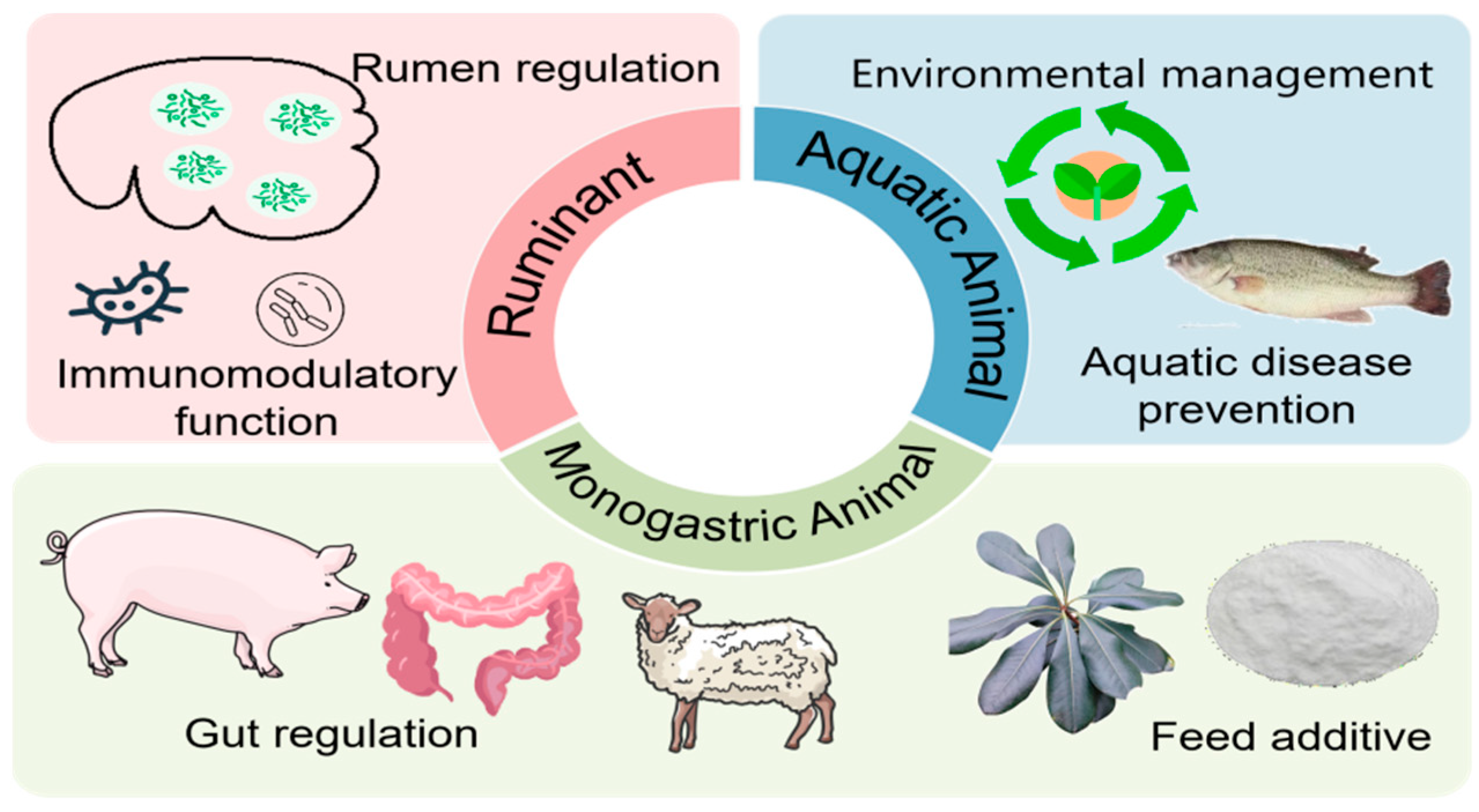
3.1. Potential Applications in Gut Regulation
3.2. Feed Additive Development
4. Application of QS in Ruminant Production
4.1. Potential Applications of Rumen Regulation
4.2. Immunomodulatory Function
5. Application of QS in Aquatic Animal Production
5.1. Aquatic Disease Prevention and Control
5.2. Aquaculture Environmental Management
6. Innovation Research and Development
7. Challenges and Limitations
8. Conclusions and Future Perspectives
Author Contributions
Funding
Institutional Review Board Statement
Data Availability Statement
Conflicts of Interest
Abbreviations
| QS | Quorum sensing |
| AHLs | N-acylhomoserine lactones |
| QSIs | Quorum-sensing inhibitors |
| AIPs | Autoinducing peptides |
| AI-2 | Autoinducer-2 |
| SAM | S-adenosylmethionine |
| ACP | Acyl carrier protein |
| SRH | S-ribosylhomocysteine |
| CPP | Cyclic di-peptide cyclo |
| CA | Chlorogenic acid |
| Quorum quenching | |
| QQE | Quorum quenching enzymes |
| ACL | N-acyl-cyclolysin |
| IAA | Indoleacetic acid |
| MG | Methyl gallate |
| Ser-Phe | Serine-phenylalanine |
| LV | Luminous vibriosis |
| AHPND | Acute hepatopancreatic necrosis disease |
| PHS | Piscine demorrhagic septicemia |
| EABs | Electroactive biofilms |
| 3OC12-HSL | N-(3-Oxododecanoyl)-L-homoserine lactone |
| 3-oxo-C14-HSL | N-(3-Oxotetradecanoyl)-L-homoserine lactone |
| C4-HSL | N-butyryl-L-homoserine lactone |
| C6-HSL | N-hexanoyl-L-homoserine lactone |
| ARG | Antibiotic resistance gene |
| VFA | Volatile fatty acids |
| SCFA | Short-chain fatty acids |
| RSM | Response surface methodology |
| VOCs | Volatile organic compounds |
| γ-HCH | γ-hexachlorocyclohexane |
| BES | Bioelectrochemical system |
| PFRs | Persistent free radicals |
| RAS | Recirculating aquaculture systems |
| MCP | Methyl-accepting chemotaxis protein |
| HK | Histidine kinase |
| TLR4 | Toll-like receptor 4 |
| MyD88 | Myeloid differentiation primary response 88 |
| NF-κB | Nuclear factor-kappa B |
References
- Miller, M.B.; Bassler, B.L. Quorum sensing in bacteria. Annu. Rev. Microbiol. 2001, 55, 165–199. [Google Scholar] [CrossRef]
- Nealson, K.H.; Platt, T.; Hastings, J.W. Cellular control of the synthesis and activity of the bacterial luminescent system. J. Bacteriol. 1970, 104, 313–322. [Google Scholar] [CrossRef]
- Mukherjee, S.; Bassler, B.L. Bacterial quorum sensing in complex and dynamically changing environments. Nat. Rev. Microbiol. 2019, 17, 371–382. [Google Scholar] [CrossRef]
- Wang, L.; Cai, Q.; Yang, Y.; Mai, Q.; Zhou, Y.; Liu, Y.; Liu, Y.; Liu, J. Reshaping bacterial microenvironments: Hybrid biomimetic membrane-coated copper nanosystems combat bacterial biofilm infections by inhibiting bacterial quorum sensing systems. Chem. Eng. J. 2025, 512, 162088. [Google Scholar] [CrossRef]
- Corcoran, C.J.; Cuthbert, B.J.; Glanville, D.G.; Terrado, M.; Valverde Mendez, D.; Bratton, B.P.; Schemenauer, D.E.; Tokars, V.L.; Martin, T.G.; Rasmussen, L.W. A glyoxal-specific aldehyde signaling axis in Pseudomonas aeruginosa that influences quorum sensing and infection. Nat. Commun. 2025, 16, 6616. [Google Scholar] [CrossRef]
- Bhuiyan, M.N.I. Biofilm, resistance, and quorum sensing: The triple threat in bacterial pathogenesis. Microbe 2025, 9, 100578. [Google Scholar] [CrossRef]
- Xu, J.; Wen, X.; Wang, S.; Worrich, A.; Ma, B.; Zou, Y.; Wang, Y.; Wu, Y. Identification of key species and molecular mechanisms driving conjugative transfer of antibiotic resistance genes in swine manure-derived bacterial communities. J. Hazard. Mater. 2025, 497, 139638. [Google Scholar] [CrossRef] [PubMed]
- Li, L.; Guan, W.; Fan, Y.; He, Q.; Guo, D.; Yuan, A.; Xing, Q.; Wang, Y.; Ma, Z.; Ni, J. Zinc/carbon nanomaterials inhibit antibiotic resistance genes by affecting quorum sensing and microbial community in cattle manure production. Bioresour. Technol. 2023, 387, 129648. [Google Scholar] [CrossRef] [PubMed]
- Kleerebezem, M.; Quadri, L.E.; Kuipers, O.P.; De Vos, W.M. Quorum sensing by peptide pheromones and two-component signal-transduction systems in Gram-positive bacteria. Mol. Microbiol. 1997, 24, 895–904. [Google Scholar] [CrossRef]
- Dunlap, P.V. Quorum regulation of luminescence in Vibrio fischeri. J. Mol. Microbiol. Biotechnol. 1999, 1, 5–12. [Google Scholar]
- Sánchez-Jiménez, A.; Llamas, M.A.; Marcos-Torres, F.J. Transcriptional regulators controlling virulence in Pseudomonas aeruginosa. Int. J. Mol. Sci. 2023, 24, 11895. [Google Scholar] [CrossRef]
- Dickschat, J.S. Quorum sensing and bacterial biofilms. Nat. Prod. Rep. 2010, 27, 343–369. [Google Scholar] [CrossRef]
- Duerkop, B.A.; Varga, J.; Chandler, J.R.; Peterson, S.B.; Herman, J.P.; Churchill, M.E.; Parsek, M.R.; Nierman, W.C.; Greenberg, E.P. Quorum-sensing control of antibiotic synthesis in Burkholderia thailandensis. J. Bacteriol. 2009, 191, 3909–3918. [Google Scholar] [CrossRef]
- Sturme, M.H.; Kleerebezem, M.; Nakayama, J.; Akkermans, A.D.; Vaughan, E.E.; De Vos, W.M. Cell to cell communication by autoinducing peptides in gram-positive bacteria. Antonie. Leeuwenhoek 2002, 81, 233–243. [Google Scholar] [CrossRef]
- Mitsumori, M.; Xu, L.; Kajikawa, H.; Kurihara, M.; Tajima, K.; Hai, J.; Takenaka, A. Possible quorum sensing in the rumen microbial community: Detection of quorum-sensing signal molecules from rumen bacteria. FEMS. Microbiol. Lett. 2003, 219, 47–52. [Google Scholar] [CrossRef] [PubMed]
- Helmy, Y.A.; El-Adawy, H.; Abdelwhab, E.M. A comprehensive review of common bacterial, parasitic and viral zoonoses at the human-animal interface in Egypt. Pathogens 2017, 6, 33. [Google Scholar] [CrossRef]
- Jha, N.K.; Kumar, L.L.; Sivasankar, C.; Gopu, V.; Devi, P.B.; Murali, A.; Shetty, P.H. Cyclic di-peptide Cyclo (L-Phe-L-Pro) mitigates the quorum-sensing mediated virulence in Salmonella typhi and biofilm formation in poultry and plastic system. Food Biosci. 2024, 60, 104391. [Google Scholar] [CrossRef]
- Dong, W.; Liang, G.; Gang, G.; Lu-fang, D. Research progress on role of chlorogenic acid and its application in animal production. Feed Res. 2024, 47, 163. [Google Scholar]
- Nayak, S.P.R.R.; Pohokar, P.; Das, A.; Dhivya, L.S.; Pasupuleti, M.; Soundharrajan, I.; Almutairi, B.O.; Kumaradoss, K.M.; Arockiaraj, J. Chalcone derivative enhance poultry meat preservation through quorum sensing inhibition against Salmonella (Salmonella enterica serovar Typhi) contamination. Food Control 2025, 171, 111155. [Google Scholar] [CrossRef]
- Zhang, Y.; Zhong, H.; Zheng, Y.; Wang, Y.; He, Y.; Gu, Y. Use of whole-genome analysis to study the effect of various quorum-sensing inhibitors on the biofilm formation of Lactobacillus fermentum. LWT 2023, 173, 114378. [Google Scholar] [CrossRef]
- Cheng, W.; Wang, Z.; Xiong, Y.; Wu, Z.; Tan, X.; Yang, Y.; Zhang, H.; Zhu, X.; Wei, H.; Tao, S. N-(3-oxododecanoyl)-homoserine lactone disrupts intestinal barrier and induces systemic inflammation through perturbing gut microbiome in mice. Sci. Total Environ. 2021, 778, 146347. [Google Scholar] [CrossRef]
- Shimada, Y.; Kinoshita, M.; Harada, K.; Mizutani, M.; Masahata, K.; Kayama, H.; Takeda, K. Commensal bacteria-dependent indole production enhances epithelial barrier function in the colon. PLoS ONE 2013, 8, e80604. [Google Scholar] [CrossRef]
- Ha, J.-H.; Hauk, P.; Cho, K.; Eo, Y.; Ma, X.; Stephens, K.; Cha, S.; Jeong, M.; Suh, J.-Y.; Sintim, H.O. Evidence of link between quorum sensing and sugar metabolism in Escherichia coli revealed via cocrystal structures of LsrK and HPr. Sci. Adv. 2018, 4, eaar7063. [Google Scholar] [CrossRef]
- Linares-Otoya, L.; Shirkey, J.D.; Chhetri, B.K.; Mira, A.; Biswas, A.; Neff, S.L.; Linares-Otoya, M.V.; Chen, Y.; Campos-Florian, J.V.; Ganoza-Yupanqui, M.L. Discovery of a widespread chemical signalling pathway in the Bacteroidota. Nature 2025, 646, 423–432. [Google Scholar] [CrossRef]
- Markus, V.; Paul, A.A.; Teralı, K.; Özer, N.; Marks, R.S.; Golberg, K.; Kushmaro, A. Conversations in the gut: The role of quorum sensing in normobiosis. Int. J. Mol. Sci. 2023, 24, 3722. [Google Scholar] [CrossRef] [PubMed]
- Wu, X.; Borjihan, Q.; Su, Y.; Bai, H.; Hu, X.; Wang, X.; Kang, J.; Dong, A.; Yang, Y.-W. Supramolecular switching-enabled quorum sensing trap for pathogen-specific recognition and eradication to treat enteritis. J. Am. Chem. Soc. 2024, 146, 35402–35415. [Google Scholar] [CrossRef]
- Yin, J.; Li, Y.; Han, H.; Ma, J.; Liu, G.; Wu, X.; Huang, X.; Fang, R.; Baba, K.; Bin, P.; et al. Administration of exogenous melatonin improves the diurnal rhythms of the gut microbiota in mice fed a high-fat diet. mSystems 2020, 5, 23. [Google Scholar] [CrossRef] [PubMed]
- Wang, H.; Chu, W.; Ye, C.; Gaeta, B.; Tao, H.; Wang, M.; Qiu, Z. Chlorogenic acid attenuates virulence factors and pathogenicity of Pseudomonas aeruginosa by regulating quorum sensing. Appl. Microbiol. Biotechnol. 2018, 103, 903–915. [Google Scholar] [CrossRef]
- Wang, L.; Zhang, Y.; Liu, Y.; Xu, M.; Yao, Z.; Zhang, X.; Sun, Y.; Zhou, T.; Shen, M. Effects of chlorogenic acid on antimicrobial, antivirulence, and anti-quorum sensing of carbapenem-resistant Klebsiella pneumoniae. Front. Microbiol. 2022, 13, 997310. [Google Scholar] [CrossRef] [PubMed]
- Wang, Y.; Feng, L.; Lu, H.; Zhu, J.; Venkitanarayanan, K.; Liu, X. Transcriptomic analysis of the food spoilers Pseudomonas fluorescens reveals the antibiofilm of carvacrol by interference with intracellular signaling processes. Food Control 2021, 127, 108115. [Google Scholar] [CrossRef]
- Subash-Babu, P.; Alshatwi, A.A.; Ignacimuthu, S. Beneficial antioxidative and antiperoxidative effect of cinnamaldehyde protect streptozotocin-induced pancreatic β-cells damage in wistar rats. Biomol. Ther. 2014, 22, 47–54. [Google Scholar] [CrossRef] [PubMed]
- Brackman, G.; Celen, S.; Hillaert, U.; van Calenbergh, S.; Cos, P.; Maes, L.; Nelis, H.J.; Coenye, T. Structure-activity relationship of cinnamaldehyde analogs as inhibitors of AI-2 based quorum sensing and their effect on virulence of Vibrio spp. PLoS ONE 2011, 6, e16084. [Google Scholar] [CrossRef] [PubMed]
- Ye, W.; Li, L.; Zou, M.; Han, L.; Xu, P.; Gu, Y.; Yuan, R.; Peng, X. Vanillin as a quorum sensing inhibitor: Effect on extracellular polymeric substance production and defoaming potential in anaerobic digestion system. Chem. Eng. J. 2025, 512, 162762. [Google Scholar] [CrossRef]
- Fu, C.; Ge, J.; Qu, M.; Ouyang, K.; Qiu, Q. Effects of 4-hydroxy-2, 5-dimethyl-3(2H)-furanone supplementation on growth performance, serum antioxidant capacity, rumen fermentation characteristics, rumen bacterial quorum sensing, and microbial community in Hu sheep. Anim. Biosci. 2025, 38, 1422–1434. [Google Scholar] [CrossRef]
- Wang, X.; Qi, Y.; Zheng, H. Dietary polyphenol, gut microbiota, and health benefits. Antioxidants 2022, 11, 1212. [Google Scholar] [CrossRef]
- Xiao, Y.; Chen, L.; Xu, Y.; He, X.; Gan, S.; Yin, F. The effects of tea polyphenols in feed on the immunity, antioxidant capacity, and gut microbiota of weaned goat kids. Animals 2025, 15, 467. [Google Scholar] [CrossRef]
- Sun, J.; Wang, Z.; Yan, X.; Zhao, Y.; Tan, L.; Miao, X.; Zhao, R.; Huo, W.; Chen, L.; Li, Q. The study on the impact of indoleacetic acid on enhancing the ability of the rumen’s original microecology to degrade aflatoxin B1. bioRxiv 2024, bioRxiv:2024.08.02.606440. [Google Scholar]
- Payam, B.; Soltani, M.; Mehrgan, M.S.; Rajabi Islami, H.; Nazemi, M. Saponins from sea cucumber disrupt Aeromonas hydrophila quorum sensing to mitigate pathogenicity. AMB. Expr. 2025, 15, 43. [Google Scholar] [CrossRef]
- Jiang, H.; Wang, Z.; Jia, A. Methyl gallate from Camellia nitidissima Chi flowers reduces quorum sensing related virulence and biofilm formation against Aeromonas hydrophila. Biofouling 2024, 40, 64–75. [Google Scholar] [CrossRef]
- Yang, W.; Liu, S.; Liu, X.; Yuan, S.; An, L.; Ren, A.; Bai, F.; Lv, X.; Li, J.; Li, X. Novel quorum-sensing inhibitor peptide SF derived from Penaeus vannamei myosin inhibits biofilm formation and virulence factors in Vibrio parahaemolyticus. LWT 2025, 218, 117542. [Google Scholar] [CrossRef]
- Lv, X.; Yang, W.; Liu, S.; Liu, X.; Yuan, S.; An, L.; Ren, A.; Bai, F.; Li, J.; Li, X. Inhibition effect of marine active peptides SF on dual-species biofilms of Vibrio parahaemolyticus and Aeromonas sobria. Food Biosci. 2024, 61, 104697. [Google Scholar] [CrossRef]
- Aldawsari, M.F.; Khafagy, E.-S.; Saqr, A.A.; Alalaiwe, A.; Abbas, H.A.; Shaldam, M.A.; Hegazy, W.A.; Goda, R.M. Tackling virulence of Pseudomonas aeruginosa by the natural furanone sotolon. Antibiotics 2021, 10, 871. [Google Scholar] [CrossRef] [PubMed]
- Huyghebaert, G.; Ducatelle, R.; Van Immerseel, F. An update on alternatives to antimicrobial growth promoters for broilers. Vet. J. 2011, 187, 182–188. [Google Scholar] [CrossRef] [PubMed]
- Zhang, A.J.; Chen, X.; Zhang, G.M.; Wang, Z.D.; Chen, Z.M.; Chang, W.H.; Chai, H.Y.; Liu, G.H. Effects of N-acylhomoserine lactonase on growth performance, slaughter performance, and nutrient apparent metabolism rate of broiler chickens. Chin. J. Anim. Nutr. 2023, 35, 3607–3616. [Google Scholar]
- Kalia, V.C. Quorum sensing inhibitors: An overview. Biotechnol. Adv. 2013, 31, 224–245. [Google Scholar] [CrossRef]
- Ma, Y.; Xue, Y.; Dou, Y.; Xu, Z.; Tao, W.; Zhou, P. Characterization and gene cloning of a novel β-mannanase from alkaliphilic Bacillus sp. N16-5. Extremophiles 2004, 8, 447–454. [Google Scholar] [CrossRef]
- Asbury, R.E.; Saville, B.A. Manno-oligosaccharides as a promising antimicrobial strategy: Pathogen inhibition and synergistic effects with antibiotics. Front. Microbiol. 2025, 16, 1529081. [Google Scholar] [CrossRef]
- Wang, D.; Cui, F.; Ren, L.; Li, J.; Li, T. Quorum-quenching enzymes: Promising bioresources and their opportunities and challenges as alternative bacteriostatic agents in food industry. Compr. Rev. Food Sci. Food. Saf. 2023, 22, 1104–1127. [Google Scholar] [CrossRef]
- Won, M.; Oyama, L.B.; Courtney, S.J.; Creevey, C.J.; Huws, S.A. Can rumen bacteria communicate to each other? Microbiome 2020, 8, 23. [Google Scholar] [CrossRef] [PubMed]
- Liu, X.; Liu, Q.; Sun, S.; Sun, H.; Wang, Y.; Shen, X.; Zhang, L. Exploring AI-2-mediated interspecies communications within rumen microbial communities. Microbiome 2022, 10, 167. [Google Scholar] [CrossRef]
- Wang, F.; Luo, Y.; Xue, Z.; Feng, Q.; Cao, J.; Wu, Y.; Li, X.; Luo, J. Double-edged sword of extracellular polymeric substances disintegration under chloramphenicol exposure in volatile fatty acids production and antibiotic resistance genes proliferation during sludge fermentation. Chem. Eng. J. 2025, 512, 162569. [Google Scholar] [CrossRef]
- Niu, Q.; Zhang, X.; Wu, Y.; Sun, C.; Zheng, X.; Long, M.; Chen, Y. Protein transformation induced by tribromophenol regulates volatile fatty acids production during sludge fermentation: Interplay between structural modification and metabolic modulation. Chem. Eng. J. 2025, 520, 165971. [Google Scholar] [CrossRef]
- Shah, S.; Park, H.; Park, H.; Kim, J.; Mameda, N.; Choo, K. The relationship between quorum sensing dynamics and biological performances during anaerobic membrane bioreactor treatment. Bioresour. Technol. 2022, 363, 127930. [Google Scholar] [CrossRef]
- Chen, L.; Shen, Y.; Wang, H. Metabolic mechanism of acid production by Streptococcus bovis in rumen and its regulation. Chin. J. Anim. Nutr. 2016, 28, 665–673. [Google Scholar]
- Haustenne, L.; Bastin, G.; Hols, P.; Fontaine, L. Modeling of the ComRS signaling pathway reveals the limiting factors controlling competence in Streptococcus thermophilus. Front. Microbiol. 2015, 6, 1413. [Google Scholar] [CrossRef] [PubMed]
- Ge, J.; Li, Y.; Zhao, X.; Ouyang, K.; Qu, M.; Qiu, Q. Dietary supplementation with D-ribose enhances growth performance, improves serum antioxidant capacity, and inhibits rumen microbial LuxS/AI-2 quorum sensing of Hu sheep. Anim. Biosci. 2025, in press. [Google Scholar] [CrossRef]
- Chen, L.; Zhang, P.; Li, Y.; Liang, J.; Zhang, G. Genome-centric metagenomic analysis reveals mechanisms of quorum sensing promoting anaerobic digestion under sulfide stress: Syntrophic metabolism and microbial self-adaptation. Sci. Total Environ. 2024, 954, 176240. [Google Scholar] [CrossRef]
- Li, Y.; Dai, J.; Ma, Y.; Yao, Y.; Yu, D.; Shen, J.; Wu, L. The mitigation potential of synergistic quorum quenching and antibacterial properties for biofilm proliferation and membrane biofouling. Water. Res. 2024, 255, 121462. [Google Scholar] [CrossRef]
- Il’shat, K.; Galimzhan, D.; Kseniya, I.; Madina, K. Inhibition of bacterial quorum sensing by the ruminal fluid of cattle. Geomate. J. 2017, 13, 88–92. [Google Scholar] [CrossRef]
- Cheng, X.; Liang, Y.; Ji, K.; Feng, M.; Du, X.; Jiao, D.; Wu, X.; Zhong, C.; Cong, H.; Yang, G. Enhanced propionate and butyrate metabolism in cecal microbiota contributes to cold-stress adaptation in sheep. Microbiome 2025, 13, 103. [Google Scholar] [CrossRef]
- Liu, C.; Li, L.; Dai, J.; Qu, M.; Ouyang, K.; Qiu, Q. Heated drinking water in winter improves growth performance of male Hu sheep by modulating rumen quorum sensing and metabolites, and enhancing serum antioxidant capacity. Anim. Biosci. 2025, 38, 2280–2296. [Google Scholar] [CrossRef]
- Gupta, D.S.; Kumar, M.S. The implications of quorum sensing inhibition in bacterial antibiotic resistance-with a special focus on aquaculture. J. Microbiol. Methods 2022, 203, 106602. [Google Scholar] [CrossRef]
- Li, Y.; Wu, X.; Han, S.; Chen, Z.; Qin, M.; Liu, L.; Jiang, X.; Wang, H. The effect of N-acyl-homoserine lactones-mediated quorum sensing on intestinal colonization and damage by Aeromonas veronii. Aquaculture 2022, 561, 738627. [Google Scholar] [CrossRef]
- Soto-Rodriguez, S.A.; Gomez-Gil, B.; Lozano-Olvera, R.; Betancourt-Lozano, M.; Morales-Covarrubias, M.S. Field and experimental evidence of Vibrio parahaemolyticus as the causative agent of acute hepatopancreatic necrosis disease of cultured shrimp (Litopenaeus vannamei) in Northwestern Mexico. Appl. Environ. Microbiol. 2015, 81, 1689–1699. [Google Scholar] [CrossRef] [PubMed]
- Bennett, H.M.; Griffin, M.; Francis-Floyd, R.; Baker, S.; Camus, A.; Pelton, C.; Dill-Okubo, J. Vibrio harveyi in a Caribbean spiny lobster (Panulirus argus) with hepatopancreas necrosis. Vet. Pathol. 2023, 60, 618–623. [Google Scholar] [CrossRef] [PubMed]
- Grandclément, C.; Tannières, M.; Moréra, S.; Dessaux, Y.; Faure, D. Quorum quenching: Role in nature and applied developments. FEMS Microbiol. Rev. 2016, 40, 86–116. [Google Scholar] [CrossRef] [PubMed]
- Sun, X.; Liu, J.; Deng, S.; Li, R.; Lv, W.; Zhou, S.; Tang, X.; Sun, Y.Z.; Ke, M.; Wang, K. Quorum quenching bacteria Bacillus velezensis DH82 on biological control of Vibrio parahaemolyticus for sustainable aquaculture of Litopenaeus vannamei. Front. Mar. Sci. 2022, 9, 780055. [Google Scholar] [CrossRef]
- Haridas, D.V.; Joshy, C.; Pillai, D. Optimization of the multispecies probiotic combination with N-acylhomoserine lactone-degrading ability for increased disease resistance of Carassius auratus using response surface methodology. Aquaculture 2022, 548, 737597. [Google Scholar] [CrossRef]
- Zhang, L.; Wu, Y.; Yao, Z.; Wang, X.; Chen, J.; Yang, W.; Yao, J.; Lin, Y.; Liu, Z.; Lin, X. A high-throughput screening approach for bacterial quorum sensing inhibitors (QSIs) against Aeromonas hydrophila infection. Aquaculture 2022, 560, 738488. [Google Scholar] [CrossRef]
- Deng, Z.; Hou, K.; Valencak, T.G.; Luo, X.M.; Liu, J.; Wang, H. AI-2/LuxS quorum sensing system promotes biofilm formation of Lactobacillus rhamnosus GG and enhances the resistance to enterotoxigenic Escherichia coli in germ-free zebrafish. Microbiol. Spectr. 2022, 10, e00610-22. [Google Scholar] [CrossRef]
- Gao, C.; Yang, W.; Duan, Y.; Niu, W.; Wang, Y.; Qin, M.; Li, Y. Dietary supplementation of Priestia sp. PPB30 attenuates intestinal colonization and inflammatory response induced by Aeromonas veronii in loach through interfering with the LuxS/AI-2 quorum sensing system. Fish Shellfish Immunol. 2025, 165, 110576. [Google Scholar] [CrossRef] [PubMed]
- Calcagnile, M.; Quarta, E.; Sicuro, A.; Pecoraro, L.; Schiavone, R.; Tredici, S.M.; Talà, A.; Corallo, A.; Verri, T.; Stabili, L.; et al. Effect of Bacillus velezensis MT9 on nile tilapia (Oreochromis Niloticus) intestinal microbiota. Microb. Ecol. 2025, 88, 37. [Google Scholar] [CrossRef]
- Cheng, J.; Wu, J.; Su, X.; Xu, J.; He, Y. Conductive material and AHLs addition altered soil microbiome and facilitated γ-HCH dechlorination but inhibited CH4 cumulation. Soil. Biol. Biochem. 2024, 191, 109347. [Google Scholar] [CrossRef]
- Cheng, Y.; Lu, K.; Chen, Z.; Li, N.; Wang, M. Biochar reduced the risks of human bacterial pathogens in soil via disturbing quorum sensing mediated by persistent free radicals. Environ. Sci. Technol. 2024, 58, 22343–22354. [Google Scholar] [CrossRef]
- Zhou, S.; An, W.; Zhao, K.; Lin, L.; Yang, S.; Zhang, Y.; Xu, M. Protection of electroactive biofilms against hypersaline shock by quorum sensing. Water. Res. 2023, 233, 119823. [Google Scholar] [CrossRef] [PubMed]
- Li, Z.; Li, J.; Gong, W.; Zhang, K.; Wang, G.; Xia, Y.; Yu, M.; Xie, W.; Lu, Z.; Cheng, X. Effect of exogenous acylhomoserine lactone 3-oxo-C14-HSL on the performance of biofilm in moving bed biofilm reactor. J. Water. Process. Eng. 2024, 64, 105595. [Google Scholar] [CrossRef]
- Yu, X.; Zhou, Z.; Li, X.; Wan, P.; Zhang, J.; Peng, C. Gamma-caprolactone-based isolation of Pseudomonas sp. YH-1: A novel quorum quenching bacterium for AHL degradation and biofouling control. Chem. Eng. J. 2025, 520, 166280. [Google Scholar] [CrossRef]
- Xue, Y.M.; Wang, Y.C.; Lin, Y.T.; Jiang, G.Y.; Chen, R.; Qin, R.L.; Jia, X.Q.; Wang, C. Engineering a Pseudomonas putida as living quorum quencher for biofilm formation inhibition, benzenes degradation, and environmental risk evaluation. Water. Res. 2023, 246, 120690. [Google Scholar] [CrossRef]
- Xiang, K.; Sun, H.F.; Xu, Y.Q.; Pei, L.W.; Zhao, J.; Ye, Z.Y. Advances in the production and removal of off - flavors in recirculating aquaculture systems (RAS) for the cultivation of freshwater fish. Chin. J. Fish. 2024, 48, 3–15. [Google Scholar]
- Wang, Y.C.; Wang, C.; Han, M.F.; Tong, Z.; Lin, Y.T.; Hu, X.R.; Deng, J.G.; Hsi, H.C. Inhibiting effect of quorum quenching on biomass accumulation: A clogging control strategy in gas biofilters. Chem. Eng. J. 2022, 432, 134313. [Google Scholar] [CrossRef]
- Chen, N.; Xi, J.; Du, N.; Shen, R.; Zhao, R.; He, W.; Peng, T.; Yang, Y.; Zhang, Y.; Yu, L. Framework nucleic acid strategy enables closer microbial contact for programming short-range interaction. Sci. Adv. 2024, 10, eadr4399. [Google Scholar] [CrossRef]
- Rao, L.; Yuan, Y.; Shen, X.; Yu, G.; Chen, X. Designing nanotheranostics with machine learning. Nat. Nanotechnol. 2024, 19, 1769–1781. [Google Scholar] [CrossRef]
- Kang, Z.; Li, N.; Han, X.; Wang, C.; Yang, X.; Yu, H. Constructing hybrid microorganism-material systems to improve pollutant bioremediation: Investigating the improved bioactivity and quorum sensing of a functional strain with acid-added microwave hydrochar. Chem. Eng. J. 2025, 506, 160384. [Google Scholar] [CrossRef]
- Zou, Y.; Liu, C.; Zhang, H.; Wu, Y.; Lin, Y.; Cheng, J.; Lu, K.; Li, L.; Zhang, Y.; Chen, H. Three lines of defense: A multifunctional coating with anti-adhesion, bacteria-killing and anti-quorum sensing properties for preventing biofilm formation of Pseudomonas aeruginosa. Acta Biomater. 2022, 151, 254–263. [Google Scholar] [CrossRef] [PubMed]
- Kalia, V.C.; Patel, S.K.; Lee, J.-K. Bacterial biofilm inhibitors: An overview. Ecotox. Environ. Saf. 2023, 264, 115389. [Google Scholar] [CrossRef] [PubMed]
- Bhatt, S.; Goswami, D.; Saraf, M. Decoding quorum sensing: The language of bacteria for sustainable development. In Climate Change and Soil Microorganisms for Environmental Sustainability; Springer Nature: Singapore, 2025; pp. 23–46. [Google Scholar]


| Natural Substance Name | Source | Target Organism/Scenario | Application Effect | Reference |
|---|---|---|---|---|
| Cyclic di-peptide Cyclo (CPP) | Bacillus subtilis P89 | Monogastric animals (intestinal pathogenic bacteria), Salmonella Typhi | Reduces intestinal pathogenicity of Salmonella Typhi; inhibits its biofilm formation (applicable to poultry and plastic systems) | [17] |
| Chlorogenic acid (CA) | Natural plant extraction | Monogastric animals (intestine), Pseudomonas aeruginosa, carbapenem-resistant Klebsiella pneumoniae | Improves intestinal barrier function; exhibits antibacterial, antivirulence, and anti-quorum-sensing activities against target pathogens | [18,28,29] |
| Carvacrol | Natural plant extraction | Monogastric animals (intestinal pathogenic bacteria), Pseudomonas fluorescens | Inhibits pathogenic biofilm formation; favors beneficial intestinal bacteria; reduces food spoilage bacteria harm | [30] |
| Cinnamaldehyde | Natural plant extraction | Monogastric animals (intestine), Vibrio spp. | Enhances feed utilization; replaces antibiotic feed additives; reduces Vibrio virulence and intestinal infection risk | [31,32] |
| Vanillin | Natural plant extraction | Monogastric animals (feed additive), microorganisms in anaerobic digestion systems | Low concentration: inhibits pathogen QS activity; High concentration: suppresses methanogenic performance (with “off-target effect”) | [33] |
| Quercetin | Plants (widely present in natural plants) | Ruminants (intestinal pathogenic bacteria), Escherichia coli, Staphylococcus aureus | Reduces harmful bacteria colonization in the digestive tract; lowers immune stimulation; indirectly enhances immunity | [34] |
| Tea polyphenols | Tea extraction | Ruminants (intestinal tract of weaned lambs) | Activates intestinal protective mechanisms; enhances intestinal epithelial immune defense; improves immunity, antioxidant capacity, and gut flora balance | [35,36] |
| Indoleacetic acid (IAA) | Natural microbial metabolite | Ruminants (rumen), rumen functional bacteria (Amylovorax, Prevotella ruminicola, Clostridium succinogenes) | Improves rumen fermentation; increases acetic acid content and acetate/propionate ratio; maintains rumen health and energy utilization | [37] |
| Sea Cucumber Saponins | Sea cucumber extraction | Aquatic animals (fish pathogenic bacteria), Aeromonas hydrophila | increases acetic acid content and acetate/propionate ratio; maintains rumen health and energy utilization | [38] |
| Methyl gallate (MG) | Extracted from the flowers of Camellia nitidissima Chi | Aquatic animals (pathogenic bacteria), Aeromonas hydrophila | Reduces A. hydrophila pathogenicity to aquatic animals; decreases aquaculture diseases | [39] |
| Serine-phenylalanine (Ser-Phe) | Endogenous hydrolysate of Litopenaeus vannamei myosin | Aquatic animals (shrimp intestine), Vibrio parahaemolyticus | Reduces V. parahaemolyticus colonization in shrimp intestine; protects shrimp health; lowers acute hepatopancreatic necrosis disease (AHPND) risk | [40,41] |
| Sotolon | Natural product | Ruminants (pathogenic bacteria), Pseudomonas aeruginosa | Reduces endotoxin entry into the bloodstream; decreases unnecessary nutrient consumption; lowers pathogen infection risk | [11,42] |
Disclaimer/Publisher’s Note: The statements, opinions and data contained in all publications are solely those of the individual author(s) and contributor(s) and not of MDPI and/or the editor(s). MDPI and/or the editor(s) disclaim responsibility for any injury to people or property resulting from any ideas, methods, instructions or products referred to in the content. |
© 2025 by the authors. Licensee MDPI, Basel, Switzerland. This article is an open access article distributed under the terms and conditions of the Creative Commons Attribution (CC BY) license (https://creativecommons.org/licenses/by/4.0/).
Share and Cite
Tang, C.; Ouyang, K.; Qu, M.; Qiu, Q. Microbial Quorum Sensing: Unlocking Sustainable Animal Production and Beyond. Agriculture 2025, 15, 2579. https://doi.org/10.3390/agriculture15242579
Tang C, Ouyang K, Qu M, Qiu Q. Microbial Quorum Sensing: Unlocking Sustainable Animal Production and Beyond. Agriculture. 2025; 15(24):2579. https://doi.org/10.3390/agriculture15242579
Chicago/Turabian StyleTang, Chenxin, Kehui Ouyang, Mingren Qu, and Qinghua Qiu. 2025. "Microbial Quorum Sensing: Unlocking Sustainable Animal Production and Beyond" Agriculture 15, no. 24: 2579. https://doi.org/10.3390/agriculture15242579
APA StyleTang, C., Ouyang, K., Qu, M., & Qiu, Q. (2025). Microbial Quorum Sensing: Unlocking Sustainable Animal Production and Beyond. Agriculture, 15(24), 2579. https://doi.org/10.3390/agriculture15242579