
Article

Quantifying Dynamic Water-Saving Thresholds Through Regulating Irrigation: Insights from an Integrated Hydrological Model of the Hetao Irrigation District

1
College of Water Sciences, Beijing Normal University, Beijing 100875, China
2
School of Water Resources and Hydropower Engineering, North China Electric Power University, Beijing 102206, China
*
Author to whom correspondence should be addressed.
Agriculture 2025, 15(24), 2563; https://doi.org/10.3390/agriculture15242563
Submission received: 6 November 2025 / Revised: 8 December 2025 / Accepted: 9 December 2025 / Published: 11 December 2025
(This article belongs to the Section Agricultural Water Management)

Abstract

Agricultural irrigation accounts for nearly 70% of global freshwater withdrawals, making sustainable water management crucial for food security and ecological stability—particularly in arid and semi-arid regions. However, dynamic water-saving thresholds at both inter-annual and intra-annual scales remain insufficiently quantified in current research. To address this gap, this study developed an integrated SWAT-MODFLOW model for the Hetao Irrigation District and quantified dynamic water-saving thresholds by simulating crop yield responses under a range of irrigation scenarios. The model was calibrated (2008–2014) and validated (2014–2016), demonstrating reliable performance (R2 = 0.75, NSE = 0.74) in capturing local hydrological processes. Inter-annual scenarios assessed water-saving levels of 5%, 10%, 20%, and 30% under wet, normal, and dry years, while intra-annual scenarios adjusted seasonal irrigation volumes in spring, summer, and autumn with reduction gradients of 33%, 50%, and 100%. Results show that wet and normal years could achieve a water-saving threshold of up to 20%, whereas dry years were limited to 5%. Intra-annually, autumn irrigation offered the greatest saving potential (33–100%), followed by spring (33–50%). Spatially, crop responses varied substantially: the western part of the region proved particularly sensitive, with even the optimal district-wide strategy reducing local crop yields by 10–20%. This study quantifies dynamic water-saving thresholds and incorporates spatial heterogeneity into scenario assessment. The resulting framework is transferable and provides a basis for sustainable water management in water-limited agricultural regions.

1. Introduction

Globally, agricultural irrigation is the largest consumer of freshwater resources, ac-counting for approximately 70% of total water withdrawals [1,2,3]. In arid and semi-arid regions, this dependency is even more pronounced, where the sustainable management of water resources is not merely an economic issue but a fundamental prerequisite for food security and ecological stability [4,5,6].
The complexity of water resources management in irrigation districts lies in the intricate interaction between surface water (SW) and groundwater (GW) [7,8]. Inefficient surface irrigation can lead to deep percolation, which recharges groundwater [9]. This groundwater can then be reused through capillary rise or pumping, creating a complex hydrologic cycle [10,11]. Traditional modeling approaches often treat SW and GW separately, which can lead to significant inaccuracies in quantifying the water balance [12]. For instance, the Soil and Water Assessment Tool (SWAT) is a widely used, physically based model for simulating land surface processes, including runoff, sediment, and agricultural chemical yields [8]. Conversely, MODFLOW is the international standard for simulating groundwater flow [13,14,15]. Using either model in isolation fails to capture the critical feedback between the two systems. Recognizing this limitation, the coupled SWAT-MODFLOW model has emerged as a powerful tool, enabling an integrated simulation of the entire watershed [15]. This coupling allows for a more accurate representation of real-world conditions, such as the exchange fluxes between rivers and aquifers, and the impact of irrigation practices on both SW and GW resources [16,17,18,19].
The Hetao Irrigation District, located in Inner Mongolia, China, is one of the largest irrigation districts in Asia. It relies heavily on water diversions from the Yellow River to support its vast agricultural lands [20]. However, this region faces a pressing dual challenge: on one hand, it is plagued by issues of low irrigation efficiency and traditional, often inefficient, water management practices [21]; on the other hand, it is under increasing pressure from the stringent “Water Allocation Plan” of the Yellow River Basin, which mandates strict limits on water usage for each region [22,23,24]. This situation is further exacerbated by the uncertainties of climate change, which introduce greater variability in both water availability and crop water requirements [25]. Consequently, optimizing irrigation strategies to maximize water productivity—achieving “more crop per drop”—has become a critical and urgent task for the agricultural sustainability of the Hetao Irrigation District [26,27].
Previous studies in the Hetao Irrigation District have investigated various aspects of its hydrology and water management. Some researchers have used SWAT to assess the impact of climate change on water resources, while others have employed MODFLOW to analyze groundwater dynamics [28,29,30,31]. Several studies have also highlighted the significant water loss during specific irrigation events, particularly the pre-winter irrigation known as “Autumn Irrigation” [32,33,34]. This practice is intended to leach salts from the root zone and store moisture in the soil profile for the following spring [26]; however, its application is often excessive, leading to substantial unproductive water loss and even aggravating shallow groundwater evaporation, which can cause secondary soil salinization [33,35,36,37]. While these studies provide valuable insights, a significant research gap remains.
Applications of the integrated SWAT-MODFLOW model remain limited in arid and semi-arid regions, and there is a pressing need to determine dynamic agricultural water-saving thresholds for sustainable water management [28,29,30,31]. Accordingly, this study simulated crop yield variations under multiple inter- and intra-annual water-saving scenarios in the Hetao Irrigation District to quantify these dynamic thresholds. The specific objectives of this paper are to: (1) Evaluate the performance of the coupled SWAT-MODFLOW model in simulating the hydrologic cycles within the Hetao Irrigation District. (2) Quantify the water-saving potential under different hydro-climatic conditions by analyzing inter-annual dynamic thresholds. (3) Identify the most impactful intra-annual irrigation adjustment strategies and their effects on crop yield. (4) Propose an optimized scheme for dynamic water diversion thresholds that supports the sustainable and intensive use of water resources in the region. This study delivers a scientifically grounded decision-making tool for water resource managers and policymakers. It establishes clear, quantifiable water allocation targets to enhance agricultural resilience and sustainability. While developed for the Hetao Irrigation District, the framework is also applicable to similar arid irrigation systems globally.

2. Materials and Methods

2.1. Study Area

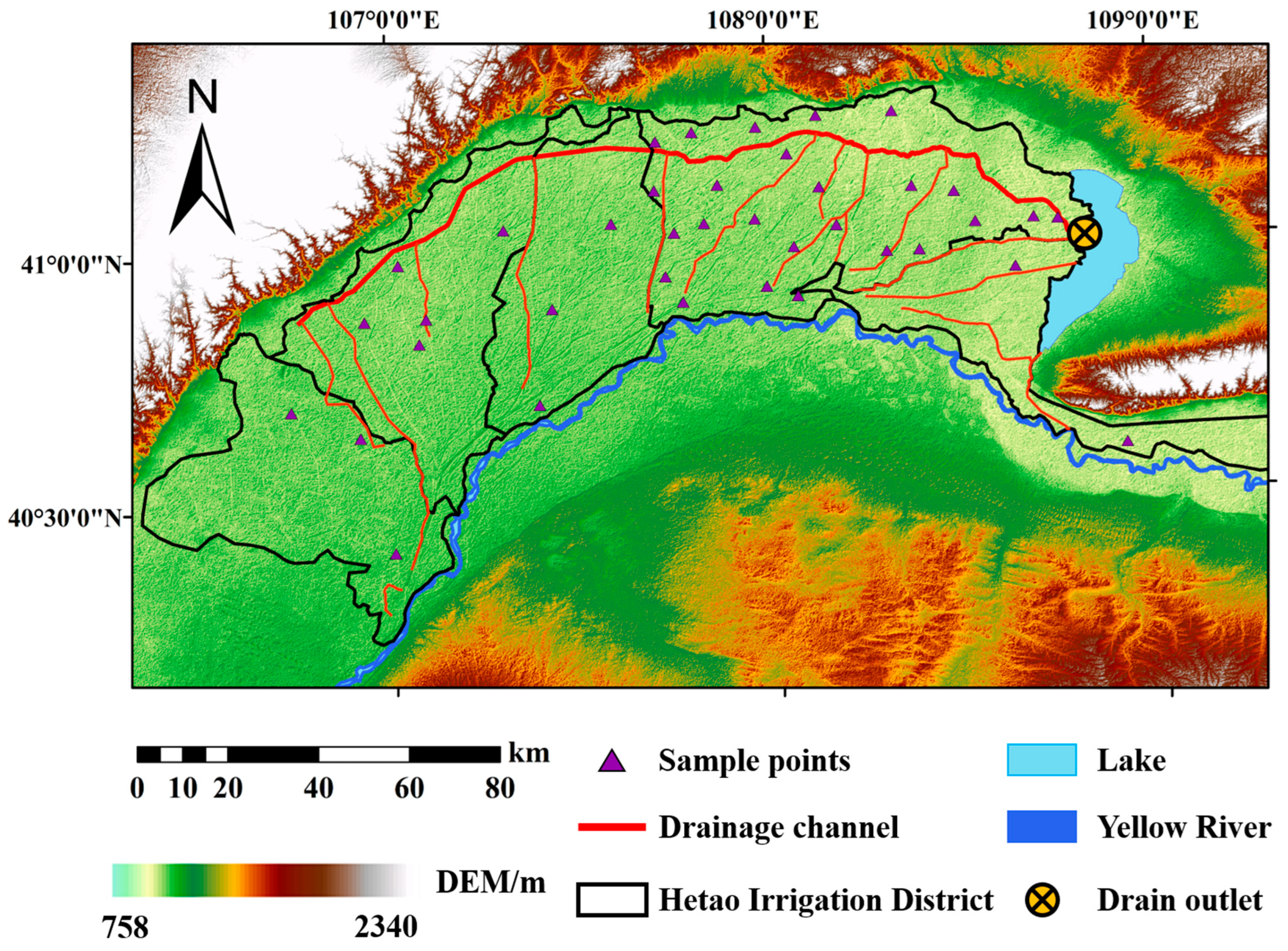
The Hetao Irrigation District (40°20′~41°18′ N, 106°20′~109°20′ E) is located in the western part of the Inner Mongolia Autonomous Region, China. As shown in Figure 1, it is bordered by the Yin Mountains to the north, the Yellow River to the south, the Ulan Buh Desert to the west, and Baotou City to the east. The district spans approximately 270 km from east to west and 50 km from north to south, with a total land area of 1.189 million hectares [20,21,22].
The Hetao Irrigation District experiences a temperate continental climate characterized by cold winters and mild summers. Annual precipitation is substantially lower than potential evaporation, with the majority of rainfall concentrated between July and September, while evaporation remains high throughout the year. Due to this significant water deficit, agricultural and ecosystem water supply in the region relies heavily on irrigation water diverted from the Yellow River. The mean annual temperature is approximately 8.6 °C, with annual sunshine duration ranging from 3100 to 3300 h [24,25,26].
As one of the major agricultural regions in northern China, the district features diverse soil textures, predominantly silt loam, loam, and clay loam. The groundwater table is generally shallow, typically ranging from 1.5 to 3.5 m in the main farming areas, while exceeding 6 m in some piedmont zones. The cropping system is characterized by intercropping with a relatively fragmented structure, primarily involving sunflower and spring maize, along with wheat and cash crops such as melons, fruits, and vegetables [22,23,24,27].
Agricultural production is predominantly dependent on irrigation from the Yellow River, with annual water diversions of approximately 3.7–5.2 billion cubic meters. The irrigation regime includes spring, growing-season, and autumn irrigation events, aimed mainly at salt leaching and soil moisture conservation. Sunflower typically receives 1–2 irrigations during its growth period, whereas maize receives 2–3. Long-term large-scale irrigation has resulted in shallow groundwater levels and substantial salt input into the soil system. The terrain is flat, with an average slope of about 0.02%, leading to weak lateral groundwater flow and making vertical evaporation the dominant discharge mechanism [25,26,27].

2.2. Data Sources

The digital elevation model (DEM) data used in this study were obtained from the Geospatial Data Cloud site of the Computer Network Information Center, Chinese Academy of Sciences (http://www.gscloud.cn (accessed on 20 May 2025)). The original DEM has a spatial resolution of 30 m × 30 m and was resampled to 500 m × 500 m in ArcGIS 10.8.2 for subsequent model development.
The meteorological data were sourced from the China Meteorological Assimilation Driving Datasets for the SWAT model (CMADS dataset), which is specifically designed for the SWAT model. The dataset includes daily mean temperature, daily maximum/minimum temperature, daily cumulative precipitation, daily mean solar radiation, daily mean air pressure, daily specific humidity, daily relative humidity, and daily mean wind speed.
Data on irrigation volumes, channel drainage, and groundwater levels were provided by the Water Resources Development Center of the Hetao Irrigation District in Inner Mongolia. The irrigation schedules for the various crops cultivated in the Hetao Irrigation District are summarized in Table 1. Groundwater observations were obtained from 38 monitoring wells, as illustrated in Figure 1. All three datasets cover the period from 2008 to 2016 at a monthly temporal resolution.
Land use, and soil texture data were acquired from the Google Earth Engine (GEE) platform. The precipitation data are available at a daily frequency, while both land use and soil texture datasets have a spatial resolution of 500 m × 500 m, which meets the requirements of the modeling framework.

2.3. Methods

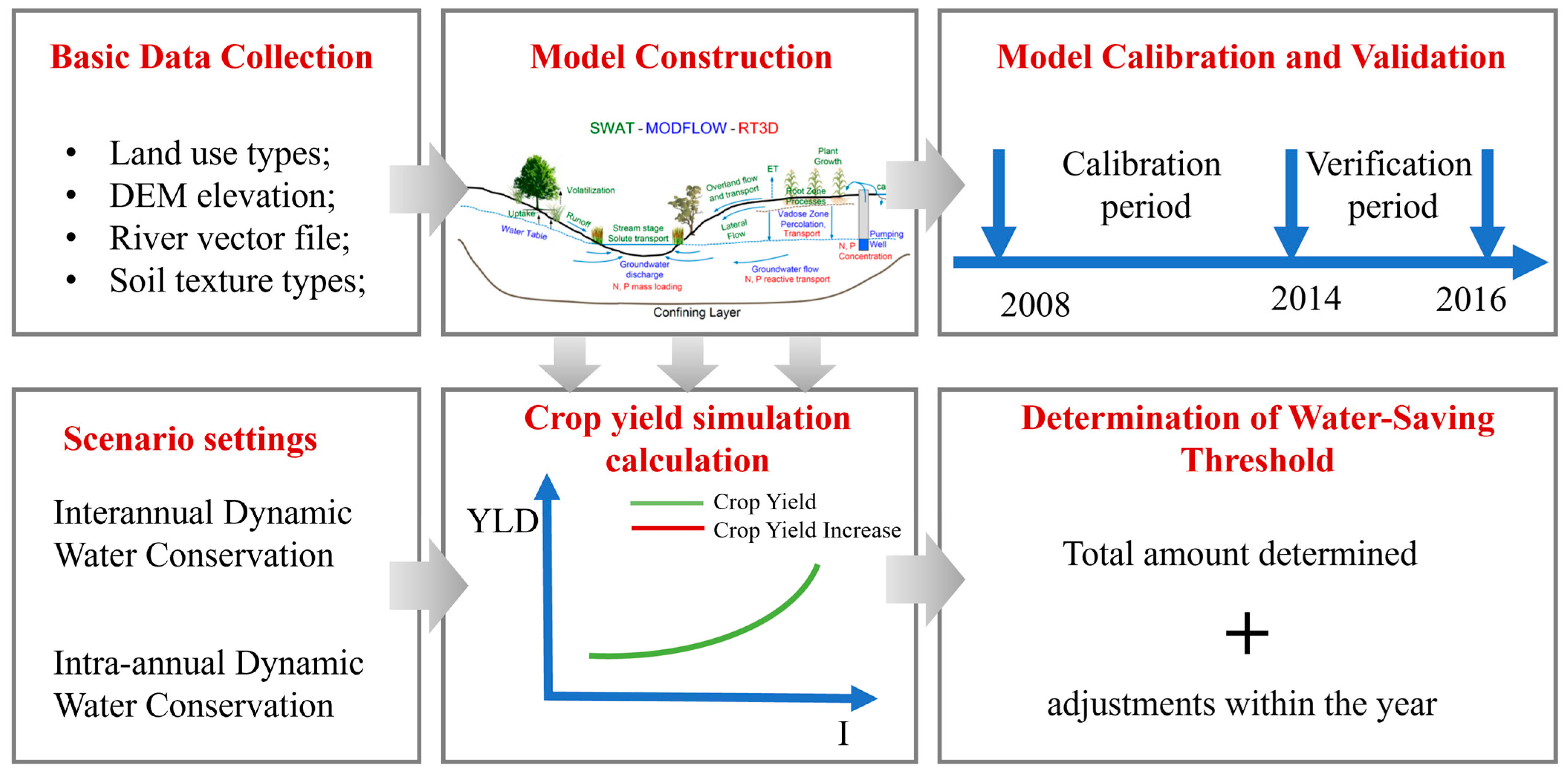
The methodology of this study primarily encompasses four key components: (1) model development and configuration, (2) model calibration and validation, (3) scenario design and analysis, and (4) determination of critical thresholds. A schematic diagram illustrating the entire research workflow is presented in Figure 2.

2.3.1. SWAT-MODFLOW Model

SWAT-MODFLOW is a widely used coupled surface water–groundwater modeling framework that integrates the Soil and Water Assessment Tool (SWAT) and the Modular Finite-Difference Groundwater Flow Model (MODFLOW). This coupling enables integrated simulation of hydrologic processes across the atmosphere–surface–soil–groundwater continuum [38]. SWAT is a physically based, semi-distributed model that simulates surface processes such as rainfall-runoff, erosion, and pollutant transport by discretizing a watershed into hydrologic response units; however, it employs a simplified groundwater module, limiting its ability to represent detailed groundwater flow and human impacts such as pumping [39]. In contrast, MODFLOW is a standard three-dimensional groundwater model that solves finite-difference flow equations and excels under complex hydrogeological and anthropogenic stresses, but lacks detailed representation of land-surface processes linked to climate and land use [40]. Thus, the combined framework overcomes the individual limitations of each model, allowing for comprehensive watershed-scale analysis.
The core concept of the coupled SWAT-MODFLOW model lies in leveraging the strengths of each component model to overcome their individual limitations. The coupling mechanism is typically implemented as follows: recharge from deep percolation and river stages generated by SWAT are passed to MODFLOW as source terms and boundary conditions. Concurrently, MODFLOW calculates updated groundwater levels and the exchange fluxes between groundwater and surface water, which are then fed back to SWAT. This feedback updates soil moisture content, calculates groundwater evaporation, and modifies baseflow contribution to river channels. This bidirectional, dynamic feedback mechanism allows the coupled model to more realistically represent the integrated nature of the hydrological cycle. Consequently, in regions with strong surface water-groundwater interaction, the simulation accuracy and reliability of a coupled model far surpass that of either model used in isolation. This is particularly true in settings like alluvial plains. The Hetao Irrigation District, as an irrigated agricultural area, serves as a prime example of this advantage [41].
Therefore, this study employed the SWATMODFLOW module within the QGIS platform to construct a monthly-scale coupled SWAT-MODFLOW model. This was achieved by utilizing the watershed units delineated by the SWAT model as boundary conditions and routing the hydrological outputs from SWAT as inputs to the MODFLOW model. Model calibration and validation were performed using the SUFI-2 algorithm within SWAT-CUP, which accounts for all sources of uncertainty (e.g., inputs, parameters). The degree of uncertainty is quantified by the P-factor (the proportion of measured data enclosed by the 95% confidence interval) and the R-factor (the average width of the 95% uncertainty interval). For streamflow simulation, a P-factor closer to 1 and an R-factor closer to 0 indicate better model performance. In practice, a higher P-factor tends to widen the R-factor; thus, a balance between the two must be sought. Generally, a P-factor > 0.7 and an R-factor < 1.5 are considered acceptable, though these thresholds are not rigid and should be adjusted based on specific study conditions. Once suitable P-factor and R-factor values are obtained, the goodness-of-fit is further quantified using the coefficient of determination (R2) and the Nash–Sutcliffe efficiency (Ens) between the observed data and the final “best” simulation.

2.3.2. Interannual and Intra-Annual Water-Saving Scenario Settings

For the inter-annual water-saving scenarios, a gradient approach was adopted by systematically reducing the total irrigation water application by a series of predefined percentages. This setup was designed to quantify the corresponding changes in crop yield across different years. The calculation is defined by the following equation:
Y L D = f S M [ ( 1 k ) I ]
where YLD denotes the simulated crop yield; fS-M represents the integrated simulation process of the coupled SWAT-MODFLOW model; k is the water-saving ratio, with common values set at 5%, 10%, 20%, etc.
I refers to the actual irrigation water application under current (baseline) conditions.
In the intra-annual simulations, the total saved water volume was held constant (i.e., the value of k remained fixed). The focus then shifted to redistributing this saved water across different growth seasons by adjusting the seasonal irrigation allocation ratios. This allowed for the simulation of crop yield under various intra-annual water management strategies, as formulated below:
Y L D = f S M [ ( 1 a ) ( 1 k ) I a , ( 1 b ) ( 1 k ) I b , ( 1 c ) ( 1 k ) I c ]
where a, b, and c represent the water-saving ratios applied to the spring, summer, and autumn irrigation periods, respectively; Ia, Ib, and Ic correspond to the actual irrigation water applications during spring, summer, and autumn under the current conditions.

3. Results

3.1. Model Construction

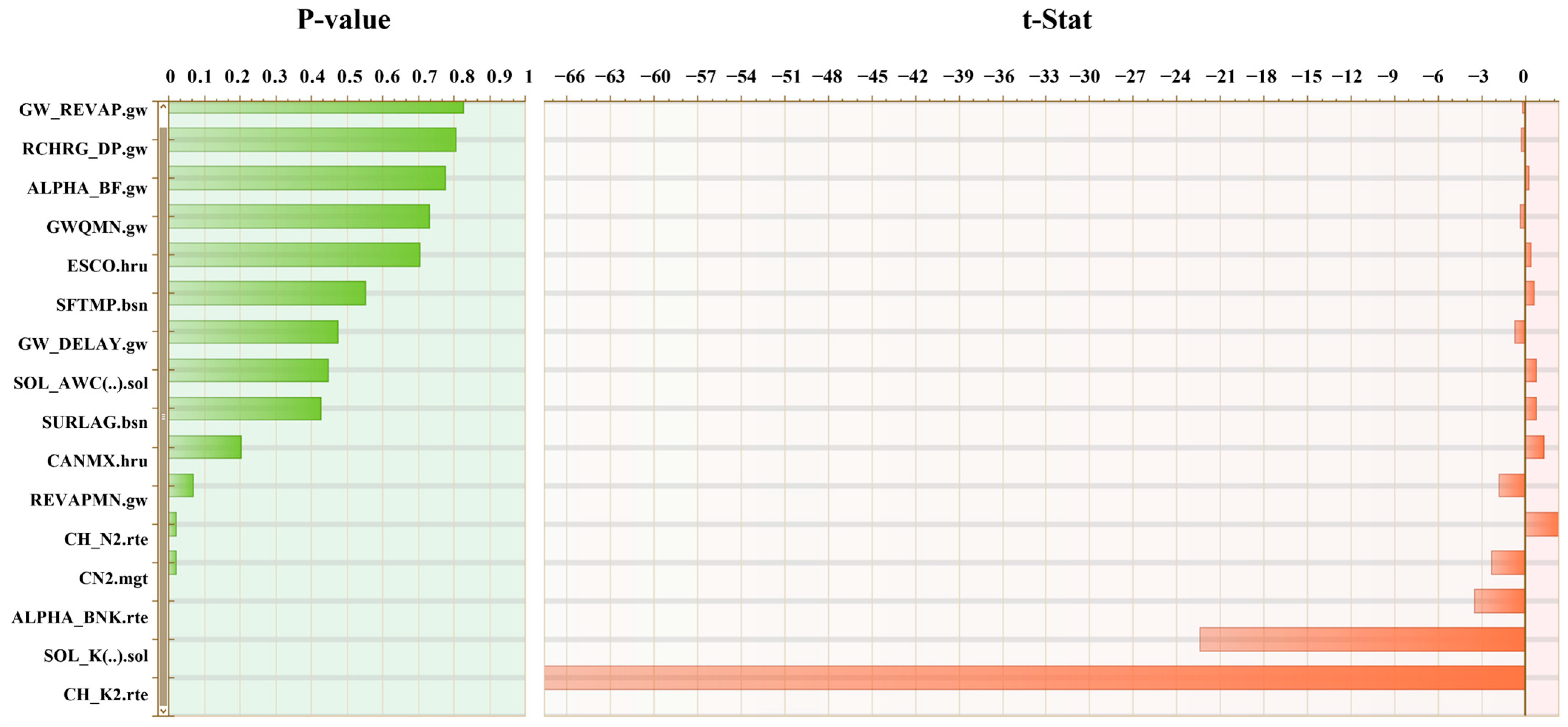
Based on the specific soil characteristics and prevailing field management practices in the Hetao Irrigation District, 16 key parameters were selected for the calibration of the SWAT-MODFLOW model (Figure 3). These parameters, summarized in Table 2, were chosen due to their documented sensitivity in influencing hydrological and agronomic processes under similar irrigated agricultural settings.
The selection process considered factors such as soil hydraulic properties (e.g., saturated hydraulic conductivity and available water capacity), crop growth parameters, and irrigation management coefficients (Table 2). This targeted approach ensures that the model calibration is both computationally efficient and physically representative of the regional conditions, thereby enhancing the reliability of subsequent scenario simulations and water resources assessments.
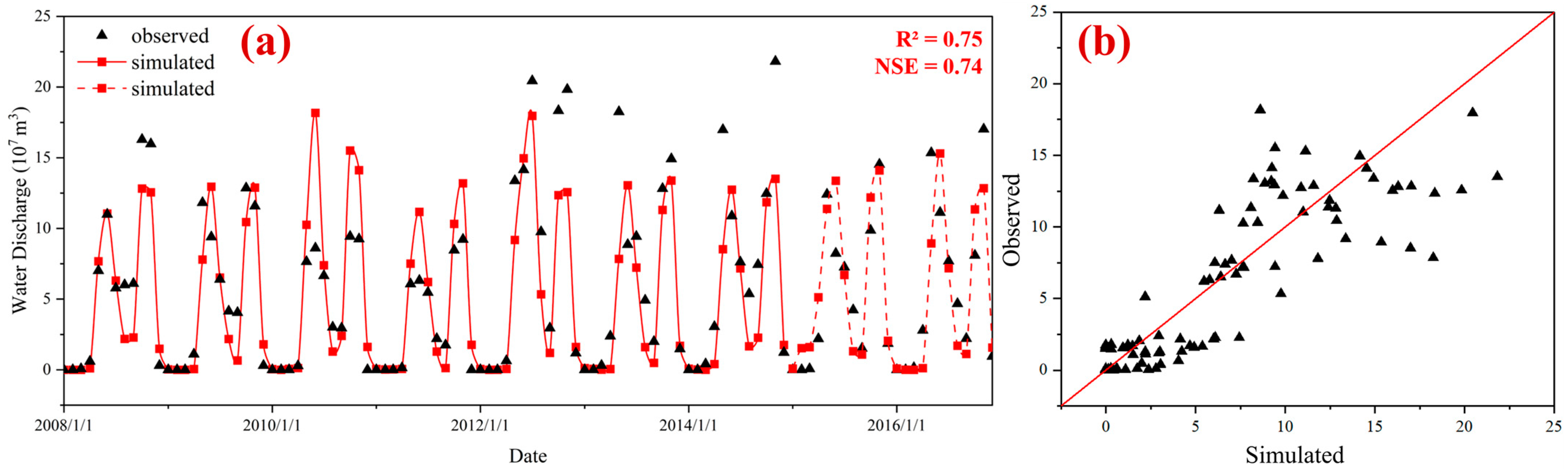
The model calibration and validation results are presented in Figure 4. The period 2008–2014 was used for model calibration, while 2015–2016 served as the validation period. The model performance was evaluated using the coefficient of determination (R2) and the Nash-Sutcliffe efficiency (NSE), which reached 0.75 and 0.74, respectively. These indices indicate that the model performs satisfactorily in simulating the hydrological processes of the study area, meeting the generally accepted criteria for hydrological models.
Furthermore, the simulated versus observed hydrograph reveals a systematic tendency of the model to underestimate peak values. This underestimation suggests that the model may exhibit larger uncertainties under extreme hydrological conditions, such as intensive irrigation events. A notable example is the autumn irrigation in 2012, where the simulated discharge values were considerably lower than the observed ones. This discrepancy could be attributed to several factors: (1) the model’s simplified conceptualization of canal seepage and drainage systems, which may not fully capture the rapid hydrological responses during high-intensity irrigation; (2) the possible underestimation of the hydraulic conductivity in shallow aquifers, leading to attenuated simulation of groundwater discharge peaks; and (3) the limited capability of the model in representing the dynamic operation of irrigation infrastructure and its associated return flows under extreme water diversion scenarios, a challenge also reported in other modeling studies across arid irrigated areas.

3.2. Interannual Dynamic Water-Saving Threshold

First, in determining the dynamic thresholds for inter-annual water diversion, we drew upon established classifications of hydrological years specific to the Hetao Irrigation District. The period from 2008 to 2016 was categorized into dry, normal, and wet years based on annual precipitation characteristics, with the classification results summarized in Table 3. Our analysis indicates that dry years were the most frequent during this period, while normal and wet years collectively occurred in five years.
This classification aligns with the findings in their assessment of water-saving projects in the Hetao Irrigation District, defined wet years by an annual precipitation threshold exceeding 211.76 mm [42]. Such a precipitation-based hydrological year classification is crucial, as it directly influences agricultural net water diversions. Studies have confirmed a significant negative correlation between annual precipitation (when exceeding 211.76 mm) and agricultural net water diversions, underscoring the impact of hydrological conditions on water diversion volumes.
Furthermore, this refined categorization provides a scientific basis for developing climate-adaptive water allocation strategies. By differentiating hydrological years, we can establish more precise and dynamic water diversion thresholds. This approach supports the regional water resources management goal of “total amount control and intensity management”, facilitating targeted adjustments in water allocation under varying hydrological conditions. It also aids in optimizing the regulation of distinctive irrigation practices in the region, such as spring irrigation and autumn irrigation, ultimately enhancing agricultural water productivity and resilience in this arid irrigated area.
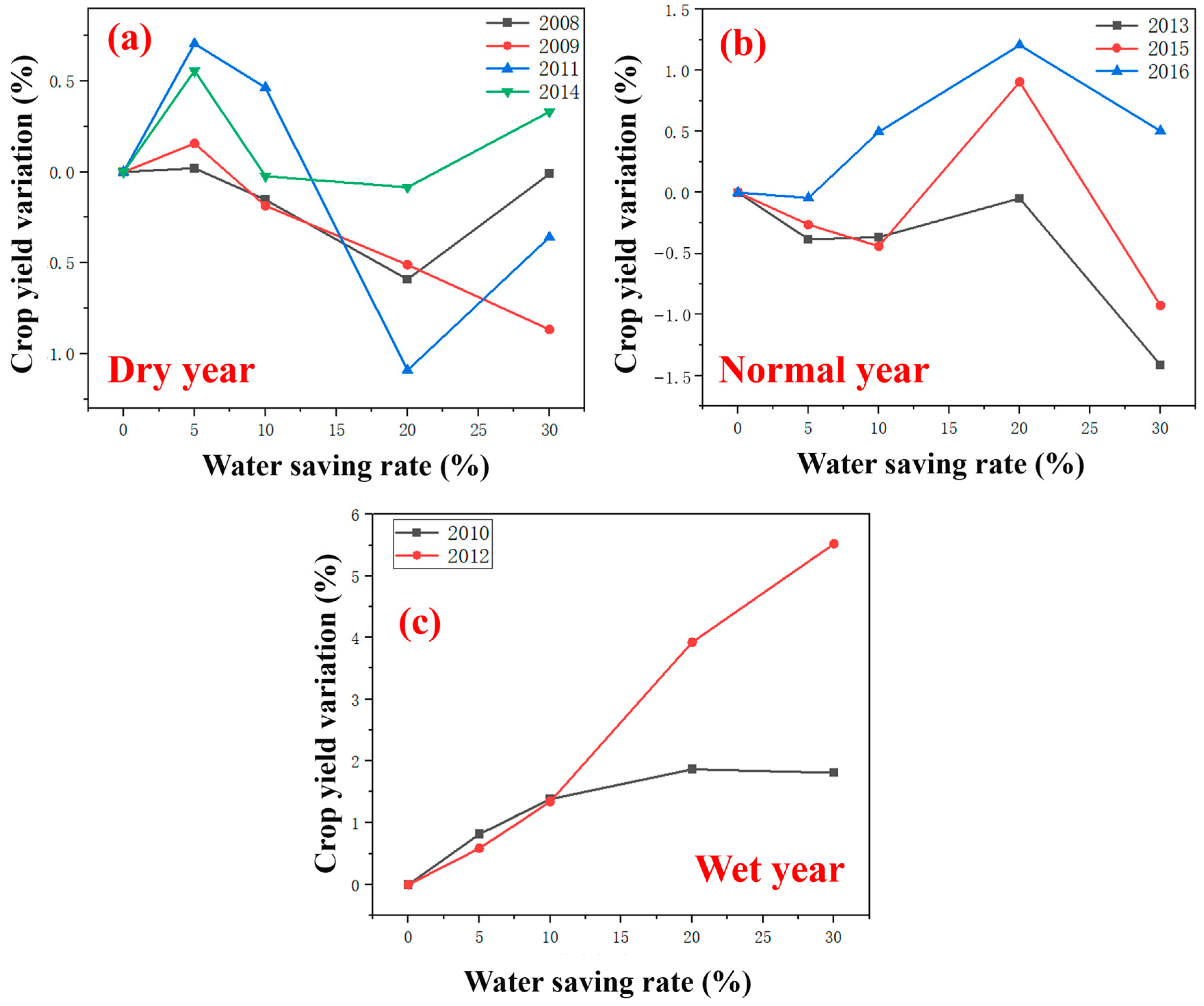
Based on the established framework, we designed a series of water-saving scenarios for the Hetao Irrigation District by applying irrigation reduction ratios of 5%, 10%, 20%, and 30%. The simulation results reveal distinct crop yield responses across different hydrological year types—dry, normal, and wet years—as summarized in the accompanying Figure 5.
In dry years, crop yields exhibited high sensitivity to reduced irrigation. A 5–10% water saving led to a moderate decline in yield, while a 20–30% reduction caused a more pronounced drop, indicating limited buffering capacity under water-scarce conditions.
In normal years, yields remained relatively stable under 5–10% water-saving scenarios, reflecting a balance between water supply and crop demand. However, a 20% or greater reduction began to significantly impact productivity, suggesting a threshold for sustainable water use in typical rainfall conditions.
Wet years demonstrated greater resilience to water-saving measures. Yield loss was minimal even with a 10–20% reduction in irrigation, and a 30% cut still resulted in an acceptable level of impact. This highlights the potential for substantial water savings in high-rainfall years without compromising yield significantly.
These findings underscore the importance of tailoring water-saving strategies to specific hydrological conditions. Dynamic and adaptive irrigation thresholds—rather than uniform reductions—can help optimize both water conservation and agricultural productivity in the Hetao Irrigation District.

3.3. Year Dynamic Water-Saving Threshold

Building upon the analysis of inter-annual water-saving potentials and considering conditions in wet and normal years, we further investigated the intra-annual dynamic water-saving thresholds under a fixed total saving target of 20%. In accordance with the distinctive irrigation practices in the Hetao Irrigation District, the growing season was divided into three key irrigation events: spring, summer, and autumn. By systematically adjusting the proportion of water savings allocated to each period, we established a range of seasonal water-saving scenarios (see Table 4). This approach allowed us to redistribute the total saved water volume across different growth stages.
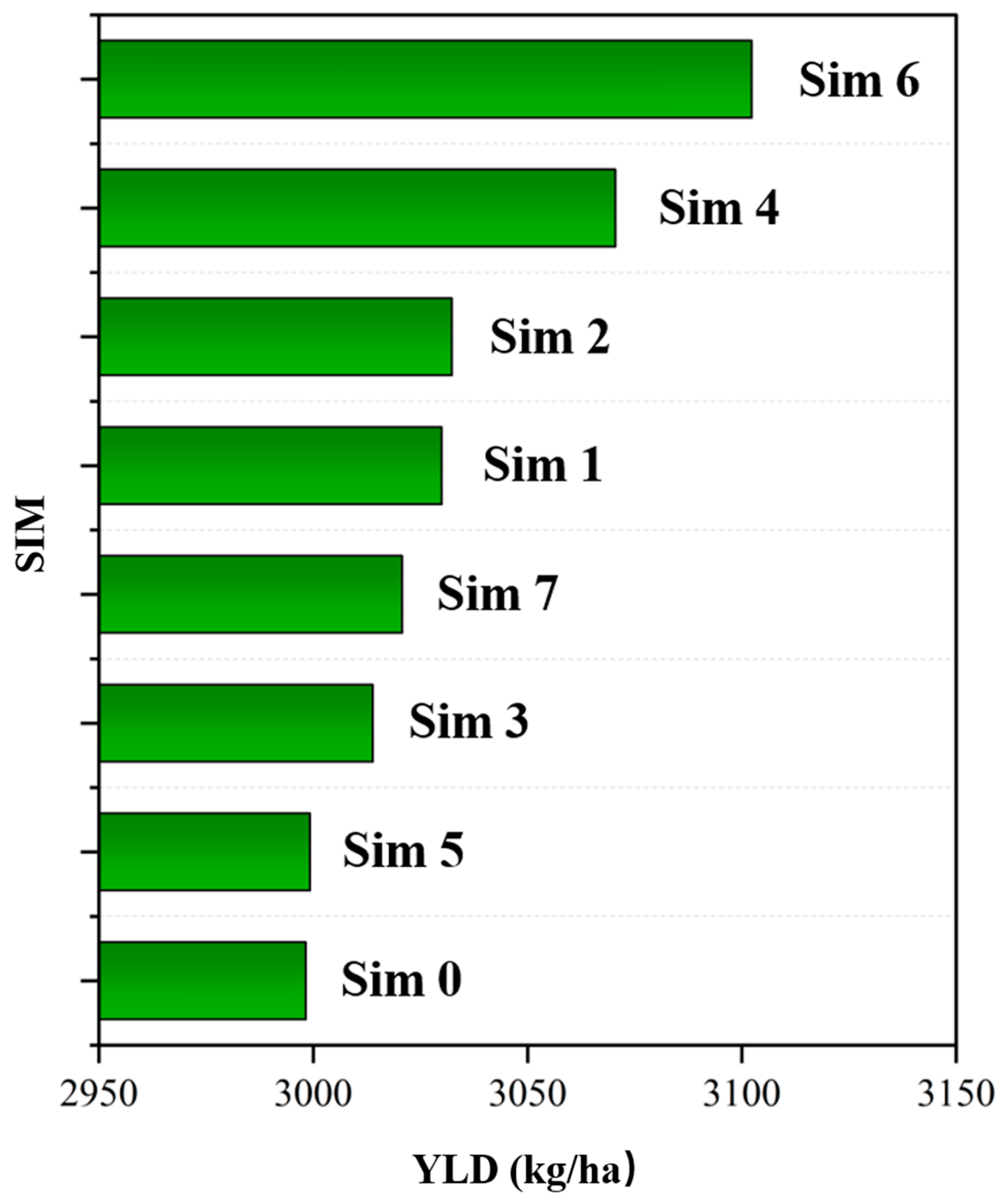
Based on the scenario configurations described previously, the simulated crop yields under different water-saving strategies were ranked in descending order, as visually presented in Figure 6. The results clearly demonstrate that the Sim6 scenario leads to a significant increase in crop yield, reaching approximately 3.3% higher than the baseline scenario (Sim0). This is followed by the Sim4 scenario, which also shows a notable yield improvement of around 2.5% compared to Sim0.
Among the intermediate-performing scenarios, Sim2, Sim1, Sim7, and Sim3 resulted in more moderate yield enhancements, with increases ranging between 0.9% and 1.1% relative to the baseline. In contrast, the Sim5 scenario exhibited no statistically significant difference in yield compared to Sim0, suggesting that this particular allocation of water-saving measures across seasons does not contribute to productivity gains.
These findings highlight that strategic temporal redistribution of irrigation water—rather than uniform reduction—can effectively achieve water conservation goals without compromising, and in some cases even enhancing, crop productivity. The superior performance of Sim6 and Sim4 implies that aligning irrigation schedules with critical crop water demand phases, especially during spring and early summer, plays a decisive role in maintaining yield stability under water-saving conditions.
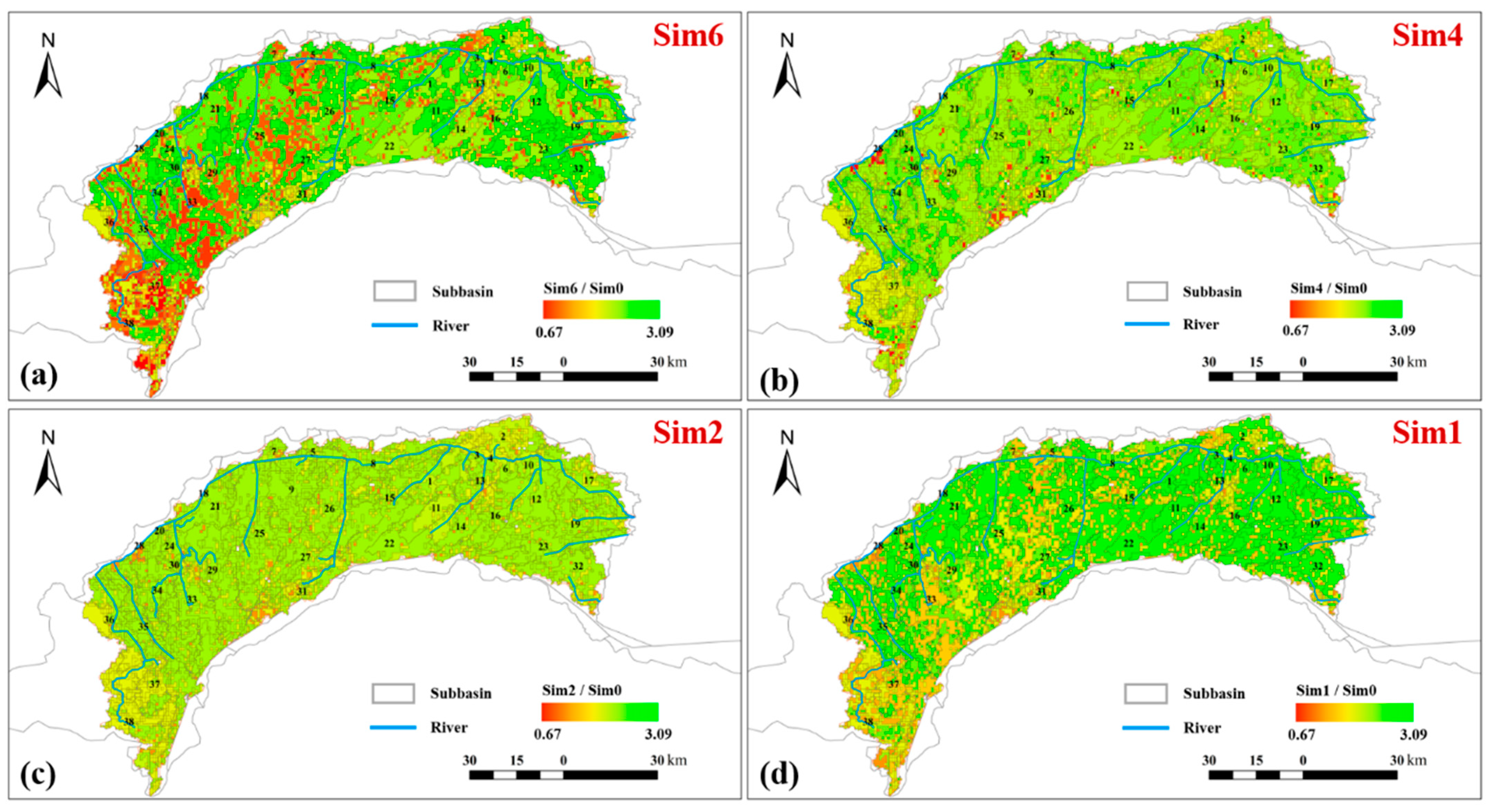
A spatial comparative analysis of crop yield was conducted between the top four most effective water-saving scenarios within the year and the baseline condition (sim0). This yielded spatial distribution maps of the crop yield ratio for scenarios sim6, sim4, sim2, and sim1 relative to sim0 (Figure 7).
The results clearly demonstrate notable spatial heterogeneity in crop yield responses across the different water-saving scenarios. Specifically, although the Sim6 scenario achieved the greatest overall increase in crop yield across the irrigation district, this increase was concentrated primarily in the eastern part. In contrast, a large area in the west experienced a decline in yield. Both the sim4 and sim2 scenarios exhibited more moderate and spatially balanced outcomes, with an overall increasing trend in crop yield across most of the region. This suggests that these two strategies achieve a better trade-off between water conservation and agricultural productivity.
As for the sim1 scenario, although it shares a similar water-saving approach with sim6, its implementation is less stringent, resulting in generally favorable crop yield performance over a larger area. Notably, only limited locales exhibited yields that were comparable to or slightly below the baseline, indicating that sim1 may offer a viable compromise between water-saving objectives and yield stability. These spatial differentiations underscore the importance of tailoring irrigation strategies to regional specificities within the basin.

4. Discussion

4.1. Principal Findings and Model Performance

This study successfully constructed an integrated SWAT-MODFLOW model for the Hetao Irrigation District. The model accurately captured the dynamics of the coupled surface water-groundwater (SW-GW) system. Furthermore, it demonstrated significant water-saving potential through optimized inter-annual and intra-annual water diversion thresholds.
The reliability and applicability of the SWAT-MODFLOW model in simulating com-plex eco-hydrological processes have also been widely validated across various agricultural regions in China. In the Hetao Irrigation District, the model was coupled with the SWAP model. This coupled framework was employed to determine the minimum irrigation water requirements for maize under different precipitation levels. The results provide crucial guidance for managing Yellow River water diversions [43]. In the Sanjiang Plain, a model coupling framework integrating SWAT, MODFLOW, and the DSSAT crop model was developed. This integrated system achieved a 12.5% reduction in water use and enhanced water productivity to 1.56 kg/m3 while boosting economic benefits by 13.5%, demonstrating its power in supporting regional precision water management [44]. In the North China Plain, the coupled model was applied to quantify the impacts of irrigation on water balance and groundwater depletion [45]. The simulation results demonstrate that water-saving irrigation can alter groundwater use efficiency while significantly enhancing both Water Use Efficiency (WUE) and Irrigation Water Use Efficiency (IUE) [46]. Furthermore, the model has been extended to arid inland basins, such as the Bosten Lake Basin, where it supported groundwater simulation and forecasting, providing technical support for the efficient development and protection of local water resources [47].
These diverse applications confirm that the SWAT-MODFLOW model is a robust and reliable tool for eco-hydrological process research, capable of guiding water resources management and agricultural conservation practices in irrigated areas across different regions.

4.2. Interpretation of Inter-Annual Water-Saving Potential

The simulation results of crop yield under different water-saving levels and hydroclimatic years are presented in Figure 4. Based on these results, our analysis reveals that the current irrigation regime in the study area may be excessive. Specifically, water diversions appear to surpass actual crop requirements. This leads to unnecessary deep percolation and inefficient drainage. The observed reduction in crop yield under high irrigation volumes supports this finding.
This phenomenon is corroborated by existing research in the Hetao Irrigation District. For instance, studies on the irrigation processes in the region have indicated that intensive irrigation during the crop growth period results in significant water seepage, which further contributes to the leaching of nutrients such as nitrogen [35,48,49]. Such nutrient loss is detrimental to crop development, particularly during critical growth stages [50].
Our simulation results align with these observations. When irrigation volumes were reduced, the nitrogen stress on crops decreased correspondingly. This suggests that the primary stress affecting crop growth in the study area does not necessarily stem from water scarcity but may be closely linked to nutrient loss induced by over-irrigation. This is further supported by local field experiments, which demonstrate that appropriately reducing irrigation volume can significantly lower nitrogen loss (including NO3-N leaching and NH3 volatilization) without substantially compromising crop nitrogen uptake [51,52].
In conclusion, the current irrigation practices not only result in water waste but also trigger a chain reaction of nutrient loss, thereby indirectly impairing crop growth. Optimizing irrigation amounts is therefore crucial not only for water conservation but also for maintaining nutrient balance and enhancing crop productivity in the region.

4.3. Implications of Intra-Annual Irrigation Adjustments

From the perspectives of water-salt movement and energy balance, the autumnal irrigation in the Hetao Irrigation District serves dual purposes of salt leaching and soil water storage for the subsequent spring [32,33,53]. As air temperatures drop during this period, crop transpiration demand becomes minimal, and the substantial irrigation water is primarily allocated to leaching salts and recharging soil moisture [28]. As temperatures drop, a significant amount of soil moisture freezes and is retained in the surface layer. During the thawing period, this retained moisture, combined with increased evaporative energy, subsequently enhances overall soil moisture content [54]. Come spring, rising temperatures and increased energy drive strong capillary rise from this shallow groundwater into the root zone [53,54]. While this Autumn irrigation process can partially alleviate spring drought by supplying moisture, it more critically acts as a conduit, transporting dissolved salts back to the soil surface [55]. This mechanism can exacerbate spring salinization risk, potentially hampering seed germination and seedling emergence—a phenomenon supported by regional observations [34].
Research indicates that the freezing–thawing cycle intensifies this water-salt dynamic. During freezing, the soil water in Autumn irrigation farmlands freezes earlier and thaws later compared to spring-irrigated fields, creating prolonged periods of temperature differentials that drive water and salt migration [56]. Furthermore, a strong logarithmic correlation exists between soil salt content and groundwater depth in the district, with shallower groundwater depths significantly associated with higher surface salt accumulation [57]. Studies employing spatial interpolation and coupling the HYDRUS and MODFLOW models have simulated that controlling the groundwater depth within a range of 1.8 to 2.2 m can effectively mitigate surface salt accumulation [33].
Therefore, moderately reducing the autumn irrigation volume, as part of a comprehensive strategy, could be a scientifically sound management practice. This approach helps prevent the shallow groundwater table from rising excessively close to the surface, thereby reducing capillary salt flux. To synergistically maintain water-salt balance, reducing autumn irrigation should be coupled with other ancillary measures. For instance, employing straw mulching in spring can effectively suppress soil evaporation, thereby weakening the energy driving capillary ascent and reducing salt transport. The integration of such practices provides a robust pathway toward achieving sustainable water use and enhancing actual crop yield by ensuring a favorable root zone environment.

4.4. Implications for Water-Saving Strategies Based on Spatial Heterogeneity

The spatial comparative analysis reveals considerable spatial heterogeneity in crop yield responses under the different water-saving scenarios (Figure 7). This finding is pivotal for informing regionally differentiated water resource management strategies.
Specifically, although the Sim6 scenario achieved the greatest overall increase in crop yield across the irrigation district, this increase was concentrated primarily in the eastern part. In contrast, a large area in the west experienced a decline in yield. This suggests that this region is likely more vulnerable to water stress, likely associated with the extensive desert and similar land use types in its western areas. In contrast, the Sim2 and Sim4 scenarios, characterized by more moderate water-saving measures, demonstrated a better trade-off, achieving both water conservation and stable or increased yields across most of the study area. These results clearly indicate that a uniform, basin-wide water-saving policy is suboptimal, and a spatially adaptive approach is essential.
Based on these insights, we recommend the implementation of zoned management strategies. For the sensitive western region, aggressive strategies like Sim6 should be avoided in favor of moderate approaches akin to Sim2 or Sim4 to safeguard farmers’ livelihoods and regional food security. Conversely, in sub-regions with higher water tolerance and greater saving potential, more ambitious strategies could be cautiously explored. While this study focused on intra-annual variations, future work should incorporate inter-annual climate variability (e.g., dry and wet years) to assess the long-term robustness of these strategies. Developing an integrated decision-making framework that concurrently addresses spatial heterogeneity and temporal variability is a critical next step for sustainable water resources management in the region.

4.5. Limitations and Future Research

In conclusion, this study highlights the effectiveness of the coupled SWAT-MODFLOW model for water management in the Hetao Irrigation District. By establishing climate-adaptive dynamic water diversion thresholds (inter- and intra-annual), our work advances beyond static water-saving targets, providing a scientific basis for sustainable water use and agricultural resilience in this arid region.
This study has notable limitations. First, fixed SWAT crop parameters may introduce uncertainty, as crop traits vary with climate and management. Second, assuming constant irrigation efficiency overlooks spatial differences from infrastructure, soil, and on-farm practices. Third, excluding farmer behavioral responses (e.g., cropping pattern adjustments) limits reflection of real-world strategy effectiveness.
The developed dynamic thresholds have direct policy relevance for the Yellow River Basin. They can serve as a scientific benchmark for the basin’s water allocation system to determine annual/seasonal quotas. Inter-annually, thresholds guide water volume adjustments based on hydrology and climate projections; intra-annually, they optimize water release timing during key crop stages to balance agricultural and ecological needs. Additionally, they support water rights trading by clarifying efficient agricultural water demand.
Future research should address these limitations, particularly by comparing SWAT’s native crop module with specialized models (AquaCrop for water-stress yield simulation, DSSAT for mechanistic crop stress representation [58,59,60]). This comparison will improve the integrated model’s predictive accuracy, offering stronger support for water management decisions.

5. Conclusions

This study contributes two key insights to arid agricultural water management: it develops a validated SWAT-MODFLOW model for the Hetao Irrigation District (HID) and derives actionable dynamic thresholds for water-saving irrigation. The integrated model reliably simulates coupled surface water-groundwater systems, supported by strong goodness-of-fit metrics (R2 = 0.75, NSE = 0.74), confirming its value for irrigation strategy development.
Using this model, we identified context-dependent water-saving potential. Inter-annually, permissible reductions reach 20% in wet/normal years (without yield loss) but drop to 5% in dry years. Intra-annually, timing is critical—water-saving in autumn (followed by spring) minimizes yield impacts, as these periods align with low crop water demand and natural precipitation. Seasonal crop requirements must guide irrigation scheduling. These findings inform infrastructure planning (e.g., flexible conveyance systems, expanded storage for wet-year water) and irrigation guidelines. We propose a tiered framework: (1) classify annual hydrology; (2) set seasonal water-saving targets; (3) integrate targets into on-farm schedules.
A dynamic, context-dependent approach is vital for HID’s water sustainability. Our hydrology- and season-specific thresholds bridge theory and practice, aiding policymakers in boosting water productivity while securing food supply. Future work could incorporate climate projections to enhance long-term adaptability.

Author Contributions

Conceptualization, C.C. and W.Y.; methodology, W.Y.; software, C.C.; validation, Q.F. and W.Y.; formal analysis, C.C.; investigation, C.C., Z.Z., K.W. and W.Y.; resources, H.Z.; data curation, Z.Z.; writing—original draft preparation, C.C.; writing—review and editing, W.Y.; visualization, Q.F.; supervision, W.Y. and X.H.; project administration, W.Y.; funding acquisition, W.Y. All authors have read and agreed to the published version of the manuscript.

Funding

This research was funded by the National Key Research and Development Program of China (Grant No. 2021YFC3201203) and the National Natural Science Foundation of China (Grant No. 52179032).

Institutional Review Board Statement

Not applicable.

Data Availability Statement

The original contributions presented in this study are included in the article. Further inquiries can be directed to the corresponding author.

Acknowledgments

The authors are grateful for the support and help from the Water Conservancy Development Center of the Hetao Irrigation District in Inner Mongolia.

Conflicts of Interest

The authors declare no conflict of interest.

Abbreviations

The following abbreviations are used in this manuscript:
SWSurface Water
GWGroundwater
YLDHarvested yield

References

  1. Rosa, L. Adapting agriculture to climate change via sustainable irrigation: Biophysical potentials and feedbacks. Environ. Res. Lett. 2022, 17, 063008. [Google Scholar] [CrossRef]
  2. Abioye, E.A.; Hensel, O.; Esau, T.J.; Elijah, O.; Abidin, M.; Ayobami, A.S.; Yerima, O.; Nasirahmadi, A. Precision Irrigation Management Using Machine Learning and Digital Farming Solutions. AgriEngineering 2022, 4, 70–103. [Google Scholar] [CrossRef]
  3. Ingrao, C.; Strippoli, R.; Lagioia, G.; Huisingh, D. Water scarcity in agriculture: An overview of causes, impacts and approaches for reducing the risks. Heliyon 2023, 9, e18507. [Google Scholar] [CrossRef]
  4. Oladosu, Y.; Rafii, M.Y.; Arolu, F.; Chukwu, S.C.; Salisu, M.A.; Fagbohun, I.K.; Muftaudeen, T.K.; Swaray, S.; Haliru, B.S. Superabsorbent Polymer Hydrogels for Sustainable Agriculture: A Review. Horticulturae 2022, 8, 605. [Google Scholar] [CrossRef]
  5. Devkota, K.P.; Devkota, M.; Rezaei, M.; Oosterbaan, R. Managing salinity for sustainable agricultural production in salt-affected soils of irrigated drylands. Agric. Syst. 2022, 198, 103390. [Google Scholar] [CrossRef]
  6. Zhang, Y.T.; Hou, K.; Qian, H.; Gao, Y.Y.; Fang, Y.; Xiao, S.; Tang, S.Q.; Zhang, Q.Y.; Qu, W.A.; Ren, W.H. Characterization of soil salinization and its driving factors in a typical irrigation area of Northwest China. Sci. Total Environ. 2022, 837, 155808. [Google Scholar] [CrossRef] [PubMed]
  7. Tu, C.W.; Wang, W.R.; Wang, W.H.; Huang, F.R.; Gao, M.M.; Liu, Y.C.; Gong, P.Y.; Yao, Y. Irrigation Suitability and Interaction Between Surface Water and Groundwater Influenced by Agriculture Activities in an Arid Plain of Central Asia. Agriculture 2025, 15, 1704. [Google Scholar] [CrossRef]
  8. Almahawis, M.K.; Bailey, R.T.; Abbas, S.A.; Arnold, J.G.; White, M.J. Investigating the impact of irrigation practices on hydrologic fluxes in a highly managed river basin. Agric. Water Manag. 2024, 301, 108954. [Google Scholar] [CrossRef]
  9. Duan, L.M.; Zhang, W.R.; Qiu, Y.H.; Chen, S.Y.; Wang, D.H.; Luo, Y.Y.; Qu, S.; Gao, R.Z.; Xue, B.L.; Wang, G.Q.; et al. Identifying the spatio-seasonal pattern of hydrochemical evolution and surface water-groundwater interaction in a large urban river basin, Northwest China. Sci. Total Environ. 2024, 944, 173989. [Google Scholar] [CrossRef]
  10. Kassie, Y.A.; Yimam, A.Y.; Assefa, T.T.; Belay, S.A. Evaluating land suitability and water availability for surface irrigation in the Abbay basin of Ethiopia. R. Soc. Open Sci. 2022, 9, 220674. [Google Scholar] [CrossRef]
  11. Yan, H.; Xie, Z.H.; Jia, B.H.; Li, R.C.; Wang, L.H.; Tian, Y.H.; You, Y.B. Impact of groundwater overextraction and agricultural irrigation on hydrological processes in an inland arid basin. J. Hydrol. 2025, 653, 132770. [Google Scholar] [CrossRef]
  12. Liang, F.L.; Li, S.; Jie, F.L.; Ge, Y.Y.; Liu, N.; Jia, G.W. The Development of a Coupled Soil Water Assessment Tool-MODFLOW Model for Studying the Impact of Irrigation on a Regional Water Cycle. Water 2023, 15, 3542. [Google Scholar] [CrossRef]
  13. Momm, H.G.; Bingner, R.L.; Moore, K.; Herring, G. Integrated surface and groundwater modeling to enhance water resource sustainability in agricultural watersheds. Agric. Water Manag. 2022, 269, 107692. [Google Scholar] [CrossRef]
  14. Zhang, Q.Y.; Qian, H.; Xu, P.P.; Liu, R.; Ke, X.M.; Furman, A.; Shang, J.T. A Numerical Assessment and Prediction for Meeting the Demand for Agricultural Water and Sustainable Development in Irrigation Area. Remote Sens. 2023, 15, 571. [Google Scholar] [CrossRef]
  15. Nasiri, S.; Ansari, H.; Ziaei, A.N. Determination of water balance equation components in irrigated agricultural watersheds using SWAT and MODFLOW models: A case study of Samalqan plain in Iran. J. Groundw. Sci. Eng. 2022, 10, 44–56. [Google Scholar] [CrossRef]
  16. Dangol, S.; Zhang, X.S.; Liang, X.Z.; Miralles-Wilhelm, F. Agricultural Irrigation Effects on Hydrological Processes in the United States Northern High Plains Aquifer Simulated by the Coupled SWAT-MODFLOW System. Water 2022, 14, 1938. [Google Scholar] [CrossRef]
  17. Bailey, R.T.; Abbas, S.; Arnold, J.G.; White, M.J. SWAT plus MODFLOW: A new hydrologic model for simulating surface-subsurface flow in managed watersheds. Geosci. Model Dev. 2025, 18, 5681–5697. [Google Scholar] [CrossRef]
  18. Al-Suraifi, A.R.; Shirinabadi, R.; Rabiefar, H.; Najarchi, M. Development of a coupled surface water-groundwater model for the spatiotemporal simulation of river-aquifer interactions. Irrig. Drain. 2025, 74, 402–419. [Google Scholar] [CrossRef]
  19. Zafarmomen, N.; Alizadeh, H.; Bayat, M.; Ehtiat, M.; Moradkhani, H. Assimilation of Sentinel-Based Leaf Area Index for Modeling Surface-Ground Water Interactions in Irrigation Districts. Water Resour. Res. 2024, 60, e2023WR036080. [Google Scholar] [CrossRef]
  20. Xiong, L.Y.; Jiang, Y.; Li, X.Y.; Ren, D.Y.; Huang, G.H. Long-term regional groundwater responses and their ecological impacts under agricultural water saving in an arid irrigation district, upper Yellow River basin. Agric. Water Manag. 2023, 288, 108493. [Google Scholar] [CrossRef]
  21. Xu, H.; Song, J.F. Drivers of the irrigation water rebound effect: A case study of Hetao irrigation district in Yellow River basin, China. Agric. Water Manag. 2022, 266, 107567. [Google Scholar] [CrossRef]
  22. Zhang, Y.Q.; Yang, P.L. Agricultural Water Optimal Allocation Using Minimum Cross-Entropy and Entropy-Weight-Based TOPSIS Method in Hetao Irrigation District, Northwest China. Agriculture 2022, 12, 853. [Google Scholar] [CrossRef]
  23. Yao, J.W.; Berbel, J.; Yang, Z.Y.; Wang, H.Y.; Martinez-Dalmau, J. Application of Positive Mathematical Programming (PMP) in Sustainable Water Resource Management: A Case Study of Hetao Irrigation District, China. Water 2025, 17, 2598. [Google Scholar] [CrossRef]
  24. Liu, X.X.; Ma, S.M.; Fang, Y.; Wang, S.F.; Guo, P. A novel approach to identify crop irrigation priority. Agric. Water Manag. 2023, 275, 108008. [Google Scholar] [CrossRef]
  25. Zhao, G.L.; Tian, S.M.; Han, B.; Zhang, Z.S.; Chen, R.X.; Zhang, Y. Quantitative assessment sustainability of the river-irrigation district-lake system under global climate change. Ecol. Indic. 2025, 177, 113802. [Google Scholar] [CrossRef]
  26. Feng, Z.Z.; Miao, Q.F.; Shi, H.B.; Goncalves, J.M.; Li, R.P. Water Saving and Environmental Issues in the Hetao Irrigation District, the Yellow River Basin: Development Perspective Analysis. Agronomy 2025, 15, 1654. [Google Scholar] [CrossRef]
  27. Huang, Y.; Zhang, Z.; Li, Z.H.; Dai, D.Q.; Li, Y.P. Evaluation of water use efficiency and optimal irrigation quantity of spring maize in Hetao Irrigation District using the Noah-MP Land Surface Model. Agric. Water Manag. 2022, 264, 107498. [Google Scholar] [CrossRef]
  28. Xiong, L.; Jiang, Y.; Qi, J.Y.; Huang, G.H. Improving regional soil water-salt management by modeling soil freezing-thawing processes in a cold-arid irrigation district, upper Yellow River basin. J. Hydrol. Reg. Stud. 2025, 60, 102544. [Google Scholar] [CrossRef]
  29. Zheng, H.X.; Han, Y.J.; Bao, R.X.; Wang, B.Y.; Wu, J.B.; Tian, D.L.; Yan, H.F.; Hao, B.B. Traceability simulation of drainage in irrigation areas along the south bank of the Yellow River based on the SWAT model. Front. Environ. Sci. 2025, 13, 1517836. [Google Scholar] [CrossRef]
  30. Sun, Y.L.; Wang, L.P.; Liu, Z.T.; Jia, Y.L.; Qu, Z.Y. Impact of a Saline Soil Improvement Project on the Spatiotemporal Evolution of Groundwater Dynamic Field and Hydrodynamic Process Simulation in the Hetao Irrigation District. Agronomy 2025, 15, 1346. [Google Scholar] [CrossRef]
  31. Mao, W.; Zhu, Y.; Huang, S.; Han, X.D.; Sun, G.F.; Ye, M.; Yang, J.Z. Assessment of spatial and temporal seepage losses in large canal systems under current and future water-saving conditions: A case study in the Hetao Irrigation District, China. Agric. Water Manag. 2024, 291, 108615. [Google Scholar] [CrossRef]
  32. Zhang, Y.; Miao, Q.F.; Li, R.P.; Sun, M.H.; Yang, X.M.; Wang, W.; Huang, Y.P.; Feng, W.Y. Distribution and Variation of Soil Water and Salt before and after Autumn Irrigation. Land 2024, 13, 773. [Google Scholar] [CrossRef]
  33. Ramos, T.B.; Liu, M.H.; Paredes, P.; Shi, H.B.; Feng, Z.Z.; Lei, H.M.; Pereira, L.S. Salts dynamics in maize irrigation in the Hetao plateau using static water table lysimeters and HYDRUS-1D with focus on the autumn leaching irrigation. Agric. Water Manag. 2023, 283, 108306. [Google Scholar] [CrossRef]
  34. Liu, J.W.; Huang, Q.Z.; Li, Z.; Liu, N.; Li, J.S.; Huang, G.H. Effect of Autumn Irrigation on Salt Leaching under Subsurface Drainage in an Arid Irrigation District. Water 2023, 15, 2296. [Google Scholar] [CrossRef]
  35. Liu, J.W.; Sun, L.; Zhu, X.J.; Deng, H.X.; Fan, Y.M.; Huang, Q.Z.; Huang, G.H. Effects of different annual irrigation strategies on soil water, salt, nitrogen leaching, and sunflower growth in saline soils of arid regions. Agric. Water Manag. 2025, 318, 109692. [Google Scholar] [CrossRef]
  36. Liu, M.H.; Paredes, P.; Shi, H.B.; Ramos, T.B.; Dou, X.; Dai, L.P.; Pereira, L.S. Impacts of a shallow saline water table on maize evapotranspiration and groundwater contribution using static water table lysimeters and the dual Kc water balance model SIMDualKc. Agric. Water Manag. 2022, 273, 107887. [Google Scholar] [CrossRef]
  37. Wang, C.Z.; Luo, Y.Y.; Huo, Z.L.; Liu, Z.Y.; Liu, G.; Wang, S.; Lin, Y.F.; Wu, P.J. Salt Accumulation during Cropping Season in an Arid Irrigation Area with Shallow Water Table Depth: A 10-Year Regional Monitoring. Water 2022, 14, 1664. [Google Scholar] [CrossRef]
  38. Kim, N.W.; Chung, I.M.; Won, Y.S.; Arnold, J.G. Development and application of the integrated SWAT-MODFLOW model. J. Hydrol. 2008, 356, 1–16. [Google Scholar] [CrossRef]
  39. Molina-Navarro, E.; Bailey, R.T.; Andersen, H.E.; Thodsen, H.; Nielsen, A.; Park, S.; Jensen, J.S.; Jensen, J.B.; Trolle, D. Comparison of abstraction scenarios simulated by SWAT and SWAT-MODFLOW. Hydrolog. Sci. J. 2019, 64, 434–454. [Google Scholar] [CrossRef]
  40. Bailey, R.T.; Wible, T.C.; Arabi, M.; Records, R.M.; Ditty, J. Assessing regional-scale spatio-temporal patterns of groundwater-surface water interactions using a coupled SWAT-MODFLOW model. Hydrol. Process. 2016, 30, 4420–4433. [Google Scholar] [CrossRef]
  41. Aliyari, F.; Bailey, R.T.; Tasdighi, A.; Dozier, A.; Arabi, M.; Zeiler, K. Coupled SWAT-MODFLOW model for large-scale mixed agro-urban river basins. Environ. Modell. Softw. 2019, 115, 200–210. [Google Scholar] [CrossRef]
  42. Qu, Z.; Yang, X.; Huang, Y. Analysis and assessment of water-saving project of in Hetao Irrigation District in Inner Mongolia. Trans. Chin. Soc. Agric. Mach. 2015, 46, 70–76+112, (In Chinese with English Abstract). [Google Scholar]
  43. Xue, J.; Ren, L. Simulating the impact of subsurface pipe drainage systems on crop water productivity at a regional scale in the upper Yellow River Basin. Irrig. Drain. 2024, 73, 627–648. [Google Scholar] [CrossRef]
  44. Li, M.; Wang, L.J.; Singh, V.P.; Chen, Y.S.; Li, H.Y.; Li, T.X.; Zhou, Z.Q.; Fu, Q. Green and efficient fine control of regional irrigation water use coupled with crop growth-carbon emission processes. Eur. J. Agron. 2025, 164, 127442. [Google Scholar] [CrossRef]
  45. Zhou, H.; Dai, M.; Wei, M.; Luo, Z.C. Quantitative Assessment of Shallow Groundwater Sustainability in North China Plain. Remote Sens. 2023, 15, 474. [Google Scholar] [CrossRef]
  46. Wei, D.; Wang, X.L.; Luo, N.; Zhu, Y.P.; Wang, P.; Meng, Q.F. Alleviating groundwater depletion while realizing food security for sustainable development. J. Clean. Prod. 2023, 393, 136351. [Google Scholar] [CrossRef]
  47. Jiang, D.L.; Ao, C.; Bailey, R.T.; Zeng, W.Z.; Huang, J.S. Simulation of water and salt transport in the Kaidu River Irrigation District using the modified SWAT-Salt. Agric. Water Manag. 2022, 272, 107845. [Google Scholar] [CrossRef]
  48. He, H.J.; Liu, L. Study on irrigation scheme and nitrogen application to sunflower (Helianthus annuus L.) in saline farmland in the arid/semi-arid region of Hetao Irrigation District. Irrig. Sci. 2025, 43, 203–219. [Google Scholar] [CrossRef]
  49. Li, C.; Feng, H.; Luo, X.Q.; Li, Y.; Wang, N.J.; Wu, W.J.; Zhang, T.B.; Dong, Q.G.; Siddique, K. Limited irrigation and fertilization in sand-layered soil increases nitrogen use efficiency and economic benefits under film mulched ridge-furrow irrigation in arid areas. Agric. Water Manag. 2022, 262, 107406. [Google Scholar] [CrossRef]
  50. Qi, Z.; Gao, Y.; Sun, C.; Ramos, T.B.; Mu, D.N.; Xun, Y.H.; Huang, G.H.; Xu, X. Assessing water-nitrogen use, crop growth and economic benefits for maize in upper Yellow River basin: Feasibility analysis for border and drip irrigation. Agric. Water Manag. 2024, 295, 108771. [Google Scholar] [CrossRef]
  51. Hou, L.Y.; Liu, X.T.; Luo, J.H.; Zhao, Y.; Zhang, X.J.; Lei, Q.L.; Liu, H.B.; Zou, P.; Liu, Z.J. Nitrogen rate is more important than irrigation rate in mitigating nitrogen leaching in flood-irrigated maize: A 6-year lysimeter experiment. Geoderma 2024, 447, 116940. [Google Scholar] [CrossRef]
  52. Cheng, Y.; Zhang, T.B.; Hu, X.L.; Liu, Z.Y.; Liang, Q.; Yan, S.H.; Feng, H.; Siddique, K. Drip fertigation triggered by soil matric potential reduces residual soil nitrate content and improves maize nitrogen uptake and yield stability in an arid area. Eur. J. Agron. 2023, 150, 126932. [Google Scholar] [CrossRef]
  53. Li, H.; Miao, Q.F.; Shi, H.B.; Li, X.Y.; Zhang, S.W.; Zhang, F.X.; Bu, H.L.; Wang, P.; Yang, L.; Wang, Y.L.; et al. Remote sensing monitoring of irrigated area in the non-growth season and of water consumption analysis in a large-scale irrigation district. Agric. Water Manag. 2024, 303, 109020. [Google Scholar] [CrossRef]
  54. Fu, C.; Xue, J.; Chen, J.F.; Cui, L.H.; Wang, H. Evaluating spatial and temporal variations of soil water, heat, and salt under autumn irrigation in the Hetao Irrigation District based on distributed SHAW model. Agric. Water Manag. 2024, 293, 108707. [Google Scholar] [CrossRef]
  55. Sun, G.F.; Zhu, Y.; Mao, W.; Li, Y.H.; Yang, J.Z.; Gao, Z.L. Development and application of a monthly water and salt balance model for seasonally frozen agricultural and non-agricultural areas with shallow groundwater table. Catena 2024, 235, 107701. [Google Scholar] [CrossRef]
  56. Xue, J.; Fu, C.; Chen, J.F.; Cui, L.H. Evaluating the influence of different straw mulch-autumn irrigation patterns on soil water, heat, and salt in seasonally frozen regions with distributed SHAW model. Agric. Water Manag. 2025, 311, 109377. [Google Scholar] [CrossRef]
  57. Hu, Z.Y.; Miao, Q.F.; Shi, H.B.; Feng, W.Y.; Hou, C.; Yu, C.C.; Mu, Y.F. Spatial Variations and Distribution Patterns of Soil Salinity at the Canal Scale in the Hetao Irrigation District. Water 2023, 15, 3342. [Google Scholar] [CrossRef]
  58. Feng, Z.Z.; Miao, Q.F.; Shi, H.B.; Gonçalves, J.M.; Li, X.Y.; Feng, W.Y.; Yan, J.W.; Yu, D.D.; Yan, Y. AquaCrop model-based sensitivity analysis of soil salinity dynamics and productivity under climate change in sandy-layered farmland. Agric. Water Manag. 2025, 307, 109244. [Google Scholar] [CrossRef]
  59. Dai, J.L.; Li, R.P.; Miao, Q.F.; Li, C.C.; Lu, Y.Z.; Hua, Z.M. Shallow groundwater enhances water productivity of maize in arid area. Irrig. Sci. 2022, 40, 885–908. [Google Scholar] [CrossRef]
  60. Lv, M.Z.; Tian, D.L.; Wang, G.S.; Fan, T.; Li, W.P.; Hou, C.L.; Zhou, J.; Miao, X.Y. Selection of alfalfa water and nitrogen management regimes based on the DSSAT model. Sci. Rep. 2025, 15, 12108. [Google Scholar] [CrossRef] [PubMed]
Figure 1. Overview of the study area and explanation of the sampling data.
Agriculture 15 02563 g001
Figure 2. Research Flowchart.
Agriculture 15 02563 g002
Figure 3. Sensitivity Analysis of 16 Key Parameters of the SWAT-MODFLOW Model in the Hetao Irrigation District.
Agriculture 15 02563 g003
Figure 4. Model simulation and calibration verification results. (a) Line chart; (b) scatter plot.
Agriculture 15 02563 g004
Figure 5. Changes in crop yield under inter-annual water-saving scenarios.
Agriculture 15 02563 g005
Figure 6. Analysis of the Impact of Different Annual Water-Saving Schemes on the Average Annual Crop Yield from 2008 to 2016.
Agriculture 15 02563 g006
Figure 7. Spatial distribution map of the ratio of average annual crop yield from 2008 to 2016 under four relatively optimal water-saving scenarios (sim 6, sim 4, sim 2, and sim 1) to the initial scenario (sim 0).
Agriculture 15 02563 g007
Table 1. Irrigation water amount and irrigation frequency in the Hetao Irrigation District.
Crop TypeDateIrrigation Water Volume/mm
Wheat1 May100
20 May100
10 June100
5 July100
15 October180
Corn1 May150
20 May100
10 June100
5 July100
15 October180
Sunflower20 May150
10 June70
5 July50
15 October150
Table 2. Calibration Parameters of the SWAT-MODFLOW Model.
Parameter_NameFitted_ValueMin_ValueMax_Value
1CN2.mgt83.9353382.6633984.1254
2ALPHA_BF.gw0.7910060.7705260.812322
3GW_DELAY.gw463.2236441.3506473.9969
4GWQMN.gw1429.131340.7031455.543
5CANMX.hru94.130892.410596.4112
6CH_K2.rte0.82007601.822392
7CH_N2.rte0.2455790.2279850.246505
8ALPHA_BNK.rte0.289850.2638960.291216
9GW_REVAP.gw0.068690.0610790.068925
10REVAPMN.gw330.451322.6138336.8633
11RCHRG_DP.gw0.8115380.7874030.914427
12ESCO.hru0.227880.1919060.238626
13SOL_AWC(..).sol0.9248430.9114260.934166
14SOL_K(..).sol360.2079359.7607404.4818
15SFTMP.bsn11.8232310.8690711.89505
16SURLAG.bsn12.2251911.4402912.77062
Table 3. Classification Results of Hydrological Year Scenarios.
Hydrological Year ScenarioYear
Dry year2008, 2009, 2011, 2014
Normal year2013, 2015, 2016
Wet year2010, 2012
Table 4. Irrigation Scenarios Setting for Hetao Irrigation District Within the Year.
SimWater Saving Range (%)
SpringSummerAutumn
150500
250050
305050
410000
501000
600100
7333333
Disclaimer/Publisher’s Note: The statements, opinions and data contained in all publications are solely those of the individual author(s) and contributor(s) and not of MDPI and/or the editor(s). MDPI and/or the editor(s) disclaim responsibility for any injury to people or property resulting from any ideas, methods, instructions or products referred to in the content.