Article

Pollution Levels and Associated Health Risks of Heavy Metals in Agricultural Soils in Zhenjiang and Yangzhou, China


1
School of Geographical Science, Nantong University, Nantong 226019, China
2
Technology Innovation Center for Ecological Monitoring & Restoration Project on Land (Arable), Ministry of Natural Resources, Geological Survey of Jiangsu Province, Nanjing 210018, China
3
Nanjing Institute of Environmental Science, Ministry of Ecology and Environment of the People’s Republic of China, Nanjing 210042, China
4
State Key Laboratory of Lake Science and Environment, Nanjing Institute of Geography and Limnology, Chinese Academy of Sciences, Nanjing 210008, China
*
Authors to whom correspondence should be addressed.
Agriculture 2025, 15(24), 2552; https://doi.org/10.3390/agriculture15242552
Submission received: 4 November 2025 / Revised: 5 December 2025 / Accepted: 8 December 2025 / Published: 10 December 2025

Abstract

This study investigates heavy metal pollution in agricultural soils and its associated health risks in Zhenjiang and Yangzhou in the core of the Yangtze River Delta, China, based on high-density sampling at 449 sites. Although the total concentrations of As and Cd remain below national Risk Intervention Values (GB 15618-2018), the Cd level significantly exceeds the national background, and the potential ecological risk index (PERI) indicates very high ecological risk (>320) at 88.2% of sites, driven primarily by Hg and Cd. The results show acceptable non-carcinogenic risks (HI < 1) for adults and children, but carcinogenic risks are elevated: arsenic alone exceeds the 1 × 10⁻⁶ threshold in 71.7% of adult and 92.1% of child scenarios, with the total carcinogenic risk averaging 1.89 × 10⁻⁶ (adults) and 3.05 × 10⁻⁶ (children). These probabilistic findings justify stricter local action thresholds for As and Cd in this densely populated rice-producing region and demonstrate the value of Monte Carlo simulation for delivering transparent, population-specific risk exceedance probabilities to support evidence-based regional soil management and food-safety policies.

1. Introduction

The Yangtze River Delta (YRD), one of China’s most economically vibrant and agriculturally productive regions, supports over 11% of the national population on less than 2% of its land area while generating nearly a quarter of China’s GDP [1]. Intensive industrialization, urbanization, and agricultural practices over recent decades have led to widespread heavy metal accumulation in soils, threatening food security, ecosystem integrity, and public health [2,3]. Among these contaminants, arsenic (As), cadmium (Cd), mercury (Hg), copper (Cu), lead (Pb), and zinc (Zn) are of particular concern due to their persistence, bioaccumulation potential, and toxicity [4,5,6,7].
Agricultural soils in the YRD are especially vulnerable. Long-term use of phosphate fertilizers, pesticides, and livestock manure, which is common in rice–wheat rotation systems, has been linked to elevated Cd and As levels [8,9]. Atmospheric deposition from coal combustion and industrial emissions further exacerbates Hg and Pb inputs [10]. Although regional surveys have documented contamination hotspots, few studies integrate high-density sampling with probabilistic risk modeling to quantify exposure uncertainty across life stages [11,12,13,14].
Traditional deterministic risk assessments often rely on fixed exposure parameters, potentially under- or overestimating health impacts [15]. Monte Carlo simulation addresses this limitation by incorporating variability in soil concentrations, ingestion rates, body weight, and toxicological thresholds, yielding more robust probabilistic risk estimates [16,17,18]. Such approaches are increasingly recommended for policy-relevant assessments in data-rich regions like the YRD [19,20,21].
Heavy metal contamination in agricultural soils has emerged as a critical environmental and public health issue in rapidly industrialized and fertilized regions such as the Yangtze River Delta, one of China’s most important grain-producing areas. Unlike organic pollutants, heavy metals are non-biodegradable, tend to accumulate along the food chain, and can induce a range of chronic diseases including kidney dysfunction, skeletal damage, and multiple cancers, even at low exposure levels [22,23]. Given that rice, the staple food for local residents, is particularly efficient at absorbing Cd and As from paddy soils, long-term consumption of locally grown produce constitutes the dominant exposure pathway for non-occupationally exposed populations. Systematic and scientifically robust health risk assessment is therefore essential to quantify actual threats, identify priority pollutants and vulnerable groups, and provide evidence-based support for soil environmental standards and agricultural product safety management in this densely populated and economically vital region.
Despite numerous studies on heavy metals in the Yangtze Delta [24,25], none have combined high-density grid sampling with probabilistic (Monte Carlo) health risk assessment for both children and adults in this intensively cultivated region. The present work addresses this gap by (1) collecting and analyzing 449 topsoil samples from a regular grid across Zhenjiang and Yangzhou, and (2) applying 10,000-iteration Monte Carlo simulations to generate policy-relevant exceedance probabilities for non-carcinogenic and carcinogenic risks in both children and adults. This integrated approach provides a more robust scientific basis for region-specific risk thresholds and management priorities than previously available, with direct implications for child health protection and sustainable grain production in one of China’s most important agricultural heartlands.
This study focuses on Zhenjiang and Yangzhou—two prefecture-level cities in the central YRD with intensive farmland use and high population density. Using 449 georeferenced topsoil samples, we aim to: (1) characterize the spatial and pH-dependent distribution of six priority heavy metals; (2) assess pollution severity via geoaccumulation and ecological risk indices; (3) quantify non-carcinogenic and carcinogenic health risks for children and adults through Monte Carlo simulation; and (4) identify key risk drivers via sensitivity analysis. The results provide a scientific basis for soil management and risk prioritization in one of China’s most critical agro-ecological zones.

2. Materials and Methods

2.1. Study Area

The study area encompasses Lidian County and Touqiao County in Yangzhou City, as well as Gaoqiao County in Zhenjiang City, Jiangsu Province, China (Figure 1). Located in the central part of Jiangsu Province within the core Yangtze River Delta, Zhenjiang and Yangzhou represent key agricultural, cultural, and ecological regions of China. The geology is dominated by Quaternary alluvial deposits, consisting primarily of unconsolidated sand, clay, and silt layers with thicknesses ranging from tens to hundreds of meters, reflecting the prolonged alluvial processes of the Yangtze River and its tributaries. Both areas are shaped by the Yangtze River system, with extensive floodplain and deltaic landforms developed along the riverbanks. The predominant soil types are paddy soils and alluvial soils, which are highly fertile and support intensive agricultural production [24]. Paddy soils are widely distributed across plains and low-lying areas; formed through long-term wetland rice cultivation, they are mainly clayey or loamy in texture, rich in organic matter, and typically neutral to slightly alkaline in pH. The topography consists primarily of the Yangtze alluvial plain, which is characterized by low relief and elevations of 4–10 m above sea level. Riverine zones feature floodplains and sandbars with silt-dominated surface soils that are prone to flooding. The region experiences a subtropical monsoon climate with distinct seasons, synchronous rainfall and heat, and mild, humid conditions. Mean annual temperatures range from 15 to 17 °C, with hot, humid summers and cold, damp winters. Annual precipitation is 1000–1200 mm, which is concentrated during the plum rain and typhoon seasons.

2.2. Sample Collection and Pretreatment

A total of 449 topsoil samples (0–20 cm depth) were collected from agricultural land across the study area. The primary land-use types included paddy fields, irrigated cropland, dryland, orchards, forestland, and grassland. Sampling sites were arranged on a grid layout; at each site, soil from five subsites was collected, thoroughly mixed, and composited into a single representative sample (Figure 1).
All samples were cleared of plant roots, gravel, and debris, sealed in polyethylene bags, and promptly transported to the laboratory for pretreatment. Upon arrival, the soils were air-dried, sieved through a 10-mesh screen to remove coarse impurities, and then ground into a fine powder (>200 mesh) using an agate mortar. The processed samples were stored in sealed polyethylene bags pending further analysis.

2.3. Chemical Analysis

Soil pH was measured in a 1:2.5 (w/v) soil–water suspension using a calibrated pH meter. The suspension was stirred for 30 min and allowed to equilibrate before measurement [26]. Soil organic carbon (SOC) was quantified via dry combustion at 950 °C using an elemental analyzer equipped with a thermal conductivity detector. Prior to analysis, samples were acidified with 1 M HCl to remove carbonates (CaCO3) and eliminate inorganic carbon interference [27].
For trace element analysis, 1.00 g of air-dried soil powder was digested in a microwave system at 180 °C for 90 min using a tri-acid mixture of HF, HNO3, and HClO4 to achieve complete dissolution [28]. The digestate was evaporated to near dryness and reconstituted in 2% HNO3. Concentrations of As, Cd, Cu, Hg, Pb, and Zn in the resulting solutions were determined by inductively coupled plasma mass spectrometry (ICP-MS; Thermo X-Series, Thermo Fisher Scientific, Waltham, MA, USA) [28].
Quality assurance and control included blanks, duplicates, and certified reference materials to ensure accuracy and precision. Reagent blanks yielded no detectable signals. Method accuracy was validated using certified reference soils (GSS-9, GSS-18, GSS-21, and GSS-25). Replicate analyses of samples and standards demonstrated precision within 5%.

2.4. Pollution Indices

The geoaccumulation index ( I g e o ) is widely employed to assess the contamination levels of heavy metals in soils. This index accounts for natural variations in elemental concentrations due to geological backgrounds while reflecting anthropogenic influences from industrial and mining activities, agriculture, and residential lifestyles [29]. I g e o is calculated using the following equation (Equation (1)):
I g e o   =   log 2   ( C n / 1.5 B n )
where C n   is the measured concentration of each heavy metal (mg·kg−1) and B n is the geochemical background value of the element in soil (mg·kg−1). The background values used in this study were derived from the national soil elemental background dataset provided by the China National Environmental Monitoring Center [30]: As (11.2), Cd (0.10), Cu (20.0), Hg (0.018), Pb (26.0), and Zn (74.2). The factor 1.5 minimizes the influence of natural background variability. The I g e o is classified as follows: <0 (Class 0, uncontaminated), 0–1 (Class 1, uncontaminated to moderately contaminated), 1–2 (Class 2, moderately contaminated), 2–3 (Class 3, moderately to strongly contaminated), 3–4 (Class 4, strongly contaminated), 4–5 (Class 5, strongly to extremely contaminated), and >5 (Class 6, extremely contaminated).
To further evaluate soil contamination, additional indices were employed, including the contamination factor C f , which is calculated as follows (Equation (2)):
C f   =   C i / C b
where C i represents the heavy metal concentration in surface soil and C b is the corresponding background concentration. This index quantifies the contribution of an individual heavy metal to the overall soil contamination.
The potential ecological risk factor for a specific heavy metal   E r i and the potential ecological risk index (PERI; the sum of E r   i values) are commonly applied to assess the potential ecological impacts of soil heavy metal pollution at regional or broader scales (Equations (3) and (4)):
E r i   =   T r i × C f
P E R I = E r i
where C f is the contamination factor from Equation (3), and T r i   is the toxic response factor for each heavy metal, with values of As = 10, Cd = 30, Cu = 5, Hg = 40, Pb = 5, and Zn = 1. The E r i   is categorized as: <40, low potential ecological risk; 40–80, moderate potential ecological risk; 80–160, considerable potential ecological risk; 160–320, high potential ecological risk; and >320, very high potential ecological risk [31].

2.5. Risk Assessment Indices

Exposure assessment and risk characterization are essential for evaluating the human health impacts of heavy metals in environmental media such as soil [15,32]. Human exposure to heavy metals in contaminated soil occurs primarily through two direct pathways: incidental oral ingestion and dermal absorption via soil particle contact. Studies indicate that oral ingestion contributes the most to health risks from heavy metal exposure, with the average carcinogenic risk from ingestion being approximately tenfold higher than from dermal contact [33,34]. Accordingly, this study focuses on oral ingestion to assess exposure risks from multiple heavy metals. Due to physiological differences, children (aged 6–12 years) and adults were evaluated separately. The average daily dose (ADD, mg·kg−1·day−1) via oral ingestion was calculated using the following equation [15] (Equation (5)):
ADD   =   C S × I R × E F × E D B W × A T × 10 6
where C S   is the total heavy metal concentration in soil (mg kg−1), I R is the soil ingestion rate (mg day−1), E F is the exposure frequency (days year−1), E D is the exposure duration (years), B W is the body weight of the exposed individual (kg), A T is the average time of exposure to contaminated soil (days), and 10 6 is a unit conversion factor.
This study adopted U.S. Environmental Protection Agency (USEPA) protocols to assess potential health impacts from heavy metal exposure, distinguishing between carcinogenic and non-carcinogenic effects [15]. Carcinogenic risk evaluation focuses on known carcinogens, whereas non-carcinogenic assessment applies to both carcinogenic and non-carcinogenic pollutants. The procedure involves determining soil heavy metal concentrations and quantifying associated health risks. Non-carcinogenic effects are expressed via the hazard quotient (HQ), which is calculated as follows [15] (Equation (6)):
HQ   =   A D D R f D
where R f D (mg kg−1 day−1) is the oral reference dose for the heavy metal.
The hazard index (HI) evaluates the cumulative non-carcinogenic risk from multiple soil heavy metals [15] and is calculated as (Equation (7)):
H I = i = 1 n H Q i
where i denotes an individual element, and HI is the sum of the hazard quotients (HQs) for all soil heavy metals. An HQ or HI = 1 indicates that the estimated exposure equals the reference dose ( R f D ). An HQ or HI value below 1 is considered safe, whereas a value exceeding 1 indicates potential adverse health effects, which suggests the potential for adverse non-carcinogenic effects over a lifetime.
Carcinogenic risk (CR) represents the incremental probability of an individual developing cancer over a lifetime due to ingestion of contaminated soil and is calculated as follows [35] (Equation (8)):
CR   =   ADD × S F
where S F (mg kg−1 day−1)−1 is the oral cancer slope factor for the heavy metal derived from toxicological studies. The total carcinogenic risk (TCR) is determined by summing the risks from all potential and probable carcinogenic heavy metals (Equation (9)):
T C R = i = 1 n A D D i × S F i
where A D D i   is the average daily dose of element i (mg kg−1 day−1), and S F i   is the cancer slope factor for element i ((mg kg−1 day−1)−1). Carcinogenic risks exceeding 1 × 10⁻⁶ are deemed unacceptable, whereas those below this threshold are considered negligible [35].

2.6. Statistical Analysis

Basic descriptive statistics and frequency distribution analyses for soil properties, heavy metal concentrations, I g e o , E r i , and PERI values were performed using SPSS (v25; IBM, Chicago, IL, USA). Normality of the datasets was tested using Kolmogorov–Smirnov tests, and all heavy metal concentrations exhibited log-normal distributions. Monte Carlo simulations and sensitivity analyses were conducted with Microsoft Excel (v2021; Microsoft, Redmond, WA, USA) and Crystal Ball (v11.1.2.2; Oracle, Austin, TX, USA), employing 10,000 iterations to ensure robust probabilistic health risk estimates. Best-fit probability distributions for exposure parameters (ingestion rate, body weight) and toxicological parameters ( R f D , S F ) were determined using chi-square goodness-of-fit tests within Crystal Ball. Confidence levels were set at 95%. Figures were generated in Origin (v2021; OriginLab, Northampton, MA, USA), and maps of the study area and sampling sites were created using ArcGIS (v10.3; ESRI, Redlands, CA, USA).

3. Results and Discussion

3.1. Heavy Metal Characteristics in Soils

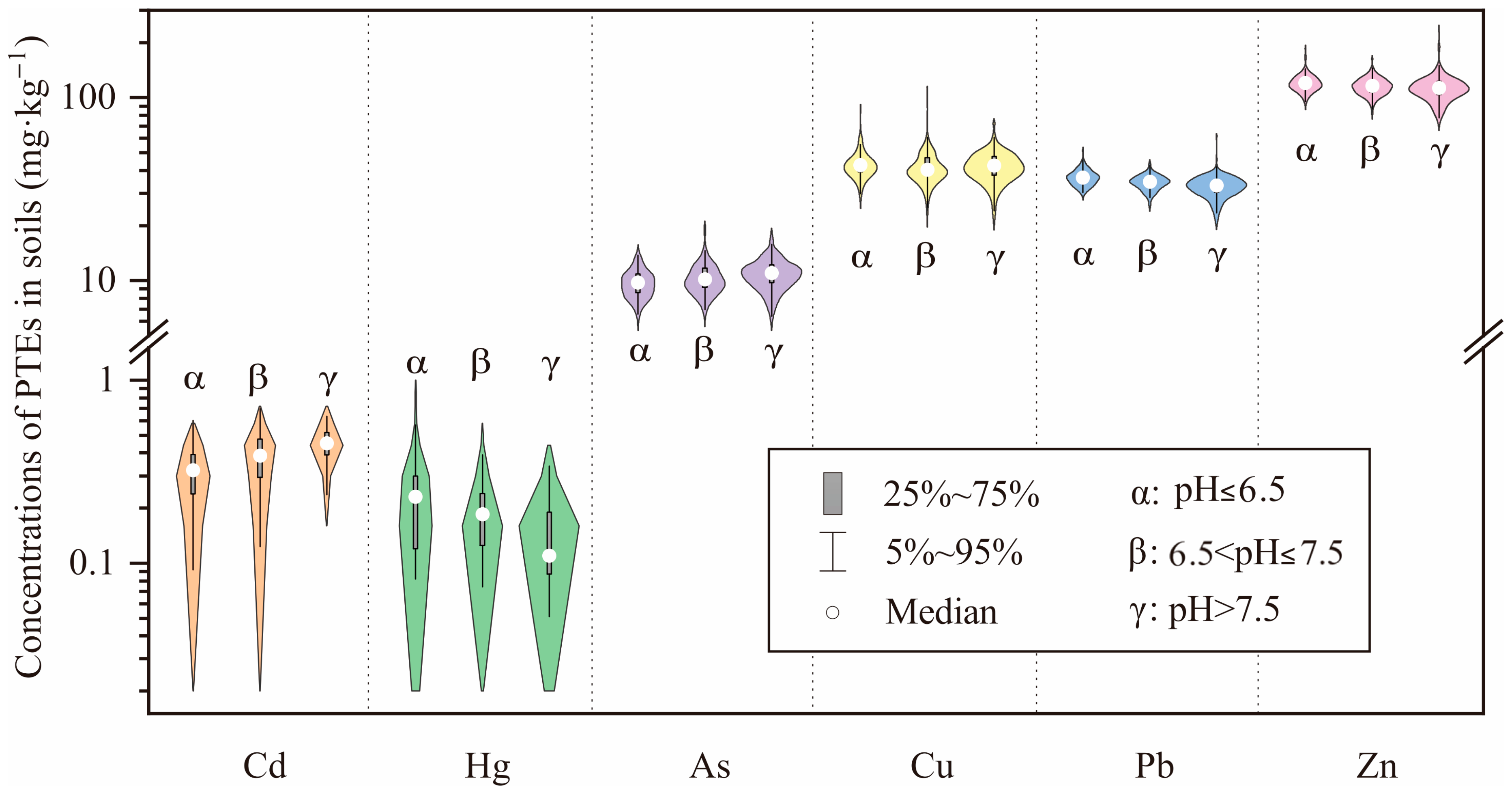
Figure 2 illustrates the concentration distributions of heavy metals (Cd, Hg, As, Cu, Pb, and Zn) in 449 surface farmland soil samples from the Zhenjiang–Yangzhou study area. Based on soil pH, all samples were categorized into three groups: α (pH ≤ 6.5), β (6.5 < pH ≤ 7.5), and γ (pH > 7.5). This classification follows the Soil Environmental Quality—Risk Control Standard for Soil Contamination on Agricultural Land (GB 15618-2018) [36], although it deviates slightly from the standard because most samples in the study area were neutral to alkaline, with no pH values below 5.5.
Cadmium (Cd) is a heavy metal posing significant health risks, as it accumulates in the human body; prolonged consumption of Cd-contaminated agricultural products may cause kidney disease, lung cancer, and prostate cancer. In the study area, soil Cd concentrations ranged from 0.02 to 2.03 mg·kg−1, with a mean of 1.09 mg·kg−1, substantially exceeding the national background value of 0.10 mg·kg−1 for Chinese soils [30]. Soil Cd concentrations increased with rising pH, likely due to enhanced adsorption of Cd onto soil particles at higher pH levels. Arsenic (As), another element with high health risks, can impair critical organs such as the nervous system and kidneys when excessive amounts are ingested through contaminated produce [5]. Similar to Cd, soil As concentrations rose with increasing pH. In contrast, Hg and Pb concentrations decreased with greater soil alkalinity (Figure 2), possibly because higher pH reduces metal adsorption to minerals and promotes desorption.
In the alkaline alluvial soils of Zhenjiang–Yangzhou, total Cd and As concentrations increased with rising pH, whereas Hg and Pb concentrations decreased. Although all are divalent cations, Cd is preferentially retained through strong complexation with organic matter and precipitation as CdCO3 or Cd-phosphate in carbonate- and phosphate-rich paddy environments [37]. In contrast, at pH > 7.5, Hg and Pb form soluble chlorocomplexes (HgCl20, PbCl+) and mobile metal–dissolved organic matter complexes, and exhibit weaker adsorption to Fe/Mn oxides compared with Cd, resulting in reduced solid-phase accumulation [38].
Based on the risk screening values (RSVs) and risk intervention values (RIVs) from the national Soil Environmental Quality Risk Control Standard for Soil Contamination on Agricultural Land, all 449 farmland soil samples were classified (Table 1). The results show that, except for Cd, all the heavy metal concentrations in nearly all samples fell within RSV limits, indicating low ecological risk for these elements in agricultural soils. However, 83.29% of samples had Cd levels between the RSV and RIV, signifying elevated ecological risk and the need for ongoing environmental monitoring of farmland soils. No heavy metal exceeded the RIV, indicating that stringent intervention or remediation measures are unnecessary.

3.2. Evaluation Using Pollution Indices

Table 2 presents the statistical characteristics and classification of the geoaccumulation index ( I g e o ) for the 449 farmland soil samples from the study area. Overall, soils were primarily contaminated with As, Cd, and Hg, with moderate-to-heavy pollution affecting 1.1%, 0.9%, and 71.5% of samples, respectively. Cu and Zn levels indicate lighter pollution, while all sites remained unpolluted with Pb.
To evaluate the potential ecological risks to ecosystems from farmland soils in the study area, the ecological risk index ( E r i ) was employed (Table 3). Based on the statistical characteristics of E r i for different heavy metals, Cd and Hg posed higher potential risks, with mean E r i values of 97.14 and 419.0, respectively, primarily due to their elevated toxicity response factors. Notably, over half the sampling sites (54.4%) exhibited E r i > 320 for Hg, indicating very high potential ecological risk. The environmental risk ranking for all heavy metals in the study area was Hg > Cd > Cu > As > Pb > Zn. For Cd, 90.5% of sites had E r i > 80, signifying considerable potential ecological risk. When combining the potential ecological risk index (PERI) across all heavy metals, 396 sites (88.2%) exceeded 320, underscoring a very high overall potential ecological risk in the region.
In summary, despite generally low soil concentrations, the high toxicity and potential health risks of As, Cd, and Hg result in elevated ecological risks. Given the region’s dense population and its role as a key production area for rice, wheat, and other crops, the environmental and health risks posed by heavy metal contamination in Zhenjiang–Yangzhou soils warrant close attention.

3.3. Probabilistic Risk Modeling

To assess the human health risks from heavy metals in the Zhenjiang–Yangzhou study area, Monte Carlo simulation was employed to evaluate probabilistic risk distributions for each element using statistical parameters derived from the concentrations of six heavy metals across all 449 soil samples. Due to the absence of comprehensive statistical distributions for oral reference doses (RfD) and cancer slope factors (SF) in official databases, and given that only point estimates or limited ranges are typically provided by the U.S. EPA Integrated Risk Information System (IRIS) and related sources, the triangular distribution was selected to characterize the uncertainty and variability of these toxicological parameters. This approach is widely accepted in probabilistic health risk assessments when empirical distribution data are lacking, as the triangular distribution requires only the minimum, most likely (central tendency), and maximum values, making it both practical and robust for representing expert-elicited or literature-derived parameter uncertainty [39,40].
RfD and SF values for each metal were adopted from U.S. EPA standards [35,41] and are presented in Table 4. Optimal probability distributions were fitted to exposure parameters for ingestion rate (IR) and body weight (BW) [17] for health risk assessment (Table 5) while single-point estimates were used for exposure frequency (EF), exposure duration (ED), and averaging time (AT) (Table 6).
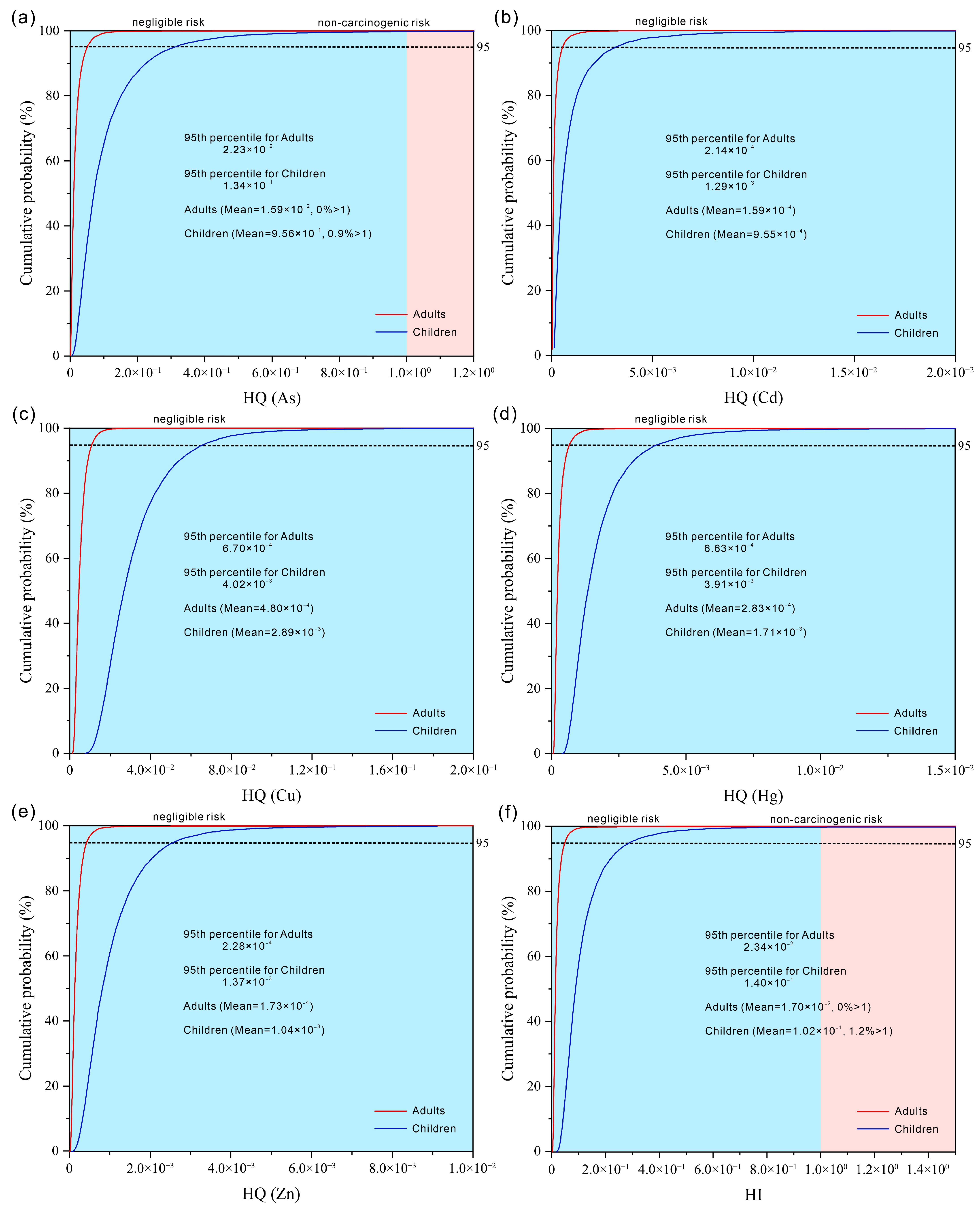
Following 10,000 iterations of Monte Carlo simulation, non-carcinogenic health risks from heavy metals in farmland soils of the Zhenjiang–Yangzhou study area were calculated and are shown in Figure 3. Mean hazard quotients (HQs) for As, Cd, Cu, Hg, Pb, and Zn in both adults and children were below the non-carcinogenic risk threshold of 1, indicating that no single metal poses significant non-carcinogenic risk. The risk rankings for both groups were As > Cu > Hg > Cd ≈ Zn (Figure 3a–e). The 95th percentile HQ values (dashed lines) were highest for As at 2.23 × 10⁻² for adults and 1.34 × 10⁻¹ for children; adult values remained below the threshold, but 0.9% of children exceeded it. Cu followed, with 95th percentile HQs of 6.70 × 10⁻⁴ (adults) and 4.02 × 10⁻³ (children). The combined hazard indices (HIs) averaged 1.70 × 10⁻² for adults and 1.02 × 10⁻¹ for children; the adult HI fell below the U.S. EPA guideline of 1, while 1.2% of children exceeded this threshold. Overall risk is low, but children are more vulnerable to soil heavy metals via oral ingestion in the Yangtze River Delta region [34].
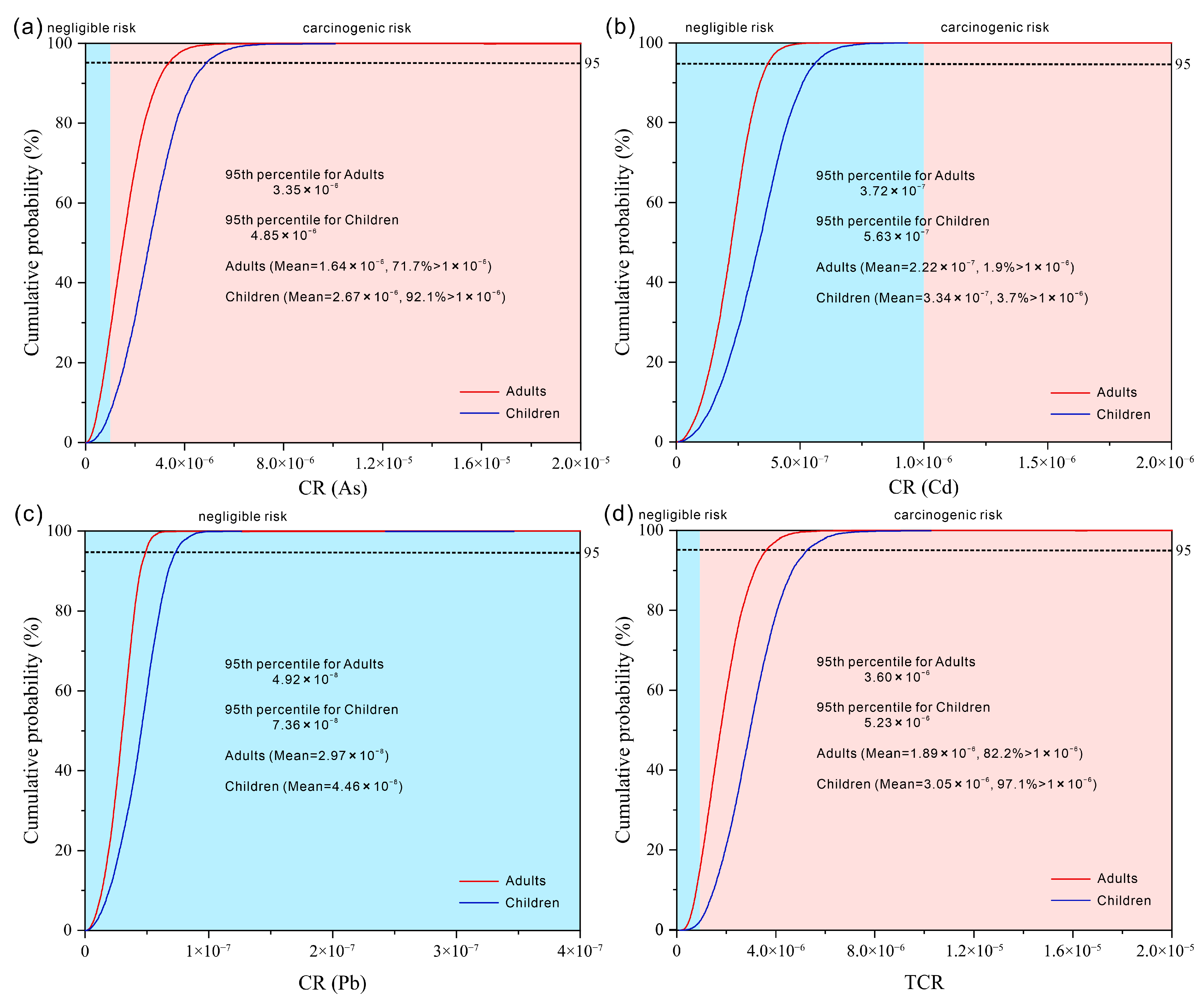
In contrast to non-carcinogenic risks, carcinogenic risks varied markedly among heavy metals. Probabilistic distributions from Monte Carlo simulations for the Zhenjiang–Yangzhou area are shown in Figure 4a–c, with total carcinogenic risk (TCR) shown in Figure 4d. Only The carcinogenic risks (CRs) exceeded the U.S. EPA acceptable threshold of 1 × 10⁻⁶, with mean values of 1.64 × 10⁻⁶ for adults and 2.67 × 10⁻⁶ for children. For adults, 71.7% of As CR values surpassed this threshold; for children, 92.1% did. Cd ranked second, with mean CRs of 2.22 × 10⁻⁷ (adults) and 3.34 × 10⁻⁷ (children), while Pb posed lower risks. Thus, As and Cd in farmland soils likely substantially contribute to carcinogenic risk to local populations in the Yangtze River Delta.
At the 95th percentile, the As CR exceeded 1 × 10⁻⁶, reaching 3.35 × 10⁻⁶ (adults) and 4.85 × 10⁻⁶ (children). The combined TCR averaged 1.89 × 10⁻⁶ for adults and 3.05 × 10⁻⁶ for children, which is 1.89 and 3.05 times the acceptable threshold, respectively. Notably, 82.2% of adult and 97.1% of child TCR values fell within the carcinogenic risk range, highlighting elevated potential health risks from heavy metal exposure in farmland soils, particularly As.
Although the probabilistic health risk assessment conducted in this study followed internationally recognized protocols and incorporated Monte Carlo simulation with 10,000 iterations to reduce uncertainty, several limitations should be acknowledged. The exposure parameters for soil ingestion rate (IR), body weight (BW), and related factors were primarily derived from the Exposure Factors Handbook of Chinese Population [17] and other national-scale investigations. These values represent generalized averages across diverse regions and age groups in China and may not fully capture local behavioral characteristics of residents in the rural communities of the Yangtze River Delta. In particular, children in agricultural areas of Zhenjiang and Yangzhou often engage in outdoor play and farming-related activities, which can result in higher hand-to-mouth contact frequency and consequently greater incidental soil ingestion than the national average. Therefore, the use of generalized ingestion rates and body weights is likely to underestimate, rather than overestimate, actual oral exposure and associated non-carcinogenic and carcinogenic risks for local children. The deterministic (single-point) risk assessment using median exposure parameters and mean heavy metal concentrations yielded a TCR of 1.12 × 10⁻⁶ for adults and 1.81 × 10⁻⁶ for children, both exceeding the USEPA threshold of 1 × 10⁻⁶, whereas the HI remained below 1 for both groups. In contrast, the Monte Carlo probabilistic approach (10,000 iterations) revealed that 82.2% of adult and 97.1% of child TCR values exceeded 1 × 10⁻⁶, with 95th-percentile TCRs reaching 3.35 × 10⁻⁶ and 4.85 × 10⁻⁶, respectively. This comparison demonstrates that deterministic estimates significantly underestimate the proportion of the population at unacceptable risk and fail to quantify upper-bound (95th percentile) risks that are critical for protective decision-making. Similar advantages of Monte Carlo simulation over deterministic methods in revealing tail risks and population variability have been consistently reported in recent heavy-metal health risk studies in China and elsewhere [42,43].

3.4. Sensitivity Analysis

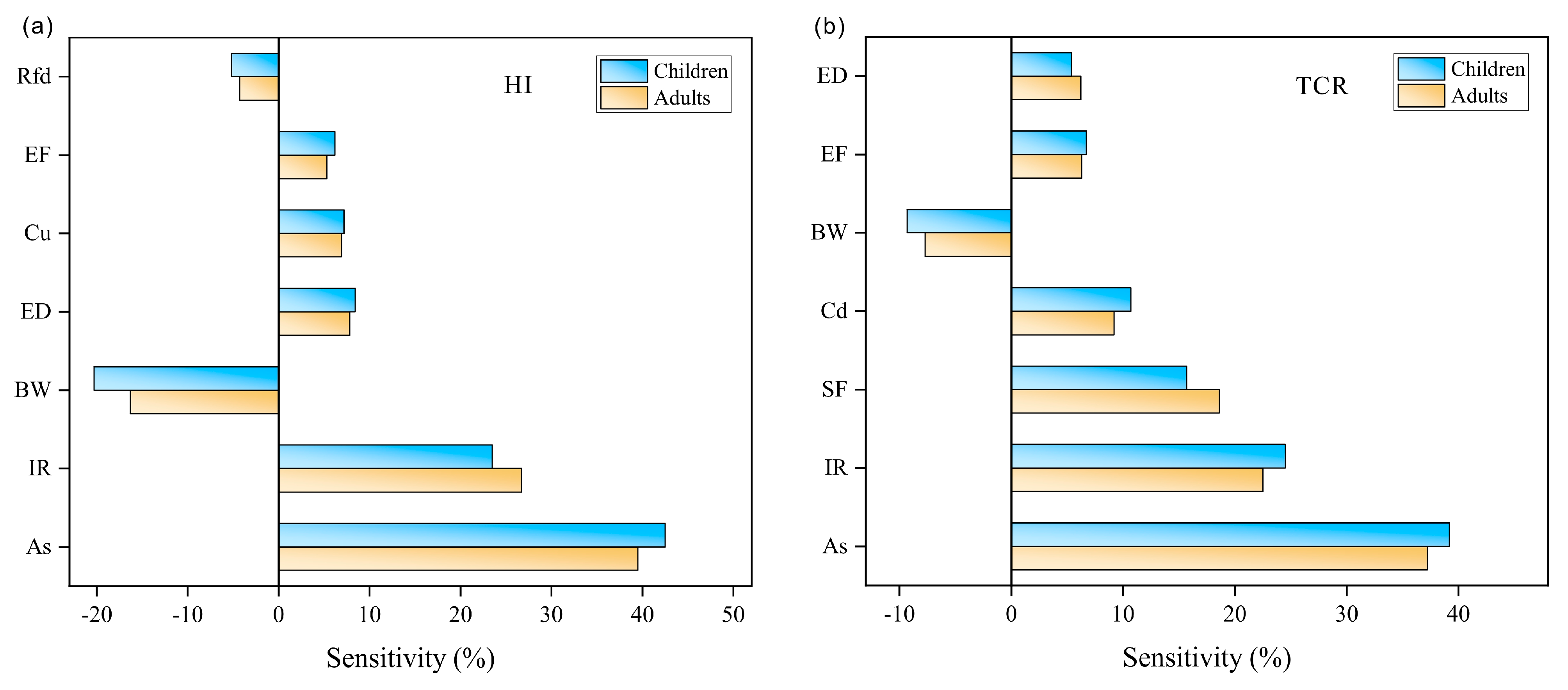
During human health risk assessment, both heavy metal concentrations in farmland soils and exposure parameters, such as population-specific factors (exposure frequency, EF; exposure duration, ED; body weight, BW) and pathway-related factors (ingestion rate, IR; average time, AT), influence probabilistic risk distributions. Sensitivity analyses were conducted using Monte Carlo simulations for adults and children to identify and quantify parameters affecting non-carcinogenic (HI) and carcinogenic (TCR) risks (Figure 5a,b).
For non-carcinogenic risk, soil As concentration contributed the most in both adults (39.5%) and children (42.5%), followed by IR and BW. Other key factors included ED, Cu concentration, EF, and RfD. Notably, BW and RfD exhibited negative sensitivity, indicating that higher BW reduces non-carcinogenic risk.
For carcinogenic risk, soil As concentration again dominated, contributing 37.3% (adults) and 39.2% (children), followed by IR and slope factor (SF). Additional influential factors were Cd concentration, BW, EF, and ED. Overall, As was the most sensitive element for non-carcinogenic risk, while As and Cd were the primary contributors to carcinogenic risk. Exposure parameters significantly modulate health risks from farmland soil exposure in the Yangtze River Delta. Reducing soil As and Cd concentrations and minimizing ingestion rates are critical for mitigating human health risks.
The health risk assessment presented above was conservatively based on total heavy metal concentrations, which represents the most widely accepted screening-level approach recommended by the U.S. EPA [15,36]. However, only the bioaccessible and bioavailable fractions can actually be absorbed by the human gastrointestinal tract and thus contribute to systemic exposure. Soil pH exerted a clear influence on total concentrations in the present study (Figure 2): Cd and As increased significantly with rising pH, whereas Hg and Pb decreased. These trends are generally consistent with known geochemical behavior in neutral-to-alkaline calcareous soils typical of the lower Yangtze floodplain: Cd forms relatively soluble species or weakly adsorbed forms under slightly alkaline conditions, leading to higher total contents and simultaneously higher bioavailability. The use of total concentrations in the current study most likely overestimates the actual health risk from Hg and Pb but is more realistic, or may even underestimate, the risk posed by Cd and to a lesser extent As.

3.5. Risk Management Implications

The elevated concentrations of Cd and particularly the high ecological and carcinogenic risks posed by As in the agricultural soils of Zhenjiang and Yangzhou highlight the need for practical, cost-effective, and farm-compatible risk management strategies. Given that the study area is dominated by paddy soils developed on calcareous alluvial deposits of the Yangtze River Delta, with naturally neutral to alkaline pH (mostly > 7.0), several in situ stabilization and remediation techniques can be readily implemented without disrupting rice production.
A key observation in this study is the counter-intuitive positive correlation between soil pH and Cd concentration (Figure 2), which contrasts with the typical decrease in Cd solubility at higher pH in non-calcareous soils. In the calcareous alluvial soils of the study area, this pattern can be largely explained by (i) enhanced formation of stable Cd–organic matter complexes, as these soils are rich in organic carbon from long-term rice cultivation and manure application, and (ii) co-precipitation of Cd with secondary carbonates and phosphates under alkaline conditions [44]. These mechanisms effectively immobilize Cd at pH > 7.5, reducing its bioavailability and plant uptake more than would be predicted from simple solubility models.
This naturally high pH therefore represents a management advantage, especially for As, whose mobility and bioavailability dramatically decrease under alkaline and oxidizing conditions due to strong adsorption onto Fe/Mn (hydr)oxides and co-precipitation with carbonate minerals. Maintaining or slightly raising soil pH above 7.5 through light lime or other alkaline amendments (e.g., steel slag, oyster shell powder) is therefore a priority strategy to suppress As release while accepting moderately elevated total Cd concentrations, provided that plant-available Cd remains low.
To further reduce Cd bioavailability, organic amendments such as farmyard manure, biochar, or composted crop residues can be applied at rates of 10–30 t ha−1. These materials increase soil organic matter content, promote Cd complexation and adsorption onto functional groups, and stimulate microbial sulfate reduction under flooded conditions, leading to CdS precipitation [45].
For As management, water regime manipulation via alternate wetting and drying (AWD) is highly effective and widely adopted in the Yangtze River Delta. By avoiding prolonged soil reduction, AWD maintains higher redox potential, promotes the formation and stability of Fe(III) (hydr)oxides, and thereby limits As mobilization and root uptake [46].
Finally, agronomic selection of low-accumulating cultivars remains one of the most immediate and low-cost interventions. Numerous rice varieties with As-excluding traits (low expression of arsenite transporters) and low-Cd-accumulating characteristics (defective OsNramp5 or OsHMA3 transporters) have been officially released in China and are already available to local farmers. Combining cultivar selection with the stabilization measures outlined above can achieve synergistic reductions in dietary exposure to both As and Cd [47].
The naturally alkaline, organic-matter-rich paddy soils of Zhenjiang and Yangzhou provide a favourable starting point for in situ immobilization strategies. Targeted application of lime/alkaline materials, organic and phosphate-based amendments, AWD water management, and deployment of low-accumulator rice cultivars offer practical, scalable pathways to significantly mitigate the health risks identified in this study while sustaining agricultural productivity in this important grain-producing region.
Further, to ensure the probabilistic carcinogenic risk findings, particularly the elevated total carcinogenic risk for children, are effectively communicated to stakeholders, a concise tiered risk communication strategy is proposed: (i) distribution of simplified, Chinese-language fact sheets containing easy-to-read color-coded village-level risk maps (green/low, yellow/monitor, red/action) to all farming households; (ii) community workshops organized in collaboration with local agricultural technology extension stations to explain results and demonstrate practical mitigation measures; (iii) a mini-program that delivers mobile-phone-based alerts and personalized soil-to-rice risk updates linked to free annual grain testing; and (iv) targeted policy briefs submitted to Zhenjiang and Yangzhou Environmental Protection Bureaus and Agriculture Bureaus that clearly summarize the Monte Carlo-derived exceedance probabilities and recommend integration of the risk maps into existing farmland quality and food-safety programs. This multi-channel approach translates complex scientific data into accessible, actionable information while building trust through familiar local institutions.

4. Conclusions

This study provides a comprehensive evaluation of heavy metal pollution and its associated ecological and human health risks in agricultural soils of the Zhenjiang–Yangzhou region, a core rice- and wheat-producing area of the Yangtze River Delta. Although the total concentrations of As and Cd remain below the current Risk Intervention Values (RIVs) of China’s Soil Environmental Quality Standard for Agricultural Land (GB 15618-2018), Cd levels markedly exceed the national background value, and the potential ecological risk index (PERI) indicates very high ecological risk (>320) at 88.2% of sites, driven primarily by Hg (mean E r i = 419.0) and Cd (mean E r i = 97.14).
Probabilistic health risk modeling via 10,000-iteration Monte Carlo simulations demonstrated that non-carcinogenic risks (HI) remained below the safety threshold (HI < 1) for both adults and children, indicating negligible concern from individual or combined metal exposure under typical conditions. However, carcinogenic risks were markedly elevated, with As exceeding the U.S. EPA acceptable threshold (1 × 10⁻⁶) in 71.7% of adults and 92.1% of children. Total carcinogenic risk (TCR) averaged 1.89 × 10⁻⁶ and 3.05 × 10⁻⁶ for adults and children, respectively—surpassing acceptable limits by 1.89- and 3.05-fold. Children were consistently more vulnerable due to higher soil ingestion rates and lower body weights.
Sensitivity analysis underscored soil As concentration as the primary driver of both non-carcinogenic (39.5–42.5%) and carcinogenic (37.3–39.2%) risks, followed by ingestion rate and, for carcinogenic effects, the slope factor. Cd also contributed meaningfully to TCR, reinforcing the need for dual focus on these elements.
Although soil metal levels do not warrant immediate remediation (no exceedance of risk intervention values), the combination of high ecological risk, significant carcinogenic potential, particularly in children, and the region’s role as a major rice and wheat production base demands proactive measures. We recommend the following: (1) immediate incorporation of probabilistic carcinogenic risk endpoints into local soil management guidelines; (2) establishment of Jiangsu Province or Yangtze River Delta regional trigger values for As and Cd based on the child-specific TCR < 1 × 10⁻⁶; (3) sustained monitoring and public soil-testing programs; (4) accelerated adoption of low-accumulator cultivars, AWD water management, and targeted immobilization amendments; and (5) integration of village-level risk maps into existing farmland quality and food-safety initiatives. This integrated framework combines pollution indexing, ecological risk assessment, and probabilistic health modeling, which offers a replicable template for risk-based soil management in rapidly developing agricultural regions worldwide.

Author Contributions

Y.W. (Yubo Wen): conceptualization, methodology, writing—original draft, writing—review and editing; Y.W. (Yuanyuan Wang): investigation, visualization, writing—review and editing; W.J.: methodology, investigation, writing—review and editing; S.W.: conceptualization, investigation, writing—review and editing; Y.G.: investigation, methodology, writing—review and editing; X.M.: conceptualization, methodology, writing—review and editing. All authors have read and agreed to the published version of the manuscript.

Funding

This research was financially supported by the National Natural Science Foundation of China (No. 42207236) and National Key Research and Development Program of China (No. 2022YFC2105401.2).

Data Availability Statement

The data presented in this study are available on request from the corresponding author.

Conflicts of Interest

The authors declare no conflict of interest.

References

  1. NBSC (National Bureau of Statistics of China). China Statistical Yearbook 2024; China Statistics Press: Beijing, China, 2024. (In Chinese)
  2. Zhao, F.-J.; Ma, Y.; Zhu, Y.-G.; Tang, Z.; McGrath, S.P. Soil contamination in China: Current status and mitigation strategies. Environ. Sci. Technol. 2015, 49, 750–759. [Google Scholar] [CrossRef]
  3. Huang, Y.; Chen, Q.; Deng, M.; Japenga, J.; Li, T.; Yang, X.; He, Z. Heavy metal pollution and health risk assessment of agricultural soils in a typical peri-urban area in southeast China. J. Environ. Manag. 2018, 207, 159–168. [Google Scholar] [CrossRef]
  4. Antoniadis, V.; Levizou, E.; Shaheen, S.M.; Ok, Y.S.; Sebastian, A.; Baum, C.; Rinklebe, J. Trace elements in the soil-plant interface: Phytoavailability, translocation, and phytoremediation—A review. Earth-Sci. Rev. 2017, 171, 621–645. [Google Scholar] [CrossRef]
  5. Dangleben, N.L.; Smith, M.T.; Skibola, C.F. Arsenic immunotoxicity, a review. Environ. Health 2013, 12, 73–88. [Google Scholar] [CrossRef]
  6. Diane, G.D.; Li, Z.; Perry, A.E.; Spencer, S.K.; Jay, G.A.; Karagas, M.R. A population-based case–control study of urinary arsenic species and squamous cell carcinoma in New Hampshire, USA. Environ. Health Perspect. 2013, 121, 1154–1160. [Google Scholar]
  7. Tóth, G.; Hermann, T.; Da Silva, M.R.; Montanarella, L. Heavy metals in agricultural soils of the European Union with implications for food safety. Environ. Int. 2016, 88, 299–309. [Google Scholar] [CrossRef]
  8. Luo, L.; Ma, Y.; Zhang, S.; Wei, D.; Zhu, Y.G. An inventory of trace element inputs to agricultural soils in China. J. Environ. Manag. 2009, 90, 2524–2530. [Google Scholar] [CrossRef]
  9. Wen, Y.; Wang, Y.; Ji, W.; Wei, N.; Liao, Q.; Huang, D.; Meng, X.; Song, Y. Influencing factors of elevated levels of potentially toxic elements in agricultural soils from typical karst regions of China. Agronomy 2023, 13, 2230. [Google Scholar] [CrossRef]
  10. Tian, H.Z.; Zhu, C.Y.; Gao, J.J.; Cheng, K.; Hao, J.M.; Wang, K.; Hua, S.B.; Wang, Y.; Zhou, J.R. Quantitative assessment of atmospheric emissions of toxic heavy metals from anthropogenic sources in China: Historical trend, spatial distribution, uncertainties, and control policies. Atmos. Chem. Phys. 2015, 12, 6505–6526. [Google Scholar] [CrossRef]
  11. Guarino, A.; Albanese, S.; Cicchella, D.; Ebrahimi, P.; Dominech, S.; Rita Pacifico, L.; Rofrano, G.; Nicodemo, F.; Pizzolante, A.; Allocca, C.; et al. Factors influencing the bioavailability of some selected elements in the agricultural soil of a geologically varied territory: The Campania region (Italy) case study. Geoderma 2022, 428, 116207. [Google Scholar] [CrossRef]
  12. Li, Z.; Ma, Z.; van der Kuijp, T.J.; Yuan, Z.; Huang, L. A review of soil heavy metal pollution from mines in China: Pollution and health risk assessment. Sci. Total Environ. 2014, 468–469, 843–853. [Google Scholar] [CrossRef]
  13. Yang, Q.; Li, Z.; Lu, X.; Duan, Q.; Huang, L.; Bi, J. A review of soil heavy metal pollution from industrial and agricultural regions in China: Pollution characteristics and risk assessment. Sci. Total Environ. 2018, 642, 690–700. [Google Scholar] [CrossRef]
  14. Yi, S.; Li, X.; Chen, W. From Total Concentration to Bioaccessible Load: Reassessing Soil Heavy Metal (loid) s Risks Through Probabilistic Exposure Approach and Toxicokinetic Modeling. J. Hazard. Mater. 2025, 495, 139062. [Google Scholar] [CrossRef] [PubMed]
  15. USEPA (United States Environmental Protection Agency). Exposure Factors Handbook (Final Edition); U.S. Environment Protection Agency: Washington, DC, USA, 2011; EPA/600/R-09/052F.
  16. Atamaleki, A.; Asadi, Z.S.; Moradinia, M. Quantification and probabilistic health risk assessment of benzene series compounds emitted from cooking process in restaurant kitchens. Build. Environ. 2024, 266, 112100. [Google Scholar] [CrossRef]
  17. Duan, X.L. Exposure Factors Handbook of Chinese Population; China Environmental Press: Beijing, China, 2013. [Google Scholar]
  18. Malakootian, M.; Mohammadi, A.; Nasiri, A.; Asadi, A.M.S.; Conti, G.O.; Faraji, M. Spatial distribution and correlations among elements in smaller than 75 μm street dust: Ecological and probabilistic health risk assessment. Environ. Geochem. Health 2021, 43, 567–583. [Google Scholar] [CrossRef]
  19. Chu, Z.; Lin, C.; Yang, K.; Cheng, H.; Gu, X.; Wang, B.; Wu, L.; Ma, J. Lability, bioaccessibility, and ecological and health risks of anthropogenic toxic heavy metals in the arid calcareous soil around a nonferrous metal smelting area. Chemosphere 2022, 307, 136200. [Google Scholar] [CrossRef]
  20. Du, B.; Zhou Jun Lu, B.; Zhang, C.; Li, D.; Zhou Jing Jiao, S.; Zhao, K.; Zhang, H. Environmental and human health risks from cadmium exposure near an active lead-zinc mine and a copper smelter, China. Sci. Total Environ. 2020, 720, 137585. [Google Scholar] [CrossRef]
  21. Yang, S.; Zhao, J.; Chang, S.X.; Collins, C.; Xu, J.; Liu, X. Status assessment and probabilistic health risk modeling of metals accumulation in agriculture soils across China: A synthesis. Environ Int. 2019, 128, 165–174. [Google Scholar] [CrossRef]
  22. IARC (International Agency for Research on Cancer). IARC Monographs on the Identification of Carcinogenic Hazards to Humans. Volume 133: Arsenic, Metals, Fibres, and Dusts; World Health Organization: Lyon, France, 2024; Available online: https://monographs.iarc.who.int/list-of-classifications/ (accessed on 14 August 2025).
  23. Khan, Z.I.; Ahmad, K.; Rehman, S.; Siddique, S.; Bashir, H.; Zafar, A.; De Mastro, G. Health risk assessment of heavy metals in wheat using different water qualities: Implication for human health. Environ. Sci. Pollut. Res. 2017, 24, 947–955. [Google Scholar] [CrossRef]
  24. Liu, Z.; Zhang, X.; Wang, Y.; Wen, Y. Distributions and influencing factors of heavy metals in Soils from Zhenjiang and Yangzhou, China. Minerals 2025, 15, 171. [Google Scholar] [CrossRef]
  25. Cheng, S.; Liao, J.; Jia, F.; Wen, Y. Characterization of Cd and Pb bioavailability in agricultural soils using DGT technique and DIFS model. Minerals 2025, 15, 386. [Google Scholar] [CrossRef]
  26. Dai, Y.; Nasir, M.; Zhang, Y.; Wu, H.; Guo, H.; Lv, J. Comparison of DGT with traditional methods for assessing cadmium bioavailability to Brassica chinensis in different soils. Sci. Rep. 2017, 7, 14206. [Google Scholar] [CrossRef]
  27. Liu, E.K.; Zhou, J.; Yang, X.; Jin, T.; Zhao, B.Q.; Li, L.L.; Wen, Y.C.; Soldatova, E.; Zamanian, K.; Gopalakrishnan, S.; et al. Long-term organic fertilizer-induced carbonate neoformation increases carbon sequestration in soil. Environ. Chem. Lett. 2023, 21, 663–671. [Google Scholar] [CrossRef]
  28. Chenery, S.R.; Izquierdo, M.; Marzouk, E.; Klinck, B.; Palumbo-Roe, B.; Tye, A.M. Soil-plant interactions and the uptake of Pb at abandoned mining sites in the Rookhope catchment of the N. Pennines, UK-a Pb isotope study. Sci. Total Environ. 2012, 433, 547–560. [Google Scholar] [CrossRef]
  29. Mazurek, R.; Kowalska, J.; Gąsiorek, M.; Zadrożny, P.; Józefowska, A.; Zaleski, T.; Kępka, W.; Tymczuk, M.; Orłowska, K. Assessment of heavy metals contamination in surface layers of Roztocze National Park Forest soils (SE Poland) by indices of pollution. Chemosphere 2016, 168, 839–850. [Google Scholar] [CrossRef]
  30. CNEMC (China National Environmental Monitoring Centre). The Background Values of Elements in Chinese Soils; China Environmental Science Press: Beijing, China, 1990. (In Chinese) [Google Scholar]
  31. Hakanson, L. An ecological risk index for aquatic pollution control. A Sedimentological Approach. Water Res. 1980, 14, 975–1001. [Google Scholar] [CrossRef]
  32. Peña-Fernández, A.; González-Muñoz, M.J.; Lobo-Bedmar, M.C. Establishing the importance of human health risk assessment for metals and metalloids in urban environments. Environ. Int. 2014, 72, 176–185. [Google Scholar] [CrossRef] [PubMed]
  33. Ramirez-Andreotta, M.D.; Brusseau, M.L.; Beamer, P.; Maier, R.M. Home gardening near a mining site in an arsenic-endemic region of Arizona: Assessing arsenic exposure dose and risk via ingestion of home garden vegetables, soils, and water. Sci. Total Environ. 2013, 454, 373–382. [Google Scholar] [CrossRef] [PubMed]
  34. Liu, X.; Song, Q.; Tang, Y.; Li, W.; Xu, J.; Wu, J.; Brookes, P.C. Human health risk assessment of heavy metals in soil-vegetable system, a multi-medium analysis. Sci. Total Environ. 2013, 463, 530–540. [Google Scholar] [CrossRef]
  35. USEPA (United States Environmental Protection Agency). Regional Screening Levels (RSLs)—Generic Tables. 2019. Available online: https://www.epa.gov/risk/regional-screening-levels-rsls-generic-tables (accessed on 26 June 2025).
  36. GB-15618-2018; Soil Environmental Quality Risk Control Standard for Soil Contamination of Agricultural Land. MEE (Ministry of Ecology and Environment of China): Beijing, China, 2018.
  37. Deng, Y.; Ren, C.; Chen, N.; Huang, Y.; Zhu, G.; Zhang, X.; Li, Y. Effects of pH and phosphate on cadmium adsorption onto goethite and a paddy soil: Experiments and NOM-CD model. J. Soil Sediment 2023, 23, 2072–2082. [Google Scholar] [CrossRef]
  38. Porter, S.K.; Scheckel, K.G.; Impellitteri, C.A.; Ryan, J.A. Toxic metals in the environment: Thermodynamic considerations for possible immobilization strategies for Pb, Cd, As, and Hg. Crit. Rev. Environ. Sci. Technol. 2004, 34, 495–604. [Google Scholar] [CrossRef]
  39. Zhou, J.; You, Y.; Bai, Z.; Hu, Y.; Zhang, J.; Zhang, N. Health risk assessment of personal inhalation exposure to volatile organic compounds in Tianjin, China. Sci. Total Environ. 2011, 409, 452–459. [Google Scholar] [CrossRef]
  40. Orosun, M.M.; Nwabachili, S.; Alshehri, R.F.; Omeje, M.; Alshdoukhi, I.F.; Okoro, H.K.; Ife-Adediran, O. Potentially toxic metals in irrigation water, soil, and vegetables and their health risks using Monte Carlo models. Sci. Rep. 2023, 13, 21220. [Google Scholar] [CrossRef]
  41. IRIS (Integrated Risk Information System). IRIS Assessments. 2024. Available online: https://cfpub.epa.gov/ncea/iris2/atoz.cfm (accessed on 14 August 2025).
  42. Zhang, T.; Song, B.; Han, G.; Zhao, H.; Hu, Q.; Zhao, Y.; Liu, H. Effects of coastal wetland reclamation on soil organic carbon, total nitrogen, and total phosphorus in China: A meta-analysis. Land Degrad. Dev. 2023, 34, 3340–3349. [Google Scholar] [CrossRef]
  43. Lallawmzuali, G.; Devi, A.S.; Thanhmingliana Hriatsaka, V.; Singh, A.P.; Lalhriatpuia, C. Assessment of the heavy metal contaminations of roadside soil in Aizawl, Mizoram (India): An in-depth analysis utilising advanced scientific methodologies. Asian J. Water Environ. Pollut. 2024, 21, 37–47. [Google Scholar] [CrossRef]
  44. Augustin, F.; Houle, D.; Gagnon, C.; Courchesne, F. Long-term base cation weathering rates in forested catchments of the Canadian Shield. Geoderma 2015, 247, 12–23. [Google Scholar] [CrossRef]
  45. Yu, X.; Wang, X.; Sun, M.; Liu, H.; Liu, D.; Dai, J. Cadmium immobilization in soil using phosphate modified biochar derived from wheat straw. Sci. Total Environ. 2024, 926, 171614. [Google Scholar] [CrossRef] [PubMed]
  46. Majumdar, A.; Upadhyay, M.K.; Giri, B.; Yadav, P.; Moulick, D.; Sarkar, S.; Roychowdhury, T. Sustainable water management in rice cultivation reduces arsenic contamination, increases productivity, microbial molecular response, and profitability. J. Hazard. Mater. 2024, 466, 133610. [Google Scholar] [CrossRef]
  47. Zhao, F.J.; Wang, P. Arsenic and cadmium accumulation in rice and mitigation strategies. Plant Soil 2020, 446, 1–21. [Google Scholar] [CrossRef]
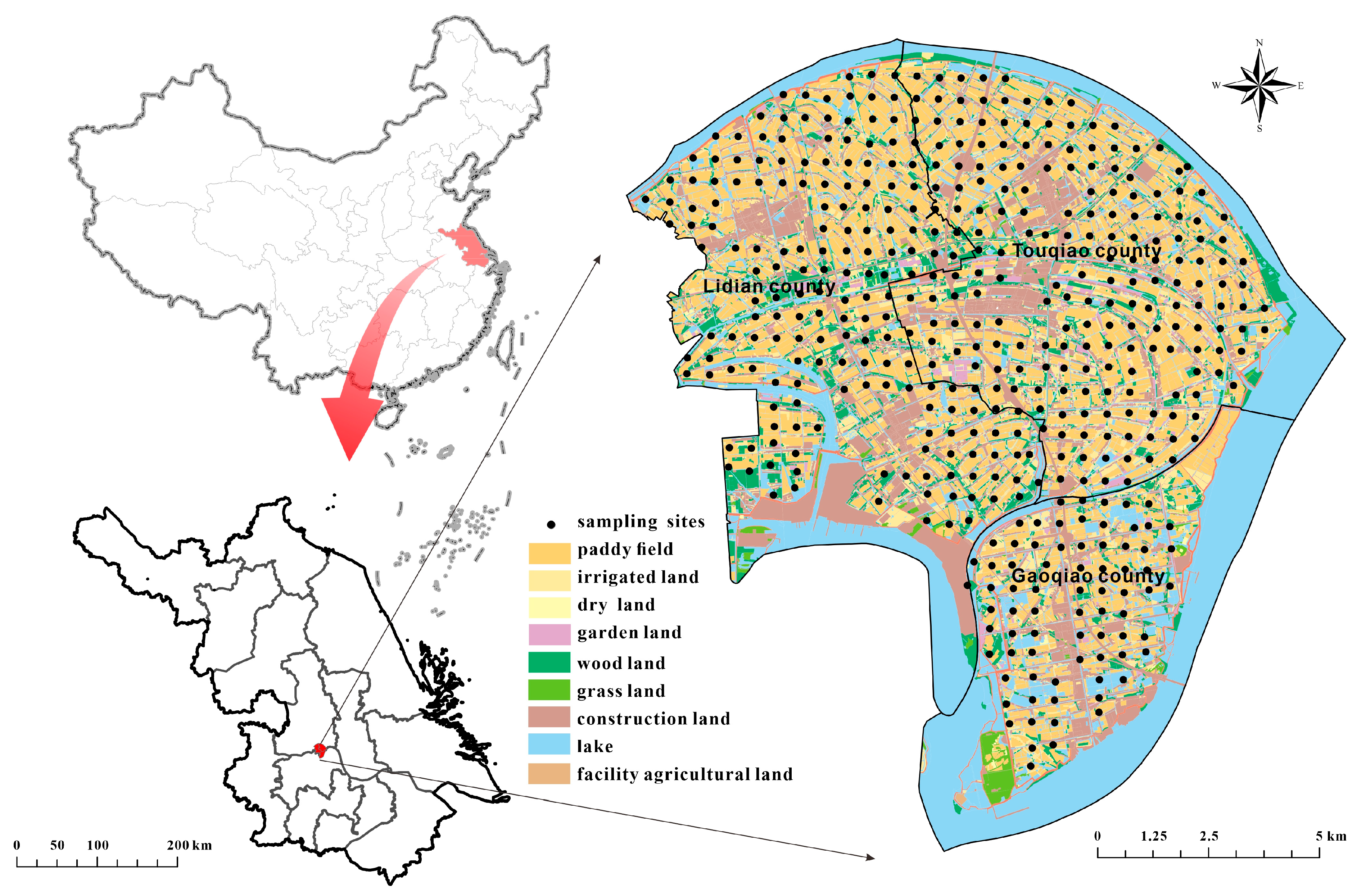
Figure 1. Soil sampling locations in Zhenjiang and Yangzhou, Jiangsu Province, China.
Agriculture 15 02552 g001
Figure 2. pH-dependent concentration distributions of heavy metals in soils. α, β, and γ represent soils with pH ≤ 6.5, 6.5 < pH ≤ 7.5, and pH > 7.5, respectively.
Agriculture 15 02552 g002
Figure 3. Cumulative probabilities of HQs for (a) As, (b) Cd, (c) Cu, (d) Hg, (e) Zn, and (f) HI. Values below and surpassing 1 represent negligible and non-carcinogenic risks for heavy metals, respectively.
Agriculture 15 02552 g003
Figure 4. Cumulative probabilities of CRs for (a) As, (b) Cd, (c) Pb, and (d) total cancer risk (TCR). Values below and surpassing 1 × 10⁻⁶ represent negligible and carcinogenic risks for heavy metals, respectively.
Agriculture 15 02552 g004
Figure 5. Sensitivity analysis of contributions of various exposure parameters to (a) HI and (b) TCR.
Agriculture 15 02552 g005
Table 1. Number and percentage of heavy metal exceedance sites based on Risk Screening Values (RSVs) and Risk Intervening Values (RIVs) according to the national soil environmental quality standards.
AsCdCuHgPbZn
<RSVnumber44075447439441448
percentage97.99%16.71%99.54%97.99%98.22%99.78%
RSV~RIVnumber937421081
percentage2.01%83.29%0.46%2.23%1.78%0.22
>RIVnumber000000
percentage0.00%0.00%0.00%0.00%0.00%0.00%
Table 2. Descriptive statistics of the pollution levels of heavy metals in soils using the geo-accumulation index ( I g e o ) (n = 449).
AsCdCuHgPbZn
10th−0.030.810.301.62−0.090.17
25th0.160.960.421.870.030.25
Mean0.321.090.572.580.120.36
Median0.321.130.552.570.130.37
75th0.491.200.733.150.230.47
90th0.661.350.883.610.300.55
Class 0 (%)0.000.001.100.0021.403.60
Class 1 (%)92.1026.9094.900.2078.6095.30
Class 2 (%)6.8072.204.0028.300.001.10
Class 3 (%)1.100.900.0037.900.000.00
Class 4 (%)0.000.000.0030.100.000.00
Class 5 (%)0.000.000.003.100.000.00
Class 6 (%)0.000.000.000.400.000.00
Table 3. Descriptive statistics of the pollution levels of heavy metals in soils using the ecological risk index ( E r i ), and potential ecological risk (PERI) (n = 449).
AsCdCuHgPbZnPERI
10th7.3779.099.21184.47.051.68312.5
25th8.2787.2710.04220.07.641.78359.0
Mean9.5497.1411.32419.08.201.95547.2
Median9.3898.1810.97355.68.211.93484.2
75th10.54103.6412.47533.38.792.08663.0
90th11.88114.5513.76733.39.242.20870.3
Table 4. The RfD and SF values of heavy metals adopted in probabilistic assessment.
Non-Carcinogenic Heavy MetalProbabilistic Distribution of RfD (mg kg−1 d−1)ParametersCarcinogenic Heavy MetalProbabilistic Distribution of SF (mg kg−1 Day−1)−1ParametersReferences
AsTriangularTRI (0.0003, 0.0003, 0.0008)AsTriangularTRI (0, 1.5, 1.5)[35,41]
CdTriangularTRI (0.001, 0.001, 0.04)CdTriangularTRI (0, 6.1, 6.1)[35,41]
CuTriangularTRI (0.04, 0.04, 0.1)CuN/AN/A[35,41]
HgTriangularTRI (0.0003, 0.0003, 0.001)HgN/AN/A[35,41]
PbN/AN/APbTriangularTRI (0, 0.0085, 0.0085)[35,41]
ZnTriangularTRI (0.3, 0.3, 0.91)ZnN/AN/A[35,41]
TRI, Triangular distribution; N/A, data not available.
Table 5. Variable exposure factors in the health risk assessment.
Exposure FactorSymbol (Unit)Probabilistic DistributionParameter: UN (Minimum, Maximum); LN (Mean, SD); TRI (Minimum, Likeliest, Maximum)Reference
Body weightBW (kg)Uniform
(adults)
UN (55.683, 68.6)[17]
Lognormal (children)LN (37.0, 2.98)
Oral ingestion rate of soilsIRO
(mg day−1)
Triangular
(adults)
TRI (4, 30, 52)[15]
Triangular
(children)
TRI (66, 103, 161)
UN, Uniform distribution; LN, Lognormal distribution; TRI, Triangular distribution; SD, Standard Deviation.
Table 6. Exposure time parameters for health risk assessment of soil contamination.
ParameterDescriptionUnitValueReference
EFExposure frequencyday year−1350[15]
EDExposure durationyear24 for adults and 6 for children[15]
ATAverage timedayED × 365 for non-carcinogenic heavy metals and 70 × 365 for carcinogenic heavy metals[15]
Disclaimer/Publisher’s Note: The statements, opinions and data contained in all publications are solely those of the individual author(s) and contributor(s) and not of MDPI and/or the editor(s). MDPI and/or the editor(s) disclaim responsibility for any injury to people or property resulting from any ideas, methods, instructions or products referred to in the content.