Article

Coupling and Coordination Characteristics of Agricultural Water Resources and Economic Development in the Qilian Mountains Region

1
Northwest Institute of Eco-Environment and Resources, Chinese Academy of Sciences, Lanzhou 730030, China
2
College of Geography and Environment Science, Northwest Normal University, Lanzhou 730070, China
3
Water Affairs Bureau of Shandan County, Zhangye 734100, China
*
Author to whom correspondence should be addressed.
Agriculture 2025, 15(24), 2551; https://doi.org/10.3390/agriculture15242551
Submission received: 29 October 2025 / Revised: 6 December 2025 / Accepted: 8 December 2025 / Published: 10 December 2025
(This article belongs to the Section Agricultural Water Management)

Abstract

The coordination of agricultural water use efficiency (AWUE) and the level of agricultural economic development (AEDL) is crucial for promoting high-quality development in the Qilian Mountains region. This study was aimed at examining the synergistic development trends and spatial distribution characteristics of AWUE and AEDL. This study focused on 11 cities (autonomous prefectures) within and adjacent to the Qilian Mountains region, employing the Super-SBM model and a comprehensive evaluation model to measure AWUE and AEDL. The coupling coordination degree model and coefficient of variation method were used to analyze the level of development coordination as well as spatial differences. The findings indicate that (1) from 2010 to 2022, both AWUE and the AEDL in these areas showed a significant upward trend, with AWUE increasing from 0.379 to 0.924 and AEDL rising from 0.284 to 0.437. The spatial analysis reveals a pattern of high values in the northeast and low values in other regions; (2) the coupling degree (CD) between AWUE and AEDL is in the primary coupling stage (0.456–0.474), with the coupling coordination degree (CCD) transitioning from low (0.401) to high coordination (0.554) between 2010 and 2022. The spatial distribution characteristics of the CD and CCD are high in the middle section and low in the eastern and western sections. Furthermore, the high coordination area exhibits a spreading evolutionary trend, from Zhangye City to Hexi Corridor regions, from the middle to the east and west sections, and from the north to the south section. These findings suggest that the coupling and coordination between AWUE and AEDL in the Qilian Mountains region have been improved, reaching a higher level. Combined with targeted suggestions, the findings offer valuable insights for designing targeted policies and water-saving measures to advance sustainable agricultural development in arid areas.

1. Introduction

Water is a crucial resource for agricultural production, with approximately 70% of global freshwater utilized for this purpose [1]. In 2023, China’s agricultural water consumption constituted 62.18% of the national total societal water usage. The efficient use of this resource is intrinsically linked to economic development and forms the cornerstone of a water-secure society, particularly in arid regions like northwest China where water scarcity poses significant challenges to food security and agricultural sustainability [2]. Considering China’s proposed national strategy for ecological protection and high-quality development in the Yellow River Basin, there has been a shift from the previous extensive water-use model to a ‘demand-side management’ approach. The structure and scale of economic and social development should be judiciously determined in accordance with exploitable and utilizable water resources, ensuring an alignment between economic and social development and the sustainable use of these resources [3]. This transition makes the coordination between agricultural water use efficiency and economic development particularly critical in ecologically fragile regions like the Qilian Mountains [4].
Efficient utilization of water resources can foster economic growth and alleviate the limitations of agricultural development. Conversely, economic growth can influence the efficiency of water resource use and promote sustainable agricultural development [4,5]. Studies in the arid regions of China and sub-Saharan Africa have shown that economic development is heavily reliant on water resources, particularly in countries facing acute water scarcity, such as Africa [6,7]. Researchers often employ indicators such as agricultural scale, structure, input, and efficiency to assess agricultural water-use efficiency and its relationships with agricultural economic development [8,9,10,11]. Previous studies have established relationships between water resource utilization and economic development using various methodologies [12], including entropy weight methods [13], gray correlation analysis [14], decoupling analysis [6], multi-regional computable general equilibrium models [15], and coupling coordination degree models [16] at national and regional spatial scales [4,17]. However, quantification of water resource utilization efficiency remains complex within ecologically diverse regions such as the Qilian Mountains, where fragile environments are further affected by climate change and human activity. Previous studies have not sufficiently addressed the spatial–temporal evolution of the coupling coordination relationship between AWUE and AEDL in arid mountain environments, nor have they provided differentiated policy recommendations based on distinct regional development pathways.
This study addresses these gaps by: (1) focusing on 11 cities and autonomous prefectures within and around the ecologically significant Qilian Mountains, utilizing panel data from 2010 to 2022. The study provides a comprehensive analysis of the coupling coordination relationship between AWUE and AEDL; (2) applying multiple analytical methods (Super-SBM, comprehensive evaluation, coupling coordination degree, coefficient of variation, and GM(1,1) models) to capture temporal trends and spatial patterns; and (3) offering region-specific recommendations based on distinct CCD trends, contributing to sustainable agricultural development in arid regions.

2. Materials and Methods

2.1. Study Area

The Qilian Mountains (36–40° N, 93–104° E) are located in the central region of northwest China. These mountains, which lie far inland and distant from the sea, straddle the intersection of the Qinghai–Tibet Plateau, Inner Mongolia Plateau, and Loess Plateau [18]. The topography of the Qilian Mountains is characterized by higher elevations in the west that gradually decrease towards the east, following a northwest-to-southeast trend [19]. The mountain range is home to 2685 glaciers that collectively cover an area of 1537 km2. These glaciers are formed from accumulated mountain snow, making the Qilian Mountains a significant source of water for the Hexi inland rivers, the Qinghai inland water system, and the upper reaches of the Yellow River [18,20]. The climate is characteristic of a continental alpine and subhumid mountain environment, with an average annual temperature below 4 °C. The region experiences approximately 1744 h of sunshine annually, and the average annual precipitation ranges from 300 to 900 mm. This precipitation exhibits a distinct spatial distribution and is primarily concentrated from June to September [18,21]. Precipitation decreases significantly from east to west, with the eastern region experiencing higher precipitation and temperatures than the western region.
The study area encompasses most of the administrative regions within the Qilian Mountains in Gansu and Qinghai Provinces. These include the Haixi Mongolian Tibetan Autonomous Prefecture (Haixi Autonomous Prefecture), Haibei Tibetan Autonomous Prefecture (Haibei Prefecture), Hainan Tibetan Autonomous Prefecture (Hainan Autonomous Prefecture), Xining, Lanzhou, Baiyin, Wuwei, Jinchang, Zhangye, and Jiuquan. The study area is 4.14 × 10⁵ km2 with altitudes varying between approximately 1100 and 5800 m above sea level [18]. The terrain of this region is complex and hosts a diverse array of vegetation types including grasslands and meadows, broad-leaved forests, coniferous forests, deserts, alpine vegetation, and cultivated vegetation. The dominant plant species in the area are the Qinghai spruce (Picea crassifolia), Qilian cedar (Pinus tabuliformis), Potentilla fruticosa, and Rhododendron simsii [20].

2.2. Research Method

2.2.1. Super-SBM Model [22]

The Super-SBM model was employed to assess the AWUE in 11 cities within and around the Qilian Mountains from 2010 to 2022. This model effectively handles multiple inputs and outputs, distinguishes between efficient and inefficient decision-making units, and provides a nuanced evaluation of relative efficiency. The detailed construction of the model is as follows:
ρ = m i n 1 1 a i = 1 a s i x i 0 1 + 1 b j = 1 b s β + / y β 0 +
s . t . x i 0 = j = 1 n x i j γ j + s i , i = 1 , , a y β 0 = j = 1 n y i j γ j s β , β = 1 , , b γ , s + , s 0
where ρ is the efficiency value; a and b refer to the types of input factors and output factors, respectively; s+ refers to the relaxation variables of output and input, respectively; s refers to the relaxation variables of output and input, respectively; xi0 is the input vector of each city; yβ0 is the output vector of each city; and γ is the weight vector of each decision unit.

2.2.2. Comprehensive Evaluation Model [17]

The entropy weight method, which assigns weights based on valuable information provided by the data, effectively circumvents the subjectivity associated with manual weighting. Accordingly, this study first standardized the indicators before employing the entropy weight method to determine their respective weights. Finally, a comprehensive evaluation model was applied to assess the AEDL, as follows:
(1)
Data standardization processing:
Y i j = a + ( b a ) x i j m i n ( x j ) m a x ( x j ) m i n ( x j )
where Y i j represents the data after non-dimensionalization; x i j represents the original data; a and b are the lower limit (0) and upper limit (1) of the normalized range, respectively; and m i n ( x i j ) and m a x ( x i j ) are the minimum and maximum values of the factor quantization, respectively. Positive indicators are processed as shown in Equation (2), and for the inverse index, it is necessary to subtract the normalized value from the normalized upper limit.
(2)
Index weight calculation:
W j = g j j = 1 m g j
g j = 1 E j
E j = 1 l n ( n ) i = 1 n P i j l n ( P i j )
P i j = Y i j i = 1 n Y i j
where Pij is the proportion of the standardized value of the city-state index in the index; gj is the information entropy redundancy, which is used to evaluate the redundancy degree and repeated information process among indicators; Ej is the information entropy value of the j index, reflecting the information purity and difference of each index; n is the number of Pij; m is the number of gj; and Wj is the weight of the i index.
(3)
Construction of the comprehensive evaluation model:
Z = j = 1 n W j Y i j
where Z represents the comprehensive evaluation index of the ith evaluation object, Wj represents the weight of the JTH indicator, and Y i j is a standardized indicator data value.

2.2.3. CCD Model [5,17]

The degree of coupling measures the extent to which the systems interact with each other or within themselves. Specifically, the CD model was used to examine the interaction between AWUE and AEDL in the study region.
C = U 1 × U 2 ( U 1 + U 2 ) 2 1 K
where C is the CD with the range [0,1]; U1 is AWUE; U2 is the AEDL; and K is the adjustment coefficient, where K = 2. When C = 0, no correlation exists between the two systems.
Although CD reflects the strength of the coupling effect, it does not reflect the level of coordinated development. Therefore, the CCD model was used to analyze the overall degree of coordination between AWUE and AEDL, as follows:
D = C × T
T = 1 2 U 1 + 1 2 U 2

2.2.4. Coefficient of Variation Method [17]

The coefficient of variation method was applied to assess spatial disparities in CD and CCD, as it standardizes the standard deviation by the mean, allowing for comparison of variability across different datasets. The CCD provides an overview of the coordination between AWUE and AEDL across 11 cities in the Qilian Mountains and the surrounding regions; however, this does not account for inter-city variations. To investigate these spatial disparities, we employed the coefficient of variation method to assess the variance in the CD and CCD values from 2010 to 2022. This coefficient measures the uniformity, stability, and consistency of the datasets. A higher value suggests pronounced spatial differences in CD and CCD among cities. The coefficient of variation method was applied based on the standard deviation, as follows:
C v = σ μ
where Cv is the coefficient of variation, σ is the standard deviation, and μ is the mean.
The CD and CCD were subsequently classified based on their calculated values, as shown in Table 1.

2.2.5. GM(1,1) Model [23]

Gray system theory, grounded in the principles of relational space and smooth discrete functions, is used to define gray derivatives and differential equations. This theory employs these sequences to construct dynamic models in the form of differential equations that exist in a spectrum between black and white models. Gray system theory is particularly useful for the predictive analysis of data that are limited in quantity, incomplete in sequence, and low in reliability; it is primarily employed for short-term and medium-term forecasting [23,24]. The model applied was constructed using the following steps:
(1)
Establish the original system sequence:
X(0) = [x(0)(1), x(0)(2), …, x(0)n]
(2)
Accumulate the original sequence to generate the following new sequence:
X(1) = [x(1)(1), x(1)(2), …, x(1)n]
x ( 1 ) ( k ) = i = 1 k x ( 0 ) ( i ) , k = 1 , 2 , , n
(3)
Generate the mean sequence:
Z(1) = [z(1)(2), z(1)(3), …, z(1)n]
Z ( 1 ) ( k ) = 1 2 ( x ( 1 ) ( k ) + x 1 ( k 1 ) ) , k = 2 , 3 , , n
(4)
Determine the mean form of the GM(1,1) model as follows:
x0(k) + az1(k) = a
d x ( 1 ) d t + a x ( 1 ) = b
(5)
Calculate the model parameters as follows:
â = [a,b]T = (BT × B)−1 × BTY
B = z ( 0 ) ( 2 ) 1 z ( 0 ) ( 3 ) 1 z ( 0 ) ( n ) 1 ,   Y = x ( 0 ) ( 2 ) x ( 0 ) ( 3 ) x ( 0 ) ( n )
(6)
Establish the first-order cumulative time-response sequence prediction, as follows:
x(1)(t) = (x(1) − b/a)exp(−a(t − 1))+b/a
x ^ ( 1 ) ( k + 1 ) = ( x ( 0 ) ( 1 ) b / a ) exp ( a × k ) + b / a ,   k = 1 , 2 , , n
(7)
Calculate the predicted value, as follows:
x ^ ( 0 ) ( k + 1 ) = x ^ ( 1 ) ( k + 1 ) x ^ ( 1 ) ( k ) = ( 1 e a ) × ( x ( 0 ) ( 1 ) b / a ) × exp ( a × k ) ,   k = 1 , 2 , , n

2.3. Index System Construction

Panel data from 11 municipal administrative regions were adopted as decision-making units, spanning 2010 to 2022. As detailed in Table 2, land resource input was represented by the area of cropland sowing; agricultural water resource input was denoted by the volume of irrigation water used for agriculture; labor input was indicated by the number of individuals employed in the primary industry; technological progress was measured by the total power of agricultural machinery; capital input was reflected by the quantity of chemical fertilizers used; and the economic benefit derived from agricultural production factors was represented by the total value of agricultural output and grain yield. The data were primarily derived from the Gansu Development Yearbook, the Qinghai Statistical Yearbook, the Gansu Water Resources Bulletin, the Qinghai Water Resources Bulletin, and various city and state statistical yearbooks. Missing data were estimated using a time-series trend extrapolation method, which involved linear interpolation or extrapolation based on historical data trends to ensure data continuity and completeness.
Referring to previous research findings [17], a comprehensive evaluation index system for the AEDL in the Qilian Mountains region was constructed. This included primary and secondary indicators across the following five dimensions: scale of agricultural development; structure of agricultural development; investment in agricultural development; objectives of the agricultural economy; and quality of life for farmers. We selected the per capita total agricultural output value to represent the scale of agricultural development; the proportion of primary industry in the GDP to represent the structure of agricultural development; the proportion of fixed asset investment in the primary industry; and fiscal expenditure on agriculture to indicate the intensity of investment in the AEDL. The goal of agricultural development is to increase farmers’ income; therefore, we chose the disposable income of rural residents to represent the economic goal of agriculture. The Engel coefficient is an important indicator of living standards and, therefore, we selected the rural Engel coefficient to characterize the quality of life of farmers. The specific selections of the indicators and their weights are presented in Table 3. The data were primarily derived from the Gansu Development Yearbook, the Qinghai Statistical Yearbook, city and state statistical yearbooks, and the National Economic and Social Development Statistical Bulletin. Agricultural fiscal expenditure data were sourced from the statistical bureaus of each city and state. We estimated missing data using a time-series trend extrapolation method.

3. Results

3.1. AWUE

The calculated mean AWUE values for the study area for between 2010 and 2022 are shown in Figure 1.
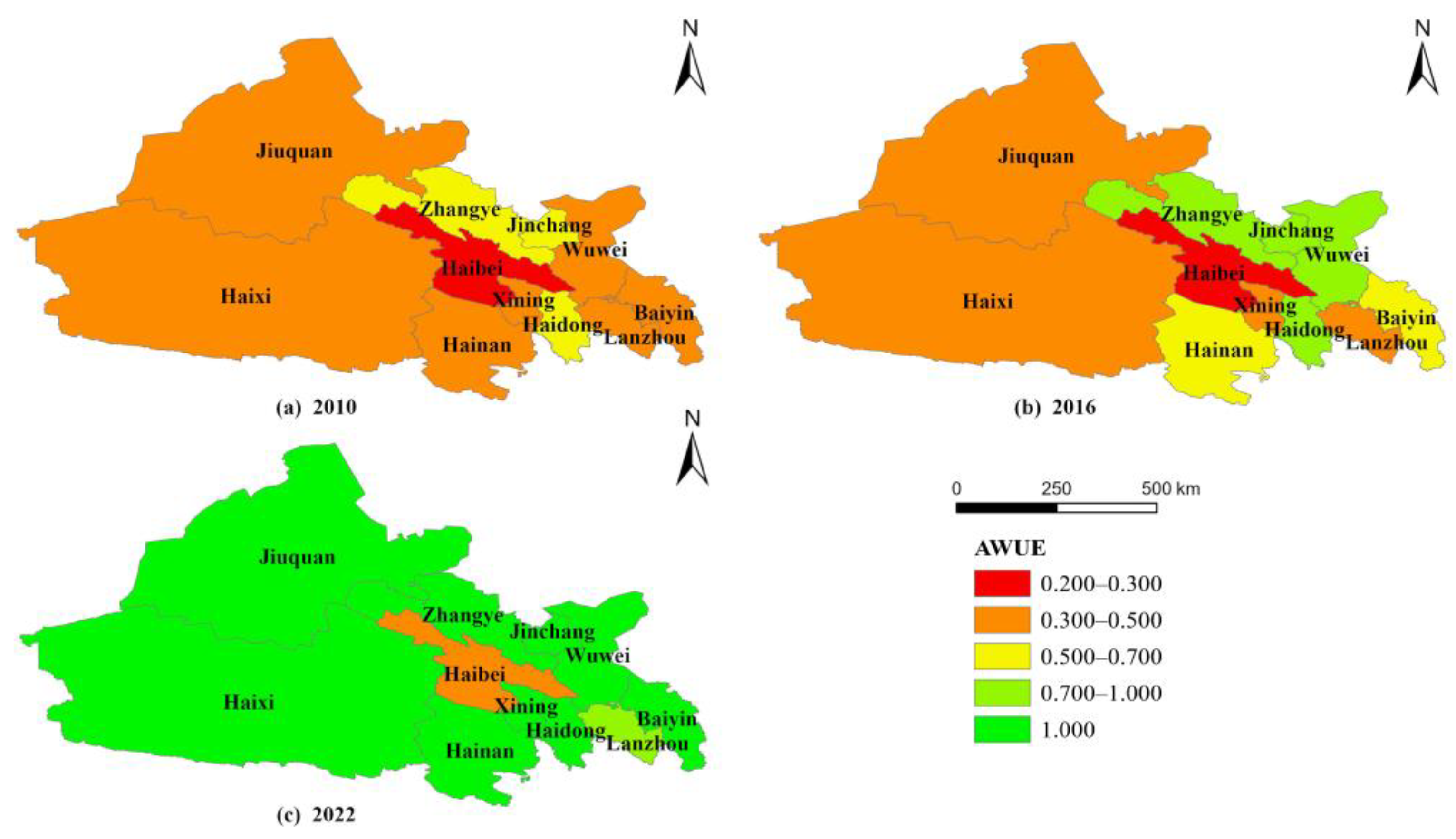
The AWUE showed an overall upward trend between 2010 and 2022, from 0.423 to 0.932, signifying a 120.05% increase. In more detail, from 2010 to 2016, the AWUE gradually increased from 0.423 to 0.558, reflecting a growth rate of 32.01%. From 2016 to 2022, this further increased to 0.932, with a growth rate of 67.15%. In 2022, excluding Haibei Prefecture and Lanzhou, the AWUE of the remaining nine cities reached a benchmark indicative of high efficiency (Figure 2). This implies that, concomitant with economic and social development, agricultural water-saving technology has consistently increased, resulting in increased AWUE. However, in 2022, Haibei Prefecture and Lanzhou fell short of this benchmark, suggesting the potential for further improvements in AWUE.
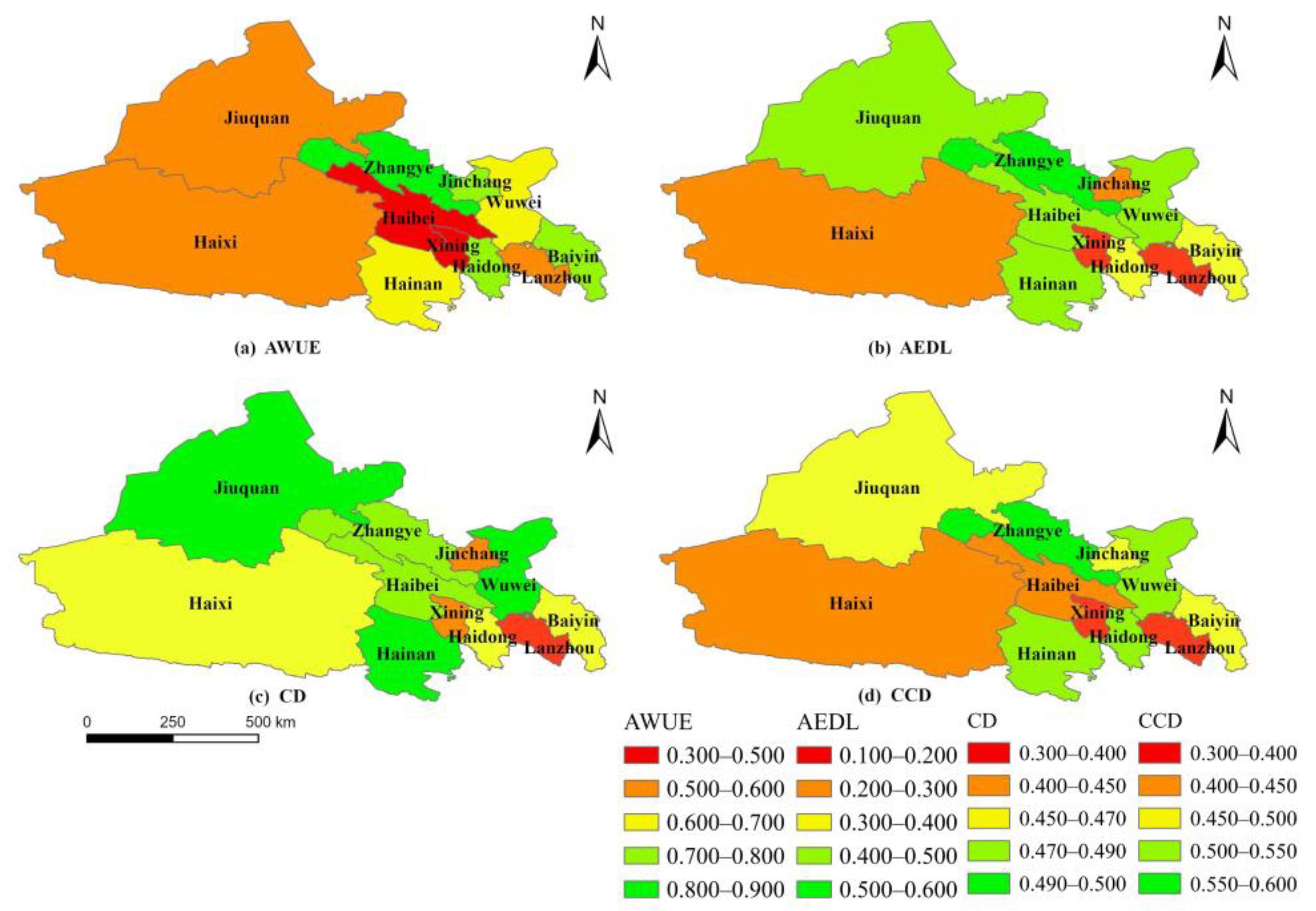
Regionally, there is significant room for improvement in the AWUE of the 11 studied cities (Figure 3a), with notable differences among these cities. The top three cities are Zhangye, Jinchang, and Haidong, with average values of 0.812, 0.800, and 0.728, respectively. The high AWUE in Zhangye and Jinchang is likely due to advanced agricultural practices and efficient water management. The AWUEs in Haibei, Xining, and Haixi prefectures are, in comparison, relatively low, with average values of 0.323, 0.476, and 0.522, respectively. The substantial difference between highest- and lowest-performing regions (0.490) highlights the unequal distribution of technological adoption and resource management capabilities. All 11 cities have experienced varying degrees of growth in annual AWUE, with some substantial growth rates that exceed an annual growth value of 0.600, namely Xining (0.671), Jiuquan (0.635), Haixi Prefecture (0.626), and Wuwei (0.616).

3.2. AEDL

The mean AEDL values for the study cities showed a continuous upward trend between 2010 and 2022 (Figure 1), increasing from 0.284 to 0.437, which is a 0.54-fold increase. Despite this progress, the overall levels remained relatively low, indicating significant potential for improvement. Between 2010 and 2016, AEDL increased from 0.284 to 0.365, with a growth rate of 28.56%, and then increased to peak at 0.437 in 2022 with a growth rate of 19.76%. This indicates that the agricultural economies of the 11 cities have continuously developed, with a sufficient supply of agricultural products.
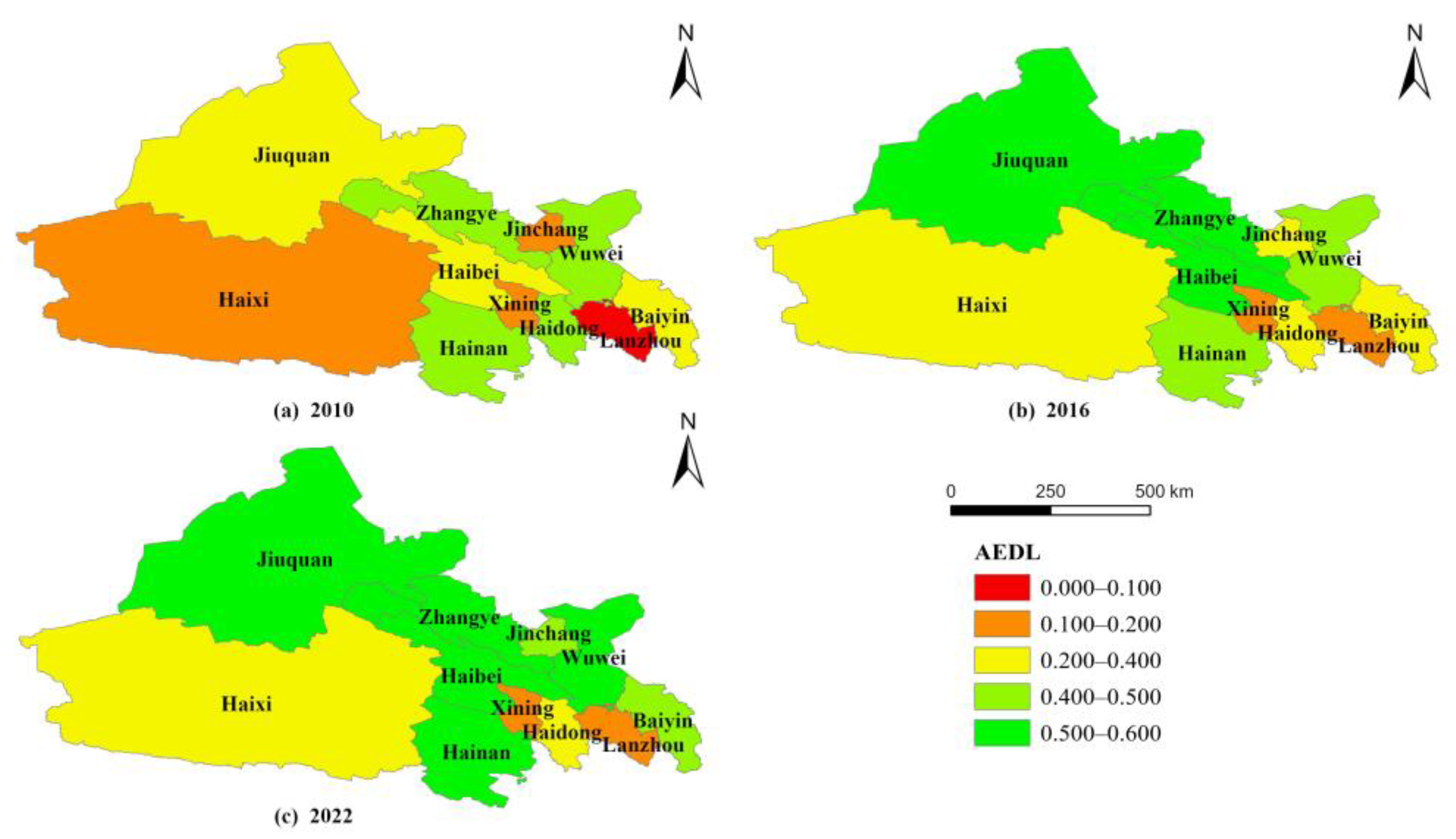
From 2010 to 2022, significant differences in AEDL were observed among the 11 cities (Figure 3b). The most notable difference was between Zhangye and Lanzhou, with a difference of 0.380. Zhangye City had the highest average development index (0.511) followed by Wuwei (0.483) and Hainan Prefecture (0.478). Haixi Prefecture, Xining, and Lanzhou had lower development indices, with averages of 0.270, 0.138, and 0.131, respectively. From 2010 to 2022, the AEDL for Zhangye City consistently increased (Figure 4), by 29.34% overall. In comparison, Wuwei experienced a substantial increase, by 98.90%, since 2010.

3.3. CD and CCD

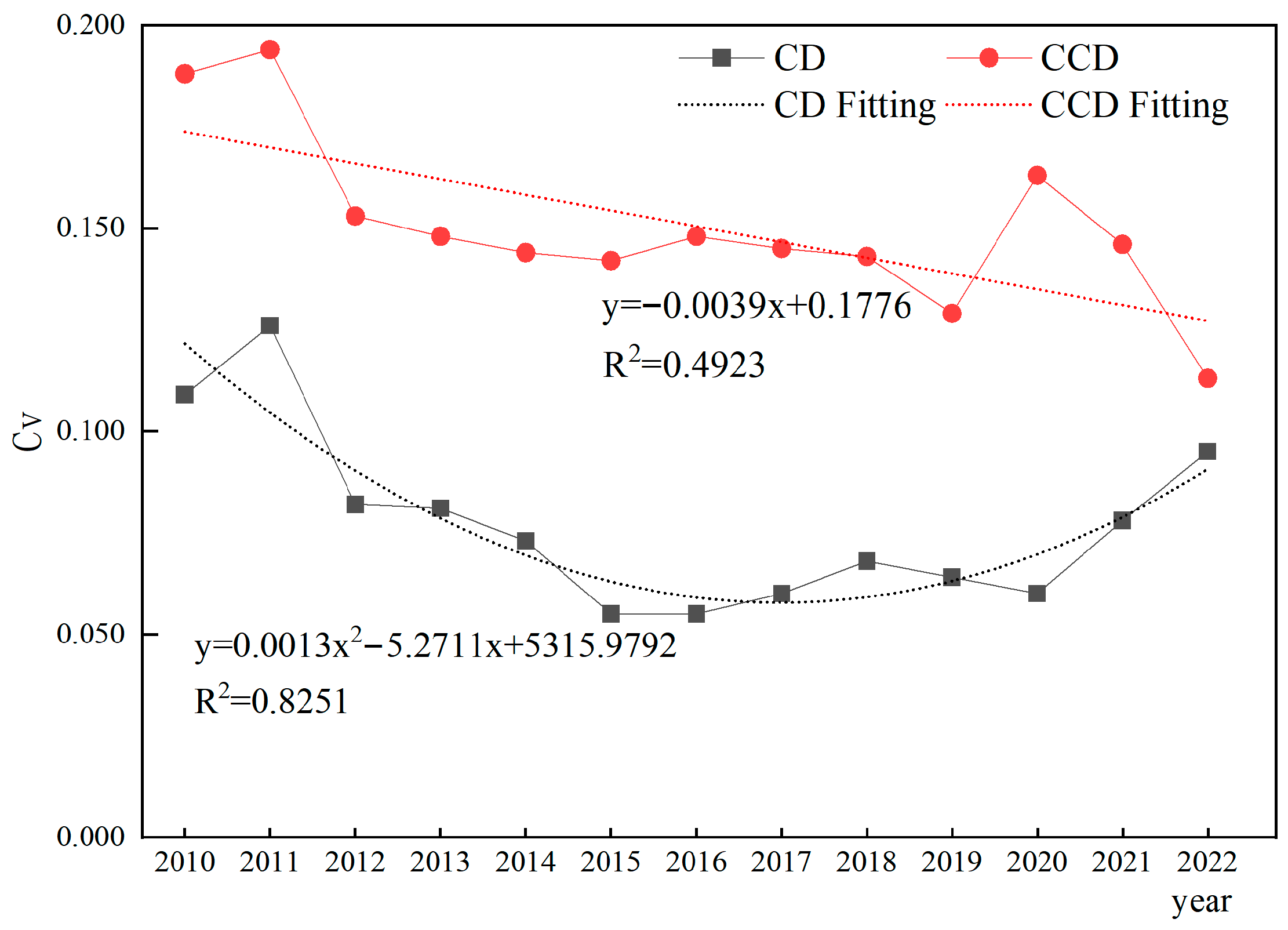
To quantify the relationship between AWUE and AEDL, we conducted a Spearman correlation analysis. The Spearman correlation coefficient between AWUE and AEDL was 0.354 (p < 0.01), indicating a statistically significant positive correlation. We further investigated the coupling relationship between AWUE and AEDL. The variation in CD among the 11 cities from 2010 to 2022 generally exhibited an initial decrease followed by an increase (Figure 5). To better capture this trend, a second-order polynomial fitting was performed for the CD coefficient of variation (R2 = 0.8251). This improved fit confirms that the variation trend of the CD coefficient of variation represents a non-linear process, characterized by an initial decline followed by a subsequent increase. Specifically, the CD declined steadily from 0.109 in 2010 to 0.055 in 2016, representing a 48.58% reduction. However, between 2016 and 2022, there was an increase of 72.43%, from 0.044 to 0.095. To quantify the evolving trends in CCD differences, we further conducted a linear regression analysis of CCD. The coefficient of variation of the CCD demonstrated a downward trajectory (R2 = 0.492), decreasing by 21.27% by 2016 compared to 2010, and, by 2022, further reducing by 39.89%. This indicates that the disparity in the level of coordinated development between the two systems has been steadily narrowing in every city. Notwithstanding heterogeneous and non-linear trajectories in achieving close agricultural water–economic development (CD) coupling, all cities are evolving toward a more advanced and harmonious coordinated development (CCD) model in their ultimate outcomes.
The CD between AWUE and AEDL in the 11 studied cities remained relatively balanced between 2010 and 2022 (Figure 1); CD values fluctuated between 0.456 and 0.474 during this period. This indicates that, while the two systems influence each other, their interaction remains at a preliminary level with modest overall impact. Specifically, values increased from 0.401 in 2010 to 0.554 in 2022, representing an increase of 38.24%. This shift indicates a transition from moderate to high coordination (Figure 6). Such trends indicate that AEDL in these areas has progressively improved—narrowing the gap with AWUE—and evolved from mutual restriction to mutual promotion and support. Between 2010 and 2022, the AWUE in the study region surpassed the AEDL. This suggests that the enhancement of CCD was primarily driven by improvements in AWUE. This can be attributed to the lag in the AEDL relative to advancements in AWUE; the former does not yield a corresponding increase in the output value owing to the enhancements of the latter, resulting in a negative state within the coupling coordination system.
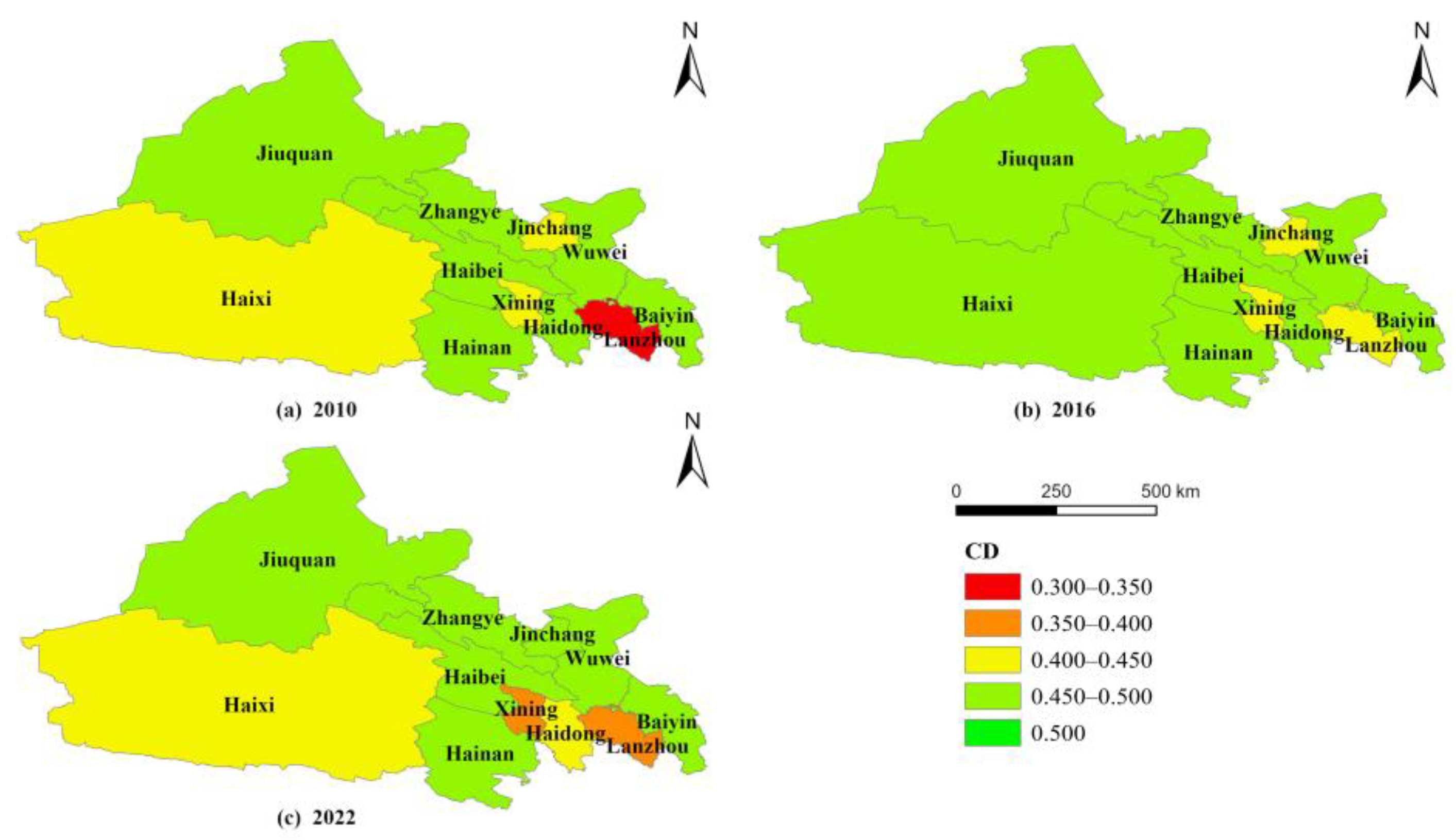
The analysis of regional CD characteristics revealed a relatively low correlation between AWUE and AEDL across the various cities (Figure 6). From 2010 to 2022, the CD in each city mainly ranged between 0.3 and 0.5, suggesting the initial stage of coupling. This implies that the AWUE and AEDL subsystems have transitioned away from a disordered development, i.e., their mutual interaction has progressively strengthened; however, the CD has remained low. As shown in Figure 3c, Jiuquan City exhibited a relatively high average CD while Lanzhou had the lowest, at 0.498 and 0.392, respectively. The AWUE in Lanzhou has not achieved an effective state, and its AEDL is low, resulting in a minimal degree of mutual interaction. Conversely, Jiuquan’s AEDL is higher and, although it remains in the primary coupling stage, approaches the intermediate coupling threshold, demonstrating positive trends in mutual checks, balances, and cooperation.
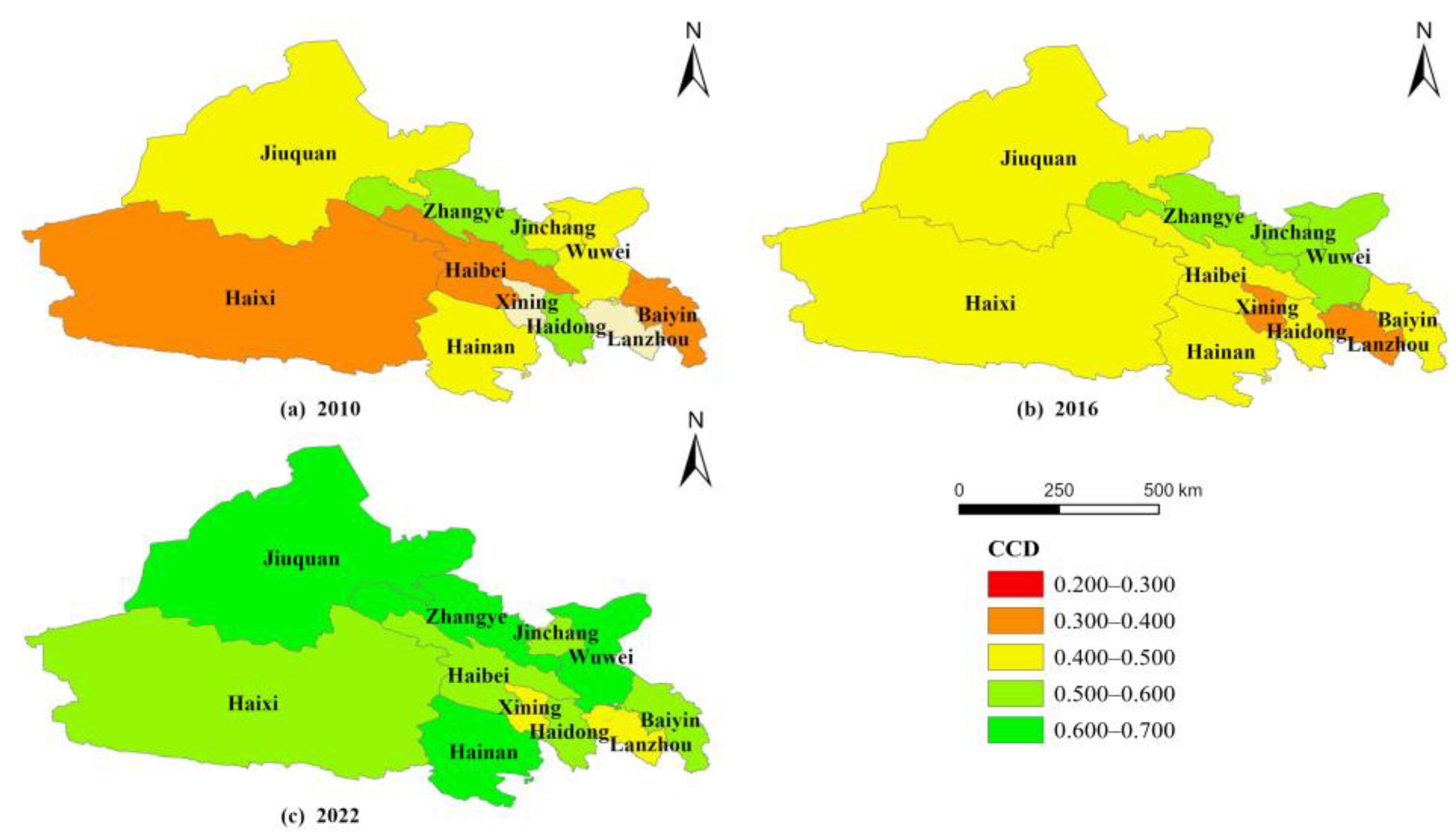
With the exception of Lanzhou and Xining, the CCD for the other cities in 2022 exceeded 0.500, indicating a high coordination stage (Figure 7). This suggests that these areas have made significant improvements in AEDL and have enhanced the efficiency of agricultural water use. Conversely, the CCD for Lanzhou and Xining stood at 0.432 and 0.453, respectively, in 2022, corresponding to a moderate coordination stage. This implies a mutual constraint between AWUE and AEDL in these two cities. Specifically, the enhancement of AWUE is hindered by the state of the agricultural economy, and, conversely, the agricultural economy’s growth is limited by available water resources.
Temporally, while nine of the studied cities achieved a high coordination stage by 2022, their individual trajectories have differed. For instance, Zhangye City has consistently been in a high coordination stage from 2010, and the average CCD for Zhangye stood at 0.565 (Figure 3d); Wuwei reached this stage in 2015 and has since demonstrated consistent growth; Jinchang achieved a high coordination stage in 2016 and has similarly shown steady progress; Hainan Prefecture regressed to a moderate coordination stage (0.490) in 2016 after reaching a high coordination stage in 2015, but returned to the high coordination stage by 2018; both Baiyin and Jiuquan attained the high coordination stage in 2018 and have maintained steady growth since; Haidong oscillated between moderate and high coordination stages from 2010 to 2018 but has remained at the high coordination stage since 2019; and Haibei and Haixi Prefectures only transitioned into the high coordination stage in 2020.

3.4. Prediction and Analysis of CCD

Based on the model error test outcomes, the average relative error of the GM(1,1) model was 0.97%, which is less than 0.1 (Table 4). The variance ratio, C, is 0.02, which is less than 0.35, and the small error probability p-value is 1.00, which is greater than 0.95. These results suggest that the model had accurate fitting.
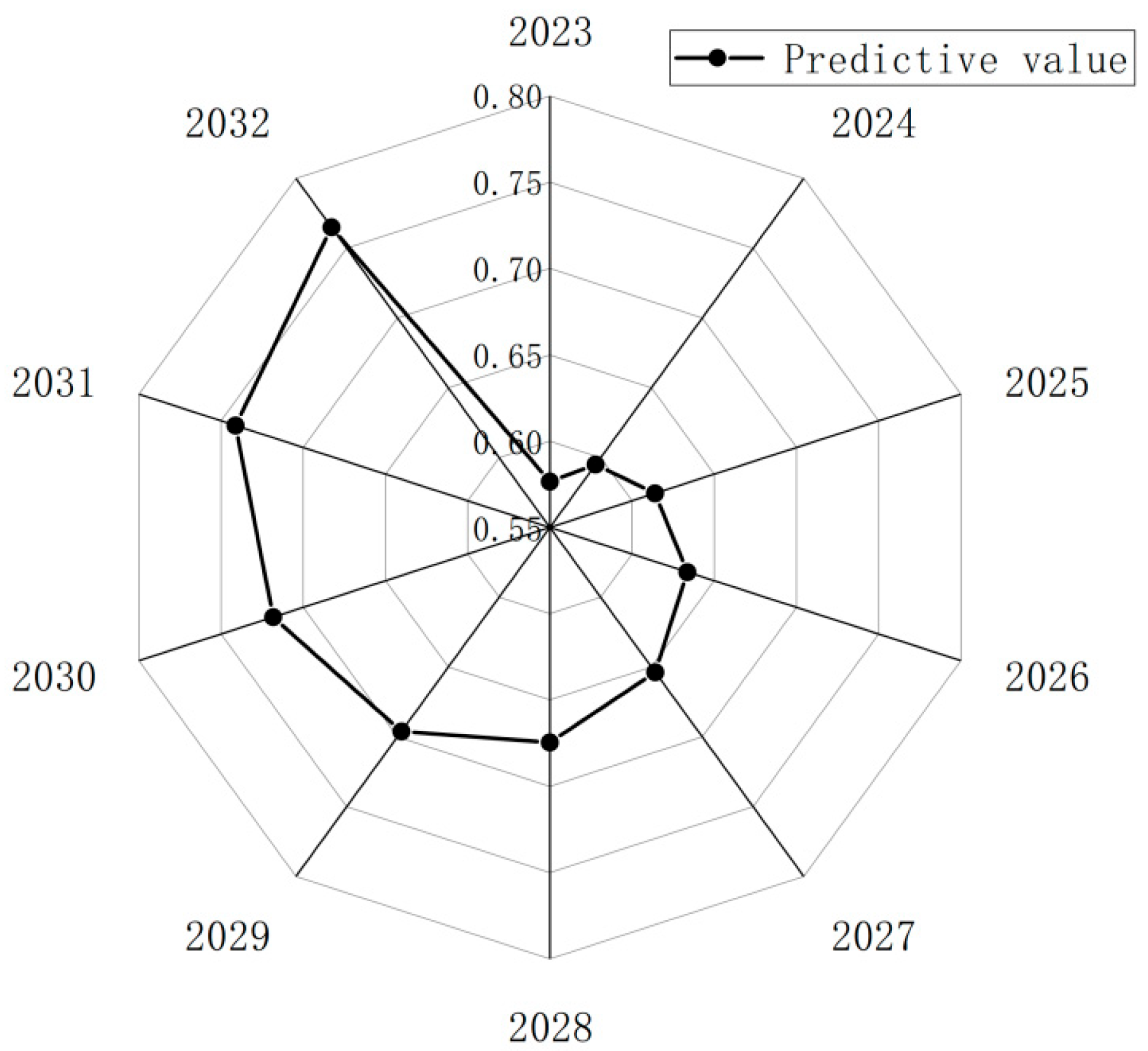
The predicted results are presented in Figure 8, with the gray model accurately forecasting the trend of CCD alterations in the study area. Over the next decade, CCD is expected to exhibit a gradual upward trend. In 2023, the CCD was projected to be 0.576, rising to 0.614 in 2026, and further increasing to 0.765 by 2032. This suggests that the future coupling level will progressively transition from a high coordination phase to an extreme coordination phase.

4. Discussion

4.1. Changes in AWUE and AEDL

AWUE is defined as the ratio of various production factors associated with agricultural water resources to their consequent economic, social, and ecological outcomes [25,26]. Correlation analysis indicates that the correlation coefficient between AWUE and AEDL is significant yet weak (0.354), suggesting that the relationship between the two is not a simple linear one. The weak correlation establishes a reasonable expectation for the CCD value, suggesting that CCD may fall within the fundamentally coordinated development stage. The degree of AWUE and the progression of AEDL are significantly influenced by a range of production factors, geographical climate, economic circumstances, agricultural technology, and government policies [24]. These other factors dilute its individual influence. Notably, there are disparities in AWUE and AEDL within the Qilian Mountains region.
The overall upward trend in AWUE from 2010 to 2022 aligns with national policy shifts during this period. Since 2010, the Central Committee of the Communist Party of China has placed heightened emphasis on deepening agricultural reforms and accelerating the development of modern agriculture, signifying the country’s growing focus on agricultural reform. Similar to the findings of previous studies, the AWUE growth rate in the Qilian Mountains region shows significant differences among cities, primarily due to variations in industrial structure and natural endowments. The Zhangye area, a key grain-producing area in Gansu Province, has benefited from large-scale production and advanced technology, leading to stable, high water-use efficiency. However, its agricultural growth rate was relatively lower, partly due to a high baseline leaving limited room for improvement and partly due to economic diversification driven by tourism following the ‘Belt and Road’ initiative [4].
Lanzhou, located on the banks of the Yellow River, faces fewer water scarcity constraints than Zhangye and Wuwei. Some researchers [27,28] have pointed out that relatively high precipitation eases the water shortage pressure; however, there is a noted weakness in farmers’ awareness of water conservation and the development and application of water-saving technologies, which reduces the return on investment for such technologies. In our study, due to data accessibility constraints, we did not account for undesired output indicators resulting from water resource inputs when assessing AWUE. This omission may have led to the increased efficiency values. Future research should, therefore, address this limitation and explore suitable methods to refine the calculation model to provide a more accurate representation of AWUE.
A comprehensive assessment of the AEDL indicated notable improvement since 2011; there has been a significant increase in state investments in primary industry fixed assets and agricultural fiscal expenditures during this period. Furthermore, both the per capita gross output value and disposable income of rural residents have consistently increased, whereas the rural Engel coefficient has steadily decreased, signifying a sustained enhancement at the agricultural economic level. However, the consistently low evaluation scores (mostly between 0.2 and 0.4) underscore that, despite progress, the AEDL in the Qilian Mountains region remains suboptimal compared to leading agricultural areas in China (e.g., Shandong Province) [29], indicating substantial potential for enhancement.
The AEDL values in Zhangye and Wuwei are notably high. The Hexi region, which has consistently been Gansu Province’s commodity grain base and primary irrigation area, has comprehensive evaluation values that all exceed 0.500. This region boasts advanced agricultural production technology and a relatively high income level among farmers. Survey data indicated that the Hexi region has significant advantages in terms of total mechanical power, fertilizers, and other factors, coupled with a high degree of agricultural modernization, representing premier agricultural production conditions within the Qilian Mountains region. For example, in 2022, the total mechanical power of agriculture in Zhangye and Wuwei reached 299.87 and 358.50 million kilowatts, respectively, significantly surpassing other regions. Conversely, the lower AEDL in Lanzhou and Xining is explained by their smaller agricultural scale and structure (lower per capita output, smaller GDP share of primary industry). Additionally, these cities show reduced fixed asset investments in this sector, leading to a diminished AEDL. Lanzhou’s economic progress has been predominantly industrial, revealing a relative deficiency in agricultural advancement. Notably, AEDL was not only assessed based on scale but also structure and investment considerations. This comprehensive approach underscores the primary reason for the lower AEDL observed in Lanzhou and Xining [17].

4.2. Coupling Analysis of AWUE and AEDL

The concepts of the CD and CCD are instrumental in assessing the interaction between subsystems within an open system [25]. Our analysis places the AWUE–AEDL relationship in the Qilian Mountains at a primary coupling stage yet transitioning into a high coordination stage. This progression can be attributed to the concurrent, though uneven, improvements in both subsystems, particularly driven by enhanced water-saving irrigation practices and gradual agricultural economic development, fostering a move towards more synchronous growth [5]. Gansu and Qinghai provinces have implemented stringent water resource management systems, water conservation regulations, and action plans since 2010, promoting rational allocation and efficient use. These policies or actions may prompt all cities to simultaneously enhance the coupling strength between their systems [30], thereby reducing regional disparities (Figure 5). As the dividends from initial technological and management measures gradually diminish, enhancing the coupling between water resource consumption and economic growth requires more complex and profound industrial restructuring [25,31]. The rise of high-value-added agriculture in some cities has facilitated the transformation and upgrading, leading to a renewed widening of the gap in coupling levels [32].
The spatial evolution of coordination reveals a distinct pattern. For example, Zhangye City has consistently maintained a high coordination stage since 2010. In recent years, Zhangye City has prioritized the development of ecological agriculture. While ensuring food security, the city has actively optimized and adjusted the agricultural structure by reducing the planting area of high-water-consuming and low-benefit crops and increasing the planting area of high-benefit crops. This has led to the optimization and upgrading of the agricultural industry. Concurrently, this has encouraged the deep processing of agricultural products, development of rural tourism, pastoral vacations, and other new activities, thereby promoting the integrated development of agriculture with secondary and tertiary industries [33,34]. Other regions followed diverse pathways to higher coordination. Financial support investments can significantly enhance agricultural planting development. Regions such as Wuwei, Jiuquan, Jinchang, Baiyin, and Haidong have allocated substantial funds for R&D in agricultural technology. The production of high-quality crops can generate significant economic income, which can subsequently affect agricultural planting. Furthermore, the tourism industry in Jiuquan, along with non-ferrous metal industries in Jinchang and Baiyin, has stimulated local economic development. This, in turn, propelled the optimization and upgrading of the agricultural industry structure, thereby fostering circular development [12].
Hainan and Haibei prefectures possess limited arable land of subpar quality, exacerbated by ecological degradation, leading to significant soil erosion. This has resulted in a decline in the quality of arable land. Their industrial development hinges primarily on animal husbandry, complemented by agriculture. Conversely, despite being relatively economically advanced, Lanzhou City and Xining City rely heavily on industrial development as regional pillars. For example, Lanzhou’s primary industries include petrochemicals, non-ferrous metallurgy, and equipment manufacturing, whereas Xining focuses on clean energy, polymer materials, and biomedicine. Emerging industries including new materials and information technology also contribute to economic growth. However, compared with other cities, their scales of agriculture, structure, and investment are relatively underdeveloped. Arable land is limited and fragmented, underscoring the tension between population and land availability. Furthermore, the regional water-use efficiency and economic coupling coordination are notably deficient in these cities.
Considering factors such as geographical location, resource endowment, transportation infrastructure, and economic ties, the evolution of coordinated development types in the cities and the prefectures of the study area is primarily characterized as follows. Zhangye City maintains a high coordination stage; Jinchang, Baiyin, and Haibei Prefecture have transitioned from low to moderate and high coordination; Wuwei, Jiuquan, Haixi Prefecture, Hainan Prefecture, and Haidong Prefecture have transitioned from moderate to high coordination stages; and Xining and Lanzhou have transitioned from low to moderate coordination stages. Based on the coefficient of variation analysis, the disparities among the 11 studied cities are generally diminishing. This trend primarily stems from the systematic implementation of ecological protection and high-quality development strategies in the Qilian Mountains region. Consequently, the effects of ecological and environmental governance in various regions have become increasingly evident. For example, there has been a consistent enhancement in the conservation and intensive utilization of agricultural water resources, leading to a reduction in the differences in water resource endowments between regions. In addition, there has been a notable improvement in the AEDL in less-developed areas. Such progress fosters a more harmonized AEDL and water-use efficiency throughout the Qilian Mountains and adjacent regions.
In summary, areas with high coordination exhibit an evolutionary trend that extends from Zhangye to Jinchang, Wuwei, and other northern foothills of the Qilian Mountains and spreads from the northeast to the southwest, moving towards a higher degree of coordination. The GM(1,1) model simulation and forecast indicated a year-on-year increase in the CCD of the Qilian Mountains region and its surrounding areas; however, CCD has not yet experienced a significant breakthrough. These predictions hold substantial relevance for the agricultural and economic development of the study area. This analysis does not address the impact of training programs for farmers and agricultural organizations on AWUE and AEDL. Training initiatives significantly contribute to agricultural productivity and water use efficiency by promoting the adoption of advanced technologies and sustainable practices [35]. For instance, in arid regions, training on drip irrigation technology and drought-resistant crops has achieved substantial water savings and increased yields [36,37]. In the Qilian Mountains region, incorporating training programs into the coupled equation may enhance the synergistic effects between AWUE and AEDL [35,38]. As science and technology advance and reforms deepen, AWUE will encounter new opportunities and challenges. To bolster the innovative capacity of agricultural water resources, emphasis should be placed on strategic needs, such as ensuring food security and maintaining an effective supply of agricultural products amid water scarcity. This also includes the sustainable development of agriculture, augmenting the input of innovative elements, developing farmer education and extension services to ensure technological advancements effectively reach grassroots levels, effectively enhancing the comprehensive innovative capacity of agricultural water resources, and improving the coordination between the AWUE and AEDL systems [12]. Finally, it is important to note that the CCD of a region is a complex indicator. Therefore, when interpreting our predictive results, it is crucial to consider, among other factors, the potential impacts of external environmental factors, policy adjustments, and scale structure. This is needed to ensure the accuracy and reliability of such predictions.

5. Conclusions

5.1. Conclusions and Recommendations

This study examined 11 cities in the Qilian Mountains and adjacent areas, explored the coupling and coordination relationship between AWUE and the AEDL, and analyzed the development characteristics and spatial differences at different stages. The main conclusions are as follows:
(1)
From 2010 to 2022, both AWUE and the AEDL in these areas showed an upward trend, with a spatial pattern summarized as being higher in the northeast and lower in other regions. By 2022, the overall AWUE has reached a high level, and most cities have achieved an effective status. Conversely, while the AEDL also increased substantially over the same period, the overall AEDL has remained relatively low, indicating significant room for improvement.
(2)
The AWUE and AEDL are currently in a ‘low coupling, high coordination’ development phase. The coordinated development patterns evolved via four distinct pathways: a highly coordinated sustainability pathway, growth-oriented pathway, transitioning pathway, and improving pathway. Overall, the CCD was found to be highest in cities with integrated primary, secondary, and tertiary industries, followed by agriculture-based cities with supplementary sectors, and then others based on animal husbandry with agricultural supplementation and those that are industry-based with agricultural supplementation. Spatially, the CCD is summarized as ‘high in the middle, low in the east and west’, with high coordination areas expanding from Zhangye City to Hexi Corridor regions, from middle to east and west, and from the northern to southern foothills, moving towards a higher level of coordination overall.
(3)
Considering industrial layouts, it is advisable to prioritize industries that offer substantial economic benefits with minimal water consumption to foster balanced development between AWUE and AEDL. Strategies should be tailored to local conditions: in Wuwei and Jinchang, the focus should be on Silk Road cold and arid agriculture, promoting efficient water-saving irrigation technologies and preventing the wastage of rural land resources due to the acceleration of urbanization [34]. In regions such as Zhangye and Jiuquan, emphasis should be placed on the rapid growth of the tertiary sector to maximize agricultural water-saving potential and optimize industrial structure [4]. In contrast, areas such as Baiyin and Haidong currently prioritize technical advancements in planting techniques and drought-resistance breeding to boost crop yields [12]. In water-rich regions, including Xining and Lanzhou, efforts should focus on raising water conservation awareness and improving agricultural water infrastructure [22]. Additionally, in prefectures such as Haibei, Hainan, and Haixi, it is essential to consistently increase agricultural fiscal investment, expand water conservancy coverage, and strengthen ecological stewardship [39].

5.2. Research Limitations and Future Directions

Despite these advancements, due to data availability constraints, factors such as agricultural non-point source pollution and farmer training programs were not included in the coupled model. Capturing the full multi-dimensional interactions within agricultural water-economic systems remains a challenge. Furthermore, regarding GM(1,1) projections, while the GM(1,1) model is methodologically suitable for historical data patterns, it should be viewed as an extension of current trends rather than a deterministic forecast of the future. Agricultural economic systems remain vulnerable to the non-linear impacts of climate fluctuations and policy adjustments. For future research, we aim to construct more integrated models (e.g., system dynamics) that combine climate projections with policy scenarios and incorporate more dynamic indicators. This approach is expected to yield more detailed and accurate results, thereby offering a more robust foundation for supporting sustainable agricultural development in mountain–oasis–desert regions.

Author Contributions

Conceptualization, H.X. and H.R.; methodology, H.X.; investigation, H.X. and T.Z.; data curation, T.Z. and X.X.; writing—original draft preparation, H.X.; writing—review and editing, H.X.; visualization, T.Z.; supervision, H.X.; funding acquisition, H.R. All authors have read and agreed to the published version of the manuscript.

Funding

This work was supported by the Joint Funds of the National Social Science Foundation of China (Project No.: 23XGL035) and Gansu Province Philosophy and Social Sciences Planning Project (Project No.: 2022YB138). We appreciate the anonymous reviewers and the editor for their comments that have been very helpful in improving an earlier manuscript of this paper.

Data Availability Statement

The original contributions presented in this study are included in the article. Further inquiries can be directed to the corresponding author.

Acknowledgments

We appreciate the anonymous reviewers and the editor for their comments that have been very helpful in improving an earlier manuscript of this paper.

Conflicts of Interest

The authors declare no conflicts of interest.

References

  1. Song, M.F.; He, W.J.; An, M.; Fang, X.; Wang, B.; Ramsey, T.S. Toward better agricultural grey water footprint allocation under economy-resource factors constraint. Ecol. Indic. 2023, 154, 110806. [Google Scholar] [CrossRef]
  2. Kang, S.Z. Ten years of agricultural water-saving in China: Achievements, challenges and measures. China Water Resour. 2024, 10, 1–9. (In Chinese) [Google Scholar]
  3. Li, J.W.; Wu, Z.; Tian, G.L. Research on water resources pricing model under the water resources–economic high-quality development coupling system: A case study of Hubei Province, China. Water Policy 2022, 24, 363–381. [Google Scholar] [CrossRef]
  4. Wu, H.L.; Li, X.Y.; An, H. Decoupling of water resources utilization and coordinated economic development in China’s Hexi Corridor based on ecological water resource footprint. Environ. Sci. Pollut. R. 2022, 29, 90936–90947. [Google Scholar] [CrossRef]
  5. Kong, Y.; Abliz, A.; Guo, D.P.; Liu, X.H.; Li, J.L.; Nurahmat, B. Coupling Coordination Development Between Cultivated Land and Agricultural Water Use Efficiency in Arid Regions: A Case Study of the Turpan-Hami Basin. Agriculture 2025, 15, 1153. [Google Scholar] [CrossRef]
  6. Zhang, Y.; Liu, W.X.; Cai, Y.; Khan, S.U.; Zhao, M.J. Decoupling analysis of water use and economic development in arid region of China—Based on quantity and quality of water use. Sci. Total Environ. 2021, 761, 143275. [Google Scholar] [CrossRef]
  7. Dalin, C.; Conway, D. Water resources transfers through southern African food trade: Water efficiency and climate signals. Environ. Res. Lett. 2016, 11, 12. [Google Scholar] [CrossRef]
  8. Farhan, M.; Yang, J.; Wu, T.; Wang, S.; Zhao, X.; Tariq, A. Impact assessment of agricultural droughts on water use efficiency in different climatic regions of Punjab Province Pakistan using MODIS time series imagery. Hydrol. Process 2024, 38, 15232. [Google Scholar] [CrossRef]
  9. Kotze, H.C.; Qotoyi, M.S.M.A.; Bahta, Y.T.; Jordaan, H.; Monteiro, M.A. A systematic review and Meta-Analysis of factors influencing water use behaviour and the efficiency of agricultural production in South Africa. Resources 2024, 13, 94. [Google Scholar] [CrossRef]
  10. Lu, W.N.; Guo, X.Y.; Liu, W.X.; Du, R.R.; Chi, S.Y.; Zhou, B.Y. Spatial–temporal dynamic evolution and influencing factors of green efficiency of agricultural water use in the Yellow River Basin, China. Water 2023, 15, 143. [Google Scholar] [CrossRef]
  11. Wang, J.L.; Tong, J.B.; Fang, Z. Assessing the drivers of sustained agricultural economic development in China: Agricultural productivity and poverty reduction efficiency. Sustainability 2024, 16, 2073. [Google Scholar] [CrossRef]
  12. Yang, G.M.; Yang, Y.R.; Gong, G.F.; Chen, X.L. The coupling and coordination characteristics of agricultural green water resources and agricultural economic development in China. Environ. Dev. Sustain. 2024, 26, 2131–2151. [Google Scholar] [CrossRef]
  13. Zhang, Y.; Khan, S.U.; Swallow, B.; Liu, W.X.; Zhao, M.J. Coupling coordination analysis of China's water resources utilization efficiency and economic development level. J. Clean. Prod. 2022, 373, 133874. [Google Scholar] [CrossRef]
  14. Song, Q.R.; Wang, Z.C.; Wu, T.H. Risk analysis and assessment of water resource carrying capacity based on weighted gray model with improved entropy weighting method in the central plains region of China. Ecol. Indic. 2024, 160, 111907. [Google Scholar] [CrossRef]
  15. Guo, C.Y.; Dai, H.C.; Liu, X.R.; Wu, Y.Z.; Liu, X.Y.; Liu, Y. Impacts of climate change mitigation on agriculture water use: A provincial analysis in China. Geogr. Sustain. 2020, 1, 189–199. [Google Scholar] [CrossRef]
  16. Hu, Y.N.; Duan, W.L.; Zou, S.; Chen, Y.N.; De Maeyer, P.; Van de Voorde, T.; Takara, K.; Kayumba, P.M.; Kurban, A.; Goethals, P.L.M. Coupling coordination analysis of the water-food-energy-carbon nexus for crop production in Central Asia. Appl. Energy 2024, 369, 123584. [Google Scholar] [CrossRef]
  17. Zha, J.P.; Zhou, Y.Y.; Zhou, X. Coupling and coordination relationship between agricultural water use efficiency and agricultural economic development in the nine provinces (autonomous regions) along the Yellow River. J. Water Resour. Water Eng. 2021, 32, 219–2266. (In Chinese) [Google Scholar]
  18. Zhang, B.T.; Li, Z.X.; Feng, Q.; Lu, Z.X.; Zhang, B.J.; Chen, W.J. Evolution of ecosystem service values in Qilian Mountains based on land-use change from 1990 to 2020. Acta Ecol. Sin. 2024, 44, 4187–4202. (In Chinese) [Google Scholar]
  19. Ren, H.; Zhao, W.Z.; Wang, X.P.; Luo, W.C.; Zhou, T. System Cognition and Key Challenges for the Future of Qilian Mountains Community of Life: A Case Study of Gansu Province. Adv. Earth Sci. 2024, 39, 957–967. (In Chinese) [Google Scholar]
  20. Wu, J.J.; Jiao, L.; Zhang, H.; Du, D.S.; Zhu, X.L.; Che, X.C. Vegetation coverage variation in the Qilian Mountains before and after ecological restoration. Acta Ecol. Sin. 2023, 43, 408–418. (In Chinese) [Google Scholar] [CrossRef]
  21. Ren, B.F.; Park, K.; Shrestha, A.; Yang, J.; McHale, M.; Bai, W.L.; Wang, G.Y. Impact of human disturbances on the spatial heterogeneity of landscape fragmentation in Qilian Mountain National Park, China. Land 2022, 11, 2087. [Google Scholar] [CrossRef]
  22. Liu, S.S.; Han, F.M.; Cai, A.N.; Zhang, K.; Jin, W. Influence of agricultural water use efficiency on agricultural water consumption in consideration of regional differences. Resour. Environ. Yangtze River Basin 2017, 26, 2099–2110. (In Chinese) [Google Scholar]
  23. Yao, H.; Zhang, Q.X.; Niu, G.Y.; Liu, H.; Yang, Y.X. Applying the GM(1,1) model to simulate and predict the ecological footprint values of Suzhou city, China. Environ. Dev. Sustain. 2021, 23, 11297–11309. [Google Scholar] [CrossRef]
  24. Song, Y.; Mei, D. Sustainable development of China’s regions from the perspective of ecological welfare performance: Analysis based on GM(1,1) and the malmquist index. Environ. Dev. Sustain. 2022, 24, 1086–1115. [Google Scholar] [CrossRef]
  25. Chen, C.H.; Wang, Y.; Zhang, H.; Bai, X.G. Evaluation on coupling coordination development of agricultural water use efficiency—Economic development—Ecological environment in the Yellow River Basin. China Rural Water Hydropower 2024, 6, 114–123. (In Chinese) [Google Scholar]
  26. Cetin, M. The effect of urban planning on urban formations determining bioclimatic comfort area’s effect using satellitia imagines on air quality: A case study of Bursa city. Air Qual. Atmos. Health 2019, 12, 1237–1249. [Google Scholar] [CrossRef]
  27. Shao, T.S.; Xu, X.D.; Su, Y.L. Evaluation and Prediction of Agricultural Water Use Efficiency in the Jianghan Plain Based on the Tent-SSA-BPNN Model. Agriculture 2025, 15, 30. [Google Scholar] [CrossRef]
  28. Fang, D.L.; Wang, J.; Liu, J.J.; Luo, Y.Z. Spatial and temporal differentiation of agricultural water use efficiency and its influencing factors under the combination of multiple models. Water Sav. Irrig. 2024, 4, 105–113. (In Chinese) [Google Scholar]
  29. Zhang, F.; Xiao, Y.; Gao, L.; Ma, D.; Su, R.; Yang, Q. How agricultural water use efficiency varies in China—A spatial-temporal analysis considering unexpected outputs. Agric. Water Manag. 2022, 260, 107297. [Google Scholar] [CrossRef]
  30. Xiong, C.L.; Zhang, Y.L.; Wang, W.J. An Evaluation Scheme Driven by Science and Technological Innovation-A Study on the Coupling and Coordination of the Agricultural Science and Technology Innovation-Economy-Ecology Complex System in the Yangtze River Basin of China. Agriculture 2024, 14, 1844. [Google Scholar] [CrossRef]
  31. Kang, S.Z.; Hao, X.M.; Du, T.S.; Tong, L.; Su, X.L.; Lu, H.N.; Li, X.L.; Huo, Z.L.; Li, S.E.; Ding, R.S. Improving agricultural water productivity to ensure food security in China under changing environment: From research to practice. Agric. Water Manag. 2017, 179, 5–17. [Google Scholar] [CrossRef]
  32. Zhang, W.; Zhang, L. Research on the coupling and coordination of harmonious rural construction and integration of agriculture and tourism. Sci. Rep. 2025, 15, 33804. [Google Scholar] [CrossRef]
  33. Si, L.H. Analysis of the Measurement of high-quality development level of agricultural economy based on entropy weight method—Taking Shandong Province as an example. Rural Econ. Sci. Technol. 2023, 34, 99–102. (In Chinese) [Google Scholar]
  34. Wang, Y.; Jia, Y.Q.; Zhao, W.W. Ecological cycle of agriculture and economic development model in Zhangye. Pratacultural Sci. 2013, 30, 1488–1492. (In Chinese) [Google Scholar]
  35. Makapela, M.; Alexander, G.; Tshelane, M. Enhancing Agricultural Productivity Among Emerging Farmers Through Data-Driven Practices. Sustainability 2025, 14, 4666. [Google Scholar] [CrossRef]
  36. Athelly, A.; Guzmán, S.M.; Yu, Z.W.; Watson, J.A. Bridging the gap between water-saving technologies and adoption in vegetable farming: Insights from Florida, USA. Agric. Front. Agron. 2025, 7, 162260. [Google Scholar] [CrossRef]
  37. Awa, M.; Zhao, J.H.; Tumaerbai, H. Deficit Irrigation-Based Improvement in Growth and Yield of Quinoa in the Northwestern Arid Region in China. Sustainability 2024, 16, 107297. [Google Scholar] [CrossRef]
  38. Hou, X.Q.; Zheng, J.L.; He, M.N.; Feng, G.Z.; He, K.H.; Ma, T.; Coffman, D.; Mi, Z.F.; Wang, S.Y. A multi-regional input-output database linking Chinese subnational regions and global economies. Sci. Data 2025, 12, 1761. [Google Scholar] [CrossRef]
  39. Nie, S.P.; Li, W.D. Analysis of water use characteristics of different economic structures in Haixi prefecture of Qinghai province. Ecol. Sci. 2023, 42, 136–142. (In Chinese) [Google Scholar]
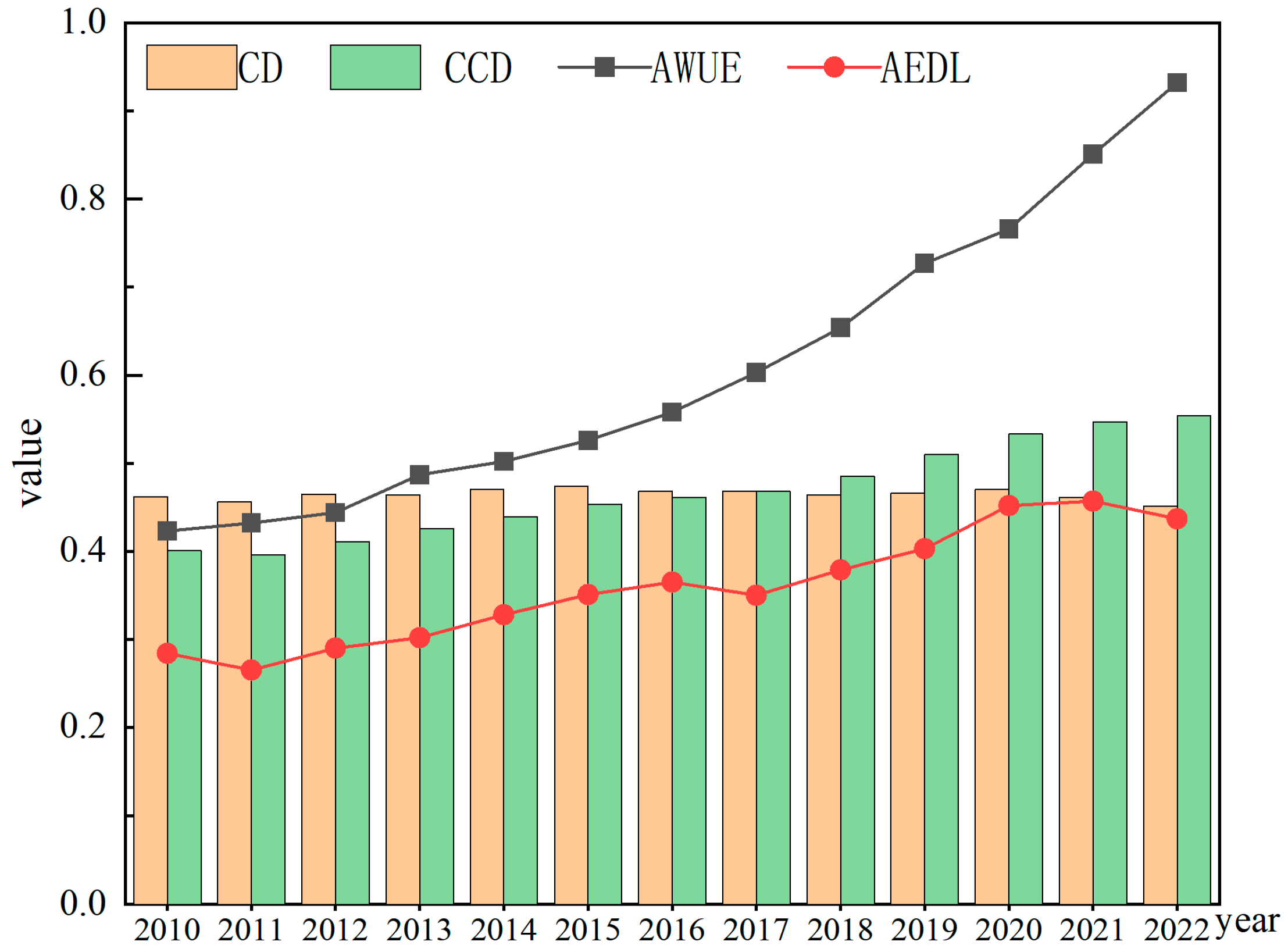
Figure 1. Coupling and coordination degree, and changes in the AWUE and AEDL, in the Qilianshan region and adjacent areas from 2010 to 2022.
Agriculture 15 02551 g001
Figure 2. AWUE of 11 cities in the Qilian Mountains region and adjacent areas in 2010, 2016, and 2022.
Agriculture 15 02551 g002
Figure 3. Mean CD and CCD between the AWUE and AEDL of 11 city states in the Qilian Mountains region and adjacent areas from 2010 to 2022.
Agriculture 15 02551 g003
Figure 4. AEDL of 11 cities in Qilian Mountains region and adjacent areas in 2010, 2016, and 2022.
Agriculture 15 02551 g004
Figure 5. CD and CCD variation coefficients (Cv) of AWUE and AEDL in the Qilian Mountains region and adjacent areas.
Agriculture 15 02551 g005
Figure 6. Alterations in the CD of 11 cities in and around the Qilian Mountains region in 2010, 2016, and 2022.
Agriculture 15 02551 g006
Figure 7. Alterations in the CCD of 11 cities in and around the Qilian Mountains region in 2010, 2016, and 2022.
Agriculture 15 02551 g007
Figure 8. Predicted trend diagram for the CCD.
Agriculture 15 02551 g008
Table 1. Coupling types or coupling coordination types and classification criteria.
CD ValueCoupling LevelCCD ValueCoupling Coordination Level
0–0.3Low-degree coupling0–0.4Low coordination stage
0.3–0.5Primary coupling0.4–0.5Moderate coordination stage
0.5–0.7Intermediate coupling0.5–0.8High coordination stage
0.7–1High-degree coupling0.8–1Extreme coordination stage
Table 2. Evaluation indicators for the calculating the AWUE.
Primary Indicator Secondary IndicatorMeasurable Indicator
Input IndicatorLandCrop sowing area/(kha)
Agricultural water resources Irrigation water consumption/(×109 m3)
Labor forceNumber of employees in the primary industry/(×104 person )
Technological advancementTotal power of agricultural machinery/(×104 kWh)
CapitalPure chemical fertilizer equivalent/(t)
Output indicators Economic outputGross output value of agriculture/(×104 CNY)
Physical outputGrain production/(10 kt)
Table 3. Evaluation indicators for calculating the AEDL.
Primary IndicatorSecondary IndicatorIndicator MeaningIndex AttributeWeight
Agricultural Development Scale Per capita agricultural output value/(×104 CNY)Total output value of agriculture, forestry, animal husbandry, and fisheries divided by the number of primary industry workers +0.215
Agricultural Development StructureProportion of primary industry in GDP/% Ratio of primary industry total output value to the regional GDP+0.234
Agricultural Development InvestmentProportion of fixed asset investment in primary industry/% Fixed asset investment in the primary industry/total fixed asset investment+0.241
Proportion of agricultural fiscal expenditure/%Agricultural financial expenditure/general budget expenditure+0.131
Agricultural Economic ObjectivesDisposable income of rural residents/(×104 CNY)Disposable income of rural residents+0.146
Farmers’ Quality of LifeRural Engel coefficient/%Food, tobacco, and alcohol expenditure/consumer expenditure0.035
Table 4. Error test based on the GM(1,1) model.
YearOriginal ValueEstimate ValueResidualRelative Error (%)
20130.426---
20140.4390.397−0.0011.052
20150.4530.4100.0020.986
20160.4610.4230.0030.357
20170.4680.4360.0032.056
20180.4850.4500.0031.622
20190.5100.464−0.0020.307
20200.5330.478−0.0101.527
20210.5470.493−0.0080.979
20220.5540.5090.0010.807
Disclaimer/Publisher’s Note: The statements, opinions and data contained in all publications are solely those of the individual author(s) and contributor(s) and not of MDPI and/or the editor(s). MDPI and/or the editor(s) disclaim responsibility for any injury to people or property resulting from any ideas, methods, instructions or products referred to in the content.