Article

Severity of Leaf Spots Caused by Bipolaris maydis and Cercospora fusimaculans on Panicum maximum Forages Under Phosphate Fertilization and Limestone


by
Néstor Eduardo Villamizar Frontado
1,
Gelson dos Santos Difante
1,
Alexandre Romeiro de Araújo
2,
Manuel Claudio Motta Macedo
2,
Denise Baptaglin Montagner
2,
Marcio Martinello Sanches
2,
Celso Dornelas Fernandes
2,
Hitalo Rodrigues da Silva
1,
Gustavo de Faria Theodoro
1,
Mariane Arce Tico
1,
Antonio Leandro Chaves Gurgel
3,*,
Jéssica Gomes Rodrigues
1 and
Adrián Gonzalez
4
1
Faculdade de Medicina Veterinária e Zootecnia, Universidade Federal de Mato Grosso do Sul, Campo Grande 79070-900, MS, Brazil
2
Empresa Brasileira de Pesquisa Agropecuária, EMBRAPA Gado de Corte, Campo Grande 79106-550, MS, Brazil
3
Campus Professora Cinobelina Elvas, Universidade Federal do Piauí, Bom Jesus 64900-000, PI, Brazil
4
Faculty of Agronomy, Rómulo Gallegos University, University City, University Avenue, San Juan de los Morros 2301, Venezuela
*
Author to whom correspondence should be addressed.
Agriculture 2025, 15(23), 2506; https://doi.org/10.3390/agriculture15232506
Submission received: 11 September 2025 / Revised: 9 October 2025 / Accepted: 13 October 2025 / Published: 2 December 2025
(This article belongs to the Section Crop Protection, Diseases, Pests and Weeds)

Abstract

The study evaluated the severity of leaf spots caused by Bipolaris maydis and Cercospora fusimaculans in Panicum maximum subjected to different liming and phosphate fertilization levels. A randomized block design was used in a 6 × 2 × 5 factorial arrangement, considering six genetic materials of P. maximum, two cultivars (BRS Tamani and BRS Zuri) and four genotypes (PM422, PM408, PM414 and PM406), two phosphorus (P) doses (P19 and P116 mg dm3) and five limestone doses (0, 326, 653, 1306 and 2612 mg dm3). A significant interaction between Forage and P doses was observed for both pathogens (p < 0.0001 and p = 0.0001, respectively). The severity of C. fusimaculans decreased at P116 in the genotypes PM406, PM408, PM422 and Tamani. A P × Limestone interaction was detected for both pathogens (p = 0.0270 and p = 0.0077), with lower severity at P116. For B. maydis, limestone doses did not significantly differ. For C. fusimaculans, at P19, lower severity was observed at 1306 mg dm−3 limestone, while at P116, the lowest severity occurred at 2612 mg dm−3. No significant Forage × Limestone interaction was found. The Forage × P doses × Days interaction (p = 0.0005) influenced B. maydis severity, while the Forage × Days interaction (p < 0.0001) affected C. fusimaculans. Phosphate fertilization and liming reduce the severity of Bipolaris maydis and Cercospora fusimacula in different genotypes on Panicum maximum.

1. Introduction

Brazil stands out among the world’s leading livestock producing countries, with an estimated herd of approximately 234 million head [1]. Pastures are one of the largest and most important ecosystems in the country, as they represent the basis of animal feed [2]. This dependence on pastures reinforces the importance of maintaining their quality and health for the sustainability of livestock farming.
In several regions, pasture areas are composed of a limited number of cultivars, most of which are propagated clonally, resulting in low genetic diversity [3]. This homogeneity increases the susceptibility of plants to pests and diseases and can compromise the stability of ecosystems, since monocultures favor the spread of pathogens [4]. The genetic limitation of forage grasses is therefore a significant challenge for breeding and phytosanitary management programs.
Plant mineral nutrition plays a key role in disease resistance through histological, morphological, and chemical changes. Nutrient deficiency or excess can directly influence the survival, reproduction, and development of pathogens [5,6]. Structurally, defense mechanisms involve the accumulation of minerals—such as Co, Cu, Fe, Mn, and Zn—precursors of phenolic compounds, as well as the formation of lignified layers in cell walls. These elements contribute to strengthening the physical and chemical barriers of plants against the penetration and colonization of infectious agents [7].
The interaction between fungi and grasses can occur in a pathogenic or symbiotic manner [8]. Leaf spot caused by the fungus Bipolaris maydis is considered a fungal disease with a major impact on the species Panicum maximum (syn. Megathyrsus maximus), having been initially reported by Charchar et al. [9] as responsible for significant production losses in Tanzânia pastures in Brazil. This disease has also been observed affecting grasses of the genus Brachiaria spp. [10,11]. Another relevant disease that affects Panicum maximum is caused by Cercospora fusimaculans, often identified in humid tropical soils, where it can also infect important species such as Brachiaria spp., Pennisetum spp. and Setaria spp. [12]. Both diseases have attracted increasing attention due to their wide distribution and the damage they cause to the productivity and longevity of tropical pastures.
Leaf spots on grasses are usually caused by a complex of pathogens, with Bipolaris maydis and Cercospora spp. being the main agents. Infection by B. maydis manifests itself as elongated, elliptical or fusiform lesions, brown in color with a dark halo, which coalesce under favorable conditions, leading to extensive necrosis of the leaf blade [13]. Symptoms associated with Cercospora spp. are characterized by angular and rectangular lesions, delimited by veins and presenting a grayish or beige central coloration [14].
Research conducted in the Qinghai–Tibetan Plateau in China investigated the severity of fungal leaf diseases in perennial herbaceous plants of five different species (Oxytropis sp., Potentilla anserina, Ranunculus membraneceus, Saussurea nigrescens and Stellaria spp.), observing an increase in disease severity after the addition of phosphorus [15]. In contrast, studies conducted in tropical agroecosystems indicate that phosphate fertilization can induce resistance in soybean plants, reducing the incidence of fungal diseases [16,17,18]. These discrepancies indicate that the effect of phosphorus on plant resistance may vary depending on the species, environmental conditions and the level of nutrient availability in the soil.
Thus, the objective of this study was to evaluate damage to tropical forage crops Panicum maximum resulting from the appearance of leaf spots caused by Bipolaris maydis and Cercospora fusimaculans under different doses of phosphorus and limestone.

2. Materials and Methods

The experiment was conducted in a greenhouse facility at Embrapa Beef Cattle, situated in the municipality of Campo Grande, Mato Grosso do Sul, Brazil (20°44′ S, 54°72′ W, 530 m above sea level). The evaluation period was from September 2021 to February 2022, encompassing a total of 162 experimental days. The soil employed in this study was sourced from a typical dystric Red Oxisol, collected from the cerrado biome, specifically from a depth layer of 20–40 cm. The soil had previously been utilized for extensive pasture grazing without any chemical fertilization (Table 1).
The experimental design utilized a randomized block arrangement, adopting a 6 × 2 × 5 factorial design. This design incorporated six distinct forage forages of the species Panicum maximum. Two phosphorus application rates were administered (19 mg dm−3, P19, and 116 mg dm−3, P116), five different dolomitic limestone application doses, namely, 0, 326, 653, 1306, and 2612 mg dm−3. Three replications were performed, with individual pots serving as the experimental units and each pot containing 2.55 dm−3 of soil.
Liming was applied 40 days before sowing, with moisture close to field capacity to allow the limestone to react. After that, P was added. Each container received the following nutrients per unit volume: 58.82 mg dm−3 of sulfur (S), 12.94 mg dm−3 of zinc (Zn), 12.94 mg dm−3 of copper (Cu), 3.24 mg dm−3 of boron (B), and 1.61 mg dm−3 of molybdenum (Mo). These elements were sourced from elemental sulfur, zinc sulfate, copper sulfate, sodium borate, and ammonium molybdate, respectively. The soil was allowed to incubate for a period of 40 days, maintaining moisture levels close to field capacity to facilitate limestone reaction. Sowing was conducted on 9 September 2021, with an initial seeding of 50 seeds per pot. Thinning was carried out on the 15th day post-sowing, retaining five plants per pot under irrigation to start the experiment assessments.
Throughout the 162-day experimental period, maintenance fertilization was administered the day following each harvest, occurring at 28-day intervals. The fertilizer application doses were 588 mg dm−3 for nitrogen (N) and 488 mg dm−3 for potassium (P), employing urea as the source of N and potassium chloride as the source of K.
To assess the severity of leaf spots caused by Bipolaris maydis and Cercospora fusimaculans, we utilized a diagrammatic scale developed by Martinez-Franzener [19] and modified by Fernandes et al. [20].
Following the second harvest, we observed the presence of leaf spots attributed to B. maydis and C. fusimaculans (referred to as A and B, respectively) (Figure 1). Three assessments were conducted two days prior to the third, fourth, and fifth harvests. Subsequently, we calculated the area under the disease progress curve (AUDPC) [21] using the following formula:
AUDPC = ∑in − 1 [(Xi + Xi + 1) × 0.5] × [ti + 1 − ti]
where n is the number of evaluations, X represents disease severity; and [ti + 1 − ti] denotes the interval of consecutive evaluations.
The recorded disease assessment data were transformed to √SEV + 0.01 and subjected to variance and regression analyses. The mathematical model included fixed effects for cultivar, P doses, limestone doses, and their interactions. Analyses at 30 and 60 days after the first symptoms of spots were also considered. Forage effects were evaluated using Tukey’s test at a 5% significance level, while the effect of limestone doses was analyzed using a regression equation. Linear and quadratic models were tested and selected based on the significance of the regression coefficients, employing a significance level of 5%.

3. Results

There was an interaction effect between P doses and limestone doses, observed for B. maydis (p = 0.0270) and C. fusimaculans (p = 0.0077). Lower disease severity attributed to B. maydis was observed at the P116 dose, while the highest severity was observed at the P19 dose (Table 2). However, severity values within the limestone doses did not significantly differ for B. maydis, both at P116 and P19.
A significant interaction effect between Forage x P doses was observed for B. maydis (p < 0.0001) and C. fusimaculans (p = 0.0013) (Table 3). The highest disease severity due to B. maydis was observed in cv. Tamani, and the lowest in PM406, PM414, and Zuri under P19. When the phosphorus doses were P116, cv. Tamani still exhibited greater severity. However, lower severity values, similar to each other, were observed in forages PM422, PM408, Zuri, PM414, and PM406. For C. fusimaculans, the greatest disease severity was observed at the P19 doses in forages PM406, PM408, PM422, and Zuri, while the lowest was in forages Tamani and PM414. At P116, severity was lowest in the Tamani forage, whereas the greatest severity was similar across the other forages except PM408.
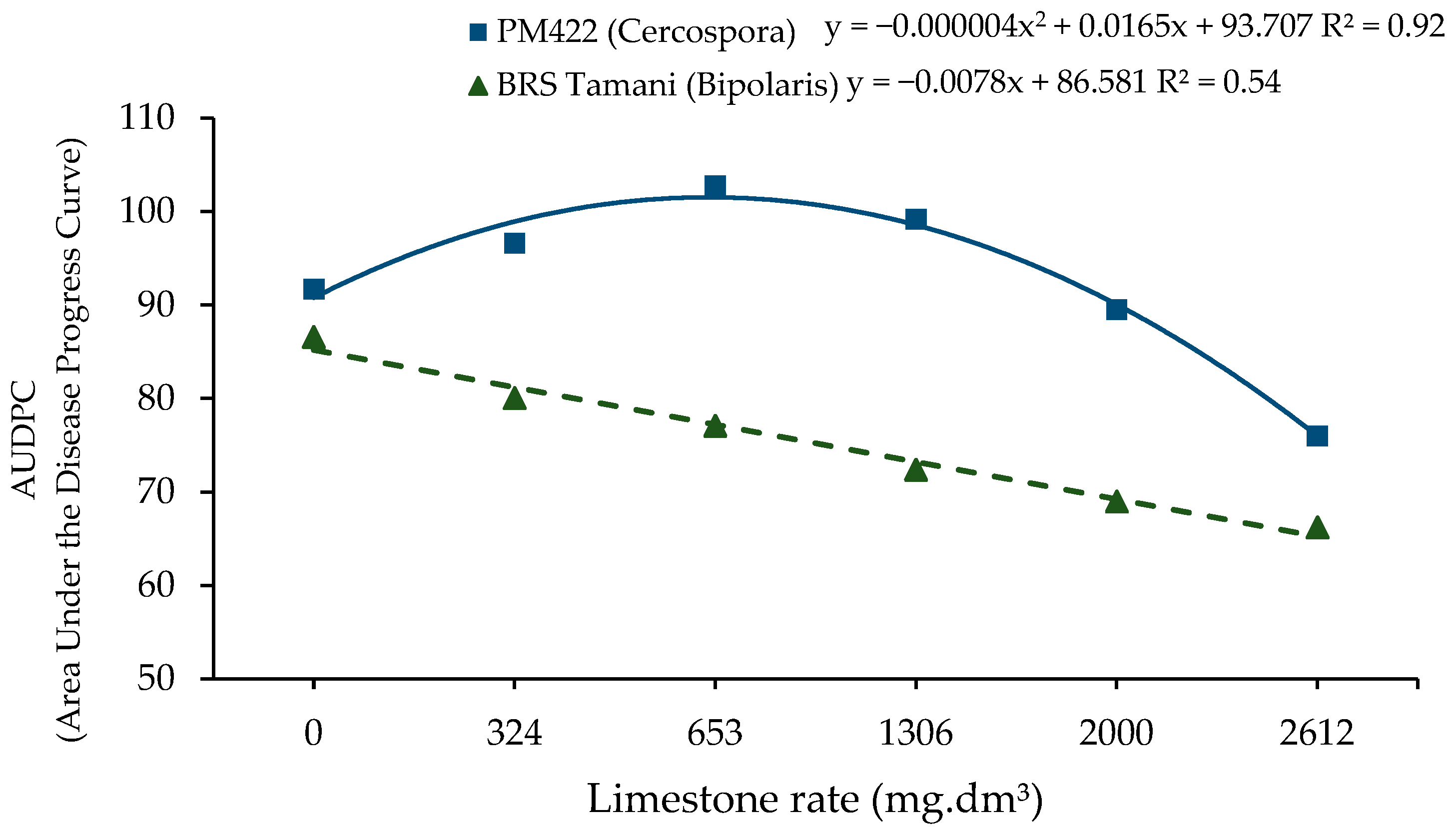
There was no interaction between limestone × forage rates for B. maydis (p = 0.1042) or C. fusimaculans (p = 0.1622). However, upon analyzing the interaction decomposition, significant effects were noted for limestone within the forage factor, with significance observed for limestone associated with cv. Tamani (p = 0.0426) for B. maydis, and limestone associated with PM422 (p = 0.0407) for C. fusimaculans. For B. maydis, a decreasing linear response was observed for the severity of leaf spot, with the highest value at a limestone dose of 653 mg dm−3 and the lowest at 2612 mg dm−3 of limestone. For C. fusimaculans, a quadratic response with a negative inflection point was observed starting at a limestone dose of 653 mg dm−3. The highest severity value was noted at the doses of 653 mg dm−3, and the lowest at the dose of 2612 mg dm−3 (Figure 2).
There was a forage*dose of P*days interaction for Bipolaris maydis severity (p < 0.0001), and for Cercospora fusimaculans there was a forage*days interaction (p < 0.0001). In the three-way interaction, a reduction in the severity of B. maydis damage was observed when the dose was P116, for the BRS Tamani forage, and the PM422 and PM408 genotypes, associated with day 30 of the disease assessment, while on day 60, an effect was observed only for the Tamani forage, associated with both P doses. However, for the PM422 genotype, an effect was observed on day 60 (Table 4).
There was a forage × days interaction (<0.0001) for Cercospora fusimaculans (Table 5), the severity between the evaluation days (30 and 60 days) increased for the BRS Tamani and BRS Zuri forages, while the values for the other forage plants did not differ between evaluation days. On day 60, BRS Tamani and PM408 had the lowest damage severity values, while on day 30, BRS Tamani had the lowest severity.

4. Discussion

The interaction between phosphorus (P) and lime rates resulted in a reduction in the severity of foliar fungal diseases caused by Bipolaris maydis and Cercospora fusimaculans. This result is based on the role of P in plant resistance, mainly by favoring physiological mechanisms linked to faster maturation of shoots and roots, which contributes to reducing the time of exposure to pathogen infections [21]. This effect of P is widely described in the literature, as plants with accelerated development have a shorter window of susceptibility to diseases [22].
Calcium from liming may also have contributed significantly to plant resistance—not only by maintaining cell wall and membrane structures [23] but also by acting as a second messenger in the regulation of plant defense mechanisms, mediating responses associated with cytosolic Ca2+ influx and activation of ion-binding proteins [24]. This process hinders the action of pectolytic enzymes released by pathogens, restricting their penetration and colonization of leaf tissues.
Limestone doses did not exert any influence on the disease severity of B. maydis, whether at the P19 or P116 doses. However, the severity of B. maydis was consistently lower compared to that of C. fusimaculans, irrespective of the P level and limestone application. Nevertheless, liming did introduce variability in the severity of the disease caused by C. fusimaculans. This suggests the need for more specific studies on the impact of liming on this disease in tropical Panicum maximum forages. The relevance of integrated approaches to nutritional management is highlighted here, considering that the efficiency of plant defense can be modulated by synergistic arrangements of different nutrients.
According to Teixeira et al. [25], the distribution of photoassimilates in P. maximum depends on the level of leaf insertion, as upper leaves concentrate resources in the apical meristem while basal leaves subsidize roots and tillers. In this study, disease severity was greater in basal leaves, suggesting susceptibility linked to the physiological function of the leaf in the plant and possibly its age. The older age of basal leaves may increase the availability of senescent or less protected tissue, favoring colonization strategies of fungal pathogens. Despite the polycyclic nature of the disease, environmental factors and experimental management (harvesting every 28 days) limited the pathogen’s progress in the upper leaves, reducing the available inoculum [26].
The results concerning the effects of phosphorus on fungal disease severity in P. maximum tropical forages mirror findings reported in other species in diverse agroecosystems [17,18], where mineral-induced plant resistance reduced disease severity. Increased P availability was found to reduce disease severity. The greater mineral supply may have led to higher phospholipid levels and reduced cell membrane permeability, aiding in pathogen defense [13].
In the case of B. maydis leaf spot, disease severity was generally low in the studied genotypes, except for Tamani. Consequently, P doses did not influence disease severity in these genotypes with a certain degree of resistance. When evaluating the disease caused by C. fusimaculans, variability was observed in the severity of damage among forage plants at both P19 and P116 doses. This underscores the strong influence of forage genotype and P supply level on resistance to fungal attacks. However, for the genotype PM414 and Zuri forage, there was no response to P concerning disease severity, indicating a potential role of Ca, particularly as there was a significant interaction between P and limestone doses. [27] suggest that supplying minerals in line with plant requirements, in a balanced manner between macro- and micronutrients, enhances disease resistance. Conversely, medium-sized forages appeared to be less resistant to C. fusimaculans attack. Therefore, increasing P supply did not induce greater resistance to fungal attacks when compared to Tamani, PM422, and PM408 (low content). However, disease progression will depend on the species-environment-pathogen interplay.
By decomposing the Forage × Limestone doses interaction, we found that limestone doses reduced disease severity in Tamani and PM422 (for B. maydis and C. fusimaculans, respectively). This suggests that increasing limestone doses in short-sized forage species may have a positive impact on reducing disease damage. Nevertheless, more specific investigations are necessary.
The study results revealed that small-sized forages receiving greater P inputs showed the capability to tole doses and reduce the damage of the disease up to 30 days after the first symptoms. However, after 60 days, this result was not repeated due to the depletion of P in the vessel, which was provided in a single dose at the beginning of the experiment [15]. At 60 days, P doses promoted a reduction in disease damage only in the BRS Tamani forage, indicating that certain forages can resist disease attacks even under conditions of greater nutrient inputs [28]. These plants can be utilized as an alternative to susceptible forages available on the market and as pasture diversification doses [29].
The medium-sized forages, BRS Zuri, PM414 and PM406 demonstrated more resistance to leaf spot, with greater resistance to the disease with the lowest dose of P applied. These results reinforce the findings of other studies Marcos et al. [30], that indicate some forages belonging to the species Panicum maximum have greater resistance to leaf spot caused by Bipolaris maydis. This integrated approach can reduce reliance on fungicides, promote more sustainable systems, and increase pasture longevity. This resistance, especially in new genotypes, is a characteristic sought after by genetic improvement programs for forage plants of the Panicum maximum species [31]. Forage plants of this species show varying responses in terms of resistance to leaf spots caused by B. maydis, from high susceptibility, such as the forages Tanzania and Mombaça [32], to low susceptibility, such as the forage Massai [19].
Currently, there is little to no literature reporting the presence of leaf spot caused by Cercospora fusimaculans in forage plants of the species Panicum maximum. However, under the study conditions, variability existed among the forages evaluated in relation to resistance to leaf spot throughout the experiment. Since resistance to leaf spot is a heritable trait [30,31], the forage BRS Tamani showed greater resistance among the forages evaluated during the initial 30 days of evaluation.
After 60 days from the first evaluation, an increase in leaf spots was observed in the Tamani and Zuri forages. However, further field studies are needed for these two forages. Nonetheless, in agricultural crops that suffer injuries from this disease, the use of fungicides proves to be an alternative to help control leaf spots caused by C. fusimaculans [28]. This practice is recurrent in crops such as maize (Zea mays) and sorghum (Sorghum bicolor), which are severely attacked by C. fusimaculans fungi [32].
Despite the variability of resistance responses of new genotypes to C. fusimaculans, such characteristics can be included in species improvement programs to aid in decision-making when launching new forages [29]. Thus, the study results suggest that the evaluated genotypes PM422, PM408, PM414, and PM406 are promising and may resist the damage caused by C. fusimaculans without compromising forage production.
Similar responses to phosphate fertilizer were observed by Spagnolleti et al. [18], who reported a decrease in severity and colonization in the roots of the fungi Macrophamina phaseolina and Rhizophagus intraradices. Phosphorus availability also led to an increase in the percentage of arbuscular roots. This decrease in severity is attributed to phosphate ions triggering systemic acquired resistance (SAR). It is further hypothesized that chelation of Ca ions at the site of phosphate application induces an endogenous biochemical signal for SAR [32]. However, more research is needed to comprehensively understand the effects of mineral nutrition on tropical forages and its relationship with resistance against diseases.

Author Contributions

Conceptualization, N.E.V.F., G.d.S.D., A.R.d.A., M.C.M.M., D.B.M., M.M.S., C.D.F. and G.d.F.T.; methodology, N.E.V.F., G.d.S.D., A.R.d.A., M.C.M.M., D.B.M., M.M.S., C.D.F., G.d.F.T., H.R.d.S. and M.A.T.; software, A.L.C.G.; validation, A.L.C.G., J.G.R. and A.G.; formal analysis, G.d.S.D. and D.B.M.; investigation, N.E.V.F., G.d.S.D., A.R.d.A., M.C.M.M., D.B.M., M.M.S., C.D.F., G.d.F.T., H.R.d.S., J.G.R. and M.A.T.; resources, G.d.S.D. and D.B.M.; data curation, A.L.C.G.; writing—original draft preparation, N.E.V.F., G.d.S.D., J.G.R. and D.B.M.; writing—review and editing, A.L.C.G.; visualization, A.R.d.A., M.C.M.M., D.B.M., M.M.S., C.D.F. and G.d.F.T.; supervision, G.d.S.D., A.R.d.A., M.C.M.M. and D.B.M.; project administration, N.E.V.F., G.d.S.D., A.R.d.A., M.C.M.M. and D.B.M.; funding acquisition, G.d.S.D., A.R.d.A., M.C.M.M. and D.B.M. All authors have read and agreed to the published version of the manuscript.

Funding

This research was funded by the Coordination for the Improvement of Higher Education Personnel (CAPES) under the funding code 001.

Institutional Review Board Statement

Not applicable.

Data Availability Statement

The raw data supporting the conclusions of this article will be made available by the authors upon request.

Acknowledgments

To the National Council for Scientific and Technological Development (CNPq), the Foundation for Supporting the Development of Education, Science and Technology of the State of Mato Grosso do Sul (FUNDECT), to the Federal University of Mato Grosso do Sul (UFMS), the Brazilian Agricultural Research Corporation (Embrapa Gado de Corte) and the Association for the Promotion of Forage Improvement Research (Unipasto) for their support, Adrián Gonzalez reviewed the English grammar (UNERG).

Conflicts of Interest

Authors Alexandre Romeiro de Araújo, Manuel Claudio Motta Macedo, Denise Baptaglin Montagner, Marcio Martinello Sanches and Celso Dornelas Fernandes were employed by the company Empresa Brasileira de Pesquisa Agropecuária. The remaining authors declare that the research was conducted in the absence of any commercial or financial relationships that could be construed as a potential conflict of interest.

References

  1. Instituto Brasileiro de Geografia e Estatística (IBGE). Censo Agropecuário; IBGE: Rio de Janeiro, Brasil, 2024. [Google Scholar]
  2. Euclides, V.P.B.; Montagner, D.B.; Macedo, M.C.M.; Araújo, A.R.; Difante, G.S.; Barbosa, R.A. Grazing intensity affects forage accumulation and persistence of Marandu palisadegrass in the Brazilian savannah. Grass Forage Sci. 2019, 74, 450–462. [Google Scholar] [CrossRef]
  3. Simeão, R.M.; Resende, M.D.V.; Alves, R.S.; Pessoa Filho, M.A.C.P.; Azevedo, A.L.S.; Jones, C.S.; Pereira, J.F.; Machado, J.C. Genomic Selection in Tropical Forage Grasses: Current Status and Future Applications. Front. Plant Sci. 2021, 12, 624584. [Google Scholar] [CrossRef]
  4. Zappacosta, M.; Bustamante, M.; Quarin, C.; Lavia, G. Genetic Transformation of Apomictic Grasses: Progress and Constraints. Front. Plant Sci. 2021, 12, 756382. [Google Scholar] [CrossRef] [PubMed]
  5. Lenne, J.M. A Word List of Fungal Diseases of Tropical Pasture Species; Phytopathological Papers; CABI Publishing: Wallingford, UK, 1990; Volume 31, p. 177. ISBN 0851986749. [Google Scholar]
  6. Perrenoud, S. Potassium and Plant Health; International Potash Institute (IPI): Basel, Switzerland, 1990; IPI Research Topics No. 3; 361p, ISBN 3-906535-11-5. [Google Scholar]
  7. Alves, E. Mecanismos estruturais na resistência de plantas a patógenos. Summa Phytopathol. 2007, 33, 156–160. [Google Scholar]
  8. Barrios, E. Soil biota, ecosystem services and land productivity. Ecol. Econ. 2007, 64, 269–285. [Google Scholar] [CrossRef]
  9. Charchar, M.J.A.; Anjos, J.R.N.; Fernandes, F.D. Panicum maximum cv. Tanzânia, nova hospedeira de Bipolaris maydis. Fitopatol. Bras. 2003, 28, 385. [Google Scholar]
  10. Ghimire, S.R.; Njarui, D.; Mutimura, M.; Cardoso, J.; Johnson, L.; Gichangi, E.; Teasdale, S.; Odokonyero, K.; Caradus, J.; Rao, I.M. Climate-smart Brachiaria for improving livestock production in East Africa: Emerging opportunities. In Proceedings of the 23rd International Grassland Congress 2015—Keynote Lectures, New Delhi, India, 20–24 November 2015; pp. 361–370. [Google Scholar]
  11. Teasdale, S.E.; Caradus, J.R.; Johnson, L.J. Fungal endophyte diversity from tropical forage grass Brachiaria. Plant Ecol. Divers. 2019, 11, 611–624. [Google Scholar] [CrossRef]
  12. Charchar, M.J.D.; dos Anjos, J.R.N.; Silva, M.S. Leaf spot in elephantgrass in the Cerrado region of central Brazil caused by Bipolaris maydis. Pesq. Agropec. Bras. 2008, 43, 1637–1639. [Google Scholar] [CrossRef]
  13. Biemond, P.; Oguntade, O.; Stomph, T.-J.; Kumar, P.L.; Termorshuizen, A.J.; Struik, P.C. Saúde de sementes de milho armazenadas por agricultores no nordeste da Nigéria. Eur. J. Plant Pathol. 2013, 137, 563–572. [Google Scholar] [CrossRef]
  14. Nsibo, D.L.; Barnes, I.; Omondi, D.O.; Dida, M.M.; Berger, D.K. Estrutura genética populacional e padrões de migração do fungo patogênico do milho, Cercospora zeina, na África Oriental e Meridional. Fungal Genet. Biol. 2021, 149, 103527. [Google Scholar] [CrossRef]
  15. Liu, X.; Lu, Y.; Zhang, Z.; Zhou, S. Foliar fungal diseases respond differently to nitrogen and phosphorus additions in Tibetan alpine meadows. Ecol. Res. 2020, 35, 162–169. [Google Scholar] [CrossRef]
  16. Brennan, R.F. Effect of levels of take-all and phosphorus fertiliser on the dry matter and grain yield of wheat. J. Plant Nutr. 1995, 18, 1159–1176. [Google Scholar] [CrossRef]
  17. Csöndes, I.; Balikó, K.; Degenhardt, A. Effect of different nutrient levels on the resistance of soybean to Macrophomina phaseolina infection in field experiment. Acta Agron. Hung. 2008, 56, 357–362. [Google Scholar] [CrossRef]
  18. Spagnoletti, F.N.; Leiva, M.; Chiocchio, V.; Lavado, R.S. Phosphorus fertilization reduces the severity of charcoal rot (Macrophomina phaseolina) and the arbuscular mycorrhizal protection in soybean. J. Plant Nutr. Soil Sci. 2018, 181, 855–860. [Google Scholar] [CrossRef]
  19. Silva Martinez, A.; Franzener, G.; Stangarlin, J.R. Damages caused by Bipolaris maydis in Panicum maximum cv. Tanzânia. Semin. Ciênc. Agrár. 2010, 31, 863–870. [Google Scholar] [CrossRef]
  20. Fernandes, C.D.; Chermouth, K.S.; Jank, L.; Mallmann, G.; Fernandes, E.T.; Queiróz, C.A.; Carvalho, C.; Quetez, F.A.; Silva, M.J.; Batista, M.V. Reação de híbridos de Panicum maximum à mancha das folhas em condições de infecção natural. In Proceedings of the International Symposium on Forage Breeding, Bonito, Brazil, 14–17 November 2011; Embrapa Gado de Corte: Campo Grande, Brazil, 2011; Volume 3, pp. 59–61. [Google Scholar]
  21. Gruber, B.D.; Giehl, R.F.H.; Friedel, S.; Wirén, N.V. Plasticity of the Arabidopsis root system under nutrient deficiencies. Plant Physiol. 2013, 163, 161–179. [Google Scholar] [CrossRef] [PubMed]
  22. Chan, C.; Liao, Y.Y.; Chiou, T.J. The Impact of Phosphorus on Plant Immunity. Plant Cell Physiol. 2021, 62, 582–589. [Google Scholar] [CrossRef] [PubMed]
  23. Xu, H.; Heath, M.C. Role of calcium in signal transduction during the hypersensitive response caused by basidiospore-derived infection of the cowpea rust fungus. Plant Cell 1998, 10, 585–597. [Google Scholar] [CrossRef]
  24. Balzergue, C.; Chabaud, M.; Barker, D.G.; Bécard, G.; Rochange, S.F. High phosphate reduces host ability to develop arbuscular mycorrhizal symbiosis without affecting root calcium spiking responses to the fungus. Front. Plant Sci. 2013, 4, 426. [Google Scholar] [CrossRef] [PubMed] [PubMed Central]
  25. Teixeira, A.C.B.; Gomide, J.A.; Oliveira, J.A.; Alexandrino, E.; Lanza, D.C.F. Distribuição de fotoassimilados de folhas do topo e da base do capim-Mombaça (Panicum maximum Jacq.) em dois estádios de desenvolvimento. Rev. Bras. Zootec. 2005, 34, 479–488. [Google Scholar] [CrossRef]
  26. Nunes, C.D.M.; Mittelmann, A. Doenças do Azevém. Documentos 2009, 279, 34–35. [Google Scholar]
  27. Tripathi, R.; Tewari, R.; Singh, K.P.; Keswani, C.; Minkina, T.; Srivastava, A.K.; De Corato, U.; Sansinenea, E. Plant mineral nutrition and disease resistance: A significant linkage for sustainable crop protection. Front. Plant Sci. 2022, 13, 883970. [Google Scholar] [CrossRef] [PubMed]
  28. Silva, H.R.; Frontado, N.E.V.; Tico, M.A.; de Faria Theodoro, G.; Sanches, M.M.; Fernandes, C.D.; Difante, G.D.S. Behavior of Megathyrsus maximus cv. BRS Tamani to brown leaf spot, caused by Bipolaris yamadae, as a function of nitrogen fertilization doses. J. Plant Pathol. 2025, 107, 1413–1421. [Google Scholar] [CrossRef]
  29. Véras, E.L.d.L.; Difante, G.d.S.; Araújo, A.R.d.; Montagner, D.B.; Monteiro, G.O.d.A.; Araújo, C.M.C.; Gurgel, A.L.C.; Macedo, M.C.M.; Rodrigues, J.G.; Santana, J.C.S. Potassium Fertilization Alters the Morphogenetic, Structural, and Productive Characteristics of Panicum maximum Cultivars. Grasses 2024, 3, 287–296. [Google Scholar] [CrossRef]
  30. Martinez, A.S.; Frazener, G.; Stangarlin, J.R. Avaliação do dano provocado por Bipolaris maydis em Panicum maximum cv. Tanzânia-1. Dissertation, Marechal Cândido Rondon, State University of Western Paraná, Cascavel, Brazil, 2006; 41p. Available online: https://tede.unioeste.br/handle/tede/1273 (accessed on 20 September 2025).
  31. Pinto, N.F.J.D.A. Controle químico da “ergot” (Claviceps africana Frederickson, Mantle & de Milliano) ou doença-açucarada e das principais doenças foliares do sorgo (Sorghum bicolor (L.) Moench). Ciênc. Agrotecnol. 2003, 27, 939–944. [Google Scholar]
  32. Rodrigues, F.A.; Romeiro, R.S.; Resende, R.S.; Dallagnol, L.J. Indução de resistência em plantas a patógenos. In O Essencial da Fitopatologia: Epidemiologia de Doenças de Plantas; Zambolim, L., Júnior, W.C.J., Rodrigues, F.A., Eds.; Universidade Federal de Viçosa: Viçosa, Brazil, 2014; pp. 264–290. ISBN 978-85-60027-37-8. [Google Scholar]
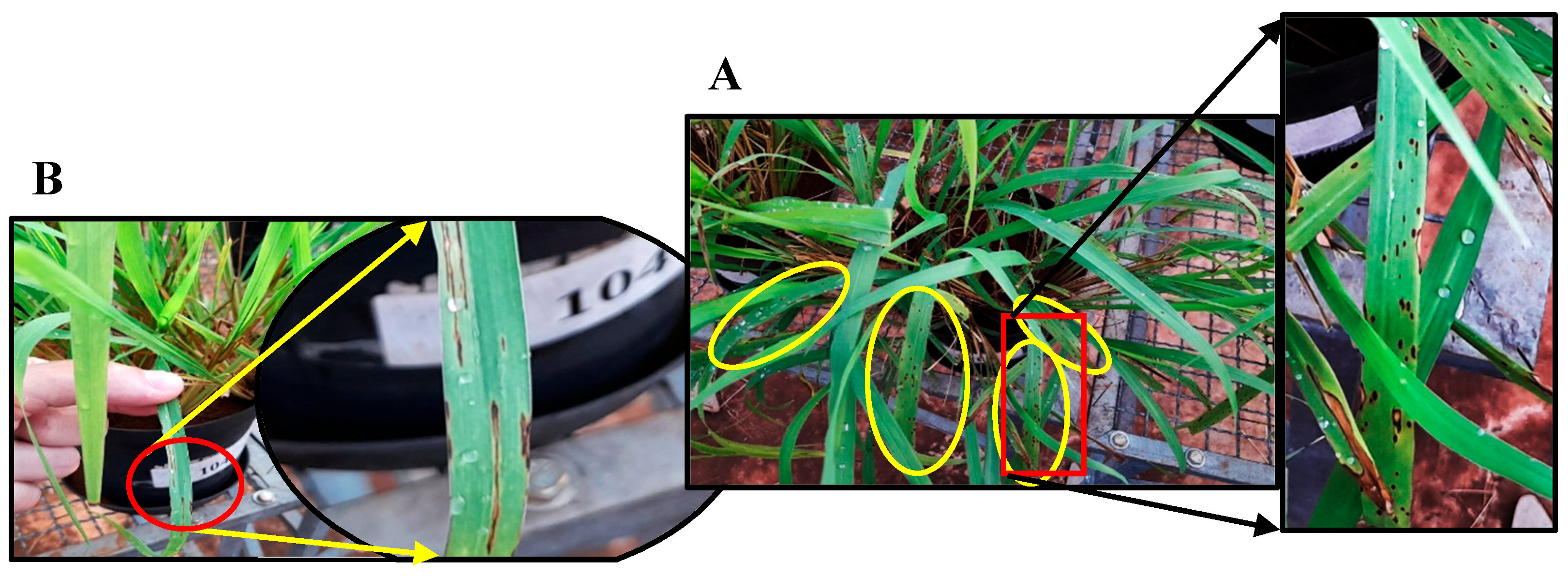
Figure 1. Leaf spots by Bipolaris maydis and Cercospora fusimaculans ((A) and (B), respectively).
Agriculture 15 02506 g001
Figure 2. Influence of limestone doses on the severity of the leaf spot complex in the BRS Tamani cultivar and PM422 genotype.
Agriculture 15 02506 g002
Table 1. Chemical characteristics of the soil before the start of the experiment evaluations.
TRTpHCa++Mg++K+Al+3H + AlSTCECBSmOMPM1
(mg dm−3)
PCaCO3CaCl2cmolc/dm3%dag/dm3mg/dm3
04.610.450.260.170.295.040.885.911.1614.824.62.564.60
3264.720.580.470.140.185.001.206.201.3819.4013.102.584.62
1166534.970.770.640.120.104.901.546.451.6423.905.802.584.28
13065.121.060.920.140.044.492.126.612.1632.12.002.493.65
26125.621.861.670.130.003.803.667.463.6649.100.002.453.86
04.650.240.220.120.394.900.585.490.9810.7040.102.951.10
3264.710.410.410.100.214.970.915.881.1215.518.902.731.63
196534.860.560.590.070.124.871.236.11.3420.18.703.020.76
13065.221.050.980.130.035.002.167.162.1930.11.502.570.88
26125.491.571.470.140.004.093.187.273.1843.80.002.700.86
TRT—treatment; pH—potential of hydrogen; Ca++—calcium; Mg++—magnesium; K—potassium; Al+3—aluminum; H + Al—SMP buffer pH; S—sum of bases (Ca + Mg + K); T—potential CEC (H + Al + Ca + Mg + K); BS—base saturation [(S/T) × 100]; m—aluminum saturation percentage; OM—organic matter, modified South Dakota; PM1—phosphorus in Mehlich extract; P—phosphorus doses; CaCO3—calcium carbonate (limestone); CaCl2—calcium chloride.
Table 2. Severity of leaf spot caused by Bipolaris maydis and Cercospora fusimaculans in Panicum maximum forages as a function of P and limestone doses.
AUDPC Bipolaris maydis
P Doses (mg dm−3)Limestone Doses (mg dm−3)
032665313062612SEMLSDp-Value
1933.5 aA30.6 aA41.1 aA34.4 aA26.8 aA3.9715.550.1202
11614.0 bA20.0 aA15.0 bA19.1 bA25.1 aA3.9715.550.2673
AUDPC Cercospora fusimaculans
1992.4 aAB102.2 aA95.3 aAB84.6 aB92.5 aAB4.3416.960.0854
11681.5 aA75.5 bAB67.5 bAB78.7 aA59.3 bB4.3416.960.0029
Means followed by common lowercase letters in the column and uppercase letters in the row do not differ from each other according to Tukey’s test at 5%. AUDPC: area under the disease progress curve. p-value: probability of a significant effect. SEM: standard error of the mean. LSD: least significant difference.
Table 3. Severity of leaf spot caused by Bipolaris maydis and Cercospora fusimaculans in Panicum maximum forages as a function of P doses.
ForageP Doses (mg dm−3)p-Value
19116
AUDPC (Bipolaris maydis)
Tamani113.8 aA43.9 aB<0.0001
PM42229.2 bA17.6 bA0.0549
PM40824.9 bcA14.8 bA0.0930
Zuri16.2 bcdA8.8 bA0.2175
PM4149.7 cdA14.6 bA0.4124
PM4066.0 dA12.1 bA0.3040
Mean33.318.6
AUDPC (Cercospora fusimaculans)
Tamani69.1 cA44.4 cB0.0004
PM422107.2 aA75.3 aB<0.0001
PM40895.4 abA55.1 bB<0.0001
Zuri99.9 abA93.9 aA0.3790
PM41486.8 bcA79.7 aA0.2992
PM406102.1 abA86.6 aB0.0248
Mean93.472.5
Means followed by common lowercase letters in the column and uppercase letters in the row do not differ from each other according to Tukey’s test at 5%. AUDPC: area under the disease progress curve. p-value: probability of a significant effect. SEM: standard error of the mean. CV: Coefficient of Variation. LSD: least significant difference. SEM AUDPC (Bipolaris maydis): 4.35; LSD AUDPC (Bipolaris maydis): 12.18; CV AUDPC (Bipolaris maydis): 62.82; SEM AUDPC (Cercospora fusimaculans): 4.81; LSD AUDPC (Cercospora fusimaculans): 13.29; CV AUDPC (Cercospora fusimaculans): 22.46.
Table 4. Severity of leaf spot caused by Bipolaris maydis at 30 and 60 days after the appearance of symptoms.
ForageP Doses (mg dm−3)p-Value
19116
AUDPC (Bipolaris maydis)
30 day0.0005
Tamani62.14 aAa35.19 aBa<0.0001
PM42224.01 bAa9.81 bBa<0.0001
PM40815.74 bcAa7.44 bBa0.0208
Zuri9.66 cdAa5.8 bAa0.2811
PM4145.8 cdAa7.76 bAa0.5846
PM4063.00 dAa7.34 bAa0.2243
60 day
Tamani51.73 aAb8.76 aBb<0.0001
PM4225.22 bAb7.85 aAa0.4612
PM4089.25 bAa7.44 aAa0.6136
Zuri6.54 bAa3.00 aAa0.3224
PM4143.90 bAa6.85 aAa0.4092
PM4063.00 bAa4.80 aAa0.6129
Means followed by common lowercase letters in the column, uppercase letters in the row and lowercase in the column do not differ from each other according to Tukey’s test at 5%. AUDPC: area under the disease progress curve. p-value: probability of a significant effect. SEM: standard error of the mean. CV: Coefficient of Variation. LSD: least significant difference. SEM: 2.83; LSD:7.91; CV:75.23.
Table 5. Severity of leaf spot caused by Cercospora fusimaculans at 30 and 60 days after the appearance of symptoms.
ForageDayp-Value
3060
AUDPC (Cercospora fusimaculans)
Tamani22.00 cB34.78 cA0.0002
PM42242.75 abA48.51 abA0.0935
PM40840.48 bA34.84 cA0.1006
Zuri44.75 abB52.17 aA0.0311
PM41441.20 bA42.09 bcA0.7957
PM40650.06 aA44.32 abA0.0945
Means followed by common lowercase letters in the column and uppercase letters in the row do not differ from each other according to Tukey’s test at 5%. AUDPC: area under the disease progress curve. p-value: probability of a significant effect. SEM: standard error of the mean. CV: Coefficient of Variation. LSD: least significant difference. SEM: 2.15; LSD:8.74; CV:28.46.
Disclaimer/Publisher’s Note: The statements, opinions and data contained in all publications are solely those of the individual author(s) and contributor(s) and not of MDPI and/or the editor(s). MDPI and/or the editor(s) disclaim responsibility for any injury to people or property resulting from any ideas, methods, instructions or products referred to in the content.