Article

Efficacy of Mini Wheel-Driven Sweet Potato Transplanting Machine for Mulched Raised Beds

1
Shandong Academy of Agricultural Machinery Sciences, Jinan 250100, China
2
Shandong Key Laboratory of Intelligent Agricultural Equipment in Hilly and Mountainous Areas, Jinan 250100, China
3
Huang Huai Hai Key Laboratory of Modern Agricultural Equipment, Ministry of Agriculture and Rural Affairs, Jinan 250100, China
4
Shandong Academy of Agricultural Sciences, Jinan 250100, China
*
Author to whom correspondence should be addressed.
Agriculture 2025, 15(23), 2434; https://doi.org/10.3390/agriculture15232434
Submission received: 1 October 2025 / Revised: 14 November 2025 / Accepted: 22 November 2025 / Published: 25 November 2025
(This article belongs to the Section Agricultural Technology)

Abstract

The mechanized transplanting of sweet potato slips onto mulched raised beds in China’s Huang-Huai-Hai region faces significant challenges due to fragmented smallholder farms and the specific agronomic requirement of “boat-shaped” horizontal planting. To address this gap, this study aimed to develop a compact, cost-effective transplanter that meets the “boat-shaped” planting agronomy and adapts to small plots. We designed the 2CGX-1 mini wheel-driven transplanter coupled with a tractor. This machine features a compact chassis (<1.5 m length) for enhanced maneuverability on small plots, a novel five-bar taking-planting mechanism optimized for boat-shaped placement (achieving a stem-soil angle of 56.2° and planting depth of 110 mm), and an integrated spring buffer system. Transmission design ensures precise synchronization between the dual-chain seedling feeding mechanism and planting actions, allowing plant spacing adjustment from 18 to 30 cm. Coupled Adams–EDEM simulations demonstrated that the buffer system reduces maximum resistance on the clip fingers by 37.8% when encountering obstacles. Field validation under optimal parameters (0.55 km/h operating speed, 30 plants/min transplanting frequency) showed high consistency: average planting depth 101.3 mm (SD 1.38), plant spacing 330.3 mm (SD 11.24), seedling length under the film 185 mm (SD 3.65), and stem-soil angle 47.9° (SD 3.41), with qualification rates exceeding 91.9% for all key parameters except submerged length (82.5%). Compared with manual planting (≤0.1 ha/day per person, labor cost > ¥800/ha), this transplanter achieves a daily operational efficiency of ~0.35 ha/day (calculated by 0.55 km/h speed × 0.8 m working width × 8 h daily working time). Meanwhile, the consistency of its key planting indicators and the planting qualification rate are significantly superior to those of manual planting, while improving operational quality and significantly reducing labor cost input. Deviations in individual indicators mainly stem from planting positioning deviations induced by terrain undulations in hilly test areas, and sweet potato seedlings’ tendency to fall off during clamping due to mechanical vibration. However, these errors are within the acceptable agricultural operation range and do not compromise the machine’s overall compliance with agronomic requirements. The transplanter effectively meets agronomic requirements while offering a cost-effective, adapted solution for small-scale sweet potato production systems, significantly advancing mechanization capabilities for mulched cultivation.

1. Introduction

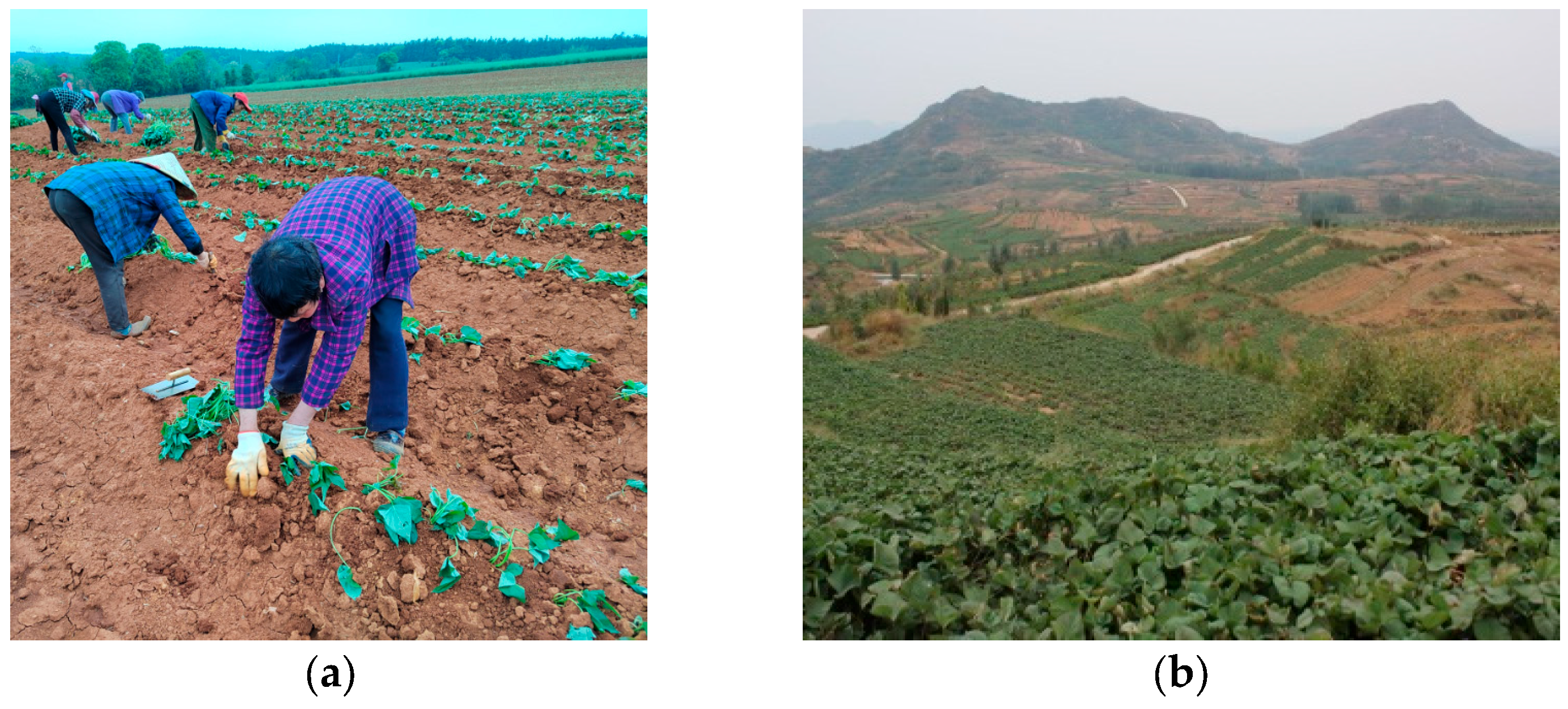
Sweet potato (Ipomoea batatas (L.) Lam.) is a globally important crop with high nutritional value and adaptability to marginal lands, and it plays a critical role in China’s food security, ranking among the top cultivated crops [1]. According to FAO statistics, China’s sweet potato cultivation area has exceeded 2000 km2 in recent years, with an annual total production of approximately 60,000 kt—accounting for about 65.35% of the world’s output [2]. In the Huang-Huai-Hai Plain—a major grain-producing region contributing 51% of China’s wheat and corn output—sweet potato cultivation faces unique mechanization challenges. Unlike staple crops with consolidated plots and standardized machinery, sweet potato fields here are fragmented, characterized by small plot sizes (<1 ha), dispersed distribution, and complex terrain (Figure 1). These constraints necessitate compact, adaptable machinery to align with localized agronomic practices while minimizing land waste during operation.
The agronomic specificity of Huang-Huai-Hai sweet potato cultivation exacerbates these challenges. Optimal yields require burying multiple slip nodes shallowly (5–8 cm depth) to balance tuber development and pest resistance [3], while also covering with plastic film to increase soil temperature, retain moisture, reduce pest infestations, and mitigate drought stress [4]—a practice incompatible with the existing common vertical or deep-planting mechanisms for vegetable plug slips. Consequently, most regions’ operations still rely on manual labor, incurring labor costs exceeding ¥1800/ha and transplanting rates below 0.1 ha/day/person [5,6]. This gap underscores an urgent need for cost-effective, small-plot-optimized transplanters and complex transplanting agronomy-adapted transplanters that harmonize mechanical design with regional agronomy.
Despite advances in raised-bed farming technologies, mechanized transplanting of sweet potato slips remains underdeveloped compared to grain crops. Conventional transplanters, such as Kubota’s IKP-4 Mulch-Trans Planter Series and Agritech Solutions’ multifunctional models, primarily target vegetable-potted slips [7,8]. While vertical planting mechanisms (e.g., duck-billed systems with planetary five-bar linkages) show efficacy for upright crops [9], they fail to address the horizontal placement required for sweet potato slips—a critical factor for tuber initiation [5]. Yan’s innovative seedling belt-type sweet potato transplanter achieves horizontal seedling planting, meeting the agronomic requirements of uncovered ridge planting without plastic film mulching in southern China [10]. ISEKI PVH-103 self-propelled sweet potato transplanter (0.6 km/h, single-row capacity) achieved limited success due to its high cost (>$15,000 USD) and incompatibility with China’s smallholder farming economy [11]. Recent domestic innovations, including Li et al.’s compound transplanter integrating tillage and transplanting, improved functionality but suffered from oversized designs (>3 m width), resulting in operational inefficiencies on fragmented plots [12,13].
Internationally, the FPP EVO mechanical transplanter [14] from Italy’s FERRARI GROWTECH S.P.A. employs a tractor-towed design, featuring telescopic hydraulic rods and integrated irrigation-fertilization systems, and is designed for vertical sweet potato seedling planting on bare ridges without plastic film. The Agriplanter 2SP-W [15] from Belgium’s AGRIPLANTER incorporates an advanced data analysis and decision support system, allowing real-time parameter adjustment based on historical data and sensor feedback. However, it remains restricted to bare-ridge conditions and vertical planting. The 814F Trailer transplanter [16] from the U.S. MECHANICAL TRANSPLANTER CO. can process over ten ridges per pass and is similarly suited for vertical planting on bare ridges. Like the Agriplanter 2SP-W, it targets large-scale farming operations. In summary, mainstream sweet potato transplanters in Europe and America are generally characterized by large dimensions and high electrification, tailored for large-scale cultivation on flat terrains—a profile that markedly differs from the current sweet potato planting systems in China.
However, the mainstream global technological routes for mechanized sweet potato production primarily serve large-scale plain farms. Their characteristics of large size, high energy consumption, and high cost stand in acute contradiction with the prevalent smallholder farming models in this region—characterized by fragmented plots, limited capital, and complex agronomy. This disconnect between technological pathways and production systems constitutes the core bottleneck restricting full mechanization of nearly two-thirds of the world’s sweet potato output.
To address this dual challenge of mechanical adaptability and agronomic specificity, this study aimed to explore and verify a miniaturization and adaptability design paradigm for agricultural machinery suited to smallholder economies and tailored to the specific agronomy of plastic film-mulched raised beds. Taking sweet potato transplanting in China’s Huang-Huai-Hai Plain as a specific case, we developed the 2CGX-1 transplanter, which serves as the engineering carrier to verify the technical feasibility and economic benefits of this design. Our design prioritizes three innovations: (1) A compact chassis with a length < 1.5 m, minimizing headland waste on fragmented plots; (2) A hybrid mechanism combining a finger-clip slip-taking–planting mechanism and a buffering system, enabling real-time depth adjustment and “boat-shaped” planting geometry to fulfill multi-node burial requirements; (3) A tractor-hitched configuration tailored to China’s agricultural infrastructure, significantly reducing manufacturing and operational costs while ensuring compatibility with smallholder farming practices. Field trials evaluated performance metrics including transplanting efficiency, slip survival rate, and operational cost per hectare, benchmarked against manual and existing mechanized methods.
This study advances mechanized sweet potato production by resolving the mismatch between conventional transplanters and smallholder farming contexts. By demonstrating the technical feasibility and economic viability of miniaturized designs compatible with raised beds mulched with plastic film, our work provides a scalable template for crop-specific mechanization in developing economies.

2. Materials and Methods

2.1. Agronomic Requirements and Design Basis

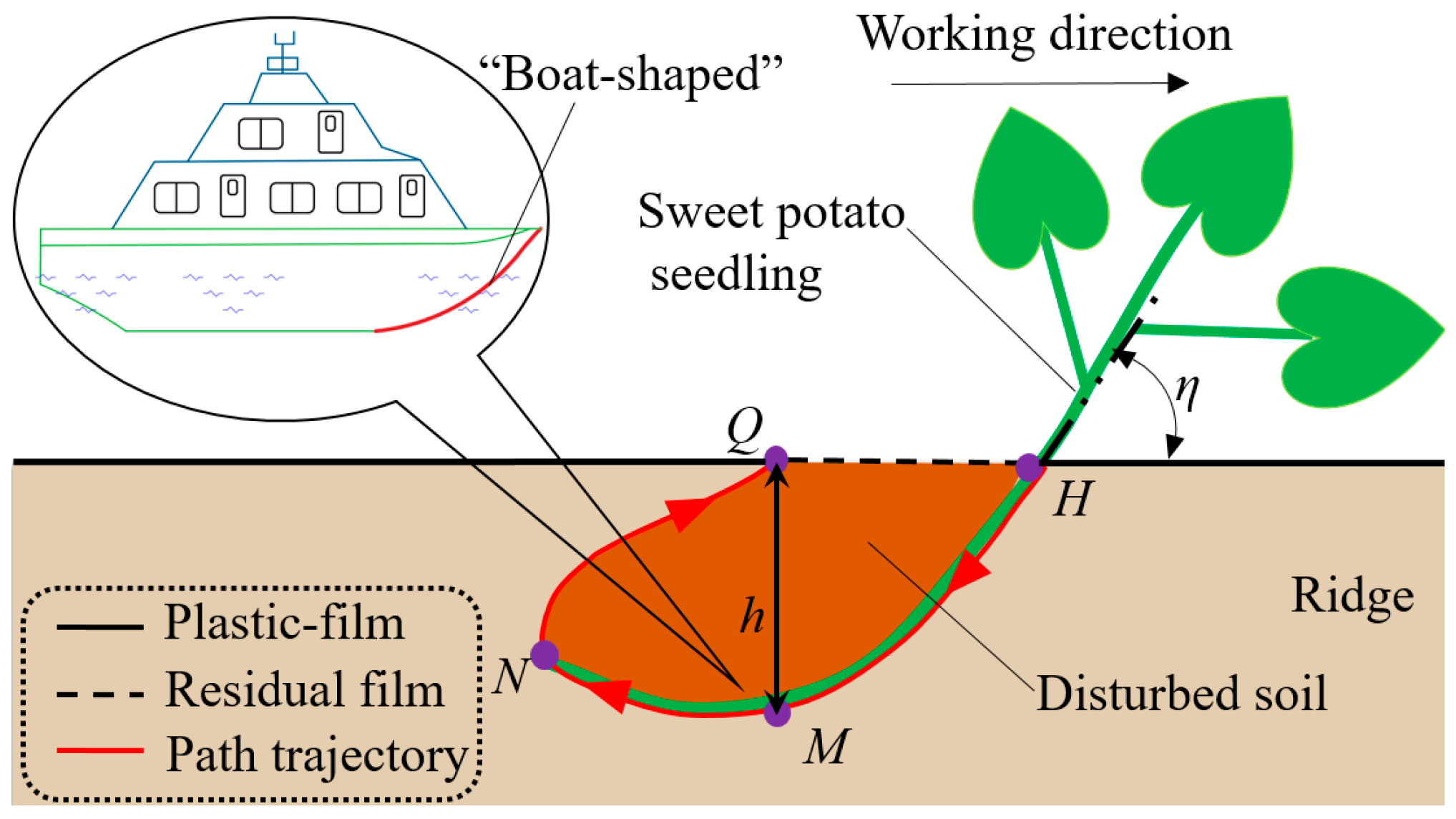
Ridge mulching in sweet potato cultivation not only enhances production efficiency but also improves soil temperature [17] and physical properties and suppresses weed growth [18], consequently increasing both yield and quality of sweet potatoes [19]. Since sweet potato roots develop from the nodes of buried stems, adequate node burial (typically 3–4 nodes) with optimal planting depth (60–100 mm) is crucial to ensure proper aeration and maximize tuber formation. As shown in Figure 2, the boat-shaped planting method, characterized by specific parameters including a stem-soil angle (η), planting depth (h), and buried stem length l NMH ^ = 15~20 cm, and plant spacing (18~30 cm) [20], has demonstrated advantages in drought resistance and yield improvement [21]. This configuration optimizes node burial depth and distribution, promoting uniform tuber development and enhanced productivity. Currently, this planting method has been widely adopted in China’s Huang-Huai-Hai region [22].
To meet the agronomic requirements of mulched boat-shaped planting, the 2CGX-1 mini wheel-driven sweet potato transplanter was specifically designed. This implement integrates key technical parameters including planting depth control, accurate transplanting on mulched beds and precise plant spacing mechanisms, to ensure compliance with the prescribed cultivation specifications.
Where H is the soil penetration point; Q is the excavation point; M is the deepest point; N is the farthest point; η is the angle between the slip and the ground (stem-soil angle), (°); h is transplanting depth, (mm); XOY is the coordinate, X axis is parallel and opposite to the forward direction, Y axis is vertical and downward to the ground.

2.2. Machine Structure and Working Principle

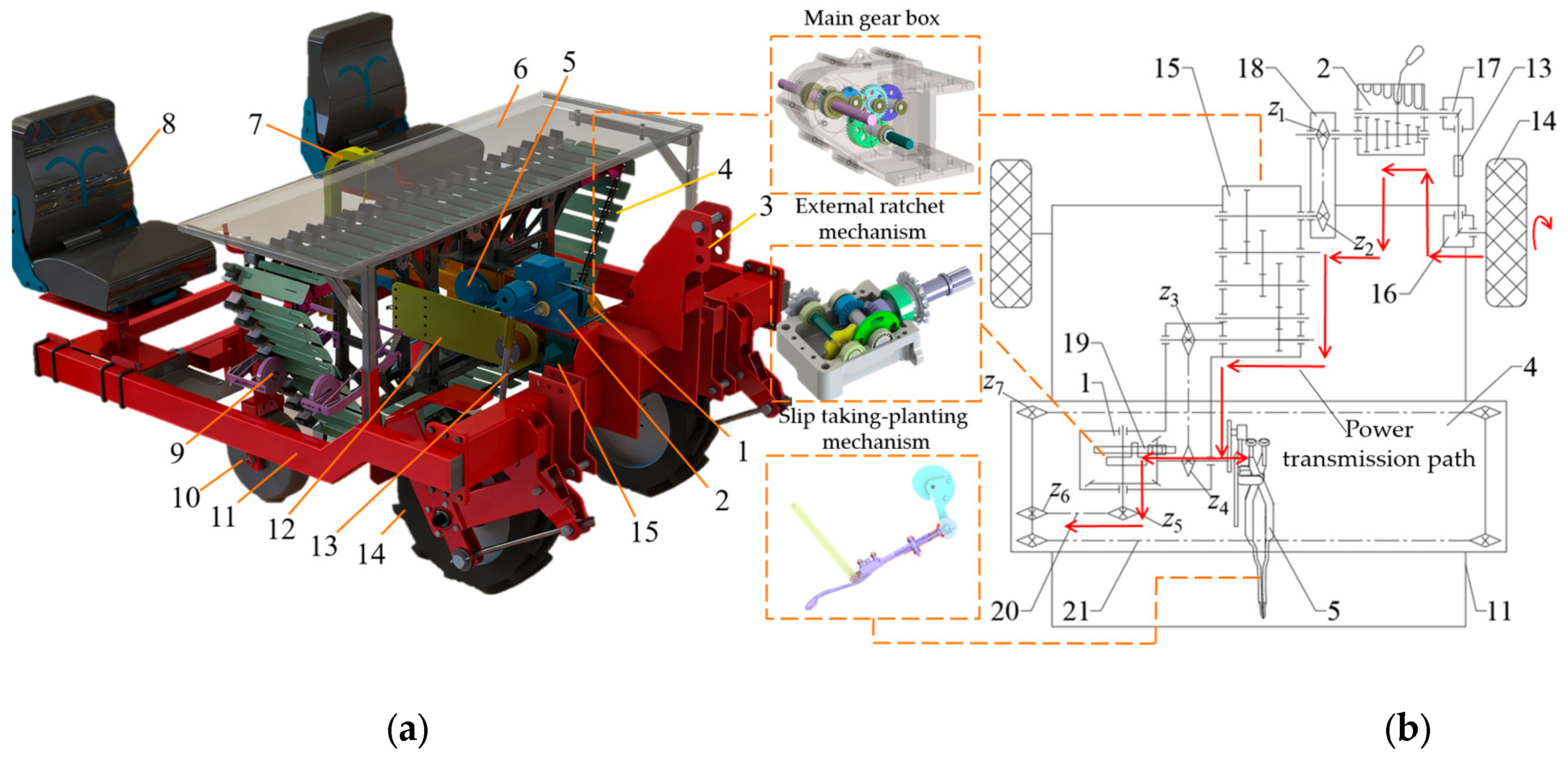
The 2CGX- 1 transplanter for the cultivation of sweet potato slips is mainly composed of a frame assembly, speed change system, and slip transplanting apparatus (Figure 3). During the mechanized operation of slip planting on raised beds mulched with a plastic film system, the tractor hangs the 2CGX-1 transplanter through the three-point suspension system. Among the working processes, the slip transplanting apparatus plays a crucial role as it clamps and plants the slips on the ridge by means of the slip-taking and planting mechanism, which is driven by the ground wheel. Simultaneously, slips are manually placed in the slip feeding mechanism by the operators sitting on the seats. The 2CGX-1 transplanter was independently developed by our team with full intellectual property rights, having completed the entire process of design, prototyping, manufacturing, and field testing; Figure 3, is self-drawn with full publication rights.
The speed change system is a critical component of the transplanter, designed to provide an adjustable gear ratio for real-time synchronization of planting spacing with the tractor’s forward speed. Equipped with multiple gear settings, this system allows operators to fine-tune planting spacing according to specific agronomic requirements. For example, shifting to a higher gear reduces planting spacing, making it suitable for high-density planting patterns. All transmission components are securely integrated into the frame assembly, which ensures structural rigidity and enables smooth operation across diverse terrains. Additionally, strategically positioned ground wheels enhance mobility and operational stability during field use.
The transplanter is powered via the tractor’s three-point hitch system, with the ground wheel serving as the primary source of mechanical energy for both the planting device and the slip feeding mechanism. Power is transmitted from one end of the ground wheel through a series of interconnected components: the first reversing gearbox, a telescopic drive shaft, and a secondary reversing gearbox adjacent to the plant spacing adjustment gearbox. From there, power is directed into the plant spacing adjustment gearbox and subsequently transmitted to the main gearbox via the front chain drive. The main gearbox increases rotational speed while reducing torque, then distributes the power to the rear chain drive. The rear chain drive splits the power into two output streams: one drives the planting device to execute the transplanting operation, while the other is routed to the slip delivery gearbox. Within the slip delivery gearbox, a cam mechanism converts continuous rotational motion into intermittent motion, which is then transmitted to the slip feeding mechanism via a chain drive. This precise coordination between the slip delivery and planting motions ensures seamless and efficient transplanting operations.
The plant spacing is a significant agronomic parameter in sweet potato cultivation and also a crucial design parameter for the transplanter’s transmission system. The planting spacing for sweet potato seedling transplanting usually ranges from 180 mm to 300 mm. The relationship between the plant spacing of the transplanter and the traveling speed of the tractor is as follows:
d Z = π d W Π = π d W n 1 / n g
where dZ is the planting spacing (mm); dW is the ground wheel diameter (mm); Π is the ratio of the slip-taking–planting mechanism rotational speed n1 to the ground wheel rotational speed ng. Based on the characteristics of the machine’s chassis, it is known that the wheel diameter dg = 580 mm. When the machine operates. the tractor’s forward speed is maintained at 0.6~0.8 km/h, and speed adjustment can be achieved by regulating the throttle or shifting gears. When the planting spacing is 180~300 mm, the range of values for the transmission ratio Π is 6.07–10.12.
The operational conditions of the sweet potato transplanting machine can be categorized into two primary states: the planting operation state and the neutral state. During the planting operation, the transmission system is subjected to high dynamic loads with significant fluctuations due to the intermittent nature of the transplanting process. In contrast, when the machine is in the neutral state, the entire system is unloaded, and the transmission is securely locked to prevent unintended rotation of the ground wheels. This locking mechanism is critical for protecting the slip-taking-planting mechanism from damage during tractor suspension lifting or transportation.
In order to fulfill the agronomic demands of sweet potato planting, the plant spacing adjustment gearbox is designed with six operational gears and one neutral gear, enabling precise adjustment of plant spacing to accommodate varying field conditions. When the gearbox is set to the neutral position, the power transmission is interrupted, ensuring that the mini 2CGX-1 sweet potato transplanter ceases operation. This feature safeguards the slip-taking–planting mechanism from potential damage caused by ground wheel rotation during non-operational phases. Additionally, the Geneva mechanism integrated into the slip delivery gearbox ensures that each slip delivery plate reaches the slip-taking–position in advance and remains stationary. This design enhances the synchronization between the slip delivery and transplanting processes, significantly improving the success rate of slip take-up by the planting mechanism. The parameters of the machine are shown in Table 1.

2.3. Design and Optimization of the Taking-Planting Mechanism

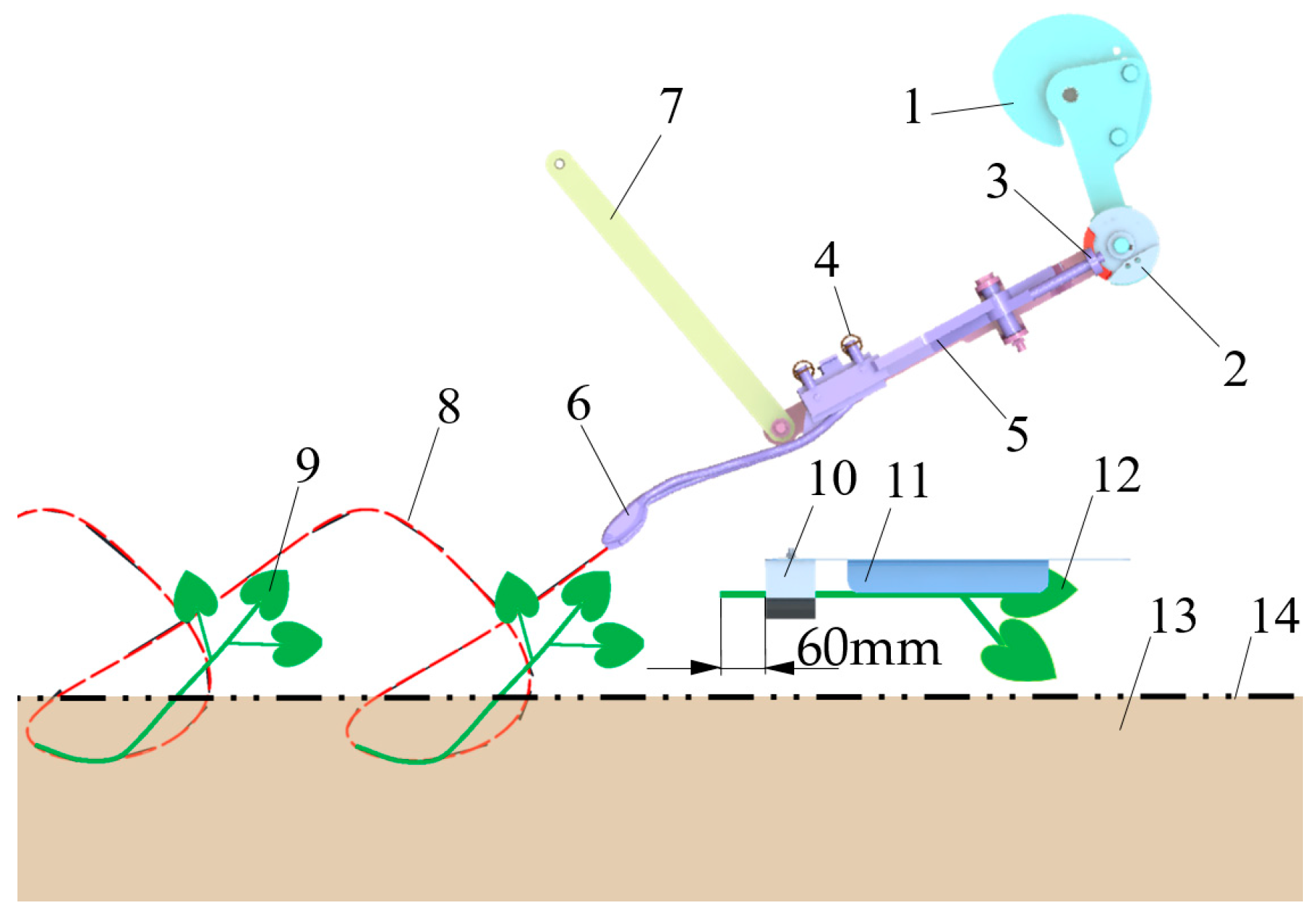
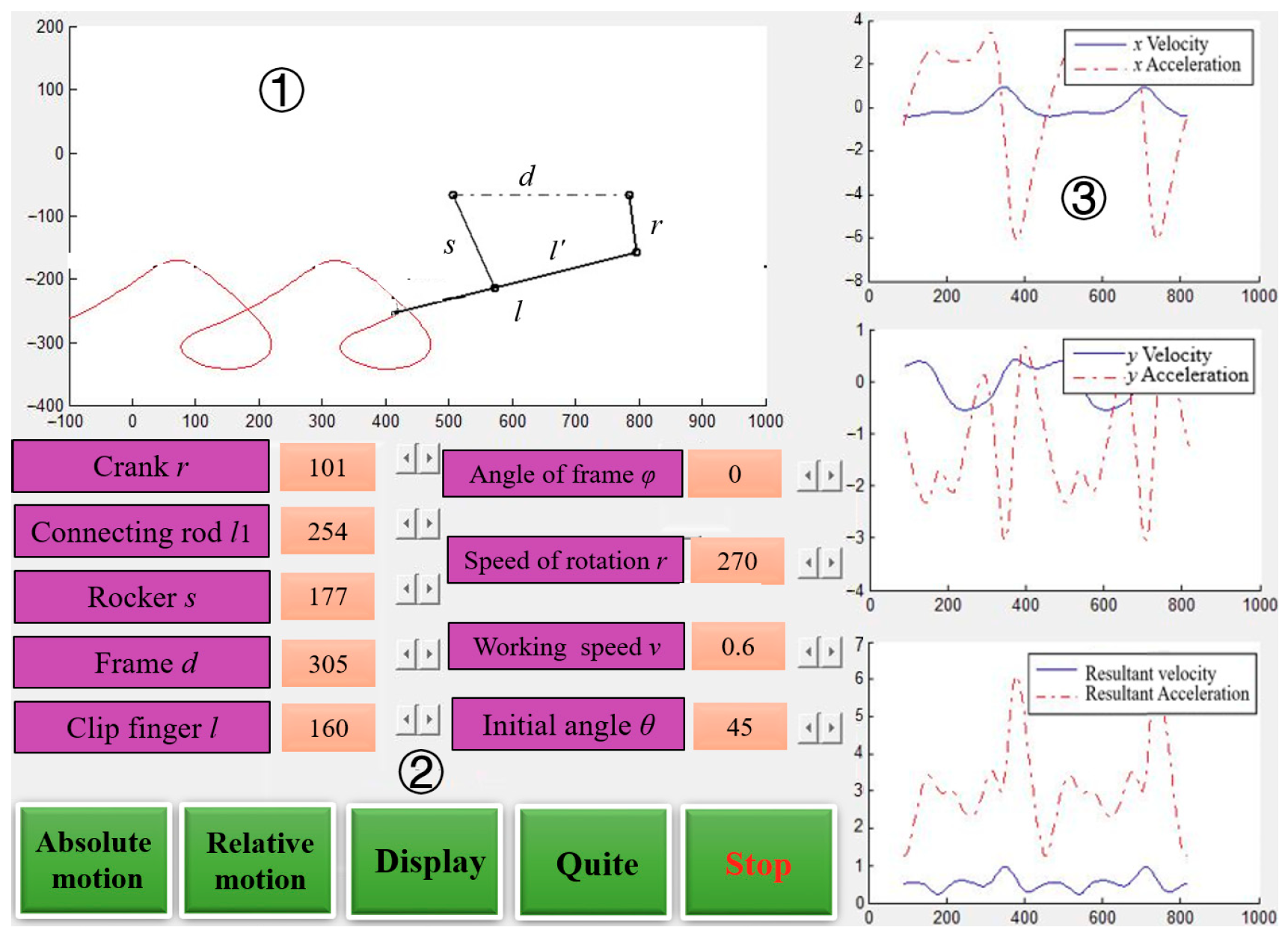
The slip-taking–planting mechanism is crucial for achieving the boat-shaped placement. Figure 4 shows the working diagram and the mechanical principle of the slip-taking–planting mechanism. As shown in Figure 5, based on the mechanism motion parameters and actual agronomic requirements, we analyzed the relationship between the planting trajectory of the planting mechanism and its own structure as well as operating parameters [24,25,26].
The parameters of the planting mechanism were optimized by analyzing the relationship between the machine operation speed, planting spacing, and the dynamic transplanting trajectory so that the slips could be planted with a “boat-shaped” placement. As a result, the optimized values of the parameters were determined to be r = 101.6 mm, l = 254 mm, s = 177.8 mm, d = 304.8 mm (Figure 5). Correspondingly, as the key indicators of the boat-shaped planting form of sweet potato slips, the stem-soil angle (η), transplanting depth (h), and length of seedlings under film ( l N M H ) are 56.2°, 110 mm, and 195 mm, respectively. Operating parameters meet the agronomic requirements for ridge-forming and film-mulching planting of sweet potatoes in the Huang-Huai-Hai region [3,12,22].

2.4. Slips Transplanting Apparatus

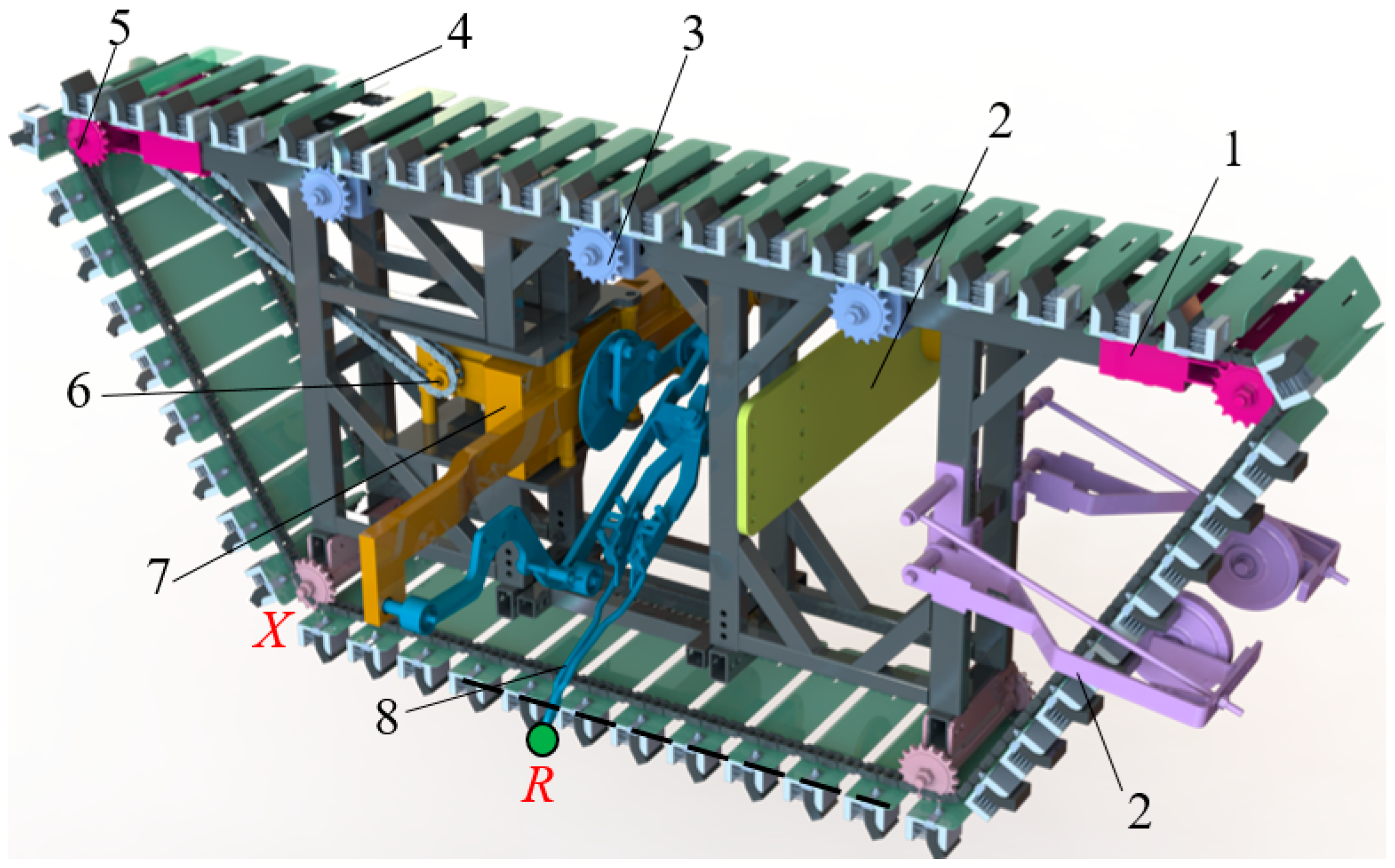
The transplanting assembly primarily consists of a seedling feeding mechanism, a taking-planting mechanism, an intermittent mechanism, a support frame, and a tensioning mechanism (Figure 6). It is hinged to the main frame via support plates. The seedling feeding mechanism and the taking-planting mechanism work in coordination: the seedling feeding mechanism conveys sweet potato seedlings continuously and individually to the feeding point R, where the taking–planting mechanism grasps the seedlings as it passes by and inserts them into the soil, thereby completing the planting operation.

2.4.1. Dual-Chain Seedling Feeding Mechanism

The dual-chain seedling feeding mechanism is a critical component of the transplanting assembly, whose structural design and operational parameters directly affect the feeding accuracy and overall performance. This mechanism mainly includes seedling clamping blocks, seedling guard plates, a top tensioning mechanism, and feeding chains. The seedling clamping brushes are fixed onto the seedling guard plates, which are mounted at evenly spaced intervals on two parallel-arranged annular feeding chains, collectively forming the dual-chain seedling feeding mechanism.
To reduce motion impact and accumulated positioning errors during the seedling feeding process, it is essential to ensure that each feeding action corresponds to an integer number of chain link rotations. According to the agronomic requirements for sweet potato planting, the transplanting spacing is generally 180~300 mm. Considering the speed ratio relationships of the entire drive system and the chain pitch, the gear transmission ratio is set as Z5:Z6:Z7 = 2:1:2. This ensures that when gear Z4 completes one revolution (i.e., the planting mechanism finishes one working cycle), the feeding chains rotate by an exact integer number of links. Based on this, in the dual-chain seedling feeding device, the seedling guard plates are installed at uniform intervals of every 9 chain links, thereby achieving precise and efficient seedling conveying.

2.4.2. Intermittent Mechanism

The operational characteristics of the slip-taking–planting mechanism are high speed and short intervals between taking and planting. Therefore, a continuous, stable and precise supply of slips is crucial for the success of the transplanting operation. The design concept of the sweet potato transplanter in this study is: before the planting device reaches point R, the slip placement board of the slip feeding mechanism has already delivered the slips to be planted to point R and remains stationary, waiting for the slip-taking–planting mechanism to take up the slips, thereby improving the success rate of slip pickup by the slip-taking–planting mechanism.
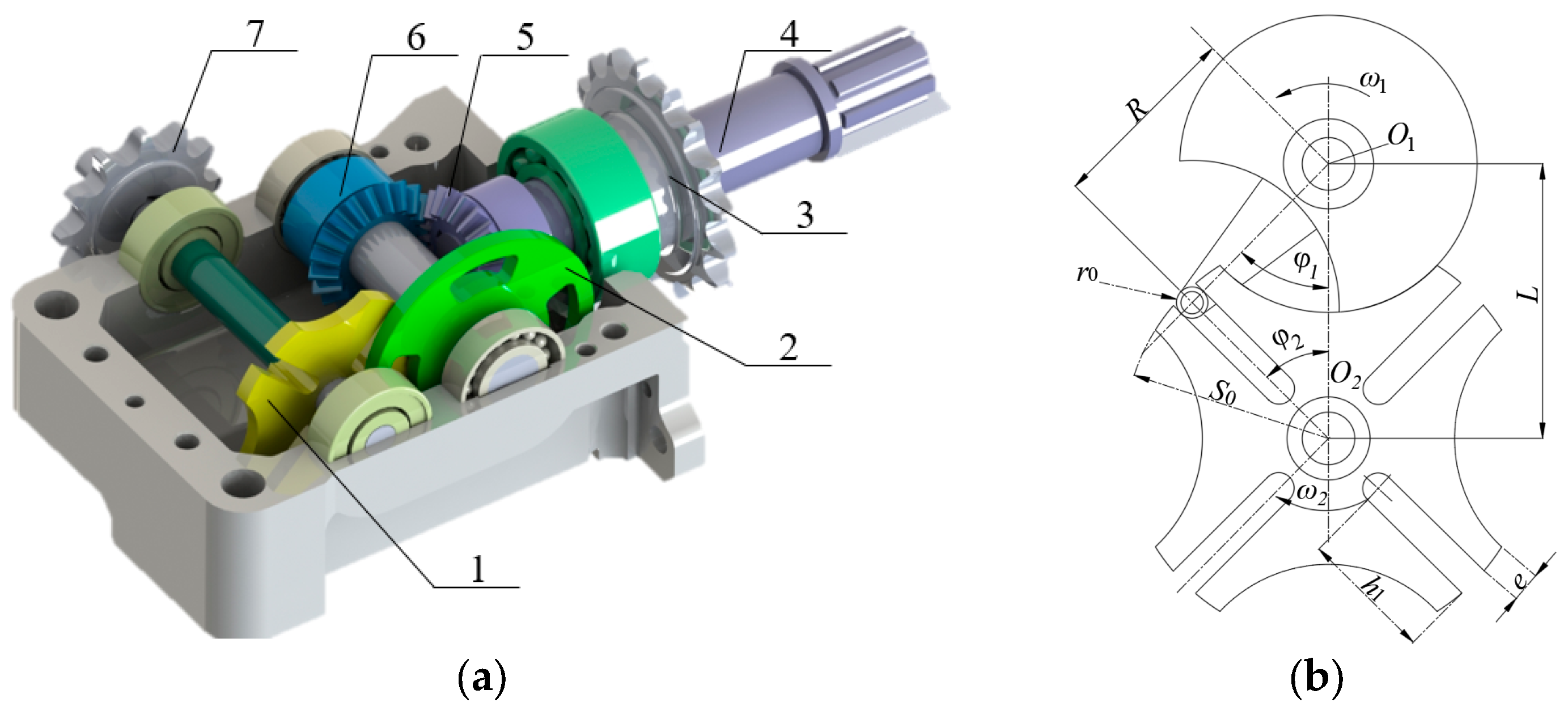
The external ratchet mechanism has a characteristic. When the center distance is constant, more slots lead to a larger ratchet wheel. Moreover, when the number of slots exceeds 9, the increase in the number of slots does not cause a significant change in the motion coefficient of the ratchet wheel. Considering the transplanting space in the slip feeding mechanism and the dynamic matching principle between the slip feeding mechanism and the slip-taking–planting mechanism, several data are preliminarily determined as follows: the center distance of the external ratchet mechanism L = 45 mm, the number of pins on the driving disc n = 1, the number of slots on the external ratchet wheel z = 4. Consequently, we further determined the motion coefficient k of the ratchet mechanism, as shown below [27]:
k = n ( 1 2 1 z )
Finally, we calculated that the motion coefficient k = 0.25 < 1, which indicates the motion time of the ratchet wheel in the ratchet mechanism is always shorter than its stationary time, which conforms to the operational requirements of the slip feeding mechanism, the external ratchet mechanism is shown in Figure 7.
The other structural parameters of the external ratchet mechanism should satisfy the following constraints (Equations (3)–(5)) [28]:
R = L sin ( π / z )
S 0 = L cos ( π / z )
h 1 S 0 ( L R r 0 )
where R is the radius of gyration of the pin; S0 is the radius of the external circle of the ratchet wheel; r is the radius of the pin; h1 is the depth of the slot; e represents the thickness of the external ratchet teeth; r indicates the outer diameter of the roller. Finally, the values of the parameters were determined to be R = 32 mm; S0 = 31.82 mm; h1 = 21.82 mm; e = 9 mm, r0 = 3 mm.

2.5. Design and Analysis of the Buffer System

The clip finger has a slender structure and operates at a relatively high speed of about 43 cycles per minute, which results in significant vibrational impacts. If the clip finger encounters hard objects such as rocks in the soil during operation, it is prone to damage, thereby reducing the overall reliability of the machine and the success rate of transplanting. Common measures for balancing and damping the planar linkage mechanism include the counterweight method and balance mechanism method [29]. However, for agricultural machinery, adding counterweights or balance mechanisms can make the equipment bulky and complex [30]. In view of this, to address the issue of low planting success rates caused by excessive deformation of the planting claw due to vibration and soil resistance during the planting process, a suspended spring was designed to absorb the impact generated by the planting mechanism.
The slip feeding mechanism for slip transplanting is articulated to the main gearbox through the rear chain box and support plate, and the end of the rear chain box is suspended on the spring suspension bracket with a spring, enabling the slip transplanting delivery mechanism to float and buffer the vibration and impact generated by the slip-taking–planting mechanism. During operation, the buffer system reduces the impact and deformation of the clip finger, thereby improving the reliability and performance of the machine.
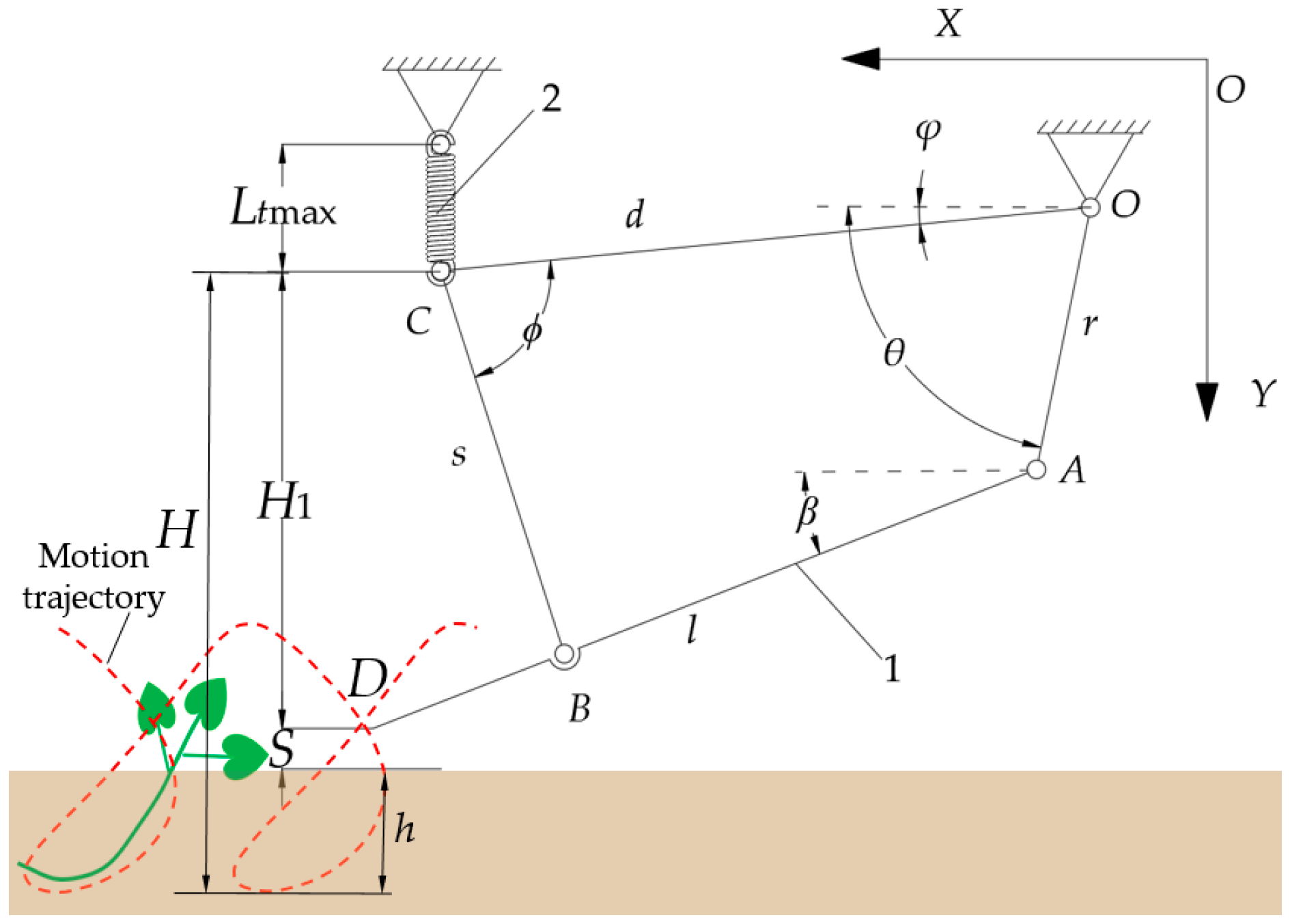
The spring is a critical component ensuring the normal operation of the buffer system, with its key parameters including the spring stiffness coefficient k and the initial length Lt. If the spring force is designed too small, the planting mechanism may bounce under the impact of crank rotation, making it difficult to ensure consistent planting depth. Conversely, if the spring force is designed too large, the stiffness of the buffer system will increase, resulting in a loss of protection for the gripping fingers of the slip-taking–planting mechanism when they encounter rocks. To determine the appropriate range of the spring stiffness coefficient k, a mechanical analysis model of the buffer mechanism is established, as illustrated in Figure 8.
Where O is the rotation center of the crank; A is the hinge point between the crank and connecting rod; B is the hinge point between the connecting rod and the rocker; C is the hinge point between the rocker and the frame; r is the length of the crank, mm; l is the length of connecting rod |AB|, mm; s is the length of rocker, mm; d is the length of the frame, mm; θ is the crank angle, (°); β is the rod angle, (°); ϕ is the rocker angle, (°). φ is the angle between the frame OC and X-axis direction, (°);
The initial length of the spring is determined based on the rotation angle of the planting assembly, which consists of the seedling feeding device, the taking-planting mechanism, and the buffer system. To ensure that the maximum agronomic planting depth requirement for sweet potato seedlings is met, the initial spring length Lt and the maximum elongation x of the spring under the action of the planting assembly and inertial forces must satisfy the following condition:
{ H = L t   max + H 1 + S L t   max = L t + χ
The parameters S, h, and H1 satisfy the following conditions:
(1) To prevent the clamping fingers of the taking-planting mechanism from damaging the plastic film during non-operating periods, S should be constrained within the range of 20 mm ≤ S ≤ 30 mm.
(2) The agronomic planting depth h should meet the requirement of 80 mm ≤ h ≤ 120 mm.
(3) To ensure reliable seedling grasping and planting by the clamping fingers, H1 is set to 267 mm based on the spatial constraints of the mechanism.
The spring is primarily subjected to the weight of the planting assembly and the inertial forces generated by the rotation of the crank in the taking-planting mechanism. The maximum elongation of the spring, denoted as x, satisfies the following equation:
{ x = F x F = F c y 1 + F G y   max
where Fcy1 is the vertical component (y-direction) of the planting assembly’s weight at point C, FGymax is the maximum vertical force (y-direction) at point C resulting from the inertial forces of the taking-planting mechanism.
In analyzing the inertial forces produced by the crank rotation, friction at each hinge joint is neglected. The angular positions of the rocker ϕ and the connecting rod β satisfy the following relation:
{ r cos θ + l cos β = d + s cos ϕ r sin θ + l sin β = s sin ϕ
The angular velocity of the rocker ωs and the connecting rod angle ωl should satisfy the following relation:
{ l ω l sin β + s ω s sin ϕ = r ω sin θ l ω l cos β s ω s cos ϕ = r ω cos θ
The angular acceleration of the rocker αS and the angular acceleration of the connecting rod αl should satisfy the following relation:
{ l α l s i n β + s α s s i n ϕ = r ω 2 c o s θ l ω l 2 c o s β s ω s 2 c o s ϕ l α l c o s β s α s c o s ϕ = r ω 2 s i n θ + l ω l 2 s i n β s ω s 2 s i n ϕ
The accelerations of the center of mass of each linkage in the x-direction and y-direction are then given by:
{ a c x = ω 2 r c c o s θ a c y = ω 2 r c sin θ a s x = s c ω s 2 c o s ϕ s c α s sin ϕ a s y = s c ω s 2 sin ϕ + s c α s c o s ϕ a l x = ( r ω 2 cos θ s ω s 2 cos ϕ s α s sin ϕ ) / 2 a l y = ( r ω 2 sin θ + s α s c o s ϕ s ω s 2 sin ϕ ) / 2
The inertial force F is acts at the center of mass of the rocker in the direction opposite to its acceleration a s , while the inertial moment Mis acts in the direction opposite to the angular acceleration αs, F is and Mis satisfy:
{ F i s , x = m s a s x F i s , y = m s a s y M i s = I s a s
where Is is the moment of inertia of the rocker about its center of mass.
The inertial force F il acts at the center of mass of the connecting rod in the direction opposite to its translational acceleration a l , while the inertial moment Mil acts in the direction opposite to its angular acceleration al. F il and Mil satisfy the following relationship:
{ F i l , x = m l a l x F i l , y = m l a l y M i l = I l α l
where Il is the moment of inertia of the connecting rod about its center of mass.
Since the crank rotates at a constant speed, its angular acceleration is 0; consequently, it experiences an inertial force but no inertial moment. The inertial force F il acts at the center of mass of the crank in a direction radially outward along the crank.
{ F i r , x = m r ω 2 r cos θ F i r , y = m r ω 2 r sin θ
According to the static equilibrium conditions, the rocker must satisfy the following equation:
{ F 12 x + F 43 x + F i s , x = 0 F 12 y + F 43 y + F i s , y = 0 M i s + ( r × F 43 ) z + ( r s × F i s ) z = 0
In this equation, F 12 is the reaction force exerted by the frame on the rocker, F 43 is the force exerted by the connecting rod on the rocke r , is the vector from the hinge point C to point B (the joint connecting the rocker and the connecting rod), and r s is the vector from point C to the center of mass of the rocker.
Based on the static equilibrium conditions, the connecting rod need satisfy the following equation:
{ F 34 x + F 23 x + F i , x = 0 F 34 + F 23 y + F i l , y = 0 M i l + ( r B × F 34 ) z + ( r A × F 23 ) z = 0
where F 23 is the force exerted by the crank on the connecting rod, and F 34 is the force exerted by the rocker on the connecting rod. r A and r B are vectors directed from the center of mass of the connecting rod to points A and B, respectively.
By solving Equations (15) and (16) simultaneously, the reaction force F12 exerted by the frame on the rocker at a specific crank angle θ is determined.
F 12 = ( F 12 x 2 , F 12 y 2 )
According to Newton’s third law, the force exerted by the rocker on the frame at point C, denoted as C is equal in magnitude and opposite in direction to F 21 = − F 12 .
Thus, the total force exerted by the rocker on the frame is:
| F 21 | = F 21 x 2 + F 21 y 2 = F 12 x 2 + F 12 y 2
The solution shows that the maximum magnitude of F 12 throughout one full rotation of the crank is 132.8 N. Since the direction of the inertial force is not required in the subsequent analysis and given the small angle θ involved, this force is regarded as the maximum inertial force acting along the axis of the spring.
Therefore, the working load F of the spring acting at point C is given by:
F = F G y   max + G C
where GC is the y-direction of the self-weight of the planting assembly at point C.
Based on the operating conditions of the seedling planting device, the number of cyclic loadings applied to the suspension spring falls within the range of 1 × 10³ to 1 × 10⁶ cycles. The material of the cylindrical helical spring is carbon steel wire. The relationship among the shear stress in the spring wire, the wire diameter, the number of active coils, and the curvature correction factor is given by the following formula:
{ K = 4 C 1 4 C 4 + 0.615 C d = 1.6 K C F τ P F = F Gy max + G C C = D d n = L t d k = F f = G d 4 8 n D 3 = G D 8 C 4 n
where F is the working load of the spring (N); f is the deformation under the working load (mm); k is the spring stiffness (N/mm); D is the mean coil diameter (mm); C is the spring index, defined as C = D/d, with a value of C = 10 adopted in this case; d is the wire diameter (mm); K is the curvature correction factor; G is the shear modulus (MPa); n is the number of active coils. According to the recommendation of ISO 8458-2:2002 [31], the shear modulus of the spring wire is G = 79 GPa.
Using the above formula, the calculated wire diameter is d = 2.36 mm, which is rounded up to d = 2.5 mm. The mean coil diameter is determined as D = 25 mm, and the number of active coils is n = 16. Based on the common spring specification table, the initial parameters selected for the suspension spring are as follows: wire diameter d = 2.5 mm, mean coil diameter D = 40 mm, number of active coils n = 16, free length H0 = 40 mm, and spring stiffness k = 1543 N/m.

2.6. Coupled Simulation of the Buffer System

To verify the functional effectiveness of the designed spring damping system, a coupled ADAMS-EDEM simulation approach was employed to conduct a targeted investigation into the beneficial effects of the damping system on the planting mechanism. Using the optimal operating parameters under actual working conditions as initial inputs, coupled simulations were carried out for two configurations: the transplanter equipped with the damping system and without it. By comparing the simulation results of these two scenarios, a quantitative assessment was performed to evaluate the protective effect of the damping system on the grippers of the pickup-transplant mechanism.

2.6.1. Development of the Multibody Dynamics Model

To validate the dynamic model, the core kinematic mechanisms of the pickup-planting unit were retained. The assembly model was imported into ADAMS in STEP format and assigned appropriate material properties. Revolute joints were created at key articulation points, including between the crank and connecting rod, the connecting rod and rocker, and the rocker and the frame.
Rigid contact models were defined for critical interacting pairs, with parameters such as contact stiffness, damping coefficient, and friction coefficient specified. The crank rotational speed ω0 was set according to field operating parameters. After validating the dynamic model, GFORCE elements were created at the center of mass of each contacting component to define force transmission paths. A user subroutine interface (SUBROUTINE) was configured, and a solver ID was assigned. The spatial correspondence between the force vector coordinate system and the EDEM particle coordinate system was simultaneously verified (relevant parameters are listed in Table 2).
After completing the aforementioned preprocessing, an executable .adm format file is generated, which incorporates complete constraint relationships, material properties, and driving conditions, thereby enabling real-time bidirectional coupling between the dynamic response and the discrete element interaction forces.

2.6.2. Development of the Discrete Element Simulation Model

A virtual soil bin model was constructed using the EDEM 2022 discrete element simulation software. The geometric dimensions of the soil bin were set to 500 × 300 × 300 mm to accommodate the soil particle model and the rock model.
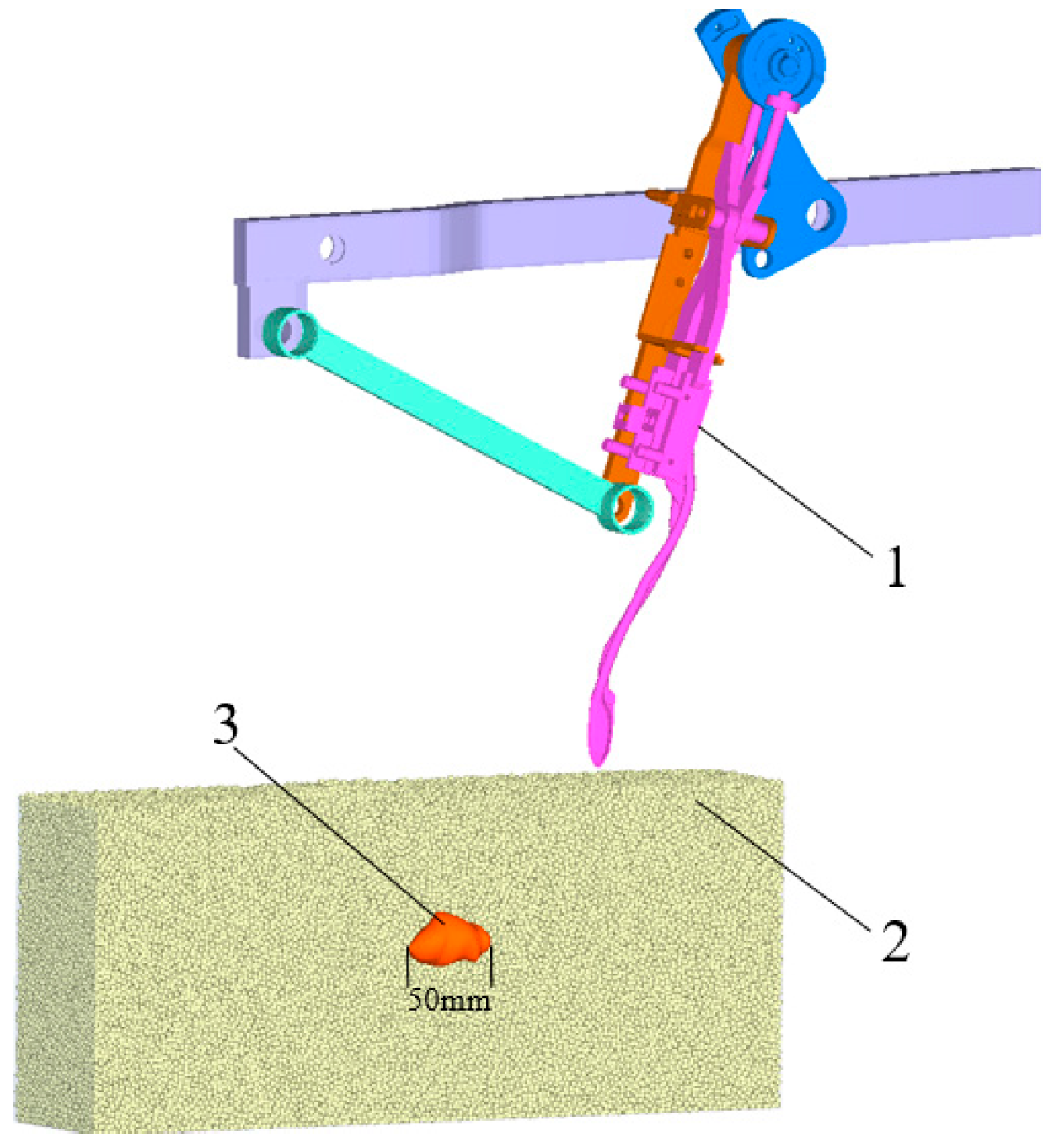
Considering the high moisture content and strong adhesion of the soil beneath the plastic film in the mulched planting mode, the Edinburgh Elasto-Plastic Adhesion (EEPA) model was selected as the contact model for the soil particles [32,33]. This model couples compressibility and adhesion parameters, accurately capturing the actual mechanical behavior of the mulched soil. A particle factory was created above the soil bin to generate soil particles with a diameter of 3 mm [34], forming a particle layer with a thickness of 300 mm. Ellipsoidal rock models measuring 50 × 45 × 30 mm were generated along the trajectory of the pickup fingers, which were positioned 50 mm above the soil particle surface. The simplified core mechanism model of the transplanting device was imported into EDEM, and the spatial relative positions of each simulation component (including the transplanting device and rocks) were adjusted based on the spatial relationships derived from trajectory analysis. This ensured interference-free seedling gripping during the transplanting process and compliance with the required planting depth. The discrete element model is illustrated in Figure 9.
The contact parameters involved in the simulation for various types of interactions, including transplanter–soil [34], soil–soil [35], and soil–rock [36,37], are listed in Table 3.

2.6.3. Coupled Simulation Analysis

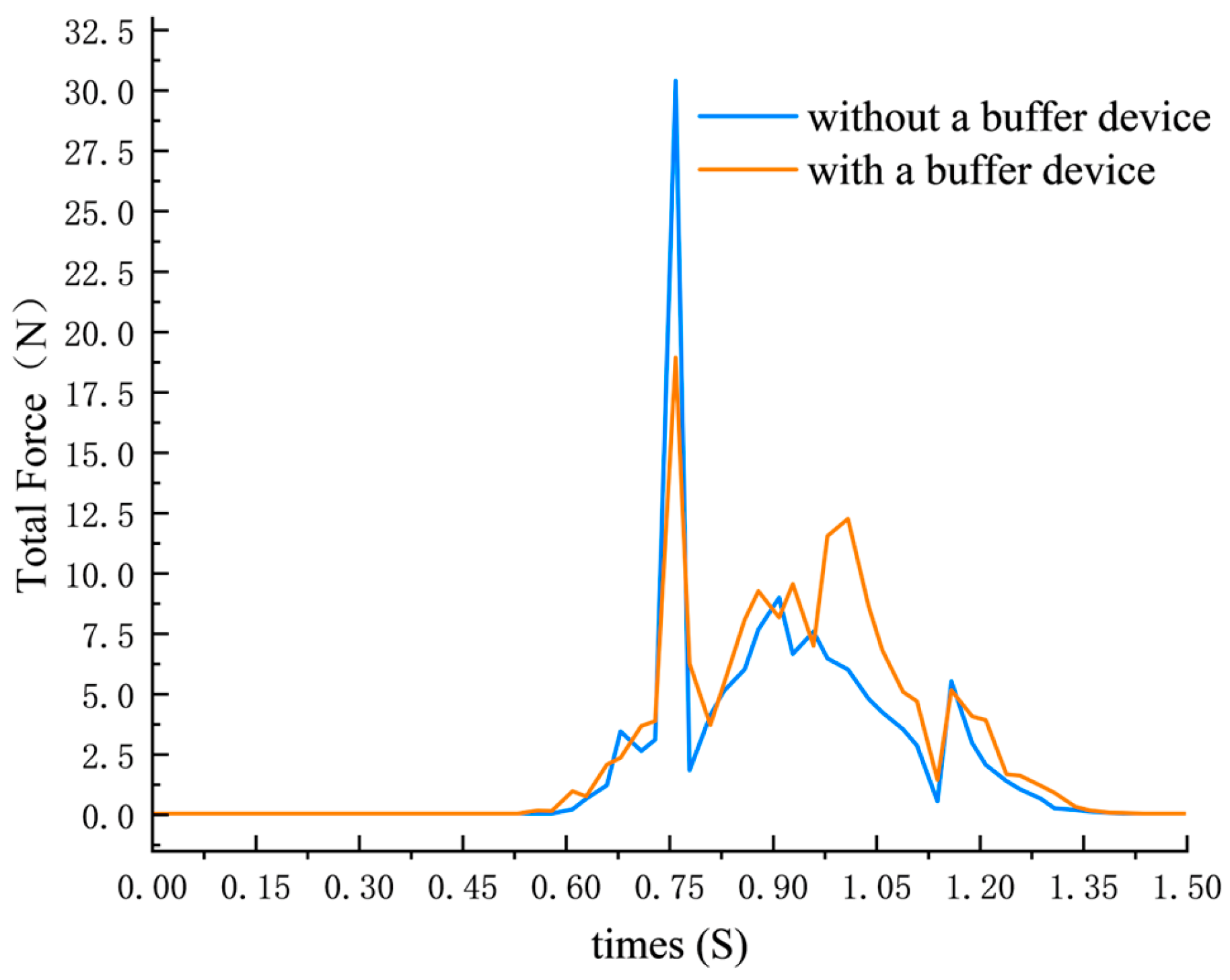
Due to the symmetrical structure of the gripping mechanism, only a single clip finger was selected for analysis in this study. As shown in Figure 10, the working process of the taking-planting mechanism with a buffer system is as follows:
At the initial moment (t = 0 s), the clip finger performs only rotational motion and is free from external force. At t = 0.62 s, the clip finger begins to contact and penetrate the soil. The external force acting on it originates entirely from soil resistance, which increases to approximately 3.5 N. At t = 0.72 s, the clip finger contacts the rock, causing the contact moment to rapidly rise to 18.91 Nm. Meanwhile, due to the spring buffer mechanism, the clip finger shifts upward by about 10 mm to avoid the rock, and the contact force quickly decreases to approximately 3.72 N. Since the rock does not completely leave the theoretical motion path of the clip finger, a secondary contact occurs, leading to persistent bouncing. This is the main reason why the resistance fluctuates between 3.72 N and 12.29 N during this stage. After the clip finger completely passes over the rock, the resistance drops rapidly to 1.4 N. By t = 1.25 s, the clip finger starts to exit the soil, and the resistance gradually decreases to zero.
For the taking-planting mechanism unit without a buffer system, during the initial stage (t = 0 s), the clip finger only undergoes rotational motion without external force. At t = 0.62 s, the clip finger contacts and penetrates the soil. The external force is entirely attributed to soil resistance, which reaches about 15 N. At t = 0.72 s, the clip finger begins to contact the rock, and the contact force rapidly increases to 30.4 N. Similarly to the case with the buffer system, the rock does not fully deviate from the ideal motion trajectory of the clip finger, resulting in sustained contact. The rock is pushed approximately 20 mm in the negative x-direction until final disengagement. Between 0.78 s and 1.13 s, the unbuffered clip finger remains in contact with the rock while pushing it, with the resistance fluctuating between 1.5 N and 9.1 N. After the clip finger completely passes the rock, the resistance drops rapidly to 1.4 N. At t = 1.25 s, the clip finger disengages from the rock, and the resistance gradually returns to zero.
The simulation results demonstrate that equipping the mechanism with a buffer spring reduces the maximum resistance on the clip finger by 37.8%. This system thus provides effective protection for the seedling pickup claw against obstacles like rocks that impede its normal path.

3. Results and Discussion

3.1. Field Test Conditions

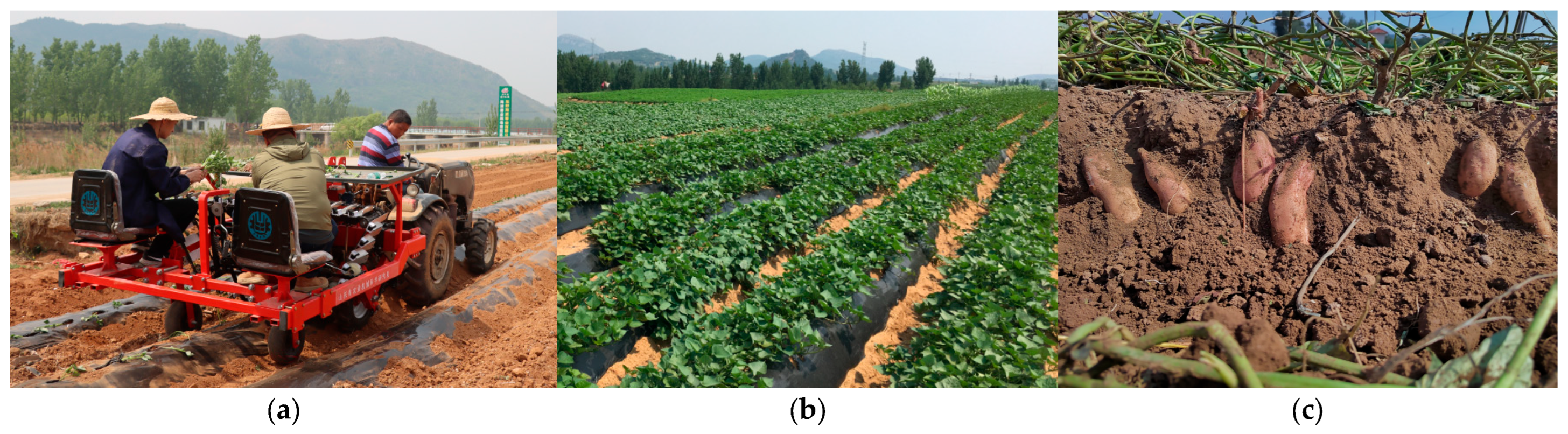
The experiment was conducted in April 2023 at the Sishui Experimental Station (N 35°30′, E 117°15′) in southern Shandong Province (Figure 11). The test area consisted of a flat plot, 65 m in length, free of residual materials from previous crops or weeds. The soil type was classified as silt loam according to the USDA soil taxonomy system. The moisture content was 13.4% in the topsoil layer (0~50 mm) and 16.8% in the subsurface layer (50~100 mm). The test cultivar was Jishu 26, a representative sweet potato variety widely grown in the main production regions of China’s Huang-Huai-Hai region. The seedlings had vine lengths of 280~380 mm and stem diameters of 4~6 mm.

3.2. Optimal Test Parameters and Testing Methodology

Based on the agronomic requirements for plastic-film mulched cultivation of sweet potatoes and local soil fertility conditions, the target planting spacing was set at 300 mm. Considering the operational fatigue and sustainable working capacity of the personnel placing the seedlings, the transplanting frequency was determined to be 30 plants per minute. According to the parameters of the machinery’s transmission system, the optimal operating speed was calculated to be 0.55 km/h. Using these optimized parameters, a consistency transplanting test was carried out to evaluate the operational performance of the implement [3,12,22].
During the seedling placement process, the extension length of the sweet potato seedlings beyond the placement plate was set to 60 mm (Figure 4). Each test group covered a transplanting length of 60 m. Upon completion of the tests, 120 samples were selected from each group for data collection, with the process repeated three times. The measurements included the length of the seedlings under the film, the planting depth, and the planting spacing. To account for the growth stability of the seedlings after rooting, the planting depth and planting length of the seedlings under the film were measured on the 10th day after transplanting. Using the ridge surface as the reference plane and the contact point between the seedling and the ridge surface as the benchmark, the measurements included two aspects: (1) the planting depth, defined as the vertical distance from the benchmark point to the root of the seedling, and (2) the length of the seedling under the film, which was determined by carefully extracting the seedling, flattening it, and measuring its submerged portion.

3.3. Field Test Performance and Discussion

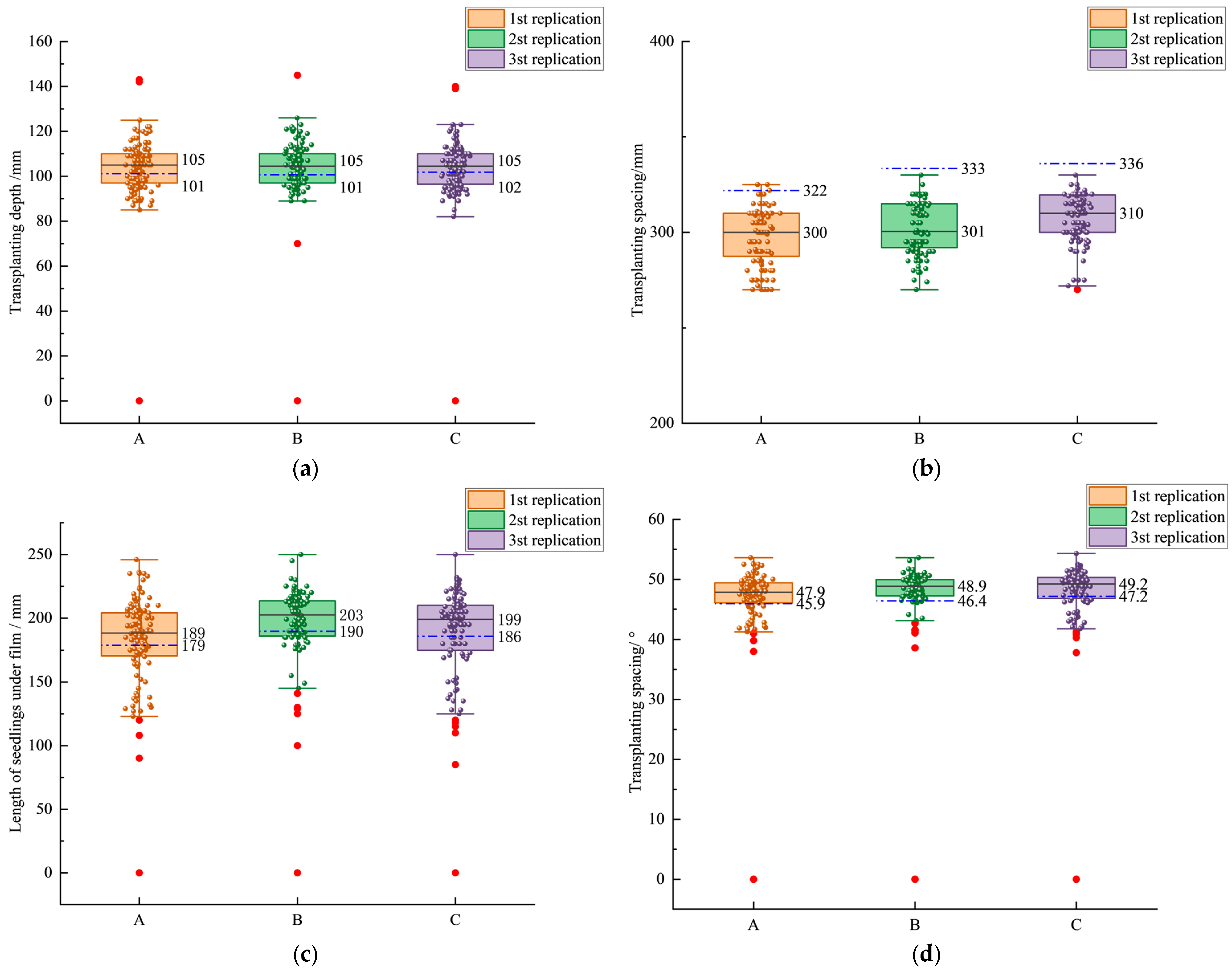
As shown in the box plots in Figure 12, the actual field tests demonstrated good stability in the length of seedlings under the film, planting depth, and planting spacing across three consecutive trials. From Figure 12a,b,d and Table 4, it can be observed that the data distributions for the length of seedlings under the film, the planting depth and stem-soil are relatively symmetrical, with the median close to the mean. This indicates that these three indicators are well controlled, the operation consistency is high, and the “boat-shaped” planting form is superior. In contrast, data from Figure 12c and Table 4 show that the coefficient of variation for planting spacing is relatively large, reflecting a higher degree of dispersion relative to the mean. The primary reason for this phenomenon is that during the operation, some exposed seedlings were recorded as having a planting depth of 0 cm (considered invalid planting). These invalid plantings resulted in significantly increased spacing between adjacent seedlings, leading to abnormal spacing data of approximately 60 cm.
The final measurements demonstrated mean values of 101.3 ± 1.38 mm for planting depth, 47.9° ± 3.41° for the stem–soil angle, and 185 ± 3.65 mm for seedling length under the film, which align closely with the optimal parameters for “shallow-boat-shaped planting” reported in the literature [11,24,25]. This agronomic technique emphasizes shallow planting with multiple nodes buried (typically at 60~100 mm depth) to promote uniform tuber initiation and enhance drought resistance. In terms of plant spacing, the average value was 330.3 ± 11.24 mm, while the mean row spacing was slightly larger, primarily due to occasional missed plantings (outliers > 600 mm)—an issue also noted by Yan et al. [10] in their study on horizontal transplanters. The results verify that the machine’s performance robustly meets the agronomic requirements.
There is a significant deviation in planting spacing, and the core reason lies in the fact that seedling exposure plants are defined as having a planting depth of 0 cm (i.e., invalid planting). As shown in Figure 11a, the sweet potato planting area is a non-standardized operating environment, and the field experiment of this study was conducted in hilly and mountainous regions. Terrain undulations lead to situations where the clamping fingers can implant sweet potato seedlings into the soil under ideal conditions, but planting failure occurs in actual operation, which is the primary factor causing seedling exposure. On the other hand, terrain changes can cause vibrations of the machinery during field operation, and it is impossible to ensure that the rhizome diameter of each sweet potato seedling is completely consistent in the actual experiment. These two factors together result in the problem of seedling detachment when the clamping fingers grip the seedlings, thereby leading to insufficient seedling insertion into the soil.
The qualified rate of seedling length under film (82.5%) is significantly lower than that of other parameters. The core reason is that during manual seedling placement, it is difficult to ensure the length of each sweet potato seedling’s end protruding from the Seedling-clamping block is completely consistent with the theoretical value (Figure 4), thus leading to a high degree of variation in the actual seedling length under film.
A comparative analysis between the field-measured stem-soil angle (47.9° ± 3.41°) and the theoretically optimized value (56.2°) reveals a certain deviation. This discrepancy is mainly attributed to the resistance of the field soil and machine vibration, which causes slight rebound of the seedlings after insertion. Nevertheless, the measured values still fall entirely within the effective range for “boat-shaped” planting, validating the rationality and feasibility of the mechanism design.
The stability of planting performance was evaluated by the standard deviations of key parameters. Experimental data showed that the standard deviations of the transplanter in terms of planting depth, plant spacing, length of sweet potato seedlings under film, and stem-soil angle were 1.38 mm, 11.24 mm, 3.65 mm, and 3.41°, respectively, all lower than those of the manual planting group (17.16 mm, 12.74 mm, 22.65 mm, 20.8°). This result proves that mechanical planting can effectively reduce the volatility of operational parameters and achieve far superior stability and consistency compared with manual planting. Meanwhile, the higher planting qualification rate further verifies its reliability. Therefore, the transplanter developed in this study exhibits excellent operational consistency and stability, and its performance can reliably meet the agronomic requirements for the “boat-shaped” planting of sweet potato seedlings.
To further improve the qualification rate of planting spacing and reduce the seedling exposure rate, subsequent research intends to carry out optimization work from the following two aspects: (1) Add a terrain profiling control system, which can dynamically adjust the height of the planting assembly from the ground based on real-time monitoring of the undulations of the ridges, ensuring the consistency of planting depth; (2) Optimize the roughness parameters of the contact surface of the clamping fingers to achieve precise clamping of sweet potato seedlings, thereby reducing the probability of seedling detachment during operation. (3) Conduct standardized training for seedling placement operators, clarify and unify the standard for the length of sweet potato seedling ends protruding from the seedling-clamping block, and enhance the proficiency and standardization of operators’ seedling placement operations. (4) The automation of seedling feeding or the development of assisted positioning mechanisms is essential for further improvement in overall system performance.
Unlike the technological approach of the membrane-side-inserting transplanter developed by Zhang [38], this study focused on achieving standard “boat-shaped” hole planting. The self-propelled transplanter reported by Li [3,12,22], which demonstrated similar operational performance to our findings, provides cross-validation from a different technical pathway for the mechanical feasibility of this agronomic practice. Compared to the self-propelled solution, our suspended design potentially offers superior cost-effectiveness and field adaptability while maintaining comparable performance, making it particularly suitable for smallholder farmers. Furthermore, the widely used clamp-type transplanters primarily serve non-mulched conditions, representing a fundamental difference in agronomic objectives, which further highlights the targeted and innovative value of our machine in addressing this specific industrial challenge.

4. Conclusions

Based on the above background and requirements, this study draws the following three core conclusions:
In response to the industrial challenge of mechanized film-transplanting for sweet potatoes in the Huang-Huai-Hai region of China, a mounted sweet potato transplanter suitable for small plots was designed. Key components such as the taking-planting mechanism, transmission system, seedling feeding unit, intermittent motion mechanism, and planting buffer system were intensively studied. Targeting the agronomic requirements for seedling establishment, the lengths of the linkages in the taking-planting mechanism were determined as 101.6 mm, 254 mm, 177.8 mm, and 304.8 mm, respectively. Based on the synchronization needs between seedling feeding and planting actions, the transmission parameters for the seedling feeding mechanism and the intermittent device were defined. Furthermore, according to the required plant spacing and the operating speed of the tractor, the overall transmission ratio of the machine was determined to be within the range of 6.07 to 10.12.
An integrated spring buffer system was designed. Coupled Adams-EDEM simulation results demonstrated that equipping the mechanism with the buffer spring reduced the maximum resistance on the clip finger by 37.8%. This system enables the clip finger to adaptively deflect when encountering rigid obstacles, significantly mitigating the risk of mechanism damage due to impact and ensuring the continuity and reliability of the planting process.
Field tests under optimized operational parameters verified the comprehensive performance of the developed transplanter. The key agronomic indicators, including planting depth, plant spacing, submerged seedling length, and stem–soil angle, exhibited high stability and consistency during field operations, fully meeting the agronomic requirements of “boat-shaped” planting for mulched raised beds. This verification not only confirms the rationality of the machine’s structural design (e.g., the five-bar taking-planting mechanism and spring buffer system) but also validates its adaptability to fragmented small plots and complex terrains in the Huang-Huai-Hai region. The transplanter thus provides a cost-effective and practical mechanized solution for smallholder farmers engaged in sweet potato cultivation with plastic film mulching, laying a technical foundation for promoting the popularization of standardized “boat-shaped” planting technology.
In conclusion, this study not only provides a reliable, suspended transplanter solution specifically for raised beds mulched with plastic film with “boat-shaped” planting but also validates its design rationality through simulation and experimentation. The machine is significant for promoting the mechanization of sweet potato production in specific ecoregions of China and effectively reduces the planting costs compared to manual labor. Future work will focus on evaluating the long-term durability of the machine and optimizing its adaptability across diverse soil and climatic conditions.

Author Contributions

Conceptualization, Writing—original draft, Methodology, T.H.; Formal analysis, Software, H.L. (Hu Liu); Investigation, Y.S.; Funding acquisition and supervision B.W.; Writing—review and editing, Methodology, H.L. (Hui Li); Validation, Software, X.Z.; Project administration, Supervision, Resources, S.S. All authors have read and agreed to the published version of the manuscript.

Funding

This research was supported by the Natural Science Foundation of Shandong Province (ZR2024ME137), National Natural Science Foundation of China (Grant No. 32201683), The Key Research and Development Program of Shandong Province (Action Plan on Promoting Rural Revitalization with Scientific and Technological Innovation) (2024TZXD071-02), Shandong Province Potato Production Technology System (SDAIT-16-13).

Institutional Review Board Statement

Not applicable.

Data Availability Statement

The data presented in this study are available in this article.

Conflicts of Interest

The authors declare no conflicts of interest.

References

  1. Ye, B.; Ye, Y.; Zhou, H.; Yu, G.; Zhao, X.; Deng, B. Design and experimental research on the sweet potato slip transplanting mechanism of the planetary gear train with deformed elliptical gear transmission. Int. J. Agric. Biol. Eng. 2024, 17, 91–99. [Google Scholar]
  2. Zhu, Q.; Wang, G.; Zhang, W.; Hu, L.; Zhang, T.; Mu, G. Research Progress on Key Technologies and Equipments of Sweet Potato Planting Mechanization. J. Chin. Agric. Mech. 2025, 46, 36–42. [Google Scholar]
  3. Li, H.; He, T.; Liu, H.; Shi, S.; Wang, B.; Zhou, J.; Liu, X.; Wei, G.; Zhang, R. Efficacy of Sweet Potato Transplanting Machine for Different Cultivation Systems in Northern China. Agriculture 2022, 12, 1184. [Google Scholar] [CrossRef]
  4. Wang, S.; Deng, G. A Study on the Mechanism of Soil Temperature in Creasing Under Plastic Mulch. Sci. Agric. Sin. 1991, 24, 74–78. [Google Scholar]
  5. Seizing the Farming Season to Plant Sweet Potato Slips! Tongqu Town Cultivates a New “Potato” Dawn of Prosperity. Pengpai News, 18 April 2024. Available online: https://m.thepaper.cn/baijiahao_27085555 (accessed on 24 February 2025).
  6. 15,000 Acres of Land Sow the Seeds of a New “Potato” Hope. JSTV News, 25 April 2023. Available online: https://news.jstv.com/a/20230425/1682403409536.shtml (accessed on 24 February 2025).
  7. Kubota, IKP-4. 2024. Available online: https://www.kubota.com.cn/kams/productlist.do?method=list&&modelCodeNow=104 (accessed on 24 February 2025).
  8. He, T.; Li, H.; Shi, S.; Liu, X.; Liu, H.; Shi, Y.; Jiao, W.; Zhou, J. Preliminary Results Detailing the Effect of the Cultivation System of Mulched Ridge with Double Row on Solanaceous Vegetables Obtained by Using the 2ZBX-2A Vegetable Transplanter. Appl. Sci. 2023, 13, 1092. [Google Scholar] [CrossRef]
  9. Liu, Z.; Zheng, W.; Wang, N.; Lyu, Z.; Zhang, W. Trajectory Tracking Control of Agricultural Vehicles Based on Disturbance Test. Int. J. Agric. Biol. Eng. 2020, 13, 138–145. [Google Scholar] [CrossRef]
  10. Yan, W.; Hu, M.; Li, K.; Wang, J.; Zhang, W. Design and Experiment of Horizontal Transplanter for Sweet Potato Seedlings. Agriculture 2022, 12, 675. [Google Scholar] [CrossRef]
  11. Tanaka, S.; Suzuki, K.; Yamamoto, T. Research on the Optimization of Sweet Potato Transplanting Machinery for High—Density Planting Patterns. J. Agric. Mach. Sci. Jpn. 2018, 50, 23–35. [Google Scholar]
  12. Li, H.; Wang, B.; Shi, S.; Zhou, J.; Shi, Y.; Liu, X.; Liu, H.; He, T. Response of Crop Performance and Yield of Spring Sweet Potato (Ipomoea batatas [L.] Lam) as Affected by Mechanized Transplanting Properties. Agronomy 2023, 13, 1611. [Google Scholar] [CrossRef]
  13. Li, L.; Xu, Y.; Pan, Z.; Zhang, H.; Sun, T.; Zhai, Y. Design and Experiment of Sweet Potato Up-Film Transplanting Device with a Boat-Bottom Posture. Agricultural 2022, 12, 1716. [Google Scholar] [CrossRef]
  14. FPP EVO Mechanical Transplanter. 2025. Available online: https://ferrarigrowtech.com/en/finger-transplanters/26-fpp-evolution-short-chain-finger-transplanter.html (accessed on 11 November 2025).
  15. Agriplanter 2SP-W Transplanter. 2025. Available online: https://agriplanter.com/en/machines/2-sp/ (accessed on 11 November 2025).
  16. 814F Trailer Transplanter. 2025. Available online: https://mechanicaltransplanter.com/pages/transplanters (accessed on 11 November 2025).
  17. Yang, D.; Li, L.; Wan, G.; Wang, S.; Li, S. Effects of Different Mulching Cultivation Methods on the Growth and Weeds of Potato with Different Maturity. J. Hunan Agric. Univ. 2022, 48, 643–649. [Google Scholar]
  18. Qin, S.; Zhang, J.; Wang, D.; Pu, Y.; Du, Q.Z. Effects of Different Film Mulch and Ridge-Furrow Cropping Patterns on Yield Formation and Water Translocation of Rainfed Potato. J. Appl. Ecol. 2011, 22, 389–394. [Google Scholar]
  19. Zhao, X.; Zhang, X.; Wu, Q.; Dai, L.; Chen, J. Research and Experiment of a Novel Flower Transplanting Device Using Hybrid-Driven Mechanism. Int. J. Agric. Biol. Eng. 2020, 13, 92–100. [Google Scholar] [CrossRef]
  20. Hu, L.; Wang, B.; Wang, G.; Yu, Z.; You, Z.; Hu, Z.; Wang, B.; Gao, X. Design and Experiment of Type 2ZGF-2 Duplex Sweet Potato Transplanter. Trans. Chin. Soc. Agric. Eng. 2016, 32, 8–16. [Google Scholar]
  21. Hou, F.; Zhang, L.; Xie, B.; Dong, X.; Zhang, H.; Li, A.; Wang, Q. Effect of Plastic Mulching on the Photosynthetic Capacity, Endogenous Hormones and Root Yield of Summer-Sown Sweet potato (Ipomoea batatas (L). Lam.) in Northern China. Acta Physiol. Plant. 2015, 37, 164. [Google Scholar] [CrossRef]
  22. Li, H.; He, T.; Liu, H.; Shi, S.; Zhou, J.; Liu, X.; Wang, B. Development of the Profiling Up-Film Transplanter for Sweet Potato in Hilly and Mountainous Region. Trans. Chin. Soc. Agric. Eng. 2023, 39, 26–35. [Google Scholar]
  23. Dassault Systèmes. SolidWorks, Version 2012 SP0; Dassault Systèmes: Vélizy-Villacoublay, France, 2011.
  24. Shao, Y.; Zhang, H.; Xuan, G.; Zhang, T.; Guan, X.; Wang, F. Simulation and Experiment of a Transplanting Mechanism for Sweet Potato Slips with ‘Boat-Bottom’ Transplanting Trajectory. Int. J. Agric. Biol. Eng. 2023, 16, 96–101. [Google Scholar]
  25. Pan, Z.; Li, L.; Chen, D.; Zha, X.; Yang, R. Design and Optimization of a Boat-Bottom-Shaped Transplanting Device for Sweet Potato (Ipomoea batatas) with Low Seedling Damage Rate. Appl. Sci. 2022, 12, 2817. [Google Scholar] [CrossRef]
  26. Gao, Z.; Sun, X.; Wang, J. Theory of Machines and Mechanisms, 1st ed.; Huazhong University of Science & Technology Press: Wuhan, China, 2011; pp. 208–209. [Google Scholar]
  27. Qin, D.; Xie, L. Modern Hand Book of Mechanical Design, 1st ed.; Chemical Industry Press Co., Ltd.: Beijing, China, 2011; pp. 1022–1025. [Google Scholar]
  28. Shen, H.; Nie, Y.; Li, J.; Yang, T. Design and Analysis of Complete Shaking Force Balance of Stamping Mechanism Based on finite position method. Trans. Chin. Soc. Agric. Eng. 2021, 52, 384–391,426. [Google Scholar]
  29. Lin, J.; Liao, Q.; Zhang, Q.; Kang, Y.; Zhang, J. Vibration characteristics analysis and structural improvement of the shovel type seedbed preparation machine suitable for rapeseed mechanical direct seeding. Trans. Chin. Soc. Agric. Eng. 2023, 39, 39–48. [Google Scholar]
  30. GB/T 23935-2009; Design of Cylindrical Helical Springs. Standards Press of China: Beijing, China, 2009.
  31. ISO 8458-2:2002; Steel Wire for Mechanical Springs—Part 2: Patented Cold-Drawn Unalloyed Spring Steel Wire. International Organization for Standardization: Geneva, Switzerland, 2002.
  32. Zhong, P.; Jia, W.; Yang, W.; He, J.; Zhang, E.; Yu, D.; Xu, Y.; Chen, J.; Peng, F.; Zeng, G.; et al. Calibration and Testing of Parameters for the Discrete Element Simulation of Soil Particles in Paddy Fields. Agriculture 2024, 14, 118. [Google Scholar] [CrossRef]
  33. Sun, K.; He, C.; Zhou, Q.; Yu, X.; Dong, Q.; Wang, W.; Chen, Y.; Li, M.; Xia, X.; Wang, Y.; et al. Study on the Influence Mechanism of Soil Covering and Compaction Process on Maize Sowing Uniformity Based on DEM–MBD Coupling. Agronomy 2024, 14, 2883. [Google Scholar] [CrossRef]
  34. Gao, P.; Liu, X.; Xu, Z.; Wang, S.; Qu, M.; Ma, Y. DEM Simulation and Experimental Investigation of Draft-Reducing Performance of Up-Cutting Subsoiling Method Inspired by Animal Digging. Agricultural 2025, 15, 2046. [Google Scholar] [CrossRef]
  35. Zhu, H.; Wu, X.; Bai, L.; Qian, C.; Zhao, H.; Li, H. Development of the Biaxial Stubble Breaking No-Tillage Device for Rice Stubble Field Based on EDEM-ADAMS Simulation. Trans. Chin. Soc. Agric. Eng. 2022, 38, 10–22. [Google Scholar]
  36. Kuang, D.; Long, Z.; Guo, R.; Yu, P.; Zhou, X.; Wang, J. Numerical Investigation of the Cushion and Size Effects During Single-Particle Crushing Via DEM. Acta Mech. Solida Sin. 2020, 33, 851–863. [Google Scholar] [CrossRef]
  37. Hao, J.; Jin, D.; Gao, Z.; Zhao, J.; Zhang, K. Design and Experiment of a Vibratory Soil Crushing Device for Ma Yam Harvesting Machine Based on EDEM. Trans. Chin. Soc. Agric. Eng. 2025, 41, 90–98. [Google Scholar]
  38. Zhang, W.; Zhu, Q.; Zhang, T.; Liu, H.; Mu, G. Design and Control of a Side Dense Transplanting Machine for Sweet Potato Seedlings on Mulch Fil. Comput. Electron. Agric. 2024, 224, 109193. [Google Scholar] [CrossRef]
Figure 1. Scene of manual ridge planting for sweet potatoes in the fragmented land of China (a) Raised beds cultivation system. (b) Fragmented land for sweet potato plant.
Agriculture 15 02434 g001
Figure 2. Model for planting sweet potato slips using boat-shaped placement.
Agriculture 15 02434 g002
Figure 3. Schematic diagram of the 2CGX-1 sweet potato transplanter structure. (a) 3D model of 2CGX-1 sweet potato transplanter (created with SolidWorks (2012 SP0)) [23]; (b) Schematic Diagram of the Transmission System. 1, Main gear box; 2, Reversing gear box; 3, Three-point suspension; 4, Slip feeding mechanism; 5, Slip-taking–planting mechanism; 6, Slip pallet; 7, Buffer system; 8, Chair; 9, Tensioning mechanism; 10, Front chain box; 11, Frame; 12, Support plate; 13, Telescopic drive shaft; 14, Ground wheel; 15, Main gear box; 16, First reversing gear box; 17, Second reversing gear box; 18, Front chain box; 19, External ratchet mechanism; 20, Slip delivery drive chain; 21, Slip delivery transmission chain.
Agriculture 15 02434 g003
Figure 4. The structure and parameter design of the slip-taking–planting mechanism. 1, Crack; 2, Slip clamping assembly; 3, Bracket; 4, Spring; 5, Connecting rod; 6, Clip finger; 7, Rocker; 8, motion trajectory; 9, Transplanted sweet potato seedlings; 10, Seedling-clamping block; 11, Seedling-feeding plate; 12, Sweet potato seedlings ready for transplanting; 13, Field ridge; 14, Plastic film.
Agriculture 15 02434 g004
Figure 5. Parameter-trajectory optimization system. ①, Trajectory display area; ②, Parameter input control panel; ③, Velocity and acceleration analysis and display Area.
Agriculture 15 02434 g005
Figure 6. Planting unit of sweet potato slips for sweet potato transplanter. (created with SolidWorks 2012 (SP0) [22]). 1, Top tightening mechanism; 2, Support plate; 3, Support sprocket; 4, Dual-chain seedling feeding mechanism; 5, Sprocket carrier; 6, Transmission; 7, Intermittent mechanism (Rear chain box); 8, Slip-taking–planting mechanism.
Agriculture 15 02434 g006
Figure 7. The structure and parameter design of the external ratchet mechanism (created with SolidWorks 2012 (SP0)). (a) Intermittent mechanism (b) Schematic model of the external ratchet mechanism. 1, External Ratchet Wheel; 2, Driving Disc; 3, Sprocket Z4; 4, Planting Drive Shaft; 5, Driving Bevel Gear; 6, Driven Bevel Gear; 7, Sprocket Z5.
Agriculture 15 02434 g007
Figure 8. Geometric model of the buffer system. 1. Slip-taking–planting mechanism, 2. Spring.
Agriculture 15 02434 g008
Figure 9. Discrete element model. 1, Slip-taking–planting mechanism; 2, Soil particles; 3, Rock fragments.
Agriculture 15 02434 g009
Figure 10. Comparison of resistance on the taking-planting mechanism.
Agriculture 15 02434 g010
Figure 11. Field experiment of mini wheel-driven sweet potato transplanting machine. (a) The designed transplanter working in raised beds mulched with plastic film cultivation system. (b) Completed transplanting field site. (c) Sweet potato production state.
Agriculture 15 02434 g011
Figure 12. Analysis of transplanter performance metrics. (a) Transplanting depth; (b) Transplanting spacing; (c) Length of seedlings under film; (d) Stem-soil angle. The red dots denote statistical outliers. The orange, green, and purple dots represent the normally distributed data points from the first (A), second (B), and third (C) experimental trials, respectively.
Agriculture 15 02434 g012
Table 1. Technical parameters of the 2CGX-1 sweet potato transplanter.
ProjectParameters
Overall dimensions (length × width × height)1450 × 1750 × 1320 mm
Matched power18.4 kW (≈25 Hp)
Working width80 ± 20 cm
Ridge spacing80~100 cm
Ridge height30 ± 5 cm
Ridge surface width60 ± 5 cm
Weight280 kg
Plant spacing180~300 mm
Planting depth50~150 mm
Operating speed0.3~0.8 km/h
Table 2. Pre-processing related parameters.
ItemProjectParameters
1Density (kg/m3)7800
2Young’s modulus (Pa)2.07 × 10¹¹
3Poisson’s ratio0.29
4Contact stiffness (N/mm)1 × 105
5Damping coefficient (Ns/mm)1 × 103
6Static friction coefficient0.15
7Dynamic friction coefficient0.12
8Driving speed (°/s)250
Table 3. Material parameters and contact parameters.
ItemProjectParameters
TransplanterPoisson’s ratio0.29
Shear modulus/Pa8.023 × 1010
Density (kg/m3)7800
Soil ParticlesPoisson’s ratio0.4
Shear modulus/Pa1.09 × 106
Density (kg/m3)2950
Rock ParticlesPoisson’s ratio0.3
Shear modulus/Pa1.868 × 107
Density (kg/m3)910
Transplanter-Soil Particle PairCoefficient of restitution0.5
Static Friction coefficient0.5
Dynamic Friction coefficient0.01
Transplanter-Rock Particles Coefficient of Restitution0.5
Static friction coefficient0.9
Dynamic friction coefficient0.9
Soil-Soil ParticlesCoefficient of restitution0.5
Static friction coefficient0.5
Dynamic friction coefficient0.01
EEPA Model Parameters (Soil-Soil)Surface energy/(J·m−3)−0.01
Contact plasticity Ratio0.8
Slope index0.5
Tensile index1.5
Table 4. Comparison of effects between different planting methods (machine vs. manual).
IndicatorTransplanting
Depth/mm
Transplanting
Spacing/mm
Length of Seedlings
Under Film/mm
Stem-Soil Angle/°
Mechanical plantingMean101.3330.318547.9
SD1.3811.243.653.41
Qualified rate95%91.9%82.5%94%
Manual plantingMean127.3306.5201.861.4
SD17.1612.7422.6520.85
Qualified rate87.3%90.2%81.1%88.4%
Disclaimer/Publisher’s Note: The statements, opinions and data contained in all publications are solely those of the individual author(s) and contributor(s) and not of MDPI and/or the editor(s). MDPI and/or the editor(s) disclaim responsibility for any injury to people or property resulting from any ideas, methods, instructions or products referred to in the content.