
Article

Seed 3D Phenotyping Across Multiple Crops Using 3D Gaussian Splatting
1
School of Mathematics and Computer Science, Zhejiang A&F University, Hangzhou 310058, China
2
College of Modern Agriculture, Zhejiang A&F University, Hangzhou 310058, China
*
Author to whom correspondence should be addressed.
Agriculture 2025, 15(22), 2329; https://doi.org/10.3390/agriculture15222329
Submission received: 18 September 2025 / Revised: 30 October 2025 / Accepted: 6 November 2025 / Published: 8 November 2025
(This article belongs to the Section Artificial Intelligence and Digital Agriculture)

Abstract

This study introduces a versatile seed 3D reconstruction method that is applicable to multiple crops—including maize, wheat, and rice—and designed to overcome the inefficiency and subjectivity of manual measurements and the high costs of laser-based phenotyping. A panoramic video of the seed is captured and processed through frame sampling to extract multi-view images. Structure-from-Motion (SFM) is employed for sparse reconstruction and camera pose estimation, while 3D Gaussian Splatting (3DGS) is utilized for high-fidelity dense reconstruction, generating detailed point cloud models. The subsequent point cloud preprocessing, filtering, and segmentation enable the extraction of key phenotypic parameters, including length, width, height, surface area, and volume. The experimental evaluations demonstrated a high measurement accuracy, with coefficients of determination (R2) for length, width, and height reaching 0.9361, 0.8889, and 0.946, respectively. Moreover, the reconstructed models exhibit superior image quality, with peak signal-to-noise ratio (PSNR) values consistently ranging from 35 to 37 dB, underscoring the robustness of 3DGS in preserving fine structural details. Compared to conventional multi-view stereo (MVS) techniques, the proposed method can achieve significantly improved reconstruction accuracy and visual fidelity. The key outcomes of this study confirm that the 3DGS-based pipeline provides a highly accurate, efficient, and scalable solution for digital phenotyping, establishing a robust foundation for its application across diverse crop species.

1. Introduction

In agricultural production systems, seeds serve as the primary vessels of genetic information, wherein the inherent genetic attributes of germplasm resources directly dictate a crop’s yield potential, stress resilience, and quality characteristics [1]. The rapid advancement of modern agriculture necessitates adopting increasingly stringent quality standards for crop seeds, establishing the pursuit of superior seed quality as an imperative industry trajectory. The scientific identification and selection of premium seeds critically influence not only crop productivity and quality attributes but also the overall economic viability and sustainable development of agricultural systems [2]. Consequently, targeted research on crop seeds exhibiting superior traits—notably high-yielding capacity and stress resilience—is imperative for mitigating contemporary food security challenges [3].
Plant phenotypes emerge from dynamic interactions between intrinsic genetic programs and extrinsic environmental factors, manifesting as measurable structural and functional traits at the cellular, tissue, organ, and organismal levels. Phenotypic parameters quantitatively characterize these attributes—such as seed length, width, thickness, and volume—which exhibit significant correlations with crop yield performance and genotypic variation. Systematic analysis of phenotypic metrics enables precise assessments of plant growth status, facilitates comparative evaluations across genotypes for screening elite alleles, and ultimately contributes to yield enhancement and food security resilience [4,5,6]. Conventional phenotyping methodologies predominantly rely on manual measurements, which are inherently labor-intensive, time-consuming, and procedurally complex. Such approaches are highly susceptible to operator-induced biases, consequently compromising data consistency and reliability. Artificial screening methods also have obvious limitations, and thus, a series of new technologies and methods need to be explored to break through the existing limitations and improve breeding efficiency [7].
Conventional plant phenotyping quantification predominantly relies on 2D imaging-based analytical techniques, which extract critical phenotypic information from planar projections of plant structures [8]. However, these approaches exhibit inherent limitations in capturing spatial dimensionality, making it difficult to accurately obtain key morphological traits such as plant height, surface area, and volume. Consequently, researchers are pioneering the adoption of advanced three-dimensional reconstruction technologies to acquire more exhaustive and precise phenotypic datasets [9]. In the field of plant phenomics, current 3D reconstruction technologies encompass laser scanning techniques [10,11,12,13], structured light methods [14,15], near-infrared approaches [16], and multi-view image-based photogrammetry [17].
Advancements in computer graphics have facilitated the emergence of RGB image-based 3D reconstruction as a prominent alternative in plant phenotyping, particularly given the prohibitive cost constraints associated with LiDAR methodologies [18]. Structure-from-Motion–Multi-View Stereo (SFM-MVS) enables robust 3D reconstruction of plant architecture, effectively overcoming the limitations inherent to 2D imaging. By employing self-calibrating bundle adjustment to determine camera intrinsics and extrinsics, this approach bypasses laborious manual calibration procedures, achieving high-precision phenotyping measurements using low-cost consumer-grade hardware. Zermas et al. [19] established an automated phenotyping pipeline that integrates high-resolution RGB imagery acquired via UAV and handheld devices using SFM technology, achieving sub-plant-resolution 3D reconstruction of maize canopies. This methodology enables high-precision extraction of individual plant traits from derived point clouds, including plant count (accuracy: 88.1%), Leaf Area Index (92.5%), plant height (89.2%), leaf length (74.8%), leaf-stem insertion angles, and inter-leaf distances. Through the application of the Structure-from-Motion (SFM) methodology to field-grown sugar beet, Xiao et al. [20] achieved comprehensive 3D reconstruction of plant architecture, enabling the extraction of key phenotypic traits—including canopy height, leaf area, and leaf length—from the reconstructed models. These parameters facilitate rigorous assessments of growth dynamics and physiological status. The validation results demonstrated strong correlations (R2 > 0.85) between the ground-truth measurements and SFM-derived estimates, confirming the technique’s reliability for monitoring in situ crop performance. This approach has been successfully extended to multiple crops, including wheat [21,22], cotton [23], and tomato [24], establishing its broad utility in agricultural phenotyping. Although 3D reconstruction technologies such as SFM-MVS have been widely used, there are still certain limitations in processing speed and reconstruction accuracy.
In the 2020s, some novel 3D reconstruction technologies provided new possibilities for the 3D reconstruction of plants [25]. Mildenhall et al. [26] proposed a 3D reconstruction method based on implicit neural rendering using Neural Radiance Fields (NeRF). This method can implicitly learn static 3D scenes through neural networks and realize the rendering of complex scenes. This technology has been applied to plant phenotyping and has shown great potential [27]. Although NeRF has made breakthrough progress in 3D reconstruction, it still has the problem of an unintuitive implicit expression. The 3D Gaussian sputtering method proposed by Kerbl et al. provides new possibilities for three-dimensional reconstruction of plants [28]. Three-Dimensional Gaussian Splatting (3DGS) represents scenes by superimposing anisotropic Gaussian kernels at point locations, achieving efficient image rendering through tile-based parallel rasterization. Similar to SFM-MVS, 3DGS also requires an initial sparse reconstruction via SFM; however, its key distinction lies in the subsequent dense representation stage. Unlike the traditional SFM–MVS framework, which generates dense point clouds through pixel-wise stereo matching and depth estimation, 3DGS replaces this step with a continuous volumetric representation composed of Gaussian primitives, enabling continuous optimization, high-fidelity structural preservation, and real-time rendering. Compared with NeRF, 3DGS has more advantages in rendering speed and accuracy [29,30]. Furthermore, 3DGS uses explicit scene expression, and the generated model is retrainable and editable, which is impossible for NeRF using neural implicit expression [31]. Recent developments in 3DGS have further expanded its efficiency, scalability, and controllability. GaussianPro [32] introduced a progressive propagation mechanism to accelerate optimization and enhance reconstruction fidelity. Mani-GS [33] combines 3DGS with triangular mesh structures to enable intuitive geometric manipulation. In addition, PyGS [34] uses a pyramidal representation that improves scalability and memory efficiency for large-scale scene reconstruction. However, despite its demonstrated success in large-scale scenes, the applicability and performance of 3DGS for high-precision, seed-scale 3D reconstruction and phenotypic quantification remain largely unexplored, representing a critical research gap.
Therefore, we hypothesized that 3D Gaussian Splatting can achieve superior accuracy and efficiency in reconstructing seed morphology and extracting quantitative phenotypic traits compared to traditional SFM-MVS methods. To test this hypothesis, the objectives of this study were as follows: (1) to develop a 3DGS-based pipeline for the high-fidelity 3D reconstruction of seeds from multiple crop species; (2) to quantitatively evaluate its performance against the conventional SFM-MVS approach in terms of reconstruction quality, efficiency, and measurement accuracy for key traits; and (3) to validate the generalizability and robustness of the 3DGS method across diverse seed morphologies.

2. Materials and Methods

2.1. Experimental Design and Data Acquisition

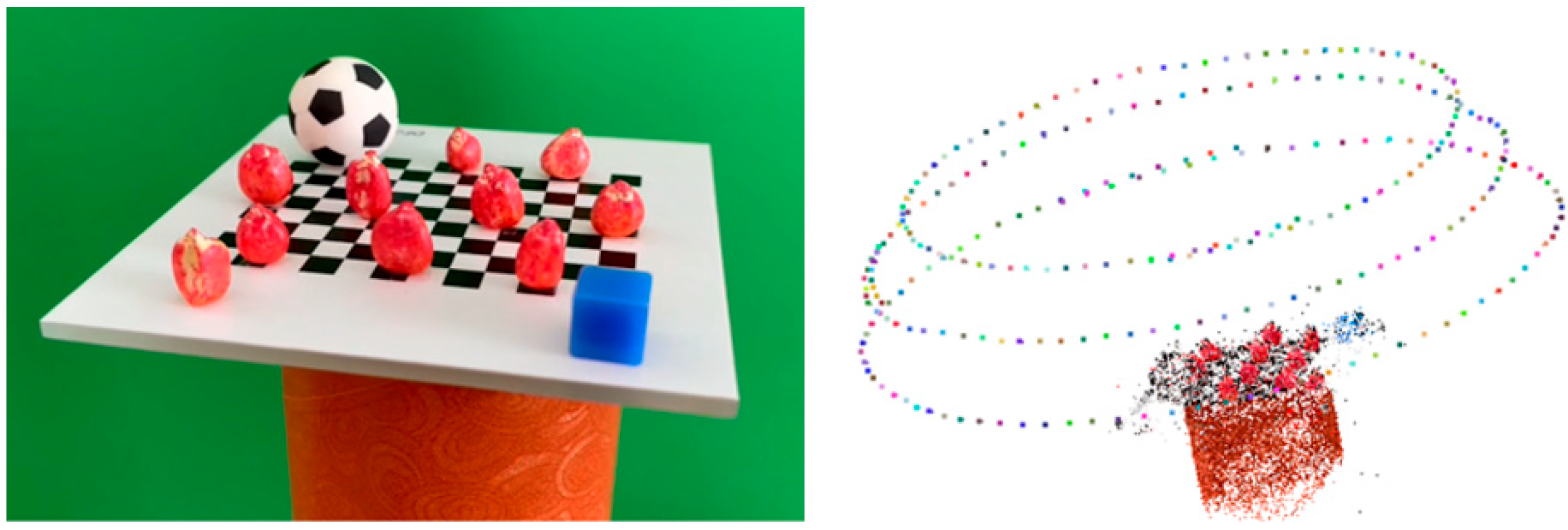
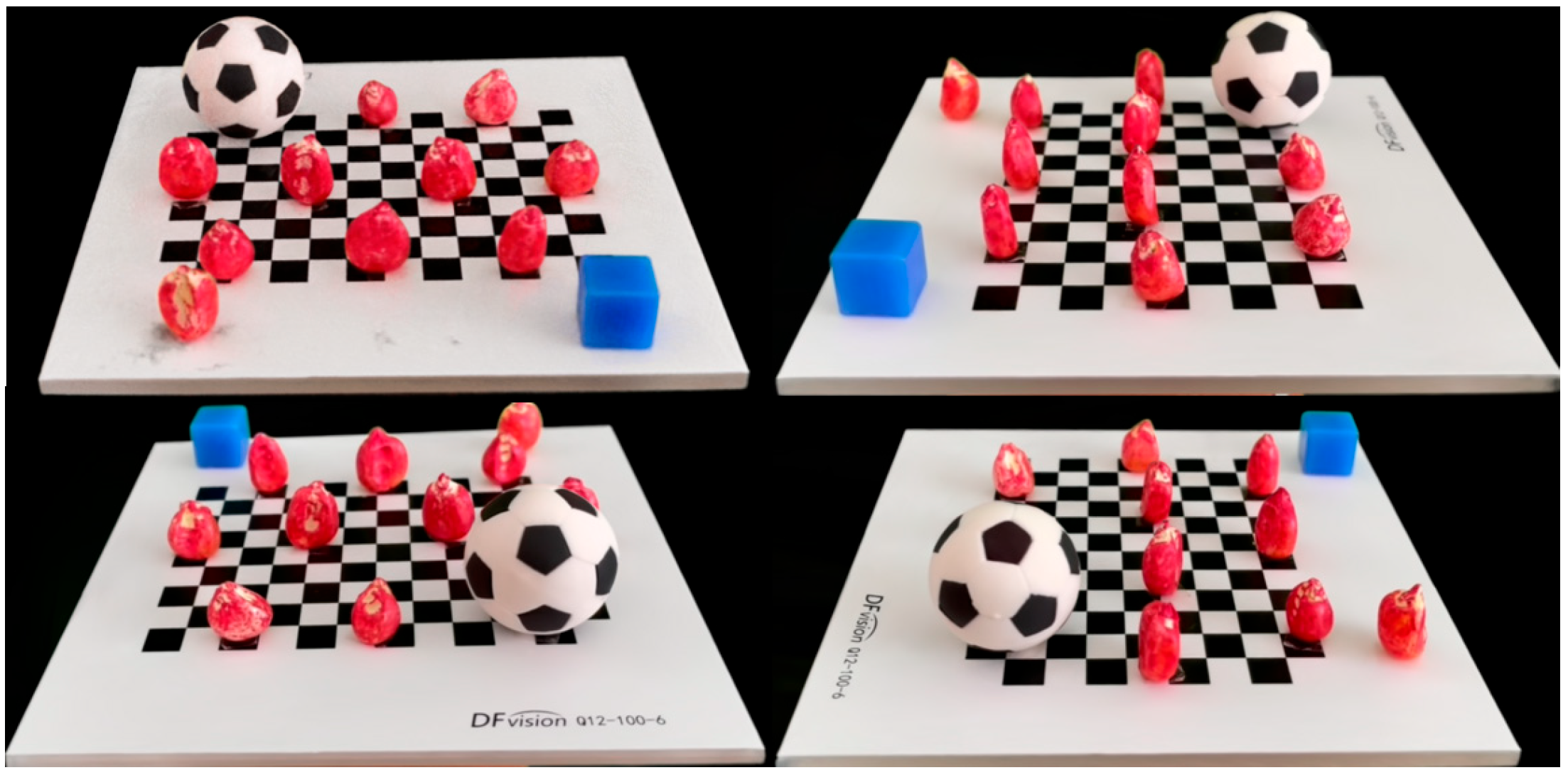
To obtain precise three-dimensional (3D) point cloud data, this study employed two methods, SFM-MVS and 3DGS, to construct high-accuracy 3D models of seeds. The experimental subjects comprised 50 seeds each of maize (Zea mays L. cultivars Zhengdan 958 and Tianguinuo 932), wheat (Triticum aestivum L. cultivars Jimai 22 and Aikang 58), and rice (Oryza sativa L. cultivars Suijing 18 and Xiangya Xiangzhan). To guarantee reliable and reproducible outcomes, the seeds of each cultivar were divided into 5 groups of 10 seeds each for independent experiments. This design resulted in a total of 300 seeds and 30 experimental runs across all cultivars. To ensure the portability and universality of the data collection methodology, an iPhone 12 Pro smartphone(Apple Inc., Cupertino, CA, USA) was selected as the acquisition device. During capture, the distance between the phone lens and the sample was maintained within the range of 30 cm to 80 cm. The videos were recorded under indoor natural lighting conditions at a resolution of 1920 × 1080 and 30 frames per second, and were divided into three groups corresponding to upper, middle, and lower viewpoints. The specific height and angle were not strictly constrained. Complete 360° coverage around the sample was ensured by capturing continuous video footage. Static images were subsequently extracted from the video at a specific frame rate, followed by green screen background removal. The extracted images were then processed using both the SFM-MVS and 3DGS pipelines to generate preliminary 3D point cloud models. Finally, the acquired 3D point cloud models underwent preprocessing steps, including point cloud denoising and downsampling, to prepare them for subsequent analysis and quantitative evaluation. The 3D reconstruction platform and scheme are shown in Figure 1.
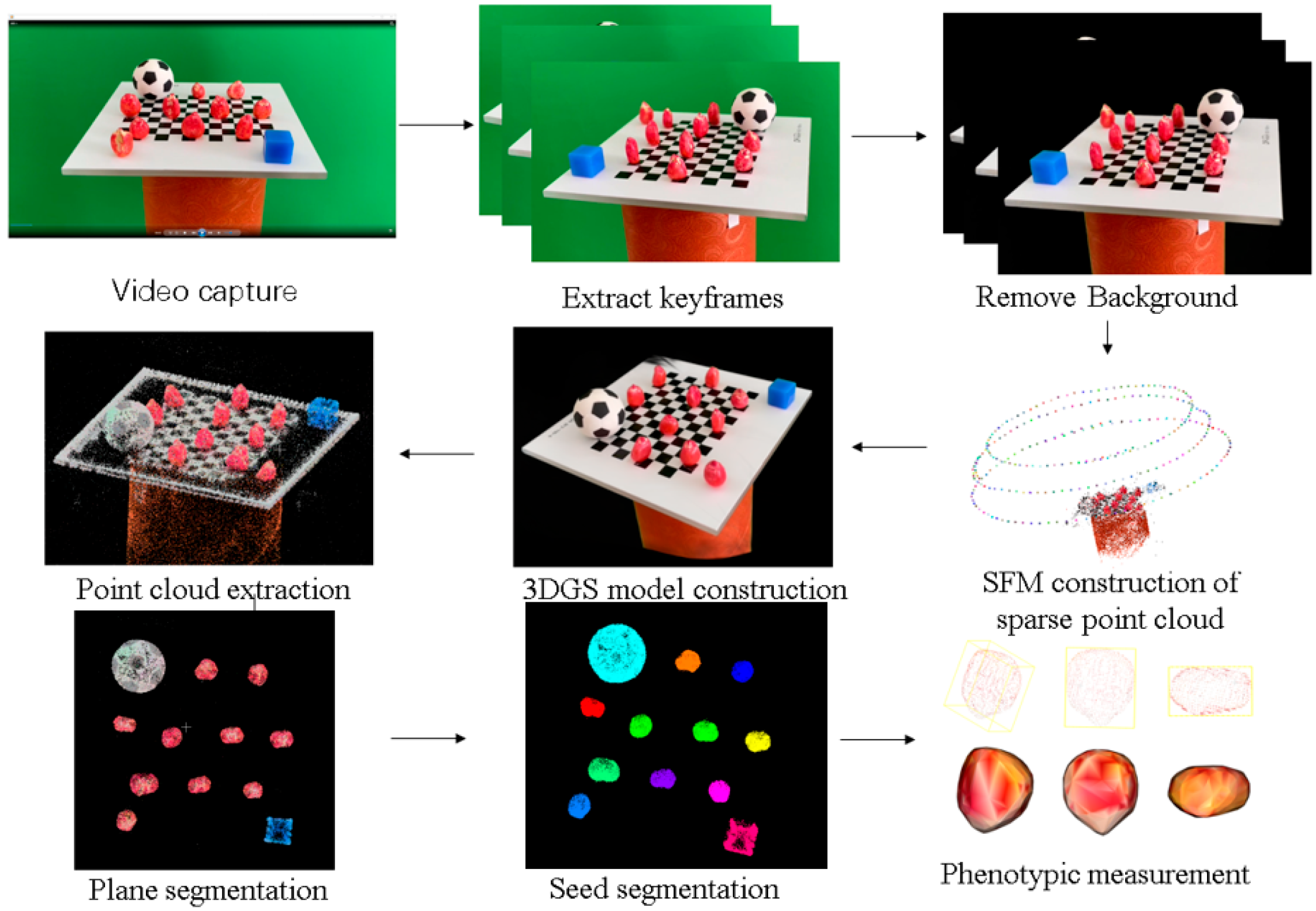
The specific steps and process of the seed phenotyping measurement study are illustrated in Figure 2. The flowchart commences with video acquisition and encompasses key stages, including image data acquisition, point cloud model generation, data preprocessing, point cloud segmentation, parameter measurement, and data analysis, culminating in the acquisition of seed phenotypic data.
During the data processing stage of this experiment, frames were extracted at fixed temporal intervals using Ffmpeg (v6.0) with an output rate of frames per second (fps) = 2 to achieve uniform coverage across the video timeline. This ensured evenly distributed viewpoints and minimized redundancy among consecutive frames, providing a suitable input for 3D reconstruction. To enhance 3D reconstruction accuracy, background removal was performed on the extracted images. Specifically, images were converted from the RGB (Red, Green, Blue) to HSV (Hue, Saturation, Value) color space, which describes color more robustly. In HSV, hue represents color type, saturation indicates color purity, and value measures brightness. The RGB values were normalized to a standard scale and then converted to the HSV color space according to the conversion formula [35]. Using OpenCV, the green background was segmented and removed with a threshold range from (35, 25, 25) to (77, 255, 255). The conversion formula to HSV is as follows:
r = R R + G + B
g = G R + G + B
b = B R + G + B
V = max ( r , g , b )
s a t u r a t i o n = 0 i f   V = 0 V min ( r , g , b ) V i f   V > 0
h u e = 0 i f   S = 0 60 × g b S × V i f   V = r 60 × 2 + b r S × V i f   max = g 60 × 4 + r g S × V i f   max = b 360 + H i f   H < 0
The 3D models obtained using multi-view reconstruction methods typically include a scale factor P relative to the actual object. To ensure consistency between the seed model and the real-world dimensions, this experiment used a 10 cm × 10 cm calibration board with small black squares with dimensions of 6 mm × 6 mm as a reference object for scale correction. The board was chosen to provide sufficient reference points for accurate measurement while being conveniently sized for seed imaging. Let Lreal be the actual unit length of the calibration board, and Lmodel be its length in the reconstructed model. The scale factor P can then be calculated using the following formula:
P = L r e a l L mod e l
For any point s(x, y, z) in the three-dimensional model, the actual point cloud coordinates s(x1, y1, z1) can be calculated using the following formula:
s ( x 1 , y 1 , z 1 ) = P × s ( x , y , z )
In the data acquisition phase of this study, the first step is to randomly extract key frames from the video, selecting a total of 270 images as the basis for the subsequent analysis. After extracting the key frames, camera poses are estimated using the Structure-from-Motion (SfM) method implemented in COLMAP version 3.8. SIFT features are extracted from multi-view images and matched with a nearest-neighbor strategy. Outliers are removed using RANSAC with default settings, followed by triangulation to reconstruct sparse point clouds. Finally, global bundle adjustment is applied to optimize the intrinsic and extrinsic camera parameters. Subsequently, the 3DGS method is employed to perform dense point cloud reconstruction.

2.2. Three-Dimensional Seed Reconstruction Based on 3D Gaussian Splatting

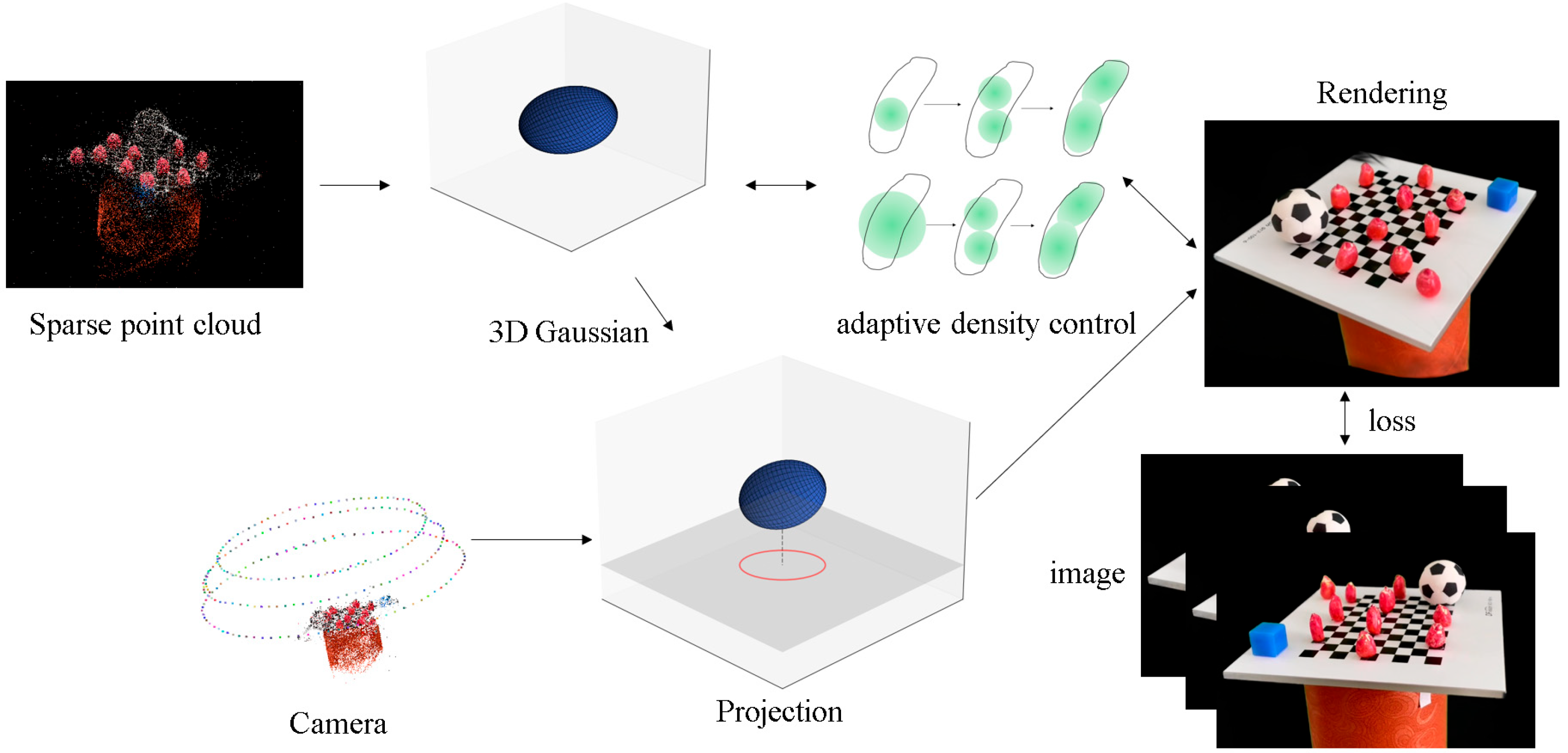
Three-Dimensional Gaussian Splatting (3DGS) is a differentiable rendering-based 3D reconstruction method that comprises the following key steps: First, Structure-from-Motion (SFM) is employed to estimate camera poses and generate a sparse point cloud, which serves as the initial data. Based on this, a parameterized set of 3D Gaussian ellipsoids is constructed, where each ellipsoid is characterized by parameters such as position, covariance matrix, opacity, and spherical harmonic coefficients. In the differentiable splatting stage, the Gaussian ellipsoids are projected onto a 2D image plane using the camera extrinsic parameters, and a rasterization process is used to produce synthesized views. A photometric loss function is then defined between the synthesized and real images. This loss is minimized using stochastic gradient descent to jointly optimize the spatial distribution, covariance properties, optical attributes, and density of the Gaussians. An adaptive density control module dynamically adjusts the splitting and merging of Gaussian kernels based on local gradient information, thereby achieving an optimal balance between scene representation accuracy and rendering efficiency. A diagram showing the principle of 3D Gaussian sputtering is shown in Figure 3.

2.2.1. Three-Dimensional Gaussian Initialization

First, for each point in the sparse point cloud obtained by SFM, a 3D Gaussian point is generated that contains both positional and shape information; its density function is as follows:
G ( x ) = exp [ 1 2 ( x μ ) T Σ 1 ( x μ ) ]
Equation (8) represents the probability density function of a 3D Gaussian distribution. For each generated 3D Gaussian point, four parameters are stored: position, covariance matrix, opacity, and spherical harmonic functions.
The position information denotes the coordinates of the Gaussian point in the world coordinate system, expressed through the center point of the 3D Gaussian point, i.e., the mean vector μ. The superscript T indicates the transpose operation, which converts a column vector into a row vector to enable valid matrix multiplication with the covariance components.
μ = [ x , y , z ] T
The covariance matrix ∑ represents the shape information of the 3D Gaussian ellipsoid. This matrix can be decomposed into two parts: a rotation matrix R and a scaling matrix S. The calculation is carried out using the following formula:
Σ = R S S T R T

2.2.2. Three-Dimensional Gaussian Rendering

After obtaining the 3D Gaussian points, it is necessary to project these points onto a two-dimensional image plane and then proceed with rendering operations.
Σ = J W Σ W T J T
where W represents the projection matrix, J represents the Jacobian matrix of the affine-approximated projection transformation, and Σ denotes the covariance matrix of the Gaussian point after projection onto the two-dimensional image plane.
After projection, by determining a set N of ordered points within a specific radius range that can influence a pixel in the point cloud, the color C of a pixel can be calculated using the following formula:
C = Σ i N c i a i Π j = 1 i 1 ( 1 a j )
a i = O i exp ( 1 2 ( x i u i ) T ( Σ ) 1 ( x i u i ) )
where α i represents the opacity of the current Gaussian point, c i denotes the color of the current Gaussian point, and α j is the opacity of the Gaussian point cloud in front of the ith Gaussian point. O i is the original opacity, and by multiplying it with the Gaussian function, the opacity of the current Gaussian point can be obtained.

2.2.3. Calculating Loss

The Gaussian points are initialized using the sparse point cloud created through the Structure from Motion (SFM) algorithm. Subsequently, their attributes are further optimized using stochastic gradient descent, a commonly used iterative method in machine learning that updates model parameters step by step to minimize the difference between the rendered and real images. Since the rendering process is fully differentiable, this allows the model to gradually improve by reducing the error for each training view. For each view sampled from the training dataset, the forward process mentioned above is used for projection and rasterization, with the loss calculated by the error between the rendered image and the real image.
L = ( 1 λ ) L 1 + λ L S S I M
where λ is a scale factor, set as 0.2 in this case, L_1 represents the photometric error between the rendered image and the ground-truth image, and L_SSIM is the structural similarity error.

2.2.4. Adaptive Density Control

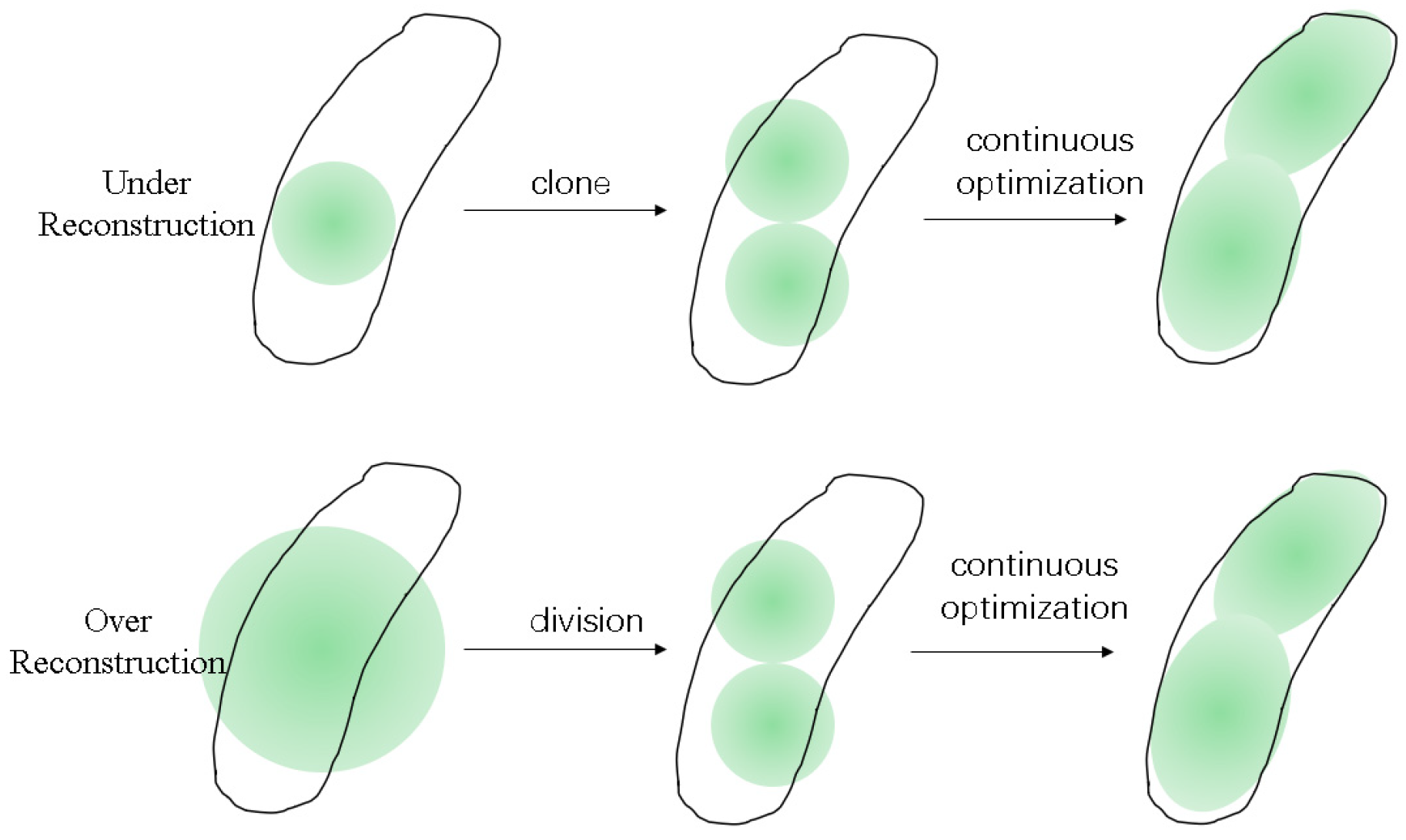
During the optimization of the parameters of the 3D Gaussian points, gradients propagate backward through the data flow, indicating which areas require additional attention. Typically, regions with insufficient reconstruction generate larger gradients, making them focal points for optimization. Whether a region is categorized as under-reconstruction or over-reconstruction can be further determined based on gradient magnitude and variance: if the gradient magnitude exceeds a predefined threshold and the variance is large, the region is classified as over-reconstructed; conversely, if the variance is small, the region is categorized as under-reconstructed. This scenario can be categorized into the following two cases:
  • Under-Reconstruction: The existing 3D Gaussian primitives are insufficient to cover the areas that need reconstruction. The solution involves cloning the existing primitives to expand their coverage, ensuring they accurately reconstruct all necessary regions.
  • Over-Reconstruction: Although the existing 3D Gaussian primitives can cover the reconstructed area, they lack sufficient detail. The solution involves segmenting the existing primitives to increase detail and accuracy. By adjusting parameters and subdivision operations, Gaussian primitives can more accurately describe the detailed features of the reconstructed area.
As shown in Figure 4, optimizing under-reconstructed and over-reconstructed areas during the gradient descent process can enhance the quality and accuracy of the reconstruction results.

2.3. Phenotype Extraction

2.3.1. Filtering

Point cloud models generated from multi-view image sequences often contain varying degrees of noise, which can interfere with the subsequent data analysis and modeling. Therefore, necessary preprocessing is required prior to analysis. To ensure the accuracy of the measurement results, this study employed a filtering algorithm based on statistical characteristics to identify and remove outlier noise points. The core principle of statistical filtering is to analyze the spatial distribution of a fixed number of neighboring points for each point in the cloud. By computing the mean and standard deviation, each point is evaluated against a predefined threshold to determine whether it is an outlier. Points that exceed the threshold are classified as outliers and removed. This method effectively eliminates noisy outliers and significantly improves the quality of the point cloud data as well as the reliability of subsequent analyses.

2.3.2. Downsampling

In the point cloud modeling process based on multi-view image sequences, sparse point clouds are typically generated using Structure-from-Motion (SFM), followed by the reconstruction of dense point clouds using either Multi-View Stereo (MVS) or 3D Gaussian Splatting (3DGS) methods. To improve the efficiency of point cloud processing, this study employed voxel grid downsampling during the preprocessing stage. This method divides the point cloud into equally sized voxel units, computes the centroid of the points within each voxel, and replaces all points in the voxel with the centroid point. By reducing the overall point density, this approach effectively decreases the data volume and enhances processing efficiency. At the same time, it preserves the overall geometric features and spatial structure of the point cloud, resulting in a more uniform point distribution that facilitates subsequent analysis and processing.

2.3.3. Obtaining Seed Point Cloud

To extract individual seed data, this study performed planar segmentation on the preprocessed point cloud to separate the seed from the calibration board. The Random Sample Consensus (RANSAC) algorithm was employed for plane model fitting. The core idea of RANSAC is to randomly select a minimal subset of points to fit a model, iteratively optimizing it to identify the model with the largest number of inliers. This model is then considered the optimal solution, enabling effective segmentation of planar and non-planar point cloud data.
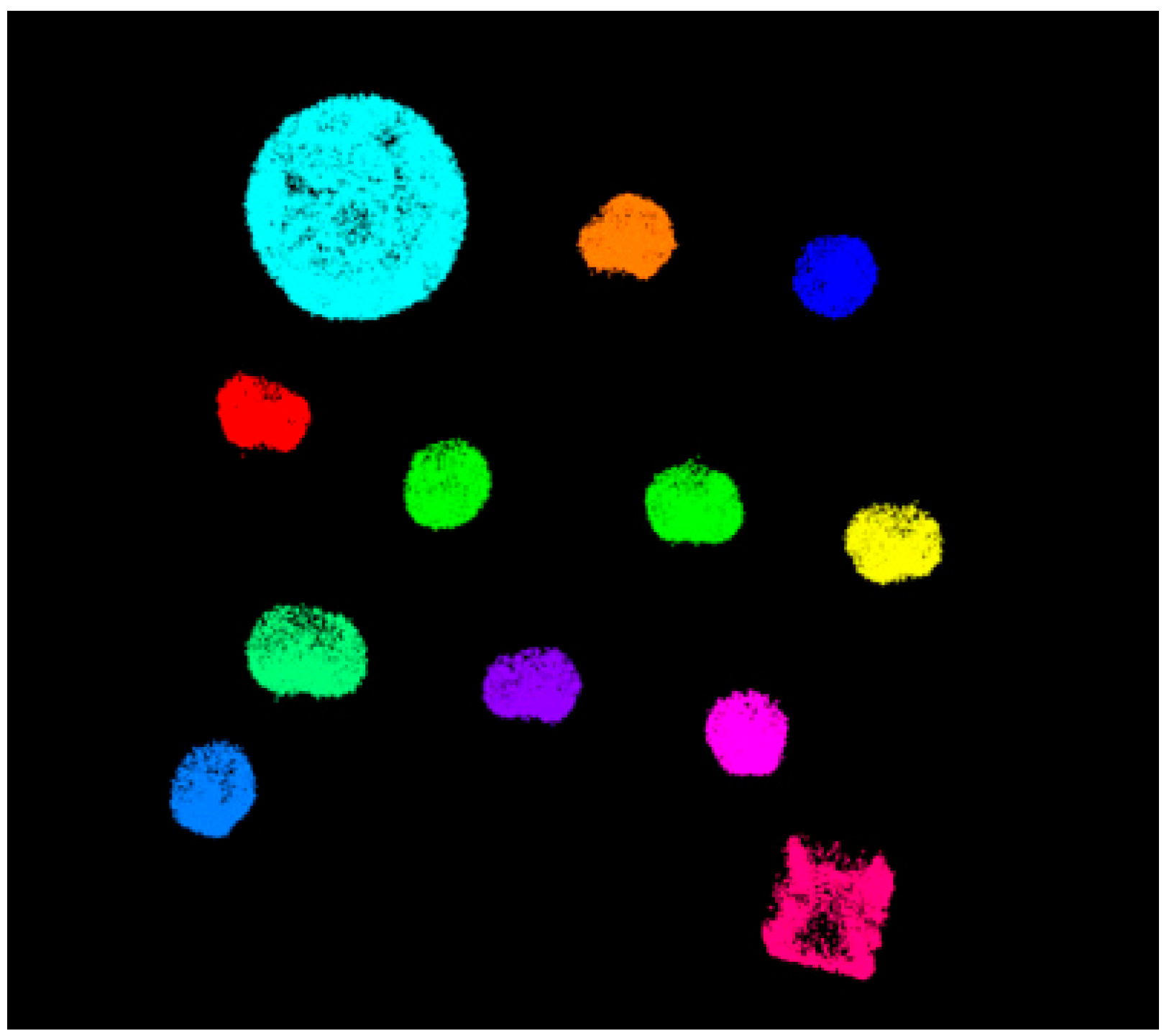
After separating the seed and calibration board point clouds, further segmentation of individual seeds from the seed point cloud is required. This study utilized the Euclidean Cluster Extraction algorithm to achieve this goal. The algorithm clusters the point cloud based on a distance threshold: for each point in the cloud, the Euclidean distance to neighboring points is calculated. If the distance is less than a predefined threshold, the points are assigned to the same cluster. This method effectively partitions the point cloud into multiple independent clusters, enabling accurate segmentation of individual seeds. The seed segmentation is shown in Figure 5.

2.3.4. Obtaining Seed Length, Width, and Height

Length, width, and height are key phenotypic indicators used to describe the three-dimensional morphology of crop seeds, directly reflecting their physical size. These dimensional attributes are typically extracted using bounding box techniques, primarily Axis-Aligned Bounding Boxes (AABBs) and Oriented Bounding Boxes (OBBs). Compared to AABBs, OBBs can adapt to the actual orientation of the seed, providing a tighter and more accurate fit to the object’s shape, and therefore are more commonly used in high-precision measurements.
The computation of an OBB involves two main steps: first, the principal directions of the point cloud are determined by calculating the covariance matrix and performing eigenvalue decomposition; second, the minimum and maximum projection values of the point cloud along these principal directions and their orthogonal directions are computed to construct the minimum-volume bounding box. This allows for the accurate extraction of the seed’s length, width, and height, effectively capturing its true spatial dimensions.

2.3.5. Obtaining Seed Surface Area and Volume

To obtain geometric information such as the surface area and volume of the seed, this study employed the Alpha Shape method for 3D reconstruction of the point cloud, based on Delaunay triangulation. Alpha Shape enables fine-grained modeling of the point cloud by adjusting a key parameter, α, which controls the size of cavities in the reconstructed geometry. A smaller α value results in the formation of finer cavities, leading to a more detailed and complex model, while a larger α value yields smoother and more simplified surfaces by allowing larger cavities.
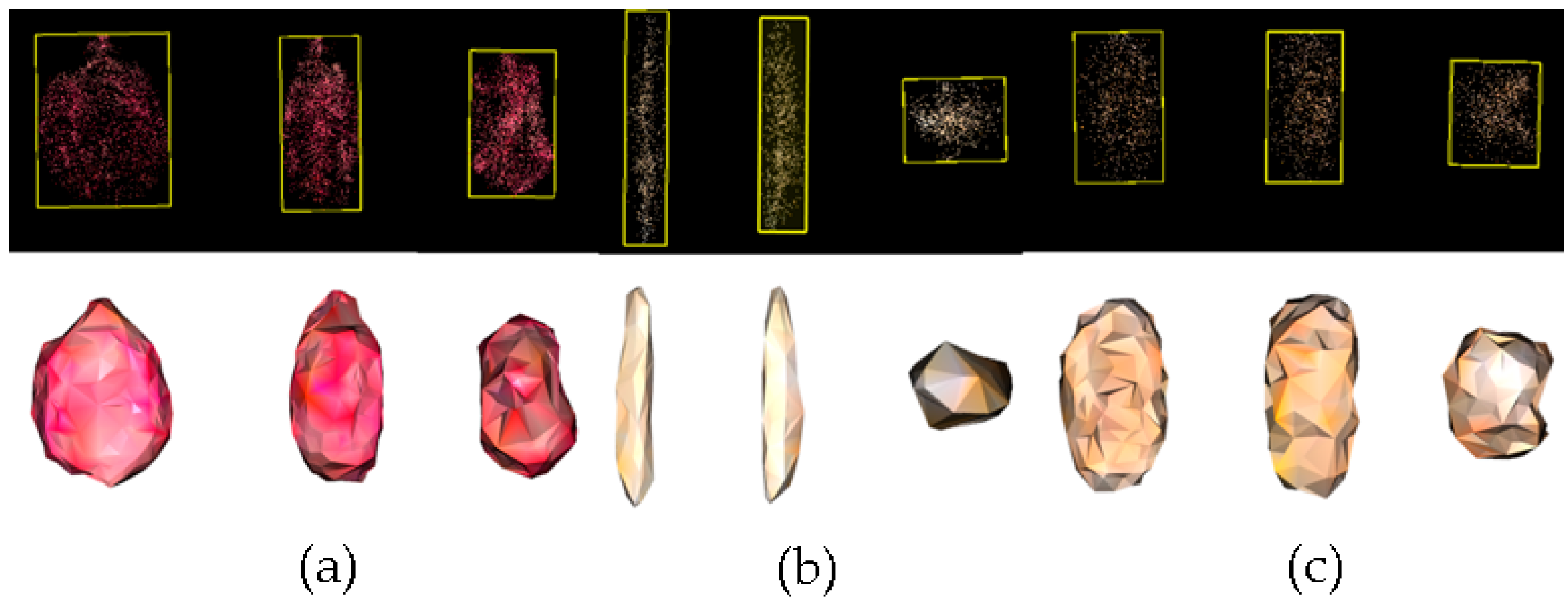
The principle of Alpha Shape is analogous to the 2D rolling ball method, which is commonly used to extract the boundary of a set of points in two dimensions. In 2D, a circle of radius α “rolls” along the point cloud, and whenever the circle touches two points simultaneously, an edge is formed, gradually tracing out the boundary. Extending this idea to three dimensions, a sphere of radius α is rolled through the 3D point cloud; whenever the sphere contacts three points simultaneously, a triangle is formed. By repeating this process across the entire point set, a continuous 3D surface is progressively constructed. Figure 6 shows an example of the resulting seed 3D mesh model.
In the preceding steps, the seed point cloud was reconstructed into a 3D model using a triangulation algorithm, with the seed surface divided into multiple triangular facets. The total surface area of the seed can then be obtained by calculating the area of each triangular facet and summing them. The calculation formula is as follows:
S 0 = Σ i = 1 k S i
S i = d i ( d i a i ) ( d i b i ) ( d i c i )
d i = a i + b i + c i 2
In this equation, S0 represents the seed surface area, k is the total number of triangular facets in the seed model, Si is the area of the i-th facet, and ai, bi, and ci are the lengths of the three sides of the i-th facet.
Similarly, for volume calculation, one can find a point inside the mesh that forms a tetrahedron with each triangle. Summing the volumes of all these tetrahedra yields the seed volume. The formula is as follows:
V 0 = Σ i = 1 k V i
V i = S i × h
In the equation, V0 represents the seed volume, and h is the distance from a point inside the mesh to the triangular facet.

2.4. Experimental Platform

The experiments were conducted on a computer equipped with an Intel i5-12490F processor, 32 GB RAM, and an NVIDIA GeForce RTX 4060Ti GPU. The deep learning framework used was PyTorch 1.12.1, with PyCharm(v2023.2) as the development environment and Python 3.7.13 as the programming language. Data acquisition and image processing were carried out using OpenCV 4.9.0.80, while point cloud processing was performed with MATLAB R2022a.

3. Results

3.1. Comparison and Analysis of Reconstruction Methods

To investigate the impact of different 3D reconstruction methods on point cloud model accuracy and reconstruction efficiency, this study conducted reconstructions using both the SFM-MVS and 3DGS approaches. The SFM-MVS method was implemented using the open-source software VisualSFM (v0.5.26), while the 3DGS method was evaluated at iteration counts of 5000, 10,000, and 30,000. For each reconstruction, the processing time and the number of generated point cloud elements were recorded. Additionally, reconstruction accuracy was assessed by comparison with manual measurements. Table 1 presents a comparison of the reconstruction times of the two methods.
Based on Table 1, it is evident that when the 3DGS method was run for 5000 iterations, the average number of points in the point cloud already exceeded that of the SFM-MVS method. At 10,000 iterations, the reconstruction time of 3DGS was comparable to that of SFM-MVS, while the average point cloud size reached approximately 295% of the SFM-MVS result. When the number of iterations was increased to 30,000, the reconstruction time required by 3DGS rose to about 230% of that of SFM-MVS, yet the average point cloud size increased to roughly 338% of the SFM-MVS output.

3.2. Validation of 3D Representation Capability

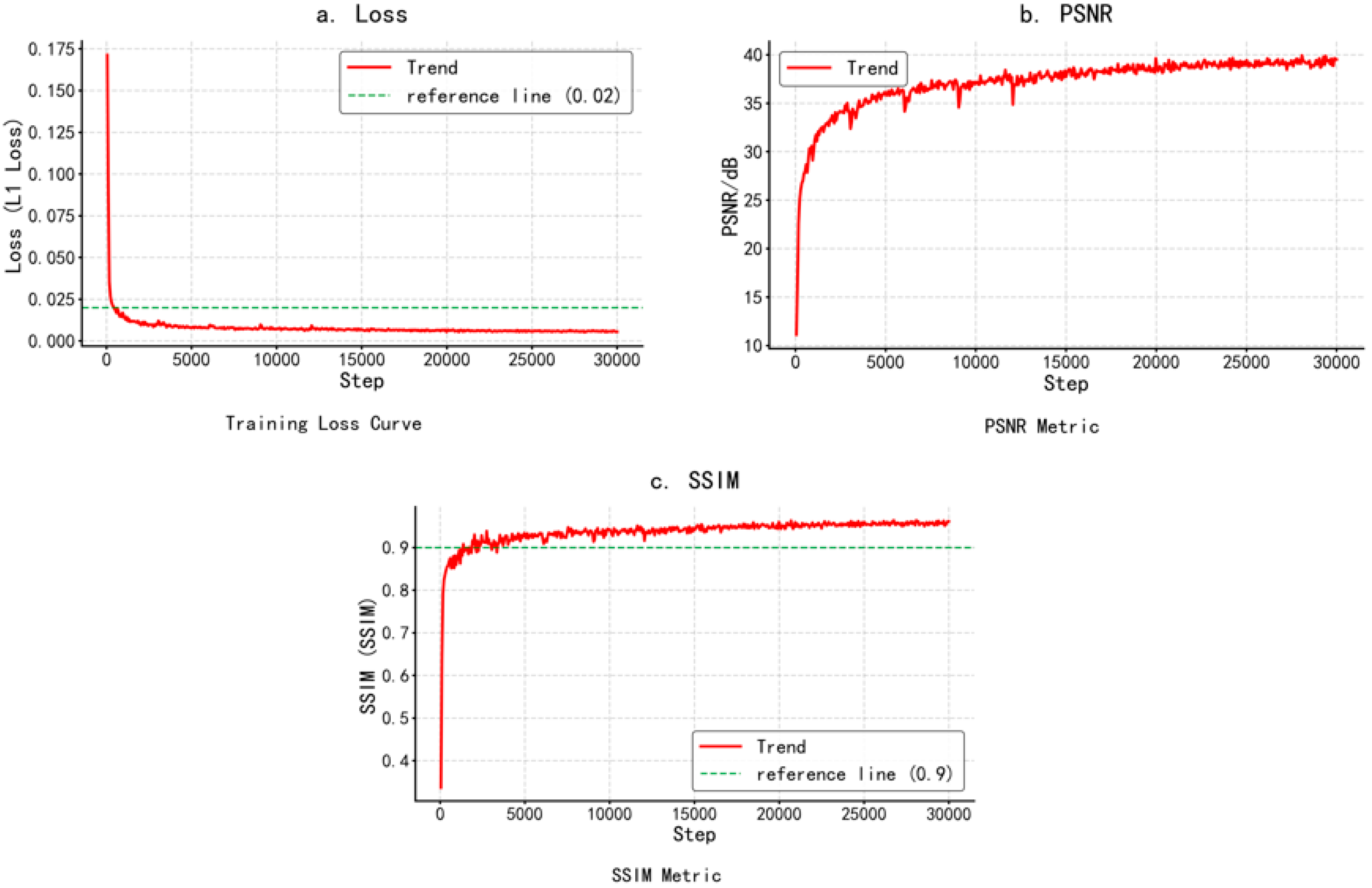
To evaluate the performance of 3D Gaussian Splatting (3DGS) in three-dimensional scene representation and its degree of structural distortion, the Peak Signal-to-Noise Ratio (PSNR) metric was used to quantify the representational capability of 3DGS. During training, the PSNR between images of fruit trees from a test dataset and the corresponding 3DGS-rendered scenes under identical camera viewpoints was computed every 50 iterations. Figure 7 illustrates the variation in PSNR over the training steps. After 10,000 training iterations, the PSNR stabilized within the range of 34 to 36 dB, reaching a maximum value of 35.74 dB. This range is comparable to the image quality observed in simulated signal transmission devices, indicating that 3DGS can achieve near-photorealistic 3D scene representation with minimal structural distortion. Similarly, as shown in the figure, the Structural Similarity Index Measure (SSIM) also stabilized after 10,000 training iterations, within a range of 0.93 to 0.96, with a maximum value of 0.9537. This demonstrates that the model can attain high structural fidelity and photorealistic representation in 3D scene reconstruction.

3.3. Measurement Accuracy Evaluation

This experiment evaluated the accuracy of the system by comparing system-based and manual measurements of seed samples. Both methods measured key phenotypic traits of the seeds, including length, width, and height. To quantitatively assess the measurement accuracy of the system, three key performance metrics were introduced: the coefficient of R2, MAPE, and RMSE. These metrics serve as standard indicators for evaluating system precision. The calculation formulas are as follows:
R 2 = 1 Σ i ( x i y i ) 2 Σ i ( x i y ¯ i ) 2
M A P E = 1 n Σ i x i y i x i
R M S E = Σ i ( x i y i ) 2 n
In these equations, xi represents the manual measurement value, yi represents the systematic measurement value, and y ¯ is the mean value of the systematic measurements.
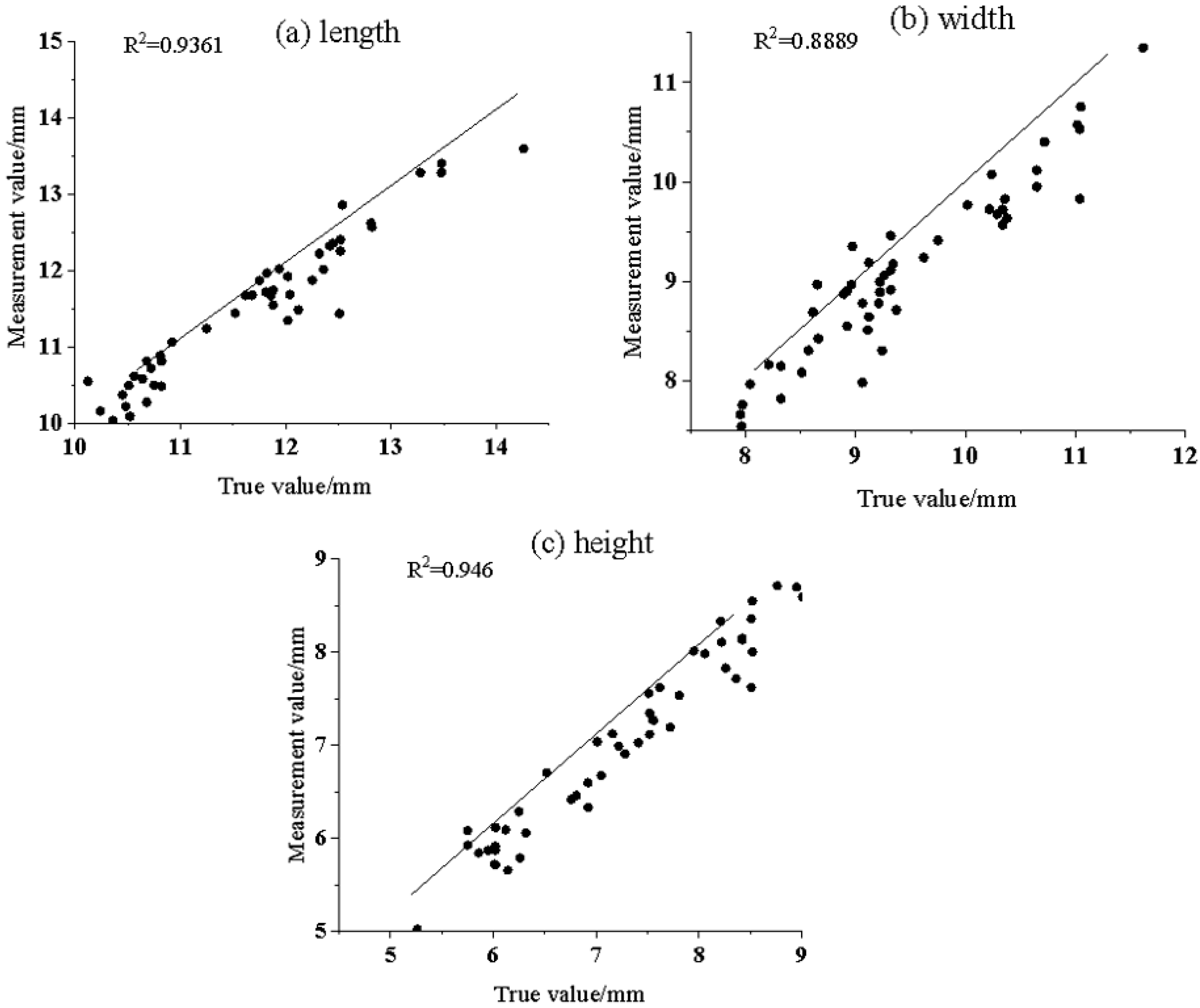
Linear regression was performed separately for seed length, seed width, and seed height. The x-axis values are the manual measurement values, and the y-axis values are the systematic measurement values.
As shown in Table 2 and Figure 8, in the 3D reconstruction of Zhengdan 958 maize seeds, the 3DGS method demonstrated higher consistency than SFM-MVS in terms of the coefficient of determination. Specifically, the R2 values for length, width, and height reached 0.9361, 0.8889, and 0.946, respectively, representing improvements of 15.4%, 14.4%, and 6.1% over the MVS method. In addition, 3DGS exhibited a lower mean absolute percentage error (MAPE) and root mean square error (RMSE) compared to MVS. Statistical significance was evaluated using paired t-tests on per-seed performance metrics. The mean RMSE values were 0.2223 for 3DGS and 0.3450 for SFM–MVS (t = −2.539, p = 0.0143), while the corresponding mean MAPE values were 1.91% and 2.98% (t = −2.569, p = 0.0133). These results demonstrate that the reconstruction accuracy achieved by 3DGS was significantly higher than that of SfM–MVS (p < 0.05).

3.4. Multi-Crop Applicability Expansion

A preliminary validation of the 3DGS method was conducted on rice (Suijing 18 and Xiangya Xiangzhan), wheat (Jimai 22 and Aikang 58), and maize (Zhengdan 958 and Tiangui Nuo 932) to establish a foundation for cross-crop adoption.
As shown in Table 3, the models generated for rice (japonica: Suijing 18; indica: Xiangya Xiangzhan), wheat (Jimai 22 and Aikang 58), and maize (Zhengdan 958 and Tiangui Nuo 932) all achieved SSIM values exceeding 0.95 and PSNR values in the range of 35–37 dB. These results confirm that the 3DGS method can generate high-precision seed models for multiple crop species.
Based on Table 4, the 3D Gaussian Splatting (3DGS) method demonstrated an overall strong performance in the extraction of three-dimensional phenotypic parameters across different crop seeds, exhibiting high generalizability and stability. The coefficients of determination (R2) for length, width, and height across the various crops were generally above 0.84, with a maximum of 0.9644 observed in the length measurement of Xiangya Xiangzhan, indicating a high level of consistency between the 3DGS-based measurements and manual measurements. Among the tested varieties, the measurement of the wheat cultivars Jimai 22 and Aikang 58 showed relatively low errors, with the MAPE mostly ranging from 2% to 4% and the RMSE reaching as low as 0.115, reflecting the high measurement accuracy of 3DGS for medium-sized, structurally regular seeds. In contrast, for the rice varieties with smaller, slender grains, relatively higher errors were observed in certain dimensions, particularly width and height—for example, the Xiangya Xiangzhan measurements exhibited MAPE values of 9.63% and 9.1% for width and height, respectively, and those for Suijing 18 showed a height error of 8.34%. Nonetheless, these errors remained within an acceptable range, and the consistency of the length measurements across all crop types highlights the robustness of 3DGS in modeling along the seed’s primary axis.
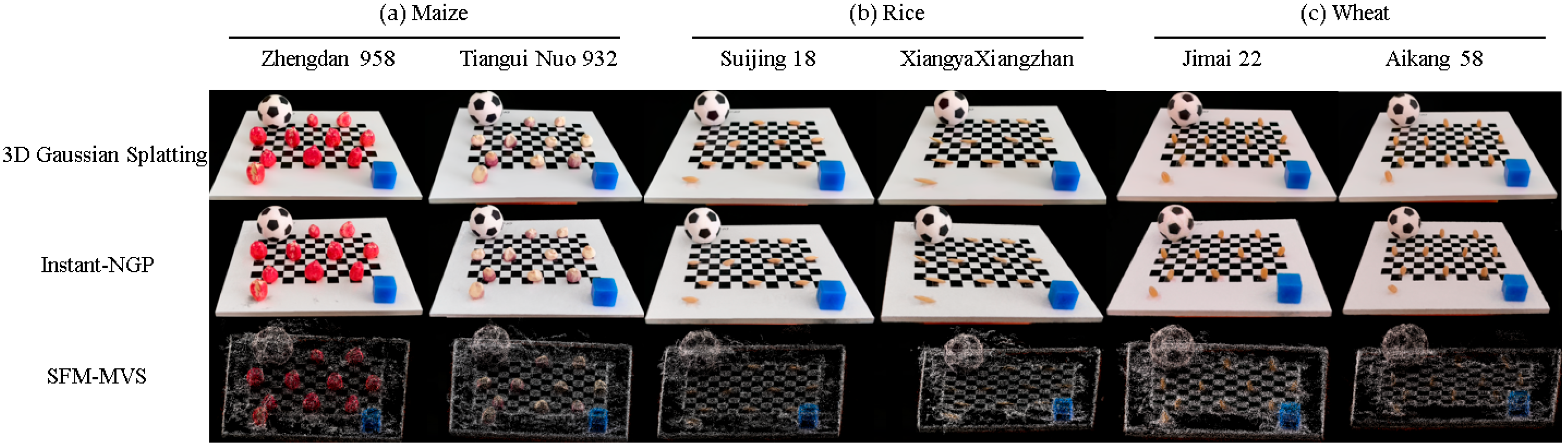
Instant Neural Graphics Primitives (Instant-NGP) is a fast implementation of NeRF that integrates multi-resolution hash encoding and GPU-based optimization for real-time 3D reconstruction. Based on Table 5 and Figure 9 and Figure 10, it is evident that 3D Gaussian Splatting exhibited significant performance differences under varying training iterations compared to the Instant-NGP method across multiple crop seed types, including maize, wheat, and rice varieties. These differences highlight the respective advantages and limitations of each method in terms of image fidelity and model optimization effectiveness. In terms of PSNR, 3DGS-30000 consistently achieved the highest values across all crop types, with PSNRs ranging from 35.66 dB to 37.31 dB. This is markedly superior to both Instant-NGP (approximately 32.95–33.59 dB) and 3DGS-7000 (approximately 33.64–34.94 dB), indicating that 3DGS, when sufficiently trained, can deliver higher-quality image reconstructions and better visual realism. Although 3DGS-7000 requires a shorter training time and produces slightly higher loss values, its PSNR still surpassed that of Instant-NGP, demonstrating a strong balance between computational efficiency and reconstruction accuracy. These results suggest that 3DGS is particularly well-suited for high-fidelity 3D reconstruction tasks involving complex seed morphologies and that increasing the number of training iterations significantly enhances its performance.
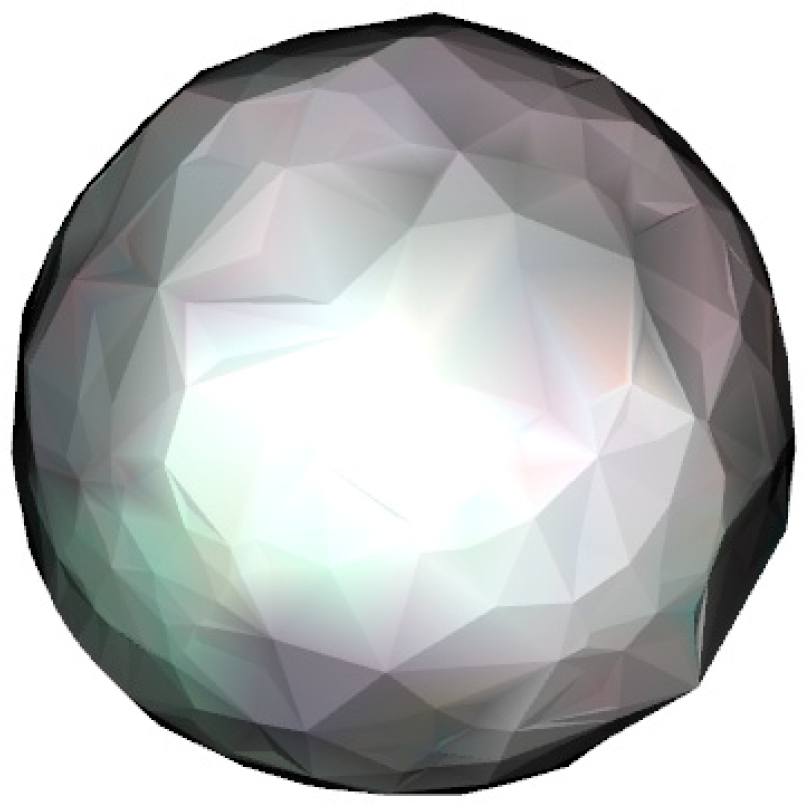
Due to the irregular surface morphology of seeds, it is challenging to obtain accurate measurements using traditional manual methods. To validate the accuracy of the proposed algorithm in calculating seed surface area and volume, a reference object—a sphere with an approximate diameter of 22 mm—was used. The point cloud model of the sphere was generated using the 3DGS method to evaluate the reliability of the algorithm.
Figure 11 shows the triangulated point cloud model of the sphere generated by the 3DGS method. Upon measurement, the reconstructed sphere exhibited a surface area of 1545.2 mm2 and a volume of 5638.85 mm3, corresponding to relative errors of 1.67% and 1.14%, respectively, when compared to the ground truth. These results demonstrate that 3DGS reconstruction can achieve high accuracy in surface area and volume estimation.

4. Discussion

This study systematically explored the potential and advantages of applying the 3D Gaussian Splatting (3DGS) method for three-dimensional reconstruction and phenotypic measurement of crop seeds, particularly maize. Compared to traditional multi-view stereo approaches such as Structure-from-Motion and Multi-View Stereo (SFM-MVS), 3DGS demonstrated significant improvements in both reconstruction efficiency and accuracy, along with superior scalability and adaptability to diverse scenes. The experimental design incorporated sufficient biological replication, with five independent groups per cultivar and ten seeds per group, ensuring statistically reliable comparisons between reconstruction methods.

4.1. Reconstruction Efficiency, Measurement Accuracy, and Multi-Crop Applicability of 3DGS

In terms of reconstruction efficiency, although 3DGS requires approximately 2.3 times the reconstruction time of SFM-MVS at 30,000 training iterations, it generates 3.38 times more point cloud data. This indicates a considerable advantage in point cloud density while maintaining high rendering quality, enabling more detailed modeling of complex seed surface structures and facilitating the extraction of fine-grained phenotypic traits. It is worth noting that this time increase primarily results from the iterative optimization of Gaussian parameters to achieve photorealistic rendering. However, the reconstruction efficiency can be substantially improved in practical applications by reducing the number of training iterations to 7000–10,000, which still produces high-fidelity reconstructions with PSNR values exceeding 34 dB.
From the perspective of measurement accuracy, 3DGS outperformed SFM-MVS across the key morphological traits of the maize variety Zhengdan 958. The coefficients of determination (R2) for length, width, and height reached 0.9361, 0.8889, and 0.946, respectively—each exceeding those obtained by SFM-MVS by more than 10% on average. Although 3DGS demonstrated superior performance to SFM-MVS across all evaluated morphological traits, the relative gain in R2 for height was less substantial than that observed for length and width. This limitation can be explained by two factors. First, seed height is generally smaller in scale, making it more sensitive to reconstruction noise, artifacts, and point cloud sparsity along the vertical axis. Even minor deviations can result in proportionally larger errors. Second, height estimation is more vulnerable to occlusions and shadowing, particularly in regions where the seed surface exhibits curvature or concavity, which reduces the visibility of key features from available viewpoints. Despite these challenges, 3DGS demonstrated clear advantages in absolute error metrics, with a reduction in MAPE from 5.76 to 3.66 and in RMSE from 0.553 to 0.34, indicating more accurate and stable height estimation overall. Overall, the results show that although the gains in explained variance for height were modest, 3DGS consistently showed higher robustness and measurement precision than SFM-MVS.
Moreover, by incorporating visual evaluation metrics such as peak signal-to-noise ratio (PSNR) and Structural Similarity Index (SSIM), the realism and structural fidelity of the 3DGS reconstructions were quantitatively verified. The PSNR values remained consistently above 35 dB, while the SSIM values exceeded 0.95, indicating photorealistic rendering quality and faithful geometric reconstruction. This affirms 3DGS as a suitable approach not only for analytical measurements but also for visualization and digital twin applications.
Importantly, the study also demonstrates the broad applicability of 3DGS across multiple crop types. A high reconstruction accuracy was achieved for rice and wheat seed samples, with all SSIM values exceeding 0.95. This highlights the method’s generalizability across crop species and its potential for integration into agricultural big data platforms and cross-species phenotypic databases.

4.2. Trade-Offs Between Implicit and Explicit Representations

Implicit representations such as NeRF encode scenes within neural networks, providing compact storage. Recent advances—most notably Instant-NGP, which employs multi-resolution hash encoding—have markedly accelerated training and inference, thereby improving the computational feasibility of NeRF-based approaches. Nevertheless, NeRF variants continue to face limitations in interpretability, direct metric extraction, and interoperability with conventional 3D analysis pipelines. These shortcomings hinder their application in quantitative domains such as plant phenotyping.
By contrast, explicit representations such as 3DGS encode geometry and appearance into discrete, parameterized primitives. This explicit representation offers superior computational efficiency and inherent interpretability and allows 3D Gaussians to be imported into software such as Unity (v2022.3) for further editing and analysis. However, 3DGS and its derivatives may incur increased memory and computational demands when modeling extremely fine radiance effects, underscoring the fundamental trade-off between the usability of explicit methods and the expressive capacity of implicit representations.

4.3. Extensions of 3DGS in Sparse-View Contexts

Three-Dimensional Gaussian Splatting (3DGS) inherently relies on dense multi-view image observations to achieve accurate reconstruction, as the distribution of Gaussian primitives is optimized according to view-dependent gradients. When the number of views is limited, reconstruction quality may degrade due to insufficient geometric constraints and reduced coverage of occluded or underrepresented regions. To address this, several potential extensions can be considered.
First, the challenges of sparse-view reconstruction can be alleviated by incorporating strong geometric and semantic priors into the optimization process. Geometric and Semantic Priors for Sparse-View Reconstruction Few-shot Gaussian Splatting (FSGS) introduces a proximity-guided Gaussian unpooling strategy to densify primitives from a highly sparse Structure-from-Motion initialization. By leveraging monocular depth estimates from pre-trained models, FSGS provides robust geometric constraints and strategically places new Gaussians to cover under-reconstructed regions, thereby improving detail recovery and reducing over-smoothing [36]. Complementarily, SIDGaussian incorporates semantic priors by utilizing features from a pre-trained DINO-ViT model. Through semantic consistency loss and local depth regularization, SIDGaussian ensures multi-view alignment and enhances the generalization of Gaussian primitives to unseen viewpoints, effectively addressing the ill-posed nature of sparse-view reconstruction [37].
Second, synthetic data augmentation via generative models presents a powerful alternative to combat information scarcity by creating geometrically consistent virtual content. GSFixer epitomizes this direction by employing a reference-guided video diffusion model, which is built on a Diffusion Transformer architecture [38]. This model does not merely generate independent novel views; instead, it is trained to take sparse input images as a reference and iteratively repair and enhance the rendered novel views from an under-optimized 3DGS, which often contain artifacts or holes. By synthesizing photometrically and semantically consistent details for these underrepresented regions, GSFixer effectively augments the training data in a loop, guiding the 3D Gaussians to converge towards a more accurate and complete representation of the scene.

5. Conclusions

This study aimed to address the limitations of traditional crop phenotyping methods, which are often subjective, costly in terms of 3D measurement equipment, and restricted in application scenarios. By employing 3D Gaussian Splatting (3DGS) for three-dimensional reconstruction of seeds and subsequent phenotypic data extraction, the potential of 3DGS for accurately capturing crop phenotypic parameters was demonstrated. The main findings are as follows:
(1)
The high accuracy of 3DGS in measuring key phenotypic traits—seed length, width, and height—was validated. The coefficients of determination (R2) between 3DGS-reconstructed seed dimensions and manual measurements were 0.9361, 0.8889, and 0.946, respectively, indicating strong consistency.
(2)
Compared with the traditional SFM-MVS approach, 3DGS exhibited superior performance in both reconstruction accuracy and efficiency. While the average reconstruction times were comparable, 3DGS achieved higher reconstruction quality at 30,000 iterations.
(3)
The method demonstrated robust applicability across multiple crop species. For maize (Zhengdan 958 and Tiangui Nuo 932), wheat (Jimai 22 and Aikang 58), and rice (Suijing 18 and Xiangya Xiangzhan), the 3DGS-reconstructed models yielded structural similarity indices (SSIM) above 0.95 and peak signal-to-noise ratios (PSNRs) between 35 and 37 dB, highlighting the method’s generalizability and stability for broader germplasm phenotyping.
In summary, the 3DGS method exhibits high precision, strong versatility, and effective visualization capabilities for seed 3D modeling and phenotyping, positioning it as a low-cost and efficient tool for modern digital breeding. Future work will focus on optimizing multi-scale modeling, on-site deployment, and automated trait extraction.

Author Contributions

Conceptualization, J.G. and C.Z.; Data curation, J.G.; Formal analysis, Z.X.; Funding acquisition, C.Z.; Investigation, F.D.; Methodology, C.Z.; Project administration, J.H.; Resources, X.W.; Software, J.G.; Supervision, J.H.; Validation, J.G., C.Z. and J.H.; Visualization, C.Z.; Writing—original draft, J.G.; Writing—review and editing, C.Z. All authors have read and agreed to the published version of the manuscript.

Funding

This research was funded by the Department of Education of Zhejiang Province (Y202455634) and the National Natural Science Foundation of China under Grant No. 32371668.

Data Availability Statement

The original contributions presented in this study are included in the article material. Further inquiries can be directed to the corresponding author.

Acknowledgments

C.Z. gratefully acknowledges the support from the National Natural Science Foundation of China.

Conflicts of Interest

The authors declare no conflicts of interest.

References

  1. Gao, C. Genome engineering for crop improvement and future agriculture. Cell 2021, 184, 1621–1635. [Google Scholar] [CrossRef]
  2. Sajja, S.; Pranati, J.; Shyamala, S.; Vinutha, K.S.; Reddy, R.; Joshi, P.; Pannem, S.; Rakshit, P.; Jadhav, Y.; Kumar, C.V.S.; et al. Rapid Ragi: A speed breeding protocol for finger millet. Plant Methods 2025, 21, 84. [Google Scholar] [CrossRef] [PubMed]
  3. He, T.; Li, C. Harness the power of genomic selection and the potential of germplasm in crop breeding for global food security in the era with rapid climate change. Crop J. 2020, 8, 688–700. [Google Scholar] [CrossRef]
  4. Feng, L.; Chen, S.; Zhang, C.; Zhang, Y.; He, Y. A comprehensive review on recent applications of unmanned aerial vehicle remote sensing with various sensors for high-throughput plant phenotyping. Comput. Electron. Agric. 2021, 182, 106033. [Google Scholar] [CrossRef]
  5. Rebetzke, G.J.; Jimenez-Berni, J.; Fischer, R.A.; Deery, D.M.; Smith, D.J. Review: High-throughput phenotyping to enhance the use of crop genetic resources. Plant Sci. 2019, 282, 40–48. [Google Scholar] [CrossRef]
  6. Cobb, J.N.; DeClerck, G.; Greenberg, A.; Clark, R.; McCouch, S. Next-generation phenotyping: Requirements and strategies for enhancing our understanding of genotype–phenotype relationships and its relevance to crop improvement. Theor. Appl. Genet. 2013, 126, 867–887. [Google Scholar] [CrossRef] [PubMed]
  7. Huang, C.; Yang, W.; Duan, L.; Jiang, N.; Chen, G.; Xiong, L.; Liu, Q. Rice panicle length measuring system based on dual-camera imaging. Comput. Electron. Agric. 2013, 98, 158–165. [Google Scholar] [CrossRef]
  8. Tanabata, T.; Shibaya, T.; Hori, K.; Ebana, K.; Yano, M. SmartGrain: High-Throughput Phenotyping Software for Measuring Seed Shape through Image Analysis. Plant Physiol. 2012, 160, 1871–1880. [Google Scholar] [CrossRef]
  9. Akhtar, M.S.; Zafar, Z.; Nawaz, R.; Fraz, M.M. Unlocking plant secrets: A systematic review of 3D imaging in plant phenotyping techniques. Comput. Electron. Agric. 2024, 222, 109033. [Google Scholar] [CrossRef]
  10. Moreno, H.; Valero, C.; Bengochea-Guevara, J.M.; Ribeiro, Á.; Garrido-Izard, M.; Andújar, D. On-Ground Vineyard Reconstruction Using a LiDAR-Based Automated System. Sensors 2020, 20, 1102. [Google Scholar] [CrossRef]
  11. Zhou, L.; Gu, X.; Cheng, S.; Yang, G.; Shu, M.; Sun, Q. Analysis of Plant Height Changes of Lodged Maize Using UAV-LiDAR Data. Agriculture 2020, 10, 146. [Google Scholar] [CrossRef]
  12. Zhang, C.; Yang, G.; Jiang, Y.; Xu, B.; Li, X.; Zhu, Y.; Lei, L.; Chen, R.; Dong, Z.; Yang, H. Apple Tree Branch Information Extraction from Terrestrial Laser Scanning and Backpack-LiDAR. Remote Sens. 2020, 12, 3592. [Google Scholar] [CrossRef]
  13. Li, N.; Ho, C.P.; Xue, J.; Lim, L.W.; Chen, G.; Fu, Y.H.; Lee, L.Y.T. A Progress Review on Solid-State LiDAR and Nanophotonics-Based LiDAR Sensors. Laser Photonics Rev. 2022, 16, 2100511. [Google Scholar] [CrossRef]
  14. Zuo, C.; Yin, W.; Feng, S.; Tao, T.; Chen, Q. High-speed 3D shape measurement using composite structured-light patterns and multiview system. In Proceedings of the Optical Metrology and Inspection for Industrial Applications V, Beijing, China, 11–13 October 2018; p. 19. [Google Scholar]
  15. Qin, Z.; Zhang, Z.; Hua, X.; Yang, W.; Liang, X.; Zhai, R.; Huang, C. Cereal grain 3D point cloud analysis method for shape extraction and filled/unfilled grain identification based on structured light imaging. Sci. Rep. 2022, 12, 3145. [Google Scholar] [CrossRef] [PubMed]
  16. Wu, T.; Dai, J.; Shen, P.; Liu, H.; Wei, Y. Seedscreener: A novel integrated wheat germplasm phenotyping platform based on NIR-feature detection and 3D-reconstruction. Comput. Electron. Agric. 2023, 215, 108378. [Google Scholar] [CrossRef]
  17. Paturkar, A.; Sen Gupta, G.; Bailey, D. Plant trait measurement in 3D for growth monitoring. Plant Methods 2022, 18, 59. [Google Scholar] [CrossRef]
  18. Gao, Q.; Kan, J. Automatic Forest DBH Measurement Based on Structure from Motion Photogrammetry. Remote Sens. 2022, 14, 2064. [Google Scholar] [CrossRef]
  19. Zermas, D.; Morellas, V.; Mulla, D.; Papanikolopoulos, N. 3D model processing for high throughput phenotype extraction—The case of corn. Comput. Electron. Agric. 2020, 172, 105047. [Google Scholar] [CrossRef]
  20. Xiao, S.; Chai, H.; Shao, K.; Shen, M.; Wang, Q.; Wang, R.; Sui, Y.; Ma, Y. Image-Based Dynamic Quantification of Aboveground Structure of Sugar Beet in Field. Remote Sens. 2020, 12, 269. [Google Scholar] [CrossRef]
  21. Li, M.; Shamshiri, R.R.; Schirrmann, M.; Weltzien, C. Impact of Camera Viewing Angle for Estimating Leaf Parameters of Wheat Plants from 3D Point Clouds. Agriculture 2021, 11, 563. [Google Scholar] [CrossRef]
  22. Li, W.; Wu, S.; Wen, W.; Lu, X.; Liu, H.; Zhang, M.; Xiao, P.; Guo, X.; Zhao, C. Using high-throughput phenotype platform MVS-Pheno to reconstruct the 3D morphological structure of wheat. AoB PLANTS 2024, 16, plae019. [Google Scholar] [CrossRef] [PubMed]
  23. Sun, S.; Li, C.; Chee, P.W.; Paterson, A.H.; Jiang, Y.; Xu, R.; Robertson, J.S.; Adhikari, J.; Shehzad, T. Three-dimensional photogrammetric mapping of cotton bolls in situ based on point cloud segmentation and clustering. ISPRS J. Photogramm. Remote Sens. 2020, 160, 195–207. [Google Scholar] [CrossRef]
  24. Wang, Y.; Hu, S.; Ren, H.; Yang, W.; Zhai, R. 3DPhenoMVS: A Low-Cost 3D Tomato Phenotyping Pipeline Using 3D Reconstruction Point Cloud Based on Multiview Images. Agronomy 2022, 12, 1865. [Google Scholar] [CrossRef]
  25. Azinovic, D.; Martin-Brualla, R.; Goldman, D.B.; Niebner, M.; Thies, J. Neural RGB-D Surface Reconstruction. In Proceedings of the 2022 IEEE/CVF Conference on Computer Vision and Pattern Recognition (CVPR), New Orleans, LA, USA, 18–24 June 2022; pp. 6280–6291. [Google Scholar]
  26. Mildenhall, B.; Srinivasan, P.P.; Tancik, M.; Barron, J.T.; Ramamoorthi, R.; Ng, R. NeRF: Representing Scenes as Neural Radiance Fields for View Synthesis. In Computer Vision—ECCV 2020; Vedaldi, A., Bischof, H., Brox, T., Frahm, J.-M., Eds.; Springer International Publishing: Cham, Switzerland, 2020; Volume 12346, pp. 405–421. [Google Scholar]
  27. Kang, H.; Hu, K.; Ying, W.; Pan, Y.; Chen, C. High-Fidelity 3d Reconstruction of Plants Using Neural Radiance Field. Comput. Electron. Agric. 2024, 220, 108848. [Google Scholar] [CrossRef]
  28. Kerbl, B.; Kopanas, G.; Leimkuehler, T.; Drettakis, G. 3D Gaussian Splatting for Real-Time Radiance Field Rendering. ACM Trans. Graph. 2023, 42, 139. [Google Scholar] [CrossRef]
  29. Wu, T.; Yuan, Y.-J.; Zhang, L.-X.; Yang, J.; Cao, Y.-P.; Yan, L.-Q.; Gao, L. Recent advances in 3D Gaussian splatting. Comput. Vis. Media 2024, 10, 613–642. [Google Scholar] [CrossRef]
  30. Fei, B.; Xu, J.; Zhang, R.; Zhou, Q.; Yang, W.; He, Y. 3D Gaussian Splatting as a New Era: A Survey. IEEE Trans. Vis. Comput. Graph. 2025, 31, 4429–4449. [Google Scholar] [CrossRef]
  31. Shen, P.; Jing, X.; Deng, W.; Jia, H.; Wu, T. PlantGaussian: Exploring 3D Gaussian splatting for cross-time, cross-scene, and realistic 3D plant visualization and beyond. Crop J. 2025, 13, 607–618. [Google Scholar] [CrossRef]
  32. Cheng, K.; Long, X.; Yang, K.; Yao, Y.; Yin, W.; Ma, Y.; Wang, W.; Chen, X. Gaussianpro: 3D gaussian splatting with progressive propagation. In Proceedings of the Forty-First International Conference on Machine Learning, Vienna, Austria, 21–27 July 2024. [Google Scholar]
  33. Gao, X.; Li, X.; Zhuang, Y.; Zhang, Q.; Hu, W.; Zhang, C.; Yao, Y.; Shan, Y.; Quan, L. Mani-gs: Gaussian splatting manipulation with triangular mesh. In Proceedings of the Computer Vision and Pattern Recognition Conference, Nashville, TN, USA, 10–17 June 2025; pp. 21392–21402. [Google Scholar]
  34. Wang, Z.; Xu, D. Pygs: Large-scale scene representation with pyramidal 3D gaussian splatting. arXiv 2024, arXiv:2405.16829. [Google Scholar]
  35. Kusnandar, T.; Santoso, J.; Surendro, K. Enhancing Color Selection in HSV Color Space. Ing. Syst. D’inf. 2024, 29, 1483. [Google Scholar] [CrossRef]
  36. Zhu, Z.; Fan, Z.; Jiang, Y.; Wang, Z. FSGS: Real-Time Few-Shot View Synthesis Using Gaussian Splatting. In Computer Vision—ECCV 2024; Leonardis, A., Ricci, E., Roth, S., Russakovsky, O., Sattler, T., Varol, G., Eds.; Springer Nature: Cham, Switzerland, 2025; Volume 15097, pp. 145–163. [Google Scholar]
  37. He, Z.; Xiao, Z.; Chan, K.-C.; Zuo, Y.; Xiao, J.; Lam, K.-M. See In Detail: Enhancing Sparse-view 3D Gaussian Splatting with Local Depth and Semantic Regularization. In Proceedings of the ICASSP 2025—2025 IEEE International Conference on Acoustics, Speech and Signal Processing (ICASSP), Hyderabad, India, 6–11 April 2025; pp. 1–5. [Google Scholar]
  38. Yin, X.; Zhang, Q.; Chang, J.; Feng, Y.; Fan, Q.; Yang, X.; Pun, C.-M.; Zhang, H.; Cun, X. GSFixer: Improving 3D Gaussian Splatting with Reference-Guided Video Diffusion Priors. arXiv 2025. [Google Scholar] [CrossRef]
Figure 1. Three-dimensional reconstruction platforms and schemes.
Agriculture 15 02329 g001
Figure 2. Measurement process flowchart.
Agriculture 15 02329 g002
Figure 3. Three-dimensional Gaussian sputtering principle.
Agriculture 15 02329 g003
Figure 4. Adaptive density control in 3D Gaussian Splatting. In the case of under-reconstruction, Gaussian primitives are cloned and optimized to fill sparse regions. In the case of over-reconstruction, excessive Gaussians are divided and continuously optimized to maintain a balanced density distribution across the object surface.
Agriculture 15 02329 g004
Figure 5. Seed segmentation using Euclidean clustering. Each color represents a distinct seed cluster, enabling subsequent trait extraction for length, width, and height measurements.
Agriculture 15 02329 g005
Figure 6. Point cloud triangulation of (a) maize, (b) rice, and (c) wheat seeds.
Agriculture 15 02329 g006
Figure 7. Peak signal-to-noise ratio (PSNR), Structural Similarity Index (SSIM), and training loss curves.
Agriculture 15 02329 g007
Figure 8. Comparison of 3DGS reconstruction and manual measurements of phenotype parameters.
Agriculture 15 02329 g008
Figure 9. Synthesized novel-view images (from different views in sequence).
Agriculture 15 02329 g009
Figure 10. Three-dimensional reconstruction results for seed samples from three crop species—(a) maize (Zhengdan 958 and Tiangui Nuo 932), (b) rice (Suijing 18 and Xiangya Xiangzhan), and (c) wheat (Jimai 22 and Aikang 58)—using three methods: 3D Gaussian Splatting, Instant-NGP, and SFM–MVS.
Agriculture 15 02329 g010
Figure 11. Small ball triangular mesh.
Agriculture 15 02329 g011
Table 1. Comparison of reconstruction times of different 3D reconstruction methods.
3D Reconstruction MethodAverage Reconstruction Time/sAverage Number of Point Clouds
SFM-MVS75777,416
3DGS-5000624182,404
3DGS-7000694198,203
3DGS-10000804228,321
3DGS-300001744261,540
Table 2. Comparison of the accuracy of 3DGS and MVS methods in measuring seed morphological parameters.
3D Reconstruction MethodMeasurementR2MAPERMSE
3DGSlength0.93611.910.304
3DGSwidth0.88893.990.464
3DGSheight0.9463.660.34
MVSlength0.8122.970.501
MVSwidth0.7774.350.554
MVSheight0.89175.760.553
Table 3. Quantitative evaluation metrics of 3DGS-based seed models across different crop varieties.
Crop VarietySSIMPSNRLPIPS
Zhengdan 9580.953735.740.0528
Tiangui Nuo 9320.962837.130.0529
Jimai 220.962935.660.0582
Aikang 580.958735.870.057
Suijing 180.966436.750.048
Xiangya Xiangzhan0.969137.310.047
Table 4. Accuracy of 3DGS-based morphological measurements across different crop varieties.
Crop VarietyMeasurement AreaR2MAPERMSE
Tiangui Nuo 932length0.93723.960.38
Tiangui Nuo 932width0.90422.370.201
Tiangui Nuo 932height0.90319.110.51
Jimai 22length0.85271.450.118
Jimai 22width0.86432.870.124
Jimai 22height0.86613.380.137
Aikang 58length0.926420.156
Aikang 58width0.84524.010.199
Aikang 58height0.86372.540.115
Suijing 18length0.89982.310.216
Suijing 18width0.84026.040.193
Suijing 18height0.8078.340.222
Xiangya Xiangzhanlength0.96443.040.329
Xiangya Xiangzhanwidth0.84289.630.257
Xiangya Xiangzhanheight0.85889.10.197
Table 5. PSNRs of 3DGS and Instant-NGP for different crop varieties.
VarietyMetric/Method3DGS-300003DGS-7000Instant-NGP
Zhengdan 958PSNR35.7433.6433.398
Tiangui Nuo 932PSNR37.1334.8833.028
Aikang 58PSNR35.6634.9433.376
Jimai 22PSNR35.8734.8932.994
Suijing 18PSNR36.7533.932.954
Xiangya XiangzhanPSNR37.3134.1333.586
Disclaimer/Publisher’s Note: The statements, opinions and data contained in all publications are solely those of the individual author(s) and contributor(s) and not of MDPI and/or the editor(s). MDPI and/or the editor(s) disclaim responsibility for any injury to people or property resulting from any ideas, methods, instructions or products referred to in the content.