
Urea Supplementation Increases Crude Protein and Alters pH but Does Not Affect Ruminal Degradability of Opuntia Silages

Abstract
1. Introduction
2. Materials and Methods
2.1. Collection Sites and Harvest Procedure
2.2. Opuntia Process and Silage
2.3. Treatments
2.4. Sampling and Sample Preparations
2.5. In Situ Digestibility Measurements
- p = DM disappearance at time t
- a = soluble fraction. The DM solubilized at the beginning of incubation (time 0)
- b = potentially degradable fraction of DM, degraded slowly in the rumen
- c = degradation rate constant of fraction b
- t = incubation time
- k = rumen outflow rate
- LT = lag time prior to microbial degradation
2.6. Chemical Composition Analyses
2.7. Statistical Analysis
3. Results
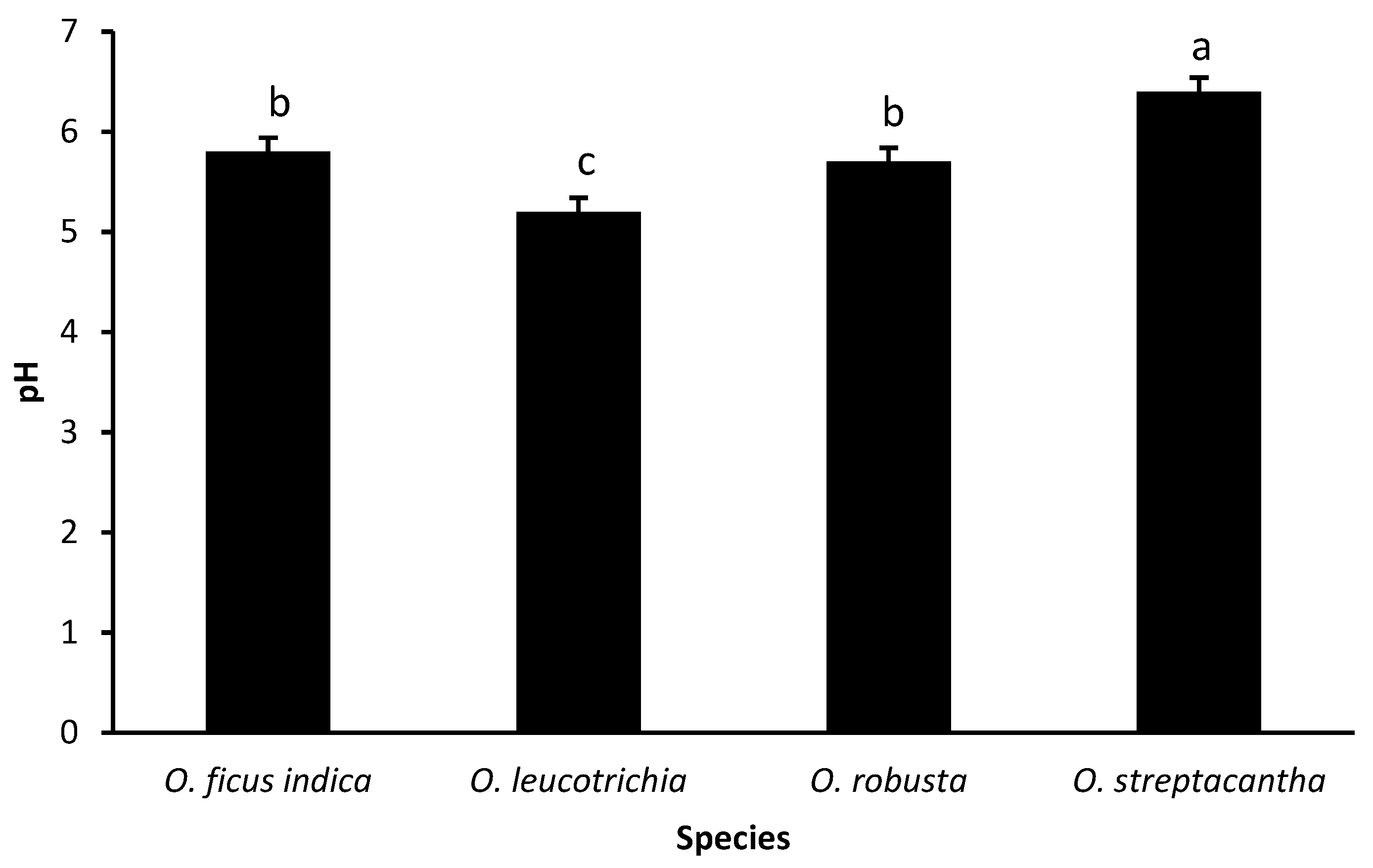
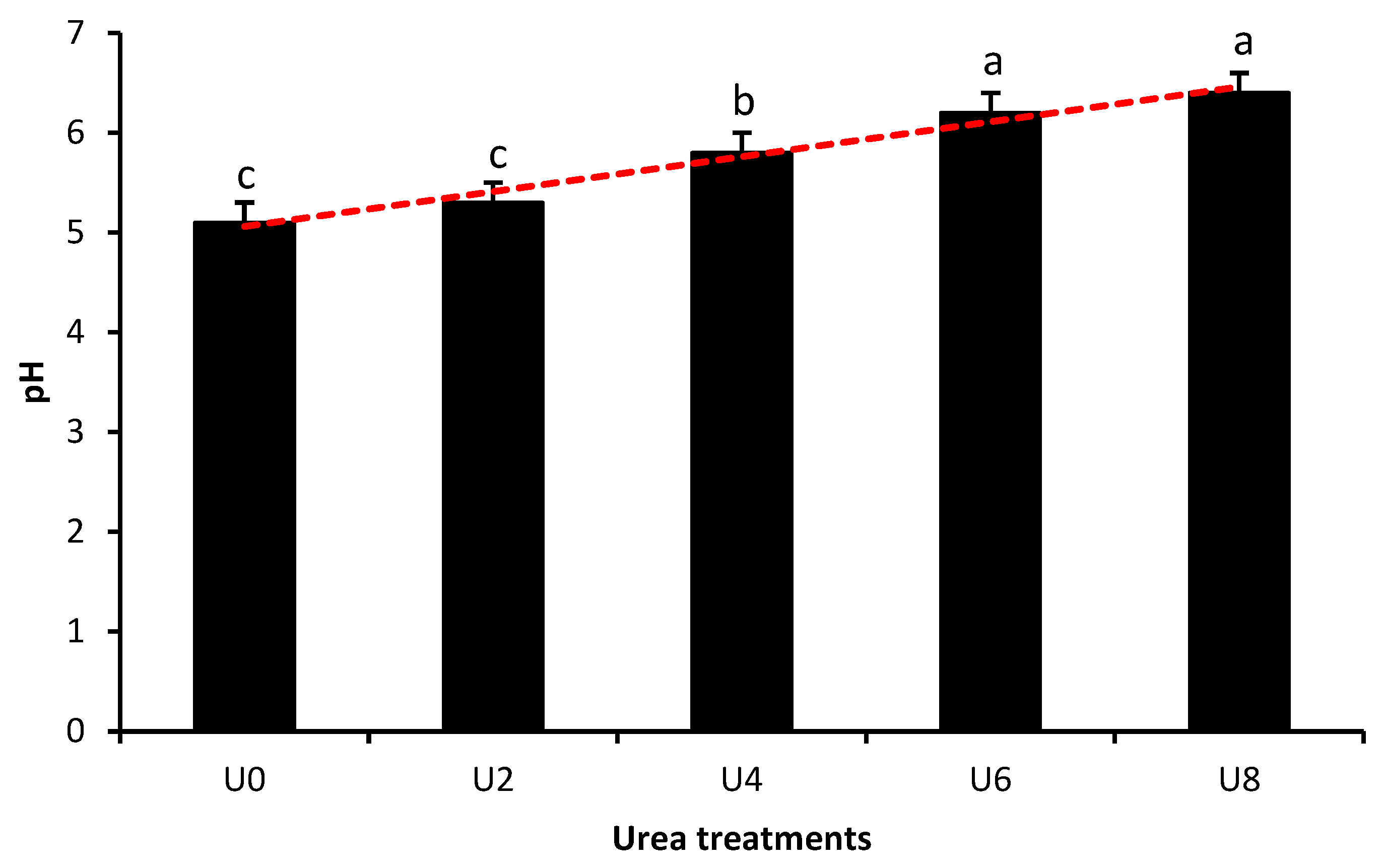
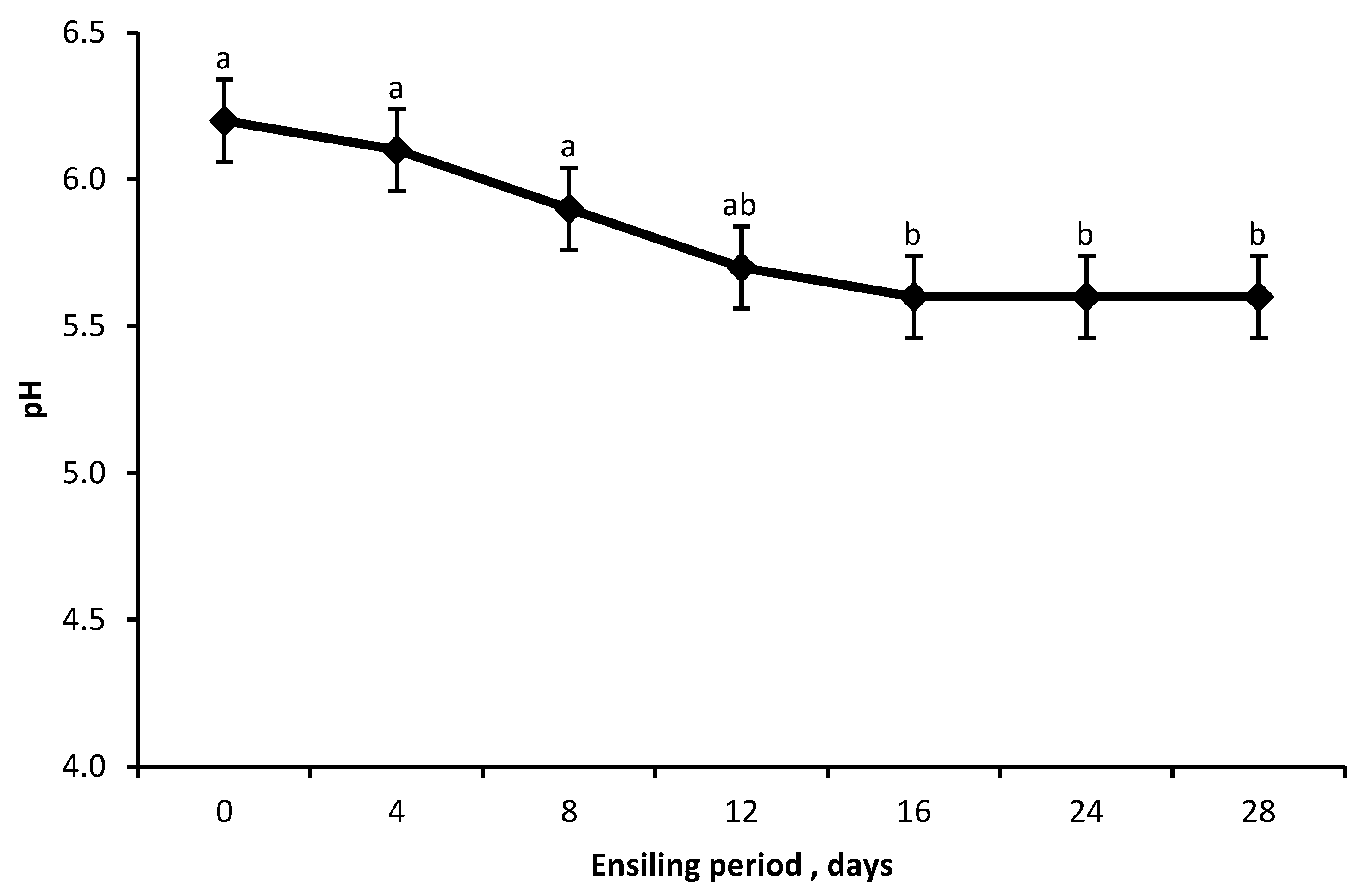
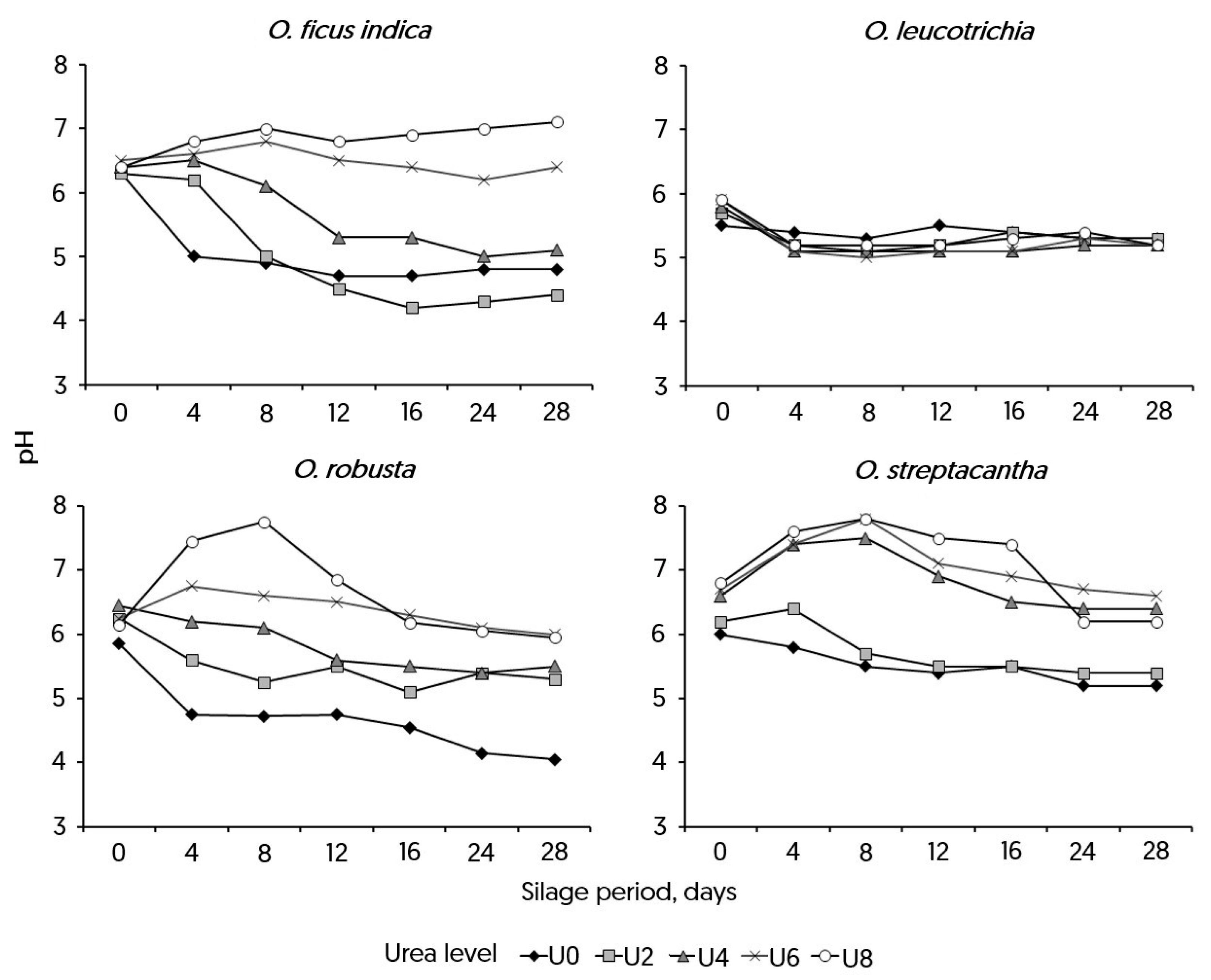
3.1. Silage pH Dynamics During Ensiling
3.2. In Situ Degradability Results
3.3. Chemical Composition Outcomes
4. Discussion
4.1. Silage pH Responses
4.2. In Situ Degradability Findings
4.3. Chemical Composition Changes
5. Conclusions
Author Contributions
Funding
Institutional Review Board Statement
Data Availability Statement
Acknowledgments
Conflicts of Interest
References
- United Nations Convention to Combat Desertification. The Global Threat of Drying Lands: Regional and Global Aridity Trends and Future Projections. In A Report of the Science-Policy Interface; United Nations Convention to Combat Desertification: Bonn, Germany, 2024; Available online: https://www.unccd.int/sites/default/files/2024-12/aridity_report.pdf (accessed on 9 October 2025).
- Safriel, U.; Adeel, Z. Dryland Systems. In Ecosystems and Human Well-Being: Current State and Trends; Hassan, R., Scholes, R., Ash, N., Eds.; Island Press: Washington, DC, USA, 2005; Volume 1, pp. 623–662. [Google Scholar]
- Fust, P.; Schlecht, E. Importance of timing: Vulnerability of semi-arid rangeland systems to increased variability in temporal distribution of rainfall events as predicted by future climate change. Ecol. Model. 2022, 468, 109961. [Google Scholar] [CrossRef]
- Nefzaoui, A.; Ben Salem, H.; Inglese, P. Opuntia spp. a strategic fodder and efficient tool to combat desertification in the Wana region. In Cactus (Opuntia spp.) as Forage; Mondragón-Jacobo, C., Pérez-González, S., Eds.; FAO: Rome, Italy, 2001; pp. 73–89. [Google Scholar]
- Louhaichi, M.; Yigezu, Y.A.T.; Hassan, S.; Naorem, A.; Meta-Gonzales, R.; Kumar, S.; Hamdeni, I.; Palsaniya, D.R.; Kauthale, V.K.; Al-Mahasneh, A.M.; et al. Characterization of cactus pear (Opuntia ficus-indica) production systems and analysis of the adoption and economic viability of spineless cactus for animal feed in four continents. Cogent Food Agric. 2025, 11, 2550493. [Google Scholar] [CrossRef]
- Pastorelli, G.; Serra, V.; Vannuccini, C.; Attard, E. Opuntia spp. as alternative fodder for sustainable livestock production. Animals 2022, 12, 1597. [Google Scholar] [CrossRef]
- Costa, R.G.; Treviño, I.H.; de Medeiros, G.R.; Medeiros, A.N.; Pinto, T.F.; de Oliveira, R.L. Effects of replacing corn with cactus pear (Opuntia ficus indica Mill) on the performance of Santa Inês lambs. Small Rumin. Res. 2012, 102, 13–17. [Google Scholar] [CrossRef]
- Méndez-Llorente, F.; Ramirez-Lozano, R.G.; Lopez-Carlos, M.A.; Rodriguez-Frausto, H.; Arechiga-Flores, C.F.; Bonilla-Salazar, A.; Nuñez-González, A.M.; Aguilera-Soto, J.I. Performance and nutrient digestion of lambs fed incremental levels of wild cactus (Opuntia leucotrichia). J. Appl. Anim. Res. 2011, 39, 248–251. [Google Scholar] [CrossRef]
- Andrade-Montemayor, H.M.; Cordova-Torres, A.V.; García-Gasca, T.; Kawas, J.R. Alternative foods for small ruminants in semiarid zones, the case of Mesquite (Prosopis laevigata spp.) and Nopal (Opuntia spp.). Small Rumin. Res. 2011, 98, 83–92. [Google Scholar] [CrossRef]
- Batista Dubeux, J.C., Jr.; Santos, M.V.F.; Cunha, M.V.; Santos, D.C.; Souza, R.T.A.; Mello, A.C.L.; Silva, M.C. Cactus (Opuntia and Nopalea) nutritive value: A review. Anim. Feed Sci. Technol. 2021, 275, 114890. [Google Scholar] [CrossRef]
- Sipango, N.; Ravhuhali, K.E.; Sebola, N.A.; Hawu, O.; Mabelebele, M.; Mokoboki, H.K.; Moyo, B. Prickly Pear (Opuntia spp.) as an Invasive Species and a Potential Fodder Resource for Ruminant Animals. Sustainability 2022, 14, 3719. [Google Scholar] [CrossRef]
- Aguilera-Soto, J.I.; Aréchiga-Flores, C.F.; Ramírez, R.G. Utilización del nopal en nutrición animal. In El Nopal en la Producción Animal; Aréchiga-Flores, C.F., Aguilera-Soto, J.I., Valdez-Cepeda, R.D., Eds.; Universidad Autónoma de Zacatecas: Zacatecas, Mexico, 2007; p. 149. [Google Scholar]
- Dutra, I.C.; Pires, A.J.V.; dos Santos, B.E.F.; da Silva, N.V.; Pio, L.P.; Cruz, N.T.; Sousa, M.P.; de Dutra, G.C. Forage cactus (Opuntia ficus-indica (L.) Miller) f. Cactaceae as an alternative for ruminant feeding. Braz. J. Sci. 2024, 3, 33–41. [Google Scholar] [CrossRef]
- Maniaci, G.; Ponte, M.; Giosuè, C.; Gannuscio, R.; Pipi, M.; Gaglio, R.; Busetta, G.; Di Grigoli, A.; Bonanno, A.; Alabiso, M. Cladodes of Opuntia ficus-indica (L.) as a source of bioactive compounds in dairy products. J. Dairy Sci. 2024, 107, 1887–1902. [Google Scholar] [CrossRef]
- Sumadong, P.; So, S.; Cherdthong, A. The benefits of adding sulfur and urea to a concentrate mixture on the utilization of feed, rumen fermentation, and milk production in dairy cows supplemental fresh cassava root. Vet. Med. Int. 2022, 2022, 9752400. [Google Scholar] [CrossRef]
- Sundstol, F.; Coxworth, E.M. Ammonia Treatment. In Straw and Other Fibrous By-Products as Feed; Sundstol, F., Owen, E., Eds.; Elsevier: Amsterdam, The Netherlands, 1984; pp. 196–247. [Google Scholar]
- El-Zaiat, H.M.; Kholif, A.E.; Khattab, I.M.; Sallam, S.M. Slow-release urea partially replacing soybean in the diet of Holstein dairy cows: Intake, blood parameters, nutrients digestibility, energy utilization, and milk production. Ann. Anim. Sci. 2022, 22, 723–730. [Google Scholar] [CrossRef]
- Martens, S.; Wildner, V.; Schulze, J.; Richardt, W.; Greef, J.M.; Zeyner, A.; Steinhöfel, O. Chemical treatment of straw for ruminant feeding with NaOH or urea–investigative steps via practical application under current European Union conditions. Agric. Food Sci. 2022, 31, 260–281. [Google Scholar] [CrossRef]
- Degu, A.; Melaku, S.; Berhane, G. Supplementation of isonitrogenous oil seed cakes in cactus (Opuntia ficus-indica)–tef straw (Eragrostis tef) based feeding of Tigray Highland sheep. Anim. Feed Sci. Technol. 2009, 148, 214–226. [Google Scholar] [CrossRef]
- Ma, S.-W.; Faciola, A.P. Impacts of Slow-Release Urea in Ruminant Diets: A Review. Fermentation 2024, 10, 527. [Google Scholar] [CrossRef]
- Zurak, D.; Kljak, K.; Aladrović, J. Metabolism and utilization of non-protein nitrogen compounds in ruminants: A review. J. Cent. Eur. Agric. 2023, 24, 1–14. [Google Scholar] [CrossRef]
- Sallam, S.; Rady, A.; Attia, M.F.; Elazab, M.A.; Vargas-Bello-Pérez, E.; Kholif, A.E. Different maize silage cultivars with or without urea as a feed for ruminant: Chemical composition and in vitro fermentation and nutrient degradability. Chil. J. Agric. Anim. Sci. 2024, 40, 137–147. [Google Scholar] [CrossRef]
- Ben Salem, H.; Nefzaoui, A.; Ben Salem, L. Supplementing spineless cactus (Opuntia ficus-indica f. inermis) based diets with urea-treated straw or oldman saltbush (Atriplex nummularia). Effects on intake, digestion and sheep growth. J. Agric. Sci. 2002, 138, 85–92. [Google Scholar] [CrossRef]
- INIFAP. Red de Monitoreo Agroclimático del Estado de Zacatecas Boletines Mensuales; INIFAP: Zacatecas, Mexico, 2019; Available online: http://zacatecas.inifap.gob.mx/boletines.php?id=18851 (accessed on 20 August 2025).
- Da Silva, D.D.; De Andrade, A.P.; Da Silva, D.S.; Alves, F.A.L.; De Lima Valença, R.; Santos, D.C.D.; De Medeiros, A.N.; Araújo, F.D.S.; Lima, L.K.S.; Bruno, R.D.L.A. Nutritional Quality of Opuntia ssp. at Different Phenological Stages: Implications for Forage Purposes. J. Agric. Stud. 2021, 10, 48–67. [Google Scholar] [CrossRef]
- Maiuolo, J.; Nucera, S.; Serra, M.; Caminiti, R.; Oppedisano, F.; Macrì, R.; Scarano, F.; Ragusa, S.; Muscoli, C.; Palma, E.; et al. Cladodes of Opuntia ficus-indica (L.) Mill. Possess Important Beneficial Properties Dependent on Their Different Stages of Maturity. Plants 2024, 13, 1365. [Google Scholar] [CrossRef] [PubMed]
- Ørskov, E.R.; Hovell, F.D.; Mould, F. The use of the nylon bag technique for the evaluation of feedstuffs. Trop. Anim. Prod. 1980, 5, 195–213. Available online: https://www.cipav.org.co/TAP/TAP/TAP53/53_1.pdf (accessed on 21 August 2025).
- Ørskov, E.R.; McDonald, I. The estimation of protein degradability in the rumen from incubation measurements weighted according to rate of passage. J. Agric. Sci. 1979, 92, 499–503. [Google Scholar] [CrossRef]
- Van Soest, P.J.; Robertson, J.B.; Lewis, B.A. Methods for dietary fiber, neutral detergent fiber, and nonstarch polysaccharides in relation to animal nutrition. J. Dairy Sci. 1991, 74, 3583–3597. [Google Scholar] [CrossRef]
- Littell, R.C.; Henry, P.R.; Ammerman, C.B. Statistical analysis of repeated measures data using SAS procedures. J. Anim. Sci. 1998, 76, 1216–1231. [Google Scholar] [CrossRef]
- McDonald, I. A revised model for the estimation of protein degradability in the rumen. J. Agric. Sci. 1981, 96, 251–252. [Google Scholar] [CrossRef]
- Rooke, J.A.; Hatfield, R.D. Biochemistry of ensiling. In Silage Science and Technology; Buxton, D.R., Muck, R.E., Harrison, J.H., Eds.; American Society of Agronomy: Madison, WI, USA, 2003; pp. 95–140. [Google Scholar] [CrossRef]
- Çürek, M.; Özen, N. Feed value of cactus and cactus silage. Turk. J. Vet. Anim. Sci. 2004, 28, 633–639. Available online: https://journals.tubitak.gov.tr/veterinary/vol28/iss4/1?utm_source=journals.tubitak.gov.tr%2Fveterinary%2Fvol28%2Fiss4%2F1&utm_medium=PDF&utm_campaign=PDFCoverPages (accessed on 19 August 2025).
- Stintzing, F.C.; Carle, R. Cactus stems (Opuntia spp.): A review on their chemistry, technology, and uses. Mol. Nutr. Food Res. 2005, 49, 175–194. [Google Scholar] [CrossRef]
- Muck, R.; Nadeau, E.; McAllister, T.; Contreras-Govea, F.; Santos, M.; Kung, L., Jr. Silage review: Recent advances and future uses of silage additives. J. Dairy Sci. 2018, 101, 3980–4000. [Google Scholar] [CrossRef]
- Charmley, E. Towards improved silage quality—A review. Can. J. Anim. Sci. 2001, 81, 157–168. [Google Scholar] [CrossRef]
- Muck, R.E. Factors Influencing Silage Quality and Their Implications for Management. J. Dairy Sci. 1988, 71, 2992–3002. [Google Scholar] [CrossRef]
- Godoi, P.F.A.; Magalhães, A.L.R.; de Araújo, G.G.L.; de Melo, A.A.S.; Silva, T.S.; Gois, G.C.; dos Santos, K.C.; do Nascimento, D.B.; da Silva, P.B.; de Oliveira, J.S.; et al. Chemical Properties, Ruminal Fermentation, Gas Production and Digestibility of Silages Composed of Spineless Cactus and Tropical Forage Plants for Sheep Feeding. Animals 2024, 14, 552. [Google Scholar] [CrossRef]
- Guerrero-Cervantes, M.; Ramírez, R.G.; Cerrillo-Soto, M.A.; Montoya-Escalante, R.; Nevárez-Carrasco, G.; Juarez-Reyes, A.S. Dry matter digestion of native forages consumed by range goats in North Mexico. J. Anim. Vet. Adv. 2009, 8, 408–412. Available online: https://www.makhillpublications.co/public/index.php/view-article/1680-5593/javaa.2009.408.412 (accessed on 2 September 2025).
- Batista, A.M.V.; Ribeironeto, A.C.; Lucena, R.B.; Santos, D.C.; Dubeux, J.C.B., Jr.; Mustafa, A.F. Chemical Composition and Ruminal Degradability of Spineless Cactus Grown in Northeastern Brazil. Rangel. Ecol. Manag. 2009, 62, 297–301. [Google Scholar] [CrossRef]
- Batista, A.M.V.; Mustafa, A.F.; McAllister, T.; Wang, Y.; Soita, H.; McKinnon, J. Effects of variety on chemical composition, in situ nutrient disappearance and in vitro gas production of spineless cacti. J. Sci. Food Agric. 2003, 83, 440–445. [Google Scholar] [CrossRef]
- Fuentes-Rodriguez, J. A comparison of the nutritional value of Opuntia and Agave plants for ruminants. J. Prof. Assoc. Cactus Dev. 1997, 2, 20–23. Available online: https://jpacd.org/jpacd/article/download/176/167/277 (accessed on 25 August 2025).
- Ramirez-Tobias, H.M.; Reyes-Agüero, J.A.; Pinos-Rodríguez, J.M.; Aguirre-Rivera, J.R. Efecto de la especie y madurez sobre el contenido de nutrientes de cladodios de nopal. Agrociencia 2007, 41, 619–626. Available online: https://www.agrociencia-colpos.org/index.php/agrociencia/article/view/569/569 (accessed on 25 August 2025).
- Castillo-González, A.R.; Burrola-Barraza, M.E.; Domínguez-Viveros, J.; Chávez-Martínez, A. Rumen microorganisms and fermentation. Arch. Med. Vet. 2014, 46, 349–361. [Google Scholar] [CrossRef]
- Wagali, P.; Pelech, I.; Sabastian, C.; Ben Ari, J.; Tagari, H.; Mabjeesh, S.J. The Effect of Microbial Inoculum and Urea Supplements on Nutritive Value, Amino Acids Profile, Aerobic Stability and Digestibility of Wheat and Corn Silages. Animals 2023, 13, 2197. [Google Scholar] [CrossRef]
- Rodríguez-Romero, N.; Abarca, F.; Herrera, J.; Bórquez, J.L. Efecto de la urea sobre la composición química y digestibilidad de paja de trigo. Arch. Med. Vet. 2002, 34, 91–98. Available online: https://ojs.alpa.uy/index.php/ojs_files/article/download/17/13/ (accessed on 25 August 2025).
- Guedes, C.M.; Rodrigues, M.M.; Gomes, M.J.; Silva, S.R.; Ferreira, L.M.; Mascarenhas-Ferreira, A. Urea treatment of whole-crop triticale at four growth stages: Effects on chemical composition and on in vitro digestibility of cell wall. J. Sci. Food Agric. 2006, 86, 964–970. [Google Scholar] [CrossRef]
- Santos-Haliscak, J.A. Evaluación de la Productividad y Caracterización de Tres Variedades de Nopal Mejorado y Tres Criollos. Ph.D. Thesis, Universidad Autónoma de Nuevo León, Monterrey, México, 2015. Available online: http://eprints.uanl.mx/13646/1/1080238031.pdf (accessed on 20 August 2025).
- Pinos-Rodríguez, J.M.; Duque-Briones, R.; Reyes-Agüero, J.A.; Aguirre-Rivera, J.R.; García-López, J.C.; González-Muñoz, S. Effect of Species and Age on Nutrient Content and in vitro Digestibility of Opuntia spp. J. Appl. Anim. Res. 2006, 30, 13–17. [Google Scholar] [CrossRef][Green Version]
- Aregheore, E.M. Effect of Yucca schidigera saponin on the nutritive value of urea-ammoniated maize stover and its feeding value when supplemented with forage legume Calliandra calothyrsus for goats. Small Rumin. Res. 2005, 56, 95–102. [Google Scholar] [CrossRef]
- Fall, S. Utilisation Digestive par les Ruminants Domestiques de Ligneux Fourrages Disponibles au Senegal; Rapport ISRA-LNERV No. 59 Ahm. Nut.: Dakar, Senegal, 1988; p. 100. [Google Scholar]
- Vargas, J.J.; Tarnonsky, F.; Podversich, F.; Maderal, A.; Fernandez-Marenchino, I.; Gómez-López, C.; Heredia, D.; Schulmeister, T.M.; Ruiz-Ascacibar, I.; Gonella-Diaza, A.; et al. Impact of Supplementing a Backgrounding Diet with Nonprotein Nitrogen on In Vitro Methane Production, Nutrient Digestibility, and Steer Performance. J. Anim. Sci. 2024, 102, skae048. [Google Scholar] [CrossRef]
- Razzak, S.; Aouji, M.; Zirari, M.; Benchehida, H.; Taibi, M.; Bengueddour, R.; Wondmie, G.F.; Ibenmoussa, S.; Bin Jardan, Y.A.; Taboz, Y. Nutritional Composition, Functional and Chemical Characterization of Moroccan Opuntia ficus-indica Cladode Powder. Int. J. Food Prop. 2024, 27, 1167–1179. [Google Scholar] [CrossRef]
- Dubeux, J.C.B., Jr.; Santos, M.V.F.; Lira, M.A.; Santos, D.C.; Farias, I.; Lima, L.E.; Ferreira, R.L.C. Productivity of Opuntia ficus-indica (L.) Miller under different N and P fertilization and plant population in north-east Brazil. J. Arid Environ. 2006, 67, 357–372. [Google Scholar] [CrossRef]
- Moharrery, A. The determination of buffering capacity of some ruminant feedstuffs and their cumulative effects in TMR ration. Am. J. Anim. Vet. Sci. 2007, 2, 72–78. [Google Scholar] [CrossRef]
- Contreras-Padilla, M.; Pérez, D.M.; Torrero, E. Evaluation of oxalates and calcium in nopal pads (Opuntia ficus-indica var. redonda) at different maturity stages. J. Food Compos. Anal. 2011, 24, 38–43. [Google Scholar] [CrossRef]
- Rojas-Molina, I.; Ariza-Colpas, P.; Vicente, A.; Almanza, N. Characterization of calcium compounds in Opuntia ficus-indica. J. Chem. 2015, 2015, 710328. [Google Scholar] [CrossRef]
- Quintero-García, M.; Gutiérrez-Cortez, E.; Rojas-Molina, I.; Mendoza-Ávila, M.; Del Real, A.; Rubio, E.; Jiménez-Mendoza, D. Calcium Bioavailability of Opuntia ficus-indica Cladodes in an Ovariectomized Rat Model of Postmenopausal Bone Loss. Nutrients 2020, 12, 1431. [Google Scholar] [CrossRef]
- Martins, M.; Ferreira, A.R.B.; de Oliveira, J.P.R.; Bedin, K.C. Physicochemical, nutritional, and medicinal properties of Opuntia species: A review. Plants 2023, 12, 1512. [Google Scholar] [CrossRef] [PubMed]
- Nortjie, E.; Basitere, M.; Moyo, D.; Nyamukamba, P. Extraction Methods, Quantitative and Qualitative Phytochemical Screening of Medicinal Plants for Antimicrobial Textiles: A Review. Plants 2022, 11, 2011. [Google Scholar] [CrossRef] [PubMed]
- Katoch, R. Nutritional Quality Estimation of Forages. In Nutritional Quality Management of Forages in the Himalayan Region; Springer: Singapore, 2022; pp. 263–287. [Google Scholar] [CrossRef]
- Mciteka, H. Fermentation Characteristics and Nutritional Value of Opuntia Ficus-indica var. Fusicaulis Cladode Silage. Ph.D. Thesis, University of the Free State, Bloemfontein, South Africa, 2008. [Google Scholar]
- Caneque, V.; Velasco, S.; Sancha, J.L.; Manzanares, C.; Souza, O. Effect of moisture and temperature on the degradability of fiber and on nitrogen fractions in barley straw treated with urea. Anim. Feed Sci. Technol. 1998, 74, 241–258. [Google Scholar] [CrossRef]
- Boukrouh, S.; Noutfia, A.; Moula, N.; Avril, C.; Louvieaux, J.; Hornick, J.; Cabaraux, J.; Chentouf, M. Ecological, morpho-agronomical, and bromatological assessment of sorghum ecotypes in Northern Morocco. Sci. Rep. 2023, 13, 15548. [Google Scholar] [CrossRef] [PubMed]
- Hussein, A.; Ateeq, R.; Ismail, E.; Cheikhyoussef, N.; Cheikhyoussef, A. Opuntia spp. in Biogas Production. In Opuntia spp.: Chemistry, Bioactivity and Industrial Applications; Ramadan, M.F., Ayoub, T.E.M., Rohn, S., Eds.; Springer: Cham, Switzerland, 2021; pp. 727–742. [Google Scholar] [CrossRef]



| Chemical Composition | Opuntia Species | |||||
|---|---|---|---|---|---|---|
| ficus indica | leucotrichia | robusta | streptacantha | SEM | (p-Value) | |
| DM | 103 y | 104 y | 105 y | 109 x | 0.9 | 0.0004 |
| CP | 47 y | 51 x | 44 z | 48 y | 0.8 | <0.0001 |
| Ash | 168 y | 144 z | 193 w | 175 x | 1.2 | <0.0001 |
| EE | 26 x | 25 x | 22 y | 22 y | 0.5 | 0.0002 |
| NDF | 325 w | 249 z | 289 x | 266 y | 1.6 | <0.0001 |
| ADF | 181 y | 168 z | 189 x | 179 y | 1.3 | <0.0001 |
| Item | Opuntia Species | SEM | |||
|---|---|---|---|---|---|
| ficus indica | leucotrichia | robusta | streptacantha | ||
| a | 0.492 x | 0.445 y | 0.387 z | 0.423 y | 0.004 |
| b | 0.375 z | 0.417 y | 0.465 x | 0.425 y | 0.005 |
| a + b | 0.867 x | 0.863 x | 0.852 y | 0.848 y | 0.002 |
| c, h−1 | 0.094 x | 0.078 y | 0.072 y | 0.077 y | 0.004 |
| EDDM 0.03, h−1 | 0.749 x | 0.740 x | 0.713 y | 0.725 y | 0.003 |
| Item | Urea Treatment * | SEM | Contrasts (p-Value) | |||||
|---|---|---|---|---|---|---|---|---|
| U0 | U2 | U4 | U6 | U8 | Linear | Quadratic | ||
| a | 0.481 x | 0.416y | 0.433 y | 0.433 y | 0.421 y | 0.005 | 0.254 | 0.390 |
| b | 0.394 z | 0.450 x | 0.416 y | 0.419 y | 0.413 y | 0.006 | 0.930 | 0.665 |
| a + b | 0.875 x | 0.866 x | 0.849 y | 0.852 y | 0.834 z | 0.003 | 0.011 | 0.084 |
| c, h−1 | 0.063 y | 0.103 x | 0.092 x | 0.085 x | 0.064 y | 0.005 | 0.817 | 0.173 |
| EDDM 0.03, h−1 | 0.738 x | 0.746 x | 0.731 x | 0.745 x | 0.710 y | 0.003 | 0.272 | 0.357 |
| Item | Ensiling Period, d | SEM | Contrasts (p-Value) | |||||||
|---|---|---|---|---|---|---|---|---|---|---|
| 0 | 4 | 8 | 12 | 16 | 24 | 28 | Linear | Quadratic | ||
| a | 0.438 | 0.437 | 0.428 | 0.431 | 0.434 | 0.439 | 0.441 | 0.006 | 0.418 | 0.167 |
| b | 0.434 | 0.423 | 0.432 | 0.429 | 0.425 | 0.405 | 0.418 | 0.007 | 0.074 | 0.261 |
| a + b | 0.873 x | 0.860 y | 0.860 y | 0.861 y | 0.860 y | 0.856 y | 0.859 y | 0.003 | 0.126 | 0.135 |
| c, h−1 | 0.067 y | 0.082 x | 0.090 x | 0.092 x | 0.091 x | 0.086 x | 0.076 x | 0.006 | 0.613 | 0.008 |
| EDDM 0.03, h−1 | 0.725 | 0.732 | 0.733 | 0.735 | 0.735 | 0.736 | 0.735 | 0.004 | 0.052 | 0.025 |
| Chemical Composition | Urea Level * | SEM | Contrasts (p-Value) | |||||
|---|---|---|---|---|---|---|---|---|
| (g/kg) | U0 | U2 | U4 | U6 | U8 | Linear | Quadratic | |
| O. ficus-indica | ||||||||
| DM | 104 | 105 | 105 | 106 | 107 | 2.8 | 0.056 | 0.074 |
| CP | 48 z | 98 y | 149 x | 202 w | 265 v | 4.1 | <0.001 | <0.001 |
| Ash | 168 | 174 | 172 | 174 | 173 | 3.5 | 0.250 | 0.309 |
| EE | 26 | 24 | 24 | 24 | 25 | 0.8 | 0.559 | 0.071 |
| NDF | 325 | 318 | 320 | 319 | 318 | 3.8 | 0.184 | 0.333 |
| ADF | 181 | 187 | 189 | 189 | 190 | 3.6 | 0.055 | 0.048 |
| O. leucotrichia | ||||||||
| DM | 110 | 111 | 112 | 112 | 113 | 2.9 | 0.059 | 0.075 |
| CP | 51 z | 99 y | 152 x | 204 w | 267 v | 4.2 | <0.001 | <0.001 |
| Ash | 145 | 140 | 148 | 154 | 154 | 3.8 | 0.074 | 0.261 |
| EE | 24 | 22 | 23 | 23 | 22 | 0.9 | 0.319 | 0.653 |
| NDF | 248 | 245 | 247 | 244 | 246 | 3.8 | 0.391 | 0.571 |
| ADF | 168 | 167 | 167 | 166 | 164 | 3.5 | 0.058 | 0.150 |
| O. robusta | ||||||||
| DM | 109 | 112 | 113 | 113 | 114 | 2.9 | 0.135 | 0.162 |
| CP | 44 z | 94 y | 151 x | 205 w | 262 v | 3.9 | <0.001 | <0.01 |
| Ash | 195 | 198 | 201 | 197 | 201 | 3.6 | 0.219 | 0.490 |
| EE | 21 | 19 | 20 | 21 | 20 | 0.7 | 0.998 | 0.898 |
| NDF | 291 | 287 | 289 | 288 | 287 | 3.9 | 0.224 | 0.505 |
| ADF | 187 | 189 | 191 | 190 | 189 | 3.4 | 0.355 | 0.058 |
| O. streptacantha | ||||||||
| DM | 116 | 114 | 115 | 117 | 119 | 2.9 | 0.253 | 0.162 |
| CP | 48 z | 92 y | 144 x | 199 w | 264 v | 4.0 | <0.01 | <0.001 |
| Ash | 175 | 174 | 175 | 178 | 179 | 3.6 | 0.052 | 0.097 |
| EE | 22 | 21 | 21 | 22 | 22 | 0.8 | 0.638 | 0.381 |
| NDF | 264 | 258 | 262 | 261 | 259 | 4.0 | 0.432 | 0.757 |
| ADF | 179 | 182 | 181 | 183 | 182 | 3.5 | 0.162 | 0.273 |
Disclaimer/Publisher’s Note: The statements, opinions and data contained in all publications are solely those of the individual author(s) and contributor(s) and not of MDPI and/or the editor(s). MDPI and/or the editor(s) disclaim responsibility for any injury to people or property resulting from any ideas, methods, instructions or products referred to in the content. |
© 2025 by the authors. Licensee MDPI, Basel, Switzerland. This article is an open access article distributed under the terms and conditions of the Creative Commons Attribution (CC BY) license (https://creativecommons.org/licenses/by/4.0/).
Share and Cite
Méndez-Llorente, F.; López-Carlos, M.A.; Aguilera-Soto, J.I. Urea Supplementation Increases Crude Protein and Alters pH but Does Not Affect Ruminal Degradability of Opuntia Silages. Agriculture 2025, 15, 2285. https://doi.org/10.3390/agriculture15212285
Méndez-Llorente F, López-Carlos MA, Aguilera-Soto JI. Urea Supplementation Increases Crude Protein and Alters pH but Does Not Affect Ruminal Degradability of Opuntia Silages. Agriculture. 2025; 15(21):2285. https://doi.org/10.3390/agriculture15212285
Chicago/Turabian StyleMéndez-Llorente, Fabiola, Marco A. López-Carlos, and Jairo I. Aguilera-Soto. 2025. "Urea Supplementation Increases Crude Protein and Alters pH but Does Not Affect Ruminal Degradability of Opuntia Silages" Agriculture 15, no. 21: 2285. https://doi.org/10.3390/agriculture15212285
APA StyleMéndez-Llorente, F., López-Carlos, M. A., & Aguilera-Soto, J. I. (2025). Urea Supplementation Increases Crude Protein and Alters pH but Does Not Affect Ruminal Degradability of Opuntia Silages. Agriculture, 15(21), 2285. https://doi.org/10.3390/agriculture15212285