Article

Sensitivity of Soil Moisture Simulations to Noah-MP Parameterization Schemes in a Semi-Arid Inland River Basin, China

1
Anhui Province Key Laboratory of Atmospheric Science and Satellite Remote Sensing, Anhui Institute of Meteorological Sciences, Hefei 230031, China
2
School of Geography and Tourism, Anhui Normal University, Wuhu 241002, China
3
School of Earth and Space Sciences, University of Science and Technology of China, Hefei 230031, China
4
Huaihe River Basin Meteorological Center, Anhui Meteorological Bureau, Hefei 230031, China
5
School of Aeronautic Engineering, Changsha University of Science and Technology, Changsha 410000, China
*
Author to whom correspondence should be addressed.
Agriculture 2025, 15(21), 2286; https://doi.org/10.3390/agriculture15212286
Submission received: 5 August 2025 / Revised: 17 October 2025 / Accepted: 28 October 2025 / Published: 3 November 2025

Abstract

Soil moisture simulations in semi-arid inland river basins remain highly uncertain due to complex land–atmosphere interactions and multiple parameterization schemes in land surface models. This study evaluated the ability of the Noah-Multiparameterization Land Surface Model (Noah-MP) to simulate soil moisture at meteorological sites representing the upstream, midstream and downstream regions of a semi-arid inland river basin with contrasting climates. A large physics-ensemble experiment (17,280 simulations per site) combining different parameterization schemes for 10 main physical processes was conducted. Natural selection, Tukey’s test and uncertainty contribution analysis were applied to identify sensitive processes and quantify their contributions to simulation uncertainty. Results indicate that Noah-MP captures soil moisture variability across the basin but with notable biases. Three physical processes—frozen soil permeability, supercooled liquid water in frozen soil and ground resistance to sublimation—were sensitive at all sites, whereas radiation transfer and surface albedo were consistently insensitive. At the upstream and midstream sites, supercooled liquid water contributed about half of the ensemble uncertainty, and at the downstream site ground resistance to sublimation contributed roughly 51%. These findings reveal which physical processes most strongly affect Noah-MP soil moisture simulations in semi-arid basins and provide guidance for improving parameterization schemes to reduce uncertainty.

1. Introduction

Soil moisture is a crucial component of the terrestrial water cycle and a significant influencing factor in the distribution of surface radiation [1]. Accurately estimating soil moisture is of paramount importance for understanding surface conditions, studying land-atmosphere interactions, and managing agricultural production [2,3,4]. It serves as a key variable in studies related to land-atmosphere interactions and hydrological cycles, exerting important impacts on surface energy fluxes, runoff, radiation balance, and material transport [5,6]. As a critical parameter in land surface processes, soil moisture plays a vital role in climate and regional environmental changes. It affects these changes by altering surface reflectance, soil heat capacity, surface evaporation, transpiration, and vegetation growth conditions, leading to the redistribution of surface energy and moisture. This, in turn, modifies the sensible, latent, and longwave radiation fluxes from the surface to the atmosphere. Furthermore, the thermal properties and water transport processes within the soil were influenced by the changes in soil moisture, causing variations in various surface parameters and subsequently impacting climate [7]. Against the backdrop of ongoing global warming, accurately simulating soil moisture and understanding its spatial-temporal distribution characteristics and intrinsic properties are critical for comprehending the Earth’s surface response to climate change. This knowledge holds significant scientific importance for sustainable water resource utilization, regional climate change predictions, runoff estimation, and agricultural production irrigation.
Numerical simulation is a crucial approach for studying the spatiotemporal distribution characteristics of soil moisture. Internationally, numerous land surface models focusing on various surface elements have emerged, and those that incorporate multiple parameterization schemes for diverse surface physical processes can accurately simulate soil moisture. The Noah-MP model represents a new generation of land surface models developed based on the Noah model framework [8,9], incorporating various parameterization schemes for different physical processes and plays a reliable candidate for simulating soil moisture [10,11]. In recent years, researchers have extensively evaluated the model at both single-point and regional scales [11,12,13]. For instance, the runoff simulation performance of the Noah-MP model was assessed in the Mississippi River Basin, revealing its high sensitivity to surface dryness coefficients, hydraulic conductivity, and saturated soil moisture [14]. To further clarify the simulation performance of the Noah-MP model, a study evaluated its ability to simulate water and energy fluxes in the continental United States and results demonstrated that the Noah-MP model effectively captures the spatiotemporal distribution characteristics of net radiation, snow cover area, and runoff [15]. Compared with the original Noah model, significant improvements were found in simulating surface fluxes, dry season surface temperature, snow water equivalent, snow depth, and runoff [10,16,17]. Due to the high applicability and excellent land surface process modeling performance of the Noah-MP model, it has gradually become a strong candidate for soil moisture simulation. The water budget components including soil moisture simulated by Noah-MP model were evaluated in main river basin, China and the results showed that the simulations effectively reproduce the observed spatial pattern of soil moisture during the warm seasons across most regions, however, the results also demonstrated that there is significant room for improvement in the model’s simulation performance [18]. In response to the issue of Noah-MP does not consider surface water ponding and overland flow, lateral terrestrial water flow schemes have been developed for Noah-MP to improve the simulation of soil moisture [19]. The bias of the Noah-MP model in simulating soil water-heat transport in freeze-thaw process were investigated and results exhibited that the biases in simulating soil moisture in freeze-thaw process are difficult to be eliminated [20]. Indeed, assimilating satellite observation data, like leaf area index and SMAP soil retrievals [21,22,23], Sentinel-1 backscatter observations [24], remotely sensed MODIS evapotranspiration [25], vegetation optical depth retrievals [26], etc. into the Noah-MP model can effectively improve soil moisture simulation results. However, the soil moisture data assimilation technique aims to obtain the optimal posterior estimation of the model state by fully considering model errors and observation errors, in order to improve the accuracy of soil moisture simulations, without adjusting the model’s physical parameterization schemes. Efforts are still needed to reduce errors caused by model structural uncertainties by enhancing the model’s ability to describe actual physical processes. The most distinctive feature of the Noah-MP model is its integration of multiple parameterization schemes for the same physical process, greatly enhancing its applicability [11,27]. However, this also makes it difficult to determine which combination of schemes results in the least structural uncertainty and simulation error. To address this issue, the sensitivity of sensible and latent heat simulations to parameterization schemes was analyzed by conducting a total number of 4608 Noah-MP physics-ensemble simulations [13]. Similar studies have been conducted to explore the sensitivity of snow simulation results to parameterization schemes and the uncertainties in the results under different snow climate conditions worldwide through ensemble simulations with multiple parameterization schemes [28]. Additionally, the sensitivity of surface heat flux to parameterization schemes has been investigated [29]. The sensitivities of the simulated runoff to parameterizations were quantified by varying the optional parameterization schemes of six land surface processes [30].
Although researchers have explored the sensitivity of simulation results to parameterization schemes for various surface elements, there are currently few studies investigating the sensitivity of soil moisture simulation results to the Noah-MP model parameterization schemes under different surface types and climate conditions. Considering this, based on previous research efforts, this study selects the Heihe River Basin (HRB) in China, which encompasses various underlying surfaces and climate types, as the study area. Soil moisture simulation experiments are conducted in the upper, middle, and lower reaches of the Heihe River to evaluate the soil moisture simulation performance of the Noah-MP model. Building upon this, given that the Noah-MP model incorporates multiple parameterization schemes for its key physical processes, resulting in a diverse set of parameterization scheme combinations, the study designs experiments using multiple parameterization schemes to explore the sensitivity of soil moisture simulation results to different parameterization schemes under various underlying surface conditions. This study is an attempt to provide a scientific basis for improving the soil moisture simulation performance of the Noah-MP model. All simulations in this study were based on meteorological and soil moisture observations from sites in the upper, middle, and lower reaches of the HRB. The main goal of this research is to address the following issues: (1) How does the Noah-MP model perform in simulating soil moisture in the HRB? (2) What is the sensitivity of soil moisture simulations to parameterization schemes?
Section 2 contains the study sites, input meteorological dataset, the Noah-MP model and the sensitivity analysis methods. Section 3 provides the results and discussions of the experiment. Section 4 summarizes the findings and presents main conclusion of this study.

2. Data and Methods

2.1. Study Sites and Data

The Heihe river is the second-largest inland river in China, located in the Qilian Mountains and the middle section of the Hexi Corridor. It spans approximately 819 KM, with coordinates ranging from 97°24′ to 102°10′ E longitude and 37°41′ to 42°42′ N latitude. As shown in Figure 1, the southern part of HRB is the Qilian Mountain area, has an average elevation of over 3600 m and is the source of the Heihe river’s main stream. The central part is characterized by a corridor plain with fault basins, at an elevation of around 1200 m. The northwest part of HRB consists of mid-low mountains, with elevations ranging from 1400 to 2800 m, and the whole basin covers a total area of over 1300 square kilometers [31]. The upper mountainous region serves as the runoff-producing area of the Heihe river, with an average annual precipitation of 330 mm, good vegetation, and a humid, cold climate. The middle reaches rely on the Heihe river for water supply and have developed into an artificial oasis, making this area has abundant light and heat resources. The lower reaches are typical arid regions characterized by dry climate, sparse vegetation, and low annual precipitation. The complex surface features of the HRB provide favorable conditions for studying land surface processes. Li et al. (2009) [32] conducted the Heihe River Basin Upper Reaches Cold Region Hydrological Remote Sensing and Ground Synchronous Observation Experiment, establishing a series of hydrological and ecological observation stations and collecting a substantial amount of observational data, laying a foundation for further in-depth research on land surface processes in the HRB.
Considering the high spatial heterogeneity of land cover types in the HRB and the significant differences in climate types across different sections of the basin, this study selected a typical meteorological station in the upper, middle, and lower reaches of the HRB to conduct soil moisture simulation experiment, respectively. This was done to compare the performance of the Noah-MP model in simulating soil moisture under different climate and land cover conditions. The three selected sites are the Arou, Heihe, and Sidaoqiao site. Arou site is located in the upper reaches of the HRB, with coordinates 100.46° E, 38.03° N, and an elevation of 3032.8 m. The underlying surface type at Arou site is subalpine mountain meadow. According to soil texture information for the HRB provided by the National Cryosphere Desert Data Center, the soil type at this site is dark cold calcareous soil. The Heihe site is located in the middle reaches of the HRB, with coordinates 100.48° E, 38.83° N, and an elevation of 1560 m. The underlying surface at Heihe site is crop land, and the soil type is sandy loam. The surrounding area is mainly farmland planted with corn. In addition to observing conventional meteorological elements, this site also monitored soil moisture at different depths. Sidaoqiao site is located in the lower reaches of the HRB, with coordinates 101.14° E, 42.00° N, and an elevation of 873 m. The underlying surface is dominated by sparse vegetation, and the soil type is saline-alkali soil. This area has a typical extremely arid continental climate characterized by dryness, low rainfall, high evaporation, and significant diurnal temperature variation. Unlike the upper and middle reaches, the lower reaches have sparse vegetation and suffer from serious desertification and salinization due to wind erosion. The locations of the three sites are signed in Figure 1, and the detail information of the three sites are listed in Table 1.

2.2. Noah-MP Default Parameterization and Physics Ensemble Numerical Experiment

The Noah-MP model has undergone significant improvements based on the original Noah model framework. Compared to the original Noah model, Noah-MP has redesigned the internal structure of the model. The most notable improvement is the design of an independent vegetation canopy to separately calculate canopy temperature and surface temperature, and to separate the vegetation canopy energy balance from the surface energy balance, making the calculation of canopy temperature more reasonable [10,11]. The improvements to the Noah-MP model on the basis of the Noah model mainly include a 2-m-deep soil column, a snowpack stratified according to snow depth, and an unconfined aquifer. The model divides the soil column into four layers, with soil thicknesses of 0.1 m, 0.3 m, 0.6 m, and 1.0 m respectively [11]. Additionally, the Noah-MP model has incorporated several new physical processes into the original Noah model framework, such as dynamic water table [10,33], interactive vegetation canopy [34], and an unconfined aquifer for groundwater storage [11].The most notable feature of the Noah-MP model is that it provides 2–4 different parameterization schemes for the major physical processes in the model, greatly enhancing the applicability of the Noah-MP model under different environmental conditions. The newest version of the Noah-MP 5.0 includes multiple parameterization schemes for physic options, The main physic options which may affect the soil moisture simulations are shown in Table 2. Considering that the Noah-MP model is currently the most widely used in different land surface simulation experiment, this study examines the performance of the Noah-MP model in simulating soil moisture at the selected sites.
The meteorological driving elements required by the Noah-MP model include near-surface air temperature, air pressure, relative humidity, precipitation, downward longwave and shortwave radiation, as well as near-surface wind speed and wind direction. Model initialization requires surface datasets such as soil type, land cover type, and elevation. All three sites selected in this study have high-precision meteorological and soil moisture observation data. The time scale of the meteorological observation data used as model driving data is 1 h, meeting the model’s requirements for driving data in the experiment. A spin-up simulation was performed with meteorological forcing data from the year prior to the study period to attain soil-state equilibrium. The equilibrium criterion followed Gao et al. (2015) [12] and Cai et al. (2014) [14], requiring that the difference between consecutive annual mean values from two one-year simulations be less than 0.1% of the mean. The selected time period data in the study have all undergone quality control, ensuring data quality. All the site data can be downloaded from the National Tibetan Plateau Data Center (https://data.tpdc.ac.cn).

2.3. Analysis and Evaluation Methods

Soil moisture was recorded as a simulation variable, and the simulation performance of Noah-MP model was evaluated by comparing the soil moisture simulation results with the observed soil moisture data. The Root Mean Square Error (RMSE) between the simulations and observations is used as the evaluation metric for simulation accuracy,
R M S E = 1 N i = 1 n [ s i m ( i ) o b s ( i ) ] 2
where N is the number of samples, s i m is the simulated value, and o b s is the observed value. The smaller the RMSE value, the closer the simulated value is to the observed value, indicating higher simulation accuracy. In the ensemble simulation experiment, two sensitivity analysis methods, Natural Selection and Tukey’s Test, were used to analyze the sensitivity of the parameterization schemes based on the simulation results. Both methods evaluate the model’s simulation performance by calculating the RMSE between the simulated and observed values. They analyze different physical processes one by one to identify the soil moisture simulations sensitive to parameterization schemes. The two sensitivity analysis methods are introduced as follows.
Natural Selection: First, the RMSE of simulated soil moisture for each combination scheme was calculated based on the observed values, and all the RMSE values was sorted in ascending order. The top 5% (about 864 ensemble members) and the bottom 5% (about 864 ensemble members) were extracted from the ensemble. Obviously, the combination schemes with RMSE values in the top 5% perform better than those in the bottom 5%. Therefore, the set of all RMSE values in the top 5% was labeled as “Best members”, and the set of all RMSE values in the bottom 5% was labeled as “worst members”. Based on the newly formed sets, the frequency of a given scheme for each physical process occurring in the “best members” and “worst members” sets were counted. Obviously, the higher the frequency of a given scheme in the “best members”, the greater its contribution to improving simulation accuracy. Conversely, the higher the frequency of a given scheme in the “worst members”, the greater its contribution to reducing simulation accuracy. This method allows for a preliminary macro-level assessment of the relative merits of different parameterization schemes within the same physical process and helps determine the sensitivity of the simulated soil moisture to the parameterizations based on frequency differences.
Tukey’s Test: as a method of hypothesis testing, is used to examine the sensitivity of simulated soil moisture to parameterizations. The concept of this method is to use hypothesis testing to compare whether there are significant differences between parameterizations within a given physical process. If significant differences exist, the simulated soil moisture is sensitive to the given parameterization scheme. First, the mean RMSE values for each parameterization scheme was calculated, Y 1 ¯ , Y 2 ¯ , , Y a ¯ . Then, the method of hypothesis testing was used to compare whether the differences between each pair of means, u i and u j ( i j ), are significant. The null hypothesis and alternative hypothesis are shown in Equation (2).
H 0 : u i = u j H 1 : u i u j
The indicator of significant differences between parameterizations is
q = Y ¯ max Y ¯ min M S E 2 1 n i + 1 n i = Y ¯ max Y ¯ min S S E 2 N a 1 n i + 1 n i
where Y ¯ max represents the larger mean RMSE value of the two parameterization schemes being compared, and Y ¯ min is the smaller one. n i and n j are the sample sizes of the i t h and j t h parameterizations, respectively. M S E represents the mean square error, calculated using Equation (4).
M S E = 1 N a k = 1 a l = 1 n k Y k l Y ¯ k 2
S S E is the sum of squares, which can be calculated using Equation (5),
S S E = k = 1 a l = 1 n k Y k l Y ¯ k 2
where N is the total sample size including all schemes, and N a is the degrees of freedom. If the mean RMSE values of the two parameterization schemes satisfy Equation (6), then the difference between them is deemed statistically significant.
Y ¯ i Y ¯ j / M S E 2 1 n i + 1 n i > q α a , N a
where α is the significance level of the hypothesis test, set to 0.01 in this study. The value of q α a , N a can be obtained by looking up the hypothesis test distribution table. For example, the physical process of radiation transfer has three parameterizations (i.e., a = 3 ), the hypothesis test method is used to examine whether there is a significant difference between the first and second parameterization scheme. The null hypothesis and alternative hypothesis are set as H 0 : u 2 = u 3 and H 1 : u 2 u 3 , respectively. The total sample size N is 17,280, and the sample size for each parameterization scheme is 5760 (i.e., n 1 = n 2 = n 3 = 5760 ). The degrees of freedom N a is 17,277, and the mean square error is M S E = k = 1 3 l = 1 n k Y k l Y ¯ k 2 / 17277 . The significance level is α = 0.01 . The value of q 0.01 3 , 17277 can be obtained by looking up the hypothesis test distribution table. If the values of Y ¯ i and Y ¯ j satisfy Equation (6), the null hypothesis will be rejected at the significance level of 0.01. Conversely, the null hypothesis will be accepted at this significance level.
Natural Selection and Tukey’s Test are two sensitivity analysis methods that determine the sensitivity of parameterization schemes from a macro and micro perspective, respectively. In this study, if either method identifies sensitivity in a parameterization scheme, the simulated soil moisture is considered sensitive to that scheme.
Uncertainty Contribution Analysis: To elucidate the impact of sensitive physical processes to the uncertainty in ensemble simulation results, this study employed a comprehensive approach to quantify the contribution of individual physical processes to the overall uncertainty in soil moisture simulations. Ten main physical processes within Noah-MP model were selected to configure the multi-parameterization scheme ensemble simulation experiment, with each process represented by multiple parameterization schemes, resulting in a total of 17,280 soil moisture simulations. For instance, the BTR physical process has three different parameterization schemes. To quantify BTR’s contribution to overall uncertainty, a conditional uncertainty analysis was performed. The simulation outputs were grouped according to the BTR parameterization scheme used: BTR1, BTR2, and BTR3. For each group, the mean simulation result was computed,
R ¯ k = 1 n k i = 1 n k R i k
where R ¯ k represents the mean of the simulation results for the k th BTR scheme, n k is the number of simulations using the k th BTR scheme, and R i k is the individual simulation result for the i th simulation under the k th BTR scheme. The between-group variance, representing the variability in simulation results due to differences in the BTR schemes, was calculated as,
B V = 1 K k = 1 K R ¯ k R ¯ 2
where K is the total number of BTR schemes, and R ¯ is the overall mean of all simulation results across all BTR schemes,
R ¯ = 1 N i = 1 N R i
with N being the total number of simulations. The total variance, representing the overall model uncertainty, was calculated as,
T V = 1 N i = 1 N R i R ¯ 2
Finally, the contribution of the BTR process to the total model uncertainty was quantified as the ratio of the between-group variance to the total variance,
C o n = B V / T V
This ratio reflects the proportion of total variability in soil moisture simulations attributable to differences in the BTR parameterization schemes. By applying this methodology, the contribution of sensitive processes to the uncertainty of ensemble simulations can be quantified, offering valuable insights into their role in driving model uncertainty.

3. Results

3.1. Soil Moisture Simulated by Default Parameterization Combination

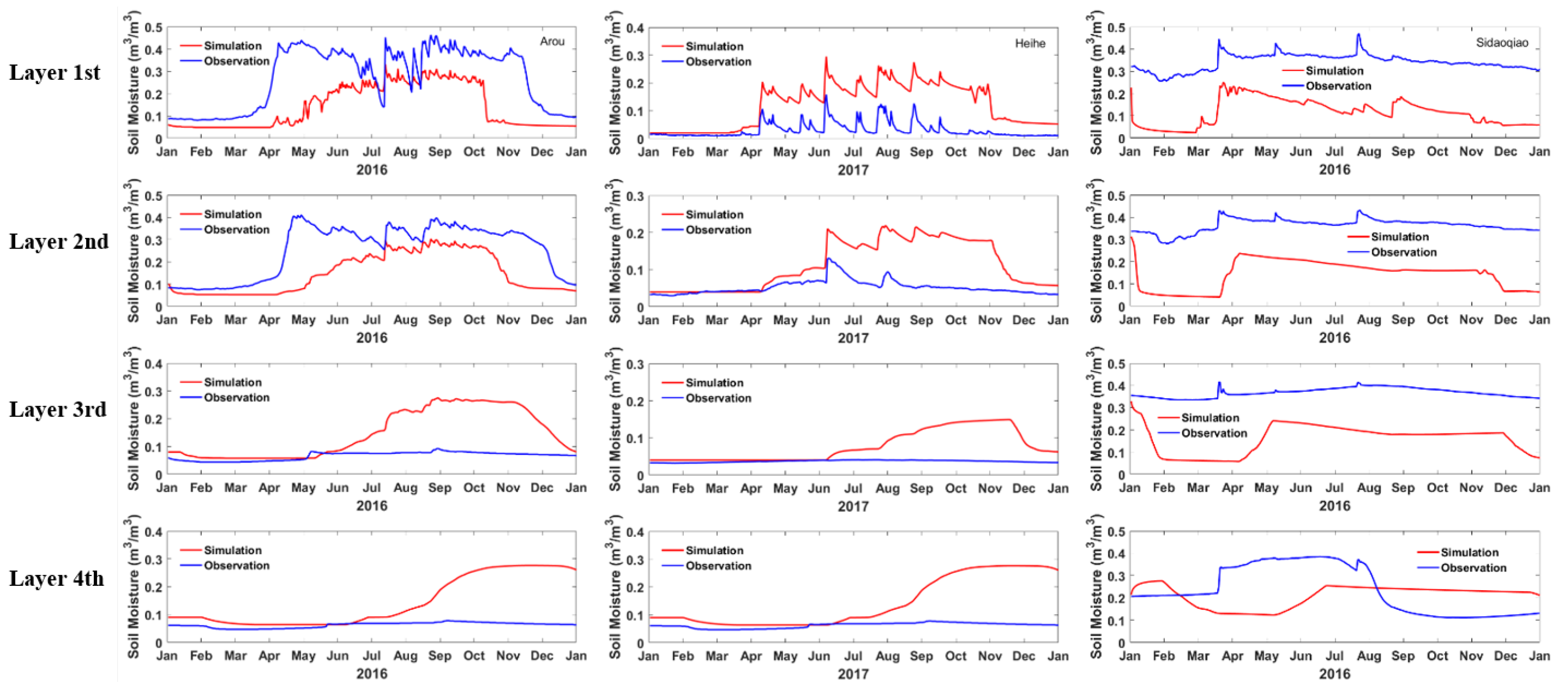
This section evaluates the performance of the Noah-MP model in simulating soil moisture across different layers at three sites-Arou, Heihe, and Sidaoqiao, which come from the upper, middle and lower reaches of the HRB. The comparison between simulated and observed soil moisture data covers the period from January to December 2016 in Arou and Sidaoqiao site, with an extension into 2017 in Heihe site. The analysis is performed across four distinct soil layers, ranging from the surface layer (0–10 cm) to deeper layers, progressively down to the fourth layer. Figure 2 shows the comparison of soil moisture at the three sites simulated by Def with the corresponding observations.
At the Arou site, the simulation of soil moisture exhibits varying degrees of accuracy across the different layers. The first layer, representing the surface soil moisture, shows significant variability throughout the year, particularly during the growing season (May to September). While the model captures the overall trend, there are substantial deviations between the simulated and observed values, especially during the wetter months (July and August). The model tends to underestimate soil moisture during these periods, as indicated by the consistently higher simulated values compared to the observations. Moving to the second layer, the model’s performance slightly improves, though discrepancies remain evident. The underestimation trend persists, particularly during the peak moisture periods. The third layer shows a similar pattern, with the simulation capturing the seasonal fluctuations but demonstrating an overestimation tendency, particularly during the latter half of the year. The fourth layer presents the most significant challenge for the model. Here, the simulation not only overestimates soil moisture but also fails to capture the observed drying trends seen in the latter part of the year. Since the Arou site is located in the cold mountainous region of the upper reaches of the HRB, the freeze-thaw process of the soil is very intense, and the liquid water content in the soil rapidly increases when the temperature rises. The soil moisture simulation results for the first and second layers at the Arou site indicate that the Noah-MP model can adequately simulate the soil freeze-thaw process. However, it should be noted that the soil moisture during this process is consistently underestimated. Furthermore, the model’s inability to accurately simulate the deeper soil moisture dynamics suggests potential issues in the parameterization of subsurface processes within the Noah-MP model, at least this is the case in the cold mountainous region.
The Heihe site, located in the midstream oasis of HRB, presents a more complex scenario. Since this area is a desert oasis, the soil moisture content is relatively low and is greatly influenced by precipitation. Unlike the Arou site, the Noah-MP model tends to overestimate soil moisture at the Heihe site. As shown in the Figure 2, in the first layer, the model exhibits a mixed performance. While it captures the seasonal variation, including the sharp increase in soil moisture during the monsoon season (July and August), it again tends to overestimate the moisture content during the peak season. For the second layer, the model shows a decline in performance. The simulated soil moisture during the wet season is notably higher than the observed values, with a noticeable lag in capturing the drying trend post-monsoon. Soil moisture in the third and fourth layers at the Heihe site is very low, with deep soil moisture showing almost no variation throughout the year and no occurrence of freeze-thaw processes. As shown in Figure 2, the overestimation in the third and fourth layers are significant and the simulated values remain high throughout the latter part of the year, contrary to the observed data. Moreover, the fourth layer exhibits the most considerable deviation from the observations. The model not only overestimates soil moisture but also shows a delayed response to the drying trends observed from September onwards. This suggests that the default parameterization scheme combination of Noah-MP model for deeper soil layers may not be adequately capturing the subsurface hydrological processes at Heihe site.
At the Sidaoqiao site, located in the downstream desert area, the model’s performance is somewhat consistent with the patterns observed at the other two sites. The model is able to accurately simulate the trend of the first layer of soil moisture, but the simulation results show a significant underestimation. This underestimation continues into the post-monsoon period, although the trend matches the observed data more closely than at the other two sites. In the second layer, the model begins to deviate more noticeably from the observations, and the model fails to capture the rapid decrease in soil moisture observed towards the end of the year. Compared to the other two sites, soil moisture in the third and fourth layers at the Sidaoqiao site is noticeably higher and more stable. The third layer follows a similar trend, the underestimation here is substantial, and the model does not adequately reflect the observed soil moisture dynamics. The fourth layer presents the most significant challenge, similar to the Arou and Heihe sites. The model almost underestimates soil moisture throughout the year, and the drying trend observed in the data is almost entirely absent from the simulation. Previous studies have shown that the annual mean soil moisture (SM) in the driest and wettest regions was underestimated, while SM was generally overestimated in other regions [30]. Here, we found that the soil moisture simulations at the Arou and Sidaoqiao stations were underestimated, whereas at the Heihe station the soil moisture simulation was overestimated, even though the HRB is located in an arid and semi-arid region.

3.2. Sensitivities of Physical Parameterization Schemes

The simulation results of the default parameterization scheme combination at different sites indicate that the accuracy of soil moisture simulations is relatively low across all sites, whether upstream, midstream, or downstream. This is especially true for the third and fourth soil layers, where the model almost fails to accurately capture the soil moisture trends. There are many methods to improve the accuracy of soil moisture simulations, such as optimizing model parameters, adjusting the model structure, or using data assimilation techniques to obtain the optimal posterior estimates of soil moisture. However, the goal of this study is not to improve the accuracy of the Noah-MP model’s soil moisture simulations in the HRB. Instead, we are more interested in the sensitivity of soil moisture simulation results to the parameterization schemes. Given the lower accuracy of the Noah-MP model in simulating soil moisture in the third and fourth layers, this study focuses only on the sensitivity of shallow soil moisture (first layer) simulation results to parameterization schemes and compares the sensitivity under different climate types in the HRB. To this end, two classic sensitivity analysis methods were employed to analysis the sensitivity of soil moisture simulations to parameterization schemes at different sites.

3.2.1. Natural Selection Results

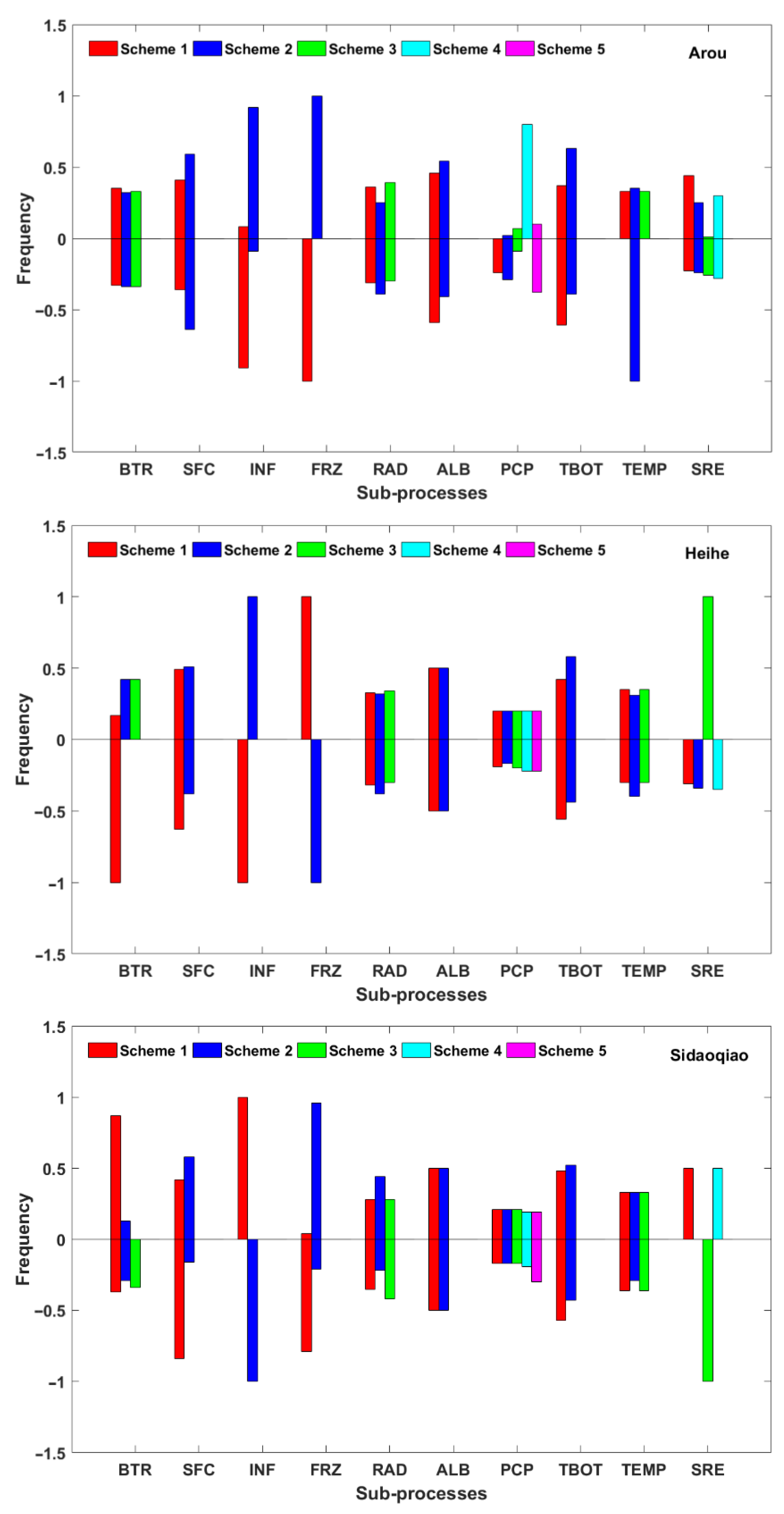
First, the shallow soil moisture observation data from three sites were used to calculate the RMSE values of soil moisture simulations for all parameterization scheme combinations. Then, all the RMSE values were sorted in ascending order, the members concentrated below the fifth percentile of RMSE for soil moisture were considered as “best members”, and the “worst members” contains the members which are those above the 95th percentile. Subsequently, the frequency of different parameterization schemes being selected were determined for the two groups. The selected frequency of different parameterization schemes for soil moisture was shown in Figure 3, and above the horizontal axis in the subfigure is the frequency of each parameterization scheme for the best members, and below is the frequency of the worst members. The frequency with which different parameterization schemes within the same physical process are selected in the ensemble simulation results at the same site varies significantly, as seen in Figure 3. For example, at the Arou site, the selection frequency of parameterization schemes for the INF, FRZ, PCP, and TEMP physical processes shows considerable differences. Conversely, some physical processes exhibit minimal differences in the selection frequency of their parameterization schemes. For instance, the two parameterization schemes of the ALB physical process show almost no difference in their selection frequency at the Heihe and Sidaoqiao sites; the frequency with which these two schemes are selected in the “best members” and “worst members” is nearly identical. Additionally, it can be observed that the selection frequency of parameterization schemes for partial physical processes shows little difference at some sites but significant differences at others, like the parameterization schemes for the PCP physical process display large differences in selection frequency at the Arou site, but not at the Heihe and Sidaoqiao sites. Clearly, the significant differences in the selection frequencies of parameterization schemes within the same physical process between the “best members” and “worst members” indicate that altering the parameterization scheme for this process can lead to substantial variations in soil moisture simulation results. And this suggests a high sensitivity of soil moisture simulations to the choice of parameterization schemes for this physical process.
There are three parameterization schemes in the BTR physical process, the default is the Noah type scheme which uses soil moisture, the second is CLM type which uses matric potential and the third is the SSIB type which also uses matric potential. The three schemes result in significant differences in the calculation of the soil moisture controlling stomatal resistance, β factor [11]. At the Arou site, the selection frequencies of the three parameterization schemes for the BTR physical process in the “best members” and “worst members” groups are nearly identical. Changing the parameterization scheme for this process does not affect the accuracy of soil moisture simulations, indicating that soil moisture simulation results at the Arou site are not sensitive to the BTR physical process. However, at the Heihe site, we found that the selection frequencies of schemes two and three for the BTR process in the “best members” group are identical and higher than that of scheme one. In the corresponding “worst members” group, the selection frequencies of schemes two and three are zero, while that of scheme one is 1.0. This suggests that at the Heihe site, changing the parameterization scheme for the BTR process leads to significant differences in soil moisture simulation results, with scheme one degrading the accuracy, indicating sensitivity to the parameterization scheme at this site. Although scheme one is not favored at the Heihe site, Figure 3 shows that in the “worst members” group at the Sidaoqiao site, the selection frequencies of the three schemes are nearly identical. However, in the “best members” group, the selection frequency of scheme three is zero, scheme one is selected with a frequency of 0.9, and scheme two with a frequency of 0.1, indicating that scheme one enhances the accuracy of soil moisture simulations at this site.
Physical process INF is the frozen soil permeability and two schemes were integrated, the first scheme considers that a model grid cell includes both permeable and impermeable regions, thereby calculating the soil’s hydraulic properties based on the total soil moisture content. In contrast, the second option determines hydraulic properties using only the volume of liquid water. The difference between the two approaches results in more permeable permafrost being generated by the first scheme compared to the second. It can be observed that the two parameterization schemes of the INF physical process showed significant differences in selection frequency across all three sites. At the Arou site, in the “best members” group, scheme INF(1) was selected with a frequency of 0.08, while INF(2) was selected with a frequency of 0.92. However, in the “worst members” group, INF(1) was selected 91% of the time, and INF(2) only 9% of the time. This indicates that at the Arou site, scheme INF(2) outperforms INF(1), yielding soil moisture simulation results with smaller errors. A similar pattern was observed at the Heihe site, where INF(2) was chosen 100% of the time in the “best members” group and 0% in the “worst members” group. Conversely, INF(1) was never selected in the “best members” ensemble but was selected 100% of the time in the “worst members” group. Clearly, soil moisture simulation results at both the Arou and Heihe sites are highly sensitive to the INF physical process. For the Sidaoqiao site, although it is evident from Figure 3 that soil moisture simulation results are also highly sensitive to the INF process, the key difference from the previous two sites is that scheme INF(1) was chosen with a frequency of 1.0 in the “best members” group and 0 in the “worst members” group. In contrast, INF(2) was selected with a frequency of 0 in the “best members” group and 1.0 in the “worst members” group. Clearly, for the desert region where the Sidaoqiao site is located, scheme INF(1) is more suitable. However, for the Arou site in the alpine region and the Heihe site in the artificial oasis area, INF(2) is better suited for simulating soil moisture. To be honest, there could be many reasons for this phenomenon, such as differences in climate type, vegetation type, and soil type, etc. However, it is undeniable that in the upper and middle reaches of the HRB, water permeability in permafrost is significantly lower than in the lower reaches area where the Sidaoqiao site is located.
Based on the results presented in Figure 3, it is evident that the soil moisture simulation outcomes at all three sites are highly sensitive to the parameterization schemes of the FRZ physical process. At the Arou site, scheme FRZ(1) was selected with a frequency of 0 in the “best members” group, but with a frequency of 1.0 in the “worst members” group. Conversely, scheme FRZ(2) was chosen with a frequency of 1.0 in the “best members” group and 0 in the “worst members” group. This suggests that at Arou, FRZ(2) outperforms FRZ(1), resulting in more accurate soil moisture simulations. A similar pattern was observed at the Sidaoqiao site, where FRZ(2) was selected with a frequency of 0.96 in the “best members” group, while FRZ(1) was selected with a frequency of 0.79 in the “worst members” group, indicating that FRZ(2) is also more favorable at Sidaoqiao. At the Heihe site, although soil moisture simulations are highly sensitive to the FRZ process, Figure 3 shows that FRZ(1) was selected with a frequency of 1.0 in the “best members” group, whereas FRZ(2) was selected with a frequency of 1.0 in the “worst members” group. This indicates that FRZ(1) is the more suitable option at this site, producing more accurate soil moisture simulation results compared to FRZ(2). Why is there a difference in sensitivity when all three sites are located in the HRB? Further analysis reveals that scheme FRZ(1) uses the more general form of the freezing-point depression equation, while scheme FRZ(2) employs a variant of this equation with an added extra term. This modification in FRZ(2) results in the generation of more liquid water compared to FRZ(1). Arou and Sidaoqiao are both located in field environments, while the Heihe site is situated in farmland within a midstream artificial oasis. During winter, when the soil freezes, the land remains fallow due to low temperatures and the inability to cultivate. Additionally, limited precipitation and the absence of artificial irrigation lead to low liquid water content within the frozen soil. As a result, FRZ(1) is more suitable for simulating soil moisture in this region.
Precipitation is the primary source of soil moisture, as illustrated in Figure 3, the rain-snow partitioning process (PCP) may not have a direct impact on the accuracy of soil moisture simulations, at least at the Heihe and Sidaoqiao sites. This is evidenced by the fact that the five parameterization schemes for the PCP process were selected with similar frequencies in both the “best members” and “worst members” groups at these sites, indicating that variations in the PCP parameterization schemes do not affect the soil moisture simulation accuracy at these locations. In contrast, at the Arou site, scheme PCP(4) was chosen with a frequency of 0.8 in the “best members” group, which is significantly higher than the other four schemes, while PCP(4) was not selected in the “worst members” group. This demonstrates that, at the Arou site, PCP(4) exhibits a clear advantage over the other parameterization schemes. A similar pattern is observed with the physical process TEMP across the three sites. At both Heihe and Sidaoqiao sites, the frequencies of selecting the three TEMP parameterization schemes are similar in both the “best members” and “worst members” groups. This suggests that changing the parameterization schemes for this physical process does not affect the accuracy of soil moisture simulations at these sites. However, at the Arou site, TEMP(2) was selected with a frequency of 1.0 in the “worst members” group, indicating that TEMP(2) tends to produce poorer soil moisture simulation results at this site. The sensitivity testing results of the physical process of surface resistance to ground evaporation/sublimation (SRE) vary significantly across the three sites. At the Arou site, the frequencies of the four different SRE schemes being chosen are quite similar, and SRE(3) was not selected in the “best members” group, making it difficult to determine the sensitivity of soil moisture simulation results to the parameterization scheme of this physical process. At the Heihe site, SRE(3) was selected with a frequency of 1.0 in the “best members” group and 0 in the “worst members” group. At the Sidaoqiao site, SRE(3) was selected with a frequency of 1.0 in the “worst members” group but was not chosen in the “best members” group. The frequency statistics of SRE(3) at these two sites indicate that soil moisture simulation results at these sites are sensitive to the parameterization scheme of this physical process, with SRE(3) improving the simulation accuracy of soil moisture at the Heihe site, whereas at the Sidaoqiao site, SRE(3) decreases the accuracy of soil moisture simulation.
Some physical processes, such as RAD, ALB, and TBOT, show similar frequencies for parameterization schemes in both the “best members” and “worst members” groups. This suggests that soil moisture simulations are not particularly sensitive to the parameterization schemes for these processes. However, discrepancies in frequency statistics are observed for other processes, such as the two parameterization schemes for the SFC process across the three sites. In such cases, it remains uncertain whether the soil moisture simulation results are sensitive to the parameterization schemes for these processes.

3.2.2. Tukey Test Results

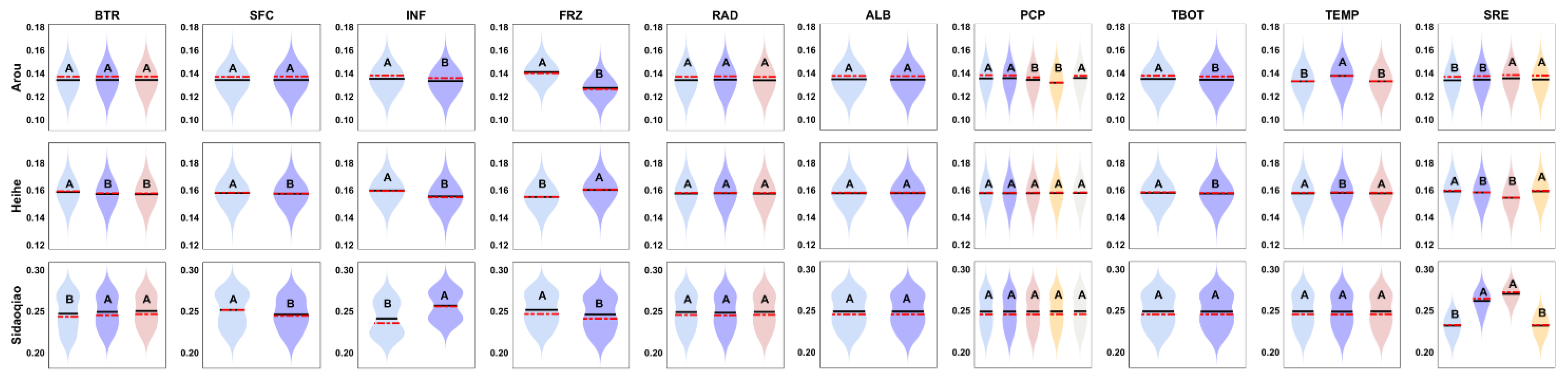
In this section, the Tukey’s test was employed to examine the difference of parameterization schemes for a certain physical process. First, a total number of 17,280 RMSEs of all scheme combinations for soil moisture were calculated, and all of the RMSE values are independent of each other. Moreover, before applying Tukey’s test, the assumptions of normality and equality of variances were examined. Taking the physical process SFC as an example, SFC has two parameterization schemes. For each scheme, 8640 out of 17,280 combination schemes selected the corresponding parameterization, resulting in 8640 RMSE values for each scheme. Figure 4 shows the kernel density distribution of the RMSE samples for each parameterization scheme across the ten physical processes, along with the results of Tukey’s test.
As shown in Figure 4, if different parameterization schemes for the same physical process are marked with the same letter, such as “A”, it indicates that Tukey’s test results show no significant difference between these schemes. Conversely, if parameterization schemes for the same physical process are marked with different letters, such as “A” and “B”, it signifies a significant difference between the schemes, with the scheme marked “B” being slightly better due to its lower corresponding RMSE values. Clearly, if there is a significant difference between parameterization schemes for the same physical process, it indicates that soil moisture simulation results are sensitive to the parameterization scheme of that physical process. If all parameterization schemes for a specific physical process in the figure are marked with the same letter, such as “A”, it implies that soil moisture simulation results are not sensitive to the parameterization scheme of that physical process. For example, for the SFC physical process at the Arou site, there is no significant difference between SFC(1) and SFC(2). Meanwhile, we noticed that at the Heihe and Sidaoqiao sites, the two parameterization schemes for SFC were marked with different letters, with the SFC(2) scheme marked with the letter “B”. This indicates that the soil moisture simulation results at these two stations are sensitive to the parameterization scheme of this physical process, and the performance of the SFC(2) scheme is slightly better. Further analysis and comparison reveal that at the Arou site, there is no significant difference between the parameterization schemes of the BTR and SFC physical processes, indicating that the soil moisture simulation results at this station are not sensitive to the parameterization schemes of these two physical processes. At the Heihe site, the parameterization schemes for the RAD, ALB, and PCP physical processes do not show significant differences, meaning that changing the parameterization schemes for these three physical processes does not result in substantial changes in the soil moisture simulation results at this station. At the Sidaoqiao site, the parameterization schemes for the physical processes FRZ, RAD, ALB, PCP, TBOT, and TEMP do not show significant differences, indicating that the soil moisture simulation results at this site are not sensitive to the parameterization schemes of these physical processes.
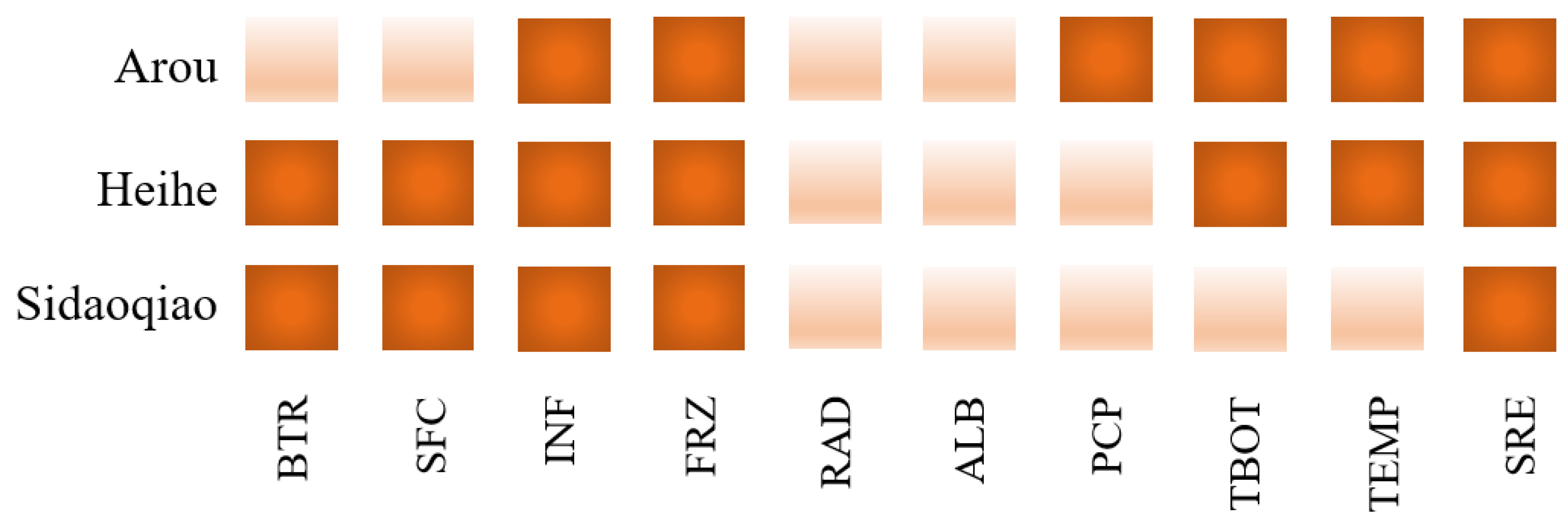
Figure 4 shows that the sensitivity detection results from Tukey’s test are largely consistent with those from the Natural Selection method. However, there are differences in the sensitivity of some physical process parameterization schemes. For example, it is difficult to determine the sensitivity of the SFC physical process parameterization scheme using the Natural Selection method, but Tukey’s test results indicate that the SFC process is sensitive at both the Heihe and Sidaoqiao sites. There is no contradiction between the results of the two sensitivity analysis methods. The Natural Selection method identifies sensitivity from a macro statistical perspective, based on the differences in the frequency with which different parameterization schemes are selected in the best and worst members groups. Tukey’s test, on the other hand, takes a more micro-level approach, using hypothesis testing to detect subtle differences between different parameterization schemes within the same physical process, thereby determining sensitivity. Therefore, in this study, if either method detects sensitivity in a physical process, it is concluded that soil moisture simulation results are sensitive to that parameterization scheme of that physical process. We integrated the results of the two sensitivity analysis methods, and Figure 5 illustrates the sensitivity of major physical processes to soil moisture.

3.3. Uncertainty Contribution Analysis of Physical Options

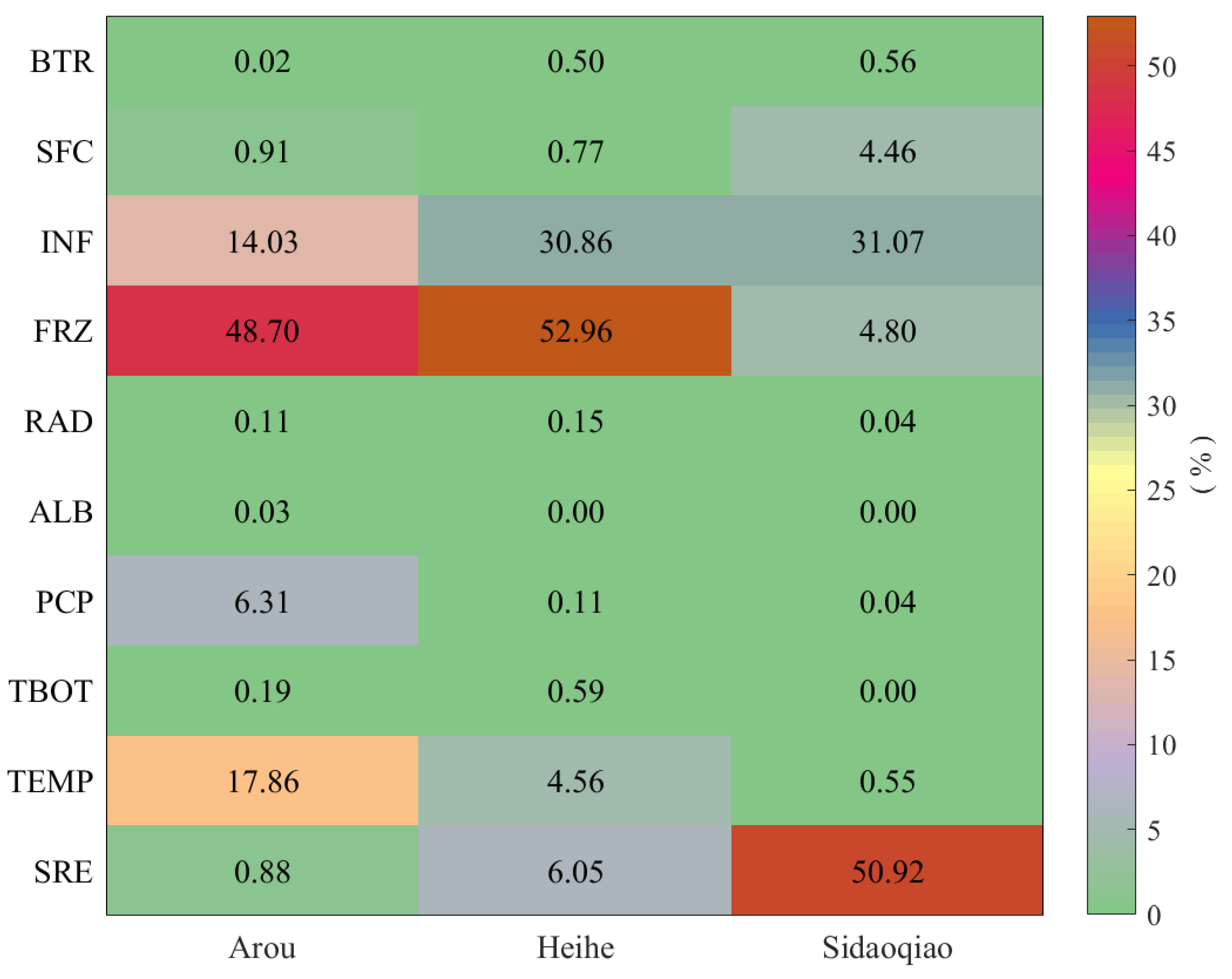
Our previous research results indicated that the uncertainty in ensemble simulation results with multiple parameterization schemes primarily stems from sensitive physical processes, and the greater the sensitivity of the simulation results to a specific physical process, the higher the uncertainty in the ensemble simulation results [28,35]. Although this conclusion was derived from snow depth simulation results, it is evidently applicable to soil moisture simulations as well. In this study, we use ‘Uncertainty Contribution Analysis’ to assess the contribution of each physical process to the uncertainty in soil moisture ensemble simulation results, as shown in Figure 6. Clearly, the greater a physical process’s contribution to the uncertainty in ensemble simulation results, the more varied its parameterization scheme will be, leading to significant differences in simulated soil moisture, thereby generating greater uncertainty. As shown in Figure 6, at the Arou site, most physical processes contribute less than 1% to the overall uncertainty. However, certain processes contribute more significantly, such as INF (14.03%), FRZ (48.70%), PCP (6.31%), and TEMP (17.86%). At the Heihe site, INF contributes 30.86%, FRZ contributes 52.96%, TEMP contributes 4.56%, and SRE contributes 6.05%. At the Sidaoqiao site, SFC contributes 4.46%, INF contributes 31.07%, FRZ contributes 4.80%, and SRE contributes 50.92%. Contributions from other physical processes at these sites are all below 1%.

4. Discussion

Across all three sites, the Noah-MP model, with its default parameterization, consistently overestimates soil moisture at Heihe site which is located in an oasis region, particularly during the wet season. However, the soil moisture simulations show significant underestimation at Arou and Sidaoqiao site. Among the three sites, the default parameterization scheme combination of the Noah-MP model is generally able to accurately simulate the soil moisture trends in the first and second layers, although overestimation or underestimation occurs to varying degrees at each site. However, for the third and fourth layers, the Noah-MP model is generally unable to simulate the trends in soil moisture. The overestimation of soil moisture by the Noah-MP model may be attributed to several factors. One potential reason is the model’s representation of soil hydraulic properties, which may not be adequately parameterized for the specific conditions in the HRB. The model’s default parameterization scheme combination may not account for the unique soil texture and structure of the region, leading to an overestimation of water retention capacity, especially in the deeper layers. Additionally, the model’s inability to capture the drying trends in the deeper layers suggests that the subsurface drainage processes might be inadequately represented, possibly due to oversimplified assumptions in the soil moisture parameterization schemes. The variations in model performance across the different sites and layers also highlight the spatial heterogeneity of the HRB. The differences in soil texture, vegetation cover, and topography between the sites likely contribute to the varying levels of model accuracy. The Arou site, for example, with its more complex terrain and vegetation, poses a greater challenge for the model, especially the freeze-thaw process of the soil, resulting in larger discrepancies. In contrast, the Heihe site, with its more uniform conditions, shows somewhat better model performance, although significant issues remain. In conclusion, while the Noah-MP model, with its default parameterization, can capture the general seasonal trends of soil moisture across the HRB, significant biases and inaccuracies remain, particularly in the deeper soil layers. The consistent underestimation and overestimation of soil moisture suggest that the default parameterization scheme combination may not be adequately capturing the subsurface hydrological processes in the region. Future work should focus on optimizing the model’s parameterization for the specific conditions of the HRB, potentially through site-specific calibration or the integration of more detailed soil and vegetation data. Additionally, the implementation of advanced data assimilation techniques could help reduce the model’s biases and improve the accuracy of soil moisture simulations, particularly in the deeper layers.
From the Figure 5, it can be observed that the INF, FRZ, and SRE processes exhibit sensitivity at all three sites, with the parameterization schemes for INF and FRZ being particularly sensitive. The parameterization schemes for the BTR, SFC, TBOT, and TEMP processes show sensitivity at two of the sites, while the PCP process exhibits sensitivity only at the Arou site. Furthermore, the parameterization schemes for the RAD and ALB processes did not exhibit sensitivity at any of the three sites. The RAD process is primarily designed for areas with tall shrub vegetation, but the land surface types at the three sites in this study are grassland, crop, and desert, respectively. Therefore, altering the parameterization scheme for RAD does not lead to changes in the simulation results. The parameterization scheme for the ALB process is mainly used to calculate the albedo of the snow surface and significantly impacts snow depth simulations [28]; however, in this study, it clearly did not affect the soil moisture simulation results. For the PCP process, the parameterization scheme PCP(4) calculates the proportion of solid precipitation using the total amount of snow, graupel, and hail from the forcing data. The Arou site is located in the upstream alpine region, where the average temperature is lower, and the average precipitation is higher compared to the midstream and downstream sites. This gives the PCP(4) scheme a distinct advantage at the Arou site. Our findings regarding differences in Noah-MP parameterization sensitivity align with earlier work in similar contexts. For example, Hu et al. (2023) [36] demonstrated spatial and seasonal variations of sensitivity across the Tibetan Plateau, notably in parameterizations such as SFC and ALB.
An analysis combining Figure 5 and Figure 6 shows that the contributions of sensitive physical processes to the uncertainty in ensemble simulation results at all three sites are non-negligible, indicating that these processes are primarily responsible for the overall uncertainty. However, does this mean that all sensitive physical processes contribute significantly to the uncertainty in the simulation results? The answer is no. For example, at the Arou site, although TBOT and SRE both exhibit sensitivity, their contributions to the uncertainty are below 1%. Similarly, at the Heihe site, the BTR, SFC, and TBOT processes, as well as the BTR process at the Sidaoqiao site, show sensitivity but contribute less than 1% to the overall uncertainty. The results demonstrate that the contributions of the RAD and ALB physical processes to the uncertainty in ensemble simulation results are minimal at all three stations. In particular, the ALB physical process contributes virtually nothing to the uncertainty at any of the stations. Although the FRZ physical process shows significant sensitivity across all three stations, its contribution to the uncertainty in ensemble soil moisture simulation results varies considerably. It is relatively high at the upstream Arou site and the midstream Heihe site, but lower at the downstream Sidaoqiao site. At Sidaoqiao, the SRE physical process contributes 50.92% to the uncertainty in ensemble soil moisture simulation results, accounting for half of the total uncertainty.

5. Conclusions

In this study, a representative research site from the upstream, midstream, and downstream regions of the HRB were chosen to evaluate the performance of the Noah-MP model in simulating soil moisture, respectively. For the first soil layer, we conducted ensemble simulations using multiple parameterization schemes and employed two sensitivity analysis methods to examine the sensitivity of soil moisture to parameterization schemes from both macro and micro perspectives. Building on this, the contribution of specific physical processes to the uncertainty in ensemble soil moisture simulation results was further quantified and the impact of sensitive physical processes on this uncertainty was assessed. The main findings are as follows:
The Noah-MP model is capable of simulating soil moisture variations in the first and second layers at the three sites located in the upstream, midstream, and downstream areas of the HRB. However, the simulations exhibit varying degrees of overestimation and underestimation, indicating that there is room for improvement in the model’s accuracy. In contrast, the model fails to capture the variations in soil moisture in the third and fourth layers at these sites, with significant discrepancies compared to the observed data.
Sensitivity analysis reveals that the physical processes of infiltration (INF), freeze-thaw cycles (FRZ), and surface resistance to evaporation (SRE) demonstrate sensitivity across all three sites. However, processes such as bare soil evaporation (BTR) and surface exchange coefficients (SFC) show sensitivity only at the midstream and downstream sites. The bottom temperature (TBOT) and canopy air temperature (TEMP) processes do not exhibit sensitivity at the downstream site. Precipitation (PCP) sensitivity is observed only in the upstream alpine region, while radiation (RAD) and albedo (ALB) processes do not show sensitivity in this study’s soil moisture simulation experiments.
The contribution of specific physical processes to the uncertainty in ensemble simulation results for soil moisture highlights that this uncertainty mainly stems from the sensitive processes. Variations in parameterization schemes within these sensitive processes are the primary drivers of uncertainty in the ensemble simulations. The FRZ process, for instance, accounts for nearly 50% of the uncertainty in soil moisture simulations at both the upstream Arou site and the midstream Heihe site, making it the dominant factor for uncertainty at these locations. At the downstream Sidaoqiao site, the SRE process contributes 50.92% of the uncertainty, making it the primary source of uncertainty in soil moisture simulations at that site.
In this study, we only considered grassland, farmland, and desert, and did not include shrub vegetation. This may limit the representativeness of our soil moisture simulations. Future work should consider more land cover types to better capture soil moisture variability. In forthcoming research, we plan to incorporate data assimilation techniques to integrate high-precision soil moisture observations within the model framework, aiming to further enhance the accuracy of soil moisture simulations. We hope that the findings of this study can serve as a reference for selecting parameterization schemes for soil moisture simulation, provide insights into the applicability of parameterization schemes in specific regions, and offer a scientific basis for developing more accurate land surface process parameterization schemes.

Author Contributions

Conceptualization, Y.Y.; methodology, Y.Y. and H.Z.; software, Y.Y. and Y.W.; validation, Y.H.; data curation, Z.W. and W.C.; writing—original draft preparation, Y.Y.; writing—review and editing, Y.W., Z.W. and W.C.; supervision, Y.L. and Y.W. All authors have read and agreed to the published version of the manuscript.

Funding

This study was supported by several sources, including the National Natural Science Foundation of China (U2342206, 42201425, 42101361), Jianghuai Meteorological Joint Project of Anhui Natural Science Foundation (2408055UQ006), the Scientific Research Project of Higher Education Institutions in Anhui province (2023AH050143), and the China Postdoctoral Science Foundation (2024M753092).

Data Availability Statement

The original data presented in the study are openly available on the website of the National Tibetan Plateau Data Center (TPDC) (https://data.tpdc.ac.cn).

Conflicts of Interest

The authors declare no conflicts of interest.

References

  1. Sepulcre-Canto, G.; Horion, S.; Singleton, A.; Carrao, H.; Vogt, J. Development of a Combined Drought Indicator to detect agricultural drought in Europe. Nat. Hazards Earth Syst. Sci. 2012, 12, 3519–3531. [Google Scholar] [CrossRef]
  2. Kumar, S.V.; Peters-Lidard, C.D.; Santanello, J.A.; Reichle, R.H.; Draper, C.S.; Koster, R.D.; Nearing, G.; Jasinski, M.F. Evaluating the utility of satellite soil moisture retrievals over irrigated areas and the ability of land data assimilation methods to correct for unmodeled processes. Hydrol. Earth Syst. Sci. 2015, 19, 4463–4478. [Google Scholar] [CrossRef]
  3. Massari, C.; Brocca, L.; Tarpanelli, A.; Moramarco, T. Data assimilation of satellite soil moisture into rainfall-runoff modelling: A complex recipe? Remote Sens. 2015, 7, 11403–11433. [Google Scholar]
  4. Azimi, S.; Dariane, A.B.; Modanesi, S.; Bauer-Marschallinger, B.; Bindlish, R.; Wagner, W.; Massari, C. Assimilation of sentinel 1 and SMAP-based satellite soil moisture retrievals into SWAT hydrological model: The impact of satellite revisit time and product spatial resolution on flood simulations in small basins. J. Hydrol. 2020, 581, 124367. [Google Scholar]
  5. Vereecken, H.; Huisman, J.A.; Bogena, H.; Vanderborght, J.; Vrugt, J.A.; Hopmans, J.W. On the value of soil moisture measurements in vadose zone hydrology: A review. Water Resour. Res. 2008, 44, W00D06. [Google Scholar] [CrossRef]
  6. Heathman, G.C.; Cosh, M.H.; Han, E.; Jackson, T.J.; McKee, L.; McAfee, S. Field scale spatiotemporal analysis of surface soil moisture for evaluating point-scale in situ networks. Geoderma 2012, 170, 195–205. [Google Scholar] [CrossRef]
  7. Seneviratne, S.I.; Corti, T.; Davin, E.L.; Hirschi, M.; Jaeger, E.B.; Lehner, I.; Orlowsky, B.; Teuling, A.J. Investigating soil moisture-climate interactions in a changing climate: A review. Earth-Sci. Rev. 2010, 99, 125–161. [Google Scholar]
  8. Chen, F.; Dudhia, J. Coupling an advanced land surface hydrology model with the Penn State-NCAR MM5 modeling system. Part I: Model implementation and sensitivity. Mon. Weather. Rev. 2001, 129, 569–585. [Google Scholar]
  9. Ek, M.B.; Mitchell, K.E.; Lin, Y.; Rogers, E.; Grunmann, P.; Koren, V.; Gayno, G.; Tarpley, J.D. Implementation of Noah land surface model advances in the National Centers for Environmental Prediction operational mesoscale Eta model. J. Geophys. Res.-Atmos. 2003, 108, D22. [Google Scholar]
  10. Niu, G.Y.; Yang, Z.L.; Mitchell, K.E.; Chen, F.; Ek, M.B.; Barlage, M.; Kumar, A.; Manning, K.; Niyogi, D.; Rosero, E.; et al. The community Noah land surface model with 9 multi-parameterization options (Noah-MP): 1. Model description and evaluation with local-scale measurements. J. Geophys. Res.-Atmos. 2011, 116, D12109. [Google Scholar]
  11. Yang, Z.L.; Niu, G.Y.; Mitchell, K.E.; Chen, F.; Ek, M.B.; Barlage, M.; Longuevergne, L.; Manning, K.; Niyogi, D.; Tewari, M.; et al. The community Noah land surface model with multiparameterization options (Noah-MP): 2. Evaluation over global river basins. J. Geophys. Res.-Atmos. 2011, 116, D12110. [Google Scholar] [CrossRef]
  12. Gao, Y.H.; Li, K.; Chen, F.; Jiang, Y.; Lu, C. Assessing and improving Noah-MP land model simulations for the central Tibetan Plateau. J. Geophys. Res.-Atmos. 2015, 120, 9258–9278. [Google Scholar] [CrossRef]
  13. Zhang, G.; Chen, F.; Gan, Y.J. Assessing uncertainties in the Noah-MP ensemble simulations of a cropland site during the Tibet Joint International Cooperation program field campaign. J. Geophys. Res.-Atmos. 2016, 121, 9576–9596. [Google Scholar] [CrossRef]
  14. Cai, X.T.; Yang, Z.L.; David, C.H.; Niu, G.-Y.; Rodell, M. Hydrological evaluation of the Noah-MP land surface model for the Mississippi River Basin. J. Geophys. Res.-Atmos. 2014, 119, 23–38. [Google Scholar] [CrossRef]
  15. Ma, N.; Niu, G.Y.; Xia, Y.L.; Cai, X.; Zhang, Y.; Ma, Y.; Fang, Y. A systematic evaluation of Noah-MP in simulating land-atmosphere energy, water, and carbon exchanges over the continental United States. J. Geophys. Res.-Atmos. 2017, 122, 12245–12268. [Google Scholar] [CrossRef]
  16. Kuribayashi, M.; Noh, N.J.; Saitoh, T.M.; Tamagawa, I.; Wakazuki, Y.; Muraoka, H. Comparison of Snow Water Equivalent Estimated in Central Japan by High-Resolution Simulations Using Different Land-Surface Models. Meteorol. Soc. JPN. 2013, 9, 148–152. [Google Scholar] [CrossRef]
  17. Fang, Y.H.; Zhang, X.N.; Niu, G.Y.; Zeng, W.; Zhu, J.; Zhang, T. Study of the Spatiotemporal Characteristics of meltwater contribution to the total runoff in the upper Changjiang river basin. Water 2017, 9, 165. [Google Scholar] [CrossRef]
  18. Liang, J.J.; Yang, Z.L.; Lin, P.R. Systematic hydrological evaluation of the Noah-MP land surface model over China. Adv. Atmos. Sci. 2019, 36, 1171–1187. [Google Scholar] [CrossRef]
  19. Meng, C.L.; Jin, H.D.; Zhang, W.L. Lateral terrestrial water flow schemes for the Noah-MP land surface model on both natural and urban land surfaces. J. Hydrol. 2023, 620, 129410. [Google Scholar] [CrossRef]
  20. Yang, K.; Yang, J.T.; Zhaoye, P.H.; Zhang, F.; Zhang, G.; Wang, C. Optimization and validation of soil Frozen-Thawing parameterizations in Noah-MP. J. Geophys. Res.-Atmos. 2023, 128, e2022JD038217. [Google Scholar] [CrossRef]
  21. Hassani, F.; Zhang, Y.; Kumar, S.V. Improved representation of vegetation soil moisture coupling enhances soil moisture data assimilation in water limited regimes: A Case Study over Texas. Water Resour. Res. 2024, 60, e2023WR035558. [Google Scholar] [CrossRef]
  22. Ahmad, J.A.; Forman, B.A.; Kumar, S.V. Soil moisture estimation in South Asia via assimilation of SMAP retrievals. Hydrol. Earth Syst. Sci. 2022, 26, 2221–2243. [Google Scholar] [CrossRef]
  23. Zhao, L.; Yang, K.; He, J.; Zheng, H.; Zheng, D. Potential of mapping global soil texture type from SMAP soil moisture product: A pilot study. IEEE Trans. Geosci. Remote Sens. 2022, 60, 4406410. [Google Scholar] [CrossRef]
  24. Bechtold, M.; Modanesi, S.; Lievens, H.; Baguis, P.; Brangers, I.; Carrassi, A.; Getirana, A.; Gruber, A.; Heyvaert, Z.; Massari, C.; et al. Assimilation of Sentinel-1 Backscatter into a Land Surface Model with River Routing and Its Impact on Streamflow Simulations in Two Belgian Catchments. J. Hydrometeorol. 2023, 24, 2389–2408. [Google Scholar] [CrossRef]
  25. Gavahi, K.; Abbaszadeh, P.; Moradkhani, H. How does precipitation data influence the land surface data assimilation for drought monitoring? Sci. Total Environ. 2022, 831, 154916. [Google Scholar] [CrossRef]
  26. Kumar, S.V.; Holmes, T.R.; Bindlish, R.; de Jeu, R.; Peters-Lidard, C. Assimilation of vegetation optical depth retrievals from passive microwave radiometry. Hydrol. Earth Syst. Sci. 2020, 24, 3431–3450. [Google Scholar] [CrossRef]
  27. You, Y.H.; Huang, C.L.; Hou, J.L.; Zhang, Y.; Wang, Z.; Zhu, G. Improving the estimation of snow depth in the Noah-MP model by combining particle filter and Bayesian model averaging. J. Hydrol. 2023, 617, 128877. [Google Scholar] [CrossRef]
  28. You, Y.H.; Huang, C.L.; Yang, Z.L.; Zhang, Y.; Bai, Y.; Gu, J. Assessing Noah-MP parameterization sensitivity and uncertainty interval across snow climates. J. Geophys. Res.-Atmos. 2020, 125, e2019JD030417. [Google Scholar] [CrossRef]
  29. Chang, M.; Liao, W.H.; Wang, X.M.; Zhang, Q.; Chen, W.; Wu, Z.; Hu, Z. An optimal ensemble of the Noah-MP land surface model for simulating surface heat fluxes over a typical subtropical forest in South China. Agric. For. Meteorol. 2020, 281, 107815. [Google Scholar] [CrossRef]
  30. Li, J.; Miao, C.Y.; Zhang, G.; Fang, Y.-H.; Shangguan, W.; Niu, G.-Y. Global Evaluation of the Noah-MP Land Surface Model andSuggestions for Selecting Parameterization Schemes. J. Geophys. Res.-Atmos. 2022, 127, e2021JD035753. [Google Scholar] [CrossRef]
  31. Pan, X.D.; Li, X.; Shi, X.K.; Han, X.; Luo, L.; Wang, L. Dynamic downscaling of near-surface air temperature at the basin scale using WRF-a case study in the Heihe River Basin, China. Front. Earth Sci. 2012, 6, 314–323. [Google Scholar] [CrossRef]
  32. Li, X.; Li, X.W.; Li, Z.Y.; Ma, M.; Wang, J.; Xiao, Q.; Liu, Q.; Che, T.; Chen, E.; Yan, G.; et al. Watershed Allied Telemetry Experimental Research. J. Geophys. Res.-Atmos. 2009, 114, D22103. [Google Scholar] [CrossRef]
  33. Niu, G.Y.; Yang, Z.L.; Dickinson, R.E.; Gulden, L.E.; Su, H. Development of a simple groundwater model for use in climate models and evaluation with Gravity Recovery and Climate Experiment data. J. Geophys. Res.-Atmos. 2007, 112, D7. [Google Scholar] [CrossRef]
  34. Dickinson, R.E.; Shaikh, M.; Bryant, R.; Graumlich, L. Interactive canopies for a climate model. J. Clim. 1998, 11, 2823–2836. [Google Scholar] [CrossRef]
  35. You, Y.; Huang, C.; Gu, J.; Li, H.; Hao, X.; Hou, J. Assessing snow simulation performance of typical combination schemes within Noah-MP in northern Xinjiang, China. J. Hydrol. 2020, 581, 124380. [Google Scholar] [CrossRef]
  36. Hu, W.; Ma, W.Q.; Yang, Z.L.; Ma, Y.; Xie, Z. Sensitivity analysis of the Noah-MP land surface model for soil hydrothermal simulations over the Tibetan Plateau. J. Adv. Model. Earth Syst. 2023, 15, e2022MS003136. [Google Scholar] [CrossRef]
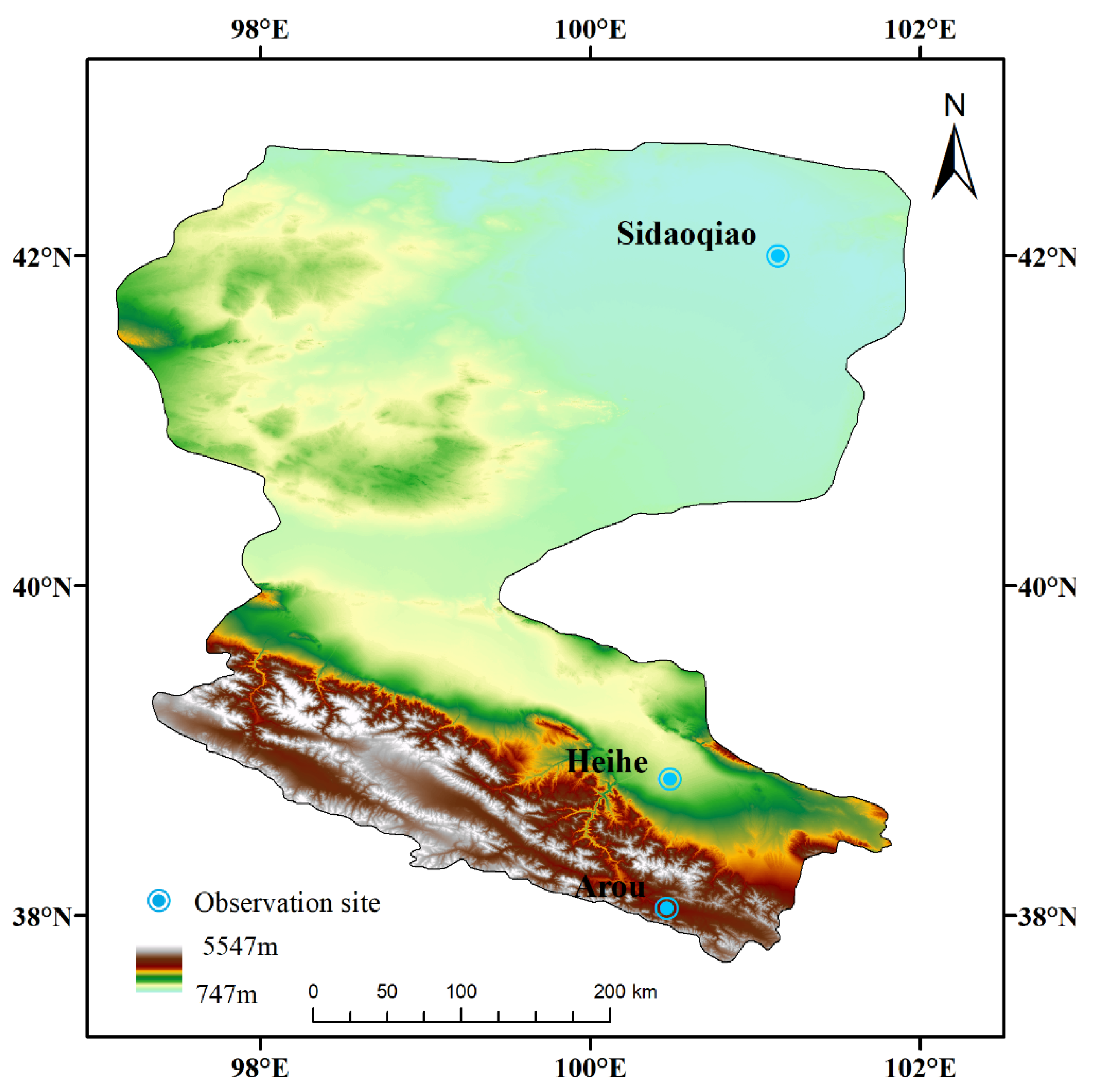
Figure 1. Terrain height of the HRB and the location of experiment sites.
Agriculture 15 02286 g001
Figure 2. Variation of soil moisture across three sites in the HRB, observed and simulated, by default parameterization combination, from top to bottom are the first to fourth soil layer, respectively.
Agriculture 15 02286 g002
Figure 3. The selected frequency of different parameterization schemes for soil moisture of the three sites, by best members (0–1) or worst members (−1–0), in ensemble experiments.
Agriculture 15 02286 g003
Figure 4. Tukey’s test for RMSE. For each subfigure, letters A and B represent the categories of corresponding schemes, and schemes of the same physical process that do not share a letter are significantly different; the black line indicates the mean, and the red line indicates the median; the kernel bandwidth was 0.01.
Agriculture 15 02286 g004
Figure 5. Sensitivity diagram of soil moisture. Light color indicates that soil moisture is insensitive to the physical process; dark color indicates that soil moisture is sensitive to the physical process.
Agriculture 15 02286 g005
Figure 6. Uncertainty contribution diagram of physical options at three sites, the results are all expressed in percentage format.
Agriculture 15 02286 g006
Table 1. Geographic features of the three sites in HRB.
Site NameArouHeiheSidaoqiao
Latitude (N)38.0338.8342.00
Longitude (E)100.46100.48101.14
Elevation (m)3032.81560873
Study Period201620172016
Climate TypeHighland Continental ClimateTemperate Continental Arid ClimateTemperate Monsoon Climate
Vegetation TypeGrasslandCropDesert
Soil TypeDark Cold Calcareous SoilCoral Sandy SoilMountain Shrub Meadow Soil
Evaluation DataSoil MoistureSoil MoistureSoil Moisture
Table 2. The physical process options employed for ensemble simulation in Noah-MP model.
Physical ProcessParameterization Schemes
Soil moisture factor controlling stomatal resistance (BTR)* 1. Noah 2. CLM 3. SSiB
Surface layer drag or exchange coefficient (SFC)* 1. M-O 2. Original Noah (Chen97)
Frozen soil permeability (INF)* 1. Linear effects, more permeable 2. Nonlinear effects, less permeable
Soil supercooled liquid water (FRZ)* 1. No iteration 2. Koren’s iteration
Canopy radiation transfer (RAD)1. Modified two-stream 2. Two-stream applied to grid-cell (gap = 0) * 3. Two-stream applied to vegetated fraction (gap = 1-VegFrac)
Snow surface albedo (ALB)* 1. BATS snow albedo 2. CLASS snow albedo
Partitioning precipitation into rainfall and snowfall (PCP)* 1. Jordan (1991) 2. BATS 3. Noah 4. Use WRF microphysics output 5. Wet-bulb temperature-based
Lower boundary condition of soil temperature (TBOT)1. Zero-flux scheme * 2. Noah scheme
Snow or soil temperature time scheme (only layer 1) (TEMP)* 1. Semi-implicit; flux top boundary condition 2. Full-implicit (original Noah); temperature top boundary condition 3. Same as 1, but snow cover for skin temperature calculation
Ground resistant to evaporation or sublimation (SRE)* 1. Sakaguchi and Zeng, 2009 2. Sellers (1992) 3. Adjusted Sellers to decrease RSURF for wet soil 4. Option 1 for non-snow; rsurf = rsurf_snow for snow
* Represents the default parameterization scheme.
Disclaimer/Publisher’s Note: The statements, opinions and data contained in all publications are solely those of the individual author(s) and contributor(s) and not of MDPI and/or the editor(s). MDPI and/or the editor(s) disclaim responsibility for any injury to people or property resulting from any ideas, methods, instructions or products referred to in the content.