Responses of Yield, Efficiency, and Phenotypes of Spring Wheat in Arid Regions to Water Regulation

Abstract
1. Introduction
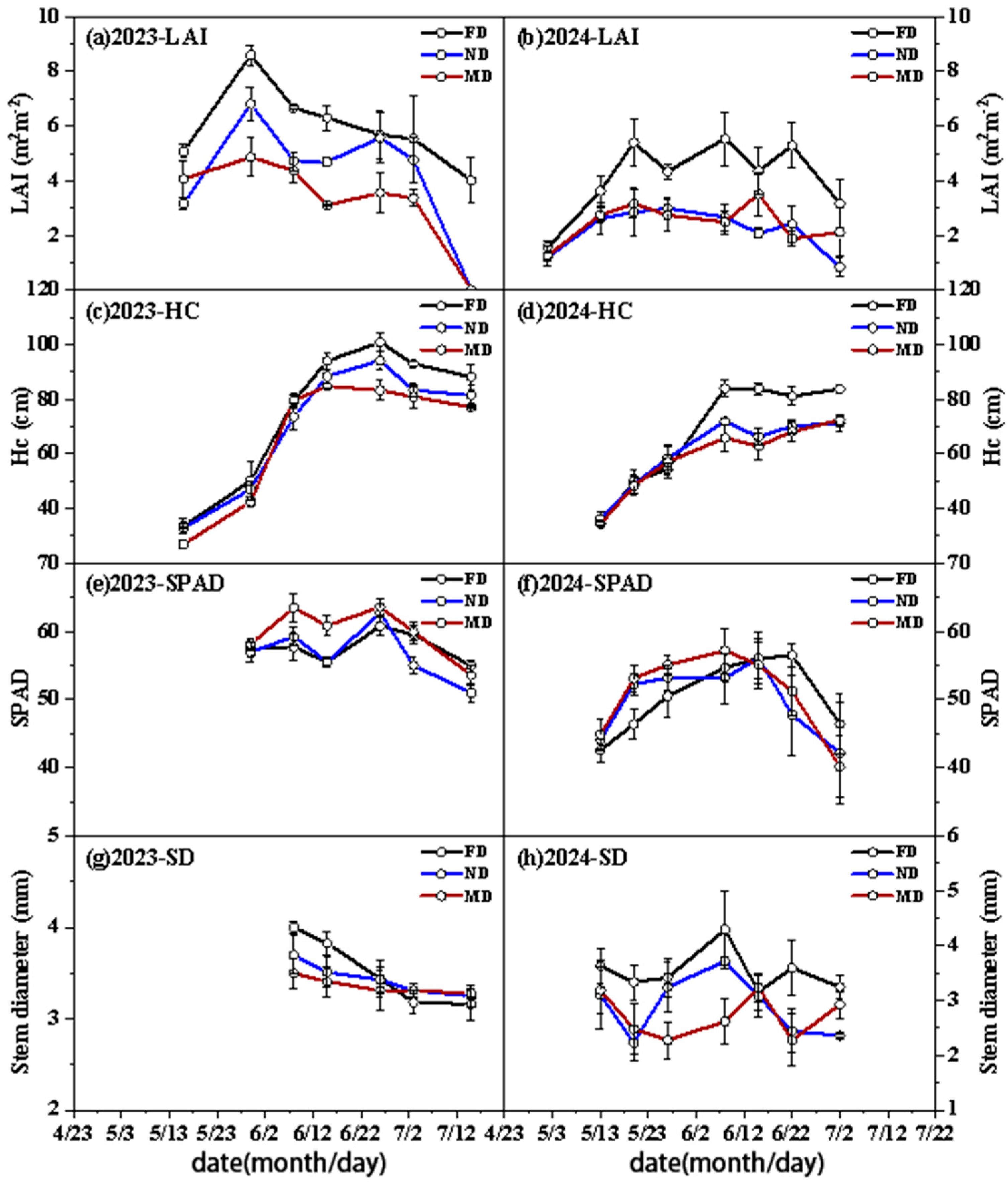
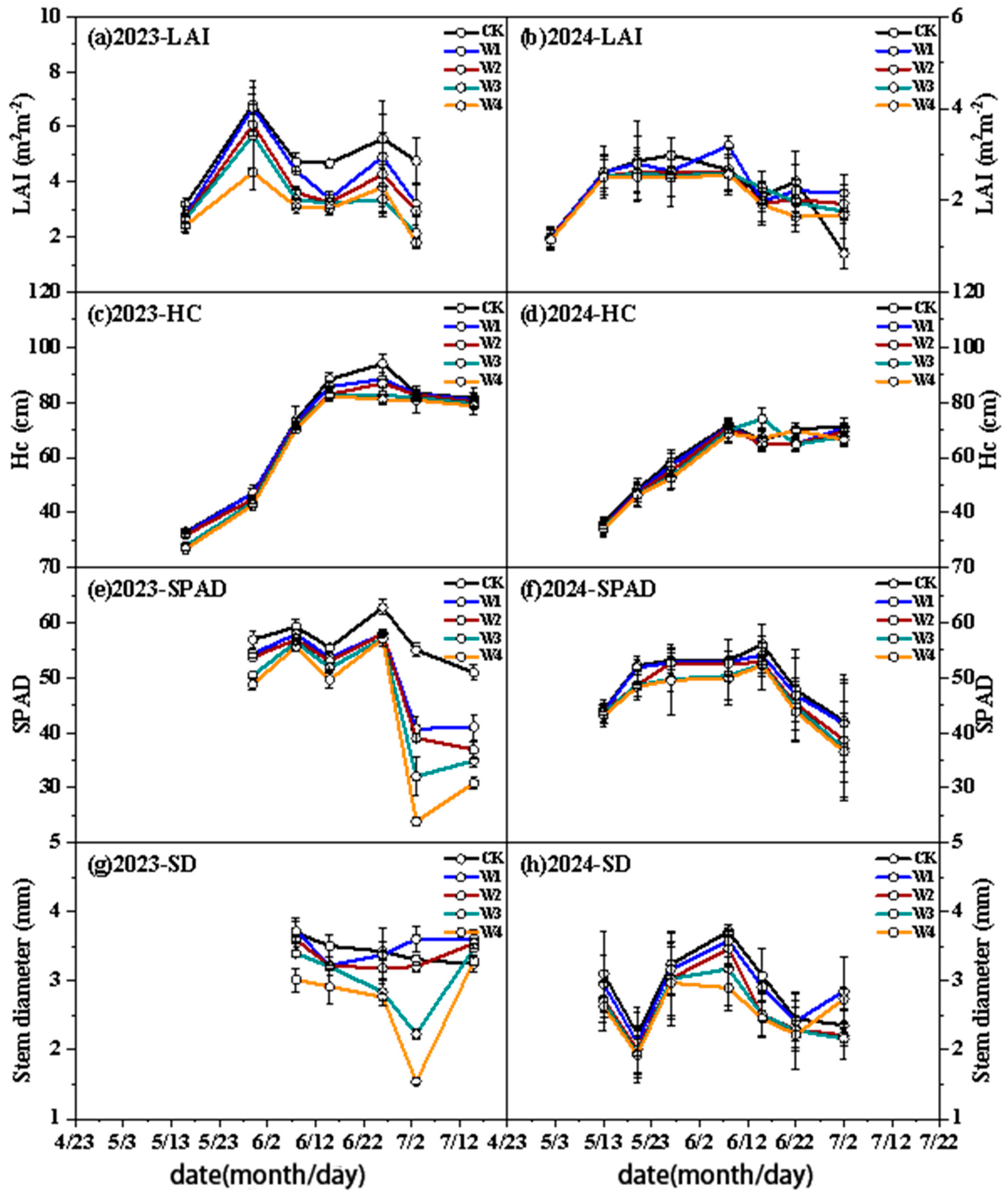
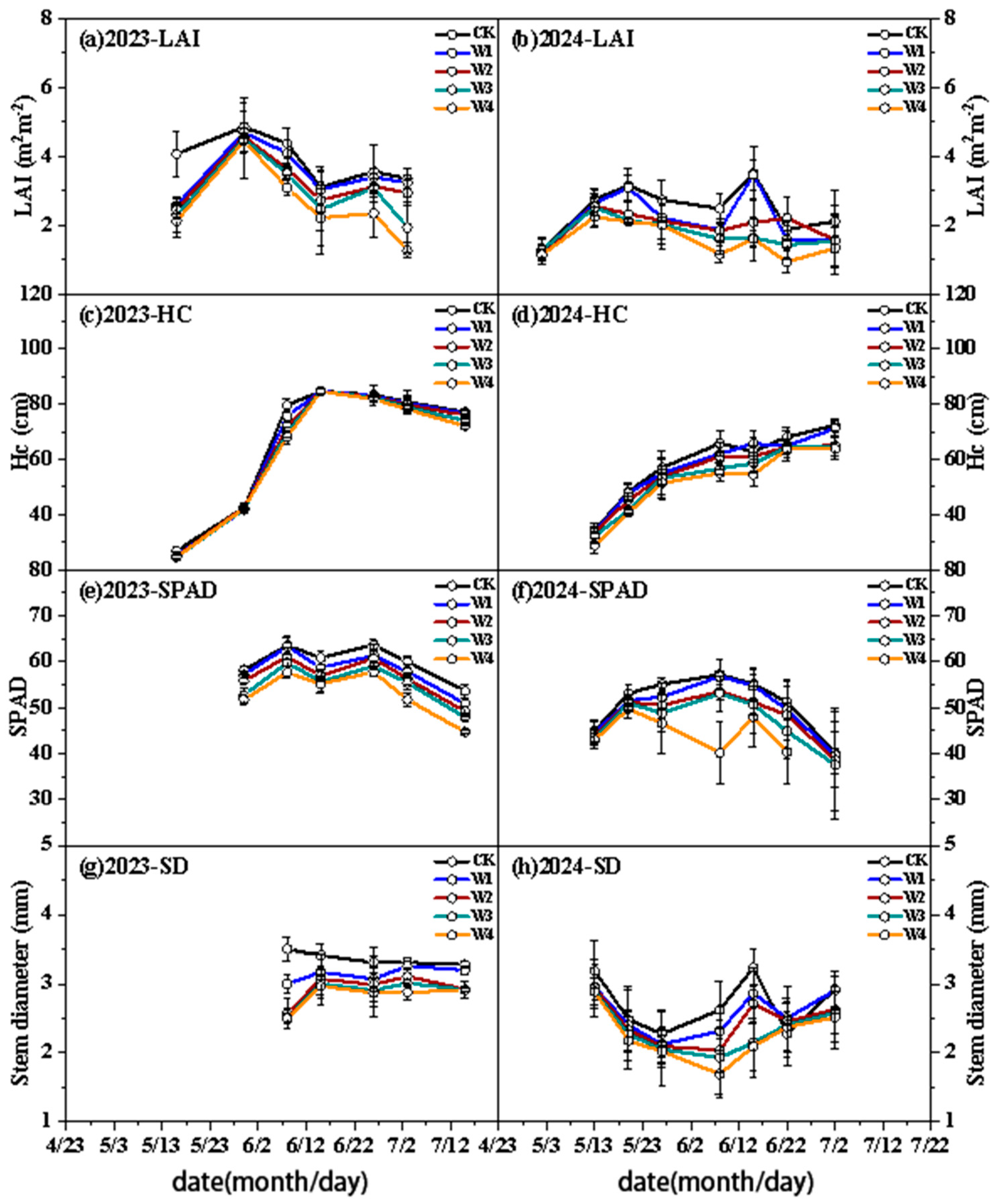
- Under the same water treatment, the phenotypic indicators (LAI, SPAD, SD) of FD are significantly better than those of ND and MD, especially in the late filling stage—film mulching can reduce soil evaporation, maintain stable root water supply, and delay leaf senescence and stem degradation;
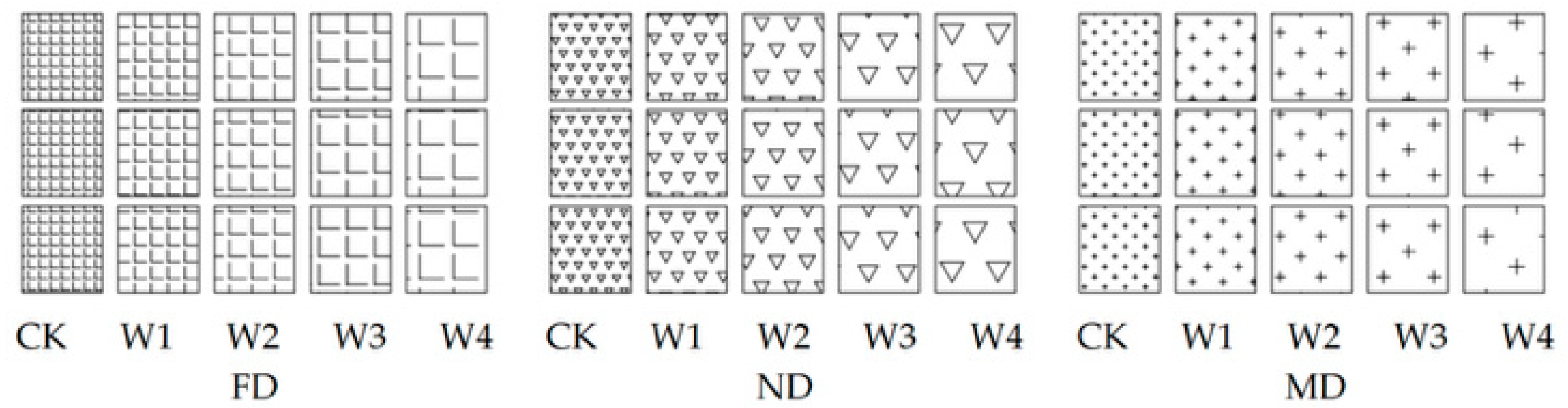
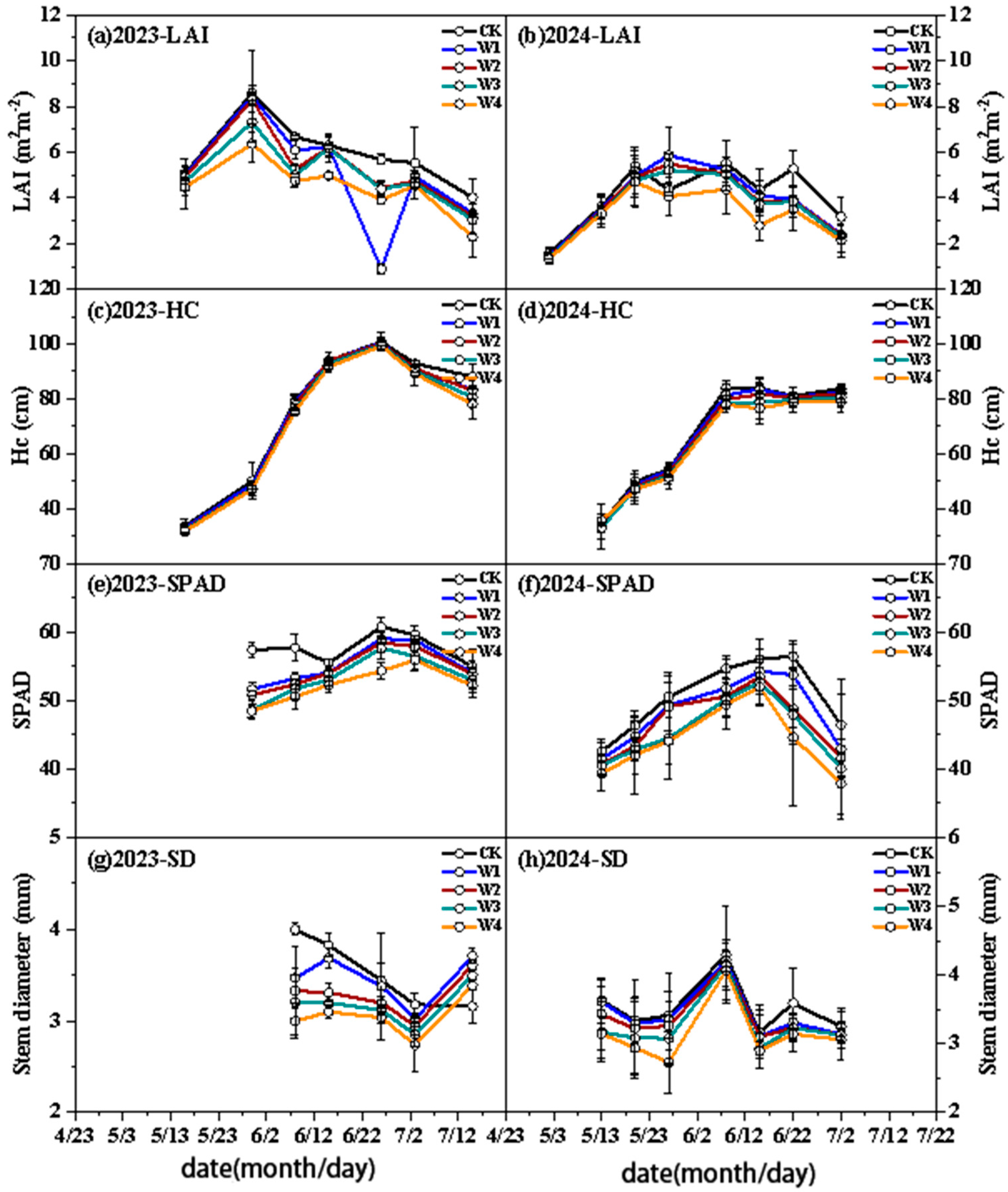
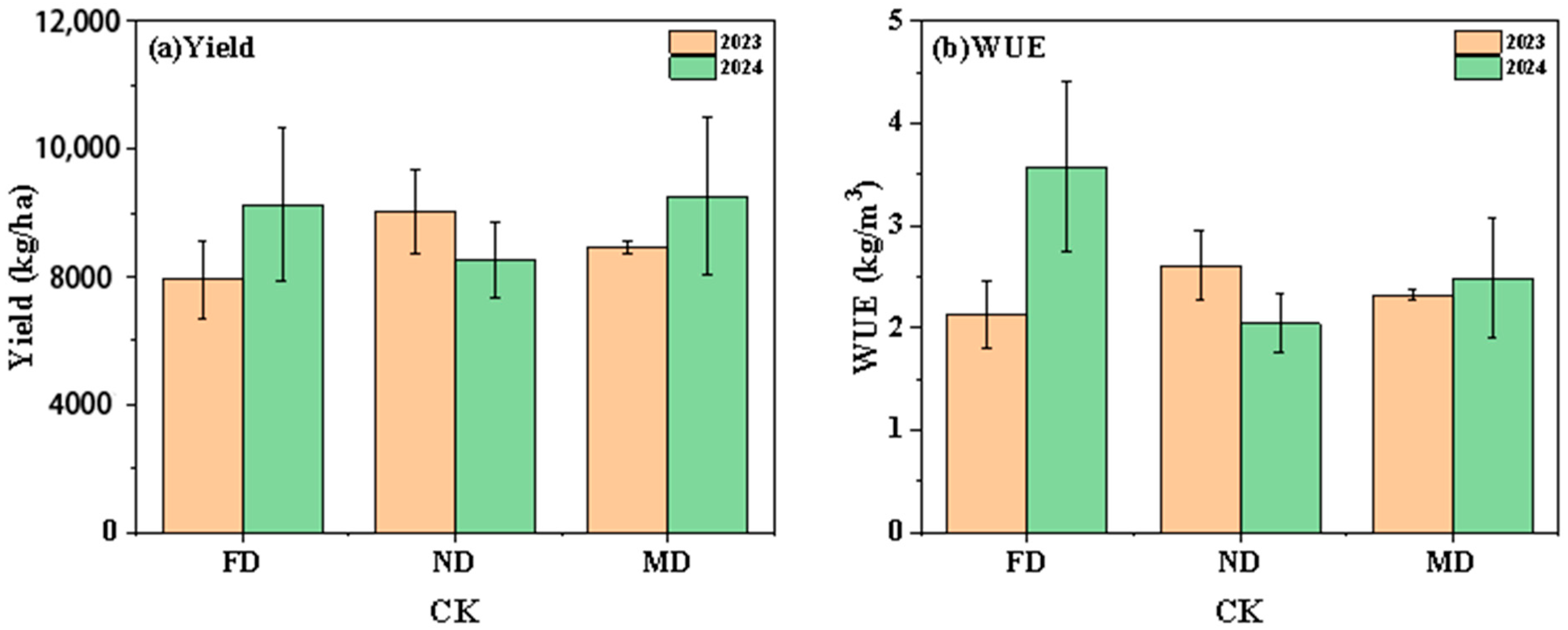
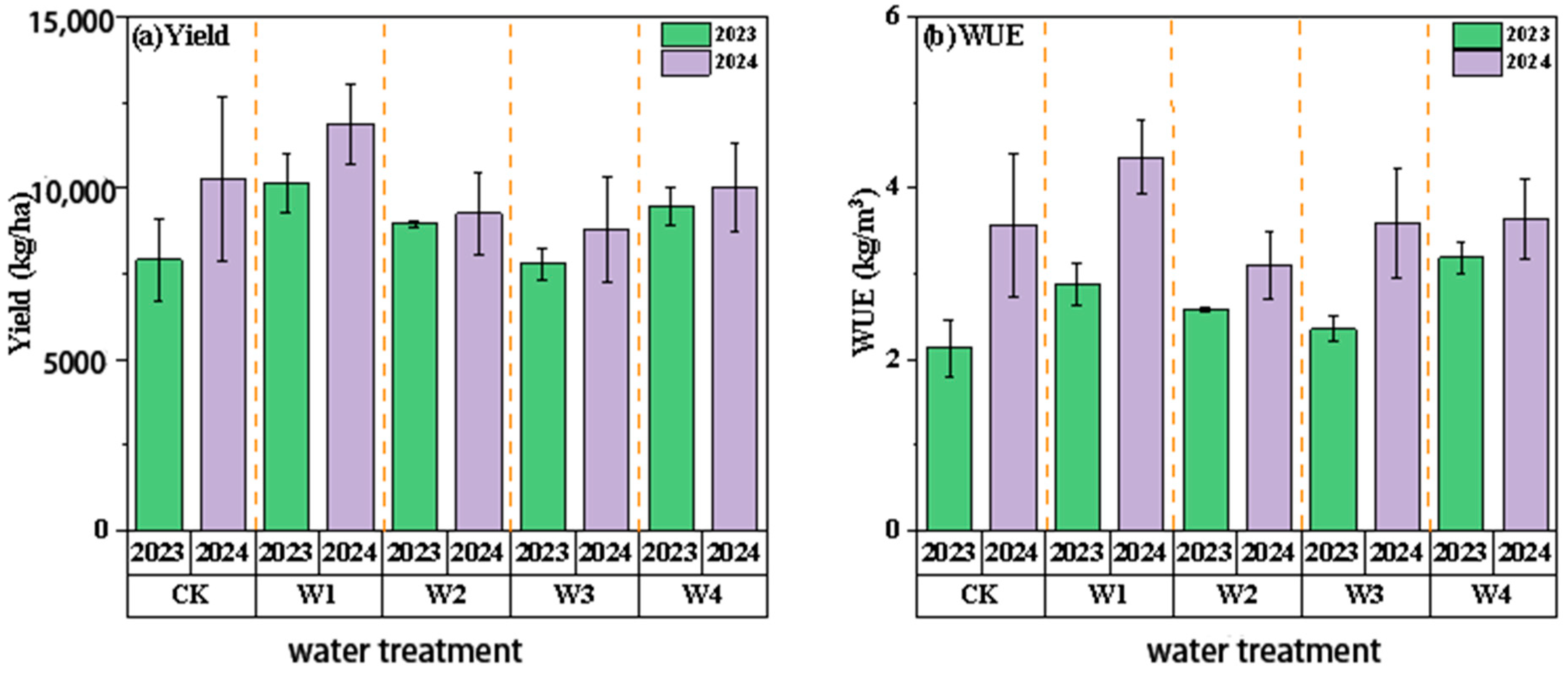
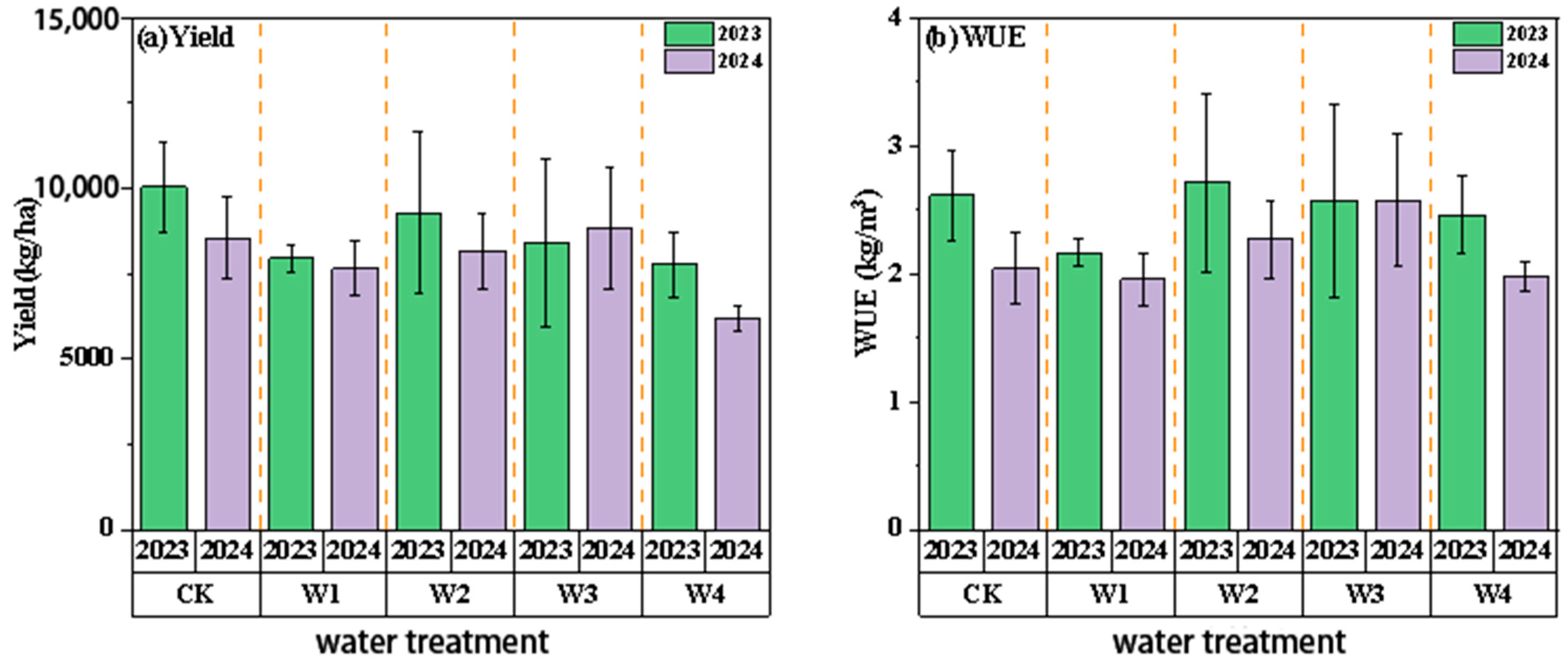
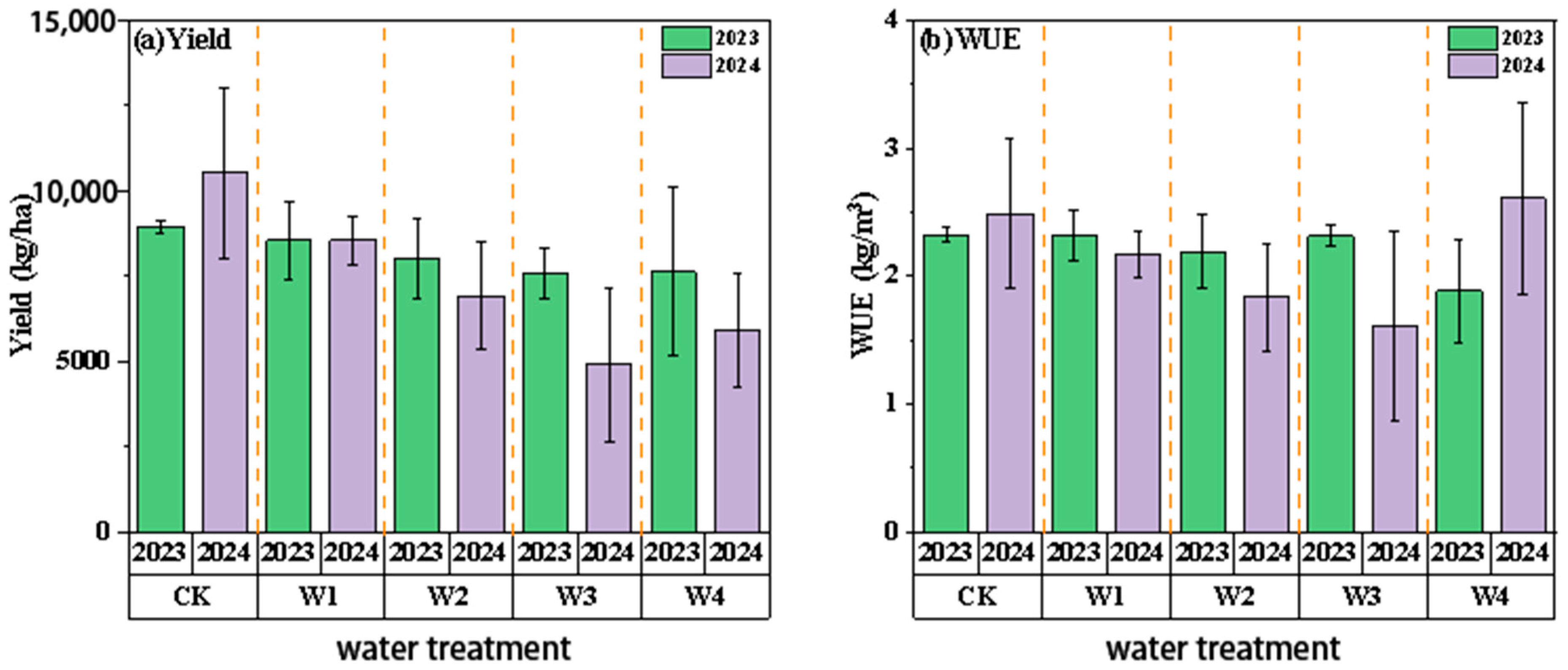
- FD is more likely to balance high yield and high WUE under moderate to severe water stress (W1: 90% CK, W4: 60% CK), while ND performs better under full water supply or mild stress (CK, W2: 80% CK, W3: 70% CK)—ND has no film mulching barrier, so it can avoid root waterlogging when water is sufficient, while the water retention advantage of FD is more prominent under stress conditions;
- MD is sensitive to water, with the highest yield under full water supply (CK); however, due to the absence of film mulching and the shallow burial of drip tapes, its WUE is lower than that of FD, and the yield reduction under water stress is greater than that of FD and ND.
2. Materials and Methods
2.1. Overview of the Study Area
2.1.1. Geographical and Climatic Characteristics
2.1.2. Soil Characteristics
2.1.3. Irrigation Water Source Characteristics
2.2. Experimental Design
2.2.1. Setting of Irrigation Methods and Water Treatments
2.2.2. Planting and Management Measures
2.3. Determination Indicators and Methods
2.3.1. Determination of Spring Wheat Growth Phenotypic Indicators
2.3.2. Determination of Yield and Water Use Efficiency
2.4. Data Analysis Methods
3. Results
3.1. Responses of Spring Wheat Growth Phenotypic Indicators to Water Regulation
3.2. Responses of Spring Wheat Yield and Water Use Efficiency to Water Regulation
4. Discussion
4.1. Correlation Between the Effects of Water Regulation on Spring Wheat Growth Phenotypes and Phenological Stages
4.2. Regulatory Mechanism of Assimilate Translocation and Grain Filling on Yield
4.3. Indicators of Water Use Efficiency and the Potential Role of Root Development
4.4. Screening of Optimal Water Regulation Methods
5. Conclusions
Author Contributions
Funding
Data Availability Statement
Conflicts of Interest
Abbreviations
| WUE | Water use efficiency |
| FD | Film-mulched drip irrigation |
| ND | Non-mulched drip irrigation |
| MD | Non-mulched shallow-buried drip irrigation |
| HC | Plant height |
| SD | Stem diameter |
| LAI | Leaf area index |
| SPAD | Chlorophyll content |
| LWC | Leaf water content |
References
- Zhang, K.; Wang, R.; Wang, H.; Zhao, H.; Zhao, F.; Yang, F.; Chen, F.; Qi, Y.; Lei, J. Influence of climate warming and rainfall reduction on semi-arid wheat production. Chin. J. Eco-Agric. 2019, 27, 413–421. (In Chinese) [Google Scholar] [CrossRef]
- Liu, L.L.; Liu, G.H.; Mai, X.F.; Xue, Y.X.; Zhang, Q.; Yang, S.Q. Comprehensive benefits evaluation of spring wheat multiple cropping forage grass in Ningxia Yellow River irrigation area. Agric. Res. Arid Areas 2022, 40, 50–60+103. (In Chinese) [Google Scholar] [CrossRef]
- Dong, D.; Sun, Y. Research and Development Status and Prospect of Wheat Germ Oil. Triticeae Crops 1999, 19, 58–60. (In Chinese) [Google Scholar] [CrossRef]
- Solovyov, O.; Shvidchenko, V.; Zaika, V.; Capo-Chichi, L.; Kadyrov, B. Spring Wheat Productivity and Profitability Under Various Crop Rotations in Northern Kazakhstan’s Chernozem. Int. J. Des. Nat. Ecodynamics 2024, 19, 137–146. [Google Scholar] [CrossRef]
- Khan, K. Wheat: Chemistry and Technology; Elsevier: Amsterdam, The Netherlands, 2016. [Google Scholar]
- Zhu, Y.; Chang, X.; Wang, D.; Yang, Y.; Wang, Y.; Lv, B.; Ma, R.; Liu, Y.; Wang, Y.; Zhao, G.; et al. Effects of Black Soil and Alluvial Soil on Nutritional Quality of Different Spring Wheat. Crops 2017, 33, 84–90. (In Chinese) [Google Scholar] [CrossRef]
- Leklem, J.E.; Miller, L.T.; Perera, A.D.; Peffers, D.E. Bioavailability of vitamin B-6 from wheat bread in humans. J. Nutr. 1980, 110, 1819–1828. [Google Scholar] [CrossRef]
- Liu, H.; Wang, Z.-H.; Li, F.-C.; Li, K.-Y.; Yang, N.; Yang, Y.-E. Contents of Protein and Amino Acids of Wheat Grain in Different Wheat Pro-duction Regions and Their Evaluation. Acta Agron. Sin. 2016, 42, 768–777. (In Chinese) [Google Scholar] [CrossRef]
- Chen, F.; Yan, S.; Wang, H.; Zhang, K.; Zhao, F.; Huang, X. Study on Gas Exchange Parameters and Water Use Efficiency of Spring Wheat Leaves Under Different Water Stress Levels. Arid Land Res. Manag. 2021, 38, 821–832. (In Chinese) [Google Scholar] [CrossRef]
- Cao, R.; Huang, X.; Wang, H. Effects of water and nitrogen deficit on yield and water use efficiency of spring wheat. Agric. Eng. 2024, 14, 115–120. (In Chinese) [Google Scholar] [CrossRef]
- Shiyang River Basin Water Resources Bureau of Gansu Province. Shiyang River Basin: Comprehensive Management to Reconstruct the Order of Harmonious Coexistence between Humans and Water. China Water Resour. 2019, 66. (In Chinese) [CrossRef]
- Li, T. Pilot Study on Water Production Functions and Optimal Irrigation Schedule of Main Crops in Shinyang River Basin. Master’s Thesis, Northwest A&F University, Xianyang, China, 2005. (In Chinese). [Google Scholar]
- Liu, Q.; Zhang, E.; Wang, Q.; Wang, T.; Liu, C.; Yin, H.; Yu, H. Effect of irrigation and nitrogen supply levels on water consumption, grain yield and water use efficiency of spring wheat on notillage with stubble standing farmland. Acta Prataculturae Sin. 2012, 21, 169–177. (In Chinese) [Google Scholar] [CrossRef]
- Zhang, M.; Chen, Y.; Xu, C.; Yang, B.; Ha, R.; Xia, X.; Yang, G.; Ji, W.; Wang, H.; Yang, H.; et al. Comprehensive comparison experiment on different irrigation modes of spring wheat in the Yellow River Irrigation District of Ningxia. Agric. Technol. 2023, 43, 66–70. (In Chinese) [Google Scholar] [CrossRef]
- Ma, Y.; Wang, X.; Wei, G.; Xue, X.; Hao, W.; Wang, C.; Tan, J. Effects of nitrogen reduction and water saving on water consumption characteristics and water use efficiency of spring wheat in Ningxia Yellow River irrigation area. Agric. Res. Arid Areas 2024, 42, 150–160. (In Chinese) [Google Scholar]
- Zhang, T. Study on Water and Nitrogen Use Characteristics of Spring Wheat and Their Interrelation. Master’s Thesis, Gansu Agricultural University, Lanzhou, China, 2009. (In Chinese). [Google Scholar]
- Zhang, Y. Effects of Water Regulation in Growth Season on Growth and Water-Nitrogen Utilization of Spring Wheat in the Hexi Region. Master’s Thesis, Northwest A&F University, Xianyang, China, 2017. (In Chinese). [Google Scholar]
- Xu, X.; Lv, Y.; Shao, J.; Liu, X.; Zhang, Y.; Li, R.; Gao, Q.; Han, H.; Liu, L. The Variations in Leaf-Level Photosynthesis and Intrinsic Water Use Efficiency of Different Spike Types Winter Wheat in North China. J. Agron. Crop Sci. 2025, 211, e70091. [Google Scholar] [CrossRef]
- Che, Z.; Bie, S.; Wang, R.; Ma, Y.; Zhang, Y.; He, F.; Jiang, G. Mild deficit irrigation delays flag leaf senescence and increases yield in drip-irrigated spring wheat by regulating endogenous hormones. J. Integr. Agric. 2025, 24, 2954–2973. [Google Scholar] [CrossRef]
- Zhang, H.; Gao, H.; Hu, B. The Research Progress of Farmland Water Ecological Process and Control. Anhui Agric. Sci. Bull. 2014, 20, 12–15. (In Chinese) [Google Scholar] [CrossRef]
- Liao, D.; Niu, J.; Du, T.; Kang, S. Improving subsurface soil moisture estimation using a 2-dimensional data assimilation framework incorporated with a dual state-parameter scheme. Water Resour. Res. 2024, 60, e2023WR035771. [Google Scholar] [CrossRef]
- Yang, D.; Li, S.; Wu, M.; Yang, H.; Zhang, W.; Chen, J.; Wang, C.; Huang, S.; Zhang, R.; Zhang, Y. Drip irrigation improves spring wheat water productivity by reducing leaf area while increasing yield. Eur. J. Agron. 2023, 143, 126710. [Google Scholar] [CrossRef]
- Wang, J. Effect of Mulched Drip Irrigation on Crop Root-Zone Soil Microenvironment and Crop Growth in Plastic Greenhouse. Doctoral Dissertation, Northwest A&F University, Xianyang, China, 2017. (In Chinese). [Google Scholar]
- Song, W.; Huang, J.; Chen, X.; Wang, L.; SUN, W.; Wang, Z.; Xue, X.; Guo, W.; Li, Y.; Chen, F. Effects of plastic film mulching and conventional irrigation on water consumption characteristics and yield of winter wheat. Chin. J. Eco-Agric. 2016, 24, 1445–1455. (In Chinese) [Google Scholar] [CrossRef]
- Wen, Y.; Shang, S.; Yang, J. Optimization of irrigation scheduling for spring wheat with mulching and limited irrigation water in an arid climate. Agric. Water Manag. 2017, 192, 33–44. [Google Scholar] [CrossRef]
- Li, W.; Feng, S.; Kang, S.; Du, T.; Chen, S. Distribution characteristics of soil water in desert oasis region in middle reaches of Shiyang River. J. Soil Water Conserv. 2007, 3, 138–143+157. (In Chinese) [Google Scholar] [CrossRef]



| Indicator Name | Soil Organic Matter | Total Nitrogen | Available Phosphorus (Olsen Method) | Available Potassium | pH Value | Cation Exchange Capacity (CEC) | Soil Bulk Density |
|---|---|---|---|---|---|---|---|
| g/kg | g/kg | mg/kg | mg/kg | - | cmol/kg | g/cm3 | |
| High fertility level | ≥20 | ≥1.5 | ≥20 | ≥150 | 6.5–7.5 (neutral) | ≥20 | 1.1–1.3 |
| Medium fertility level | 10–20 | 1.0–1.5 | 10–20 | 100–150 | 5.5–6.5 (slightly acidic) or 7.5–8.5 (slightly alkaline) | 10–20 | 1.0–1.1 or 1.3–1.4 |
| Low fertility level | <10 | <1.0 | <10 | <100 | <5.5 (acidic) or >8.5 (alkaline) | <10 | <1.0 or >1.4 |
| Indicator | Measurement Instrument | Measurement Method |
|---|---|---|
| Plant height (HC) | Telescopic tape measure (accuracy: 1 mm) | Measure the vertical height from the ground to the awns (2023)/top of the plant (2024), and take the average value of 10 plants. |
| Stem diameter (SD) | Vernier caliper (accuracy: 0.01 mm) | Measure the diameter of the stem base; measure vertically twice per plant, take the average for each plant, and then calculate the average value of 10 plants. |
| Leaf area index (LAI) | Electronic balance (0.001 g) + Tape measure (1 mm) | Individual plant leaf area = ∑ (leaf length × leaf width) × 0.83 (correction coefficient); LAI = (Individual plant leaf area × Number of plants per unit area)/unit area. |
| Chlorophyll content (SPAD) | SPAD-502plus (Konica Minolta, Osaka, Japan) chlorophyll meter (accuracy: ±1.0 SPAD) | Measure 3 equally spaced points on the flag leaf of each plant, and take the average value of 10 plants. |
| Leaf water content (LWC) | Electronic balance (0.001 g) + Oven | Measure fresh weight (FW) with an electronic balance → deactivate enzymes at 105 °C for 30 min → dry at 75 °C for 48 h to constant weight (DW), LWC = (FW − DW)/FW (FW: fresh weight, DW: dry weight). |
Disclaimer/Publisher’s Note: The statements, opinions and data contained in all publications are solely those of the individual author(s) and contributor(s) and not of MDPI and/or the editor(s). MDPI and/or the editor(s) disclaim responsibility for any injury to people or property resulting from any ideas, methods, instructions or products referred to in the content. |
© 2025 by the authors. Licensee MDPI, Basel, Switzerland. This article is an open access article distributed under the terms and conditions of the Creative Commons Attribution (CC BY) license (https://creativecommons.org/licenses/by/4.0/).
Share and Cite
Li, N.; Zhao, P.; Zhu, J.; Li, S. Responses of Yield, Efficiency, and Phenotypes of Spring Wheat in Arid Regions to Water Regulation. Agriculture 2025, 15, 2174. https://doi.org/10.3390/agriculture15202174
Li N, Zhao P, Zhu J, Li S. Responses of Yield, Efficiency, and Phenotypes of Spring Wheat in Arid Regions to Water Regulation. Agriculture. 2025; 15(20):2174. https://doi.org/10.3390/agriculture15202174
Chicago/Turabian StyleLi, Na, Pinyuan Zhao, Jiaxin Zhu, and Sien Li. 2025. "Responses of Yield, Efficiency, and Phenotypes of Spring Wheat in Arid Regions to Water Regulation" Agriculture 15, no. 20: 2174. https://doi.org/10.3390/agriculture15202174
APA StyleLi, N., Zhao, P., Zhu, J., & Li, S. (2025). Responses of Yield, Efficiency, and Phenotypes of Spring Wheat in Arid Regions to Water Regulation. Agriculture, 15(20), 2174. https://doi.org/10.3390/agriculture15202174