

Article

Linking Yield, Baking Quality, and Rheological Properties to Guide Sustainable Improvement of Rwandan Wheat Varieties


by
Yves Theoneste Murindangabo
1,*,
Trong Nghia Hoang
1,2,
Innocent Habarurema
3,
Petr Konvalina
1,
Marguerite Niyibituronsa
3,
Protegene Byukusenge
1,
Protogene Mbasabire
1,
Josine Uwihanganye
1,
Roger Bwimba
1,
Marie Grace Ntezimana
1 and
Dang Khoa Tran
2
1
Faculty of Agriculture and Technology, University of South Bohemia in České Budějovice, Branišovská 1645/31A, 370 05 České Budějovice, Czech Republic
2
Faculty of Agronomy, University of Agriculture and Forestry—Hue University, 102 Phung Hung, Hue City 49000, Vietnam
3
Rwanda Agriculture and Animal Resources Development Board (RAB), Rubona P.O. Box 5016, Rwanda
*
Author to whom correspondence should be addressed.
Agriculture 2025, 15(20), 2160; https://doi.org/10.3390/agriculture15202160
Submission received: 28 August 2025 / Revised: 8 October 2025 / Accepted: 15 October 2025 / Published: 17 October 2025
(This article belongs to the Section Agricultural Systems and Management)

Abstract

Wheat is an important crop in Rwanda; however, rapid population growth, urbanization, and shifting dietary preferences have driven demand far beyond domestic production capacity, resulting in a steady increase in imports. Closing this gap requires a variety of management strategies that jointly optimise yield, processing quality, and sustainability. This study evaluated ten widely cultivated wheat (Triticum aestivum L.) varieties in Rwanda through an integrated assessment of grain yield, quality traits, and rheological properties. Yields ranged from 4.3 to 6.3 t ha−1, with Nyaruka and Gihundo achieving the highest productivity. Quality attributes, including protein content (PC), wet gluten (WG), gluten index (GI), falling number (FN), and Zeleny sedimentation value (ZSV), varied significantly, with Cyumba and Reberaho showing superior protein levels. Mixolab-based rheological analyses revealed marked diversity in dough development time, torque, and water absorption, with Keza and Nyangufi exhibiting favorable baking profiles. Statistical analyses highlighted trade-offs between yield and quality, as high-yielding varieties such as Nyaruka showed weaker baking characteristics. These findings demonstrate that linking agronomic performance with grain and dough quality traits provides a pathway towards targeted breeding, sustainable intensification, and enhanced food security. Integrating genetic selection with tailored management and processing strategies can improve both productivity and product value, strengthening the resilience and economic viability of Rwanda’s wheat sector.

1. Introduction

Wheat, alongside rice and maize, stands as one of the three primary cereal grains that have served as a dietary mainstay for humans for millennia. Originating from the Fertile Crescent in the Middle East, it has played a pivotal role in human civilization [1]. Wheat provides over half of the world’s calories and two-fifths of its protein intake, although it lacks essential amino acids, particularly lysine, threonine, and methionine. Beyond carbohydrates and proteins, wheat also contains fibers, lipids, vitamins, minerals, and other phytochemicals, making it a nutritionally rich crop [2,3,4,5]. Its adaptability to various climatic conditions, owing to its genetic diversity, has made wheat cultivation feasible across temperate, Mediterranean, and subtropical regions globally, making it a biologically and economically feasible crop [6,7].
Since its domestication, wheat has spread from the Middle East to North Africa, Europe, Asia, and beyond, becoming one of the most cultivated cereals worldwide by the 19th century [8]. Nowadays, wheat cultivation covers approximately 200–240 million hectares worldwide. According to FAO, global production in 2023 reached about 799 million tons from 220 million hectares [9], and projections by USAID and the International Grains Council indicate that production may rise to 811 million tons in 2025/2026 [10,11]. This places wheat among the top three in terms of global cereal production. Wheat productivity has steadily increased since 1961, with yields rising from 1 ton per hectare to 3.5 tons per hectare globally. Asia leads in global wheat production, followed by Europe, the Americas, Oceania and Africa, each contributing approximately 44%, 34%, 15%, and 3.4–3.5%, respectively. Major wheat-producing countries include China, India, Russia, the United States, and France, owing to high-yielding varieties, supported by inputs like fertilizers and irrigation, along with favorable policies and extensive land resources [12,13,14].
However, various parts of the world, notably the Sub-Saharan region in Africa, are still grappling with a decrease in food production per capita, as well as issues such as undernourishment, malnutrition, and poverty [15]. Despite the increased adoption of high-yielding varieties and the use of fertilizers, yields have not kept pace with the rising demand driven by factors such as population growth, changing food preferences, and socio-economic shifts associated with urbanization [16]. For instance, in 2012, wheat imports satisfied approximately 60% of the wheat demand in 80% of Sub-Saharan Africa, making this region the world’s largest wheat importer [17]. Moreover, recent geopolitical events, such as the Ukraine/Russia war, have disrupted wheat exports from the affected regions, leading to shortages and price increases in countries dependent on wheat imports. According to Bertassello et al. [18], the Ukraine–Russia conflict has significantly impacted global wheat supplies, with major repercussions for food security worldwide. In 2022, Ukrainian wheat exports plummeted by 39%, leading to over 70% import losses in vulnerable countries like Egypt, Oman, Saudi Arabia, Libya, Mauritania, Yemen, and Lebanon. These disparities underscore the urgent need for policy interventions to address the impending food crisis, emphasizing the importance of access to capital and international trade.
While global wheat research has made significant progress in enhancing yield and quality, African wheat breeding programs have yet to integrate rheological and baking quality assessments fully. This study addresses this gap by linking yield, baking quality, and rheological properties to guide sustainable improvement of Rwandan wheat varieties.
Rwanda, despite its small size, faces significant agricultural challenges, with a large portion of its population undernourished and living in poverty. Agriculture forms the backbone of the country’s economy, employing over 70% of the population and contributing 31% to the gross domestic product [19]. In Rwanda, wheat cultivation began in the early 19th century with the introduction of European missionaries [20]. It is cultivated on approximately 35,000 hectares through rain-fed agriculture, primarily by smallholder farmers, with additional production contributed by cooperatives and companies [21,22]. The crop is grown across various highland agro-ecological zones, particularly in regions situated between 1900 and 2500 m above sea level, primarily in the northern and southern parts of the country [23] to meet the increasing demand of over 200,000 tons per year. According to the Rwanda Ministry of Agriculture and Animal Resources [24], wheat productivity in Rwanda has increased from 0.95 t ha−1 in 2016/2017 to 1.3 t ha−1 in 2023/2024, on an estimated 45,858 ha (season A and B) cultivated under the Land Use Consolidation (LUC) program for priority crops within the framework of the National Strategy for Transformation I (NST1).
Rwanda primarily produces soft bread wheat, with a small portion of hard bread wheat imported for blending purposes to enhance flour quality; however, the majority of wheat consumed in Rwanda is imported, amounting to 120,000 tons in 2019 [21,25]. The wheat production sector in Rwanda has experienced significant growth, attributed to several factors, including expansion in cultivated areas and improved productivity facilitated by the adoption of improved varieties, fertilizers, and good agronomic practices. Government policies such as the crop intensification program, input subsidy scheme, the Strategic Plan for Agriculture Transformation, and Vision 2050 have also played a pivotal role in fostering this growth trajectory [26]. Despite an average wheat production of around 90,684 tons in 2011, this figure gradually declined to 68,635 tons in 2014. However, by 2019, production rebounded to 80,000 tons [21]. The decline was likely linked to diminishing soil fertility resulting from nutrient depletion, while the subsequent increase post-2014 may be attributed to the adoption of subsidized improved seeds and fertilizers [27].
Nevertheless, Rwanda’s wheat consumption is on an upward trajectory, driven by factors such as population growth, urbanization, and shifting in food consumption regimes, which are leading to shifts in dietary patterns and increased demand for food. Hence, enhancing both the quantity and quality of wheat produced is essential for ensuring food security in Rwanda amidst these evolving trends [28]. While wheat yield can be determined by the quantity produced per unit area of land, its quality assessment involves physical, chemical, and sensory characterization of wheat kernels and the resulting wheat flour, dough, and baking qualities. Wheat baking qualities are typically determined by various factors, including protein content, gluten, flour yield, falling number, test weight, pasting capabilities of starch, and rheological characteristics of batter and dough [29,30]. Rheological traits are particularly crucial as they forecast dough properties such as elasticity, viscosity, and extensibility, which ultimately affect the quality of the end product [31,32].
In this study, our objective was to conduct a comprehensive comparative analysis of grain yield, baking quality parameters, and rheological properties across ten prevalent commercial wheat varieties in Rwanda. These wheat varieties display diverse traits suited to various agricultural and climatic conditions. With improvements, they can play a crucial role in addressing challenges related to production and productivity, combating malnutrition and undernourishment, and enhancing economic returns within the agricultural sector. By meticulously evaluating these factors, we aim to make significant contributions towards enhancing both the quantity and quality of wheat production, ultimately bolstering food security within the country. In the context of Rwanda, where such comprehensive studies are scarce, this research holds particular significance, underscoring the need for in-depth investigations to address the unique challenges (quantity and quality) and opportunities within the country’s wheat production sector.

2. Materials and Methods

2.1. Study Site and Sampling

All the wheat varieties used in this study were sourced from the Rwanda Agriculture and Animal Resources Development Board (RAB), specifically from Rwerere station, Rugezi site, situated at Latitude 1°29′20″ S and Longitude 29°52′40″ E, with an elevation of 2100 m above sea level (masl). The study site is located in the Buberuka highlands agroecological zone, a tropical humid climate region renowned for its steep slopes, soils with low fertility, and high acidity, posing challenges for achieving high crop yields [33,34,35]. It experiences an average annual rainfall of 1200–1400 mm and an average annual temperature of 15–18 °C. Following a bimodal pattern, the first short rainy season spans September to December, while the second long rainy season extends from March to May, with peak rainfall occurring in November and April, respectively. Altitudes range from 1800 to 2400 m above sea level, with the predominant soil type being oxisols [36,37].
All the selected seeds were breeder seeds, normally used as the primary source for producing foundation seed, the initial stage in the seed production chain, as they are of the highest genetic purity and quality. The study involved ten hexaploid (2n = 6x = 42) Triticum aestivum L. commercial varieties (with corresponding pedigree) currently grown in Rwanda: Nyaruka (EMB16/CBRD//CBRD), Gihundo (ND643/2*WBLL1), Reberaho (BABAX/LR42//BABAX2/4/SNI/TRAP#1/3/KAUZ*2/TRAP//KAUZ), Majyambere (URES/JUN//KAUZ/3/BABAX/4/TILHI), Kibatsi (TRAP#1/BOW//MILAN/3/BAU), Cyumba(TAM200/TUI/6/PVN//CAR422/ANA/5/BOW/CROW//BUC/PVN/3/YR/4/TRAP#1), Nyangufi (PSN/BOW//SERI/3/MILAN/4/ATTILA), Rengerabana (BABAX/LR42//BABAX*2/3/TUKURU), Keza (ND643/2*WBLL1), and Mizero (THELIN#2/TUKURU) (Figure 1). All selected varieties were planted simultaneously at a seeding rate of 100 kg/ha and subjected to identical treatments in accordance with guidelines provided by RAB. These treatments included hoeing, thinning, roguing (to remove off-types), weeding as needed, erosion control, pest and disease management both in the field and storage facilities, and measures to deter birds in the field, among others. During planting, all varieties received 100 kg/ha of diammonium phosphate (DAP). Additionally, 3–6 weeks after planting, during the weeding stage, they were provided with 50 kg/ha of urea as top dressing, ensuring uniformity in nutrient application and agronomic practices across all varieties.
The plot size was equivalent to 5m × 10 m per variety. Each wheat variety was sown in three replicate plots, arranged in a randomized complete block design (RCBD) to account for field variability. The samples were selected from those planted on 14 March 2023 (Season 2023B) and harvested on 31 July 2023 (Season 2023B). For each variety, composite grain samples were collected from the three replicates for quality analyses. Laboratory analyses (e.g., PC, GI, FN, Mixolab parameters) were conducted in duplicate to ensure accuracy and repeatability. All quality parameters were meticulously assessed at the Laboratory of Bioproduct Quality within the Department of Agroecosystems at the Faculty of Agriculture and Technology, University of South Bohemia in České Budějovice, Czech Republic. Specific flour sample weights were used for each parameter test. A total of 200 g of grain was milled for all tests. From this, 1 g of flour was used for the protein test (repeated twice); 10 g was used for the WG and GI tests; approximately 7 g was used for the FN test (also repeated twice); and around 50 g was used for the Mixolab test. The exact amount for Mixolab varied depending on the flour’s moisture content and water absorption, which differed across wheat flour varieties, so the sample size could fluctuate around 50 g.

2.2. Wheat Grain Yield and Quality Parameters Evaluation

2.2.1. Grain Yield

Wheat grain harvesting was conducted using hand sickles at full grain physiological maturity. Following harvesting, meticulous cleaning procedures were applied to the wheat grains. Subsequently, the yield was recorded and calculated at 14% moisture content, with the grain yield per unit area of land expressed in t/ha. Furthermore, the thousand kernel weight (TKW) was determined, and the hectoliter weight (HW, kg hL−1) was measured using the Dickey-John GAC500XT apparatus (Dickey-John Corporation, Auburn, IL, USA) [38,39].

2.2.2. Wheat Flour Analysis: Protein Content, Gluten Composition, and Falling Number

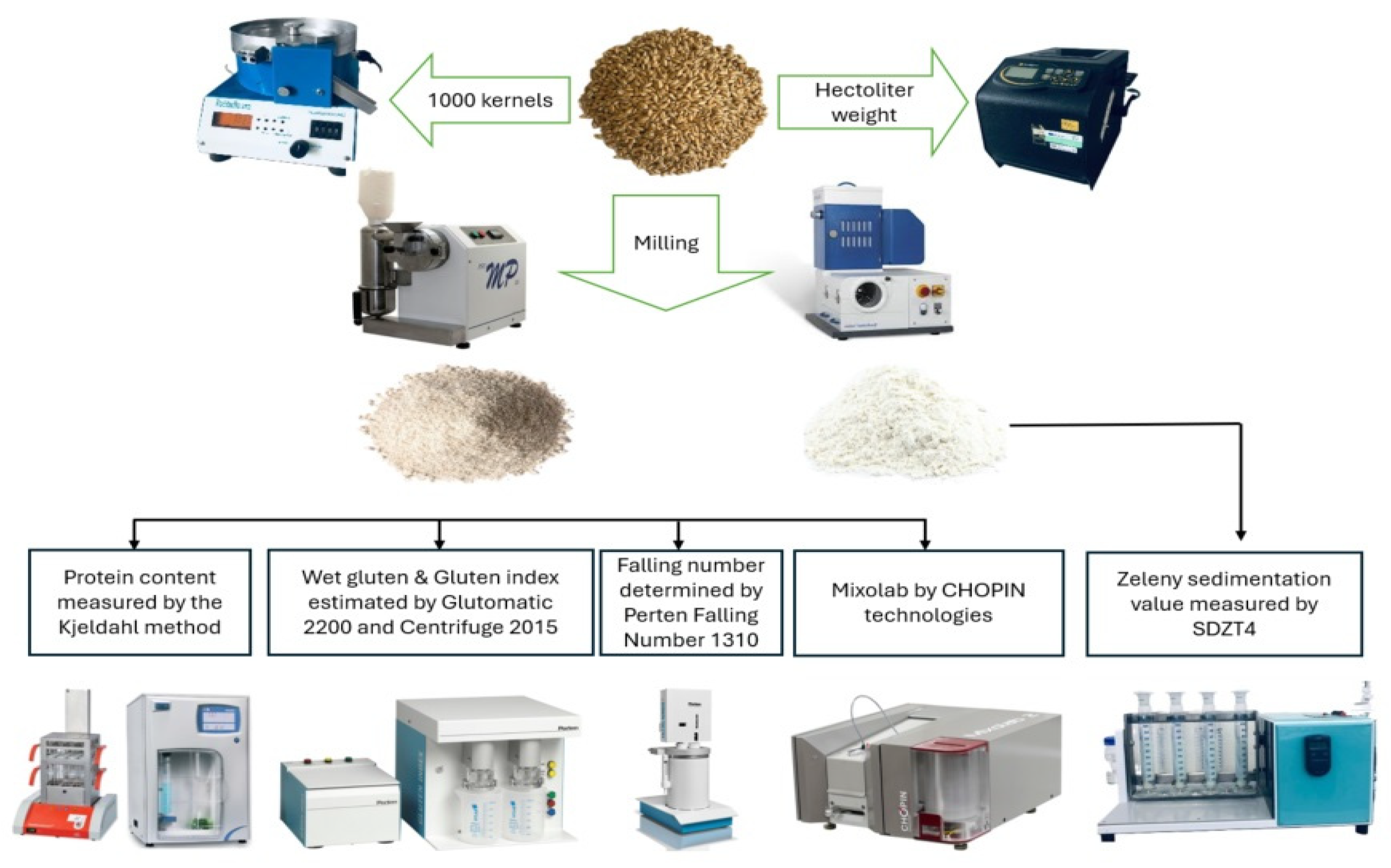
Before wheat flour analyses, the wheat grain samples underwent a milling process using the PSY 20 machine (Mezos, Hradec Kralove, Czech Republic) and the Quadrumat Junior machine (Brabender, Duisburg, Germany) (Figure 2). The use of two different mills was based on the specific requirements of different analytical methods. All grain samples milled using the PSY 20 machine, equipped with a 0.8 mm sieve, produced meal used for the analysis of PC, WG, GI, FN, and Mixolab parameters [29]. In parallel, grain samples milled using the Quadrumat Junior mill, which employs a 150 µm sieve, produced finer flour suitable for the Zeleny sedimentation test, which requires a more refined and uniform particle size for accurate measurement [40,41]. In our study, no additional conditioning (tempering) of the wheat grains was performed before milling, as the initial moisture content of the samples was approximately 14%, which falls within the standard range (14–17%) typically used for milling without requiring further moisture adjustment. PC was determined using the Kjeldahl method (Kjeltec 1002 System, Tecator AB, Hoganas, Sweden), with calculations based on N × 5.7 (in dry matter). WG and GI were determined according to ICC Standard No. 137/1 [42] using the Glutomatic 2200 and Centrifuge 2015 (Perten Instruments, Hägersten, Sweden). The FN was measured using the Perten Falling Number 1310 apparatus (Perten Inst., Stockholm, Sweden), following the ICC standard No. 107/1 [43] and the AACC International method 56-81B [44]. Sedimentation value (Zeleny test) (ZSV) was determined using the SDZT4 apparatus (MEZOS, spol. s r. o., Hradec Králové, Czech Republic) according to ICC standard No. 116/1 [45,46,47,48].

2.2.3. Mixolab Analyses

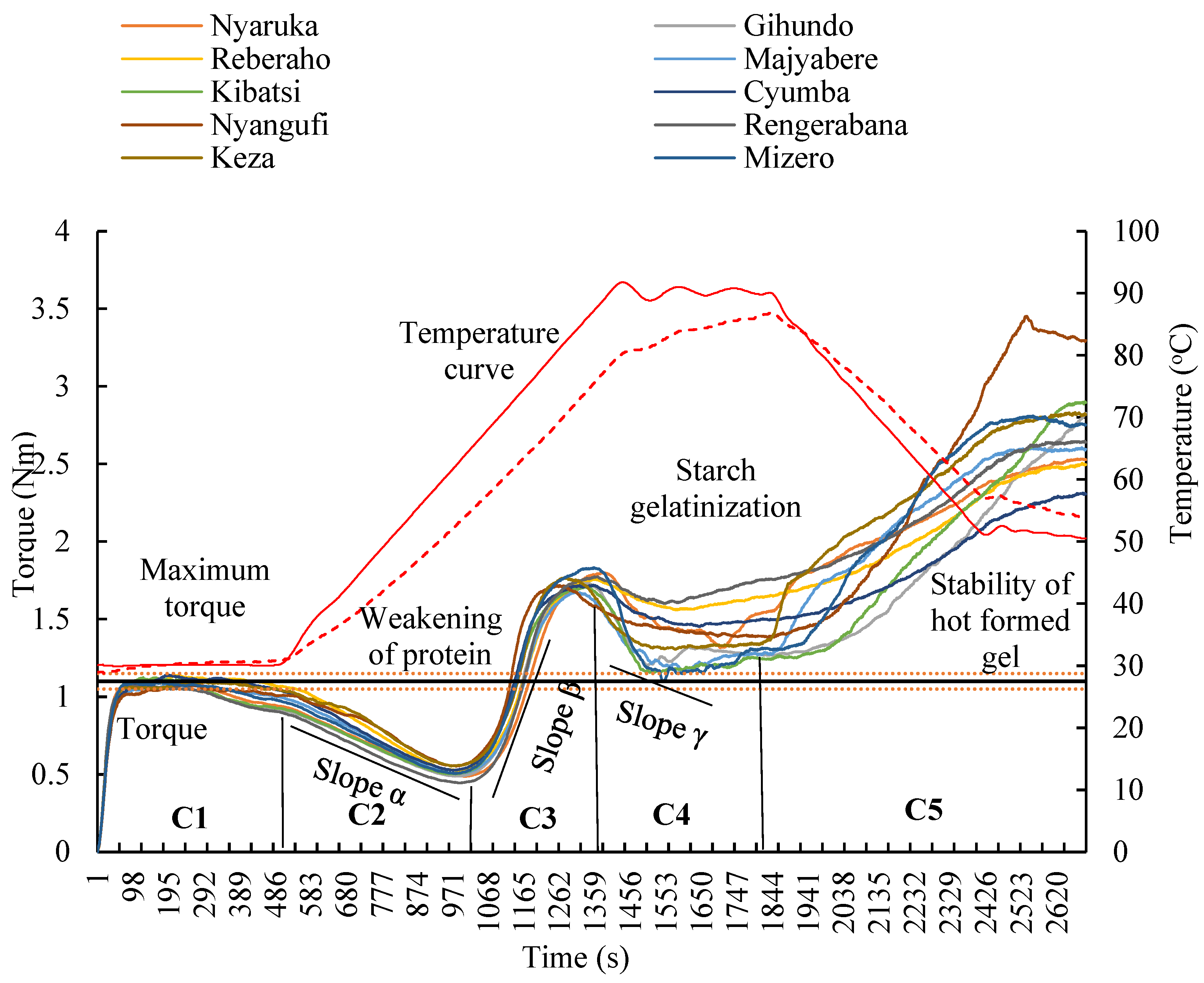
According to the ICC standard method No. 173-ICC 2011 [49], Mixolab (CHOPIN Technologies Mixolab 2, Villeneuve-la-Garenne, France) was employed to evaluate various dough physical properties, encompassing dough stability or weakening, and starch characteristics, all in a single measurement [31]. Approximately 50 g of flour was used for each test. The Mixolab instrument automatically adjusted the exact flour mass to achieve a constant dough mass, based on the flour’s moisture content and the target water absorption. The moisture content of the flour samples ranged between 8–10%. Water was added automatically by the instrument, with the volume adjusted accordingly to meet the required dough consistency. Accurate weighing and transfer of the flour into the Mixolab tray were critical, as errors could lead to calibration issues. If the instrument’s calibration curve fell outside the acceptable range, the test was repeated. This comprehensive assessment also provided insights into the rheological properties of wheat flour, including the consistency of the dough during mixing, the quality of the protein and starch, as well as the impact of enzymes. Key parameters evaluated through Mixolab analysis included stability (Stab), which reflects the resistance to dough kneading, with longer durations indicating stronger flour. Additionally, the time of C1 (TimeC1) represented dough development, while Torque C2 (TC2) indicated the attenuation of protein due to mechanical work and temperature. Torque C3 (TC3) reflected the gelatinization of starch, whereas Torque C4 (TC4) indicated the stability of the hot gel. Torque C5 (TC5) measured starch retrogradation in the cooling phase [50]. Further analysis involved evaluating slopes: Slope α evaluated the speed of protein weakening under the effect of heat between 30 °C and TC2, while Slope β calculated starch gelatinization speeds between TC2 and TC3. Slope γ represented enzymatic degradation speeds during the period of TC3 and TC4. Mixolab curves generated from wheat flour provided a comprehensive view of its rheological properties and suitability for various applications [46,51].

2.3. Statistical Analysis

All statistical analyses were conducted using the JMP Pro 14 software (SAS, Cary, NC, USA), and analysis of variance was used to assess differences among the variables. Principal component analysis (PCA) and correlation analysis were utilized to identify correlations between parameters. Furthermore, Tukey’s HSD (Honest Significant Difference) test was performed with a significance level p ≤ 0.05, to compare means and determine significant differences among the ten wheat varieties.

3. Results

3.1. Grain Yield, Thousand Kernel Weight, and Hectoliter Weight

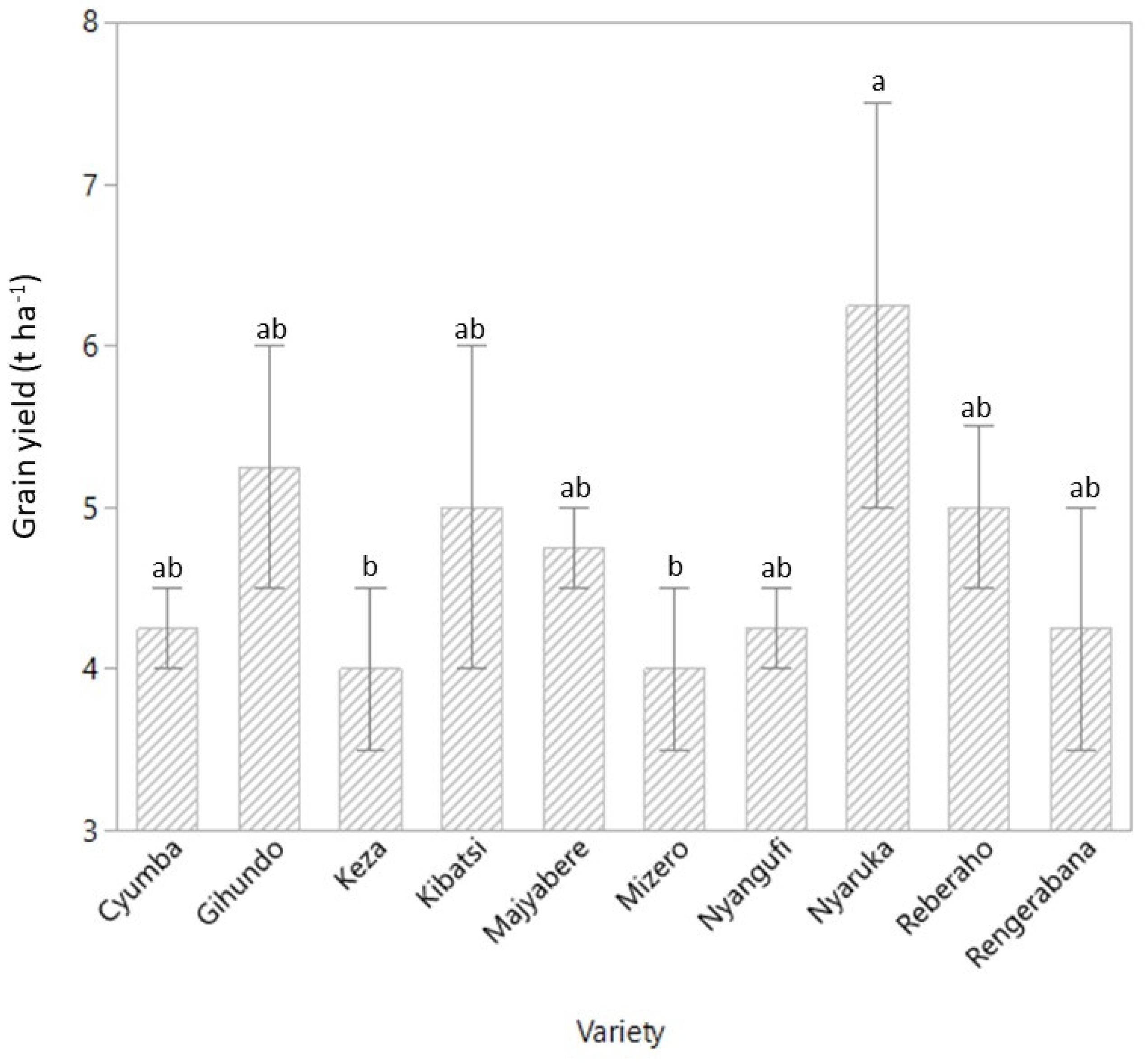
Grain yields of all wheat varieties, along with the thousand kernel weight and hectoliter weight, were recorded and summarized in Figure 3 and Table 1. Grain yield, representing the amount of harvested grain per unit area of cultivated land (ha), is a fundamental measure of wheat productivity and serves as a critical factor influencing agricultural sustainability, food supply chains, and global food security efforts. It ranged between 4.3 and 6.3 t/ha, with Nyaruka and Gihundo exhibiting high yields of 6.25 t/ha and 5.25 t/ha, respectively, while Mizero and Keza showed lower yields of 4 t/ha each. The TKW and HW are pivotal components of grain yield, not only defining improvements in yield but also influencing grain quality during the milling process. TKW ranged from 29.9 to 38.2 g, with the highest value observed in Nyangufi (38.2 g) and the lowest in Reberaho (29.9 g). HW serves as one of the metrics for wheat purchase and classification, with higher HW indicating greater amounts of dry matter and flour yield. Rengerabana (75.6 kg/hL), Cyumba, and Nyaruka exhibited comparatively lower hectoliter weight (HW) values within the range of varieties tested, whereas Gihundo (80.9 kg/hL) and others demonstrated higher HW values.

3.2. Wheat Flour Baking Quality Parameters

Detailed results of the analysis of variance and mean comparison of wheat quality are presented in Table 1. The analysis of variance for PC, WG content, GI, FN, and Zeleny test was performed with three replicates per sample. The results were significant at a p-value < 0.01 for all indices, indicating significant differences among varieties. Cyumba and Reberaho varieties had the highest PC, with 10.72% and 10.55%, respectively, while Gihundo and Nyaruka had the lowest PC, with 9.49% and 9.65%, respectively, compared to the rest of the varieties. For GC, Rengerabana and Mizero exhibited higher gluten content at 22.82% and 22.52%, respectively, while Gihundo and Majyambere showed lower values at 18.64% and 19.77%, respectively. Three varieties showed a high, but not statistically different, GI: Keza, Nyangufi, and Majyambere, with 95.46, 95.22, and 92.66, respectively, whereas Rengerabana, Gihundo, and Kibatsi showed the lowest values at 30.88, 40.15, and 43.40, respectively. The FN was higher in Gihundo at 506 s, while Keza had the lowest at 409.3 s. The ZST showed the highest value for the Nyangufi variety at 46.0 mL, while the lowest was for Gihundo at 15.7 mL.

3.3. Dough Rheology

Mixolab offered us the significant advantage of evaluating multiple characteristics of cereal flour simultaneously in a single test, covering proteins, starch, and associated enzymes (Table 2). Illustrated in Figure 4 are the various stages involved in the Mixolab analysis process [46,50].
The mean values for Time C1, stability, Torque C1, Torque C2, Torque C3, Torque C4, Torque C5, water absorption, and slope α, β, and γ for all wheat varieties are displayed in Figure 4, with statistically significant differences observed at p < 0.05. During the initial phase of Mixolab analysis, the dough development time (Time C1) served as a pivotal parameter, often referred to as the gluten formation or dough development time. This duration typically ranges from 0.99 to 7.36 min (59.4–441.6 s) for wheat. Flour with superior quality tends to exhibit an extended dough development period. The C1 parameter is primarily influenced by protein quality, starch granule size, and the degree of starch degradation. Overall, all varieties demonstrated a statistically significant difference in Time C1, ranging from 1.58 min (94.8 s) for Rengerabana to 4.77 min (286.2 s) for Keza. The torque of all varieties ranged between 0.48 Nm and 3.30 Nm. TC2 values were higher in Keza and Nyangufi at 0.55 Nm, while Nyaruka and Gihundo exhibited lower values at 0.48 Nm and 0.49 Nm, respectively. TC3 was higher in the Mizero variety at 1.83 Nm, with Kibatsi, Cyumba, and Nyangufi varieties showing the lowest values at 1.71 Nm, 1.72 Nm, and 1.72 Nm, respectively. TC4 was higher in the Rengerabana variety at 1.60 Nm, whereas Mizero showed the lowest value at 1.10 Nm. TC5 was higher in the Nyangufi variety at 3.30 Nm, while Cyumba presented the lowest value at 2.31 Nm.
Dough stability represented the dough′s resistance against mixing, which was determined by the time in minutes/seconds between C1 and a decrease in torque by 11% during the constant thermal phase. The Keza variety showed higher stability, while Gihundo and Kibatsi exhibited the lowest stability at 9.9 min (559 s), 5.6 min (336 s), and 5.4 min (324 s), respectively.
Slope α reflected the speed of protein weakening under heating between C1 and C2, and it was higher in the Nyaruka variety, while Reberaho showed the lowest value at −0.057 and −0.09, respectively. Slope β indicated the speed of starch gelatinization between C2 and C3, and it was higher in the Nyangufi variety at 0.632, while Keza and Majyambere exhibited the lowest values at 0.370 and 0.414, respectively. Slope γ represented enzymatic (α-amylase) degradation speed between C3 and C4, and it was higher in Nyaruka and Nyangufi varieties at −0.018 and −0.006, respectively, while Mizero had the lowest value at −0.380.
The amplitude responsible for dough elasticity was higher, with no statistically significant difference observed in Majyambere, Kibatsi, Nyangufi, Rengerabana, and Keza, all at 0.09 Nm, while Mizero had a lower amplitude at 0.06 Nm. Water absorption was higher in the Cyumba variety at 64%, while Nyangufi exhibited the lowest value at 58.5%.

3.4. Regression Analysis Between Yield, Quality, and Rheological Parameters

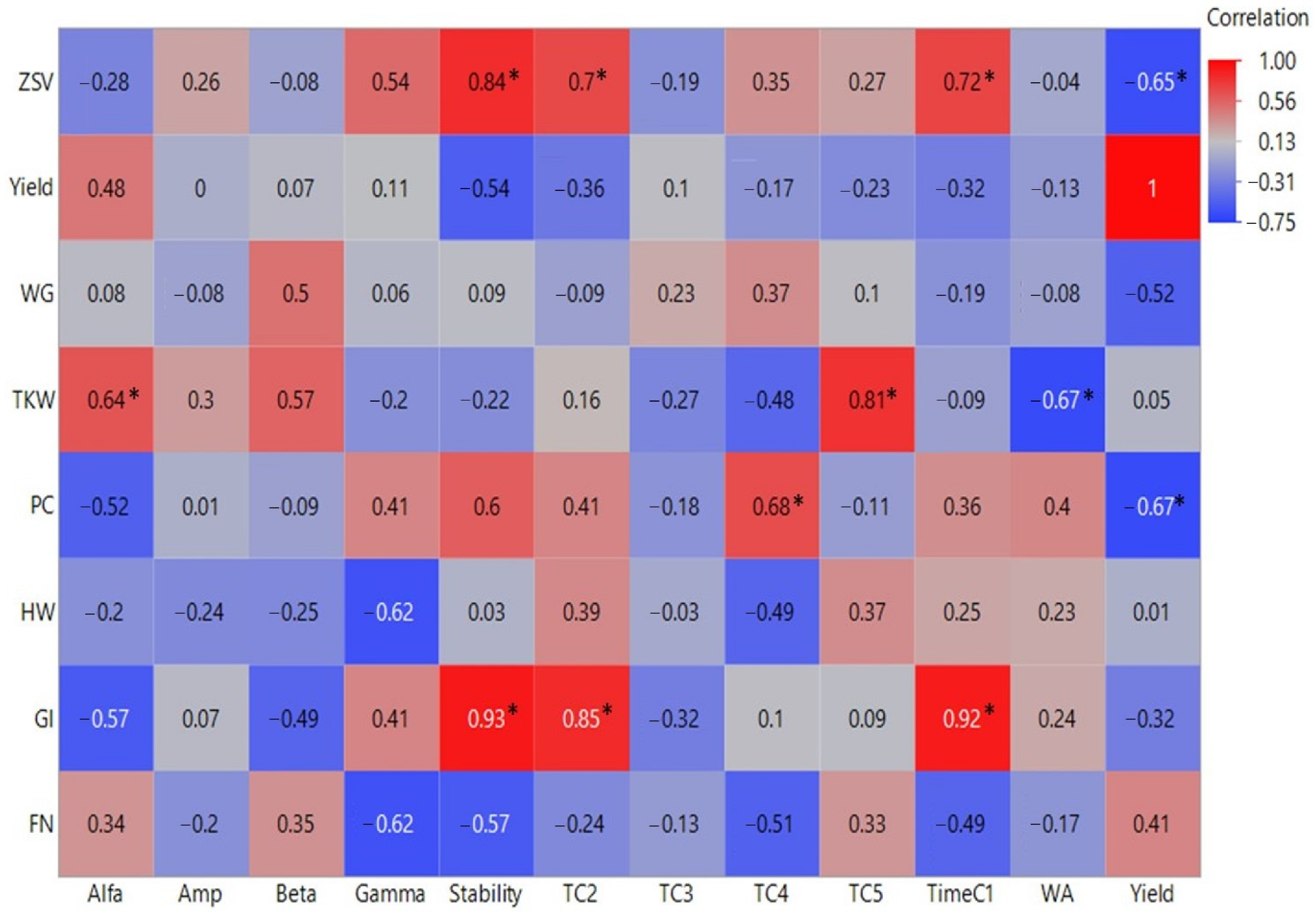
This study delved into the intricate relationships between yield, quality, and rheological parameters of wheat varieties. Through regression analysis, correlations among these factors were examined, shedding light on their interconnectedness. Additionally, correlation coefficients were calculated to understand the nuanced associations between yield, quality, and Mixolab parameters, as illustrated in Figure 5.
Negative and significant correlations were observed between yield and quality, with the exception of the falling number, suggesting that higher yielding varieties are associated with lower grain quality (p < 0.05). Specifically, the correlation coefficient between yield and PC was R = −0.67, and between yield and ZSV was R = −0.65. Interestingly, no significant correlation was found between yield and Mixolab parameters. Water absorption exhibited significantly negative correlations with thousand kernel weight (R = −0.67). Furthermore, Torque C2 demonstrated a significant positive correlation with GI (R = 0.85) and ZSV (R = 0.70). Torque C4 exhibited a significant positive correlation with PC (R = 0.68), while Torque C5 showed a positive correlation with thousand kernel weight (R = 0.81). Moreover, stability was positively and significantly correlated with GI (R = 0.93) and ZSV (R = 0.84). Time C1 displayed a positive correlation with GI (R = 0.92) and ZSV (R = 0.72). Additionally, thousand kernel weight showed a significant positive correlation with slope α (R = 0.65).

3.5. Principal Component Analysis

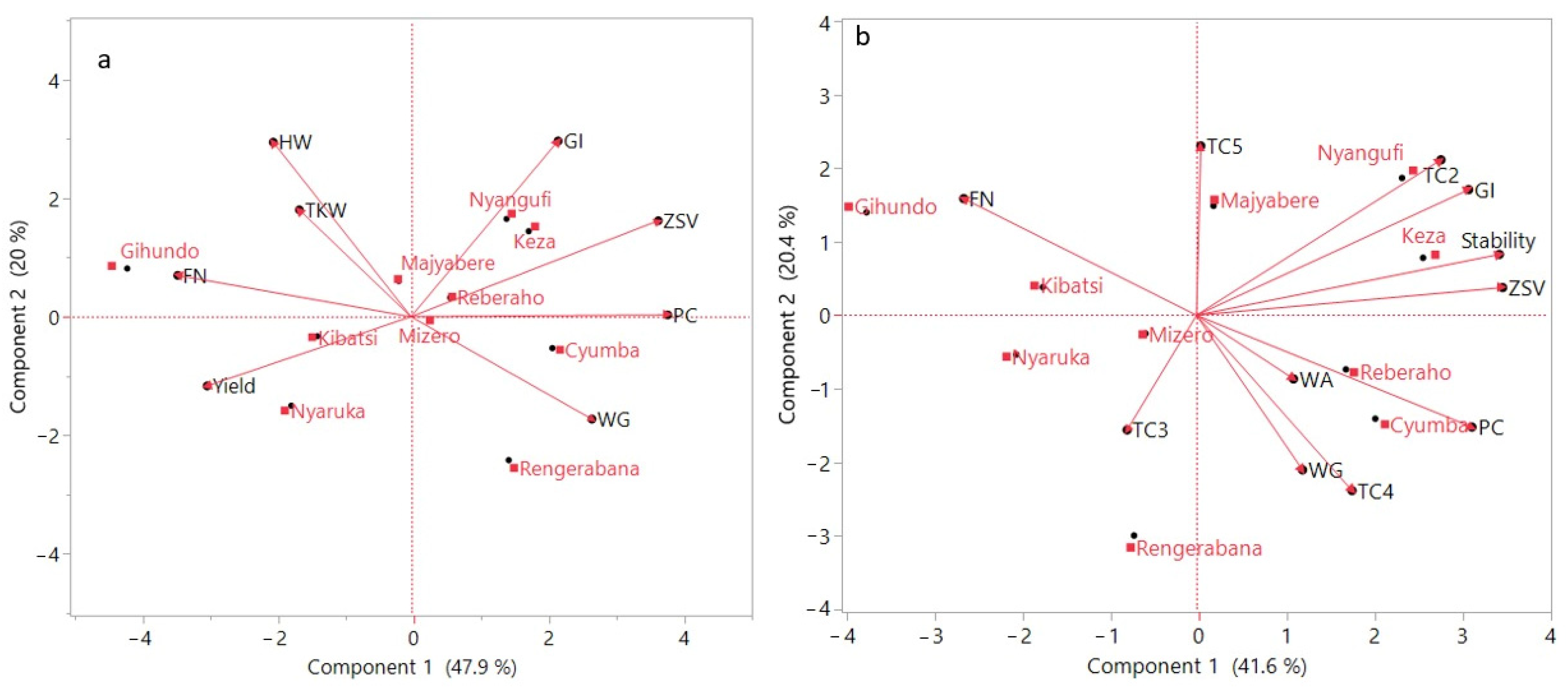
The relationships among yield, quality, and rheological properties of ten wheat varieties were also analyzed using principal component analysis (PCA), as depicted in Figure 6. Figure 6a, yield vs. grain quality PCA biplot (PC1 = 47.9%, PC2 = 20%), highlights the contrasting relationship between yield and quality traits. Grain yield is positioned on the negative side of PC1, opposite to key quality parameters such as PC, GI, ZSV, TKW, and HW. This indicates a trade-off, where high-yielding varieties (e.g., Nyaruka, Gihundo) tend to have lower grain quality attributes, while varieties such as Nyangufi, Keza, and Cyumba align positively with quality but not with yield. FN is positioned closer to Gihundo, suggesting higher enzymatic stability in this variety despite its lower PC.
Figure 6b, grain quality vs. rheological properties PCA biplot (PC1 = 41.6%, PC2 = 20.4%), illustrates associations between grain quality traits and rheological parameters measured by Mixolab. Gluten-related traits (GI, ZSV, and stability) cluster together on the positive side of PC1, indicating their strong alignment with dough strength and stability. Conversely, starch-related parameters, such as TC3, TC4, and WA, align with PC and WG, reflecting their joint influence on starch gelatinization and water absorption. Varieties such as Nyangufi and Keza are strongly associated with gluten strength and stability, whereas Cyumba and Reberaho are more closely aligned with starch-related parameters. Rengerabana, positioned negatively along PC1 and PC2, separates from other varieties due to weaker gluten and lower rheological performance.

4. Discussion

4.1. Grain Yield and Yield Components

Yield and yield components are fundamental measures of productivity and serve as critical factors influencing agricultural sustainability, food supply chains, and global food security [52,53]. The enhanced grain yield (4.3–6.3 t·ha−1) and TKW (30–50 g) found in this study can be credited to a combination of factors facilitated by the Rwanda crop intensification program (CIP). This program started in 2007 and engages various stakeholders along the agricultural value chain, such as government bodies, research institutions, extension services, input suppliers, and farmers. Through collaborative efforts, CIP promotes sustainable crop intensification in Rwanda by supporting effective management practices (e.g., Twigire Muhinzi, land use consolidation, and use of improved inputs), small-scale irrigation, research and breeding programs, and technological innovations. These efforts aim to strengthen food security, raise farmer incomes, and advance agricultural development nationwide [54,55]. These results are also in agreement with previous studies, which reported that the breeding programs and improved management practices play a key role in wheat grain yield [56,57,58,59,60,61]. The large error bars observed for Nyaruka and other cultivars reflect wide yield variability, with Nyaruka, for instance, yielding between 5000 and 7500 kg/ha. This indicates strong genotype-by-environment interactions affecting yield performance.
Moreover, TKW reflects seed size and density, which may correlate with yield potential under optimal conditions [62]. However, Zhang et al. noted that TKW alone is insufficient to predict yield robustness across environments, emphasizing the need for multi-trait selection [63]. It is an essential factor in seed certification and grading processes, where seeds with higher TKW are often considered superior in terms of vigor, germination, and overall performance. It is also used by plant breeders as a selection criterion in breeding programs to develop improved varieties with desirable traits such as high yield, disease resistance, and stress tolerance [39,64,65]. The thousand kernel weight showed highly significant variation among the studied varieties (p < 0.001), reflecting strong genetic control over grain size. Nyangufi (38.20 g) and Gihundo (36.49 g) exhibited the heaviest kernels, suggesting their potential advantage for higher grain yield and better milling performance, since larger kernels often contribute positively to flour extraction rates. By contrast, Reberaho had the lowest TKW (29.91 g), indicating smaller kernels that may reduce yield potential despite its otherwise favorable protein quality traits. Intermediate values were observed for Kibatsi (35.04 g), while Nyaruka, Majyambere, Cyumba, Rengerabana, Keza, and Mizero clustered around 32–34 g, representing moderate kernel weights. Interestingly, the varieties with higher TKW (e.g., Nyangufi, Gihundo) did not always align with the highest grain quality indices, consistent with the well-documented trade-off between yield components (such as grain size) and protein/gluten strength. Conversely, varieties like Reberaho and Keza, which performed well in quality-related traits, showed relatively lower kernel weights. This suggests that in Rwandan wheat breeding, balancing grain yield potential (through traits like TKW) with quality parameters will be critical to meeting both production and end-use requirements.
The same trend as our results has been reported in previous studies, where a significant effect (p < 0.05) of different wheat varieties on thousand kernel weight was observed [29,66,67,68,69].
Hectoliter weight as an indicator of grain density or bulkiness can vary based on factors such as seed size, shape, moisture content, variety, market preferences, region, and intended use [70]. Our results, which demonstrated an optimal hectoliter weight range of 75.60–80.7 kg/hL−1, suggest a good grain quality suitable for diverse end uses including milling, baking, and food processing [38], although this can’t be based on one parameter. According to previous studies, the HW variation among cultivars likely reflects genetic differences in kernel morphology, filling efficiency, and environmental interactions. For example, in a multi-environment trial of 25 bread wheat genotypes, HW ranged from ~76.5 to 80.4 kg/hL, and the genotype × environment (G × E) interaction accounted for a significant portion of HW variance (13.7%) beyond genotype and environmental main effects [71]. In another wheat research under irrigated conditions, HW among genotypes varied from 66.95 to 76.80 kg/hL, highlighting the broad genetic potential for HW variation [72]. Moreover, agronomic factors influence the HW as in the Arsi wheat trials, HW was significantly influenced by N fertilizer rates, locations, varieties, and their interactions, with the highest HW of 83.4 kg/hL recorded under high N in favorable conditions [73].
High hectoliter weight indicates denser and heavier grains, which are desirable qualities in terms of processing and storage, and as they occupy less volume for a given weight, it makes them more efficient to handle and transport. In the grain trade, HW is often used as a quality parameter and pricing factor [74]. Grains with higher HW typically command better prices in the market due to their superior quality and handling characteristics. Farmers use HW measurements to assess the quality of their grain harvest and to make decisions regarding storage, marketing, and sale of their produce [75]. Thus, our observed differences in HW among cultivars may stem not only from genetic variation and environmental responses (e.g., fertilizer, water) but also from kernel geometry and packing behavior. While our optimal HW range (75.60–80.70 kg/hL) is within or above ranges reported in several wheat studies, the direct comparison must take into account species, growth conditions, and cultivar sets [38,70,75]. Nevertheless, this breadth of literature supports the idea that HW differences are meaningful and interpretable in the context of grain quality evaluation.

4.2. Baking Quality Parameters

Baking quality parameters are essential for assessing the suitability of wheat varieties for different baking applications and determining their overall end-use quality [76,77]. In this study, we evaluated several key indicators of baking performance. PC was assessed due to its critical role in influencing dough strength and baking characteristics. WG and GI were measured to evaluate the quantity and quality of gluten, which are important for dough elasticity, extensibility, and gas retention during baking [29]. The FN test was used to estimate starch gelatinization and enzyme (α-amylase) activity, both of which affect flour quality and dough stability [46]. Lastly, the ZSV was measured as an indicator of gluten strength and flour quality, based on the sedimentation rate of gluten particles in a lactic acid suspension [47,78].
One of the primary goals of modern agriculture is to achieve a satisfactory yield while maintaining high-quality, with PC being a crucial trait. Genetic factors predominantly control these traits, but environmental conditions during development, such as soil composition, weather patterns, and agricultural practices like fertilization, can also influence their expression [79,80]. The PC in wheat plays a crucial nutritional role and determines the quality of baked products. Various studies have suggested an optimal protein content range of 7–11% for cakes and pastries production, while at least 12% is considered ideal for high-volume pan breads and speciality breads [81,82,83]. Our results indicate that all examined varieties exhibited PC ranging from 9.49% to 10.72%, which is considered relatively low for bread-making applications that require strong gluten development and a chewy texture, such as traditional bread and rolls [83]. However, this protein level is adequate for baked products that benefit from a softer, more delicate crumb structure, including cakes, biscuits, and certain pastries. Generally, higher PC, along with favorable protein composition, supports stronger gluten formation, which contributes to dough elasticity and bread volume. Nevertheless, excessively high protein levels can lead to overly firm or chewy textures, which may be undesirable in some bakery products [84,85]. In most scenarios, a significant portion of PC comprises continuous proteins responsible for gluten formation. This network imparts distinctive properties to wheat dough, enabling it to be transformed into various products such as bread, noodles, spaghetti, cakes, and biscuits [86].
In addition, GI plays a significant role in dough elasticity and gas retention during baking. It determines the ability of the gluten proteins in the flour to form a cohesive network when mixed with water, thereby contributing to the volume, structure, and texture of the final product [87,88]. In our evaluation of various wheat varieties, we found that the GI ranged between 30.88 and 95.46. Comparing these results to the reported ideal ranges from previous studies (weak: GI < 30%, normal: GI = 30–80%, and strong: GI > 80%), our findings indicate a normal to strong gluten quality across the evaluated varieties [89,90], indicating better gluten quality, leading to improved dough elasticity and gas retention during fermentation and baking processes [91].
Moreover, our evaluation revealed a low WG, a portion of gluten in wheat flour that remains after the starch has been washed away, impacting the dough strength and elasticity. It ranged from 18.64% to 22.82%, while previous studies reported that the ideal WG for bread-making should fall between 28% and 35% [92]. This, unlike the GI, compromises the quality of evaluated varieties, as higher WG content is associated with better dough strength and elasticity, crucial factors for producing high-quality bread [93,94]. Discrepancies in wheat grain WG and GI have been documented in several studies. For instance, Mitura et al. [60] report significant genotype × farming system effects on WG and GI, with conventional fertilization boosting WG but in some cases reducing GI, suggestive of an inverse relationship between gluten quantity and strength. The production-technology trial by Sulek and Cacak-Pietrzak [95] demonstrates that the response of WG and GI to inputs varies by cultivar, and Tran et al. [96] show cases where higher WG did not translate into higher GI in certain environments. Other works, such as studies on tillage and fertilizer management [97] and the environment- and genotype-dependent stability in common wheat grain quality [98], further confirm that higher WG does not always correspond to higher GI, reinforcing the complex and sometimes nonlinear relationship between gluten quantity and quality.
Furthermore, protein complex quality and enzyme activity are crucial parameters in wheat grain processing, as enzyme activity, measured through the FN test, impacts the milling quality of wheat grain [99]. The FN test assesses the activity of amylolytic enzymes, which are essential for dough fermentation and flour quality [100,101]. Results of our study ranged from 409.3 to 506.0 s, compared to the reported ideal range of 250–350 s, indicating little enzyme activity, minimal sprouting and that our wheat varieties’ flour should be supplemented with a form of amylolytic enzyme or with malted grain flours [102]. It was reported that a FN below 250 s indicates low enzyme activity and may lead to sticky dough, while a number above 350 s suggests excessive starch damage and poor dough fermentation [103]. A longer time for the plunger to fall suggests a higher falling number, indicating less enzymatic activity and better starch preservation [99]. The FN value is influenced by various factors such as weather conditions, cultivar, grain storage, and fertilizer application rates [29,104]. The results of our study show clearly that the FN, an indicator of α-amylase activity, was significantly influenced by cultivar, as indicated by the results of prior studies [60,95,96]. For instance, cultivars like Gihundo exhibited FN values above 500 s, suggesting very low α-amylase activity, which could result in overly dry or stiff doughs during baking. In contrast, cultivars with relatively lower FN values, while still above the optimal range, may perform better in fermentation without the need for additives. These findings have practical implications for milling and baking industries: cultivars with excessively high FN values may require enzyme supplementation to achieve desirable bread quality. The results also suggest that selecting cultivars with moderate FN values could optimize processing efficiency without compromising product quality. Environmental factors such as drought stress or late harvest could also have contributed to enzyme inactivity, but cultivar genetics appear to be a dominant influence in our data.
Another important baking quality parameter is the Zeleny Sedimentation test, used to assess gluten quality and quantity for wheat genotypes [105]. It was performed to assess gluten strength and flour quality based on the sedimentation rate of gluten particles in a suspension [106], and the findings provided valuable information about gluten quantity and quality, which in turn influenced dough strength, gas retention, and bread volume [107]. Our results revealed a range of 15.7–46.0 mL across all varieties, compared to the reported ideal range of 20–50 mL in wheat [108]. With high sedimentation numbers indicating stronger gluten and better flour quality for superior baking performance, most of our varieties showed a good sedimentation value (25–36 mL), while a few exhibited moderate gluten quality (15–24 mL), and none had poor gluten quality with sedimentation values of less than 15 mL [109,110]. It should be added that in previous studies investigating different wheat cultivars, the ZSV has been singled out as the best predictor of bread-baking potential and strength, especially for hard wheat varieties [96,105,111]. The significant variation in Zeleny sedimentation values among evaluated cultivars suggests genetic differences in gluten strength and composition. For example, cultivars such as Keza and Nyangufi exhibited the highest sedimentation values (above 40 mL), indicating strong gluten networks and high suitability for breadmaking. In contrast, cultivars like Gihundo had moderate values (15–24 mL), suggesting weaker gluten quality and potentially reduced baking performance. These differences may be attributed to variations in PC, protein composition (especially gliadin-to-glutenin ratio), or responsiveness to environmental factors such as nitrogen availability or drought stress during grain filling [112,113,114,115].
The observed range indicates that while most cultivars are acceptable for breadmaking, only a few possess the strong gluten characteristics desirable for high-volume, high-quality loaves. This variability highlights the importance of selecting cultivars with consistently high sedimentation values for breeding programs aimed at improving wheat processing quality. Furthermore, it underscores the value of the Zeleny sedimentation test as a practical tool for predicting baking performance in hard wheat types [116].

4.3. Rheological Properties

Parameters like dough elasticity, extensibility, viscosity, and resistance to deformation are crucial for understanding the rheological properties of dough [76,117]. These properties are influenced by various factors, including PC, gluten strength, hydration levels, and the presence of other components such as starch and lipids [118,119,120]. Our Mixolab analysis results demonstrated a statistically significant difference (p < 0.05) in Time C1, ranging from 1.58 min (94.8 s) for Rengerabana to 4.77 min (286.2 s) for Keza across all varieties. This duration typically ranges from 0.99 to 7.36 min (59.4–441.6 s) for wheat varieties, with flour of superior quality tending to exhibit an extended dough development period. Our results indicate that our varieties are of low to medium quality, and this can be attributed primarily to protein quality, starch granule size, and the degree of starch degradation [47,57]. It was also reported that the behaviour of dough during mixing and heating is also closely linked to the composition of High Molecular Weight Glutenin Subunits (HMW-GS), which are major determinants of gluten strength [121,122]. Among these, the 5 + 10 subunit combination, encoded at the Glu-D1 locus, is strongly associated with superior baking quality and stronger gluten networks. In contrast, the 2 + 12 combination is generally linked to weaker gluten and reduced dough strength [123]. These differences in HMW-GS composition can influence parameters such as dough development time, stability, and protein weakening (C2) during Mixolab analysis [32]. Therefore, the rheological differences observed among the wheat varieties in this study may partly be attributed to variations in their HMW-GS profiles. Unfortunately, HMW-GS composition was not directly determined in this study, but future work should include it to better link genetic and functional wheat quality traits. However, indirect indicators of gluten strength, such as the GI and ZSV used in this study, offer supporting information, reflecting the potential effect of HMW-GS variation on functional dough properties.
Further Mixolab analysis indicated a torque range of between 0.48 Nm (TC2) and 3.30 Nm (TC5). There was a remarkable rise in torque during initial mixing (C1), which reduced during the continuous mixing stage (C2) due to heating, reduction in dough consistency, and protein weakening. Subsequently, torque increased during heating due to starch gelatinization (C3), decreased afterwards due to the stability of the formed hot gel (C4), and increased again due to starch retrogradation during the cooling phase (C5), indicating the end of the test (Figure 4). It reflects the extent of starch gelatinization and is influenced by the amylose-to-amylopectin ratio, starch granule integrity, and the presence of competing components such as lipids and proteins [124,125]. A higher C3 value generally indicates a strong water-binding capacity and a higher degree of starch swelling [126]. The breakdown viscosity, defined as the difference between C3 and C4, indicates the stability of the starch paste under mechanical and thermal stress. A large breakdown suggests weaker paste stability, which can be detrimental in baking applications requiring structure retention [57,78]. The final viscosity (C5) represents starch retrogradation during cooling, reflecting the tendency of amylose molecules to reassociate and form a gel-like network. This is important for predicting crumb firmness, shelf-life, and textural attributes of baked products. These starch-related parameters are influenced by both starch structure and processing conditions, as also discussed in recent work by [127].
The quantity of water required by the dough to reach an optimum torque of 1.1 Nm (C1) during initial mixing in Mixolab, known as water absorption [128], was statistically different and higher in Cyumba and Reberaho (64% each), while Nyangufi absorbed less (58.5%). These observed differences in water absorption among the wheat varieties can be attributed, in part, to variations in gluten content and damaged starch content [129]. Higher gluten content typically increases water absorption due to the water-binding capacity of gluten-forming proteins. Similarly, damaged starch, which is more reactive and porous than intact starch granules, can significantly enhance water uptake during dough mixing. Although damaged starch was not directly measured in this study, it is known to influence Mixolab water absorption results and may explain part of the variation observed across varieties [130]. The combined effect of gluten and starch characteristics thus plays a crucial role in determining water absorption capacity and dough handling properties. Our results indicate that C2 resisted mixing, while C5, C4, and C3 demonstrated retrogradation of starch, stability of gelatinized starch granules, and starch gelatinization, respectively, which align with previous studies [29,131].
These results can also be explained by the variations observed in slopes, where slope α, reflecting the speed of protein weakening under heating between C1 and C2, was negative for all varieties. The slope β, indicating the speed of starch gelatinization between C2 and C3, was positive and higher than slope α, while the slope γ, representing enzymatic (α-amylase) degradation speed between C3 and C4, was negative and lower than slope β. This can further be explained by the dough stability (indicating the time in seconds between C1 and a decrease in torque by 11% during the constant thermal phase), representing the dough′s resistance against mixing [132], and the amplitude, responsible for dough elasticity [46,76]. Observation of C1 and C2 could be related to protein quality, while C5, C4, and C3 can be related to starch characteristics [31,128]. As the temperature of the dough increased, weakening of proteins occurred, leading to a decrease in torque until C2. The results clearly show that C2 marked the start of pasting of dough, with the varieties with the highest C2 most of the time having less protein weakening, while varieties with a lower C2 value are known to have higher weakening of the gluten protein network during simultaneous mixing and heating [76,133].
Previous studies have demonstrated that Mixolab parameters vary significantly across wheat cultivars, largely due to genetic differences and environmental interactions. For instance, Lacko-Bartošová et al. [76] found that cropping systems influenced dough stability and starch gelatinization, though protein weakening (C2) remained stable, unlike in our study, where cultivar differences notably affected C2. Similarly, Hoang et al. [57] showed that wheat mixtures altered rheological behavior, with cultivar combinations exhibiting distinct torque profiles. Papoušková et al. [134] reported that biotic stress (Fusarium contamination) affected both protein and starch-related parameters, amplifying varietal differences under stress. They showed that under fungal contamination, both protein (C2) and starch (C3–C5) parts of the Mixolab curves are clearly affected, and that Mixolab parameters correlated well with standard quality traits (protein, gluten, falling number). Banu et al. [135] further confirmed that specific cultivars display unique Mixolab profiles, which correlate with baking performance. They established correlations between Mixolab parameters (especially β slope, C2, C3, and C4) and bread volume and baking performance, showing that the Mixolab parameters are meaningful predictors of end quality.
The observed differences in Mixolab parameters among the ten wheat cultivars primarily reflect genetic variability in protein composition, starch characteristics, and their interaction during dough formation. Varieties such as Keza and Cyumba, which exhibited longer dough development times and higher water absorption, likely possess stronger gluten networks and greater hydration capacity, contributing to more stable dough. Conversely, cultivars such as Rengerabana and Nyangufi, characterized by shorter development times and lower torque values, indicate weaker gluten matrices and faster protein weakening under heat and mechanical stress. These functional differences suggest that each variety expresses a unique balance between protein quality and starch functionality, which ultimately determines its suitability for specific end uses. For example, varieties with higher stability and lower C2 values may be better suited for bread making, while those with higher C3 and C5 values may perform better in products requiring greater starch gelatinization and retrogradation stability. Overall, these findings demonstrate that the rheological diversity observed among Rwandan wheat cultivars is genetically driven and offers valuable opportunities for targeted breeding and selection of varieties adapted to specific processing and baking requirements.

4.4. Regression Analysis of Yield, Quality, and Rheological Parameters

The relationship between yield, quality, and Mixolab parameters among the studied wheat varieties was investigated. The significant negative correlations observed between yield and grain quality, except for the FN, suggest that higher-yielding varieties are associated with lower grain quality. These results are consistent with previous studies [29,47,96], which reported a negative correlation between grain yield and grain quality. Specifically, the correlation coefficient between yield and PC was R = −0.67, and between yield and ZSV was R = −0.65. While increasing wheat grain yield and PC is an important goal in wheat production, improving both qualities and quantity simultaneously has proven difficult, probably due to several factors, including genetic tradeoffs, complexity of traits, environmental influences, breeding priorities, and technological limitations [136,137]. Mitura et al. [60] reported a low yield but high PC and WG, regardless of the wheat cultivars planted in different conditions, while Singh et al. [133] found a positive correlation between TC2 and protein quality, whereas TC5, TC4, and TC3 were related to starch properties. This suggests that flour strong in gluten or glutenin has a higher TC2, as even the ZSV and GI have been linked to gluten and glutenin levels. In this study, PC was positively correlated with TC4, which is different from the findings of Hoang et al. [29], who reported a negative correlation between PC and TC3, TC4, and TC5. Furthermore, GI demonstrated a significant positive correlation with TC2 (R = 0.85), Stability (R = 0.93), and Time C1 (R = 0.92), and ZSV correlated with TC2 (R = 0.70), stability (R = 0.84), and Time C1 (R = 0.72), respectively. This indicates a positive effect of GI and ZSV on dough consistency, stability, protein weakening, gluten formation, and dough development [29,47]. Water absorption exhibited significantly negative correlations with thousand kernel weight (R = −0.67), slope α (R = −0.77), and slope β (R = −0.65), which can be attributed to the proportion of damaged starch content [133]. Additionally, TKW showed a significant positive correlation with slope α (R = 0.65). The TKW was found to be linked to both the yield and quality of the resulting flour, affecting its color and ash content [100]. Studies on correlation analysis and principal component analysis of wheat grain yield and yield components often exhibit substantially varied findings, which have been attributable to several factors such as genotypes and environmental conditions [138,139,140]. Practically many prior research showed a positive link between yield and yield components, such as grain yield and TKW [29,141]; however, the correlation between grain yield and TKW was not found in some of these study.
Lastly, principal component analysis revealed that although most varieties displayed high yields and correlated yield components, these parameters were not always conducive to ideal bread-baking qualities. In our study, the correlation patterns differ somewhat from those reported in previous works. For example, Lacko-Bartošová et al. [125] found strong positive correlations between Zeleny sedimentation and Mixolab indicators of protein weakening and starch behavior (difference C1–C2, slope α), and between FN and C3–C5 parameters. Similarly, Öztürk et al. [124] reported that Mixolab stability was highly correlated with protein, WG, and Zeleny sedimentation values, and that Mixolab C3 & C4 correlated with cookie quality traits. In contrast, our correlations between yield and quality are weaker, possibly due to differences in cultivar genetic background, adaptability, or the range of PC in our sample set. These differences matter, for wheat breeding programs, traits that show consistent and strong correlations across multiple studies (e.g., Zeleny with process-quality parameters) are more reliable selection targets. For the baking industry, understanding which trait combinations (e.g., high Zeleny + moderate FN + favorable Mixolab C parameters) lead to the best end product quality will help in cultivar choice, supplementation strategies, or choosing blending/flour mixing practices.
We can argue that the quality attributes of Rwandan wheat varieties align closely with international breeding goals, particularly those set by CIMMYT, which emphasize traits such as high gluten strength, dough stability, and consistent baking performance [142]. Notably, the strong GI values observed in this study reflect a probable good bread-making potential and are consistent with CIMMYT’s focus on improving wheat end-use quality [143]. Additionally, the favorable Mixolab stability parameters suggest that these varieties can maintain their functional quality under varying thermal and mechanical conditions, a trait considered critical in breeding programs targeting climate resilience [144]. When compared to other African varieties, similar technological quality traits have been reported in high-performing Ethiopian and Kenyan cultivars such as Kakaba and Robin, particularly in terms of GI and Zeleny sedimentation values [145,146]. This regional consistency underscores the potential for collaborative breeding initiatives across East Africa aimed at improving both quality and adaptability. However, some Rwandan varieties displayed relatively lower falling numbers, indicating a susceptibility to pre-harvest sprouting, especially when compared to cultivars bred in drier agro-ecologies [147,148]. This highlights the importance of integrating traits related to post-maturity grain quality and disease resistance in future breeding strategies tailored to the East African highlands [149]. While our findings are promising, it is important to acknowledge that quality traits can be significantly influenced by environmental variability, reinforcing the need for continuous research and adaptive breeding approaches to ensure stability across growing conditions.

5. Conclusions

The comprehensive assessment of Rwanda’s 10 common commercial wheat varieties′ performance, encompassing grain yield, quality parameters, and rheological properties, provided valuable insights into their overall suitability for diverse agricultural and food processing contexts. The results underscore the multifaceted nature of wheat productivity and quality, which is mostly determined by varietal characteristics. It was evident from the analysis that grain yield, a critical determinant of agricultural sustainability and food security, varied significantly among the studied varieties. Nyaruka and Gihundo emerge as notable performers in terms of grain yield, demonstrating the potential for high productivity. However, it is essential to consider grain quality alongside yield, as highlighted by the negative correlations observed between yield and certain quality parameters, particularly protein and gluten content. Varieties such as Cyumba and Reberaho exhibit superior PC, GI, and other quality attributes, albeit with slightly lower yields, emphasizing the importance of balancing yield with quality considerations.
Furthermore, the rheological properties assessed through Mixolab analysis shed light on the functional characteristics of wheat flour, crucial for various food processing applications, particularly baking. Varieties like Keza and Nyangufi display favorable rheological profiles, characterized by optimal dough development times and torque values, indicative of desirable baking qualities.
The Principal Component Analysis underscores the complex interplay between yield, quality, and rheological properties, revealing distinct patterns among the wheat varieties. While certain varieties excel in specific traits, the PCA highlights trade-offs between yield and quality, necessitating a nuanced approach in variety selection based on specific production and end-use requirements.
Therefore, a holistic understanding of wheat performance, integrating yield, quality, and rheological characteristics, is indispensable for informed decision-making in breeding programs, agricultural practices, and food processing industries. By embracing diversity and considering the multifaceted aspects of wheat performance, stakeholders can foster resilience, sustainability, and inclusivity across the wheat value chain. We recommend further evaluation of the efficiency of all studied wheat cultivars in diverse growing seasons and agroecological locations, with varying inputs, particularly nitrogen levels. Blending practices to enhance flour quality and the addition of enzymes like α-amylase during bread making are encouraged strategies. Additionally, prioritizing breeding programs that target both grain yield and quality is essential for advancing wheat cultivation and meeting diverse market demands, with particular emphasis on the role of solvent retention capacities (SRCs) and the prediction of high-molecular-weight glutenin subunit (HMW-GS) allelic composition and farinographic dough behavior.

Author Contributions

Conceptualization, Y.T.M. and T.N.H.; Data curation, Y.T.M., T.N.H., I.H., M.N., P.B., P.M., J.U., R.B., M.G.N. and D.K.T.; Formal analysis, Y.T.M. and T.N.H.; Funding acquisition, P.K.; Investigation, Y.T.M., T.N.H., I.H., M.N., P.B., P.M. and R.B.; Methodology, Y.T.M. and T.N.H.; Project administration, I.H.; Software, T.N.H.; Supervision, P.K.; Validation, P.K.; Visualization, P.K., P.B., P.M., J.U., M.G.N. and D.K.T.; Writing—original draft, Y.T.M. and T.N.H.; Writing—review & editing, Y.T.M. All authors have read and agreed to the published version of the manuscript.

Funding

This study was supported by the University of South Bohemia in České Budějovice (GAJU 085/2022/Z).

Institutional Review Board Statement

Not applicable.

Data Availability Statement

The raw data supporting the conclusions of this article will be made available by the authors on request.

Conflicts of Interest

The authors declare no conflicts of interest.

References

  1. Levy, A.A.; Feldman, M. Evolution and Origin of Bread Wheat. Plant Cell 2022, 34, 2549–2567. [Google Scholar] [CrossRef]
  2. Anjum, F.M.; Ahmad, I.; Butt, M.S.; Sheikh, M.A.; Pasha, I. Amino Acid Composition of Spring Wheats and Losses of Lysine during Chapati Baking. J. Food Compos. Anal. 2005, 18, 523–532. [Google Scholar] [CrossRef]
  3. Shewry, P.R.; Hey, S.J. The Contribution of Wheat to Human Diet and Health. Food Energy Secur. 2015, 4, 178–202. [Google Scholar] [CrossRef]
  4. Shiferaw, B.; Smale, M.; Braun, H.-J.; Duveiller, E.; Reynolds, M.; Muricho, G. Crops That Feed the World 10. Past Successes and Future Challenges to the Role Played by Wheat in Global Food Security. Food Sec. 2013, 5, 291–317. [Google Scholar] [CrossRef]
  5. Siddiqi, R.A.; Singh, T.P.; Rani, M.; Sogi, D.S.; Bhat, M.A. Diversity in Grain, Flour, Amino Acid Composition, Protein Profiling, and Proportion of Total Flour Proteins of Different Wheat Cultivars of North India. Front. Nutr. 2020, 7, 141. [Google Scholar] [CrossRef]
  6. Curtis, B.C.; Rajaram, S.; Gómez Macpherson, H. Food and Agriculture Organization of the United Nations (Eds.) Bread Wheat: Improvement and Production. In Plant Production and Protection Series; Food and Agriculture Organization of the United Nations: Rome, Italy, 2002; ISBN 978-92-5-104809-2. [Google Scholar]
  7. De Sousa, T.; Ribeiro, M.; Sabença, C.; Igrejas, G. The 10,000-Year Success Story of Wheat! Foods 2021, 10, 2124. [Google Scholar] [CrossRef]
  8. Guo, X.; Zhang, P.; Yue, Y. Prediction of Global Wheat Cultivation Distribution under Climate Change and Socioeconomic Development. Sci. Total Environ. 2024, 919, 170481. [Google Scholar] [CrossRef] [PubMed]
  9. FAO. Crops and Livestock Products; Food and Agriculture Organization: Rome, Italy, 2023. [Google Scholar]
  10. USDA. USDA Wheat Outlook: Economic Research Service; WHS-25f 2025; USDA: Washington, DC, USA, 2025.
  11. IGC International Grains Council. IGC International Grains Council Raises Global Wheat Production Forecast to 811 Mln Tons; IGC International Grains Council: London, UK, 2025.
  12. Awika, J.M. Major Cereal Grains Production and Use around the World. In ACS Symposium Series; Awika, J.M., Piironen, V., Bean, S., Eds.; American Chemical Society: Washington, DC, USA, 2011; Volume 1089, pp. 1–13. ISBN 978-0-8412-2636-4. [Google Scholar]
  13. Erenstein, O.; Jaleta, M.; Mottaleb, K.A.; Sonder, K.; Donovan, J.; Braun, H.-J. Global Trends in Wheat Production, Consumption and Trade. In Wheat Improvement; Reynolds, M.P., Braun, H.-J., Eds.; Springer International Publishing: Cham, Switzerland, 2022; pp. 47–66. ISBN 978-3-030-90672-6. [Google Scholar]
  14. Ojha, S.; Karki, L.B. Forecasting Global Wheat Price in the Context of Changing Climate and Market Dynamics: An Application of SARIMA Modeling Technique. Am. J. Appl. Stat. Econ. 2025, 4, 1–11. [Google Scholar] [CrossRef]
  15. Sánchez, P.A. Tripling Crop Yields in Tropical Africa. Nat. Geosci. 2010, 3, 299–300. [Google Scholar] [CrossRef]
  16. Ray, D.K.; Mueller, N.D.; West, P.C.; Foley, J.A. Yield Trends Are Insufficient to Double Global Crop Production by 2050. PLoS ONE 2013, 8, e66428. [Google Scholar] [CrossRef] [PubMed]
  17. Mason, N.M.; Jayne, T.S.; Shiferaw, B.A.; Mason, N.M.; Jayne, T.S.; Shiferaw, B.A. Wheat Consumption in Sub-Saharan Africa: Trends, Drivers, and Policy Implications; Department of Agricultural, Food, and Resource Economics, Department of Economics, Michigan State University: East Lansing, MI, USA, 2012. [Google Scholar] [CrossRef]
  18. Bertassello, L.; Winters, P.; Müller, M.F. Access to Global Wheat Reserves Determines Country-Level Vulnerability to Conflict-Induced Ukrainian Wheat Supply Disruption. Nat. Food 2023, 4, 673–676. [Google Scholar] [CrossRef]
  19. World Bank. Future Drivers of Growth in Rwanda: Innovation, Integration, Agglomeration, and Competition; The World Bank: Washington, DC, USA, 2020; ISBN 978-1-4648-1280-4. [Google Scholar]
  20. Floride, M. Effect of Different Doses of Organic Fertilizers on Growth Characteristics and Yield of Wheat (Triticum aestivum). Diploma Thesis, Faculty of Agriculture, Busogo, Rwanda, 2006. [Google Scholar] [CrossRef]
  21. Knoema Corporation. Rwanda—Wheat Production Quantity. In The Wheat Production in Rwanda; Knoema Corporation: New York, NY, USA, 2024. [Google Scholar]
  22. Verhofstadt, E.; Maertens, M. Smallholder Cooperatives and Agricultural Performance in Rwanda: Do Organizational Differences Matter? Agric. Econ. 2014, 45, 39–52. [Google Scholar] [CrossRef]
  23. Cyamweshi, A.R.; Nabahungu, N.L.; Mirali, J.C.; Kihara, J.; Oduor, G.; Rware, H.; Sileshi, G.W. Sustainable Intensification of Wheat Production under Smallholder Farming Systems in Burera, Musanze and Nyamagabe Districts of Rwanda. Ex. Agric. 2022, 58, e20. [Google Scholar] [CrossRef]
  24. MINAGRI. MINAGRI Annual Report 2023/2024; MINAGRI: Kigali, Rwanda, 2024.
  25. National Institute of Statistics of Rwanda. Rwanda Statistical Yearbook; National Institute of Statistics of Rwanda: Kigali, Rwanda, 2019.
  26. Baudron, F.; Ndoli, A.; Habarurema, I.; Silva, J.V. How to Increase the Productivity and Profitability of Smallholder Rainfed Wheat in the Eastern African Highlands? Northern Rwanda as a Case Study. Field Crops Res. 2019, 236, 121–131. [Google Scholar] [CrossRef]
  27. Ndushabandi, E.N.S.; Rutayisire, C.; Mwangi, L.; Bizimana, V. Crop Intensification Program (CIP): Citizen’s Satisfaction Survey-2018; Institute of Research and Dialogue for Peace: Kigali, Rwanda, 2018. [Google Scholar]
  28. Popkin, B.M. Urbanization, Lifestyle Changes and the Nutrition Transition. World Dev. 1999, 27, 1905–1916. [Google Scholar] [CrossRef]
  29. Hoang, T.N.; Konvalina, P.; Kopecký, M.; Ghorbani, M.; Amirahmadi, E.; Bernas, J.; Ali, S.; Nguyen, T.G.; Murindangabo, Y.T.; Tran, D.K.; et al. Assessing Grain Yield and Achieving Enhanced Quality in Organic Farming: Efficiency of Winter Wheat Mixtures System. Agriculture 2023, 13, 937. [Google Scholar] [CrossRef]
  30. Yazar, G. Wheat Flour Quality Assessment by Fundamental Non-Linear Rheological Methods: A Critical Review. Foods 2023, 12, 3353. [Google Scholar] [CrossRef]
  31. Koksel, H.; Kahraman, K.; Sanal, T.; Ozay, D.S.; Dubat, A. Potential Utilization of Mixolab for Quality Evaluation of Bread Wheat Genotypes. Cereal Chem. 2009, 86, 522–526. [Google Scholar] [CrossRef]
  32. Torbica, A.; Drašković, M.; Tomić, J.; Dodig, D.; Bošković, J.; Zečević, V. Utilization of Mixolab for Assessment of Durum Wheat Quality Dependent on Climatic Factors. J. Cereal Sci. 2016, 69, 344–350. [Google Scholar] [CrossRef]
  33. Clay, D.C.; Dejaegher, Y.M.J. Agro-Ecological Zones: The Development of a Regional Classification. Tropicultura 1987, 5, 153–159. [Google Scholar]
  34. Rutebuka, J.; Kagabo, D.M.; Verdoodt, A. Farmers’ Diagnosis of Current Soil Erosion Status and Control within Two Contrasting Agro-Ecological Zones of Rwanda. Agric. Ecosyst. Environ. 2019, 278, 81–95. [Google Scholar] [CrossRef]
  35. Tanner, D.G. Developing Sustainable Wheat Production Systems: The Eighth Regional Wheat Workshop for Eastern, Central and Southern Africa; CIMMYT: Addis Ababa, Ethiopia, 1994; ISBN 978-92-9053-277-4. [Google Scholar]
  36. Van Ginkel, M.; Tanner, D.G. Canadian International Development Agency; International Maize and Wheat Improvement Center (Eds.). In Proceedings of the Fifth Regional Wheat Workshop: For Eastern, Central, and Southern Africa and the Indian Ocean, Antsirabe, Madagascar, 5–10 October 1987; Centro Internacional de Mejoramiento de Maíz y Trigo: Texcoco, Mexico, 1988. ISBN 978-968-6127-03-4. [Google Scholar]
  37. Tanner, D.G. International Maize and Wheat Improvement Center (Eds.). In Proceedings of the Sixth Regional Wheat Workshop for Eastern, Central and Southern Africa, Addis Ababa, Ethiopia, 2–6 October 1989; International Maize and Wheat Improvement Center (CIMMYT): Texcoco, Mexico, 1990. ISBN 978-968-6127-45-4. [Google Scholar]
  38. Lauro, A.O.; Paulo, H.C.; Man, M.K. New Microchondrometer to Measure Hectoliter Weight in Small Samples of Wheat. Afr. J. Agric. Res. 2020, 15, 524–530. [Google Scholar] [CrossRef]
  39. Wang, K.; Fu, B.X. Inter-Relationships between Test Weight, Thousand Kernel Weight, Kernel Size Distribution and Their Effects on Durum Wheat Milling, Semolina Composition and Pasta Processing Quality. Foods 2020, 9, 1308. [Google Scholar] [CrossRef]
  40. Alhendi, A.; Ahmad, T.H.; Albayati, W.S.; Almukhtar, B.Q.; Ali, Z.K.; Al-Hayani, N.K. Comparisons between Flour Qualities Produced by Three Different Mills: Buhler, Quadrumat, and Industry Mills. Int. J. Food. Stud. 2022, 11, 19–27. [Google Scholar] [CrossRef]
  41. Fu, B.X.; Wang, K.; Dupuis, B.; Cuthbert, R.D. High Throughput Testing of Key Wheat Quality Traits in Hard Red Spring Wheat Breeding Programs. In Wheat Quality for Improving Processing and Human Health; Igrejas, G., Ikeda, T.M., Guzmán, C., Eds.; Springer International Publishing: Cham, Switzerland, 2020; pp. 309–321. ISBN 978-3-030-34162-6. [Google Scholar]
  42. ICC Standard No. 137/1; Mechanical Determination of the Wet Gluten Content of Wheat Flour (Glutomatic). International Association for Cereal Science and Technology: Vienna, Austria, 1994. Available online: https://icc.or.at/store/137-1-mechanical-determination-of-the-wet-gluten-content-of-wheat-flour-glutomatic-pdf (accessed on 1 August 2025).
  43. ICC Standard No. 107/1; Determination of the “Falling Number” According to Hagberg-Perten as a Measure of the Degree of Alpha-Amylase Activity in Grain and Flour. International Association for Cereal Science and Technology: Vienna, Austria, 1995. Available online: https://icc.or.at/store/107-1-determination-of-the-falling-number-according-to-hagberg-perten-as-a-measure-of-the-degree-of-alpha-amylase-activity-in-grain-and-flour-pdf (accessed on 1 August 2025).
  44. AACC International. Approved Methods of Analysis—Method 56-81.03—Determination of Falling Number, 11th ed.; AACC International: St. Paul, MN, USA, 1999. [Google Scholar] [CrossRef]
  45. Bushuk, W.; Rasper, V.F. Wheat: Production, Properties and Quality; Springer: Boston, MA, USA, 1994; ISBN 978-1-4615-2672-8. [Google Scholar]
  46. Konvalina, P.; Grausgruber, H.; Dang, K.T.; Vlasek, O.; Capouchova, I.; Sterba, Z.; Suchy, K.; Stolickova, M.; Kyptova, M.; Bernas, J.; et al. Rheological and Technological Quality of Minor Wheat Species and Common Wheat. In Wheat Improvement, Management and Utilization; Wanyera, R., Owuoche, J., Eds.; InTech: Rijeka, Croatia, 2017; ISBN 978-953-51-3151-9. [Google Scholar]
  47. Tran, K.D.; Konvalina, P.; Capouchova, I.; Janovska, D.; Lacko-Bartosova, M.; Kopecky, M.; Tran, P.X.T. Comparative Study on Protein Quality and Rheological Behavior of Different Wheat Species. Agronomy 2020, 10, 1763. [Google Scholar] [CrossRef]
  48. ICC Standard No. 116/1; Determination of Sedimentation Value (According to Zeleny) as an Approximate Measure of Baking Quality (Approved 1972; Revised 1994). International Association for Cereal Science and Technology: Vienna, Austria, 1994. Available online: https://icc.or.at/store/116-1-determination-of-sedimentation-value-according-to-zeleny-as-an-approximate-measure-of-baking-quality-pdf (accessed on 1 August 2025).
  49. ICC Standard No. 173; Whole Meal and Flour from T. Aestivum—Determination of Rheological Behavior as a Function of Mixing and Temperature Increase. International Association for Cereal Science and Technology: Vienna, Austria, 2011. Available online: https://icc.or.at/store/173-whole-meal-and-flour-from-t-aestivum-determination-of-rheological-behavior-as-a-function-of-mixing-and-temperature-increase-pdf (accessed on 1 August 2025).
  50. Dubat. A New AACC International Approved Method to Measure Rheological Properties of a Dough Sample. Cereal Foods World 2010, 55, 150. [Google Scholar] [CrossRef]
  51. Wanyera, R. Wheat Improvement, Management and Utilization; InTech: Rijeka, Croatia, 2017; ISBN 978-953-51-3152-6. [Google Scholar]
  52. Diaz-Ambrona, C.G.H.; Maletta, E. Achieving Global Food Security through Sustainable Development of Agriculture and Food Systems with Regard to Nutrients, Soil, Land, and Waste Management. Curr. Sustain. Renew. Energy Rep. 2014, 1, 57–65. [Google Scholar] [CrossRef]
  53. Fischer, T.; Byerlee, D.; Edmeades, G. Crop Yields and Global Food Security: Will Yield Increase Continue to Feed the World? ACIAR Monograph Series; ACIAR: Canberra, Australia, 2014; ISBN 978-1-925133-05-9. [Google Scholar]
  54. Kim, S.K.; Marshall, F.; Dawson, N.M. Revisiting Rwanda’s Agricultural Intensification Policy: Benefits of Embracing Farmer Heterogeneity and Crop-Livestock Integration Strategies. Food Sec. 2022, 14, 637–656. [Google Scholar] [CrossRef]
  55. Nsabimana, A.; Niyitanga, F.; Weatherspoon, D.D.; Naseem, A. Land Policy and Food Prices: Evidence from a Land Consolidation Program in Rwanda. J. Agric. Food Ind. Organ. 2021, 19, 63–73. [Google Scholar] [CrossRef]
  56. Al-Hilfy, I.H.; Wahid, S.A.; Al-Abodi, H.M.K.; Al-Salmani, S.A.A.; Mahamud, M.R.; Hossain, M.B. Grain Yield and Quality of Wheat as Affected by Cultivars and Seeding Rates. Malays. J. Sustain. Agric. 2019, 3, 8–12. [Google Scholar] [CrossRef]
  57. Hoang, T.N.; Kopecký, M.; Konvalina, P. Winter Wheat Mixtures Influence Grain Rheoogical and Mixolab Quality. J. Appl. Life Sci. Environ. 2022, 54, 417–428. [Google Scholar] [CrossRef]
  58. Konvalina, P.; Stehno, Z.; Capouchova, I.; Moudry, J. Wheat Growing and Quality in Organic Farming. In Research in Organic Farming; Nokkoul, R., Ed.; InTech: Rijeka, Croatia, 2011; ISBN 978-953-307-381-1. [Google Scholar][Green Version]
  59. Li, C.; Yang, J.; Li, Z.; Wang, X.; Guo, Z.; Tian, Y.; Liu, J.; Siddique, K.H.M.; Wang, Z.; Zhang, D. Integrating Crop and Soil Nutrient Management for Higher Wheat Grain Yield and Protein Concentration in Dryland Areas. Eur. J. Agron. 2023, 147, 126827. [Google Scholar] [CrossRef]
  60. Mitura, K.; Cacak-Pietrzak, G.; Feledyn-Szewczyk, B.; Szablewski, T.; Studnicki, M. Yield and Grain Quality of Common Wheat (Triticum aestivum L.) Depending on the Different Farming Systems (Organic vs. Integrated vs. Conventional). Plants 2023, 12, 1022. [Google Scholar] [CrossRef] [PubMed]
  61. Reynolds, M.; Bonnett, D.; Chapman, S.C.; Furbank, R.T.; Manès, Y.; Mather, D.E.; Parry, M.A.J. Raising Yield Potential of Wheat. I. Overview of a Consortium Approach and Breeding Strategies. J. Exp. Bot. 2011, 62, 439–452. [Google Scholar] [CrossRef] [PubMed]
  62. Khazaei, F.; AghaAlikhani, M.; Mobasser, S.; Mokhtassi-Bidgoli, A.; Asharin, H.; Sadeghi, H. Evaluation of Wheat (Triticum Aestivum, L.) Seed Quality of Certified Seed and Farm-Saved Seed in Three Provinces of Iran. Plant Breed. Seed Sci. 2016, 73, 99–115. [Google Scholar] [CrossRef]
  63. Zhang, C.; Zheng, B.; He, Y. Improving Grain Yield via Promotion of Kernel Weight in High Yielding Winter Wheat Genotypes. Biology 2021, 11, 42. [Google Scholar] [CrossRef]
  64. Botwright, T.L.; Condon, A.G.; Rebetzke, G.J.; Richards, R.A. Field Evaluation of Early Vigour for Genetic Improvement of Grain Yield in Wheat. Aust. J. Agric. Res. 2002, 53, 1137. [Google Scholar] [CrossRef]
  65. Wu, W.; Zhou, L.; Chen, J.; Qiu, Z.; He, Y. GainTKW: A Measurement System of Thousand Kernel Weight Based on the Android Platform. Agronomy 2018, 8, 178. [Google Scholar] [CrossRef]
  66. Aslam, M.; Sagoo, A.; Khan, E.A.; Ghaffar, A.; Hussain, N.; Irshad, M.; Khaliq, M.; Abbas, M. Comparison of Yield and Yield Related Traits of Spring Wheat Varieties to Various Seed Rates. Int. J. Biosci. 2018, 12, 51–63. [Google Scholar] [CrossRef]
  67. Duvnjak, J.; Katanic, Z.; Sarcevic, H.; Spanic, V. Analysis of the Photosynthetic Parameters, Grain Yield, and Quality of Different Winter Wheat Varieties over a Two-Year Period. Agronomy 2024, 14, 478. [Google Scholar] [CrossRef]
  68. Majidi, M. Evaluation of Yield and Yield Components of New Wheat Cultivars in Comparison with Sardari Wheat. Plant Prod. Genet. 2019, 1, 45–52. [Google Scholar]
  69. Tian, W.; Gong, X.; Ibba, M.I.; Govindan, V.; Cao, S.; Liu, J.; He, Z. Variation of the Ferulic Acid Concentration and Kernel Weight in CIMMYT Bread Wheat Germplasm and Selection of Lines for Functional Food Production. LWT 2024, 195, 115829. [Google Scholar] [CrossRef]
  70. Manley, M.; Engelbrecht, M.L.; Williams, P.C.; Kidd, M. Assessment of Variance in the Measurement of Hectolitre Mass of Wheat, Using Equipment from Different Grain Producing and Exporting Countries. Biosyst. Eng. 2009, 103, 176–186. [Google Scholar] [CrossRef]
  71. Mut, Z.; Aydin, N.; Bayramoglu, H.O.; Ozcan, H. Stability of Some Quality Traits in Bread Wheat (Triticum aestivum) Genotypes. J. Env. Biol. 2010, 31, 489–495. [Google Scholar]
  72. Chewaka, N.; Estifanos, E.; Galeta, N. Genetic Variability in Bread Wheat (Triticum aestivum L.) Genotypes under Irrigated Condition. Curr. Agric. Res. J. 2024, 12, 658–669. [Google Scholar] [CrossRef]
  73. Dobocha, D.; Negasa, G.; Abera, G. Interactive Effects of Location and N- Fertilizer Rates on Grain Quality Traits of Bread Wheat Varieties at Arsi Zone, South-Eastern Ethiopia. J. Chem. Environ. Biol. Eng. 2024, 8, 77–87. [Google Scholar] [CrossRef]
  74. Ortiz-Torres, E.; Argumedo-Macías, A.; Bernal-Muñoz, R.; Cepeda-Cornejo, V.; Taboada-Gaytán, O.R. Peso Hectolítrico y Peso de Semilla Predicen El Volumen de Reventado En Amaranto. Remexca 2023, 14, e3025. [Google Scholar] [CrossRef]
  75. Lüy, M.; Türk, F.; Argun, M.Ş.; Polat, T. Investigation of the Effect of Hectoliter and Thousand Grain Weight on Variety Identification in Wheat Using Deep Learning Method. J. Stored Prod. Res. 2023, 102, 102116. [Google Scholar] [CrossRef]
  76. Lacko-Bartošová, M.; Lacko-Bartošová, L.; Konvalina, P. Wheat Rheological and Mixolab Quality in Relation to Cropping Systems and Plant Nutrition Sources. Czech J. Food Sci. 2021, 39, 265–272. [Google Scholar] [CrossRef]
  77. Wysocka, K.; Cacak-Pietrzak, G.; Feledyn-Szewczyk, B.; Studnicki, M. The Baking Quality of Wheat Flour (Triticum aestivum L.) Obtained from Wheat Grains Cultivated in Various Farming Systems (Organic vs. Integrated vs. Conventional). Appl. Sci. 2024, 14, 1886. [Google Scholar] [CrossRef]
  78. Lacko-Bartošová, M.; Konvalina, P.; Lacko-Bartošová, L. Baking Quality Prediction of Spelt Wheat Based on Rheological and Mixolab Parameters. Acta Aliment. 2019, 48, 213–220. [Google Scholar] [CrossRef]
  79. Ngoune Liliane, T.; Shelton Charles, M. Factors Affecting Yield of Crops. In Agronomy—Climate Change and Food Security; Amanullah, Ed.; IntechOpen: London, UK, 2020; ISBN 978-1-83881-222-5. [Google Scholar]
  80. Silva, J.V.; Jaleta, M.; Tesfaye, K.; Abeyo, B.; Devkota, M.; Frija, A.; Habarurema, I.; Tembo, B.; Bahri, H.; Mosad, A.; et al. Pathways to Wheat Self-Sufficiency in Africa. Glob. Food Secur. 2023, 37, 100684. [Google Scholar] [CrossRef]
  81. Khan, K.; Shewry, P.R. (Eds.) Wheat: Chemistry and Technology, 4th ed.; AACC International: St. Paul, MN, USA, 2009; ISBN 978-1-891127-55-7. [Google Scholar]
  82. Ortolan, F.; Steel, C.J. Protein Characteristics That Affect the Quality of Vital Wheat Gluten to Be Used in Baking: A Review. Comp. Rev. Food Sci. Food Safe 2017, 16, 369–381. [Google Scholar] [CrossRef] [PubMed]
  83. Tronsmo, K.M.; Færgestad, E.M.; Schofield, J.D.; Magnus, E.M. Wheat Protein Quality in Relation to Baking Performance Evaluated by the Chorleywood Bread Process and a Hearth Bread Baking Test. J. Cereal Sci. 2003, 38, 205–215. [Google Scholar] [CrossRef]
  84. Oyeyinka, S.A.; Bassey, I.-A.V. Composition, Functionality, and Baking Quality of Flour from Four Brands of Wheat Flour. J. Culin. Sci. Technol. 2023, 23, 1–21. [Google Scholar] [CrossRef]
  85. Sharma, A.; Garg, S.; Sheikh, I.; Vyas, P.; Dhaliwal, H.S. Effect of Wheat Grain Protein Composition on End-Use Quality. J. Food Sci. Technol. 2020, 57, 2771–2785. [Google Scholar] [CrossRef]
  86. Guzmán, C.; Ibba, M.I.; Álvarez, J.B.; Sissons, M.; Morris, C. Wheat Quality. In Wheat Improvement: Food Security in a Changing Climate; Reynolds, M.P., Braun, H.-J., Eds.; Springer International Publishing: Cham, Switzerland, 2022; pp. 177–193. ISBN 978-3-030-90673-3. [Google Scholar]
  87. Oikonomou, N.A.; Bakalis, S.; Rahman, M.S.; Krokida, M.K. Gluten Index for Wheat Products: Main Variables in Affecting the Value and Nonlinear Regression Model. Int. J. Food Prop. 2015, 18, 1–11. [Google Scholar] [CrossRef]
  88. Tiefenbacher, K.F. The Technology of Wafers and Waffles; Academic Press: New York, NY, USA, 2017; ISBN 978-0-12-809438-9. [Google Scholar]
  89. Edwards, N.M.; Gianibelli, M.C.; McCaig, T.N.; Clarke, J.M.; Ames, N.P.; Larroque, O.R.; Dexter, J.E. Relationships between Dough Strength, Polymeric Protein Quantity and Composition for Diverse Durum Wheat Genotypes. J. Cereal Sci. 2007, 45, 140–149. [Google Scholar] [CrossRef]
  90. Wang, C.; Kovacs, M.I.P. Swelling Index of Glutenin Test. II. Application in Prediction of Dough Properties and End-Use Quality. Cereal Chem. 2002, 79, 190–196. [Google Scholar] [CrossRef]
  91. Veraverbeke, W.S.; Delcour, J.A. Wheat Protein Composition and Properties of Wheat Glutenin in Relation to Breadmaking Functionality. Crit. Rev. Food Sci. Nutr. 2002, 42, 179–208. [Google Scholar] [CrossRef]
  92. Violeta, I.; Georgeta, S.; Ina, V.; Aprodu, I.; Banu, I. Comparative Evaluation of Wet Gluten Quantity and Quality through Different Methods. Ann. Univ. Dunarea Jos Galati. Fascicle VI-Food Technol. 2010, 34, 49–53. [Google Scholar]
  93. Bodor, K.; Szilágyi, J.; Salamon, B.; Szakács, O.; Bodor, Z. Physical–Chemical Analysis of Different Types of Flours Available in the Romanian Market. Sci. Rep. 2024, 14, 881. [Google Scholar] [CrossRef] [PubMed]
  94. Džafić, A.; Mulić, J.; Akagić, A.; Oručević Žuljević, S. Effects of Wet Gluten Adjustment on Physico-Chemical and Rheological Characteristics of Three Types of Wheat Flour. In Proceedings of the 10th Central European Congress on Food, Sarajevo, Bosnia and Herzegovina, 11–13 June 2020; Brka, M., Sarić, Z., Oručević Žuljević, S., Omanović-Mikličanin, E., Taljić, I., Biber, L., Mujčinović, A., Eds.; Springer International Publishing: Cham, Switzerland, 2022; pp. 211–222. ISBN 978-3-031-04796-1. [Google Scholar]
  95. Sulek, A.; Cacak-Pietrzak, G. The Influence of Production Technology on Yield and Selected Quality Parameters of Spring Wheat Cultivars. Res. Rural Dev. 2018, 2, 42–48. [Google Scholar]
  96. Tran, D.K. Research on the Agronomic and Quality Characteristics of Modern Wheat Cultivars in Organic Farming. Ph.D. Thesis, University of South Bohemia in Ceske Budejovice, České Budějovice, Czechia, 2021. [Google Scholar]
  97. Ahmadi, H.; Mirseyed Hosseini, H.; Moshiri, F.; Alikhani, H.A.; Etesami, H. Impact of Varied Tillage Practices and Phosphorus Fertilization Regimes on Wheat Yield and Grain Quality Parameters in a Five-Year Corn-Wheat Rotation System. Sci. Rep. 2024, 14, 14717. [Google Scholar] [CrossRef]
  98. Tsenov, N.; Gubatov, T.; Yanchev, I. Environment- and Genotype-Dependent Stability in the Common Wheat Grain Quality (Triticum aestivum L.). Int. J. Innov. Approaches Agric. Res. 2023, 7, 1–24. [Google Scholar] [CrossRef]
  99. Kiszonas, A.M.; Engle, D.A.; Pierantoni, L.A.; Morris, C.F. Relationships between Falling Number, A-amylase Activity, Milling, Cookie, and Sponge Cake Quality of Soft White Wheat. Cereal Chem. 2018, 95, 373–385. [Google Scholar] [CrossRef]
  100. Jańczak-Pieniążek, M.; Buczek, J.; Kaszuba, J.; Szpunar-Krok, E.; Bobrecka-Jamro, D.; Jaworska, G. A Comparative Assessment of the Baking Quality of Hybrid and Population Wheat Cultivars. Appl. Sci. 2020, 10, 7104. [Google Scholar] [CrossRef]
  101. Ral, J.; Whan, A.; Larroque, O.; Leyne, E.; Pritchard, J.; Dielen, A.; Howitt, C.A.; Morell, M.K.; Newberry, M. Engineering High A-amylase Levels in Wheat Grain Lowers Falling Number but Improves Baking Properties. Plant Biotechnol. J. 2016, 14, 364–376. [Google Scholar] [CrossRef] [PubMed]
  102. Jukić, M.; Šumanovac, F.; Nakov, G.; Šimić, G.; Komlenić, D.K.; Ivanova, N.; Lukinac, J. Application of the Falling Number Method in the Evaluation of the α-Amylase Activity of Malt Flour. Appl. Sci. 2023, 13, 3218. [Google Scholar] [CrossRef]
  103. Moot, D.J.; Every, D. A Comparison of Bread Baking, Falling Number, α-Amylase Assay and Visual Method for the Assessment of Pre-Harvest Sprouting in Wheat. J. Cereal Sci. 1990, 11, 225–234. [Google Scholar] [CrossRef]
  104. Zecevic, V.; Knezevic, D.; Boskovic, J.; Micanovic, D.; Dozet, G. Effect of Nitrogen Fertilization on Winter Wheat Quality. Cereal Res. Commun. 2010, 38, 243–249. [Google Scholar] [CrossRef]
  105. Dhaka, V.; Gulia, N.; Khatkar, B.S. Application of Mixolab to Assess the Bread Making Quality of Wheat Varieties. Open Access Sci. Rep. 2012, 183, 1–8. [Google Scholar] [CrossRef]
  106. Eckert, B.; Amend, T.; Belitz, H.-D. The Course of the SDS and Zeleny Sedimentation Tests for Gluten Quality and Related Phenomena Studied Using the Light Microscope. Z. Leb. Unters. Forch 1993, 196, 122–125. [Google Scholar] [CrossRef]
  107. Hrušková, M.; Faměra, O. Prediction of Wheat and Flour Zeleny Sedimentation Value Using NIR Technique. Czech J. Food Sci. 2003, 21, 91–96. [Google Scholar] [CrossRef]
  108. Surma, M.; Adamski, T.; Banaszak, Z.; Kaczmarek, Z.; Kuczyńska, H.; Majcher, M.; Ługowska, B.; Obuchowskił, W.; Salmanowicz, B.; Krystkowiak, K. Effect of Genotype, Environment and Their Interaction on Quality Parameters of Wheat Breeding Lines of Diverse Grain Hardness. Plant Prod. Sci. 2012, 15, 192–203. [Google Scholar] [CrossRef]
  109. Bigalli, G. Study of Zeleny’s sedimentation test as an index for classification of wheat and flour and its use in Ecuador. Rev. Ecuat. Hig. Med. Trop. 1958, 15, 21–34. [Google Scholar]
  110. Colombo, A.; Pérez, G.T.; Ribotta, P.D.; León, A.E. A Comparative Study of Physicochemical Tests for Quality Prediction of Argentine Wheat Flours Used as Corrector Flours and for Cookie Production. J. Cereal Sci. 2008, 48, 775–780. [Google Scholar] [CrossRef]
  111. Zecevic, V.; Boskovic, J.; Knezevic, D.; Micanovic, D. Effect of Seeding Rate on Grain Quality of Winter Wheat. Chil. J. Agric. Res. 2014, 74, 23–28. [Google Scholar] [CrossRef]
  112. Shewry, P.R.; Halford, N.G. Cereal Seed Storage Proteins: Structures, Properties and Role in Grain Utilization. J. Exp. Bot. 2002, 53, 947–958. [Google Scholar] [CrossRef]
  113. Kiszonas, A.M.; Morris, C.F. Wheat Breeding for Quality: A Historical Review. Cereal Chem. 2018, 95, 17–34. [Google Scholar] [CrossRef]
  114. Würschum, T.; Leiser, W.L.; Kazman, E.; Longin, C.F.H. Genetic Control of Protein Content and Sedimentation Volume in European Winter Wheat Cultivars. Theor. Appl. Genet. 2016, 129, 1685–1696. [Google Scholar] [CrossRef]
  115. Rharrabti, Y.; Villegas, D.; Garcia Del Moral, L.F.; Aparicio, N.; Elhani, S.; Royo, C. Environmental and Genetic Determination of Protein Content and Grain Yield in Durum Wheat under Mediterranean Conditions. Plant Breed. 2001, 120, 381–388. [Google Scholar] [CrossRef]
  116. Muqaddasi, Q.H.; Muqaddasi, R.K.; Ebmeyer, E.; Korzun, V.; Argillier, O.; Mirdita, V.; Reif, J.C.; Ganal, M.W.; Röder, M.S. Genetic Control and Prospects of Predictive Breeding for European Winter Wheat’s Zeleny Sedimentation Values and Hagberg-Perten Falling Number. Theor. Appl. Genet. 2023, 136, 229. [Google Scholar] [CrossRef] [PubMed]
  117. Della Valle, G.; Dufour, M.; Hugon, F.; Chiron, H.; Saulnier, L.; Kansou, K. Rheology of Wheat Flour Dough at Mixing. Curr. Opin. Food Sci. 2022, 47, 100873. [Google Scholar] [CrossRef]
  118. Attenburrow, G.; Barnes, D.J.; Davies, A.P.; Ingman, S.J. Rheological Properties of Wheat Gluten. J. Cereal Sci. 1990, 12, 1–14. [Google Scholar] [CrossRef]
  119. Berland, S.; Relkin, P.; Launay, B. Calorimetric and Rheological Properties of Wheat Flour Suspensions and Doughs: Effects of Wheat Types and Milling Procedure. J. Therm. Anal. Calorim. 2003, 71, 311–320. [Google Scholar] [CrossRef]
  120. Taniguchi, A.; Miura, M.; Ikeda, T.M.; Kaneko, S.; Kobayashi, R. Factors Affecting Rheological Properties of Barley Flour-Derived Batter and Dough Examined from Particle Properties. Food Hydrocoll. 2022, 129, 107645. [Google Scholar] [CrossRef]
  121. Schuster, I.; Souza, M.A.D.; Cardoso, A.A.; Sediyama, C.S.; Moreira, M.A. Correlation between High Molecular Weight Gluten Subunits Composition and Bread-Making Quality in Brazilian Wheat. Braz. J. Genet. 1997, 20, 667–671. [Google Scholar] [CrossRef]
  122. Shewry, P.R.; Halford, N.G.; Belton, P.S.; Tatham, A.S. The Structure and Properties of Gluten: An Elastic Protein from Wheat Grain. Phil. Trans. R. Soc. Lond. B 2002, 357, 133–142. [Google Scholar] [CrossRef]
  123. Ito, M.; Maruyama-Funatsuki, W.; Ikeda, T.M.; Nishio, Z.; Nagasawa, K.; Tabiki, T. Dough Properties and Bread-Making Quality-Related Characteristics of Yumechikara near-Isogenic Wheat Lines Carrying Different Glu-B3 Alleles. Breed. Sci. 2015, 65, 241–248. [Google Scholar] [CrossRef][Green Version]
  124. Ozturk, S.; Kahraman, K.; Tiftik, B.; Koksel, H. Predicting the Cookie Quality of Flours by Using Mixolab®. Eur. Food Res. Technol. 2008, 227, 1549–1554. [Google Scholar] [CrossRef]
  125. Lacko-Bartošová, M.; Konvalina, P.; Lacko-Bartošová, L.; Štěrba, Z. Quality Evaluation of Emmer Wheat Genotypes Based on Rheological and Mixolab Parameters. Czech J. Food Sci. 2019, 37, 192–198. [Google Scholar] [CrossRef]
  126. Ragaee, S.; Abdel-Aal, E.-S.M. Pasting Properties of Starch and Protein in Selected Cereals and Quality of Their Food Products. Food Chem. 2006, 95, 9–18. [Google Scholar] [CrossRef]
  127. Pandey, S.; Gujral, H.S. Mixolab Thermo-Mechanical Behaviour of Millet Flours and Their Cookie Doughs, Flour Functionality and Baking Characteristics. J. Cereal Sci. 2024, 116, 103866. [Google Scholar] [CrossRef]
  128. Sharma, B.; Gujral, H.S.; Solah, V. Effect of Incorporating Finger Millet in Wheat Flour on Mixolab Behavior, Chapatti Quality and Starch Digestibility. Food Chem. 2017, 231, 156–164. [Google Scholar] [CrossRef]
  129. Bonfil, D.J.; Posner, E.S. Can Bread Wheat Quality Be Determined by Gluten Index? J. Cereal Sci. 2012, 56, 115–118. [Google Scholar] [CrossRef]
  130. Jukić, M.; Komlenić, D.; Mastanjević, K.; Mastanjević, K.; Lučan, M.; Popovici, C.; Nakov, G.; Lukinac, J. Influence of Damaged Starch on the Quality Parameters of Wheat Dough and Bread. Ukr. Food J. 2019, 8, 512–521. [Google Scholar] [CrossRef]
  131. Heo, S.; Lee, S.M.; Shim, J.-H.; Yoo, S.-H.; Lee, S. Effect of Dry- and Wet-Milled Rice Flours on the Quality Attributes of Gluten-Free Dough and Noodles. J. Food Eng. 2013, 116, 213–217. [Google Scholar] [CrossRef]
  132. Masbernat, L.; Berland, S.; Almeida, G.; Michon, C. Stabilizing Highly Hydrated Wheat Flour Doughs by Adding Water in Two Steps. J. Cereal Sci. 2021, 98, 103179. [Google Scholar] [CrossRef]
  133. Singh, N.; Gujral, H.S.; Katyal, M.; Sharma, B. Relationship of Mixolab Characteristics with Protein, Pasting, Dynamic and Empirical Rheological Characteristics of Flours from Indian Wheat Varieties with Diverse Grain Hardness. J. Food Sci. Technol. 2019, 56, 2679–2686. [Google Scholar] [CrossRef] [PubMed]
  134. Papoušková, L.; Capouchová, I.; Kostelanská, M.; Škeříková, A.; Prokinová, E.; Hajšlová, J.; Salava, J.; Faměra, O. Changes in Baking Quality of Winter Wheat with Different Intensity of Fusarium Spp. Contamination Detected by Means of New Rheological System. Czech J. Food Sci. 2011, 29, 420–429. [Google Scholar] [CrossRef]
  135. Banu, I.; Stoenescu, G.; Ionescu, V.; Aprodu, I. Estimation of the Baking Quality of Wheat Flours Based on Rheological Parameters of the Mixolab Curve. Czech J. Food Sci. 2011, 29, 35–44. [Google Scholar] [CrossRef]
  136. Gawęda, D.; Haliniarz, M. Grain Yield and Quality of Winter Wheat Depending on Previous Crop and Tillage System. Agriculture 2021, 11, 133. [Google Scholar] [CrossRef]
  137. Hu, N.; Du, C.; Zhang, W.; Liu, Y.; Zhang, Y.; Zhao, Z.; Wang, Z. Did Wheat Breeding Simultaneously Improve Grain Yield and Quality of Wheat Cultivars Releasing over the Past 20 Years in China? Agronomy 2022, 12, 2109. [Google Scholar] [CrossRef]
  138. Koppensteiner, L.J.; Kaul, H.-P.; Piepho, H.-P.; Barta, N.; Euteneuer, P.; Bernas, J.; Klimek-Kopyra, A.; Gronauer, A.; Neugschwandtner, R.W. Yield and Yield Components of Facultative Wheat Are Affected by Sowing Time, Nitrogen Fertilization and Environment. Eur. J. Agron. 2022, 140, 126591. [Google Scholar] [CrossRef]
  139. Slafer, G.A.; Kantolic, A.G.; Appendino, M.L.; Tranquilli, G.; Miralles, D.J.; Savin, R. Genetic and Environmental Effects on Crop Development Determining Adaptation and Yield. In Crop Physiology; Elsevier: Amsterdam, The Netherlands, 2015; pp. 285–319. ISBN 978-0-12-417104-6. [Google Scholar]
  140. Studnicki, M.; Wijata, M.; Sobczyński, G.; Samborski, S.; Gozdowski, D.; Rozbicki, J. Effect of Genotype, Environment and Crop Management on Yield and Quality Traits in Spring Wheat. J. Cereal Sci. 2016, 72, 30–37. [Google Scholar] [CrossRef]
  141. Kong, X.; Li, L.; Peng, P.; Zhang, K.; Hu, Z.; Wang, X.; Zhao, G. Wheat Cultivar Mixtures Increase Grain Yield under Varied Climate Conditions. Basic Appl. Ecol. 2023, 69, 13–25. [Google Scholar] [CrossRef]
  142. Rwubatse, B.; Okoth, M.W.; Andago, A.A.; Ngala, S.; Kimonyo, A.; Bitwayiki, C. Effect of Selected Rwandan Wheat Varieties on the Physicochemical Characteristics of Whole Wheat Flour. Acta Agric. Slov. 2021, 117, 1–9. [Google Scholar] [CrossRef]
  143. Liu, P.; Zhang, Z.; Yin, Y.; Yan, S.; Ren, Y.; Sang, W.; Xu, H.; Han, X.; Cui, F.; Nie, Y.; et al. Quality Traits Analysis of 153 Wheat Lines Derived from CIMMYT and China. Front. Genet. 2023, 14, 1198835. [Google Scholar] [CrossRef]
  144. Guzmán, C.; Ammar, K.; Govindan, V.; Singh, R. Genetic Improvement of Wheat Grain Quality at CIMMYT. Front. Agr. Sci. Eng. 2019, 6, 265. [Google Scholar] [CrossRef]
  145. Beatrice, N.T.; Pascal, P.O.O.; Daniel, O. Maurice Wheat Stem Rust Disease Incidence Severity Associated with Farming Practices in the Central Rift Valley of Kenya. Afr. J. Agric. Res. 2016, 11, 2640–2649. [Google Scholar] [CrossRef]
  146. Harisha, R.; Ahlawat, A.K.; Balakrishna, A.P.; Bhavya, B.; Singh, S.K.; Singhal, S.; Narwal, S.; Jaiswal, J.P.; Singh, J.B.; Kumar, R.R.; et al. Unraveling the Effects of Genotype, Environment and Their Interaction on Quality Attributes of Diverse Wheat (Triticum aestivum L.) Genotypes. Indian J. Genet. Plant Breed. 2024, 84, 156–167. [Google Scholar] [CrossRef]
  147. Bedő, Z.; Láng, L.; Rakszegi, M. Breeding for Grain-Quality Traits. In Cereal Grains; Elsevier: Amsterdam, The Netherlands, 2017; pp. 425–452. ISBN 978-0-08-100719-8. [Google Scholar]
  148. Tadesse, W.; Bishaw, Z.; Assefa, S. Wheat Production and Breeding in Sub-Saharan Africa: Challenges and Opportunities in the Face of Climate Change. Int. J. Clim. Change Strateg. Manag. 2019, 11, 696–715. [Google Scholar] [CrossRef]
  149. Guzmán, C.; Ibba, M.I. Wheat Quality Testing in a Breeding Program. In ICC Handbook of 21st Century Cereal Science and Technology; Elsevier: Amsterdam, The Netherlands, 2023; pp. 207–213. ISBN 978-0-323-95295-8. [Google Scholar]
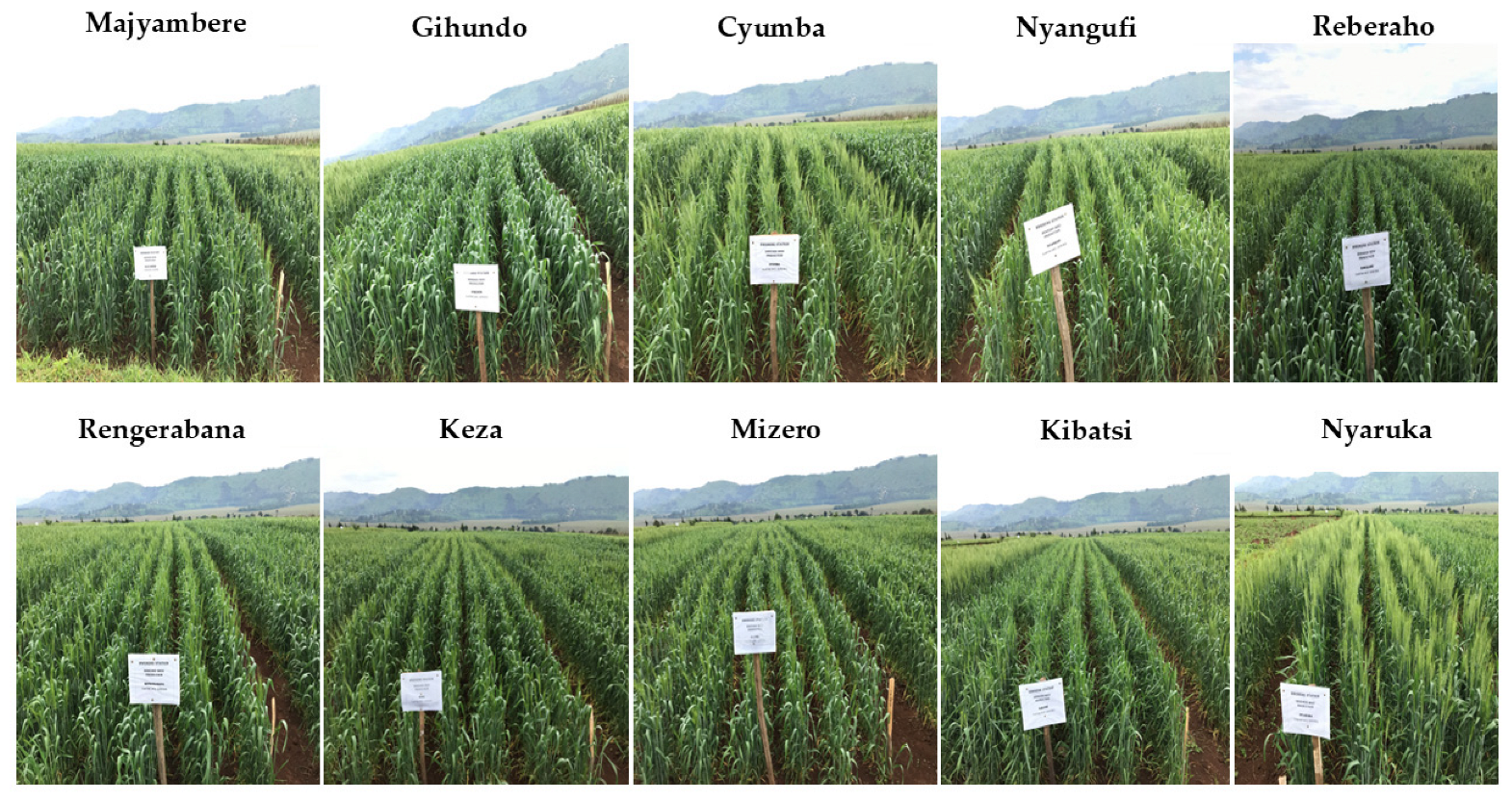
Figure 1. Field views of the ten wheat varieties evaluated in this study. All varieties are Triticum aestivum L. breeder seeds sourced from RAB, Rwerere station, Rugezi site.
Agriculture 15 02160 g001
Figure 2. Workflow of wheat grain yield and quality assessment.
Agriculture 15 02160 g002
Figure 3. The effect of variety on grain yield. Different letters correspond to significant differences (p < 0.05) between varieties. Error bars indicate the standard error of the mean.
Agriculture 15 02160 g003
Figure 4. Mixolab curves of wheat varieties milled flour.
Agriculture 15 02160 g004
Figure 5. Correlation between grain yield, grain quality and rheological properties analyzed by Mixolab of wheat varieties. TKW—Thousand kernel weight; HW—Hectoliter weight; PC—Protein content; GI—Gluten index; WG—Wet gluten; FN—Falling number; ZSV—Zeleny Sedimentation Value; WA—Water absorption; TC2—Torque C2; TC3—Torque C3, TC4—Torque C4; TC5—Torque C5; Amp—Amplitude; Stab.—Stability; α—Alfa; β—Beta; γ—Gamma; *—statistically significant result (p < 0.05). The strength and direction of the correlations are depicted using a color gradient, with red indicating strong positive correlations, blue indicating strong negative correlations, and lighter shades toward white representing weak or no correlation. The color scale bar on the right side provides a reference for interpreting correlation values, which range from –0.75 to +1.00.
Agriculture 15 02160 g005
Figure 6. Principal component analysis (PCA) of yield, grain quality, and rheological properties of ten Rwandan wheat varieties. (a) Relationships between grain yield and quality traits. (b) Relationships between quality traits and Mixolab rheological properties. TKW—Thousand kernel weight; HW—Hectoliter weight; PC—Protein content; GI—Gluten index; WG—Wet gluten; FN—Falling number; ZSV—Zeleny Sedimentation Value; WA—Water absorption; TC3—Torque C3; TC4—Torque C4; TC5—Torque C5; Stability—Dough stability. Squares represent wheat varieties, and vectors represent traits.
Agriculture 15 02160 g006
Table 1. The quality of wheat varieties.
VarietyTKW (g)Hectoliter Weight (kg hL−1)Protein Content (%)Gluten Index (%)Wet Gluten (%)Falling Number (s)ZSV (mL)
Nyaruka33.50 ± 0.10 cd76.70 ± 0.34 de9.65 ± 0.02 de51.19 ± 19.22 b–d20.27 ± 0.91 d447.0 ± 4.00 cd24.7 ± 0.57 e
Gihundo36.49 ± 0.42 ab80.87 ± 0.32 a9.49 ± 0.17 e40.15 ± 2.96 cd18.64 ± 0.80 e506.0 ± 5.00 a15.7 ± 1.15 f
Reberaho29.91 ± 0.92 e79.30 ± 0.10 a–c10.55 ± 0.26 ab92.59 ± 0.07 a20.91 ± 0.03 cd458.0 ± 6.00 c31.0 ± 1.00 d
Majyambere33.36 ± 0.97 cd77.63 ± 0.41 b–e9.96 ± 0.09 c–e92.66 ± 0.55 a19.77 ± 0.13 de454.0 ± 1.00 c32.0 ± 1.00 d
Kibatsi35.04 ± 0.18 bc79.20 ± 0.20 a–c10.14 ± 0.15 b–d43.40 ± 4.03 cd21.59 ± 0.06 bc485.0 ± 13.00 b24.7 ± 0.57 e
Cyumba32.18 ± 0.31 d76.83 ± 0.32 c–e10.72 ± 0.09 a73.62 ± 8.40 ab21.60 ± 0.20 bc426.0 ± 1.00 ef36.3 ± 0.57 c
Nyangufi38.20 ± 0.14 a78.13 ± 2.55 b–d10.45 ± 0.07 a–c95.22 ± 0.14 a21.97 ± 0.02 a–c457.0 ± 1.00 c46.0 ± 1.00 a
Rengerabana32.98 ± 0.06 d75.60 ± 0.26 e10.44 ± 0.07 a–c30.88 ± 5.61 d22.82 ± 0.07 a431.3 ± 8.50 de30.3 ± 0.57 d
Keza32.68 ± 0.63 d79.40 ± 0.43 ab10.36 ± 0.42 a–c95.46 ± 0.05 a20.18 ± 0.22 d409.3 ± 10.50 f41.3 ± 0.57 b
Mizero33.43 ± 1.06 cd79.03 ± 0.15 a–d10.11 ± 0.08 b–d60.44 ± 11.45 bc22.52 ± 0.00 ab464.3 ± 0.57 c30.3 ± 0.57 d
p-Value<0.001<0.001<0.001<0.001<0.001<0.001<0.001
Means ± SD values associated with different wheat varieties, different letters within the column show statistically significant difference at p-Value < 0.01, Tukey HSD test. SD—standard deviation; TKW—Thousand kernel weight; ZSV—Zeleny Sedimentation Value.
Table 2. The rheological properties of wheat varieties analyzed by Mixolab.
VarietyWA (%)TC2 (Nm)TC3 (Nm)TC4 (Nm)TC5 (Nm)Amp. (Nm)Stab. (min)αβγTimeC1 (min)
Nyaruka60.0 d0.48 a1.82 ab1.27 d–f2.53 fg0.08 ab6.3 e−0.057 a0.55 b−0.01 a2.74 d
Gihundo60.8 cd0.49 a1.75 b–d1.18 e–g2.83 bc0.07 a–c5.6 f−0.070 a–c0.52 b−0.30 d2.20 e
Reberaho64.0 a0.53 a1.76 a–c1.56 ab2.49 g0.07 bc9.3 b−0.09 d0.43 cd−0.07 a–c3.65 b
Majyabere61.5 bc0.51 a1.68 d1.164 fg2.59 ef0.09 a8.6 c−0.082 cd0.41 d−0.13 c3.25 c
Kibatsi62.5 b0.50 a1.71 cd1.16 fg2.90 b0.09 a5.4 f−0.066 ab0.53 b−0.30 d2.08 e
Cyumba64.0 a0.53 a1.72 cd1.45 bc2.31 h0.07 bc8.4 c−0.084 cd0.50 bc−0.06 ab3.18 c
Nyangufi58.5 e0.55 a1.72 cd1.38 cd3.30 a0.09 a9.5 b−0.064 ab0.63 a−0.006 a3.85 b
Rengerabana60.0 d0.45 a1.78 a–c1.60 a2.64 e0.09 a6.4 e−0.07 a–c0.56 ab−0.07 a–c1.58 f
Keza62.5 b0.55 a1.77 a–c1.31 de2.82 cd0.09 a9.9 a−0.084 cd0.37 d−0.11 bc4.77 a
Mizero61.5 bc0.51 a1.83 a1.10 g2.75 d0.06 c8.0 d−0.076 b–d0.56 ab−0.38 e2.90 d
p-Value<0.001ns<0.001<0.001<0.001<0.001<0.001<0.001<0.001<0.001<0.001
Means values associated with different wheat varieties, different letters within the column show statistically significant difference at p-Value < 0.05, Tukey HSD test. ns—not significant; WA—Water absorption; TC2—Torque C2; TC3—Torque C3, TC4—Torque C4; TC5—Torque C5; Amp.—Amplitude; Stab.—Stability; α—Alfa; β—Beta; γ—Gamma.
Disclaimer/Publisher’s Note: The statements, opinions and data contained in all publications are solely those of the individual author(s) and contributor(s) and not of MDPI and/or the editor(s). MDPI and/or the editor(s) disclaim responsibility for any injury to people or property resulting from any ideas, methods, instructions or products referred to in the content.