Article

Factors Affecting China’s Tea Exports to Malaysia: An ARDL Analysis

Faculty of Economics and Business, Universiti Malaysia Sarawak, Kota Samarahan 94300, Sarawak, Malaysia
*
Author to whom correspondence should be addressed.
Agriculture 2025, 15(17), 1897; https://doi.org/10.3390/agriculture15171897
Submission received: 13 August 2025 / Revised: 2 September 2025 / Accepted: 5 September 2025 / Published: 7 September 2025
(This article belongs to the Section Agricultural Economics, Policies and Rural Management)

Abstract

This study employed quarterly data spanning from 2005 to 2024 to investigate the factors affecting China’s tea exports to Malaysia using demand theory. The Autoregressive Distributed Lag (ARDL) approach and Granger causality test were applied to examine the long-run and short-run impacts of key variables, including the prices of China’s tea and coffee imported by Malaysia, Malaysia’s GDP, Malaysia’s tea production, and the international oil price. The ARDL bounds testing confirmed the existence of a long-run equilibrium among these variables. The empirical findings revealed that an increase in the price of China’s tea significantly reduced export volumes, whereas Malaysia’s GDP exerted a strong positive influence. The price of coffee exhibited a significantly negative effect, suggesting an unconventional substitution relationship with tea. Both Malaysia’s domestic tea production and the international oil price imposed downward pressures on China’s tea exports. Furthermore, the Granger causality analysis indicated that the price of China’s tea, the price of coffee, and Malaysia’s GDP all exerted short-run effects on China’s tea exports to Malaysia. These findings contribute to the export demand literature and offer implications for policies aiming to enhance bilateral tea trade between China and Malaysia.

1. Introduction

Tea is the world’s second most popular beverage after water, with approximately 3 billion regular consumers in over 160 countries according to the United Nations Food and Agriculture Organization (FAO) [1]. As both a cultural symbol and an economic commodity, tea plays a pivotal role in agricultural trade, especially for developing economies. Among tea-producing nations, as reported by the International Tea Committee (ITC), China is the world’s largest tea producer, accounting for 49% of the total output in 2023 [2]. While China’s domestic tea consumption remains dominant, the country also plays a major role in international tea trade. According to FAO statistics, in 2023, China exported approximately 367,500 tons of tea, making it the second-largest global tea exporter after Kenya [3]. Among China’s export destinations, Malaysia has emerged as a particularly important market; notably, in 2023, it ranked second in terms of China’s tea export value, surpassed only by Hong Kong [4].
Malaysia’s appeal as an export destination stems from several interrelated factors. Historically, Chinese tea culture has taken root in Malaysian society through centuries of migration and cultural integration [5]. Black tea, oolong, and Pu’er varieties have become embedded in everyday consumption patterns, particularly among Malaysian Chinese communities. Meanwhile, “the Belt and Road Initiative” has further strengthened bilateral trade ties and increased the presence of Chinese tea in the Malaysian market [6].
Table 1 summarizes the trade data over the past 20 years, which reveals the rapid growth of China’s tea exports to Malaysia. The most remarkable growth is observed in the export value, which in 2022 reached a level 71.25 times higher than that recorded in 2005. The export volume grew from just 1586.59 tons in 2005 to a peak of 9265.4 tons in 2022, while the average export price surged to over 35.4 USD/kg in 2021 before dropping sharply in the following years.
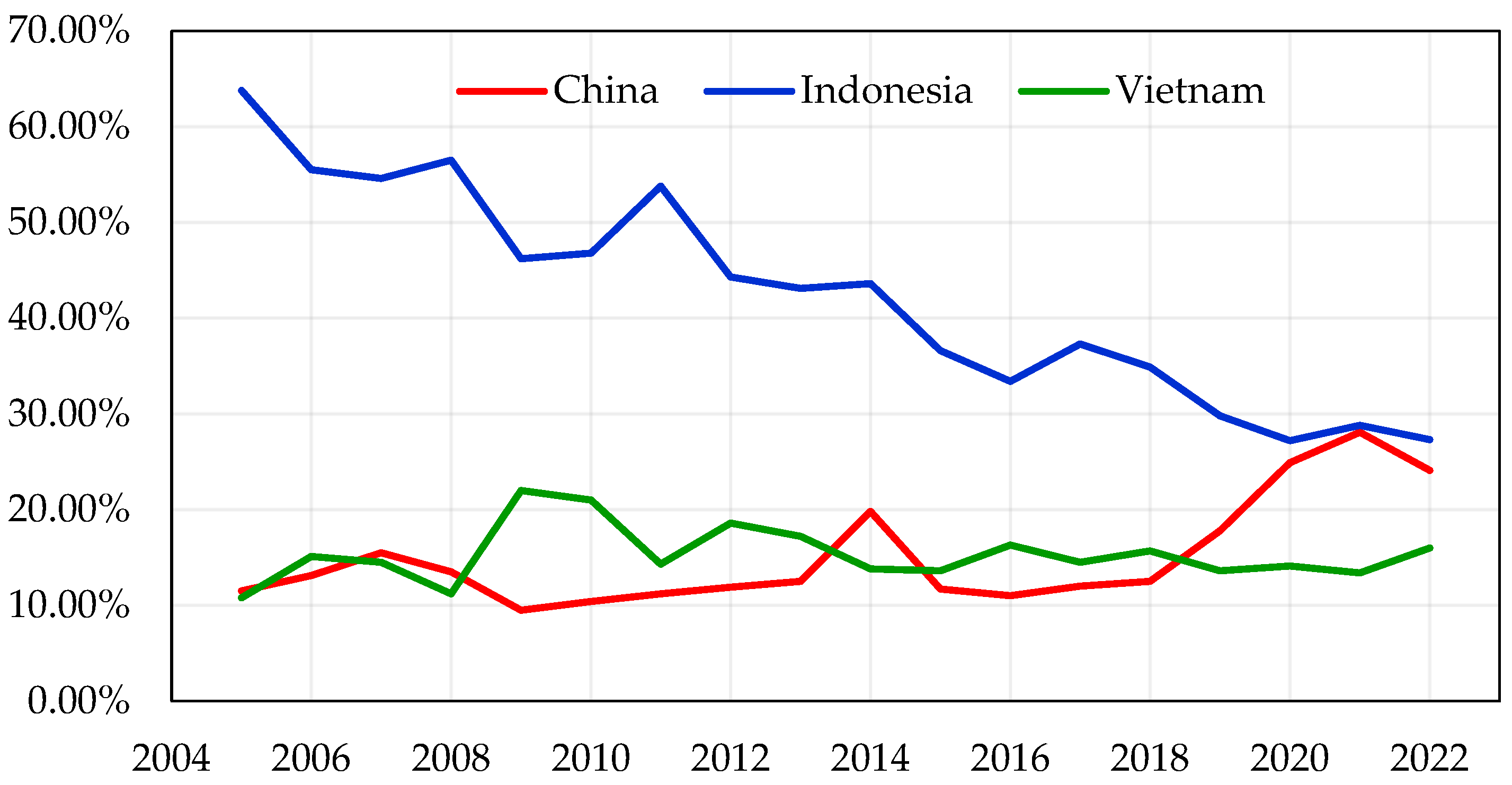
Based on statistics from the Malaysian Tea Association [7], China’s share in Malaysia’s tea import market fluctuated significantly between 2005 and 2022. Although it rose from 11.5% in 2005 to 24.1% in 2022, it experienced several ups and downs during this period, dropping to as low as 9.5% at one point. From Figure 1, it can be observed that the share of China’s tea reached a minor peak in 2014 before declining, rising to a new peak in 2021, and then declining again. Between 2005 and 2022, Indonesia consistently held the position of Malaysia’s largest tea import source, peaking at 63.8% in 2005. However, its overall share has shown a persistent downward trend, nearly matching that of China in 2021. As shown in the figure, although China was surpassed by Vietnam on multiple occasions, falling from the second-largest to the third-largest source of tea imports, it has demonstrated strong export momentum in recent years and is gradually closing in on Indonesia’s position.
Despite the observed trade growth, China’s tea exports to Malaysia have exhibited considerable volatility, particularly in recent years. This irregularity, coupled with the growing presence of substitute beverages like coffee, raises key questions about the sustainability of this bilateral trade relationship. Malaysia’s tea consumption landscape is increasingly competitive, with younger demographics favoring ready-to-drink coffee products that challenge traditional tea consumption patterns [8]. At the same time, local tea production, though limited, provides a certain degree of internal supply stability, while international oil price fluctuations influence logistics costs and final prices.
Given these complexities, and drawing on demand theory, this study sought to empirically assess the factors influencing China’s tea exports to Malaysia. It explored the influence of several core factors, including the price of China’s tea, the price of coffee as a substitute, Malaysia’s GDP, Malaysia’s tea production, and the international oil price. Based on demand theory, this study hypothesized that China’s tea price, Malaysia’s tea production, and international oil price negatively impact export volumes, while coffee price and Malaysia’s GDP positively impact it. Using quarterly data from 2005 to 2024 and the Autoregressive Distributed Lag (ARDL) model, this research investigated both the long-term equilibrium and short-term dynamics between these variables.
This study makes important contributions in several areas. Theoretically, it applies demand theory to a specific bilateral tea trade context within an emerging market, contributing to a more nuanced understanding of commodity trade behavior. Practically, using the ARDL approach, the findings provide valuable insights for policymakers aiming to enhance the China–Malaysia tea trade under the “Belt and Road” framework, as well as for tea enterprises seeking to align their product strategies with evolving market signals. At present, systematic research on the China–Malaysia tea trade remains relatively scarce. The innovation of this study lies in taking the China–Malaysia tea trade as the research object, integrating demand theory with the ARDL model, and systematically incorporating five dimensions: price, substitutes, income, domestic supply, and transportation costs. It reveals the differences between short-term and long-term mechanisms and provides new empirical evidence for policy formulation in the China–Malaysia tea trade.

2. Literature Review

Over the past two decades, empirical studies on China’s tea exports have primarily focused on trade performance, competitiveness, and market diversification. The general consensus is that China’s tea exports are shaped not only by external trade barriers and policy frameworks, but also by internal drivers such as production efficiency and branding strategies. For instance, Mou [9] applied a gravity model to examine the impact of green trade barriers, concluding that such measures significantly reduced China’s tea export volumes, particularly to developed economies. Fan and Liu [10] focused on the role of the Belt and Road Initiative and found that it exerted a significant promotion effect on China’s tea exports. Specifically, they noted that the initiative boosted export growth and facilitated market diversification, especially in participating countries along the routes.
Complementing the focus on external constraints, Qin and Zhou [11] shifted their attention to the internal drivers of sustainable growth. Their study emphasized that while the cost advantages and scale expansion of China’s tea industry have historically driven export growth, long-term competitiveness hinges on three interrelated factors: alignment with international quality standards, brand recognition in global markets, and integration of cultural value. Specifically, they found that regions that emphasize brand building and standardized production exhibited greater resilience to market fluctuations, which underscored the need for a shift from quantity-driven export strategies to quality- and value-oriented ones. Nevertheless, within the context of China’s tea export research, the demand-side determinants rooted in the economic and consumption structures of importing countries remain insufficiently understood. This research responds to this limitation by studying the case of Malaysia.
Most existing studies focused on export destinations such as developed countries or member states of regional organizations. Zhang [12] established a regression model to study China’s tea exports to Japan and found that Japan’s tea consumption and the export price of China’s tea were positively correlated with China’s tea exports to Japan, and the exchange rate was negatively correlated with the trade volume. Against the backdrop of China-US trade frictions, Xu [13] empirically analyzed the positive impact of US GDP and population on China’s tea exports to the US based on the classic gravity model. On the contrary, the CNY exchange rate, China’s tea export quality level, and Trump’s policies were negatively correlated. These studies collectively demonstrate that bilateral analyses can yield more nuanced insights compared to aggregated regional studies.
However, few studies have conducted separate analyses of bilateral trade relationships with specific importing countries in Southeast Asia. This limits the understanding of country-specific demand determinants, which may vary according to differences in cultural preferences, market structures, and competitive conditions. Literature specifically studying China’s tea exports to Malaysia is very scarce; this topic is usually only mentioned in individual studies that cover multiple countries or involve discussions on segmented products among small regions.
Yang et al. [14] studied the tea trade exchanges between China and ASEAN countries in the context of the Belt and Road Initiative and the China-ASEAN Free Trade Area. Malaysia, as one of the ASEAN member states, was prominently mentioned as a key market for China’s tea exports to the ASEAN with both policy dividends and consumption potential. Zhao et al. [15] took the economic and trade cooperation in tea between Guizhou Province of China and Malaysia as the research object using the RCEP framework, with the core goal of determining how Guizhou plateau ecological tea can leverage RCEP rules to explore the Southeast Asian market. In addition, by using the quantitative model of the trade competitiveness index, they pointed out that the Guizhou tea industry should leverage rule dividends and cross-border e-commerce to enhance its competitiveness. These contributions indicate that Malaysia holds growing strategic importance for China’s tea exports. However, analyses of bilateral trade remain insufficiently comprehensive, specific, and systematic. This study fills this void by applying time-series econometric analysis to the China–Malaysia tea trade.
The theoretical foundation for analyzing import or export demand in agricultural trade often draws upon demand theory, which posits that consumer demand is a function of own prices, prices of substitute goods, and income levels [16]. Price effects on agricultural exports have been a central theme in the trade literature. According to the existing literature, the impact of tea prices on export volumes varies across countries and market segments. In their study on the competitiveness of Indonesian tea in Southeast Asian markets, Nursodik et al. [17] revealed a significant negative relationship between tea price and export volume. The estimated elasticity indicated that a 1% increase in price would lead to a 0.93% decrease in export volume, confirming the applicability of the law of demand in the tea trade. In a study on China’s tea exports to the US market, Xu [13] found that tea prices have a positive impact on total tea export volume and black tea exports, but a weak negative impact on green tea exports, indicating that price sensitivity varies by tea category. These findings confirm that price is a key determinant, but its influence is context-specific. More importantly, previous studies have paid insufficient attention to distinguishing between the short-run and long-run effects of price. By using quarterly data and an ARDL model, this study addressed this gap.
The research of Hajra [18] regarded coffee as a substitute for tea. However, there are relatively few studies that considered coffee as a substitute for tea in research on tea export demand. Kadhim [19] conducted an empirical analysis by establishing an ARDL model based on Iraq’s tea import demand from over 20 countries. The study found that tea prices had a significant negative impact on import volumes, while coffee prices exhibited a strong positive substitution effect, indicating that there is a dynamic substitution relationship between the two in the Iraqi market: when coffee prices rise, a significant number of consumers will switch to tea consumption whereas an increase in tea prices will suppress demand in the short term and trigger a more substantial reduction in import volume in the long term. This shows that the price sensitivity of tea as a necessity and the consumption switching elasticity of coffee as a substitute jointly shape the structural characteristics of Iraq’s import market. Yet, few studies have explicitly modeled coffee as a substitute in the Southeast Asian context. This study extends the literature by testing such substitution effects within the Malaysia–China tea trade.
In international trade research, GDP represents a country’s economic strength and purchasing power, which directly determines the scale and growth potential of foreign trade demand [20]. Vo et al. [21] used a spatial gravity model and panel data to find that GDP growth and population growth in the importing country have a positive impact on Vietnam’s coffee exports. Sato [22] examined the impact of importing countries’ GDP on Kenya’s tea exports and concluded that for every 1% growth in the GDP of importing countries, Kenya’s tea export volume increases by 2%. In Mou’s study [9] based on the gravity model, it was found that in China’s tea exports to over 30 countries, for every 1% growth in the importing country’s GDP, China’s tea export volume increases by approximately 0.68%. Collectively, these studies affirm that the importing country’s GDP is a robust predictor of agricultural exports.
In studies on international agricultural product trade, the domestic agricultural output of importing countries is regarded as an important factor affecting their import behavior. According to the local supply substitution effect, when a country can achieve partial self-sufficiency in agricultural products domestically, the demand for similar imported products usually decreases, thereby exerting an inhibitory effect on exporting countries [23]. According to the study by Forgenie and Khoiriyah [24], there is a significant negative relationship between Indonesia’s domestic food production and its import volume. This conclusion was validated through both long-run and short-run estimations using the ARDL model, which showed that a 1% increase in domestic food production reduces the import volume by 2.31% in the long run and by 2.14% in the short run. While this supply–substitution logic is compelling, it has rarely been tested in the tea trade context. By including Malaysia’s domestic tea production, this study examined whether the local supply similarly constrains China’s exports.
Transportation costs, frequently measured using international oil prices as a proxy, are another critical factor in trade models. According to the transportation cost hypothesis, when transportation costs rise, the final price of exported goods in the destination market will increase accordingly, which in turn weakens their relative price advantage, leading to a decline in demand and reducing the export volume [25]. Zhou and Kang [26] systematically examined the factors influencing Russia’s foreign trade and found that Russia’s GDP and international oil prices are the main factors affecting its imports and exports. Adi [27] empirically analyzed the panel data of Indonesia, Malaysia, and Thailand, and found that international oil prices have a significant negative impact on trade flows among the three countries. However, empirical analyses of the tea trade have rarely considered international oil prices as a proxy for transport costs. By incorporating this variable, this study expands the analytical scope for the factors influencing tea exports.
Methodologically, the ARDL model developed by Pesaran et al. [28] has become a preferred approach in small-sample time-series trade studies due to its ability to integrate variables on different orders [I(0) or I(1)]. Studies such as Ganbaatar et al. [29] have applied the ARDL approach to agricultural trade data, revealing both the short-run and long-run dynamics. The inclusion of an error correction mechanism within the ARDL model enables the measurement of adjustment speeds toward long-run equilibrium [30]. Additionally, the Granger causality test, as utilized by Mbiakop et al. [31] in agricultural trade research, complements ARDL by identifying the direction of influence between variables, thereby enhancing the robustness of empirical findings. Although these methods are commonly applied in agricultural economics, they remain underutilized in tea export research, particularly in bilateral contexts. This study therefore contributes to the subject matter by applying ARDL and Granger causality analysis to the China–Malaysia tea trade, allowing both long-run equilibrium and short-run causality to be identified.

3. Materials and Methods

3.1. Data Information

This study employed quarterly time-series data from 2005Q1 to 2024Q4 to analyze the factors influencing China’s tea exports to Malaysia. The dependent variable was the export volume of China’s tea to Malaysia (EV), measured in kilograms, which serves as a direct indicator of bilateral trade performance. Five explanatory variables were included based on demand theory and the empirical literature. The price of China’s tea (CTP) imported by Malaysia (USD/kg) measures the price Malaysian importers pay for China’s tea, enabling estimation of its price elasticity. The price of coffee (CP) imported by Malaysia (USD/kg) represents the price of a key substitute, capturing potential cross-price effects. Malaysia’s gross domestic product (GDP), expressed in USD, served as a proxy for national income and purchasing power. Malaysia’s tea production (MTP), measured in kilograms, reflects the local supply capacity and has the potential to substitute for imports. The international oil price (OP), measured in USD/barrel (Brent crude), acted as a proxy for transport and logistics costs in international trade. Data were compiled from reputable international sources to ensure reliability. Trade volumes and import prices for China’s tea (HS code 0902) and coffee (HS code 0901) were obtained from the United Nations Comtrade Database. Malaysia’s GDP figures were sourced from the Bank Negara Malaysia (BNM) and Department of Statistics Malaysia (DOSM). Malaysia’s tea production data were retrieved from the FAO. The international oil price data was collected from the Federal Reserve Economic Data (FRED) and the International Monetary Fund (IMF), ensuring accuracy and consistency.

3.2. Estimation Procedure

In order to explore the factors affecting the export volume of China’s tea to Malaysia, this study constructed a logarithmic linear regression model:
L E V t = β 0 + β 1 L C T P t + β 2 L C P t + β 3 L G D P t + β 4 L M T P t + β 5 L O P t + ε t
where L represents the natural logarithm of the variable; β0 represents the constant term or intercept; and εt represents the error term. The coefficients β1, β4, and β5 are expected to be negative, as increases in China’s tea price, Malaysia’s tea production, and international oil price are likely to reduce export volumes. In contrast, β2 and β3 are expected to be positive since higher coffee prices and GDP growth are anticipated to boost export volumes.
The Augmented Dickey–Fuller (ADF) and Kwiatkowski–Phillips–Schmidt–Shin (KPSS) tests are complementary unit root testing methods: the ADF test takes “the variable has a unit root” as the null hypothesis, while the KPSS test takes “the variable is stationary” as the null hypothesis. Their combined application enables a more comprehensive judgment of the stationarity of time series [32].
The ARDL model, proposed by Pesaran et al. [28], offers several advantages compared with other techniques. It is an econometric approach that can be used to identify both long-run equilibrium relationships and short-run dynamic adjustments between variables, particularly in cases where time series data are integrated at different levels [I(0) or I(1)]. Moreover, the ARDL method is known for its high test power and estimation accuracy, even in studies with small sample sizes [33]. After testing the stationarity of the variables through the unit root tests, the ARDL bounds test can determine the cointegration relationship between the variables and reveal the long-run equilibrium relationship and short-run dynamic changes between the variables. Following the method of Hadi and Chung [34], this study used the Akaike Information Criterion (AIC) method to select the lag order. The ARDL model for cointegration in this study took the following form:
Δ L E V t = α 0 + i = 1 j δ 1 i Δ L E V t i + i = 0 k δ 2 i Δ L C T P t i + i = 0 l δ 3 i Δ L C P t i + i = 0 m δ 4 i Δ L G D P t i + i = 0 n δ 5 i Δ L M T P t i + i = 0 o δ 6 i Δ L O P t i + β 1 L E V t 1 + β 2 L C T P t 1 + β 3 L C P t 1 + β 4 L G D P t 1 + β 5 L M T P t 1 + β 6 L O P t 1 + ε t
where α0 is a constant; δ1δ6 represent the lagged difference coefficients, which indicate the short-term dynamic impact of the variables; β1β6 represent the coefficients of the lagged level terms, which indicate the long-term relationship between the variables; j, k, l, m, n, and o represent the lag order of each variable; ∆ is the difference operator; and εt is the error term.
The null hypothesis (H0) of the bounds test is β1 = β2 = β3 = β4 = β5 = β6 = 0, that is, there is no long-term cointegration relationship between the variables. The alternative hypothesis (H1) is β1β2β3β4β5β6 ≠ 0, that is, there is a long-term cointegration relationship between the variables. In this study, the statistic of the bounds test was compared with the critical value [33]. A computed F-statistic that exceeds the upper bound value indicates cointegration among the variables, while an F-statistic below the lower bound at the 5% significance level indicates that the null hypothesis (H0) of no cointegration should be accepted [35]. If the bounds test indicates the existence of a long-run cointegration relationship, the long-run coefficient can then be estimated. In this study, the long-run model was based on the following formula:
L E V t = α 1 + i = 1 j λ 1 i L E V t i + i = 0 k λ 2 i L C T P t i + i = 0 l λ 3 i L C P t i + i = 0 m λ 4 i L G D P t i + i = 0 n λ 5 i L M T P t i + i = 0 o λ 6 i L O P t i + ε t
When a long-run relationship exists between the variables, an error correction representation is warranted [36]. Subsequent to estimating the long-run coefficients, the next empirical step entails formulating the Error Correction Model (ECM). When there is a long-term cointegration relationship between variables, the short-term deviation from the long-term equilibrium will be adjusted through the error correction term (ECT) to gradually return to the long-term equilibrium state [37]. The model form of ECM can be expressed as
Δ L E V t = α 0 + i = 1 j δ 1 i Δ L E V t i + i = 0 k δ 2 i Δ L C T P t i + i = 0 l δ 3 i Δ L C P t i + i = 0 m δ 4 i Δ L G D P t i + i = 0 n δ 5 i Δ L M T P t i + i = 0 o δ 6 i Δ L O P t i + ϕ E C T t 1 + ε t
where ECTt−1 represents the lagged error correction term and ϕ indicates the error correction coefficient. The ECTt−1 reflects the deviation between the actual value of the previous period and the long-term equilibrium value. The error correction coefficient (ϕ) is a key parameter of the ECM, indicating the speed of short-term adjustment. Several criteria can be used to confirm that short-run dynamic adjustments toward long-run equilibrium operate through the ECTt−1. These criteria are as follows: the ECTt−1 must be negative, significant, and have a coefficient value ranging between −1 and 0. In addition, long-run causality from the independent variables to the dependent variable can be established when the ECTt−1 is statistically significant.
The Granger causality test is a statistical method used to evaluate whether there is a causal predictive relationship between time series variables. The core point is that if the past values of a variable X can significantly predict the current value of another variable Y, then X is called the Granger-cause of Y [38]. The Wald test was employed to examine whether the model parameters significantly differ from the predetermined values. Specifically, the Wald test determines whether one or a set of predictor variables makes a statistically significant contribution to the dependent variable. In Granger causality testing, the Wald test serves a critical role: it assesses whether the coefficients of lagged predictor variables are jointly zero [39]. For example, to test if a variable X causes Y, the canonical model is
Y t = α + i = 1 p δ i Y t i + j = 1 p λ j X t j + ε t
For Granger causality testing, the null hypothesis (H0) states that all lagged X coefficients in Y’s autoregressive model are zero (no Granger causality). The alternative hypothesis (H1) claims that at least one lagged X coefficient is non-zero (indicating Granger causality).
Diagnostic tests are mainly used to examine whether the regression model meets the basic assumptions of the classical linear regression model. This study used several specific test methods, including the Jarque–Bera, Breusch–Godfrey Serial Correlation Lagrange Multiplier (LM), Autoregressive Conditional Heteroskedasticity (ARCH) test, and Ramsey RESET tests. These tests can determine whether the estimated model has problems with normality, autocorrelation, heteroskedasticity, and/or model specification. This study used CUSUM and CUSUM of Squares (CUSUMSQ) tests to evaluate the stability of the model. The empirical analysis of this study was conducted using EViews (v13.0) and the results are presented in the next section.

4. Results

4.1. Unit Root Test Results

Prior to conducting the unit root tests, all the variables were transformed into logarithmic form to stabilize their variance and ensure consistency in the analysis. Table 2 presents the results of the ADF and KPSS unit root tests for the variables used in this study. Both tests presented consistent results, with most series showing similar stationarity characteristics. According to the results of the ADF and KPSS tests, the LOP was stationary, which is a characteristic of an I(0) variable. In contrast, LEV, LCTP, LCP, LGDP, and LMTP became stationary only after first differencing, making them typical I(1) variables. This satisfies the precondition for applying the ARDL model.

4.2. ARDL Estimation Results

The ARDL model, which was selected using the Akaike Information Criterion (AIC), can effectively incorporate lagged relationships, enabling a more comprehensive assessment of the long-run and short-run associations between variables. The testing procedures in this section consisted of the following steps: first, the bounds test for cointegration was conducted to confirm the existence of a long-run relationship; second, the long-run coefficients were estimated; and third, the ECM was estimated to examine the ECT.
The bounds test results are shown in Table 3, where “k” denotes the number of independent variables employed in this study, while “n” represents the number of observations. The model included five independent variables and 80 observations. As illustrated in the table, the bounds test found an F-statistic of 4.062, which exceeds the 5% significance level upper critical value reported by Narayan [33]. This result enabled the rejection of the null hypothesis of no cointegration, confirming the existence of a long-run relationship between the variables in the model.
The long-run coefficient reflects the direction and intensity of the stable and lasting impact of the explanatory variables on the dependent variable after the short-term fluctuations and dynamic adjustment process. Table 4 lists the long-run coefficient estimation results. Based on the analysis of the results, the sign of the LCTP coefficient was consistent with the expected sign and was significant at the 5% level (p < 0.05). In contrast, the sign of the LCP coefficient was opposite to the expectation and was significant at the 5% level (p < 0.05). In addition, the coefficient signs of the LGDP, LMTP, and LOP variables were as expected and significant at the 1% level (p < 0.01). Therefore, all the explanatory variables affected the export volume of China’s tea to Malaysia in the long run. The long-run estimated coefficient can be summarized in the following equation:
L E V = 124.0755 0.6722 L C T P 2.5698 L C P + 6.3409 L G D P 0.9011 L M T P 1.0995 L O P                       ( 4.2388 ) * * * ( 2.2934 ) * * ( 2.3851 ) * * ( 5.1870 ) * * * ( 2.9138 ) * * * ( 2.9151 ) * * *
Equation (6) provides a clear representation of the estimated coefficient results. In the long run, a 1% increase in LCTP was associated with a 0.67% decrease in LEV. A 1% rise in LCP corresponded to a 2.57% decline in LEV, while a 1% growth in LGDP led to a 6.34% increase in LEV. An increase in LMTP of 1% was linked to a reduction in LEV of 0.9%. Finally, a 1% uptick in LOP resulted in a 1.1% decrease in LEV. Subsequently, it was found that the ECM could effectively model the long-run equilibrium and short-run dynamics. It not only revealed the short-run dynamic adjustment path between variables, but could also measure the speed and direction of the system’s return to the long-run equilibrium state through the ECT.
As shown in Table 5, the ECTt−1 of the model had a negative sign, a coefficient value less than 1, and was statistically significant at the 1% level. Consequently, since all the lagged ECT criteria were satisfied, this model was confirmed to capture a long-run relationship between the variables. The ECTt−1 in the ECM was estimated to be −0.445, indicating that when the system deviates from its long-run equilibrium in the short run, the export volume (LEV) adjusts back toward the long-run equilibrium value at a rate of 44.5% in one quarter. This implies that it takes approximately 2.25 quarters to achieve long-run equilibrium.

4.3. Granger Causality Results

After the cointegration test and error correction model established the long-term relationships between variables, Granger causality tests between each explanatory variable and China’s tea export volume to Malaysia (LEV) were conducted. This step further verified the short-term causal relationships between the variables. The lag length for the Granger causality test was based on the lag structure selected for the ARDL model, with a maximum lag length of 9, which was determined using the AIC to ensure the most appropriate fit. Based on the Granger causality test results presented in Table 6, the null hypothesis that LCTP does not Granger-cause LEV was rejected at the 1% significance level. This indicates a short-run causal relationship between LCTP and LEV. Similarly, the null hypothesis that LCP does not Granger-cause LEV was also rejected at the 1% significance level. Moreover, LGDP was found to significantly Granger-cause LEV in the short run. On the contrary, the results of the Granger causality tests for LMTP and LOP with respect to LEV were insignificant, implying that their past values have limited predictive power for export volume under the current model specifications.

4.4. Diagnostic and Stability Test Results

The results of the diagnostic test are shown in Table 7. The Jarque–Bera test was used to evaluate whether the residual term follows a normal distribution; a p-value of 0.8056 indicates that the residuals were normally distributed. The Breusch–Godfrey serial correlation LM test checks for the presence of serial correlation in the residuals over time. Based on the p-value of 0.7089, there was no evidence of serial correlation, indicating that the residuals were independent and satisfied the assumption of uncorrelated errors. The ARCH test was used to examine autoregressive conditional heteroskedasticity; the p-value of 0.1151 indicates the absence of heteroskedasticity, suggesting that the variance of residuals remained consistent across all observations, thereby supporting the assumption of homoskedasticity. Finally, the Ramsey RESET test was used to assess the correct functional form of the regression model; the p-value of 0.0663 indicates that the model specification was generally reasonable.
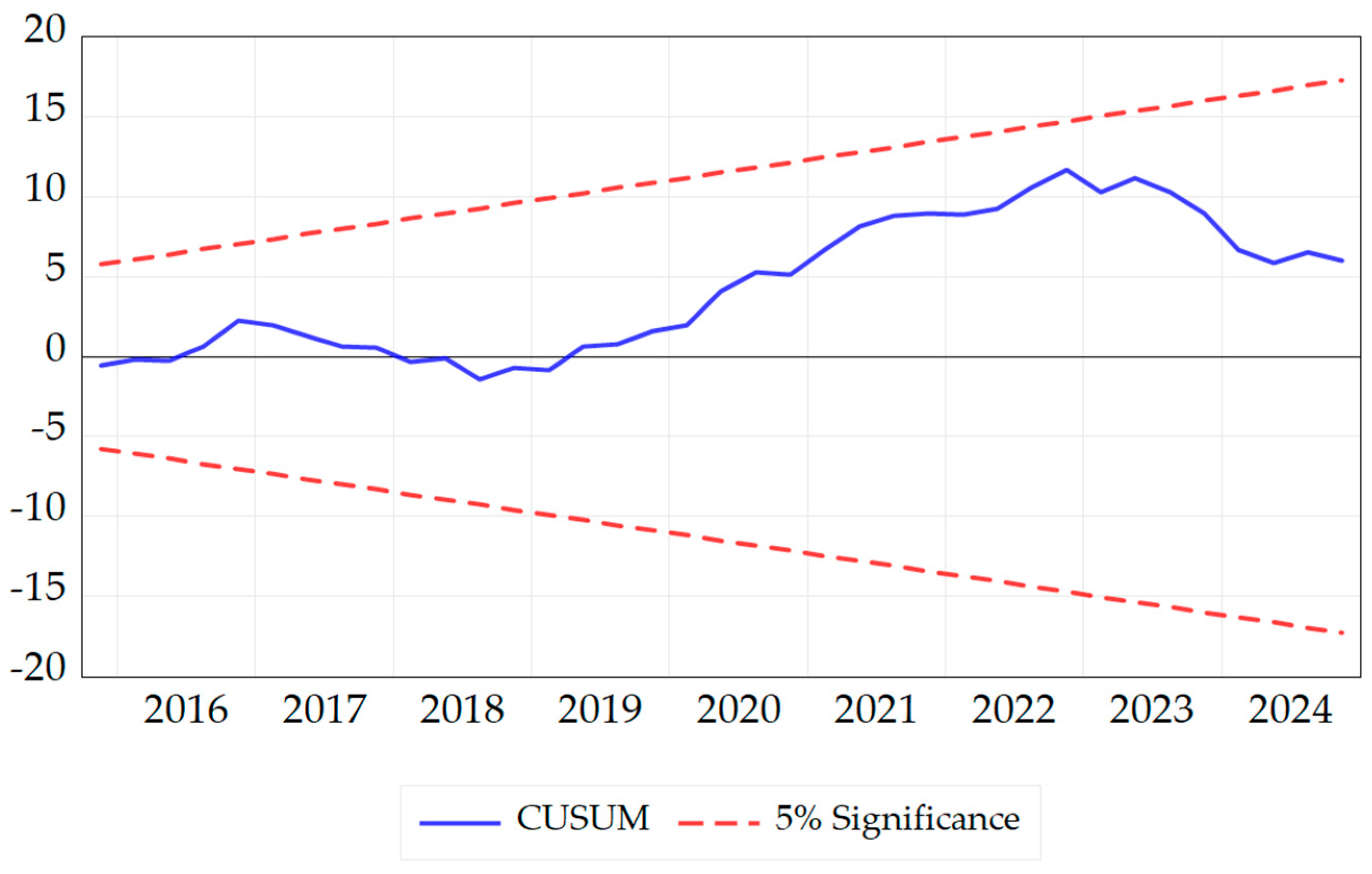
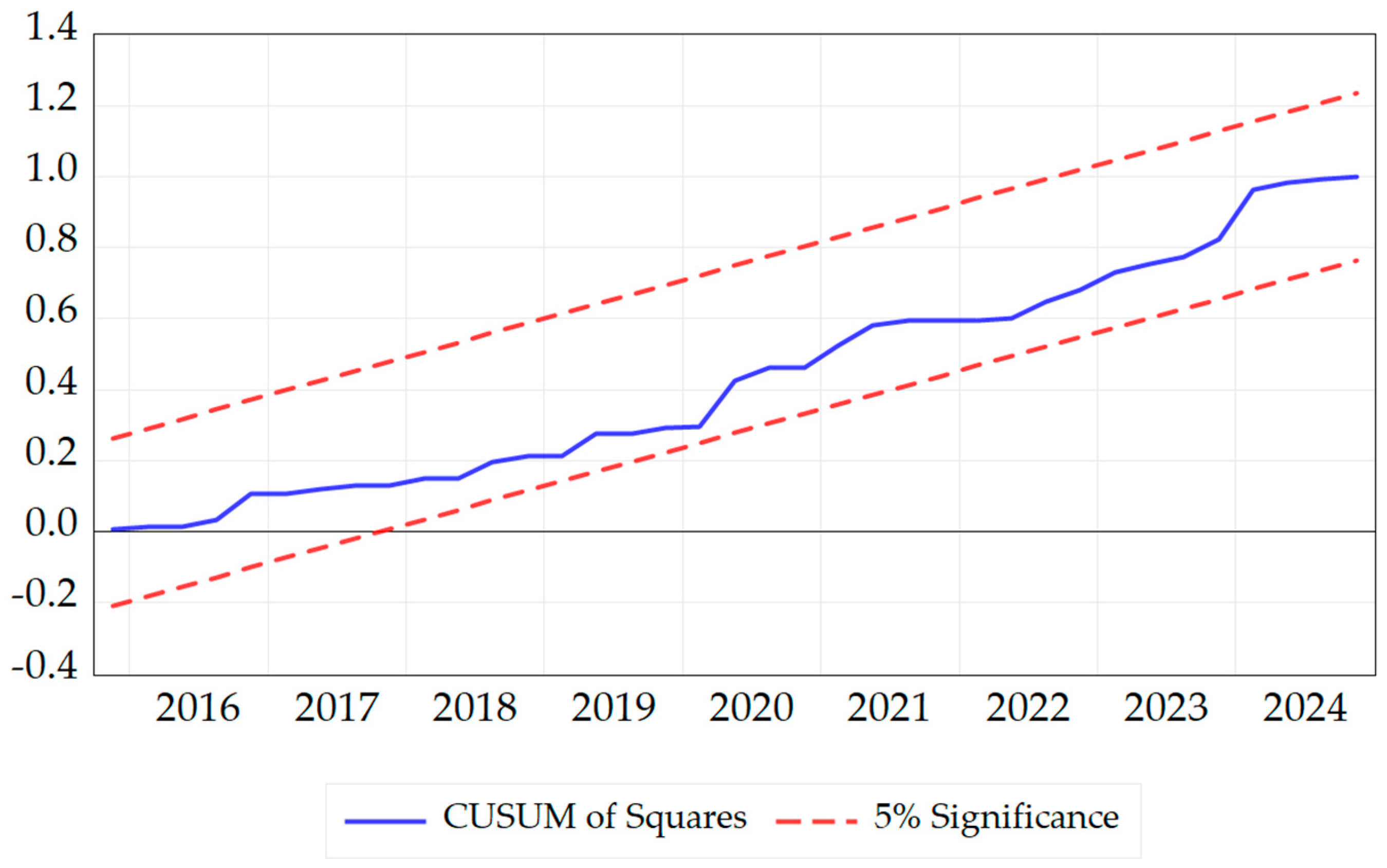
The CUSUM test examines systematic parameter drift in the model, while the CUSUMSQ test detects structural breaks. As shown in Figure 2 and Figure 3, the statistical curves from both tests lie within the 5% significance critical bounds, leading to the conclusion that the null hypothesis of parameter stability cannot be rejected. This demonstrates that the model parameters remained stable throughout the entire sample period, with no evidence of structural changes, thereby reinforcing the model’s predictive reliability.

5. Discussion

Firstly, the relationship between the price of China’s tea imported by Malaysia and the volume of China’s tea exported to Malaysia is consistent with expectations. Specifically, a 1% increase in the price of China’s tea was associated with a decrease in the tea export volume of approximately 0.67%. Due to the logarithmic form of the model, the long-run coefficient can be interpreted as the long-run price elasticity; in this study, it had an absolute value less than 1, indicating that Malaysia’s demand for China’s tea is price-inelastic in the long run [40]. This indicates that China’s tea in the Malaysian market has certain advantages in terms of quality, brand recognition, and cultural acceptance, and can still maintain a stable demand even in the face of price increases. Furthermore, it confirms that the price of China’s tea can be used to predict the tea export volume in the short run at the 1% significance level. This finding is of great significance for policymakers and China’s tea export enterprises, suggesting that price changes not only serve as a tool for long-term strategic adjustments but may also induce short-term fluctuations in demand.
Secondly, there was a significant negative correlation between the price of coffee imported by Malaysia and the export volume of China’s tea to Malaysia in the long run and short run, with the direction contradicting expectations. In the Malaysian market, although tea and coffee are theoretically substitutes, there are multiple factors that can shape this relationship in practice. Coffee holds strong cultural associations, and high-end consumers exhibit rigid preferences [41], meaning that rising coffee prices do not trigger substitution toward tea but may instead reduce the tea demand as household budgets tighten. In terms of import structure [42], both products are often procured by the same importers, so higher coffee prices raise total import costs and indirectly reduce tea imports. Through the price transmission mechanism [43], increases in coffee prices generate overall cost pressures that compress the market size for beverages, including tea. This finding contrasts with the evidence from the Iraqi market, where empirical research suggests a substitution effect between tea and coffee [19], highlighting the importance of different country contexts. Therefore, rising coffee prices lead to a decline in China’s tea export volume in Malaysia, underscoring the need for export strategies that account for the target market’s cultural context and consumption habits rather than relying solely on theoretically predicted price elasticity.
Thirdly, Malaysia’s GDP had a significant positive correlation with China’s tea exports to Malaysia in both the long and short term, which is in line with expectations. The study empirically demonstrated that Malaysia’s GDP growth exerts a significant, stable, and substantial positive impact on the volume of China’s tea exports. This indicates that China’s tea possesses the characteristics of a normal good in the Malaysian market, with economic growth and consumption upgrading serving as the key drivers of demand. In accordance with prior studies that highlighted the role of rising income levels in boosting beverage imports in other countries [9,21,22], this finding reinforces the argument that economic expansion in Malaysia is a decisive factor in shaping tea import dynamics. These findings offer important implications for future export strategy formulation: the economic trends in the target market should be continuously monitored, while enhancing brand awareness and promoting cultural value, which can further expand export growth.
Next, the relationship between Malaysia’s tea production and the export volume of China’s tea exported to Malaysia is consistent with expectations. Although Malaysia’s total domestic tea production is relatively limited, it exerts a certain degree of substitution effect in specific market segments or regional markets [44]. In line with the empirical findings of Forgenie and Khoiriyah [24], in the long run, the improvement of domestic production has important impacts on price competitiveness, trade policies, and the layout of procurement channels, which is further reflected in the overall reduction in import demand. Furthermore, Malaysia’s tea production could not be used to predict the tea export volume in the short term. This may be due to the fact that domestic tea in Malaysia accounts for a limited proportion of the overall tea consumption and differs from China’s tea in terms of segmented markets, which hinder effective short-term market substitution.
Finally, the relationship between international oil prices and the volume of China’s tea exported to Malaysia is consistent with expectations. Within the analytical framework of export demand, international oil prices represent a crucial cost factor. This is particularly true for agricultural products (such as tea) that rely on long-distance transportation. Fluctuations in oil prices can alter trade volumes through the price transmission mechanism. The empirical results of this study further confirmed a statistically significant negative correlation between the international oil price and the export volume of China’s tea to Malaysia. In addition, international oil prices could not be used to predict the export volume of China’s tea in the short term. This is in line with the view of Hämäläinen et al. [45] that the export of bulk commodities is slow to respond to changes in transportation costs in the short term, as prices and supply chain coordination usually depend on long-term agreements and trading relationships.
The empirical results of this study confirm that the key factors influencing China’s tea exports to Malaysia include price mechanisms, income effects, substitution with coffee, domestic production, and transportation costs. Taken together, these findings highlight the multifaceted demand-side determinants in the Malaysian market: while tea price and GDP drive the core dynamics of consumption, the unexpected influence of coffee price and the negative role of domestic production reveal the importance of cultural preferences and market structures. The negative effect of oil prices further emphasizes the relevance of global cost shocks in shaping bilateral trade flows. By systematically integrating these factors, this study offers a clearer picture of the dynamics underlying the China–Malaysia tea trade.

6. Conclusions and Policy Recommendations

Based on quarterly data from 2005 to 2024, this study investigated the factors influencing China’s tea exports to Malaysia using ARDL and Granger causality methods. The analysis integrated price, substitute, income, domestic supply, and transportation cost variables, offering both long- and short-run perspectives. Overall, most of the empirical results in this study are consistent with theoretical expectations. Notably, coffee price displays an unexpected negative relationship, reflecting cultural preference, import structure, and price transmission effects rather than pure substitution effects. These findings highlight the need for export strategies tailored to Malaysia’s market characteristics.
The findings suggest several targeted policy measures to enhance China’s tea export performance in Malaysia. First, bilateral trade cooperation under existing frameworks such as the Belt and Road Initiative should be strengthened through reduced tariffs, streamlined customs procedures, and joint promotion of tea culture. Second, stable pricing strategies are essential to maintain competitiveness, coupled with brand differentiation to mitigate sensitivity to price fluctuations. Third, given the negative impact of coffee price on tea exports, marketing strategies should emphasize tea’s unique value rather than competing solely on price. Fourth, aligning the export supply with Malaysia’s market demand requires coordinated production planning and quality enhancement at the source. Finally, mitigating transport cost volatility through logistics optimization and diversified shipping arrangements can stabilize export flows. These recommendations integrate economic, cultural, and structural factors, aiming to support sustainable and resilient growth of the China–Malaysia tea trade.
This study has two main limitations. First, data constraints limited the granularity of the analysis. Specifically, official statistics on Malaysia’s import of China’s tea are mostly aggregated under the general category of “tea”, with detailed subcategory data (e.g., oolong, Pu’er, and Liubao teas) available for only a short time period, which may obscure differences in price and income sensitivity across various tea types. Additionally, there is a lack of data on tea consumption habits among Malaysia’s ethnically diverse population. Second, there is limited empirical literature on the China–Malaysia tea trade and tea substitutes, which created challenges in establishing background evidence for the study. Based on these limitations, future research could explore segmented analyses at the product level to capture differences in market acceptance, price elasticity, and brand influence, and consider the competitive dynamics with other tea-exporting countries such as Indonesia and Vietnam. Moreover, incorporating non-economic factors such as brand awareness, consumer preferences, and policy shocks (e.g., tariff adjustments and import licensing reforms) would provide a more comprehensive understanding of the factors influencing China’s tea exports to Malaysia.

Author Contributions

Conceptualization, Y.H. and C.-H.P.; methodology, Y.H.; software, Y.H.; validation, Y.H. and C.-H.P.; formal analysis, Y.H.; investigation, Y.H.; resources, Y.H.; data curation, Y.H.; writing—original draft preparation, Y.H.; writing—review and editing, Y.H.; visualization, Y.H.; supervision, C.-H.P.; project administration, Y.H.; funding acquisition, Y.H. All authors have read and agreed to the published version of the manuscript.

Funding

This research received no external funding.

Institutional Review Board Statement

Not applicable.

Data Availability Statement

Data are available upon request from the lead author, Y.H.

Acknowledgments

The authors would like to extend their heartfelt gratitude to the experts and scholars who provided invaluable insights and constructive feedback that significantly enhanced the quality of this manuscript.

Conflicts of Interest

The authors declare no conflicts of interest.

References

  1. FAO. Global Market Analysis—Promotion (ISM-17-3). Intersessional Meeting on Tea, Rome, Italy, 2017. Available online: https://www.fao.org/fileadmin/templates/est/COMM_MARKETS_MONITORING/Tea/Intersessional_2017/ISM-17-3-GlobalMktAnalysis_Promotion.docx (accessed on 8 July 2025).
  2. Tea & Coffee Trade Journal. The Global Tea Report 2024. Available online: https://www.teaandcoffee.net/feature/34254/the-global-tea-report-2024/ (accessed on 9 July 2025).
  3. FAO. FAOSTAT Statistical Database. Available online: https://www.fao.org/faostat/en/#data (accessed on 17 July 2025).
  4. Tea Industry Committee (TIC) of China Association for the Promotion of International Agricultural Cooperation (CAPIAC); the Belt and Road International Tea Trade Industry Innovation Institute (BRIT). China Tea Import and Export Trade Analysis Report 2021. Available online: https://www.capiaccti.org.cn/teaTrade (accessed on 18 July 2025).
  5. Pampus, M. More than Colonial Vestige? Afternoon Tea as Heritage Practice in Penang (Malaysia). Heritage 2023, 6, 2928–2941. [Google Scholar] [CrossRef]
  6. Xu, S.M.; Guo, Y.L. Thoughts on the Diversification and Development of Tea Drinking in Malaysia. J. Anhui Agric. Sci. 2017, 45, 256–258. [Google Scholar] [CrossRef]
  7. Tea Industry Committee (TIC) of China Association for the Promotion of International Agricultural Cooperation (CAPIAC); The Belt and Road International Tea Trade Industry Innovation Institute (BRIT). China Tea Import and Export Trade Analysis Report 2022. Available online: https://www.capiaccti.org.cn/teaTrade (accessed on 18 July 2025).
  8. Statista. Ready-to-Drink (RTD) Tea-Malaysia. Available online: https://www.statista.com/outlook/cmo/non-alcoholic-drinks/ready-to-drink-rtd-coffee-tea/ready-to-drink-rtd-tea/malaysia (accessed on 20 July 2025).
  9. Mou, S.T. The Impact of Green Trade Barriers on Chinese Tea Exports: A Gravity Model Study. Mod. Econ. 2023, 14, 1849–1864. [Google Scholar] [CrossRef]
  10. Fan, Z.; Liu, K. The Promotion Effect of the Belt and Road Initiative on China’s Tea Export Trade. J. Sociol. Ethnol. 2022, 4, 94–100. [Google Scholar] [CrossRef]
  11. Qin, K.; Zhou, L. Analysis of the High-quality Development Path of China’s Tea Export. PLoS ONE 2024, 19, e0311629. [Google Scholar] [CrossRef]
  12. Zhang, H.L. Analysis of Influencing Factors of China’s Tea Export Trade to Japan. J. Minxi Voc. Technol. Coll. 2012, 14, 43–47. [Google Scholar] [CrossRef]
  13. Xu, Y.M. An Empirical Analysis of the Factors Affecting China’s Tea Exports to the United States under the Background of Sino-US Trade Friction. Chin. Tea 2020, 11, 21–27. [Google Scholar] [CrossRef]
  14. Yang, F.; Jiang, R.; Chen, F.Q.; Zhang, F. Analysis of the Current Situation and Prospects of Tea Trade Between China and ASEAN Under the Belt and Road Initiative. Chin. Tea 2019, 3, 23–28. [Google Scholar]
  15. Zhao, L.; Li, Y.N.; Li, W.; Xie, Y.Q. Strategies for Deepening Tea Trade and Economic Cooperation Between Guizhou and Southeast Asia Under the RCEP Background: A Case Study of Malaysia. J. Tea Sci. 2023, 5, 53–59. [Google Scholar] [CrossRef]
  16. Ni Mhurchu, C.; Eyles, H.; Schilling, C.; Yang, Q.; Kaye-Blake, W.; Genç, M.; Blakely, T. Food prices and consumer demand: Differences across income levels and ethnic groups. PLoS ONE 2013, 8, e75934. [Google Scholar] [CrossRef] [PubMed]
  17. Nursodik, H.; Santoso, S.I.; Nurfadillah, S. Competitiveness of Indonesian Tea Export in Southeast Asia Markets. SOCA J. Soc. Econ. Agric. 2022, 16, 1–14. [Google Scholar] [CrossRef]
  18. Hajra, N.G. The Global Tea Industry Amid COVID-19. Tea Coffee Trade J. 2021, 193, 12–18. [Google Scholar]
  19. Kadhim, Z.R. An Economic Analysis of the Determinants of Domestic Demand for Tea Imports in Iraq Using the Auto-regressive Distributed Lag Technique (ARDL) for the Period (1990–2020). Iraqi J. Agric. Sci. 2022, 53, 187–197. [Google Scholar] [CrossRef]
  20. Bernhofen, B.M.; Tian, M. The Trade–GDP Ratio as a Measure of Openness. World Econ. 2023, 46, 1319–1332. [Google Scholar] [CrossRef]
  21. Vo, T.D.; Yang, L.; Dung Tran, M. Determinants Influencing Vietnam Coffee Exports. Cogent Bus. Manag. 2024, 11, 2337961. [Google Scholar] [CrossRef]
  22. Sato, M.N. Determinants of Kenyan Tea Exports: The Gravity Model Approach. J. Econ. Sustain. Dev. 2020, 10, 132–143. [Google Scholar] [CrossRef]
  23. Clements, K.W.; Mariano, M.J.M.; Verikios, G. Foreign-domestic Substitution, Import Penetration and CGE Modelling. Appl. Econ. 2021, 53, 4080–4099. [Google Scholar] [CrossRef]
  24. Forgenie, D.; Khoiriyah, N. Analyzing Food Import Demand in Indonesia: An ARDL Bounds Testing Approach. Int. J. Food Agric. Econ. 2023, 11, 1–15. [Google Scholar] [CrossRef]
  25. Sen, S. International Trade Theory and Policy: A Review of the Literature (November 23, 2010). Levy Economics Institute Working Papers Series No. 635. SSRN 2010. [Google Scholar] [CrossRef]
  26. Zhou, S.; Kang, C. Research on the Influencing Factors of Russian Foreign Trade Based on R Language Regression Analysis. Math. Probl. Eng. 2021, 2021, 5638831. [Google Scholar] [CrossRef]
  27. Adi, L. Can the Prices of the World Crude Oil as a Proxy for Transportation Cost in Trade among ASEAN-3? J. Econ. Dev. Stud. 2016, 16, 38–47. [Google Scholar]
  28. Pesaran, M.H.; Shin, Y.; Smith, R.J. Bounds Testing Approaches to the Analysis of Level Relationships. J. Appl. Econ. 2001, 16, 289–326. [Google Scholar] [CrossRef]
  29. Ganbaatar, B.; Huang, J.; Shuai, C.; Nawaz, A.; Ali, M. Empirical Analysis of Factors Affecting the Bilateral Trade Between Mongolia and China. Sustainability 2021, 13, 4051. [Google Scholar] [CrossRef]
  30. Soharwardi, M.A.; Ahmad, M.; Shafique, M.N. Exchange Rate Volatility and Trade Deficit in Pakistan: A Time Series Analysis. Int. J. Econ. Financ. Issues 2020, 10, 215–219. [Google Scholar] [CrossRef]
  31. Mbiakop, W.D.; Khobai, H.; Fani, D.C.R. The Impact of Public Agricultural Spending on Foreign Direct Investment Inflows in Agriculture in South Africa: An ARDL Analysis. Int. J. Econ. Financ. Issues 2023, 13, 76–87. [Google Scholar] [CrossRef]
  32. Soyebi, O.J.; Umobong, A.A. Government Expenditure and Economic Growth in Nigeria 1970–2022: ARDL Approach. Int. J. Bus. Manag. 2024, 7, 87–106. [Google Scholar] [CrossRef]
  33. Narayan, P.K. The Saving and Investment Nexus for China: Evidence from Cointegration Tests. Appl. Econ. 2005, 37, 1979–1990. [Google Scholar] [CrossRef]
  34. Hadi, S.N.; Chung, R.H. Estimation of Demand for Beef Imports in Indonesia: An Autoregressive Distributed Lag (ARDL) Approach. Agriculture 2022, 12, 1212. [Google Scholar] [CrossRef]
  35. Azam, A.H.M.; Zainuddin, M.R.K.V.; Abedin, N.F.Z.; Rusli, N.A.M. Impact of Exchange Rate Volatility on Trade Balance in Malaysia. J. Asian Finance Econ. Bus. 2022, 9, 49–59. [Google Scholar] [CrossRef]
  36. Matashu, M.; Skhephe, M. Human Capital and Economic Growth in Sub Saharan Africa Countries ARDL and ECM Analysis. J. Econ. Educ. Entrepren. 2022, 3, 49–64. [Google Scholar] [CrossRef]
  37. Lee, C.W.; Fernando, A. Foreign Direct Investment, Export and Economic Growth in Indonesia: ARDL-ECM Analysis. Rev. Integr. Bus. Econ. Res. 2021, 10, 68–82. [Google Scholar]
  38. Granger, C.W. Investigating Causal Relations by Econometric Models and Cross-spectral Methods. Econometrica 1969, 37, 424–438. [Google Scholar] [CrossRef]
  39. Jacob, R.Z.; Magungu, A.W. Relationship between Foreign Exchange Reserves and Economic Growth in Tanzania: Application of Wald Granger-causality Test. Rural Plan. J. 2023, 25, 102–119. [Google Scholar] [CrossRef]
  40. Ignanga, C.; Chen, Y.; Zhao, Y.; Liu, H.; Yu, W. Cross-sectional Analysis of Household Food Demand in Estuaire Gabon: A Near-ideal Quadratic Demand System Approach. Agriculture 2025, 15, 268. [Google Scholar] [CrossRef]
  41. Omar, N.R.N.; Ahmad, A.A.; Nor, N.A.A.M.; Abidin, A.Z.Z.; Sulaiman, N.H.; Ahmad, B. Coffee Industry in Malaysia: An Overview and Potential. Econ. Technol. Manag. Rev. 2022, 19, 103–114. [Google Scholar]
  42. Hassan, M.; Sultan, F.; Kamal, M.H.; Hassan, S.I.; Sadiq, W. Evaluating Strategies for Cost Reduction in Supply Chain Management Relating to Exports and Imports. Crit. Rev. Soc. Sci. Stud. 2024, 2, 809–817. [Google Scholar] [CrossRef]
  43. Von Cramon-Taubadel, S.; Goodwin, B.K. Price Transmission in Agricultural Markets. Annu. Rev. Resour. Econ. 2021, 13, 65–84. [Google Scholar] [CrossRef]
  44. Krishnan, T.S. Forecasting Tea Production in Malaysia. Doctoral Dissertation, University of Malaya, Kuala Lumpur, Malaysia, 2000. [Google Scholar]
  45. Hämäläinen, E.; Twrdy, E.; Inkinen, T. Cost Aggregation in Export Logistics Chain. J. Open Innov. Technol. Mark. Complex. 2017, 3, 1–14. [Google Scholar] [CrossRef]
Figure 1. Market share of the top three countries exporting tea to Malaysia (2005–2022).
Agriculture 15 01897 g001
Figure 2. CUSUM test result.
Agriculture 15 01897 g002
Figure 3. CUSUMSQ test result.
Agriculture 15 01897 g003
Table 1. China’s tea export value and volume to Malaysia and average price (2005–2024).
YearExport Value
(100 Million
USD)
Growth
Rate
(%)
Export
Volume
(Tons)
Growth
Rate
(%)
Average
Price
(USD/kg)
Growth
Rate
(%)
20050.0325.821586.5922.202.492.96
20060.0551.231513.62−4.603.9458.52
20070.0836.241734.3914.584.6918.90
20080.08−0.711621.95−6.484.986.17
20090.06−31.661312.63−19.074.20−15.55
20100.0851.781550.3618.115.4028.51
20110.0912.571588.422.465.939.87
20120.1114.421760.0610.816.133.27
20130.1977.632140.6021.628.9546.05
20140.3056.182071.02−3.2514.4461.43
20150.301.232572.3724.2111.77−18.50
20160.4755.062377.50−7.5819.7567.77
20170.6232.753372.1741.8418.48−6.41
20180.7723.553488.203.4422.0819.44
20191.3170.434910.2640.7726.7321.07
20201.7130.535634.0414.7430.4113.76
20212.5749.807242.6328.5535.4316.53
20222.8510.949265.4027.9330.73−13.28
20232.09−26.668208.27−11.4125.44−17.22
20241.05−49.924528.77−44.8323.09−9.23
Source: author’s calculations based on the UN Comtrade Database (https://comtrade.un.org/, accessed on 25 August 2025) and data from the Ministry of Commerce of the People’s Republic of China (http://wms.mofcom.gov.cn/cms_files/oldfile/wms/article/zt_ncp/table/tea_1612.pdf, accessed on 26 August 2025).
Table 2. Unit root test results.
ADF
SeriesLevelFirst DifferenceFinding
InterceptIntercept and TrendInterceptIntercept and Trend
LEV−0.8838(3)−2.3549(2)−9.0415(2) ***−8.9841(2) ***I(1)
LCTP−1.4589(1)−2.4538(1)−14.8985(0) ***−14.8037(0) ***I(1)
LCP−1.6223(0)−2.3970(0)−8.1760(0) ***−8.1264(0) ***I(1)
LGDP−2.0992(0)−2.7094(0)−8.0914(0) ***−8.1403(0) ***I(1)
LMTP−2.3373(5)−2.2513(5)−3.5309(4) ***−3.5934(4) **I(1)
LOP−3.1645(1) **−3.1497(1)−7.2542(0) ***−7.2301(0) ***I(0)
KPSS
SeriesLevelFirst DifferenceFinding
InterceptIntercept and TrendInterceptIntercept and Trend
LEV1.4650(4) ***0.2379(4) ***0.0578(4)0.0571(4)I(1)
LCTP0.9085(6) ***0.1582(6) **0.0793(16)0.0811(16)I(1)
LCP0.8900(6) ***0.1298(6) *0.1464(2)0.1426(2) *I(1)
LGDP1.0905(6) ***0.2283(6) ***0.2342(7)0.1046(9)I(1)
LMTP0.3915(6) *0.1808(6) **0.1005(1)0.0874(0)I(1)
LOP0.1214(6)0.1086(6)0.0790(4)0.0597(4)I(0)
*, **, and *** indicate statistically significant differences at the 10, 5, and 1 percent levels, respectively. The numbers in parentheses are the lag lengths.
Table 3. Results of bounds test for cointegration.
ModelSample SizeF-StatisticARDL Order
LEV, LCTP, LCP, LGDP, LMTP, and LOP804.062 **(8, 2, 7, 4, 9, 7)
Critical value bounds of F-statistic: restricted intercept and no trend (k = 5, n = 80)
Significance10%5%1%
SampleI(0)I(1)I(0)I(1)I(0)I(1)
802.3033.1542.5503.6063.3514.587
Asymptotic2.0803.0002.3903.3803.0604.150
** indicate significant differences at the 5% level. I(0) and I(1) are the stationary and non-stationary bounds, respectively.
Table 4. Long-run ARDL estimation.
RegressorCoefficientSEt-Statisticp-Value
LCTPt−1−0.6722 **0.2931−2.29340.0247
LCPt−1−2.5698 **1.0774−2.38510.0196
LGDPt−16.3409 ***1.22245.18700.0000
LMTPt−1−0.9011 ***0.3092−2.91380.0047
LOPt−1−1.0995 ***0.3772−2.91510.0047
Constant−124.0755 ***29.2713−4.23880.0001
*** and ** indicate statistically significant differences at the 1 and 5 percent levels.
Table 5. Error correction representation of ARDL results.
RegressorCoefficientSEt-Statisticp-Value
∆LCPt−10.7857 ***0.2888552.7199270.0094
∆LCPt−20.14470.2614340.5535200.5828
∆LCPt−30.7598 ***0.2742332.7705490.0082
∆LCPt−40.6423 **0.2645192.4282360.0194
∆LCPt−5−0.07210.265112−0.2721280.7868
∆LCPt−60.8995 ***0.2711873.3169410.0019
∆LGDPt2.8473 ***0.6382284.4612540.0001
∆LGDPt−1−1.4041 **0.669896−2.0960370.0420
∆LGDPt−20.68270.6966350.9800350.3326
∆LGDPt−3−1.2413 *0.669157−1.8549550.0705
∆LMTPt0.33080.2768791.1946410.2388
∆LMTPt−10.27890.3312180.8420460.4044
∆LMTPt−20.07370.3240060.2275040.8211
∆LMTPt−30.5867 *0.3282041.7877450.0809
∆LMTPt−40.02370.3837520.0618510.9510
∆LMTPt−50.11520.3067950.3755860.7091
∆LMTPt−6−0.00950.315887−0.0300500.9762
∆LMTPt−70.5665 *0.3180381.7811010.0820
∆LMTPt−8−0.5744 **0.279093−2.0581410.0457
∆LOPt−0.7199 ***0.204951−3.5123660.0011
∆LOPt−10.06580.2167290.3036610.7629
∆LOPt−20.13800.2136140.6458970.5218
∆LOPt−30.24550.2127911.1535370.2551
∆LOPt−40.4775 ***0.1624652.9390920.0053
∆LOPt−50.11050.1825980.6051420.5483
∆LOPt−60.3444 *0.1807921.9047230.0635
ECTt−1−0.4450 ***0.0774−5.74840.0000
*, **, and *** indicate statistically significant differences at the 10, 5, and 1 percent levels, respectively. ECT stands for error correction term.
Table 6. Granger causality test results.
Null HypothesisChi-Squarep-ValueConclusion
LCTP does not Granger-cause LEV12.24380.0066 ***Rejected
LCP does not Granger-cause LEV24.10580.0022 ***Rejected
LGDP does not Granger-cause LEV32.50430.0000 ***Rejected
LMTP does not Granger-cause LEV15.76770.1065Not rejected
LOP does not Granger-cause LEV13.28240.1025Not rejected
*** represents statistically significant differences at the 1 percent level.
Table 7. Diagnostic test results.
TestNull Hypothesisp-ValueConclusion
JBThere is a normal distribution.0.8056Not rejected
Breusch–Godfrey LMThere is no autocorrelation.0.7089Not rejected
ARCHThere is no heteroskedasticity.0.1151Not rejected
Ramsey RESETThe model is correctly specified.0.0663Not rejected
Disclaimer/Publisher’s Note: The statements, opinions and data contained in all publications are solely those of the individual author(s) and contributor(s) and not of MDPI and/or the editor(s). MDPI and/or the editor(s) disclaim responsibility for any injury to people or property resulting from any ideas, methods, instructions or products referred to in the content.