Article

Response of Soil Organic Carbon Sequestration Rate, Nitrogen Use Efficiency, and Corn Yield to Different Exogenous Carbon Inputs in Rainfed Farmlands of the Ningnan Mountainous Area, Northwest China


by
Huanjun Qi
1,2,3,
Jinyin Lei
2,3,*,
Jinqin He
2,3,
Jian Wang
1,*,
Xiaoting Lei
2,3,
Jianxin Jin
2,3 and
Lina Zhou
2,3
1
College of Soil and Water Conservation Science and Engineering, Northwest A&F University, Xianyang 712100, China
2
Institute of Agricultural Resources and Environment, Ningxia Academy of Agriculture and Forestry Sciences, Yinchuan 750002, China
3
National Agricultural Environment Yinchuan Observation and Experimental Station, Yinchuan 750002, China
*
Authors to whom correspondence should be addressed.
Agriculture 2025, 15(17), 1809; https://doi.org/10.3390/agriculture15171809
Submission received: 12 June 2025 / Revised: 12 August 2025 / Accepted: 21 August 2025 / Published: 25 August 2025
(This article belongs to the Section Crop Production)

Abstract

The mechanisms through which different types of exogenous carbon enhance the soil organic carbon sequestration rate (Cseq), nitrogen use efficiency (NUE), and corn yield (CY) in rainfed farmland on the Loess Plateau remain inadequately elucidated. This study established a four-year fixed-site experiment in the context of organic materials to increase soil organic carbon storage and enhance corn yield in the dry-farmed areas of the mountainous southern Ningxia region. The research investigates the effects of adding different types of exogenous carbon materials on Cseq, NUE, and CY. The soil type at the experimental base is loessial soil (Huangmian soil), with a soil pH of 8.28 and a baseline organic carbon content of 8.20 g kg−1. The main crop cultivated in this area is corn. The experimental treatments were as follows: (i) N, no fertilization; (ii) CK, 100% nitrogen, phosphorus, and potassium fertilizers; (iii) C, 50%CK + corn straw (pulverized); (iv) M, 50%CK + fermented cow manure; (v) C/M, 50%CK + fermented cow manure + corn straw (1:1). The results show that compared with the CK treatment, the Cseq of C, M, and C/M treatments increased by 488.89%, 355.56%, and 527.78%, respectively. Compared with the CK treatment, the NUE of C, M, and C/M treatments increased by 15.04%, 7.70%, and 12.20%, respectively. Compared with the CK treatment, the CY under the C, M, and C/M treatments were increased by 7.91%, 19.10%, and 11.59%, respectively. The linear regression results show that the Cseq had a significant positive effect on CY (R2 = 0.37) and NUE, R2 = 0.39) (p < 0.0001). The TOPSIS (technique for order preference by similarity to ideal solution) evaluation results indicate that the C/M treatment was the optimal measure for achieving increased corn yield while enhancing Cseq and NUE. Therefore, incorporating a 1:1 mixture of corn straw and cattle manure in rainfed farmland in the mountainous area of southern Ningxia may be the best strategy to improve Cseq and NUE.

1. Introduction

In terrestrial ecosystems, carbon sinks are primarily found in the soil, with soil organic carbon stock (SOCs) reaching up to 1550 Pg within the 0–100 cm soil depth. This is significantly higher than the carbon storage in terrestrial organisms [1,2]. Therefore, even slight changes in SOCs can have a significant impact on the global carbon cycle and climate [3,4]. Soil organic carbon (SOC) is a crucial indicator for assessing soil fertility. The SOCs reflects soil fertility status and nutrient supply capacity [5] and directly determines crop productivity levels in agricultural systems [6]. Therefore, studying the SOCs and composition of organic carbon holds significant practical importance for achieving high-quality agricultural development and ecological environmental protection in the new era.
SOC is categorized into labile organic carbon (LOC) and recalcitrant organic carbon (ROC) based on its average residence time in the soil. LOC primarily includes microbial biomass carbon (MBC) and dissolved organic carbon (DOC) [7]. Although LOC constitutes a small proportion of total soil organic carbon (TOC) and exhibits lower stability, it is highly active and bioavailable, directly supplying nutrients for crop growth. Exogenous carbon inputs are currently the most direct and effective measure to enhance SOC content in rainfed agricultural production [8]. Aula et al. [9] found that exogenous carbon addition significantly increases SOC and LOC levels. SOC content directly influences SOCs [10], and studies [11] have shown that SOCs generally increases with higher exogenous carbon input. For example, Lu [12] demonstrated that incorporating crop straw as a carbon source elevated SOCs in the plough layer by 12%. Studies have shown that the content of soil total nitrogen (TN) has a regulatory effect on the dynamic changes of SOC [13], which proves that there is a close relationship between SOC and TN content. Frey et al. [14] and Oertel et al. [15] found that applying a large amount of nitrogen fertilizer can significantly reduce the soil CO2 emission rate, thereby increasing the SOC content. At the same time, many studies [16,17,18] have shown that adding exogenous carbon can significantly increase the SOC content, and at the same time, the TN content also increases significantly. Jin et al. [19] and Tang et al. [20] found that adding exogenous carbon not only increases the SOC and nutrient content, but also improves crop yields and NUE, indicating a close relationship between SOC and NUE. Therefore, the addition of exogenous carbon represents a critical measure for enhancing Cseq, improving NUE, and increasing SOCs. Although extensive research exists on the impacts of different exogenous carbon types on agricultural soils, the effects of adding varying carbon sources on soil organic carbon stocks and nitrogen use efficiency differ significantly across regions. Consequently, further research is imperative to investigate how different exogenous carbon types influence SOC sequestration rates, nitrogen use efficiency, and organic carbon storage enhancement in diverse geographical contexts.
The southern mountainous area of Ningxia, referred to as the Ningnan Mountainous Area, is located at the northwest end of the Loess Plateau. It is an important dryland farming area where corn has become an important food crop in this region. However, due to severe soil erosion and low basic soil fertility in this area, in the process of corn planting, farmers generally choose to apply excessive nitrogen fertilizer at one time to save costs, resulting in low NUE and CY [21,22,23]. Therefore, this study takes the dryland farming area in the Ningnan Mountainous Area as the research object and conducts a 4-year fixed-position fertilization experiment in Xiji County, Ningxia, aiming to (1) study the impact characteristics of different exogenous carbon additions in the Ningnan Mountainous Area on the physical and chemical properties of the soil; (2) analyze the interrelationships between SOC, DOC, MBC, SOCs, Cseq, NUE, and CY; (3) determine the suitable types of exogenous carbon to be added to provide a theoretical basis for improving the soil fertility of dryland farmland in the Ningnan Mountainous Area, increasing CY, and rationally applying organic materials for returning to the field.

2. Materials and Methods

2.1. Experimental Site Overview

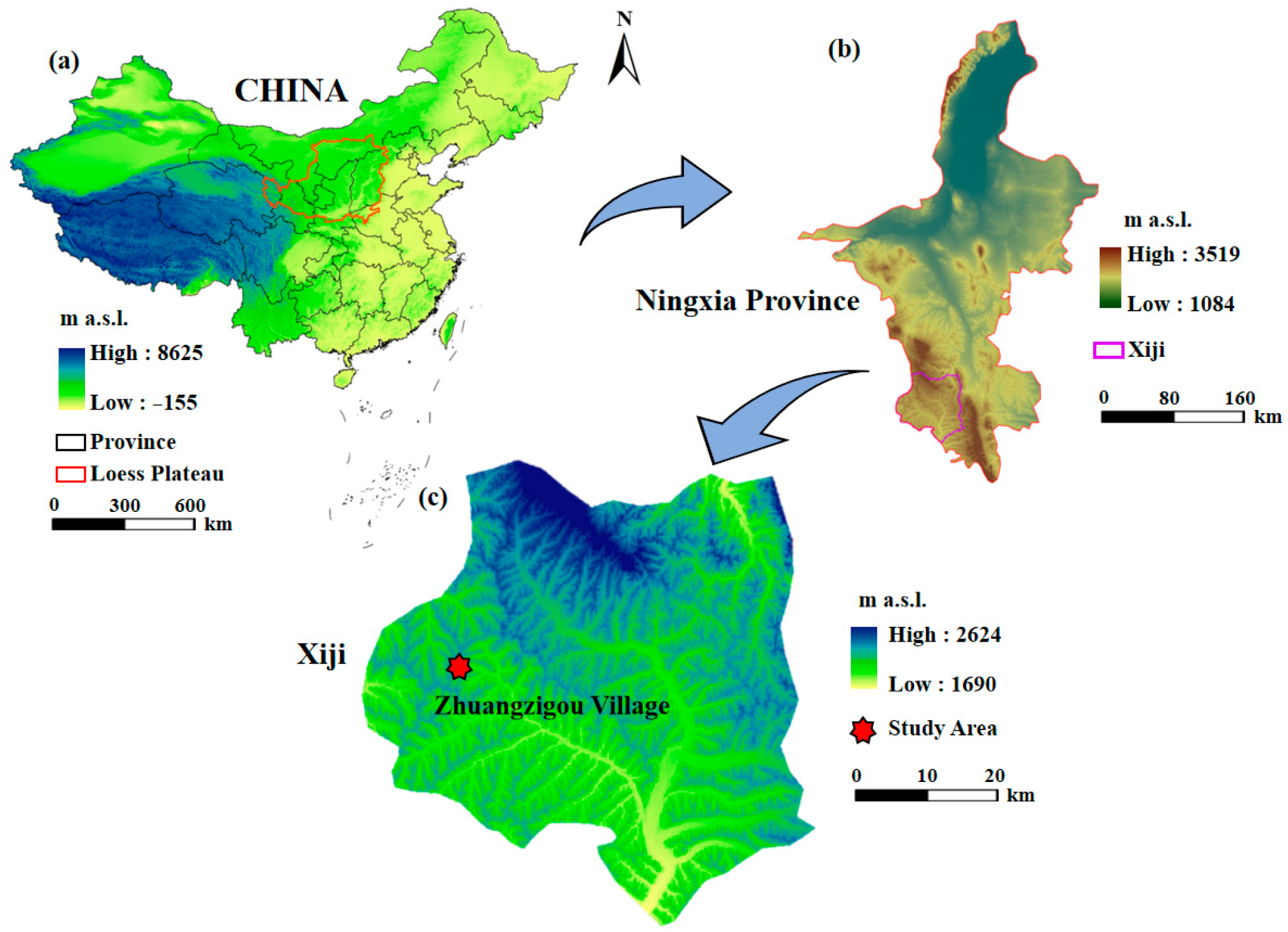
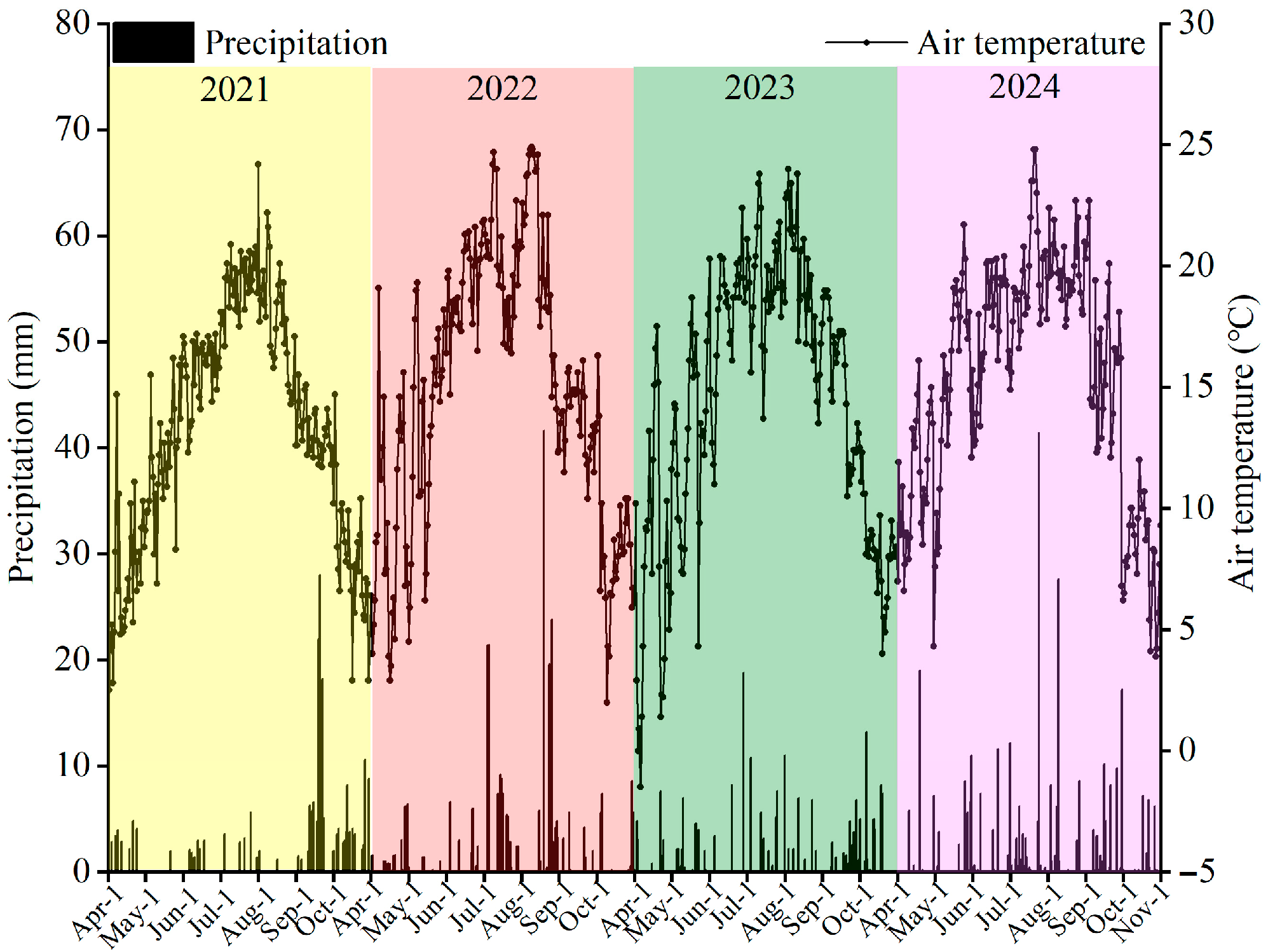
This study conducted a fixed-site exogenous carbon addition experiment from 2021 to 2024 at the experimental base in Zhuangzigou Village, Xiji County, Ningxia (105.5031° E, 35.9442° N, Figure 1). The region features a temperate continental semi-arid climate, with an average annual temperature of approximately 6.0 °C and average annual precipitation of about 400 mm. The average annual evaporation is roughly five times the precipitation, and the elevation is approximately 1954 m a.s.l. The base soil type is loessial soil, and the cropping system follows a “single crop per year” pattern. In the plough layer (0–20 cm), the BD is 1.38 g cm−3, SOM content is 14.13 g kg−1, TN is 0.85 g kg−1, available phosphorus (AP) is 30.09 mg kg−1, and available potassium (AK) is 81.10 mg kg−1. Additionally, a small weather station was installed at the base to monitor daily precipitation and temperature. The daily precipitation and temperature during the corn growth period (April–October) from 2021 to 2024 are presented in Figure 2.

2.2. Treatments, Experimental Design, and Fertilizer Use

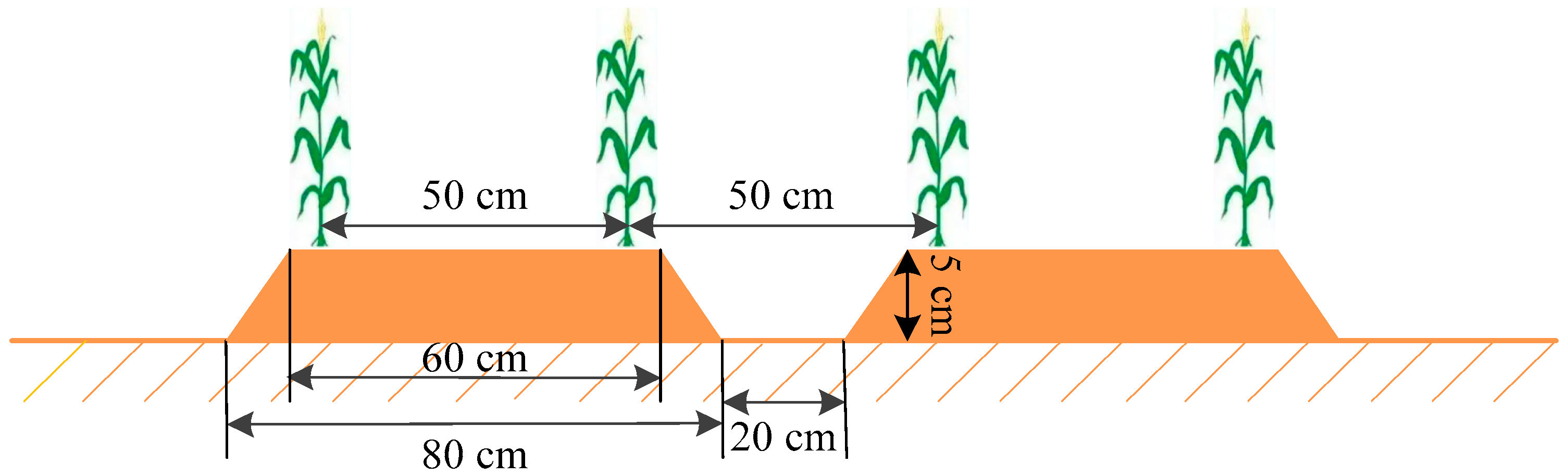
The experiment employed a completely randomized block design with five treatments: no fertilization (N), conventional chemical fertilizer (CK), 50% conventional chemical fertilizer plus fermented cattle manure (C), 50% conventional chemical fertilizer plus corn straw (with equivalent carbon content to fermented cattle manure) (M), and 50% conventional chemical fertilizer plus fermented cattle manure and corn straw (with equivalent carbon content to fermented cattle manure) (C/M) (Table 1). The specific fertilization rates for each treatment are detailed in Table 1. Each treatment was replicated three times, resulting in a total of 15 plots. Each plot covered an area of 36 m2 (6 m long × 6 m wide) and was separated by cement partition walls 1 m deep and 0.6 m wide. The planting method utilized traditional flat planting with ridging and plastic film mulching (Figure 3), with a ridge width of 0.8 m.
The experimental crop was corn, a locally dominant variety known as “Ningdan No. 19”. Sowing occurred annually in mid-to-late April, with harvesting in early October, at a planting density of 52,500 plants ha−1. All required phosphorus fertilizer, potassium fertilizer, fermented cattle manure, and corn straw for each treatment were applied in a single dose at sowing. Nitrogen fertilizer was applied in two splits: 70% at sowing and the remaining 30% during the corn jointing stage. Both cattle manure and corn straw were sourced from local livestock farmers. The fermented cattle manure was produced through aerobic composting of beef cattle manure, while corn straw was mechanically crushed to 3–5 cm lengths. The nutrient composition of the fermented cattle manure was as follows: organic carbon (C) content of 36.86%, nitrogen (N) content of 0.78%, phosphorus (P2O5) content of 0.97%, and potassium (K2O) content of 1.01%. The nutrient composition of corn straw was C content of 45.67%, N content of 0.51%, P2O5 content of 0.34%, and K2O content of 1.20%. The chemical fertilizers used included urea (nitrogen fertilizer) with 46% N, diammonium phosphate (phosphorus fertilizer) with 48% P2O5 and 15% N, and potassium sulfate (potassium fertilizer) with 52% K2O. Both chemical fertilizers and organic materials were applied annually.

2.3. Soil Sampling and Analysis

Starting at the beginning of the study (April 2021), soil samples were collected annually in April (before sowing) and October (after maize harvest). Soil samples from the 0–20 cm layer were collected using a soil auger following the five-point sampling method. For each treatment plot, five soil cores were randomly collected and thoroughly mixed to form a composite sample. The collected soil samples were immediately placed in low-temperature (4 °C) preservation containers and transported to the laboratory as soon as possible. Before analysis, visible plant and animal residues, stones, and roots were manually removed. The soil was then thoroughly mixed, air-dried, ground, and passed through a 2 mm sieve. Prepared samples were divided into two parts: (1) fresh samples were stored in laboratory refrigerators (4 °C) to determine the soil microbial biomass carbon (MBC) and dissolved organic carbon (DOC); (2) air-dried samples were used to analyze the soil physical and chemical properties.
Bulk density (BD): The bulk density of the 0–20 cm soil layer was determined using the core sampling method and calculated using the following formula [24]:
B D = m / V
In the formula, BD represents the soil bulk density (g cm−3); m represents the dry soil weight (g); V represents the unit volume (cm3).
AP and AK: AP content was determined using the 0.5 mol L−1 NaHCO3 extraction-colorimetry method; AK content was measured by the ammonium acetate extraction–flame photometry method [25].
Soil organic carbon (SOC) content was determined using the potassium dichromate (K2Cr2O7) oxidation method [26] and then multiplied by 1.724 to convert into soil organic matter (SOM) content.
Soil total nitrogen (TN) and total phosphorus (TP) contents: TN and TP were determined following the methods of Nelson and Sommers [26] and Murphy and Riley [27], respectively.
Soil microbial biomass carbon (MBC) content: MBC was determined using the chloroform fumigation–K2SO4 extraction method, followed by quantification with a total organic carbon analyzer (Phoenix 8000, Teledyne Tekmar, Mason, OH, USA) [28].
Soil dissolved organic carbon (DOC) content: DOC was determined via distilled water extraction followed by analysis with a total organic carbon analyzer (SHIMADZU TOC-L, Kyoto, Japan) [29].

2.4. Crop Sampling and Analysis

Since the initiation of the study in April 2021, 10 plants with uniform growth were randomly selected from each treatment plot during the maize harvest period (October) each year. These plants were used to measure kernel-related parameters, including the number of kernel rows, kernels per row, and 1000-kernel weight. Maize grain yield was calculated based on planting density and adjusted to a standard moisture content of 12–14%. Additionally, 3 plants with uniform growth were randomly selected from each treatment plot. These plants were separated into roots, stems, leaves, and grains, and each part was weighed. The samples were then transported to the laboratory, where they were oven-dried at 105 °C for 30 min to deactivate enzymes, followed by drying at 75 °C until constant weight. The dry weights of each plant part were recorded to calculate dry matter accumulation based on planting density. Finally, the dried samples were finely chopped to determine the total nitrogen content in different plant parts (roots, stems, leaves, and grains).
The nitrogen content in maize plants was determined using the micro-Kjeldahl method [30].

2.5. Calculation

The nitrogen accumulation in maize (CNA, kg ha−1) was calculated using the following formula:
C N A = Q × L
In the formula, Q (kg ha−1) represents the dry matter mass of different parts of the maize plant, and L (kg ha−1) represents the total nitrogen content of different parts of the maize plant.
Agronomic NUE (%) was calculated using the below equation:
N U E = ( C N A C N A 0 N input ) × 100
where CNA0 (kg ha−1) represents the nitrogen uptake by maize in the non-nitrogen application zone, and Ninput (kg ha−1) denotes the total nitrogen input (sum of inorganic and organic nitrogen).
The formula for calculating soil organic carbon stock (SOCs) is as follows:
S O C s ( t   ha 1   yr 1 ) = S O C × B D × H × 10 1
where SOC represents the soil organic carbon content (g kg−1), BD denotes the soil bulk density (g cm−3), and H indicates the thickness of the soil layer (cm).
This study estimated the Cseq using the equation proposed by Zhang et al. [31]:
C seq ( t   ha 1   yr 1 ) = ( S O C T S O C 1 ) T
In the formula, SOCT represents the soil organic carbon stock at the 2024 harvest period (t ha−1), SOC1 represents the soil organic carbon stock before sowing in 2021 (t ha−1), and T denotes the time interval between 2021 and 2024 (yr).
This study employed the multi-objective optimization method—a technique for order preference by similarity to ideal solution (TOPSIS) [32]—to evaluate the impact of soil physicochemical properties on Cseq and NUE, and to explore the optimal exogenous carbon addition measures for maximizing maize yield. The TOPSIS method primarily involves the following steps:
Establish an evaluation indicator contribution matrix that encompasses the interrelationships between CY and soil organic matter, as well as between NUE and Cseq:
Z = ( Z i j ) x × y
In the formula, x denotes the number of exogenous carbon addition types, y represents the total number of evaluation objectives, and Zij indicates the contribution value of the i-th treatment to the j-th evaluation indicator.
The normalization calculation formula for the matrix is given below:
Z ¯ = Z i j i = 0 n Z i j 2 i = 1 , 2 , , n ; j = 1 , 2 , , m
Calculate the weighted normalized matrix:
V i j = Z ¯ i j × W j
In the formula, a positive Vij value represents the ideal optimal solution, while a negative value denotes the ideal worst solution. Wj indicates the weight of the j-th evaluation criterion (satisfying j = 1 n W j   = 1 ). For this study, both CY and SOM were assigned weights of 0.5, while both Cseq and NUE were also weighted at 0.5, thus achieving balanced contributions between these two sets of evaluation objectives.
Calculate the Euclidean distances:
D i + = j = 1 m ( V i j V j + ) 2
D i = j = 1 m ( V i j V j ) 2
Calculate the performance score of the fertilizer treatments:
C i = T i T i + + T i
In the formula, Ci represents the comprehensive evaluation value of the i-th alternative, while Ti+ and Ti denote the optimal value and worst value, respectively.

2.6. Statistical Analysis

Data organization and calculations were performed using Microsoft Excel 2010. The values in tables are presented as the mean ± standard error (SE). All graphs were generated using Origin 2021. Statistical analyses, including correlation analysis, one-way analysis of variance (ANOVA) with LSD post hoc tests (p < 0.05 for significance), and linear regression modeling, were conducted using R software version 4.4.3.

3. Results

3.1. Soil Physicochemical Properties

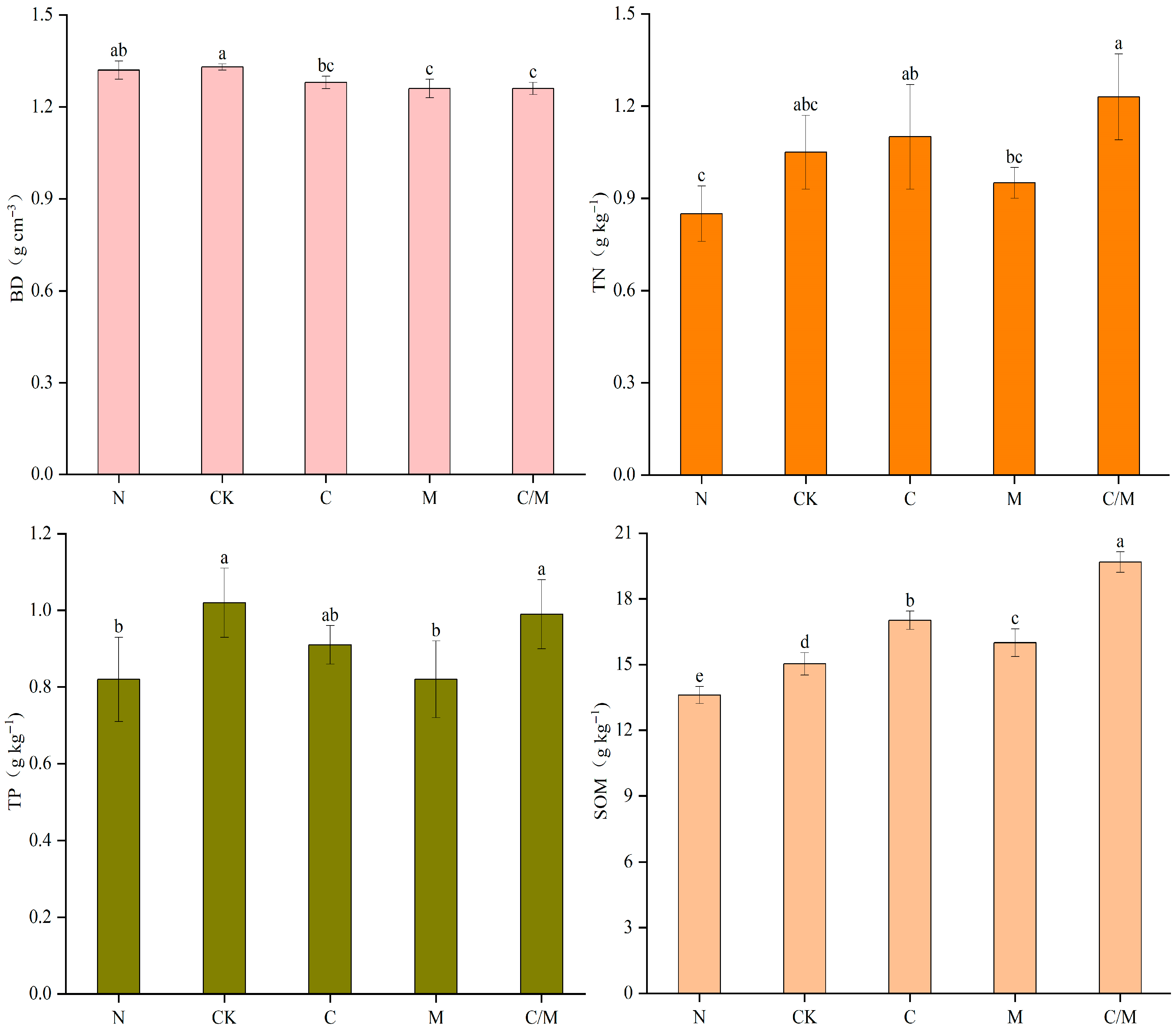
In the 0–20 cm soil layer, the addition of different exogenous carbon sources significantly influenced soil BD, TN, TP, and SOM contents (p < 0.05) (Figure 4). The BD showed no significant difference (p > 0.05) between the N and C treatments. Compared to the CK treatment, all exogenous carbon inputs significantly reduced soil BD. The soil BD under different treatments ranked as C/M < M < C, with the C/M treatment reducing BD by 5.26% compared to CK. For soil TN, TP, and SOM contents under exogenous carbon inputs, the values ranked as C/M > C > M. Specifically, the C/M treatment increased TN and SOM contents by 17.14% and 30.94%, respectively, relative to CK. However, there was no significant difference (p > 0.05) in TP between the CK and C/M treatments.
Adding different exogenous carbons had a significant impact on the soil C/P ratio and N/P ratio (p < 0.05) (Table 2). Compared with the CK treatment, adding different exogenous carbons significantly increased the soil C/P and N/P. The soil C/P and N/P were the highest under the C/M treatment, increasing by 34.62% and 21.57%, respectively, compared with the CK treatment.

3.2. Soil Organic Carbon Components

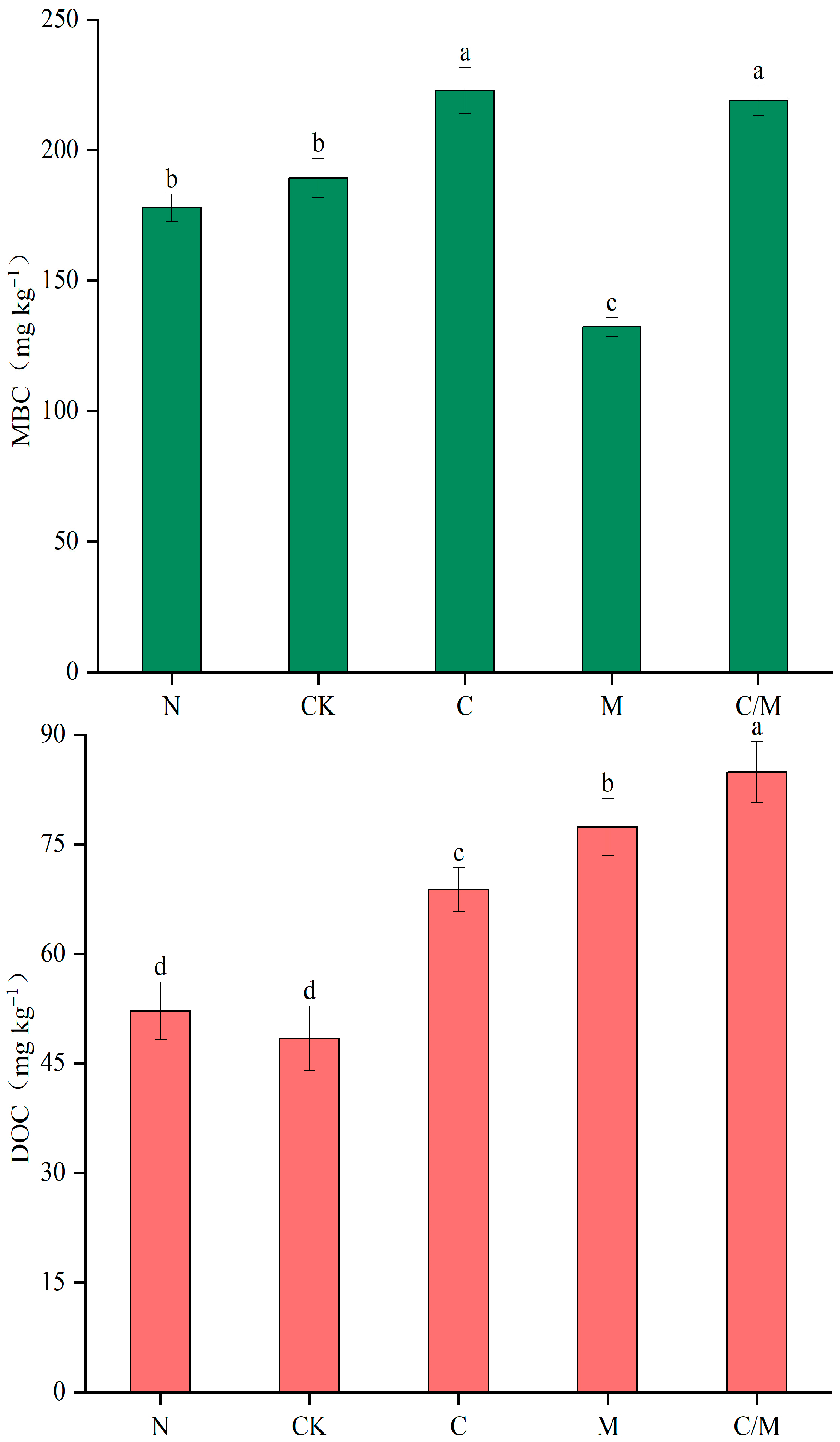
The addition of different exogenous carbon sources significantly influenced soil MBC and DOC content (p < 0.05) (Figure 5). Under exogenous carbon treatments, soil MBC content ranked as C > C/M > M, with the C treatment increasing MBC by 17.71% compared to CK. Conversely, the M treatment showed a significant reduction (p < 0.05) in MBC compared to the CK treatment. Compared to the CK treatment, exogenous carbon inputs significantly increased soil DOC content, with values ranked as C/M > M > C. Specifically, the C/M treatment increased DOC content by 75.34% relative to CK.

3.3. Soil Organic Carbon Storage and Sequestration Rate

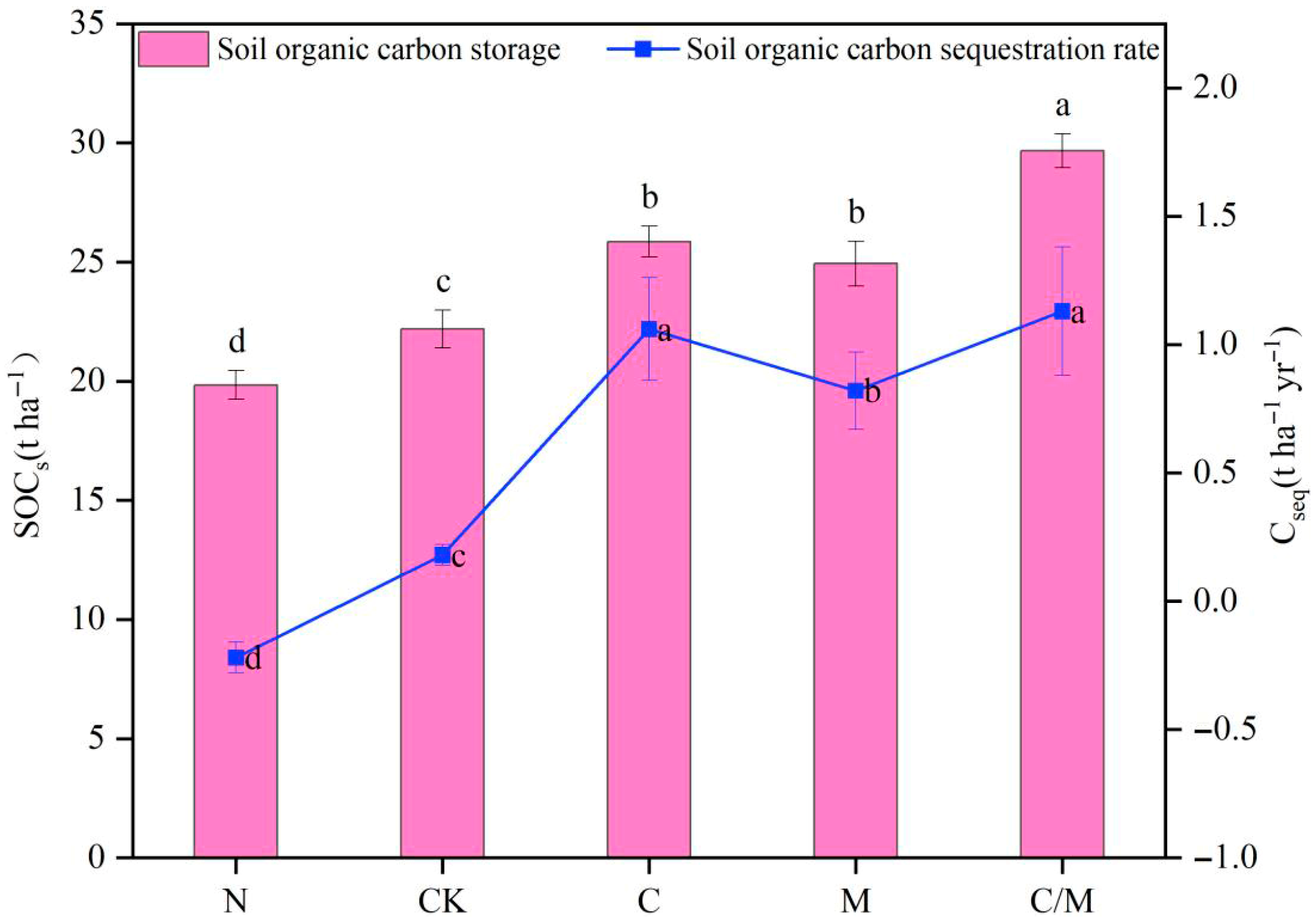
The addition of different exogenous carbon sources significantly influenced SOCs and Cseq (p < 0.05, Figure 6). Compared with the CK treatment, the addition of different exogenous carbon sources significantly increased SOCs and Cseq, with the order from highest to lowest being C/M > C > M. Specifically, the C/M treatment increased SOCs and Cseq by 27.94% and 527.78%, respectively, compared to the CK treatment.

3.4. Corn Dry Matter Mass, Yield, and Nitrogen Use Efficiency

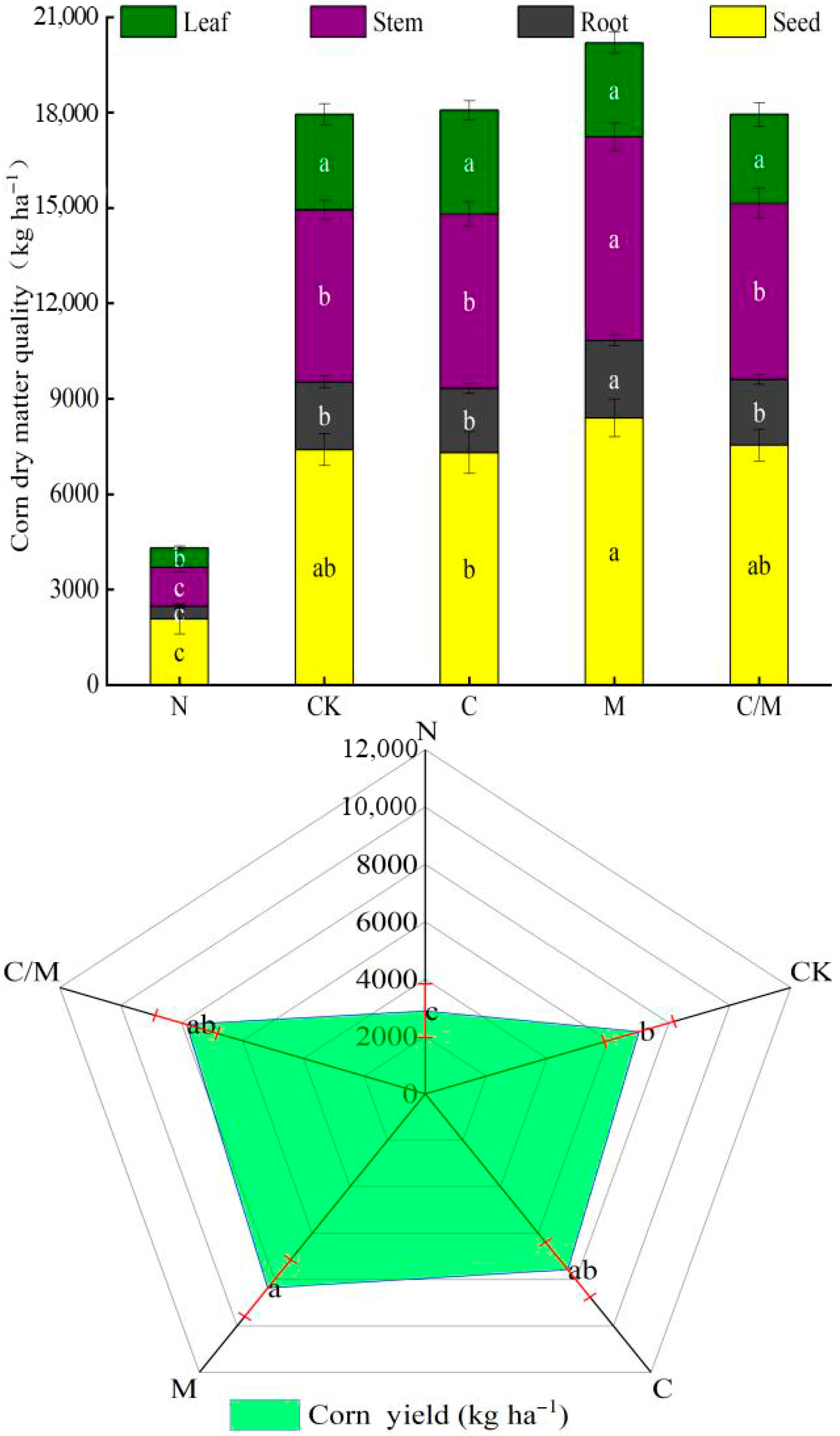
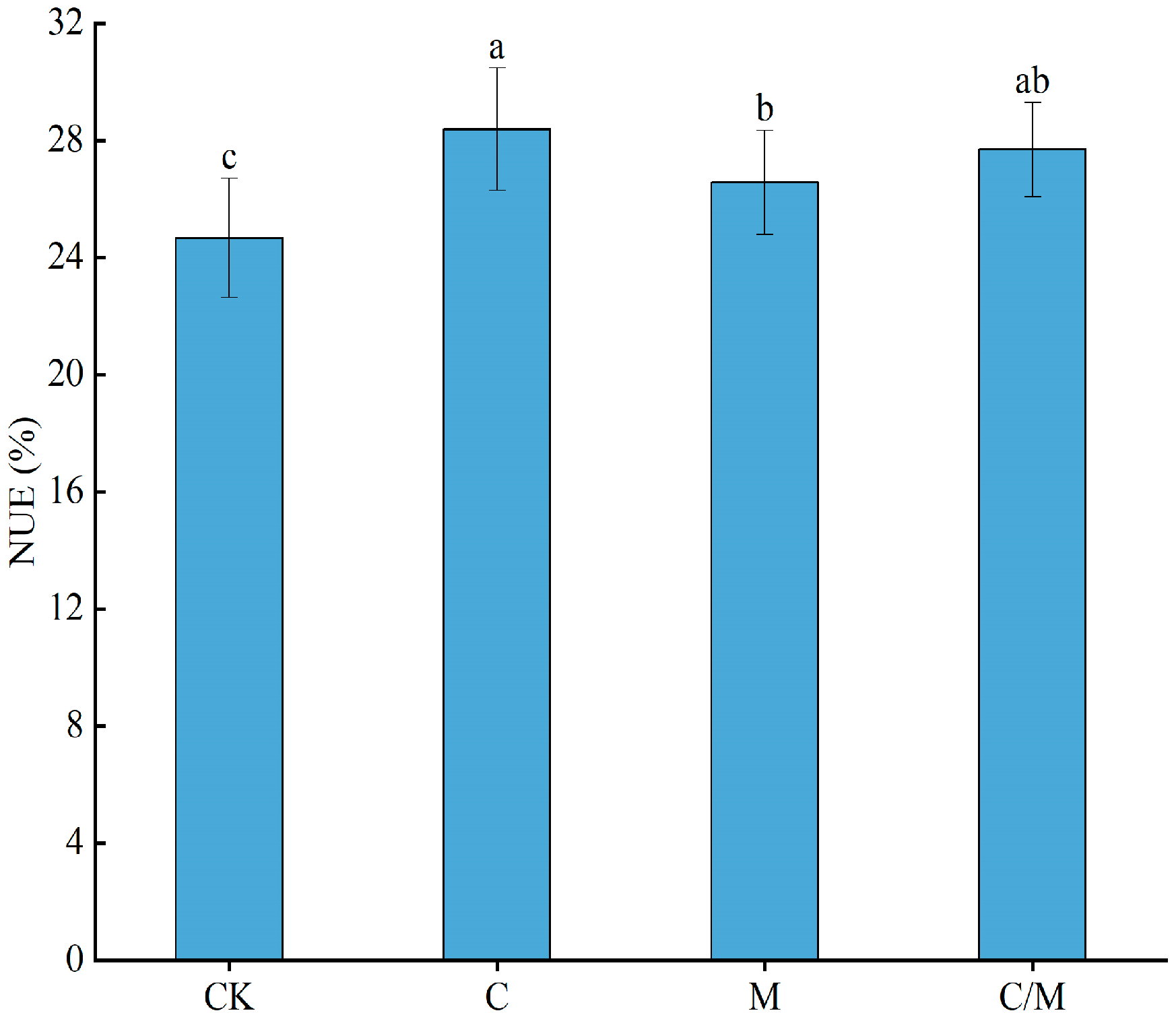
As shown in Figure 7, the addition of different exogenous carbon sources had a significant impact on corn dry matter mass, yield, and nitrogen use efficiency (p < 0.05). Across different treatments, the dry matter mass of various corn parts was ranked in descending order as grains > stems > leaves > roots. The M treatment resulted in the highest dry matter mass, which increased by 12.52% compared to the CK treatment. Under the addition of different exogenous carbon treatments, CY were ranked from high to low as M > C/M > C, with the M treatment increasing CY by 19.10% compared to the CK treatment. Compared to the CK treatment, the addition of exogenous carbon significantly improved nitrogen use efficiency, with the ranking from high to low being C > C/M > M. Specifically, the C treatment improved NUE by 15.04% compared to the CK treatment.

3.5. Relationship Between Soil Physicochemical Properties, CY, Cseq, and NUE

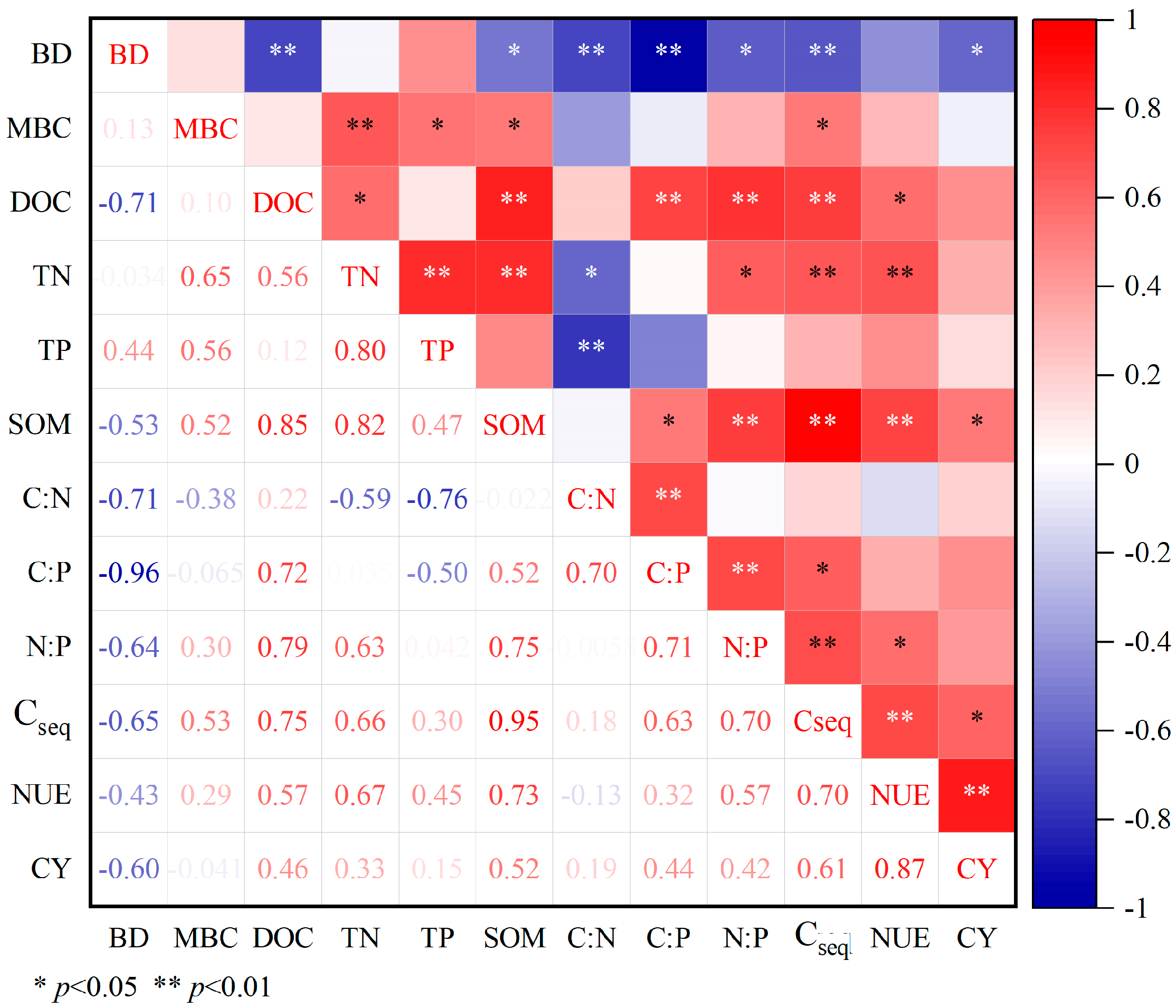
As shown in Figure 8, BD exhibited a highly significant negative correlation with DOC, C/N ratio, C/P ratio, and Cseq (p < 0.01), and a significant negative correlation with SOM and yield (p < 0.05). Soil MBC showed a significant positive correlation with TN, TP, SOM, and Cseq (p < 0.05). DOC was significantly positively correlated with SOM, C/P ratio, N/P ratio, and Cseq (p < 0.01), and also showed a significant positive correlation with TN and NUE (p < 0.05). TN exhibited a highly significant positive correlation with TP, SOM, Cseq, and NUE (p < 0.01), a significant positive correlation with the N/P ratio (p < 0.05), and a significant negative correlation with the C/P ratio (p < 0.05). TP displayed a highly significant negative correlation with the C/N ratio (p < 0.01). SOM showed a highly significant positive correlation with the N/P ratio, Cseq, and NUE (p < 0.01), and a significant positive correlation with the C/P ratio (p < 0.05). CY was highly significantly positively correlated with NUE (p < 0.01), and significantly positively correlated with Cseq and SOM (p < 0.05).
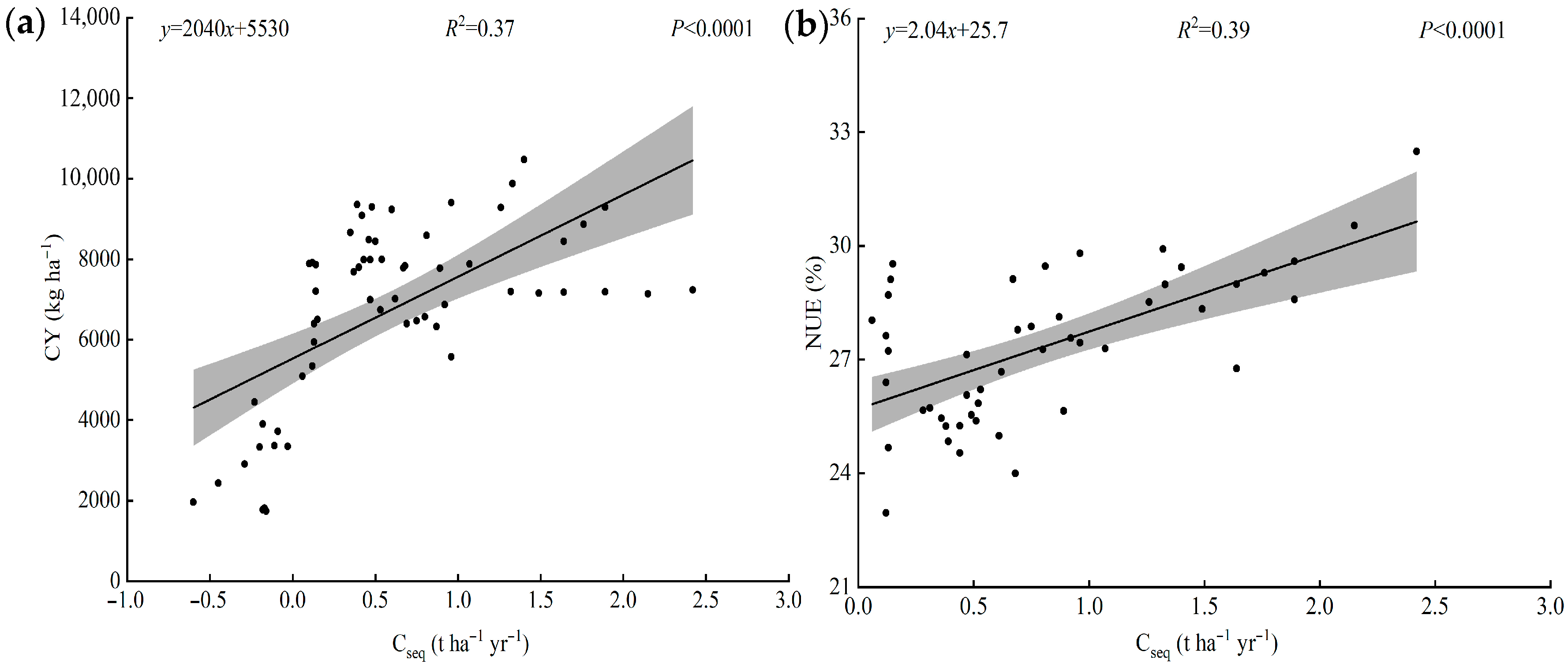
As shown in Figure 9a,b, Cseq exhibits a significant positive correlation with CY (R2 = 0.37) and NUE (R2 = 0.39) (p < 0.0001). The results of linear regression analysis indicate that when Cseq increases by 0.1, CY increases by 2040 kg ha−1, while NUE improves by 2.04%.

3.6. Evaluation of the Effects of Different Exogenous Carbon Sources

The application of the TOPSIS evaluation method to various exogenous carbon treatments (Table 3 and Table 4) revealed that the C/M treatment outperformed others (Ci = 0.786) when balancing CY with SOM, contrasting sharply with the CK treatment, which was the least effective (Ci = 0.360). Similarly, in terms of balancing NUE with Cseq, the C/M treatment again demonstrated optimal performance (Ci = 0.786), with the CK treatment remaining the least desirable (Ci = 0.360). To summarize, the comprehensive evaluation across four dimensions using the TOPSIS method highlighted the C/M treatment as the most effective among the different exogenous carbon treatments. This suggests that in the arid farmlands of the southern Ningxia region, employing C/M carbon enhancement and fertility measures is the most advisable strategy for achieving higher CY and simultaneously enhancing both NUE and Cseq.

4. Discussion

Soil physicochemical properties are critical indicators for assessing soil quality, and the addition of exogenous carbon is one of the most direct and effective measures to improve these properties in dryland farmland soils. Safaei et al. [33] demonstrated that the addition of exogenous carbon significantly reduces soil bulk density compared to conventional fertilizers. The results of this study indicate that the addition of different exogenous carbon sources significantly decreased BD compared to the CK treatment, with the lowest BD observed under the C/M treatment, representing a 5.26% reduction relative to CK. This aligns with the findings of Meng et al. [34]. However, this study also found that the N and C treatments had no significant effect on bulk density (BD), likely due to the slow decomposition rate of corn stover, which did not contribute to the formation of stable aggregates. The study also revealed that exogenous carbon addition significantly increased TN, TP, and SOM content, consistent with numerous existing studies [35], primarily due to the high levels of C, N, and other elements inherent in exogenous carbon sources [36]. Furthermore, under different exogenous carbon treatments, the mixed exogenous carbon (C/M) treatment yielded the highest TN, TP, and SOM contents. Specifically, TN and SOM contents increased by 17.14% and 30.94%, respectively, compared to CK. This enhancement is attributed to the combination of cattle manure and corn straw (C/M), which increases the mass loss rate of straw and thereby accelerates nutrient release [37]. However, compared to the CK treatment, the C/M treatment showed no significant effects on TN and TP. This is because conventional chemical fertilizers provide readily available inorganic nitrogen and phosphorus that directly enhance soil TN and TP contents, while the nitrogen and phosphorus nutrients contained in composted cattle manure and corn straw exhibit slow-release characteristics.
The soil C/N and C/P ratios are commonly used as critical indicators for evaluating soil nutrient content and availability, SOM decomposition rates, and nutrient immobilization or mineralization rates [38,39]. The results of this study demonstrate that the addition of different exogenous carbon sources significantly increased the soil C/N, C/P, and N/P ratios, consistent with the findings of Hayatu et al. [40]. This is primarily attributed to the inherently high carbon content of exogenous carbon materials. Additionally, the study revealed that the C/P and N/P ratios under the C/M treatment were the highest, increasing by 34.62% and 21.57%, respectively, compared to those under CK. This enhancement is mainly due to the combination of cattle manure and corn straw (C/M), where corn straw contributes substantial recalcitrant carbon, while the nitrogen and phosphorus in cattle manure alleviate nutrient limitations in the straw, promoting the conversion of recalcitrant carbon into SOC. Another possible reason is that the C/N ratio of corn straw is significantly higher than that of fermented cattle manure. Materials with a high C/N ratio inhibit microbial mineralization, promoting the conversion of organic carbon into recalcitrant carbon. Although the combined application of fermented cattle manure provides ample nitrogen to support the decomposition of corn straw, the high-carbon corn straw still results in substantial carbon retention. Furthermore, in the rain-fed agricultural region of the Loess Plateau, low precipitation reduces soil microbial activity, leading to slower decomposition of recalcitrant organic carbon components, like cellulose and lignin, in the corn straw.
Numerous studies have indicated that, compared to the application of chemical fertilizer (NPK) alone, adding exogenous carbon significantly increases the content of particulate organic carbon (POC), DOC, and MBC [41,42,43]. Additionally, research has found that supplementing with exogenous carbon notably enhances soil organic carbon sequestration efficiency and increases the proportion of the stable carbon fraction by 22% relative to NPK-only fertilization [44]. Therefore, the addition of exogenous carbon is the most effective measure for enhancing SOC components in farmland soils [45]. However, different exogenous carbon sources are constrained by factors such as nutrient contents and structural composition, leading to varied impacts on SOC fractions. Chen et al. [46] found that labile SOC components, like soil DOC and MBC, exhibit high activity and rapid turnover rates in soils, making them more sensitive to changes induced by field fertilization management practices. Consequently, these components can serve as sensitive indicators for early-stage SOC dynamics. The results of this study indicate that the addition of different exogenous carbon sources significantly increased soil MBC and DOC content. The MBC levels ranked in descending order as C > C/M > M, while DOC levels followed C/M > M > C. Specifically, the C treatment increased MBC content by 17.71% compared to CK, and the C/M treatment elevated DOC content by 75.34% compared to CK. This is primarily attributed to the higher C/N ratio of corn straw (C) compared to cattle manure (M), which provides a more abundant energy source for microorganisms upon incorporation. Additionally, improved soil aeration accelerates microbial respiration, thereby boosting microbial biomass [47]. Simultaneously, this study also revealed that compared to CK treatment, the composted M treatment exhibited a significant reduction in MBC content. This phenomenon may be primarily attributed to the substantially higher C/N ratio in the M treatment relative to CK, which, under the moisture constraints typical of rainfed agricultural systems, shifts microbial metabolic pathways toward heightened respiration and diminished synthesis. Compounded by nutrient competition resulting from reduced chemical fertilizer application, these factors collectively contributed to the decrease in MBC.
The addition of exogenous carbon is one of the most crucial measures for enhancing Cseq and increasing SOCs [48,49]. Studies have shown [50] that, compared to the sole application of chemical fertilizers, adding exogenous carbon can significantly increase SOCs. This study found that the addition of different types of exogenous carbon significantly boosted Cseq, thereby increasing SOCs. The C/M treatment showed the most significant effect, increasing the Cseq by 11.57 times and the SOCs by 27.94% compared to the CK treatment. This is primarily due to the optimization of the soil C/N ratio under the C/M treatment, which promotes microbial activity and accelerates the decomposition and transformation of exogenous carbon, thereby enhancing SOCs. These findings align with the research results of Zhang et al. [51].
Improving NUE was the most effective approach to enhance crop yield while minimizing environmental pollution risks [52,53]. The results of this study indicate that the addition of different exogenous carbon sources significantly increased NUE compared to the CK treatment, with the C treatment showing the most pronounced effect, elevating NUE by 23.77% relative to CK. Furthermore, a highly significant positive correlation was observed between CY and NUE (Figure 8, p < 0.01), consistent with previous studies [20,54]. Extensive research [55,56,57] has demonstrated that long-term exogenous carbon input promotes maize nutrient uptake and utilization, thereby significantly boosting yield. This study found that the addition of different exogenous carbon sources significantly influenced maize dry matter accumulation and CY. Dry matter and yield followed the descending order of M > C/M > C. Specifically, the M treatment increased maize dry matter and CY by 12.52% and 13.47%, respectively, compared to CK. Additionally, CY exhibited significant positive correlations with Cseq and SOM (Figure 8, p < 0.05).
The correlation analysis revealed that CY showed significant positive correlations with NUE, Cseq, and SOM (p < 0.05). Furthermore, linear regression analysis confirmed that the Cseq had a significant positive influence on CY (R2 = 0.37) and NUE (R2 = 0.42) (p < 0.0001). Specifically, for every 0.1-unit increase in Cseq, CY and NUE increased by 2040 kg ha−1 and 10.70%, respectively.
By balancing maize yield and SOM content, an analysis using the TOPSIS evaluation method demonstrated that the C/M treatment is the optimal exogenous carbon addition scheme (Table 3 and Table 4). Furthermore, based on Cseq and NUE, the TOPSIS evaluation results indicate that the C/M treatment maximized Cseq while also representing the best choice for improving NUE. This is primarily because the synergistic interaction between the carbon source from corn straw and the nitrogen and phosphorus in cattle manure under the C/M treatment not only fulfills the energy requirements for microbial decomposition but also ensures sustained nutrient supply for maize.

5. Conclusions

This study demonstrates that the addition of different exogenous carbon sources to dryland farmland in the Ningnan Mountainous Area can enhance soil fertility and potentially increase maize yield. Among the three exogenous carbon sources investigated, improvements in the soil C/N ratio and TN and SOC contents offer viable strategies for enhancing soil physicochemical properties and enhancing soil fertility. Additionally, research also indicates that adding exogenous carbon more effectively enhances Cseq and improves NUE. Among these approaches, the C/M treatment yielded the most significant results, with a C/N ratio of approximately 23:1. However, this study may have the limitation that the fertilizer reduction ratio might not be optimal. Future studies should consider investigating different fertilizer reduction proportions under exogenous carbon addition in this region, for instance, 10%, 20%, 30%, 40%, 50%, and 60% reductions in chemical fertilizer application. Meanwhile, since the study was conducted at only one location, the findings cannot represent the general situation across the entire Loess Plateau. To address this limitation, relevant research needs to be carried out in different rainfed agricultural regions of the Loess Plateau. In conclusion, the application of exogenous carbon in dryland farmland of the Ningnan Mountainous Area holds significant practical importance for achieving green and sustainable agricultural development by strengthening SOC sequestration, improving NUE, and increasing CY.

Author Contributions

Methodology, L.Z.; Software, X.L.; Validation, J.L.; Investigation, J.H.; Writing—original draft, H.Q.; Writing—review and editing, J.W.; Supervision, J.J. All authors have read and agreed to the published version of the manuscript.

Funding

This study was supported by the “Scientific and Technological Innovation Demonstration Project for High-Quality Agricultural Development and Ecological Protection During the 14th Five Year Plan Period” (NGSB-2021-11-05), the National Natural Science Foundation of China (42267057), the Agricultural Fundamental Long-term Scientific and Technological Observation and Monitoring Project of Yinchuan Agricultural and Environmental Observation Station (NAES091AE18), and the Ningxia Natural Science Foundation Project (2023AAC03435).

Data Availability Statement

Data will be made available on request.

Acknowledgments

We thankfully acknowledge the support of all the team members for their valuable discussions. We greatly appreciate the contributions of all authors.

Conflicts of Interest

The authors declare no conflicts of interest.

References

  1. Lal, R. Soil carbon sequestration impacts on global climate change and food security. Science 2004, 304, 1623–1627. [Google Scholar] [CrossRef] [PubMed]
  2. Schlesinger, W.H. Biogeochemistry: An Analysis of Global Change, 2nd ed.; Academic Press: San Diego, CA, USA, 1997. [Google Scholar]
  3. Belay-Tedla, A.; Zhou, X.; Su, B.; Wan, S.; Luo, Y. Labile, recalcitrant, and microbial carbon and nitrogen pools of a tallgrass prairie soil in the US Great Plains subjected to experimental warming and clipping. Soil. Biol. Biochem. 2009, 41, 110–116. [Google Scholar] [CrossRef]
  4. Zhang, C.; Liu, G.B.; Xue, S.; Sun, C. Soil organic carbon and total nitrogen storage as affected by land use in a small watershed of the Loess Plateau, China. Eur. J. of Soil. Biol. 2013, 54, 16–24. [Google Scholar] [CrossRef]
  5. Yang, F.; Xu, Y.; Cui, Y.; Meng, Y.D.; Dong, Y.; Li, R.; Ma, Y.B. Changes in the organic matter content of topsoil in Chinese farmland in the past 30 years. Acta. Pedol. Sin. 2017, 54, 1047–1056. [Google Scholar]
  6. Schmidt, M.W.; Torn, M.S.; Abiven, S.; Dittmar, T.; Guggenberger, G.; Janssens, I.A.; Trumbore, S.E. Persistence of soil organic matter as an ecosystem property. Nature 2011, 478, 49–56. [Google Scholar] [CrossRef]
  7. Ma, W.; Li, G.; Wu, J.; Xu, G.; Wu, J. Response of soil labile organic carbon fractions and carbon-cycle enzyme activities to vegetation degradation in a wet meadow on the Qinghai–Tibet Plateau. Geoderma 2020, 377, 114565. [Google Scholar] [CrossRef]
  8. Yu, H.Y.; Ding, W.X.; Luo, J.F.; Donnison, A.; Zhang, J.B. Long-term effect of compost and inorganic fertilizer on activities of carbon-cycle enzymes in aggregates of an intensively cultivated sandy loam. Soil. Use Manag. 2012, 28, 347–360. [Google Scholar] [CrossRef]
  9. Aula, L.; Omara, P.; Dhillon, J.S.; Fornah, A.; Raun, W.R. Influence of applied cattle manure on winter wheat (Triticum aestivum L.) grain yield, soil pH and soil organic carbon. Commun. Soil. Sci. Plant Anal. 2019, 50, 2056–2064. [Google Scholar] [CrossRef]
  10. Pan, G.X.; Zhao, Q. Research on the evolution of farmland soil carbon pool in China: Global change and national food security. Adv. Earth. Sci. 2005, 20, 384–393. [Google Scholar] [CrossRef]
  11. Cai, A.D.; Zhang, W.J.; Shen, X.R.; Xiao, J.; Han, T.F.; Xu, M.G. Carbon sequestration efficiency of soil particles with different particle sizes under long-term fertilization. J. Plant Nutr. Fertil. 2015, 21, 1431–1438. [Google Scholar] [CrossRef]
  12. Lu, F. How can straw incorporation management impact on soil carbon storage? A meta-analysis. Mitig. Adapt. Strateg. Glob. Change 2015, 20, 1545–1568. [Google Scholar] [CrossRef]
  13. Eastman, B.A.; Adams, M.B.; Peterjohn, W.T. The path less taken: Long-term N additions slow leaf litter decomposition and favor the physical transfer pathway of soil organic matter formation. Soil. Biol. Biochem. 2022, 166, 108567. [Google Scholar] [CrossRef]
  14. Frey, S.D.; Ollinger, S.; Nadelhoffer, K.E.; Bowden, R.; Brzostek, E.; Burton, A.; Wickings, K. Chronic nitrogen additions suppress decomposition and sequester soil carbon in temperate forests. Biogeochemistry 2014, 121, 305–316. [Google Scholar] [CrossRef]
  15. Oertel, C.; Matschullat, J.; Zurba, K.; Zimmermann, F.; Erasmi, S. Greenhouse gas emissions from soils—A review. Geochemistry 2016, 76, 327–352. [Google Scholar] [CrossRef]
  16. Wong, J.W.; Karthikeyan, O.P.; Selvam, A. Biological nutrient transformation during composting of pig manure and paper waste. Environ. Technol. 2017, 38, 754–761. [Google Scholar] [CrossRef]
  17. Xu, H.; Cai, A.; Yang, X.; Zhang, S.; Huang, S.; Wang, B.; Zhang, W. Long-term organic substitution promotes carbon and nitrogen sequestration and benefit crop production in upland field. Agronomy 2023, 13, 2381. [Google Scholar] [CrossRef]
  18. Kong, D.; Ren, C.; Yang, G.; Liu, N.; Sun, J.; Zhu, J.; Feng, Y. Long-term wheat-soybean rotation and the effect of straw retention on the soil nutrition content and bacterial community. Agronomy 2022, 12, 2126. [Google Scholar] [CrossRef]
  19. Jin, Z.; Shah, T.; Zhang, L.; Liu, H.; Peng, S.; Nie, L. Effect of straw returning on soil organic carbon in rice–wheat rotation system: A review. Food. Energy. Secur. 2020, 9, e200. [Google Scholar] [CrossRef]
  20. Tang, H.; Cheng, K.; Shi, L.; Li, C.; Wen, L.; Li, W.; Long, Z. Effects of long-term organic matter application on soil carbon accumulation and nitrogen use efficiency in a double-cropping rice field. Environ. Res. 2022, 213, 113700. [Google Scholar] [CrossRef]
  21. Wang, H.; Liang, Y.; Kang, J.H.; Feng, P.B.; Wang, L.; Yu, X.; Ma, Y. Responses of soil inorganic nitrogen and spatio-temporal distribution of spring maize roots to the input of controlled-release urea in arid areas. Maize Sci. 2022, 30, 130–141. [Google Scholar] [CrossRef]
  22. Zhao, Y.; Liu, X.T.; Luo, J.H.; Zhao, T.C.; Zhang, X.J. Effects of Strip Application of Slow/Controlled-Release Fertilizer on Yield, Nitrogen Uptake and Nitrogen Balance of Spring Maize. Chin. J. Soil. Sci. Fertil. 2020, 5, 34–39. [Google Scholar] [CrossRef]
  23. Liang, Y.; Kang, J.H.; Zhu, R.; He, W.S.; Dai, X.H. Effects of the combined application of controlled-release and conventional urea on spring maize yield and nitrogen utilization in rain-fed areas. J. Soil. Water Conserv. 2017, 31, 237–241+278. [Google Scholar] [CrossRef]
  24. Liu, X.Y. Research Methods in Soil Physics and Soil Improvement; Shanghai Scientific and Technical Publishers: Shanghai, China, 1982; pp. 1–241. [Google Scholar]
  25. Bao, S.D. Soil and Agricultural Chemistry Analysis, 3rd ed.; China Agriculture Press: Beijing, China, 2000; pp. 263–268. [Google Scholar]
  26. Nelson, D.; Sommers, L. Chemical Methods. In Methods of Soil Analysis: Part 3; Bigham, J.M., Ed.; Soil Science Society of America: Madison, WI, USA, 1996; pp. 961–1010. [Google Scholar] [CrossRef]
  27. Murphy, J.; Riley, J.P. A modified single solution method for the determination of phosphate in natural waters. Anal. Chim. Acta. 1962, 27, 31–36. [Google Scholar] [CrossRef]
  28. Vance, E.D.; Brookes, P.C.; Jenkinson, D.S. An extraction method for measuring soil microbial biomass C. Soil. Biol. Biochem. 1987, 19, 703–707. [Google Scholar] [CrossRef]
  29. Li, T.K.; Guo, Z.L.; Kou, C.L.; Lü, J.L.; Zhang, X.N.; Yang, X.L. Influence of extraction methods on the determination results of soil dissolved organic carbon. J. Ecol. Environ. 2017, 26, 1878–1883. [Google Scholar] [CrossRef]
  30. Morgan, M.A.; Jackson, W.A.; Volk, R.J. Uptake and assimilation of nitrate by corn roots during and after induction of the nitrate uptake system. J. Exp. Bot. 1985, 36, 859–869. [Google Scholar] [CrossRef]
  31. Zhang, W.; Xu, M.; Wang, X.; Huang, Q.; Nie, J.; Li, Z.; Lee, K.B. Effects of organic amendments on soil carbon sequestration in paddy fields of subtropical China. J. Soils Sediments 2012, 12, 457–470. [Google Scholar] [CrossRef]
  32. Lai, Y.J.; Hwang, C.L. Fuzzy multiple objective decision making. In Fuzzy Multiple Objective Decision Making; Springer: Berlin/Heidelberg, Germany, 1994; pp. 139–262. [Google Scholar] [CrossRef]
  33. Safaei Khorram, M.; Zhang, G.; Fatemi, A.; Kiefer, R.; Maddah, K.; Baqar, M.; Li, G. Impact of biochar and compost amendment on soil quality, growth and yield of a replanted apple orchard in a 4-year field study. J. Sci. Food. Agric. 2019, 99, 1862–1869. [Google Scholar] [CrossRef]
  34. Meng, X.; Zheng, E.; Hou, D.; Qin, M.; Meng, F.; Chen, P.; Qi, Z. The effect of biochar types on carbon cycles in farmland soils: A meta analysis. Sci. Total. Environ. 2024, 930, 172623. [Google Scholar] [CrossRef]
  35. Gao, J.S.; Huang, J.; Yang, Z.C.; Cao, W.D.; Zhang, H.M.; Gao, P.; Gao, X.C. Combined returning of green manure and rice straw improves soil organic matter content and stabilizes nitrogen supply. J. Plant. Nutr. Fertil. 2020, 26, 472–480. [Google Scholar] [CrossRef]
  36. Ge, G.; Li, Z.; Fan, F.; Chu, G.; Hou, Z.; Liang, Y. Soil biological activity and their seasonal variations in response to long-term application of organic and inorganic fertilizers. Plant Soil. 2010, 326, 31–44. [Google Scholar] [CrossRef]
  37. Yang, H.; Zhai, S.; Li, Y.; Zhou, J.; He, R.; Liu, J.; Meng, Y. Waterlogging reduction and wheat yield increase through long-term ditch-buried straw return in a rice—Wheat rotation system. Field. Crops. Res. 2017, 209, 189–197. [Google Scholar] [CrossRef]
  38. Zhang, W.; Zhao, J.; Pan, F.; Li, D.; Chen, H.; Wang, K. Changes in nitrogen and phosphorus limitation during secondary succession in a karst region in southwest China. Plant Soil. 2015, 391, 77–91. [Google Scholar] [CrossRef]
  39. Abrar, M.M.; Xu, H.; Aziz, T.; Sun, N.; Mustafa, A.; Aslam, M.W.; Xu, M. Carbon, nitrogen, and phosphorus stoichiometry mediate sensitivity of carbon stabilization mechanisms along with surface layers of a Mollisol after long-term fertilization in Northeast China. J. Soils Sediments 2021, 21, 705–723. [Google Scholar] [CrossRef]
  40. Hayatu, N.G.; Liu, Y.R.; Han, T.F.; Daba, N.A.; Zhang, L.; Shen, Z.H.; Zhang, H.M. Carbon sequestration rate, nitrogen use efficiency and rice yield responses to long-term substitution of chemical fertilizer by organic manure in a rice–rice cropping system. J. Integr. Agric. 2023, 22, 2848–2864. [Google Scholar] [CrossRef]
  41. Wang, M.Y.; Fu, Y.P.; Huang, T.T.; Zhao, Y.P.; Jia, H.; He, T.T.; Zhao, X.J. Effects of adding different organic materials with equivalent carbon amounts on soil organic carbon fractions and soil respiration. Acta Tabac. Sin. 2018, 24, 65–73. [Google Scholar] [CrossRef]
  42. Wang, Y.L.; Zhou, F.; Zhang, F.; Ma, W.G.; Wang, Q.; Cao, S.L.; Geng, Z.C. Effects of biochar application on soil respiration and soil organic carbon fractions. Res. Environ. Sci. 2017, 30, 920–928. [Google Scholar] [CrossRef]
  43. Yu, Q.; Hu, X.; Ma, J.; Ye, J.; Sun, W.; Wang, Q.; Lin, H. Effects of long-term organic material applications on soil carbon and nitrogen fractions in paddy fields. Soil. Tillage Res. 2020, 196, 104483. [Google Scholar] [CrossRef]
  44. Chaudhary, S.; Dheri, G.S.; Brar, B.S. Long-term effects of NPK fertilizers and organic manures on carbon stabilization and management index under rice-wheat cropping system. Soil. Tillage Res. 2017, 166, 59–66. [Google Scholar] [CrossRef]
  45. Rachel, W.; Sindhu, J. Response of soil organic carbon fractions to cover cropping: A meta-analysis of agroecosystems. Agric. Ecosyst. Environ. 2023, 351, 108497. [Google Scholar] [CrossRef]
  46. Chen, S.; Xu, C.; Yan, J.; Zhang, X.; Zhang, X.; Wang, D. The influence of the type of crop residue on soil organic carbon fractions: An 11-year field study of rice-based cropping systems in southeast China. Agric. Ecosyst. Environ. 2016, 223, 261–269. [Google Scholar] [CrossRef]
  47. Juan, Y.H.; He, Z.G.; Liu, H.Y.; Liu, Y.; Chen, Y. Effects of straw returning to fields and nitrogen fertilizer management on microbial biomass carbon, nitrogen, and enzyme activity in farmland brown soil. Soil. 2023, 55, 1223–1229. [Google Scholar] [CrossRef]
  48. Li, S.; Wei, W.; Liu, S. Long-Term organic amendments combined with nitrogen fertilization regulates soil organic carbon sequestration in calcareous soil. Agronomy 2023, 13, 291. [Google Scholar] [CrossRef]
  49. Wu, L.; Zhang, S.; Ma, R.; Chen, M.; Wei, W.; Ding, X. Carbon sequestration under different organic amendments in saline-alkaline soils. Catena 2021, 196, 104882. [Google Scholar] [CrossRef]
  50. Li, B.; Song, H.; Cao, W.; Wang, Y.; Chen, J.; Guo, J. Responses of soil organic carbon stock to animal manure application: A new global synthesis integrating the impacts of agricultural managements and environmental conditions. Glob. Change Biol. 2021, 27, 5356–5367. [Google Scholar] [CrossRef]
  51. Zhang, P.L.; Guo, T.W.; Liu, X.W.; Zeng, J. Effects of long-term organic fertilizer application on spring wheat yield, water use efficiency, and soil organic carbon in semi-arid regions. Chin. Soil. Fertil. 2024, 01, 105–112. [Google Scholar]
  52. Abbasi, M.K.; Tahir, M.M.; Rahim, N. Effect of N fertilizer source and timing on yield and N use efficiency of rainfed maize (Zea mays L.) in Kashmir-Pakistan. Geoderma 2013, 195–196, 87–93. [Google Scholar] [CrossRef]
  53. Trenton, F.S.; Joseph, G.L. Crop grain yield response to crop ration and nitrogen over 35 years. Agron. J. 2008, 100, 643–650. [Google Scholar] [CrossRef]
  54. Sharma, S.; Singh, P.; Choudhary, O.P. Nitrogen and rice straw incorporation impact nitrogen use efficiency, soil nitrogen pools and enzyme activity in rice-wheat system in north-western India. Field Crops Res. 2021, 266, 108131. [Google Scholar] [CrossRef]
  55. Wei, W.; Yan, Y.; Cao, J.; Christie, P.; Zhang, F.; Fan, M. Effects of combined application of organic amendments and fertilizers on crop yield and soil organic matter: An integrated analysis of long-term experiments. Agric. Ecosyst. Environ. 2016, 225, 86–92. [Google Scholar] [CrossRef]
  56. Ju, J.; Gu, Q.; Zhou, H.; Zhang, H.; Mao, W.; Yang, H.; Zhao, H. Effects of organic fertilizer combined with chemical fertilizer on nutrients, enzyme activities, and rice yield in reclaimed soil. Commun. Soil. Sci. Plant Anal. 2022, 53, 3060–3071. [Google Scholar] [CrossRef]
  57. Mi, W.; Sun, Y.; Xia, S.; Zhao, H.; Mi, W.; Brookes, P.C.; Wu, L. Effect of inorganic fertilizers with organic amendments on soil chemical properties and rice yield in a low-productivity paddy soil. Geoderma 2018, 320, 23–29. [Google Scholar] [CrossRef]
Figure 1. Schematic diagram of the experimental base. (a) The geographical location of the Loess Plateau; (b) The geographical location of Xiji County; (c) The geographical location of the experimental site.
Agriculture 15 01809 g001
Figure 2. Changes in daily rainfall and temperature during the maize growth period (April–October) from 2021 to 2024.
Agriculture 15 01809 g002
Figure 3. Traditional flat planting with ridging and plastic film mulching.
Agriculture 15 01809 g003
Figure 4. Effect of different exogenous carbon on soil physicochemical properties. Bars labeled with different letters indicate significant differences at the p < 0.05 level. BD: soil bulk density; TN: total nitrogen; TP: total phosphorus; SOM: soil organic matter.
Agriculture 15 01809 g004
Figure 5. Effects of different exogenous carbon treatments on soil organic carbon components. Bars labeled with different letters indicate significant differences at the p < 0.05 level. MBC: soil microbial biomass carbon; DOC: dissolved organic carbon.
Agriculture 15 01809 g005
Figure 6. Effects of different exogenous carbon treatments on soil organic carbon storage and sequestration rate. Bars labeled with different letters indicate significant differences at the p < 0.05 level. Cseq: soil organic carbon sequestration rate; SOCs: soil organic carbon storage.
Agriculture 15 01809 g006
Figure 7. Effects of different exogenous carbon treatments on corn dry matter mass, yield, and nitrogen use efficiency. Bars labeled with different letters indicate significant differences at the p < 0.05 level. CY: corn yield; NUE: nitrogen use efficiency.
Agriculture 15 01809 g007aAgriculture 15 01809 g007b
Figure 8. Correlation analysis of soil physicochemical properties, Cseq, NUE, and CY under different exogenous carbon conditions. Red indicates a positive correlation, meaning that when one variable increases, the other tends to increase as well. Blue indicates a negative correlation, meaning that when one variable increases, the other decreases. Deeper shades (such as dark red or dark blue) indicate a stronger correlation, while lighter shades or colors close to white indicate a weaker correlation or no association. BD: soil bulk density; MBC: soil microbial biomass carbon; DOC: dissolved organic carbon; TN: total nitrogen; TP: total phosphorus; SOM: soil organic matter; Cseq: soil organic carbon sequestration rate; CY: corn yield; NUE: nitrogen use efficiency.
Agriculture 15 01809 g008
Figure 9. Effects of Cseq on CY (a) and NUE (b) under different exogenous carbon levels. Cseq: soil organic carbon sequestration rate; CY: corn yield; NUE: nitrogen use efficiency.
Agriculture 15 01809 g009
Table 1. Fertilizer application amounts under different treatments.
TreatmentChemical Fertilizer (kg ha−1)Fermented Cattle Manure
kg ha−1
Corn Straw
kg ha−1
NP2O5K2O
N00000
CK24015012000
C120756009686
M120756012,0000
C/M120756060004843
Table 2. Effects of different exogenous carbon additions on soil nutrient stoichiometric ratios (C/N/P ratios) from 2021 to 2024.
TreatmentC/NC/PN/P
N9.31 ± 0.71 a9.67 ± 1.02 bc1.04 ± 0.03 b
CK8.38 ± 0.68 a8.58 ± 0.47 c1.02 ± 0.03 b
C9.14 ± 1.21 a10.83 ± 0.31 ab1.20 ± 0.12 a
M9.80 ± 0.15 a11.41 ± 0.95 a1.16 ± 0.08 a
C/M9.31 ± 0.84 a11.55 ± 0.78 a1.24 ± 0.02 a
The data in the table are presented as mean ± SE (n = 3). Different letters within the same column indicate significant differences among treatments at p < 0.05.
Table 3. TOPSIS scores and rankings of different exogenous carbon treatments based on balancing CY and SOM content.
TreatmentNormalized MatrixEuclidean DistancesPerformance
Ci
TOPSIS Rank
CY (w = 0.5)SOM (w = 0.5)Di+Di
CK0.2620.2130.0800.0450.3604
C0.2590.2410.0620.0640.5083
M0.2970.2270.0520.0820.6122
C/M0.2670.2790.0300.1100.7861
CY: corn yield; SOM: soil organic matter.
Table 4. TOPSIS scores and rankings of different exogenous carbon treatments based on balancing NUE and Cseq content.
TreatmentNormalized MatrixEuclidean DistancesPerformance
Ci
TOPSIS Rank
NUE (w = 0.5)Cseq (w = 0.5)Di+Di
CK0.2250.0360.4140.0150.0364
C0.2790.2060.2410.1770.4232
M0.2340.0830.3660.0480.1163
C/M0.2590.4470.0200.4120.9541
Cseq: soil organic carbon sequestration rate; NUE: nitrogen use efficiency.
Disclaimer/Publisher’s Note: The statements, opinions and data contained in all publications are solely those of the individual author(s) and contributor(s) and not of MDPI and/or the editor(s). MDPI and/or the editor(s) disclaim responsibility for any injury to people or property resulting from any ideas, methods, instructions or products referred to in the content.