Article

Study of the Impact of Agricultural Insurance on the Livelihood Resilience of Farmers: A Case Study of Comprehensive Natural Rubber Insurance


International Business School, Hainan University, Haikou 570228, China
*
Author to whom correspondence should be addressed.
Agriculture 2025, 15(15), 1683; https://doi.org/10.3390/agriculture15151683
Submission received: 8 July 2025 / Revised: 31 July 2025 / Accepted: 31 July 2025 / Published: 4 August 2025
(This article belongs to the Section Agricultural Economics, Policies and Rural Management)

Abstract

Against the backdrop of increasingly frequent extreme weather events and heightened market price volatility, investigating the relationship between agricultural insurance and farmers’ livelihood resilience is crucial for ensuring rural socioeconomic stability. This study utilizes field survey data from 1196 households across twelve county-level divisions (three cities and nine counties) from China’s Hainan and Yunnan provinces, specifically in natural rubber-producing regions. Using propensity score matching (PSM), we empirically examine agricultural insurance’s impact on household livelihood resilience. The results demonstrate that agricultural insurance increased the effect on farmers’ livelihood resilience by 1%. This effect is particularly pronounced among recently poverty-alleviated households and large-scale farming operations. Furthermore, the analysis highlights the mediating roles of credit availability, adoption of agricultural production technologies, and production initiative in strengthening insurance’s positive impact. Therefore, policies should be refined and expanded, combining agricultural insurance with credit support and agricultural technology extension to leverage their value and ensure the sustainable development of farm households.

1. Introduction

As global climate change intensifies, triggering frequent extreme weather events and market price fluctuations, agricultural production faces substantially heightened uncertainty. According to the United Nations Office for Disaster Risk Reduction (UNDRR), the proportion of agricultural losses from climate-related disasters relative to GDP increased by 23% between 2000 and 2021, with smallholder farmers accounting for 76% of these losses [1]. China, as a climate-sensitive agricultural powerhouse, experienced damage to 120 million mu of crops from extreme weather in 2022. Concurrently, price fluctuations led to the “bumper crop but no harvest” phenomenon, exposing 15.7% of farmers to the risk of falling back into poverty [2]. Consequently, establishing a long-term poverty prevention mechanism is imperative to effectively mitigate large-scale relative poverty and prevent marginalized populations from re-entering poverty. Simultaneously, China’s rural revitalization strategy explicitly calls for “improving the agricultural support and protection system”.
Based on this context, agricultural insurance plays a critical role as a market-based risk dispersion mechanism. Its significance lies not only in serving as a key instrument for addressing developmental challenges but also in generating spillover effects across industries. From the perspectives of agriculture itself and farmers’ livelihoods, agricultural insurance effectively prevents vulnerable farmers from falling into poverty or returning to poverty because of disasters by compensating for losses caused by natural hazards or market fluctuations, thereby reducing the poverty rate among smallholder farmers [3] and stabilizing their livelihoods. Simultaneously, insurance coverage enhances farmers’ confidence and capacity to adopt new technologies and expand production [4] facilitating agricultural modernization [5]. The stabilizing effect of agricultural insurance also benefits related industries. Furthermore, the substantial agricultural insurance market itself directly drives the development of the insurance and reinsurance sectors.
Therefore, agricultural insurance has been entrusted with a critical mission within China’s Rural Revitalization Strategy. However, China’s current agricultural insurance system suffers from the issue of “high coverage but low protection.” The “low protection” is primarily manifested in low coverage levels, narrow scopes of liability, and stringent claim standards, making it difficult to meet the differentiated needs of farmers. This “quantity-over-quality” status quo may result in insufficient disaster compensation payouts, causing farmers to experience sudden income drops, depletion of savings, or even forced asset sales, thereby undermining their risk resistance and post-disaster recovery capacities. When uncovered risks materialize, insurance fails to provide an effective buffer, leaving farmers’ livelihoods still exposed to significant shocks. Consequently, beneath the facade of “high coverage,” the reality of “low protection” may substantially diminish the effectiveness of agricultural insurance in enhancing farmers’ livelihood resilience, falling far short of theoretical expectations. Whether it can fully translate into a substantive improvement in farmers’ risk resistance capabilities and strengthen their livelihood resilience and sustainable development in the face of compound risk remains a core question demanding urgent empirical validation.
Natural rubber, as a national strategic material, has production stability directly linked to industrial chain security and national livelihood. Furthermore, China’s primary natural rubber production regions are concentrated in ecologically sensitive areas such as Hainan and Yunnan. Therefore, safeguarding the livelihood stability of rubber farmers holds significance not only for individual household welfare but also for maintaining regional economic development, stability, and ecological barrier functions.
Considering this, this study takes natural rubber insurance as the entry point and employs the propensity score matching (PSM) method to explore the impact of agricultural insurance on farmers’ livelihood resilience and its underlying mechanisms at the micro level. The marginal contributions of this paper are primarily manifested in the following aspects: First, whereas most existing studies use a single income factor to measure the policy effectiveness of agricultural insurance, this research considers the multidimensionality and complexity of policy effects. It constructs a multidimensional indicator system from the perspective of farmers’ livelihood resilience to evaluate the policy impact of agricultural insurance. Second, it empirically analyzes the transmission mechanisms through which agricultural insurance affects farmers’ livelihood resilience—specifically, credit access, agricultural production technology adoption, and production initiative. Third, based on heterogeneity analysis categorizing farmers by whether they are formerly impoverished households and by planting scale, it clarifies the differential effects of agricultural insurance on livelihood resilience across distinct groups. This study not only helps address gaps in the existing literature and provides empirical evidence for constructing indicator systems and conducting empirical analyses related to livelihood resilience but also offers insights into further refining and advancing agricultural insurance policies, thereby informing decision-making to promote rural development.

2. Literature Review

Agricultural insurance may raise transaction and administrative costs because of moral hazard and adverse selection caused by information asymmetry [6]. Systemic agricultural risks prevent effective spatial risk dispersion, prompting private insurers to impose coverage restrictions under solvency constraints [7], resulting in market failure. Government intervention thus becomes essential to resolve this dilemma [8]. Fiscal subsidies reduce operational costs for insurers, ensuring the effective operation of agricultural insurance mechanisms to some extent.
The existing literature on agricultural insurance primarily covers three areas. First, studies of its impact on farmers’ production behavior, such as [9], who examined how federal crop revenue insurance influences planting systems in the US Corn Belt, finding it affects crop selection and rotation decisions. Further research reveals agricultural insurance shapes farmer behavior through altered risk attitudes [10], resource allocation adjustments [11], and production financing [12,13,14,15]. Second, research on income effects, such as that by [16], analyzed rainfall insurance’s impact on smallholder incomes in rural India, demonstrating significant household income increases. Subsequent studies indicate that agricultural insurance boosts farm income by enhancing production efficiency via indemnity payments [17] and credit support [18,19,20]. Third, environmental effect studies highlight its role in promoting green production [21], reducing air pollution [22], and improving agricultural carbon productivity [23]. Collectively, most research focuses on short-term food crops at the farm level using singular behavioral or income metrics, leaving the livelihood effects of insurance for long-cycle, high-volatility cash crops insufficiently explored.
The existing literature on agricultural insurance primarily examines three domains. First, investigations into its impact on farmers’ productive behavior. Studies demonstrate that agricultural insurance shapes production factor inputs by modifying income structures [24], risk attitudes [10], factor allocation [11], and production financing [12]. This encompasses technology adoption [12,25], fertilizer and pesticide application [13,26], and adjustments to operational scale [27], among others. Second, research assessing agricultural insurance’s influence on farmer income. Evidence indicates it elevates income levels via economic compensation [17], credit support [18], and enhanced production factors to boost agricultural efficiency [19]. Third, exploration of its spillover effects. Research on environmental impacts includes promoting green production [21], reducing air pollution [22], and enhancing agricultural carbon productivity [23]. Research on food security impacts reveals significant positive effects on grain planting areas [14], crop structure [15], and yield [20]. However, existing policy evaluations, predominantly household-focused, tend to analyze singular behavioral or income dimensions, lacking a comprehensive framework to fully capture impacts on household well-being. Consequently, research on agricultural insurance’s effect on livelihood resilience is critically significant for promoting farmers’ endogenous development momentum, consolidating production and livelihood foundations, and ensuring a smooth transition from poverty alleviation to rural revitalization strategies.
In summary, current research exhibits two unresolved issues. First, the existing literature predominantly focuses on farmers’ economic recovery and stability post-risk events—emphasizing ex-post management. Few studies adopt a livelihood perspective that simultaneously addresses economic concerns and farmers’ capacity to maintain and adjust livelihood strategies, spanning ex-post compensation to ex-ante prevention and long-term development. Second, the mechanisms underlying the livelihood resilience generation remain inadequately examined, while pathways and measures for enhancing farmers’ livelihood resilience require further refinement.

3. Policy Background, Conceptual Explanation, Theoretical Analysis

3.1. Background of the Natural Rubber Insurance Policy

China has developed a comprehensive policy-based agricultural insurance system through an extensive exploration of institutional frameworks, structural optimization, and implementation pathways since the resumption of agricultural insurance operations in 1982. Nationally implemented natural rubber insurance currently comprises two primary types: disaster insurance and price insurance, designed to mitigate losses from risk exposure during coverage periods. Analysis of government policy documents on natural rubber insurance since 2007 (Table 1) reveals continuous institutional refinements aimed at strengthening natural rubber farmers’ resilience to market fluctuations and natural disasters, ensuring stable and sustainable rubber production.

3.2. Conceptual Explanation

Livelihood resilience refers to the ability of livelihood groups to maintain individual balance or enhance it through intrinsic attributes under external pressures and shocks [28]. It not only emphasizes passive adaptive capacity but also active resistance capacity [29], serving as an important dimension and effective tool for analyzing how individuals cope with uncertainties and sustainable livelihood characteristics. The term ‘resilience’ traces its origins to the Latin word “resilio.” It was first introduced into academic research by ecologist Holling ([30]) to describe the ability of ecosystems to maintain core functions and achieve self-repair after experiencing disturbances. As the scope of research expanded, development economists Chambers et al. (1994 [31]) first proposed the concept of “livelihood resilience,” defining it as the foundational survival capacity demonstrated by residents when facing environmental pressures, representing the most basic form of productivity. This study draws on Speranza et al. ([32]) to select relevant indicators for measuring farmers’ livelihood resilience. Among the three dimensions of livelihood resilience, buffer capacity refers to the ability of farmers to utilize existing resources to mitigate risks and maintain livelihood stability when facing external shocks; self-organization capacity refers to the ability of farmers to spontaneously organize themselves when responding to risk shocks, leveraging social networks and institutional advantages to collectively mitigate risks [33]; learning capacity refers to farmers’ ability to acquire knowledge and skills, as well as their ability to convert knowledge into livelihood activities [32].

3.3. Theoretical Analysis

3.3.1. Analysis of the Impact of Agricultural Insurance on Farmers’ Livelihood Resilience

As a key risk management instrument, agricultural insurance enhances farmers’ livelihood resilience across multiple dimensions. According to risk-sharing theory (Arrow, 1963) [34], it transfers individual risks via the law of large numbers, mitigating natural and market risks [35], thereby establishing foundations for enhanced resilience. First, at the risk response level, insurance compensation and credit support rapidly replenish production funds during shocks [36,37], preventing asset liquidation-induced poverty cycles and stabilizing household economies [38]. Agricultural insurance further bolsters financial capital through direct and indirect income effects [24]. Per Prospect Theory [39], it reduces risk aversion by stabilizing expected income, not only promoting agricultural labor allocation [40] but also improving mental health [41], thus optimizing human capital. Additionally, farmers can release precautionary savings for productive investment [42], enhancing efficiency and material capital accumulation. Second, at the social connectivity level, agricultural insurance mechanisms partially substitute informal risk-sharing channels such as kinship borrowing, alleviating social network burdens and preventing social capital depletion [43]. Concurrently, policyholder experience-sharing fosters learning networks [44], broadening social connections while strengthening internal bonds. Third, at the cognitive and development level, stable expected income significantly boosts educational investment [45]. Insurance promotion generates knowledge spillovers: participants access weather alerts, market intelligence [46], risk management training, and informational support [47], heightening risk awareness and management capabilities [48]. Insurer-provided technical training further improves comprehension and adaptability [49]. Based on this analysis, we propose the following research hypotheses.
H1: 
Agricultural insurance has a significant positive impact on farmers’ livelihood resilience.

3.3.2. Mechanism Analysis of Agricultural Insurance on Farmers’ Livelihood Resilience

Credit functions as a vital funding source for farmers’ development, providing essential financial support for increased production inputs or cash flow relief [50]. Nonetheless, farmers face difficulties obtaining loans from financial institutions because of low solvency [51]. Agricultural insurance enhances credit access through innovative bank–insurance linkages that serve as collateral, reducing traditional collateral requirements and alleviating rural credit rationing [52]. Furthermore, insured farmers demonstrate stronger risk resilience, deemed more risk-aware and responsible, enhancing their creditworthiness [53]. Insurance coverage may also prompt lenders to lower interest rates. Such credit access enables farmers to borrow against income shocks, maintaining basic needs and production recovery [54], thereby reducing livelihood disruption risks and strengthening buffer capacity. Credit access further supports production investments and technical training [55,56,57], enhancing learning capabilities. Based on this analysis, we propose the following research hypothesis.
H2: 
Enhancing loan accessibility is the primary mechanism through which agricultural insurance influences farmers’ livelihood resilience.
In traditional agriculture, farmers frequently hesitate to adopt new agricultural technologies because of uncertainties, capital requirements, and limited risk management capacity. However, when agricultural insurance provides risk protection, farmers become more willing to adopt new, potentially higher yielding yet riskier agricultural technologies as production risks are partially covered [58]. Furthermore, insurance facilitates credit access for policyholders, alleviating financial constraints on technology adoption and enhancing implementation capacity [52]. Additionally, the risk protection mechanism improves farmers’ income expectations, incentivizing them to invest in new technologies for greater long-term returns and strengthening adoption motivation [4]. Advanced agricultural technologies typically boost production efficiency and reduce costs, thereby increasing farm profits [59] and enhancing livelihood stability. The adoption process necessitates enhanced knowledge and skills through learning, strengthening future risk-coping abilities, and providing crucial safeguards for livelihood development. Based on this analysis, we propose the following research hypothesis.
H3: 
Promoting the adoption of agricultural production technologies is the primary pathway through which agricultural insurance influences farmers’ livelihood resilience.
Agricultural insurance’s risk mitigation function reduces farmers’ risk apprehension, thereby stabilizing income volatility [60]. This enhances agricultural engagement security, a crucial psychological foundation for heightened production initiative. Insurance coverage reduces precautionary savings through risk protection [61], releasing disposable capital for productive investment and strengthening production incentives [42]. When farmers exhibit high production enthusiasm, they optimize existing resources to improve utilization efficiency and productive investments, thereby increasing income [62] and enhancing buffer capacity. Concurrently, motivated farmers invest in human capital through agricultural training and skill acquisition [63], enhancing household labor capabilities. Heightened production initiatives not only generate short-term income gains but, more significantly, achieve livelihood improvements in efficiency gains, enhanced risk-coping capacity, and long-term development [64], thereby bolstering livelihood resilience. Based on this analysis, we propose the following research hypothesis.
H4: 
Enhancing production initiative is a key pathway through which agricultural insurance impacts farmers’ livelihood resilience.
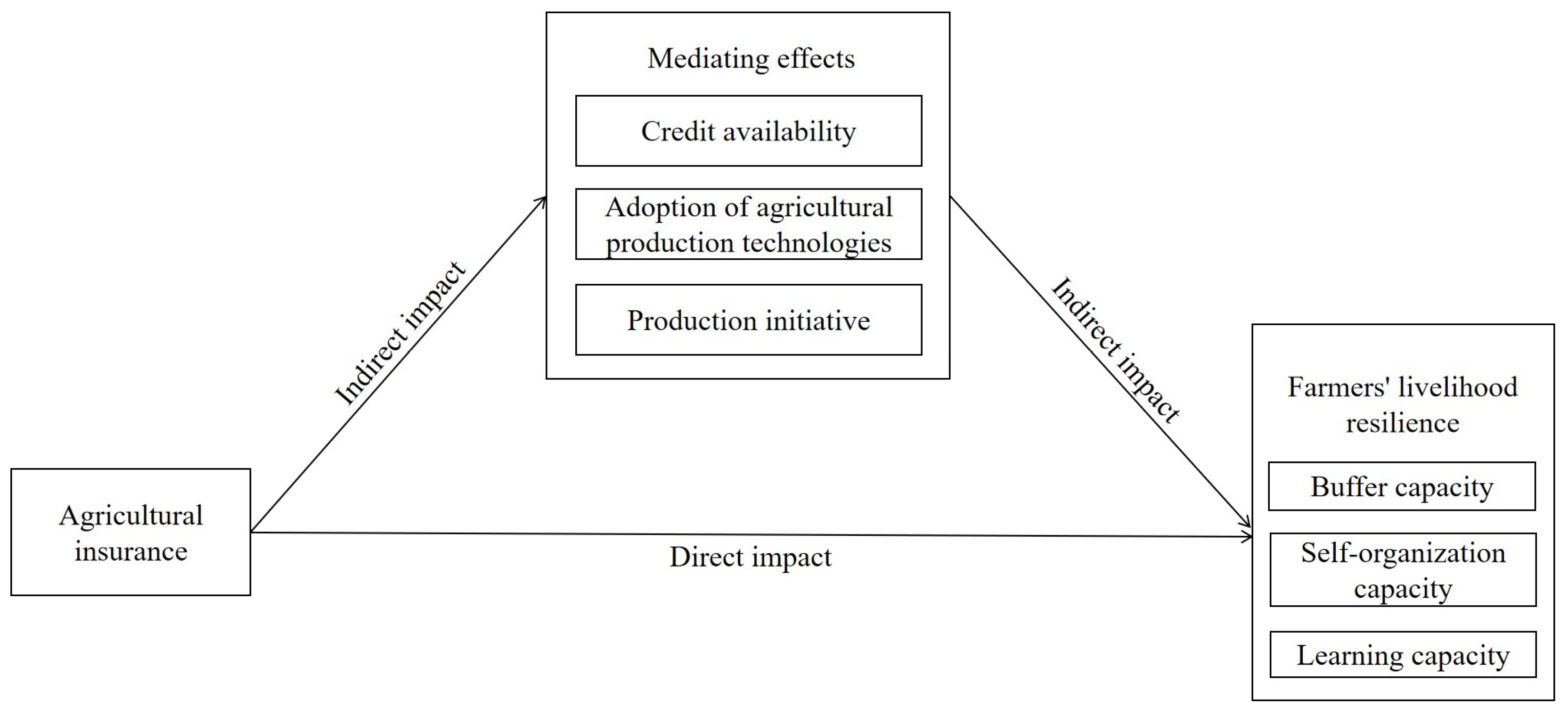
Based on H1–H4, this study develops a conceptual framework illustrating agricultural insurance’s impact mechanisms on farmers’ livelihood resilience (see Figure 1).

4. Materials and Methods

4.1. Data Sources

Data presented in this paper were collected through field surveys conducted by the research team between December 2024 and February 2025, targeting natural rubber farmers in Yunnan and Hainan provinces, China. The surveys were administered through one-on-one interviews. Hainan and Yunnan are major natural rubber-producing regions in China, with their rubber planting areas and yields occupying an important position nationwide. Conducting research in these regions ensures the representativeness and typicality of the research samples. Additionally, natural rubber insurance in the surveyed areas has been implemented for a long time with a high coverage rate. To ensure scientific and representative survey data, a stratified random sampling method was adopted for sample selection. The selection of survey samples was as follows (see Table 2): first, 6 cities (counties) were selected from the natural rubber production areas in Hainan and Yunnan Provinces, respectively, namely Chengmai County, Danzhou City, Baisha County, Qionghai City, Qiongzhong County, Ledong County in Hainan, Mengla County, Jinghong City, Gengma County, Mojiang County, Jinping County, and Jiangcheng County in Yunnan. The research team randomly selected 1 to 3 sample towns in each city (county), totaling 33 towns. Second, 1 to 4 natural villages were randomly selected from each sample town. Finally, the research team randomly interviewed 25 to 45 rubber farmers in each sample village, and team members filled out the questionnaires based on the interview content. The interviewees were family members aged 18–78 who were familiar with their family’s basic situation and could communicate effectively. The survey content mainly included the characteristics of the interviewees’ family members, such as gender, age, health status, and education level; the family’s buffer capacity, self-organization capacity, learning capacity, as well as the policy implementation, infrastructure, and natural conditions of the village where they lived. A total of 1241 questionnaires were distributed. After excluding invalid questionnaires with outliers and missing values, 1196 valid questionnaires were finally obtained (96.4%). This study has a limitation in the form of cross-sectional data. To mitigate the endogeneity problem caused by omitted variables, this study will use the PSM model and instrumental variable method to identify causal relationships more robustly.
Among surveyed households, the average household members were 4.23 persons; mean household head age was 52.96 years; 82.27% of household heads were male versus 17.73% female; only 13.54% attained high school education or above, while 86.46% possessed junior high school education or lower; 45.74% had purchased agricultural insurance compared with 54.26% non-purchasers. Comparisons with statistical yearbook data, including household size, head age, and education level, revealed minor deviations, indicating strong representativeness of the survey sample.

4.2. Construction of a Household Livelihood Resilience Indicator System

The measurement of household livelihood resilience is modeled after the indicator system proposed by [32] and incorporates insights from Quandt ([65]), who emphasizes that constructing household-level resilience metrics should integrate both subjective and objective indicators. This study operationalizes livelihood resilience through a multi-indicator framework spanning three dimensions—buffer capacity, self-organization capacity, and learning capacity—thereby establishing a comprehensive evaluation system. The dimensional definitions are as follows:

4.2.1. Buffer Capacity

Based on the buffer capacity’s conceptual definition, this study scientifically validates using livelihood capital indicators as measurement standards, where greater capital possession corresponds to stronger buffer capacity. Livelihood capital encompasses human, natural, physical, financial, and social capital. Labor capacity—human capital’s core element—directly influences livelihood status through quantitative proportion and health status, leading to “labor force proportion” and “per capita health level” as the measurement standard. For natural capital, land being foundational for survival and development necessitates “per capita arable land area” representation. Financial capital assessment combines “total household income” (foundational livelihood support) with “household debt amount” (financial health indicator), reflecting resource status. Material capital—the infrastructure for production and daily life—is quantified via “per capita residential area” and “number of production/transportation tools.” Given the conceptual overlap between social capital and self-organization capacity regarding social networks, this paper employs social capital indicators for self-organization capacity measurement without further elaboration.

4.2.2. Self-Organization Capacity

Based on self-organization capacity’s conceptual definition, this study selects social participation, social trust, social networks, and social connectivity as specific indicators: farmers’ social networks are measured through “the total number of village officials, government officials, and public institution staff among relatives/friends” and “mobile phone contacts”; social participation is quantified by “frequency of participation in village activities”; social trust is represented by “trust in village officials” and “trust in neighbors”; while social connectivity reflects villagers’ social norms and reciprocity through “level of village cohesion” and “frequency of mutual assistance”.

4.2.3. Learning Capacity

Based on learning capacity’s conceptual definition, this study employs “average education level per capita” to assess farmers’ information processing capabilities and knowledge reserves; “number of times receiving rubber technology extension services” evaluates technical learning and application capacity; “internet learning time” measures self-directed learning and information acquisition abilities; “whether exchanging production techniques with village officials” and “whether exchanging production techniques with other farmers” gauge access to authoritative information and social interaction capabilities; while “channels for obtaining information” assess information integration capabilities and learning flexibility.
Specific indicators are shown in Table A1.

4.3. Variable Selection and Descriptive Statistics

4.3.1. Dependent Variable: Household Livelihood Resilience

Based on the established indicator system, this study measures farmers’ livelihood resilience using the entropy weight method—an objective weighting approach that determines indicator weights based on the information quantity provided by each indicator’s entropy value. This method minimizes human bias in results; thus, we apply it to calculate weighted evaluation indices and derive a composite livelihood resilience score.

4.3.2. Explanatory Variable: Natural Rubber Insurance

This study operationalizes the variable through the survey question “Has the household purchased natural rubber insurance?”. Current comprehensive coverage includes rubber tree materialized cost insurance, full cost insurance, and natural rubber income insurance. Farmers purchasing any type are coded as 1; otherwise, 0.

4.3.3. Covariates

Drawing on established research regarding agricultural insurance and livelihood resilience determinants, this study selects household characteristics (total household population, average household age, and presence of Communist Party membership) and location characteristics (distance to village committee, distance to logistics point, and provincial location in Yunnan) as covariates for propensity score matching.

4.3.4. Mediating Variables: Credit Availability, Adoption of Agricultural Production Technologies, and Production Initiative

Credit availability is coded as 1 if farmers obtain credit, 0 otherwise; agricultural technology adoption is coded as 1 for adopters, 0 for non-adopters; production initiative is measured through rubber-tapping frequency categorized into five ordinal levels: 1 (abnormal tapping: rarely taps), 2 (extremely low-frequency: ≤0.25 taps/day), 3 (low-frequency: 0.25–0.5 taps/day), 4 (regular: 0.5–0.7 taps/day), and 5 (high-frequency: >0.7 taps/day).

4.3.5. Instrumental Variable

The instrumental variable indicates whether agricultural insurance was promoted by the government or village cadres, coded as 1 if promoted and 0 otherwise.
The descriptive statistics of the variables are shown in Table A2.
Comparative results between natural rubber insurance purchasers and non-purchasers regarding livelihood resilience, credit availability, agricultural technology adoption, and production initiative (Table 3) demonstrate purchasers’ slightly higher average livelihood resilience (0.115 vs. 0.114), alongside significantly greater proportions in credit access, technology adoption, and production initiative, indicating insurance’s positive effect on resilience enhancement and synergistic relationships with these activities.

4.4. Model Construction

4.4.1. Propensity Score Matching Method

To ascertain whether livelihood resilience differences between the treatment group (natural rubber insurance purchasers) and the control group (non-purchasers) stem from insurance intervention, this study employs propensity score matching (PSM). PSM constructs a counterfactual framework by identifying comparable control units, thus approximating randomized conditions in observational data and minimizing sample bias. When multiple observed characteristics exist, direct matching proves challenging. PSM resolves this by condensing multidimensional variables into a scalar propensity score. Let Y 1 denote the treatment group’s livelihood resilience, Y 0 be the control group’s resilience, and Treat be the intervention variable. The average treatment effect on the treated (ATT) of natural rubber insurance is then defined as:
A T T = E ( P ( X ) T r e a t ) { E [ Y 1 | T r e a t = 1 , P ( X ) ] E [ Y 0 | T r e a t = 0 , P ( X ) ] }
The PSM method typically involves selecting covariates, estimating propensity scores, choosing matching algorithms, assessing matching quality, quantifying treatment effects, and performing sensitivity analyses. Propensity scores are commonly estimated via Logit or Probit models. In this study, we utilize the Logit model to derive linearized propensity scores. The formula is expressed as follows:
P ( z ) = P r [ T r e a r = 1 | X ] = E [ T r e a r | X ]
In Equation (2), P denotes the fitted conditional probability of farmers purchasing natural rubber insurance, while X signifies the covariates.
Three matching methods were employed: caliper-based k-nearest neighbor matching (k = 6, caliper = 0.01), radius matching, and kernel matching. These approaches prioritize matching quality versus quantity differently, with no consensus on superiority. Their distinctions mainly manifest in estimation consistency.

4.4.2. Mediator Analysis Method

Mediation analysis examines causal pathways between variables, advancing beyond conventional analyses that focus exclusively on direct independent–dependent variable relationships. This approach generates deeper insights into the underlying mechanisms. To clarify how natural rubber insurance affects farmers’ livelihood resilience, we adopt Baron et al.’s (1986) [66] methodology to develop mediation regression equations modeling key variable relationships.
Y = a 0 + a 1 T r e a t + a 2 X + ε
M = β 0 + β 1 T r e a t + β 2 X + ε
Y = γ 0 + γ 1 T r e a t + γ 2 M + γ 3 M + ε
In these equations, Y denotes household livelihood resilience, M denotes the mediating variable, and ε denotes the random disturbance term. Equation (3) captures the total effect of natural rubber insurance on livelihood resilience. Equation (4) estimates its effect on the mediator, while the coefficient in Equation (5) measures the mediator’s direct effect on resilience. Substituting (4) into (5) yields the indirect effect ( γ 2 β 1 )—natural rubber insurance’s impact on resilience mediated through M.

5. Empirical Results

5.1. Common Support Domain and PSM Matching Results Analysis

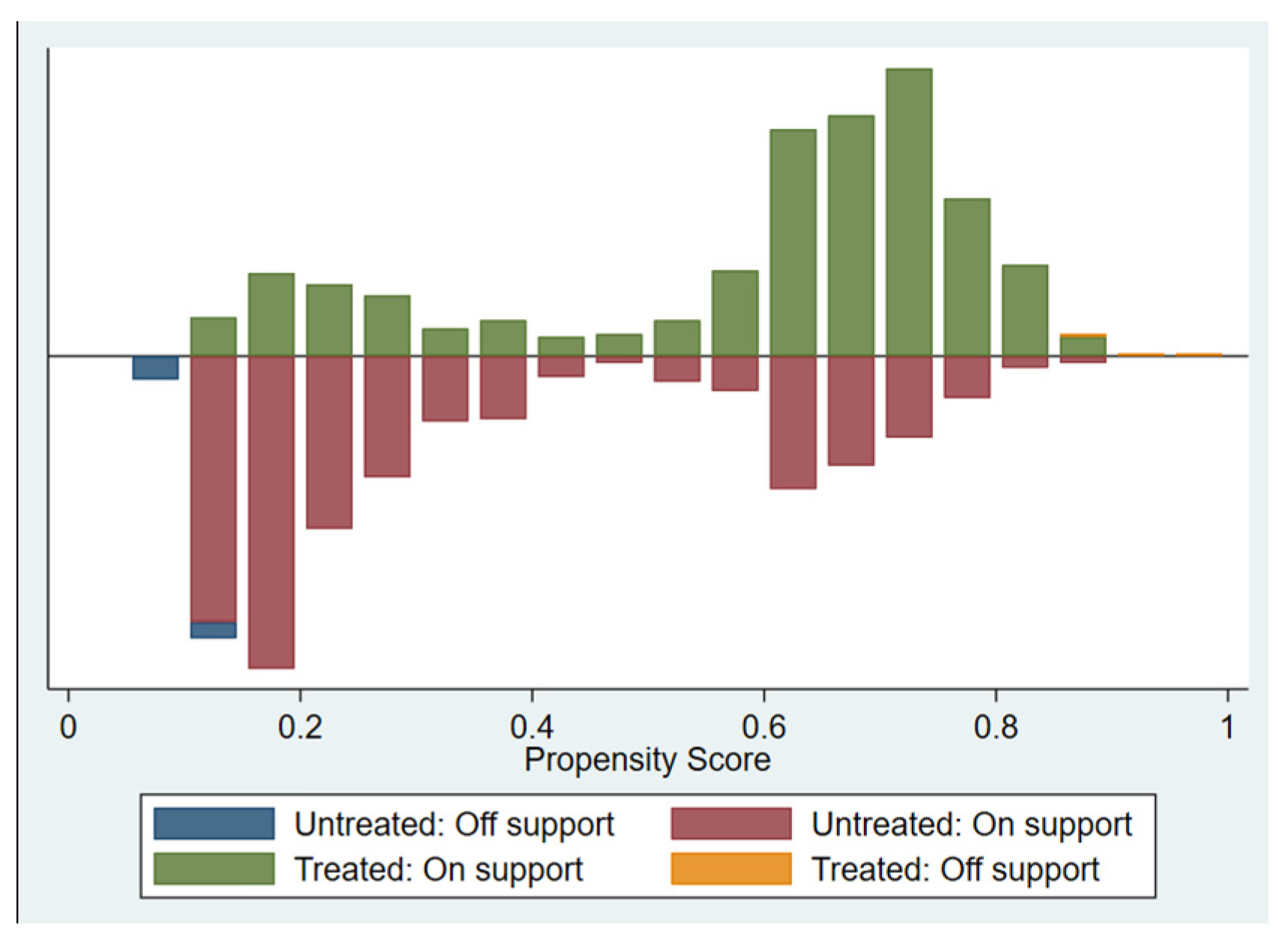
Using regression Equation (1), we compute agricultural insurance purchase propensity scores for each farmer as the matching foundation. To validate PSM estimates, both common support and conditional independence assumptions require testing. Given space limitations, only kernel matching results are presented in an exemplary manner (Figure 2). Substantial overlap exists between treatment and control group propensity scores, with most observations within the common support range—confirming high matching quality and fulfillment of the common support assumption.
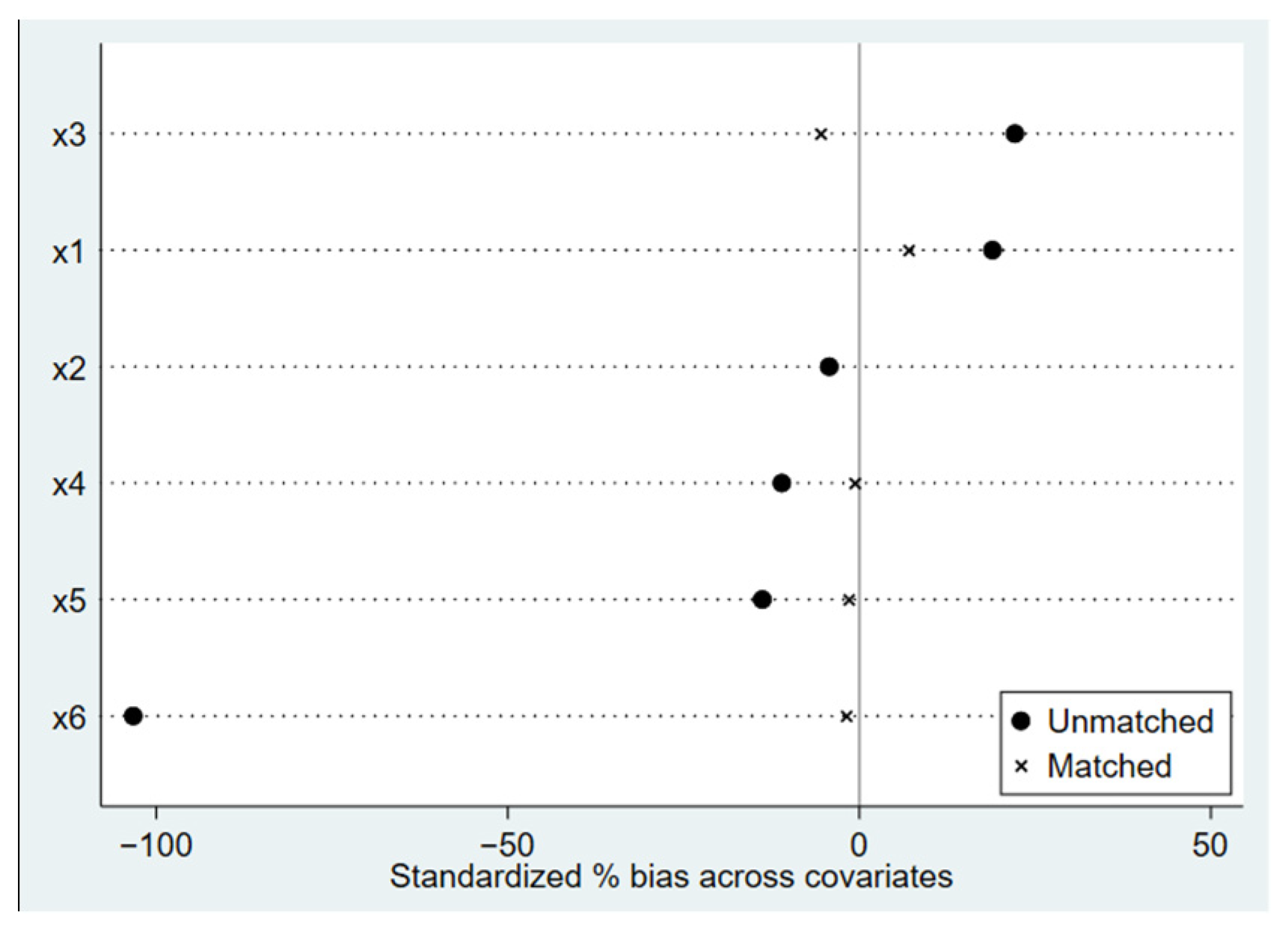
As shown in Figure 3, standardized covariate deviations between treatment and control groups are below 10% after matching, indicating effective elimination of pre-matching differences. Moreover, kernel matching retained 1176 matched samples with only 20 exclusions (Table 4), confirming robust matching quality.

5.2. Balance Test

To ensure matching reliability, covariate balance was verified—meaning no significant systematic differences existed between control and treatment groups post-matching, except in livelihood resilience. Balance test results (Table 5) indicate that after sample matching, the standardized bias of explanatory variables decreased from 115.7% to 9.3–14.9%, with total bias reduced significantly to below the 20% threshold. Pseudo R2 declined from 0.194 pre-matching to 0.002–0.004 post-matching, while the LR statistics dropped from 320.48 to 2.36–5.92. These results confirm that PSM effectively reduced explanatory variable distribution differences and eliminated self-selection bias.

5.3. Impact Effect Calculation

We calculate the average treatment effect (ATT) of natural rubber insurance on farmers’ livelihood resilience, buffer capacity, self-organization capacity, and learning capacity. The results (Table 6) demonstrate consistent estimates across three matching methods, confirming data robustness. For empirical analysis, the arithmetic mean is selected to represent the impact effect.
Following propensity score matching counterfactual estimation, we obtained the average treatment effect (ATT) for the treatment group. Table 6 results demonstrate that, after controlling for household and location characteristics, natural rubber insurance purchase exerts a significantly positive impact (1% level) on livelihood resilience, with a net effect of 0.010. This indicates that after addressing selection bias, insured farmers show 0.01 units higher livelihood resilience on average than non-insured farmers, confirming H1. Two factors may explain this observation. First, the livelihood resilience scores calculated via the entropy weight method are relative values with limited inter-household variation, leading to an attenuated linear relationship. Second, as a multidimensional, complex, and relatively stable composite indicator, livelihood resilience inherently resists substantial short-term fluctuations. Although the absolute coefficient value is small, according to Hou et al. ([67])’s economic interpretation measured by livelihood resilience standard deviation, the treatment effect is 0.217 standard deviations. This indicates agricultural insurance improves farmers’ livelihood resilience by approximately 21.7% in standard deviation change, demonstrating it as an identifiable factor enhancing resilience. This represents a practically meaningful small-to-medium effect size ([68]). Specifically, insured farmers climb 21.7 percentile points within the overall farmer population’s livelihood resilience ranking, demonstrating agricultural insurance’s demonstrable policy value in bolstering risk resilience and guarding against poverty. Additionally, insurance significantly enhances buffer capacity (ATT = 0.001), self-organization capacity (ATT = 0.003), and learning capacity (ATT = 0.006)—translating to 0.1%, 0.3%, and 0.6% improvements, respectively. Consistent results across matching methods reinforce robustness.

5.4. Robustness Tests

5.4.1. Alternative Models

Robustness was tested by estimating ordinary least squares (OLS) regression for natural rubber insurance’s impact on livelihood resilience. The results in Table 7(1) show largely consistent significance and direction with our core findings, confirming robustness. However, when compared with radius matching results, the OLS regression may introduce bias in assessing livelihood resilience and learning capacity improvements because of unaddressed sample selection issues.

5.4.2. Alternative Measurement Methods

For livelihood resilience measurement, this study adopted the entropy weight method to calculate composite scores. To avoid methodological bias, we re-measured resilience using equal-weight assignment. The results in Table 7(2) remain largely consistent with matching estimates, confirming that agricultural insurance enhances farmers’ livelihood resilience.

5.4.3. Instrumental Variable Approach

All sampled farmers reside in insurance-available areas, potentially weakening the counterfactual inference basis of PSM. To address endogeneity from unobservable factors, this study selects whether agricultural insurance was promoted by the government or village cadres as the instrumental variable. This choice satisfies two conditions: promotion enhances farmers’ insurance awareness and trust, thereby increasing participation; yet promotion itself has no direct link with livelihood resilience, meeting exogeneity requirements. The model results in Table 8 show a Cragg–Donald Wald F-statistic of 103.37, exceeding the 16.38 threshold and rejecting weak instrument concerns. The significant Kleibergen–Paap rk LM statistic (1% level) confirms instrument validity. The first stage regression indicates a significant correlation between the instrument and explanatory variable, while the second stage shows a 0.388 coefficient for the core variable (significant at 1%), maintaining consistent direction and significance after controlling for selection bias.

5.5. Mechanism Exploration

While prior analysis established whether natural rubber insurance improves farmers’ livelihood resilience and its impact magnitude, how it achieves this improvement requires examination. This section performs regression analysis on Equations (3)–(5), employing Sobel and Bootstrap tests. Columns (1)–(2) use credit availability as the mediating variable; Columns (3)–(4) agricultural production technology adoption; Columns (5)–(6) production initiative. The results are presented in Table 9.
First, Columns (1), (3), and (5) of Table 9 demonstrate significantly positive coefficients for natural rubber insurance (5% and 1% levels), confirming its effectiveness in promoting farmers’ credit accessibility, adoption of agricultural technologies, and production initiative. Second, loan accessibility, technology adoption, and production initiatives significantly enhance livelihood resilience through mediating pathways, as manifested by significantly positive coefficients of the natural rubber insurance variable in Columns (2), (4), and (6) of Table 9. These results validate hypotheses H2, H3, and H4.
Building on these regression results, we performed Sobel and Bootstrap tests to examine the mediating effects of credit accessibility, agricultural technology adoption, and production initiative. Sobel tests yielded significant z-statistics at the 5% level, while Bootstrap tests showed confidence intervals for livelihood resilience excluding zero—confirming significant mediation effects.

5.6. Heterogeneity Analysis

The existing literature confirms that natural rubber insurance enhances farmers’ livelihood resilience. To investigate nuanced dimensions of this impact, we analyze differential effects across two dimensions: poverty-stricken household status and natural rubber cultivation scale. The detailed results appear in Table 10.

5.6.1. Whether They Are Poverty-Stricken Households

Poverty-stricken households exhibit weaker economic foundations, resource acquisition capacity, and risk resistance compared with ordinary households. Natural rubber insurance may affect them differently because of greater reliance on agricultural income, potentially amplifying insurance’s buffer effect on their livelihood resilience. However, premium affordability constraints may lower enrollment rates among poverty-alleviated households, potentially diminishing actual policy impacts. Interaction term analysis reveals (Table 10(1)) a significantly positive coefficient (5% level) for the poverty alleviation × insurance interaction, indicating greater marginal utility of insurance on livelihood resilience in poverty-alleviated households.

5.6.2. Natural Rubber Planting Scale

Households of different scales face distinct risks and coping capacities. Large-scale operations possess greater resources (e.g., capital and technology), enhancing disaster resilience where insurance serves supplementary purposes. Conversely, small-scale households rely more critically on insurance, as single risk events may cause irreparable livelihood damage. Differential impacts of price fluctuations and disasters also yield varied insurance roles. Following Dennis et al. ([69]), we classify households above the mean cultivation area (≥35 acres) as large-scale and those below (<35 acres) as small-scale. Table 10(2) shows a significantly positive interaction term (1% level) between cultivation scale × insurance, indicating greater marginal utility of insurance on livelihood resilience among large-scale households.

6. Discussion

This study analyzes agricultural insurance’s impact on farmers’ livelihood resilience. The results show a statistically significant positive effect (0.01, p < 0.01), consistent with prior qualitative findings by Pratiwi et al. (2018 [70]). Notably, while Pratiwi et al. documented resilience improvements through income-based qualitative assessment, they did not quantify the effect size. Our multidimensional resilience framework empirically establishes this 0.01-unit insurance effect at 1% significance. This stems from insurance enhancing buffer capacity through indemnities and credit access, strengthening self-organization via cooperation and information sharing, and boosting learning capacity by reducing risk aversion and facilitating knowledge transfer—collectively improving resilience. Therefore, optimizing agricultural insurance policies is essential to maximize their protective function.
Furthermore, agricultural insurance enhances livelihood resilience primarily through credit accessibility, agricultural technology adoption, and production incentives. Credit accessibility functions as a mechanism by improving farmers’ credit ratings and enabling loan collateralization via bank–insurance partnerships, thus mitigating credit constraints [52]. Reduced credit constraints bolster risk-coping capacity for livelihood maintenance and production recovery [57]. Agricultural technology adoption operates through insurance’s risk reduction and financing facilitation, lowering barriers to new technologies and increasing adoption willingness [58]. Technological application enhances productivity and income [59], strengthening resilience. Production initiatives arise as insurance stabilizes income expectations, reduces risk aversion, and facilitates productive investments and technology adoption [42]. Enhanced initiatives improve resource utilization efficiency, drive human capital investment, and foster livelihood improvements [64]. Therefore, governments should strengthen the integration of agricultural insurance with credit policies and technology extension to maximize synergies.
Finally, agricultural insurance demonstrates greater marginal utility on livelihood resilience for poverty-alleviated households and large-scale farmers. For poverty-alleviated households, high-subsidy policies lower participation barriers, enabling low-cost risk protection [71]. Greater reliance on agricultural income also allows insurance to buffer risk shocks more effectively, reducing income volatility and enhancing resilience. For large-scale farmers, heightened marginal utility presumably originates a lot from higher input costs, extended initial investment cycles, and elevated risk exposure. Insurance covers larger losses while their stronger risk management initiative—including better utilization of insurers’ risk information and prompt implementation of scientific risk measures—reduces moral hazard [72]. Consequently, governments should develop differentiated insurance policies.
This study has limitations: (1) Findings based on natural rubber growers in Hainan and Yunnan may have limited generalizability to other crops or regions with distinct socioeconomic conditions. Future research should expand to encompass diverse crops and geographic areas to verify robustness. (2) Constrained by cross-sectional data, we cannot capture long-term dynamics of insurance impacts on livelihood resilience. Future work should employ panel tracking data to examine temporal policy effects. (3) The limited value range of livelihood resilience indices constructed via the entropy weight method may yield low absolute linear correlation coefficients with other variables, despite high statistical significance. Future research could develop comprehensive indicators capturing all dimensions or explore more complex functional forms to further validate this relationship.

7. Conclusions and Recommendations

This study focuses on natural rubber insurance, utilizing field survey data from 1196 rubber-growing households across twelve county-level divisions (three cities and nine counties) of China’s Hainan and Yunnan provinces. Through propensity score matching, we assess agricultural insurance’s impact on farmers’ livelihood resilience and further examine its mechanisms and heterogeneity. The key findings indicate: (1) agricultural insurance significantly enhances livelihood resilience, buffer capacity, self-organization capacity, and learning capacity; (2) credit accessibility, agricultural technology adoption, and production incentives serve as effective mechanisms for resilience improvement; (3) heterogeneity analysis reveals greater marginal effects among poverty-alleviated households and large-scale farmers, who derive more substantial benefits from insurance dividends compared with general and small-scale households.
Based on these findings, this study proposes the following recommendations: First, optimize and expand agricultural insurance policies. Policymakers should develop multi-tiered, diversified, region-specific, and differentiated insurance products. Streamline claim settlement mechanisms to reduce processing time and improve efficiency. Maintain and refine premium subsidies with higher rates for lifted-out-of-poverty and small-scale farmers to lower participation costs. Concurrently, enhance farmers’ awareness and engagement through social media, training programs, and village assemblies. Second, strengthen policy synergies. Establish an insurance-anchored synergy system integrating credit support and agricultural technology extension to amplify incentives for production initiative and learning capacity. Third, implement robust monitoring mechanisms. Governments must track real-time metrics—participation rates, claim settlement duration, and farmers’ satisfaction—while providing regular feedback to ensure effective risk protection. Crucially, to mitigate moral hazard and subsidy over-reliance, establish risk management standards clarifying farmers’ post-enrollment responsibilities, ensuring policy sustainability and effectiveness.

Author Contributions

J.W.: methodology, software, data curation, visualization, and writing—original draft preparation; Y.W.: investigation, polished/refined, revised, and formalized the manuscript; J.L.: validation, writing—review and editing, supervision, project administration; D.Z.: resources, funding acquisition. All authors have read and agreed to the published version of the manuscript.

Funding

This work was supported by the National Natural Science Foundation of China [Grant No. 72403065], Hainan Provincial Natural Science Foundation Youth Project [Grant No. 724QN240], Natural Rubber Industry Technology System Industrial Economy Post [Grant No. CARS-33], Tropical High-efficiency Agricultural Industry Technology System of Hainan University [Grant No. THAITS-3].

Informed Consent Statement

This study obtained informed consent for publication from all identifiable human participants.

Data Availability Statement

The datasets generated and analyzed during the current study are available from the corresponding author upon reasonable request.

Acknowledgments

We thank the National Natural Science Foundation of China, Hainan Provincial Natural Science Foundation Youth Project, Natural Rubber Industry Technology System Industrial Economy Post, Tropical High-efficiency Agricultural Industry Technology System of Hainan University, and Hainan University for their funding.

Conflicts of Interest

Authors have no conflicts of interest to declare.

Abbreviations

The following abbreviations are used in this manuscript:
PSMPropensity Score Matching
OLSOrdinary Least Squares
LRLikelihood Ratio
k-NNk-Nearest Neighbor

Appendix A

Table A1. Construction of a resilience index system for farmers’ livelihoods.
VariableDescriptionMeasurementAttributeWeighting
Buffer capacityPer capita health levelDisability = 0; Unhealthy = 1; Generally healthy = 2; Completely healthy = 3+0.002
Labor force shareLabor force size/household population+0.006
Per capita arable land areaArable land area/household population (mu)+0.047
Per capita residential area Residential area/household population (square meters)+0.026
Number of production and transportation toolsNumber of production and transportation tools in normal use (vehicles or units), such as cars, tractors, etc.+0.018
Annual total household income2024 household total income (ten thousand yuan)+0.051
Household debt amount2024 household debt amount (ten thousand yuan)0.001
Self-organization capacity Number of relatives and friends working in village committees, government departments, and public
institutions
Number of relatives and friends working in village committees, government departments, and public institutions+0.155
Mobile phone contactsMobile phone contacts (number)+0.084
Frequency of participation in collective
activities
Rated from low to high on a scale of 1 to 5: Very low = 1; Low = 2; Average = 3; High = 4; Very high = 5+0.015
Trust in village
officials
Rated from low to high on a scale of 1 to 5: Very low = 1; Low = 2; Average = 3; High = 4; Very high = 5+0.005
Trust in neighborsRated from low to high on a scale of 1 to 5: Very low = 1; Low = 2; Average = 3; High = 4; Very high = 5+0.003
Frequency of mutual assistanceRated from low to high on a scale of 1 to 5: Very low = 1; Low = 2; Average = 3; High = 4; Very high = 5+0.014
Village unityRated from low to high on a scale of 1 to 5: Very low = 1; Low = 2; Average = 3; High = 4; Very high = 5+0.004
Learning
capacity
Average education levelTotal years of education per household/household population+0.007
Internet learning timeDaily internet learning time (hours)+0.222
Information acquisition channelsTotal number of information acquisition channels+0.113
Natural rubber technology promotion sessionsNumber of natural rubber technology promotion sessions attended+0.117
Whether exchanging production techniques with other farmersYes = 1; No = 0+0.056
Whether exchanging production techniques with village officialsYes = 1; No = 0+0.051
Table A2. Descriptive statistics.
VariableVariable NameVariable DefinitionMinMaxMeanStandard Deviation
Dependent variableFarmers’ livelihood
resilience
Sum of buffer capacity, self-organization capacity, and learning capacity0.0240.3990.1140.046
Buffer capacityComprehensive value calculated using the entropy weight method0.0070.0230.0230.009
Self-organization capacityComprehensive value calculated using the entropy weight method0.0050.1840.0400.016
Learning capacityComprehensive value calculated using the entropy weight method00.2660.0520.038
Explanatory variableNatural rubber insuranceWhether natural rubber insurance was purchased: Yes = 1; No = 0010.4570.498
Mediating variableCredit availabilityWhether borrowing occurred in 2024: Yes = 1; No = 0010.1710.376
Adoption of agricultural production technologyWhether agricultural production technology will be applied in 2024:
1 = Yes; 0 = No
010.1880.399
Production initiativeAssigned values from low to high 1–5: Abnormal tapping = 1; Extremely low-frequency tapping = 2; Low-frequency tapping = 3; Regular tapping = 4;
High-frequency tapping = 5
153.7510.721
Instrumental variablePromoted agricultural insuranceWhether agricultural insurance was promoted by government/village cadres: Yes = 1; No = 0010.50805
CovariateHousehold populationTotal number of household members184.4011.463
Average household ageTotal age of household members/Number of household members (years)177638.08410.64
Whether there are Party members in the householdWhether there are Party members in the household: Yes = 1; No = 0010.2220.416
Distance to the village committeeDistance from home to the village
committee (km)
0.01303.7085.689
Distance to the logistics stationDistance from home to logistics
station (km)
0.01405.0916.951
Regional dummy variableHainan Province = 1; Yunnan Province = 0010.5140.500

References

  1. United Nations Office for Disaster Risk Reduction (UNDRR). Global Assessment Report on Disaster Risk Reduction: Our World at Risk; UNDRR: Geneva, Switzerland, 2022. [Google Scholar]
  2. Ministry of Agriculture and Rural Affairs. National Agricultural Disaster Statistics Annual Report; Ministry of Agriculture and Rural Affairs: Beijing, China, 2023. [Google Scholar]
  3. Kramer, B.; Hazell, P.; Alderman, H. Is Agricultural Insurance Fulfilling Its Promise for the Developing World? A Review of Recent Evidence. Annu. Rev. Resour. Econ. 2022, 14, 291–311. [Google Scholar] [CrossRef]
  4. Carter, M.R.; Cheng, L.; Sarris, A. Where and how index insurance can boost the adoption of improved agricultural technologies. J. Dev. Econ. 2016, 118, 59–71. [Google Scholar] [CrossRef]
  5. Cao, W.F. Interaction Mechanism Between Agricultural Insurance and Agricultural Modernization. Macroeconomics 2013, 106–111. [Google Scholar] [CrossRef]
  6. Skees, J.R.; Reed, M.R. Rate Making for Farm-level Crop Insurance: Implications for Adverse Selection. Am. J. Agric. Econ. 1986, 68, 653–659. [Google Scholar] [CrossRef]
  7. Miranda, M.J.; Glauber, J.W. Systemic Risk, Reinsurance, and the Failure of Crop Insurance Markets. Am. J. Agric. Econ. 1997, 79, 206–215. [Google Scholar] [CrossRef]
  8. Coble, K.H.; Barnett, B.J. Why Do We Subsidize Crop Insurance? Am. J. Agric. Econ. 2013, 95, 498–504. [Google Scholar] [CrossRef]
  9. Claassen, R.; Langpap, C.; Wu, J.J. Impacts of Federal Crop Insurance on Land Use and Environmental Quality. Am. J. Agric. Econ. 2017, 99, 592–613. [Google Scholar] [CrossRef]
  10. Lefebvre, M.; Langrell, S.R.H.; Gomez-y-Paloma, S. Incentives and policies for integrated pest management in Europe: A review. Agron. Sustain. Dev. 2015, 35, 27–45. [Google Scholar] [CrossRef]
  11. Belissa, T.K. Effects of weather index insurance adoption on household food consumption and investment in agricultural inputs in Ethiopia. J. Agric. Food Res. 2024, 16, 101043. [Google Scholar] [CrossRef]
  12. Fang, L.; Hu, R.; Mao, H.; Chen, S. How crop insurance influences agricultural green total factor productivity: Evidence from Chinese farmers. J. Clean. Prod. 2021, 321, 128977. [Google Scholar] [CrossRef]
  13. Dougherty, J.P.; Gallenstein, R.A.; Mishra, K. Impact of index insurance on moral hazard in the agricultural credit market: Theory and evidence from Ghana. J. Afr. Econ. 2021, 30, 418–446. [Google Scholar] [CrossRef]
  14. Goli, I.; Kriaučiūnienė, Z.; Zhang, R.; Bijani, M.; Koohi, P.K.; Rostamkalaei, S.A.; Lopez-Carr, D.; Azadi, H. Contributions of climate smart agriculture toward climate change adaptation and food security: The case of Mazandaran Province, Iran. Trends Food Sci. Technol. 2024, 152, 104653. [Google Scholar] [CrossRef]
  15. Habtemariam, L.T.; Will, M.; Müller, B. Agricultural insurance through the lens of rural household dietary diversity. Glob. Food Secur. 2021, 28, 100485. [Google Scholar] [CrossRef]
  16. Giné, X.; Townsend, R.; Vickery, J. Patterns of Rainfall Insurance Participation in Rural India. World Bank Econ. Rev. 2008, 22, 539–566. [Google Scholar] [CrossRef]
  17. Cai, R.; Ma, J.; Cai, S. Can crop insurance help optimize farmers’ decisions on pesticides use? Evidence from family farms in East China. J. Asian Econ. 2024, 92, 101735. [Google Scholar] [CrossRef]
  18. Xie, S.; Zhang, J.; Li, X.; Xia, X.; Chen, Z. The effect of agricultural insurance participation on rural households’ economic resilience to natural disasters: Evidence from China. J. Clean. Prod. 2024, 434, 140123. [Google Scholar] [CrossRef]
  19. Min, W. Rural financial development, agricultural mechanization, and total factor productivity. Financ. Res. Lett. 2025, 79, 107288. [Google Scholar] [CrossRef]
  20. Akbarovich, Y.A. Issues of food safety on the basis of agricultural insurance. Am. J. Agric. Biomed. Eng. 2020, 2, 43–52. [Google Scholar] [CrossRef]
  21. Huang, Z.; Su, K.; Wang, S. The role of agricultural insurance in promoting farmers’ green production behavior: The moderating effect of legal trust. Financ. Res. Lett. 2025, 80, 107269. [Google Scholar] [CrossRef]
  22. Li, H.; Tang, M.; Cao, A.; Guo, L. Assessing the relationship between air pollution, agricultural insurance, and agricultural green total factor productivity: Evidence from China. Environ. Sci. Pollut. Res. 2022, 29, 78381–78395. [Google Scholar] [CrossRef]
  23. Jiang, S.J.; Wang, L.; Xiang, F. The effect of agriculture insurance on agricultural carbon emissions in China: The mediation role of low-carbon technology innovation. Sustainability 2023, 15, 4431. [Google Scholar] [CrossRef]
  24. Gao, Y.; Shu, Y.; Cao, H.; Zhou, S.; Shi, S. Fiscal policy dilemma in resolving agricultural risks: Evidence from China’s agricultural insurance subsidy pilot. Int. J. Environ. Res. Public Health 2021, 18, 7577. [Google Scholar] [CrossRef] [PubMed]
  25. Li, H.J.; Yuan, K.H.; Cao, A.D.; Zhao, X.M.; Guo, L.L. The role of crop insurance in reducing pesticide use: Evidence from rice farmers in China. J. Environ. Manag. 2022, 306, 114456. [Google Scholar] [CrossRef] [PubMed]
  26. Mishra, A.K.; Wesley, N.R.; El-Osta, H.S. Is moral hazard good for the environment? Revenue insurance and chemical input use. J. Environ. Manag. 2005, 74, 11–20. [Google Scholar] [CrossRef] [PubMed]
  27. Miao, R.; Hennessy, D.A.; Feng, H. The effects of crop insurance subsidies and Sodsaver on land-use change. J. Agric. Resour. Econ. 2016, 41, 247–265. [Google Scholar]
  28. Sina, S. A conceptual framework for measuring livelihood resilience: Relocation experience from Aceh, Indonesia. World Dev. 2019, 117, 253–265. [Google Scholar] [CrossRef]
  29. Yi, F.M. Digital Skills, Livelihood Resilience and Sustainable Poverty Reduction in Rural Areas. J. South China Agric. Univ. (Soc. Sci. Ed.) 2021, 20, 1–13. [Google Scholar]
  30. Holling, C.S. Resilience and stability of ecological systems. Annu. Rev. Ecol. Syst. 1973, 4, 1–23. [Google Scholar] [CrossRef]
  31. Chambers, R.; Conway, G. Sustainable rural livelihoods: Practical concepts for the 21st century. In IDS Discussion Paper; Institute of Development Studies: Brighton, UK, 1992; Volume 296. [Google Scholar]
  32. Speranza, C.I.; Wiesmann, U.; Rist, S. An indicator framework for assessing livelihood resilience in the context of social-ecological dynamics. Glob. Environ. Change 2014, 28, 109–119. [Google Scholar] [CrossRef]
  33. Liu, W.; Li, J.; Ren, L.J.; Xu, J.; Li, C.; Li, S.Z. Exploring livelihood resilience and its impact on livelihood strategy in rural China. Soc. Indic. Res. 2020, 150, 977–998. [Google Scholar] [CrossRef]
  34. Arrow, K.J. Uncertainty and the welfare economics of medical care. Am. Econ. Rev. 1963, 53, 941–973. [Google Scholar]
  35. Cai, J. Agricultural insurance and its role in risk management for smallholder farmers. China Agric. Econ. Rev. 2016, 8, 423–440. [Google Scholar]
  36. Janzen, S.A.; Carter, M.R.; Ikegami, M. Can insurance alter poverty dynamics and reduce the cost of social protection in developing countries? J. Risk Insur. 2021, 88, 293–324. [Google Scholar] [CrossRef]
  37. Noritomo, Y.; Takahashi, K. Can insurance payouts prevent a poverty trap? Evidence from randomised experiments in northern Kenya. J. Dev. Stud. 2020, 56, 1079–1096. [Google Scholar] [CrossRef]
  38. Hungerford, A.; O’Donoghue, E. Federal crop insurance options for upland cotton farmers and their revenue effects. United States Dep. Agric. Econ. Res. Serv. 2016, 3, 110–135. [Google Scholar]
  39. Kahneman, D.; Tversky, A. Prospect theory: An analysis of decision under risk. Econometrica 1979, 47, 263–292. [Google Scholar] [CrossRef]
  40. Chai, Z.H.; Ren, J.; Li, S.N. Effects of Agricultural Insurance on the Labor Allocation of Farmers. J. Agrotech. Econ. 2025, 5, 88–106. [Google Scholar] [CrossRef]
  41. Rana, R.H.; Adeyinka, A.A.; Mushtaq, S.; Barratt, J.; Alam, K. The impact of agricultural insurance on farmers’ mental health: What we can learn from the literature. Environ. Dev. Sustain. 2024, 1–18. [Google Scholar] [CrossRef]
  42. Farrin, K.; Miranda, M.J. A heterogeneous agent model of credit-linked index insurance and farm technology adoption. J. Dev. Econ. 2015, 116, 199–211. [Google Scholar] [CrossRef]
  43. Mazur, K. Sharing risk to avoid tragedy: Informal insurance and irrigation in village economies. J. Dev. Econ. 2023, 161, 10303. [Google Scholar] [CrossRef]
  44. Martine, V.; Hafsah, J.; Kerri, B. Risk preferences and poverty traps in the uptake of credit and insurance amongst small-scale farmers in South Africa. J. Econ. Behav. Organ. 2020, 180, 826–836. [Google Scholar] [CrossRef]
  45. Wen, S.; Xiao, Q.; Li, J.; Li, J. The impact of agricultural insurance on urban–rural income gap: Empirical evidence from China. Agriculture 2023, 13, 1950. [Google Scholar] [CrossRef]
  46. Narayanan, A.; Tomar, S. Farm support and market distortion: Evidence from India. Am. J. Agric. Econ. 2023, 105, 966–993. [Google Scholar] [CrossRef]
  47. Stoeffler, Q.; Carter, M.; Guirkinger, C.; Gelade, W. The spillover impact of index insurance on agricultural investment by cotton farmers in Burkina Faso. World Bank Econ. Rev. 2022, 36, 114–140. [Google Scholar] [CrossRef]
  48. Alam, A.S.A.F.; Begum, H.; Masud, M.M.; Al-Amin, A.Q.; Leal Filho, W. Agriculture insurance for disaster risk reduction: A case study of Malaysia. Int. J. Disaster Risk Reduct. 2020, 47, 101626. [Google Scholar] [CrossRef]
  49. Genius, M.; Koundouri, P.; Nauges, C.; Tzouvelekas, V. Information transmission in irrigation technology adoption and diffusion: Social learning, extension services, and spatial effects. Am. J. Agric. Econ. 2014, 96, 328–344. [Google Scholar] [CrossRef]
  50. Ai, T.; Zhang, J.; Shao, J. Study on the coordinated poverty reduction effect of agricultural insurance and agricultural credit and its regional differences in China. Econ. Anal. Policy 2023, 78, 835–844. [Google Scholar] [CrossRef]
  51. Balana, B.B.; Oyeyemi, M.A. Agricultural credit constraints in smallholder farming in developing countries: Evidence from Nigeria. World Dev. Sustain. 2022, 1, 100012. [Google Scholar] [CrossRef]
  52. Wu, H.; Li, J. Risk preference, interlinked credit and insurance contract and agricultural innovative technology adoption. J. Innov. Knowl. 2023, 8, 100282. [Google Scholar] [CrossRef]
  53. Ma, Q.; Zhou, Y.; Wang, J. The impact of climate change on credit risk of rural financial institutions: A threshold effect based on agricultural insurance. N. Am. J. Econ. Financ. 2024, 71, 102086. [Google Scholar] [CrossRef]
  54. Lu, M.; Bai, H.; Wu, Y. Anti-corruption, credit supply, and agricultural economic development. Financ. Res. Lett. 2024, 65, 105515. [Google Scholar] [CrossRef]
  55. Islam, M.M. Agricultural credit and agricultural productivity in Bangladesh: An econometric approach. Int. J. Food Agric. Econ. 2020, 8, 247–255. [Google Scholar]
  56. Seven, U.; Tumen, S. Agricultural credits and agricultural productivity: Cross-country evidence. Singap. Econ. Rev. 2020, 65, 161–183. [Google Scholar] [CrossRef]
  57. Wanzala, R.W.; Marwa, N.; Lwanga, E.N. Impact of agricultural credit on coffee productivity in Kenya. World Dev. Sustain. 2024, 5, 100166. [Google Scholar] [CrossRef]
  58. Madaki, M.Y.; Kaechele, H.; Bavorova, M. Agricultural insurance as a climate risk adaptation strategy in developing countries: A case of Nigeria. Clim. Policy 2023, 23, 747–762. [Google Scholar] [CrossRef]
  59. Birthal, P.S.; Hazrana, J.; Negi, D.S.; Mishra, A.K. Assessing benefits of crop insurance vis-a-vis irrigation in Indian agriculture. Food Policy 2022, 112, 102348. [Google Scholar] [CrossRef]
  60. Barratt, J.; Kath, J.; Mushtaq, S.; Collins, B.; Chenu, K.; Christopher, J.; An-Vo, D.A. Strategic use of index-based frost insurance to reduce financial risk and improve income stability for wheat producers in Australia. Agric. Syst. 2025, 226, 104306. [Google Scholar] [CrossRef]
  61. Joyce, M.; Singh, A. Income uncertainty, precautionary wealth, and social insurance. Eur. Econ. Rev. 2025, 175, 105003. [Google Scholar] [CrossRef]
  62. Dahlin, A.S.; Rusinamhodzi, L. Yield and labor relations of sustainable intensification options for smallholder farmers in sub-Saharan Africa: A meta-analysis. Agron. Sustain. Dev. 2019, 39, 32. [Google Scholar] [CrossRef]
  63. Adepoju, O.; Esan, O.; Akinyomi, O. Food security in Nigeria: Enhancing workers’ productivity in precision agriculture. J. Digit. Food Energy Water Syst. 2022, 3, 13–27. [Google Scholar] [CrossRef]
  64. Joffre, O.M.; Castine, S.A.; Phillips, M.J.; Senaratna Sellamuttu, S.; Chandrabalan, D.; Cohen, P. Increasing productivity and improving livelihoods in aquatic agricultural systems: A review of interventions. Food Secur. 2017, 9, 39–60. [Google Scholar] [CrossRef]
  65. Quandt, A. Measuring livelihood resilience: The Household Livelihood Resilience Approach (HLRA). World Dev. 2018, 107, 253–263. [Google Scholar] [CrossRef]
  66. Baron, R.M.; Kenny, D.A. The moderator–mediator variable distinction in social psychological research: Conceptual, strategic, and statistical considerations. J. Personal. Soc. Psychol. 1986, 51, 1173. [Google Scholar] [CrossRef] [PubMed]
  67. Hou, F.; Mengistu, M.M.; Ng, J.; Zhang, J.J. Credit Information Sharing and Investment Efficiency: Cross-Country Evidence. Contemp. Account. Res. 2024, 41, 2099–2133. [Google Scholar] [CrossRef]
  68. Cohen, J. Statistical Power Analysis for the Behavioral Sciences; Routledge: Oxfordshire, UK, 2013. [Google Scholar]
  69. Dennis, E.J.; Tonsor, G.T.; Lusk, J.L. Choosing quantities impacts individuals choice, rationality, and willingness to pay estimates. Agric. Econ. 2021, 52, 945–962. [Google Scholar] [CrossRef]
  70. Pratiwi, N.; Karuniasa, M.; Suroso, D. Self-organization and crop insurance to enhance livelihood resilience: A case of rice farmers in Cirebon Regency, Indonesia. ASEAN J. Community Engagem. 2018, 2, 1. [Google Scholar] [CrossRef]
  71. Dercon, S.; Bold, T.; Calvo, C. Insurance for the poor? In Social Protection for the Poor and Poorest: Concepts, Policies and Politics; Palgrave Macmillan: London, UK, 2008; pp. 47–63. [Google Scholar]
  72. Greatrex, H.; Hansen, J.; Garvin, S.; Diro, R.; Blakeley, S.; Le Guen, M.; Rao, K.; Osgood, D. Scaling up Index Insurance for Smallholder Farmers: Recent Evidence and Insights; CCAFS Report; CGIAR Research Program on Climate Change, Agriculture and Food Security (CCAFS): Copenhagen, Denmark, 2015. [Google Scholar]
Figure 1. Mechanism of agricultural insurance’s impact on farmers’ livelihood resilience.
Agriculture 15 01683 g001
Figure 2. Jointly supporting hypothesis testing.
Agriculture 15 01683 g002
Figure 3. Standard bias (%).
Agriculture 15 01683 g003
Table 1. Summary of key natural rubber insurance policies.
Policy PhaseKey Documents
Policy exploration phase
(2007–2017)
2007: The Ministry of Finance issued Interim Measures for Central Government Subsidies on Agricultural Insurance Premiums. Hainan Province launched a pilot rubber tree wind disaster insurance program with provincial subsidies.
2008: Natural Rubber Advantageous Region Layout Plan (2008–2015) first proposed establishing policy-based agricultural insurance and disaster compensation systems.
2010: Rubber tree wind disaster insurance was included in nationally subsidized categories.
Policy structuring phase
(2018–2022)
2018: Hainan Provincial Government implemented the 2018 Hainan Agricultural Insurance Implementation Plan, integrating natural rubber income insurance into policy programs to achieve full price insurance coverage.
Policy refinement phase
(2023–present)
2023: Joint notice by the Ministry of Finance, Ministry of Agriculture, and National Financial Regulatory Administration: Implementation Guidelines for Comprehensive Natural Rubber Insurance Policy specified operational rules (insured entities, coverage types, protection levels, and subsidy ratios) for Hainan and Yunnan, covering all growers and enterprises.
Table 2. Sample distribution.
ProvinceCity
(County)
Number of VillagesNumber of QuestionnairesSample ProportionProvinceCity (County)Number of VillagesNumber of QuestionnairesSample Proportion
HainanChengmai71109.20%YunnanMengla1125321.15%
Danzhou814111.79%Jinghong1321217.73%
Baisha712010.03%Gengma2574.77%
Qionghai2605.02%Mojiang1312.59%
Qiongzhong712010.03%Jinping1312.59%
Ledong1302.51%Jiangcheng1312.59%
Table 3. Purchasers vs. non-purchasers of natural rubber insurance.
VariableMeanStandard DeviationMinimumMaximum
ParticipatedNon-ParticipatedParticipatedNon-ParticipatedParticipatedNon-ParticipatedParticipatedNon-Participated
Farmers’ livelihood resilience0.1150.1140.0480.0450.0230.0260.3990.321
Credit availability0.1610.1790.3680.3830011
Adoption of agricultural production technology0.1940.1830.4090.3910011
Production initiative3.8723.6500.6100.7891155
Table 4. PSM matching results.
Unmatched SamplesMatched SamplesTotal
Control group17632649
Treatment group3544547
Total2011761196
Table 5. Results of explanatory variable balance tests before and after propensity score matching.
Matching MethodPseudo R2LR Chi-SquareStandardized
Bias (%)
Before matching0.194320.25115.7
Kernel matching0.0022.369.3
Radius matching0.0034.7513.3
Caliper-based k-NN matching
(k = 6, caliper = 0.01)
0.0045.9214.9
Table 6. Average treatment effect (ATT) of propensity score matching.
Farmers’ Livelihood
Resilience
Buffer
Capacity
Self-Organization CapacityLearning
Capacity
Kernel matching0.011 ***
(0.003)
0.001 **
(0.001)
0.003 **
(0.001)
0.006 **
(0.003)
Radius matching0.010 ***
(0.004)
0.001 **
(0.001)
0.003 **
(0.001)
0.006 **
(0.003)
Caliper-based
k-NN matching
(k = 6 caliper = 0.01)
0.009 ***
(0.004)
0.001 **
(0.000)
0.003 **
(0.001)
0.005 **
(0.003)
Average value0.0100.0010.0030.006
Note: **, and *** indicate significance at the 5%, and 1% levels, respectively. The numbers in parentheses are standard errors.
Table 7. Robustness tests using alternative models and measurement methods.
VariableFarmers’ Livelihood Resilience
Alternative Model
(1)
Alternative Measurement
(2)
Agricultural insurance0.011 ***
(0.003)
0.011 **
(0.004)
1196
R2/Pseudo R20.1800.188
Note: **, and *** indicate significance at the 5%, and 1% levels, respectively. The numbers in parentheses are standard errors.
Table 8. Robustness tests using the instrumental variable approach.
VariableFirst StageSecond Stage
Agricultural InsuranceLivelihood Resilience
Whether agricultural insurance was promoted by government/village cadres0.251 ***
(0.026)
0.011 **
(0.004)
Agricultural insurance0.1800.188
Constant term0.321 ***0.078 ***
CovariatesControlledControlled
Kleibergen–Paap rk LM87.24 ***
Cragg–Donald Wald F103.37
Sample size1196
R2/Pseudo R20.1850.113
Note: **, and *** indicate significance at the 5%, and 1% levels, respectively. The numbers in parentheses are standard errors.
Table 9. Test results of the mechanism.
(1)(2)(3)(4)(5)(6)
VariableCredit availabilityFarmers’ livelihood resilienceAdoption of Agricultural Production TechnologiesFarmers’ livelihood resilienceProduction initiativeFarmers’ livelihood resilience
Natural rubber
insurance
0.053 **
(0.024)
0.010 ***
(0.003)
0.07 ***
(0.003)
0.010 ***
(0.003)
0.174 ***
(0.05)
0.011 ***
(0.003)
Credit availability 0.016 ***
(0.003)
Adoption of agricultural production
technologies
0.009 ***
(0.003)
Production
initiative
0.004 **
(0.002)
CovariatesControlled
Sobel test z-statistic 1.980 ** 1.928 * 2.011 **
95% Confidence
interval (CI)
(0.000, 0.002) (0.000, 0.001) (0.000, 0.001
Matched observations (N)1196
Note: *, **, and *** indicate significance at the 10%, 5%, and 1% levels, respectively. The numbers in parentheses are standard errors.
Table 10. Heterogeneity results of the impact of natural rubber insurance on farmers’ livelihood resilience.
VariableFarmers’ Livelihood Resilience
Coefficient
(1)
Standard ErrorCoefficient
(2)
Standard Error
Natural rubber
insurance
0.009 ***0.0030.006 **0.003
Natural rubber insurance × whether a household has escaped poverty0.009 **0.004
Natural rubber insurance × natural rubber planting scale 0.135 ***0.004
Control variablesControlledControlled
Sample size11961196
R20.1830.187
Note: **, and *** indicate significance at the 5%, and 1% levels, respectively.
Disclaimer/Publisher’s Note: The statements, opinions and data contained in all publications are solely those of the individual author(s) and contributor(s) and not of MDPI and/or the editor(s). MDPI and/or the editor(s) disclaim responsibility for any injury to people or property resulting from any ideas, methods, instructions or products referred to in the content.