DBSCAN-MFI Based Improved Clustering for Field-Road Classification in Mechanical Residual Film Recovery


Abstract
1. Introduction
2. Materials and Methods
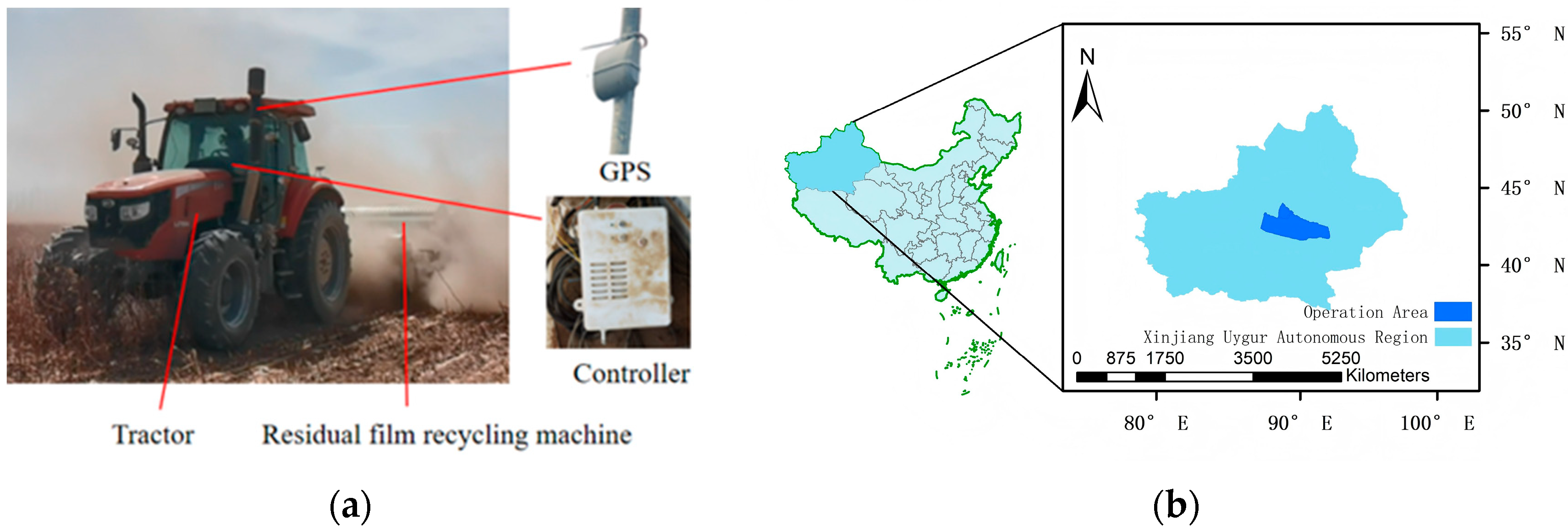
2.1. Experimental Equipment and Conditions
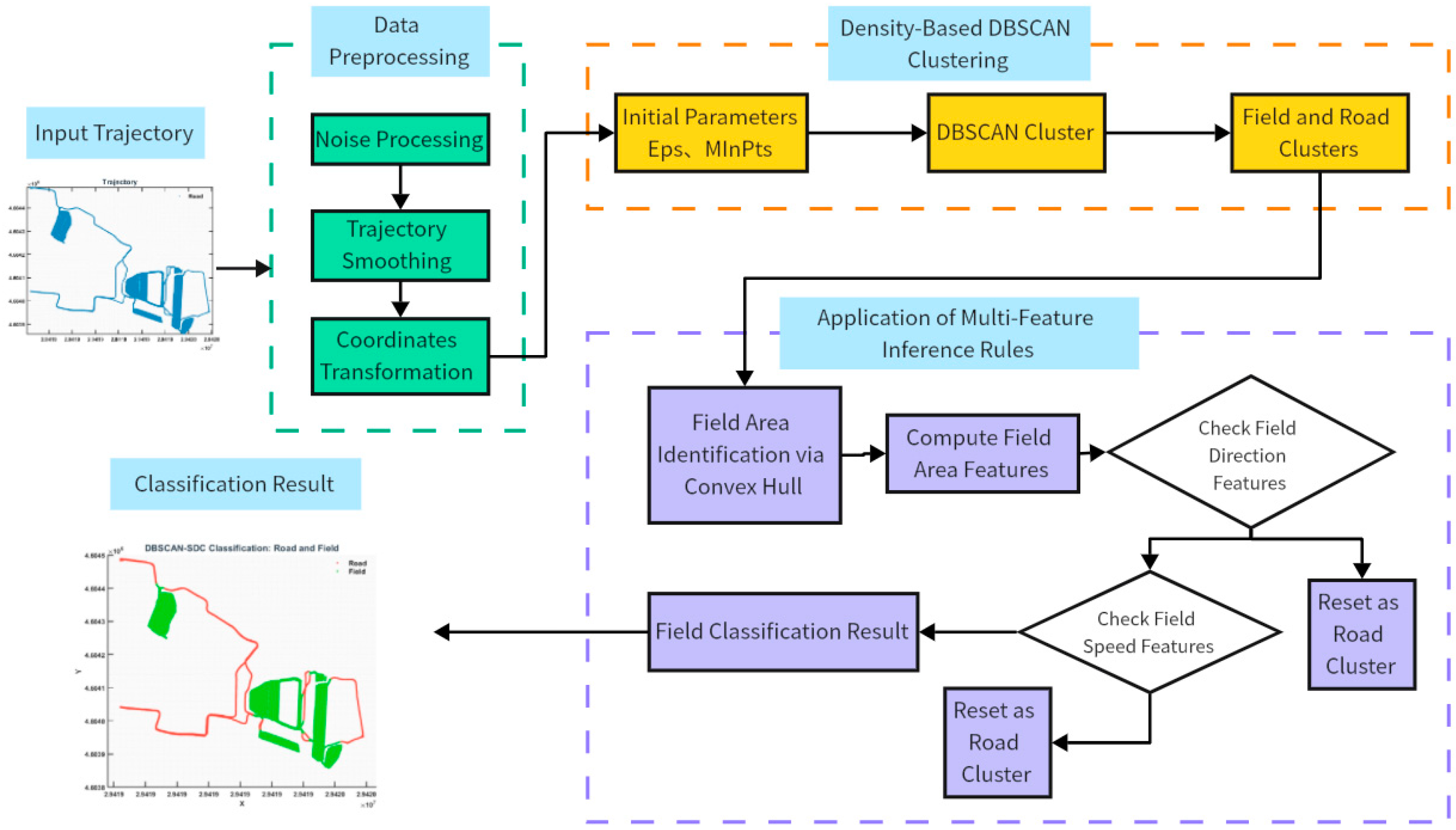
2.2. Overview
- (1)
- Data Preprocessing
- (2)
- Density-Based DBSCAN Clustering
- (3)
- Application of Multi-Feature Inference Rules
2.3. Data Preprocessing
- (1)
- Noise Points Processing. Signal noise during GNSS positioning inevitably causes signal drift, generating significant localization errors. In order to reduce the impact of noise points, the noise points are detected based on the maximum traveling speed of the residual film recovery machine. If there is a large change in speed that far exceeds the maximum traveling speed of the residual film recovery machine, then remove the points [26].
- (2)
- Trajectory Smoothing. Discrete GNSS positioning points (2.5 m accuracy) introduce substantial errors in direction and velocity calculations. Kalman filtering was applied to smooth trajectories, reducing directional errors and velocity errors during residual film recovery operations [33].
- (3)
- Coordinate Transformation. Geodetic coordinates (WGS84) were converted to a two-dimensional Gauss-Krüger projection to enable accurate Euclidean distance calculations between points [34].
2.4. Density-Based DBSCAN Clustering
2.5. Multi-Feature Inference Method Based on Speed and Directional Features
- (1)
- Based on the known field area clusters, conduct statistical analysis on the driving directions and speed characteristics within the clusters.
- (2)
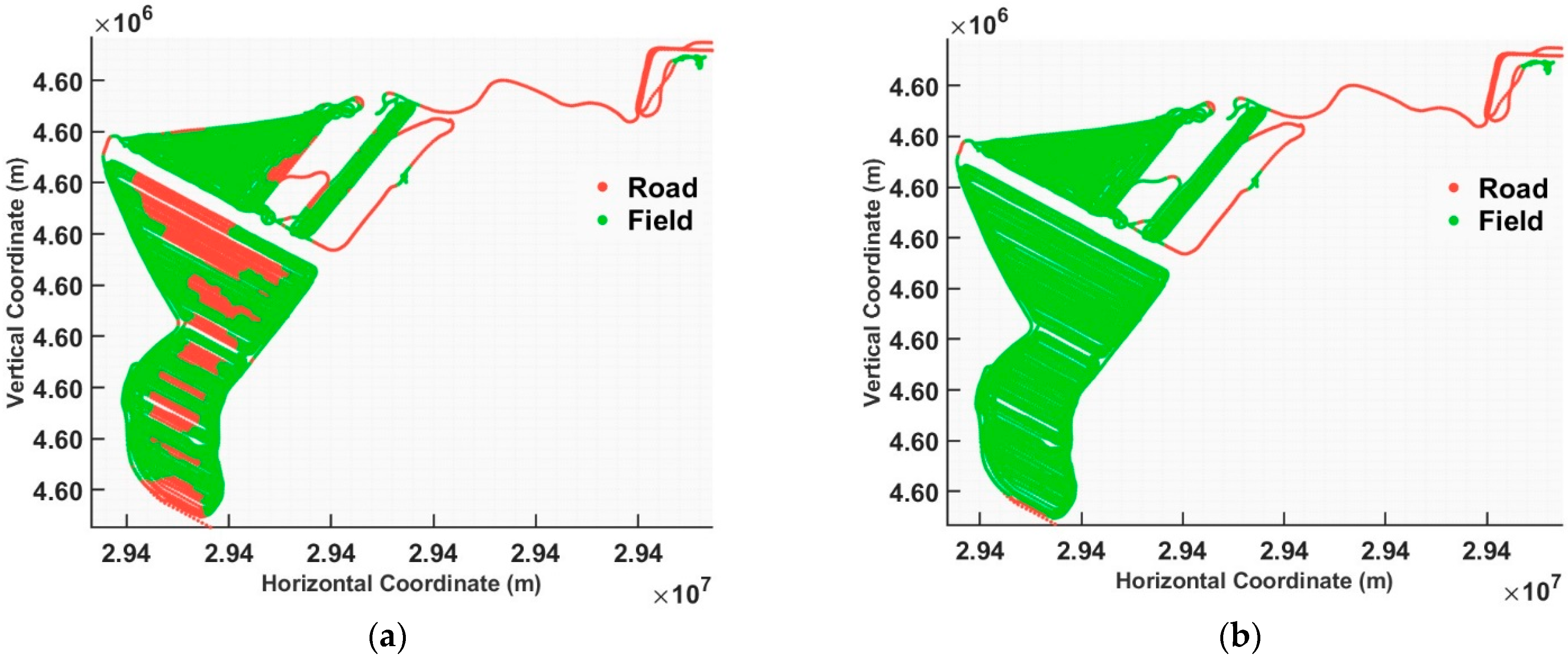
- Complete the field area clusters. According to the driving direction and driving speed feature within the clusters, complete the points within the field area clusters that are mistakenly regarded as road area clusters.
- (3)
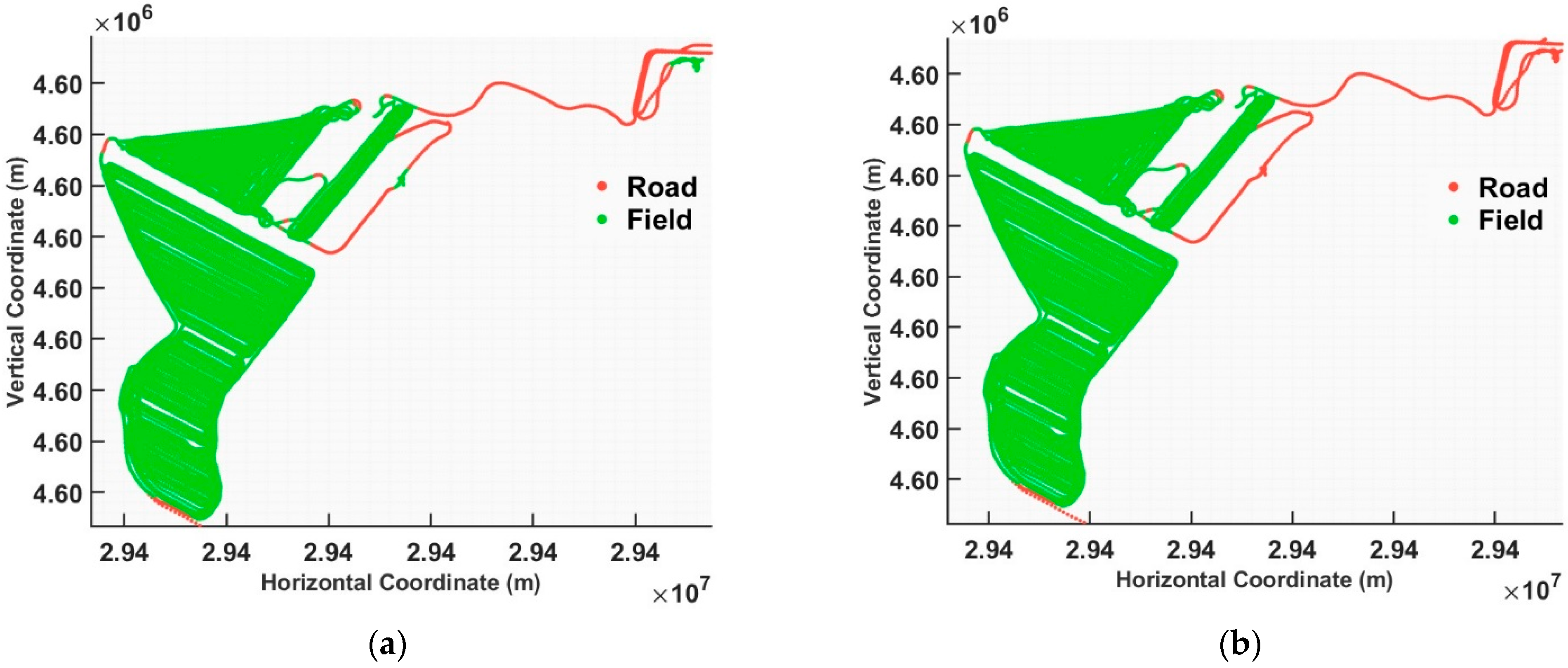
- Screen the field area clusters after noise filtering and overall completion based on driving speed and directional features. Filter out clusters strictly concentrated in only two parallel directions and regard them as road area clusters; screen out field area clusters where the speed always remains below a certain threshold.
2.5.1. Measurement Method for Driving Direction and Speed

2.5.2. Convex Hull Completion Based on Driving Direction Features
- (1)
- Whether the “road area cluster” is within the corresponding “field area cluster”.
- (2)
- Whether the driving direction features of the “road area cluster” are consistent with the main directional regions of the “field area cluster”.
- (3)
- Whether the convex hull containing the “road area cluster” collides with other convex hulls.
| Algorithm 1: Convex Hull Expansion Classification Algorithm |
 |
2.5.3. Screening Based on Driving Speed and Directional Features
- (1)
- Detect the total number of points in field area clusters: determine the point threshold based on the minimum operation time of the residual film recovery machine, traverse the “field area clusters,” screen out those with point counts below the threshold, and classify them as “road area clusters.”
- (2)
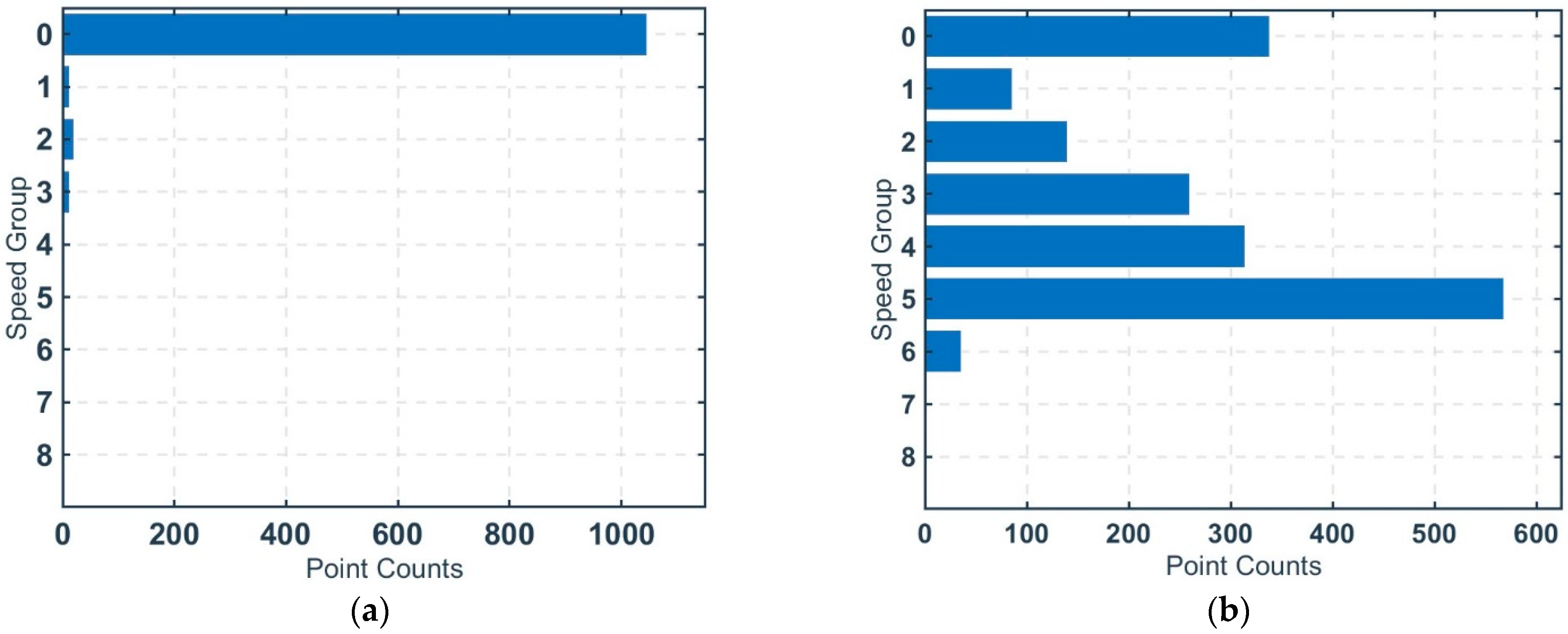
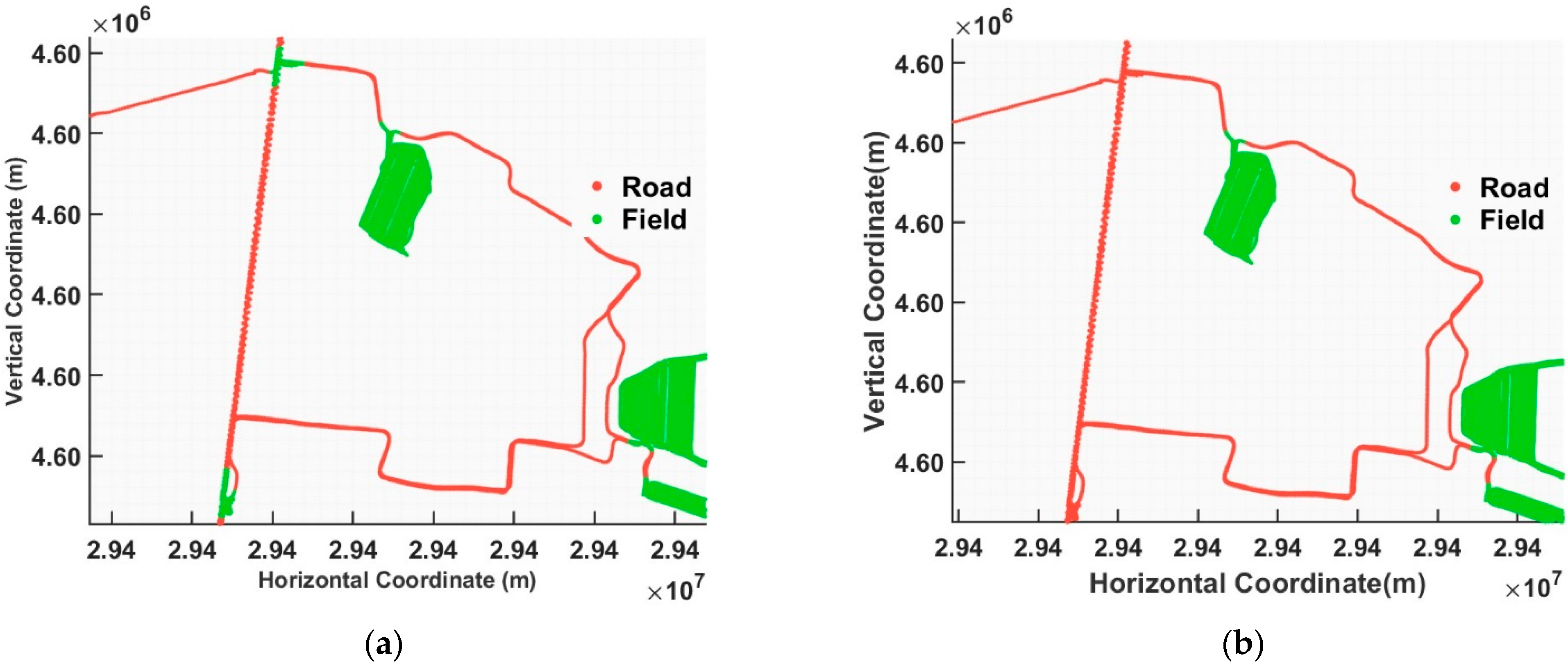
- Detect the driving speed features of field area clusters: statistically analyze the driving speeds of “field area clusters” according to the speed processing method mentioned in Section 2.5.1. In the “field area clusters,” if the proportion of low driving speeds in the overall driving speed features is large, classify them as “road area clusters.” As shown in the speed feature distribution of correctly and mistakenly identified field area clusters in Figure 3, the driving speed features of correct “field area clusters” are concentrated in the working speed range, while those of mistaken “field area clusters” are concentrated in the low driving speed range of 0–1 km/h.
- (3)
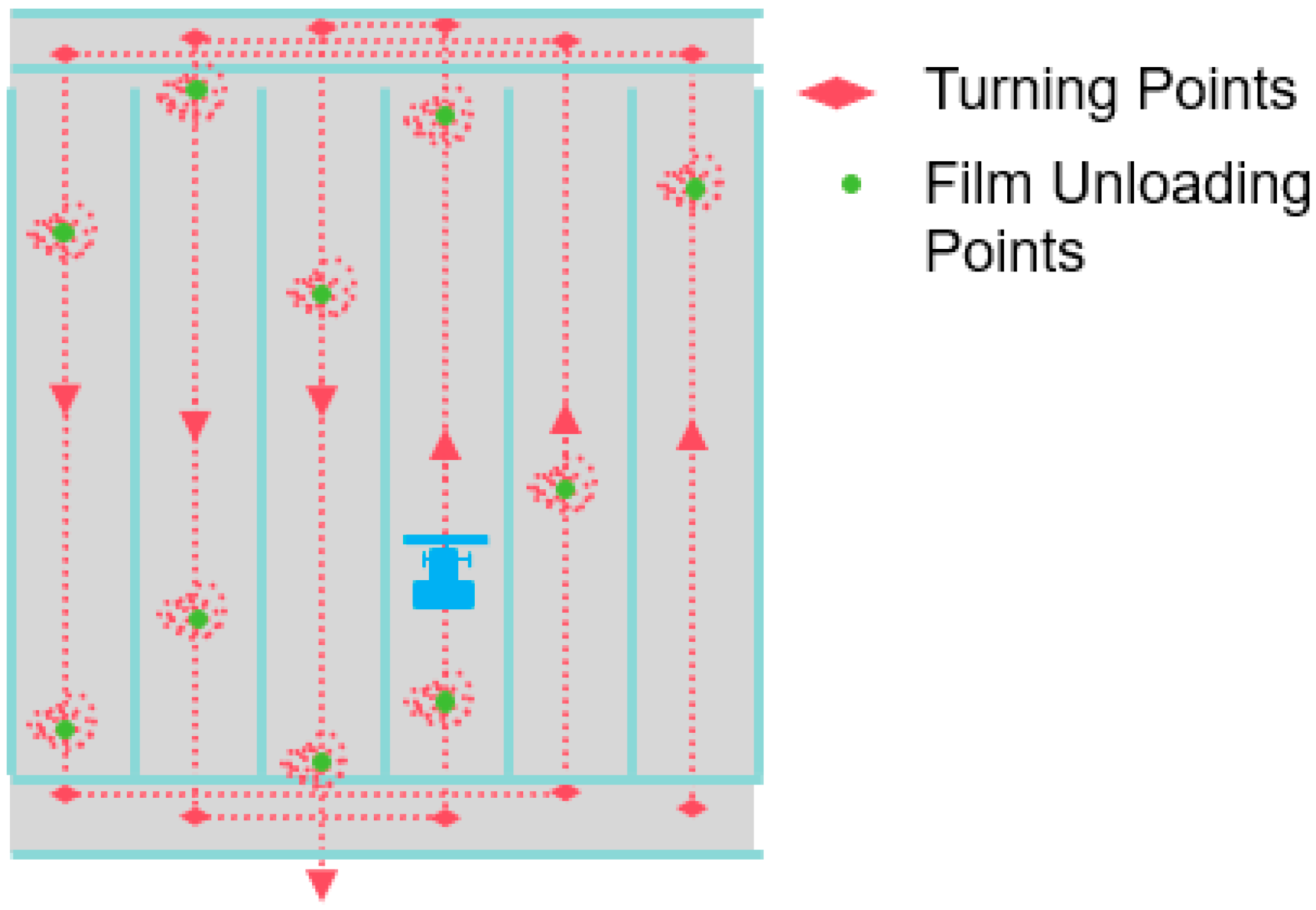
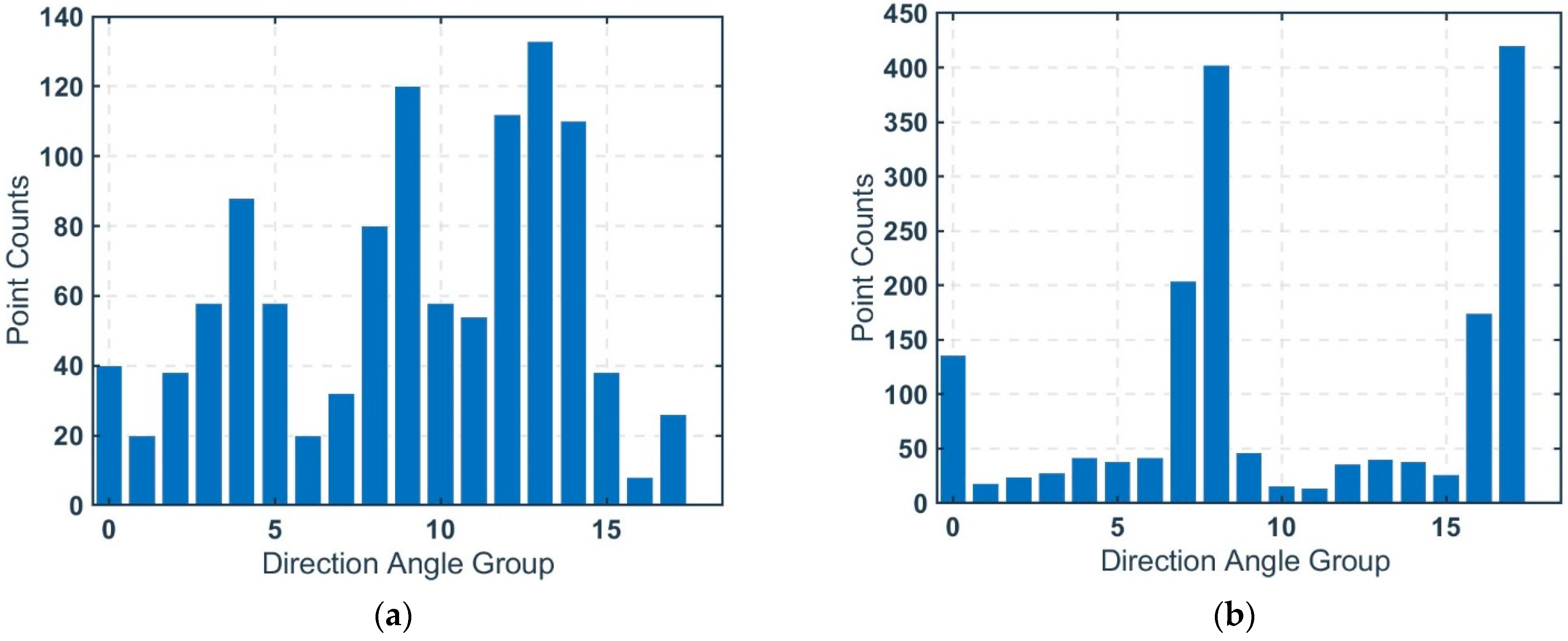
- Detect the directional distribution features of field area clusters: Different from common agricultural machinery working modes, due to the special working mode of the residual film recovery machine, it needs to repeatedly drive in a certain directional region at both ends of the field. Therefore, based on the premise that the driving directions of the main operation area are parallel, there are also two directional regions with higher point counts.
| Algorithm 2: Field Area Verification |
 |
- (1)
- Statistically analyze the point distribution of “field area clusters” in 36 directional regions, and select the top four directional region groups with the highest point counts.
- (2)
- Detect the selected top four directional region groups to ensure that at least one group consists of directionally parallel regions with similar point counts.
2.6. Evaluation Metrics
2.6.1. Precision, Recall, and F1-Score
2.6.2. Operational Area
- (1)
- Correct Segmentation Area. The area of the actual field regions that is correctly segmented as fields.
- (2)
- Over-segmentation Area. The area of actual road regions that is mistakenly segmented as fields (i.e., road areas misclassified as fields).
- (3)
- Under-segmentation Area. The area of actual field regions that is mistakenly segmented as roads (i.e., field areas misclassified as roads).
3. Results and Discussion
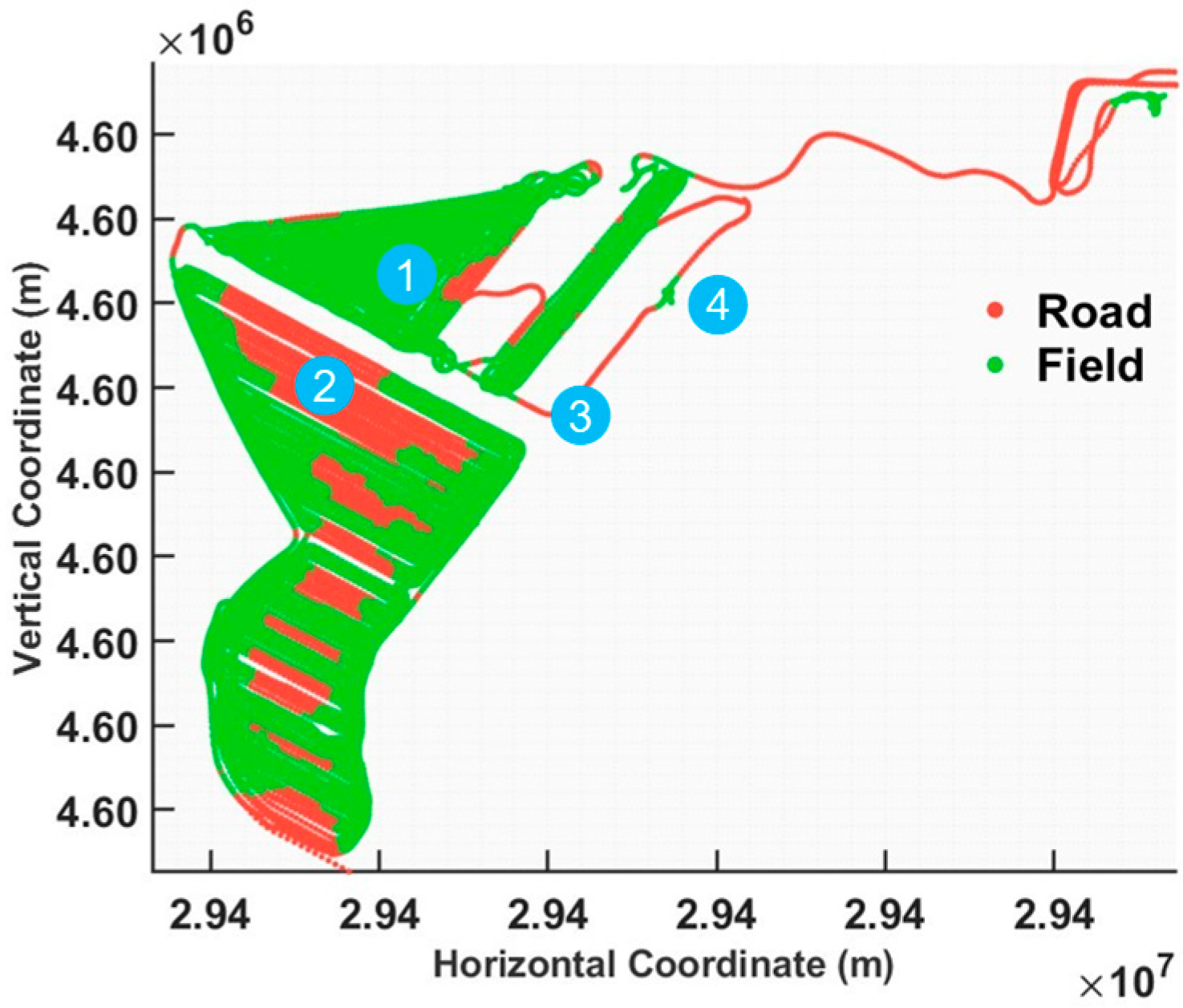
3.1. Segmentation Results
3.2. Operational Area Calculation
3.3. Discussion
- (1)
- Parameters derived from residual film recovery machinery’s operational characteristics improve segmentation accuracy but fail to resolve the inherent algorithmic sensitivity problem. Furthermore, the impact of GPS noise and signal loss requires additional verification.
- (2)
- Machinery-specific knowledge enhances accuracy but exhibits regional/crop dependencies, limiting immediate transferability to other equipment without adaptation.
4. Conclusions
Author Contributions
Funding
Institutional Review Board Statement
Data Availability Statement
Conflicts of Interest
References
- Yan, H.; Ma, J.; Zhang, J.; Wang, G.; Zhang, C.; Akhlaq, M.; Huang, S.; Yu, J. Effects of film mulching on the physiological and morphological parameters and yield of cucumber under insufficient drip irrigation. Irrig. Drain. 2022, 71, 897–911. [Google Scholar] [CrossRef]
- Iqbal, B.; Zhao, T.; Yin, W.; Zhao, X.; Xie, Q.; Khan, K.Y.; Zhao, X.; Nazar, M.; Li, G.; Du, D. Impacts of soil microplastics on crops: A review. Appl. Soil Ecol. 2023, 181, 104680. [Google Scholar] [CrossRef]
- Lakhiar, I.A.; Yan, H.; Zhang, J.; Wang, G.; Deng, S.; Bao, R.; Zhang, C.; Syed, T.N.; Wang, B.; Zhou, R.; et al. Plastic Pollution in Agriculture as a Threat to Food Security, the Ecosystem, and the Environment: An Overview. Agronomy 2024, 14, 548. [Google Scholar] [CrossRef]
- Jiang, D.L.; Yan, L.M.; Chen, X.G.; Mo, Y.S.; Zhang, J.H.; Wu, T. Improved Design and Test of Longitudinal Nail-tooth-chain Plastic Film Pickup Device. Trans. Chin. Soc. Agric. Mach. 2025, 56, 267–281, (In Chinese with English Abstract). [Google Scholar] [CrossRef]
- Wang, X.; Hong, T.; Fang, W.; Chen, X. Optimized Design for Vibration Reduction in a Residual Film Recovery Machine Frame Based on Modal Analysis. Agriculture 2024, 14, 543. [Google Scholar] [CrossRef]
- Fang, W.; Wang, X.; Han, D.; Chen, X. Review of Material Parameter Calibration Method. Agriculture 2022, 12, 706. [Google Scholar] [CrossRef]
- Fang, W.; Wang, X.; Zhu, C.; Han, D.; Zang, N.; Chen, X. Analysis of Film Unloading Mechanism and Parameter Optimization of Air Suction-Type Cotton Plough Residual Film Recovery Machine Based on CFD—DEM Coupling. Agriculture 2024, 14, 1021. [Google Scholar] [CrossRef]
- Fang, W.; Wang, X.; Han, D.; Enema Ohiemi, I. Design and Testing of Film Picking–Unloading Device of Tillage Residual Film Recycling Machine Based on DEM Parameter Calibration. Agronomy 2025, 15, 955. [Google Scholar] [CrossRef]
- Gou, H.X.; Wen, H.J.; Chen, X.G. Design and test of the two-order pin-tooth chain plate type residual film recovery device. Trans. Chin. Soc. Agric. Eng. 2024, 40, 1–11, (In Chinese with English Abstract). [Google Scholar] [CrossRef]
- Chen, C.; Cao, G.; Zhang, J.; Hu, J. Dynamic monitoring of harvester working progress based on traveling trajectory and header status. Eng. Agríc. 2023, 43, e20220196. [Google Scholar] [CrossRef]
- Zhu, S.; Wang, B.; Pan, S.; Ye, Y.; Wang, E.; Mao, H. Task Allocation of Multi-Machine Collaborative Operation for Agricultural Machinery Based on the Improved Fireworks Algorithm. Agronomy 2024, 14, 710. [Google Scholar] [CrossRef]
- Tao, W.; Ma, J.; Shi, J.; Lv, W.; Zhao, M.; Zheng, L.; Huang, L.; Weng, S. Dual-strategy semi-supervised learning method based on GAN for recognition of tomato leaf diseases. Int. J. Remote Sens. 2022, 43, 5025–5039. [Google Scholar] [CrossRef]
- Rana, S.; Gerbino, S.; Akbari Sekehravani, E.; Russo, M.B.; Carillo, P. Crop Growth Analysis Using Automatic Annotations and Transfer Learning in Multi-Date Aerial Images and Ortho-Mosaics. Agronomy 2024, 14, 2052. [Google Scholar] [CrossRef]
- Martins, O.O.; Oosthuizen, C.C.; Desai, D.A. RiceLeafClassifier-v1.0: A Quantized Deep Learning Model for Automated Rice Leaf Disease Detection and Edge Deployment. Eng. Rep. 2025, 7, e70231. [Google Scholar] [CrossRef]
- Wang, H.; Ma, Z.; Ren, Y.; Du, S.; Lu, H.; Shang, Y.; Hu, S.; Zhang, G.; Meng, Z.; Wen, C.; et al. Interactive image segmentation based field boundary perception method and software for autonomous agricultural machinery path planning. Comput. Electron. Agric. 2024, 217, 108568. [Google Scholar] [CrossRef]
- Yu, J.; Zhang, J.; Shu, A.; Chen, Y.; Chen, J.; Yang, Y.; Tang, W.; Zhang, Y. Study of convolutional neural network-based semantic segmentation methods on edge intelligence devices for field agricultural robot navigation line extraction. Comput. Electron. Agric. 2023, 209, 107811. [Google Scholar] [CrossRef]
- Borowiec, N.; Marmol, U. Using LiDAR System as a Data Source for Agricultural Land Boundaries. Remote Sens. 2022, 14, 1048. [Google Scholar] [CrossRef]
- Lu, E.; Xu, L.; Li, Y.; Tang, Z.; Ma, Z. Modeling of working environment and coverage path planning method of combine harvesters. Int. J. Agric. Biol. Eng. 2020, 13, 132–137. [Google Scholar] [CrossRef]
- Yusuf, K.A.; Amisi, E.O.; Ding, Q.; Chen, X.; Xu, G.; Jibril, A.N.; Gedeon, M.G.; Abdulhamid, Z.M. Novel Technical Parameters-Based Classification of Harvesters Using Principal Component Analysis and Q-Type Cluster Model. Agriculture 2024, 14, 941. [Google Scholar] [CrossRef]
- Li, X.; Bai, J.; Wu, X.; Hao, F. Statistical on Agricultural Machinery Operation Area Based on Beidou Positioning Data, Proc. In Proceedings of the 2023 IEEE 3rd International Conference on Information Technology, Big Data and Artificial Intelligence (ICIBA), Chongqing, China, 26–28 May 2023; pp. 1094–1098. [Google Scholar] [CrossRef]
- Wang, P.; Meng, Z.J.; Yin, Y.X.; Fu, W.Q.; Chen, J.P.; Wei, X.L. Automatic recognition algorithm of field operation status based on spatial track of agricultural machinery and corresponding experiment. Trans. Chin. Soc. Agric. Eng. 2015, 31, 56–61, (In Chinese with English Abstract). [Google Scholar] [CrossRef]
- Chen, Y.; Zhang, X.; Wu, C.; Li, G. Field-road trajectory segmentation for agricultural machinery based on direction distribution. Comput. Electron. Agric. 2021, 186, 106180. [Google Scholar] [CrossRef]
- Chen, Y.; Li, G.; Zhang, X.; Jia, J.; Zhou, K.; Wu, C. Identifying field and road modes of agricultural Machinery based on GNSS Recordings: A graph convolutional neural network approach. Comput. Electron. Agric. 2022, 198, 107082. [Google Scholar] [CrossRef]
- Poteko, J.; Eder, D.; Noack, P.O. Identifying operation modes of agricultural vehicles based on GNSS measurements. Comput. Electron. Agric. 2021, 185, 106105. [Google Scholar] [CrossRef]
- Zhang, X.; Chen, Y.; Jia, J.; Kuang, K.; Lan, Y.; Wu, C. Multi-view density-based field-road classification for agricultural machinery: DBSCAN and object detection. Comput. Electron. Agric. 2022, 200, 107263. [Google Scholar] [CrossRef]
- Chen, Y.; Kuang, K.; Wu, C. Trajectory classification to support effective and efficient field-road classification. PeerJ Comput. Sci. 2024, 10, e1945. [Google Scholar] [CrossRef] [PubMed]
- Xiao, Y.; Mo, G.; Xiong, X.; Pan, J.; Hu, B.; Wu, C.; Zhai, W. DR-XGBoost: An XGBoost model for field-road segmentation based on dual feature extraction and recursive feature elimination. Int. J. Agric. Biol. Eng. 2023, 16, 169–179. [Google Scholar] [CrossRef]
- Zhai, W.; Mo, G.; Xiao, Y.; Xiong, X.; Wu, C.; Zhang, X.; Xu, Z.; Pan, J. GAN-BiLSTM network for field-road classification on imbalanced GNSS recordings. Comput. Electron. Agric. 2024, 216, 108457. [Google Scholar] [CrossRef]
- Zhai, W.; Wu, Y.; Liu, J.; Pan, J.; Wu, C. BiLSTM-SAGCN: A hybrid model of BiLSTM with a semiadaptation graph convolutional network for agricultural machinery trajectory operation mode identification. Comput. Electron. Agric. 2025, 233, 110193. [Google Scholar] [CrossRef]
- Wang, B.; Wang, W. A novel deep learning approach to field-road semantic segmentation. Sci. Rep. 2025, 15, 21488. [Google Scholar] [CrossRef]
- Chen, Y.; Li, G.; Zhou, K.; Wu, C. Field–Road Operation Classification of Agricultural Machine GNSS Trajectories Using Spatio-Temporal Neural Network. Agronomy 2023, 13, 1415. [Google Scholar] [CrossRef]
- Han, Y.; Huang, Z.; Xu, P. Field-road trajectory classification for agricultural machinery by integrating spatio-temporal clustering and semantic segmentation. Comput. Electron. Agric. 2025, 233, 110139. [Google Scholar] [CrossRef]
- Erfani, S.; Jafari, A.; Hajiahmad, A. Comparison of two data fusion methods for localization of wheeled mobile robot in farm conditions. Artif. Intell. Agric. 2019, 1, 48–55. [Google Scholar] [CrossRef]
- Kaivosoja, J.; Linkolehto, R. GNSS error simulator for farm machinery navigation development. Comput. Electron. Agric. 2015, 119, 166–177. [Google Scholar] [CrossRef]
- Tang, W.; Pi, D.; He, Y. A Density-Based Clustering Algorithm with Sampling for Travel Behavior Analysis. In Intelligent Data Engineering and Automated Learning–IDEAL 2016, Proceedings of the 17th International Conference, Yangzhou, China, 12–14 October 2016; Lecture Notes in Computer Science; Springer International Publishing: Cham, Switzerland, 2016; pp. 231–239. [Google Scholar] [CrossRef]
- Zhang, P.; Li, X.L.; Wang, L.Y. Dynamic Neighborhood Density Clustering Algorithm Based on DBSCAN. Comput. Sci. 2023, 50, 609–615, (In Chinese with English Abstract). [Google Scholar] [CrossRef]
- Prelipcean, A.C.; Gidofalvi, G.; Susilo, Y.O. Measures of transport mode segmentation of trajectories. Int. J. Geogr. Inf. Sci. 2016, 30, 1763–1784. [Google Scholar] [CrossRef]
- Liu, Y.; Xiang, Y.; Li, G.S.; Lei, G.; Nie, Y.; Xiang, H. An algorithm for measuring farm machinery operation area based on Gauss’s area formula and GPS data. Agric. Eng. Equip. 2020, 47, 159–161, (In Chinese with English Abstract). [Google Scholar] [CrossRef]
- Tang, C.; Wang, H.; Wang, Z.; Zeng, X.; Yan, H.; Xiao, Y. An improved OPTICS clustering algorithm for discovering clusters with uneven densities. Intell. Data Anal. 2021, 25, 1453–1471. [Google Scholar] [CrossRef]
- Mao, Y.; Zhong, H.; Qi, H.; Ping, P.; Li, X. An Adaptive Trajectory Clustering Method Based on Grid and Density in Mobile Pattern Analysis. Sensors 2017, 17, 2013. [Google Scholar] [CrossRef]
- Zhai, W.; Xu, Z.; Pan, J.; Guo, Z.; Wu, C. A general image classification model for agricultural machinery trajectory mode recognition. Comput. Electron. Agric. 2024, 227, 109629. [Google Scholar] [CrossRef]



| Parameter | Value | |
|---|---|---|
| GNSS Module | Positioning Accuracy | 2.5 m |
| Recording Frequency | 1 Hz | |
| Protocol | NMEA-0183 | |
| Collected Data Points | 620,267 | |
| Machine | Residual Film Recycling Machine | 4JMLQ-210A |
| Field Size | Area | 35 ha |
| MinPts | Eps | ||||
|---|---|---|---|---|---|
| 1 | 3 | 5 | 7 | 9 | |
| 20 | 31.61 | 45.35 | 49.36 | 39.53 | 34.6 |
| 22 | 31.61 | 43.62 | 50.61 | 39.67 | 36.08 |
| 25 | 31.54 | 43.35 | 51.53 | 41.16 | 37.27 |
| 28 | 31.54 | 43.08 | 51.38 | 49.05 | 37.53 |
| 30 | 31.54 | 42.19 | 51.13 | 49.74 | 37.65 |
| Method | Trajectory Type | Number of Identified Field | Number of Identified Road |
|---|---|---|---|
| DBSCAN | Field | 433,549 | 40,023 |
| Road | 82,777 | 63,918 | |
| DBSCAN-MFI | Field | 466,413 | 7,159 |
| Road | 45,968 | 100,727 | |
| OPTICS | Field | 429,574 | 43,998 |
| Road | 79,046 | 67,649 | |
| Grid-Based Method | Field | 439,808 | 33,764 |
| Road | 94,030 | 52,665 | |
| DBSCAN-FR | Field | 459,436 | 14,136 |
| Road | 84,160 | 62,535 |
| Method | Area Accuracy (%) | Correct Segmentation Area (ha) | Over-Segmentation Area (ha) | Under-Segmentation Area (ha) |
|---|---|---|---|---|
| DBSCAN | 71.74 | 25.11 | 1.03 | 9.24 |
| DBSCAN-MFI | 95.33 | 33.36 | 0.88 | 1.27 |
| OPTICS | 70.19 | 24.56 | 0.75 | 9.75 |
| Grid-Based | 74.62 | 26.12 | 1.57 | 8.13 |
| DBSCAN-FR | 88.47 | 30.96 | 1.27 | 3.57 |
Disclaimer/Publisher’s Note: The statements, opinions and data contained in all publications are solely those of the individual author(s) and contributor(s) and not of MDPI and/or the editor(s). MDPI and/or the editor(s) disclaim responsibility for any injury to people or property resulting from any ideas, methods, instructions or products referred to in the content. |
© 2025 by the authors. Licensee MDPI, Basel, Switzerland. This article is an open access article distributed under the terms and conditions of the Creative Commons Attribution (CC BY) license (https://creativecommons.org/licenses/by/4.0/).
Share and Cite
Fang, H.; Hu, J.; Chen, X.; Zhang, Q.; Bai, J. DBSCAN-MFI Based Improved Clustering for Field-Road Classification in Mechanical Residual Film Recovery. Agriculture 2025, 15, 1651. https://doi.org/10.3390/agriculture15151651
Fang H, Hu J, Chen X, Zhang Q, Bai J. DBSCAN-MFI Based Improved Clustering for Field-Road Classification in Mechanical Residual Film Recovery. Agriculture. 2025; 15(15):1651. https://doi.org/10.3390/agriculture15151651
Chicago/Turabian StyleFang, Huimin, Jinshan Hu, Xuegeng Chen, Qingyi Zhang, and Jing Bai. 2025. "DBSCAN-MFI Based Improved Clustering for Field-Road Classification in Mechanical Residual Film Recovery" Agriculture 15, no. 15: 1651. https://doi.org/10.3390/agriculture15151651
APA StyleFang, H., Hu, J., Chen, X., Zhang, Q., & Bai, J. (2025). DBSCAN-MFI Based Improved Clustering for Field-Road Classification in Mechanical Residual Film Recovery. Agriculture, 15(15), 1651. https://doi.org/10.3390/agriculture15151651