Article

Estimation of Potato Growth Parameters Under Limited Field Data Availability by Integrating Few-Shot Learning and Multi-Task Learning

College of Mechanical and Electrical Engineering, Gansu Agricultural University, Lanzhou 730070, China
*
Author to whom correspondence should be addressed.
Agriculture 2025, 15(15), 1638; https://doi.org/10.3390/agriculture15151638
Submission received: 12 June 2025 / Revised: 23 July 2025 / Accepted: 25 July 2025 / Published: 29 July 2025
(This article belongs to the Section Artificial Intelligence and Digital Agriculture)

Abstract

Leaf chlorophyll content (LCC), leaf area index (LAI), and above-ground biomass (AGB) are important growth parameters for characterizing potato growth and predicting yield. While deep learning has demonstrated remarkable advancements in estimating crop growth parameters, the limited availability of field data often compromises model accuracy and generalizability, impeding large-scale regional applications. This study proposes a novel deep learning model that integrates multi-task learning and few-shot learning to address the challenge of low data in growth parameter prediction. Two multi-task learning architectures, MTL-DCNN and MTL-MMOE, were designed based on deep convolutional neural networks (DCNNs) and multi-gate mixture-of-experts (MMOE) for the simultaneous estimation of LCC, LAI, and AGB from Sentinel-2 imagery. Building on this, a few-shot learning framework for growth prediction (FSLGP) was developed by integrating simulated spectral generation, model-agnostic meta-learning (MAML), and meta-transfer learning strategies, enabling accurate prediction of multiple growth parameters under limited data availability. The results demonstrated that the incorporation of calibrated simulated spectral data significantly improved the estimation accuracy of LCC, LAI, and AGB (R2 = 0.62~0.73). Under scenarios with limited field measurement data, the multi-task deep learning model based on few-shot learning outperformed traditional mixed inversion methods in predicting potato growth parameters (R2 = 0.69~0.73; rRMSE = 16.68%~28.13%). Among the two architectures, the MTL-MMOE model exhibited superior stability and robustness in multi-task learning. Independent spatiotemporal validation further confirmed the potential of MTL-MMOE in estimating LAI and AGB across different years and locations (R2 = 0.37~0.52). These results collectively demonstrated that the proposed FSLGP framework could achieve reliable estimation of crop growth parameters using only a very limited number of in-field samples (approximately 80 samples). This study can provide a valuable technical reference for monitoring and predicting growth parameters in other crops.

1. Introduction

As the fourth largest food crop, the potato plays an important role in ensuring global food security [1]. Predicting crop biophysical properties is crucial for promoting sustainable agriculture and achieving data-driven precision agriculture. For example, leaf area index (LAI) and above-ground biomass (AGB) are vital biophysical parameters that characterize plant canopy structure [2,3] and also serve as key indicators for crop development and yield prediction [4,5].Leaf chlorophyll content (LCC) is an important biochemical parameter that reflects plant physiological processes, mainly responsible for solar radiation capture and chemical energy conversion [6]. Accurate measurement of LCC can not only reveal the photosynthetic capacity, nutritional stress, and health status of potatoes [7], but also characterize the nitrogen concentration status of crops [8]. Traits such as LAI, AGB, and LCC provide valuable information for understanding crop photosynthesis, growth, development, and nutritional status. However, traditional measurement methods have some limitations, such as being labor-intensive, time-consuming, costly, and lagging. In addition, many potato growers lack the expertise required for optimal agronomic management and quantitative analysis of plant characteristics. Therefore, the timely and accurate acquisition of crop growth information over large areas using remote sensing platforms, especially satellite remote sensing, is of great significance for optimizing agricultural management, improving production, and reducing fertilizer use.
As an alternative, satellite remote sensing provides an effective way to monitor crop growth parameters at regional scales [9]. In general, remote sensing-based methods for crop trait inversion can be divided into empirical models, physical methods, and hybrid methods [10]. Among them, empirical methods usually establish regression models between crop traits and original spectra or vegetation index (VI) [11]. Nonlinear regression and machine learning regression (such as random forest (RF), support vector machine (SVM), and artificial neural network (ANN)) have been widely used to estimate LAI [12,13], AGB [14,15], LCC [16,17], and leaf nitrogen concentration [18,19], and other crop traits. The advantage of this method lies in its simplicity, as it does not require complex physical processes and is easy to apply in localized regions. However, the performance of data-driven machine learning and deep learning models highly depends on the scale and quality of field observation samples, leading to poor performance in areas with no available samples or limited data [20,21]. It should be emphasized that collecting sufficient ground sample data is time-consuming, labor-intensive [22], and lagging, and the measurement samples obtained by researchers may not cover all possible spatial variations. Moreover, empirical models are usually limited by specific time and location constraints and require retraining when applied in different settings [23,24]. To alleviate the problem of insufficient measured samples, some studies have introduced generative adversarial networks (GANs) for in situ sample generation, which are then applied to empirical models for trait parameter inversion [25]. GANs can be used to increase the scale of the training dataset, thus improving the generalization ability of the model. However, the scarcity of in situ data in small sample learning problems makes it difficult for GANs to capture the true distribution of the data, resulting in low-quality generated samples. Therefore, GAN methods cannot be directly applied to small data. To address these challenges, several studies have used a radiative transfer model (RTM), such as PROSAIL, to estimate crop growth parameters [26]. This model describes the complex relationship between canopy reflectance, plant biochemical, and biophysical properties from a physical perspective [27]. For example, Xu et al. [28] employed an RTM to develop a Bayesian network look-up table for the inversion of rice canopy chlorophyll content and LAI. Unlike empirical models, RTM theoretically does not require a calibration dataset for traits, eliminating the need to recalibrate the model for different geographical locations. However, their use is limited by ill-posed and ill-conditioned problems, which introduce uncertainty and reduce practical applicability.
Fortunately, the development of hybrid methods overcomes the limitations of empirical and physical models [29]. Large spectral datasets covering different environmental conditions and vegetation growth are simulated by the PROSAIL model, and these simulated spectral datasets are then used as training data to train machine learning models. Thus, the hybrid approach combines the versatility of RTM with the flexibility of machine learning algorithms, which improves the accuracy and stability of the inversion. For example, Estévez et al. [30] used PROSAIL and Gaussian process regression (GPR) to invert crop traits from Sentinel-2. Similarly, Chen et al. [31] used synthetic datasets generated from RTM to train RF regression models to estimate LAI from UAV-based multispectral imagery. When machine learning models trained on simulated data are applied to new tasks or unseen spectral data, a significant drop in performance often occurs. Some studies attempt to enhance the utility of in situ data by introducing sample matching [32] and spiking-hybrid methods [33] into the simulated data. These strategies somewhat alleviate the spectral bias issue, but model parameterization still affects the quality of simulated data, thus negatively impacting the performance of machine learning models. As a few-shot learning approach, deep transfer learning provides a novel solution to the challenge of deep learning models requiring large-scale training datasets. Several studies [34,35] have shown that pretraining deep networks with PROSAIL-simulated data enables high-precision inversion of crop growth parameters using only a small amount of ground-based observations. Yue et al. [36] further validated the effectiveness of this approach in estimating soybean LCC. In addition, Li et al. [37] proposed an innovative unsupervised domain adaptation method to directly predict LAI from VIIRS surface reflectance data, offering a new direction for cross-sensor data transfer. These methods effectively alleviate challenges related to limited labeled data and domain discrepancies, thereby providing technical support for large-scale regional crop monitoring. However, it is worth noting that the fine-tuning stage of the models still requires a moderate amount of target domain data, which may limit the general applicability of these approaches to some extent.
In terms of modeling, deep learning techniques enable the automatic extraction of high-level features from crop canopy spectra, thereby reducing the reliance on manual band selection. Patel et al. [38] employed one-dimensional and two-dimensional convolutional neural networks (CNNs) to process hyperspectral data, achieving accurate estimation of canopy nitrogen concentration and AGB. Yue et al. [39] proposed the LACNet model by integrating shallow and deep feature fusion with VGG blocks, significantly improving the estimation accuracy of LAI and LCC. Similarly, Hu et al. [40] demonstrated that image features extracted from pretrained deep learning networks more effectively captured crop canopy structural information, mitigated saturation effects, and enhanced the estimation of LCC and fractional vegetation cover. Beyond typical CNN-based approaches, temporal models such as LSTM [41] and GRU [42] networks have also been utilized to predict crop growth parameters from one-dimensional spectral inputs. Overall, deep learning models have shown great potential in improving prediction accuracy and generalizability under complex field conditions. However, the development of robust deep learning models generally requires large volumes of labeled data, which remains a major constraint for their application in field environments. Few-shot learning (FSL) is a new paradigm in machine learning that allows the model to learn knowledge from only a few training samples [43]. Meta-learning is considered to be an effective way to address the challenges of FSL. It facilitates effective learning of new tasks by using prior knowledge gained from past experiences [44]. Among them, model-agnostic meta-learning (MAML) [45] is a popular gradient-based meta-learning algorithm that can be applied to various model structures. The goal of this algorithm is to learn a good initialization through a large number of tasks and then perform one or several gradient updates to quickly adapt to new and unknown tasks. Although MAML has been successfully applied in areas such as image classification, object detection, and semantic segmentation, its application in growth parameter inversion warrants further investigation. Therefore, exploring how to embed FSL methods into deep learning models is of great value to effectively address the challenge of small data and improve cross-domain generalization of models.
The key parameters that characterize crop growth are morphology (plant height), physiology and biochemistry (LAI, LCC, etc.), stress (leaf water content, etc.), and yield metrics (AGB, etc.). Most of the studies have been conducted to predict crop growth parameters by building independent deep learning models; that is, each task was considered as an independent task. In fact, there is a correlation between different trait parameters during crop development. Previous research results show that adding LAI structure information to the model can improve the inversion accuracy of AGB [46,47]. Similarly, Chen et al. [48] found that the inclusion of LCC information improved the estimation accuracy of wheat LAI. Therefore, establishing a single-task learning model for each trait parameter is not only a cumbersome process but also fails to learn the intrinsic connections between different tasks. Multi-task learning (MTL) is a new paradigm for small data learning that aims to improve generalization performance and parameter efficiency by learning multiple related tasks simultaneously [49]. Unlike single-task learning, multi-task learning can exploit the correlation and shared information between tasks, allowing it to perform predictions on multiple tasks simultaneously. Furthermore, when the labeled data is limited, multi-task learning can improve the performance of a single task by learning on multiple related tasks. Simultaneous prediction of LCC, LAI, and AGB can be considered as multi-task learning, and MAML requires tasks to update network parameters. Both aim to extract shared information from tasks. Therefore, the integration of FSL and MTL to estimate various vegetation parameters from remote sensing data is feasible and highly promising, because it can not only improve model efficiency but also facilitate knowledge mining and model generalization under small data.
Simultaneous acquisition of relevant growth parameters such as LCC, LAI, and AGB is a key aspect of potato growth monitoring. However, the scarcity of field measurement data is a common yet still unresolved issue in crop trait estimation, leading to poor model adaptability and portability. This study proposes a novel method integrating a few-shot learning framework with a multi-task deep learning network to simultaneously predict multiple growth parameters. The few-shot learning framework serves as an effective training strategy for optimizing multi-task models under conditions of limited field-measured data. We term this framework Few-Shot Learning for Growth Prediction (FSLGP). Specifically, we train the MTL model using calibrated large-scale simulated data to ensure proper parameter initialization. Meta-transfer learning is then applied to transfer the pre-trained MTL model to the target few-shot learning task, enabling rapid fine-tuning using the limited field measurement data from the target domain. To improve model adaptability to new tasks and ensure effective balance across multiple tasks, this study attempts to incorporate the MAML algorithm into the MTL model for parameter optimization. We propose the following research objectives:
(1) Explore the feasibility of integrating FSLGP into multi-task deep networks for simultaneous inversion of AGB, LAI, and LCC under the limited field measurement data;
(2) Compare different multi-task learning models to determine the optimal network architecture suitable for predicting potato growth parameters;
(3) Explore the feasibility of improving cross-domain learning by constraining the PROSAIL model with prior knowledge;
(4) Conduct a comprehensive evaluation of the adaptability of the proposed new methodology to different planting regions, as well as the model transferability across time, space, and growth stages.

2. Materials and Methods

2.1. Study Area and Data

2.1.1. Study Area

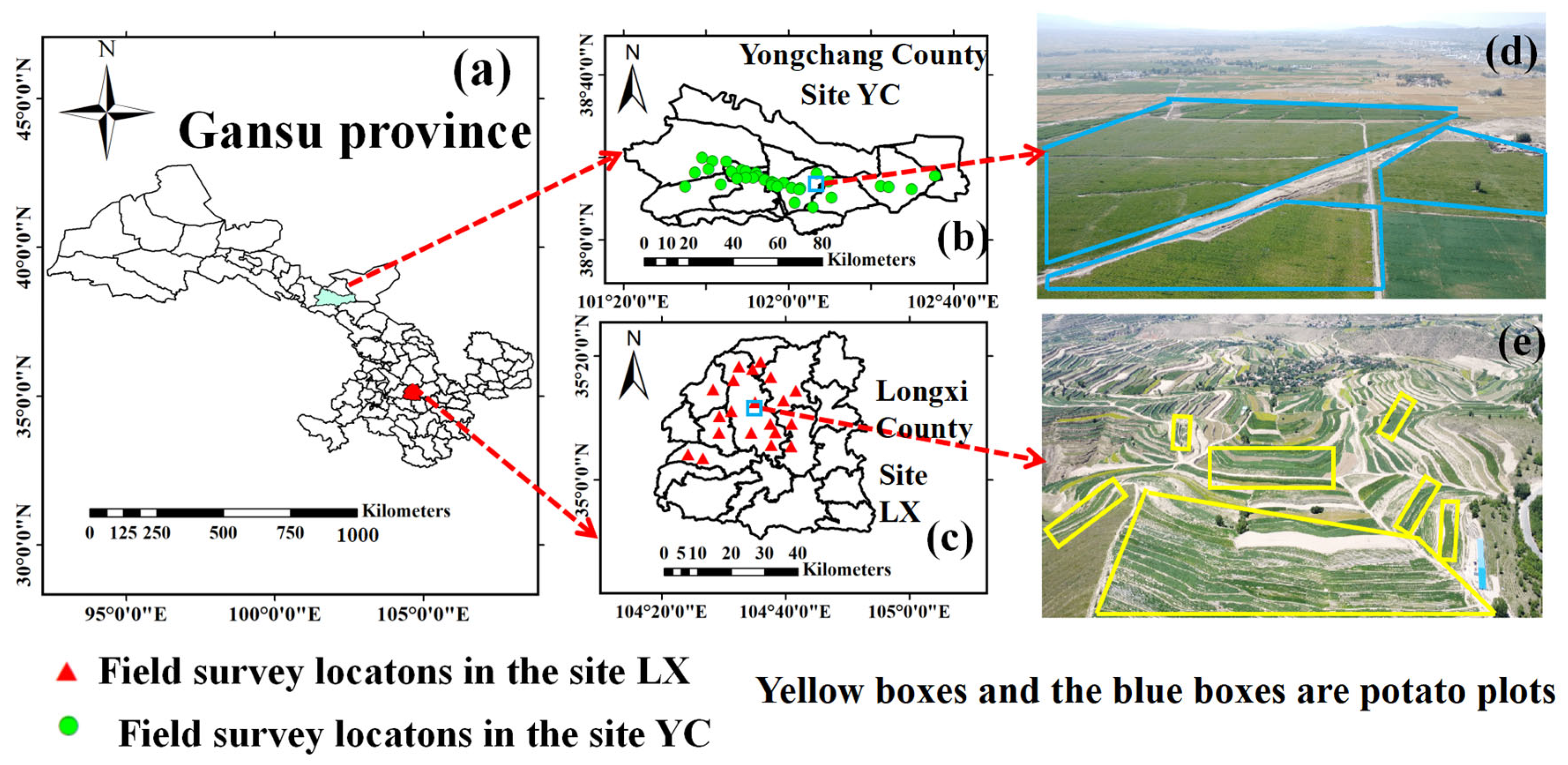
Our study areas are located in Longxi County (34°50′ N~35°23′ N, 104°18′ E~104°54′ E) and Yongchang County (37°47′ N~38°39′ N, 101°04′ E~102°43′ E) in Gansu Province, both of which are known for their significant potato production (Figure 1). These two geographical locations represent different potato-growing environments: rain-fed and irrigated. The Longxi County (Site LX) is located in the arid mountainous region of the Loess Plateau, more than 90% of which is a rain-fed agricultural area. The region features a mid-temperate semi-arid to southern temperate semi-humid climate, with an average annual temperature of 6.3 °C and an average elevation of 1980 m. The annual average precipitation is approximately 390 mm, which is unevenly distributed and mainly concentrated between July and September, characterizing it as a typical dryland farming area. The distribution of farmland in Site LX is characterized by mountainous and loess hilly terrain with fragmented plots, irregular topography, and varying elevations (Figure 1e). Another region named Yongchang (site YC) is located in the Hexi irrigation area, where most of the land relies on favorable irrigation conditions for large-scale potato cultivation, with agricultural management led by cooperatives. The farmland in this area ranges in elevation from 1452 to 2400 m, with an average temperature of 7.5 °C and an annual precipitation of 160 mm, classified as a mid-temperate semi-arid zone. Unlike site LX, the farmland at site YC is flat, with concentrated and relatively large contiguous plots (Figure 1d). Potatoes in the study area are typically planted in mid-April and harvested around mid-September each year.

2.1.2. Field Measurements of Potato Growth Parameters

Field measurements of potato growth parameters and satellite remote sensing experiments were conducted in 2021 and 2023. Four key growth stages of potato were selected for field measurements: budding stage (P1), tuber formation (P2), tuber enlargement (P3), and starch accumulation (P4). Sampling points were located in an area of 10 m × 10 m to match the spatial resolution of the Sentinel-2 satellite. LAI values of all sample points were measured using a plant canopy analyzer (LAI-2200C, LI-COR Biosciences, Lincoln, NE, USA) with a 45° viewing angle gap to reduce the influence of lighting and background conditions. To minimize the measurement error of LAI, five points (center and four corners) were selected for measurement at each sample point, with each point being measured three times, and the average value taken as the LAI value. At the same time, an intelligent real-time kinematic (RTK) measurement system (CTI, i86) was used to record the coordinates of the sample points. The SPAD values of each sample point were measured using an SPAD-502 chlorophyll meter, with five different leaves selected from each sample point and SPAD values calculated from the upper, middle, and lower loci of each leaf. These 15 values were then averaged to determine the SPAD value of the sample point. The SPAD value was then converted to LCC (µg/cm2) using empirical equations [50]. The equation is expressed as follows:
LCC = 6.34299 × exp ( SPAD × 0.043 ) 6.10629
where LCC denotes leaf chlorophyll content (µg/cm2), and SPAD denotes measured leaf SPAD value.
AGB measurements were conducted simultaneously with LAI and LCC observations. At each sampling location, three plants that best represented the growth condition of the plot were selected for sampling. All above-ground parts of the potato plants (including stems, leaves, and flowers) were manually harvested, placed into sealed bags, and promptly transported back to the laboratory. In the lab, the sampled plants were blanched at 105 °C for 1 h, then dried at 80 °C for at least 48 h until a constant weight was achieved. The dry matter of three potato plants was measured using a high-precision balance. Finally, the AGB at each sampling point was calculated based on planting density and the measured dry matter.
Based on the spatial heterogeneity, accessibility, and representativeness of crop distribution at the regional scale, sample plots with varying spatial distances were selected for continuous measurement of growth parameters. From 2021 to 2023, a total of 238 samples were collected at Site LX, including 26 samples in 2021, 105 in 2022, and 107 in 2023. At Site YC, 240 samples were collected during the same period, with 35 samples in 2021, 90 in 2022, and 115 in 2023. Due to the destructive and labor-intensive nature of field sampling, along with cloud contamination in satellite imagery, the number of usable field measurements collected annually at the regional scale typically ranges from several dozen to a few hundred, which is often insufficient for effectively training deep learning models.

2.1.3. Satellite Data

The Sentinel-2 satellites, launched by the European Space Agency (ESA), are a series of Earth observation satellites that offer significant advantages such as multispectral imaging, high spatial resolution, high revisit frequency, and free and open access to data. Each satellite carries a multispectral imager with a wavelength range of 0.4 to 2.4 um, covering a total of 13 bands from visible to near-infrared and short-wave infrared. Among these, the red-edge and shortwave infrared bands are highly sensitive to vegetation biophysical parameters, making them particularly suitable for vegetation condition assessment and agricultural monitoring. To mitigate the influence of cloud interferences, only the data with a cloud content below 20% were selected. Sentinel-2 imagery has three spatial resolutions: 10 m, 20 m, and 30 m. Nearest neighbor resampling is used to match the 20 m and 60 m resolution bands to the 10 m pixel grid. To minimize modeling errors and ensure temporal consistency between remote sensing data and field measurements, the acquisition time of Sentinel-2 satellite imagery in this study was kept within one week of the field observation date.

2.2. Generation of Simulated Datasets Based on Prior Knowledge

The PROSAIL model is a radiative transfer model (RTM) that is increasingly being used for inversion and spectral simulation of plant trait parameters. This model couples the leaf optical property model PROSPECT-D with the canopy reflectance model 4SAIL to describe the reflective properties of vegetation through a set of assumptions and parameters. The PROSPECT-D model mainly simulates the optical properties of plant leaves, such as absorption, transmission, and reflection. Its input parameters consist of leaf chlorophyll content (Cab), leaf dry matter content (Cm), and leaf water content (EWT). On the other hand, the 4SAIL model is used to mimic the radiative transfer process within the vegetation canopy. The parameters driving this model include LAI, average leaf inclination angle (ALA), hot spot size parameters (hspot), and soil brightness parameters (Psoil). In this study, the potato growth parameters LAI and LCC are directly input to the model, while AGB has to be calculated using LAI and Cm. The conversion relationship for AGB is as follows [51]:
AGB = LAI C m 10000   [ g / m 2 ]
where LAI and Cm represent the driving parameters of PROSPECT-D and 4SAIL, respectively.
To reduce the inter-domain difference between the simulated spectral reflectance and the actual spectral reflectance, this study uses parametric prior knowledge and linear spectral mixture analysis (LSMA) to double constrain the PROSAIL physical model as follows:
ρ s = LSMA ( P R O S A I L ( C ab pro , LAI pro , C m pro , A L A pro ) )
where C a b p r o , L A I p r o , C m p r o and ALA pro are the prior knowledge driving the model parameters, respectively, and ρ s is the calibrated spectral reflectance.
The reasonable selection of input parameters is crucial for the accurate simulation of spectral reflectance using PROSAIL. In order to simplify the process of setting model parameters and to reduce the cost of data collection, model parameters have been varied over a wide range in previous studies [52]. However, it is worth noting that the canopy structure and soil background of different crops may differ significantly from the reference values of the standard RTM. Therefore, when selecting input parameters, it is essential to consider the specific characteristics of the potato crop and its environment to enhance the fidelity of the RTM simulation spectral. Previous sensitivity analyses of the PROSAIL model [28] have demonstrated that Cab, LAI, Cm, and ALA are the most influential parameters affecting canopy reflectance within the 400–900 nm spectral range, while the remaining input parameters show relatively low sensitivity to spectral variation. Therefore, in this study, prior knowledge of potato leaf biochemical and structural traits— namely Cab, LAI, Cm, and ALA—obtained through field experiments was used to constrain the input parameter ranges of the PROSAIL model. To demonstrate the benefits of incorporating prior knowledge, this study compared two sets of parameter configurations. In Set #1, model parameters were set within a wide range based on some reference values from previous studies [52,53]. In Set #2, key parameters were constrained to a narrower range using prior potato knowledge. Detailed parameter settings are shown in Table 1.
The PROSAIL model assumes that the vegetation is uniform, continuous, and horizontally distributed, with similar vegetation characteristics within the modeled area. However, the potato is a typical row crop with a canopy that exposes more soil than uniformly distributed vegetation. Additionally, multispectral imagery in potato cultivation areas can also contain uncertainties, noise, and mixed pixels. To minimize the spectral gap between the simulated spectral reflectance and the actual scene, the simulated pure vegetation reflectance was calibrated using LSMA. The adjusted spectral reflectance R adjust is as follows [54]:
R adjust = R pro × ( 1 F C soil ) + R soil × F C soil
where R pro represents the pure spectral reflectance based on PROSAIL simulations, R soil represents the reflectance of the soil end elements, and F C soil represents the mixing ratio.
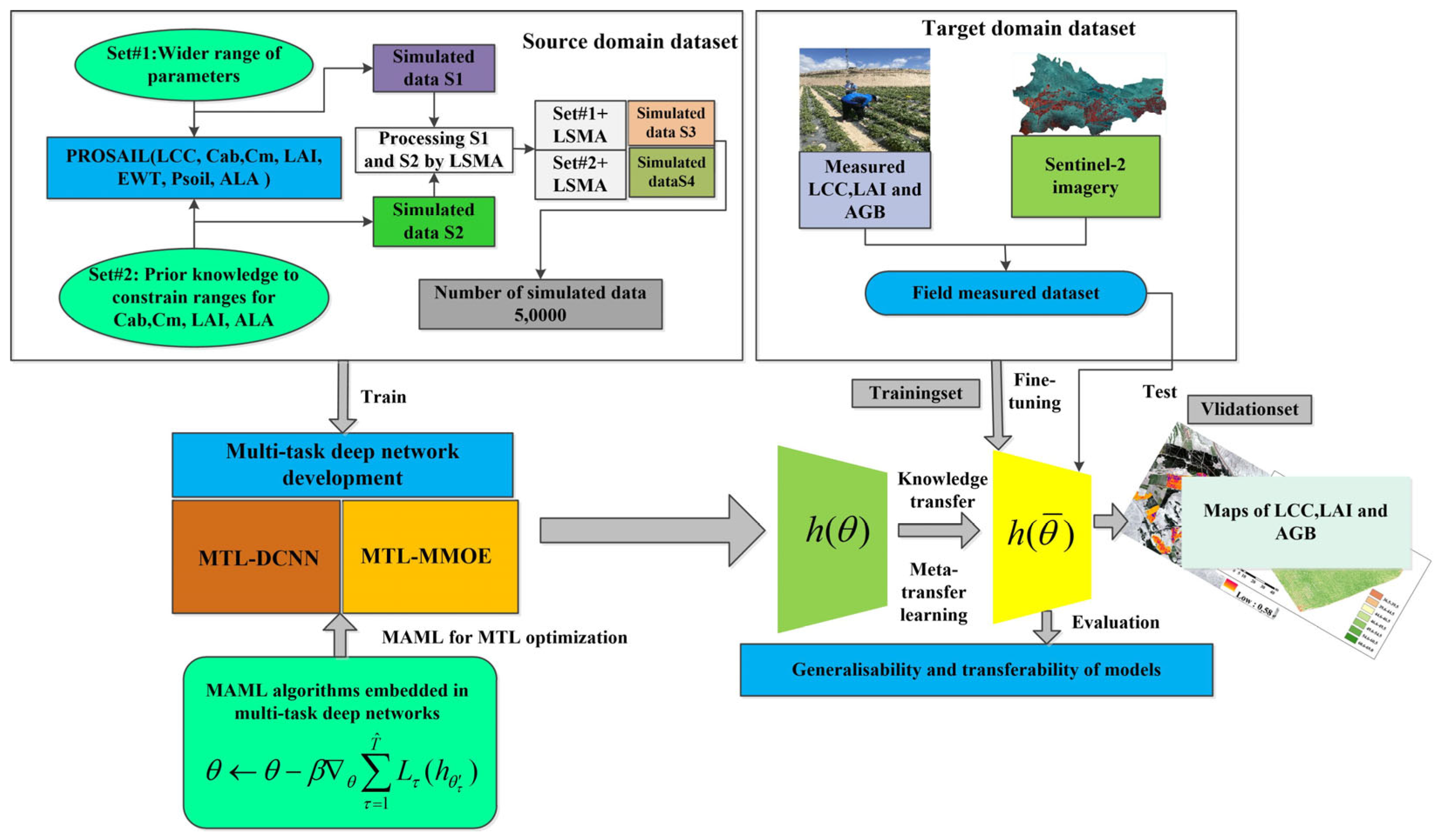
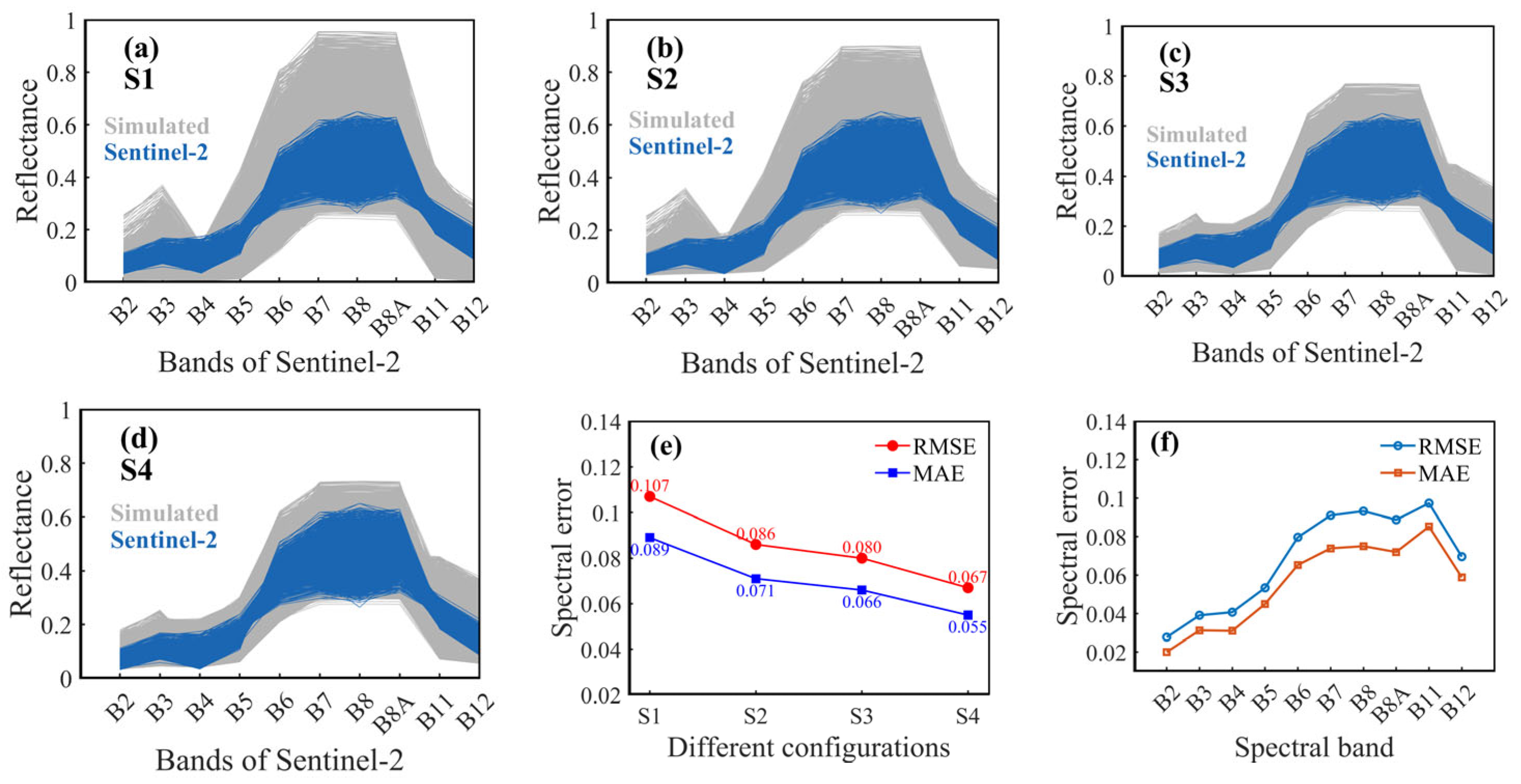
Four simulated datasets (S1–S4) were created by combining Set #1, Set #2, and LSMA. S1 was generated using Set#1 only; S2 was generated using Set#2 only; S3 was generated using a dataset based on Set#1 for LSMA processing; and S4 was generated using a dataset based on Set#2 for LSMA processing. Based on the specified model parameter settings, simulated spectral datasets within the 400–2500 nm range were generated using the PROSAIL model. These hyperspectral data were subsequently resampled using the spectral response functions of Sentinel-2 to obtain equivalent multispectral sensor reflectance. To capture the spectral characteristics of different growth stages of potatoes, a total of 50,000 sets of simulated canopy reflectances, along with corresponding LCC, LAI, and AGB values, were generated using the PROSAIL model. The spectral simulation approach based on the PROSAIL model was adopted to address the limited availability of ground-truth data. This approach allows us to generate a large, diverse dataset that covers a wide range of canopy conditions and soil backgrounds, which holds promise for facilitating model pretraining and enhancing generalizability.

2.3. Retrieval Workflow for Potato Growth Parameters

To address the challenges of small data and task imbalance prevalent in growth parameter prediction, this study proposes a hybrid inversion method combining few-shot learning and multi-task deep learning networks. The workflow of the proposed method is shown in Figure 2. The few-shot learning framework FSLGP mainly includes simulated spectrum generation, meta-transfer learning (meta-transfer only for MAML-based tuning), and MAML optimization algorithms. First, the PROSAIL model was used to generate four types of large-scale simulation datasets by incorporating prior knowledge, which were reconstructed using the Sentinel-2 spectral response function. Two multi-task deep networks were then trained using the large-scale simulation datasets to allow the model to be well initialized in the source domain task. Following this, the model parameters were fine-tuned using smaller, task-specific field measurement data to facilitate adaptation to new scenario tasks. Training models with such large data not only broadens the adaptation across different data distributions but also alleviates the challenge of limited labeled data for downstream tasks. Finally, the trained model was used to invert potato LCC, LAI, and AGB maps from Sentinel-2 imagery, with the validation dataset used to assess the robustness and transferability of the MTL model.

2.4. Multi-Task Deep Network Development

Deep convolutional networks have the ability to learn hierarchical feature representations and transfer knowledge across domains through multi-level nonlinear transformations. Currently, the mainstream MTL deep models can be divided into hard parameter-sharing models and soft parameter-sharing models. In view of this, this study designed a hard parameter-sharing multi-task learning DCNN (multi-task learning DCNN, MTL-DCNN) and a soft parameter-sharing multi-task learning MMOE (MTL-MMOE) to determine the optimal MTL architecture suitable for estimating multiple growth parameters.
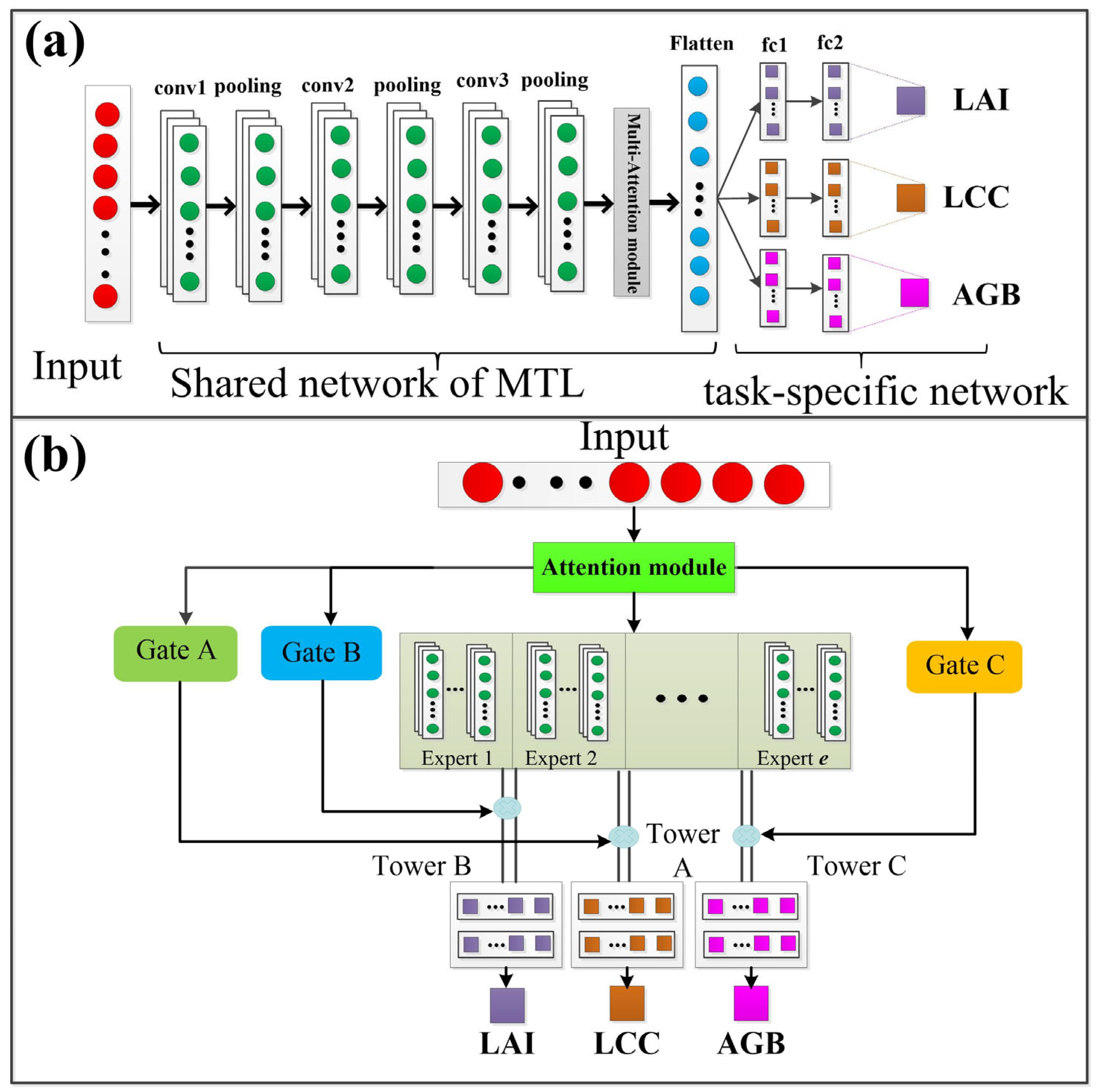
The MTL-DCNN network consists of an input layer, a shared network, and three task-specific networks (Figure 3a). The shared network is a shared hierarchical structure in multi-task learning, usually located at the bottom of the model, aimed at extracting generic feature representations. The shared network is designed with three convolutional layers, namely conv1, conv2, and conv3, with convolutional kernel numbers set to 16, 32, and 64, respectively. In order to improve the feature representation capability for the input spectral reflectance, a multi-head attention module is incorporated into the shared layer. This module allows the model to integrate different head information, enabling the model to comprehensively consider knowledge information across different subspaces. Furthermore, the inclusion of the multi-head attention module also helps to improve the generalization ability of the MTL network, allowing it to better adapt to new tasks. A flattening layer is designed at the end of the sharing network to convert high-dimensional convolutional features into one-dimensional shared features. Three separate task-specific layers were designed for LAI, LCC, and AGB, focusing on processing task-specific information. The task-specific network consists of two dense layers with the number of neurons being 128 and 32, respectively.
1D-CNN operates by sliding filters at different scales over the entire input information. This sliding filter strategy can capture features at different scales simultaneously, allowing for a more comprehensive understanding and learning of patterns in sequences. The mathematical operation of 1D convolution for input data X is as follows [55]:
X c 0 l = f ^ ( c n W c 0 ( l ) , c n X ( l 1 ) , c n + B c 0 l )
where c 0 denotes the c 0 th output channel, c n denotes the number of channels in the l-1th layer, l denotes the lth layer of the MTL network. W c 0 ( l ) , c n denotes the convolution kernel corresponding to the cn input channel and the c0 output channel, B c 0 l denotes the learnable bias and f ^ ( ) denotes the activation function ReLU.
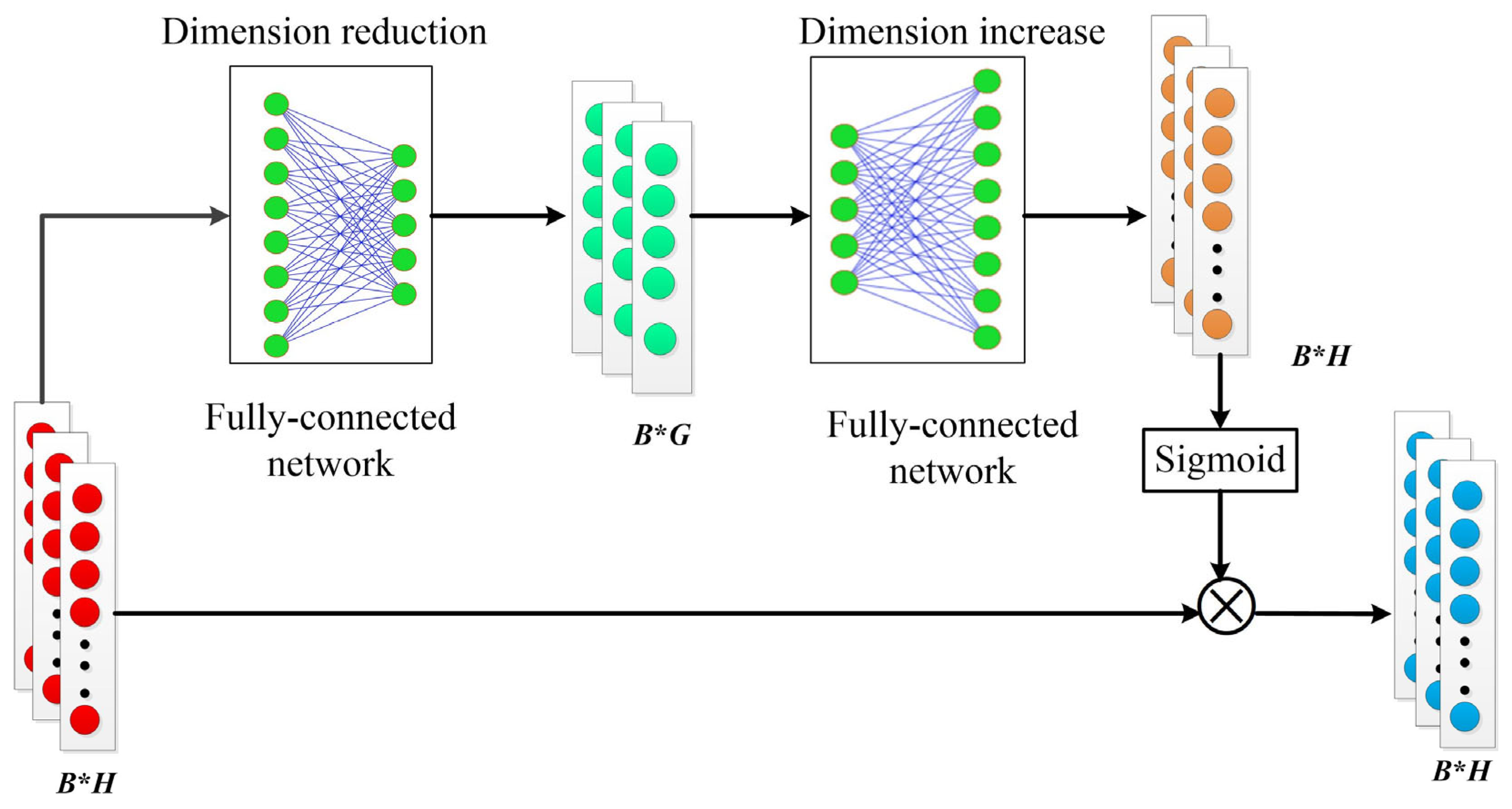
The structure of the MTL-MMOE is shown in Figure 3b. The network consists of an attention mechanism module, an expert hybrid network, a gated network, and a tower layer (task-specific layer). To reduce the dimensionality of the input features, minimize the risk of overfitting, and eliminate redundant spectral bands, an attention mechanism module was introduced at the backend of the model [56]. Given the module’s superior feature selection performance without introducing additional computational complexity or increasing the network parameters in the MTL model, a lightweight multilayer perceptron (MLP) was adopted for the module design, as illustrated in Figure 4. For each input spectral feature, it is first processed by fully connected networks to perform dimension reduction and increase operations, and then a vector is output as a set of weights through the softmax function. Subsequently, each input feature is multiplied by its corresponding attention weights to obtain a weighted feature representation. This process can be seen as a reweighting or revaluing of each feature. The expert network dynamically assigns weights to each feature through an attention mechanism. This allows the model to focus efficiently on the features that are critical to the current task.
The expert network consists of several independent MLP networks. An MLP with a three-layer fully connected architecture (24, 64, 128) is designed to process one-dimensional spectral data. Each layer is capable of introducing nonlinear transformations, endowing it with a stronger nonlinear modeling capability. Instead of relying on a single shared network, MMOE employs a collection of expert networks, each specializing in a particular facet of the problem domain. To capture the relevance and distinctions of the tasks, MTL-MMOE adds a separate gated network for each task. MMOE incorporates task-specific gating networks to dynamically select and combine the outputs of these experts, enabling the model to effectively capture task relevance and distinction. Each expert network is a separate sub-model, focusing on a particular aspect or sub-space of the learning data. The output of the kth task in MTL-MMOE is denoted as follows [57]:
y k = h ^ k ( f k ( X ) )
where f k ( X ) represents the input of the kth tower network and h ^ k ( . ) represents the tower network for the kth task.
The gated network generates a distribution of e experts based on the inputs through a soft gating mechanism and weights the sums of the predictions of different experts. The relationship between the expert and the gated network is represented as follows:
f k ( X ) = j = 1 e g j k ( X ) f j ( X ) )
where g j k ( X ) represents the weight of the jth expert subnet in the kth task, f j ( X ) represents the output of the jth expert subnet and e represents the number of expert subnets.
The gating network is composed of simple linear transformations and softmax functions. The specific formulas are given below:
g k ( X ) = softmax ( W k X )
where W k R e × d denotes the linear transformation matrix and d denotes the feature dimension.

2.5. Coupling of MAML Algorithm and Multi-Task Learning

The aim of multi-task learning is to jointly learn the network parameters of multiple tasks in order to unearth shared information across different tasks. In addition to considering the network structure, it is crucial to also focus on optimizing the multi-task learning process to improve the adaptability of the model to different tasks. Meta-learning, or learning to learn, can enhance learning quality by altering various aspects of the learning process. Among them, MAML is one of the important methods for few-shot meta-learning. Therefore, in this study, the advanced MAML algorithm is integrated into multi-task learning to address the problems of imbalance and overfitting to specific tasks in gradient-based multi-task learning. A prominent feature of this algorithm is its model-agnostic nature, which allows its application to different model architectures.
After coupling the MAML algorithm, each growth parameter in the multi-task learning is considered as an independent but jointly learned task (one growth parameter type per task). The optimization algorithm proceeds as follows:
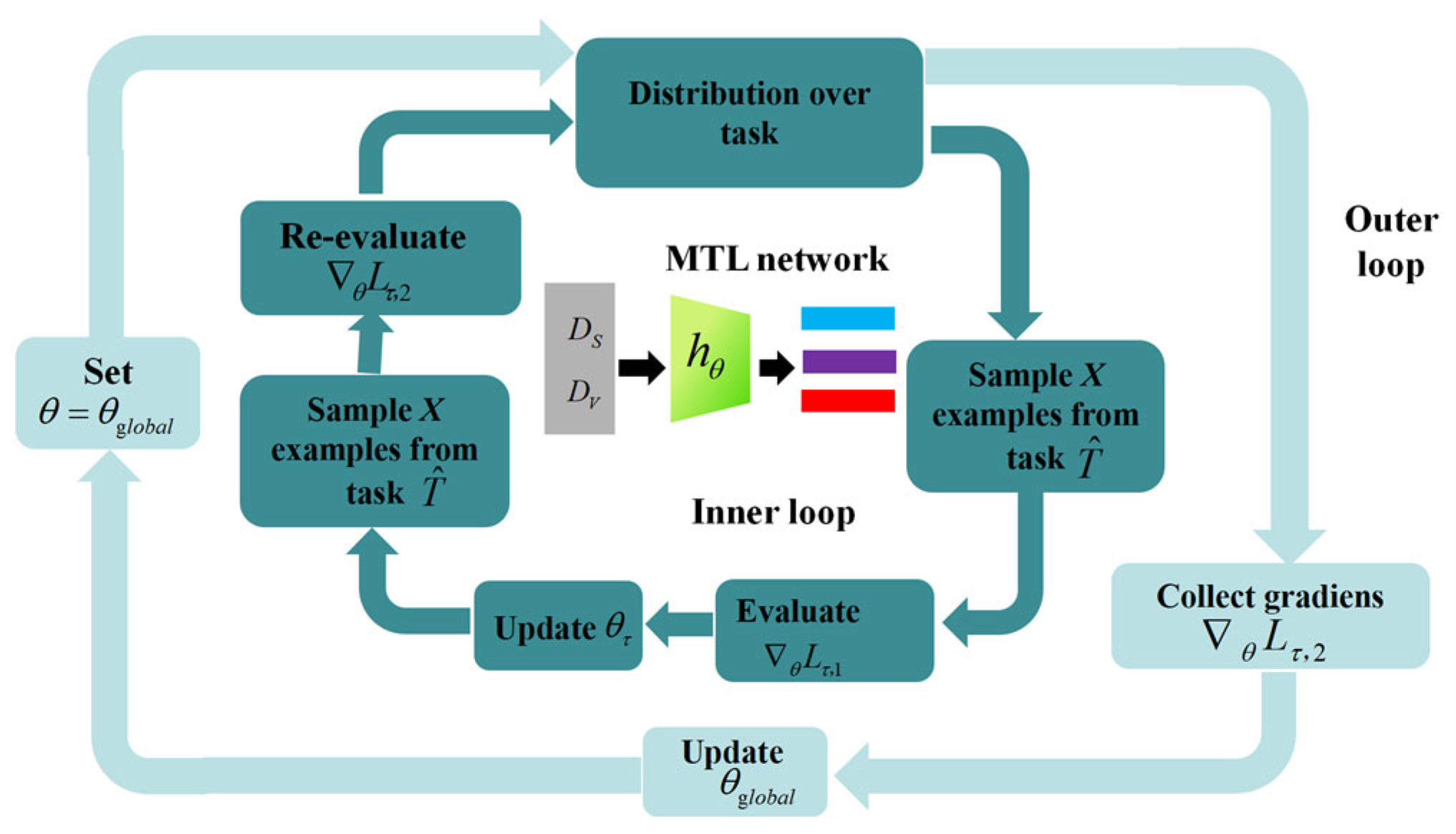
(1) Sample batches of tasks are taken from the source domain D S to compute the current loss for each task, and temporary updates are performed across the network by gradient descent for each task. The specific calculation formula is as follows [58,59]:
θ τ = θ α θ L τ ( h θ )
where h θ ( ) denotes MTL-MMOE or MTL-DCNN and θ denotes model parameters.
(2) The losses for each task are recalculated using the temporarily updated network, and the network parameters are updated again with the sum of the task losses.
θ θ β θ τ = 1 T ^ L τ ( h θ τ )
where α , β are the learning rate hyperparameters, respectively. T ^ denotes the number of tasks.
(3) Samples are extracted from the target domain dataset D V , and the pretrained network is used as the initial set of parameters θ . The network is then fine-tuned by following the procedures outlined in Equations (9) to (10), resulting in network parameters θ ¯ that are adapted to the field measurement task.
(4) Finally, the prediction accuracy of the model for the growth parameters is evaluated on the test set in the target domain.
Multi-task learning based on MAML employs a two-stage optimization strategy, consisting of an inner loop and an outer loop, as shown in Figure 5. In the inner loop, the parameters of the model are updated by gradient descent, which is used to optimize the local parameters for a specific task. In the outer loop, the global parameter θ global is updated by calculating the gradients of the losses across multiple tasks, aiming to achieve good performance across all tasks. In addition, when target domain samples are limited, MAML leverages a meta-learning strategy to learn a well-generalized model initialization on source domain tasks, enabling rapid adaptation to new tasks in downstream learning with only a small number of samples.

2.6. Input Variables

Unlike hyperspectral imagery, the Sentinel-2 satellite has only 10 effective bands available (B2–B8, B8A, B11, B12), which can potentially restrict the performance of deep CNN in certain tasks. Vegetation index, as an important indicator of vegetation status, can provide complementary information on vegetation physiology and ecology. Therefore, based on previous research in crop trait estimation, 14 representative spectral indices related to growth parameters were selected to enhance the input information of MTL. The LCC-related VIs include red edge chlorophyll index (CIre) [60], green chlorophyll index (CIg) [61], modified chlorophyll absorption reflectance index (MCARI) [62], optimized soil adjusted vegetation index (OSAVI) [63], MCARI/OSAVI [64], transformed chlorophyll absorption reflectance index (TCARI), and TCARI/OSAVI [65]. VIs related to LAI and AGB include normalized difference water index (NDWI1) [66], normalized difference vegetation index red-edge1 (NDVIre1) [67], modified enhanced vegetation index (MEVI) [68], green normalized difference vegetation index (GNDVI) [69], difference vegetation index (DVI) [70], soil-adjusted red-edge index (SARE) [71], and angular insensitivity vegetation index (AIVI) [72]. Previous related studies have shown that these VI features are very useful for inverting physiological and biochemical morphological indicators of crops and estimating crop growth status. The spectral attention mechanism performs dimensionality reduction and expansion operations on the input features, subsequently applying a sigmoid activation function to generate a weight vector that serves as a learnable scaling factor for each input variable. This architecture enables automatic and adaptive selection of discriminative spectral features.

2.7. Assessment of Model Accuracy

The various inversion models were evaluated using the coefficient of determination (R2), root mean square error (RMSE), and relative root mean square error (rRMSE) indicators. The calculation formulae are as follows:
RMSE = i = 1 n ( y i y ^ i ) 2 n
R 2 = 1 i n ( y i y ^ i ) 2 i n ( y i y ¯ ) 2
rRMSE = RMSE y ¯ × 100 %
where y i and y ^ i are the measured and predicted values, respectively. y ¯ denotes the mean of the measured samples, and n denotes the sample size.

3. Results

3.1. Validation of the MTL Model with Different Source Domain Data

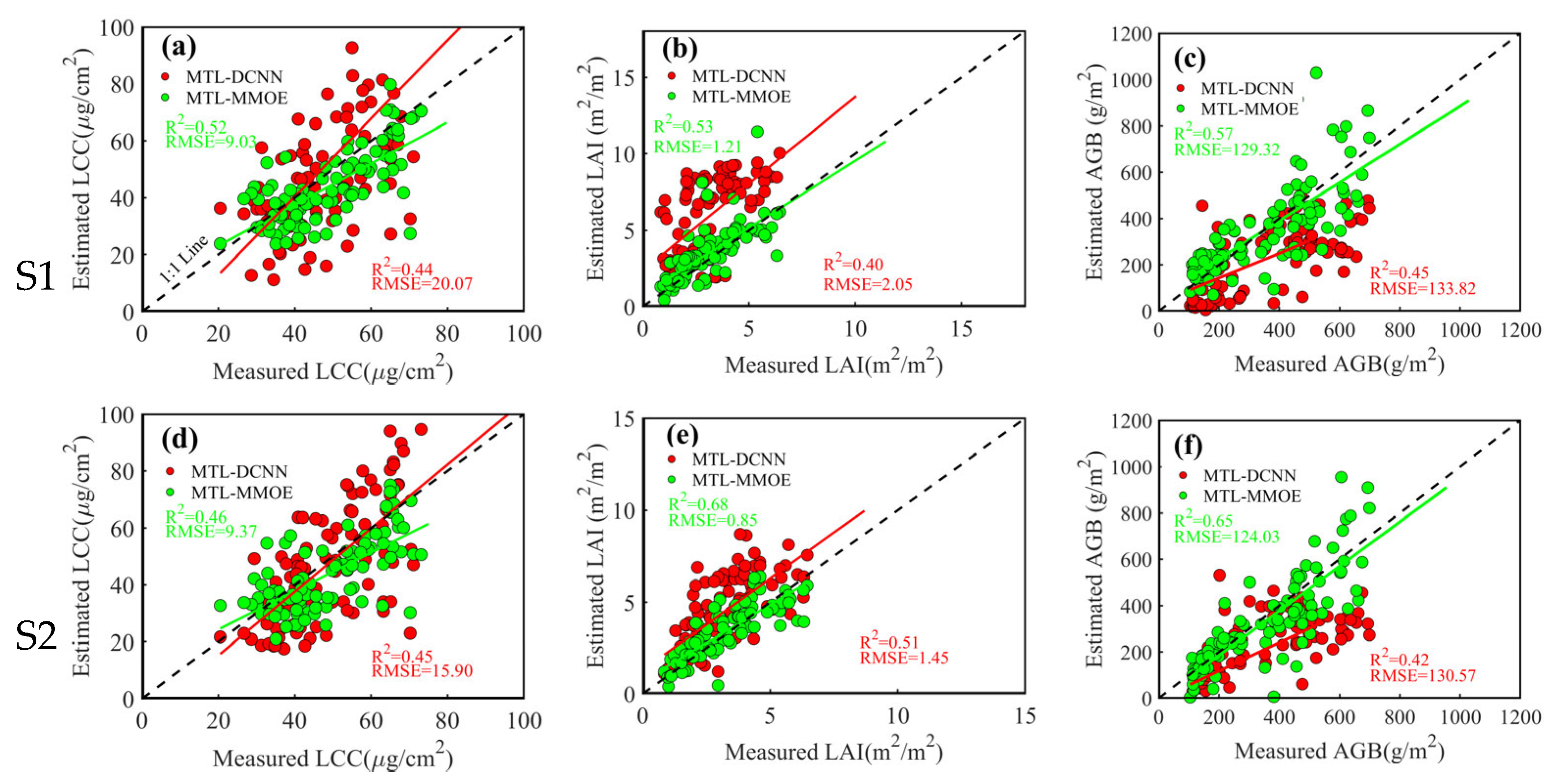
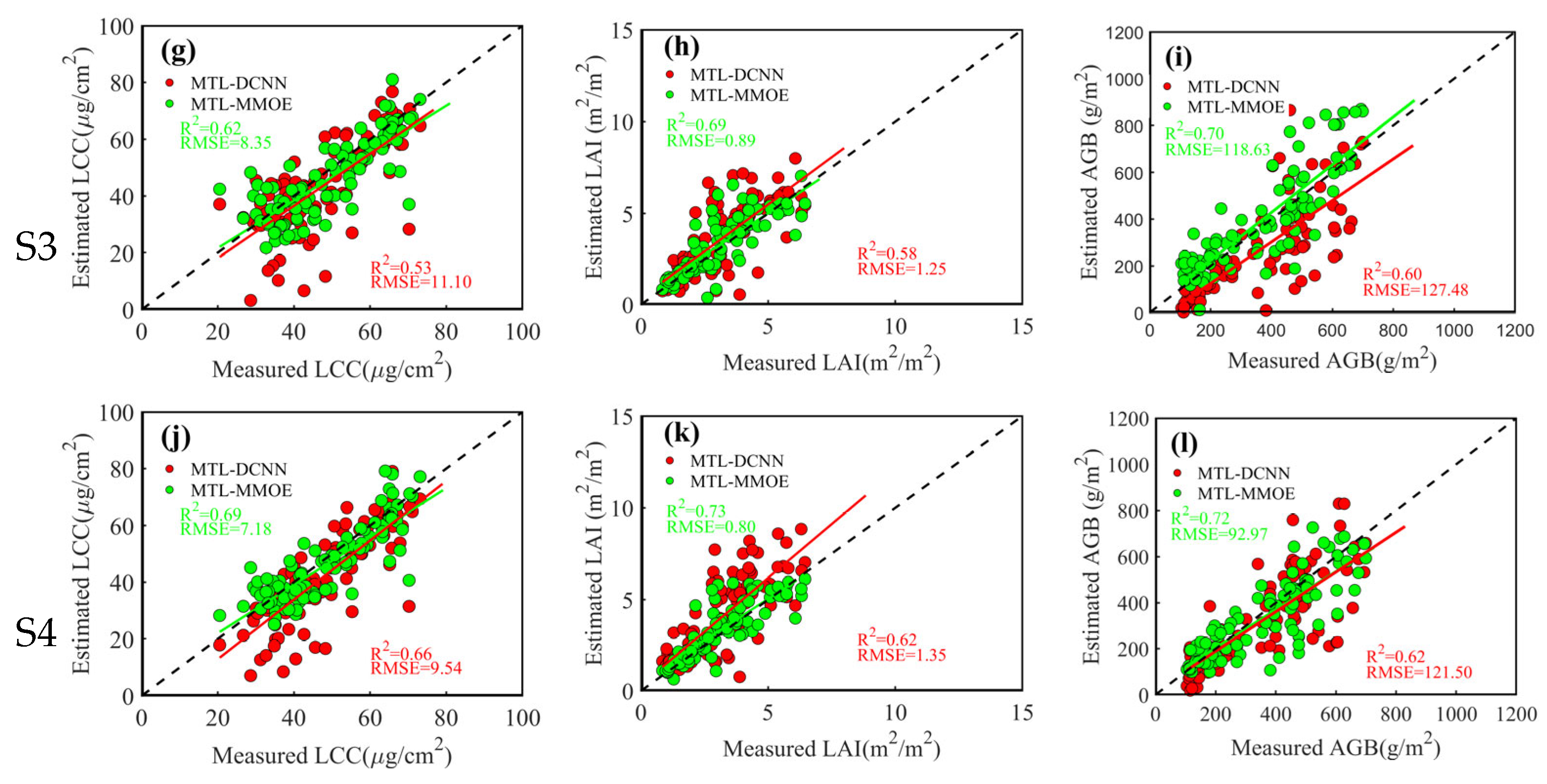
To assess the effectiveness of prior knowledge and the LSMA method in estimating LCC, LAI, and AGB, we compared the performance of two MTL models using simulated data from S1, S2, S3, and S4 (Figure 6). The field measurement data from 2021 to 2023 are merged into a single dataset, with 80% randomly allocated for meta-transfer learning training and 20% for validation. Overall, the MTL models showed variable performance across different simulated data settings. When S1 was directly applied, both MTL-DCNN and MTL-MMOE demonstrated lower estimation accuracies (R2 = 0.40~0.57) for LCC, LAI, and AGB, along with higher RMSE values. However, after correcting S1 with LSMA (S3), the accuracy of both MTL models improved to varying degrees (R2 = 0.53~0.70). In cases where the PROSAL parameters were constrained by prior knowledge (S2), the MTL models trained with S2 achieved comparable performance to S3, surpassing S1 in terms of estimation accuracy. These results suggest that solely relying on either prior knowledge or LSMA for estimating growth parameters may not yield satisfactory results. It is worth noting that the two MTL models based on the S4 had the best average performance (R2 = 0.62~0.73) for estimating LCC, LAI, and AGB. This is attributed to the dual-condition constraint of the source domain data, which reduces the distributional difference between simulated and actual spectral reflectance. Furthermore, MTL-DCNN was more sensitive to inter-domain differences than MTL-MMOE. Specifically, the R2 ranges of MTL-DCNN and MTL-MMOE on S1 were 0.40~0.45 and 0.52~0.57, respectively, while their R2 ranges on S4 were 0.62~0.66 and 0.69~0.73, respectively. The results demonstrated that MTL-MMOE consistently outperformed MTL-DCNN in most settings, particularly under conditions with greater domain shifts (e.g., S1 and S2), where its dynamic gating mechanism and expert mixture structure better captured task-specific patterns. In contrast, MTL-DCNN, which uses hard parameter sharing, showed relatively lower accuracy and greater performance variability when faced with heterogeneous tasks or data domains.
As shown in Figure 7, the simulated spectral distribution covered the spectral reflectance of the Sentinel-2 satellite at different growth stages of the potato. However, when using settings S1 and S2, there were significant spectral differences between the simulated spectra and the satellite data, resulting in lower estimation accuracy of the MTL model. Compared to settings S1, S2, and S3, the simulated spectral reflectance under S4 was closer to the satellite spectral distribution (Figure 7d), and the spectral error metrics RMSE and MAE were also relatively lower (Figure 7e). Moreover, under the S4 setting, we calculated the RMSE and MAE for each spectral band to quantitatively evaluate the differences between the simulated and measured spectral reflectance. As shown in Figure 7f, most bands exhibit relatively small spectral errors, further validating the reliability of the simulated data. Consequently, S4 was selected as the source domain data for all subsequent experiments.

3.2. Theoretical Validation Using Simulated Data

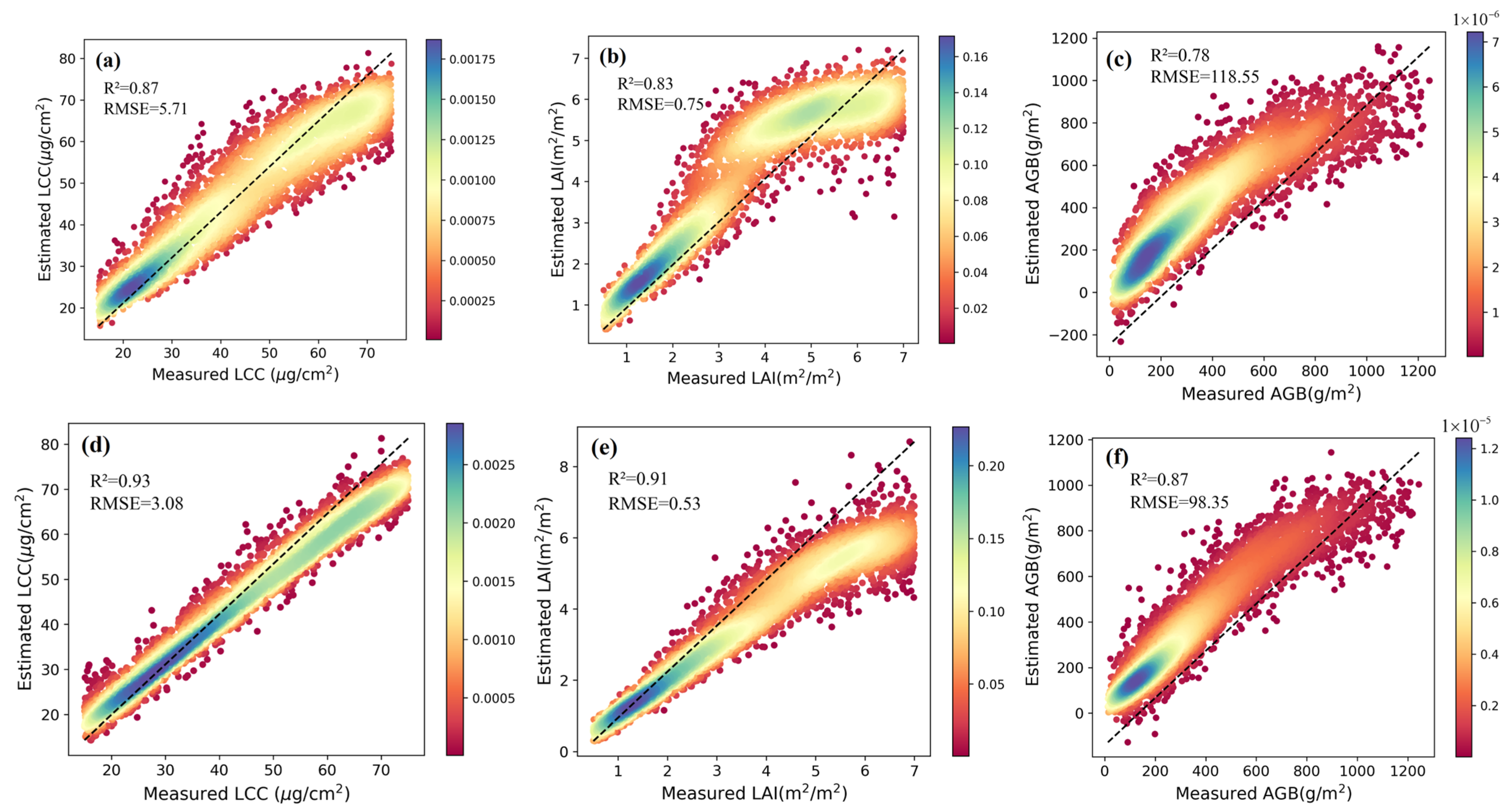
To assess the theoretical performance of the proposed MTL model, we evaluated the estimation accuracy of MTL-DCNN and MTL-MMOE using simulation data (n = 4195). Both MTL models yielded satisfactory accuracy in the estimation of LCC, LAI, and AGB (Figure 8). MTL-MMOE achieved R2 values of 0.93, 0.91, and 0.87 for LCC, LAI, and AGB, with corresponding RMSE values of 3.08 µg/cm2, 0.53 m2/m2, and 98.35 g/m2, respectively. Meanwhile, for the MTL-DCNN model, the R2 for LCC, LAI, and AGB were 0.87, 0.83, and 0.78, respectively, with RMSE values of 5.71 µg/cm2, 0.75 m2/m2, and 118.55 g/m2, respectively. Comparatively, MTL-MMOE showed higher R2 values and lower RMSE in the estimation of growth parameters than MTL-DCNN. In addition, MTL-DCNN was found to be more sensitive to the estimation of the high-value regions of LAI and AGB, making the model less robust than MTL-MMOE. The main reason is that MTL-DCNN shares the same convolutional backbone across tasks and uses separate task-specific output layers, which may lead to negative transfer when tasks compete for shared parameters. In contrast, MTL-MMOE introduces a multi-gate mixture-of-experts mechanism that enables each task to learn a tailored combination of shared expert networks via task-specific gating. This architecture is more effective in handling task conflicts and improves task balancing by dynamically allocating shared representations. Therefore, theoretical validation shows that MTL-MMOE is better suited for simultaneous estimation of growth parameters using multi-task learning. In terms of computational overhead, MTL-MMOE introduces multiple expert networks and task-specific gating mechanisms, which lead to a significantly higher inference burden compared to the relatively simple structure of MTL-DCNN. Under the same input and number of tasks, the inference latency of MTL-MMOE is typically about 1.2 to 1.3 times that of MTL-DCNN.

3.3. Comparison of Different Learning Methods

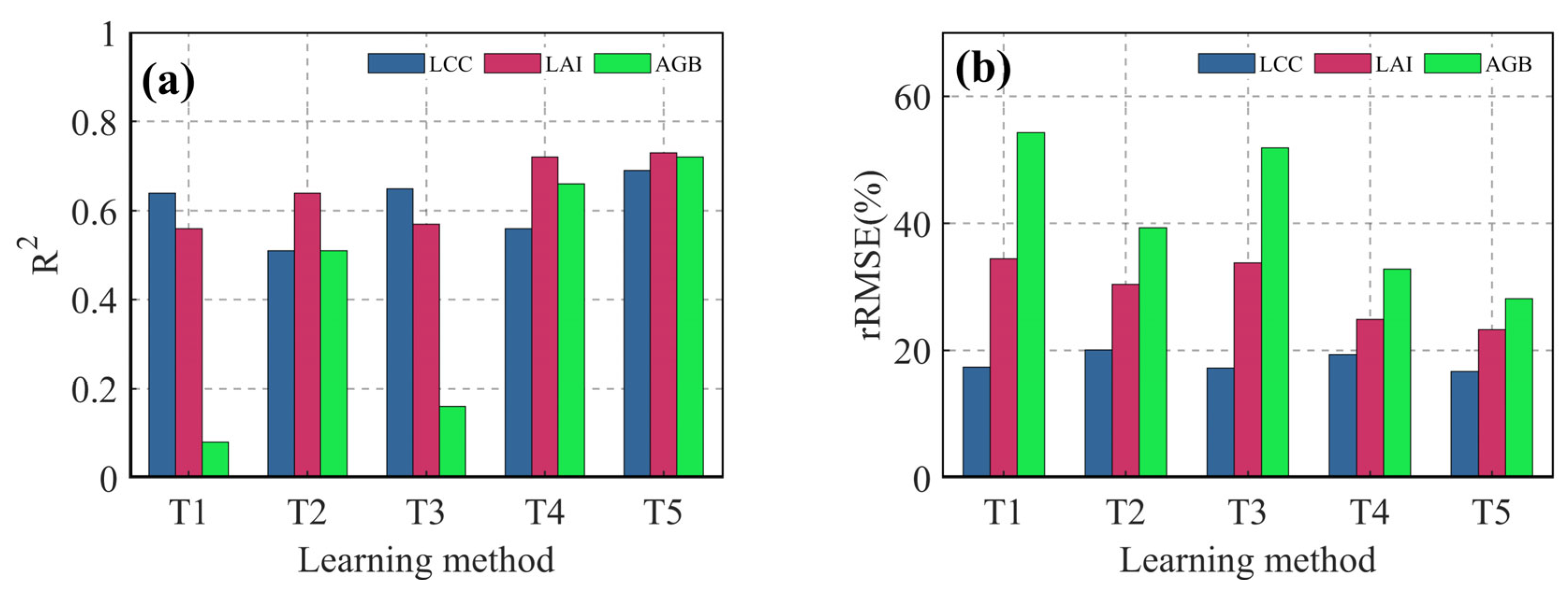
To evaluate the effectiveness of FSLGP for growth parameter estimation, the proposed FSLGP method was compared with four other typical learning methods based on the MTL-MMOE model (Figure 9). The field measurement dataset was divided into training and testing sets according to the method outlined in Section 3.1. T1: The traditional hybrid inversion method, where the model trained on simulated data S4 was used directly for growth parameter prediction on testing sets. T2: The model trained using only field measurement data predicts growth parameters on testing sets. T3: The training set from the field measurement data was added to the simulated data S4 to form a new mixed dataset, which is then used for training the pre-trained model on the mixed data to predict growth parameters. T4: Traditional transfer learning, where the model is pre-trained with simulated data S4 and then fine-tuned using the training set of the field measurement dataset. T5: Integration of meta-transfer learning, simulated data generation, and the MAML algorithm (FSLGP). The difference between T5 and T4 lies in the addition of the MAML optimization algorithm. In Figure 9, T1–T5 are all validated on the test set of the field measurement dataset.
The T1 failed to achieve satisfactory results in growth parameter prediction, particularly in AGB estimation (R2 = 0.08; rRMSE = 54.27%). This result can be attributed to the significant inter-domain differences between simulated data and actual spectra, causing the model trained solely on simulated data to be unable to effectively learn specific crop growth conditions and uncertainties [73]. Due to the limited number of field measurement samples, the T2 shows relatively low accuracy in growth parameter estimation. The generalization capability of deep learning networks is heavily reliant on the size and diversity of the training samples, and fewer field measurement samples are likely to cause overfitting in the MTL model. Although the T3 method enables the model to learn the features of field measurement data, the improvement in estimation accuracy was marginal. This is because when the volume of simulated data greatly exceeds that of field-measured data, the model decisions become overly dependent on the feature distribution of the simulated data, thus ignoring the information from the field-measured data. As a result, the performance of the model on field data may not be as expected. Compared to T1, T2, and T3, T4, based on transfer learning, significantly improved the estimation accuracy of growth parameters (R2 = 0.56~0.72; rRMSE = 19.35%~32.81%). Many previous studies have shown that deep learning models, by sequentially using simulated data and field-measured data for training, achieve higher generalizability and prediction accuracy. This is because the T4 learning method failed to account for the balance between tasks during the MTL model training process. Compared to the other four learning methods (T1–T4), the T5 learning method, FSLGP, achieved the highest growth parameter estimation accuracy (R2 = 0.69~0.73; rRMSE = 16.68%~28.13%). These results highlight the ability of few-shot learning techniques to effectively address the challenges posed by the scarcity of field measurement data. Notably, the distinctive aspect of the T5 method compared to T4 is that both the pretraining and fine-tuning of the MTL model use the MAML algorithm. This algorithm effectively accounts for the balance between tasks during the MTL model training process and enhances the model’s adaptability to the target task, thus making the T5 method more accurate than T4 in growth parameter prediction.

3.4. Model Validation Across Different Sites

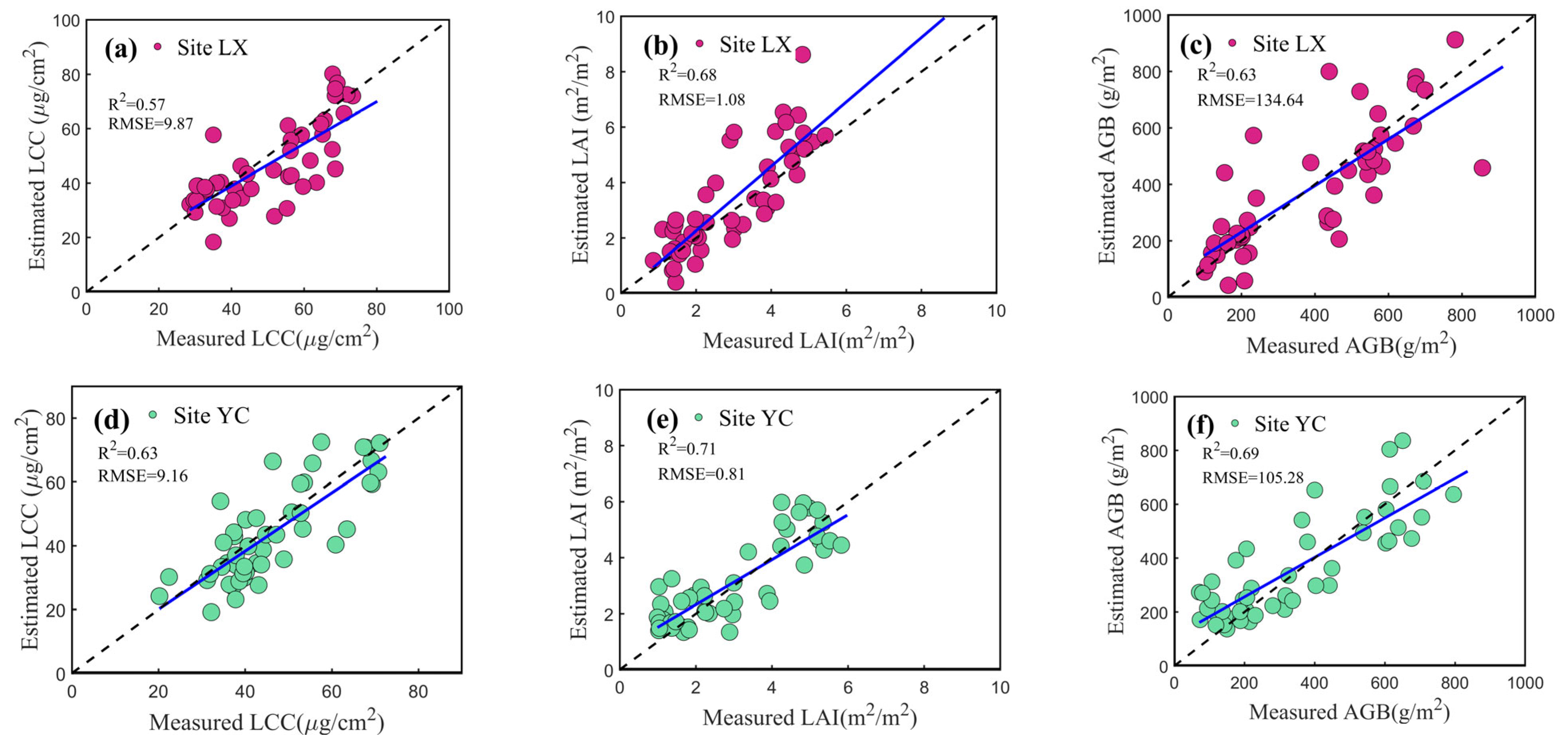
The hilly mountainous area (Site LX) and the Hexi irrigation area (Site YC) represent two different potato-growing environments and geographical conditions. Variances in management practices, environmental conditions, potato varieties, and meteorological factors can potentially influence the spectral characteristics of the potato canopy. To validate the robustness and applicability of the MTL model, the MTL-MMOE was applied to both sites. In this experiment, the field measurement data from Site LX across three consecutive years were combined and randomly split into training and testing sets for meta-transfer learning and validation of the model. The field measurement data from Site YC were processed separately using a similar partitioning method. MTL-MMOE had a higher accuracy in estimating LCC, LAI, and AGB at Site YC (R2 = 0.63~0.71) compared to Site LX (R2 = 0.57~0.68) (Figure 10). This difference could be attributed to the relatively smaller size of most of the potato fields at Site LX, which resulted in a higher proportion of mixed pixels in the Sentinel-2 data, thus affecting the estimation accuracy.
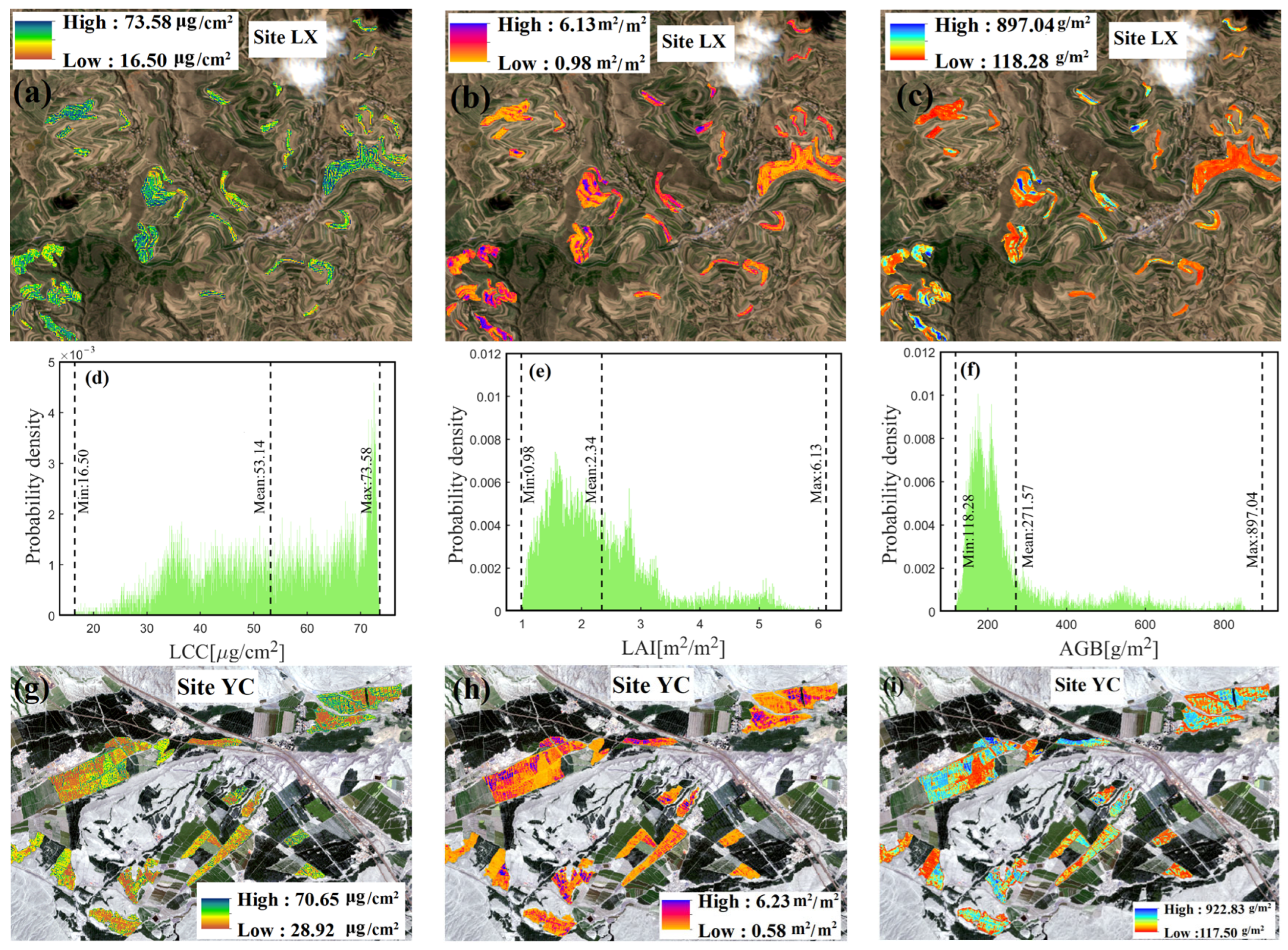
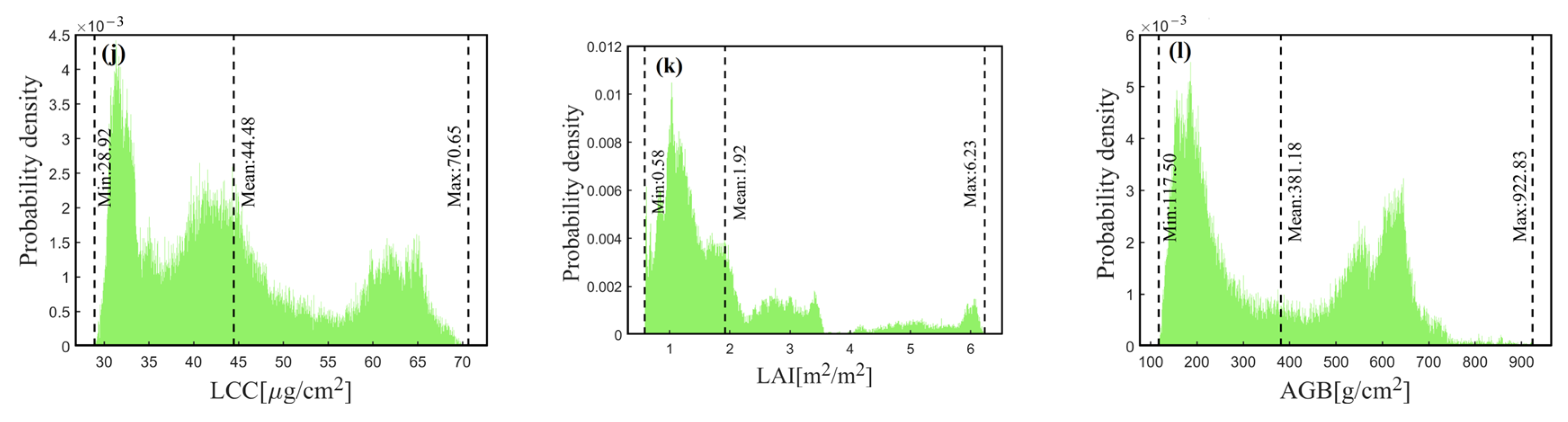
Due to the limited availability of field measurement samples at a regional scale, spatial patterns and probability density distribution maps were used for a qualitative assessment of the variability of the MTL model. Inversion maps for LCC, LAI, and AGB were generated using MTL-MMOE within two planted sub-regions at Site LX and Site YC, as shown in Figure 11. The probability density distributions indicate that the predicted results for all potato growth indicators fell within a reasonable range of parameter variations. Specifically, the LAI ranged from 0.58 to 6.23 m2/m2, AGB ranged from 117.50 to 922.83 g/m2, and LCC ranged from 16.50 to 73.58 µg/cm2. The inversion results of MTL-MMOE at Site YC exhibited a normal distribution with multiple peaks, suggesting a robust spatial adaptability of the model in this area. This phenomenon is due to the large size of most potato-growing areas in Site YC, which mitigates spectral mixing effects between different vegetation types. Conversely, the probability density of LCC deviated from a normal distribution in the Site LX region, indicating significant variability and uncertainty in the LCC inversion. The main reason is that LCC is more susceptible to external interferences such as background soil reflectance, atmospheric noise, and canopy structural variations, especially in areas with sparse vegetation coverage. Additionally, LCC exhibits significant spatial heterogeneity at the canopy scale, which complicates consistent modeling across varying field conditions. While the estimation results of AGB generally followed a single-peak distribution, they were concentrated in a narrower range of lower values, suggesting a potential underestimation of AGB by the model. Compared to the inversion results at Site YC, the inversion uncertainty was more pronounced when the model was applied at Site LX. This result is consistent with the verification of field measurements. Therefore, the estimation of potato growth parameters in hilly mountainous terrain on a regional scale is challenging.

4. Discussion

4.1. Effect of Field Measurement Sample Size on Estimation Accuracy

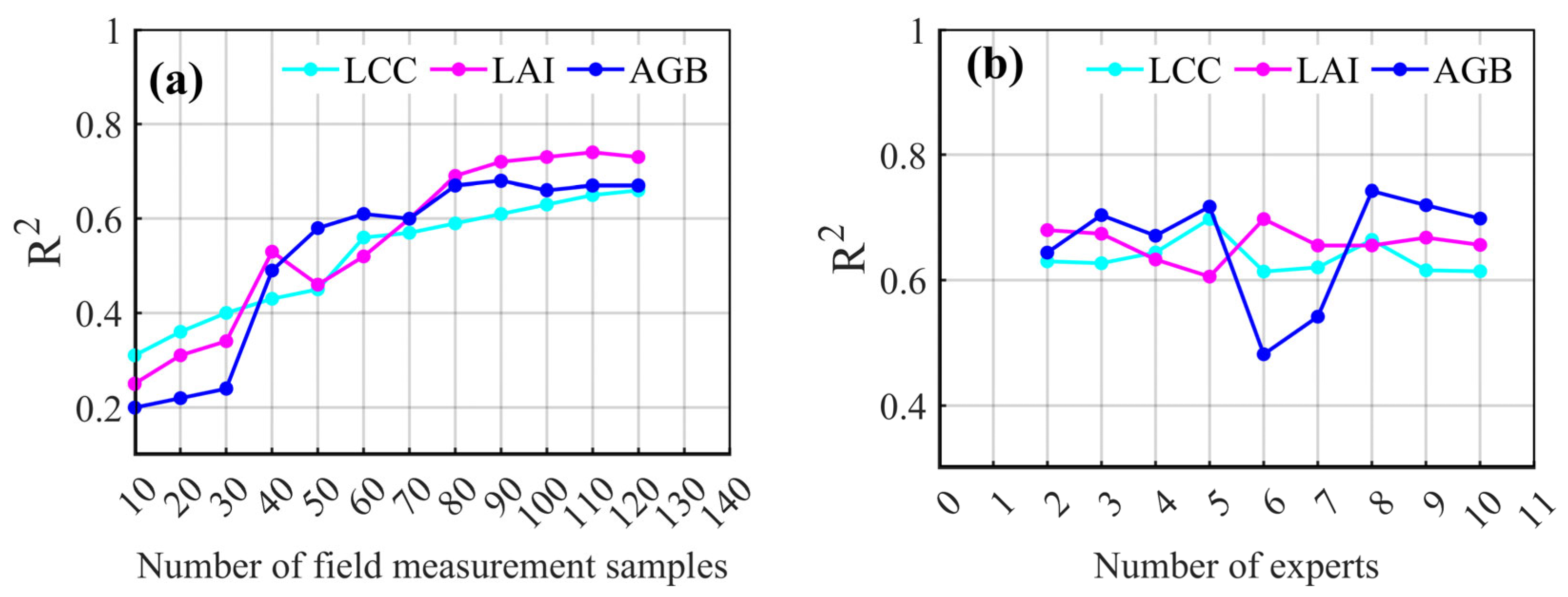
The small data problem is a common challenge for inverting growth parameters at the regional scale, resulting in poor generality and portability of models [74]. Therefore, the goal of FSL is to adapt networks trained on simulated data to new tasks with small data. Based on the pre-trained MTL-MMOE model, random samples of different sizes were selected from the entire field measurement dataset for meta-transfer learning, with the remaining samples used to validate the model’s prediction accuracy. In this experiment, the number of field measurement samples used for training was set between 10 and 120. The estimation accuracy of the model was relatively low when the sample size was less than 30 (Figure 12a). The estimation accuracy increased substantially when the sample size changed from 30 to 80, but the model’s estimation accuracy increased relatively more slowly when the sample size was larger than 80. It is worth noting that the model achieved comparable estimation results with 80 samples as with 120 samples. This stems from the capacity of multi-task learning to bolster overall performance through the useful sharing of information across tasks. Consequently, even with fewer samples allocated to a specific task, the model adeptly leverages knowledge from other tasks to optimize its parameters effectively [75]. On the other hand, the MAML algorithm uses gradient descent within a meta-optimization framework to refine model parameter adjustments for novel tasks via inter-task gradient updates. This meta-optimization process allows the model to be updated iteratively on a small number of samples, thereby reducing the dependence on sample size. Experimental results show that the integration of MTL with MAML significantly enhances the effectiveness and generalizability of deep learning networks when faced with small-sample learning tasks. This approach offers a new perspective and methodology to address the scarcity of ground truth data in the crop growth parameters inversion. However, the FSLGP method still has certain limitations. In regions with high farmland heterogeneity—particularly hilly or mountainous areas or during the early stages of crop growth—the model’s performance may decline due to factors such as terrain variation, complex soil backgrounds, and low vegetation coverage. Moreover, when the number of training samples is extremely limited or the sample distribution is highly imbalanced, the model is prone to overfitting, which in turn affects its generalization ability.

4.2. Effect of Hyperparameter on Estimation Accuracy

The number of expert subnetworks is a central hyperparameter of the MTL-MMOE model. A validation set was used to evaluate the effect of different expert subnet numbers on the model’s performance. As shown in Figure 12b, the model’s performance exhibited some fluctuations with increasing expert numbers. The optimal number of experts varied slightly across different tasks (LAI, LCC, and AGB); however, the average estimation accuracy across all three tasks reached its highest level when five expert subnetworks were used. While slight variations in optimal expert count may exist for individual tasks, we chose to adopt a setting of five experts across all tasks. This decision aimed to strike a balance between accuracy, generalizability, and computational efficiency.
In addition, we conducted a systematic hyperparameter tuning experiment on the inner-loop learning rate (α) and outer-loop learning rate (β) in the MAML algorithm. Specifically, we selected three values for α (0.01, 0.05, 0.1) and two values for β (0.001, 0.0005), resulting in a total of six hyperparameter combinations. The results indicate that different combinations of α and β have a significant impact on model performance. As shown in Table 2, the combination of α = 0.01 and β = 0.0005 achieved the best performance across the three parameter prediction tasks, with an average R2 of 0.69, which is notably superior to the other settings.

4.3. Transferability of Models

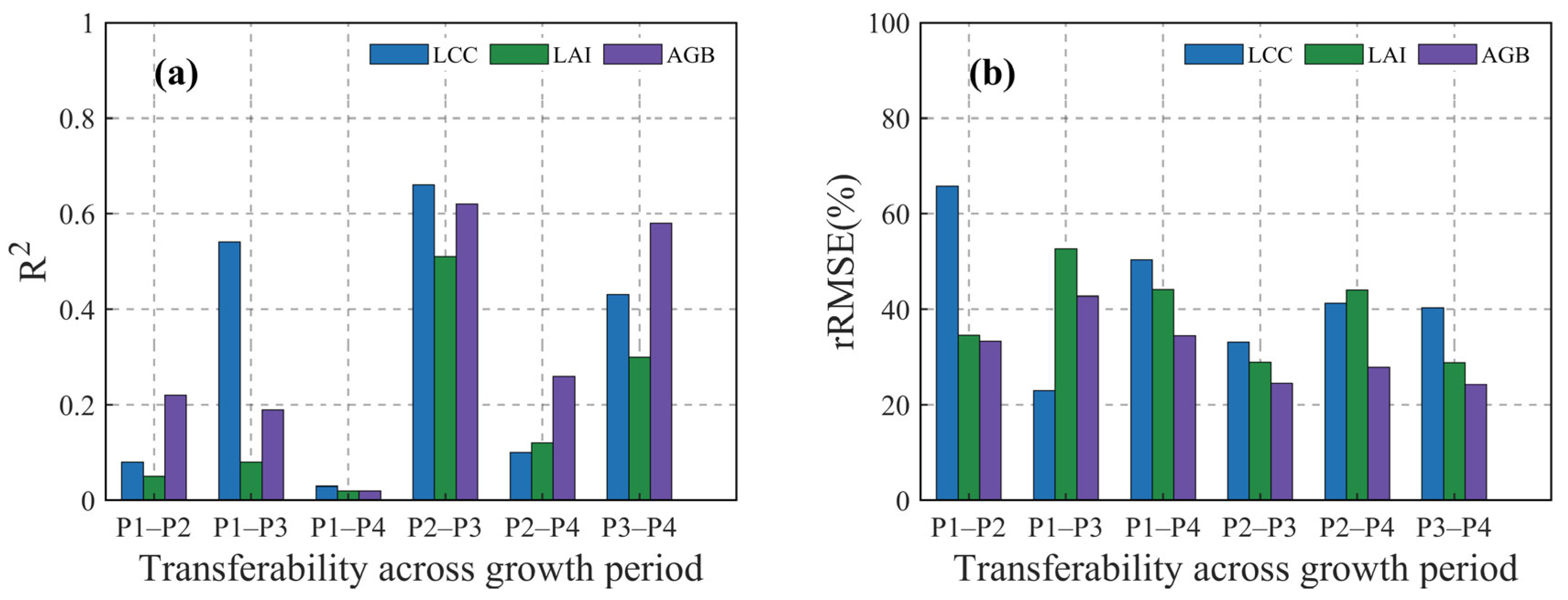
The transferability of the MTL-MMOE across space, time, and growth stages was assessed at the regional scale. Figure 13 shows the estimation accuracy across growth stages. In the P1–P2 transfer experiment, the MTL-MMOE model, trained using field measurement data from the P1 growth stage, was transferred to independent field measurement data from the P2 growth stage for validation. The experimental procedure for the other five transfer conditions followed the same process as the P1–P2 experiment.
The model achieved good estimation results for LCC (R2 = 0.66), LAI (R2 = 0.51) and AGB (R2 = 0.62) under the P2–P3. Similarly, the model obtained satisfactory estimation accuracy for LCC (R2 = 0.43) and AGB (R2 = 0.58) under the P3–P4. The results indicated that the two growth periods, P2 and P3, were the best periods for monitoring potato growth parameters. Because the models of these two growth periods can be effectively transferred to adjacent growth periods. In practice, the collection of measured samples at the regional scale for the full reproductive period is often lagging behind, which may result in missing the best prediction window for potato. If a specific growth period model can be effectively transferred, the distribution space of potato growth in the next growth period can be predicted in time. This would allow farmers to manage potato water and fertilizer in advance to ensure optimal conditions for potato growth.
It is worth noting that the MTL-MMOE model exhibited low estimation accuracy for LCC, LAI, and AGB under the P1–P2 and P1–P3 transfer scenarios. In particular, the P1–P4 transfer scenario failed to produce reliable results. One possible reason is that during the early P1 stage, potato plants are relatively sparse, and growth parameter values are concentrated in a lower range, resulting in a significant distribution shift compared to later stages. Additionally, the canopy structure and spectral responses differ markedly between early and later stages. One possible mitigation strategy is to perform growth-stage-specific fine-tuning using a small number of labeled samples from the target domain, enabling the model to better adapt to phenological variations. In future work, we also plan to explore domain adaptation techniques to further improve the cross-growth-stage transferability of crop growth parameter estimation.
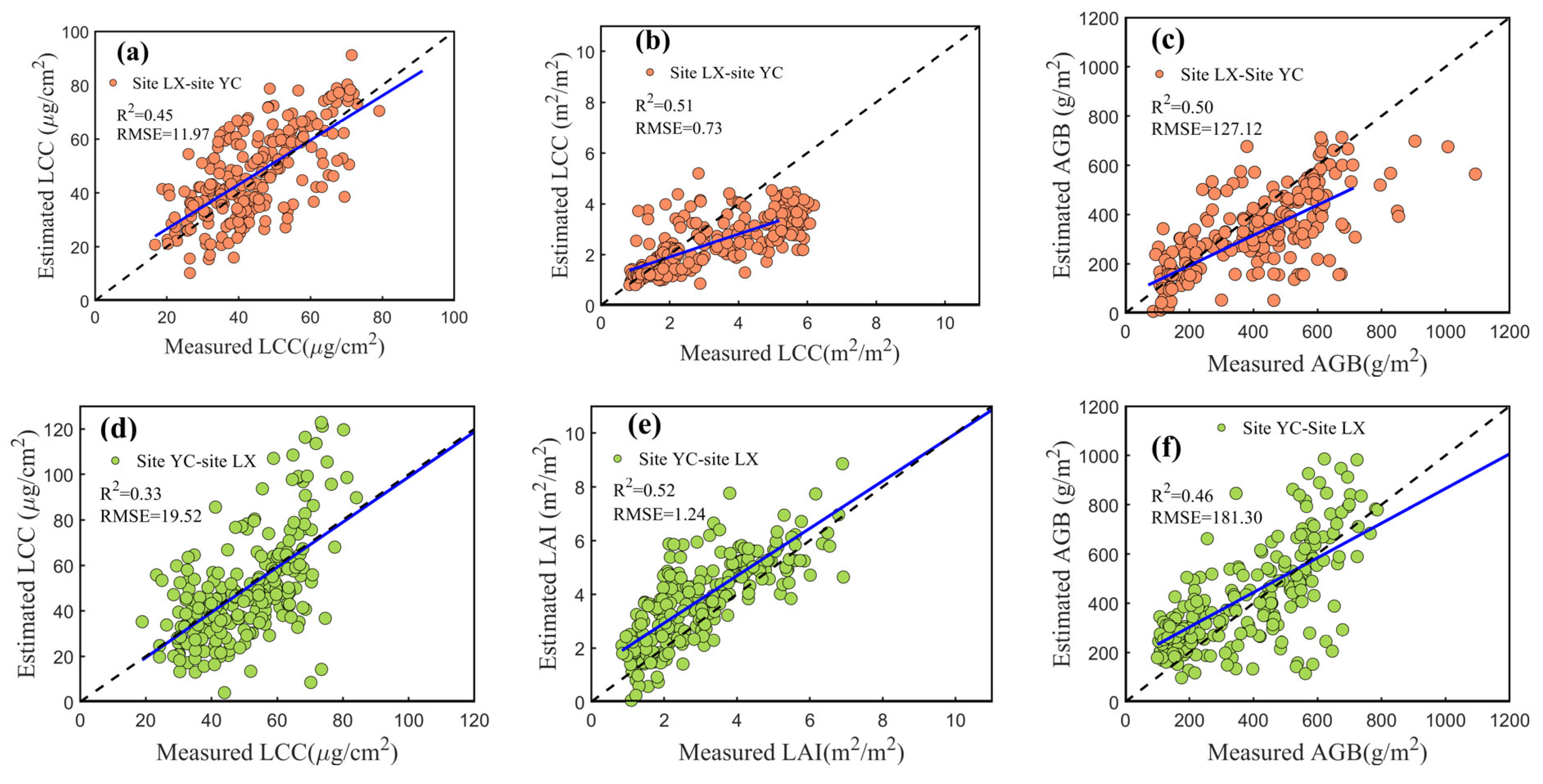
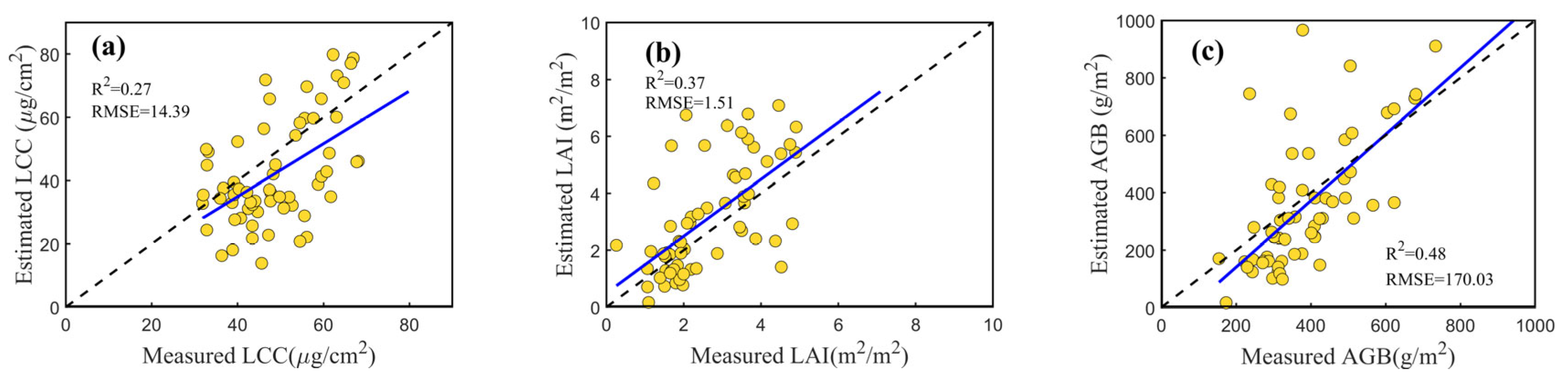
To further validate the spatial and temporal transferability of the MTL-MMOE model, test experiments were carried out using field measurement datasets from different sites and years. For spatial transferability, the models trained on Site LX or Site YC were applied to the in situ data from other sites. For temporal transferability, the model trained on 2022 in situ data was applied to 2021 data. Compared to the local test results, the accuracy of the growth parameter estimation by the MTL-MMOE model showed a decrease, whether the model was transferred from Site LX to Site YC or from Site YC to Site LX (Figure 14). Similarly, the performance of the trained MTL-MMOE model was greatly reduced when applied to other years (Figure 15). This is because the relationship between crop growth parameters and spectra is susceptible to factors such as meteorological conditions, geographic location, and phenology, resulting in a degraded performance of the MTL-MMOE model when applied to new environments and spatial domains outside the calibration set. It is worth noting that the MTL-MMOE model exhibited poor stability in estimating LCC across spatial and temporal transfers (R2 = 0.27~0.45), which may be related to the high sensitivity of LCC to spectral changes.
In practical applications, the model’s cross-spatial and cross-temporal transferability not only reflects its adaptability and robustness but also has important application value for the inversion of crop growth parameters at the regional scale. Especially in remote areas or specific years where field measurement samples are lacking, the model’s cross-spatial and cross-temporal transferability can provide technical support for estimating growth parameters in areas without samples. However, data-driven models tend to perform poorly when the spatial extent of the training sample data does not adequately cover the sites and time of the test set. To improve the transferability of models, many studies employ the PROSAIL model to simulate extensive spectral datasets [32,33], enabling the training dataset to encompass a broader range of spatial, temporal, and growth stages. Unfortunately, the simulated dataset deviates considerably from the actual sensor. On the other hand, different combinations of parameters entered in PROSAIL may produce similar spectral distributions. This will lead to the still limited ability of the model to be transferable across space and time. In view of this, this study attempts to optimize the model at both data and algorithmic levels to improve its adaptability to new environments. First, prior knowledge of potato parameters was incorporated into the PROSAIL model. This strategy not only increased the spectral diversity of the training dataset but also effectively reduced the spectral error between domains. Additionally, the ability of the model to transfer knowledge between simulated and in situ data is strengthened by introducing multi-task learning and small sample learning. We found that model transfer across space and time produced acceptable estimation accuracies for LAI and AGB (LAI: R2 = 0.37~0.52; AGB: R2 = 0.46~0.50). However, the transferability potential of the MTL-MMOE model proposed in this study fails to reach its maximum potential and even exhibits poor performance for the LCC model. This implies that more advanced models, algorithms, and more efficient proofreading strategies need to be further explored to improve the transferability of the model. In the future, the FSLGP method can also be extended to other crops. By fine-tuning the model with a small set of labeled samples from the target crop, it is expected to achieve effective adaptation.

5. Conclusions

Due to the limited availability of field measurement samples, estimating growth parameters from satellite remote sensing images using deep learning models poses numerous challenges. This study introduces a novel framework that integrates the FSLGP method with a multi-task deep learning network to simultaneously estimate LCC, LAI, and AGB. In addition, the introduction of a dual strategy combining simulated spectral correction and algorithm optimization in the MTL model provides a novel and more efficient solution for the accurate estimation of multi-task parameters for potatoes under small sample conditions. The main conclusions of this study are as follows.
(1) When both prior knowledge and LSAM are incorporated into the PROSAIL model, the MTL model shows better performance in estimating growth parameters (R2 = 0.62~0.73). This result highlights the importance of reducing the domain spectral differences in enhancing the meta-transfer learning ability.
(2) In handling multiple growth parameters, the MTL-MMOE consistently outperforms the MTL-DCNN architecture in terms of both accuracy and robustness. Compared with the four traditional inversion methods (T1–T4), the MTL-MMOE (T5) coupled with FSLGP can achieve higher accuracy in estimating growth parameters (R2 = 0.69~0.73; rRMSE = 16.68%~28.13%) using extremely limited field measurement samples. These results confirm the effectiveness of FSLGP in improving the performance and stability of multi-task learning networks.
(3) The spatiotemporal transferability experiments further highlight that the MTL-MMOE model exhibits varying adaptability across different terrain regions and growth stages of potatoes. Specifically, in irrigated regions and at the mid-late stages of potato growth, the model demonstrates superior stability and transferability. Future work will focus on exploring more efficient FSL algorithms and UAV–satellite collaborative calibration techniques to enhance the inversion accuracy of potato growth parameters in hilly and mountainous areas at satellite scales.

Author Contributions

S.Y.: writing—original draft preparation, writing—review and editing, software, methodology, validation; Q.F.: conceptualization; supervision, project administration, funding acquisition; F.G.: data curation, investigation, resources. W.Z.: visualization, formal analysis. All authors have read and agreed to the published version of the manuscript.

Funding

This work was supported by the National Natural Science Foundation of China (Grant No. 32201663), funding from the Industrialization Support Project from the Education Department of Gansu Province (Grant No. 2021CYZC-57).

Institutional Review Board Statement

Not applicable.

Data Availability Statement

The data presented in this study are available on request from the corresponding author.

Conflicts of Interest

The authors declare no conflicts of interest.

References

  1. Li, Q.; Li, H.; Zhang, L.; Zhang, S.; Chen, Y. Mulching improves yield and water-use efficiency of potato cropping in China: A meta-analysis. Field Crops Res. 2018, 221, 50–60. [Google Scholar] [CrossRef]
  2. Féret, J.-B.; Gitelson, A.A.; Noble, S.D.; Jacquemoud, S. PROSPECT-D: Towards modeling leaf optical properties through a complete lifecycle. Remote Sens. Environ. 2017, 193, 204–215. [Google Scholar] [CrossRef]
  3. Zhuo, W.; Huang, J.; Li, L.; Zhang, X.; Xiao, X. Assimilating Soil Moisture Retrieved from Sentinel-1 and Sentinel-2 Data into WOFOST Model to Improve Winter Wheat Yield Estimation. Remote Sens. 2019, 11, 1618. [Google Scholar] [CrossRef]
  4. Räsänen, A.; Juutinen, S.; Kalacska, M.; Aurela, M.; Heikkinen, P.; Mäenpää, K.; Rimali, A.; Virtanen, T. Peatland leaf-area index and biomass estimation with ultra-high resolution remote sensing. GISci. Remote Sens. 2020, 57, 943–964. [Google Scholar] [CrossRef]
  5. Potgieter, A.B.; George-Jaeggli, B.; Chapman, S.C.; Laws, K.; Suárez Cadavid, L.A.; Wixted, J.; Watson, J.; Eldridge, M.; Jordan, D.R.; Hammer, G.L. Multi-Spectral Imaging from an Unmanned Aerial Vehicle Enables the Assessment of Seasonal Leaf Area Dynamics of Sorghum Breeding Lines. Front. Plant Sci. 2017, 8, 1532. [Google Scholar] [CrossRef] [PubMed]
  6. Xu, M.; Liu, R.; Chen, J.M.; Liu, Y.; Shang, R.; Ju, W.; Wu, C.; Huang, W. Retrieving leaf chlorophyll content using a matrix-based vegetation index combination approach. Remote Sens. Environ. 2019, 224, 60–73. [Google Scholar] [CrossRef]
  7. Qiu, F.; Chen, J.M.; Ju, W.; Wang, J.; Zhang, Q.; Fang, M. Improving the PROSPECT model to consider anisotropic scattering of leaf internal materials and its use for retrieving leaf biomass in fresh leaves. IEEE Trans. Geosci. Remote Sens. 2018, 56, 3119–3136. [Google Scholar] [CrossRef]
  8. Croft, H.; Chen, J.M.; Luo, X.; Bartlett, P.; Chen, B.; Staebler, R.M. Leaf chlorophyll content as a proxy for leaf photosynthetic capacity. Glob. Change Biol. 2017, 23, 3513–3524. [Google Scholar] [CrossRef]
  9. Gilardelli, C.; Stella, T.; Confalonieri, R.; Ranghetti, L.; Campos-Taberner, M.; García-Haro, F.J.; Boschetti, M. Downscaling rice yield simulation at sub-field scale using remotely sensed LAI data. Eur. J. Agron. 2019, 103, 108–116. [Google Scholar] [CrossRef]
  10. Verrelst, J.; Camps-Valls, G.; Muñoz-Marí, J.; Rivera, J.P.; Veroustraete, F.; Clevers, J.G.; Moreno, J. Optical remote sensing and the retrieval of terrestrial vegetation bio-geophysical properties–A review. ISPRS J. Photogramm. Remote Sens. 2015, 108, 273–290. [Google Scholar] [CrossRef]
  11. Spafford, L.; Le Maire, G.; MacDougall, A.; De Boissieu, F.; Féret, J.-B. Spectral subdomains and prior estimation of leaf structure improves PROSPECT inversion on reflectance or transmittance alone. Remote Sens. Environ. 2021, 252, 112176. [Google Scholar] [CrossRef]
  12. Luo, S.; He, Y.; Wang, Z.; Duan, D.; Zhang, J.; Zhang, Y.; Zhu, Y.; Yu, J.; Zhang, S.; Xu, F. Comparison of the retrieving precision of potato leaf area index derived from several vegetation indices and spectral parameters of the continuum removal method. Eur. J. Remote Sens. 2019, 52, 155–168. [Google Scholar] [CrossRef]
  13. Qiao, L.; Zhao, R.; Tang, W.; An, L.; Sun, H.; Li, M.; Wang, N.; Liu, Y.; Liu, G. Estimating maize LAI by exploring deep features of vegetation index map from UAV multispectral images. Field Crops Res. 2022, 289, 108739. [Google Scholar] [CrossRef]
  14. Luo, S.; Jiang, X.; He, Y.; Li, J.; Jiao, W.; Zhang, S.; Xu, F.; Han, Z.; Sun, J.; Yang, J. Multi-dimensional variables and feature parameter selection for aboveground biomass estimation of potato based on UAV multispectral imagery. Front. Plant Sci. 2022, 13, 948249. [Google Scholar] [CrossRef] [PubMed]
  15. Tang, Z.; Guo, J.; Xiang, Y.; Lu, X.; Wang, Q.; Wang, H.; Cheng, M.; Wang, H.; Wang, X.; An, J. Estimation of leaf area index and above-ground biomass of winter wheat based on optimal spectral index. Agronomy 2022, 12, 1729. [Google Scholar] [CrossRef]
  16. Cheng, J.; Yang, H.; Qi, J.; Han, S.; Sun, Z.; Feng, H.; Chen, R.; Zhang, C.; Li, J.; Yang, G. Evaluation of the effect of leaf spatial aggregation on chlorophyll content retrieval in open-canopy apple orchards. Int. J. Appl. Earth Obs. Geoinf. 2023, 121, 103367. [Google Scholar] [CrossRef]
  17. Zhang, H.; Li, J.; Liu, Q.; Lin, S.; Huete, A.; Liu, L.; Croft, H.; Clevers, J.G.; Zeng, Y.; Wang, X. A novel red-edge spectral index for retrieving the leaf chlorophyll content. Methods Ecol. Evol. 2022, 13, 2771–2787. [Google Scholar] [CrossRef]
  18. Xu, S.; Xu, X.; Blacker, C.; Gaulton, R.; Zhu, Q.; Yang, M.; Yang, G.; Zhang, J.; Yang, Y.; Yang, M. Estimation of leaf nitrogen content in rice using vegetation indices and feature variable optimization with information fusion of multiple-sensor images from UAV. Remote Sens. 2023, 15, 854. [Google Scholar] [CrossRef]
  19. Feng, Z.; Zhang, H.; Duan, J.; He, L.; Yuan, X.; Gao, Y.; Liu, W.; Li, X.; Feng, W. Improved Spectral Detection of Nitrogen Deficiency and Yellow Mosaic Disease Stresses in Wheat Using a Soil Effect Removal Algorithm and Machine Learning. Remote Sens. 2023, 15, 2513. [Google Scholar] [CrossRef]
  20. Zhou, X.; Huang, W.; Kong, W.; Ye, H.; Dong, Y.; Casa, R. Assessment of leaf carotenoids content with a new carotenoid index: Development and validation on experimental and model data. Int. J. Appl. Earth Obs. Geoinf. 2017, 57, 24–35. [Google Scholar] [CrossRef]
  21. Lyu, M.; Lu, X.; Shen, Y.; Tan, Y.; Wan, L.; Shu, Q.; He, Y.; He, Y.; Cen, H. UAV time-series imagery with novel machine learning to estimate heading dates of rice accessions for breeding. Agric. For. Meteorol. 2023, 341, 109646. [Google Scholar] [CrossRef]
  22. Koh, J.C.; Banerjee, B.P.; Spangenberg, G.; Kant, S. Automated hyperspectral vegetation index derivation using a hyperparameter optimisation framework for high-throughput plant phenotyping. New Phytol. 2022, 233, 2659–2670. [Google Scholar] [CrossRef]
  23. He, C.; Sun, J.; Chen, Y.; Wang, L.; Shi, S.; Qiu, F.; Wang, S.; Yang, J.; Tagesson, T. PROSPECT-GPR: Exploring spectral associations among vegetation traits in wavelength selection for leaf mass per area and water contents. Sci. Remote Sens. 2023, 8, 100100. [Google Scholar] [CrossRef]
  24. Wan, L.; Zhang, J.; Xu, Y.; Huang, Y.; Zhou, W.; Jiang, L.; He, Y.; Cen, H. PROSDM: Applicability of PROSPECT model coupled with spectral derivatives and similarity metrics to retrieve leaf biochemical traits from bidirectional reflectance. Remote Sens. Environ. 2021, 267, 112761. [Google Scholar] [CrossRef]
  25. Chen, C.; Ma, Y.; Ren, G.; Wang, J. Aboveground biomass of salt-marsh vegetation in coastal wetlands: Sample expansion of in situ hyperspectral and Sentinel-2 data using a generative adversarial network. Remote Sens. Environ. 2022, 270, 112885. [Google Scholar] [CrossRef]
  26. Jacquemoud, S.; Verhoef, W.; Baret, F.; Bacour, C.; Zarco-Tejada, P.J.; Asner, G.P.; François, C.; Ustin, S.L. PROSPECT+ SAIL models: A review of use for vegetation characterization. Remote Sens. Environ. 2009, 113, S56–S66. [Google Scholar] [CrossRef]
  27. Croft, H.; Chen, J.; Zhang, Y.; Simic, A.; Noland, T.; Nesbitt, N.; Arabian, J. Evaluating leaf chlorophyll content prediction from multispectral remote sensing data within a physically-based modelling framework. ISPRS J. Photogramm. Remote Sens. 2015, 102, 85–95. [Google Scholar] [CrossRef]
  28. Xu, X.; Lu, J.; Zhang, N.; Yang, T.; He, J.; Yao, X.; Cheng, T.; Zhu, Y.; Cao, W.; Tian, Y. Inversion of rice canopy chlorophyll content and leaf area index based on coupling of radiative transfer and Bayesian network models. ISPRS J. Photogramm. Remote Sens. 2019, 150, 185–196. [Google Scholar] [CrossRef]
  29. Berger, K.; Verrelst, J.; Féret, J.-B.; Hank, T.; Wocher, M.; Mauser, W.; Camps-Valls, G. Retrieval of aboveground crop nitrogen content with a hybrid machine learning method. Int. J. Appl. Earth Obs. Geoinf. 2020, 92, 102174. [Google Scholar] [CrossRef]
  30. Estévez, J.; Salinero-Delgado, M.; Berger, K.; Pipia, L.; Rivera-Caicedo, J.P.; Wocher, M.; Reyes-Muñoz, P.; Tagliabue, G.; Boschetti, M.; Verrelst, J. Gaussian processes retrieval of crop traits in Google Earth Engine based on Sentinel-2 top-of-atmosphere data. Remote Sens. Environ. 2022, 273, 112958. [Google Scholar] [CrossRef]
  31. Chen, Q.; Zheng, B.; Chenu, K.; Hu, P.; Chapman, S.C. Unsupervised plot-scale LAI phenotyping via UAV-based imaging, modelling, and machine learning. Plant Phenomics 2022, 2022, 9768253. [Google Scholar] [CrossRef]
  32. Liu, T.; Duan, S.-B.; Liu, N.; Wei, B.; Yang, J.; Chen, J.; Zhang, L. Estimation of crop leaf area index based on Sentinel-2 images and PROSAIL-Transformer coupling model. Comput. Electron. Agric. 2024, 227, 109663. [Google Scholar] [CrossRef]
  33. Li, J.; Wijewardane, N.K.; Ge, Y.; Shi, Y. Improved chlorophyll and water content estimations at leaf level with a hybrid radiative transfer and machine learning model. Comput. Electron. Agric. 2023, 206, 107669. [Google Scholar] [CrossRef]
  34. Li, J.; Xiao, Z.; Sun, R.; Song, J. A method to estimate leaf area index from VIIRS surface reflectance using deep transfer learning. ISPRS J. Photogramm. Remote Sens. 2023, 202, 512–527. [Google Scholar] [CrossRef]
  35. Zhang, Y.; Hui, J.; Qin, Q.; Sun, Y.; Zhang, T.; Sun, H.; Li, M. Transfer-learning-based approach for leaf chlorophyll content estimation of winter wheat from hyperspectral data. Remote Sens. Environ. 2021, 267, 112724. [Google Scholar] [CrossRef]
  36. Yue, J.; Yang, H.; Feng, H.; Han, S.; Zhou, C.; Fu, Y.; Guo, W.; Ma, X.; Qiao, H.; Yang, G. Hyperspectral-to-image transform and CNN transfer learning enhancing soybean LCC estimation. Comput. Electron. Agric. 2023, 211, 108011. [Google Scholar] [CrossRef]
  37. Li, J.; Xiao, Z.; Sun, R.; Song, J. Retrieval of the leaf area index from visible infrared imaging radiometer suite (VIIRS) surface reflectance based on unsupervised domain adaptation. Remote Sens. 2022, 14, 1826. [Google Scholar] [CrossRef]
  38. Patel, M.K.; Padarian, J.; Western, A.W.; Fitzgerald, G.J.; McBratney, A.B.; Perry, E.M.; Suter, H.; Ryu, D. Retrieving canopy nitrogen concentration and aboveground biomass with deep learning for ryegrass and barley: Comparing models and determining waveband contribution. Field Crops Res. 2023, 294, 108859. [Google Scholar] [CrossRef]
  39. Yue, J.; Wang, J.; Zhang, Z.; Li, C.; Yang, H.; Feng, H.; Guo, W. Estimating crop leaf area index and chlorophyll content using a deep learning-based hyperspectral analysis method. Comput. Electron. Agric. 2024, 227, 109653. [Google Scholar] [CrossRef]
  40. Hu, J.; Feng, H.; Wang, Q.; Shen, J.; Wang, J.; Liu, Y.; Feng, H.; Yang, H.; Guo, W.; Qiao, H. Pretrained deep learning networks and multispectral imagery enhance maize lcc, fvc, and maturity estimation. Remote Sens. 2024, 16, 784. [Google Scholar] [CrossRef]
  41. Liu, T.; Jin, H.; Xie, X.; Fang, H.; Wei, D.; Li, A. Bi-LSTM model for time series leaf area index estimation using multiple satellite products. IEEE Geosci. Remote Sens. Lett. 2022, 19, 2506805. [Google Scholar] [CrossRef]
  42. Bhadra, S.; Sagan, V.; Sarkar, S.; Braud, M.; Mockler, T.C.; Eveland, A.L. PROSAIL-Net: A transfer learning-based dual stream neural network to estimate leaf chlorophyll and leaf angle of crops from UAV hyperspectral images. ISPRS J. Photogramm. Remote Sens. 2024, 210, 1–24. [Google Scholar] [CrossRef]
  43. Sun, J.; Cao, W.; Fu, X.; Ochi, S.; Yamanaka, T. Few-shot learning for plant disease recognition: A review. Agron. J. 2024, 116, 1204–1216. [Google Scholar] [CrossRef]
  44. Parnami, A.; Lee, M. Learning from few examples: A summary of approaches to few-shot learning. arXiv 2022, arXiv:2203.04291. [Google Scholar]
  45. Finn, C.; Abbeel, P.; Levine, S. Model-agnostic meta-learning for fast adaptation of deep networks. In Proceedings of the International Conference on Machine Learning, Sydney, Australia, 6–11 August 2017; pp. 1126–1135. [Google Scholar]
  46. Jin, X.; Li, Z.; Feng, H.; Ren, Z.; Li, S. Deep neural network algorithm for estimating maize biomass based on simulated Sentinel 2A vegetation indices and leaf area index. Crop J. 2020, 8, 87–97. [Google Scholar] [CrossRef]
  47. Dong, T.; Liu, J.; Qian, B.; He, L.; Liu, J.; Wang, R.; Jing, Q.; Champagne, C.; McNairn, H.; Powers, J. Estimating crop biomass using leaf area index derived from Landsat 8 and Sentinel-2 data. ISPRS J. Photogramm. Remote Sens. 2020, 168, 236–250. [Google Scholar] [CrossRef]
  48. Chen, Z.; Jia, K.; Wei, X.; Liu, Y.; Zhan, Y.; Xia, M.; Yao, Y.; Zhang, X. Improving leaf area index estimation accuracy of wheat by involving leaf chlorophyll content information. Comput. Electron. Agric. 2022, 196, 106902. [Google Scholar] [CrossRef]
  49. Liu, S.; Johns, E.; Davison, A.J. End-to-end multi-task learning with attention. In Proceedings of the IEEE/CVF Conference on Computer Vision and Pattern Recognition, Long Beach, CA, USA, 15–20 June 2019; pp. 1871–1880. [Google Scholar]
  50. Houborg, R.; Boegh, E. Mapping leaf chlorophyll and leaf area index using inverse and forward canopy reflectance modeling and SPOT reflectance data. Remote Sens. Environ. 2008, 112, 186–202. [Google Scholar] [CrossRef]
  51. Wocher, M.; Berger, K.; Verrelst, J.; Hank, T. Retrieval of carbon content and biomass from hyperspectral imagery over cultivated areas. ISPRS J. Photogramm. Remote Sens. 2022, 193, 104–114. [Google Scholar] [CrossRef]
  52. Zhu, J.; Lu, J.; Li, W.; Wang, Y.; Jiang, J.; Cheng, T.; Zhu, Y.; Cao, W.; Yao, X. Estimation of canopy water content for wheat through combining radiative transfer model and machine learning. Field Crops Res. 2023, 302, 109077. [Google Scholar] [CrossRef]
  53. Wan, L.; Liu, Y.; He, Y.; Cen, H. Prior knowledge and active learning enable hybrid method for estimating leaf chlorophyll content from multi-scale canopy reflectance. Comput. Electron. Agric. 2023, 214, 108308. [Google Scholar] [CrossRef]
  54. Jiao, Q.; Sun, Q.; Zhang, B.; Huang, W.; Ye, H.; Zhang, Z.; Zhang, X.; Qian, B. A random forest algorithm for retrieving canopy chlorophyll content of wheat and soybean trained with PROSAIL simulations using adjusted average leaf angle. Remote Sens. 2021, 14, 98. [Google Scholar] [CrossRef]
  55. Furbank, R.T.; Silva-Perez, V.; Evans, J.R.; Condon, A.G.; Estavillo, G.M.; He, W.; Newman, S.; Poiré, R.; Hall, A.; He, Z. Wheat physiology predictor: Predicting physiological traits in wheat from hyperspectral reflectance measurements using deep learning. Plant Methods 2021, 17, 108. [Google Scholar] [CrossRef] [PubMed]
  56. Li, K.; Xu, J. AC-MMOE: A Multi-gate Mixture-of-experts model based on attention and convolution. Procedia Comput. Sci. 2023, 222, 187–196. [Google Scholar] [CrossRef]
  57. Ma, J.; Zhao, Z.; Yi, X.; Chen, J.; Hong, L.; Chi, E.H. Modeling task relationships in multi-task learning with multi-gate mixture-of-experts. In Proceedings of the 24th ACM SIGKDD International Conference on Knowledge Discovery & Data Mining, London, UK, 19–23 August 2018; pp. 1930–1939. [Google Scholar]
  58. Lee, S.; Son, Y. Multitask learning with single gradient step update for task balancing. Neurocomputing 2022, 467, 442–453. [Google Scholar] [CrossRef]
  59. Aoki, R.; Tung, F.; Oliveira, G.L. Heterogeneous multi-task learning with expert diversity. IEEE/ACM Trans. Comput. Biol. Bioinform. 2022, 19, 3093–3102. [Google Scholar] [CrossRef]
  60. Ruan, G.; Schmidhalter, U.; Yuan, F.; Cammarano, D.; Liu, X.; Tian, Y.; Zhu, Y.; Cao, W.; Cao, Q. Exploring the transferability of wheat nitrogen status estimation with multisource data and Evolutionary Algorithm-Deep Learning (EA-DL) framework. Eur. J. Agron. 2023, 143, 126727. [Google Scholar] [CrossRef]
  61. Gitelson, A.A.; Gritz, Y.; Merzlyak, M.N. Relationships between leaf chlorophyll content and spectral reflectance and algorithms for non-destructive chlorophyll assessment in higher plant leaves. J. Plant Physiol. 2003, 160, 271–282. [Google Scholar] [CrossRef]
  62. Daughtry, C.S.; Walthall, C.; Kim, M.; De Colstoun, E.B.; McMurtrey, J., III. Estimating corn leaf chlorophyll concentration from leaf and canopy reflectance. Remote Sens. Environ. 2000, 74, 229–239. [Google Scholar] [CrossRef]
  63. Rondeaux, G.; Steven, M.; Baret, F. Optimization of soil-adjusted vegetation indices. Remote Sens. Environ. 1996, 6, 95–107. [Google Scholar] [CrossRef]
  64. Zarco-Tejada, P.J.; Miller, J.R.; Morales, A.; Berjón, A.; Agüera, J. Hyperspectral indices and model simulation for chlorophyll estimation in open-canopy tree crops. Remote Sens. Environ. 2004, 90, 463–476. [Google Scholar] [CrossRef]
  65. Haboudane, D.; Miller, J.R.; Tremblay, N.; Zarco-Tejada, P.J.; Dextraze, L. Integrated narrow-band vegetation indices for prediction of crop chlorophyll content for application to precision agriculture. Remote Sens. Environ. 2002, 81, 416–426. [Google Scholar] [CrossRef]
  66. Gao, B.C. NDWI—A normalized difference water index for remote sensing of vegetation liquid water from space. Remote Sens. Environ. 1996, 58, 257–266. [Google Scholar] [CrossRef]
  67. Sims, D.A.; Gamon, J.A. Relationships between leaf pigment content and spectral reflectance across a wide range of species, leaf structures and developmental stages. Remote Sens. Environ. 2002, 81, 337–354. [Google Scholar] [CrossRef]
  68. Justice, C.O.; Vermote, E.; Townshend, J.R.G.; Defries, R. The Moderate Resolution Imaging Spectroradiometer (MODIS): Land remote sensing for global change research. IEEE Trans. Geosci. Remote Sens. 1998, 36, 1228–1249. [Google Scholar] [CrossRef]
  69. Gitelson, A.A.; Merzlyak, M.N. Signature analysis of leaf reflectance spectra: Algorithm development for remote sensing of chlorophyll. J. Plant Physiol. 1996, 148, 494–500. [Google Scholar] [CrossRef]
  70. Richardson, A.J.; Wiegand, C. Distinguishing vegetation from soil background information. Photogramm. Eng. Remote Sens. 1977, 43, 1541–1552. [Google Scholar]
  71. Ali, M.; Montzka, C.; Stadler, A.; Menz, G.; Thonfeld, F.; Vereecken, H. Estimation and validation of RapidEye-based time-series of leaf area index for winter wheat in the Rur catchment (Germany). Remote Sens. 2015, 7, 2808–2831. [Google Scholar] [CrossRef]
  72. He, L.; Song, X.; Feng, W.; Guo, B.-B.; Zhang, Y.-S.; Wang, Y.-H.; Wang, C.-Y.; Guo, T.-C. Improved remote sensing of leaf nitrogen concentration in winter wheat using multi-angular hyperspectral data. Remote Sens. Environ. 2016, 174, 122–133. [Google Scholar] [CrossRef]
  73. Brede, B.; Verrelst, J.; Gastellu-Etchegorry, J.-P.; Clevers, J.G.; Goudzwaard, L.; den Ouden, J.; Verbesselt, J.; Herold, M. Assessment of workflow feature selection on forest LAI prediction with sentinel-2A MSI, landsat 7 ETM+ and Landsat 8 OLI. Remote Sens. 2020, 12, 915. [Google Scholar] [CrossRef]
  74. Safonova, A.; Ghazaryan, G.; Stiller, S.; Main-Knorn, M.; Nendel, C.; Ryo, M. Ten deep learning techniques to address small data problems with remote sensing. Int. J. Appl. Earth Obs. Geoinf. 2023, 125, 103569. [Google Scholar] [CrossRef]
  75. Zhang, Y.; Yang, Q. An overview of multi-task learning. Natl. Sci. Rev. 2018, 5, 30–43. [Google Scholar] [CrossRef]
Figure 1. The geographical location of the field test sites (a). Also shown is the distribution of sampling points at Site YC (b) and Site LX (c). Parts (d,e) show the sub-regions of potato cultivation in two different environments.
Agriculture 15 01638 g001
Figure 2. Workflow of potato growth estimation based on the FSLGP framework.
Agriculture 15 01638 g002
Figure 3. Architecture of a multi-task deep network. (a) MTL-DCNN and (b) MTL-MMOE.
Agriculture 15 01638 g003
Figure 4. Structure of the attention mechanism module. H is the model input feature dimension, G is the feature dimension through the first fully connected layer, and B is the batch size.
Agriculture 15 01638 g004
Figure 5. Multi-task learning algorithm based on MAML optimization.
Agriculture 15 01638 g005
Figure 6. Comparison of the estimation results for LCC (a,d,g,j), LAI (b,e,h,k), and AGB (c,f,i,l) on the field measurement verification set across different simulation settings. The red fitted curve represents MTL-DCNN, while the green fitted curve represents MTL-MMOE.
Agriculture 15 01638 g006aAgriculture 15 01638 g006b
Figure 7. Distribution of simulated spectra and Sentinel-2 satellite spectral reflectance at S1 (a), S2 (b), S3 (c), and S4 (d) settings. (e) Spectral error under different settings. (f) Spectral error across different bands in S4 settings. The satellite spectral data (n = 5165) consist of four different growth stages of potatoes.
Agriculture 15 01638 g007
Figure 8. Theoretical validation results of the MTL model on the PROSAIL simulation dataset. Parts (ac) show estimation results of LCC, LAI, and AGB based on MTL-DCNN and parts (df) show estimation results of LCC, LAI, and AGB based on MTL-MMOE.
Agriculture 15 01638 g008
Figure 9. Evaluation of MTL-MMOE model performance using R2 (a) and rRMSE (b) using five learning methods.
Agriculture 15 01638 g009
Figure 10. Estimation results of potato growth parameters for two typical regions. (ac) Validation results in the Site LX region and (df) validation results in the Site YC region.
Agriculture 15 01638 g010
Figure 11. Inversion maps of LCC, LAI and AGB (ac,gi) and probability density distributions (df,jl) corresponding to each parameter generated from Sentinel-2 imagery using MTL-MMOE.
Agriculture 15 01638 g011aAgriculture 15 01638 g011b
Figure 12. Comparison of estimation accuracy of LCC, LAI and AGB with different sample sizes (a) and number of experts (b).
Agriculture 15 01638 g012
Figure 13. Comparison of R2 (a) and rRMSE (b) across six growth period conditions based on the MTL-MMOE model.
Agriculture 15 01638 g013
Figure 14. Evaluation of spatial transferability from the MTL-MMOE model at the regional scale. (ac) Site LX transferred to Site YC. (df) Site YC transferred to Site LX.
Agriculture 15 01638 g014
Figure 15. Evaluation of temporal transferability from the MTL-MMOE at the regional scale: (a) LCC, (b) LAI, (c) AGB.
Agriculture 15 01638 g015
Table 1. Input parameter settings for the PROSAIL-5 model.
ModelNameParameterUnitRange (Set#1)Range (Set#2)Distribution
Leaf structure parameterN0.5–3.00.5–3.0Uniform
Leaf chlorophyll contentCabµg/cm210–11015–70Gaussian
PROSPECT-DLeaf water contentEWTg/cm20.01–0.110.01–0.11Uniform
Leaf carotenoid contentCcxµg/cm25–305–30Uniform
Leaf brown pigment contentCbrown00Fixed
Leaf mass per areaCmg/cm20–0.010.001–0.008Gaussian
Leaf area indexLAIm2/m21–110.5–6.5Gaussian
Average leaf inclination angleALAdegree20–8030–70Gaussian
Hot spot parameterhspotm/m0.01–0.0310.01–0.031Uniform
4SAILSoil brightness parameterPsoil0–10–1Uniform
Sun zenith angleSZAdegree4040Fixed
Observer zenith angleVZAdegree88Fixed
Relative Azimuth AngleRAAdegree103103Fixed
Table 2. Comparison of model accuracy under different hyperparameter combinations.
αβAverage R2
0.010.0010.65
0.010.00050.69
0.050.0010.64
0.050.00050.66
0.10.0010.59
0.10.00050.64
Disclaimer/Publisher’s Note: The statements, opinions and data contained in all publications are solely those of the individual author(s) and contributor(s) and not of MDPI and/or the editor(s). MDPI and/or the editor(s) disclaim responsibility for any injury to people or property resulting from any ideas, methods, instructions or products referred to in the content.