Article

European Green Deal Objective: Potential Expansion of Organic Farming Areas

1
Latvia University of Life Sciences and Technologies, Liela Street 2, LV-3001 Jelgava, Latvia
2
Centre of Estonian Rural Research and Knowledge, 48309 Jõgeva, Estonia
*
Author to whom correspondence should be addressed.
Agriculture 2025, 15(15), 1633; https://doi.org/10.3390/agriculture15151633
Submission received: 4 July 2025 / Revised: 24 July 2025 / Accepted: 26 July 2025 / Published: 28 July 2025
(This article belongs to the Special Issue Strategies for Resilient and Sustainable Agri-Food Systems)

Abstract

Organic farming represents a paradigm that emphasises a balance between production and environmental sustainability. In the European Union (EU), organic farming has evolved into a global production system with harmonised standards and increasing market demand. Compared with conventional agriculture, it produces greater environmental benefits. The European Green Deal and the Farm to Fork (F2F) strategy highlight the role of organic farming in achieving the EU’s climate and environmental goals, aiming to use at least 25% of the total agricultural area for organic farming by 2030. This research assesses the contributions of Member States towards achieving the objectives of the European Green Deal and F2F strategy and increasing the number of organic farming areas in the future. The research assessed the performance of EU Member States during the period of 2018–2022 and for the projected period up to 2030, using indicators outlined in the Common Agricultural Policy (CAP) Strategic Plan. EU Member States were classified by their historical growth in organic farming areas and their required future performance to meet targets. The results showed that the increase in organic farming areas across the EU is a sign of a shift towards more sustainable farming, although performance varied among Member States. Overall, performance tended to improve in seventeen Member States, remained stable in nine, and declined in only one.

1. Introduction

Organic farming represents a paradigm shift in agriculture, prioritising a balance between the environment and production, the preservation of biodiversity, and the health of consumers and the environment [1]. It differs from conventional farming by strictly limiting the use of chemical fertilisers, pesticides, growth hormones, and genetically modified organisms [2]. Organic farming represents a comprehensive system for soil management, water conservation, and biodiversity [3]. It is essential to recognise that the principles of organic farming have been developed and enhanced over many decades, with their origins in Europe dating back to the early 20th century [4]. In the 21st century, organic farming has evolved from a small-scale localised system into a highly organised and global production and marketing system, which has led to setting standards for organic production and marketing [5] based on an increase in the demand for healthy food [6]. Organic farming practices are known to produce greater environmental benefits than intensive farming, thereby providing a more sustainable alternative [7,8]. The benefits include higher soil fertility, water conservation, and more biodiversity [9]. One of the main benefits of organic farming for the environment is its positive impact on soil health. Organic farming practices, e.g., crop rotation and cover crops, increase soil organic matter, which improves soil structure, water infiltration, and nutrient retention [10]. Organic farming often has a greater diversity of plants, insects, and birds than conventional farming [11], which is due to the absence of synthetic pesticides and the presence of different habitats, e.g., hedges, wildflower strips, and buffer zones. The agri-food sector plays a significant economic role in the EU; however, conventional farming practices have depleted land resources, contributed to greenhouse gas emissions, and led to soil fertility and biodiversity loss, as well as water scarcity and pollution [12,13]. A shift towards more sustainable farming practices is therefore needed, and organic farming is a potential solution to mitigating adverse environmental impacts [14,15].
The EU has positioned itself as a global leader in fostering sustainability through innovative policy initiatives, particularly the European Green Deal [16]. This ambitious plan outlines a strategy to reduce the negative impacts of climate change and environmental degradation [17,18]. The Green Deal aims to develop the European economy to achieve a sustainable production pattern that is resource-efficient and climate-neutral by 2050 [19,20]. An important element of it is sustainable farming, and organic farming practices play a key role in achieving EU environmental targets [10,21] because organic farming is increasingly recognised as a viable and essential approach in modern agriculture [2,22]. The growth of organic farming is perfectly aligned with the objectives of the European Green Deal, thereby providing a long-term, environmentally friendly alternative to conventional agriculture to strengthen its resilience. However, the efficiency and scalability of organic farming in the EU context requires a thorough analysis considering regional differences in agricultural practices, historical economic evolution, agricultural and farm structures, and environmental conditions [15,23].
The F2F strategy, an essential component of the European Green Deal, envisions a transition to sustainable food systems that are healthy, fair, and environmentally friendly. This strategy encompasses a diverse range of initiatives, from reducing pesticide use to promoting organic farming and animal welfare, all with the primary aim of establishing a sustainable food supply chain [24]. Organic farming, which respects ecological balance, biodiversity, and the management of natural resources, is a cornerstone of achieving the ambitious objectives of the F2F strategy [25]. This approach aims to minimise environmental impacts and promote soil health and ecosystem resilience in the long term. Organic farming is considered a key component in achieving the objectives of the F2F strategy, namely the establishment of sustainable food systems [2]. The strategy recognises the positive environmental and health impacts of organic farming practices, highlighting their potential to reduce pollution, protect biodiversity, and improve soil fertility. The F2F strategy therefore prescribes and aims “to reach the target of at least 25% of the EU’s agricultural land under organic farming by 2030” [26]. This target shows that the European Commission considers organic farming to be an essential tool for a sustainability transition in agriculture, as this would reduce the use of fertilisers, pesticides, and antibiotics, which would have a positive impact on the environment, climate, soil, water, air, biodiversity, animal welfare, etc. [27]. Therefore, the present research aims to assess the contribution of Member States to the European Green Deal’s F2F strategy goal of expanding organic agricultural areas by 2030. An assessment of management practices in organic farming in EU Member States is not the focus of the present research.
Section 2, the Materials and Methods Section, presents the methodology employed in the present research, while Section 3, the Results Section, reports the findings after assessing of the actual situation and the potential contribution of EU Member States to achieving the European Green Deal F2F strategy’s objective of increasing organic farming areas in the future. Section 4, the Discussion Section, presents the main findings of the present research in comparison with other research studies and findings and suggests main priorities for future research. The paper ends with the main conclusions.

2. Materials and Methods

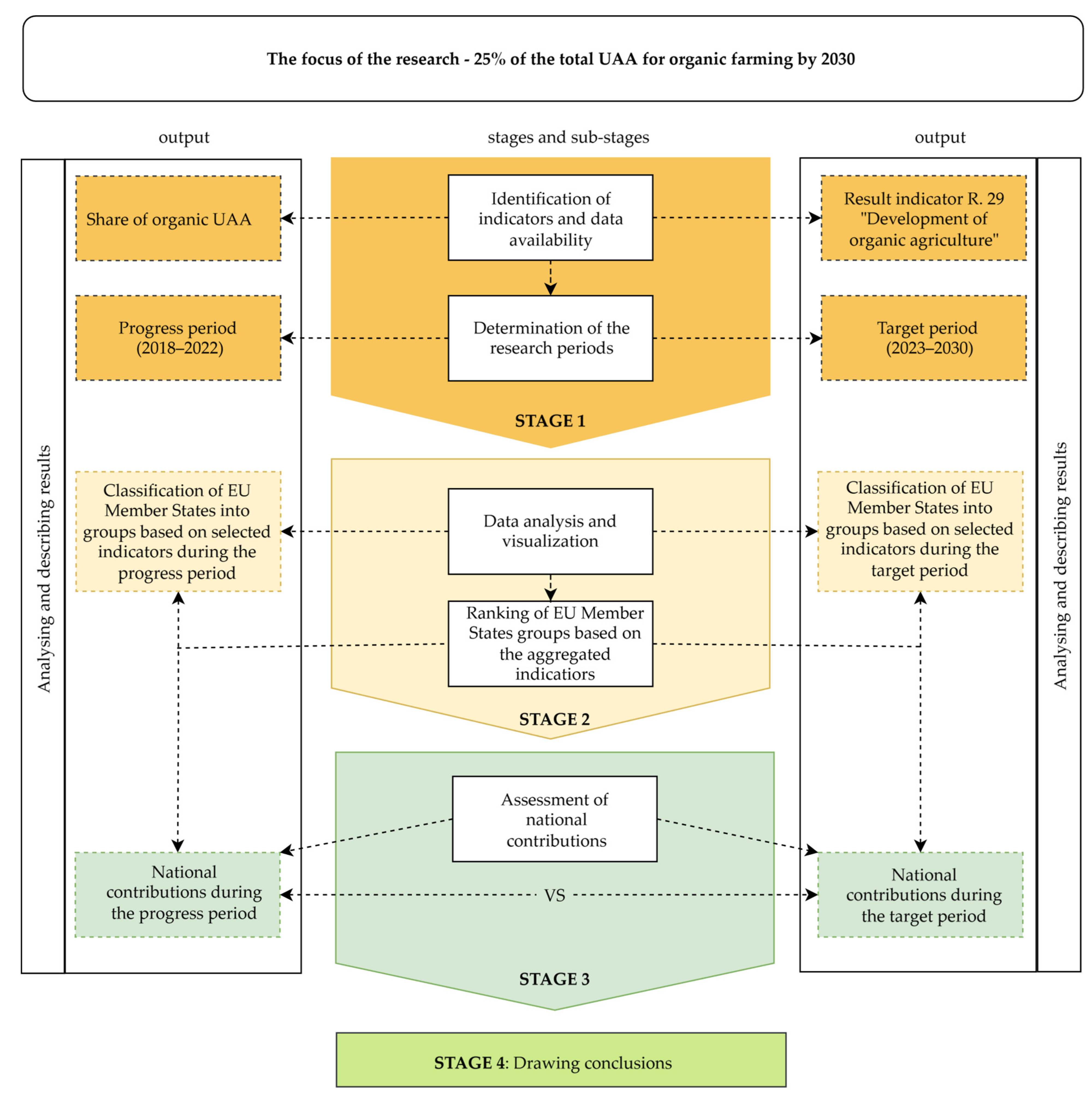
To achieve the research aim, a methodological framework was designed (Figure 1) and the following specific research tasks were set: (1) examining the overall situation in organic farming areas in the EU and (2) assessing the contributions of EU Member States to achieving the EU Green Deal target regarding organic farming areas defined by the F2F strategy, both during the progress period and for the target period.
In the first stage, the research identified indicators and their availability, which correspond to the target set by the F2F strategy and were selected for the study. The research used the indicator “Share of utilised agricultural area (UAA) under organic farming (%)”. To achieve the F2F aims, it is necessary for 25% of the total farmland to be used for organic farming by 2030 [26]. The selected statistical indicator was complemented by a result indicator from the CAP National Strategic Plans (SPs) for 2023–2027.
On 6 December 2021, the European Parliament and the Council of the European Union adopted Regulation (EU) 2021/2115, establishing the contribution monitoring and evaluation framework that applies to the CAP from 2023 until 2027 [28,29]. This new contribution-oriented implementation framework prescribes several common contribution indicators for EU Member States, including result indicators, which will be used to monitor the Member States’ progress towards pre-set targets. The CAP legislation includes 44 result indicators related to specific objectives. Not all 44 targets are included in each Member State’s CAP SP. The objectives consider needs and planned measures adopted at the national level [28]. The objective set by the F2F strategy to increase the area under organic farming is R.29 “Development of organic agriculture”, which defines the share of UAA supported by the CAP for organic farming, with a split between maintenance and conversion. The EU-27 average target value for the R.29 result indicator in 2027 is 10%, supported by CAP funding [30], and this is significantly higher than the 5.6% value in 2020 [27].
The region examined by the research covers 27 EU Member States, including Austria (AT), Belgium (BE), Bulgaria (BG), Croatia (HR), Czech Republic (CZ), Cyprus (CY), Denmark (DK), Estonia (EE), Finland (FI), France (FR), Germany (DE), Greece (EL), Hungary (HU), Ireland (IE), Italy (IT), Latvia (LV), Lithuania (LT), Luxembourg (LU), Malta (MT), the Netherlands (NL), Poland (PL), Portugal (PT), Romania (RO), Slovakia (SK), Slovenia (SI), Spain (ES), and Sweden (SE). In the case of Belgium, there are two CAP SPs for the regions of Wallonia and Flanders; therefore, the forecast indicators were analysed for each region.
The contributions of EU Member States were assessed for two periods, namely (1) the progress period (2018–2022) and (2) the target period (2023–2030).
In the second stage, EU Member States were classified into groups based on selected indicators. During the progress period, Member States were classified based on the two differentiation indicators, (1) the share of the organic farming area in 2022 (%) and (2) the rate of change in the share of organic farming area from the base year (2018) during the progress period (%). The rate of change from the base year (increase/decrease) (%) over the progress period was calculated using Equation (1):
t n ( b ) =   y n y 1 × 100 100
In Equation (1), tn(b) is the rate of change from the base year (%), yn is the value at the end of the progress period, and y1 is the value at the beginning of the progress period.
For the target period, EU Member States were grouped using two differentiation indicators, namely (1) the average annual rate of change over the target period and (2) result indicator R.29 set by the CAP SP of the respective EU Member State for 2023–2027, which represents the current policies, future lines of action, and the political ambitions of national governments in achieving the goal. Although the programming period ends in 2027, the impacts of the implemented measures will be visible until 2030.
Since indicator-based trends observed in previous years do not indicate the current and future context, only the past context [31], the average annual rate of change was calculated for the statistical indicator for both the progress period (2018–2022) and for the target period (2023–2030). The average rate of change (%) shows the average development intensity of the phenomenon examined, indicating the number of times the average levels of the time series have changed per unit of time. It was calculated using Equation (2):
t ¯ ( p ) = y n y 1 n 1 × 100 100
In Equation (2), t ¯ ( p ) is the average annual rate of change (increase/decrease), yn is the time series indicator value at the end of the period, y1 is the time series indicator value at the beginning of the period, and n is the number of time series levels.
The average annual rate of change over the target period (B) was compared with the average annual rate of change over the progress period (A) to determine whether the pace of change should be increased, decreased, or maintained in the future. A potential increase in the pace in the future would mean the need for changes in the current policies and actions to be taken by the respective Member State.
The following estimate was made to interpret the required rate of change: for (B − A) < –4%, the achievement is considered probable; for –4% ≤ (B − A) < –2%, it is feasible; for –2% ≤ (B − A) < 0%, it is uncertain; for 0% ≤ (B − A) < 2%, it is difficult; for 2% ≤ (B − A) < 4%, it is very difficult; and for (B − A) ≥ 4%, it is improbable [32].
The indicator values achieved by EU Member States were compared with the EU-27 average, which allowed the Member States to be classified into four groups based on each differentiation indicator, namely (1) above the EU average and (2) below the EU average. Assigning group ranks was based on the aggregated indicator [33]. To compare different data and have a uniform scale for analysis, the indicators were standardised by the zero unitarization method [34]. Given that the parameters selected for the research were both stimulants or indicators that had a positive impact on the phenomenon examined and a de-stimulant or indicator that negatively impacted the phenomenon [34], Equations (3) and (4) were applied for the standardisation:
z i j = x i j m i n x i j i max x i j i m i n x i j i ,   f o r   s t i m u l a n t s
z i j = max x i j i x i j max x i j i m i n x i j i ,   f o r   d e - s t i m u l a n t s
In Equations (3) and (4), zij is the normalised value of the j-th variable in the i-th Member State, xij is the initial value of the j-th variable in the i-th Member State, min(xij)i is the minimum value of xij, max(xij)i is the maximum value of xij.
Since the normalised values were in the range of 0–1, the average normalised value was calculated for each Member State both for the progress period and for the target period. Using the average normalised value found for each Member State, the average aggregated indicator value for each group was calculated based on which group rank was assigned. The closer the aggregated indicator value was to 1, the higher the group rank was.
A colour-coded visualisation allows Member States’ achievements to be compared with the EU-27 average. It shows whether a given Member State’s indicator value is higher, equal (±15%), or lower than the EU average.
The ±15% threshold was selected as a methodologically robust and balanced criterion to assess whether a Member State’s indicator significantly diverged from the EU average. This threshold accounts for statistical variability, measurement uncertainty, and cross-country methodological discrepancies, while preserving sufficient sensitivity to detect substantively significant deviations. Comparable thresholds are frequently employed in policy analysis [35] and comparative research [36,37] to distinguish meaningful differences without overreacting to minor or incidental variations.
The authors of the present research interpreted national performance as follows:
  • Strong contribution—the contributions of Member States were high compared with average, i.e., the national contribution was superior (the average value of the aggregated indicators is >0.65);
  • Contribution parity—the contributions of Member States were average (the average value of the aggregated indicators is ≥0.5 and ≤0.65);
  • Limited contribution—the contributions of Member States were below average (the average value of the aggregated indicators is ≥0.35 and <0.5);
  • Insufficient contribution—the contributions of Member States were low (the average value of the aggregated indicators is <0.35).
In the third stage, the contributions of Member States during the progress period as well as the target period were compared to identify changes in national contributions, such as (1) whether the Member State’s contribution improves; (2) whether the Member State’s contribution deteriorates; or (3) whether the Member State’s contribution is stable.
In each stage, the research analysed the indicator values calculated and described the results. Ultimately, the main conclusions and proposals were formulated.
The research used information and indicators from Eurostat [30,38], the European Commission [39], and the Horizon Europe project OrganicTargets4EU database for Austria for 2021 and 2022 [40].

3. Results

This chapter analyses the situation and the areas being used for organic farming in the EU, and it also performs a comprehensive and detailed assessment of the contributions of EU Member States to achieving the EU Green Deal target in organic farming defined by the F2F strategy, both in the progress period and the target period.

3.1. Situation of Organic Farming in the EU

The area being used for organic farming in the EU has been steadily increasing since 2012, owing to the high demand for organic products and policy support. In 2022, 16.8 million ha or 10.5% of the total UAA (160 million ha) was organically managed in the EU, which is 3.9 million ha more than in 2018 (Table 1). The largest absolute increases in organic area in 2022 were reported in France (+787 thousand ha), Portugal (+547 thousand ha), Greece (+432 thousand ha), Spain (+429 thousand ha), Germany (+410 thousand ha), Italy (+392 thousand ha), and Romania (+318 thousand ha) compared to 2018. In total, four EU Member States—France, Germany, Italy, and Spain—had the largest proportion of organic areas, at 9.5 million ha or 56% of the total EU. The smallest organic areas have been reported in Malta, Cyprus, and Luxembourg, which had a small but stable or slightly growing organic area, yet their impact on the EU total was negligible. Less than 1% of the total organically managed land in 2022 was reported in nine EU Member States (BE, BG, HR, CY, IE, LU, MT, NL, and SI).
In Portugal, Greece, and Romania, organically managed areas showed significant increases with +2.9%, +1.7%, and +1.3% in share growth of the EU total, respectively. In contrast, the largest decreases in the share of the EU total in 2022 compared with 2018 were found in Spain (−1.5%), Italy (−1.2%), and Sweden (−1.2%). However, despite a decline in the share of the EU-27 total, in Italy and Spain, the total organic area increased. The only EU Member States where the area of organic agricultural land decreased were Bulgaria and Sweden.
Overall, there was a steady increase in areas for organic farming in the EU-27; however, in several Member States, the share of organic area in the total agricultural area was negligible or even tended to decrease.
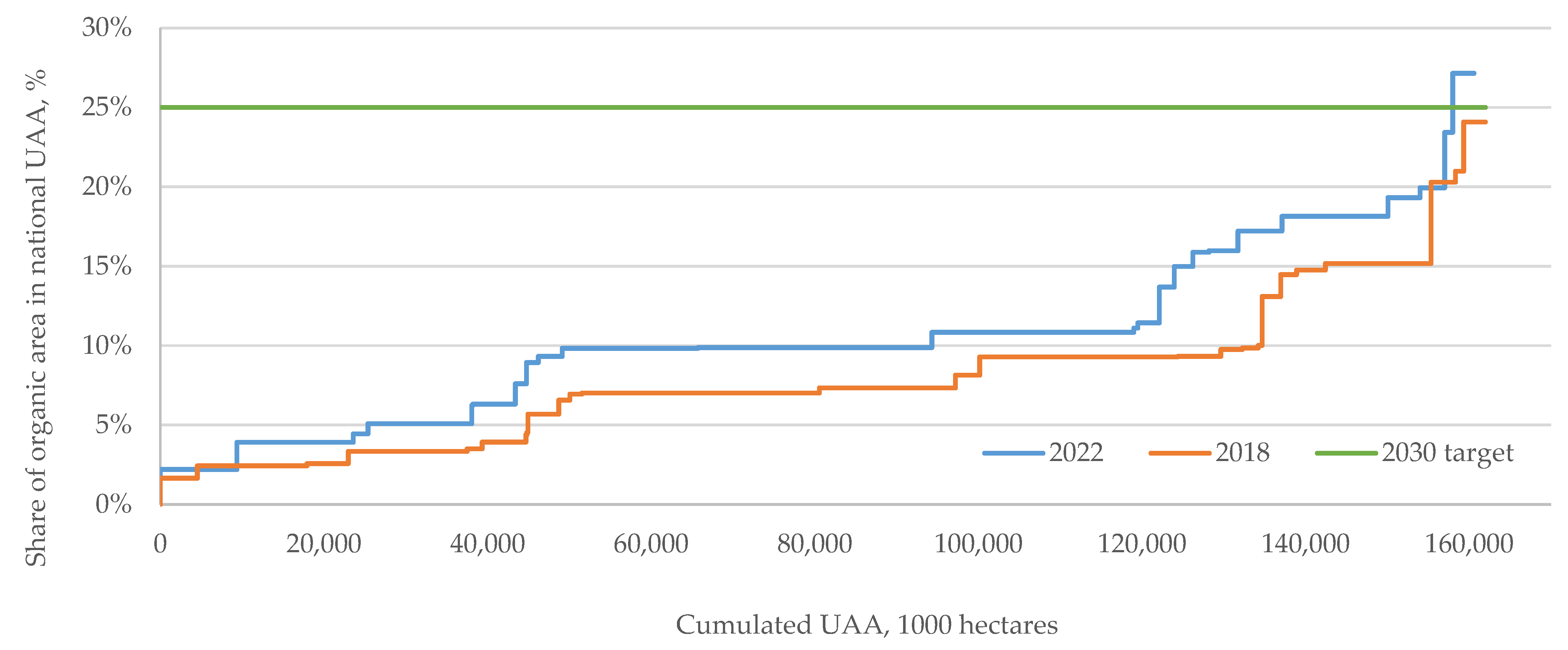
Member States with the largest utilised agricultural area have the most potential to increase the EU’s total organic agricultural area, as a one percentage point change in the share of organic agricultural area in these countries has a larger marginal effect on the EU’s total organic agricultural area (Figure 2). Figure 2 shows precisely that countries like Austria and Estonia, which are on the right end of the graph at nearly 25% of share of organic land, have very small UAA in the EU total. Therefore, their absolute contribution to the EU’s 25% target is minimal, even if they achieve a 25% national contribution. The area between the green line and the 2018 or 2022 lines indicates the amount of organic area still required to reach the EU’s total target. Small countries can contribute only a small amount to achieving the EU’s total target.
It should be noted that the F2F strategy’s target of increasing the area under organic farming to 25% of the UAA by 2030 is not differentiated between Member States. This means that there is no different approach to achieving this target, regardless of the current organic land area of a Member State. Similarly, the target for organic farming set in the CAP Strategic Plans is expressed in relative values (percentages) and not in absolute hectares. It is therefore clear that the European Commission and the Member States have agreed on a single target of 25% of the total UAA for organic farming by 2030 for all Member States, regardless of their initial situation or their total land area in hectares.

3.2. Assessment of Contributions of EU Member States Towards Achieving EU Green Deal Target in Organic Farming Defined by F2F Strategy in Progress Period

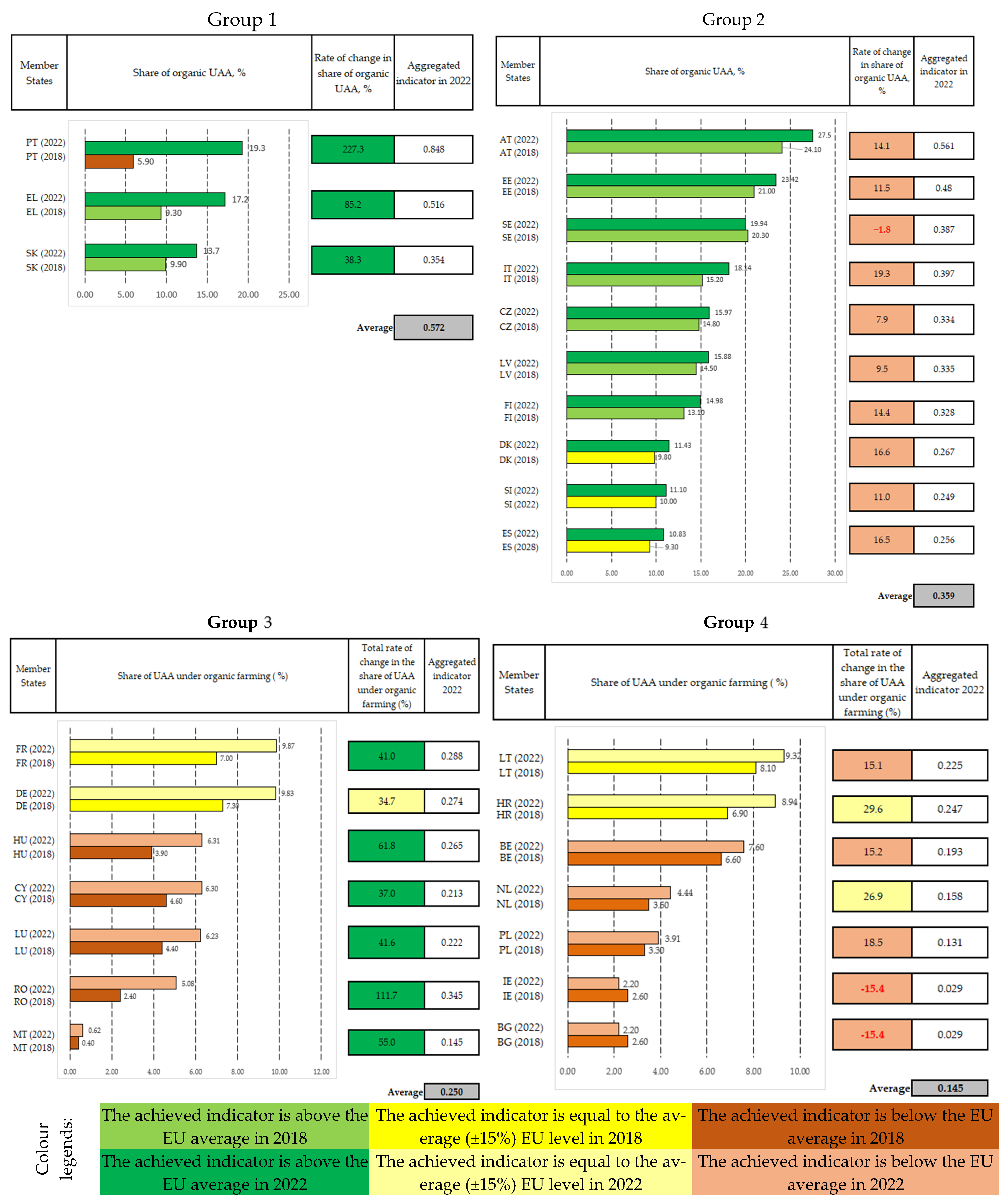
Although the share of organic area in the EU has steadily increased by an average of 7% per year (EU-27) between 2018 and 2022, the share of organic area varied significantly at the Member State level, ranging from 0.62% in Malta (2022) to 27.5% in Austria (2022) (Figure 3).
To assess the performance of Member States during the progress period regarding the target of 25% of the total EU agricultural area under organic farming by 2030, Member States were classified into four groups based on the two differentiation indicators described in the research methodology (Figure 3).
Group 1 included three Member States, Portugal, Greece, and Slovakia, whose proportion of organic farming areas in 2022 was higher than the EU-27 average (>10.5%), and the rate of change in the share of organic farming area during the progress period was higher than the EU-27 average (>31.3%). Among the Member States from Group 1, Portugal should be highlighted, as its share of organic farming area increased by 227%, or from 5.9% in 2018 to 19.3% in 2022. The colour-coded visualisation also demonstrates that in 2018, the share of organically managed areas in Portugal was lower than the EU-27 average; however, in 2022, it was above the EU-27 average. This can be attributed to the support measures implemented in Portugal, which resulted in a nearly tenfold increase in the area used for organic farming during the “conversion process” between 2020 and 2022 [41].
Group 2 included ten EU Member States, with the share of organic farming area being above the EU-27 average in 2022 (>10.5%) and the rate of change in the share of organic farming area during the progress period being lower than the EU-27 average (<31.3%). In Group 2, the share of organic farming area in 2022 ranged from 10.83% in Spain to 27.5% in Austria, which was above the EU target for 2027. Estonia also had a high share of organic farming area (23.42% in 2022). Analysing of the rate of change in the share of organic farming area in Group 2 over the progress period revealed that the rate of change ranged from a decrease of 1.8% in Sweden to an increase of 19.3% in Italy.
Group 3 includes seven Member States, with the rate of change in the share of organic farming during the progress period being higher than the EU-27 average (>31.3%). It ranged from 34.7% in Germany to 111.7% in Romania. Despite the high rates of change, the share of organic UAA was lower than the EU-27 average. This ranged from 0.62% in Malta to almost 10% in France and Germany. The colour-coded visualisation demonstrated that the share of organic area in France and Germany was close to the EU average (EU average ± 15%).
Group 4 included seven Member States where the share of organic UAA in 2022 was lower than the EU-27 average, ranging from 2.2% in Bulgaria and Ireland to 9.32% in Lithuania, and the rate of change in the share of organic area was lower than the EU-27 average over the progress period (<31.3%). In two Member States, Bulgaria and Ireland, the rate of change in the share of organic farming area was negative during the progress period, meaning that the share in both Member States decreased from 2.6% to 2.2%. Among the Member States from Group 4, Croatia and the Netherlands should be highlighted, as their rates of change could be compared to the EU average (EU average ± 15%), as well as Lithuania and Croatia, as their shares of organic farming can be compared to the EU average (EU average ± 15%).
The research results revealed that during the progress period, Group 1’s performance regarding the target was the highest among the EU Member States; however, the average value of the aggregated indicator (0.572) for this group could be interpreted by the authors as above average rather than high. Therefore, the authors rate Group 1’s performance of as performance parity, not performance opportunity. The value of the average aggregated indicator (0.359) for Group 2 could be interpreted as below the average level; therefore, of Group 2’s performance could be rated as limited. The authors interpret the performance of Groups 3 and 4 (average aggregated indicator values of 0.250 and 0.145, respectively) as low, so the performance of the EU Member States in both groups was insufficient during the progress period.

3.3. Assessment of Contributions of EU Member States Towards Achieving EU Green Deal Target in Organic Farming Defined by F2F Strategy in Target Period

To assess the performance of Member States over the target period regarding the target of 25% of the total EU agricultural area used for organic farming by 2030, the Member States were grouped based on two differentiation indicators, namely (1) the average annual growth rate needed to reach the target by 2030 and (2) the national CAP SP performance indicator R.29 (development of organic agriculture).
Based on the above indicators, the Member States were classified into three groups (1, 2, and 4); no EU Member State was classified in Group 3.
Table 2 shows that Group 1 includes Member States whose average annual growth rate towards the target in 2023–2030 can be reduced compared with the average annual growth rate achieved over the progress period, which means that if the policies and activities implemented so far are continued, there is a high probability that Portugal and Greece will reach the 25% target. Both EU Member States can significantly reduce their average annual growth rate in 2023–2030 by 31.22 percentage points and 11.88 percentage points, respectively. Austria should also be highlighted, as it has already achieved the target set by the EU during the progress period (2019) and has set a national target of 30% organic UAA for 2030. Italy, however, has set a target of 25% of the total agricultural area used for organic farming by 2027. Slovakia has set a national Green Deal target of 14% reported in its SP, which is significantly behind the EU target, and according to Eurostat data [38], the share of organic farming in Slovakia in 2022 was 13.69%, meaning that the target set was close to the level in 2022. The other Member States from Group 1 have not set a national Green Deal target in their CAP Strategic Plans. This shows that the Member States lack ambition to achieve this target, despite the good promising results achieved during the progress period. The ability of Estonia, Slovakia, and Italy to achieve the target was rated by the authors as “uncertain”.
Actions taken by the Member States were essential to achieve the 25% organic farming target defined by the European Green Deal F2F strategy, which required the Member States to set a CAP SP target for organic farming for the period 2023–2027. At the EU level, approximately 10% of the total utilised agricultural area is expected to receive CAP support for organic farming in 2027, i.e., the area will double compared with 2020 [27], yet there are differences between the Member States. Among those from Group 1, Austria and Estonia should be highlighted, as their CAP SPs envision support for organic farming for more than 20% of the total UAA, whereas for others, this figure is below 20%.
Group 2 (Table 3) included Member States where the average annual growth rate for achieving the target in 2023–2030 needs to be increased compared with the average annual growth rate achieved during the progress period. The increase in the average annual growth rate to be achieved in 2023–2030 ranged from 3.20% points for Finland to 12.46% points for Belgium in the Wallonia region. Based on the data, it could be concluded that if the policies and activities implemented so far continue, the Member States will not come close to the 25% target defined by the F2F strategy. Therefore, the possibilities of achieving the target are rated by the authors as “very difficult” (CZ, FI, LV, SE, and FR) and “improbable” (LU, BE (Wallonia), SI, DK, LT, HR, and DE). The result indicator R.29 for Group 2 was above the EU-27 average, ranging from 21.28% in Czechia to 11.71% in France, which was a positive outcome.
Group 3 can reduce the average annual growth rate towards the target over the target period compared with that over the progress period. Their result indicator R.29 values were below the EU-27 average, and this group was not singled out because no Member State qualified for both indicators.
Group 4 (Table 4) included Member States where the average annual growth rate towards the target in 2023–2030 needs to be increased compared with that in the progress period. The annual growth rate target ranged from 1.4% points for Romania to 47.2% points for Malta. Based on the data, it could be concluded that, by continuing the policies and activities implemented so far, Group 4 will not reach the 25% target defined by the F2F strategy, except Romania, whose future potential to achieve the target is positive. For Group 4, the result indicator R.29 was below the EU-27 average, ranging from 2.54% for Malta to 8.95% for Cyprus. It is positive that most of the Member States from Group 4 had national European Green Deal targets for organic farming, yet at the same time their ambitions were low, ranging from 5% for the region of Flanders and Malta to 20% for Spain, which was a significantly lower target compared with that set by the F2F strategy. Only the Netherlands and Romania did not set national targets.
The calculated average indicator values revealed that in the target period, Group 1’s the performance regarding the target was high, as the average aggregated indicator value for the group was 0.723 (strong performance). Group 2’s performance was above average (performance parity) (average aggregated indicator value for the group was 0.581). Group 4’s performance was low (insufficient performance), and this was indicated by the value of the average aggregated indicator at 0.235.

3.4. Summary of Assessment of the Contributions of EU Member States Towards Achieving EU Green Deal Target in Organic Farming Defined by F2F Strategy in Both Periods

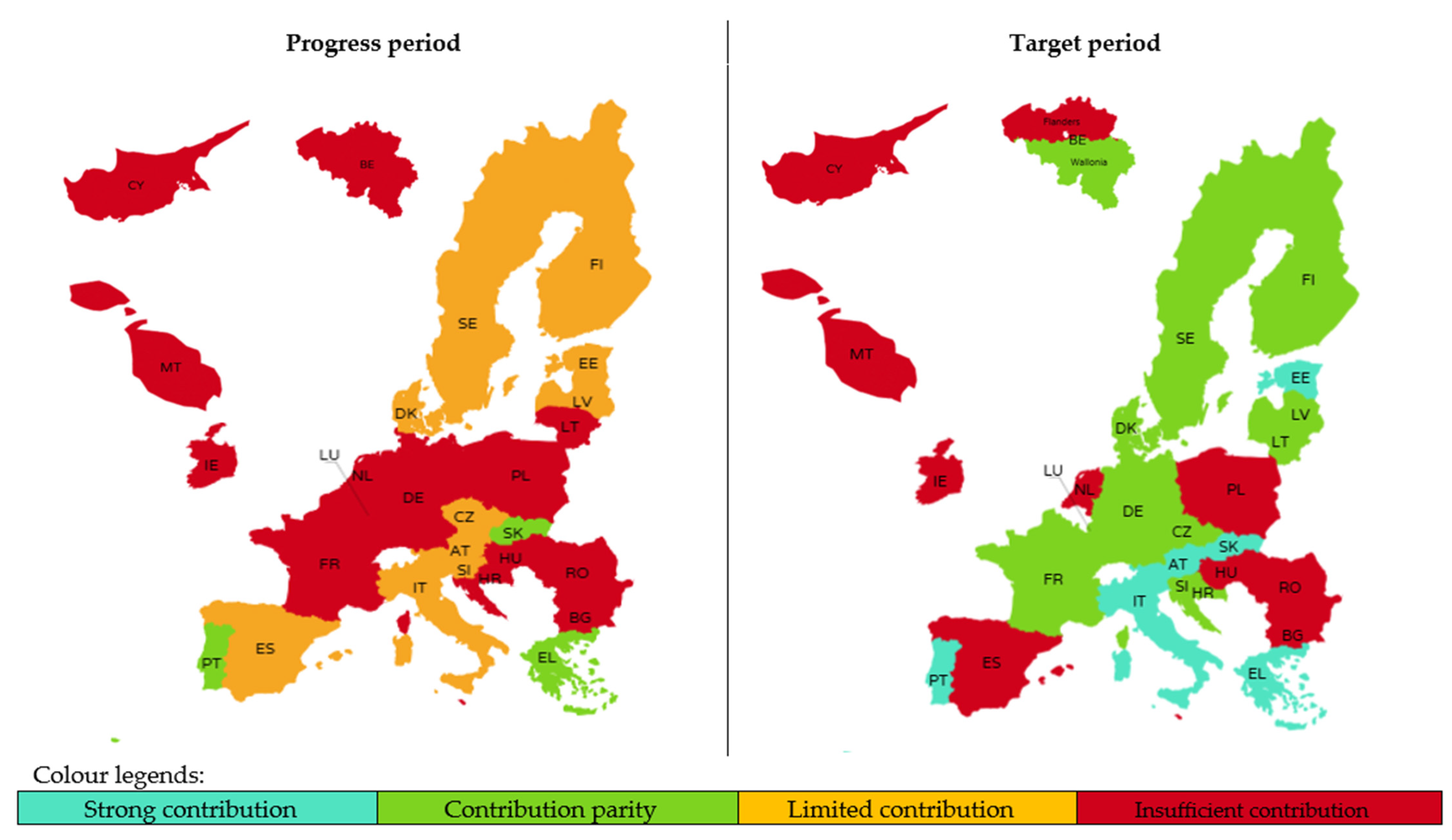
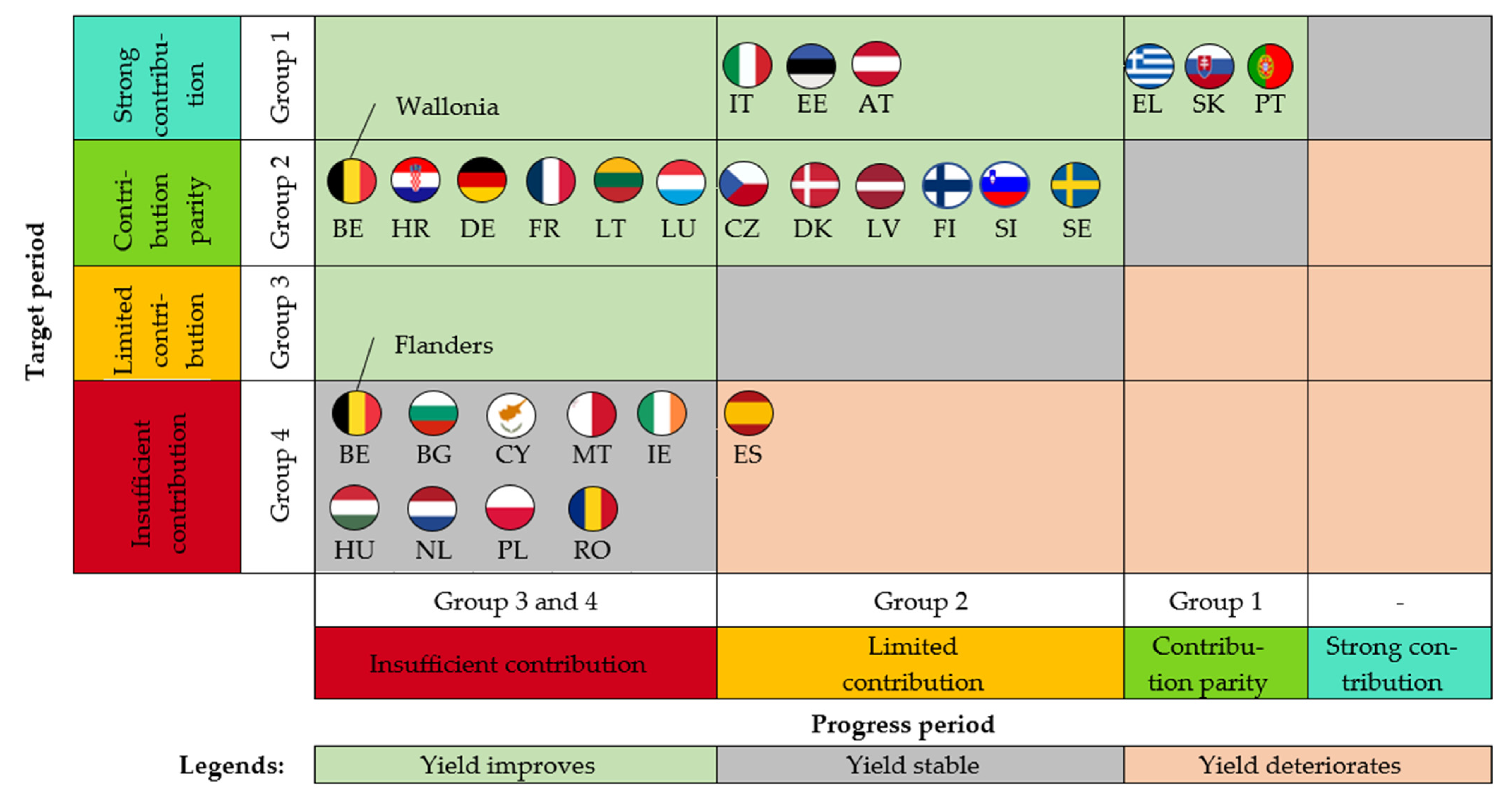
A spatial summary of the performance of EU Member States and their changes to achieve the target defined by the F2F strategy—at least 25% of the EU’s agricultural land being used for organic farming by 2030—is presented in Figure 4.
Figure 5 presents a summary of the changes in the performance of EU Member States to achieve the target of at least 25% of the EU’s agricultural land being used for organic farming by 2030, as outlined in the F2F strategy. The summary indicates that performance improved in seventeen Member States (PT, SK, EL, AT, EE, IT, SE, SI, FI, LV, DK, CZ, LU, LT, FR, DE, and HR) and the Wallonia region of Belgium, remained stable in eight Member States (BG, CY, MT, IE, HU, NL, PL, and RO) and the Flanders region, and deteriorated in only one Member State (ES).

4. Discussion

4.1. Drivers and Impacts of Organic Farming Expansion in EU

This research found that in the EU between 2018 and 2022, organically managed areas increased by 30% or 3.9 million hectares, which aligns with the findings of other scientists. For example, Doorn & Verhoef (2011) have emphasised that the growing consumer demand for sustainably produced food, combined with an understanding of the environmental and health impacts of conventional farming, has led to a significant increase in the uptake of organic farming techniques in all EU Member States [42]. Mughal et al. (2021) have concluded that this transition to organic farming is driven by a combination of factors, including widespread media coverage and a growing consumer awareness of environmental and animal welfare issues, as well as awareness of the consequences of environmental pollution, global warming, and depletion of natural resources [43].
The authors concluded that, during the target period, six countries are expected to make a substantial contribution to increasing organic agriculture areas, building on what was already achieved in the progress period (PT, SK, EL, AT, IT, and EE) (Figure 4). Therefore, it is necessary to study the good practices of these countries. It is worth noting that the expansion of organic farming is further facilitated by the introduction of support policies and financial incentives at both the national and European levels [16], which encourage farmers to transition from conventional to organic farming systems. National support for organic farming is particularly emphasised in Portugal [41], which combined with different agro-ecological conditions and historical dependence on agriculture is conducive to the rapid growth of organic farming [44]. Austria is one of the leaders in organic farming in Europe thanks to an early organisational culture. The organic farming movement began in the 1920s and 1930s, later developing with targeted state support and strong market integration through supermarkets [45]. Lakner et al. (2015) [46] note that since Austria joined the EU in 1995, its agricultural policy has been closely tied to the CAP. Within it, 32 groups of support measures are dedicated to the agri-environment, of which support for organic farming is one of the most significant. A European Commission (2023) study found that more than half of organic farms in Austria are engaged in livestock farming, which is determined by the fact that 64% of agricultural land is considered to be areas with natural constraints [47]. Zollet S. (2024) [48] stresses that Italy is one of the leaders in the EU in terms of the number of organic farms and the area of organic agricultural land. This is because it has been able to position organic farming as a tool for revitalising rural areas and supporting the survival of small farms, utilising the CAP’s rural development funding. The adoption of organic farming in Italy is driven by farmers’ attitudes towards the social and environmental sustainability of this production method [49]. In Slovakia, organic farming is also developing with the support of the CAP measure “Organic Farming”, which was the most widely used sub-measure within the framework of the “Agri-environmental payments” measure from 2007 to 2011 [50]. Kozáková et al. (2014) point out that the structure of farms in Slovakia differs from that in other EU Member States, mainly in terms of the size of UAA per farm, as farms with more than 500 hectares manage almost 80% of the total UAA, and they show practically the same indicators as conventional farms [51]. In Estonia, organic farming began in 1989, and by 2022, the area used for this continued to increase. The number of organic farms remained stable, while the average size of organic farms continued to grow, reaching 114 ha. Additionally, 22 farms exceeded 1000 ha. The processing and trade of organic products also increased slightly, with growth in traditional stores, and support was provided for their use in schools and kindergartens. Education and awareness-raising activities in educational institutions, open days on farms, and export promotion activities were of significant importance. A national map of organic farming has been created and is regularly updated, making it publicly available online [52]. In Greece, organic farming began to develop in the early 1980s, mainly thanks to the activities of the private sector in the economy, which primarily covers the costs (inspection, processing, marketing, etc.) [53]. However, Argyropoulos et al. (2013) note that organic farming has been significantly promoted in Greece since 2004 with the provision of subsidies to farmers [54]. Therefore, we can conclude that, in all the countries that have made significant progress in expanding the area of organic farming, government policies, particularly the CAP and its support payments, have played a crucial role Peng (2019) [55] has a similar opinion, noting that the increasing popularity of organic farming and its products is driven by both market demand and subsidies, which are financially helpful both locally and internationally, due to the associated trade and employment opportunities. Rocchi et al. (2021) [56] have acknowledged that the expansion of organic farming in the EU can be characterised by a significant increase in the total area used for organic agriculture. This growth is not just a compilation of statistical data but represents a fundamental change in agricultural practices, reflecting farmers’ growing commitment to the environment and sustainable resource management.

4.2. Barriers, Disparities, and Policy Challenges

However, some scientists have recognised that there are many challenges in the transition to organic farming. Although some research studies show comparable costs between the two agricultural practices (conventional and organic), labour costs in organic farming can be significantly higher [7]. One of the main obstacles comprises lower yields in organic farming compared to conventional farming, especially during the first years of transition. However, many organic farmers also use modern equipment, better crop varieties, and practices of preserving soil and water. Overcoming the challenges requires a concerted effort by farmers, researchers, policymakers, and consumers to support the development and uptake of innovative organic farming technologies and practices [8]. Organic farming assumes zero use of synthetic pesticides. For many crop producers and agronomists who currently rely on well-established and scalable conventional crop production technologies, the financial implications of reducing pesticide use could be substantial. This significantly hampers the acceptance of organic farming, especially in cereal and oilseed production [57].
Several problems and obstacles hinder the uniform implementation of organic farming practices across all EU Member States. The current situation in organic farming varies considerably across the EU, as evidenced by the authors’ research, which classified the Member States into groups by area used for organic farming in the historical development period (2018–2022) and future ambitions (2030). This revealed that, on average, a significant part of agricultural land (10.5% of the total in 2022) was managed organically in the EU. However, there are disparities among EU Member States. The lowest share of organic farming was found in Malta at only 0.6% of UAA. In contrast, the highest share was found in Austria at 27.5%, which showed different practices implemented so far to achieve the F2F strategy target set by the European Green Deal, i.e., at least 25% of UAA being used for organic farming by 2030. Crowder & Reganold (2015) have emphasised that economic factors are crucial, as the transition to organic farming could be costly for farmers, including investments in new equipment, training, and certification [7]. In addition, consumer demand for organic products, although growing, varied across the EU, which could have a significant impact on the economic viability of organic farming in some regions. Shortcomings in policy implementation, as well as inconsistencies in the application of EU legislation, further complicate the situation, as do differences in eligibility criteria for national support for organic farming [21]. Managing agricultural sustainability is a complex problem with emerging challenges, fundamental institutional modernisation, and a lack of long-term data [15]. Furthermore, issues such as imperfect legal frameworks and insufficient support measures for organic producers can hinder an increase in organic areas [58], as organic farming is a voluntary production system. It is therefore essential to understand the obstacles and drivers to its implementation, with scientific evidence playing an important role [59].
The feasibility of individual EU Member States to achieve the target of 25% of the total UAA being used for organic farming by 2030 set by the F2F strategy is affected by the complex interactions of factors, including the current state of organic agriculture in the Member State, the level of support provided to farmers for the transition to organic farming, consumer demand for organic products, and general policies and regulatory frameworks. The Member States with a strong organic farming industry, supportive policies, and high consumer demand are more likely to achieve the target, while those facing economic constraints, policy gaps, and limited access to the organic market might struggle to achieve the target. For example, those with established organic certification institutions and well-developed organic farming legislation are in a better position to support the expansion of organic farming [60]. In addition, the Member States need to consider the availability of technical assistance and training programmes for farmers to facilitate the transition to organic farming. Policy measures are required to improve production technologies, management procedures, and the viability of rural communities, while increasing the resilience of farms [61].
Fostering organic farming effectively in the EU requires a multifaceted scientific approach encompassing advances in soil health management, pest and disease control, and optimised crop and livestock production techniques [62]. Innovative techniques, e.g., biological preparations that contribute to degrading crop residues, have become a key area and are in line with the objectives of the European Green Deal, encouraging sustainable agricultural practices and reducing the use of pesticides [63]. Therefore, joint efforts between sectoral politicians, farmers, scientists, and other stakeholders are needed to implement the latest scientific findings into the prerequisites for environmentally friendly farming practices. These findings can also be used to determine how to deal with economic, social, and environmental problems related to organic farming to achieve the targets set by the European Green Deal by 2030, not only in the Member States that already have established good traditions for organic agriculture and classified by the present research into Groups 1 or 2 but also in the others. It is therefore necessary to continue assessing how and whether EU Member States are achieving the target set by the F2F strategy for increasing the area of organic farming.

5. Conclusions

The increase in organic farming areas in the EU over the last decade marks a systemic transition towards more sustainable farming practices. In 2022, the organic area in the EU reached 16.8 million ha or 10.5% of the total UAA. The increase was driven by both the demand for organic products and targeted policy support.
At the national level, the shares of organic farming and growth rates varied significantly. France, Portugal, Greece, Spain, Germany, Italy, and Romania have been the main drivers of the expansion of organic areas, with significant increases between 2018 and 2022. However, only a few Member States, e.g., Austria (27.5%) and Estonia (23.4%), have already reached or come close to the target of 25% of the EU’s agricultural land being used for organic farming set by the European Green Deal F2F strategy.
The performance of Member States was analytically assessed by applying two different classification approaches, with one based on historical growth and the other encompassing the need for future development to achieve the target. The indicators allowed Member States to be classified into several groups.
By historical performance (2018–2022): (a) Group 1 showed a high share of organic area in the total UAA and a rapid increase in the organic area was found in Portugal, Greece, and Slovakia; (b) Group 2 had a high share, but a lower increase over the analysis period included Austria, Estonia, Spain, and Italy, which were close to the target set by the F2F strategy, but the growth rate tended to decrease; (c) Group 3 had a share of organic area below the EU average but rapid increases occurred in Germany, France, Romania, and others, which are areas with great potential but which need to continue to grow; (d) Group 4 had a share of organic area below the EU average, and areas with low growth rates included Bulgaria, Ireland, Lithuania, and others, where achieving the target set by the F2F strategy was at risk. The calculated aggregated indicator values showed that Group 1 had better performance than other EU Member States, was rated as “above average” rather than “high”, and was classified as performance parity. Group 2 had below average performance that was considered limited. However, Group 3 and Group 4 had low and insufficient performance to achieve the F2F target.
By prospects (2023–2030): (a) Group 1’s growth rates could be reduced in Portugal, Greece, and Austria. The current government policies could be viewed as sufficiently effective; (b) in Group 2, it is necessary to increase the growth rate in Finland, Belgium, the Czech Republic, and France, where, without additional measures, the target of 25% of the total UAA being used for organic farming will not be achieved; (c) Group 4 had a significant increase in the organic area but areas with low national targets included Malta, Cyprus, the Belgian region of Flanders, and others, which were characterised by low results and low levels of political ambition until 2030. The research results revealed that Group the 1’s performance was high for the target period (strong performance). Group 2 had above average performance (performance parity), while Group 4 had low performance (insufficient performance).
Overall, although the EU Member States moved towards the target set by the F2F strategy, there were significant differences between them in terms of growth, political commitment, and targets set. The quality and ambition of the national CAP Strategic Plans are key to achieving the strategic targets of the European Green Deal by 2030. It is therefore necessary to continue examining what Member State practices and political commitments could accelerate the achievement of the target in the Member States where it is at risk, with a focus on building on and assessing the achievements of Austria and Portugal.
Some countries are progressing more than others towards the EU’s organic area targets. While differences can partly be explained by various local conditions, the variation in results among countries with similar climatic conditions suggests that national policies, not EU-level policies, are the main obstacle. Nevertheless, promoting a more results-oriented and targeted support framework from the EU could help facilitate progress.
Another important area for further research is the development of new, economically competitive, and scalable organic farming models, reducing the sector’s reliance on financial support, and decreasing dependence on consumers’ willingness to pay higher premium prices for organic products.

Author Contributions

Conceptualization, A.M. and I.P.; methodology, A.M.; software, A.M. and K.M.; validation, I.P., A.-H.V. and A.N.; formal analysis, A.M.; investigation, A.M. and I.P.; resources, A.N.; data curation, A.M. and I.P.; writing—original draft preparation, A.M. and I.P.; writing—review and editing, A.-H.V. and A.N.; visualization, A.M. and K.M.; supervision, A.N.; project administration, A.N.; funding acquisition, A.N. All authors have read and agreed to the published version of the manuscript.

Funding

The research was supported by the Ministry of Agriculture of the Republic of Latvia and the Latvian Science Council’s national research programme “Research and Sustainable Use of Local Resources for the Development of Latvia” for 2023–2025, scientific project No. VPP-ZM-VRIIILA-2024/1-0002 Science-based Solutions for a Sustainable Food System to Achieve the Goals of the European Green Deal (GreenAgroRes), and project “Forecasting of Agricultural Development and the Designing of Scenarios for Policies until 2050” (S511).

Institutional Review Board Statement

Not applicable.

Data Availability Statement

The data presented in this study are openly available in DataverseLV at https://dv.dataverse.lv/dataset.xhtml?persistentId=doi:10.71782/DATA/XDLJDQ (accessed on 4 July 2025).

Conflicts of Interest

The authors declare no conflicts of interest.

Abbreviations

The following abbreviations are used in this manuscript:
ATAustria
BEBelgium
BGBulgaria
CAPEuropean Union Common Agricultural Policy
CYCyprus
CZCzech Republic
DEGermany
DKDenmark
EEEstonia
ELGreece
ESSpain
EUEuropean Union
EU-27EU 27 Member States
F2FFarm to Fork Strategy
FIFinland
FRFrance
HRCroatia
HUHungary
IEIreland
ITItaly
LTLithuania
LULuxembourg
LVLatvia
MTMalta
NLThe Netherlands
NOAPNational Organic Action Plan
PLPoland
PTPortugal
RORomania
SESweden
SKSlovakia
SISlovenia
SPCAP National Strategic Plan for 2023–2027
UAAUtilised Agricultural Area

References

  1. Mandal, D.N. Organic farming: An ecofriendly way to sustainable agriculture. J. Agric. Environ. 2007, 8, 115–118. [Google Scholar] [CrossRef]
  2. Gamage, A.; Gangahagedara, R.; Gamage, J.; Jayasinghe, N.; Kodikara, N.; Suraweera, P.; Merah, O. Role of organic farming for achieving sustainability in agriculture. Farming Syst. 2023, 1, 100005. [Google Scholar] [CrossRef]
  3. Prousalidis, K.; Bourou, S.; Velivassaki, T.H.; Voulkidis, A.; Zachariadi, A.; Zachariadis, V. Olive Tree Segmentation from UAV Imagery. Drones 2024, 8, 408. [Google Scholar] [CrossRef]
  4. Jackson-Smith, D.B. Toward sustainable agricultural systems in the 21st century. Choice Rev. Online 2011, 48, 48. [Google Scholar] [CrossRef]
  5. Mulvaney, D.; Robbins, P. (Eds.) National Organic Program. In Green Food: An A-to-Z Guide; SAGE Publications, Inc.: Thousand Oaks, CA, USA, 2011. [Google Scholar] [CrossRef]
  6. Aslam, W. Factors affecting organic productions and its consumption approaches towards consumers: A case study of Punjab province. Asian J. Agric. Biol. 2020, 8, 274. [Google Scholar] [CrossRef]
  7. Crowder, D.W.; Reganold, J.P. Financial competitiveness of organic agriculture on a global scale. Proc. Natl. Acad. Sci. USA 2015, 112, 7611. [Google Scholar] [CrossRef]
  8. Uddin, M.N.; Bari, M.L. Governmental policies and regulations including FSMA on organic farming in the United States and around the globe. In Elsevier eBooks; Elsevier BV.: Amsterdam, The Netherlands, 2019; p. 33. [Google Scholar] [CrossRef]
  9. Lacour, C.; Seconda, L.; Allès, B.; Herzberg, S.; Langevin, B.; Pointereau, P.; Lairon, D.; Baudry, J.; Kesse-Guyot, E. Environmental impacts of plant-based diets: How does organic food consumption contribute to environmental sustainability? Front. Nutr. 2018, 5, 8. [Google Scholar] [CrossRef]
  10. Lemke, S.; Smith, N.; Thiim, C.; Stump, K. Drivers and barriers to adoption of regenerative agriculture: Case studies on lessons learned from organic. Int. J. Agric. Sustain. 2024, 22, 2324216. [Google Scholar] [CrossRef]
  11. Stein-Bachinger, K.; Gottwald, F.; Haub, A.; Schmidt, E. To what extent does organic farming promote species richness and abundance in temperate climates? A review. Org. Agr. 2021, 11, 1–12. [Google Scholar] [CrossRef]
  12. Choirun, A.; Santoso, I.; Astuti, R. Sustainability risk management in the agri-food supply chain: Literature review. IOP Conf. Ser. Earth Environ. Sci. 2020, 475, 12050. [Google Scholar] [CrossRef]
  13. Fess, T.L.; Benedito, V.A. Organic versus Conventional Cropping Sustainability: A Comparative System Analysis. Sustainability 2018, 10, 272. [Google Scholar] [CrossRef]
  14. Duquennoi, C.; Martínéz, J.A. European Union’s policymaking on sustainable waste management and circularity in agroecosystems: The potential for innovative interactions between science and decision-making. Front. Sustain. Food Syst. 2022, 6, 937802. [Google Scholar] [CrossRef]
  15. Bachev, H. Governance of agrarian sustainability-forms, efficiency and improvement. Adv. Plants Agric. Res. 2018, 8, 56–69. [Google Scholar] [CrossRef]
  16. Pilvere, I.; Nipers, A.; Pilvere, A. Evaluation of the European Green Deal Policy in the Context of Agricultural Support Payments in Latvia. Agriculture 2022, 12, 2028. [Google Scholar] [CrossRef]
  17. Papallou, E.; Katafygiotou, M.; Dimopoulos, T. Emerging Sustainability Trends in Tourist Facilities: A Comparative Assessment of Multiple Hotels and Resorts. Sustainability 2024, 16, 3536. [Google Scholar] [CrossRef]
  18. Rowan, N.J.; Casey, O. Empower Eco multiactor HUB: A triple helix ‘academia-industry-authority’ approach to creating and sharing potentially disruptive tools for addressing novel and emerging new Green Deal opportunities under a United Nations Sustainable Development Goals framework. Curr. Opin. Environ. Sci. Health 2021, 21, 100254. [Google Scholar] [CrossRef]
  19. Doran, N.M.; Bădîrcea, R.M.; Jianu, E.; Antoniu, M.; Ciobanu, R.M.G.; Ciobanu, Ș.C.F. Unveiling CO2 Emission Dynamics Under Innovation Drivers in the European Union. Sustainability 2025, 17, 3463. [Google Scholar] [CrossRef]
  20. Kowalska, A.; Bieniek, M. Meeting the European green deal objective of expanding organic farming. Balance. Q. J. Econ. Econ. Policy 2022, 17, 607–633. [Google Scholar] [CrossRef]
  21. Migliorini, P.; Wezel, A. Converging and diverging principles and practices of organic agriculture regulations and agroecology. A review. Agron. Sustain. Dev. 2017, 37, 63. [Google Scholar] [CrossRef]
  22. Magaudda, S.; D’Ascanio, R.; Muccitelli, S.; Palazzo, A.L. ‘Greening’ Green Infrastructure. Good Italian Practices for Enhancing Green Infrastructure through the Common Agricultural Policy. Sustainability 2020, 12, 2301. [Google Scholar] [CrossRef]
  23. Brodny, J.; Tutak, M. Analyzing Similarities between the European Union Countries in Terms of the Structure and Volume of Energy Production from Renewable Energy Sources. Energies 2020, 13, 913. [Google Scholar] [CrossRef]
  24. Turetta, A.P.D.; Bonatti, M.; Sieber, S. Resilience of Community Food Systems (CFS): Co-Design as a Long-Term Viable Pathway to Face Crises in Neglected Territories? Foods 2021, 10, 521. [Google Scholar] [CrossRef]
  25. Wang, G.; Wang, Y.; Li, S.; Yang, Y.; Li, C.; Shin, C.H. Sustainability in Global Agri-Food Supply Chains: Insights from a Comprehensive Literature Review and the ABCDE Framework. Foods 2024, 13, 2914. [Google Scholar] [CrossRef]
  26. European Commission. A Farm to Fork Strategy for a Fair, Healthy and Environmentally-Friendly Food System. COM(2020)381 Final. Brussels. 2020. Available online: https://eur-lex.europa.eu/resource.html?uri=cellar:ea0f9f73-9ab2-11ea-9d2d-01aa75ed71a1.0001.02/DOC_1&format=PDF. (accessed on 1 March 2025).
  27. European Commission. Replies of the European Commission to the European Court of Auditors’ Special Report ‘Organic Farming in the EU: Gaps and Inconsistencies Hamper the Success of the Policy’. 2024. Available online: https://www.eca.europa.eu/Lists/ECAReplies/COM-Replies-SR-2024-19/COM-Replies-SR-2024-19_EN.pdf (accessed on 1 March 2025).
  28. EUR-Lex. Regulation (EU) 2021/2115 of the European Parliament and of the Council of 2 December 2021 Establishing Rules on Support for Strategic Plans to Be Drawn up by Member States Under the Common Agricultural Policy (CAP Strategic Plans) and Financed by the European Agricultural Guarantee Fund (EAGF) and by the European Agricultural Fund for Rural Development (EAFRD) and Repealing Regulations (EU) No 1305/2013 and (EU) No 1307/2013. Available online: https://eur-lex.europa.eu/legal-content/EN/TXT/PDF/?uri=CELEX:32021R2115 (accessed on 3 March 2025).
  29. European Commission. Recommendations to the Member States as Regards Their Strategic Plan for the Common Agricultural Policy. COM(2020) 846 Final. Brussels. 2020. Available online: https://eur-lex.europa.eu/legal-content/EN/TXT/?uri=celex:52020DC0846 (accessed on 6 March 2025).
  30. European Commission. Result Indicators Dashboard. Available online: https://agridata.ec.europa.eu/extensions/DashboardCapPlan/result_indicators.html (accessed on 15 March 2025).
  31. European Environment Agency. European Union 8th Environment Action Programme: Monitoring Report on Progress Towards the 8th EAP Objectives 2023 Edition. EEA Report 11/2023. Available online: https://www.eea.europa.eu/en/analysis/publications/european-union-8th-environment-action-programme (accessed on 11 March 2025).
  32. Canali, M.; Aragrande, M.; Beber, C.L. The 2030 Veterinary Antimicrobial Sales Reduction Target in Europe: Where Are We? EuroChoices 2024, 23, 52–53. [Google Scholar] [CrossRef]
  33. Kasztelan, A. How Circular Are the European Economies? A Taxonomic Analysis Based on the INEC (Index of National Economies’ Circularity). Sustainability 2020, 12, 7613. [Google Scholar] [CrossRef]
  34. Nowak, A.; Kasztelan, A. Economic competitiveness vs. green competitiveness of agriculture in the European Union countries. Copernic. Econ. 2022, 13, 379–405. [Google Scholar] [CrossRef]
  35. Bardach, E. A Practical Guide for Policy Analysis: The Eightfold Path to More Effective Problem Solving, 4th ed.; CQ Press: Washington, DC, USA, 2011; Available online: https://justicepolicynetwork.com/wp-content/uploads/2021/03/Bardachs-Eightfold-Path-1.pdf (accessed on 7 March 2025).
  36. Lizinska, W.; Kisiel, R. Concentration of non-agricultural economic activity in Poland. Econ. Sci. Rural. Dev. 2019, 50, 124–131. [Google Scholar] [CrossRef]
  37. Muska, A.; Popluga, D.; Pilvere, I. Assessment of the concentration and structure of the bioeconomy: The regional approach. Emerg. Sci. J. 2023, 7, 60–76. [Google Scholar] [CrossRef]
  38. Eurostat. Organic Crop Area by Agricultural Production Methods and Crops [org_cropar]. Available online: https://doi.org/10.2908/ORG_CROPAR (accessed on 14 March 2025).
  39. European Commission Directorate-General for Agriculture and Rural Development. Mapping and Analysis of CAP Strategic Plans—Assessment of Joint Efforts for 2023–2027; Chartie, O., Folkeson Lillo, C., Eds.; Publications Office of the European Union: Luxembourg, 2023. [Google Scholar] [CrossRef]
  40. OrganicTargets4EU. Austria Organic Sector Factsheet Production/Market Trends & Policies. Available online: https://organictargets.eu/wp-content/uploads/2025/03/Austria-Digital-country-Factsheet.pdf (accessed on 11 March 2025).
  41. Eurostat. Developments in Organic Farming. Data from June 202. 2025. Available online: https://ec.europa.eu/eurostat/statistics-explained/index.php?title=Developments_in_organic_farming (accessed on 11 March 2025).
  42. Van Doorn, J.; Verhoef, P.C. Willingness to pay for organic products: Differences between virtue and vice foods. Int. J. Res. Mark. 2011, 28, 167. [Google Scholar] [CrossRef]
  43. Mughal, H.A.; Faisal, F.; Khokhar, M.N. Exploring consumer’s perception and preferences towards purchase of non-certified organic food: A qualitative perspective. Cogent Bus. Manag. 2021, 8, 1984028. [Google Scholar] [CrossRef]
  44. Viana, C.M.; Freire, D.; Abrantes, P.; Rocha, J. Evolution of Agricultural Production in Portugal during 1850–2018: A Geographical and Historical Perspective. Land 2021, 10, 776. [Google Scholar] [CrossRef]
  45. Vogl, C.R.; Darnhofer, I. Organic agriculture in Austria. Ctry. Focus 2004, 34, 2–5. Available online: https://orgprints.org/id/eprint/5521/1/TOS_Austriacor22022004.pdf (accessed on 20 July 2025).
  46. Lakner, S.; Kirchweger, S.; Hoop, D.; Brümmer, B.; Kantelhardt, J. Impact of Diversification on Technical Efficiency of Organic Farming in Switzerland, Austria and Southern Germany (No. 1508). Diskussionsbeitrag. 2015. Available online: https://hdl.handle.net/10419/121296 (accessed on 19 July 2025).
  47. European Commission. Organic Farming in the EU—A Decade of Organic Growth, January 2023. European Commission, DG Agriculture and Rural Development, Brussels. Available online: https://agriculture.ec.europa.eu/document/download/df01a3c7-c0fb-48f1-8eca-ce452ea4b8c2_en?filename=agri-market-brief-20-organic-farming-eu_en.pdf (accessed on 20 July 2025).
  48. Zollet, S. Organic Farming Systems and Rural Revitalization in Italy- Current Situation and Way Forward. J. Rural. Probl. 2024, 60, 27–34. [Google Scholar] [CrossRef]
  49. Canavari, M.; Gori, F.; Righi, S.; Viganò, E. Factors fostering and hindering farmers’ intention to adopt organic agriculture in the Pesaro-Urbino province (Italy). AIMS Agric. Food 2022, 7, 108–129. [Google Scholar] [CrossRef]
  50. Lacko-Bartošová, M.; Buday, S. Global challenges for sustainable agriculture and rural development in Slovakia. J. Cent. Eur. Agric. 2013, 14, 263–278. [Google Scholar] [CrossRef]
  51. Kozáková, J.; Lančarič, D.; Savov, R.; Tóth, M. Organic and conventional production in Slovakia: Comparison of selected managerial and financial indicators. Potravin. Slovak J. Food Sci. 2014, 8, 254–260. [Google Scholar] [CrossRef]
  52. Vetemaa, A.; Mikk, M.; Peetsmann, E. Mahepõllumajandus Eestis 2022/ Organic Farming in Estonia 2022. 2023. Available online: https://orgprints.org/id/eprint/50813/1/mahe_eestis_2022.pdf (accessed on 20 July 2025).
  53. Bitsaki, A.; Vassiliou, A.; Kabourakis, E. Organic farming in Greece trends and perspectives. In The Market for Organic Products in the Mediterranean Region; Nikolaidis, A., Baourakis, G., Isikli, E., Yercan, M., Eds.; CIHEAM: Chania, Greece, 2003; pp. 53–65. Available online: https://ressources.ciheam.org/om/pdf/c61/00800151.pdf (accessed on 20 July 2025).
  54. Argyropoulos, C.; Tsiafouli, M.A.; Sgardelis, S.P.; Pantis, J.D. Organic farming without organic products. Land Use Policy 2013, 32, 324–328. [Google Scholar] [CrossRef]
  55. Peng, M. The Growing Market of Organic Foods: Impact on the U.S. and Global Economy. In Elsevier eBooks, Chapter 1—The Growing Market of Organic Foods: Impact on the US and Global Economy; Biswas, D., Micallef, S.A., Eds.; Safety and Practice for Organic Food; Academic Press: Cambridge, MA, USA, 2019. [Google Scholar] [CrossRef]
  56. Rocchi, L.; Mancinelli, A.C.; Paolotti, L.; Mattioli, S.; Boggia, A.; Papi, F.; Castellini, C. Sustainability of Rearing System Using Multicriteria Analysis: Application in Commercial Poultry Production. Animals 2021, 11, 3483. [Google Scholar] [CrossRef]
  57. Nipers, A.; Pilvere, I.; Upite, I.; Krievina, A.; Pilvere, A. When pesticide reduction objectives meet business as usual: Possible impacts on the crop sector in Latvia. Resour. Environ. Sustain. 2024, 15, 100145. [Google Scholar] [CrossRef]
  58. Çakmakçı, R.; Salık, M.A.; Çakmakçı, S. Assessment and Principles of Environmentally Sustainable Food and Agriculture Systems. Agriculture 2023, 13, 1073. [Google Scholar] [CrossRef]
  59. Ewert, F.; Baatz, R.; Finger, R. Agroecology for a Sustainable Agriculture and Food System: From Local Solutions to Large-Scale Adoption. Annu. Rev. Resour. Econ. 2023, 15, 351. [Google Scholar] [CrossRef]
  60. Adebiyi, J.A.; Olabisi, L.S.; Richardson, R.B.; Liverpool-Tasie, L.S.O.; Delate, K. Drivers and Constraints to the Adoption of Organic Leafy Vegetable Production in Nigeria: A Livelihood Approach. Sustainability 2019, 12, 96. [Google Scholar] [CrossRef]
  61. Peng, B.; Melnikienė, R.; Baležentis, T.; Agnusdei, G.P. Structural dynamics and sustainability in the agricultural sector: The case of the European Union. Agric. Food Econ. 2024, 12, 31. [Google Scholar] [CrossRef]
  62. Lechenet, M.; Bretagnolle, V.; Bockstaller, C.; Boissinot, F.; Petit, M.S.; Petit, S.; Munier-Jolain, N. Reconciling Pesticide Reduction with Economic and Environmental Sustainability in Arable Farming. PLoS ONE 2014, 9, e97922. [Google Scholar] [CrossRef]
  63. Rowińska, P.; Gutarowska, B.; Janas, R.; Szulc, J. Biopreparations for the decomposition of crop residues. Microb. Biotechnol. 2024, 17, e14534. [Google Scholar] [CrossRef]
Figure 1. Main stages and sub-stages of the research methodology.
Agriculture 15 01633 g001
Figure 2. Cumulated UAA (1000 ha) and share of UAA under organic farming (%) in the EU member States in 2018, 2022, and target for 2030 [38,40].
Agriculture 15 01633 g002
Figure 3. Classification of EU Member States by organic UAA in %, and by rate of change in share of organic UAA in 2018–2022 [38,40].
Agriculture 15 01633 g003
Figure 4. Spatial summary of the contributions of EU Member States to achieving the objective set by the F2F strategy to increase organic farming area during the progress period, as well as the target period.
Agriculture 15 01633 g004
Figure 5. Summary of changes in the performance of EU Member States to achieve the objective set by the F2F strategy to increase organic farming area during the progress period as well as the target period.
Agriculture 15 01633 g005
Table 1. Organic farming area and structure in EU Member States in 2018 and 2022 [38,40].
Member States201820222022 vs. 2018
haShare from EU-27, %haShare from EU-27, %haShare from EU-27, %
AT639,0974.9705,8354.266,738−0.7
BE89,0250.7103,4370.614,412−0.1
BG128,8391.0110,4410.7−18,398−0.3
HR103,1660.8129,3740.826,2080.0
CZ519,9104.0563,7023.343,792−0.7
CY60220.077490.017270.0
DK256,7112.0300,0571.843,346−0.2
EE206,5901.6231,0111.424,421−0.2
FI297,4422.3339,4592.042,017−0.3
FR2,034,11515.72,821,46216.7787,3471.0
DE1,221,3039.41,630,9849.7409,6810.2
EL492,6273.8924,8535.5432,2261.7
HU209,3821.6320,5171.9111,1350.3
IE74,3070.695,7010.621,3940.0
IT1,957,93715.12,349,47513.9391,538−1.2
LV280,3832.2312,8201.932,437−0.3
LT239,6911.9271,3291.631,638−0.2
LU57820.082550.024730.0
MT470.0660.0190.0
NL63,8090.580,0860.516,2770.0
PL484,6763.7554,6323.369,956−0.5
PT213,1181.6759,9774.5546,8592.9
RO326,2602.5644,5203.8318,2601.3
SK188,9861.5253,1561.564,1700.0
SI47,8480.453,2020.35354−0.1
ES2,246,47517.42,675,33115.9428,856−1.5
SE608,7544.7597,2043.5−11,550−1.2
EU-2712,942,302100.016,844,635100.03,902,3330.0
Table 2. Group 1 Member States classified according to required average annual growth rate and result indicator R.29 set by Member States’ CAP SPs for target period [30,38,40].
Member StatesAverage Annual Change Rate in 2018–2022 (A), %Required Average Annual Growth Rate in 2023–2030 (B), %Required Change in the Annual Growth Rate (B − A), %-PointsRating of Achieving the TargetTargets for R.29, %Aggregated IndicatorNational Green Deal Target Reported in SP or in NOAP * (2030; with ** for 2027), %
AT3.40−1.18−4.58target achieved in 201923.660.83030
EE2.760.82−1.94uncertain23.270.804-
PT34.503.28−31.22probable19.180.894-
EL16.654.77−11.88probable16.410.705-
SK8.447.82−0.62uncertain14.090.57814
IT4.524.09−0.43uncertain11.880.52525 **
Average0.723
* NOAP-National Organic Action Plan; ** target for 2027.
Table 3. Group 2 EU Member States classified according to the required average annual growth rate and result indicator R.29 set by the Member States’ CAP SPs for the target period [30,38,40].
Member StatesAverage Annual Change Rate in 2018–2022 (A), %Required Average Annual Growth Rate in 2023–2030 (B), %Required Change in the Annual Growth Rate (B − A), %-PointsRating of
Achieving
the Target
Targets
for
R.29, %
Aggregated IndicatorNational Green Deal Target Reported in SP or in NOAP * (2030; with ** for 2027), %
CZ1.925.763.84very difficult21.280.720-
LU9.0818.979.88improbable19.840.647-
FI3.416.613.20very difficult19.440.68125
LV2.305.843.54very difficult18.780.66320 **
BE (Wallonia)3.5916.0512.46improbable17.990.58730
SI2.6410.688.04improbable16.990.59218
DK3.9210.286.36improbable15.360.56420
SE−0.452.873.31very difficult14.540.56430
LT3.5713.139.56improbable12.840.48415
HR6.6913.727.03improbable12.080.48212.1 **
DE7.7212.384.65improbable12.050.49630
FR8.9712.323.35very difficult11.710.49718 **
Average0.581
* NOAP—National Organic Action Plan; ** target for 2027.
Table 4. Group 4 Member States classified according to the required average annual growth rate and result indicator R.29 set by the Member States’ CAP SPs for the target period [30,38,40].
Member StatesAverage Annual Change Rate in 2018–2022 (A), %Required Average Annual Growth Rate in 2023–2030 (B), %Required Change in the Annual Growth Rate (B − A), %-PointsRating of Achieving the TargetTargets
for
R.29, %
Aggregated
Indicator
National Green Deal Target Reported in SP or in NOAP * (2030; with ** for 2027), %
CY8.1818.8010.62improbable8.950.38510
IE−4.0935.5039.59improbable7.460.1657.5 **
NL6.1324.1117.99improbable6.020.269-
ES3.8811.027.14improbable5.140.31720
BE (Flanders)3.5916.0512.46improbable5.000.2805
PL4.3326.1021.77improbable4.530.2097
BG−4.0935.5039.59improbable3.980.0827
MT11.5858.7447.16improbable2.540.0005
HU12.7818.786.00improbable5.260.32710 **
RO20.6222.041.42difficult3.530.315-
Average0.235
* NOAP—National Organic Action Plan; ** target for 2027.
Disclaimer/Publisher’s Note: The statements, opinions and data contained in all publications are solely those of the individual author(s) and contributor(s) and not of MDPI and/or the editor(s). MDPI and/or the editor(s) disclaim responsibility for any injury to people or property resulting from any ideas, methods, instructions or products referred to in the content.