Article

Estimating Wheat Chlorophyll Content Using a Multi-Source Deep Feature Neural Network

1
College of Resource and Environment, Anhui Science and Technology University, Chuzhou 233100, China
2
Anhui Engineering Research Center of Smart Crop Planting and Processing Technology, Chuzhou 233100, China
3
Anhui Province Key Laboratory of Functional Agriculture and Functional Food, Anhui Science and Technology University, Chuzhou 239000, China
*
Authors to whom correspondence should be addressed.
Agriculture 2025, 15(15), 1624; https://doi.org/10.3390/agriculture15151624
Submission received: 18 June 2025 / Revised: 22 July 2025 / Accepted: 23 July 2025 / Published: 26 July 2025
(This article belongs to the Section Artificial Intelligence and Digital Agriculture)

Abstract

Chlorophyll plays a vital role in wheat growth and fertilization management. Accurate and efficient estimation of chlorophyll content is crucial for providing a scientific foundation for precision agricultural management. Unmanned aerial vehicles (UAVs), characterized by high flexibility, spatial resolution, and operational efficiency, have emerged as effective tools for estimating chlorophyll content in wheat. Although multi-source data derived from UAV-based multispectral imagery have shown potential for wheat chlorophyll estimation, the importance of multi-source deep feature fusion has not been adequately addressed. Therefore, this study aims to estimate wheat chlorophyll content by integrating spectral and textural features extracted from UAV multispectral imagery, in conjunction with partial least squares regression (PLSR), random forest regression (RFR), deep neural network (DNN), and a novel multi-source deep feature neural network (MDFNN) proposed in this research. The results demonstrate the following: (1) Except for the RFR model, models based on texture features exhibit superior accuracy compared to those based on spectral features. Furthermore, the estimation accuracy achieved by fusing spectral and texture features is significantly greater than that obtained using a single type of data. (2) The MDFNN proposed in this study outperformed other models in chlorophyll content estimation, with an R2 of 0.850, an RMSE of 5.602, and an RRMSE of 15.76%. Compared to the second-best model, the DNN (R2 = 0.799, RMSE = 6.479, RRMSE = 18.23%), the MDFNN achieved a 6.4% increase in R2, and 13.5% reductions in both RMSE and RRMSE. (3) The MDFNN exhibited strong robustness and adaptability across varying years, wheat varieties, and nitrogen application levels. The findings of this study offer important insights into UAV-based remote sensing applications for estimating wheat chlorophyll under field conditions.

1. Introduction

Chlorophyll levels not only serve as an indicator of a plant’s photosynthetic efficiency but also reflect its overall growth and nutritional status [1]. Traditional chlorophyll content measurements are typically carried out using manual techniques. While this approach provides highly accurate measurements, its destructive sampling nature, combined with time-consuming and labor-intensive procedures, limits its feasibility for large-scale field applications [2]. Canopy spectral imaging technology based on crop spectral characteristics combined with UAV technology has been proven to be a non-destructive and efficient method for chlorophyll content estimation [3]. Multispectral images acquired by UAVs contain abundant spectral and spatial information related to crop chlorophyll content. However, effectively extracting and fusing key features from such complex data remains a critical challenge that affects the accuracy of chlorophyll content estimation. Therefore, this study aims to exploit deep features from multi-source data to improve the accuracy of crop growth status monitoring, thereby contributing to the advancement of precision agriculture.
Previous studies have demonstrated that chlorophyll content can be non-destructively estimated using spectral and imaging data obtained from crop canopies [4,5,6]. Vegetation indices derived from spectral information have proven to be reliable indicators of crop chlorophyll content [7]. The normalized difference vegetation index (NDVI) is a widely used indicator that reflects variations in chlorophyll content throughout crop development, as it is calculated from the difference between near-infrared and red spectral bands [8]. As crop biomass increases, NDVI tends to reach a saturation point, thereby reducing its sensitivity to subtle variations in crop growth conditions [9,10]. As a result, enhanced vegetation indices have been proposed, including the red-edge chlorophyll index (CIrededge) and the normalized difference red-edge index (NDRE), which incorporate red-edge spectral bands to enhance sensitivity to crop growth conditions and alleviate saturation effects in advanced growth stages [11,12]. However, spectral reflectance often contains non-crop signals influenced by variable environmental conditions and crop structural characteristics, which increases the uncertainty in estimation [13]. Therefore, saturation effects and environmental variability in field settings limit the large-scale application of vegetation indices for crop growth monitoring [14].
The integration of vegetation indices with image information has emerged as a promising strategy for improving the accuracy of crop chlorophyll estimation [15]. Previous studies have investigated the use of morphological indicators, such as plant height and canopy cover, for dynamic crop growth monitoring. The findings demonstrated that these indicators effectively alleviate spectral saturation effects, thereby enhancing the accuracy of crop monitoring [16]. However, extracting such morphological metrics requires digital elevation model (DEM) data obtained through point cloud processing and surface reconstruction techniques, which increases computational complexity and limits feasibility in high-throughput field applications [17].
To reduce the complexity of UAV image processing, some studies have employed texture features as substitutes for morphological indicators. Texture, as a critical low-level feature, facilitates the characterization of crop canopy structural variations and offers computational simplicity [18]. Zu et al. [19] employed a convolutional neural network (CNN) model that integrated spectral and textural features for monitoring wheat growth status. Yin et al. [20] adopted models such as LSTM and demonstrated that the fusion of spectral and textural information improved the accuracy of wheat chlorophyll content estimation. Although spectral–texture integration has been widely adopted in crop monitoring, most existing studies rely on basic-level fusion methods, which improve accuracy but limit the development of advanced feature fusion strategies. Consequently, this study hypothesizes that the in-depth characterization of spectral and texture features can help address these challenges. This study aims to propose a novel approach to explore the deeper-level fusion of spectral and textural information, thereby enhancing the accuracy of wheat chlorophyll content estimation.
Numerous studies have demonstrated that deep learning models are powerful tools for advanced data analysis, especially for feature extraction and recognition tasks [21,22]. For example, Zhao et al. [22] employed a convolutional neural network (CNN) to extract deep spectral features from potato leaf reflectance data. The results indicated that, compared to first-order derivative and continuous wavelet transform methods, the CNN was more effective in capturing deep spectral features related to chlorophyll content. Liu et al. [23] estimated aboveground biomass in wheat across the entire growth cycle using improved convolutional features, which significantly alleviated the spectral saturation effect during later growth stages. Qiao et al. [24] extracted deep textural features from remote sensing imagery using the ResNet-50 model. The results showed that, compared to models based on spectral and traditional textural features, the model based on deep features achieved the highest accuracy in estimating leaf area index (LAI). However, the aforementioned studies focused on deep feature extraction from a single data source and did not take into account the importance of multi-source deep feature fusion.
In summary, to enable timely and accurate estimation of wheat chlorophyll content as an indicator of vegetation growth status, this study employed UAV-based multispectral imagery to extract spectral and textural information, and integrated three modeling approaches with a multi-source deep feature neural network to construct a chlorophyll content estimation model. The specific objectives of this study were to (1) evaluate the estimation accuracy of models based on spectral or textural features; (2) compare the performance of multi-source deep feature fusion models with traditional fusion models; and (3) assess the applicability of the multi-source deep feature fusion model under different years, nitrogen treatments, and wheat varieties. This study further explores the practical application of UAV data for chlorophyll estimation under varying conditions, providing both theoretical and technical support for future research on field-scale chlorophyll monitoring and the advancement of precision agriculture.

2. Materials and Methods

2.1. Experimental Design

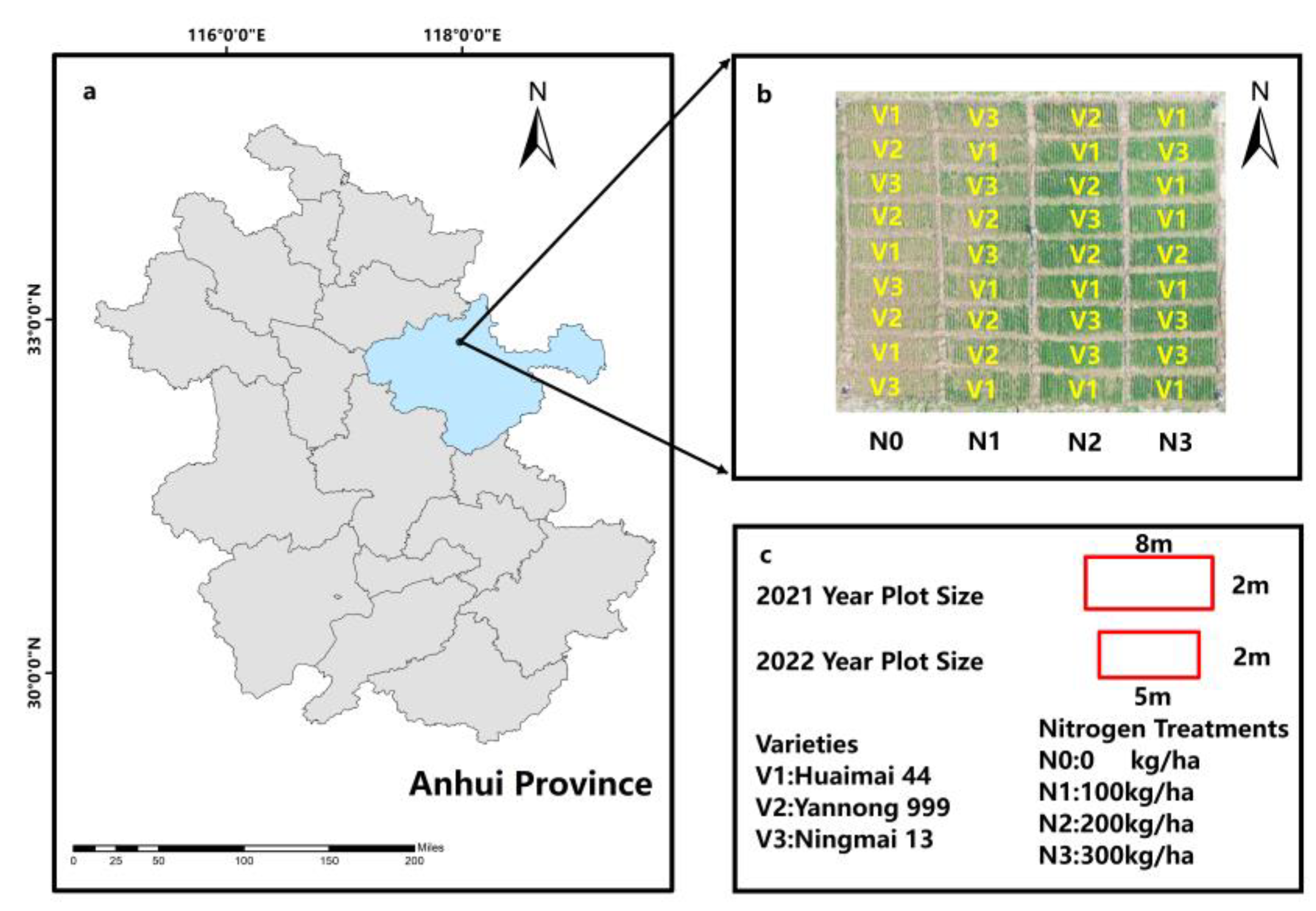
The wheat experiment was conducted in Xiaogang Village (117.77° E, 32.81° N), Fengyang County, Chuzhou City, Anhui Province, China (Figure 1), between November 2020 and June 2022. The region has a warm-temperate monsoon continental climate, with a mean elevation of 31 m, an average annual temperature of 15.4 °C, precipitation of 1050 mm, sunshine duration of 2073.4 h per year, and a 210-day frost-free period.
In 2021, a total of 36 plots were established, each measuring 2 m × 8 m. Three wheat varieties were used in the experiment—Huaimai 44 (V1), Yannong 999 (V2), and Ningmai 13 (V3). Four nitrogen fertilizer treatments were applied: N0 (no nitrogen fertilizer), N1 (100 kg/ha; same hereafter), N2 (200 kg/ha), and N3 (300 kg/ha)—with three replications for each treatment. Sowing was carried out on 25 November 2020, and harvest occurred in early June 2021. Before sowing, potassium chloride (containing 50% K2O) as the potash fertilizer and calcium superphosphate (containing 12% P2O5) as the phosphorus fertilizer were applied at rates of 135 kg/ha (as K2O) and 90 kg/ha (as P2O5), respectively. Nitrogen fertilizer in the form of granular urea (46% N) was applied in two stages: 60% as a basal application and 40% as a topdressing at the nodulation stage. In 2022, the experimental design was consistent with that of 2021. Sowing was conducted on 19 November 2021, and the plot size was adjusted to 2 m × 5 m. Fertilizer and crop management practices were the same as those implemented in 2021.

2.1.1. Drone Data Acquisition and Preprocessing

In this study, The DJI Phantom 4 Multispectral ((DJI Technology Co., Shenzhen, China)) was used to capture multispectral images of wheat. The P4M is equipped with one RGB camera and five multispectral sensors, with spectral bands centered at blue (450 ± 16 nm), green (560 ± 16 nm), red (650 ± 16 nm), red-edge (730 ± 16 nm), and near-infrared (840 ± 26 nm).
For each experiment, flight missions were planned using DJI GS Pro software (https://www.dji.com/cn/ground-station-pro/, (accessed on 22 July 2025).) to ensure 90% forward overlap and 85% side overlap of the captured images. The UAV flight plans and camera settings were kept consistent across different wheat growth stages. Image acquisition was conducted over the experimental plots at a flight altitude of 30 m and a speed of 2 m/s. To perform radiometric calibration of the UAV imagery, four standard reflectance panels with known spectral properties were placed on the ground within the UAV’s field of view. Data acquisition took place between 10:00 and 13:00 under clear, windless, and cloud-free conditions, with stable solar radiation intensity. Detailed image acquisition times are provided in Table 1.

2.1.2. UAV Image Preprocessing

Pix4Dmapper software was used to perform image stitching and reconstruction, which included camera parameter configuration, coordinate system setup, initial processing, point cloud and texture processing, and the generation of orthomosaic images. Radiometric calibration was conducted using an empirical linear model. Specifically, the digital number (DN) values of the original images were converted into reflectance values using Equation (1), based on standard reference panels with known spectral reflectance values that were pre-positioned within the UAV’s field of view:
R i , j = D N i , j * a i + b i ,   i   1 , 5 ,   j 1 , 4
In the equation, R i , j and D N i , j represent the reflectance value and digital number (DN) value, respectively, of band i on the j-th reference panel. The parameters a and b denote the slope and intercept of the calibration equation, respectively.

2.2. Chlorophyll Content Data Collection

Field measurements during each growth stage were conducted prior to the UAV flight on the same day to measure SPAD-based chlorophyll content in the wheat plots. In each plot, three uniform wheat plants were randomly selected, and three points (top, middle, and bottom) on the top leaf of each plant were measured. Chlorophyll content was measured using a SPAD-502 chlorophyll meter (Konica Minolta Optics Inc., Osaka, Japan), and the average of the nine readings was taken as the ground-truth chlorophyll value for the plot.

2.3. Selection of Vegetation Indices

Vegetation indices (VIs) are linear or nonlinear combinations of waveband reflectance values, designed to enhance the target signal while minimizing noise from soil and water backgrounds, atmospheric scattering, illumination variability, and environmental heterogeneity. In this study, twenty VIs were selected for chlorophyll estimation, with details summarized in Table 2.

2.4. Texture Features Extraction

Texture features (TFs), a visual feature that describes the spatial arrangement of pixel intensities independent of luminance, offers valuable insights into variations in crop canopy structure by analyzing the spatial correlation of gray levels between pixels [43]. In this study, the Gray Level Co-Occurrence Matrix (GLCM) method, a widely adopted approach in texture analysis, was employed to extract texture information from wheat images. In this study, the most commonly used parameters were applied for texture feature extraction, including a window size of 3 pixels × 3 pixels, an extraction direction of 45°, and grayscale quantization levels set to 64, among other default settings. Detailed parameter settings are provided in Table 3.

2.5. Model Construction

2.5.1. Partial Least Squares Regression (PLSR)

Partial least squares regression (PLSR) is a linear regression model that combines the advantages of principal component analysis, correlation analysis, and linear regression. It captures the maximum variance within the dataset by projecting predictor and response variables into a new latent space and identifying latent components that explain the most significant variation in the predictor variables [44]. PLSR effectively addresses multicollinearity among independent variables and minimizes the impact of random noise.

2.5.2. Random Forest Regression (RFR)

Random forest regression (RFR) is an ensemble machine learning technique that aggregates the predictions of multiple decision trees to enhance model accuracy and robustness [45]. Each tree in the forest is trained on randomly selected subsets of features and samples, introducing randomness at multiple levels. This approach minimizes the risk of overfitting and improves model generalization. The RFR model is robust to outliers and effectively captures complex nonlinear relationships between dependent and independent variables.

2.5.3. Deep Neural Network (DNN)

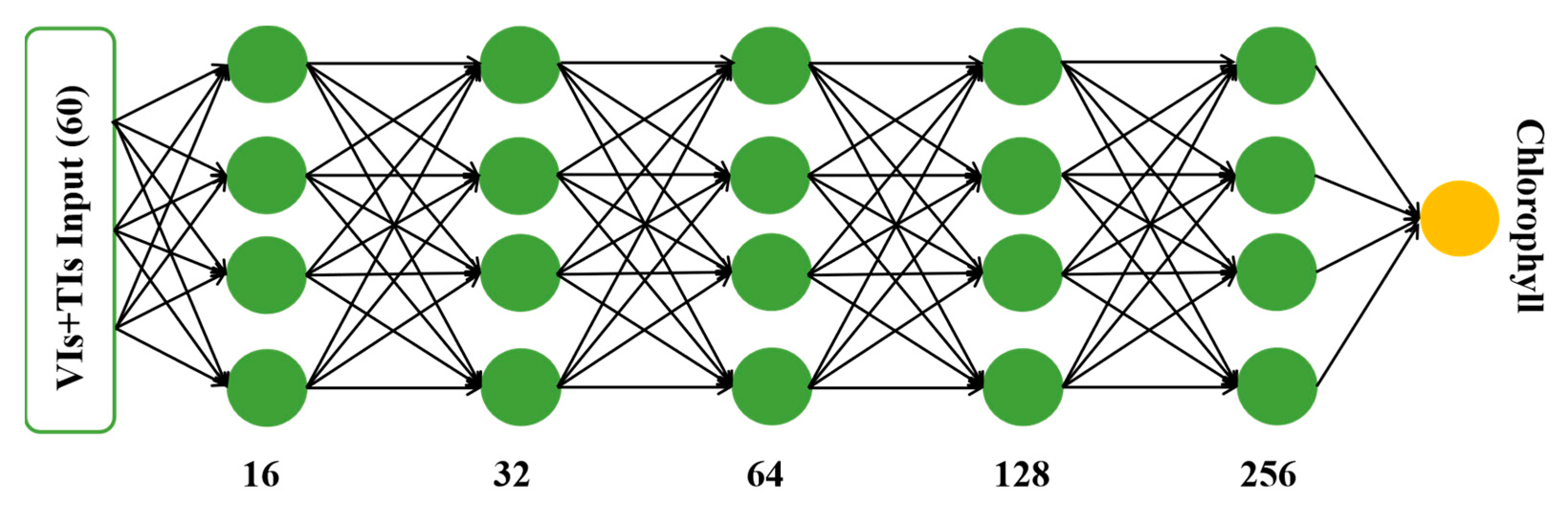
Deep neural network (DNN) consists of multiple layers, including an input layer, several hidden layers, and an output layer [46]. The DNN model overcomes the limitations of linear models by incorporating hidden layers, which allow the model to capture complex and nonlinear relationships, as illustrated in Figure 2. In this study, the dropout technique is applied to improve robustness and reduce overfitting [47]. Additionally, the activation function used in this study is the rectified linear unit (ReLU). ReLU is a simple nonlinear activation function, defined as the maximum of 0 and x, as shown in Equation (1):
ReLU(x) = max(x,0)

2.5.4. Multi-Source Deep Feature Neural Network (MDFNN)

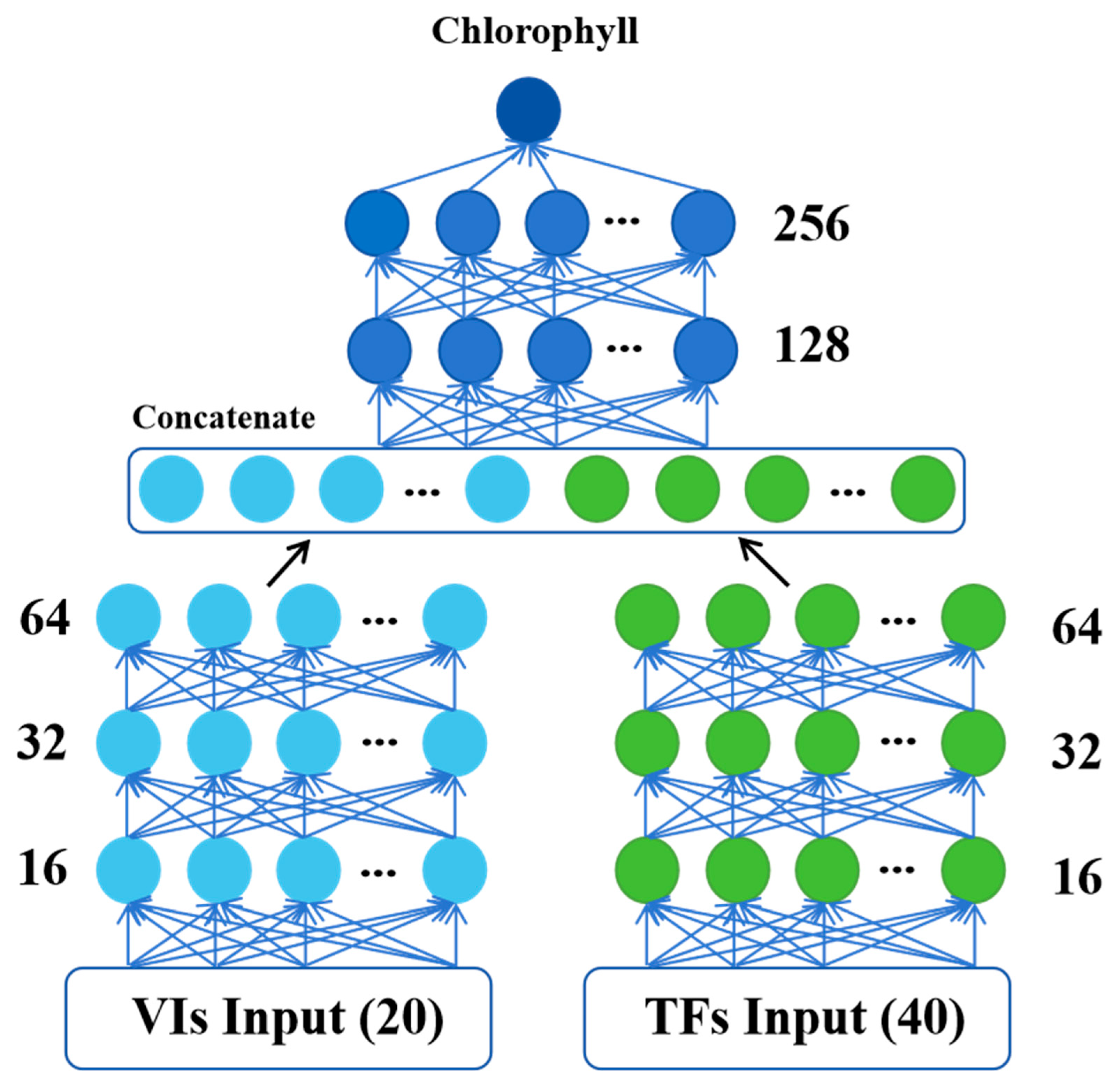
To integrate spectral and textural features from remote sensing imagery, we propose a novel deep learning architecture that employs two independent branches to process these features (Figure 3). The multi-source deep feature fusion network (MDFNN) is a deep learning framework designed to handle multi-source data. By integrating these data sources, MDFNN captures complex nonlinear relationships and produces more accurate predictions. Typically, MDFNN consists of independent sub-networks, each dedicated to processing specific types of input data. The outputs of these sub-networks are subsequently merged in a fusion layer. Additionally, MDFNN utilizes ReLU activation functions and dropout regularization to enhance model performance and prevent overfitting.

2.6. Model Development and Accuracy Evaluation

This study divided the two-year wheat chlorophyll dataset into training and testing sets, with 70% randomly selected for model training and the remaining 30% for model testing. To evaluate the performance of various models, the coefficient of determination (R2), root mean square error (RMSE), and relative root mean square error (RRMSE) were employed. These metrics were calculated using the following mathematical formulas:
R 2 = 1 y i ^ y ¯ 2 y i y ¯ 2
R M S E = i = 1 n y i ^ y i 2 n  
R R M S E = R M S E y ¯ * 100
In the equation, y i ^ and y i represent the observed and predicted chlorophyll values, respectively; y ¯ denotes the mean of the observed chlorophyll values; and n is the total number of samples in the test set.

2.7. Methods

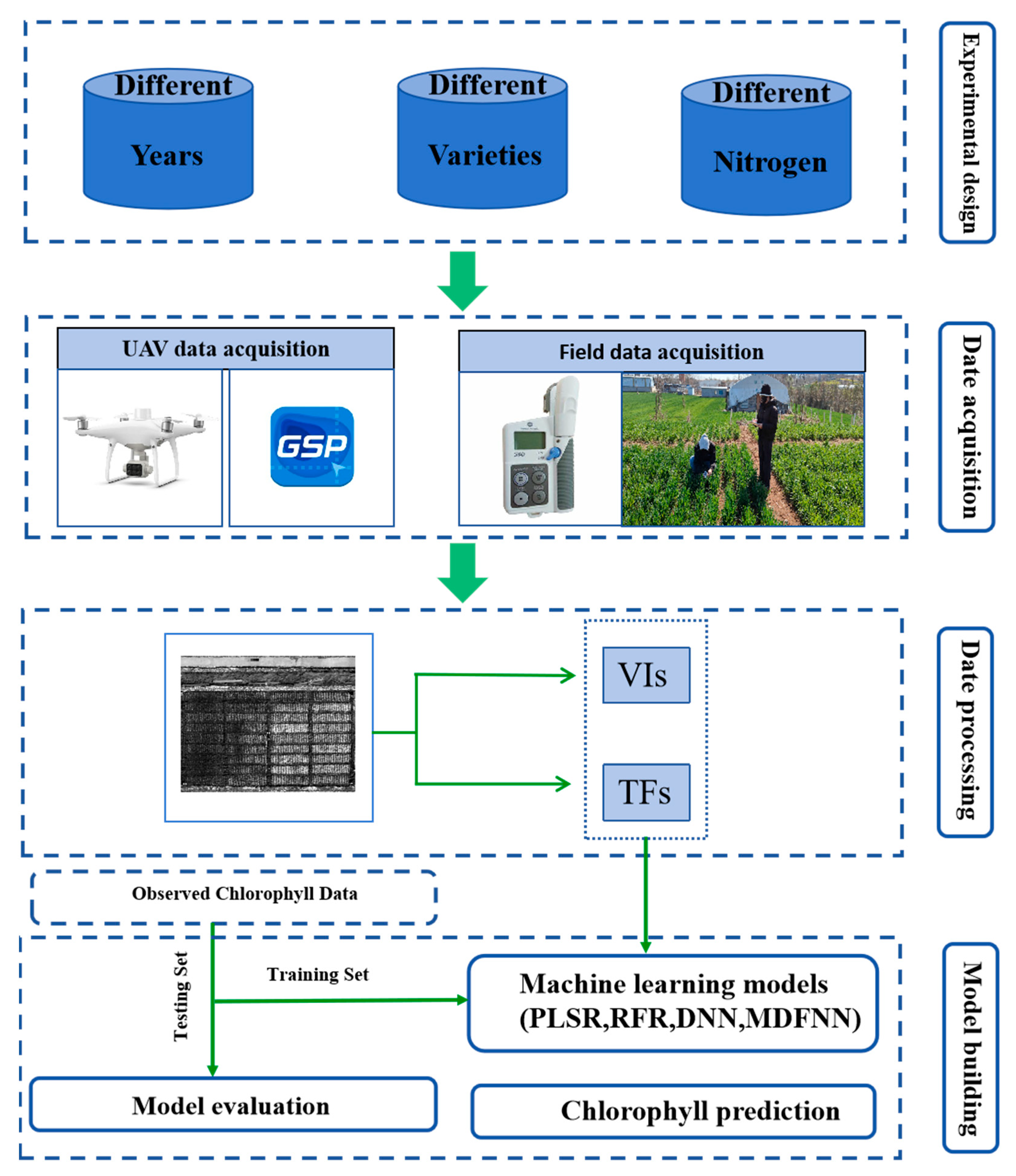
In this study, VIs and TFs were extracted from multispectral UAV imagery. These features were integrated and used to construct chlorophyll estimation models for wheat based on various modeling algorithms. Additionally, the performance of the proposed multi-source MDFNN model was evaluated across different years, wheat varieties, and nitrogen treatments. The overall workflow of the study is illustrated in Figure 4.

3. Results

3.1. Modeling and Validation of Chlorophyll Content in Wheat

The chlorophyll content estimation model was developed using two classical machine learning algorithms and two deep learning models (Table 4). The results indicated that RFR was the best-performing model for chlorophyll estimation using spectral features, achieving an R2 of 0.783, an RMSE of 6.730, and an RRMSE of 18.94%. For texture-based estimation, the DNN achieved the best performance, with R2 = 0.784, RMSE = 6.716, and RRMSE = 18.90%. When comparing data types, models using texture features generally outperformed those based on spectral features, except for the RFR model.
Additionally, the fusion of spectral and textural information significantly improves chlorophyll content estimation accuracy compared to using spectral or textural features alone. When both spectral and textural data were combined, the MDFNN achieved the best performance in chlorophyll estimation, with R2 = 0.850, RMSE = 5.602, and RRMSE = 15.76%. This represented a 6.4% increase in R2 and 13.5% reductions in both RMSE and RRMSE compared to the second-best performing DNN model (R2 = 0.799, RMSE = 6.479, RRMSE = 18.23%).

3.2. Evaluation of Wheat Chlorophyll Content Model Under Different Years

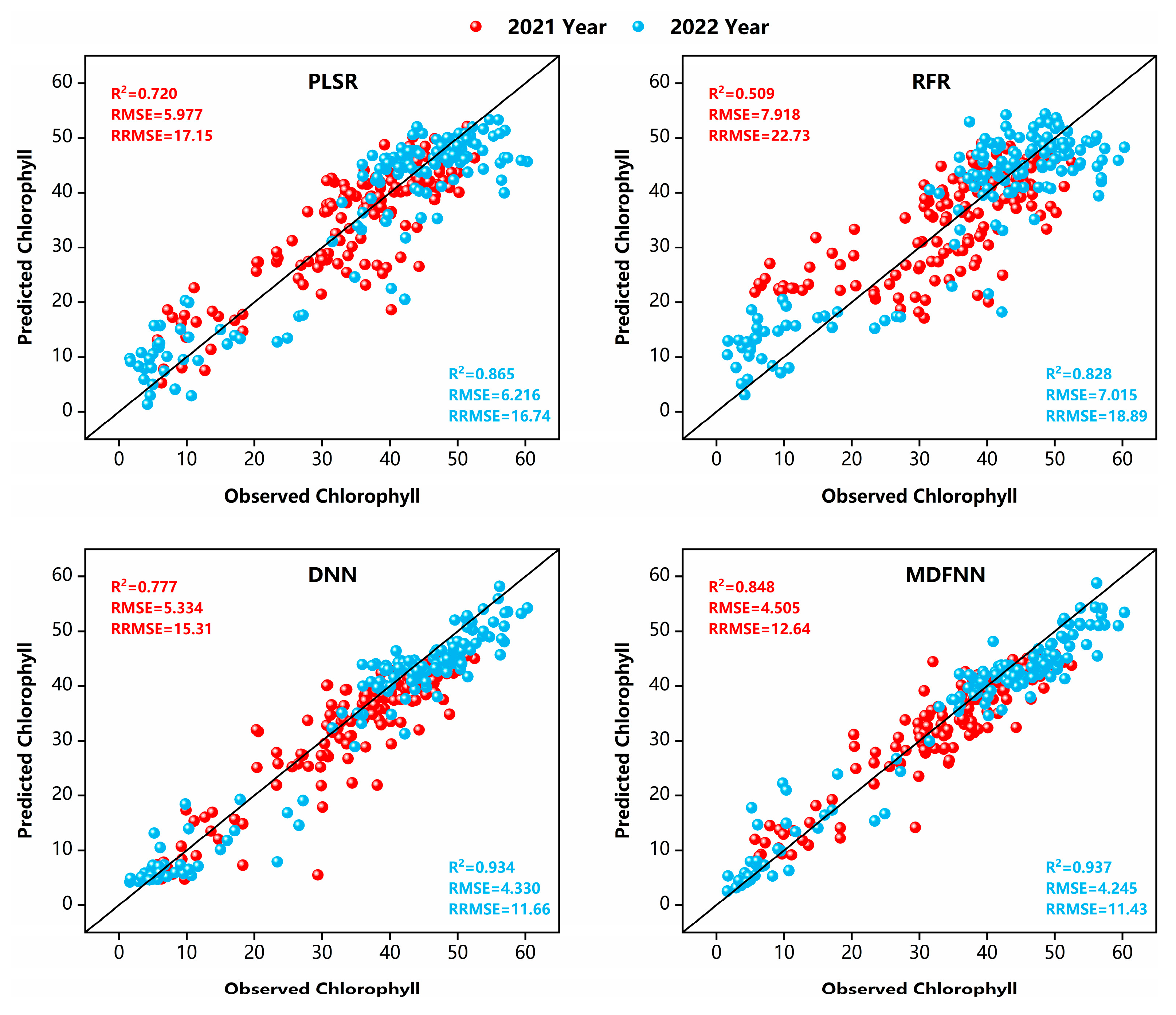
Assessing the applicability of chlorophyll content estimation models to individual years is essential. As shown in Figure 5, the model trained on 2022 data outperformed the one trained on 2021 data. The deep learning model DNN achieved higher accuracy than classical machine learning approaches, while the RFR model yielded the lowest accuracy among all models. The proposed MDFNN consistently outperformed all other models in both 2021 and 2022, achieving R2 = 0.802, RMSE = 4.405, and RRMSE = 13.12 in 2021, and R2 = 0.937, RMSE = 4.245, and RRMSE = 11.43 in 2022. These results demonstrate that the chlorophyll estimation model, trained on two-year data, can generalize effectively to individual years, with MDFNN exhibiting the highest accuracy.

3.3. Estimation of Chlorophyll in Different Species

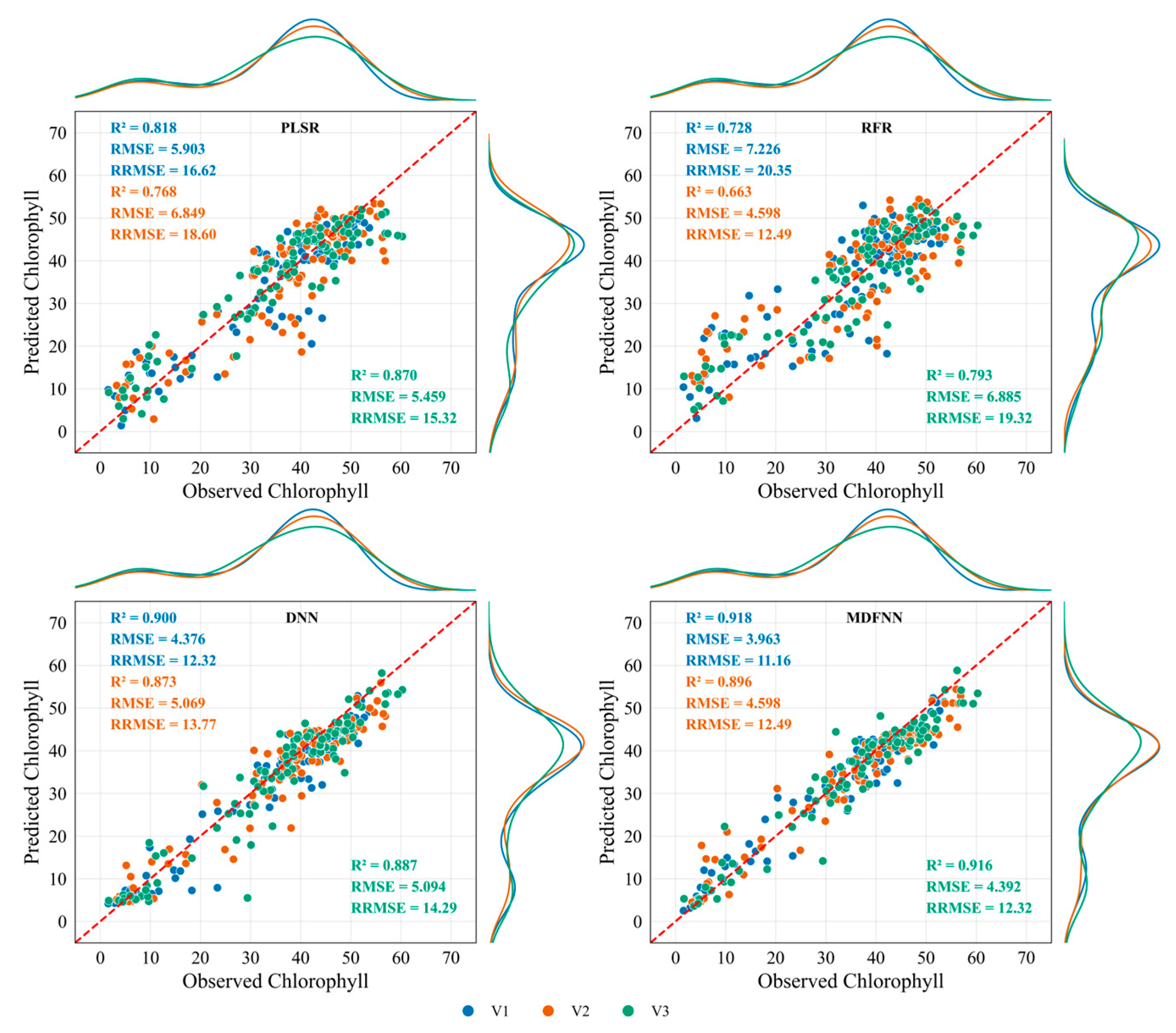
The adaptability of chlorophyll estimation models to different wheat varieties or genotypes is essential. Therefore, it is necessary to apply the chlorophyll estimation model to each variety individually to assess its reliability and adaptability. As shown in Figure 6, the MDFNN model achieved the highest accuracy across the three wheat varieties, with R2 values ranging from 0.896 to 0.918. This was followed by the DNN model (R2 = 0.873–0.900), while the RFR model exhibited the poorest performance, with R2 values between 0.663 and 0.793. The model accuracy for varieties V1 and V3 was relatively consistent across the four algorithms, whereas V2 showed comparatively lower accuracy. These results suggest that, compared to traditional machine learning algorithms, deep learning approaches—particularly the MDFNN model—demonstrate superior adaptability across different wheat varieties.

3.4. Chlorophyll Content Estimation Under Different Nitrogen Treatments

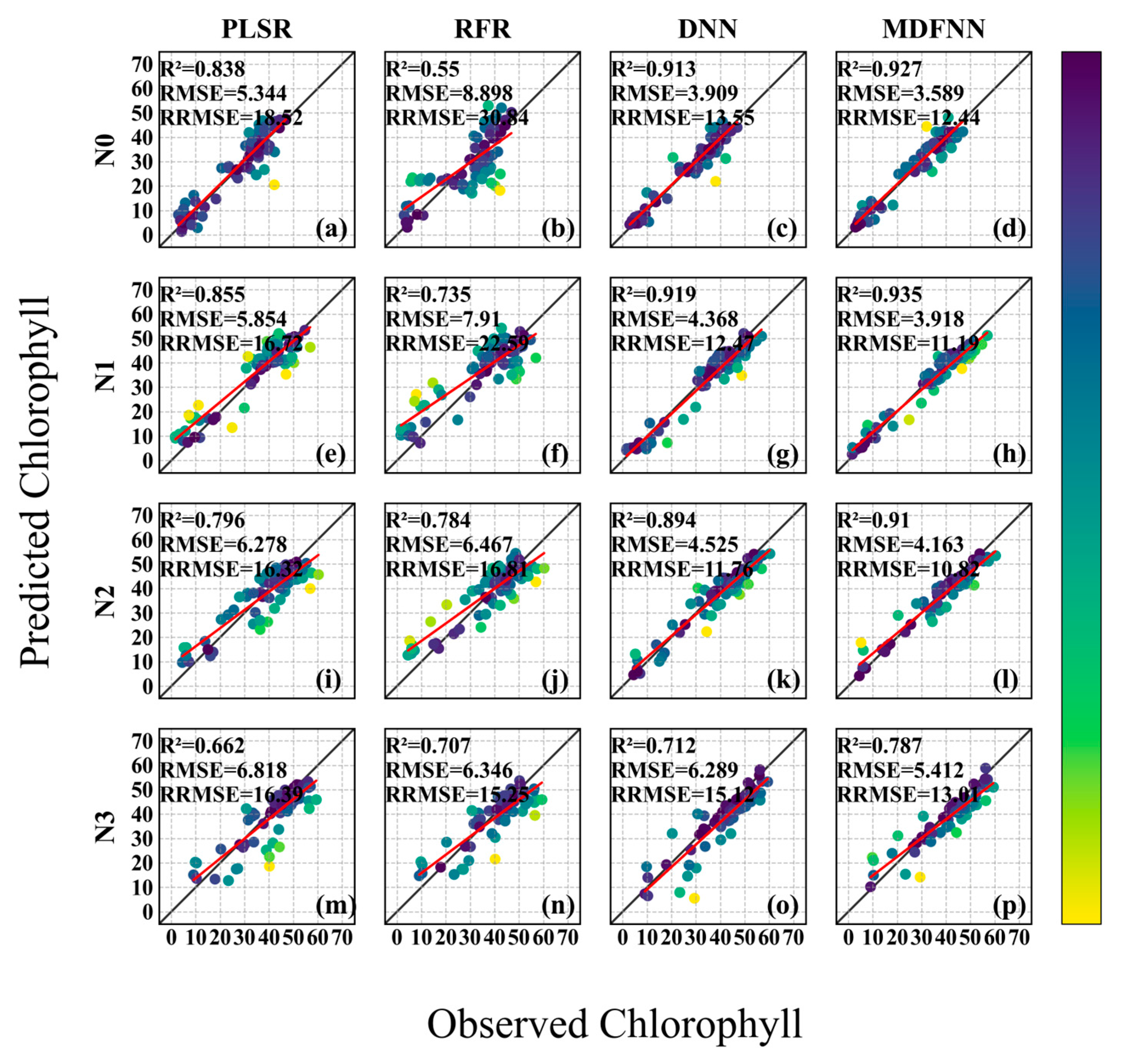
The adaptability of chlorophyll content estimation models to different nitrogen treatments is critical, particularly in high-throughput plant phenotyping studies based on remote sensing technologies. As shown in Figure 7, the RFR model showed the lowest performance, with R2 values ranging from 0.550 to 0.784, while the MDFNN model achieved the highest performance, with R2 values ranging from 0.789 to 0.927 across all four nitrogen treatments. All four modeling algorithms demonstrated better predictive accuracy under the N0, N1, and N2 treatments, except for RFR, which showed reduced performance under both N0 and N3 (high-nitrogen) conditions.

3.5. Application of the MDFNN Model

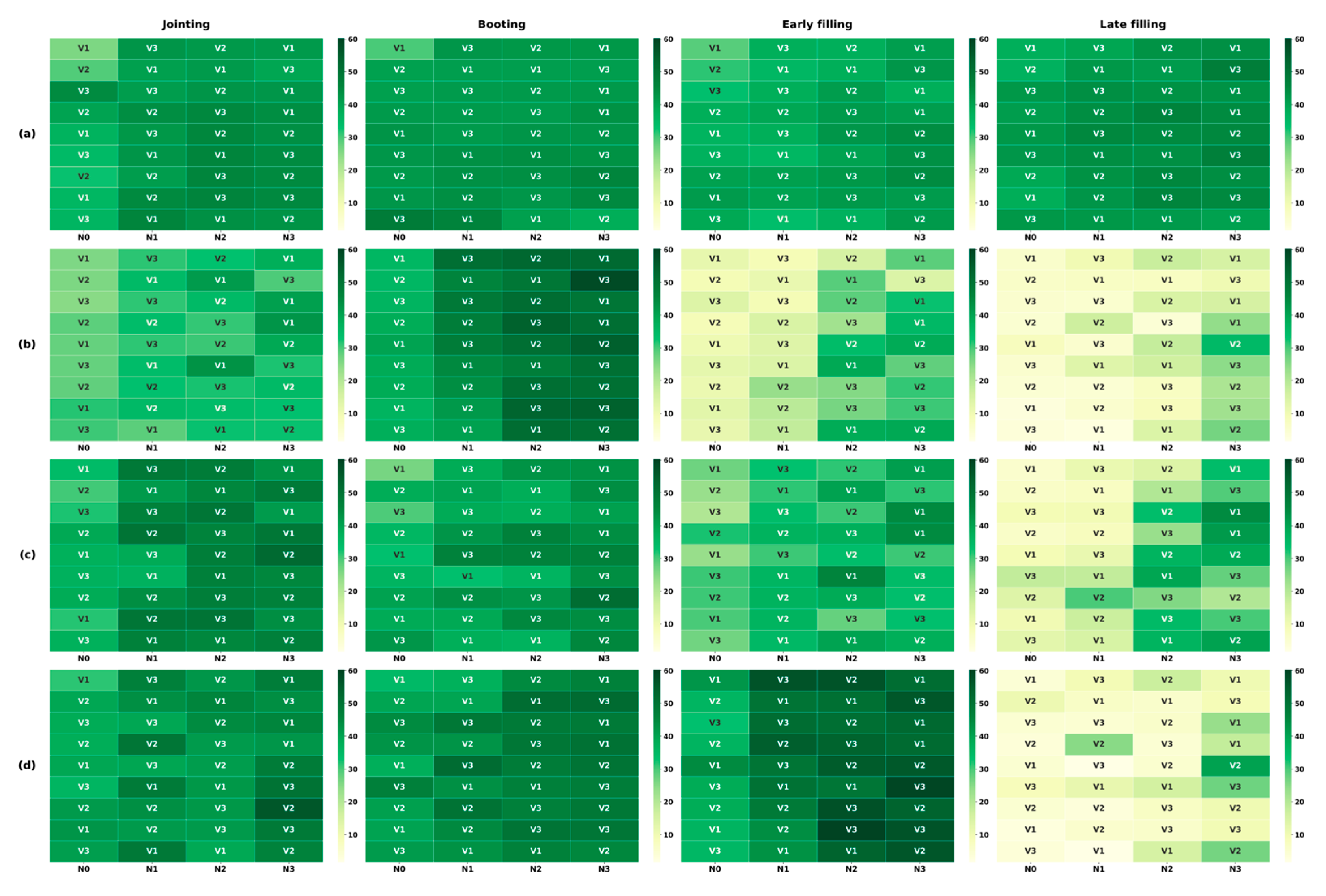
Figure 8 illustrates the spatial distribution of wheat chlorophyll content at key growth stages as estimated by the MDFNN model. The estimated chlorophyll content exhibited high spatial consistency with the measured values. From the jointing stage to the late filling stage, chlorophyll content showed a continuous decline, accompanied by increasing variability among plots. The estimated chlorophyll content was also associated with nitrogen application levels and wheat varieties. Specifically, chlorophyll content increased with higher nitrogen application rates, and noticeable differences were observed among different wheat varieties.

4. Discussion

4.1. Comparative Analysis of Chlorophyll Content Estimation Accuracy Based on Spectral–Textural Feature Fusion

Previous research has shown that combining spectral and textural information can significantly enhance the accuracy of crop phenotypic trait estimation [48,49,50]. Crop reflectance across different spectral bands varies throughout various growth stages, and vegetation indices derived from specific bands are effective in capturing crop growth conditions [51]. Currently, vegetation index-based modeling approaches remain among the most widely used and effective methods for estimating crop chlorophyll content [52]. However, the sensitivity of vegetation indices to crop growth characteristics varies across reproductive stages due to differences in physiological status. Relying solely on spectral information often fails to capture the dynamic physiological changes during late growth stages. Therefore, incorporating texture information is necessary to complement spectral data in chlorophyll estimation [51]. The fusion of spectral and texture information enriches data diversity and feature representation while improving the accuracy, consistency, and robustness of crop monitoring. Furthermore, it addresses the challenges of reduced prediction sensitivity caused by stage-dependent variations and spectral saturation effects [53]. This fusion strategy enhances model performance and enables more precise evaluation of crop growth and health conditions. Su et al. [54] reported that the integration of spectral and texture features improved chlorophyll estimation accuracy at various wheat growth stages. Similarly, Shu et al. [55] demonstrated that models based on spectral–texture fusion achieved higher accuracy across different wheat varieties compared to single-source models. These findings confirm that spectral–textural integration can substantially enhance model accuracy in crop monitoring. In this study, a similar fusion strategy was adopted to improve the accuracy of wheat chlorophyll estimation. Unlike previous studies, this study not only explored the fusion of traditional spectral and textural information but also proposed a multi-source deep feature model. As shown in Table 4, the deep fusion model significantly improved estimation performance, increasing R2 by 6.4%, decreasing RMSE by 13.5%, and reducing RRMSE by 13.5% compared to the best conventional fusion model. These results highlight the strong potential of deep feature fusion for robust and generalized feature extraction in agricultural remote sensing applications.
Texture information, in addition to spectral information, serves as a fundamental component of image representation. It effectively captures uniformity, detail, and surface roughness, and quantifies local variations in pixel intensity within a defined analysis window [56]. Additionally, texture statistics help reduce spatial heterogeneity between vegetation and background elements via a sliding window approach [57,58]. Even when vegetation coverage is similar, morphological differences can exist in wheat canopies at different growth stages; therefore, textural features can compensate for the limitations of spectral information [59]. The integration of spatial information improves chlorophyll estimation accuracy across multiple wheat growth stages. Textural features capture key phenotypic traits of wheat crops [60] and quantify spatial variations in growth, while also representing fine-scale structural differences at the canopy surface [61]. The fusion of spectral and textural information provides spatial insights into crop growth and compensates for the limitations of spectral information derived solely from vegetation indices. Compared to spectral information, texture is less affected by noise, soil background, and other influencing factors, thereby reducing the interference caused by weather conditions and varietal differences in rice [62]. The texture of crops captures dynamic variations in organs, plant architecture, and background, which are closely associated with changes in wheat chlorophyll content. The fusion of spectral and textural information has improved the accuracy of wheat chlorophyll estimation models [61].

4.2. The Critical Role of Model Selection in Chlorophyll Content Estimation

Machine learning algorithms have been widely applied in crop growth monitoring, yield estimation, and related agricultural applications due to their notable computational efficiency, rapid training, and strong predictive performance [63,64]. Numerous studies have demonstrated the effectiveness of various dimensionality reduction techniques in predictive modeling, such as principal component analysis (PCA) [65,66], singular value decomposition (SVD) [67,68], and linear discriminant analysis (LDA) [69,70]. Partial least squares regression (PLSR), a multivariate regression algorithm that incorporates aspects of PCA to construct predictive models [71], exhibited strong performance in this study across different years, wheat cultivars, and nitrogen treatments. Notably, PLSR outperformed conventional machine learning algorithms, including random forest regression (RFR), and these results are consistent with findings reported in previous studies [72,73].
A key advantage of deep learning algorithms over traditional machine learning methods is their ability to perform automatic feature extraction, particularly in the field of remote sensing [74]. The results of this study demonstrate that deep learning significantly outperforms traditional machine learning models in terms of estimation accuracy. This can be attributed to the following reasons: On the one hand, the performance of machine learning models is influenced by various factors, including training data, input variables, crop type, and growth stage. As a result, they exhibit limited capability in modeling complex nonlinear relationships and handling temporal data, leading to poor performance in chlorophyll estimation across multiple crop varieties with distinct morphological and phenological characteristics [75]. On the other hand, multispectral data contain information from multiple independent variables, which exhibit complex interrelationships both among themselves and with the target variable. Deep neural network (DNN), through multiple fully connected layers, can effectively capture the complex nonlinear relationships inherent in remote sensing data. Moreover, DNNs possess the capability to learn global feature representations [74].
In this study, the proposed MDFNN model achieved the highest performance among all tested models, with R2 = 0.850, RMSE = 5.602, and RRMSE = 15.76% in chlorophyll content estimation. The MDFNN model also maintained consistent performance across different years, nitrogen levels, and wheat cultivars, while even the simpler DNN model yielded satisfactory results. The MDFNN framework processes multiple data sources by separately extracting deep features from each modality, which are then integrated in a shared representation layer to enable effective feature fusion and end-to-end learning. Prior studies have likewise confirmed that deep learning is highly effective in extracting latent information from complex datasets, particularly when dealing with nonlinear and multi-source relationships [72,74].

4.3. Influence of Year, Nitrogen Application, and Cultivar on Chlorophyll Content Estimation Accuracy

This study investigates the applicability of the chlorophyll content estimation model across different growing seasons. The model’s prediction accuracy varied between years, which can be attributed to the influence of interannual environmental variability. Factors such as crop canopy structure, light conditions, and water availability vary considerably across years and directly affect model performance. This observation is supported by previous studies [76,77], which emphasize the role of these variables in affecting chlorophyll content estimation accuracy. As shown in Figure 5, the chlorophyll content estimation model for 2022 outperformed that of 2021 in terms of accuracy. This may be attributed to interannual variations in climatic conditions (e.g., temperature and humidity), which can lead to differences in plant physiological status. Such differences may alter spectral response characteristics, thereby affecting the model’s estimation performance [78].
As shown in Figure 6, the V1 and V3 wheat varieties exhibited comparable modeling accuracies across the four algorithms, while the V2 variety showed relatively lower accuracy. This discrepancy may be attributed to differences in growth period, morphological characteristics, and other phenotypic traits, which influence the performance of chlorophyll estimation models across wheat varieties [23].
This study aimed to evaluate chlorophyll content estimation models under different nitrogen treatments in wheat. As shown in Figure 7, the predictive accuracy of all four models declined under high nitrogen conditions (N3), potentially due to excessive fertilization adversely affecting wheat growth and thereby reducing the responsiveness of spectral and textural features to chlorophyll variation [49]. Under appropriate nitrogen conditions (N1 and N2), the model exhibited higher estimation accuracy, likely because a certain amount of nitrogen fertilization is essential for normal wheat development, and moderately developed wheat canopies are more easily monitored using remote sensing data.

4.4. Limitations and Future Research Perspectives

This study conducted a two-year field experiment using three wheat varieties and four nitrogen levels. A multi-year chlorophyll content estimation model was developed using a multi-source deep feature fusion approach. Future work will consider integrating multiple sensors (e.g., RGB, hyperspectral, and LiDAR) for synergistic observation to improve the performance of chlorophyll estimation in wheat. The remote sensing platform employed in this study was relatively limited, and UAV constraints such as flight time and altitude restricted its applicability at larger spatial scales. Future research will incorporate satellite-based remote sensing and explore ways to integrate the strengths of different platforms. As this study was conducted at a single location, the generalizability of the MFDNN model may be limited. Therefore, future research will involve validating the model across different geographical regions and environmental conditions. Additionally, although the MFDNN model achieved promising results for the three selected high-yield wheat varieties, future experiments will extend its application to a broader range of wheat cultivars.

5. Conclusions

This study aimed to improve the accuracy of wheat chlorophyll estimation by extracting both spectral and textural features from multispectral UAV imagery. The performance of chlorophyll estimation based on spectral features, textural features, and their fusion was systematically compared. The main findings are summarized as follows: (1) In terms of individual data types, models based on textural features outperformed those based on spectral features in all cases except for the RFR model. Moreover, the fusion of spectral and textural information consistently achieved higher estimation accuracy than using either data type alone. (2) The proposed MDFNN demonstrated the best performance in chlorophyll estimation, with R2 = 0.850, RMSE = 5.602, and RRMSE = 15.76%. Compared to the second-best model, DNN (R2 = 0.799, RMSE = 6.479, RRMSE = 18.23%), MDFNN achieved a 6.4% improvement in R2 and 13.5% reductions in both RMSE and RRMSE. (3) MDFNN also exhibited strong robustness and adaptability across different years, wheat varieties, and nitrogen treatments. In conclusion, this study highlights the effective application of UAV-based remote sensing in estimating wheat chlorophyll content, demonstrating significant advancements in agricultural remote sensing. The integration of spectral and textural features was shown to be critical for enhancing estimation accuracy. These findings provide a methodological framework for future research and offer valuable guidance for optimizing nitrogen management practices.

Author Contributions

Conceptualization, J.L. (Jun Li) and X.L.; methodology, J.L. (Jun Li); software, J.L. (Jun Li), Y.S., and W.W.; validation, Y.S. and W.W.; formal analysis, W.W.; investigation, J.L. (Jun Li); resources, J.L. (Jun Li); data curation, J.L. (Jun Li) and Y.S.; writing—original draft, J.L. (Jun Li); writing—review and editing, J.L. (Jun Li), J.L. (Jikai Liu), and X.L.; visualization, W.W.; supervision, J.L. (Jikai Liu) and X.L.; project administration, X.L.; funding acquisition, X.L. All authors have read and agreed to the published version of the manuscript.

Funding

This research was funded by the Sub-Project of the National Key Research and Development Program (no. 2022YFD2301402-3); Scientific Research Projects in Higher Education Institutions of Anhui Province (no. 2023AH051855); Anhui Province University Science and Engineering Teachers Enterprise Practice Program Project (no. 224jsqygz62) and Anhui Province Crop Intelligent Planting and Processing Technology Engineering Research Center Open Research Project (no. ZHKF03).

Data Availability Statement

The data presented in this study are available on request from the corresponding author due to the need for follow-up studies.

Conflicts of Interest

The authors declare no conflicts of interest.

References

  1. Li, W.; Li, D.; Warner, T.A.; Liu, S.; Baret, F.; Yang, P.; Jiang, J.; Dong, M.; Cheng, T.; Zhu, Y.; et al. Improved generality of wheat green lai models through mitigation of the effect of leaf chlorophyll content variation with red edge vegetation indices. Remote Sens. Environ. 2025, 318, 114589. [Google Scholar] [CrossRef]
  2. Sampson, P.H.; Zarco-Tejada, P.J.; Mohammed, G.H.; Miller, J.R.; Noland, T.L. Hyperspectral remote sensing of forest condition: Estimating chlorophyll content in tolerant hardwoods. For. Sci. 2003, 49, 381–391. [Google Scholar] [CrossRef]
  3. Colomina, I.; Molina, P. Unmanned aerial systems for photogrammetry and remote sensing: A review. Isprs J. Photogramm. Remote Sens. 2014, 92, 79–97. [Google Scholar] [CrossRef]
  4. Yin, Q.; Zhang, Y.; Li, W.; Wang, J.; Wang, W.; Ahmad, I.; Zhou, G.; Huo, Z. Estimation of winter wheat spad values based on uav multispectral remote sensing. Remote Sens. 2023, 15, 3595. [Google Scholar] [CrossRef]
  5. Ma, W.; Han, W.; Zhang, H.; Cui, X.; Zhai, X.; Zhang, L.; Shao, G.; Niu, Y.; Huang, S. Uav multispectral remote sensing for the estimation of spad values at various growth stages of maize under different irrigation levels. Comput. Electron. Agric. 2024, 227, 109566. [Google Scholar] [CrossRef]
  6. Guo, Y.; Chen, S.; Li, X.; Cunha, M.; Jayavelu, S.; Cammarano, D.; Fu, Y. Machine learning-based approaches for predicting spad values of maize using multi-spectral images. Remote Sens. 2022, 14, 1337. [Google Scholar] [CrossRef]
  7. Wang, J.; Zhou, Q.; Shang, J.; Liu, C.; Zhuang, T.; Ding, J.; Xian, Y.; Zhao, L.; Wang, W.; Zhou, G.; et al. Uav- and machine learning-based retrieval of wheat spad values at the overwintering stage for variety screening. Remote Sens. 2021, 13, 5166. [Google Scholar] [CrossRef]
  8. Xu, D.; An, D.; Guo, X. The impact of non-photosynthetic vegetation on lai estimation by ndvi in mixed grassland. Remote Sens. 2020, 12, 1979. [Google Scholar] [CrossRef]
  9. Fang, H.; Baret, F.; Plummer, S.; Strub, G.S. An overview of global leaf area index (lai): Methods, products, validation, applications. Rev. Geophys. 2019, 57, 739–799. [Google Scholar] [CrossRef]
  10. Wan, L.; Cen, H.; Zhu, J.; Zhang, J.; Zhu, Y.; Sun, D.; Du, X.; Zhai, L.; Weng, H.; Li, Y.; et al. Grain yield prediction of rice using multi-temporal uav-based rgb and multispectral images and model transfer—A case study of small farmlands in the south of china. Agric. For. Meteorol. 2020, 291, 108096. [Google Scholar] [CrossRef]
  11. Yao, X.; Wang, N.; Liu, Y.; Cheng, T.; Tian, Y.; Chen, Q.; Zhu, Y. Estimation of wheat lai at middle to high levels using unmanned aerial vehicle narrowband multispectral imagery. Remote Sens. 2017, 9, 1304. [Google Scholar] [CrossRef]
  12. Yue, J.; Yang, G.; Tian, Q.; Feng, H.; Xu, K.; Zhou, C. Estimate of winter-wheat above-ground biomass based on uav ultrahigh-ground-resolution image textures and vegetation indices. Isprs J. Photogramm. Remote Sens. 2019, 150, 226–244. [Google Scholar] [CrossRef]
  13. Liang, L.; Geng, D.; Yan, J.; Qiu, S.; Di, L.; Wang, S.; Xu, L.; Wang, L.; Kang, J.; Li, L. Estimating crop lai using spectral feature extraction and the hybrid inversion method. Remote Sens. 2020, 12, 3534. [Google Scholar] [CrossRef]
  14. Zhang, Y.; Hui, J.; Qin, Q.; Sun, Y.; Zhang, T.; Sun, H.; Li, M. Transfer-learning-based approach for leaf chlorophyll content estimation of winter wheat from hyperspectral data. Remote Sens. Environ. 2021, 267, 112724. [Google Scholar] [CrossRef]
  15. Xu, T.; Wang, F.; Xie, L.; Yao, X.; Zheng, J.; Li, J.; Chen, S. Integrating the textural and spectral information of uav hyperspectral images for the improved estimation of rice aboveground biomass. Remote Sens. 2022, 14, 2534. [Google Scholar] [CrossRef]
  16. Zhu, Y.; Liu, J.; Tao, X.; Su, X.; Li, W.; Zha, H.; Wu, W.; Li, X. A three-dimensional conceptual model for estimating the above-ground biomass of winter wheat using digital and multispectral unmanned aerial vehicle images at various growth stages. Remote Sens. 2023, 15, 3332. [Google Scholar] [CrossRef]
  17. Yan, G.; Hu, R.; Luo, J.; Weiss, M.; Jiang, H.; Mu, X.; Xie, D.; Zhang, W. Review of indirect optical measurements of leaf area index: Recent advances, challenges, perspectives. Agric. For. Meteorol. 2019, 265, 390–411. [Google Scholar] [CrossRef]
  18. Zhou, M.; Zheng, H.; He, C.; Liu, P.; Awan, G.M.; Wang, X.; Cheng, T.; Zhu, Y.; Cao, W.; Yao, X. Wheat phenology detection with the methodology of classification based on the time-series uav images. Field Crops Res. 2023, 292, 108798. [Google Scholar] [CrossRef]
  19. Zu, J.; Yang, H.; Wang, J.; Cai, W.; Yang, Y. Inversion of winter wheat leaf area index from uav multispectral images: Classical vs. Deep learning approaches. Front. Plant Sci. 2024, 15, 1367828. [Google Scholar] [CrossRef]
  20. Yin, Q.; Zhang, Y.; Li, W.; Wang, J.; Wang, W.; Ahmad, I.; Zhou, G.; Huo, Z. Better inversion of wheat canopy spad values before heading stage using spectral and texture indices based on uav multispectral imagery. Remote Sens. 2024, 15, 4935. [Google Scholar] [CrossRef]
  21. Rong, D.; Wang, H.; Ying, Y.; Zhang, Z.; Zhang, Y. Peach variety detection using vis-nir spectroscopy and deep learning. Comput. Electron. Agric. 2020, 175, 105553. [Google Scholar] [CrossRef]
  22. Zhao, R.; An, L.; Tang, W.; Gao, D.; Qiao, L.; Li, M.; Sun, H.; Qiao, J. Deep learning assisted continuous wavelet transform-based spectrogram for the detection of chlorophyll content in potato leaves. Comput. Electron. Agric. 2022, 195, 106802. [Google Scholar] [CrossRef]
  23. Liu, T.; Wang, J.; Wang, J.; Zhao, Y.; Wang, H.; Zhang, W.; Yao, Z.; Liu, S.; Zhong, X.; Sun, C. Research on the estimation of wheat agb at the entire growth stage based on improved convolutional features. J. Integr. Agric. 2024, 24, 1403–1423. [Google Scholar] [CrossRef]
  24. Qiao, L.; Zhao, R.; Tang, W.; An, L.; Sun, H.; Li, M.; Wang, N.; Liu, Y.; Liu, G. Estimating maize lai by exploring deep features of vegetation index map from uav multispectral images. Field Crops Res. 2022, 289, 108739. [Google Scholar] [CrossRef]
  25. Xue, J.; Su, B. Significant remote sensing vegetation indices: A review of developments and applications. J. Sens. 2017, 2017, 1–17. [Google Scholar] [CrossRef]
  26. Jiang, Z. Interpretation of the modified soil-adjusted vegetation index isolines in red-nir reflectance space. J. Appl. Remote Sens. 2007, 1, 13503. [Google Scholar] [CrossRef]
  27. Cao, Q.; Miao, Y.; Wang, H.; Huang, S.; Cheng, S.; Khosla, R.; Jiang, R. Non-destructive estimation of rice plant nitrogen status with crop circle multispectral active canopy sensor. Field Crops Res. 2013, 154, 133–144. [Google Scholar] [CrossRef]
  28. Gitelson, A.A.; Viña, A.; Ciganda, V.; Rundquist, D.C.; Arkebauer, T.J. Remote estimation of canopy chlorophyll content in crops. Geophys. Res. Lett. 2005, 32, L08403. [Google Scholar] [CrossRef]
  29. Feng, H.; Tao, H.; Li, Z.; Yang, G.; Zhao, C. Comparison of uav rgb imagery and hyperspectral remote-sensing data for monitoring winter wheat growth. Remote Sens. 2022, 14, 3811. [Google Scholar] [CrossRef]
  30. Potgieter, A.B.; George-Jaeggli, B.; Chapman, S.C.; Laws, K.; Cadavid, L.A.S.; Wixted, J.; Watson, J.; Eldridge, M.; Jordan, D.R.; Hammer, G.L. Multi-spectral imaging from an unmanned aerial vehicle enables the assessment of seasonal leaf area dynamics of sorghum breeding lines. Front. Plant Sci. 2017, 8, 1532. [Google Scholar] [CrossRef]
  31. Cheng, Q.; Ding, F.; Xu, H.; Guo, S.; Li, Z.; Chen, Z. Quantifying corn lai using machine learning and uav multispectral imaging. Precis. Agric. 2024, 25, 1777–1799. [Google Scholar] [CrossRef]
  32. Zha, H.; Miao, Y.; Wang, T.; Li, Y.; Zhang, J.; Sun, W.; Feng, Z.; Kusnierek, K. Improving unmanned aerial vehicle remote sensing-based rice nitrogen nutrition index prediction with machine learning. Remote Sens. 2020, 12, 215. [Google Scholar] [CrossRef]
  33. Tucker, C.J. Red and photographic infrared linear combinations for monitoring vegetation. Remote Sens. Environ. 1979, 8, 127–150. [Google Scholar] [CrossRef]
  34. Sripada, R.P.; Heiniger, R.W.; White, J.G.; Weisz, R. Aerial color infrared photography for determining late-season nitrogen requirements in corn. Agron. J. 2005, 97, 1443–1451. [Google Scholar] [CrossRef]
  35. Steven, M.D. The sensitivity of the osavi vegetation index to observational parameters. Remote Sens. Environ. 1998, 63, 49–60. [Google Scholar] [CrossRef]
  36. Lu, J.; Miao, Y.; Shi, W.; Li, J.; Yuan, F. Evaluating different approaches to non-destructive nitrogen status diagnosis of rice using portable rapidscan active canopy sensor. Sci. Rep. 2017, 7, 14073. [Google Scholar] [CrossRef]
  37. Boiarskii, B. Comparison of ndvi and ndre indices to detect differences in vegetation and chlorophyll content. J. Mech. Contin. Math. Sci. spl1 2019, 4, 20–29. [Google Scholar] [CrossRef]
  38. Sripada, R.P.; Heiniger, R.W.; White, J.G.; Meijer, A.D. Aerial color infrared photography for determining early in-season nitrogen requirements in corn. Agron. J. 2006, 98, 968–977. [Google Scholar] [CrossRef]
  39. Hatfield, J.L.; Prueger, J.H. Value of using different vegetative indices to quantify agricultural crop characteristics at different growth stages under varying management practices. Remote Sens. 2010, 2, 562–578. [Google Scholar] [CrossRef]
  40. Candiago, S.; Remondino, F.; De Giglio, M.; Dubbini, M.; Gattelli, M. Evaluating multispectral images and vegetation indices for precision farming applications from uav images. Remote Sens. 2015, 7, 4026–4047. [Google Scholar] [CrossRef]
  41. Broge, N.H.; Mortensen, J.V. Deriving green crop area index and canopy chlorophyll density of winter wheat from spectral reflectance data. Remote Sens. Environ. 2002, 81, 45–57. [Google Scholar] [CrossRef]
  42. Dempewolf, J.; Adusei, B.; Becker-Reshef, I.; Hansen, M.; Potapov, P.; Khan, A.; Barker, B. Wheat yield forecasting for punjab province from vegetation index time series and historic crop statistics. Remote Sens. 2014, 6, 9653–9675. [Google Scholar] [CrossRef]
  43. Wang, X.; Yan, S.; Wang, W.; Yin, L.; Li, M.; Yu, Z.; Chang, S.; Hou, F. Monitoring leaf area index of the sown mixture pasture through uav multispectral image and texture characteristics. Comput. Electron. Agric. 2023, 214, 108333. [Google Scholar] [CrossRef]
  44. Herrmann, I.; Pimstein, A.; Karnieli, A.; Cohen, Y.; Alchanatis, V.; Bonfil, D.J. Lai assessment of wheat and potato crops by venμs and sentinel-2 bands. Remote Sens. Environ. 2011, 115, 2141–2151. [Google Scholar] [CrossRef]
  45. Ramos, A.P.; Osco, L.P.; Furuya, D.E.; Gonçalves, W.N.; Santana, D.C.; Teodoro, L.P.; da Silva Junior, C.A.; Capristo-Silva, G.F.; Li, J.; Baio, F.H.; et al. A random forest ranking approach to predict yield in maize with uav-based vegetation spectral indices. Comput. Electron. Agric. 2020, 178, 105791. [Google Scholar] [CrossRef]
  46. Khan, S.N.; Li, D.; Maimaitijiang, M. Using gross primary production data and deep transfer learning for crop yield prediction in the us corn belt. Int. J. Appl. Earth Obs. Geoinf. 2024, 131, 103965. [Google Scholar] [CrossRef]
  47. Wu, H.; Wu, Q.; Wang, L. Design and wide range microwave absorption of porous co–co3o4 hybrid hollow sphere with magnetic multi-resonance mechanisms. Mater. Charact. 2015, 103, 1–10. [Google Scholar] [CrossRef]
  48. Xu, T.; Wang, F.; Shi, Z.; Xie, L.; Yao, X. Dynamic estimation of rice aboveground biomass based on spectral and spatial information extracted from hyperspectral remote sensing images at different combinations of growth stages. Isprs J. Photogramm. Remote Sens. 2023, 202, 169–183. [Google Scholar] [CrossRef]
  49. Xu, T.; Wang, F.; Shi, Z.; Miao, Y. Multi-scale monitoring of rice aboveground biomass by combining spectral and textural information from uav hyperspectral images. Int. J. Appl. Earth Obs. Geoinf. 2024, 127, 103655. [Google Scholar] [CrossRef]
  50. Li, S.; Yuan, F.; Ata-UI-Karim, S.T.; Zheng, H.; Cheng, T.; Liu, X.; Tian, Y.; Zhu, Y.; Cao, W.; Cao, Q. Combining color indices and textures of uav-based digital imagery for rice lai estimation. Remote Sens. 2019, 11, 1763. [Google Scholar] [CrossRef]
  51. Hassan, M.A.; Yang, M.; Rasheed, A.; Jin, X.; Xia, X.; Xiao, Y.; He, Z. Time-series multispectral indices from unmanned aerial vehicle imagery reveal senescence rate in bread wheat. Remote Sens. 2018, 10, 809. [Google Scholar] [CrossRef]
  52. Ji, J.; Li, N.; Cui, H.; Li, Y.; Zhao, X.; Zhang, H.; Ma, H. Study on monitoring spad values for multispatial spatial vertical scales of summer maize based on uav multispectral remote sensing. Agriculture 2023, 13, 1004. [Google Scholar] [CrossRef]
  53. Fu, Y.; Yang, G.; Li, Z.; Song, X.; Li, Z.; Xu, X.; Wang, P.; Zhao, C. Winter wheat nitrogen status estimation using uav-based rgb imagery and gaussian processes regression. Remote Sens. 2020, 12, 3778. [Google Scholar] [CrossRef]
  54. Su, X.; Nian, Y.; Shaghaleh, H.; Hamad, A.; Yue, H.; Zhu, Y.; Li, J.; Wang, W.; Wang, H.; Ma, Q.; et al. Combining features selection strategy and features fusion strategy for spad estimation of winter wheat based on uav multispectral imagery. Front. Plant Sci. 2024, 15, 1404238. [Google Scholar] [CrossRef]
  55. Shu, M.; Wang, Z.; Guo, W.; Qiao, H.; Fu, Y.; Guo, Y.; Wang, L.; Ma, Y.; Gu, X. Effects of variety and growth stage on uav multispectral estimation of plant nitrogen content of winter wheat. Agriculture 2024, 14, 1775. [Google Scholar] [CrossRef]
  56. Yang, K.; Gong, Y.; Fang, S.; Duan, B.; Yuan, N.; Peng, Y.; Wu, X.; Zhu, R. Combining spectral and texture features of uav images for the remote estimation of rice lai throughout the entire growing season. Remote Sens. 2021, 13, 3001. [Google Scholar] [CrossRef]
  57. Haralick, R.M.; Shanmugam, K.; Dinstein, I. Textural Features for Image Classification. IEEE Trans. Syst. Man Cybern. 1973, SMC-3, 610–621. [Google Scholar] [CrossRef]
  58. Sarker, L.R.; Nichol, J.E. Improved forest biomass estimates using alos avnir-2 texture indices. Remote Sens. Environ. 2011, 115, 968–977. [Google Scholar] [CrossRef]
  59. Liu, J.; Zhu, Y.; Song, L.; Su, X.; Li, J.; Zheng, J.; Zhu, X.; Ren, L.; Wang, W.; Li, X. Optimizing window size and directional parameters of glcm texture features for estimating rice agb based on uavs multispectral imagery. Front. Plant Sci. 2023, 14, 1284235. [Google Scholar] [CrossRef]
  60. Wang, F.; Yi, Q.; Hu, J.; Xie, L.; Yao, X.; Xu, T.; Zheng, J. Combining spectral and textural information in uav hyperspectral images to estimate rice grain yield. Int. J. Appl. Earth Obs. Geoinf. 2021, 102, 102397. [Google Scholar] [CrossRef]
  61. Zheng, H.; Ma, J.; Zhou, M.; Li, D.; Yao, X.; Cao, W.; Zhu, Y.; Cheng, T. Enhancing the nitrogen signals of rice canopies across critical growth stages through the integration of textural and spectral information from unmanned aerial vehicle (uav) multispectral imagery. Remote Sens. 2020, 12, 957. [Google Scholar] [CrossRef]
  62. Maimaitijiang, M.; Sagan, V.; Sidike, P.; Daloye, A.M.; Erkbol, H.; Fritschi, F.B. Crop monitoring using satellite/uav data fusion and machine learning. Remote Sens. 2020, 12, 1357. [Google Scholar] [CrossRef]
  63. Xu, S.; Xu, X.; Zhu, Q.; Meng, Y.; Yang, G.; Feng, H.; Yang, M.; Zhu, Q.; Xue, H.; Wang, B. Monitoring leaf nitrogen content in rice based on information fusion of multi-sensor imagery from uav. Precis. Agric. 2023, 24, 2327–2349. [Google Scholar] [CrossRef]
  64. Li, B.; Xu, X.; Zhang, L.; Han, J.; Bian, C.; Li, G.; Liu, J.; Jin, L. Above-ground biomass estimation and yield prediction in potato by using uav-based rgb and hyperspectral imaging. Isprs J. Photogramm. Remote Sens. 2020, 162, 161–172. [Google Scholar] [CrossRef]
  65. Farrell, M.D.; Mersereau, R.M. On the impact of pca dimension reduction for hyperspectral detection of difficult targets. IEEE Geosci. Remote Sens. Lett. 2005, 2, 192–195. [Google Scholar] [CrossRef]
  66. Jiang, J.; Ma, J.; Chen, C.; Wang, Z.; Cai, Z.; Wang, L. Superpca: A superpixelwise pca approach for unsupervised feature extraction of hyperspectral imagery. IEEE Trans. Geosci. Remote Sens. 2018, 56, 4581–4593. [Google Scholar] [CrossRef]
  67. Menon, V.; Du, Q.; Fowler, J.E. Fast svd with random hadamard projection for hyperspectral dimensionality reduction. IEEE Geosci. Remote Sens. Lett. 2016, 13, 1275–1279. [Google Scholar] [CrossRef]
  68. Ma, Y.; Zhang, Y.; Mei, X.; Dai, X.; Ma, J. Multifeature-based discriminative label consistent k-svd for hyperspectral image classification. IEEE J. Sel. Top. Appl. Earth Obs. Remote Sens. 2019, 12, 4995–5008. [Google Scholar] [CrossRef]
  69. Jayaprakash, C.; Damodaran, B.B.; Sowmya, V.; Soman, K.P. Randomized Ica and Lda Dimensionality Reduction Methods for Hyperspectral Image Classification. arXiv 2018, arXiv:1804.07347. [Google Scholar]
  70. Fabiyi, S.D.; Murray, P.; Zabalza, J.; Ren, J. Folded lda: Extending the linear discriminant analysis algorithm for feature extraction and data reduction in hyperspectral remote sensing. IEEE J. Sel. Top. Appl. Earth Obs. Remote Sens. 2021, 14, 12312–12331. [Google Scholar] [CrossRef]
  71. Godoy, J.L.; Vega, J.R.; Marchetti, J.L. Relationships between pca and pls-regression. Chemom. Intell. Lab. Syst. 2014, 130, 182–191. [Google Scholar] [CrossRef]
  72. Bhadra, S.; Sagan, V.; Sarkar, S.; Braud, M.; Mockler, T.C.; Eveland, A.L. Prosail-net: A transfer learning-based dual stream neural network to estimate leaf chlorophyll and leaf angle of crops from uav hyperspectral images. Isprs J. Photogramm. Remote Sens. 2024, 210, 1–24. [Google Scholar] [CrossRef]
  73. Wu, Q.; Zhang, Y.; Zhao, Z.; Xie, M.; Hou, D. Estimation of relative chlorophyll content in spring wheat based on multi-temporal uav remote sensing. Agronomy 2023, 13, 211. [Google Scholar] [CrossRef]
  74. Khan, S.N.; Iqbal, J.; Khan, M.R.; Malik, N.A.; Khan, F.A.; Khan, K.; Khan, A.N.; Wahab, A. Using remotely sensed vegetation indices and multi-stream deep learning improves county-level corn yield predictions. Eur. J. Agron. 2025, 164, 127496. [Google Scholar] [CrossRef]
  75. Sudu, B.; Rong, G.; Guga, S.; Li, K.; Zhi, F.; Guo, Y.; Zhang, J.; Bao, Y. Retrieving spad values of summer maize using uav hyperspectral data based on multiple machine learning algorithm. Remote Sens. 2022, 14, 5407. [Google Scholar] [CrossRef]
  76. Hunt, E.R.; Daughtry, C.S.T.; Eitel, J.U.H.; Long, D.S. Remote sensing leaf chlorophyll content using a visible band index. Agron. J. 2011, 103, 1090–1099. [Google Scholar] [CrossRef]
  77. Nian, Y.; Su, X.; Yue, H.; Anwar, S.; Li, J.; Wang, W.; Sheng, Y.; Ma, Q.; Liu, J.; Li, X. Winter wheat spad prediction based on multiple preprocessing, sequential module fusion, feature mining methods. Agriculture 2024, 14, 2258. [Google Scholar] [CrossRef]
  78. Hatfield, J.L.; Gitelson, A.A.; Schepers, J.S.; Walthall, C.L. Application of spectral remote sensing for agronomic decisions. Agron. J. 2008, 100, S-117–S-131. [Google Scholar] [CrossRef]
Figure 1. Location of study area (a) and field experimental design (b,c).
Agriculture 15 01624 g001
Figure 2. DNN architectures for estimating wheat chlorophyll content.
Agriculture 15 01624 g002
Figure 3. MDFNN architectures for estimating wheat chlorophyll content.
Agriculture 15 01624 g003
Figure 4. The technical route and scheme of this study.
Agriculture 15 01624 g004
Figure 5. Performance of different models in estimating chlorophyll content across two growing seasons (2021 and 2022).
Agriculture 15 01624 g005
Figure 6. Performance of different models in estimating chlorophyll content across wheat varieties: Huaimai 44 (V1), Yannong 999 (V2), and Ningmai 13 (V3).
Agriculture 15 01624 g006
Figure 7. Comparison of model performance for chlorophyll estimation under different nitrogen levels: (ad) N0, (eh) N1, (il) N2, and (mp) N3. Note: The color gradient from yellow to blue indicates an increase in data density.
Agriculture 15 01624 g007
Figure 8. Spatial distributions of estimated and measured chlorophyll content in wheat fields for the 2021 year and 2022 year growing seasons. Subfigures (a,b) show the estimated chlorophyll content, while (c,d) present the measured values for the corresponding years.
Agriculture 15 01624 g008
Table 1. Detailed information on wheat field trials and sampling time.
Growing SeasonVarietyDate of UAV FlightGrowth Stage
2021 YearHuaimai 44
Yannong 999
Ningmai 13
14 March 2021
8 April 2021
29 April 2021
24 May 2021
Jointing
Booting
Early filling
Late filling
2022 Year16 March 2022
10 April 2022
5 May 2022
21 May 2022
Table 2. Spectral parameters extracted from multispectral imagery and their calculation formulas.
Vegetation Index DefinitionReferences
NDVI R NIR R R / R NIR + R R [25]
MSAVI2 0.5 2 R NIR + 1 ( 2 R NIR + 1 ) 2 8 ( R NIR R R ) [26]
GWDRVI ( 0.12 R NIR R R ) / ( 0.12 R NIR + R G ) [27]
GCI ( R NIR R G ) 1 [28]
RECI ( R NIR R RE ) 1 [28]
MSR ( R NIR / R R 1 ) / ( R NIR / R R + 1 ) [29]
EVI 2.5 ( R NIR R R ) / ( 1 + R NIR 2.4 R R ) [30]
NLI ( R NIR 2 R R ) / ( R NIR 2 + R R ) [31]
MDD ( R NIR R RE ) ( R RE R G ) [32]
DVI R NIR R R [33]
GRVI ( R G R R ) / ( R G + R R ) [34]
OSAVI ( R NIR R R ) / ( R NIR R R + 0.16 ) [35]
NRI R R / ( R NIR + R RE + R R ) [36]
MNDI ( R NIR R RE ) / ( R NIR R G ) [36]
NDRE ( R NIR R RE ) / ( R NIR + R RE ) [37]
RESAVI 1.5 ( R NIR R RE ) / ( R NIR + R RE + 0.5 ) [38]
SAVI 1.5 ( R NIR R RE ) / ( R NIR + R R + 0.5 ) [39]
GNDVI ( R NIR R G ) / ( R NIR + R G ) [40]
RVI R NIR / R R [41]
EVI2 2.5 ( R NIR R R ) / ( 1 + R NIR + 2.4 R R ) [42]
Note: RG, RR, RRE, RNIR represent the reflectance information in green, red, red-edge, and near-infrared spectral bands of UAV multispectral data, respectively.
Table 3. Texture metrics extracted based on the GLCM method.
NumberingAbbreviationTFsFormulation
1MeaMean i = 0 N 1 j = 0 N 1 i p ( i , j )
2VarVariance i j ( i - u ) 2 p ( i , j )
3HomHomogeneity i j 1 1 + ( i - j ) 2 p ( i , j )
4ConContrast n = 0 N g 1 n 2 i = 1 N g j = 1 N g p ( i , j ) | i - j | = n
5DisDissimilarity n = 1 N g 1 n i = 1 N g j = 1 N g p ( i , j ) | i - j | = n
6EntEntropy i j p ( i , j ) log ( p ( i , j ) )
7SemSecond moment i j { p ( i , j ) } 2
8CorCorrelation i j ( i , j ) p ( i , j ) μ i μ j σ i σ j
Note: The parameters ui, uj, σi, and σj represent the average and standard deviation of the row and column sums of the GLCM.
Table 4. Performance comparison of chlorophyll content estimation models based on different datasets in wheat.
Data TypeNumberMetricsPLSRRFRDNNMDFNN
VIs20R20.7240.7830.741
RMSE7.5926.7307.354
RRMSE21.3618.9420.69
TFs40R20.7490.7510.784
RMSE7.2357.2076.716
RRMSE20.3620.2818.90
VIs-TFs60R20.7760.7950.7990.850
RMSE6.8346.5386.4795.602
RRMSE19.2318.4018.2315.76
Disclaimer/Publisher’s Note: The statements, opinions and data contained in all publications are solely those of the individual author(s) and contributor(s) and not of MDPI and/or the editor(s). MDPI and/or the editor(s) disclaim responsibility for any injury to people or property resulting from any ideas, methods, instructions or products referred to in the content.