Article

Tracking Free-Ranging Pantaneiro Sheep during Extreme Drought in the Pantanal through Precision Technologies

by
Gianni Aguiar da Silva
1,
Sandra Aparecida Santos
2,
Paulo Roberto de Lima Meirelles
1,
Rafael Silvio Bonilha Pinheiro
1,
Marcos Paulo Silva Gôlo
3,
Jorge Luiz Franco
3,
Igor Alexandre Hany Fuzeta Schabib Péres
4,
Laysa Fontes Moura
1 and
Ciniro Costa
1,*
1
School of Veterinary Medicine and Animal Science, São Paulo State University (UNESP), Botucatu 18618-681, SP, Brazil
2
Embrapa Pecuária Sudeste, São Carlos 13560-970, SP, Brazil
3
Institute of Mathematics and Computer Sciences, University of São Paulo, São Carlos 13566-590, SP, Brazil
4
Embrapa Pantanal, Corumbá 79320-900, MS, Brazil
*
Author to whom correspondence should be addressed.
Agriculture 2024, 14(7), 1154; https://doi.org/10.3390/agriculture14071154

Submission received: 15 May 2024 / Revised: 12 June 2024 / Accepted: 18 June 2024 / Published: 16 July 2024

Abstract

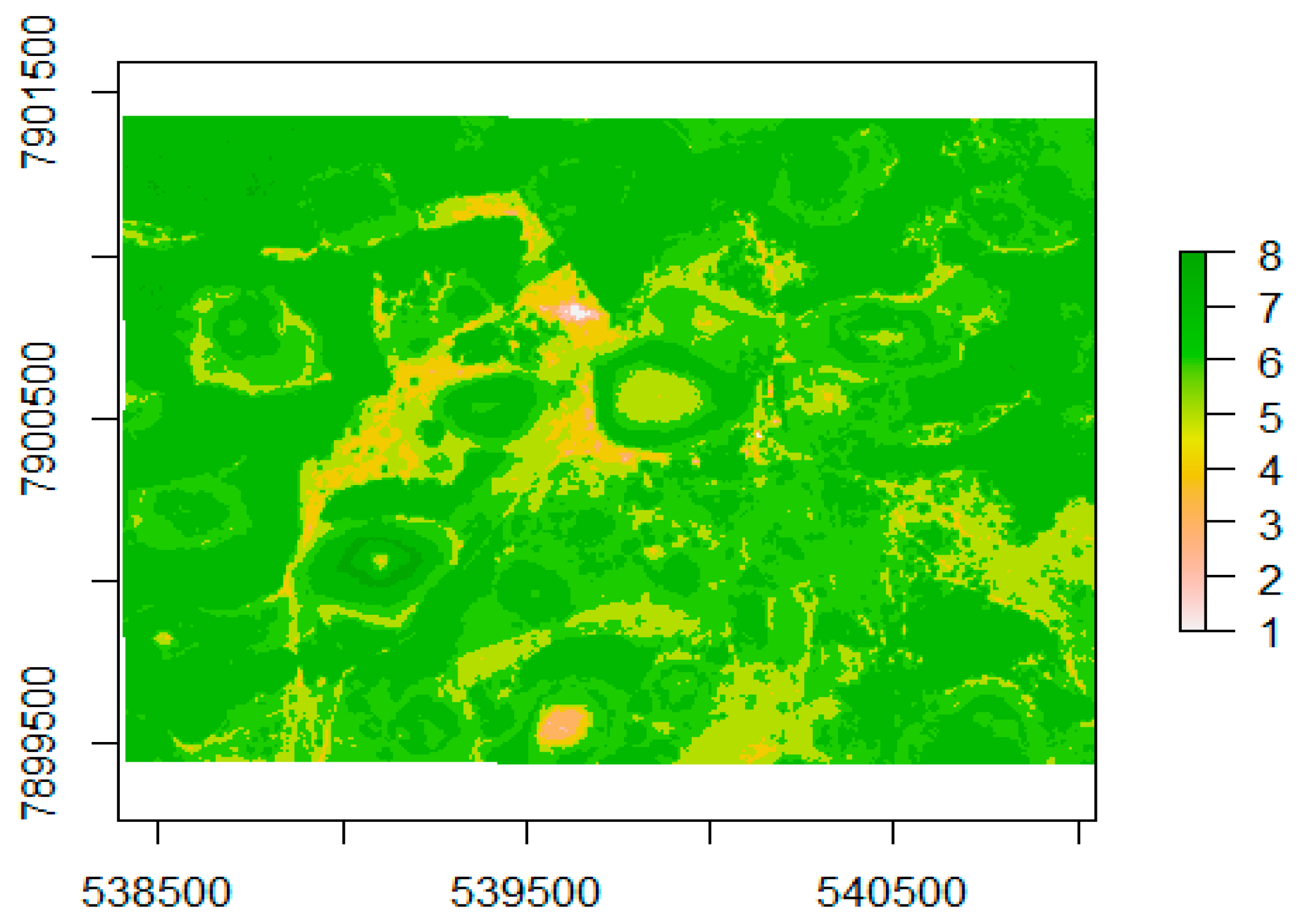
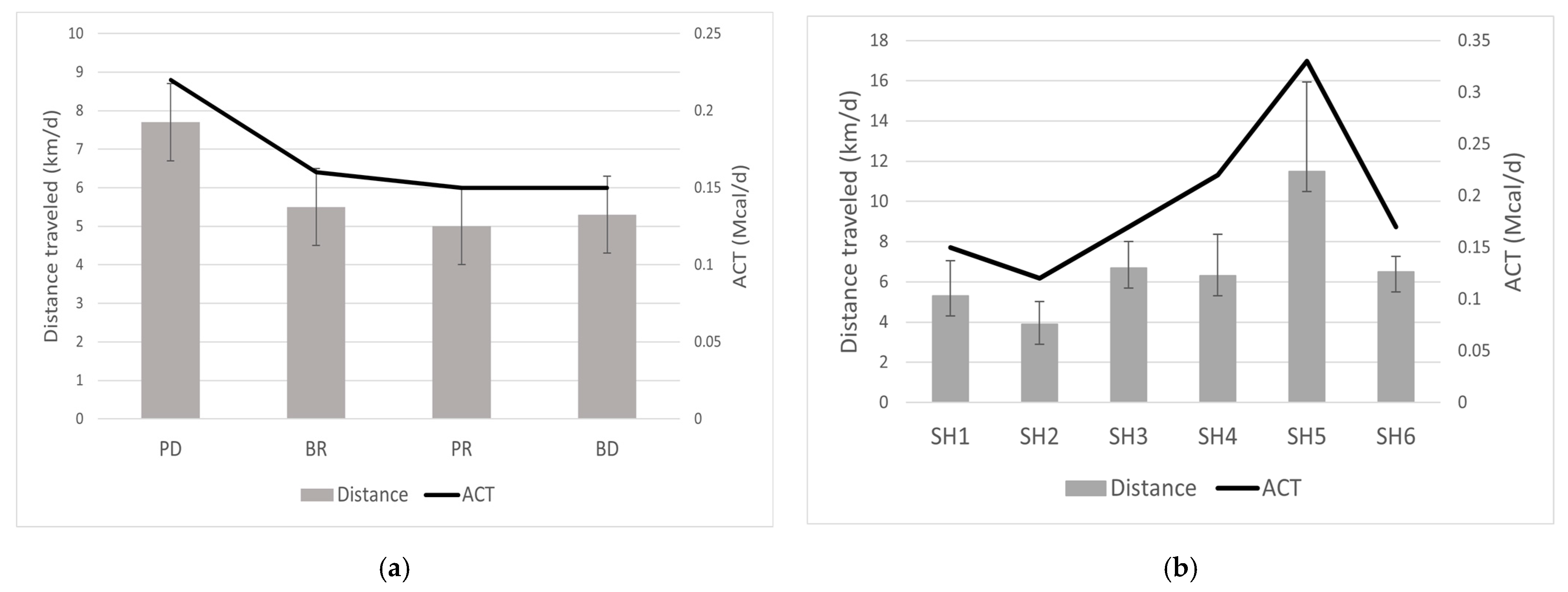
The Pantanal has been facing consecutive years of extreme drought, with an impact on the quantity and quality of available pasture. However, little is known about how locally adapted breeds respond to the distribution of forage resources in this extreme drought scenario. This study aimed to evaluate the movement of free-grazing Pantaneiro sheep using a low-cost GPS to assess the main grazing sites, measure the daily distance traveled, and determine the energy requirements for walking with body weight monitoring. In a herd of 100 animals, 31 were selected for weighing, and six ewes were outfitted with GPS collars. GPS data collected on these animals every 10 m from August 2020 to May 2021 was analyzed using the Python programming language. The traveled distance and activity energy requirements (ACT) for horizontal walking (Mcal/d of NEm) were determined. The 31 ewes were weighed at the beginning and end of each season. The available dry matter (DM) and floristic composition of the grazing sites were estimated at the peak of the drought. DM was predicted using power regression with NDVI (normalized difference vegetation index) (R2 = 0.94). DM estimates averaged 450 kg/ha, ranging from traces to 3830 kg/ha, indicating overall very low values. Individual variation in the frequency of use of grazing sites was observed (p < 0.05), reflecting the distances traveled and the energetic cost of the activity. The range of distances traveled by the animals varied from 3.3 to 17.7 km/d, with an average of 5.9 km/d, indicating low energy for walking. However, the traveled distance and ACT remained consistent over time; there were no significant differences observed between seasons (p > 0.05). On average, the ewes’ initial weight did not differ from the weight at the drought peak (p > 0.05), indicating that they maintained their initial weight, which is important for locally adapted breeds as it confers robustness and resilience. This study also highlighted the importance of the breed’s biodiverse diet during extreme drought, which enabled the selection of forage for energy and nutrient supplementation. The results demonstrated that precision tools such as GPS and satellite imagery enabled the study of animals in extensive systems, thereby contributing to decision-making within the production system.
Keywords: Ovis aries; GPS; biodiverse diet; daily distance traveled; adapted locally breed Ovis aries; GPS; biodiverse diet; daily distance traveled; adapted locally breed