Prickly Pear Cladodes as an Alternative Source of Water in Small- and Medium-Scale Yellow Mealworm Rearing

 , , , ,
  ,
,
Abstract
1. Introduction
2. Materials and Methods
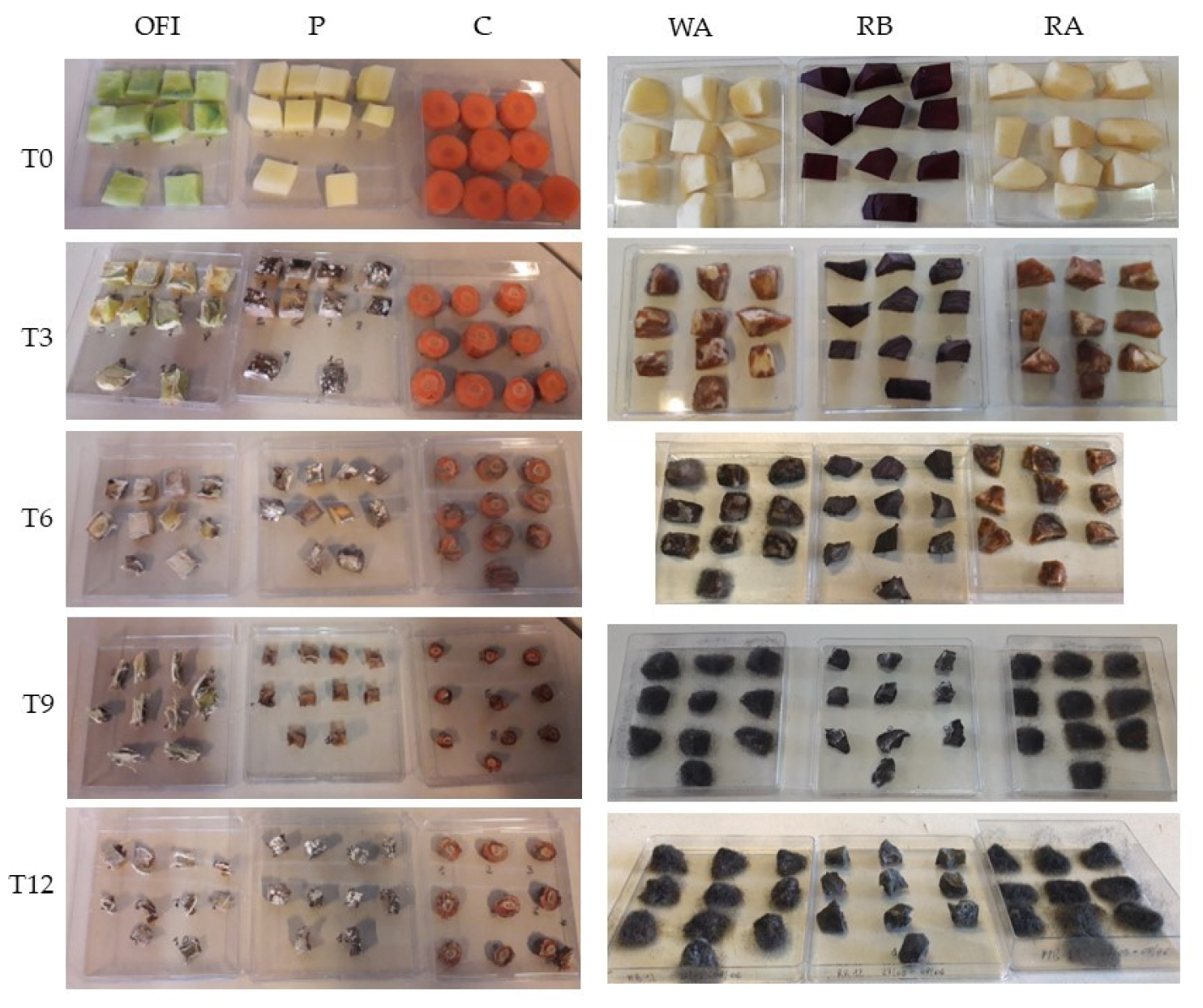
2.1. Dehydration Test of Some VMs
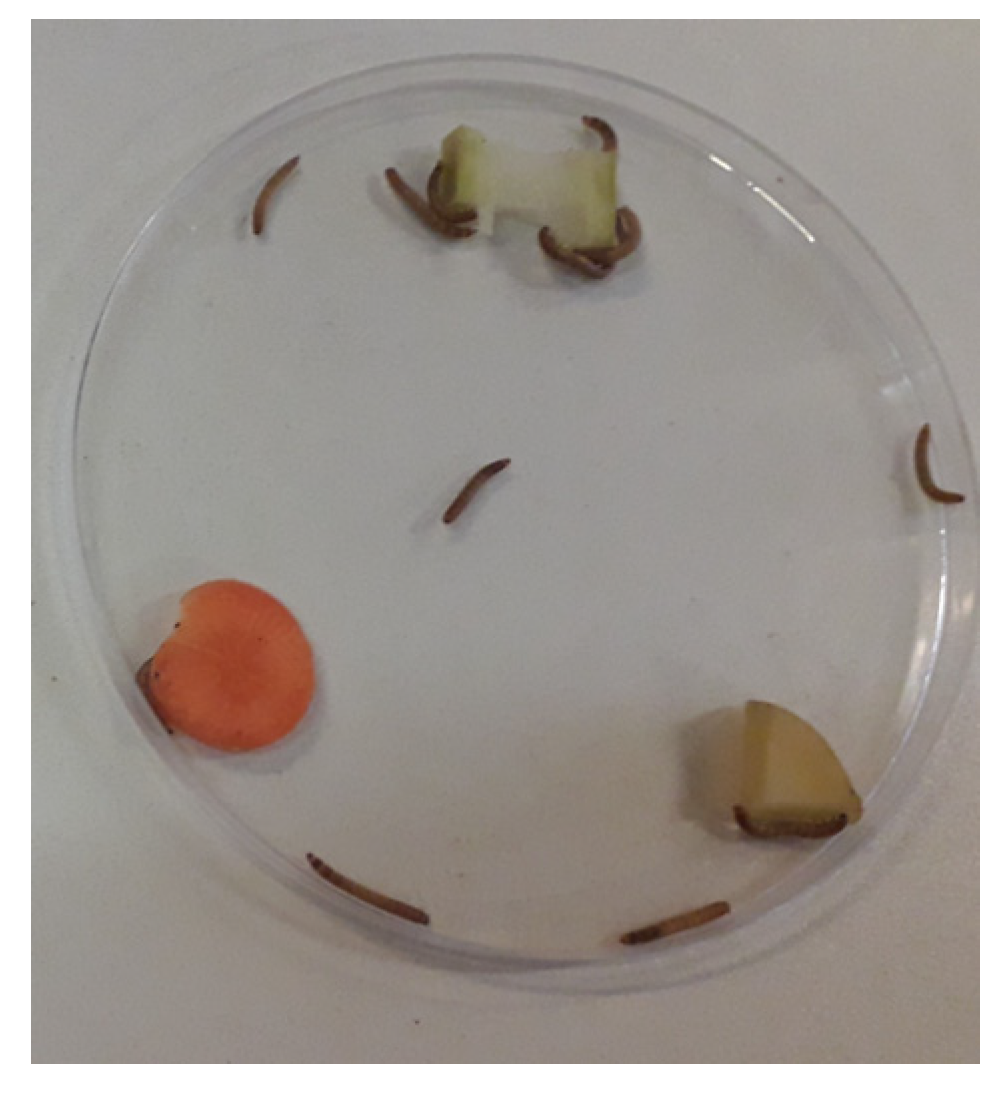
2.2. Choice Test by TMLs
2.3. Palatability Test of the VMs by the TMLs
2.4. Performance of the TMLs Fed on the Standard Diet and the VMs
2.5. Statistical Analyses
3. Results
3.1. Dehydration Test of Some VMs
3.2. Choice Test by TMLs
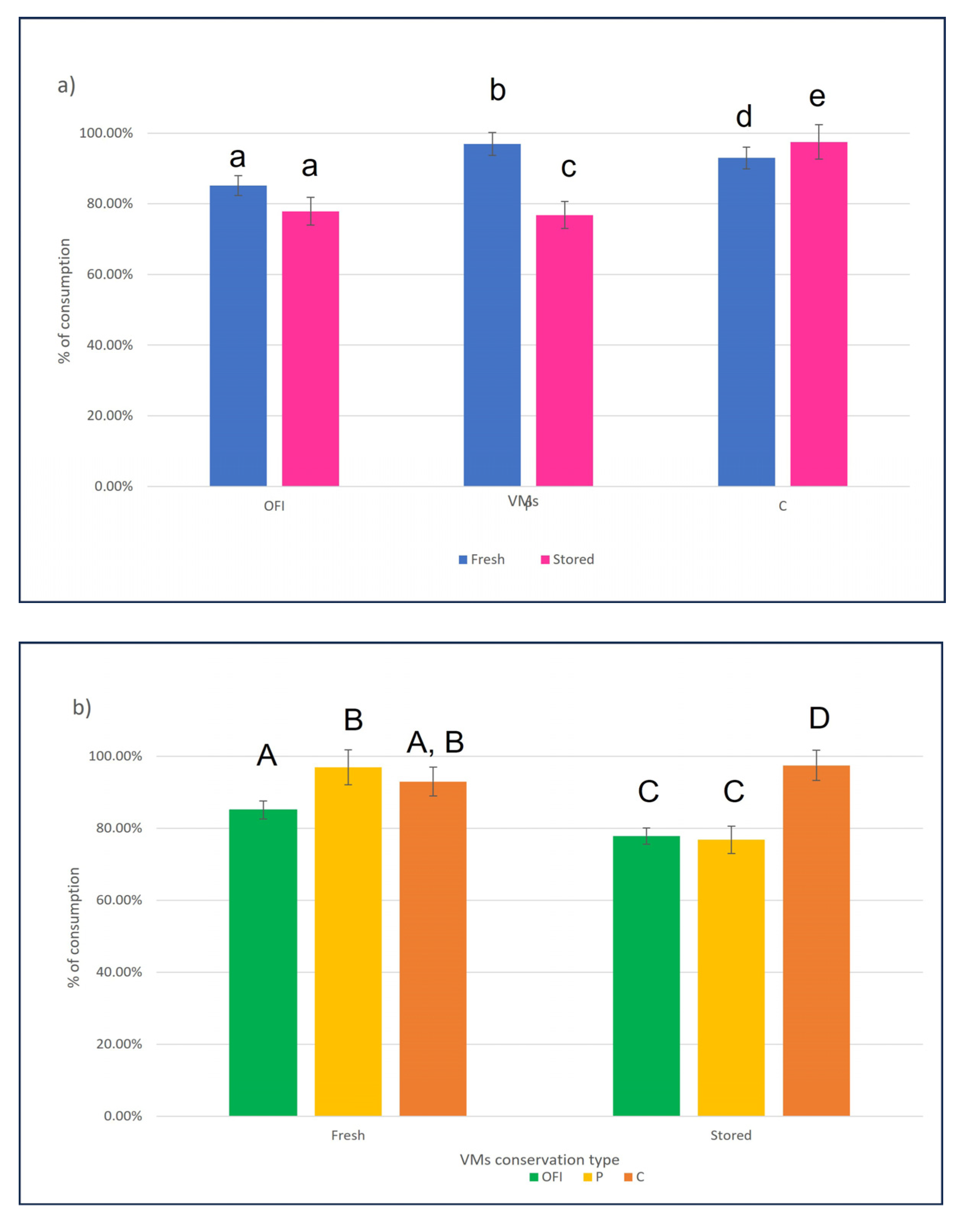
3.3. Palatability Test of the VMs by the TMLs
3.4. Performance of the TMLs Fed on the Standard Diet and the VMs
4. Discussion
5. Conclusions
Author Contributions
Funding
Institutional Review Board Statement
Data Availability Statement
Conflicts of Interest
References
- Hertog, G.P.; Wheldon, S.; Kantorova, M.; Gu, V.; Gonnella, D.; Williams, G.; Zeifman, I.; Bay, L.; Castanheira, G.; Kamiya, H.; et al. World Population Prospects 2022: Summary of Results; United Nations: New York, NY, USA, 2022.
- Ordoñez-Araque, R.; Egas-Montenegro, E. Edible Insects: A Food Alternative for the Sustainable Development of the Planet. Int. J. Gastron. Food Sci. 2021, 23, 100304. [Google Scholar] [CrossRef] [Scilit]
- Crippa, M.; Solazzo, E.; Guizzardi, D.; Monforti-Ferrario, F.; Tubiello, F.N.; Leip, A. Food Systems Are Responsible for a Third of Global Anthropogenic GHG Emissions. Nat. Food 2021, 2, 198–209. [Google Scholar] [CrossRef] [Scilit] [PubMed]
- Macdiarmid, J.I. The Food System and Climate Change: Are Plant-Based Diets Becoming Unhealthy and Less Environmentally Sustainable? Proc. Nutr. Soc. 2022, 81, 162–167. [Google Scholar] [CrossRef] [Scilit] [PubMed]
- Patel, S.; Suleria, H.A.R.; Rauf, A. Edible Insects as Innovative Foods: Nutritional and Functional Assessments. Trends Food Sci. Technol. 2019, 86, 352–359. [Google Scholar] [CrossRef] [Scilit]
- Meyer-Rochow, V.B. Can Insects Help to Ease the Problem of World Food Shortage? Search 2014, 6, 261–262. [Google Scholar]
- Imathiu, S. Benefits and Food Safety Concerns Associated with Consumption of Edible Insects. NFS J. 2020, 18, 1–11. [Google Scholar] [CrossRef] [Scilit]
- European Commission. Commission Implementing Regulation (EU) 2021/882; European Commission: Brussels, Belgium, 2012.
- Oonincx, D.G.A.B.; Van Broekhoven, S.; Van Huis, A.; Van Loon, J.J.A. Feed Conversion, Survival and Development, and Composition of Four Insect Species on Diets Composed of Food by-Products. PLoS ONE 2015, 10, e0144601. [Google Scholar] [CrossRef] [Scilit]
- Hong, J.; Han, T.; Kim, Y.Y. Mealworm (Tenebrio molitor Larvae) as an Alternative Protein Source for Monogastric Animal: A Review. Animals 2020, 10, 2068. [Google Scholar] [CrossRef] [Scilit]
- Errico, S.; Spagnoletta, A.; Verardi, A.; Moliterni, S.; Dimatteo, S.; Sangiorgio, P. Tenebrio molitor as a Source of Interesting Natural Compounds, Their Recovery Processes, Biological Effects, and Safety Aspects. Compr. Rev. Food Sci. Food Saf. 2022, 21, 148–197. [Google Scholar] [CrossRef] [Scilit]
- Smetana, S.; Palanisamy, M.; Mathys, A.; Heinz, V. Sustainability of Insect Use for Feed and Food: Life Cycle Assessment Perspective. J. Clean. Prod. 2016, 137, 741–751. [Google Scholar] [CrossRef] [Scilit]
- Derler, H.; Lienhard, A.; Berner, S.; Grasser, M.; Posch, A.; Rehorska, R. Use Them for What They Are Good at: Mealworms in Circular Food Systems. Insects 2021, 12, 40. [Google Scholar] [CrossRef] [Scilit]
- Cortes Ortiz, J.A.; Ruiz, A.T.; Morales-Ramos, J.A.; Thomas, M.; Rojas, M.G.; Tomberlin, J.K.; Yi, L.; Han, R.; Giroud, L.; Jullien, R.L. Insect Mass Production Technologies; Academic Press: Cambridge, MA, USA, 2016; ISBN 9780128028568. [Google Scholar]
- Hansen, L.L.; Ramløv, H.; Westh, P. Metabolic Activity and Water Vapour Absorption in the Mealworm Tenebrio molitor L. (Coleoptera, Tenebrionidae): Real-Time Measurements by Two-Channel Microcalorimetry. J. Exp. Biol. 2004, 207, 545–552. [Google Scholar] [CrossRef] [Scilit]
- Johnsen, N.S.; Andersen, J.L.; Offenberg, J. The Effect of Relative Humidity on the Survival and Growth Rate of the Yellow Mealworm Larvae (Tenebrio molitor, Linnaeus 1758). J. Insects Food Feed 2021, 7, 311–318. [Google Scholar] [CrossRef] [Scilit]
- Rumbos, C.I.; Bliamplias, D.; Gourgouta, M.; Michail, V.; Athanassiou, C.G. Rearing Tenebrio molitor and Alphitobius diaperinus Larvae on Seed Cleaning Process Byproducts. Insects 2021, 12, 293. [Google Scholar] [CrossRef] [Scilit]
- Liu, C.; Masri, J.; Perez, V.; Maya, C.; Zhao, J. Growth Performance and Nutrient Composition of Mealworms (Tenebrio molitor) Fed on Fresh Plant Materials-Supplemented Diets. Foods 2020, 9, 151. [Google Scholar] [CrossRef] [Scilit]
- Fasce, B.; Ródenas, L.; López, M.C.; Moya, V.J.; Pascual, J.J.; Cambra-López, M. Nutritive Value of Wheat Bran Diets Supplemented with Fresh Carrots and Wet Brewers’ Grains in Yellow Mealworm. J. Insect Sci. 2022, 22, 7. [Google Scholar] [CrossRef] [Scilit]
- Sangiorgio, P.; Verardi, A.; Dimatteo, S.; Spagnoletta, A.; Moliterni, S.; Errico, S. Valorisation of Agri-Food Waste and Mealworms Rearing Residues for Improving the Sustainability of Tenebrio molitor Industrial Production. J. Insects Food Feed 2022, 8, 509–524. [Google Scholar] [CrossRef] [Scilit]
- Gouhis, F.; Louhaichi, M.; Nefzaoui, A. Cactus (Opuntia ficus-indica) Utilization for Rehabilitating Rangelands in Arid Regions of Tunisia. Acta Hortic. 2019, 1247, 95–101. [Google Scholar] [CrossRef] [Scilit]
- Palmieri, N.; Suardi, A.; Stefanoni, W.; Pari, L. Opuntia ficus-indica as an Ingredient in New Functional Pasta: Consumer Preferences in Italy. Foods 2021, 10, 803. [Google Scholar] [CrossRef] [Scilit]
- Procacci, S.; Bojórquez-Quintal, E.; Platamone, G.; Maccioni, O.; Vecchio, V.L.; Morreale, V.; Alisi, C.; Balducchi, R.; Bacchetta, L. Opuntia ficus-indica Pruning Waste Recycling: Recovery and Characterization of Mucilage from Cladodes. Nat. Resour. 2021, 12, 91–107. [Google Scholar] [CrossRef]
- Albergamo, A.; Potortí, A.G.; Di Bella, G.; Amor, N.B.; Lo Vecchio, G.; Nava, V.; Rando, R.; Ben Mansour, H.; Lo Turco, V. Chemical Characterization of Different Products from the Tunisian Opuntia ficus-indica (L.) Mill. Foods 2022, 11, 155. [Google Scholar] [CrossRef] [Scilit] [PubMed]
- Silva, M.A.; Albuquerque, T.G.; Pereira, P.; Ramalho, R.; Vicente, F.; Oliveira, M.B.P.P.; Costa, H.S. Opuntia ficus-indica (L.) Mill.: A Multi-Benefit Potential to Be Exploited. Molecules 2021, 26, 951. [Google Scholar] [CrossRef] [Scilit] [PubMed]
- Sipango, N.; Ravhuhali, K.E.; Sebola, N.A.; Hawu, O.; Mabelebele, M.; Mokoboki, H.K.; Moyo, B. Prickly Pear (Opuntia spp.) as an Invasive Species and a Potential Fodder Resource for Ruminant Animals. Sustainability 2022, 14, 3719. [Google Scholar] [CrossRef] [Scilit]
- Andreu-Coll, L.; Cano-Lamadrid, M.; Sendra, E.; Carbonell-Barrachina, Á.; Legua, P.; Hernández, F. Fatty Acid Profile of Fruits (Pulp and Peel) and Cladodes (Young and Old) of Prickly Pear [Opuntia ficus-indica (L.) Mill.] from Six Spanish Cultivars. J. Food Compos. Anal. 2019, 84, 103294. [Google Scholar] [CrossRef] [Scilit]
- Ribeiro, N.; Abelho, M.; Costa, R. A Review of the Scientific Literature for Optimal Conditions for Mass Rearing Tenebrio molitor (Coleoptera: Tenebrionidae). J. Entomol. Sci. 2018, 53, 434–454. [Google Scholar] [CrossRef] [Scilit]
- Morales-Ramos, J.A.; Rojas, M.G.; Kelstrup, H.C.; Emery, V. Self-Selection of Agricultural by-Products and Food Ingredients by Tenebrio molitor (Coleoptera: Tenebrionidae) and Impact on Food Utilization and Nutrient Intake. Insects 2020, 11, 827. [Google Scholar] [CrossRef] [Scilit]
- Mlček, J.; Adámek, M.; Adámková, A.; Matyáš, J.; Bučková, M.; Mrázková, M.; Vícha, R.; Vychodil, R.; Knížková, I.; Volek, Z. Feed Parameters Influencing the Breeding of Mealworms (Tenebrio molitor). Sustainability 2021, 13, 12992. [Google Scholar] [CrossRef] [Scilit]
- Rovai, D.; Ortgies, M.; Amin, S.; Kuwahara, S.; Schwartz, G.; Lesniauskas, R.; Garza, J.; Lammert, A. Utilization of Carrot Pomace to Grow Mealworm Larvae (Tenebrio molitor). Sustainability 2021, 13, 9341. [Google Scholar] [CrossRef] [Scilit]
- Kröncke, N.; Benning, R. Self-Selection of Feeding Substrates by Tenebrio molitor Larvae of Different Ages to Determine Optimal Macronutrient Intake and the Influence on Larval Growth and Protein Content. Insects 2022, 13, 657. [Google Scholar] [CrossRef] [Scilit]
- Ruschioni, S.; Loreto, N.; Foligni, R.; Mannozzi, C.; Raffaelli, N.; Zamporlini, F.; Pasquini, M.; Roncolini, A.; Cardinali, F.; Osimani, A.; et al. Addition of Olive Pomace to Feeding Substrate Affects Growth Performance and Nutritional Value of Mealworm (Tenebrio molitor L.) Larvae. Foods 2020, 9, 317. [Google Scholar] [CrossRef] [Scilit]
- Morales-Ramos, J.A.; Rojas, M.G.; Shapiro-Llan, D.I.; Tedders, W.L. Use of Nutrient Self-Selection as a Diet Refining Tool in Tenebrio molitor (Coleoptera: Tenebrionidae). J. Entomol. Sci. 2013, 48, 206–221. [Google Scholar] [CrossRef] [Scilit]
- Deruytter, D.; Coudron, C.L.; Claeys, J. The Influence of Wet Feed Distribution on the Density, Growth Rate and Growth Variability of Tenebrio molitor. J. Insects Food Feed 2021, 7, 141–149. [Google Scholar] [CrossRef] [Scilit]
- Miglietta, P.P.; De Leo, F.; Ruberti, M.; Massari, S. Mealworms for Food: A Water Footprint Perspective. Water 2015, 7, 6190–6203. [Google Scholar] [CrossRef] [Scilit]
- Coudron, C.L.; Deruytter, D.; Claeys, J. The Influence of Wet Feed PH on the Growth of Tenebrio molitor Larvae. Sustainability 2022, 14, 7841. [Google Scholar] [CrossRef] [Scilit]



| VMs | T3 | T6 | T9 | T12 |
|---|---|---|---|---|
| OFI | 54.02 ± 5.32 a | 78.13 ± 9.32 a | 90.88 ± 1.03 a | 91.22 ± 8.38 a |
| P | 58.85 ± 7.02 ab | 76.20 ± 6.25 a | 86.32 ± 1.15 b | 86.16 ± 1.28 bc |
| C | 62.72 ± 3.45 b | 78.74 ± 2.82 a | 87.00 ± 1.01 b | 85.13 ± 0.35 b |
| WA | 45.18 ± 4.12 c | 59.92 ± 5.21 b | 81.71 ± 0.93 c | 79.73 ± 1.04 d |
| RB | 46.50 ± 2.13 c | 63.07 ±6.17 b | 77.17 ± 2.27 d | 76.67 ± 1.04 d |
| RA | 46.45 ± 3.48 c | 66.27 ± 1.37 b | 81.13 ± 0.44 c | 84.91 ± 1.07 c |
| VMs | Dry Matter (%) | Moisture Content (%) |
|---|---|---|
| Carrot (C) | 12.37 ± 0.32 | 87.63 ± 2.19 |
| Potato (P) | 18.06 ± 0.51 | 81.94 ± 2.05 |
| Prickly Pear (OFI) | 11.07 ± 0.28 | 88.93 ± 2.22 |
| Red Beet (RB) | 31.15 ± 0.84 | 68.85 ± 1.91 |
| OFI | P | C | No Choice | |
|---|---|---|---|---|
| CtL | 6.7 ± 1.4 a | 2.7 ± 1.1 b | 2.5 ± 1.1 b | 3.2 ± 1.6 b |
| VvL | 5.8 ± 1.9 a | 2.8 ± 1.1 b | 2.6 ± 1.1 b | 3.8 ± 2.3 b |
| VMs | Moisture (%) | |
|---|---|---|
| Fresh | Stored | |
| Carrot (C) | 87.63 ± 2.19 ac | 29.66 ± 0.86 a |
| Potato (P) | 81.94 ± 2.05 b | 28.60 ± 0.73 a |
| Prickly Pear (OFI) | 88.93 ± 2.22 c | 50.27 ± 1.51 b |
| Wet Supplement | Survival (%) | Weight Gain/Larva (mg) |
|---|---|---|
| Potato (P) | 98.5 ± 3.4 | 53.8 ± 4.2 a |
| Carrot (C) | 98.0 ± 3.5 | 62.5 ± 2.1 b |
| Prickly Pear (OFI) | 98.0 ± 3.5 | 64.8 ± 3.5 b |
Disclaimer/Publisher’s Note: The statements, opinions and data contained in all publications are solely those of the individual author(s) and contributor(s) and not of MDPI and/or the editor(s). MDPI and/or the editor(s) disclaim responsibility for any injury to people or property resulting from any ideas, methods, instructions or products referred to in the content. |
© 2023 by the authors. Licensee MDPI, Basel, Switzerland. This article is an open access article distributed under the terms and conditions of the Creative Commons Attribution (CC BY) license (https://creativecommons.org/licenses/by/4.0/).
Share and Cite
Errico, S.; Sangiorgio, P.; Moliterni, S.; Verardi, A.; Spagnoletta, A.; Dimatteo, S.; Baldacchino, F. Prickly Pear Cladodes as an Alternative Source of Water in Small- and Medium-Scale Yellow Mealworm Rearing. Agriculture 2023, 13, 1435. https://doi.org/10.3390/agriculture13071435
Errico S, Sangiorgio P, Moliterni S, Verardi A, Spagnoletta A, Dimatteo S, Baldacchino F. Prickly Pear Cladodes as an Alternative Source of Water in Small- and Medium-Scale Yellow Mealworm Rearing. Agriculture. 2023; 13(7):1435. https://doi.org/10.3390/agriculture13071435
Chicago/Turabian StyleErrico, Simona, Paola Sangiorgio, Stefania Moliterni, Alessandra Verardi, Anna Spagnoletta, Salvatore Dimatteo, and Ferdinando Baldacchino. 2023. "Prickly Pear Cladodes as an Alternative Source of Water in Small- and Medium-Scale Yellow Mealworm Rearing" Agriculture 13, no. 7: 1435. https://doi.org/10.3390/agriculture13071435
APA StyleErrico, S., Sangiorgio, P., Moliterni, S., Verardi, A., Spagnoletta, A., Dimatteo, S., & Baldacchino, F. (2023). Prickly Pear Cladodes as an Alternative Source of Water in Small- and Medium-Scale Yellow Mealworm Rearing. Agriculture, 13(7), 1435. https://doi.org/10.3390/agriculture13071435