Article

Bioactive Compounds in Malanto (Kalimeris indica) Leaves and Their Antioxidant Characteristics

1
School of Food, Jiangsu Food and Pharmaceutical Science College, No. 4, Meicheng Road, Higher Education Park, Huai’an 223003, China
2
Shenhua Testing Technology (Nantong) Co., Ltd., Nantong 226000, China
3
Department of Food and Beverage Management, Chung-Jen Junior College of Nursing, Health Sciences and Management, 217, Hung-Mao-Pi, Chiayi City 60077, Taiwan
4
Department of Medicinal Botanicals and Foods on Health Applications, Da-Yeh University, 168, Xuefu Road, Dacun Township, Changhua County 515006, Taiwan
5
Department of Food and Nutrition, Providence University, 200, Sec. 7, Taiwan Boulevard, Shalu Dist., Taichung City 43301, Taiwan
*
Authors to whom correspondence should be addressed.
Agriculture 2023, 13(1), 211; https://doi.org/10.3390/agriculture13010211

Submission received: 19 December 2022 / Revised: 10 January 2023 / Accepted: 13 January 2023 / Published: 14 January 2023
(This article belongs to the Section Agricultural Product Quality and Safety)

Abstract

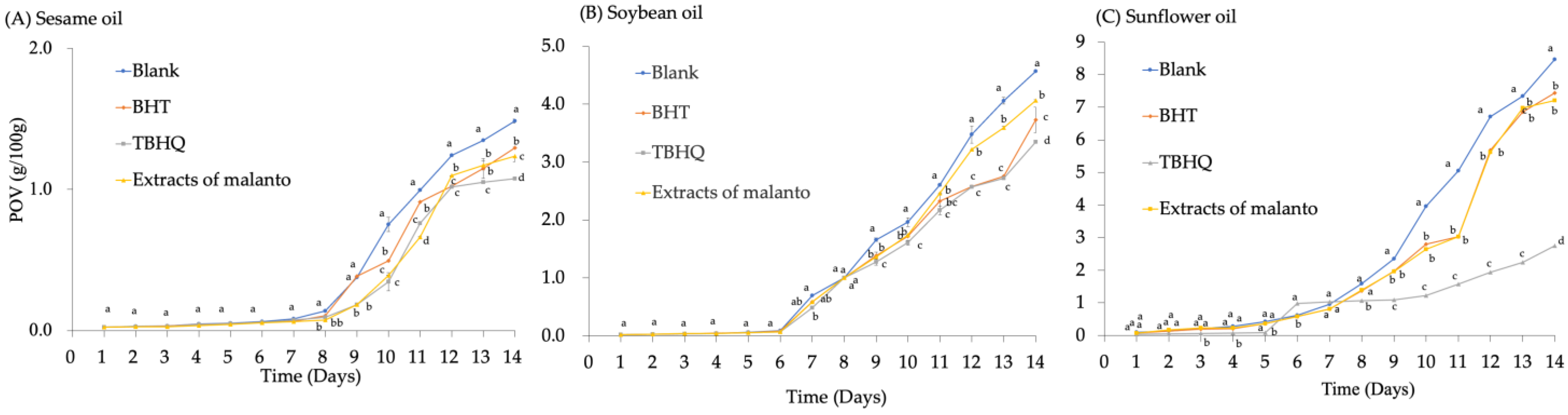
Currently, there is an increasing trend to replace artificial antioxidants with natural antioxidants. However, certain naturally occurring antioxidants have lower antioxidant activities than artificial antioxidants. Therefore, they will not be as effective in preventing cellular damage. Nevertheless, if they are controlled, natural antioxidants represent a valuable alternative to synthetic antioxidants. With regard to current knowledge, new applications of natural antioxidants in the food industry include food additives, feedstuffs, food packaging materials, and nutraceuticals. The younger leaves of Malan (Kalimeris indica (L.) Sch. Bip.), often referred to as “malanto”, are usually eaten as a vegetable. The findings of this study demonstrated that malanto flavonoids form the active ingredient of the naturally occurring malanto. The malanto extract contains six flavonoids with antioxidant capacity. Malanto flavonoids (0.02% addition) were evaluated for their antioxidant effects and were found to be similar to BHT in inhibiting the peroxidation of sesame, soybean, and sunflower oils. This study aims to provide unique insights into the comprehensive utilization of the flavonoids extracted from malanto.
Keywords: natural antioxidant; malan; malanto; flavonoid; antioxidant capacity; peroxidation natural antioxidant; malan; malanto; flavonoid; antioxidant capacity; peroxidation