Article

Development of a Quarantine Postharvest Treatment against Guatemalan Potato Moth (Tecia solanivora Povolny)

by
María Gloria Lobo
1,*,
Cristina González-García
2,
Raimundo Cabrera
3 and
Domingo Ríos
4
1
Producción Vegetal en Zonas Tropicales y Subtropicales, Instituto Canario de Investigaciones Agrarias, 38270 San Cristóbal de La Laguna, Tenerife, Spain
2
Gestión del Medio Rural de Canarias, SAU, 38110 Santa Cruz de Tenerife, Tenerife, Spain
3
Botánica, Ecología y Fisiología Vegetal, Universidad de La Laguna, 38206 San Cristóbal de La Laguna, Tenerife, Spain
4
Cabildo Insular de Tenerife, 38007 Santa Cruz de Tenerife, Tenerife, Spain
*
Author to whom correspondence should be addressed.
Agriculture 2021, 11(8), 801; https://doi.org/10.3390/agriculture11080801

Submission received: 20 July 2021 / Revised: 14 August 2021 / Accepted: 15 August 2021 / Published: 23 August 2021

Abstract

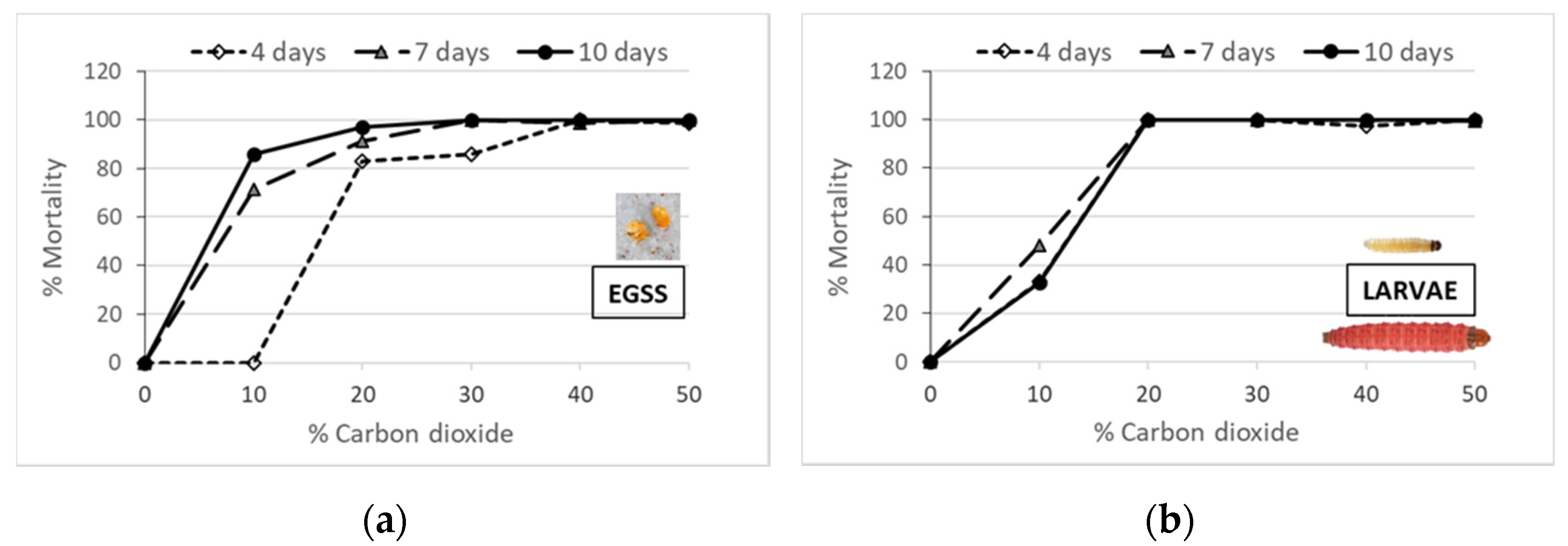
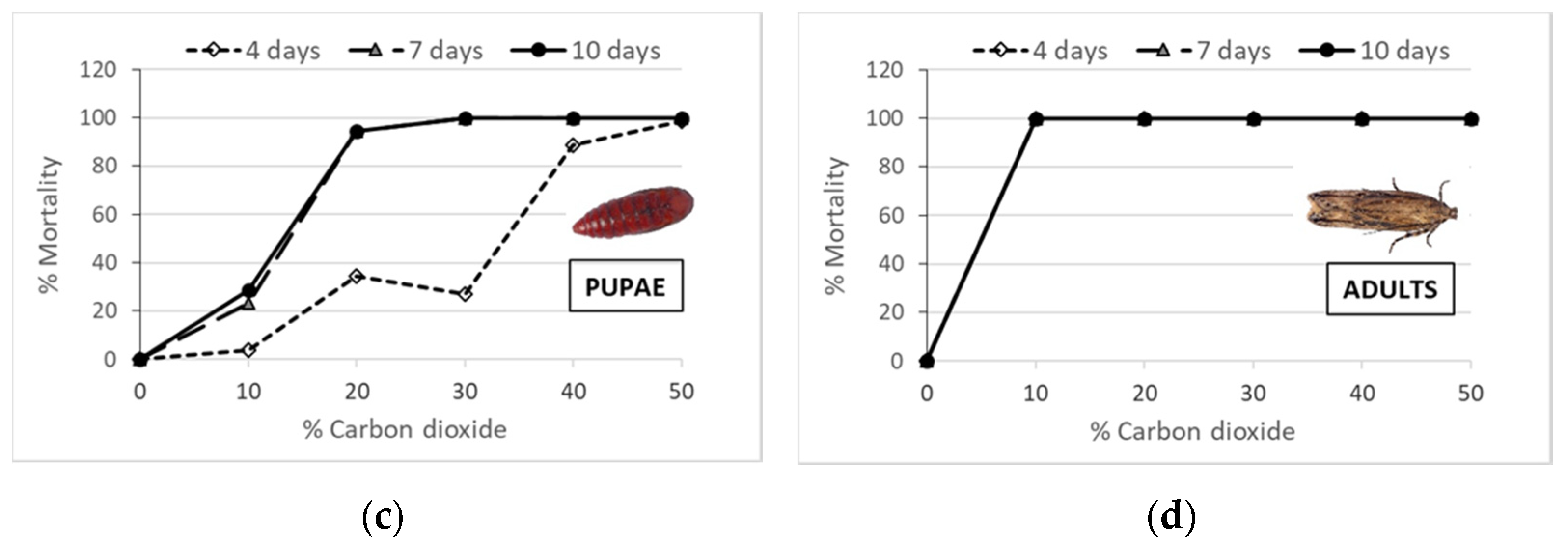
Tecia solanivora is a quarantine organism regarded as one of the insect pests causing major economic losses during potato cultivation and storage in Central America. The potatoes trade between countries, the interest in introducing new potato varieties, the great adaptability of the insect to different agro-ecological conditions, and the globalization world are serious risks in other potato growing countries. This pest was first recorded in Europe in the Canary Islands, Spain, in 1999, later in Galicia (2015) and then in Asturias (2016). Unfortunately, there are no effective chemical treatments for field control, and their integrated management has variable efficacy. Therefore, the implementation of a postharvest treatment to eradicate the insect, at any stage, during storage and marketing of potato becomes essential to achieve a product free of the insect that prevents its dissemination while maintaining the quality during its commercialization. This article presents the development of a new postharvest treatment of potatoes to eliminate all developmental stages of the Guatemalan moth by the application of a control atmosphere enriched in carbon dioxide. Infested potatoes were exposed to different control atmospheres combination (10, 20, 30, 40, or 50% CO2, 20% O2, and rest of N2). These treatments were applied for 4, 7, and 10 days at 18 ± 2 °C. The 10 days duration treatment (30 ± 2% CO2, 20 ± 2% O2 and 50 ± 2% N2) killed the insect in the semi and commercial trials performed without affecting potatoes quality and postharvest life, giving the possibility of its consideration as a quarantine postharvest treatment against T. solanivora.
Keywords: phytosanitary; insect; control atmosphere; potato quality phytosanitary; insect; control atmosphere; potato quality