Article

The Screening of Resistance against Meloidogyne graminicola in Oats


1
Department of Plant Pathology and Microbiology, National Taiwan University, Taipei 10617, Taiwan
2
Department of Agronomy, National Taiwan University, Taipei 10617, Taiwan
*
Author to whom correspondence should be addressed.
Agriculture 2020, 10(8), 352; https://doi.org/10.3390/agriculture10080352

Submission received: 25 July 2020 / Revised: 11 August 2020 / Accepted: 11 August 2020 / Published: 13 August 2020
(This article belongs to the Section Crop Protection, Diseases, Pests and Weeds)

Abstract

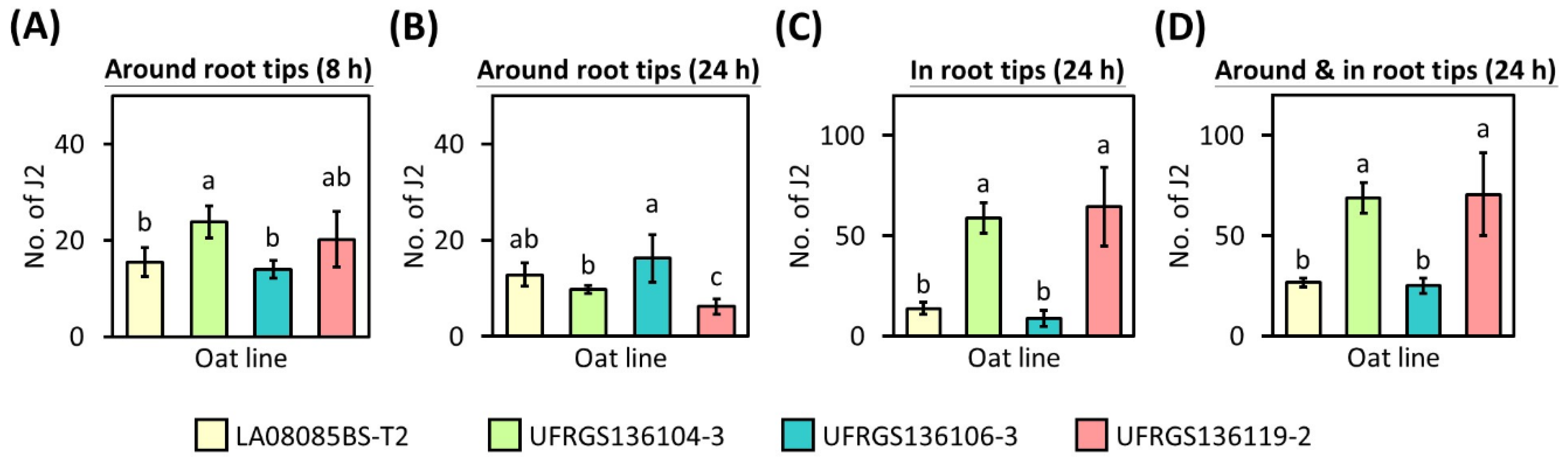
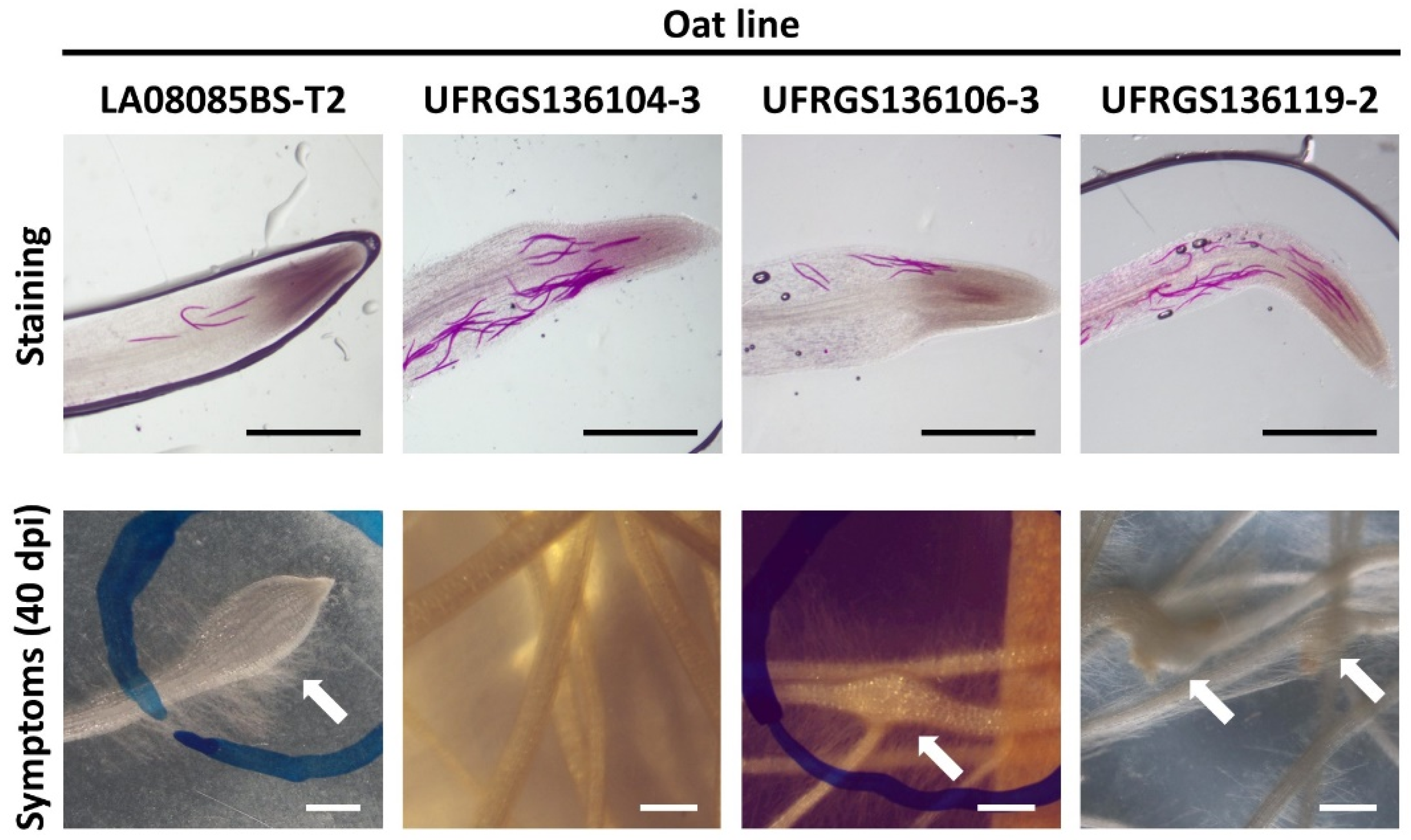
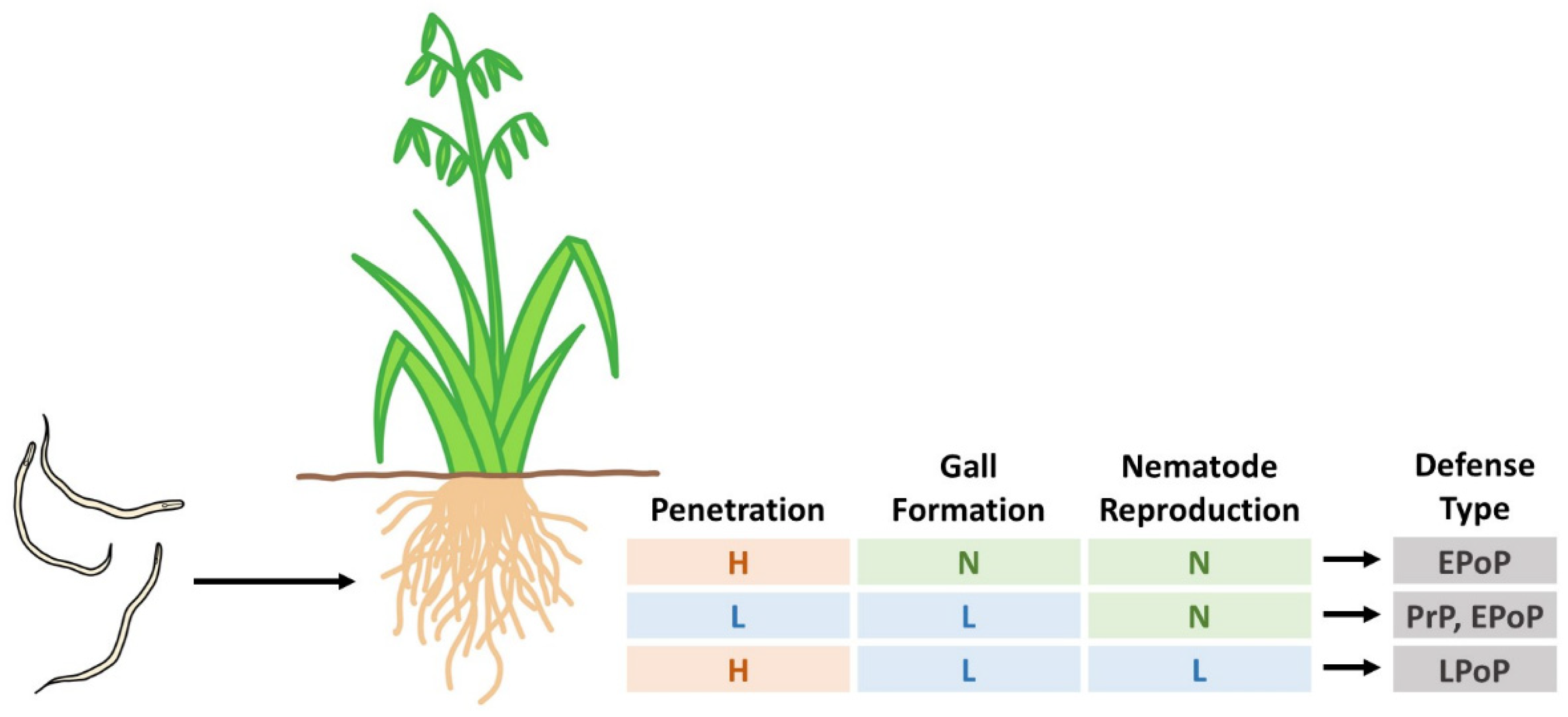
Including pest resistance elements against the major local concern is naturally important in the breeding process. Oat (Avena sativa L.) has been recently reintroduced into Taiwan as a winter alternative forage crop, and its agronomic performance has been evaluated at different locations in the country. This study examined the resistance to root-knot nematode, Meloidogyne graminicola, in four oat (Avena sativa L.) breeding lines of mass planting potential for winter in Taiwan. The host attraction level to the nematode, and the penetration and reproduction ability of nematode towards host roots were evaluated by chemotaxis assay, root staining assay, root galling, and nematode extraction. Based on the gall index (GI) and multiplication factor (R), the resistance of each oat line was evaluated. At 24 h postinoculation, second-stage juvenile (J2) nematodes appeared most attracted by oat breeding lines UFRGS136104-3 and UFRGS136119-2. The number of J2s successfully penetrated into the two breeding lines were also high. However, at 40 days postinoculation, observation of the oats in the newly developed culture bag nematode-inoculation system revealed that the amount of root galls and 2nd generation nematodes were significantly higher in line LA08085BS-T2 than in other lines. In sum, oat breeding line UFRGS136104-3 was highly resistant to M. graminicola by inhibiting the gall formation and nematode reproduction, while UFRGS136106-3 and UFRGS136119-2 showed relatively weak resistance and oat line LA08085BS-T2 would be a moderately susceptible host to M. graminicola, with high numbers of root gall formation. The outcome of this study provides ground information for nematode-resistant oat cultivar breeding.
Keywords: breeding; Meloidogyne graminicola; oat (Avena sativa L.); resistance; root-knot nematode breeding; Meloidogyne graminicola; oat (Avena sativa L.); resistance; root-knot nematode