Article

Prediction of Function in ABCA4-Related Retinopathy Using Ensemble Machine Learning


1
Department of Ophthalmology, University of Bonn, 53127 Bonn, Germany
2
Center for Rare Diseases, University of Bonn, 53127 Bonn, Germany
3
Moorfields Eye Hospital NHS Foundation Trust, London EC1V 2PD, UK
4
Institute of Ophthalmology, University College London, London EC1V 9EL, UK
5
BioQuant, University of Heidelberg, 69120 Heidelberg, Germany
6
Department of Biomedical Data Science, Stanford University, Stanford, CA 94305-5464, USA
*
Author to whom correspondence should be addressed.
J. Clin. Med. 2020, 9(8), 2428; https://doi.org/10.3390/jcm9082428
Submission received: 24 June 2020 / Revised: 19 July 2020 / Accepted: 28 July 2020 / Published: 29 July 2020
(This article belongs to the Special Issue New Advances in Retinal Research)

Abstract

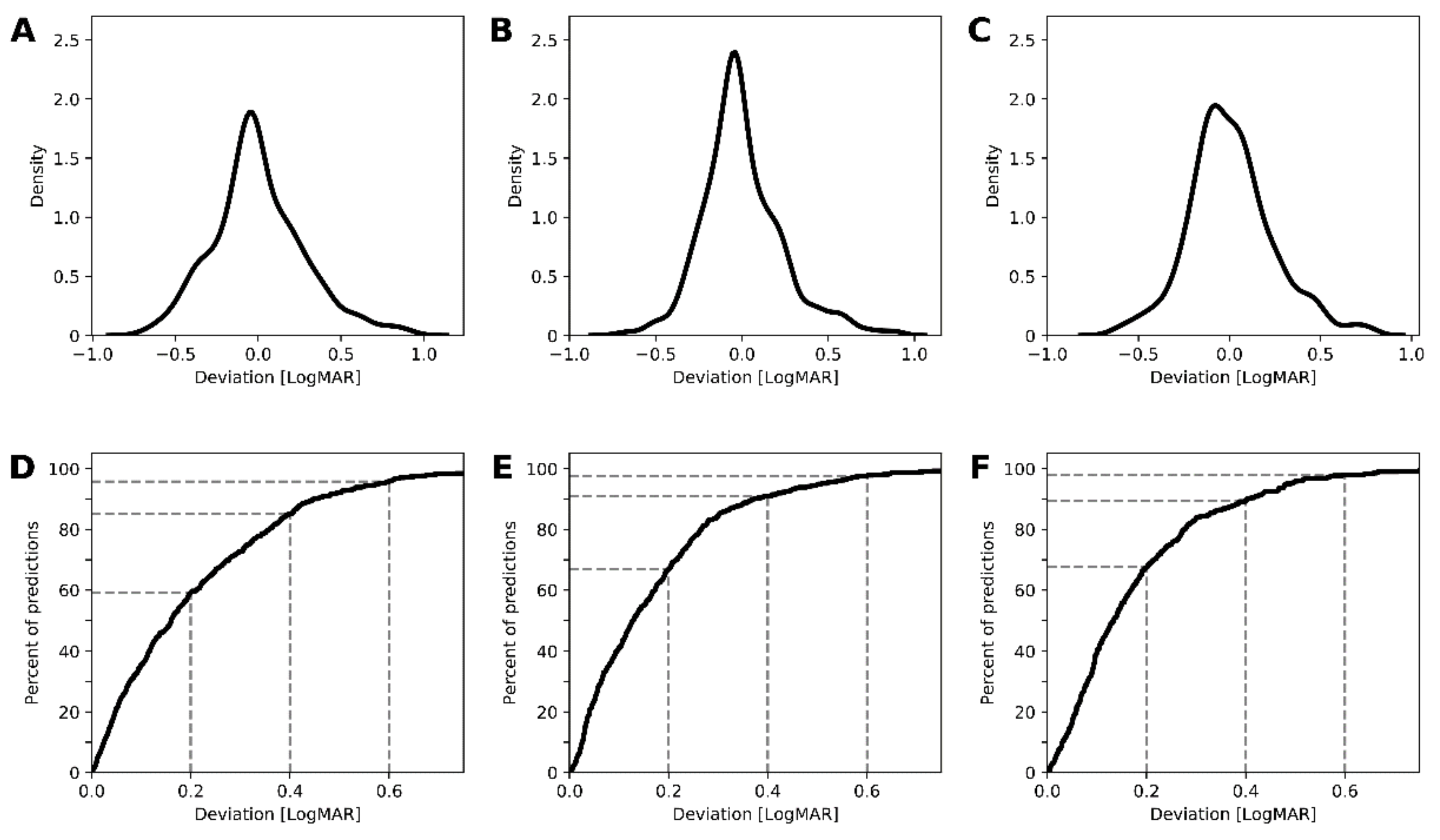
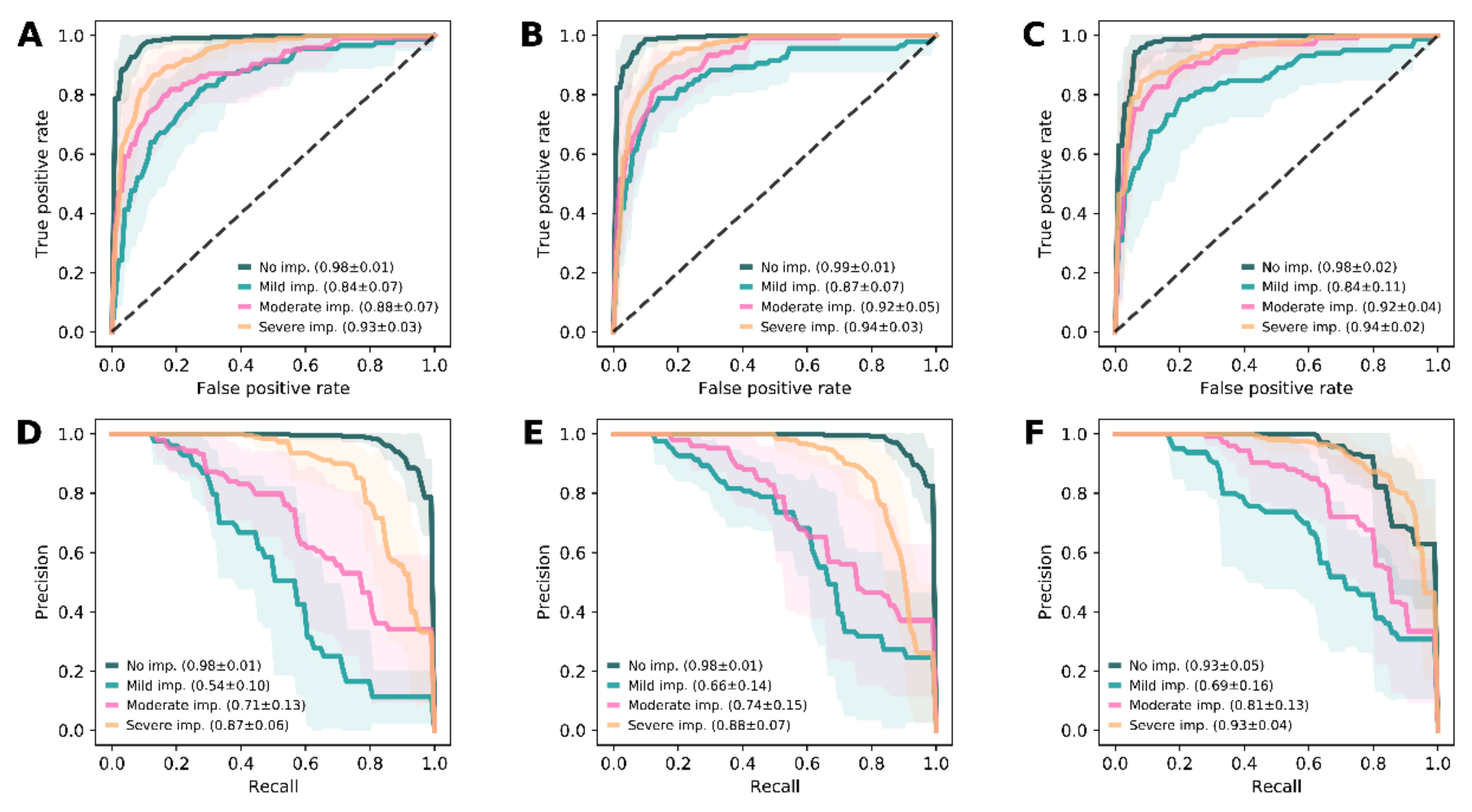
Full-field electroretinogram (ERG) and best corrected visual acuity (BCVA) measures have been shown to have prognostic value for recessive Stargardt disease (also called “ABCA4-related retinopathy”). These functional tests may serve as a performance-outcome-measure (PerfO) in emerging interventional clinical trials, but utility is limited by variability and patient burden. To address these limitations, an ensemble machine-learning-based approach was evaluated to differentiate patients from controls, and predict disease categories depending on ERG (‘inferred ERG’) and visual impairment (‘inferred visual impairment’) as well as BCVA values (‘inferred BCVA’) based on microstructural imaging (utilizing spectral-domain optical coherence tomography) and patient data. The accuracy for ‘inferred ERG’ and ‘inferred visual impairment’ was up to 99.53 ± 1.02%. Prediction of BCVA values (‘inferred BCVA’) achieved a precision of ±0.3LogMAR in up to 85.31% of eyes. Analysis of the permutation importance revealed that foveal status was the most important feature for BCVA prediction, while the thickness of outer nuclear layer and photoreceptor inner and outer segments as well as age of onset highly ranked for all predictions. ‘Inferred ERG’, ‘inferred visual impairment’, and ‘inferred BCVA’, herein, represent accurate estimates of differential functional effects of retinal microstructure, and offer quasi-functional parameters with the potential for a refined patient assessment, and investigation of potential future treatment effects or disease progression.
Keywords: retina; Stargardt disease; optical coherence tomography; visual acuity; electroretinogram; hereditary retinal disease; artificial intelligence retina; Stargardt disease; optical coherence tomography; visual acuity; electroretinogram; hereditary retinal disease; artificial intelligence