

Upstroke Time Per Cardiac Cycle as A Novel Parameter for Mortality Prediction in Patients with Acute Myocardial Infarction

 , ,
, ,
Abstract
1. Introduction
2. Materials and Methods
2.1. Study Population and Design
2.2. Ethics Statement
2.3. Assessment of ABI, UTCC, and Four Limb Blood Pressures by ABI-form Device
2.4. Collection of Demographic and Medical Data
2.5. Statistical Analysis
3. Results
4. Discussion
Study Limitations
5. Conclusions
Author Contributions
Funding
Acknowledgments
Conflicts of Interest
References
- Anderson, J.L.; Morrow, D.A. Acute Myocardial Infarction. N. Engl. J. Med. 2017, 376, 2053–2064. [Google Scholar] [CrossRef] [PubMed]
- Murray, C.J.; Vos, T.; Lozano, R.; Naghavi, M.; Flaxman, A.D.; Michaud, C.; Ezzati, M.; Shibuya, K.; Salomon, J.A.; Abdalla, S.; et al. Disability-adjusted life years (DALYs) for 291 diseases and injuries in 21 regions, 1990–2010: A systematic analysis for the Global Burden of Disease Study 2010. Lancet 2012, 380, 2197–2223. [Google Scholar] [CrossRef]
- Li, Y.H.; Wang, Y.C.; Wang, Y.C.; Liu, J.C.; Lee, C.H.; Chen, C.C.; Hsieh, I.C.; Kuo, F.Y.; Huang, W.C.; Sung, S.H.; et al. 2018 Guidelines of the Taiwan Society of Cardiology, Taiwan Society of Emergency Medicine and Taiwan Society of Cardiovascular Interventions for the management of non ST-segment elevation acute coronary syndrome. J. Formos. Med. Assoc. 2018, 117, 766–790. [Google Scholar] [CrossRef] [PubMed]
- Carter, S.A. Indirect systolic pressures and pulse waves in arterial occlusive diseases of the lower extremities. Circulation 1968, 37, 624–637. [Google Scholar] [CrossRef] [PubMed]
- Allen, J.; Overbeck, K.; Nath, A.F.; Murray, A.; Stansby, G. A prospective comparison of bilateral photoplethysmography versus the ankle-brachial pressure index for detecting and quantifying lower limb peripheral arterial disease. J. Vasc. Surg. 2008, 47, 794–802. [Google Scholar] [CrossRef]
- Cachovan, M.; Linhart, J.; Prerovsky, I. Morphology of pulse wave curve from various segments of the lower limb in man. Angiology 1968, 19, 381–392. [Google Scholar] [CrossRef]
- Sheng, C.S.; Li, Y.; Huang, Q.F.; Kang, Y.Y.; Li, F.K.; Wang, J.G. Pulse Waves in the Lower Extremities as a Diagnostic Tool of Peripheral Arterial Disease and Predictor of Mortality in Elderly Chinese. Hypertension 2016, 67, 527–534. [Google Scholar] [CrossRef]
- Yamashina, A.; Tomiyama, H.; Takeda, K.; Tsuda, H.; Arai, T.; Hirose, K.; Koji, Y.; Hori, S.; Yamamoto, Y. Validity, reproducibility, and clinical significance of noninvasive brachial-ankle pulse wave velocity measurement. Hypertens. Res. 2002, 25, 359–364. [Google Scholar] [CrossRef] [PubMed]
- Tomiyama, H.; Yamashina, A.; Arai, T.; Hirose, K.; Koji, Y.; Chikamori, T.; Hori, S.; Yamamoto, Y.; Doba, N.; Hinohara, S. Influences of age and gender on results of noninvasive brachial-ankle pulse wave velocity measurement—A survey of 12517 subjects. Atherosclerosis 2003, 166, 303–309. [Google Scholar] [CrossRef]
- Yu, S.; Lu, Y.; Xiong, J.; Teliewubai, J.; Chi, C.; Ji, H.; Zhou, Y.; Fan, X.; Zhang, J.; Blacher, J.; et al. Comparison of ankle-brachial index and upstroke time in association with target organ damage: The Northern Shanghai Study. J. Am. Soc. Hypertens. 2018, 12, 703–713. [Google Scholar] [CrossRef] [PubMed]
- Rac-Albu, M.; Iliuta, L.; Guberna, S.M.; Sinescu, C. The role of ankle-brachial index for predicting peripheral arterial disease. Maedica 2014, 9, 295–302. [Google Scholar] [PubMed]
- Leng, G.C.; Fowkes, F.G.; Lee, A.J.; Dunbar, J.; Housley, E.; Ruckley, C.V. Use of ankle brachial pressure index to predict cardiovascular events and death: A cohort study. BMJ 1996, 313, 1440–1444. [Google Scholar] [CrossRef] [PubMed]
- Diehm, C.; Lange, S.; Darius, H.; Pittrow, D.; von Stritzky, B.; Tepohl, G.; Haberl, R.L.; Allenberg, J.R.; Dasch, B.; Trampisch, H.J. Association of low ankle brachial index with high mortality in primary care. Eur. Heart J. 2006, 27, 1743–1749. [Google Scholar] [CrossRef] [PubMed]
- McDermott, M.M.; Feinglass, J.; Slavensky, R.; Pearce, W.H. The ankle-brachial index as a predictor of survival in patients with peripheral vascular disease. J. Gen. Intern. Med. 1994, 9, 445–449. [Google Scholar] [CrossRef] [PubMed]
- Feringa, H.H.; Bax, J.J.; van Waning, V.H.; Boersma, E.; Elhendy, A.; Schouten, O.; Tangelder, M.J.; van Sambeek, M.H.; van den Meiracker, A.H.; Poldermans, D. The long-term prognostic value of the resting and postexercise ankle-brachial index. Arch Intern. Med. 2006, 166, 529–535. [Google Scholar] [CrossRef] [PubMed][Green Version]
- Caro, J.; Migliaccio-Walle, K.; Ishak, K.J.; Proskorovsky, I. The morbidity and mortality following a diagnosis of peripheral arterial disease: Long-term follow-up of a large database. BMC Cardiovasc. Disord. 2005, 5, 14. [Google Scholar] [CrossRef] [PubMed]
- Sartipy, F.; Sigvant, B.; Lundin, F.; Wahlberg, E. Ten Year Mortality in Different Peripheral Arterial Disease Stages: A Population Based Observational Study on Outcome. Eur. J. Vasc. Endovasc. Surg. 2018, 55, 529–536. [Google Scholar] [CrossRef] [PubMed]
- Manfredini, F.; Lamberti, N.; Guerzoni, F.; Napoli, N.; Gasbarro, V.; Zamboni, P.; Mascoli, F.; Manfredini, R.; Basaglia, N.; Rodriguez-Borrego, M.A.; et al. Rehabilitative Exercise Reduced the Impact of Peripheral Artery Disease on Vascular Outcomes in Elderly Patients with Claudication: A Three-Year Single Center Retrospective Study. J. Clin. Med. 2019, 8, 210. [Google Scholar] [CrossRef] [PubMed]
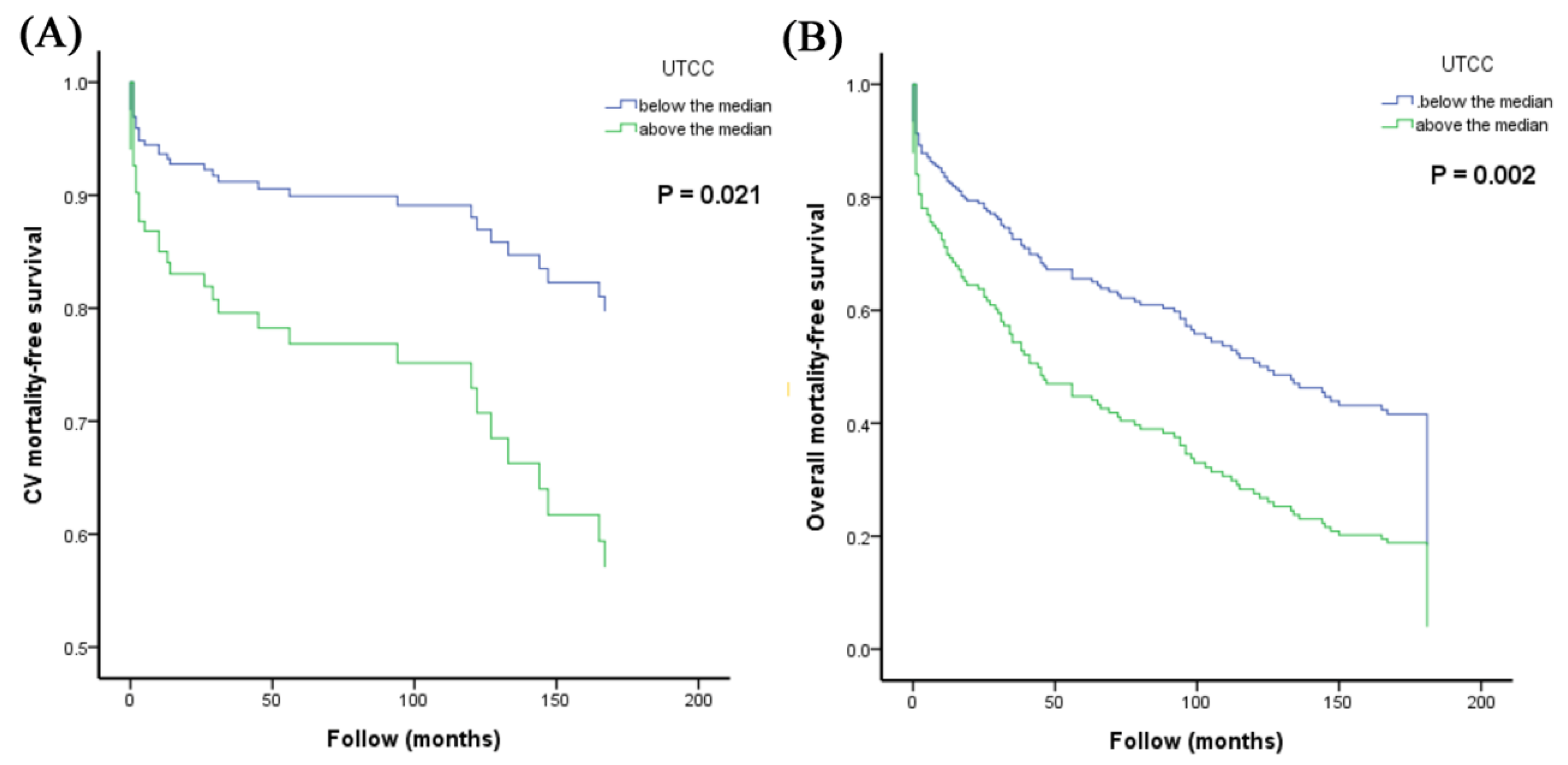

| Baseline Characteristics | UTCC below the Median | UTCC above the Median | P value |
|---|---|---|---|
| Number | 92 | 92 | |
| Age (years) | 60 ± 13 | 71 ± 12 | <0.001 |
| Male gender (%) | 82.6% | 62.0% | 0.003 |
| Dyslipidemia (%) | 26.1% | 37.0% | 0.153 |
| Diabetes mellitus (%) | 23.9% | 30.4% | 0.407 |
| Hypertension (%) | 31.5% | 54.3% | 0.003 |
| STEMI (%) | 19.6% | 20.7% | 1.000 |
| NSTEMI (%) | 80.4% | 79.3% | 1.000 |
| PAD (%) | 6.5% | 45.7% | <0.001 |
| Heart rate (beat/min) | 70.3 ± 12.3 | 87.4 ± 17.3 | <0.001 |
| LVEF | 60.9 ± 15.2 | 55.8 ± 15.6 | 0.066 |
| CCI | 2.38 ± 1.64 | 3.95 ± 1.79 | <0.001 |
| Body mass index (kg/m2) | 24.7 ± 3.6 | 24.0 ± 4.0 | 0.231 |
| Ankle brachial index | 1.04 ± 0.11 | 0.86 ± 0.22 | <0.001 |
| UTCC (%) | 16.1 ± 2.07 | 25.9 ± 7.93 | <0.001 |
| Parameter | Univariable Analysis | Multivariable Analysis | ||
|---|---|---|---|---|
| HR (95% CI) | P | HR (95% CI) | P | |
| Age (Per 1 year) | 1.049(1.020–1.079) | < 0.001 | - | 0.801 |
| Gender (Male vs. Female) | 0.481(0.245–0.944) | 0.033 | - | 0.406 |
| Diabetes mellitus (Yes vs. No) | 1.154(0.556–2.295) | 0.700 | - | - |
| Hypertension (Yes vs. No) | 2.464(1.258–4.828) | 0.009 | 3.363(1.163-9.731) | 0.025 |
| Dyslipidemia (Yes vs. No) | 0.972(0.478–1.975) | 0.937 | - | - |
| STEMI (Yes vs. No) | 0.947(0.415–2.164) | 0.898 | - | - |
| Heart rate (Per beat/min) | 1.020(1.001–1.038) | 0.036 | - | 0.707 |
| Body mass index (Per 1kg/m2) | 0.950(0.864–1.043) | 0.282 | - | - |
| LVEF (Per 1%) | 0.973(0.947–1.000) | 0.048 | - | 0.355 |
| CCI | 1.400(1.198–1.637) | < 0.001 | - | 0.943 |
| Ankle brachial index (Per 1SD) | 0.656(0.489–0.881) | 0.005 | - | 0.407 |
| UTCC (Per 1SD) | 1.627(1.231–2.151) | 0.001 | 1.844(1.018–3.342) | 0.043 |
| Parameter | Univariable Analysis | Multivariable Analysis | ||
|---|---|---|---|---|
| HR (95% CI) | P | HR (95% CI) | P | |
| Age (Per 1 year) | 1.070(1.053–1.087) | <0.001 | 1.050(1.028–1.073) | <0.001 |
| Gender (Male vs. Female) | 0.606(0.416–0.883) | 0.009 | - | 0.339 |
| Diabetes mellitus (Yes vs. No) | 1.173(0.793–1.736) | 0.424 | - | - |
| Hypertension (Yes vs. No) | 1.570(1.103–2.235) | 0.012 | - | 0.703 |
| Dyslipidemia (Yes vs. No) | 1.072(0.735–1.564) | 0.717 | - | - |
| STEMI (Yes vs. No) | 0.922(0.590–1.440) | 0.721 | - | - |
| Heart rate (Per 1beat/min) | 1.019(1.009–1.029) | <0.001 | - | 0.956 |
| Body mass index (Per 1kg/m2) | 0.902(0.856–0.950) | <0.001 | - | 0.149 |
| LVEF (Per 1%) | 0.983(0.970–0.997) | 0.014 | - | 0.150 |
| CCI | 1.438(1.322–1.564) | < 0.001 | - | 0.506 |
| Ankle brachial index (Per 1SD) | 0.790(0.727–0.858) | < 0.001 | - | 0.493 |
| UTCC (Per 1SD) | 1.084(1.063–1.105) | < 0.001 | 1.849(1.367–2.501) | <0.001 |
© 2020 by the authors. Licensee MDPI, Basel, Switzerland. This article is an open access article distributed under the terms and conditions of the Creative Commons Attribution (CC BY) license (http://creativecommons.org/licenses/by/4.0/).
Share and Cite
Hsu, P.-C.; Lee, W.-H.; Tsai, W.-C.; Chen, Y.-C.; Chi, N.-Y.; Chang, C.-T.; Chu, C.-Y.; Lin, T.-H.; Lee, C.-S.; Lai, W.-T.; et al. Upstroke Time Per Cardiac Cycle as A Novel Parameter for Mortality Prediction in Patients with Acute Myocardial Infarction. J. Clin. Med. 2020, 9, 904. https://doi.org/10.3390/jcm9040904
Hsu P-C, Lee W-H, Tsai W-C, Chen Y-C, Chi N-Y, Chang C-T, Chu C-Y, Lin T-H, Lee C-S, Lai W-T, et al. Upstroke Time Per Cardiac Cycle as A Novel Parameter for Mortality Prediction in Patients with Acute Myocardial Infarction. Journal of Clinical Medicine. 2020; 9(4):904. https://doi.org/10.3390/jcm9040904
Chicago/Turabian StyleHsu, Po-Chao, Wen-Hsien Lee, Wei-Chung Tsai, Ying-Chih Chen, Nai-Yu Chi, Ching-Tang Chang, Chun-Yuan Chu, Tsung-Hsien Lin, Chee-Siong Lee, Wen-Ter Lai, and et al. 2020. "Upstroke Time Per Cardiac Cycle as A Novel Parameter for Mortality Prediction in Patients with Acute Myocardial Infarction" Journal of Clinical Medicine 9, no. 4: 904. https://doi.org/10.3390/jcm9040904
APA StyleHsu, P.-C., Lee, W.-H., Tsai, W.-C., Chen, Y.-C., Chi, N.-Y., Chang, C.-T., Chu, C.-Y., Lin, T.-H., Lee, C.-S., Lai, W.-T., Sheu, S.-H., & Su, H.-M. (2020). Upstroke Time Per Cardiac Cycle as A Novel Parameter for Mortality Prediction in Patients with Acute Myocardial Infarction. Journal of Clinical Medicine, 9(4), 904. https://doi.org/10.3390/jcm9040904

