Article

Pregabalin Failed to Prevent Dry Eye Symptoms after Laser-Assisted in Situ Keratomileusis (LASIK) in a Randomized Pilot Study


by
Anat Galor
1,2,*,
Sneh Patel
1,2,
Leslie R. Small
2,
Adriana Rodriguez
2,
Michael J. Venincasa
2,
Stephen E. Valido
2,
William Feuer
2,
Roy C. Levitt
2,3,4,5,
Constantine D. Sarantopoulos
2,3 and
Elizabeth R. Felix
6,7
1
Department of Ophthalmology, Miami Veterans Administration Medical Center, Miami, FL 33136, USA
2
Bascom Palmer Eye Institute, University of Miami, Miami, FL 33136, USA
3
Department of Anesthesiology, Perioperative Medicine and Pain Management, University of Miami, Miami, FL 33136, USA
4
John P. Hussman Institute for Human Genomics, University of Miami Miller School of Medicine, Miami, FL 33136, USA
5
John T. Macdonald Foundation Department of Human Genetics, University of Miami Miller School of Medicine, Miami, FL 33136, USA
6
Department of Physical Medicine and Rehabilitation, University of Miami, Miami, FL 33136, USA
7
Research Service, Miami Veterans Administration Medical Center, Miami, FL 33136, USA
*
Author to whom correspondence should be addressed.
J. Clin. Med. 2019, 8(9), 1355; https://doi.org/10.3390/jcm8091355
Submission received: 1 August 2019 / Revised: 24 August 2019 / Accepted: 28 August 2019 / Published: 1 September 2019
(This article belongs to the Special Issue Dry Eye Syndrome: New Insights on Epidemiology and Management)

Abstract

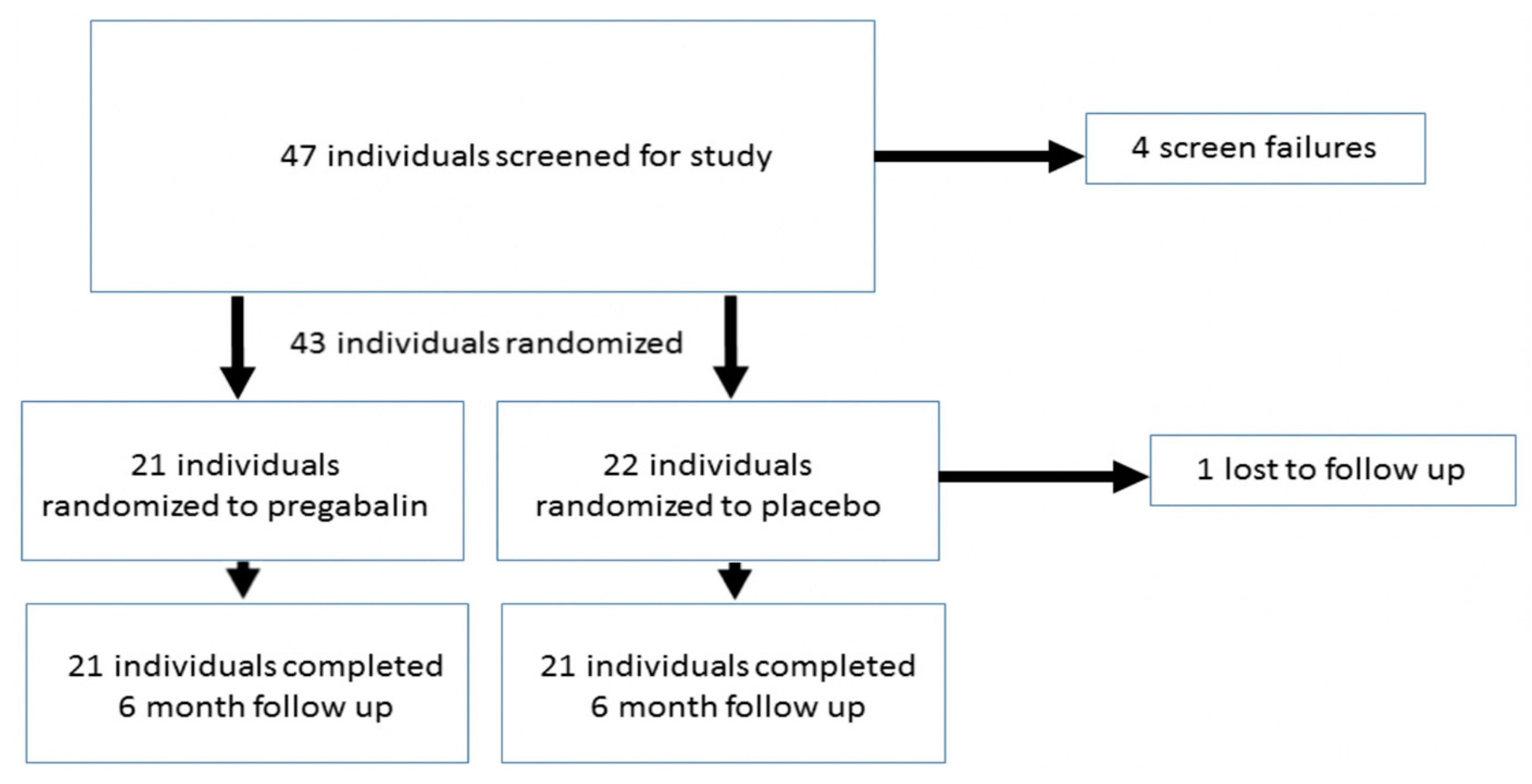
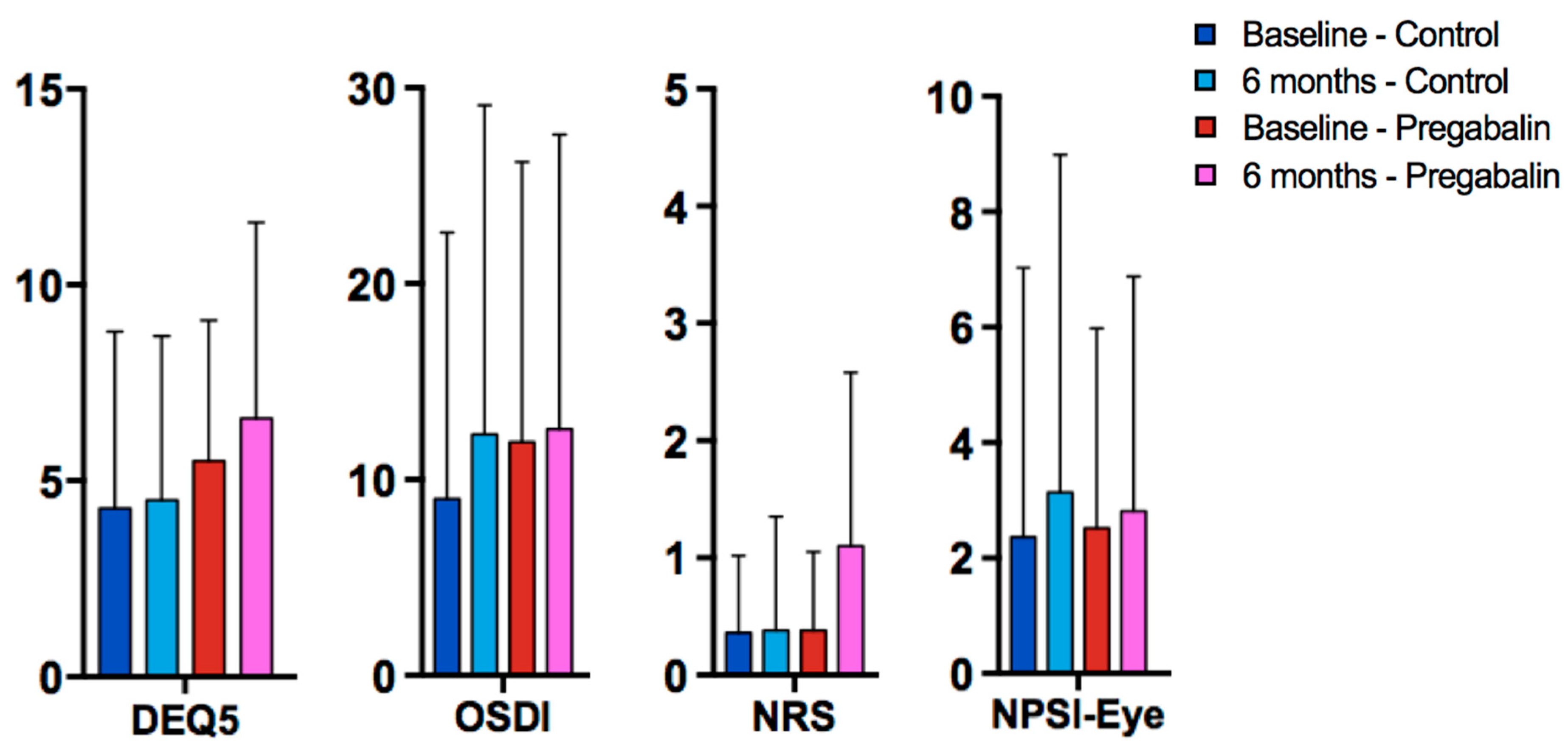
Purpose: Perioperative pregabalin administration has been found to reduce the risk of persistent pain after a variety of surgical procedures. However, this approach has not been tested in relation to eye surgery. As such, the purpose of this study was to evaluate whether perioperative pregabalin can reduce the presence of dry eye (DE) symptoms, including eye pain, six months after laser-assisted in situ keratomileusis (LASIK). Methods: Prospective, masked, randomized single-center pilot study. Patients were treated with either pregabalin (oral solution of pregabalin 150 mg twice daily, first dose prior to surgery, continued for a total of 28 doses over 14 days) or placebo solution. The primary outcome was dry eye symptoms as measured by the Dry Eye Questionnaire 5 (DEQ-5). Secondary outcome measures included pain-related eye symptoms. Results: In total, 43 individuals were enrolled in the study and randomized to pregabalin (n = 21) or placebo (n = 22). Of those, 42 individuals completed the final visit after six months of follow-up. Some differences were noted between the two groups at baseline, including a higher frequency of females in the pregabalin group. At 6-months, there were no significant differences in the percentage of patients with DE symptoms (DEQ5 ≥ 6, 57% vs. 33%, p = 0.14), DE symptom severity (DEQ5, 6.6 ± 5.0 vs. 4.5 ± 4.2, p = 0.14), ocular pain intensity (numerical rating scale, 1.10 ± 1.48 vs. 0.38 ± 0.97, p = 0.08), or neuropathic pain complaints (Neuropathic Pain Symptom Inventory-Eye, 2.81 ± 4.07 vs. 3.14 ± 5.85, p = 0.83) between the pregabalin and control groups. Ocular signs were likewise similar between the groups, and of note, did not correlate with DE symptoms. The strongest predictor of DE symptoms six months post-surgery was the presence of DE symptoms prior to surgery. Conclusions: Perioperative pregabalin did not reduce the frequency or severity of DE symptoms at a six month follow-up after LASIK in this small pilot study.
Keywords: dry eye symptoms; dry eye; ocular pain; pregabalin; refractive surgery; LASIK dry eye symptoms; dry eye; ocular pain; pregabalin; refractive surgery; LASIK