Evaluating Dry Eye Disease Subtypes Based on Whole-Area Lipid Layer Thickness Assessment



Abstract
1. Introduction
2. Methods
2.1. Study Design
2.2. Subjects
2.3. Sample Size
2.4. Tear Interferometry and Lipid Layer Thickness
2.5. Dry Eye Disease Assessments
2.6. Statistical Analysis
3. Results
3.1. Characteristics of Subjects
3.2. Inferior Corneal Lipid Layer Thickness and Dry Eye Assessments (Table 2)

| LLTinf Grade | Value | p-Value | |
|---|---|---|---|
| MGE (grades) | Low | 1.9 ± 0.8 | <0.001 (vs. M) * |
| Middle | 1.1 ± 0.9 | 1.000 (vs. H) | |
| High | 1.2 ± 0.9 | <0.001 (vs. L) * | |
| MQ (grades) | Low | 2.5 ± 0.8 | <0.001 (vs. M) * |
| Middle | 2.1 ± 0.9 | 1.000 (vs. H) | |
| High | 2.0 ± 0.9 | <0.001 (vs. L) * | |
| TMH (μm) | Low | 219.7 ± 39.3 | 0.005 (vs. M) * |
| Middle | 207.0 ± 48.9 | 1.000 (vs. H) | |
| High | 200.4 ± 41.8 | 0.001 (vs. L) * | |
| Schirmer (mm) | Low | 7.3 ± 4.9 | 0.467 (vs. M) |
| Middle | 6.7 ± 3.9 | 0.373 (vs. H) | |
| High | 6.3 ± 3.6 | 0.231 (vs. L) | |
| AD (%) | Low | 42.1 | 0.158 (vs. M) |
| Middle | 52.3 | 0.807 (vs. H) | |
| High | 57.4 | 0.015 (vs. L) * | |
| TBUPs † (%) | Low | 8.6/30.7/47.9/12.1/0.7 | <0.001 (vs. M) * |
| Middle | 19.4/20.9/35.3/23.6/0.8 | <0.001 (vs. H) * | |
| High | 10.6/34.3/23.2/28.3/4.6 | <0.001 (vs. L) * |
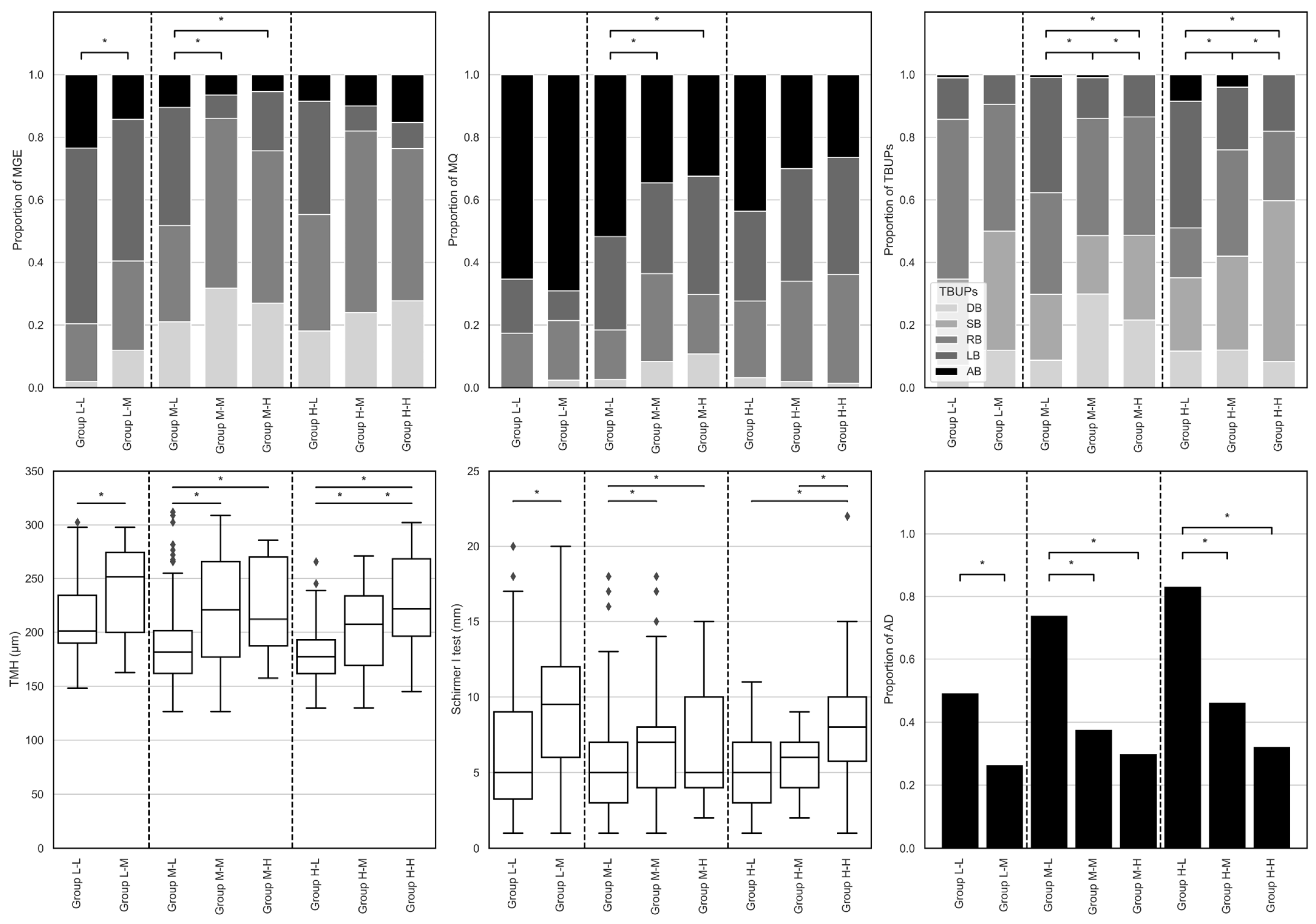
3.3. Subgroup Analysis of Superior Corneal Lipid Layer Thickness (Figure 1)

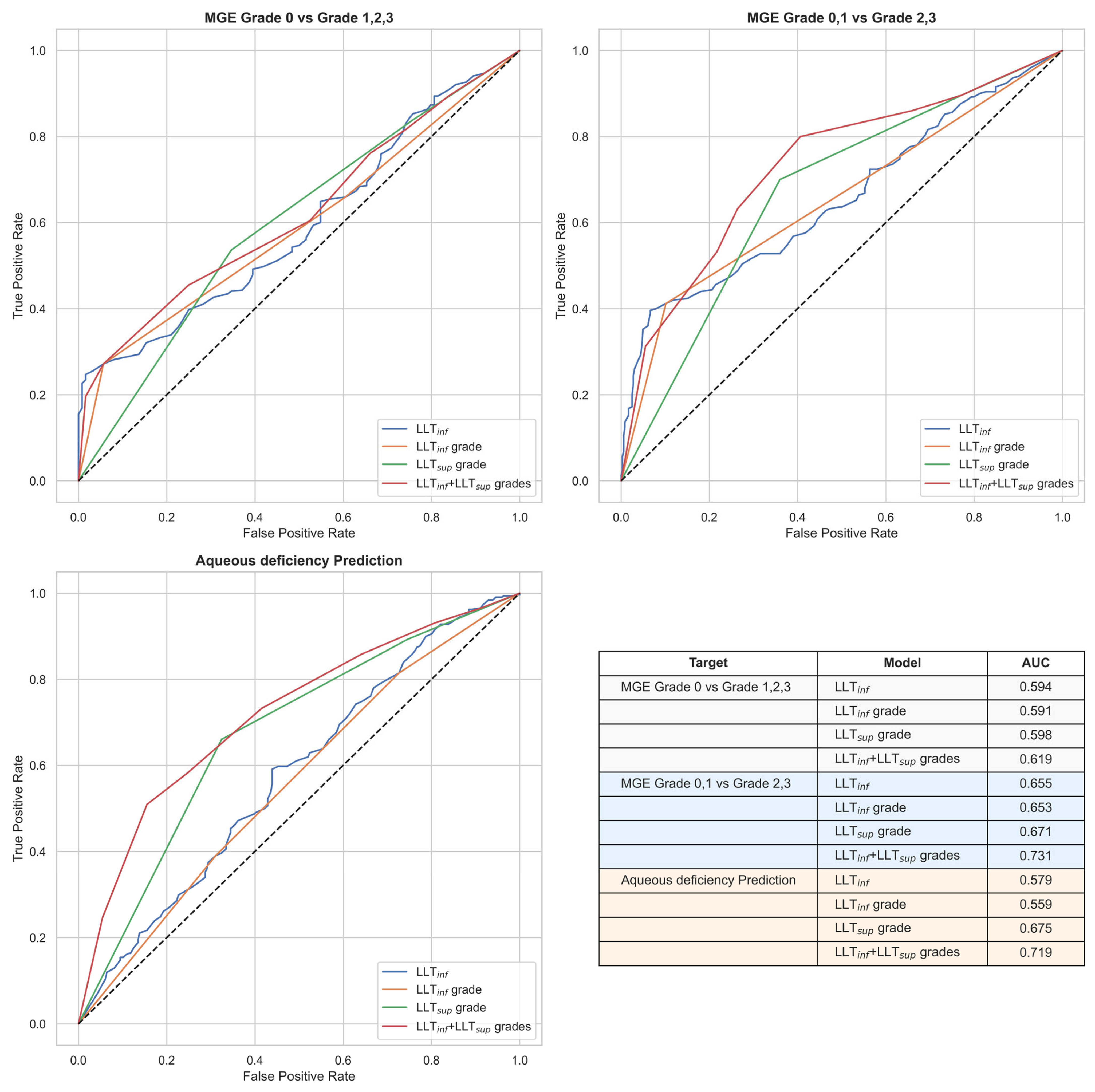
3.4. Performance of Combined LLTinf and LLTsup Assessment (Figure 2)

4. Discussion
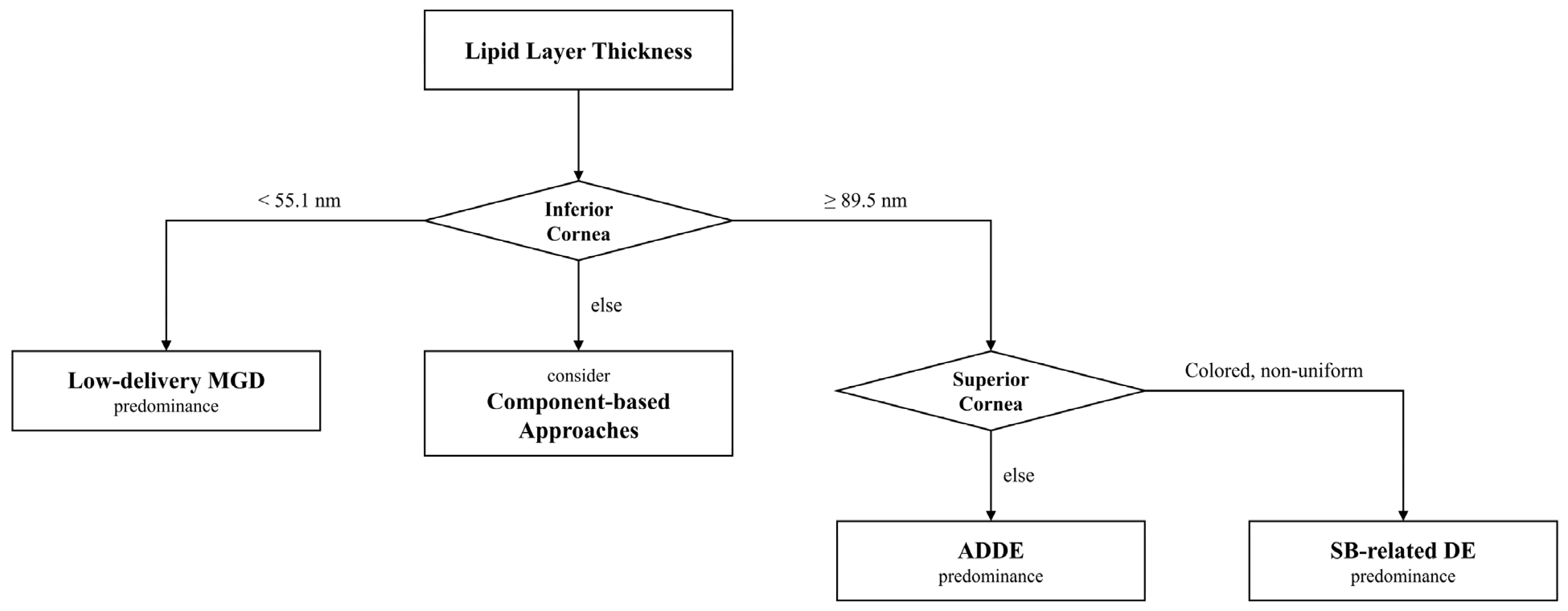
5. Conclusions
Supplementary Materials
Author Contributions
Funding
Institutional Review Board Statement
Informed Consent Statement
Data Availability Statement
Conflicts of Interest
References
- Wolffsohn, J.S.; Benítez-Del-Castillo, J.M.; Loya-Garcia, D.; Inomata, T.; Iyer, G.; Liang, L.; Pult, H.; Sabater, A.L.; Starr, C.E.; Vehof, J. TFOS DEWS III: Diagnostic methodology. Am. J. Ophthalmol. 2025, 279, 387–450. [Google Scholar] [CrossRef]
- Stapleton, F.; Argüeso, P.; Asbell, P.; Azar, D.; Bosworth, C.; Chen, W.; Ciolino, J.B.; Craig, J.P.; Gallar, J.; Galor, A. TFOS DEWS III: Digest. Am. J. Ophthalmol. 2025, 279, 451–553. [Google Scholar] [CrossRef]
- Tsubota, K.; Yokoi, N.; Shimazaki, J.; Watanabe, H.; Dogru, M.; Yamada, M.; Kinoshita, S.; Kim, H.-M.; Tchah, H.-W.; Hyon, J.Y. New perspectives on dry eye definition and diagnosis: A consensus report by the Asia Dry Eye Society. Ocul. Surf. 2017, 15, 65–76. [Google Scholar] [CrossRef]
- Yokoi, N.; Georgiev, G.A. Tear film–oriented diagnosis and tear film–oriented therapy for dry eye based on tear film dynamics. Investig. Ophthalmol. Vis. Sci. 2018, 59, DES13–DES22. [Google Scholar] [CrossRef]
- Arita, R.; Morishige, N.; Fujii, T.; Fukuoka, S.; Chung, J.L.; Seo, K.Y.; Itoh, K. Tear interferometric patterns reflect clinical tear dynamics in dry eye patients. Investig. Ophthalmol. Vis. Sci. 2016, 57, 3928–3934. [Google Scholar] [CrossRef]
- Bai, Y.; Ngo, W.; Khanal, S.; Nichols, J.J. Characterization of the thickness of the tear film lipid layer in meibomian gland dysfunction using high resolution optical microscopy. Ocul. Surf. 2022, 24, 34–39. [Google Scholar] [CrossRef]
- King-Smith, E.; Fink, B.; Hill, R.; Koelling, K.; Tiffany, J. The thickness of the tear film. Curr. Eye Res. 2004, 29, 357–368. [Google Scholar] [CrossRef]
- Goto, E.; Tseng, S.C. Kinetic analysis of tear interference images in aqueous tear deficiency dry eye before and after punctal occlusion. Investig. Ophthalmol. Vis. Sci. 2003, 44, 1897–1905. [Google Scholar] [CrossRef] [PubMed]
- Ahn, H.; Kim, S.Y.; Jun, I.; Kim, T.-I.; Seo, K.Y. Aqueous-Deficient Dry Eye Increases Lipid Layer Thickness Measured by Dynamic Tear Interferometry. Cornea 2025, 44, 679–684. [Google Scholar] [CrossRef] [PubMed]
- Zhao, Y.; Tan, C.L.S.; Tong, L. Intra-observer and inter-observer repeatability of ocular surface interferometer in measuring lipid layer thickness. BMC Ophthalmol. 2015, 15, 53. [Google Scholar] [CrossRef] [PubMed]
- Pflugfelder, S.; Nakhleh, L.; Kikukawa, Y.; Tanaka, S.; Kosugi, T. Non-invasive tear break-up detection with the Kowa DR-1α and its relationship to dry eye clinical severity. Int. J. Mol. Sci. 2022, 23, 14774. [Google Scholar] [CrossRef]
- Vigo, L.; Pellegrini, M.; Bernabei, F.; Carones, F.; Scorcia, V.; Giannaccare, G. Diagnostic performance of a novel noninvasive workup in the setting of dry eye disease. J. Ophthalmol. 2020, 2020, 5804123. [Google Scholar] [CrossRef] [PubMed]
- Wolffsohn, J.S.; Arita, R.; Chalmers, R.; Djalilian, A.; Dogru, M.; Dumbleton, K.; Gupta, P.K.; Karpecki, P.; Lazreg, S.; Pult, H. TFOS DEWS II Diagnostic methodology report. Ocul. Surf. 2017, 15, 539–574. [Google Scholar] [CrossRef] [PubMed]
- Ji, Y.W.; Seong, H.; Seo, J.G.; Park, S.Y.; Alotaibi, M.; Choi, M.; Nam, S.; Kim, T.-I.; Lee, H.K.; Seo, K.Y. Evaluation of dry eye subtypes and characteristics using conventional assessments and dynamic tear interferometry. Br. J. Ophthalmol. 2022, 106, 1648–1654. [Google Scholar] [CrossRef] [PubMed]
- Jun, I.; Kim, S.; Kim, H.; Kim, S.W.; Ji, Y.W.; Kim, K.P.; Lee, T.G.; Seo, K.Y. Evaluation of meibum lipid composition according to tear interferometric patterns: RRH: Meibum composition according to interferometric patterns. Am. J. Ophthalmol. 2022, 240, 37–50. [Google Scholar] [CrossRef]
- Hwang, H.; Jeon, H.-J.; Yow, K.C.; Hwang, H.S.; Chung, E. Image-based quantitative analysis of tear film lipid layer thickness for meibomian gland evaluation. BioMed. Eng. Online 2017, 16, 135. [Google Scholar] [CrossRef]
- Yokoi, N.; Takehisa, Y.; Kinoshita, S. Correlation of tear lipid layer interference patterns with the diagnosis and severity of dry eye. Am. J. Ophthalmol. 1996, 122, 818–824. [Google Scholar] [CrossRef]
- Schiffman, R.M.; Christianson, M.D.; Jacobsen, G.; Hirsch, J.D.; Reis, B.L. Reliability and validity of the ocular surface disease index. Arch. Ophthalmol. 2000, 118, 615–621. [Google Scholar] [CrossRef]
- Bandlitz, S.; Peter, B.; Pflugi, T.; Jaeger, K.; Anwar, A.; Bikhu, P.; Nosch, D.S.; Wolffsohn, J.S. Agreement and repeatability of four different devices to measure non-invasive tear breakup time (NIBUT). Contact Lens Anterior Eye 2020, 43, 507–511. [Google Scholar] [CrossRef]
- Lan, W.; Lin, L.; Yang, X.; Yu, M. Automatic noninvasive tear breakup time (TBUT) and conventional fluorescent TBUT. Optom. Vis. Sci. 2014, 91, 1412–1418. [Google Scholar] [CrossRef]
- Whitcher, J.P.; Shiboski, C.H.; Shiboski, S.C.; Heidenreich, A.M.; Kitagawa, K.; Zhang, S.; Hamann, S.; Larkin, G.; McNamara, N.A.; Greenspan, J.S. A simplified quantitative method for assessing keratoconjunctivitis sicca from the Sjögren’s Syndrome International Registry. Am. J. Ophthalmol. 2010, 149, 405–415. [Google Scholar] [CrossRef]
- Arriola-Villalobos, P.; Fernández-Vigo, J.I.; Díaz-Valle, D.; Peraza-Nieves, J.E.; Fernández-Pérez, C.; Benítez-del-Castillo, J.M. Assessment of lower tear meniscus measurements obtained with Keratograph and agreement with Fourier-domain optical-coherence tomography. Br. J. Ophthalmol. 2015, 99, 1120–1125. [Google Scholar] [CrossRef]
- Tomlinson, A.; Bron, A.J.; Korb, D.R.; Amano, S.; Paugh, J.R.; Pearce, E.I.; Yee, R.; Yokoi, N.; Arita, R.; Dogru, M. The international workshop on meibomian gland dysfunction: Report of the diagnosis subcommittee. Investig. Ophthalmol. Vis. Sci. 2011, 52, 2006–2049. [Google Scholar] [CrossRef] [PubMed]
- Kim, S.; Blackie, C.A.; Korb, D.R. Forceful meibomian gland expression with a standardized force of 8 PSI on patients with obstructive meibomian gland dysfunction. Investig. Ophthalmol. Vis. Sci. 2011, 52, 3819. [Google Scholar]
- Choi, M.; Han, S.J.; Ji, Y.W.; Choi, Y.J.; Jun, I.; Alotaibi, M.H.; Ko, B.Y.; Kim, E.K.; Kim, T.-i.; Nam, S.M. Meibum expressibility improvement as a therapeutic target of intense pulsed light treatment in meibomian gland dysfunction and its association with tear inflammatory cytokines. Sci. Rep. 2019, 9, 7648. [Google Scholar] [CrossRef] [PubMed]
- Lee, Y.; Hyon, J.Y.; Jeon, H.S. Characteristics of dry eye patients with thick tear film lipid layers evaluated by a LipiView II interferometer. Graefe’s Arch. Clin. Exp. Ophthalmol. 2021, 259, 1235–1241. [Google Scholar] [CrossRef] [PubMed]
- Jung, J.W.; Park, S.Y.; Kim, J.S.; Kim, E.K.; Seo, K.Y.; Kim, T.-i. Analysis of factors associated with the tear film lipid layer thickness in normal eyes and patients with dry eye syndrome. Investig. Ophthalmol. Vis. Sci. 2016, 57, 4076–4083. [Google Scholar] [CrossRef]
- Arita, R.; Morishige, N.; Koh, S.; Shirakawa, R.; Kawashima, M.; Sakimoto, T.; Suzuki, T.; Tsubota, K. Increased tear fluid production as a compensatory response to meibomian gland loss: A multicenter cross-sectional study. Ophthalmology 2015, 122, 925–933. [Google Scholar] [CrossRef]
- Yokoi, N.; Georgiev, G.A.; Kato, H.; Komuro, A.; Sonomura, Y.; Sotozono, C.; Tsubota, K.; Kinoshita, S. Classification of fluorescein breakup patterns: A novel method of differential diagnosis for dry eye. Am. J. Ophthalmol. 2017, 180, 72–85. [Google Scholar] [CrossRef]
- Toda, I.; Shimazaki, J.; Tsubota, K. Dry eye with only decreased tear break-up time is sometimes associated with allergic conjunctivitis. Ophthalmology 1995, 102, 302–309. [Google Scholar] [CrossRef]

| Characteristics | Units | Values |
|---|---|---|
| Age | years, Mean ± SD | 49.5 ± 15.4 |
| Sex | N (% of female) | 478 (77.9%) |
| Conventional DED assessments | ||
| OSDI | scores, Mean ± SD | 28.7 ± 15.6 |
| TBUT | seconds, Mean ± SD | 3.5 ± 2.5 |
| CSS | scores, Mean ± SD | 0.5 ± 1.4 |
| Aqueous assessments | ||
| TMH | μm, Mean ± SD | 207.6 ± 44.9 |
| Schirmer I test | mm, Mean ± SD | 6.7 ± 4.1 |
| Aqueous deficiency | N (%) | 318 (51.8%) |
| Lipid assessments | ||
| MGE | grades, Mean ± SD | 1.3 ± 0.9 |
| Grade 0 (none) | N (%) | 124 (20.2%) |
| Grade 1 (minimal to mild) | N (%) | 240 (39.1%) |
| Grade 2 (moderate) | N (%) | 176 (28.7%) |
| Grade 3 (severe) | N (%) | 74 (12.0%) |
| MQ | grades, Mean ± SD | 2.1 ± 0.9 |
| Grade 0 (clear) | N (%) | 22 (3.6%) |
| Grade 1 (cloudy) | N (%) | 144 (23.5%) |
| Grade 2 (cloudy particulate) | N (%) | 172 (28.0%) |
| Grade 3 (toothpaste or no secretion) | N (%) | 276 (45.0%) |
| Lid margin abnormality | ||
| Plugging | N (%) | 135 (22.0%) |
| Telangiectasia | N (%) | 117 (19.1%) |
| Anterior shift of MCJ | N (%) | 202 (32.9%) |
| Notching | N (%) | 120 (19.5%) |
| Epithelial desquamation | N (%) | 157 (25.6%) |
| Tear interferometric lipid layer thickness | ||
| LLTinf | nm, Mean ± SD | 76.9 ± 26.5 |
| Grade L (LLTinf < 55.1 nm) | N (%) | 140 (22.8%) |
| Grade M (55.1 nm ≤ LLTinf < 89.5 nm) | N (%) | 258 (42.0%) |
| Grade H (LLTinf ≥ 89.5 nm) | N (%) | 216 (35.2%) |
| LLTsup grade | ||
| Grade L (dark, uniform) | N (%) | 330 (49.8%) |
| Grade M (gray, uniform and non-uniform) | N (%) | 188 (32.4%) |
| Grade H (colored, non-uniform) | N (%) | 96 (17.8%) |
| Fluorescence tear break-up patterns | ||
| Dimple break | N (%) | 85 (13.8%) |
| Spot break | N (%) | 171 (27.9%) |
| Random break | N (%) | 206 (33.6%) |
| Line break | N (%) | 139 (22.6%) |
| Area break | N (%) | 13 (2.1%) |
Disclaimer/Publisher’s Note: The statements, opinions and data contained in all publications are solely those of the individual author(s) and contributor(s) and not of MDPI and/or the editor(s). MDPI and/or the editor(s) disclaim responsibility for any injury to people or property resulting from any ideas, methods, instructions or products referred to in the content. |
© 2026 by the authors. Licensee MDPI, Basel, Switzerland. This article is an open access article distributed under the terms and conditions of the Creative Commons Attribution (CC BY) license.
Share and Cite
Ahn, H.; Choi, Y.J.; Jun, I.; Kim, T.-i.; Seo, K.Y. Evaluating Dry Eye Disease Subtypes Based on Whole-Area Lipid Layer Thickness Assessment. J. Clin. Med. 2026, 15, 3553. https://doi.org/10.3390/jcm15093553
Ahn H, Choi YJ, Jun I, Kim T-i, Seo KY. Evaluating Dry Eye Disease Subtypes Based on Whole-Area Lipid Layer Thickness Assessment. Journal of Clinical Medicine. 2026; 15(9):3553. https://doi.org/10.3390/jcm15093553
Chicago/Turabian StyleAhn, Hyunmin, Young Joon Choi, Ikhyun Jun, Tae-im Kim, and Kyoung Yul Seo. 2026. "Evaluating Dry Eye Disease Subtypes Based on Whole-Area Lipid Layer Thickness Assessment" Journal of Clinical Medicine 15, no. 9: 3553. https://doi.org/10.3390/jcm15093553
APA StyleAhn, H., Choi, Y. J., Jun, I., Kim, T.-i., & Seo, K. Y. (2026). Evaluating Dry Eye Disease Subtypes Based on Whole-Area Lipid Layer Thickness Assessment. Journal of Clinical Medicine, 15(9), 3553. https://doi.org/10.3390/jcm15093553