Phenotypic Heterogeneity in Titinopathies with Peripheral Nerve Involvement in Pediatric Age: Two Case Reports

 , , , , , , ,
Abstract
1. Introduction
2. Materials and Methods
2.1. Genetic Testing and Variant Classification
2.2. Neurophysiological Assessment
2.3. Ethical Statement
3. Results
3.1. Clinical Description
3.1.1. Case Report 1
3.1.2. Case Report 2
4. Discussion
5. Conclusions
Author Contributions
Funding
Institutional Review Board Statement
Informed Consent Statement
Data Availability Statement
Acknowledgments
Conflicts of Interest
References
- Granzier, H.; Labeit, S. Structure-function relations of the giant elastic protein titin in striated and smooth muscle cells. Muscle Nerve 2007, 36, 740–755. [Google Scholar] [CrossRef]
- Kontrogianni-Konstantopoulos, A.; Ackermann, M.A.; Bowman, A.L.; Yap, S.V.; Bloch, R.J. Muscle giants: Molecular scaffolds in sarcomerogenesis. Physiol. Rev. 2009, 89, 1217–1267. [Google Scholar] [CrossRef] [PubMed]
- Linke, W.A.; Stockmeier, M.R.; Ivemeyer, M.; Hosser, H.; Mundel, P. Characterizing titin’s I-band Ig domain region as an entropic spring. J. Cell Sci. 1998, 111, 1567–1574. [Google Scholar] [CrossRef]
- Labeit, S.; Lahmers, S.; Burkart, C.; Fong, C.; McNabb, M.; Witt, S.; Witt, C.; Labeit, D.; Granzier, H. Expression of distinct classes of titin isoforms in striated and smooth muscles by alternative splicing, and their conserved interaction with filamins. J. Mol. Biol. 2006, 362, 664–681. [Google Scholar] [CrossRef]
- Herman, D.S.; Lam, L.; Taylor, M.R.G.; Wang, L.; Teekakirikul, P.; Christodoulou, D.; Conner, L.; DePalma, S.R.; McDonough, B.; Sparks, E.; et al. Truncations of titin causing dilated cardiomyopathy. N. Engl. J. Med. 2012, 366, 619–628. [Google Scholar] [CrossRef]
- Gerull, B.; Gramlich, M.; Atherton, J.; McNabb, M.; Trombitás, K.; Sasse-Klaassen, S.; Seidman, J.G.; Seidman, C.; Granzier, H.; Labeit, S.; et al. Mutations of TTN, encoding the giant muscle filament titin, cause familial dilated cardiomyopathy. Nat. Genet. 2002, 30, 201–204. [Google Scholar] [CrossRef]
- Jacoby, N.; Anziska, Y. A practical approach to diagnosing peripheral neuropathies. Semin. Neurol. 2025, 45, 4–12. [Google Scholar] [CrossRef] [PubMed]
- Savarese, M.; Vihola, A.; Oates, E.C.; Barresi, R.; Fiorillo, C.; Tasca, G.; Jokela, M.; Sarkozy, A.; Luo, S.; Díaz-Manera, J.; et al. Genotype-phenotype correlations in recessive titinopathies. Genet. Med. 2020, 22, 2029–2040. [Google Scholar] [CrossRef]
- Oates, E.C.; Jones, K.J.; Donkervoort, S.; Charlton, A.; Brammah, S.; Smith, J.E., 3rd; Ware, J.S.; Yau, K.S.; Swanson, L.C.; Whiffin, N.; et al. Congenital Titinopathy: Comprehensive characterization and pathogenic insights. Ann. Neurol. 2018, 83, 1105–1124. [Google Scholar] [CrossRef] [PubMed]
- Savarese, M.; Sarparanta, J.; Vihola, A.; Udd, B.; Hackman, P. Increasing role of titin mutations in neuromuscular disorders. J. Neuromuscul. Dis. 2016, 3, 293–308. [Google Scholar] [CrossRef]
- Richards, S.; Aziz, N.; Bale, S.; Bick, D.; Das, S.; Gastier-Foster, J.; Grody, W.W.; Hegde, M.; Lyon, E.; Spector, E.; et al. Standards and guidelines for the interpretation of sequence variants: A joint consensus recommendation of the American College of Medical Genetics and Genomics and the Association for Molecular Pathology. Genet. Med. 2015, 17, 405–424. [Google Scholar] [CrossRef]
- Korinthenberg, R.; Trollmann, R.; Plecko, B.; Stettner, G.M.; Blankenburg, M.; Weis, J.; Schoser, B.; Müller-Felber, W.; Lochbuehler, N.; Hahn, G.; et al. Differential Diagnosis of Acquired and Hereditary Neuropathies in Children and Adolescents-Consensus-Based Practice Guidelines. Children 2021, 8, 687. [Google Scholar] [CrossRef] [PubMed]
- Pérez-Vidarte, F.; Estévez-Arias, B.; Matalonga, L.; Yubero, D.; Codina, A.; Ortez, C.; Medina, J.; DeSena DeCabo, L.; Carrera-García, L.; Expósito-Escudero, J.; et al. Fetal Akinesia/Hypokinesia and Arthrogryposis of Neuromuscular Origin: Etiologic Groups, Genetics, and Phenotypic Spectrum. Ann. Clin. Transl. Neurol. 2025, 12, 1528–1547. [Google Scholar] [CrossRef]
- Pollazzon, M.; Suominen, T.; Penttilä, S.; Malandrini, A.; Carluccio, M.A.; Mondelli, M.; Marozza, A.; Federico, A.; Renieri, A.; Hackman, P.; et al. The first Italian family with tibial muscular dystrophy caused by a novel titin mutation. J. Neurol. 2010, 257, 575–579. [Google Scholar] [CrossRef]
- Bugiardini, E.; Morrow, J.M.; Shah, S.; Wood, C.L.; Lynch, D.S.; Pitmann, A.M.; Reilly, M.M.; Houlden, H.; Matthews, E.; Parton, M.; et al. The Diagnostic Value of MRI Pattern Recognition in Distal Myopathies. Front. Neurol. 2018, 9, 456. [Google Scholar] [CrossRef]
- Cameron, B.; Torres-Hernandez, L.; Montague, V.L.; Lewis, K.A.; Smith, H.; Fox, J.; Guo, X.; Kalb, R.G.; George, L. Titin is a nucleolar protein in neurons. Res. Sq. 2024, preprint. [Google Scholar] [CrossRef]
- Jovicic, A.; Mertens, J.; Boeynaems, S.; Bogaert, E.; Chai, N.; Yamada, S.B.; Paul, J.W., 3rd; Sun, S.; Herdy, J.R.; Bieri, G.; et al. Modifiers of C9orf72 dipeptide repeat toxicity connect nucleocytoplasmic transport defects to FTD/ALS. Nat. Neurosci. 2015, 18, 1226–1229. [Google Scholar] [CrossRef]
- Kwon, I.; Xiang, S.; Kato, M.; Wu, L.; Theodoropoulos, P.; Wang, T.; Kim, J.; Yun, J.; Xie, Y.; McKnight, S.L. Poly-dipeptides encoded by the C9orf72 repeats bind nucleoli, impede RNA biogenesis, and kill cells. Science 2014, 345, 1139–1145. [Google Scholar] [CrossRef]
- Haeusler, A.R.; Donnelly, C.J.; Periz, G.; Simko, E.A.; Shaw, P.G.; Kim, M.S.; Maragakis, N.J.; Troncoso, J.C.; Pandey, A.; Sattler, R.; et al. C9orf72 nucleotide repeat structures initiate molecular cascades of disease. Nature 2014, 507, 195–200. [Google Scholar] [CrossRef] [PubMed]
- Aladesuyi Arogundade, O.; Nguyen, S.; Leung, R.; Wainio, D.; Rodriguez, M.; Ravits, J. Nucleolar stress in C9orf72 and sporadic ALS spinal motor neurons precedes TDP-43 mislocalization. Acta Neuropathol. Commun. 2021, 9, 26. [Google Scholar] [CrossRef]
- Astier, C.; Raynaud, F.; Lebart, M.C.; Roustan, C.; Benyamin, Y. Binding of a native titin fragment to actin is regulated by PIP2. FEBS Lett. 1998, 429, 95–98. [Google Scholar] [CrossRef]
- Luo, Y.B.; Peng, Y.; Lu, Y.; Li, Q.; Duan, H.; Bi, F.; Yang, H. Expanding the Clinico-Genetic Spectrum of Myofibrillar Myopathy: Experience From a Chinese Neuromuscular Center. Front. Neurol. 2020, 11, 1014, Erratum in Front. Neurol. 2021, 11, 636981. https://doi.org/10.3389/fneur.2020.636981. [Google Scholar] [CrossRef]
- Pérez-Arzola, A.A.; Juárez-Melchor, D.; Crisanto-López, I.E.; Vera-Loaiza, A.; Hernández-Castañeda, Y.; Guzmán-Santiago, T.A.; Jiménez-Pérez, B.; Rodríguez-Hurtado, P.O.; Salazar-Bonilla, W. Distrofia muscular de cinturas y extremidades autosómica recesiva 10. Reporte de caso [Autosomal recessive limb-girdle muscular dystrophy-10. Case report]. Rev. Med. Inst. Mex. Seguro Soc. 2025, 63, e6447. (In Spanish) [Google Scholar] [CrossRef]
- Gaertner, A.; Bloebaum, J.; Brodehl, A.; Klauke, B.; Sielemann, K.; Kassner, A.; Fox, H.; Morshuis, M.; Tiesmeier, J.; Schulz, U.; et al. The combined human genotype of truncating TTN and RBM20 mutations is associated with severe and early onset of dilated cardiomyopathy. Genes 2021, 12, 883. [Google Scholar] [CrossRef]
- Van Goor, D.; Hyland, C.; Schaefer, A.W.; Forscher, P. The role of actin turnover in retrograde actin network flow in neuronal growth cones. PLoS ONE 2012, 7, e30959. [Google Scholar] [CrossRef]





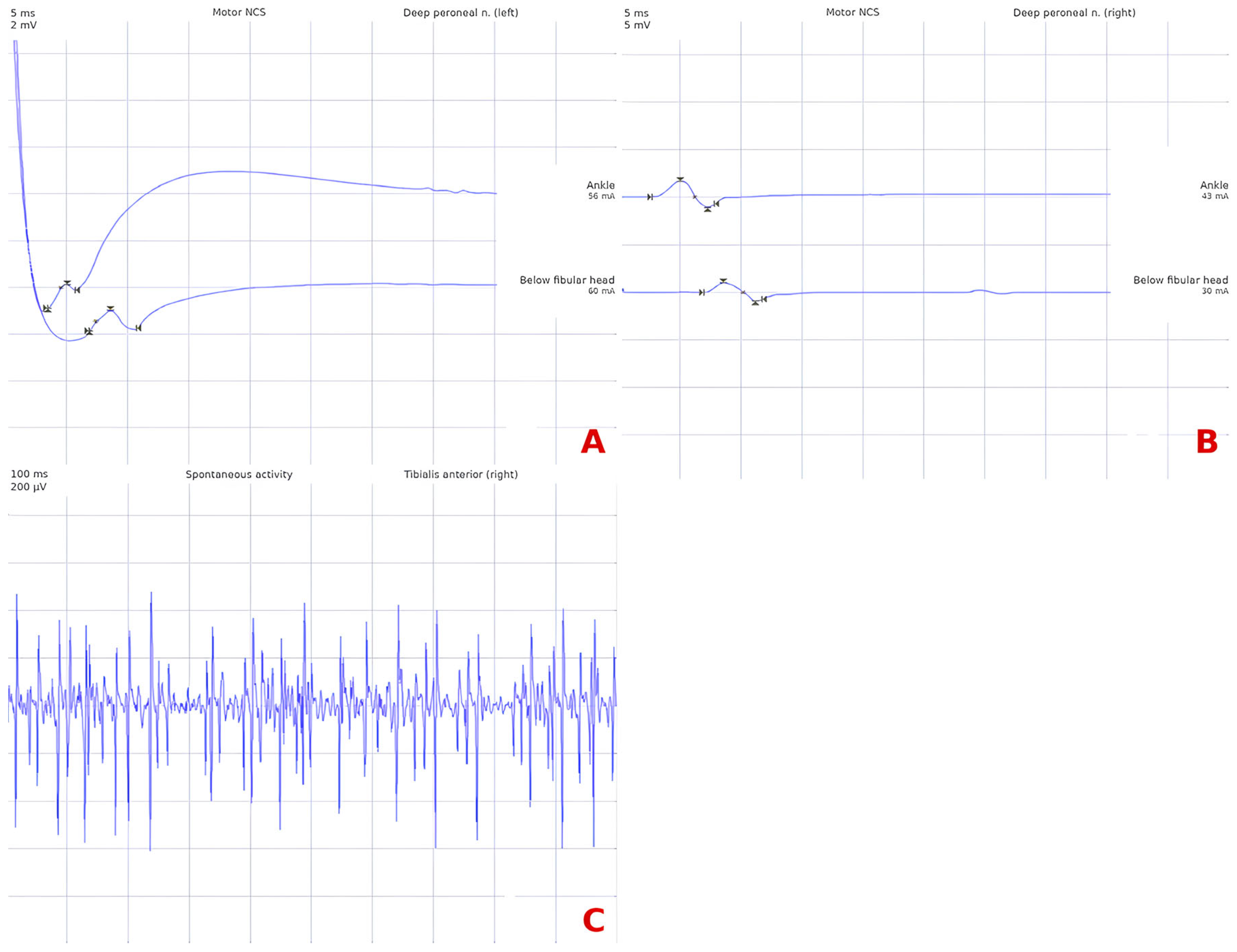
| Nerve | Site/Segment | Latency (ms) | Amplitude (mV) | Distance (mm) | CV (m/s) |
|---|---|---|---|---|---|
| Patient 1—reference values: CMAP > 3 mV; CV > 40 m/s; distal latency < 4.5 ms | |||||
| Left deep peroneal | Ankle—EDB | 3.5 | 1.0 * | — | — |
| Below fibular head—Ankle | 6.9 | 0.877 * | 200 | 58.9 | |
| Right deep peroneal | Ankle—EDB | 2.8 | 2.7 * | — | — |
| Below fibular head—Ankle | 7.0 | 2.0 * | 222 | 52.2 | |
| Patient 2—reference values: CMAP > 3 mV; CV > 40 m/s; distal latency < 4.5 ms | |||||
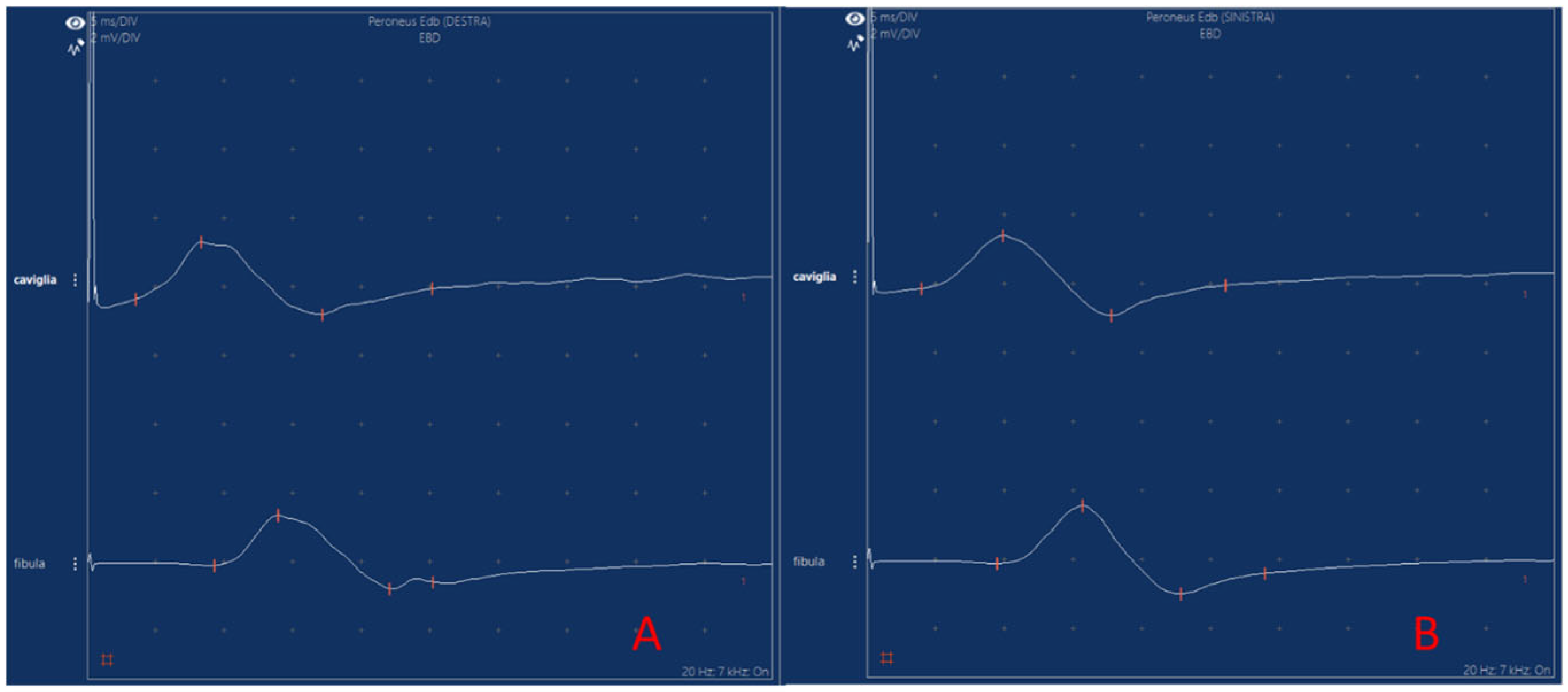
| Left deep peroneal | Ankle—EDB | 3.97 | 2.32 * | — | — |
| Fibula—Ankle | 9.46 | 2.57 * | 300 | 53.93 | |
| Right deep peroneal | Ankle—EDB | 3.56 | 2.12 * | — | — |
| Fibula—Ankle | 9.29 | 2.14 * | 300 | 52.36 | |
| Patient | Age/Sex | TTN Variant | Titin Region | Inheritance | Clinical Phenotype | NCS Findings | EMG Findings | Other Genes Excluded | Reference |
|---|---|---|---|---|---|---|---|---|---|
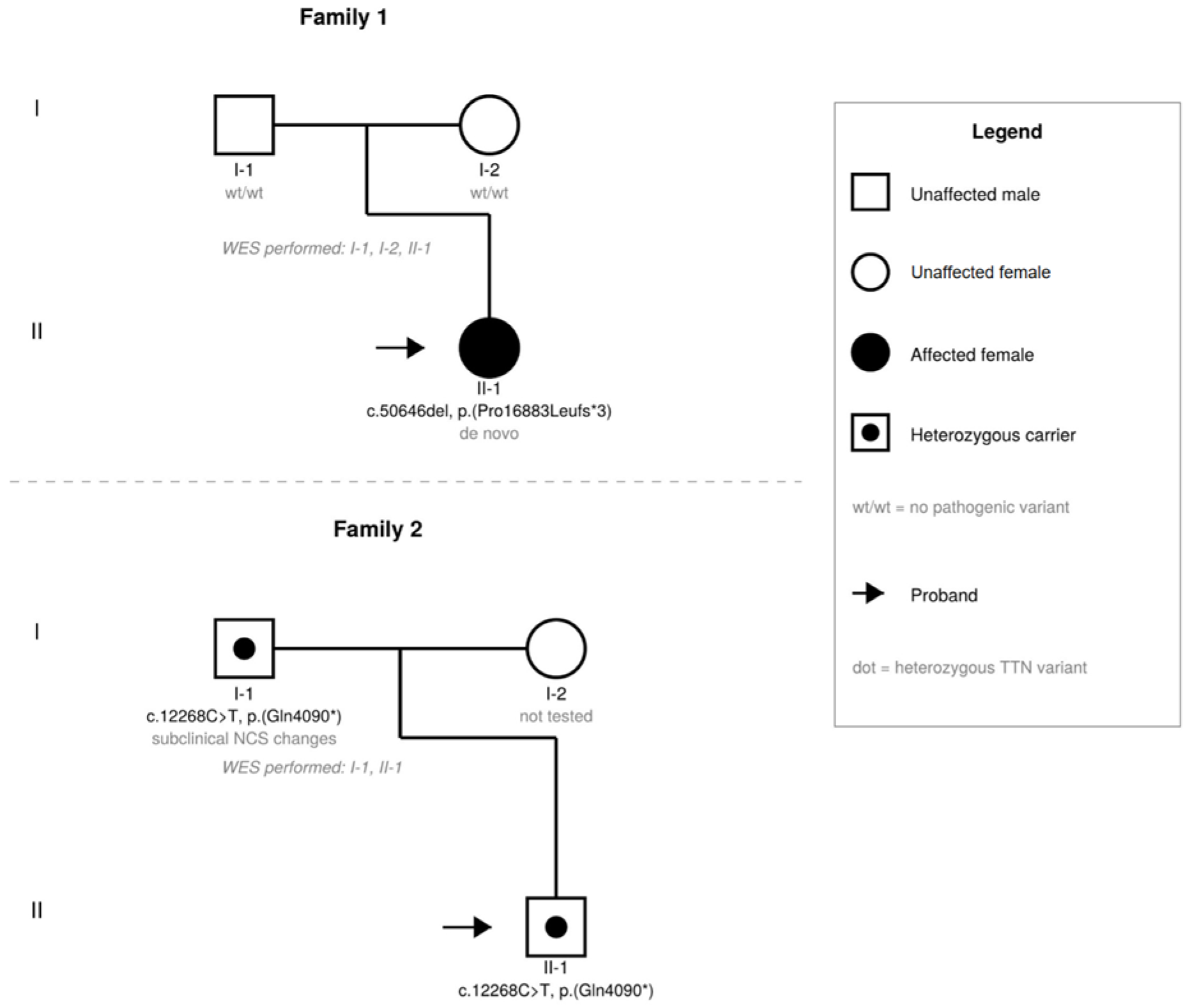
| Patient 1 | 10 y/F | NM_001256850.2: c.50646del, p.(Pro16883Leufs*3) | Distal I-band (PEVK region) | AD (de novo) | Bilateral pes cavus, anterior compartment atrophy, areflexia, steppage gait | Reduced CMAP bilateral deep peroneal nerve; preserved DL and CV | Myotonic-like discharges, low-amplitude short-duration MUAPs, reduced recruitment left TA; variable MUAPs simplified recruitment right TA | WES excluded other inherited neuropathy genes | Present series |
| Patient 2 | 8 y/M | NM_001256850.2: c.12268C>T, p.(Gln4090*) | Proximal I-band (N2B region) | AD (paternal) | Subclinical; intermittent lower limb pain. Father (same variant): unilateral peroneal axonal involvement and myopathic EMG changes | Proband: reduced CMAP bilateral deep peroneal nerve; preserved DL and CV. Father: reduced CMAP left deep peroneal nerve; preserved DL and CV | Proband: not performed. Father: low-amplitude short-duration MUAPs left TA (myopathic pattern) | WES excluded other inherited neuropathy genes | Present series |
| Case 3 | 42 y/M | NM_001267550.1: c.95134T>C, p.(Cys31712Arg), exon 344 | A-band (FnIII-119/A150 domain) | AD | HMERF: distal lower limb weakness, early respiratory failure | Reduced CMAP and SNAP amplitudes; preserved CV (axonal sensorimotor pattern) | Fibrillation potentials; large MUAPs | Not specified | Luo et al. [22] |
| Case 4 | 39 y/M | NM_001267550.1: c.107578C>T, p.(Gln37860*) + c.104269C>T, p.(Gln34767*) | Distal A-band/M-line | AR (compound het.) | LGMDR10: proximal asymmetric weakness, left leg atrophy, myalgia | Left femoral neuropathy (axonotmesis pattern); mixed axonal neuropathy upper limbs * | Myopathic pattern upper limbs | Not specified | Pérez-Arzola et al. [23] |
Disclaimer/Publisher’s Note: The statements, opinions and data contained in all publications are solely those of the individual author(s) and contributor(s) and not of MDPI and/or the editor(s). MDPI and/or the editor(s) disclaim responsibility for any injury to people or property resulting from any ideas, methods, instructions or products referred to in the content. |
© 2026 by the authors. Licensee MDPI, Basel, Switzerland. This article is an open access article distributed under the terms and conditions of the Creative Commons Attribution (CC BY) license.
Share and Cite
Cesaroni, C.A.; Pisanò, G.; Marton, M.; Caraffi, S.G.; Rizzi, S.; Pantani, A.; Ziveri, D.; Pollazzon, M.; Koskenvuo, J.; Frattini, D.; et al. Phenotypic Heterogeneity in Titinopathies with Peripheral Nerve Involvement in Pediatric Age: Two Case Reports. J. Clin. Med. 2026, 15, 3552. https://doi.org/10.3390/jcm15093552
Cesaroni CA, Pisanò G, Marton M, Caraffi SG, Rizzi S, Pantani A, Ziveri D, Pollazzon M, Koskenvuo J, Frattini D, et al. Phenotypic Heterogeneity in Titinopathies with Peripheral Nerve Involvement in Pediatric Age: Two Case Reports. Journal of Clinical Medicine. 2026; 15(9):3552. https://doi.org/10.3390/jcm15093552
Chicago/Turabian StyleCesaroni, Carlo Alberto, Giulia Pisanò, Massimiliano Marton, Stefano Giuseppe Caraffi, Susanna Rizzi, Agnese Pantani, Diletta Ziveri, Marzia Pollazzon, Juha Koskenvuo, Daniele Frattini, and et al. 2026. "Phenotypic Heterogeneity in Titinopathies with Peripheral Nerve Involvement in Pediatric Age: Two Case Reports" Journal of Clinical Medicine 15, no. 9: 3552. https://doi.org/10.3390/jcm15093552
APA StyleCesaroni, C. A., Pisanò, G., Marton, M., Caraffi, S. G., Rizzi, S., Pantani, A., Ziveri, D., Pollazzon, M., Koskenvuo, J., Frattini, D., & Fusco, C. (2026). Phenotypic Heterogeneity in Titinopathies with Peripheral Nerve Involvement in Pediatric Age: Two Case Reports. Journal of Clinical Medicine, 15(9), 3552. https://doi.org/10.3390/jcm15093552